Systematic Review

Systematic Literature Review of Human–AI Collaboration for Intelligent Construction

by
Juan Du
1,2,†,
Ruoqi Gu
1,†,
Xuan Tang
1,*,† and
Vijayan Sugumaran
3
1
SILC Business School, Shanghai University, Shanghai 201800, China
2
SHU-SUCG Research Centre for Building Industrialization, Shanghai University, Shanghai 201800, China
3
School of Business Administration, Oakland University, Rochester, MI 48309, USA
*
Author to whom correspondence should be addressed.
These authors contributed equally to this work.
Appl. Sci. 2026, 16(2), 597; https://doi.org/10.3390/app16020597
Submission received: 7 July 2025 / Revised: 5 December 2025 / Accepted: 12 December 2025 / Published: 7 January 2026
(This article belongs to the Special Issue AI from Industry 4.0 to Industry 5.0: Engineering for Social Change)

Abstract

Artificial intelligence (AI) technology, serving as an indispensable component within intelligent construction systems, has become a cornerstone for driving the digital and intelligent transformation of the construction industry. Although AI demonstrates autonomous decision-making capabilities in specific operational contexts, because of the dynamic and often unforeseeable nature of construction workflows, human–AI collaboration (HAIC) still dominates the operational paradigm. This study undertakes a systematic review of the prior research on human–AI collaboration in intelligent construction. Through a bibliometric search, scientometric analysis, and in-depth literature classification, 191 highly cited articles in the past five years, which are in the top 10% by citation count within the dataset (as of May 2025, based on Scopus, Google Scholar, and WOS), were screened, and four research streams were formed based on a co-citation analysis and clustering, namely, construction robotics, productivity and safety, intelligent algorithms and modelling, and factors related to construction workers. Finally, a three-dimensional knowledge framework covering the technical layer, application layer, and management layer was constructed. Through this comprehensive synthesis, the study developed a human–AI collaboration knowledge framework in the field of construction science that integrates technology, scenarios, and management dimensions, revealing the co-evolutionary path of artificial intelligence technology and industry digital transformation.

1. Introduction

The construction industry, as a key pillar of the global economy, plays an important role in contributing to the gross domestic product (GDP) of countries. According to the data for 2023, the annual spending on construction is approaching $12 trillion, or about 13% of the global GDP [1]. Despite its significant economic position, the construction industry continues to face challenges such as labor shortages, high safety risks, and low levels of automation [2]. In this context, the introduction of AI (artificial intelligence) is seen as a disruptive revolution in the intelligent construction industry. According to the definition of Kaplan and Haenlein, artificial intelligence is the capacity of a system to accurately interpret external information, acquire knowledge from it, and adjust flexibly to achieve specific goals [3]. As a rapidly developing field of research, artificial intelligence covers a wide range of topics in various construction scenarios [4], such as digital twins [5], building information modelling (BIM) [6], machine learning [7,8], artificial neural networks [9], interpretable artificial intelligence [10], autonomous construction systems for unmanned vibrating road rollers [11], wireless remote fault diagnosis systems [12], etc.
However, the adoption of AI techniques faces unique challenges in the construction industry sector. Firstly, AI techniques still face technical maturity challenges such as algorithmic robustness and high data labelling costs, and, thus, their application in the construction industry has yet to significantly improve construction efficiency [13,14]. Secondly, due to the more complex and variable tasks in the field of intelligent construction, the diversity of construction environments and the variability of participants can affect the current application of AI techniques [15]. Thirdly, it is difficult to cope with complex and dynamic contingencies in construction with AI techniques alone, and it is difficult to make context-aware decisions with techniques such as machine learning alone [16]. Therefore, human–machine collaboration is now considered a key solution for increasing the flexibility of AI applications in intelligent construction.
This paper defines human–AI collaboration (HAIC) as a cognitive partnership that extends beyond instrumental utility. In contrast to the interface-focused scope of human–computer interaction (HCI) and the physical co-manipulation emphasized in human–robot interaction (HRI), HAIC is characterized by shared and dynamic decision-making. This paper explains this concept through a framework anchored in levels of autonomy, collaboration modalities, and role allocation. Crucially, this approach distinguishes collaboration, which is defined by joint agency and interdependence, from interaction, which refers to discrete and isolated exchanges. While related terms have appeared in the literature on human–computer interaction and robotics [17], their application in the construction domain remains scarce and fragmented. Therefore, we explicitly use this term to reflect the need for a systemic framework tailored to the unique characteristics of the construction environment, which is currently underrepresented in existing AI-in-construction reviews. However, the research on human–AI collaboration in the field of intelligent construction still has significant research gaps. Firstly, the existing literature on the application of AI technology in the field of intelligent construction is relatively one-sided, and lacks collaborative research from multiple dimensions such as scenarios, methods, and processes. Secondly, although studies have explored human–machine collaboration issues in the construction field, such as human perceptual security and collaboration methods [15], most of these studies are limited to a single application scenario, such as BIM and computer vision, and lack a systematic summary of the lack of collaboration scenarios for the whole life cycle. Previous reviews of AI in construction exhibit a similar limitation, as the reviews primarily document technological developments while providing a limited consideration of the collaboration mechanisms, human factors, and decision-making processes from a HAIC perspective. Thirdly, these studies focus on perception and execution layer technologies [16], but there is a gap in the research on human–AI collaboration decision layer technologies.
In view of this, this study aims to distill the dominant research themes related to human–computer collaboration in intelligent construction from the relevant literature, and to identify the connections foci and gaps in the literature. The aim of this review is to comprehensively explore the current state of AI technology in the construction industry, analyze the challenges it faces, and suggest possible future research directions. A bibliometric search, a scientometric analysis, and an in-depth literature categorization produced four different research dimensions: construction robotics, productivity and safety, intelligent algorithms and models, and construction worker factors, and unsafe behaviors and risks. Based on these themes, these four research dimensions are discussed and analyzed from the perspectives of the existing technologies and collaborative approaches to AI-related construction robotics, construction productivity enhancement, applications and challenges of AI algorithms and technologies, and human cognition and behavior. Compared with the prior fragmented reviews, this study offers two distinct contributions. First, it develops a three-dimensional knowledge framework that systematically integrates the technical, application, and management layers of human–AI collaboration in intelligent construction, thereby advancing beyond the predominantly single-dimensional perspectives of the earlier studies. Second, by conducting a comparative synthesis across research themes, this review employs visual representations to highlight both the shared features and the unaddressed gaps in the existing literature, providing novel conceptual insights into the co-evolution of human–AI collaboration and the digital transformation of the construction industry.
By systematically generalizing and summarizing the AI-related literature in the intelligent construction field, this paper not only takes a two-dimensional view of the application of human–AI collaboration in the field of intelligent construction, but also looks for common research content from the perspective of the entire construction industry and provides insights into issues such as the adoption of AI technologies, human–AI collaboration, and technology integration, and provide in-depth analyses and recommendations. In addition, this paper helps to provide theoretical support and practical guidance for the transformation of automation and intelligence in the construction industry, establish a body of knowledge on human–AI collaboration in construction, and, thus, promote the sustainable development of the whole industry.

2. Research State and Methodology

2.1. The Current State of Research on Human Factors in Intelligent Construction

Although the presented reviews have explored AI techniques and human–AI collaboration in their research, a specific definition of human–AI collaboration in the field of intelligent construction has not yet been established. Similarly, the review by Pärn et al. [18] focuses primarily on physical human–robot interaction, such as mechanical coordination and co-manipulation, but does not encompass the cognitive and decision-level collaboration emphasized in our HAIC framework. Therefore, clarifying the conceptual boundaries of human–AI collaboration in the field of intelligent construction is necessary in order to define the scope of this review.
The current research has concluded that the application of human–AI collaboration in the intelligent construction industry heralds new working paradigms and challenges in the development and management of intelligent buildings. Onososen [19] outlines the current challenges faced by the intelligent construction industry; however, the study proposes that AI technology has a greater potential to improve productivity and occupational safety.
Based on these discussions, the aim of this study is to delve into and analyze the systemic challenges to the widespread adoption of AI techniques in the intelligent construction sector and the application paradigm of human–AI collaboration through a systematic review approach. To this end, this study will provide a quantitative and content analysis of the existing literature on AI techniques and human–AI collaboration in the field of intelligent construction. This includes the construction of an extensive historical literature database through bibliometric searches and scientometric analyses to obtain statistical data and determine the history of research on human–AI collaboration in the construction industry. In addition, this study will systematically summarize and analyze the research content of human–computer interaction in the construction field to reveal the research hotspots and trends of human–AI collaboration in the field of intelligent construction.
Through a systematic literature review, this paper aims to provide insights into the existing body of knowledge on human–AI collaboration research in the construction industry and to identify research challenges and future trends for the wider adoption and development of human–computer collaboration systems in the industry. This review not only contributes to a clearer understanding of the current state of research, but also provides theoretical support and practical guidance for the intelligent transformation of the construction industry. By establishing a structured body of knowledge on human–AI collaboration, it aims to inform the design and deployment of adaptive technologies and promote the sustainable development of the industry. This study will look for common research content from the perspective of the entire intelligent building industry and provide in-depth analysis and recommendations on the adoption of AI techniques, human–AI collaboration, and technology integration.

2.2. Research Methodology Framework

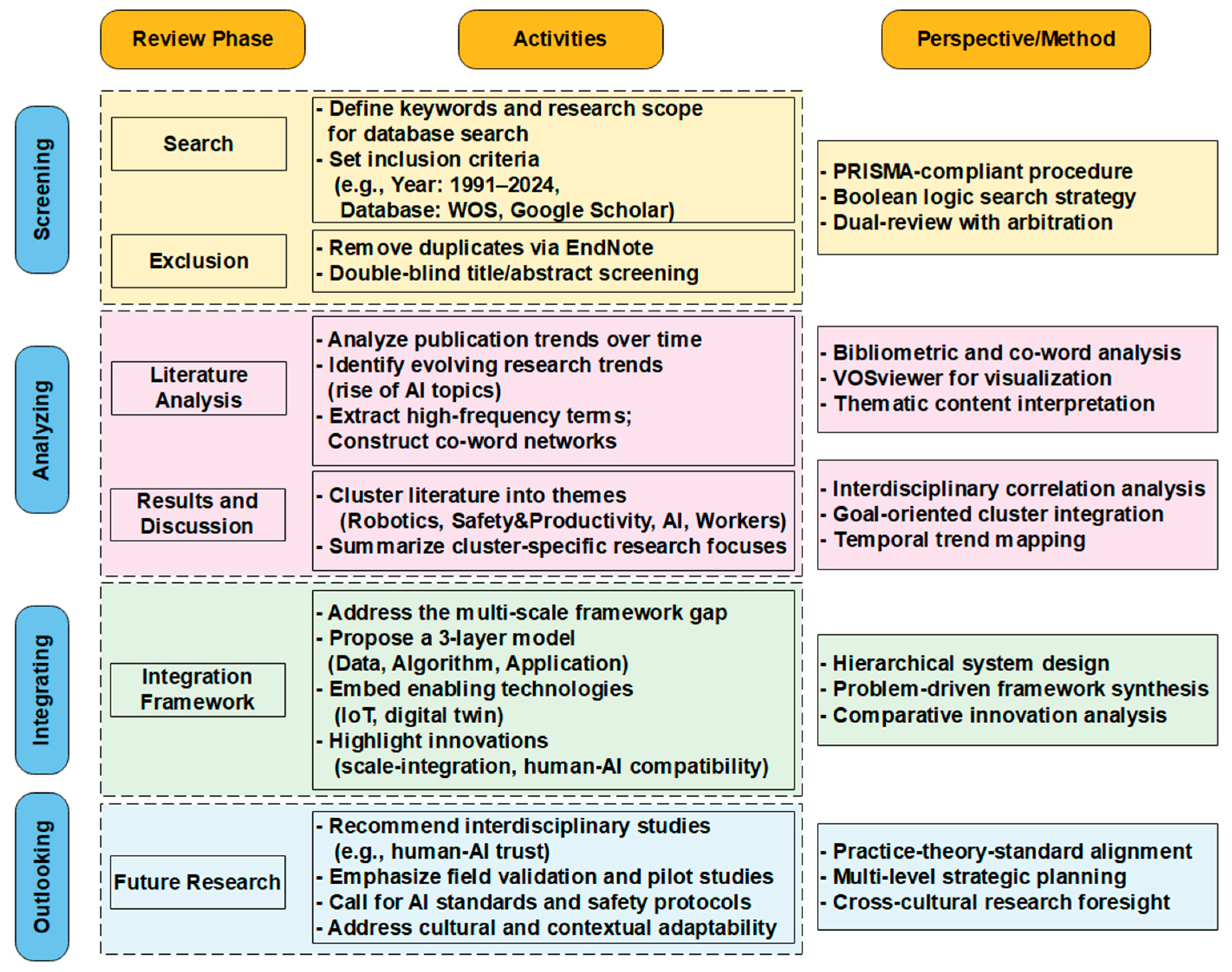
In order to comprehensively explore the existing research in the field of human–AI collaboration in intelligent construction, this study adopts a combination of bibliometric analyses and a systematic literature review methodology. This approach, which has been used extensively in previous research, brings together and complements findings from both quantitative and qualitative perspectives in order to provide compelling insights in the event of inconsistencies or contradictions in either analysis. To ensure methodological rigor and replicability, this paper strictly adheres to the PRISMA (Preferred Reporting Items for Systematic Reviews and Meta-Analyses) 2020 guidelines. An overview of the methods used is given in Figure 1. This review methodology first clarifies the research objectives of the paper, defines the concepts and boundaries of the research topic, and retrieves and screens the relevant research papers from the selected databases. Then, it performs a bibliometric analysis to form a co-occurrence and clustering map of the existing literature, and, finally, identifies the key research areas of the paper for a qualitative discussion in order to provide insights into the current state of the art of the research and, ultimately, to make recommendations for future research.
Figure 1 depicts the methodology used in this paper, which contains the following specific steps:
  • Step 1 (Screening): Construct a high-quality literature sample base based on keyword search, Boolean logic, and double-blind screening. This paper constructed the sample base following the PRISMA flow (the PRISMA checklist is provided as an Supplementary Materials): Starting with 301 acquired papers, we screened titles and abstracts to retain 191 selected papers. After a full-text eligibility assessment, 74 articles were finally included for an in-depth review [the systematic review method].
  • Step 2 (Analyzing): Adopt publication trend analysis, high-frequency word co-occurrence, and theme clustering methods to refine the research hotspots and theme framework. Moreover, this step involves mining and evaluating cross-correlations among themes, and merging similar clusters to outline the research evolution [the content analysis method].
  • Step 3 (Integrating): Design the data–algorithm–application three-level integration framework, embedding technology-driven elements such as IoT and digital twins [the concept summarization method]
  • Step 4 (Outlooking): Identify research gaps and propose future research directions such as interdisciplinary validation experiments, AI standards and norms, and cultural adaptation [the trend prediction method].

3. Literature Screening and Analysis

This section focuses on the screening process of the research for this review, and the keyword co-occurrence analysis identified for the search.

3.1. Literature Screening Process and Criteria

In this paper, we adopt the method of the systematic literature review and divide the keywords of the literature search into two fields, human–machine relationship and construction, and construct a search expression as shown in Table 1. Firstly, the search keywords were defined from the perspectives of intelligent construction and human–AI collaboration. Secondly, Scopus, Google Scholar, and Web of Science (WOS), which cover the fields of science, technology, and social sciences, were selected as the search databases; and the time range of the search was determined to be before May 2025. Scopus and Web of Science were chosen for their rigorous indexing in the engineering and management disciplines. Google Scholar was complementarily included to capture relevant ‘grey literature’ (e.g., preprints), ensuring coverage of the rapid AI advancements prior to formal indexing. The initial search yielded a corpus of 301 documents. To ensure the review focused on high-impact research, we prioritized ‘highly cited’ articles, defined as those falling within the top 10% citation percentile relative to their publication year within the retrieved dataset. Following the removal of duplicates and a rigorous screening process, 191 documents were finally selected, and the keywords of the documents were also outputted for a co-occurrence analysis using analysis tools such as Endnote 21.2, VOSviewer 1.6.20 (https://www.vosviewer.com/), and Citespace 6.3.R1 (https://citespace.podia.com/).
To enhance the transparency and reproducibility of the review process, we first anchored our search in leading journals and research groups in the field, including Automation in Construction, Journal of Construction Engineering and Management, and Advanced Engineering Informatics. This anchoring step ensured that domain-specific terminology and research frontiers were captured before defining the keyword set. Based on this mapping, we conducted iterative keyword refinement across three axes—technology, domain, and collaboration. The resulting Boolean search strings were tested and manually validated on the top 100 retrieved papers to confirm the thematic coverage and minimize the keyword bias.
Studies were included if they (1) were published between 2015 and May 2025; (2) were written in English; (3) appeared in peer-reviewed journals or as highly cited conference papers; and (4) explicitly addressed human–AI collaboration within the context of intelligent construction. Exclusion criteria included (1) non-English publications; (2) non-peer-reviewed material such as editorials, patents, and news articles; (3) studies focusing solely on AI algorithms without reference to human interaction or collaboration; and (4) duplicates across databases.

3.2. Literature Publication Trends Analysis

In this section, the literature data will be analyzed, including the research trends in the field, literature terminology, and publication year of the literature, as well as whether they produce accurate visualization results.
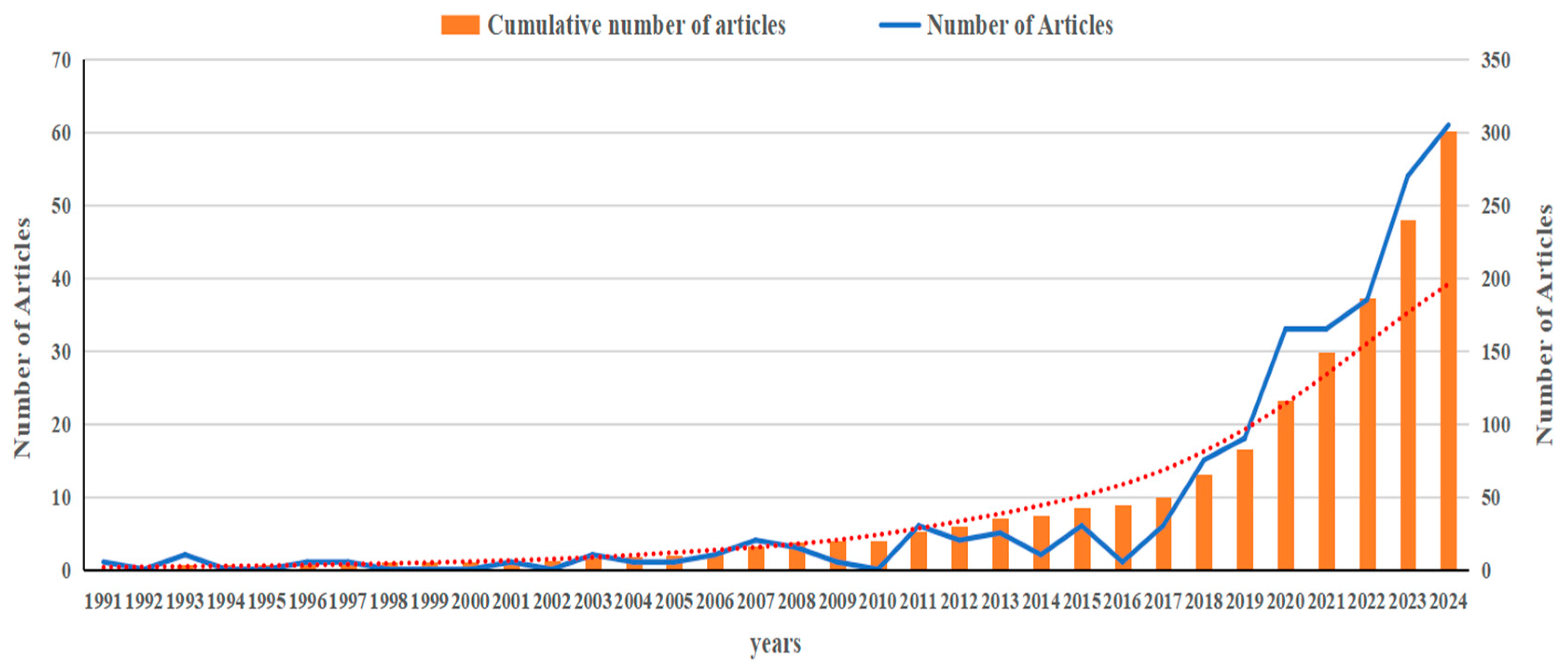
This section derives the process of human–AI collaboration technology development and the trend of existing human–AI collaboration research in the construction industry through a quantitative analysis [20]. Among them, the trend of the published literature related to human–AI collaboration in the construction field is shown in Figure 2. Since 1991, Takao Kakoto [21] and others have discussed construction engineering issues in tunnel automation applications and identified decision support concepts for selecting a shield machine and a suitable construction process under the given site conditions, which exemplifies the effectiveness of construction automation. Meanwhile, literature related to human–computer interaction has gradually appeared and increased, with a significant upward trend in 2010. Notably, since 2019, the number of journal articles related to human–AI collaboration has increased exponentially, reaching 61 in 2024. And, as of May 2025, there have been 33 articles on this topic. This rapid growth of human–AI collaboration research in the construction field demonstrates the unique opportunities for enhancing human–AI collaboration and presents a variety of challenges for future research.

3.3. Keyword Co-Occurrence Analysis

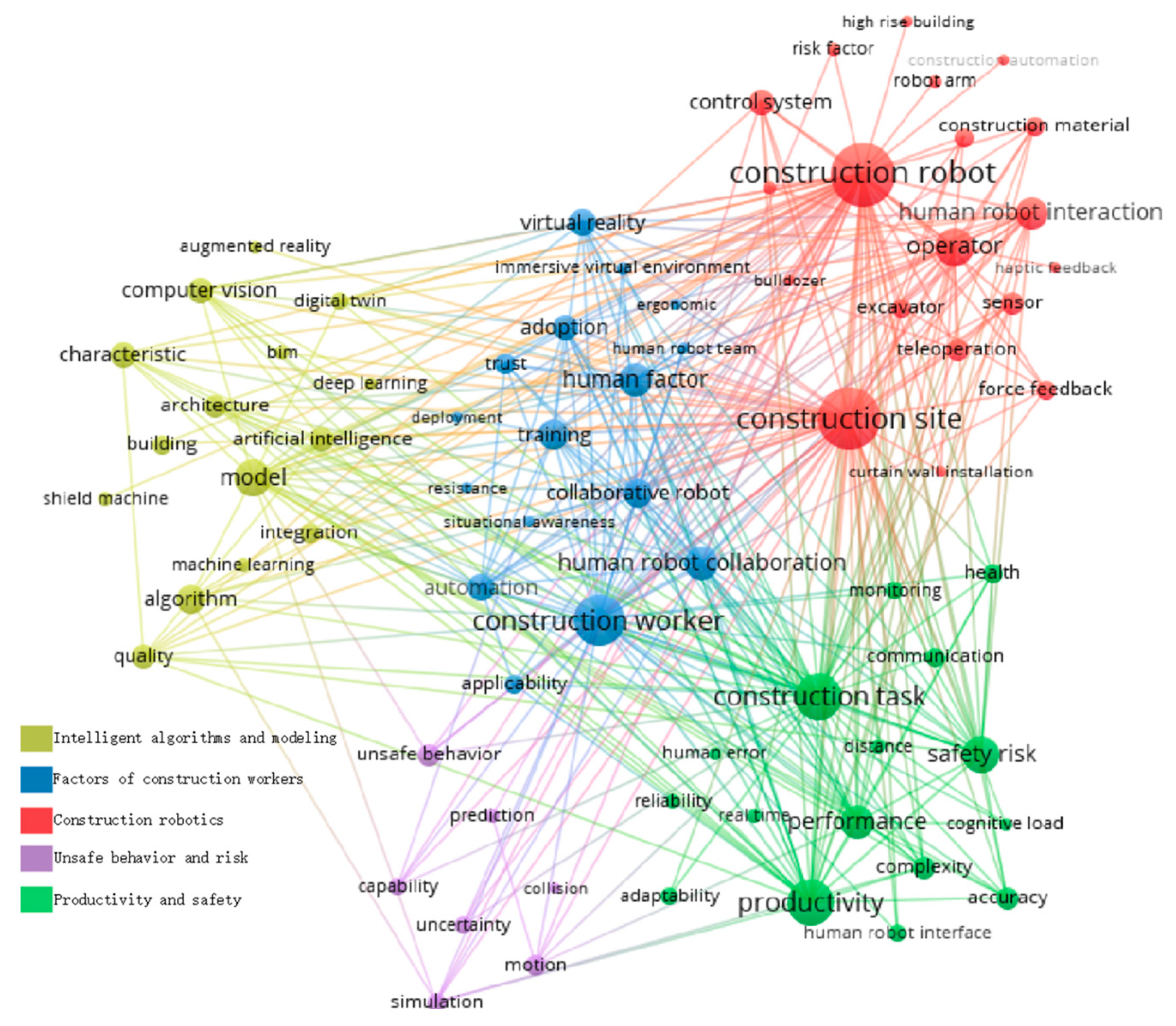
After a content analysis of the titles and abstracts of the 301 screened documents, 1158 high-frequency keywords were obtained, the keyword occurrence threshold was set to 5, words irrelevant to the topic of the review were removed, and synonyms were merged, and, finally, 70 high-frequency keywords were obtained, which could be divided into 5 clusters. The identified keywords were analyzed by clustering using VOSviewer with the ‘Association Strength’ normalization method. The minimum keyword occurrence threshold was set to 5, and the cluster resolution parameter was fixed at 1.0. Following the manual exclusion of irrelevant terms and the merging of synonyms, 70 high-frequency keywords were finally retained and categorized into 5 distinct clusters. The results of the cluster analysis are shown in Figure 3 and Table 2.
In Figure 3, the visual representation of the keywords further emphasizes their frequency of occurrence and cluster attribution. Larger nodes in the graph indicate a higher frequency of occurrence of the word, and the connecting line between nodes indicates a co-occurrence relationship between two keywords, with a wider connecting line indicating a stronger connection between the two keywords. The consistent color of the nodes in the network indicates the relevance of the keywords, which can be classified into the same category. Moreover, different color-coded clusters represent major thematic areas. A legend is included to enhance interpretability. By summarizing the commonalities of the keywords in each category, we obtain five themes for this paper, which are labelled as ‘construction robotics’, ‘productivity and safety’, ‘intelligent algorithms and modeling’, ‘construction workers’, and ‘unsafe behavior and risk’. Since ‘productivity and safety’ and ‘unsafe behavior and risk’ discuss similar areas, and both aim to improve the productivity of construction teams and the safety of construction workers, these two clusters will be merged into the ‘productivity and safety’ cluster in this paper in Section 4.

3.4. Timeline and Research Trend Analysis

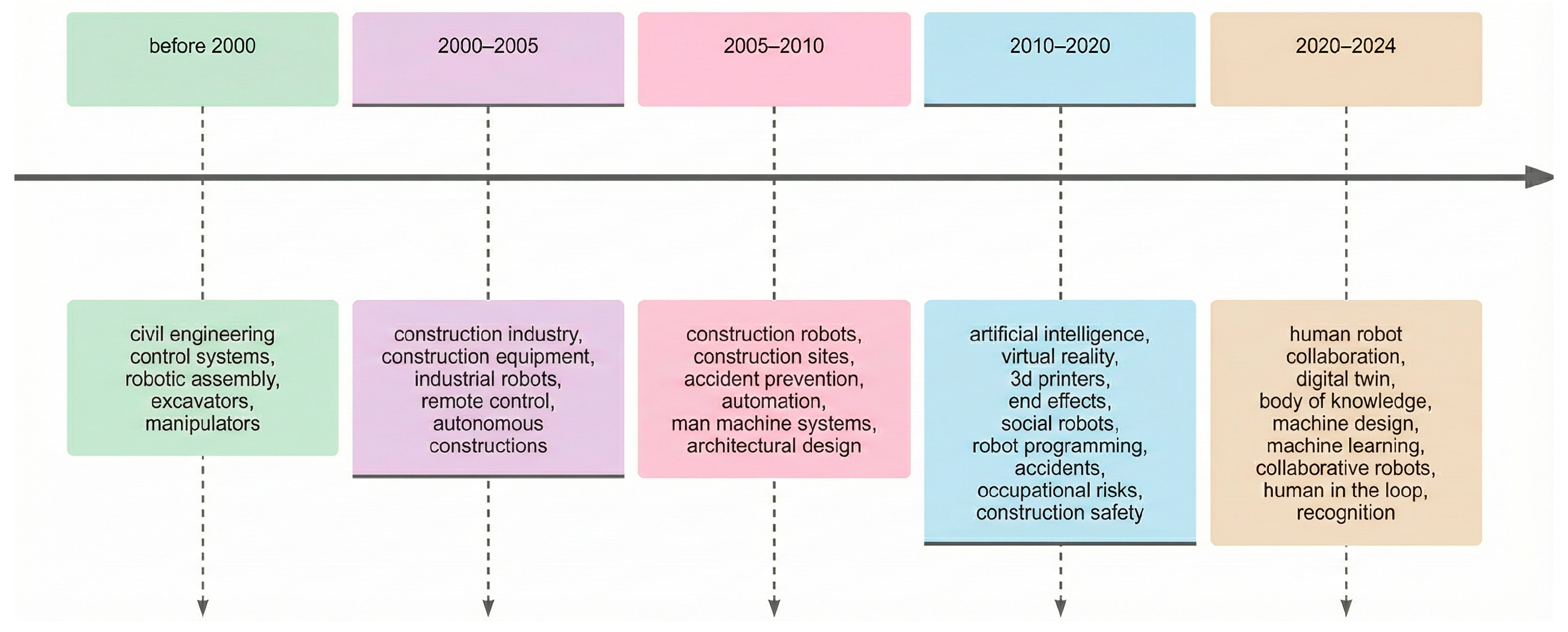
The time of keyword appearance can be used to understand the research status and trend changes in the field. The average year of the appearance of co-occurring keywords is derived from VOSviewer, and the co-occurring keyword timeline is obtained after dividing and summarizing the keywords according to the time period, as shown in Figure 4 and Table 3. The evolution of the timeline shows that the development in the field of intelligent construction shows a trend of transformation from single technology applications to integrated human–AI collaboration systems. The early research focused on basic technologies such as control systems and robot assembly, while, in recent years, it has focused more on more advanced applications such as human–AI collaboration, robot programming, and accident prevention, and this shift reflects that intelligent construction is gradually realizing the development from being technology-driven to application- and safety-oriented.
At the same time, based on the timing of the co-occurring keywords, it can also be seen that, with the massive emergence of AI techniques in 2010 as the key time point, the focus of attention in the field of intelligent construction has gradually changed from focusing on human-operated machines or systems to the current discussion of how to balance and optimize the interaction between humans and AI techniques. Three key terms describing the different stages of human–machine relationships appear in Figure 4: human–machine systems; artificial intelligence; and human–AI collaboration. Therefore, the promotion of human–AI collaboration has become a current main trend and occupies a central position in the research of intelligent construction.

4. Research Theme Analysis

4.1. Construction Robotics

Construction robotics, as a key technology to improve efficiency and safety in the construction industry, has received widespread attention in recent years. With the development of intelligent technology, construction robots have shown great potential in different types of construction tasks. In this part of the paper, the application of construction robots in different construction environments, the characteristics of human–robot co-operation, and the future development trend will be reviewed and analyzed.

4.1.1. Application of Construction Robots

The application of construction robots in actual construction shows a diversified trend. Through the wide application of mobile and stationary robots, as well as drones and shield machines, different types of construction robots have shown great advantages in various construction scenarios. Yuan et al. [22] studied in detail how modern tunnel-boring machines (TBMs) can solve the problems of tunnelling under complex geological conditions through automation technology, especially in the process of tool replacement, which reduces safety brought by the manual operation risk and time cost. Similarly, Lee et al. [23] investigated the Automated System for Curtain Wall Installation (ASCI), proposing the use of a combination of multi-degree-of-freedom manipulators and excavators to significantly improve the accuracy and construction speed of curtain wall installation. In large-scale infrastructure construction, Zhang et al. [13] presented an unmanned milling system applied in the construction of earth and rock dams, which greatly improved the construction quality and efficiency through fully automated driving and real-time positioning technology. In addition, in the research of Wang et al. [24], the wall mortar spraying robot, on the other hand, effectively improves the flexibility and adaptability of the construction site through an intelligent spraying system, and the unmanned motion tracking system proposed by Mettler et al. [25] also plays an important role in improving the monitoring and collaboration at the construction site, demonstrating the diversified application scenarios of robotics in the process of building construction.

4.1.2. Human–AI Collaboration Technology

In terms of human–AI collaboration, construction robots do not work independently, but work closely with workers to complete complex tasks. Nyokum and Tamut [26] provide a broad overview of AI applications in civil engineering, including areas where human–AI collaboration can improve efficiency, safety, and sustainability in construction processes. Lee et al. [27] proposed a remote operation technology for excavators, which allows workers to control the excavator from a safe distance, especially in hazardous construction environments, and significantly reduces the risk of injury or death. Wang et al. [28] designed a hybrid collaborative manufacturing system through architectural and operational optimization, proposing a control model that enhances the task allocation efficiency and real-time information sharing to adapt to complex production environments. AI-Sabbag et al. [29] explored a mixed-reality-based human–AI collaboration inspection system, which achieves real-time structural defect detection and analysis by combining a worker-worn mixed-reality helmet with a data acquisition platform for an on-site robot. Building upon this foundation, Al-Sabbag et al. [30] proposed a distributed collaborative inspection system, which allows synchronous interaction between on-site inspectors equipped with MR devices and remote personnel using VR interfaces, achieving real-time information exchange and collaborative decision-making across physical and virtual spaces. Virtual learning environments (VLEs) have also shown potential in enhancing worker–robot collaboration, and Nagatani et al. [31] described how to train workers by simulating real construction scenarios to help them work better with robots. In addition, the VR digital twin system studied by Wang, X. et al. [32] enhances workers’ global control of the construction site through virtual reality, further improving the efficiency and safety of human–AI collaboration.

4.1.3. Development Trend of Construction Robotics

The future development trend of construction robotics focuses on intelligence, collaboration, and integration. Cai et al. [33] proposed a robot-path-planning algorithm based on deep reinforcement learning, which ensures the efficient movement and safe operation of the robot on the construction site by predicting the dynamic behaviors of the workers. McLaughlin et al. [34], on the other hand, investigated a method for predicting potential risks during the construction process. Intelligent algorithms enable construction workers and robots to better cope with potentially hazardous situations. The semi-automated construction equipment proposed by Shan et al. [35] demonstrates the promise of robotics in large-scale construction equipment, while the collaborative robots of Burden et al. [36] lay the technological foundation for future collaborative work between workers and robots. In addition, Ma et al. [37] discussed the substitution potential of ‘machine for man’, pointing out that, although robots are expected to take on more and more work in construction, at this stage, the construction industry will still be in the stage of human–AI co-existence for a long time. Meanwhile, Yokoi et al. [38] further envisioned the application of humanoid robots in civil engineering and construction project sites, suggesting the possibility of humanoid robots replacing human operators in areas such as driving industrial vehicles outdoors.
Table 4 summarizes the key research papers on construction robotics for human–AI collaboration in intelligent construction, listing the authors of the articles, the research topics, and the methods applied. The table provides insights into various perspectives of researching and applying construction robotics, including the applications of construction robotics, human–AI collaboration technology, and construction robotics’ development trend.

4.2. Productivity and Safety

In the construction industry, productivity enhancement and worker safety in the workplace are two intertwined and critical issues. With the development of industrialization and the innovation of intelligent construction technologies, how to improve productivity while ensuring worker safety has become a common focus for both academia and industry. The content of this topic is related to the improvement of worker safety during the construction process and the construction efficiency of the project, aiming to explore the strategies and methods to achieve the double improvement of productivity and safety in the construction field.

4.2.1. Ergonomics

The construction site is a highly dynamic and complex working environment in which the application of ergonomics is essential for worker safety and productivity. Ishwarya et al. [39] explored in depth the application of ergonomics in the construction site and its impact on workers’ health by means of a questionnaire survey. The study revealed the importance of psychological and administrative factors on workers’ health and emphasized the need for effective communication between management and workers. Such communication can significantly reduce the stress and risk of the workers’ work due to psychological and health problems while increasing productivity. Further, Tak et al. [40] used the PATH method to quantitatively analyze the ergonomic exposures in road construction work, providing a scientific basis for worker health risks. The study recommended the development and implementation of effective ergonomic interventions, including the optimization of the working posture and the improvement in the working environment, as a means of minimizing worker health problems associated with a chronic poor working posture and environment.

4.2.2. Physical and Mental Safety of Workers

In a high-noise construction environment, the physiological and mental health and safety of shield tunneling machine drivers is particularly critical. Xing et al. [41], by proposing a noise annoyance assessment model based on ECG and EEG, not only provided a scientific basis for screening workers who are sensitive to high-noise environments, but also enhanced the workers’ adaptive ability to noise through methods such as sound conditioning training, which effectively reduced noise-induced physiological and psychological stress, thus reducing the operational risks and safeguarding the physiological safety of workers. In addition, Brophy et al. [42] thoroughly explored the impact of construction robots on workers‘ safety and health when applied on construction sites, focusing on the analysis of physical risks, attention costs, and psychological impacts in human–AI interaction, and put forward the suggestions of strengthening operation training, optimizing the robot design to reduce the risk of physical injuries, and reducing the workers’ psychological stress through psychological support and adaptive training. Zhang et al. [43] proposed a multi-level edge intelligent management and control model for safety production, emphasizing real-time data fusion and decentralized decision-making across edge nodes to enhance responsiveness and precision. These comprehensive measures not only improve workers’ adaptability to adverse environmental factors, but also further safeguard their physical and psychological health by optimizing the human–AI interaction and providing psychological support, which is important for enhancing the construction efficiency and reducing the occupational health risks.

4.2.3. Construction Safety Behavior Analysis

Through a systematic methodology and technological innovation, researchers at home and abroad have provided multi-dimensional perspectives and methods for the analysis and improvement of construction safety behaviors, which helps to build a safer and more efficient construction environment. Among them, Ding et al. [44] developed an unsupervised Multi-Anomaly GAN model to detect unsafe behaviors of construction workers by synthesizing pseudo-anomalies and identifying deviations in real time. Their approach enables automated, continuous monitoring on-site without labeled data, offering a scalable solution for identifying risky human actions during subway tunnel operations. George et al. [45] pointed out the design through the analysis of 500 failure cases, human defects in construction and operation processes, and emphasized the importance of continuing education, system improvement, and resilience training in order to reduce the risk of project failure. And the improved weighted fuzzy CREAM model proposed by Wang et al. [46] improves the accuracy of the human error probability assessment through a multivariate correlation analysis and theory of evidence, and verifies its reasonableness and validity in the human reliability analysis of tunnel construction, which provides important data support for the improvement of construction safety behavior.

4.2.4. Safety Training and Monitoring Measures

Based on the analysis and improvement in construction safety behavior, a number of studies have proposed subsequent supporting safety training and monitoring measures. For example, Shayesteh et al. [47] proposed a training platform based on avatars to assess the cognitive load during training through workers’ psychological signals. Such a platform demonstrated significant effectiveness in improving the safety performance in human–machine collaborative tasks. By simulating the real construction environment, workers can practice multiple operations in the virtual environment to reduce the error rate in actual operation. In order to further control the construction quality and reduce the construction defects and human errors, Guo et al. [48] developed a real-time skeleton-based unsafe behavior recognition method, which effectively reduces the occurrence of safety accidents by monitoring the workers’ behavior in real time, identifying and correcting unsafe behaviors in a timely manner by utilizing the image technology and the theory of ergonomics. Annam and Khullar [49] propose a federated learning approach to detect cyber threats in smart buildings, potentially enabling human security experts to better manage and respond to vulnerabilities through AI-driven insights. Leung et al. [50], on the other hand, proposed an integrated monitoring system that carries out the remote monitoring and management of construction sites through long-distance wireless networks and webcams. The system supports real-time decision making by the project team and improves the safety and management efficiency of the construction site. Real-time monitoring can not only detect and deal with safety hazards in a timely manner, but also record key data during the construction process, which provides important references for subsequent safety analyses and improvements.
Table 5 summarizes the key research papers on productivity and safety for human–AI collaboration in intelligent construction, listing the authors of the articles, the research topics, and the methods applied. The table provides insights into the various approaches of improving productivity and safety in working places, including ergonomics, the analysis of workers’ physical and mental safety, and construction safety behaviors.

4.3. Intelligent Algorithms and Modeling

4.3.1. Information Management and Data-Driven Technology

The combination of artificial intelligence (AI) with building information modelling (BIM), digital twins, and other technologies provides new means for the planning, construction, and management of buildings. BIM, as a core tool for information management in the field of construction, makes design, construction, and operation and maintenance more efficient by integrating the data of the whole life cycle of a building. Ashour et al. [51] discuss the transition from computer-aided design (CAD) to BIM, demonstrating the potential of BIM in combination with augmented reality (AR) technology. The study presented a BIMxAR prototype system that enables the visualization of building information in a dynamic environment by aligning it with the geometric information of the physical building. The application of digital twin technology in architecture has also received a lot of attention in recent years. Ma et al. [52] proposed the role of digital twins in human–AI collaboration, where digital twins are able to reflect the physical state and make dynamic decisions through real-time data interactions. Weber et al. [53] explored how digital twins can contribute to the planning and construction of the building industry from a digital perspective and proposed a framework based on the corporate digital responsibility (CDR) framework, emphasizing that the ethical and liability issues of AI technology need to be given sufficient attention during digital transformation. Cichon et al. [54], on the other hand, proposed the application of digital twin technology to a virtual test platform for robotic systems, which is able to efficiently integrate human–machine skills in disaster scenarios and provide a more intuitive and efficient collaboration tool. Although still in its early stages, the application of AI in the construction industry has shown great potential. As AI continues to evolve, its drivers and the barriers it faces have attracted a lot of attention. Ogunrinde et al. [55] highlight the key role of AI in the quality management of highway construction and propose a fuzzy exponential model for evaluating the readiness of construction automation to help the industry to better integrate the technology. Cichon et al. [54] describe how digital twins can be used in disaster scenarios and how it can be combined with robotic systems to provide a more efficient response and processing capabilities. These applications not only improve the level of automation in construction, but also demonstrate the great potential of AI in dealing with complex construction environments.

4.3.2. Intelligent Algorithms and Optimization Technologies

In terms of machine learning, the application of AI algorithms in the building construction process has great potential. For instance, Piras et al. [56] developed a data-driven model for building renovation, utilizing machine-learning algorithms to identify key energy consumption factors and optimize the economic sustainability of retrofitting interventions. Shi et al. [57] investigated the application of machine learning in building energy management, proposing an integrated framework consisting of four layers to optimize the operational efficiency of the energy management system by analyzing the energy consumption data during the building lifecycle. Huang et al. [58], on the other hand, explored the application of machine learning in the construction of shield machines The application of machine learning in shield machine construction was investigated in order to optimize the attitude control of the shield machine and improve the accuracy and safety of construction through algorithms such as Multi-Layer Perception (MLP) and the Support Vector Machine (SVM). Further, Hou et al. [59] proposed a shield construction parameter-matching model based on the SVM and Particle Swarm Optimization (PSO) algorithms, which effectively improves the accuracy and stability of parameter matching. AI applications in the field of intelligent construction are also facing key challenges at the same time. Xue et al. [60] applied a multi-agent simulation to model knowledge learning in human–machine hybrid organizations, demonstrating how algorithmic representations of trust dynamics can optimize the collaborative learning efficiency. Cisterna et al. [61] identified the key factors that drive and hinder the implementation of AI in the construction industry through a systematic review of more than 100 studies. The study showed that productivity gains and technological advancements are the main drivers of AI adoption, while skill shortages and data security issues are the main barriers. Emaminejad et al. [62] focused on human–computer trust in the built environment and analyzed how trust dimensions affect the acceptance of AI systems. Jalali Alenjareghi et al. [63] explored AI’s potential to improve human–robot collaboration safety through enhanced risk assessment methods, highlighting the need for hybrid approaches that combine AI with traditional techniques. Further, Waqar [64] conducted a comprehensive review of AI and machine-learning methodologies applied to intelligent decision support systems in construction, highlighting their roles in enhancing decision-making, project optimization, and human–machine collaboration. With the gradual increase in the application of AI technology in the construction industry, building trust, improving human–computer interaction, and enhancing the interpretability of systems will be important directions for future research.

4.3.3. Interactive Simulation and Visualization Technologies

In terms of virtual reality (VR), Zhang et al. [65] explored the low acceptance of VR in intelligent construction technology through the extended TAM model, revealing that perceived usefulness (PU), perceived ease of use (PEU), and perceived interestingness are the keys to improving the acceptance of VR technology in intelligent construction, and pointing out that improving the interestingness of the user experience can directly enhance the willingness to use and promote the use of VR technology in the human–computer interaction. Schia et al. [66] further revealed the potential of AI in intelligent construction in the construction industry, pointing out that human–computer trust is the key to digital transformation, emphasizing learning from the experience of implementing basic digital tools, and focusing on building human–computer trust, facilitating collaboration, providing staff training, and fostering positive culture to effectively drive the use of AI in intelligent construction.
Table 6 summarizes the key research papers on artificial intelligence for human–AI collaboration in intelligent construction, listing the authors of the articles, the research topics, and the methods applied. The table provides insights into improving productivity and safety in working places, including ergonomics, the analysis and improvement in key technologies of intelligent construction, the application status, and digital transformation and human error implementation challenges.

4.4. Construction Workers and Human–AI Collaboration

Under the trend of digital transformation in the construction industry, robotics provides new solutions for improving efficiency and safety. However, human–AI collaboration is not a simple superimposition of technologies, but requires the full consideration of the factors of construction workers, including the physiological, psychological, and behavioral characteristics, in order to achieve efficient and safe collaboration. Under the theme of construction worker factors, this paper will provide an overview of the research on construction worker factors in human–AI collaboration and discuss the key research trends.

4.4.1. Human–AI Collaboration Models

The study of human–AI collaboration models in the context of intelligent construction is not only about the application of technology, but also, more deeply, involves the physiological, psychological, and behavioral characteristics of construction workers, which directly affect the efficiency and safety of human–AI collaboration. Wu et al. [67] explored human–AI collaboration systems in construction and simulated the process of bricklaying based on agent-based approaches, focusing on its complexity, and concluded that the human–AI collaboration process has its uniqueness and complexity and needs to consider various aspects such as task allocation, human–AI interaction, and environmental factors. Kim et al. [68] investigated the application of collaborative robots in architecture and evaluated human responses to the robots using an immersive virtual environment. It was found that considering the human–AI collaborative work environment is important to understanding how humans perceive robots when working with them. Jung et al. [69] proposed a novel resource allocation task for investigating the collaboration between robots and multiple humans. By focusing on whether and how the robot’s allocation of resources affects the collaboration dynamics and outcomes, the study provides a case study of how the task can be used in a laboratory study and to collect data on human–AI collaboration involving multiple human participants. Moreover, Zhao et al. [70] investigated the emotional dynamics in collaborative decision-making under VUCA conditions, revealing how emotional factors shape decision disparities and informing the design of emotion-aware AI collaboration models.

4.4.2. Human–AI Trust

Human–computer trust is an important factor affecting the efficiency and safety of human–AI collaboration. Jiang et al. [71] explored how to establish and enhance human–computer trust from the perspective of the design and optimization of human–computer interaction interfaces. The human–machine interface evaluation index system constructed in the paper for the shield main control room takes human–machine trust as one of the important evaluation indices and emphasizes the ease of use, information transfer efficiency, and operational safety of the human–machine interface design. Shayesteh et al. [72] proposed a procedure for non-invasively and continuously identifying the trust of workers in collaborative construction robots using electroencephalography (EEG) signals, which provides a new method for evaluating the level of trust in human–AI collaboration, providing a new methodology. This study analyzed workers‘ EEG signals, monitored their mood changes in real time, and assessed their level of trust in the robot, so that problems could be identified in time and measures could be taken to improve workers’ trust. Chauhan et al. [73] examined the trust dynamics in human–robot collaboration during virtual construction tasks, identifying key robot interaction factors influencing trust through psychophysiological responses such as EDA- and EEG-based emotional metrics. Canto et al. [74], on the other hand, explored the importance of ergonomic design parameters for human–AI trust in the intelligent planning of a multi-purpose utility tunnel. The study pointed out that the ergonomic design parameters should take into account the workers’ physiological and psychological characteristics, such as their working posture, operating habits, visual and auditory needs, etc., in order to create comfortable, efficient, and safe working environments, and to increase the level of trust of construction workers towards intelligent construction equipment.

4.4.3. Human Error

Construction workers are facing the challenge of working with new intelligent construction equipment. This transition is accompanied by a significant increase in the risk of human error, which poses a potential threat to construction safety. In order to gain a deeper understanding of the influencing factors of human error and to seek effective preventive and mitigating measures, researchers have explored multiple perspectives. Zhang et al. [75] focused on the impact of the noise environment on shield drivers, revealing that the noise environment negatively affects the drivers’ emotional and physiological responses, which, in turn, affects their operational efficiency and safety. Wong et al. [76] analyzed Hong Kong’s construction industry using logistic regression accident cases to explore the relationship between human-factor-related accidents and work patterns. It was found that the work patterns were all associated with an increased probability of human-factor-related accidents. To address the problem of human errors, Li et al. [77] identified and analyzed SMO (shield machine operation) errors at a fine-grained activity level through the improved TRACEr model and revealed the main manifestations of SMO errors and their implicit correlation patterns of cognitive failures. The study proposed several targeted cognitive-based human error mitigation strategies, which provide new ideas for human error management in the construction industry. Liao et al. [78], on the other hand, found that poor quality control, design failure, and neglect are the root causes of human errors among construction workers in intelligent construction, and quantified the external stimuli and human errors through the CREAM method and Bayesian parameter estimation. In a more in-depth manner, Wang et al. [47] proposed an improved weighted fuzzy CREAM method to construct a theoretical model of human error. The model considers the input weights and evaluates the rationality of the Common Performance Condition (CPC) and introduces a rule-based fuzzy inference method, which improves the accuracy of the human error risk assessment.
Table 7 summarizes the key research papers on factors of construction workers for human–AI collaboration in intelligent construction., listing the authors of the articles, the research topics, and the methods applied. The table provides insights into the factors of construction workers, including the human–AI collaboration model, human–machine trust, and human error.

5. Implications of Human–AI Collaboration in Intelligent Construction

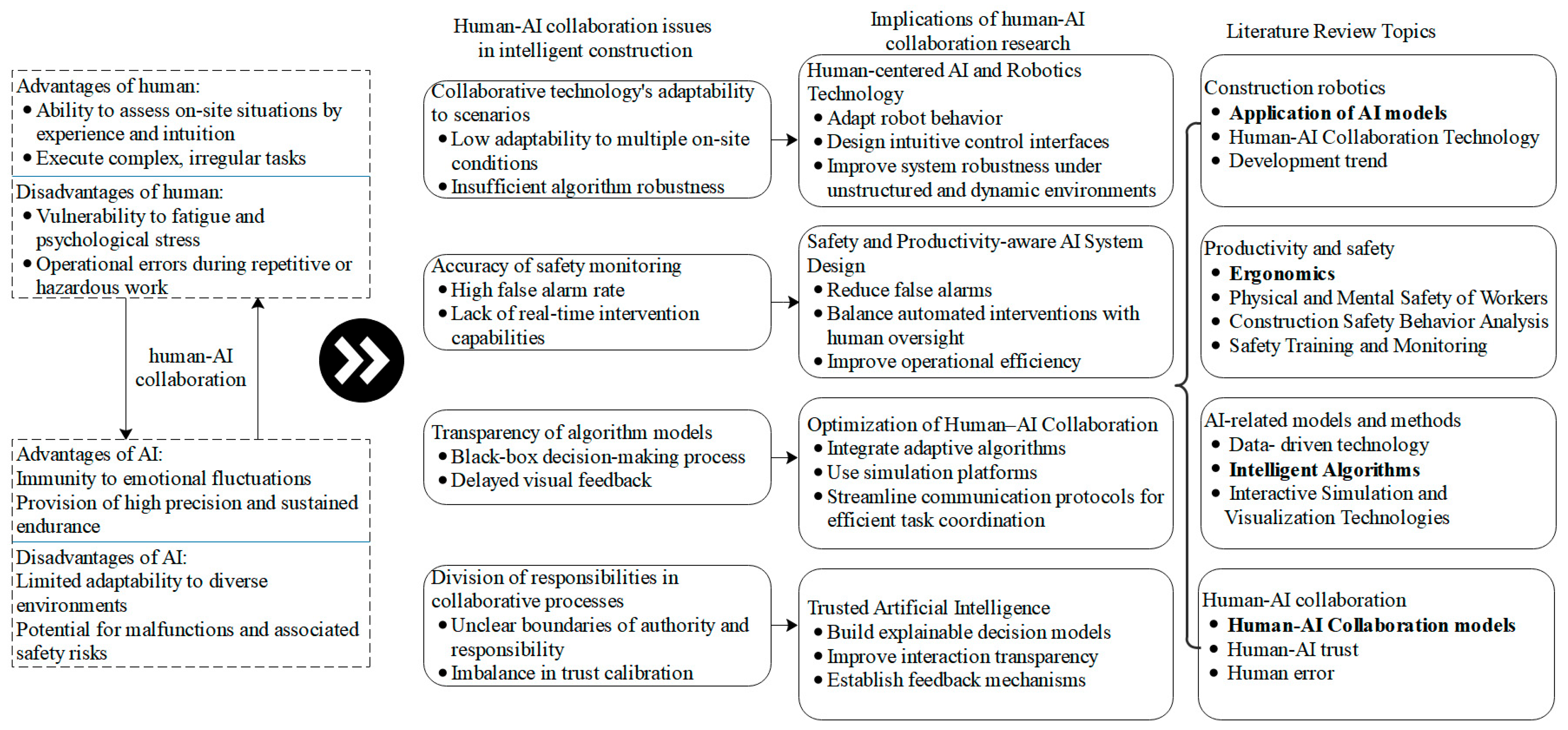
The current literature review related to human–AI collaboration in the field of intelligent construction is mostly based on specific scenes or only from the perspective of intelligent technology, and there is no multi-scale and all-round integration framework at present. In this paper, through a keyword analysis, we sort out and summarize the key contents of the data layer, algorithm/technology layer, and application layer, and, at the same time, introduce driving technology as the overall support, trying to build a systematic framework that runs through the theory and practice (as shown in Figure 5).

5.1. Trusted Artificial Intelligence

In the construction industry, the wide application of trusted AI faces the challenge of system trust issues. In the construction scenario, the trust of workers and managers in the AI system directly determines the effect of human–AI collaboration. Therefore, future research needs to focus on dynamic trust modelling and develop techniques that can enhance trust by monitoring and interpreting models in real time. Such research can further improve the reliability of human–AI collaboration by combining worker behavior analysis with task assignment optimization. In addition, the complexity of AI decisions often makes it difficult for users to understand the logic behind them, making it crucial to improve the interpretability of AI systems. In the future, multimodal visualization tools and intuitive interactive interfaces can be developed to help users understand the AI prediction process more clearly, thus enhancing the transparency and usability of the technology. Meanwhile, the research on AI transparency also needs to focus on breakthroughs, such as the development of open systems that allow for the tracing of data sources and model training processes, and the combination of blockchain and other technologies to enhance data management transparency. In-depth research in these directions will further optimize the efficiency of the data flow and collaboration in construction projects in the building industry, providing important support for the landing of trusted AI in the industry. Among these, the development of robust and interpretable AI models that can demonstrably improve worker trust and decision-making in high-stakes construction scenarios, particularly in dynamic and unpredictable environments, stands out as the most urgent and underserved research priority.

5.2. Human-Centered AI and Robotics Technology

Human-centered AI and robotics is an important research direction in the field of intelligent construction, the core of which is to optimize the relationship between humans and machines, and improve the safety and efficiency of workers. Future research should focus on human factors engineering and design optimization, focusing on the physiological and psychological behavioral characteristics of construction workers, and designing more collaborative and friendly robot systems based on ergonomics. For example, real-time data can be used to capture the worker’s state and dynamically adjust the robot’s interaction strategy for optimal task allocation. In addition, the construction of intelligent collaborative environments is especially critical for complex construction sites. Virtual reality (VR) and augmented reality (AR) technologies can provide workers with a testbed for simulation training and robot task adjustment, helping them adapt to diverse collaboration scenarios. Especially in high-risk construction scenarios (e.g., deep pit work, high-rise construction, etc.), collaborative robots and assistive devices that combine safety and efficiency need to be developed in the future. Wearable technologies such as smart exoskeletons will further reduce the labor intensity of workers and provide strong support for heavy physical work. Through these studies, human-centered technology design can be better realized to ensure overall safety and efficient collaboration on construction sites. Specifically, the urgent need lies in the development of ergonomic and context-aware robotic systems that can proactively adapt to individual worker needs and the immediate environmental demands, thereby minimizing the physical strain and cognitive overload, which is currently a significant gap.

5.3. Optimization of Human–AI Collaboration

In the field of human–AI collaboration, optimizing construction performance and safety are dual objectives for future research. In terms of construction performance, the research needs to further improve the accuracy and efficiency of task execution, and develop collaboration systems with real-time risk assessment capabilities to ensure dynamic safety at construction sites. In terms of optimization methods, future research needs to focus on designing dynamic task allocation mechanisms to accommodate the diversity and complexity of construction tasks. For example, allocation algorithms designed using machine-learning and reinforcement-learning techniques can realize the complementary advantages of human experience and machine computing power, improving the collaboration efficiency and task completion quality. In response to the need for safety detection on construction sites, more accurate unsafe behavior monitoring systems can be developed using IoT sensors and AI technologies. These systems can leverage improved data analysis algorithms to significantly reduce the risk of construction accidents while improving the overall collaboration efficiency. The most critical aspect here is the development of intelligent algorithms that dynamically balance human capabilities and AI support, considering real-time safety metrics and productivity goals. This area is highly underserved and crucial for seamless collaboration.

5.4. Safety- and Productivity-Aware AI System Design

Prior studies have highlighted the limitations of the current AI-based safety monitoring systems, such as the high false alarm rates and low responsiveness in complex construction environments. These issues undermine workers’ trust and delay timely interventions. Meanwhile, over-automation may compromise human vigilance, while under-automation reduces efficiency. Most urgently needed are standardized evaluation frameworks for human–AI coordination, as the current practices lack consistent metrics to balance safety interventions with workflow continuity across different construction phases. Therefore, future research should focus on developing context-aware alert mechanisms and shared control strategies that dynamically adjust intervention levels. Optimizing both safety and productivity requires integrating dual-objective performance indicators into the AI system design to achieve effective human–AI coordination on site.

6. Conclusions

6.1. Comprehensive Overview and Thematic Framework

This systematic review of 191 selected studies reveals a distinct evolutionary path in the construction sector, characterized by a transition from isolated technological deployments to integrated socio-technical systems. Our analysis confirms that construction robotics and intelligent algorithms are moving beyond static execution toward context-aware adaptability. The literature demonstrates a decisive paradigm shift where data-driven approaches—ranging from machine learning to digital twins—are now serving as the cognitive backbone for complex decision-making, enabling resilience against the uncertainties typical of renovation and site management. Simultaneously, the review of productivity, safety, and worker factors highlights that technical sophistication alone is insufficient. The findings indicate that human-centric variables, particularly human–computer trust and cognitive load management, have become the primary determinants of system success. Furthermore, safety strategies are observed to be evolving from reactive protocols to proactive, real-time interventions driven by IoT and cognitive reliability models. Synthesizing these fragmented insights, this study consolidates the technical, application, and management layers into a unified framework, providing the necessary theoretical scaffolding to support the practical scaling of human–machine teaming in future intelligent construction.

6.2. Focus of Future Research

The future development of architectural robotics and AI technologies requires a significant enhancement in their adaptability and robustness to meet the demands of complex construction environments. The current system suffers from insufficient stability in dynamic scenarios, and future research should focus on developing real-time task allocation algorithms based on reinforcement learning, combined with a multimodal sensor integration system, in order to achieve efficient adaptation to dynamic changes on the construction site. Meanwhile, in response to the requirements of trusted AI, technical transparency and interpretability are key directions for future development. The research needs to focus on developing highly transparent and interpretable algorithms and tools to help workers and managers better understand the system logic through intuitive visualization interfaces with transparent decision-making processes, thus enhancing human–machine trust. In addition, the integration of emerging technologies is an important path to promote intelligent construction. For example, digital twin technology enables real-time interaction and the dynamic risk prediction of construction data; generative AI can optimize construction solutions and resource allocation; and blockchain technology provides transparency and security for construction data management.
Future research should focus on expanding the technological requirements in emerging application scenarios to enhance the scenario adaptability of construction robots. For example, scenarios such as post-disaster reconstruction, high-altitude work, underground construction, and green building all place higher demands on collaboration technologies. For extreme environmental conditions, collaborative robots with both energy-saving properties and high efficiency need to be designed to meet the needs of special construction tasks. In addition, further research should be conducted on how to balance worker safety and efficiency during the construction process, and how to optimize the design of collaborative interfaces and tasks by incorporating ergonomics to reduce the risk of worker injuries while improving the construction accuracy and speed. In the context of globalization, where labor cultures, regulations, and construction habits vary significantly from region to region, customized intelligent construction technologies and collaboration models should also be a focus of research to better accommodate diverse regional needs.

6.3. Summary and Outlook

Multidisciplinary research is indispensable to further advancing the overall development of the intelligent construction field. Future research needs to combine cognitive science and data science to deeply analyze the behavioral characteristics of construction workers and develop dynamic collaboration optimization models based on the prediction of worker behavior. Such models can not only improve the rationality of task allocation, but also enhance the overall construction efficiency. At the same time, the widespread application of AI technology is accompanied by potential risks in terms of ethical and social impacts, and the research needs to be geared towards the development of a comprehensive policy and standards framework to ensure the fairness of the technology, the protection of privacy, and the long-term sustainability of society. In addition, in order to lower the adoption threshold of intelligent construction technologies, in-depth analyses of their cost-effectiveness need to be conducted, and efficient promotion strategies need to be explored, so as to promote the intelligent transformation of the entire industrial chain of the construction industry. This will provide a solid theoretical and practical support for the sustainable development of the industry.

Supplementary Materials

The following supporting information can be downloaded at: https://www.mdpi.com/article/10.3390/app16020597/s1, Preferred Reporting Items for Systematic reviews and Meta-Analyses extension for Scoping Reviews (PRISMA-ScR) Checklist.

Author Contributions

Conceptualization, J.D.; methodology, R.G. and X.T.; validation, X.T.; formal analysis, R.G.; investigation, J.D.; resources, J.D.; data curation, R.G.; writing—original draft preparation, R.G. and X.T.; writing—review and editing, J.D. and V.S.; visualization, R.G. and X.T.; supervision, J.D.; project administration, R.G. and X.T.; funding acquisition, J.D. All authors have read and agreed to the published version of the manuscript.

Funding

This work is funded by the National Natural Science Foundation of China (grant number 72471133).

Institutional Review Board Statement

Not applicable.

Informed Consent Statement

Not applicable.

Data Availability Statement

The raw data supporting the conclusions of this article will be made available by the authors upon request.

Acknowledgments

This paper is supervised and guided by Wenbo Zhou (Municipal Engineering Branch of the China Civil Engineering Society and Shanghai University).

Conflicts of Interest

The authors declare no conflicts of interest.

References

  1. China Construction Industry Association. Analysis of construction industry development statistics in 2023. Wanfang Data 2024, 3, 48–53. [Google Scholar] [CrossRef]
  2. Parasch, S. Construction Robotics: From Automation to Collaboration. Annu. Rev. Control Robot. Auton. Syst. 2023, 6, 183–204. [Google Scholar] [CrossRef]
  3. Dorfler, K.; Dielemans, G.; Lachmayer, L.; Recker, T.; Raatz, A.; Lowke, D.; Gerke, M. Additive Manufacturing using mobile robots: Opportunities and challenges for building construction. Cem. Concr. Res. 2022, 158, 106772. [Google Scholar] [CrossRef]
  4. Han, I.X.; Meggers, F.; Parascho, S. Bridging the collectives: A review of collective human-AI construction. Int. J. Archit. Comput. 2021, 19, 512–531. [Google Scholar] [CrossRef]
  5. Zhang, X.; Zhang, C.; Wang, M.; Wang, Y.; Du, Y.; Mao, Q.; Lyu, X. Digital twin-driven virtual control technology of cantilever road header. Comput. Integr. Manuf. Syst. 2021, 27, 1617–1628. [Google Scholar] [CrossRef]
  6. Kapoor, N.R.; Kumar, A.; Kumar, A.; Kumar, A.; Arora, H.C. Artificial intelligence in civil engineering: An immersive view. In Applications of Artificial Intelligence in Engineering (Chapter 9); Mohan, B.R., Khan, R.A., Poonia, R.C., Eds.; Elsevier: Amsterdam, The Netherlands, 2024. [Google Scholar] [CrossRef]
  7. Naser, M.Z. An engineer’s guide to eXplainable Artificial Intelligence and Interpretable Machine Learning: Navigating causality, forced goodness, and the false perception of inference. Autom. Constr. 2021, 129, 103821. [Google Scholar] [CrossRef]
  8. Naumets, S.; Lu, M. Investigation into Explainable Regression Trees for Construction Engineering Applications. J. Constr. Eng. Manag. 2021, 147, 04021084. [Google Scholar] [CrossRef]
  9. Hatami, M.; Flood, I.; Franz, B.; Zhang, X. State-of-the-Art Review on the Applicability of AI Methods to Automated Construction Manufacturing. In ASCE International Conference on Computing in Civil Engineering 2019; American Society of Civil Engineers: Reston, VA, USA, 2019; pp. 368–375. [Google Scholar] [CrossRef]
  10. Al-Bashiti, M.K.; Naser, M.Z. Verifying domain knowledge and theories on Fire-induced spalling of concrete through eXplainable artificial intelligence. Constr. Build. Mater. 2022, 348, 128648. [Google Scholar] [CrossRef]
  11. Huang, W.Z.; Wang, D.; Xiao, Z.D.; Yao, Q.; Du, D.J. Design and Implementation of PLC-Based Autonomous Construction System of Unmanned Vibratory Roller. CMC-Comput. Mater. Contin. 2020, 65, 897–912. [Google Scholar] [CrossRef]
  12. Sun, P. Design of Walking Brick Coding Robot and Remote Online Monitoring System. In Proceedings of the 2020 5th International Conference on Electromechanical Control Technology and Transportation (ICECTT), Nanchang, China, 15–17 May 2020; IEEE: New York City, USA, 2020; pp. 102–105. [Google Scholar]
  13. Zhang, Q.; Liu, T.; Zhang, Z.; Huangfu, Z.; Li, Q.; An, Z. Unmanned rolling compaction system for rockfill materials. Autom. Constr. 2019, 100, 103–117. [Google Scholar] [CrossRef]
  14. Melenbrink, N.; Werfel, J.; Menges, A. On-site autonomous construction robots: Towards unsupervised building. Autom. Constr. 2020, 119, 103312. [Google Scholar] [CrossRef]
  15. Chen, Y. A Preliminary Review of Current Research Studies on Human Robot Collaboration in Construction Industry. Comput. Civ. Eng. 2021, 2021, 329–333. [Google Scholar] [CrossRef]
  16. Turek, W.; Cetnarowicz, K.; Borkowski, A. On human-centric and robot-centric perspective of a building model. Autom. Constr. 2017, 81, 2–16. [Google Scholar] [CrossRef]
  17. Amershi, S.; Weld, D.; Vorvoreanu, M.; Fourney, A.; Nushi, B.; Collisson, P.; Suh, J.; Iqbal, S.; Bennett, P.N.; Inkpen, K.; et al. Guidelines for human-AI interaction. In Proceedings of the 2019 CHI Conference on Human Factors in Computing Systems, Glasgow, UK, 4–9 May 2019; pp. 1–13. [Google Scholar] [CrossRef]
  18. Pärn, E.A.; Edwards, D.J.; Singh, V.; Thayaparan, M. Human–Robot Collaboration in Construction: Classification and Research Trends. J. Constr. Eng. Manag. 2021, 147, 03121002. [Google Scholar] [CrossRef]
  19. Onososen, A.O.; Musonda, I. Ergonomics in construction robotics and human-robot teams in the AEC domain: A review. IOP Conf. Ser. Earth Environ. Sci. 2022, 1101, 052003. [Google Scholar] [CrossRef]
  20. Xiao, B.; Chen, C.; Yin, X. Recent advancements of robotics in construction. Autom. Constr. 2022, 144, 104591. [Google Scholar] [CrossRef]
  21. Kakoto, T.; Skibniewski, M.J. Engineering decision support of automated shield tunneling. J. Constr. Eng. Manag. 1991, 117, 674–690. [Google Scholar] [CrossRef]
  22. Yuan, J.; Guan, R.; Guo, D.; Lai, J.; Du, L. Robotic approach of disc cutter replacement for shield machine. In Proceedings of the 2020 IEEE International Conference on Real-Time Computing and Robotics (IEEE-RCAR), Asahikawa, Japan, 28–29 September 2020. [Google Scholar] [CrossRef]
  23. Lee, S.Y.; Lee, K.Y.; Lee, S.H.; Kim, J.W.; Han, C.S. Human-AI cooperation control for installing heavy construction materials. Auton. Robot. 2007, 22, 305–319. [Google Scholar] [CrossRef]
  24. Wang, Y.; Xie, L.; Wang, H.; Zeng, W.; Ding, Y.; Hu, T.; Zheng, T.; Liao, H.; Hu, J. Intelligent spraying robot for building walls with mobility and perception. Autom. Constr. 2022, 139, 104270. [Google Scholar] [CrossRef]
  25. Mettler, B.; Dadkhah, N.; Kong, Z.D.; Andersh, J. Research infra-structure for interactive human- and autonomous guidance. J. Intell. Robot. Syst. 2013, 70, 437–459. [Google Scholar] [CrossRef]
  26. Taba Nyokum, T.; Tamut, Y. Artificial intelligence in civil engineering: Emerging applications and opportunities. Front. Built Environ. 2025, 11, 1622873. [Google Scholar] [CrossRef]
  27. Lee, J.S.; Ham, Y.; Park, H.; Kim, J. Challenges, tasks, and opportunities in tele-operation of excavator toward human-in-the-loop construction automation. Autom. Constr. 2022, 135, 104119. [Google Scholar] [CrossRef]
  28. Wang, T.; Zhan, W.M. Design and control a hybrid human-machine collaborative manufacturing system in operational management technology to enhance human-machine collaboration. Int. J. Adv. Manuf. Technol. 2024. advance online publication. [Google Scholar] [CrossRef]
  29. Al-Sabbag, Z.A.; Yeum, C.M.; Narasimhan, S. Enabling human–machine collaboration in infrastructure inspections through mixed reality. Adv. Eng. Inform. 2022, 53, 101709. [Google Scholar] [CrossRef]
  30. Al-Sabbag, Z.A.; Yeum, C.M.; Narasimhan, S. Distributed collaborative inspections through smart infrastructure metaverse. Autom. Constr. 2024, 165, 15. [Google Scholar] [CrossRef]
  31. Nagatani, K.; Abe, M.; Osuka, K.; Chun, P.-J.; Okatani, T.; Nishio, M.; Chikushi, S.; Matsubara, T.; Ikemoto, Y.; Asama, H. Innovative technologies for infrastructure construction and maintenance through collaborative robots based on an open design approach. Adv. Robot. 2021, 35, 715–722. [Google Scholar] [CrossRef]
  32. Wang, X.; Liang, C.-J.; Menassa, C.; Kamat, R.V. Interactive and immersive process-level digital twin for collaborative human–robot construction work. J. Comput. Civ. Eng. 2021, 35, 04021023. [Google Scholar] [CrossRef]
  33. Cai, J.; Du, A.; Liang, X.; Li, S. Prediction-based path planning for safe and efficient human–robot collaboration in construction via deep reinforcement learning. J. Comput. Civ. Eng. 2023, 37, 04022046. [Google Scholar] [CrossRef]
  34. McLaughlin, J.; Sreenivasan, S.V.; Haas, C.; Liapi, K. Rapid human-assisted creation of bounding models for obstacle avoidance in construction. Comput.-Aided Civ. Infrastruct. Eng. 2004, 19, 3–15. [Google Scholar] [CrossRef]
  35. Shan, Y.; Xiao, W.; Xiang, K.; Wang, B.; Zhou, S. Semi-automatic construction of pile-supported subgrade adjacent to existing railway. Autom. Constr. 2022, 134, 104085. [Google Scholar] [CrossRef]
  36. Burden, A.G.; Caldwell, G.A.; Guertler, M.R. Towards human–robot collaboration in construction: Current cobot trends and forecasts. Constr. Robot. 2022, 6, 209–220. [Google Scholar] [CrossRef]
  37. Ma, X.; Mao, C.; Liu, G. Can robots replace human beings?—Assessment on the developmental potential of construction robot. J. Build. Eng. 2022, 56, 104727. [Google Scholar] [CrossRef]
  38. Yokoi, K.; Nakashima, K.; Kobayashi, M.; Mihune, H.; Hasunuma, H.; Yanagihara, Y.; Ueno, T.; Gokyuu, T.; Endou, K. A tele-operated humanoid robot drives a backhoe in the open air. In Proceedings of the 2003 IEEE/RSJ International Conference on Intelligent Robots and Systems, Las Vegas, NV, USA, 27–31 October 2003; Volume 2, pp. 1117–1122. [Google Scholar]
  39. Abinaya Ishwarya, G.K.; Rajkumar, D. Analysis of ergonomic risk factors in construction industry. Mater. Today Proc. 2021, 37, 2415–2418. [Google Scholar] [CrossRef]
  40. Tak, S.W.; Buchholz, B. Physical ergonomic hazards in highway tunnel construction: Overview from the Construction Occupational Health Program. Appl. Ergon. 2010, 41, 527–536. [Google Scholar] [CrossRef] [PubMed]
  41. Xing, X.; Li, H.; Zhong, B.; Qiu, L.; Luo, H.; Yu, Q.; Hou, J.; Li, L. Assessment of noise annoyance level of shield tunneling machine drivers under noisy environments based on combined physiological activities. Appl. Acoust. 2021, 179, 108045. [Google Scholar] [CrossRef]
  42. Brophy, P.; Albeaino, G.; Gheisari, M.; Jeelani, I. New Risks for Workers at Heights: Human-Drone Collaboration Risks in Construction. Comput. Civ. Eng. 2022, 2021, 321–328. [Google Scholar] [CrossRef]
  43. Zhang, C.; Zhang, W.; Zhong, H.; Zhao, T.; Zhang, Y. Multi-level edge intelligent management and control mode of safety production based on safety informatics. Adv. Eng. Inform. 2024, 62, 102751. [Google Scholar] [CrossRef]
  44. Ding, C.; Liu, Q.; Guo, X. Identifying unsafe behaviors of construction workers through an unsupervised multi-anomaly GAN approach. Autom. Constr. 2024, 165, 105509. [Google Scholar] [CrossRef]
  45. Sowers, G.F. Human Factors in Civil and Geotechnical Engineering Failures. J. Geotech. Eng. 1993, 119, 238–256. [Google Scholar] [CrossRef]
  46. Shayesteh, S.; Ojha, A.; Liu, Y.; Jebelli, H. Human-AI teaming in construction: Evaluative safety training through the integration of immersive technologies and wearable physiological sensing. Saf. Sci. 2023, 159, 106019. [Google Scholar] [CrossRef]
  47. Wang, N.; Du, X.; Zhang, M.; Xu, C.; Lu, X. An improved weighted fuzzy CREAM model for quantifying human reliability in subway construction: Modeling, validation, and application. Hum. Factors Ergon. Manuf. Serv. Ind. 2020, 30, 248–265. [Google Scholar] [CrossRef]
  48. Guo, H.; Yu, Y.; Ding, Q.; Skitmore, M. Image-and-Skeleton-Based Parameterized Approach to Real-Time Identification of Construction Workers’ Unsafe Behaviors. J. Constr. Eng. Manag. 2018, 144, 04018042. [Google Scholar] [CrossRef]
  49. Annam, S.; Khullar, V. Tabular Federated Learning to detect cyber faults in smart buildings. Proc. Inst. Civ. Eng.-Smart Infrastruct. Constr. 2025, 178, 98–111. [Google Scholar] [CrossRef]
  50. Leung, M.; Li, H. Using a real-time integrated communication system to monitor the progress and quality of construction works. Autom. Constr. 2008, 17, 262–273. Available online: https://www.sciencedirect.com/science/article/pii/S0926580508000198 (accessed on 23 April 2025). [CrossRef]
  51. Ashour, Z.; Yan, W. BIM-powered augmented reality for advancing human-building interaction. In Anthropologic: Architecture and Fabrication in the Cognitive Age, Proceedings of the 38th eCAADe Conference; Werner, L., Koering, D., Eds.; TU Berlin: Berlin, Germany, 2020; Volume 1, pp. 169–178. [Google Scholar] [CrossRef]
  52. Ma, X.; Qi, Q.; Cheng, J.; Tao, F. A consistency method for digital twin model of human-AI collaboration. J. Manuf. Syst. 2022, 65, 550–563. [Google Scholar] [CrossRef]
  53. Weber-Lewerenz, B. Corporate digital responsibility (CDR) in construction engineering—Ethical guidelines for the application of digital transformation and artificial intelligence (AI) in user practice. SN Appl. Sci. 2021, 3, 801. [Google Scholar] [CrossRef]
  54. Cichon, T.; Roßmann, J. Digital Twins: Assisting and Supporting Cooperation in Human-AI Teams. In Proceedings of the 2018 15th International Conference on Control, Automation, Robotics and Vision (ICARCV), Singapore, 18–21 November 2018; pp. 486–491. [Google Scholar]
  55. Ogunrinde, O.; Nnaji, C.; Amirkhanian, A. Developing Automation Adoption Readiness Index for Quality Management Focused on Highway Construction. J. Infrastruct. Syst. 2021, 27, 04020049. [Google Scholar] [CrossRef]
  56. Piras, G.; Muzi, F.; Ziran, Z. A Data-Driven Model for the Energy and Economic Assessment of Building Renovations. Appl. Sci. 2025, 15, 8117. [Google Scholar] [CrossRef]
  57. Shi, C.L.Q.; Xiao, C. Machine learning in building energy management: A critical review and future directions. Front. Eng. Manag. 2022, 9, 239–256. [Google Scholar] [CrossRef]
  58. Huang, H.; Chang, J.; Zhang, D.; Zhang, J.; Wu, H.; Li, G. Machine learning-based automatic control of tunneling posture of shield machine. J. Rock Mech. Geotech. Eng. 2022, 14, 1153–1164. [Google Scholar] [CrossRef]
  59. Hou, G.; Xu, Z.; Li, L.; Quan, X.; Yang, Y. Shield tunneling parameter matching model and UI interface. Adv. Civ. Eng. 2020, 2020, 9562828. [Google Scholar] [CrossRef]
  60. Xue, C.G.; Zhang, H.X.; Cao, H.W. Multi-agent modelling and analysis of the knowledge learning of a human-machine hybrid intelligent organization with human-machine trust. Syst. Sci. Control Eng. 2024, 12, 13. [Google Scholar] [CrossRef]
  61. Cisterna, D.; Seibel, S.; Oprach, S.; Haghsheno, S. Artificial Intelligence for the Construction Industry-A Statistical Descriptive Analysis of Drivers and Barriers. In New Trends in Disruptive Technologies, Tech Ethics and Artificial Intelligence. DiTTEt 2021. Advances in Intelligent Systems and Computing; De Paz Santana, J.F., de la Iglesia, D.H., López Rivero, A.J., Eds.; Springer: Cham, Switzerland, 2022; Volume 1410. [Google Scholar]
  62. Emaminejad, N.; Akhavian, R. Trustworthy AI and robotics: Implications for the AEC industry. Autom. Constr. 2022, 139, 104298. [Google Scholar] [CrossRef]
  63. Jalali Alenjareghi, M.; Keivanpour, S.; Chinniah, Y.A.; Jocelyn, S.; Oulmane, A. Safe human-robot collaboration: A systematic review of risk assessment methods with AI integration and standardization considerations. Int. J. Adv. Manuf. Technol. 2024, 133, 4077–4110. [Google Scholar] [CrossRef]
  64. Waqar, A. Intelligent decision support systems in construction engineering: An artificial intelligence and machine learning approaches. Expert Syst. Appl. 2024, 249, 22. [Google Scholar] [CrossRef]
  65. Zhang, M.; Shu, L.; Luo, X.; Yuan, M.; Zheng, X. Virtual reality technology in construction safety training: Extended technology acceptance model. Autom. Constr. 2022, 135, 104113. [Google Scholar] [CrossRef]
  66. Schia, M.H.; Trollsås, B.C.; Fyhn, H.; Lædre, O. The Introduction of AI in the Construction Industry and Its Impact on Human Behavior. In Proceedings of the 27th Annual Conference of the International Group for Lean Construction (IGLC), Dublin, Ireland, 1–7 July 2019. [Google Scholar]
  67. Wu, M.-H.; Lin, J.-R. An agent-based approach for modeling human-AI collaboration in bricklaying. In Proceedings of the 37th International Symposium on Automation and Robotics in Construction, Kitakyushu, Japan, 27–28 October 2020; IAARC Publications: Kitakyushu, Japan, 2020; pp. 797–804. [Google Scholar]
  68. Kim, J.; You, S.; Lee, S.H.; Kamat, V.R.; Robert, L.P. Evaluation of human–robot collaboration in masonry work using immersive virtual environments. In Proceedings of the 15th International Conference on Construction Applications of Virtual Reality (CONVR 2015), Banff, AB, Canada, 5–7 October 2015; Wang, Y., Zhong, R., Eds.; University of Michigan: Ann Arbor, MI, USA, 2015; pp. 132–141. Available online: https://hdl.handle.net/2027.42/116277 (accessed on 21 April 2025).
  69. Jung, M.F.; Difranzo, D.; Shen, S.; Stoll, B.; Claure, H.; Lawrence, A. Robot-assisted tower construction—A method to study the impact of a robot’s allocation behavior on interpersonal dynamics and collaboration in groups. J. Hum.-AI Interact. 2020, 10, 2. [Google Scholar] [CrossRef]
  70. Zhao, Y.H.; Gou, J.Q.; Wang, Z.; Wen, Y.X. Emotional Impact Analysis of Human-Machine Collaborative Decision-Making. In Proceedings of the 7th International Conference on Artificial Intelligence and Big Data (ICAIBD), Chengdu, China, 24–27 May 2024; IEEE: New York, NY, USA, 2024; pp. 572–577. [Google Scholar] [CrossRef]
  71. Jiang, X.; Ma, S.; Pang, X.; Sun, H.; Jin, Y.; Qi, P. Comprehensive evaluation of man-machine interface of shield main control room based on matching goodness. In Proceedings of the 2020 6th International Conference on Control, Automation and Robotics (ICCAR), Singapore, 20–23 April 2020; pp. 261–266. [Google Scholar] [CrossRef]
  72. Shayesteh, S.; Ojha, A.; Jebelli, H. Workers’ trust in collaborative construction robots: EEG-based trust recognition in an immersive environment. In Automation and Robotics in the Architecture, Engineering, and Construction Industry; Jebelli, H., Habibnezhad, M., Shayesteh, S., Asadi, S., Lee, S., Eds.; Springer: Berlin/Heidelberg, Germany, 2022; pp. 201–215. [Google Scholar] [CrossRef]
  73. Chauhan, H.; Pakbaz, A.; Jang, Y.; Jeong, I. Analyzing Trust Dyna-mics in Human–Robot Collaboration through Psychophysiological Responses in an Immersive Virtual Construction Environment. J. Comput. Civ. Eng. 2024, 38, 04024017. [Google Scholar] [CrossRef]
  74. Canto Perello, J.; Curiel Esparza, J. Human factors engineering in utility tunnel design. Tunn. Undergr. Space Technol. 2001, 16, 211–215. [Google Scholar] [CrossRef]
  75. Zhang, L.; Kang, J.; Luo, H.; Zhong, B. Drivers’ physiological response and emotional evaluation in the noisy environment of the control cabin of a shield tunneling machine. Appl. Acoust. 2018, 138, 1–8. [Google Scholar] [CrossRef]
  76. Wong, K.-W.; Francis, Y.-H.; Chiang, A.A.; Liang, S. Interrelation between human factor–related accidents and work patterns in construction industry. J. Constr. Eng. Manag. 2019, 145, 04019021. [Google Scholar] [CrossRef]
  77. Li, J.; Wang, H.; Xie, Y.; Zeng, W. Human error identification and analysis for shield machine operation using an adapted tracer method. J. Constr. Eng. Manag. 2020, 146, 04020095. [Google Scholar] [CrossRef]
  78. Liao, P.C.; Ma, Z.M.; Chong, H.Y. Identifying effective management factors across human errors-A case in elevator installation. KSCE J. Civ. Eng. 2018, 22, 3204–3214. [Google Scholar] [CrossRef]
Figure 1. Methodology framework.
Applsci 16 00597 g001
Figure 2. Number of publications related to human–AI collaboration. The red dotted line represents the overall trend of publication growth over time.
Applsci 16 00597 g002
Figure 3. Co-occurrence networks of high-frequency disciplinary keywords.
Applsci 16 00597 g003
Figure 4. Timeline of co-occurring keywords.
Applsci 16 00597 g004
Figure 5. Human–AI collaboration research issues, implications, and topics in intelligent construction.
Applsci 16 00597 g005
Table 1. Literature search strategy.
TopicSearch Strings
Human–AI relationship(human) AND (ai OR machine OR computer OR automat* OR robot OR artificial intelligence OR collaboration robot* OR collaborative robot* OR teleoperation OR remote control OR HRI OR HMI OR HCI OR unman* OR intelligent OR robot* OR self-driving OR decision-making system*) AND (interaction OR collaboration OR cooperative OR co-operative OR coordination OR team)
Boolean operatorAND
Construction(Architecture, Engineering and Construction OR AEC OR civil engineering OR construction engineering OR construction industry OR construction project OR construction OR building)
Note. The asterisk () indicates a wildcard used in the search string to capture multiple word variants (e.g., robot* includes robot, robots, and robotics) *.
Table 2. Literature search keywords.
Key TopicsHigh-Frequency WordsResearch Focus
Cluster 1
Construction Robotics
Construction sites and construction technologies;
automated robots in various construction scenarios
“Construction sites”,
“Control systems”, “Operators”
Operation and system optimization of construction robots in various applications
Cluster 2
Productivity and Safety
Construction site productivity;
construction worker safety
“Construction tasks”, “Productivity”,
“Safety risks”
Help construction engineers or managers arrange tools, workers, and their environment in an orderly manner to complete construction site tasks more efficiently
Cluster 3
Intelligent Algorithms and Modeling
Intelligent construction technology (augmented reality,
digital twins)
“Model”,
“Intelligence”
Drivers and barriers to AI implementation (technology acceptance, cost–benefit analysis, regulatory compliance, and complexity of technology integration)
Cluster 4
Construction Workers
Human errors related to construction workers; trust between humans and machines in different situations“Human factors”,
“Construction workers”, “Trust”,
“Explainability”
Analyze the factors that affect human trust and acceptance from a human perspective and the mechanism of action of AI technology in applications, and study how to design AI technology that is more compatible with such application operations from an ergonomic perspective
Cluster 5
Unsafe Behavior and Risk
Unsafe behaviors and risks“Unsafety behavior”,
“Uncertainty
Construction uncertainty and management capabilities
Table 3. Main research content of human–AI research in intelligent construction.
Time PeriodAI System CharacteristicsKey Human–AI Research Topics
Before 2000
  • Rule-based control algorithms embedded
① Timeliness of information flow; ② operator dependency and vigilance decline; ③ early HMI layout and reachability; ④ safety buffers for AI misclassification; and ⑤ skill requirements and re-training
2000–2005
  • Remote tele-operation
① Telepresence lag and cognitive load; ② command-priority conflict handling; ③ visual feedback for hazardous tasks; ④ runtime reliability and fail-safe recovery; and ⑤ division of responsibility between on-site crew and remote AI supervisor
2005–2010
  • Environment perception via sensors and fusion
①Perception accuracy vs. safety trust; ② joint human–AI decision ladders and authority tiers; ③ multi-AI task allocation and role interfaces; ④ integrating AI constraints into architectural design rules; ⑤ worker psychological safety and acceptance
2010–2020
  • Machine-learning adoption
  • Immersive tech (VR/AR)
① Explainable AI for transparent decisions; ② effectiveness of VR/AR skill transfer; ③ ergonomics in additive-manufacturing tasks; ④ real-time risk monitoring and alerts; ⑤ social robots and emotion-aware interaction; and ⑥ usability of complex ML configuration
2020–2025
  • Deep-learning-driven collaborative robots with self-adaptation
  • Human–twin interfaces
① Function allocation and joint decision making; ② real-time supervision/feedback inside the digital twin; ③ trust calibration and longitudinal trust models; ④ ethical boundaries for self-adapting AI; ⑤ cognitive-load management and attention sharing; and ⑥ cross-domain knowledge graphs and standards
Table 4. Document classification statistics for the research content in construction robotics for human–AI collaboration in intelligent construction.
AuthorsResearch TopicsResearch Methods
J. Yuan et al. [22]Robotic disc cutter replacement in shield machinesLiterature review and analysis of robotic technologies
Taba Nyokum, T., and Tamut, Y. [26] Artificial intelligence in civil engineering: emerging applications and opportunitiesEmerging applications and opportunities
Lee, S.Y. et al. [23]Teleoperation challenges in excavator automationSystematic review and teleoperation literature analysis
Zhang et al. [13]Unmanned rolling compaction systemGPS and remote monitoring
Wang et al. [24]Spraying robot for wallsLaser-ranging adjustment and LiDAR recognition
Mettler et al. [25]Interactive guidance infrastructureRotorcraft testing
Lee et al. [27]Human–AI cooperation control for heavy construction material installation2DOF manipulator and interactive control experiments
Wang et al. [28] Hybrid human–machine manufacturingSystem design and control modeling
Al-Sabbag et al. [29]Mixed reality for human–AI inspection collaborationLab-tested HMCI system with MR headset and robotic data collection
Al-Sabbag et al. [30]Real-time collaborative structural inspectionMixed-reality/virtual reality integration, experimental study
Nagatani et al. [31]Collaborative robots in infrastructureOpen design approach
X. Wang et al. [33]VR digital twin for construction collaborationVirtual reality and digital twin
Cai et al. [33]Safe construction roboticsPredictive path planning
McLaughlin et al. [34]Human-assisted roboticsObstacle avoidance modeling
Shan et al. [35]Semi-automatic construction systemReal-time monitoring
Burden et al. [36]Construction robots and collaborationLiterature review and analysis
Ma et al. [37]Robot substitution in constructionTask–technology fit theory
Yokoi et al. [38]Tele-operated humanoid robot for constructionRemote control system development
Table 5. Document classification statistics for the research content in productivity and safety for human–AI collaboration in intelligent construction.
AuthorsResearch TopicsMethodologies
Ishwarya et al. [39]Ergonomics in constructionQuestionnaire survey
Tak and Buchholz [40]Quantitative ergonomic exposure analysisPATH method
Xing et al. [41]Noise annoyance assessmentPhysiological activity monitoring
Brophy et al. [42]Human–drone collaboration risksCase study analysis
Zhang et al. [43]Intelligent safety management in construction Multi-level edge computing and safety informatics-based data fusion
Ding et al. [44] Unsafe behavior detection in constructionUnsupervised Multi-Anomaly GAN model
Sowers et al. [45]Safety behavior system dynamicsCase analysis
Shayesteh et al. [46]Analysis of engineering failuresFuzzy CREAM model
Wang et al. [47]Human reliability in constructionImmersive technology and wearable sensing
Guo et al. [48]Real-time identification of unsafe behaviorsImage and skeleton-based method
Annam, S., and Khullar, V. [49]Tabular federated learning to detect cyber faults in smart buildingsTabular data modeling in federated setting
Leung and Li [50]Integrated communication system for construction monitoringWireless network and cameras
Table 6. Document classification statistics for the research content in Intelligent Algorithms and Modeling for human–AI collaboration in intelligent construction.
AuthorsResearch TopicsResearch Methods
Ashour and Yan [51]BIM and AR for human–building interactionPrototype development and experimental evaluation
Ma et al. [52]Digital twin model consistency in Human–AI collaborationModel development and case study validation
Weber et al. [53]Corporate digital responsibility in construction engineeringCase studies and expert interviews
Cichon et al. [54]Digital twins for human–AI team cooperationConceptual framework and software development proposal
Shi et al. [57]Machine learning in building energy managementLiterature review and framework development
Huang et al. [58]Machine learning for shield machine tunneling posture controlData collection, algorithm improvement, and model application
Hou et al. [59]Shield tunneling parameter-matching model and UI interfaceModel development, optimization, and UI interface creation
Zhang et al. [65]VR technology in construction safety trainingExtended TAM model, survey, and data analysis
Ogunrinde et al. [55]Automation Adoption Readiness Index for highway constructionFuzzy index model, survey, and data analysis
Schia et al. [66]Introduction of AI in the construction industry and human behaviorLiterature review and analysis
Xue et al. [60]Trust in human–AI collaborationMulti-agent simulation
Cisterna et al. [61]AI for the construction industry—drivers and barriersSystematic review and statistical descriptive analysis
Emaminejad et al. [62]Trustworthy AI and robotics in the AEC industrySystematic review and analysis
Waqar [64]AI/ML in construction decision supportLiterature review, and empirical study
Table 7. Document classification statistics for the research content in factors of construction workers for human–AI collaboration in intelligent construction.
AuthorsResearch TopicsResearch Methods
Wu and Lin [67]An agent-based approach for modeling human–AI collaboration in bricklayingAgent-based modeling, simulation, and real project validation
Kim et al. [68]Evaluation of human–AI collaboration in masonry work using immersive virtual environmentsImmersive virtual environments, experimental scenarios, and Unity3D Game Engine (Unity Technologies; available at https://unity.com, accessed 15 March 2024)
Jung et al. [69]Robot-assisted tower construction—a method to study the impact of a robot’s allocation behavior on interpersonal dynamics and collaboration in groupsLaboratory study, resource distribution task, and data collection
Zhao et al. [70]Emotion in human–AI decision-makingExperiments, and interviews
Jiang et al. [71]Comprehensive evaluation of man–machine interface of shield main control room based on matching goodnessEvaluation model construction, and gray matter element analysis
Shayesteh et al. [72]Workers’ trust in collaborative construction robots: EEG-based trust recognition in an immersive environmentEEG signals analysis, machine-learning algorithms, and immersive environment experiment
Chauhan et al. [73]Trust in HRC in constructionExperiments, and physiological analysis
Zhang et al. [75]Drivers’ physiological response and emotional evaluation in the noisy environment of the control cabin of a shield tunneling machineExperimental study, physiological measurements, and emotional evaluation
Wong et al. [76]Interrelation between human-factor-related accidents and work patterns in the construction industryStatistical analysis, and case studies
Li et al. [77]Human error identification and analysis for shield machine operation using an adapted TRACEr methodTRACEr method adaptation, and error analysis
Liao et al. [78]Identifying effective management factors across human errors—a case in elevator installationCase study, and management factor analysis
Wang et al. [47]An improved weighted fuzzy CREAM model for quantifying human reliability in subway construction: modeling, validation, and applicationFuzzy logic, weighted fuzzy CREAM model, modeling, and validation
Disclaimer/Publisher’s Note: The statements, opinions and data contained in all publications are solely those of the individual author(s) and contributor(s) and not of MDPI and/or the editor(s). MDPI and/or the editor(s) disclaim responsibility for any injury to people or property resulting from any ideas, methods, instructions or products referred to in the content.