1. Introduction
Consciousness remains a fundamental challenge in neuroscience, requiring mechanistic frameworks that bridge molecular, cellular, and systems-level phenomena. Traditional approaches have struggled to provide unified explanations connecting neural dynamics to subjective experience, motivating the development of integrative theories that emphasize both structure and temporal dynamics [
1]. The problem is not merely descriptive, as it demands the identification of the physical mechanisms whose configurations associate with conscious experience, distinguishing brain regions that instantiate consciousness from those that process information unconsciously [
2,
3].
Recent empirical convergence around complexity-related measures has revealed that consciousness correlates consistently with specific dynamical signatures across diverse states including sleep, anesthesia, hallucinatory states, and disorders of consciousness [
1]. This consilience of evidence suggests that underlying principles governing conscious access and integration may be captured through information-theoretic frameworks operating at multiple temporal scales. Notably, consciousness appears to reflect the brain’s capacity to generate integrated information, a quantity that is neither maximized by completely connected networks nor by independent modules, but emerges when systems balance functional specialization with integration [
4]. Contemporary formulations have extended classical Integrated Information Theory (IIT) to continuous-time dynamics [
5,
6,
7,
8], offering a more biologically tractable characterization of consciousness at multiple temporal scales. In parallel, non-invasive EEG-based approaches have extensively characterized large-scale brain responsiveness and information integration using information-theoretic measures, functional connectivity, and data-driven classification frameworks, demonstrating high sensitivity to brain state changes across cognitive and clinical contexts [
1,
9].
Beyond classical spectral power and linear coupling measures, recent EEG research increasingly leverages information-theoretic connectivity (e.g., mutual information and normalized mutual information) together with modern machine-learning pipelines to enhance robustness and generalizability. Representative examples include the use of normalized mutual information (NMI) features to construct EEG functional connectivity matrices and feed them into extreme learning machine (ELM) classifiers for state decoding, illustrating how nonlinear inter-channel dependencies can be quantified and exploited in predictive models [
10]. In parallel, end-to-end deep learning architectures increasingly incorporate connectivity priors explicitly: for instance, graph-attention convolutional neural networks (GAT-CNNs) can take EEG signals jointly with mutual-information-driven adjacency matrices, enabling models to learn discriminative representations while preserving interpretable channel-relationship structure [
11].
More broadly, recent surveys on EEG-based emotion recognition summarize methodological progress and highlight persistent challenges—noise, inter-subject variability, limited labels, and interpretability—that closely overlap with the constraints faced by EEG-based consciousness assessment in clinical settings [
12]. Together, these developments provide a useful methodological context for our review, reinforcing EEG’s role as a non-invasive window into brain dynamics while clarifying how information-theoretic coupling and modern learning frameworks can operationalize integration-related features in practice.
Although major theories such as the Global Neuronal Workspace Theory (GNWT) have long offered explicit computational architectures and neurobiologically grounded models of conscious access [
2,
13], and recent adversarial-collaboration efforts have begun to test these models in a rigorous, theory-neutral manner [
14], current empirical implementations still focus largely on coarse-grained neural signatures, such as widespread ignition and late positivity (P3b) patterns associated with conscious perception, rather than on time-resolved, multiscale biomarkers [
13,
15]. In contrast, the three approaches emphasized here (continuous-time formulations of IIT, dynamical-systems modeling of attractor landscapes, and perturbational complexity metrics derived from transcranial magnetic stimulation combined with simultaneous electroencephalography (TMS-EEG)) are inherently dynamical, generating time-dependent measures that enable whole-brain simulations and can be directly linked to both neurophysiological data and clinical evaluation. This review therefore focuses on these strategies and is not intended to replace other theoretical frameworks, but to highlight a convergent, quantitatively tractable, and translationally relevant route toward mechanistic biomarkers of consciousness. Importantly, many of the dynamical and complexity-related signatures discussed in this review, such as large-scale integration, metastability, and sensitivity to perturbations, are not specific to a single theory of consciousness and can be interpreted within different theoretical frameworks, including the GNWT and related dynamical approaches.
This article is not intended as a systematic or exhaustive review, but rather as an integrative narrative review and perspective, grounded in the authors’ direct contributions to continuous-time Integrated Information Theory, attractor dynamics, and perturbational complexity. The literature discussed was identified through targeted searches in major scientific databases, including PubMed, Web of Science, Scopus, and Google Scholar. Reference selection was guided by conceptual relevance to three main thematic axes: (i) continuous-time formulations of information integration, (ii) dynamical-systems and attractor-based descriptions of brain states, and (iii) empirical complexity measures, particularly those derived from TMS-EEG, with demonstrated relevance to consciousness research and clinical translation. The aim of this review is therefore conceptual integration and mechanistic coherence rather than comprehensive coverage of all available studies.
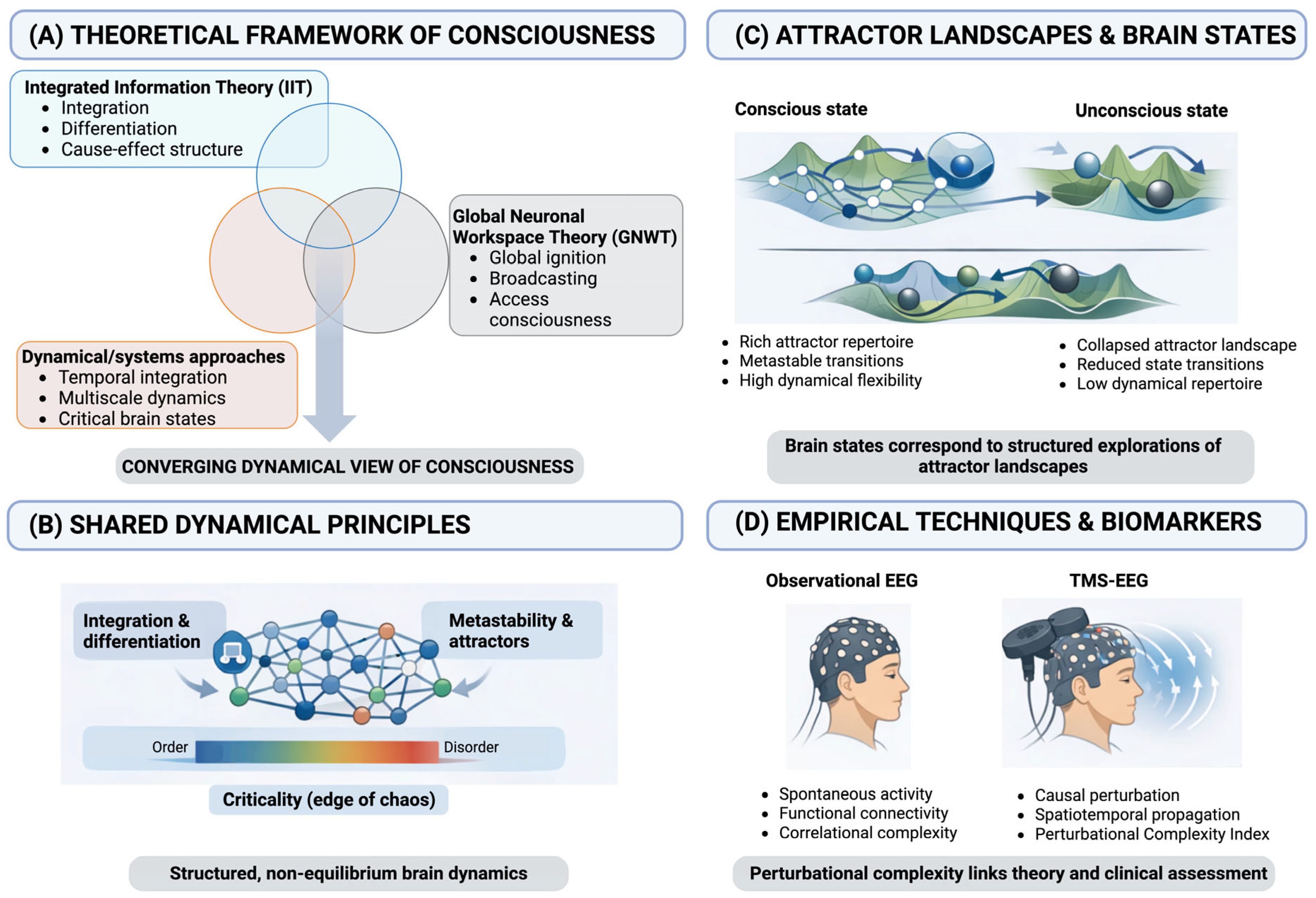
In the following sections, we develop this integrative perspective by examining how these three approaches jointly contribute to a mechanistic, multiscale understanding of consciousness (
Figure 1).
Although synchronization, information processing, and brain dynamics are often examined within distinct theoretical and methodological traditions, a growing body of work suggests that these dimensions converge on a shared dynamical view of conscious processing. To make this convergence explicit,
Table 1 summarizes how representative theoretical frameworks and empirical approaches map onto these three core dimensions. Rather than providing an exhaustive overview, the table highlights complementary perspectives across continuous formulations of IIT, attractor-based models of brain-state transitions, and perturbational complexity measures derived from TMS-EEG, thereby offering a conceptual roadmap for the sections that follow. This integrative mapping complements the conceptual framework illustrated in
Figure 1.
2. Continuous-Time Formulations of Integrated Information
Integrated Information Theory identifies conscious experience with maximally irreducible conceptual structures, but current formulations rely on discrete time steps and partitioning schemes that may not capture the continuous nature of brain dynamics [
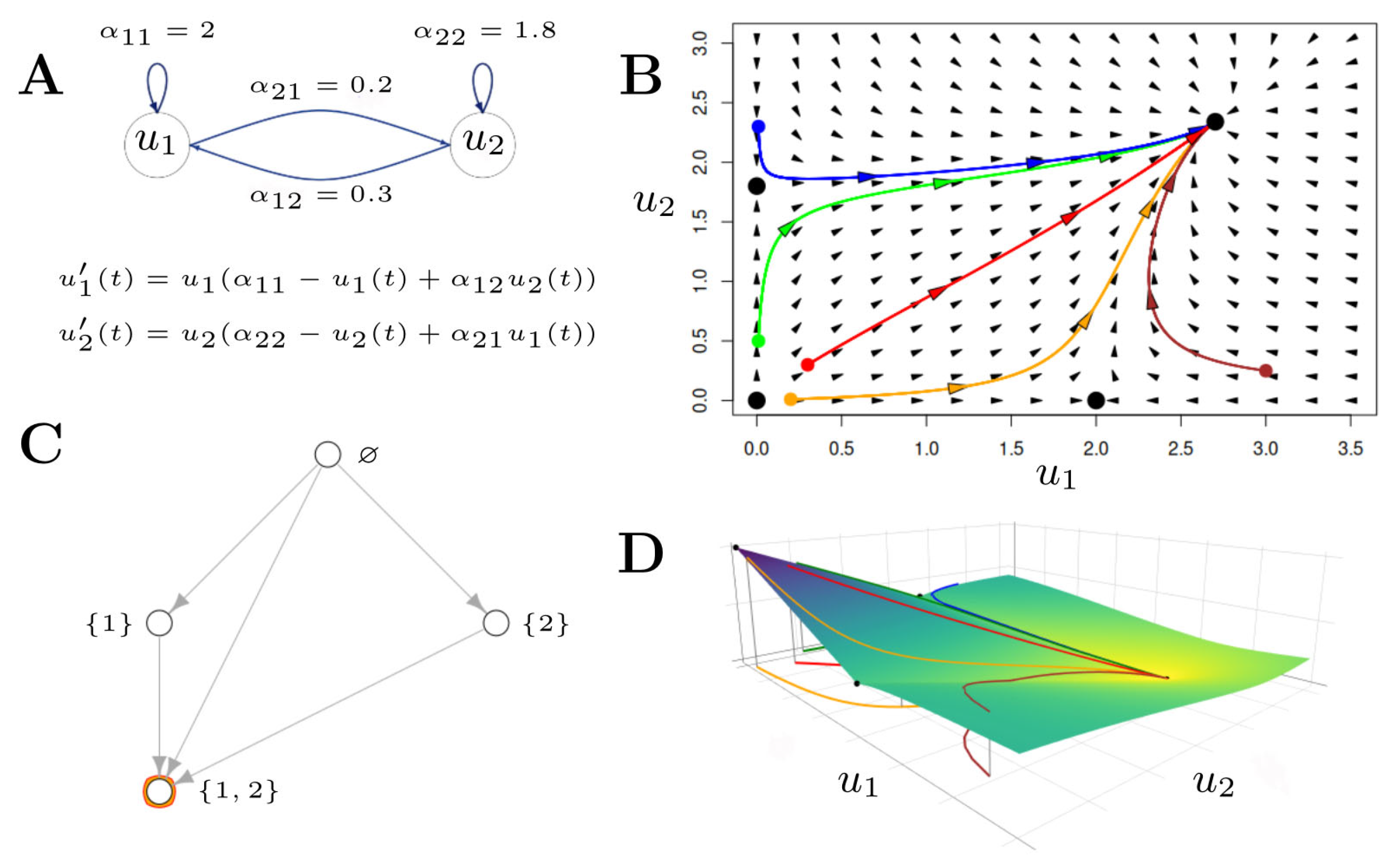
8]. We proposed a spatiotemporally continuous extension of integrated information using dynamical systems theory, where informational structures are associated with global attractors (see
Figure 2) at each moment in time [
5,
16]. These continuous formulations enrich the phase space of brain states with cause-effect power through informational fields, describing consciousness as a property emerging from complex trajectories within a continuous state space, whose instantaneous configurations can nonetheless be captured through discrete informational snapshots [
17]. By associating each informational structure with invariant properties and transition probability matrices, continuous approaches quantify integrated information across the full temporal evolution of system states, providing a mechanistically grounded framework that preserves structural partitioning between components for comparative analysis of informational structures and fields [
5].
Converging Integrated Information Theory with the Temporo-Spatial Theory of Consciousness directly addresses a critical temporal gap in consciousness research by incorporating multiple timescales simultaneously [
18]. This temporally continuous, multiscale framework links short-term integration of inputs over 100–300 ms in the alpha and theta frequency ranges, as predicted by IIT, with longer timescales in delta and slower frequencies, where non-additive interactions between pre-stimulus activity and incoming inputs temporally expand phenomenal contents and help account for the stream of consciousness as a temporally extended phenomenon [
18]. Such nested temporal hierarchies are essential because conscious experience consists of brief phenomenal contents arising at discrete moments in time that are simultaneously embedded within an ongoing, continuous flow of experience.
Metastable attractors and transient neural dynamics reflect this hierarchical organization, with evidence showing that the brain spontaneously visits discrete dynamical states lasting from seconds (at the fMRI scale) before transitioning to others. These states behave as weakly stable (“ghost”) attractors, whose recurrent excursions and asymmetric transition structure are consistent with a heteroclinic-like dynamical regime connecting saddle-type configurations [
19]. These state-dependent, initial-condition-sensitive dynamics illustrate how conscious perception emerges from the interaction between the brain’s ongoing background activity and incoming stimulation, whereby small variations in pre-stimulus brain state can markedly alter perceptual thresholds and the conscious accessibility of stimuli.
The transition from discrete to continuous formulations reflects a deeper advance in understanding how synchronization and integration emerge from neural dynamics. Whereas classical IIT partitions systems into discrete states and computes cause-effect power through stochastic interventions, continuous formulations recognize that the brain operates as a coupled dynamical system in which integration evolves continuously over time. Each informational structure associated with an attractor specifies the repertoire of causal states available to the system, not merely at an isolated instant but along its evolving trajectories [
5]. These trajectories traverse metastable configurations (weakly stable partial-synchrony states) that are transiently occupied before transitioning to other states; this dynamical regime is consistent with the ghost attractor framework proposed to describe spontaneous brain activity, and may provide a mechanistic substrate relevant for theories of consciousness. [
19]. In this view, conscious states correspond to structured explorations of the system’s attractor landscape, where complexity measures derived from the richness and diversity of these trajectories provide biomarkers of conscious capacity [
20]. The continuous framework thus bridges informational structures and time-dependent neural dynamics, grounding phenomenological descriptions of consciousness in the electrophysiology and connectivity patterns of cortical tissue.
In dynamical systems theory, attractors are well-defined mathematical objects associated with the transient and long-term behavior of continuous-time systems, typically formalized through differential equations [
21]. When applied to large-scale brain activity and its different ways of modeling, however, the term “attractor” necessarily spans different levels of description and cannot be directly identified as a formal object from empirical neurophysiological data [
22,
23,
24].
3. Time-Dependent Attractor Landscapes and Fine-Grained Classification of Conscious States
Brain states emerge from the interplay between anatomical connectivity and local dynamical rules, generating characteristic attractor landscapes whose geometry reflects the level and quality of conscious access [
17]. Rather than treating consciousness as a binary phenomenon, dynamical-systems approaches reveal a graded continuum of states characterized by distinct attractor topologies. In altered or impaired conditions such as unresponsive wakefulness syndrome (UWS), minimally conscious state (MCS), or deep anesthesia, attractors become overly regular and repetitive, reflecting a markedly reduced variability and a narrow repertoire of accessible configurations -what Soler-Toscano et al. (2022) described as low NoEL (number of energy levels) and Frondosity (number of points in the IS) standard deviation [
20]. In contrast, psychedelic or highly integrative states display expanded and flexible attractor repertoires, while wakefulness operates near criticality, balancing order and disorder. This topology-consciousness mapping suggests that the structure and richness of the brain’s phase-space landscape directly determine both the diversity of accessible conscious states and their adaptive responsiveness to perturbations.
The brain maintains a critical balance between stability (order) and adaptability (disorder) through intermediate synchronization regimes best described as Griffiths-like phases [
25]. These broad phases, emerging in structurally heterogeneous networks, allow flexible levels of synchronization midway along the synchronous-asynchronous spectrum, enabling rapid transitions between metastable states while preserving functional coherence [
25]. Such hybrid-type bifurcations generate rich dynamical patterns necessary for conscious discrimination and adaptive behavior. Consistently, analyses of Soler-Toscano et al. (2022) show that conscious states lie closer to bifurcation points—quantified by their higher “criticality” values—indicating maximal responsiveness to perturbations and greater dynamical flexibility [
20]. In contrast, unconscious states exhibit restricted bifurcation landscapes where dynamics collapse into a limited set of stable attractors, reducing variability and the repertoire of possible state transitions [
26].
Computational whole-brain models constrained by anatomical connectivity can reproduce empirical resting-state dynamics and predict how perturbations (including TMS-like stimuli) propagate through networks depending on the underlying dynamical regime [
27]. Regimes exhibiting turbulence-like fluctuations (characterized by ongoing noise and non-equilibrium dynamics) best capture functional connectivity data and confer maximal flexibility to local perturbations, consistent with brain dynamics operating near criticality. This near-critical nonequilibrium dynamics may provide a mechanistic substrate relevant for conscious brain function [
27].
Fine-grained state classification exploits differences in attractor dynamics across pathological and physiological conditions. Disorders of consciousness are associated with reduced dynamical flexibility, characterized by less recurrent and more structurally constrained brain states, diminished regional heterogeneity, and a loss of the stabilizing role of network hubs, these alterations reflecting a reduced capacity for dynamic transitions and responsiveness, consistent with a departure from the flexible regimes observed during conscious wakefulness [
28]. Psychedelic states exhibit expanded exploratory dynamics characterized by an increased repertoire of dynamical configurations and facilitated transitions between metastable states, correlating with alterations in perceptual and self-referential processing [
29]. Anesthesia demonstrates loss of critical responsiveness manifested as stabilization of neuronal dynamics and contraction of available attractor states, with propofol producing greater stabilization effects than ketamine [
30]. Time-resolved analyses of these attractor trajectories reveal discrete, stabilize metastable states and abrupt transitions between them, consistent with a non-continuous recovery process. Recovery of consciousness after anesthesia proceeds through a sequence of discrete metastable attractor states rather than a smooth, continuous trajectory, with specific transition patterns predictive of recovery timing [
31]. This dynamic framework distinguishes not only the instantaneous level of consciousness but also the stability and reversibility of conscious states, key metrics for early detection and prognosis in clinical contexts.
Similar synchronization, metastability, and noise-enhanced stability phenomena have been extensively studied in other classes of nonlinear complex systems, including coupled oscillator networks and microelectromechanical systems (MEMS). In these systems, noise and heterogeneity can stabilize collective dynamics and promote flexible transitions near critical regimes, revealing general dynamical principles that are not specific to biological substrates but emerge from high-dimensional nonlinear interactions [
32,
33]. These results support the view that synchronization and metastability reflect generic properties of complex systems operating near criticality, while their functional interpretation and relevance remain system-dependent and must be grounded in the specific biological and cognitive context of brain dynamics.
4. TMS-EEG Perturbational Complexity as a Clinical Biomarker of Consciousness
Transcranial magnetic stimulation combined with electroencephalography provides a non-invasive perturbational approach to causally probe brain responsiveness and integration by delivering brief magnetic pulses while recording electrophysiological responses across the scalp [
34]. This methodology captures how neural systems respond to controlled perturbations, revealing their capacity for information integration and complexity. The perturbational complexity index (PCI), derived from TMS-EEG responses, quantifies the spatiotemporal complexity of cortical responses with high sensitivity for detecting consciousness independent of behavioral responsiveness, a crucial advantage when assessing severely impaired patients whose residual awareness may elude behavioral testing [
35]. Benchmark validation has shown that PCI can discriminate between conscious and unconscious states with 100% sensitivity and specificity in healthy controls, and 94.7% sensitivity in identifying minimally conscious patients, also detecting a subset of UWS patients with residual conscious capacity [
36].
The mechanistic foundation of PCI rests on the link between perturbational complexity and critical dynamics. PCI correlates fundamentally with avalanche criticality and edge-of-chaos properties measured in resting-state EEG, indicating that consciousness emerges in systems poised near dynamical criticality where responsiveness is maximized [
35]. Empirical evidence shows that participants who remain conscious under pharmacological modulation—such as ketamine-induced dreaming versus propofol-induced unconsciousness—exhibit resting-state EEG features predictive of significantly higher PCI values, thus supporting the theoretical prediction that critical dynamics enable complex information integration [
35]. This mechanistic connection anchors clinical measurements in dynamical systems principles, allowing PCI to be estimated from spontaneous EEG and suggesting that criticality represents a necessary dynamical regime for the emergence of consciousness.
While non-invasive EEG studies based on spontaneous or task-evoked activity provide powerful correlational descriptions of functional integration and brain state decoding, perturbational approaches such as TMS-EEG uniquely probe the brain’s causal response to controlled perturbations, allowing direct assessment of integration, differentiation, and dynamical flexibility independently of task performance [
34,
37].
Machine learning frameworks applied to TMS-EEG feature sets achieve high diagnostic accuracy in stratifying pathological consciousness and neurodegenerative states. Time-domain features extracted from post-stimulus epochs—particularly the maximum amplitude of post-TMS signals, Hjorth complexity reflecting local signal variability, and late-window transient evoked potentials (45–80 ms post-pulse), effectively classify Alzheimer’s disease patients from age-matched controls with 92.05% accuracy, 96.15% sensitivity, and 87.94% specificity [
38]. These features reflect disrupted synchronization within cortico-basal ganglia-thalamo-cortical loops characteristic of neurodegeneration, directly linking TMS-EEG biomarkers to underlying network dysfunction. Moreover, longitudinal validation over a six-year follow-up demonstrated that specific alterations in alpha, beta, and gamma synchronization within the stimulated sensorimotor cortex discriminate amnestic mild cognitive impairment (aMCI) patients who progress to Alzheimer’s disease from those who remain cognitively stable, enabling early identification of high-risk individuals [
39].
Optimization of TMS-EEG protocols requires rigorous control of stimulation parameters that critically influence biomarker reliability. Both current direction and pulse waveform strongly affect early TMS-evoked potential components reflecting interhemispheric connectivity; monophasic versus biphasic stimulation produces marked differences in component amplitude, latency, and replicability [
40]. The M1-P15 component, an early response indexing transcallosal inhibition of the contralateral motor cortex, shows substantial within-condition reproducibility but poor cross-parameter stability, underscoring that standardized TMS-EEG configurations are prerequisite for reliable single-subject biomarkers [
40]. Moreover, cortical complexity is modulated by GABAergic inhibition through nonlinear mechanisms: both excessive and insufficient inhibition lower PCI values, whereas intermediate physiological inhibition yields maximal dynamical richness [
41]. This highlights that biomarkers must incorporate neurochemical context rather than assuming linear relationships between neuronal parameters and consciousness indices.
From a translational perspective, data-driven EEG classification on spontaneous or task-evoked activity and perturbational complexity measures should be regarded as complementary tools, capturing different aspects of large-scale brain organization and state-dependent dynamics. In this sense, clinical validation of PCI and related TMS-EEG metrics demonstrates robust prognostic value across multiple disorders of consciousness [
36,
37,
42] and neurodegenerative conditions [
38,
39]. The convergence of mechanistic grounding in critical and attractor dynamics [
17,
35], high diagnostic sensitivity and specificity [
36], reproducible associations with underlying neuropathology [
38,
39], and now prospective predictive validity [
42] establishes TMS-EEG as a translatable biomarker platform bridging computational theories of consciousness with bedside assessment and individualized prognostication.
This translational framework resonates with the broader digital neuroscience vision articulated by Amunts et al. (2024) [
43], which emphasizes the integration of continuous-time formulations of brain activity, dynamical systems approaches, and causal perturbational methods with a unified multiscale framework. Continuous-time approaches provide the mathematical scaffold for defining informational structures across multiple timescales; attractor dynamics describe how these structures manifest as stable or metastable functional brain states; and TMS-EEG perturbations empirically probe their stability and responsiveness in clinically accessible ways. This convergence illustrates how digital brain research can bridge theoretical, computational, and clinical domains, transforming abstract models of consciousness into operational tools for diagnosis and prognosis.
Whole-brain computational models constrained by anatomical connectivity and incorporating biologically grounded local dynamics enable prediction of individual TMS-EEG responses using structural connectivity [
44]. Task-dependent variations in these predictive relationships indicate that local excitability and global network dynamics interact non-linearly; individuals with greater structural network heterogeneity tend to exhibit more variable propagation of stimulation across the cortex [
44]. This computational-to-empirical bridge demonstrates that complexity metrics such as PCI are not arbitrary but emerge from the coupling between anatomical architecture and the underlying dynamical regime, as validated by models showing that systems operating in fluctuation-driven regimes near criticality maximize flexibility and responsiveness to perturbations [
27].
Intrinsic neural timescales (INT)—the characteristic temporal constants of different brain regions—govern input processing and determine how information is sampled and integrated across scales [
45]. Regions with longer timescales encode slower environmental dynamics and integrate information over extended periods, whereas those with shorter timescales track rapid fluctuations. Conscious experience emerges from coordinated interaction across this hierarchy of timescales, implying that reliable biomarkers must capture multiscale temporal organization [
45]. Computational modeling further demonstrates that this temporal hierarchy is mechanistically grounded in the dynamical organization of cortical processing: longer timescales at higher cortical levels give rise to slower dynamics that integrate inputs from faster sensory regions, supporting hierarchical integration processes considered critical for conscious access [
46].
Complementary evidence from Ruiz de Miras et al. (2019) [
47] offers a dynamical interpretation by showing that both temporal and spatial fractal dimensions of resting-state brain activity differ systematically between conscious and unconscious conditions. Using the same empirical dataset from which PCI values were originally derived, the authors demonstrated that loss of consciousness under anesthesia is accompanied by a marked reduction in fractal dimensionality, indicating a collapse of the brain’s dynamical repertoire [
47]. In contrast, wakeful states exhibit higher fractal dimensions, reflecting richer, scale-free temporal fluctuations and greater spatial complexity across cortical networks [
47]. These results extend the perturbational findings by revealing that consciousness correlates not only with the brain’s responsiveness to external stimulation but also with the intrinsic fractal organization of its spontaneous dynamics. Fractality thus provides a complementary descriptor of how the brain explores its high-dimensional state space, linking informational complexity, attractor geometry, and the multiscale self-similarity that underlies conscious processing.
Closed-loop neuromodulation systems represent the frontier of translating these frameworks into precision therapeutics [
48]. Real-time measurement of brain state via resting EEG or TMS-EEG informs personalized stimulation parameters optimized to achieve desired dynamical changes. Such systems leverage individual structure–function relationships and timescale hierarchies governing integration and segregation to move beyond one-size-fits-all approaches [
48]. For instance, individual variations in dynamical properties measurable through resting-state complexity can predict how a given brain will respond to stimulation, enabling rational selection of intensity and frequency to avoid entrainment into pathological attractors and to enhance transitions toward high-complexity integrative states.
Across anesthesia, sleep, and disorders of consciousness, reduced complexity and altered synchronization consistently emerge as robust markers of impaired brain function [
27,
36,
37,
47]. At a general level, these convergent findings point to a contraction of the brain’s dynamical repertoire, characterized by a reduced capacity to explore a rich set of metastable states and to balance large-scale integration and differentiation [
27,
49]. In this sense, decreased complexity and abnormal synchronization constitute shared, theory-agnostic signatures of compromised global dynamics rather than disorder-specific biomarkers.
Importantly, this generality does not imply mechanistic equivalence across conditions. Different states and pathologies are associated with distinct dynamic signatures that become evident when additional dimensions are considered, including spatial distribution, temporal structure, and responses to perturbation. For example, pharmacological anesthesia is typically associated with a stabilization of cortical dynamics and stereotyped perturbational responses, whereas disorders of consciousness are characterized by impaired long-range propagation and reduced differentiation of evoked activity despite preserved local reactivity [
27,
36,
37]. More generally, differences in how synchronization and complexity are distributed across scales and networks can give rise to condition-specific dynamical fingerprints, even when global reductions are observed [
47].
We therefore propose a two-level interpretation: reduced complexity and altered synchronization define a common dynamical background associated with diminished consciousness or cognitive capacity, while clinically relevant specificity emerges from how these changes are organized across regions, timescales, and perturbational regimes. This perspective reconciles general dynamical principles with meaningful differentiation across conditions and supports multivariate and perturbation-based approaches for stratification within and across patient populations [
27,
37].
6. Methodological Standardization and Future Directions for Clinical Implementation
Clinical translation of consciousness biomarkers requires rigorous standardization of TMS-EEG protocols to ensure reproducibility across sites and populations. Key parameters include stimulation intensity (typically 80–110% of the resting motor threshold (rMT)), current direction and waveform (monophasic pulses offering greater directional specificity than biphasic), inter-stimulus intervals accounting for cortical refractoriness, and high-density montages (≥64 channels, 10–10 layout) [
34]. Artifact correction remains a critical bottleneck: magnetic, muscular, and EEG transients must be dissociated from genuine TMS-evoked potentials using modular pipelines such as TMS-EEG integrating independent component analysis and spatial filtering [
55]. Clear documentation of preprocessing steps (filtering, epoching, baseline correction, and amplitude thresholding) enables cross-site validation and meta-analytic assessment of biomarker reliability [
34].
While multimodal integration of diffusion MRI, fMRI, EEG, and perturbational TMS-EEG data is conceptually appealing and central to individualized modeling of consciousness-related dynamics, its clinical implementation faces several non-trivial practical challenges. First, cross-modal alignment remains a major limitation: structural connectivity, hemodynamic functional networks, and electrophysiological signals rely on different spatial representations, parcellations, and modeling assumptions, making direct correspondence between modalities inherently ambiguous [
9,
24]. Second, temporal-resolution mismatches pose fundamental constraints, as fast electrophysiological dynamics captured by EEG or TMS-EEG must be related to slow hemodynamic fluctuations measured by fMRI through indirect and model-dependent mappings [
9,
22]. Third, data availability and feasibility in clinical settings are uneven, particularly in severely impaired patients, who may not tolerate long MRI protocols, repeated perturbational sessions, or high-density EEG recordings, leading to incomplete or unbalanced multimodal datasets [
34,
36]. These constraints limit large-scale deployment and necessitate flexible analytical frameworks capable of operating under partial data conditions. Addressing these challenges requires standardized acquisition protocols and staged integration strategies, in which robust single-modality biomarkers—especially EEG- and TMS-EEG-based measures—form the backbone of clinical assessment, with additional modalities incorporated when feasible [
37,
40].
Building on frameworks of time-varying functional connectivity [
9], the integration of multimodal neuroimaging combines structural connectivity derived from diffusion magnetic resonance imaging (MRI), functional connectivity from resting-state fMRI and EEG, and perturbational measures from TMS-EEG to probe structure-function relationships at complementary scales. This multimodal approach provides complementary information: structural connectivity reveals anatomical scaffolds constraining information flow; spontaneous functional connectivity identifies which pathways are engaged at rest; and TMS-EEG perturbations reveal state-dependent causal interactions and response nonlinearity [
9]. Computational whole-brain models incorporating individual structural connectivity enable individualized predictions of consciousness biomarkers and treatment response, being consistent with precision neuromodulation by generating patient-specific predictions of how targeted stimulation will propagate through distributed networks.
Machine learning methods are advancing the development of consciousness biomarkers by uncovering non-linear relationships within high-dimensional TMS-EEG datasets [
56]. Deep learning and neuromorphic frameworks reveal latent structures in brain dynamics and enable real-time computation of complexity metrics suitable for clinical application.
Yet predictive accuracy must be balanced with mechanistic interpretability: models operating as opaque black boxes risk capturing superficial associations rather than genuine neural mechanisms. Mechanistically grounded biomarkers should remain transparent and theoretically anchored, allowing clinicians to understand why a given TMS-EEG response predicts consciousness level and to anticipate potential sources of error [
56]. Longitudinal cohorts integrating TMS-EEG, resting connectivity, and structural imaging are essential to determine how these biomarkers evolve, which features anticipate critical transitions, and how early dynamical changes relate to clinical outcomes [
39].
Neurochemical modulation of cortical complexity and synchronization, particularly via GABAergic systems, must be incorporated into biomarker interpretation frameworks. Pharmacological enhancement of GABAergic inhibition consistently reduces perturbational complexity by collapsing cortical attractor dynamics, with effects showing non-linear dose dependence [
41]. Benzodiazepines and anesthetics shift neural dynamics toward equilibrium states with minimal complexity, whereas GABAergic insufficiency likewise reduces complexity through excessive excitation [
41]. Accounting for concurrent pharmacological modulation is therefore essential for robust biomarker interpretation, and individualized pharmacological TMS-EEG probes may help establish subject-specific baseline ranges and predict drug responsiveness.
These convergent efforts—rigorous standardization coupled with mechanistic grounding in dynamical systems theory, multimodal integration of structural and functional data, judicious application of machine learning, and systematic longitudinal validation—position TMS-EEG complexity metrics as the most immediately translatable candidates to evolve from research instruments into clinically deployable technologies. Achieving this translation requires sustained investment in multicenter consortia, standardized data-sharing infrastructures, and cross-disciplinary research bridging computational neuroscience with bedside assessment. The clinical implications are substantial: early identification of consciousness recovery in disorders of consciousness, individualized anesthetic dosing, objective tracking of psychiatric and neurodegenerative disease progression, and rational optimization of neuromodulation parameters. Within this broader translational pipeline, dynamical biomarkers derived from attractor landscapes and informational structures currently play a more conceptual role, guiding hypothesis generation and model design rather than directly informing routine clinical decision-making.
From the perspective of continuous-time IIT and informational (or relational) structures, the path towards clinical application is necessarily longer-term and requires further theoretical and empirical development. So far, most empirical implementations have relied on Lotka–Volterra-type models as a convenient prototype for defining informational structures, but there is no principled reason to restrict attention to this specific class of dynamics. A realistic translational roadmap would involve at least three steps. First, refining the dynamical reformulation of IIT beyond Lotka–Volterra systems to identify more general classes of relational structures that could, in principle, act as indicators of healthy versus pathological brain organization. Second, testing these candidate structures in existing cohorts—for instance, patients with disorders of consciousness—by comparing their predictive performance against established benchmarks such as PCI, resting-state complexity measures, clinical scales, and long-term outcomes. Third, co-designing prospective protocols together with clinicians and caregivers who routinely assess DoC patients, embedding the computation of informational or relational structures into clinically feasible EEG, fMRI, or TMS-EEG paradigms.
At present, this program remains largely conceptual, but if IIT-based descriptions indeed capture something essential about conscious experience, their dynamical reinterpretation in terms of relational structures may ultimately yield complementary biomarkers capable of characterizing the integrity, flexibility, and resilience of the brain’s dynamical organization in health and disease.
7. Conclusions
The convergence of continuous-time Integrated Information Theory, dynamical-systems perspectives on brain state classification, and empirically grounded TMS-EEG complexity metrics defines a unified framework bridging fundamental neuroscience and clinical practice [
1]. This multiscale approach respects the hierarchical organization of brain dynamics while remaining mechanistically anchored in information integration and criticality. Analyses of the system’s Jacobian and attractor-landscape geometry provide a way to infer how local coupling and stability shape causal integration across scales, conceptually linking continuous-time formulations of integrated information with dynamical measures of criticality that connect spontaneous resting dynamics and perturbational responses.
Across neurodegenerative, traumatic, and pharmacological conditions, consciousness-related pathophysiology manifests as characteristic patterns of desynchronization, reduced critical dynamics, and collapse of complexity. Mechanistic grounding in attractor dynamics and continuous-time information integration allows interpreting biomarkers not as statistical correlations but as direct reflections of neural organization sustaining or precluding consciousness. Integration of TMS-EEG biomarkers with structural-connectivity models and whole-brain simulations enables personalized prognostication, identifying patients with highest recovery potential and establishing objective outcome metrics for neuroprotective and neuromodulation interventions.
Reproducible biomarkers require alignment of computational modeling and clinical measurement across temporal and spatial scales, from rapid sensory integration (100–300 ms) to sustained conscious processing over extended time windows [
18]. Standardization of TMS-EEG protocols, covering stimulation parameters, artifact correction, and preprocessing, remains essential for multicenter validation. Multimodal approaches combining diffusion-MRI structural data, resting-state fMRI/EEG connectivity, and perturbational measures provide complementary constraints on individual structure-function coupling. Whole-brain models fitted to these connectomes predict subject-specific attractor landscapes and TMS-EEG responses, being consistent with a rational personalization of biomarkers and stimulation parameters.
Future progress will depend on (1) prospective validation in well-characterized cohorts with long-term follow-up; (2) standardized acquisition pipelines enabling cross-site comparability; (3) integration of pharmacological and neuromodulatory interventions to delineate how inhibitory and excitatory balance modulates consciousness signatures; and (4) translation of computational insights into accessible bedside tools [
48]. Closed-loop systems coupling real-time biomarker monitoring with adaptive stimulation represent the next frontier in precision neuromodulation, dynamically adjusting parameters according to measured brain state.
Ultimately, this integration of theory, standardized measurement, and adaptive intervention may transform consciousness research into a predictive and clinically actionable science, enabling early detection of recovery in brain injury, individualized anesthetic titration, and objective outcome prediction in neurodegenerative and psychiatric disorders. Achieving this translational vision demands sustained multicenter consortia, open data platforms, and continuous feedback between theoretical refinement and clinical practice, a reciprocal feedback loop in which mechanism and medicine co-evolve.