Article

Lossless Compression of Infrared Images via Pixel-Adaptive Prediction and Residual Hierarchical Decomposition


1
Shanghai Institute of Technical Physics, Chinese Academy of Sciences, Shanghai 200083, China
2
University of Chinese Academy of Sciences, Beijing 100049, China
3
Hangzhou Institute for Advanced Study, University of Chinese Academy of Sciences, Hangzhou 310024, China
*
Authors to whom correspondence should be addressed.
These authors contributed equally to this work.
Appl. Sci. 2026, 16(2), 1030; https://doi.org/10.3390/app16021030
Submission received: 15 December 2025 / Revised: 16 January 2026 / Accepted: 17 January 2026 / Published: 20 January 2026

Abstract

Linear array detector-based infrared push-broom imaging systems are widely employed in remote sensing and security surveillance due to their high spatial resolution, wide swath coverage, and low cost. However, the massive data volume generated during continuous scanning presents substantial storage and transmission challenges. To mitigate this issue, we propose a lossless compression algorithm based on pixel-adaptive prediction and hierarchical decomposition of residuals. The algorithm first performs pixel-wise adaptive noise compensation according to local image characteristics and achieves efficient prediction by exploiting the strong inter-pixel correlation along the scanning direction. Subsequently, hierarchical decomposition is applied to high-energy residual blocks to further eliminate spatial redundancy. Finally, the Golomb–Rice coding parameters are adaptively adjusted based on the neighborhood residual energy, optimizing the overall code length distribution. The experimental results demonstrate that our method significantly outperforms most state-of-the-art approaches in terms of both the compression ratio (CR) and bits per pixel (BPP). Moreover, while maintaining a CR comparable to H.265-Intra, our method achieves a 21-fold reduction in time complexity, confirming its superiority for large-format image compression.

1. Introduction

Infrared imaging technology, distinguished by its unique passive thermal sensing capability, plays a pivotal role in various fields, including remote sensing, industrial inspection, and security surveillance [1,2,3,4,5,6,7,8]. As a prominent subset of this domain, line-scanning infrared systems utilize the push-broom mode to acquire continuous, two-dimensional images along the track direction, offering distinct advantages, including wide field-of-view coverage, high spatial resolution, and continuous imaging capabilities. However, the resulting infrared data is typically characterized by a high dynamic range (14–16 bits) and ultra-high spatial resolution, leading to a massive surge in data volume. For instance, a single-frame 14-bit raw image with a resolution of 2048 × 4096 pixels occupies approximately 14 MB. Conversely, a complete line-scan panoramic image can span tens of thousands of columns, resulting in an immense data load. This creates a critical bottleneck for system storage and transmission, particularly in airborne or spaceborne platforms where hardware resources are severely constrained. Consequently, it is imperative to develop compression algorithms specifically tailored for high bit-depth and large-format infrared images to effectively mitigate these resource limitations.
Compared with visible light natural images, infrared images exhibit distinct statistical characteristics, specifically the following: (1) a wide dynamic range coupled with low overall contrast; (2) in large-format and high-resolution scenarios, the scene content is complex and diverse, featuring significant variations in texture complexity across different regions and exhibiting varying statistical distribution characteristics; and (3) influenced by the non-uniformity of detector unit responses, the images are prone to pronounced fixed pattern noise, typically manifested as stripe noise [9]. These characteristics limit the adaptability and coding efficiency of traditional compression algorithms for large-format infrared images, with the impact of stripe noise being the most prominent.
Stripe noise in line-scan infrared images manifests along the scan direction, degrading the inter-pixel correlation in the direction perpendicular to the scan. For striping noise in infrared imagery, existing non-uniformity correction methods [10,11,12] often struggle to strike a balance between thorough denoising and detail preservation. However, the line-scan imaging mechanism introduces inherent directional redundancy: pixels within the same row originate from the same detector element, exhibiting consistent noise biases and response characteristics, which yield extremely strong correlation along the scan direction. Consequently, prioritizing the exploitation of this distinctive directional characteristic to optimize prediction strategies can effectively reduce redundancy and enhance compression performance. In contrast, traditional compression algorithms are not optimized for stripe characteristics and thus fail to meet the efficient compression requirements of large-format line-scan infrared images.
Based on the above analysis, this paper proposes an adaptive compression framework tailored to the physical characteristics of the detector. The method fully leverages the high correlation of pixels along the scanning direction for predictive coding; it introduces an adaptive noise compensation mechanism in the vertical direction to dynamically correct inter-row pixel differences, effectively mitigating the adverse impact of stripe noise on prediction. The overall compression performance is enhanced through the joint optimization of strong-correlation predictive coding and adaptive compensation mechanisms. The contributions of this paper are as follows:
  • A per-pixel adaptive prediction method based on local characteristic analysis is proposed, which combines noise compensation with strong-correlation prediction along the scanning direction to jointly enhance coding performance.
  • High-energy residual blocks generated by prediction in complex texture regions are hierarchically decomposed to further eliminate spatial redundancy.
  • An adaptive Golomb–Rice parameter adjustment algorithm based on neighborhood residual energy is constructed to optimize the code length distribution.

2. Related Works

Existing image coding methods are primarily categorized into lossy compression [13,14] and lossless compression [15,16]. Lossy compression introduces distortion after decoding and typically achieves higher compression ratios, whereas lossless compression can fully reconstruct the original image without any information loss. In infrared imaging applications, particularly those involving weak small target detection comprising only a few pixels [17] or precision medical imaging [18], any information loss may lead to incorrect assessments. Therefore, lossless compression is crucial for application scenarios that require extremely high integrity of image information.

2.1. Traditional Lossless Image Compression Methods

Prediction-based compression algorithms exploit spatial correlations among image pixels by predicting the current pixel value from previously encoded pixels and encoding the prediction residual. DPCM [19] serves as the foundational framework for predictive coding. Based on the LOCO-I algorithm [20], JPEG-LS [21] has been widely adopted for its balance between computational complexity and compression performance. It employs run length coding for uniform regions and context-adaptive prediction for textured regions. However, its median edge detection (MED) predictor relies on a fixed template with limited prediction modes, making it difficult to effectively capture complex texture features. To enhance prediction accuracy, many studies have focused on refining prediction strategies. For instance, CALIC [22] introduces the gradient-adjusted predictor (GAP), which constructs a more fine-grained context model to improve prediction accuracy; however, it simultaneously increases computational costs. JPEG-XL [23] dynamically selects the optimal prediction template by analyzing local gradients or edge directions, thereby adapting to the characteristics of different texture regions. The video compression standards H.264/AVC [24], H.265/HEVC [25], and H.266/VVC [26] significantly improve compression efficiency by introducing multi-directional intra-prediction modes; however, their complex computational processes lead to high encoding latency, making it difficult to meet the requirements for real-time single-frame processing.
Transform-based compression algorithms aim to convert images from the spatial domain to the transform domain, achieving energy compaction to enable efficient compression. The DCT [27] serves as the core technology of JPEG [28]; however, due to irreversible errors introduced by quantization and finite precision arithmetic, it cannot meet strict requirements for lossless applications. Wavelet decomposition [29] provides multiresolution analysis, decomposing images into different frequency bands and facilitating efficient coding of image structural information. JPEG2000 [30] employs 5/3 and 9/7 wavelet transforms to achieve lossless and lossy compression, respectively. Compared with general lossless compression methods such as PNG [31] and ZIP, the lossless mode of JPEG2000 attains a higher compression ratio, but with higher computational complexity. Since most mainstream displays currently support only 8-bit images, 16-bit high bit-depth images cannot be displayed directly. To address this, JPEG-XT [32,33] employs a dual-layer architecture: it initially generates an 8-bit low dynamic range image via tone mapping, and subsequently obtains the residual relative to the original image using inverse tone mapping. This approach enables scalable coding from lossy to lossless while maintaining compatibility with JPEG. However, due to the complex computational and access requirements of transform coding, its processing speed is generally lower than that of prediction-based schemes. Dictionary-based methods provide an alternative approach that leverages pattern repetition. Lempel–Ziv–Welch (LZW) coding [34] dynamically constructs a dictionary of recurring byte sequences during the compression process, replacing repetitive patterns with corresponding dictionary indices.

2.2. Deep Learning-Based Lossless Image Compression

Diverging from traditional coding standards that rely on prediction and transform, deep learning-based image compression methods leverage end-to-end optimization techniques [35,36] to effectively capture spatial redundancy, thereby overcoming the limitations of traditional compression technologies.
Autoregressive models, such as PixelCNN [37], PixelCNN++ [38], and L3C [39], predict current pixel values conditioned on previously generated ones, thereby effectively modeling long-range dependencies. Furthermore, flow-based methods like iVPF [40] have enhanced compression performance, approaching or even surpassing theoretical entropy limits, while integer discrete flows (IDFs) [41] map input images to latent representations via invertible transformations.
Nevertheless, the superior compression ratio of these neural networks generally suffers from high computational complexity involving millions of parameters and heavy floating-point operations (FLOPs). For instance, although L3C [39] achieves high compression efficiency, it relies on powerful GPUs for efficient execution, limiting its deployment on resource-constrained platforms such as CPUs or edge devices. As demonstrated in [42], emerging learned image compression (LC) methods have achieved compression efficiency comparable to that of state-of-the-art codecs (H.265/HEVC and H.266/VVC), but these solutions typically incur prohibitive computational costs, as verified through systematic evaluations on both CPU and GPU platforms. Consequently, despite their theoretical advantages, achieving a balance between compression efficiency and computational complexity remains a critical bottleneck for the practical deployment of learned compression models.

2.3. Entropy Coding Techniques

Entropy coding transforms prediction residuals or transform coefficients into a binary bitstream. Variable-length coding (VLC), represented by Huffman coding [43], offers high decoding throughput and implementation simplicity, but its coding efficiency is constrained by integer bit allocation. Golomb–Rice coding [44] demonstrates high efficiency for residuals that exhibit an approximate two-sided Laplacian distribution common in images, which follow a geometric distribution after mapping. Characterized by low computational complexity and superior performance under specific distributions, it has been adopted by the JPEG-LS standard. To further exploit inter-symbol correlations, context-adaptive variable-length coding (CAVLC) [45] significantly outperforms static VLC by dynamically switching code tables based on local contexts, yet it remains fundamentally constrained by integer bit lengths. To overcome this limitation and better adapt to non-stationary probability distributions, arithmetic coding (AC) [46] no longer assigns independent codewords to each symbol, instead mapping the entire symbol sequence to a sub-interval within the real number interval [0,1). Building upon this, context-adaptive binary arithmetic coding (CABAC) [47] employs local inter-symbol correlations more comprehensively through sophisticated context modeling and real-time probability updates. Although this technique has achieved outstanding compression performance in video coding standards such as H.264/AVC and HEVC, it introduces high computational overhead and serial dependencies. To strike a balance between speed and the compression ratio, asymmetric numeral systems (ANSs) [48] combine the high compression efficiency of arithmetic coding with the high-throughput characteristics of Huffman coding, and have been adopted by modern standards such as JPEG-XL. Concurrently, researchers have begun employing neural networks to construct entropy models [49,50]. Although these methods achieve superior compression ratios, their substantial model complexity and computational demands limit their practical application on resource-constrained platforms.

3. Methods

3.1. Characteristic Analysis of Line-Scan Infrared Images

3.1.1. Stripe Noise in Line-Scan Infrared Images

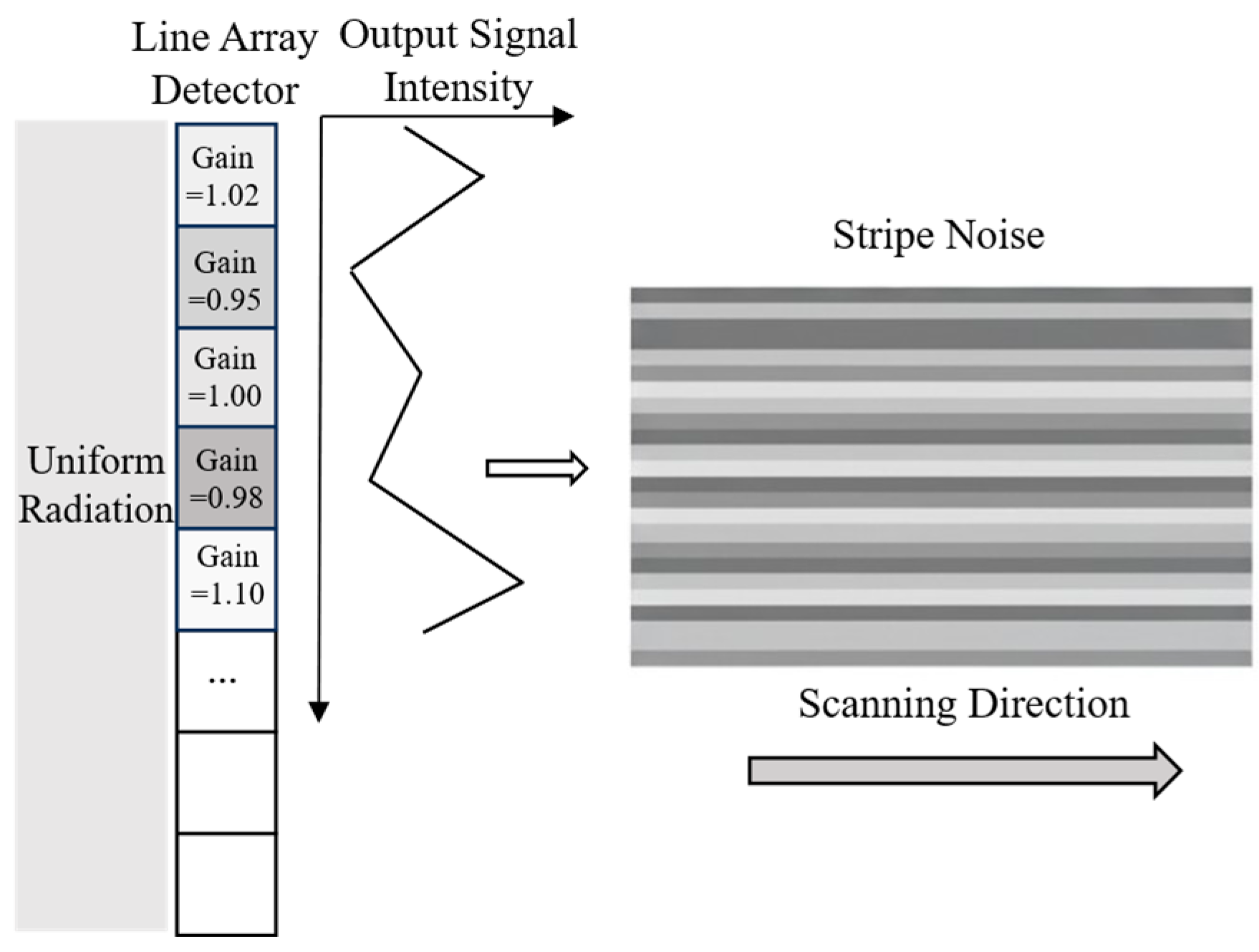
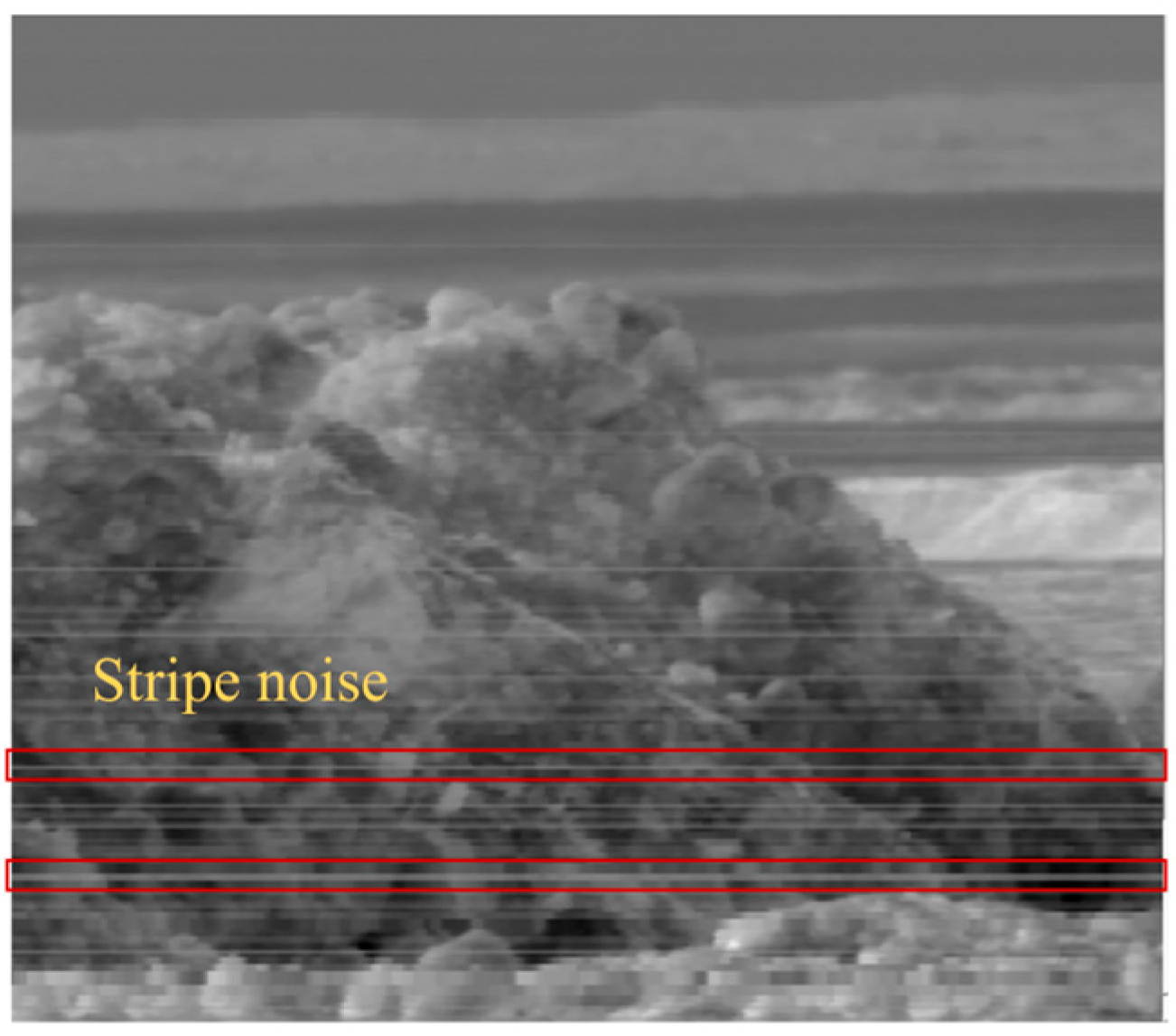
Figure 1 and Figure 2 illustrate the imaging mechanism of a linear array detector and the resultant stripe noise in infrared images, respectively. Visually, stripe noise manifests as distinct, regular bands aligned with the scanning direction. This noise primarily originates from response non-uniformity among individual detector units within the line-scan infrared system. The presence of stripe noise significantly disrupts spatial correlation between pixels perpendicular to the scanning direction, leading to degraded prediction accuracy and increased prediction residuals. Consequently, effectively suppressing the impact of stripe noise on pixel correlation has become critical for enhancing the lossless compression performance of infrared images.

3.1.2. Calculation of Row and Column Correlations

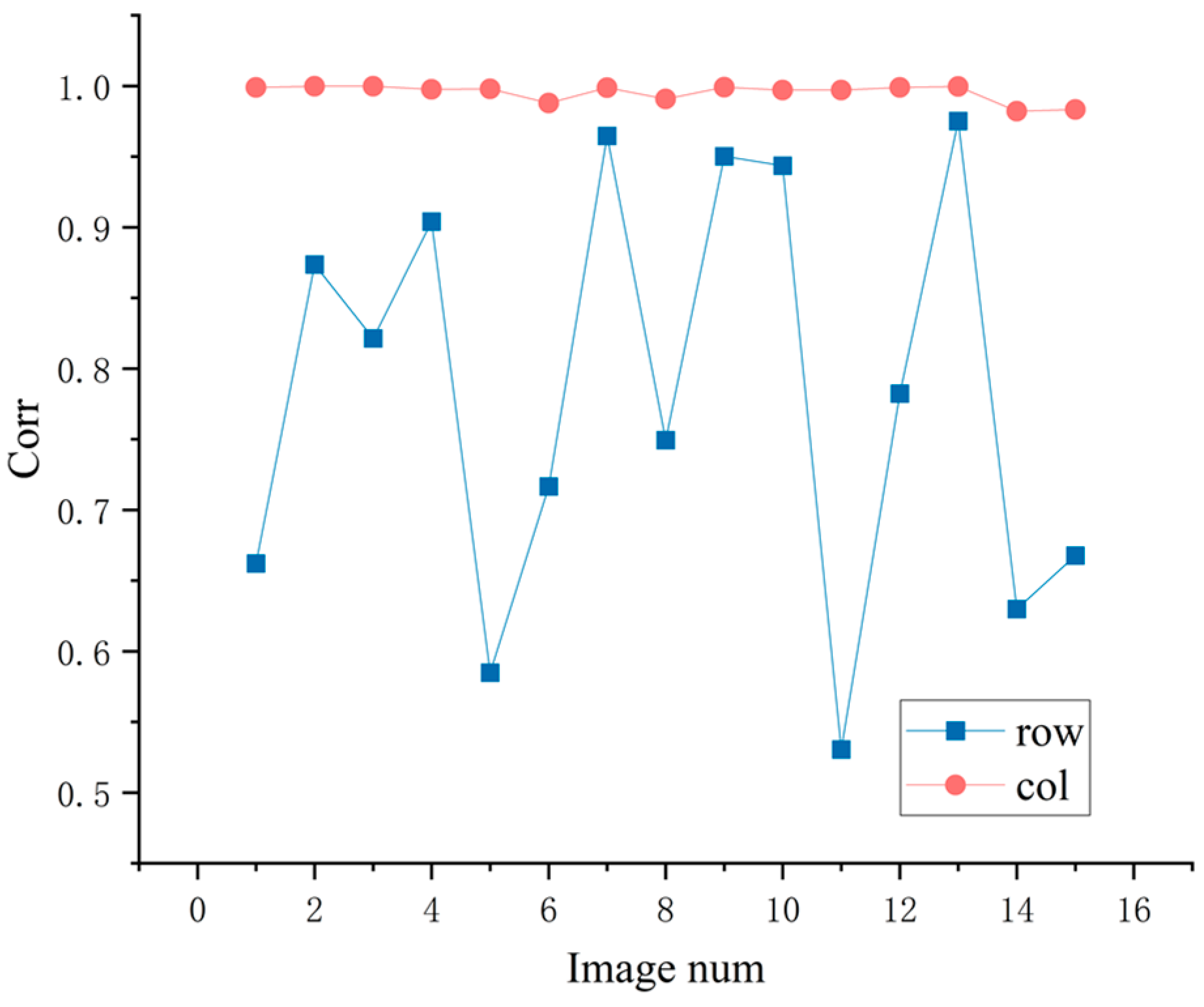
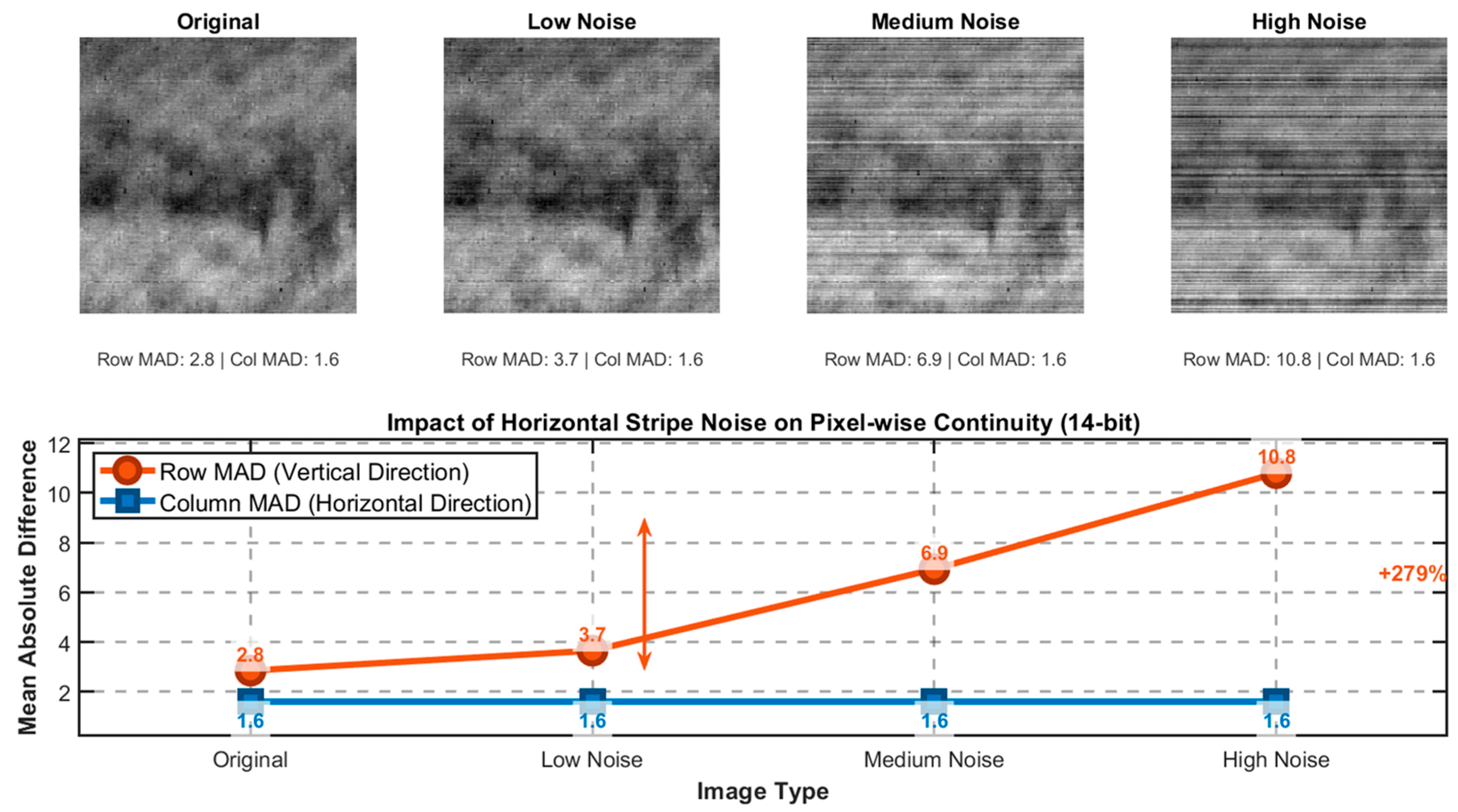
The presence of stripe noise degrades the local spatial correlation among pixels in the direction perpendicular to the stripes. To investigate this impact, we analyzed 15 infrared images exhibiting varying noise levels. The average correlation coefficients between adjacent rows and adjacent columns were calculated for image patches with relatively uniform backgrounds in each image. As shown in Figure 3, the statistical results demonstrate that the average vertical correlation is significantly lower than the average horizontal correlation across the test dataset. Additionally, stripe noise of varying intensities was synthetically added to the same infrared image, and the mean absolute differences (MADs) between adjacent rows and adjacent columns were computed. Figure 4 demonstrates that as the noise intensity increases, the inter-row MAD remains relatively constant, whereas the inter-column MAD creates a marked rise. These experiments confirm that horizontal stripe noise is the primary factor of weakened pixel correlation in the vertical direction.

3.2. Compression Algorithm

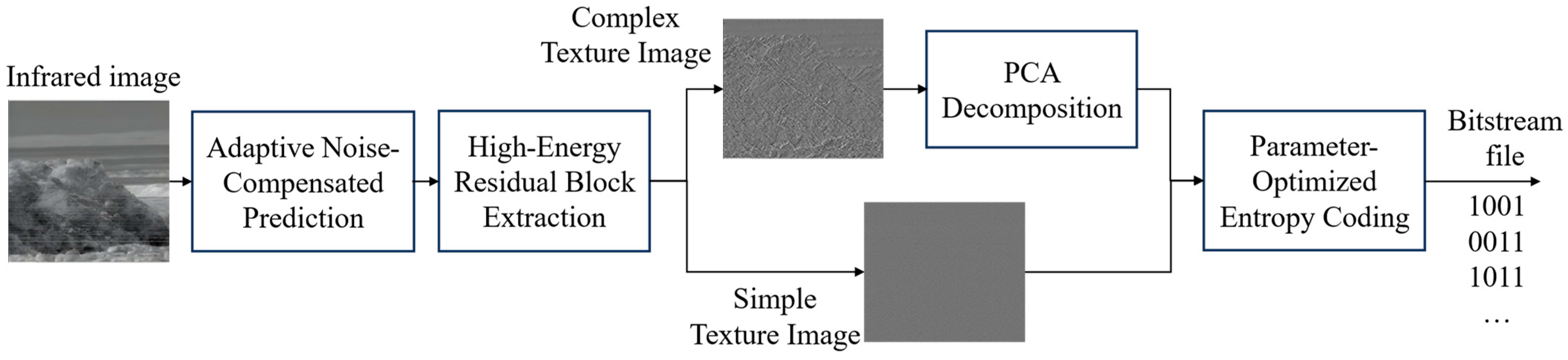
This paper proposes an adaptive prediction-based infrared image coding framework, as illustrated in Figure 5. Firstly, the method performs pixel-wise prediction on infrared images by exploiting both noise compensation and the strong correlations inherent in the scanning direction. Subsequently, high-energy residual blocks corresponding to complex texture regions are extracted and decomposed using row-wise principal component analysis (PCA) to eliminate redundant information. Finally, the prediction residuals are efficiently compressed using a parameter-optimized entropy coding method to generate the final binary bitstream. Through the cascaded processing of adaptive prediction, PCA decomposition of complex texture blocks, and optimized entropy coding, this framework achieves efficient lossless compression for infrared images.

3.2.1. Adaptive Noise-Compensated Prediction

We propose an adaptive prediction strategy incorporating noise compensation. By analyzing intensity relationships between adjacent scanning lines, the method dynamically adjusts the prediction scheme and introduces adaptive correction coefficients to accommodate varying noise levels. This approach effectively mitigates the impact of stripe noise on compression performance while exploiting the strong correlation along the scanning direction to enhance prediction accuracy.
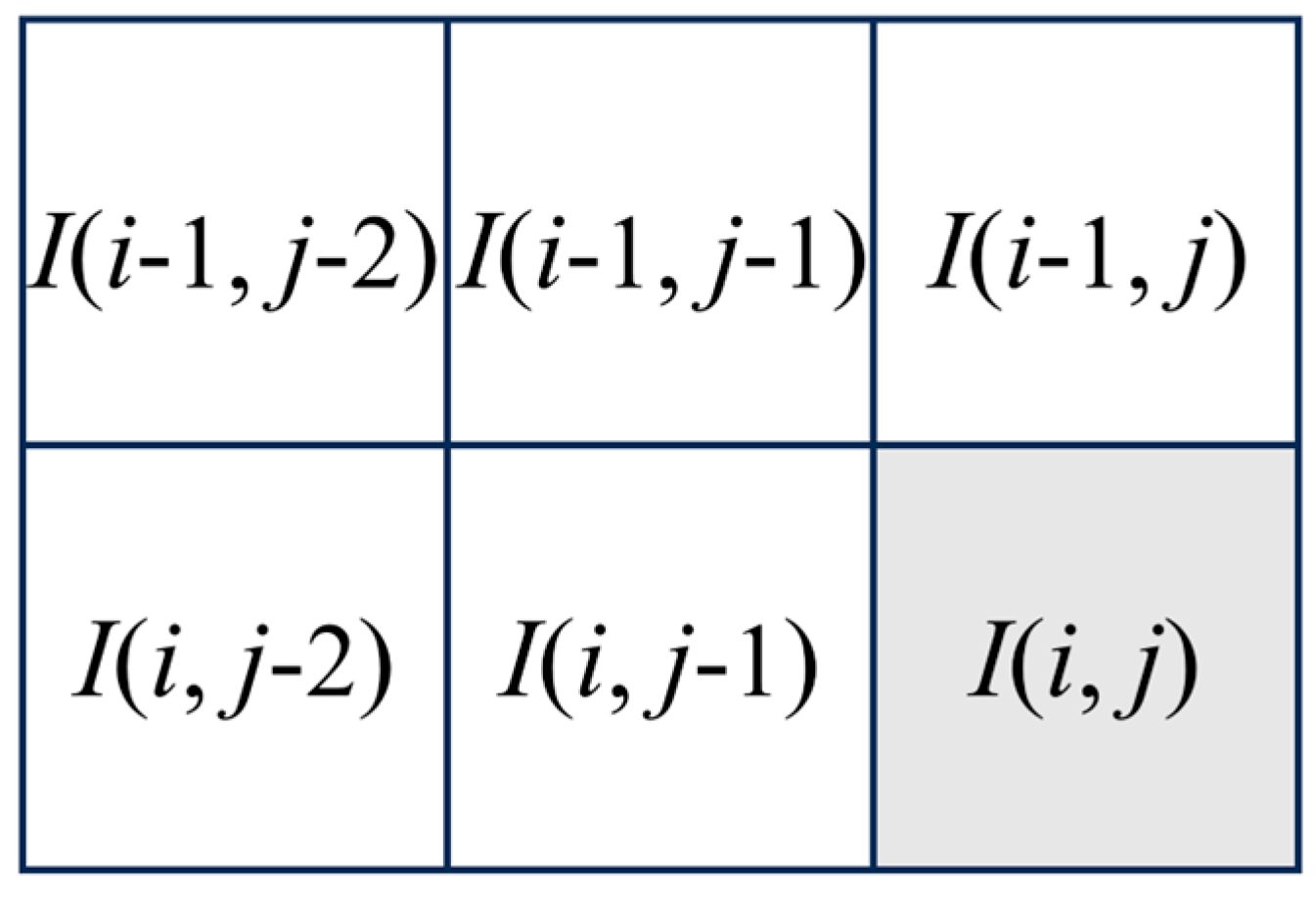
As illustrated in Figure 6, let I denote the current image to be encoded, with size M × N . The current pixel to be encoded at row i and column j is denoted by I ( i , j ) . The prediction context, denoted as Ω , comprises five previously encoded neighboring pixels:  Ω = I ( i 1 , j 2 ) , I ( i 1 , j 1 ) , I ( i 1 , j ) , I ( i , j 2 ) , I ( i , j 1 ) . The specific prediction steps are as follows:
(1)
Prediction mode selection
Calculate the vertical difference metric using Equation (1) to assess the noise level.
G = m e a n ( r 1 r 2 )
where r 1 = { I ( i 1 , j 2 ) , I ( i 1 , j 1 ) } , r 2 = { I ( i , j 2 ) , I ( i , j 1 ) } .
Based on G , the prediction mode is verified against a threshold T 1 .
-
If G = T 1 : The local context is considered strictly uniform. The pixel is predicted using median prediction (Equation (2)) to minimize computational cost.
-
Otherwise G > T 1 : The region contains texture information or potential stripe noise. The proposed adaptive noise-compensated prediction and strong-correlation prediction (Equations (3)–(10)) is performed.
Extensive experiments across diverse scenarios determined that the optimal threshold is T 1 = 0 . As detailed in Table 1, the average absolute prediction residual energy is minimized at T 1 = 0 and increases monotonically as T 1 rises. This trend demonstrates the robustness of the proposed strategy, which maximizes the utilization of texture information by applying adaptive prediction to all non-strictly flat regions G > 0 . This is achieved because the proposed method adaptively compensates for varying noise levels, effectively outperforming standard median prediction even in regions with minute variations (e.g., 1 G 4 ). Consequently, setting T 1 = 0 ensures the adaptive model is utilized to its full potential for maximum coding gain, restricting median prediction strictly to perfectly uniform regions.
(2)
Median prediction
Let c = I ( i 1 , j 1 ) , a = I ( i , j 1 ) , and b = I ( i 1 , j ) denote the neighboring pixels. The predicted value I ^ ( i , j ) is given by Equation (2):
I ^ ( i , j ) = min ( a , b ) , i f   c max ( a , b ) max ( a , b ) , i f   c min ( a , b ) a + b c , o t h e r w i s e
(3)
Adaptive noise-compensated strong-correlation prediction
The adjustment coefficient f is calculated based on adjacent rows according to Equations (3)–(5).
μ 1 = [ I ( i 1 , j 1 ) + I ( i , j 1 ) ] / 2
μ 2 = I ( i , j 1 )
f = μ 2 / μ 1
The reference pixels   c   and   b   are corrected via Equation (6); meanwhile, weight coefficients are adaptively assigned to pixel a within the same row to leverage its strong correlation for prediction. The predicted value I ( i , j ) is calculated as Equation (7):
c ^ = c f b ^ = b f
I ^ ( i , j ) = min ( a , w 1 × b ^ + w 2 × a ) , i f   c max ( a , b ) max ( a , w 1 × b ^ + w 2 × a ) , i f   c min ( a , b ) w 1 × ( a + b ^ c ^ ) + w 2 × a , o t h e r w i s e
where the weight coefficients w 1 and w 2 are calculated as Equations (8)–(10):
c o l _ d i f f = b c
w 1 = ( 1 0.04 × c o l _ d i f f )
w 1 = ( w 1 > 0.55 ) × w 1 , w 2 = 1 w 1

3.2.2. PCA Decomposition of High-Energy Residual Blocks

(1)
Extraction of High-Energy Residual Blocks
Let the original residual image be denoted as E R M × N ; the image is partitioned into non-overlapping blocks of size m × n , and the ( k , l ) -th image block is defined as Equation (11):
B k , l = r k : r k + m 1 , r l : r l + n 1
where r k = ( k 1 ) × m + 1 , c l = ( l 1 ) × n + 1 , k = 1,2 , , b r , l = 1,2 , , b c , b r = M / m , b c = N / n . In this work, m = 4 , n = 4 .
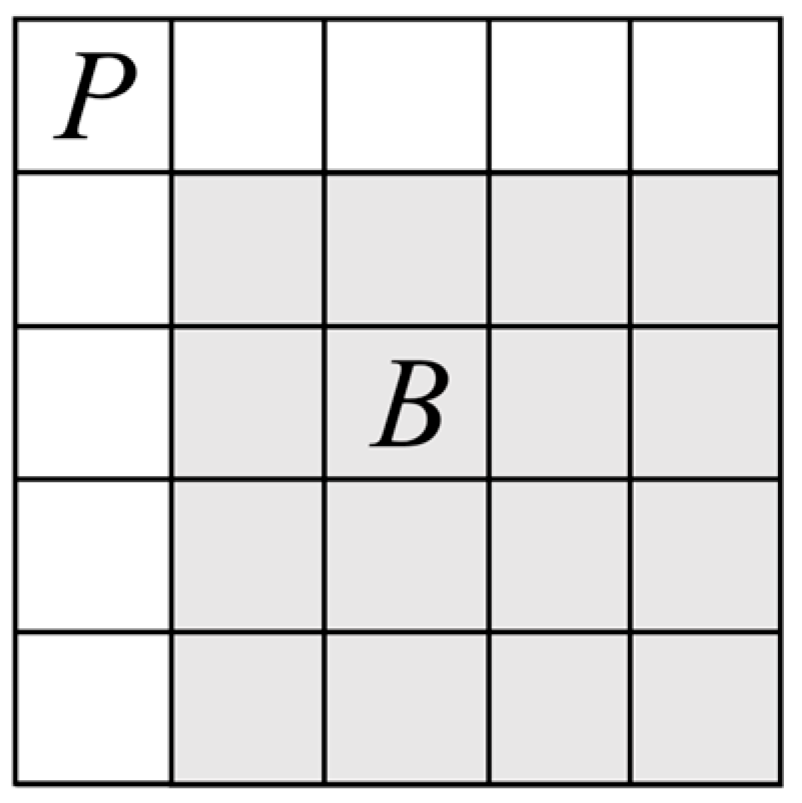
As illustrated in Figure 7, the nine pixels surrounding the target block are selected as reference samples, and their corresponding average energy is computed as Equation (12).
E = 1 9 t P P t
High-energy residual blocks are extracted to construct a complex texture image (Equation (13)):
F ( k , l ) = 1 , i f   E ( k , l ) > T e 0 , o t h e r w i s e
where E ( k , l )   represents the residual energy of the ( k , l ) block;   T e is the complexity threshold used to distinguish between simple and complex textures; and F ( k , l ) = 1 indicates that the block is classified as a complex texture block.
The total number of complex texture blocks is (Equation (14)) as follows:
N c = k = 1 b r l = 1 b c F   ( k , l )
The selection of T e is a critical parameter that balances computational complexity and compression efficiency. A smaller T e increases the number of blocks classified as complex, which may introduce additional transform operations and parameter transmission for image blocks with simple textures where the residual itself is small. Conversely, a larger T e reduces the number of complex blocks and lowers computational complexity, but may fail to identify certain highly textured regions, thereby degrading compression performance.
To evaluate the impact of T e , experiments were performed on the test images by comparing the compression ratios before and after decomposing complex images, as well as the number of complex blocks identified. The results presented in Table 2 demonstrate that  T e [ 20 , 60 ] achieves a favorable trade-off between complexity and efficiency. Therefore, T e = 40 is selected in this paper.
All complex texture blocks are concatenated horizontally in row-major order to construct the complex texture residual image I c , I c = [ B c , 1 B c , 2 B c , N c ] . The height of I c is h = m , and the width is w = N c × n .
(2)
Row-wise PCA Decomposition of Complex Texture Residual Image
(a)
Decomposition
Each row of pixels in the complex texture residual image is treated as an independent dataset, and principal component analysis (PCA) is applied to decompose the data into low- and high-frequency components. This process further eliminates partial intra-row correlations.
Let
I c = A 1 A 2 A h
where A i R w represents the i-th row vector. For each row A i , it is converted into a 2D matrix   2 × w / 2  based on odd and even coordinates.
X i = x i ( 1 ) x i ( 3 ) x i ( w 1 ) x i ( 2 ) x i ( 4 ) x i ( w )
Decompose X i via Equation (15):
X i = Y P T = y 11 y 12 y 21 y 22 · p 11 p 11 p 21 p 22 p g 1 p g 2 = y 11 p 11 + y 12 p 12 , y 11 p 21 + y 12 p 22 , , y 11 p g 1 + y 12 p g 2 y 21 p 11 + y 22 p 12 , y 21 p 21 + y 22 p 22 , , y 21 p g 1 + y 22 p g 2
where g = w / 2 .
The first row X i (1,:) is divided into two parts, L i ( 1 , : )  and H i ( 1 , : )  (Equation (16)).
X i ( 1 , : ) = [ y 11 p 11 + y 12 p 12 , y 11 p 21 + y 12 p 22 , , y 11 p g 1 + y 12 p g 2 ] = [ y 11 p 11 , y 11 p 21 , , y 11 p g 1 ] + [ y 12 p 12 , y 12 p 22 , , y 12 p g 2 ]
where
L i ( 1 , : ) = r o u n d ( [ y 11 p 11 , y 11 p 21 , , y 11 p g 1 ] ) H i ( 1 , : ) = r o u n d ( [ y 12 p 12 , y 12 p 22 , , y 12 p g 2 ] )
(b)
Reconstruction
Since the compression is lossless, the reconstructed values of   L ~ i ( 1 , : )  and   H ~ i ( 1 , : ) are as follows:
L ~ i ( 1 , : ) = L i ( 1 , : ) H ~ i ( 1 , : ) = H i ( 1 , : )
As shown in Equation (17), L ~ i ( 2 , : ) and H ~ i ( 2 , : ) are reconstructed from L ~ i ( 1 , : ) and H ~ i ( 1 , : ) :
L ~ i ( 2 , : ) = r o u n d ( L ~ i ( 1 , : ) y 21 / y 11 ) H ~ i ( 2 , : ) = r o u n d ( H ~ i ( 1 , : ) y 22 / y 12 )
Then, the reconstructed values of X ~ i ( 2 , : ) and X i are given by Equations (18) and (19):
X ~ i ( 2 , : ) = L ~ i ( 2 , : ) + H ~ i ( 2 , : )
X ~ i =   X i ( 1 , : ) X ~ i ( 1 , : )
For each row of the complex residual image, the encoder stores a four-parameter core matrix Y required for reconstruction. Let t i = y 21 / y 11 , then
y 22 / y 12 = y 11 / y 21 = 1 / t i
Therefore, only one parameter t i needs to be transmitted for each row. However, since this value is floating-point data, it is truncated to 8 decimal places for transmission, t i = f i x ( t i × 1 0 k ) / 1 0 k , k = 8 . Empirical tests show that this precision is sufficient to achieve identical reconstruction results as full-precision floating-point parameters, while avoiding the high bitrate overhead of higher-precision transmission.
Since Y is a floating-point matrix, and rounding operations were performed when obtaining L i ( 1 , : ) and H i ( 1 , : ) , the reconstructed matrix L ~ i ( 2 , : ) and H ~ i ( 2 , : ) may contain errors. Therefore, calculate the error matrix (Equation (20)):
r e s = X X ~

3.2.3. Minimum Nearest Neighbor Prediction for Residuals

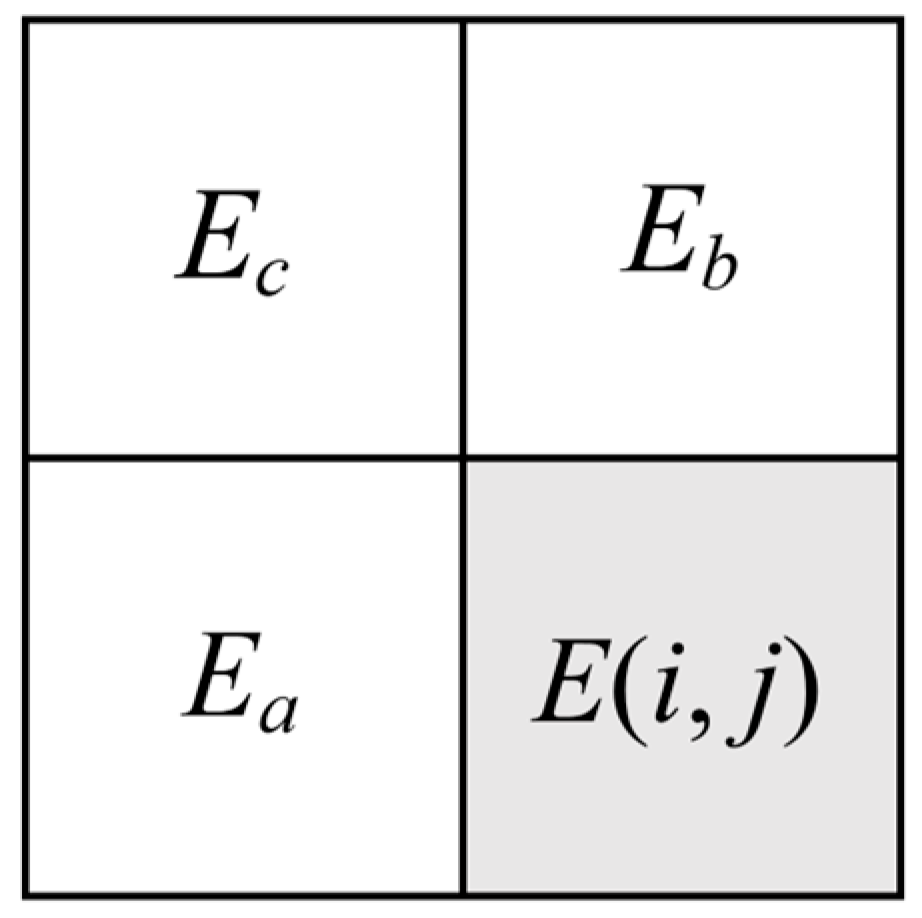
In the residual image, particularly within edge and texture regions, prediction residuals often retain substantial energy. To mitigate this, a minimum nearest neighbor prediction strategy is applied to further reduce the residual energy. Let   E ( i , j )   denote the pixel to be predicted, with the positional distribution of its neighboring pixels shown in Figure 8.
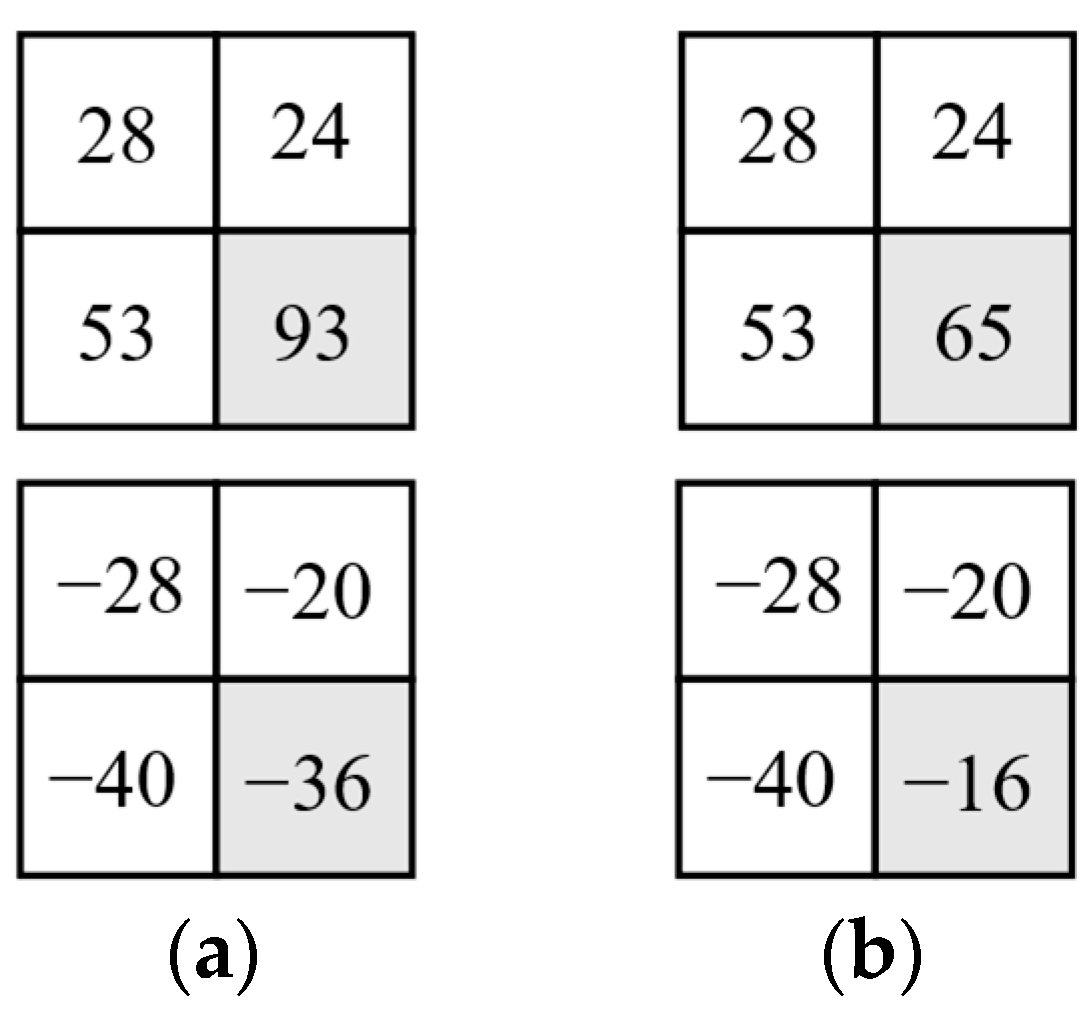
Initially, the polarity of the neighboring pixels E a ,   E b , and E c is examined to verify sign consistency. If these neighbors exhibit identical signs, there is a strong probability that the target pixel E ( i , j ) shares this polarity. Meanwhile, if ( E a + E b + E c ) / 3 > T 2 , in such scenarios, the pixel with the minimum absolute value among the neighbors is selected as the prediction value for E ( i , j ) , as Equation (21). Figure 9 demonstrates the effectiveness of this approach by comparing signal magnitudes before and after applying minimum nearest neighbor prediction, where the values are derived from actual image prediction residuals.
E ^ ( i , j ) =   E ( i , j ) min ( E a , E b , E c ) , i f   μ > T 2   a n d min ( E a , E b , E c ) > 0 E ( i , j ) max ( E a , E b , E c ) , i f   μ > T 2   a n d max ( E a , E b , E c ) < 0 E ( i , j ) , o t h e r s
where μ = ( E a + E b + E c ) / 3 denotes the mean of absolute values.
To determine the optimal value of T 2 , extensive experiments were conducted on test images by evaluating the average absolute residual energy under various threshold settings. As detailed in Table 3, the residual energy is minimized at T 2 = 5 , but the performance difference between T 2 = 5 and T 2 = 10 is marginal. A smaller T increases the frequency of minimum nearest neighbor prediction, which may lead to unnecessary computations and the over-prediction of inherently small residuals, consequently increasing the overall residual energy. In contrast, a larger T 2 reduces the number of predictions, limiting the algorithm’s ability to exploit residual correlations effectively.
Considering both the prediction accuracy and computational stability, T 2 = 10 was selected as the optimal threshold. This setting ensures that the minimum nearest neighbor prediction is performed only when the residual correlation is sufficiently strong, thus balancing the trade-off between residual reduction and computational efficiency. The experimental results confirm that T 2 = 10 achieves stable performance across diverse image scenarios.

3.2.4. Adaptive Parameter-Optimized Entropy Coding

Golomb–Rice coding is highly efficient for data with a two-sided geometric distribution, particularly image prediction residuals. Additionally, by replacing complex division with bitwise operations, it reduces computational overhead and facilitates hardware implementation.
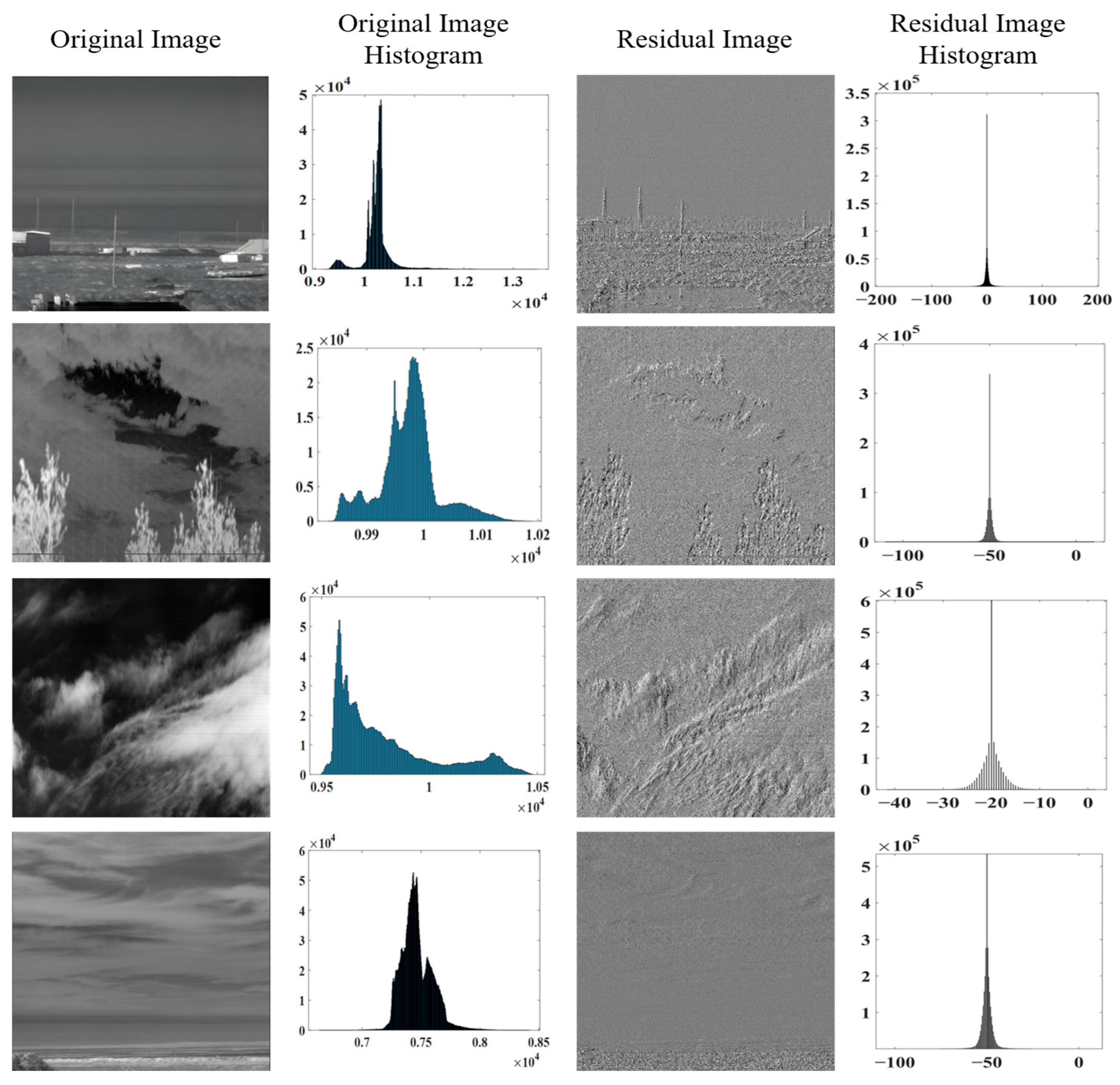
Figure 10 illustrates the histogram distributions of the line-scan infrared images and the residual images. It can be observed that the residual values obtained by the proposed method are distributed around zero, conforming to a two-sided geometric distribution. Therefore, in this paper, Golomb–Rice coding is employed to entropy encode the prediction residuals.
The encoding process begins by mapping the signed residual E r r V a l to a non-negative integer  M a p p e d E r r through a mapping function, defined as follows (Equation (22)):
M a p p e d E r r = 2 × E r r V a l , i f   E r r V a l 0 2 × E r r V a l 1 , i f   E r r V a l < 0
Subsequently,   M a p p e d E r r  is encoded using a Golomb–Rice code with  k . The codeword consists of two parts:
(1) A unary code for the quotient q = M a p p e d E r r / 2 k ;
(2) A k-bit binary representation of the remainder r = M a p p e d E r r   m o d   2 k .
The total code length: ( q + 1 ) + k   bits.
JPEG-LS adopts a context-based mechanism to dynamically update the value of k . For each context Q , determined by local gradients, it maintains accumulated absolute prediction errors A [ Q ] , occurrence count N [ Q ] . Since 2 k approximately equates to the expected error magnitude, the optimal k is recalculated before encoding as the minimum integer satisfying the following: N [ Q ] 2 k A [ Q ] . This mechanism allows the encoder to adapt effectively to local signal characteristics.
The determination of k is refined by incorporating the local statistics of immediate neighbors, rather than relying solely on the accumulated context Q . Supplementing the standard A [ Q ] and N [ Q ] calculation, we compute A v g E r r , the average absolute residual of the three surrounding pixels. A correction factor based on A v g E r r is introduced to appropriately increase k in regions with high values, which indicate complex texture and significant fluctuations.
Let the current residual pixel be x , and consider the residuals of the three neighboring pixels: Φ = { R ( x 1 , y 1 ) , R ( x 1 , y ) , R ( x , y 1 ) } . Calculate the mean absolute residual of the three neighboring pixels A v g E r r via Equation (23):
A ν g E r r = 1 3 i = 1 3 Φ i
Update the k value (Equation (24)):
k = k + Δ k ,   Δ k = 1 , i f   A ν g E r r > 13   a n d   2 k + 1 < A ν g E r r 0 , otherwise

4. Experiment and Results

4.1. Datasets

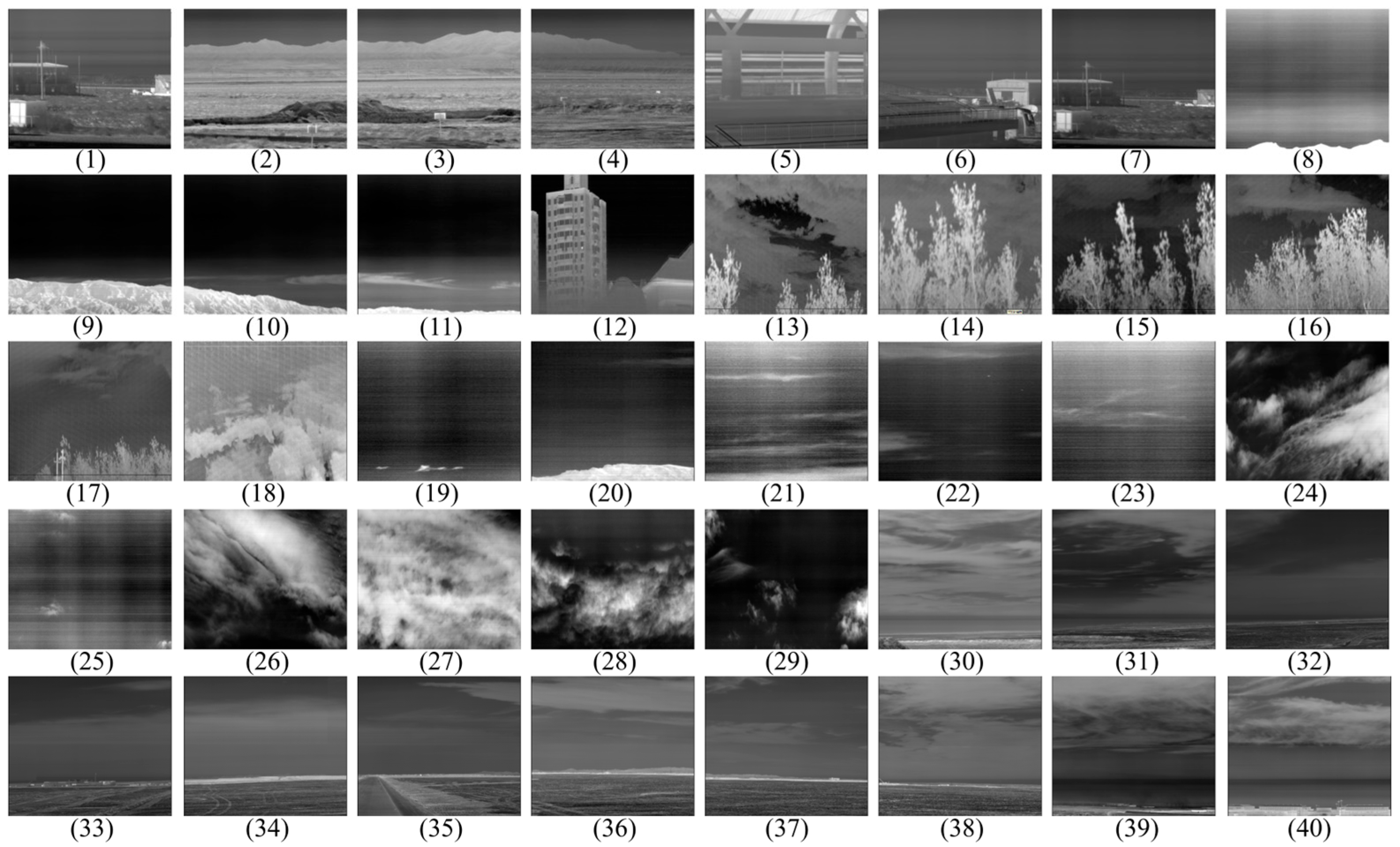
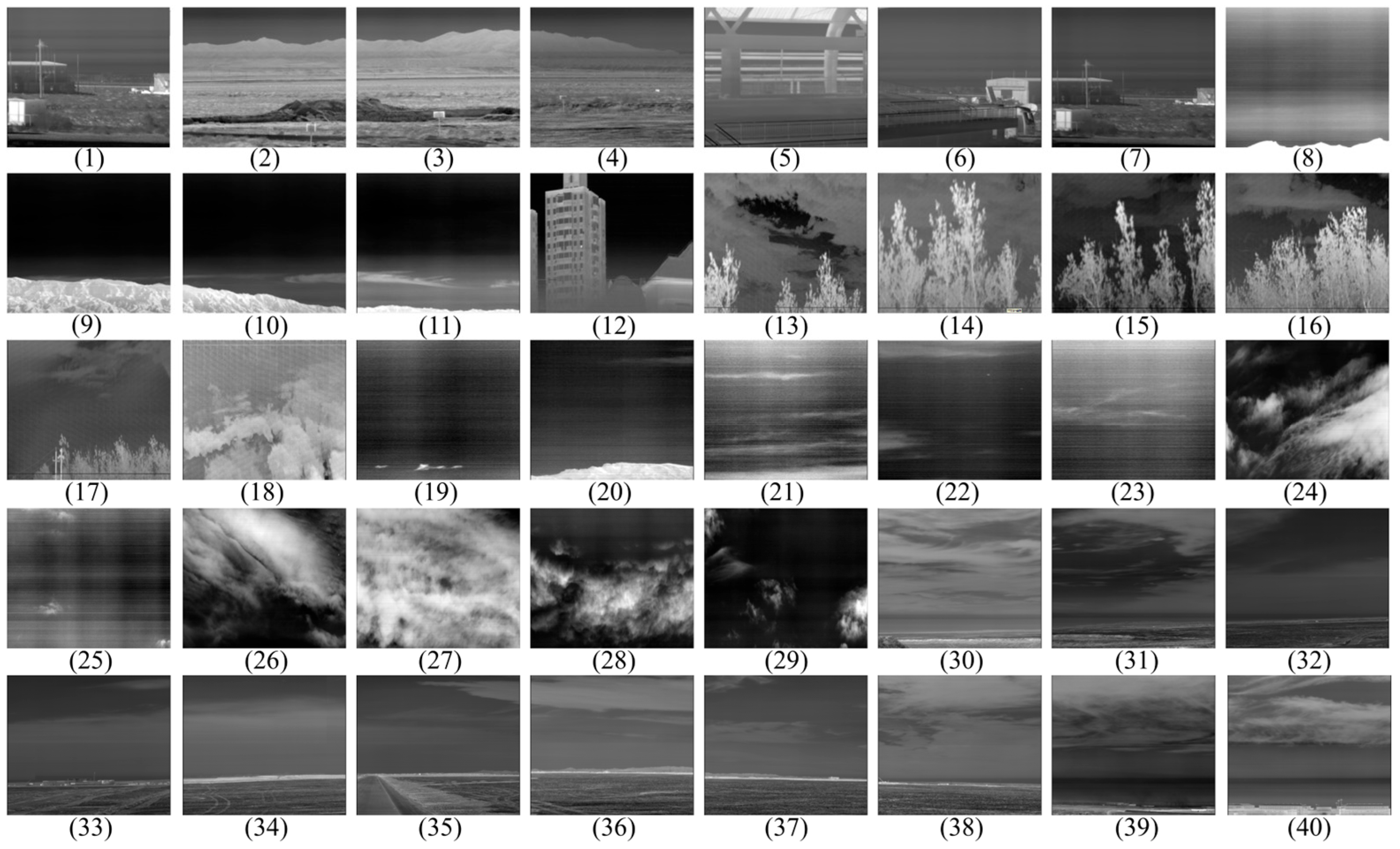
In this paper, 40 frames of line-scan infrared images are used as the test image dataset. The dataset includes scenes such as sky clouds, buildings, mountains, and vegetation, as shown in Figure 11. Table 4 provides comprehensive information about the test images.

4.2. Performance Comparison and Configurations

To evaluate compression performance, the proposed method is compared with mainstream image coding methods: JPEG2000 [31], JPEG-XT [33], PNG [32]. H.264/AVC-Intra [24], and H.265/HEVC-Intra [25].
Encoder configurations: JPEG2000: OpenJPEG2.5.0 [51]; JPEG-XT: (part of ISO/IEC 18477-5) [52];
H.264/AVC: JM19.0 [53]; H.265/HEVC: HM16.9 [54].
All experiments were conducted on a platform equipped with an Intel Core i7-8750H CPU (2.1 GHz) and 8 GB of RAM, running Windows 10 (64-bit). The proposed algorithm was implemented in Visual Studio 2017 (C/C++) without explicit parallelization. For a fair complexity comparison, all comparative methods were evaluated using their respective reference software.

4.3. Metrics

The coding performance of different methods is evaluated by Structural Similarity (SSIM) (Equation (25)), compression ratio (CR) (Equation (26)), bits per pixel (bpp) (Equation (27)), and compression speed.
S S I M = ( 2 μ I μ I + C I ) ( 2 σ I I + C I ) ( μ I 2 + μ I 2 + C I ) ( σ I 2 + σ I 2 + C I )
where μ I and μ I represent the mean values of the original image I and the reconstructed image I , respectively;   σ I and σ I denote the variances in the original image and the reconstructed image; and σ I I indicates the covariance between the original image and the reconstructed image. Constants: C I = ( K 1 L ) 2 , C I = ( K 2 L ) 2 , C I = ( K 1 L ) 2 , C I = ( K 2 L ) 2 .
C R = O r i g i n a l   i m a g e   s i z e C o m p r e s s e d   i m a g e   s i z e
b p p = C o m p r e s s e d   i m a g e   s i z e I m a g e   d i m e n s i o n s

4.4. Experimental Results and Analysis

1.
SSIM
The reconstructed images are shown in Figure 12. We computed the SSIM between the reconstructed and original images for all 40 test images, and the results show that the SSIM is exactly 1.0 for all reconstructed images. This confirms that the reconstructed images are structurally identical to the originals, verifying the lossless nature of the proposed method.
2.
CR, BPP, and Compression Speed
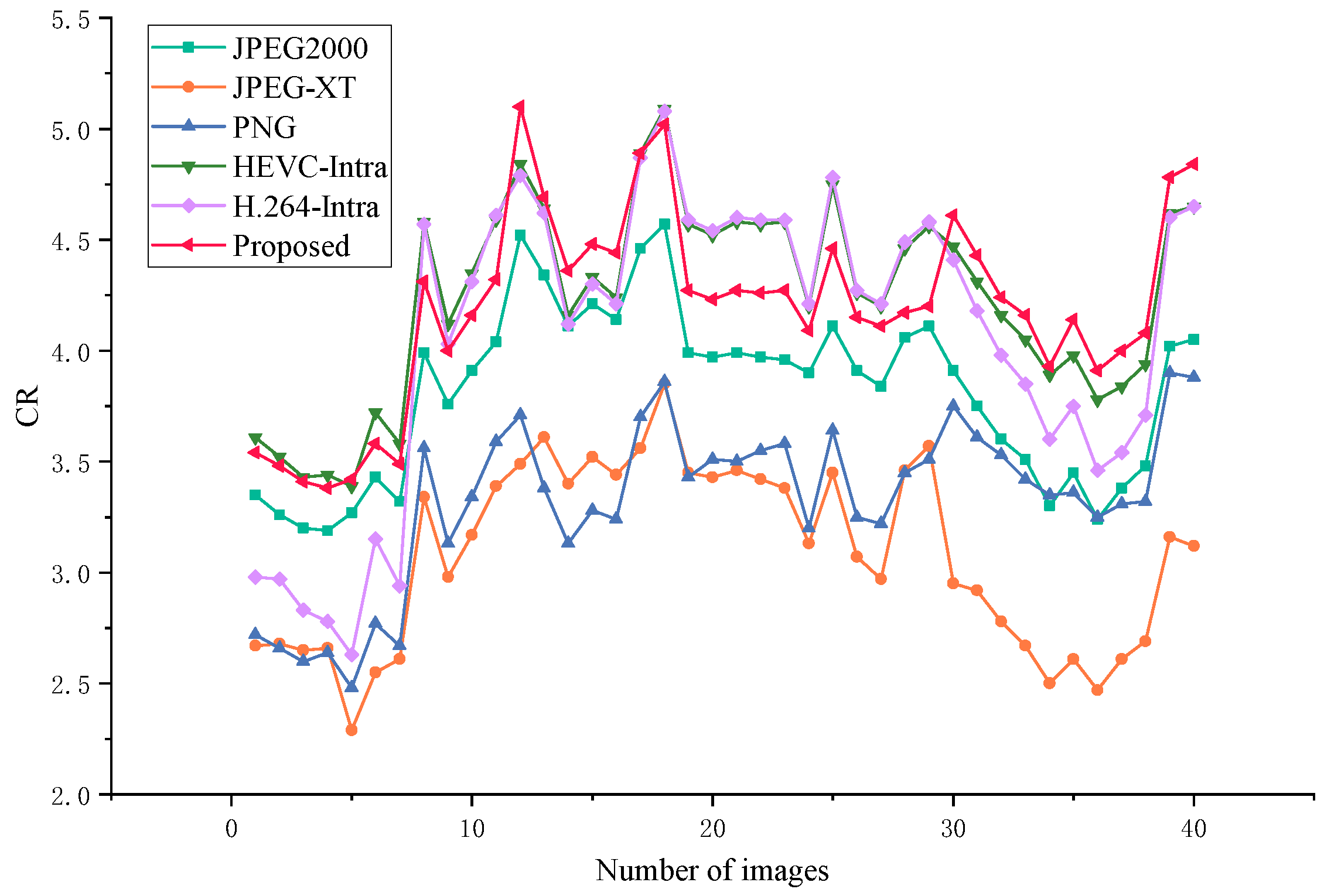
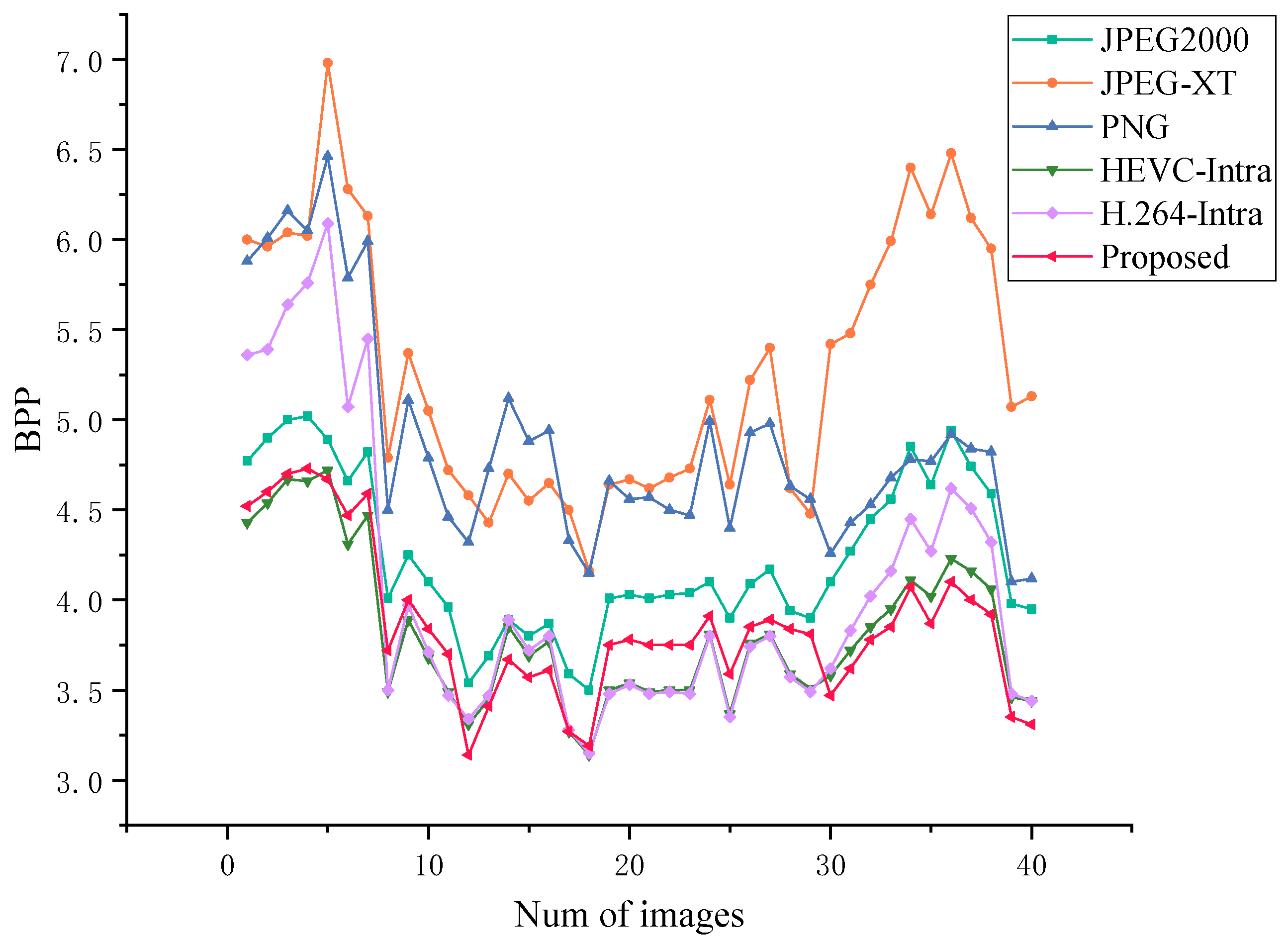
Figure 13 and Figure 14 present the CR and BPP values for each individual test image, respectively. CR represents the reduction in data size (higher is better), whereas BPP represents the number of bits required per pixel (lower is better). Table 5 presents the average performance (CR, BPP, and compression speed (CS)) of different lossless compression methods for infrared images.
Based on the above experimental results, the key findings of this study are summarized as follows:
(1) Compression efficiency: The proposed method achieves a CR of 4.19, which is slightly lower than that of HEVC-Intra (4.24) but outperforms H.264-Intra (4.07), JPEG2000 (3.81), PNG (3.32), and JPEG-XT (3.08). Meanwhile, its BPP is 3.86, which is only slightly higher than that of HEVC-Intra (3.82) and significantly lower than those of other methods (5.29 for JPEG-XT), indicating that the proposed method has high data compression capability.
(2) Computational efficiency: The proposed method achieves a compression speed of 9.85 MB/s, which is significantly faster than HEVC-Intra (0.46 MB/s) and H.264-Intra (0.88 MB/s), and is close to the lightweight JPEG2000 (9.69 MB/s). Compared with H.265/HEVC, our method achieves a 21.4-fold improvement in processing speed. The proposed method also achieves a favorable balance between computational complexity and compression performance. These results indicate that the proposed method avoids the high computational cost of high-performance standards such as HEVC-Intra while maintaining competitive compression efficiency, making it more suitable for real-time or infrared image compression scenarios.
3.
Comparison with alternative approaches
It is worth noting that a sequential strategy of “image destriping followed by standard compression” was considered, but the proposed joint approach was ultimately deemed more suitable for the lossless compression task. This decision is justified by four critical factors.
(1). Requirement for raw data integrity: In many applications, such as remote sensing observation and weak/small target detection, downstream scientific analysis demands raw, unaltered image data. Most existing stripe noise removal methods are inherently lossy operations that modify original pixel values. Applying such preprocessing prior to compression risks irreversible information loss, thereby violating the strict requirement for bit-exact reconstruction in lossless compression.
(2). Coding inefficiency of standard algorithms: Standard compression protocols (e.g., JPEG 2000) typically interpret stripe noise as high-frequency image components. Consequently, they allocate excessive bitrate to encode these noise patterns without exploiting their structural correlations, resulting in suboptimal compression ratios.
(3). Computational complexity and latency: Implementing destriping algorithms as a preprocessing step imposes an increased processing burden and latency on resource-constrained hardware. In contrast, our method integrates noise modeling directly into the prediction stage, providing a more lightweight solution.
(4). Signal distortion: Denoising preprocessing may misidentify valid texture details as noise and remove them, leading to information loss. By encoding the original image and specifically reducing the redundancy induced by stripes, our method avoids such preprocessing artifacts and preserves all original information.
In conclusion, the proposed method utilizes adaptive prediction mechanisms governed by local statistical characteristics to effectively reduce spatial redundancy. Distinct from conventional approaches, it achieves an optimal equilibrium between compression efficiency and low computational complexity. This effectively resolves the inherent conflict in traditional methods, where high compression ratios typically necessitate prohibitive processing time, thereby establishing a practical solution for the lossless compression of infrared imagery.

5. Conclusions

This paper proposes a pixel-level adaptive prediction compression algorithm for high bit-depth, large-format line-scan infrared images. Line-scan infrared images may contain varying degrees of stripe noise, which is difficult to eliminate completely. The proposed method fully exploits the high correlation between pixels acquired by the same detector element in the scanning direction for predictive coding. Meanwhile, an adaptive noise compensation mechanism is introduced in the perpendicular direction to dynamically correct inter-row pixel differences, effectively reducing the impact of stripe noise on prediction accuracy and improving compression performance. The experimental results demonstrate that the proposed method significantly improves the compression efficiency for large-format infrared images compared to existing standard lossless algorithms. Consequently, for wide field-of-view, high-resolution systems requiring high fidelity, this algorithm effectively alleviates data storage and transmission burdens, offering significant potential for applications in remote sensing, target recognition, and tracking.

Author Contributions

Conceptualization, Y.L.; methodology, Y.L.; software, Y.L.; formal analysis, Y.L. and R.Z.; investigation, Y.L.; data curation, Y.L.; writing—original draft preparation, Y.L.; writing—review and editing, Z.L., Y.Z., and R.Z.; supervision, Z.L., Y.Z., and R.Z.; project administration, Y.Z.; funding acquisition, Y.Z. All authors have read and agreed to the published version of the manuscript.

Funding

This work was supported by the National Key R&D Program of China (Grant No. 2024YFB3614400).

Institutional Review Board Statement

Not applicable.

Informed Consent Statement

Not applicable.

Data Availability Statement

The raw data supporting the conclusions of this article will be made available by the authors on request.

Conflicts of Interest

The authors declare no conflicts of interest.

References

  1. Hou, F.; Zhang, Y.; Zhou, Y.; Zhang, M.; Lv, B.; Wu, J. Review on infrared imaging technology. Sustainability 2022, 14, 11161. [Google Scholar] [CrossRef]
  2. Smigaj, M.; Agarwal, A.; Bartholomeus, H.; Decuyper, M.; Elsherif, A.; de Jonge, A.; Kooistra, L. Thermal infrared remote sensing of stress responses in forest environments: A review of developments, challenges, and opportunities. Curr. For. Rep. 2024, 10, 56–76. [Google Scholar] [CrossRef]
  3. Zhang, C.J.; Geng, B.F.; Ma, L.M.; Lu, X.Q. Estimation of tropical cyclone size by combining sequential infrared satellite images with multi-task deep learning. IEEE Trans. Geosci. Remote Sens. 2024, 62, 1–16. [Google Scholar]
  4. Xu, H.; Lu, C.; Zhang, H.; Shao, Z.; Liu, G.; Ma, J. Artificial intelligence-assisted remote sensing observation, understanding, and decision. The Innovation 2025, 6, 100688. [Google Scholar] [CrossRef]
  5. Usamentiaga, R.; Venegas, P.; Guerediaga, J.; Vega, L.; Molleda, J.; Bulnes, F.G. Infrared thermography for temperature measurement and non-destructive testing. Sensors 2014, 14, 12305–12348. [Google Scholar] [CrossRef] [PubMed]
  6. Buongiorno, D.; Prunella, M.; Grossi, S.; Hussain, S.M.; Rennola, A.; Longo, N.; Di Stefano, G.; Bevilacqua, V.; Brunetti, A. Inline defective laser weld identification by processing thermal image sequences with machine and deep learning techniques. Appl. Sci. 2022, 12, 6455. [Google Scholar] [CrossRef]
  7. Chen, J.; Yang, X.; Lu, L.; Li, Q.; Li, Z.; Wu, W. A novel infrared image enhancement based on correlation measurement of visible image for urban traffic surveillance systems. J. Intell. Transp. Syst. 2020, 24, 290–303. [Google Scholar] [CrossRef]
  8. Chen, X.; Hopkins, B.; Wang, H.; O’Neill, L.; Afghah, F.; Razi, A.; Fulé, P.; Coen, J.; Rowell, E.; Watts, A. Wildland fire detection and monitoring using a drone-collected rgb/ir image dataset. IEEE Access 2022, 10, 121301–121317. [Google Scholar] [CrossRef]
  9. Zhang, J.; Zhou, X.; Li, L.; Hu, T.; Fansheng, C. A combined stripe noise removal and deblurring recovering method for thermal infrared remote sensing images. IEEE Trans. Geosci. Remote Sens. 2022, 60, 1–4. [Google Scholar] [CrossRef]
  10. Li, M.; Nong, S.; Nie, T.; Han, C.; Huang, L.; Qu, L. A novel stripe noise removal model for infrared images. Sensors 2022, 22, 2971. [Google Scholar] [CrossRef]
  11. Shao, Y.; Sun, Y.; Zhao, M.; Chang, Y.; Zheng, Z.; Tian, C.; Zhang, Y. Infrared image stripe noise removing using least squares and gradient domain guided filtering. Infrared Phys. Technol. 2021, 119, 103968. [Google Scholar] [CrossRef]
  12. Liu, Z.; Deng, H.; Zhu, X.; Li, L. Distance Constrained Sparse Representation Approach for Scene Based Nonuniformity Correction in Infrared Imaging. IEEE Access 2024, 12, 141116–141129. [Google Scholar]
  13. Zhang, Y. A Rate-Distortion-Classification approach for lossy image compression. Digit. Signal Process. 2023, 141, 104163. [Google Scholar] [CrossRef]
  14. Hu, Y.; Yang, W.; Ma, Z.; Liu, J. Learning end-to-end lossy image compression: A benchmark. IEEE Trans. Pattern Anal. Mach. Intell. 2021, 44, 4194–4211. [Google Scholar] [CrossRef]
  15. Rahman, M.A.; Hamada, M. Lossless image compression techniques: A state-of-the-art survey. Symmetry 2019, 11, 1274. [Google Scholar] [CrossRef]
  16. Altamimi, A.; Ben Youssef, B. Lossless and near-lossless compression algorithms for remotely sensed hyperspectral images. Entropy 2024, 26, 316. [Google Scholar] [CrossRef] [PubMed]
  17. Rawat, S.S.; Verma, S.K.; Kumar, Y. Review on recent development in infrared small target detection algorithms. Procedia Comput. Sci. 2020, 167, 2496–2505. [Google Scholar] [CrossRef]
  18. Mofreh, A.; Barakat, T.M.; Refaat, A.M. A new lossless medical image compression technique using hybrid prediction model. Signal Process. Int. J. 2016, 10, 20. [Google Scholar]
  19. Mielikainen, J.; Toivanen, P. Clustered DPCM for the lossless compression of hyperspectral images. IEEE Trans. Geosci. Remote Sens. 2004, 41, 2943–2946. [Google Scholar] [CrossRef]
  20. Weinberger, M.J.; Seroussi, G.; Sapiro, G. The LOCO-I lossless image compression algorithm: Principles and standardization into JPEG-LS. IEEE Trans. Image Process. 2000, 9, 1309–1324. [Google Scholar] [CrossRef]
  21. Chen, L.; Yan, L.; Sang, H.; Zhang, T. High-throughput architecture for both lossless and near-lossless compression modes of LOCO-I algorithm. IEEE Trans. Circuits Syst. Video Technol. 2018, 29, 3754–3764. [Google Scholar] [CrossRef]
  22. Zhang, M.; Tong, X.; Wang, Z.; Chen, P. Joint lossless image compression and encryption scheme based on CALIC and hyperchaotic system. Entropy 2021, 23, 1096. [Google Scholar] [CrossRef]
  23. Alakuijala, J.; Van Asseldonk, R.; Boukortt, S.; Bruse, M.; Comșa, I.M.; Firsching, M.; Fischbacher, T.; Kliuchnikov, E.; Gomez, S.; Obryk, R.; et al. JPEG XL next-generation image compression architecture and coding tools. In Proceedings of the Applications of Digital Image Processing XLII; SPIE: Bellingham, WA, USA, 2019; Volume 11137, pp. 112–124. [Google Scholar]
  24. Wiegand, T.; Sullivan, G.J.; Bjontegaard, G.; Luthra, A. Overview of the H. 264/AVC video coding standard. IEEE Trans. Circuits Syst. Video Technol. 2003, 13, 560–576. [Google Scholar] [CrossRef]
  25. Sullivan, G.J.; Ohm, J.R.; Han, W.J.; Wiegand, T. Overview of the high efficiency video coding (HEVC) standard. IEEE Trans. Circuits Syst. Video Technol. 2012, 22, 1649–1668. [Google Scholar] [CrossRef]
  26. Bross, B.; Wang, Y.K.; Ye, Y.; Liu, S.; Chen, J.; Sullivan, G.J.; Ohm, J.R. Overview of the versatile video coding (VVC) standard and its applications. IEEE Trans. Circuits Syst. Video Technol. 2021, 31, 3736–3764. [Google Scholar] [CrossRef]
  27. Saxena, A.; Fernandes, F.C. DCT/DST-based transform coding for intra prediction in image/video coding. IEEE Trans. Image Process. 2013, 22, 3974–3981. [Google Scholar] [CrossRef] [PubMed]
  28. Wallace, G.K. The JPEG still picture compression standard. IEEE Trans. Consum. Electron. 2002, 38, xviii–xxiv. [Google Scholar] [CrossRef]
  29. Qureshi, M.A.; Deriche, M. A new wavelet based efficient image compression algorithm using compressive sensing. Multimed. Tools Appl. 2016, 75, 6737–6754. [Google Scholar] [CrossRef]
  30. Rabbani, M.; Joshi, R. An overview of the JPEG 2000 still image compression standard. Signal Process. Image Commun. 2002, 17, 3–48. [Google Scholar] [CrossRef]
  31. Roelofs, G. PNG Lossless Image Compression. In Lossless Compression Handbook; Sayood, K., Ed.; Academic Press: San Diego, CA, USA, 2003; pp. 371–390. [Google Scholar]
  32. Artusi, A.; Mantiuk, R.K.; Richter, T.; Hanhart, P.; Korshunov, P.; Agostinelli, M.; Ten, A.; Ebrahimi, T. Overview and evaluation of the JPEG XT HDR image compression standard. J. Real-Time Image Process. 2019, 16, 413–428. [Google Scholar] [CrossRef]
  33. Belyaev, E.; Forchhammer, S. Low-complexity open-loop coding of IDR infrared images having JPEG compatibility. J. Real-Time Image Process. 2020, 17, 1547–1565. [Google Scholar] [CrossRef]
  34. Mohammadi, H.; Ghaderzadeh, A.; Sheikh Ahmadi, A. A novel hybrid medical data compression using Huffman coding and LZW in IoT. IETE J. Res. 2023, 69, 7831–7845. [Google Scholar] [CrossRef]
  35. Ballé, J.; Laparra, V.; Simoncelli, E.P. End-to-end optimized image compression. arXiv 2016, arXiv:1611.01704. [Google Scholar]
  36. Zhao, Y.; Luo, D.; Wang, F.; Gao, H.; Ye, M.; Zhu, C. End-to-end compression for surveillance video with unsupervised foreground-background separation. IEEE Trans. Broadcast. 2023, 69, 966–978. [Google Scholar] [CrossRef]
  37. van den Oord, A.; Kalchbrenner, N.; Kavukcuoglu, K. Pixel Recurrent Neural Networks. In Proceedings of the 33rd International Conference on Machine Learning (ICML); PMLR: New York, NY, USA, 2016; pp. 1747–1756. [Google Scholar]
  38. Salimans, T.; Karpathy, A.; Chen, X.; Kingma, D.P. PixelCNN++: Improving the PixelCNN with Discretized Logistic Mixture Likelihood and Other Modifications. In Proceedings of the 5th International Conference on Learning Representations (ICLR); OpenReview: Toulon, France, 2017. [Google Scholar]
  39. Mentzer, F.; Agustsson, E.; Tschannen, M.; Timofte, R.; Van Gool, L. Practical Full Resolution Learned Lossless Image Compression. In Proceedings of the IEEE/CVF Conference on Computer Vision and Pattern Recognition (CVPR); IEEE: Long Beach, CA, USA, 2019; pp. 10629–10638. [Google Scholar]
  40. Zhang, S.; Qian, C.; Yi, Z. iVPF: Numerical Invertible Volume Preserving Flow for Lossless Image Compression. In Proceedings of the IEEE/CVF Conference on Computer Vision and Pattern Recognition (CVPR); IEEE: Nashville, TN, USA, 2021; pp. 620–629. [Google Scholar]
  41. Ho, J.; Chen, X.; Srinivas, A.; Duan, Y.; Abbeel, P. Flow++: Improving flow-based generative models with variational dequantization and architecture design. In International Conference on Machine Learning (ICML); PMLR: Long Beach, CA, USA, 2019; pp. 2722–2730. [Google Scholar]
  42. Pakdaman, F.; Gabbouj, M. Comprehensive complexity assessment of emerging learned image compression on CPU and GPU. In Proceedings of the 2023 IEEE International Conference on Acoustics, Speech and Signal Processing (ICASSP); IEEE: Rhodes Island, Greece, 2023; pp. 1–5. [Google Scholar]
  43. Rahman, M.A.; Hamada, M. A prediction-based lossless image compression procedure using dimension reduction and Huffman coding. Multimed. Tools Appl. 2023, 82, 4081–4105. [Google Scholar] [CrossRef]
  44. Tate, J.E. Preprocessing and Golomb-Rice encoding for lossless compression of phasor angle data. IEEE Trans. Smart Grid. 2016, 7, 718–729. [Google Scholar] [CrossRef]
  45. Heo, J.; Kim, S.H.; Ho, Y.S. Improved CAVLC for H. 264/AVC lossless intra-coding. IEEE Trans. Circuits Syst. Video Technol. 2010, 20, 213–222. [Google Scholar]
  46. Said, A. Introduction to Arithmetic Coding Theory and Practice; Report HPL-2004-76; Hewlett-Packard Laboratories: Palo Alto, CA, USA, 2004. [Google Scholar]
  47. Sze, V.; Budagavi, M. High throughput CABAC entropy coding in HEVC. IEEE Trans. Circuits Syst. Video Technol. 2012, 22, 1778–1791. [Google Scholar] [CrossRef]
  48. Hsieh, P.A.; Wu, J.L. A review of the asymmetric numeral system and its applications to digital images. Entropy 2022, 24, 375. [Google Scholar] [CrossRef]
  49. Fu, C.; Du, B.; Zhang, L. Hybrid-context-based multi-prior entropy modeling for learned lossless image compression. Pattern Recognit. 2024, 155, 110632. [Google Scholar] [CrossRef]
  50. Ballé, J.; Minnen, D.; Singh, S.; Hwang, S.J.; Johnston, N. Variational image compression with a scale hyperprior. arXiv 2018, arXiv:1802.01436. [Google Scholar] [CrossRef]
  51. HM Reference Software. Available online: https://hevc.hhi.fraunhofer.de/svn/svn_HEVCSoftware/ (accessed on 12 December 2025).
  52. JM Reference Software. Available online: https://iphome.hhi.de/suehring/ (accessed on 12 December 2025).
  53. JPEG2000 Reference Software. Available online: https://www.openjpeg.org/ (accessed on 12 December 2025).
  54. JPEG-XT Reference Software. Available online: https://jpeg.org/jpegxt/software.html (accessed on 12 December 2025).
Figure 1. The imaging mechanism of linear array detector. Under uniform radiation, gain inconsistency across detection units (… denotes unlisted elements) causes non-uniform output intensities. During scanning (arrow direction), this inconsistency manifests as stripe noise, with light and dark bands representing the noise distribution.
Applsci 16 01030 g001
Figure 2. The stripe noise in infrared image.
Applsci 16 01030 g002
Figure 3. Comparison of row–column correlation in infrared images.
Applsci 16 01030 g003
Figure 4. Impact of varying stripe noise levels on image MAD. The orange arrow indicates the upward trend of the row MAD from the low-noise stage to the high-noise stage.
Applsci 16 01030 g004
Figure 5. Infrared image compression coding framework.
Applsci 16 01030 g005
Figure 6. The contexts of current pixel.
Applsci 16 01030 g006
Figure 7. Reference pixels for target block. The P region denotes the reference pixels, and the B region denotes the target block.
Applsci 16 01030 g007
Figure 8. Minimum nearest neighbor prediction with neighborhood pixels.
Applsci 16 01030 g008
Figure 9. Comparison of residual values before and after prediction. (a) Pre-prediction; (b) post-prediction.
Applsci 16 01030 g009
Figure 10. The histogram distributions of the line-scan infrared images and the residual images.
Applsci 16 01030 g010
Figure 11. The original infrared test images with different resolutions: (1)–(11) 1024 × 1024 pixels; (12) 512 × 512 pixels; (13)–(18) 896 × 1024 pixels; (19)–(23) 896 × 512 pixels; (24)–(29) 896 × 2048 pixels; (30)–(40) 1984 × 2048 pixels.
Applsci 16 01030 g011
Figure 12. The reconstructed infrared images with different resolutions: (1)–(11) 1024 × 1024 pixels; (12) 512 × 512 pixels; (13)–(18) 896 × 1024 pixels; (19)–(23) 896 × 512 pixels; (24)–(29) 896 × 2048 pixels; (30)–(40) 1984 × 2048 pixels.
Applsci 16 01030 g012
Figure 13. The CR of different methods across test images.
Applsci 16 01030 g013
Figure 14. The BPP of different methods across test images.
Applsci 16 01030 g014
Table 1. The average absolute prediction residual energy of test images under different   T 1   settings.
No Threshold T 1 = 0 T 1 = 1 T 1 = 2 T 1 = 3 T 1 = 4
Residual Energy3.733.493.523.563.613.64
Table 2. Performance comparison of different   T e  values.
T e = 10 T e = 20 T e = 30 T e = 40 T e = 60 T e = 80
Block Number14,2085792330722121165625
%4.134.554.484.264.263.33
Table 3. The average absolute prediction residual energy of test images under different   T 2   settings.
No Threshold T 2 = 5 T 2 = 10 T 2 = 15 T 2 = 20 T 2 = 25
Residual Energy3.713.693.703.713.733.75
Table 4. Resolution, minimum value, maximum value, and zero-order entropy of test images.
ImagesResolutionMinMaxH
11024 × 1024916713,4819.42
21024 × 1024946111,1259.65
31024 × 1024946911,0859.63
41024 × 1024964611,6469.29
51024 × 1024816713,65311.44
61024 × 1024870913,34610.1
71024 × 1024919013,2109.66
81024 × 1024904210,3027.59
91024 × 1024918710,4078.56
101024 × 1024920110,3288.42
111024 × 1024922510,0028.02
12512 × 51210,81411,3377.73
13896 × 1024983310,1877.54
14896 × 1024978410,3227.9
15896 × 1024994610,3097.47
16896 × 1024989610,3008.07
17896 × 1024964910,2916.55
18896 × 1024979210,0186.31
19896 × 51213,01313,1825.84
20896 × 51213,11113,4196.64
21896 × 51212,98513,1036.25
22896 × 51212,94513,2146.53
23896 × 51212,91213,0696.7
24896 × 2048949510,4859.34
25896 × 2048939696176.68
26896 × 2048940510,5279.82
27896 × 2048954010,5009.26
28896 × 2048957310,1028.18
29896 × 2048961810,3246.83
301984 × 2048663784168.97
311984 × 2048696891319.38
321984 × 2048686010,5329.17
331984 × 2048677812,8239.45
341984 × 2048680210,2329.63
351984 × 2048690114,3429.49
361984 × 2048686995219.48
371984 × 2048688394979.13
381984 × 2048686410,2709.31
391984 × 2048693292829.34
401984 × 2048673282659.05
Table 5. CR, BPP, and compression speed of different lossless compression methods.
HEVC-IntraH.264-IntraJPEG2000PNGJPEG-XTProposed
CR4.244.073.813.323.084.19
BPP3.824.054.244.885.293.86
CS/(MB/s)0.460.889.69--9.85
Disclaimer/Publisher’s Note: The statements, opinions and data contained in all publications are solely those of the individual author(s) and contributor(s) and not of MDPI and/or the editor(s). MDPI and/or the editor(s) disclaim responsibility for any injury to people or property resulting from any ideas, methods, instructions or products referred to in the content.