1. Introduction
In team sports such as volleyball, performance involves continuous co-adaptation as players adapt their behavior to changing interactions with teammates, opponents, and the game context [
1,
2]. Within this framework, learning and performance improvement are nonlinear processes in which athletes explore motor and tactical behaviors to develop functional solutions adapted to task demands [
3]. From an ecological dynamics’ perspective, this process is explained by the continuous interaction between the athlete and the environment [
3,
4]. Accordingly, skill acquisition involves adapting to the constraints and opportunities for action present in the practice context, allowing athletes to continuously adjust their behavior to meet task demands [
5,
6]. Consequently, skilled behavior emerges through the dynamic interaction between athletes and the opportunities for action afforded by the performance environment, requiring continuous self-organization and adaptation to representative game demands [
5,
7,
8]. This reconceptualization of learning positions the coach as a designer of practice environments that foster adaptive behaviors rather than prescribe predetermined technical solutions [
6]. This requires designing representative tasks that preserve perception–action coupling and promote exploration and self-organization in response to game demands [
7,
8,
9]. Within this framework, manipulating task constraints provides a means of guiding players’ adaptation without prescribing a specific movement solution [
6,
10,
11].
In volleyball, this process is particularly relevant because opportunities for action continuously change with the evolving game context and players’ interactions [
12]. Deliberate manipulation of constraints during practice requires players to adapt their actions to changing task demands, promoting exploration of context-specific solutions and tactical adjustments in response to teammates, opponents, and available information [
8,
13,
14,
15]. Constraint manipulation can therefore support the calibration of perception and action, guiding players toward solutions that meet the spatiotemporal demands of the competitive situation [
15,
16]. Overall, this approach promotes processes of self-organization, framing learning as a functional adaptation centered on the search for movement solutions across different contexts rather than on the decontextualized execution of technical patterns [
10,
17,
18].
This approach provides the basis for the Constraints-Led Approach (CLA), which brings the principles of ecological dynamics into the design and manipulation of practice conditions [
19,
20]. The CLA involves the careful and strategic manipulation of constraints to modify the demands and opportunities for action available during practice, directing athletes’ exploration toward functionally relevant solutions without prescribing a single response in advance [
21,
22]. By altering habitual interactions between the individual, task, and environment, such manipulations can perturb existing behavioral organization and require players to adapt to new task demands [
5,
23].
The application of these principles to volleyball has led to an evolution in training task design toward increasingly representative practices, built around the actual demands of competition and aimed at developing functional skills and processes of co-adaptation [
23]. In the context of volleyball, several studies have shown that constraint manipulation can modify players’ technical–tactical behavior and promote adaptive responses to the specific demands of the game [
24,
25]. Among the different strategies for manipulating constraints, rule manipulation is particularly relevant for influencing the collective organization of play by altering cooperative relationships between players [
26,
27,
28]. In volleyball, rules form part of the environment that shapes the opportunities for cooperation required to achieve collective goals [
12] and may include both competition rules and participation rules that regulate the distribution of responsibilities and interactions among players. Although rule-based manipulations have been investigated extensively in other team sports [
26,
27,
29], their application in volleyball remains comparatively limited, with only a small number of studies addressing how such manipulations affect player interactions and collective behavior [
28].
In volleyball, these issues are particularly relevant during defensive phases, where perceptual attunement to relevant information influences anticipation, spatiotemporal regulation, and player coordination [
29]. Blocking constitutes the first line of opposition to the attack and is a decisive technical skill, contributing to scoring and competitive success [
30,
31]. The skill has evolved from a passive defensive technique into an active, collectively organized starting point for scoring and counterattacking [
32].
Its execution requires continuous adjustments in positioning, jump timing, and coordination according to attack characteristics and the opposing setter’s tactical behavior [
33,
34]. However, temporal constraints may limit middle-blocker involvement in some situations, increasing the functional responsibility of wing blockers against attacks from the outside zones, which are among the most frequent and decisive offensive options in women’s volleyball [
35]. This is particularly relevant in youth volleyball, where effective decisions are associated with greater attention to information from the opposing team [
36]. Although constraint manipulation has received increasing attention in volleyball, limited evidence is available on how participation-rule manipulation through the exaggeration principle may influence blocking behavior and whether responses differ according to competitive level.
Therefore, this study aimed to examine pre–post changes in wing blockers’ behavior following exposure to a CLA-designed task that temporarily increased their responsibility against attacks from the outside zones, and to explore whether these changes differed according to competitive level.
2. Materials and Methods
2.1. Participants
The participants were 46 female U18 volleyball players (age: M = 16.59; SD = 0.884 years) from four teams representing four clubs in Spain. The teams were maintained as natural groups and were not modified for research purposes. For descriptive and exploratory comparisons, the participants were classified into two groups according to competitive level, with each level represented by two teams from two different clubs. The higher competitive level group included 24 players (M = 16.65; SD = 0.80 years), whereas the lower competitive level group included 22 players (M = 16.52; SD = 0.96 years). All teams completed the same number of training sessions and the same weekly training time and played one official match during the weekend. The study was conducted in accordance with the recommendations of the Declaration of Helsinki. Participants and their parents or legal guardians were informed about the study procedures, and the club, coaches, players, and parents or legal guardians provided written informed consent before data collection began. The research project was approved by the Ethics Committee of a Spanish University (code 120-2025).
2.2. Design and Procedure
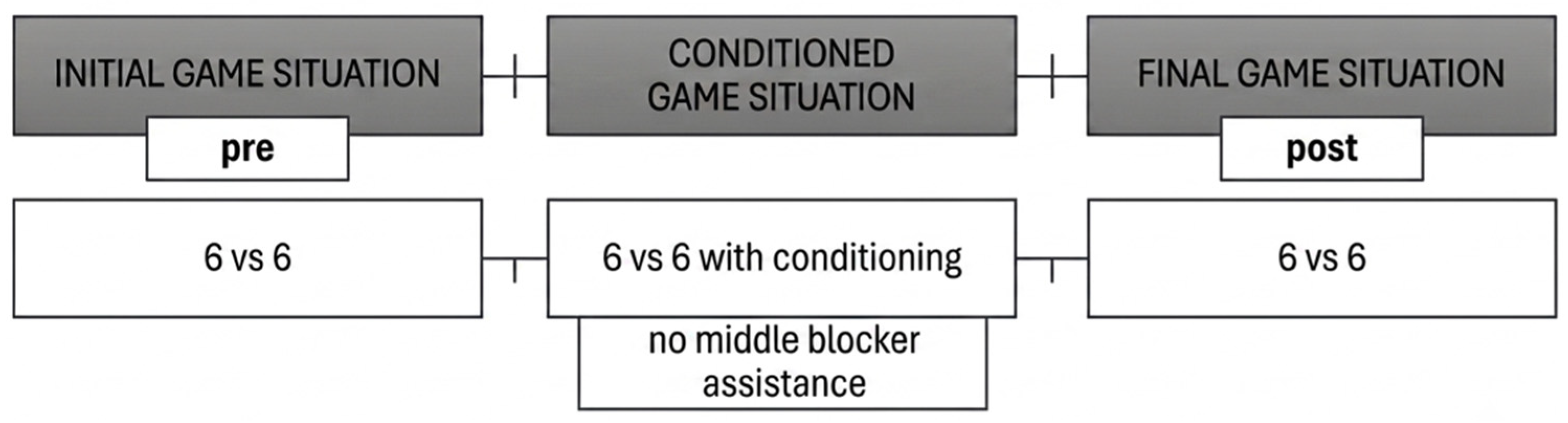
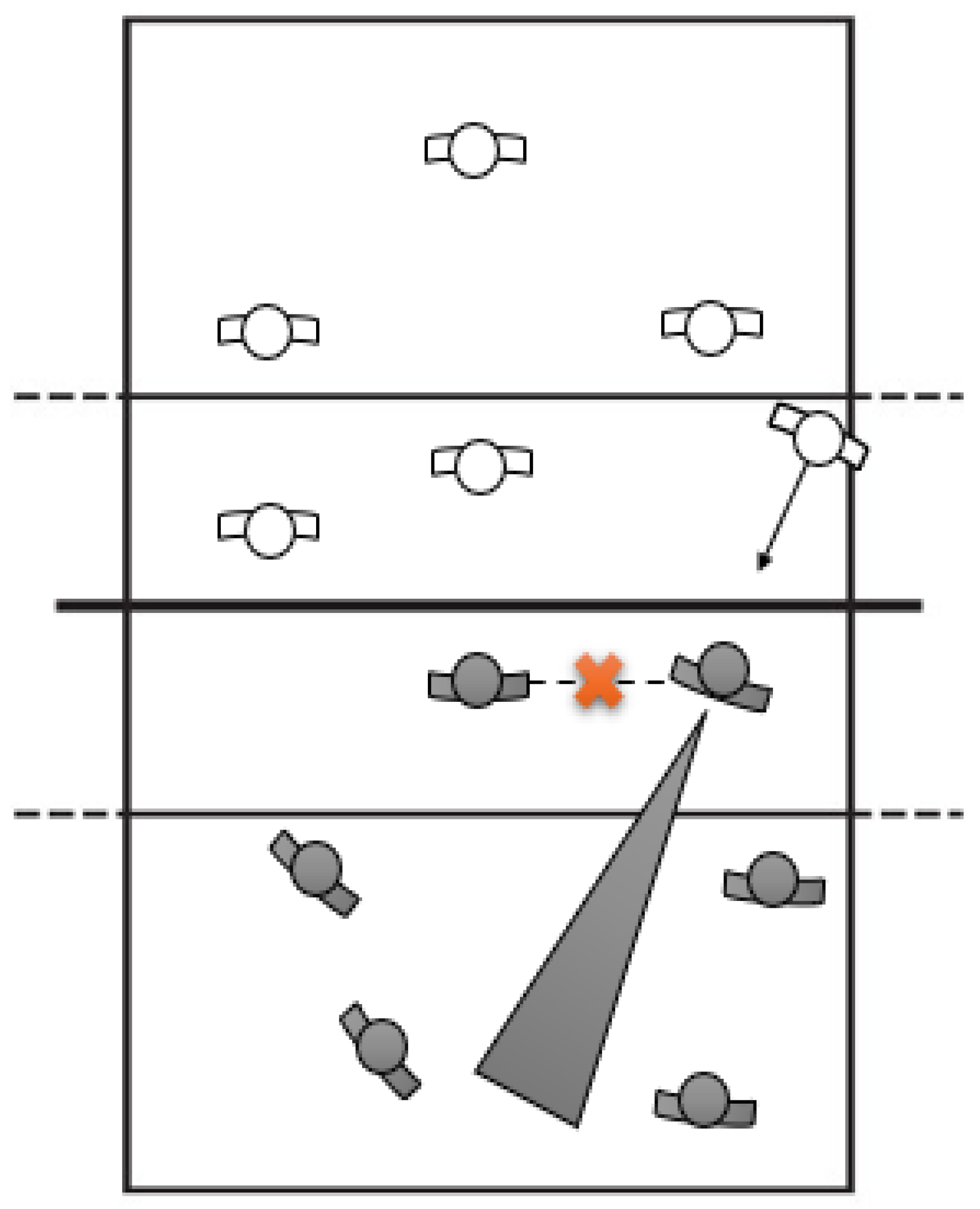
The study followed a single-session pre–post design to examine pre–post behavioral changes following exposure to an ecological task based on exaggerating relational and cooperative demands during blocking formation. Exploratory comparisons according to competitive level were also conducted. The players participated consecutively in three 6 vs. 6 game situations: (i) an initial game situation (pre), with no manipulation; (ii) a manipulated game situation, corresponding to the manipulated situation, in which a relational constraint was introduced by preventing the middle blocker from assisting in double blocks against attacks from the wing Zones 2 and 4 (allowing an oriented shift start); and (iii) a final game situation (post), again without manipulation, to assess potential residual effects following exposure to the manipulated condition under unrestricted cooperative situations. This experimental protocol was replicated identically across the four participating clubs.
Figure 1 provides a schematic representation of the study design and the temporal sequence of the game situations.
From an ecological perspective, task design was based on the manipulation of task constraints with the aim of modifying the opportunities for action available to the players during blocking formation. Thus, Balagué et al. [
37] identify players’ strategic commitments, at both the individual and collective levels, as an essential constraint in learning processes. Considering the ecology of dynamic game situations, wing blockers are continuously exposed to different degrees and possibilities of coordination and attunement during blocking formation. In the proposed design, the exaggeration constraint applied in the experimental situation was intended to amplify the functional involvement of the wing blocker, emphasizing the perceptual-motor and tactical adjustments required to respond more effectively to attacks from the outside zones (Zones 2 and 4) without the possibility of assistance from the middle blocker.
A total of 444 game sequences were analyzed across the pre- and post-manipulation situations. Each attacking action constituted one behavioral observation, for which the corresponding blocking behavior, block–ball contact, functional outcome, and decision-making appropriateness were coded. Accordingly, the 46 players represented the participant sample, whereas the 444 game sequences represented behavioral observations generated during the game situations. If play continued into a subsequent transition and a new attack was constructed in a way that allowed the blocking situation to develop adequately for observation, that attacking action was coded as a new observation. Competitive level was subsequently considered as a contextual factor to explore whether these pre–post changes differed between the First and Second Divisions. Individual player identifiers were not retained at the sequence level and could not be recovered retrospectively. Therefore, repeated observations could not be linked to specific players, and the analyses were conducted at the sequence level.
2.3. Intervention Procedure
The intervention protocol was conducted independently at each of the four participating clubs, at their own facilities and during their regular training schedule. To ensure comparable situations across clubs, all experimental sessions were conducted during the same week of the competitive period and followed an identical temporal and organizational structure. In each session, the players from the respective club were divided into two teams of six players according to technical–tactical criteria, with the aim of balancing performance levels and reproducing a representative opposition situation. This procedure followed approaches like those used in previous studies on task manipulation in volleyball, which aimed to balance players’ performance capabilities [
24]. The teams were formed by the head coaches of each club, all of whom had more than 10 years of experience in youth and performance-oriented coaching, and team composition was maintained throughout the three game situations comprising the session.
Figure 2 illustrates the task configuration corresponding to the manipulated situation. In this situation, the wing blocker had to regulate her defensive action independently against attacks from the outside zones, adapting her behavior to the actions of the direct opponent and the information available in the game situation, without assistance from the middle blocker during blocking formation.
2.4. Dependent Variables
The analysis of technical–tactical performance in volleyball increasingly emphasizes the importance of adopting a contextual and integrated perspective, considering not only the immediate outcomes of actions but also players’ positioning and the specific demands of each game situation [
38]. Consistent with this perspective, the dependent variables in the present study were selected as observable indicators of the functional adjustments made by wing blockers in response to the demands of the game and the interactions that emerged during play.
The first variable, block–ball contact, was coded as actions without contact (0) and with contact (1). This variable identified the blocker’s direct physical involvement with the ball, distinguishing between defensive positioning without contact and direct intervention in the opponent’s offensive action, regardless of the subsequent effect of that action on rally continuity.
The functional outcome of the blocking action was assessed using an adaptation of the coding system proposed by the FIVB, based on Coleman [
39], which uses a five-level scale: (0) error resulting in the direct loss of the point; (1) block allowing all attacking options to the opposing team; (2) block partially limiting these options; (3) block allowing the defending team to construct a counterattack or generating a free-ball situation; and (4) direct block point. From a functional perspective of collective defensive performance, the outcome of the block does not depend solely on whether contact with the ball occurs, but also on the extent to which the blocking action constrains the opponent’s offensive options and facilitates subsequent defensive continuity [
40]. This consideration is particularly relevant given the high frequency of blocking actions without contact in actual play, especially in women’s volleyball, where the block can influence the opponent’s offensive action without contacting the ball [
41]. The original five-level scale was therefore retained for the primary analyses to preserve the functional distinctions between blocking outcomes. As a complementary analysis, the categories were additionally grouped into two functional levels: ineffective blocks (0–1), corresponding to actions that do not provide the defending team with a favorable situation for continuing the rally, and effective blocks (2–4), including actions that limit the opponent’s offensive options, facilitate a more advantageous subsequent situation, or result in a direct block point.
Finally, decision-making appropriateness of the wing blocker was assessed using an observational criterion developed from the decision-making component of the Game Performance Assessment Instrument (GPAI) [
42], following criteria previously applied in similar contexts [
43]. Decisions were coded as appropriate (1) or inappropriate (0). This adaptation was based on the fact that relevant behaviors during the blocking action—such as direction of movement and timing of intervention—do not necessarily involve contact with the ball but constitute functional responses that may influence defensive performance and the opponent’s offensive options. Accordingly, responses were considered appropriate when, regardless of whether contact with the ball occurred, they were consistent with the informational cues and tactical demands of the situation. This criterion is consistent with the GPAI framework, which allows game performance to be assessed through behaviors both with and without the ball, considering the appropriateness of decisions in relation to the demands of the situation [
42].
To synthesize and clarify the conceptual and operational differences among the variables analyzed,
Table 1 presents the coding unit, functional meaning, main assessment criterion, and corresponding categories for each variable.
For the systematic observation of the variables, all 6 vs. 6 game situations were recorded using a SONY HDR-XR155 digital camera (SONY, Tokyo, Japan) (M2TS format), positioned in one of the corners at the back of the court at an approximate height of 5 m, providing an optimal field of view. All game situations were recorded, and sequences involving attacks from the wing zones that provided an adequate opportunity for the blocking action to develop were included in the analysis.
2.5. Reliability
To ensure intra-observer reliability, the observer responsible for the coding underwent prior training conducted by a volleyball expert who was a national-level coach at the highest level and had more than 15 years of experience using observational methodology in research. During this process, both reviewed the observation instrument and the operational criteria established for coding each dependent variable, resolving any discrepancies until agreement was reached on their application. Subsequently, the observer completed a training period by coding a set of actions equivalent to more than 10% of the total sample, in accordance with the recommendations of Losada and Manolov [
44]. This procedure allowed the correct application of the observation criteria to be verified before the definitive coding of the data began. Finally, to assess temporal intra-observer reliability, the same set of actions was coded again by the observer after a 10-day interval.
Agreement was assessed using Cohen’s kappa coefficient for Decision-making appropriateness and Functional outcome of the blocking action, with the predefined agreement criterion of κ > 0.81 reached during the calibration process [
45]. As the same training sequences were used in the successive assessments, once this criterion and sufficient coding consistency were achieved, the calibration process was considered complete. This procedure supported the temporal stability of the coding and allowed the final analysis of the dependent variables to proceed.
2.6. Data Analysis
The statistical software SPSS v30.0 was used for data analysis and processing. Given that the dependent variables were categorical in nature, association analyses and regression models were used to assess changes between measurement situations and explore whether these changes differed according to competitive level. To examine differences between competitive levels, the models included the factors Time (pre vs. post), Competitive Level (First Division vs. Second Division), and their interaction (Time × Competitive Level). Binary logistic regression models were used for the dichotomous variables, namely block–ball contact and decision-making appropriateness, whereas ordinal logistic regression was used for the functional outcome of the blocking action. The proportional-odds assumption for the ordinal logistic regression model was assessed using the Test of Parallel Lines. As a complementary analysis, multinomial logistic regression was used to examine category-specific differences in functional outcome according to competitive level, with category 0 used as the reference category. Regression results were expressed as odds ratios (ORs) and 95% confidence intervals. The three overall pre–post comparisons of the primary outcomes—block–ball contact, functional outcome using the original five-category scale, and decision-making appropriateness—were considered primary analyses. A Holm correction was applied to control for multiple comparisons across these three primary analyses. Analyses examining competitive-level differences, within-division comparisons, the dichotomized functional outcome, and category-specific multinomial models were considered exploratory. For exploratory analyses, statistical significance was set at p < 0.05. To examine changes between the pre and post situations in the overall sample and within each competitive level, contingency tables were used. Associations between categorical variables were assessed using Pearson’s chi-square test. For statistically significant associations, adjusted standardized residuals (|z| ≥ 1.96) were examined to identify the categories contributing to the observed differences. The magnitude of associations was estimated using Cramer’s V. Statistical significance was assessed using the criteria described above.
3. Results
3.1. Descriptive Analysis
A total of 444 game sequences were analyzed. Of these, 234 sequences corresponded to the pre-situation and 210 to the post- situation. In the First Division, 292 sequences were recorded (156 pre and 136 post), whereas 152 sequences were analyzed in the Second Division (78 pre and 74 post). Across the entire sample, the block contacted the ball in 148 actions (33.3%), whereas no contact occurred in 296 actions (66.7%). Regarding the functional outcome of the blocking action, 110 actions (24.8%) were classified as category 0, 147 (33.1%) as category 1, 91 (20.5%) as category 2, 71 (16.0%) as category 3, and 25 (5.6%) as category 4. Regarding decision-making appropriateness, 266 decisions (59.9%) were classified as appropriate and 178 (40.1%) as inappropriate.
3.2. Overall and Within-Division Pre–Post Changes
The overall analysis showed a significant association between situation and block–ball contact (χ2(1) = 16.26, p < 0.003, Holm-adjusted; V = 0.19), with a small effect size. In the pre-situation, 176 actions without contact (75.2%) and 58 with contact (24.8%) were recorded, whereas in the post-situation, actions without contact decreased to 120 (57.1%) and actions with contact increased to 90 (42.9%).
Within-division analyses showed a significant association between situation and block–ball contact in the First Division (χ
2(1) = 13.61,
p < 0.001; V = 0.22), whereas no significant association was observed in the Second Division (χ
2(1) = 3.28,
p = 0.070; V = 0.15). Adjusted standardized residuals indicated that the association in the First Division was characterized by more contact actions than expected in the post-situation, whereas no significant residuals were observed in the Second Division (
Table 2).
The overall distribution of the functional outcome of the blocking action also showed a significant association between situation and functional outcome (χ2(4) = 14.31, p = 0.012, Holm-adjusted; V = 0.18), with a small effect size. In the pre-situation, categories 1 (38.9%) and 0 (22.6%) were the most frequent. In the post-situation, the proportion of actions classified as categories 1 and 3 decreased, whereas the proportion classified as categories 0, 2, and 4 increased.
Within-division analyses showed significant associations in both the First Division (χ
2(4) = 14.28,
p = 0.006; V = 0.22) and the Second Division (χ
2(4) = 11.46,
p = 0.022; V = 0.27), with small effect sizes in both cases. Adjusted standardized residuals indicated that, in the First Division, the association was characterized by a higher frequency of category 4 actions and a lower frequency of category 3 actions in the post-situation. In the Second Division, the association was characterized by a reduction in category 1 and an increase in category 3 (
Table 3).
As a complementary exploratory analysis, the functional outcome was dichotomized into ineffective (categories 0–1) and effective (categories 2–4) blocks. No significant pre–post association was observed in the overall sample (χ2(1) = 2.71, p= 0.100; V = 0.08) or in the First Division (χ2(1) = 0.19, p = 0.662; V = 0.03). In the Second Division, the proportion of effective blocks increased from 20.5% to 39.2% (χ2(1) = 6.36, p = 0.012; V = 0.20). This dichotomized analysis was considered complementary and exploratory.
The overall analysis also showed a significant association between situation and decision-making appropriateness (χ2(1) = 3.91, p = 0.048, Holm-adjusted; V = 0.09), although the effect size was small. In the pre-situation, 104 decisions were classified as inappropriate (44.4%) and 130 as appropriate (55.6%), whereas in the post-situation, 74 decisions were classified as inappropriate (35.2%) and 136 as appropriate (64.8%).
Within-division analyses showed no significant associations between situation and decision-making appropriateness in either the First Division (χ
2(1) = 1.66,
p = 0.198; V = 0.08) or the Second Division (χ
2(1) = 2.73,
p = 0.098; V = 0.13). No adjusted standardized residual exceeded the established critical value (
Table 4).
3.3. Exploratory Analyses According to Competitive Level
To explore whether the pre–post changes differed according to competitive level, the Time × Competitive Level interaction was examined using regression models (
Table 5). No significant interactions were observed for block–ball contact (OR = 1.18; 95% CI [0.69–2.02];
p = 0.543), the functional outcome of the blocking action (ordinal model: OR = 1.30; 95% CI [0.64–2.63];
p = 0.465), or decision-making appropriateness (OR = 1.14; 95% CI [0.63–2.08];
p = 0.579). However, the proportional-odds assumption underlying the ordinal logistic regression was not satisfied (Test of Parallel Lines: χ
2(9) = 30.049,
p < 0.001). Therefore, the ordinal regression result for functional outcome should be interpreted with caution. For block–ball contact and decision-making appropriateness, these findings provided no statistical evidence that the overall pre–post changes differed between the two competitive levels.
The complementary multinomial analysis identified a category-specific Time × Competitive Level interaction for category 3 of the functional outcome relative to the reference category (OR = 4.84; 95% CI [1.10–21.27]; p = 0.037). Given the exploratory and category-specific nature of this analysis, the wide confidence interval, and the absence of a significant overall interaction, this finding should be interpreted cautiously.
4. Discussion
This study examined pre–post changes in blocking performance and wing blockers’ decision-making following exposure to a task based on the CLA and designed to modify a participation rule through the exaggeration principle. It also explored whether these changes differed according to competitive level. Overall, no statistically significant evidence indicated that the pre–post changes in block–ball contact, functional outcome, or decision-making appropriateness differed between the First and Second Divisions. Nevertheless, changes were observed in several dimensions of blocking behavior, particularly in block–ball contact and the distribution of functional outcomes. No significant interaction was observed between evaluation phase and competitive level for block–ball contact, indicating no evidence that the pre–post change in this variable differed between the First and Second Divisions. However, a significant increase in block–ball contact was observed in the post-situation compared with the pre-situation across the overall sample, although the effect size was small (V = 0.19). When the two competitive levels were analyzed separately, this change reached statistical significance in the First Division but not in the Second Division. Importantly, these within-level patterns should not be interpreted as evidence of different competitive-level responses, given the non-significant interaction.
From an ecological dynamics’ perspective, exposure to modified interaction situations may create new coordination demands, requiring players to adapt their behavior to the information available within the game context. Such manipulations may alter the functional relevance of available information and guide players’ attention towards information that is particularly important for achieving the task goal [
46,
47]. In the present task, temporarily restricting middle-blocker assistance increased the wing blocker’s functional responsibility during attacks from the outside zones. These situations require the wing blocker to regulate the blocking action according to information from the setter’s trajectory and the attacker’s actions, involving anticipatory and coordinative adjustments [
47]. The task design further emphasized information arising from the opposing attacker as particularly relevant for the wing blocker, while temporarily removing the need to rely on the middle blocker’s assistance during double-block formation. The increase in block–ball contact observed from pre- to post-manipulation may therefore be interpreted as a behavioral change following exposure to the modified interaction demands. From this perspective, the pre–post change observed in block–ball contact may be consistent with an adaptation of blocking behavior to the altered task conditions, although the specific processes underlying this change were not directly assessed.
No significant overall interaction was observed between evaluation phase and competitive level for functional outcome. However, significant pre–post changes in the distribution of functional outcomes were found within both divisions, although the specific categories involved differed. The First Division showed an increase in the most effective outcome (category 4) and a reduction in category 3, whereas the Second Division showed a reduction in the less effective category 1 and an increase in category 3. Thus, both divisions exhibited changes in functional blocking outcomes, but there was no evidence that the overall pre–post response differed according to competitive level. Importantly, the changes in the five-category distribution should not be interpreted as a uniform improvement in functional blocking effectiveness. Rather, the findings suggest changes in how the functional outcomes of blocking actions were distributed following exposure to the manipulated task. These findings may be compatible with different forms of functional reorganization of the blocking action. From an ecological dynamics perspective, the same constraint can lead to different functional solutions depending on the initial state and characteristics of the system, without requiring identical coordination patterns [
18,
37]. In the present context, increasing the wing blocker’s responsibility against attacks from the outside zones may promote adjustments in the spatial and temporal regulation of the blocking action, potentially influencing ball contact, the restriction of attacking options, and the conditions for defensive continuity and counterattack [
26,
48,
49,
50]. This perspective is consistent with the concept of degeneracy; whereby different coordination solutions may contribute to achieving similar functional outcomes [
18]. In the present study, both competitive levels exhibited changes in the functional distribution of blocking actions, although these changes manifested differently across specific categories.
The category-specific multinomial finding for category 3 should be interpreted cautiously. Although the Time × Competitive Level interaction was statistically significant, the estimate was imprecise (OR = 4.84; 95% CI [1.10–21.27]) and emerged from a category-specific analysis. Therefore, this finding should be considered exploratory and interpreted together with the overall pattern of functional outcomes. While the specific coordination solutions underlying these outcomes were not directly assessed, the variability in the functional responses observed following the same task manipulation is compatible with the possibility that players adapted their blocking behavior through different solutions while responding to the modified task demands. Thus, the present findings do not demonstrate degeneracy directly, but the different functional responses observed at the outcome level may be consistent with the variability in solutions described by this theoretical perspective.
No significant interaction was observed between evaluation phase and competitive level for decision-making appropriateness, indicating no evidence that the pre–post change differed between the First and Second Divisions. Across the entire sample, the proportion of appropriate decisions increased significantly after the manipulated task, although the magnitude of this association was small. However, this change did not reach statistical significance when the two competitive levels were analyzed separately. Therefore, the observed increase should be interpreted cautiously, particularly given the small magnitude of the association and the absence of significant within-group changes. This pattern suggests that the manipulated task may have been more closely associated with changes in the functional regulation of the blocking action than with categorical changes in tactical decision-making. Players may have maintained relatively stable decision-making criteria while adapting other aspects of their blocking behavior. From an ecological dynamics’ perspective, such changes may involve adjustments in the regulation of perception–action coupling as players adapt to task-relevant information [
47]. The single-session exposure may also help explain the limited changes observed in decision-making appropriateness. Although representative tasks involving specific constraints have been associated with changes in decision-making and technical performance [
17,
19,
51], the present pre–post design may have captured only short-term behavioral responses to the modified task. However, the present data do not allow this mechanism to be directly established. The single-session exposure may also have been insufficient to produce more consistent changes in decision-making appropriateness. Thus, the observed differences can be interpreted as short-term behavioral responses following exposure to the modified task rather than as evidence of consolidated learning.
From a CLA perspective, these findings are consistent with the notion that manipulating constraints can guide the exploration of functional solutions without prescribing a specific technical response [
12,
52]. In the present study, the participation-rule manipulation temporarily modified the cooperative demands involved in block formation and increased the wing blocker’s responsibility during attacks from the outside zones.
The changes observed in some dimensions of blocking behavior therefore highlight how modifying participation rules within representative practice may be used to emphasize specific functional responsibilities and alter the demands experienced by players during game-like situations. From a practical perspective, temporarily restricting middle-blocker assistance against attacks from the outside zones may provide a useful task-design strategy to emphasize wing-blocker responsibility during representative 6 vs. 6 practice.
5. Limitations and Future Research
The interpretation of the present findings should consider some characteristics of the study design and data structure. The fixed pre–manipulation–post order and absence of a control or counterbalanced condition mean that the observed changes cannot be attributed exclusively to the manipulation. In addition, the 444 attacking sequences represented repeated observations from 46 players, and the absence of player-level identifiers prevented the potential dependence between observations from being explicitly modelled. Competitive level was represented by only four naturally occurring teams from four clubs; therefore, differences between competitive levels may reflect team, club, coaching, or tactical characteristics rather than competitive level alone. Accordingly, findings should not be generalized to broader competitive-level effects.
Future research should use controlled or counterbalanced designs, retain player-level identifiers, and apply multilevel models to account for repeated observations. Studies involving more independent teams and longitudinal measurements could further determine whether these behavioral changes are maintained over time and transfer to competitive performance.




 ,
,