Alterations in Center of Pressure and Ground Reaction Forces Across Transition and Progression Conditions of Stair Negotiation in Adults with Chronic Ankle Instability: A Cross-Sectional Study




Abstract
1. Introduction
2. Materials and Methods
2.1. Study Design
2.2. Participants
2.3. Sample Size
2.4. Procedure
2.5. Outcome Measures
2.5.1. Center of Pressure
2.5.2. Ground Reaction Force
2.6. Statistical Analysis
3. Results
3.1. Participants’ General Characteristics
3.2. Center of Pressure During Stair Ascent and Descent
3.3. Ground Reaction Force During Stair Ascent and Descent
3.4. Sensitivity Analysis
4. Discussion
4.1. Center of Pressure During Stair Ascent and Descent
4.2. Ground Reaction Force During Stair Ascent and Descent
4.3. Limitations
5. Conclusions
Supplementary Materials
Author Contributions
Funding
Institutional Review Board Statement
Informed Consent Statement
Data Availability Statement
Acknowledgments
Conflicts of Interest
Abbreviations
| Asc-P | Stair ascent, progressing |
| Asc-T | Stair ascent, transitioning |
| %BW | Percentage of body weight |
| CAI | Chronic ankle instability |
| CAIT | Cumberland Ankle Instability Tool |
| CI | Confidence interval |
| COP | Center of pressure |
| Desc-P | Stair descent, progressing |
| Desc-T | Stair descent, transitioning |
| Fx | Anterior–posterior ground reaction force |
| Fx-HC | Anterior–posterior ground reaction force during heel contact |
| Fx-PO | Anterior–posterior ground reaction force during push-off |
| Fy | Medio-lateral ground reaction force |
| Fy-MS | Lateral ground reaction force during mid-stance |
| Fz | Vertical ground reaction force |
| Fz-HC | Vertical ground reaction force during heel contact |
| Fz-PO | Vertical ground reaction force during push-off |
| GRF | Ground reaction force |
| RM-ANOVA | Repeated measures analysis of variance |
Appendix A
References
- Tyler, J.R.; Sandler, A.B.; Albagli, A.; Gilat, R.; Scanaliato, J.P.; Parnes, N. The National Epidemiology of Ankle Sprains in the United States: Updates from 2010 to 2024. Orthopedics 2025, 48, 371–377. [Google Scholar] [CrossRef] [Scilit] [PubMed]
- Hertel, J.; Corbett, R.O. An updated model of chronic ankle instability. J. Athl. Train. 2019, 54, 572–588. [Google Scholar] [CrossRef] [Scilit] [PubMed]
- Gribble, P.A.; Delahunt, E.; Bleakley, C.; Caulfield, B.; Docherty, C.; Fourchet, F.; Fong, D.; Hertel, J.; Hiller, C.; Kaminski, T. Selection criteria for patients with chronic ankle instability in controlled research: A position statement of the International Ankle Consortium. J. Orthop. Sports Phys. Ther. 2013, 43, 585–591. [Google Scholar] [CrossRef] [Scilit] [PubMed]
- Lin, C.-I.; Houtenbos, S.; Lu, Y.-H.; Mayer, F.; Wippert, P.-M. The epidemiology of chronic ankle instability with perceived ankle instability—A systematic review. J. Foot Ankle Res. 2021, 14, 41. [Google Scholar] [CrossRef] [Scilit] [PubMed]
- Herzog, M.M.; Kerr, Z.Y.; Marshall, S.W.; Wikstrom, E.A. Epidemiology of ankle sprains and chronic ankle instability. J. Athl. Train. 2019, 54, 603–610. [Google Scholar] [CrossRef] [Scilit] [PubMed]
- Thompson, C.; Schabrun, S.; Romero, R.; Bialocerkowski, A.; van Dieen, J.; Marshall, P. Factors contributing to chronic ankle instability: A systematic review and meta-analysis of systematic reviews. Sports Med. 2018, 48, 189–205. [Google Scholar] [CrossRef] [Scilit] [PubMed]
- Xue, X.; Ma, T.; Li, Q.; Song, Y.; Hua, Y. Chronic Ankle Instability Is Associated with Proprioception Deficits: A Systematic Review and Meta-Analysis. J. Sport Health Sci. 2021, 10, 182–191. [Google Scholar] [CrossRef] [Scilit] [PubMed]
- Peterka, R.J. Sensorimotor integration in human postural control. J. Neurophysiol. 2002, 88, 1097–1118. [Google Scholar] [CrossRef] [Scilit] [PubMed]
- Song, K.; Burcal, C.J.; Hertel, J.; Wikstrom, E.A. Increased visual use in chronic ankle instability: A meta-analysis. Med. Sci. Sports Exerc. 2016, 48, 2046–2056. [Google Scholar] [CrossRef] [Scilit] [PubMed]
- Labanca, L.; Mosca, M.; Ghislieri, M.; Agostini, V.; Knaflitz, M.; Benedetti, M.G. Muscle activations during functional tasks in individuals with chronic ankle instability: A systematic review of electromyographical studies. Gait Posture 2021, 90, 340–373. [Google Scholar] [CrossRef] [Scilit] [PubMed]
- Protopapadaki, A.; Drechsler, W.I.; Cramp, M.C.; Coutts, F.J.; Scott, O.M. Hip, knee, ankle kinematics and kinetics during stair ascent and descent in healthy young individuals. Clin. Biomech. 2007, 22, 203–210. [Google Scholar] [CrossRef] [Scilit] [PubMed]
- McFadyen, B.J.; Winter, D.A. An integrated biomechanical analysis of normal stair ascent and descent. J. Biomech. 1988, 21, 733–744. [Google Scholar] [CrossRef] [Scilit] [PubMed]
- Neuman, R.M.; Fey, N.P. There are unique kinematics during locomotor transitions between level ground and stair ambulation that persist with increasing stair grade. Sci. Rep. 2023, 13, 8576. [Google Scholar] [CrossRef] [Scilit] [PubMed]
- Zachazewski, J.E.; Riley, P.O.; Krebs, D.E. Biomechanical analysis of body mass transfer during stair ascent and descent of healthy subjects. J. Rehabil. Res. Dev. 1993, 30, 412–422. [Google Scholar] [PubMed]
- Brown, C.; Padua, D.; Marshall, S.W.; Guskiewicz, K. Individuals with mechanical ankle instability exhibit different motion patterns than those with functional ankle instability and ankle sprain copers. Clin. Biomech. 2008, 23, 822–831. [Google Scholar] [CrossRef] [Scilit] [PubMed]
- Watabe, T.; Takabayashi, T.; Tokunaga, Y.; Kubo, M. Copers adopt an altered dynamic postural control compared to individuals with chronic ankle instability and controls in unanticipated single-leg landing. Gait Posture 2022, 92, 378–382. [Google Scholar] [CrossRef] [Scilit] [PubMed]
- Chan, L.Y.T.; Sim, Y.T.N.; Gan, F.K.; Abd Razak, H.R.B. Effect of chronic ankle instability on lower extremity kinematics, dynamic postural stability, and muscle activity during unilateral jump-landing tasks: A systematic review and meta-analysis. Phys. Ther. Sport 2022, 55, 176–188. [Google Scholar] [CrossRef] [Scilit] [PubMed]
- Wang, X.; Wang, Z.; Adams, R.; Gao, Y.; Lyu, J.; Han, J. Effects of stair riser height on ankle proprioception in individuals with and without chronic ankle stability. Front. Bioeng. Biotechnol. 2025, 13, 1457233. [Google Scholar] [CrossRef] [Scilit] [PubMed]
- Farahpour, N.; Yaghoubi, U.M.; Robbins, S.; Allard, P.; Moisan, G. Dynamic Step-Down Tasks Reveal Altered Lower Limb Biomechanics in Chronic Ankle Instability. J. Foot Ankle Res. 2026, 19, e70102. [Google Scholar] [CrossRef] [Scilit] [PubMed]
- Zhong, Y.; Cen, X.; Hu, X.; Xu, D.; Tu, L.; Jemni, M.; Fekete, G.; Sun, D.; Song, Y. Control deficits and compensatory mechanisms in individuals with chronic ankle instability during dual-task stair-to-ground transition. Bioengineering 2025, 12, 1120. [Google Scholar] [CrossRef] [Scilit] [PubMed]
- Kawaguchi, K.; Taketomi, S.; Mizutani, Y.; Inui, H.; Yamagami, R.; Kono, K.; Kage, T.; Takei, S.; Fujiwara, S.; Ogata, T. Dynamic postural stability is decreased during the single-leg drop landing task in male collegiate soccer players with chronic ankle instability. Orthop. J. Sports Med. 2022, 10, 23259671221107343. [Google Scholar] [CrossRef] [Scilit] [PubMed]
- Hiller, C.E.; Refshauge, K.M.; Bundy, A.C.; Herbert, R.D.; Kilbreath, S.L. The Cumberland ankle instability tool: A report of validity and reliability testing. Arch. Phys. Med. Rehabil. 2006, 87, 1235–1241. [Google Scholar] [CrossRef] [Scilit] [PubMed]
- Cohen, J. Statistical Power Analysis for the Behavioral Sciences, 2nd ed.; Routledge: New York, NY, USA, 2013. [Google Scholar]
- Bolt, D.; Giger, R.; Wirth, S.; Swanenburg, J. Step-down test assessment of postural stability in patients with chronic ankle instability. J. Sport Rehabil. 2018, 27, 1a–5. [Google Scholar] [CrossRef] [Scilit] [PubMed]
- Bonnet, V.; Azevedo-Coste, C.; Robert, T.; Fraisse, P.; Venture, G. Optimal external wrench distribution during a multi-contact sit-to-stand task. IEEE Trans. Neural Syst. Rehabil. Eng. 2017, 25, 987–997. [Google Scholar] [CrossRef] [Scilit] [PubMed]
- Stemplewski, R.; Maciaszek, J.; Osiński, W.; Szeklicki, R. Test-retest reliability of measurements of the center of pressure displacement in quiet standing and during maximal voluntary body leaning among healthy elderly men. J. Hum. Kinet. 2011, 28, 15–23. [Google Scholar] [CrossRef] [Scilit] [PubMed]
- Rhea, C.K.; Kiefer, A.W.; Haran, F.J.; Glass, S.M.; Warren, W.H. A new measure of the CoP trajectory in postural sway: Dynamics of heading change. Med. Eng. Phys. 2014, 36, 1473–1479. [Google Scholar] [CrossRef] [Scilit] [PubMed]
- Linens, S.W.; Ross, S.E.; Arnold, B.L.; Gayle, R.; Pidcoe, P. Postural-stability tests that identify individuals with chronic ankle instability. J. Athl. Train. 2014, 49, 15–23. [Google Scholar] [CrossRef] [Scilit] [PubMed]
- Jafarnezhadgero, A.A.; Majlesi, M.; Azadian, E. Gait ground reaction force characteristics in deaf and hearing children. Gait Posture 2017, 53, 236–240. [Google Scholar] [CrossRef] [Scilit] [PubMed]
- Farahpour, N.; Jafarnezhad, A.; Damavandi, M.; Bakhtiari, A.; Allard, P. Gait ground reaction force characteristics of low back pain patients with pronated foot and able-bodied individuals with and without foot pronation. J. Biomech. 2016, 49, 1705–1710. [Google Scholar] [CrossRef] [Scilit] [PubMed]
- Tomczak, M.; Tomczak, E. The need to report effect size estimates revisited. An overview of some recommended measures of effect size. Trends Sport Sci. 2014, 21, 19–25. [Google Scholar]
- Kim, M.J.; Kim, S.; Kim, J.; Hopkins, J.T.; Choi, W.; Oh, S.; Son, S.J. Directional deficits in reactive postural control during perturbations among groups of chronic ankle instability, ankle sprain coper, and healthy control. Sci. Rep. 2025, 15, 16947. [Google Scholar] [CrossRef] [Scilit] [PubMed]
- McKeon, P.O.; Hertel, J. Spatiotemporal postural control deficits are present in those with chronic ankle instability. BMC Musculoskelet. Disord. 2008, 9, 76. [Google Scholar] [CrossRef] [Scilit] [PubMed]
- Esteves, J.; Dinis, R.; Fernandes, O.; Castro, M.A.; Oliveira, R.; Pezarat-Correia, P. Differences in postural control between healthy and subjects with chronic ankle instability. Phys. Ther. Sport 2022, 56, 8–14. [Google Scholar] [CrossRef] [Scilit] [PubMed]
- Chiu, M.-C.; Wu, H.-C.; Chang, L.-Y. Gait speed and gender effects on center of pressure progression during normal walking. Gait Posture 2013, 37, 43–48. [Google Scholar] [CrossRef] [Scilit] [PubMed]
- Gigi, R.; Haim, A.; Luger, E.; Segal, G.; Melamed, E.; Beer, Y.; Nof, M.; Nyska, M.; Elbaz, A. Deviations in gait metrics in patients with chronic ankle instability: A case control study. J. Foot Ankle Res. 2015, 8, 1. [Google Scholar] [CrossRef] [Scilit] [PubMed]
- Son, S.J.; Kim, H.; Seeley, M.K.; Hopkins, J.T. Altered walking neuromechanics in patients with chronic ankle instability. J. Athl. Train. 2019, 54, 684–697. [Google Scholar] [CrossRef] [Scilit] [PubMed]
- Luan, L.; Orth, D.; Newman, P.; Adams, R.; El-Ansary, D.; Han, J. Do individuals with ankle instability show altered lower extremity kinematics and kinetics during walking? A systematic review and meta-analysis. Physiotherapy 2024, 125, 101420. [Google Scholar] [CrossRef] [Scilit] [PubMed]
- Cao, S.; Wang, C.; Ma, X.; Jiang, S.; Yu, Y.; Wang, X.; Huang, J.; Zhang, C. Stair descent biomechanics reflect perceived instability in people with unilateral ankle sprain history. Clin. Biomech. 2020, 72, 52–57. [Google Scholar] [CrossRef] [Scilit] [PubMed]
- DeJong, A.F.; Koldenhoven, R.M.; Hertel, J. Proximal adaptations in chronic ankle instability: Systematic review and meta-analysis. Med. Sci. Sports Exerc. 2020, 52, 1563–1575. [Google Scholar] [CrossRef] [Scilit] [PubMed]
- Xu, Y.; Mo, Y.; Liu, C.; Chen, H.; Zhao, J.; Zhang, W.; Yu, Y.; Li, Y.; Wang, L.; Yuan, Y. Differences in lower extremity kinematics and kinetics during a side-cutting task in patients with and without chronic ankle instability. Front. Sports Act. Living 2025, 7, 1593231. [Google Scholar] [CrossRef] [Scilit] [PubMed]
- Stacoff, A.; Diezi, C.; Luder, G.; Stüssi, E.; Kramers-de Quervain, I.A. Ground reaction forces on stairs: Effects of stair inclination and age. Gait Posture 2005, 21, 24–38. [Google Scholar] [CrossRef] [Scilit] [PubMed]
- He, Z.; Zhu, H.; Ye, B.; Zheng, Z.; Liu, G.; Pan, H.; Liu, R. Does chronic ankle instability patients lead to changes in biomechanical parameters associated with anterior cruciate ligament injury during landing? A systematic review and meta-analysis. Front. Physiol. 2024, 15, 1428879. [Google Scholar] [CrossRef] [Scilit] [PubMed]
- Bigouette, J.; Simon, J.; Liu, K.; Docherty, C.L. Altered vertical ground reaction forces in participants with chronic ankle instability while running. J. Athl. Train. 2016, 51, 682–687. [Google Scholar] [CrossRef] [Scilit] [PubMed]
- Çakır, O.; Çilli, M. Impact of Body Weight on Stair Ascent and Descent Biomechanics in Teenagers. Pamukkale J. Sport Sci. 2026, 17, 170–186. [Google Scholar] [CrossRef] [Scilit]


| Condition | Force Plate Location | Description |
|---|---|---|
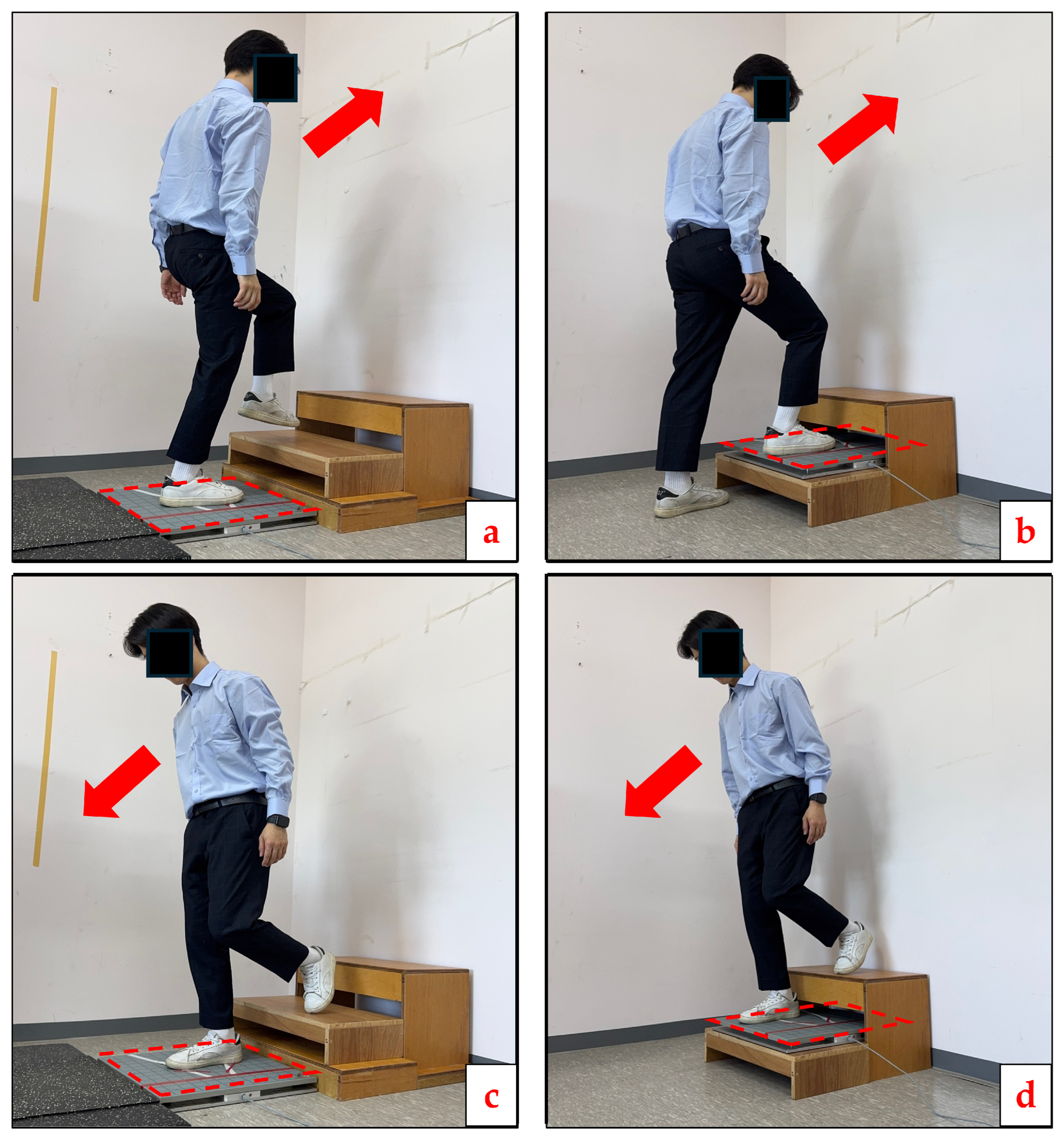
| Stair Ascent, Transitioning (Asc-T) | Floor | The transition from level walking into stair ascent. The measured limb supports the body on the floor while the opposite limb steps up to the first step. |
| Stair Ascent, Progressing (Asc-P) | First step | The progression of stair ascent. The measured limb steps onto the first step and accepts body weight while continuing the upward movement. |
| Stair Descent, Transitioning (Desc-T) | Floor | The transition from stair descent into level walking. The measured limb steps down onto the floor and accepts body weight as the descent ends and level walking resumes. |
| Stair Descent, Progressing (Desc-P) | First step | The progression of stair descent. The measured limb supports the body on the first step while the opposite limb steps down to the floor. |
| Variables | CAI Group (n = 13) | Healthy Group (n = 12) | p-Value |
|---|---|---|---|
| Age (years) 1 | 29.92 ± 2.78 | 31.58 ± 2.06 | 0.106 3 |
| Height (cm) 1 | 169.15 ± 9.28 | 166.88 ± 6.68 | 0.491 3 |
| Weight (kg) 1 | 67.62 ± 14.25 | 62.50 ± 10.86 | 0.326 3 |
| Body mass index 1 | 23.50 ± 3.01 | 22.19 ± 2.65 | 0.262 3 |
| Foot length (mm) 1 | 252.31 ± 21.47 | 248.75 ± 11.89 | 0.617 3 |
| Foot width (cm) 1 | 9.55 ± 0.76 | 9.23 ± 0.76 | 0.302 3 |
| CAIT score 1 | 22.00 ± 1.08 | 28.75 ± 0.62 | <0.001 4 |
| Gender (Male/Female) 2 | 8/5 | 8/4 | 1.000 5 |
| Affected side (L/R) | 5/8 | — | — |
| Dominant leg side(L/R) 2 | 3/10 | 0/12 | 0.220 5 |
| Asc-T stance duration (s) 1 | 0.91 ± 0.09 | 0.93 ± 0.12 | 0.623 3 |
| Asc-P stance duration (s) 1 | 1.00 ± 0.12 | 1.08 ± 0.21 | 0.270 3 |
| Desc-T stance duration (s) 1 | 0.83 ± 0.09 | 0.84 ± 0.13 | 0.912 3 |
| Desc-P stance duration (s) 1 | 0.86 ± 0.12 | 0.90 ± 0.14 | 0.488 3 |
| Group | Asc-T a [95% CI] | Asc-P b [95% CI] | Desc-T c [95% CI] | Desc-P d [95% CI] | Within-Group p-Value | Group × Condition Interaction p-Value | F | Effect Size (η2p) |
|---|---|---|---|---|---|---|---|---|
| Path length (mm) | ||||||||
| CAI | 121.71 ± 28.68 [94.76, 148.67] | 116.45 ± 27.74 [99.99, 132.90] | 134.22 ± 50.41 [112.38, 156.07] | 128.89 ± 22.37 [117.06, 140.72] | 0.051 | 0.015 * | 4.578 | 0.172 |
| Healthy | 170.05 ± 61.99 b,c [140.75, 199.35] | 109.48 ± 29.61 a,d [91.59, 127.37] | 115.26 ± 11.07 a [91.52, 139.01] | 127.84 ± 18.16 b [114.99, 140.70] | <0.001 * | |||
| Between-group p-value | 0.020 * | 0.558 | 0.236 | 0.902 | ||||
| Group | Asc-T a [95% CI] | Asc-P b [95% CI] | Desc-T c [95% CI] | Desc-P d [95% CI] | Within-Group p-Value | Group × Condition Interaction p-Value | F | Effect Size (η2p) |
|---|---|---|---|---|---|---|---|---|
| Velocity (mm/s) | ||||||||
| CAI | 133.55 ± 26.79 [98.99, 168.11] | 117.09 ± 28.60 d [100.44, 133.73] | 161.57 ± 58.60 [134.69, 188.46] | 151.39 ± 27.78 b [130.91, 171.88] | 0.002 * | 0.007 * | 5.465 | 0.192 |
| Healthy | 193.12 ± 82.48 b,c [157.14, 229.09] | 102.07 ± 29.46 a,d [84.75, 119.39] | 143.94 ± 29.07 a [115.96, 171.92] | 152.83 ± 42.70 b [131.52, 174.15] | <0.001 * | |||
| Between-group p-value | 0.021 * | 0.209 | 0.357 | 0.921 | ||||
| Group | Asc-T a [95% CI] | Asc-P b [95% CI] | Desc-T c [95% CI] | Desc-P d [95% CI] | Within-Group p-Value | Group × Condition Interaction p-Value | F | Effect Size (η2p) |
|---|---|---|---|---|---|---|---|---|
| Area 95 (mm2) | ||||||||
| CAI | 24.08 ± 7.47 [19.11, 29.06] | 27.37 ± 10.37 [20.61, 34.12] | 20.26 ± 10.92 [14.20, 26.33] | 18.83 ± 5.14 [14.70, 22.96] | 0.034 * | 0.569 | 0.678 | 0.029 |
| Healthy | 25.79 ± 9.81 [20.62, 30.97] | 24.69 ± 13.13 [17.66, 31.71] | 16.15 ± 10.19 d [9.84, 22.47] | 19.89 ± 8.92 c [15.59, 24.19] | 0.036 * | |||
| Group | Asc-T a [95% CI] | Asc-P b [95% CI] | Desc-T c [95% CI] | Desc-P d [95% CI] | Within-Group p-Value | Group × Condition Interaction p-Value | F | Effect Size (η2p) |
|---|---|---|---|---|---|---|---|---|
| Fx-HC (% body weight) | ||||||||
| CAI | −10.83 ± 2.46 c [−12.42, −9.25] | −10.23 ± 1.81 c [−11.07, −9.40] | −15.90 ± 4.17 a,b,d [−17.95, −13.86] | −11.96 ± 4.26 c [−13.90, −10.02] | <0.001 * | 0.292 | 1.267 | 0.052 |
| Healthy | −8.16 ± 3.06 c [−9.81, −6.51] | −9.80 ± 0.94 c [−10.67, −8.92] | −13.55 ± 2.75 a,b,d [−15.67, −11.42] | −10.42 ± 2.04 c [−12.44, −8.40] | <0.001 * | |||
| Fx-PO (% body weight) | ||||||||
| CAI | 7.60 ± 2.52 b,c,d [6.13, 9.06] | 3.88 ± 1.26 a,c [3.19, 4.57] | 12.65 ± 2.01 a,b [11.18, 14.12] | 14.28 ± 2.23 a,b [13.13, 15.43] | <0.001 * | 0.036 * | 3.008 | 0.116 |
| Healthy | 8.07 ± 2.58 b,c,d [6.55, 9.60] | 3.59 ± 1.15 a,c,d [2.87, 4.31] | 10.20 ± 3.05 a,b [8.67, 11.72] | 12.50 ± 1.72 a,b [11.31, 13.70] | <0.001 * | |||
| Between-group p-value | 0.646 | 0.551 | 0.025 * | 0.036 * | ||||
| Group | Asc-T a [95% CI] | Asc-P b [95% CI] | Desc-T c [95% CI] | Desc-P d [95% CI] | Within-Group p-Value | Group × Condition Interaction p-Value | F | Effect Size (η2p) |
|---|---|---|---|---|---|---|---|---|
| Fy-MS (% body weight) | ||||||||
| CAI | −6.04 ± 1.16 c,d [−6.64, −5.45] | −5.21 ± 1.61 c,d [−6.09, −4.34] | −8.36 ± 2.36 a,b [−9.77, −6.95] | −8.50 ± 1.66 a,b [−9.61, −7.40] | <0.001 * | 0.194 | 1.613 | 0.066 |
| Healthy | −5.67 ± 0.88 d [−6.28, −5.05] | −5.79 ± 1.44 d [−6.71, −4.88] | −7.29 ± 2.56 [−8.76, −5.82] | −7.94 ± 2.17 a,b [−9.09, −6.79] | 0.002 * | |||
| Group | Asc-T a [95% CI] | Asc-P b [95% CI] | Desc-T c [95% CI] | Desc-P d [95% CI] | Within-Group p-Value | Group × Condition Interaction p-Value | F | Effect Size (η2p) |
|---|---|---|---|---|---|---|---|---|
| Fz-HC (% body weight) | ||||||||
| CAI | 110.83 ± 4.49 c,d [108.01, 113.65] | 107.69 ± 6.64 c,d [104.48, 110.90] | 159.13 ± 35.47 a,b [138.58, 179.68] | 145.77 ± 33.64 a,b [129.83, 161.72] | <0.001 * | 0.289 | 1.250 | 0.052 |
| Healthy | 113.36 ± 5.33 b,c [110.43, 116.29] | 105.44 ± 4.17 a,c [102.10, 108.79] | 147.71 ± 36.19 a,b [126.33, 169.10] | 128.78 ± 19.50 [112.18, 145.37] | <0.001 * | |||
| Fz-PO (% body weight) | ||||||||
| CAI | 117.15 ± 10.66 c,d [111.71, 122.58] | 120.22 ± 11.77 c,d [114.72, 125.73] | 104.98 ± 6.97 a,b,d [101.74, 108.21] | 95.63 ± 9.69 a,b,c [90.51, 100.75] | <0.001 * | 0.030 * | 3.793 | 0.142 |
| Healthy | 115.29 ± 7.99 b,c,d [109.63, 120.95] | 108.55 ± 6.42 a [102.83, 114.28] | 103.99 ± 3.70 a [100.62, 107.36] | 97.58 ± 7.99 a [92.25, 102.91] | <0.001 * | |||
| Between-group p-value | 0.630 | 0.006 * | 0.667 | 0.590 | ||||
Disclaimer/Publisher’s Note: The statements, opinions and data contained in all publications are solely those of the individual author(s) and contributor(s) and not of MDPI and/or the editor(s). MDPI and/or the editor(s) disclaim responsibility for any injury to people or property resulting from any ideas, methods, instructions or products referred to in the content. |
© 2026 by the authors. Licensee MDPI, Basel, Switzerland. This article is an open access article distributed under the terms and conditions of the Creative Commons Attribution (CC BY) license.
Share and Cite
Park, T.-W.; Suh, H.-R.; Jung, J.-H.; Jung, E.-Y.; Cho, H.-Y. Alterations in Center of Pressure and Ground Reaction Forces Across Transition and Progression Conditions of Stair Negotiation in Adults with Chronic Ankle Instability: A Cross-Sectional Study. Appl. Sci. 2026, 16, 8837. https://doi.org/10.3390/app16178837
Park T-W, Suh H-R, Jung J-H, Jung E-Y, Cho H-Y. Alterations in Center of Pressure and Ground Reaction Forces Across Transition and Progression Conditions of Stair Negotiation in Adults with Chronic Ankle Instability: A Cross-Sectional Study. Applied Sciences. 2026; 16(17):8837. https://doi.org/10.3390/app16178837
Chicago/Turabian StylePark, Tae-Woong, Hye-Rim Suh, Jin-Hwa Jung, Eui-Young Jung, and Hwi-Young Cho. 2026. "Alterations in Center of Pressure and Ground Reaction Forces Across Transition and Progression Conditions of Stair Negotiation in Adults with Chronic Ankle Instability: A Cross-Sectional Study" Applied Sciences 16, no. 17: 8837. https://doi.org/10.3390/app16178837
APA StylePark, T.-W., Suh, H.-R., Jung, J.-H., Jung, E.-Y., & Cho, H.-Y. (2026). Alterations in Center of Pressure and Ground Reaction Forces Across Transition and Progression Conditions of Stair Negotiation in Adults with Chronic Ankle Instability: A Cross-Sectional Study. Applied Sciences, 16(17), 8837. https://doi.org/10.3390/app16178837