Curcuma-, Mustard-, and Ginger-Infused PLA/TEC Films: A Comparative Study of Sustainable Active Packaging for Fresh Meat Preservation


 ,
,  ,
,  and
and 
Abstract
1. Introduction
2. Materials and Methods
2.1. Chemicals and Reagents
2.2. Experimental Design—Preparation of Extruded PLA/TEC/xCur, PLA/TEC/xMus, and PLA/TEC/xGin Composite Pellets
2.3. Film Formation
2.4. Physicochemical Characterization (XRD and ATR-FTIR)
2.4.1. X-Ray Diffraction (XRD)
2.4.2. Attenuated Total Reflectance-Fourier Transform Infrared Spectroscopy (ATR-FTIR)
2.5. Tensile Properties
2.6. Oxygen Barrier Properties
2.7. Antioxidant Activity (DPPH Assay)
2.8. Antibacterial Activity
2.9. Packaging Test of Fresh Minced Pork Meat Using Optimum Films
- Lipid oxidation using the thiobarbituric acid reactive substances (TBARS) method, expressed as mg malondialdehyde per kg meat;
- Total viable count (TVC) by spreading appropriate dilutions on Plate Count Agar and incubating at 30 °C for 48 h; results are expressed as log CFU/g.
2.10. Statistical Analysis
3. Results
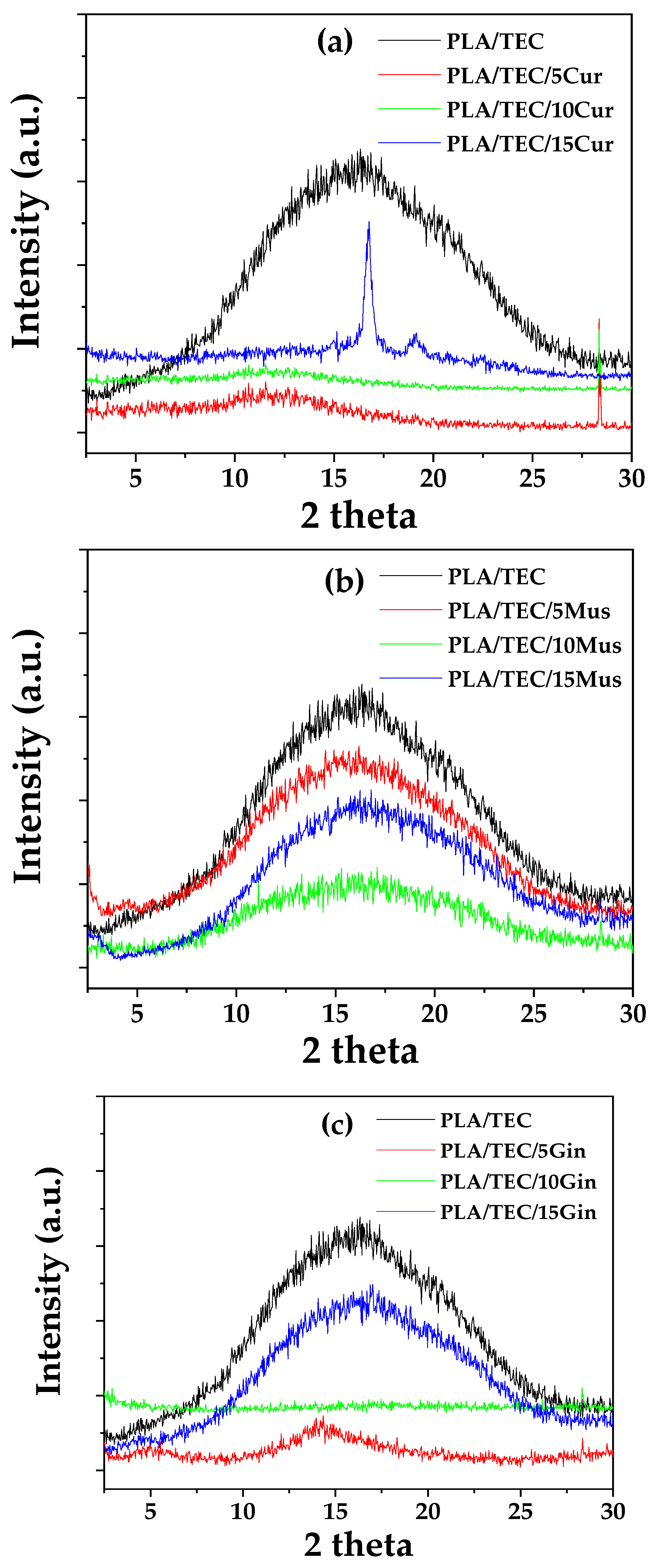
3.1. XRD Analysis of PLA/TEC/xCur, PLA/TEC/xMus, and PLA/TEC/xGin Composite Films
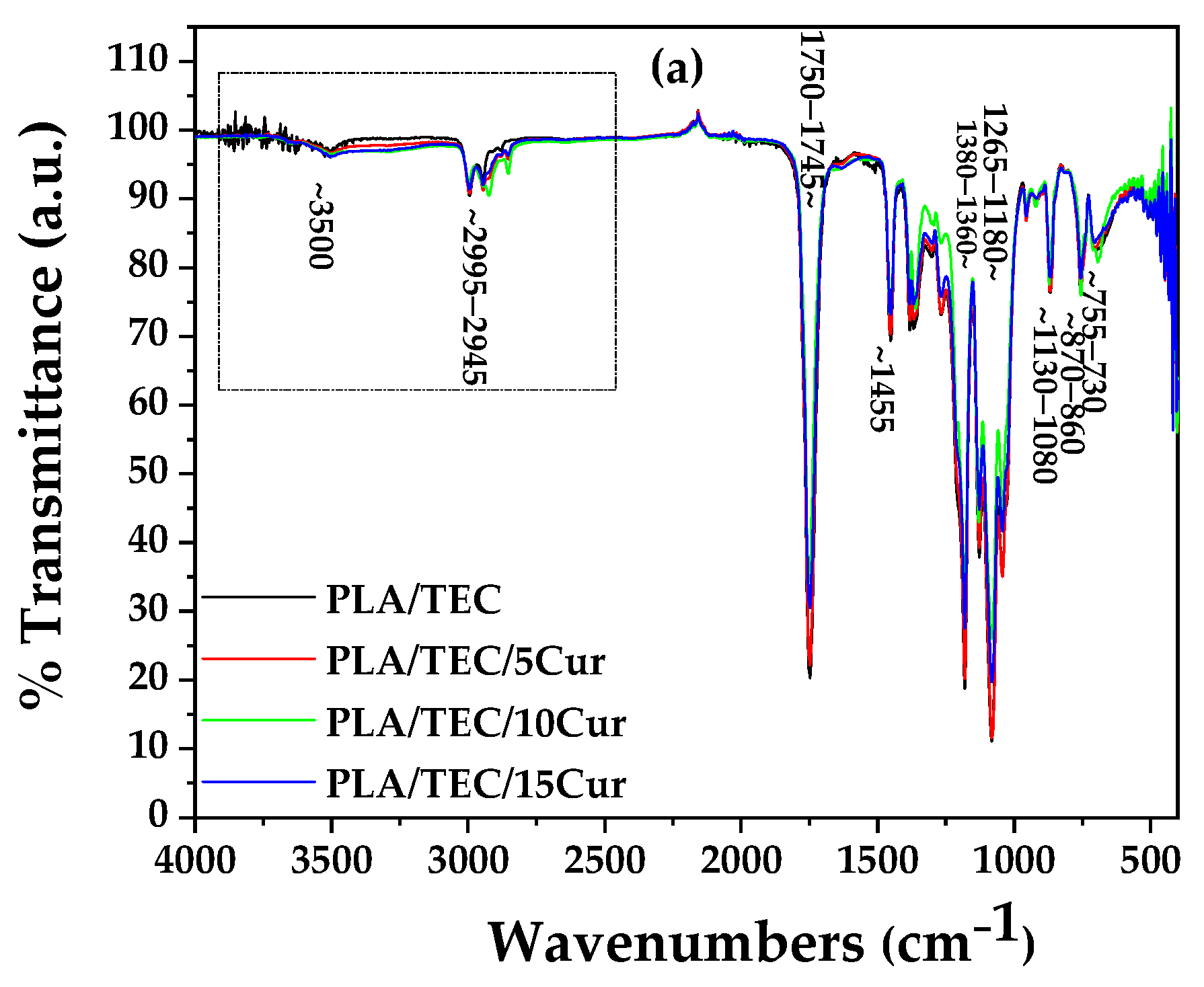
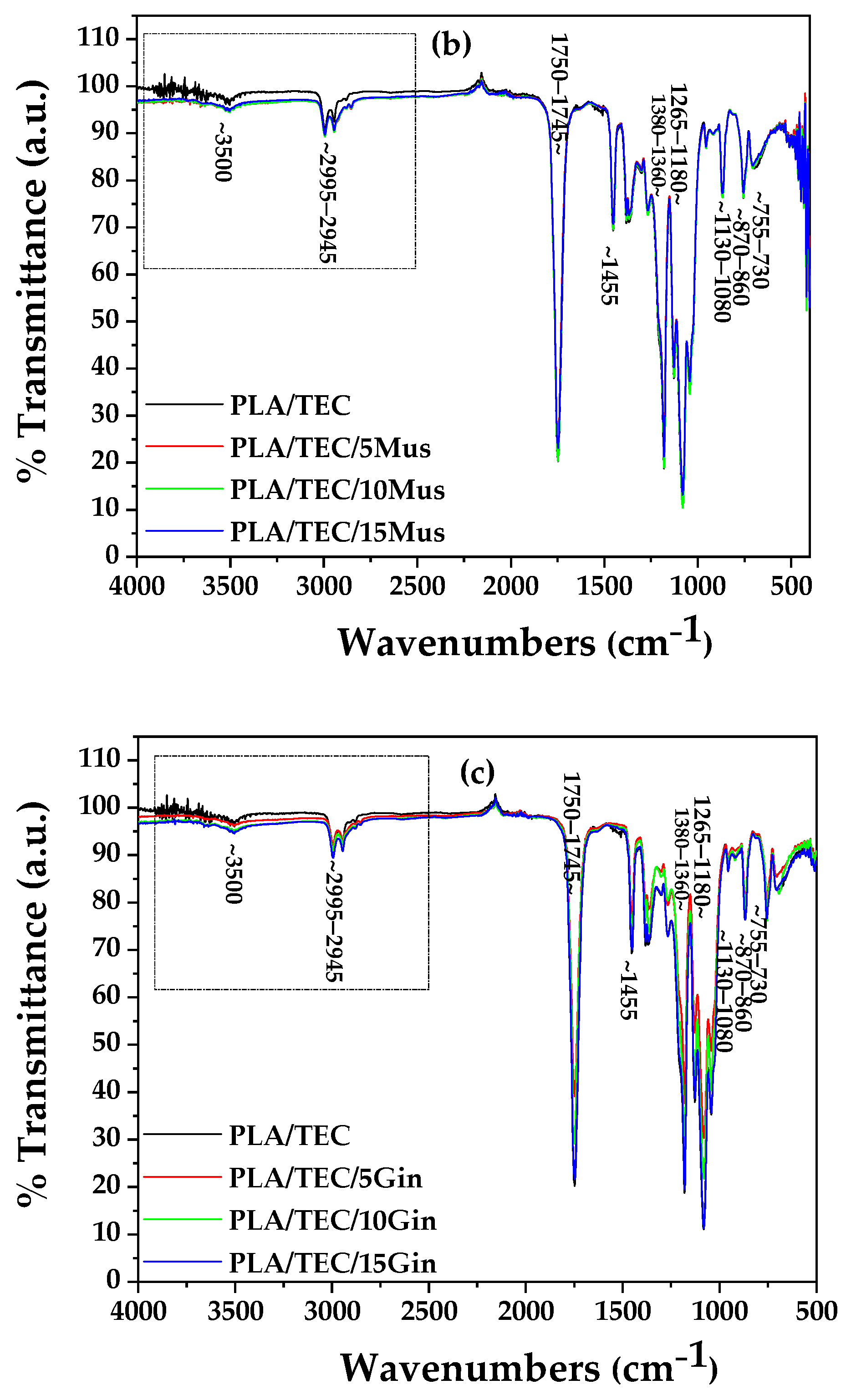
3.2. ATR-FTIR Analysis
3.3. Tensile Properties
3.4. Oxygen Barrier Properties
3.5. Antioxidant Activity
3.6. Antibacterial Activity of Films
3.7. Packaging Test in Fresh Minced Pork
4. Discussion
4.1. Structural and Morphological Characteristics
4.2. Mechanical Properties: Filler-Dependent Behavior
4.3. Oxygen Barrier Properties: The 10 wt% Optimum
4.4. Antioxidant Activity: Curcuma as the Most Potent Scavenger
4.5. Antibacterial Activity: Moderate Efficacy and Release Limitations
4.6. Shelf-Life Extension of Fresh Minced Meat
4.7. Comparison with Previous Studies and Novelty of the Approach
4.8. Limitations and Future Perspectives
4.9. Sustainability Implications
5. Conclusions
- The PLA/TEC matrix effectively accommodates natural spice powders at concentrations up to 15 wt% (the maximum tested in this study) while maintaining adequate mechanical integrity and processability. Curcuma powder acts as a solid-state plasticizer, dramatically increasing elongation at break (up to 410%), while ginger powder functions as a reinforcing filler, maintaining higher modulus and strength.
- The 10 wt% formulations of all three powders provide the best oxygen barrier performance (OTR: 55.4–61.8 cc/m2·day) due to maximum disruption of polymer chain ordering and optimal filler dispersion.
- Curcuma powder exhibits the strongest antioxidant activity (EC50 = 34.4 mg/mL at 15 wt%), followed by ginger (48.9 mg/mL) and mustard (70.2 mg/mL), correlating with their phenolic and curcuminoid contents.
- Antibacterial activity against L. monocytogenes and E. coli is moderate for all films, attributed to slow release of bioactive compounds from the PLA matrix and, in the case of mustard, the inactivation of myrosinase during extrusion processing.
- In fresh minced meat packaging tests, all three active films (10 wt%) extend shelf life by approximately 2 days compared to PLA/TEC, with curcuma-based films showing the best overall performance in delaying microbial growth and lipid oxidation.
- The developed films represent a fully bio-based, sustainable alternative to conventional petroleum-based packaging, with tunable properties depending on the choice of spice powder. From a sustainability perspective, the developed films offer a fully bio-based alternative to conventional petroleum-based packaging, combining renewable raw materials with active functionality to reduce food waste—a critical but often overlooked aspect of environmental sustainability. The use of crude spice powders as active agents further enhances the sustainability profile by avoiding the energy-intensive extraction and purification steps associated with essential oils and purified compounds. These findings position the PLA/TEC/spice powder films as promising candidates for sustainable active packaging applications. Curcuma-containing films offer the most promising balance of mechanical flexibility, oxygen barrier, antioxidant activity, and shelf-life extension performance, making them the most suitable candidate for fresh meat packaging applications.
Supplementary Materials
Author Contributions
Funding
Institutional Review Board Statement
Informed Consent Statement
Data Availability Statement
Conflicts of Interest
References
- Esposito, B.; Sessa, M.R.; Sica, D.; Malandrino, O. Towards Circular Economy in the Agri-Food Sector. A Systematic Literature Review. Sustainability 2020, 12, 7401. [Google Scholar] [CrossRef] [Scilit]
- Jurgilevich, A.; Birge, T.; Kentala-Lehtonen, J.; Korhonen-Kurki, K.; Pietikäinen, J.; Saikku, L.; Schösler, H. Transition towards Circular Economy in the Food System. Sustainability 2016, 8, 69. [Google Scholar] [CrossRef] [Scilit]
- Hamam, M.; Chinnici, G.; Di Vita, G.; Pappalardo, G.; Pecorino, B.; Maesano, G.; D’Amico, M. Circular Economy Models in Agro-Food Systems: A Review. Sustainability 2021, 13, 3453. [Google Scholar] [CrossRef] [Scilit]
- Costa, C.F.F.A.; Amorim, C.L.; Duque, A.F.; Reis, M.A.M.; Castro, P.M.L. Valorization of Wastewater from Food Industry: Moving to a Circular Bioeconomy. Rev. Environ. Sci. Biotechnol. 2022, 21, 269–295. [Google Scholar] [CrossRef] [Scilit]
- Aguilar, A.; Twardowski, T.; Wohlgemuth, R. Bioeconomy for Sustainable Development. Biotechnol. J. 2019, 14, 1800638. [Google Scholar] [CrossRef] [Scilit] [PubMed]
- Kristinsson, H.G.; Jörundsdóttir, H.Ó. Food in the Bioeconomy. Trends Food Sci. Technol. 2019, 84, 4–6. [Google Scholar] [CrossRef] [Scilit]
- Nguyen, T.H.; Wang, X.; Utomo, D.; Gage, E.; Xu, B. Circular Bioeconomy and Sustainable Food Systems: What Are the Possible Mechanisms? Clean. Circ. Bioecon. 2025, 11, 100145. [Google Scholar] [CrossRef] [Scilit]
- Senila, L.; Kovacs, E.; Senila, M. A Review of Polylactic Acid (PLA) and Poly(3-Hydroxybutyrate) (PHB) as Bio-Sourced Polymers for Membrane Production Applications. Membranes 2025, 15, 210. [Google Scholar] [CrossRef] [Scilit] [PubMed]
- Khouri, N.G.; Bahú, J.O.; Blanco-Llamero, C.; Severino, P.; Concha, V.O.C.; Souto, E.B. Polylactic Acid (PLA): Properties, Synthesis, and Biomedical Applications—A Review of the Literature. J. Mol. Struct. 2024, 1309, 138243. [Google Scholar] [CrossRef] [Scilit]
- Rajendran, D.S.; Venkataraman, S.; Jha, S.K.; Chakrabarty, D.; Kumar, V.V. A Review on Bio-Based Polymer Polylactic Acid Potential on Sustainable Food Packaging. Food Sci. Biotechnol. 2024, 33, 1759–1788. [Google Scholar] [CrossRef] [Scilit] [PubMed]
- Swetha, T.A.; Bora, A.; Mohanrasu, K.; Balaji, P.; Raja, R.; Ponnuchamy, K.; Muthusamy, G.; Arun, A. A Comprehensive Review on Polylactic Acid (PLA)—Synthesis, Processing and Application in Food Packaging. Int. J. Biol. Macromol. 2023, 234, 123715. [Google Scholar] [CrossRef] [Scilit] [PubMed]
- Mastalygina, E.E.; Aleksanyan, K.V. Recent Approaches to the Plasticization of Poly(Lactic Acid) (PLA) (A Review). Polymers 2024, 16, 87. [Google Scholar] [CrossRef] [Scilit] [PubMed]
- K.t, N.H.; Panicker, U.G. Beyond Fossil Plastics: Next-Generation PLA-Based Bio-Packaging for Industrial Applications—Advances, Challenges, and Data-Driven Insights. RSC Adv. 2026, 16, 15095–15118. [Google Scholar] [CrossRef] [Scilit] [PubMed]
- Chinsirikul, W.; Rojsatean, J.; Hararak, B.; Kerddonfag, N.; Aontee, A.; Jaieau, K.; Kumsang, P.; Sripethdee, C. Flexible and Tough Poly(Lactic Acid) Films for Packaging Applications: Property and Processability Improvement by Effective Reactive Blending. Packag. Technol. Sci. 2015, 28, 741–759. [Google Scholar] [CrossRef] [Scilit]
- Choi, K.; Choi, M.-C.; Han, D.-H.; Park, T.-S.; Ha, C.-S. Plasticization of Poly(Lactic Acid) (PLA) through Chemical Grafting of Poly(Ethylene Glycol) (PEG) via in Situ Reactive Blending. Eur. Polym. J. 2013, 49, 2356–2364. [Google Scholar] [CrossRef] [Scilit]
- Shahroodi, Z.; Momeni, V.; Moshkriz, A.; Rajabifar, N.; Darvishi, R. Mechanical and Morphological Perspectives on PLA-Based Thermoplastic Vulcanizates (TPVs): A Brief Review. Macromol. Mater. Eng. 2025, 310, 2400209. [Google Scholar] [CrossRef] [Scilit]
- Karabagias, V.K.; Giannakas, A.E.; Andritsos, N.D.; Moschovas, D.; Karydis-Messinis, A.; Leontiou, A.; Avgeropoulos, A.; Zafeiropoulos, N.E.; Proestos, C.; Salmas, C.E. Νovel Polylactic Acid/Tetraethyl Citrate Self-Healable Active Packaging Films Applied to Pork Fillets’ Shelf-Life Extension. Polymers 2024, 16, 1130. [Google Scholar] [CrossRef] [Scilit] [PubMed]
- Roy, S.; Rhim, J.-W. Preparation of Bioactive Functional Poly(Lactic Acid)/Curcumin Composite Film for Food Packaging Application. Int. J. Biol. Macromol. 2020, 162, 1780–1789. [Google Scholar] [CrossRef] [Scilit] [PubMed]
- Bužarovska, A.; Dimitrovski, D.; Trajkovska Petkoska, A. Development of Poly(L-Lactic Acid) Films Containing Curcuma lunga L. Extract for Active Cheese Packaging. Processes 2025, 13, 1881. [Google Scholar] [CrossRef] [Scilit]
- Mohan, S.; Panneerselvam, K. Development of Polylactic Acid Based Functional Films Reinforced with Ginger Essential Oil and Curcumin for Food Packaging Applications. Food Meas. 2022, 16, 4703–4715. [Google Scholar] [CrossRef] [Scilit]
- Laorenza, Y.; Harnkarnsujarit, N. Ginger Oil and Lime Peel Oil Loaded PBAT/PLA via Cast-Extrusion as Shrimp Active Packaging: Microbial and Melanosis Inhibition. Food Packag. Shelf Life 2023, 38, 101116. [Google Scholar] [CrossRef] [Scilit]
- Kanani, N.; Rahmayetty, R.; Wardhono, E.Y.; Wardalia, W. Mechanical and Antibacterial Properties of Chitosan-PLA Film Containing Cinnamon and Ginger Essential Oil for Milkfish Satay Packaging. In Materials Science Forum; Trans Tech Publications Ltd.: Stafa-Zurich, Switzerland, 2022; Volume 1057, pp. 32–39. [Google Scholar] [CrossRef] [Scilit]
- NatureWorks® IngeoTM 3052D Lubricated, High Flow Biopolymer. Available online: https://www.matweb.com/search/datasheettext.aspx?matguid=a9611f0cdf97487fae82f8e077f70fa0 (accessed on 19 August 2026).
- ASTM D792; Standard Test Methods for Density and Specific Gravity (Relative Density) of Plastics by Displacement. ASTM International: West Conshohocken, PA, USA, 2020.
- ASTM D1238; Standard Test Method for Melt Flow Rates of Thermoplastics by Extrusion Plastometer. ASTM International: West Conshohocken, PA, USA, 2023.
- ASTM D3418; Standard Test Method for Transition Temperatures and Enthalpies of Fusion and Crystallization of Polymers by Differential Scanning Calorimetry. ASTM International: West Conshohocken, PA, USA, 2021.
- Zhao, X.; Ao, Q.; Du, F.; Zhu, J.; Liu, J. Surface Characterization of Ginger Powder Examined by X-Ray Photoelectron Spectroscopy and Scanning Electron Microscopy. Colloids Surf. B Biointerfaces 2010, 79, 494–500. [Google Scholar] [CrossRef] [Scilit] [PubMed]
- Zhao, X.; Yang, Z.; Gai, G.; Yang, Y. Effect of Superfine Grinding on Properties of Ginger Powder. J. Food Eng. 2009, 91, 217–222. [Google Scholar] [CrossRef] [Scilit]
- ASTM D638; Standard Test Method for Tensile Properties of Plastics. ASTM International: West Conshohocken, PA, USA, 2022.
- ASTM D3985; Standard Test Method for Oxygen Gas Transmission Rate Through Plastic Film and Sheeting Using a Coulometric Sensor. ASTM International: West Conshohocken, PA, USA, 2017.
- Shafeer, M.; Pitchaimani, J.; Doddamani, M. A Short Banana Fiber—PLA Filament for 3D Printing: Development and Characterization. Polym. Compos. 2024, 46, 4863–4880. [Google Scholar] [CrossRef] [Scilit]
- Lendvai, L.; Singh, T.; Jakab, S.K. Effect of Maleated Compatibilizer on the Mechanical Properties of PLA/Mustard Waste Biocomposites. Chem. Eng. Trans. 2024, 114, 775–780. [Google Scholar] [CrossRef]
- Aou, K.; Hsu, S.L. Trichroic Vibrational Analysis on the α-Form of Poly(Lactic Acid) Crystals Using Highly Oriented Fibers and Spherulites. Macromolecules 2006, 39, 3337–3344. [Google Scholar] [CrossRef] [Scilit]
- Tsuji, H. Poly(Lactic Acid) Stereocomplexes: A Decade of Progress. Adv. Drug Deliv. Rev. 2016, 107, 97–135. [Google Scholar] [CrossRef] [Scilit] [PubMed]
- Aouay, M.; Magnin, A.; Putaux, J.-L.; Boufi, S. Biobased Nucleation Agents for Poly-L-(Lactic Acid)—Effect on Crystallization, Rheological and Mechanical Properties. Int. J. Biol. Macromol. 2022, 218, 588–600. [Google Scholar] [CrossRef] [Scilit] [PubMed]
- Shi, K.; Liu, G.; Sun, H.; Yang, B.; Weng, Y. Effect of Biomass as Nucleating Agents on Crystallization Behavior of Polylactic Acid. Polymers 2022, 14, 4305. [Google Scholar] [CrossRef] [Scilit] [PubMed]
- Riba, J.-R.; Cantero, R.; García-Masabet, V.; Cailloux, J.; Canals, T.; Maspoch, M.L. Multivariate Identification of Extruded PLA Samples from the Infrared Spectrum. J. Mater. Sci. 2020, 55, 1269–1279. [Google Scholar] [CrossRef] [Scilit]
- Mayilswamy, N.; Kandasubramanian, B. PLA/Curcumin Biocomposite Films for Food Packaging. J. Package Technol. Res. 2024, 8, 203–215. [Google Scholar] [CrossRef] [Scilit]
- Rani, S.; Rani, P.; Aggarwal, M.; Dinesh Kumar, K.; Kumar, R. Preparation and Characterization of Curcumin Incorporated Soy Protein Isolate Biopolymeric Films. J. Polym. Environ. 2022, 30, 4877–4886. [Google Scholar] [CrossRef] [Scilit]
- Megahed, A.A.E.-W.; Megahed, M. Fabrication and Characterization of Functionally Graded Nanoclay/Glass Fiber/Epoxy Hybrid Nanocomposite Laminates. Iran. Polym. J. 2017, 26, 673–680. [Google Scholar] [CrossRef] [Scilit]
- Zhang, H.; Zou, P.; Yuan, F.; Yu, Z.; Huang, S.; Lu, L. Ginger Residue-Derived Nanocellulose as a Sustainable Reinforcing Agent for Composite Films. Int. J. Biol. Macromol. 2025, 308, 142754. [Google Scholar] [CrossRef] [Scilit] [PubMed]
- Lourenço, B.; Serôdio, R.M.N.; Ferro, A.; Marques, A.C.; Serro, A.P.; Galante, R.; Garcês, A.; Claudio, R.; Figueiredo-Pina, C.G. Suitability of Kahili Ginger Stem Fibres for Reinforcement/Filler of Polymeric Matrix Composites. Results Eng. 2025, 28, 107912. [Google Scholar] [CrossRef] [Scilit]
- Wu, H.-X.; Li, W.-J.; Zhang, L.; Zhou, N.-N.; Ye, Z.-H.; Wang, X.; Zhang, W.-B.; Qiao, F.; Du, Z.-Y.; Zhang, M.-L. Microbiota Derived Butyrate Affected the Muscle Texture of Nile Tilapia (Oreochromis niloticus) Fed with Different Protein Sources. Food Chem. 2022, 393, 133392. [Google Scholar] [CrossRef] [Scilit] [PubMed]
- Fernandes de Carvalho Reis, M.; de Oliveira Machado, G.; Côcco Teixeira, S.; Batista, L.F.; Frollini, E.; de Abreu Oliveira, A.V.; Ferreira Soares, N.d.F.; Fontes Demuner, I.; Veloso de Oliveira, T.; Oliveira Carneiro, A.d.C. Strengthening Poly (Lactic Acid): The Role of Fractionated Lignin in the Development of Sustainable Films. Int. J. Biol. Macromol. 2025, 320, 145912. [Google Scholar] [CrossRef] [Scilit] [PubMed]
- Wang, S.; Li, Y.; Xiang, H.; Zhou, Z.; Chang, T.; Zhu, M. Low Cost Carbon Fibers from Bio-Renewable Lignin/Poly(Lactic Acid) (PLA) Blends. Compos. Sci. Technol. 2015, 119, 20–25. [Google Scholar] [CrossRef] [Scilit]
- Okunade, O.A.; Ghawi, S.K.; Methven, L.; Niranjan, K. Thermal and Pressure Stability of Myrosinase Enzymes from Black Mustard (Brassica nigra L. W.D.J. Koch. Var. nigra), Brown Mustard (Brassica juncea L. Czern. Var. Juncea) and Yellow Mustard (Sinapsis alba L. Subsp. maire) Seeds. Food Chem. 2015, 187, 485–490. [Google Scholar] [CrossRef] [Scilit] [PubMed]
- Hussain, Y.; Alam, W.; Ullah, H.; Dacrema, M.; Daglia, M.; Khan, H.; Arciola, C.R. Antimicrobial Potential of Curcumin: Therapeutic Potential and Challenges to Clinical Applications. Antibiotics 2022, 11, 322. [Google Scholar] [CrossRef] [Scilit] [PubMed]
- Beristain-Bauza, S.D.C.; Hernández-Carranza, P.; Cid-Pérez, T.S.; Ávila-Sosa, R.; Ruiz-López, I.I.; Ochoa-Velasco, C.E. Antimicrobial Activity of Ginger (Zingiber officinale) and Its Application in Food Products. Food Rev. Int. 2019, 35, 407–426. [Google Scholar] [CrossRef] [Scilit]


| Sample | Elastic Modulus—E (MPa) | Ultimate Strength—σuts (MPa) | %Elongation at Break—%ε |
|---|---|---|---|
| PLA/TEC | 687.0 ± 10.8 h | 17.50 ± 0.28 f | 58.5 ± 1.4 a |
| PLA/TEC/5Cur | 384.0 ± 6.1 d | 10.70 ± 0.17 d | 248.0 ± 5.9 e |
| PLA/TEC/10Cur | 217.7 ± 3.5 b | 6.40 ± 0.10 b | 202.0 ± 4.8 d |
| PLA/TEC/15Cur | 119.7 ± 1.9 a | 4.30 ± 0.07 a | 410.0 ± 9.7 g |
| PLA/TEC/5Mus | 444.8 ± 7.0 e | 11.70 ± 0.18 e | 243.9 ± 5.8 e |
| PLA/TEC/10Mus | 348.0 ± 5.5 c | 6.98 ± 0.11 c | 319.2 ± 7.6 f |
| PLA/TEC/15Mus | 228.8 ± 3.6 b | 6.84 ± 0.11 b,c | 231.6 ± 5.5 e |
| PLA/TEC/5Gin | 801.2 ± 12.7 i | 17.14 ± 0.27 f | 184.2 ± 4.4 c |
| PLA/TEC/10Gin | 606.0 ± 9.6 g | 12.08 ± 0.19 e | 152.8 ± 3.6 b |
| PLA/TEC/15Gin | 477.0 ± 7.5 f | 9.10 ± 0.14 * | 176.5 ± 4.2 c |
| Sample | Thickness (mm) | OTR (cc/m2·Day) | PeO2 (cm2/s) |
|---|---|---|---|
| PLA/TEC | 0.25 | 92.7 ± 1.3 ef | (2.682 ± 0.037) × 10−9 ef |
| PLA/TEC/5Cur | 0.25 | 73.6 ± 1.7 c | (2.130 ± 0.049) × 10−9 c |
| PLA/TEC/10Cur | 0.25 | 55.4 ± 0.7 a | (1.603 ± 0.021) × 10−9 a |
| PLA/TEC/15Cur | 0.25 | 95.5 ± 1.3 f | (2.762 ± 0.038) × 10−9 f |
| PLA/TEC/5Mus | 0.25 | 75.8 ± 1.7 c | (2.194 ± 0.050) × 10−9 c |
| PLA/TEC/10Mus | 0.25 | 57.1 ± 0.7 a | (1.652 ± 0.021) × 10−9 a |
| PLA/TEC/15Mus | 0.25 | 88.3 ± 1.0 e | (2.555 ± 0.030) × 10−9 e |
| PLA/TEC/5Gin | 0.25 | 73.3 ± 1.2 c | (2.120 ± 0.033) × 10−9 c |
| PLA/TEC/10Gin | 0.25 | 61.8 ± 2.8 b | (1.787 ± 0.082) × 10−9 b |
| PLA/TEC/15Gin | 0.25 | 81.6 ± 1.2 d | (2.346 ± 0.035) × 10−9 d |
| Sample | Mean EC50 (mg/mL) ± SD |
|---|---|
| PLA/TEC | 253.9 ± 2.8 i |
| PLA/TEC/5Cur | 152.0 ± 12.0 g |
| PLA/TEC/10Cur | 55.7 ± 1.4 bc |
| PLA/TEC/15Cur | 34.4 ± 0.7 a |
| PLA/TEC/5Mus | 174.8 ± 2.7 h |
| PLA/TEC/10Mus | 80.2 ± 2.3 ef |
| PLA/TEC/15Mus | 70.2 ± 3.7 de |
| PLA/TEC/5Gin | 85.1 ± 1.8 f |
| PLA/TEC/10Gin | 63.1 ± 0.6 cd |
| PLA/TEC/15Gin | 48.9 ± 0.3 b |
| Sample | L. monocytogenes | E. coli |
|---|---|---|
| Control | 9.86 ± 0.02 f | 10.20 ± 0.02 g |
| PLA/TEC | 10.22 ± 0.02 g | 10.12 ± 0.01 f |
| PLA/TEC/5Cur | 9.65 ± 0.15 d | 9.86 ± 0.08 d |
| PLA/TEC/10Cur | 9.42 ± 0.14 b | 9.86 ± 0.02 d |
| PLA/TEC/15Cur | 9.48 ± 0.16 b | 9.23 ± 0.16 a |
| PLA/TEC/5Mus | 9.58 ± 0.26 c | 9.92 ± 0.08 e |
| PLA/TEC/10Mus | 9.44 ± 0.11 b | 9.49 ± 0.17 b |
| PLA/TEC/15Mus | 9.44 ± 0.13 b | 9.90 ± 0.02 e |
| PLA/TEC/5Gin | 9.42 ± 0.17 b | 9.65 ± 0.04 c |
| PLA/TEC/10Gin | 9.73 ± 0.05 e | 9.48 ± 0.12 b |
| PLA/TEC/15Gin | 9.15 ± 0.04 a | 9.54 ± 0.10 b |
| Sample | Day 0 | Day 2 | Day 4 | Day 6 | Day 8 |
|---|---|---|---|---|---|
| Control (commercial paper) | 3.10 ± 0.15 a | 5.42 ± 0.21 c | 7.85 ± 0.32 d | 9.10 ± 0.28 d | 10.20 ± 0.35 c |
| PLA/TEC | 3.05 ± 0.12 a | 4.50 ± 0.18 b | 6.10 ± 0.25 c | 7.20 ± 0.22 c | 8.80 ± 0.30 b |
| PLA/TEC/10Cur | 3.08 ± 0.10 a | 4.10 ± 0.15 a | 5.20 ± 0.20 ab | 5.90 ± 0.18 a | 6.80 ± 0.25 a |
| PLA/TEC/10Mus | 3.12 ± 0.14 a | 4.20 ± 0.16 ab | 5.40 ± 0.22 b | 6.10 ± 0.20 ab | 7.10 ± 0.28 a |
| PLA/TEC/10Gin | 3.06 ± 0.11 a | 4.15 ± 0.14 a | 5.30 ± 0.18 ab | 6.00 ± 0.15 a | 6.90 ± 0.22 a |
| Sample | Day 0 | Day 2 | Day 4 | Day 6 | Day 8 |
|---|---|---|---|---|---|
| Control (commercial paper) | 0.15 ± 0.02 a | 0.65 ± 0.05 d | 1.45 ± 0.10 d | 2.30 ± 0.15 d | 3.10 ± 0.20 d |
| PLA/TEC | 0.14 ± 0.01 a | 0.50 ± 0.04 c | 0.95 ± 0.08 c | 1.60 ± 0.12 c | 2.40 ± 0.15 c |
| PLA/TEC/10Cur | 0.15 ± 0.02 a | 0.30 ± 0.03 a | 0.55 ± 0.05 a | 0.80 ± 0.06 a | 1.20 ± 0.10 a |
| PLA/TEC/10Mus | 0.14 ± 0.01 a | 0.38 ± 0.03 b | 0.70 ± 0.06 b | 1.05 ± 0.08 b | 1.50 ± 0.12 b |
| PLA/TEC/10Gin | 0.15 ± 0.01 a | 0.35 ± 0.02 ab | 0.60 ± 0.05 ab | 0.90 ± 0.07 a | 1.35 ± 0.10 ab |
Disclaimer/Publisher’s Note: The statements, opinions and data contained in all publications are solely those of the individual author(s) and contributor(s) and not of MDPI and/or the editor(s). MDPI and/or the editor(s) disclaim responsibility for any injury to people or property resulting from any ideas, methods, instructions or products referred to in the content. |
© 2026 by the authors. Licensee MDPI, Basel, Switzerland. This article is an open access article distributed under the terms and conditions of the Creative Commons Attribution (CC BY) license.
Share and Cite
Giannakas, A.; Kopsacheili, A.; Leontiou, A.A.; Kollia, E.; Antonopoulos, F.; Proestos, C.; Giannakas, A.E. Curcuma-, Mustard-, and Ginger-Infused PLA/TEC Films: A Comparative Study of Sustainable Active Packaging for Fresh Meat Preservation. Appl. Sci. 2026, 16, 8777. https://doi.org/10.3390/app16178777
Giannakas A, Kopsacheili A, Leontiou AA, Kollia E, Antonopoulos F, Proestos C, Giannakas AE. Curcuma-, Mustard-, and Ginger-Infused PLA/TEC Films: A Comparative Study of Sustainable Active Packaging for Fresh Meat Preservation. Applied Sciences. 2026; 16(17):8777. https://doi.org/10.3390/app16178777
Chicago/Turabian StyleGiannakas, Andreas, Anna Kopsacheili, Areti A. Leontiou, Eleni Kollia, Fotis Antonopoulos, Charalampos Proestos, and Aris E. Giannakas. 2026. "Curcuma-, Mustard-, and Ginger-Infused PLA/TEC Films: A Comparative Study of Sustainable Active Packaging for Fresh Meat Preservation" Applied Sciences 16, no. 17: 8777. https://doi.org/10.3390/app16178777
APA StyleGiannakas, A., Kopsacheili, A., Leontiou, A. A., Kollia, E., Antonopoulos, F., Proestos, C., & Giannakas, A. E. (2026). Curcuma-, Mustard-, and Ginger-Infused PLA/TEC Films: A Comparative Study of Sustainable Active Packaging for Fresh Meat Preservation. Applied Sciences, 16(17), 8777. https://doi.org/10.3390/app16178777