Article

Effect of Three-Month Water Storage on Sorption, Solubility, and Microhardness of Four Commercial Resin Composites with Different Color Adjustment Concepts
1
Private Dental Practice, 31000 Osijek, Croatia
2
Department of Endodontics and Restorative Dentistry, University of Zagreb School of Dental Medicine, 10000 Zagreb, Croatia
3
Private Dental Practice, 10000 Zagreb, Croatia
*
Authors to whom correspondence should be addressed.
Appl. Sci. 2026, 16(17), 8560; https://doi.org/10.3390/app16178560
Submission received: 24 June 2026 / Revised: 25 August 2026 / Accepted: 27 August 2026 / Published: 28 August 2026
(This article belongs to the Special Issue Recent Advancements in Novel Dental Materials)

Abstract

Single-shade and simplified-shade resin composites are designed to simplify clinical application through enhanced color adjustment potential. However, compositional modifications used to simplify shade selection may affect the physicochemical and mechanical properties of these composites, especially during extended water exposure, which occurs in the oral cavity. This study aimed to evaluate the degree of conversion, water sorption, solubility, and microhardness of two single-shade composites (Omnichroma and Essentia Universal), one simplified-shade composite (Tetric Plus), and a conventional composite (Tetric Prime) as a reference material. Disk-shaped specimens (d = 6 mm, h = 2 mm) were stored in distilled water at 37 °C for 3 months to evaluate water sorption and solubility. Vickers microhardness was measured before and after 3 months of water immersion. Degree of conversion was evaluated immediately and after 1 and 3 days. The single-shade composite Omnichroma exhibited the highest degree of conversion, but also the highest water sorption (21.7 μg/mm3), and was the only material that showed a positive solubility value (2.9 μg/mm3). In contrast, the reference composite showed the highest microhardness (51.8–60.2 VH). Omnichroma and Tetric Plus demonstrated lower microhardness than the reference material, whereas Essentia Universal showed significantly lower microhardness (38.4–42.1 VH) despite nominally high filler content. These findings indicate that degree of conversion, water sorption, solubility, and microhardness differed among the tested products and appeared to depend on their specific composition rather than on the color-adjustment concept alone.

1. Introduction

Dental resin composite materials are currently the preferred choice for direct anterior and posterior esthetic restoration [1]. This is due to their favorable physical and chemical properties, clinical practicality, biocompatibility, and wide range of available shades, which enable the reconstruction of natural tooth esthetics [1,2,3].
Existing composite classifications are mainly based on filler particle size, viscosity, or polymerization mode. In recent years, the development of resin composite materials has increasingly focused on improving optical properties, particularly their ability to match the appearance of surrounding tooth structures. Consequently, a new terminology has been proposed to categorize composites according to their level of color adjustment potential [4]. In 2023, Korkut et al. [4] categorized composites as “polyshade” (conventional multi-shade systems with a wide range of shades), “simplyshade” (simplified-shade systems with a limited number of “body” shades covering multiple VITA shades), and “monoshade” universal composites (a more recent group of materials marketed as “single-shade” or “universal in color,” capable of mimicking a wide range of VITA shades with a single shade). Although this classification was initially developed to improve our understanding of esthetic restorative outcomes, it may also be relevant for material properties because simplified-shade and single-shade composites often rely on compositional modifications designed to improve their color adjustment potential [5]. These modifications include changes in filler particle size and shape, increased translucency, reduced or modified amounts of pigments, as well as changes in resin matrix composition or filler loading [6]. Such compositional modifications may influence the physicochemical and mechanical properties of the materials. It should be noted that the terms “polyshade,” “simplyshade,” and “monoshade” originate largely from clinical terminology rather than from an established filler-based classification, and they do not necessarily correspond to distinct, well-defined compositional groups.
Color adjustment in resin composites can be achieved through several approaches, including reducing or eliminating pigments that limit light penetration [7]. Some manufacturers have modified filler particle shape and size to optimize light transmission through the composites. A prominent example is the single-shade material Omnichroma, which contains spherical filler particles approximately 260 nm in diameter, consisting of a zirconia-silica core surrounded by a polymer shell [8]. Increased light transmittance is also often achieved by optimizing the refractive indices of the filler and resin [9,10]. A smaller mismatch between the refractive indices of the filler and resin increases light transmittance [11], which may enhance both depth of cure and the contribution of surrounding tooth structures to the final perceived color of the restoration. Alongside the development of optical properties, the chemical composition of the resin matrix has also been modified in single-shade and simplified-shade composites. Partly in response to concerns regarding potential exposure to bisphenol A derivatives, some manufacturers have reduced or eliminated the use of Bis-GMA and Bis-EMA [12]. Additionally, some single-shade materials incorporate prepolymerized fillers or fillers containing resinous components. Alterations in the matrix composition may lead to differences in the degree of conversion and, when combined with filler adjustments required for the chameleon effect, may influence the materials’ mechanical behavior and clinical performance [7,12].
The extent of water sorption and solubility of resin composites is influenced by the type and amount of resin matrix, filler content, and degree of conversion [13,14]. Because water sorption is primarily associated with the organic component of the matrix, it is lower in composites with higher filler loading [15]. Water uptake into the composite matrix promotes hydrolysis of ester bonds within the polymer network [16]. Water penetration may also facilitate the leaching of residual unreacted monomers, which have been associated with allergenic, estrogenic, cytotoxic, and genotoxic effects, potentially compromising the biocompatibility of the material [17,18]. Swelling and degradation of the polymer matrix in an aqueous environment, together with the dissolution of reactive filler components, may adversely affect the surface properties of resin composites [19]. Surface degradation of the composite may decrease microhardness and increase its surface roughness [20,21]. Materials with reduced microhardness are more susceptible to abrasive wear and consequently develop increased surface roughness. Because increased surface roughness promotes bacterial adhesion and biofilm accumulation, it may indirectly increase the risk of secondary caries when marginal integrity is compromised [22,23,24]. Surface microhardness is a simple, reproducible surface measurement that is sensitive to the degree of polymerization and cross-link density of the resin matrix, as well as to plasticization of that matrix by absorbed water. Because it responds to both the quality of cure and the effects of water storage, it was selected as one of the primary outcome measures in this study, alongside the degree of conversion [16]. However, microhardness reflects surface behavior rather than bulk mechanical performance. Materials with comparable hardness may differ in flexural strength, fracture toughness, wear resistance, and long-term aging behavior [12]. The present microhardness data are therefore interpreted as a surface-specific indicator of the state of the polymer network and its response to water storage, not as a direct measure of the mechanical durability or overall degradation resistance of the restoration.
Therefore, modifications to the resin matrix and filler system introduced to improve color adaptation may influence the long-term stability of the material in the oral environment, which can be assessed through measurements of water sorption, solubility, and microhardness. Comparing composites based on different optical concepts may improve understanding of their behavior during prolonged exposure to moisture and functional loading. Despite the rapidly growing clinical use of single-shade and simplified-shade composites, their physicochemical behavior during long-term water storage remains insufficiently characterized, especially their water sorption, solubility, and the stability of surface microhardness. It is still unclear whether the compositional modifications introduced to achieve color adjustment compromise their hydrolytic stability. The present study was designed to address this gap.
The purpose of this study was to compare the water sorption, solubility, and microhardness of two single-shade composites, a simplified-shade composite, and a reference multi-shade composite over a three-month water immersion period. The hypotheses were as follows:
  • Degree of conversion differs among the tested single-shade, simplified-shade, and reference materials, immediately and after one or three days.
  • Water sorption and solubility differ among the tested single-shade, simplified-shade, and reference materials.
  • Microhardness differs among the tested single-shade, simplified-shade, and reference materials, immediately and after three months of water immersion.

2. Materials and Methods

2.1. Materials

Four commercially available resin composite materials representing different optical concepts were used in this study: Tetric Prime (Ivoclar, Schaan, Liechtenstein), Omnichroma (Tokuyama Dental Corp., Tokyo, Japan), Essentia Universal (GC, Tokyo, Japan), and Tetric Plus (Ivoclar, Schaan, Liechtenstein). Table 1 presents the composition of the tested materials. The four products were selected because each represents a distinct current color-adjustment concept: two single-shade composites relying on different mechanisms (Omnichroma on structural color from uniform supra-nano spheres and Essentia Universal on a limited universal shade), one simplified-shade composite as a bulk-fill for anterior and posterior restorations (Tetric Plus), and a conventional multi-shade composite (Tetric Prime) as reference. They are widely available commercial materials from three manufacturers and are not intended to represent the full range of products within each category.

2.2. Changes in the Degree of Conversion as a Function of Time

To measure the long-term increase in the degree of conversion, a separate set of disk-shaped specimens was prepared for each of the following time points: 0, 1 and 3 days. The uncured specimens (n = 6 per material and time point) were sandwiched between two polyethylene terapthalate foils with 0.1 mm spacers and polymerized using the violet-blue LED light-curing unit (Bluephase G2, Ivoclar Vivadent, Schaan, Liechtenstein) for 20 s. The average irradiance was 1350 mW/cm2, as measured using a MARC Light Collector spectrometer (BlueLight Analytics Inc., Halifax, NS, Canada).
Infrared spectra were collected immediately after polymerization on three points per specimen with a Fourier transform infrared spectrometer (FTIR) (Nicolet iS50, Thermo Fisher, Madison, WI, USA) with an attenuated total reflection (ATR) accessory. After one and three days, the spectra were collected in the same manner. The degree of conversion was calculated from the relative changes in the intensity of the spectral band at 1638 cm−1 normalized to the band at 1720 cm−1, according to the following formula:
DC   ( % )   =   ( 1     ( A 1638 / A 1720 ) c u r e d ( A 1638 / A 1720 ) u n c u r e d )   ×   100
The mean of the three measurements per specimen was used for further statistical analysis.

2.3. Water Sorption and Solubility

Specimens were fabricated using circular Teflon molds with a diameter of 6 mm and a thickness of 2 mm. Before polymerization, each mold was slightly overfilled and covered on both sides with a transparent polyester matrix strip and a glass slide, which were pressed to extrude the excess and to obtain flat, smooth surfaces. Polymerization was performed using a violet-blue LED light-curing unit (Bluephase G2, Ivoclar Vivadent, Schaan, Liechtenstein) for 20 s from each side. The average irradiance was 1350 mW/cm2, as measured using a MARC Light Collector spectrometer (BlueLight Analytics Inc., Halifax, NS, Canada). Excess material at the specimen margins was removed by dry polishing with P1200 SiC abrasive paper (Buehler, Lake Bluff, IL, USA) to eliminate flash and standardize specimen dimensions. The specimen geometry (6 mm diameter × 2 mm thickness) followed the protocol used in previous long-term sorption studies [25] and matched the geometry of the microhardness specimens, so that both properties were evaluated on comparable specimens. This geometry differs from the 15 mm diameter × 1 mm thick disk specified in ISO 4049 because water sorption and solubility are normalized to specimen volume. The smaller geometry still permits valid comparison among the tested materials, although the absolute values may not be directly comparable with studies using the ISO specimen geometry.
A total of 24 specimens (n = 6 per material) were prepared. Following specimen preparation, initial mass measurements were performed. Specimens were weighed daily using an analytical balance (MS105 New Classic, Mettler-Toledo AG, Greifensee, Switzerland; readability 0.00001 g) until a constant mass was achieved, defined as a mass change of less than 0.1 mg between consecutive measurements. The stabilized mass was recorded as the baseline mass (m1). The sample size (n = 6 for water sorption and solubility and n = 5 for microhardness) was based on the specimen numbers recommended in ISO 4049 and used in comparable previous studies [25]; a formal a priori power analysis was not performed.
Each specimen was then placed in an individual Eppendorf tube with a conical bottom containing 4 mL of distilled water (Purite Fusion; Purite, Cheshire, United Kingdom) water purification system—ISO grade 1, less than 18 MΩ/cm). The conical design minimized contact between the specimen and the tube, allowing most of the specimen surface to remain exposed to water. Distilled water was replaced every two weeks over a three-month period. Specimens were stored in a dark incubator at 37 ± 1 °C. Mass measurements were performed after 1, 3, 7, 14, 28, 60, and 90 days of immersion [25]. All weighing procedures followed the general principles of ISO 4049, except for the specimen geometry noted above. Prior to weighing, specimens were removed from water, carefully blot-dried on both sides until no visible moisture remained, and then air-dried for an additional 15 s before mass determination. All mass determinations were carried out under controlled ambient laboratory conditions. A three-month (90-day) immersion period was chosen to extend beyond the 7-day sorption test prescribed by ISO 4049 and to allow the specimens to approach water-uptake equilibrium, so that longer-term hydrolytic changes could be captured [25].
After the final measurement at 90 days of immersion, specimens were returned to a desiccator over silica gel and reweighed after 60, 63, and 90 days of drying. The measurements at 60 and 63 days served to verify that a constant mass had been reached (mass change <0.1 mg over three days), and the measurement at 90 days confirmed continued mass stability; the value at 90 days was recorded as the final mass (m3). Water sorption and solubility were calculated using the following equations:
Water   sorption = ( m 2 ( eq ) m 3 ) / V   ( μ g / mm 3 ) Solubility = ( m 1 m 3 ) / V   ( μ g / mm 3 ) ,
where m2(eq) represents the mass at equilibrium and V is the specimen volume.
Mass changes as a function of time were calculated for each time point as a percentage of the baseline specimen mass as follows: Mass change (%) = mass at a particular time point (g)/baseline mass (g) × 100.

2.4. Microhardness

A total of 20 specimens (n = 5 per material) were prepared following the protocol described for water sorption and solubility. Specimens were polished on both surfaces using P4000 abrasive paper (Buehler, Lake Bluff, IL, USA) to remove the superficial resin-rich layer. Subsequently, both surfaces were polished for 1 min using a 0.05 μm aluminum oxide suspension and polishing cloths (Buehler, Lake Bluff, IL, USA) to obtain a high-gloss finish.
Specimens were then thoroughly rinsed under running water, and the polished surfaces were gently cleaned using a cotton applicator for 1 min. Vickers surface microhardness was measured using a digital microhardness tester (CSV-10; ESI Prüftechnik GmbH, Wendlingen, Germany) with a load of 100 g applied for 15 s. Vickers hardness values were calculated by the device software using the formula VH = 0.1891 × F/d2, where VH represents Vickers hardness, F is the applied load (N), and d is the indentation diagonal length (mm). Four indentations were performed on each specimen, resulting in a total of 80 measurements across all material groups. Indentations were placed in the center of the specimen surface at least 0.5 mm from the specimen edge. The mean of the four indentations was used for statistical analysis. Microhardness measurements were performed after 24 h water storage at 37 °C (baseline values) and repeated after three months of immersion in distilled water at 37 °C in the dark.

2.5. Statistical Analysis

Normality was assessed using normal Q-Q plots and the Shapiro–Wilk test, while homogeneity of variances was assessed using Levene’s test. The assumptions for parametric analysis were considered satisfied for all variables. Water sorption and solubility data were compared among materials using one-way analysis of variance (ANOVA) followed by Tukey’s post hoc test. Microhardness data were analyzed using mixed-model ANOVA, with “material” as the between-subjects factor and “time point” (baseline and 3 months) as the within-subject factor, because the same specimens were measured at both time points. For the degree of conversion, separate specimens were prepared for each time point (0, 1, and 3 days; n = 6 per material and time point). The degree of conversion was analyzed by one-way ANOVA, comparing materials at each time point and time points within each material. Post hoc comparisons were performed using Tukey’s adjustment for independent observations and Bonferroni adjustment for repeated observations. Statistical analyses were performed using SPSS Statistics, version 25.0 (IBM, Armonk, NY, USA). The level of statistical significance was set at α = 0.05 for all analyses. To complement the significance tests, effect sizes were calculated (partial eta squared, η2, for the ANOVA models and Cohen’s dz for within-material comparisons between time points), and group means are reported with 95% confidence intervals.

3. Results

3.1. Degree of Conversion

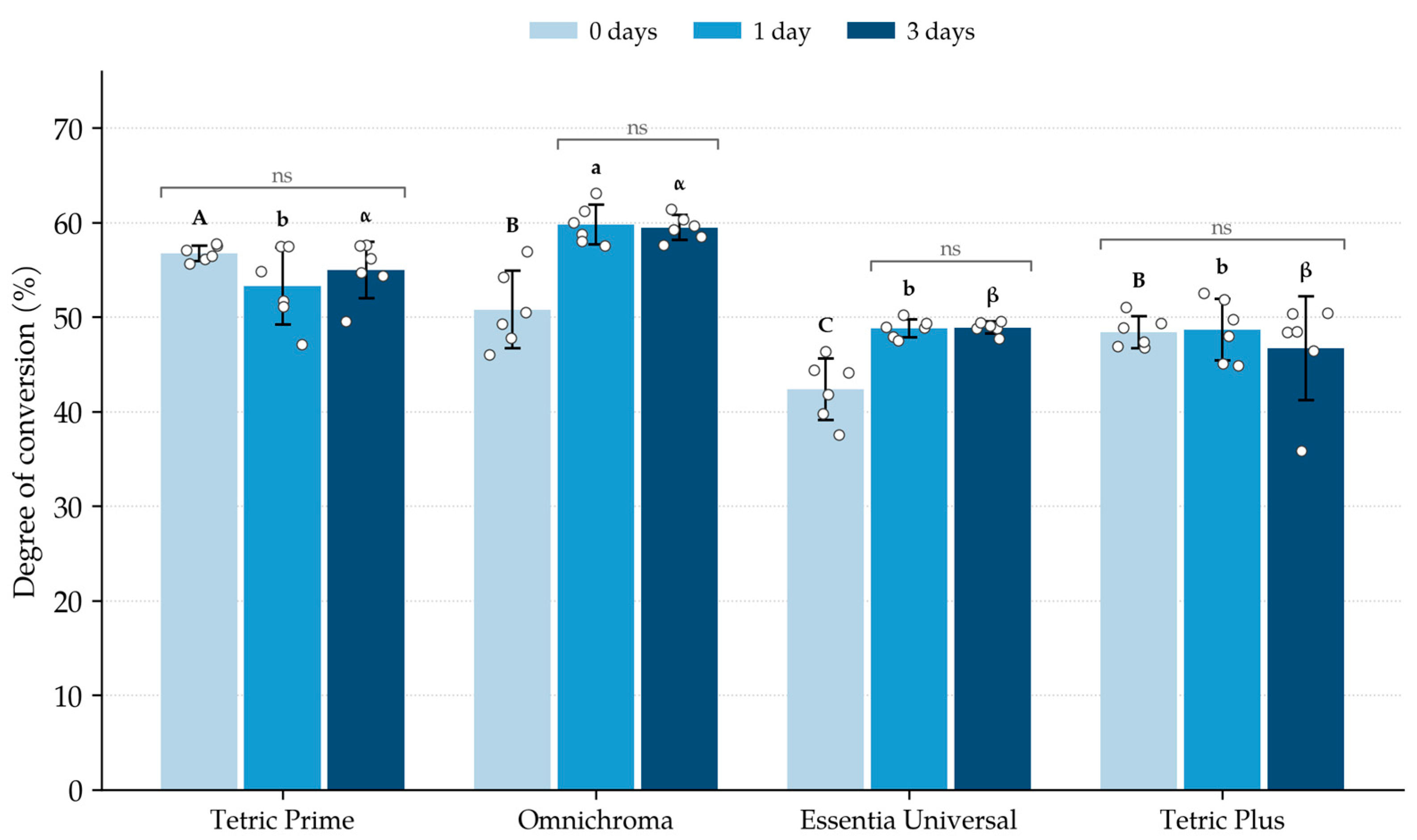
The results of the degree of conversion measured immediately after curing and after 1 and 3 days show a statistically significant increase for Essentia and Omnichroma after 1 and 3 days, while the Tetric Plus and Tetric Prime show statistically homogeneous values for all three measurements (Figure 1).
Immediately after curing, the degree of conversion ranged from 42.3 ± 3.3% for Essentia Universal to 56.7 ± 0.8% for Tetric Prime (among-material ANOVA F(3,20) = 27.7, p < 0.001, η2 = 0.81). Omnichroma and Essentia Universal showed a significant increase in the degree of conversion over the first day (Omnichroma from 50.8% to 59.7%, and Essentia Universal from 42.3% to 48.8%; p < 0.001), after which it remained stable through day 3. In contrast, Tetric Prime and Tetric Plus showed no significant change over the three days (p = 0.16 and p = 0.63, respectively). After this initial post-cure period, Omnichroma reached the highest degree of conversion (59.4 ± 1.3% at day 3), followed by Tetric Prime (55.0 ± 3.0%), whereas Essentia Universal (48.9 ± 0.6%) and Tetric Plus (46.7 ± 5.5%) had the lowest values.

3.2. Water Sorption and Solubility

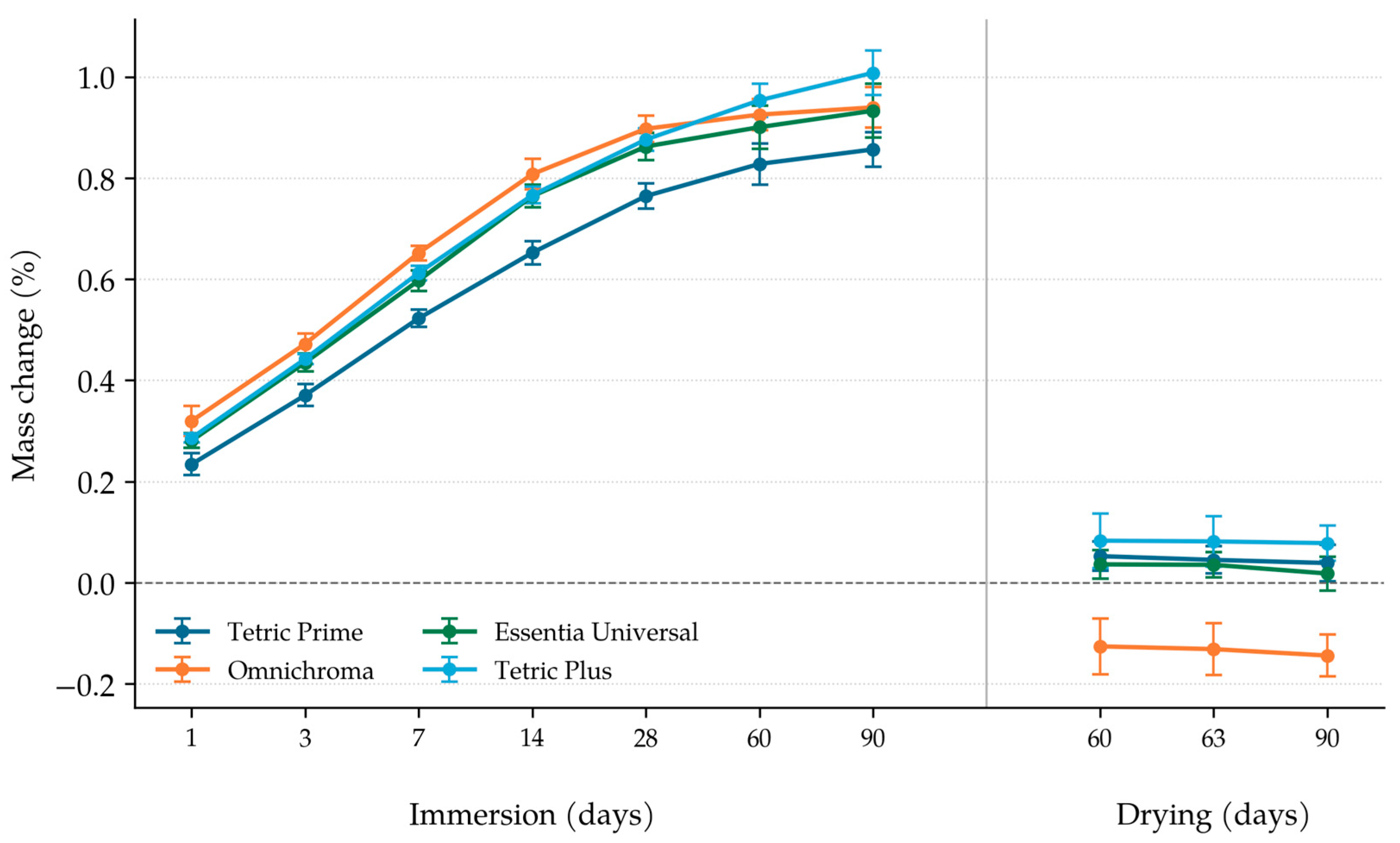
All four materials showed an increase in mass during water storage as a result of water sorption, followed by a decrease in mass after the drying process.
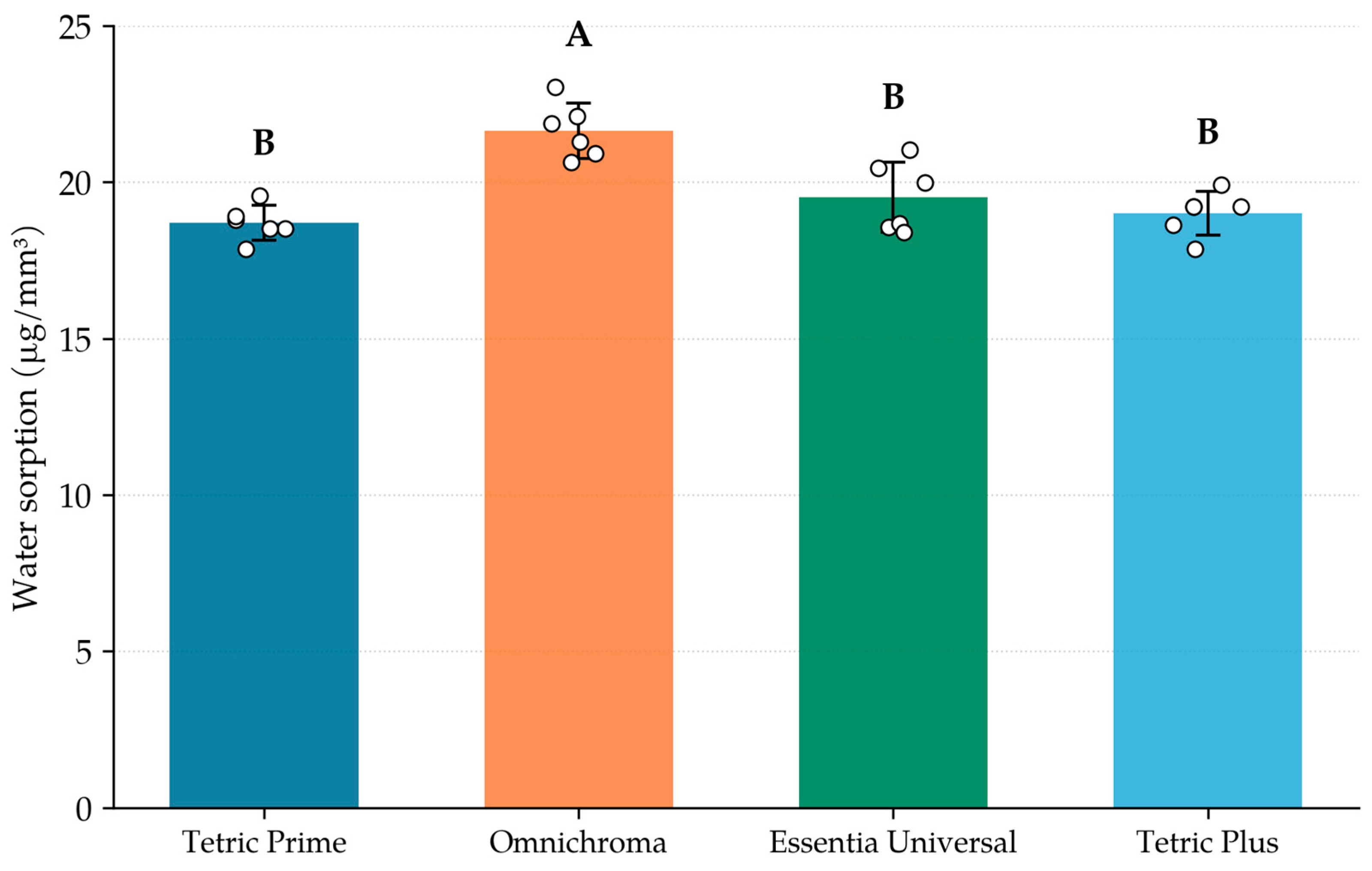
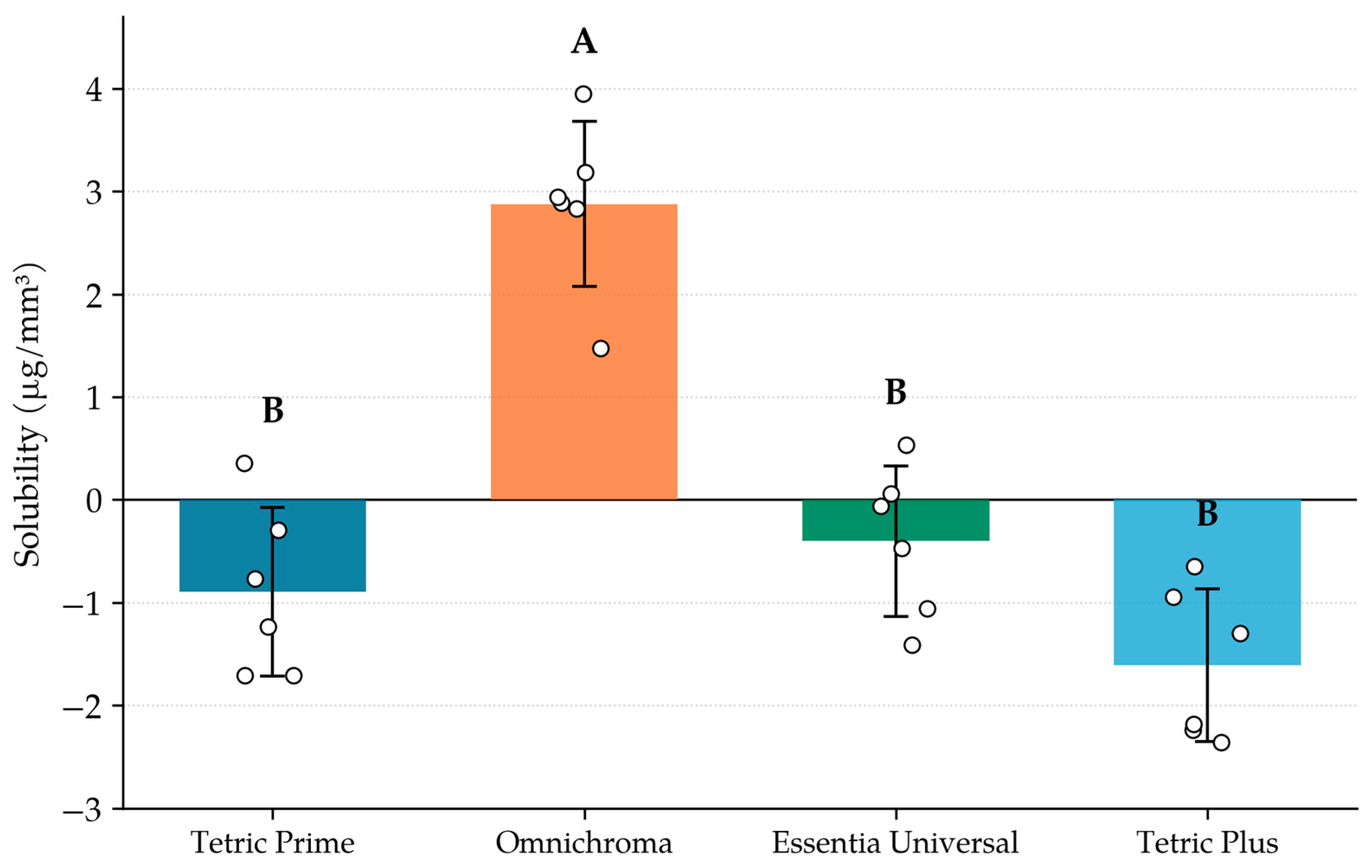
Water sorption (Figure 2) ranged from 18.70 ± 0.56 µg/mm3 for Tetric Prime to 21.64 ± 0.88 µg/mm3 for Omnichroma. Omnichroma was significantly higher than the other three materials (p < 0.001), which formed a statistically homogeneous group (Tetric Prime, Essentia Universal 19.52 ± 1.12, and Tetric Plus 19.01 ± 0.70 µg/mm3). The coefficient of variation for water sorption ranged from 3.0% to 5.7%, indicating good repeatability of the gravimetric measurement. Solubility (Figure 3) was positive only for Omnichroma (2.88 ± 0.80 µg/mm3) and slightly negative for Tetric Prime (−0.89 ± 0.82), Essentia Universal (−0.40 ± 0.73), and Tetric Plus (−1.61 ± 0.74 µg/mm3). After the reconditioning period, the three composites with negative solubility did not fall below their pre-immersion mass but returned to, or slightly exceeded, the baseline (mean net mass change +0.04%, +0.02%, and +0.08% for Tetric Prime, Essentia Universal, and Tetric Plus, respectively). Omnichroma was the only material whose final mass fell below baseline (mean net mass change −0.14%), consistent with its positive solubility (Figure 4). Mean values with standard deviations and 95% confidence intervals for all outcomes are summarized in Table 2.

3.3. Microhardness

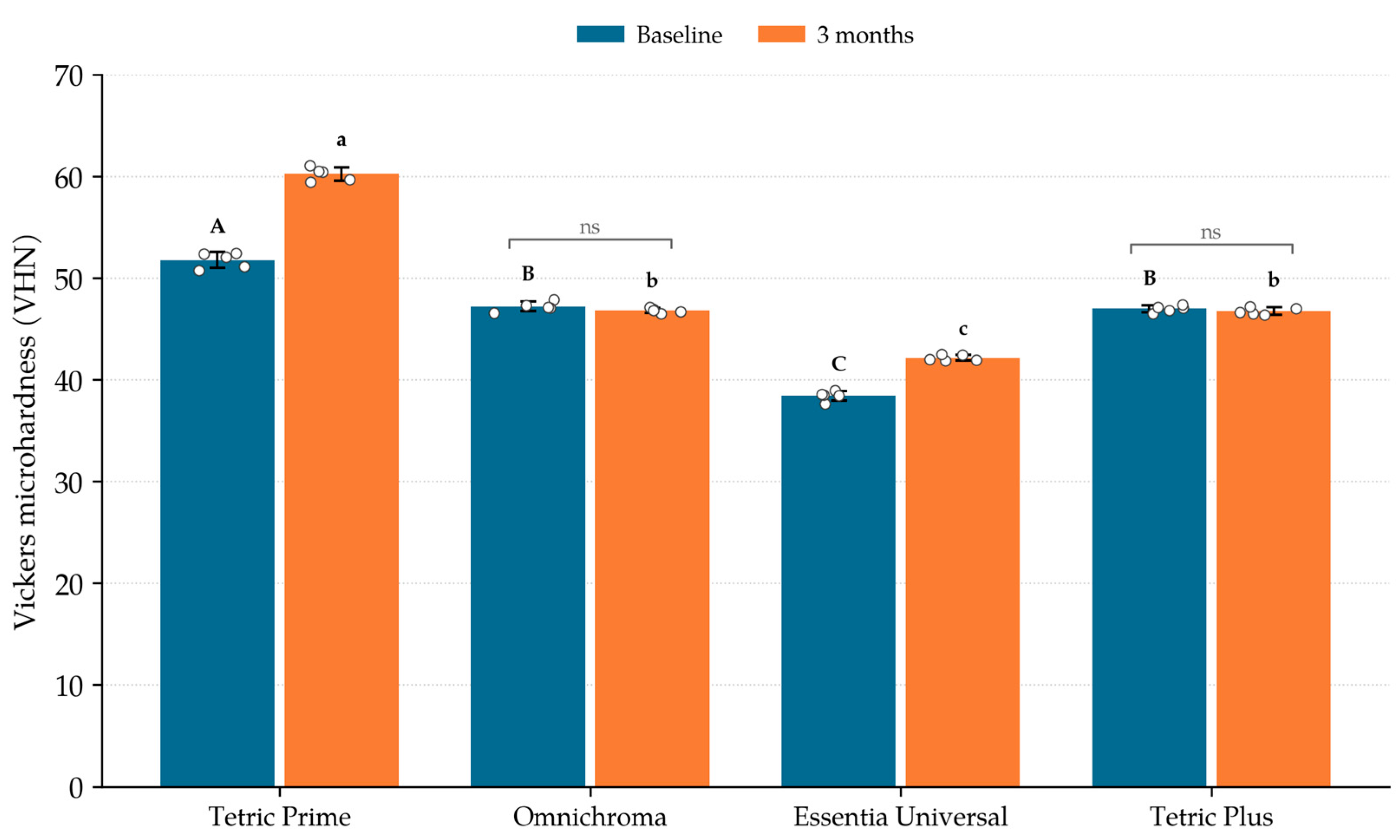
The reference material Tetric Prime exhibited the highest initial microhardness (51.75 ± 0.78 VH) and the highest microhardness after three months of water immersion (60.20 ± 0.66 VH), corresponding to the greatest increase among the tested materials. Essentia Universal exhibited the lowest microhardness values both before immersion (38.42 ± 0.47 VH) and after three months (42.15 ± 0.28 VH), despite a statistically significant increase over time. No statistically significant changes were observed for Omnichroma (47.19 ± 0.46 and 46.80 ± 0.25 VH before and after immersion, respectively) or Tetric Plus (46.97 ± 0.33 and 46.73 ± 0.36 VH, respectively) (Figure 5). Between-material differences in microhardness were large at both time points (η2 = 0.99 at baseline and 1.00 after three months). The increase over time was statistically significant for Tetric Prime (+16.3%, dz = 10.77, p < 0.001) and Essentia Universal (+9.7%, dz = 6.37, p < 0.001), whereas the small changes for Omnichroma (−0.8%, p = 0.20) and Tetric Plus (−0.5%, p = 0.11) were not significant.

4. Discussion

This study evaluated the water sorption, solubility, and microhardness of four resin composites representing distinct color adjustment strategies over a three-month period. The post-cure evolution of degree of conversion was also evaluated under dry conditions. Based on the obtained results, the hypotheses were confirmed, as significant differences among materials were observed for degree of conversion, water sorption, solubility, and microhardness, and water immersion significantly affected microhardness in two of four tested materials.
The reference material Tetric Prime showed the highest microhardness values among all materials, as well as a marked increase in microhardness after 3 months of aging, suggesting good resistance to water-induced softening together with substantial post-cure hardening. The simplified-shade composite Tetric Plus had higher microhardness than the single-shade material Essentia Universal while maintaining water sorption and solubility values comparable to those of the reference material. In contrast, Essentia Universal demonstrated the lowest microhardness values among the tested materials despite its relatively high filler loading. The single-shade composite Omnichroma showed the highest degree of conversion, but also the greatest mass change during water storage, as reflected by its high water sorption and positive solubility values. Despite its increased solubility, Omnichroma did not show a significant reduction in microhardness after three months of immersion. Considering that a limited number of commercial products were selected for this study and that each differs in both resin matrix and filler composition, these differences are most appropriately interpreted as product-specific rather than as inherent characteristics of the single-shade or simplified-shade categories.
Tetric Prime showed the highest initial microhardness values, whereas Essentia Universal showed the lowest values despite having the highest reported filler loading by weight. This is consistent with a significantly higher degree of conversion of Tetric Prime than that of Essentia Universal at every time point (e.g., 55.0% versus 48.9% at three days). This finding aligns with a previous report of a lower conversion for Essentia Universal (55.1% versus 61.6% for Tetric Prime), although that difference was not statistically significant [12]. A lower degree of conversion leaves more unreacted C=C groups and a less densely cross-linked network, which is consistent with the lower microhardness of Essentia Universal.
Other studies also reported the lowest microhardness values for Essentia Universal compared with other universal composites [12,26]. Scanning electron microscopy evaluation of Essentia Universal and Tetric Prime showed the presence of pre-polymerized fillers, which are commonly incorporated to improve polishability and, in some cases, reduce polymerization shrinkage stress [5,12]. Compared with glass fillers, pre-polymerized fillers may provide less structural reinforcement, and their inclusion in some composites can lead to lower flexural strength [27,28]. Despite the presence of pre-polymerized fillers in both materials, Tetric Prime and Essentia Universal had markedly different microhardness values. Beyond degree of conversion, possible explanation could be that the composition and internal structure of the pre-polymerized fillers differ between the two materials, potentially affecting their contribution to microhardness. However, detailed information regarding the composition of pre-polymerized fillers is generally not disclosed by manufacturers, limiting direct comparison between materials [12].
However, in contrast to the aforementioned study by González-Alenda et al. [12], which reported a decrease in microhardness after storage in artificial saliva, the present study found a 9.7% increase in microhardness for Essentia Universal and a 16.3% increase for Tetric Prime, relative to the respective baseline values, after three months of water immersion. In contrast, no statistically significant changes were observed for Tetric Plus and Omnichroma. These discrepancies may be attributable to differences in experimental conditions. While González-Alenda et al. [12] used artificial saliva as the storage medium, the present study used distilled water as a standardized and reproducible storage medium, in line with ISO 4049 and the majority of comparable laboratory studies [25,29,30,31]. More importantly, specimens in the present study were stored for three months, whereas González-Alenda et al. [12] evaluated microhardness after only two weeks of aging. The differences in storage media and aging protocols limit direct comparison of the findings between the two studies.
The degree of conversion measured here reflects the immediate post-cure period of up to three days, during which conversion increased significantly for Omnichroma and Essentia Universal but not for Tetric Prime or Tetric Plus. Because this initial increase was essentially complete within one day, the further rise in microhardness of Tetric Prime and Essentia Universal over the subsequent three months of storage is unlikely to reflect additional monomer conversion and is more consistent with slower maturation and rearrangement of the polymer network over time. Previous studies have shown that composites with lower initial degrees of conversion may undergo substantial post-cure conversion because of the greater availability of unreacted functional groups [32,33]. Storage at 37 °C may increase the mobility of unreacted species and facilitate further conversion reactions within the polymer network. In addition, continued network maturation during storage may contribute to changes in the structure and properties of the polymer matrix [34]. An increase in cross-link density generally enhances the resistance of the polymer network to localized deformation, which may result in higher microhardness values [35]. Omnichroma showed the largest immediate post-cure increase in degree of conversion (from 50.8% to 59.7% within the first day), yet its microhardness did not change significantly over three months of immersion. This is consistent with the plasticizing effect of the absorbed water in their unique resin-coated filler particles offsetting any hardening from the higher conversion [19,36]. Tetric Plus showed no significant change in either the degree of conversion or microhardness. Cross-link density and network structure were not measured in this study; so, the relationship between the degree of conversion and microhardness over the longer term should be interpreted with this in mind.
Taken together, the degree-of-conversion results show that conversion alone does not govern microhardness across the tested materials. At the immediate post-cure stage the ranking of the degree of conversion, with Tetric Prime highest and Essentia Universal lowest, paralleled the baseline microhardness ranking. After post-curing, however, Omnichroma reached the highest degree of conversion (about 59%), exceeding that of Tetric Prime (about 55%), while its microhardness (about 47 VHN) remained well below that of Tetric Prime (about 60 VHN). This indicates that, across materials with different filler systems, filler content and type are the dominant determinants of microhardness, whereas the degree of conversion is most informative when comparing materials with comparable fillers, such as the lower conversion and lower microhardness of Essentia Universal relative to Tetric Prime.
According to the ISO 4049 standard [25], water sorption should be less than or equal to 40 µg/mm3, while the solubility should be less than or equal to 7.5 µg/mm3. The measured water sorption and solubility values for all materials were below these numerical thresholds. However, because a non-standard specimen geometry was used, formal compliance with ISO 4049 cannot be claimed. Compared with the other materials, Omnichroma showed the greatest overall mass change, the highest water sorption, and was the only material to exhibit positive solubility values. The increased water uptake of Omnichroma may be related to its UDMA/TEGDMA-based resin matrix and filler composition reported by the manufacturer. Among the resin systems used in the tested materials, the UDMA/TEGDMA combination would be expected to show the highest water affinity based on previously reported monomer properties. Previous studies on model dimethacrylate copolymer networks have shown that UDMA/TEGDMA systems absorb significantly more water than BisGMA/TEGDMA or BisEMA/TEGDMA systems at comparable TEGDMA content [15,37]. TEGDMA contains three consecutive ether-linked ethylene oxide units that bind water through hydrogen bonding. Additionally, the relatively low molecular weight of TEGDMA (~286 g/mol) facilitates water diffusion through the polymer network [15,38]. Furthermore, based on the manufacturer’s report, Omnichroma was the only tested material that did not contain Bis-EMA, one of the least hydrophilic dimethacrylate monomers present in the other three materials. Shalaby et al. [39] reported the same pattern specifically for Omnichroma and Essentia. In the present study, the lower water sorption of Tetric Prime and Tetric Plus may likewise be related to the reported presence of Bis-EMA and the absence of TEGDMA in their resin matrices. Essentia Universal does contain TEGDMA, yet its water sorption remained below that of Omnichroma. A possible explanation is that the presence of Bis-EMA, together with the highest filler loading among the tested materials (81 wt%), reduced the volume fraction of water-accessible resin matrix, thereby limiting water sorption compared with Omnichroma.
According to ISO 4049, solubility is calculated as (m1 − m3)/V, where m1 is the initial dry mass before immersion and m3 is the final dry mass after reconditioning [25]. Omnichroma was the only material to show a positive mean solubility value, showing a net loss of mass after reconditioning. The other three materials yielded negative values. Negative solubility means that m3 exceeded m1; so, the final mass was greater than the mass recorded before immersion. Negative solubility is a recognized methodological artifact [40,41] of the gravimetric ISO 4049 protocol rather than a true material property. One possible explanation is incomplete desorption of absorbed water during reconditioning. Water loosely associated with the free volume of the network is readily removed by desiccator drying, while water forming strong hydrogen bonds with carbonyl oxygens of ester and carbamate groups, urethane NH protons, or ether oxygens within the polymer backbone desorbs much more slowly and may not be fully eliminated at 37 °C over silica gel [19]. The ISO 4049 reconditioning criterion of ≤0.1 mg difference between successive weightings may be satisfied before all absorbed water has been removed, because the residual desorption rate can fall below the measurement threshold. Under such conditions, m3 may remain slightly higher than m1, resulting in negative calculated solubility values.
The largest negative solubility was recorded for Tetric Plus. One possible explanation is that the amount of material lost through leaching was particularly low, allowing even a small quantity of retained water to outweigh the mass loss during reconditioning. In contrast, the UDMA/TEGDMA-based matrix of Omnichroma may be more susceptible to the elution of low molecular weight species such as TEGDMA, whose release from dental composites has been well documented [17]. In Omnichroma, the mass lost through leaching may have exceeded the mass of water retained after reconditioning, resulting in a positive solubility value that indicates the release of both absorbed water and leachable material [42]. However, the elution of low-molecular-weight species should be measured by direct analysis of the eluate for confirmation.
These findings must be interpreted in the context of the aging model used. Storage in distilled water reproduces only the hydrolytic component of oral aging. In the mouth, restorations are additionally exposed to temperature fluctuations, cyclic pH changes, masticatory loading, and salivary enzymes such as esterases, which can hydrolyze ester-containing monomers and accelerate surface degradation beyond that produced by water alone. For this reason, the three-month immersion period cannot be equated with a defined interval of clinical service. It is best regarded as a standardized, accelerated indicator of relative hydrolytic stability rather than a direct predictor of in vivo longevity. Within these constraints, the practical significance of the present results is that the products differed mainly in the magnitude of reversible water exchange while remaining within the ISO 4049 limits, and that only Omnichroma combined high sorption with measurable solubility [23,24].
This study has several limitations. This study was conducted under in vitro conditions, which cannot fully replicate the complex physical, chemical, and biological environment of the oral cavity. Furthermore, the limited number of single-shade and simplified-shade materials evaluated may restrict the generalizability of the findings to other products within these categories. Future studies on a broader range of materials and complementary analyses are needed to assess the factors determining the performance of simplified-shade and single-shade composites. Additional limitations include the absence of optical and color-adjustment measurements, surface roughness, wear, elution, and structural (SEM, FTIR/Raman) analyses; the relatively small sample size, which limits the statistical power to detect small differences; and the deviation of the specimen geometry from ISO 4049, which means that full compliance with the standard cannot be claimed. The specimens were also light-cured for 20 s from each side under ideal laboratory conditions, which produces a higher and more uniform degree of conversion than is usually achieved in a clinical cavity and may have influenced the measured water sorption, solubility, and microhardness.

5. Conclusions

The tested composites showed substantial differences in degree of conversion, water sorption, solubility, and microhardness despite sharing the common goal of simplifying shade selection through different color-matching approaches. Overall, the findings indicate that classification based solely on color adjustment potential is insufficient to predict the water-related behavior and microhardness of resin composites. Among the four products tested, only the single-shade composite Omnichroma combined markedly higher water sorption with positive solubility, whereas the other single-shade material, Essentia Universal, behaved similarly to the simplified-shade and reference composites. The increased water uptake and reduced hydrolytic stability therefore appear to be product-specific rather than a general feature of single-shade materials.

Author Contributions

Conceptualization, D.M.; methodology, M.P. and D.M.; software, M.P.; formal analysis, M.M. and M.P.; investigation, M.M., M.K. and D.P.; resources, Z.T.; data curation, D.P.; writing—original draft preparation, M.M.; writing—review and editing, M.P., Z.T., M.K., D.P. and D.M.; supervision, Z.T. and D.M.; project administration, Z.T. and D.M.; funding acquisition, Z.T. and D.M. All authors have read and agreed to the published version of the manuscript.

Funding

This work was financially supported by the Croatian Science Foundation under the project number HRZZ-IP-2024–05–2884, and by the European Union—NextGenerationEU through the National Recovery and Resilience Plan (NPOO), within the project “Integrated investigation of aesthetic, mechanical and toxicological properties of restorative dental composites”, grant number SFZG-04–2025_INDECOM.

Institutional Review Board Statement

Not applicable.

Informed Consent Statement

Not applicable.

Data Availability Statement

The raw data will be made available by the corresponding authors on reasonable request.

Conflicts of Interest

The authors declare no conflicts of interest.

References

  1. Huang, W.; Ren, L.; Cheng, Y.; Xu, M.; Luo, W.; Zhan, D.; Sano, H.; Fu, J. Evaluation of the Color Stability, Water Sorption, and Solubility of Current Resin Composites. Materials 2022, 15, 6710. [Google Scholar] [CrossRef] [Scilit] [PubMed]
  2. Zhang, N.; Xie, C. Polymerization Shrinkage, Shrinkage Stress, and Mechanical Evaluation of Novel Prototype Dental Composite Resin. Dent. Mater. J. 2020, 39, 1064–1071. [Google Scholar] [CrossRef] [Scilit] [PubMed]
  3. Moon, J.-D.; Seon, E.-M.; Son, S.-A.; Jung, K.-H.; Kwon, Y.-H.; Park, J.-K. Effect of Immersion into Solutions at Various pH on the Color Stability of Composite Resins with Different Shades. Restor. Dent. Endod. 2015, 40, 270. [Google Scholar] [CrossRef] [Scilit] [PubMed]
  4. Korkut, B.; Tarçın, B.; Atalı, P.Y.; Özcan, M. Introduction of a New Classification for Resin Composites with Enhanced Color Adjustment Potential. Curr. Oral Health Rep. 2023, 10, 223–232. [Google Scholar] [CrossRef] [Scilit]
  5. Perdigão, J.; Zatt, F.P.; Lopes, G.C.; Caon, N.B.; Chen, R. Characterization of Universal Composite Resin Filler Particles. J. Esthet. Restor. Dent. 2025, 37, 2472–2480. [Google Scholar] [CrossRef] [Scilit] [PubMed]
  6. Anwar, R.S.; Hussein, Y.F.; Riad, M. The Clinical Performance of Monoshade Resin Composite as Posterior Restoration: A Randomized Controlled Clinical Trial. Sci. Rep. 2025, 15, 25279. [Google Scholar] [CrossRef] [Scilit] [PubMed]
  7. Ilie, N.; Ionescu, A.C.; Diegelmann, J. Characterization of Universal Chromatic Resin-Based Composites in Terms of Cell Toxicity and Viscoelastic Behavior. Dent. Mater. 2022, 38, 700–708. [Google Scholar] [CrossRef] [Scilit] [PubMed]
  8. See It, Try It, Throw the Shade Guide Away! Br. Dent. J. 2021, 231, 596. [CrossRef] [Scilit]
  9. Shortall, A.C.; Palin, W.M.; Burtscher, P. Refractive Index Mismatch and Monomer Reactivity Influence Composite Curing Depth. J. Dent. Res. 2008, 87, 84–88. [Google Scholar] [CrossRef] [Scilit] [PubMed]
  10. Ilie, N.; Högg, C. Kinetic of Light Transmission during Setting and Aging of Modern Flowable Bulk-Fill Composites. Materials 2024, 17, 4292. [Google Scholar] [CrossRef] [Scilit] [PubMed]
  11. Par, M.; Repusic, I.; Skenderovic, H.; Tarle, Z. Wavelength-Dependent Light Transmittance in Resin Composites: Practical Implications for Curing Units with Different Emission Spectra. Clin. Oral Investig. 2019, 23, 4399–4409. [Google Scholar] [CrossRef] [Scilit] [PubMed]
  12. González-Alenda, E.; Baracco, B.; Perdigão, J.; Jiménez-Díez, D.; Garrido, M.Á.; Álvarez-Lloret, P.; Ceballos, L.; Fuentes, V. Physicomechanical Properties and Morphological Characterization of Several Universal Resin Composites After Different Aging Procedures. J. Esthet. Restor. Dent. 2025, 37, 2533–2545. [Google Scholar] [CrossRef] [Scilit] [PubMed]
  13. Braden, M.; Clarke, R.L. Water Absorption Characteristics of Dental Microfine Composite Filling Materials. Biomaterials 1984, 5, 369–372. [Google Scholar] [CrossRef] [Scilit] [PubMed]
  14. Klarić, N.; Macan, M.; Par, M.; Tarle, Z.; Marović, D. Effect of Rapid Polymerization on Water Sorption and Solubility of Bulk-Fill Composites. Acta Stomatol. Croat. 2022, 56, 235–245. [Google Scholar] [CrossRef] [Scilit] [PubMed]
  15. Sideridou, I. Study of Water Sorption, Solubility and Modulus of Elasticity of Light-Cured Dimethacrylate-Based Dental Resins. Biomaterials 2003, 24, 655–665. [Google Scholar] [CrossRef] [Scilit] [PubMed]
  16. Szczesio-Wlodarczyk, A.; Sokolowski, J.; Kleczewska, J.; Bociong, K. Ageing of Dental Composites Based on Methacrylate Resins—A Critical Review of the Causes and Method of Assessment. Polymers 2020, 12, 882. [Google Scholar] [CrossRef] [Scilit] [PubMed]
  17. Örtengren, U.; Wellendorf, H.; Karlsson, S.; Ruyter, I.E. Water Sorption and Solubility of Dental Composites and Identification of Monomers Released in an Aqueous Environment. J. Oral Rehabil. 2001, 28, 1106–1115. [Google Scholar] [CrossRef] [Scilit] [PubMed]
  18. Price, R.B.; Ferracane, J.L.; Shortall, A.C. Light-Curing Units: A Review of What We Need to Know. J. Dent. Res. 2015, 94, 1179–1186. [Google Scholar] [CrossRef] [Scilit] [PubMed]
  19. Ferracane, J.L. Hygroscopic and Hydrolytic Effects in Dental Polymer Networks. Dent. Mater. 2006, 22, 211–222. [Google Scholar] [CrossRef] [Scilit] [PubMed]
  20. Devletli Ozygit, L.; Eyuboglu, G.B. Surface Roughness and Surface Microhardness of Bulk-Fill and Conventional Resin Composites after Erosive-Abrasive Cycles: A Laboratory Study. Am. J. Dent. 2026, 39, 85–94. [Google Scholar] [PubMed]
  21. Ersoz, B.; Erkmen, Y.; Aydin, N.; Ari, B.; Baran, M.Y.; Karaoglanoglu, S.; Bakirhan, N.K. Effects of Chlorogenic Acid and Total Phenolic Content of Coffees on the Color Stability, Surface Roughness, and Microhardness of Resin Composites. BMC Oral Health 2026, 26, 288. [Google Scholar] [CrossRef] [Scilit] [PubMed]
  22. Mokhtar, M.M.; Farahat, D.S.; Eldars, W.; Osman, M.F. Physico-Mechanical Properties and Bacterial Adhesion of Resin Composite CAD/CAM Blocks: An in-Vitro Study. J. Clin. Exp. Dent. 2022, 14, e413–e419. [Google Scholar] [CrossRef] [Scilit] [PubMed]
  23. Szczesio-Wlodarczyk, A.; Kopacz, K.; Ranoszek-Soliwoda, K.; Sokolowski, J.; Bociong, K. Towards the Standardization of Artificial Aging Protocols for Dental Composites: Evaluation of Proposed Methods. J. Funct. Biomater. 2025, 16, 49. [Google Scholar] [CrossRef] [Scilit] [PubMed]
  24. Finer, Y.; Santerre, J.P. Salivary Esterase Activity and Its Association with the Biodegradation of Dental Composites. J. Dent. Res. 2004, 83, 22–26. [Google Scholar] [CrossRef] [Scilit] [PubMed]
  25. Par, M.; Spanovic, N.; Bjelovucic, R.; Marovic, D.; Schmalz, G.; Gamulin, O.; Tarle, Z. Long-Term Water Sorption and Solubility of Experimental Bioactive Composites Based on Amorphous Calcium Phosphate and Bioactive Glass. Dent. Mater. J. 2019, 38, 555–564. [Google Scholar] [CrossRef] [Scilit] [PubMed]
  26. Yılmaz Atalı, P.; Doğu Kaya, B.; Manav Özen, A.; Tarçın, B.; Şenol, A.A.; Tüter Bayraktar, E.; Korkut, B.; Bilgin Göçmen, G.; Tağtekin, D.; Türkmen, C. Assessment of Micro-Hardness, Degree of Conversion, and Flexural Strength for Single-Shade Universal Resin Composites. Polymers 2022, 14, 4987. [Google Scholar] [CrossRef] [Scilit] [PubMed]
  27. Liu, J.; Zhang, H.; Sun, H.; Liu, Y.; Liu, W.; Su, B.; Li, S. The Development of Filler Morphology in Dental Resin Composites: A Review. Materials 2021, 14, 5612. [Google Scholar] [CrossRef] [Scilit] [PubMed]
  28. Ilie, N. Universal Chromatic Resin-Based Composites: Aging Behavior Quantified by Quasi-Static and Viscoelastic Behavior Analysis. Bioengineering 2022, 9, 270. [Google Scholar] [CrossRef] [Scilit] [PubMed]
  29. Dülger, K.; Koşar, T. Microhardness, Degree of Conversion, and Water Sorption/Solubility of Non-Expired and Expired (Two and Three Years) Dental Composites. Bezmialem Sci. 2023, 11, 151–157. [Google Scholar] [CrossRef] [Scilit]
  30. Czasch, P.; Ilie, N. In Vitro Comparison of Mechanical Properties and Degree of Cure of Bulk Fill Composites. Clin. Oral Investig. 2013, 17, 227–235. [Google Scholar] [CrossRef] [Scilit] [PubMed]
  31. Šošić, A.; Šalinović, I.; Miletić, I.; Sauro, S.; Kekez, I.; Ivanišević, A. Microhardness and Chemical Composition of Glass Ionomer and Glass Hybrid Cements Modified with Experimental Bioactive Glasses. Acta Stomatol. Croat. 2026, 60, 158–172. [Google Scholar] [CrossRef] [Scilit] [PubMed]
  32. Par, M.; Gamulin, O.; Marovic, D.; Klaric, E.; Tarle, Z. Raman Spectroscopic Assessment of Degree of Conversion of Bulk-Fill Resin Composites—Changes at 24 Hours Post Cure. Oper. Dent. 2015, 40, E92–E101. [Google Scholar] [CrossRef] [Scilit] [PubMed]
  33. Par, M.; Spanovic, N.; Tauböck, T.T.; Attin, T.; Tarle, Z. Degree of Conversion of Experimental Resin Composites Containing Bioactive Glass 45S5: The Effect of Post-Cure Heating. Sci. Rep. 2019, 9, 17245. [Google Scholar] [CrossRef] [Scilit] [PubMed]
  34. Carek, A.; Dukaric, K.; Miler, H.; Marovic, D.; Tarle, Z.; Par, M. Post-Cure Development of the Degree of Conversion and Mechanical Properties of Dual-Curing Resin Cements. Polymers 2022, 14, 3649. [Google Scholar] [CrossRef] [Scilit] [PubMed]
  35. Par, M.; Marovic, D.; Attin, T.; Tarle, Z.; Tauböck, T.T. The Effect of Rapid High-Intensity Light-Curing on Micromechanical Properties of Bulk-Fill and Conventional Resin Composites. Sci. Rep. 2020, 10, 10560. [Google Scholar] [CrossRef] [Scilit] [PubMed]
  36. Ilie, N. Accelerated versus Slow In Vitro Aging Methods and Their Impact on Universal Chromatic, Urethane-Based Composites. Materials 2023, 16, 2143. [Google Scholar] [CrossRef] [Scilit] [PubMed]
  37. Barszczewska-Rybarek, I.M. Structure–Property Relationships in Dimethacrylate Networks Based on Bis-GMA, UDMA and TEGDMA. Dent. Mater. 2009, 25, 1082–1089. [Google Scholar] [CrossRef] [Scilit] [PubMed]
  38. Fonseca, A.S.Q.S.; Labruna Moreira, A.D.; De Albuquerque, P.P.A.C.; De Menezes, L.R.; Pfeifer, C.S.; Schneider, L.F.J. Effect of Monomer Type on the C C Degree of Conversion, Water Sorption and Solubility, and Color Stability of Model Dental Composites. Dent. Mater. 2017, 33, 394–401. [Google Scholar] [CrossRef] [Scilit] [PubMed]
  39. Shalaby, H.; Asmaa, A.-H.; Aboelenein, A. Water Sorption, Solubility, Surface Roughness and Microhardness of Omnichroma and Essentia Resin Composite after Thermocycling. NeuroQuantology 2022, 20, 2022–2042. [Google Scholar]
  40. Müller, J.A.; Rohr, N.; Fischer, J. Evaluation of ISO 4049: Water Sorption and Water Solubility of Resin Cements. Eur. J. Oral Sci. 2017, 125, 141–150. [Google Scholar] [CrossRef] [Scilit] [PubMed]
  41. Alshali, R.Z.; Salim, N.A.; Satterthwaite, J.D.; Silikas, N. Long-Term Sorption and Solubility of Bulk-Fill and Conventional Resin-Composites in Water and Artificial Saliva. J. Dent. 2015, 43, 1511–1518. [Google Scholar] [CrossRef] [Scilit] [PubMed]
  42. Ling, L.; Lai, T.; Chung, P.-T.; Malyala, R. Shrinkage, Degree of Conversion, Water Sorption and Solubility, and Mechanical Properties of Novel One-Shade Universal Composite. Polymers 2025, 17, 2728. [Google Scholar] [CrossRef] [Scilit] [PubMed]
Figure 1. Degree of conversion (mean ± SD) with individual specimen values overlaid. Statistically homogeneous groups within each time point are indicated by the same letter (α = 0.05), with uppercase letters denoting measurements immediately after polymerization, lowercase letters denoting measurements after 1 day and Greek letters showing measurements after 3 days. Statistically homogeneous values within each material (between different time points) are indicated by a bracket.
Applsci 16 08560 g001
Figure 2. Water sorption after 3 months of water immersion (mean ± SD). Statistically homogeneous groups are indicated by the same letter (α = 0.05).
Applsci 16 08560 g002
Figure 3. Solubility after 3 months of water immersion (mean ± SD). Statistically homogeneous groups are indicated by the same letter (α = 0.05).
Applsci 16 08560 g003
Figure 4. Percent change in specimen mass at different immersion and desiccation time points relative to the baseline mass before immersion.
Applsci 16 08560 g004
Figure 5. Microhardness (mean ± SD). Statistically homogeneous groups within each time point are indicated by the same letter (α = 0.05), with uppercase letters denoting measurements before immersion and lowercase letters denoting measurements after 3 months of water immersion. Statistically homogeneous values within each material (baseline vs. 3 months) are indicated by a bracket.
Applsci 16 08560 g005
Table 1. Composition of tested materials as stated by the manufacturers.
Material
(Shade)
GroupResin CompositionFiller CompositionFiller Amount (wt%/vol%)
Tetric Prime (A2)Conventional multi-shade (reference composite)UDMA, Bis-GMA, Bis-EMA, D3MA Barium glass, yttrium trifluoride, mixed oxide (SiO2/ZrO2) and prepolymer77/56
OmnichromaSingle-shade compositeUDMA, TEGDMAUniform sized supra-nano spherical filler (260 nm spherical SiO2-ZrO2), composite filler (include 260 nm spherical SiO2-ZrO2)79/68
Essentia
Universal
Single-shade compositeUDMA, Bis-MEPP, Bis-EMA, Bis-GMA, TEGDMA Pre-polymerized fillers, strontium glass, lanthanide fluoride, fumed silica, F-AI-Si glass81/64
Tetric Plus
Fill (A2)
Simplified-shade compositeBis-GMA, Bis-EMA, UDMA, Aromatic-aliphatic UDMA, DCPNano-ytterbium trifluoride, glass filler, optimized mixed oxide (silicon dioxide/zirconium dioxide), spherical in-flight polymerized filler70/52
UDMA, urethane dimethacrylate; Bis-GMA, bisphenol A glycidyl methacrylate; Bis-EMA, ethoxylated bisphenol A dimethacrylate; D3MA, Decanediol dimethacrylate; TEGDMA, triethylene glycol dimethacrylate; Bis-MEPP, 2 2,2-bis(4-methacryloxy polyethoxyphenyl)propane; DCP, tricyclodecane-dimethanol dimethacrylate. Compositional data are based on manufacturer disclosures; exact proprietary formulations, filler particle size distributions, and silanization details may not be fully disclosed and could not be independently verified.
Table 2. Degree of conversion, water sorption, solubility, and Vickers microhardness of the tested materials (mean ± SD; 95% confidence intervals in parentheses).
Material (Group)Water Sorption (µg/mm3)Solubility (µg/mm3)Microhardness, Baseline (VHN)Microhardness,
3 Months (VHN)
Degree of
Conversion,
0 d (%)
Degree of
Conversion,
1 d (%)
Degree of
Conversion,
3 d (%)
Tetric Prime
(reference)
18.70 ± 0.56 (18.10, 19.29) B−0.89 ± 0.82 (−1.76, −0.03) B51.75 ± 0.78 (50.79, 52.71) A60.20 ± 0.66 (59.38, 61.02) a56.73 ± 0.82 (55.87, 57.60) C53.26 ± 4.08 (48.99, 57.54) A54.98 ± 2.98 (51.85, 58.11) B
Omnichroma
(single-shade)
21.64 ± 0.88 (20.72, 22.57) A2.88 ± 0.80 (2.04, 3.72) A47.19 ± 0.46 (46.61, 47.76) B46.80 ± 0.25 (46.49, 47.11) b50.76 ± 4.10 (46.46, 55.06) B59.73 ± 2.10 (57.53, 61.94) B59.44 ± 1.33 (58.04, 60.83) B
Essentia Universal (single-shade)19.52 ± 1.12 (18.34, 20.70) B−0.40 ± 0.73 (−1.17, 0.36) B38.42 ± 0.47 (37.83, 39.01) C42.15 ± 0.28 (41.80, 42.50) c42.31 ± 3.26 (38.89, 45.73) A48.78 ± 0.97 (47.76, 49.80) A48.86 ± 0.64 (48.18, 49.53) A
Tetric Plus
(simplified-shade)
19.01 ± 0.70 (18.28, 19.74) B−1.61 ± 0.74 (−2.39, −0.83) B46.97 ± 0.33 (46.56, 47.38) B46.73 ± 0.36 (46.28, 47.18) b48.36 ± 1.68 (46.60, 50.12) B48.65 ± 3.28 (45.21, 52.09) A46.65 ± 5.49 (40.89, 52.41) A
Within each column, values sharing the same superscript letter were not significantly different among materials (α = 0.05); for microhardness, uppercase letters denote baseline and lowercase letters denote 3-month values. The degree of conversion (DC) is reported immediately after curing (0 d) and after 1 and 3 days. Among-material ANOVA: water sorption F(3,20) = 14.88, η2 = 0.69; solubility F(3,20) = 39.43, η2 = 0.86; DC at 3 days F(3,20) = 19.8, η2 = 0.75.
Disclaimer/Publisher’s Note: The statements, opinions and data contained in all publications are solely those of the individual author(s) and contributor(s) and not of MDPI and/or the editor(s). MDPI and/or the editor(s) disclaim responsibility for any injury to people or property resulting from any ideas, methods, instructions or products referred to in the content.