Article

Voice-Controlled Intralogistics on an Open Cyber–Physical Middleware: Deep Learning-Based Speech Processing and Validation in an Industrial Noisy Environment


1
Academy of Applied Studies—Sirmium, Zmaj Jovina 29, 22000 Sremska Mitrovica, Serbia
2
Faculty of Technical Sciences, University of Novi Sad, Trg Dositeja Obradovića 6, 21000 Novi Sad, Serbia
3
Faculty of Project and Innovation Management, Educons University, Bože Jankovića 14, 11010 Belgrade, Serbia
*
Author to whom correspondence should be addressed.
Appl. Sci. 2026, 16(17), 8524; https://doi.org/10.3390/app16178524
Submission received: 15 June 2026 / Revised: 17 July 2026 / Accepted: 22 July 2026 / Published: 27 August 2026

Abstract

The rapid development of Industry 4.0 brings significant benefits to intralogistics through increased flexibility, interoperability, and real-time responsiveness. However, the growing complexity of industrial environments creates challenges for logistics process adaptation and the integration of emerging technologies such as voice-driven control of heterogeneous robotic and IoT systems. Open-source solutions offer a promising approach by enabling vendor independence and cost-effective deployment. This paper investigates the use of the OPIL cyber–physical middleware, developed within the Horizon 2020 L4MS initiative, combined with convolutional neural networks for speech denoising and keyword recognition, to enable robust voice-controlled intralogistics in demanding noisy industrial environments. A voice-controlled logistics system was designed, deployed, and empirically evaluated on the OPIL platform. The results confirm the technical feasibility of OPIL as an open and modular alternative to proprietary Industry 4.0 platforms. They further demonstrate the feasibility of integrating AI-based keyword spotting and voice interaction into environments using an open middleware architecture. The study also identifies key limitations, including reduced performance for non-native speakers and mild speech over-suppression at high signal-to-noise ratios. To support reproducibility and external validation, the complete network configurations, training procedure, and deployment data are provided.

1. Introduction

The second decade of the twenty-first century corresponds to the accelerated development of technologies that appeared at the beginning of the new millennium, including the Internet of Things (IoT), blockchain, 3D printing, Artificial Intelligence (AI), Machine Learning (ML), cloud computing, big data analytics, automated and autonomous vehicles, robotics and related digital technologies, which are most often collectively called Industry 4.0 technologies. Almost all industrial and business sectors and their associated activities are increasingly adopting Industry 4.0 technologies in order to achieve significant potential benefits, such as faster access to information, improved user experience, increased productivity and efficiency, improved decision-making, lower operating costs, greater competitiveness, improved business and social sustainability, improved security, etc. [1]. Logistics, as an essential part of every company, is one of the industries that Industry 4.0 has greatly influenced because it serves as the backbone of the entire functioning of supply chains. The essential question, which is opened by this, is how companies will transform themselves in the direction of digitization and automation of their logistics processes. In this context, the Industry 4.0 paradigm imposes stringent requirements on manufacturing and logistics systems, especially in terms of flexibility, interoperability, scalability, and real-time responsiveness. Within this framework, intralogistics, encompassing integrated management of the flow of information and materials from warehouse, manufacturing units or distribution centers, has played an increasingly important role as key driver for optimizing processes, automating operations, and facilitate the flow of information and materials within business units [2]. The implementation of intralogistics solutions can help companies optimize material and information flows within their organizations, thereby enabling faster and more efficient responses to customer demands [3]. However, many organizations are still not fully prepared for the adoption of such solutions due to several challenges, including high investment costs, rigid and highly standardized technical and technological architectures, insufficient organizational readiness, and a lack of specialized knowledge and expertise. In addition, the uncertainty of return of investment, caused by implementation complexity and various risk components [4], further discourages companies from adopting advanced intralogistics technologies.
Conventional intralogistics solutions are typically characterized by vendor-specific architectures, limited adaptability, and restricted interoperability, which hinder their effective deployment in dynamic and heterogeneous production environments [5]. These off-the-shelf solutions often entail significant costs, which could be financially prohibitive for companies, especially in the case of small and medium enterprises (SME) [6]. Companies frequently encounter several challenges when adopting off-the-shelf solutions, including the “one-size-fits-all” approach, limited future scalability and adaptability, integration difficulties with existing systems, insufficient control over data ownership, and restricted customization capabilities. Open-source solutions have already demonstrated significant potential and effectiveness in addressing these challenges. Technologies such as the Robot Operating System (ROS) for Automated Guided Vehicle (AGV) navigation, FIWARE for IoT-enabled transport systems, and various simulation tools based on open standards for material and information flow management are widely applied in intralogistics automation, robotics, and simulation environments. The solution that is the focus of this paper, developed within the Horizon 2020 L4MS project [7] to orchestrate and integrate diverse open-source smart intralogistics technologies, is OPIL (Open Platform for Innovations in Logistics).
The OPIL is an open, modular, and vendor-neutral platform that follows a cyber–physical systems paradigm, enabling seamless interaction among heterogeneous entities such as AGVs, IoT devices, sensors, and human operators within a unified digital infrastructure. The platform leverages the FIWARE ecosystem for context-aware data management and real-time communication and integrates with the ROS to ensure compatibility with diverse robotic platforms. Its architecture comprises key components, including Cyber–Physical Middleware, Sensor Agent Nodes, Sensing and Perception modules, a hierarchical Task Planner, and a Human–Machine Interface, which collectively enable real-time coordination and optimization of logistics processes. This paper investigates the extent to which OPIL, as a middleware platform for defining and managing hotspots within facility layouts where intralogistics activities take place, combined with Convolutional Neural Networks (CNNs) for speech denoising and keyword recognition, can enable voice-controlled intralogistics in acoustically and operationally demanding industrial settings. To address this research question, an efficient and user-friendly voice-controlled automated logistics system for meat processing facilities, built on the OPIL platform, is designed, deployed, and empirically evaluated. The proposed system, named VCLMP (Voice Controlled Logistics System for Automation in Meat Production), aims to provide an integrated logistics solution capable of enhancing human–machine interaction and improving operational efficiency in the meat processing industry. The system integrates a fully convolutional speech denoising network, a CNN-based keyword recognizer, an AGV, an ABB IRB 140 manipulator, NFC/RFID-based traceability, and a custom ERP layer.
Beyond confirming the technical feasibility of OPIL as a viable vendor-neutral open-source alternative to proprietary Industry 4.0 platforms, the results provide empirical evidence that open and modular middleware architectures can support AI-based voice interaction within a regulated food production setting. The study also identifies the main limitations of the current pipeline, including reduced generalization to non-native speakers and mild speech over-suppression at high input Signal-to-Noise Ratios (SNR). Furthermore, the paper reports the full network configurations and training procedure.
Overall, this research contributes to the advancement of intelligent intralogistics by integrating open-platform architectures with AI-driven voice interaction, thereby addressing key limitations of existing Industry 4.0 solutions and enabling deployment in real-world industrial environments.

2. Related Work

Industry 4.0 has clearly emerged as the dominant paradigm in modern manufacturing. It reflects the convergence of industrial operations and information systems to create an integrated environment aimed at optimizing production processes and intralogistics activities [8]. Within this context, cyber–physical platforms have gained increasing importance as enabling infrastructures that connect physical assets, digital technologies, and intelligent decision-making systems in real time. These platforms integrate cyber–physical systems (CPSs), IoT technologies, cloud computing, AI, and advanced data analytics to support autonomous and adaptive manufacturing environments. By enabling continuous communication between machines, sensors, products, and operators, cyber–physical platforms facilitate enhanced monitoring, predictive maintenance, decentralized control, and real-time process optimization. The CPS, which is more technology-oriented, and the IoT, which is more concept-oriented [9], are two terms that are most commonly associated with the Industry 4.0 paradigm. One of the crucial IoT technologies is automatic identification technologies, such as Radio Frequency Identification (RFID) and its specialized subset for short-range communication, Near Field Communication (NFC). These technologies enable seamless communication, identification, and data exchange between physical objects and digital systems. The integration of RFID/NFC technologies within CPS and IoT architectures significantly improves traceability, transparency, and operational efficiency in manufacturing and intralogistics systems. Consequently, RFID/NFC represent essential enabling technologies for achieving higher levels of digitalization, and intelligent manufacturing within Industry 4.0 environment [10]. Furthermore, in [11], RFID is identified as one of the primary sensing technologies underpinning IoT-driven industrial systems, enabling seamless object-to-system communication at scale across intralogistics workflows.
The CPS have emerged as a transformative paradigm in intralogistics and warehouse environments, enabling the continuous, bidirectional coupling of physical material flows with digital monitoring and control layers. Ref. [12] proposed one of the foundational frameworks in this domain, demonstrating that the convergence of CPS and Industrial IoT allows smart production-logistics systems to achieve real-time responsiveness, adaptive scheduling, and seamless coordination between manufacturing and internal transport processes. Building directly on this in the intralogistics context, Ref. [13] developed a CPS-based architecture specifically for performance monitoring in production intralogistics, showing that IoT-driven data acquisition from conveyors, autonomous guided vehicles (AGVs), and storage systems enables continuous KPI tracking, anomaly detection, and proactive maintenance-capabilities that traditional warehouse management systems cannot deliver. The OPIL, as a form of CPS, has been introduced as a modular and interoperable framework for managing heterogeneous intralogistics systems. Early implementations demonstrate its applicability in mobile robot control and distributed optimization, emphasizing agent-based coordination and system flexibility [14,15]. More recent work extends OPIL toward analytical optimization, such as fleet sizing methodologies tailored for dynamic logistics environments [16].
Previous studies have positioned OPIL as an open, modular, and interoperable framework for managing heterogeneous intralogistics systems. In contrast to proprietary Industry 4.0 platforms such as Siemens MindSphere, Bosch IoT Suite, and SAP Leonardo, which are typically integrated within vendor-specific ecosystems, OPIL emphasizes vendor neutrality, extensibility, and the integration of heterogeneous logistics components through open interfaces. Rather than competing directly with commercial platforms in terms of functionality or performance, OPIL provides a viable open-source alternative for research-oriented, highly customizable, and adaptive industrial environments where flexibility, interoperability, and technology independence are primary requirements.
Building upon CPS, the concept of the digital twin has emerged as one of the significant technological innovations and a well-established paradigm in Industry 4.0, extensively explored for modeling, simulation, and optimization of industrial processes. A digital twin represents a virtual replica of a physical object, process, system, or production environment that is continuously updated through real-time data collected from sensors and interconnected devices. Through the integration of simulation models, data analytics, and machine learning techniques, digital twins enable the monitoring, analysis, and prediction of system behavior across different operational scenarios. Studies show that Digital Twins enable real-time monitoring and predictive decision-making in internal transport systems and logistics operations [17,18]. Furthermore, Digital Twin-based approaches have been successfully applied to AGV scheduling and optimization, highlighting their capability for system-level coordination [19]. However, while digital twin frameworks provide high-fidelity virtual representations, they are often tightly coupled with specific infrastructures and require significant integration effort. OPIL, as an emerging technology, addresses these limitations by prioritizing openness, modularity, and interoperability across heterogeneous systems.
Speech denoising has evolved from classical signal processing techniques toward deep learning-based approaches capable of handling complex and non-stationary noise conditions. Early work demonstrated the effectiveness of deep neural networks in mapping noisy speech to clean representations, significantly improving speech intelligibility [20]. Subsequent research explored fully convolutional, waveform-based, and hybrid signal processing approaches combining deep learning with traditional techniques such as wavelet decomposition [21,22,23]. Hybrid architectures combining convolutional and recurrent layers further improved temporal modeling and noise suppression performance [24]. More recent studies focus on multi-objective optimization, hybrid approaches, and comprehensive surveys of deep learning-based speech enhancement and recognition systems [25,26,27]. Additionally, practical implementations emphasize low-latency processing and real-time deployment. For example, deep filtering approaches and mobile-based denoising pipelines demonstrate the feasibility of deploying such models in real-world applications, including streaming from smartphones and assistive devices [28,29].
Automatic speech recognition (ASR) systems have significantly advanced with the adoption of deep learning techniques, particularly Convolutional Neural Networks (CNNs). Early CNN-based approaches demonstrated their capability to extract robust spectral features for speech classification and recognition tasks [30]. Recent research extends these methods to more complex scenarios, including tonal speech recognition, emotional speech classification, and speech defect detection [31,32,33]. Comparative studies further analyze different CNN architectures, showing improved performance in continuous and speaker-independent recognition tasks [34,35]. Moreover, hybrid and cross mixed architectures have been proposed to enhance feature extraction and classification accuracy, particularly in noisy and real-world environments [36]. Command recognition systems based on CNNs are especially relevant for industrial applications, where limited vocabularies and high reliability are required [37].
Mobile devices, particularly smartphones, play a crucial role in modern voice-enabled systems. Studies show that smartphones can be effectively used for voice recording and acoustic analysis, providing sufficient quality for both clinical and industrial applications [38]. Recent work focuses on real-time audio processing directly on mobile platforms. For instance, CNN-based voice activity detection (VAD) has been successfully implemented as a smartphone application, enabling efficient detection of speech segments in noisy environments [39]. Additionally, machine learning-based mobile applications have been developed for sound detection and speech recognition, demonstrating the feasibility of deploying AI-driven audio processing on edge devices [40].
AGVs are widely deployed in industrial and warehouse environments to autonomously transport materials across shop floors and storage facilities, with their physical form and functional attributes varying considerably depending on the area of application. Common configurations include forklift AGVs, piggyback AGVs, trailer handling AGVs, towing AGVs, underride AGVs, and heavy-load AGVs, each designed to meet specific material handling requirements in terms of load capacity, maneuverability, and interface with surrounding infrastructure. Regardless of type, every AGV system is architecturally composed of two interdependent layers: the physical vehicle itself and a superordinate AGV guidance and control system that coordinates routing, scheduling, and traffic management across the fleet [41]. Autonomous navigation of AGVs relies on a combination of sensing technologies and advanced control algorithms. LiDAR-based localization and SLAM techniques are widely used for accurate environment mapping and path tracking [42,43]. Deep learning-enhanced LiDAR systems further improve localization accuracy in complex environments [43].
Vision-based methods, including RGB-D sensing and deep learning, enable object recognition and tracking, which are essential for dynamic and unstructured environments [44]. Additionally, marker-based approaches have been proposed to improve docking precision and positioning accuracy in industrial settings [45]. Multi-sensor fusion frameworks integrating LiDAR, odometry, GNSS, and inertial sensors provide robust localization and trajectory tracking, particularly in challenging environments [46,47]. The use of ROS facilitates modular implementation and integration of these components, as demonstrated in practical robotic systems combining LiDAR and camera inputs [48].
Robotic manipulators are widely used in industrial automation for tasks such as picking, sorting, and palletizing. Early work focused on robot design and calibration, particularly for industrial arms such as ABB systems [49,50]. More recent research emphasizes perception-driven manipulation, where machine vision systems enable robots to handle randomly arranged or heterogeneous objects [51]. Advanced approaches incorporate deep learning and RGB-D sensing for object recognition and pose estimation in depalletizing tasks, significantly improving flexibility and accuracy [52]. Vision-assisted methods are also used to optimize end-effector positioning for handling mixed cargo [53].
However, most existing approaches rely heavily on vision-based identification and heuristic or predefined motion strategies. In contrast, the system proposed in this work utilizes NFC/RFID-based identification for deterministic pallet recognition. Based on the acquired pallet ID, sorting decisions are computed using the Simplex optimization method, enabling efficient and mathematically grounded motion planning. This approach differs from existing literature by reducing reliance on computationally intensive vision systems and introducing an optimization-driven control strategy, thereby improving robustness and scalability in industrial environments [54].

3. Materials and Methods

Synthesizing the reviewed literature reveals four convergent observations that motivate the present work. First, OPIL has been studied predominantly as a mobile robot control and fleet-sizing infrastructure, whereas its use as a backbone for voice-enabled, ERP-coupled intralogistics remains essentially unexplored. Second, deep-learning approaches to speech denoising and keyword spotting are typically evaluated on benchmark corpora under generic noise conditions, with comparatively little evidence on their behavior under sustained broadband industrial noise (drilling, conveyor systems, impact tools) representative of food-production facilities. Third, AGV navigation and robotic manipulation studies overwhelmingly rely on vision-based perception, whereas the deterministic identification properties of NFC/RFID combined with simplex-based sequencing remain a relatively underexplored avenue for low-cost, regulation-compliant traceability. Finally, the literature offers very few peer-reviewed industrial case studies in which all four subsystems: speech enhancement, command recognition, autonomous transport, and ERP orchestration, are integrated and quantitatively evaluated as a single closed-loop system in a regulated production environment. The VCLMP architecture presented in the remainder of this section is designed precisely to occupy this gap, and its evaluation is structured to provide evidence on the main research question stated in introductory section.

3.1. Overall Architecture of the VCLMP Solution

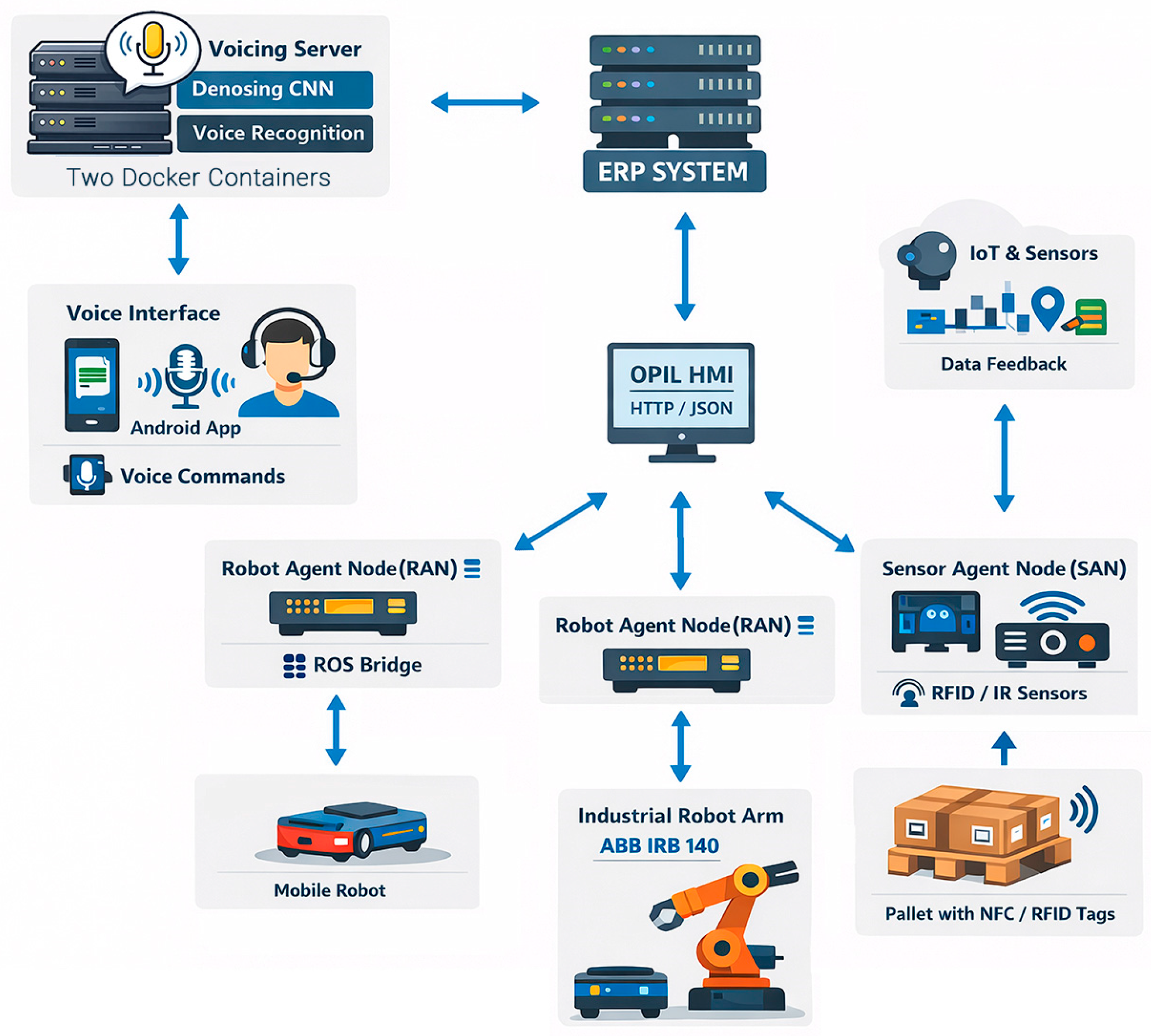
The Voice Controlled Logistic system for automation in Meat Production (VCLMP) is conceived as a distributed, service-oriented architecture that integrates enterprise management, robotic execution, intelligent voice interaction, and IoT-based sensing into a unified logistics framework. The system, presented in Figure 1, is designed to operate within the OPIL ecosystem, ensuring interoperability, scalability, and modular deployment across industrial environments.
At its core, the VCLMP architecture is centered around the Enterprise Resource Planning (ERP) system, which acts as the main orchestration layer. The ERP system is responsible for interpreting incoming commands, managing workflows, and coordinating interactions between all subsystems. It communicates with the OPIL Human Machine Interface (HMI), which serves as a middleware layer enabling standardized data exchange using HTTP and JSON-based messaging.
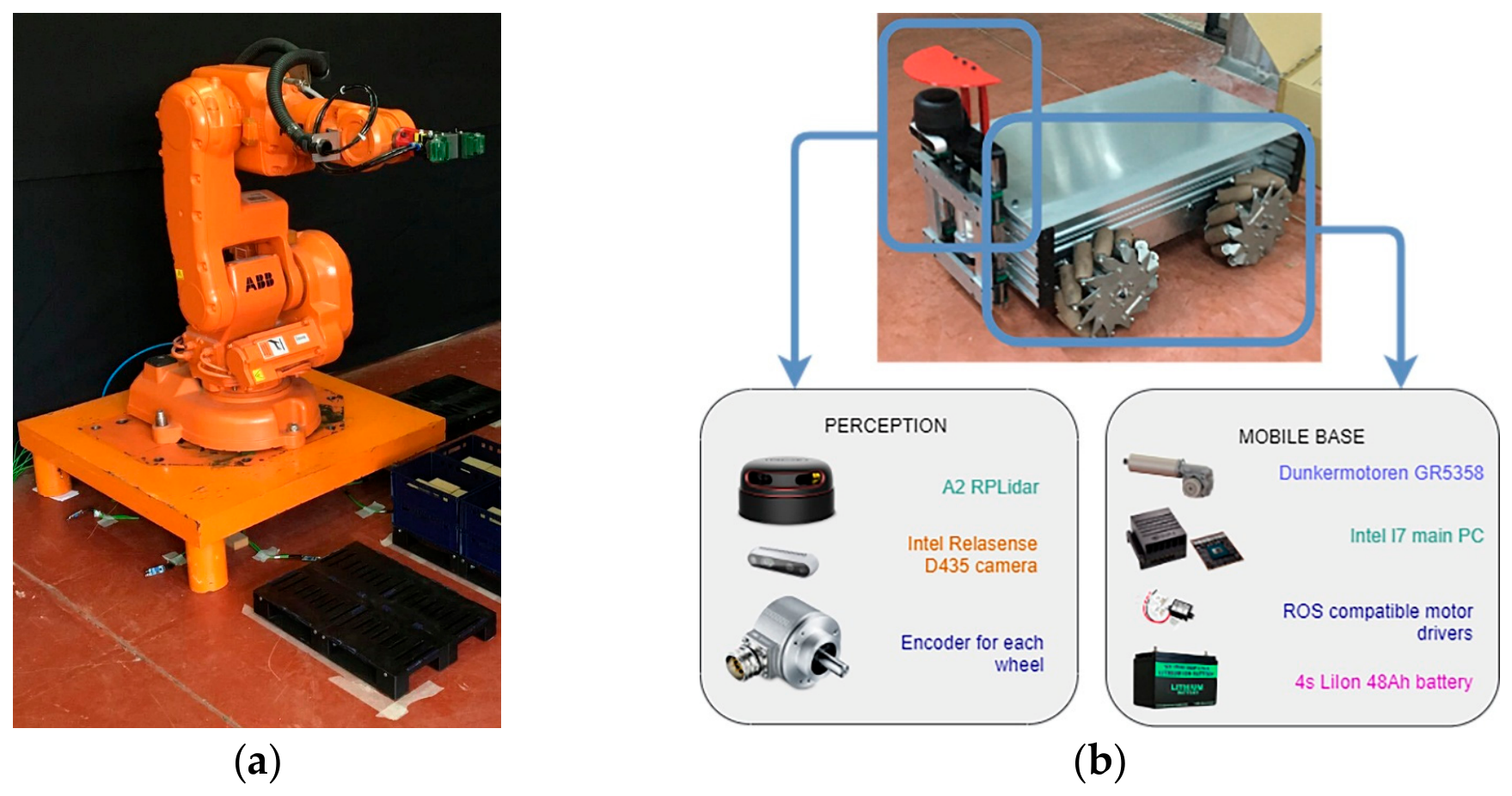
Within this architecture, physical execution is handled by a ROS—compatible robotic platform (AGV), described in [54], together with an industrial robotic manipulator. The mobile robot is integrated into the system via a Robot Agent Node (RAN), which provides an abstraction layer between the ROS environment and the OPIL infrastructure. This approach decouples low-level robotic control from higher-level enterprise logic, allowing commands generated within the ERP system to be seamlessly translated into executable robotic actions. The same communication channel enables feedback from the robot, ensuring bidirectional data flow and real-time system awareness.
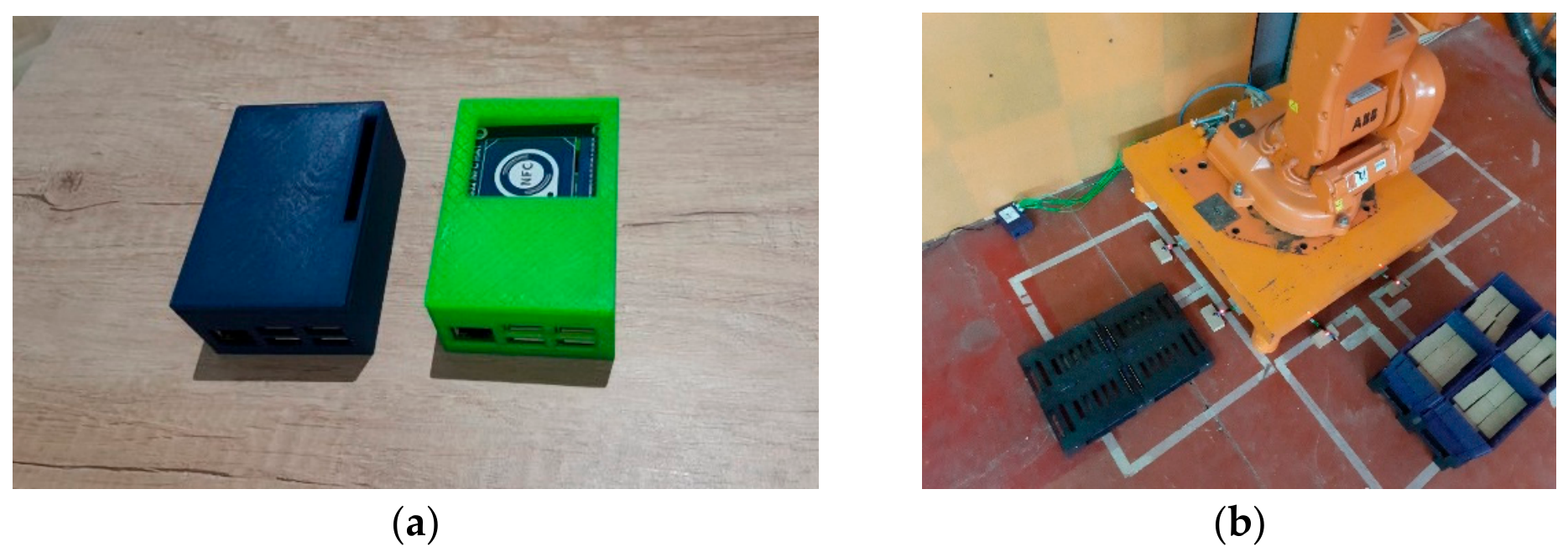
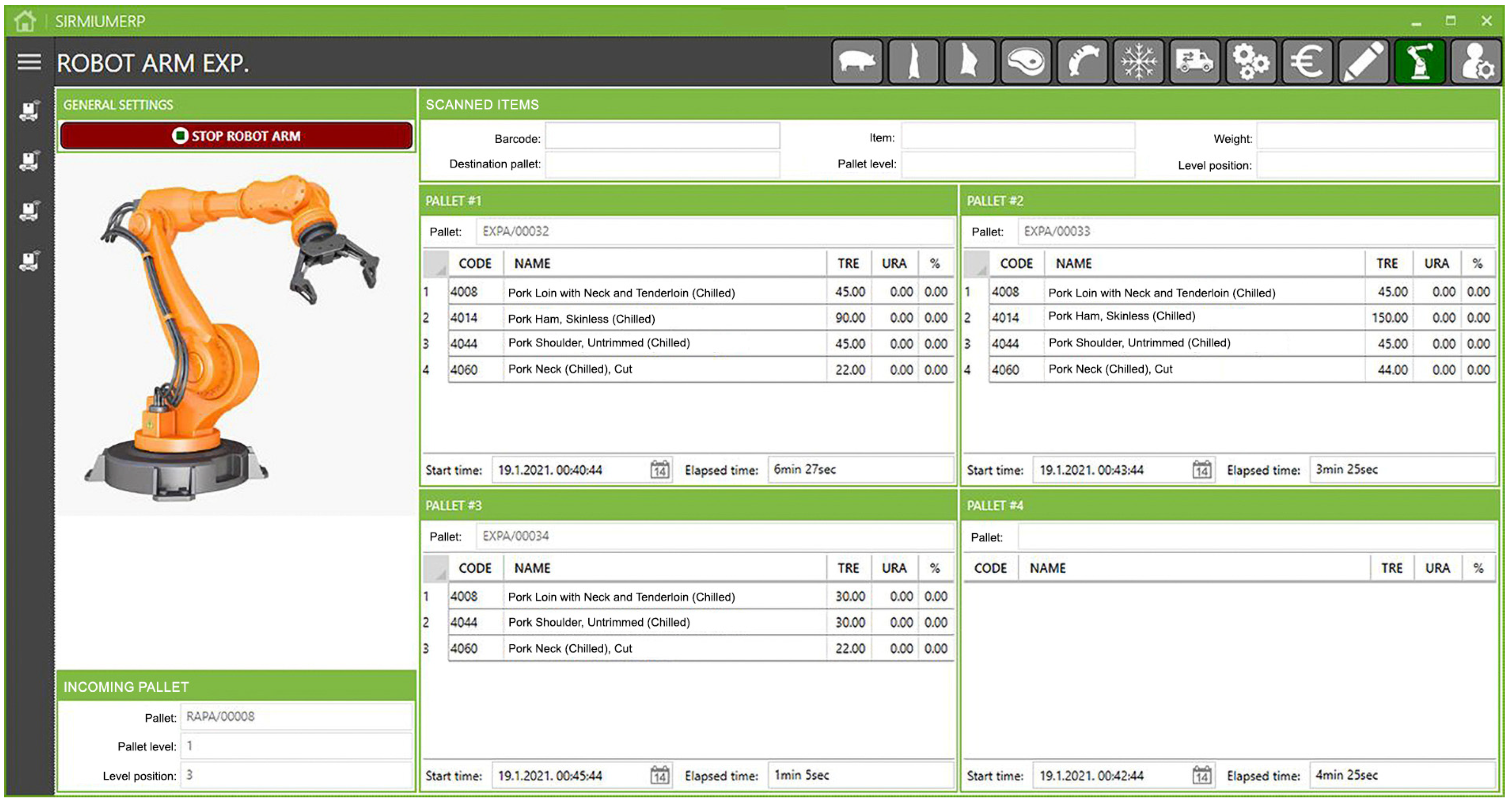
In addition to the mobile robotic platform, the system incorporates an industrial robotic arm, namely the ABB IRB 140 (ABB—Asea Brown Boveri, Zürich, Switzerland), equipped with a gripper for manipulation tasks. The robotic arm is also connected to the system through the RAN interface, ensuring uniform integration with the rest of the architecture. Its primary role is pallet sorting and handling, where optimization of sorting operations is achieved using the simplex method. In this context, the ERP system generates optimized task sequences, which are then executed by the robotic arm. Importantly, the operation of the robotic arm is tightly coupled with the IoT sensing layer. Pallets positioned in the vicinity of the robotic arm are first detected by IR sensors of a Sensor Agent Node (SAN), after which identification data is obtained through NFC/RFID tag reading. Based on the information retrieved from these tags, the system determines the appropriate handling and sorting strategy. The corresponding commands are then issued via the ERP and RAN layers to the ABB IRB 140 manipulator, which performs the required pick-and-place operations using its gripper. This mechanism enables context-aware, automated pallet sorting driven by real-time identification data.
The Android-based mobile application serves as the primary human–system interaction interface which is assigned to each worker in the production environment. The application is connected to a wireless headset, enabling hands-free operation in industrial conditions. Beyond its primary role in capturing and transmitting voice commands, the application also provides additional functionalities such as real-time monitoring of system status, task notifications, and interaction feedback from the ERP and OPIL layers. This dual-purpose design allows workers not only to issue commands but also to remain continuously informed about the state of logistics processes, thereby improving situational awareness and operational efficiency.
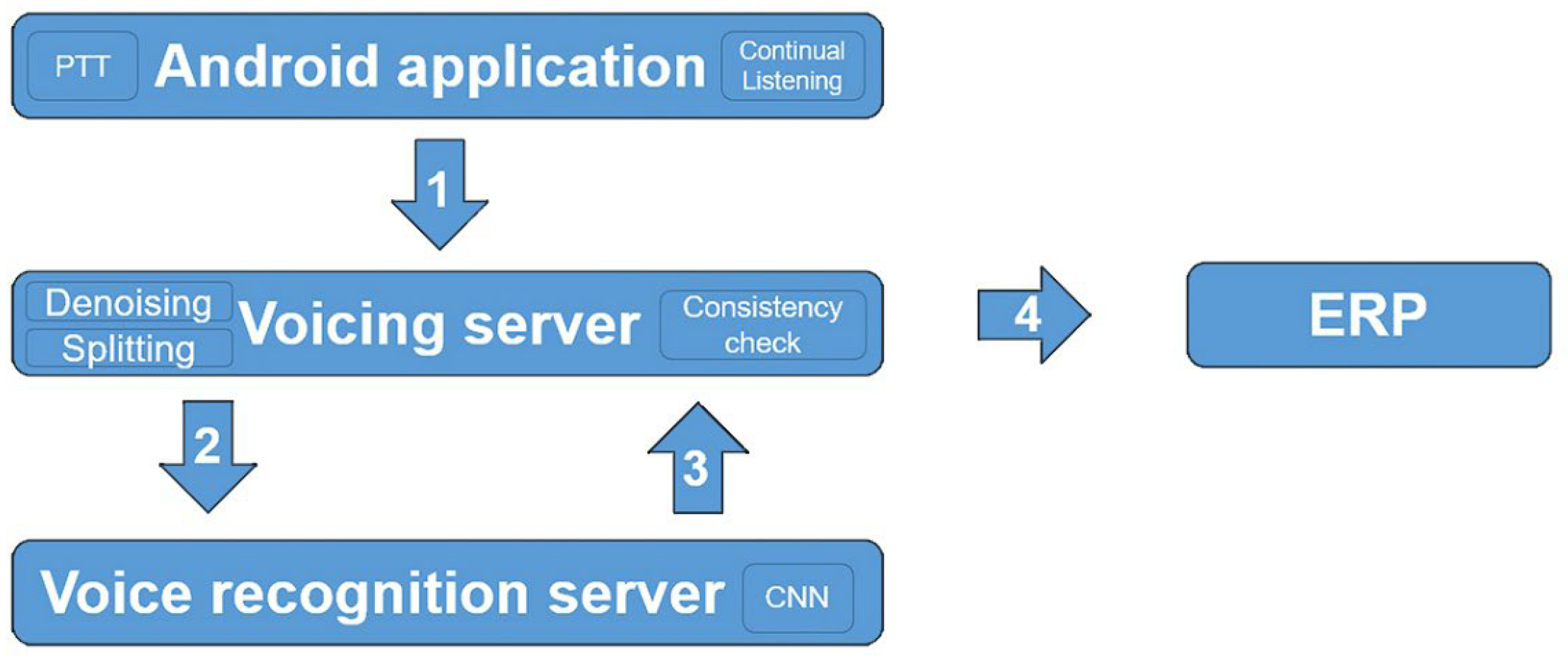
In parallel, the system incorporates an intelligent Voicing subsystem (Figure 2), which enables command-based human–machine interaction through speech. From a high-level perspective, the Voicing system follows a multi-stage processing pipeline. The aforementioned mobile application captures user speech via the connected headset and forwards audio recordings to a server-side infrastructure. The received audio is first processed by a denoising module based on a CNN, specifically trained to suppress environmental noise typical of industrial settings. The cleaned signal is then segmented into smaller units corresponding to individual words, which are subsequently analyzed by a second CNN-based model for keyword recognition. The recognized words are validated, structured into a formal command, and forwarded to the ERP system for further interpretation and execution. This design ensures robustness against noise, modularity of processing stages, and flexibility in adapting or replacing individual components without affecting the overall system.
Figure 2 provides a high-level overview of the VCLMP architecture which represents the core foundation of VCLMP End-To-End pipeline that is later described and evaluated in Section 5. Detailed descriptions of the individual subsystems, including convolutional neural network models, mobile application design, robotic control, optimization methods, and IoT implementations, are presented in the following sections.

3.2. OPIL

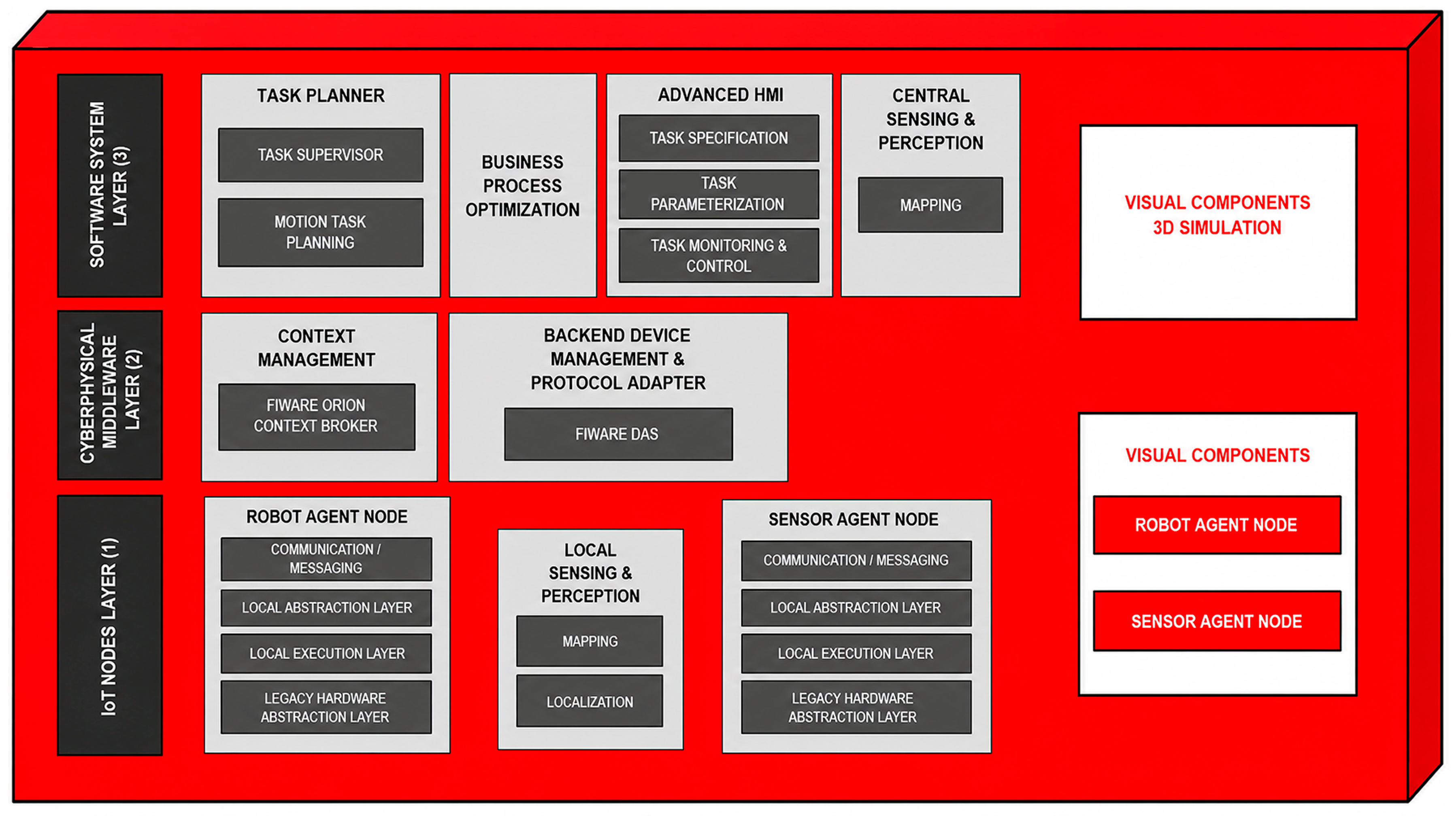
The OPIL architecture was briefly outlined in the Introduction. In this section, its structure is further elaborated through the conceptual representation provided in Figure 3, which illustrates the layered organization of the platform and the interaction between its principal components. Figure 3 depicts the OPIL architecture as a hierarchical system composed of tightly integrated layers.
At the lowest level, the IoT Nodes Layer includes physical devices such as sensors, actuators, and robotic platforms, interfaced via RAN and SAN. These elements provide abstraction, communication, and local processing capabilities, enabling seamless integration of heterogeneous hardware. Additionally, Local Sensing and Perception modules operate at this level, supporting real-time functionalities such as localization, mapping, and obstacle detection, which allow individual agents to function autonomously within dynamic environments.
The Cyber–Physical Middleware layer, positioned above the device layer, serves as the central communication backbone of the system. It leverages the FIWARE ecosystem to enable context-aware data exchange through a publish–subscribe mechanism and standardized NGSI interfaces. This design ensures decoupled communication between system components and facilitates interoperability with external enterprise systems. On top of this layer, the Software System layer hosts higher-level functionalities, including centralized Sensing and Perception, the hierarchical Task Planner, and Business Process Optimization modules, which collectively enable global coordination, task allocation, and optimization based on real-time system states. Finally, the architecture is complemented by interaction and validation components, namely the Advanced Human–Machine Interface and the 3D Factory Simulator. These modules provide intuitive system monitoring and control, as well as virtual commissioning capabilities through a digital twin environment.
From an operational standpoint, the VCLMP system enables a seamless workflow in which a worker, using the Android application and connected headset, issues a voice command; the Voicing subsystem transforms it into a machine interpretable instruction; the ERP system decomposes it into optimized executable tasks (including those derived via the simplex method and NFC-based pallet identification); and the robotic platforms, both the mobile robot and the ABB IRB 140 manipulator, together with IoT nodes, carry out the requested operations. Simultaneously, feedback is relayed back to the worker through the same application, closing the interaction loop between human operators and the automated logistics system.

4. Voice-Controlled Logistics System Design and Development

This section presents the design of the complete signal processing pipeline, focusing on the development and testing of the speech denoising and voice recognition application. The design and implementation of the remaining components of the proposed VCLMP, including the mobile acquisition infrastructure, IoT sensing integration, and high-level orchestration logic are provided in Appendix A, reflecting the primary objective of the paper while allowing the complete end-to-end system architecture to be documented in a high level of detail without interrupting the flow of the main text.

4.1. Speech Denoising Application

Within this section an implementation of a CNN for speech denoising, designed to remove background noise from speech audio signals is presented. It uses a dataset of noisy and clean speech pairs, created by mixing clean Mozilla Common Voice samples with UrbanSound8K noise clips. The system converts the raw audio into the time–frequency domain using Short-Time Fourier Transform (STFT) and trains the CNN to predict the clean magnitude spectrum from noisy inputs. Phase information is not modeled by the network during training; instead, the phase of the noisy signal is reused for inverse STFT (iSTFT) during reconstruction. The output is a denoised audio waveform closely approximating the clean original speech. The CNN is trained on log-scaled STFT magnitude spectrograms.

4.1.1. Datasets and Data Preparation

For model training, speech samples from the Mozilla Common Voice dataset (version 6.1, released December 2020) [56,57] were used. This version comprises approximately 11,000 h of validated speech recordings across multiple languages, with English representing a substantial subset commonly used for speech processing tasks. The dataset provides diverse speaker demographics and recording conditions, making it suitable for robust model training. These speech samples were combined with environmental noise clips from the UrbanSound8K (Version 1.0) [58,59], which contains 8732 labeled audio excerpts across 10 urban sound classes, including air conditioner, car horn, children playing, dog bark, drilling, engine idling, gunshot, jackhammer, siren, and street music.
Given that the target application is a meat production facility, selected noise classes were mapped to their closest industrial counterparts. Specifically, drilling was used to approximate cutting blades and slicing machinery, engine idling to represent conveyor belts and motor-driven systems, and jackhammer to emulate impact tools and heavy chopping processes. This mapping enables the use of a standardized dataset while maintaining relevance to industrial acoustic conditions. To evaluate denoising performance, a separate test set was constructed using clean speech from the LibriSpeech ASR corpus [60,61], a widely used benchmark dataset containing approximately 1000 h of 16 kHz read English speech derived from audiobooks. The corpus is characterized by high-quality recordings with minimal background noise, making it suitable as a clean reference (ground truth) for speech enhancement evaluation. Clean audio samples were artificially corrupted by adding noise from the three selected categories (drilling, engine idling, and jackhammer) from the UrbanSound8K (Version 1.0) dataset, enabling the creation of paired clean, noisy, and denoised signals.
The test dataset consisted of 50 clean speech samples, each 3 s in duration and sampled at 16 kHz. These samples were combined with noise at three signal-to-noise ratio (SNR) levels (0 dB, 5 dB, and 10 dB). For each noise category, five distinct noise clips were randomly selected and applied across the dataset, ensuring an approximately uniform distribution of noise variations. This resulted in a total of 450 noisy samples (50 samples × 3 noise types × 3 SNR levels), all of which were processed by the proposed model. The availability of corresponding clean and noisy pairs enabled quantitative evaluation using SNR-based metrics, allowing for a direct assessment of noise reduction performance across varying noise conditions and levels.
Following the denoising pipeline described above, the data preparation process defines the implementation details required to generate training inputs for the model. Raw audio signals are resampled to 16 kHz and transformed into the frequency domain using the STFT with a window length of 256 samples and 75% overlap. The resulting magnitude features are normalized using mean and standard deviation scaling. To incorporate temporal context, 8-frame windows are constructed to form a three-dimensional input tensor of shape [129 × 8 × 1]. These samples are serialized into TFRecord files for efficient streaming using TensorFlow’s tf.data pipeline. During training, the dataset is loaded in batches of 512, shuffled, and prefetched to GPU memory to ensure high throughput. The clean magnitude spectra, noisy magnitude spectra, and noisy phase components are stored; however, only magnitude features are used during training, while the phase is reused during signal reconstruction.

4.1.2. Speech Denoising Procedure

The proposed system performs speech denoising in the time–frequency domain using a CNN. The overall denoising process is described conceptually as a sequence of feature extraction, neural network enhancement, and signal reconstruction stages. First, a noisy speech signal is acquired and resampled to a fixed sampling rate of 16 kHz. Feature extraction is performed using a dedicated FeatureExtractor module, which computes time–frequency representations of the signal using the STFT. While the module supports both STFT and mel spectrogram representations, the denoising system operates on STFT-based features to enable accurate waveform reconstruction. From the STFT output, only the magnitude spectrogram is used as input to the neural network, while the phase information is preserved for later use.
To incorporate temporal context, the spectrogram is divided into overlapping segments using a sliding window approach. Each segment contains a fixed number of consecutive time frames, allowing the model to capture short-term temporal dependencies in the speech signal. These segments are then reshaped and passed to a fully convolutional neural network (FCNN) trained to estimate the clean speech magnitude spectrogram from noisy inputs. The network learns to suppress noise components while preserving relevant speech structures. After prediction, the enhanced magnitude spectrogram is converted back to its original scale. Since the model does not estimate phase, the phase of the original noisy signal is reused. The enhanced magnitude and the original phase are combined and transformed back into the time domain using the inverse STFT, implemented through the same feature extraction module. Finally, the reconstructed waveform is saved as the denoised speech signal. This output represents the denoised version of the original signal.

4.1.3. Neural Network Architecture

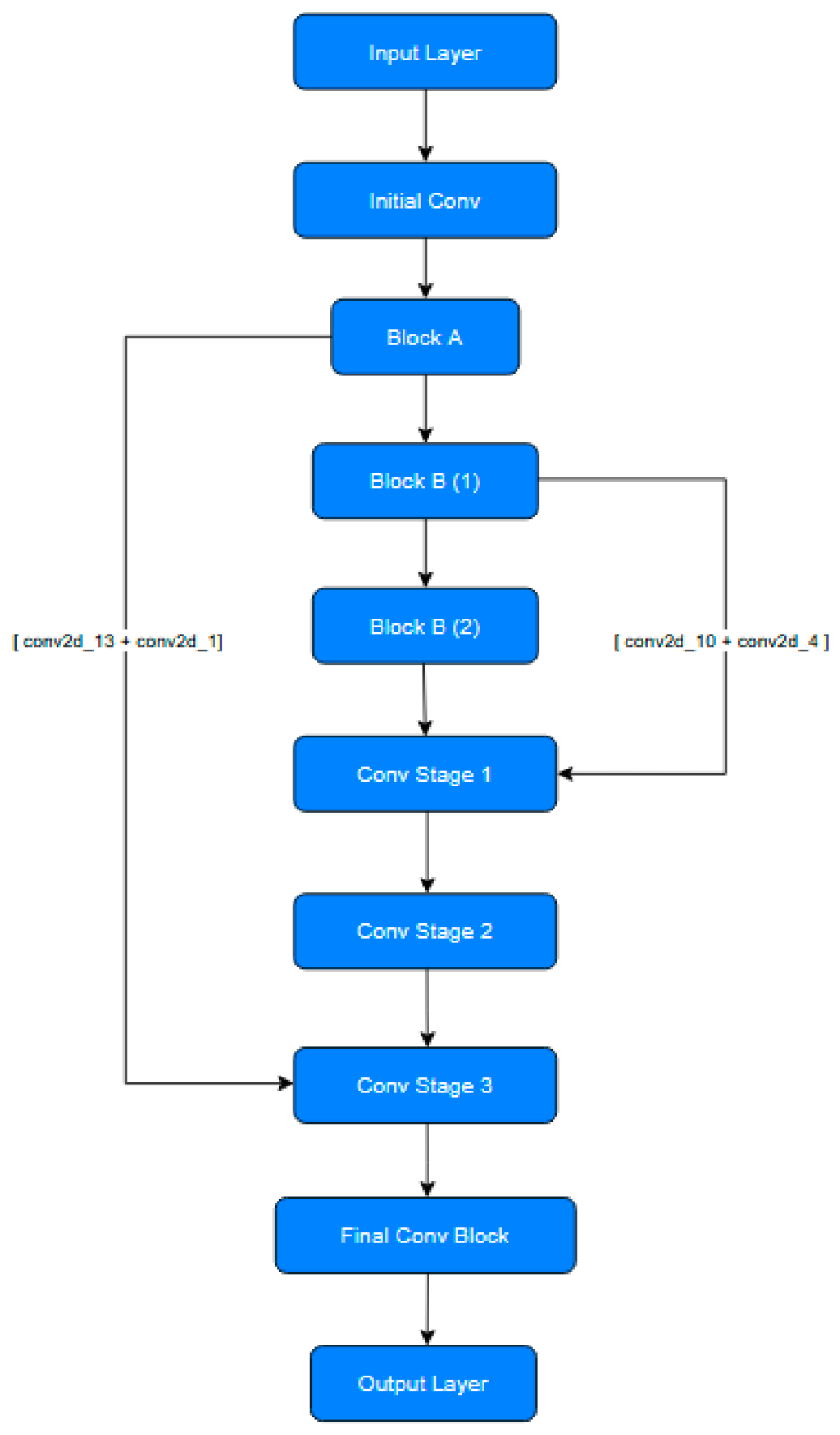
The proposed CNN, presented in Figure 4 and detailed in Table 1, respectively, is a FCNN with residual-style skip connections, designed to process time–frequency representations of speech signals. In Table 1, TP stands for trainable while NTP stands for non-trainable parameters.
The input is a three-dimensional tensor representing STFT magnitude segments of size [129 × 8 × 1]. To preserve dimensionality, zero-padding is applied along the frequency axis, followed by an initial convolutional layer with 18 filters of size [9 × 8], capturing joint time–frequency patterns by spanning the full temporal context while modeling localized spectral structures.
The network is composed of hierarchical convolutional blocks that progressively learn higher-level feature representations. These blocks employ Conv2D layers with kernel sizes such as [5 × 1] and [9 × 1], enabling effective modeling of spectral structures while initially leveraging temporal context, which is subsequently compressed for frequency-wise feature refinement. To preserve spatial dimensions, all convolutional layers use ‘same’ padding. Each convolution is then followed by batch normalization and ReLU activation, ensuring stable training, improved convergence, and enhanced generalization. The use of narrow kernels along the frequency axis (1-bin width) emphasizes temporal feature extraction in early stages, followed by frequency-wise refinement, which is particularly suitable for speech signals. All convolutional layers are implemented without bias unless explicitly stated, as batch normalization provides the necessary affine transformation.
Two residual skip connections are incorporated between intermediate layers via element-wise addition of non-adjacent convolutional outputs, enabling cross-block feature reuse and improved gradient propagation. The first connects intermediate feature maps (conv2d_4) to deeper layers (conv2d_10), while the second connects early feature maps (conv2d_1) to later layers (conv2d_13). These connections preserve low-level representations while facilitating the learning of higher-level abstractions and supporting identity mapping. Across the network, feature depth is varied (approximately 8 to 30 channels), enabling a balance between representational capacity and computational efficiency. To reduce overfitting, L2 regularization is applied to convolutional layers (with λ = 0.0006), and a SpatialDropout2D layer with a dropout rate of 20% is introduced near the output, randomly suppressing feature maps during training. The final stage consists of a convolutional layer with a kernel spanning the full frequency dimension [129 × 1 × 1], producing a single-channel output corresponding to the enhanced magnitude spectrogram. This design enables end-to-end learning of speech denoising while preserving essential spectral characteristics.
The parameter counts reported in Table 1 are obtained directly from the implemented model, while FCNN layer types, their count and purpose are reported in Table 2. Convolutional layers are implemented without bias terms, and their parameters are determined by kernel dimensions and the number of input and output channels. Each batch normalization layer contributes both trainable parameters (scale and shift) and non-trainable parameters (moving mean and variance). Residual connections are realized as parameter-free element-wise additions and therefore do not introduce additional parameters. For clarity, layers are grouped into blocks; however, parameter counts are computed strictly at the layer level to ensure exact correspondence with the implementation.

4.1.4. Training Procedure

The model is trained using the Mean Squared Error (MSE) loss function, which measures the difference between predicted and ground-truth clean magnitude spectra and is well suited for regression-based speech denoising. Optimization is performed using the Adam optimizer with a learning rate of 3 × 10⁻⁴. Model performance is additionally evaluated using Root Mean Squared Error (RMSE). Training is conducted for up to 400 epochs with 600 steps per epoch and a batch size of 512. Early stopping is applied to prevent overfitting by monitoring validation loss, with a patience of 50 epochs and a minimum patience delta of 1 × 10⁻⁴. The model is evaluated on a validation set after each epoch, and the best-performing version, corresponding to the lowest validation loss, is automatically saved using checkpointing. An initial evaluation on the validation set is performed prior to training to establish a baseline.
The proposed system is implemented in TensorFlow, with feature extraction performed using a dedicated module that computes time–frequency representations via the STFT, applying a Hamming window during the analysis stage and implemented using the librosa v.0.8.0 library. Data handling and preprocessing are performed using NumPy v.1.19.5 and Pandas v.1.1.2, while visualization and audio playback are supported by Matplotlib v.3.3.1. and IPython.display. GPU acceleration is disabled to ensure consistent CPU-based execution across environments.

4.1.5. Results and Discussion

This section presents the experimental evaluation of the proposed CNN-based speech denoising model. Performance is assessed using both quantitative and qualitative analyses. Training behavior and model convergence are examined through error metrics, while denoising effectiveness is evaluated using SNR improvements under various noise conditions. Additionally, signal-level analysis, including waveform, spectrogram, and power spectral density representations, is provided to illustrate the impact of the model on speech quality and noise suppression.
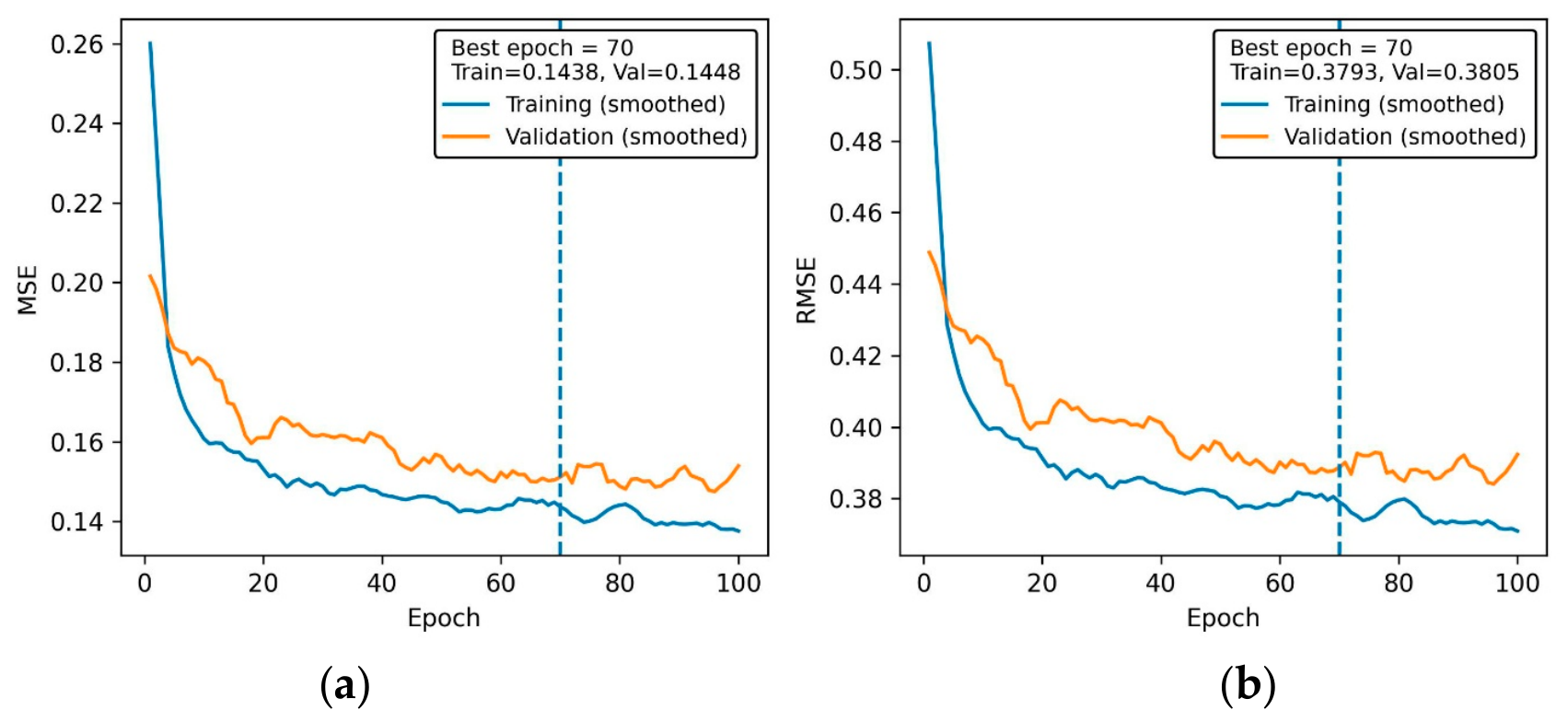
The training and validation curves for both MSE and RMSE demonstrate stable convergence of the proposed model. At the initial epoch, the training MSE starts at 0.3016, while validation MSE is 0.2086, indicating a relatively high reconstruction error at the beginning of training. Over subsequent epochs, both metrics decrease steadily, reflecting effective learning of the underlying signal structure. The training MSE is reduced to approximately 0.1383, while validation MSE reaches a minimum of 0.1448 at epoch 70, corresponding to the optimal model performance. A similar trend is observed for RMSE, where training RMSE decreases from 0.5492 to 0.3718, and validation RMSE decreases from 0.4568 to 0.3805, confirming consistent improvement in signal reconstruction quality. This is shown in Figure 5. The validation curves closely follow the training curves throughout training, with a relatively small gap, suggesting good generalization and the absence of severe overfitting.
After the optimal epoch, validation error exhibits a slight increase, while training error continues to fluctuate slightly around lower values. This behavior indicates the onset of mild overfitting. Nevertheless, the overall stability of both curves suggests that the model maintains consistent performance across epochs. The similarity in trends between MSE and RMSE indicates consistent model behavior across different error representations, as expected from their direct mathematical relationship. The validation MSE decreased from 0.2086 to 0.1448, corresponding to an improvement of approximately 30.6%, while the validation RMSE decreased from 0.4568 to 0.3805, reflecting a consistent reduction in prediction error magnitude.
The performance of the proposed CNN-based denoising model was evaluated using SNR improvement across multiple noise conditions representative of industrial environments. Noise types were selected to approximate real-world acoustic scenarios in meat processing facilities, including cutting machinery (drilling), conveyor systems (engine idling), and impact-based operations (jackhammer).
To evaluate speech-enhancement performance, both the input and output signal-to-noise ratio (SNR) were calculated using the clean speech signal as reference. The SNR improvement metric ( ∆ S N R ) was computed as:
∆ S N R = S N R o u t − S N R i n
where S N R i n and S N R o u t denote the measured input and output SNR values, respectively. The labels 0 dB, 5 dB, and 10 dB refer to the nominal target SNR levels used during noisy-sample generation. Due to minor variations introduced during noise mixing and sample normalization, the measured input SNR values may differ slightly from the nominal category values. Table 3 summarizes denoising performance for different industrial noise conditions. Input SNR and Output SNR denote the average signal-to-noise ratio before and after denoising, respectively, while ∆ S N R represents the corresponding improvement. PESQ evaluates perceived speech quality, and STOI measures speech intelligibility.
In addition to SNR-based evaluation, speech quality and intelligibility were assessed using the Perceptual Evaluation of Speech Quality (PESQ) and Short-Time Objective Intelligibility (STOI) metrics. The obtained results indicate a consistent improvement in perceptual speech quality and intelligibility as the input SNR increases. For severe noise conditions (0 dB), STOI values remained above 0.72 across all noise categories, indicating that speech intelligibility was largely preserved despite substantial background noise. Under moderate and mild noise conditions, STOI values increased to approximately 0.80 and 0.87, respectively. Similarly, PESQ scores increased from approximately 1.15 under severe noise conditions to approximately 1.57 under mild noise conditions. Although negative ∆ S N R values were observed at the nominal 10 dB condition, the corresponding STOI values remained high (0.86–0.88), suggesting that the denoising process did not significantly compromise speech intelligibility. These findings complement the SNR analysis and provide additional evidence of the practical effectiveness of the proposed speech-enhancement approach.
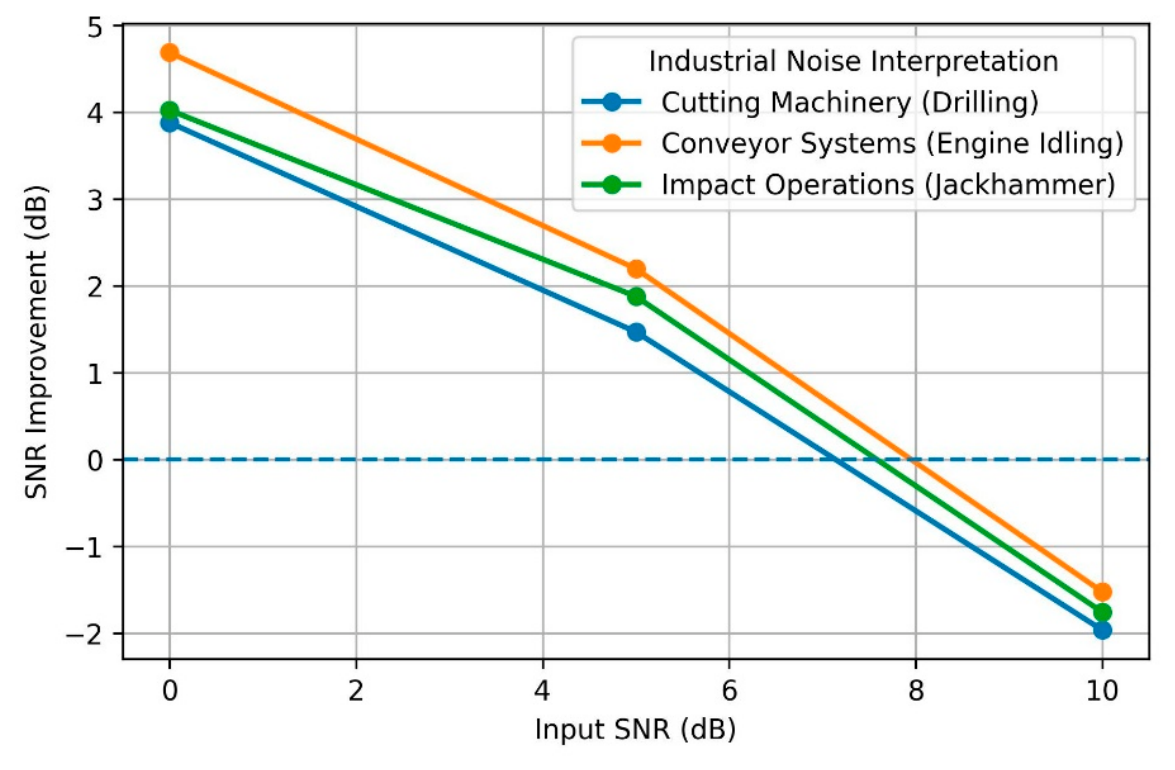
The measured input SNR values closely match the nominal target SNR categories, confirming the consistency of the noisy-sample generation procedure. Positive ΔSNR values obtained for the 0 dB and 5 dB conditions indicate effective noise suppression under severe and moderate noise levels, whereas the negative ∆ S N R values observed at approximately 10 dB input SNR suggest that the denoising process may introduce mild speech distortion when the input signal already exhibits a relatively favorable speech-to-noise ratio.
The model performs most effectively under severe and moderate noise conditions, where signal and noise power are comparable. At 0 dB, substantial improvements are observed across all noise types, with gains ranging from 3.88 dB to 4.68 dB, indicating strong capability in recovering highly degraded speech signals. As the input SNR increases to 5 dB, the magnitude of improvement decreases but remains consistent (1.47 dB to 2.19 dB), reflecting reduced noise content while still enhancing signal clarity. In contrast, at higher SNR levels (10 dB), the model introduces slight degradation (−1.53 dB to −1.97 dB), suggesting over-suppression when the input signal already exhibits a relatively favorable speech-to-noise ratio.
In practical deployments, this limitation could potentially be addressed through an adaptive bypass mechanism based on blind input SNR estimation. A Voice Activity Detection (VAD) stage could be used to identify speech-active and speech-inactive intervals, allowing background noise power to be estimated during non-speech segments. The resulting noise estimate could then be combined with signal power measurements from speech-active intervals to derive a blind estimate of the input SNR. Based on this estimate, a configurable threshold could be used to determine whether the incoming signal should be processed by the denoising network or forwarded directly to the keyword-recognition subsystem. Such an approach could reduce unnecessary processing of already favorable speech signals while preserving the benefits of denoising under more challenging acoustic conditions. The implementation and quantitative evaluation of this mechanism remain subjects for future work.
Consistent behavior is observed across different noise types as shown in Figure 6. The highest improvement is observed for engine idling noise (Conveyor Systems) at 0 dB (+4.68 dB), indicating strong performance in continuous noise environments, while comparable results for drilling (Cutting Machinery) and jackhammer (Impact Operations) noise confirm robustness across both continuous and impulsive noise characteristics. Standard deviation values ranging from approximately 1.7 dB to 2.3 dB indicate moderate variability, indicating generally stable performance with some dependence on specific signal and noise properties. These results confirm that the proposed model is particularly effective in low-SNR conditions, which are most relevant for real-world industrial environments.
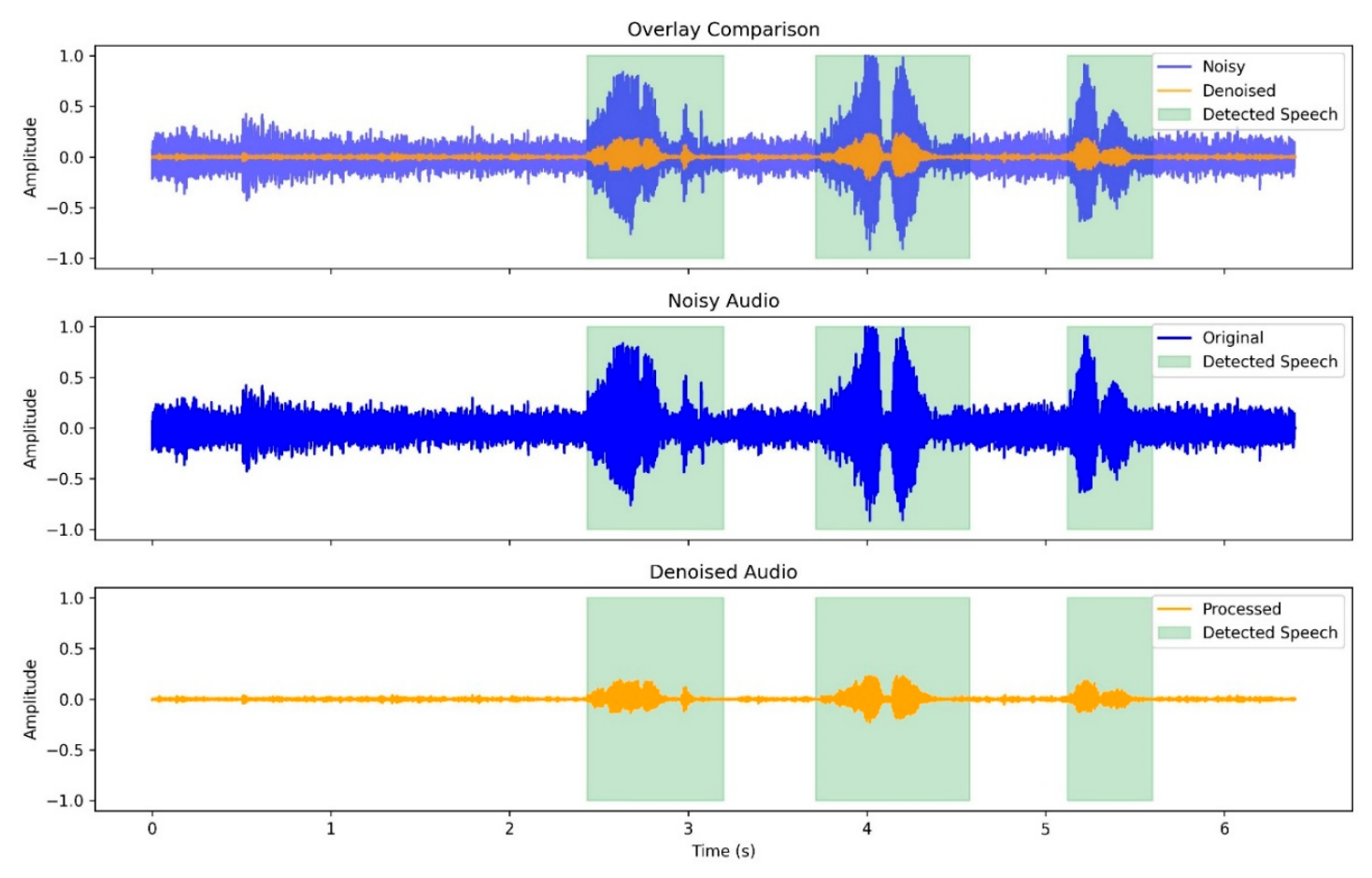
Figure 7 compares the original noisy audio with the denoised signal, with VAD (Voice Activity Detection) highlighted speech segments. The recording originates from a meat production facility under factory operating conditions, characterized by continuous mechanical and environmental noise. In the noisy waveform, this noise is present throughout the signal, while speech appears as higher-amplitude regions. After denoising, non-speech intervals are strongly attenuated, and speech components remain clearly distinguishable.
The VAD-detected segments align well with high-energy regions in both signals, indicating that speech-relevant features are preserved despite noise suppression. Quantitatively, background noise is reduced from −22.29 dB to −43.41 dB, corresponding to a 21.11 dB reduction, equivalent to approximately a 99.23% decrease in noise power. Speech is detected in 32.83% of the recording, while the remaining portions, dominated by industrial noise, are effectively suppressed. Overall, the results demonstrate effective noise removal in a challenging industrial environment, with minimal impact on speech integrity.
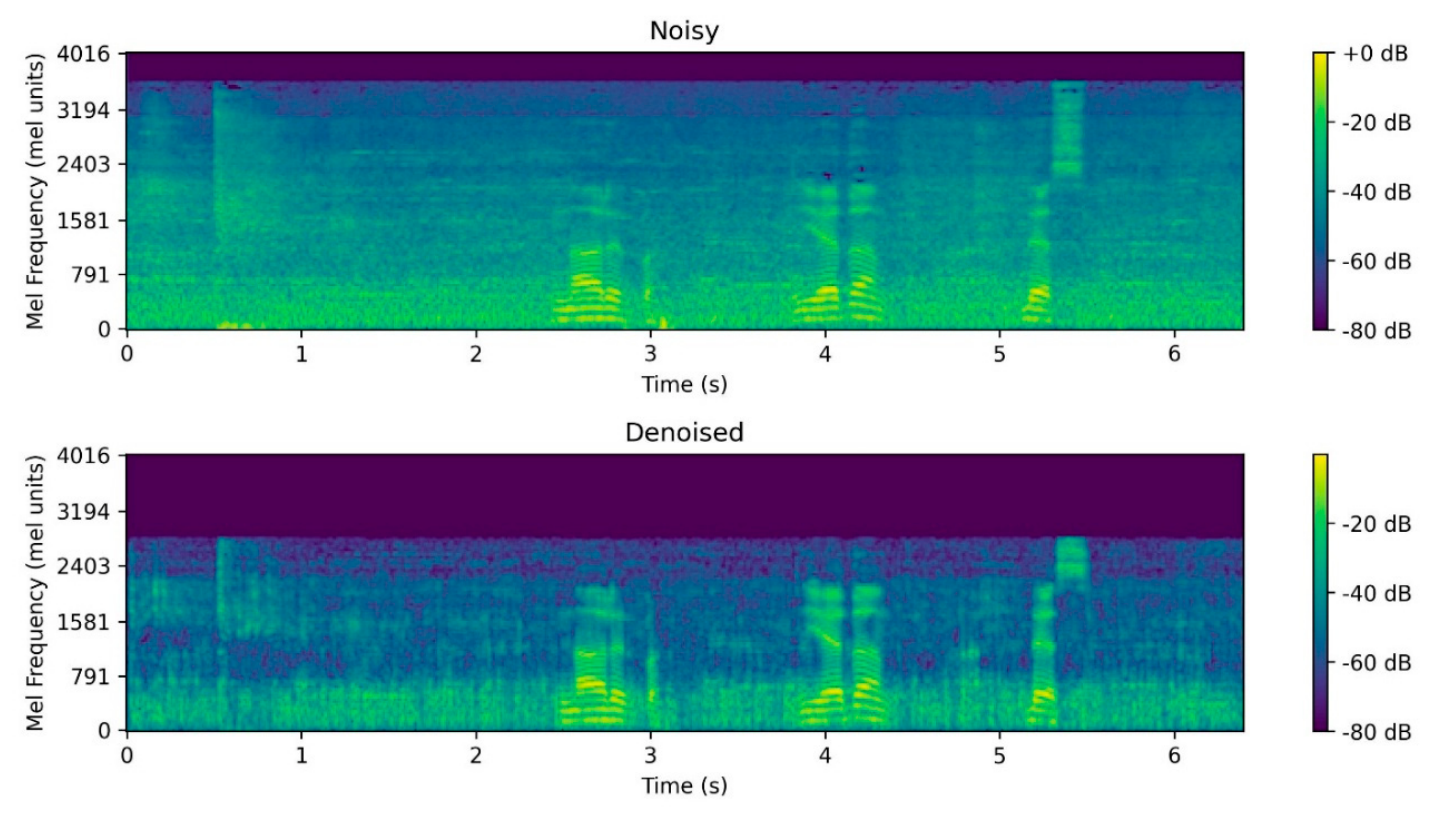
The log-Mel spectrogram (Figure 8) further confirms these findings in a perceptually relevant domain. The noisy signal is characterized by continuous background energy that masks speech structures, whereas the denoised signal shows significant suppression of this noise and clearer harmonic patterns. This suggests reduced spectral masking and preservation of features important for both speech perception and downstream processing.
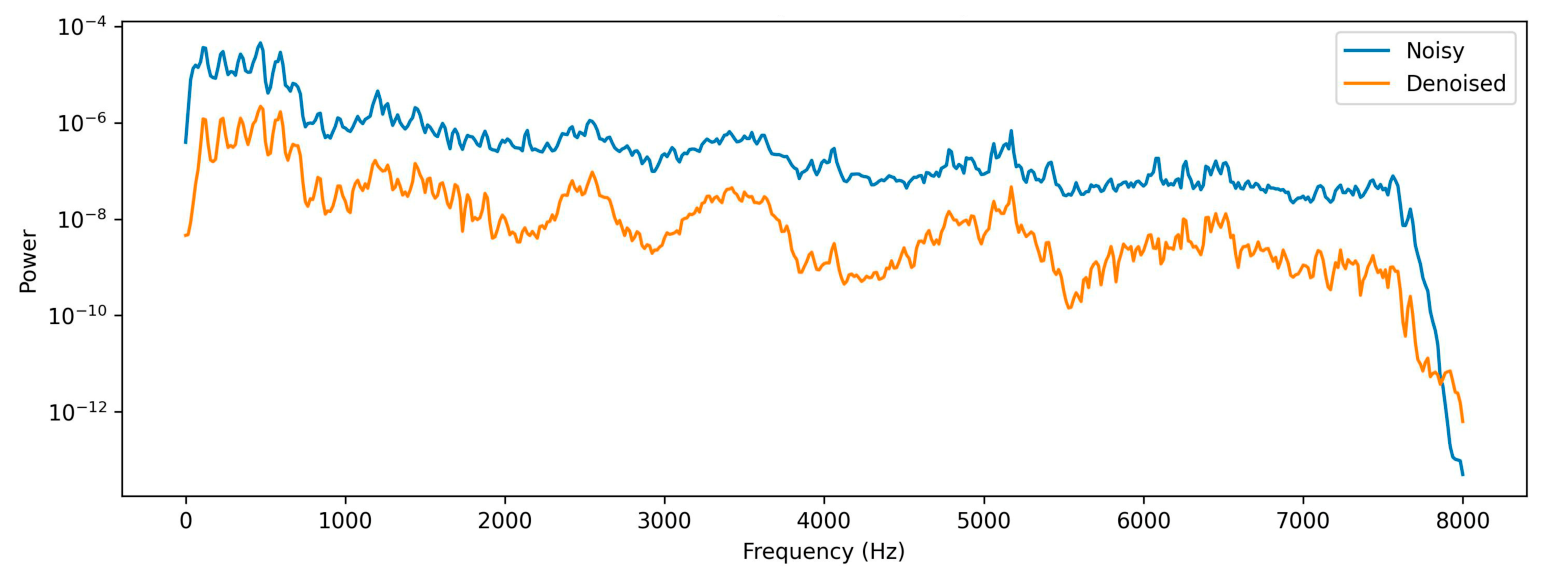
The PSD analysis (shown in Figure 9) demonstrates effective broadband noise suppression in the industrial recording. The denoised signal exhibits substantially reduced spectral power across the analyzed frequency range, particularly in the higher-frequency region approaching 8 kHz, which corresponds to the Nyquist frequency of the 16 kHz processing pipeline. At the same time, the dominant speech-related spectral components remain preserved, indicating effective suppression of industrial background noise while maintaining speech intelligibility.
Also, it is important to note that the denoising evaluation was conducted using artificially generated noisy speech samples in which clean speech recordings were mixed with representative industrial noise sources at controlled SNR levels. While this approach enables quantitative comparison under reproducible conditions, it does not fully capture the variability of real industrial environments. Therefore, the proposed speech-processing pipeline was additionally validated using recordings collected in an operational meat-processing facility, providing a complementary assessment under realistic acoustic conditions.

4.2. Voice Recognition Application

This section presents an implementation of a CNN for speech recognition, designed for keyword spotting from short audio signals. The system operates on Mel-Frequency Cepstral Coefficient (MFCC) features extracted from one-second audio clips and organized into a structured dataset. Raw audio signals are transformed into the time–frequency domain through MFCC feature extraction, providing compact representations of speech characteristics suitable for classification. The CNN is trained to map these feature representations to a predefined set of keyword classes, learning discriminative patterns across temporal and spectral dimensions. During inference, input audio is preprocessed in the same manner and passed through the trained network, which outputs a probability distribution over the target classes. The final prediction corresponds to the class with the highest probability, enabling efficient and accurate keyword recognition.

4.2.1. Datasets and Data Preparation

The experimental evaluation in this study was conducted using publicly available speech command datasets provided by TensorFlow [62]. Specifically, the Speech Commands dataset version 3.0, comprising over 100,000 one-second audio recordings from a large number of speakers, was obtained from the official TensorFlow Datasets catalog [63] while version 2.0, containing approximately 65,000 recordings, was acquired from the TensorFlow repository.
Both datasets consist of short utterances sampled at 16 kHz and cover a predefined vocabulary of spoken words. For the purposes of this study, a subset of 20 target classes was defined, consisting of the spoken digits zero through nine, along with an additional set of ten words selected as control codes. Furthermore, a third, reduced (Numbers-only) dataset containing only the digit classes was constructed from version 2.0 to evaluate model performance under lower vocabulary complexity.
These datasets were selected due to their widespread use and validation within the research community, ensuring reliability and comparability of results. As this work represents a pilot study aimed at demonstrating proof of concept, the use of established datasets allowed for controlled experimentation and benchmarking.
While the Speech Commands dataset was used as a standardized benchmark for training and evaluating the keyword-recognition model, the complete speech-processing pipeline was additionally validated using both artificially generated noisy speech samples and recordings collected in a real meat-processing environment. The generated samples enabled controlled evaluation under predefined noise conditions, while the industrial recordings provided representative acoustic conditions encountered during practical deployment.
The presented voice code approach was adopted as an initial step to evaluate whether the selected methodology can yield sufficiently strong and promising results. In this context, a predefined set of voice commands was used as a controlled surrogate for more complex, real-world interactions targeting applications in the meat industry and other noisy environments. Should the experimental outcomes confirm the effectiveness of the proposed approach, this simplified command scheme would be replaced with a fully developed voice command system that would incorporate domain-specific commands derived from the problem context and designed to closely resemble natural conversational interactions.
It should be noted that the speech-denoising and keyword-recognition subsystems were developed and evaluated using different benchmark datasets and therefore employ different preprocessing pipelines. The speech-denoising model was trained and evaluated on audio resampled to 16 kHz, consistent with the Mozilla Common Voice and LibriSpeech datasets used for speech-enhancement experiments. In contrast, the keyword-recognition subsystem was developed using the Speech Commands dataset and employs MFCC features extracted from audio sampled at 22,050 Hz. Consequently, when integrated into a complete processing pipeline, audio are resampled between the denoising and keyword-recognition stages as required. These differing sampling rates reflect dataset-specific preprocessing requirements and do not affect the conceptual integration of the proposed architecture.
The dataset is prepared using a custom script that is designed to preprocess an audio dataset by extracting Mel-Frequency Cepstral Coefficients (MFCCs) from audio fils and organizing the resulting features into a structured JSON file. It traverses a given dataset directory where each sub-directory represents a distinct class or label. For each audio file encountered, it loads the waveform, checks if it is at least one second in duration (based on a 22,050 Hz sampling rate), and truncates it to exactly one second to ensure uniform input length. It then computes a specified number of MFCCs using the librosa library and appends the transposed feature matrix to the dataset, along with the corresponding label and file path. The output is stored in a JSON file containing four main elements:
  • mapping—A list of labels corresponding to sub-directory names.
  • labels—Numerical class identifiers for each file.
  • MFCCs—The extracted feature arrays.
  • files—Paths to the original audio files.
The dataset is split into training, validation, and test subsets using scikit-lean’s train_test_split. The validation set is carved out from the training portion, ensuring unbiased evaluation during training. Moreover, it adds an extra dimension to the input features to explicitly mark the single input channel, which is essential for compatibility with TensorFlow’s Conv2D layers expecting 4D inputs.

4.2.2. Voice Recognition Procedure

Voice recognition is implemented as a keyword spotting inference system using a pre-trained deep learning model. It defines a singleton class, KeywordSpottingService, which loads a TensorFlow/Keras model and performs inference on short audio clips to predict spoken keywords. The class is instantiated via a factory function, ensuring that only a single instance of the model is loaded into memory, which improves efficiency for repeated predictions in real-time or low-latency applications.
The prediction process involves preprocessing the input audio file by loading it with librosa, trimming it to a fixed duration of one second (22,050 Hz samples), and extracting MFCC features as described in the dataset preparation stage. These MFCC features are reshaped to match the model input format before being passed to the neural network for prediction. The model outputs a probability distribution over a predefined set of 20 keywords, and the class with the highest probability is returned as the predicted keyword.

4.2.3. Neural Network Architecture

A convolutional neural network (CNN) is trained on audio-derived features for a multi-class classification task. Its training begins by loading pre-extracted MFCC features and their corresponding labels from a JSON file, then splits the dataset into training, validation, and test subsets. The input features are then reshaped to match the expected model input format. This structure allows the CNN to learn spatial and temporal patterns in the MFCC representations, which capture time–frequency characteristics for distinguishing between different audio classes.
The model consists of three convolutional blocks followed by fully connected layers, as detailed below.
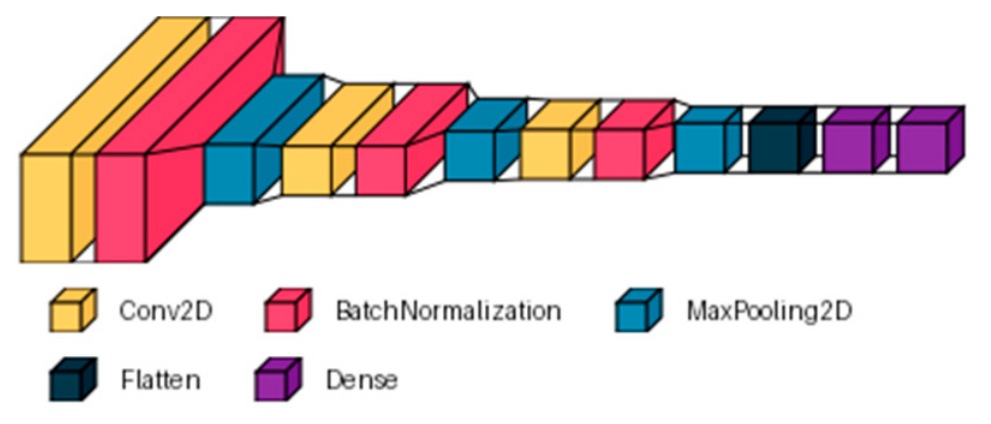
The trained network architecture, presented in Figure 10, consists of the previously described three convolutional blocks, where each is composed of:
  • A Conv2D layer applying multiple filters to the MFCC input, with 64 filters of size [3 × 3] in the first layer, followed by 32 filters of sizes [3 × 3] and [2 × 2], respectively, using ReLU activation and L2 weight regularization to improve generalization and reduce overfitting.
  • A Batch Normalization layer applied after each convolution.
  • A MaxPooling2D layer with a pooling window of [3 × 3] (or [2 × 2] for the last block), stride 2 in each dimension, and ‘same’ padding, ensuring consistent spatial downsampling across layers.
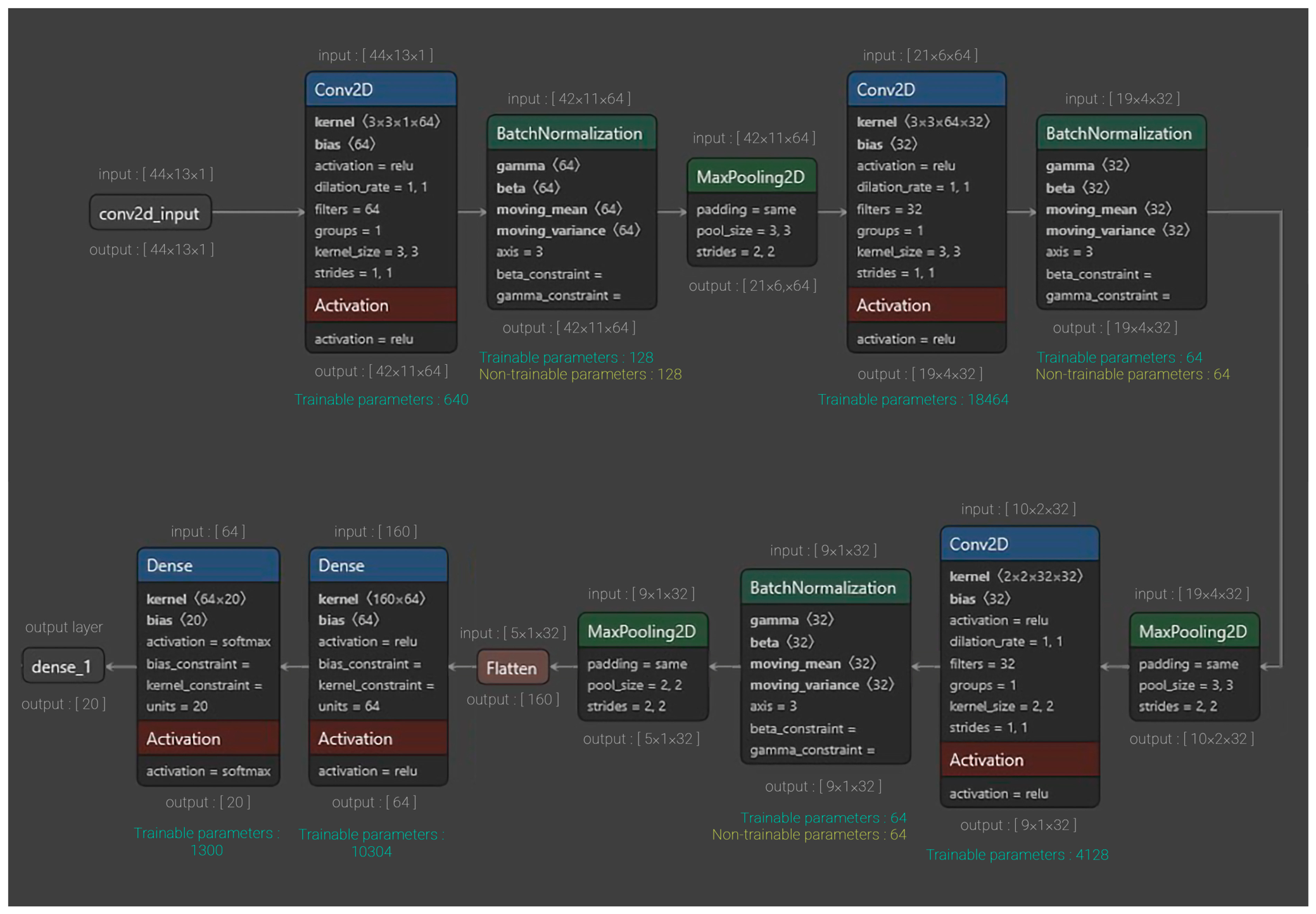
After these convolutional blocks, the resulting feature maps are flattened into a one-dimensional vector to feed into a fully connected (dense) layer with 64 neurons activated by ReLU. The final layer is a softmax output layer with 20 units, corresponding to the number of keyword classes, which outputs a probability distribution over all classes. Table 4 and Table 5 and Figure 11 provide in-depth details about trained CNN model structure highlighting its structure, layer types, their count and purpose, input and output shapes as well as number of TP—trainable—and NTP—non-trainable—parameters.
The input has a shape of [44 × 13 × 1], derived from MFCC features, while the output shapes indicate the reduction in dimensions caused by convolution and pooling layers. The 256 non-trainable parameters originate from the moving mean and variance in the Batch Normalization layers, and the total number of trainable parameters is 35,092.

4.2.4. Training Procedure

The model is compiled using the Adam optimizer with a learning rate of 1 × 10⁻⁴, which adapts the learning rate during training for efficient convergence. The loss function used is sparse categorical cross-entropy, appropriate for multi-class classification problems with integer-encoded labels.
Training is performed over a maximum of 40 epochs with mini-batches of size 32. To prevent overfitting and unnecessary long training, early stopping callback monitoring is employed on the training accuracy in order to stop training if the accuracy does not improve by at least 0.1% over 5 consecutive epochs. Validation data are used to evaluate the model’s generalization performance after each epoch. This enables the model to tune hyperparameters and avoid overfitting the training set. Finally, the trained model is evaluated on the independent test set to estimate its true predictive performance, and the model is saved for deployment or further inference tasks.

4.2.5. Results and Discussion

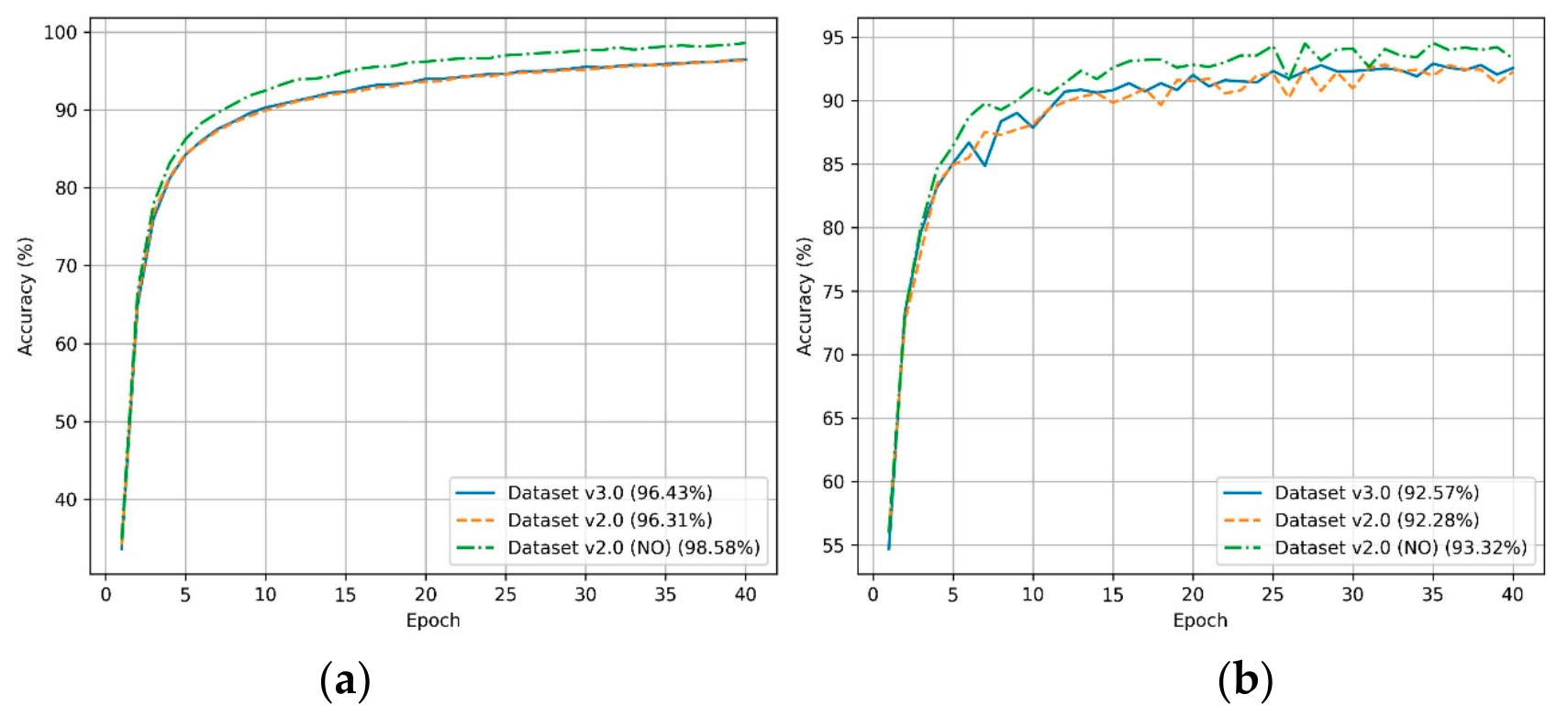
The training dynamics across all evaluated datasets, shown in Table 6, follow a consistent pattern of rapid performance improvement in the initial epochs followed by gradual convergence, with all datasets reaching approximately 85% validation accuracy within the first five epochs. For clarity, the abbreviations used in Table 6 are as follows: TRA—Training Accuracy, VAA—Validation Accuracy, TEA—Test Accuracy, TRL—Training Loss, VAL—Validation Loss, and TEL—Test Loss.
Figure 12 displays how selected datasets behave over the course of epochs during training and focuses on (a) Training accuracy and (b) Validation accuracy. Curves for TEA, TRL, VAL and TEL are not shown since they present similar trends as TRA and VAA and their respected values are shown in Table 6.
For both full Speech Commands datasets (v3.0 and v2.0), validation accuracy increases steadily until about epochs 20 to 25, after which it plateaus, indicating that the model has reached its generalization limit. In contrast, the Numbers-only (NO) subset converges faster, achieving peak validation performance earlier, around epochs 15 to 20, and reaching higher accuracy of approximately 94 to 95%. The full datasets stabilize slightly lower, around 92 to 93%. The full Speech Commands dataset (v3.0) presents the most challenging setting, achieving 92.22% test accuracy due to higher variability in speakers and recording conditions, while the v2.0 dataset performs slightly better at 92.59%, likely reflecting reduced variability. The best results are obtained on the Numbers-only (NO) subset achieving 94.17%, where the smaller vocabulary and lower phonetic overlap simplify the classification task and improve performance.
The Numbers-only (NO) dataset also shows a slightly larger gap between training and validation accuracy, suggesting a greater tendency toward overfitting. Overall, these results indicate that lower dataset complexity leads to faster convergence and higher peak performance, while more complex datasets require longer training and exhibit more gradual stabilization.
The Voice Recognition Application (keyword-recognition) component was evaluated using the Speech Commands dataset, which consists of digits and commonly used control words rather than a domain-specific industrial command vocabulary. While this dataset is widely used for benchmarking keyword-spotting systems and provides a useful basis for evaluating model performance, it does not fully represent the linguistic diversity, pronunciation variability, and operational context of industrial meat-processing environments. Consequently, the reported recognition accuracy should be interpreted as evidence of the technical feasibility of the proposed approach rather than as a direct estimate of performance on a production-scale factory command set. Future work should include the collection and evaluation of a dedicated industrial command corpus representative of real operational conditions.
Furthermore, the influence of English-language proficiency on recognition performance was not evaluated as a dedicated experimental factor in this study. During system validation, a total of 14 speakers participated, including members of the research team and industrial personnel. The participant pool comprised one native English speaker and 13 non-native speakers with the following CEFR proficiency distribution: C2 (2), C1 (1), B2 (4), and B1 (6). No participants with A1 or A2 proficiency levels were included. Most participants were members of the research team, while the remaining participants were supervisory and managerial personnel from the industrial partner. Consequently, the evaluated speaker population generally possessed intermediate to advanced English-language skills.
Informal observations during system validation suggested that the native speaker and participants with advanced English proficiency tended to experience fewer recognition errors. However, language proficiency was not evaluated as a controlled experimental variable, and detailed per-speaker performance statistics are not available. Therefore, the present study does not support a rigorous quantitative assessment of the relationship between language proficiency and recognition accuracy. Furthermore, the findings should not be generalized to users with elementary English-language skills (A1–A2). Future studies should investigate the impact of language proficiency using larger and more balanced participant groups specifically designed for this purpose. Potential mitigation strategies include additional model training using more diverse speech datasets and the incorporation of user-specific adaptation mechanisms.

5. VCLMP End-to-End Evaluation of the Integrated Voice-Command Processing Pipeline

While the denoising and keyword-recognition subsystems were evaluated independently in the preceding sections, the practical applicability of the proposed Voicing architecture depends on their operation as a unified processing pipeline presented in Figure 1. Therefore, an additional end-to-end evaluation was conducted to assess the combined performance of speech denoising, keyword recognition, ERP command validation, and command execution under noisy conditions.
To assess the practical applicability of the proposed approach, the complete pipeline was evaluated using both artificially generated noisy speech samples and recordings obtained in a real industrial environment. The generated samples provided controlled and repeatable testing conditions, while the industrial recordings enabled assessment under realistic background-noise conditions representative of the intended deployment scenario.
Also, to provide a practical baseline for evaluating the contribution of the proposed speech-enhancement subsystem, end-to-end command execution performance was assessed both with and without the denoising stage. The evaluation was performed using ten representative command patterns derived from the VCLMP logistics workflow. Command lengths ranged from four to seven keywords and included all command structures supported by the ERP command-validation module. Two datasets were used: (1) a generated dataset consisting of ten command samples corrupted by representative industrial noise sources at a nominal input SNR of 5 dB and (2) a dataset of recordings collected in an industrial environment with SNR of approximately 5 dB. Clearly, the focus was on samples with moderate noise. For the industrial dataset, two users with C2-level English proficiency repeated each command five times, resulting in a total of 100 command samples.
During evaluation, each recognized keyword was assigned a confidence score by the CNN-based keyword-recognition model. Commands containing one or more keywords with a confidence score below 90% were rejected immediately and were not forwarded to the ERP validation stage. Commands satisfying the confidence threshold of above 90% (column CNN Pass in Table 7) for all recognized keywords were subsequently evaluated by the ERP command-validation module, which verified the recognized keyword sequence against predefined command patterns. Commands that successfully passed both stages were considered successfully executed and therefore ERP Valid column represents command execution success rate within the proposed pipeline.
The results demonstrate that the proposed denoising module provides measurable benefits when integrated into the complete Voicing architecture. The generated dataset consisted of one example for each of the ten supported ERP command templates and was intended primarily as a functional verification of the complete processing pipeline rather than as a statistical performance evaluation. Consequently, the reported success rates should be interpreted with caution, since each failed command changes the overall success rate by 10 percentage points. Therefore, the industrial dataset, comprising 100 command samples recorded under realistic operating conditions, provides the primary basis for assessing system performance. Under these conditions, end-to-end command execution success increased from 77.00% without denoising to 91.00% with denoising. For the generated dataset, the corresponding improvement was from 70.00% to 90.00%. The observed improvements were primarily attributable to a reduction in keyword-recognition failures caused by background noise. These results indicate that the gains demonstrated by the objective speech-quality metrics (SNR, PESQ, and STOI) translate into improved performance of the complete voice-command processing pipeline.
Although these results support the feasibility of the proposed approach, larger-scale evaluations involving a broader range of speakers, accents, and industrial operating conditions are required before generalizing the findings to production-scale deployments. Also, presented end-to-end evaluation provides a practical baseline for assessing system performance, future studies should compare the proposed denoising and keyword-recognition models against conventional signal-processing methods and alternative machine-learning architectures.

6. Industrial Validation

In the following sections project validation case will be presented as well as findings and discussion. Section 6.2 focuses on Operational Validation in the Production Environment and Quantitative Summary of VCLMP performance.

6.1. Presentation of Validation Case

The proposed VCLMP solution was deployed and validated in a real industrial setting at the meat processing facility, located in Republic of Serbia. This deployment served as the primary application experiment within the Horizon 2020 L4MS Open Call framework and provided the empirical foundation for evaluating the proposed architecture under representative production conditions. The case site is a family-owned enterprise Alpha (the real name of the company has been withheld to maintain confidentiality) founded in 1989 that has grown into one of the leading meat processors in Serbia, with over 250 employees at the time of deployment. The facility produces fresh pork, veal, beef, mutton, and lamb, together with more than fifty different types of meat products and operates a daily slaughtering capacity of approximately 600 pigs and 50 veal alongside the production of around 15,000 kg of processed meat products. This scale and product diversity makes the site representative of the small and medium-sized abattoir segment that the VCLMP solution targets.
VCLMP involves the development of an advanced voice-controlled intralogistics system for the abattoir industry, enabling full traceability throughout the meat production process. The solution combines both software and hardware components to create a sustainable and scalable system applicable to various types of small and medium-sized abattoirs, as well as similar production environments. It integrates human operators, voice-command interfaces, Automated Guided Vehicles (AGVs), NFC tags, and robotic arms to achieve a high level of food safety and security while preventing potential fraud through the introduction of unsafe products into the food supply chain. Entire process is implemented as set of microservices and OPIL platform will be used as mechanism that will enable integration of those services. By implementing an automated voice system for logistics and warehousing in slaughterhouse production, the possibility of input of information on product or product placement errors is reduced. A hybrid system that would include humans and robots (AGV and robotic arms) would provide a far greater level of traceability and food security in the small and medium-sized slaughterhouses, which would not reduce production speed simultaneously increasing the capacity. However, such an operational environment imposes severe constraints on any automation solution. Certain areas within the facility are maintained at temperatures as low as −38 °C for product preservation, while production halls combine high humidity, low temperatures, and elevated noise levels from cutting machinery, conveyor systems, and impact tools. Hygienic standards further restrict operator movement: workers cannot easily leave their station to interact with control panels, and any contact-based interface would require repeated handwashing between operations. These conditions establish a demanding test environment for both the acoustic robustness of the voice subsystem and the durability of the deployed IoT and robotic components.
The complete VCLMP experiment lifecycle, from requirements definition and component development to system integration and on-site industrial testing, lasted approximately ten months. AGV development and production were completed within the first six months, while industrial-condition testing was subsequently delayed due to unexpected strategic and operational constraints that imposed a special operational regime on the experimental environment. Consequently, safety and ethics validation activities were conducted in parallel with the deployment of the solution in industrial test operations, rather than sequentially. During the planning phase, several control segments, i.e., operational processes with clear automation potential, were identified within the facility. For each segment, an AGV guidance path was designed based on the CAD layout of the abattoir, defining both the operational zones and the navigation routes the AGV was expected to follow. The system integrator subsequently used the OPIL Sensing and Perception module (MOD.SW.SP) to perform mapping and localization on the company’s 2D factory plan, and prepared pre-filled logistics tasks via the HMI module so that the runtime system could dispatch them through compact ERP Triggers, as described in Section 4.

6.2. Findings and Discussion

This section presents the key findings obtained from the implementation and evaluation of the proposed solution in a real production environment. The discussion focuses on the observed operational outcomes, the overall system performance, and the broader implications for industrial practice and costs. First, the results of the production-scale validation are presented, followed by a summary of the main performance indicators and a discussion of the strengths, limitations, and practical relevance of the proposed approach.

6.2.1. Operational Validation in the Production Environment

The workflow scenarios that assumes product identification at the slaughter line, box-level identification at the deboning stage, voice-initiated transport orders, pallet consolidation, manipulator-driven box relocation, and automatic door opening, were validated under realistic production conditions. The hands-free interaction paradigm proved particularly valuable in the abattoir environment, where butchers were able to issue commands without leaving their workstation and without disinfecting their hands prior to each interaction with a controlling device. This eliminated an interruption pattern that previously forced workers to break the rhythm of meat processing in order to communicate with the ERP system.
The voice subsystem operated reliably despite the broadband noise typical of slaughtering and deboning halls, confirming that the CNN used for denoising and keyword recognition generalize adequately to the targeted industrial setting. NFC-based traceability replaced the previous tracking system, allowing each carcass and each meat crate to be linked to a unique tag from the very first stage of production, thereby resolving the traceability gap that originally motivated the experiment. AGV transport between workstations, including the automatic door-opening behavior between zones with strict hygienic separation, reduced the manual handling of heavy meat carts, which previously required three workers operating on wet, slippery floors and represented one of the principal occupational hazards on the production floor. Beyond the directly observable technical outcomes, the deployment also produced several intangible benefits that reinforce the case for replication. Customer satisfaction is expected to benefit from the combination of full traceability, productivity gains, and quality assurance, while brand equity is strengthened by case company’s pioneering position in domestic meat-industry automation. Employee satisfaction improves through the elimination of physically demanding and hazardous tasks, the introduction of new digital skills, and the improved communication channel between management, production, and logistics. The scalability of the solution further allows it to be extended to other parts of the facility, such as packaging, and to other small- and medium-sized abattoirs facing similar regulatory and operational pressures.
Quantitative evaluation of the voice-processing subsystem is reported in Section 5. Under moderate industrial noise conditions (approximately 5 dB input SNR), end-to-end command execution success increased from 77.0% without denoising to 91.0% with denoising, demonstrating the practical contribution of the speech-enhancement stage to overall system performance.
This comprehensive validation, covering technical functionality, organizational fit, and operator acceptance, demonstrates that the proposed architecture is not only theoretically sound but also viable under the demanding conditions of a real meat processing facility. The implemented solution required an initial capital investment of 188,500 EUR, distributed across the voice controlling subsystem, the RFID-based traceability infrastructure, the AGV, an industrial-grade robotic lift truck, the ABB IRB 140 robotic arm, an automated rail system, returnable transport items (RTI) equipped with NFC tags, and complementary deboning-room equipment. Recurring costs over a four-year horizon, dominated by the ERP maintenance fee and the additional electricity demand of the deployed hardware and charging infrastructure, amounted to a further 61,840 EUR, bringing the total undiscounted cost of ownership to 250,340 EUR. To complement this simple cost assessment, a discounted cash-flow analysis was performed by calculating the Net Present Value (NPV) of the four-year costs using an appropriate discount rate of 10% which is common for automation project in developing countries [64]. In addition, a sensitivity analysis was conducted to evaluate the robustness of the economic assessment under variations in the discount rate (8% and 12%), and the operating costs (base case, +10%, and +20%), reflecting plausible variations in electricity prices and ERP maintenance costs. Since these analyses serve as supplementary economic validation rather than the primary focus of this study, the detailed methodology, assumptions, and results are provided in Appendix B.

6.2.2. Quantitative Summary of VCLMP Performance

To consolidate the empirical evidence reported throughout the paper, Table 8 summarizes the principal indicators under which the VCLMP system was evaluated. The indicators are organized into three complementary groups: (1) AI/voicing-subsystem indicators derived from the controlled experiments described in Section 4 and Section 5, (2) operational indicators measured at the case site, and (3) economic and organizational indicators consolidated from the investment analysis.
Taken together, these indicators provide direct evidence supporting the main research question concerning the feasibility of using OPIL as a middleware platform for defining and managing hotspots within facility layouts where intralogistics activities occur, in combination with CNN-based speech denoising and keyword recognition, to enable robust voice-controlled intralogistics in acoustically and operationally demanding industrial environments. The positive outcome of the research question, and the confirmation of the suitability of the proposed VCLMP solution based on OPIL, are supported by the successful execution of all six voice-driven workflows under real industrial conditions, by the consistently positive ΔSNR values observed at adverse input SNR levels, and by recognition accuracies exceeding 90% across all three evaluated datasets.
The negative ΔSNR observed at an input SNR of 10 dB, together with the dependency of recognition performance on speaker proficiency, remain the principal limitations of the proposed approach. However, these can be mediated by discarding denoising procedure if observed situation is detected while neural networks could be additionally trained to reduce effects of lower speaker proficiency. In addition, several further limitations should be considered when interpreting the reported results. Regarding construct validity, the speech-denoising network was evaluated using synthetic mixtures of LibriSpeech utterances and three UrbanSound8K noise classes mapped to industrial acoustic counterparts. Although this mapping preserves comparable spectral characteristics, real industrial environments contain additional impulsive and transient noise events that are only partially represented in the evaluation dataset. With respect to internal validity, the keyword vocabulary used in the controlled experiments is borrowed from the Speech Commands corpus and acts as a surrogate for the eventual domain-specific command set; performance on the final vocabulary is therefore expected but not yet quantified. With respect to external validity, the industrial deployment is conducted at a single facility. Finally, it is informally observed that the recognition accuracy depends on the operator’s English proficiency (highest for native and C1–C2 speakers) but it is not quantifiable with clear English level proficiency breakdown and analysis. This constitutes a population-validity threat that will be addressed in future work through user-specific adaptation and multilingual fine-tuning.
From a theoretical perspective, the work provides evidence that the OPIL cyber–physical paradigm is not restricted to mobile-robot fleets but can host AI-driven natural-language interaction as a first-class subsystem, thereby extending the literature on open Industry 4.0 middleware. The observed degradation of SNR improvement at high input SNR is consistent with the saturation behavior reported for monaural CNN denoisers trained on adverse-condition mixtures and suggests that future work should incorporate an SNR-aware bypass mechanism or adaptive gain control. From a practical perspective, the cost structure (188.5 k EUR CapEx) advantage indicate that voice-driven OPIL deployments are viable for small and medium-sized abattoirs facing the regulatory pressure of per-unit traceability, and the closed-loop integration with the ERP shows how cognitive interaction layers can complement, rather than replace, established enterprise software.
Rather than quantitatively comparing OPIL with proprietary Industry 4.0 platforms, the present work demonstrates that OPIL provides a viable open-source alternative supporting interoperability, modularity, vendor neutrality, and integration with heterogeneous robotic systems.
An additional evaluation of the proposed VCLMP solution conducted within the Horizon 2020 L4MS initiative is presented in Appendix C.

7. Conclusions

This paper presented a smart intralogistics solution based on the OPIL platform, integrating voice-controlled HMI, AI-based speech processing, and heterogeneous robotic and IoT components within a unified Industry 4.0 framework. The proposed VCLMP system demonstrates how an open, modular, and vendor-neutral architecture can effectively address key limitations of conventional intralogistics systems, particularly in terms of interoperability, flexibility, and scalability. By combining cyber–physical systems with advanced artificial intelligence methods, the solution enables coordinated interaction between enterprise systems, robotic platforms, and human operators in demanding industrial environments. A key contribution of this work is the integration of CNN for both speech denoising and keyword recognition, enabling reliable voice-based control under high-noise conditions typical of the meat processing industry. The experimental results obtained in controlled settings demonstrate stable model convergence, effective noise suppression, and high recognition accuracy, confirming the feasibility of applying AI-driven voice interfaces in real industrial scenarios. Furthermore, the system architecture validates seamless communication between ERP systems, OPIL middleware, robotic agents, and IoT sensing nodes, supporting real-time execution of logistics tasks.
The proposed solution also emphasizes the importance of open platforms and distributed microservice architectures for modern industrial systems. Its modular design enables incremental deployment and adaptability across different use cases, while the introduction of voice interaction enhances usability and reduces operator workload. These characteristics position the VCLMP system as a promising approach for advancing intelligent intralogistics within Industry 4.0 environments.
Several limitations of the present study should be acknowledged. First, the industrial validation was conducted at a single meat-processing facility. Although the obtained results demonstrate the technical feasibility and practical applicability of the proposed VCLMP architecture in a real industrial environment, the findings may not fully generalize to other manufacturing sectors, facility layouts, acoustic conditions, operational procedures, or workforce characteristics. Additional multi-site evaluations across different industrial environments will therefore be required to assess the broader applicability and robustness of the proposed approach.
Future work will focus on several important directions, such as:
  • The voice interaction subsystem will be further developed toward more advanced natural language understanding, enabling context-aware and conversational command execution beyond predefined keyword sets.
  • Improvements in speech processing will be explored, including more advanced neural architectures and enhanced robustness to diverse acoustic conditions and speaker variability.
  • Adaptive learning mechanisms and user-specific model tuning will also be investigated to improve performance across different users and accents.
  • Integration with digital twin technologies and predictive analytics will be explored to enable higher levels of automation, optimization, and decision support in intralogistics processes.
  • Advancement towards Industry 5.0 standards.
In addition, further research will address system scalability and previously stated generalization issues, including deployment in different industrial domains, integration with additional robotic platforms, and support for larger fleets of autonomous systems. Overall, the presented work establishes a solid foundation for intelligent, voice-enabled intralogistics systems and provides clear directions for future research and industrial deployment.

Author Contributions

Conceptualization, P.P., M.M. and V.T.; methodology, P.P., M.M. and S.N.; software, P.P. and S.S.; validation, V.T., S.N. and P.P.; formal analysis, P.P. and M.M.; investigation, M.M. and S.S.; data curation, V.T., S.S. and S.N.; writing—original draft preparation, P.P. and M.M.; writing—review and editing, P.P. and M.M.; visualization, P.P. and S.S.; supervision, V.T. and S.N. All authors have read and agreed to the published version of the manuscript.

Funding

This research was funded by the Horizon 2020 Programme under Grant Agreement No. 767642 for the period 2020–2021.

Institutional Review Board Statement

Ethical review and approval were not required for this study under Article 7 of the Code of Academic Integrity of the University of Novi Sad (No. 04-111/1, 30 January 2020). The study involved the technical evaluation of a voice-controlled logistics system and did not fall within any of the categories of research requiring prior approval by the institutional ethics committee under Article 7. Participation was voluntary, and informed consent was obtained from all participants prior to the recording of voice commands. The collected voice recordings were used exclusively for the technical evaluation and scientific analysis of the proposed system.

Informed Consent Statement

The majority of recordings were obtained from members of the research team during system testing in the meat-processing facility. A limited number of recordings were obtained from facility personnel who were informed about the purpose of the recordings and provided verbal consent prior to participation.

Data Availability Statement

The original contributions presented in this study are included in the article. Further inquiries can be directed to the corresponding author.

Acknowledgments

The realization of this paper has been supported by the project “Voice controlled logistic system for automation in meat production”, selected for realization under the open call within the project “Smart logistics for manufacturing—L4MS”, funded from the Horizon 2020 programme under grant agreement No 767642 for the period 2020–2021. During the preparation of this manuscript/study, the authors used ChatGPT 4 for the purposes of generating icons for Figure 1. The authors have reviewed and edited the output and take full responsibility for the content of this publication.

Conflicts of Interest

The authors declare no conflicts of interest.

Appendix A. VCLMP Design and Development: IoT Sensing Integration and High-Level Orchestration Logic

Appendix A.1. Speech Recording Application

This section presents the architectural design of an Android-based system for continuous voice capture and transmission. The system enables hands-free or push-to-talk voice acquisition, automatic speech segmentation using silence detection, audio storage in WAV format, and transmission to remote HTTP servers for processing or dataset collection.

Appendix A.1.1. Architectural Overview

The main activity extends the Android Activity class and integrates user interface management, audio signal acquisition, local signal processing, file generation, and network communication. The design follows an event-driven paradigm, where UI interactions (start, stop, and push-to-talk actions) control background processes responsible for audio recording and data transmission. Concurrency is achieved through a combination of AsyncTask and explicitly managed Thread subclasses. Synchronization between background threads and the UI thread is handled using Android’s runOnUiThread mechanism while the system maintains shared state variables that coordinate audio capture, file handling, server communication, and UI feedback.
The activity carefully manages its lifecycle by enabling and disabling UI controls in accordance with recording state, canceling background tasks when streaming is stopped, and releasing resources upon back navigation. Microphone muting is enforced by default to prevent unintended recording. The system is organized into clearly separated packages reflecting distinct functional responsibilities, including audio acquisition, control logic, networking, data modeling, and user interaction, enabling modularity and maintainability:
  • audio/VoiceStreamSamplerTask—Implements asynchronous audio acquisition using the device microphone, including voice activity detection (VAD) and acoustic echo cancellation (AEC). It monitors signal energy to detect speech segments, records them into a buffer, and outputs a WAV file once silence is detected, notifying higher layers via a callback interface.
  • core/AudioStreamingController—Acts as the central orchestration component running in its own thread, coordinating audio capture, file transmission, and response handling. It starts the sampling process, uploads recorded audio to a server, processes responses (optionally parsing JSON), and triggers feedback actions while maintaining a continuous listening loop.
  • httpserver/HTTPPostMultipart—Handles construction and execution of multipart HTTP POST requests, enabling file uploads along with optional form data. It manages connection setup, stream writing, and response retrieval from the server.
  • httpserver/HTTPServerResponse—Serves as a simple data container encapsulating the HTTP response status code and response body. It standardizes how server responses are passed and processed within the system.
  • httpserver/HTTPServerResponseContent—Represents a structured model for parsing JSON responses returned by the server, specifically mapping fields such as play_code. It is used in conjunction with a JSON parser to convert raw responses into usable objects.
  • interfaces/IVSSCallback—Defines a callback interface used by the audio sampling component to communicate with the controller. It provides methods for delivering the generated audio file path and reporting real-time status updates.
  • interfaces/IASCCallback—Defines a callback interface used by the controller to communicate with the user interface layer. It enables status updates and triggers playback of notification sounds based on system events.
  • model/VoiceStreamSamplerConfig—Encapsulates all configurable parameters related to audio recording and processing, such as sampling rate, encoding format, silence thresholds, and timing constraints. It allows centralized tuning of the voice acquisition behavior without modifying core logic.
  • enums/EnumNotifications—Defines a set of predefined notification types used to represent system outcomes, such as successful command recognition or the need to repeat input. These values are used to standardize feedback behavior across the application.
  • ui/VCLMPContinualMainActivity—Serves as the main user interface and entry point of the application, handling user interactions such as start/stop control, dataset configuration, and push-to-talk functionality. It initializes and connects all major components, bridging the UI with the underlying processing pipeline through callbacks.
  • utility/NotificationPlayer—Provides utility functionality for playing predefined audio feedback signals corresponding to system states. It uses a blocking playback mechanism to ensure that notification sounds are fully played before proceeding.
  • wav/WavWriter—Implements low-level logic for converting raw PCM audio data into a properly formatted WAV file. It manually constructs the WAV header and appends recorded audio data, ensuring compatibility with standard audio processing systems.

Appendix A.1.2. Interaction Logic, Audio Capture and Network Communication

User interactions control audio streaming, dataset collection mode, and microphone muting. The Push-to-Talk mechanism dynamically manages microphone muting through the AudioManager, ensuring that audio capture occurs only during intentional user interaction. Status updates are presented through textual messages, while audio notifications provide feedback. These sounds are played synchronously using the MediaPlayer API, during which audio capture is temporarily paused to ensure clear and unambiguous feedback. These notifications are primarily triggered in response to error conditions, prompting the user to repeat the voice command.
Regarding audio capture, the system performs low-level audio acquisition via the Android AudioRecord API, enabling continuous capture of raw 16-bit PCM audio samples from the device microphone or external Honeywell SRX3 Wireless headset. Recording parameters, including sampling frequency, mono channel configuration, and PCM encoding, are defined through a configurable sampler object. Optional enhancements, such as acoustic echo cancellation (AEC), may be enabled to improve recording quality.
The recording process operates in a loop that continuously reads audio buffers from the microphone. Each buffer is processed using an amplitude-based approach: samples are converted to absolute values, averaged, and smoothed using a short sliding window. This enables real-time detection of speech activity relative to a predefined silence threshold.
Recording is initiated when the smoothed signal amplitude exceeds a predefined silence threshold, indicating the onset of speech. Prior to this condition, incoming audio data are ignored. Recording is terminated when the signal amplitude falls below the threshold and remains below it for a configurable duration. This prevents premature termination during short pauses in speech. Once this condition is met, recording stops, and the captured segment is finalized and forwarded for further processing. The system then resumes its listening state.
During active recording, PCM data are sequentially appended to an internal buffer sized to accommodate extended audio durations. After recording stops, the buffered data are written to a WAV file. The system constructs a standard RIFF/WAVE header encoding key parameters (sampling rate, bit depth, channel count, and data length), followed by the raw PCM payload. The resulting file is stored using a unique filename (GUID and timestamp), ensuring compatibility with standard speech processing systems and avoiding naming conflicts.
Audio files are transmitted to remote servers using multipart HTTP POST requests. The system monitors for newly generated files, uploads them, and continues the recording cycle. In dataset collection mode, additional metadata (such as username and target word) are included as form fields. Server responses are evaluated using HTTP status codes. Optional JSON payloads are parsed (e.g., using Gson) to extract relevant feedback. After successful transmission, local audio files are deleted to conserve storage, and the system continues operation uninterrupted.

Appendix A.2. AGV and Industrial Robot Manipulator Arm

A detailed presentation of the developed main intralogistics handling element has already been provided in [54], which describes the development and validation of a coordinated intralogistics system within a scaled laboratory environment which was a part of VCLMP project.
The referenced paper demonstrates the integration of the designed robotic systems through the OPIL platform, enabling coordinated task execution via centralized, context-aware control. The architecture supports real-time communication, synchronization, and dynamic task allocation between the AGV and the manipulator, effectively addressing challenges such as navigation, localization, and interaction within a shared workspace. Furthermore, the use of cloud-based services and modular components allows seamless interoperability between heterogeneous devices. Since the detailed design, implementation, and validation of these robotic subsystems have already been reported in [54], only a concise overview is provided here to establish the technological foundation upon which the proposed VCLMP architecture is built.
At the outset, the study introduces a heterogeneous robotic setup consisting of an AGV, developed within the VCLMP project, and an industrial manipulator, both integrated into a unified control framework. This configuration serves as a representative testbed for realistic intralogistics operations, combining mobile transport and stationary handling capabilities. Both the ABB IRB 140 robot arm and developed AGV and its structure are presented in Figure A1.
Figure A1. (a) ABB IRB 140 robot arm, (b) Structure of a developed AGV.
Applsci 16 08524 g0a1

Appendix A.2.1. AGV Subsystem Implementation

The autonomous transport component of the VCLMP architecture is based on a forklift-type AGV previously developed and validated in paper [54]. The platform employs a four-wheel Mecanum drive configuration, providing omnidirectional mobility and maneuverability in constrained industrial environments. Propulsion is achieved using four 100 W brushed DC motors with integrated quadrature encoder feedback, powered by Li-ion batteries that provide approximately 16 h of autonomous operation. A dedicated forklift mechanism driven by a linear actuator enables automated handling and transportation of EURO pallets carrying industrial crates. For perception and navigation, the AGV integrates an RPLiDAR-A2 laser scanner (SLAMTEC, Shanghai, China) and an Intel RealSense D415 RGB-D camera (Intel Corporation, Santa Clara, CA, USA). The software architecture is based on the Robot Operating System (ROS), utilizing RTAB-Map SLAM for localization and mapping, the Timed Elastic Band (TEB) planner for navigation and obstacle avoidance, and custom ROS drivers for motor control and sensor integration. Localization performance was previously validated using a Vicon motion-capture system, achieving localization errors below 1 cm after loop-closure correction. Through the Robot Agent Node (RAN), the AGV exchanges commands and status information with the OPIL platform and serves as the primary transport mechanism for material movement (EURO pallets) within the facility. Detailed hardware specifications, software architecture, and localization validation are reported in [54].

Appendix A.2.2. ABB IRB 140 Subsystem Implementation

Automated palletization and sorting operations are performed using an ABB IRB 140 industrial manipulator equipped with an IRC5 controller and a custom electro-pneumatic gripper developed for handling industrial meat-processing crates according to logistics tasks generated by the OPIL platform.
The robotic workstation incorporates RFID-based crate identification, allowing crates delivered by the AGV to be automatically classified and sorted onto designated output pallets. Robot control is implemented using ROS-Industrial components, including the ABB driver and custom palletization software integrated with the OPIL platform. The robotic cell was initially designed and validated in ABB RobotStudio before deployment in the physical laboratory environment. Detailed descriptions of the robotic workstation, gripper design, palletization algorithms, and validation procedures are available in [54].

Appendix A.2.3. AGV and ABB IRB 140 Integrations

While the AGV and ABB IRB 140 subsystems were previously developed and validated independently [54], the primary contribution of the present work lies in their integration within the OPIL architecture. As illustrated in Figure 1, both robotic subsystems are connected to the OPIL ecosystem through dedicated Robot Agent Nodes (RANs), which act as middleware between the ROS-based robotic controllers and the OPIL Human–Machine Interface (HMI). The AGV exchanges transport requests, task status information, and operational feedback with the OPIL platform through the RAN, while the ABB IRB 140 workstation receives palletization and sorting tasks and reports execution status using the same communication framework. This architecture enables seamless coordination between voice commands, ERP-generated logistics requests, OPIL workflow management, autonomous material transport, and robotic pallet handling. By integrating these previously validated robotic components into a unified OPIL-based architecture, the VCLMP provides an interoperable and vendor-neutral framework for intelligent intralogistics automation in industrial environments.
Whereas [54] focused on robotic platform development, navigation, palletization, and cloud-based coordination in a laboratory environment, the present work extends this foundation by introducing voice-driven interaction, ERP integration, and deployment within a real meat-processing intralogistics workflow.

Appendix A.3. Sensor Agent Node (SAN) Implementation

The implementation of the SAN represents a key component in enabling seamless integration between physical sensing infrastructure and the OPIL platform within the proposed system. The SAN architecture is designed to provide modular, scalable, and containerized data acquisition from heterogeneous sensors deployed in an industrial environment.

Appendix A.3.1. Hardware Platform and Deployment

The SAN modules are deployed on the Raspberry Pi 3 Model B+ platform, selected due to its low cost, sufficient computational capability, and compatibility with industrial prototyping requirements. Each SAN operates as an independent edge device responsible for interfacing with connected sensors and forwarding collected data to higher-level system components.
Two distinct types of SANs (shown in Figure A2) are implemented, each tailored to a specific functional role:
  • Sensing SANs, equipped with LM393 Infrared (IR) sensors and DHT11 sensors. IR sensors are positioned around the ABB IRB 140 robot arm to detect pallet placement, with five monitored positions enabling precise spatial awareness. Stated robot arm with a gripper is fully ROS based and integrated with OPIL trough RAN (Robot Agent Node) module. Also, DHT11 sensors provide environmental monitoring by tracking temperature variations in production facilities.
  • Identification SANs, equipped with the Waveshare PN532 HAT via SPI interface, enabling reading and writing of NFC/RFID tags for product identification and traceability within the logistics system. Stated nodes are also placed near mentioned robot arm.
Figure A2. SANs: (a) Sensing SAN without LM393 IR and DHT11 sensors on the left, and Identification SAN with Waveshare PN532 HAT on the right, (b) Sensing SAN with IR and DHT11 sensors placed around ABB IRB 140 robot arm.
Applsci 16 08524 g0a2

Appendix A.3.2. Software Architecture and Containerization

Each SAN module is implemented as a lightweight microservice written in Python v.3.8.0. and deployed within a Docker container using the Docker platform. This approach ensures portability, reproducibility, and simplified deployment across ARM-based devices, including both Raspberry Pi 3 and 4 platforms. The SAN v.2.0 software architecture follows a modular design, where sensor interfacing, data preprocessing, and communication functionalities are encapsulated into distinct components. Configuration is handled via external JSON files, allowing flexible adaptation to different sensor types, sampling rates, and deployment scenarios without modifying the core application logic.
Sensor data acquisition is performed through direct hardware interfaces (e.g., GPIO and SPI), depending on the sensor type. For example, IR sensors are connected via GPIO pins for digital signal detection, while other peripherals (e.g., NFC modules in extended implementations) utilize SPI communication protocols.

Appendix A.3.3. Data Communication and OPIL Integration

Collected sensor readings are transmitted to the Human–Machine Interface (HMI) layer through the Orion Context Broker, which serves as the central data exchange component within the OPIL ecosystem. Communication is performed using HTTP protocols with JSON-formatted payloads, ensuring interoperability and compliance with OPIL standards.
Each SAN periodically sends structured messages containing sensor identifiers, timestamps, and measured values. This enables real-time monitoring and context-aware decision-making within the logistics system. The integration with the OPIL platform facilitates higher-level services such as orchestration, analytics, and interaction with robotic systems.

Appendix A.4. The Orchestration Layer—Enterprise Resource Planning

The Enterprise Resource Planning (ERP) system represents the central orchestration layer of the VCLMP architecture, responsible for translating operator intent into executable logistics tasks and for coordinating all interactions between voice-issued commands, robotic execution (Figure A3), and IoT-based traceability (Figure A4).
Figure A3. ERP screen form: Robot Arm Control.
Applsci 16 08524 g0a3
Figure A4. ERP screen form: RFID/NFC Items identification.
Applsci 16 08524 g0a4

Appendix A.4.1. OPIL Integration Architecture

Communication between the ERP system and the OPIL ecosystem is performed through the HMI layer using HTTP protocols and JSON-formatted payloads, ensuring interoperability and compliance with OPIL standards. The HMI also exposes a graphical view in which results of executed operations, such as successful NFC tag writes, transport completions, and overall system status, are visualized for the system integrator and production operators, providing continuous situational awareness over the logistics process.
A key abstraction in this integration is the ERP Trigger, a structured event generated by the ERP Integration Module from incoming high-level commands. Each ERP Trigger is bound to a predefined task within the OPIL Task Planner (MOD.SW.TP) and includes the required FROM and TO positions, expressed as logical locations within the factory layout. A bidirectional mapping between ERP-level identifiers and logical name/(x, y, θ) coordinates is established during system configuration through the OPIL Sensing and Perception module (MOD.SW.SP), which performs mapping and localization based on the company’s 2D factory plan. Pre-filled logistics tasks are prepared in advance via the HMI module by the system integrator, allowing the runtime system to dispatch them through compact ERP Triggers rather than full task descriptions.

Appendix A.4.2. Driven Operational Workflows

Within the meat processing facility, the ERP coordinates several distinct workflow types, each executed through tight coupling with the OPIL infrastructure. These workflows demonstrate how voice commands, NFC-based identification, and robotic execution are unified under a single orchestration layer:
  • Product identification at the slaughter line—A worker positioned on the production line transmits product information (e.g., a barcode) to the ERP via the SRX3 Wireless headset and the voice recognition pipeline. Upon receiving the command, the ERP issues a request to the OPIL ERP Integration Module to generate and write a new NFC tag identifier to the corresponding Sensor Agent Node (e.g., SENHUF001). Confirmation of the successful write operation is propagated back through OPIL to the ERP and reflected in the HMI view, ensuring that each carcass is uniquely traceable from the very first stage of production.
  • Box-level identification at the deboning stage—Once a worker has filled an E2 meat crate with the requested products, a voice-issued instruction prompts the ERP to generate a new NFC tag code and write it through MOD.IOT.SAN (e.g., SENUHF1002), thereby associating the box content with a unique identifier and ensuring full backward and forward traceability across all subsequent processing stages.
  • Voice-initiated transport order—When a worker requests the relocation of containers via voice command, the ERP receives the request, formulates an ERP Trigger containing the FROM/TO logical positions, and forwards it through the Integration Module to the Task Planner. The AGV, communicating through the Robot Agent Node (MOD.IOT.RAN), executes the navigation task and reports arrival, destination, and current load status back to the Task Planner and the ERP, closing the feedback loop. The same triggering mechanism is also exposed through the HMI module, allowing manual dispatch when needed.
  • Pallet consolidation—Upon completion of box transfer to a Euro pallet, the ABB IRB 140 robotic manipulator—operating through the same RAN interface—autonomously generates a transport order, which the ERP Integration Module translates into a new ERP Trigger and dispatches to the Task Planner. This eliminates the need for manual intervention during the consolidation phase and preserves the uniform integration pattern used throughout the system.
  • Box relocation by the robotic manipulator—When the ERP issues a relocation command, the manipulator’s RAN initiates motion while a co-located SAN (e.g., SENUHF1003) performs NFC tag reading. The detected tag identifier is propagated through the ERP Integration Module, mapped against the corresponding logical (x, y, z) position, and translated into the appropriate Task Planner action. This mechanism enables context-aware pick-and-place operations driven by real-time identification data rather than by static, predefined sequences.
  • Automatic door opening—When the AGV approaches a doorway separating two production zones, its RAN issues an opening command through the OPIL system to a PLC governing the I/O interface. The PLC opens the door, updates its state, and informs the OPIL infrastructure once the passage has been cleared, after which the door is closed in a similar manner. This functionality is fully driven by ERP-level workflow logic and ensures uninterrupted material flow between zones with strict hygienic separation.

Appendix A.4.3. Optimization and Decision Logic

Beyond pure orchestration, the ERP also embeds optimization logic for pallet sorting and handling, where the simplex method is employed to compute optimal sequences for the ABB IRB 140 manipulator. The decision is informed by NFC-derived product identifiers obtained through the SANs, allowing the ERP to assemble customer-specific pallets without manual sorting. The resulting sequence is then dispatched as a series of ERP Triggers, each mapped to a discrete pick-and-place operation in the Task Planner.
This architecture demonstrates how the ERP system in VCLMP transcends its traditional role as a back-office record-keeping tool and becomes the cognitive core of the intralogistics solution, fusing operator intent (captured through voice), business rules (held in the ERP), and physical execution (delegated to OPIL-managed robotic and IoT components) into a unified, traceable, and adaptive workflow.

Appendix B. A Brief Economic Analysis

The economic analysis has been performed by adding discounted cash-flow calculations and a brief sensitivity analysis. The initial investment ( I 0 ) is 188,500 EUR, with total four year operating costs (OPEX) of 61,840 EUR, giving a total undiscounted cost of 250,340 EUR. Operating costs are assumed to be incurred uniformly over the four-year period (t), so the annual operating cost ( C t ) is 15,460 EUR. The base analysis employs a 10% discount rate ( r ), representing the weighted average cost of capital typical for such kind of projects in developing economies [64]. Alternative discount rates (8% and 12%), as well as variation in operating costs (10% and 20%) are examined in sensitivity analysis. Net Present Value (NPV) analysis forms the primary metric for investment evaluation, calculated as:
N P V = I 0 + ∑ t = 1 4 C t ( 1 + r ) t
A two-way sensitivity analysis simultaneously varies the discount rate (8%, 10%, and 12%) and the recurring operating costs (base case, +10%, and +20%) to test robustness across presumable economic assumptions. As shown in Table A1, the discounted total cost (NPV) ranges from 235,458 EUR to 249,947 EUR across all analyzed scenarios. The results indicate that variations in operating costs have a greater impact on the overall project cost than changes in the discount rate. Even under the most conservative scenario (12% discount rate and base operating costs) and the most pessimistic scenario (8% discount rate and +20% operating costs), the variation in NPV remains below 6.2%, confirming the robustness of the proposed investment against reasonable economic uncertainties.
Table A1. NPV sensitivity analysis.
Discount Rate (r)Base OPEXOPEX + 10%OPEX + 20%
8%NPV = 239,706 EURNPV = 244,826 EURNPV = 249,947 EUR
10%NPV = 237,506 EURNPV = 242,407 EURNPV = 247,308 EUR
12%NPV = 235,458 EURNPV = 240,153 EURNPV = 244,849 EUR

Appendix C. Additional VCLMP Solution Evaluation

The approach proposed in this paper was evaluated in a competitive setting within the Horizon 2020 L4MS (Logistics for Manufacturing SMEs) initiative that involved 28 European teams, where it ranked among the top six solutions in the second phase and subsequently achieved first place based on innovation, robustness, and practical applicability.
This result provides external validation of the proposed system under realistic industrial conditions and positioned VCLMP alongside leading European initiatives in smart logistics, as illustrated in Figure A5, which highlights the geographical distribution and diversity of the top-performing teams.
Figure A5. 2nd L4MS Open Call winners.
Applsci 16 08524 g0a5

References

  1. Gunasekaran, A.; Subramanian, N.; Papadopoulos, T. Information technology for competitive advantage within logistics and supply chains: A review. Transp. Res. Part E Logist. Transp. Rev. 2017, 99, 14–33. [Google Scholar] [CrossRef] [Scilit]
  2. Fernandes, J.; Silva, F.J.G.; Campilho, R.D.S.G.; Pinto, G.F.L.; Baptista, A. Intralogistics and industry 4.0: Designing a novel shuttle with picking system. Procedia Manuf. 2019, 38, 1801–1832. [Google Scholar] [CrossRef] [Scilit]
  3. Placzek, E.; Osieczko-Potoczna, K. Current State of Knowledge and Research Needs of Intralogistics. Eur. Res. Stud. J. 2024, 27, 97–112. [Google Scholar] [CrossRef] [Scilit]
  4. Koster, R.D.; Roy, D.; Lim, Y.F.; Kumar, S. Internet of Things in Intralogistics: Applications and Emerging Research. Prod. Oper. Manag. 2025, 34, 3343–3363. [Google Scholar] [CrossRef] [Scilit]
  5. Pecev, P.; Ivanković, Z.; Todorović, V.; Maslarić, M.; Bojić, S.; Milosavljević, A. Exploring a Cost-Effective Approach to AGV Solutions: A Case Study in the Textile Industry. Automation 2025, 6, 72. [Google Scholar] [CrossRef] [Scilit]
  6. Björk, A. Automated Guided Vehicles: Investment and Implementation. Bachelor’s Thesis, University of Vaasa, Vaasa, Finland, 2022. Available online: https://www.theseus.fi/handle/10024/748499 (accessed on 8 May 2026).
  7. Horizon 2020—Logistics for Manufacturing SMEs. European Commision. Available online: https://cordis.europa.eu/project/id/767642 (accessed on 10 May 2026).
  8. Karamanos, X.; Mallioris, P.; Poulimenos, D.; Bechtsis, D.; Vlachos, D. A ROS Tool for Optimal Routing in Intralogistics. In Proceedings of the 30th International DAAAM Symposium 2019 “Intelligent Manufacturing & Automation”, Zadar, Croatia; DAAAM International: Vienna, Austria, 2019; pp. 0832–0838. [Google Scholar] [CrossRef] [Scilit]
  9. Govindan, K.; Kannan, D.; Jørgensen, T.B.; Nielsen, T.S. Supply Chain 4.0 performance measurement: A systematic literature review, framework development, and empirical evidence. Transp. Res. Part E Logist. Transp. Rev. 2022, 164, 102725. [Google Scholar] [CrossRef] [Scilit]
  10. Zhong, R.Y.; Xu, X.; Klotz, E.; Newman, S.T. Intelligent Manufacturing in the Context of Industry 4.0: A Review. Engineering 2017, 3, 616–630. [Google Scholar] [CrossRef] [Scilit]
  11. Xu, L.D.; He, W.; Li, S. Internet of Things in Industries: A Survey. IEEE Trans. Ind. Inform. 2014, 10, 2233–2243. [Google Scholar] [CrossRef] [Scilit]
  12. Zhang, Y.; Guo, Z.; Lv, J.; Liu, Y. A Framework for Smart Production-Logistics Systems Based on CPS and Industrial IoT. IEEE Trans. Ind. Inform. 2018, 14, 4019–4032. [Google Scholar] [CrossRef] [Scilit]
  13. Mörth, O.; Emmanouilidis, C.; Hafner, N.; Schadler, M. Cyber-physical systems for performance monitoring in production intralogistics. Comput. Ind. Eng. 2020, 142, 106333. [Google Scholar] [CrossRef] [Scilit]
  14. Seder, M.; Petrović, L.; Peršić, J.; Popović, G.; Petković, T.; Šelek, A.; Bićanić, B.; Cvišić, I.; Josić, D.; Marković, I.; et al. Open Platform Based Mobile Robot Control for Automation in Manufacturing Logistics. IFAC PapersOnLine 2019, 52, 95–100. [Google Scholar] [CrossRef] [Scilit]
  15. Körösi, L.; Duchoň, F.; Lukáč, P. Open Platform for Innovation in Logistics—Agent Optimization. In Proceedings of the 2022 Cybernetics & Informatics (K&I), Visegrád, Hungary; IEEE: Piscataway, NJ, USA, 2022; pp. 1–5. [Google Scholar] [CrossRef] [Scilit]
  16. Körösi, L.; Duchoň, F. Analytical fleet-sizing method for the Open Platform for Innovation in Logistics (OPIL). Sci. Rep. 2026, 16, 16797. [Google Scholar] [CrossRef] [Scilit] [PubMed]
  17. Kosacka-Olejnik, M.; Kostrzewski, M.; Marczewska, M.; Mrówczynska, B.; Pawlewski, P. How Digital Twin Concept Supports Internal Transport Systems?—Literature Review. Energies 2021, 14, 4919. [Google Scholar] [CrossRef] [Scilit]
  18. Galkin, A.; Samchuk, G.; Kopytkov, D.; Thompson, R.G. Digital twins in logistics: A comprehensive bibliometric analysis for advancing smart cities and sustainable development. Discov. Sustain. 2025, 6, 853. [Google Scholar] [CrossRef] [Scilit]
  19. Wu, S.; Xiang, W.; Li, W.; Chen, L.; Wu, C. Dynamic Scheduling and Optimization of AGV in Factory Logistics Systems Based on Digital Twin. Appl. Sci. 2023, 73, 1762. [Google Scholar] [CrossRef] [Scilit]
  20. Xu, Y.; Du, J.; Dai, L.-R.; Lee, C.-H. An Experimental Study on Speech Enhancement Based on Deep Neural Networks. IEEE Signal Process. Lett. 2014, 21, 65–68. [Google Scholar] [CrossRef] [Scilit]
  21. Fu, S.-W.; Tsao, Y.; Lu, X.; Kawai, H. Raw Waveform-based Speech Enhancement by Fully Convolutional Networks. In Proceedings of the APSIPA Annual Summit and Conference 2017, Malaysia, 12–15 December 2017; IEEE: Piscataway, NJ, USA, 2017; pp. 1–7. [Google Scholar] [CrossRef] [Scilit]
  22. Rethage, D.; Pons, J.; Serra, X. A Wavenet for Speech Denoising. In Proceedings of the 2018 IEEE International Conference on Acoustics, Speech and Signal Processing (ICASSP), Calgary, AB, Canada, 2018; IEEE: Piscataway, NJ, USA, 2018; pp. 5069–5073. [Google Scholar] [CrossRef] [Scilit]
  23. Wang, L.; Zheng, W.; Ma, X.; Lin, S. Denoising Speech Based on Deep Learning and Wavelet Decomposition. Sci. Program. 2021, 2021, 8677043. [Google Scholar] [CrossRef] [Scilit]
  24. Zhao, H.; Zarar, S.; Tashev, I.; Lee, C.-H. Convolutional-Recurrent Neural Networks for Speech Enhancement. In Proceedings of the 2018 IEEE International Conference on Acoustics, Speech and Signal Processing (ICASSP), Calgary, AB, Canada, 15–20 April 2018; IEEE: Piscataway, NJ, USA, 2018; pp. 2401–2405. [Google Scholar] [CrossRef] [Scilit]
  25. Natarajan, S.; Al-Haddad, S.A.R.; Ahmad, F.A.; Kamil, R.; Hassan, M.K.; Azrad, S.; Macleans, J.F.; Abdulhussain, S.H.; Mahmmod, B.M.; Saparkhojayev, N.; et al. Deep neural networks for speech enhancement and speech recognition: A systematic review. Ain Shams Eng. J. 2025, 16, 103405. [Google Scholar] [CrossRef] [Scilit]
  26. Azarang, A.; Kehtarnavaz, N. A review of multi-objective deep learning speech denoising methods. Speech Commun. 2020, 122, 1–10. [Google Scholar] [CrossRef] [Scilit]
  27. Ma, X.; Cui, Y. A Comparative Analysis of FCNN and CNN Architectures for Speech Denoising Across Diverse Noise Frequencies. Comput. Artif. Intell. 2025, 2, 45–54. [Google Scholar] [CrossRef] [Scilit]
  28. Schröter, H.; Rosenkranz, T.; Escalante-B, A.-N.; Maier, A. Low Latency Speech Enhancement for Hearing Aids Using Deep Filtering. IEEE/ACM Trans. Audio Speech Lang. Process. 2022, 30, 2716–2728. [Google Scholar] [CrossRef] [Scilit]
  29. Diehl, P.U.; Zilly, H.; Sattler, F.; Singer, Y.; Kepp, K.; Berry, M.; Hasemann, H.; Zippel, M.; Kaya, M.; Meyer-Rachner, P.; et al. Deep learning-based denoising streamed from mobile phones improves speech-in-noise understanding for hearing aid users. Front. Med. Eng. 2023, 1, 1281904. [Google Scholar] [CrossRef] [Scilit]
  30. Kulkarni, N.A.; Deshpande, S.P. Speech Recognition Using Convolutional Neural Networks. Int. Res. J. Eng. Technol. 2019, 6, 4577–4580. Available online: https://www.irjet.net/archives/V6/i5/IRJET-V6I5532.pdf (accessed on 10 May 2026).
  31. Dua, S.; Kumar, S.S.; Albagory, Y.; Ramalingam, R.; Dumka, A.; Singh, R.; Rashid, M.; Gehlot, A.; Alshamrani, S.S.; AlGhamdi, A.S. Developing a Speech Recognition System for Recognizing Tonal Speech Signals Using a Convolutional Neural Network. Appl. Sci. 2022, 12, 6223. [Google Scholar] [CrossRef] [Scilit]
  32. Hema, C.; Marquez, F.P.G. Emotional speech Recognition using CNN and Deep learning techniques. Appl. Acoust. 2023, 211, 109492. [Google Scholar] [CrossRef] [Scilit]
  33. Pronina, O.; Piatykop, O. The recognition of speech defects using convolutional neural network. In Proceedings of the CTE Workshop; Academy of Cognitive and Natural Sciences: Kryvyi Rih, Ukraine, 2023; Volume 10, pp. 153–166. [Google Scholar] [CrossRef] [Scilit]
  34. Ilgaza, H.; Akkoyuna, B.; Alpaya, Ö.; Akcayola, M.A. CNN Based Automatic Speech Recognition: A Comparative Study. ADCAIJ Adv. Distrib. Comput. Artif. Intell. J. 2024, 13, e29191. [Google Scholar] [CrossRef] [Scilit]
  35. Sayed, S.A.; Seoud, R.A.A.A.A.; Naby, H.Y.A. Convolutional Neural Networks to Facilitate the Continuous Recognition of Arabic Speech with Independent Speakers. J. Electr. Comput. Eng. 2024, 2024, 4976944. [Google Scholar] [CrossRef] [Scilit]
  36. Diep, Q.B.; Phan, H.Y.; Truong, T.-C. Crossmixed convolutional neural network for digital speech recognition. PLoS ONE 2024, 19, 1–22. [Google Scholar] [CrossRef] [Scilit] [PubMed]
  37. Cantiabela, Z.; Pardede, H.F.; Zilvan, V.; Sulandari, W.; Yuwana, R.S.; Supianto, A.A.; Krisnandi, D. Deep Learning for Robust Speech Command Recognition Using Convolutional Neural Networks (CNN). In Proceedings of the IC3INA ‘22: International Conference on Computer, Control, Informatics and Its Applications, New York, NY, USA, 2023; Association for Computing Machinery: New York, NY, USA, 2023; pp. 101–105. [Google Scholar] [CrossRef] [Scilit]
  38. Petrizzo, D.; Popolo, P.S. Smartphone Use in Clinical Voice Recording and Acoustic Analysis: A Literature Review. J. Voice 2021, 35, 499.e423–499.e428. [Google Scholar] [CrossRef] [Scilit] [PubMed]
  39. Sehgal, A.; Kehtarnavaz, N. A Convolutional Neural Network Smartphone App for Real-Time Voice Activity Detection. IEEE Access 2018, 6, 9017–9026. [Google Scholar] [CrossRef] [Scilit] [PubMed]
  40. Barnawi, N.; Alnuem, M. A Machine Learning-Based App for Sound Detection and Speech Recognition for the Deaf and Hard of Hearing. Open J. Appl. Sci. 2025, 15, 2442–2463. [Google Scholar] [CrossRef]
  41. Feledy, C.; Luttenberger, M.S. A State-of-the-Art Map of the AGVs Technology and a Guidelines for How and Where to Use It. Masters’s Thesis, University of Lund, Lund, Sweden, 2017. Available online: https://lup.lub.lu.se/student-papers/search/publication/8911830 (accessed on 10 May 2026).
  42. Wang, W.; Bao, Z.; Zheng, J.; Wang, T. Research on automated guided vehicle (AGV) path tracking control based on laser simultaneous localization and mapping (SLAM). Mech. Sci. 2025, 16, 1–24. [Google Scholar] [CrossRef] [Scilit]
  43. Ito, S.; Hiratsuka, S.; Ohta, M.; Matsubara, H.; Ogawa, M. Small Imaging Depth LIDAR and DCNN-Based Localization for Automated Guided Vehicle. Sensors 2018, 18, 177. [Google Scholar] [CrossRef] [Scilit] [PubMed]
  44. Zhang, J.; Yang, X.; Wang, W.; Guan, J.; Ding, L.; Lee, V.C.S. Automated guided vehicles and autonomous mobile robots for recognition and tracking in civil engineering. Autom. Constr. 2023, 146, 104699. [Google Scholar] [CrossRef] [Scilit]
  45. Biernacki, P.; Ziebinski, A. The method of reflection-based marker detection and identification to ensure accurate AGV docking. Sci. Rep. 2025, 15, 41343. [Google Scholar] [CrossRef] [Scilit] [PubMed]
  46. Schichler, L.; Festl, K.; Solmaz, S. Robust Multi-Sensor Fusion for Localization in Hazardous Environments Using Thermal, LiDAR, and GNSS Data. Sensors 2025, 25, 2032. [Google Scholar] [CrossRef] [Scilit] [PubMed]
  47. Tran, Q.-K.; Ryoo, Y.-J. Multi-Sensor Fusion Framework for Reliable Localization and Trajectory Tracking of Mobile Robot by Integrating UWB, Odometry, and AHRS. Biomimetics 2025, 10, 478. [Google Scholar] [CrossRef] [Scilit] [PubMed]
  48. Nises, M. ROS-Based Implementation of a Model Car with a LiDAR and Camera Setup. Master’s Thesis, Uppsala University, Uppsala, Sweeden, 2023. Available online: https://uu.diva-portal.org/smash/record.jsf?pid=diva2%3A1773842&dswid=6447 (accessed on 11 May 2026).
  49. Nicolescu, A.F.; Cristoiu, C. Status check and calibration method for robot ABB IRB 140. In Proceedings of the 8th International Conference on Advanced Concepts in Mechanical Engineering; IOP Publishing: Bristol, UK, 2018; p. 052022. [Google Scholar] [CrossRef] [Scilit]
  50. Novak-Marcincin, J.; Janak, M.; Takac, D. Computer Design of Robot ABB IRB 140 Transport System from Manufacturing Point of View. Manuf. Technol. 2014, 14, 79–84. [Google Scholar] [CrossRef] [Scilit]
  51. Giannoccaro, N.I.; Rausa, G.; Rizzi, R.; Visconti, P.; Fazio, R.D. An Innovative Vision-Guided Feeding System for Robotic Picking of Different-Shaped Industrial Components Randomly Arranged. Technologies 2024, 12, 153. [Google Scholar] [CrossRef] [Scilit]
  52. Yoon, J.; Han, J.; Nguyen, T.P. Logistics box recognition in robotic industrial de-palletising procedure with systematic RGB-D image processing supported by multiple deep learning methods. Eng. Appl. Artif. Intell. 2023, 123, 106311. [Google Scholar] [CrossRef] [Scilit]
  53. Valero, S.; Martinez, J.C.; Montes, A.M.; Marín, C.; Bolaños, R.; Álvarez, D. Machine Vision-Assisted Design of End Effector Pose in Robotic Mixed Depalletizing of Heterogeneous Cargo. Sensors 2025, 25, 1137. [Google Scholar] [CrossRef] [Scilit] [PubMed]
  54. Mišković, D.; Milić, L.; Čilag, A.; Berisavljević, T.; Gottscheber, A.; Raković, M. Implementation of Robots Integration in Scaled Laboratory Environment for Factory Automation. Appl. Sci. 2022, 12, 1228. [Google Scholar] [CrossRef] [Scilit]
  55. OPIL Architecture. 2018. Available online: https://opil-documentation.readthedocs.io/en/latest/OPIL_Intro/OPIL_Architecture.html (accessed on 13 June 2026).
  56. Mozilla Foundation. Common Voice Dataset, 6.1 ed.; Mozilla Foundation: Mountain View, CA, USA, 2020. [Google Scholar]
  57. Ardila, R.; Branson, M.; Davis, K.; Kohler, M.; Meyer, J.; Henretty, M.; Morais, R.; Saunders, L.; Tyers, F.; Weber, G. Common Voice: A Massively-Multilingual Speech Corpus. In Proceedings of the 12th Language Resources and Evaluation Conference (LREC 2020); European Language Resources Association (ELRA): Marseille, France, 2020; pp. 4218–4222. Available online: https://aclanthology.org/2020.lrec-1.520/ (accessed on 10 May 2026).
  58. New York University. UrbanSound8K Dataset, 1.0 ed.; New York University: New York, NY, USA, 2014. [Google Scholar]
  59. Salamon, J.; Jacoby, C.; Bello, J.P. A Dataset and Taxonomy for Urban Sound Research. In Proceedings of the 22nd ACM International Conference on Multimedia (ACM MM 2014), Orlando, FL, USA, 2014; Association for Computing Machinery: New York, NY, USA, 2014; pp. 1041–1044. [Google Scholar]
  60. OpenSLR. LibriSpeech ASR Corpus. In LibriSpeech; OpenSLR: Baltimore, MD, USA, 2020. [Google Scholar]
  61. Panayotov, V.; Chen, G.; Povey, D.; Khudanpur, S. Librispeech: An ASR corpus based on public domain audio books. In Proceedings of the 2015 IEEE International Conference on Acoustics, Speech and Signal Processing (ICASSP), South Brisbane, QLD, Australia, 19–24 April 2015; IEEE: Piscataway, NJ, USA, 2015; pp. 5206–5210. [Google Scholar] [CrossRef] [Scilit]
  62. Warden, P. Speech Commands: A Dataset for Limited-Vocabulary Speech Recognition. arXiv 2018. [Google Scholar] [CrossRef] [Scilit]
  63. Google. Speech Commands Dataset v0.02, v0.02 ed.; Google: Mountain View, CA, USA, 2020. [Google Scholar]
  64. Sarkar, A. The Assessment of Return on Investment for Robotic and Automated Construction Technologies When Compared to Conventional Construction Practices. Soc. Sci. Res. Netw. 2025, 1–18. [Google Scholar] [CrossRef] [Scilit]
Figure 1. VCLMP Architecture.
Applsci 16 08524 g001
Figure 2. Voicing System Architecture.
Applsci 16 08524 g002
Figure 3. OPIL Architecture [55].
Applsci 16 08524 g003
Figure 4. Architecture of the proposed FCNN-based audio denoising model.
Applsci 16 08524 g004
Figure 5. Training and validation curves for (a) Mean Squared Error (MSE) and (b) Root Mean Squared Error (RMSE) over training epochs. The dashed line indicates the epoch corresponding to the minimum validation error.
Applsci 16 08524 g005
Figure 6. SNR improvement as a function of input SNR under different industrial noise conditions.
Applsci 16 08524 g006
Figure 7. Time-domain waveform comparison of noisy and denoised speech signals with Voice Activity Detection (VAD) in an industrial environment.
Applsci 16 08524 g007
Figure 8. Log-Mel Spectrogram Comparison.
Applsci 16 08524 g008
Figure 9. Power spectral density comparison between the noisy and denoised industrial speech recording processed using the 16 kHz speech-enhancement pipeline.
Applsci 16 08524 g009
Figure 10. CNN Voice Recognition Model Keras Model representation.
Applsci 16 08524 g010
Figure 11. CNN Voice Recognition Model structure.
Applsci 16 08524 g011
Figure 12. Accuracy during training over the course of epochs for all used datasets: (a) Training accuracy; (b) Validation accuracy.
Applsci 16 08524 g012
Table 1. FCNN Denoising Model Architecture and Parameters (Exact Mapping).
BlockLayers (Exact)Output ShapeTPNTP
Input LayerInput + ZeroPadding2D[137 × 8 × 1]00
Initial ConvConv2D [9 × 8, 18] (conv2d) + BN + ReLU[129 × 1 × 18]133236
Block AConv2D [5 × 1, 30] (conv2d_1) + BN + ReLU
Conv2D [9 × 1, 8] (conv2d_2) + BN + ReLU
[129 × 1 × 18]493676
Block B (1)Conv2D [9 × 1, 18] (conv2d_3) + BN + ReLU
Conv2D [5 × 1, 30] (conv2d_4) + BN + ReLU
Conv2D [9 × 1, 8] (conv2d_5) + BN + ReLU
[129 × 1 × 8]6268112
Block B (2)Conv2D [9 × 1, 18] (conv2d_6) + BN + ReLU
Conv2D [5 × 1, 30] (conv2d_7) + BN + ReLU
Conv2D [9 × 1, 8] (conv2d_8) + BN + ReLU
[129 × 1 × 8]6268112
Conv Stage 1Conv2D [9 × 1, 18] (conv2d_9) + BN + ReLU
Conv2D [5 × 1, 30] (conv2d_10) + ReLU + BN
[129 × 1 × 8]409296
Skip Connection 1conv2d_10 + conv2d_4[129 × 1 × 30]00
Conv Stage 2Conv2D [9 × 1, 8] (conv2d_11) + BN + ReLU[129 × 1 × 30]217616
Conv Stage 3Conv2D [9 × 1, 18] (conv2d_12) + BN + ReLU
Conv2D [5 × 1, 30] (conv2d_13) + BN + ReLU
[129 × 1 × 8]409296
Skip Connection 2conv2d_13 + conv2d_1[129 × 1 × 30]00
Final Conv BlockConv2D [9 × 1, 8] (conv2d_14) + BN + ReLU
+ SpatialDropout2D
[129 × 1 × 8]217616
Output LayerConv2D [129 × 1, 1] (conv2d_15, bias = true)[129 × 1 × 1]10330
Total Parameters: 32,93332,373560
Table 2. FCNN Voice Denoising Model: Layer Types, Counts, and Their Purpose.
Layer TypeCountPurpose
Conv2D15Extracts time–frequency features using 2D filters of varying kernel sizes, primarily [9 × 1] and [5 × 1]. These layers capture temporal dynamics and local spectral patterns in the input representation, progressively refining feature maps through the network.
Batch Normalization13Applied after most convolutional layers to normalize activations, stabilize training, and improve convergence. It reduces internal covariate shift and enables more efficient gradient propagation.
ReLU Activation13Introduces non-linearity after convolutional operations, allowing the network to learn complex feature representations and improving model expressiveness.
ZeroPadding2D1Preserves spatial dimensions at the input stage, ensuring compatibility with subsequent convolutional operations and maintaining edge information.
SpatialDropout2D1Regularization technique applied in the final convolutional block, randomly dropping entire feature maps during training to reduce overfitting and improve generalization.
Skip Connections2Implements residual learning by combining outputs from earlier and deeper layers, improving gradient flow and enabling the preservation of low-level features alongside higher-level abstractions.
Output Conv2D1Final projection layer using a kernel spanning the full frequency dimension [129 × 1 × 1] to generate the output signal representation, enabling end-to-end speech enhancement.
Table 3. Speech-enhancement performance for different industrial noise categories and nominal input SNR levels.
Noise SourceInput SNROutput SNRΔSNRPESQSTOI
Severe Noise (0 dB)—AVG: ~1.12 dB
Cutting Machinery (Drilling)1.104.98+3.88 ± 1.721.15 ± 0.070.73 ± 0.08
Conveyor Systems (Engine Idling)0.945.62+4.68 ± 1.721.18 ± 0.070.73 ± 0.08
Impact Operations (Jackhammer)1.335.35+4.02 ± 2.321.18 ± 0.150.74 ± 0.10
Moderate Noise (5 dB)—AVG: ~5.38 dB
Cutting Machinery (Drilling)5.406.87+1.47 ± 1.671.33 ± 0.120.80 ± 0.07
Conveyor Systems (Engine Idling)5.337.52+2.19 ± 1.771.35 ± 0.130.82 ± 0.07
Impact Operations (Jackhammer)5.427.29+1.87 ± 1.761.31 ± 0.230.82 ± 0.08
Mild Noise (10 dB)—AVG: ~10.12 dB
Cutting Machinery (Drilling)10.128.15−1.97 ± 1.851.58 ± 0.190.86 ± 0.06
Conveyor Systems (Engine Idling)10.108.57−1.53 ± 1.921.62 ± 0.190.88 ± 0.05
Impact Operations (Jackhammer)10.138.37−1.76 ± 1.841.51 ± 0.290.87 ± 0.07
Table 4. CNN Voice Recognition Model layer and Trainable Parameters.
Layer TypeOutput ShapeTPNTP
Conv2D[42 × 11 × 64]6400
BatchNormalization[42 × 11 × 64]128128
MaxPooling2D[21 × 6 × 64]00
Conv2D[19 × 4 × 32]18,4640
BatchNormalization[19 × 4 × 32]6464
MaxPooling2D[10 × 2 × 32]00
Conv2D[9 × 1 × 32]41280
BatchNormalization[9 × 1 × 32]6464
MaxPooling2D[5 × 1 × 32]00
Flatten[160]00
Dense[64]10,3040
Dense[20]13000
Total Parameters: 35,34835,092256
Table 5. CNN Voice Recognition Model layer types, count and their purpose.
Layer TypeCountPurpose
Conv2D3Extracts spatial features from MFCC spectrogram input by applying 2D filters (kernels) over the input data to detect local patterns.
BatchNormalization3Normalizes the activations of the previous layer to stabilize and speed up training. It also helps reduce internal covariate shift and allows for higher learning rates and is used after each Conv2D layer to maintain stable distribution of feature maps.
MaxPooling2D3Reduces spatial dimensions (width and height), keeping only the most significant features by taking the maximum value over a [3 × 3] or [2 × 2] window. By doing so it downsamples data, reduces computation, and introduces translation invariance.
Flatten1Converts 2D feature maps (after pooling) into a 1D vector to feed into dense layers because Dense layers require 1D input vectors.
Dense2First Dense Layer: 64 units, Activation: ReLU
  • Purpose: Learns complex combinations of the extracted features (abstract patterns).
Second Dense Layer: 20 units, Activation: Softmax
  • Purpose: Outputs probabilities for each of the 20-word classes.
Table 6. The training dynamics across all evaluated datasets.
DatasetClassesTRA (%)VAA (%)TEA (%)TRLVALTEL
Dataset v3.02096.4392.5792.220.1610.2990.309
Dataset v2.02096.3192.2892.590.1650.3170.312
Dataset v2.0 (NO)1098.5893.3294.170.1080.2960.257
Table 7. End-to-end performance of the proposed voice-command processing pipeline under moderate industrial noise conditions (5 dB nominal input SNR).
DatasetDenoisingSamplesCNN PassERP Valid
GeneratedNo107 (70.00%)7 (70.00%)
GeneratedYes109 (90.00%)9 (90.00%)
IndustrialNo10083 (83.00%)77 (77.00%)
IndustrialYes10094 (94.00%)91 (91.00%)
Table 8. Consolidated principal indicators of the VCLMP deployment.
GroupIndicatorsMeasured ValueSource
AI/VoicingMean SNR improvement of noisy audio input at 0 and 5 dB input.
In contrast, at higher SNR levels (10 dB), the model introduces slight degradation suggesting over-suppression when the input signal is already relatively clean.
  • Increase of 3.88 dB–4.68 dB at 0 dB input
  • Increase of 1.47 dB–2.19 dB at 5 dB input
  • Decrease of −1.53 dB to −1.97 dB at 10 dB input
Test bed
environment
AI/VoicingBackground noise reduction in real plant recordingsReduction of −21.11 dB
(~99.23% noise power)
Case company
environment
AI/VoicingKeyword recognition accuracy on test set
  • 92.22% (Dataset v3.0)
  • 92.59% (Dataset v2.0)
  • 94.17% (Dataset v2.0—NO)
Test bed
environment
AI/VoicingIndustrial command execution success (without denoising)77.0%Case company
environment
AI/VoicingIndustrial command execution success (with denoising)91.0%Case company
environment
OperationalVoice-driven workflows validated end-to-end6 of 6
(slaughter ID, deboning ID, transport, consolidation, relocation, doors)
Case company
environment
OperationalCarcass/crate traceability coverageLOT → per-unit (NFC) taggingCase company
environment
OperationalManual cart handling reduction
(three-operator task)
Replaced by AGV transportCase company
environment
EconomicTotal cost of ownership
(4-year, undiscounted)
250,340 EUR
(CapEx 188.5 k +
OpEx 61.8 k)
Case company environment
Disclaimer/Publisher’s Note: The statements, opinions and data contained in all publications are solely those of the individual author(s) and contributor(s) and not of MDPI and/or the editor(s). MDPI and/or the editor(s) disclaim responsibility for any injury to people or property resulting from any ideas, methods, instructions or products referred to in the content.