MOBAPY: Modelling Household Adaptation to Summer Heat in Urban Environments Using Agent-Based Simulation



Abstract
1. Introduction
2. Materials and Methods
2.1. Conceptualization of the Behaviour Model
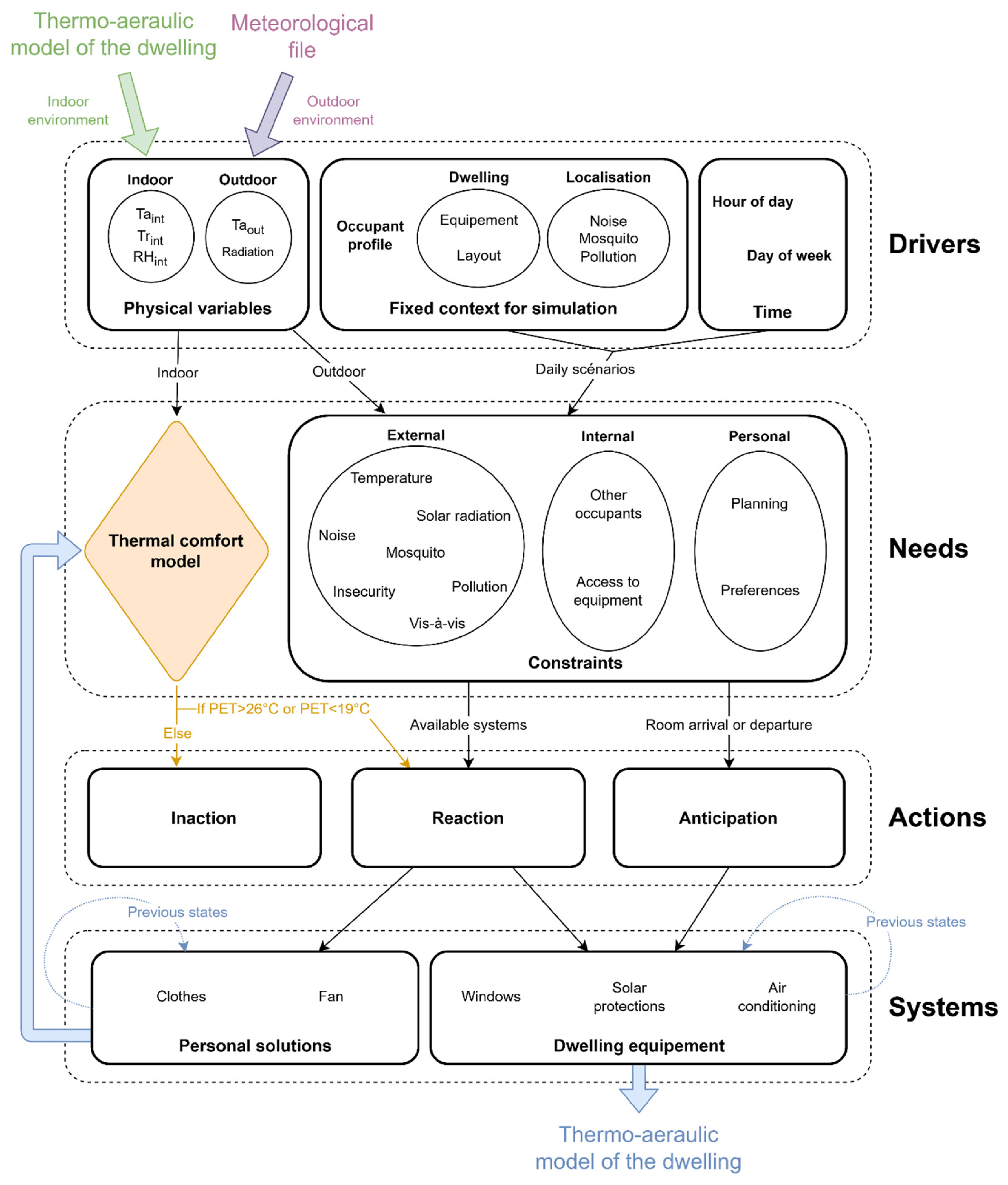
2.1.1. Conceptual Framework of the MOBAPY ABM
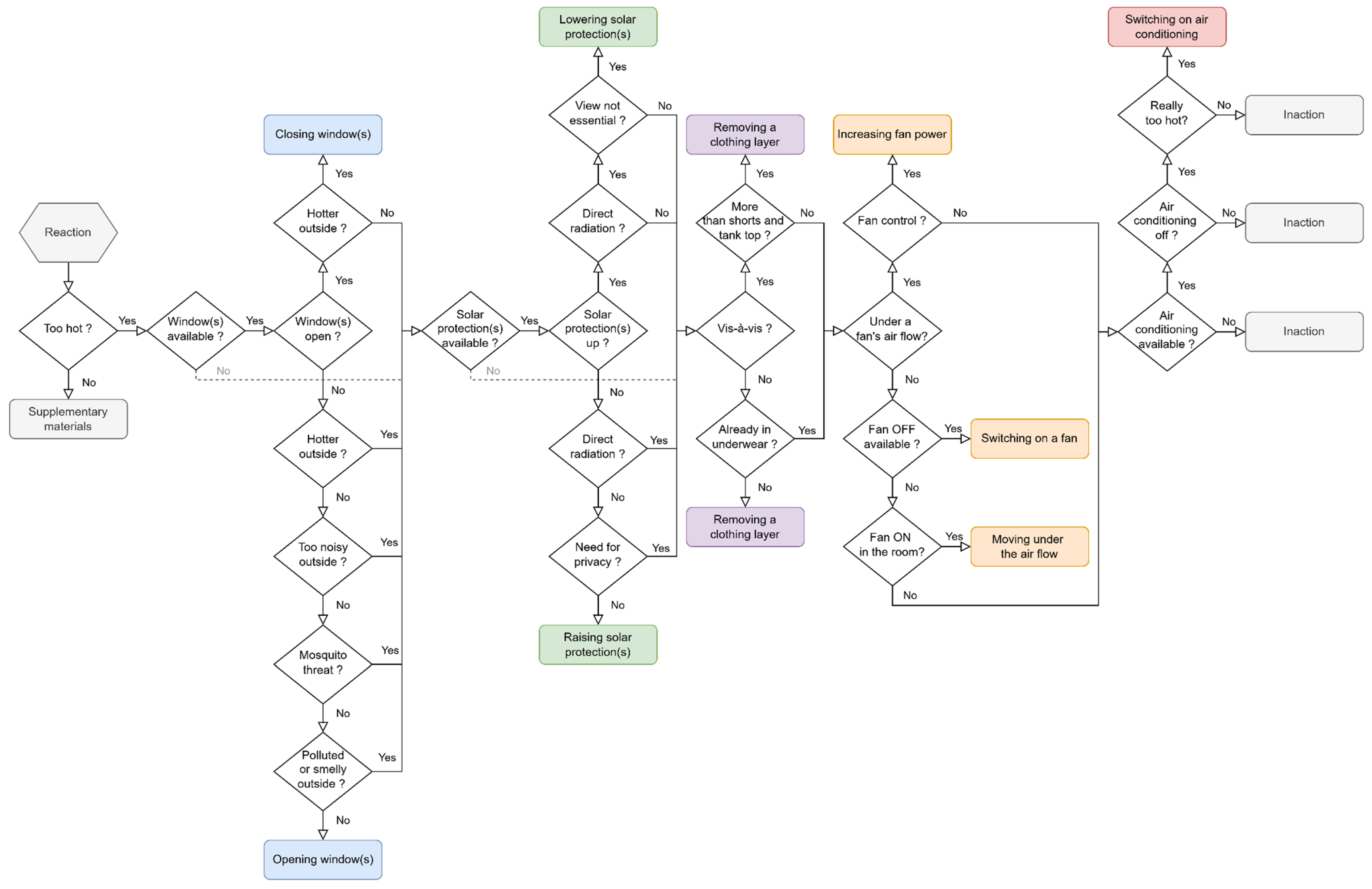
2.1.2. Rules of Conduct
2.2. Integration of MOBAPY into a Coupled Simulation Approach
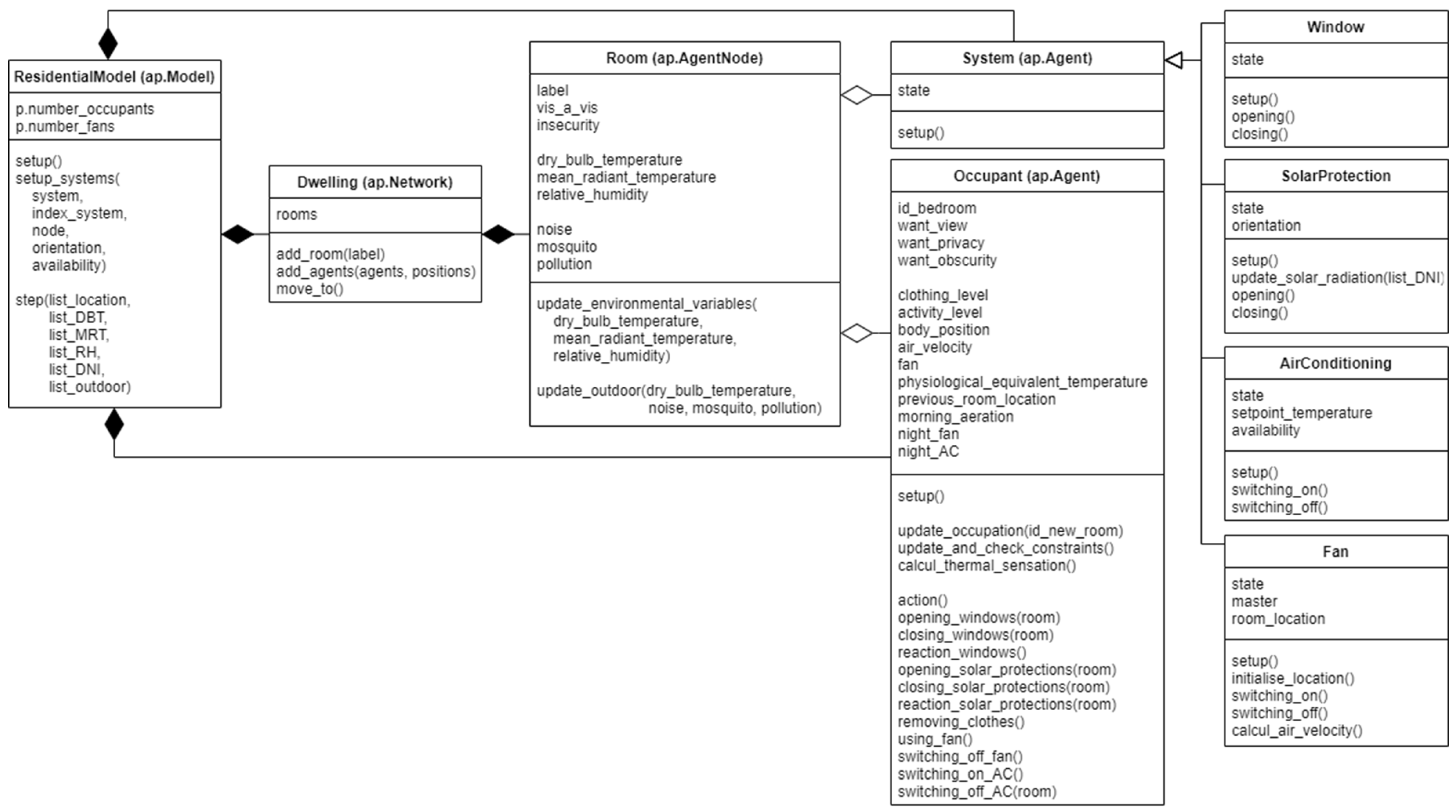
2.2.1. Technical Implementation of MOBAPY in Python
2.2.2. Constraints
2.2.3. Interoperability with BPS
2.3. Application of the Developed Toolchain: Description of the Case Study
3. Results
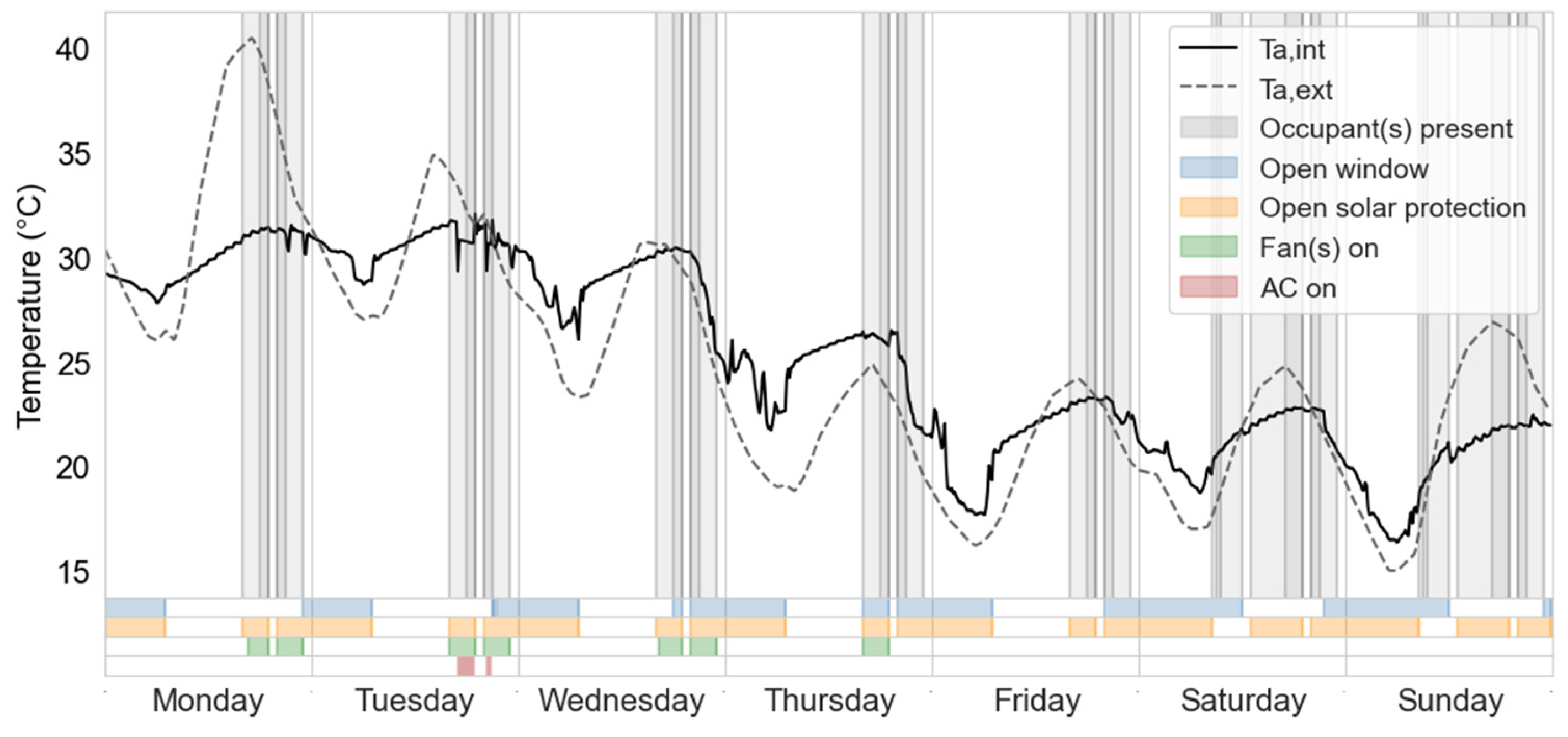
3.1. Dynamics of Adaptive Behaviour in an Unrestricted Configuration
3.2. Impact of Occupant Behaviour Under Various Constraint Configurations
4. Discussion
5. Conclusions
Author Contributions
Funding
Institutional Review Board Statement
Informed Consent Statement
Data Availability Statement
Conflicts of Interest
Abbreviations
| ABM | Agent-Based Models |
| AC | Air Conditioning |
| ASHRAE | American Society of Heating, Refrigerating and Air-Conditioning Engineers |
| ATHB | Adaptive Thermal Heat Balance |
| BPS | Building Performance Simulation |
| CONTAM | Multi-zone airflow and contaminant transport analysis programme |
| DH | Degree-Hour |
| DHPET | Degree-Hours during which PET exceeds 28 °C |
| DNAS | Drivers—Needs—Actions—Systems |
| DTS | Dynamic Thermal Sensation |
| EPW | EnergyPlus Weather file |
| iT26°C | Maximum number of successive days during which the bedroom temperature fails to drop below 26 °C |
| MEMI | Munich Energy-balance Model for Individuals |
| MOBAPY | Modelling Occupant Behaviour using an Agent-based approach with PYthon |
| OB | Occupant Behaviour |
| PET | Physiological Equivalent Temperature |
| PT | Percentage of Time |
| PTPET | Percentage of Time during which PET exceeds 28 °C |
| RCP | Representative Concentration Pathway |
| TRNSYS | Transient System Simulation |
| UML | Unified Modelling Language |
Appendix A



References
- IPCC. Climate Change 2022: Impacts, Adaptation and Vulnerability. Contribution of Working Group II to the Sixth Assessment Report of the Intergovernmental Panel on Climate Change; Cambridge University Press: Cambridge, UK, 2022. [Google Scholar]
- Yan, D.; Hong, T.; Dong, B.; Mahdavi, A.; D’Oca, S.; Gaetani, I.; Feng, X. IEA EBC Annex 66: Definition and simulation of occupant behavior in buildings. Energy Build. 2017, 156, 258–270. [Google Scholar] [CrossRef]
- Li, J.; Yu, Z.J.; Haghighat, F.; Zhang, G. Development and improvement of occupant behavior models towards realistic building performance simulation: A review. Sustain. Cities Soc. 2019, 50, 101685. [Google Scholar] [CrossRef]
- Gaetani, I. A Strategy for Fit-for-Purpose Occupant Behavior Modelling in Building Energy and Comfort Performance Simulation. Ph.D. Thesis, Technische Universiteit Eindhoven, Eindhoven, The Netherlands, 2019. [Google Scholar] [CrossRef]
- IEA EBC. Annex 79 Final Report: Occupant-Centric Building Design and Operation; Karlsruhe Institute of Technology: Karlsruhe, Germany; Carleton University: Ottawa, ON, Canada, 2024. [Google Scholar]
- d’Ambrosio Alfano, F.R.; Olesen, B.W.; Pepe, D.; Palella, B.I. Working with Different Building Energy Performance Tools: From Input Data to Energy and Indoor Temperature Predictions. Energies 2023, 16, 743. [Google Scholar] [CrossRef]
- Harputlugil, T.; de Wilde, P. The interaction between humans and buildings for energy efficiency: A critical review. Energy Res. Soc. Sci. 2021, 71, 101828. [Google Scholar] [CrossRef]
- Wagner, A.; O’Brien, W.; Dong, B. (Eds.) Exploring Occupant Behavior in Buildings; Springer International Publishing: Cham, Switzerland, 2018. [Google Scholar]
- Carlucci, S.; De Simone, M.; Firth, S.K.; Kjærgaard, M.B.; Markovic, R.; Rahaman, M.S.; Annaqeeb, M.K.; Biandrate, S.; Das, A.; Dziedzic, J.W.; et al. Modeling occupant behavior in buildings. Build. Environ. 2020, 174, 106768. [Google Scholar] [CrossRef]
- Alfakara, A.; Croxford, B. Using Agent-Based Modelling to Simulate Occupants’ Behaviours in Response to Summer Overheating. In Proceedings of the 2014 Symposium on Simulation for Architecture and Urban Design (SimAUD 2014); Society for Modeling and Simulation International (SCS): Tampa, FL, USA, 2014; Available online: http://www.simaud.org/2014/ (accessed on 7 April 2021).
- Dziedzic, J.; Yan, D.; Novakovic, V. Framework for a transient energy-related occupant behavior agent-based model. REHVA J. 2019, 5, 39–46. [Google Scholar] [CrossRef]
- Bonabeau, E. Agent-based modeling: Methods and techniques for simulating human systems. Proc. Natl. Acad. Sci. USA 2002, 99, 7280–7287. [Google Scholar] [CrossRef] [PubMed]
- Berger, C.; Mahdavi, A. Review of current trends in agent-based modeling of building occupants for energy and indoor-environmental performance analysis. Build. Environ. 2020, 173, 106726. [Google Scholar] [CrossRef]
- IEA EBC. Annex 66 Final Report: Definition and Simulation of Occupant Behavior in Buildings; Lawrence Berkeley National Laboratory: Berkeley, CA, USA; Tsinghua University: Beijing, China, 2018. [Google Scholar]
- Albouys-Perrois, J. Simulation Multi-Agent de L’autoconsommation Collective de L’énergie à L’échelle du Quartier en Lien Avec L’activité Humaine et la Consommation Énergétique des Bâtiments; Université de La Rochelle: La Rochelle, France, 2021. [Google Scholar]
- Vellei, M.; Martinez, S.; Le Dréau, J. Agent-based stochastic model of thermostat adjustments: A demand response application. Energy Build. 2021, 238, 110846. [Google Scholar] [CrossRef]
- Moujalled, B. Modélisation Dynamique du Confort Thermique dans les Bâtiments Naturellement Ventilés. Doctoral Thesis, INSA de Lyon, Lyon, France, 2007. Available online: https://www.theses.fr/2007ISAL0005 (accessed on 29 October 2021).
- Langevin, J.; Wen, J.; Gurian, P.L. Including occupants in building performance Simulation: Integration of an agent-based occupant behavior algorithm with Energyplus. In Proceedings of the ASHRAE/IBPSA-USA 2014 Simulation Conference; ASHRAE/IBPSA-USA: Atlanta, GA, USA, 2014; Available online: https://www.researchgate.net/publication/265849822_Including_Occupants_in_Building_Performance_Simulation_Integration_of_an_Agent-Based_Occupant_Behavior_Algorithm_with_EnergyPlus (accessed on 10 January 2022).
- Lee, Y.S.; Malkawi, A.M. Simulating multiple occupant behaviors in buildings: An agent-based modeling approach. Energy Build. 2014, 69, 407–416. [Google Scholar] [CrossRef]
- Chapman, J.; Siebers, P.-O.; Robinson, D. Multi-agent stochastic simulation of occupants for building simulation. In Proceedings of the 15th IBPSA Conference, San Francisco, CA, USA, 7–9 August 2017; Available online: https://nottingham-repository.worktribe.com/output/876941 (accessed on 20 January 2022).
- Darakdjian, Q. Prédiction des Performances Énergétiques des Bâtiments Avec Prise en Compte du Comportement des Usagers. Ph.D. Thesis, Université de La Rochelle, La Rochelle, France, 2017. Available online: https://tel.archives-ouvertes.fr/tel-01753830 (accessed on 14 April 2022).
- Kim, D.-W.; Kim, J.-H.; Park, S.-L.; Kim, K.-C.; Park, C.-S. Traditional Vs. Cognitive agent simulation. In Proceedings of the 13th Conference of International Building Performance Simulation Association, BS2013, Chambéry, France, 26–28 August 2013. [Google Scholar]
- Putra, H.C.; Andrews, C.; Senick, J. An agent-based model of building occupant behavior during load shedding. Build. Simul. 2017, 10, 845–859. [Google Scholar] [CrossRef]
- Berger, C.; Regnath, F.; Mahdavi, A. Agent-based modelling and energy performance assessment: A co-simulation case study. E3S Web Conf. 2022, 362, 07001. [Google Scholar] [CrossRef]
- Jia, M.; Srinivasan, R.S.; Ries, R.; Bharathy, G. A framework of occupant behavior modeling and data sensing for improving building energy simulation. In Proceedings of the Symposium on Simulation for Architecture and Urban Design, SIMAUD ’18; Society for Computer Simulation International: San Diego, CA, USA, 2018; pp. 1–8. [Google Scholar]
- Jia, M.; Srinivasan, R. Building Performance Evaluation Using Coupled Simulation of EnergyPlusTM and an Occupant Behavior Model. Sustainability 2020, 12, 4086. [Google Scholar] [CrossRef]
- Alfakara, A.; Corxford, B. Towards Better Buildings Performance Estimations? A Framework for Integrating Dynamic Occupant Behaviour in Dynamic Buildings Simulation Tools. In Proceedings of the 15th IBPSA Conference, San Francisco, CA, USA, 7–9 August 2017; p. 10. [Google Scholar]
- Gaaloul, S.; Dang, H.-A.; Kashif, A.; Delichant, B.; Wurtz, F. A new co-simulation architecture for mixing dynamic building simulation and agent oriented approach for users behaviour modelling. In Proceedings of the 13th International Conference of the International Building Performance Simulation Association (IBPSA), BS2013, Chambéry, France, 26–28 August 2013. [Google Scholar]
- Kashif, A. Modelling of Human Reactive and Deliberative Behaviour Using a Multi-Agent Approach for Energy Management in Home Settings. Ph.D. Thesis, Université de Grenoble, Saint-Martin-d’Hères, France, 2014. Available online: https://tel.archives-ouvertes.fr/tel-01304290 (accessed on 13 April 2022).
- Plessis, G.; Amouroux, E.; Haradji, Y. Coupling occupant behaviour with a building energy model—A FMI application. In Proceedings of the 10th International Modelica Conference, Lund, Sweden, 10–12 March 2014; pp. 321–326. [Google Scholar]
- Schumann, M.; Reynaud, Q.; Sabouret, N.; Sempé, F.; Haradji, Y.; Charrier, B.; Albouys, J.; Inard, C. Multi-Agent based simulation of human activity for building and urban scale assessment of residential load curves and energy use. In Proceedings of the Building Simulation 2021 Conference, Bruges, Belgium, 1–3 September 2021; Available online: https://hal.archives-ouvertes.fr/hal-03505242 (accessed on 3 February 2022).
- Jia, M.; Srinivasan, R.; Ries, R.; Bharathy, G.; Silverman, B.; Weyer, N. An Agent-Based Model Approach for Simulating Interactions between Occupants and Building Systems. In Proceedings of the 15th IBPSA Conference, San Francisco, CA, USA, 7–9 August 2017. [Google Scholar]
- Andrews, C.J.; Yi, D.; Krogmann, U.; Senick, J.A.; Wener, R.E. Designing Buildings for Real Occupants: An Agent-Based Approach. IEEE Trans. Syst. Man Cybern.—Part A Syst. Hum. 2011, 41, 1077–1091. [Google Scholar] [CrossRef]
- Micolier, A.; Taillandier, F.; Taillandier, P.; Bos, F. Li-BIM, an agent-based approach to simulate occupant-building interaction from the Building-Information Modelling. Eng. Appl. Artif. Intell. 2019, 82, 44–59. [Google Scholar] [CrossRef]
- Heydarian, A.; McIlvennie, C.; Arpan, L.; Yousefi, S.; Syndicus, M.; Schweiker, M.; Jazizadeh, F.; Rissetto, R.; Pisello, A.L.; Piselli, C.; et al. What drives our behaviors in buildings? A review on occupant interactions with building systems from the lens of behavioral theories. Build. Environ. 2020, 179, 106928. [Google Scholar] [CrossRef]
- Subrémon, H. Le climat du chez-soi. Une fabrication saisonnière. Ethnol. Fr. 2010, 40, 707. [Google Scholar] [CrossRef]
- Sovacool, B.K. What are we doing here? Analyzing fifteen years of energy scholarship and proposing a social science research agenda. Energy Res. Soc. Sci. 2014, 1, 1–29. [Google Scholar] [CrossRef]
- Allagnat, M. Habiter la Périphérie Urbaine en Périodes de Fortes Chaleurs: Les Vécus Habitants, Leurs Dilemmes et les Inégalités Socio-Spatiales Amplifiées. Doctoral Thesis, Nantes Université, Nantes, France, 2022. Available online: https://www.theses.fr/2022NANU2030 (accessed on 20 July 2023).
- Hellwig, R.T.; Teli, D.; Schweiker, M.; Choi, J.-H.; Lee, M.C.J.; Mora, R.; Rawal, R.; Wang, Z.; Al-Atrash, F. A framework for adopting adaptive thermal comfort principles in design and operation of buildings. Energy Build. 2019, 205, 109476. [Google Scholar] [CrossRef]
- Molina, G.; Allagnat, M. Les habitants, la météorologie et le climat. Expériences climatiques, modes de vie et territoires. Séminaire les lyonnais, la météorologie et le climat. In Proceedings of the Séminaire chercheurs—Collectivité territoriale “ Les Lyonnais, la Météorologie et le Climat”, Lyon, France, 19 September 2019; Available online: https://hal.archives-ouvertes.fr/hal-03327869 (accessed on 24 February 2022).
- von Grabe, J. How do occupants decide their interactions with the building? From qualitative data to a psychological framework of human-building-interaction. Energy Res. Soc. Sci. 2016, 14, 46–60. [Google Scholar] [CrossRef]
- Hostein, M.; Moujalled, B.; Musy, M.; Gernoutti, S. How do occupants adapt to the heat in their homes: Lessons learned from semi-structured interviews and in-situ measurements in urban dwellings. In Proceedings of the 5th international conference on Comfort at the Extremes (CATE 2024), Seville, Spain, 20–22 November 2024. [Google Scholar]
- Hong, T.; D’Oca, S.; Turner, W.J.N.; Taylor-Lange, S.C. An ontology to represent energy-related occupant behavior in buildings. Part I: Introduction to the DNAs framework. Build. Environ. 2015, 92, 764–777. [Google Scholar] [CrossRef]
- Höppe, P. The physiological equivalent temperature—A universal index for the biometeorological assessment of the thermal environment. Int. J. Biometeorol. 1999, 43, 71–75. [Google Scholar] [CrossRef] [PubMed]
- Hostein, M. Évaluation de L’impact du Changement Climatique sur le Confort Thermique des Bâtiments en Tenant Compte du Comportement des Occupants et du Contexte Urbain—Application aux Stratégies Passives D’amélioration du Confort Thermique D’été. Ph.D. Thesis, Université de Lyon, Lyon, France, 2024. [Google Scholar]
- Walther, E.; Goestchel, Q. The P.E.T. comfort index: Questioning the model. Build. Environ. 2018, 137, 1–10. [Google Scholar] [CrossRef]
- Höppe, P.; Mayer, H. Planungsrelevante Bewertung der thermischen Komponente des Stadtklimas. Landsch. Stadt 1987, 19, 22–29. [Google Scholar]
- Deb, C.; Alur, R. The significance of Physiological Equivalent Temperature (PET) in outdoor thermal comfort studies. Int. J. Eng. Sci. Technol. 2010, 2, 2825–2828. [Google Scholar]
- Barone, F. Numerical Assessment of Heat Stress in Dwellings and Immediate Surroundings: Development of a Microclimate Zonal Model Coupled to Buildings Models. Ph.D. Thesis, INSA de Lyon, Villeurbanne, France, 2024. [Google Scholar]
- Nouri, A.S.; Charalampopoulos, I.; Matzarakis, A. The application of the physiologically equivalent temperature to determine impacts of locally defined extreme heat events within vulnerable dwellings during the 2020 summer in Ankara. Sustain. Cities Soc. 2022, 81, 103833. [Google Scholar] [CrossRef]
- Jiang, Y.; Xie, Y.; Niu, J. Short-term dynamic thermal perception and physiological response to step changes between real-life indoor and outdoor environments. Build. Environ. 2024, 251, 111223. [Google Scholar] [CrossRef]
- Sondaz, C. Vers une Qualification Interdisciplinaire de la Vulnérabilité Sanitaire Individuelle et des Vécus Face Aux Fortes Chaleurs: Croisement et Mise à L’épreuve de la Modélisation du Stress et des Astreintes Thermiques Avec le Terrain Ethnographique. Ph.D. Thesis, INSA de Lyon, Villeurbanne, France, 2025. [Google Scholar]
- Lucas, F.; Bozonnet, E.; Boulic, M.; Lodzinski, V. Projet TROPIC pour l’étude du rafraîchissement passif des écoles polynésiennes dans un contexte de changement climatique: Confort thermique, qualité de l’air, santé cognitive et réduction des consommations électriques. In Proceedings of the IBPSA France, La Rochelle and Île d’Oléron, France, 13–17 May 2024; p. 413. Available online: https://hal.science/hal-04587632 (accessed on 16 July 2026).
- Morakinyo, T.E.; Dahanayake, K.K.C.; Adegun, O.B.; Balogun, A.A. Modelling the effect of tree-shading on summer indoor and outdoor thermal condition of two similar buildings in a Nigerian university. Energy Build. 2016, 130, 721–732. [Google Scholar] [CrossRef]
- Cohen, P.; Potchter, O.; Matzarakis, A. Human thermal perception of Coastal Mediterranean outdoor urban environments. Appl. Geogr. 2013, 37, 1–10. [Google Scholar] [CrossRef]
- Matzarakis, A.; Mayer, H. Another kind of environmental stress: Thermal stress. WHO Newsl. 1996, 18, 7–10. [Google Scholar]
- Masad, D.; Kazil, J. Mesa: An Agent-Based Modeling Framework. In Proceedings of the Python in Science Conference, Austin, TX, USA, 6–12 July 2015; pp. 51–58. [Google Scholar]
- Kazil, J.; Masad, D.; Crooks, A. Utilizing Python for Agent-Based Modeling: The Mesa Framework. In Social, Cultural, and Behavioral Modeling; Thomson, R., Bisgin, H., Dancy, C., Hyder, A., Hussain, M., Eds.; Lecture Notes in Computer Science; Springer International Publishing: Cham, Switzerland, 2020; pp. 308–317. [Google Scholar]
- Foramitti, J. AgentPy: A package for agent-based modeling in Python. J. Open Source Softw. 2021, 6, 3065. [Google Scholar] [CrossRef]
- Yu, S.; Hou, Z. Melodie: Agent-based Modeling in Python. J. Open Source Softw. 2023, 8, 5100. [Google Scholar] [CrossRef]
- Antelmi, A.; Cordasco, G.; D’Ambrosio, G.; De Vinco, D.; Spagnuolo, C. Experimenting with Agent-Based Model Simulation Tools. Appl. Sci. 2023, 13, 13. [Google Scholar] [CrossRef]
- Tartarini, F.; Schiavon, S. pythermalcomfort: A Python package for thermal comfort research. SoftwareX 2020, 12, 100578. [Google Scholar] [CrossRef]
- TomTom. Lyon Traffic. Available online: https://www.tomtom.com/traffic-index/lyon-traffic/ (accessed on 28 July 2024).
- Moustique Tigre. Available online: https://www.ville-schiltigheim.fr/vie-quotidienne/habitat-environnement/nuisibles/moustique-tigre/ (accessed on 28 July 2024).
- d’Ambrosio Alfano, F.R.; Pepe, D.; Riccio, G.; Vio, M.; Palella, B.I. On the effects of the mean radiant temperature evaluation in the assessment of thermal comfort by dynamic energy simulation tools. Build. Environ. 2023, 236, 110254. [Google Scholar] [CrossRef]
- Hostein, M.; Musy, M.; Moujalled, B.; El Mankibi, M. Generating meteorological files of future climates with heatwaves in urban context to evaluate building overheating: An energy-efficient dwelling case study. Build. Environ. 2024, 263, 111874. [Google Scholar] [CrossRef]
- ISO 7730; Ergonomie des Ambiances Thermiques—Détermination Analytique et Interprétation du Confort Thermique par le Calcul des Indices PMV et PPD et par des Critères de Confort Thermique Local. AFNOR: Saint-Denis, France, 2025.
- Ramon, D.; Allacker, K.; van Lipzig, N.P.M.; De Troyer, F.; Wouters, H. Future Weather Data for Dynamic Building Energy Simulations: Overview of Available Data and Presentation of Newly Derived Data for Belgium. In Energy Sustainability in Built and Urban Environments; Motoasca, E., Agarwal, A.K., Breesch, H., Eds.; Energy, Environment, and Sustainability; Springer: Singapore, 2019; pp. 111–138. [Google Scholar]
- Silvero, F.; Lops, C.; Montelpare, S.; Rodrigues, F. Impact assessment of climate change on buildings in Paraguay—Overheating risk under different future climate scenarios. Build. Simul. 2019, 12, 943–960. [Google Scholar] [CrossRef]
- Liu, S.; Kwok, Y.T.; Lau, K.K.-L.; Tong, H.W.; Chan, P.W.; Ng, E. Development and application of future design weather data for evaluating the building thermal-energy performance in subtropical Hong Kong. Energy Build. 2020, 209, 109696. [Google Scholar] [CrossRef]
- Yao, R.; Zhang, S.; Du, C.; Schweiker, M.; Hodder, S.; Olesen, B.W.; Toftum, J.; Romana d’Ambrosio, F.; Gebhardt, H.; Zhou, S.; et al. Evolution and performance analysis of adaptive thermal comfort models—A comprehensive literature review. Build. Environ. 2022, 217, 109020. [Google Scholar] [CrossRef]
- Schweiker, M. Combining adaptive and heat balance models for thermal sensation prediction: A new approach towards a theory and data-driven adaptive thermal heat balance model. Indoor Air 2022, 32, e13018. [Google Scholar] [CrossRef] [PubMed]
- Djongyang, N.; Tchinda, R.; Njomo, D. Thermal comfort: A review paper. Renew. Sustain. Energy Rev. 2010, 14, 2626–2640. [Google Scholar] [CrossRef]
- EN 16798-1; Performance Énergétique des Bâtiments—Ventilation des Bâtiments—Partie 1: Données D’entrées D’ambiance Intérieure Pour la Conception et L’évaluation de la Performance Énergétique des Bâtiments Couvrant la Qualité de l’air Intérieur, L’ambiance Thermique, L’éclairage et L’acoustique. AFNOR: Saint-Denis, France, 2019.
- ANSI/ASHRAE Standard 55-2020; Thermal Environmental Conditions for Human Occupancy. ASHRAE: Peachtree Corners, GA, USA, 2020.
- Yao, R.; Li, B.; Liu, J. A theoretical adaptive model of thermal comfort—Adaptive Predicted Mean Vote (aPMV). Build. Environ. 2009, 44, 2089–2096. [Google Scholar] [CrossRef]
- Fanger, O.P.; Toftum, J. Extension of the PMV model to non-air-conditioned buildings in warm climates. Energy Build. 2002, 34, 533–536. [Google Scholar] [CrossRef]
- Gagge, A.P.; Fobelets, A.P.; Berglund, L.G. A standard predictive index of human response to the thermal environment. ASHRAE Trans. 1986, 92, 709–731. [Google Scholar]
- Vellei, M.; Le Dréau, J. On the prediction of dynamic thermal comfort under uniform environments. In Proceedings of the 11th Windsor Conference 2020, Windsor, UK, 16–19 April 2020; pp. 424–439. Available online: https://hal-univ-rochelle.archives-ouvertes.fr/hal-02556047 (accessed on 15 June 2021).
- Gernouti, S.; Moujalled, B.; Ach-Chakar, M.; Travers, M.; Appere, G.; Junique, S.; Tabard-Fortecoef, V. CREATIV: Confort, Qualité de l’air & Vagues de Chaleur–Rapport de Synthèse n°3; Technical Report No. 2062C0002; ADEME: Angers, France, 2025; unpublished work. [Google Scholar]




| Reference | ABM | BPS | Modelled Actions | Coupling Method |
|---|---|---|---|---|
| Vellei et al. [16] | Python | DIMOSIM | HVAC, Clothes | Not available |
| Moujalled [17] | Matlab 7.x (AdOCC) | TRNSYS 16 | Windows, HVAC, Fan, Clothes | Directly in Matlab |
| Langevin et al. [18] | Matlab (HABIT) | EnergyPlus | Windows, HVAC, Fan, Clothes | BCVTB |
| Lee and Malkawi [19] | Matlab | EnergyPlus v7.1 | Occupancy, Blinds, Windows, Doors, HVAC, Fan, Clothes | BCVTB and MLE+ |
| Chapman et al. [20] | No-Mass | EnergyPlus | Occupancy, Artificial light, Blinds, Windows, HVAC, Clothes | FMI |
| Darakdjian [21] | No-Mass | EnergyPlus v8.2 | Occupancy, Artificial light, Blinds, Windows, HVAC | FMI |
| Kim et al. [22] | NetLogo | EnergyPlus | Occupancy, Artificial light, Windows, Doors, HVAC | BCVTB |
| Putra et al. [23] | NetLogo | EnergyPlus | Artificial light, Blinds, HVAC, Fan, Clothes | Not available |
| Berger et al. [24] | NetLogo | EnergyPlus | Occupancy, Artificial light, Blinds, Windows, HVAC, Clothes | BCVTB/Python |
| Jia et al. [25,26] | PMFserv | EnergyPlus | Blinds, Windows, Doors | Manually then BCVTB |
| Alfakara and Croxford [27] | Repast | EnergyPlus | Occupancy, Windows, HVAC, Fan | FMI |
| Alfakara and Croxford [10] | Repast | Tas | Windows, HVAC | Not available |
| Gaaloul et al. [28] | BRAHMS | Matlab/Simulink | Occupancy, Appliances, HVAC | ICAr |
| Kashif [29] | BRAHMS | Matlab/Simulink | Occupancy, Appliances, Windows, HVAC, Clothes | Not available |
| Plessis et al. [30] Schumann et al. [31] | SMACH | BuildSysPro Modelica | Occupancy, Appliances, Blinds, Windows, HVAC | FMI |
| Constraint | Python Class | Used Name | Nature | Variable or Parameter Description |
|---|---|---|---|---|
| Pollution | Room (Outdoor object) | pollution | Planning | Outdoor environment polluted |
| Mosquito | Room (Outdoor object) | mosquito | Planning | Presence of mosquito in the external environment |
| Noise | Room (Outdoor object) | noise | Planning | Outdoor environment noisy |
| Fan | ResidentialModel | number_fans | Fixed | Number of fans in the dwelling |
| Air conditioning | Room | availability | Fixed | Existence of air conditioning in the room |
| Direct views | Room | vis-a-vis | Fixed | Presence of direct views for the room |
| Insecurity | Room | insecurity | Fixed | Feeling of insecurity in the room |
| View | Occupant | want_view | Fixed | The occupant wants to see outside |
| Privacy | Occupant | want_privacy | Fixed | The occupant does not want to be seen from outside |
| Darkness | Occupant | want_darkness | Fixed | The occupant wants to sleep with the shutters closed |
Disclaimer/Publisher’s Note: The statements, opinions and data contained in all publications are solely those of the individual author(s) and contributor(s) and not of MDPI and/or the editor(s). MDPI and/or the editor(s) disclaim responsibility for any injury to people or property resulting from any ideas, methods, instructions or products referred to in the content. |
© 2026 by the authors. Licensee MDPI, Basel, Switzerland. This article is an open access article distributed under the terms and conditions of the Creative Commons Attribution (CC BY) license.
Share and Cite
Hostein, M.; Moujalled, B.; Musy, M. MOBAPY: Modelling Household Adaptation to Summer Heat in Urban Environments Using Agent-Based Simulation. Appl. Sci. 2026, 16, 7742. https://doi.org/10.3390/app16157742
Hostein M, Moujalled B, Musy M. MOBAPY: Modelling Household Adaptation to Summer Heat in Urban Environments Using Agent-Based Simulation. Applied Sciences. 2026; 16(15):7742. https://doi.org/10.3390/app16157742
Chicago/Turabian StyleHostein, Mathilde, Bassam Moujalled, and Marjorie Musy. 2026. "MOBAPY: Modelling Household Adaptation to Summer Heat in Urban Environments Using Agent-Based Simulation" Applied Sciences 16, no. 15: 7742. https://doi.org/10.3390/app16157742
APA StyleHostein, M., Moujalled, B., & Musy, M. (2026). MOBAPY: Modelling Household Adaptation to Summer Heat in Urban Environments Using Agent-Based Simulation. Applied Sciences, 16(15), 7742. https://doi.org/10.3390/app16157742