Article

Optimization Analysis of Viscoelastic Seismic Reduction Structural System Considering Spatial Torsion Effect


1
College of Civil and Transportation Engineering, Hohai University, Nanjing 210024, China
2
Institute of Dynamics and Smart Disaster Prevention, Northeastern University, Shenyang 110819, China
3
China-Pakistan Belt and Road Joint Laboratory on Smart Disaster Prevention of Major Infrastructures, Southeast University, Nanjing 210096, China
*
Author to whom correspondence should be addressed.
Appl. Sci. 2026, 16(15), 7664; https://doi.org/10.3390/app16157664
Submission received: 29 June 2026 / Revised: 30 July 2026 / Accepted: 31 July 2026 / Published: 2 August 2026

Abstract

Viscoelastic dampers, leveraging the synergistic mechanism of viscous dissipation and elastic recovery, simultaneously reduce seismic-induced structural displacement and acceleration responses while offering the advantages of simple construction and ease of installation, which hold broad prospects in both the seismic design of new buildings and the retrofitting of existing structures. This work aims to propose a rapid optimization design method for viscoelastic dampers considering torsional effect for three-dimensional solid structures. First, a full-scale prefabricated assembled viscoelastic damper was developed, and mechanical property tests were conducted under a series of loading conditions. Based on the test results, a genetic algorithm is employed to optimize the design scheme of viscoelastic dampers through co-simulation using MATLAB R2022a and OpenSees. The optimization objectives consider both the inter-story drift ratio and acceleration response of the structure, with particular emphasis on the influence of torsional effects. Given that the proposed optimization scheme accounts for structural dynamic characteristics, building functionality, and the universality of seismic excitations, it serves as a design reference for the optimization analysis of other damped structures.

1. Introduction

In recent years, as engineering structures have evolved toward greater heights, longer spans, and higher complexity, the demands imposed on structural vibration control have become increasingly stringent. Viscoelastic dampers, as typical passive energy dissipation devices, increase the effective damping ratio of a structure through hysteretic shear deformation, thereby suppressing its dynamic response under seismic excitation. [1,2]. Their mechanical behavior is not purely viscous but also exhibits instantaneous elastic characteristics. Owing to their distinct advantages—simple construction, no requirement for external energy, and the combined ability to dissipate energy while providing supplementary stiffness—these dampers have been widely applied in numerous fields, including high-rise buildings, long-span bridges, offshore platforms, and vibration isolation of precision equipment [3]. Concurrently, scholars worldwide have conducted extensive research on viscoelastic dampers [4,5], giving rise to a wealth of active research topics.
Ge et al. [6,7] comprehensively investigated the dynamic properties of cylindrical viscoelastic dampers through systematic experiments, revealing pronounced frequency sensitivity, minor amplitude dependence, and robust energy dissipation over a broad frequency range; they further proposed a novel spherical chain-network model grounded in molecular-chain microstructures, which effectively captures the coupled influences of temperature, frequency, and displacement amplitude. Nasab M. S. E et al. [8] experimentally validated a hybrid damper’s viscoelastic energy dissipation and showed that a calibrated nonlinear BWBN model captures its hysteretic behavior more accurately than the Kelvin–Voigt model. Pant et al. [9] tested full-scale viscoelastic coupling dampers under loads from extremely small deformations to design-level earthquakes and up to six-hour wind loads, revealing their hysteresis and temperature rise, and systematically evaluated generalized Maxwell, fractional derivative, and two thermo-mechanical models to provide clear recommendations for nonlinear modeling under different loading conditions. Nasab M. S. E. et al. [10] developed a stochastic Kriging-based constitutive model for viscoelastic dampers based on cyclic loading test data, enabling accurate prediction of their mechanical properties under varying loading and environmental conditions. Montgomery M. et al. [11] conducted small-scale and full-scale experimental investigations on viscoelastic coupling dampers (VCDs), validating their hysteretic behavior and mechanical performance under wind and seismic loading.
Ge X. et al. [12] proposed a closed-form analytical method based on the complex model method and pseudo-excitation method to evaluate the seismic response and energy dissipation performance of structures equipped with six-element generalized model (SGM) viscoelastic dampers. Garcia M. et al. [13] investigated the optimal configuration of viscoelastic dampers for mitigating the lateral–torsional response of asymmetric structures through analytical and experimental analyses. Castaldo P. et al. [14] developed an integrated seismic optimization framework for simultaneously designing structural stiffness and viscoelastic damper properties to achieve target seismic performance with improved cost-effectiveness. Osabel D. M. et al. [15] investigated the thermo-mechanical behavior of full-scale viscoelastic dampers under long-duration loading and proposed similarity rules for scaled testing to support damper design and optimization. Lavan O. [16] developed a performance-based optimization framework for the seismic retrofit of three-dimensional irregular structures by simultaneously optimizing viscous damper coefficients and supporting brace stiffness. Mazza F. et al. [17] investigated the optimal design of viscoelastic damper–brace systems for enhancing the seismic and wind performance of steel-framed buildings through dynamic response analysis. Zhao X. et al. [18] developed a stability-based optimization framework for viscoelastic dampers by integrating stability effects into the damper model and proposing an improved damper configuration.
Arkavazi F. et al. [19] developed analytical models of steel moment-frame buildings equipped with superelastic viscous dampers (SVDs) to evaluate their seismic response, re-centering capability, and energy dissipation performance through nonlinear response history analyses. Emami M. et al. [20] developed a viscoplastic rubber–steel core damper (RSCD) for low-damage steel column-base connections and optimized its structural performance through finite element and parametric analyses. Ghandil M. et al. [21] developed a hybrid viscoelastic–metallic yielding (VPD) damper and validated its vibration control and energy dissipation performance through theoretical, experimental, and numerical investigations. Silwal B. et al. [22] developed a hybrid superelastic viscous damper (SVD) combining shape memory alloy cables and viscoelastic materials, and validated its seismic performance through experimental characterization and nonlinear dynamic analyses. Hu et al. [23] proposed a novel hybrid self-centering brace incorporating frequency-dependent viscoelastic dampers to provide velocity-proportional damping, thereby simultaneously reducing structural residual deformation and nonstructural seismic damage. Li H N et al. [24] established and validated a hysteretic mechanical model for a rotation-amplified rubber viscoelastic damper and optimized its seismic control performance through rotational deformation amplification. Gong S et al. [25] experimentally and numerically investigated the nonlinear behavior of a viscoelastic damper and proposed a simplified analytical model for accurately predicting the seismic responses of viscoelastically damped structures. Rijnen M et al. [26] developed a frequency-dependent finite element modeling approach and an efficient modal superposition method to accurately predict and optimize the vibration control performance of viscoelastic damping systems. Kasai K et al. [27] established a three-dimensional thermo-mechanical finite element model and proposed a computationally efficient one-dimensional approach for analyzing the heat transfer and dynamic behavior of viscoelastic dampers. Sato D et al. [28] developed a nonlinear thermo-mechanically coupled analysis method and efficient one-dimensional models to accurately predict and optimize the large-strain behavior of viscoelastic dampers. Gai P et al. [29] evaluated the influence of frequency dependence on viscoelastic isolation systems and optimized seismic response analysis by introducing a rational polynomial approximation method. Lewandowski R [30] developed a temperature-dependent dynamic analysis method for viscoelastic damped structures, enabling efficient prediction of their modal properties through a nonlinear eigenvalue formulation.
Heydarinouri H et al. [31] proposed an iterative step-by-step optimization method for the placement and design of viscoelastic dampers. The optimization procedure updated damper locations according to the maximum interstory drift and adjusted damper properties based on the lateral stiffness of each story, thereby achieving the target damping ratio with fewer dampers and improved seismic control efficiency. Dai et al. [32] proposed an effective algorithm for solving the seismic response of viscoelastic damping structures under different environmental temperatures. A ten story viscoelastic damping steel frame was numerically simulated under historical earthquake action, and the influence of environmental temperature on its seismic performance was analyzed. Choi et al. [33] used a nonlinear submodel to generate a nonlinear response spectrum and fully considered the influence of the nonlinear characteristics of viscoelastic dampers on the seismic reduction effect of the structure. Tubaldi [34] analyzed the dynamic characteristics of two adjacent buildings connected to a viscoelastic damper at the top of a shorter building by considering the characteristics of different buildings and viscoelastic dampers. Beklaryan G.L. et al. [35] proposed a fuzzy-controlled real-coded genetic algorithm (F-RCGA) for optimizing system dynamics models. The proposed approach integrates fuzzy control mechanisms into the genetic algorithm to adaptively adjust key parameters, such as mutation probability, crossover strategy, and population size, thereby improving convergence efficiency and computational performance. Hu et al. [36] developed a modified particle swarm optimization (PSO) algorithm for solving constrained engineering optimization problems. The proposed method introduces a feasibility-based strategy to ensure that particles maintain only feasible solutions during the search process, effectively improving the algorithm’s ability to handle nonlinear inequality constraints.
Compared with other algorithms, genetic algorithm has demonstrated excellent performance in the optimization of damper placement problems due to its global search ability, natural advantages in handling multiple objectives and discrete variables, and wide applicability, which has been adopted in this work. Farthermore, existing research has confirmed the effectiveness of viscoelastic damping technology in mitigating structural vibrations, highlighting its considerable potential for widespread engineering implementation. In the current seismic analysis of viscoelastic structures, there is relatively little research on optimizing the torsional effect of control structures. The arrangement scheme of viscoelastic dampers in structures plays a key role in the seismic control effect. So it is necessary to comprehensively consider the dynamic characteristics of the structure, the functional use of the building, and the universality of seismic excitation to further refine the seismic analysis and optimization of viscoelastic damping structures. In addition, considering factors such as engineering economy and building functionality, in order to maximize the seismic reduction effect of viscoelastic dampers in the structure, the Matlab OpenSEES joint programming method is adopted to optimize the layout of viscoelastic dampers in the structure.

2. Mechanical Model for Viscoelastic Damper

As is well known, accurately describing the mechanical properties of viscoelastic dampers is crucial for conducting optimization analysis of viscoelastic damping structures. So the mechanical performance tests on viscoelastic dampers has been conducted and a mechanical model for describing viscoelastic dampers based on the micro energy dissipation mechanism of viscoelastic materials has been proposed. The validity of the proposed model was assessed through comparisons between the model predictions and the experimental results.

2.1. Performance Test

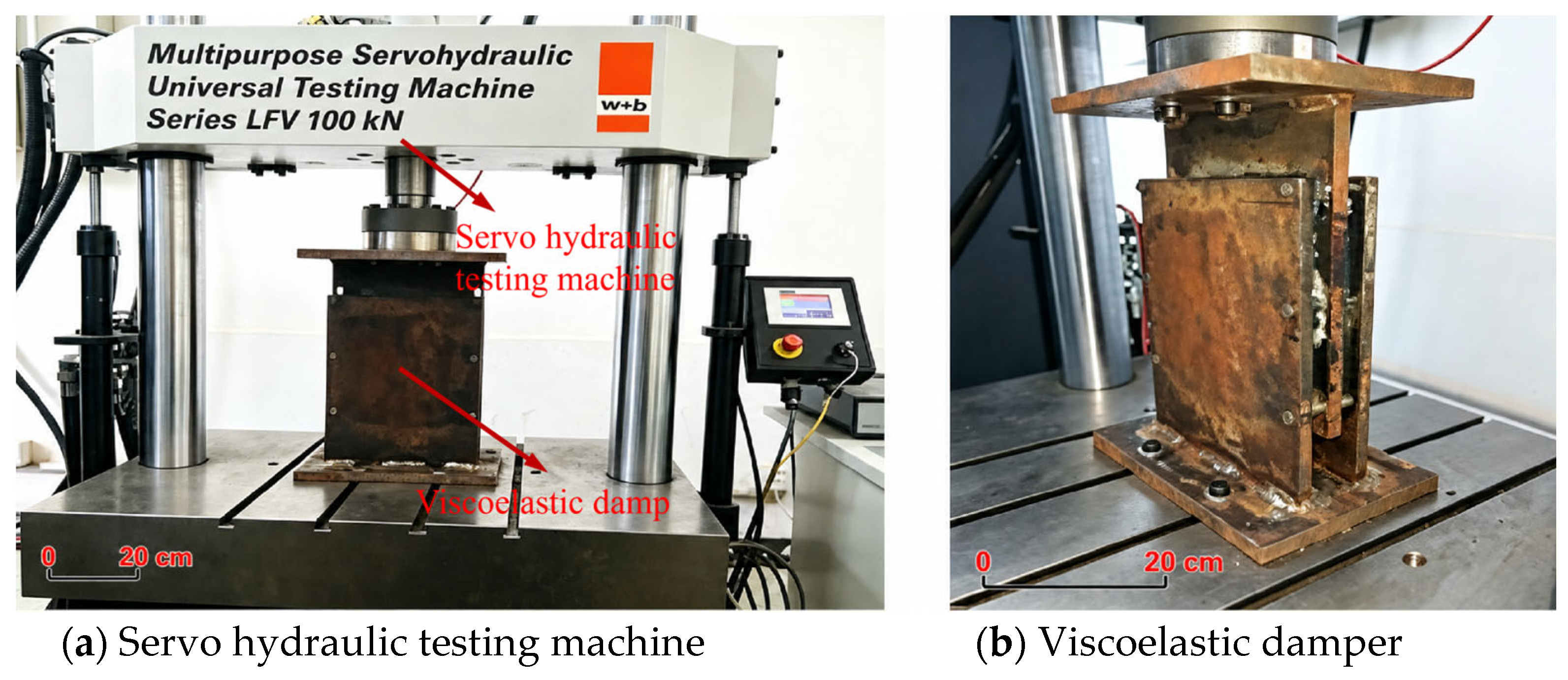
In order to test the dynamic mechanical performance of the independently developed viscoelastic damper, a series of performance tests were conducted on the viscoelastic damper using a 10 ton servo hydraulic testing machine at different excitation frequencies (0.1, 0.2, 0.5, 1.0, 2.0 Hz) and displacement amplitudes (2, 4, 8 mm). The damper size and test overview are shown in Table 1 and Figure 1. The dynamic tests were performed using a 100 kN Servohydraulic Fatigue Testing Machine (Type: LFV 100-HH) manufactured by Walter + Bai AG, Switzerland, which was installed in 2016. The testing system was equipped with a servo-hydraulic actuator and force/displacement measurement units, enabling accurate control of the prescribed sinusoidal loading histories and real-time acquisition of the damper responses. The servo-hydraulic testing machine used in this study is shown in Figure 1a.
The tested viscoelastic damper was configured as a double-shear-type damping device, consisting of three steel plates and two viscoelastic material layers sandwiched between the steel plates. The two viscoelastic layers were symmetrically arranged between the middle steel plate and the two outer steel plates, providing shear deformation during dynamic loading. The connection between the viscoelastic material layers and steel plates was achieved using Chemlok adhesive to ensure reliable interfacial bonding and effective shear force transfer. The detailed configuration of the tested viscoelastic damper specimen are illustrated in Figure 1b. Before testing, the specimens were placed under laboratory conditions for sufficient time to minimize the influence of temperature variation and material history on the measured mechanical properties. All tests were conducted at room temperature under sinusoidal loading conditions. For each loading case, repeated measurements were performed, and the stable hysteretic responses were selected for the calculation of dynamic mechanical parameters to improve the reliability of the experimental results.
To investigate the mechanical performance of assembled viscoelastic dampers subjected to various excitation frequencies and displacement amplitudes, the storage modulus, energy dissipation modulus, loss factor, and single cycle energy dissipation of the viscoelastic dampers were calculated based on the data collected from experiments, as shown in Table 2. It can be seen that the dynamic mechanical performance parameters increase with frequency under certain displacement amplitude. The storage modulus and loss modulus decrease with the increase in displacement amplitude, while the loss factor changes very little with displacement amplitude. In addition, when the frequency remains constant, the energy consumption per cycle increases sharply with the increase in displacement amplitude.

2.2. Model Validation

By combining the study of the microstructure and energy dissipation mechanisms of viscoelastic materials, Xu et al. [37] established an equivalent fractional-order micro-spherical molecular chain model for viscoelastic dampers. The model characterizes the superelastic and viscoelastic properties of viscoelastic materials through network molecular chains and free molecular chains, respectively. On this basis, this paper introduces the temperature-frequency equivalence principle to account for the influence of temperature on the dynamic mechanical properties of the damper. The storage modulus G 1 , loss modulus G 2 , and loss factor η of viscoelastic materials are as follows:
G 1 ( ω ) = n s 24 π r s 0 E s 1 + η s 1 ( α T ω ) α cos α π 2 + n c 24 π r c 0 E c 1 2 η c 1 ( α T ω ) β cos β π 2 + E c 1 η c 1 2 ( α T ω ) 2 β E c 1 2 + 2 E c 1 η c 1 ( α T ω ) β cos β π 2 + η c 1 2 ( α T ω ) 2 β
G 2 ( ω ) = n s 24 π r s 0 η 1 ( α T ω ) α sin α π 2 + n c 24 π r c 0 E c 1 2 η c 1 ( α T ω ) β sin β π 2 E c 1 2 + 2 E c 1 η c 1 ( α T ω ) β cos β π 2 + η c 1 2 ( α T ω ) 2 β
η = G 2 ( ω ) G 1 ( ω ) .
To analyze the universality of the model in describing the performance of viscoelastic materials and to validate its effectiveness over a broader frequency range, experimental data from viscoelastic dampers were used for verification. The fitted parameters of the proposed viscoelastic material constitutive model at this stage are as follows: ns = 9.08 × 10⁴, rs0 = 1.64 × 10⁻⁴, Es1 = 6.19 × 10⁻³, ηs1 = 5.76 × 10⁻³, α = 0.717, T0 = 18.7 °C, nc = 7.85 × 10⁹, rc0 = 9.66 × 10⁻³, Ec1 = 5.42 × 10⁻⁵, ηc1 = 6.71 × 10⁻⁵ and β = 0.476.
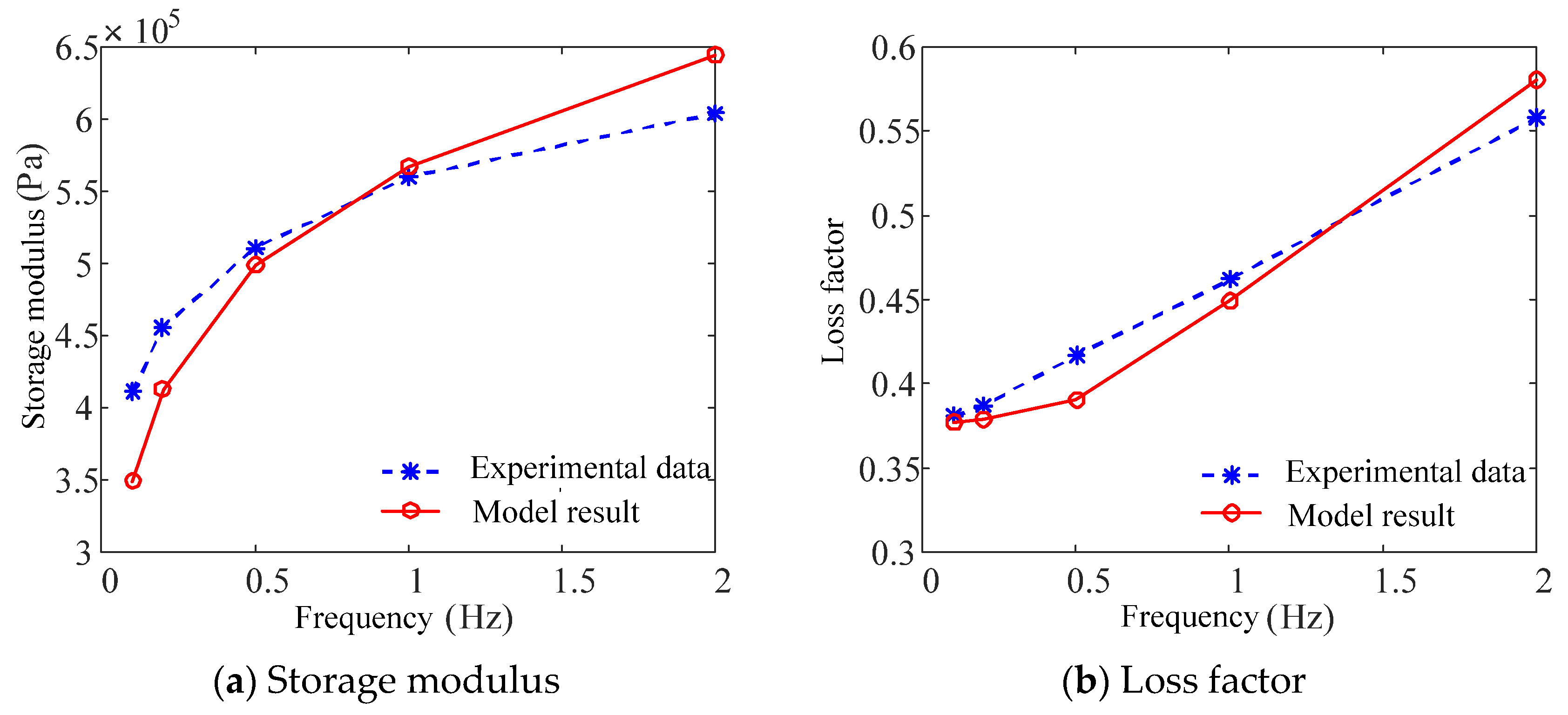
The fitted model parameters were used to calculate the storage modulus and loss factor of the precast viscoelastic damper under other working conditions to analyze the accuracy of the model in describing the mechanical performance of the precast viscoelastic damper. Figure 2 presents a comparison curve between the experimental data and model-calculated values of the mechanical performance of the precast viscoelastic damper at a displacement amplitude of 4 mm. It can be observed from the figure that the model-calculated results for the storage modulus and loss factor of the viscoelastic damper align well with the experimental results. As illustrated in Figure 2a, when the frequencies were 0.1 Hz, 0.2 Hz, 0.5 Hz, 1 Hz, and 2 Hz, the model-calculated storage modulus values were 0.35 MPa, 0.41 MPa, 0.5 MPa, 0.57 MPa, and 0.64 MPa, with errors compared to the experimental results of 14.96%, 9.44%, 2.34%, 1.31%, and 6.73%, respectively. As illustrated in Figure 2b, the model-calculated loss factor values were 0.377, 0.379, 0.39, 0.449, and 0.581, with errors of 1.08%, 2.04%, 6.36%, 2.73%, and 4.1% compared to the experimental results. Therefore, it can be concluded that this mechanical model accurately reflects the variation in equivalent dynamic mechanical performance parameters of the precast viscoelastic damper with loading frequency.
Based on the model calculation results of the dynamic mechanical performance of assembled viscoelastic dampers under different working conditions, hysteresis curves of corresponding forces and displacements can be derived. By establishing a local coordinate system at the center of the ellipse, the relationship between shear strain and shear stress over time in the local coordinate system can be written as follows based on equivalent mechanical performance parameters:
γ ( t ) = 1 2 γ max e i ω t .
τ ( t ) = G ( i ω ) e i ( ω t + φ ) = G 1 ( ω ) 2 + G 2 ( ω ) 2 sin ( ω t + φ ) .
φ = arctan η ( ω ) = arctan G 2 ( ω ) G 1 ( ω ) .
where ω is the circular frequency of the loading condition; γ max is the maximum shear strain corresponding to the loading condition, G 1 ( ω ) and G 2 ( ω ) are the equivalent energy storage and dissipation moduli calculated theoretically, and φ is the phase difference between nominal stress and equivalent strain, reflecting the hysteresis effect between stress and strain and related to the equivalent loss factor. Based on the equivalent mechanical performance results obtained from theoretical calculations, the relationship curve between the equivalent strain and nominal stress in the local coordinate system can be obtained according to the above formula. Then, the equivalent strain can be transformed into the global coordinate system according to the loading conditions to obtain the theoretical calculation results of the equivalent hysteresis curve under each working condition.
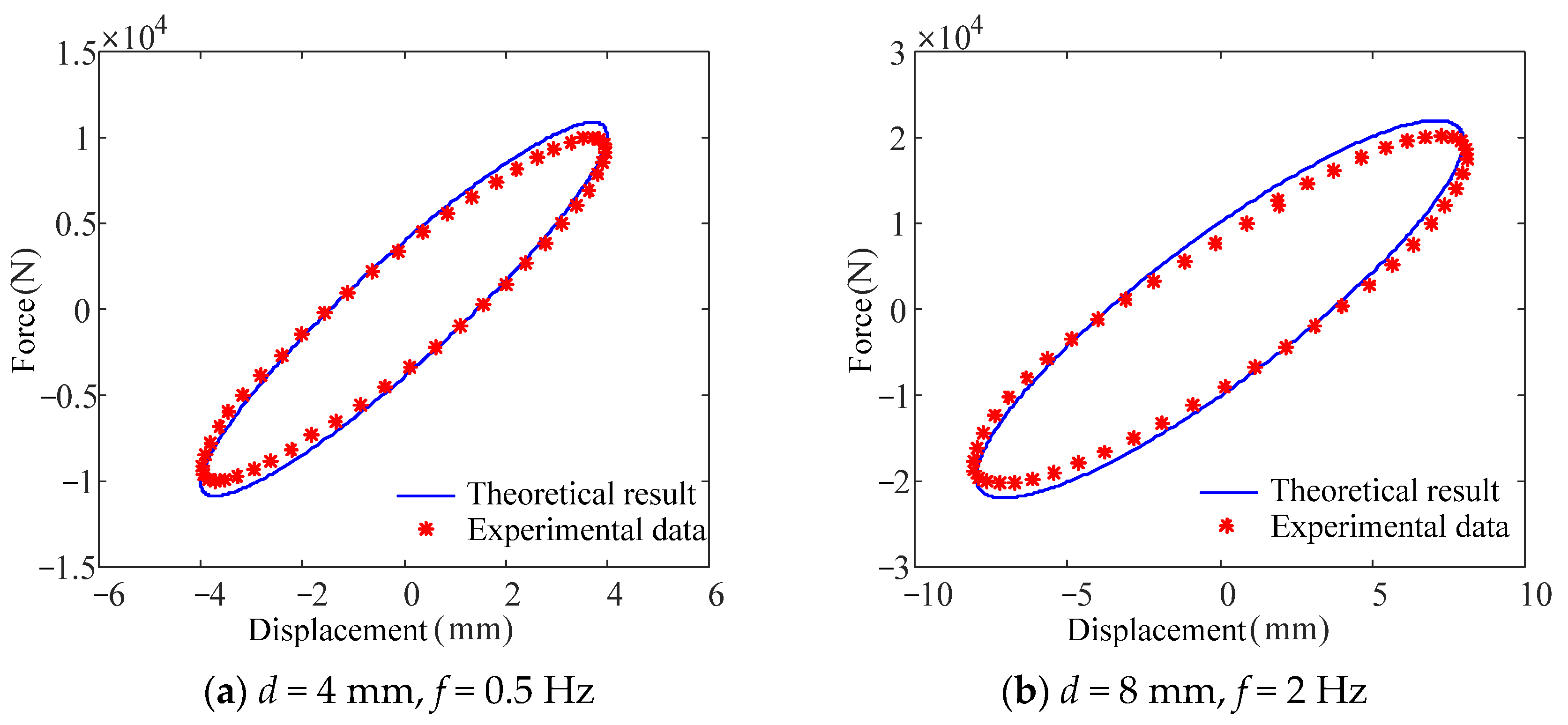
Figure 3 compares the hysteresis curves predicted by the theoretical model with the corresponding experimental results under several representative operating conditions. It can be seen that the hysteresis curves of the assembled viscoelastic damper calculated by the model are in good agreement with the original hysteresis curves, indicating that the proposed mechanical model can also effectively reflect the corresponding relationship between force and displacement of the assembled viscoelastic damper. This establishes an important foundation for the dynamic response analysis and optimization of viscoelastic damping structures in the following section.

3. Optimization of Viscoelastic Damping Structural System

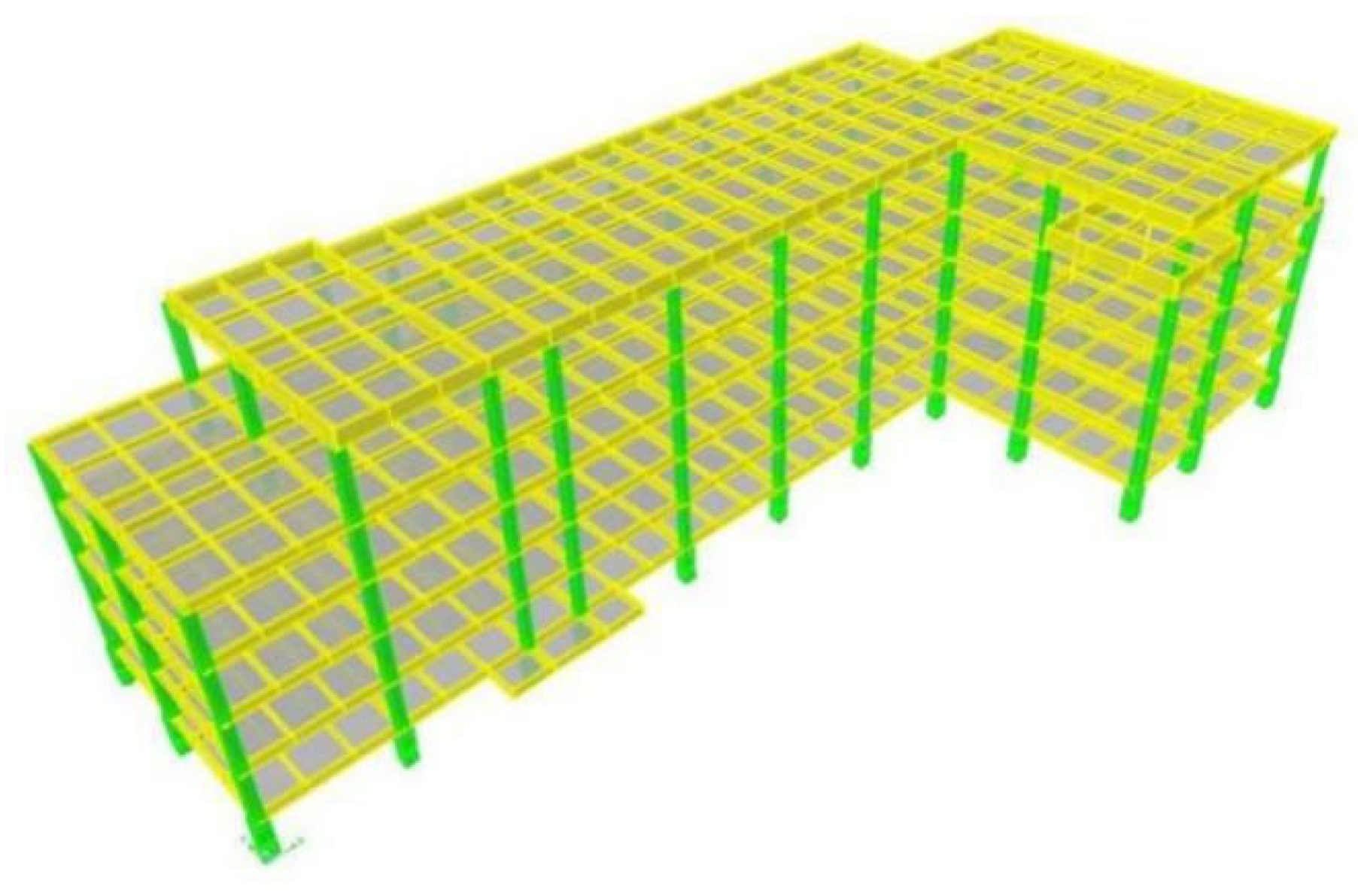
In practical engineering design, considering the complexity of the actual project, the arrangement of viscoelastic dampers will have a significant impact on the seismic reduction effect. Therefore, based on the Yunnan primary school project, the Matlab OpenSEES joint programming method will be adopted, and the layout of viscoelastic dampers on each floor of the structure will be optimized and designed based on a genetic algorithm. Figure 4 illustrates the framework of a seismic mitigation project at a primary school in Yunnan Province.
The investigated structure is a six-story reinforced-concrete frame building with an L-shaped plan, measuring 78 m in the longitudinal direction and 18 m in the transverse direction. The total height is 22.4 m, with a first-story height of 1.6 m, a top-story height of 5.2 m, and a height of 3.9 m for the intermediate stories. The typical beam cross-sections are 200 mm × 500 mm and 300 mm × 700 mm, while those of the column cross-section are 600 mm × 600 mm and 700 mm × 700 mm. A fully three-dimensional nonlinear model was established in OpenSEES using nonlinear beam-column elements with fiber-discretized sections. The nonlinear responses of concrete and reinforcing steel were represented by the Concrete02 and Steel01 material models, respectively. The floor slabs were assumed to act as rigid diaphragms, while their self-weight and imposed loads were converted into equivalent loads applied to the supporting beams. The seismic mass was determined from the dead load and 50% of the live load and assigned to the corresponding floor nodes. All column bases were fully restrained in the translational and rotational degrees of freedom using the fix command. Gravity loads were first applied through a static analysis, and P-Delta effects were considered by assigning the PDelta geometric transformation to the column elements, thereby accounting for the additional moments induced by gravity loads and lateral structural displacements. Rayleigh damping was adopted, with the coefficients calibrated to provide a damping ratio of 5% for the first two vibration modes. The fundamental period of the numerical model was 1.02 s. The building was designed for a seismic intensity of 8 degrees, a design peak ground acceleration of 0.20 g, Site Class III, the third design earthquake group, and a characteristic period of 0.65 s, and was classified as a key-fortified Class-B building.

3.1. Introduction to Genetic Algorithm

This section presents the optimization of viscoelastic damper placement in structures using a genetic algorithm. Genetic algorithm is an adaptive probabilistic optimization technique based on biological genetics and evolutionary mechanisms, suitable for optimizing complex systems. This method is suitable for the optimization design of complex systems and has wide applications in fields such as function optimization, automatic control, and machine learning. Genetic algorithms can simulate phenomena such as chromosome duplication, crossover, and gene mutations in biological genetics, and ultimately evolve to the optimal population according to natural selection rules.
Compared with traditional optimization algorithms based on single point search, genetic algorithm is an efficient global search algorithm that is not limited to specific problems and is not easily trapped in local optimal solutions; Meanwhile, the pattern theorem and building block assumption of genetic algorithm also ensure that it can converge in a better direction, thereby finding the global optimal solution of the problem. Therefore genetic algorithm is selected to optimize the arrangement of viscoelastic dampers in the structure, which is a simple, practical, and efficient calculation method.
Table 3 compares the characteristics and applicability of different optimization algorithms. Although RCGA, PSO, and DE exhibit good performance in continuous optimization problems, the design variables considered in this study represent the number of viscoelastic dampers installed in each predefined region, which are discrete integer variables. Therefore, the binary-coded genetic algorithm is adopted because it can directly represent the damper layout scheme without additional discretization procedures, making it more suitable for the optimization problem investigated in this study.

3.2. Optimization Layout Process

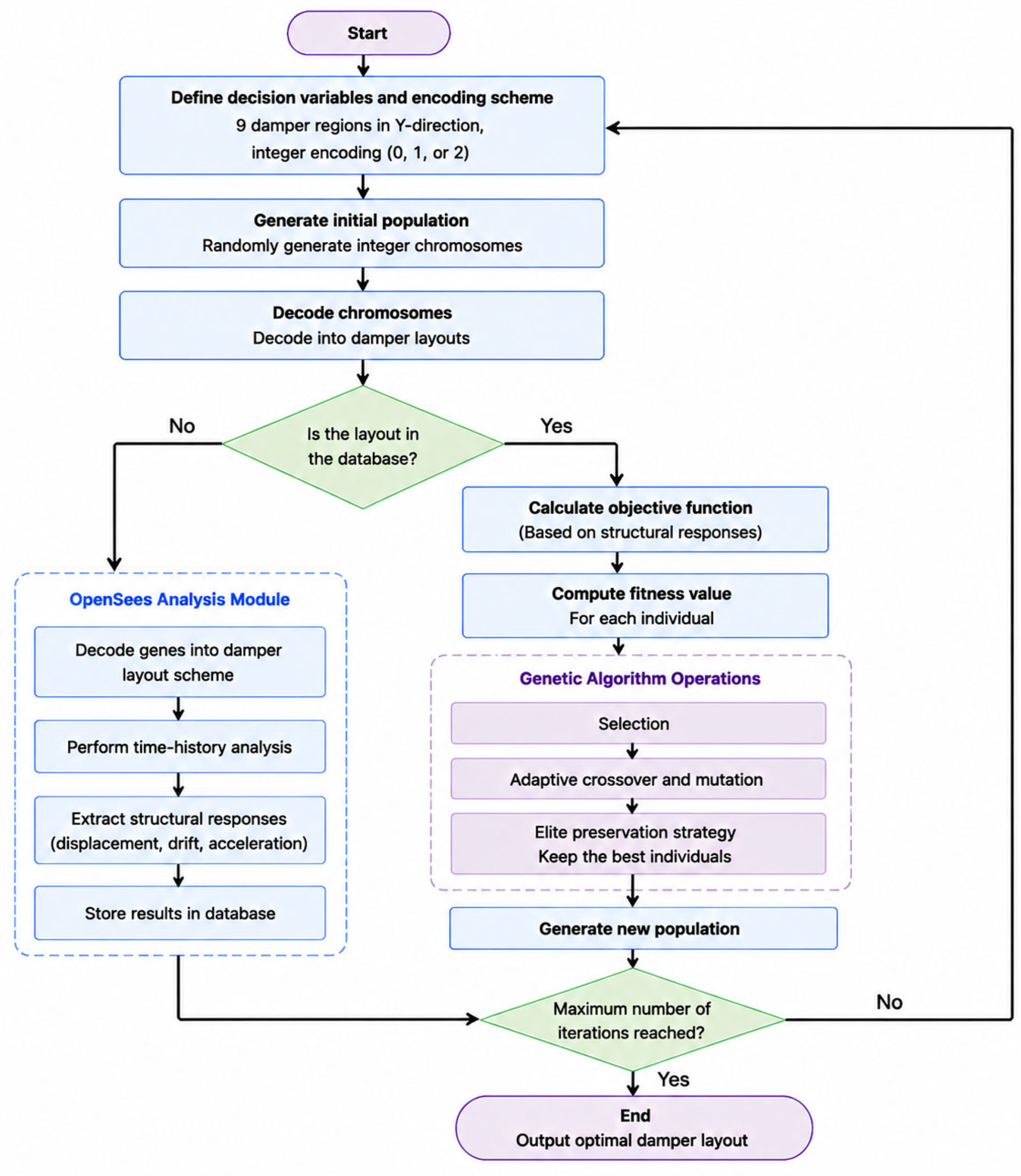
The optimization of viscoelastic dampers is mainly based on Matlab OpenSEES joint programming. A finite element model of the viscoelastic damping structure was first built in OpenSees, after which a genetic optimization algorithm was programmed in Matlab. Through Matlab software, the arrangement of viscoelastic dampers on each layer of the structure can be generated, and then OpenSEES can be called for model analysis based on the arrangement. Finally, the analysis results of OpenSEES were read using Matlab, and the objective function corresponding to each arrangement was calculated. The genetic algorithm was used to iteratively process each group, ultimately generating the optimal arrangement of the viscoelastic damper device. Figure 5 shows the detailed process of Matlab OpenSEES joint optimization and the main steps are briefly introduced below.
(1)
Encoding method
In OpenSEES, viscoelastic dampers are built on diagonal nodes of the framework, but in genetic algorithm calculations, it is not possible to directly process the numbering information of each node. Therefore, it is necessary to establish a coding method based on node information. Replace the node number corresponding to the viscoelastic damper with the corresponding chromosome sequence using Matlab, and then use genetic algorithm for calculation. In traditional genetic algorithms, chromosome sequences are usually encoded in binary form, where each group of genes on the chromosome is represented by 0 or 1. Based on this method, the arrangement position of viscoelastic dampers in the framework can be defined as 1, and the position where viscoelastic dampers are not arranged can be defined as 0, and then the chromosome sequences corresponding to each arrangement method can be obtained. However, in the engineering structure studied in this article, if this method is used, it will result in excessive computational complexity, causing the genetic algorithm to fail to converge. Therefore, in order to make the calculation both accurate and efficient, this article adopts the integer chromosome encoding method.
Based on the analysis of the dynamic response of the viscoelastic damping structure, adding viscoelastic dampers can effectively reduce the dynamic response of the structure in all directions. However, compared to the X direction, the damping effect in the Y direction is slightly worse for the existing layout scheme. In fact, according to the structural characteristics, there are many places where viscoelastic dampers can be installed in the Y direction, so it is more necessary to optimize the layout of viscoelastic dampers in the Y direction.
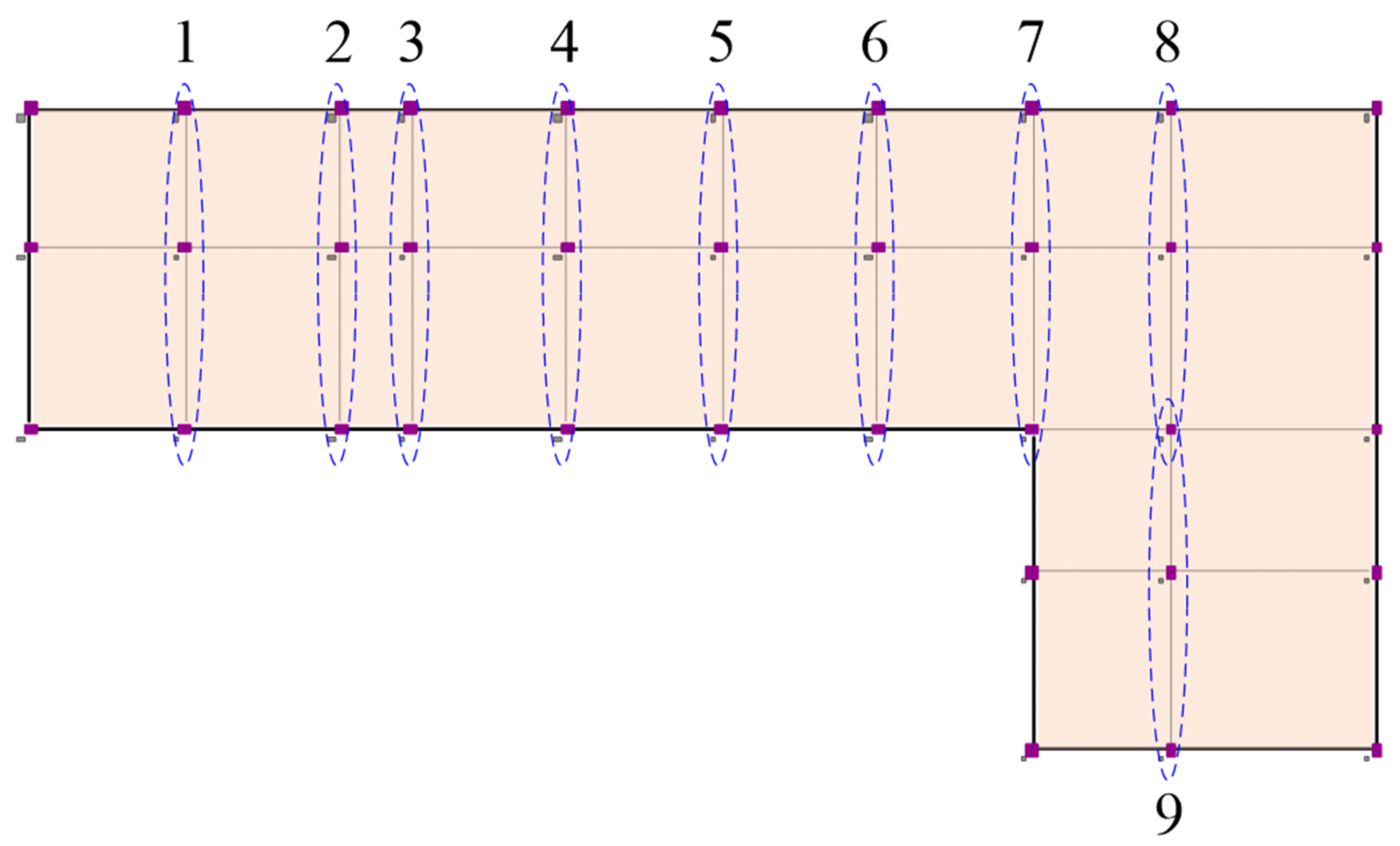
Figure 6 shows the distribution of structural framework columns. As shown in the figure, considering the aesthetic requirements during use, viscoelastic dampers should not be installed on the outermost side of the structure. Therefore, there are 18 positions in the Y direction where viscoelastic dampers can be installed, divided into 9 areas by grouping them in pairs. In the process of chromosome encoding, each region can be regarded as a gene, and the number corresponding to each gene is the number that should be arranged in that region. For example, if the chromosome sequence corresponding to an individual is 211012001, it means that there are no viscoelastic dampers installed in regions 4, 7, and 8. Arrange one viscoelastic damper in zones 2, 3, 5, and 9, two viscoelastic dampers in zones 1 and 6, and eight viscoelastic dampers on each floor of the structure. At the same time, in order to ensure the functional use of the building after adding viscoelastic dampers, dampers should be avoided as much as possible from being arranged in the corridors inside the building, that is, in locations with large spans in various areas. Therefore, if only one damper is installed in a certain area, it should be set within the smaller span of two frames. If two dampers are installed, viscoelastic dampers are installed on both frames in that area. According to the above coding scheme, it is possible to effectively establish the relationship between the node numbers of the damper arrangement model and the chromosome sequences corresponding to the genetic algorithm in Matlab.
(2)
Selection, crossover, and mutation methods
Selection, crossover, and mutation operations are key steps in genetic algorithm optimization, and they are also crucial for genetic algorithm convergence to obtain the optimal solution. The selection operation determines the fitness of each individual in the current population based on the calculated objective function value, and then selects better individuals to be retained in the next generation according to the size of the fitness, while selecting individuals with poor fitness to be eliminated. The commonly used selection methods include roulette wheel, sorting selection, and non random substitution. The roulette wheel method, also known as the proportional selection method, was first proposed by Professor Holland, which is used to select various chromosome groups in the calculation. Due to its simple principle and easy operation, it is currently the most commonly used selection method. The roulette wheel method takes the ratio of the fitness of each individual in the group to the sum of the fitness of all individuals in the group as the probability of individual selection, and determines whether to choose an individual by generating a random number.
In this study, the design variables are defined as the number of viscoelastic dampers installed in each predefined region. The chromosome used in the genetic algorithm represents a complete damper layout scheme, where each gene corresponds to one installation region and its value represents the number of dampers assigned to that region.
During chromosome decoding, the gene sequence is converted into specific damper locations according to the predefined relationship between regions and OpenSees node numbers. The decoded layout is then automatically transferred to the OpenSees model for dynamic analysis.
Several constraints are considered during the optimization process. First, the regions located at the outermost side of the structure are excluded from the candidate installation regions due to architectural requirements. Second, the number of dampers assigned to each region is restricted to a maximum value of two according to the installation configuration. Third, to avoid affecting functional spaces such as corridors, when only one damper is assigned to a region, it is placed at the smaller-span frame, while two dampers are symmetrically arranged at both frames. These constraints are embedded into the encoding and decoding procedures, ensuring that all generated chromosomes correspond to feasible damper layout schemes.
Crossover and mutation operations are both processes of generating new individuals based on individuals in the current population. Crossover operation is the process of combining individuals in a population by exchanging partial chromosome sequences to form new individuals, while mutation operation is the process of randomly changing the values of certain genes in individuals to generate new individuals. Both crossover and mutation operations essentially conform to the laws of biological evolution, helping to maintain individual diversity in various populations and further improving the algorithm’s random search ability. Due to the fact that crossover and mutation operations are based on a certain probability, the selection rate of crossover and mutation has a significant impact on the convergence speed and computational accuracy of genetic algorithms. Therefore, in the optimization, the standard fitness F0 of the population can be calculated using Formula (7), and then the probabilities of crossover and mutation can be dynamically determined by comparing the fitness of each individual with the standard fitness.
F 0 = α min ( F i ) + β max ( F i ) i = 1 , 2 , , n .
where Fi represents the fitness of each individual in the population; α and β are corresponding weight coefficients. If an individual’s fitness is greater than F0, a higher probability of crossover and mutation will be used, otherwise, a lower rate of crossover and mutation will be used. The fitness value Fi is obtained from the structural response calculated by OpenSees. The proposed adaptive crossover and mutation probabilities are determined by comparing each individual’s fitness with the population reference fitness F0.
To prevent the optimal individuals in the population from being lost in selection, crossover, and mutation operations, thereby affecting the efficiency of optimization, an elite retention strategy can be added to genetic algorithms. That is, before each operation, a randomly selected individual with the highest fitness from the population is directly retained to the next generation, and then corresponding operations are performed on the remaining individuals in the population.
(3)
Improvement of algorithm running efficiency
Although genetic algorithms themselves can converge more accurately to the optimal solution of a problem, they also have a significant computational burden, requiring model analysis and fitness calculations for individuals in each generation of the population. In previous structural optimization problems, the analyzed objects were mainly planar structures, and the time for a single operation was very short. Therefore, genetic algorithms can be directly used to converge to the desired results in a short period of time. However, the Yunnan primary school project analyzed in this section is an actual three-dimensional structure. To ensure accurate results in a relatively short period of time, it is necessary to improve traditional genetic algorithms.
To establish chromosome libraries for individuals appearing in different populations, the chromosome library can be searched before each call to OpenSEES for model analysis. If an individual exists in the chromosome bank, the corresponding fitness value can be directly read. Only when an individual has never been computed, OpenSEES will be called for analysis, and the analysis results will be further added to the chromosome library. Based on this method, it can effectively avoid the phenomenon of repeated calculations in the offspring population, greatly improving the optimization and analysis efficiency of the algorithm.
Although genetic algorithms themselves have a certain degree of completeness, in fact, the fitness calculation of each individual in the same generation population is independent of each other. Therefore, parallel computing methods can be introduced into genetic algorithms to simultaneously perform model analysis on multiple individuals in the population using different CPUs. The parallel computing process based on Matlab and OpenSEES using genetic algorithm is shown in Figure 7. Firstly, Matlab can be used in the main controller to generate a viscoelastic damper arrangement scheme corresponding to each individual in the population. Then, by calling OpenSEES in different servers, dynamic response analysis is performed on each individual server. Finally, the main controller reads the calculation results of each individual and iteratively uses genetic algorithm to determine the optimal arrangement of dampers according to the process shown in Figure 5.
By establishing a chromosome library and using parallel computing methods, the computation time can be greatly reduced. On this basis, the optimization efficiency of genetic algorithm is greatly improved, which also makes the key problem analyzed in this work, namely the optimization of the position of viscoelastic dampers for actual engineering structures, feasible for operation.

3.3. Discussion on the Optimization Layout Results of Viscoelastic Dampers

The specific process of optimizing the layout of viscoelastic dampers in practical engineering structures based on Matlab OpenSEES joint programming method and genetic algorithm was introduced above. Based on the above methods, select an appropriate objective function to optimize the specific layout of viscoelastic dampers in Yunnan primary school engineering.
Considering the seismic control effect of viscoelastic dampers, the acceleration and interstory displacement angle of the top layer of the structure can be used as optimization objectives. In addition, the planar shape of the Yunnan primary school studied in this chapter is L-shaped, and there is a deviation in the planar positions of the mass center and stiffness center of the structure. Due to the asymmetry of the structure, even under horizontal unidirectional seismic action, torsional effects may occur due to asynchronous deformation in the long and short span directions. Therefore, when optimizing the position of viscoelastic dampers, it is necessary to further consider the influence of damper arrangement on structural torsion.
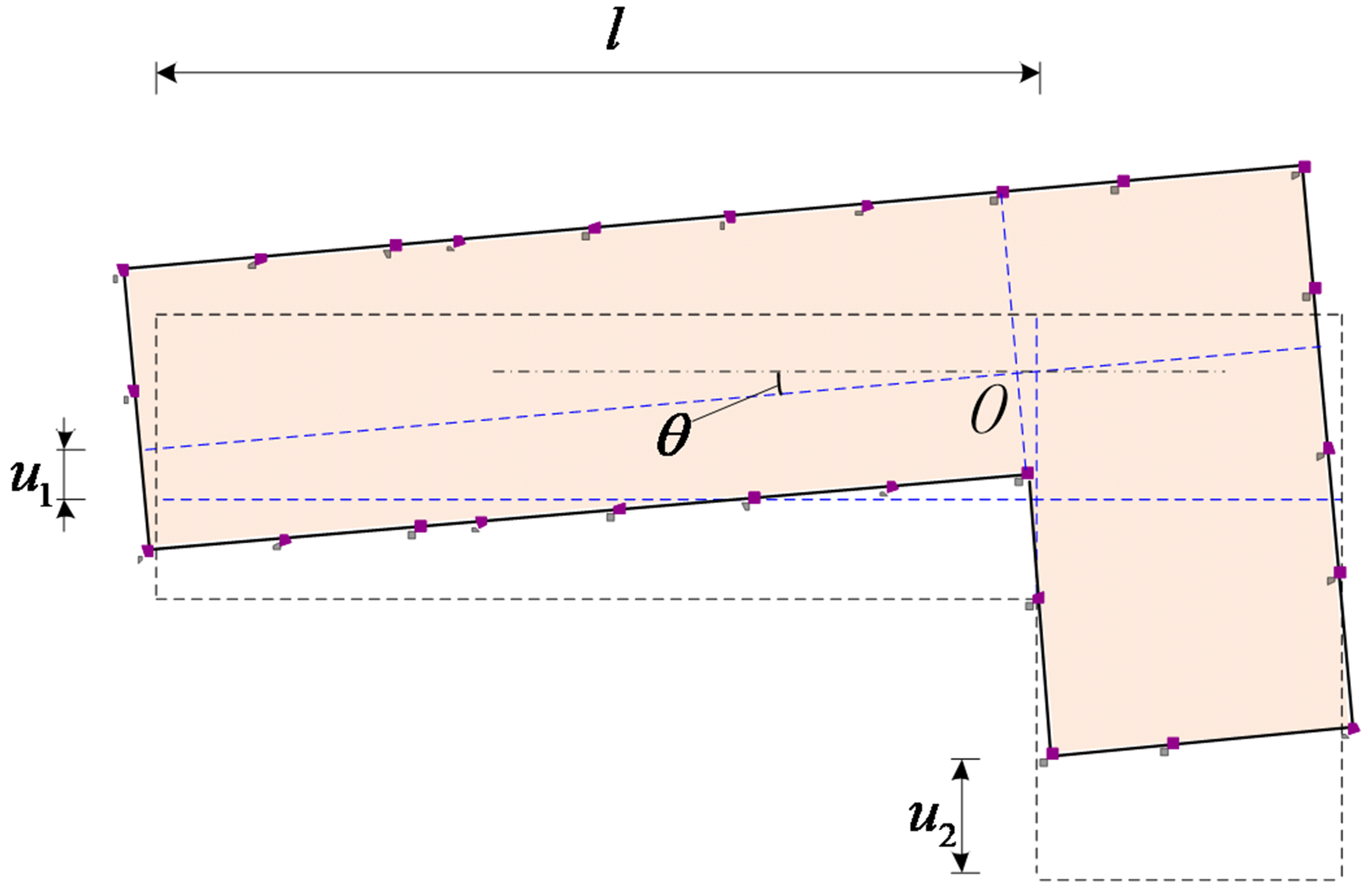
As shown in Figure 8, point O is the center of mass of the structure, and the rotation angle of the structure under the earthquake action in the Y direction can be calculated according to Equation (8):
θ u 2 u 1 l × 100 % .
where u1 is the displacement of the leftmost frame at the top of the Y-direction structure, u2 is the displacement of the center of mass at the top of the structure in the Y direction, and l is the distance from the center of mass to the leftmost frame of the structure. According to the calculation expression for the relative rotation angle given in Equation (8), the optimization objective function that simultaneously considers the acceleration at the top of the structure, the interstory displacement angle, and the rotation angle is obtained.
Z = min f ( i )
f ( i ) = α Δ u M i d , i Δ u M i d , min Δ u M i d , max Δ u M i d , min + β a T o p , i a T o p , min a T o p , max a T o p , min + γ θ i θ min θ max θ min
The optimization problem can be formulated as a discrete optimization problem. The objective is to determine the optimal arrangement of viscoelastic dampers by minimizing the objective function Z(X). The mathematical formulation is expressed as:
minX Z(X)
Subject to:
xi ∈ {0,1}, i = 1, 2, …, n
Σ ( i = 1 ) n x i = N d
where X = {x1, x2, …, xn} denotes the decision variable set representing the arrangement of viscoelastic dampers along the height of the structure. xi = 1 indicates that a viscoelastic damper is installed at the i-th story, whereas xi = 0 indicates that no damper is installed at the i-th story. Nd represents the total number of installed dampers. These constraints ensure that the number of dampers remains constant during the optimization process and that the installation status of each story is properly defined.
where Δ u M i d , i represents the maximum interstory displacement of the structure in the i-th arrangement of viscoelastic dampers, Δ u M i d , max and Δ u M i d , min represent the maximum and minimum values of the maximum interstory displacement of the structure under various arrangement schemes, a T o p , i represents the top layer acceleration of the structure in the i-th arrangement of viscoelastic dampers, while a T o p , max and a T o p , min represent the maximum and minimum values of the top layer acceleration of the structure under various arrangement schemes, respectively; θ i represents the structural torsion angle in the viscoelastic damper arrangement scheme, and θ max and θ min represent the maximum and minimum values of the structural torsion angle under various arrangement schemes, respectively; α , β and γ are the weight coefficients of the interstory displacement angle, top floor acceleration, and torsion angle in the optimization objective function, respectively. Considering the influence of torsion factors on L-shaped buildings, the values of α , β and γ are 0.3, 0.3, and 0.4, respectively.
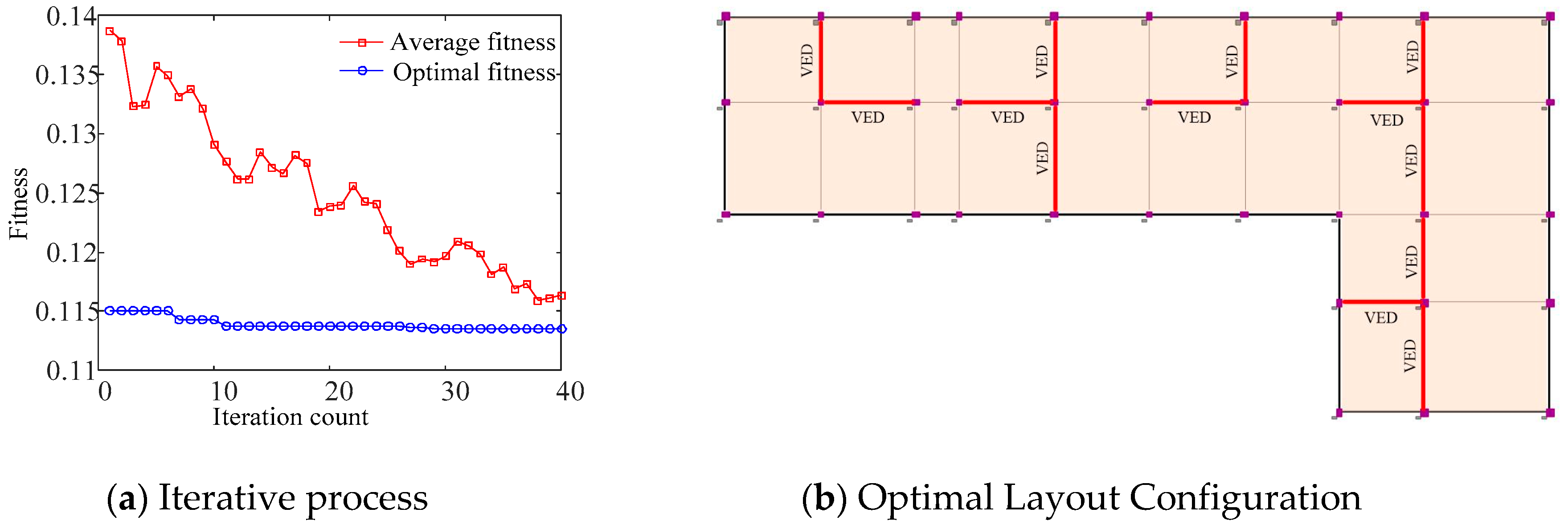
Optimize the arrangement of viscoelastic dampers using a genetic algorithm based on the objective function given in Equation (10). During optimization, a total of 8 viscoelastic dampers were set in the Y direction. The population size and total number of iterations were set to 40 for each calculation, and EI Centro waves were uniformly selected for analysis during optimization.
Figure 9 shows the iterative process of genetic algorithm optimization and the corresponding optimal arrangement of viscoelastic dampers. As shown in Figure 9a, during the optimization process, the genetic algorithm converges quickly in the early stage and then tends to stabilize. The average value of the population also gradually converges towards the optimal value, indicating that the algorithm is relatively reliable. As shown in Figure 9b, the optimal chromosome sequence obtained through optimization is 100201022, and the corresponding optimal fitness of the objective function is 0.113.
To further validate the effectiveness and reliability of the proposed optimization strategy, three representative earthquake excitations, including the El Centro record, the Taft record, and an artificial ground motion, were selected for seismic response analysis. The El Centro earthquake is one of the most widely used near-field ground motions in structural seismic studies and is characterized by strong amplitude and significant impulsive characteristics. The Taft record represents another typical historical earthquake excitation with different frequency characteristics and duration effects, which can provide a complementary evaluation of structural dynamic responses. In addition, the artificial ground motion was adopted to reflect the characteristics of design-level seismic excitations and to further examine the robustness of the optimized damper arrangement under synthesized ground motion conditions. Therefore, these three earthquake excitations cover different seismic characteristics, including recorded near-field motions, historical earthquake records, and artificial design motions, providing a representative basis for evaluating the effectiveness of the proposed optimization method. Considering the scope and focus of this study, these three typical excitations were selected to verify the reliability of the optimization strategy.
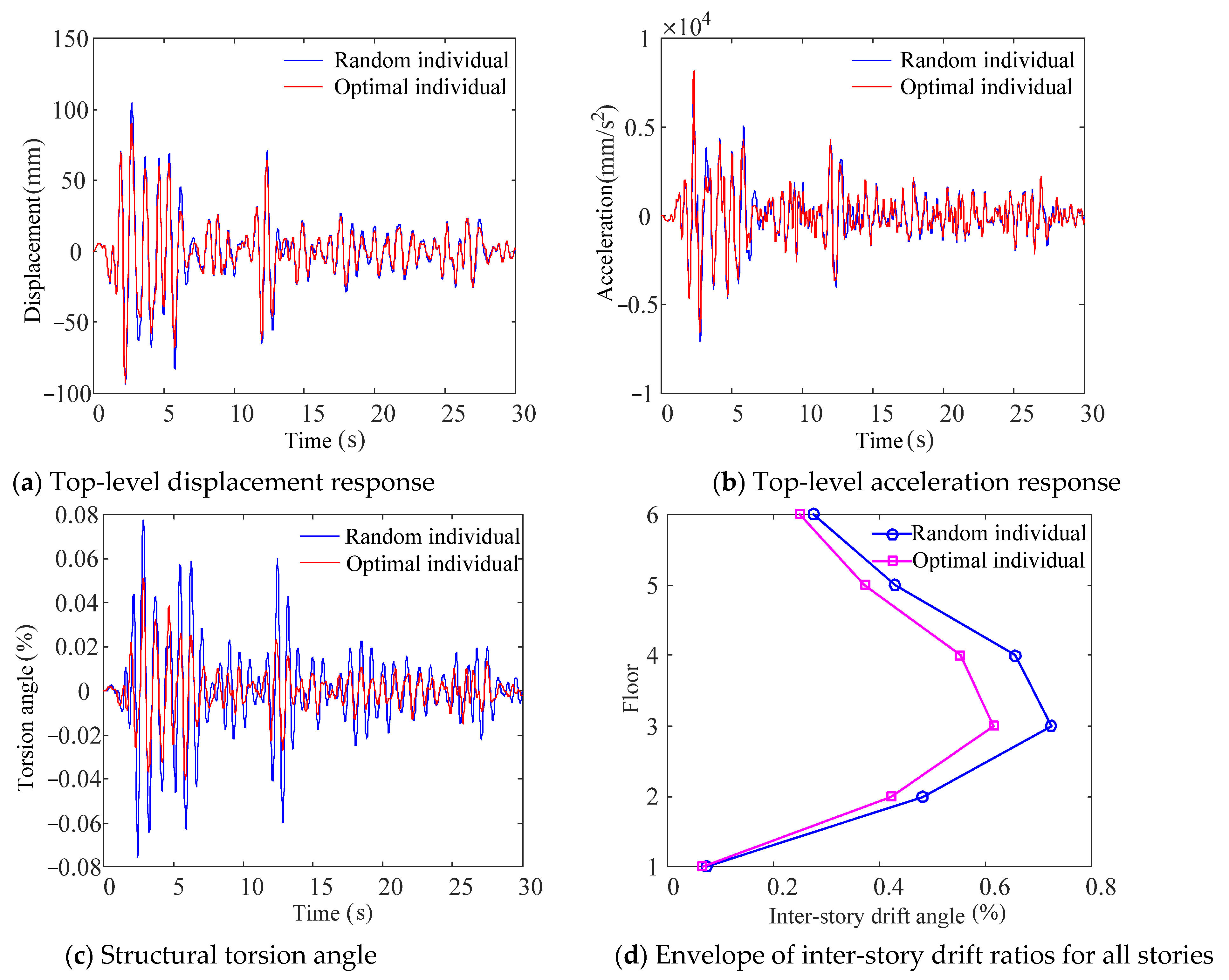
To validate the proposed optimization strategy for viscoelastic dampers, the El Centro earthquake excitation was adopted to investigate the dynamic responses of the structure with random and optimized damper layouts, together with the uncontrolled structure. According to Figure 10a, under the optimal arrangement scheme, the maximum displacement response of the top layer of the structure is 90.2 mm, which is 13.4% lower than the maximum displacement of 104.2 mm in the random arrangement; According to Figure 10b, under the optimal arrangement scheme, the maximum acceleration response of the top layer of the structure is 7.66 m/s2, which remains basically unchanged compared to the maximum relative displacement of 7.71 m/s2 of the top layer of the structure when randomly arranged. This is because the viscoelastic damper increases the lateral stiffness of the structure due to its own stiffness, making it difficult for the acceleration response of the structure to decrease; According to Figure 10c, the peak torsion angle of the structure in the optimal arrangement scheme is 0.051%, which is a decrease of 34.2% compared to the peak torsion angle of 0.077% in the random arrangement scheme; Furthermore, as shown in Figure 10d, compared with the random arrangement scheme, the maximum interstory displacement angle of each layer in the optimal arrangement scheme is significantly reduced. Specifically, under the random arrangement scheme of viscoelastic dampers, the maximum interstory displacement angles of the first to sixth floors in the Y direction of the structure are 0.074%, 0.48%, 0.72%, 0.65%, 0.43%, and 0.28%, respectively. Under the optimal scheme, the maximum interstory displacement angles of each floor are 0.066%, 0.42%, 0.61%, 0.55%, 0.37%, and 0.25%, which are reduced by 10.8%, 12.5%, 15.3%, 15.4%, 14.0%, and 10.7%, respectively.
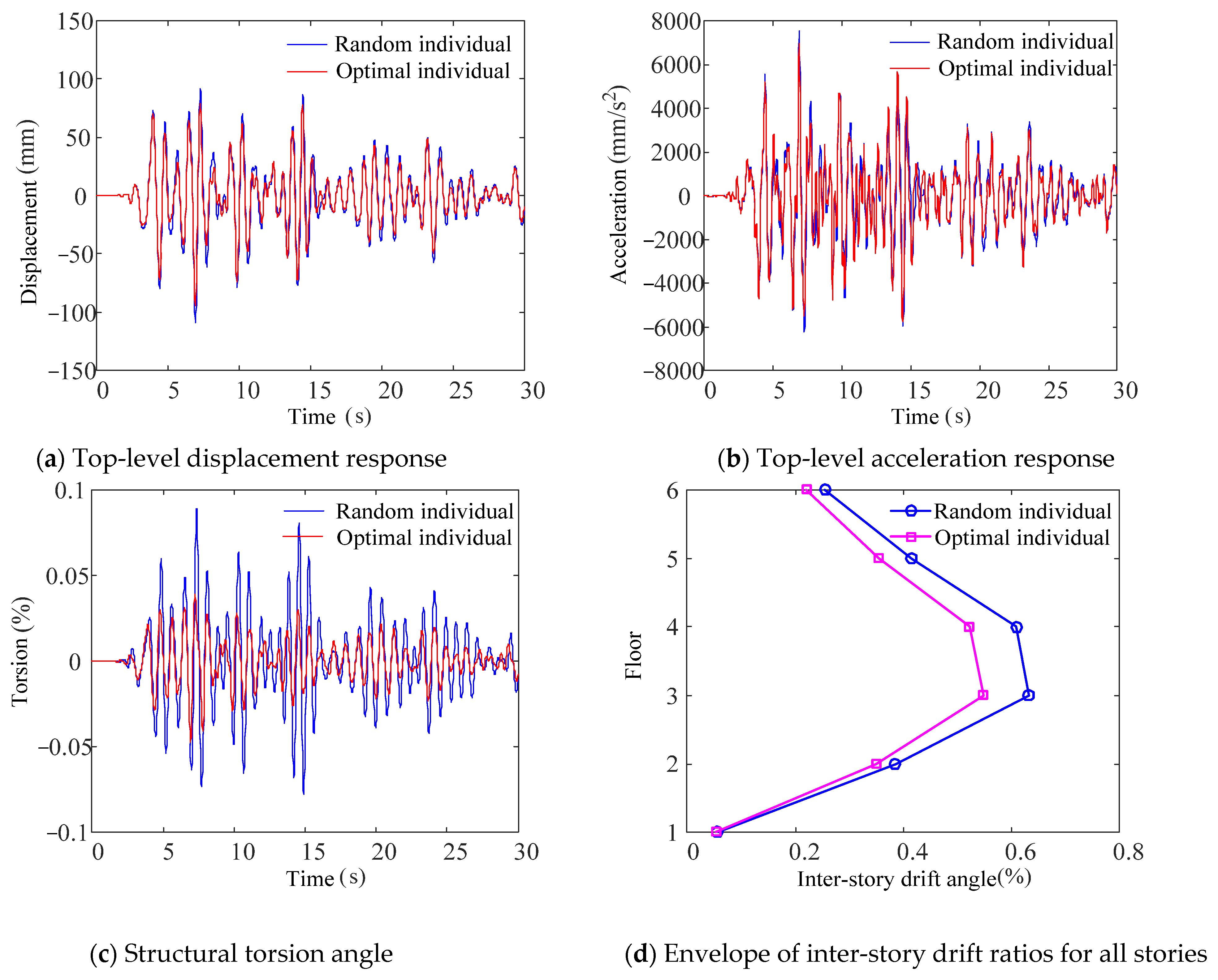
To verify the optimization effect of viscoelastic dampers, the Taft wave was selected to compare and analyze the dynamic response of the random and optimal schemes of the structure before optimization arrangement. According to Figure 11a, under the optimal arrangement scheme, the maximum displacement response of the top layer of the structure is 94.8 mm, which is 12.7% lower than the maximum displacement of 108.6 mm in the random arrangement; According to Figure 11b, under the optimal arrangement scheme, the maximum acceleration response of the top layer of the structure is 6.94 m/s2, which is 8.0% lower than the maximum relative displacement of 7.54 m/s2 of the top layer of the structure when randomly arranged. According to Figure 11c, the peak torsion angle of the structure in the optimal arrangement scheme is 0.047%, which is a decrease of 47.2% compared to the peak torsion angle of 0.089% in the random arrangement scheme. Furthermore, as shown in Figure 11d, compared with the random arrangement scheme, the maximum interstory displacement angle of each layer in the optimal arrangement scheme is significantly reduced. Specifically, under the random arrangement scheme of viscoelastic dampers, the maximum interstory displacement angles of the first to sixth floors in the Y direction of the structure are 0.06%, 0.38%, 0.63%, 0.61%, 0.42%, and 0.26%, respectively. Under the optimal scheme, the maximum interstory displacement angles of each floor are 0.05%, 0.35%, 0.55%, 0.52%, 0.35%, and 0.22%, respectively, reducing by 16.7%, 7.9%, 12.7%, 14.7%, 16.7%, and 15.4%.
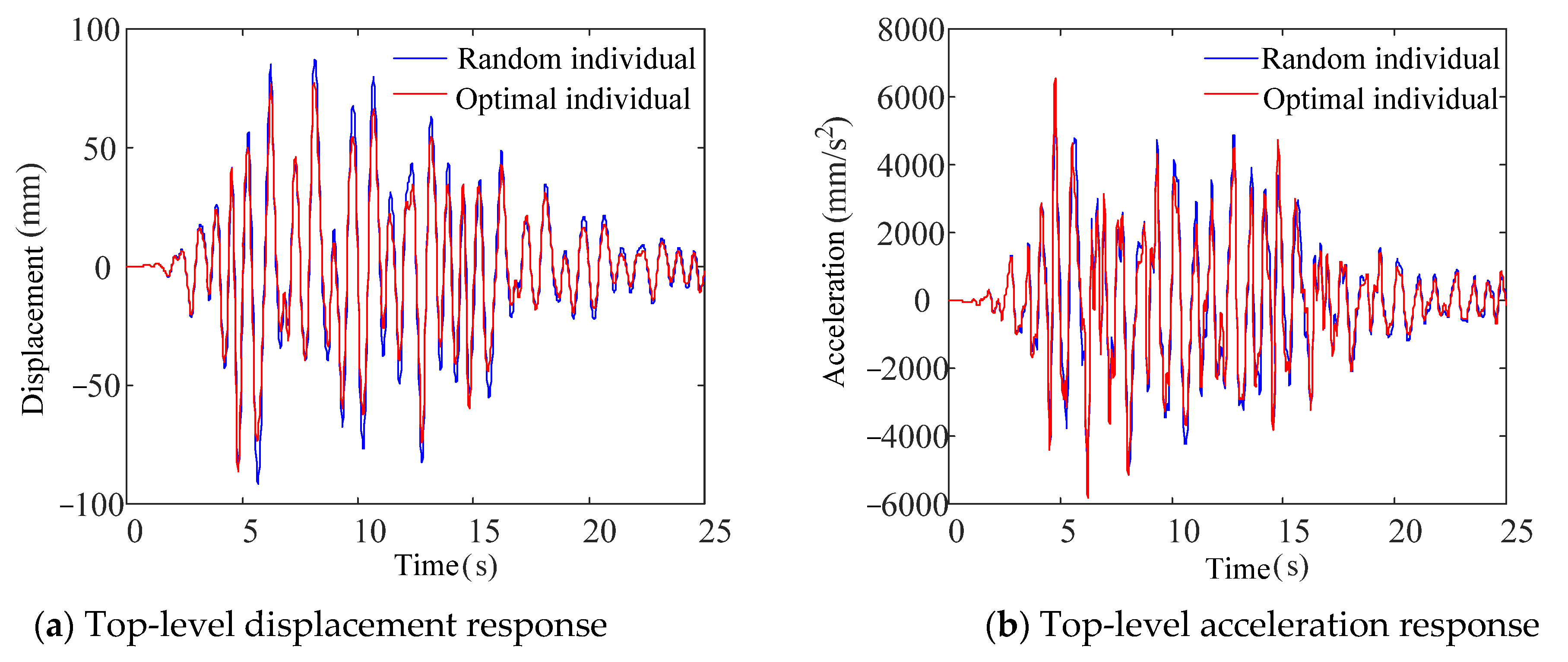
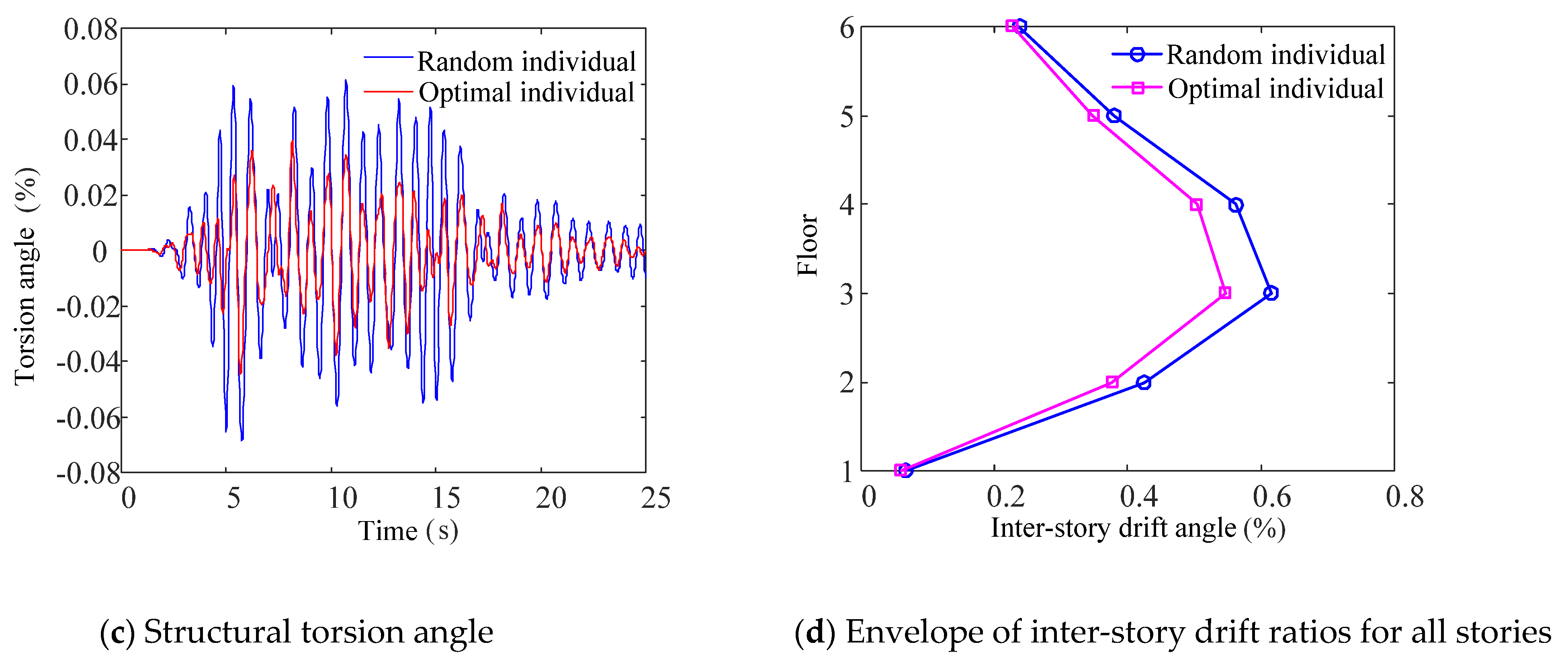
To verify the optimization effect of viscoelastic dampers, the artificial wave was selected to compare and analyze the dynamic response of the random and optimal schemes of the structure before optimization arrangement. According to Figure 12a, under the optimal arrangement scheme, the maximum displacement response of the top layer of the structure is 85.9 mm, which is 6.2% lower than the maximum displacement of 91.6 mm in the random arrangement; According to Figure 12b, under the optimal arrangement scheme, the maximum acceleration response of the top layer of the structure is 6.48 m/s2, which remains basically unchanged compared to the maximum relative displacement of 6.39 m/s2 of the top layer of the structure when randomly arranged; According to Figure 12c, the peak torsion angle of the structure in the optimal arrangement scheme is 0.045%, which is a decrease of 34.8% compared to the peak torsion angle of 0.069% in the random arrangement scheme. Furthermore, as shown in Figure 12d, compared with the random arrangement scheme, the maximum interstory displacement angle of each layer in the optimal arrangement scheme is significantly reduced. Specifically, under the random arrangement scheme of viscoelastic dampers, the maximum interstory displacement angles of the first to sixth floors in the Y direction of the structure are 0.07%, 0.43%, 0.62%, 0.56%, 0.38%, and 0.24%, respectively. Under the optimal scheme, the maximum interstory displacement angles of each floor are 0.06%, 0.38%, 0.55%, 0.5%, 0.35%, and 0.23%, which are reduced by 14.3%, 11.6%, 11.3%, 10.7%, 7.9%, and 4.2%, respectively.
The results indicate that optimizing the arrangement of viscoelastic dampers effectively decreases the interstory drift ratio, roof displacement, and structural torsional angle, thereby enhancing the overall seismic performance of the structure. Compared with before optimization, the maximum interstory displacement angle can be reduced by up to 16.7%, the maximum displacement response of the top story can be reduced by 13.4%, and the peak structural torsion angle can be reduced by 47.2%. However, the seismic control effect of structural acceleration before and after optimization has not changed much.

4. Conclusions

The effectiveness of the developed viscoelastic dampers in seismic vibration control was verified by comparing the dynamic responses of structures equipped with and without dampers under natural and artificial seismic excitations. Additionally, considering the complexity and economic constraints of practical engineering, a joint programming approach using Matlab-OpenSEES was employed to maximize the seismic mitigation effect of viscoelastic dampers in structures. Based on the arrangement positions of the dampers within the structures, an optimized design was carried out. The main conclusions obtained are as follows:
(1)
The proposed optimization strategy for viscoelastic damper arrangement effectively improves the seismic performance of the structure compared with the random layout scheme. Under different earthquake excitations, the optimized layout reduces the maximum roof displacement, inter-story drift ratio, and peak torsional angle by up to 13.4%, 16.7%, and 47.2%, respectively.
(2)
When optimizing the arrangement of viscoelastic dampers using genetic algorithms, the introduction of a chromosome library and parallel computing methods can effectively accelerate program execution while ensuring optimization accuracy, enabling the optimal design of viscoelastic dampers in large-scale three-dimensional structures.
(3)
After optimization by the genetic algorithm, the top displacement, structural torsion, and story drift ratio of the viscoelastic damping structure were all reduced compared to before optimization. Among these, the optimization effect on structural torsion was the most significant, while the acceleration showed little change before and after optimization.
It should be noted that the obtained results are subject to uncertainties associated with ground motion selection, numerical modeling assumptions, and optimization parameters. Further studies involving more seismic records and experimental validations are required to improve the reliability of the proposed method. Nevertheless, this study provides an effective optimization framework for the arrangement of viscoelastic dampers, contributing to the development of efficient seismic control strategies for complex structures and offering practical guidance for engineering applications.

Author Contributions

Conceptualization, T.G.; Methodology, T.G.; Software, Z.-W.H.; Validation, W.F.; Formal analysis, T.G.; Investigation, T.G.; Resources, Y.X.; Data curation, Z.-W.H.; Writing—original draft preparation, T.G.; Writing—review and editing, W.F.; Visualization, T.G.; Supervision, Y.X.; Project administration, Y.X. All authors have read and agreed to the published version of the manuscript.

Funding

This study was financially supported by the National Science Fund for Young Scholars (Grant No. 52508342), Natural Science Foundation of Jiangsu Province (Grant No. BK20230966) and Special Funding Project of China Postdoctoral Science Foundation (Grant No. 2023TQ0105).

Institutional Review Board Statement

Not applicable.

Informed Consent Statement

Not applicable.

Data Availability Statement

The data used to support the findings of the study are available from the first author upon request.

Conflicts of Interest

The authors declare no conflicts of interest.

References

  1. Xu, Y.; Mao, M.; Huang, X.-H.; Guo, Y.-Q.; Yang, Y.; Dong, Y.-R.; Sha, S.A.A.; Gao, X.; Usman, M.; Jeong, S.-H. Comparative investigation of dynamic damping and fracture in viscoelastic dampers with two different interfacial bonding types: Molecular dynamics simulations and device tests. J. Build. Eng. 2025, 116, 114582. [Google Scholar] [CrossRef] [Scilit]
  2. Xu, Y.; He, Q.; Guo, Y.Q.; Huang, X.-H.; Dong, Y.-R.; Hu, Z.-W.; Kim, J. Experimental and Theoretical Investigation of Viscoelastic Damper by Applying Fractional Derivative Method and Internal Variable Theory. Buildings 2023, 13, 239. [Google Scholar] [CrossRef] [Scilit]
  3. Li, J.-B.; Hu, Z.-W.; Xu, Z.-D.; Guo, Y.Q. Three-dimensional dynamic analysis of ancient buildings with novel high damping isolation trenches. J. Vib. Control 2022, 28, 2409–2420. [Google Scholar]
  4. Hu, Z.-W.; Xu, Z.-D.; Zhang, L.-Y.; He, J.X.; Chen, Z.H.; Miao, Q.S.; Li, W.F. Full-scale shaking table test on a precast sandwich wall panel structure with a high-damping viscoelastic isolation and mitigation device. Eng. Struct. 2025, 329, 119797. [Google Scholar] [CrossRef] [Scilit]
  5. Tian, Y.; Hu, Z.; Guo, Y.; Zhu, L.; Dai, J.; Tao, Y.; Wang, X. Development and Modeling of a Novel Magnetorheological Elastomer Isolator in Hybrid Mode with a Compression–Shear Hybrid Fractional-Derivative Parametric Model. Sensors 2025, 25, 6376. [Google Scholar] [CrossRef] [Scilit] [PubMed]
  6. Ge, T.; Xu, Z.-D.; Yuan, F.-G. Study on experiment and modeling of viscoelastic damper considering interfacial effect of matrix rubber/carbon black. J. Eng. Mater. Technol. 2021, 143, 041003. [Google Scholar] [CrossRef] [Scilit]
  7. Ge, T.; Huang, X.-H.; Guo, Y.-Q.; He, Z.-F.; Hu, Z.-W. Investigation of Mechanical and Damping Performances of Cylindrical Viscoelastic Dampers in Wide Frequency Range. Actuators 2021, 10, 71. [Google Scholar] [CrossRef] [Scilit]
  8. Nasab, M.S.E.; Kim, J. Seismic retrofit of structures using hybrid steel slit–viscoelastic dampers. J. Struct. Eng. 2020, 146, 04020238. [Google Scholar] [CrossRef] [Scilit]
  9. Pant, D.R.; Montgomery, M.; Christopoulos, C. Full-scale testing of a viscoelastic coupling damper for high-rise building applications and comparative evaluation of different numerical models. J. Struct. Eng. 2019, 145, 04018242. [Google Scholar] [CrossRef] [Scilit]
  10. Nasab, M.S.E.; Kim, J. Fuzzy Anal. A Viscoelastic Damper Seism. Retrofit structures. Eng. Struct. 2022, 250, 113473. [Google Scholar] [CrossRef] [Scilit]
  11. Montgomery, M.; Christopoulos, C. Experimental validation of viscoelastic coupling dampers for enhanced dynamic performance of high-rise buildings. J. Struct. Eng. 2015, 141, 04014145. [Google Scholar] [CrossRef] [Scilit]
  12. Ge, X.; Azim, I.; Li, C.; Gong, J.; Liu, M.; Zhao, C. Seismic responses of structure with six-element generalized model viscoelastic dampers. Soil Dyn. Earthq. Eng. 2023, 164, 107610. [Google Scholar] [CrossRef] [Scilit]
  13. Garcia, M.; de la Llera, J.C.; Almazán, J.L. Torsional balance of plan asymmetric structures with viscoelastic dampers. Eng. Struct. 2007, 29, 914–932. [Google Scholar] [CrossRef] [Scilit]
  14. Castaldo, P.; De Iuliis, M. Optimal integrated seismic design of structural and viscoelastic bracing-damper systems. Earthq. Eng. Struct. Dyn. 2014, 43, 1809–1827. [Google Scholar] [CrossRef] [Scilit]
  15. Osabel, D.M.; Kasai, K.; Sato, D. Understanding of Full-Scale Viscoelastic Damper Behavior Under Long-Duration Loading and Formulation of Similarity Rules for Scaled Dampers. Earthq. Eng. Struct. Dyn. 2025, 54, 2690–2710. [Google Scholar] [CrossRef] [Scilit]
  16. Lavan, O. Optimal design of viscous dampers and their supporting members for the seismic retrofitting of 3D irregular frame structures. J. Struct. Eng. 2015, 141, 04015026. [Google Scholar] [CrossRef] [Scilit]
  17. Mazza, F.; Vulcano, A. Control of the earthquake and wind dynamic response of steel-framed buildings by using additional braces and/or viscoelastic dampers. Earthq. Eng. Struct. Dyn. 2011, 40, 155–174. [Google Scholar] [CrossRef] [Scilit]
  18. Zhao, X.; Zhou, Y.; Bao, L. A stability-based energy-dissipation design method of viscoelastic dampers. Eng. Struct. 2023, 286, 116109. [Google Scholar] [CrossRef] [Scilit]
  19. Arkavazi, F.; Ghasemi, A.; Shakib, H. Seismic Vulnerability Assessment of Steel Special Moment Frames having Superelastic Viscous Damper. J. Struct. Constr. Eng. 2023, 10, 174–197. [Google Scholar]
  20. Emami, M.; Soltanabadi, R.; Mamazizi, A.; Moradi, S. Rocking steel column base connections equipped with a viscoplastic damper for seismic resilience: Design, modeling, and response assessment. J. Struct. Eng. 2024, 150, 04024091. [Google Scholar] [CrossRef] [Scilit]
  21. Ghandil, M.; Riahi, H.T.; Behnamfar, F. Numerical and experimental studies of a new visco-plastic drawing damper for control of structures under high and low-amplitude excitations. Soil Dyn. Earthq. Eng. 2026, 201, 109918. [Google Scholar] [CrossRef] [Scilit]
  22. Silwal, B.; Michael, R.J.; Ozbulut, O.E. A superelastic viscous damper for enhanced seismic performance of steel moment frames. Eng. Struct. 2015, 105, 152–164. [Google Scholar] [CrossRef] [Scilit]
  23. Hu, S.; Koetaka, Y.; Chen, Z.P.; Zhu, S.; Alam, M.S. Hybrid self-centering braces with NiTi-SMA U-shaped and frequency-dependent viscoelastic dampers for structural and nonstructural damage control. Eng. Struct. 2024, 308, 117920. [Google Scholar] [CrossRef] [Scilit]
  24. Li, H.N.; Huang, Z.; Fu, X. Study on the performance of a gear-driven rotation-amplified rubber viscoelastic damper and its vibration control of a frame structure. Struct. Control Health Monit. 2020, 27, e2617. [Google Scholar] [CrossRef] [Scilit]
  25. Gong, S.; Zhou, Y. Experimental study and numerical simulation on a new type of viscoelastic damper with strong nonlinear characteristics. Struct. Control. Health Monit. 2017, 24, e1897. [Google Scholar] [CrossRef] [Scilit]
  26. Rijnen, M.; Pasteuning, F.; Fey, R.H.B.; Van Schothorst, G.; Nijmeijer, H. A numerical and experimental study on viscoelastic damping of a 3D structure. J. Sound Vib. 2015, 349, 80–98. [Google Scholar] [CrossRef] [Scilit]
  27. Kasai, K.; Osabel, D.M.; Sato, D. Dynamic response characterization and simplified analysis methods for viscoelastic dampers considering heat transfer. Earthq. Eng. Struct. Dyn. 2023, 52, 27–50. [Google Scholar] [CrossRef] [Scilit]
  28. Sato, D.; Liang, Q.; Osabel, D.M. Three-Dimensional Finite Element Analysis and Simplified One-Dimensional Analysis Methods for Full-Scale Viscoelastic Damper Considering Strain Sensitivity. Earthq. Eng. Struct. Dyn. 2025, 54, 648–665. [Google Scholar] [CrossRef] [Scilit]
  29. Gai, P.P.; Spencer, B.F., Jr.; Xu, Z.D. Effect of frequency dependence on the seismic performance of linear viscoelastic base-isolated structures. Soil Dyn. Earthq. Eng. 2020, 139, 106396. [Google Scholar] [CrossRef] [Scilit]
  30. Lewandowski, R. Influence of temperature on the dynamic characteristics of structures with viscoelastic dampers. J. Struct. Eng. 2019, 145, 04018245. [Google Scholar] [CrossRef] [Scilit]
  31. Heydarinouri, H.; Zahrai, S.M. Iterative step-by-step procedure for optimal placement and design of viscoelastic dampers to improve damping ratio. Struct. Des. Tall Spec. Build. 2017, 26, e1361. [Google Scholar] [CrossRef] [Scilit]
  32. Dai, J.; Xu, Z.D.; Gai, P.P.; Yan, X. Seismic performance of viscoelastically damped structures at different ambient temperatures. J. Vib. Control 2020, 27, 2819–2834. [Google Scholar] [CrossRef] [Scilit]
  33. Choi, H.; Kim, W.B.; Lee, S.J. A method of calculating the non-linear seismic response of a building braced with viscoelastic dampers. Earthq. Eng. Struct. Dyn. 2010, 32, 1715–1728. [Google Scholar]
  34. Tubaldi, E. Dynamic behavior of adjacent buildings connected by linear viscous/viscoelastic dampers. Struct. Control Health Monit. 2015, 22, 1086–1102. [Google Scholar] [CrossRef] [Scilit]
  35. Beklaryan, G.L.; Akopov, A.S.; Khachatryan, N.K. Optimisation of System Dynamics Models Using a Real-Coded Genetic Algorithm with Fuzzy Control. Cybern. Inf. Technol. 2019, 19, 87–103. [Google Scholar] [CrossRef] [Scilit]
  36. Hu, X.; Eberhart, R.C.; Shi, Y. Engineering optimization with particle swarm. In Proceedings of the 2003 IEEE Swarm Intelligence Symposium. SIS’03 (Cat. No. 03EX706), Indianapolis, IN, USA, 26 April 2023; pp. 53–57. [Google Scholar]
  37. Xu, Y.; Xu, Z.D.; Guo, Y.Q.; Yang, Y.; Dong, Y.-R.; Shah, S.A.A.; Gao, X.; Usman, M.; Jeong, S.-H. Investigation of the dynamic properties of viscoelastic dampers with three-chain micromolecular configurations and tube constraint effects. J. Aerosp. Eng. 2025, 38, 04024122. [Google Scholar] [CrossRef] [Scilit]
Figure 1. Experimental study on the mechanical properties of viscoelastic dampers.
Applsci 16 07664 g001
Figure 2. Comparison between experimental values of the assembled damper and model calculation results (d = 4 mm).
Applsci 16 07664 g002
Figure 3. Comparison of hysteresis curves under representative operating conditions for prefabricated viscoelastic dampers.
Applsci 16 07664 g003
Figure 4. Framework diagram of the seismic resistance engineering system for primary school in Yunnan.
Applsci 16 07664 g004
Figure 5. Optimization process for the arrangement of viscoelastic dampers.
Applsci 16 07664 g005
Figure 6. Schematic diagram of chromosome coding mechanisms.
Applsci 16 07664 g006
Figure 7. Parallel computing workflow of Matlab-OpenSEES.
Applsci 16 07664 g007
Figure 8. Schematic diagram for calculating structural torsion angle.
Applsci 16 07664 g008
Figure 9. Optimization process and results of the genetic algorithm.
Applsci 16 07664 g009
Figure 10. Comparison of structural dynamic response parameters with optimal and random arrangement of dampers under EI Centro waves.
Applsci 16 07664 g010
Figure 11. Comparison of structural dynamic response parameters with optimal and random arrangement of dampers under Taft waves.
Applsci 16 07664 g011
Figure 12. Comparison of structural dynamic response parameters with optimal and random arrangement of dampers under artificial waves.
Applsci 16 07664 g012aApplsci 16 07664 g012b
Table 1. Dimensional parameters of viscoelastic damper.
ParametersValue
Shear area of viscoelastic material layer (m2)0.052 ± 0.0001
Thickness of viscoelastic material layer (mm)16 ± 0.1
Thickness of steel plate (mm)14 ± 0.1
Table 2. Dynamic mechanical properties of viscoelastic damper.
Loading ConditionsStorage Modulus
(MPa)
Energy Dissipation Modulus (MPa)Loss FactorSingle Cycle Energy Dissipation (N·m)
Frequency (Hz)Displacement (mm)
0.120.4810.1780.37011.57
40.4110.1570.38140.71
80.3100.1260.408131.54
0.220.5380.2020.37513.11
40.4560.1760.38745.88
80.3610.1490.412154.68
0.520.6060.2360.38915.32
40.5110.2130.41755.40
80.4030.1750.434181.89
1.020.6510.2860.43918.58
40.5600.2590.46267.27
80.4230.1980.468205.88
2.020.6920.3850.55625.01
40.6040.3370.55887.63
80.4320.2330.539242.15
Table 3. Characteristics and applicability of different optimization algorithms.
Optimization AlgorithmMain CharacteristicsAdvantagesLimitationsApplicability
Binary-coded Genetic Algorithm (GA)Performs global search through selection, crossover, and mutation operationsSuitable for discrete optimization problems; strong global search capabilityRelatively slow convergence speedSuitable for damper number optimization and can directly represent the layout scheme
Real-coded Genetic Algorithm (RCGA)Uses real-number encoding for optimization searchAvoids encoding conversion and is suitable for continuous variablesRequires discretization when dealing with integer variablesLess suitable
Particle Swarm Optimization (PSO)Searches solutions by updating particle positions and velocitiesFast convergence speed and simple parameter settingsMay easily fall into local optima; discrete problems require additional treatmentRequires modification before application to damper placement optimization
Differential Evolution (DE)Generates new solutions through differential mutation and selection mechanismsStrong global search capability and good robustnessMainly designed for continuous optimization problemsRequires discretization for application to damper layout optimization
Disclaimer/Publisher’s Note: The statements, opinions and data contained in all publications are solely those of the individual author(s) and contributor(s) and not of MDPI and/or the editor(s). MDPI and/or the editor(s) disclaim responsibility for any injury to people or property resulting from any ideas, methods, instructions or products referred to in the content.