Review

Towards Digital Twins for Cultural Heritage Musical Instruments: Geometric Documentation and Materials Analysis


by
Savvas Koltsakidis
1,*,
Eleftherios Anastasovitis
2,
Georgia Georgiou
2,
Spiros Nikolopoulos
2 and
Dimitrios Tzetzis
1,*
1
Digital Manufacturing and Materials Characterization Laboratory, School of Science and Technology, International Hellenic University, 57001 Thessaloniki, Greece
2
Multimedia Knowledge and Social Media Analytics Laboratory, Information Technologies Institute, Centre for Research and Technology Hellas, 57001 Thessaloniki, Greece
*
Authors to whom correspondence should be addressed.
Appl. Sci. 2026, 16(15), 7504; https://doi.org/10.3390/app16157504
Submission received: 30 June 2026 / Revised: 23 July 2026 / Accepted: 25 July 2026 / Published: 28 July 2026
(This article belongs to the Section Computing and Artificial Intelligence)

Abstract

Digital twins are emerging as a promising framework for the documentation, analysis, conservation, and interpretation of cultural heritage musical instruments. Their development depends on the integration of accurate geometric information with detailed knowledge of material composition, structure, and condition. This review examines recent progress in these two complementary domains, with particular focus on geometry capture and materials investigation as the foundations of digital-twin development for heritage instruments. The geometric documentation section discusses the main techniques used for digital acquisition, including photogrammetry, 3D scanning, and computed tomography, highlighting their respective capabilities for recording external morphology, internal structures, and analysis-ready digital models. The materials investigation section reviews studies on metallic, wooden, and surface-finishing materials, emphasizing analytical approaches used to identify composition, manufacturing features, degradation processes, and conservation-relevant properties. The review further discusses current challenges, including the relationship between geometry and acoustic behavior, the difficulty of converting raw scan data into usable CAD representations, the limited investigation of mechanical and acoustic material properties, and the constraints imposed by non-invasive analysis. On this basis, the paper argues that digital twins for cultural heritage instruments should be understood not as static 3D reconstructions but as integrated, evolving, and multidisciplinary models capable of combining geometric, material, environmental, structural, and functional information. Such an approach has strong potential to support conservation, monitoring, simulation, replica production, and broader heritage research.

1. Introduction

Musical instruments constitute a uniquely complex category of cultural heritage objects. Unlike static artefacts, they are simultaneously material structures and functional devices: their physical form, internal geometry, and material composition are not merely attributes to be recorded, but properties that directly determine acoustic behavior, playability, and performance character. This dual nature, both material and functional, means that the study of heritage instruments demands more than visual or descriptive documentation. It requires methods capable of capturing geometric detail with metric accuracy, characterizing materials at multiple scales of investigation, and ultimately integrating these complementary sources of information into coherent, reusable models that can support conservation, research, and digital twins over time [1,2,3].
The increasing availability of digital acquisition technologies has transformed the way heritage instruments are documented and studied. Photogrammetry, structured-light and laser scanning, and computed tomography now enable the capture of external morphology and internal architecture at levels of detail that were previously inaccessible without physical intervention [4,5]. In parallel, a wide range of analytical techniques, including X-ray fluorescence, infrared spectroscopy, computed tomography at the micro-scale, and dendrochronology, have been applied to investigate the metallic, wooden, and surface-finishing materials from which instruments are made [6,7]. Together, these developments have substantially expanded the empirical basis for heritage-instrument research. Yet despite this progress, geometry and material data are still frequently generated and reported in isolation, with limited integration between the two domains and limited connection to the functional properties that make instruments scientifically and musically significant [8].
The concept of digital twins offers a framework through which this integration can be approached. Originally formalized in the context of product lifecycle management [9], a digital twin is now broadly understood as a dynamic, evolving, and multidisciplinary virtual representation that mirrors the properties, state, and behavior of a physical counterpart [10]. Applied to cultural heritage, this concept has been extended beyond its engineering origins to encompass documentation, conservation monitoring, and knowledge management [11,12]. In this review we therefore adopt the following working definition, used consistently throughout the paper: a digital twin of a cultural heritage musical instrument is a dynamic, continuously updatable, and multimodal virtual representation that integrates geometric, material, environmental, structural, and functional (acoustic) information about a specific physical instrument, remains synchronized with the evolving state of that instrument through new measurements and monitoring data, and supports analysis, simulation, and decision making for conservation, research, and interpretation. Such an approach has the potential to transform isolated analytical datasets into interconnected knowledge systems capable of supporting conservation planning, condition monitoring, acoustical simulation, and historically informed replica production. However, the development of meaningful digital twins for heritage instruments remains an open challenge, and progress depends on a clearer understanding of both the current capabilities and the persistent limitations of geometric documentation and materials investigation as complementary foundational inputs [13,14].
This review examines recent advances in geometric documentation and materials analysis, with a focus on their relevance for digital-twin development. The article is structured as a narrative (critical) review rather than a systematic one, since its aim is to synthesize and critically assess two methodologically heterogeneous research domains and their convergence toward digital twins; nevertheless, the underlying literature survey followed a structured procedure. Searches were performed in Scopus and Google Scholar, covering publications up to 2025 and combining terms describing the object domain with terms describing the two technical domains and the integrating concept. Peer-reviewed journal articles and conference papers studies were included when they addressed tangible musical instruments of heritage value.
To the best of the authors’ knowledge, the resulting survey is the first review to jointly examine geometric documentation and materials analysis of cultural heritage musical instruments through the unifying lens of digital-twin development. Unlike buildings, sculptures, or archaeological objects, musical instruments are simultaneously material structures and sound-producing devices and, on this basis, this work identifies the methodological gaps that currently separate high-quality documentation from functionally meaningful digital twins. Section 2 and Section 3 review the principal techniques and the published studies in the two domains, and Section 4 discusses the remaining challenges and the prospects for digital-twin development.

2. Fundamentals

2.1. Digital Geometry Capture Techniques

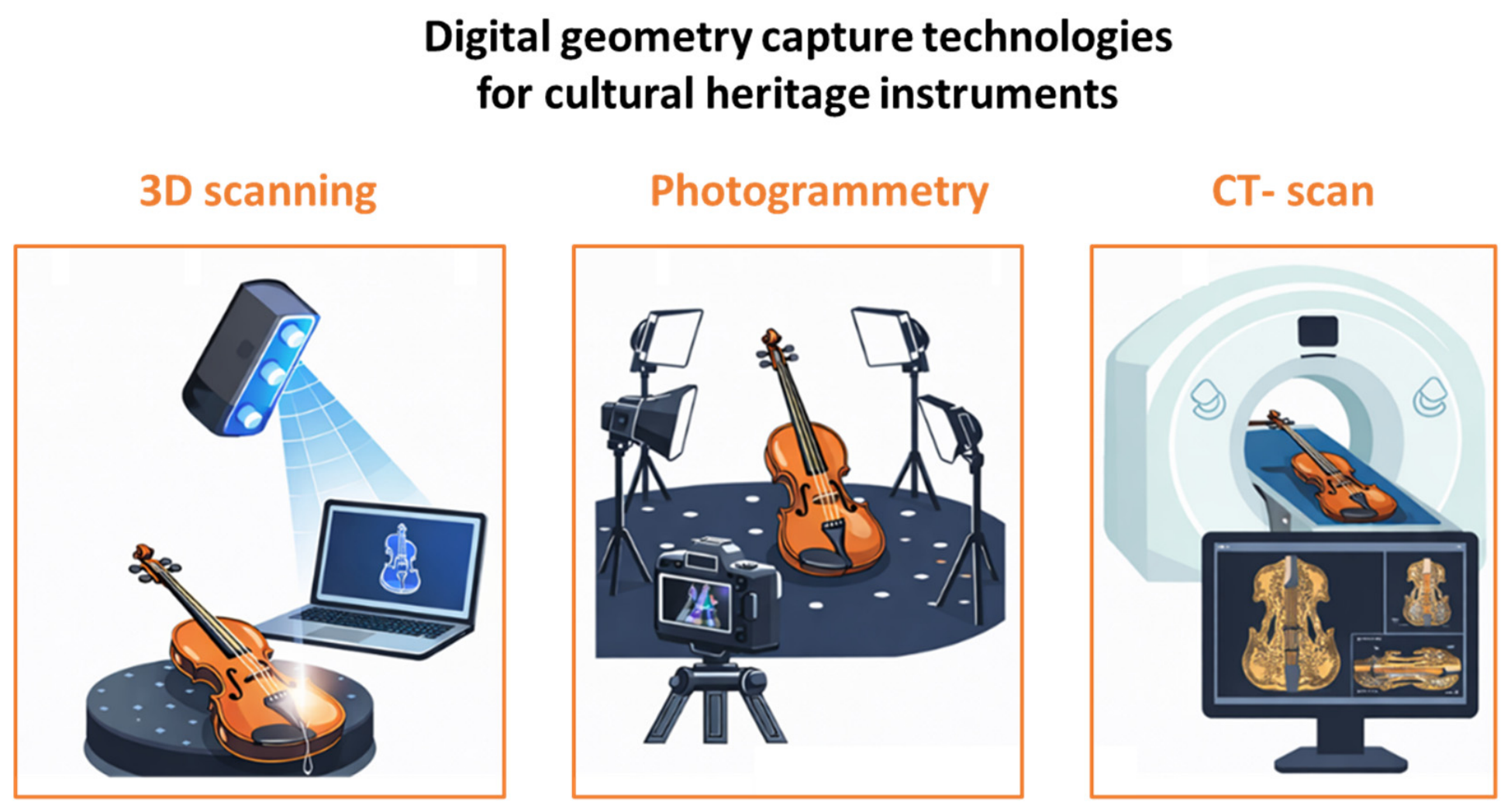
The geometric documentation of cultural heritage objects relies on a set of complementary non-contact acquisition technologies, each suited to different measurement conditions, spatial scales, and levels of geometric detail. In the context of heritage musical instruments, three principal methodologies have been widely adopted: photogrammetry, active 3D scanning, and computed tomography (CT). These techniques differ fundamentally in their physical principles, operating requirements, and the type of geometric information they produce, and are therefore best understood as complementary tools rather than competing alternatives [15,16]. Figure 1 provides a schematic overview of these three approaches as applied to a stringed instrument.
Photogrammetry is a passive image-based technique that derives three-dimensional geometric information from sets of overlapping two-dimensional photographs. The underlying principle is that of multi-view triangulation: when the same surface point is identified in multiple images acquired from different viewpoints, its spatial coordinates can be reconstructed by intersecting the corresponding projection rays [17]. In its most widely applied form, Structure-from-Motion (SfM) photogrammetry combines automated feature detection and matching with bundle adjustment to simultaneously estimate camera positions and a sparse point cloud, which is subsequently densified using multi-view stereo (MVS) algorithms to produce a dense surface representation [18,19]. The principal advantages of photogrammetry are its low equipment cost, high portability, and ability to capture both geometry and surface texture in a single workflow. Its accuracy and resolution are, however, strongly dependent on image quality, overlap, controlled lighting, and calibration, and the technique performs less well on reflective, transparent, or featureless surfaces [20]. For heritage instruments, photogrammetry is particularly well suited to the documentation of external morphology and decorative surface detail, and has been used to generate accurate three-dimensional meshes for comparative morphometric analysis, visual archiving, and integration with imaging spectroscopy data.
Active 3D scanning encompasses a range of techniques that actively project energy onto the object surface and measure the return signal to calculate geometry directly, without relying on image matching. The most common variants used in cultural heritage are triangulation-based structured-light scanning, which projects coded light patterns and detects their deformation across the object surface, and laser scanning, which measures the time-of-flight or phase shift in reflected laser pulses to compute dense point clouds [21,22]. Active scanning generally offers higher geometric accuracy and greater consistency on difficult surfaces compared with photogrammetry, making it preferable when strict metric fidelity is required, for example, in the documentation of plate arching, bore profiles, or fine surface relief [23]. It does, however, require more controlled acquisition conditions, dedicated hardware, and typically greater cost. For heritage instruments, active 3D scanning has been used to generate sub-millimeter-accurate models suitable for shape comparison between makers, dimensional analysis, and the production of physically accurate replicas.
CT differs fundamentally from the previous two methods in that it provides volumetric rather than surface-based geometric information. CT imaging works by acquiring a series of X-ray projections at incremental angular positions around the object; these projections are then reconstructed computationally into a three-dimensional density volume from which cross-sectional slices, internal structures, and material boundaries can be extracted [24]. In the context of heritage instruments, CT is uniquely capable of revealing internal construction features that are inaccessible to surface-based methods, including wall thickness distributions, internal cavity geometry, hidden joints, repair materials, and wood density variations [25]. Both medical CT systems and dedicated laboratory X-ray CT instruments have been applied at a range of spatial scales, from macroscopic structural imaging to micro-CT analysis of thin coating layers [26]. The principal limitations of CT are higher cost, restricted availability, potential concerns regarding radiation exposure for particularly sensitive materials, and the complexity of processing volumetric datasets into geometrically usable models.
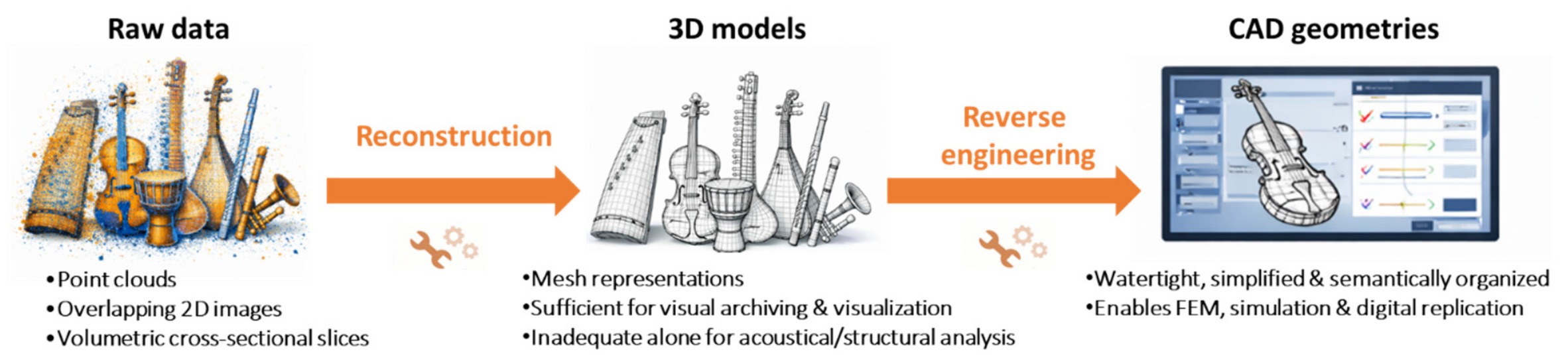
Across all three methods, the output of the acquisition process is typically a point cloud, polygonal mesh, or volumetric dataset. For downstream applications that require parametric or analysis-ready models, such as finite element simulation, acoustic modelling, or precision manufacturing, these raw datasets must be converted into computer-aided design (CAD) representations through a process known as reverse engineering. This conversion step, which involves surface fitting, geometric simplification, and semantic organization of the scan data, remains one of the most labor-intensive stages of the documentation workflow and is an active area of methodological development [27,28].

2.2. Materials Investigation Techniques

The material characterization of cultural heritage instruments draws on a broad set of analytical methods developed across conservation science, archaeometry, and materials physics. These techniques are typically applied with three linked objectives in common: identifying the chemical composition and elemental constitution of the materials present, characterizing their microstructure, stratigraphy, and phase distribution, and assessing degradation processes and preservation state. Because heritage instruments are poly-material systems, combining metals, wood, organic coatings, adhesives, and decorative elements, their investigation generally requires the integration of multiple complementary methods rather than reliance on any single analytical approach [29,30].
A fundamental distinction in this field is between invasive and non-invasive methods. Invasive techniques require the extraction of micro-samples or the preparation of polished cross-sections, which enables high-resolution laboratory analysis but entails a degree of physical intervention that is often undesirable or impermissible for rare and fragile instruments. Non-invasive and micro-invasive methods, by contrast, can be applied directly to the instrument surface without sampling, preserving its integrity while still yielding chemically and structurally informative data [31]. The development and refinement of portable, non-destructive instrumentation has therefore been a central priority in heritage science over the past two decades, and the majority of recent studies on heritage instruments reflect this shift toward in situ analysis [32].
X-ray fluorescence (XRF) is among the most widely applied techniques for the elemental characterization of heritage materials. It works by irradiating the sample with X-rays, which excite characteristic fluorescence emission from the constituent elements; the resulting spectrum provides quantitative or semi-quantitative information on elemental composition down to trace-element level [33]. Portable and handheld XRF instruments have made it possible to analyze large instrument collections in situ, without sampling or moving fragile objects. XRF is particularly well-suited to the investigation of metallic components such as brass alloys, lead-tin organ pipe metal, and surface treatments, and has also been used to characterize inorganic pigments and fillers in varnish layers. Its principal limitation is that it is sensitive only to the uppermost surface layers and cannot resolve stratigraphic information without complementary methods [34].
Infrared spectroscopy, in particular Fourier-transform infrared spectroscopy (FTIR), provides molecular-level information about organic and inorganic compounds by measuring the absorption of infrared radiation at characteristic vibrational frequencies. It is especially useful for identifying organic binding media, resins, oils, waxes, and varnish constituents in surface-finishing layers, and for detecting degradation products such as metal soaps or oxidized compounds [35]. Reflection FTIR can be performed non-invasively on instrument surfaces, while attenuated total reflectance (ATR) FTIR requires contact but no sample preparation. When combined with XRF, FTIR provides a complementary picture that covers both the elemental and molecular dimensions of material composition, and the two techniques are frequently deployed together in multi-analytical workflows for heritage instruments [36].
Raman spectroscopy offers molecular characterization through the inelastic scattering of laser light and is particularly effective for identifying inorganic pigments, crystalline phases, corrosion products, and mineral constituents that may be present in surface layers, coatings, or degraded metal surfaces [37]. Like FTIR, it can be applied non-invasively and in portable form, and it is especially sensitive to compounds that are weak infrared absorbers. Its main limitation in heritage contexts is fluorescence interference, which can obscure the Raman signal in heavily aged organic materials, though this can be partially mitigated through the selection of appropriate excitation wavelengths.
Scanning electron microscopy with energy-dispersive X-ray spectroscopy (SEM-EDS) provides high-resolution imaging of surface morphology and microstructure alongside spatially resolved elemental mapping. It is an invasive technique requiring sample preparation and operation under vacuum, but it yields detailed information on alloy microstructure, corrosion phase distribution, wood cell anatomy, and the cross-sectional stratigraphy of varnish and coating layers that cannot be obtained by surface methods alone [38]. SEM-EDS is particularly valuable when the spatial distribution of elements within a layered system is relevant, for example, in distinguishing successive coatings, identifying restoration interventions, or characterizing corrosion morphology at the microscale.
Dendrochronology is the primary method used to establish the chronology and provenance of wooden instrument components. By measuring and cross-dating the annual growth-ring sequences preserved in instrument soundboards and backs against reference chronologies of known geographical origin, dendrochronology can determine felling dates, constrain geographic provenance, and in some cases identify connections between instruments made from the same wood stock [39]. The technique is minimally invasive when applied to existing exposed wood surfaces or to data already available from high-resolution imaging, and it has become a standard tool in the organological study of historical stringed instruments.
Together, these methods form a complementary analytical toolkit whose effective deployment depends on the specific questions being addressed, the materials under investigation, the conservation status and fragility of the instrument, and the degree of physical intervention that is permissible. In practice, the most informative studies combine several of these approaches within a coordinated multi-analytical protocol, using non-invasive screening to guide the selection of targeted micro-sampling where strictly necessary [40].

3. Progress in Geometric Documentation and Materials Analysis

3.1. Digital Geometry Capture of Cultural Heritage Instruments

The acquisition of accurate geometric information is a fundamental step in the development of digital twins for cultural heritage (CH) artefacts and historical musical instruments. In the context of cultural heritage research, geometry capture technologies have been widely used to generate digital records of artefacts, enabling documentation, scientific analysis, and conservation planning. For musical instruments in particular, geometric digitization is especially important because structural and acoustic behavior is strongly influenced by geometric parameters such as plate curvature, thickness distributions, internal cavities, and bore geometries.

3.1.1. Photogrammetry

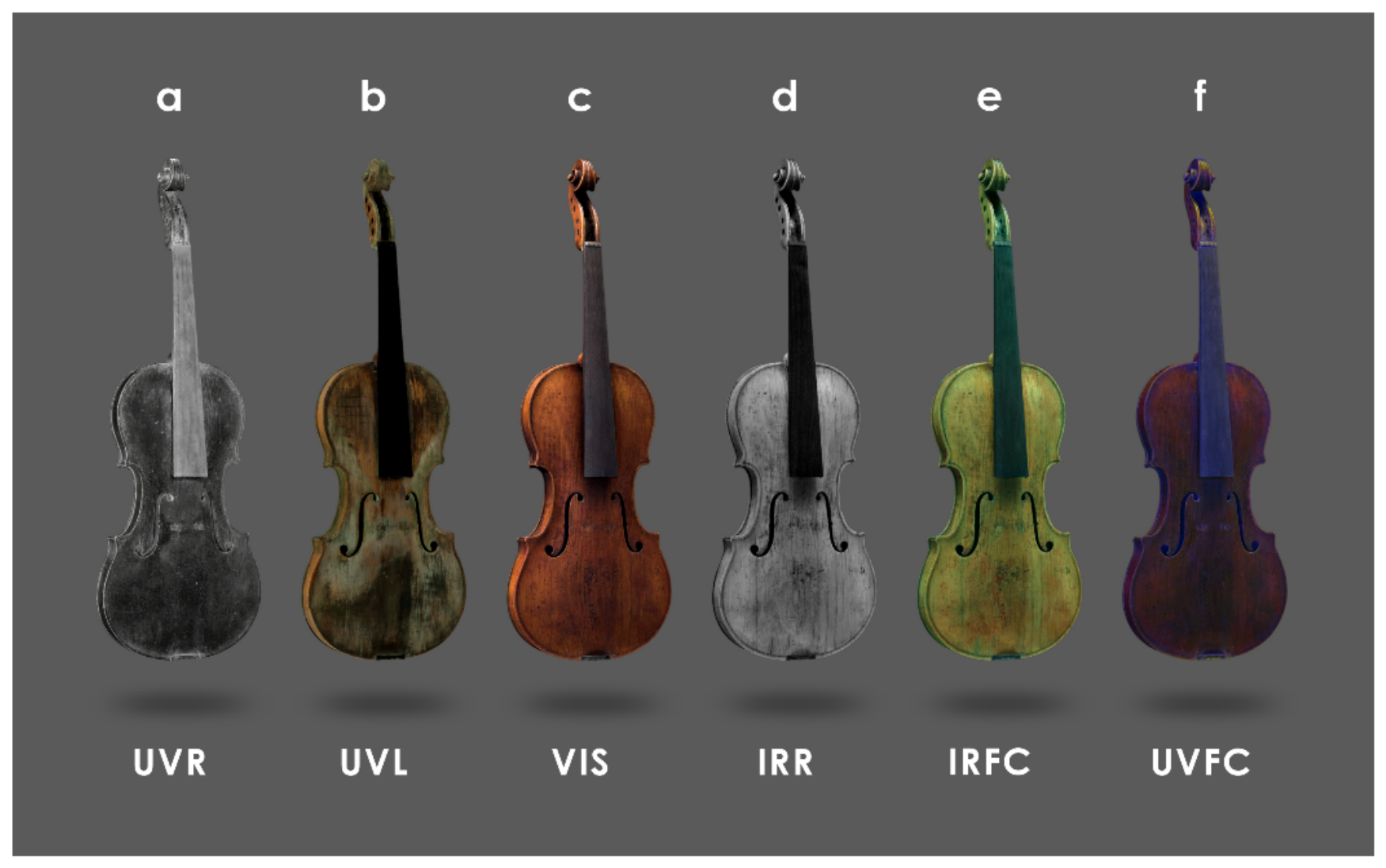
A number of studies have applied photogrammetric reconstruction techniques to document the geometry of musical instruments and other cultural heritage artefacts. Beghin et al. [41] employed close-range photogrammetry to reconstruct three-dimensional meshes of early bowed instruments and demonstrated that the resulting models could be used for quantitative morphometric analysis and comparative studies between instruments. More recent work by Di Iorio et al. [42] proposed a photogrammetric framework combined with multispectral imaging for the analysis of historical violins, demonstrating how geometric models can be integrated with imaging data to provide a comprehensive representation of instrument characteristics (Figure 2). Another research study focused on creating a digital database of ancient Maya musical instruments by generating 3D models of archaeological artifacts [43]. The authors used photogrammetry, capturing multiple photographs of each instrument and processing them with computer vision methods to reconstruct accurate 3D models. These models were then integrated into an online database that allows researchers to study instruments remotely and even produce 3D-printed replicas for experimental archaeology and public outreach.

3.1.2. Three-Dimensional Scanning

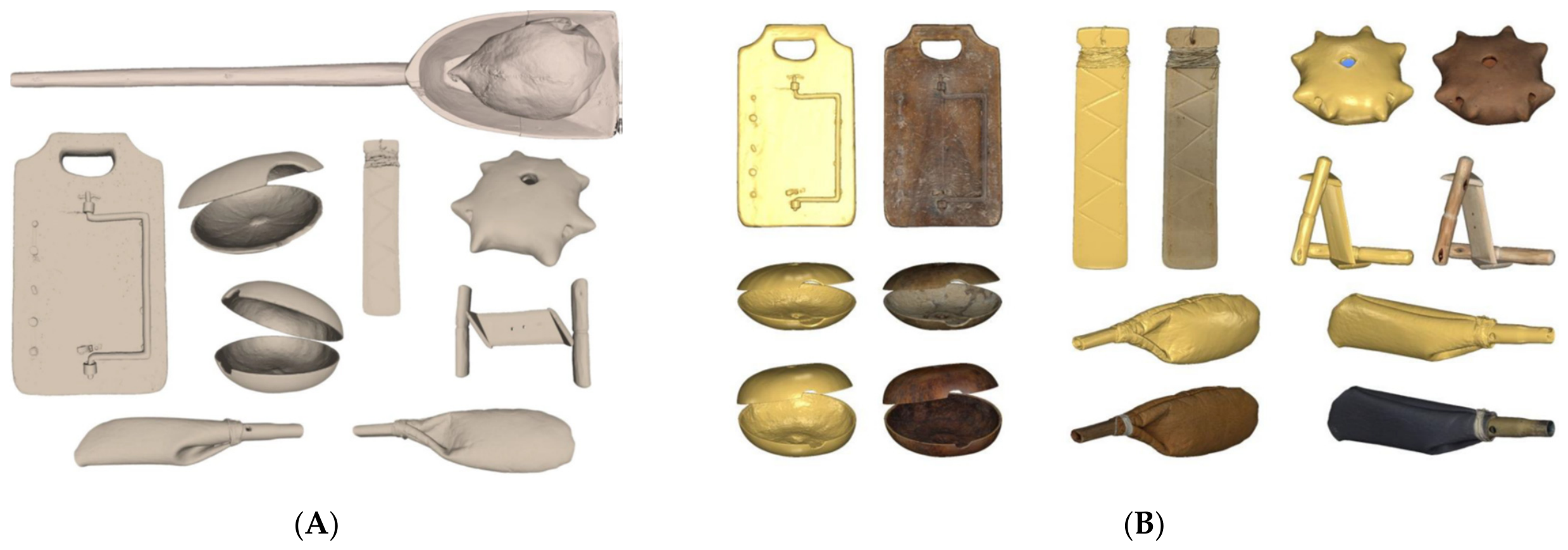
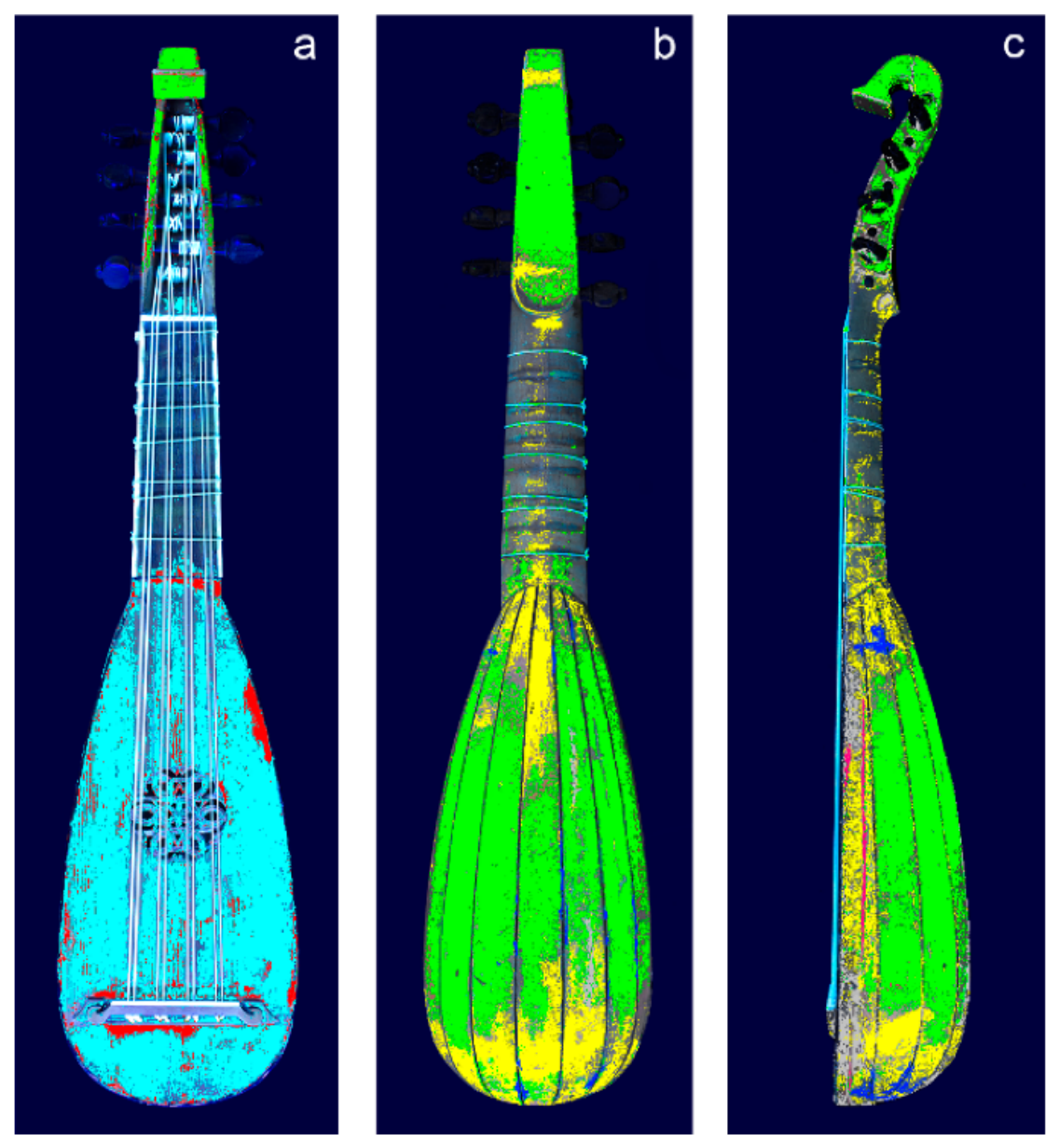
Many studies have used 3D scanning to digitally capture the geometry of musical instruments. Dondi et al. [44] developed a non-invasive method to create accurate 3D models of six historical violins using laser scanning and digital mesh correction. They tested the models by comparing measurements taken from the 3D reconstructions with caliper measurements on the original instruments and found very small average differences, around 0.14 mm. They then used the validated models to compare violin shapes and show how Stradivari’s design changed over time and differed from Guarneri del Gesù’s work. In [45], researchers investigated methods for digitizing musical instruments using both image-based and range-based 3D acquisition techniques. The study compares photogrammetry (Structure-from-Motion from high-resolution photographs) with laser scanning (LiDAR) to create highly accurate 3D models of instruments from a museum collection. The goal was to obtain sub-millimeter-accurate models that could support documentation, analysis, and digital dissemination of cultural heritage objects through online visualization and virtual/augmented reality applications. Figure 3 presents 3D model results obtained through the 2 different techniques.
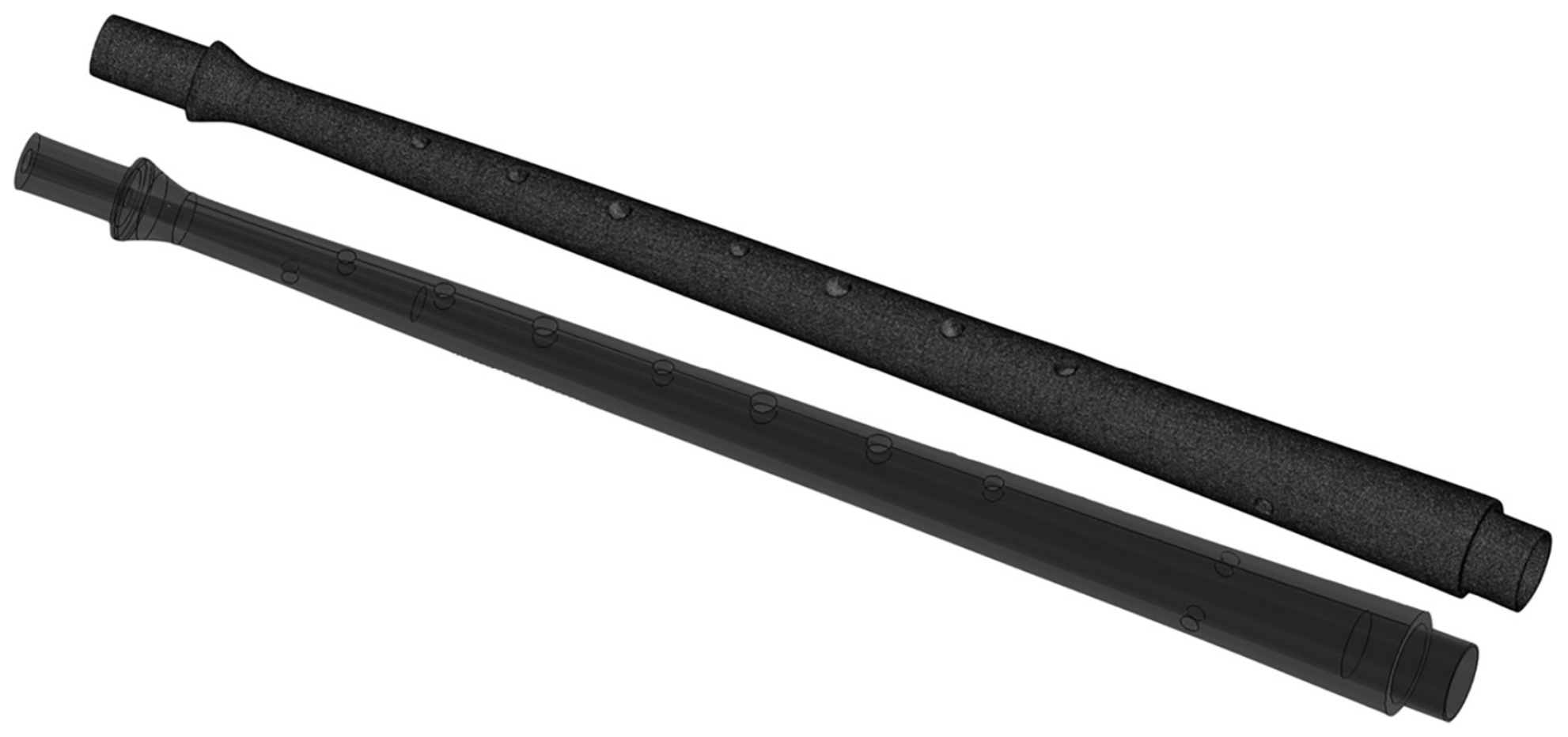
In the context of 3D scanning musical instruments, researchers investigated the reconstruction of an ancient Greek lyre using modern digital technologies [46]. The researchers first performed 3D laser scanning of a tortoiseshell used as the instrument’s resonating body, then created a detailed digital model using CAD. This digital reconstruction was used to guide the physical fabrication of replica instruments, which were subsequently tested acoustically through audio analysis to evaluate their sound characteristics. Another study examines methods for accurately documenting and reconstructing historical musical instruments, specifically border pipes, to support digital reconstruction and 3D printing [47]. The study compares several measurement techniques, including manual measurements, flatbed scanning, light-based 3D scanning, and CT. A 3D model obtained by light based 3d scanning is presented in Figure 4. By combining these approaches, researchers can capture both external geometry and internal structures of the instruments, producing reliable datasets that can be converted into CAD models and used to create accurate replicas for research and preservation.

3.1.3. Computer Tomography

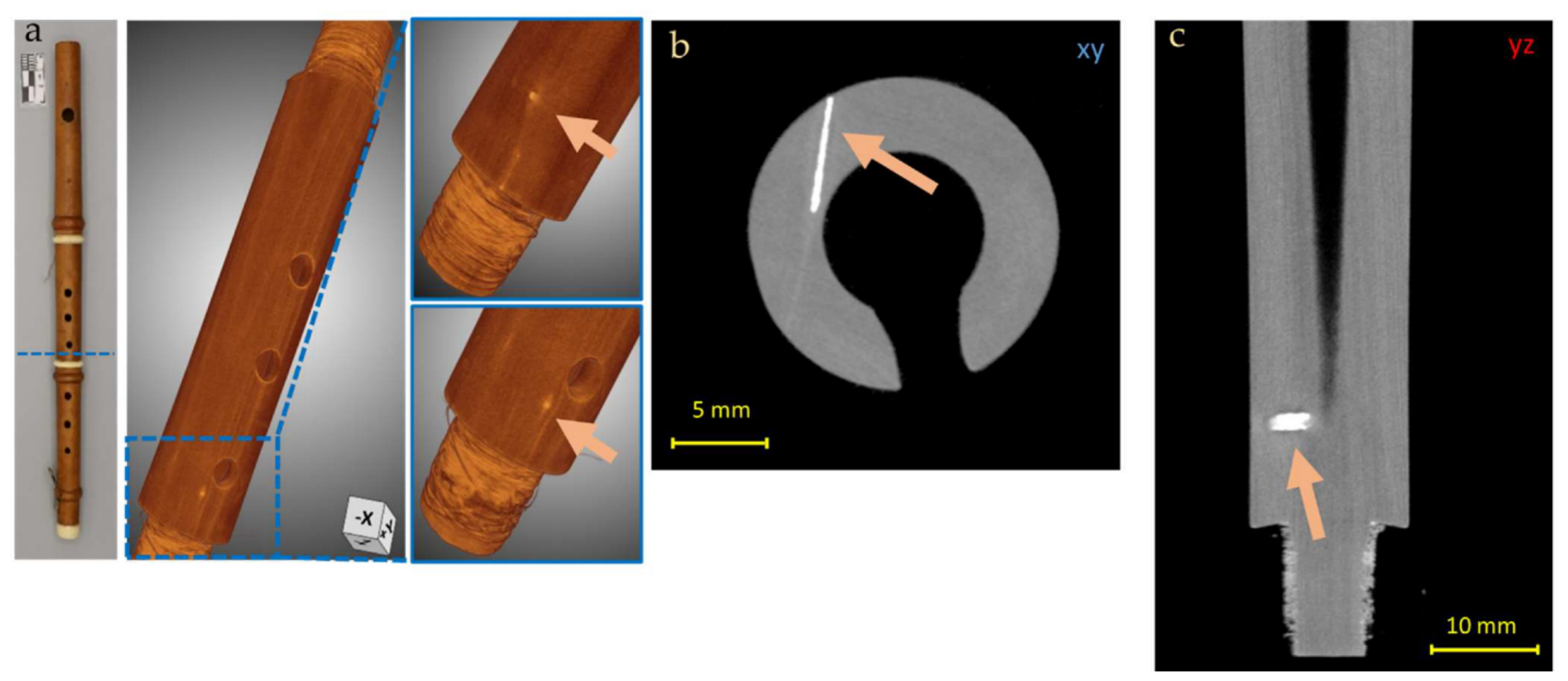
While surface digitization methods provide detailed representations of external geometry, CT has become an important technique for capturing the internal geometry of musical instruments. Stoel and Borman used medical CT scanning to analyze classical Cremonese violins, enabling the reconstruction of internal wood density distributions and structural features that cannot be observed through external measurements alone [48]. Van den Bulcke et al. [49] further demonstrated the use of laboratory X-ray CT systems for nondestructive imaging of wooden musical instruments across multiple spatial scales, allowing researchers to analyze internal structures and manufacturing details while preserving the physical integrity of the artefacts. Similar approaches have been applied to wind instruments: Tansella et al. [50] employed X-ray CT imaging to investigate historical woodwind instruments from the late eighteenth century, enabling the reconstruction of internal bore geometries and structural components relevant to instrument performance and conservation. An indicative example of their work is presented in Figure 5. At the microscale, volumetric imaging has also been used to investigate material layers and coatings; for example, Fiocco et al. [51] applied micro-computed tomography to analyse the coating systems of historical violins, revealing micro-structural features relevant to conservation science. Kirsch et al. [52] discussed the application of three-dimensional computed tomography (3D-CT) as a method for documenting museum musical instruments and proposed optimized acquisition parameters and recommendations for digitization workflows, highlighting the importance of CT imaging for analyzing internal construction details and supporting conservation research.
Taken together, these studies reveal a clear division of labor among the three technologies: photogrammetry dominates where cost, portability, and texture fidelity matter and metric demands are moderate; structured-light and laser scanning are preferred where strict metric fidelity of the external form is required; and CT is the only viable option when internal construction must be recovered, at the price of cost, limited accessibility, and large data volumes. At the same time, cross-study comparison remains difficult because accuracy is reported inconsistently across the literature: few studies quantify measurement uncertainty, and almost none assess whether the achieved accuracy is actually sufficient for the intended downstream use, such as acoustic or structural analysis.

3.2. Materials Investigation of CH Instruments

3.2.1. Metallic Materials

Metallic materials form a major class of constituents in cultural heritage instruments, especially in cases where the sound-producing body, strings, keys, fittings, or decorative/functional components are made from metal alloys. In the literature, their investigation is typically driven by three linked objectives: the determination of alloy composition and trace elements, the characterization of microstructure and phase distribution associated with historical manufacturing, and the identification of corrosion products and degradation pathways that develop during long-term exposure to museum, church, archaeological, or storage environments.
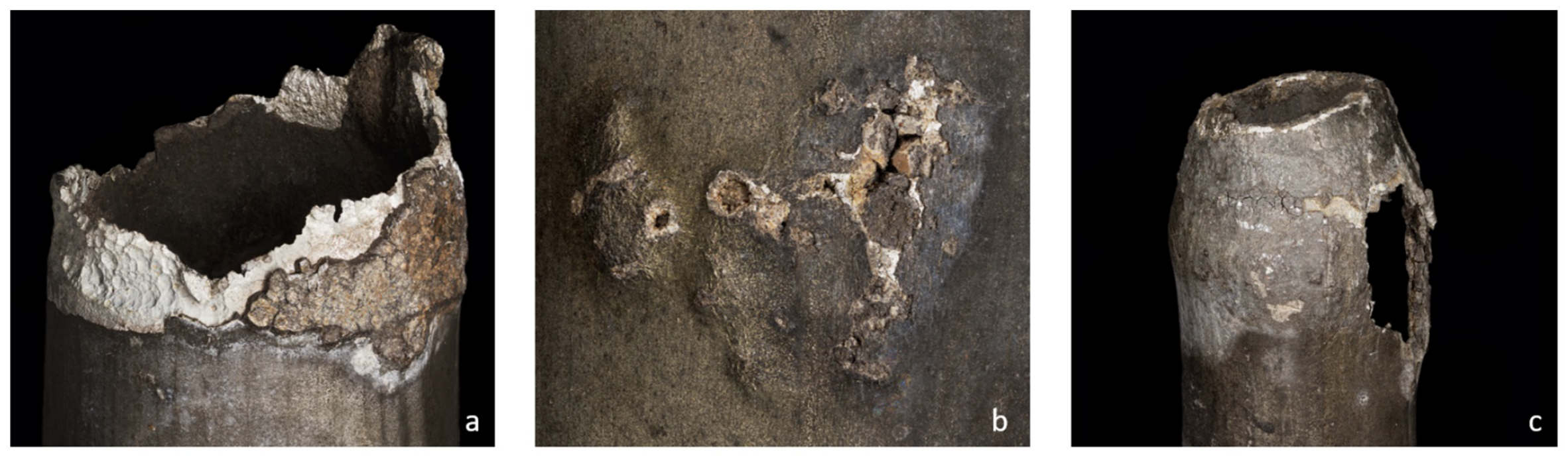
The most developed body of research concerns lead-rich and lead–tin alloys in historical church pipe organs. In this area, material investigation has focused on both the original constitution of the pipe metal and the mechanisms responsible for its alteration over time. Herrera et al. [53] showed that advanced synchrotron-based methods, specifically synchrotron radiation X-ray microfluorescence imaging and grazing-incidence X-ray diffraction, can identify elemental distribution and crystalline phases in historical organ pipes with minimal intervention, demonstrating the value of phase-sensitive analysis for heritage organ metals. This line of inquiry has been extended by studies that examine not only composition but also degradation across different spatial scales. Bovelacci et al. [54], for example, emphasized the importance of combining surface and bulk investigation in order to understand deterioration in degraded organ pipes, thereby linking visible surface alteration to deeper material change. Msallamova et al. [55] investigated the degradation of historical organ pipes made of tin-rich Sn-Pb alloys using light optical microscopy, SEM/EDS, and TEM/EDS. They identified two primary degradation mechanisms: selective corrosion of lead driven by volatile organic compounds emitted from the organ’s wooden structures, and the allotropic transformation of tin into its brittle α-phase at low temperatures (tin pest). Intermetallic phases including Cu6Sn5, FeSn2, and Sn4As3 were also detected within the alloy matrix. Representative microstructural images of the degraded pipe metal are presented in Figure 6. Chiavari et al. [56] demonstrated that the corrosion severity of historical organ pipes is strongly influenced by the organ microenvironment and by the alloy itself, with higher tin contents in low-Sn Pb alloys generally associated with lower corrosion susceptibility. Deflorian and Fedel [57] added an electrochemical perspective by showing that the degradation of lead-alloy organ pipes under acetic-acid exposure can be quantitatively followed through electrochemical measurements, linking pollutant concentration to corrosion kinetics. Earlier work by Niklasson, Johansson, and Svensson [58] had already highlighted the role of acetic and formic acid vapors and water leaching in accelerating atmospheric corrosion in historical organ pipes, helping define the mechanistic basis for later journal studies. Beyond diagnosis, this literature also includes preventive-conservation research: De Keersmaecker et al. [59] investigated lead dodecanoate coatings as a protective treatment for lead and lead–tin alloy artifacts, including organ-pipe alloys, showing that mitigation strategies can be developed on the basis of material-specific degradation knowledge.
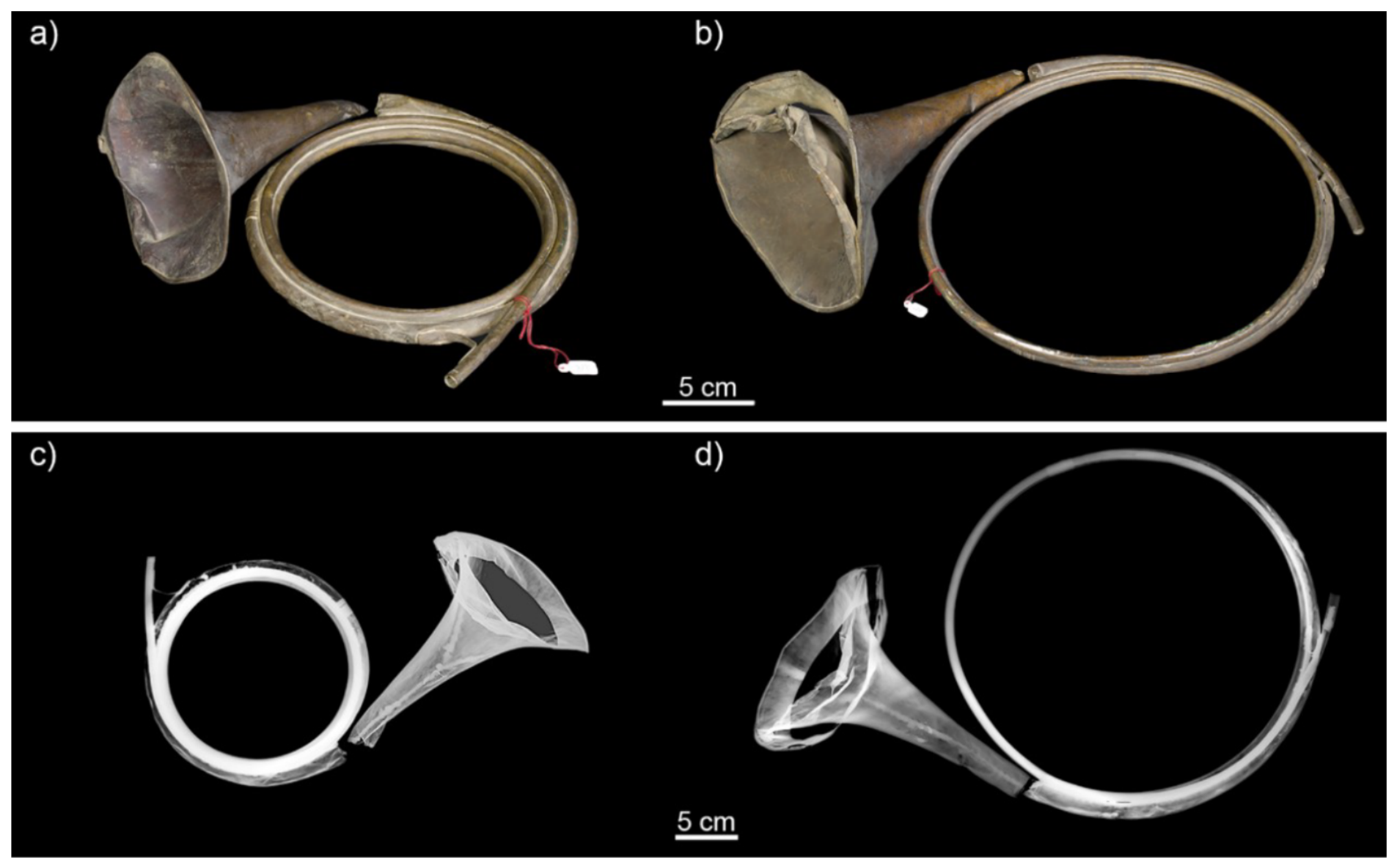
A second major subgroup comprises copper-based alloys, especially brass, used in wind instruments and archaeological metal instruments. Compared with the lead–tin organ-pipe literature, studies in this area tend to focus less on pollutant-induced corrosion and more on alloy formulation, component-to-component compositional variation, manufacturing technology, and construction practice. Vereecke, Frühmann, and Schreiner [60] analyzed sixteenth-century Nuremberg trombones and showed that their brass is chemically inhomogeneous and contains diagnostically relevant trace elements in addition to copper and zinc, illustrating the complexity of early brass production and the importance of elemental analysis for reconstructing historical metallurgy. This technological perspective is reinforced by later work on historical brass instruments from Nuremberg shown in Figure 7. Albano et al. [61] combined X-ray radiography, XRF, and XRD to characterize two late seventeenth-century natural horns, linking alloy features, surface alteration, and structural condition in a conservation-oriented framework. Pelosi et al. [62] used portable XRF together with technical analysis to investigate ancient Roman metal instruments, showing that non-invasive analysis can distinguish the compositions of the main body and associated joints and can therefore support both technological interpretation and historically informed replica production. Related archaeometric work on Roman metal pipe fragments from Pompeii has investigated copper-based alloys, corrosion products, and possible surface treatments, further demonstrating that metallic studies in this subgroup frequently combine questions of alloy composition with issues of surface alteration and ancient manufacture [63].

3.2.2. Wooden Materials

Wooden materials represent one of the most fundamental classes of constituents in cultural heritage instruments, since wood commonly forms the principal structural and acoustic body of string, keyboard, and many wind instruments. In the literature, their investigation is generally driven by three related objectives: the identification of wood species and anatomical features, the assessment of internal structure and condition, and the characterization of chemical, chronological, or provenance-related information associated with manufacture, aging, and preservation.
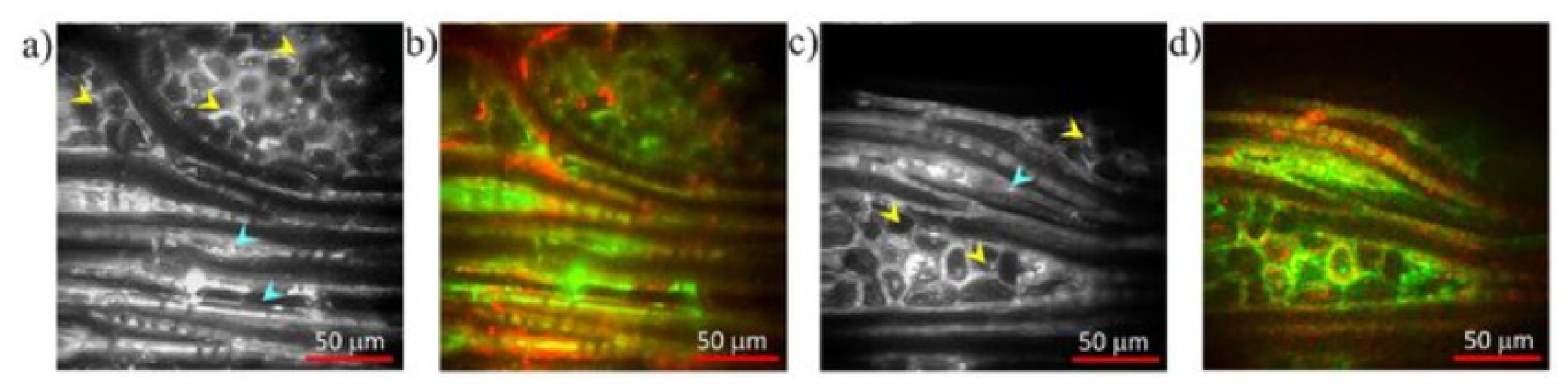
Fioravanti et al. [64] demonstrated that portable reflected-light microscopy can be applied in situ to identify wood species in historical musical instruments, showing that non-invasive anatomical observation can support taxonomic classification across large collections without the need for sampling. A related study by the same broader research group extended this approach to historical musical bows, showing that non-invasive wood identification can also be performed on smaller and highly valuable wooden components, and highlighting the usefulness of X-ray microtomography and anatomical analysis for distinguishing woods used in bow sticks [65]. Dal Fovo et al. [66] applied combined two-photon excited fluorescence (TPEF) and second-harmonic generation (SHG) imaging to characterize the microstructure of hardwood species used in artworks and musical instruments. By mapping the nonlinear optical signals of the principal cell-wall biopolymers, the authors demonstrated that this approach to imaging can distinguish species-specific anatomical features non-invasively and detect early signs of biological and biochemical deterioration within the wood structure. Representative multimodal images of wood cell-wall microstructure obtained by this approach are shown in Figure 8. The significance of this line of work lies in the fact that species identification provides direct evidence of historical material selection and can reveal the extent to which surviving instruments conform to or diverge from organological expectations. This issue was explored further by Cai et al. [67], who investigated the wood used in antique Chinese guqin zithers and showed that multiple species were employed, including woods not always consistent with traditional written prescriptions, thereby linking material study to historical practice and textual tradition.
A second important strand concerns the chronology, provenance, and chemical characteristics of historical instrument wood. Bernabei et al. [68] demonstrated the importance of dendrochronology for stringed instruments, showing that growth-ring analysis can reveal not only felling dates and provenance relationships, but in some cases also connections between instruments made from the same tree trunk or wood stock. More broadly, methodological work on dendrochronology for musical instruments has reinforced the role of annual-ring analysis as a non-invasive or minimally invasive tool for dating, provenance study, and workshop-level comparison [69]. Alongside chronological investigation, chemical studies have also contributed to the understanding of historical tonewood. Tai et al. [70] reported measurable chemical distinctions between Stradivari’s maple and modern tonewood, suggesting that the wood used in Cremonese instruments may have undergone treatment or environmental alteration that changed its material chemistry.

3.2.3. Surface Finishing Materials

Organic surface materials and finishing systems constitute a major category in the material investigation of cultural heritage instruments, particularly in stringed instruments, where the wood surface is modified by sizing layers, grounds, varnishes, oils, resins, waxes, pigments, and decorative coatings. In the literature, their study is usually driven by three closely related objectives: the identification of the chemical composition of organic and inorganic finishing materials, the reconstruction of their layered stratigraphy and application sequence, and the assessment of how these surface systems have been altered by aging, restoration, or environmental exposure. Compared with metallic and wooden materials, research in this category is especially concerned with the interface between the instrument body and its visible surface, since finishing layers are both technologically informative and highly vulnerable to loss, alteration, and overpainting. As a result, studies of varnishes and related surface systems have played a central role in attempts to reconstruct historical making practices, especially in the case of bowed and plucked string instruments. Echard and Lavédrine’s [71] review remains a key reference in this area, as it synthesizes the physicochemical study of historical stringed-instrument varnishes and proposes an analytical strategy that combines non-invasive examination with micro-analytical sampling when necessary.
The most developed strand of this literature concerns the chemical characterization and stratigraphy of varnishes in historical string instruments. Early high-resolution work by Echard et al. [72] showed that synchrotron micro-analytical methods could identify both organic and inorganic constituents in the varnish of a late sixteenth-century Venetian lute, including a proteinaceous binding medium and calcium sulfate phases distributed across lower layers, thereby demonstrating the importance of spatially resolved analysis for reconstructing varnish build-up. Later studies expanded this approach to broader instrument groups and more diverse analytical workflows. Caruso et al. [73] investigated varnishes from South Italian historical musical instruments, concluding that the sampled varnishes were largely based on a mixture of tree diterpenoid resin, shellac, and drying oil, with additional organic and inorganic materials also present. In parallel, non-destructive elemental approaches have also proven informative. Caruso et al. [74] used micro-XRF to characterize the varnish of historical Low Countries stringed instruments in situ, showing that earth pigments rich in iron and manganese were common and that unusual chromium-containing pigments could also occur in individual cases. Together, these studies show that historical finishing systems were neither chemically uniform nor technologically trivial; rather, they consisted of multi-component, multi-layered surface constructions that varied across makers, regions, and restoration histories.
A second important line of research concerns the non-invasive investigation of decorated surfaces, grounds, and maker-specific finishing practices. Invernizzi et al. [75] applied a fully non-invasive multi-analytical protocol to Stradivari’s “Hellier” violin (1679), combining UV-induced visible fluorescence imaging, optical microscopy, reflection FTIR, and XRF to characterize varnish, decorative black materials, fillers, and white inlays. Related work by Malagodi et al. [76] on a decorated Stradivari violin top plate showed that integrated non-invasive methods can also distinguish between surface coatings, pigments, decorative inlays, and later restoration-related alterations, highlighting the complexity of historical instrument surfaces as composite finishing systems rather than simple varnish films. More recently, Volpi et al. [77] extended this type of approach to the Stradivari “Coristo” mandolin, where UV fluorescence imaging (Figure 9), reflection FTIR, and XRF were used to infer a finishing sequence involving possible protein-based sizing, silicates, and an oil–resin varnish, thereby demonstrating that related finishing practices may also be traced in plucked instruments.

4. Discussion

4.1. Challenges and Prospects in Geometry Documentation

Table 1 summarizes the presented studies on geometry capture applied to cultural heritage instruments and artifacts. The literature shows that photogrammetry and optical scanning techniques are mainly used to document external morphology, while CT-based imaging enables the reconstruction of internal structures and construction features. These digital datasets are increasingly used not only for documentation and research but also for conservation and monitoring, providing the geometric foundation for further analysis and the development of digital twin models of heritage instruments.
Despite the substantial progress achieved in the 3D documentation of cultural heritage instruments, geometry capture still faces several limitations that directly affect its usefulness for research, conservation, and digital replication. A first major challenge concerns the relationship between documented geometry and acoustic behavior. In musical instruments, geometry is not merely a visual attribute but a functional parameter that shapes resonance, vibration, air flow, and sound radiation. Small variations in plate arching, wall thickness, bore profile, mouthpiece geometry, or internal cavity shape may significantly influence acoustic response. Consequently, a geometrical model that is sufficient for visual archiving may still be inadequate for acoustical or structural analysis. This is particularly important in the context of digital heritage, where geometry documentation is increasingly expected to support not only visualization, but also physically informed simulation of instrument behavior.
A key challenge in geometry documentation is not simply achieving the highest possible resolution, but selecting the most appropriate acquisition technology according to the required balance between accuracy, spatial resolution, accessibility, and downstream use. Different techniques perform differently in this respect. Three-dimensional scanning is generally preferred when high metric accuracy and dense surface detail are required for external morphology, making it especially suitable for documenting plate arching, bore geometry, or surface deformation. Photogrammetry, by contrast, offers greater flexibility and lower cost, but its effective resolution and geometric reliability depend strongly on image quality, calibration, overlap, and surface texture; it is therefore more suitable for visually rich surfaces and large-scale documentation than for cases demanding strict geometric precision. CT, on the other hand, provides not only high-resolution geometry but also access to internal features, such as wall thickness, cavities, joins, and hidden structural details, making it the most informative option when internal morphology is essential. Consequently, the choice of technology should be guided not by a generic preference for maximum detail, but by the specific documentation goal.
A third challenge concerns the reverse generation of CAD models from measured data as shown in Figure 10. Most geometry acquisition methods, including laser scanning, structured-light scanning, photogrammetry, and CT, produce point clouds, polygonal meshes, or volumetric datasets rather than directly editable parametric models. However, for engineering analysis, finite-element modeling, manufacturing, and digital replication, researchers often require watertight, simplified, and semantically organized CAD representations. The conversion from raw scan data to usable CAD geometry remains labor-intensive and often requires extensive manual intervention, especially for instruments with intricate ornament, thin structures, or hidden internal features. Reverse engineering therefore represents a major bottleneck between documentation and interpretation, and future progress will likely depend on more automated workflows capable of transforming high-resolution scan data into analysis-ready geometric models while preserving morphologically meaningful features.

4.2. Challenges and Prospects in Materials Investigations

Table 2 summarizes the published studies on materials investigation reviewed in Section 3.2, grouped by material category and analytical approach. Within the metallic materials category, research divides clearly between studies focused on lead and lead-tin organ pipe alloys, where electrochemical and synchrotron-based methods dominate, and the primary concern is corrosion mechanism and degradation kinetics. Studies on copper-based alloys used in brass and Roman instruments, where portable XRF and radiographic methods are more common, and the analytical focus shifts toward compositional characterization and technological interpretation. Wooden material studies cluster into three distinct lines of inquiry: species identification through microscopy and microtomography, chronological and provenance investigation through dendrochronology, and chemical characterization of wood composition, with the latter remaining considerably less developed than the other two. The surface finishing category is the most methodologically varied, with studies consistently deploying multi-technique workflows that combine non-invasive elemental and molecular methods; these studies further divide between those primarily concerned with varnish composition and stratigraphy and those focused on reconstructing maker-specific finishing practices. Across all three categories, non-destructive and minimally invasive approaches are clearly preferred, and no study in the table addresses mechanical or acoustically relevant material properties directly, reinforcing the observation that materials investigation in this field remains predominantly compositional and conservation-oriented.
Material investigation has become an essential component in the study of cultural heritage instruments, providing insight into composition, degradation, manufacturing practice, and conservation state. However, despite the growing use of spectroscopic, microscopic, and imaging-based analytical methods, several major challenges remain. A first and persistent issue concerns the role of environmental conditions in driving material alteration as represented in Figure 11. Heritage instruments are highly sensitive to fluctuations in temperature, relative humidity, light exposure, airborne pollutants, and storage microclimates, yet these factors are not always systematically integrated into material studies. In many cases, investigations identify corrosion products, altered varnish layers, wood degradation, or surface contamination only after deterioration has already occurred, rather than linking these findings to long-term environmental histories. This is particularly important because instruments are inherently poly-material systems, and their different components often respond unevenly to the same environment. A major prospect for future research therefore lies in connecting material characterization more closely with environmental monitoring and exposure history, so that analytical data can be interpreted not only as descriptions of present condition but also as indicators of ongoing risk and material-environment interaction.
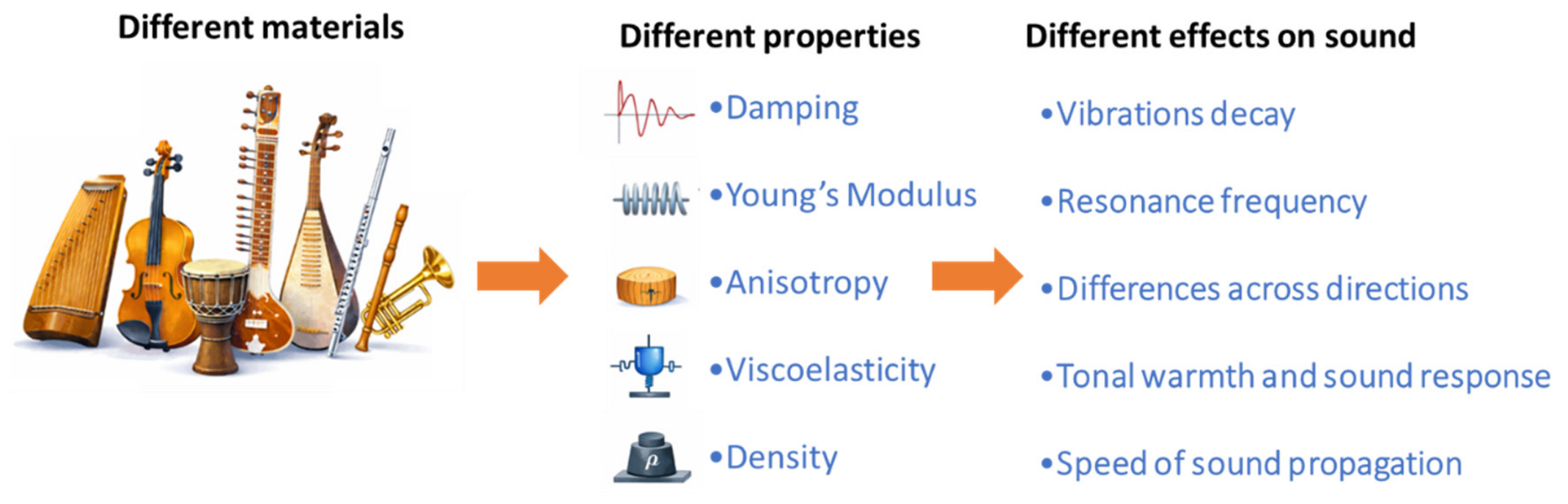
A second major challenge is the relative gap in the literature on mechanical properties, especially in relation to sound production and acoustical behavior, as outlined in Figure 12. While many published studies concentrate on chemical composition, stratigraphy, corrosion, or wood species identification, far fewer attempt to characterize the mechanical parameters that most directly connect materials to instrument function, such as stiffness, elasticity, density variation, damping behavior, viscoelastic response, or local anisotropy. Yet these properties are central to the way instruments vibrate and radiate sound. In practice, the acoustical relevance of materials is often inferred indirectly from composition or visual condition rather than measured explicitly. This creates a significant limitation for research that aims to move beyond descriptive conservation toward performance-informed understanding or digital modeling.
Several concrete experimental and computational pathways are already available to close this gap without endangering the objects. On the experimental side, non-contact vibrometric techniques, such as scanning laser Doppler vibrometry combined with contactless acoustic excitation, allow the modal frequencies, mode shapes, and damping of soundboards and instrument bodies to be measured without attaching sensors or applying mechanical loads. Inverse model-updating approaches can then identify multiple effective elastic and damping constants of the constituent materials by iteratively matching finite-element predictions to the measured vibrational response, as demonstrated non-destructively for spruce tonewood [78]. On the computational side, CT-derived geometry and density distributions provide the natural input for multiphysics (vibro-acoustic) finite-element models of individual instruments, while data-driven surrogate models have shown that modal behavior can be predicted directly from geometric and material parameters [79], opening the way to large-scale virtual testing within digital twins. A realistic near-term workflow for heritage instruments therefore combines (i) CT or high-resolution 3D scanning for geometry and density; (ii) laser-Doppler-based modal measurement under conservatively low excitation levels; (iii) inverse identification of effective material properties through model updating; and (iv) validated multiphysics simulation for what-if analyses, such as climate-induced stress, restoration scenarios, or auralization of instruments that can no longer be played.
A third major challenge concerns sample preparation and sampling strategy. Many of the most informative analytical methods still depend on micro-samples, polished cross-sections, embedded fragments, or carefully prepared surfaces, yet heritage instruments are often too rare, fragile, or valuable to permit extensive intervention. A key prospect for the field is therefore the continued development of non-invasive and micro-invasive analytical protocols that reduce dependence on destructive preparation while still preserving stratigraphic, chemical, and structural information. More broadly, future materials investigation will benefit from workflows that combine targeted sampling with high-quality non-invasive screening, allowing researchers to minimize intervention while maximizing analytical relevance.

4.3. Digital Twins for Cultural Heritage Instruments

Following the definition adopted in the Introduction, the decisive step is therefore not the accumulation of further 3D models, but the transition from static, single-modality datasets to dynamic, multimodal, and continuously updatable representations of individual instruments.
The challenges outlined in geometry documentation and materials investigation naturally lead to the broader perspective of digital twins for cultural heritage instruments. Within this framework, the digital representation of an instrument is no longer limited to the recording of shape alone. Instead, geometry becomes one layer within a more comprehensive and evolving model that may also incorporate material characterization, condition assessment, structural information, environmental history, and acoustical response. For such a framework to be meaningful, geometric data must be more than accurate visual records; they must also be interoperable, scalable, and connectable to complementary sources of information. This implies a transition from workflows centered primarily on documentation toward systems centered on models, knowledge integration, and reuse, in which 3D geometry serves as the spatial backbone for bringing together multidisciplinary evidence. From this perspective, the future challenge lies not only in capturing geometric information with increasing precision, but in ensuring that it can support conservation, monitoring, simulation, and interpretation over time. Digital twins therefore encourage a redefinition of geometry documentation as a continuous, function-oriented process rather than a static digital endpoint.
A similar shift applies to materials investigation. In a digital-twin context, material data should not remain as isolated analytical outputs but should instead be incorporated as dynamic descriptors of the instrument’s current state, degradation processes, and functional potential. Information such as wood species, alloy composition, varnish stratigraphy, corrosion products, environmental sensitivity, and, where available, mechanical properties can substantially enrich the digital representation of an instrument. This is especially important because many questions in conservation and research depend not only on form, but also on the evolving interactions among different material systems and their response to changing environmental conditions. A materials-informed digital twin could therefore support advanced monitoring, risk evaluation, and interpretation, for example, by relating exposure conditions to likely material transformations or by linking structural and compositional data with acoustical behavior. At the same time, this prospect reveals a major methodological difficulty: material data are often heterogeneous, incomplete, and distributed across multiple scales, which makes their standardization and integration challenging. One of the key prospects for future work is therefore the development of interoperable, layered data structures capable of combining chemical, structural, mechanical, and environmental information within a unified instrument model. In this way, materials investigation becomes not only a means of characterization, but also a core component in the development of condition-aware and functionally meaningful digital twins for cultural heritage instruments.
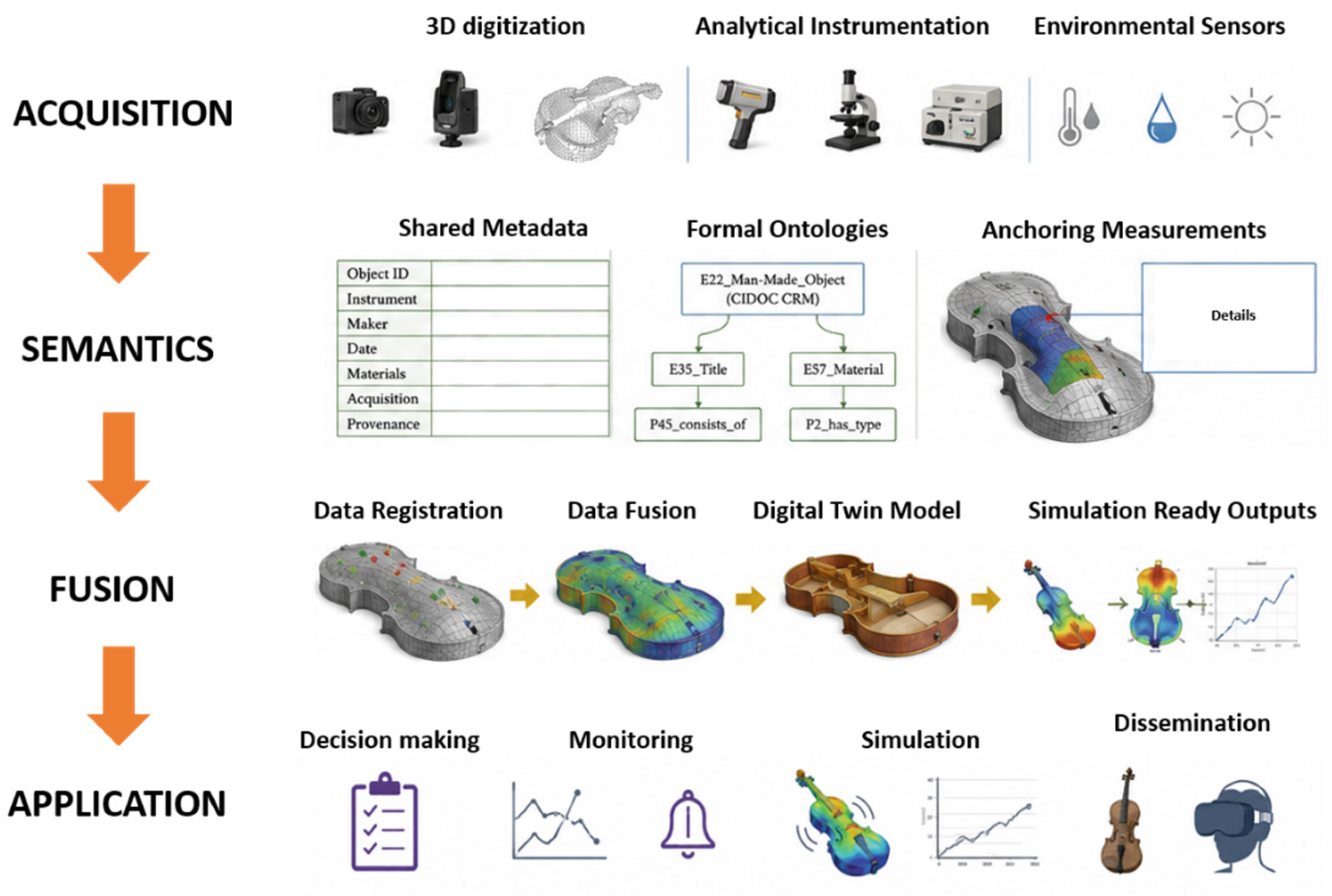
From a methodological standpoint, the integration of geometric and material data into a unified digital twin requires more than their co-existence within the same repository. As shown in Figure 13, it requires a defined data architecture. In the emerging heritage digital-twin literature, this architecture typically comprises (i) an acquisition layer, encompassing 3D digitization, analytical instrumentation, and environmental sensors; (ii) a semantic layer, in which heterogeneous datasets are described through shared metadata and formal ontologies so that, for example, an XRF measurement can be anchored to the specific region of the 3D model to which it refers; (iii) a fusion and modeling layer, in which spatially registered geometric, material, and environmental data are combined into simulation-ready models; and (iv) an application layer supporting conservation decision making, monitoring, simulation, and interpretation. First demonstrations of this approach are beginning to appear: Hermon et al. [80] used the Heritage Digital Twin ontology to formally connect the analytical investigation of a panel painting to its digital representation, while Zou et al. [81] proposed a digital-twin pipeline for musical heritage in virtual museums, coupling 3D models with interactive acoustic behavior. Comparable end-to-end demonstrations for physical heritage instruments—linking CT-derived geometry, spatially referenced material analyses, environmental monitoring, and acoustic simulation within one semantically structured model—have not yet been reported, and constitute, in our view, the most important direction for future work.
Finally, two rapidly developing technology families are likely to accelerate the application of digital twins in cultural heritage instruments. The first is artificial intelligence, which is entering the digital-twin workflow at both ends: on the acquisition side, neural rendering approaches such as Neural Radiance Fields (NeRF) and 3D Gaussian Splatting are emerging as image-based alternatives or complements to photogrammetry, showing particular promise for the reflective, varnished, and low-texture surfaces that challenge conventional pipelines [82,83], although their metric reliability for small, high-precision heritage objects is still under evaluation. On the modeling side, machine-learning surrogate models capable of predicting an instrument’s vibro-acoustic response directly from geometric and material parameters [79] can substitute computationally expensive simulations, enabling near-real-time analysis within the twin. The second is the Internet of Things: low-cost networked sensing of temperature, relative humidity, light, and vibration, organized through dedicated energy-efficient architectures for preventive conservation [84] and formally described within heritage digital-twin ontologies [12], provides the continuous data stream through which the virtual representation remains synchronized with the physical instrument. The value of this approach has already been demonstrated for heritage instruments of the highest significance: the long-term IoT-based monitoring and active climate control of Paganini’s “Cannone” violin and its historical copy resulted in a measurable, cost-effective improvement of their conservation conditions [85]. It is precisely this sensor-driven, continuously updated feedback loop, combined with AI-based inference on the accumulated data, that will ultimately distinguish predictive, condition-aware digital twins from static digital archives.

5. Conclusions

This review has examined the current state of geometric documentation and materials investigation in the context of cultural heritage musical instruments, with particular emphasis on their role in the development of digital twins. The literature shows that major advances have been achieved in both domains. In geometric documentation, photogrammetry, 3D scanning, and computed tomography have enabled increasingly accurate capture of external and internal instrument morphology, supporting documentation, comparative analysis, conservation, digital reconstruction, and, in some cases, replica fabrication. In materials investigation, a wide range of analytical approaches has been applied to metallic, wooden, and surface-finishing materials, providing valuable insight into composition, stratigraphy, degradation processes, manufacturing practice, and preservation state. Together, these developments demonstrate that both geometry and material characterization are already well established as complementary pillars of heritage-instrument research.
At the same time, the review highlights that important limitations remain. Geometric datasets are not always sufficient for acoustical or structural interpretation, especially when the required level of detail, internal access, or model interoperability is not achieved. Similarly, material studies often remain focused on compositional description, while questions related to environmental interaction, mechanical behavior, and acoustically relevant properties are still less systematically addressed. Additional challenges concern the labor-intensive conversion of scan data into usable CAD models, the heterogeneity of multi-scale material information, and the practical restrictions imposed by non-destructive investigation of rare and fragile instruments. These issues show that the transition from documentation to digitally actionable knowledge is still incomplete.
Beyond summarizing the state of the art, the joint analysis of the two domains yields several insights that have not, to our knowledge, been articulated in previous reviews. First, the principal bottleneck on the path to instrument digital twins is no longer data acquisition but data integration: the conversion of scan data into simulation-ready models and the spatial and semantic linkage of material analyses to geometry. Second, the material properties least characterized in the literature, elastic constants, damping, density variation, and anisotropy, are precisely those most needed to make digital twins functionally meaningful for sound-producing objects. Third, the enabling components required to close these gaps, non-contact vibrometry, inverse model updating, multiphysics simulation, and heritage digital-twin ontologies, already exist in adjacent fields; near-term progress therefore depends chiefly on their systematic combination around individual instruments rather than on fundamentally new technology.
Within this perspective, the real potential of this concept lies in its ability to connect multidisciplinary evidence and transform isolated datasets into reusable models for conservation, monitoring, simulation, interpretation, and historically informed reconstruction. Future progress in this field will therefore depend on the development of interoperable workflows that link accurate geometry capture with layered material information, environmental histories, and, where possible, structural and acoustic analysis. In this sense, digital twins offer a promising pathway toward a more holistic, condition-aware, and function-oriented understanding of cultural heritage instruments.

Funding

This research is part of the MusicSphere project that is funded by the European Union under the Horizon Europe Framework Program and the grant agreement N° 101233618. Views and opinions expressed are however, those of the authors only and do not necessarily reflect those of the European Union or European Research Executive Agency. Neither the European Union nor the granting authority can be held responsible for them.

Institutional Review Board Statement

Not applicable.

Informed Consent Statement

Not applicable.

Data Availability Statement

No new data were created or analyzed in this study. Data sharing is not applicable to this article.

Conflicts of Interest

The authors declare no conflicts of interest.

References

  1. Grieves, M. Digital Twin: Manufacturing Excellence Through Virtual Factory Replication; White Paper; Florida Institute of Technology: Melbourne, FL, USA, 2014. [Google Scholar]
  2. Remondino, F. Heritage recording and 3D modeling with photogrammetry and 3D scanning. Remote Sens. 2011, 3, 1104–1138. [Google Scholar] [CrossRef] [Scilit]
  3. Remondino, F.; Rizzi, A. Reality-based 3D documentation of natural and cultural heritage sites: Techniques, problems, and examples. Appl. Geomat. 2010, 2, 85–100. [Google Scholar] [CrossRef] [Scilit]
  4. Vuoto, A.; Funari, M.F.; Lourenco, P.B. Shaping digital twin concept for built cultural heritage conservation: A systematic literature review. Int. J. Archit. Herit. 2023, 18, 1762–1795. [Google Scholar] [CrossRef] [Scilit]
  5. Barsanti, S.G.; Remondino, F.; Fenandez-Palacios, B.J.; Visintini, D. Critical factors and guidelines for 3D surveying and modelling in cultural heritage. Int. J. Herit. Digit. Era 2014, 3, 141–158. [Google Scholar] [CrossRef] [Scilit]
  6. Luther, W.; Baloian, N.; Biella, D.; Sacher, D. Digital twins and enabling technologies in museums and cultural heritage: An overview. Sensors 2023, 23, 1583. [Google Scholar] [CrossRef] [Scilit] [PubMed]
  7. Invernizzi, C.; Daveri, A.; Vagnini, M.; Malagodi, M. Non-invasive identification of organic materials in historical stringed musical instruments by reflection infrared spectroscopy: A methodological approach. Anal. Bioanal. Chem. 2017, 409, 3281–3288. [Google Scholar] [CrossRef] [Scilit] [PubMed]
  8. Skublewska-Paszkowska, M.; Milosz, M.; Powroznik, P.; Lukasik, E. 3D technologies for intangible cultural heritage preservation: Literature review for selected databases. Herit. Sci. 2022, 10, 3. [Google Scholar] [CrossRef] [Scilit] [PubMed]
  9. Grieves, M.; Vickers, J. Digital twin: Mitigating unpredictable, undesirable emergent behavior in complex systems. In Transdisciplinary Perspectives on Complex Systems; Kahlen, F.-J., Flumerfelt, S., Alves, A., Eds.; Springer: Berlin/Heidelberg, Germany, 2017; pp. 85–113. [Google Scholar] [CrossRef] [Scilit]
  10. Jones, D.; Snider, C.; Nassehi, A.; Yon, J.; Hicks, B. Characterising the digital twin: A systematic literature review. CIRP J. Manuf. Sci. Technol. 2020, 29, 36–52. [Google Scholar] [CrossRef] [Scilit]
  11. Niccolucci, F.; Felicetti, A.; Hermon, S. Populating the digital space for cultural heritage with heritage digital twins. Data 2022, 7, 105. [Google Scholar] [CrossRef] [Scilit]
  12. Niccolucci, F.; Felicetti, A. Digital twin sensors in cultural heritage ontology applications. Sensors 2024, 24, 3978. [Google Scholar] [CrossRef] [Scilit] [PubMed]
  13. Dang, X.; Liu, W.; Hong, Q.; Wang, Y.; Chen, X. Digital twin applications on cultural world heritage sites in China: A state-of-the-art overview. J. Cult. Herit. 2023, 64, 228–243. [Google Scholar] [CrossRef] [Scilit]
  14. Lucchi, E. Digital twins for the automation of the heritage construction sector. Autom. Constr. 2023, 156, 105073. [Google Scholar] [CrossRef] [Scilit]
  15. Adamopoulos, E.; Rinaudo, F. A critical comparison of 3D digitization techniques for heritage objects. ISPRS Int. J. Geo-Inf. 2021, 10, 10. [Google Scholar] [CrossRef] [Scilit]
  16. Apollonio, F.I.; Fantini, F.; Garagnani, S.; Gaiani, M. A photogrammetry-based workflow for the accurate 3D construction and visualization of museum assets. Remote Sens. 2021, 13, 486. [Google Scholar] [CrossRef] [Scilit]
  17. Luhmann, T.; Robson, S.; Kyle, S.; Harley, I. Close Range Photogrammetry: Principles, Techniques and Applications; Whittles Publishing: Dunbeath, UK, 2006. [Google Scholar]
  18. Westoby, M.J.; Brasington, J.; Glasser, N.F.; Hambrey, M.J.; Reynolds, J.M. Structure-from-Motion photogrammetry: A low-cost, effective tool for geoscience applications. Geomorphology 2012, 179, 300–314. [Google Scholar] [CrossRef] [Scilit]
  19. Ullman, S. The interpretation of structure from motion. Proc. R. Soc. Lond. B 1979, 203, 405–426. [Google Scholar] [CrossRef] [Scilit] [PubMed]
  20. Guidi, G.; Remondino, F.; Russo, M.; Menna, F.; Rizzi, A.; Ercoli, S. A multi-resolution methodology for the 3D modeling of large and complex archaeological areas. Int. J. Archit. Comput. 2009, 7, 39–55. [Google Scholar] [CrossRef] [Scilit]
  21. Blais, F. Review of 20 years of range sensor development. J. Electron. Imaging 2004, 13, 231–240. [Google Scholar] [CrossRef] [Scilit]
  22. Vosselman, G.; Maas, H.G. (Eds.) Airborne and Terrestrial Laser Scanning; Whittles Publishing: Dunbeath, UK, 2010. [Google Scholar]
  23. Boehler, W.; Marbs, A. 3D scanning instruments. In Proceedings of the CIPA Workshop on Scanning for Cultural Heritage Recording, Corfu, Greece, 1–2 September 2002; pp. 9–18. [Google Scholar]
  24. Kalender, W.A. X-ray computed tomography. Phys. Med. Biol. 2006, 51, R29–R43. [Google Scholar] [CrossRef] [Scilit] [PubMed]
  25. Stock, S.R. Recent advances in X-ray microtomography applied to materials. Int. Mater. Rev. 2008, 53, 129–181. [Google Scholar] [CrossRef] [Scilit]
  26. Cnudde, V.; Boone, M.N. High-resolution X-ray computed tomography in geosciences: A review of the current technology and applications. Earth-Sci. Rev. 2013, 123, 1–17. [Google Scholar] [CrossRef] [Scilit]
  27. Buonamici, F.; Carfagni, M.; Furferi, R.; Governi, L.; Lapini, A.; Volpe, Y. Reverse engineering of mechanical parts: A template-based approach. J. Manuf. Syst. 2018, 48, 426–440. [Google Scholar] [CrossRef] [Scilit] [PubMed]
  28. Varady, T.; Martin, R.R.; Cox, J. Reverse engineering of geometric models: An introduction. Comput.-Aided Des. 1997, 29, 255–268. [Google Scholar] [CrossRef] [Scilit]
  29. Ciliberto, E.; Spoto, G. (Eds.) Modern Analytical Methods in Art and Archaeology; Wiley: Hoboken, NJ, USA, 2000. [Google Scholar]
  30. Janssens, K.; Van Grieken, R. (Eds.) Non-Destructive Microanalysis of Cultural Heritage Materials; Elsevier: Amsterdam, The Netherlands, 2004. [Google Scholar]
  31. Dran, J.C.; Calligaro, T.; Salomon, J. Particle-induced X-ray emission. In Modern Analytical Methods in Art and Archaeology; Ciliberto, E., Spoto, G., Eds.; Wiley: Hoboken, NJ, USA, 2000; pp. 135–166. [Google Scholar]
  32. Moens, L.; Von Bohlen, A.; Vandenabeele, P. X-ray fluorescence. In Modern Analytical Methods in Art and Archaeology; Ciliberto, E., Spoto, G., Eds.; Wiley: Hoboken, NJ, USA, 2000; pp. 55–80. [Google Scholar]
  33. Beckhoff, B.; Kanngiesser, B.; Langhoff, N.; Wedell, R.; Wolff, H. (Eds.) Handbook of Practical X-Ray Fluorescence Analysis; Springer: Berlin/Heidelberg, Germany, 2006. [Google Scholar] [CrossRef] [Scilit]
  34. Potts, P.J.; West, M. (Eds.) Portable X-Ray Fluorescence Spectrometry: Capabilities for In Situ Analysis; Royal Society of Chemistry: London, UK, 2008. [Google Scholar] [CrossRef] [Scilit]
  35. Derrick, M.R.; Stulik, D.; Landry, J.M. Infrared Spectroscopy in Conservation Science; Getty Conservation Institute: Los Angeles, CA, USA, 1999. [Google Scholar]
  36. Vandenabeele, P.; Edwards, H.G.M.; Moens, L. A decade of Raman spectroscopy in art and archaeology. Chem. Rev. 2007, 107, 675–686. [Google Scholar] [CrossRef] [Scilit] [PubMed]
  37. Smith, G.D.; Clark, R.J.H. Raman microscopy in archaeological science. J. Archaeol. Sci. 2004, 31, 1137–1160. [Google Scholar] [CrossRef] [Scilit]
  38. Goldstein, J.; Newbury, D.E.; Joy, D.C.; Lyman, C.E.; Echlin, P.; Lifshin, E.; Sawyer, L.; Michael, J.R. Scanning Electron Microscopy and X-Ray Microanalysis, 3rd ed.; Springer: Berlin/Heidelberg, Germany, 2003. [Google Scholar] [CrossRef] [Scilit]
  39. Schweingruber, F.H. Tree Rings: Basics and Applications of Dendrochronology; Kluwer Academic Publishers: Dordrecht, The Netherlands, 1988. [Google Scholar] [CrossRef] [Scilit]
  40. Pollard, A.M.; Heron, C. Archaeological Chemistry, 2nd ed.; Royal Society of Chemistry: London, UK, 2008. [Google Scholar] [CrossRef] [Scilit]
  41. Beghin, P.; Ceulemans, A.-E.; Fisette, P.; Glineur, F. Validation of a photogrammetric approach for the objective study of early bowed instruments. Herit. Sci. 2023, 11, 170. [Google Scholar] [CrossRef] [Scilit]
  42. Di Iorio, F.; Fiocco, G.; Angeloni, R.; Croci, S.; Cacciatori, F.; Malagodi, M.; Pozzi, F.; Grassini, S. Violins unveiled: A photogrammetric framework integrating multiband and spectroscopic data for in-depth examination of two musical instruments. Sensors 2025, 25, 3278. [Google Scholar] [CrossRef] [Scilit] [PubMed]
  43. Katz, J. Digitized Maya music: The creation of a 3D database of Maya musical artifacts. Digit. Appl. Archaeol. Cult. Herit. 2017, 6, 29–37. [Google Scholar] [CrossRef] [Scilit]
  44. Dondi, P.; Lombardi, L.; Malagodi, M.; Licchelli, M. 3D modelling and measurements of historical violins. Acta IMEKO 2017, 6, 29–34. [Google Scholar] [CrossRef] [Scilit]
  45. Patrucco, G.; Chiabrando, F.; Dondi, P.; Malagodi, M. Image and range-based 3D acquisition and modeling of popular musical instruments. Proc. Doc. Acad. 2018, 5, 9. [Google Scholar] [CrossRef] [Scilit]
  46. Koumartzis, N.; Tzetzis, D.; Kyratsis, P.; Kotsakis, R.G. A new music instrument from ancient times: Modern reconstruction of the Greek lyre of Hermes using 3D laser scanning, advanced computer aided design and audio analysis. J. New Music Res. 2015, 44, 324–346. [Google Scholar] [CrossRef] [Scilit]
  47. Qiao, Z. Integrating measurement and additive manufacturing techniques for reconstruction of historical border pipes. Music Sci. 2025, 8, 20592043251368285. [Google Scholar] [CrossRef] [Scilit]
  48. Stoel, B.C.; Borman, T.M. A comparison of wood density between classical Cremonese and modern violins using computed tomography scanning. PLoS ONE 2008, 3, e2554. [Google Scholar] [CrossRef] [Scilit] [PubMed]
  49. Van den Bulcke, J.; Van Loo, D.; Dierick, M.; Masschaele, B.; Van Hoorebeke, L.; Van Acker, J. Nondestructive research on wooden musical instruments: From macro- to microscale imaging with lab-based X-ray CT systems. J. Cult. Herit. 2017, 27, S78–S87. [Google Scholar] [CrossRef] [Scilit]
  50. Tansella, F.; Vigorelli, L.; Ricchiardi, G.; Re, A.; Bonizzoni, L.; Grassini, S.; Staropoli, M.; Lo Giudice, A. X-ray computed tomography analysis of historical woodwind instruments of the late eighteenth century. J. Imaging 2022, 8, 260. [Google Scholar] [CrossRef] [Scilit] [PubMed]
  51. Fiocco, G.; Rovetta, T.; Invernizzi, C.; Albano, M.; Malagodi, M.; Licchelli, M.; Re, A.; Giudice, A.L.; Lanzafame, G.N.; Zanini, F.; et al. A micro-tomographic insight into the coating systems of historical violins. Coatings 2019, 9, 81. [Google Scholar] [CrossRef] [Scilit]
  52. Baer, F.P.; Fuchs, T.; Wagner, R.; Kirsch, S.; Wagner, R.; Scholz, G.; Kretzer, C.; Schielein, R.; Brennhäusser, G.; Böhnel, M.; et al. Three-Dimensional Computed Tomography Scanning of Musical Instruments. In Wooden Musical Instruments Different Forms of Knowledge; Book of End of WoodMusICK COST Action FP1302; Cité de la Musique-Philharmonie de Paris: Paris, France, 2018; pp. 171–187. ISBN 9791094642351. [Google Scholar]
  53. Herrera, L.K.; Justo, A.; Munoz-Paez, A.; Sans, J.A.; Martinez-Criado, G. Study of metallic components of historical organ pipes using synchrotron radiation X-ray microfluorescence imaging and grazing incidence X-ray diffraction. Anal. Bioanal. Chem. 2009, 395, 1969–1975. [Google Scholar] [CrossRef] [Scilit] [PubMed]
  54. Bovelacci, A.; Ciliberto, E.; Greco, E.; Viscuso, E. Surface and bulk investigations of organ metal pipe degradation. Procedia Chem. 2013, 8, 130–138. [Google Scholar] [CrossRef] [Scilit]
  55. Msallamova, S.; Aliger, T.; Popova, K.; Friak, M.; Roupcova, P.; Fink, D.; Strachotova, K.C.; Ilavsky, J.; Michalcova, A. Causes of degradation of organ pipes with very low lead content. npj Herit. Sci. 2026, 14, 332. [Google Scholar] [CrossRef] [Scilit]
  56. Chiavari, C.; Martini, C.; Prandstraller, D.; Niklasson, A.; Johansson, L.-G.; Svensson, J.-E.; Åslund, A.; Bergsten, C.J. Atmospheric corrosion of historical organ pipes: The influence of environment and materials. Corros. Sci. 2008, 50, 2444–2455. [Google Scholar] [CrossRef] [Scilit]
  57. Deflorian, F.; Fedel, M. Electrochemical analysis of the degradation of lead alloy organ-pipes due to acetic acid. J. Cult. Herit. 2013, 14, 254–260. [Google Scholar] [CrossRef] [Scilit]
  58. Niklasson, A.; Johansson, L.G.; Svensson, J.E. Atmospheric corrosion of historical organ pipes: Influence of acetic and formic acid vapour and water leaching on lead. In Proceedings of the Metal, Canberra, Australia, 4–8 October 2004; pp. 273–280. [Google Scholar]
  59. De Keersmaecker, M.; Verbeken, K.; Adriaens, A. Lead dodecanoate coatings for the protection of lead and lead–tin alloy artifacts: Two examples. Appl. Surf. Sci. 2014, 292, 149–160. [Google Scholar] [CrossRef] [Scilit]
  60. Vereecke, H.; Frühmann, B.; Schreiner, M. The chemical composition of brass in nuremberg trombones of the sixteenth century. Hist. Brass. J. 2012, 24, 61–77. [Google Scholar] [CrossRef] [Scilit]
  61. Albano, M.; Fiocco, G.; Comelli, D.; Licchelli, M.; Canevari, C.; Tasso, F.; Ricetti, V.; Cofrancesco, P.; Malagodi, M. X-rays investigations for the characterization of two 17th century brass instruments from Nuremberg. Acta IMEKO 2022, 11, 1–7. [Google Scholar] [CrossRef] [Scilit]
  62. Pelosi, C.; Agresti, G.; Holmes, P.; Ervas, A.; De Angeli, S.; Santamaria, U. An X-ray fluorescence investigation of ancient roman musical instruments and replica production under the aegis of the European music archaeological project. Int. J. Conserv. Sci. 2016, 7, 847–856. [Google Scholar]
  63. Schiattone, S.; Martini, C.; Malagodi, M.; Fiocco, G.; Rocconi, E.; Morisco, M.; Chiavari, C. Metal Fragments of Roman Pipes from Pompeii: Investigations on Copper-Based Alloys, Corrosion Products, and Surface Treatments. Heritage 2024, 7, 2538–2551. [Google Scholar] [CrossRef] [Scilit]
  64. Fioravanti, M.; Di Giulio, G.; Signorini, G. A non-invasive approach to identifying wood species in historical musical instruments. J. Cult. Herit. 2017, 27, S70–S77. [Google Scholar] [CrossRef] [Scilit]
  65. Fioravanti, M.; Di Giulio, G.; Signorini, G.; Rognoni, G.R.; Sodini, N.; Tromba, G.; Zanini, F. Non-invasive wood identification of historical musical bows. IAWA J. 2017, 38, 285–296. [Google Scholar] [CrossRef] [Scilit]
  66. Dal Fovo, A.; Mattana, S.; Marchetti, M.; Anichini, M.; Giovannelli, A.; Baria, E.; Fontana, R.; Cicchi, R. Combined TPEF and SHG imaging for the microstructural characterization of different wood species used in artworks. Photonics 2022, 9, 170. [Google Scholar] [CrossRef] [Scilit]
  67. Cai, W.; Cheng, Y.K.; Tseng, H.H.; Tai, H.C.; Lo, S.F. Identification and characterization of wood from antique Chinese guqin zithers. J. Cult. Herit. 2022, 53, 72–79. [Google Scholar] [CrossRef] [Scilit]
  68. Bernabei, M.; Bontadi, J.; Rognoni, G.R. A dendrochronological investigation of stringed instruments from the collection of the Cherubini Conservatory in Florence, Italy. J. Archaeol. Sci. 2010, 37, 192–200. [Google Scholar] [CrossRef] [Scilit]
  69. Bernabei, M.A.U.R.O.; Čufar, K. Methods of dendrochronology for musical instruments. In Wooden Musical Instruments Different Forms of Knowledge; Perez, M.A., Marconi, E., Eds.; Cité de la Musique—Philharmonie de Paris: Paris, France, 2018. [Google Scholar]
  70. Tai, H.-C.; Li, G.-C.; Huang, S.-J.; Jhu, C.-R.; Chung, J.-H.; Wang, B.Y.; Hsu, C.-S.; Brandmair, B.; Chung, D.-T.; Chen, H.M.; et al. Chemical distinctions between Stradivari’s maple and modern tonewood. Proc. Natl. Acad. Sci. USA 2017, 114, 27–32. [Google Scholar] [PubMed]
  71. Echard, J.P.; Lavédrine, B. Review on the characterisation of ancient stringed musical instruments varnishes and implementation of an analytical strategy. J. Cult. Herit. 2008, 9, 420–429. [Google Scholar] [CrossRef] [Scilit]
  72. Echard, J.P.; Cotte, M.; Dooryhee, E.; Bertrand, L. Insights into the varnishes of historical musical instruments using synchrotron micro-analytical methods. Appl. Phys. A 2008, 92, 77–81. [Google Scholar] [CrossRef] [Scilit]
  73. Caruso, F.; Martino, D.F.C.; Saverwyns, S.; Van Bos, M.; Burgio, L.; Di Stefano, C.; Peschke, G.; Caponetti, E. Micro-analytical identification of the components of varnishes from South Italian historical musical instruments by PLM, ESEM–EDX, microFTIR, GC–MS, and Py–GC–MS. Microchem. J. 2014, 116, 31–40. [Google Scholar] [CrossRef] [Scilit]
  74. Caruso, F.; Saverwyns, S.; Van Bos, M.; Chillura Martino, D.F.; Ceulemans, A.E.; De Valck, J.; Caponetti, E. Micro-X-Ray Fluorescence and the Old Masters: Non-destructive in situ characterisation of the varnish of historical Low Countries stringed musical instruments. Appl. Phys. A 2012, 107, 197–202. [Google Scholar]
  75. Invernizzi, C.; Daveri, A.; Rovetta, T.; Vagnini, M.; Licchelli, M.; Cacciatori, F.; Malagodi, M. A multi-analytical non-invasive approach to violin materials: The case of Antonio Stradivari “Hellier” (1679). Microchem. J. 2016, 124, 743–750. [Google Scholar] [CrossRef] [Scilit]
  76. Malagodi, M.; Canevari, C.; Bonizzoni, L.; Galli, A.; Maspero, F.; Martini, M. A multi-technique chemical characterization of a Stradivari decorated violin top plate. Appl. Phys. A 2013, 112, 225–234. [Google Scholar] [CrossRef] [Scilit]
  77. Volpi, F.; Fiocco, G.; Rovetta, T.; Invernizzi, C.; Albano, M.; Licchelli, M.; Malagodi, M. New insights on the stradivari “coristo” mandolin: A combined non-invasive spectroscopic approach. Appl. Sci. 2021, 11, 11626. [Google Scholar] [CrossRef] [Scilit]
  78. Viala, R.; Placet, V.; Cogan, S. Simultaneous non-destructive identification of multiple elastic and damping properties of spruce tonewood to improve grading. J. Cult. Herit. 2020, 42, 108–116. [Google Scholar] [CrossRef] [Scilit]
  79. Gonzalez, S.; Salvi, D.; Baeza, D.; Antonacci, F.; Sarti, A. A data-driven approach to violin making. Sci. Rep. 2021, 11, 9455. [Google Scholar] [CrossRef] [Scilit] [PubMed]
  80. Hermon, S.; Niccolucci, F.; Bakirtzis, N.; Gasanova, S. A Heritage Digital Twin ontology-based description of Giovanni Baronzio’s “Crucifixion of Christ” analytical investigation. J. Cult. Herit. 2024, 66, 48–58. [Google Scholar] [CrossRef] [Scilit]
  81. Zou, C.; Rhee, S.-Y.; He, L.; Chen, D.; Yang, X. Sounds of history: A digital twin approach to musical heritage preservation in virtual museums. Electronics 2024, 13, 2388. [Google Scholar] [CrossRef] [Scilit]
  82. Croce, V.; Caroti, G.; De Luca, L.; Piemonte, A.; Véron, P. Neural Radiance Fields (NeRF): Review and potential applications to digital cultural heritage. Int. Arch. Photogramm. Remote Sens. Spat. Inf. Sci. 2023, 48, 453–460. [Google Scholar] [CrossRef] [Scilit]
  83. Croce, V.; Billi, D.; Caroti, G.; Piemonte, A.; De Luca, L.; Véron, P. Comparative assessment of Neural Radiance Fields and photogrammetry in digital heritage: Impact of varying image conditions on 3D reconstruction. Remote Sens. 2024, 16, 301. [Google Scholar] [CrossRef] [Scilit]
  84. Perles, A.; Pérez-Marín, E.; Mercado, R.; Segrelles, J.D.; Blanquer, I.; Zarzo, M.; García-Diego, F.J. An energy-efficient internet of things (IoT) architecture for preventive conservation of cultural heritage. Future Gener. Comput. Syst. 2018, 81, 566–581. [Google Scholar] [CrossRef] [Scilit]
  85. Manfriani, C.; Gualdani, G.; Goli, G.; Carlson, B.; Certo, A.R.; Mazzanti, P.; Fioravanti, M. The contribution of IoT to the implementation of preventive conservation according to European standards: The case study of the “Cannone” violin and its historical copy. Sustainability 2021, 13, 1900. [Google Scholar] [CrossRef] [Scilit]
Figure 1. The three principal digital geometry capture methodologies: active 3D scanning, photogrammetry, and computed tomography, each illustrated with a stringed instrument as the subject.
Applsci 16 07504 g001
Figure 2. Three-dimensional model produced from photogrammetry of a historical violin, presented in different spectral bands: (a) Ultraviolet Reflectography (UVR), (b) Ultraviolet Luminescence (UVL), (c) Visible Light (VIS), (d) Infrared Reflectography (IRR), (e) IR–False Color (IRFC), and (f) UV–False Color (UVFC) [42].
Applsci 16 07504 g002
Figure 3. Final results: (A) 3D models obtained by LiDAR acquisitions; (B) 3D models from photogrammetric approach [45].
Applsci 16 07504 g003
Figure 4. A light-based 3D scan displayed alongside a CAD model [47].
Applsci 16 07504 g004
Figure 5. Original and 3D render of the Piccolo Flute body (a) and CT horizontal (b) and lateral (c) slices of the Piccolo Flute body, in which denser filling material is clearly visible inside the wood (orange arrows in (b,c)). In (a), the areas in which the denser material is present (blue line, blue square and orange arrows) are highlighted [50].
Applsci 16 07504 g005
Figure 6. Damage to Organ Pipes from the Church of All Saints in Heřmánkovice. a Corrosion degradation in contact with the wooden case (a) corrosion damage on the surface (b) material disintergation caused by the corrosion process (c). [55].
Applsci 16 07504 g006
Figure 7. (a) Photographic image of inv.878 by Johann Wilhelm Haas (1649–1723), (b) photographic image of inv.877 by Wolf Wilhelm Haas (1681–1760), (c) X-ray radiographic image of inv.878 instrument, and (d) X-ray radiographic image of inv.877 instrument [61].
Applsci 16 07504 g007
Figure 8. TPEF/SHG multimodal images of beech (Fagus sylvatica) wood in tangential (a,b) and transverse (c,d) sections. Greyscale images (a,c) show total nonlinear signal; merged TPEF/SHG images (b,d) distinguish lignin distribution (green, TPEF) from cellulose/starch (red, SHG). Yellow arrowheads indicate parenchyma rays; light-blue arrowheads indicate fibers [66].
Applsci 16 07504 g008
Figure 9. Images of the top plate (a), shell (b), and treble side (c) processed by the UV Analyzer. The colors correspond to different areas of interest according to the UV-induced fluorescence color: area A in light-blue, area B in red, area C in green, area D in yellow, area E in magenta, and area F (purflings) in black [77].
Applsci 16 07504 g009
Figure 10. Conversion of raw scan data into analysis-ready CAD geometry. Starting from a dense point cloud reconstructed from multi-sensor acquisition of a collection of heritage instruments and resulting polygonal mesh and parametric CAD model, with a software interface illustrating the manual and automated processing steps involved in reverse engineering.
Applsci 16 07504 g010
Figure 11. Principal environmental factors driving material alteration in cultural heritage instruments. Temperature fluctuations, variations in relative humidity, light exposure, and airborne pollutants act simultaneously on the poly-material structure of instruments, with different components responding unevenly to the same microenvironment.
Applsci 16 07504 g011
Figure 12. Mechanically and acoustically relevant material properties that remain under characterized in the heritage instrument literature. Parameters including Young’s modulus, damping coefficient, density, anisotropy, and viscoelastic response govern the vibrational and radiative behavior of instruments but are rarely measured directly in conservation-oriented studies.
Applsci 16 07504 g012
Figure 13. Layered architecture of a digital twin for cultural heritage musical instruments, from data acquisition (geometry, materials, environment), through semantic description (shared metadata, formal ontologies, anchoring of measurements to 3D geometry) and data fusion into a unified, simulation-ready model, to applications in conservation decision making, monitoring, simulation, and dissemination.
Applsci 16 07504 g013
Table 1. Selected studies on geometry digitisation of cultural heritage musical instruments, highlighting the acquisition technologies used and their applications.
Ref.CH InstrumentGeometry Capture TechnologyMain Outcome
[41]Early bowed instrumentsPhotogrammetryMorphological analysis of instrument geometry
[42]Historical violinsPhotogrammetryIntegrated geometry and surface analysis
[43]Ancient Maya musical instrumentsPhotogrammetryOnline 3D database and 3D printing to support research and outreach
[44]Historical violins3D scanning3D modeling
[45]Traditional musical instrumentsPhotogrammetry + 3D scanningDocumentation, digital cataloguing, and visualization
[46]Ancient Greek lyre3D scanningDigital reconstruction and physical replica fabrication
[47]Historical border pipes3D scanning + CT-based imagingInstrument reconstruction and 3D printing
[48]Cremonese violinsCT-based imagingInternal geometry and density analysis
[49]Wooden musical instrumentsCT-based imagingMultiscale imaging of internal structures
[50]Historical woodwindsCT-based imagingReconstruction of bore geometry
[51]Historical violin coatingsCT-based imagingAnalysis of coating micro-structures
[52]Museum musical instrument collectionsCT-based imagingInternal geometry reconstruction and CT digitisation guidelines
Table 2. Selected studies on materials investigation of cultural heritage musical instruments, grouped by material category and analytical approach.
Refs.CH InstrumentMaterial CategoryMain Outcome
[53,54,56,57,58]Historical organ pipesMetallic—Pb and Pb-Sn alloysSynchrotron XRF, GIXRD, SEM, electrochemical methods, atmospheric corrosion testing
[59]Lead and Pb-Sn artefacts including organ pipe alloysMetallic—Pb and Pb-Sn alloysSEM-EDS, XRD
[60,61]16th–17th century Nuremberg brass instrumentsMetallic—Cu-based alloysXRF, SEM-EDS, X-ray radiography, XRD
[62,63]Ancient Roman metal instruments and pipe fragmentsMetallic—Cu-based alloysPortable XRF, SEM-EDS, optical microscopy
[64,65,67]Historical stringed instruments, bows, and guqin zithersWooden—species identificationReflected-light microscopy, X-ray microtomography, SEM
[68,69]Historical stringed instrumentsWooden—chronology and provenanceDendrochronology
[70]Stradivari violinsWooden—chemical characterizationSolid-state NMR, chemical analysis
[71,72]Historical stringed instrument varnishes and luteSurface finishing—composition and stratigraphyMulti-analytical (synchrotron micro-XRF, micro-XRD, non-invasive + micro-sampling)
[73,74]South Italian instruments and Low Countries stringed instrumentsSurface finishing—composition and stratigraphyESEM-EDX, microFTIR, GC-MS, Py-GC-MS, micro-XRF
[75,76,77]Stradivari violins and “Coristo” mandolinSurface finishing—maker-specific practicesUV fluorescence, reflection FTIR, XRF, optical microscopy
Disclaimer/Publisher’s Note: The statements, opinions and data contained in all publications are solely those of the individual author(s) and contributor(s) and not of MDPI and/or the editor(s). MDPI and/or the editor(s) disclaim responsibility for any injury to people or property resulting from any ideas, methods, instructions or products referred to in the content.