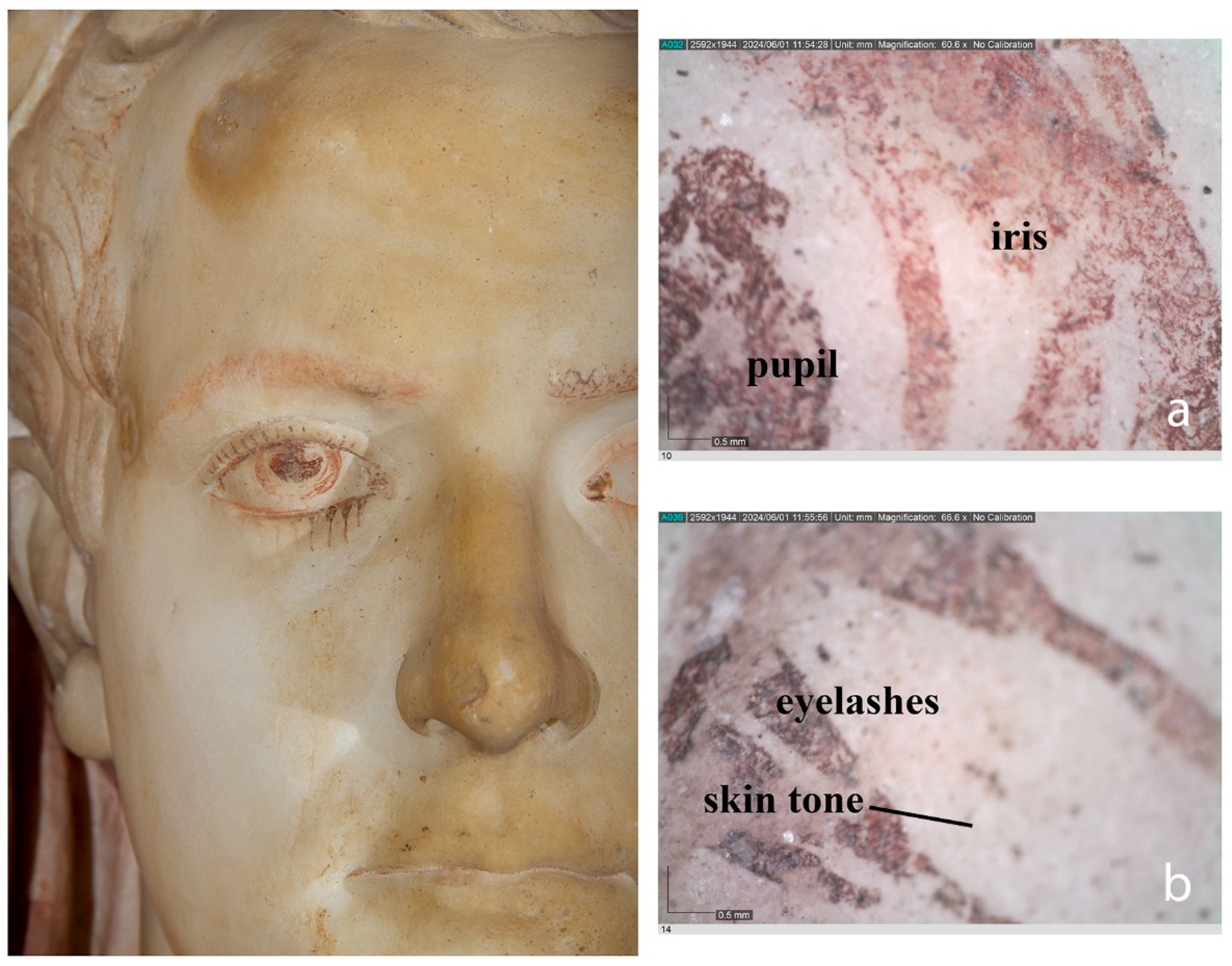
Integrated Imaging and Spectroscopic Analysis of Residual Polychromy on the Roman Sculptures of the National Archaeological Museum of Formia (LT), Italy

 ,
,  ,
,  , ,
, ,  , and
, and
Abstract
1. Introduction
2. Materials and Methods
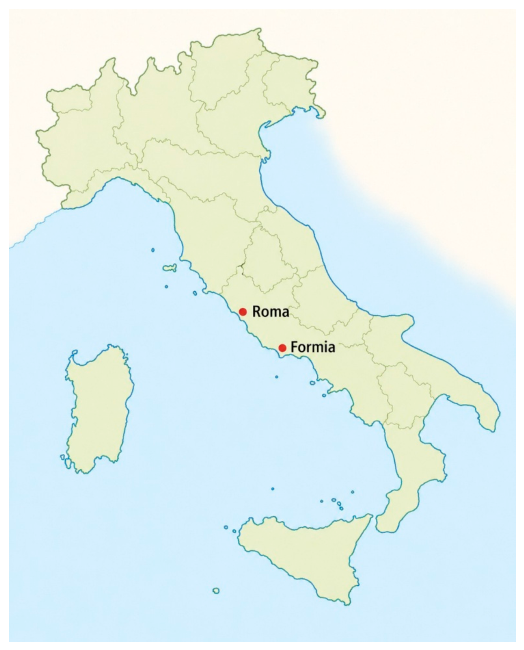
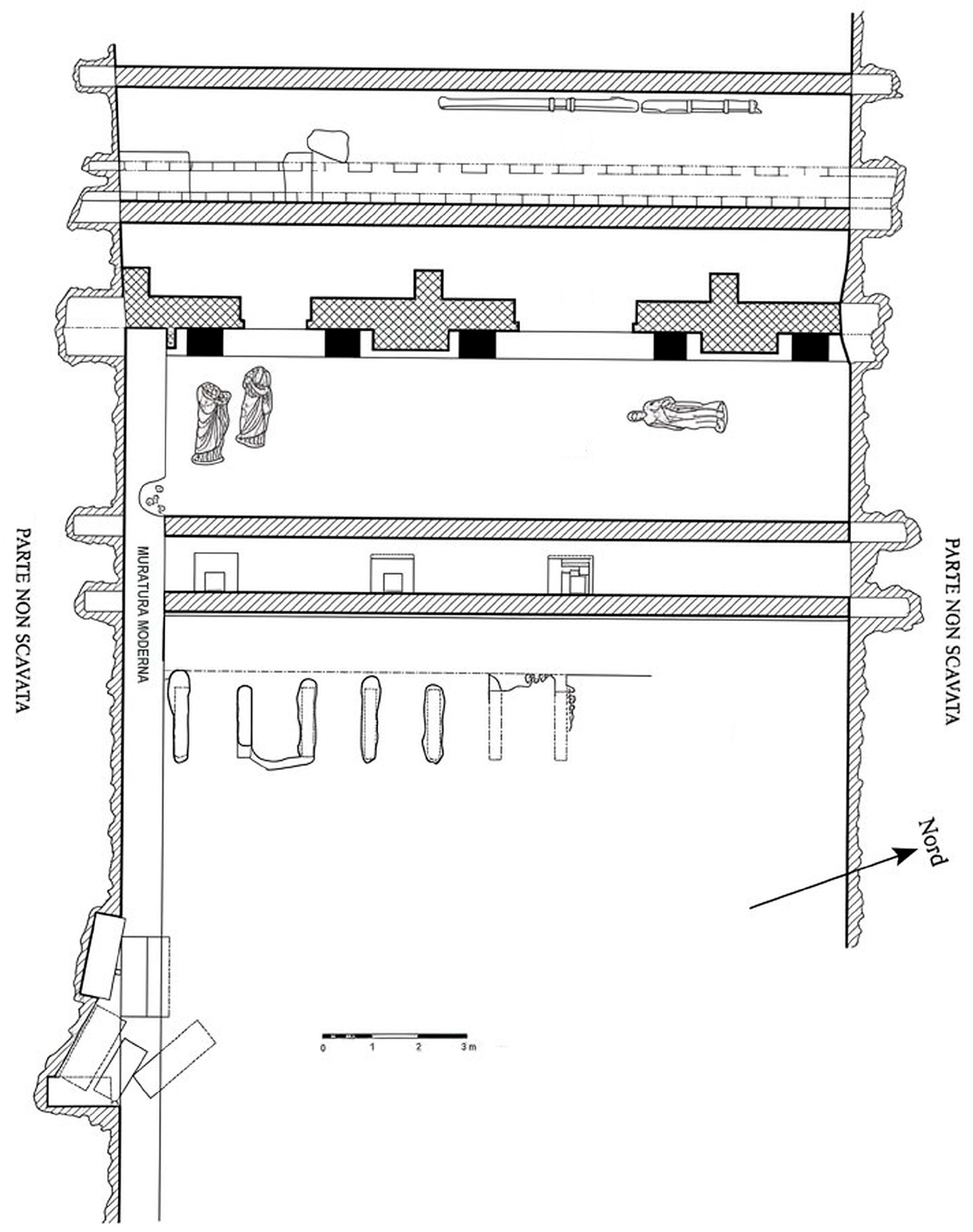
2.1. Archaeological Context and Objects
2.2. Analytical Instrumentation
3. Results
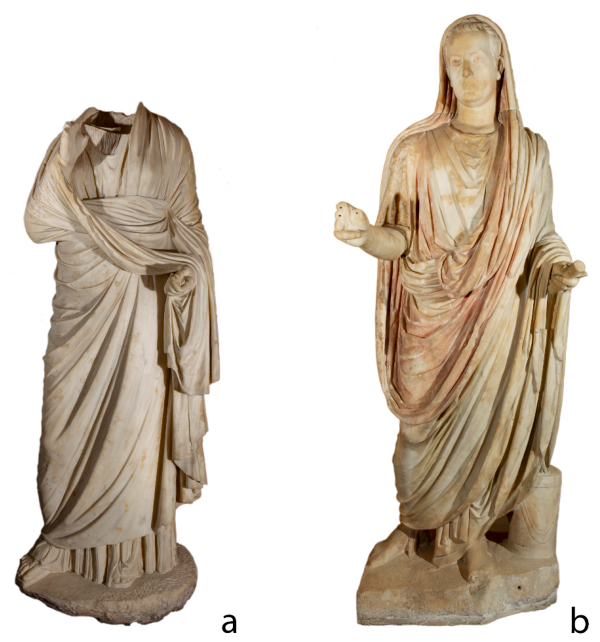
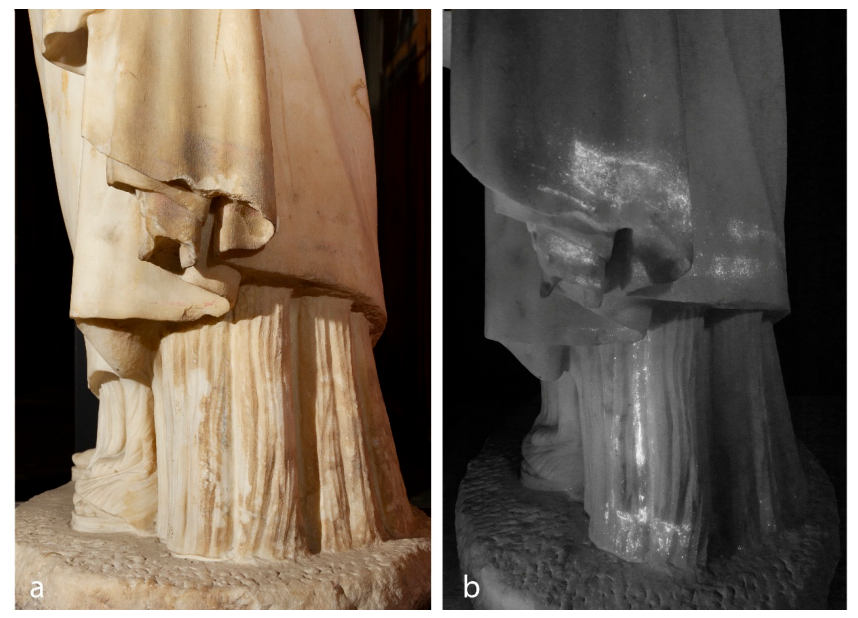
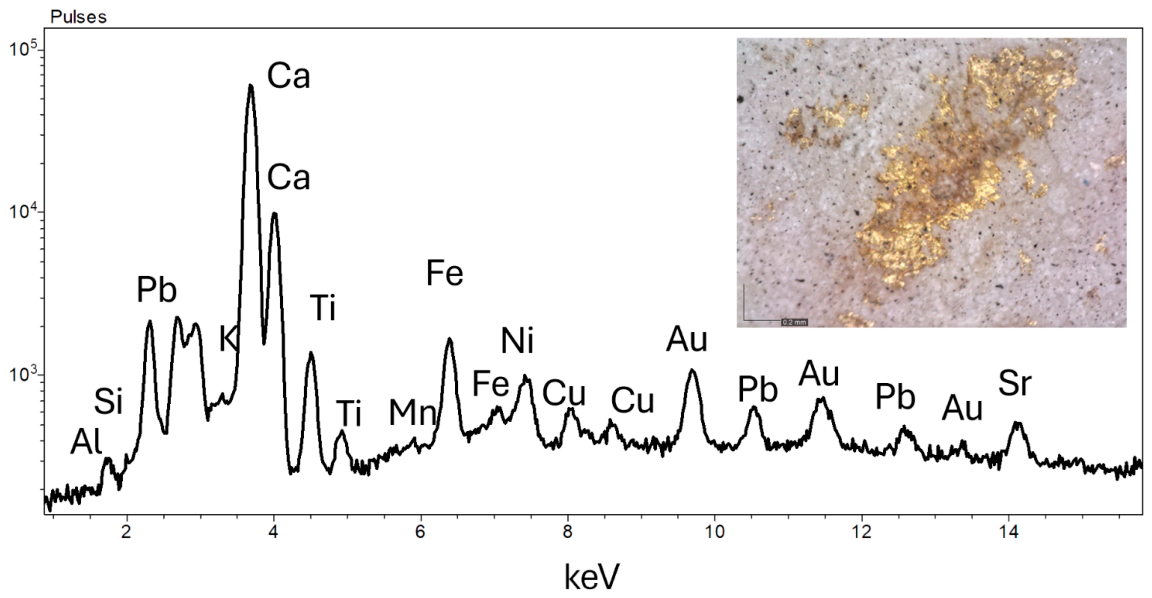
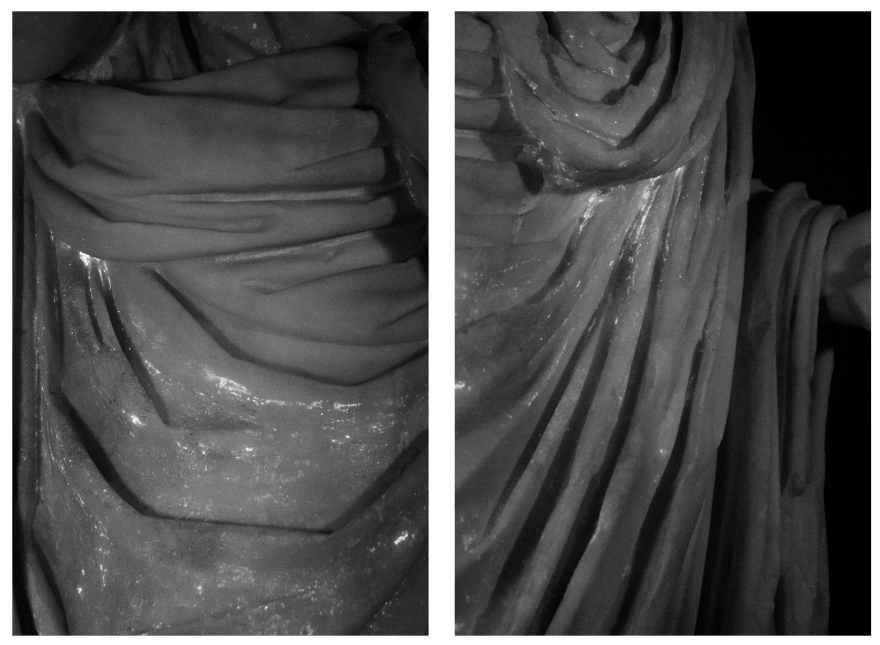
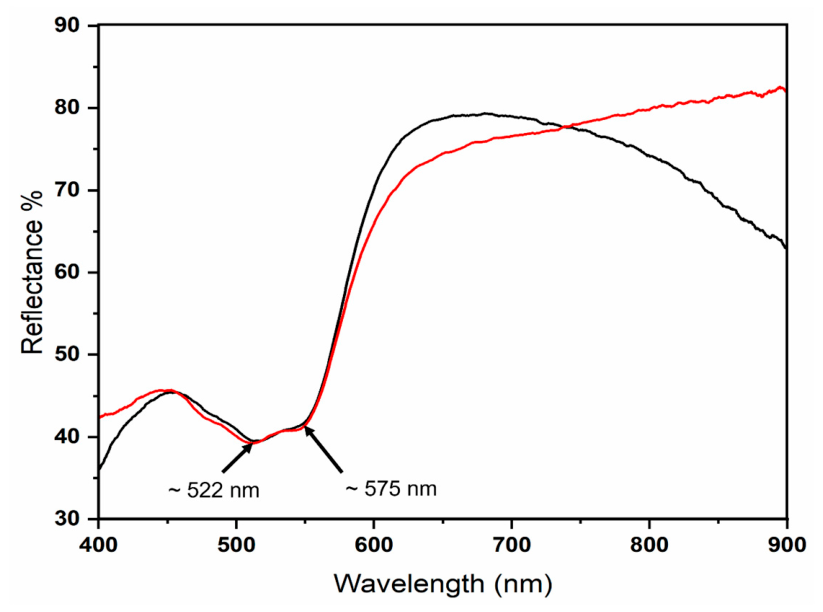
3.1. Female Statue
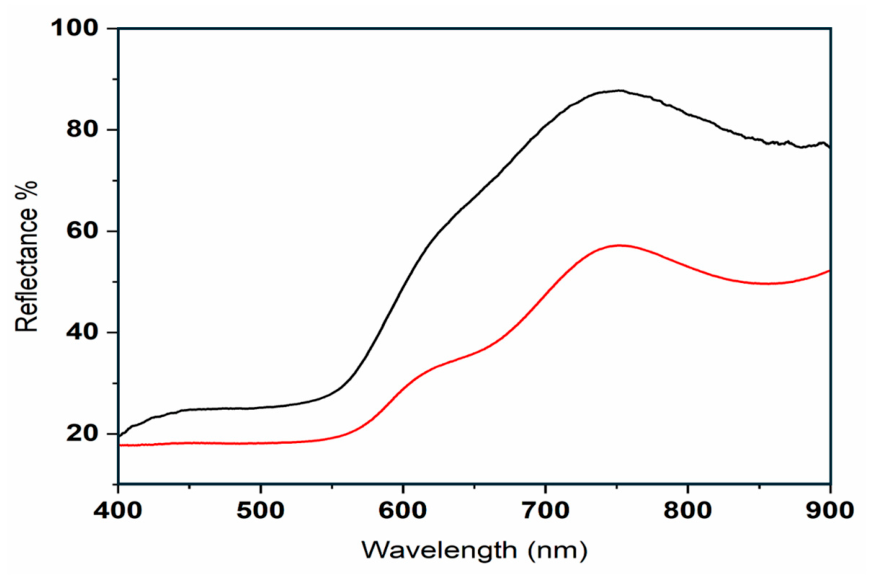
3.2. Togate Statue
4. Conclusions
Author Contributions
Funding
Institutional Review Board Statement
Informed Consent Statement
Data Availability Statement
Acknowledgments
Conflicts of Interest
References and Notes
- Liverani, P. Per una ‘Storia del colore’. La scultura policroma romana, un bilancio e qualche prospettiva. In Diversamente Bianco. La Policromia Della Scultura Romana; Liverani, P., Santamaria, U., Eds.; Quasar: Rome, Italy, 2014; pp. 9–32. [Google Scholar]
- Østergaard, J.S. The polychromy, sculptural, Greek and Roman. In Oxford Classical Dictionary; Grig, L., Ed.; Oxford Academic: New York, NY, USA, 2015. [Google Scholar] [CrossRef]
- Abbe, M. Art. In A Cultural History of Colour in Antiquity; Wharton, D., Ed.; Bloomsbury: London, UK, 2021; pp. 220–248. [Google Scholar]
- Sandu, I.C.A. Colour Through Time. In Chromatic Visions; Lecture Notes in Computer Science; Pescarin, S., Barandoni, C., Clay, A., Papadopoulos, G., Sandu, I.C.A., Eds.; Springer: Cham, Switzerland, 2026; Volume 15750. [Google Scholar] [CrossRef]
- Rodler, A.; Matthys, S.M.; Brøns, C.; Artioli, G.; Snoeck, C.; Debaille, V.; Goderis, S. Investigating the provenance of Egyptian blue pigments in ancient Roman polychromy. Archeometriai Műhely 2021, 18, 97–108. [Google Scholar] [CrossRef]
- Frantzi, G.G.; Mastrotheodoros, G.P.; Theoulakis, P.; Kogou, S.; Psalti, A.; Brecoulaki, H. Unveiling the Original Polychromy of Archaic Architecture: The Gigantomachy on the West Pediment of the Temple of Apollo at Delphi (6th c. B.C.). Heritage 2025, 8, 17. [Google Scholar] [CrossRef]
- Ferdani, D.; Barandoni, C.; Bonifazi, F.; Iannaccone, R.; Magrini, D. Multiband photogrammetry for multispectral 3D reconstruction of statuary. J. Cult. Herit. 2025, 76, 74–85. [Google Scholar] [CrossRef]
- Aggelakopoulou, E.; Sotiropoulou, S.; Karagiannis, G. Architectural Polychromy on the Athenian Acropolis: An In Situ Non-Invasive Analytical Investigation of the Colour Remains. Heritage 2022, 5, 756–787. [Google Scholar] [CrossRef]
- Verri, G.; Granger-Taylor, H.; Jenkins, I.; Sweek, T.; Weglowska, K.; Wootton, W.T. The goddess’ new clothes: The carving and polychromy of the Parthenon sculptures. Antiquity 2023, 97, 1173–1192. [Google Scholar] [CrossRef]
- Burgio, L.; Clark, R.J.H. Library of FT-Raman spectra of pigments, minerals, pigment media and varnishes, and supplement to existing library of Raman spectra of pigments with visible excitation. Spectrochim. Acta—Part A Mol. Biomol. Spectrosc. 2001, 57, 1491–1521. [Google Scholar] [CrossRef] [PubMed]
- Pozzi, F.; van den Berg, K.J.; Fiedler, I.; Casadio, F. A systematic analysis of red lake pigments in French Impressionist and Post-Impressionist paintings by surface-enhanced Raman spectroscopy (SERS). J. Raman Spectrosc. 2014, 45, 1119–1126. [Google Scholar] [CrossRef]
- Campanella, B.; Palleschi, V.; Legnaioli, S. Introduction to vibrational spectroscopies. ChemTexts 2021, 7, 5. [Google Scholar] [CrossRef]
- Whitney, A.V.; Van Duyne, R.P.; Casadio, F. An innovative surface-enhanced Raman spectroscopy (SERS) method for the identification of six historical red lakes and dyestuffs. J. Raman Spectrosc. 2006, 37, 993–1002. [Google Scholar] [CrossRef]
- Aurigemma, S. Ritratto femminile dell’età di Augusto e statue muliebri iconiche scoperte a Formia. Boll. d’Arte 1930, 10, 216–236. [Google Scholar]
- Cassieri, N. Museo Archeologico Formia; Marina di Minturno: Latina, Italy, 2001. [Google Scholar]
- Cassieri, N. Formia. Museo Archeologico Nazionale e Monumenti; Istituto poligrafico e Zecca dello Stato, Libreria dello Stato: Roma, Italy, 2013.
- Schmidt, E. Römische Frauenstatuen. Ph.D. Thesis, Berlin, Germany, 1967. [Google Scholar]
- Kruse, H.J. Römische Weibliche Gewandstatuen des zweiten Jahrhunderts n. Chr. Ph.D. Thesis, Georg-August Universität zu Göttingen, Göttingen, Germany, 1975. [Google Scholar]
- Bol, R. Das Statuenprogramm des Herodes-Atticus-Nymphäums; Hoffmann, A., Schumacher, L.-H., Eds.; Walter de Gruyter: Berlin, Germany, 1984; Volume 1. [Google Scholar]
- Filges, A. Standbilder Jugendlicher Göttinnen. Klassische und Frühhellenistische Gewandstatuen mit Brustwulst und ihre Kaiserzeitliche Rezeption; Böhlau: Köln, Germany, 1997. [Google Scholar]
- Tuccinardi, S. Sculture romane da Formia. Una proposta di lettura in contesto. In Complessi Monumentali e Arredo Scultoreo Nella Regio I: Latium et Campania; Naus: Napoli, Italy, 2017; pp. 49–68. [Google Scholar]
- Aurigemma, S. Recenti scoperte in Formia. Boll. d’Arte 1921, 1, 309–335. [Google Scholar]
- Aurigemma, S. Scoperte d’arte in Formia e Venafro. L’Illustrazione Ital. 1922, 9, 420–421. [Google Scholar]
- Strong, E. Art in Ancient Rome I; C. Scribner’s Sons: New York, NY, USA, 1929. [Google Scholar]
- Strong, E. La Scultura Romana da Augusto a Costantino; Fratelli Alinari: Florence, Italy, 1923. [Google Scholar]
- Deubner, L. Die Tracht des Römischen Triumphators. Hermes 1934, 69, 316–323. [Google Scholar]
- Goethert, F.W. Studien zur Kopienforschung. Mitt. d. Dtsch. Archäol. Inst. Röm. Abt. 1939, 54, 176–219. [Google Scholar]
- Zanker, P. Zur Bildrepräsentation führender Männer in mittelitalischen und campanischen Städten zur Zeit der späten Republik und der julisch-claudischen Kaiser. In Les “Bourgeoisies” Municipales Italiennes aux IIe et Ier Siècles av. J.-C.; Centre Jean Bérard: Naples, Italy, 1983; pp. 251–266. [Google Scholar]
- Döhl, H.; Zanker, P. La scultura. In Pompei 79. Raccolta di Studi per il Decimonono Centenario Dell’eruzione Vesuviana; Zevi, F., Ed.; Macchiaroli: Naples, Italy, 1984; pp. 177–210. [Google Scholar]
- Goette, H.R. Mulleus, Embas, Calceus. Ikonographische Studien zu römischem Schuhwerk. Jahrb. d. Dtsch. Archäol. Inst. 1988, 103, 401–464. [Google Scholar]
- Goette, H.R. Studien zu Römischen Togadarstellungen; Philipp von Zabern: Mainz, Germany, 1990; p. 115; Ba 36. [Google Scholar]
- Barry, F. A Whiter Shade of Pale: Relative and Absolute White in Roman Sculpture and Architecture. In Revival and Invention: Sculpture and Its Material Histories; Clerbois, S., Droth, M., Eds.; Peter Lang: New York, NY, USA, 2011; pp. 31–62. [Google Scholar]
- Mesolella, G. La Decorazione Architettonica di Minturnae, Formiae, Tarracina; L’età Augustea e Giulio-Claudia; L’Erma di Bretschneider: Rome, Italy, 2012. [Google Scholar]
- Tuccinardi, S. I ritratti del Museo Archeologico di Formia. In Formiae. Una Città All’inizio Dell’impero; Cassieri, N., Ed.; D’Arco edizioni: Formia, Italy, 2014; pp. 58–66. [Google Scholar]
- La Rocca, E. La statua di Augusto di Torreparedones: Un modello per la ricostruzione del divus Augustus pater ad theatrum Marcelli. In Escultura Romana na Hispânia: Atas do X Encontro Internacional de Escultura Romana na Hispânia, Faro-Mértola, Portugal, 27–29 October 2022; Bernardes, J.P., Nogales-Basarrate, T., Gonçalves, L.J., Lopes, V., Lopes, M., Eds.; Universidade do Algarve: Faro, Portugal, 2024; pp. 13–64. [Google Scholar]
- Magrini, D.; Bracci, S.; Bartolozzi, G.; Iannaccone, R.; Lenzi, S.; Liverani, P. Revealing Mithras’ color with the ICVBC mobile lab in the museum. Heritage 2019, 2, 2160–2170. [Google Scholar] [CrossRef]
- Liverani, P.; Bracci, S.; Iannaccone, R.; Lenzi, S.; Magrini, D.; Mazzei, B. Colours in the dark: New research into catacombs. In Polychromy in Ancient Sculpture and Architecture; Bracci, S., Giachi, G., Paolucci, F., Eds.; Sillabe: Livorno, Italy, 2018; pp. 111–121. [Google Scholar]
- Liverani, P.; Bracci, S.; Iannaccone, R.; Lenzi, S.; Magrini, D. New Evidence about the Polychromy of Early Imperial Cycle from the Augusteum of Rusellae (Tuscany). Heritage 2023, 6, 3385–3401. [Google Scholar] [CrossRef]
- Accorsi, G.; Verri, G.; Bolognesi, M.; Armaroli, N.; Clementi, C.; Miliani, C.; Romani, A. The Exceptional Near-Infrared Luminescence Properties of Cuprorivaite (Egyptian Blue). Chem. Commun. 2009, 23, 3392–3394. [Google Scholar] [CrossRef] [PubMed]
- CNR-IFAC Database. Available online: https://spectradb.ifac.cnr.it/ (accessed on 16 April 2026).
- CNR-ISPC (Florence, Italy). Fiber Optics Reflectance Spectra (FORS) Database of Pictorial Materials. Unpublished. [CrossRef]
- Lee, P.; Meisel, D. Adsorption and surface-enhanced Raman of dyes on silver and gold sols. J. Phys. Chem. 1982, 86, 3391–3395. [Google Scholar] [CrossRef]
- Blume, C. Polychromie Hellenistischer Skulptur: Ausführung, Instandhaltung und Botschaften; Michael Imhof Verlag: Petersberg, Germany, 2015; pp. 1–250. [Google Scholar]
- Jeannet, V. Tanagras. Figurines for Life and Eternity: The Musée du Louvre’s Collection of Greek Figurines; The Musee du Louvre: Paris, France, 2010.
- Esposito, F.; Falcucci, C.; Ferrara, D. La tecnica esecutiva dei dipinti del Salone 5 della Villa dei Misteri: Cento anni di ipotesi e ricerche. Riv. Studi Pompeiani 2011, 22, 149–158. [Google Scholar]
- Clementi, S.; Doherty, B.; Miliani, C.; Romani, A. Spectroscopic characterization of red lake pigments based on alizarin and purpurin. Appl. Phys. A 2008, 92, 25–33. [Google Scholar]
- Fonseca, B.; Schmidt Patterson, C.; Ganio, M. Seeing red: Towards an improved protocol for the identification of madder- and cochineal-based pigments by fiber optics reflectance spectroscopy (FORS). Herit. Sci. 2019, 7, 92. [Google Scholar] [CrossRef]
- Aceto, L.; Agostino, A.; Fenoglio, E.; Gulmini, M.; Idone, C. Seeing red: Towards an improved protocol for the identification of madder- and cochineal-based pigments by fiber optics reflectance spectroscopy (FORS). npj Herit. Sci. 2019, 2, 32. [Google Scholar]
- Bisulca, C.; Picollo, M.; Bacci, M.; Kunzelman, D. UV-Vis-NIR reflectance spectroscopy of red lakes in paintings. In Proceedings of the 9th International Conference on NDT of Art, Jerusalem, Israel, 25–30 May 2008. [Google Scholar]
- Van Elslande, E.; Lecomte, S.; Le Hô, A.-S. Micro-Raman spectroscopy (MRS) and surface-enhanced Raman scattering (SERS) on organic colourants in archaeological pigments. J. Raman Spectrosc. 2008, 39, 1001–1006. [Google Scholar] [CrossRef]
- Trusso, S.; Saija, F.; Ponterio, R.; Nardo, V.; Aliotta, F.; Mastelloni, M.; Ponterio, R.; Vasi, C. A spectroscopic approach to the study of organic pigments in the field of cultural heritage. Atti Della Accad. Peloritana Dei Pericolanti 2017, 95, A5. [Google Scholar] [CrossRef]
- Cañamares, M.V.; Garcia-Ramos, J.; Domingo, C.; Sanchez-Cortes, S. Surface-enhanced Raman scattering study of the adsorption of the anthraquinone pigment alizarin on Ag nanoparticles. J. Raman Spectrosc. 2004, 35, 921–927. [Google Scholar] [CrossRef]
- Pozzi, F.; Lombardi, J.; Leona, M. Winsor & Newton original handbooks: A surface-enhanced Raman scattering (SERS) and Raman spectral database of dyes from modern watercolor pigments. Herit. Sci. 2013, 1, 23. [Google Scholar] [CrossRef]
- Shadi, I.T.; Chowdhry, B.Z.; Snowden, M.J.; Withnall, R. Semi-quantitative analysis of alizarin and purpurin by surface-enhanced resonance Raman spectroscopy (SERRS) using silver colloids. J. Raman Spectrosc. 2004, 35, 800–807. [Google Scholar] [CrossRef]
- Bruni, S.; Guglielmi, V.; Pozzi, F. Historical organic dyes: A surface-enhanced Raman scattering (SERS) spectral database on Ag Lee–Meisel colloids aggregated by NaClO4. J. Raman Spectrosc. 2011, 42, 1267–1281. [Google Scholar] [CrossRef]
- Neri, E.; Verità, M. Glass and metal analyses of gold leaf tesserae from 1st to 9th century mosaics. J. Archaeol. Sci. 2013, 40, 4596–4606. [Google Scholar] [CrossRef]
- Neri, E.; Verità, M.; Biron, I.; Guerra, M.F. Glass and gold: Analyses of 4th–12th centuries Levantine mosaic tesserae. J. Archaeol. Sci. 2016, 70, 158–171. [Google Scholar] [CrossRef]
- Buccolieri, A.; Degl’Innocenti, E.; Cesareo, R.; Castellano, A.; Buccolieri, G. Non-invasive in-situ analysis of a wreath of gold leaves from the National Archaeological Museum of Taranto, Italy. Measurement 2018, 126, 164–167. [Google Scholar] [CrossRef]
- Ventura Villanueva, Á.; Fernández Cubero, L. El color de la immagine imperial en Torreparedones: Estudio de la policromía en las estatuas sedentes del foro. In Escultura Romana en Hispania VIII; Baena del Alcázar, L., Márquez, C., Ojeda Nogales, D., Eds.; UCOPress: Córdoba, Spain, 2018; pp. 733–752. [Google Scholar]
- Dyer, J.; Tamburini, D.; Sotiropoulou, S. The identification of lac as a pigment in ancient Greek polychromy—The case of a Hellenistic oinochoe from Canosa di Puglia. Dye. Pigm. 2018, 149, 122–132. [Google Scholar] [CrossRef]
- Fostiridou, A.; Karapanagiotis, I.; Vivdenko, S.; Lampakis, D.; Mantzouris, D.; Achilara, L.; Manoudis, P. Identification of pigments in Hellenistic and roman funeral figurines. Archaeometry 2016, 58, 453–464. [Google Scholar]
- Grifa, C.; Germinario, C.; Pagano, S.; Lepore, A.; De Bonis, A.; Mercurio, M.; Morra, V.; Zuchtriegel, G.; Hay, S.; Esposito, D.; et al. Pompeian pigments. A glimpse into ancient Roman colouring materials. J. Archaeol. Sci. 2025, 177, 106201. [Google Scholar] [CrossRef]
- Gliozzo, E.; Pizzo, A.; La Russa, M.F. Mortars, plasters and pigments—Research questions and sampling criteria. Archaeol. Anthropol. Sci. 2021, 13, 193. [Google Scholar] [CrossRef]
- Koppel, E.M. Die Römischen Skulpturen von Tarraco; De Gruyter: Berlin, Germany, 1985; pp. 15–16, 28–29, n. 4, pl. 4.1-3. [Google Scholar]
- Goette, H.R. Studien zu Römischen Togadarstellungen; Philipp von Zabern: Mainz, Germany, 1990; p. 29, n. 122, f, pl. 5.3. [Google Scholar]
- Koppel, E.M. Die Römischen Skulpturen von Tarraco; De Gruyter: Berlin, Germany, 1985; p. 32, n. 44, pl. 12.1-2. [Google Scholar]



| Technique | Camera | Filter on Lens | Filters on Flashes |
|---|---|---|---|
| UVL | CANON EOS 7D | B + W 468 UV/IR cut | B + W 403 UV black |
| VIS | CANON EOS 7D | B + W 468 UV/IR cut | B + W 468 UV/IR cut |
| VIL | CANON EOS 7D | B + W 093 IR | B + W 468 UV/IR cut |
Disclaimer/Publisher’s Note: The statements, opinions and data contained in all publications are solely those of the individual author(s) and contributor(s) and not of MDPI and/or the editor(s). MDPI and/or the editor(s) disclaim responsibility for any injury to people or property resulting from any ideas, methods, instructions or products referred to in the content. |
© 2026 by the authors. Licensee MDPI, Basel, Switzerland. This article is an open access article distributed under the terms and conditions of the Creative Commons Attribution (CC BY) license.
Share and Cite
Magrini, D.; Bartolozzi, G.; Iannaccone, R.; Lenzi, S.; Neri, E.; Legnaioli, S.; Lorenzetti, G.; Liverani, P. Integrated Imaging and Spectroscopic Analysis of Residual Polychromy on the Roman Sculptures of the National Archaeological Museum of Formia (LT), Italy. Appl. Sci. 2026, 16, 7399. https://doi.org/10.3390/app16157399
Magrini D, Bartolozzi G, Iannaccone R, Lenzi S, Neri E, Legnaioli S, Lorenzetti G, Liverani P. Integrated Imaging and Spectroscopic Analysis of Residual Polychromy on the Roman Sculptures of the National Archaeological Museum of Formia (LT), Italy. Applied Sciences. 2026; 16(15):7399. https://doi.org/10.3390/app16157399
Chicago/Turabian StyleMagrini, Donata, Giovanni Bartolozzi, Roberta Iannaccone, Sara Lenzi, Elisabetta Neri, Stefano Legnaioli, Giulia Lorenzetti, and Paolo Liverani. 2026. "Integrated Imaging and Spectroscopic Analysis of Residual Polychromy on the Roman Sculptures of the National Archaeological Museum of Formia (LT), Italy" Applied Sciences 16, no. 15: 7399. https://doi.org/10.3390/app16157399
APA StyleMagrini, D., Bartolozzi, G., Iannaccone, R., Lenzi, S., Neri, E., Legnaioli, S., Lorenzetti, G., & Liverani, P. (2026). Integrated Imaging and Spectroscopic Analysis of Residual Polychromy on the Roman Sculptures of the National Archaeological Museum of Formia (LT), Italy. Applied Sciences, 16(15), 7399. https://doi.org/10.3390/app16157399