Review

An Integrated Review of Industrial Dust Monitoring, Removal Mechanisms, Dust Collectors, and System Optimization


1
College of Management and Economics, Tianjin University, Tianjin 300072, China
2
School of Mechanical Engineering, Tianjin University, Tianjin 300072, China
3
Qingdao Institute of Marine Technology, Tianjin University, Qingdao 266237, China
*
Author to whom correspondence should be addressed.
Appl. Sci. 2026, 16(13), 6806; https://doi.org/10.3390/app16136806
Submission received: 10 June 2026 / Revised: 3 July 2026 / Accepted: 4 July 2026 / Published: 7 July 2026
(This article belongs to the Special Issue Feature Review Papers in Environmental Sciences)

Abstract

Industrial dust control is shifting from single-device removal toward integrated risk diagnosis, mechanism-guided collector selection, and system-level optimization under complex operating conditions. However, harsh field environments, variable dust properties, high-temperature and high-humidity operation, combustible metal dust, and long-term equipment degradation still limit the stable performance and safe application of existing technologies. This review systematically categorizes recent research into a unified analytical framework covering monitoring, removal mechanisms, dust collectors, and system optimization. First, traditional sampling, online sensing, and intelligent monitoring methods are compared in terms of real-time capability, accuracy, calibration demand, and field adaptability. Second, physical separation, interface modification, agglomeration enhancement, and special-condition safety mechanisms are synthesized to clarify how dust properties and operating environments affect removal behavior. Third, mainstream dust collectors and their optimization strategies are evaluated based on their efficiency, pressure drop, clogging, energy consumption, and safety risk. Finally, system-level layout, simulation control, safety protection, and lifecycle management are discussed. This review highlights that future industrial dust control should couple multi-source monitoring, mechanism-based equipment selection, adaptive operation, and safety-oriented system management rather than treating monitoring, collectors, and risk control as isolated tasks.

1. Introduction

Industrial particulate matter generated from manufacturing, mining, construction and bulk material handling is an unavoidable byproduct of modern industrial activities. Fugitive industrial dust has aroused widespread attention worldwide, as it poses combined threats to human occupational health and regional ecological security. A large body of research has demonstrated that industrial dust carries abundant toxic substances, including heavy metals [1,2,3,4], polycyclic aromatic hydrocarbons (PAHs) and metal(loid)s [5], as well as total petroleum hydrocarbons (TPHs) [6]. These contaminants invade the human body through three typical pathways: ingestion, inhalation and dermal contact, with ingestion being the dominant route of exposure [2]. Chronic exposure to dust-borne pollutants can induce both non-carcinogenic and carcinogenic disorders, which severely threaten the physical health of occupational practitioners and nearby residents.
Sensitive populations such as children and frontline industrial workers are particularly susceptible to dust pollution. Children’s physiological traits and frequent hand-to-mouth behaviors lead to significantly higher pollutant intake compared with adults. Relevant risk assessments indicate that children may experience higher dust-mediated pollutant intake and elevated health-risk indices, particularly in industrially influenced environments [1,3]. Spatially, dust in industrial areas contains the highest levels of toxic heavy metals, followed by roadside and residential areas [1,4]. Vehicle exhaust, industrial production activities and coal combustion facilities are identified as primary sources of heavy metal contamination [2]. Apart from heavy metals and PAHs, TPH in dust also constitutes a long-term health threat. Field monitoring shows that outdoor industrial dust has far higher TPH concentrations than indoor dust, and cancer risks at nearly 40% of sampling sites exceed the internationally recognized safety limit [6]. Notably, dust emitted from sewage treatment facilities is also highly enriched with toxic elements, further broadening the scope of dust-related health hazards [7]. Mercury contamination in foliar and road dust also indicates that urban functional areas influenced by mining and industrial activities may face additional dust-related exposure concerns [8].
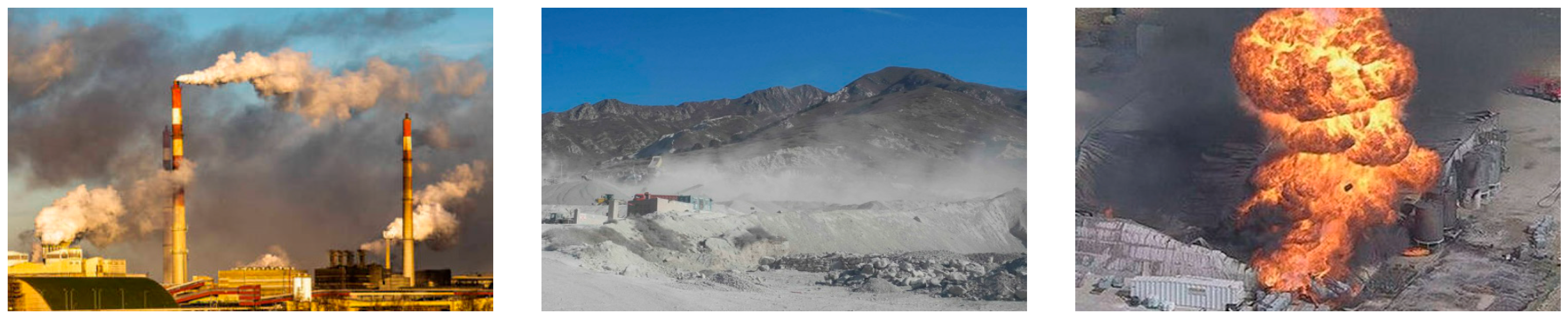
In addition to adverse health impacts, unregulated fugitive dust disrupts the stable operation of industrial facilities. Gao et al. [9] investigated the influences of transport speed, air flow velocity and particle size on dust dispersion via experimental and numerical simulations, offering theoretical guidance for precise dust suppression in material handling procedures. More importantly, combustible metal dust poses severe explosion risks, a critical bottleneck limiting industrial safety. Statistical records spanning 2016 to 2023 reveal that dust collectors are the predominant locations for dust fires and explosions, responsible for nearly 25% of all documented incidents. Existing explosion venting codes have inherent defects in risk evaluation and parameter forecasting, limiting their widespread adoption in industrial safety design [10]. Particle size, dust concentration and aerodynamic conditions dominate the ignition and flame propagation characteristics of metallic dust. For titanium and aluminum alloy dust, finer particles correspond to a lower minimum ignition temperature, while elevated dust concentrations accelerate flame propagation and boost explosion pressure, greatly increasing accident risks in workshops and conveying pipelines [11,12]. Uncontrolled mineral dust emissions degrade ambient atmospheric conditions and exert negative impacts on ecological conditions, public health, workplace safety and industrial production efficiency [13]. Furthermore, persistent dust buildup abrades production equipment and triggers frequent mechanical failures. All typical hazards induced by industrial dust are summarized in Figure 1.
To mitigate the multiple hazards triggered by industrial dust, diverse dust abatement technologies have been developed and extensively deployed across industrial sites. Currently, dry dedusting, wet dust suppression and chemical dust suppression serve as three mainstream technical routes for industrial particulate control [13,14]. Benefiting from stable and dependable performance, conventional dry and wet methods have gained wide adoption in large stockyards and mining zones. In contrast, chemical dust suppressants deliver outstanding suppression efficiency by leveraging material hygroscopicity and particle agglomeration effects. In recent years, eco-friendly suppressants synthesized from natural raw materials have drawn growing research attention, since they can alleviate the long-term ecological risks arising from traditional non-biodegradable chemical additives [14].
However, current industrial dust control studies are divided into separate fields: hazard assessment, online monitoring, separation mechanisms, dust collector optimization and system management. Most studies merely analyze single pollutants, individual equipment or fixed operating parameters. Actual industrial conditions contain multiple coupled variables such as particle size, concentration, temperature, humidity, dust flammability, airflow and equipment aging. This fragmented research creates disjointed research chains: monitoring data cannot support mechanistic analysis, basic theories fail to guide equipment selection, and equipment optimization lacks coordination with layout, energy saving, explosion protection and full-lifecycle management. Therefore, a unified review framework is necessary to correlate dust hazards, working conditions, monitoring, separation mechanisms, equipment optimization and systematic governance.
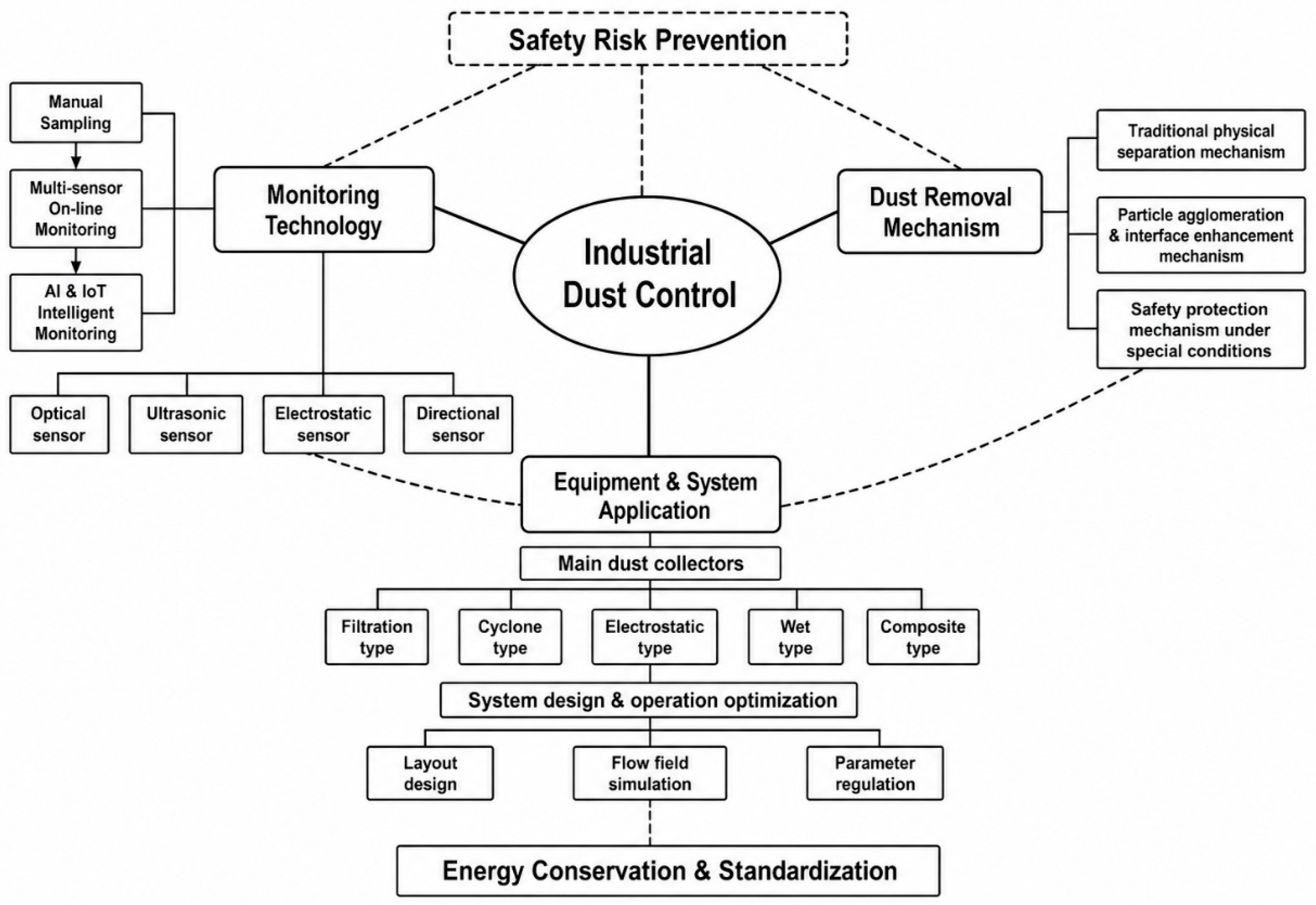
To address this gap, this review follows an integrated loop from dust diagnosis to system optimization, as illustrated in Figure 2. Section 2 compares sampling, sensor-based, and intelligent monitoring methods, emphasizing what type of dust information each method can provide for subsequent control decisions. Section 3 links removal mechanisms with dust properties and operating conditions, including physical separation, interface modification, agglomeration enhancement, and safety-related physicochemical reactions. Section 4 evaluates mainstream dust collectors and optimization strategies by connecting collector performance with efficiency, pressure drop, clogging, energy use, and explosion or hydrogen-evolution risks. Section 5 further extends the discussion from individual devices to system layout, operation control, simulation, safety protection, and lifecycle management. Through this structure, this review aims to clarify how monitoring results, mechanism understanding, collector design, and system management can be coupled to support adaptive and safer industrial dust control. This closed-loop framework is generalized by the authors after analyzing over 110 relevant domestic and international papers. To the best of our knowledge, few existing reviews have established an integrated full-chain analysis framework simultaneously covering dust monitoring, removal mechanisms, dust collectors and system management. It is worth noting that this framework is only summarized from collected literature and has not been verified via practical industrial tests. The four core modules are divided following the progressive engineering logic of real-world dust governance, and all retrieved papers are categorized by their main research subjects, forming the classification basis of this review. This work constructs a full process integrated analytical system involving dust monitoring, dust removal mechanisms, dust collectors and systematic governance to overcome the fragmentation drawbacks of previous research. The four core modules are not discussed as isolated subjects. Instead, monitoring data provide boundary conditions for mechanistic research, theoretical laws guide the selection and optimization of dust removal equipment, and equipment performance further supports the overall layout, safety protection and full-lifecycle management of industrial dust systems, realizing coupled analysis across all technical links.
To ensure the comprehensiveness and reproducibility of the review, literature retrieval was carried out across five mainstream academic databases: Web of Science Core Collection, Scopus, ScienceDirect, CNKI and the MDPI journal platform. Combined subject keywords for searching included industrial dust, fugitive dust, dust monitoring, intelligent sensor detection, dust removal mechanism, particle agglomeration, dust collector, dust suppression system, mine dust and dust explosion protection, with the publication time range restricted to 2010–2026. Clear inclusion and exclusion criteria were applied during screening: only peer-reviewed journal papers focusing on industrial dust monitoring, separation mechanisms, dust collector performance and system optimization with complete experimental or simulation data were retained, while conference abstracts, patents, irrelevant non-industrial particulate matter research and duplicate records were excluded. After two rounds of screening based on titles, abstracts and full texts, a total of 115 valid studies were finally identified and cited throughout this review.

2. Research on Industrial Dust Monitoring Technology

Accurate, real-time dust monitoring serves as the core prerequisite for targeted industrial dust control. This section classifies mainstream monitoring approaches into three categories and systematically compares their technical characteristics, practical performance and inherent limitations.

2.1. Traditional Sampling Monitoring Methods

Traditional sampling is one of the earliest and most fundamental detection technologies applied in industrial dust investigation. This technique relies on offline manual sampling and intermittent spot checks, so it cannot support all-weather, continuous and automatic monitoring of dust pollutants. Traditional manual sampling boasts mature technical logic, standardized operation procedures and stable testing accuracy, so it is commonly adopted for environmental detection and safety assessment in mines, tailing reservoirs and urban industrial zones. This method has the merits of simple equipment and low operation cost, yet it is limited by poor real-time data acquisition and massive manual sampling labor.
A combined monitoring scheme that integrates online monitoring equipment and manual field sampling has been adopted to measure airborne dust concentrations in underground coal roadways. Monitoring results reveal that dust concentrations at mining sites frequently exceed occupational exposure limits, which indicates that conventional dust prevention measures have limited practical effects [15]. To further verify the accuracy and applicability of various monitoring tools, multiple sampling and testing methods have been assessed in an abandoned zinc–lead–copper polymetallic mine. The evaluated approaches include satellite imagery analysis, lichen biomonitoring, dry passive samplers and dust deposition gauges. Test results prove that passive samplers with polyurethane foam inserts deliver higher and more stable collection efficiency. By comparison, samplers equipped with glass fiber filters and traditional dust deposition gauges tend to underestimate actual dust deposition. Affected by wind speed changes and seasonal freeze–thaw cycles, dust accumulation in tailings also presents obvious periodic patterns, with the highest deposition in winter and the lowest in summer [16].
For underground coal mine scenarios, research frameworks combining field sampling and mathematical statistics are applied to conduct synchronous detection of gas and coal dust. Gas emission rate calculations can effectively classify different types of mines. Combined with the lower explosion limit standard of coal dust, this method is also used to assess onsite safety risks and optimize underground ventilation and air volume regulation [17]. In addition, magnetic analysis has been developed as a rapid and low-cost approach for dust pollution assessment. With urban road dust and evergreen plant leaves as test samples, this method can identify the correlation between magnetic characteristics and heavy metal contamination, serving as an efficient screening tool for atmospheric dust monitoring [18].
Similar sampling-based analytical methods are also used to study farmland tillage dust and indoor particulate pollution. The relevant research ideas and test schemes can provide valuable references for industrial dust monitoring [19,20]. Overall, traditional sampling methods have the advantages of simple equipment, convenient operation and low cost. Nevertheless, their poor real-time performance and heavy manual workload become major constraints. Such approaches can only meet the needs of discontinuous periodic spot sampling, and fail to satisfy the requirements for real-time, dynamic and full-range monitoring in modern industrial production.

2.2. Sensor-Based Online Monitoring Methods

Sensors have become the mainstream equipment for online monitoring of industrial dust. According to working principles, they are divided into optical sensors, ultrasonic sensors, electrostatic induction sensors and directional monitoring sensors. To guarantee reliable detection results in complex working environments across mining, construction, metallurgy and powder processing industries, sensor calibration has become an indispensable supporting technology for all types of monitoring equipment.
Optical sensors based on light scattering, Mie scattering, hyperspectral analysis, lidar and optical imaging dominate online industrial dust monitoring. For underground coal mine scenarios, calibrated light-scattering sensors deliver steady real-time coal dust measurement, with readings insensitive to ambient temperature and humidity fluctuations [21]. Aiming to meet the demands of heavily dusty industrial sites, researchers have further upgraded optical monitoring hardware. Specifically, dual-light-source sensors built on Mie scattering theory exhibit favorable stability and anti-interference performance; their monitoring data show a correlation coefficient of 0.983 against the standard filter weighing method [22]. In addition, image processing offers non-contact dust detection by building quantitative correlations between image features and actual dust concentrations [23].
Apart from routine industrial dust concentration measurement, optical monitoring techniques have also expanded to two emerging application directions: surface dust accumulation detection and large-scale regional atmospheric dust observation. On the one hand, hyperspectral analysis combined with a mixed-pixel model enables precise quantification of dust coverage on photovoltaic panels [24]. On the other hand, long-term ground observation campaigns along the Sahelian Dust Transect capture the spatial variation of mineral dust concentrations across wide atmospheric regions [25]. For cement and construction material manufacturing sites, mobile multi-wavelength lidar facilitates long-duration tracking and spatial distribution analysis of industrial particulate emissions [26]. Furthermore, Mie scattering laser detectors support simultaneous measurement of PM1, PM2.5, PM10 and total suspended particulates, substantially expanding the particle size detection range of optical monitoring equipment [27].
In addition to optical devices, ultrasonic sensors based on the ultrasonic attenuation principle are extensively used in the powder processing industry. This kind of monitoring system can cover a dust concentration range of 0.05–2 kg/m3 and continuously capture real-time variations of dust flow inside production facilities [28]. For flammable and explosive dust pollutants, electrostatic induction sensors exhibit unique application advantages. Integrating electrostatic induction technology with neural networks can build monitoring systems with high accuracy and fast response, which are competent for dust explosion early warning [29]. When applied to high-concentration aluminum–magnesium alloy dust, monitoring systems optimized by machine learning methods can further improve overall detection efficiency and precision [30]. Directional monitoring technologies are mainly designed for dust source identification and dust migration analysis. The combination of adhesive films and computer scanning can accurately judge dust deposition directions, offering effective technical support for monitoring scattered dust around mining and industrial sites [31].
The above four types of sensors vary in working mechanisms, application scenarios and overall performance. Their technical features, strengths and weaknesses are summarized and compared in Table 1.
Low-cost sensors are ideal for large-scale field deployment, but their measurement data are prone to deviation when dust concentration changes sharply. For this reason, reasonable calibration is critical to ensure stable online monitoring. Among various machine learning calibration algorithms, XGBoost achieves optimal monitoring performance across full concentration ranges for construction sites with fluctuating dust loads [32]. Overall, sensors with diverse working principles are applicable to most industrial conditions, yet their measuring accuracy is easily compromised by external disturbances including dust concentration, temperature and humidity.
Such interference is particularly prominent under heavy dusty and humid working environments, where particulate pollutants readily attach to optical lenses and sensing surfaces and trigger severe fouling and sustained signal drift. Even optimized Mie scattering dual-light sensors suffer reduced light transmittance and consistent measuring errors due to long-term particle accumulation [22]. To tackle this defect, industrial monitoring systems adopt multiple solutions: continuous air purging, mechanical wiper self-cleaning modules and intelligent calibration algorithms. As demonstrated by wind tunnel experiments in References [21,32], the XGBoost model can dynamically correct baseline drift caused by dust coverage and humidity fluctuations and greatly mitigate long-term measuring deviations in high-dust environments.
At present, sensor-based monitoring technologies have formed a relatively complete technical system, yet obvious limitations still exist in practical application. Optical sensors are vulnerable to complex light interference, ultrasonic equipment has narrow applicable scenarios and is mainly limited to powder processing, electrostatic sensors target only explosive dust, while directional sensors have relatively single functions. Moreover, the calibration of low-cost sensors under multi-factor coupled interference is still a prominent technical difficulty. Future research needs to focus on developing universal calibration schemes and multi-functional integrated sensors to better meet the monitoring demands of complex industrial environments.

2.3. Intelligent Monitoring Methods

Traditional monitoring sensors suffer from limited detection accuracy and poor environmental adaptability in complex industrial scenarios. In contrast, intelligent monitoring approaches combine machine learning, neural networks, cloud-edge collaboration and other artificial intelligence technologies into dust monitoring systems and have become the mainstream research focus and future development direction for industrial dust monitoring.
To clarify the overall differences between the three major monitoring routes, a comprehensive comparison is provided in Table 2.
Multiple algorithms including linear regression, artificial neural networks, random forests and support vector machines have been adopted for the calibration of coal dust sensors [33]. Similarly, machine learning models are also applied to build dust concentration prediction systems for open-pit mines [34]. These approaches demonstrate different fitting performances for the nonlinear changes of dust concentration, and effectively optimize the calibration effect of low-cost sensors. Under variable temperature, humidity and dust concentration conditions, nonlinear machine learning algorithms significantly outperform traditional linear models. Among all tested methods, the artificial neural network delivers the best overall performance, raising the detection accuracy of low-cost coal dust sensors by 2–11%. This fully verifies that machine learning can correct measurement errors of low-cost sensors under complex industrial conditions.
For open-pit-mine applications, intelligent monitoring and prediction systems based on IoT and machine learning have been developed to collect real-time particulate data, predict dust concentration and issue risk alerts, realizing the shift from passive monitoring to active early warning in mining sites. Relevant intelligent technologies have also been extensively explored for dust deposition monitoring of photovoltaic panels [35,36]. One solution applies the gated recurrent unit (GRU) to extract time-series characteristics of dust data and combines the semi-supervised K-means algorithm to achieve dynamic model adaptation. This method relies solely on the original inverter data and requires no additional hardware, thereby reducing operation and maintenance costs and showing strong engineering practicality. A cloud-edge collaborative system paired with time-series interaction models has also been established, achieving a classification accuracy of over 98%. The adopted random grouping strategy enables the system to adapt to the dynamic access and removal of photovoltaic equipment, thus ensuring strong stability and environmental adaptability.
Intelligent monitoring techniques make up for the inherent defects of traditional sampling and ordinary sensor monitoring, and achieve remarkable progress in detection accuracy, automation and anti-interference capability. Such technologies have broken the performance limitations of conventional monitoring equipment. With the further development of Internet of Things and artificial intelligence, industrial dust monitoring will evolve towards high precision, unmanned operation and full-range intelligent linkage.
More importantly, monitoring should not be treated as an isolated measurement task. Sampling data, online sensor signals, and intelligent predictions provide the boundary conditions for mechanism analysis, including particle-size distribution, concentration fluctuation, dust source location, humidity, temperature, and explosion-related warning indicators. As summarized in Section 2.3, machine learning and neural network algorithms (XGBoost, GRU, artificial neural networks, etc.) can process multi-dimensional sensor data continuously in real time and generate adjustable operation signals according to transient dust characteristics, which can guide the regulation of the physicochemical dust removal mechanisms discussed in Section 3. Therefore, the next step in industrial dust control is to translate real-time monitoring outputs processed by artificial intelligence into an understanding of how particles migrate, agglomerate, deposit, ignite, or undergo hydrolysis under specific operating conditions.

3. Research on Action Mechanisms of Industrial Dust Removal

Diversified dust removal technologies are developed to tackle particulate pollution in complex industrial scenarios, and clarifying their internal working mechanisms can provide theoretical guidance for equipment optimization and practical application expansion. This section reviews relevant studies from three aspects: basic physical dust removal mechanisms, interface modification and agglomeration enhancement, as well as physicochemical reactions and safety protection of dust under special operating conditions.

3.1. Basic Mechanisms of Physical Dust Removal

Physical dust removal is the most commonly used technology across industrial fields. It realizes gas–solid separation by virtue of fluid dynamics, inertial collision, flow field regulation and electrostatic adsorption without using chemical agents. Numerous studies have thoroughly investigated the working performance and internal principles of different physical dust removal devices.
Wet chord grid dust removers and granular layer dust collectors are well-established devices for industrial applications, and relevant research mainly centers on numerical model optimization. The Lattice Boltzmann Method (LBM) is used to build mesoscale models for droplet evolution on chord grids, and experiments are conducted to validate model performance. Droplets go through three obvious evolutionary stages, and wire spacing as well as droplet shape play decisive roles in maintaining stable liquid bridges [37]. To address the limitations of conventional simulation tools for granular layer dust collectors, optimized pore-scale simulation technologies are proposed. In combination with the LBM and dynamic dust deposition models, these methods analyze internal flow fields and identify inertial collision and interception as the primary particle capture mechanisms [38].
Cyclone separators are also widely applied mature dust removal devices. Inner wall deposition of fine particles will lower separation efficiency. Tests with transparent cyclone separators, high-speed cameras and particle image velocimetry (PIV) are implemented to observe particle motion. It is found that fine particles easily escape along with airflow, and particle accumulation is most severe at the cone bottom, which conforms to the dispersion rules of moving dust sources [39]. Novel cross-structure reactors with sinusoidal velocity inlets are developed to enhance the treatment capacity for ultrafine particles. Analysis based on CFD-DEM shows that periodic turbulent pulsation intensifies gas-particle mixing, and the reactor works best when the width–diameter ratio is 1.2 [40].
Electrostatic dust removal is highly effective for fine particles and oil mist, with research focusing on mechanism research, extreme environment adaptation and miniaturized equipment design. Reviews on electrostatic oil mist control prove that multi-stage structures and pulse power supplies can boost purification efficiency and mitigate electrode faults [41]. For electrostatic precipitators operating in high-temperature flue gas, multi-physics coupling models are established to explore the joint influence of temperature and magnetic field. Rising temperature will reduce separation efficiency, while an external magnetic field can significantly improve particle capture ability [42]. Additional numerical simulations further improve the theoretical framework of high-temperature electrostatic dust removal under multi-field coupling [43]. In practical engineering, two kinds of micro-scale ESP are developed for small combustion facilities. After electrode optimization and field verification, their removal efficiencies reach 85–92% (tube type) and 78–88% (plate type). Such compact and energy-saving equipment is applicable to distributed small pollution sources [44].
The technical characteristics, advantages and limitations of the above physical dust removal devices are summarized in Table 3.

3.2. Enhancement Mechanisms Based on Interface Modification and Agglomeration

Traditional physical dust removal technologies have limitations in treating hydrophobic dust and ultrafine particles. To address this issue, researchers have developed multiple enhanced technologies via particle interface modification, covering functional filter materials, dust suppressants and surfactant-assisted agglomeration techniques.
Integrated flue gas purification represents an important development direction for industrial waste gas treatment. Catalytic bag-filter materials loaded with a V2O5-WO3/TiO2 catalyst are capable of removing dust and nitrogen oxides simultaneously with reliable long-term performance [45]. Considering that sulfur-containing flue gas easily leads to catalyst deactivation, different additives are used to modify Mn-Ce/P84 filter materials. A large number of characterization tests and long-term experiments demonstrate that these additives can regulate catalyst surface properties and strengthen sulfur resistance, enabling stable service in sulfur-containing environments [46].
Eco-friendly dust suppression has evolved into a mainstream research field in dust control [13,14]. For mine road pollution, new composite dust suppressants are prepared using sodium alginate extracted from waste seaweed. After component optimization, the materials can form compact protective films on dust. They possess excellent dust suppression capacity and realize the recycling of waste biomass, showing remarkable environmental advantages [47].
Surfactants are widely used to boost the removal of ultrafine particles and hydrophobic dust. Studies on surfactant concentration show that these substances can lower droplet surface tension, and the optimal concentration range of 0.05–0.1 mM can greatly improve separation efficiency [48]. Aiming at highly hydrophobic coal dust in mines, the wetting mechanisms of various surfactants are investigated. The prepared wetting agents effectively improve dust wettability and achieve a dust removal rate of 89% [49]. For hazardous respiratory dust, the coupled level set and volume of fluid method is adopted to establish droplet–particle interaction models. Simulation and experimental results prove that surfactants enhance droplet capture performance, with the respiratory dust sedimentation efficiency reaching 84.33% under optimal conditions [50].
A comprehensive comparison of the above dust removal enhancement technologies is presented in Table 4.

3.3. Dust Physicochemical Reactions Under Special Conditions and Safety Prevention Mechanisms

Industrial dust removal systems commonly run under high temperature, high humidity and other extreme environments. Captured industrial dust will experience complex physicochemical variations, which are closely related to production safety, hazardous waste disposal and resource recycling. Current research mainly investigates dust removal performance, risk assessment and prevention technologies for special operating scenarios.
High temperature adversely affects the performance of conventional spray dust removal. Dynamic contact angle models that take particle temperature into consideration are adopted. Combined theoretical analysis, CFD-DPM simulation and experimental tests are used to study collision behaviors between high-temperature particles and droplets. After parameter optimization, the spray system maintains a removal efficiency above 85% for particles at 500 °C, and the relevant parameters can guide field operation [51]. Beyond direct gas–solid dust removal, electric-field-driven capture has also been explored for solid contaminants in special media. For example, freestanding rotary triboelectric nanogenerator-based oil purification converts mechanical energy into high-voltage electric fields to trap solid pollutants [52].
Safety risk management is essential for the normal operation of dust removal systems. Dust explosion poses a serious threat to electrostatic spraying dust removal systems, and FLACS software has been adopted to construct three-dimensional models for full-process explosion simulation, verifying that dust concentration dominates explosion intensity and that properly designed explosion venting devices can effectively reduce potential accident risks [53]. In addition, combined reduction techniques can be applied to treat zinc-bearing hazardous dust produced in the steel industry; this integrated technical route reduces reaction temperature and energy consumption and achieves a zinc recovery rate of over 92%, realizing efficient resource recycling of metal dust [54]. Apart from explosion risks and waste disposal issues, metal dust accumulated inside wet collectors easily undergoes hydrolysis and hydrogen evolution, which brings hidden explosion hazards. Experimental tests and microscopic characterization of Al-Zn mixed dust confirm that the micro-galvanic effect accelerates the hydrolysis process and that the hydrogen evolution reaction can be divided into three distinct stages [55]. To control such potential risks, a green inhibitor derived from pine needle extract is proposed, which can form protective coatings on dust particles at a concentration of 1.75 g/L and nearly completely inhibit hydrogen evolution, providing a reliable approach for preventing safety hazards caused by metal dust [56].
Overall, removal mechanisms provide the bridge between monitoring information and collector design. Physical separation explains how particle inertia, interception, centrifugal force and electrostatic force, and gas–liquid contact determine baseline capture behavior; interface modification and agglomeration enhancement improve the removal of hydrophobic or ultrafine particles; and special-condition studies reveal how high temperature, high humidity, combustible dust, and metal-dust hydrolysis alter both efficiency and safety. Combined with the real-time multi-dimensional dust signals processed by artificial intelligence algorithms from Section 2, these different types of physicochemical mechanisms can be dynamically matched according to variable field working conditions, which delivers actionable adjustment standards for the safe and efficient operation of the various dust collectors discussed in Section 4. However, most mechanism studies still focus on single factors or laboratory-scale conditions, while coupled effects among particle size, concentration, airflow, humidity, and dust reactivity remain insufficiently verified in long-term field operation. Future mechanism research should therefore support real-time equipment adjustment and safety control rather than remaining separate from engineering design.

4. Research Status of Industrial Dust Collectors

Against the backdrop of increasingly strict industrial emission standards, various types of dust removal equipment have been developed for different working conditions. This section categorizes mainstream dust collectors, summarizes their respective application characteristics, and reviews relevant optimization research concerning operating performance, energy consumption and safety risks. Real-time dust feature data processed by the intelligent monitoring systems in Section 2 can be matched with the physicochemical dust removal mechanisms elaborated in Section 3, laying a theoretical foundation for the parameter regulation and safety improvement of all dust collection equipment covered in the following subsections.

4.1. Types and Application Status of Mainstream Dust Collectors

Based on gas–solid separation mechanisms, industrial dust collectors are categorized into five mainstream types, namely filtration-type, cyclone-type, electrostatic-type, wet-type and composite dust collectors. Each type is characterized by unique structural configurations, dust removal performances and applicable industrial scenarios, forming a diversified industrial dust purification system.
Filtration-type dust collectors, including baghouse, pleated cartridge, cone, ceramic candle and sintered plate dust collectors, separate particles by means of physical interception with filter media. This category of equipment boasts excellent performance in capturing fine particles like PM2.5, so it has been widely deployed for flue gas purification of fluidized bed boilers, wood processing and coal mining where dust concentration remains high. The purification performance and PM2.5 characteristics in such industrial scenarios have been fully explored in existing studies [57,58].
Filter media bring remarkable separation effects, yet they also lead to common operational problems during long-term service. Internal blockage is a typical fault of baghouse dust collectors, and uneven pulse-jet cleaning in the upper section greatly limits the overall working efficiency of cartridge filters [59,60]. When applied to wood dust treatment, filter bags can maintain a separation efficiency above 99.99%, while the flow resistance rises continuously with the extension of service time [61,62]. For pleated cartridge filters, both material properties and geometric parameters play decisive roles in their comprehensive performance and energy consumption [63].
Different from filtration-type dust collectors, cyclone separators complete gas–solid separation relying on the centrifugal force of rotating airflow. Thanks to their simple structure and low costs for production and maintenance, they are widely applied to remove coarse particles in conventional industrial settings [64]. Customized structures can be developed to adapt to industrial grinding scenarios, and such equipment can reach a practical removal efficiency of 90% in actual operation. The correlation between structural parameters and aerodynamic performance has also been verified via semi-industrial tests [65,66]. Cyclone dust collectors are less effective at capturing ultrafine particles compared with filtration equipment, and wall abrasion is another prominent issue during long-term operation. The application of ceramic wear liners can mitigate abrasion, but it will meanwhile lower particle separation efficiency [67]. Vortex-type improved cyclones adopt built-in water spray structures to promote particle agglomeration. Nevertheless, the working performance of such modified devices is highly susceptible to structural parameters and operating conditions [68].
Electrostatic precipitators remove particles by charging pollutants in electric fields and collecting charged particles on electrodes. Two mainstream configurations, wet electrostatic precipitators (WESPs) and electrostatic cyclone precipitator (ECP) systems, have been widely investigated [69,70]. WESPs deliver excellent performance for fine particle removal in complex industrial environments, and dedicated prediction models can effectively assess their operation under variable conditions. For ECP systems, the integration of magnetic confinement technology and exhaust port structural optimization is verified to further improve the capture of fine particles. Wet-type dust collectors capture particles via sufficient gas–liquid contact. Differing from electrostatic dust removal equipment, they feature strong adaptability to high-temperature and high-humidity environments and are widely applied in underground coal mines. Relevant reviews on coal dust hazards and prevention techniques have established a solid theoretical basis for the promotion of wet dust removal technology in mining areas [71]. As a typical wet dust control method, wind-spray synergistic dust removal has been proven to achieve high dust removal efficiency in field applications, which further expands the application value of wet dust suppression in coal mine dust governance [72].
Composite dust collectors combine two or more separation mechanisms to compensate for the limitations of single-type equipment, and have gradually become a key research direction in industrial dust treatment. Hybrid structures integrating cyclone and filtration can greatly lower the dust load on filter cartridges under high-concentration conditions [73]. Compact combined designs help save installation space and cut energy consumption compared with conventional devices [74]. Dry–wet combined technologies are proven to enhance the agglomeration and capture of ultrafine coal dust [75]. Systems that couple electrostatic and cyclone separation also present outstanding performance in removing submicron particles [76].
Overall, the five categories of dust collectors differ greatly in purification efficiency, operating cost and field adaptability. Reasonable selection of dust removal equipment needs to comprehensively match the actual working conditions, including particle-size distribution of dust, inlet dust concentration, flue gas temperature and humidity, allowable system pressure drop, long-term cleaning stability and explosion safety risks. Filtration dust collectors exhibit outstanding capture performance for fine particulate matter but suffer from filter clogging and rely on stable pulse-jet regeneration systems. Cyclone separators feature low investment and maintenance costs for coarse and medium-sized dust yet show limited removal capacity for ultrafine particles. Electrostatic and wet dedusting devices are suitable for high-humidity or high-temperature scenarios as well as fine dust treatment, whereas practical application needs to address problems such as water consumption, hydrogen precipitation, electric field instability and explosion protection. In practical industrial projects, single-type dust collectors often cannot satisfy multi-index comprehensive purification demands, which provides a development background for the emergence of multi-mechanism composite dust removal equipment.
The core characteristics of the five types of mainstream dust collectors are compared in Table 5.

4.2. Research Progress on Performance Optimization of Dust Collectors

Due to the inherent operational drawbacks of traditional dust collectors in complex industrial scenarios, multi-dimensional technical improvements have been extensively explored, including structural reconstruction, flow field regulation, cleaning system renovation, filter material innovation, and auxiliary dedusting technique development, to promote the comprehensive operating performance of dust removal facilities.
Computational fluid dynamics (CFD) has matured into a core numerical tool for structural improvement and flow field regulation of dust removal equipment. Numerical simulations based on the SST turbulence model can quantify the coupling relationship between geometric parameters, separation efficiency and pressure drop of multi-stage dust collectors, and the deviation between simulated results and experimental data is controlled within 4.6% [77]. This numerical method is also widely adopted to resolve the gas–solid flow characteristics of dry dust removal equipment applied in power industry scenarios [78].
For filtration equipment running under high-temperature and high-pressure working conditions, different inlet structures lead to distinct ash deposition and long-cycle operation performances. Relevant simulation and bench tests prove that tangential inertial inlet structures can effectively reduce dust accumulation on ceramic candle filters and prolong the service interval of pulse cleaning [79]. Comparative CFD analysis carried out under uniform lab-scale boundary conditions between filter plate and cartridge dust indicates rational filter plate layout improves the overall airflow uniformity by 6% and cuts the peak velocity difference of filter zones by 17%, alleviating local overload of filter media [80]. Combined with exponential-trigonometric optimization (ETO) algorithms, CFD can realize multi-objective optimization on sintered plate deflector components. The optimal structural parameters (30 mm aperture, 5° installation angle, 550 mm plate length) reduce the root mean square of surface velocity by more than 20% and lift dust deposition uniformity index from 0.78 to 0.91 [81]. As for straight-through baghouses, collaborative optimization of filter bag stepped layout and elliptical profile can suppress internal large-scale separation vortices, balance airflow distribution and lower total pressure loss. After optimization under fixed laboratory operating cycles, the dust distribution non-uniformity coefficient drops from 35% and the system pressure drop decreases by 15% [82]. Additionally, optimized numerical algorithms and mesh strategies have been proposed to boost the simulation precision of internal flow fields in granular layer dust collectors [38].
Although CFD optimization is widely applied, conventional two-phase flow models carry excessive simplifications, leading to significant deviations between simulated performance and actual industrial data. Most numerical frameworks ignore progressive filter cake buildup, particle agglomeration and time-dependent flue gas parameter fluctuations in practical production scenarios. High efficiency and low resistance values predicted under ideal CFD boundary settings cannot be directly compared with field measurements under unstable industrial operating conditions, restricting the industrial popularization of simulation-derived optimization schemes.
Optimization of pulse-jet cleaning mechanisms serves as a core technical route to tackle the ubiquitous problem of uneven and incomplete ash removal for filter-type dust collectors. A variety of innovative jet and flow guide structures have been validated via laboratory bench tests, semi-industrial pilot trials and underground field tests. However, performance data measured under diverse test scales and boundary environments cannot be used for direct horizontal comparison. Built-in perforated cleaning structures can eliminate the upper cleaning dead zone of pleated filter cartridges. Bench tests prolong the average filtration cycle to 1300 s from 928 s, and field tests in mining working faces realize total and respirable dust removal efficiencies of 95.2% and 93.2%, respectively [60]. For cone filter cartridges, porous diffusion nozzles can cut the average residual pressure drop by 27.0% and extend the service cycle to 3.8 times that of conventional circular nozzles under identical laboratory test conditions [83]. Diffuser-type nozzles for horizontal filter elements can achieve a balanced relationship between cleaning strength and layout space to guarantee long-term stable operation [84]. A double-layer upper and lower coordinated injection structure significantly enhances the stripping performance of sticky, damp dust cakes, and corresponding semi-industrial tests further quantify the influence of nozzle geometric parameters on filter bag regeneration effects [85,86]. Even though such optimized jet structures can homogenize the internal airflow distribution under single-factor steady experimental environments, most structural improvement schemes lack systematic verification in complex industrial scenarios with fluctuating dust concentration, variable ambient humidity and long-term accumulated ash deposition.
Innovative filter materials and chemical agglomeration auxiliary methods greatly advance industrial dust purification technology. PTFE composite substrates manufactured by needle punching and hot pressing achieve over 99.8% capture efficiency for PM0.3 and PM0.5 with low flow resistance in static lab tests [63]. The dry–wet synergistic dedusting system adopting modified AM/AA-CMCS polymer agglomerates coal particles smaller than 500 mesh and lowers outlet dust emission [75]. However, both filter modification and chemical additives have a high cost and weak environmental compatibility, and their ideal lab performance cannot be stably maintained under dynamic onsite dust conditions.
Machine learning intelligent frameworks are widely used for dust removal efficiency prediction and parameter optimization. Random forest ensemble models developed for bench-scale wet electrostatic precipitators achieve an R2 of 0.956 for PM7 prediction [69], while the integrated CFD-BPNN method optimizes underground wind-spray dust collectors, cutting shearer dust concentration from 372 mg/m3 to 43.7 mg/m3 and attaining a field removal efficiency of 90.6% [72]. All training datasets are collected under steady experimental environments; these models show weak generalization capacity when facing variable onsite dust and airflow, limiting industrial promotion.
Reported dedusting efficiencies cannot be directly cross-compared, as laboratory tests, field monitoring and numerical simulations are implemented under completely different engineering conditions. Obvious inherent scale gaps exist between lab test platforms and practical industrial equipment: laboratories maintain constant dust concentration, stable temperature and fixed air volume without long-term ash accumulation, whereas production sites suffer time-varying dust loads, continuous filter cake deposition and maldistributed airflow caused by large-scale equipment structures. Such differences widen the performance gap between ideal lab indicators and long-term field operation results. Laboratory experiments can separate single variables to analyze dust removal mechanisms yet neglect complex industrial interferences, while field data reflect real constraints but lack controllability and repeatability. Additionally, the prediction accuracy of coupled CFD and machine learning models heavily relies on pre-set boundary parameters and calibration data. Overall, existing relevant research has not yet built unified evaluation standards applicable to dust removal performance under diversified working conditions.

4.3. Research on Safety, Energy Conservation and Standardization

Operational safety, energy consumption control and standardized performance evaluation are indispensable supports for the reliable and sustainable operation of industrial dust collectors, which have attracted extensive research attention in the field of industrial dust control.
Dust explosion and hydrogen evolution are major safety hazards in dust collector systems, as shown by studies on metal-dust explosions [11,12,87] and hydrogen release in wet collectors [88,89,90]. Relevant statistics show that dust collectors are involved in nearly 25% of industrial dust explosion incidents and are recognized as high-risk production facilities. A new logarithmic congestion model has been proposed to improve the prediction accuracy of venting pressure for baghouse dust collectors [59]. Combined with full-scale deflagration tests and CFD validation, this model presents better calculation performance. Even so, the model has not been fully verified onsite under diverse dust properties and complex operating conditions, which restricts its extensive application in practical engineering.
Wet dust collectors used in metal processing also face distinctive risks arising from hydrogen explosion. The hydrogen generation mechanisms of aluminum and magnesium alloy dust in wet operating environments have been thoroughly explored. Continuous hydrogen release poses severe threats to the safe operation of dust removal facilities [88,89,90]. A series of eco-friendly inhibitors represented by plant extracts and composite chemical agents have been developed to restrain hydrogen production, delivering reliable technical guarantees for hazard prevention of wet dust removal equipment.
In terms of energy conservation and low-carbon operation, current research mainly focuses on two technical optimization directions: optimization of structural parameters for single equipment and integrated transformation of the whole system [63,82]. Material modification and geometric parameter adjustment can reduce the filtration resistance of individual dust collectors and boost energy efficiency. From the perspective of the overall system, the carbon dioxide emissions of pulse-jet baghouse dust collectors throughout manufacturing and operation have been analyzed, which offers references for the low-carbon optimization of industrial dust collection systems [91]. Key operating parameters related to the energy consumption of dust collection systems have also been summarized, supporting the implementation of refined energy-saving management [92]. Most existing energy-saving studies only target operational energy consumption. By contrast, the theoretical framework for full-lifecycle carbon emission assessment and low-carbon structural design is still incomplete.
For industrial standardization and performance evaluation, current evaluation systems are capable of testing the instantaneous dust removal efficiency and pressure drop of conventional dust collectors [61,62]. A comprehensive evaluation index for dust removal equipment, namely the levelized cost of precipitator, has been developed to conduct combined environmental and economic assessment [76]. However, existing evaluation indicators overly emphasize short-term purification performance. There is a lack of structured assessment on equipment safety reliability, service life degradation and full-lifecycle economic benefits. Up to now, a unified and universal evaluation standard for industrial dust collector systems has not been formed.
Overall, modern industrial dust removal technologies have established a sound technical framework. However, many practical challenges remain to be solved. The newly proposed safety prediction models still lack sufficient field validation, and the theoretical system for full-lifecycle carbon emission assessment is not yet perfect. Meanwhile, existing evaluation indicators cannot fully reflect equipment reliability and long-term operating benefits, and a unified industry-wide evaluation specification is still missing. Furthermore, limited simulation precision for complex multiphase flow and poor universality of optimized schemes are also prominent constraints. All these issues need to be addressed in future targeted research, and the overall collaborative operation and full-lifecycle safety management of multi-collector dust removal systems will be further elaborated in Section 5.

5. Research Progress of Industrial Dust Removal Systems

Unlike single dust removal equipment that only achieves local purification, complete industrial dust control systems integrate multiple functional modules for overall optimization of field governance, covering layout design, real-time regulation and full-cycle management. This section discusses relevant research progress from three dimensions: layout planning, collaborative operation and safety-oriented lifecycle management.

5.1. Overall Design and Layout Planning of Dust Removal Systems

Reasonable structural design and spatial layout of each system component guarantee the stable and efficient operation of the whole dust removal system. Four categories of geometric improvement strategies for gas–solid cyclone separators are systematically summarized in this review. All performance data summarized in relevant papers come from steady bench experiments and ideal CFD simulations with fixed operating conditions; such small-scale test results cannot be directly compared with long-term operation data of full-size industrial cyclones under fluctuating dust loads [93]. A miniature cyclone prototype for polyurethane grinding dust was measured on a controlled bench rig with constant dust concentration and airflow, delivering a separation efficiency of 90% under steady bench test conditions, yet this stable high performance is unattainable in fluctuating industrial production scenarios [65]. 3D CFD coupled genetic algorithm multi-objective optimization of tangential inlet cyclones is carried out under lab-scale low solid loading simulation boundaries, and the balanced low-pressure-drop and high efficiency performance only holds for fixed numerical test conditions [94]. A total of 57 cyclone structures adapted to clinker calcination scenarios are evaluated through small-scale simulation and bench-scale experiments, and the summarized design rules cannot be directly applied to full-size industrial kilns with variable ash loads [95]. Lab-scale fuzzy prediction and simulation analyses of uniflow cyclones quantify how swirl inducer angles and inlet flow affect particle cut diameter under constant particle size distribution [96].
Apart from various single cyclone structures, a series of composite dust separation devices have also been optimized from structural perspectives in existing studies. Multi-field coupling numerical simulations under fixed ideal industrial boundary conditions (20 m/s flue gas velocity, 30 kV voltage and 0.5 T magnetic induction) were conducted to analyze magnetically confined electrostatic cyclones with varied exhaust insertion depths; the optimal 85 mm insertion depth brings a 23.7% improvement in simulated dust removal efficiency under static calculation settings, yet this performance increment is difficult to realize in factories with transient flue parameters [70]. Comparative CFD simulation with unified lab-scale geometric and operating constraints was carried out for filter plate and cartridge dust collector models; reasonably arranged filter plates raise overall airflow uniformity by 6% and reduce the peak velocity difference of filter areas by 17% under identical static simulation environments, and this optimization effect will weaken when scaled up to large industrial equipment [80].
Numerous existing studies focus on the structural design of onsite dust capture accessories and matching ventilation pipelines. IR-sensing automatic steel dust cleaning robots with optimized sweeping structures achieve autonomous dust capture under fixed small workshop test environments, and continuous complex industrial dust loads will weaken the stable operation capacity [97]. Rotational flow air curtain hoods developed for tobacco dust treatment deliver superior capture efficiency compared with ordinary suction devices under steady laboratory dust test conditions, and such advantages will shrink under continuously fluctuating onsite dust concentration [98]. Structural optimization of air intake baffles via adjustment of dust barrier dimensions lowers pressure drop and achieves strong coarse particle capture performance within constant CFD simulation setups [99]. Parametric CFD analysis of polishing workshop pipelines and local suction hoods identifies optimal geometric parameters under constant dust concentration and airflow simulation boundaries [100].
From the above research on cyclone separators, composite electrostatic dust removal equipment, onsite dust capture hoods and pipeline layout optimization, diverse structural improvement schemes have been developed to improve the overall airflow uniformity and dust capture capacity of industrial dust removal systems. Nevertheless, nearly all structural performance data summarized in this subsection are derived from fixed steady laboratory bench tests or idealized CFD numerical environments with constant dust concentration, airflow and temperature parameters. Significant scale-up barriers exist when transplanting these optimized small-scale structures to full industrial production lines: actual factories feature time-varying dust loads, uneven large-space airflow distribution and long-term accumulation of dust cakes, which will greatly weaken the high-efficiency indicators obtained under isolated test conditions. Therefore, the separation efficiency and flow uniformity data from different independent studies cannot be used for direct horizontal comparison, and there is still a lack of systematic research on layout optimization under coupled complex industrial interference factors. Most existing layout strategies only target single devices or local capture units without coordinated overall factory layout design, and unified quantitative evaluation standards for layout rationality as well as multi-field coupled simulation tools that integrate long-term dust accumulation have not yet been formed, restricting the comprehensive comparison and practical promotion of different layout solutions.

5.2. System Integration, Operation Optimization and Simulation Control

Operating parameters and working conditions of system equipment are critical to the overall stability and dust collection efficiency of industrial dust removal systems. A large number of studies adopt fixed, steady test environments in laboratory setups to explore the effects of temperature, humidity, and applied voltage on different dust collectors. Steady-state flue gas assumptions are adopted to analyze flue gas and dust characteristics in cement production, and the influences of particle size, gas temperature and applied voltage on electrostatic precipitator performance are quantified based on the Deutsch equation [101]. Controlled experiments on small lab-scale photoelectric precipitators with single fixed dust components quantify the correlations between constant temperature, humidity, residence time and particle removal efficiency [102]. Relevant comparative tests with stable, unchanged air supply are also conducted to analyze air humidity impacts on the pulse-jet cleaning of cartridge filters used for hygroscopic adhesive dust [103].
LBM mesoscale simulation with constant flow boundary constraints [37,38] and steady-state optical visual measurement tests [39] are widely combined to analyze the internal working mechanisms of dust removal systems. Theoretical efficiency prediction models for twin-fluid atomization spray scrubbers are built upon multiple idealized simplifications including uniform droplet size and no-droplet coalescence, and only validated via small laboratory spray tower trials rather than full industrial equipment [104]. Particle image velocimetry tests under steady single-phase airflow environments are adopted to analyze electrohydrodynamic behaviors and submicron particle re-entrainment inside electrostatic precipitators [105]. Structural and operational optimization schemes derived from fixed inlet dust load lab tests can mitigate clogging risks of vibration-enhanced flooded bed dust scrubbers [106].
Further research carries out laboratory tests targeting small-scale wet dust removal equipment, granular bed filters and local ventilation hoods. Pulsed corona discharge’s pollutant removal capacity is measured under separated fixed energy levels in lab flue pipelines [107]. The dust control effect of local exhaust ventilation is assessed under stable, fixed concrete grinding dust concentration [108]. A series of constant high-temperature bench trials are performed to optimize the operating parameters of moving granular bed filters [109,110]. Matching laws between fixed operation modes and single-component dust characteristics are summarized via steady lab tests of integrated wet dedusting equipment for construction materials [111]. Key efficiency and power consumption influencing factors are determined from single-variable laboratory experiments, based on which stable-condition energy-saving schemes are put forward [92].
The above laboratory test data and numerical simulation conclusions provide clear parametric guidance for the integrated design and targeted operation adjustment of dust removal systems, yet such optimized schemes still need further verification and adaptive correction when deployed to full-scale industrial systems with continuously varying flue gas and dust states. Notably, the dust removal efficiency values reported in the above references originate from inconsistent test scales ranging from bench-scale test rigs to simplified simulation models. Direct horizontal comparison of these efficiency indicators will cause misjudgment without clarifying their ideal experimental premises, as there are prominent scale mismatches between constant laboratory environments and fluctuating onsite working conditions. Real industrial sites are characterized by dynamically changing dust concentration, unstable airflow and mixed multi-component dust, which inevitably degrade the high purification performance obtained under single fixed experimental boundaries. From the perspective of system integration and simulation control that this subsection focuses on, current parameter tuning and numerical optimization mostly aim at independent single dust removal units; mature multi-variable co-simulation frameworks supporting whole-system coordinated operation regulation under dynamic industrial conditions have not yet been fully developed.

5.3. Safety Protection and Comprehensive Management of Dust Removal Systems

Industrial dust may lead to explosions, environmental pollution and occupational health risks. For this reason, safety protection and full-lifecycle management have become key research topics. Existing investigations concentrate on energy consumption, carbon emission control and electrostatic properties of dust particles. Long-term continuous full-factory operation monitoring data of pulse-jet baghouses across multiple manufacturing lines are adopted to evaluate their whole-life carbon footprint, and large-capacity integrated dust removal units are recommended to cut overall energy consumption and carbon output [91]. Microscopic laboratory characterization of charged spherical dust particles is combined with industrial cyclone field sampling data to analyze particle charge distribution and rotational torque, revealing the electrostatic interaction mechanism between dust and flow fields [112]. Summarized multi-production-line industrial test data form the basis for targeted structural adjustment schemes to boost cyclone interception efficiency for submicron dust smaller than 5 μm [113].
Apart from carbon footprint and electrostatic characteristic analysis, dust explosion prevention and special combustible dust control also attract widespread research attention. Bibliometric sorting combined with global industrial powder coating explosion accident statistical data is adopted to systematically identify explosion mechanisms, onsite risk assessment standards and industrial explosion suppression technologies [114]. Comprehensive field investigation data from multiple sugar manufacturing workshops are integrated to summarize full process dust governance schemes, onsite dust removal technologies and targeted industrial safety specifications for combustible sugar-dust hazards [115]. A set of bench scale hydrolysis experiments combined with semi-industrial wet dust collector pilot tests are carried out to develop green plant-based inhibitors that suppress hydrogen evolution from aluminum waste-dust hydrolysis, eliminating explosion risks and supporting stable industrial metal-dust recycling [56].
From the above literature analysis, it can be seen that current research on the safety and full-lifecycle management of industrial dust removal systems mainly falls into two major branches. The first branch focuses on the energy-saving and low-carbon operation evaluation of complete sets of dust removal equipment, relying on long-term online monitoring data of actual production lines to analyze the carbon emission characteristics of pulse baghouses and the electrostatic interaction rules of dust particles, providing data support for the optimization of large integrated dust removal units. The second branch centers on the prevention and control of typical dust safety hazards, including quantitative analysis of explosion risks of powder coating and combustible sugar dust through accident statistics and field investigation, as well as the development of plant-based green inhibitors to solve the hidden danger of hydrogen evolution hydrolysis of aluminum–magnesium metal dust in wet dust collectors. Most of the above research work adopts full-scale factory monitoring data, accident records and semi-industrial pilot test results, which can truly reflect the operation state of dust removal equipment under complex actual working conditions and provide reliable reference standards for onsite safety management and low-carbon transformation.
Nevertheless, it should be emphasized that most structural and parametric optimization achievements summarized in Section 5.1 and Section 5.2 are derived from ideal steady laboratory setups and simplified numerical simulation boundaries with single fixed operating constraints; when transplanted to dynamic industrial dust removal systems with variable dust load and flue conditions, targeted correction and re-verification are required to eliminate scale-induced performance deviation. In contrast, all safety risk evaluation and carbon emission research outcomes outlined in Section 5.3 rely on full-scale factory monitoring and industrial accident statistics, so such scale mismatch errors do not exist in their indicator comparison. Even so, current research on safety prevention and full-cycle carbon management still tends to separate risk control and energy-saving assessment; few studies establish a unified evaluation framework that simultaneously quantifies explosion hazard, hydrogen evolution risk and full-life carbon emissions for integrated dust removal systems under complex mixed dust conditions, as summarized in Table 6.
Taken together, the system-level research covered in Section 5.1, Section 5.2 and Section 5.3 indicates that layout design, collaborative operation control, safety hazard prevention and full-lifecycle low-carbon management should not be treated as independent modules, but jointly evaluated as a unified integrated optimization problem for industrial dust governance.

6. Conclusions and Prospects

This paper integrates scattered research findings and establishes an integrated closed-loop analytical framework linking dust monitoring, removal mechanisms, dust collectors and system optimization, which identifies the complete technical chain from onsite dust diagnosis to plant-wide comprehensive dust control. Distinct from prior reviews that only discuss individual detection devices or single dust removal devices in isolation, this work organically correlates field monitoring data, particle capture principles, equipment performance indicators and system safety administration, forming a systematic research paradigm for complex industrial dust governance.
At present, the overall industrial dust control research system still has prominent deficiencies. Conventional monitoring methods cannot support full-space, real-time dynamic detection under variable working conditions; existing mechanism research mostly relies on fixed laboratory environments without multi-field coupling analysis of real factory conditions; mainstream dust collectors lack universal adaptive optimization schemes and present unstable operating performance under high humidity and high dust load; most dust removal systems operate independently without intelligent linkage of monitoring feedback and equipment regulation, and unified evaluation standards for long-term operation safety and energy efficiency are absent.
Four obvious research deficiencies can be summarized from the existing literature. First, mature multi-sensor fusion technologies and intelligent calibration algorithms for real-time acquisition of multi-dimensional dust characteristic information and safety early warning signals are still insufficient. Second, few studies have systematically explored the coupled influence of airflow field, particle characteristics, temperature, humidity and dust combustibility under actual production environments. Third, there is no unified comprehensive evaluation system covering purification efficiency, pressure drop, ash cleaning performance, energy consumption and safety risks for standardized optimization research of dust collectors. Fourth, integrated full-lifecycle management systems that integrate monitoring feedback, adaptive operation, dust explosion prevention and hydrogen evolution suppression have not been constructed to support full-process intelligent dust control.
The four-module integrated closed-loop analysis framework proposed in this paper underpins the sorting logic of the full text and provides a systematic analysis perspective for relevant research. Nevertheless, the framework has certain application limitations. The literature induction of this work is mainly based on conventional mining and manufacturing dust scenarios, while quantitative coupling relationships for high-temperature corrosive dust and ultrafine combustible metal dust are insufficiently summarized. In addition, the inter-module connections summarized herein are only qualitative conclusions extracted from the existing literature, without unified quantitative indexes to realize real-time linkage between monitoring signals and equipment operating parameters. When applied to practical industrial scenarios, the research focus of each module requires adjustment in accordance with dust characteristics, workshop layout and explosion protection specifications. At present, sufficient multi-physics simulation results and long-term field monitoring data for further improving the universality of the framework are still lacking. Future multi-condition field tests and multi-physics simulation research are required to further enrich and perfect this analytical framework.

Author Contributions

Conceptualization, B.H. and C.J.; investigation, Y.Z.; writing—original draft preparation, B.H. and C.J.; writing—review and editing, M.T. All authors have read and agreed to the published version of the manuscript.

Funding

This work is supported by the Key R&D Program of Shandong Province, China (Grant No. 2021CXGC010708).

Institutional Review Board Statement

Not applicable.

Informed Consent Statement

Not applicable.

Data Availability Statement

No new data were created or analyzed in this study.

Conflicts of Interest

The authors declare no conflicts of interest.

References

  1. Qader, M.Q.; Ayanlade, O.S.; Ayoola, P.O.; Fatah, K.K.; Oluwatimilehin, I.A.; Ayanlade, A. Multipathway assessment of heavy metal exposure in urban dust: Linking ecological and human health risks. J. Appl. Toxicol. 2026, 1–13. [Google Scholar] [CrossRef] [PubMed]
  2. Dışbudak, H.; Şevik, H.; Isinkaralar, K.; Isinkaralar, O.; Lakestani, S.; Baghani, A.N.; Bayraktar, E.P. Heavy metal contamination in industrial surface dust: Sources, levels, and health risks in Düzce city, Türkiye. Water Air Soil Pollut. 2026, 237, 677. [Google Scholar] [CrossRef]
  3. Bashir, M.H.; Rehman, A.; Ahmad, H.R.; Hedfi, A.; Ali, M.B.; Boufahja, F.; Elmnasri, K.; Mahmoudi, E.; Shehzad, M.T. Dust trace metals implications on school’s indoor air quality linked to human health risk at khurianwala (pakistan). Atmos. Environ. 2024, 339, 120889. [Google Scholar] [CrossRef]
  4. Rana, M.S.; Wang, Q.; Wang, W.; Enyoh, C.E.; Islam, M.R.; Isobe, Y.; Kabir, M.H. Sources, distribution, and health implications of heavy metals in street dust across industrial, capital city, and peri-urban areas of bangladesh. Atmosphere 2024, 15, 1088. [Google Scholar] [CrossRef]
  5. Castel, R.; Bertoldo, R.; Lebarillier, S.; Noack, Y.; Orsière, T.; Malleret, L. Toward an interdisciplinary approach to assess the adverse health effects of dust-containing polycyclic aromatic hydrocarbons (pahs) and metal(loid)s on preschool children. Environ. Pollut. 2023, 336, 122372. [Google Scholar] [CrossRef] [PubMed]
  6. Ediagbonya, T.F.; Akinlua, O.F.; Ashikodi, M.O.; Okosun, Z.J.; Faluyi, O.F.; Mupanzi, C. Comparative assessment of total petroleum hydrocarbon levels in indoor and outdoor dust: Implications for environmental and human health. J. Build. Eng. 2025, 106, 112583. [Google Scholar] [CrossRef]
  7. Tiwari, R.; Upadhyay, V.; Bhat, S.A.; Kumar, S. Sewage treatment plant dust: An emerging concern for heavy metals-induced health risks in urban area. Sci. Total Environ. 2024, 912, 169231. [Google Scholar] [CrossRef] [PubMed]
  8. Pan, H.; Wang, Y.; Wang, D. Spatial distribution of hg in foliar and road dust in different main urban function area. Environ. Geochem. Health 2025, 47, 218. [Google Scholar] [CrossRef] [PubMed]
  9. Gao, J.; Sun, H.; Li, Z.; Feng, Q. Experimental and numerical study on dust dispersion characteristics during moving dust source processes. Granul. Matter 2026, 28, 5. [Google Scholar] [CrossRef]
  10. Pinna, F.; Zucca, M.; Simoncelli, M.; Stochino, F. Explosion venting in dust collectors: A critical review of standards for reduced pressure and reaction force duration. J. Loss Prev. Process Ind. 2025, 97, 105670. [Google Scholar] [CrossRef]
  11. Li, Q.R.; Zhu, L.H.; Jiang, J.C.; Li, Y.H.; Huang, A.C. Effects investigation of particle size and concentration on the ignition, explosion characteristics, and behavior of flame propagation in tc4 titanium alloys. J. Loss Prev. Process Ind. 2024, 89, 105313. [Google Scholar] [CrossRef]
  12. Bao, S.; Zhao, H.; Yu, X.; Zhang, J.; Wang, L.; Liu, Z.; Li, G.; Yuan, C. Investigation on aluminum dust explosion in pneumatic conveying pipelines. Int. J. Therm. Sci. 2026, 220, 110315. [Google Scholar] [CrossRef]
  13. Kung, H.C.; Lin, W.C.; Huang, B.W.; Mutuku, J.K.; Chang-Chien, G.P. Techniques for suppressing mineral dust aerosol from raw material stockpiles and open pit mines: A Review. Aerosol Air Qual. Res. 2024, 24, 230166. [Google Scholar] [CrossRef]
  14. Kumar, P.; Diddi, S.; Ramachandra, S.; Uppara, H.P. Comparative evaluation of a multi-functional dust suppressant synthesized from sapindus mukorossi extract and bentonite clay. Sci. Rep. 2026, 16, 7998. [Google Scholar] [CrossRef] [PubMed]
  15. Lebecki, K.; Małachowski, M.; Sołtysiak, T. Continuous dust monitoring in headings in underground coal mines. J. Sustain. Min. 2016, 15, 125–132. [Google Scholar] [CrossRef]
  16. Cleaver, A.E.; White, H.P.; Rickwood, C.J.; Jamieson, H.E.; Huntsman, P. Field comparison of fugitive tailings dust sampling and monitoring methods. Sci. Total Environ. 2022, 823, 153409. [Google Scholar] [CrossRef] [PubMed]
  17. Zhou, Q.; Zeng, J. Research on optimization model of coal mine gas and coal dust monitoring based on data acquisition. Procedia Comput. Sci. 2024, 247, 849–858. [Google Scholar] [CrossRef]
  18. Salazar-Rojas, T.; Cejudo-Ruiz, F.R.; Calvo-Brenes, G. Assessing magnetic properties of biomonitors and road dust as a screening method for air pollution. Chemosphere 2023, 310, 136795. [Google Scholar] [CrossRef] [PubMed]
  19. Chen, G.B.; Wang, Q.J.; Li, H.W.; He, J.; Lu, C.Y.; Qin, W.H.; Mao, L.C. Monitoring of farmland dust during tillage and sowing operations and comparative analysis of cultivation modes in the suburban areas of Beijing. Soil Tillage Res. 2024, 237, 105991. [Google Scholar] [CrossRef]
  20. Kozlovtsevaa, E.Y.; Loboykob, V.F.; Nikolenkoc, D.A. Monitoring of fine dust pollution of multistory buildings air environment as an adoption factor of town-planning decisions. Procedia Eng. 2016, 150, 1954–1959. [Google Scholar] [CrossRef]
  21. Amoah, N.A.; Xu, G.; Kumar, A.R.; Wang, Y. Calibration of low-cost particulate matter sensors for coal dust monitoring. Sci. Total Environ. 2023, 859, 160336. [Google Scholar] [CrossRef] [PubMed]
  22. Xu, C.W.; Nie, W.; Peng, H.T.; Li, H.T.; Wan, J.C. Enhancing dust concentration monitoring in high particulate matter environments: A dual-light source particulate matter sensor approach based on Mie scattering. Sens. Actuators A Phys. 2025, 387, 116348. [Google Scholar] [CrossRef]
  23. Wang, S.; Yin, J.; Shi, L. Image processing techniques for dust monitoring in industry: Controlled-environment experiments and feature-based concentration mapping. Int. J. Coal Sci. Technol. 2025, 12, 97. [Google Scholar] [CrossRef]
  24. Zhang, J.Y.; Lei, S.G.; Tian, Y.; Zhao, Y.B.; Li, M.; Sun, S.Y. Intelligent monitoring of photovoltaic panel cleaning status: Fine-Scale dust accumulation estimation using hyperspectral data and mixed-pixel model. Renew. Energy 2026, 261, 125206. [Google Scholar] [CrossRef]
  25. Kaly, F.; Marticorena, B.; Chatenet, B.; Rajot, J.L.; Janicot, S.; Niang, A.; Yahi, H.; Thiria, S.; Maman, A.; Zakou, A.; et al. Variability of mineral dust concentrations over West Africa monitored by the Sahelian Dust Transect. Atmos. Res. 2015, 164–165, 226–241. [Google Scholar] [CrossRef]
  26. Lisetskii, F.; Borovlev, A. Monitoring of emission of particulate matter and air pollution using lidar in Belgorod, Russia. Aerosol Air Qual. Res. 2019, 19, 504–515. [Google Scholar] [CrossRef]
  27. Yu, X.; Shi, Y.; Wang, T.; Sun, X. Dust-concentration measurement based on Mie scattering of a laser beam. PLoS ONE 2017, 12, e0181575. [Google Scholar] [CrossRef] [PubMed]
  28. Kazys, R.; Sliteris, R.; Mazeika, L.; Van den Abeele, L.; Nielsen, P.; Snellings, R. Ultrasonic monitoring of variations in dust concentration in a powder classifier. Powder Technol. 2021, 381, 392–400. [Google Scholar] [CrossRef]
  29. He, W.; Gao, W.; Jiang, H.; Lu, J.; Luo, J. Monitoring of dust concentration based on electrostatic induction and physics-informed neural network. Process Saf. Environ. Prot. 2026, 213, 109010. [Google Scholar] [CrossRef]
  30. Zhao, F.; Gao, W.; Lu, J.; Jiang, H. Machine learning-based precise monitoring of aluminium-magnesium alloy dust. J. Loss Prev. Process Ind. 2024, 92, 105471. [Google Scholar] [CrossRef]
  31. Datson, H.; Birch, W.J. The development of a novel method for directional dust monitoring. Environ. Monit. Assess. 2007, 124, 301–308. [Google Scholar] [CrossRef] [PubMed]
  32. Zheng, L.N.; Feng, Z.K.; Liu, J.; Han, L.; Wang, H. Cross-concentration calibration of low-cost sensors for effective dust monitoring at construction sites. J. Aerosol Sci. 2024, 182, 106456. [Google Scholar] [CrossRef]
  33. Amoah, N.A.; Zaid, M.M.; Du, X.S.; Wang, Y.; Xu, G. Smart sensors, smart calibration: Applications in machine learning for coal dust monitoring. Green Smart Min. Eng. 2025, 2, 301–312. [Google Scholar] [CrossRef]
  34. Tripathi, A.K.; Aruna, M.; Parida, S. Integrated smart dust monitoring and prediction system for surface mine sites using IoT and machine learning techniques. Sci. Rep. 2024, 14, 7587. [Google Scholar] [CrossRef] [PubMed]
  35. Zhou, K.J.; Meng, X.J.; Zhang, Y.S. Localized dust accumulation monitoring for distributed photovoltaic arrays. Sol. Energy 2025, 302, 114029. [Google Scholar] [CrossRef]
  36. Zhou, K.J.; Gao, F.; Hou, Z.Y.; Liu, J.; Meng, X.J. Cloud-edge collaborated dust deposition degree monitoring for distributed photovoltaic systems. Int. J. Electr. Power Energy Syst. 2023, 153, 109298. [Google Scholar] [CrossRef]
  37. Huang, M.; Jin, H.; Li, C.; Xu, A.; Hao, X.; Chen, S. Mesoscale flow theoretical model and numerical inversion of chord-grid water film in industrial dust removal systems. Sep. Purif. Technol. 2026, 386, 136560. [Google Scholar] [CrossRef]
  38. Huo, B.; Qi, X.; Liu, H.; Wang, R.; Wang, D.; Zhang, S. Numerical simulation of the temporal and spatial distribution characteristics of the flow field in a rectangular granular layer dust collector. Sep. Purif. Technol. 2025, 376, 133981. [Google Scholar] [CrossRef]
  39. Hu, B.; Chen, J.; Yang, L.; Wu, X.; Wei, Y. Experimental study on fine particle transport and deposition processes in the swirling flow of a cyclone separator. Adv. Powder Technol. 2026, 37, 105213. [Google Scholar] [CrossRef]
  40. Xi, Y.; Dai, Y.; Li, B.; Liang, H.; Su, S. Influence of sinusoidal velocity-inlet on turbulence characteristics and particle motion under new cross-structure. Arab. J. Sci. Eng. 2025, 50, 20613–20632. [Google Scholar] [CrossRef]
  41. Liang, L.; Lan, Y.; Yu, T.; Leng, W.; Zhang, L.; Long, Z. A comprehensive review of industrial workshop oil mist control technology based on electrostatic collection. Atmosphere 2025, 16, 242. [Google Scholar] [CrossRef]
  42. Zhang, J.; Wang, J.; Chen, Z.; Zhang, P.; Liu, P. Influences of temperature and magnetic field on PM2.5 collection performance of electrostatic precipitators. Fuel 2024, 366, 131291. [Google Scholar] [CrossRef]
  43. Zhang, J.; Wang, J.; Ren, H.; Fu, J.; Li, J.; Zhang, Z. Enhancement of PM2.5 removal efficiency in high-temperature ESP under multi-field coupling: A numerical simulation study on temperature and magnetic field effects. Powder Technol. 2024, 434, 119376. [Google Scholar] [CrossRef]
  44. Kubica, R.; Kiraga, K.; Jewiarz, M.; Pacura, W.; Domagała, J. Abating particulate emissions from small combustion installations: Field testing of the micro-scale electrostatic precipitators. Appl. Sci. 2026, 16, 2115. [Google Scholar] [CrossRef]
  45. Zhang, B.; Lu, Y.; Luo, X.; Wang, W.; Huang, J.; Lai, Y.; Wang, Y.; Zhang, Y.; Cai, W. Integration of dedusting and denitration in V2O5-WO3/TiO2/PTFE-based catalytic bag-filter materials. J. Clean. Prod. 2023, 407, 137122. [Google Scholar] [CrossRef]
  46. Wan, J.; Liu, M.; Li, T.; Shi, G.; Duan, Y. Effect of additives on sulfur resistance of catalytic filter material during denitrification and synergistic decomposition of 1,2-DCBz. Environ. Sci. Pollut. Res. 2023, 30, 98400–98416. [Google Scholar] [CrossRef] [PubMed]
  47. Yi, F.; Li, M.; Du, C.; Liu, Y.; Sun, Q.; Li, X.; Qin, Q. A new type of limestone mine road dust solidification and mechanism analysis based on waste seaweed. Mater. Today Commun. 2025, 48, 113585. [Google Scholar] [CrossRef]
  48. Li, S.; Cheng, T.; Mu, M.; Yu, H.; Dong, K.; Wang, B. Effect of surfactant concentration on fine particle removal enhanced by atomization agglomeration: An experimental and molecular dynamics simulated study. Sep. Purif. Technol. 2025, 362, 131960. [Google Scholar] [CrossRef]
  49. Gao, M.; Li, H.; Zhao, Y.; Liu, Y.; Zhou, W.; Li, L.; Xie, J.; Deng, J. Mechanism of micro-wetting of highly hydrophobic coal dust in underground mining and new wetting agent development. Int. J. Min. Sci. Technol. 2023, 33, 31–46. [Google Scholar] [CrossRef]
  50. Nie, W.; Liu, F.; Peng, H.; Xu, C.; Lei, C.; Akanyange, S.; Mwabaima, F. Study on the mechanism of surfactant droplet wetting and coagulation of respiratory dust. J. Mol. Liq. 2024, 394, 123742. [Google Scholar] [CrossRef]
  51. Guo, S.; Huang, Y.; Wang, Y.; Wu, S.; Wang, Z.; Rong, J. Enhanced removal of high-temperature industrial particles via optimized spray droplet collision. J. Hazard. Mater. 2025, 495, 139117. [Google Scholar] [CrossRef] [PubMed]
  52. Wan, X.; Sun, M.; Su, Z.; Li, F.; Xu, M. Highly adaptive and sustainable oil purification driven by triboelectric nanogenerator. Adv. Mater. Technol. 2025, 10, 2401773. [Google Scholar] [CrossRef]
  53. Sun, D.; Yuan, C.; Zhang, J.; Bai, R.; Wei, D.; Du, Z.; Chen, H. Study on the disaster-causing mechanism of dust explosions in electrostatic spraying dust removal systems. J. Loss Prev. Process Ind. 2026, 99, 105832. [Google Scholar] [CrossRef]
  54. Khaidarov, T.; Khanna, R.; Khaidarov, B.; Li, K.; Suvorov, D.; Metlenkin, D.; Burmistrov, I.; Gorokhovsky, A.; Volokhov, S.; Kuznetsov, D. An innovative approach toward enhancing the environmental and economic sustainability of resource recovery from hazardous zn-bearing dusts. Sustainability 2025, 17, 2773. [Google Scholar] [CrossRef]
  55. Hao, T.; Xu, K.; Zhang, R.; Li, J.; Wang, H. Unveiling the multi-stage kinetic evolution and micro-galvanic mechanisms governing hydrogen release from Al-Zn waste dust. Chem. Eng. J. 2026, 536, 175766. [Google Scholar] [CrossRef]
  56. Hao, T.; Xu, K.; Zhang, R.; Wang, H.; Zheng, X.; Li, J.; Yu, Y.; Zhang, Y.; Liu, Z. Green hydrogen control and efficiency enhancement technology for Al waste dust recovery in wet dust collection systems. Energy 2025, 319, 134963. [Google Scholar] [CrossRef]
  57. Liang, L. The efficiencies of different dust collectors and characteristics of PM2.5 water-soluble ions in industrial fluidized bed boilers. E3S Web Conf. 2021, 245, 03076. [Google Scholar] [CrossRef]
  58. Zhang, S.; Du, Q.; Qi, G. Experimental study on production and emission characteristics of PM2.5 from industrial fluidized bed boilers. Therm. Sci. 2020, 24, 2665–2675. [Google Scholar] [CrossRef]
  59. Pinna, F.; Zucca, M.; Simoncelli, M.; Stochino, F. A new logarithmic congestion model for vent sizing and reduced pressure prediction in baghouse dust collectors. J. Loss Prev. Process Ind. 2026, 99, 105829. [Google Scholar] [CrossRef]
  60. Li, S.; Cheng, H.; Hu, S.; Wen, G.; Zhou, A.; Gui, C.; Yuan, L.; Zhou, F. Study on the influence of built-in open-hole dust cleaner on the cleaning performance of cartridge filter. Process Saf. Environ. Prot. 2023, 173, 786–799. [Google Scholar] [CrossRef]
  61. Dembiński, C.; Potok, Z.; Kučerka, M.; Kminiak, R.; Očkajová, A.; Rogoziński, T. The dust separation efficiency of filter bags used in the wood-based panels furniture factory. Materials 2022, 15, 3232. [Google Scholar] [CrossRef] [PubMed]
  62. Dembiński, C.; Potok, Z.; Kučerka, M.; Kminiak, R.; Očkajová, A.; Rogoziński, T. The flow resistance of the filter bags in the dust collector operating in the line of wood-based furniture panels edge banding. Appl. Sci. 2022, 12, 5580. [Google Scholar] [CrossRef]
  63. Fan, C.; Ma, X.; Zhao, W.; Yao, Q.; Mi, J.; Chen, J.; Yu, S.; Zhu, J. Effect of material and geometric parameter on pleated filter cartridge for energy-saving during industrial dust removal. Sep. Purif. Technol. 2025, 378, 134808. [Google Scholar] [CrossRef]
  64. Vega, M.P.; Ferreira, T.; Vieira, F.; Scheid, C. Mathematical modeling of cyclones—Dust collectors for air pollution control. Chem. Eng. Trans. 2013, 32, 2167–2172. [Google Scholar] [CrossRef]
  65. Kanojiya, M.T.; Mandavgade, N.; Kalbande, V.; Padole, C. Design and fabrication of cyclone dust collector for industrial application. Mater. Today Proc. 2022, 49, 378–382. [Google Scholar] [CrossRef]
  66. Buligin, Y.I.; Zharkova, M.; Alexeenko, L. Aerodynamical probation of semi-industrial production plant for centrifugal dust collectors’ efficiency research. IOP Conf. Ser. Earth Environ. Sci. 2017, 50, 012002. [Google Scholar] [CrossRef]
  67. Khorasanimohammadrezaei, M.; Aminizadeh, N. The impact of a ceramic wear liner on the separation efficiency of a particular cyclone dust collector. Procedia Eng. 2016, 157, 414–421. [Google Scholar] [CrossRef]
  68. Puring, S.; Vatusov, D.; Turin, N. Design features of vortex dust collectors. MATEC Web Conf. 2017, 117, 00142. [Google Scholar] [CrossRef]
  69. Choi, S.; Kim, S.; Jung, H. Ensemble prediction model for dust collection efficiency of wet electrostatic precipitator. Electronics 2023, 12, 2579. [Google Scholar] [CrossRef]
  70. Yang, S.; Zhou, W.; Wang, B.; Zhang, J.; Zhang, H. Influence of exhaust port internal probing depth on collection performance in electrostatic cyclone precipitator under magnetic confinement effect. Fuel 2026, 403, 136109. [Google Scholar] [CrossRef]
  71. Pan, J.; Liu, G.; Chen, L.; Xu, Q. Coal dust exposure hazards and prevention technology: A review. Process Saf. Environ. Prot. 2025, 202, 107756. [Google Scholar] [CrossRef]
  72. Zhang, X.; Nie, W.; Xiu, Z.; Peng, H.; Guo, L. Research on wind-spray synergistic dust removal technology in coal mine. Process Saf. Environ. Prot. 2025, 36, 105056. [Google Scholar] [CrossRef]
  73. Li, S.; Wei, Y.; Han, M.; Hu, S.; Jin, H.; Huang, Y.; Zhou, G.; Jiang, B.; Li, J.; Hu, P. Research on the dust removal performance of a novel transverse cyclone cartridge filter. Sep. Purif. Technol. 2025, 356, 129994. [Google Scholar] [CrossRef]
  74. Emmrich, J.; Wozniak, G. Ein beitrag zur experimentellen untersuchung hybrider filterzyklone für die partikelabscheidung aus gasen. Forsch. Ingenieurwesen 2015, 79, 75–85. [Google Scholar] [CrossRef]
  75. Liu, R.; Zhou, G.; Wang, K.; Niu, C.; Zhang, Q.; Wang, Y.; Dong, X.; Ramakrishna, S. Experimental investigation on highly efficient collection and cleaning for fine coal dust particles by dry-wet mixed chemical method. J. Environ. Chem. Eng. 2021, 9, 105861. [Google Scholar] [CrossRef]
  76. Park, J.S.; Lee, D.G.; Lee, K.S.; Kim, J.H.; Yoo, J.H.; Shin, H.J.; Choi, Y.C.; Lee, Y.J.; Woo, Y.; Lee, M.; et al. Performance and techno-economic evaluation of a high-efficiency electrospray cyclone. J. Environ. Chem. Eng. 2024, 12, 112908. [Google Scholar] [CrossRef]
  77. Yao, J.; Wang, Z.; Yu, M.; Wang, Y.; Chen, B.; Wu, H. Numerical analysis of the gas-particle two-phase flow in a multistep dust collector. Curr. Sci. 2019, 117, 1999–2005. [Google Scholar] [CrossRef]
  78. Maćkowiak, A.; Kostrzewski, M.; Bugała, A.; Chamier-Gliszczyński, N.; Bugała, D.; Woźniak, W.; Dombek, G.; Nowak, K. Investigation into the flow of gas-solids during dry dust collectors exploitation, as applied in domestic energy facilities—Numerical analyses. Eksploat. I Niezawodn.-Maint. Reliab. 2023, 25, 174095. [Google Scholar] [CrossRef]
  79. Lee, K.S.; Sohn, J.R.; Park, Y.O. Filtration performance characteristics of ceramic candle filter based on inlet structure of high-temperature and high-pressure dust collectors. J. Ind. Eng. Chem. 2015, 21, 101–110. [Google Scholar] [CrossRef]
  80. Li, J.; Li, S.; Han, M.; Yang, B.; Ouyang, M.; Ding, J.; Wei, Y.; Jin, H.; Hu, S. Numerical simulation of filter plate influence on flow field uniformity in dust collectors. Sep. Purif. Technol. 2025, 376, 133973. [Google Scholar] [CrossRef]
  81. Yan, C.; Liu, S.; Mao, W.; Zhang, M.; Li, X.; Xiang, P. Flow field optimization and dust deposition uniformity enhancement in sintered plate dust collectors: A CFD-ETO integrated design approach. Powder Technol. 2026, 467, 121578. [Google Scholar] [CrossRef]
  82. Cao, Q.; Yang, Y.; Wang, Y.; Xiong, K.; Zhu, N.; Cui, Y.; Zhang, Y.; Li, S. Synergistic optimization of filter bag arrangement and shape for vortex suppression flow equalization and resistance reduction in straight-through baghouse dust collectors. J. Clean. Prod. 2026, 559, 148313. [Google Scholar] [CrossRef]
  83. Wu, Q.; Xing, Z.; Xu, Y.; Tang, Y.; Li, Y.; Wang, Y.; Wang, H.; Liu, Z.; Xie, W.; Sun, S.; et al. Study on Improving Pulsed-Jet Performance in Cone Filter Cartridges Using a Porous Diffusion Nozzle. Atmosphere 2025, 16, 1206. [Google Scholar] [CrossRef]
  84. Yuan, N.; Ren, L.; Wang, B.; Teng, D.; Li, P.; Xu, Z.; Li, Y.; Chen, H.; Lin, L. Experimental study on the effects of diversion device on pulse-jet cleaning of horizontal filter cartridge. Process Saf. Environ. Prot. 2021, 145, 247–254. [Google Scholar] [CrossRef]
  85. Xie, B.; Li, H.; Hu, S.; Zhang, X. Experimental study of an improved pulse-jet cleaning method to enhance performance of cartridge dust collectors. Powder Technol. 2024, 442, 119874. [Google Scholar] [CrossRef]
  86. Simon, X.; Chazelet, S.; Thomas, D.; Bémer, D.; Régnier, R. Experimental study of pulse-jet cleaning of bag filters supported by rigid rings. Powder Technol. 2007, 172, 67–81. [Google Scholar] [CrossRef]
  87. Zhang, X.; Chen, Y.; Zhang, C.; Xu, S.; Zhang, Y.; Shi, X. Venting characteristics, combustion mechanism, and safety assessment for AlH3 dust induced low concentration hydrogen explosion in connected container. Int. J. Hydrogen Energy 2026, 199, 152879. [Google Scholar] [CrossRef]
  88. Hao, T.; Xu, K.; Zheng, X.; Li, J.; Zhang, R.; Zhang, Y.; Liu, Z. Hydrogen evolution risk and sustainable control strategy for industrial aluminum alloy dust in wet dust collectors. Fuel 2025, 394, 135084. [Google Scholar] [CrossRef]
  89. Hao, T.; Xu, K.; Zhang, R.; Li, J.; Zhang, Y.; Wang, H. Hydrogen inhibition performance of blueberry anthocyanin as a green-potent inhibitor in wet Al alloy dust collector systems. Int. J. Hydrogen Energy 2024, 63, 685–695. [Google Scholar] [CrossRef]
  90. Zhang, Y.; Liu, B.; Chen, S.; Xu, K. A new idea for industrial safety in magnesium grinding: Suppression of hydrogen generation in wet dust collectors. Int. J. Hydrogen Energy 2022, 47, 20333–20346. [Google Scholar] [CrossRef]
  91. Skoromny, A.; Pinchuk, V.; Kuzmin, A. Evaluation of pulse-jet baghouse dust collectors’ contribution to CO2 emissions. Heliyon 2024, 10, e32388. [Google Scholar] [CrossRef] [PubMed]
  92. Beaulac, P.; Issa, M.; Ilinca, A.; Brousseau, J. Parameters affecting dust collector efficiency for pneumatic conveying: A review. Energies 2022, 15, 916. [Google Scholar] [CrossRef]
  93. Guo, M.; Yang, L.; Son, H.; Le, D.K.; Manickam, S.; Sun, X.; Yoon, J.Y. An overview of novel geometrical modifications and optimizations of gas-particle cyclone separators. Sep. Purif. Technol. 2024, 329, 125136. [Google Scholar] [CrossRef]
  94. Amirante, R.; Tamburrano, P. Tangential inlet cyclone separators with low solid loading: Design by means of 3D fluid dynamic optimization. Eng. Comput. 2016, 33, 2090–2116. [Google Scholar] [CrossRef]
  95. Wasilewski, M.; Duda, J. Multicriteria optimisation of first-stage cyclones in the clinker burning system by means of numerical modelling and experimental research. Powder Technol. 2016, 289, 143–158. [Google Scholar] [CrossRef]
  96. Klapper, V.; Luzi, G.; Prah, B.; Delgado, A. Prediction of the particle cut diameter of uniflow cyclone systems using fuzzy system analysis. Separations 2023, 10, 345. [Google Scholar] [CrossRef]
  97. Tejashree, S.; Maheswari, S.; Lizzy Nesa Bagyam, M.; Udhaya Krishnan, S.; Tharani Kumar, M.; Dharun, V.S. Automated steel dust cleaning system for industrial environment. In Proceedings of the 2nd International Conference on Sustainable Computing and Smart Systems (ICSCSS 2024), Coimbatore, India, 10–12 July 2024; IEEE: Piscataway, NJ, USA, 2024; pp. 216–219. [Google Scholar] [CrossRef]
  98. Li, X.; Jiang, Y.; Zhu, J.; Wang, L.; Zhang, M.; Xu, X.; Fang, Z.; Zhuo, Y.; Zhao, X.; Li, Z.; et al. Air curtain dust-collecting technology: Investigation of industrial application in tobacco factory of the air curtain dust-collecting system. Process Saf. Environ. Prot. 2021, 149, 676–683. [Google Scholar] [CrossRef]
  99. Lin, Y.; Wang, C.; Wen, S.; He, M.; Liu, J. CFD structural design of an intake air louver for low pressure drop and high large particle separation efficiency. Sep. Purif. Technol. 2024, 335, 126142. [Google Scholar] [CrossRef]
  100. Luo, Y.; Xie, B.; Wu, Z.; He, C.; Guo, Q.; Wei, Y.; Gui, C.; Hu, S.; Jin, H. Research on the influence of dust collection pipeline and vacuum hood structure on the dust removal effect of polishing workshops. J. Clean. Prod. 2025, 532, 146961. [Google Scholar] [CrossRef]
  101. Bapat, J.D. Application of ESP for gas cleaning in cement industry—With reference to India. J. Hazard. Mater. 2001, 81, 285–308. [Google Scholar] [CrossRef] [PubMed]
  102. Abdollahzadeh, K.; Soleimani-Alyar, S.; Yarahmadi, R. Efficiency evaluation of a lab-scale photoelectric precipitator for particulate matter emission reduction. J. Environ. Health Sci. Eng. 2024, 22, 545–554. [Google Scholar] [CrossRef] [PubMed]
  103. Zhang, M.; Li, Y.; Yan, C.; Huang, W.; Peng, Y.; Wang, Y. Effect of air humidity on the pulse-jet cleaning performance of cartridge filter for collecting hygroscopic adhesive dusts. Part. Sci. Technol. 2024, 42, 963–977. [Google Scholar] [CrossRef]
  104. Raj Mohan, B.; Jain, R.K.; Meikap, B.C. Comprehensive analysis for prediction of dust removal efficiency using twin-fluid atomization in a spray scrubber. Sep. Purif. Technol. 2008, 63, 269–277. [Google Scholar] [CrossRef]
  105. Yan, D.; Zhang, Z.; Gong, H.; Ya, Y. Effect of barbed tubular electrode corona discharge EHD flow on submicron particle collection in a wide-type ESP. J. Electrost. 2021, 109, 103545. [Google Scholar] [CrossRef]
  106. Uluer, M.E.; Noble, A. Influence of mesh design and surface treatments on particle transport and fate in a vibration-enhanced flooded bed dust scrubber. Min. Metall. Explor. 2024, 41, 1245–1263. [Google Scholar] [CrossRef]
  107. Mok, Y.S.; Lee, H.W.; Hyun, Y.J. Flue gas treatment using pulsed corona discharge generated by magnetic pulse compression modulator. J. Electrost. 2001, 53, 195–208. [Google Scholar] [CrossRef]
  108. Croteau, G.A.; Flanagan, M.E.; Camp, J.E.; Seixas, N.S. The efficacy of local exhaust ventilation for controlling dust exposures during concrete surface grinding. Ann. Occup. Hyg. 2004, 48, 509–518. [Google Scholar] [CrossRef] [PubMed]
  109. Chen, Y.S.; Chyou, Y.P.; Li, S.C. Hot gas clean-up technology of dust particulates with a moving granular bed filter. Appl. Therm. Eng. 2015, 74, 146–155. [Google Scholar] [CrossRef]
  110. Chen, Y.S.; Hsiau, S.S.; Syu, J.R.; Chang, Y.L. Influence of removal efficiency on a moving granular bed filter. Chem. Eng. Process. Process Intensif. 2020, 149, 107836. [Google Scholar] [CrossRef]
  111. Skorik, T.; Galkina, N.; Glazunova, E. Resource-saving technologies for cleaning gas emissions in the production of building materials. MATEC Web Conf. 2018, 196, 04070. [Google Scholar] [CrossRef]
  112. Swift, M.R.; Smith, M.I. Torque about electrostatically charged spheres makes them more attractive. Soft Matter 2024, 20, 7038–7043. [Google Scholar] [CrossRef] [PubMed]
  113. Ray, M.B.; Luning, P.E.; Hoffmann, A.C.; Plomp, A.; Beumer, M.I.L. Improving the removal efficiency of industrial-scale cyclones for particles smaller than five micrometre. Int. J. Miner. Process. 1998, 53, 39–47. [Google Scholar] [CrossRef]
  114. Chen, Z.; Liu, N.; Guo, C.; Liang, X.; Zhu, C. Knowledge domain mapping in powder coating explosion research: A visualization and analysis study. Fire 2026, 9, 145. [Google Scholar] [CrossRef]
  115. Iwuozor, K.O.; Ojeyemi, T.; Emenike, E.C.; Umeh, C.T.; Egbemhenghe, A.; Ayoku, B.D.; Ogunsanya, T.I.; Ogunniyi, S.; Ighalo, J.O.; Adeniyi, A.G. Management of sugar dust in the sugar industry. Heliyon 2024, 10, e23158. [Google Scholar] [CrossRef] [PubMed]
Figure 1. Typical hazards of industrial dust pollution.
Applsci 16 06806 g001
Figure 2. Overall framework of industrial dust control review.
Applsci 16 06806 g002
Table 1. Comparison of different sensor-based industrial dust monitoring technologies *.
TypePrincipleScenariosAdvantagesLimitations
Optical sensors [21,22,23,24,25,26,27]Light scatteringCoal mines, photovoltaic stations, industrial areasHigh accuracy, multi-particle detection; non-intrusive and widely usedSusceptible to temperature and humidity interference
Ultrasonic sensors [28]Ultrasonic attenuationPowder processing industryReal-time tracking, steady operation, low costNarrow range; ineffective for low-concentration dust
Electrostatic induction sensors [29,30]Electrostatic induction Flammable and explosive dust areasGood performance for dust explosion early warningLimited to charged combustible dust
Directional monitoring sensors [31]Adhesive film + image scanningMining and industrial sitesTraceable dust migration and source locationRelatively weak efficiency; not for continuous concentration monitoring
* Note: Performance descriptions are summarized from cited references.
Table 2. Comprehensive comparison of three industrial dust monitoring technologies *.
TechniqueContinuityAnti-interferenceScenariosLimitations
Traditional sampling monitoring [15,16,17,18,19,20]IntermittentGoodMines, tailings ponds, regular safety inspectionPoor real-time performance, heavy manual workload
Sensor-based online monitoring [21,22,23,24,25,26,27,28,29,30,31]ContinuousModerateMining, metallurgy, powder processingSusceptible to temperature, humidity and dust concentration changes
Intelligent monitoring [32,33,34,35,36]ContinuousGoodOpen-pit mines, photovoltaic industry, large industrial parksRelatively complex system construction
* Note: Performance descriptions are summarized from cited references.
Table 3. Comparison of typical physical dust removal devices *.
Equipment MechanismTreatment ObjectScenarios AdvantagesLimitations
Wet chord grid dust remover [37]Inertial & liquid bridge interceptionConventional dustNormal flue gasSimple structure, low costRelatively weak performance for ultrafine particles
Granular layer dust collector [38]Inertial collision, interceptionCommon particulate dustGeneral industrial environmentsSteady operationEasy blockage
Cyclone separator [39,40]Centrifugal separationCoarse and medium particlesHigh-flow dry flue gasLarge throughput, no consumablesFine particles can easily escape
ESP [41,42,43,44]Electrostatic adsorptionFine particles, oil mistNormal-/high-temperature flue gasHigh removal efficiencySusceptible to temperature and humidity
* Note: Performance descriptions are summarized from cited references.
Table 4. Comparison of dust removal enhancement technologies *.
Technology PrincipleTarget ScenariosAdvantagesLimitations
Functional filter material [45,46]Integrated filtration and catalysisDust, nitrogen oxidesIndustrial flue gas purificationRemove multiple pollutantsCatalyst deactivation risk
Eco-friendly dust suppressant [47]Dust film protectionMine & road dustOpen dust sources, roadwaysEco-friendly & recyclableOnly for surface dust suppression
Surfactant-assisted agglomeration [48,49,50]Improve dust wettabilityUltrafine & hydrophobic dustUnderground minesGood agglomeration effectStrict on concentration control
* Note: Performance descriptions are summarized from cited references.
Table 5. Comparison of five mainstream industrial dust collectors *.
Collector MechanismParticle AdvantagesLimitationsScenarios
Filtration [57,63]Filter interceptionFine particles (PM2.5)Ultra-high removal efficiencyHigh flow resistance, easy blockageBoiler flue gas, wood processing, coal mining
Cyclone [64,65,66,67,68]Centrifugal separationCoarse & medium particlesLow cost, simple maintenanceRelatively weak performance for ultrafine particles, wall abrasionIndustrial grinding, dry flue gas treatment
Electrostatic [69,70]Electrostatic adsorptionFine particlesExcellent fine particle capture abilityAffected by temperature and flue gas propertiesGeneral industrial flue gas purification
Wet [71,72]Gas–liquid contact & captureConventional dustAdapt to high temperature and high humidityLarge water consumptionUnderground coal mines, humid working conditions
Composite [73,74,75,76]Multi-mechanism couplingFull-size particlesIntegrate advantages of multiple technologiesComplex structure and high costComplex industrial dust removal scenarios
* Note: Performance descriptions are summarized from cited references.
Table 6. Research methods and application scenarios of industrial dust removal systems *.
MethodScenariosAdvantagesLimitationsRefs
CFD combined with intelligent algorithmsStructural optimization of cyclone separators and electrostatic cyclone precipitatorsAchieve balance between low pressure drop and high separation efficiencySimplified models lead to relatively weak accuracy for complex multiphase flow[65,70,93,94,95,96]
Experimental test & parametric analysisLayout optimization of dust collection components and pipelines; operating parameter explorationReliable test results for onsite industrial applicationHeavy workload, poor adaptability to changing working conditions[98,100,103]
Mesoscale simulation & flow field measurementAnalysis of internal flow, droplet evolution and particle movement characteristicsClarify internal working mechanism of dust removal equipmentComplex modeling and high requirements for computing performance[37,104,105,106]
Operating parameter optimizationPerformance tuning of wet dust collectors, granular bed filters and ventilation systemsImprove efficiency and realize energy-saving controlOnly applicable to fixed equipment and operating conditions[92,107,108,109,110,111]
Particle property & carbon emission analysisEnergy conservation, low-carbon operation and fine particle removalSupport full-cycle operation and managementDifficult to evaluate long-term operating performance quantitatively[91,112,113]
Bibliometric analysis & whole-process managementDust explosion research, combustible dust control and safety regulationSort out research hotspots and formulate management strategiesCannot provide direct guidance for equipment structural improvement[56,114,115]
* Note: Performance descriptions are summarized from cited references.
Disclaimer/Publisher’s Note: The statements, opinions and data contained in all publications are solely those of the individual author(s) and contributor(s) and not of MDPI and/or the editor(s). MDPI and/or the editor(s) disclaim responsibility for any injury to people or property resulting from any ideas, methods, instructions or products referred to in the content.