Article

Evaluating the Operational Feasibility of Repeated Field-Based Cholinesterase Monitoring Among Farmworkers: A Preliminary Study


1
Department of Public Health, Brody School of Medicine at East Carolina University, Greenville, NC 27834, USA
2
Department of Bioinformatics and Genomics, University of North Carolina at Charlotte, Charlotte, NC 28223, USA
3
Nanodiagnostic Technology, LLC, Charlotte, NC 28223, USA
4
Department of Physiological Sciences, Oklahoma State University, Stillwater, OK 74078, USA
5
North Carolina Farmworkers Project, Dunn, NC 27534, USA
*
Author to whom correspondence should be addressed.
Appl. Sci. 2026, 16(13), 6795; https://doi.org/10.3390/app16136795
Submission received: 19 May 2026 / Revised: 14 June 2026 / Accepted: 19 June 2026 / Published: 6 July 2026

Abstract

Farmworkers experience disproportionate risks of pesticide exposure, yet only two U.S. states, California and Washington, currently mandate routine cholinesterase biomonitoring programs for agricultural workers. Although regulatory and resource limitations influence implementation of worker protection programs, operational barriers also complicate repeated biomonitoring among highly mobile and underserved farmworker populations. The objective of this preliminary study was to evaluate the operational feasibility of recruiting, retaining, and repeatedly monitoring farmworkers using a novel, rapid, portable cholinesterase analysis device under routine agricultural field conditions. Guided by an evidence-based feasibility framework, a multidisciplinary team administered surveys and collected blood samples from 25 farmworkers in rural North Carolina at three time points during a single agricultural season. Participation and visit completion rates were high, although worker mobility, changing job assignments, environmental conditions, and temperature-sensitive samples created logistical challenges. Experienced bilingual promotoras de salud played a critical role in coordination, communication, scheduling, and retention. Findings provide preliminary evidence that repeated field-based cholinesterase biomonitoring protocols are feasible and acceptable when supported by community-based outreach organizations with Spanish speaking health workers, structured logistics, and culturally responsive engagement strategies. Evaluation of the analytical performance is beyond the scope of this report, however, these results provide practical insights for strengthening occupational health surveillance and future implementation studies designed to protect agricultural workers.

1. Introduction

Farmworkers in the United States experience disproportionate occupational pesticide exposure risks, including pesticide handling, mixing, application, harvesting, and field re-entry activities [1,2,3,4,5,6,7]. These risks are further compounded by demanding work schedules, workforce mobility, language barriers, limited healthcare access, and structural challenges common within agricultural labor populations [4,5,6,7]. Acute pesticide exposure may result in headaches, dizziness, nausea, respiratory symptoms, and neurotoxicity, while repeated or chronic exposures have been linked to neurological dysfunction, respiratory disease, endocrine disruption, reproductive effects and certain cancers [8,9,10]. Consequently, reducing pesticide exposure remains an important occupational and public health priority, particularly among vulnerable agricultural worker populations that often experience barriers to healthcare access and occupational health surveillance [8]. Despite longstanding concerns regarding pesticide-related illness and underrecognized occupational exposures, only two U.S. states, California and Washington, currently mandate routine medical cholinesterase monitoring programs for agricultural workers [9,10]. However, these programs apply primarily to pesticide handlers and workers meeting defined exposure thresholds rather than the broader farmworker population, leaving many agricultural workers without routine biomonitoring or medical surveillance [5,11,12,13]. In addition, the absence of a national monitoring requirement has limited broader adoption of cholinesterase screening programs across the United States [12,13].
Previous studies have identified several practical and structural barriers that complicate implementation of routine cholinesterase monitoring among migrant and seasonal farm labor populations. These challenges include difficulty establishing baseline cholinesterase values, maintaining follow-up testing, and ensuring continuity of monitoring across employers, worksites, and agricultural seasons [14,15,16,17]. Existing programs are also resource-intensive, requiring blood collection, laboratory infrastructure, medical oversight, and timely removal-from-exposure decisions when cholinesterase depression is identified [11,13,14]. Furthermore, underreporting of pesticide-related illness and inconsistent regulatory enforcement may reduce incentives for wider program implementation and expansion [6,7,13].
Overall, these limitations highlight the need for practical, field-based biomonitoring approaches capable of supporting pesticide exposure surveillance among underserved and highly mobile agricultural worker populations.
Although biomonitoring is widely recognized as an important component of occupational health surveillance, several biological, clinical, and operational challenges complicate its implementation in agricultural settings [14,15,16,17]. More specifically, variability in pesticide absorption, metabolism, adiposity, and potential masking effects associated with commonly used home remedies may complicate exposure assessment and clinical interpretation [18,19,20]. In addition, cholinesterase inhibition following organophosphate (OP) exposure is highly time-sensitive, yet most existing monitoring protocols rely on venous blood collection and centralized laboratory analysis, delaying detection of recent or low-level exposures among highly mobile farmworker populations [3,9,10,13]. These limitations can hinder timely exposure detection and complicate repeated biomonitoring efforts under routine field conditions.
Portable clinic-based test kits, analyzers, field-deployable biosensors, and finger-stick blood collection approaches offer improved timeliness and practicality for pesticide exposure assessment and can reduce dependence on centralized laboratory infrastructure [21,22]. These technologies offer particular advantages in agricultural settings because they can facilitate point-of-care testing, reduce transportation requirements, and improve access to biomonitoring among geographically dispersed worker populations. However, successful implementation of field-based biomonitoring depends not only on analytical performance, but also on the ability to recruit participants, maintain follow-up, collect and transport specimens under challenging environmental conditions, and sustain engagement across agricultural seasons. Consequently, demonstrating that these operational components can be successfully implemented under real-world conditions is essential before novel monitoring technologies can be effectively translated into routine occupational health research and practice.
Accordingly, an important distinction must be made between the evaluation of biomonitoring technology and the evaluation of procedures required to implement those technologies in field settings. Whereas analytical validation focuses on accuracy, precision, sensitivity, and agreement with reference laboratory methods, feasibility assessments are best suited for assessing whether recruitment, retention, specimen collection, field logistics, communication strategies, and operational workflows can be successfully implemented in field conditions. Both forms of evaluation are equally important and necessary before large-scale implementation can occur.
Although portable finger-stick and point-of-care cholinesterase assays have demonstrated technical feasibility and acceptable performance in pilot field studies, their use for routine pesticide exposure surveillance among farmworkers under standard field conditions remains poorly documented. Addressing this gap requires more than identifying appropriate instrumentation; it requires evidence-based research documenting feasibility and implementation consistently under standard field conditions. Existing portable cholinesterase studies have largely evaluated technical performance and limited feasibility in controlled or pilot settings, underscoring the need for systematic implementation research in routine farmworker surveillance contexts [9,21,22,23].
A pilot study conducted by Trueblood and colleagues reported favorable acceptability of a portable finger-stick cholinesterase device among 58 adolescents living along the Texas–Mexico border [21]. Although the study demonstrated that finger-stick testing was acceptable, it did not evaluate the operational feasibility or implementation challenges. Specifically, little is known regarding the ability to recruit and retain agricultural workers, obtain repeated blood specimens, manage field logistics, and sustain participation across an agricultural season. Consequently, evidence-based implementation research examining the integration of portable biomonitoring technologies into routine agricultural settings remains limited. Building upon previous work, the current research team developed a smartphone-based nanosensor and cloud-supported platform capable of rapidly detecting pesticide exposure from finger-stick blood samples, which has been described elsewhere [22]. The present study was designed to address this gap by evaluating the feasibility of implementing repeated cholinesterase biomonitoring among farmworkers under real-world field conditions. Findings from this study may help inform future occupational health surveillance strategies and support scalable biomonitoring approaches to strengthen agricultural worker health protections at the national level.

2. Methods

2.1. Study Design and Conceptual Framework

This was a prospective, repeated-measures study, using a feasibility framework described by Bowen et al. (2009) [24]. This framework provided a structured basis for judging whether the proposed biomonitoring design was logistically sound and ready for scale-up. Consistent with Bowen’s framework, the primary focus of this preliminary study was assessment of implementation, practicality, acceptability, and process-related feasibility outcomes rather than evaluation of the analytical performance of the nanosensor technology.
This study was reviewed and approved by the East Carolina University Institutional Review Board (UMCIRB 22-001546) prior to data collection. All participants provided written informed consent prior to any data being collected.

2.2. Setting and Participants

Twenty-five Latino farmworkers actively engaged in agricultural fieldwork were recruited from migrant housing camps in southeastern N.C. between March and April 2025. Eligibility criteria included being (1) 18 years of age or older, (2) currently employed in farm labor, (3) fluent in English or Spanish, and (4) available to participate in 3 scheduled site visits across a single agricultural season. Recruitment was conducted exclusively in person by trained, native Spanish-speaking promotoras de salud. Bilingual (English/Spanish) recruitment flyers were distributed at participating housing camps during initial outreach. Each subsequent week, a promotoras de salud returned to each camp to provide a standardized explanation of study procedures, answer questions, obtain written informed consent, and enroll eligible participants.

2.3. Multidisciplinary Partnership and Coordination

The study was implemented through a coordinated partnership of 3 teams with clearly defined responsibilities:
  • A science and technology team responsible for nanosensor development, device calibration, and laboratory analyses.
  • An academic research team responsible for overall project oversight, ethical compliance, data management, quality assurance, and feasibility evaluation.
  • A community-based farmworker organization responsible for participant recruitment, promotora-led scheduling, survey administration, and finger-stick blood collection.
Because team members were geographically distributed across North Carolina, structured communication was central to study coordination. Monthly videoconference meetings were held to review sampling activities, align operational needs, and maintain consistency in field procedures. Additional planning meetings were conducted during the 2 weeks preceding each field visit to identify potential logistical constraints, including equipment readiness, weather conditions, laboratory schedules, and worker availability. A final coordination meeting approximately 1 week prior to each field visit was used to confirm staff assignments and field protocols.

2.4. Procedures

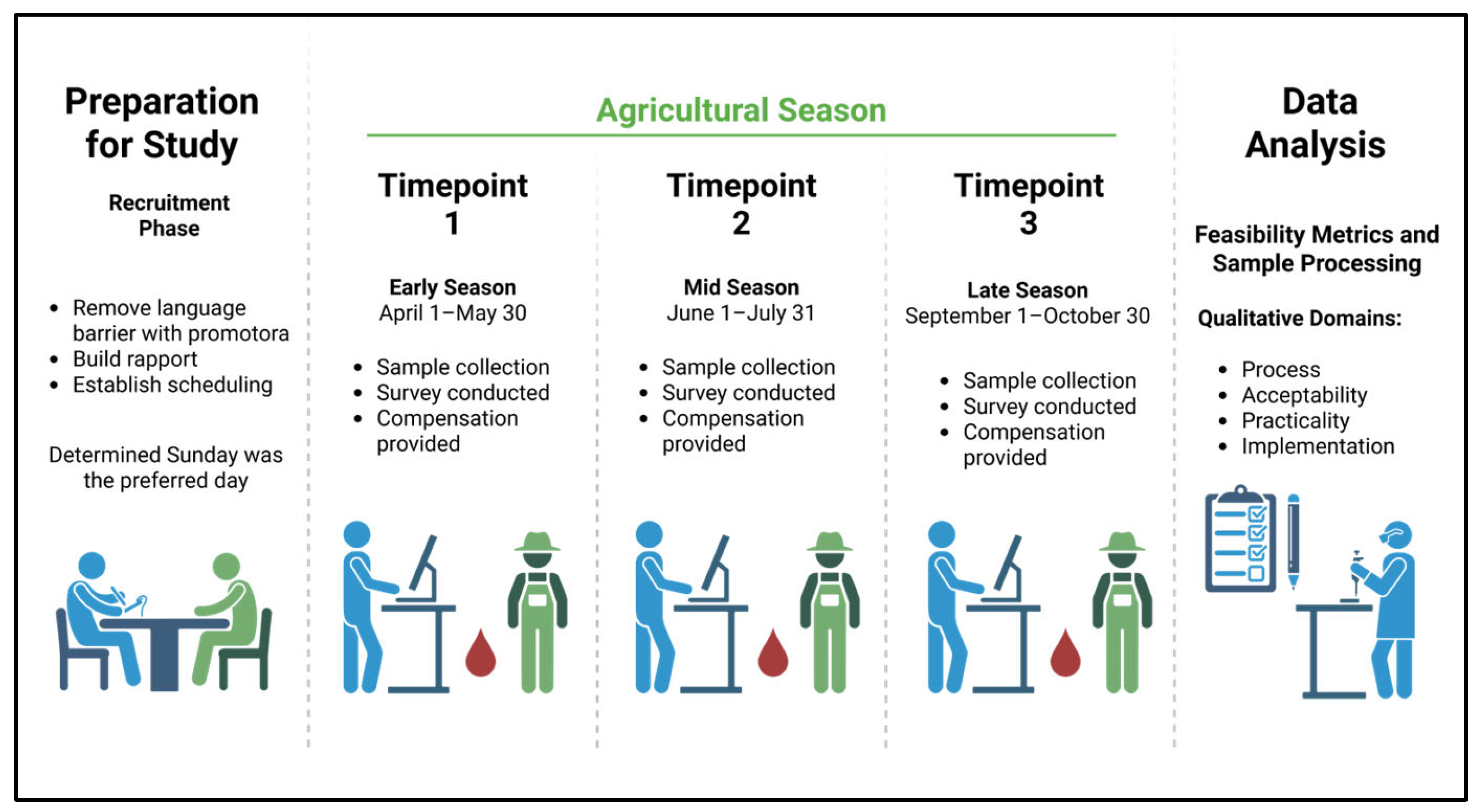
Site visits were scheduled by an experienced promotora de salud in direct coordination with employers and workers to identify dates compatible with work demands, including market trips and other essential activities. To capture variability in work activities and potential exposure timing, data were collected across 3 scheduled visits during a single agricultural season (Figure 1): early season (1 April–30 May), mid-season (1 June–31 July), and late season (1 September–30 October).
At each visit, participants completed a brief structured questionnaire and provided a capillary finger-stick blood sample. All encounters were conducted onsite at farmworker housing camps and lasted approximately 15 to 20 min. Participants received a $25 incentive per visit, for a maximum of $75 across the 3-visit protocol. Because farmworkers often work long hours under weather-dependent schedules, planned visits were occasionally disrupted by unanticipated work demands. In such cases, the promotora conducted same-day or evening follow-up visits to accommodate participant availability and ensure completion of interviews and blood sampling under real-world field conditions.

2.5. Field Specimen Protocol

A standard clinical capillary blood specimen protocol was adapted to accommodate outdoor field conditions. Trained field staff obtained samples using sterile, single-use lancets and micro-collection tubes. At each visit, 3 drops of capillary blood were collected from a finger stick and transferred into labeled, de-identified microcapillary tubes. One drop was analyzed immediately onsite using the nanosensor device. The remaining 2 drops were stored on dry ice in an insulated cooler and shipped via overnight delivery to the Oklahoma State University laboratory for standardized cholinesterase (ChE) testing the following morning. All specimens were transported in accordance with state and federal guidelines (UN3373 Category B standards).
The field specimen protocol is described to characterize the operational requirements associated with implementing repeated biomonitoring under real-world agricultural conditions. Evaluation of nanosensor performance and agreement with laboratory reference methods is beyond the scope of this paper.

2.6. Feasibility Metrics

As shown in Table 1, four feasibility domains were operationalized based on the framework described by Bowen and colleagues (2009) [24].
Process implementation was assessed through participant recruitment, retention, completion of scheduled visits, employer coordination, workforce needs, and environmental constraints encountered during field operations. Practicality reflected the research team’s ability to conduct blood collection in field settings, maintain cold-chain integrity under hot-weather conditions, and ensure timely specimen transport. Acceptability was operationalized through participants’ willingness to complete repeated interviews and finger-stick blood collection procedures across study visits. These process indicators or criteria were intended to inform protocol refinement and serve as benchmarks for determining whether a larger-scale implementation study would be justified.

2.7. Questionnaire

Structured surveys were administered face-to-face by trained bilingual staff in the participant’s preferred language (English or Spanish) at each of the three visits. Items were identical across visits, with the exception of demographic characteristics, which were collected only at the baseline (visit 1). Each survey captured information on daily work activities, including crop tasks, planting and harvesting duties, days worked per week, and involvement in applying or working near pesticides.

2.8. Field Notes and Observations

Three trained team members documented field notes and observations immediately following each site visit. Observations were reviewed and discussed during regularly scheduled team meetings to minimize recall bias and preserve contextual details. Completion time averaged approximately 10–15 min per visit. Promotoras de salud contributed worker feedback, contextual observations, and comments arising during survey administration and blood collection activities.
Field notes documented visit date, location, staffing, environmental conditions, participant attendance, specimen collection activities, equipment performance, transportation logistics, deviations from protocol, and operational challenges encountered during study implementation. Additional observations regarding participant interactions, barriers encountered, workflow adaptations, and other implementation issues were also recorded. These notes served as the primary qualitative data source supporting the feasibility assessment.

2.9. Data Management and Analysis

For quantitative analysis, paper-based survey responses were entered into REDCap (Project ID #2684) and underwent standard data-cleaning procedures. Univariate analyses and summary statistics were computed using SPSS, version 29.0 (IBM Corp., Armonk, NY, USA).
For qualitative assessment, field notes and observations were reviewed by members of the multidisciplinary research team during regularly scheduled meetings. Recurring patterns and implementation issues identified across field visits were documented and used to inform thematic analysis. Promotoras de salud contributed contextual observations and worker feedback obtained during survey administration and blood collection activities.
Qualitative feasibility data derived from field notes and observations were imported into NVivo (Lumivero, v. 14) and analyzed using a thematic analysis approach informed by Braun and Clarke [25,26]. An inductive analytic strategy was employed to identify recurring operational challenges, workflow adaptations, implementation barriers, and contextual factors influencing study feasibility [27]. Because the primary objective of the qualitative component was to characterize implementation experiences rather than generate theory, thematic analysis was selected as a pragmatic approach for organizing and interpreting feasibility-related observations.
Themes were developed through iterative review and discussion among members of the multidisciplinary research team and were subsequently organized according to the implementation, practicality, and acceptability domains of Bowen’s feasibility framework [24]. Representative observations and verbatim quotations were used to support the interpretation of major themes. To enhance methodological rigor and transparency, the qualitative components were reported in accordance with the Standards for Reporting Qualitative Research (SRQR) [28].
Because the study was designed as a feasibility assessment rather than a traditional qualitative inquiry, formal thematic saturation was not established as an analytic endpoint. Instead, emphasis was placed on identifying recurring operational issues relevant to protocol refinement and future scale-up decisions.

3. Results

Across the 3 data-collection points, participant retention was complete, with all 25 workers (100%) participating at every visit. Sociodemographic characteristics at baseline are summarized in Table 2. All participants were male and identified as Hispanic or Latino, reported Mexico as their country of origin, named Spanish as their primary language, and were employed under the H-2A temporary agricultural worker program. Most participants (92.0%) identified as White, and the remaining 8.0% as Black. The largest age group was 35 to 44 years (40.0%), followed by 45 years or older (32.0%) and 25 to 34 years (28.0%).

3.1. Work and Job Task Characteristics

As shown in Table 3, during the early season, the most commonly reported crops were tobacco (60.0%) and sweet potato (40.0%), followed by watermelon (36.0%) and other crops or farmwork (28.0%); a small number of participants reported corn, soybeans, or pigs (4.0%) or watermelon and soybeans (4.0%). In the mid-season, tobacco (56.0%) and sweet potato (56.0%) remained the most frequently reported crops, followed by other crops or farmwork (36.0%). By the late season, sweet potato predominated (96.0%), with smaller proportions reporting squash (28.0%), soybeans (16.0%), other crops or farmwork (16.0%), and tobacco, watermelon, or cotton (4.0% each).
Job tasks tracked the production cycle. Planting was the predominant early-season activity (88.0%), with a small proportion cultivating or weeding (8.0%). In the mid-season, harvesting was most common (60.0%), followed by cultivating or weeding (36.0%) and loading or transporting (16.0%). In the late season, harvesting was again the dominant task (88.0%), followed by cultivating or weeding (28.0%). Other tasks were infrequent: barning or baling was reported by 4.0% in the mid-season, and sorting sweet potatoes by 4.0% in the late season. Pesticide-related activities (mixing, applying, or transporting) were reported by 20.0% of participants in the early season, 16.0% in the mid-season, and 4.0% in the late season. In the early season, most participants worked 3 to 4 days per week (76.0%), with the remainder (24.0%) working 5 to 6 days. Workweek intensity peaked in the mid-season, when 80.0% reported working 5 to 6 days per week. In the late season, 24.0% worked 5 to 6 days per week, 16.0% worked 1 to 2 days, and no participants reported a 3-to-4-day workweek.

3.2. Qualitative Findings

Thematic review of field logs and community health worker observations identified three overarching themes corresponding to the feasibility domains. Within these themes, several recurring subthemes emerged regarding trust and confidentiality, communication barriers, worker mobility, employer-controlled schedules, environmental constraints, specimen collection challenges, and participant willingness to engage in repeated finger-stick sampling. Representative quotations supporting these themes are presented in Supplementary Table S1. Process implementation themes primarily involved trust and confidentiality concerns, communication barriers, worker mobility, and scheduling challenges associated with employer-controlled work schedules. Practicality themes reflected environmental and logistical constraints affecting specimen collection and interview administration, including limited privacy, equipment adaptations, and the need for contingency planning. Acceptability themes suggested that participants’ willingness to engage in repeated interviews and finger-stick blood collection was generally high, although concerns regarding confidentiality and fear of participation influenced some workers’ decisions.

3.3. Feasibility Findings

Across the prioritized feasibility domains, multiple operational and contextual challenges were identified during field implementation (Table 4). Acceptability-related challenges centered on initial hesitancy toward finger-stick blood collection. This hesitancy was mitigated over time through monetary incentives, the provision of food, and the development of strong interpersonal relationships between participants and field staff, which collectively supported continued engagement across visits. Practical challenges included unpredictable work schedules and employer-controlled release times, which constrained the days and hours when data collection could occur. Sunday emerged as the only consistently feasible day for site visits across the season. Finally, implementation challenges reflected both the demands of recruiting and retaining a mobile workforce and the realities of non-clinical field settings. Recruitment, retention, and multi-visit follow-up were complicated by limited trust related to employers, government agencies, confidentiality, and immigration status; by communication barriers driven by phone instability and limited connectivity; and by high worker mobility, particularly among contractor-employed workers. Onsite, interview quality was affected by noisy and distracting environments with limited privacy, and obtaining capillary blood samples was complicated by participant apprehension, variable lighting, and physiological variability. Sample handling required contingency planning for temperature control and labeling under outdoor conditions, and equipment limitations underscored the need for redundancy and backup materials. Collectively, these findings highlight the operational complexities inherent in conducting repeated biomonitoring among farmworkers under real-world agricultural conditions. Additional verbatim observations from the promotoras de salud are provided in Table S1.

4. Discussion

This preliminary study evaluated the feasibility of conducting repeated, field-based data collection and biomonitoring among a hard-to-reach farmworker work population over a single agricultural season. Findings provide preliminary evidence supporting the feasibility and acceptability of repeated biomonitoring under the specific agricultural, geographic, and seasonal conditions examined. High levels of participant engagement and complete retention across all three visits were achieved through culturally and linguistically appropriate field teams, flexible scheduling, and strong community partnerships. Despite well-recognized structural challenges associated with agricultural research, including long work hours, weather-dependent schedules, and workforce mobility, participants demonstrated sustained willingness to complete repeated interviews and finger-stick blood collection.
Using Bowen’s feasibility framework, these findings demonstrate alignment across multiple feasibility domains [24]. Trust, communication barriers, and workforce mobility primarily influenced implementation and acceptability, shaping recruitment, retention, and study execution within agricultural work constraints. High engagement and sustained participation reflected strong acceptability, supported by culturally responsive, relationship-based fieldwork. Operational challenges related to work schedules, environmental conditions, and sample handling informed practicality, clarifying staffing, infrastructure, and logistical requirements for field-based biomonitoring. Protocol adaptations driven by weather, equipment limitations, and non-clinical settings reflect implementation considerations affecting fidelity and quality. Collectively, these findings provide actionable guidance for protocol refinement and may help inform go/no-go decisions prior to larger-scale, field implementation studies.
Biomonitoring remains an underutilized exposure assessment tool in occupational health and safety [29]. Nevertheless, the favorable feasibility findings observed in this study suggest that repeated field-based biomonitoring may be achievable when supported by trusted community partnerships and culturally responsive engagement strategies. Unlike previous farmworker studies that have reported mistrust, participant attrition, and reluctance to provide biological specimens, particularly in longitudinal designs [30,31], recruitment and retention in this study were high. Bilingual promotoras de salud played a central role in fostering trust, maintaining communication, and coordinating visits, consistent with previous community-engaged approaches among farmworker population studies [32]. Identification of (early–mid) Sunday mornings as the most feasible data-collection window further highlights the need to align research protocols with workers’ limited non-work time [33].
From an operational perspective, this study demonstrates that many barriers traditionally associated with field-based biomonitoring, such as unpredictable work schedules, environmental conditions, and specimen handling requirements, can be addressed through portable field infrastructure and streamlined protocols. Most agricultural worker pesticide biomonitoring and cholinesterase surveillance programs rely on clinic-based venous blood collection and centralized laboratory analysis—approaches that can be logistically complex and costly and raise concerns about feasibility and scalability for highly mobile farmworker populations in under-resourced rural settings. In contrast, we found minimal challenges or disruptions related to data collection with participants or their routine activities. Although there were challenges associated with fingertip callusing, dehydration-related low blood volume, and heat-related specimen handling constraints, these issues were addressed through relatively simple protocol adaptations, such as increased puncture depth of lancets, additional supplies, and flexible workspace arrangements. These observations underscore the importance of contingency planning and field-adapted procedures when conducting repeated biomonitoring in agricultural settings.

5. Limitations

Several limitations should be acknowledged. First, the study population consisted exclusively of male H-2A workers, which may limit generalizability to female farmworkers, domestic agricultural laborers, or migrant workers with different employment structures. In addition, the requirement for participation across three scheduled visits may have favored recruitment of more stable workers and limited inclusion of highly mobile agricultural workers, introducing the potential for selection bias. Second, health symptoms, pesticide use, and work practices were self-reported and subject to recall and social desirability bias. Third, biomonitoring procedures were conducted under real-world field conditions, including heat, humidity, and variable workspace availability, which may have influenced participant comfort and sample consistency. Because qualitative findings were derived from field logs and team observations, the potential for observer bias should also be considered. While reliance on Sunday morning data collection is essential for feasibility, it may have excluded workers with competing obligations or limited transportation access. The high retention observed in this study may also have been influenced by participant incentives and intensive support provided by promotoras de salud, which may limit generalizability to settings with fewer resources. Furthermore, this study was conducted during a single agricultural season within one geographic region of North Carolina, and the findings may not be generalizable to other crops, regions, or agricultural systems. Finally, the evaluation of nanosensor performance and comparison with laboratory reference methods were beyond the scope of the present report and will be presented separately.

6. Conclusions

This preliminary study provides evidence supporting the feasibility and acceptability of repeated field-based biomonitoring among farmworkers under the specific conditions examined. This study demonstrates that sustained, field-based biomonitoring among farmworkers is achievable when research designs are grounded in community trust, operational flexibility, and pragmatic field logistics. Beyond documenting feasibility, the findings clarify how culturally concordant staffing, alignment with work schedules, and adaptable protocols mitigate structural barriers that have historically limited longitudinal exposure assessment in agricultural settings. As portable, rapid exposure-monitoring technologies continue to advance, implementation-focused feasibility studies such as this provide critical evidence to guide protocol refinement, inform go/no-go decisions, and support the responsible integration of biomonitoring into routine occupational health research and surveillance. Future studies involving larger and more diverse agricultural populations are needed to evaluate the performance of emerging technologies and determine the scalability of repeated biomonitoring approaches across different agricultural settings.

Supplementary Materials

The following supporting information can be downloaded at https://www.mdpi.com/article/10.3390/app16136795/s1, Table S1: Representative Qualitative Themes and Findings Supporting Major Feasibility Domains.

Author Contributions

Conceptualization, J.W., H.M., Q.V. and G.D.K.; methodology, J.W., H.M. and G.D.K.; formal analysis, G.D.K. and G.M.; investigation, J.W., H.M., G.D.K., J.T.B., G.M., Q.V., A.W. and E.C.; resources, J.W., Q.V. and A.W.; data curation, G.D.K.; writing—original draft preparation, G.D.K.; writing—review and editing, J.W., H.M., G.M., Q.V., A.W., E.C. and E.N.; visualization, E.N.; supervision, J.W., H.M., G.D.K. and Q.V.; project administration, J.W., G.D.K., G.M. and Q.V.; funding acquisition, J.W. and H.M. All authors have read and agreed to the published version of the manuscript.

Funding

Research reported in this publication was supported by the U.S. Department of Health and Human Services, National Institute of Health, National Institute of Environmental Health Sciences (NIEHS) on 2 May 2025, under Award Number 5R42ES032388-03 (Unique Federal Award Identification Number (FAIN) R42ES032388). The content is solely the responsibility of the authors and does not necessarily represent the official views of the National Institutes of Health.

Institutional Review Board Statement

The study was conducted in accordance with the Declaration of Helsinki and approved by the Institutional Review Board of East Carolina University (UMCIRB 22-001546) and approved on 18 January 2024.

Informed Consent Statement

Informed consent was obtained from all subjects involved in the study prior to data collection.

Data Availability Statement

Data generated as part of this study is considered restricted access. The de-identified datasets generated and analyzed during this study are available from the corresponding author upon reasonable request. Public deposition is restricted to protect the confidentiality of a small, identifiable H-2A farmworker cohort.

Acknowledgments

The authors gratefully acknowledge the H-2A farmworkers who generously contributed their time and trust to this study, as well as the participating growers and farm operators in eastern North Carolina who facilitated site access and scheduling. Sincere thanks are extended to the bilingual promotoras de salud whose cultural and linguistic expertise was central to recruitment, communication, and successful field operations.

Conflicts of Interest

J.W. and H.M. were employed by Nanodiagnostic Technology, LLC. The remaining authors declare that the research was conducted in the absence of any commercial or financial relationships that could be construed as a potential conflict of interest. The funders had no role in the design of the study; in the collection, analyses, or interpretation of data; in the writing of the manuscript; or in the decision to publish the results.

References

  1. U.S. Environmental Protection Agency. Pesticides Industry Sales and Usage: 2008–2012 Market Estimates; Environmental Protection Agency: Washington, DC, USA, 2017. [Google Scholar]
  2. Blain, P.G. Organophosphorus poisoning (acute). BMJ Clin. Evid. 2011, 2011, 2102. [Google Scholar] [PubMed] [PubMed Central]
  3. Robb, E.L.; Regina, A.C.; Baker, M.B. Organophosphate toxicity. In StatPearls [Internet]; StatPearls Publishing: Treasure Island, FL, USA, 2025. [Google Scholar] [PubMed]
  4. Arcury, T.A.; Quandt, S.A. Pesticides at work and at home: Exposure of migrant farmworkers. Lancet 2003, 362, 2021–2022. [Google Scholar] [CrossRef] [PubMed]
  5. Arcury, T.A.; Grzywacz, J.G.; Talton, J.W.; Chen, H.; Vallejos, Q.M.; Galván, L.; Barr, D.B.; Quandt, S.A. Repeated pesticide exposure among North Carolina migrant and seasonal farmworkers. Am. J. Ind. Med. 2010, 53, 802–813. [Google Scholar] [CrossRef] [PubMed]
  6. Calvert, G.M.; Plate, D.K.; Das, R.; Rosales, R.; Shafey, O.; Thomsen, C.; Male, D.; Beckman, J.; Arvizu, E.; Lackovic, M. Acute occupational pesticide-related illness in the United States, 1998–1999: Surveillance findings from the SENSOR-pesticides program. Am. J. Ind. Med. 2004, 45, 14–23. [Google Scholar] [PubMed]
  7. Calvert, G.M.; Karnik, J.; Mehler, L.; Beckman, J.; Morrissey, B.; Sievert, J.; Barrett, R.; Lackovic, M.; Mabee, L.; Schwartz, A.; et al. Acute pesticide poisoning among agricultural workers in the United States, 1998–2005. Am. J. Ind. Med. 2008, 51, 883–898. [Google Scholar] [CrossRef] [PubMed]
  8. Kamel, F.; Hoppin, J.A. Association of pesticide exposure with neurologic dysfunction and disease. Environ. Health Perspect. 2004, 112, 950–958. [Google Scholar] [CrossRef] [PubMed]
  9. California Office of Environmental Health Hazard Assessment (OEHHA). Physician’s Guidelines for Occupational Exposure to Pesticides. Sacramento, CA, USA. Available online: https://oehha.ca.gov/sites/default/files/media/downloads/pesticides/document-pesticides/physicianguidelines.pdf (accessed on 1 June 2026).
  10. Washington Administrative Code (WAC). Cholinesterase Monitoring for Agricultural Pesticide Handlers. Chapter 296-307-148, Sections 296-307-14830–296-307-14835. Washington State Legislature, Olympia, WA, USA. Available online: https://app.leg.wa.gov/wac/default.aspx?cite=296-307-148 (accessed on 2 June 2026).
  11. Hofmann, J.N.; Carden, A.; Fenske, R.A.; Ruark, H.E.; Keifer, M.C. Evaluation of a clinic-based cholinesterase test kit for the Washington State Cholinesterase Monitoring Program. Am. J. Ind. Med. 2008, 51, 532–538. [Google Scholar] [CrossRef] [PubMed]
  12. Quandt, S.A.; Grzywacz, J.G.; Talton, J.W.; Trejo, G.; Tapia, J.; D’Agostino RBJr Mirabelli, M.C.; Arcury, T.A. Evaluating the effectiveness of a lay health promoter–led, community-based participatory pesticide safety intervention with farmworker families. Health Promot. Pract. 2013, 14, 425–432. [Google Scholar] [CrossRef] [PubMed]
  13. U.S. Government Accountability Office. Farmworkers: Additional Information Needed to Protect Farmworkers from Pesticide Exposure; Report to Congressional Committees (GAO-21-63); GAO: Washington, DC, USA, 2021. [Google Scholar]
  14. Ohlander, J.; Fuhrimann, S.; Basinas, I.; Cherrie, J.W.; Galea, K.S.; Povey, A.C.; Van Tongeren, M.; Harding, A.H.; Jones, K.; Vermeulen, R.; et al. Systematic review of methods used to assess exposure to pesticides in occupational epidemiology studies, 1993–2017. Occup. Environ. Med. 2020, 77, 357–367. [Google Scholar] [CrossRef] [PubMed]
  15. Wilson, B.W.; Arrieta, D.E.; Henderson, J.D. Monitoring cholinesterase to detect pesticide exposure. Chem. Biol. Interact. 2005, 157–158, 253–256. [Google Scholar] [CrossRef] [PubMed]
  16. Barr, D.B.; Thomas, K.; Curwin, B.; Landsittel, D.; Raymer, J.; Lu, C.; Donnelly, K.C.; Acquavella, J. Biomonitoring of exposure in farmworker studies. Environ. Health Perspect. 2006, 114, 936–942. [Google Scholar] [CrossRef] [PubMed]
  17. Arcury, T.A.; Quandt, S.A.; Barr, D.B.; Hoppin, J.A.; McCauley, L.; Grzywacz, J.G.; Robson, M.G. Farmworker exposure to pesticides: Methodologic issues for the collection of comparable data. Environ. Health Perspect. 2006, 114, 923–928. [Google Scholar] [CrossRef] [PubMed]
  18. McCauley, L.A.; Anger, W.K.; Keifer, M.; Langley, R.; Robson, M.G.; Rohlman, D. Studying health outcomes in farmworker populations exposed to pesticides. Environ. Health Perspect. 2006, 114, 953–960. [Google Scholar] [CrossRef] [PubMed]
  19. Li, Z.D.; Zhang, X.L.; Yi, N.; Zhang, F.C. Protective effects of curcumin and vitamin E against chlorpyrifos-induced lung oxidative damage. Hum. Exp. Toxicol. 2015, 34, 668–676. [Google Scholar] [CrossRef] [PubMed]
  20. Keshav, P.; Goyal, D.K.; Singh, S. Ginger (Zingiber officinale) attenuates the neurotoxicity in rats induced by organophosphate pesticide. J. Basic Appl. Zool. 2024, 85, 20. [Google Scholar] [CrossRef]
  21. Trueblood, A.B.; Ross, J.A.; Shipp, E.M.; McDonald, T.J. Feasibility of portable fingerstick cholinesterase testing in adolescents in South Texas. J. Prim. Care Community Health 2019, 10, 2150132719838716. [Google Scholar] [CrossRef] [PubMed]
  22. Maanaki, H.; Bussiere, L.; Smirnov, A.; Du, X.; Sun, Y.; Arcury, T.A.; Summers, P.; Butler, L.; Pope, C.; Jensen, A.; et al. An integrated nanosensor/smartphone platform for point-of-care biomonitoring of human exposure to pesticides. Anal. Chem. 2025, 97, 9701–9712. [Google Scholar] [CrossRef] [PubMed]
  23. Higgins, G.M.; Muñiz, J.F.; McCauley, L.A. Monitoring acetylcholinesterase levels in migrant agricultural workers and their children using a portable test kit. J. Agric. Saf. Health 2001, 7, 35–49. [Google Scholar] [CrossRef] [PubMed]
  24. Bowen, D.J.; Kreuter, M.; Spring, B.; Cofta-Woerpel, L.; Linnan, L.; Weiner, D.; Bakken, S.; Kaplan, C.P.; Squiers, L.; Fabrizio, C.; et al. How we design feasibility studies. Am. J. Prev. Med. 2009, 36, 452–457. [Google Scholar] [CrossRef] [PubMed]
  25. Braun, V.; Clarke, V. Using thematic analysis in psychology. Qual. Res. Psychol. 2006, 3, 77–101. [Google Scholar] [CrossRef]
  26. Braun, V.; Clarke, V. Thematic Analysis: A Practical Guide; Sage Publications: London, UK, 2022. [Google Scholar]
  27. Halpin, M.; Braun, V. Inductive and deductive thematic analysis. In Thematic Analysis Handbook; Braun, V., Clarke, V., Eds.; Sage Publications: London, UK, 2023. [Google Scholar]
  28. O’Brien, B.C.; Harris, I.B.; Beckman, T.J.; Reed, D.A.; Cook, D.A. Standards for reporting qualitative research: A synthesis of recommendations. Acad. Med. 2014, 89, 1245–1251. [Google Scholar] [CrossRef] [PubMed]
  29. Viegas, S.; Zare Jeddi, M.; BHopf, N.; Bessems, J.; Palmen, N.; SGalea, K.; Jones, K.; Kujath, P.; Duca, R.C.; Verhagen, H.; et al. Biomonitoring as an underused exposure assessment tool in occupational safety and health context—Challenges and way forward. Int. J. Environ. Res. Public Health 2020, 17, 5884. [Google Scholar] [CrossRef] [PubMed]
  30. Farquhar, S.; de Jesus Gonzalez, C.; Hall, J.; Samples, J.; Ventura, S.; Sanchez, V.; Shadbeh, N. Recruiting and retaining indigenous farmworker participants. J. Immigr. Minor Health 2014, 16, 1011–1015. [Google Scholar] [CrossRef] [PubMed] [PubMed Central]
  31. Arcury, T.A.; Quandt, S.A. (Eds.) Latinx Farmworkers in the Eastern United States: Health, Safety, and Justice, 2nd ed.; Springer: Cham, Switzerland, 2020. [Google Scholar]
  32. WestRasmus, E.K.; Pineda-Reyes, F.; Tamez, M.; Westfall, J.M. Promotores de salud and community health workers: An annotated bibliography. Fam. Community Health 2012, 35, 172–182. [Google Scholar] [CrossRef] [PubMed]
  33. North Carolina Justice Center. Under the Same Sun: A Sunday with Farmworkers in Wilson; North Carolina Justice Center: Raleigh, NC, USA, 2025. [Google Scholar]
Figure 1. Study timeline and repeated field data collection across one agricultural season. Created in BioRender. Emily Nunan (2026). https://www.biorender.com/.
Applsci 16 06795 g001
Table 1. Feasibility assessment domains and metrics.
DomainMetrics
Process ImplementationParticipant recruitment, retention, completion of scheduled visits; workforce needs; employer coordination; and environmental constraints encountered during field operations
PracticalityResearch team’s ability to carry out blood collection, cold-chain maintenance, and specimen transport under real-world, field constraints
AcceptabilityParticipant willingness to complete repeated finger-stick sampling and interviews across visits
* Limited-efficacy testingPreliminary cholinesterase exposure estimates and within-person variability of samples to inform power calculations for a full-scale study
Note: * Limited-efficacy testing refers to preliminary evaluation of whether the biomonitoring approach could generate meaningful and measurable cholinesterase (ChE) exposure data under real-world field conditions [24]. Phase 2 results, including paired nanosensor and Oklahoma State University reference-laboratory analyses, are not reported in this study.
Table 2. Participant Socio-demographic Characteristics (n = 25).
Characteristicn%
Gender
 Male25100.0
Age (years)
 25–34728.0
 35–441040.0
 45+832.0
Race
 White2392.0
 Black28.0
Ethnicity
 Latino25100.0
Country of Origin
 Mexico25100.0
Primary Language
 Spanish25100.0
Migrant Worker Status
 H-2A25100.0
Note: Baseline responses were collected at the first visit (early season).
Table 3. Work and Job Task Characteristics of Farmworker Participants During Different Time Periods Over One Agricultural Season, North Carolina 2025 (n = 25).
Work CharacteristicSeasonal Work Period
Early Season
n (%)
Mid-Season
n (%)
Late Season
n (%)
Primary crop(s) worked in past week
 Tobacco15 (60.0)14 (56.0)1 (4.0)
 Sweet potato10 (40.0)14 (56.0)24 (96.0)
 Squash0 (0.0)0 (0.0)7 (28.0)
 Other crops or farmwork7 (28.0)9 (36.0)4 (16.0)
 Corn, soybeans, pigs1 (4.0)0 (0.0)0 (0.0)
 Watermelon9 (36.0)0 (0.0)1 (4.0)
 Watermelon and soybeans1 (4.0)0 (0.0)0 (0.0)
 Cotton0 (0.0)0 (0.0)1 (4.0)
 Soybeans0 (0.0)0 (0.0)4 (16.0)
Job tasks performed
 Planting22 (88.0)0 (0.0)0 (0.0)
 Cultivating or weeding2 (8.0)9 (36.0)7 (28.0)
 Harvesting (picking, cropping)0 (0.0)15 (60.0)22 (88.0)
 Loading (packing or transporting)0 (0.0)4 (16.0)0 (0.0)
  Other farmwork tasks
 Sorting sweet potatoes0 (0.0)0 (0.0)1 (4.0)
 Barning or bailing0 (0.0)1 (4.0)0 (0.0)
 Pesticides *5 (20.0)4 (16.0)1 (4.0)
Days worked in past week *
 1–2 days/week0 (0.0)2 (8.0)4 (16.0)
 3–4 days/week19 (76.0)1 (4.0)0 (0.0)
 5–6 days/week6 (24.0)20 (80.0)6 (24.0)
Notes: Percentages represent the proportion of participants reporting each characteristic within one agricultural season (n = 25). Participants could report multiple crops and job tasks within the same season; therefore, percentages may exceed 100% within a season. Job tasks include field or farmwork. * Pesticide activities include mixing, applying, and/or transporting.
Table 4. Key Qualitative Findings and Implications for Repeated Field-Based Biomonitoring Among Farmworkers.
Feasibility DomainKey Qualitative FindingsImplications for Feasibility and
Future Study Design
AcceptabilityInitial fear and hesitancy related to finger-stick blood collection and confidentiality concerns were observed among some workers.Field-adapted consent processes and repeated reassurance regarding confidentiality are required to support participation.
Incentives, food, and strong interpersonal relationships facilitated continued participation across visits.Incentives and rapport-building may enhance retention in repeated-measures studies.
PracticalitySunday was identified as the only consistently feasible day for participant contact and specimen collection.Non-traditional data-collection windows may be required for farmworker populations.
Distracting and noisy interview environments with limited privacy occasionally necessitated data collection activities.Interview quality may be influenced by environmental/occupational conditions encountered in non-clinical settings.
Environmental conditions (e.g., wind and hot, humid weather), finger-stick blood collection, sample handling, and equipment limitations required adaptation to field conditions.Successful implementation requires field-adapted protocols, adequate supplies, equipment redundancy, contingency planning (i.e., backup equipment and supplies, alternative transportation arrangements, and flexibility to accommodate participants, weather- or schedule-related disruptions).
Process
Implementation
Trust and fear related to employers, government agencies, confidentiality, and immigration status affected recruitment participation.Recruitment efforts benefit from trusted health workers (promotoras de salud), community partners and repeated reassurances regarding confidentiality and data use.
Communication barriers resulting from unstable phone access and limited connectivity complicated follow-up activities.Redundant, relationship-based communication strategies are necessary to support longitudinal participation.
Unpredictable work schedules, employer-controlled release times, weather conditions, and high worker mobility affected eligibility, planned data collection, and follow-up.Flexible scheduling and accommodation of last-minute changes are critical, and multi-visit protocols should account for workforce mobility and environmental disruptions.
Note: Findings were derived from thematic analysis of structured field logs and community health worker observations. Representative quotations supporting these themes are presented in Supplementary Table S1.
Disclaimer/Publisher’s Note: The statements, opinions and data contained in all publications are solely those of the individual author(s) and contributor(s) and not of MDPI and/or the editor(s). MDPI and/or the editor(s) disclaim responsibility for any injury to people or property resulting from any ideas, methods, instructions or products referred to in the content.