3.2. Multi-Source Evidence Construction and Representation
We construct a four-source AI technology corpus from 2017 to 2025, covering academic papers, patents, policy documents, and reports. Papers and patents were collected from the Wanfang Data Knowledge Service Platform using a Selenium-based crawler. The search terms were defined by an AI technology keyword list, including intelligent agent, multimodal large language model, embodied intelligence, large-model reasoning, fine-tuning, reinforcement learning, foundation model, pre-trained language model, self-attention mechanism, and multi-head attention. Policy documents and reports were collected from both publicly available sources and authorized non-public materials. Policy documents were retrieved from official government websites, including national-level agencies and municipal governments in regions with active AI industrial development. Reports were collected from industry reports, enterprise technical reports, security research reports, and internally curated AI-related materials. The retrieval and selection process followed the same AI technology keyword scope used for papers and patents, covering terms related to intelligent agents, multimodal large language models, embodied intelligence, large-model reasoning, foundation models, reinforcement learning, and other representative AI technologies. Documents were included if they explicitly discussed AI policy directions, industrial development, technological trends, or annual AI hot-spot topics, and were excluded if they were duplicates, weakly related to AI, lacked identifiable publication years, or contained insufficient extractable text.
The evidence construction process was implemented in three main steps. Documents were retained if they were within the target time window, belonged to one of the four source types, and contained usable technology-related textual fields. Records were screened and excluded if they were outside the target-year range, lacked key year information, or contained no identifiable technology mentions. Duplicate records and repeated mentions within the same document were also checked during preprocessing and aggregation. For papers, titles, abstracts, keywords, classification codes, authors, and affiliations were retained when available. For patents, the raw collection included titles, abstracts, patent types, patent numbers, application or publication dates, and applicants when available; the evidence panel retained titles, years, and extracted core technology keywords for downstream aggregation. Policy and report PDFs were converted into structured records containing document identifiers, years, and core technology keywords. First, technology-related mentions are extracted from each source-year subset. Let
denote the set of technology mentions extracted from source
in year
t. Technology mention extraction follows the CTLKE keyphrase-extraction design for Chinese technical literature [
26]. Candidate technology mentions were mainly extracted from source-specific keyword fields, including original keywords and curated core-keyword fields, while document titles or identifiers were used as contextual information during alignment. The extraction prompts and cleaning rules were designed to emphasize technical noun phrases and AI-related keyphrases, while reducing overly general, non-technical, or incomplete expressions. Second, raw mentions are normalized and aligned into canonical concepts in
, so that lexical variants, abbreviations, and source-specific naming forms referring to the same underlying technology are consolidated. Concept normalization was implemented through a rule-first, candidate-linking, and review-queue strategy. Each raw mention was first surface-normalized by unifying letter case, punctuation, spacing, full-width and half-width forms, and common Chinese-English variants. Synonymous terms and abbreviations were then merged using manual alias rules, lexical matching, semantic similarity, and contextual consistency. Ambiguous mentions were disambiguated using available document-level context, source type, year, and co-occurring keyword information. High-confidence mappings were accepted automatically, while borderline cases were stored in a review queue for inspection. The accepted mention-to-concept links were finally aggregated into the source-aware term-year panel. Third, annual source-specific document-frequency statistics were calculated for each accepted concept to form the source-aware global concept panel.
For forecasting, the final experimental panel retains 974 concepts and 3158 nonzero concept-year rows. Primary-source evidence accounts for 96.49% of the nonzero panel evidence, and no concept is supported exclusively by auxiliary sources. This setting indicates that auxiliary evidence complements rather than replaces primary technical evidence in downstream forecasting.
After cross-source alignment, AgentProphet preserves source-resolved observations rather than collapsing all evidence into a single aggregated score. For each concept
and year
t, the source-aware evidence profile is represented as
where
,
,
, and
denote source-specific document-frequency counts of concept
c in papers, patents, policy documents, and reports, respectively. The term
denotes the number of sources with nonzero support, and
denotes the total document-frequency count across all sources. The historical evidence panel of concept
c is denoted as
where
denotes the historical window. For models requiring complete yearly trajectories, missing concept-year observations are filled with zero source counts.
The resulting historical panel provides the basis for the history-only feature records used in downstream agent reasoning and confidence calibration. This representation preserves both temporal evolution and source-specific evidence distribution. AgentProphet explicitly distinguishes primary and auxiliary sources: papers and patents are treated as primary technical evidence, whereas policy documents and reports are treated as auxiliary contextual evidence. The latter may provide early signals about policy attention or industrial expectations, but they are potentially noisier and less technically specific. Therefore, auxiliary evidence is retained as complementary context, while source-aware weighting and confidence calibration prevent weaker contextual signals from being treated as equally reliable as primary technical evidence.
3.3. AgentProphet Framework
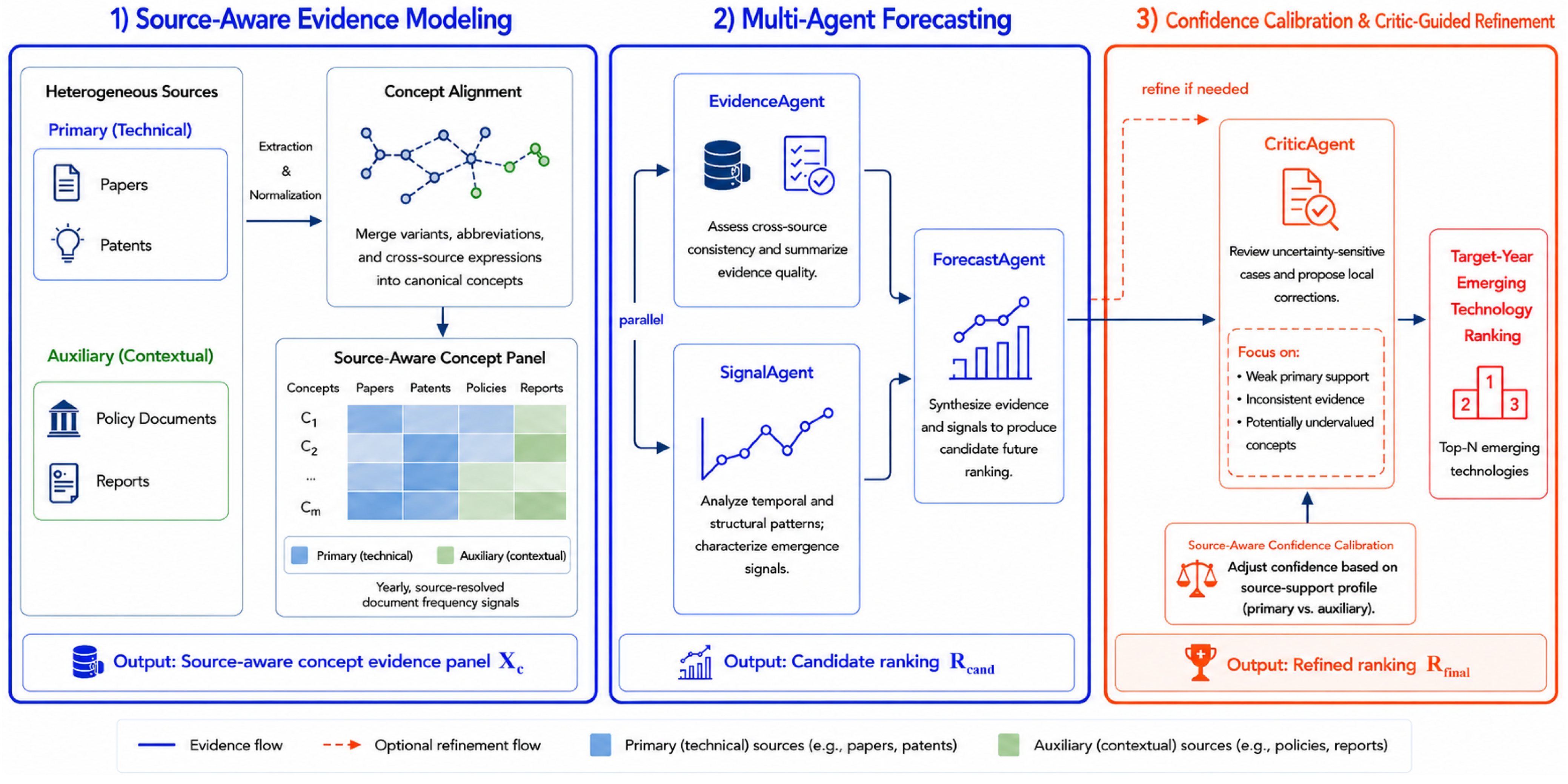
AgentProphet forecasts emerging AI technologies by integrating heterogeneous evidence with source-aware multi-agent reasoning, source-aware confidence calibration, and critic-guided refinement. As shown in
Figure 1, the framework consists of three stages: source-aware evidence modeling, role-specialized multi-agent forecasting, and confidence-calibrated critic-guided refinement. Before agent collaboration, each candidate concept is converted into a compact history-only feature record, including last-year hotness, one-year growth, trend slope, support years, primary-source counts, auxiliary-source counts, recent source coverage, primary-source share, and emergence score. All agent prompts are restricted to observations no later than the historical-window end year, and the target-year or later outcomes are explicitly excluded from the prompt.
Based on the source-aware evidence panel, AgentProphet decomposes forecasting into four coordinated roles: EvidenceAgent, SignalAgent, ForecastAgent, and CriticAgent. This decomposition avoids a single undifferentiated generation step and separates evidence interpretation, signal characterization, candidate ranking, and trustworthiness-oriented review.
To make the multi-agent procedure reproducible,
Table 1 summarizes the prompt objective, input fields, structured output schema, and downstream use of each agent. All agents are prompted with history-only evidence. The numerical panel is truncated at the end of the historical window, and the prompts explicitly prohibit the use of target-year or post-target outcomes. To improve transparency and reproducibility, the complete role prompts used by the agents and representative intermediate outputs generated during the forecasting procedure are provided in
Supplementary File S1.
The AgentProphet forecasting module uses four role-specific agents. EvidenceAgent and SignalAgent are executed in parallel, and their tags are then passed to ForecastAgent. CriticAgent subsequently reviews the forecasted scores and applies bounded corrections when the evidence supports an adjustment.
The EvidenceAgent first computes a numerical evidence score and then uses the LLM to assign a source-quality tag. The raw evidence score is defined as
where
,
,
, and
denote normalized primary-source support, last-year hotness, one-year growth, and support-year coverage, respectively. The final evidence score is
where
is set to
,
, and
for
strong,
moderate, and
weak evidence, respectively. This step distinguishes credible primary or cross-source support from weak or auxiliary-source-dominated evidence, while treating short history as uncertainty rather than evidence failure.
The SignalAgent characterizes the temporal pattern of each concept. Its raw signal score is
where
denotes the normalized trend slope. The LLM assigns a stage label and a momentum score
. The final signal score is
where
is
,
,
, and
for
emerging,
growing,
mature, and
declining concepts, respectively.
The ForecastAgent combines numerical trajectory estimation with semantic forecasting. It outputs an absolute target-year hotness prediction
, a semantic trend label, and a semantic confidence score. The core fusion step can be summarized as
where
is the numerical trajectory estimate and
is determined by evidence quality, semantic confidence, semantic trend, and momentum. The semantic weight and the LLM prediction are bounded before fusion to avoid uncontrolled amplification.
Finally, the CriticAgent reviews the ForecastAgent output using top predictions, emerging underdogs, evidence quality, semantic confidence, growth features, and source-support features. it applies a bounded multiplicative correction to the fused pre-critic target-year hotness score
:
where
denotes the critic-corrected target-year hotness score and
denotes the bounded multiplicative correction factor.
The CriticAgent is constrained to output for strong penalties, for moderate penalties, for unchanged predictions, for moderate boosts, and for strong boosts. Strong boosts are allowed only for low-base candidates with credible history-side support, such as high emergence score, early-signal evidence, cross-source support, or strong primary-source growth. The corrected scores are then further constrained by deterministic boundary rules and persistence residual calibration, preventing the critic from arbitrarily rewriting the ranking while still allowing correction of clearly underestimated emerging technologies.
3.5. Experimental Protocol and Implementation Details
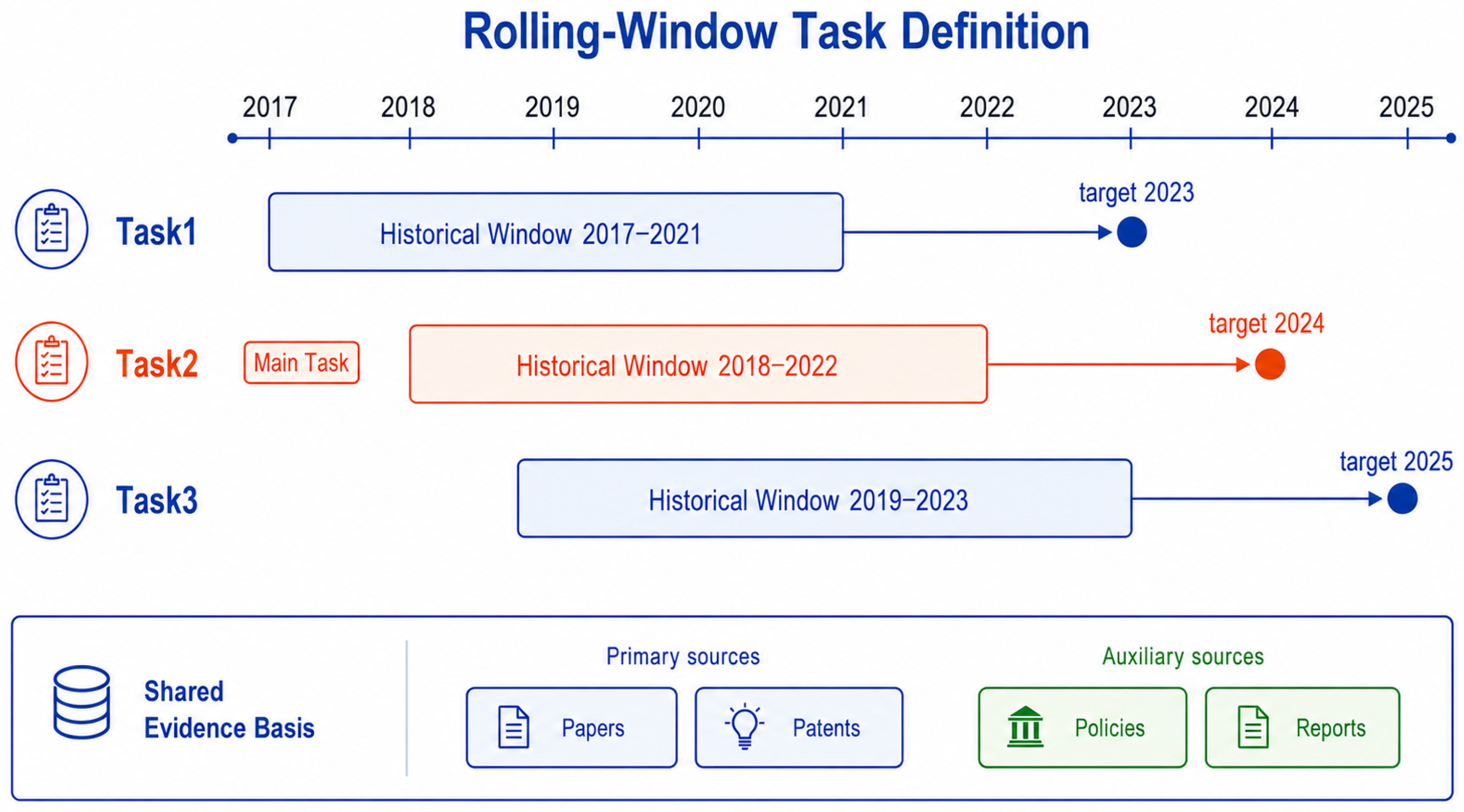
We use a rolling forecasting protocol to evaluate whether AgentProphet can identify emerging AI technologies before their future growth becomes fully observable. As shown in
Figure 2, we instantiate three rolling forecasting tasks with a five-year history window and a two-year prediction horizon: Task1 (2017–
), Task2 (2018–
), and Task3 (2019–
). This rolling design allows us to evaluate forecasting behavior under different signal-maturity regimes while keeping the history length consistent across tasks.
For each rolling forecasting task, we compute task-property diagnostics to characterize the corresponding signal regime. Let
denote the last observed year in the historical window,
denote the target year, and
denote the weighted hotness of concept
c in year
t. The weighted hotness is computed from source-resolved counts as
These weights encode a fixed primary-source prior: papers and patents are treated as primary technical evidence and together receive 80% of the weight, while policy documents and reports are treated as auxiliary contextual evidence and together receive 20%. Papers and patents receive equal weights because they respectively represent scientific exploration and technical protection, whereas policy documents and reports receive equal but smaller weights because they may provide early contextual signals but have lower technical specificity. This prior is consistent with the corpus composition, where primary-source evidence accounts for 96.49% of nonzero panel evidence and no concept is supported exclusively by auxiliary sources. We therefore use auxiliary sources as complementary signals rather than allowing them to dominate the target-year ranking. The sensitivity of this fixed-prior choice is examined in
Section 4.3.
Let denote the target-year Top-10 concepts ranked by , and let denote the historical Top-10 concepts ranked by . The weak-signal emerging concept set is denoted as . It is constructed from using history-window-only criteria.
First, historically prominent concepts are excluded by removing the Top-10 concepts ranked by last-year hotness, mean historical hotness, and primary-source support. Second, a target-year Top-10 concept is retained as a weak-signal emerging concept if it satisfies one of the following conditions: zero historical support but positive target-year hotness; early-signal status, defined by at most two support years, at least one primary-source observation, and positive one-year growth or positive trend slope; short historical support with support years no larger than ; or low-base challenger status, defined by and an emergence score of at least 0.60, where is the minimum hotness in . For nonzero-history candidates, the concept must also be observed for fewer than all history-window years, have positive one-year growth or positive trend slope, and satisfy . These criteria aim to capture that captures target-year prominent concepts that were not already dominant in the historical window.
The emergence score used in the low-base challenger rule is computed from rank-normalized weak-signal features
where
is the inverse percentile rank of last-year hotness,
and
are percentile ranks of one-year growth and trend slope,
increases when support years are fewer, and
is a log-damped primary-source support score. The bonus term
adds 0.18 for early-signal concepts, 0.06 when
with primary evidence, 0.08 when recent source coverage is at least two, 0.08 for bridge-rising concepts with at least two support years, at least six primary-source observations, and
, and 0.05 for light-primary early concepts with recent primary evidence and
. All bonus terms are applied only when the concept has positive one-year growth or a positive trend slope. The penalty
is 0.20 for auxiliary-only concepts and 1.00 otherwise.
Based on these definitions, the four diagnostic properties are computed as follows:
and
When
, the two average-based diagnostics, Hist. hotness and Growth, are set to 0.
Here, Weak@10 counts weak-signal emerging truths within the target-year Top-10, Overlap@10 measures the Jaccard overlap between historical and target-year Top-10 concepts, Hist. hotness reports their average pre-target weighted hotness, and growth reports their average positive target-year increase.
As shown in
Table 2, Task2 and Task3 both contain four weak-signal truths at Top-10, but Task2 has the lowest historical–target Jaccard overlap, lower pre-target hotness than Task3, and the highest mean positive growth. Task1 represents a sparse zero-history setting, as its weak-signal truths have no historical hotness, whereas Task3 shows stronger continuation patterns, with higher historical–target overlap and higher pre-target hotness among weak-signal truths. Therefore, Task2 is used as the main diagnostic weak-signal setting, while Task1 and Task3 are retained as supplementary settings for cross-task analysis under sparse and more historically developed signal regimes, respectively.
We compare AgentProphet with five baselines: LastValue, ARIMA, DLinear, GRU, and DirectLLM. For each concept c, let denote its weighted hotness in year t, and let denote the source-aware evidence vector consisting of paper, patent, policy, report, weighted-hotness, and source-coverage channels. Given a historical window ending at and a target year , each baseline produces a non-negative prediction score for each candidate concept. Candidate concepts are ranked in descending order of .
LastValue is a strict persistence baseline that carries forward the weighted hotness observed in the final history year
Since the historical panel is dense, this baseline uses the value in the last observed year directly and does not backfill to the most recent nonzero observation.
ARIMA is a classical univariate time-series baseline fitted independently for each concept [
27]. In our implementation, the model is fitted to the weighted-hotness sequence
using an ARIMA
specification without a trend term
where
is the autoregressive coefficient and
is the error term. The fitted model forecasts the target-year score
For empty series, the prediction is set to zero; for constant or failed series, the method falls back to the last observed weighted hotness.
DLinear is implemented as a lightweight DLinear-style multivariate baseline [
28]. It uses the same six historical evidence channels as
GRU. Given a length-
L window,
we first compute a moving-average trend component and a residual annual component
where
denotes a moving average with window size
m. The flattened annual and trend components are concatenated into a feature vector
A ridge-regularized linear projection is then fitted
and the fitted one-step projection is applied recursively over the forecasting horizon
. At each step, the predicted weighted-hotness channel is inserted into the next input window while the remaining channels are carried forward from the latest window state. The final recursive prediction is clipped to obtain
GRU is a neural sequence baseline over the same six-channel historical evidence representation [
29]. Given the historical input window
, the sequence is encoded by a gated recurrent unit
and the final hidden state is mapped to a one-step weighted-hotness prediction through feed-forward layers
where
denotes the dense prediction head. target-year forecasting is then performed recursively over
steps by updating the weighted-hotness channel after each prediction
The implementation uses a GRU layer with 32 hidden units, followed by a 16-dimensional ReLU dense layer and a linear output layer. The model is trained with mean squared error loss and the Adam optimizer.
DirectLLM is a direct-prompt LLM baseline using the same history-derived concept features [
16]. For each candidate concept
c, we construct a compact feature summary
, including its last observed hotness, mean historical hotness, recent growth, trend slope, active years, and source-support statistics. Candidate summaries are grouped into batches and passed to the LLM with instructions to use only the provided history-derived features and public knowledge available before the cutoff year, without adding new terms or using target-year outcomes. The LLM is then asked to predict the absolute hotness of each candidate in the target year
The final prediction score is clipped to be non-negative
Unlike AgentProphet, this baseline directly maps compact history-derived feature summaries to target-year hotness predictions, without role-specialized agent decomposition or critic-guided refinement.
Given the prediction scores defined above, we evaluate each method with metrics that distinguish ordinary target-year ranking accuracy from growth-oriented and emerging-oriented forecasting performance. In the following definitions, denotes the predicted target-year hotness score, equivalent to above.
The primary metric is Growth-Aware NDCG@10 (GA-NDCG@10), a growth-oriented variant of NDCG [
30] adapted to technological emergence assessment [
31,
32]. The ground-truth and predicted positive growth are defined as
and
Positive growth is further converted into graded relevance by log normalization
GA-NDCG@10 is then computed by applying NDCG@10 to the ranking induced by , with as the graded relevance score. This metric is treated as primary because it directly reflects the objective of prioritizing concepts with substantive future rise potential rather than preserving historical prominence.
We also report Emerging NDCG@10 (E-NDCG@10), Emerging Gain@10 (E-Gain@10), Emerging MAP@10 (E-MAP@10), and Standard NDCG@10. Emerging-oriented relevance combines future growth with low historical prevalence
where
is the low-base factor derived from the percentile rank of
among candidate concepts.
A concept with lower historical hotness therefore receives a larger emerging-oriented relevance multiplier, while the constant 0.40 preserves relevance for high-growth concepts that are not strictly zero-history. E-NDCG@10 applies NDCG@10 to
. E-Gain@10 is the accumulated normalized emerging relevance captured by the predicted Top-10 list
where
denotes the predicted Top-10 list,
denotes the 20 highest emerging-relevance concepts, and
is the sum of the ten largest relevance values in
.
E-MAP@10 computes relevance-weighted average precision over the predicted Top-10 list
where
is the concept at rank
j and
. Concepts outside
have zero emerging relevance in E-Gain@10 and E-MAP@10. Standard NDCG@10 uses target-year hotness as the conventional graded relevance reference.
All LLM-based methods use qwen3-max-2026-01-23. AgentProphet is run five times and reported as mean ± standard deviation to reflect the stochasticity of multi-agent LLM reasoning, while deterministic baselines and DirectLLM are reported as single values under fixed configurations.
Baseline Selection Rationale. The baseline methods are selected to cover the main methodological families relevant to weak-signal emerging technology forecasting under heterogeneous historical evidence. LAST VALUE is included as a persistence-based baseline, which tests whether target-year technology prominence can be explained by simple continuation of the most recent observations. ARIMA represents classical statistical time-series forecasting and evaluates whether univariate temporal extrapolation is sufficient for short-horizon technology forecasting. DLinear is adopted as a lightweight linear neural forecasting model, providing a stronger yet interpretable temporal baseline for multivariate historical evidence. GRU represents recurrent neural sequence modeling and tests whether nonlinear temporal dependencies in the historical evidence panel can improve forecasting performance. DirectLLM uses the same LLM backbone as AgentProphet but directly generates the technology ranking without source-aware decomposition, confidence calibration, or critic-guided refinement. It therefore serves as a key control for distinguishing the benefit of the proposed source-aware multi-agent framework from the effect of simply using an LLM.
Together, these baselines provide a controlled comparison across persistence-based continuation, classical time-series extrapolation, lightweight neural forecasting, recurrent neural forecasting, and direct LLM-based reasoning. This design is aligned with the objective of this study: to examine whether source-aware multi-agent reasoning improves the ranking of emerging AI technologies under weak historical signals and heterogeneous multi-source evidence. We therefore interpret the baseline comparison as a representative evaluation across complementary methodological families, rather than as an exhaustive benchmark of all possible technology-forecasting paradigms.
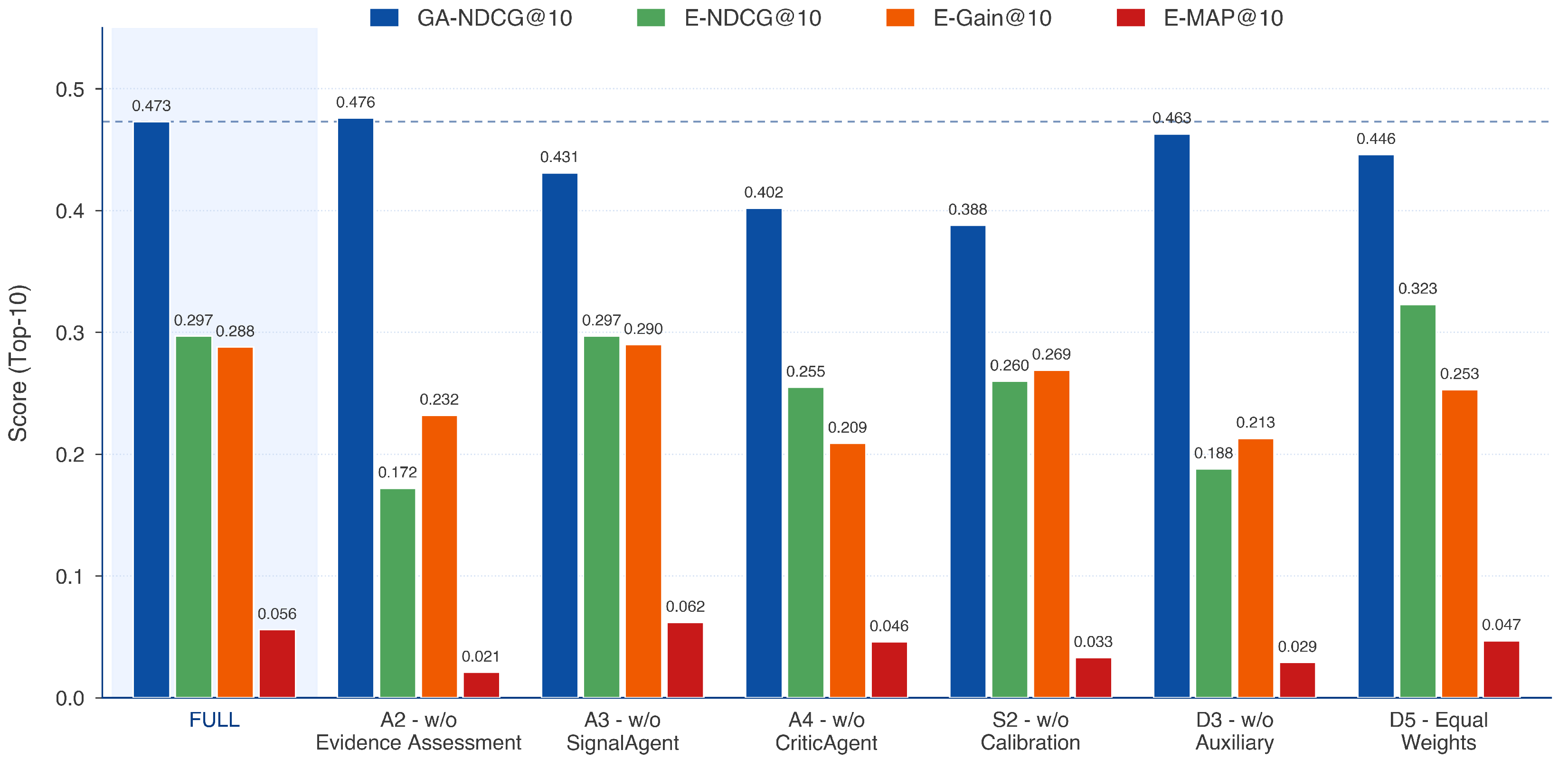
To ensure a fair and leakage-free comparison, all numerical baselines were configured using only pre-target historical data. For each rolling forecasting task, we constructed an internal validation split within the historical window, using the earlier years for model fitting and the last available pre-target year as the validation year. Hyperparameter configurations were selected or confirmed according to validation performance on the primary growth-aware ranking metric, and the selected configuration was then retrained on the full historical window before generating the target-year forecast. Under this protocol, DLinear was implemented with a sequence length of 3, a moving-average window of 3, and ridge regularization with (). The GRU baseline used a sequence length of 3, a hidden size of 32, a mini-batch size of 256, 12 training epochs, Adam optimization, and a fixed random seed of 42. ARIMA was fitted independently for each concept-level time series, so that each concept was forecast only from its own historical observations. These parsimonious settings were adopted to match the short annual concept-level time series and to reduce the risk of overfitting or unstable estimation. For the controlled ablation study, the FULL, D3, D5, A2, A3, A4, and S2 variants share a fixed-prior protocol, so that each variant differs only in the targeted component.
Because the LLM backbone may have been exposed during pre-training to public information about technologies that became popular in 2024 or 2025, the evaluation may be affected by temporal knowledge contamination, which is a known concern in LLM-based evaluation [
33,
34]. We therefore treat the evaluation as contamination-aware rather than contamination-free. To reduce prompt-side and evidence-side leakage, all numerical evidence supplied to LLM-based methods is truncated at the end of the historical window. Candidate features are constructed only from observations no later than
, and target-year hotness values are used only for evaluation. The prompts explicitly specify the allowed public-knowledge cutoff year, prohibit the use of target-year or later outcomes, and forbid adding new technology terms. In addition, LLM rationales and adjustment reasons are screened for post-cutoff-year references; unsafe free-text explanations are removed or excluded from downstream structured records and counted as semantic leakage flags.
This design separates two types of contamination risk. Prompt-side leakage refers to target-year or post-target evidence being included in the model input or prompt context; this is controlled by historical-window truncation, target-year exclusion from feature construction, and explicit prompt instructions. Parametric contamination refers to knowledge already stored in the pre-trained LLM; this cannot be fully eliminated without retraining or using a strictly time-bounded model. Therefore, our claims focus on controlling prompt-side and evidence-side leakage, while treating parametric contamination as a residual limitation.