Review

Co-Inertia Analysis in Neutrosophic Spaces: An Exploratory Bibliometric Study

by
Mayra D’Armas Regnault
1,*,
Purificación Vicente-Galindo
2,3 and
Purificación Galindo-Villardón
2,3,4
1
Faculty of Science and Engineering, Universidad Estatal de Milagro (UNEMI), Milagro 091050, Ecuador
2
Faculty of Research, Universidad Estatal de Milagro (UNEMI), Milagro 091050, Ecuador
3
Departamento Estadística, Universidad de Salamanca (USAL), 37008 Salamanca, Spain
4
Centro de Estudios e Investigaciones Estadísticas (CEIE), Escuela Superior Politécnica del Litoral (ESPOL), Guayaquil 090902, Ecuador
*
Author to whom correspondence should be addressed.
Appl. Sci. 2026, 16(12), 5948; https://doi.org/10.3390/app16125948
Submission received: 9 April 2026 / Revised: 28 May 2026 / Accepted: 1 June 2026 / Published: 12 June 2026
(This article belongs to the Special Issue Advances in Intelligent Decision-Making Systems)

Abstract

This study explores the intersection between co-inertia analysis and neutrosophic spaces through a bibliometric analysis of 259 scientific articles indexed in Scopus (1994–2025). Employing PRISMA methodology and the bibliometrix software (version 5.2.0), the temporal evolution, intellectual structure, and collaboration networks in both fields are examined. Results reveal sustained growth in scientific production since 2010, primarily concentrated in France (71 articles, 27.4% of the corpus). Stéphane Dray emerges as the most influential author with 7252 citations, while Bioinformatics leads in impact (6863 citations across 6 articles). Keyword analysis positions ‘multivariate analysis’ as the central term, articulating three clusters: ecology, multivariate statistics, and genomics. However, explicit integration between co-inertia analysis and neutrosophic theory remains incipient, located in the emerging topics zone with low centrality and density. The thematic map identifies consolidated applications in ecology (macroinvertebrates, functional traits) and development opportunities in data integration under high uncertainty. This work establishes a conceptual foundation for future research on the coupling of multivariate methods with neutrosophic frameworks in contexts of heterogeneous information and indeterminacy.

1. Introduction

The rapid growth of heterogeneous data environments has increased the analytical challenges faced by contemporary research. In ecology, environmental sciences, genomics, health studies, and decision sciences, researchers increasingly work with multiple data blocks that describe the same observational units from different but complementary perspectives. As a result, single-table exploratory approaches are often insufficient because they cannot fully capture the relationships between datasets that differ in scale, content, or informational characteristics. The search for methods capable of integrating several tables while preserving the geometric properties of multivariate spaces has a long lineage in statistical science, including the treatment of vector variables, the development of the RV coefficient as a measure of similarity between configurations, and the broader family of methods for the canonical analysis of several sets of variables [1,2,3]. Within this tradition, co-inertia analysis (CoIA) emerged as one of the most elegant and operational frameworks for studying the shared structure between two tables observed on the same sampling units [4,5].
Co-inertia analysis was originally proposed as a multivariate method for maximizing the covariance between the projections of two linked data tables [4]. Unlike procedures that focus primarily on prediction, CoIA is designed to reveal the common latent structure underlying paired datasets, making it especially valuable when the aim is exploratory integration rather than one-directional modeling. One of the main strengths of CoIA is that it preserves the internal structure of each dataset while identifying a shared space that facilitates interpretation of their common patterns [5]. In this sense, co-inertia analysis belongs to the duality diagram family and forms part of a broader geometric approach to multivariate integration [6,7,8].
The ecological sciences provided the earliest and perhaps most influential applications of CoIA. In these contexts, researchers frequently needed to relate species assemblages to environmental descriptors, biological traits to habitat gradients, or temporal changes in communities to changing ecological conditions [4,5]. Over time, its interpretive potential was strengthened by its relationship with adjacent approaches such as RLQ analysis and fourth-corner methods, which made it possible to connect species traits, environmental variation, and species composition in a more integrated inferential framework [9,10]. Multiple co-inertia analysis later expanded this rationale to more than two tables, allowing the study of synchrony and shared variability across temporal or multiblock ecological datasets [11].
A major reason for the diffusion of CoIA has been the availability of accessible computational implementations. The ADE-4 platform and, later, the ade4 ecosystem in R contributed decisively to translating theoretical developments into reproducible workflows for applied researchers [6,7]. The consolidation of these tools did more than simplify computation; it widened the methodological reach of co-inertia analysis by allowing users from diverse disciplines to perform advanced geometric data analysis without having to derive the mathematics from first principles. As a result, CoIA evolved from a specialized ecological technique into a more general strategy for multiblock data integration [8].
The interdisciplinary expansion of CoIA became especially visible with the rise of genomics and, later, multi-omics research. High-dimensional biological data often arise in parallel blocks, such as transcriptomics, proteomics, metabolomics, epigenomics, and genotype-derived marker sets. These blocks are typically measured on the same samples but express different layers of biological organization, making them ideal candidates for integrative multivariate analysis. Co-inertia was quickly adopted because it allowed cross-platform comparison and joint exploration of different omics spaces [12,13]. Subsequent work on multivariate integration of multi-omics datasets confirmed that CoIA and related latent-variable approaches occupy an important place in the broader toolbox of integrative biology [14]. In parallel, packages such as mixOmics and DIABLO helped establish data integration as a mature methodological field [15,16].
Despite the growing use of co-inertia analysis in multiblock and high-dimensional data integration, its application in environments characterized by indeterminate or partially reliable information remains limited. At the same time, neutrosophic theory has emerged as a relevant framework for representing uncertainty, inconsistency, and indeterminacy in complex analytical settings. However, the potential methodological relationship between CoIA Cd neutrosophic approaches has not yet been systematically explored in the scientific literature. This study addresses that gap by examining the intellectual and thematic development of research at the intersection of co-inertia analysis and neutrosophic spaces through a bibliometric perspective.
This expansion toward multi-omics signals a deeper epistemological transformation. Biological and environmental systems are increasingly studied as layered systems in which information is partial, heterogeneous, and sometimes internally inconsistent. Reviews on multi-omics integration have emphasized that the field is moving from isolated high-throughput measurements toward true systems-level synthesis [17,18,19,20].
In this context, integrative multivariate methods have become increasingly important because the scientific problem itself is multiblock in nature. Co-inertia analysis is particularly valuable because it supports exploratory analysis of how different sources of information converge or diverge while preserving the internal structure of each dataset [12,13,14,15,16]. Unlike methods focused exclusively on prediction, CoIA facilitates the interpretation of shared patterns across heterogeneous data sources.
This characteristic becomes especially important in contexts where uncertainty is inherent to the data rather than being treated only as statistical noise. In many real-world scenarios, researchers must interpret relationships between multiple datasets affected by incomplete information, ambiguity, or inconsistent observations. Such conditions highlight the need for analytical approaches capable of handling both multivariate complexity and epistemic uncertainty simultaneously.
The empirical literature further shows that CoIA has demonstrated considerable adaptability across application domains. Beyond classical ordination problems, it has been used to assess anthropogenic impacts on marine organisms, to integrate environmental datasets for contamination assessment, and to study fish–habitat relationships under disturbance [21,22,23]. These studies confirm the usefulness of co-inertia analysis in contexts characterized by ecological complexity, correlated gradients, and heterogeneous sources of evidence. Nevertheless, even in these advanced applications, uncertainty is generally handled within conventional probabilistic or geometric-statistical assumptions. Ambiguity, incompleteness, and indeterminacy may be acknowledged substantively, but they are not usually modeled as explicit analytical dimensions. This limitation becomes increasingly relevant as researchers confront datasets that are not only multiblock and high-dimensional, but also epistemically unstable: partially observed, semantically vague, or characterized by conflicting information from different sources.
In this context, neutrosophic theory becomes particularly relevant. Introduced as a framework that extends beyond binary and fuzzy logics by explicitly incorporating indeterminacy alongside truth and falsity, neutrosophy offers a conceptual architecture for representing information that is incomplete, inconsistent, vague, or partially unknown [24]. Its later formalization through single-valued, interval, and multi-valued neutrosophic sets made the framework operational for applied mathematical and decision-oriented contexts [25,26,27]. In contrast to classical crisp representations, and even in contrast to many fuzzy formulations, neutrosophic approaches seek to preserve the independent role of indeterminacy rather than absorbing it into a single uncertainty parameter. This property is particularly significant for real-world datasets in which ambiguity does not merely reflect measurement error, but structural indeterminacy arising from conflicting evidence, missingness, or unstable classification rules.
Over the last decade, neutrosophic methods have expanded rapidly into multicriteria decision-making, similarity analysis, pattern recognition, medical diagnosis and complex decision systems [27,28,29,30,31,32]. Researchers have developed neutrosophic operators, similarity coefficients, aggregation procedures, and cross-entropy measures aimed at preserving the informational richness of indeterminate environments [28,29].
More recent studies have extended neutrosophic approaches to multivariate monitoring and quality control settings, including neutrosophic multivariate EWMA control charts and bootstrap-based multivariate schemes under neutrosophic conditions [30,31]. In parallel, conceptual discussions have emphasized that indeterminacy cannot always be adequately represented through probabilistic or fuzzy approaches alone [32]. Together, these developments show that neutrosophic theory has evolved from a mainly theoretical concept into a practical framework for analyzing complex and uncertain data environments.
The present study addresses a gap that has not yet been examined through systematic bibliometric means. Although both co-inertia analysis and neutrosophic theory have each accumulated substantial studies, no prior study has mapped their joint scientific landscape, identified where their traditions overlap, or quantified the degree to which their conceptual dialog has developed. This absence is not merely bibliographic: without a structured overview of how these two traditions relate, it is difficult to assess whether their integration is conceptually feasible, methodologically opportune, or scientifically premature. A bibliometric investigation is therefore not only descriptive but diagnostic—it reveals the structural conditions under which a new methodological synthesis may or may not be emerging.
Despite the maturity of both research traditions, the methodological relationship between CoIA and neutrosophic theory remains limited. This gap is noteworthy because the two approaches appear conceptually compatible in several respects. Co-inertia analysis focuses on identifying concordance between linked datasets while preserving multivariate geometry, whereas neutrosophic methods focus on representing information characterized by truth, falsity, and indeterminacy. In principle, integrating these perspectives could provide a more flexible framework for analyzing datasets that contain not only numerical variability but also partially reliable or indeterminate information. Such an approach could be particularly relevant in environmental risk assessment, socio-ecological monitoring, multi-omics diagnostics, and decision-support systems where data sources differ in precision, completeness, and semantic certainty. However, the current literature remains fragmented, with CoIA mainly advancing in ecological and omics integration, while neutrosophic approaches have developed primarily within decision analysis and uncertainty modeling [12,13,14,15,16,24,25,26,27,28,29,30,31,32].
This fragmentation creates a clear need for structured bibliometric mapping. Bibliometric analysis is particularly suitable for identifying how a field evolves over time, which authors and journals shape its intellectual core, how thematic clusters are organized, and where emerging research fronts begin to appear [33,34,35,36,37]. In rapidly diversifying domains, bibliometric methods do more than summarize productivity; they make visible the structure of scientific knowledge production, including co-citation structures, keyword co-occurrence, source concentration, and collaboration patterns [33,34,35,36,37].
For a topic such as the intersection between co-inertia analysis and neutrosophic approaches, bibliometric mapping can help determine whether this area is evolving into a coherent research domain or whether it remains dispersed across related studies. Therefore, bibliometric analysis serves not only as a descriptive tool but also as a way to evaluate the maturity and conceptual organization of an emerging field.
The study therefore examines whether this intersection is evolving into a coherent research area or whether it remains dispersed across related disciplines such as multivariate statistics, ecology, omics integration, and neutrosophic uncertainty modeling. On that basis, the article addresses three guiding questions: What has been the evolution of scientific production on CoIA applied to neutrosophic spaces? What are the main thematic lines and predominant analytical approaches? Which authors, journals, institutions, and countries exert the greatest scientific influence in this emerging domain?

2. Materials and Methods

2.1. Study Design and Analytical Framework

This study was designed as a descriptive-analytical bibliometric investigation aimed at characterizing the scientific production located at the intersection between co-inertia analysis and neutrosophic approaches. The methodological strategy combined two complementary components: performance analysis, used to quantify productivity and scientific impact, and science mapping, used to reconstruct the social, intellectual, and conceptual structure of the field [33,34,38,39,40]. In operational terms, the study addressed three analytical dimensions: temporal evolution, knowledge structure, and collaboration patterns. The overall analytical framework, the corresponding dimensions, and the outputs generated in each stage are summarized in Table 1.
This dual approach was selected because bibliometric studies on emerging and fragmented domains require more than simple publication counts. In addition to productivity indicators, it is necessary to identify the relationships among authors, sources, institutions, and keywords to detect the field’s internal architecture and its degree of consolidation [33,38,39]. For that reason, the study integrated descriptive indicators with network-based analyses and thematic mapping, as specified in Table 1.

2.2. Data Source and Search Strategy

Scopus was used as the sole bibliographic source. Scopus was selected over alternatives such as Web of Science because it offers broader coverage of journals in ecology, bioinformatics, and applied mathematics—the three disciplinary communities most relevant to the target literature—while providing complete, standardized metadata fields that are essential for co-authorship and co-citation mapping [33,38]. In addition, Scopus offers standardized and comprehensive metadata that facilitate bibliometric procedures such as co-authorship analysis, co-citation mapping, keyword co-occurrence analysis, and thematic structure visualization.
Therefore, the results should be interpreted within the scope of the Scopus-indexed literature. Nevertheless, the exclusive use of Scopus represents one of the methodological limitations of the present study because database-specific coverage restrictions may have excluded relevant publications indexed exclusively in Web of Science, or other multidisciplinary databases. Therefore, the results should be interpreted within the scope of the Scopus-indexed literature. Future studies could strengthen comparative robustness and corpus coverage through multi-database approaches.
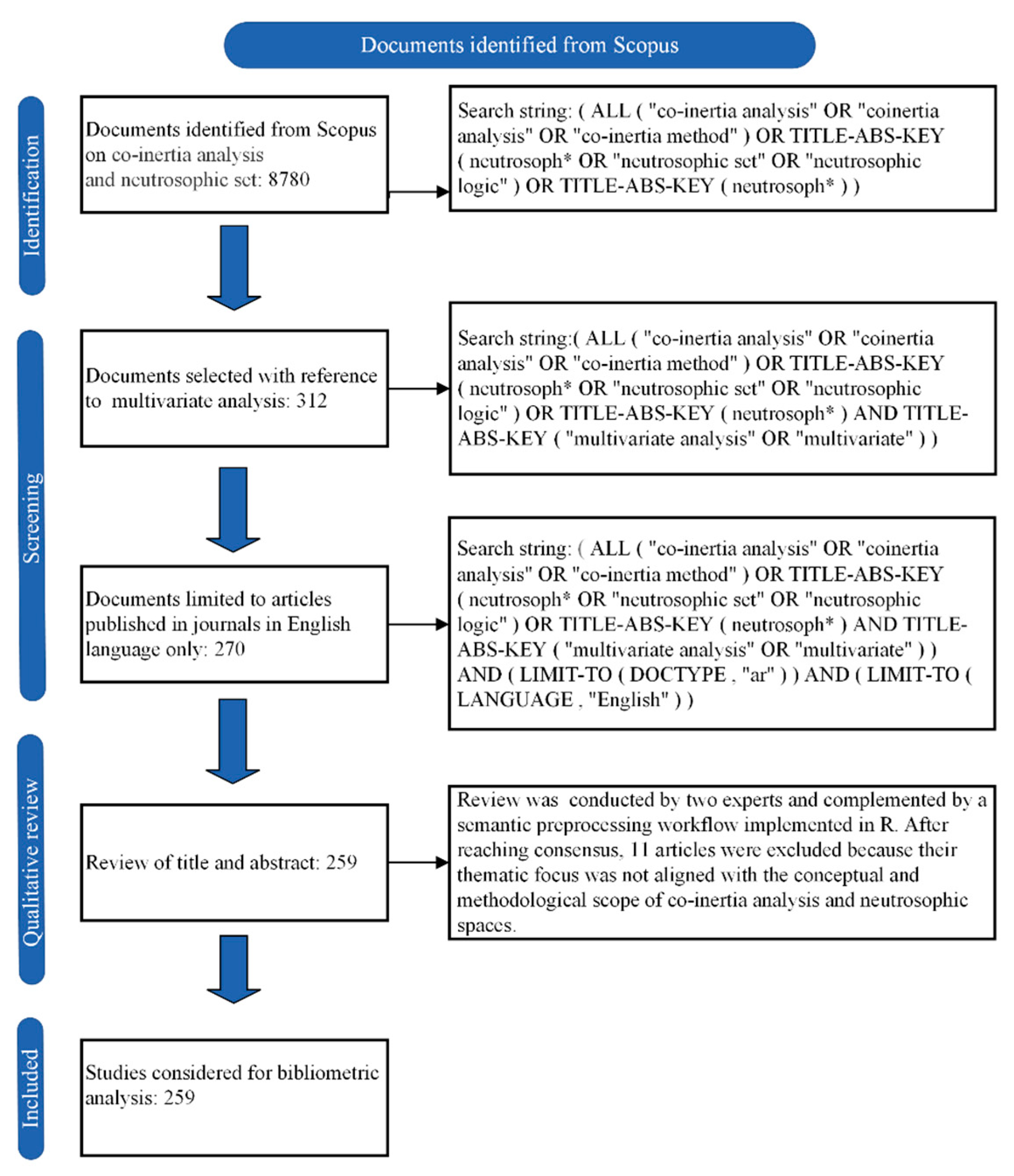
The search and filtering process is synthesized in Figure 1, which presents the PRISMA-style workflow adopted for document identification, screening, quality review, and final inclusion. As shown in that figure, the first retrieval stage yielded 8780 records from Scopus using a broad combination of terms related to CoIA and neutrosophic terminology. In a second step, the corpus was narrowed by requiring an explicit association with multivariate analysis, which reduced the dataset to 312 records. A third restriction limited the sample to journal articles published in English, producing 270 records. Finally, after reviewing titles and abstracts, 11 documents that did not fit the topic were excluded, resulting in a final corpus of 259 studies for bibliometric analysis.
To improve transparency and reproducibility, the exact search logic used at each filtering stage is detailed in Table 2. This table should be interpreted jointly with Figure 1: whereas the figure visually summarizes the document flow, Table 2 specifies the search expressions and restrictions that generated each successive reduction in the corpus. In this way, the methodology is not only replicable at the conceptual level, but also auditable at the level of database operations.

2.3. Eligibility Criteria and Screening Process

The eligibility criteria were established before analysis in order to ensure conceptual coherence in the final corpus. Publications were included when they met four conditions: (i) they were indexed in Scopus, (ii) they were written in English, (iii) they corresponded to journal articles, and (iv) they showed a conceptual or applied link with co-inertia analysis, neutrosophic logic, neutrosophic sets, or multivariate matrix integration. Publications were excluded when they represented purely industrial, sector-specific, or technical applications without a meaningful methodological connection to the study focus. These criteria are organized in Table 3.
The screening process followed the logic illustrated in Figure 1. After database retrieval and formal filtering, titles and abstracts were independently reviewed by two experts in order to assess thematic relevance and methodological consistency. This qualitative stage was critical because bibliographic search expressions alone may retain documents with superficial lexical overlap but no genuine conceptual alignment with the study objective. As shown in Table 3, the expert review mainly excluded records whose content referred to unrelated industrial applications rather than to co-inertia-based multivariate integration or neutrosophic analytical frameworks.
The final outcome of this process was a corpus of 259 articles, which constituted the dataset used in all subsequent bibliometric analyses. The numerical progression across the stages is presented visually in Figure 1, while the logic of inclusion and exclusion is formalized in Table 3.

2.4. Data Extraction and Metadata Preprocessing

Once the final corpus was established, bibliographic metadata were exported from Scopus for analytical processing. The extracted fields included at least the following variables: authors, title, abstract, author keywords, indexed keywords, source title, year of publication, affiliations, countries, references, and citation information. These variables were selected because they enable both productivity-based indicators and relational analyses such as co-authorship, co-citation, and keyword co-occurrence [33,34].
Before conducting the bibliometric analyses, the dataset underwent a metadata standardization stage to reduce noise caused by spelling variants, synonymous expressions, inconsistent institutional names, and author-name fragmentation. This step is particularly important in science mapping because lexical inconsistency can artificially split authors, institutions, or thematic clusters that in fact belong to the same analytical entity [33,37,39]. The specific preprocessing actions are listed in Table 4.
As indicated in Table 4, the cleaning process included author-name harmonization, normalization of institutional affiliations, standardization of countries, and merging of keyword variants. For example, lexical forms such as “co-inertia analysis,” “co inertia analysis,” and closely related descriptors referring to multivariate table coupling were standardized to improve the stability of co-occurrence and thematic maps. Thus, Table 4 documents the preprocessing logic that underpins the validity of the subsequent network and cluster interpretations.

2.5. Bibliometric Indicators and Science-Mapping Procedures

The bibliometric analysis combined descriptive performance metrics with relational mapping techniques. Performance analysis included annual scientific production, total citations, source productivity, and author-level impact metrics such as h-index, g-index, and m-index [33,38]. At the country level, collaboration was assessed through the distinction between single-country publications (SCP) and multiple-country publications (MCP), with the MCP ratio used as an indicator of international collaborative propensity. These indicators are summarized in Table 5.
Science-mapping procedures were used to reconstruct the structure of the field at three levels. First, co-authorship analysis was used to identify collaborative patterns among authors and countries. Second, source co-citation analysis was used to reveal the journals and knowledge traditions that constitute the intellectual foundation of the domain. Third, keyword co-occurrence analysis, multiple correspondence analysis (MCA), and thematic mapping were used to identify conceptual clusters, latent thematic gradients, and the degree of development of dominant topics [33,34,37]. The full correspondence between indicator, analytical objective, and expected output is presented in Table 5.
Thus, Table 5 functions as the operational core of the methodological design. It links each bibliometric procedure with the analytical question it was intended to answer, ensuring consistency between the study objectives and the empirical outputs presented later in Section 3.

2.6. Software Environment and Reproducibility

The bibliometric workflow was implemented primarily in R (version 4.5.1) using the bibliometrix package, which was employed for descriptive bibliometric indicators, source analysis, collaboration metrics, conceptual mapping, and thematic structure exploration [33]. In parallel, VOSviewer (version 1.6.19) was used for the generation and refinement of bibliometric network visualizations [34]. VOSviewer clustering was performed at the default resolution parameter (1.0), using fractionalized counting for co-citation analyses. In keyword co-occurrence maps, a minimum threshold of five occurrences was applied, yielding 140 qualifying terms from 3126 unique keywords. Co-citation maps were constructed from journal-level citations with a minimum of five co-citations required for inclusion. These parameters are reported to enable full reproducibility of the network maps.
The role of each analytical tool is specified in Table 6; bibliometrix was used for data handling, indicator computation, and thematic analyses, whereas VOSviewer was used to optimize visual exploration of bibliometric networks. The use of Scopus as the primary data source also contributed to greater metadata consistency during network construction, citation mapping, and thematic preprocessing, reducing fragmentation problems commonly associated with multi-database integration. This complementary use of software is recommended in bibliometric research because different tools provide distinct advantages in computational analysis and visual interpretation [33,34,37].
In addition to the software environment, the screening stage included a manual expert review supported by a structured workflow. This combination of automated bibliometric processing and expert-assisted relevance checking strengthened the reliability of the final corpus. Accordingly, Table 6 should be read not only as a list of software resources, but as a concise representation of the reproducibility architecture of the study.

2.7. Integration of the PRISMA Workflow with the Bibliometric Design

A distinctive feature of this methodological design is the integration of a PRISMA-style document flow with a bibliometric analytical framework. In this study, Figure 1 performs a central methodological function because it visually documents how the corpus was progressively refined from a broad conceptual search to a final analytically coherent dataset of 259 articles. Rather than serving as a mere illustrative element, the figure establishes the logical link between database retrieval and bibliometric interpretation.
This integration is reinforced by the accompanying tables. Table 2 details the search strings that produced each major reduction shown in Figure 1; Table 3 formalizes the eligibility criteria applied during screening and quality review; Table 4 documents the metadata cleaning required before mapping; Table 5 defines the bibliometric indicators and science-mapping procedures applied to the final corpus; and Table 6 specifies the analytical software environment. In that sense, the figure and tables are methodologically interdependent: the figure explains the corpus construction process, while the tables provide the operational detail necessary for reproducibility.

3. Results

A bibliometric analysis was conducted to examine the scientific landscape at the intersection of co-inertia analysis and neutrosophic-oriented research. The final corpus comprised 259 scientific articles, authored by 1078 researchers and published in 156 journals between 1994 and 2025. Only 10 papers (3.9%) were single-authored, indicating that the field is predominantly collaborative and structurally dependent on co-authorship networks.

3.1. Temporal Evolution of Scientific Production

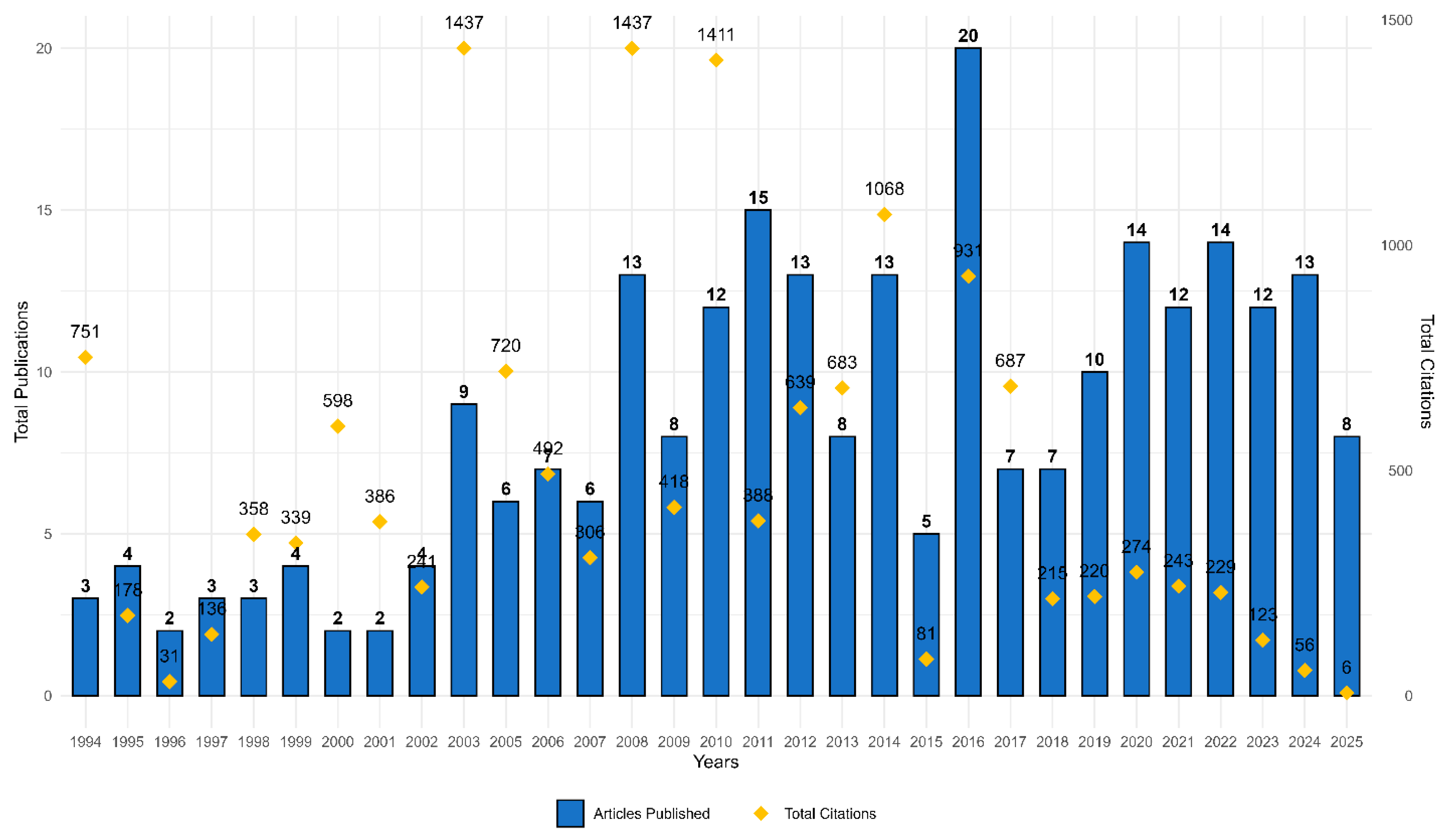
The temporal dynamics of the field are presented in Figure 2. Overall, the trajectory reveals a progressive transition from methodological emergence to interdisciplinary expansion. Although early productivity was limited, the field later entered a phase of visible consolidation, followed by a diversification stage characterized by more regular annual output and broader thematic dispersion.
A first phase (1994–2005) may be interpreted as a stage of methodological establishment. Productivity remained modest, averaging approximately 3.2 articles per year. The field’s theoretical bases were established by foundational contributions such as the original co-inertia formulation by Dolédec and Chessel [4] and the computational implementation provided through ADE-4 [6]. The citation profile of this stage reflects the classic behavior of foundational literature: low initial production volume but high long-term citation accumulation.
A second phase (2006–2015) corresponds to consolidation and expansion. Annual publication output generally ranged from 6 to 13 articles, while citations increased markedly, reflecting the broader adoption of CoIA beyond its original ecological setting. The publication of the adegenet package by Jombart [41] was especially important in extending the method toward genetics and genomics. The field reached a marked citation peak during this stage, confirming its methodological maturation and disciplinary diffusion.
The third phase (2016–2025) reflects interdisciplinary diversification. The highest annual production was observed in 2016 (20 publications), after which the field stabilized at approximately 12–14 articles per year. Although citation counts decreased in the most recent years, this pattern reflects the normal citation-lag effect associated with recent publications. During this period, co-inertia analysis became increasingly connected to broader research areas, including multivariate integration, ecological traits, omics, and uncertainty-aware analytics.

3.2. Influential Authors and Source Structure

The most influential authors are summarized in Table 7. The leading contributor was Stéphane Dray, with 13 publications and 7252 citations. His h-index (12), and g-index (13) indicate both high productivity and strong citation impact. Together with Thioulouse, Dolédec, and Chessel, Dray forms the central methodological core of the field. These four authors accounted for 17,665 citations, representing 53% of the total citations accumulated by the top eight contributors.
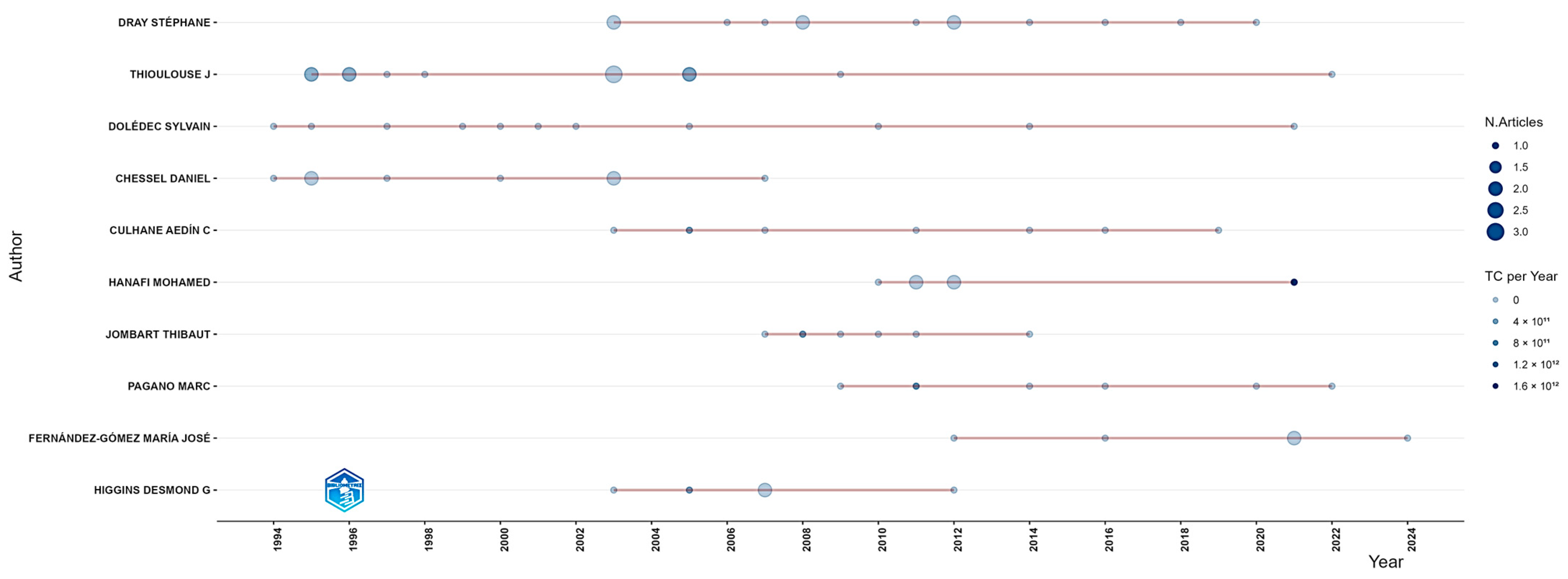
The temporal production pattern shown in Figure 3 reinforces this interpretation. A foundational authorial nucleus appears early and remains active over extended periods, reflecting long-term continuity in method development and application. In this context, the persistence of authors such as Dray and collaborators is consistent with the consolidation of CoIA as a recurring analytical framework rather than a short-lived methodological innovation. The continuity of this group of authors is also consistent with earlier methodological developments relating to the integration of features and context and the fourth-corner problem [9].
The journal structure (Table 8) reveals a clear distinction between publication volume and citation impact. PLOS ONE led in number of documents (10 articles), but Bioinformatics concentrated the highest impact, with 6 articles accumulating 6863 citations. This difference—approximately 1144 citations per article for Bioinformatics versus 57 citations per article for PLOS ONE—indicates that Bioinformatics operated as a high-impact specialized outlet, whereas PLOS ONE functioned as a broader multidisciplinary dissemination channel.
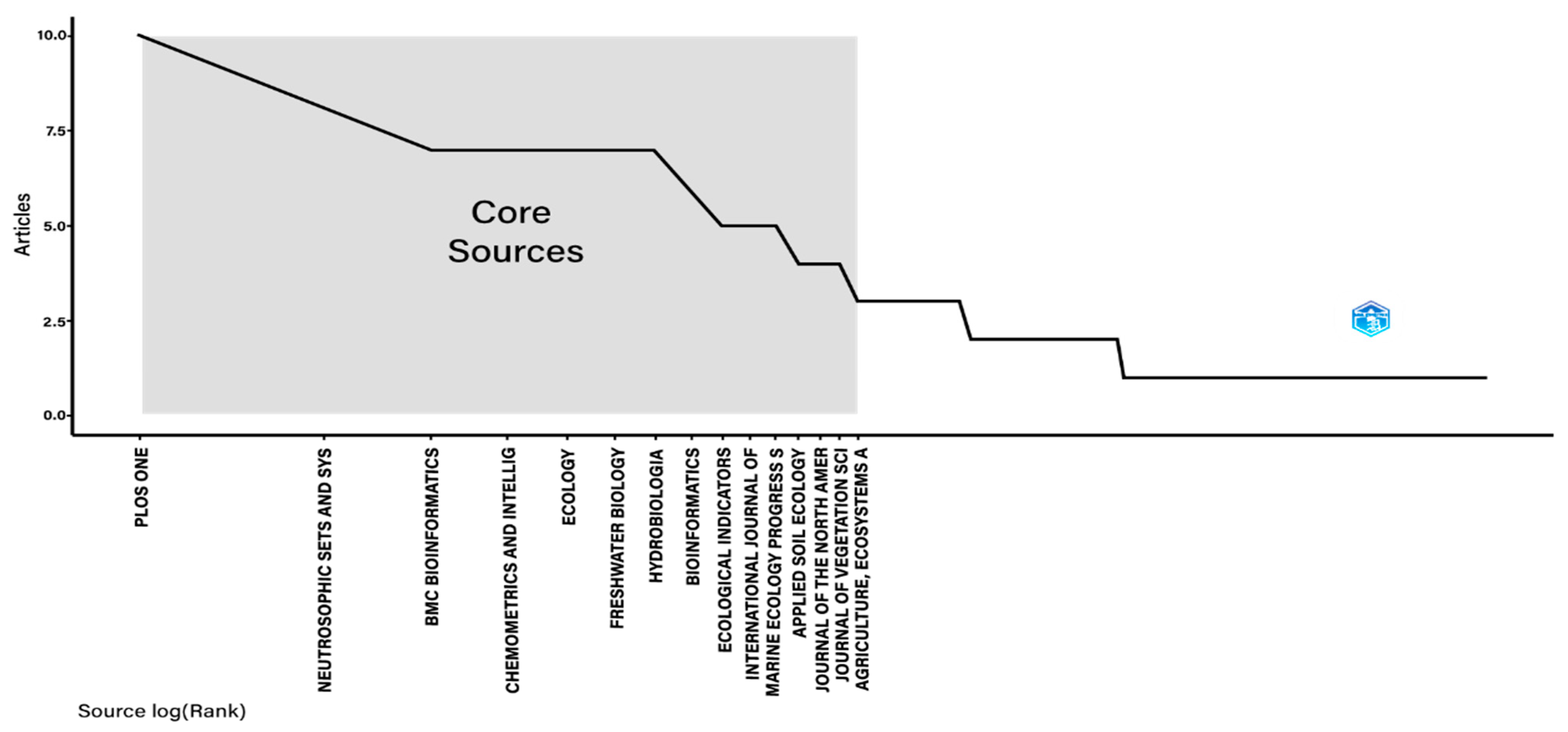
Traditional ecological journals also retained an important position. Ecology accumulated 2766 citations from 7 articles. In contrast, Neutrosophic Sets and Systems showed recent growth but still limited citation impact, with 68 citations across 8 articles. This difference suggests that the relationship between co-inertia analysis and neutrosophic theory is still emerging rather than fully consolidated. The Bradford distribution shown in Figure 4 supports this reading, because it identifies a reduced core of journals concentrating the most influential production, while the remaining literature is distributed across a peripheral but expanding interdisciplinary zone, consistent with Bradford’s law [42].

3.3. Geographic and Institutional Distribution

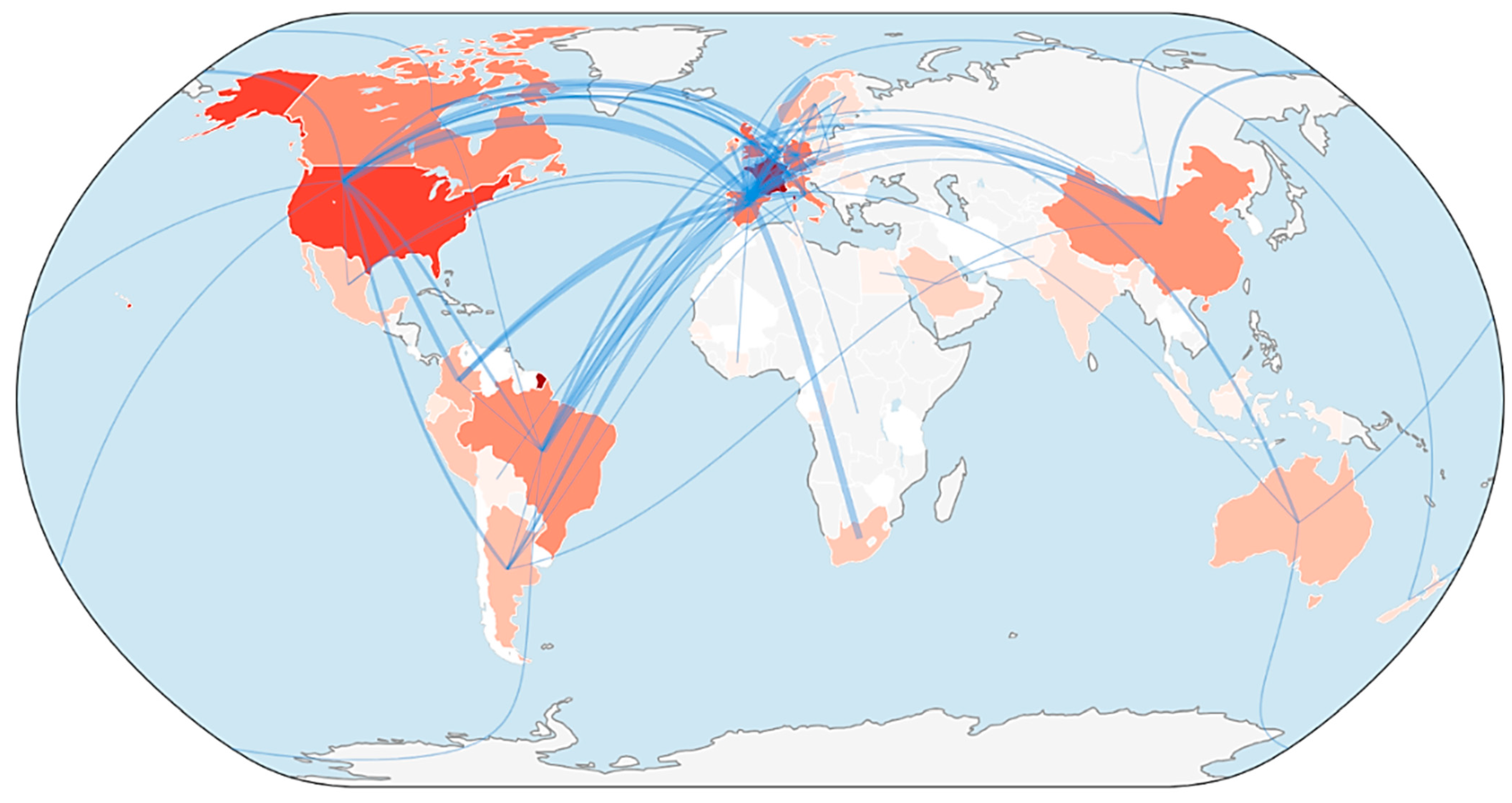
The spatial distribution of scientific production is summarized in Table 9. France clearly dominated the field, with 71 articles (27.4% of the total corpus). Its collaboration profile was not fully internationalized: 40 papers were classified as single-country publications (SCP) and 31 as multiple-country publications (MCP), yielding an MCP ratio of 0.437. This suggests that France combined domestic critical mass with selective international collaboration.
By contrast, countries such as the United Kingdom and Ireland exhibited the highest collaborative orientation, with MCP ratios of 0.750 and 0.857, respectively. In practice, this means that most of their output depended on transnational partnerships rather than purely domestic research structures. The United States also showed relevant participation (16 articles), while Italy, China, Switzerland, Spain, Germany, and Brazil formed a second category of contributors. Overall, Figure 5 shows an asymmetric but strongly international network. The Franco-European core acts as the main hub connecting North America, Latin America, Asia, and Oceania.
Institutional productivity (Table 10) reveals a dual pole of leadership. The Centre National de la Recherche Scientifique (CNRS) and University College Dublin (UCD) each contributed 12 articles, albeit with different scientific profiles. CNRS represents the methodological cradle of the field, particularly through the work of Dray, Thioulouse, and their collaborators, whereas UCD reflects the expansion of co-inertia analysis into bioinformatics and high-dimensional biological data. Additional notable institutions included Université de Lyon (10 articles), Technische Universität München, Universidad de Salamanca, Université de Montpellier, Villeurbanne, and Wageningen University and Research (each with 9 articles). The presence of the Universidad de Salamanca is especially relevant because it suggests a potential Ibero-American entry point for future integration between CoIA and neutrosophic approaches.

3.4. Fundamental Documents and Citation Concentration

The most influential documents in the corpus are presented in Table 11, which reports both local citations (LC) and global citations (GC). A striking feature of this table is that all listed articles recorded LC = 0. This result deserves careful interpretation. The universal LC = 0 finding means that the most globally influential methodological references in the field—adegenet, ade4, the ADE-4 software paper, and the foundational CoIA articles—are not internally cited within the specific co-inertia–neutrosophic intersection captured in this corpus.
This pattern is typical of an emergent field. The most influential references originate from adjacent mature traditions rather than from an internally connected research community. In practical terms, it suggests that the corpus of 259 articles does not yet constitute a self-referential scholarly community. Instead, it is a heterogeneous assembly of independently developed studies that share terminological overlap without forming a coherent citation network. The LC = 0 finding therefore reinforces the conclusion drawn from the thematic and co-citation maps: co-inertia analysis and neutrosophic theory are methodologically complementary but scientifically disconnected at present.
The citation hierarchy is strongly dominated by software and implementation papers. Jombart’s adegenet article [41] accumulated 6456 global citations, while Dray and Dufour’s ade4 paper [7] accumulated 5079 global citations. Together, these two software-oriented contributions reached 11,535 citations, exceeding the combined total of the next five listed documents. This finding suggests that, in this domain, computational accessibility has been at least as influential as theoretical development. The next most cited documents included the ADE-4 software paper [6], the foundational co-inertia article by Dolédec and Chessel [4], the linking-of-ecological-data-tables article by Dray et al. [5], and the fourth-corner study by Dray and Legendre [9].

3.5. Conceptual, Intellectual, and Thematic Structure of the Field

3.5.1. Keyword Co-Occurrence Network

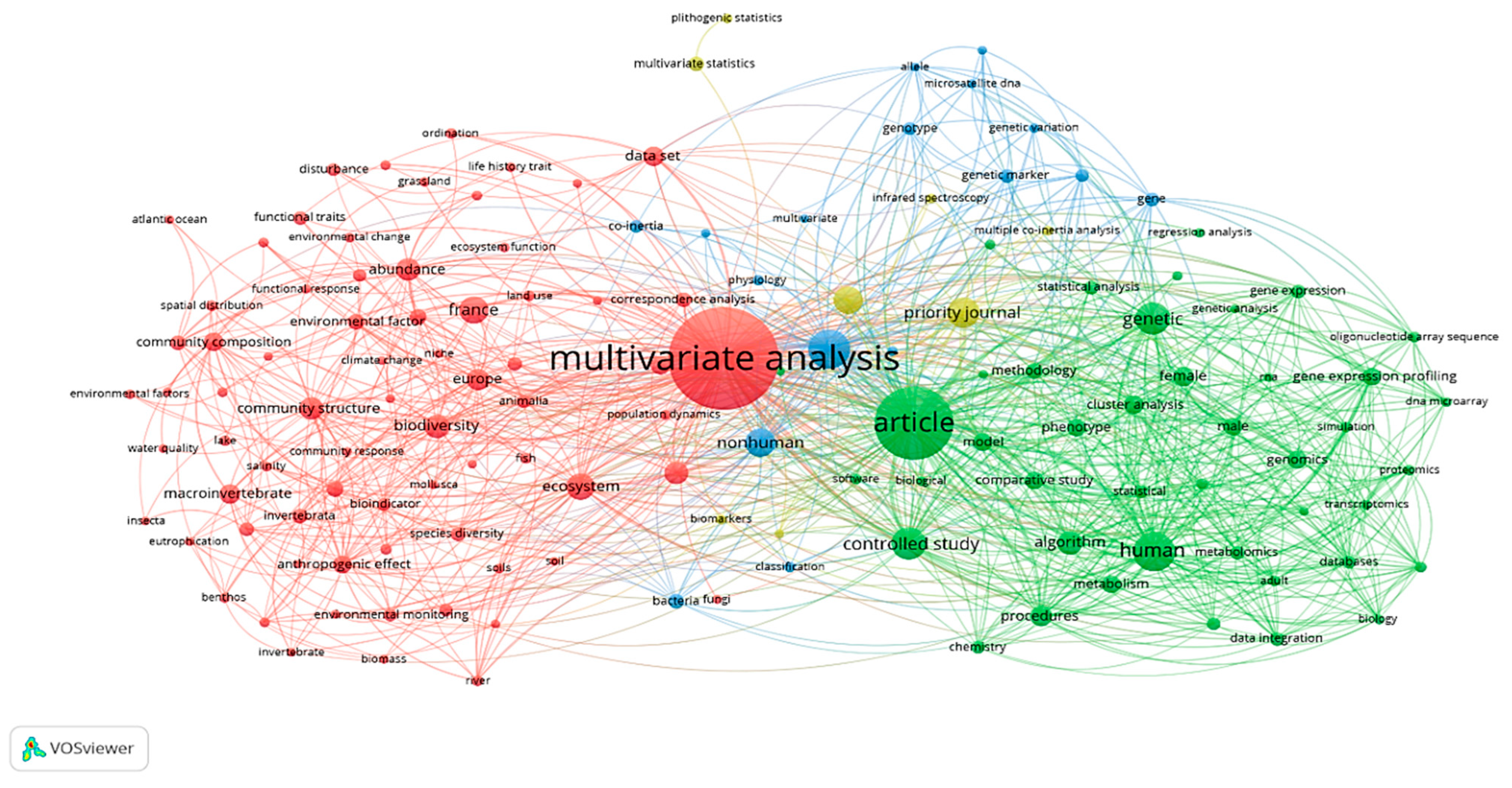
The keyword co-occurrence network is shown in Figure 6. The map was built from 3126 unique terms, of which 140 met the minimum threshold of five occurrences (VOSviewer default resolution = 1.0). The most central term was “multivariate analysis”, which occupied the principal hub position and linked the major thematic clusters of the field. This confirms that co-inertia analysis is embedded primarily within a multivariate integration tradition rather than within a distinct or autonomous conceptual niche [5].
Three main thematic clusters appear in Figure 6. The first cluster is related to ecology and environmental studies. The second cluster focuses on genetics and bioinformatics. The third cluster is methodological and includes multivariate statistics and correspondence analysis. The ecological cluster is consistent with the broader interpretive tradition of correspondence and ordination analysis described by Greenacre [43], whereas the data-integration cluster aligns with more recent environmental multiblock applications such as those reported by Sprovieri et al. [22].

3.5.2. Factorial Structure

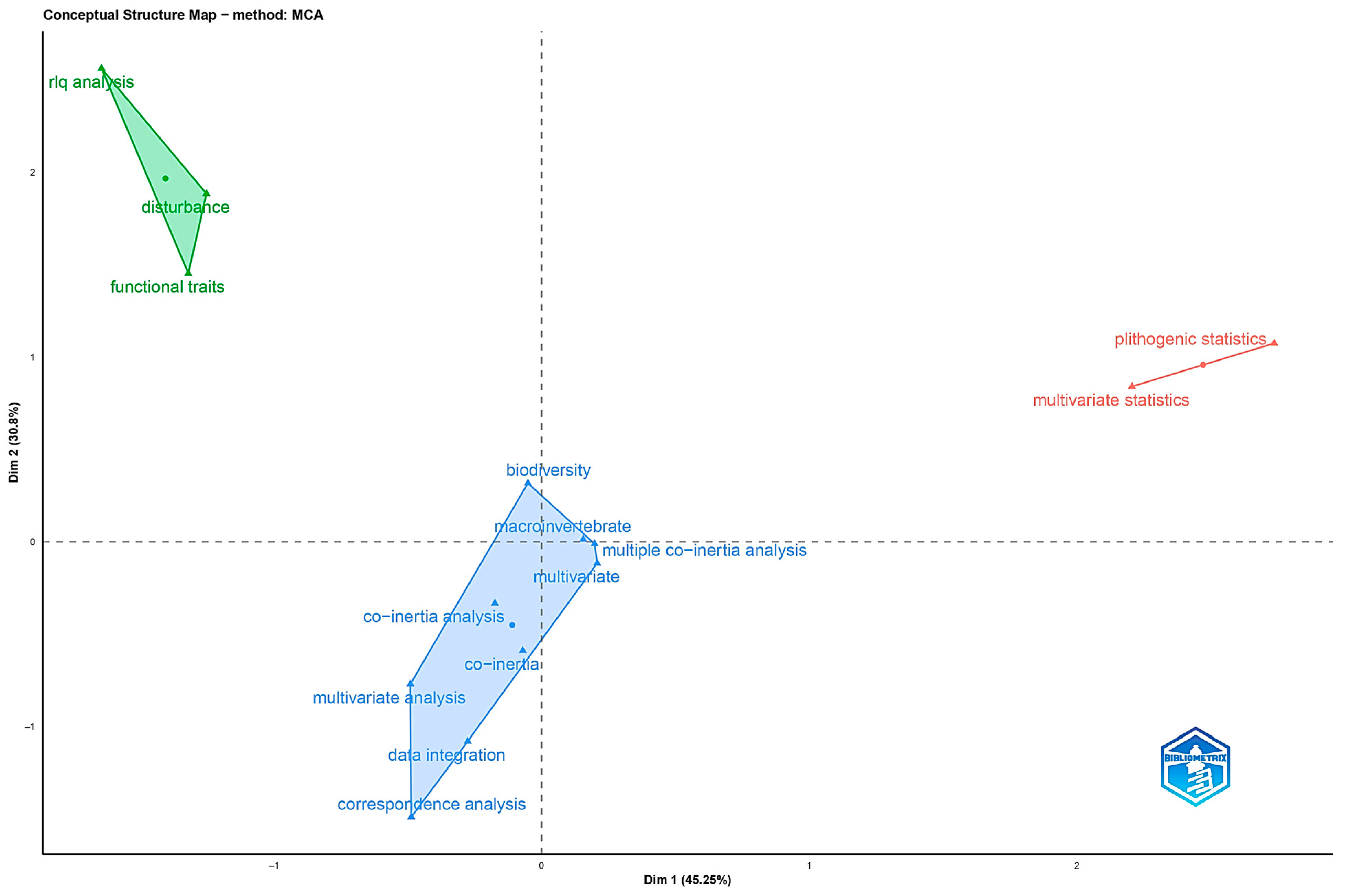
The conceptual factorial structure is displayed in Figure 7, which was obtained through multiple correspondence analysis (MCA). The first dimension explained 45.25% of the inertia, while the second dimension explained 30.8%, together revealing a structured but non-homogeneous conceptual space. The map shows that the field is not randomly dispersed; instead, it is polarized along interpretable thematic gradients.
Dimension 1 separates a formal statistical pole from a more application-oriented pole focused on ecological descriptors and data integration. Dimension 2 differentiates a functional-ecological from more general multivariate terms. CoIA, multivariate analysis, and data integration appear near the origin, suggesting that they function as bridging concepts within the field. This spatial configuration supports the interpretation of co-inertia as a transversal methodological node connecting otherwise differentiated analytical subfields.

3.5.3. Intellectual and Relational Structure

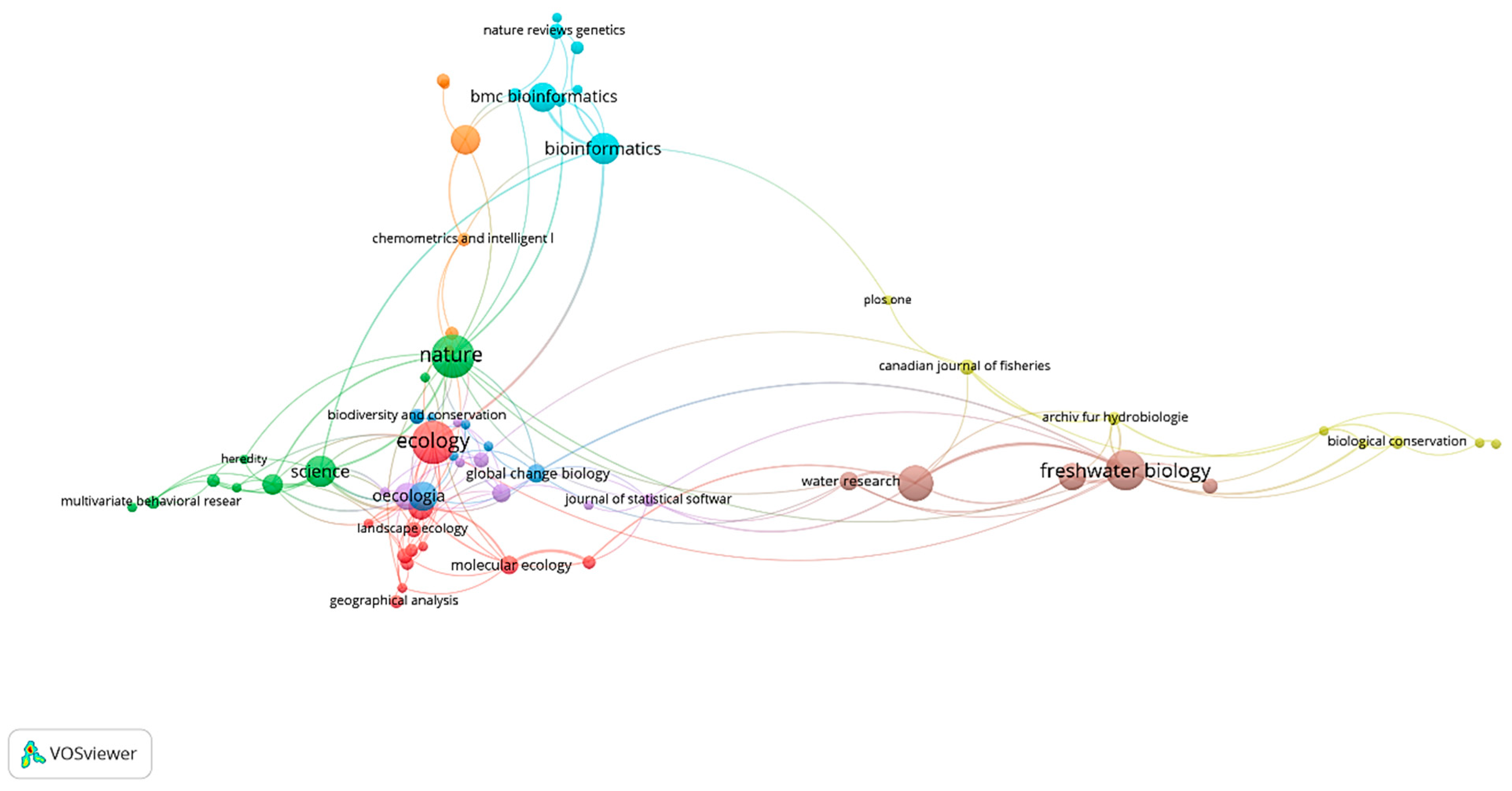
The intellectual structure of the field is represented in the source co-citation network shown in Figure 8. This map reveals that the literature is built around a small number of highly connected journal traditions. One central cluster is formed by journals such as Ecology, Journal of Applied Ecology, Global Change Biology, and Annual Review of Ecology and Systematics, confirming the ecological roots of co-inertia analysis. A second cluster is dominated by methodological and statistical journals, including Journal of Chemometrics, Technometrics, Journal of the American Statistical Association, and Psychometrika, reflecting the field’s geometric and multivariate foundation. A third cluster is associated with bioinformatics and computational biology, with journals such as Bioinformatics, BMC Bioinformatics, and Nature Reviews Genetics.
The connectivity among these clusters indicates that co-inertia analysis functions as an integrative methodological framework capable of traversing the ecological, statistical, and computational literature. At the same time, the co-citation map does not display a comparably consolidated neutrosophic cluster, which suggests that neutrosophy has not yet become part of the field’s stable intellectual canon. In bibliometric terms, the prospective convergence between CoIA and neutrosophic spaces is still more potential than realized.

3.5.4. Three-Field Plot

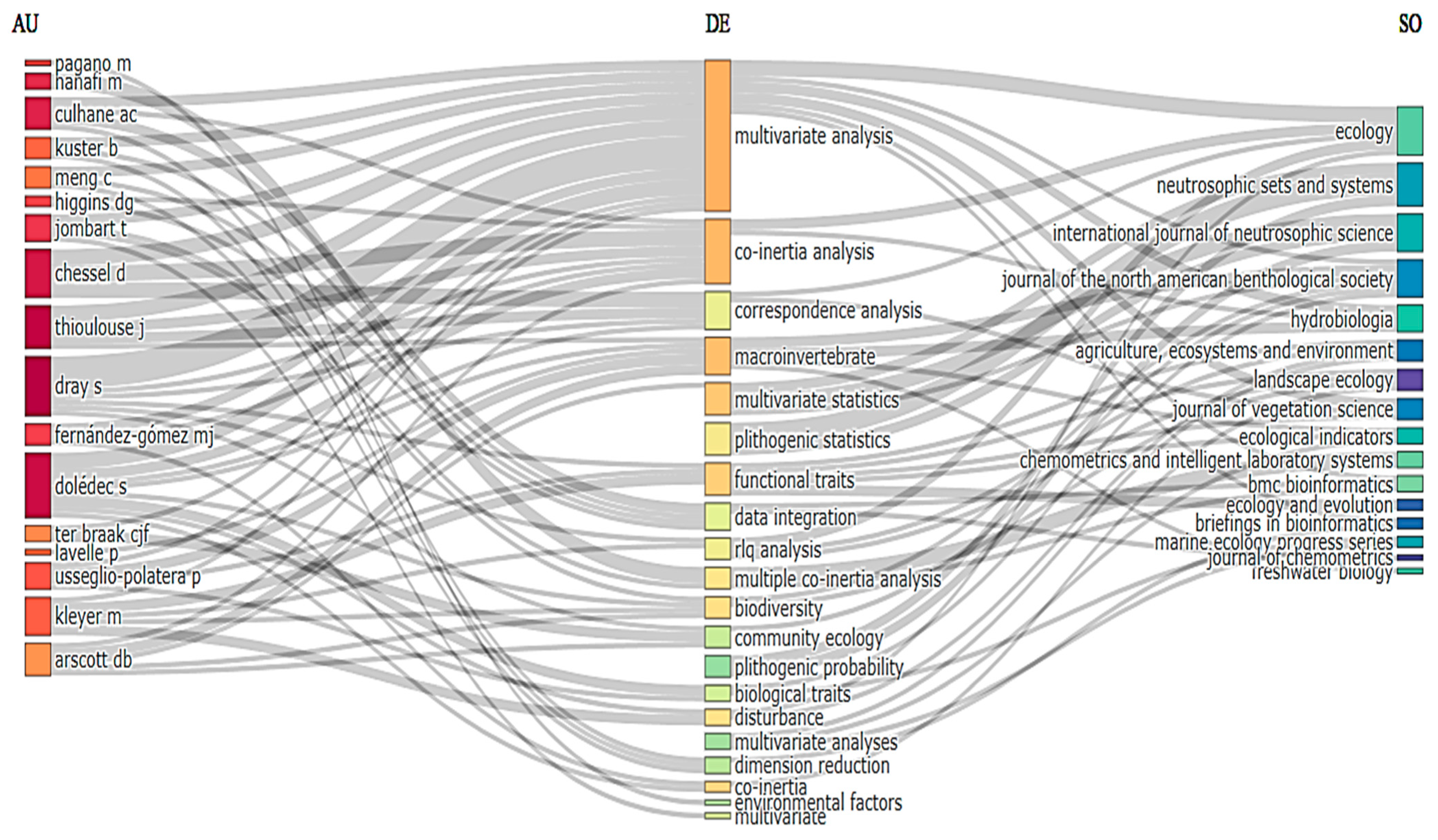
The three-field plot shown in Figure 9 links authors (AU), descriptors (DE), and sources (SO). Its structure confirms that the dominant authorial core remains tightly connected to a small set of methodological descriptors, particularly multivariate analysis, co-inertia analysis, and correspondence analysis. Authors such as Dray, Thioulouse, Dolédec, Chessel, and Usseglio-Polatera are positioned as central connectors between the methodological vocabulary of the field and its principal publication venues.
From the source side, the most visible journals correspond mainly to ecology, applied multivariate analysis, and bioinformatics. Although journals linked to neutrosophy do appear, their connections are weaker and more peripheral, generally mediated through generic descriptors. Consequently, explicit co-inertia–neutrosophy integration remains indirect and underdeveloped, even though the structural conditions for such integration are already visible.

3.5.5. Thematic Structure

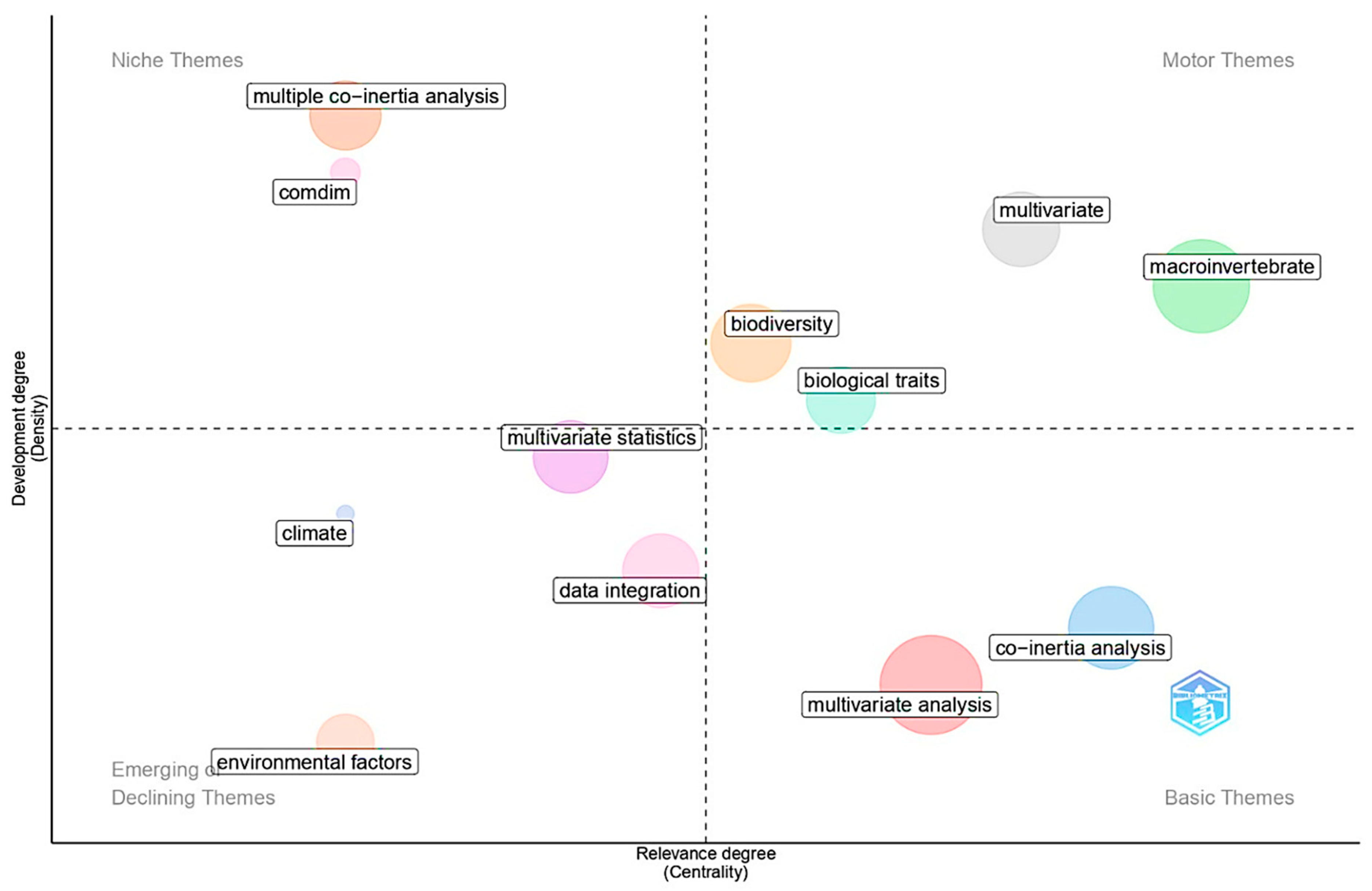
The thematic map (Figure 10) synthesizes the field according to centrality and density, allowing the identification of motor themes, basic themes, niche themes, and emerging or declining themes. The upper-right quadrant (motor themes) contains notably multivariate, macroinvertebrate, and biological traits. These topics display both high centrality and high density.
The lower-right quadrant (the basic themes) includes co-inertia analysis and multivariate analysis, showing high relevance but lower developmental density, indicating that they serve as foundational frameworks for the field. The upper-left quadrant (niche themes) includes multiple CoIA and comdim. The lower-left quadrant (emerging or declining themes) includes data integration, environmental factors, and climate. In the specific context of this study, the location of data integration is particularly important because it indicates a potential route for future articulation between co-inertia analysis and neutrosophic modeling under conditions of heterogeneous and partially indeterminate information.

4. Discussion

The present bibliometric analysis provides a structured interpretation of how co-inertia analysis has evolved from a specialized multivariate tool into a broader framework for integrating heterogeneous data structures across ecology, bioinformatics, and complex-system analytics. The results indicate that the field has passed through a recognizable sequence of emergence, consolidation, and diversification [4,5,10,11,12,13,14,15,16,17,18,19,20,21,22,23,24].
In response to the first research question, the temporal pattern confirms that scientific production has grown progressively, albeit unevenly, across the study period. The early years were characterized by low annual output but high long-term citation accumulation, a pattern typical of fields structured around seminal methodological contributions. This first stage was dominated by foundational work on co-inertia analysis and related ordination logic, as well as by the early software infrastructures that enabled its dissemination [1,2,3,4,5]. The subsequent expansion phase reflects the widening relevance of multivariate coupling methods in environmental and biological research [44,45,46,47,48,49,50,51,52]. The growth of the field parallels the broader movement in multivariate science toward multiblock, multidomain, and systems-oriented analytical strategies [18,19,20,21,22,23,24,25,49,50,51,52,53].
The productivity and citation patterns reveal a pronounced intellectual concentration. The leading authors—especially Dray, Thioulouse, Dolédec, and Chessel—form a cohesive methodological nucleus that has shaped both the technical language and the empirical legitimacy of co-inertia analysis. Its influence is particularly evident in the continuity between foundational ordination studies, software implementation, ecological applications, and subsequent multi-board extensions [1,2,3,4,5,6,7,8,9,15,16,17]. The bibliometric data support the interpretation that CoIA is a field with a stable canonical core.
The journal structure reinforces this interpretation. The contrast between high-output and high-impact journals is telling. Broad multidisciplinary venues have widened the field’s visibility, but the heaviest citation concentrations remain in journals central to ecology, bioinformatics, and statistical computing. This suggests that co-inertia analysis has spread through disciplinary layering—not by displacing existing fields, but by being reinterpreted within them. Ecology remains the field’s historical anchor, while bioinformatics and multi-omics research have become key spaces for methodological renewal [10,11,12,13,14,15,16,17,18,19,20,21,22,23,37,38,39,40,41,42,43,44,45,46,47,48,49,50,51,52]. This pattern aligns with the conceptual centrality of “multivariate analysis” in the co-occurrence network and with the growing strategic weight of data integration as a thematic line.
The geographic and institutional findings point in the same direction. France leads in publication volume and acts as a hub in a broader transnational network. The collaboration map shows that the Franco-European core was the main channel through which CoIA spread to other scientific communities—particularly in the United Kingdom, Ireland, and the United States. The dual prominence of CNRS and University College Dublin reflects two distinct but complementary roles: one anchored in foundational methodology, the other in applied high-dimensional data analysis. That division matters analytically, because it mirrors the field’s own shift from ecological multivariate geometry toward large-scale integrative analytics [10,11,12,13,14,15,16,17,18,19,20,21,22,23,24,38,39,40,41,42,43,44,45,46,47,48,49,50,51,52].
The disconnect between co-inertia analysis and neutrosophic theory—despite their apparent complementarity—comes down to structural differences between two largely separate disciplinary communities. CoIA grew out of the French ecological statistics tradition and spread mainly through software ecosystems (ade4, ADE-4) adopted by ecologists and bioinformaticians. Its practitioners have worked almost entirely within an ecology–multivariate statistics–bioinformatics triangle. Neutrosophic theory, by contrast, has roots in philosophical logic and found its audience among researchers in decision science, operations research, and engineering. These communities have had little methodological overlap: different journals, different citation habits, different empirical priorities. The bibliometric evidence—notably the absence of a consolidated neutrosophic cluster in the co-citation network and the peripheral position of neutrosophic journals in the three-field plot—reflects those structural separations, not any inherent incompatibility between the methods themselves.
From the perspective of the second research question, the conceptual structure of the field is highly coherent. The keyword co-occurrence map identifies “multivariate analysis” as the dominant organizing term, while co-inertia analysis occupies a central but intermediate position. The MCA factorial space supports this view by revealing a polarized but articulated domain: one pole is more formal, associated with multivariate and phylogenetic statistics; the other is more application-driven, structured around ecological traits, disturbance, biodiversity, and data integration [4,5,6,7,8,9,33,34,35,36,37,44,45,46,47,48,49,50,51,52].
The thematic map provides additional insight into the developmental status of the field. The location of motor themes in the ecological-functional zone confirms that the strongest and most mature applications of CoIA remain linked to biodiversity, macroinvertebrate research, and trait-based ecological interpretation. At the same time, the position of multiple co-inertia analysis and related consensus approaches as niche themes suggests technical sophistication combined with limited diffusion, consistent with their specialized role in multitable coupling and chemometric or omics-oriented integration [15,16,17,23,24,25,53,54]. Recent applications in mathematical biology have further extended the relevance of multivariate integration approaches in contexts of biological complexity [55,56].
The most consequential result of this study lies in the asymmetry between the mature co-inertia literature and the still peripheral presence of neutrosophic. Although journals and keywords associated with neutrosophy appear in the corpus, they do not yet form a dense or central cluster. The early neutrosophic literature established a wide conceptual foundation by formalizing neutrosophic logic, single-valued neutrosophic sets, neutrosophic measures, similarity concepts, and related epistemic constructs [52,53,54,57,58,59,60,61,62,63,64].
This point is especially important because current developments in co-inertia analysis are increasingly placing it in contexts where uncertainty is a significant factor. In ecological monitoring, multi-omics integration, environmental contamination studies, and other high-dimensional settings, heterogeneity is rarely only numerical. It is often epistemic. Data blocks may differ in reliability, represent conflicting biological or environmental signals, or contain uncertainty that cannot be treated as ordinary noise. In such settings, the neutrosophic framework becomes relevant not simply as an abstract philosophical extension, but as a possible way to preserve indeterminacy explicitly within multivariate integration. Recent neutrosophic applications in market segmentation, multivariate control charts, bootstrap monitoring, and the distinction between uncertainty and indeterminacy show that the neutrosophic tradition is already moving toward more operational and quantitative contexts [65,66,67,68,69,70]. This makes the absence of a strong co-inertia–neutrosophy cluster all the more striking.
A substantial body of work has developed similarity measures, cross-entropy formulations, trapezoidal and interval neutrosophic representations, and weighted aggregation operators [71,72,73,74,75,76,77]. A second set of contributions has extended these developments toward multivalued neutrosophic sets, linguistic uncertainty, DEMATEL–TOPSIS combinations, and multi-scale three-way decision systems [78,79,80,81,82,83,84,85,86,87]. Taken together, these studies demonstrate that neutrosophic methodology already possesses a sophisticated apparatus for handling structured indeterminacy. Yet this apparatus has remained largely external to the mainstream literature on co-inertia analysis. The bibliometric evidence thus indicates not the absence of tools, but the absence of integration.
A concrete pathway toward methodological integration could proceed through a sequential methodological workflow involving at least three stages. First, the original linked data tables could be transformed into neutrosophic matrices in which each observation is represented through truth (T), indeterminacy (I), and falsity (F) memberships. Within this framework, neutrosophic weighting schemes could be incorporated into the duality diagram structure underlying CoIA, allowing observations, variables, or entire data tables to carry different levels of epistemic certainty rather than a single deterministic reliability weight. This would enable the co-inertia compromise axes to reflect not only the shared variance between tables but also the degree of uncertainty associated with each observational unit.
Second, the RV coefficient used to assess concordance between tables in CoIA could be reformulated within a neutrosophic framework by replacing deterministic vector norms with single-valued neutrosophic similarity or distance measures, as developed in [81,82,83]. Such adaptation would allow the concordance structure between linked datasets to preserve ambiguity and partial reliability during multivariate integration.
Third, the resulting co-inertia axes could be projected into neutrosophic compromise coordinates, producing ordination configurations that explicitly preserve indeterminacy instead of collapsing uncertain observations into single point estimates. Each of these stages builds on existing developments in neutrosophic similarity measures, aggregation operators, and multivalued uncertainty modeling [81,82,83,85,86,87,88,89,90,91,92,93,94], and could be validated in ecological monitoring, multi-omics integration, or environmental contamination datasets characterized by partial observability and conflicting signals.
In summary, the discussion supports four main conclusions. Firstly, co-inertia analysis has consolidated itself as a methodologically stable and bibliometrically coherent field anchored in multivariate ecology and subsequently extending into bioinformatics and integration in high-dimensional spaces. Secondly, the field remains strongly structured by a canonical authorial and journal core, which explains both its stability and the citation concentration. Thirdly, the conceptual structure confirms that CoIA operates as a multivariate linking framework, rather than as a specialized technique of limited scope. Fourthly, the weak but detectable presence of neutrosophic-oriented literature suggests that the most promising future direction is methodological synthesis between multitable integration and explicit representations of indeterminacy [58,59,60,61,62,63,64,65,66,67,68,69,70,71,72,73,74,75,76,77,78,79,80,81,82,83,84,85,86,87]—a synthesis whose structural conditions are now in place.

5. Conclusions

This study’s results have theoretical, methodological, and prospective implications. From a theoretical standpoint, the bibliometric characterization performed contributes to clarifying CoIA’s intellectual structure and its evolution toward increasingly complex applications, providing a reference framework for researchers interested in matrix coupling and advanced relational analysis.
In methodological terms, findings suggest that co-inertia analysis constitutes an adequate tool for contexts where multiple heterogeneous data sources converge, positioning it as a natural candidate for integration with neutrosophic approaches. Neutrosophy’s capacity to explicitly model indeterminacy could complement the strengths of the CoIA.
From a prospective perspective, the absence of works explicitly combining CoIA with neutrosophic spaces in the analyzed database is not a conceptual limitation but a research opportunity. Results allow identifying authors, journals, and thematic lines where such integration could develop naturally.
This work provides a systematic vision of the state of the art and establishes a roadmap for CoIA’s future development in contexts of high uncertainty, contributing to the consolidation of advanced multivariate approaches oriented toward complex decision-making.

6. Study Limitations and Future Directions

Several limitations should be considered when interpreting the findings of this study. The first is related to database coverage. The corpus was built exclusively from Scopus, which offers standardized metadata and broad journal coverage, making it highly suitable for bibliometric analysis. However, single-database studies inevitably risk underrepresenting literature indexed in other sources, including Web of Science, Dimensions, Crossref-linked repositories, or specialized disciplinary databases. This issue is recognized in methodological discussions on bibliometric design, which note that differences in indexing policies, source coverage, and metadata completeness can influence both productivity indicators and network structures [88,89,90,91,92,94,95,96]. Consequently, the present study should be interpreted as a rigorous map of the Scopus-indexed landscape rather than as an exhaustive census of all possible literature on CoIA and neutrosophic approaches.
A second limitation concerns the search strategy and keyword dependence of the corpus. Bibliometric analyses are highly sensitive to lexical formulation, especially in emerging or interdisciplinary fields where equivalent concepts may circulate under partially different terminologies. Although the search strategy was progressively refined and coupled with expert review, it is still possible that some relevant contributions were omitted because they used adjacent descriptors rather than the specific terms prioritized here. This limitation is inherent to bibliometric retrieval and has been repeatedly discussed in the bibliometric methods literature, particularly in relation to co-word mapping and emerging topic detection [33,34,37,88,89,92,95,96]. In fields where conceptual bridges are still weak, terminology may lag behind substantive similarity, making query design a decisive source of inclusion or exclusion.
A third limitation is associated with the restriction to English-language journal articles. This decision improved metadata consistency and comparability, but it also reduced the corpus to the most internationally visible segment of the literature. As a consequence, conceptually relevant contributions published in other languages, or in formats such as proceedings, book chapters, reports, or monographs, may have been excluded. This issue may be especially relevant for methodological traditions with strong regional development, where part of the foundational debate may not be fully visible in mainstream journal indexing systems.
A fourth limitation concerns the interpretive nature of citation-based evidence. Citations indicate visibility, uptake, and relational centrality, but they do not directly measure theoretical superiority or methodological adequacy. A highly cited document may be dominant because it offers software accessibility, broad disciplinary relevance, or timing advantages, rather than because it exhausts the theoretical possibilities of a field. Likewise, peripheral themes in a thematic map are not necessarily weak in epistemic terms; they may simply be recent, fragmented, or insufficiently stabilized. This is particularly important when interpreting the marginality of neutrosophic literature in the current corpus. Its weak bibliometric density does not imply low conceptual value. It may instead reflect recency, disciplinary separation, or differences in indexing intensity.
A fifth limitation derives from the use of science-mapping indicators themselves. Co-citation, bibliographic coupling, and co-word analyses are powerful for reconstructing relational structures, but each emphasizes different aspects of scientific organization. Co-citation privileges shared reception over time, bibliographic coupling emphasizes common reference behavior at the publication moment, and co-word analysis captures lexical proximity rather than necessarily deep conceptual convergence [90,91,92]. Therefore, the present maps should be understood as complementary views of the field rather than as definitive representations of a single latent structure. In the same way, Bradford-type source concentration and Lotka-type author productivity laws provide useful heuristics for interpreting concentration patterns, but they should not be reified as deterministic laws governing all scientific production [93,94].
A sixth limitation concerns recency effects. Newer publications have had less time to accumulate citations, and emerging topics often appear bibliometrically weak during their early diffusion phase. This is especially relevant for the neutrosophic literature included in the corpus, much of which belongs to a more recent wave of applied uncertainty modeling. Therefore, the relatively peripheral position of neutrosophic terms and sources may partly reflect citation latency rather than purely structural marginality.
Despite these limitations, the study also opens several clear future directions. The first is methodological: future bibliometric work should adopt multi-database designs and compare how corpus structure changes when Scopus is combined with other indexing systems. Such triangulation would improve recall, reduce database-specific bias, and allow stronger robustness checks [88,95,96]. The second direction is conceptual: future research should move beyond bibliometric mapping and develop formal analytical models that explicitly integrate co-inertia logic with neutrosophic representations of indeterminacy. This could include neutrosophic weighting schemes for linked data tables, extensions of covariance-based ordination under indeterminate information, or hybrid frameworks for multiblock analysis in which truth, falsity, and uncertainty are preserved simultaneously rather than collapsed into a single error term [53,54,57,58,59,60,61,62,63,64,65,66,67,68,69,70,71,72,73,74,75,76,77,78,79,80,81,82,83,84].
A third future direction is empirical. The thematic structure identified in this study suggests that environmental monitoring, ecological disturbance analysis, biodiversity assessments, and multi-omics integration are especially promising domains for testing a future co-inertia–neutrosophic synthesis. These are precisely the settings in which multiple data blocks, partial observability, and ambiguous signals tend to coexist. In such cases, the conventional strength of co-inertia analysis—its ability to reveal concordance between linked datasets—could be substantially enhanced by a framework that treats indeterminacy as analytically meaningful rather than merely residual.
Ultimately, the main limitation of the current literature is also its greatest opportunity. The explicit integration between CoIA and neutrosophic theory remains underdeveloped. Yet the bibliometric evidence presented here shows that both traditions have already matured enough, on their own terms, to make such a convergence plausible. The next step for the field is therefore not only to continue describing its structure, but to build the methodological bridge that its current conceptual configuration now makes visible.


Author Contributions

Conceptualization, M.D.R. and P.G.-V.; methodology, M.D.R. and P.V.-G.; software, M.D.R.; validation, M.D.R., P.V.-G. and P.G.-V.; formal analysis, M.D.R.; investigation, M.D.R.; resources, P.V.-G. and P.G.-V.; data curation, M.D.R.; writing—original draft preparation, M.D.R.; writing—review and editing, P.V.-G. and P.G.-V.; visualization, M.D.R.; supervision, P.V.-G. and P.G.-V.; project administration, P.G.-V.; funding acquisition, P.G.-V. All authors have read and agreed to the published version of the manuscript.

Funding

The authors declare that financial support for the publication of this article was received from the Vice-Rectorate of Research and Postgraduate Studies of the State University of Milagro (UNEMI).

Institutional Review Board Statement

Not applicable.

Informed Consent Statement

Not applicable.

Data Availability Statement

No new data were created or analyzed in this study. Data sharing is not applicable to this article.

Acknowledgments

The authors are grateful to the Universidad Estatal de Milagro (UNEMI).

Conflicts of Interest

The authors declare no conflicts of interest.

References

  1. Escoufier, Y. Le traitement des variables vectorielles. Biometrics 1973, 29, 751–760. [Google Scholar] [CrossRef]
  2. Robert, P.; Escoufier, Y. A unifying tool for linear multivariate statistical methods: The RV-coefficient. J. R. Stat. Soc. Ser. C 1976, 25, 257–265. [Google Scholar] [CrossRef]
  3. Kettenring, J.R. Canonical analysis of several sets of variables. Biometrika 1971, 58, 433–451. [Google Scholar] [CrossRef]
  4. Dolédec, S.; Chessel, D. Co-inertia analysis: An alternative method for studying species–environment relationships. Freshw. Biol. 1994, 31, 277–294. [Google Scholar] [CrossRef]
  5. Dray, S.; Chessel, D.; Thioulouse, J. Co-inertia analysis and the linking of ecological data tables. Ecology 2003, 84, 3078–3089. [Google Scholar] [CrossRef]
  6. Thioulouse, J.; Chessel, D.; Dolédec, S.; Olivier, J.M. ADE-4: A multivariate analysis and graphical display software. Stat. Comput. 1997, 7, 75–83. [Google Scholar] [CrossRef]
  7. Dray, S.; Dufour, A.B. The ade4 package: Implementing the duality diagram for ecologists. J. Stat. Softw. 2007, 22, 1–20. [Google Scholar] [CrossRef]
  8. Thioulouse, J.; Dray, S.; Dufour, A.B.; Siberchicot, A.; Jombart, T.; Pavoine, S. Multivariate Analysis of Ecological Data with Ade4; Springer: New York, NY, USA, 2018. [Google Scholar] [CrossRef]
  9. Dray, S.; Legendre, P. Testing the species traits–environment relationships: The fourth-corner problem revisited. Ecology 2008, 89, 3400–3412. [Google Scholar] [CrossRef] [PubMed]
  10. Dray, S.; Choler, P.; Dolédec, S.; Peres-Neto, P.R.; Thuiller, W.; Pavoine, S.; ter Braak, C.J.F. Combining the fourth-corner and the RLQ methods for assessing trait responses to environmental variation. Ecology 2014, 95, 14–21. [Google Scholar] [CrossRef]
  11. Thioulouse, J.; Simier, M.; Chessel, D. Multiple co-inertia analysis: A tool for assessing synchrony in the temporal variability of aquatic communities. Comptes Rendus Biol. 2004, 327, 29–36. [Google Scholar] [CrossRef]
  12. Culhane, A.C.; Perrière, G.; Higgins, D.G. Cross-platform comparison and visualisation of gene expression data using co-inertia analysis. BMC Bioinform. 2003, 4, 59. [Google Scholar] [CrossRef]
  13. Fagan, A.I.; Culhane, A.C.; Higgins, D.G. A multivariate analysis approach to the integration of proteomic and gene expression data. Proteomics 2007, 7, 2162–2171. [Google Scholar] [CrossRef]
  14. Meng, C.; Kuster, B.; Culhane, A.C.; Gholami, A.M. A multivariate approach to the integration of multi-omics datasets. BMC Bioinform. 2014, 15, 162. [Google Scholar] [CrossRef]
  15. Rohart, F.; Gautier, B.; Singh, A.; Lê Cao, K.A. mixOmics: An R package for ‘omics feature selection and multiple data integration. PLoS Comput. Biol. 2017, 13, e1005752. [Google Scholar] [CrossRef] [PubMed]
  16. Singh, A.; Shannon, C.P.; Gautier, B.; Rohart, F.; Vacher, M.; Tebbutt, S.J.; Lê Cao, K.A. DIABLO: An integrative approach for identifying key molecular drivers from multi-omics assays. Bioinformatics 2019, 35, 3055–3062. [Google Scholar] [CrossRef] [PubMed]
  17. Hasin, Y.; Seldin, M.; Lusis, A. Multi-omics approaches to disease. Genome Biol. 2017, 18, 83. [Google Scholar] [CrossRef]
  18. Karczewski, K.J.; Snyder, M.P. Integrative omics for health and disease. Nat. Rev. Genet. 2018, 19, 299–310. [Google Scholar] [CrossRef] [PubMed]
  19. Huang, S.; Chaudhary, K.; Garmire, L.X. More is better: Recent progress in multi-omics data integration methods. Front. Genet. 2017, 8, 84. [Google Scholar] [CrossRef]
  20. Bersanelli, M.; Mosca, E.; Remondini, D.; Giampieri, E.; Sala, C.; Castellani, G.; Milanesi, L. Methods for the integration of multi-omics data: Mathematical aspects. BMC Bioinform. 2016, 17, 15. [Google Scholar] [CrossRef]
  21. Piazzese, D.; Bonanno, A.; Bongiorno, D.; Falco, F.; Indelicato, S.; Milisenda, G.; Vazzana, I.; Cammarata, M. Co-inertia multivariate approach for the evaluation of anthropogenic impact on two commercial fish along Tyrrhenian coasts. Ecotoxicol. Environ. Saf. 2019, 182, 109435. [Google Scholar] [CrossRef]
  22. Sprovieri, M.; Passaro, S.; Ausili, A.; Bergamin, L.; Finoia, M.G.; Gherardi, S.; Molisso, F.; Quinci, E.M.; Sacchi, M.; Sesta, G.; et al. Integrated approach of multiple environmental datasets for the assessment of sediment contamination in marine areas affected by long-lasting industrial activity: The case study of Bagnoli (southern Italy). J. Soils Sediments 2020, 20, 1692–1705. [Google Scholar] [CrossRef]
  23. Bozec, Y.M.; Dolédec, S.; Kulbicki, M. An analysis of fish-habitat associations on disturbed coral reefs: Chaetodontid fishes in New Caledonia. J. Fish. Biol. 2005, 66, 966–982. [Google Scholar] [CrossRef]
  24. Smarandache, F. A Unifying Field in Logics: Neutrosophy—Neutrosophic Probability, Set and Logic; American Research Press: Rehoboth, NM, USA, 2001. [Google Scholar]
  25. Wang, H.; Smarandache, F.; Zhang, Y.; Sunderraman, R. Single valued neutrosophic sets. Rev. Air Force Acad. 2010, 1, 10–14. [Google Scholar]
  26. Zhang, H.Y.; Wang, J.Q.; Chen, X.H. Interval neutrosophic sets and their application in multicriteria decision making problems. Sci. World J. 2014, 2014, 645953. [Google Scholar] [CrossRef]
  27. Peng, J.J.; Wang, J.Q.; Wu, X.H.; Wang, J.; Chen, X.H. Multi-valued neutrosophic sets and power aggregation operators with their applications in multi-criteria group decision-making problems. Int. J. Comput. Intell. Syst. 2015, 8, 345–363. [Google Scholar] [CrossRef]
  28. Ye, J. Improved cosine similarity measures of simplified neutrosophic sets for medical diagnoses. Artif. Intell. Med. 2015, 63, 171–179. [Google Scholar] [CrossRef]
  29. Ye, J. Single valued neutrosophic cross-entropy for multicriteria decision making problems. Appl. Math. Model. 2014, 38, 1170–1175. [Google Scholar] [CrossRef]
  30. Wibawati; Ahsan, M.; Khusna, H. Neutrosophic multivariate EWMA control chart. Decis. Sci. Lett. 2023, 12, 807–816. [Google Scholar] [CrossRef]
  31. Saritha, M.B.; Varadharajan, R. Multivariate exponentially weighted moving average control chart under neutrosophic environment: A bootstrap approach. Int. J. Math. Eng. Manag. Sci. 2024, 9, 835–843. [Google Scholar] [CrossRef]
  32. Voskoglou, M.G. Uncertainty vs indeterminacy: A journey from fuzziness to neutrosophy. Am. J. Appl. Math. Stat. 2022, 10, 65–68. [Google Scholar] [CrossRef]
  33. Aria, M.; Cuccurullo, C. bibliometrix: An R-tool for comprehensive science mapping analysis. J. Inf. 2017, 11, 959–975. [Google Scholar] [CrossRef]
  34. van Eck, N.J.; Waltman, L. Software survey: VOSviewer, a computer program for bibliometric mapping. Scientometrics 2010, 84, 523–538. [Google Scholar] [CrossRef]
  35. Donthu, N.; Kumar, S.; Mukherjee, D.; Pandey, N.; Lim, W.M. How to conduct a bibliometric analysis: An overview and guidelines. J. Bus. Res. 2021, 133, 285–296. [Google Scholar] [CrossRef]
  36. Zupic, I.; Čater, T. Bibliometric methods in management and organization. Organ. Res. Methods 2015, 18, 429–472. [Google Scholar] [CrossRef]
  37. Cobo, M.J.; López-Herrera, A.G.; Herrera-Viedma, E.; Herrera, F. Science mapping software tools: Review, analysis, and cooperative study among tools. J. Am. Soc. Inf. Sci. Technol. 2011, 62, 1382–1402. [Google Scholar] [CrossRef]
  38. Gan, Y.-n.; Li, D.-d.; Robinson, N.; Liu, J.-p. Practical guidance on bibliometric analysis and mapping knowledge domains methodology—A summary. Eur. J. Integr. Med. 2022, 56, 102203. [Google Scholar] [CrossRef]
  39. Zupic, I.; Vinayavekhin, S.; Caputo, A. Topic Modeling in Literature Reviews. Acad. Manag. Proc. 2024, 2024, 16144. [Google Scholar] [CrossRef]
  40. Jin, R.; Zou, P.X.W.; Piroozfar, P.; Wood, H.; Yang, Y.; Yan, L.; Han, Y. A science mapping approach based review of construction safety research. Saf. Sci. 2019, 113, 285–297. [Google Scholar] [CrossRef]
  41. Jombart, T. Adegenet: A R package for the multivariate analysis of genetic markers. Bioinformatics 2008, 24, 1403–1405. [Google Scholar] [CrossRef]
  42. Urbizagástegui Alvarado, U. Una revisión crítica de la Ley de Bradford. Investig. Bibl. 1996, 10, 16–25. [Google Scholar] [CrossRef][Green Version]
  43. Greenacre, M.J. Correspondence analysis. In Correspondence Analysis in Practice; Greenacre, M., Blasius, J., Eds.; Chapman and Hall/CRC: Boca Raton, FL, USA, 2006. [Google Scholar]
  44. Batra, S. Exploring the application of PLS-SEM in construction management research: A bibliometric and meta-analysis approach. Eng. Constr. Archit. Manag. 2024, 32, 2697–2727. [Google Scholar] [CrossRef]
  45. Avilés-Noles, A.; Molina-Orellana, S.; Buestan Benavides, M.; Ramirez-Anormaliza, R. Application of lean practices in higher education institutions (HEIs): Bibliometric analysis from 2010 to 2023. Int. J. Qual. Reliab. Manag. 2025, 42, 2478–2508. [Google Scholar] [CrossRef]
  46. Dieleman, J.A.; Mortensen, D.A.; Buhler, D.D.; Cambardella, C.A.; Moorman, T.B. Identifying associations among site properties and weed species abundance. I. Multivariate analysis. Weed Sci. 2000, 48, 567–575. [Google Scholar] [CrossRef]
  47. Greffard, M.H.; Saulnier-Talbot, É.; Gregory-Eaves, I. A comparative analysis of fine versus coarse taxonomic resolution in benthic chironomid community analyses. Ecol. Indic. 2011, 11, 1541–1551. [Google Scholar] [CrossRef]
  48. Le Féon, V.; Schermann-Legionnet, A.; Delettre, Y.; Aviron, S.; Billeter, R.; Bugter, R.; Hendrickx, F.; Burel, F. Intensification of agriculture, landscape composition and wild bee communities: A large scale study in four European countries. Agric. Ecosyst. Environ. 2010, 137, 143–150. [Google Scholar] [CrossRef]
  49. Picard, N.; Ouattara, S.; Diarisso, D.; Ballo, M.; Gautier, D. Defining units for savanna management in Sudano-sahelian areas. For. Ecol. Manag. 2006, 236, 403–411. [Google Scholar] [CrossRef]
  50. Usseglio-Polatera, P.H.; Beisel, J.N. Longitudinal changes in macroinvertebrate assemblages in the Meuse River: Anthropogenic effects versus natural change. River Res. Appl. 2002, 18, 197–211. [Google Scholar] [CrossRef]
  51. Pierce, S.; Negreiros, D.; Cerabolini, B.E.L.; Kattge, J.; Díaz, S.; Kleyer, M.; Shipley, B.; Wright, S.J.; Soudzilovskaia, N.A.; Onipchenko, V.G.; et al. A global method for calculating plant CSR ecological strategies applied across biomes world-wide. Funct. Ecol. 2017, 31, 444–457. [Google Scholar] [CrossRef]
  52. ter Braak, C.J.F.; Šmilauer, P.; Dray, S. Algorithms and biplots for double constrained correspondence analysis. Environ. Ecol. Stat. 2018, 25, 171–197. [Google Scholar] [CrossRef]
  53. Smarandache, F. Neutrosophy, A New Branch of Philosophy. Mult. Valued Log. Int. J. 2002, 8, 297–384. [Google Scholar]
  54. Colhon, M.; Tilea, M.; Gonzalez-Marcos, A.; Resceanu, A.; Smarandache, F.; Navaridas-Naida, F. A Neutrosophic decision-making model for determining young people’s active engagement. Int. J. Inf. Technol. Decis. Mak. 2023, 23, 569–598. [Google Scholar] [CrossRef]
  55. Zhu, L.; Ding, Y.; Shen, S. Green behavior propagation analysis based on statistical theory and intelligent algorithm in data-driven environment. Math. Biosci. 2024, 379, 109340. [Google Scholar] [CrossRef] [PubMed]
  56. Balderrama, R.; Prieto, M.I.; Sánchez de la Vega, C.; Vázquez, F. Optimal control for an SIR model with limited hospitalised patients. Math. Biosci. 2024, 378, 109317. [Google Scholar] [CrossRef]
  57. Smarandache, F. Neutrosophic measure and neutrosophic integral. Neutrosophic Sets Syst. 2013, 1, 3–7. [Google Scholar]
  58. Ye, J. Another form of correlation coefficient between single valued neutrosophic sets and its multiple attribute decision making method. Neutrosophic Sets Syst. 2013, 1, 8–12. [Google Scholar]
  59. Broumi, S.; Smarandache, F. Several similarity measures of neutrosophic sets. Neutrosophic Sets Syst. 2013, 1, 54–62. [Google Scholar]
  60. Chi, P.; Liu, P. An extended TOPSIS method for the multiple attribute decision making problems based on interval neutrosophic set. Neutrosophic Sets Syst. 2013, 1, 63–70. [Google Scholar]
  61. Shabir, M.; Ali, M. Soft neutrosophic group. Neutrosophic Sets Syst. 2013, 1, 13–22. [Google Scholar]
  62. Salama, A.A.; Smarandache, F. Filters via neutrosophic crisp sets. Neutrosophic Sets Syst. 2013, 1, 34–38. [Google Scholar]
  63. Salama, A.A. Neutrosophic crisp points and neutrosophic crisp ideals. Neutrosophic Sets Syst. 2013, 1, 50–53. [Google Scholar]
  64. Smarandache, F.; Vladutescu, S. Communication vs. information: An axiomatic neutrosophic solution. Neutrosophic Sets Syst. 2013, 1, 24–27. [Google Scholar]
  65. Guo, Y.; Sengur, A. A novel image segmentation algorithm based on neutrosophic filtering and level set. Neutrosophic Sets Syst. 2013, 1, 46–49. [Google Scholar]
  66. Smarandache, F. Practical Applications of the Independent Neutrosophic Components and of the Neutrosophic Offset Components. Neutrosophic Sets Syst. 2021, 47, 558–572. [Google Scholar]
  67. Romero-Fernández, A.J.; Alvarez-Gomez, G.A.; Armijos, C.G. Neutrosophic K-means for market segmentation. Int. J. Neutrosophic Sci. 2022, 19, 272–279. [Google Scholar] [CrossRef]
  68. Muhammad, A.; Khushnoor, K.; Mohammed, A.; Liaquat, A. Moving average control chart under neutrosophic statistics. AIMS Math. 2023, 8, 7083–7096. [Google Scholar] [CrossRef]
  69. Quang-Thinh, B.; My-Phuong, N.; Vaclav, S.; Witold, P.; Bay, V. Information measures based on similarity under neutrosophic fuzzy environment and multi-criteria decision problema. Eng. Appl. Artif. Intell. 2023, 122, 106026. [Google Scholar] [CrossRef]
  70. Muhammad, A.; AlAita, A.; Smarandache, F. A Critical Evaluation of theCriticisms against Neutrosophic Statistical Methods. Neutrosophic Syst. Appl. 2025, 25, 576–589. [Google Scholar]
  71. Ye, J. Similarity measures between interval neutrosophic sets and their applications in multicriteria decision-making. J. Intell. Fuzzy Syst. 2014, 26, 165–172. [Google Scholar] [CrossRef]
  72. Du, S.; Ye, J.; Yong, R.; Zhang, F. Some aggregation operators of neutrosophic Z-numbers and their multicriteria decision making method. Complex Intell. Syst. 2021, 7, 429–438. [Google Scholar] [CrossRef] [PubMed]
  73. Ye, J.; Fu, J. Multi-period medical diagnosis method using a single valued neutrosophic similarity measure based on tangent function. Comput. Methods Programs Biomed. 2016, 123, 142–149. [Google Scholar] [CrossRef]
  74. Ye, J. A multicriteria decision-making method using aggregation operators for simplified neutrosophic sets. J. Intell. Fuzzy Syst. 2014, 26, 2459–2466. [Google Scholar] [CrossRef]
  75. Ye, J. Trapezoidal neutrosophic set and its application to multiple attribute decision-making. Neural Comput. Appl. 2015, 26, 1157–1166. [Google Scholar] [CrossRef]
  76. Ye, J. Multiple-attribute group decision-making method under a neutrosophic number environment. J. Intell. Syst. 2015, 25, 377–386. [Google Scholar] [CrossRef]
  77. Ye, J. Exponential operations and aggregation operators of interval neutrosophic sets and their decision making methods. SpringerPlus 2016, 5, 1488. [Google Scholar] [CrossRef]
  78. Wu, X.; Qian, J.; Peng, J.; Xue, C. A Multi-Criteria Group Decision-Making Method with Possibility Degree and Power Aggregation Operators of Single Trapezoidal Neutrosophic Numbers. Symmetry 2018, 10, 590. [Google Scholar] [CrossRef]
  79. Sarkar, D.; Srivastava, P.K. Recent development and applications of neutrosophic fuzzy optimization approach. Int. J. Syst. Assur Eng. Manag. 2024, 15, 2042–2066. [Google Scholar] [CrossRef]
  80. Broumi, S.; Ye, J.; Smarandache, F. An extended TOPSIS method for multiple attribute decision making based on interval neutrosophic uncertain linguistic variables. Neutrosophic Sets Syst. 2015, 8, 22–31. [Google Scholar]
  81. Ye, J. Some weighted aggregation operators of trapezoidal neutrosophic numbers and their multiple attribute decision making method. Informatica 2017, 28, 387–402. [Google Scholar] [CrossRef]
  82. Chen, J.; Ye, J.; Du, S. Vector similarity measures between refined simplified neutrosophic sets and their multiple attribute decision-making method. Symmetry 2017, 9, 153. [Google Scholar] [CrossRef]
  83. Tu, A.; Ye, J.; Wang, B. Multiple attribute decision-making method using similarity measures of neutrosophic cubic sets. Symmetry 2018, 10, 215. [Google Scholar] [CrossRef]
  84. Yang, W.; Pang, Y. New multiple attribute decision making method based on DEMATEL and TOPSIS for multi-valued interval neutrosophic sets. Symmetry 2018, 10, 115. [Google Scholar] [CrossRef]
  85. Jiang, W.; Zhang, Z.; Deng, X. Multi-attribute decision making method based on aggregated neutrosophic set. Symmetry 2019, 11, 267. [Google Scholar] [CrossRef]
  86. Du, S.; Ye, J.; Yong, R.; Zhang, F. Simplified neutrosophic indeterminate decision making method with decision makers’ indeterminate ranges. J. Civ. Eng. Manag. 2020, 26, 590–598. [Google Scholar] [CrossRef]
  87. Yang, X.; Zhou, X.; Huang, B.; Li, H.; Wang, T. A three-way decision method on multi-scale single-valued neutrosophic decision systems. Artif. Intell. Rev. 2024, 57, 109. [Google Scholar] [CrossRef]
  88. Page, M.J.; McKenzie, J.E.; Bossuyt, P.M.; Boutron, I.; Hoffmann, T.C.; Mulrow, C.D.; Shamseer, L.; Tetzlaff, J.M.; Akl, E.A.; Brennan, S.E.; et al. The PRISMA 2020 statement: An updated guideline for reporting systematic reviews. BMJ 2021, 372, n71. [Google Scholar] [CrossRef] [PubMed]
  89. Chen, C. CiteSpace II: Detecting and visualizing emerging trends and transient patterns in scientific literature. J. Am. Soc. Inf. Sci. Technol. 2006, 57, 359–377. [Google Scholar] [CrossRef]
  90. Kessler, M.M. Bibliographic coupling between scientific papers. Am. Doc. 1963, 14, 10–25. [Google Scholar] [CrossRef]
  91. Small, H. Co-citation in the scientific literature: A new measure of the relationship between two documents. J. Am. Soc. Inf. Sci. 1973, 24, 265–269. [Google Scholar] [CrossRef]
  92. Callon, M.; Courtial, J.P.; Turner, W.A.; Bauin, S. From translations to problematic networks: An introduction to co-word analysis. Soc. Sci. Inf. 1983, 22, 191–235. [Google Scholar] [CrossRef]
  93. Bradford, S.C. Sources of information on specific subjects. Engineering 1934, 137, 85–86. [Google Scholar]
  94. Lotka, A.J. The frequency distribution of scientific productivity. J. Wash. Acad. Sci. 1926, 16, 317–323. [Google Scholar]
  95. Debmalya, M.; Weng, M.L.; Satish, K.; Naveen, D. Guidelines for advancing theory and practice through bibliometric research. J. Bus. Res. 2022, 148, 101–115. [Google Scholar] [CrossRef]
  96. Ozturk, O. Bibliometric review of resource dependence theory literature: An overview. Manag. Rev. Q. 2021, 71, 525–552. [Google Scholar] [CrossRef]
Figure 1. PRISMA-style flow diagram for document identification, screening, quality review, and inclusion.
Applsci 16 05948 g001
Figure 2. Annual total publications and total citations.
Applsci 16 05948 g002
Figure 3. Authors’ production over time.
Applsci 16 05948 g003
Figure 4. Main sources according to Bradford’s Law.
Applsci 16 05948 g004
Figure 5. Collaboration map between countries.
Applsci 16 05948 g005
Figure 6. Concurrent words.
Applsci 16 05948 g006
Figure 7. Factorial map.
Applsci 16 05948 g007
Figure 8. Co-citation: cited sources.
Applsci 16 05948 g008
Figure 9. Three-field plot linking authors, descriptors and sources.
Applsci 16 05948 g009
Figure 10. Thematic map.
Applsci 16 05948 g010
Table 1. Analytical framework of the bibliometric study.
Analytical DimensionObjectiveMain Indicators/TechniquesOutput
Temporal evolutionExamine the growth of the field over timeAnnual publications; annual citationsTime-series trend analysis
Performance analysisMeasure productivity and scientific impactNP, TC, h-index, g-index, m-indexAuthor/source ranking tables
Social structureIdentify collaboration patternsCo-authorship; SCP; MCP; MCP ratioCollaboration networks and country maps
Intellectual structureDetect foundational knowledge basesSource co-citation analysisCo-citation network
Conceptual structureIdentify dominant themes and their relationshipsKeyword co-occurrence; MCAKeyword network and factorial map
Thematic structureAssess topic maturity and developmentCentrality-density thematic mapMotor, basic, niche, and emerging themes
Table 2. Search strategy and successive Scopus filtering stages.
StageSearch Strategy/RestrictionRecords
Initial identificationALL (“co-inertia analysis” OR “coinertia analysis” OR “ co-inertia method”) OR TITLE-ABS-KEY (neutrosoph* OR “neutrosophic set” OR “neutrosophic logic”)8780
Multivariate restrictionPrevious search AND TITLE-ABS-KEY (“multivariate analysis” OR “multivariate”)312
Document type and language restrictionPrevious search AND LIMIT-TO (DOCTYPE, “ar”) AND LIMIT-TO (LANGUAGE, “English”)270
Expert title/abstract reviewScreening for conceptual and methodological alignment259
Final inclusionStudies retained for bibliometric analysis259
Table 3. Inclusion and exclusion criteria applied during screening.
CriterionInclusionExclusion
Database sourceScopus-indexed publicationsNon-Scopus documents
LanguageEnglishLanguages other than English
Document typeJournal articlesOther document types
Thematic scopeCo-inertia analysis, neutrosophic approaches, multivariate integrationUnrelated industrial or technical applications without conceptual alignment
Relevance assessmentConceptual and methodological correspondence confirmed by title/abstract reviewWeak lexical overlap without real thematic correspondence
Table 4. Metadata extraction and preprocessing procedures.
Metadata ComponentMain IssuePreprocessing ActionPurpose
AuthorsInitial/surname variantsAuthor-name harmonizationAvoid fragmentation of author productivity
AffiliationsInstitutional name inconsistenciesStandardization of institutional formsImprove institutional counts
CountriesAffiliation-based variationCountry normalizationStabilize country collaboration analyses
KeywordsSynonyms and spelling variantsKeyword merging and normalizationImprove thematic and co-occurrence mapping
SourcesMinor source-title inconsistenciesSource-title unificationImprove source-level indicators
Table 5. Bibliometric indicators and mapping procedures.
ProcedureIndicator/MethodAnalytical Purpose
Productivity analysisAnnual publicationsAssess temporal growth
Citation analysisTotal citations; citations per sourceMeasure scientific impact
Author analysish-index, g-index, m-index, NP, TCIdentify influential researchers
Country collaborationSCP, MCP, MCP ratioEvaluate international collaboration
Co-authorship mappingNetwork analysisReconstruct social structure
Source co-citationCo-citation networkIdentify intellectual foundations
Keyword co-occurrenceCluster mappingDetect conceptual cores
MCAFactorial structureVisualize conceptual gradients
Thematic mapCentrality and densityClassify theme maturity
Table 6. Software and analytical environment.
ToolMain RoleApplication in This Study
R + bibliometrixData import, bibliometric computation, thematic analysisPerformance analysis, source analysis, thematic structure
VOSviewerNetwork construction and visualizationCo-citation and keyword co-occurrence maps
Expert review workflowQualitative relevance controlTitle and abstract screening
Table 7. Top contributing authors (≥6 articles).
AuthorsHGmNPTC
Dray Stéphane12130.500137252
Thioulouse J11130.344132903
Dolédec Sylvain10110.303114067
Chessel Daniel880.24283443
Culhane Aedín C770.29271182
Hanafi Mohamed660.353697
Jombart Thibaut560.25066620
Pagano Marc460.222674
Table 8. Top contributing journals.
JournalhgmNPTC
Plos One9100.52910572
Neutrosophic Sets and Systems380.500868
BMC Bioinformatics770.2927573
Ecology770.25972766
Hydrobiologia770.2197408
Freshwater Biology670.18271108
Cheometrics and Intelligent Laboratory Systems570.263784
Bioinformatics660.18866863
Table 9. Top contributing countries.
CountryArticleSCPMCPMCP Ratio
France7140310.437
USA16970.438
Italy10640.400
China9630.333
Switzerland9450.556
United Kingdom8260.750
Germany7430.429
Ireland7160.857
Spain7340.571
Brazil5140.800
Table 10. Top contributing institutions.
AffiliationArticles
Centre National de la Recherche Scientifique (CNRS)12
University College Dublin (UCD)12
Université de Lyon10
Technische Universität München9
Universidad de Salamanca9
Université de Montpellier9
Villeurbanne9
Wageningen University and Research9
Table 11. Top contributing articles.
TitleJournalLCGC
Adegenet: a R Package for the Multivariate Analysis of Genetic MarkersBioinformatics06456
The Ade4 Package: Implementing the Duality Diagram for EcologistsJournal of Statistical Software05079
Canonical Correspondence Analysis and Related Multivariate Methods in Aquatic EcologyAquatic Sciences01658
Ade-4: a Multivariate Analysis and Graphical Display SoftwareStatistics and Computing01471
Co-inertia analysis: an alternative method for studying species–environment relationshipsFreshwater Biology0696
Co-Inertia Analysis and The Linking of Ecological Data TablesEcology0550
Testing The Species Traits–Environment Relationships: The Fourth-Corner Problem RevisitedEcology0539
Disclaimer/Publisher’s Note: The statements, opinions and data contained in all publications are solely those of the individual author(s) and contributor(s) and not of MDPI and/or the editor(s). MDPI and/or the editor(s) disclaim responsibility for any injury to people or property resulting from any ideas, methods, instructions or products referred to in the content.