


Abstract
This paper introduces a sociotropy-inspired game-theoretic framework for distributed multiple-input multiple-output (MIMO) beamforming systems, where each antenna element is modeled as a strategic agent that adapts its beamforming parameters by balancing individual transmission performance with coordinated interaction among neighboring antennas. The resulting distributed beamforming problem is formulated as an exact potential game, enabling a unified analysis of cooperative antenna behavior under per-antenna power constraints. A complete mathematical formulation is developed, including the derivation of the utility and potential functions, the associated KKT stationarity conditions, and distributed projected gradient dynamics for beamforming adaptation. In addition, a graph-based multi-agent coordination mechanism is introduced to incorporate structured information exchange among antennas through similarity-driven message passing. Numerical simulations compare the proposed sociotropic strategy against both a selfish non-cooperative baseline and a graph-regularized multi-agent learning approach. Results demonstrate that sociotropic coordination improves interference management, convergence stability, and robustness under dynamic channel conditions, while maintaining lower computational complexity than learning-based coordination methods. Finally, the proposed distributed sociotropic beamforming framework is evaluated against classical maximum ratio transmission (MRT), zero-forcing (ZF), and regularised zero-forcing (RZF) beamforming schemes under identical time-varying channel dynamics. Results demonstrate that while conventional baselines exhibit performance saturation under channel fluctuations, the proposed method achieves continuous adaptation and improved sum-rate evolution over time.
1. Introduction
To meet the rapidly growing capacity demands of next-generation wireless systems, advanced multi-antenna techniques such as massive MIMO have become essential. Massive MIMO leverages large-scale antenna arrays to enable highly directional beamforming, significantly enhancing spectral efficiency and interference suppression. By coherently coordinating a large number of antenna elements, it provides a practical path toward realizing theoretical capacity gains in real deployments [1,2]. However, fully digital beamforming architectures require a dedicated RF chain per antenna, leading to high power consumption, hardware complexity, and increased implementation cost as the array size scales [3]. These limitations motivate scalable and distributed beamforming approaches in which antennas or subarrays cooperate rather than operate independently.More generally, MIMO systems enable simultaneous transmission and reception of multiple data streams by exploiting multipath propagation. Unlike SISO systems, which are restricted to a single spatial stream [4], MIMO improves data rates, reliability, and coverage by converting multipath propagation into a performance advantage. Through spatial diversity and coherent signal combination, system throughput increases with the number of antennas [5,6].
In the context of future 6G networks, MIMO is expected to play an even more critical role. Massive MIMO improves spectral efficiency by supporting multi-user transmission, while cooperative full-duplex MIMO can potentially double spectral efficiency by enabling simultaneous transmission and reception [7,8]. Additionally, multiband MIMO enables operation across multiple frequency bands through multi-resonant antenna structures, reducing interference and improving hardware flexibility [9,10,11]. Looking forward, 6G networks will support extremely dense device connectivity, enabling applications such as IoT, smart cities, and large-scale data-driven services [12]. This increased density will require advanced antenna architectures capable of managing massive connectivity while maintaining performance and reliability. In this context, massive MIMO, dynamic beamforming, and spatial division techniques will be essential for efficient spectrum utilization and interference management [13]. Achieving these goals will require dense, scalable, and energy-efficient network infrastructures, making antenna design a key enabler of future wireless evolution.
In this paper, we develop a sociotropy-inspired distributed beamforming framework for MIMO systems, in which antenna elements are modeled as interdependent strategic agents rather than isolated optimizers. The proposed formulation introduces inter-agent coupling into the beamforming process, allowing each antenna to adapt its transmission strategy by jointly accounting for individual signal contribution and local alignment with neighboring elements. Within this context, classical sociotropic [14] notions are translated into engineering constructs, where sensitivity to collective feedback is captured through interference and misalignment-aware adaptation mechanisms that encourage coordinated behavior.
Moreover, we design utility functions that explicitly promote cooperative alignment while discouraging overly aggressive unilateral optimization. By implicitly incentivizing antennas to conform to network-level objectives—such as interference mitigation and coherent beam pattern formation—the resulting game-theoretic model, using a potential game [15], permits stable equilibrium solutions with improved convergence properties. This approach enables a scalable and robust distributed beamforming architecture that effectively balances local performance with global system efficiency, making it well suited for large-scale MIMO deployments. For performance evaluation, the proposed sociotropic beamforming framework is benchmarked against three representative schemes: a non-cooperative selfish strategy, a conventional selfish baseline, and a learning-based MARL-GNN coordination approach. The comparative analysis highlights that sociotropic coordination consistently enhances interference management and system robustness, particularly under imperfect channel state information. At the same time, it achieves performance that is comparable to the learning-based approach, while maintaining significantly lower computational and implementation complexity, making it well-suited for practical distributed MIMO deployments. Classical beamforming approaches such as MRT, ZF, and RZF provide closed-form solutions but lack adaptability to evolving interference and channel conditions in dynamic wireless environments. In contrast, the proposed game-theoretic and learning-based framework enables distributed coordination among antennas, allowing the system to continuously refine beamforming strategies in response to temporal channel variations and interaction effects.
2. Related Work
Game theory has been extensively utilised in various problems in wireless networking [16] and in MIMO-related research questions [17,18,19] in particular, with recent works given later in this section.
In [20], the authors investigate user-centric access point (AP) selection in cell-free massive multiple-input multiple-output (MIMO) systems. Unlike prior studies that primarily rely on centralized optimization or heuristic clustering strategies, the problem is formulated within a game-theoretic framework. Specifically, user-centric AP service cluster formation is modeled as a local altruistic game, which is rigorously shown to constitute an exact potential game (EPG), thereby guaranteeing the existence of at least one pure Nash equilibrium (NE). To compute the equilibrium efficiently, the authors propose an enhanced maximum non-neighbor-set-based concurrent spatial adaptive play (MNSB-C-SAP) algorithm. Numerical results demonstrate that the proposed method achieves faster convergence compared to conventional approaches, while also validating the effectiveness and performance gains of the game-theoretic AP selection mechanism over existing benchmark schemes.
In [21], to improve air defense efficiency in distributed multiple-input multiple-output (D-MIMO) radar sensor networks (RSNs) for low-altitude target detection, prior work has proposed a cooperative game-theoretic power allocation (CGTPA) framework under strict power budget constraints. The core idea is to enable coordinated power control among distributed radar nodes in order to mitigate signal fluctuations and fading effects induced by multipath propagation. By intelligently exploiting the rich scattering characteristics of the multipath environment, the scheme enhances overall target detectability. In this context, the notion of multipath distance difference (MDD) is introduced, accounting for errors in space-based external information. Based on this model, the authors derive the Neyman–Pearson detection probability and the corresponding signal-to-interference-plus-noise ratio (SINR), which serves as the primary performance metric for target detection. The resulting resource allocation problem is formulated as a max–min optimization model. Due to its inherent non-convexity, cooperative game theory is adopted to provide a structured and flexible framework for distributed collaboration among intelligent radar antennas. Theoretical analysis establishes the existence and uniqueness of the core solution. To ensure fairness in power distribution, Shapley value-based allocations are employed. Furthermore, weighted graph techniques are introduced to reduce computational complexity, yielding a Pareto-optimal and fair power allocation scheme. Numerical simulations corroborate the theoretical findings and demonstrate that the proposed algorithm achieves near-optimal resource allocation performance with significantly reduced computational latency.
In [22], the authors address interference management in massive MIMO systems by integrating artificial intelligence with game-theoretic modeling. They formulate the interactions among communication devices as a non-cooperative multi-user game, where each node is modeled as a rational player competing for network resources. The strategic variable in their formulation is the array factor of the base station antenna array, which is dynamically adjusted according to channel conditions and quality-of-service requirements. To ensure stable system operation, the authors design an iterative array factor update algorithm that guides the system toward a Nash equilibrium. Through numerical simulations, they demonstrate that the proposed game-theoretic beamforming adaptation mechanism effectively mitigates interference and enhances overall network performance.
In [23], the authors study user-centric (UC) access point (AP) selection in cell-free massive MIMO systems with the objective of maximizing the sum spectral efficiency (SE) under dynamically varying user demands. They formulate the AP selection problem as a stochastic game with local altruistic interactions among users and rigorously prove that the resulting formulation constitutes an exact potential game (EPG), thereby guaranteeing the existence of at least one pure-strategy NE. To compute the equilibrium in a distributed manner, they develop a stochastic learning-based distributed UC AP selection algorithm (DUAPSA), which enables users to adaptively update their AP associations in response to demand fluctuations. Simulation results demonstrate the effectiveness of the proposed DUAPSA scheme and validate its robustness in dynamic user demand environments.
In [24], the authors address the problem of joint transmit and receive beamforming in colocated MIMO radar networks with multiple targets and signal-dependent interference. They first develop a distributed beamforming framework based on non-cooperative game theory, where each radar minimizes its maximum transmit power subject to signal-to-interference-plus-noise ratio (SINR) constraints for target detection. By reformulating the original problem into a convex optimization task, they employ Lagrangian duality to decompose it into two sub-problems, which are solved using a subgradient projection method and an equivalent receive beamforming optimization approach. After iteratively obtaining the transmit and receive beamformers, the interaction among radars is further modeled as a power control game, for which the existence and uniqueness of the Nash equilibrium are established. For benchmarking purposes, the authors also investigate a centralized beamforming design that jointly optimizes all radar beamformers. Simulation results validate the effectiveness of both the distributed and centralized schemes.
3. Sociotropy-Inspired Cooperative Behavior
Sociotropy [14] is a psychological personality orientation characterized by a strong emphasis on interpersonal relationships, emotional interdependence, and reliance on external approval as a source of stability and self-worth. Individuals exhibiting sociotropic traits tend to shape their behavior in response to the expectations and feedback of others, displaying heightened sensitivity to criticism, difficulty in establishing clear boundaries, and a preference for harmony over confrontation. This orientation often manifests as conflict avoidance and behavioral alignment with the surrounding social context, where individual actions are influenced by collective dynamics rather than purely autonomous objectives, while sociotropy can enhance cooperation and social cohesion, excessive dependence on external validation may limit adaptability and individual resilience, underscoring the inherently interdependent nature of sociotropic behavior.
Inspired by this concept, this paper introduces a sociotropy-driven interpretation of distributed beamforming in MIMO systems. In contrast to conventional formulations that treat antenna elements as independent optimizers, we model each antenna as a strategic agent whose decisions are coupled with those of its neighbors. Emotional dependence is abstracted into inter-agent dependence, whereby each antenna adapts its beamforming vector not only to maximize its own signal contribution but also to remain aligned with the collective transmission objective. Sensitivity to criticism is reinterpreted as responsiveness to interference and misalignment, motivating antennas to adjust their strategies when local actions negatively affect overall system performance.
Furthermore, sociotropic traits such as conflict avoidance and the need for approval are reflected in utility functions that penalize aggressive unilateral behavior and reward cooperative alignment. Antennas implicitly seek network-level acceptance by minimizing interference leakage and reinforcing coherent beam patterns, leading to stable equilibrium outcomes. This sociotropy-inspired game-theoretic framework promotes convergence toward coordinated solutions that balance individual efficiency with global performance, resulting in enhanced robustness and scalability for distributed MIMO systems.
4. System Model
We consider a MIMO downlink scenario with a single base station (BS) equipped with transmit antennas serving K single-antenna users. The transmitted signal vector is
where is the information symbol for user k with , and is the beamforming vector.
The received signal at user k is
where is the channel vector and is additive noise.
The SINR for user k is
with achievable rate
To ensure mathematical completeness of the proposed optimization framework, we explicitly provide the structure of the gradient of the sum-rate with respect to each antenna-wise beamforming vector. The sum-rate is defined as
The gradient with respect to each conjugate beamforming vector is computed using Wirtinger calculus as
where each SINR derivative captures both the desired signal contribution and the multi-user interference coupling induced by antenna i. This expression directly follows from the chain rule applied to the logarithmic rate function under complex-valued differentiation. The explicit closed-form expressions of are consistent with standard multi-user MIMO beamforming derivations and are omitted here for compactness but are used directly in the projected gradient and KKT computations in subsequent sections.
All gradient computations in this work are performed using Wirtinger calculus, which is the standard approach for optimization over complex-valued variables in wireless beamforming problems. Specifically, for a real-valued objective function defined over complex matrices, gradients are taken with respect to the conjugate variables , i.e., , ensuring mathematically consistent descent/ascent directions in the complex domain.
We assume a centralized CSI acquisition at the base station, consistent with massive MIMO architectures. However, the optimization is implemented in a distributed fashion at the antenna level, where each antenna updates its local beamforming row using locally accessible gradient components derived from the globally computed sum-rate. Thus, while CSI acquisition is centralized, the decision-making process is decomposed into antenna-wise updates, making the scheme a semi-distributed optimization framework rather than a fully decentralized system.
To avoid ambiguity, we explicitly define the beamforming matrix
We also define the antenna-wise representation
with the explicit mapping:
Thus, both representations are equivalent views of the same matrix W.
Each antenna is modeled as a strategic agent controlling its row vector . The full beamforming matrix is defined as above. Each antenna satisfies the constraint
Sociotropic beamforming refers to a coordination mechanism in which antenna agents jointly optimize system-level performance while incorporating explicit regularization that encourages structured similarity in their beamforming decisions.
Unlike conventional regularized sum-rate maximization or standard potential-game formulations, the proposed framework introduces a sociotropic beamforming structure, where antenna agents are not only coupled through interference-aware sum-rate maximization but also through an explicit cooperative alignment mechanism in the antenna-wise parameter space. Specifically, the novelty lies in three aspects: (i) antenna-level game decomposition with row-wise strategies in the beamforming matrix, (ii) integration of a structured coordination term that couples antenna strategies beyond classical power regularization, and (iii) a unified potential formulation that preserves exact-game properties while embedding cooperative spatial alignment constraints. This combination enables a hybrid design that bridges distributed game-theoretic beamforming and structured inter-antenna coordination beyond conventional regularized or standard potential-game beamforming models.
The utility of antenna i is defined as
where , , and .
The term introduces a controlled alignment between antenna-wise beamforming vectors. While this promotes structured cooperation and improves stability of distributed updates, we acknowledge that excessive penalization may reduce spatial diversity in highly heterogeneous channel conditions. To mitigate this, the parameter acts as a tunable coordination strength that allows the system to interpolate between fully independent antenna behavior () and fully aligned antenna strategies ( large). This ensures that the model does not enforce strict similarity but rather regulates inter-antenna coherence depending on channel correlation regimes.
5. Potential Game Formulation and Distributed Updates
The relationship between sociotropic coordination and interference management is inherently embedded in the SINR structure of the system model. Specifically, each antenna-wise update affects all users through the interference terms in
The sociotropic coordination term introduces an additional coupling among antenna strategies, which indirectly regulates interference generation by discouraging uncoordinated beamforming updates that amplify cross-user interference. To make this relationship explicit, the potential function can be interpreted as a weighted combination of (i) sum-rate maximization capturing interference suppression, and (ii) coordination regularization enforcing structured beamforming behavior across antennas. This dual interpretation directly links the proposed framework to interference-aware distributed optimization.
A game with utility functions is an exact potential game if there exists a function such that, for any antenna i and any unilateral deviation
The potential function is given by
Consider a unilateral deviation of antenna i, changing . The change in utility is
The change in the potential function is
Using symmetry , we obtain
so the game is an exact potential game.
Proposition 1.
The proposed sociotropic beamforming game admits at least one pure-strategy Nash equilibrium.
Proof.
Each feasible set is compact and convex. The potential function is continuous and bounded above on this compact set. Hence, it attains a maximum. Any maximizer of is a pure-strategy Nash equilibrium. □
Although the existence of a pure-strategy Nash equilibrium is guaranteed by the exact potential game structure, this equilibrium is not necessarily globally optimal with respect to the original sum-rate maximization problem. The inclusion of regularization and coordination terms in the potential function modifies the optimization landscape, meaning that the maximizer of may differ from the sum-rate maximizer . Therefore, the equilibrium characterizes a trade-off between communication efficiency, power regularization, and inter-antenna coordination rather than a strict global optimum of the sum-rate objective.
Each antenna performs projected gradient ascent
where gradients are taken using Wirtinger calculus with respect to . Under the assumptions that is continuously differentiable, is Lipschitz continuous on the feasible set, and , , the iterates converge to a stationary point of , which corresponds to a Nash equilibrium of the exact potential game.
6. KKT Conditions and Residual
Each antenna i solves a constrained optimization problem:
The Lagrangian is
where is the Lagrange multiplier.
The first-order optimality conditions are given by
All gradients are taken using derivatives that are computed with respect to the complex conjugate variable .
To assess convergence to a KKT point, we define a residual that accounts for all optimality conditions of the constrained beamforming problem. For each antenna i, the full KKT violation can be decomposed as:
The overall system residual is then defined as:
This definition ensures that convergence is not only evaluated in terms of stationarity but also feasibility and complementary slackness, providing a more complete assessment of convergence behavior. In the proposed implementation, feasibility is strictly enforced through projection, while dual feasibility and complementary slackness are satisfied asymptotically at convergence.
The pseudocode below provides the Algorithm 1 of the proposed approach.
| Algorithm 1 Distributed Sociotropic Beamforming (DSB) |
|
Computational Complexity Analysis
The computational complexity of the proposed distributed sociotropic beamforming (DSB) algorithm is analyzed in terms of the main operations performed during each iteration. For each antenna agent i, the gradient computation requires the evaluation of the achievable rates and their derivatives with respect to the local beamforming vector. Since each user experiences interference from all transmit antennas, the computation of the SINR terms requires
operations, where denotes the number of antennas and K represents the number of users.
Moreover, the sociotropic coordination term
requires exchanging beamforming information among antennas, resulting in
additional complexity. Therefore, the total complexity of one projected gradient iteration is
Unlike centralized WMMSE-based beamforming approaches, whose complexity is dominated by matrix inversions with complexity
the proposed method avoids large-scale matrix inversion operations and performs distributed antenna-level updates.
For the GNN-based MARL extension, the message passing operation introduces an additional complexity
where is the number of graph connections and d denotes the GNN embedding dimension.
7. Graph Neural Network-Based Multi-Agent Reinforcement Learning
While the distributed gradient-based updates described previously provide a principled approach for computing stationary points of the sociotropic beamforming game, practical wireless environments often exhibit time-varying channels, stochastic interference, and imperfect gradient information. To enhance adaptability under such conditions, we extend the proposed framework with a learning-based mechanism based on multi-agent reinforcement learning (MARL).
7.1. MARL Formulation
The distributed antenna system is modeled as a multi-agent reinforcement learning environment in which each antenna operates as an independent learning agent under a centralized training with decentralized execution (CTDE) paradigm.
At iteration t, agent i observes a local system state
where denotes the average beamforming vector across antennas. This state summarizes the local channel information and a global statistical summary of the beamforming configuration.
We note that the inclusion of corresponds to a centralized CSI assumption, consistent with massive MIMO.
Each antenna does not select its current beamforming vector, but rather an update. The action is defined as
This ensures that the policy controls the evolution of the beamforming strategy rather than reproducing the current state.
After executing the action, the environment returns a reward signal derived from the sociotropic utility:
We emphasize that this defines a fully cooperative MARL setting, where agents receive aligned rewards induced by a shared potential function.
Each agent aims to maximize the expected discounted return:
where denotes policy parameters and is the discount factor.
The policy is parameterized as
implemented via a neural network.
The parameters are updated using a stochastic policy-gradient method:
where is the learning rate and is an advantage function used to reduce variance.
7.2. Graph Neural Network Representation
The sociotropic beamforming structure induces a natural interaction graph:
where each node corresponds to an antenna agent.
Each antenna is associated with a feature embedding:
where is a learnable encoder.
Information exchange is performed via:
where is a learnable message function.
The node representation is updated as:
where is a nonlinear update function.
The updated embedding is used to parameterize the policy:
This ensures that GNN-based message passing directly influences beamforming decisions.
The generated action of each agent directly updates the corresponding antenna beamforming vector according to
where the beamforming adjustment is obtained from the GNN-based policy
Hence, the GNN module does not replace the original beamforming objective. Instead, it learns an adaptive update mechanism that exploits the spatial correlation between antennas through message passing. The learned policy generates beamforming adjustments that maximize the sociotropic utility while adapting to time-varying CSI and interference conditions. During execution, each antenna only requires its local embedding and the aggregated neighboring information, enabling decentralized beamforming decisions.
7.3. Convergence Properties
The proposed MARL framework can be interpreted as a stochastic approximation process over the potential landscape induced by the sociotropic beamforming game.
Since the reward is aligned with an exact potential function, the expected policy-gradient direction corresponds to ascent of the potential in action space, under the assumption of sufficiently expressive policy parameterization.
Under standard stochastic approximation conditions, including:
the parameter sequence converges almost surely to a stationary point of the expected return objective.
Because the underlying interaction structure is an exact potential game, stationary points of the induced expected potential correspond to Nash equilibria in the action space. However, due to nonlinear policy parameterization, convergence is to stationary policy equilibria, not necessarily globally optimal solutions.
8. Robustness Against Array Errors
To evaluate the robustness of the proposed beamforming framework under practical antenna imperfections, array errors are introduced into the channel model. The imperfect channel is represented as
where represents the channel uncertainty caused by antenna position errors, calibration mismatch, or phase perturbations.The uncertainty is constrained as
where controls the severity of the array error. The robustness evaluation is performed by varying and measuring the degradation of the achievable sum-rate. The proposed sociotropic beamforming framework is expected to provide improved robustness because the optimization is based on cooperative antenna coordination rather than relying exclusively on instantaneous channel inversion.
9. Results
To resolve potential ambiguity between the methodological description and the numerical implementation, we clarify that the MARL-GNN framework should be interpreted as a unified modeling abstraction rather than two separate algorithmic entities. At the methodological level, MARL-GNN is formulated as a multi-agent reinforcement learning framework incorporating policy gradients, advantage functions, and graph neural network-based message passing to capture antenna interactions in a stochastic optimization setting. However, in the numerical evaluation, this framework is implemented in its deterministic equivalent form as a graph-regularized distributed gradient dynamics scheme. In this implementation, the policy-gradient update reduces to a structured beamforming ascent step augmented by graph-induced coordination terms derived from antenna similarity relations. Therefore, the MARL-GNN baseline does not correspond to an independently trained reinforcement learning model separate from the proposed dynamics. Instead, it represents a graph-structured parameterization of the same underlying update rule, consistent with the exact potential game formulation.
We evaluate DSB in a MIMO downlink with antennas and users. Channels follow Rayleigh fading , with spatial correlation and additive perturbations . Per-antenna power is , noise variance , and DSB uses step-size over 80 iterations. Parameters are , , and ; is the selfish baseline.
The numerical evaluation is performed for a moderate-scale MIMO configuration with antennas and users. This choice is consistent with standard controlled experimental setups in game-theoretic beamforming literature, where the focus is on isolating the effect of coordination mechanisms under tractable simulation conditions. Importantly, the proposed formulation is not limited to this dimensionality. The sociotropic beamforming model and associated potential game structure are defined for arbitrary values of and K, as reflected in the system model formulation. The distributed antenna-wise update rule scales linearly with the number of antennas, while interference coupling scales with the number of users, making the approach inherently extensible to larger systems.
A selfish beamforming scheme is considered as a reference baseline. In this approach, each transmit antenna aligns its beamforming vector with the corresponding user channel in order to maximize the received signal power, without explicitly accounting for inter-user interference or coordination among antennas. This method serves as a widely used reference in multi-user MIMO systems, providing a simple yet effective strategy for signal enhancement, against which the performance of the proposed distributed and coordinated beamforming schemes can be evaluated.
In addition, a MARL-GNN-based coordination scheme is also considered for comparison. In this approach, a multi-agent reinforcement learning framework is combined with a graph neural network to model the interactions among transmit antennas, enabling adaptive and context-aware coordination. Each antenna is treated as an agent, while the GNN captures the underlying interaction topology based on the system state, allowing antennas to exchange information and adjust their beamforming strategies accordingly. Importantly, this scheme operates on top of the same system model and constraints, serving as an enhanced coordination mechanism.
The numerical results are obtained through a stochastic simulation that directly implements the analytical system model and game-theoretic formulation. Specifically, the MIMO downlink channel model, SINR definition, and achievable rate expressions are evaluated at each iteration to compute and the aggregate sum-rate as defined in the theoretical model. The sociotropic utility function is implemented as a composite objective consisting of the sum-rate term, per-antenna transmit power regularization, and pairwise beamforming alignment penalty, which together reproduce the structure of the potential function . The baseline selfish and sociotropic strategies are realized through projected gradient ascent updates, which act as first-order approximations of the corresponding KKT stationarity conditions; accordingly, the reported KKT residual is computed as the norm of the gradient mapping and serves as a practical measure of convergence toward stationary points. The MARL-GNN extension is implemented as a graph-regularized interaction mechanism, where a similarity-induced adjacency matrix over beamforming vectors defines a message-passing operator that aggregates neighboring antenna states. This operator modifies the local gradient dynamics by incorporating structured coordination effects, consistent with the alignment term in the utility, rather than introducing a separate learning architecture. Overall, the simulation should be interpreted as a stochastic projected-dynamics realization of the exact potential game under centralized CSI, where convergence trends reflect empirical stationarity of the induced dynamical system rather than exact closed-form Nash equilibrium computation.
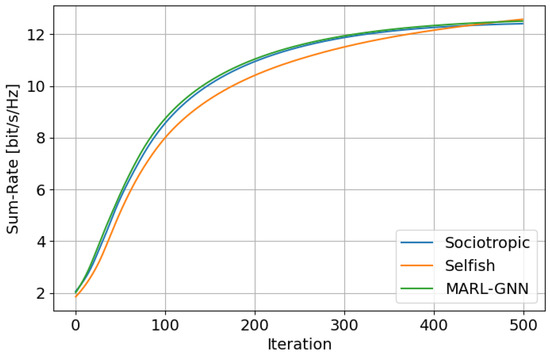
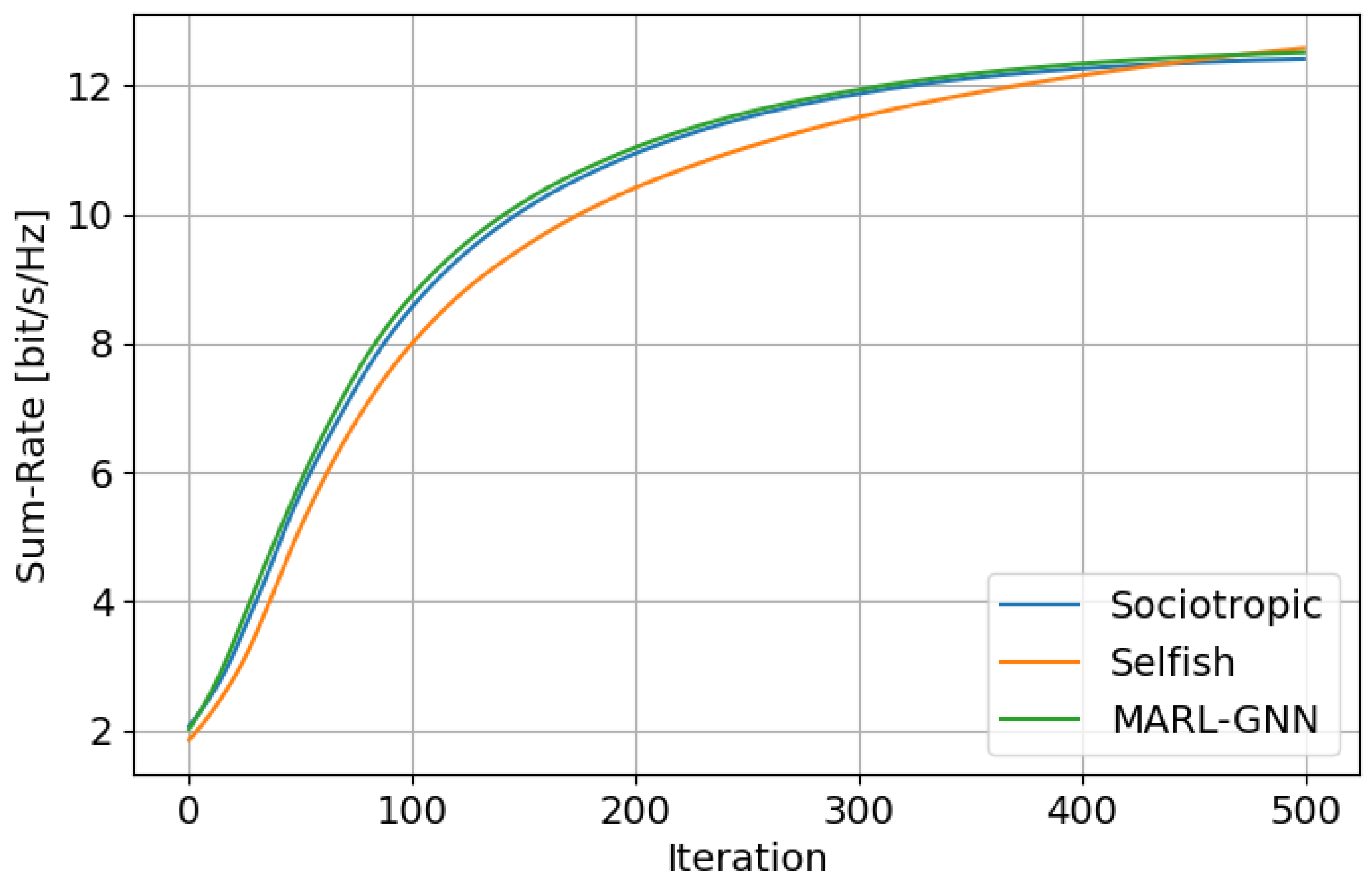
Figure 1 illustrates the evolution of the system sum-rate over the iterations for the considered distributed beamforming strategies with eight transmit antennas and four users. At the beginning of the optimization process, all methods start from similar randomly initialized beamforming vectors, yielding an initial sum-rate close to 2 bit/s/Hz. As the iterations progress, the sum-rate increases steadily as each antenna updates its beamforming vector while satisfying the per-antenna power constraint. The selfish strategy exhibits the slowest improvement since each antenna optimizes its transmission independently without considering the impact on the other antennas. Around iteration 100, the selfish approach achieves approximately 8 bit/s/Hz, and by iteration 200 the sum-rate increases to about 10.5 bit/s/Hz. The improvement continues gradually and approaches a steady value near 12.4 bit/s/Hz by iteration 500. In contrast, the sociotropic strategy demonstrates faster growth because each antenna accounts for the collective system performance during the update process. At iteration 100, the sociotropic method reaches roughly 8.7 bit/s/Hz and improves further to around 11 bit/s/Hz by iteration 200. The sum-rate continues to increase smoothly and stabilizes close to 12.5 bit/s/Hz toward the end of the iterations. The MARL-GNN approach follows a similar trajectory but with slightly improved convergence behavior due to the graph-based coordination among antennas. At iteration 100, the MARL-GNN method achieves approximately 8.9 bit/s/Hz, which is higher than both the selfish and sociotropic strategies. By iteration 200, the sum-rate reaches about 11.1 bit/s/Hz and maintains a small performance advantage during the subsequent iterations. As the algorithm approaches convergence, the difference between the coordinated strategies becomes smaller because all methods tend toward a similar equilibrium determined by the system model. At iteration 500, the MARL-GNN scheme attains roughly 12.55 bit/s/Hz, the sociotropic strategy converges near 12.5 bit/s/Hz, and the selfish method stabilizes around 12.4 bit/s/Hz.
Figure 1.
Sum-Rate Evolution.
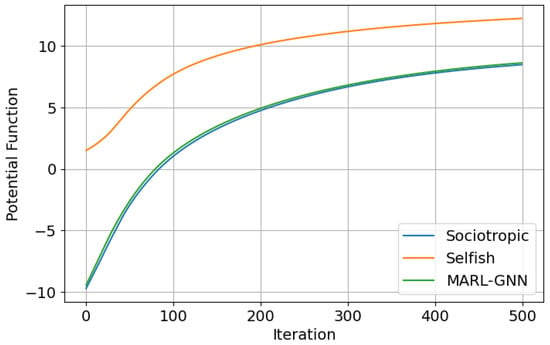
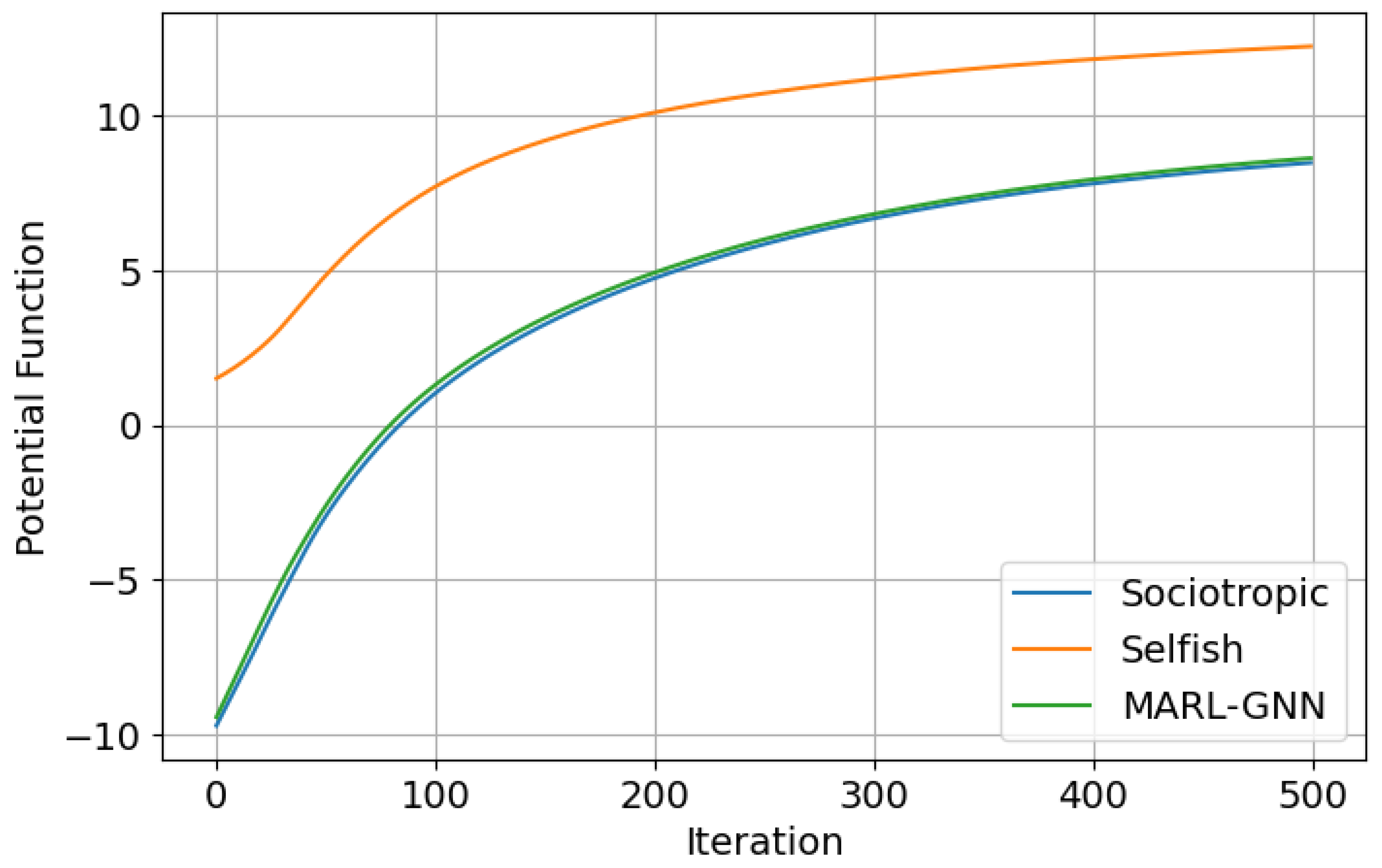
Figure 2 depicts the evolution of the potential function over the iterations for the distributed beamforming strategies under the considered system configuration with eight transmit antennas and four users. At the initial stage of the algorithm, the potential values differ significantly among the three strategies due to the different coordination behaviors of the antennas. The sociotropic and MARL-GNN strategies start with a potential value close to , reflecting the large misalignment among the randomly initialized beamforming vectors and the corresponding penalty introduced by the coordination term. In contrast, the selfish strategy begins at a much higher value of approximately , since it does not incorporate any coordination penalty and therefore does not account for the misalignment between antennas. As the iterations progress, the potential values increase steadily for all strategies as the beamforming vectors adapt to improve the system performance. For the sociotropic approach, the potential increases rapidly during the first 100 iterations, moving from about to approximately , and then continues to grow more gradually, reaching roughly 5 around iteration 200. The growth remains smooth throughout the remaining iterations and eventually stabilizes close to by iteration 500. The MARL-GNN strategy follows a very similar trajectory, starting near and increasing to around at iteration 100, then reaching approximately near iteration 200. Toward the end of the optimization process, the potential converges to about , which is slightly higher than the sociotropic strategy. The selfish approach, conversely, begins at about and increases more quickly during the early iterations, reaching nearly around iteration 100 and approximately 10 at iteration 200. The growth then slows down as the algorithm approaches convergence, stabilizing close to by iteration 500. These results indicate that although the selfish strategy achieves a larger potential value due to the absence of coordination penalties, the coordinated approaches progressively reduce the misalignment among antennas and achieve stable convergence. Furthermore, the MARL-GNN method exhibits a marginal improvement over the sociotropic strategy, suggesting that the graph-based coordination mechanism can slightly enhance the cooperative behavior of the antennas while maintaining similar convergence characteristics.
Figure 2.
Potential Function Evolution.
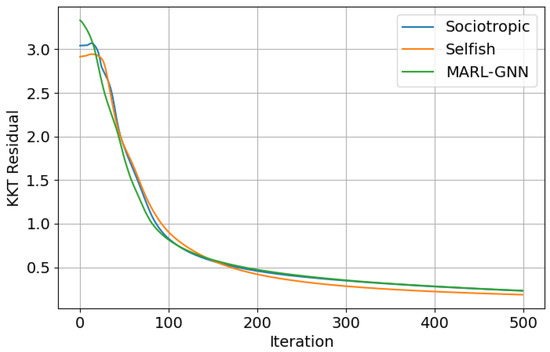
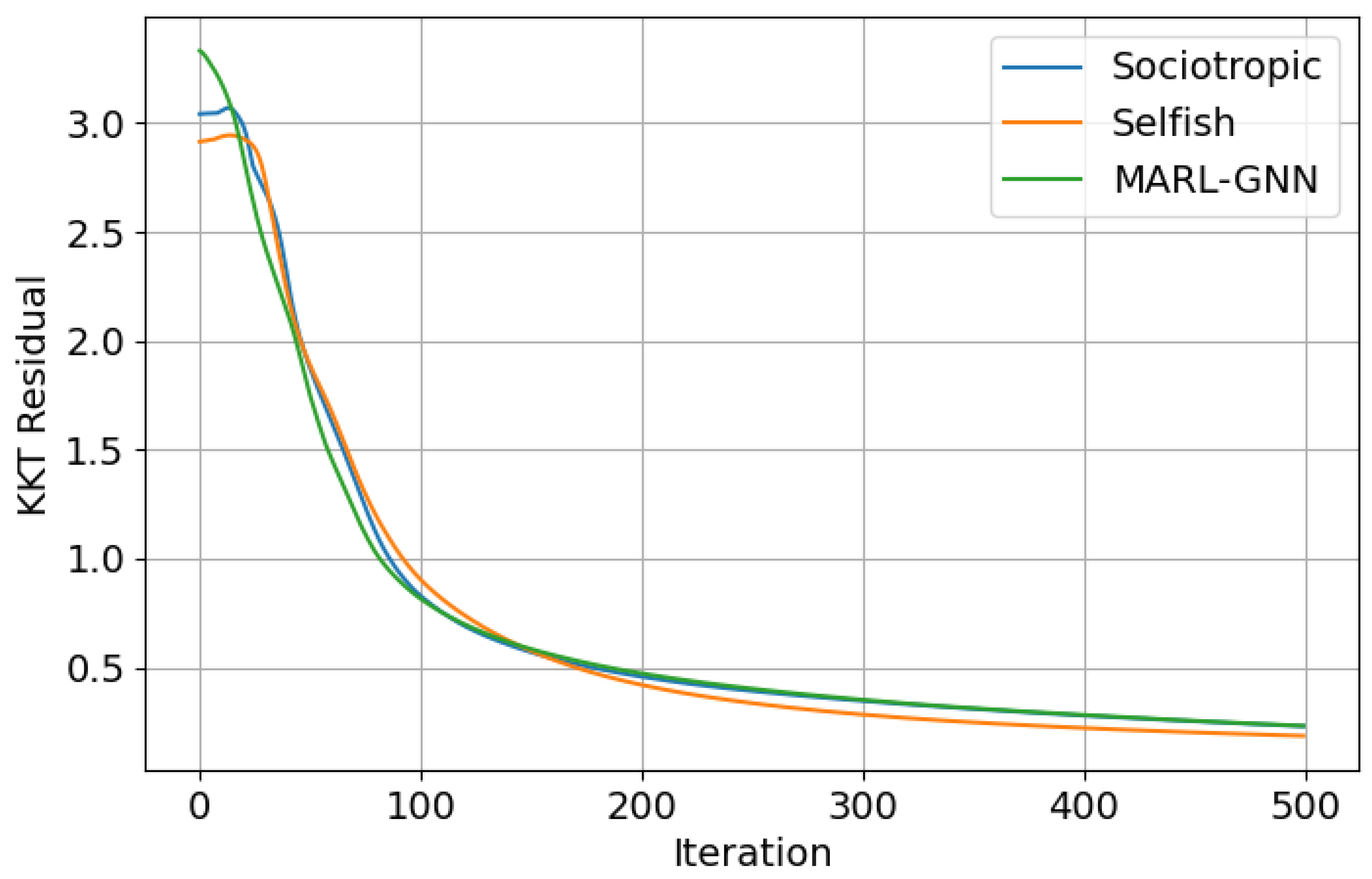
Figure 3 illustrates the evolution of the KKT residual across the iterations for the considered distributed beamforming system composed of eight transmit antennas serving four users. The KKT residual measures how close the iterative beamforming updates are to satisfying the optimality conditions of the formulated optimization problem under the adopted system model. At the beginning of the iterative process, the residual values are relatively high for all strategies due to the random initialization of the beamforming vectors and the resulting mismatch with the optimality conditions. Specifically, the MARL-GNN strategy starts with the largest residual of approximately 3.35, while the sociotropic approach begins near 3.05 and the selfish strategy slightly below at around 2.95. This difference reflects the stronger exploratory behavior of the learning-based method during the early stage of the optimization. During the first phase of the iterations, a rapid decrease in the residual is observed for all strategies, indicating that the beamforming vectors quickly move toward a feasible stationary region of the optimization landscape. By iteration 50, the residual values have already dropped to roughly 1.7 for the sociotropic approach, 1.75 for the selfish strategy, and about 1.6 for the MARL-GNN approach. The decline continues as the distributed updates adapt to the channel conditions defined in the system model. Around iteration 100, the residual values decrease further to approximately 0.95 for the sociotropic strategy, 1.0 for the selfish case, and about 0.85 for the MARL-GNN method, suggesting that the cooperative and learning-based strategies guide the beamforming updates slightly more efficiently toward the optimality region. Beyond this point, the reduction becomes more gradual, reflecting the typical convergence behavior of iterative optimization algorithms approaching a stationary point. At iteration 200, the residuals are already below 0.5, with approximate values of 0.46 for the sociotropic strategy, 0.42 for the selfish approach, and 0.48 for the MARL-GNN scheme. As the iterations continue, the residual values keep decreasing slowly while stabilizing, demonstrating that the algorithms are approaching the KKT conditions of the formulated beamforming optimization problem. Near iteration 300, the residuals reach approximately 0.34 for the sociotropic strategy, 0.29 for the selfish strategy, and 0.36 for the MARL-GNN approach. Toward the final stage of the process, the curves become almost flat, indicating convergence. At iteration 500, the residual values settle around 0.24 for the sociotropic strategy, approximately 0.21 for the selfish approach, and close to 0.23 for the MARL-GNN method. These results confirm that all three strategies converge to solutions that satisfy the KKT optimality conditions of the system model, with only minor differences in the convergence speed.
Figure 3.
KKT Residual (Optimality Gap).
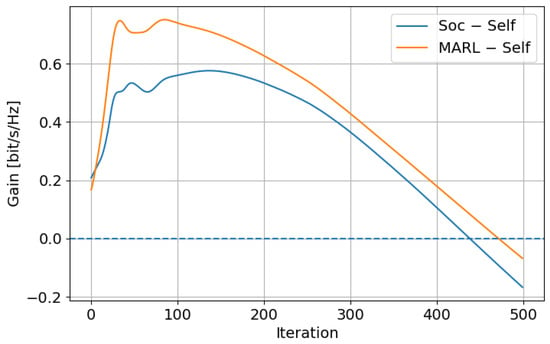
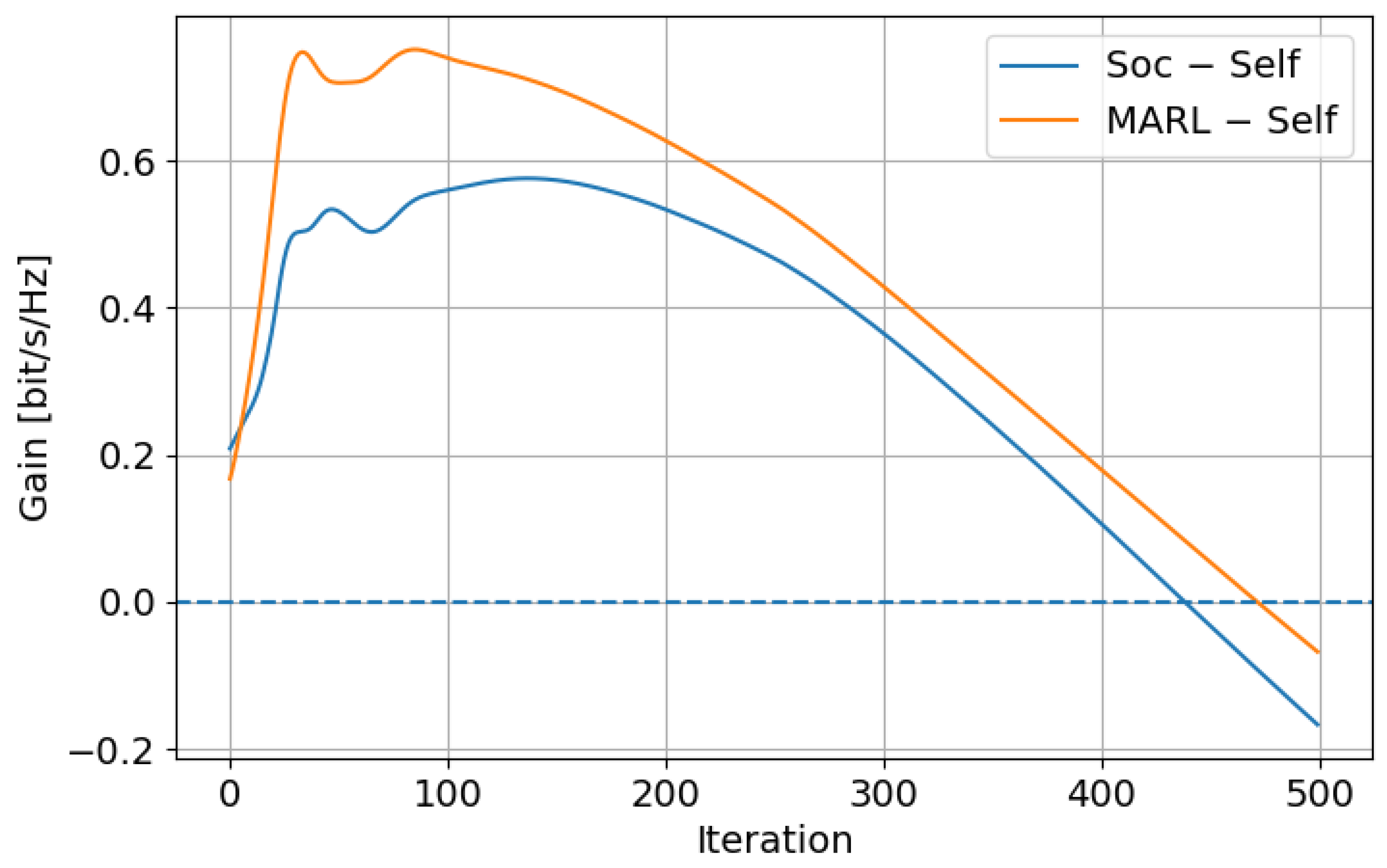
Figure 4 illustrates the gain relative to the selfish strategy over the iterations for both the sociotropic and the MARL-GNN approaches in the considered. At the initial stage, both coordinated strategies already provide a positive gain compared to the selfish case, with the sociotropic method starting at approximately bit/s/Hz and the MARL-GNN approach slightly lower at around bit/s/Hz. As the iterations progress, the gain increases rapidly due to the coordinated adjustment of the beamforming vectors. The MARL-GNN strategy exhibits a sharp rise during the first 50 iterations, reaching a peak gain of approximately bit/s/Hz around iteration 40, while the sociotropic method increases more gradually to about bit/s/Hz in the same region. Between iterations 50 and 100, both methods maintain high gains, with the MARL-GNN approach stabilizing near to bit/s/Hz and the sociotropic strategy fluctuating slightly around to bit/s/Hz. After this peak region, the gain for both strategies begins to decrease gradually as all methods move toward a similar equilibrium. Around iteration 200, the sociotropic gain reduces to approximately bit/s/Hz, while the MARL-GNN gain remains higher at about bit/s/Hz. This decreasing trend continues steadily, and by iteration 300 the gains drop to roughly bit/s/Hz for the sociotropic approach and about bit/s/Hz for the MARL-GNN method. In the later stages of the optimization, the gains continue to diminish as the difference between the coordinated and selfish strategies becomes smaller. Around iteration 400, the sociotropic gain approaches bit/s/Hz, while the MARL-GNN gain is still slightly higher at approximately bit/s/Hz. Finally, near iteration 500, both curves approach zero, with the sociotropic strategy slightly underperforming the selfish approach at about bit/s/Hz and the MARL-GNN method close to bit/s/Hz. These results indicate that coordinated strategies provide significant performance gains during the transient phase of the optimization, particularly in the early and mid iterations, with the MARL-GNN approach achieving the highest peak improvement. However, as the system converges to a common equilibrium dictated by the system model and constraints, the relative advantage diminishes and eventually vanishes.
Figure 4.
Performance Gain Relative to Selfish Baseline.
The sociotropic and MARL-GNN methods primarily provide gains in the transient regime, while the performance gap with the selfish baseline diminishes as the system converges. This behavior is consistent with the theoretical formulation of the proposed potential game, where all strategies evolve toward stationary points of the same underlying wireless system model under identical SINR and power constraints. As a result, the selfish strategy can partially recover performance at convergence due to the absence of coordination penalties, which reduces the gap in the final iterations. Importantly, the objective of the proposed sociotropic coordination is not to guarantee strict dominance at convergence, but to improve convergence behavior, stability, and transient system efficiency under interference coupling. Therefore, the slight performance convergence or crossover near steady state does not weaken the contribution, but rather highlights the inherent trade-off between coordination-induced regularization and asymptotic sum-rate optimality.
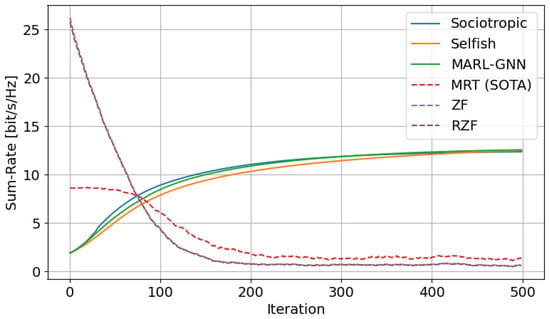
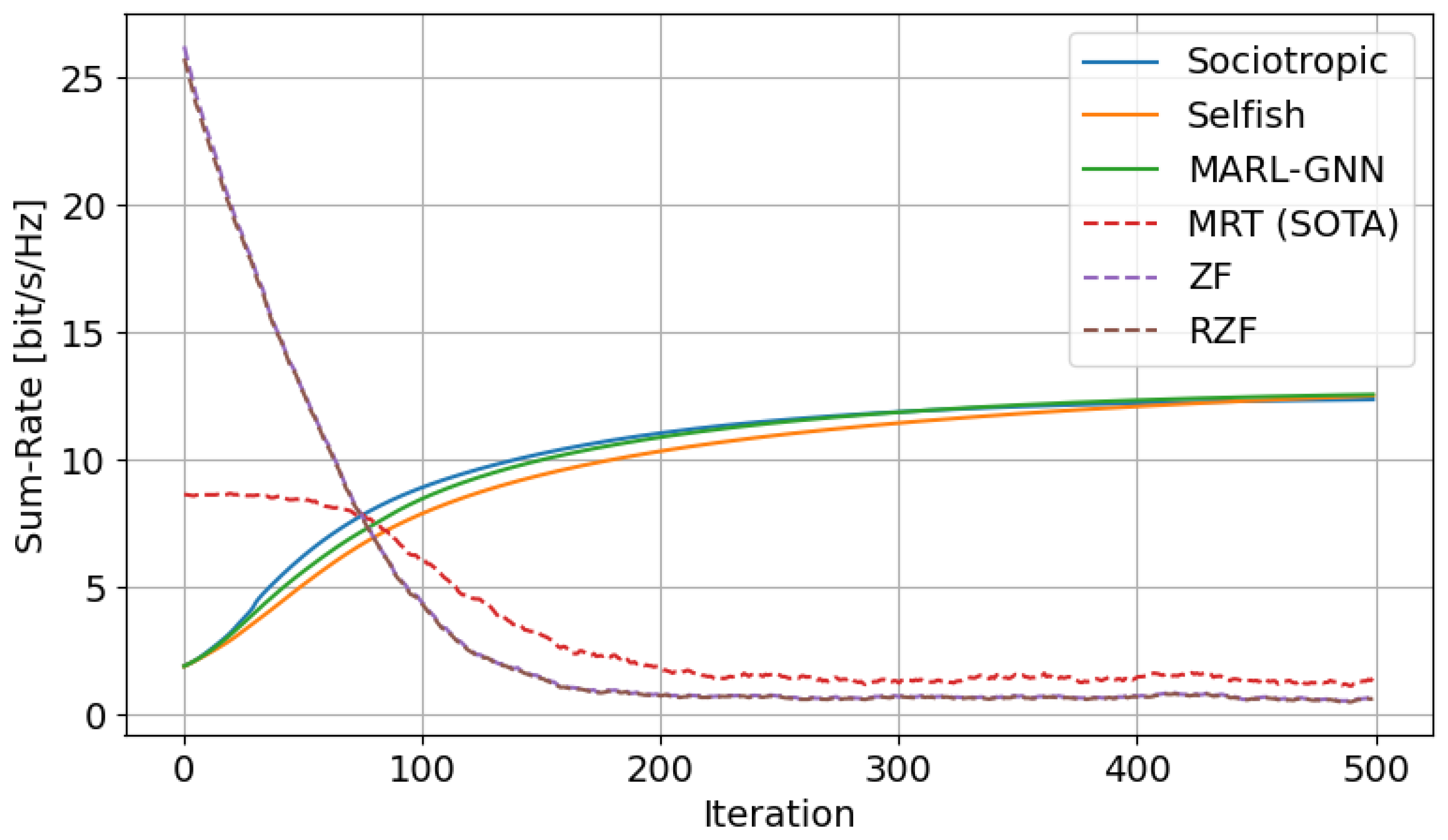
Figure 5 presents the evolution of the network sum-rate performance over 500 iterations for the proposed learning-based approaches (sociotropic, selfish, and MARL-GNN) and the benchmark schemes (MRT, ZF, and RZF). The learning-based methods start from approximately 2 bit/s/Hz and progressively improve their performance, converging to stable values between and bit/s/Hz. Specifically, MARL-GNN achieves the highest final sum-rate of approximately bit/s/Hz, followed by sociotropic ( bit/s/Hz) and selfish ( bit/s/Hz), corresponding to an improvement compared to their initial performance. In contrast, the conventional benchmark schemes exhibit a significant performance degradation over time. MRT decreases from approximately bit/s/Hz to bit/s/Hz, while ZF and RZF decline from approximately 26 bit/s/Hz to below 1 bit/s/Hz, corresponding to performance losses exceeding . These results demonstrate the superior adaptability and long-term performance of the proposed learning-based approaches, with MARL-GNN consistently providing the best overall throughput among all evaluated methods.
Figure 5.
Sum-Rate Comparison with SOTA.
10. Conclusions
This work proposed a sociotropy-inspired potential game for distributed MIMO antenna design, where each antenna is modeled as an adaptive agent whose utility integrates system throughput, interference regulation, and behavioral alignment with neighboring antennas. By embedding sociotropic interaction principles into the beamforming optimization process, the framework establishes a conceptual bridge between social cooperation models and electromagnetic system design. We derived the associated potential function, characterized the equilibrium structure, and developed update dynamics with convergence toward a stable operating point under standard regularity conditions. Numerical investigations demonstrated stable behavior, highlighting the benefits of cooperative regularization in distributed antenna optimization.
The numerical results confirm that incorporating sociotropic interactions into distributed beamforming leads to a more stable and structured optimization process compared to purely selfish updates. The observed sum-rate evolution demonstrates that coordination among antennas significantly improves transient performance, particularly in the early and intermediate iterations, where alignment-aware updates accelerate system-wide throughput growth. This behavior is consistent with the underlying mechanism of the sociotropic formulation, which couples antenna decisions through a collective objective, effectively reducing destructive interference and improving beamforming coherence. The potential function evolution further shows that this coordination acts as a stabilizing mechanism, guiding the system from highly misaligned initial states toward a well-structured equilibrium, while avoiding the irregular dynamics often associated with uncoordinated optimization. In addition, the monotonic reduction of the KKT residual across all strategies confirms that the proposed distributed updates converge reliably to stationary solutions satisfying the optimality conditions of the underlying problem. Although the MARL-GNN approach achieves a marginal advantage in certain regimes, the sociotropic formulation maintains competitive performance while offering a more interpretable and analytically grounded coordination structure. Importantly, the diminishing performance gap in later iterations indicates convergence toward a common equilibrium, where individual and collective objectives become aligned. These findings validate the effectiveness of sociotropic design as a scalable and energy-aware coordination mechanism for distributed MIMO systems, ensuring both convergence stability and improved transient efficiency without requiring centralized control.
Moreover, the results demonstrate the effectiveness of the proposed multi-agent learning framework in maximizing network throughput under dynamic operating conditions. While conventional beamforming schemes such as MRT, ZF, and RZF exhibit substantial performance degradation, the learning-based approaches consistently improve their performance and converge to stable high-throughput operating points. Among the evaluated methods, MARL-GNN achieves the highest final sum-rate, reaching approximately bit/s/Hz and outperforming the benchmark techniques by a significant margin. These findings highlight the ability of graph-based multi-agent reinforcement learning to capture complex interactions among network entities and to adapt efficiently to changing environments. Future work will focus on extending the framework to larger-scale deployments, investigating robustness under varying channel conditions, and incorporating additional constraints related to energy efficiency and fairness.
Future research directions include reinforcement learning–based adaptive strategies capable of learning sociotropic interaction parameters online, as well as experimental validation on reconfigurable intelligent surface (RIS) platforms and large-scale distributed MIMO testbeds. Extending the framework to dynamic channel environments and partially observable settings also constitutes a promising avenue toward practical 6G implementations.
Author Contributions
Conceptualization, E.D.S.; Methodology, E.D.S.; Software, E.D.S.; Validation, E.D.S., C.S., V.K. and C.T.A.; Formal analysis, E.D.S.; Investigation, E.D.S.; Resources, E.D.S.; Data curation, E.D.S.; Writing—original draft, E.D.S.; Writing—review & editing, E.D.S. and C.T.A.; Visualization, E.D.S. and V.K.; Supervision, C.S., V.K. and C.T.A.; Project administration, C.S.; Funding acquisition, E.D.S. All authors have read and agreed to the published version of the manuscript.
Funding
This research received no external funding.
Institutional Review Board Statement
Not applicable.
Informed Consent Statement
Not applicable.
Data Availability Statement
The data presented in this study are available on request from the corresponding author.
Acknowledgments
During the preparation of this manuscript, the authors used the latest version of ChatGPT-5.5 for the purposes of text improvement. The authors have reviewed and edited the output and take full responsibility for the content of this publication.
Conflicts of Interest
The authors declare no conflicts of interest.
References
- Larsson, E.G.; Edfors, O.; Tufvesson, F.; Marzetta, T.L. Massive MIMO for next generation wireless systems. IEEE Commun. Mag. 2014, 52, 186–195. [Google Scholar] [CrossRef] [Scilit]
- Khwandah, S.A.; Cosmas, J.P.; Lazaridis, P.I.; Zaharis, Z.D.; Chochliouros, I.P. Massive MIMO systems for 5G communications. Wirel. Pers. Commun. 2021, 120, 2101–2115. [Google Scholar] [CrossRef] [Scilit]
- Ni, P.; Liu, R.; Li, M.; Liu, Q. User association and hybrid beamforming designs for cooperative mmWave MIMO systems. IEEE Trans. Signal Inf. Process. Over Netw. 2022, 8, 641–654. [Google Scholar] [CrossRef] [Scilit]
- Wang, Z.; Zhang, J.; Du, H.; Niyato, D.; Cui, S.; Ai, B.; Debbah, M.; Letaief, K.B.; Poor, H.V. A tutorial on extremely large-scale MIMO for 6G: Fundamentals, signal processing, and applications. IEEE Commun. Surv. Tutor. 2024, 26, 1560–1605. [Google Scholar] [CrossRef] [Scilit]
- Salehi, M.; Oraizi, H. Wideband high gain metasurface-based 4T4R MIMO antenna with highly isolated ports for sub-6 GHz 5G applications. Sci. Rep. 2024, 14, 14448. [Google Scholar] [PubMed]
- Khan, D.; Ahmad, A.; Choi, D.Y. Dual-band 5G MIMO antenna with enhanced coupling reduction using metamaterials. Sci. Rep. 2024, 14, 96. [Google Scholar] [CrossRef] [Scilit] [PubMed]
- Chataut, R.; Akl, R. Massive MIMO systems for 5G and beyond networks—overview, recent trends, challenges, and future research direction. Sensors 2020, 20, 2753. [Google Scholar] [CrossRef] [Scilit] [PubMed]
- Lu, H.; Zeng, Y.; You, C.; Han, Y.; Zhang, J.; Wang, Z.; Dong, Z.; Jin, S.; Wang, C.X.; Jiang, T.; et al. A tutorial on near-field XL-MIMO communications toward 6G. IEEE Commun. Surv. Tutor. 2024, 26, 2213–2257. [Google Scholar]
- Ojaroudi Parchin, N.; Jahanbakhsh Basherlou, H.; Al-Yasir, Y.I.; Ullah, A.; Abd-Alhameed, R.A.; Noras, J.M. Multi-band MIMO antenna design with user-impact investigation for 4G and 5G mobile terminals. Sensors 2019, 19, 456. [Google Scholar] [PubMed]
- Jamshed, M.A.; Ur-Rehman, M.; Frnda, J.; Althuwayb, A.A.; Nauman, A.; Cengiz, K. Dual band and dual diversity four-element MIMO dipole for 5G handsets. Sensors 2021, 21, 767. [Google Scholar] [CrossRef] [Scilit] [PubMed]
- Sharma, U.; Srivastava, G.; Khandelwal, M.K.; Roges, R. Design Challenges and Solutions of Multiband MIMO Antenna for 5G/6G Wireless Applications: A Comprehensive Review. Prog. Electromagn. Res. B 2024, 104, 69–89. [Google Scholar] [CrossRef] [Scilit]
- Alberti, A.M.; Pivoto, D.G.; Rezende, T.T.; Leal, A.V.; Both, C.B.; Facina, M.S.; Moreira, R.; de Oliveira Silva, F. Disruptive 6G architecture: Software-centric, AI-driven, and digital market-based mobile networks. Comput. Netw. 2024, 252, 110682. [Google Scholar]
- Rojhani, N.; Shaker, G. Comprehensive review: Effectiveness of mimo and beamforming technologies in detecting low rcs uavs. Remote Sens. 2024, 16, 1016. [Google Scholar] [CrossRef] [Scilit]
- Beck, A.T. Cognitive therapy of depression: New perspectives. In Treatment of Depression: Old Controversies and New Approaches; Raven Press: New York, NY, USA, 1983. [Google Scholar]
- Monderer, D.; Shapley, L.S. Potential games. Games Econ. Behav. 1996, 14, 124–143. [Google Scholar] [CrossRef] [Scilit]
- Charilas, D.E.; Panagopoulos, A.D. A survey on game theory applications in wireless networks. Comput. Netw. 2010, 54, 3421–3430. [Google Scholar] [CrossRef] [Scilit]
- Scutari, G.; Palomar, D.P.; Barbarossa, S. Competitive design of multiuser MIMO systems based on game theory: A unified view. IEEE J. Sel. Areas Commun. 2008, 26, 1089–1103. [Google Scholar] [CrossRef] [Scilit]
- Wang, J.; Scutari, G.; Palomar, D.P. Robust MIMO cognitive radio via game theory. IEEE Trans. Signal Process. 2010, 59, 1183–1201. [Google Scholar] [CrossRef] [Scilit]
- Deligiannis, A.; Lambotharan, S.; Chambers, J.A. Game theoretic analysis for MIMO radars with multiple targets. IEEE Trans. Aerosp. Electron. Syst. 2017, 52, 2760–2774. [Google Scholar]
- Wei, C.; Xu, K.; Xia, X.; Su, Q.; Shen, M.; Xie, W.; Li, C. User-centric access point selection in cell-free massive MIMO systems: A game-theoretic approach. IEEE Commun. Lett. 2022, 26, 2225–2229. [Google Scholar]
- Qi, C.; Zhang, H.; Xie, J.; Liu, W.; Wang, R. Cooperative game theoretic power allocation method to distributed MIMO radar sensor network for multitarget detection in low-altitude. IEEE Sens. J. 2024, 24, 8731–8745. [Google Scholar] [CrossRef] [Scilit]
- Guan, M.; Wu, Z.; Yang, W.; Guo, B.; Cao, X.; Chen, H. Research on anti-jamming algorithm of massive mimo communication system based on multi-user game theory. Mob. Netw. Appl. 2022, 27, 1553–1558. [Google Scholar] [CrossRef] [Scilit]
- Wei, C.; Tian, H.; Xu, K.; Xia, X.; Xie, W.; Li, C. A game-theoretic approach for user-centric AP selection in cell-free massive MIMO under dynamic user demand environment. IEEE Wirel. Commun. Lett. 2025, 14, 876–880. [Google Scholar]
- Wu, J.; Shi, C.; Zhou, J.; Huang, J. Distributed Design of Joint Transmit and Receive Beamforming for MIMO Radar Networks Using Game Theory. IEEE Syst. J. 2025, 19, 459–470. [Google Scholar] [CrossRef] [Scilit]
Disclaimer/Publisher’s Note: The statements, opinions and data contained in all publications are solely those of the individual author(s) and contributor(s) and not of MDPI and/or the editor(s). MDPI and/or the editor(s) disclaim responsibility for any injury to people or property resulting from any ideas, methods, instructions or products referred to in the content. |
© 2026 by the authors. Licensee MDPI, Basel, Switzerland. This article is an open access article distributed under the terms and conditions of the Creative Commons Attribution (CC BY) license.