1. Introduction
Improving the service life of machine components and engineering equipment operating under severe abrasive, erosive, and corrosive wear conditions remains one of the key challenges in modern materials science. Thermal spray coatings are widely used for surface protection because they significantly enhance the wear and corrosion resistance of structural materials without altering the properties of the substrate. Among various protective coating systems, Cr
3C
2–NiCr composite coatings have attracted considerable attention due to their excellent performance resulting from the combination of the high hardness of the carbide phase and the ductility of the metallic binder [
1,
2,
3,
4,
5,
6].
Chromium carbide (Cr
3C
2) acts as an effective reinforcing phase, providing high resistance to abrasive and erosive wear, whereas the NiCr alloy serves as a ductile metallic matrix that promotes stress redistribution and improves the fracture toughness of the coating. Owing to this combination of properties, Cr
3C
2–NiCr coatings are widely used for the protection of components in power generation, metallurgy, aerospace engineering, and tribological systems operating under severe service conditions [
7,
8,
9]. According to the studies of Ozkan [
10], Cr
3C
2–NiCr coatings exhibit excellent wear resistance, oxidation resistance, and high-temperature corrosion resistance due to the synergistic effect of the hard carbide phase and the corrosion-resistant NiCr matrix. Ksiazek et al. [
11] demonstrated that the tribological and mechanical properties of Cr
3C
2–NiCr coatings are strongly influenced by coating porosity, coating density, and the uniform distribution of the carbide phase within the metallic matrix. Numerous studies have shown that thermal spraying parameters play a decisive role in determining the microstructure and performance characteristics of Cr
3C
2–NiCr coatings. Seitov B. et al. [
12] reported that increasing coating density and reducing structural defects significantly improve wear resistance and mechanical performance. Zhang et al. [
13] found that the morphology and distribution of structural constituents strongly affect the wear mechanisms and failure behavior of coatings under sliding conditions.
Detonation spraying is considered one of the most promising techniques for depositing Cr
3C
2–NiCr coatings because it provides extremely high particle velocities and enables the formation of dense coatings with low porosity. The high kinetic energy of the particles promotes intensive plastic deformation upon impact with the substrate, resulting in strong adhesion and a compact coating structure [
14,
15,
16,
17,
18]. Rakhadilov et al. [
19] demonstrated that detonation-sprayed Cr
3C
2–NiCr coatings possess high wear resistance and stable tribological characteristics. Similar findings were reported by Kakimzhanov and Rakhadilov [
20], who established a significant influence of processing parameters on the microstructure and properties of chromium carbide-based coatings. Despite the considerable number of studies devoted to Cr
3C
2–NiCr coatings, the influence of detonation spraying parameters on the formation of microstructure, phase composition, and tribological properties remains insufficiently understood. Of particular interest is the investigation of the barrel filling ratio, since this parameter determines the amount of powder introduced into the spraying process, the heating and acceleration conditions of particles, and the efficiency of thermal and kinetic energy transfer. Variations in the barrel filling ratio may significantly affect carbide phase retention, coating density, distribution of structural constituents, and wear resistance. However, information regarding the influence of the barrel filling ratio on the structure formation and tribological performance of detonation-sprayed Cr
3C
2–NiCr coatings remains limited in the current literature.
Therefore, the aim of the present study is to investigate the effect of barrel filling ratio during detonation spraying on the microstructure, phase composition, and tribological properties of Cr3C2–NiCr coatings.
2. Materials and Methods
Commercial Cr
3C
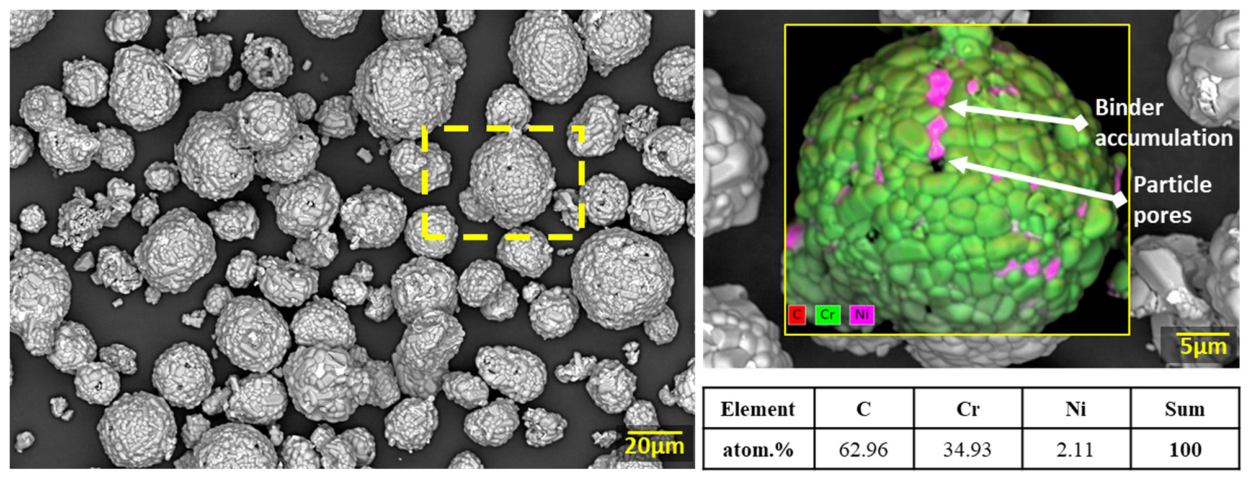
2–NiCr powder was used as the feedstock material for coating deposition. The powder consisted of agglomerated spherical particles with a developed surface morphology and heterogeneous relief, which are characteristic of powders produced by agglomeration and sintering processes. The coatings were deposited onto 12Kh1MF steel substrates with dimensions of 5 × 5 × 5 mm. The powder morphology was examined using scanning electron microscopy (SEM) (
Figure 1). The analysis revealed that the particles were predominantly spherical and possessed a rough surface formed by fine chromium carbide particles bonded by a NiCr metallic matrix. Local pores and regions enriched with the metallic binder were observed within individual particles, which was further confirmed by energy-dispersive X-ray spectroscopy (EDS) analysis.
Coatings were deposited using a CCDS2000 detonation spraying system (LIH SB RAS, Novosibirsk, Russia) installed at Sarsen Amanzholov East Kazakhstan University. Acetylene and oxygen were used as the fuel gas mixture. The detonation spraying process is based on the periodic ignition of a fuel–oxygen mixture inside the barrel, generating high-temperature detonation products that accelerate powder particles to supersonic velocities. As a result, the particles acquire high kinetic energy and undergo intensive plastic deformation upon impact with the substrate surface, forming dense coatings with low porosity.
Prior to coating deposition, the substrate surfaces were mechanically prepared to improve coating adhesion. Surface preparation included cleaning to remove contaminants and abrasive treatment to achieve the required surface roughness. After preparation, the samples were coated under constant spraying conditions. The spraying parameters were as follows: oxygen-to-acetylene ratio (O/C) of 1.856, spraying distance of 150 mm, program cycle duration of 200, number of shots of 105, and barrel diameter of 20 mm. To evaluate the influence of detonation spraying parameters on the structure and properties of the coatings, two barrel filling ratios, 43% and 53%, were employed. The selected barrel filling ratios were based on previous experimental studies conducted in our research group and were chosen to provide stable coating deposition and enable comparison of two representative processing conditions [
15,
17,
20]. Variation in the barrel filling ratio changed the volume of the acetylene–oxygen explosive gas mixture introduced into the barrel before each detonation cycle, thereby influencing the thermal and kinetic conditions of the spraying process.
The morphology of the feedstock powder and the microstructure of the deposited coatings were examined using scanning electron microscopy (SEM, SEM3200). Cross-sectional observations were performed in the backscattered electron (BSE) mode, which enabled phase visualization based on atomic number contrast. The elemental distribution within the coatings was analyzed by energy-dispersive X-ray spectroscopy (EDS) and elemental mapping.
The phase composition of the feedstock powder and detonation-sprayed coatings was investigated by X-ray diffraction (XRD) using an X’Pert Pro diffractometer (Philips Corporation, Amsterdam, The Netherlands) with monochromatic CuKα radiation (λ = 1.5406 Å). Phase identification was carried out by comparing the experimental diffraction patterns with the PDF-2 database. Particular attention was paid to the retention of the Cr3C2 carbide phase and the possible formation of secondary phases caused by the high-temperature exposure associated with the detonation spraying process.
Tribological tests were performed under dry sliding conditions at room temperature using a ball-on-disc configuration on a TRB
3 tribometer (Anton-Paar, Buchs, Switzerland). A 100Cr6 steel ball with a diameter of 6 mm was used as the counterbody. The tests were conducted at normal loads of 10 and 15 N and sliding speeds of 5 and 10 cm/s. During testing, the coefficient of friction was continuously recorded as a function of sliding distance. After completion of the tribological tests, the wear tracks formed on the coating surface were analyzed using a profilometer (Taylor Hobson surface profilometer AMETEK Taylor Hobson, Leicester, UK) to determine the wear volume [
21]. Profilometric measurements were performed by scanning the cross-sectional profile of the wear track, and the wear volume was calculated from the measured profile geometry along the entire sliding path. The wear rate was calculated according to the following equation:
where W is the wear rate (mm
3/(m·N), V is the wear volume (mm
3), L is the sliding distance (m), and F is the applied normal load (N). To ensure reproducibility of the experimental results, each tribological condition was tested at least three times.
3. Results
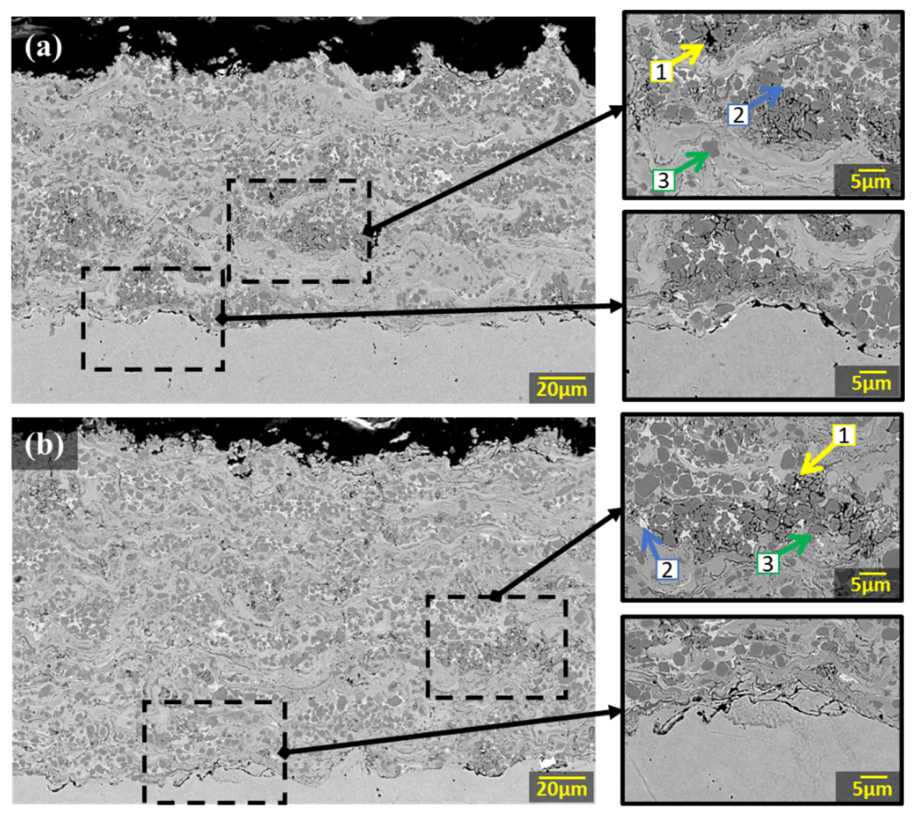
Figure 2 shows BSE micrographs of the cross-sections of detonation-sprayed Cr
3C
2–NiCr coatings. Microstructural analysis revealed that both coatings exhibit a typical lamellar structure with a relatively small amount of visible porosity. Based on visual examination of the BSE micrographs, the visible porosity was estimated to be approximately 1–2 area%, with the coating deposited at a barrel filling ratio of 53% exhibiting slightly fewer visible pores than the coating deposited at 43%. The formation of such a morphology is attributed to the high particle velocities and intensive impact-induced compaction occurring during the detonation spraying process. In both coatings, the Cr
3C
2 carbide phase is dispersed within the NiCr metallic binder, forming a composite microstructure. The coatings exhibit a typical lamellar morphology characteristic of thermal spray coatings, resulting from the successive deposition and deformation of molten or semi-molten particles.
At higher magnification, regions with different contrast levels can be distinguished. The dark regions (1) correspond to pores formed due to incomplete filling of interlamellar spaces and gas evolution during particle deposition. The light-gray regions (2) represent the NiCr metallic binder, whereas the gray regions (3) correspond to the Cr3C2 carbide phase. The pores are distributed non-uniformly throughout the coating and are predominantly localized along interlamellar boundaries. However, their overall content remains low, indicating the high density of the coatings and the efficiency of the detonation spraying process.
During detonation spraying, powder particles were exposed to high-temperature detonation products and accelerated to high velocities before impacting the substrate surface. This resulted in intensive plastic deformation of the metallic binder and the formation of strong interlamellar bonding within the coating. An interfacial transition zone was observed at the boundary between the carbide phase and the metallic matrix. The formation of this zone is associated with partial dissolution of carbide particles and diffusion interactions between the coating constituents under high-temperature spraying conditions. The presence of this transition zone indicates strong interfacial bonding and effective interaction between the components of the composite coating.
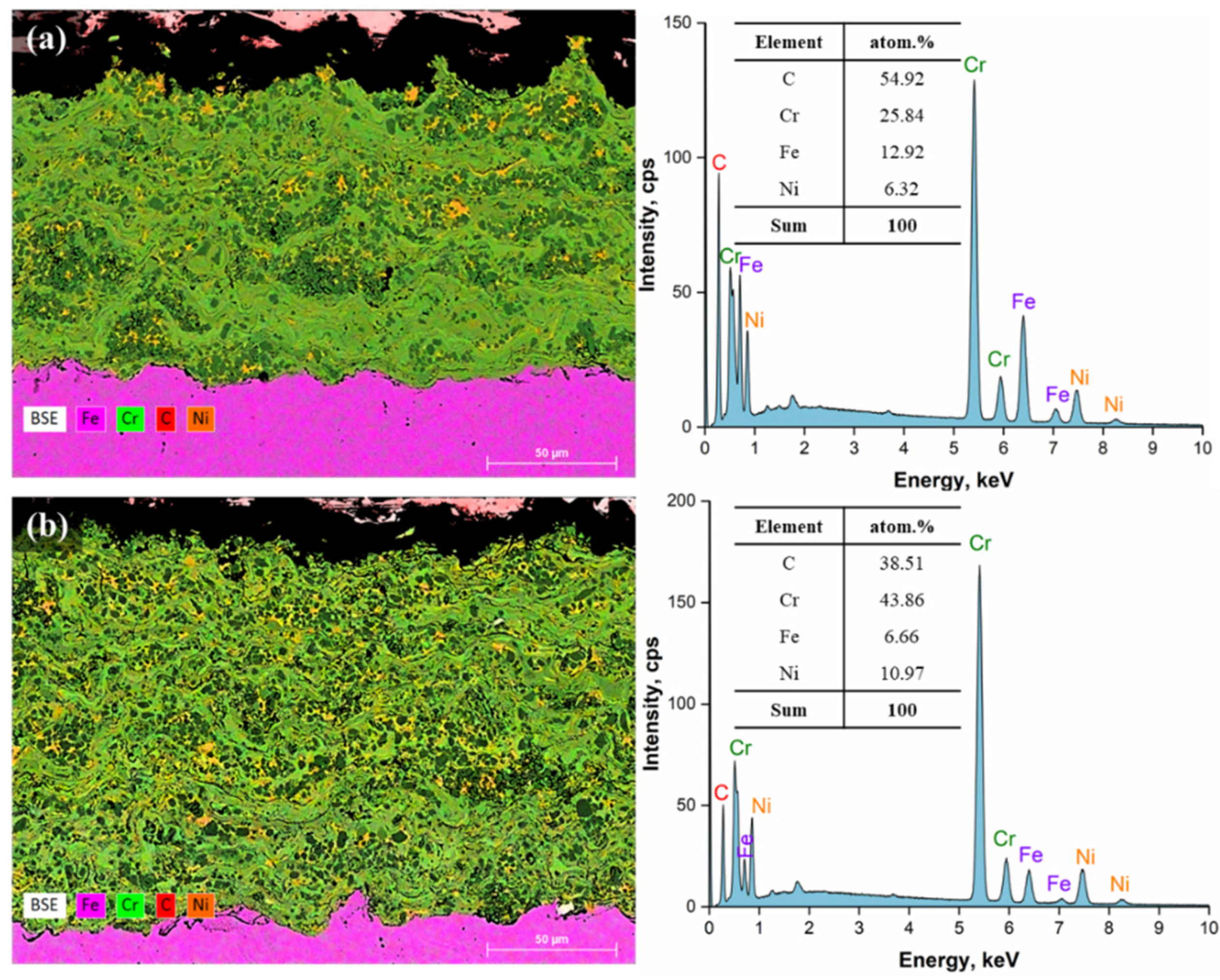
To analyze the elemental distribution within the coatings, EDS mapping of the cross-sections of the detonation-sprayed Cr
3C
2–NiCr coatings was performed (
Figure 3). The elemental maps confirm the formation of a composite coating structure consisting of a Cr
3C
2 carbide phase uniformly distributed within the NiCr metallic matrix. The coating deposited at a barrel filling ratio of 53% exhibits a more homogeneous elemental distribution throughout the coating thickness and fewer local heterogeneities compared to the coating produced at a filling ratio of 43%. In addition, a more uniform distribution of the metallic binder is observed in the coating produced at 53% barrel filling, contributing to reduced porosity and increased coating density.
Variations in the ratio between the metallic binder and the carbide phase have a significant influence on the coating microstructure. An increase in the metallic binder content enhances coating ductility, improves particle deformability upon impact, and reduces the amount of porosity. At the same time, the Cr3C2 carbide phase acts as a reinforcing component, providing increased hardness and wear resistance. However, excessive carbide content may increase local brittleness and promote microcrack formation due to differences in the thermal expansion coefficients of the constituent phases.
The obtained results demonstrate that an optimal balance between the carbide phase and the metallic binder is essential for the formation of a dense microstructure and the improvement of the coating’s performance characteristics. The dense composite structure of the Cr3C2–NiCr coatings with low porosity is expected to provide high wear resistance and thermal stability. The carbide phase enhances resistance to abrasive wear, whereas the metallic matrix contributes to stress redistribution and reduces coating brittleness. Low porosity is also an important factor in improving corrosion resistance, as it limits the penetration of aggressive media toward the substrate surface.
Furthermore, the presence of a transition interfacial zone between the carbide particles and the metallic binder promotes stronger interfacial bonding and reduces the likelihood of carbide particle pull-out during service under severe mechanical loading conditions. As a result, the coatings exhibit improved structural integrity and enhanced resistance to wear-related degradation.
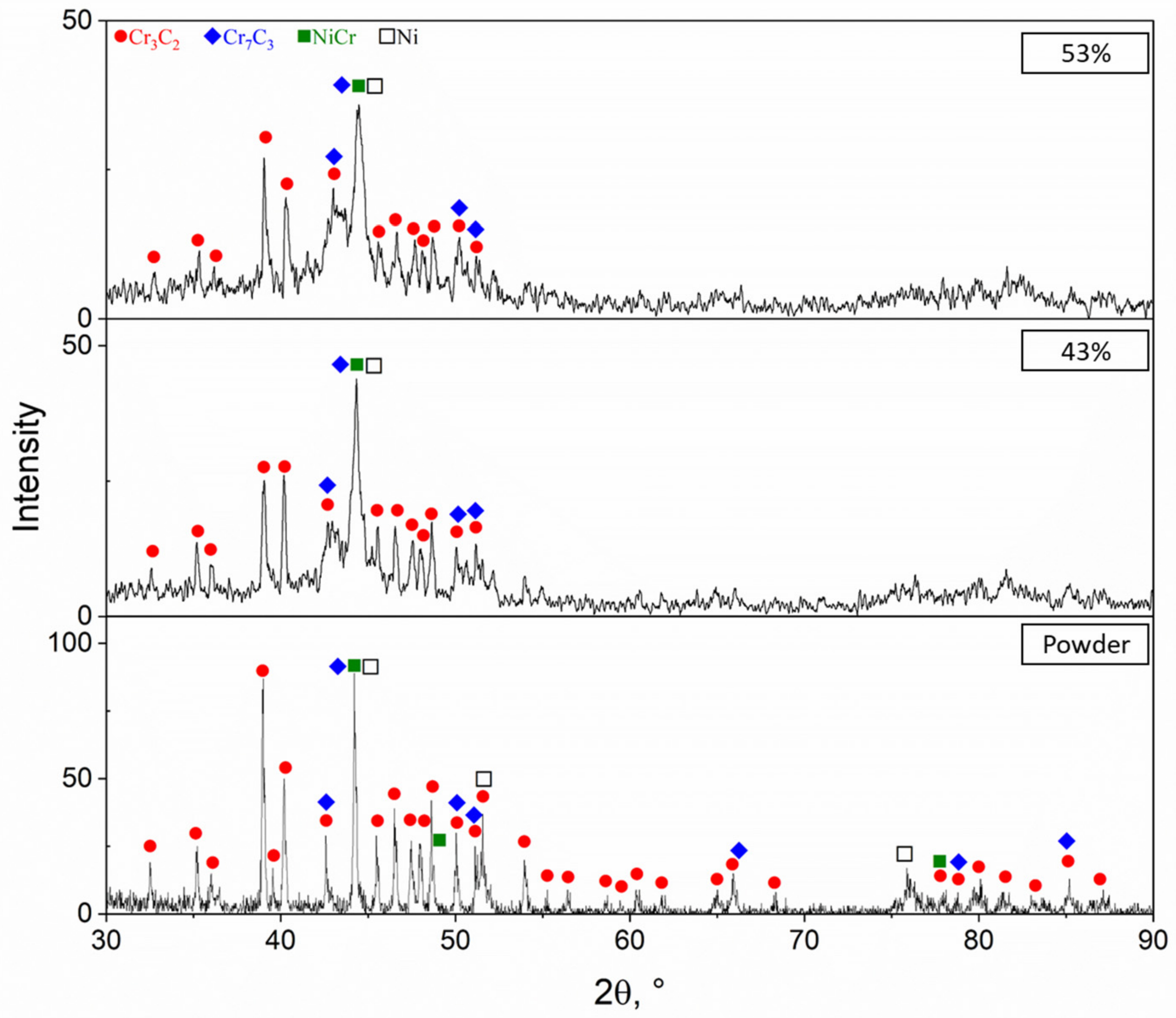
Figure 4 presents the X-ray diffraction patterns of the feedstock powder and detonation-sprayed Cr
3C
2–NiCr coatings deposited at barrel filling ratios of 43% and 53%. Analysis of the diffraction patterns revealed that both the feedstock powder and the deposited coatings are primarily composed of the Cr
3C
2 carbide phase and the NiCr metallic binder, with a minor amount of the Ni phase. The main structural constituents of the coatings are Cr
3C
2 and NiCr, which together form the composite coating structure. The diffraction pattern of the feedstock powder is characterized by intense and sharp Cr
3C
2 peaks located at approximately 2θ = 39–40°, as well as a pronounced NiCr peak near 2θ = 44–45°, corresponding to the (111) crystallographic plane of the NiCr solid solution. The presence of narrow and highly intense diffraction peaks indicates a high degree of crystallinity of the feedstock material. Following detonation spraying, noticeable changes in the diffraction patterns are observed. The coatings exhibit a reduction in the intensity of the Cr
3C
2 peaks accompanied by significant peak broadening. Such broadening may be attributed to crystallite refinement, the development of residual stresses, and increased lattice microstrain caused by the high-velocity impact of particles on the substrate during the spraying process. In addition, the diffraction patterns of the coatings reveal the presence of the Cr
7C
3 phase, whose intensity increases after spraying. The formation of the Cr
7C
3 phase is associated with the partial decarburization of Cr
3C
2 carbide under exposure to high-temperature detonation products. Carbon depletion during thermal exposure promotes phase transformation and the formation of secondary chromium carbide phases. The appearance of the Cr
7C
3 phase indicates the occurrence of phase transformations during coating formation and is consistent with previously reported results for thermally sprayed Cr
3C
2–NiCr coatings. A comparison of the coatings deposited at different barrel filling ratios shows that the coating produced at a filling ratio of 53% exhibits more pronounced peaks associated with the metallic binder and a more uniform phase distribution. This behavior may be associated with differences in the spraying conditions between the two investigated barrel filling ratios. The XRD results indicate that Cr
3C
2 remained the dominant carbide phase after detonation spraying, whereas only a minor amount of Cr
7C
3 formed due to partial decarburization. Similar phase evolution has been reported for HVOF-sprayed Cr
3C
2–NiCr coatings, where carbide decomposition is generally limited and secondary chromium carbides may form under elevated thermal exposure.
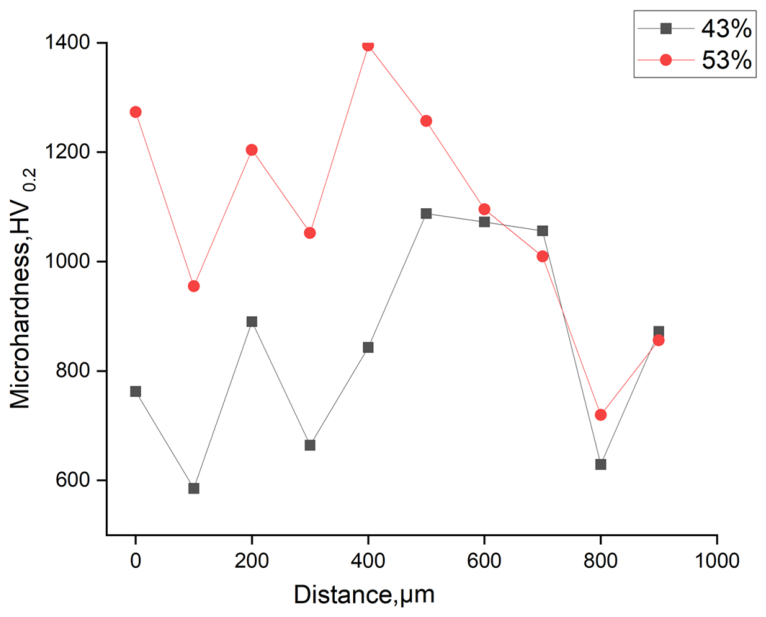
Figure 5 shows the cross-sectional Vickers microhardness profiles of the detonation-sprayed Cr
3C
2–NiCr coatings deposited at barrel filling ratios of 43% and 53%. The microhardness varies across the coating thickness owing to the heterogeneous distribution of the carbide phase and metallic binder, which is characteristic of thermally sprayed composite coatings. Overall, the coating deposited at a barrel filling ratio of 53% exhibits higher microhardness values than the coating deposited at 43%. This behavior is attributed to the more homogeneous distribution of the reinforcing Cr
3C
2 phase and the compact lamellar microstructure observed in the SEM analysis.
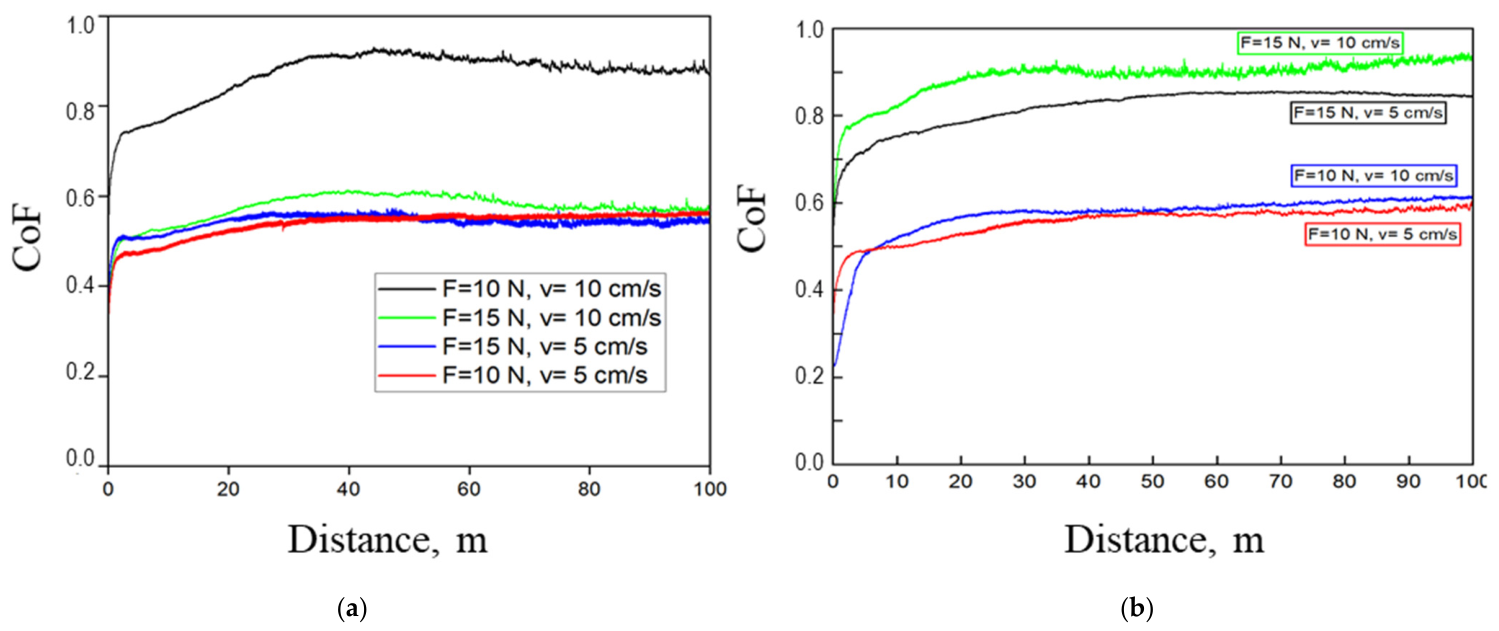
Figure 6 shows the friction coefficient as a function of sliding distance for detonation-sprayed Cr
3C
2–NiCr coatings tested under different normal loads (10 and 15 N) and sliding speeds (5 and 10 cm/s). Analysis of the tribological curves reveals that both coatings exhibit a sharp increase in the coefficient of friction at the initial stage of testing, corresponding to the running-in period of the contacting surfaces. During this stage, surface asperities are removed, the real contact area increases, and a stable contact layer is gradually formed. After the running-in stage, the coefficient of friction reaches a quasi-steady-state regime.
For the coating deposited at a barrel filling ratio of 43%, relatively stable friction behavior is observed under a load of 10 N, where the coefficient of friction ranges from 0.53 to 0.57 regardless of the sliding speed. Under these conditions, the wear rate varies between 1.41 × 10⁻⁴ and 2.07 × 10⁻⁴ mm3/(m·N). Increasing the sliding speed from 5 to 10 cm/s results in a reduction in the wear rate, which may be attributed to the formation of a more stable tribolayer on the coating surface. When the load is increased to 15 N, the coefficient of friction rises to 0.54–0.87, while the wear rate decreases to 1.27 × 10⁻⁴–1.37 × 10⁻⁴ mm3/(m·N). These results indicate that an increase in the coefficient of friction is not necessarily accompanied by a proportional increase in wear rate, which may be associated with the formation of protective oxide films and densification of the surface layer during sliding. A similar tribological behavior is observed for the coating deposited at a barrel filling ratio of 53%. Under a load of 10 N, the coefficient of friction ranges from 0.56 to 0.57, whereas the wear rate varies between 1.87 × 10⁻⁴ and 2.95 × 10⁻⁴ mm3/(m·N). Increasing the load to 15 N results in a rise in the coefficient of friction to 0.82–0.89, while the wear rate decreases to 1.23 × 10⁻⁴–1.34 × 10⁻⁴ mm3/(m·N). Comparison of the results shows that the coating deposited at a barrel filling ratio of 53% exhibits higher friction coefficients but lower wear rates under elevated loads. This behavior is related to the microstructural characteristics of the coating. As demonstrated by the microstructural analysis, increasing the barrel filling ratio promotes the formation of a denser microstructure and a more uniform distribution of the carbide phase within the metallic matrix. The denser structure increases the real contact area during sliding and may lead to a higher coefficient of friction. However, it simultaneously improves the resistance of the surface layer to mechanical degradation, thereby reducing the wear rate.
From the tribological point of view, the minimum wear rate obtained in the present study reached 1.23 × 10⁻⁴ mm3/(m·N), indicating high resistance to wear under dry sliding conditions. This value is comparable to the wear rates commonly reported for HVOF-sprayed Cr3C2–NiCr coatings. The improved wear resistance observed for the coating deposited at a barrel filling ratio of 53% can be attributed to reduced porosity and a more homogeneous distribution of carbide particles within the metallic matrix, which increased the coating resistance to surface degradation during sliding.
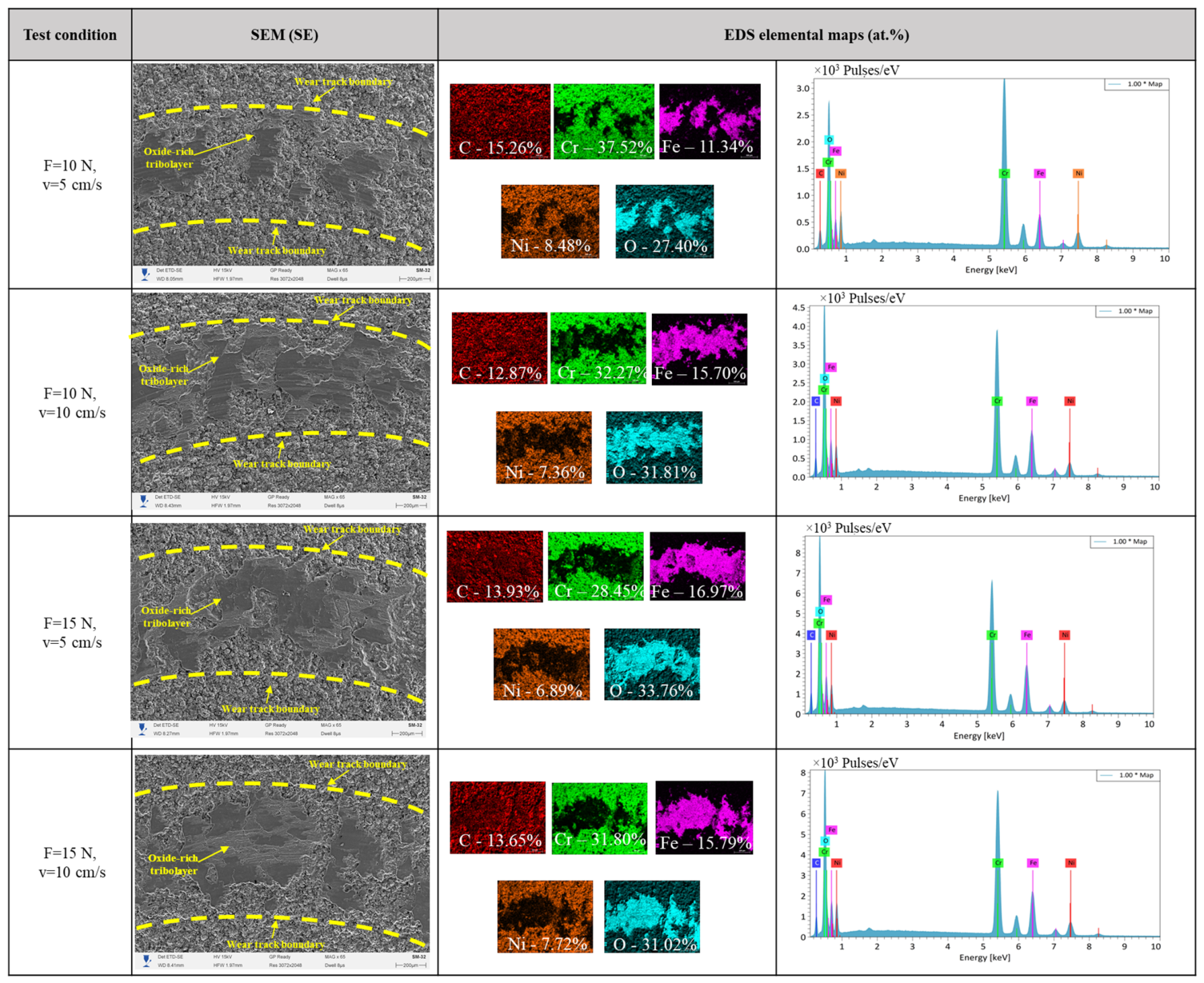
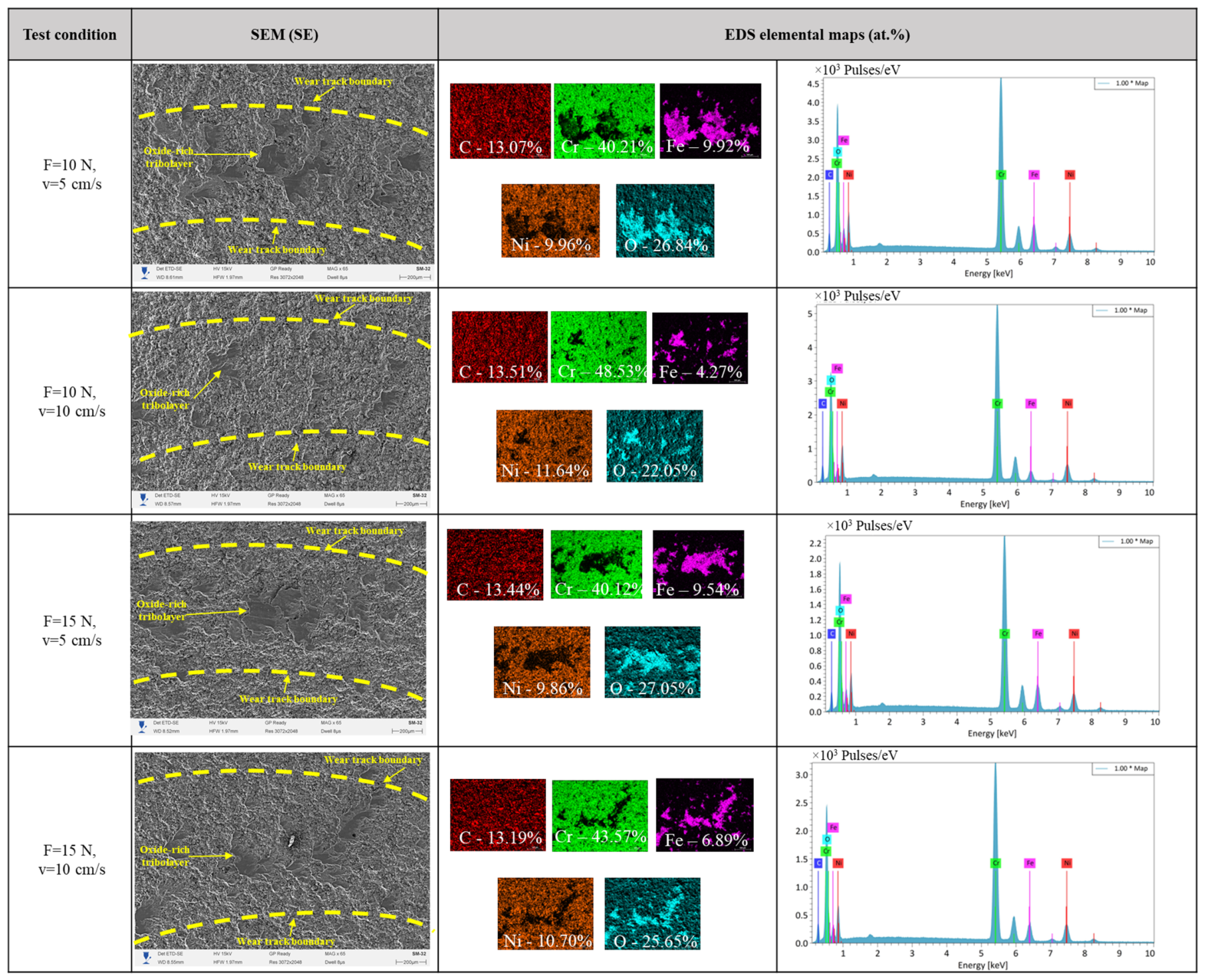
To further clarify the wear mechanisms responsible for the tribological behavior of the detonation-sprayed Cr
3C
2–NiCr coatings, SEM observations and EDS elemental mapping of the wear tracks were performed after the sliding tests (
Figure 7 and
Figure 8). The SEM images revealed that the wear tracks of both coatings were characterized by plastically deformed regions covered with compacted wear products. The worn surfaces remained relatively smooth, and no evidence of extensive delamination or large-scale spallation was observed. These observations indicate that catastrophic coating failure did not occur under the investigated testing conditions. Instead, the wear process was mainly associated with gradual removal of material accompanied by the formation of a tribologically modified surface layer. EDS elemental mapping demonstrated a significant enrichment of oxygen within the wear tracks, confirming that oxidation occurred during sliding. Chromium and nickel remained uniformly distributed over the worn surfaces, indicating that the protective coating maintained its structural integrity after testing. In addition, the detection of iron is attributed to the transfer of material from the 100Cr6 steel counterbody to the coating surface during sliding. A comparison of the coatings deposited at different barrel filling ratios revealed noticeable differences in the elemental composition of the wear tracks. The coating deposited at a barrel filling ratio of 53% exhibited lower oxygen and iron contents than the coating produced at 43%. The reduced oxygen concentration suggests that the denser coating experienced less tribo-oxidation during sliding, whereas the lower iron content indicates reduced material transfer from the steel counterbody. These observations are in good agreement with the tribological results, where the coating deposited at a barrel filling ratio of 53% exhibited the lowest wear rate despite its relatively higher coefficient of friction. The improved wear resistance of the 53% coating can therefore be attributed to its denser microstructure, lower porosity, and higher structural integrity, which reduce surface degradation and suppress excessive oxidation during sliding. Based on the SEM observations and EDS analysis, the dominant wear mechanism of both coatings can be described as mild oxidative wear accompanied by limited abrasive wear. The absence of extensive delamination indicates strong cohesion of the coating throughout the tribological tests.