Article

PBAT Microplastics Modulate Oxidative Stress and Plant–Fungus Interactions in Wheat Under Metolachlor Exposure


by
Olga Rusiecka
1 and
Przemysław Bernat
2,*
1
Department of Industrial Microbiology and Biotechnology, Faculty of Biology and Environmental Protection, Doctoral School of Exact and Natural Sciences, University of Lodz, Banacha Street 12/16, 90-237 Lodz, Poland
2
Department of Industrial Microbiology and Biotechnology, Faculty of Biology and Environmental Protection, University of Lodz, Banacha Street 12/16, 90-237 Lodz, Poland
*
Author to whom correspondence should be addressed.
Appl. Sci. 2026, 16(13), 6569; https://doi.org/10.3390/app16136569
Submission received: 2 June 2026 / Revised: 22 June 2026 / Accepted: 26 June 2026 / Published: 1 July 2026

Abstract

Microplastics (MPs) and pesticides increasingly co-occur in agricultural ecosystems, where they may jointly affect plant physiology and plant–microorganism interactions. This study investigated the individual and combined effects of biodegradable poly(butylene adipate-co-terephthalate) (PBAT), the herbicide metolachlor (MET), and the beneficial fungus Trichoderma harzianum KKP 534 on wheat (Triticum aestivum). Plant growth, physiological responses, chlorophyll content, cell membrane damage, antioxidant enzyme activities and selected metabolomic and lipidomic biomarkers were evaluated. High PBAT concentrations negatively affected wheat growth by reducing root and shoot length and increasing oxidative stress, as evidenced by elevated TBARS levels, increased antioxidant enzyme activities (POD, GST, CAT, and SOD), and enhanced membrane damage. Metabolomic and lipidomic analyses further revealed stress-associated changes in amino acid metabolism and membrane lipid remodelling. PBAT also adsorbed MET and 2,4-di-tert-butylphenol (DTBP), potentially altering their bioavailability and environmental behaviour. Although T. harzianum KKP 534 promoted plant growth and enhanced antioxidant responses under control conditions, these beneficial effects were attenuated in the presence of PBAT MP. The results suggest that biodegradable microplastics may influence plant–microbe interactions and modify pesticide dynamics under controlled conditions, highlighting the need for further studies in soil-based systems.

1. Introduction

As microplastic (MP) pollution becomes increasingly pervasive in agroecosystems, understanding its interactions with economically important crops is essential for evaluating risks to soil health and food-chain contamination [1,2,3]. The primary source of MP contamination in agroecosystems is the use of plastic mulching films, with reported MP concentration in topsoil (0–10 cm) reaching up to 8885 particles/kg and contamination detected at depths of up to 80 cm [4]. However, the mechanisms through which MPs affect soil functioning and plant development remain poorly understood [5]. Accumulating evidence suggests that MPs can influence plant physiology through multiple pathways, including alterations in soil structure, water repellency, nutrient bioavailability, soil microbial community function, and the induction of oxidative stress in soil organisms [3,6,7,8,9,10,11]. MPs have also been shown to alter the composition, diversity and metabolic function of bacterial communities, disrupting interactions with symbiotic organisms. This may reduce phosphorus and nitrogen uptake, as well as carbon assimilation in plants, partly through the inhibition of soil enzyme activity [8,12,13,14].
Plastic mulch films are widely used in agriculture to improve soil temperature and moisture, suppress weeds, and increase crop yields and quality [15]. Due to the growing global demand for food, plastic mulch films are expected to be used more widely, leading to greater MP accumulation in agricultural soils. As a result, biodegradable materials have been proposed as a potential alternative. A key advantage of these materials is that, after use, they can be incorporated into the soil, where they are degraded by microorganisms [16].
Among biodegradable polymers, poly(butylene adipate-co-terephthalate) (PBAT) is one of the most widely used in Europe. PBAT is characterised by high flexibility, resistance to abrasion and cracking, and resistance to water and oil; it is also biodegradable in soil and compostable [17]. These properties make PBAT a common component of agricultural films and other biodegradable products [18,19]. However, its impact on soil structure, biological activity, and plant physiology remains insufficiently understood and continues to be debated [20,21,22]. Studies have shown that PBAT degradation enhances organic matter decomposition and CO2 emission [23]. Furthermore, PBAT-derived MPs can alter rhizosphere ecology and negatively affect plant growth, as demonstrated for pakchoi (Brassica chinensis L.) [24]. In contrast, no phytotoxic or genotoxic effects were observed in bioassays with Allium cepa and Lactuca sativa [1], suggesting that PBAT effects are context- and species-dependent.
Particular attention should be given to interactions between PBAT MPs and wheat (Triticum aestivum L.), a globally important cereal crop of high agronomic and economic significance. Wheat is characterised by rapid germination, uniform early development, and well-defined growth stages, making it a suitable model for controlled studies of MP–plant interactions. Its sensitivity to soil contaminants and standardised cultivation protocols facilitate robust comparison of MP impacts on germination, biomass, and physiological parameters [12,25,26]. Despite existing studies, knowledge of the mechanisms underlying PBAT MP–plant interactions, including wheat, remains limited and fragmented. Moreover, MP effects depend on multiple factors including soil type, environmental conditions, MP concentration and physicochemical properties, co-occurring contaminants, and soil microbiota structure and activity [2,27].
Importantly, MPs can act as vectors of other contaminants, including pathogens, pesticides, heavy metals and xenobiotics. This may alter their environmental mobility, bioavailability, and transfer within food chains, potentially increasing toxicity toward non-target organisms [28,29]. One such contaminant is metolachlor (MET), a widely used chloroacetanilide herbicide applied for pre-emergent weed control in cereal crops [25]. MET disrupts very-long-chain fatty acid (VLCFA) elongation by targeting VLCFA synthase, which is critical for cuticular wax biosynthesis and cell membrane development. As a result, seedling growth is arrested, and susceptible plants exhibit symptoms such as stunted roots, swollen hypocotyls, and dark-green, brittle leaves shortly after emergence [30]. The small particle size, large surface area and hydrophobicity of MPs facilitate the adsorption of organic pollutants [31]. In our previous study [32], we demonstrated that PBAT can adsorb MET, suggesting that PBAT-derived MPs may modify its environmental fate, mobility, and phytotoxicity [29].
Plant growth-promoting fungi, such as Trichoderma spp., are ubiquitous in soils and enhance plant growth through multiple mechanisms. They suppress pathogens via mycoparasitism, antibiotic production, and competition while also stimulating plant development and inducing systemic resistance [33]. In addition, they secrete phytohormones, growth-promoting compounds, and enzymes that improve nutrient availability and uptake [34]. Trichoderma also enhances plant tolerance to abiotic stresses by activating antioxidant systems and defence-related pathways [35,36]. Moreover, Trichoderma spp. synthesise secondary metabolites with bioremediation potential, enabling the degradation of pesticide residues through enzymatic processes such as hydrolysis and oxidation [32].
To date, no studies have comprehensively evaluated the combined effects of PBAT-derived microplastics, herbicide contamination, and beneficial soil fungi on plant physiological responses. We hypothesise that PBAT MPs modify MET bioavailability and phytotoxicity, while Trichoderma harzianum mitigates stress effects through enhanced detoxification and plant defence mechanisms. Based on the current state of knowledge, this study aims to systematically evaluate the effects of PBAT MPs on wheat growth, physiological responses, and stress adaptation under co-exposure to MET and the bioaugmentation agent Trichoderma harzianum. The results will provide insight into interactions between MPs and co-occurring contaminants and contribute to understanding the ecological implications of bioplastics in agroecosystems.

2. Materials and Methods

2.1. Chemicals

PBAT (Ecoflex F Blend C1200, BASF, Ludwigshafen, Germany) was imported in granular form. The microplastic (MP) mixture was prepared according to our previously described method [32]. Briefly, the material was mechanically ground and sieved into different particle size fractions, 1–0.5 mm (40%), 0.5–0.25 mm (40%), and <0.25 mm (20%), resulting in irregularly shaped particles. Particle morphology and surface characteristics of the PBAT microplastics were previously characterised using scanning electron microscopy (SEM) in our earlier study [37], in which irregular, mechanically fragmented particles with heterogeneous surface structures were confirmed.
The MP mixture was sterilised in 70% ethanol for 1 h and subsequently dried under sterile conditions in a laminar flow hood prior to use.
Metolachlor (MET), reagents utilised for thiobarbituric acid-reactive substance (TBARS) determination, peroxidase (POD), glutathione S-transferase (GST) and catalase (CAT) activity assays, superoxide dismutase (SOD) Activity Assay Kit, and Evans blue were sourced from Merck (Darmstadt, Germany). Solvents used for liquid chromatography–tandem mass spectrometry (LC–MS/MS) analyses were also obtained from Merck. MET stock solutions were prepared in ethanol. Buffers and other solutions were prepared using ultrapure water. All other reagents met analytical-grade standards.

2.2. Organisms and Growth Conditions

T. harzianum strain KKP 534 from the Industrial Microorganisms Collection at the Institute of Agricultural and Food Industry (IAFB) in Warsaw, Poland, was used due to its high potential for MET degradation [32]. For spore suspension preparation, 7-day-old cultures grown on ZT agar slants were used. The medium contained (g/L): glucose, 4; Difco yeast extract, 4; agar, 25; and malt extract, 6° Balling [BLG], up to 1 L [1° BLG = 1 g of soluble substances extracted from the grain per 100 mL of malt extract]; pH 7.0 [38]. Spores were harvested using sterile water and adjusted to a final concentration of 107 CFU/mL.
Wheat seeds (Triticum aestivum) were purchased from the Plant breeding Strzelce Sp. z o.o. IHAR Group, Strzelce, Poland. Seeds were surface-sterilised in 70% ethanol for 30 s, rinsed twice with distilled water, and incubated for 10 min either in sterile water or water with KKP 534 spores. The sterilised MPs were placed in 9 cm Petri dishes on two layers of filter paper. The filter paper was moistened either with MET solution (2 µg per dish) or with sterile water. Ten pre-sterilised seeds were placed on each dish, followed by the addition of 10 mL of distilled water. The seeds were cultivated in the plant growth chamber (IL/750/FIT P, Pol-Eko, Wodzisław Śląski, Poland) under controlled conditions, a 14 h light/10 h dark photoperiod, relative humidity of 40%, and light intensity of 200 µmol/m2/s, following the protocol described by Mironenka et al. [35]. The experimental setup created a simplified hydroponic-like environment that minimised the confounding effects of the soil matrix and allowed us to focus on interactions among PBAT MPs, metolachlor, Trichoderma harzianum, and wheat, based on the models used by Bernat et al. [39] and Zantis et al. [40].
The experiment was designed as a factorial system including three factors: PBAT MP concentration, MET presence, and T. harzianum inoculation. Four treatment groups were established: (1) wheat only (W), (2) wheat inoculated with T. harzianum (W+T), (3) wheat exposed to metolachlor (W+MET), and (4) wheat exposed to both metolachlor and T. harzianum (W+T+MET). Within each group, four PBAT MP levels were applied: 0, 50, 100, and 200 mg per dish (Figure S1). This resulted in a total of 16 experimental variants, with each treatment performed in triplicate. In addition to the absolute control (W, 0 mg MP), treatments without PBAT MPs (0 mg) in each experimental group (W, W+T, W+MET, W+T+MET) were used as internal controls. This approach enabled the evaluation of MP-specific effects within each treatment condition, independent of MET exposure and T. harzianum inoculation.
The MET dose (2 µg per dish) was selected based on literature reports describing its widespread agricultural use and environmental occurrence, as well as concentrations commonly applied in laboratory phytotoxicity studies [41]. The chosen level was intended to induce measurable phytotoxic responses while avoiding complete inhibition of germination and early seedling development, and to remain within the tolerance range of the Trichoderma harzianum strain. Elevated MP concentrations were applied to ensure measurable biological responses under controlled experimental conditions.

2.3. Plant Growth, Biomass and Relative Water Content

The germination rate was calculated as the percentage of germinated seeds relative to the total number of seeds sown. The seedling vigour index (SVI) was calculated using Shahid’s [42] method, based on the germination rate and the combined length of shoots and roots: SVI = germination (%) × seedling length. Plant biomass was assessed based on the dry weight (DW) of shoots and roots, which were analysed separately.
Relative water content (RWC) was determined on day 20 of cultivation according to the method of Mironenka et al. [35], with modifications. Fresh weight (FW) of shoots and roots was measured immediately after harvesting. The samples were then rehydrated in distilled water for 1 h to obtain full turgor and weighed to determine turgid weight (TW). Subsequently, the plant material was dried at 60 °C until a constant weight was achieved to obtain dry weight (DW).
The RWC was determined according to the following equation:
RWC(%) = (FW − DW)/(TW − DW) × 100

2.4. Cell Membrane Integrity, Total Phenolic Content and Chlorophyll Content

Cell membrane integrity of root tissues was assessed using 0.25% (w/v) Evans blue dye. After staining, roots were rinsed three times (30 min each) with distilled water to remove unbound dye. The samples were then homogenised in 1% (w/v) sodium dodecyl sulphate (SDS) and centrifuged at 8000× g for 5 min. The absorbance of the supernatant was measured at 600 nm according to the method of Baker and Mock [43].
Total phenolic content (TPC) was measured using plant material extracted with 80% (v/v) methanol after homogenisation. The extracts were incubated with Folin–Ciocalteu reagent (Merck, Darmstadt, Germany), and absorbance was measured at a wavelength of 765 nm using a FLUOstar OMEGA microplate reader (BMG LABTECH, Ortenberg, Germany), in accordance with the protocol [44].
Chlorophyll a and b were extracted from shoot tissue homogenised in liquid nitrogen using methanol as a solvent. Chlorophyll concentrations were calculated based on absorbance measured at 652 nm and 665 nm according to the method described by Warren [45].

2.5. Microscopic Analysis

The microscopic morphology of the wheat roots was assessed after 20 days of cultivation using an LSM 510 Meta confocal laser scanning microscope (Carl Zeiss, Oberkochen, Germany) using a Plan-Neofluar 20× objective (Carl Zeiss, Oberkochen, Germany). Prior to the experiment, PBAT microplastics were stained with Nile Red according to the method described previously [32]. This step enabled the visualisation of MP particles during microscopic analysis. After cultivation, plants were carefully removed from the growth system and rinsed three times with deionised water to remove surface residues. Roots were then excised into small segments and mounted on glass slides for microscopic observation.

2.6. Lipid Peroxidation Determination

Lipid peroxidation, as an indicator of oxidative damage to cellular membranes, was determined by measuring thiobarbituric acid-reactive substances (TBARSs), according to a procedure previously used [39]. In brief, 50 mg of fresh shoot or root tissue was homogenised in a cooled mortar with 1 mL of 50 mM sodium phosphate buffer at pH 7 containing 1 mM EDTA. Then, 0.2 mL of homogenate was mixed with 0.4 mL of TBA reagent, consisting of 15 mM thiobarbituric acid (TBA) dissolved in 15% (w/v) trichloroacetic acid (TCA). The mixture was vortexed for approximately 30 s and incubated in a water bath at 90 °C for 30 min. After incubation, the samples were cooled on ice and then centrifuged at 10,000× g for 10 min The absorbance of the supernatant was measured at 530 nm and 600 nm. The protein concentration in the homogenate was determined by the Bradford method. The absorbance was measured on a FLUOstar OMEGA microplate reader (BMG LABTECH, Germany). TBARS content was calculated as malondialdehyde (MDA) equivalents and expressed as nmol per mg of protein.

2.7. Enzyme Activity Determination

For enzymatic assays, 200 mg of fresh plant biomass (shoots and roots were analysed separately) was frozen in liquid nitrogen and homogenised in a mortar. The powdered tissue was extracted with 2 mL of ice-cold extraction buffer (0.05 M sodium phosphate buffer pH 7.8, 1 mM EDTA, 1% PVP). The mixture was collected in 2 mL tubes and centrifuged at 18,000× g at 4 °C for 10 min. After centrifugation, the supernatant was transferred into new tubes and kept on ice. Enzyme activity (POD, GST and CAT) was determined according to the method of Chen and Zhang [46]. Enzyme activities were expressed as units per milligram of protein (U/mg protein). The protein content was assayed using the Bradford method. The superoxide dismutase (SOD) activity was measured using a WST-based assay, which quantifies the inhibition of superoxide-driven reductions in WST dye at 450 nm, according to the manufacturer’s recommended method (Merck). The absorbance was measured on a FLUOstar OMEGA microplate reader (BMG LABTECH).

2.8. Analysis of MP Adsorption Capacity

PBAT microplastics were collected from Petri dishes after cultivation and used for chemical analysis (100 mg per sample). Prior to extraction, MPs were rinsed three times with deionised water (5 min each) to remove loosely attached and non-specifically bound particles and residues. The cleaned microplastics were then extracted with 1 mL of methanol and shaken for 30 min to desorb strongly bound compounds from the polymer surface. The extracts were centrifuged, and the supernatant was collected for further analysis. A qualitative gas chromatography–mass spectrometry (GC-MS) screening was performed to identify compounds persistently adsorbed on PBAT microplastics. The chromatographic data were used for compound identification by library matching, followed by selection of the most abundant compounds detected across treatments. For this purpose, the gas chromatograph GC 7890, connected to the mass spectrometer MS 5973C (Agilent, Santa Clara, CA, USA), was used according to the previously described procedure [38].

2.9. Determination of Phospholipids and Amino Acids

The two-phase extraction system was used for both phospholipid and amino acid profiling. Briefly, 100 mg of fresh biomass was ground in a frozen mortar with methanol and extracted using a chloroform:methanol:water system (final ratio of 1:2:0.8, v/v/v). After phase separation, the chloroform (organic) phase was collected and evaporated to dryness at room temperature under a fume hood. Before analysis, the residue was re-dissolved in methanol and vortexed to ensure complete solubilisation.
Lipid profiling was performed using LC-MS/MS, as described previously [32]. Lipid species were quantified relative to an internal standard and expressed as a percentage of total phospholipid content. The double bond index (DBI) was calculated using the method described by Jasinska et al. [47]. The inorganic phase was used to determine amino acids using LC-MS/MS, as previously described [32].

2.10. Statistical Analysis

For germination and growth analyses, three independent biological replicates were performed for each treatment, with ten seedlings analysed per replicate (30 seedlings per treatment in total). For metabolomic, biomass, and water content analyses, five seedlings were randomly selected from each of the three independent biological replicates for every experimental variant, resulting in a total of 15 seedlings analysed per treatment. Statistical analyses were performed using STATISTICA v.13.1 (TIBCO Software Inc., USA), and results were presented as mean ± standard deviation (SD) using Microsoft Excel 365. The normality of data distribution was assessed using the Kolmogorov–Smirnov test, and homogeneity of variance was evaluated using the Brown–Forsythe test. When assumptions of normality and homoscedasticity were satisfied, one-way ANOVA was applied. For comparisons among treatments with different PBAT concentrations within each experimental group (W, W+T, W+MET, W+T+MET), Dunnett’s post hoc test was applied using the corresponding 0 mg MP treatment as the control. For comparisons among experimental groups, Tukey’s HSD post hoc test was applied.
In cases where assumptions of normality were not met, the non-parametric Kruskal–Wallis test, followed by appropriate pairwise post hoc comparisons, was applied. A significance level of p < 0.05 was used throughout the study. In addition to statistical significance, effect sizes were reported as partial eta-squared (η2p) for ANOVA analyses and epsilon-squared (ε2) for Kruskal–Wallis tests.

3. Results

3.1. Integrated Analysis of Plant Growth and Physiological Responses

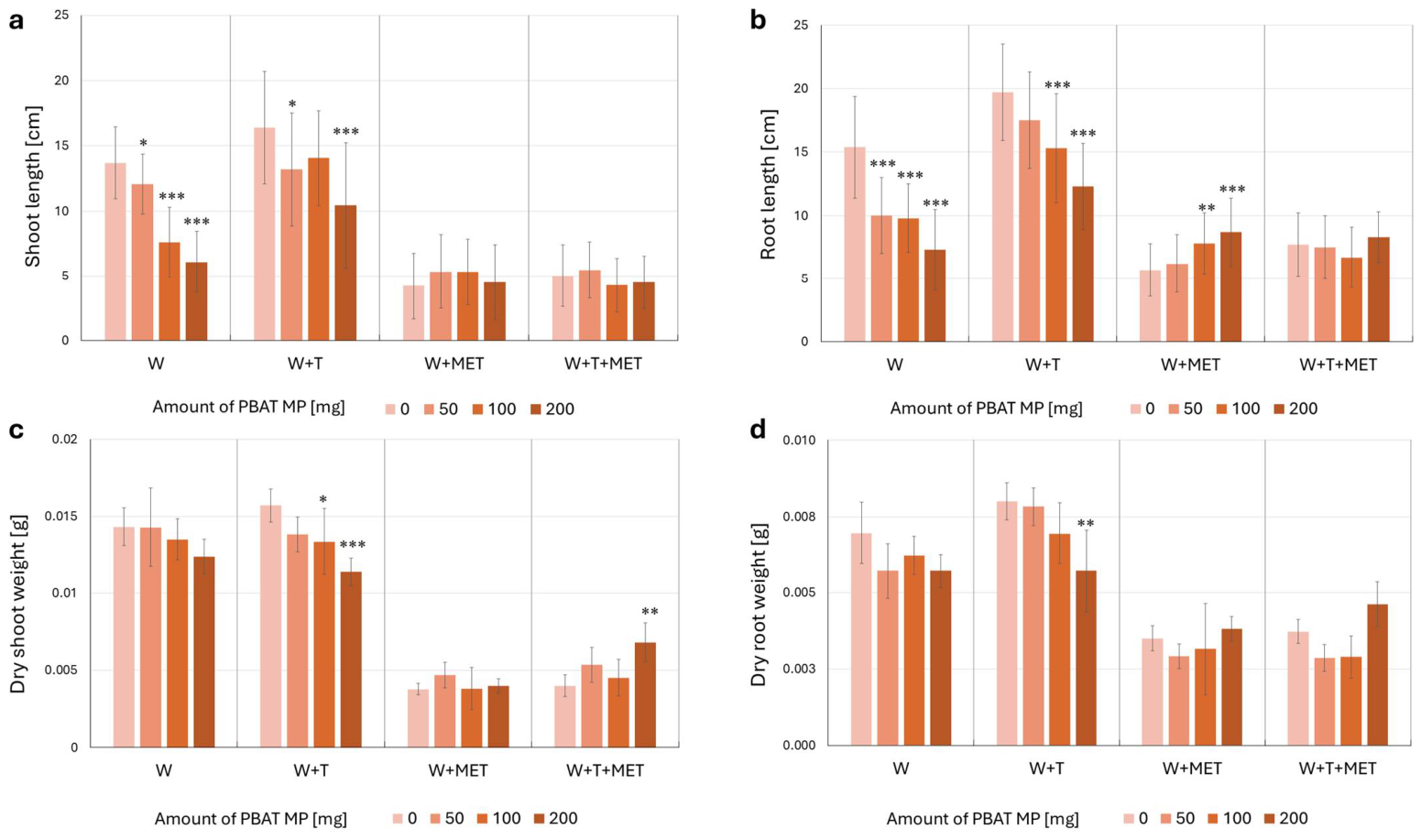
Measurements performed after 20 days of cultivation revealed significant differences in shoot and root length, as well as dry biomass. In the W and W+T groups, increasing MP concentrations led to a reduction in shoot and root length (Figure 1a,b, shoot length: ε2 = 0.620; root length: ε2 = 0.566). The reduction in plant length was accompanied by less pronounced changes in biomass in the W group, whereas biomass responses were more evident in W+T plants (Figure 1c,d). Trichoderma positively influenced plant growth, as reflected by increased shoot and root length compared to the W group (Figure 1 and Figure 2). Moreover, Trichoderma mitigated the negative effects of MP, particularly at intermediate concentrations (Figure 1a,b). In MET-treated groups, plant growth was generally inhibited, and the presence of Trichoderma did not significantly alleviate this effect. However, in the W+MET group, root length increased at higher MP concentrations compared to MP-free controls (Figure 1b).
The presence of Trichoderma also increased root number, from typically 2–3 roots in W to 3–5 in W+T (Figure S3 in Supplementary Materials). In MET-treated samples, visible morphological abnormalities were observed, including shoot deformation and leaf curling. No clear effect of MET on root number was noticed.
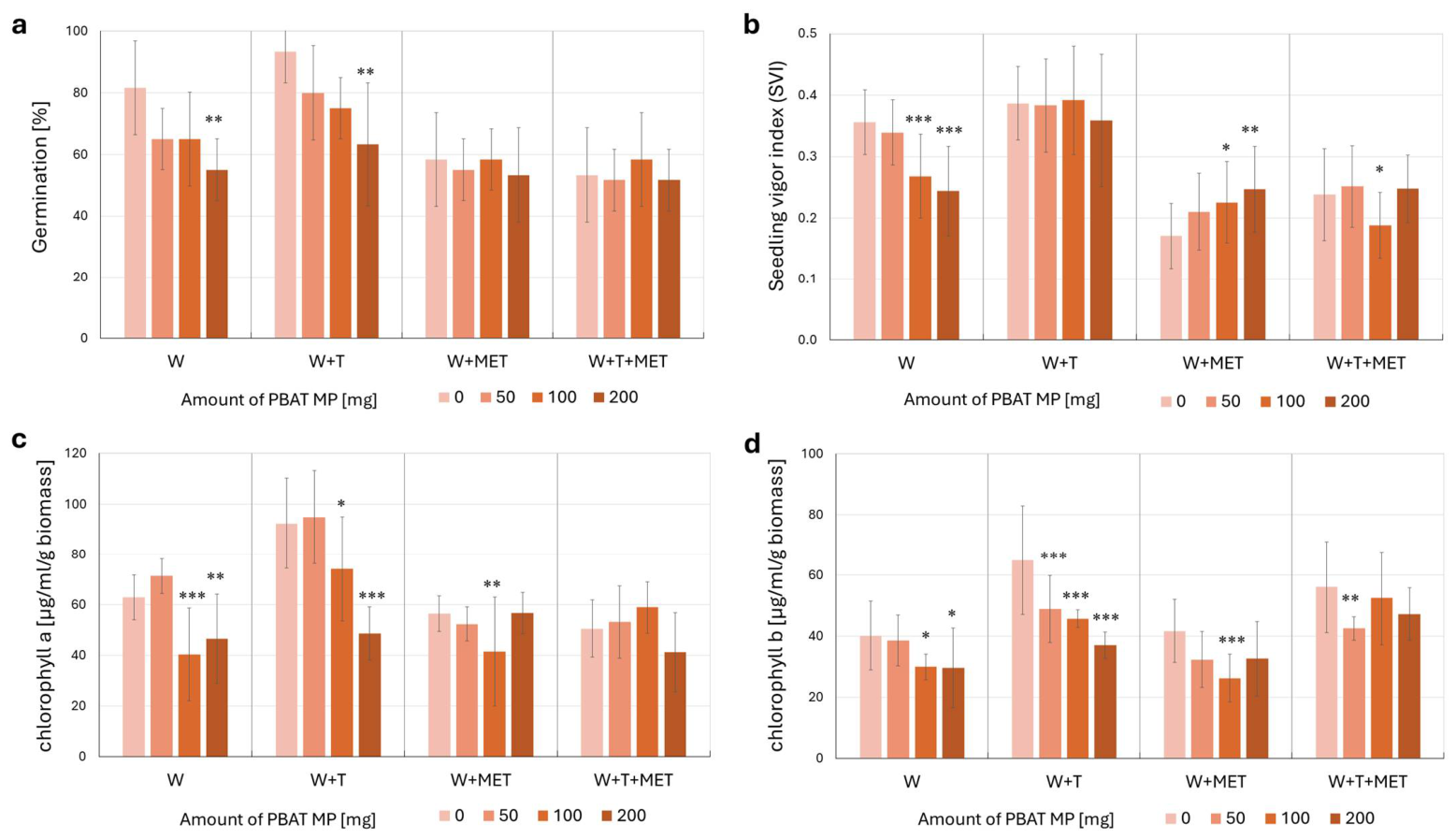
Germination analysis (Figure 2a) revealed a positive effect of Trichoderma under control conditions, while increasing MP concentrations reduced germination in both W and W+T groups (η2 = 0.944). In MET-treated samples, germination was consistently lower, regardless of Trichoderma presence. A similar trend was observed for the seedling vigour index (SVI) (Figure 2b: ε2 = 0.563). MPs negatively affected the SVI in the W group, while Trichoderma maintained relatively stable SVI values across MP treatments. In contrast, in the presence of MET, increasing MP concentrations were associated with a slight increase in the SVI.
Chlorophyll a and b content (Figure 2c,d) decreased with increasing MP concentrations in both the W and W+T groups. Although Trichoderma enhanced chlorophyll levels under control conditions, this effect diminished at higher MP concentrations. In MET-treated samples, chlorophyll levels were generally lower, with no consistent trend across MP treatments.
Relative water content (RWC) differed between plant organs and treatments (Table 1), with large treatment effects observed for both shoots (η2 = 0.942) and roots (η2 = 0.860). In shoots, significant differences were observed in the W+T group between 0 and 200 mg MPs (p < 0.001). Root RWC increased with MP concentration in W but decreased in W+MET. Trichoderma increased root RWC under control conditions in both MET and non-MET treatments.
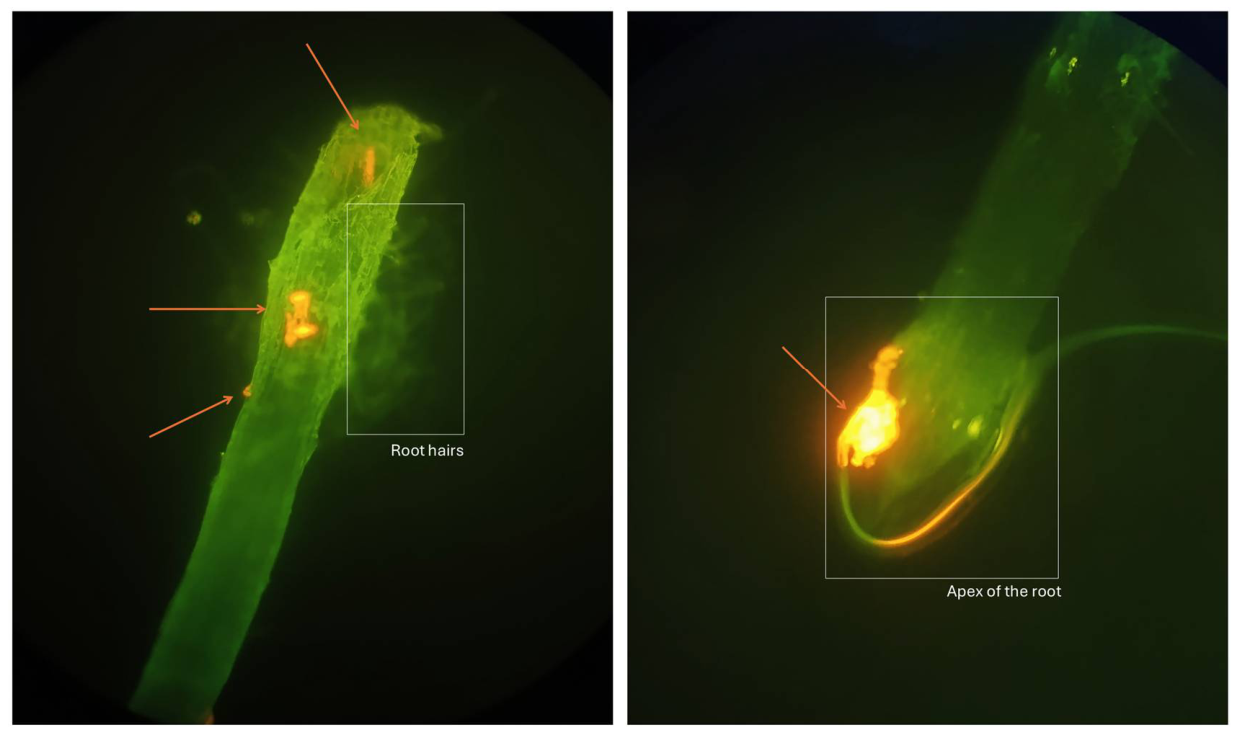
Fluorescence microscopy revealed that PBAT microplastic particles adhered to root surfaces and root hairs (Figure 3). Despite thorough rinsing, particles remained attached, indicating strong adhesion. However, the internalisation of MPs within root tissues could not be conclusively confirmed.
Qualitative GC-MS analysis demonstrated that PBAT MP particles adsorbed several compounds during cultivation, including metolachlor (MET) and 2,4-di-tert-butylphenol (DTBP) (Figure S4 in the Supplementary Materials). Quantitative estimation indicated that 100 mg of PBAT MPs adsorbed up to 0.49 µg of MET under the tested conditions, corresponding to approximately 25% of the initial MET amount.

3.2. Assessment of Oxidative Stress in Plant Tissues

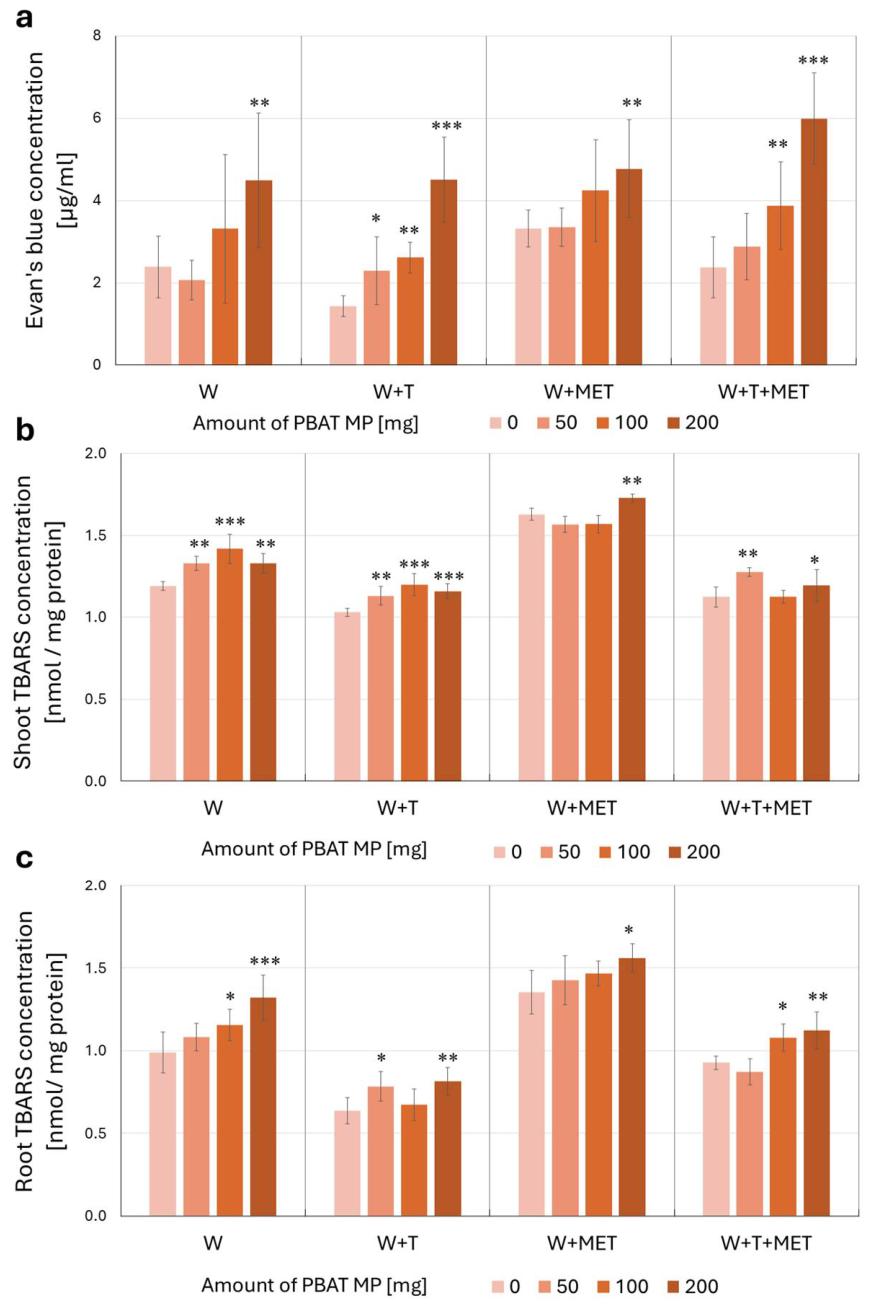
Cell membrane integrity, assessed by Evans blue uptake, indicated increased membrane damage in the presence of MPs across all experimental groups (Figure 4a). The extent of dye accumulation increased with MP concentration, suggesting a dose-dependent effect. The presence of Trichoderma reduced membrane damage, whereas MET-treated samples showed higher dye uptake compared to non-MET treatments. Lipid peroxidation, measured as TBARSs, showed a general increase in both shoots and roots with increasing MP concentrations (Figure 4b,c). Trichoderma significantly reduced TBARS levels compared to the corresponding W samples, including in MET-treated variants. However, this protective effect was less pronounced at higher MP concentrations. Effect sizes for lipid peroxidation (TBARS) indicated a strong treatment effect in both tissues, with η2 = 0.944 for leaves and η2 = 0.903 for roots.
Total phenolic content (TPC) varied depending on treatment and MP concentration (Table 2). In roots, TPC generally increased with MP concentration, with significant differences observed at 100 and 200 mg in most groups. In the W group, a clear increase in TPC was observed with increasing MP levels. The presence of Trichoderma stabilised TPC levels in shoots under MP exposure and maintained relatively consistent values in roots under combined MP and MET treatments. In contrast, MET in combination with MPs increased TPC levels in shoots, while in roots, higher MP concentrations reduced TPC compared to MP-free controls within the same group. Overall, MP exposure was associated with increased oxidative stress markers, while Trichoderma partially mitigated these effects, particularly at lower MP concentrations.
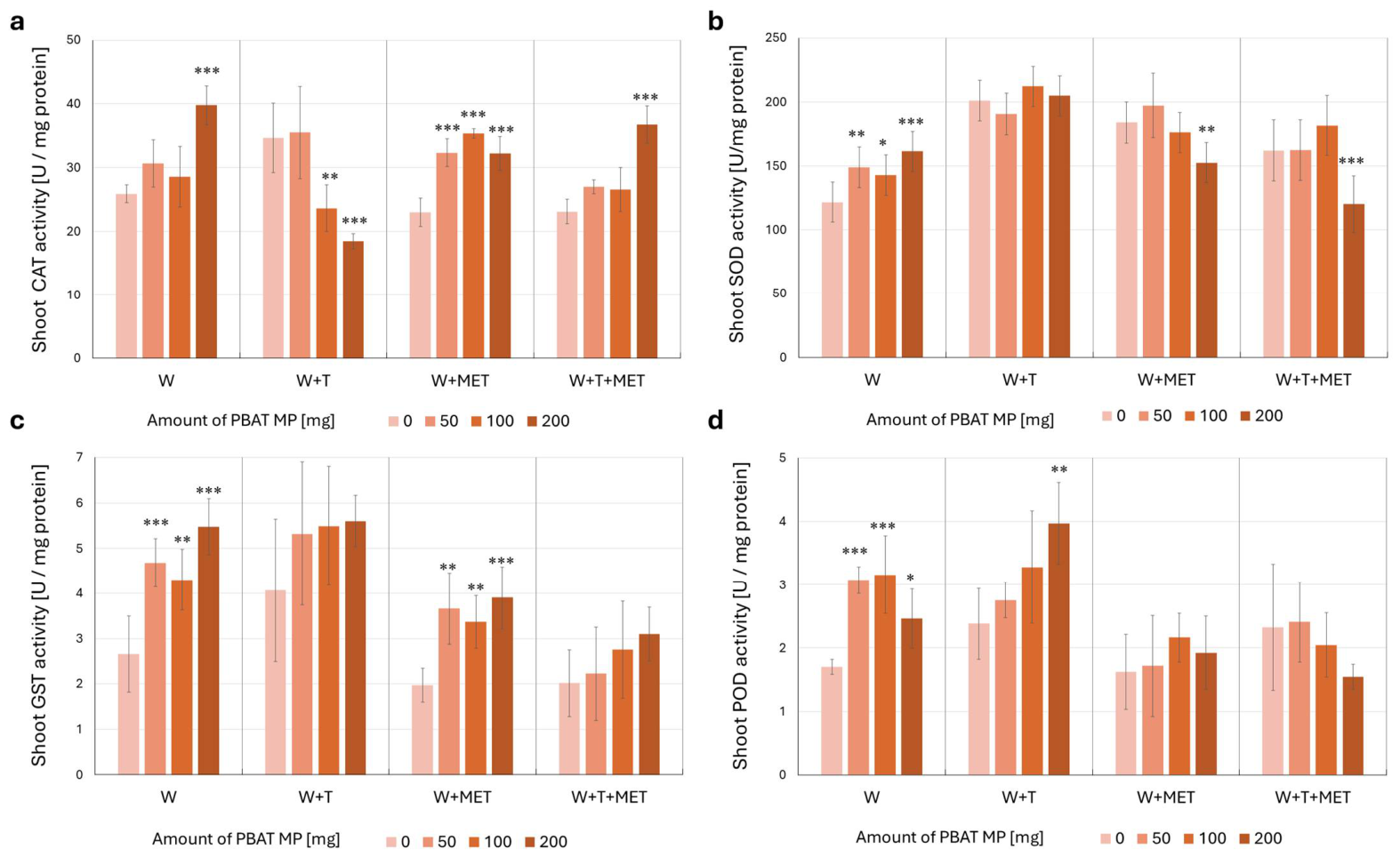
To further assess oxidative stress responses, the activities of four antioxidant enzymes (CAT, SOD, GST, POD) were analysed in shoots and roots. In shoots, Trichoderma significantly increased CAT and SOD activity compared to the W control without MPs (Figure 5a,b). Increasing MP concentrations generally enhanced CAT activity in the W, W+MET and W+T+MET groups, whereas in the W+T group an opposite trend was observed. SOD activity increased with MP concentration in the W group, while in W+MET a decreasing trend was observed at higher MP levels. MET-treated samples showed overall higher SOD activity compared to W, although a decline was observed at the highest MP concentration. GST activity increased with MP concentration across all groups (Figure 5c), whereas POD responses depended strongly on treatment configuration (Figure 5d).
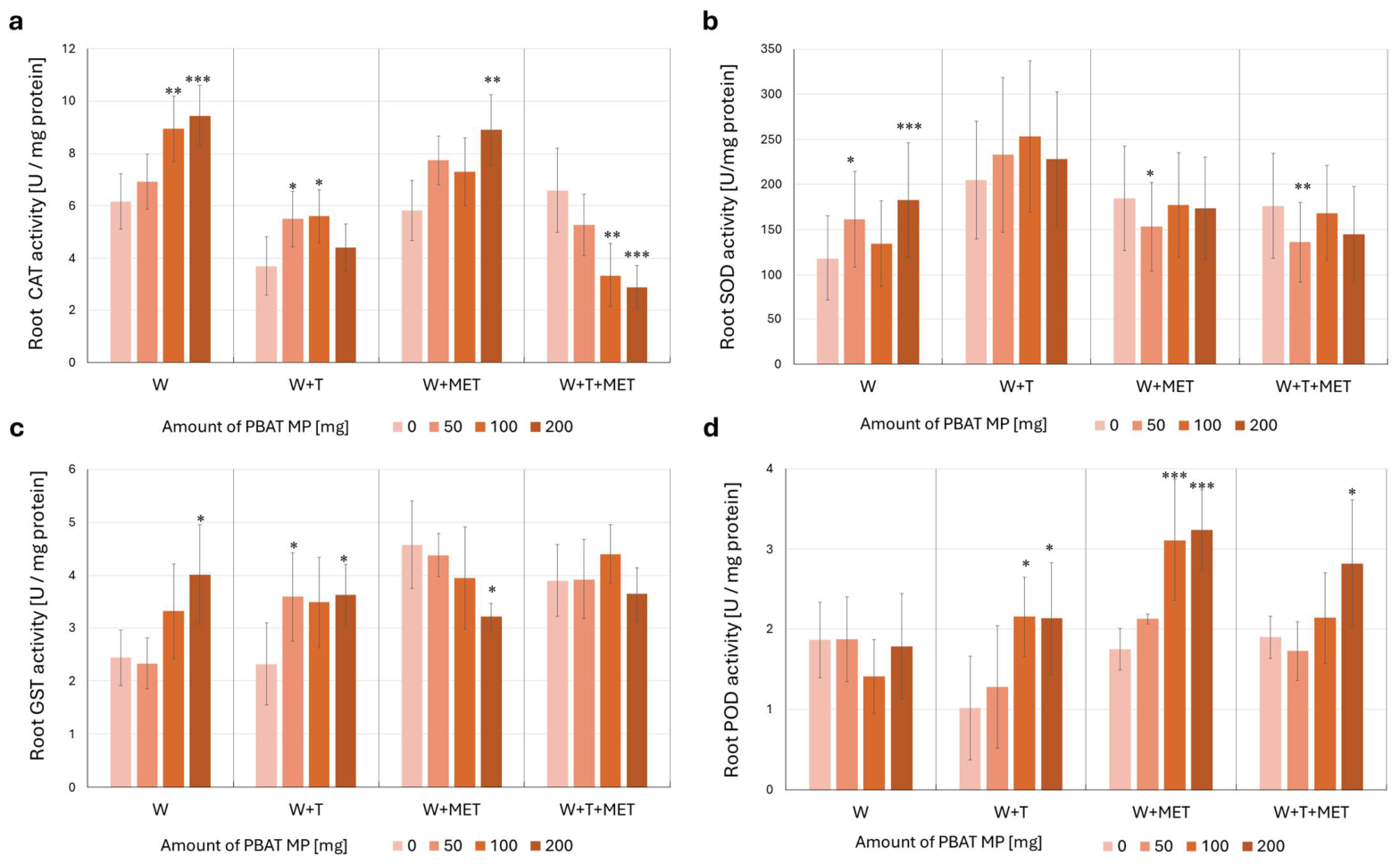
In roots, CAT activity increased with MP concentration in W and W+MET, and to a lesser extent in W+T, while an opposite trend was observed in W+T+MET (Figure 6a). SOD activity increased significantly with MP concentration in the W group and was further enhanced by the presence of Trichoderma in selected treatments (Figure 6b). POD activity increased with increasing amounts of MPs in most groups, with the exception of W, where no consistent trend was observed (Figure 6d). GST activity showed variable responses depending on treatment (Figure 6c). In general, MP exposure increased GST activity in the W and W+T groups, while in W+MET higher MP concentrations were associated with reduced activity. In summary, the enzymatic responses depended on both MP concentration and treatment type (presence of MET and/or Trichoderma).

3.3. Metabolomic and Lipidomic Characterisation of Stress-Related Biomarkers

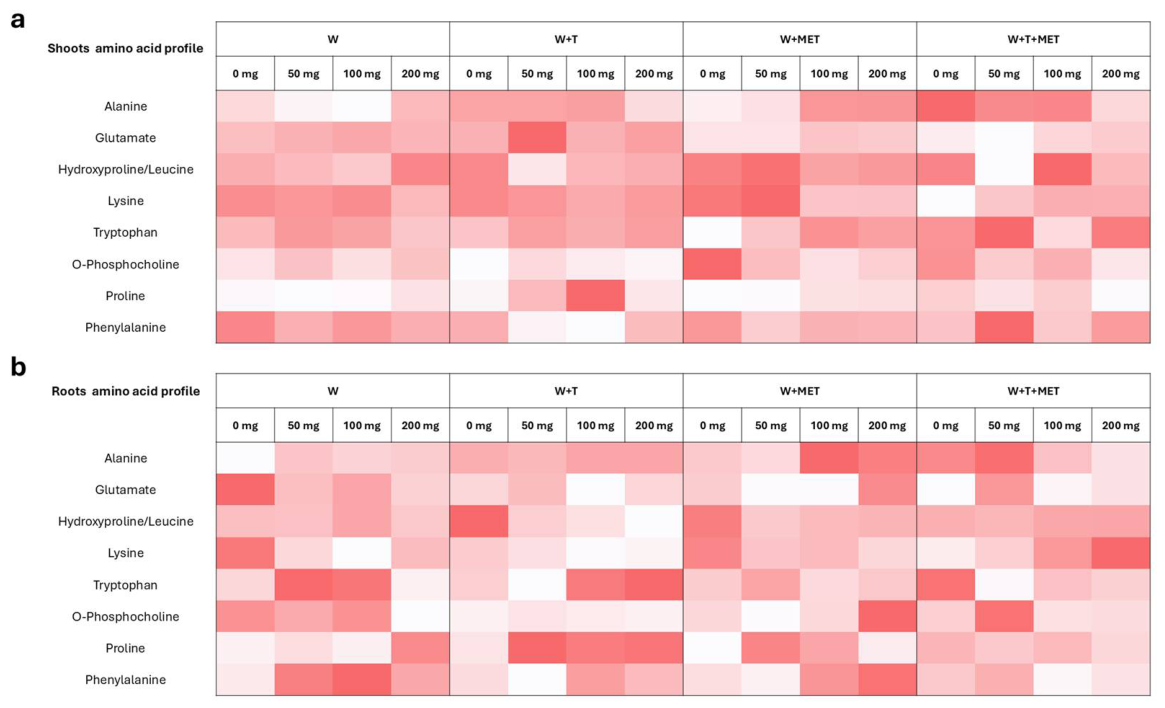
Changes in amino acid profiles revealed distinct responses to MPs, MET, and Trichoderma treatments (Figure 7). Proline levels increased in both shoots and roots under MP exposure, indicating a stress-related accumulation pattern across most groups. This trend was less consistent in the W+T+MET group. Glutamate showed elevated levels in MET-treated samples at higher MP concentrations, particularly in both plant organs. In contrast, no consistent trend was observed in the W and W+T groups. Alanine content increased in response to MPs in the W and W+MET groups, whereas relatively stable levels were observed in W+T. An opposite trend was noted in W+T+MET samples. Tryptophan and phenylalanine exhibited treatment-dependent responses, with more pronounced changes observed in roots than in shoots. In general, MP exposure increased their levels in the W and W+T groups, while combined stress conditions (W+T+MET) resulted in a decreasing trend. Hydroxyproline and phosphocholine showed variable responses across treatments, indicating modifications in cell wall and membrane-associated processes.
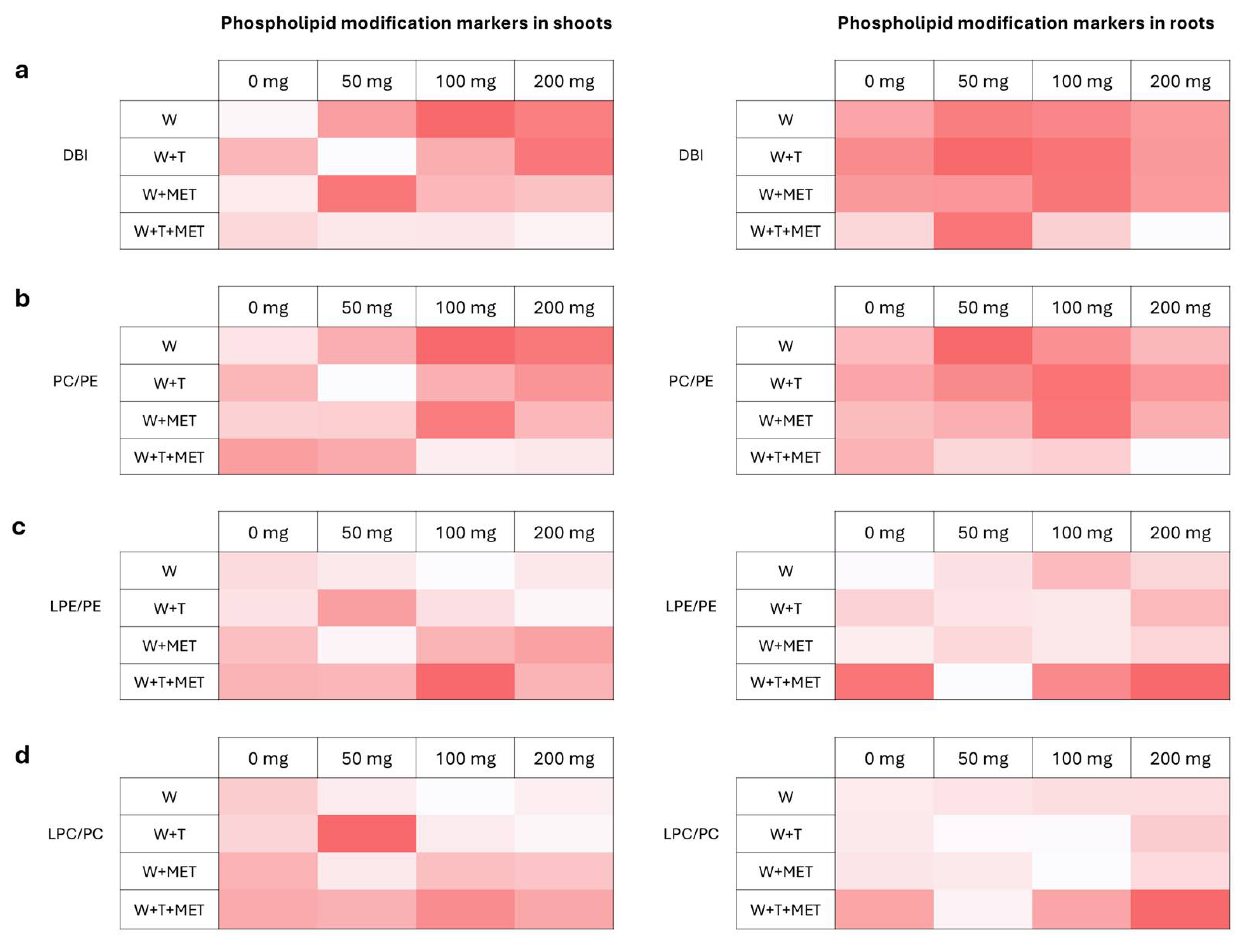
Phospholipid-related indices showed treatment- and concentration-dependent changes (Figure 8). The double bond index (DBI) increased in shoots with MP exposure in most groups (Figure 8a), while a decreasing trend was observed in W+T+MET. In roots, the DBI remained relatively stable across treatments, with a slight decrease at higher MP concentrations in the W+T+MET group. The PC/PE ratio increased with MP concentration in most groups (Figure 8b), except W+T+MET, where an opposite trend was observed in both shoots and roots. Lysophospholipid ratios (LPC/PC and LPE/PE) showed an overall increase in MET-treated samples and in combined stress conditions (W+T+MET), particularly in roots (Figure 8c,d). In contrast, lower values were observed in the W and W+T groups under MP exposure. The overall phospholipid profiles for the groups studied are presented in the Supplementary Materials: Figure S5 for shoots and Figure S6 for roots.

4. Discussion

The introduction of biodegradable polymers as alternatives to conventional plastics has gained considerable attention in recent years. Nevertheless, their degradation in open environments remains highly variable, as numerous physical, chemical, and biological factors can significantly influence degradation rates [48]. Although toxicity tests on selected organisms have confirmed their general safety, interactions with co-occurring environmental stressors are still insufficiently understood [49]. In agroecosystems, MP contamination can reach substantial levels, particularly in systems using plastic mulching, where concentrations exceeding 8000 particles/kg soil and up to 324.5 kg/ha have been reported, and contamination increases over time [4,50]. When converted to mass-based estimates, these values indicate that environmentally relevant microplastic loads can vary widely depending on soil depth, particle size distribution, and degradation state.
In the present study, PBAT was applied in the range of 50–200 mg per Petri dish, which represents a simplified and controlled laboratory exposure system rather than a direct field-equivalent concentration. The applied doses were selected to ensure detectable biological responses under short-term experimental conditions and to enable comparisons of dose-dependent effects.
At the same time, metolachlor (MET), a widely used herbicide, is characterised by high environmental mobility and persistence, leading to its detection in both soil and aquatic systems [41,51]. In this study, we examined whether PBAT-derived microplastics modify wheat responses to metolachlor and interfere with the growth-promoting activity of Trichoderma harzianum. The results show that PBAT MPs acted not only as a stress factor but also as a modifier of herbicide bioavailability and plant–fungus interactions.
In this study, co-exposure to PBAT MPs and MET negatively affected wheat growth, particularly at higher MP concentrations. These findings are consistent with previous reports demonstrating reduced biomass and growth inhibition in plants exposed to biodegradable microplastics [12,52,53]. Similarly, reduced germination under the increasing MP concentrations observed here aligns with earlier findings for cereal crops [40]. However, MP effects could vary depending not only on the concentration and type of plastic but also on the plant species and growing conditions [40,54].
The growth-promoting effect of T. harzianum, previously demonstrated in wheat [35], was evident under control conditions but was reduced in the presence of PBAT MPs and MET. This suggests that biodegradable microplastics may interfere with beneficial plant–fungus interactions. Such interference may arise through several non-mutually exclusive mechanisms, including altered fungal physiology, adsorption of signalling molecules or fungal metabolites onto MP surfaces, and direct physical interactions between MP particles and root tissues [9,26,32,55]. MPs adhering to roots may reduce gas exchange, transpiration and nutrient uptake, induce oxidative stress, and disrupt plant hormone production and function [56,57,58,59,60]. In addition, MPs may indirectly affect plant metabolism through interactions with root exudates and nutrient availability, influenced by surface charge and physicochemical properties [61].
Studies indicate that Trichoderma-induced resistance is mediated by fungal elicitors and involves changes in plant hormone signalling, including the salicylic acid, jasmonic acid, and ethylene pathways [36,62]. It is therefore possible that the adsorption or retention of signalling molecules on MP surfaces contributed to the reduced effectiveness of T. harzianum, although this mechanism requires further verification. The ability of MPs to adsorb various compounds has been repeatedly confirmed [63,64,65], including both organic compounds and heavy metals. However, interactions between PBAT MPs and plant- or fungus-derived metabolites remain poorly understood.
In this study, adsorption of both MET and 2,4-di-tert-butylphenol (DTBP) on PBAT MPs was confirmed. DTBP, a compound with known antimicrobial activity produced by Trichoderma spp. [66,67] and some plants [68,69], may exhibit reduced bioavailability when bound to MPs, potentially altering its biological function.
It has been confirmed that micro- and nanoparticles can penetrate plant tissues, including the stele of wheat [28,58]. Microplastics may therefore act as vectors for pesticides, increasing their environmental mobility and potential transfer through the food chain [29,31,70]. The interaction between PBAT MPs and MET observed in this study is consistent with previously reported sorption behaviour [32]. This mechanism could partly explain the reduced phytotoxicity of MET observed at higher MP concentrations, particularly in root growth and selected physiological parameters. It should be acknowledged that sterilisation and ethanol treatment may have modified the surface properties of PBAT, potentially affecting its adsorption capacity for metolachlor and other compounds, and this should be considered when interpreting the results. However, similar physicochemical changes are also expected under environmental weathering conditions, suggesting that the observed behaviour remains environmentally relevant. Relative water content (RWC), a key indicator of plant water status under stress conditions [71], limited variation across most treatments. In general, no consistent trend associated with MP concentration was observed, which may be related to the controlled, high-humidity conditions of the experimental system. Nevertheless, selected differences were noted between treatments. In particular, the presence of Trichoderma increased RWC compared to the corresponding W groups, which is consistent with reports indicating that plant growth-promoting microorganisms can enhance water retention and stress tolerance through activation of defence pathways [25,72]. In contrast, MET exposure did not lead to a consistent decrease in RWC, and in some cases even resulted in higher values compared to untreated controls. This may reflect compensatory physiological responses under moderate stress conditions rather than direct water deficit [71].
The effect of MPs on plant growth and development may also result from changes in key physiological processes, including ion homeostasis, redox regulation, and changes in chlorophyll content and photosynthetic efficiency [61]. Numerous studies have reported the negative impact of MPs on chlorophyll a and b content, carotenoid levels, and Rubisco activity in various plant species [73,74,75]. In the case of PBAT MPs, reduced photosynthetic efficiency in Arabidopsis thaliana L. has been linked to decreased expression of gene encoding light-harvesting chlorophyll a/b-binding proteins (LHCBs) [21]. Similar trends were observed in the present study, where PBAT MP exposure led to a reduction in chlorophyll content in wheat. The stimulatory effect of Trichoderma on pigment production was also diminished in the presence of MPs, suggesting interference with plant–microbe signalling or metabolic regulation. However, in systems containing metolachlor, Trichoderma partially mitigated the negative effects of the herbicide on chlorophyll levels, particularly chlorophyll b. The presence of MPs in these combined systems appeared to disrupt these interactions, leading to altered pigment accumulation patterns.
The Evans blue assay is widely used to assess plasma membrane integrity, as the dye selectively penetrates cells with compromised membranes and serves as a reliable indicator of stress-induced cellular damage [43]. In this study, PBAT MPs significantly increased Evans blue uptake in wheat roots, indicating enhanced membrane damage and confirming the detrimental impact of MPs on cellular integrity. Although direct evidence of Evans blue responses under Trichoderma treatment is limited, previous studies have shown that Trichoderma reduces dye uptake in plant tissues, suggesting improved membrane stability [76]. This is consistent with our observations, where the presence of Trichoderma reduced membrane damage compared to untreated controls. In contrast, exposure to metolachlor increased Evans blue uptake, indicating enhanced membrane permeability and cellular damage, likely associated with disrupted lipid metabolism and oxidative stress [77].
The TBARS assay further supported these findings by revealing increased lipid peroxidation under MP exposure. TBARS levels increased proportionally with MP concentration across all treatments, indicating enhanced oxidative damage to cellular membranes. At the same time, T. harzianum exerted a protective effect, significantly reducing TBARS levels both in the presence and absence of MET. These results are consistent with previous studies. Zhang et al. [78] demonstrated that Trichoderma suppresses salt stress in wheat by enhancing antioxidant defence mechanisms, including increased proline accumulation and reduced malondialdehyde (MDA) levels. Similarly, Kang et al. [79] showed that exposure to conventional plastics (PE, PET, PA, PS) increased ROS production and MDA content in Pisum sativum, with photodegraded MPs further intensifying lipid peroxidation. Comparable effects were also observed by Adamczyk et al. [44], where increasing concentrations of PBAT-based MPs led to elevated MDA levels in lettuce leaves. Moreover, increased TBARS levels in response to herbicide exposure have previously been reported in wheat [39]. In the present study, the combined presence of MPs and MET resulted in an overall intensification of oxidative stress markers, suggesting additive or synergistic effects of these stressors, which may pose a potential risk to crop productivity under co-contamination scenarios.
The production of ROS is considered one of the first plant responses to stress [80]. This key process activates plant defence mechanisms, including the induction of resistance-related genes and the production of protective metabolites, which contribute to cell wall reinforcement and defence against pathogens. To prevent excessive ROS accumulation, plant cells activate antioxidant systems, including enzymes such as SOD, CAT, POD and GST [36,81,82].
As a first line of defence, SOD catalyses the conversion of superoxide radicals (•O2) into hydrogen peroxide (H2O2), which is less reactive but still potentially harmful [9,46,83]. Therefore, increased SOD activity observed in samples exposed to higher concentrations of MPs, MET, or Trichoderma suggests enhanced ROS generation in plant tissues. However, in the W+MET and W+T+MET groups, a decrease in SOD activity at the highest MP concentration was observed, which may indicate reduced herbicide bioavailability due to adsorption onto MP particles. CAT decomposes H2O2, produced by SOD or generated by photorespiration, into water and oxygen, protecting cells from oxidative damage, and is particularly active in peroxisomes, where H2O2 concentrations are high [80,83]. Consistent with its role in photorespiration and photosynthesis, relatively high CAT activity was observed in shoot tissues. POD, on the other hand, removes H2O2 in cellular compartments where CAT activity is limited and is also involved in phenolic metabolism, cell wall lignification, and defence responses [83].
Previous studies have shown that Trichoderma spp. can induce ROS formation as part of a priming mechanism, which is associated with increased antioxidant enzyme activity [84]. In the present study, Trichoderma treatment significantly increased SOD activity in both shoots and roots, and CAT in shoots, which is in accordance with earlier reports [36,78]. Mastouri et al. [81] also demonstrated that Trichoderma-colonised tomato plants exhibit higher activity of antioxidant enzymes, including SOD, CAT, and enzymes involved in ascorbate–glutathione cycling, particularly under stress conditions. The results obtained are in accordance with this finding, as increased POD activity in shoots and SOD activity in both shoots and roots were observed in the presence of Trichoderma. GSTs, which are involved in the detoxification of xenobiotics, can also function as antioxidants [85,86]. Zou et al. [87] reported that plant resistance to herbicides is strongly associated with GST activity. In this study, GST activity in shoots increased with rising MP concentrations across all treatments, indicating the activation of detoxification pathways in response to PBAT exposure. However, in roots, an opposite trend was observed in the W+MET group, where GST activity decreased with increasing MP concentration, which may be related to reduced herbicide availability due to adsorption onto MP surfaces. The presence of Trichoderma did not induce a significant increase in GST activity. Taken together, these results suggest that PBAT microplastics modulate ROS homeostasis and stimulate antioxidant defence mechanisms. Increased activities of antioxidant enzymes may reflect the activation of protective responses aimed at limiting oxidative damage; however, they may also indicate an elevated oxidative burden requiring enhanced ROS detoxification. Therefore, the observed enzymatic responses should be interpreted both as evidence of plant defence activation and as an indication of stress intensity. The concurrent increase in TBARS levels further suggests that antioxidant responses were not always sufficient to completely prevent oxidative damage. Metolachlor may further increase ROS generation by disrupting lipid metabolism and membrane integrity, leading to sustained oxidative stress responses in plant tissues.
Plant defence mechanisms can respond to MPs not only through the activation of antioxidant enzymes but also via increased production of non-enzymatic antioxidants, such as phenolic compounds [44]. Total phenolic content (TPC) is commonly used as an indicator of phenylpropanoid pathway activity and reflects the accumulation of phenolic metabolites involved in plant stress responses. The increase in TPC observed with rising PBAT MP concentrations suggests enhanced activation of this pathway, likely associated with oxidative stress and increased ROS levels. The trend is consistent with the observed changes in phenylalanine-derived metabolites, supporting the involvement of the phenylpropanoid pathway, which is commonly upregulated under stress conditions and contributes to antioxidant defence [88]. These results further support the role of oxidative stress as a key driver of metabolic reprogramming in response to PBAT microplastics.
Microplastic exposure has been reported to induce oxidative stress and metabolic reprogramming in plants, particularly affecting amino acid metabolism (e.g., phenylalanine and tyrosine) and the phenylpropanoid pathway, leading to changes in phenolic compound accumulation and carbon metabolism [89]. These findings are consistent with the present study, where PBAT MPs induced broad metabolic alterations in wheat tissues. The analysed marker amino acids exhibited tissue-specific responses, with distinct patterns observed between roots and shoots, suggesting differential metabolic adaptation to MP exposure. Under natural conditions, roots are directly exposed to MPs, whereas shoots primarily reflect systemic responses resulting from disrupted root function or, in some cases, limited translocation of plastic particles to aerial tissues [55,58,59]. In the experimental system used in this study, heterogeneous contact between roots and MPs may have contributed to variability between samples and the absence of strictly linear trends.
Significant changes in metabolites associated with the glutamate–proline and shikimate pathways are consistent with activation of stress-related metabolic responses, including osmoprotection and phenylpropanoid metabolism [88,90]. Additionally, increased levels of O-phosphocholine may suggest membrane remodelling and perturbation, particularly under combined exposure to MPs and MET. The presence of Trichoderma further modulated these responses, suggesting that this fungus may contribute to the modulation of plant metabolic responses under stress conditions [91]. This is consistent with previous reports demonstrating that Trichoderma enhances stress tolerance through metabolic reprogramming, including increased proline accumulation and reduced lipid peroxidation [78].
The observed changes in membrane lipid composition suggest substantial remodelling of cellular membranes in response to PBAT microplastic exposure and interacting stress factors. The increase in the double bond index (DBI) in shoots suggests enhanced fatty acid unsaturation, which is generally interpreted as being associated with increased membrane fluidity and may reflect an adaptive response to stress, although it may also increase susceptibility to lipid peroxidation under oxidative conditions. In contrast, the decrease in the DBI observed under combined stress conditions may reflect a compensatory mechanism aimed at maintaining membrane stability [47].
The increase in the phosphatidylcholine-to-phosphatidylethanolamine (PC/PE) ratio further supports membrane remodelling, as shifts in this ratio are associated with changes in membrane organisation and stability under stress conditions. The altered pattern observed under combined treatments suggests a disruption of normal adaptive responses. The accumulation of lysophospholipids (LPC and LPE), particularly in roots exposed to combined stress, indicates increased phospholipid turnover and activation of phospholipase-mediated pathways, which are closely associated with stress signalling and membrane degradation. These lipidomic changes are consistent with mechanisms described for PBAT-induced stress, where microplastic exposure leads to oxidative damage and membrane remodelling [47].
The differential effects observed in the presence of Trichoderma suggest that this fungus modulates lipid metabolism and membrane dynamics, particularly influencing lysophospholipid levels, thereby regulating oxidative stress responses rather than fully preventing membrane damage. Furthermore, the presence of MPs and MET may also affect the metabolism and lipid profile of Trichoderma, potentially altering its interactions with the plant [41]. Overall, these findings suggest that microplastic exposure, especially in combination with herbicide stress, induces both adaptive and damage-related changes in membrane lipid composition, with the balance between membrane remodelling and oxidative degradation depending on the intensity and combination of stress factors.
It should be noted that the present study was conducted using a single Trichoderma harzianum strain (KKP 534), which limits the generalisation of the observed effects. Different Trichoderma strains may vary substantially in their plant growth-promoting capacity, stress tolerance, metabolite production, and interactions with both microplastics and pesticides. Therefore, the responses observed in this study should be interpreted as strain-specific rather than representative of the entire Trichoderma genus.
Disregarding environmental variability, the chemical composition of the plastic material plays a significant role in determining its biological effects. Zantis et al. [40] demonstrated that biodegradable MPs composed of starch and PBAT MPs exert stronger effects on plants than conventional PE MPs. Similarly, Meng et al. [52] reported a greater reduction in plant biomass following exposure to biodegradable plastics (85% PBAT, 10% PLA, 5% CaCO3) compared to low-density polyethylene (LDPE-MP). These findings suggest that biodegradable plastics may, in some cases, exert stronger biological effects than conventional polymers [40]. An additional factor to consider is the potential contribution of PBAT degradation products, such as adipic acid and terephthalic acid. However, supplementary experiments conducted under the same conditions showed that exposure to these compounds (0.5, 5, and 10 µg per Petri dish) did not significantly affect wheat shoot length, root length, or biomass after 20 days. Although the Trichoderma strain used in this study can degrade PBAT [37], the experimental period was likely too short for degradation products to accumulate at biologically relevant levels. Therefore, the observed responses were more likely associated with the PBAT microplastic particles themselves, although effects of degradation products under longer-term exposure cannot be excluded.
MPs may also alter plant–fungal interactions, with potentially complex consequences for plant health [92]. The variability of environmental conditions, together with the diversity of plastic types and co-occurring contaminants, presents a major challenge for reconstructing natural systems under laboratory conditions. Furthermore, the interactions between MPs and other xenobiotics remain insufficiently understood, despite their potential implications for agricultural productivity. Several limitations of the present study should therefore be acknowledged. The experiment was conducted in a Petri dish system rather than in soil, which does not fully reflect the physical, chemical, and biological complexity of agricultural environments. In addition, the study was limited to a 20-day exposure period and focused on early wheat development; therefore, the observed responses represent short-term physiological and metabolic adjustments. Longer-term experiments may reveal additional effects associated with microplastic ageing, degradation, and prolonged plant exposure. Although Trichoderma was included as a model beneficial microorganism, the broader microbial community was not analysed. Future studies incorporating microbiome analyses would provide a more comprehensive understanding of microplastic-mediated effects on plant–microbe interactions. Finally, only a single wheat cultivar was examined, and plant responses may vary among genotypes. Therefore, caution should be exercised when extrapolating these findings to other wheat cultivars or crop species.
Therefore, further research under more realistic soil conditions is needed to evaluate the impact of MPs on economically important crops and their associated microbiota under conditions of co-contamination. Such studies provide a foundation for understanding complex environmental interactions and for designing experimental systems that better reflect natural conditions.

5. Conclusions

The present study demonstrates that PBAT-derived microplastics can adversely affect early wheat development and interfere with beneficial plant–microbe interactions under conditions of herbicide co-exposure. PBAT MP exposure reduced germination, seedling vigour, and plant growth, while simultaneously enhancing oxidative stress responses, as evidenced by increased TBARS levels and the activation of antioxidant enzymes (POD, GST, CAT, and SOD).
In addition to oxidative stress, PBAT MPs induced substantial metabolic and structural alterations in plant tissues. Changes in amino acid profiles, including metabolites associated with proline and phenylalanine pathways, suggest metabolic reprogramming linked to stress adaptation. Lipidomic analyses further revealed membrane remodelling, reflected by alterations in the DBI, PC/PE ratio, and lysophospholipid levels, indicating a balance between adaptive responses and membrane damage under stress conditions.
Although T. harzianum promoted plant growth and enhanced antioxidant capacity under control conditions, PBAT MPs partially attenuated these beneficial effects, suggesting disruption of plant–fungus interactions. PBAT MPs showed sorption affinity toward metolachlor, suggesting that biodegradable microplastics may simultaneously reduce acute phytotoxicity while altering herbicide availability, persistence, and environmental transport.
Overall, the findings demonstrate that PBAT-derived microplastics are not biologically inert in the experimental system used in this study and can modulate plant physiology, oxidative balance, membrane dynamics, and responses to co-occurring contaminants. This study contributes to our understanding of interactions among PBAT MPs, beneficial fungi, and herbicide contamination during early wheat development. Nevertheless, long-term soil-based and field-scale studies are required to fully assess the ecological consequences of biodegradable microplastics under realistic environmental conditions.

Supplementary Materials

The following supporting information can be downloaded at: https://www.mdpi.com/article/10.3390/app16136569/s1. Figure S1: Experimental design scheme. (W—wheat, W+T—wheat and Trichoderma, W+MET—wheat and metolachlor, W+T+MET—wheat, Trichoderma and metolachlor). Figure S2: Isolation of microorganisms from wheat roots after cultivation under the experimental conditions. Fungal colonies were isolated on PDA selective medium supplemented with chloramphenicol. Photographs were taken after 2 days (a) and 4 days (b) of incubation. The yellow–orange coloration of the colonies indicates carotenoid pigment production, which is associated with antioxidant properties. The most intense pigment accumulation was observed in isolates obtained from the W+T+MET 0 mg treatment. (W+T—wheat and Trichoderma, W+T+MET—wheat, Trichoderma and metolachlor). Figure S3: Selected wheat samples after 20 days of cultivation in Petri dishes, taken from groups with 200 mg PBAT MPs (a); selected Petri dishes containing wheat cultures from W and W+T groups with different concentrations of PBAT MP (b). (W—wheat, W+T—wheat and Trichoderma, W+MET—wheat and metolachlor, W+T+MET—wheat, Trichoderma and metolachlor). Figure S4: Mass spectra of compounds adsorbed by PBAT MPs obtained using GC-MS. Figure S5: Changes in the phospholipid profile of shoots after 20 days of cultivation for all configurations containing PBAT MPs ranging from 0 to 200 mg. (W—wheat, W+T—wheat and Trichoderma, W+MET—wheat and metolachlor, W+T+MET—wheat, Trichoderma and metolachlor). Figure S6: Changes in the phospholipid profile of roots after 20 days of cultivation for all configurations containing PBAT MPs ranging from 0 to 200 mg. (W—wheat, W+T—wheat and Trichoderma, W+MET—wheat and metolachlor, W+T+MET—wheat, Trichoderma and metolachlor). Table S1: Pairwise comparisons of length of wheat shoots using the Kruskal-Wallis test; significant differences were evaluated at p < 0.05. Table S2: Pairwise comparisons of length of wheat roots using the Kruskal-Wallis test; significant differences were evaluated at p < 0.05. Table S3: Pairwise comparisons of dry shoot weight using Tukey’s HSD post hoc test; significant differences were evaluated at p < 0.05. Table S4: Pairwise comparisons of dry root weight using Tukey’s HSD post hoc test; significant differences were evaluated at p < 0.05. Table S5: Pairwise comparisons of SVI using the Kruskal-Wallis test; significant differences were evaluated at p < 0.05. Table S6: Pairwise comparisons of germination using Tukey’s HSD post hoc test; significant differences were evaluated at p < 0.05. Table S7: Pairwise comparisons of chlorophyll a level using the Kruskal-Wallis test; significant differences were evaluated at p < 0.05. Table S8: Pairwise comparisons of chlorophyll b level using the Kruskal-Wallis test; significant differences were evaluated at p < 0.05. Table S9: Pairwise comparisons of shoot RWC using Tukey’s HSD post hoc test; significant differences were evaluated at p < 0.05. Table S10: Pairwise comparisons of root RWC using Tukey’s HSD post hoc test; significant differences were evaluated at p < 0.05. Table S11: Pairwise comparisons of Evans blue uptake using Tukey’s HSD post hoc test; significant differences were evaluated at p < 0.05. Table S12: Pairwise comparisons of shoot TBARS concentration using Tukey’s HSD post hoc test; significant differences were evaluated at p < 0.05. Table S13: Pairwise comparisons of root TBARS concentration using Tukey’s HSD post hoc test; significant differences were evaluated at p < 0.05. Table S14: Pairwise comparisons of shoot TPC concentration using the Kruskal-Wallis test; significant differences were evaluated at p < 0.05. Table S15: Pairwise comparisons of root TPC concentration using the Kruskal-Wallis test; significant differences were evaluated at p < 0.05. Table S16: Pairwise comparisons of shoot CAT activity using Tukey’s HSD post hoc test; significant differences were evaluated at p < 0.05. Table S17: Pairwise comparisons of root CAT activity using Tukey’s HSD post hoc test; significant differences were evaluated at p < 0.05. Table S18: Pairwise comparisons of shoot SOD activity using Tukey’s HSD post hoc test; significant differences were evaluated at p < 0.05. Table S19: Pairwise comparisons of root SOD activity using the Kruskal-Wallis test; significant differences were evaluated at p < 0.05. Table S20: Pairwise comparisons of shoot GST activity using Tukey’s HSD post hoc test; significant differences were evaluated at p < 0.05. Table S21: Pairwise comparisons of root GST activity using Tukey’s HSD post hoc test; significant differences were evaluated at p < 0.05. Table S22: Pairwise comparisons of shoot POD activity using Tukey’s HSD post hoc test; significant differences were evaluated at p < 0.05. Table S23: Pairwise comparisons of root POD activity using Tukey’s HSD post hoc test; significant differences were evaluated at p < 0.05.

Author Contributions

O.R.: Writing—Original Draft, Methodology, Investigation, Formal Analysis, Data Curation, and Conceptualization. P.B.: Writing—Review and Editing, Methodology, Funding Acquisition, Formal Analysis, and Conceptualization. All authors have read and agreed to the published version of the manuscript.

Funding

This research was funded by the National Science Centre, Poland, grant number 2020/39/B/NZ9/00471.

Institutional Review Board Statement

Not applicable.

Informed Consent Statement

Not applicable.

Data Availability Statement

Data will be made available on request.

Acknowledgments

Generative AI (ChatGPT-5, OpenAI) was used exclusively for language editing and proofreading of the manuscript. The tool assisted in improving grammar, spelling, sentence structure, and readability. It was not used for data analysis, interpretation of results, generation of scientific conclusions, or preparation of figures. All scientific content and final editorial decisions were made by the authors, who take full responsibility for the manuscript.

Conflicts of Interest

The authors declare no conflicts of interest.

Abbreviations

The following abbreviations are used in this manuscript:
PBATPoly(butylene adipate-co-terephthalate)
MPMicroplastic
TBARSThiobarbituric acid-reactive substance
ROSReactive oxygen species
PODPeroxidase
GSTGlutathione S-transferase
CATCatalase
SODSuperoxide dismutase
METMetolachlor
DTBP2,4-di-tert-butylphenol
VLCFAVery-long-chain fatty acid
LC–MS/MSLiquid chromatography–tandem mass spectrometry
IAFBInstitute of Agricultural and Food Industry
SVISeedling vigour index
DWDry weight
RWCRelative water content
FWFresh weight
TWTurgid weight
SDSSodium dodecyl sulphate
TPCTotal phenolic content
TBAThiobarbituric acid
TCATrichloroacetic acid
MDAMalondialdehyde
EDTAEthylenediaminetetraacetic acid
PVPPolyvinylpyrrolidone
DBIDouble bond index
LHCBLight-harvesting chlorophyll a/b-binding protein
PCPhosphatidylcholine
PEPhosphatidylethanolamine
LPCLysophosphatidylcholine
LPELysophosphatidylethanolamine

References

  1. de Souza Machado, A.A.; Lau, C.W.; Kloas, W.; Bergmann, J.; Bachelier, J.B.; Faltin, E.; Becker, R.; Görlich, A.S.; Rillig, M.C. Microplastics Can Change Soil Properties and Affect Plant Performance. Environ. Sci. Technol. 2019, 53, 6044–6052. [Google Scholar] [CrossRef] [PubMed]
  2. Qi, R.; Jones, D.L.; Li, Z.; Liu, Q.; Yan, C. Behavior of microplastics and plastic film residues in the soil environment: A critical review. Sci. Total Environ. 2020, 703, 134722. [Google Scholar] [CrossRef] [PubMed]
  3. Liu, Y.; Xiao, M.; Shahbaz, M.; Hu, Z.; Zhu, Z.; Lu, S.; Yu, Y.; Yao, H.; Chen, J.; Ge, T. Microplastics in soil can increase nutrient uptake by wheat. J. Hazard. Mater. 2022, 438, 129547. [Google Scholar] [CrossRef] [PubMed]
  4. Li, S.; Ding, F.; Flury, M.; Wang, Z.; Xu, L.; Li, S.; Jones, D.L.; Wang, J. Macro- and microplastic accumulation in soil after 32 years of plastic film mulching. Environ. Pollut. 2022, 300, 118945. [Google Scholar] [CrossRef] [PubMed]
  5. Gu, J.; Ford, T.; Mitton, B.; Mitchell, R. Research on biodeterioration of plastics. Int. Biodeterior. Biodegrad. 2024, 186, 105699. [Google Scholar]
  6. Li, C.; Moore-Kucera, J.; Lee, J.; Corbin, A.; Miles, B.M.C.; Inglis, D. Effects of biodegradable mulch on soil quality. Appl. Soil Ecol. 2014, 79, 59–69. [Google Scholar] [CrossRef]
  7. Fei, Y.; Huang, S.; Zhang, H.; Tong, Y.; Wen, D.; Xia, X.; Wang, H.; Luo, Y.; De, B. Response of soil enzyme activities and bacterial communities to the accumulation of microplastics in an acid cropped soil. Sci. Total Environ. 2020, 707, 135634. [Google Scholar] [CrossRef] [PubMed]
  8. Liu, Y.; Huang, Q.; Hu, W.; Qin, J.; Zheng, Y.; Wang, J.; Wang, Q.; Xu, Y.; Guo, G.; Hu, S. Effects of plastic mulch film residues on soil–microbe–plant systems under different soil pH conditions. Chemosphere 2021, 267, 128901. [Google Scholar] [PubMed]
  9. Jasińska, A.; Różalska, S.; Rusetskaya, V.; Słaba, M.; Bernat, P. Microplastic-induced oxidative stress in metolachlor-degrading filamentous fungus Trichoderma harzianum. Int. J. Mol. Sci. 2022, 23, 12978. [Google Scholar] [PubMed]
  10. Guo, S.; Zhang, J.; Liu, J.; Guo, N.; Zhang, L.; Wang, S.; Wang, X.; Zhao, M.; Zhang, B.; Chen, Y. Organic fertilizer and irrigation water are the primary sources of microplastics in the facility soil, Beijing. Sci. Total Environ. 2023, 895, 165005. [Google Scholar] [CrossRef] [PubMed]
  11. Železnikar, Š.; Drobne, D.; Hočevar, M.; Noč, M.; Pintar, M. Soil water repellency of two disturbed soils contaminated with different agricultural microplastics tested under controlled laboratory conditions. Geoderma 2025, 453, 117124. [Google Scholar]
  12. Qi, Y.; Yang, X.; Pelaez, A.M.; Huerta Lwanga, E.; Beriot, N.; Gertsen, H.; Garbeva, P.; Geissen, V. Macro- and microplastics in soil–plant system: Effects of plastic mulch film residues on wheat (Triticum aestivum) growth. Sci. Total Environ. 2018, 645, 1048–1056. [Google Scholar] [PubMed]
  13. Qi, Y.; Ossowicki, A.; Yang, X.; Huerta Lwanga, E.; Dini-Andreote, F.; Geissen, V. Effects of plastic mulch film residues on wheat rhizosphere and soil properties. J. Hazard. Mater. 2020, 387, 121711. [Google Scholar] [CrossRef] [PubMed]
  14. Dong, Y.; Gao, M.; Qiu, W.; Song, Z. Effect of microplastics and arsenic on nutrients and microorganisms in rice rhizosphere soil. Ecotoxicol. Environ. Saf. 2021, 211, 111899. [Google Scholar] [CrossRef] [PubMed]
  15. Steinmetz, Z.; Wollmann, C.; Schaefer, M.; Buchmann, C.; David, J.; Troger, J.; Munoz, K. Plastic mulching in agriculture: Trading short-term agronomic benefits for long-term soil degradation? Sci. Total Environ. 2016, 550, 690–705. [Google Scholar] [PubMed]
  16. Bandopadhyay, S.; Sintim, H.; DeBruyn, J. Effects of biodegradable plastic film mulching on soil microbial communities in two agroecosystems. Microbiology 2020, 8, e9015. [Google Scholar] [CrossRef]
  17. European Bioplastics. European Bioplastics Collaborates with Nova-Institute and Plastics Europe to Deliver Bioplastics Production Data for 2022. Available online: https://www.european-bioplastics.org/european-bioplastics-collaborates-with-nova-institute-and-plastics-europe-to-deliver-bioplastics-production-data-for-2022/ (accessed on 20 June 2025).
  18. Saadi, Z.; Cesar, G.; Bewa, H.; Benguigui, L. Fungal Degradation of Poly(Butylene Adipate-Co-Terephthalate) in Soil and in Compost. J. Polym. Environ. 2013, 21, 893–901. [Google Scholar]
  19. Zumstein, M.T.; Schintlmeister, A.; Nelson, T.F.; Baumgartner, R.; Woebken, D.; Wagner, M.; Kohler, H.P.E.; McNeill, K.; Sander, M. Biodegradation of synthetic polymers in soils: Tracking carbon into CO2 and microbial biomass. Sci. Adv. 2018, 4, eaas9024. [Google Scholar] [PubMed]
  20. Souza, P.M.S.; Sommaggio, L.R.D.; Marin-Morales, M.A.; Morales, A.R. PBAT biodegradable mulch films: Study of ecotoxicological impacts using Allium cepa, Lactuca sativa and HepG2/C3A cell culture. Chemosphere 2020, 256, 126985. [Google Scholar] [PubMed]
  21. Liu, J.; Wang, P.; Wang, Y.; Zhang, Y.; Xu, T.; Zhang, Y.; Xi, J.; Hou, L.; Li, L.; Zengqiang, Z.; et al. Negative effects of poly(butylene adipate-co-terephthalate) microplastics on Arabidopsis and its root-associated microbiome. J. Hazard. Mater. 2022, 437, 129294. [Google Scholar] [PubMed]
  22. Ma, J.; Cao, Y.; Fan, L.; Xie, Y.; Zhou, X.; Ren, Q.; Yang, X.; Gao, X.; Feng, Y. Degradation characteristics of polybutylene adipate terephthalic acid (PBAT) and its effect on soil physicochemical properties: A comparative study with several polyethylene mulch films. J. Hazard. Mater. 2023, 456, 131661. [Google Scholar] [CrossRef] [PubMed]
  23. Chang, S.; Chen, C.; Fu, Q.; Zhou, A.; Hua, Z.; Zhu, F.; Li, S.; He, H. PBAT biodegradable microplastics enhanced organic matter decomposition capacity and CO2 emission in soils with and without straw residue. J. Hazard. Mater. 2024, 480, 135872. [Google Scholar] [CrossRef] [PubMed]
  24. Han, Y.; Teng, Y.; Wang, X.; Wen, D.; Gao, P.; Yan, D.; Yang, N. Biodegradable PBAT microplastics adversely affect pakchoi (Brassica chinensis L.) growth and the rhizosphere ecology: Focusing on rhizosphere microbial community composition, element metabolic potential, and root exudates. Sci. Total Environ. 2024, 912, 169048. [Google Scholar] [PubMed]
  25. Qu, Q.; Li, Y.; Zhang, Z.; Cui, H.; Zhao, Q.; Liu, W.; Lu, T.; Qian, H. Effects of S-metolachlor on wheat (Triticum aestivum L.) seedling root exudates and the rhizosphere microbiome. J. Hazard. Mater. 2021, 411, 125137. [Google Scholar] [CrossRef] [PubMed]
  26. Zhuang, M.; Qiao, C.; Han, L.; Bi, Y.; Cao, M.; Wang, S.; Guo, L.; Pang, R.; Xie, H. Multi-omics analyses reveal the responses of wheat (Triticum aestivum L.) and rhizosphere bacterial community to nano(micro)plastics stress. J. Nanobiotechnol. 2024, 22, 507. [Google Scholar]
  27. Surendran, U.; Jayakumar, M.; Raja, P.; Gopinath, G.; Chellam, P. Microplastics in terrestrial ecosystem: Sources and migration in soil environment. Chemosphere 2023, 318, 137946. [Google Scholar] [CrossRef] [PubMed]
  28. Bouaicha, O.; Mimmo, T.; Tiziani, R.; Praeg, N.; Polidori, C.; Lucini, L.; Vigani, G.; Terzano, R.; Sanchez-Hernandez, J.C.; Illmer, O.; et al. Microplastics make their way into the soil and rhizosphere: A review of the ecological consequences. Rhizosphere 2022, 22, 100542. [Google Scholar] [CrossRef]
  29. Zhang, Q.; Xu, P.; Yan, N.; Ren, Y.; Liang, X.; Guo, X. Adsorption of neonicotinoid insecticides by mulch film-derived microplastics and their combined toxicity. Sci. Total Environ. 2024, 955, 177238. [Google Scholar] [CrossRef] [PubMed]
  30. Strom, S.; Hager, A.; Concepcion, J.; Seiter, N.; Davis, A.; Morris, J.; Kaundun, S.; Riechers, D. Metabolic pathways for S-metolachlor detoxification differ between tolerant corn and multiple-resistant waterhemp. Plant Cell Physiol. 2021, 62, 1770–1785. [Google Scholar] [PubMed]
  31. Li, H.; Wang, F.; Li, J.; Deng, S.; Zhang, S. Adsorption of three pesticides on polyethylene microplastics in aqueous solutions: Kinetics, isotherms, thermodynamics, and molecular dynamics simulation. Chemosphere 2021, 264, 128556. [Google Scholar] [CrossRef] [PubMed]
  32. Rusetskaya, V.; Różalska, S.; Słaba, M.; Bernat, P. Degradation ability of Trichoderma spp. in the presence of poly(butylene adipate-co-terephthalate) microparticles. Int. Biodeterior. Biodegrad. 2024, 193, 105829. [Google Scholar]
  33. Zehra, A.; Meena, M.; Dubey, M.; Aamir, M.; Upadhyay, R. Synergistic effects of plant defense elicitors and Trichoderma harzianum on enhanced induction of antioxidant defense system in tomato against Fusarium wilt disease. Bot. Stud. 2017, 58, 44. [Google Scholar] [CrossRef] [PubMed]
  34. Rashad, Y.; El-Sharkawy, H.; El Badeea, O.; Yousef, S.; Madbouly, A. A combination of Trichoderma harzianum HE23 and Spirulina maxima UTEX LB2342 effectively induces plant immune responses in wheat against yellow rust and promotes host growth. Rhizosphere 2025, 33, 101018. [Google Scholar] [CrossRef]
  35. Mironenka, J.; Różalska, S.; Bernat, P. Potential of Trichoderma harzianum and Its Metabolites to Protect Wheat Seedlings against Fusarium culmorum and 2,4-D. Int. J. Mol. Sci. 2021, 22, 13058. [Google Scholar] [CrossRef] [PubMed]
  36. Contreras-Cornejo, H.; Macías-Rodríguez, L.; López-Bucio, J.; López-Bucio, J. Enhanced Plant Immunity Using Trichoderma. In Biotechnology and Biology of Trichoderma; Elsevier: Amsterdam, The Netherlands, 2014; pp. 495–504. [Google Scholar]
  37. Rusiecka, O.; Hrynkiewicz, K.; Trykowski, G.; Szewczyk, R.; Bernat, P. Enzymatic biodegradation of poly(butylene adipate-co-terephthalate) (PBAT) microplastic by Trichoderma harzianum KKP534. Int. Biodeterior. Biodegrad. 2026, 213, 106370. [Google Scholar]
  38. Nykiel-Szymańska, J.; Stolarek, P.; Bernat, P. Elimination and detoxification of 2,4-D by Umbelopsis isabellina with the involvement of cytochrome P450. Environ. Sci. Pollut. Res. 2018, 25, 2738–2743. [Google Scholar]
  39. Bernat, P.; Nykiel-Szymańska, J.; Gajewska, E.; Różalska, S.; Stolarek, P.; Dackowa, J.; Słaba, M. Trichoderma harzianum diminished oxidative stress caused by 2,4-D in wheat, with insights from lipidomics. J. Plant Physiol. 2018, 229, 158–163. [Google Scholar] [PubMed]
  40. Zantis, L.; Adamczyk, S.; Velmala, S.; Adamczyk, B.; Vijver, M.; Peijnenburg, W.; Bosker, T. Comparing the impact of microplastics derived from a biodegradable and a conventional plastic mulch on plant performance. Sci. Total Environ. 2024, 935, 173265. [Google Scholar] [CrossRef] [PubMed]
  41. Bernat, P.; Jasińska, A.; Niedziałkowska, K.; Słaba, M.; Różalska, S.; Paraszkiewicz, K.; Sas-Paszt, L.; Heipieper, H.J. Adaptation of the metolachlor-degrading fungus Trichoderma harzianum to the simultaneous presence of low-density polyethylene (LDPE) microplastics. Ecotoxicol. Environ. Saf. 2023, 267, 115656. [Google Scholar] [PubMed]
  42. Shahid, M.; Ahmed, B.; Zaidi, A.; Khan, M. Toxicity of fungicides to Pisum sativum: Oxidative damage, growth suppression, cellular death and morpho-anatomical changes. RSC Adv. 2018, 8, 38483–38498. [Google Scholar] [PubMed]
  43. Baker, C.; Mock, N. An improved method for monitoring cell death in cell suspension and leaf disc assays using Evans blue. Plant Cell Tissue Organ Cult. 1994, 39, 7–12. [Google Scholar] [CrossRef]
  44. Adamczyk, S.; Zantis, L.; Nizzetto, L.; Adamczyk, B.; Velmala, S. Biodegradable microplastics induce profound changes in lettuce (Lactuca sativa) defense mechanisms and to some extent deteriorate growth traits. Environ. Pollut. 2024, 363, 125307. [Google Scholar] [CrossRef] [PubMed]
  45. Warren, C. Rapid measurement of chlorophylls with a microplate reader. J. Plant Nutr. 2008, 31, 1321–1332. [Google Scholar] [CrossRef]
  46. Chen, T.; Zhang, B. Measurements of proline and malondialdehyde content and antioxidant enzyme activities in leaves of drought-stressed cotton. Bio-Protocol 2016, 6, e1913. [Google Scholar]
  47. Jasińska, A.; Słaba, M.; Różalska, S.; Kubera, H.; Heipieper, H.J.; Bernat, P. Biodegradable polybutylene adipate terephthalate (PBAT) microplastics cause more toxic effects on winter wheat in the presence of Trichoderma citrinoviride and 2,4-D than low-density polyethylene (LDPE). Agronomy 2026, 16, 182. [Google Scholar] [CrossRef]
  48. Wang, T.; Hosseinzadeh, M.; Cuccagna, A.; Alakenova, R.; Casademunt, P.; López-Rubio, A.; Porte, C. Comparative toxicity of conventional versus compostable plastic consumer products: An in-vitro assessment. J. Hazard. Mater. 2023, 459, 132123. [Google Scholar] [CrossRef] [PubMed]
  49. Zimmermann, L.; Dombrowski, A.; Völker, C.; Wagner, M. Are bioplastics and plant-based materials safer than conventional plastics? In vitro toxicity and chemical composition. Environ. Int. 2020, 145, 106066. [Google Scholar] [CrossRef] [PubMed]
  50. Huang, Y.; Liu, Q.; Jia, W.; Yan, C.; Wang, J. Agricultural plastic mulching as a source of microplastics in the terrestrial environment. Environ. Pollut. 2020, 260, 114096. [Google Scholar] [CrossRef] [PubMed]
  51. Hejazirad, S.; Abreu, C.; Carneiro, G.; Gomes, C.; Filho, P.S.; Costa, M.; Santos, J. The impact of metolachlor applications and phytoremediation processes on soil microorganisms: Insights from functional metagenomics analysis. J. Xenobiot. 2024, 14, 970–988. [Google Scholar] [CrossRef] [PubMed]
  52. Meng, F.; Yang, X.; Riksen, M.; Xu, M.; Geissen, V. Response of common bean (Phaseolus vulgaris L.) growth to soil contaminated with microplastics. Sci. Total Environ. 2021, 755, 142516. [Google Scholar] [CrossRef] [PubMed]
  53. Liu, J.; Han, S.; Wang, P.; Zhang, X.; Zhang, J.; Hou, L.; Zhang, Y.; Wang, Y.; Li, L.; Lin, Y. Soil microorganisms play an important role in the detrimental impact of biodegradable microplastics on plants. Sci. Total Environ. 2024, 933, 172933. [Google Scholar] [CrossRef] [PubMed]
  54. Radharamanan, C.; Rajeev, A.; Venkatesan, K.; Perumal, S. Effects of polyethylene microplastics on seed germination, growth performance, biomass production and physiological function of cowpea (Vigna unguiculata) young seedlings. Environ. Sci. Pollut. Res. 2025, 32, 12133–12146. [Google Scholar] [CrossRef]
  55. Dong, Y.; Gao, M.; Qiu, W.; Song, Z. Uptake of microplastics by carrots in presence of As(III): Combined toxic effects. J. Hazard. Mater. 2021, 411, 125055. [Google Scholar] [PubMed]
  56. Bosker, T.; Bouwman, L.; Brun, N.; Behrens, P.; Vijver, M. Microplastics accumulate on pores in seed capsule and delay germination and root growth of the terrestrial vascular plant Lepidium sativum. Chemosphere 2019, 226, 774–781. [Google Scholar] [CrossRef] [PubMed]
  57. Giorgetti, L.; Spanò, C.; Muccifora, S.; Bottega, S.; Barbieri, F.; Bellani, L.; Castiglione, M. Exploring the interaction between polystyrene nanoplastics and Allium cepa during germination: Internalization in root cells, induction of toxicity and oxidative stress. Plant Physiol. Biochem. 2020, 149, 170–177. [Google Scholar] [CrossRef] [PubMed]
  58. Li, L.; Liu, Y.; Li, R.; Zhou, Q.; Tu, C.; Zhang, Y. Effective uptake of submicrometre plastics by crop plants via a crack-entry mode. Nat. Sustain. 2020, 3, 929–937. [Google Scholar] [CrossRef]
  59. Wang, F.; Feng, X.; Liu, Y.; Adams, C.; Sun, Y.; Zhang, S. Micro(nano)plastics and terrestrial plants: Uptake, translocation, and phytotoxicity. Resour. Conserv. Recycl. 2022, 185, 106503. [Google Scholar]
  60. Illanes, M.; Toro, M.; Schoebitz, M.; Zapata, N.; Moreno, D.; López-Belchí, M. Integrating microplastic research in sustainable agriculture: Challenges and future directions for food production. Curr. Plant Biol. 2025, 42, 100458. [Google Scholar] [CrossRef]
  61. Jia, L.; Liu, L.; Zhang, Y.; Fu, W.; Liu, X.; Wang, Q.; Tanveer, M.; Huang, L. Microplastic stress in plants: Effects on plant growth and their remediations. Front. Plant Sci. 2023, 14, 1226484. [Google Scholar] [CrossRef] [PubMed]
  62. Nguyen, T.; Higa, T.; Shiina, A.; Utami, Y.; Hiruma, K. Exploring the roles of fungal-derived secondary metabolites in plant–fungal interactions. Physiol. Mol. Plant Pathol. 2023, 125, 102021. [Google Scholar]
  63. Wang, F.; Gao, J.; Zhai, W.; Liu, D.; Zhou, Z.; Wang, P. The influence of polyethylene microplastics on pesticide residue and degradation in the aquatic environment. J. Hazard. Mater. 2020, 394, 122517. [Google Scholar] [CrossRef] [PubMed]
  64. Li, W.; Wufuer, R.; Duo, J.; Wang, S.; Luo, Y.; Zhang, D.; Pan, X. Microplastics in agricultural soils: Extraction and characterization after different periods of polythene film mulching in an arid region. Sci. Total Environ. 2020, 749, 141420. [Google Scholar] [CrossRef] [PubMed]
  65. Liu, B.; Zhao, S.; Qiu, T.; Cui, Q.; Yang, Y.; Li, L.; Chen, J.; Huang, M.; Zhan, A.; Fang, L. Interaction of microplastics with heavy metals in soil: Mechanisms, influencing factors and biological effects. Sci. Total Environ. 2024, 918, 170281. [Google Scholar] [CrossRef] [PubMed]
  66. Shavkiev, J.; Karimov, T.B.A.N.K.; Nazirbekov, K.K.M.K. Some volatile metabolites produced by the antifungal Trichoderma asperellum UZ-A4 micromycete. Int. J. Phytopathol. 2022, 11, 3. [Google Scholar] [CrossRef]
  67. Ajijah, N.; Fiodor, A.; Kazimierczuk, K.; Urbaniak, M.; Enow, E.; Stasiuk, R.; Stępień, L.; Dziewit, L.; Pranaw, K. Pseudomonas protegens ML15 and Trichoderma koningiopsis Tr21 co-culture: A potent strategy for suppressing Fusarium cerealis infections in wheat through augmented antifungal metabolite production. Biol. Control 2024, 198, 105621. [Google Scholar] [CrossRef]
  68. Bai, J.; Wang, J.; Tao, B.; Teng, C. Allelopathy and preliminary separation of allelopathic substance. Adv. Mater. Res. 2012, 468–471, 565–568. [Google Scholar] [CrossRef]
  69. Zhao, F.; Wang, P.; Lucardi, R.D.; Su, Z.; Li, S. Natural sources and bioactivities of plant secondary metabolites. Toxins 2020, 12, 35. [Google Scholar] [PubMed]
  70. Guo, C.; Wang, L.; Lang, D.; Qian, Q.; Wang, W.; Wu, R.; Wang, J. UV and chemical aging alter the adsorption behavior of microplastics for tetracycline. Environ. Pollut. 2023, 318, 120859. [Google Scholar] [PubMed]
  71. Meher, P.; Shivakrishna, P.; Reddy, K.; Rao, D. Effect of PEG-6000 imposed drought stress on RNA content, relative water content (RWC), and chlorophyll content in peanut leaves and roots. Saudi J. Biol. Sci. 2018, 25, 285–289. [Google Scholar] [CrossRef] [PubMed]
  72. Yaghoubian, I.; Modarres-Sanavy, S.A.M.; Smith, D.L. Plant growth promoting microorganisms (PGPM) as an eco-friendly option to mitigate water deficit in soybean (Glycine max L.): Growth, physio-biochemical properties and oil content. Plant Physiol. Biochem. 2022, 191, 55–66. [Google Scholar] [PubMed]
  73. Ahammed, G.; Wang, M.; Zhou, Y.; Xia, X.; Mao, W.; Shi, K.; Yu, J. The growth, photosynthesis and antioxidant defense responses of five vegetable crops to phenanthrene stress. Ecotoxicol. Environ. Saf. 2012, 80, 132–139. [Google Scholar] [CrossRef] [PubMed]
  74. Gao, M.; Liu, Y.; Dong, Y.; Song, Z. Effect of polyethylene particles on dibutyl phthalate toxicity in lettuce (Lactuca sativa L.). J. Hazard. Mater. 2021, 401, 123422. [Google Scholar] [CrossRef] [PubMed]
  75. Lian, J.; Liu, W.; Meng, L.; Wu, J.; Chao, L.; Zeb, A.; Sun, Y. Foliar-applied polystyrene nanoplastics reduce the growth and nutritional quality of lettuce (Lactuca sativa L.). Environ. Pollut. 2021, 280, 116978. [Google Scholar] [PubMed]
  76. Ji, S.; Liu, Z.; Liu, B.; Wang, Y.; Wang, J. The effect of Trichoderma biofertilizer on the quality of flowering Chinese cabbage and the soil environment. Sci. Hortic. 2020, 262, 109069. [Google Scholar] [CrossRef]
  77. Liu, H.; Huang, R.; Xie, F.; Zhang, S.; Shi, J. Enantioselective phytotoxicity of metolachlor against maize and rice roots. J. Hazard. Mater. 2012, 217–218, 330–337. [Google Scholar] [CrossRef] [PubMed]
  78. Zhang, S.; Gan, Y.; Xu, B. Application of plant-growth-promoting fungi Trichoderma longibrachiatum T6 enhances tolerance of wheat to salt stress through improvement of antioxidative defense system and gene expression. Front. Plant Sci. 2016, 7, 1405. [Google Scholar] [PubMed]
  79. Kang, M.; Liu, Y.; Wang, H.; Gong, D.; Bai, X. Physiological toxicity and antioxidant mechanism of photoaging microplastics on Pisum sativum seedlings. Toxics 2023, 11, 242. [Google Scholar] [CrossRef] [PubMed]
  80. Foyer, C.; Noctor, G. Redox homeostasis and antioxidant signaling: A metabolic interface between stress perception and physiological responses. Plant Cell 2005, 17, 1866–1875. [Google Scholar] [CrossRef] [PubMed]
  81. Mastouri, F.; Björkman, T.; Harman, G. Trichoderma harzianum enhances antioxidant defense of tomato seedlings and resistance to water deficit. Mol. Plant Microbe Interact. 2012, 25, 1264–1271. [Google Scholar] [CrossRef] [PubMed]
  82. Youssef, S.; Tartoura, K.; Abdelraouf, G. Evaluation of Trichoderma harzianum and Serratia proteamaculans effect on disease suppression, stimulation of ROS-scavenging enzymes and improving tomato growth infected by Rhizoctonia solani. Biol. Control 2016, 100, 79–86. [Google Scholar] [CrossRef]
  83. Mittler, R. Oxidative stress, antioxidants and stress signaling. Trends Plant Sci. 2002, 7, 405–410. [Google Scholar] [PubMed]
  84. Tančić-Živanov, S.; Medić-Pap, S.; Danojević, D.; Prvulović, D. Effect of Trichoderma spp. on growth promotion and antioxidative activity of pepper seedlings. Braz. Arch. Biol. Technol. 2020, 63, e20190513. [Google Scholar] [CrossRef]
  85. Rezaei, M.; Shobbar, Z.; Shahbazi, M.; Abedini, R.; Zare, S. Glutathione S-transferase (GST) family in barley: Identification of members, enzyme activity, and gene expression pattern. J. Plant Physiol. 2013, 170, 1277–1284. [Google Scholar] [CrossRef] [PubMed]
  86. Eceiza, M.; Jimenez-Martinez, C.; Gil-Monreal, M.; Barco-Antoñanzas, M.; Font-Farré, M.; Huybrechts, M.; van der Hoorn, R.; Cuypers, A.; Royuela, M.; Zabalza, A. Role of glutathione S-transferases in the mode of action of herbicides that inhibit amino acid synthesis in Amaranthus palmeri. Plant Physiol. Biochem. 2024, 208, 108506. [Google Scholar] [CrossRef] [PubMed]
  87. Zou, Y.; Cao, S.; Zhao, B.; Sun, Z.; Liu, L.; Ji, M. Increase in glutathione S-transferase activity and antioxidant damage ability drive resistance to bensulfuron-methyl in Sagittaria trifolia. Plant Physiol. Biochem. 2022, 190, 240–247. [Google Scholar] [PubMed]
  88. Sharma, A.; Shahzad, B.; Rehman, A.; Bhardwaj, R.; Landi, M.; Zheng, B. Response of phenylpropanoid pathway and the role of polyphenols in plants under abiotic stress. Molecules 2019, 24, 2452. [Google Scholar] [CrossRef] [PubMed]
  89. Pal, S.; Gupta, S.; Guha, P.; Saha, N. Microplastics as emerging stressors in plants: Biochemical and metabolic responses. Environ. Geochem. Health 2025, 47, 530. [Google Scholar] [CrossRef] [PubMed]
  90. Ghosh, U.; Islam, M.; Siddiqui, M.; Cao, X.; Khan, M. Proline, a multifaceted signaling molecule in plant responses to abiotic stress: Understanding physiological mechanisms. Plant Biol. J. 2022, 24, 227–239. [Google Scholar]
  91. Harman, G.; Howell, C.; Viterbo, A.; Chet, I.; Lorito, M. Trichoderma species—Opportunistic, avirulent plant symbionts. Nat. Rev. Microbiol. 2004, 2, 43–56. [Google Scholar] [PubMed]
  92. Bouaicha, O.; Maver, M.; Mimmo, T.; Cesco, S.; Borruso, L. Microplastic influences the ménage à trois among the plant, a fungal pathogen, and a plant growth-promoting fungal species. Ecotoxicol. Environ. Saf. 2024, 279, 116518. [Google Scholar] [CrossRef] [PubMed]
Figure 1. The shoot (a) and root (b) length; shoot (c) and root (d) dry biomass weight for all configurations containing PBAT MP ranging from 0 to 200 mg. “*” indicates a value significantly different from the sample without MPs within the same group (Dunnett’s test: * p < 0.05; ** p < 0.01; *** p < 0.001). (W—wheat, W+T—wheat and Trichoderma, W+MET—wheat and metolachlor, W+T+MET—wheat, Trichoderma and metolachlor).
Applsci 16 06569 g001
Figure 2. Total germination % (a); seedling vigour index (SVI) (b); and concentrations of chlorophyll a (c) and chlorophyll b (d) for all configurations containing PBAT MPs ranging from 0 to 200 mg. “*” indicates a value significantly different from the sample without MPs within the same group (Dunnett’s test: * p < 0.05; ** p < 0.01; *** p < 0.001). (W—wheat, W+T—wheat and Trichoderma, W+MET—wheat and metolachlor, W+T+MET—wheat, Trichoderma and metolachlor.)
Applsci 16 06569 g002
Figure 3. The picture of the wheat roots grown in the presence of PBAT under a fluorescence microscope. On the left side, a cut section of the root with root hairs is shown and on the right side, the apex of the root. The arrows indicate the presumed fragments of MP PBAT particles adhering to the root surface that fluoresce orange due to prior staining with Nile Red dye. The images were acquired using a Plan-Neofluar 20× objective.
Applsci 16 06569 g003
Figure 4. Evans blue uptake by roots (a); the TBARSs in shoots (b) and roots (c) for all configurations containing PBAT MPs ranging from 0 to 200 mg. “*” indicates a value significantly different from the sample without MPs within the same group (Dunnett’s test: * p < 0.05; ** p < 0.01; *** p < 0.001). (W—wheat, W+T—wheat and Trichoderma, W+MET—wheat and metolachlor, W+T+MET—wheat, Trichoderma and metolachlor.)
Applsci 16 06569 g004
Figure 5. Activities of antioxidant enzymes in shoots: CAT (a), SOD (b), GST (c), and POD (d) after 20 days of cultivation for all configurations containing PBAT MPs ranging from 0 to 200 mg. “*” indicates a value significantly different from the sample without MPs within the same group (Dunnett’s test: * p < 0.05; ** p < 0.01; *** p < 0.001). (W—wheat, W+T—wheat and Trichoderma, W+MET—wheat and metolachlor, W+T+MET—wheat, Trichoderma and metolachlor.)
Applsci 16 06569 g005
Figure 6. Activities of antioxidant enzymes in roots: CAT (a), SOD (b), GST (c), and POD (d) after 20 days of cultivation for all configurations containing PBAT MPs ranging from 0 to 200 mg. “*” indicates a value significantly different from the sample without MP within the same group (Dunnett’s test: * p < 0.05; ** p < 0.01; *** p < 0.001). (W—wheat, W+T—wheat and Trichoderma, W+MET—wheat and metolachlor, W+T+MET—wheat, Trichoderma and metolachlor.)
Applsci 16 06569 g006
Figure 7. Changes in the profile of selected amino acids and related metabolites in wheat shoots (a) and roots (b) after 20 days of cultivation for all configurations containing PBAT MPs ranging from 0 to 200 mg. Color intensity reflects the magnitude of the measured parameter, with darker shades indicating higher values and lighter shades indicating lower values. Because raw values were used for visualization, each heatmap panel has an independent color scale. (W—wheat, W+T—wheat and Trichoderma, W+MET—wheat and metolachlor, W+T+MET—wheat, Trichoderma and metolachlor.)
Applsci 16 06569 g007
Figure 8. Phospholipid modification markers in shoots and roots after 20 days of cultivation for all configurations containing PBAT MPs ranging from 0 to 200 mg. (a) Double bond index (DBI), (b) phosphatidylcholine to phosphatidylethanolamine ratio (PC/PE), (c) lysophosphatidylethanolamine to phosphatidylethanolamine ratio (LPE/PE), and (d) lysophosphatidylcholine to phosphatidylcholine ratio (LPC/PC). Color intensity reflects the magnitude of the measured parameter, with darker shades indicating higher values and lighter shades indicating lower values. Because raw values were used for visualization, each heatmap panel has an independent color scale. (W—wheat, W+T—wheat and Trichoderma, W+MET—wheat and metolachlor, W+T+MET—wheat, Trichoderma and metolachlor.)
Applsci 16 06569 g008
Table 1. The RWC values of the shoot and roots after 20 days of cultivation for all configurations containing PBAT MPs ranging from 0 to 200 mg. “*” indicates a value significantly different from the sample without MPs within the same group (Dunnett’s test: * p < 0.05; ** p < 0.01; *** p < 0.001). (W—wheat, W+T—wheat and Trichoderma, W+MET—wheat and metolachlor, W+T+MET—wheat, Trichoderma and metolachlor.)
Shoot RWC [%]Root RWC [%]
Amount of PBAT MP0 mg50 mg100 mg200 mgAmount of PBAT MP0 mg50 mg100 mg200 mg
W80.99 ± 2.8681.02 ± 3.4585.03 ± 3.6486.86 ± 4.26W62.20 ± 14.7670.43 ± 10.2478.12 ± 5.13 *72.08 ± 1.18
W+T81.77 ± 1.7683.51 ± 2.6184.11 ± 1.7287.52 ± 1.26 ***W+T77.68 ± 4.9765.54 ± 3.87 *78.95 ± 9.4873.48 ± 2.51
W+MET84.84 ± 6.1588.16 ± 0.7382.86 ± 4.8875.37 ± 8.72W+MET80.76 ± 5.5980.84 ± 8.9076.07 ± 4.4862.26 ± 4.34 **
W+T+MET88.46 ± 0.9990.74 ± 0.8789.74 ± 4.2187.78 ± 2.31W+T+MET89.13 ± 5.3378.67 ± 4.71 **80.21 ± 1.82 **90.55 ± 3.09
Table 2. The total phenolic content (TPC) values of the shoot and roots after 20 days of cultivation for all configurations containing PBAT MPs ranging from 0 to 200 mg. “*” indicates a value significantly different from the sample without MPs within the same group (Dunnett’s test or Kruskal–Wallis test: * p < 0.05; ** p < 0.01; *** p < 0.001). (W—wheat, W+T—wheat and Trichoderma, W+MET—wheat and metolachlor, W+T+MET—wheat, Trichoderma and metolachlor.)
Shoot TPC [µg/mL/g Biomass]Root TPC [µg/mL/g Biomass]
Amount of PBAT MP0 mg50 mg100 mg200 mgAmount of PBAT MP0 mg50 mg100 mg200 mg
W323.47 ± 31.67384.30 ± 13.05417.87 ± 10.34 ***399.12 ± 20.59 **W242.69 ± 4.17272.60 ± 15.79347.02 ± 30.95 ***373.52 ± 50.32 ***
W+T384.20 ± 25.14405.76 ± 6.33395.46 ± 7.18356.45 ± 50.19W+T352.36 ± 39.43303.89 ± 3.99 *340.96 ± 6.39417.62 ± 52.68
W+MET377.48 ± 9.04384.71 ± 8.81455.53 ± 4.69 ***404.03 ± 3.85 ***W+MET318.25 ± 4.61337.16 ± 23.76266.16 ± 35.06 **290.66 ± 4.23 *
W+T+MET454.92 ± 9.06392.75 ± 11.42 ***475.53 ± 13.44 **485.55 ± 16.00 ***W+T+MET316.86 ± 4.72345.49 ± 16.60284.44 ± 19.34425.38 ± 56.70
Disclaimer/Publisher’s Note: The statements, opinions and data contained in all publications are solely those of the individual author(s) and contributor(s) and not of MDPI and/or the editor(s). MDPI and/or the editor(s) disclaim responsibility for any injury to people or property resulting from any ideas, methods, instructions or products referred to in the content.