Multi-Agent Deep Reinforcement Learning (MADRL)-Based End-to-End Formation Control for UAV Swarm with Dynamic Topology


Abstract
1. Introduction
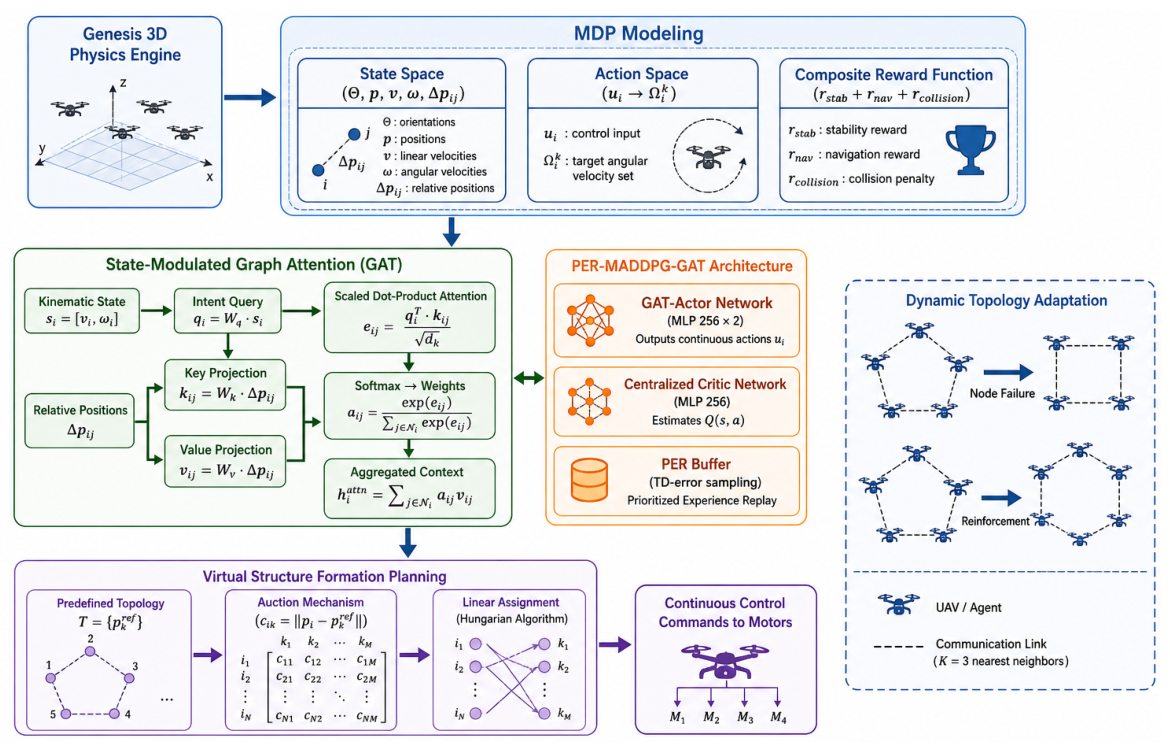
- 3D End-to-End MDP Formulation: We construct a comprehensive Markov Decision Process (MDP) for 3D quadrotor control. A composite reward function is designed, incorporating attitude constraints, velocity penalties, and collision avoidance, bridging the gap between high-level navigation decisions and low-level physical actuation.
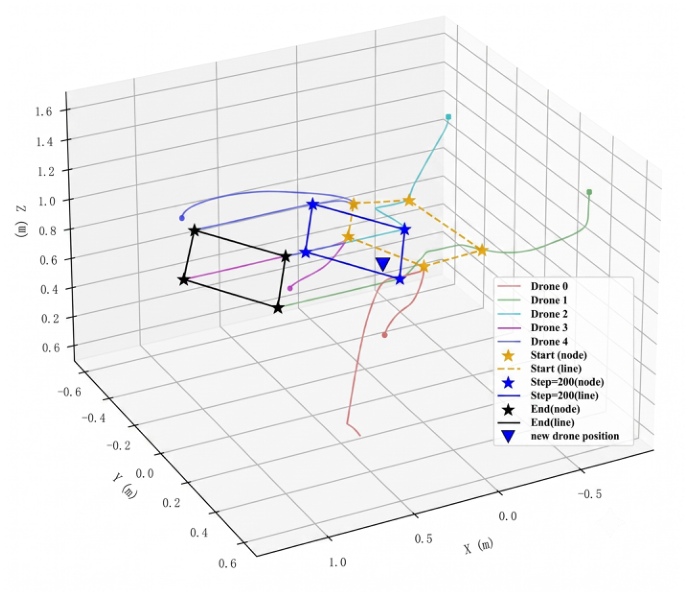
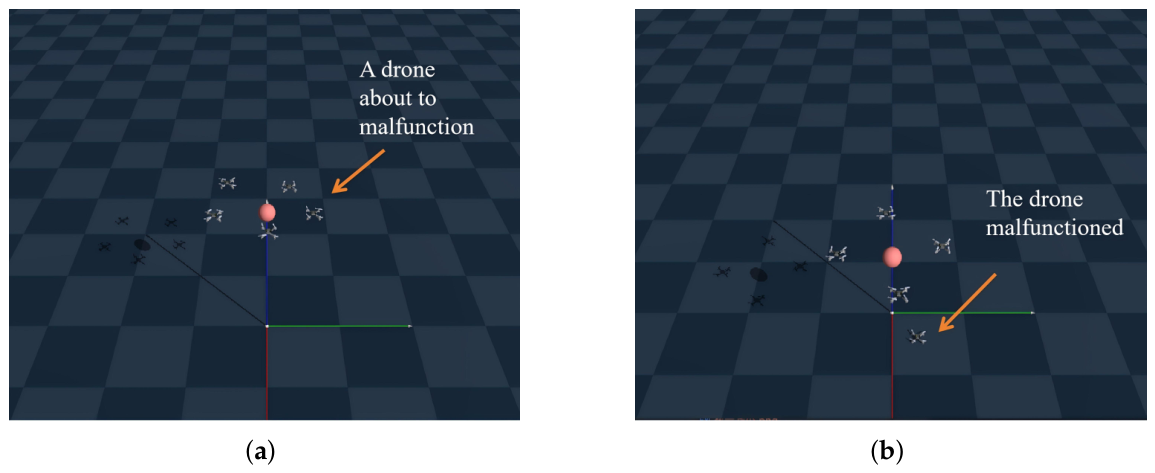
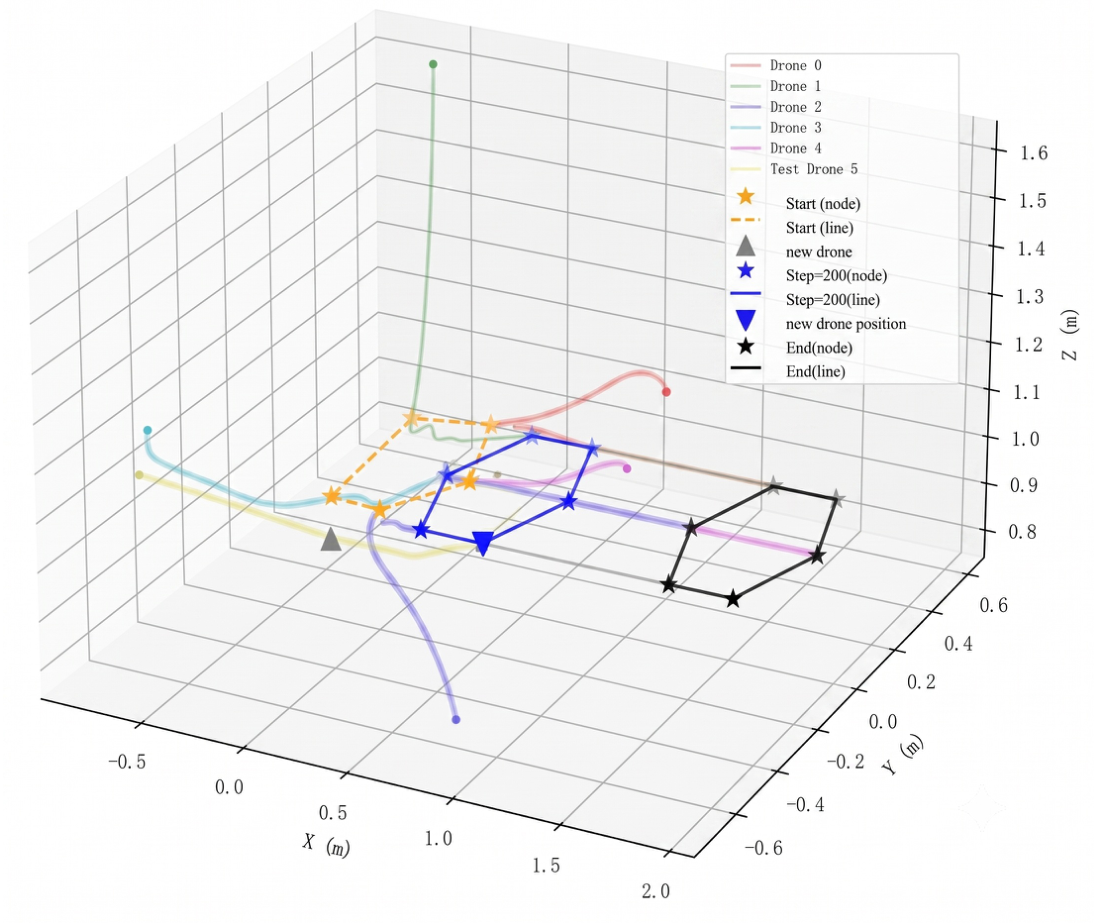
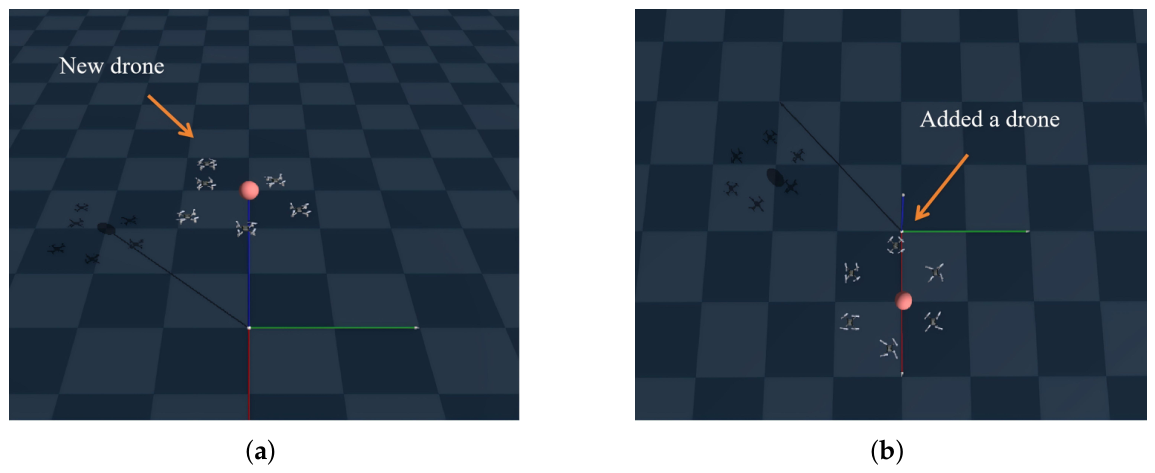
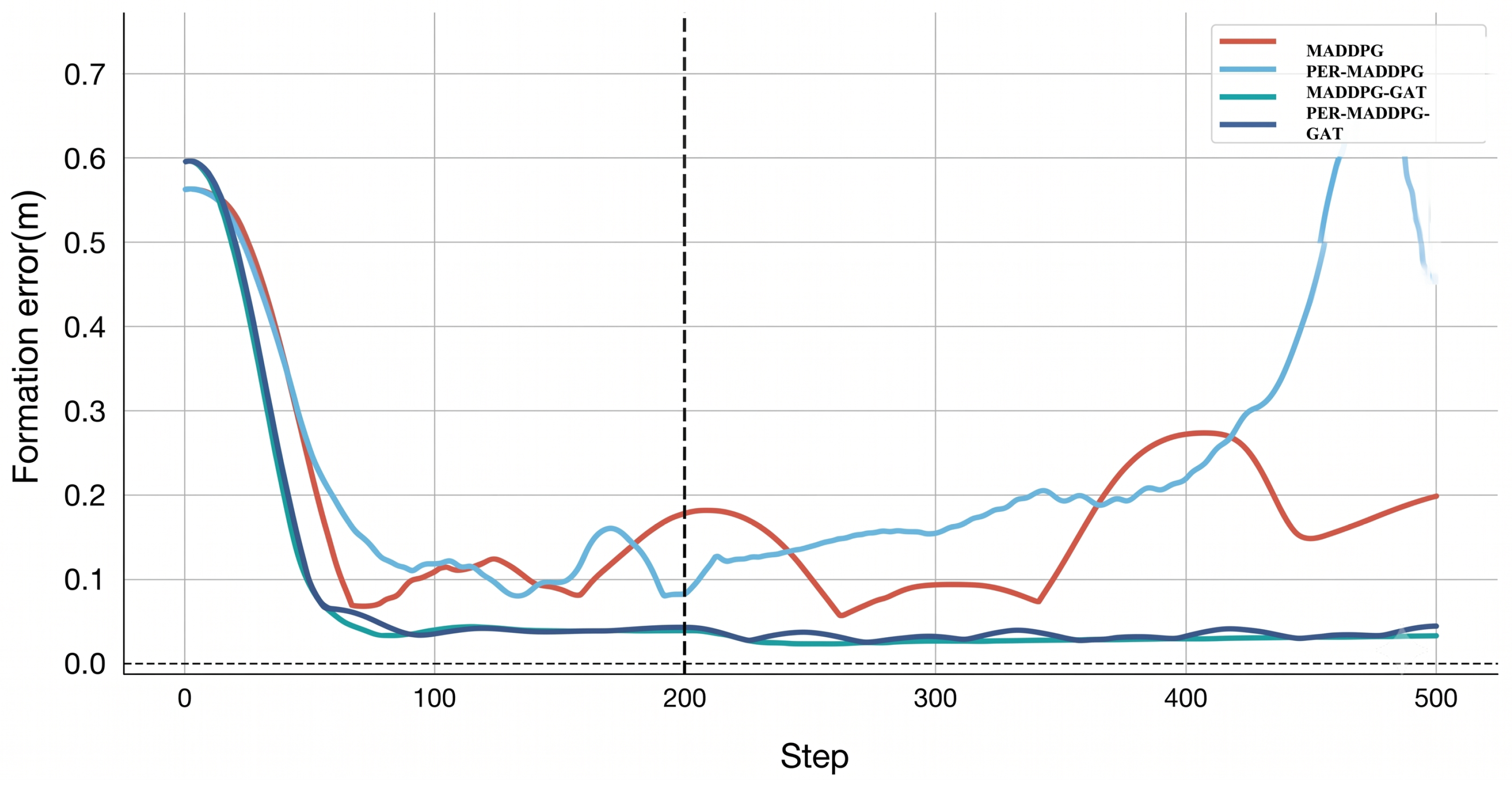
- State-Modulated GAT for Dynamic Topologies: We introduce a GAT module that dynamically aggregates neighbor features based on kinematic intent vectors. This design inherently accommodates variable neighbor counts, enabling the swarm to seamlessly adapt to sudden topological changes (e.g., node failures or additions) without requiring retraining.
- Auction-Based Formation Planning: We integrate a virtual structure approach with a decentralized auction mechanism to translate macroscopic swarm topologies into explicit relative-position tracking tasks, effectively minimizing the total maneuvering cost during formation reconfiguration.
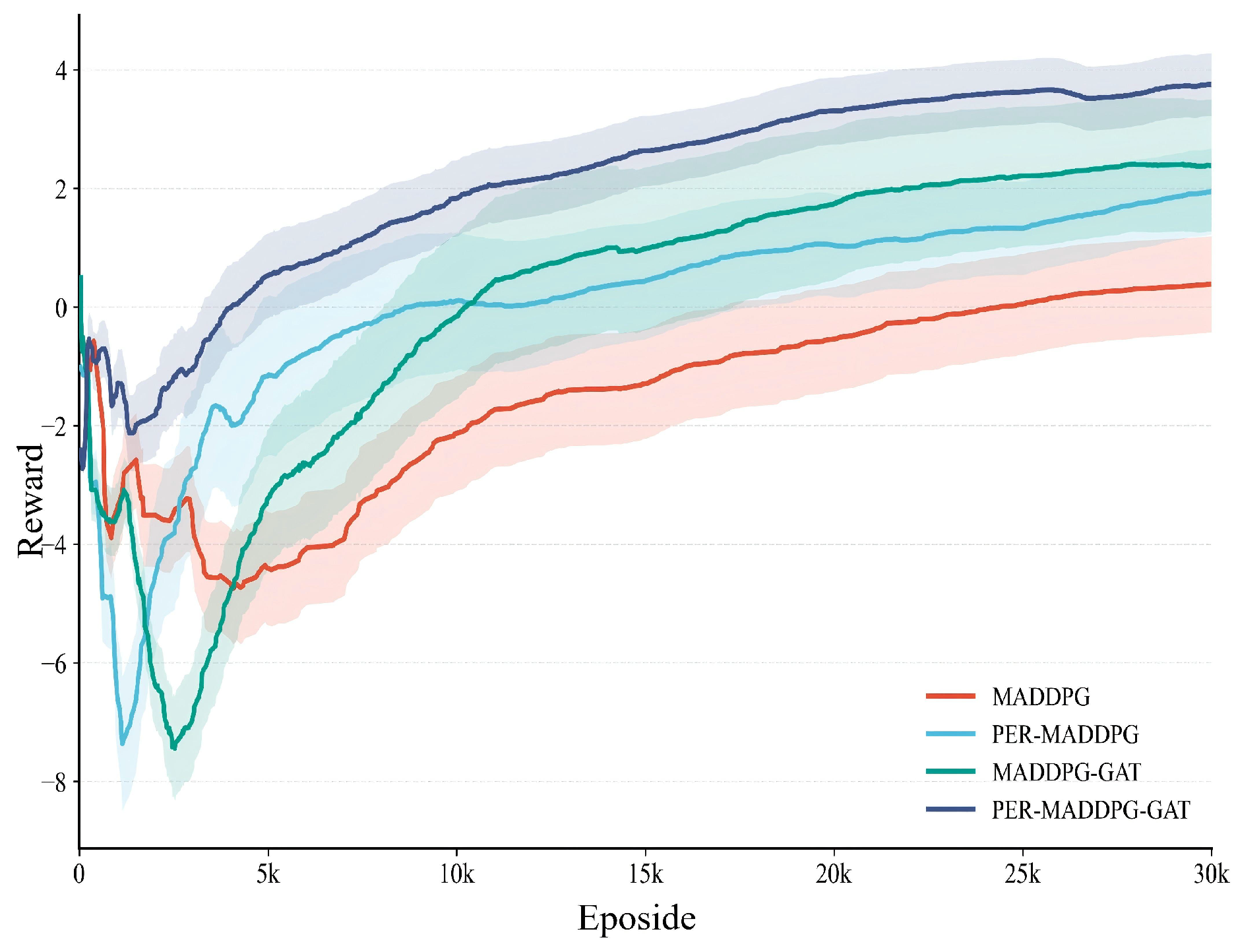
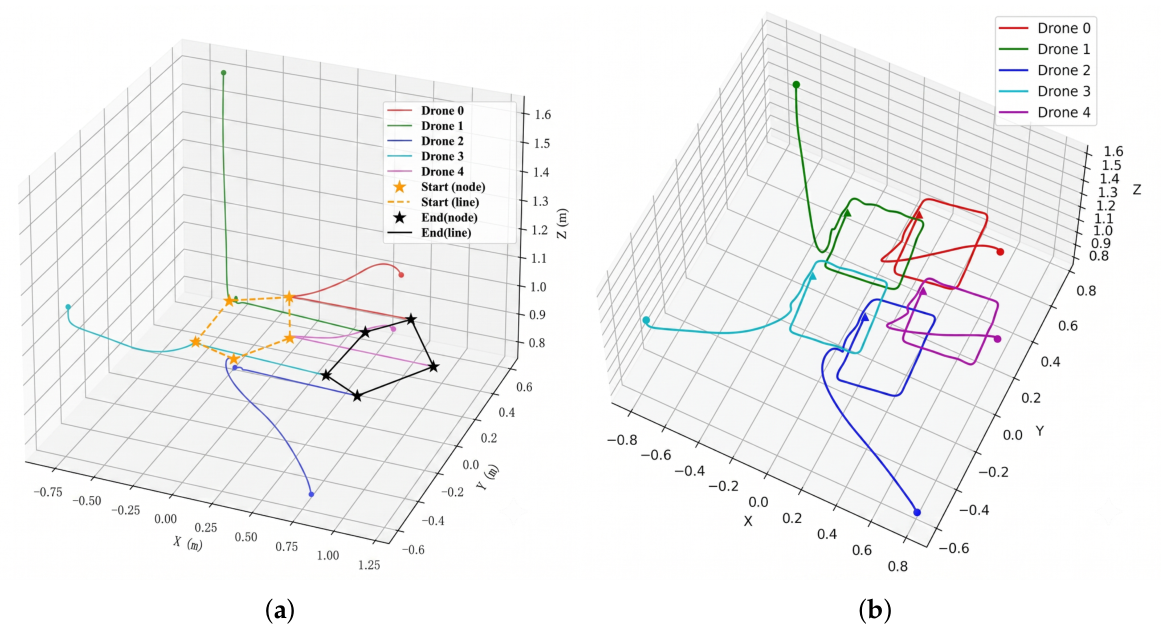
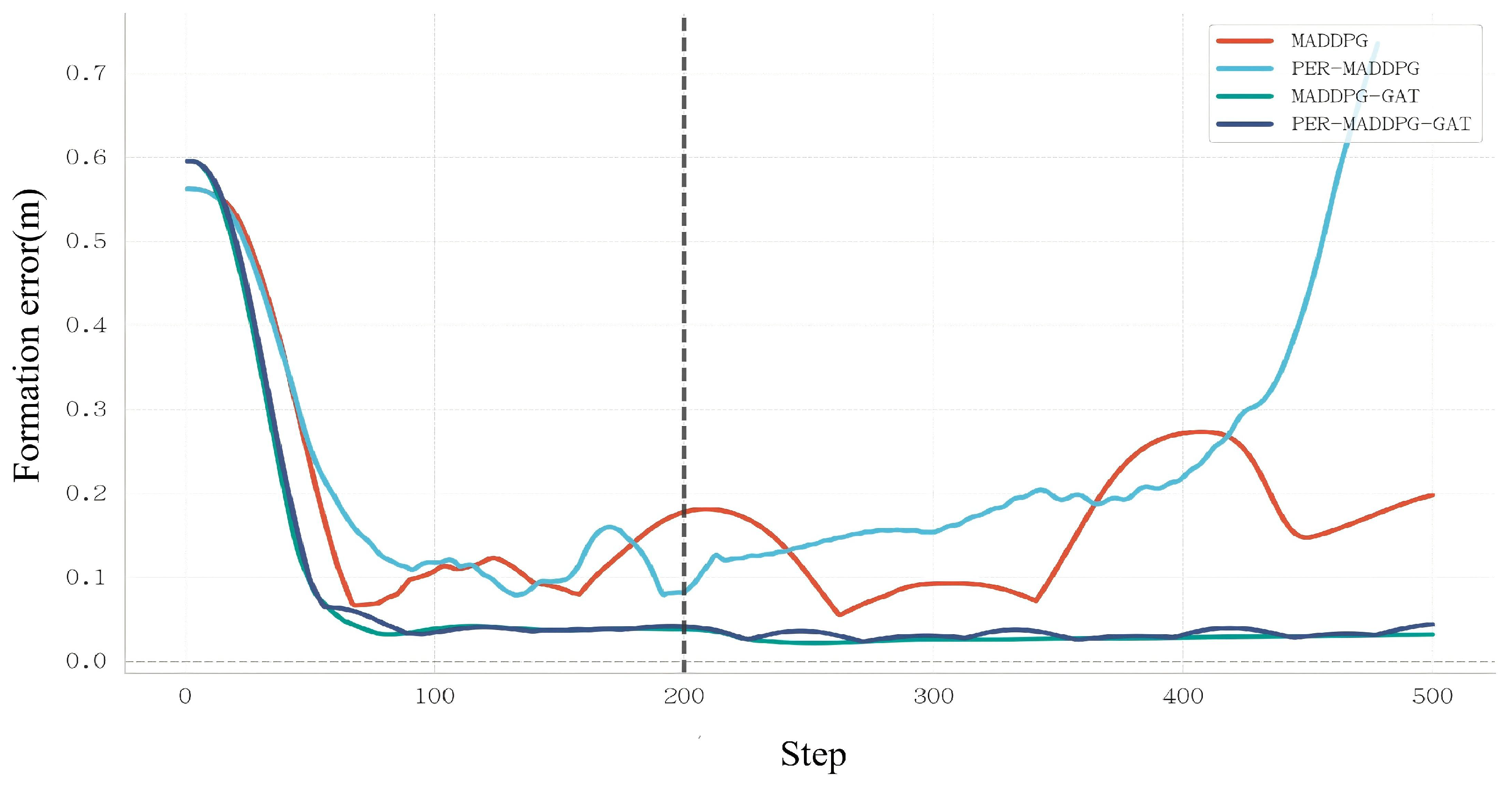
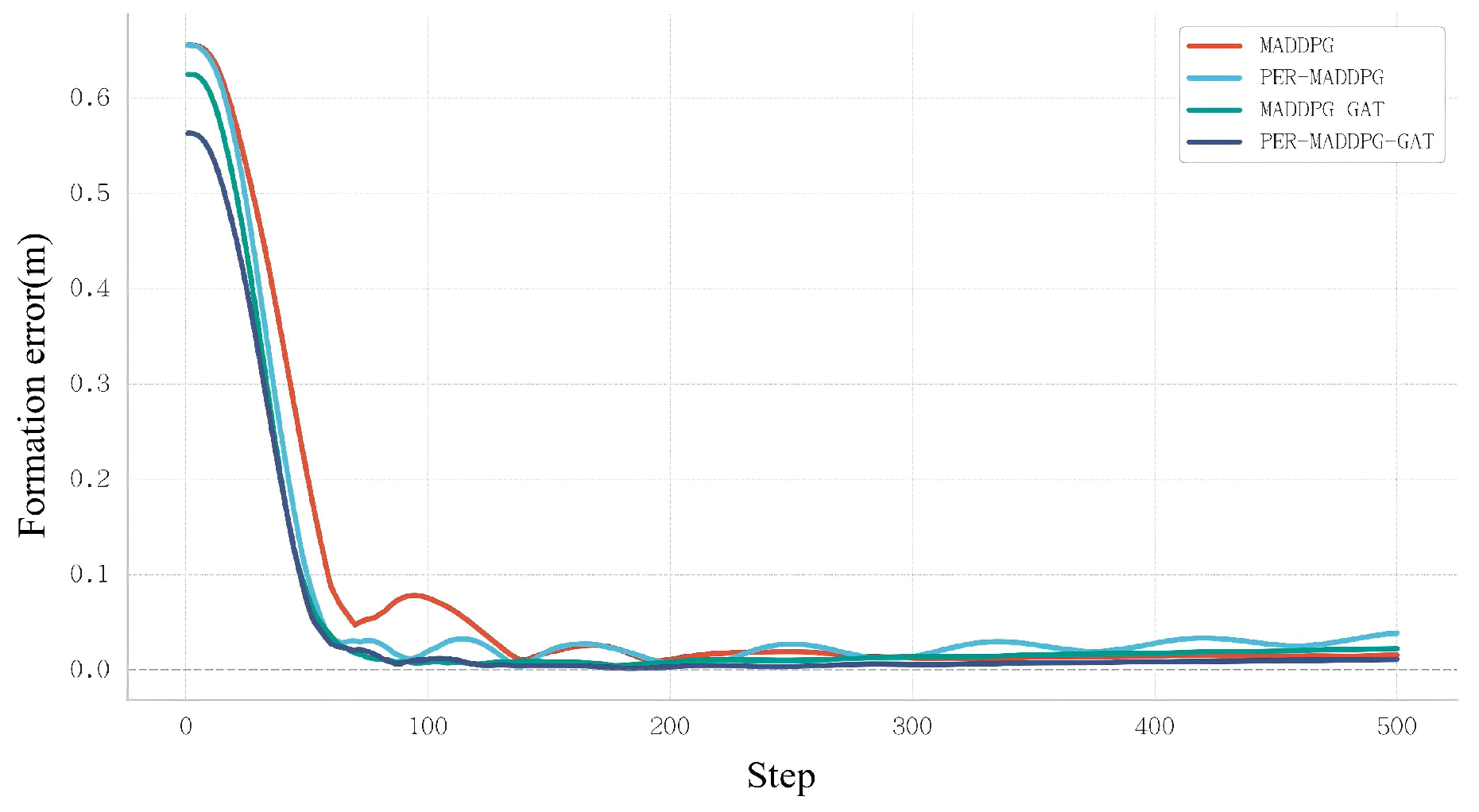
- 3D Physical Validation: The proposed PER-MADDPG-GAT algorithm is evaluated within the Genesis 3D physics engine. Extensive ablation studies confirm that the framework maintains high control precision and robustness under dynamic node reduction and reinforcement scenarios, significantly outperforming baseline MADRL methods.
2. GAT-Based UAV Swarm Control Algorithm
2.1. MDP Modeling for 3D End-to-End Swarm Control
2.2. State-Modulated Graph Attention Mechanism
2.3. Network Architecture and Algorithm Workflow
2.4. Swarm Formation Planning and Node Allocation
3. Experimental Validation and Results Analysis
3.1. Experimental Parameter Settings
3.2. Experimental Results and Analysis
4. Conclusions
Author Contributions
Funding
Institutional Review Board Statement
Informed Consent Statement
Data Availability Statement
Acknowledgments
Conflicts of Interest
Abbreviations
| UAV | Unmanned Aerial Vehicle |
| GAT | Graph Attention Network |
| PER | Prioritized Experience Replay |
| MADRL | Multi-Agent Deep Reinforcement Learning |
| MADDPG | Multi-Agent Deep Deterministic Policy Gradient |
References
- Zhang, J.; Zhang, L. Bio-inspired neighbor selection mechanism and performance evaluation for UAV Swarm: An extended visual-attention model. IFAC-PapersOnLine 2025, 59, 1569–1574. [Google Scholar] [CrossRef]
- Mishra, B.; Garg, D.; Narang, P.; Mishra, V. Drone-surveillance for search and rescue in natural disaster. Comput. Commun. 2020, 156, 1–10. [Google Scholar] [CrossRef]
- Dilshad, N.; Hwang, J.; Song, J.; Sung, N. Applications and challenges in video surveillance via drone: A brief survey. In Proceedings of the 2020 International Conference on Information and Communication Technology Convergence (ICTC); IEEE: Piscataway, NJ, USA, 2020; pp. 728–732. [Google Scholar]
- Albanese, A.; Sciancalepore, V.; Costa-Pérez, X. SARDO: An automated search-and-rescue drone-based solution for victims localization. IEEE Trans. Mob. Comput. 2021, 21, 3312–3325. [Google Scholar] [CrossRef]
- Hoang, M.T.O.; Grøntved, K.A.R.; Van Berkel, N.; Skov, M.B.; Christensen, A.L.; Merritt, T. Drone swarms to support search and rescue operations: Opportunities and challenges. In Cultural Robotics: Social Robots and Their Emergent Cultural Ecologies; Springer: Cham, Switzerland, 2023; pp. 163–176. [Google Scholar]
- Chen, W.; Liu, J.; Guo, H.; Kato, N. Toward robust and intelligent drone swarm: Challenges and future directions. IEEE Netw. 2020, 34, 278–283. [Google Scholar] [CrossRef]
- Saffre, F.; Hildmann, H.; Karvonen, H. The design challenges of drone swarm control. In Proceedings of the International Conference on Human-Computer Interaction, Washington, DC, USA, 24–29 July 2021; pp. 408–426. [Google Scholar]
- Liu, H.; Suzuki, S.; Wang, W.; Liu, H.; Wang, Q. Robust control strategy for quadrotor drone using reference model-based deep deterministic policy gradient. Drones 2022, 6, 251. [Google Scholar] [CrossRef]
- Ahn, H.; Hu, M.; Chung, Y.; You, K. Sliding-mode control for flight stability of quadrotor drone using adaptive super-twisting reaching law. Drones 2023, 7, 522. [Google Scholar] [CrossRef]
- Zhang, P.; Zhou, J.; Tian, D.; Duan, X.; Zhao, D.; Guo, K. Distributed Robust UAVs Formation Control Based on Semidefinite Programming. IEEE Access 2024, 12, 61123–61134. [Google Scholar] [CrossRef]
- Liu, J.; Zhang, Z.; Zhang, L.; Zhang, K.; Yan, C. A Decoupled Non-Uniform Guiding Vector Field for Multi-Robot Coordinated Path-Following on 2D Manifolds. IEEE Trans. Aerosp. Electron. Syst. 2026, 62, 5751–5766. [Google Scholar] [CrossRef]
- Yan, C.; Zhang, Z.; Bao, W.; Zhang, K.; Zhang, L. Collision-Free Robust Trajectory Tracking Control for Fixed-Wing UAV with Flexible Performance Constraints. Aerosp. Sci. Technol. 2025, 168, 111217. [Google Scholar] [CrossRef]
- Zhang, Y.; Li, Y.; Wu, Z.; Xu, J. Deep reinforcement learning for UAV swarm rendezvous behavior. J. Syst. Eng. Electron. 2023, 34, 360–373. [Google Scholar] [CrossRef]
- Li, B.; Wang, J.; Song, C.; Yang, Z.; Wan, K.; Zhang, Q. Multi-UAV roundup strategy method based on deep reinforcement learning CEL-MADDPG algorithm. Expert Syst. Appl. 2024, 245, 123018. [Google Scholar]
- Zhang, Y.; Wu, Z.; Ma, Y.; Sun, R.; Xu, Z. Research on autonomous formation of multi-UAV based on MADDPG algorithm. In Proceedings of the 2022 IEEE 17th International Conference on Control & Automation (ICCA); IEEE: Piscataway, NJ, USA, 2022; pp. 249–254. [Google Scholar]
- Xing, X.; Ma, Y.; Lei, Y.; Li, Y.; Xiao, B. Multi-UAV Rendezvous Trajectory Planning Based on Improved MADDPG Algorithm in Complex Dynamic Obstacle Environments. IEEE Access 2025, 13, 5580–5591. [Google Scholar] [CrossRef]
- Chen, J.; Wang, Y.; Zhang, Y.; Lu, Y.; Shu, Q.; Hu, Y. Extrinsic-and-Intrinsic Reward-Based Multi-Agent Reinforcement Learning for Multi-UAV Cooperative Target Encirclement. IEEE Trans. Intell. Transp. Syst. 2025, 26, 17653–17665. [Google Scholar]
- Yang, Q.; Lu, J.; Zhang, Y.; Shao, S. Multi-UAV Cooperative Path Planning via Graph Neural Network and Proximal Policy Optimization. IEEE Access 2025, 13, 193575–193588. [Google Scholar] [CrossRef]
- Xu, Z.; Wang, Y.; Wu, Z.; Zheng, W.X.; Hu, C. Federated learning-based offset-free distributed control of nonlinear networked systems with application to IIoT. IEEE Trans. Netw. Sci. Eng. 2025, 12, 1859–1871. [Google Scholar]
- Sun, J.; Zhu, Z.; Li, H.; Chai, Y.; Qi, G.; Wang, H.; Hu, Y.H. An integrated critic-actor neural network for reinforcement learning with application of DERs control in grid frequency regulation. Int. J. Electr. Power Energy Syst. 2019, 111, 286–299. [Google Scholar] [CrossRef]
- Yadav, K.; Palaparthi, D.P.; Garg, G.; HB, H.; Priyanka, T.P.; Kaliappan, S. MAPPO-GAT: A Graph-Attention-Driven Multi-Agent Reinforcement Learning Framework for Entropy-Aware Autonomous Drone Swarm Coordination. In Proceedings of the 2025 1st International Conference on Advancement in Futuristic Technologies (ICAFT); IEEE: Piscataway, NJ, USA, 2025; pp. 1–8. [Google Scholar]
- Fu, S.; Li, K.; Huang, H.; Ma, C.; Fan, Q.; Zhu, Y. Red-billed blue magpie optimizer: A novel metaheuristic algorithm for 2D/3D UAV path planning and engineering design problems. Artif. Intell. Rev. 2024, 57, 134. [Google Scholar]
- Lyu, R.; Pang, J.; Tian, X.; Zhao, W.; Zhang, J. How to optimize the 2D/3D urban thermal environment: Insights derived from UAV LiDAR/multispectral data and multi-source remote sensing data. Sustain. Cities Soc. 2023, 88, 104287. [Google Scholar]
- Veličković, P.; Cucurull, G.; Casanova, A.; Romero, A.; Lio, P.; Bengio, Y. Graph attention networks. arXiv 2017, arXiv:1710.10903. [Google Scholar]
- Schaul, T.; Quan, J.; Antonoglou, I.; Silver, D. Prioritized experience replay. arXiv 2015, arXiv:1511.05952. [Google Scholar]
- Askari, A.; Mortazavi, M.; Talebi, H. UAV formation control via the virtual structure approach. J. Aerosp. Eng. 2015, 28, 04014047. [Google Scholar] [CrossRef]
- Sutton, R.S.; Barto, A.G. Reinforcement Learning: An Introduction, 2nd ed.; MIT Press: Cambridge, MA, USA, 2018. [Google Scholar]







| Parameter Name | Symbol | Value |
|---|---|---|
| Initial Number of UAVs | N | 5 |
| Desired Swarm Radius | R | 0.3 m |
| Target Flight Altitude | 1.0 m | |
| Simulation Frequency | f | 100 Hz |
| Max Steps per Episode | 500 | |
| Total Training Episodes | 30,000 | |
| Batch Size | 256 | |
| Map Dimensions | – | |
| Target Tracking Reward | 3.0 | |
| Proximity Guidance Reward | 300.0 | |
| Altitude Maintenance Reward | 1.0 | |
| Velocity Tracking Reward | 1.0 | |
| Attitude Stability Reward | 10.0 | |
| Action Smoothness Penalty | 0.02 | |
| Actor Learning rate | ||
| Critic Learning rate | ||
| Replay Buffer Capacity | ||
| PER prioritization exponent | 0.6 | |
| PER importance sampling exponent | 0.4 |
Disclaimer/Publisher’s Note: The statements, opinions and data contained in all publications are solely those of the individual author(s) and contributor(s) and not of MDPI and/or the editor(s). MDPI and/or the editor(s) disclaim responsibility for any injury to people or property resulting from any ideas, methods, instructions or products referred to in the content. |
© 2026 by the authors. Licensee MDPI, Basel, Switzerland. This article is an open access article distributed under the terms and conditions of the Creative Commons Attribution (CC BY) license.
Share and Cite
Chen, Y.; Xu, Q.; Zhang, C.; Li, Z. Multi-Agent Deep Reinforcement Learning (MADRL)-Based End-to-End Formation Control for UAV Swarm with Dynamic Topology. Appl. Sci. 2026, 16, 6554. https://doi.org/10.3390/app16136554
Chen Y, Xu Q, Zhang C, Li Z. Multi-Agent Deep Reinforcement Learning (MADRL)-Based End-to-End Formation Control for UAV Swarm with Dynamic Topology. Applied Sciences. 2026; 16(13):6554. https://doi.org/10.3390/app16136554
Chicago/Turabian StyleChen, Yanping, Qingyang Xu, Chi Zhang, and Zhengmao Li. 2026. "Multi-Agent Deep Reinforcement Learning (MADRL)-Based End-to-End Formation Control for UAV Swarm with Dynamic Topology" Applied Sciences 16, no. 13: 6554. https://doi.org/10.3390/app16136554
APA StyleChen, Y., Xu, Q., Zhang, C., & Li, Z. (2026). Multi-Agent Deep Reinforcement Learning (MADRL)-Based End-to-End Formation Control for UAV Swarm with Dynamic Topology. Applied Sciences, 16(13), 6554. https://doi.org/10.3390/app16136554