Sedimentary Microfacies Analysis and Reservoir Prediction of Braided River Delta Reservoirs in Central Asia’s S Gas Field


Featured Application
Abstract
1. Introduction
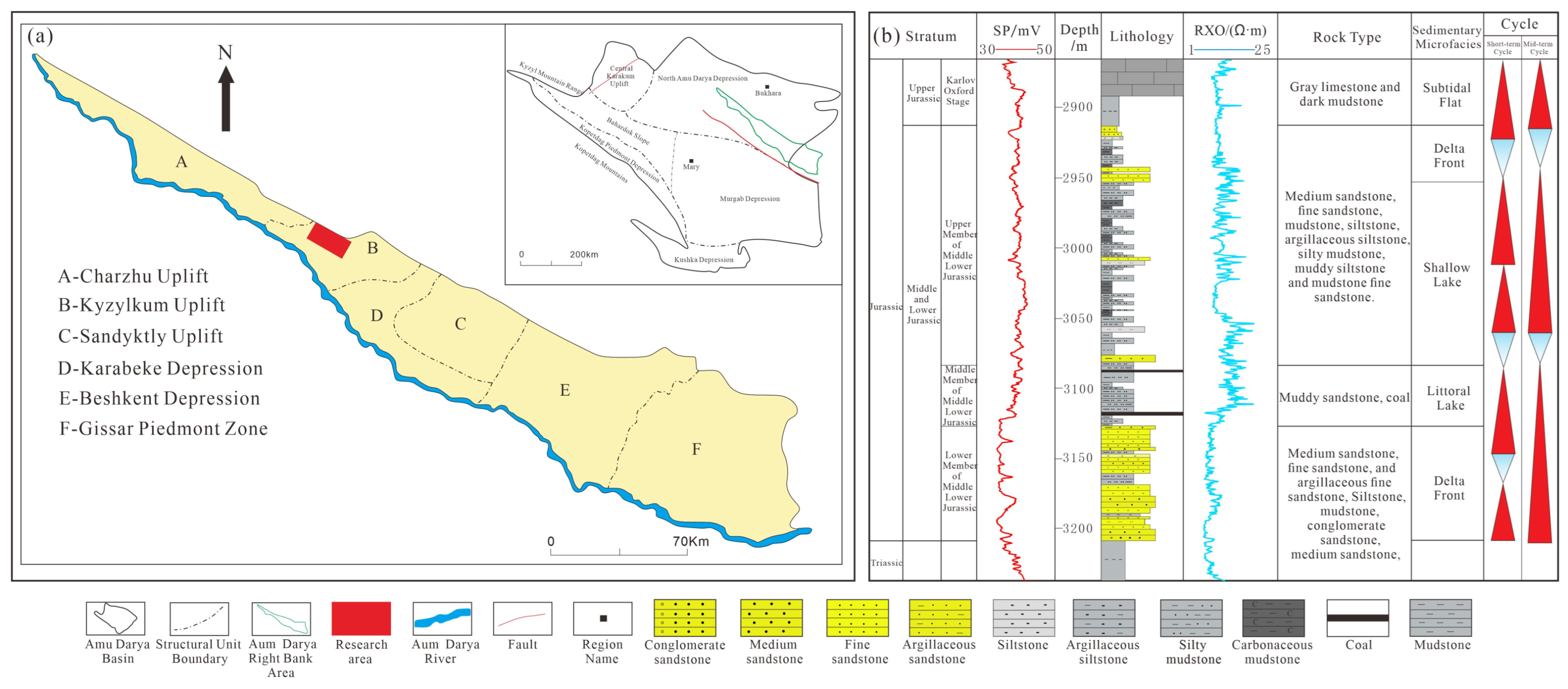
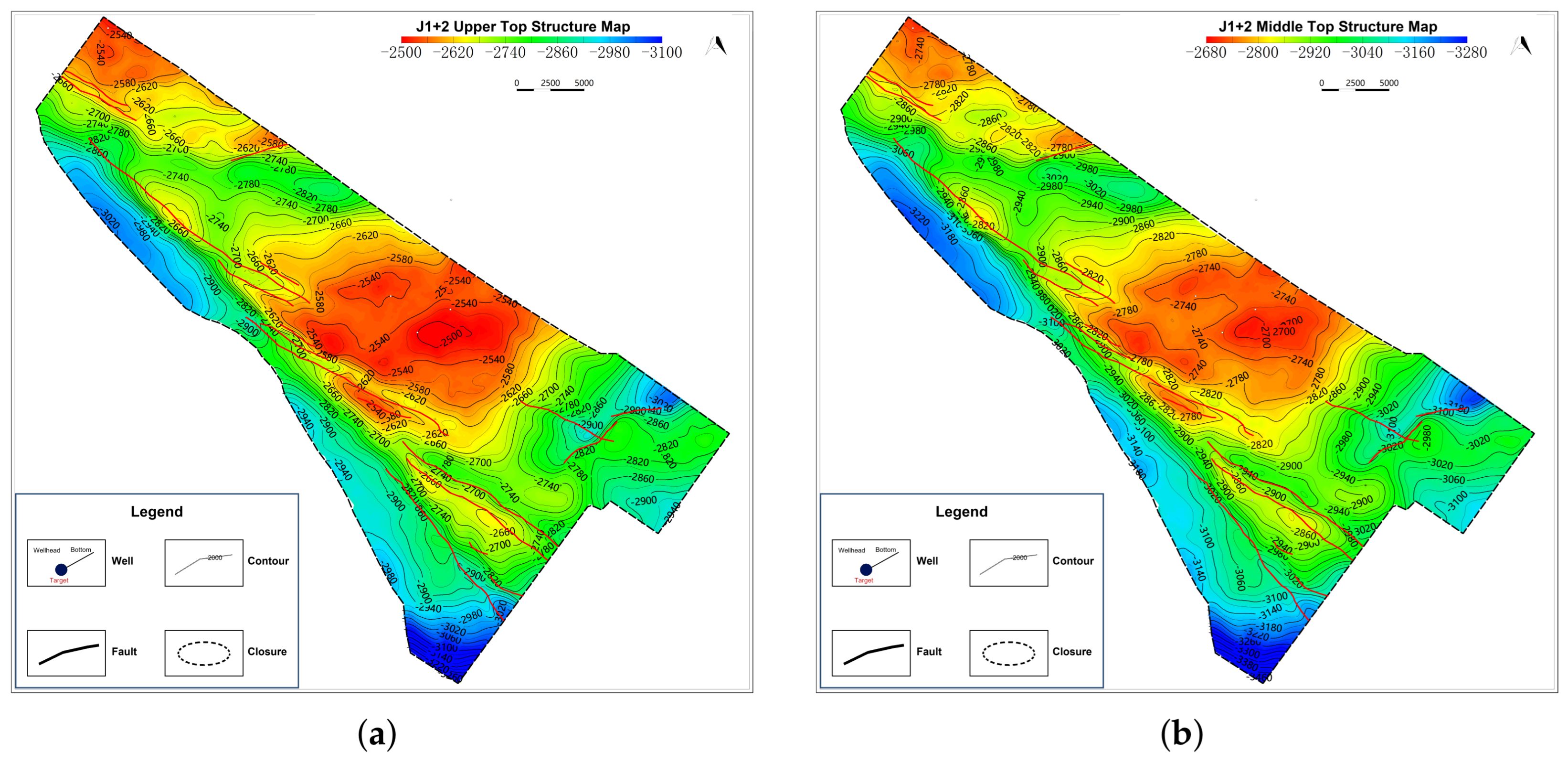
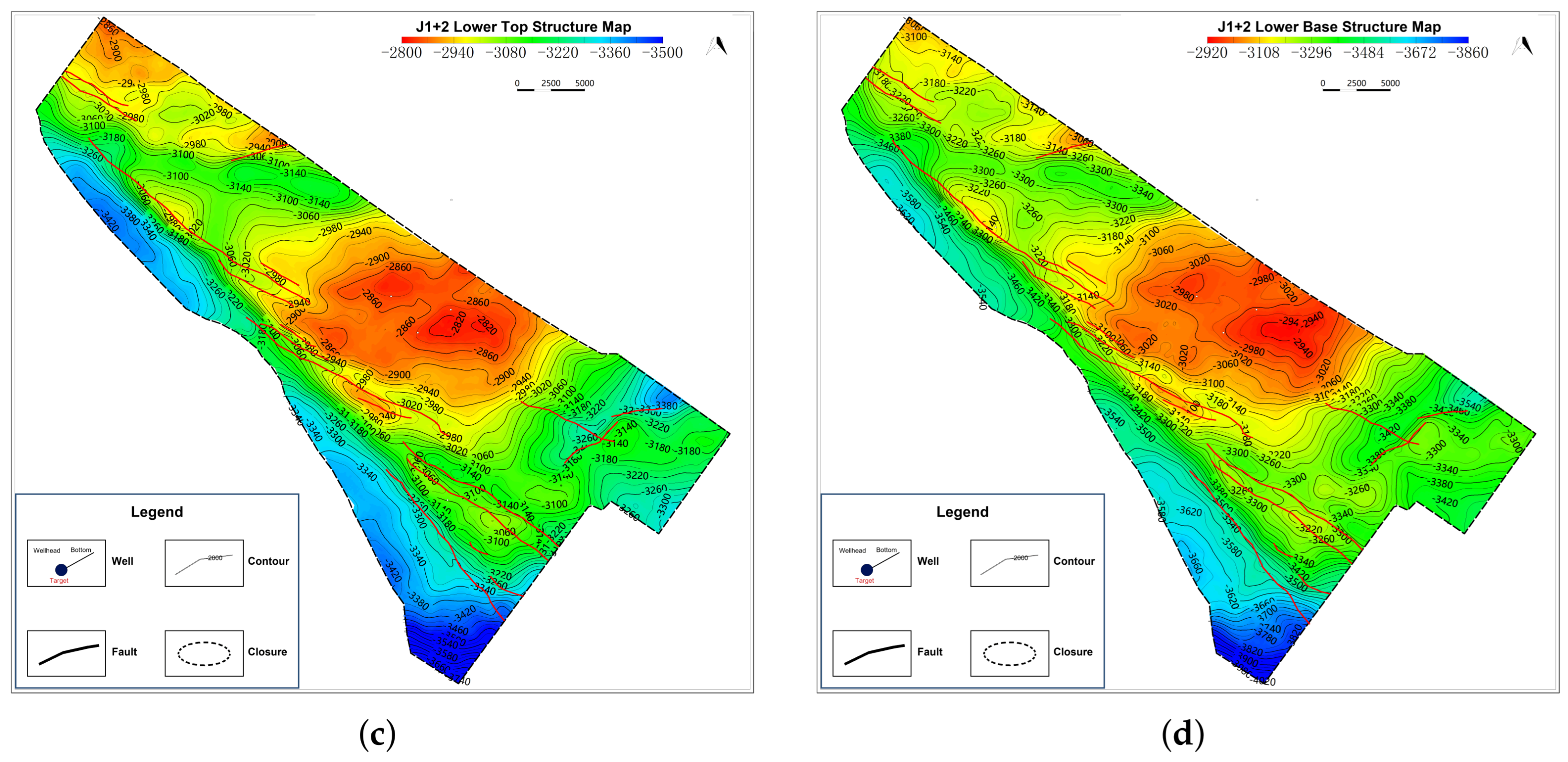
2. Geological Setting
3. Data and Methods
3.1. Dataset
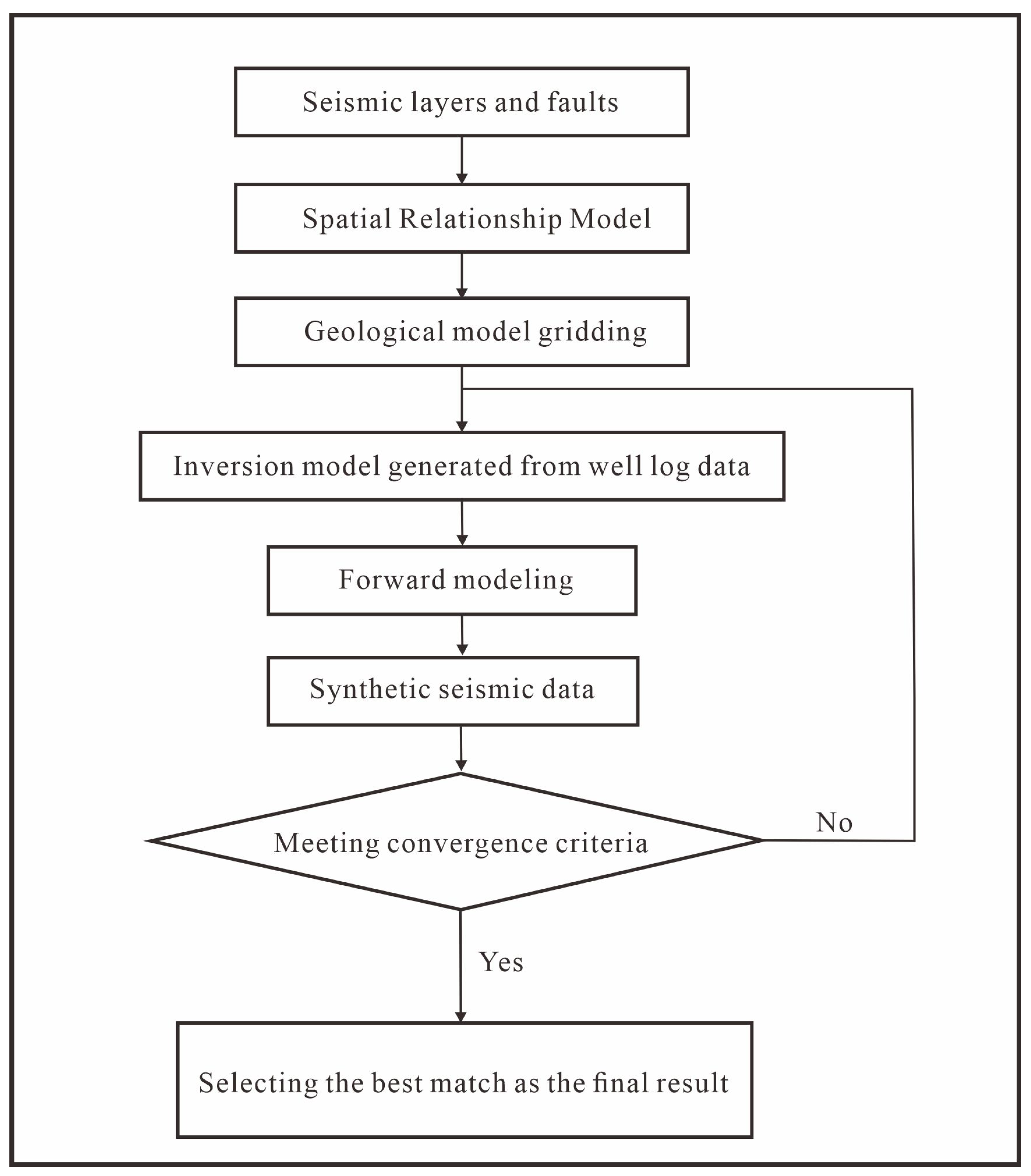
3.2. Integrated Workflow
- (1)
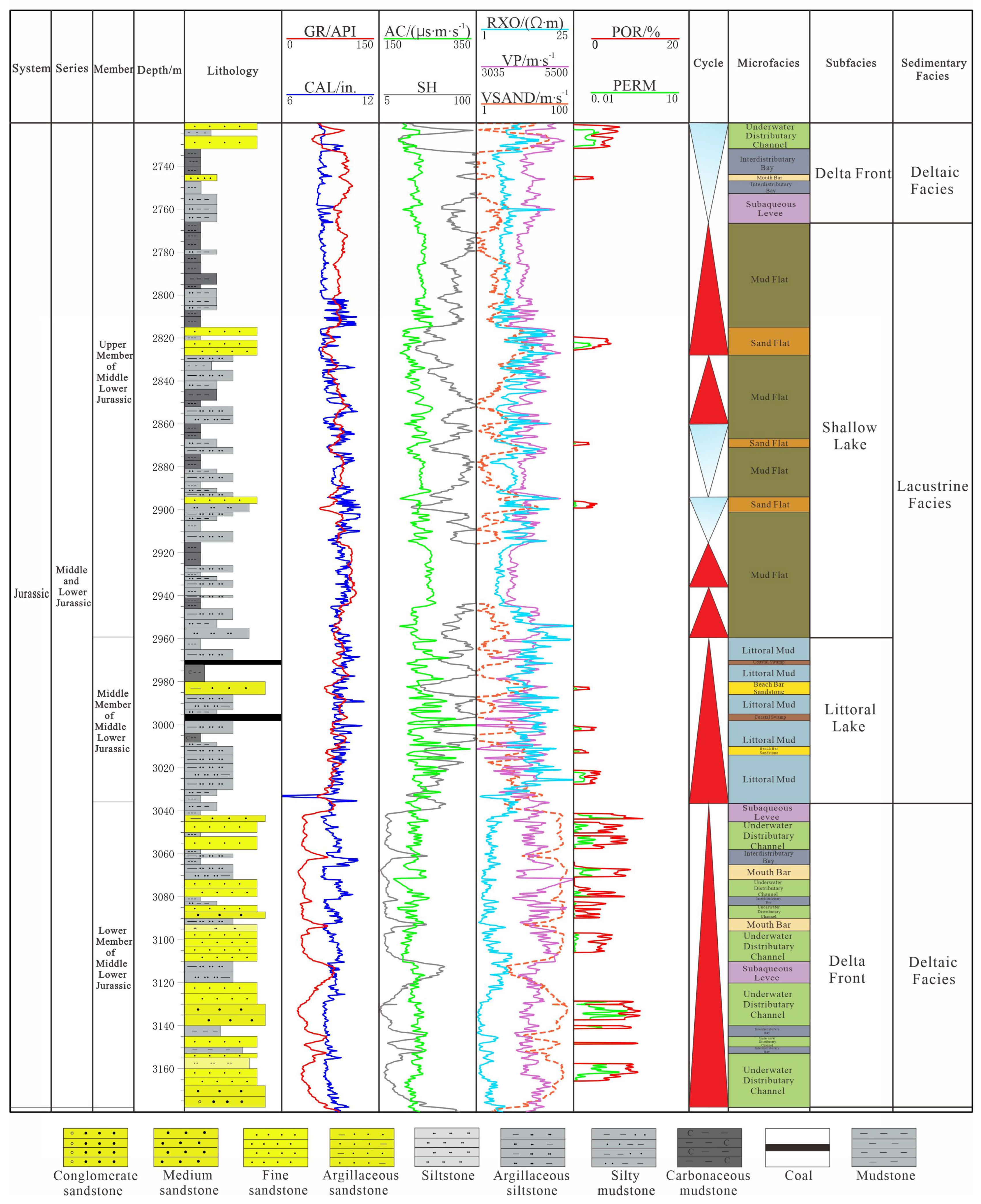
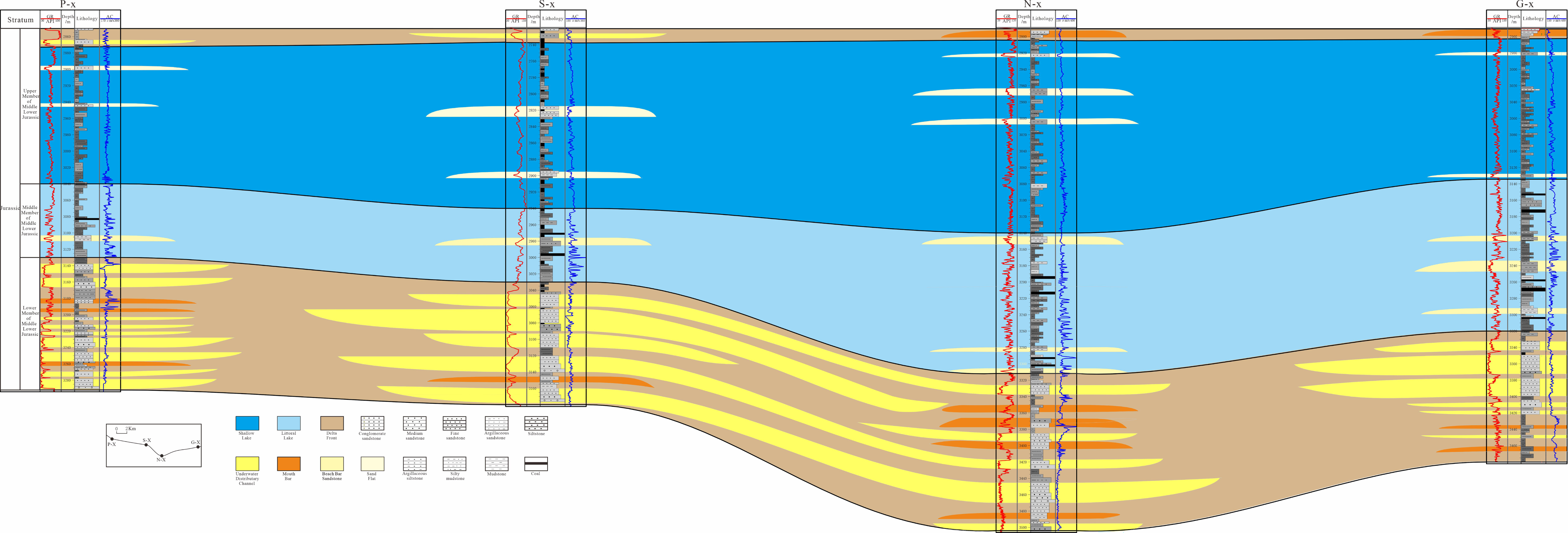
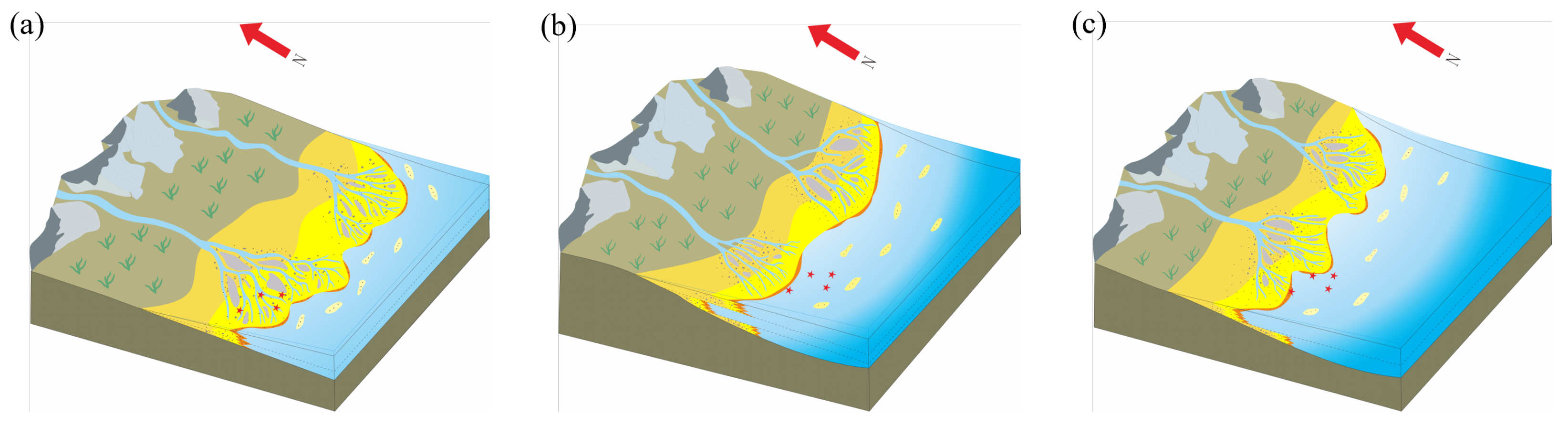
- Sedimentary facies and microfacies characterization. Lithofacies, grain-size types, electrofacies, and seismic facies were identified from core, logs, and seismic profiles. Single-well columns and cross-well correlations resolved vertical stacking; planar microfacies maps were prepared for the Lower, Middle, and late Upper members.
- (2)
- Geological constraints for reservoir prediction. Boundaries of underwater distributary channels, mouth bars, and interdistributary bays on planar microfacies maps were used as lateral guides for delineating sand-prone fairways, analogous to the use of facies belts and stratal boundaries to constrain low-frequency models in fan-delta inversion [3,11].
- (3)
- (4)
3.3. Sedimentary Facies Analysis
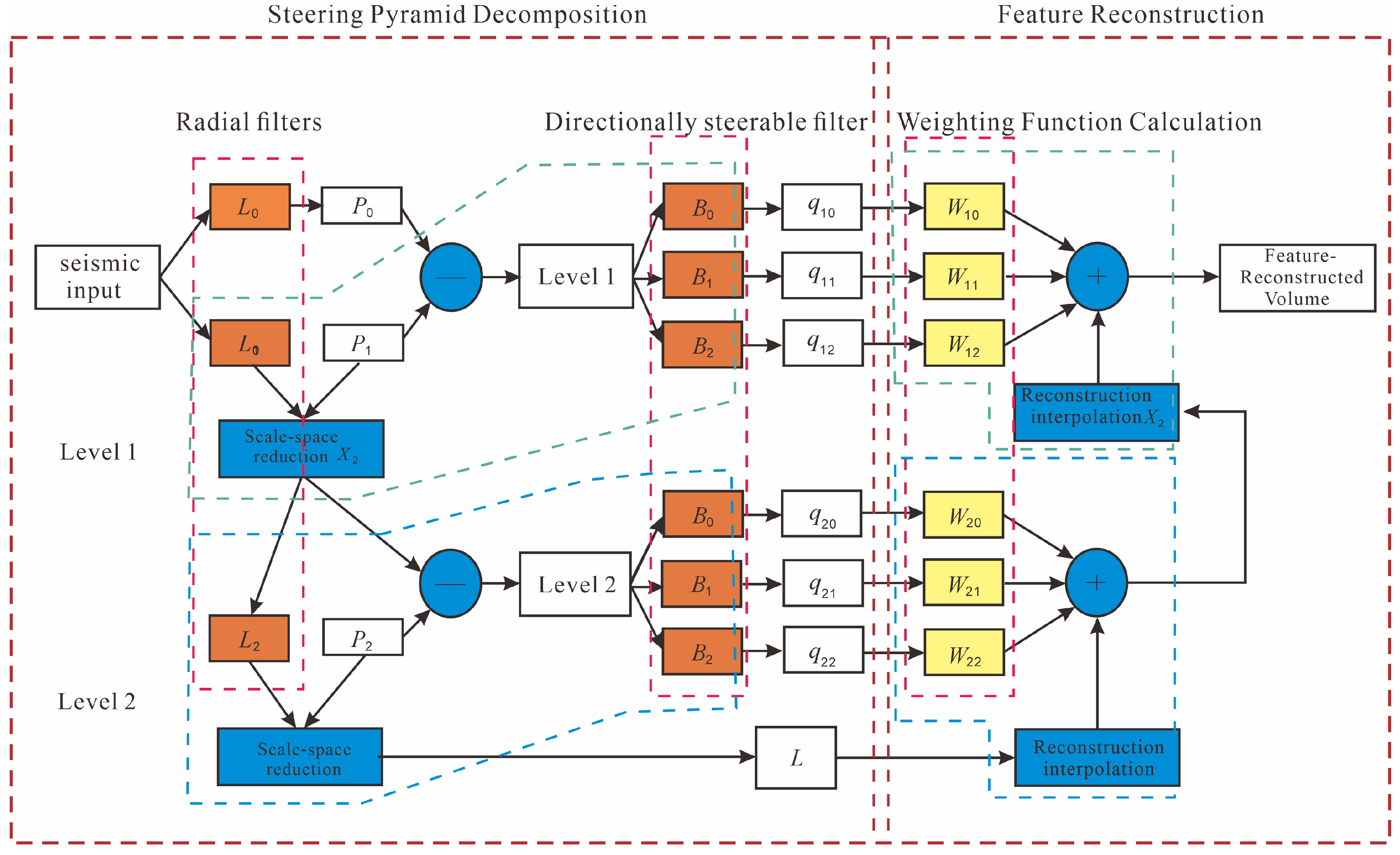
3.4. Steerable Pyramid-Based Seismic Enhancement
3.5. Stochastic Optimization Seismic Inversion
3.5.1. Forward Model and Boundary Conditions
3.5.2. Objective Function and Regularization
3.5.3. Discretization Sensitivity
4. Results
4.1. Sedimentary Facies Characteristics
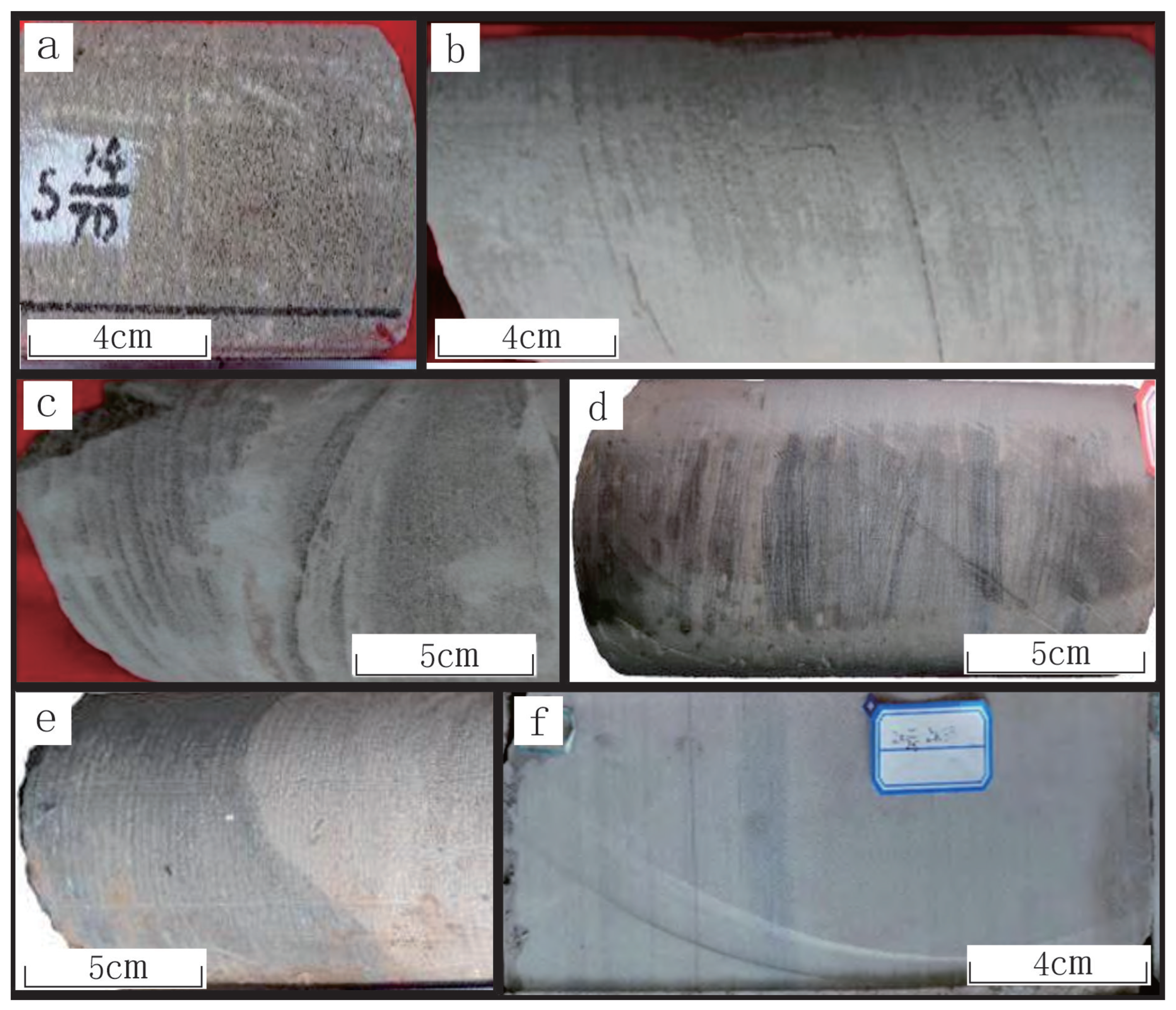
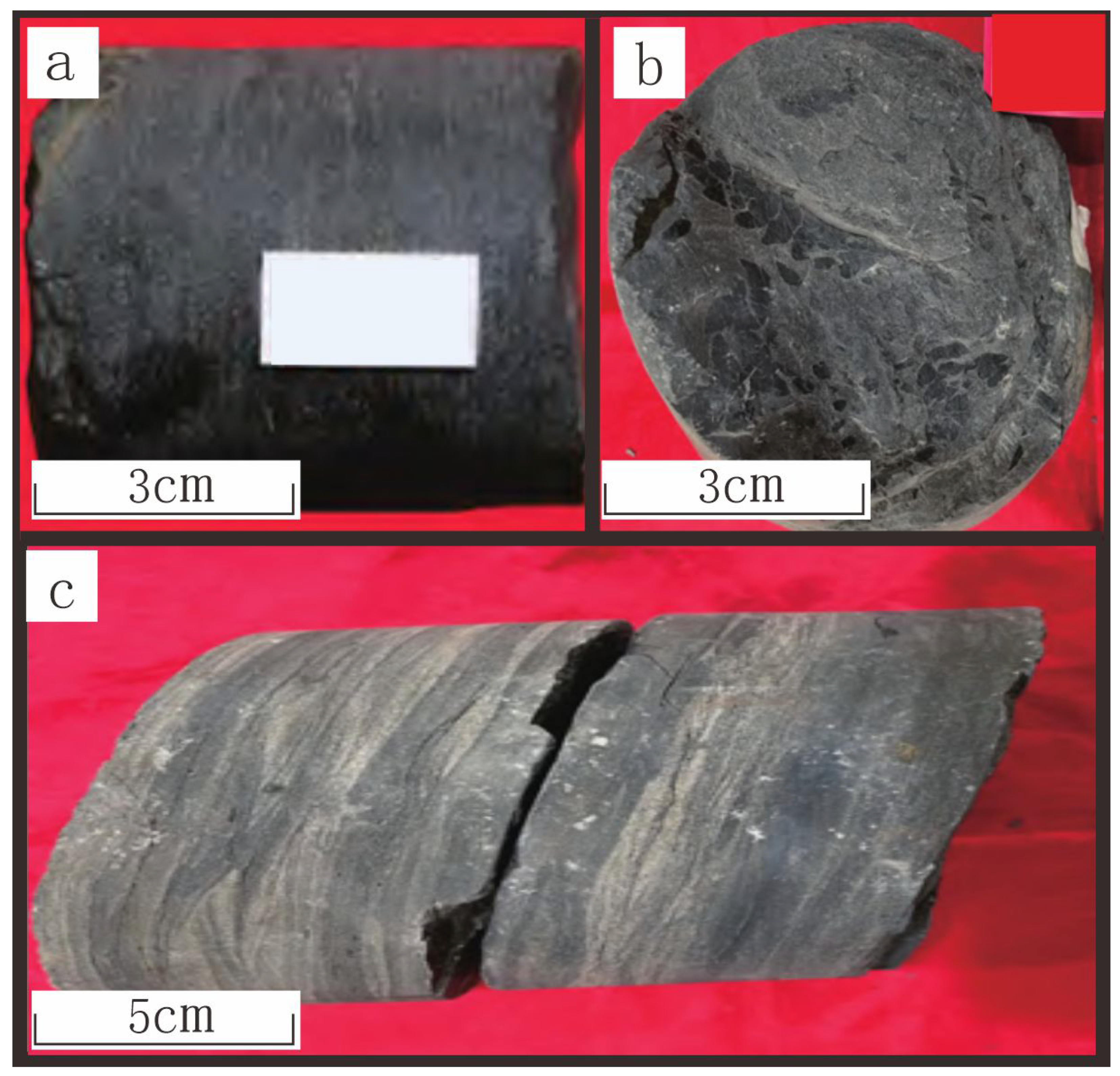
4.1.1. Sandstone Facies
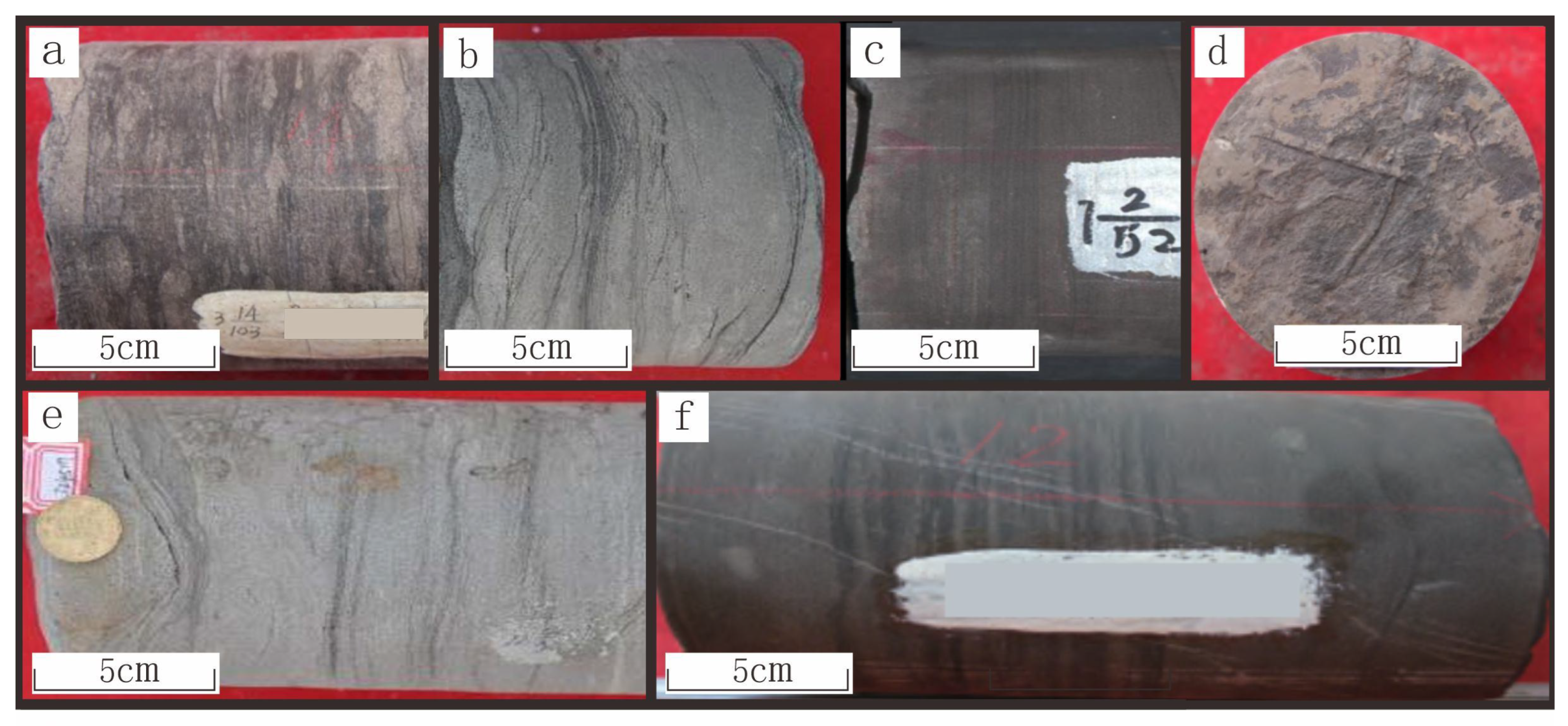
4.1.2. Siltstone Facies
4.1.3. Mudstone Facies
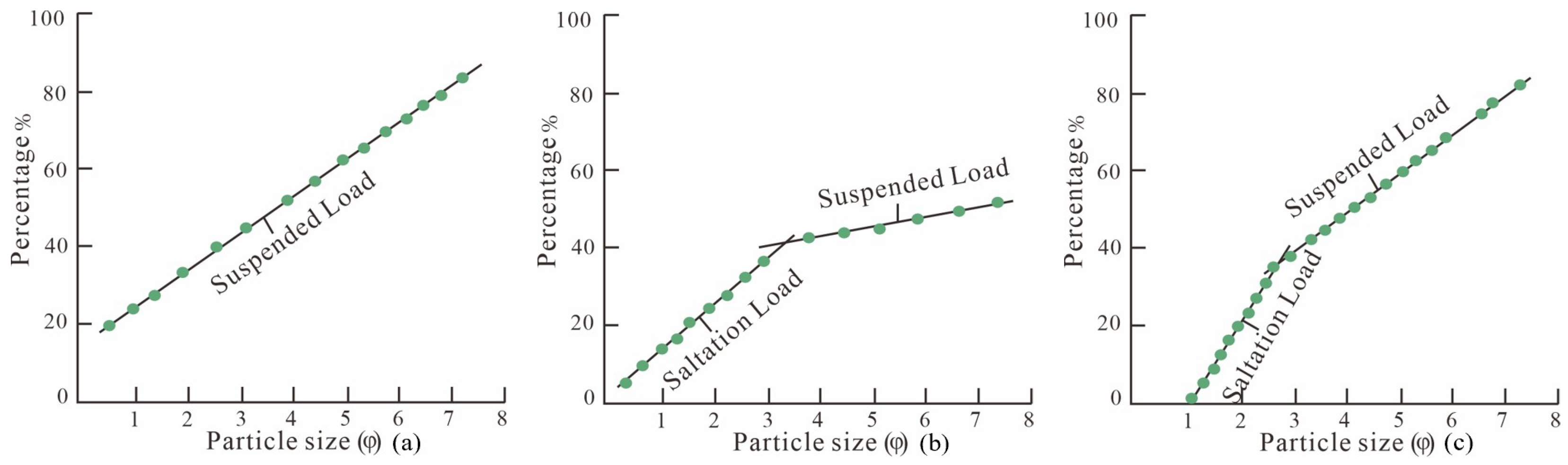
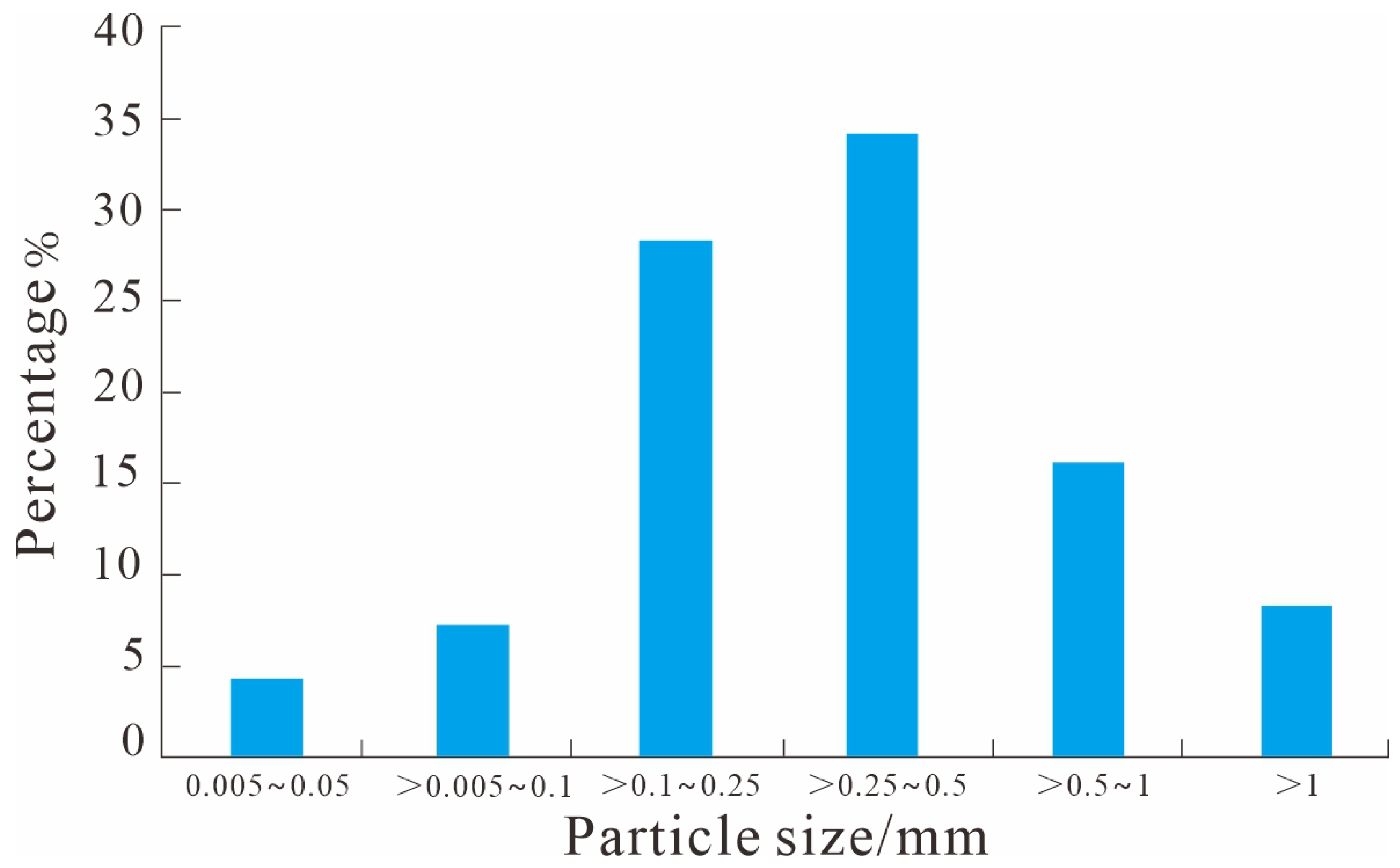
4.1.4. Grain Size Analysis
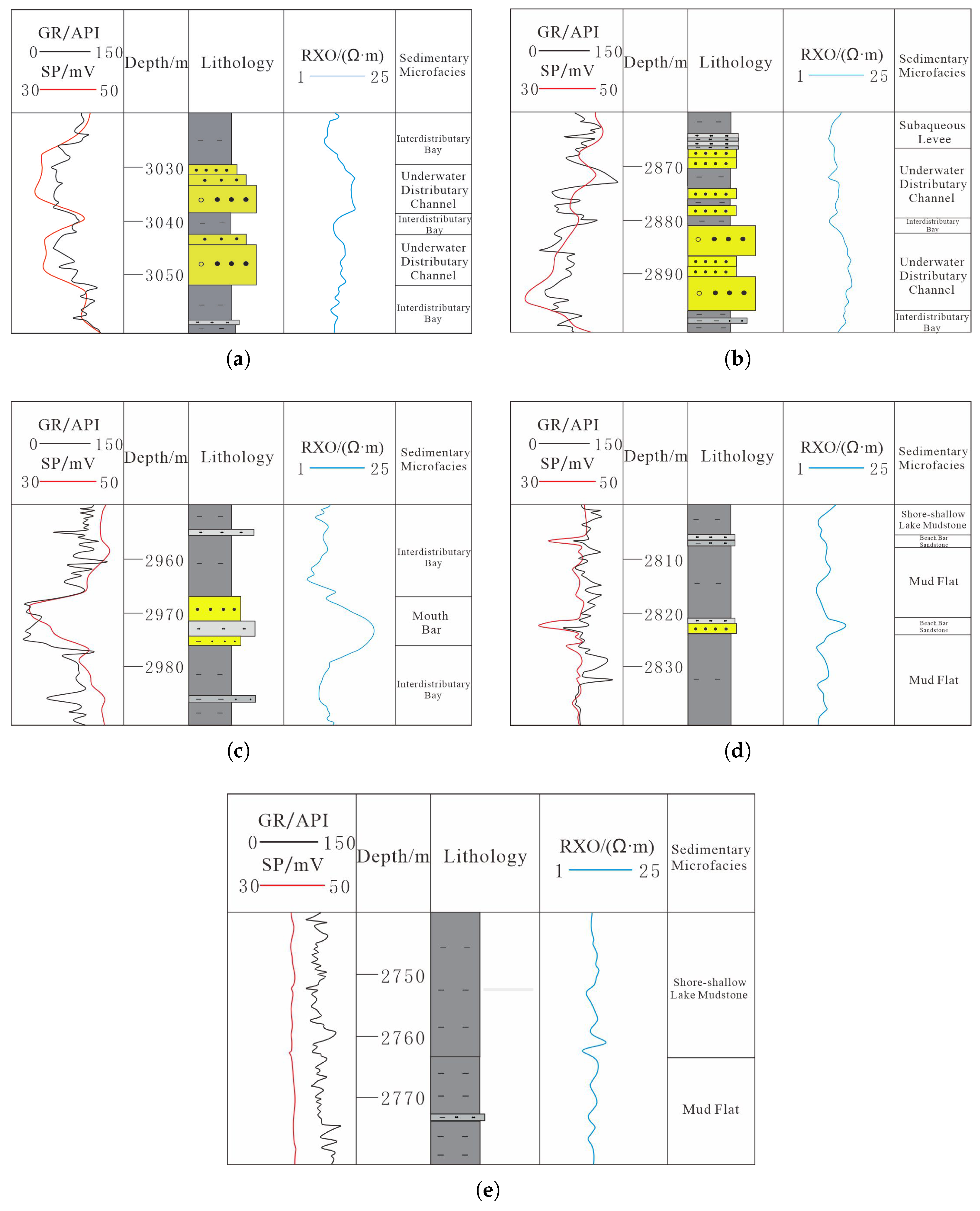
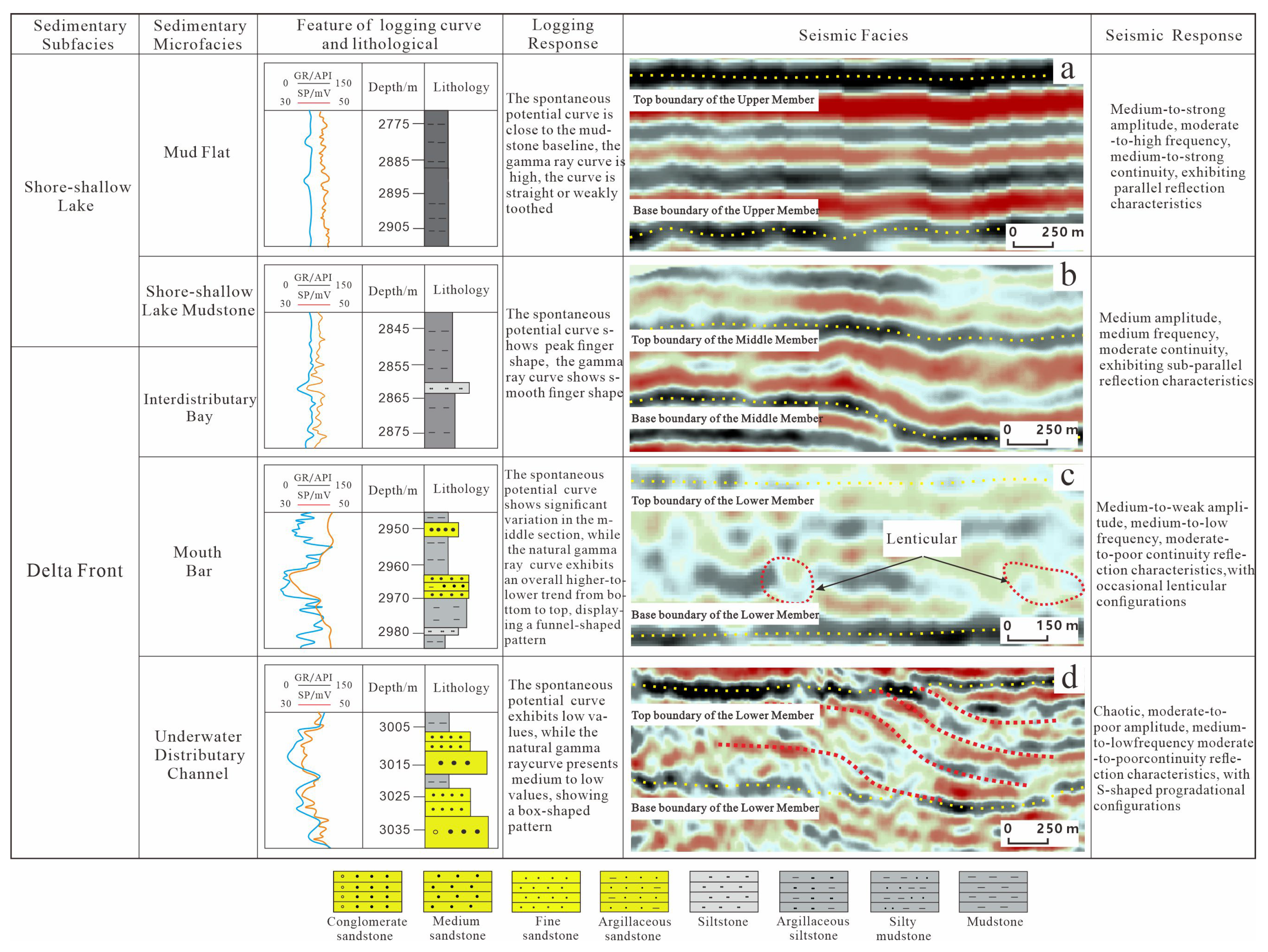
4.1.5. Log Facies Characteristics
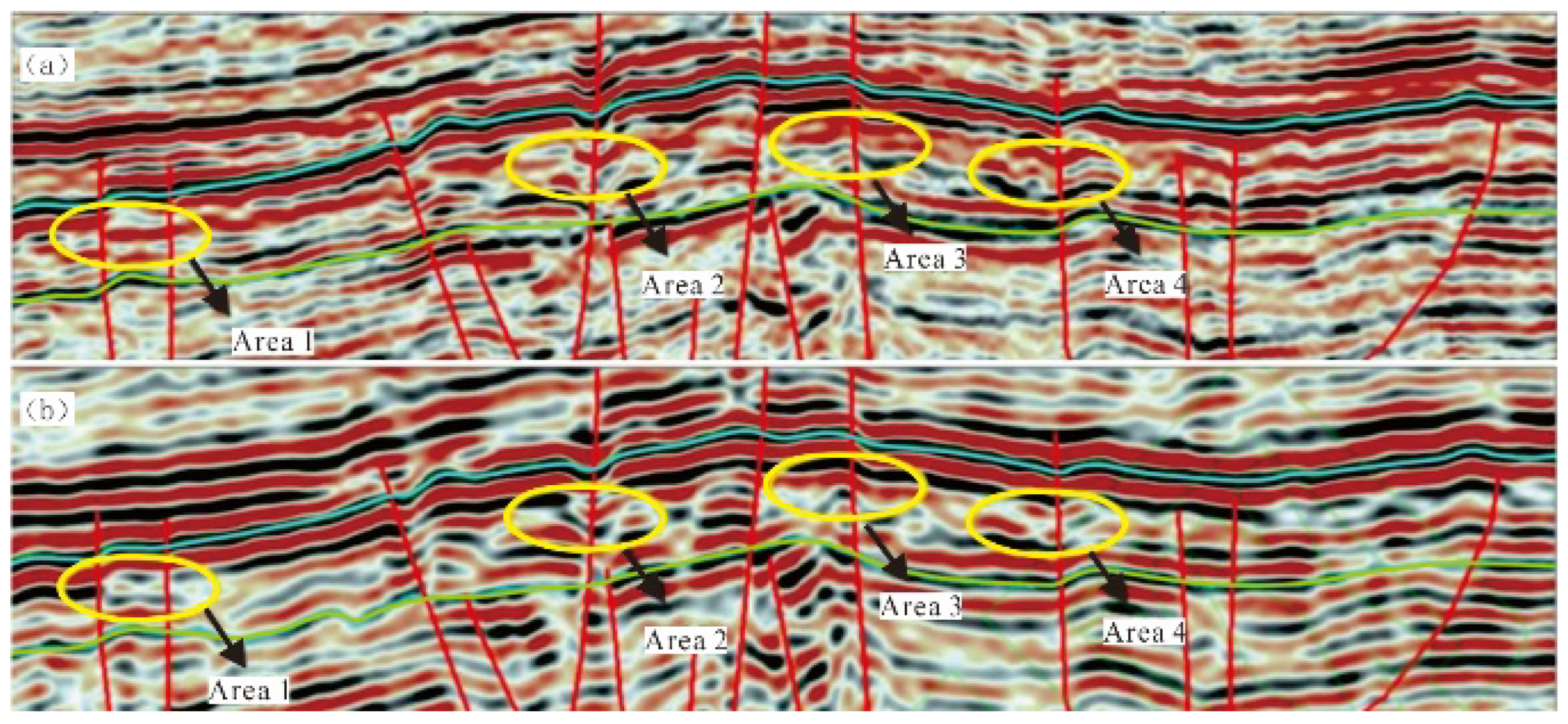
4.1.6. Seismic Facies Characteristics
4.2. Types of Sedimentary Microfacies
4.3. Single-Well and Cross-Well Sedimentary Facies Analysis
4.4. Planar Distribution Characteristics of Sedimentary Microfacies
4.5. Sedimentary Model
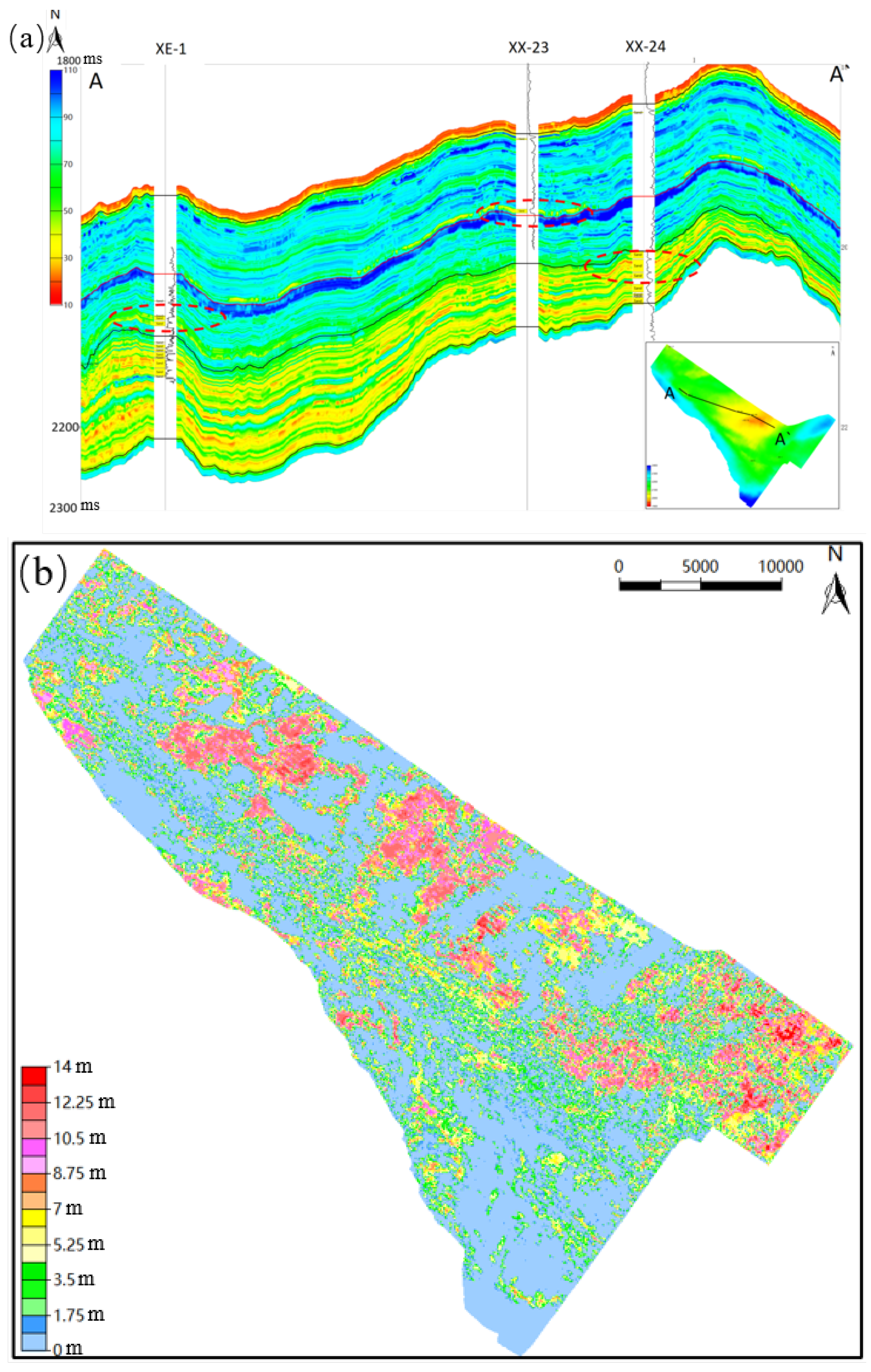
4.6. Prediction of Reservoir Distribution
4.7. Comprehensive Evaluation of Favorable Facies Belts
5. Discussion
5.1. Comparison with Regional Sedimentary Models
5.2. Exploration Implications
5.3. Methodological Significance
5.4. Limitations and Future Work
6. Conclusions
Author Contributions
Funding
Institutional Review Board Statement
Informed Consent Statement
Data Availability Statement
Acknowledgments
Conflicts of Interest
References
- Zeng, H. High-resolution mapping of subsurface sedimentary facies and reservoirs using seismic sedimentology. Appl. Sci. 2025, 15, 6387. [Google Scholar] [CrossRef] [Scilit]
- He, Z.; Li, J.; Wang, H.; Chen, Y.; Zhang, L. Seismic sedimentology for the characterization of Quaternary evaporite facies in biogas-bearing Taidong area, Sanhu Depression, Qaidam Basin, NW China. Appl. Sci. 2025, 15, 2288. [Google Scholar] [CrossRef] [Scilit]
- Wang, J.; Chen, X.; Liu, X.; Huang, Y.; Su, A. Prediction of favorable sand bodies in fan delta deposits of the second member in Baikouquan Formation, X Area of Mahu Sag, Junggar Basin. Appl. Sci. 2025, 15, 10908. [Google Scholar] [CrossRef] [Scilit]
- Wang, J.; Guan, D.; Huang, X.; He, Y.; Li, H.; Xu, W.; Liu, R.; Feng, B. Integrated SOM multi-attribute optimization and seismic waveform inversion for thin sand body characterization: A case study of the Paleogene Lower E3d2 sub-member in the HHK Depression, Bohai Bay Basin. Appl. Sci. 2025, 15, 5134. [Google Scholar]
- Liu, S.; Zhou, L.; Zhang, B.; Dai, R.; Lu, P.; He, C.; Wu, Y.; Ni, C. Thin-layer siliceous dolomite prediction based on post-stack seismic data mining and optimization. Appl. Sci. 2025, 15, 9631. [Google Scholar]
- Li, H. Microfacies analysis of braided river deposits based on seismic-to-well ties: A case study of the Jin-77 well block in the Dongsheng gas field, Ordos Basin. Oil Gas Geol. 2025, 46, 91–107. (In Chinese) [Google Scholar]
- Grana, D.; Della Rossa, E.; Colombo, D. Stochastic inversion of seismic data for reservoir properties: A review. Geophysics 2012, 77, R23–R34. [Google Scholar] [CrossRef] [Scilit]
- Grana, D.; Mukerji, T. Introduction to Geophysical Integration and Machine Learning: Seismic Reservoir Characterization; Cambridge University Press: Cambridge, UK, 2021. [Google Scholar]
- Xue, Y.; Sen, M.K. Stochastic seismic inversion using greedy annealed importance sampling. J. Geophys. Eng. 2016, 13, 786–804. [Google Scholar] [CrossRef] [Scilit]
- Xu, Y.; Bai, C.; Zhang, R.; Chen, G.; Wu, L.; Huang, X. Prediction of thin sand body reservoirs using facies-model-constrained stochastic optimization inversion. Front. Earth Sci. 2026, 14, 1754981. [Google Scholar]
- Norum, A.; Abedi, M.; Kharrat, R. Seismic prediction of porosity in the Norne field: Utilizing support vector regression and empirical models driven by Bayesian linearized inversion. Appl. Sci. 2025, 15, 616. [Google Scholar] [CrossRef] [Scilit]
- Alves Gomes, N.S.; Grana, D.; Azevedo, L. Advanced elastic and reservoir properties prediction through generative adversarial network. Appl. Sci. 2023, 13, 6311. [Google Scholar] [CrossRef] [Scilit]
- Gharibian, A.; Mukerji, T.; Grana, D. Lithology and porosity distribution of high-porosity sandstone reservoir in North Adriatic using machine learning synthetic well catalogue. Appl. Sci. 2023, 13, 7671. [Google Scholar] [CrossRef] [Scilit]
- Tasikyn, A.; Li, J.H.; Li, H.L.; Li, W.B.; Mao, X.; Wang, H.H. Tectonic evolution and petroliferous characteristics of basin groups in Central Asia and adjacent regions. Geoscience 2014, 28, 573–584. (In Chinese) [Google Scholar]
- Zhang, T.; Li, J.; Wang, H. A study on the sedimentary environment and facies model of Triassic carbonate rocks in the Mangeshlak Basin. Appl. Sci. 2025, 15, 7788. [Google Scholar] [CrossRef] [Scilit]
- Guo, Y.Q.; Liu, L.F.; Zhu, S.L. Classification and assessment of petroleum system in Amu-Darya Basin. Pet. Explor. Dev. 2006, 33, 515–520. (In Chinese) [Google Scholar]
- He, Y.D.; Wei, C.G. Tectonic evolution and its vital role for oil and gas reservoir in Amu Darya Basin. Prog. Geophys. 2014, 29, 1143–1147. (In Chinese) [Google Scholar]
- Li, H.W.; Tong, X.G.; Wang, S.H.; Gao, X.K.; Wen, Z.X.; Guo, J.Y. An analysis of geological characteristics and exploration potential of the Jurassic play, Amu Darya Basin. Nat. Gas Ind. 2010, 30, 6–12. (In Chinese) [Google Scholar]
- Zhang, B.; Zheng, R.C.; Liu, H.N.; Wu, L.; Chen, R.J. Characteristics of carbonate reservoir in Callovian-Oxfordian of Samandepe Gas Field, Turkmenistan. Acta Geol. Sin. 2010, 84, 117–125. (In Chinese) [Google Scholar]
- Xu, W.L.; Zheng, R.C.; Fei, H.Y.; Sun, Z.J.; Wang, Q. The sedimentary facies of Callovian-Oxfordian in Amu Darya basin, Turkmenistan. Geol. China 2012, 39, 954–964. (In Chinese) [Google Scholar]
- Lv, G.X.; Liu, H.N.; Deng, M.M.; Wu, L.; Cheng, X.B.; Zhang, X.Y.; Liu, Y.C. Exploration and Development of Giant Carbonate Gas Field in the Amu Darya Right Bank Area; Science Press: Beijing, China, 2013. (In Chinese) [Google Scholar]
- Tian, Y.; Xu, H.; Zhang, X. Sedimentary characteristics, distribution regularities and main controlling factors of carbonate intra-platform shoal reservoirs: A case study of intra-platform shoal gas fields in the Amu Darya Basin. Earth Sci. Front. 2017, 24, 312–321. [Google Scholar]
- Chang, H.L.; Rong, C.Z.; Wang, Q. Characteristics of lower-middle Jurassic sandstone reservoirs in Amu Darya Basin, Turkmenistan. Oil Gas Geol. 2015, 36, 985–993. (In Chinese) [Google Scholar]
- Zhang, T.; Wang, Q.; Liu, B. Sedimentary facies and its lateral distribution of the Middle-Lower Jurassic in Amu Darya right bank area. J. Xi’an Shiyou Univ. 2014, 36, 27–38. (In Chinese) [Google Scholar]
- Qi, Y.; Hu, Z.; Wang, J.; Zhang, F.; Wang, X.; Hu, H.; Wang, Q.; Wang, H. The formation mechanisms of ultra-deep effective clastic reservoir and oil and gas exploration prospects. Appl. Sci. 2025, 15, 6984. [Google Scholar] [CrossRef] [Scilit]
- Lu, S.K.; Bao, Z.H.; Yang, J.S. Structural deformation of the Lower-middle Jurassic series and their trap characteristics in Amu Darya right bank area. Geoscience 2013, 27, 774–782. [Google Scholar]
- Nie, M.L.; Wu, L.; Liu, B.; Hou, L. Fault characteristic and reservoir-control effect in Amu Darya right bank area in Turkmenistan. Xinjiang Pet. Geol. 2013, 34, 365–368. (In Chinese) [Google Scholar]
- Zhang, Y.; Li, C.; Li, J.; Luo, X.; Cheng, M.; Zhang, X.; Lu, B. A new method of geological modeling for the hydrocarbon secondary migration research. Appl. Sci. 2025, 15, 3377. [Google Scholar] [CrossRef] [Scilit]
- Dou, M.; Li, S.; Lei, T.; Ren, G.; Li, X.; Guo, Y.; Feng, W.; Zhang, X. Hierarchical multiple-point geostatistical modeling method and application based on braided river reservoir architecture. Minerals 2022, 12, 1398. [Google Scholar] [CrossRef] [Scilit]
- Liu, H.; Zhang, X.; Wang, Q. Quantitative prediction of braided sandbodies based on probability fusion and multi-point geostatistics. Energies 2023, 16, 2796. [Google Scholar] [CrossRef] [Scilit]
- Wang, J.; He, Y.; Li, H.; Feng, B.; Zhao, Z.; Yu, X.; Hou, X. The genesis of a thin-bedded beach-bar system under the strike-slip extensional tectonic framework: A case study in the Bohai Bay Basin. Appl. Sci. 2025, 15, 7964. [Google Scholar]
- Chen, G. Application of steerable pyramid decomposition technology in reservoir seismic prediction. China Pet. Explor. 2021, 26, 125–131. [Google Scholar]
- Zhang, H.F.; Huang, X.R.; Zhang, J.; Ren, M. Strong seismic constraint modelling method based on steerable pyramid: A case study of fluvial facies in the second member of Shahejie Formation, Shengli Oilfield. Oil Geophys. Prospect. 2024, 59, 1197–1205. (In Chinese) [Google Scholar]
- Huang, Z.-Y.; Gan, L.-D.; Dai, X.-F.; Li, L.-G.; Wang, J. Key parameter optimization and analysis of stochastic seismic inversion. Appl. Geophys. 2012, 9, 49–56. [Google Scholar] [CrossRef] [Scilit]
- Franco, C.A.; Mukerji, T.; Mavko, G. Predicting reservoir petrophysical geobodies from seismic data using enhanced extended elastic impedance inversion. Appl. Sci. 2023, 13, 4755. [Google Scholar] [CrossRef] [Scilit]
- Xu, Y.; Li, J.; Zhang, H. DFN modelling constrained by multiple seismic attributes using the steering pyramid technology. Front. Earth Sci. 2023, 11, 1257481. [Google Scholar] [CrossRef] [Scilit]
- Abdi, Y.A.; Abdolghafour, M. A new robust weak supervision deep learning approach for reservoir properties prediction in Malaysian Basin field. Appl. Sci. 2023, 13, 9025. [Google Scholar] [CrossRef] [Scilit]
- Pelemo-Daniels, D.; Stewart, R.R. Petrophysical property prediction from seismic inversion attributes using rock physics and machine learning: Volve field, North Sea. Appl. Sci. 2023, 14, 1345. [Google Scholar]
- Zhao, A.; Yu, Y.; Wang, B.; Liu, Y.; Liu, J.; Fu, X.; Zheng, W.; Tian, F. Real-time intelligent recognition and precise drilling in strongly heterogeneous formations based on multi-parameter logging while drilling and drilling engineering. Appl. Sci. 2025, 15, 5536. [Google Scholar]
- Zecchin, M.; Catuneanu, O.; Olariu, C. Reconstruction of land and marine features by seismic and surface geomorphology techniques. Appl. Sci. 2022, 12, 9611. [Google Scholar] [CrossRef] [Scilit]
- Chen, Y.; Zhang, G. New parameters identification of proton exchange membrane fuel cell stacks based on an improved version of African vulture optimization algorithm. Energy Rep. 2022, 8, 3030–3040. [Google Scholar] [CrossRef] [Scilit]
- Wang, E.; Xia, J.; Li, J.; Sun, X.; Li, H. Parameters exploration of SOFC for dynamic simulation using adaptive chaotic grey wolf optimization algorithm. Energy 2022, 261, 125146. [Google Scholar] [CrossRef] [Scilit]
- Wang, H.; Zhao, L.; Peng, Q. An improved sand cat swarm optimization algorithm and its application to agricultural robot path planning. Eng. Comput. 2025, 42, 1525–1553. [Google Scholar] [CrossRef] [Scilit]
- Dong, S.; Xia, Y.; Kamruzzaman, J. Quantum particle swarm optimization for task offloading in mobile edge computing. IEEE Trans. Ind. Inform. 2023, 19, 9113–9122. [Google Scholar]
- Zhang, D.; Jiang, Z.; Mohammadzadeh, F.; Hasani Azhdari, S.M.; Abualigah, L.; Ghazal, T.M. FUZ-SMO: A fuzzy slime mould optimizer for mitigating false alarm rates in the classification of underwater datasets using deep convolutional neural networks. Heliyon 2024, 10, e28681. [Google Scholar] [CrossRef] [Scilit]
- Liu, L.; Chu, C.; Chen, C.; Huang, S. MarineYOLO: Innovative deep learning method for small target detection in underwater environments. Alex. Eng. J. 2024, 104, 423–433. [Google Scholar] [CrossRef] [Scilit]
- Yin, X.; Chen, L. Image object detection method based on improved Faster R-CNN. J. Circuits Syst. Comput. 2024, 33, 2450130. [Google Scholar]
- Fan, J.; Yu, G.-A.; Zhao, M.; Zong, H. Addressing multi-scale temporal variability: Deep integration and application of the CNN and transformer model in monthly streamflow prediction. Expert Syst. Appl. 2025, 292, 128658. [Google Scholar] [CrossRef] [Scilit]
- Naeem, H.; Dong, S.; Falana, O.; Ullah, F. Development of a deep stacked ensemble with process based volatile memory forensics for platform independent malware detection and classification. Expert Syst. Appl. 2023, 223, 119952. [Google Scholar] [CrossRef] [Scilit]
- Zhang, C.; Guo, Z.; Li, C. Unsupervised anomaly detection for gearboxes based on the deep convolutional support generative adversarial network. Sci. Rep. 2025, 15, 8835. [Google Scholar] [CrossRef] [Scilit]
- Cui, C.; Liu, L.; Qiao, R. A cutting-edge video anomaly detection method using image quality assessment and attention mechanism-based deep learning. Alex. Eng. J. 2024, 108, 476–485. [Google Scholar] [CrossRef] [Scilit]
- Yu, L.; Zhang, D.; Liu, N.; Zhou, W. A multi-view fusion method via tensor learning and gradient descent for image features. IEEE Access 2021, 9, 79389–79399. [Google Scholar] [CrossRef] [Scilit]
- Qian, D.; Yu, L.; Tang, H.; Zhao, J. Multiview feature fusion optimization method for image retrieval based on matrix correlation. J. Electron. Imaging 2020, 29, 053007. [Google Scholar] [CrossRef] [Scilit]
- Yu, L.; Liu, P.; Jiang, L.; Zhao, Z. Tensor dispersion-based multi-view feature embedding for dimension reduction. J. Electron. Imaging 2021, 30, 033019. [Google Scholar]
- Tian, C.; Chen, Y. Image segmentation and denoising algorithm based on partial differential equations. IEEE Sens. J. 2020, 20, 11935–11942. [Google Scholar]
- Tian, C.; Zhang, H. Application of partial differential equation in brain image segmentation and registration. IEEE Access 2019, 7, 19631–19642. [Google Scholar] [CrossRef] [Scilit]
- Yao, Y.; Xia, C.; Li, J.; Li, Q. Head CT image convolution feature segmentation and morphological filtering for densely matching points of IoTs. IEEE Access 2020, 8, 12521–12532. [Google Scholar] [CrossRef] [Scilit]
- Wang, X.; Zhao, P.; Yue, S.; Gu, Y. An improved cross algorithm edge detection method and its application in coal gangue identification. Int. J. Coal Prep. Util. 2026, 46, 835–847. [Google Scholar]
- Dong, S. Multi class SVM algorithm with active learning for network traffic classification. Expert Syst. Appl. 2021, 176, 114885. [Google Scholar] [CrossRef] [Scilit]
- Wang, Y.; Feng, Y.; Sun, H. Research on vehicle intelligent wireless location algorithm based on convolutional neural network. Neural Comput. Appl. 2021, 33, 8131–8141. [Google Scholar]
- Wang, W.; Dong, Q.; Hu, Z. Interactive piecewise planar building reconstruction from a single image based on geometric priors. Expert Syst. Appl. 2023, 230, 120572. [Google Scholar] [CrossRef] [Scilit]







| Type | Microfacies | Sand Ratio | Avg. Porosity (%) | Avg. Permeability (mD) |
|---|---|---|---|---|
| Type I | MF1 underwater distributary channel | >0.4 | 12.7 | 8.3 |
| Type II | MF2 mouth bar | 0.2–0.4 | 10.1 | 4.7 |
| Type III | MF5 beach bar | <0.2 | 4.5 | 1.6 |
| No. | Code | Microfacies |
|---|---|---|
| 1 | MF1 | Underwater distributary channel |
| 2 | MF2 | Mouth bar |
| 3 | MF3 | Interdistributary bay |
| 4 | MF4 | Subaqueous natural levee |
| 5 | MF5 | Beach bar |
| 6 | MF6 | Littoral mud |
| 7 | MF7 | Coastal swamp |
| 8 | MF8 | Sand flat |
| 9 | MF9 | Mud flat |
| Well | AI Correlation (2 ms) | AI Correlation (4 ms) | Net Sand Thickness Deviation (%) | RMSE (g cm−3) (m s−1), 2 ms/4 ms |
|---|---|---|---|---|
| S1 | 0.88 | 0.84 | 5.1 | 395/458 |
| S2 | 0.87 | 0.83 | 7.2 | 410/472 |
| G1 | 0.85 | 0.82 | 6.8 | 428/491 |
| N2 | 0.84 | 0.81 | 7.9 | 447/505 |
| Mean | 0.86 | 0.83 | 6.8 | 420/482 |
Disclaimer/Publisher’s Note: The statements, opinions and data contained in all publications are solely those of the individual author(s) and contributor(s) and not of MDPI and/or the editor(s). MDPI and/or the editor(s) disclaim responsibility for any injury to people or property resulting from any ideas, methods, instructions or products referred to in the content. |
© 2026 by the authors. Licensee MDPI, Basel, Switzerland. This article is an open access article distributed under the terms and conditions of the Creative Commons Attribution (CC BY) license.
Share and Cite
Li, F.; Xu, Y.; Liu, H.; Leng, Y.; Wei, Z.; Zhang, N.; Liu, R.; Liao, B.; Huang, X. Sedimentary Microfacies Analysis and Reservoir Prediction of Braided River Delta Reservoirs in Central Asia’s S Gas Field. Appl. Sci. 2026, 16, 6523. https://doi.org/10.3390/app16136523
Li F, Xu Y, Liu H, Leng Y, Wei Z, Zhang N, Liu R, Liao B, Huang X. Sedimentary Microfacies Analysis and Reservoir Prediction of Braided River Delta Reservoirs in Central Asia’s S Gas Field. Applied Sciences. 2026; 16(13):6523. https://doi.org/10.3390/app16136523
Chicago/Turabian StyleLi, Feilong, Yungui Xu, Haotong Liu, Youheng Leng, Zhanjun Wei, Nini Zhang, Ronghe Liu, Boyong Liao, and Xuri Huang. 2026. "Sedimentary Microfacies Analysis and Reservoir Prediction of Braided River Delta Reservoirs in Central Asia’s S Gas Field" Applied Sciences 16, no. 13: 6523. https://doi.org/10.3390/app16136523
APA StyleLi, F., Xu, Y., Liu, H., Leng, Y., Wei, Z., Zhang, N., Liu, R., Liao, B., & Huang, X. (2026). Sedimentary Microfacies Analysis and Reservoir Prediction of Braided River Delta Reservoirs in Central Asia’s S Gas Field. Applied Sciences, 16(13), 6523. https://doi.org/10.3390/app16136523