


Abstract
Cemented natural fractures are widely developed in unconventional reservoirs and play a key role in controlling hydraulic fracture propagation and fracture network evolution. However, their mechanical effects are often oversimplified in conventional numerical models, limiting the reliability of fracture prediction. A numerical framework was established to investigate hydraulic fracture propagation in reservoirs containing cemented natural fractures. Cementation effects are quantitatively characterized using two parameters—cementation degree () and cementation strength ()—representing the filling condition and interfacial resistance of natural fractures. Based on this formulation, both single-fracture and multiple-fracture models are constructed to analyze the influence of cementation properties and fracture density on fracture propagation. The results show that mainly controls fracture activation and propagation mode. Lower promotes fracture diversion and branching, whereas higher favors fracture penetration through the interface. governs interfacial resistance, with higher leading to more stable propagation. Increasing fracture density enhances fracture network complexity but also intensifies stress interference, affecting propagation stability and connectivity. These findings provide mechanistic insights into the role of cemented natural fractures in hydraulic fracturing and may support a more reliable interpretation of fracture propagation behavior in naturally fractured reservoirs.
1. Introduction
Naturally fractured unconventional oil and gas reservoirs are widely developed, and the spatial distribution and mechanical properties of natural fractures are widely recognized as key factors controlling the effectiveness of hydraulic fracturing treatments [1,2,3]. In addition to laboratory observations and numerical simulations, field-based geophysical methods, such as azimuthal amplitude-versus-offset analysis and 3D vertical seismic profiling, have been widely used to characterize fracture orientation, fracture density, and fault/fracture distributions in carbonate reservoirs [4,5]. Unlike idealized homogeneous media, natural fractures are commonly filled and cemented by carbonate and other mineral precipitates during geological evolution, forming cemented natural fractures with finite tensile strength and fracture toughness. These cemented fractures differ fundamentally from conventional open or frictional interfaces because they can sustain and transmit part of the applied stress during deformation, thereby altering the local stress distribution and hydraulic fracture propagation behavior [6,7,8].
When a propagating hydraulic fracture approaches a cemented natural fracture, it typically exhibits several characteristic propagation modes, including penetration, deflection, and arrest [9,10,11]. These interaction behaviors directly affect the spatial geometry and connectivity of fracture networks, thereby controlling the stimulated reservoir volume and reservoir flow capacity [12,13,14]. Therefore, a thorough understanding of the controlling mechanisms of cemented natural fractures on hydraulic fracture propagation is of great significance for improving hydraulic fracturing design in complex reservoirs.
Extensive studies have been conducted to investigate the interaction between hydraulic fractures and natural fractures. Laboratory experiments have provided direct observations of fracture intersection behavior, including crossing, deflection, and interface-guided propagation, and have shown that fracture interaction is strongly affected by the mechanical contrast between the rock matrix and natural fractures [9,15]. Fu et al. further examined fracture propagation characteristics under partially cemented conditions and provided important insights into the role of cemented interfaces in controlling fracture paths [16]. With the development of computational methods, numerical simulation has become an important tool for studying complex fracture propagation processes. Continuum-based methods, cohesive zone models, and the extended finite element method have been widely used to simulate hydraulic fracture initiation, propagation, and interaction with pre-existing discontinuities [17,18,19,20,21]. In addition, classical fracture-mechanics criteria provide theoretical foundations for understanding crack penetration and deflection at interfaces, highlighting the importance of interface strength, toughness, and interaction angle in determining fracture propagation paths [22,23].
Despite these advances, several key issues remain unresolved. On the one hand, although experimental studies can visually capture fracture propagation paths, the initiation and propagation processes within cemented interfaces are difficult to characterize continuously and quantitatively due to limitations in materials and observation techniques. Moreover, multiple controlling factors are often coupled, making it challenging to isolate their individual effects. On the other hand, in numerical simulations, natural fractures are commonly simplified as open or frictional interfaces, neglecting the widespread presence of cementation in reservoirs. This simplification reduces the applicability of models to real reservoir conditions. Although some studies have incorporated cemented fractures [6,14], a consistent parameterization method for key properties such as cementation degree and cementation strength is still lacking, which limits systematic analysis of fracture propagation under different cementation conditions. Furthermore, in multiple-fracture systems, the integrated control mechanisms of cemented natural fractures on fracture propagation paths and fracture network evolution remain unclear.
Based on the above considerations, accurate prediction of hydraulic fracture propagation in reservoirs containing cemented natural fractures requires proper characterization of interfacial mechanical properties and effective description of multiple-factor coupling effects. Therefore, it is necessary to establish a numerical model that simultaneously accounts for cementation degree, cementation strength, and fracture spatial distribution, enabling quantitative analysis of fracture propagation paths and fracture network morphology. On this basis, further investigation of fracture propagation behavior under varying parameter conditions is essential for deepening the understanding of fracture interaction mechanisms.
To address these issues, this study focuses on reservoirs containing cemented natural fractures and develops a numerical simulation approach that incorporates both cementation degree and cementation strength to characterize the interaction between hydraulic fractures and natural fractures. In this model, cemented fractures are parameterized through interfacial mechanical properties, enabling consistent analysis of fracture behavior under different cementation conditions. Based on this framework, the effects of key factors—including cementation degree, cementation strength, and fracture density—on hydraulic fracture propagation paths and fracture network morphology are systematically analyzed. The results reveal the controlling mechanisms of cemented natural fractures on fracture propagation modes and provide mechanistic insights for hydraulic fracturing design in complex naturally fractured reservoirs.
2. Effect of Natural Fractures on Rock Mechanical Properties
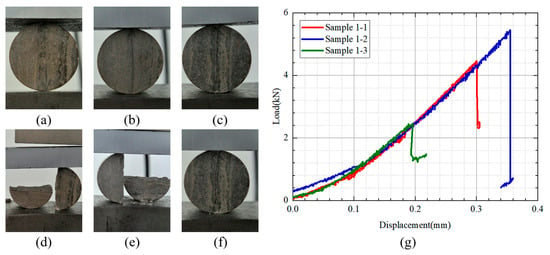
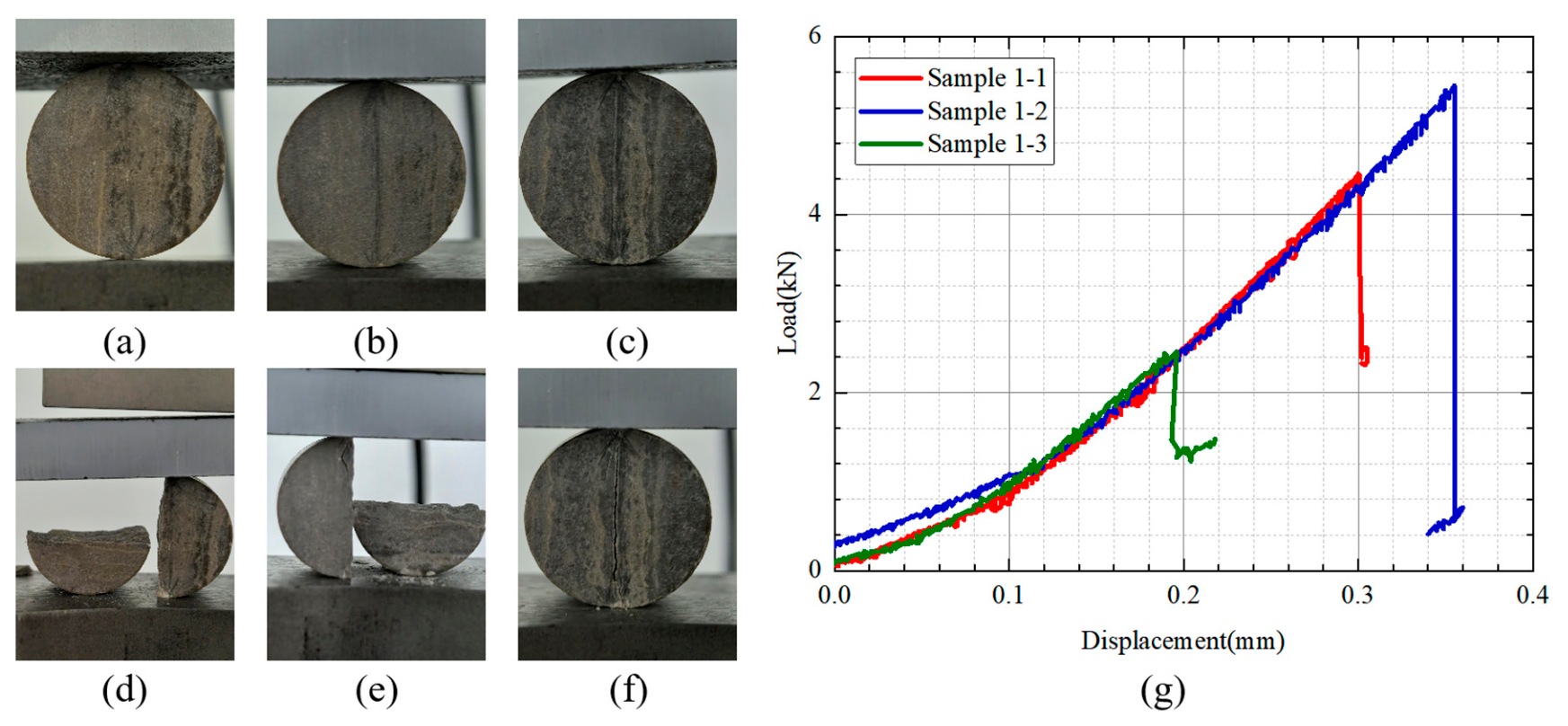
To investigate the influence of natural fractures on the mechanical properties of rock and to provide experimental background for subsequent numerical simulations, Brazilian splitting tests were conducted on representative specimens. Specimens 1-1 and 1-2 represent intact rock matrix, while specimen 1-3 contains a through-going natural fracture (Figure 1a–c). A comparative analysis was performed to evaluate the differences in tensile behavior between fractured and unfractured samples. The experimental results, including the post-test failure patterns and the corresponding load–displacement responses, are illustrated in Figure 1d–g.
Figure 1.
Brazilian splitting test results of rock samples. (a–c) Pre-test photographs of samples 1-1, 1-2, and 1-3. (d–f) Post-test failure patterns of the corresponding samples after Brazilian splitting. (g) Load–displacement curves obtained from the Brazilian splitting tests.
The results show that the tensile strengths of specimens 1-1 and 1-2 are 9.1 MPa and 10.9 MPa, respectively, with an average value of approximately 10.0 MPa. In contrast, the tensile strength of specimen 1-3 is only 5.0 MPa, representing a reduction of about 50% compared to the intact samples. In terms of failure load, specimens without fractures exhibit values of 4460 N and 5350 N, whereas specimen 1-3 shows a significantly lower value of 2460 N (Figure 1g). These results indicate that the presence of natural fractures substantially reduces the load-bearing capacity of the rock.
Overall, natural fractures not only decrease the tensile strength of the rock but also alter its failure behavior. Therefore, it is reasonable to treat natural fractures as relatively weak structural planes in numerical simulations. The Brazilian splitting tests presented in this study were not intended for numerical-model calibration or validation; rather, they were conducted to provide experimental evidence that the presence of natural fractures can significantly reduce rock tensile strength. The numerical simulations presented in the subsequent sections were performed independently based on the parameter ranges summarized in Table 1 and relevant literature sources. Since only three Brazilian splitting specimens were tested, the statistical significance of the measured tensile strengths is limited, and the reported values should be regarded as indicative observations rather than definitive material properties. Nevertheless, all specimens consistently demonstrate the weakening effect of natural fractures on rock tensile strength.
Table 1.
Summary of input parameters used in the numerical simulations.
3. Numerical Methodology
3.1. Model Description and Geometry Construction
To investigate the propagation characteristics of stimulated fracture networks Sunder different cementation states of natural fractures, a series of numerical simulations were conducted using ABAQUS (version 2021, Dassault Systèmes, Vélizy-Villacoublay, France). MATLAB (R2023b, The MathWorks, Inc., Natick, MA, USA) was employed to generate stochastic natural fracture networks and assist in model preprocessing. In this study, two types of numerical models were developed, including a single natural fracture model and a multiple natural fracture network model. By systematically varying key parameters, sensitivity analyses were carried out to elucidate the influence of natural fracture cementation on fracture network evolution. Although these two models differ in geometric complexity and research focus, they are integrated within a unified analytical framework: the single-fracture model is designed to reveal fundamental fracture interaction mechanisms, whereas the multiple-fracture model is employed to examine the amplification and evolution of these mechanisms under higher fracture-density conditions.
1. Single natural fracture model
The single natural fracture model is used to analyze the fundamental interaction processes between a hydraulic fracture and an isolated cemented natural fracture. The model is constructed under two-dimensional plane-strain conditions, with a rectangular computational domain measuring 20 m × 20 m. This domain size is selected to balance computational efficiency while adequately capturing the localized characteristics of fracture interaction. The rock matrix is treated as a continuous medium. A fully cemented natural fracture is embedded at the center of the model, with a length of 6 m and an inclination angle of 60°. To reduce computational cost and improve simulation efficiency, an initial artificial hydraulic fracture with a length of 4 m is introduced. The fracture is initiated at the midpoint of the left boundary and oriented parallel to the upper and lower boundaries of the model. This configuration ensures that the hydraulic fracture intersects the natural fracture at its midpoint during propagation, thereby allowing the fracture evolution to be predominantly governed by the cementation state of the natural fracture and the relative geometric relationship between the two fractures. The single-fracture model serves as a fundamental reference case, providing mechanistic insights that support subsequent numerical analyses under multiple-fracture network conditions.
2. Multiple natural fracture model
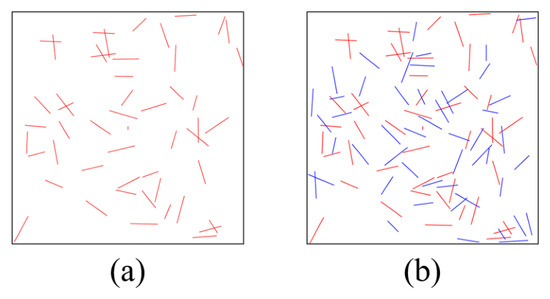
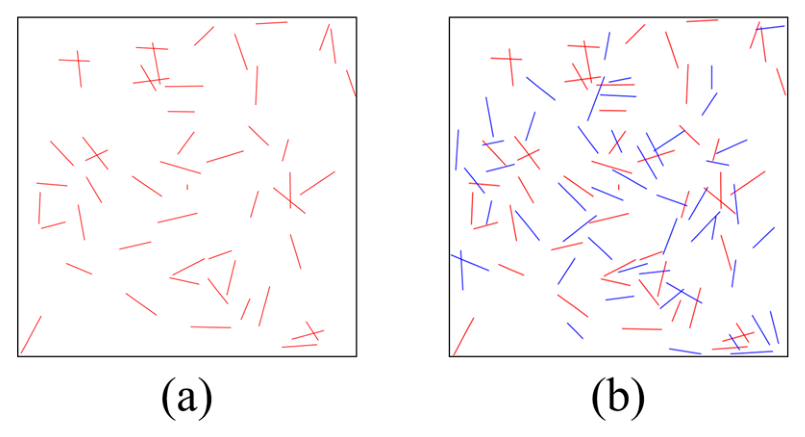
Based on the single-fracture configuration, a multiple natural fracture network model is further developed to simulate hydraulic fracture propagation in reservoirs characterized by densely distributed natural fractures. The model is also established under two-dimensional plane-strain conditions, with the computational domain expanded to 80 m × 80 m to accommodate higher fracture densities and to minimize boundary effects on fracture network evolution. In this model, fracture networks consisting of 50 and 100 natural fractures are generated to represent different fracture-density scenarios (Figure 2). The natural fractures are created using a scripting approach, whereby fracture initiation points are uniformly distributed within the model domain, and fracture endpoints are randomly generated according to a prescribed length range of 5–10 m. Additional geometric constraints are imposed to ensure that all fractures remain within the computational boundaries. An initial artificial hydraulic fracture with a length of 1 m is positioned at the center of the model. Its injection location and basic geometric characteristics are kept identical across different fracture-density cases, thereby ensuring consistency and comparability among simulations.
Figure 2.
Distributions of natural fracture networks with different fracture densities. (a) Fracture network containing 50 fractures. (b) Fracture network containing 100 fractures. Red lines represent the original 50 natural fractures, and the blue lines represent the additionally introduced fractures.
3. Model consistency and comparability
It should be noted that, although the single natural fracture model and the multiple natural fracture model differ in domain size and fracture number, they share consistent modeling concepts and research objectives. The single-fracture model is employed to identify the fundamental interaction mechanisms between hydraulic fractures and cemented natural fractures, whereas the multiple-fracture model extends this analysis to the network scale, where the cumulative and amplifying effects of fracture density can be systematically evaluated. Together, these two types of models constitute a coherent and complementary numerical framework, enabling a comprehensive investigation of fracture network evolution across different spatial scales and natural-fracture configurations.
3.2. Representation of Cemented Natural Fractures
In the numerical model, natural fractures are simplified as discrete interfaces embedded within the rock matrix, and their geometric characteristics are primarily described by fracture location, length, and inclination angle. To improve computational efficiency, the fracture aperture is assumed to be zero. Unlike open fractures or frictional fractures, cemented natural fractures are filled with cementing materials and therefore possess finite strength and fracture toughness. The presence of cementing materials enables the fracture interfaces to sustain a certain level of tensile and shear stresses and to transmit part of the applied stress prior to failure. When the interfacial stress exceeds its strength or fracture toughness threshold, damage initiates and the cemented interface is reactivated. Under such conditions, the hydraulic fracture may either deflect along the natural fracture or directly penetrate the cemented interface and continue propagating. This representation approach can reasonably capture the mechanical response of cemented fractures during hydraulic fracturing.
To achieve a quantitative and parameterized characterization of the influence of cemented natural fractures on hydraulic fracture propagation, two key parameters—cementation degree () and cementation strength ()—are introduced in this study. Based on the concept of apparent cementation ratio in previous studies, the cementation degree () is defined and equivalently represented in the numerical model by fracture porosity. Fracture porosity reflects the proportion of unfilled void space within the fracture. A lower porosity indicates a higher degree of filling, corresponding to a higher cementation degree.
Here, denotes fracture porosity, represents the volume of cementing material, denotes the void volume within the fracture, and represents the cementation degree.
In this study, is treated as an equivalent cementation index rather than a direct physical measurement of cementation. Fracture porosity is employed as a surrogate variable to characterize the filling state of cemented natural fractures. Although cementation may also be influenced by factors such as mineral composition and cement stiffness, fracture porosity provides a practical and quantifiable indicator of fracture filling. Therefore, should be interpreted as a numerical representation of the cementation state. In ABAQUS, different values are implemented through the assignment of corresponding cohesive-interface properties.
The cementation strength () is defined as the ratio of the Mode I fracture toughness of the cemented natural fracture interface to that of the intact rock matrix. Under the assumption that the fracture geometry and loading conditions are similar (i.e., and are approximately identical), the fracture toughness ratio can be further simplified as the ratio of tensile strengths. A larger value indicates a stronger cemented interface, making hydraulic fractures less likely to deflect, whereas a smaller value suggests that the interface is more easily activated.
Here, is a dimensionless parameter related to fracture geometry and loading conditions, represents the tensile strength of the material, and denotes the characteristic fracture size. and represent the Mode I fracture toughness of the cemented fracture interface and intact rock matrix, respectively, while and denote their corresponding tensile strengths.
Although both parameters are related to fracture cementation, they describe different aspects of the cemented natural fracture. characterizes the degree of fracture filling and represents the geometric state of cementation, whereas characterizes the mechanical resistance of the cemented interface. Therefore, and are treated as two independent parameters to separately evaluate the effects of fracture filling and interface strength on hydraulic fracture propagation.
3.3. Boundary Conditions and Loading Scheme
To realistically simulate the initiation and propagation of hydraulic fractures in reservoirs containing cemented natural fractures under in situ stress conditions, appropriate boundary conditions and loading schemes are established for both the single-fracture and multiple-fracture models. The two models share a consistent overall modeling framework, while differences exist in the location of fluid injection and local loading strategies.
To prevent rigid-body motion and reduce its influence on fracture propagation, horizontal displacement constraints are imposed on the left and right boundaries of the model, while vertical displacement constraints are applied on the top and bottom boundaries. Meanwhile, a zero-pore-pressure boundary condition is prescribed along all outer boundaries to stabilize the pore-pressure field and reduce boundary effects. This boundary condition allows fluid pressure to dissipate at the model boundaries and minimizes artificial pressure accumulation caused by the finite model size. Consequently, the fracture-propagation behavior within the central region is primarily governed by local hydraulic and mechanical interactions rather than boundary-induced effects. As a baseline model, a uniform stress field is assumed in the single-fracture model, whereas the multiple-fracture model incorporates directional variations in principal stresses to represent realistic in situ stress anisotropy.
The model is first subjected to an in situ stress equilibrium step, followed by a subsequent analysis step in which fracturing fluid is injected by applying a flow-rate boundary condition at a specified location. In the single-fracture model, the injection point is located at the predefined hydraulic fracture initiation site, corresponding to the midpoint of the left boundary; in contrast, the injection point in the multiple-fracture model is positioned at the geometric center of the model. To realistically represent the hydraulic injection process and avoid numerical disturbances induced by abrupt loading, a smooth loading scheme is adopted during the injection stage, whereby the injection rate gradually increases to the prescribed level. Fracture propagation initiates when the stress state or damage variable at the fracture tip or cemented natural-fracture interface satisfies the fracture initiation criterion. The simulations were conducted using a coupled pore-pressure/stress formulation, in which fluid-pressure evolution and mechanical deformation interact throughout the hydraulic-fracturing process. A fluid leak-off coefficient of 1 × 10⁻¹⁴ m/(Pa·s) was assigned to represent fluid exchange between the fracture system and the surrounding rock matrix during hydraulic fracturing.
3.4. Parameter Calibration
To ensure the rationality and comparability of the numerical model, the selection of rock matrix parameters and fracture interface parameters in this study is primarily based on previous research and typical engineering value ranges.
The elastic properties of the rock matrix, including Young’s modulus and Poisson’s ratio, are selected with reference to typical values reported in hydraulic fracturing simulations [24]. The strength parameters of the matrix are determined based on commonly accepted ranges in rock mechanics to ensure the validity of fracture initiation and propagation criteria. The fracture-interface strength parameters and cohesive-zone modeling approach are defined based on the fracture-propagation criterion proposed by Renshaw and Pollard [22] and the cohesive fracture simulations of Xu and Needleman [25], and are used to characterize tensile and shear failure during fracture propagation. Considering that natural fractures are typically cemented but mechanically weaker than the intact rock matrix, the cementation strength parameters are appropriately reduced within the ranges reported in the literature to reflect their weak-plane characteristics. The definitions and physical meanings of the cementation strength () and cementation degree () have been detailed in Section 3.2 and are therefore not repeated here; these parameters are incorporated into the numerical model through parameter assignment. In terms of geometric and numerical settings, quadrilateral cohesive elements are employed for model discretization, with mesh resolution adjusted according to model scale. The remaining parameters are selected based on typical engineering ranges, and the primary model parameters and their values are summarized in Table 1.
3.5. Mesh Sensitivity Analysis
To evaluate the influence of mesh resolution on the numerical results, preliminary simulations were performed using mesh sizes of 0.5 m, 0.8 m, and 1.0 m in the multiple-fracture model. The overall hydraulic-fracture propagation patterns, fracture-network geometries, and general evolution trends were found to be consistent among the different mesh resolutions, indicating that the main conclusions of this study are not significantly affected by mesh size.
Although finer meshes provided a higher level of local geometric detail, they substantially increased computational cost and, in some simulation cases, resulted in convergence difficulties during fracture propagation. Considering both numerical stability and computational efficiency, a mesh size of 1.0 m was adopted for the multiple-fracture simulations presented in this study.
4. Results and Discussion
4.1. Numerical Simulation Results of a Single Fracture
4.1.1. Effect of Cementation Degree in the Single-Fracture Model
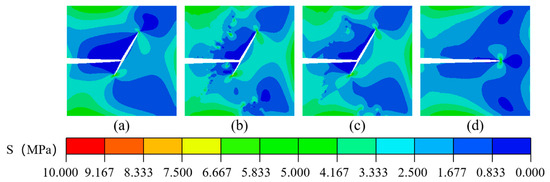
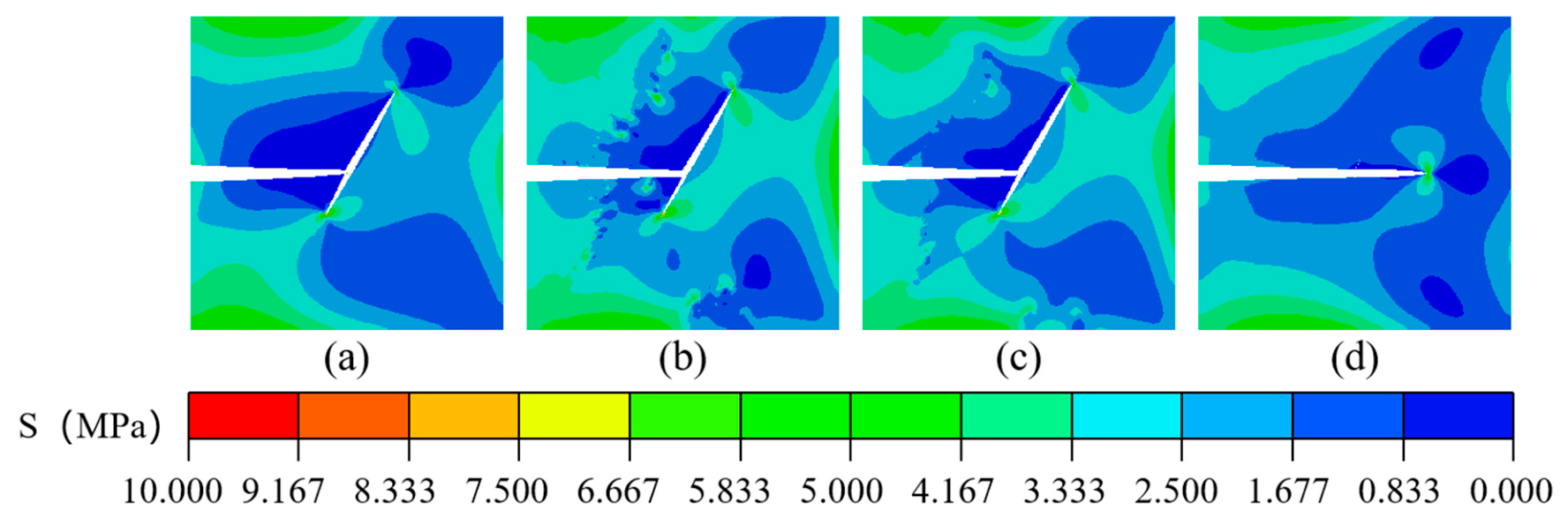
Under single-fracture conditions, a comparative analysis was conducted to investigate the influence of different cementation degrees on hydraulic fracture propagation. The results indicate that the cementation degree exerts a significant control on the propagation path and geometric characteristics of hydraulic fractures (Figure 3). With increasing cementation degree, the hydraulic fracture tends to maintain its original propagation direction after intersecting the natural fracture and propagates through the cemented interface. In contrast, under low cementation conditions, the hydraulic fracture is more likely to deflect toward the natural fracture, resulting in a more complex fracture geometry.
Figure 3.
Stress distribution contours of hydraulic fracture propagation in the single natural fracture model under different cementation degrees. (a) = 10%; (b) = 30%; (c) = 50%; (d) = 70%.
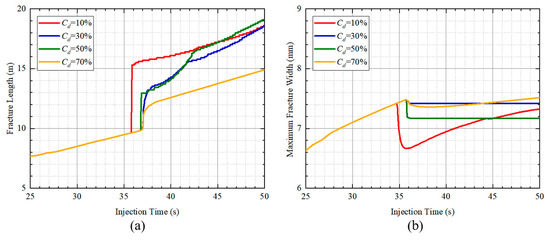
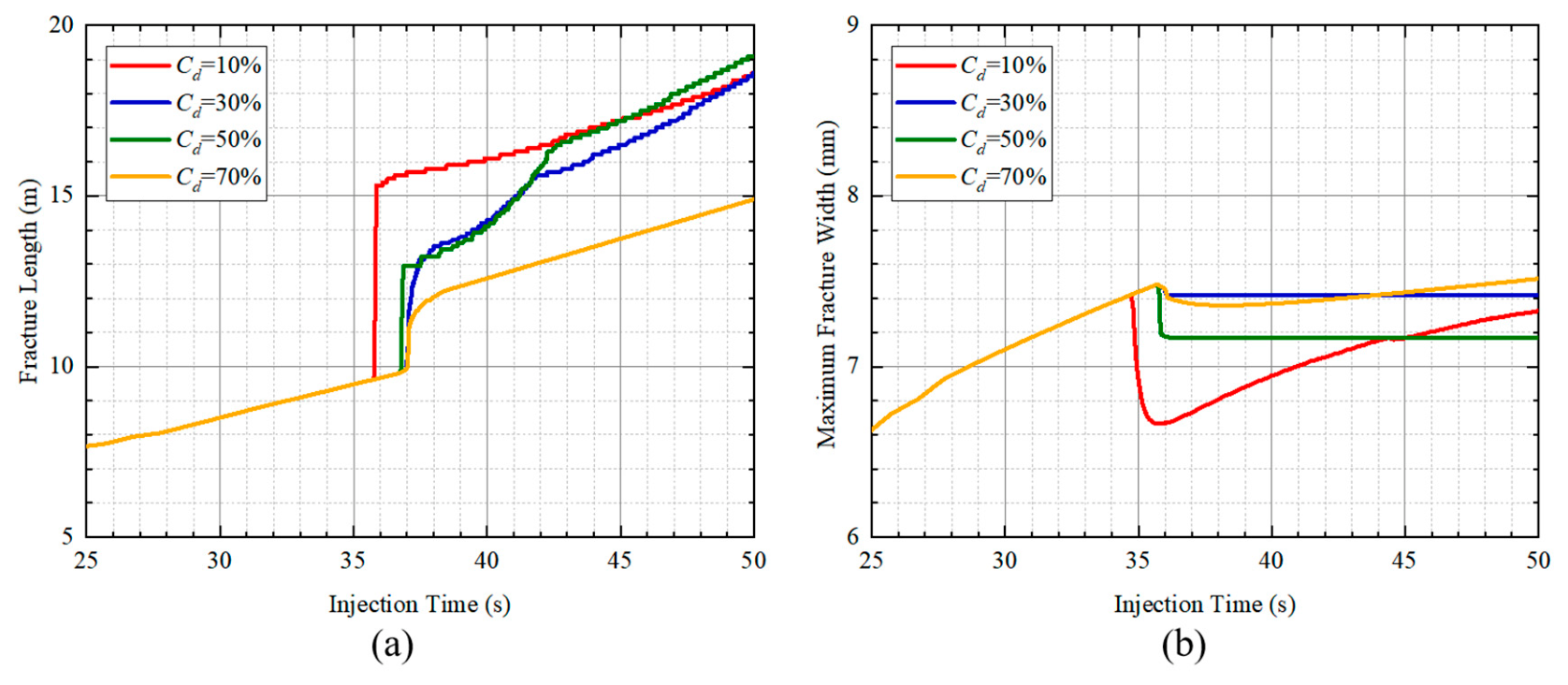
The temporal evolutions of fracture length and maximum fracture width are shown in Figure 4. Under a high cementation degree (70%), the final fracture length is 15.15 m, which is approximately 26.5% shorter than the average fracture length under low cementation conditions (19.17 m). This result demonstrates that an increased cementation degree of natural fractures effectively suppresses long-distance hydraulic fracture propagation. Meanwhile, fracture opening is more restricted under high cementation conditions, and the overall propagation process becomes more stable.
Figure 4.
Evolution of fracture length and maximum fracture width with injection time in the single natural fracture model under different cementation degrees (). (a) Variation in fracture length with injection time. (b) Variation in maximum fracture width with injection time.
These results indicate that the cementation degree enhances the overall mechanical constraint of the natural fracture interface, weakens the tendency of hydraulic fractures to propagate along weak planes, and consequently alters both the propagation path and the scale characteristics of fracture growth.
4.1.2. Effect of Cementation Strength in the Single-Fracture Model
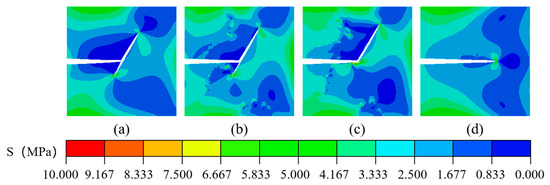
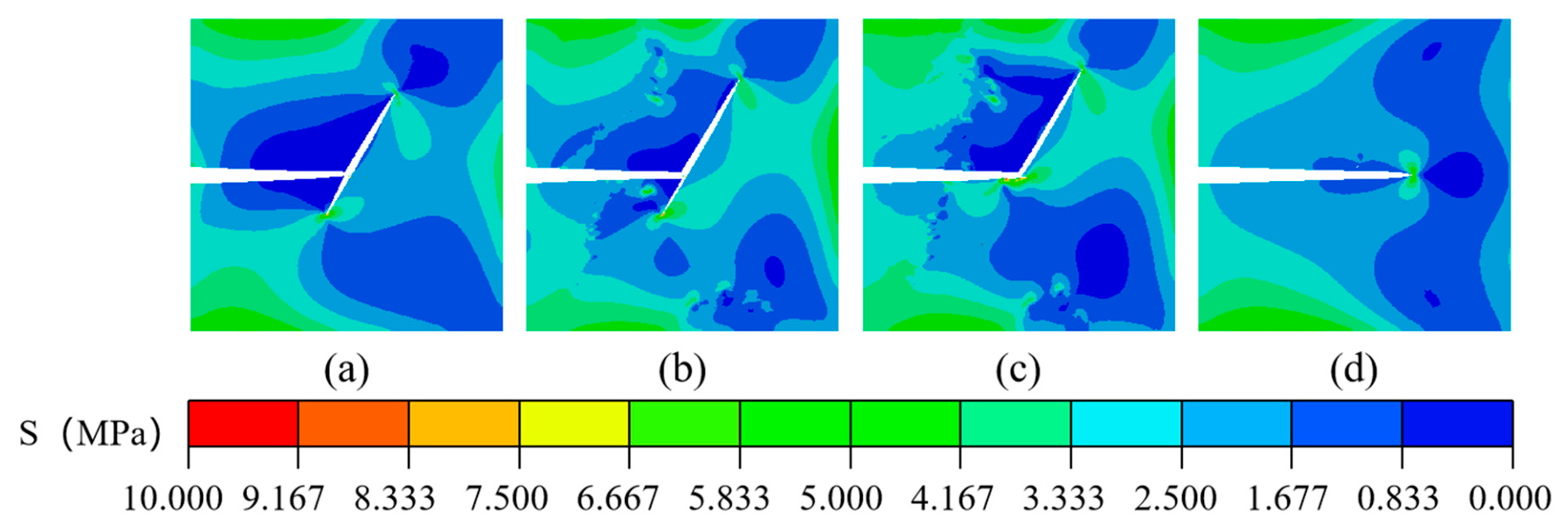
The cementation strength parameter plays a decisive role in controlling the propagation mode of hydraulic fractures. Under low cementation strength conditions, the natural fracture interface behaves as a pronounced weak plane, causing the hydraulic fracture to preferentially deflect toward the direction forming a smaller intersection angle with the natural fracture and continue propagating along it. In this case, the stress concentration zone is redistributed in the vicinity of the natural fracture. As the cementation strength increases, fracture deflection gradually diminishes, and the hydraulic fracture becomes more likely to penetrate directly through the natural fracture and propagate along its original direction, accompanied by a continuous migration of the stress concentration zone (Figure 5).
Figure 5.
Stress distribution contours of hydraulic fracture propagation in the single natural fracture model under different cementation strength. (a) = 0.20; (b) = 0.30; (c) = 0.50; (d) = 0.60.
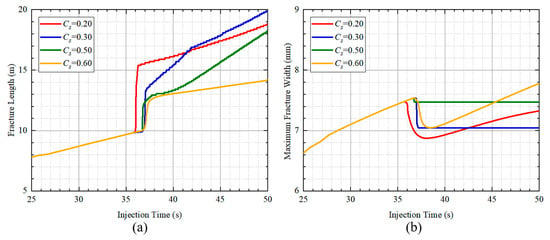
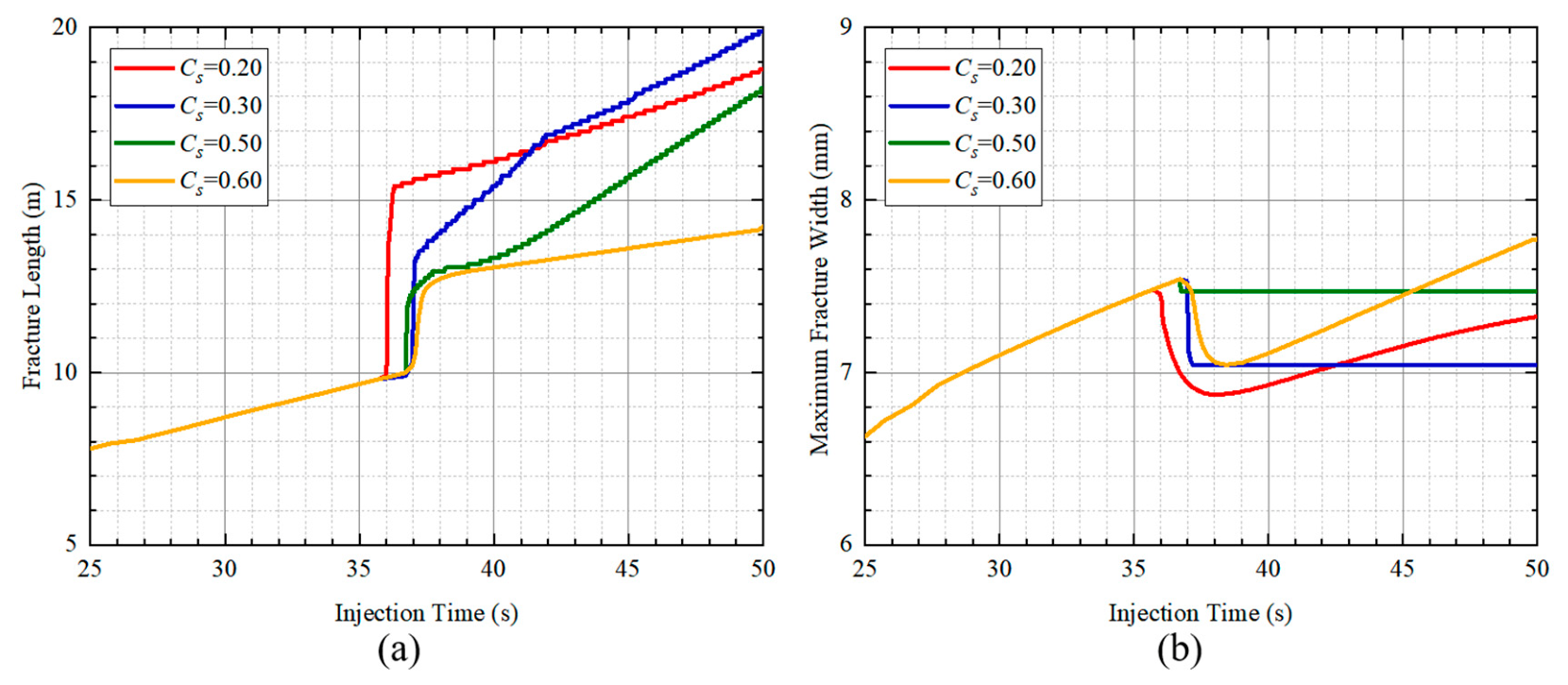
As the cementation strength increases from weak to strong, the final fracture length decreases by approximately 45%, indicating that the enhancement of interface strength significantly inhibits fracture propagation. A comprehensive assessment of fracture paths, final fracture lengths, and maximum fracture widths indicates that a transition in fracture propagation behavior is observed around ≈ 0.5 (Figure 6). When ≥ 0.5, fracture propagation is dominated by penetration through the natural fracture, whereas for < 0.5, fractures are more prone to deflect and propagate along the natural fracture.
Figure 6.
Evolution of fracture length and maximum fracture width with injection time in the single natural fracture model under different cementation strengths (). (a) Variation in fracture length with injection time. (b) Variation in maximum fracture width with injection time.
These findings demonstrate that cementation strength is a key parameter governing the penetration–deflection behavior of hydraulic fractures and has a pronounced influence on fracture geometry and propagation efficiency.
4.2. Fifty Natural Fractures
The investigation of the single-fracture model has revealed, from the perspective of fundamental mechanical units, the influence of cemented natural fractures on hydraulic fracture propagation paths. To further approximate the complex fracture network interactions encountered in actual reservoirs, this section examines a multiple-fracture system while maintaining consistent natural fracture numbers, spatial distributions, and injection conditions. The focus is placed on investigating the effects of natural fracture cementation characteristics on the evolution of hydraulic fractures within a complex fracture network.
4.2.1. Effect of Cementation Degree in the 50-Fracture Model
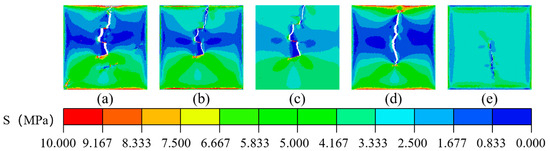
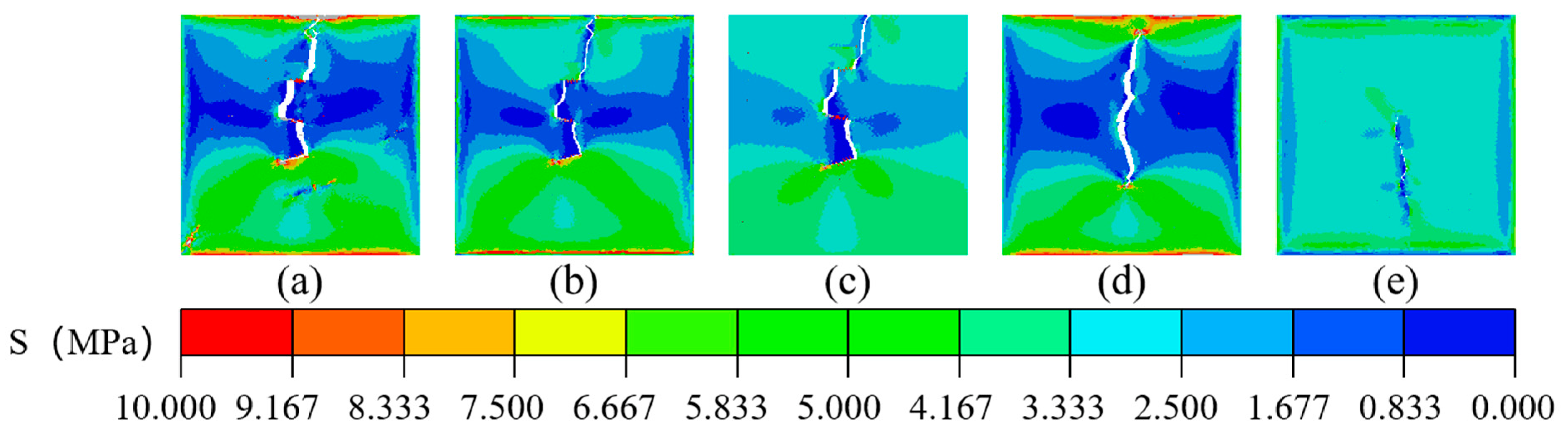
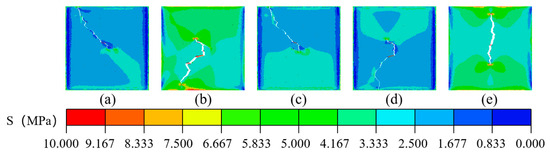
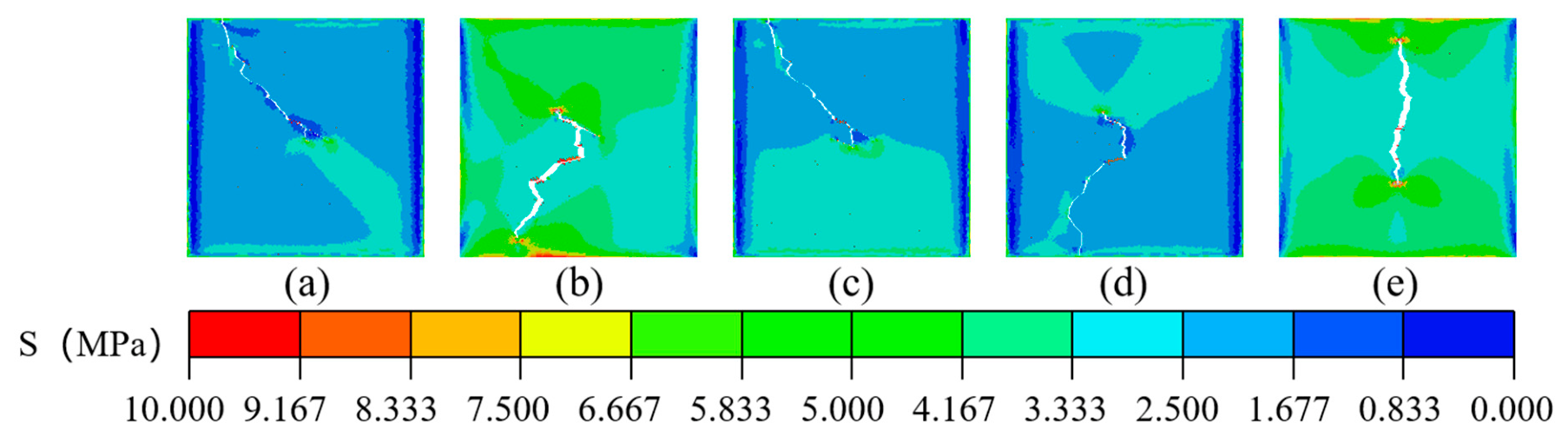
The degree of cementation of natural fractures exerts a pronounced control on both the propagation paths and geometric characteristics of hydraulic fractures. As illustrated by the propagation paths in Figure 7, a distinct transition is observed at a cementation degree of approximately 50%. When the cementation degree of natural fractures is relatively low ( ≤ 50%), hydraulic fractures tend to undergo significant deflection and branching upon intersecting natural fractures, subsequently propagating along the orientations of the natural fracture network. Under these conditions, a substantial volume of fracturing fluid is diverted into the natural fractures, ultimately resulting in a complex fracture system characterized by multiple branches and inflection points.
Figure 7.
Stress distribution contours of hydraulic fracture propagation in the fifty natural fractures model under different cementation degrees. (a) = 40%; (b) = 45%; (c) = 50%; (d) = 60%; (e) = 70%.
In contrast, at higher cementation degrees, hydraulic fractures are more likely to directly cross natural fractures, maintaining their original propagation direction. The resulting fracture paths are comparatively straight, and the development of complex fracture networks is markedly suppressed. Therefore, a transition in fracture propagation behavior is observed around a cementation degree of 50%. At this stage, the fracture network evolves from a relatively simple and planar geometry to a more complex and interconnected structure.
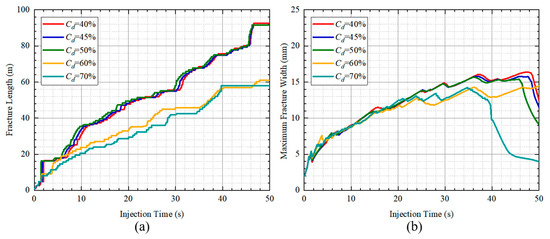
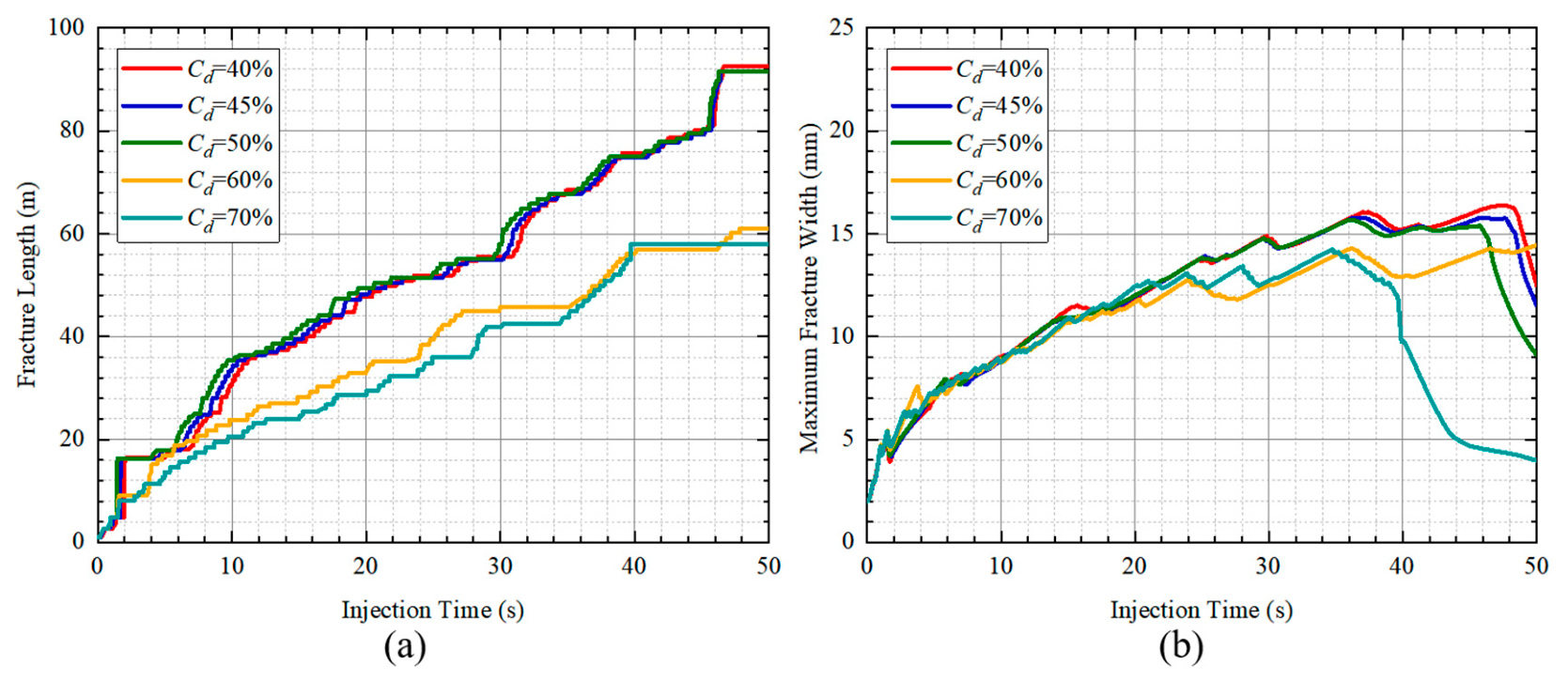
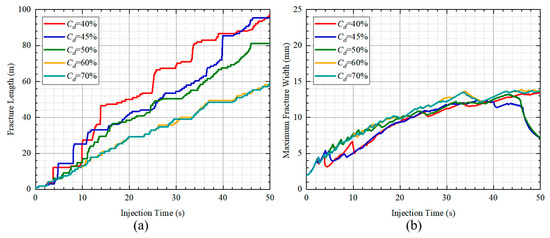
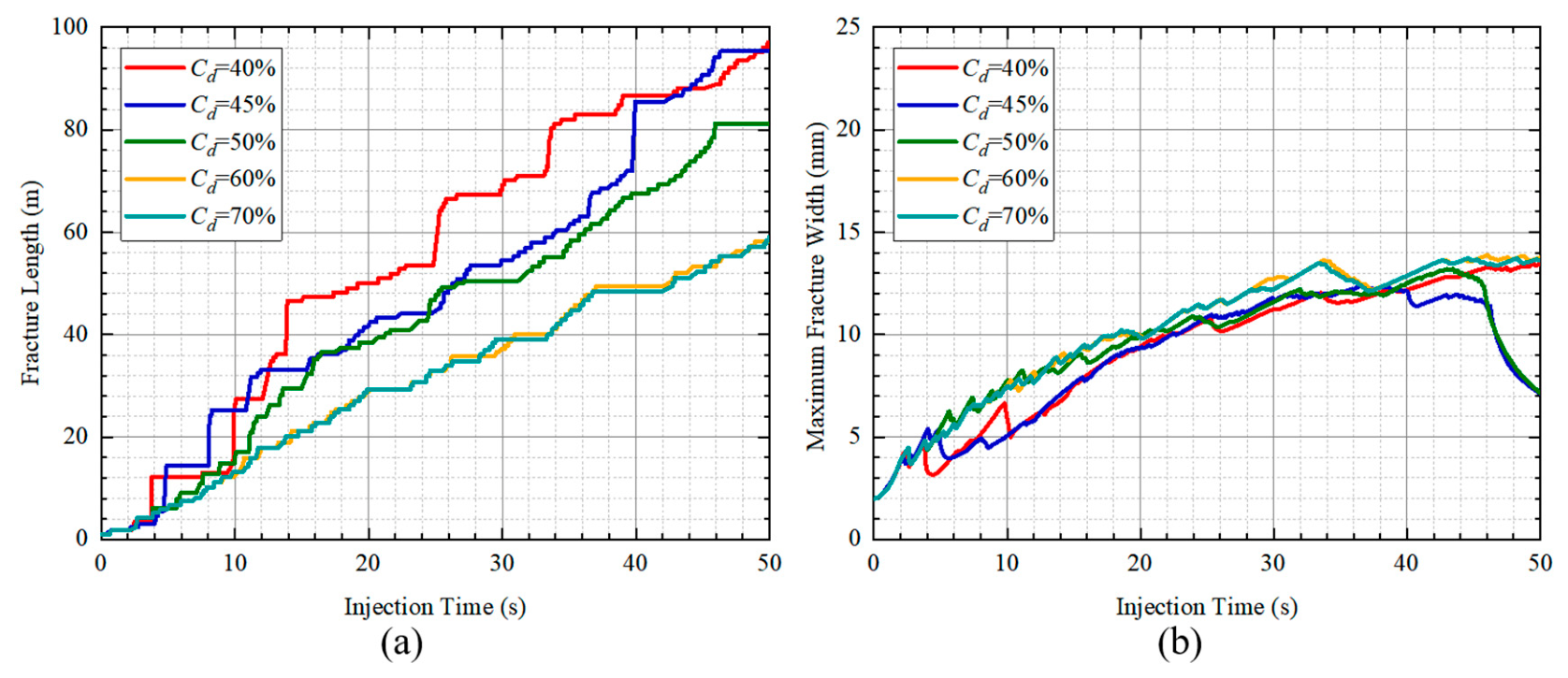
These differences in propagation behavior are further reflected in fracture length and width evolution. Analysis of the time–length curves in Figure 8a indicates that low cementation conditions significantly reduce resistance to fracture propagation, yielding an average propagation rate within the first 40 s that is approximately 1.3 times greater than that observed under high cementation conditions. As shown in Figure 8b, the maximum fracture width under low cementation conditions reaches up to 16 mm, representing an increase of approximately 14% compared to the 14 mm observed in the high cementation group.
Figure 8.
Evolution of fracture length and maximum fracture width with injection time in the fifty natural fractures model under different cementation degrees (). (a) Variation in fracture length with injection time. (b) Variation in maximum fracture width with injection time.
Overall, these results demonstrate that under low cementation conditions, fracturing fluid can more readily invade and open natural fractures, thereby facilitating both fracture extension and width development.
4.2.2. Effect of Cementation Strength in the 50-Fracture Model
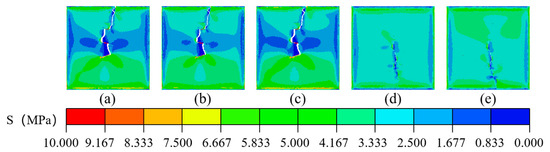
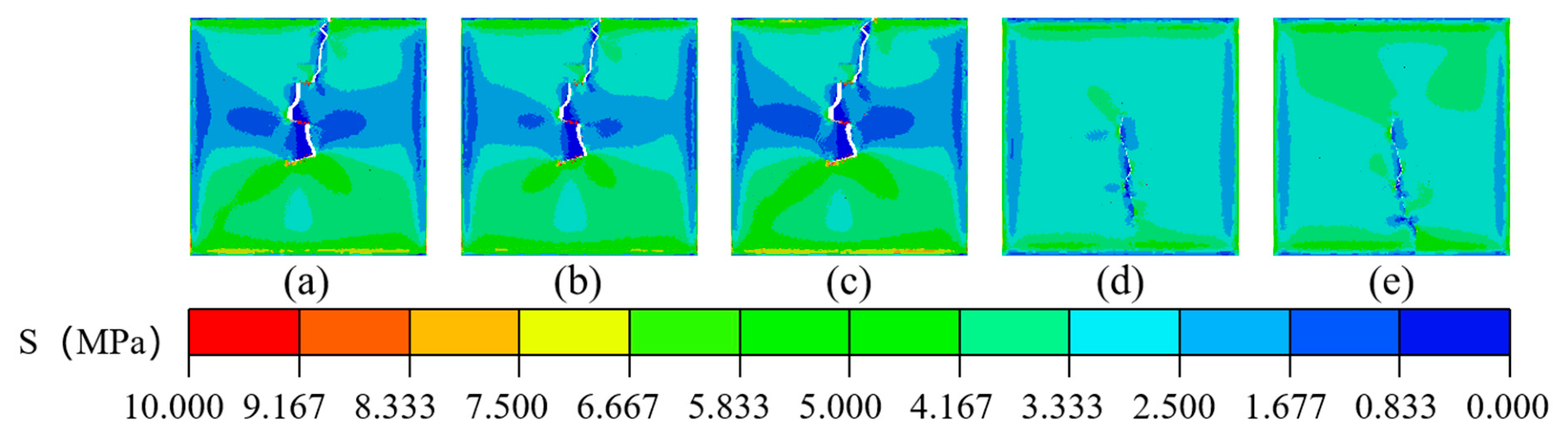
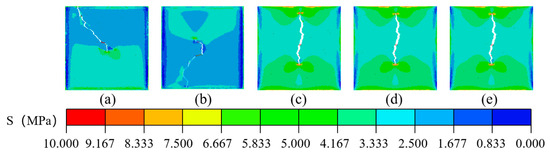
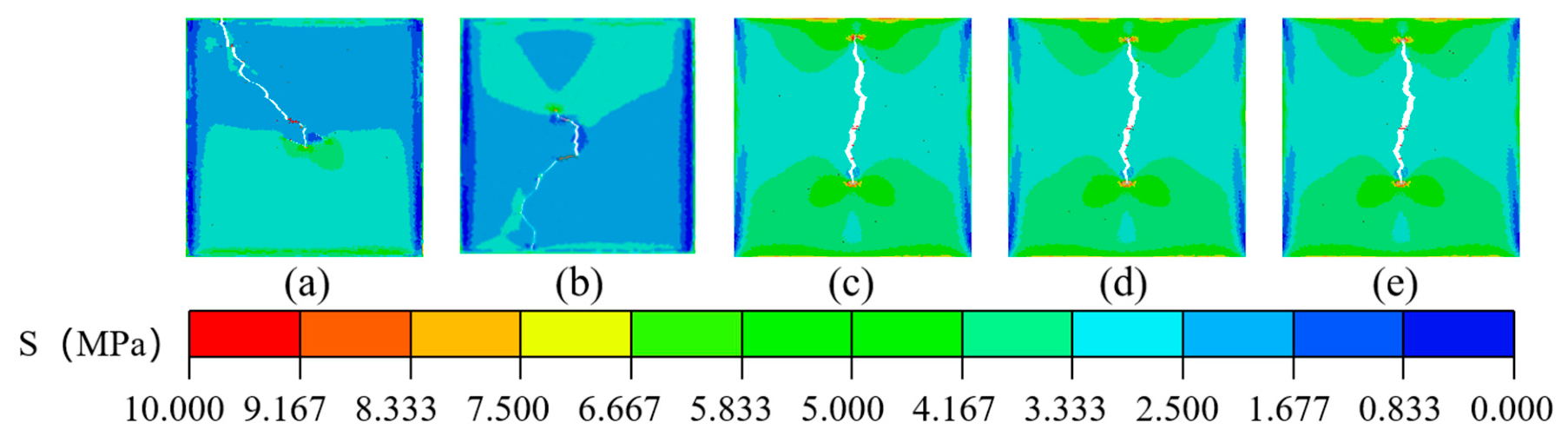
Under the condition that the spatial distribution of natural fractures and the operational parameters remain unchanged, this section further investigates the influence of cementation strength on hydraulic fracture propagation behavior. The corresponding stress distribution and propagation paths are shown in Figure 9. The results indicate that fracture propagation patterns under different cementation strengths also exhibit clear grouping characteristics.
Figure 9.
Stress distribution contours of hydraulic fracture propagation in the fifty natural fractures model under different cementation strengths. (a) = 0.35; (b) = 0.40; (c) = 0.45; (d) = 0.50; (e) = 0.60.
When < 0.50, hydraulic fractures tend to undergo multiple deflections and branching during interaction with natural fractures. Fracture propagation along the orientations of natural fractures is pronounced, leading to the formation of a relatively complex fracture network. In contrast, when ≥ 0.50, hydraulic fractures predominantly propagate across natural fractures, with a noticeable reduction in the number of fracture branches and a more concentrated propagation path.
Further analysis shows that the effect of cementation strength on fracture network geometry exhibits a saturation behavior. Once exceeds a certain threshold, the mechanical properties of the cemented natural fracture interfaces gradually approach those of the rock matrix, and their influence on the local stress field becomes significantly weakened. Under such conditions, further increases in cementation strength result in only minor changes in fracture crossing behavior and geometric characteristics. This indicates that in strongly cemented reservoirs, the contribution of natural fracture structures to hydraulic fracturing effectiveness is limited, and hydraulic fracture propagation tends to be primarily governed by the in situ stress field.
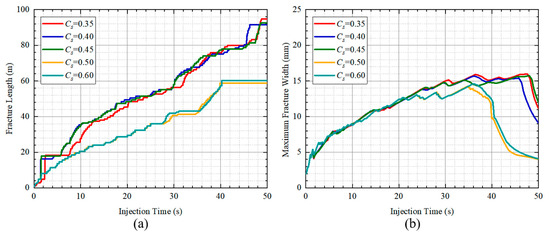
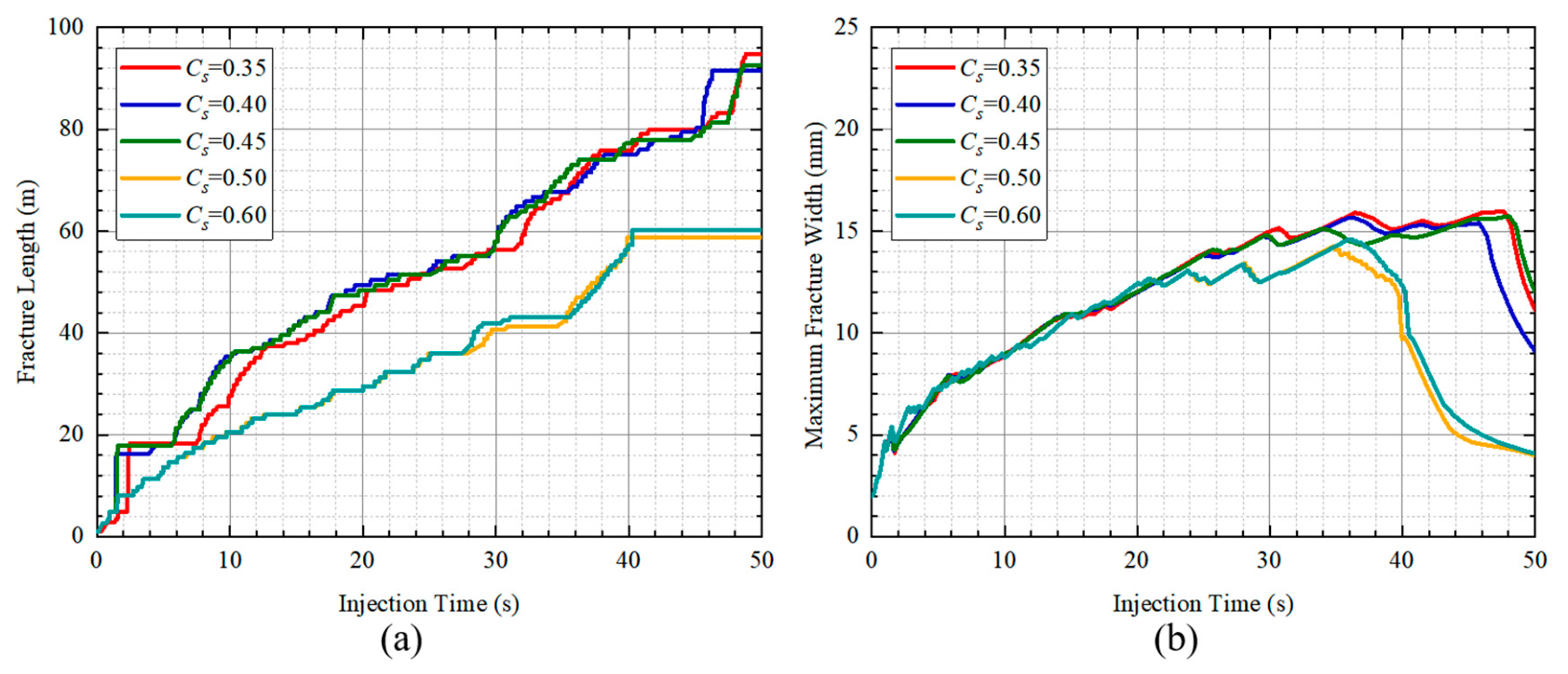
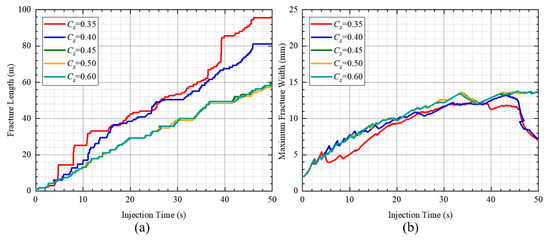
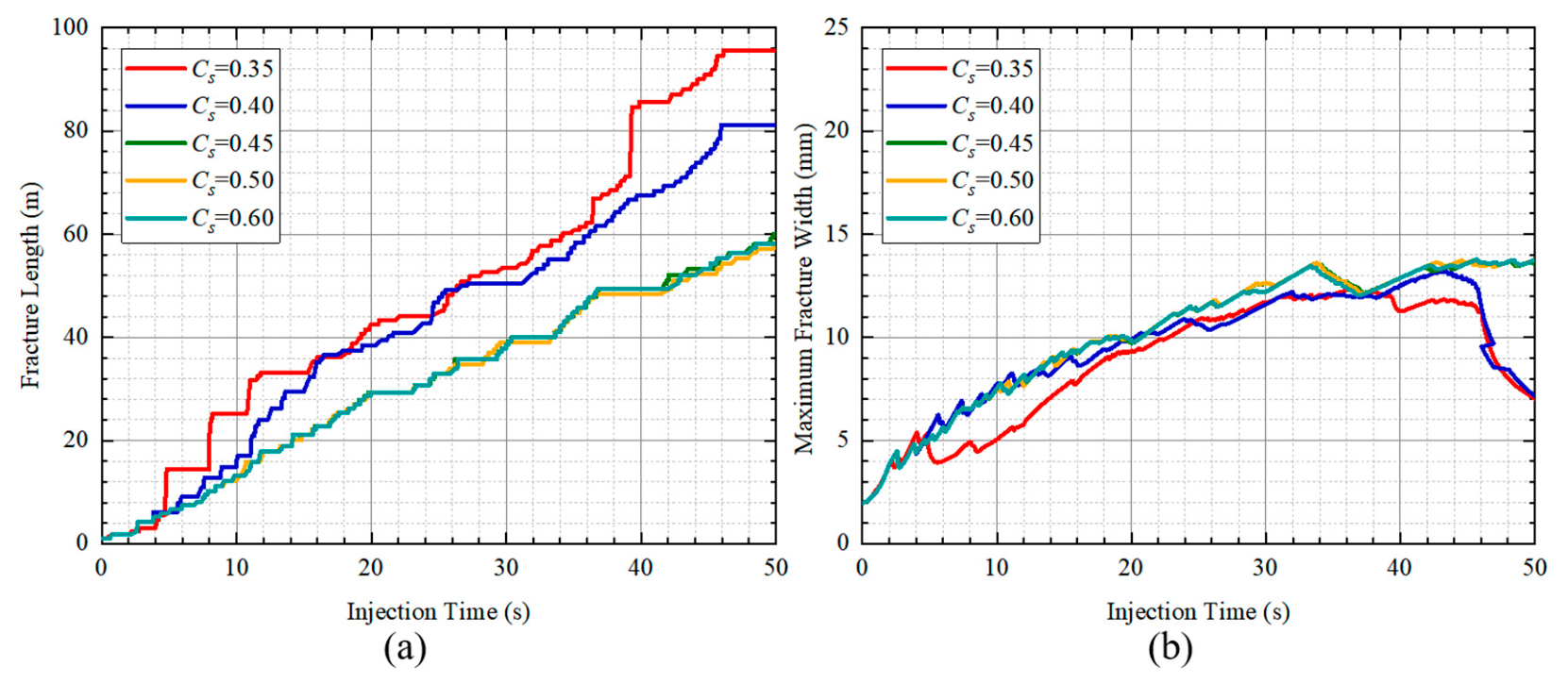
A quantitative comparison of fracture geometric parameters further confirms the controlling role of cementation strength. As shown in Figure 10a, during the early injection stage up to 40 s, the fracture length reaches approximately 75 m when < 0.50, whereas it is about 60 m when ≥ 0.50, representing a difference of roughly 25%. This indicates that weakly cemented interfaces promote frequent deflection and branching of hydraulic fractures, thereby significantly enlarging the swept area of fracturing fluid within the reservoir.
Figure 10.
Evolution of fracture length and maximum fracture width with injection time in the fifty natural fractures model under different cementation strengths (). (a) Variation in fracture length with injection time. (b) Variation in maximum fracture width with injection time.
This expansion is also reflected in the development of fracture width. As illustrated in Figure 10b, at 30 s, the maximum fracture width under = 0.35 reaches 14.94 mm, which is approximately 17% larger than the 12.67 mm observed under = 0.80. This result suggests that a reduction in cementation strength is favorable for fracture width development.
4.3. One Hundred Natural Fractures
To verify the general applicability of the evolution behavior observed in multiple-fracture systems and to further examine the influence of natural fracture density on hydraulic fracture propagation, this section introduces an additional set of 50 randomly distributed natural fractures while keeping the original geological conditions and operational parameters unchanged, increasing the total number of natural fractures in the model to 100. By comparing the simulation results of the 50-fracture and 100-fracture models, the effect of increased fracture density on fracture network geometry is systematically analyzed, and the applicability of the previously identified cementation-related behaviors under more complex conditions is further validated.
4.3.1. Effect of Cementation Degree in the 100-Fracture Model
Under the condition of 100 natural fractures, the propagation process of hydraulic fractures is simulated for different degrees of natural fracture cementation. The corresponding stress distributions and propagation paths are shown in Figure 11. The results indicate that, despite the significant increase in natural fracture density, a similar transition in fracture propagation behavior is still observed around a cementation degree of 50%. The increase in fracture density does not alter the fundamental transition of hydraulic fracture behavior from deflection- and branching-dominated propagation to crossing-dominated propagation.
Figure 11.
Stress distribution contours of hydraulic fracture propagation in the one hundred natural fractures model under different cementation degrees. (a) = 40%; (b) = 45%; (c) = 50%; (d) = 60%; (e) = 70%.
Under low cementation conditions ( ≤ 50%), hydraulic fractures undergo frequent deflection and branching during interactions with a large number of natural fractures and preferentially propagate along natural fracture orientations, forming a more complex fracture network. Compared with the 50-fracture model, the increased fracture density further amplifies the complexity of the fracture network under low cementation conditions, allowing fracturing fluid to be more easily distributed into multiple branch fractures. In contrast, under high cementation conditions ( > 50%), hydraulic fractures mainly propagate across natural fractures, and the overall fracture paths remain relatively straight. In this case, the increase in fracture density has a limited effect on the fracture propagation paths. These observations confirm the general applicability of the previously identified behaviors obtained from the single-fracture and 50-fracture models under high-density fracture network conditions.
Owing to the significant enhancement of the overall flow capacity in high-density fracture networks, hydraulic fractures rapidly reach the model boundaries during the later stages of evolution. To eliminate data distortion caused by boundary effects at later times, the quantitative analysis in this study is focused on an effective observation window within the first 40 s (Figure 12a). Within this interval, fractures have not yet contacted the physical boundaries, and their geometric evolution is fully governed by the coupled effects of interfacial mechanical properties and fluid flow, ensuring clear and reliable data interpretation.
Figure 12.
Evolution of fracture length and maximum fracture width with injection time in the one hundred natural fractures model under different cementation degrees (). (a) Variation in fracture length with injection time. (b) Variation in maximum fracture width with injection time.
Within this effective observation window, the fracture length and width evolution in the 100-fracture model exhibits distinct trends. As shown in Figure 12a, the low cementation group ( ≤ 50%) demonstrates a higher propagation rate, mainly because densely distributed weak interfaces provide more readily accessible paths for fracture extension. However, the fracture width data in Figure 12b show an opposite trend: with decreasing cementation degree, the final fracture width becomes smaller. This “long and narrow” geometric characteristic reflects the fluid diversion into numerous fractures under high-density network conditions, resulting in insufficient pressure within individual fractures.
A quantitative comparison between the 50-fracture and 100-fracture models (Table 2) further reveals the dual influence of fracture density on propagation efficiency. In the low cementation conditions, the propagation length in the 100-fracture model is generally greater than that in the 50-fracture model. For example, at a cementation degree of 40%, the fracture length increases by approximately 14.4%, indicating that a high-density fracture network facilitates outward fracture propagation. In contrast, in the high cementation conditions, the fracture length in the 100-fracture model is reduced by approximately 13.4% compared with the 50-fracture model (taking a cementation degree of 70% as an example). This reflects the cumulative resistance effect caused by repeated crossing of densely distributed, strongly cemented interfaces. In addition, the weakening effect of increased fracture density on fracture width is more pronounced under low cementation conditions, with a reduction of up to 14.9%, whereas the reduction is only 3.8% under high cementation conditions. These comparative results demonstrate that the influence of natural fracture density on fracture network geometry is strongly dependent on the cementation strength of the fractures.
Table 2.
Comparison of fracture geometry parameters under various cementation degrees and fracture densities at t = 40 s.
4.3.2. Effect of Cementation Strength in the 100-Fracture Model
Under the condition of 100 natural fractures, the stress distribution and propagation paths of hydraulic fractures under different cementation strengths ( = 0.30–0.60) are shown in Figure 13. Compared with the 50-fracture model, a clear earlier shift in the propagation mode is observed in the high-density fracture system. Specifically, when ranges from approximately 0.4 to 0.5, the hydraulic fracture transitions from a tendency to deflect toward natural fractures to a tendency to directly cross them.
Figure 13.
Stress distribution contours of hydraulic fracture propagation in the one hundred natural fractures model under different cementation strengths. (a) = 0.35; (b) = 0.40; (c) = 0.45; (d) = 0.50; (e) = 0.60.
Consistent with the previous analysis, the first 40 s is selected as the effective observation window. By jointly examining the evolution of fracture length and maximum fracture width (Figure 14), together with the quantitative results summarized in Table 3, it is found that fracture lengths in the 100-fracture model are generally shorter than those in the 50-fracture model. An exception is observed at = 0.35, where the fracture length in the 100-fracture model exceeds that of the 50-fracture model. Under very weak interface conditions, the increased fracture density provides additional propagation pathways and promotes local fracture extension. For the remaining cases, increasing fracture density limits the effective extension of individual hydraulic fractures due to more frequent fracture interactions, resulting in increased energy dissipation during fracture propagation. Meanwhile, the propagation direction becomes more strongly controlled by natural fractures, and the resulting fracture geometry exhibits increased non-directionality, promoting the development of a more complex fracture network.
Figure 14.
Evolution of fracture length and maximum fracture width with injection time in the one hundred natural fractures model under different cementation strengths (). (a) Variation in fracture length with injection time. (b) Variation in maximum fracture width with injection time.
Table 3.
Comparison of fracture geometry parameters under various cementation strengths and fracture densities at t = 40 s.
The evolution of fracture width further supports this energy-partitioning mechanism. As shown in Table 3, the maximum fracture width in the 100-fracture model is consistently lower than that in the 50-fracture model under all cementation conditions. This trend is consistent with observations under different cementation degrees. A higher natural fracture density leads to a more intricate branching system, and under a constant injection rate, the fracturing fluid is redistributed into secondary fractures. As a result, the pressure acting on individual fractures is reduced, giving rise to a fracture network characterized by “more fractures with shorter length and smaller width.”
4.4. Engineering Implications and Integrated Discussion
Based on the numerical simulation results obtained under different cementation degrees, cementation strengths, and fracture densities, it can be concluded that the cementation characteristics of natural fractures constitute the primary controlling factor governing hydraulic fracture propagation behavior. Regardless of whether the model contains 50 or 100 natural fractures, a transition in fracture propagation behavior is generally observed when approaches approximately 50% or approaches 0.50. Under weakly cemented conditions, hydraulic fractures tend to be captured by natural fractures, exhibiting frequent deflection and branching; conversely, under strongly cemented conditions, hydraulic fractures predominantly propagate by directly crossing natural fractures, and the fracture path becomes comparatively stable. Although only cementation-related parameters were investigated in this study, hydraulic fracture propagation is also affected by in situ stress conditions, injection parameters, fluid properties, and natural-fracture geometry. The interaction between these factors and cementation properties deserves further investigation.
The influence of fracture density on hydraulic fracture propagation is characterized as a nonlinear amplification effect rather than a dominant controlling mechanism. When natural fractures are weakly cemented, an increase in fracture density markedly intensifies fracture deflection and branching, thereby promoting the development of a more complex fracture network. In contrast, under strongly cemented conditions, even a substantial increase in fracture density exerts only a limited influence on fracture propagation paths and geometric characteristics.
From an engineering perspective, hydraulic fracturing design in naturally fractured reservoirs should place particular emphasis on the cementation characteristics of natural fractures. In reservoirs characterized by weak cementation and high fracture density, fracture complexity should be carefully regulated through appropriate control of fracturing-fluid properties and operational parameters to prevent excessive branching that may compromise stimulation efficiency. In contrast, for strongly cemented reservoirs where natural fractures are difficult to effectively activate, the design focus should shift toward enhancing the conductivity of long, dominant hydraulic fractures, thereby ensuring effective drainage and control of the far-field reservoir volume.
It should be noted that all simulations in this study were conducted using a two-dimensional plane-strain model. Although this approach is effective for investigating the fundamental interaction mechanisms between hydraulic fractures and cemented natural fractures, it does not explicitly account for fracture height growth, out-of-plane propagation, or three-dimensional stress redistribution. Consequently, the quantitative transition values identified in this study should be interpreted within the context of the present modeling framework. In addition, only one representative realization was considered for each fracture-density scenario. Although the generated fracture networks capture the general characteristics of randomly distributed natural fractures, additional realizations may further improve the statistical robustness of the results. Future work should incorporate fully coupled three-dimensional simulations, multiple fracture-network realizations, and experimental validation to further evaluate the applicability of these findings under more realistic reservoir conditions.
5. Conclusions
This study systematically investigates the propagation mechanisms of hydraulic fractures in reservoirs containing cemented natural fractures based on numerical simulations. By varying key parameters, including cementation degree, cementation strength, and natural fracture density, the fracture propagation behavior and geometric characteristics are analyzed. The main conclusions are summarized as follows:
1. and are the dominant factors controlling hydraulic fracture propagation behavior. Under weak cementation conditions, hydraulic fractures are more likely to deflect along natural fractures, resulting in the formation of complex fracture networks. In contrast, under strong cementation conditions, hydraulic fractures tend to propagate in a stable and planar manner with relatively straight trajectories, leading to reduced network complexity but promoting the development of dominant fractures with greater aperture and continuity.
2. Natural fracture density exhibits a significant nonlinear influence on hydraulic fracture propagation. Under weak cementation conditions, increasing fracture density introduces more structural discontinuities; however, frequent deflection intensifies energy dissipation and path tortuosity, resulting in a coupled control on fracture extension distance. Meanwhile, fracture network complexity increases, accompanied by a reduction in individual fracture width. Under strong cementation conditions, natural fractures primarily act as mechanical barriers. Increasing fracture density has a limited effect on propagation paths, but due to enhanced crossing resistance and fluid diversion, both fracture length and width decrease.
3. A transition in fracture propagation behavior is observed when approaches approximately 50% and approaches 0.5. Around these values, hydraulic fractures gradually shift from deflection- and branching-dominated propagation toward crossing-dominated propagation. These findings provide mechanistic insights for understanding hydraulic fracture propagation under different cementation conditions in naturally fractured reservoirs.
Author Contributions
Conceptualization, B.T. and L.Z.; methodology, L.Z. and Y.D.; software, L.Z.; validation, L.Z. and Y.D.; formal analysis, L.Z.; investigation, L.Z.; resources, J.L. and Y.P.; data curation, L.Z.; writing—original draft preparation, L.Z.; writing—review and editing, B.T., Y.D., J.L. and Y.P.; visualization, L.Z.; supervision, B.T.; project administration, B.T.; funding acquisition, B.T. All authors have read and agreed to the published version of the manuscript.
Funding
This research received no external funding. The APC was funded by the authors.
Institutional Review Board Statement
Not applicable.
Informed Consent Statement
Not applicable.
Data Availability Statement
The raw data supporting the conclusions of this article will be made available by the authors on request.
Acknowledgments
The authors would like to acknowledge the support from the PetroChina Research Institute of Petroleum Exploration & Development for providing the research platform and project support. The authors also thank colleagues for valuable discussions.
Conflicts of Interest
Author Yawen Du was employed by the company PetroChina Southwest Oil & Gasfield Company; Author Jia Li was employed by the company CNPC Engineering Technology R&D Company Limited; Author Yue Peng was employed by the company PetroChina Changqing Oilfield Company. The remaining authors declare that the research was conducted in the absence of any commercial or financial relationships that could be construed as a potential conflict of interest.
References
- Taleghani, A.D.; Olson, J.E. How natural fractures could affect hydraulic-fracture geometry. SPE J. 2014, 19, 161–171. [Google Scholar] [CrossRef] [Scilit]
- Wang, J.; Xie, H.-P.; Matthai, S.K.; Hu, J.-J.; Li, C.-B. The role of natural fracture activation in hydraulic fracturing for deep unconventional geo-energy reservoir stimulation. Pet. Sci. 2023, 20, 2141–2164. [Google Scholar] [CrossRef] [Scilit]
- Wu, H.; Kong, X. Fine description of natural fractures in the tight sandstone reservoir of the Yanchang reservoirs in the southern Ordos Basin. Sci. Rep. 2025, 15, 6152. [Google Scholar] [CrossRef] [Scilit] [PubMed]
- Takougang, E.M.T.; Ali, M.Y.; Bouzidi, Y.; Bouchaala, F.; Sultan, A.A.; Mohamed, A.A.I. Extraction and characterization of faults and fractures from 3D VSP data in a carbonate reservoir: A workflow. J. Pet. Sci. Eng. 2019, 182, 106328. [Google Scholar] [CrossRef] [Scilit]
- Bouchaala, F.; Mohamed, A.A.I.; Jouini, M.S.; Bouzidi, Y.; Ali, M.Y. Azimuthal Investigation of a Fractured Carbonate Reservoir. SPE Reserv. Eval. Eng. 2023, 26, 813–826. [Google Scholar]
- Chen, Z.; Yang, Z.; Wang, M. Hydro-mechanical coupled mechanisms of hydraulic fracture propagation in rocks with cemented natural fractures. J. Pet. Sci. Eng. 2018, 163, 421–434. [Google Scholar] [CrossRef] [Scilit]
- Zheng, Y.; Liu, J.; Lei, Y. The propagation behavior of hydraulic fracture in rock mass with cemented joints. Geofluids 2019, 2019, 5406870. [Google Scholar] [CrossRef] [Scilit]
- Sun, T.; Zeng, Q.; Xing, H. A quantitative model to predict hydraulic fracture propagating across cemented natural fracture. J. Pet. Sci. Eng. 2022, 208, 109595. [Google Scholar] [CrossRef] [Scilit]
- Bahorich, B.; Olson, J.E.; Holder, J. Examining the effect of cemented natural fractures on hydraulic fracture propagation in hydrostone block experiments. In SPE Annual Technical Conference and Exhibition? SPE: Houston, TX, USA, 2012; p. SPE-160197-MS. [Google Scholar]
- Wang, H. Hydraulic fracture propagation in naturally fractured reservoirs: Complex fracture or fracture networks. J. Nat. Gas Sci. Eng. 2019, 68, 102911. [Google Scholar] [CrossRef] [Scilit]
- Zhang, J.; Li, Y.; Pan, Y.; Wang, X.; Yan, M.; Shi, X.; Zhou, X.; Li, H. Experiments and analysis on the influence of multiple closed cemented natural fractures on hydraulic fracture propagation in a tight sandstone reservoir. Eng. Geol. 2021, 281, 105981. [Google Scholar] [CrossRef] [Scilit]
- Li, Q.; Xing, H.; Liu, J.; Liu, X. A review on hydraulic fracturing of unconventional reservoir. Petroleum 2015, 1, 8–15. [Google Scholar] [CrossRef] [Scilit]
- Yoshioka, K.; Katou, M.; Tamura, K.; Arima, Y.; Ito, Y.; Chen, Y.; Ishida, T. Interactions of hydraulic fractures with grain boundary discontinuities in the near wellbore region. J. Geophys. Res. Solid Earth 2023, 128, e2022JB024509. [Google Scholar] [CrossRef] [Scilit]
- Fu, W.; Ames, B.C.; Bunger, A.P.; Savitski, A.A. Impact of partially cemented and non-persistent natural fractures on hydraulic fracture propagation. Rock Mech. Rock Eng. 2016, 49, 4519–4526. [Google Scholar] [CrossRef] [Scilit]
- Olson, J.E.; Bahorich, B.; Holder, J. Examining hydraulic fracture-natural fracture interaction in hydrostone block experiments. In SPE Hydraulic Fracturing Technology Conference and Exhibition; SPE: Houston, TX, USA, 2012; p. SPE-152618-MS. [Google Scholar]
- Fu, W.; Ames, B.; Bunger, A.; Savitski, A. An experimental study on interaction between hydraulic fractures and partially-cemented natural fractures. In ARMA US Rock Mechanics/Geomechanics Symposium; ARMA: Lee’s Summit, MO, USA, 2015; p. ARMA-2015-132. [Google Scholar]
- Chen, B.; Barboza, B.R.; Sun, Y.; Bai, J.; Thomas, H.R.; Dutko, M.; Cottrell, M.; Li, C. A review of hydraulic fracturing simulation. Arch. Comput. Methods Eng. 2022, 29, 1–58. [Google Scholar]
- Chen, Z.; Jeffrey, R.G.; Zhang, X.; Kear, J. Finite-element simulation of a hydraulic fracture interacting with a natural fracture. SPE J. 2017, 22, 219–234. [Google Scholar] [CrossRef] [Scilit]
- Wang, H. Numerical modeling of non-planar hydraulic fracture propagation in brittle and ductile rocks using XFEM with cohesive zone method. J. Pet. Sci. Eng. 2015, 135, 127–140. [Google Scholar] [CrossRef] [Scilit]
- Haddad, M.; Sepehrnoori, K. XFEM-based CZM for the simulation of 3D multiple-cluster hydraulic fracturing in quasi-brittle shale formations. Rock Mech. Rock Eng. 2016, 49, 4731–4748. [Google Scholar]
- Sheng, M.; Li, G.; Sutula, D.; Tian, S.; Bordas, S.P. XFEM modeling of multistage hydraulic fracturing in anisotropic shale formations. J. Pet. Sci. Eng. 2018, 162, 801–812. [Google Scholar] [CrossRef] [Scilit]
- Renshaw, C.; Pollard, D. An experimentally verified criterion for propagation across unbounded frictional interfaces in brittle, linear elastic materials. Int. J. Rock Mech. Min. Sci. Geomech. Abstr. 1995, 32, 237–249. [Google Scholar] [CrossRef] [Scilit]
- Alam, M.; Grimm, B.; Parmigiani, J.P. Effect of incident angle on crack propagation at interfaces. Eng. Fract. Mech. 2016, 162, 155–163. [Google Scholar] [CrossRef] [Scilit]
- Detournay, E. Mechanics of hydraulic fractures. Annu. Rev. Fluid Mech. 2016, 48, 311–339. [Google Scholar] [CrossRef] [Scilit]
- Xu, X.-P.; Needleman, A. Numerical simulations of fast crack growth in brittle solids. J. Mech. Phys. Solids 1994, 42, 1397–1434. [Google Scholar] [CrossRef] [Scilit]

Disclaimer/Publisher’s Note: The statements, opinions and data contained in all publications are solely those of the individual author(s) and contributor(s) and not of MDPI and/or the editor(s). MDPI and/or the editor(s) disclaim responsibility for any injury to people or property resulting from any ideas, methods, instructions or products referred to in the content. |
© 2026 by the authors. Licensee MDPI, Basel, Switzerland. This article is an open access article distributed under the terms and conditions of the Creative Commons Attribution (CC BY) license.