Hardware Performance Counter Analysis of Ransomware Behavior: Observed Inverse Correlations Across Heterogeneous x86 Platforms

Abstract
1. Introduction
1.1. Background and Motivation
1.2. Related Work
1.2.1. HPC-Based Malware Detection
1.2.2. Phase-Aware Behavioral Analysis
1.3. Research Gaps
1.4. Research Questions
- RQ1: What patterns characterize the correlation strength between HPC events and ransomware behaviors (startup, key generation, encryption) across Win7 and Win10? Which events exhibit the strongest associations within the first 10 s of execution?
- RQ2: How do cross-platform correlation patterns differ between ransomware and benign tasks, particularly within the first 2 s of the startup phase?
1.5. Contributions
- 1.
- A cross-platform HPC–ransomware correlation framework. We integrate 10 s time-series data with three-phase behavioral partitioning (startup, key generation, and encryption), establishing a complete paradigm of “preprocessing → correlation analysis → validation” that addresses the gap in cross-platform correlation mechanism studies.
- 2.
- Platform-specific core event identification.Through multi-dimensional quantitative analysis, we systematically characterize correlation strength differences across 25 Win7 events and 42 Win10 instance-level metrics, identifying both platform-common and platform-specific core events. This provides interpretable feature sets for understanding ultra-early startup-phase behavior.
- 3.
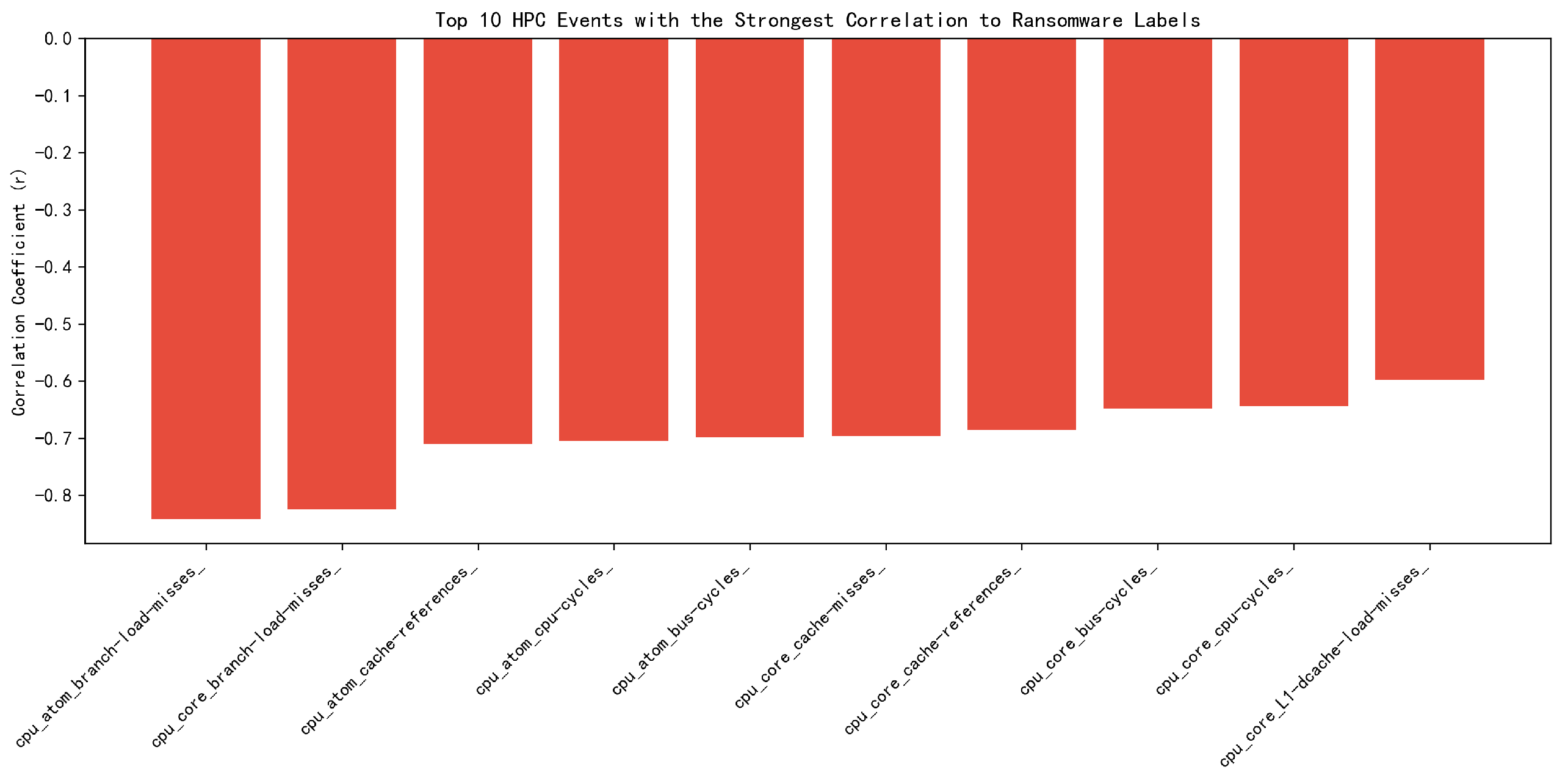
- An architecture-dependent behavioral observation.We observe that HPC responses invert from “resource-enhanced disturbance” on homogeneous Win7 to “resource-suppressed disturbance” on heterogeneous Win10, with fine-grained P/E-core separation being associated with an increase in correlation strength from 54.90% to 89.91% during the startup phase.
1.6. Paper Organization
2. Materials and Methods
2.1. Experimental Environment
- 1.
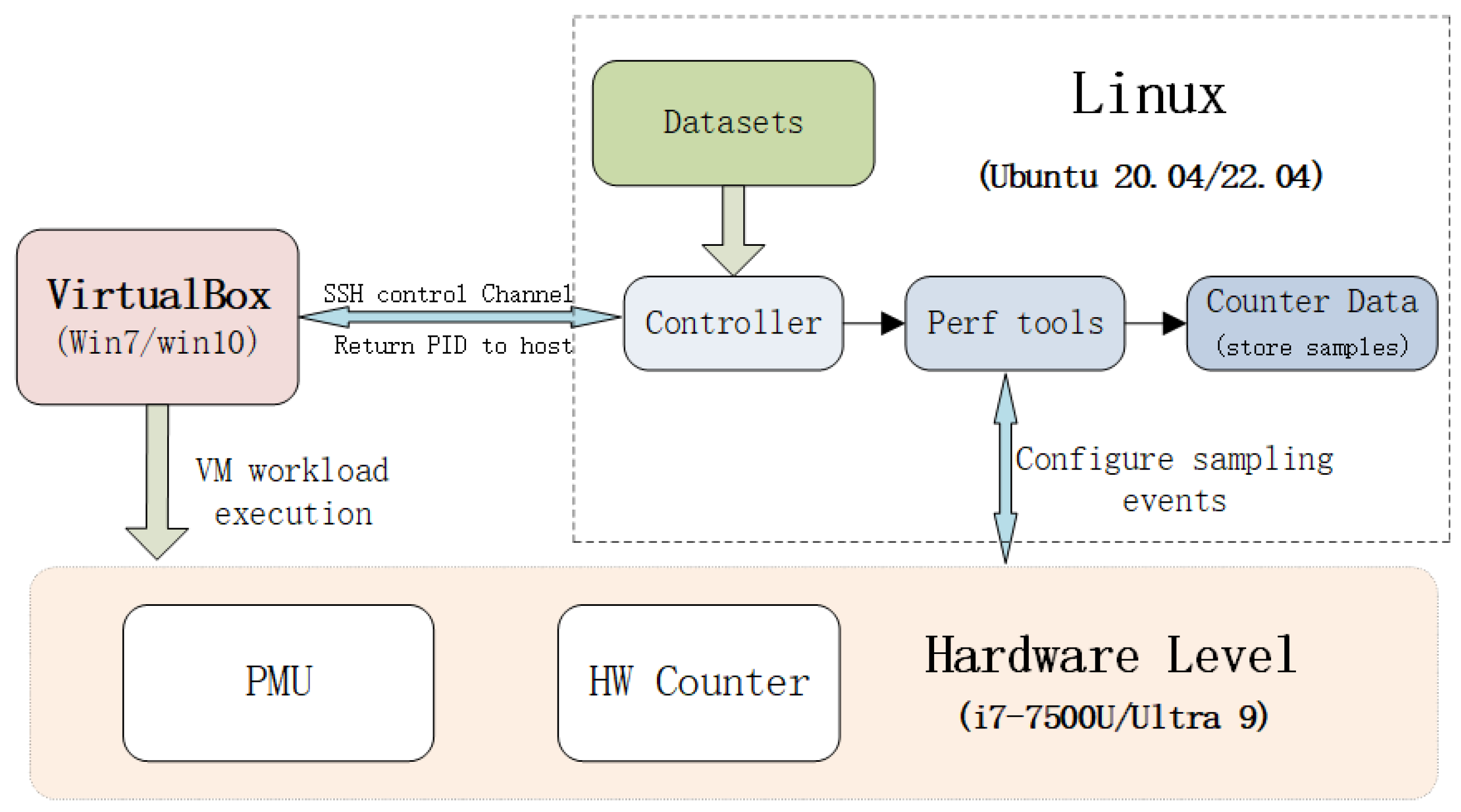
- Non-interference: Monitoring operations on the Linux host do not interfere with ransomware execution inside the Windows VM.
- 2.
- Data integrity: The isolated VM environment prevents ransomware from tampering with the data collection process or escaping to the host system.
2.2. Data Collection
2.3. HPC Event Selection
2.4. Behavioral Phase Annotation
2.5. Correlation Analysis Framework
2.5.1. Validation of Virtualization Distortion on Windows 10 Platform
2.5.2. Impact of Virtualization on HPC Measurements
3. Results
3.1. Correlation and Redundancy Analysis
- Overall Distribution of Effect Sizes (Cohen’s d)
- 2.
- Category-Level Redundancy Analysis
- 3.
- Summary and Recommendations
- Windows 7: Prioritize low-redundancy features from the dTLB address translation category, which exhibits the best independence.
- Windows 10: Apply aggressive feature selection and dimensionality reduction to highly redundant categories such as cache and dTLB.
3.1.1. Difference Fold Change Analysis
3.1.2. Key Findings Summary
- 1.
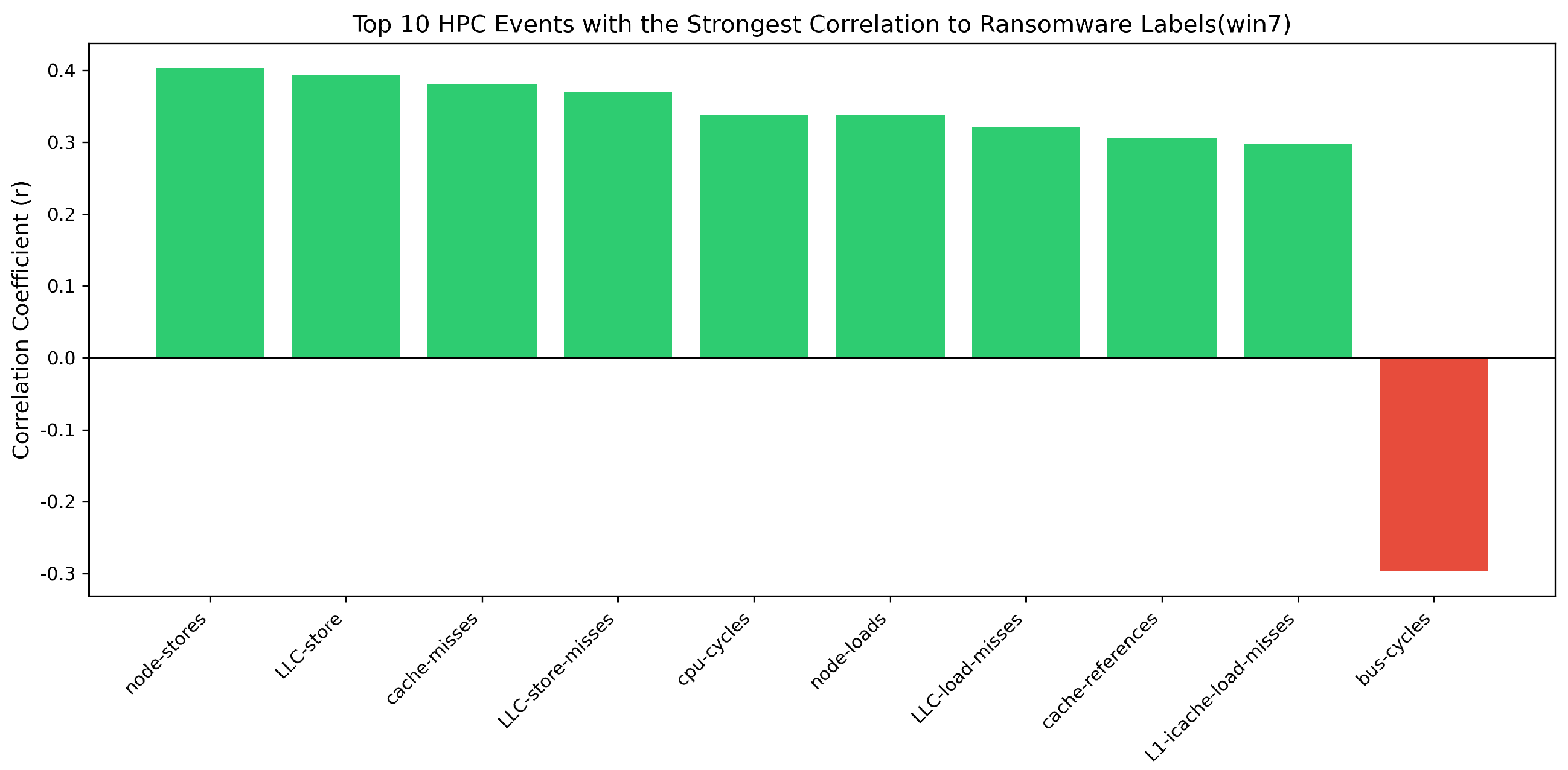
- Opposite effect directions and stronger separation on Win10: Windows 7 exhibits positive Cohen’s d (resource-enhanced disturbance), while Windows 10 exhibits negative Cohen’s d (resource-suppressed disturbance). The proportion of large effects () is substantially higher on Windows 10 (70.2%) than on Windows 7 (35.0%).
- 2.
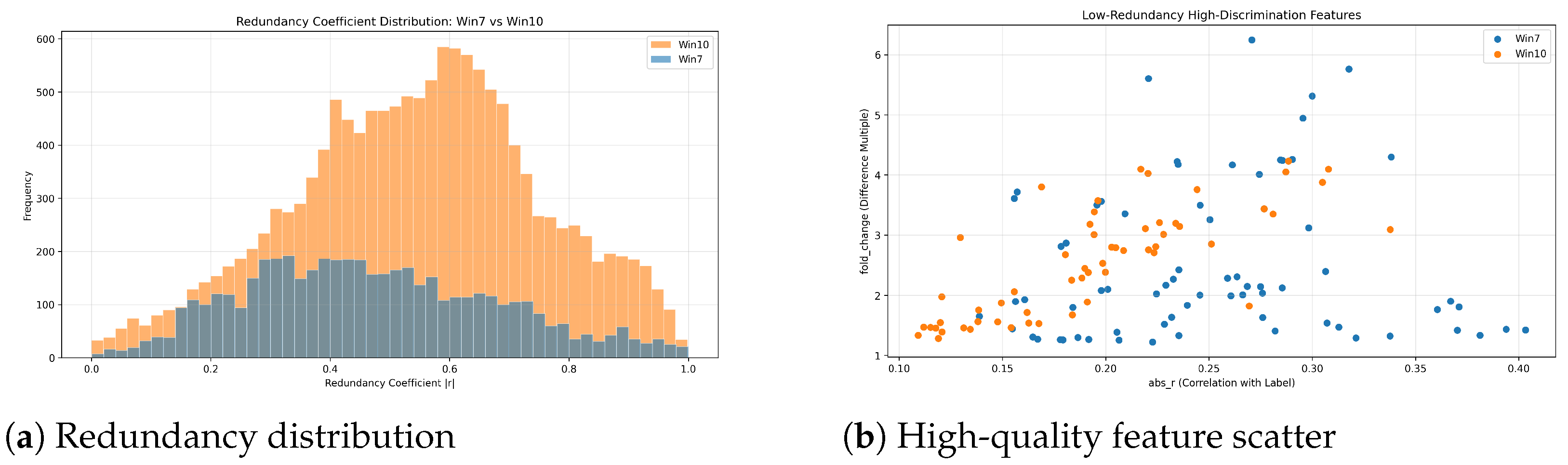
- Different redundancy characteristics: Windows 7 exhibits lower overall redundancy (0.470 vs. 0.546) and more low-redundancy high-quality features (72 vs. 57), indicating better feature independence. Windows 10 shows higher redundancy across all categories due to its heterogeneous architecture, with Branch prediction and Cache categories being the most redundant.
- 3.
- Divergent high-difference event types: Windows 7 has a higher proportion of high-difference features (45.0% vs. 33.9%), concentrated on last-level cache and memory nodes. Windows 10 has a higher proportion of low-difference features (50.6% vs. 41.0%), with high-difference events concentrated on L1 cache and TLB, and exclusively using median (med) features.
3.2. Feature Importance Ranking
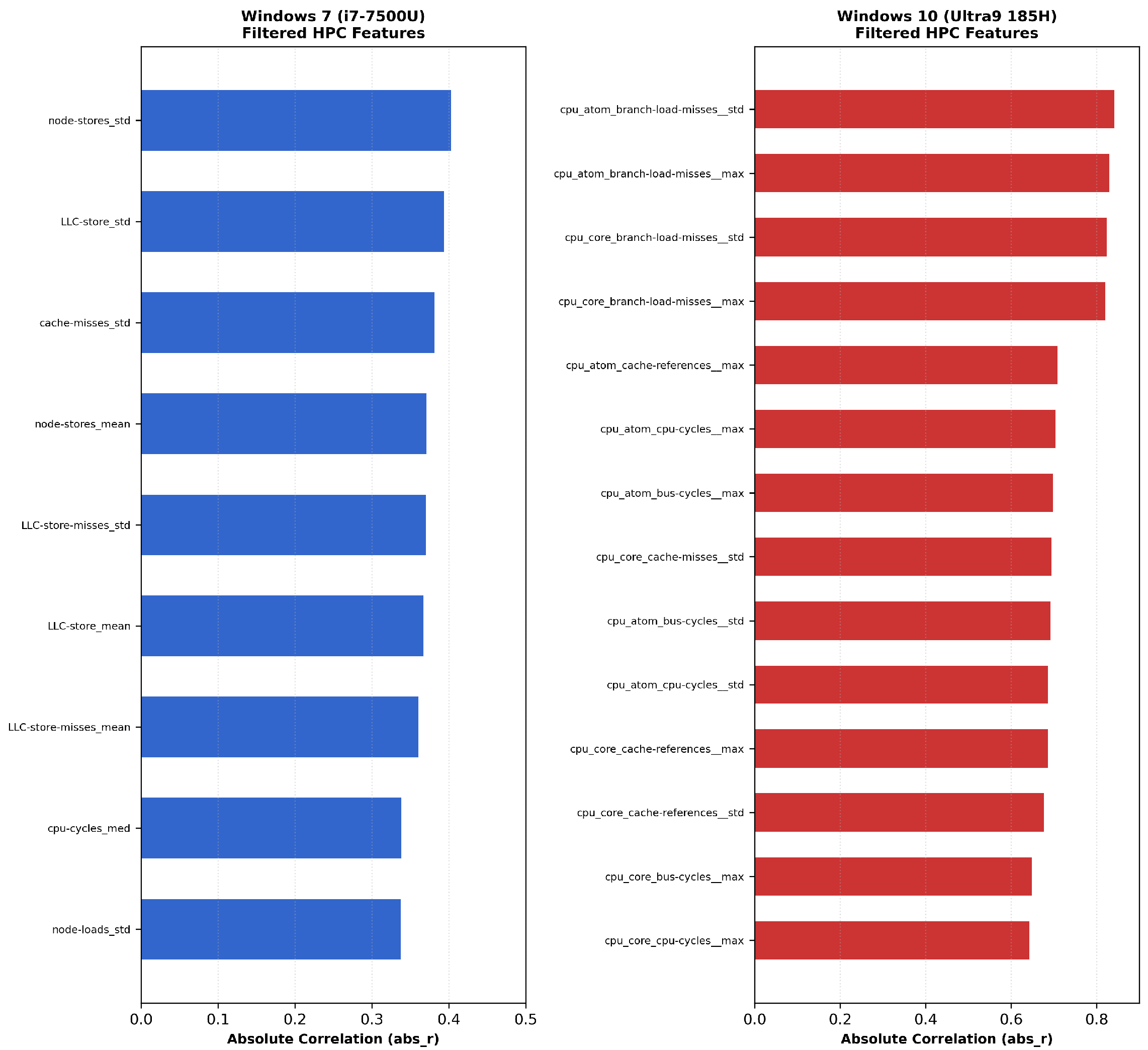
3.2.1. Initial Feature Screening
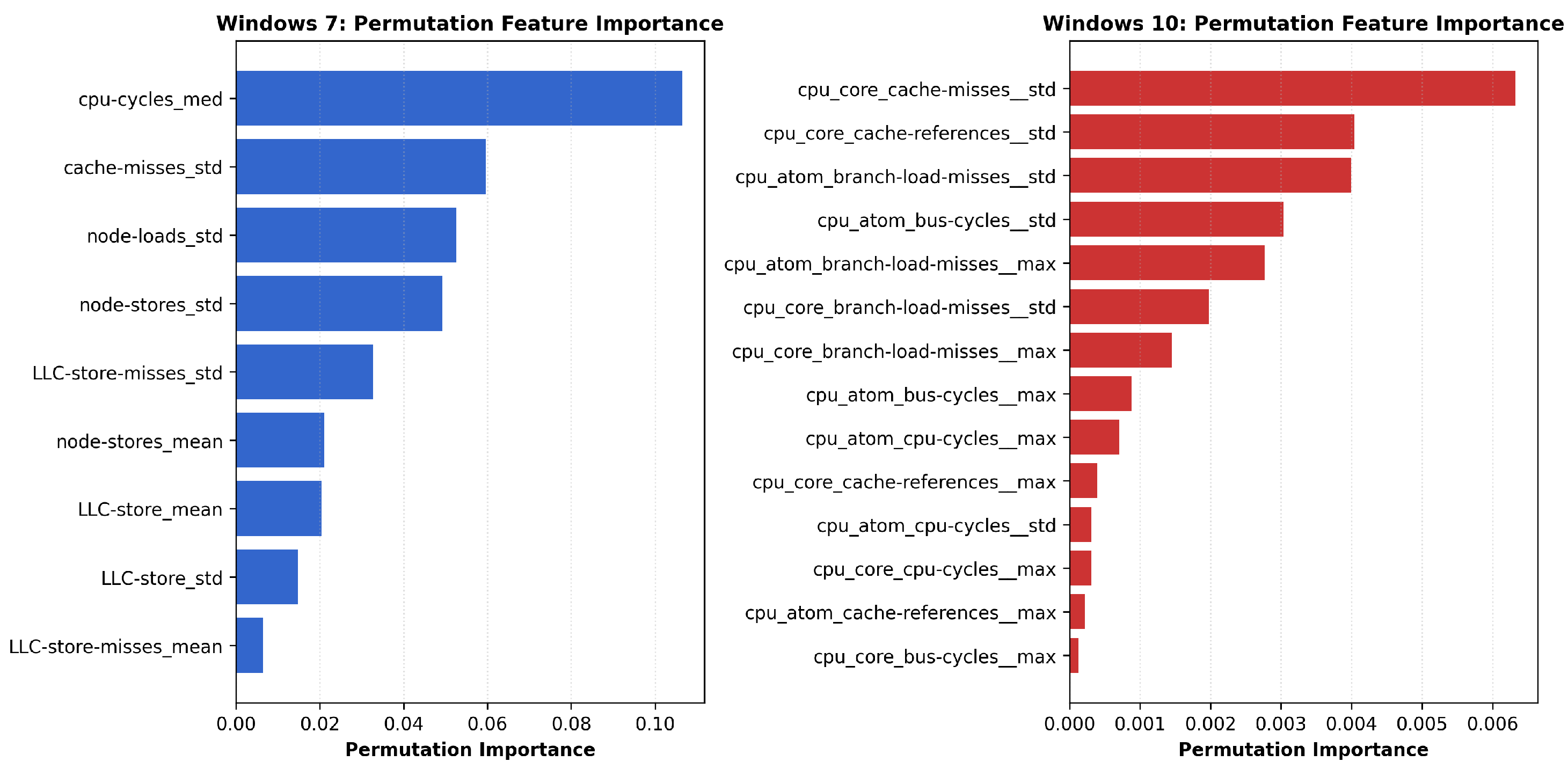
3.2.2. Random Forest Importance Scoring
Note
Evaluation Framework
Cross-Validation Accuracy
Generalization to Unseen Families
Feature Importance Ranking
- node-stores_mean (importance: 0.0063)
- LLC-store_std (importance: 0.0058)
- cpu-cycles_med (importance: 0.0051)
- cpu_core_cache-misses_std (importance: 0.0063)
- cpu_core_cache-references_std (importance: 0.0040)
- cpu_atom_branch-load-misses_std (importance: 0.0040)
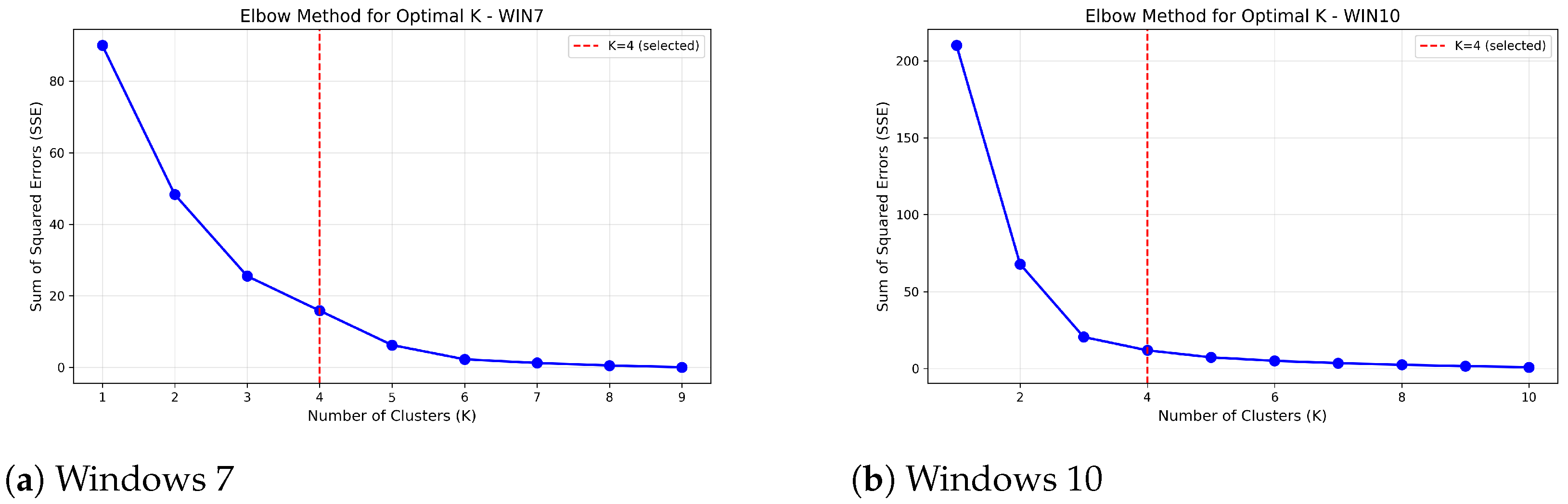
3.2.3. Clustering-Based Optimization
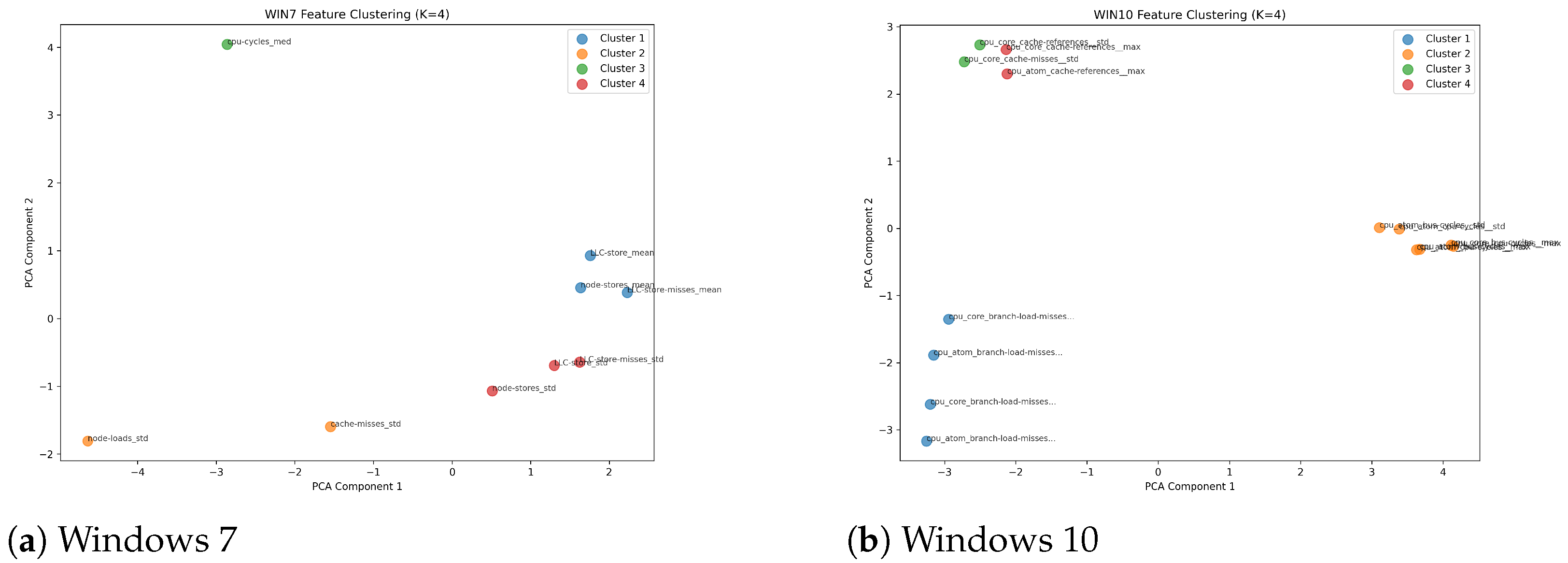
Clustering Procedure
Cluster Structure
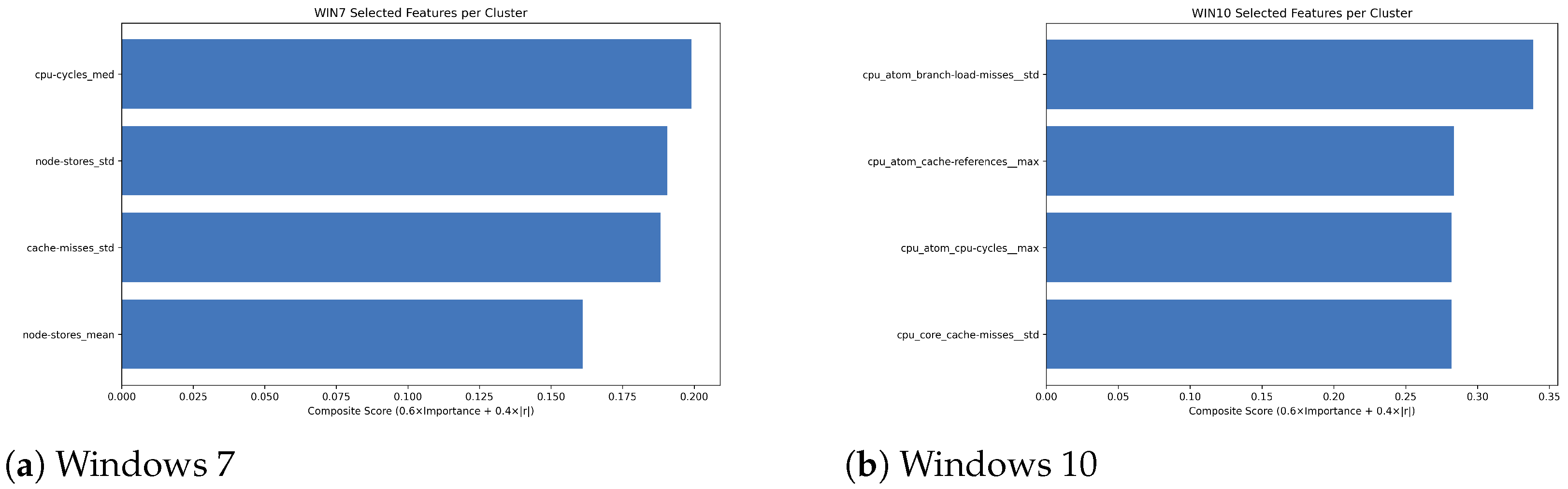
Selected Features
- Windows 7: node-stores_mean, cache-misses_std,cpu-cycles_med, node-stores_std
- Windows 10: cpu_atom_branch-load-misses_std,cpu_atom_cpu-cycles_max, cpu_core_cache-misses_std,cpu_atom_cache-references_max
3.2.4. Summary
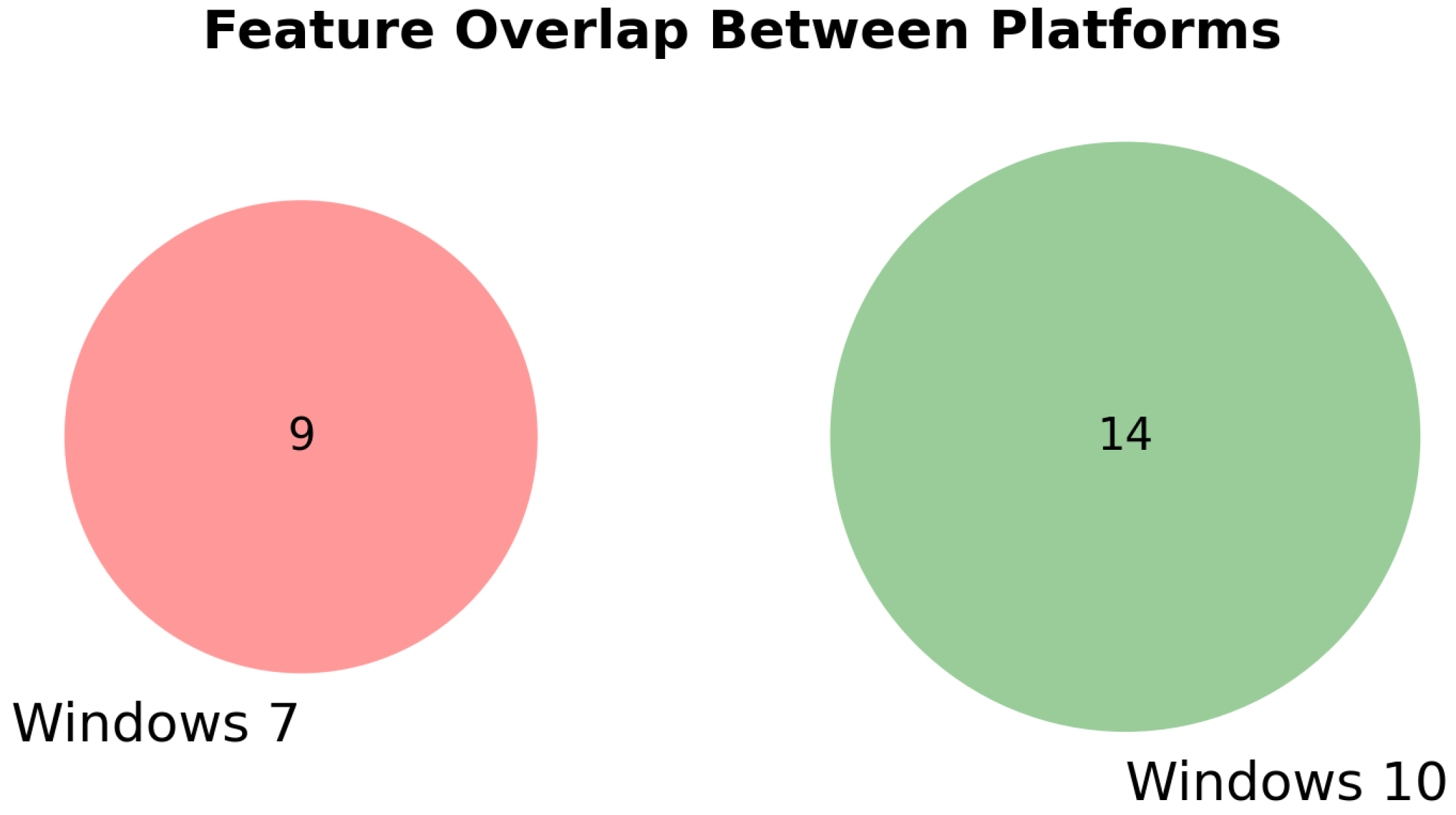
- Initial screening: 9 features retained on Windows 7, 14 on Windows 10, satisfying correlation (), discriminability (fold change or ), and effect size (Cohen’s ) criteria.
- Random Forest importance scoring (permutation importance): All candidate features were identified as effective, with classification accuracies of (Win7) and (Win10). The top-3 features are:- Win7: node-stores_mean, LLC-store_std, cpu-cycles_med;- Win10: cpu_core_cache-misses_std, cpu_core_cache-references_std, cpu_atom_branch-load-misses_std.
- Clustering optimization (K-means, K=4): Four low-redundancy, highly representative features were selected per platform, each from distinct clusters covering diverse HPC categories (LLC storage, cache, CPU cycle, branch miss, bus/CPU cycle).
- Cross-platform divergence: Windows 7 selected features show increasing trends (fold change ), while Windows 10 selected features show decreasing trends (fold change ). No common features exist between the two platforms, highlighting the necessity of platform-specific feature selection.
3.3. Phase Matching and Correlation Characterization
- Windows 7: node-stores_mean, cache-misses_std,cpu-cycles_med, node-stores_std
- Windows 10: cpu_atom_branch-load-misses_std,cpu_atom_cpu-cycles_max, cpu_core_cache-misses_std,cpu_atom_cache-references_max
3.3.1. Quantitative Analysis of Feature-Stage Correlation
Key Observations
- Windows 7 (resource-enhanced disturbance):
- -
- node-stores_mean and node-stores_std reach S-level (91.45) in the key generation phase (2–5 s), indicating that storage-related HPC events peak during cryptographic operations.
- -
- Other features show A/B levels, suggesting moderate but consistent separation.
- Windows 10 (resource-suppressed disturbance):
- -
- Three features achieve S-level in the startup phase (0–2 s):cpu_atom_cpu-cycles_max (100.00), cpu_core_cache-misses_std (89.88), and cpu_atom_cache-references_max (90.48). This enables ultra-early detection (within the first 2 s).
- -
- All four features reach S-level in the encryption phase (5–10 s),with cpu_atom_cpu-cycles_max and cpu_core_cache-misses_std achieving perfect scores (100.00).
- -
- The key generation phase (2–5 s) shows the weakest alignment (C/B levels), suggesting this phase is the most challenging for HPC-based differentiation on Windows 10.
Summary
3.3.2. Stage-Specific Threshold Calculation
- Startup phase (0–2 s): Lower bound: 0.5× median; Upper bound: 97.5th percentile
- Key generation phase (2–5 s): Lower bound: 2.5th percentile; Upper bound: 97.5th percentile
- Encryption phase (5–10 s): Lower bound: 0.5× median; Upper bound: 97.5th percentile
Robustness Analysis
3.3.3. Phase-Wise Alignment Quantification
- 1.
- Independent stage evaluation: Each stage uses its own thresholds and percentile-based criteria.
- 2.
- Feature-level weighting: Core features are weighted according to their correlation strength with each stage (see Table 10).
- 3.
- Stage-specific thresholds: Thresholds are calculated independently for each stage based on benign sample distributions.
- 4.
- No unified merging: Alignment results for each stage and the full-sequence evaluation are output independently. No single threshold is applied to merge or override multi-stage decisions.
Windows 7 Platform
Windows 10 Platform
Summary
Offline Retrospective Validation
Practical Recommendations
- 1.
- Primary detection (startup phase): Use startup phase thresholds as the main trigger. On Windows 10, this achieves 86% accuracy with zero false positives, providing early warning within 2 s of execution.
- 2.
- Secondary verification (ensemble): If the startup phase does not trigger, apply the ensemble strategy to capture delayed or stealthy ransomware variants, ensuring high recall.
- Alternatively, adopting a Random Forest classifier (Section 3.2.2) directly achieves 98.5% accuracy with near-zero false positives, making it suitable for real-world deployment.
4. Discussion
4.1. Mechanisms Underlying the Opposite Correlation Patterns
4.2. Platform-Specific Divergence and Feature Selection
4.3. Stage-Wise and Cross-Platform Implications
4.4. Limitations and Future Directions
4.5. On the Stability of E-Core Measurements
- 1.
- Directional consistency: Despite variability in absolute values, the load-to-idle ratio remained positive for all E-core measurements (100% consistency), and all correlation coefficients were negative. The direction of change—the primary concern for correlation analysis—is stable.
- 2.
- Statistical power from large samples: The main correlation analysis is based on a large dataset (1,562 ransomware and 714 benign samples on Windows 10). Random measurement noise affects both groups equally and is statistically averaged out, ensuring reliable correlation estimates.
- 3.
- Hardware-informed interpretation: The observed variability is consistent with the energy-efficient design of Intel E-cores (Atom), which prioritize power savings over deterministic performance through aggressive power management. This variability is a feature of the hardware, not a measurement artifact.
5. Conclusions
5.1. Academic Contributions
5.2. Practical Recommendations
- Windows 7: Prioritize low-redundancy features from the dTLB address translation category, which exhibits the best independence (average inter-feature correlation 0.394).
- Windows 10: Apply aggressive feature selection and dimensionality reduction to highly redundant categories such as cache (average inter-feature correlation 0.579) and dTLB (0.463), focusing on median-based features with decreasing trends.
5.3. Limitations and Future Directions
Author Contributions
Funding
Institutional Review Board Statement
Informed Consent Statement
Data Availability Statement
Acknowledgments
Conflicts of Interest
Abbreviations
| HPC | Hardware Performance Counter |
| PMU | Performance Monitoring Unit |
| LLC | Last-Level Cache |
| TLB | Translation Lookaside Buffer |
| FPR | False Positive Rate |
Appendix A. Complete HPC Event Lists
Appendix A.1. Windows 7 HPC Events (25 Events)

| branches | branch-misses | branch-loads | branch-load-misses |
| cache-references | cache-misses | iTLB-load-misses | iTLB-loads |
| dTLB-load-misses | dTLB-loads | dTLB-store-misses | dTLB-stores |
| L1-dcache-loads | L1-dcache-stores | L1-icache-load-misses | L1-dcache-load-misses |
| LLC-loads | LLC-store-misses | LLC-stores | LLC-load-misses |
| bus-cycles | cpu-cycles | instructions | node-loads |
| node-stores |
Appendix A.2. Windows 10 HPC Metrics (42 Instance-Level Metrics)
- cpu_atom_L1-dcache-load-misses
- cpu_atom_node-loads
- cpu_atom_iTLB-load
- cpu_core_iTLB-load
- cpu_atom_node-stores
- cpu_core_node-stores
- cpu_atom_LLC-load-misses
- cpu_atom_LLC-store-misses
Appendix A.3. Selected Features After Screening
References
- Das, S.; Werner, J.; Antonakakis, M.; Polychronakis, M.; Monrose, F. Sok: The challenges, pitfalls, and perils of using hardware performance counters for security. In Proceedings of the 40th IEEE Symposium on Security and Privacy (S&P); IEEE: New York, NY, USA, 2019; pp. 20–38. [Google Scholar]
- Demme, J.; Salwan, M.; Sethumadhavan, A.; Stolfo, S. On the feasibility of online malware detection with performance counters. In Proceedings of the 40th Annual International Symposium on Computer Architecture (ISCA), Tel Aviv, Israel, 23–27 June 2013; pp. 559–570. [Google Scholar]
- Tang, A.; Chen, S.; Lin, Y. Unsupervised anomaly detection using hardware performance counters. In Proceedings of the 21st IEEE International Symposium on High Performance Computer Architecture (HPCA), Burlingame, CA, USA, 7–11 February 2015; pp. 119–130. [Google Scholar]
- Aurangzeb, S.; Rais, R.N.B.; Aleem, M.; Khan, M.A. On the classification of Microsoft-Windows ransomware using hardware profile. PeerJ Comput. Sci. 2021, 7, e715. [Google Scholar] [CrossRef]
- Thummapudi, K.; Lama, P.; Boppana, R.V. Detection of ransomware attacks using processor and disk usage data. IEEE Access 2023, 11, 51395–51407. [Google Scholar] [CrossRef]
- Pundir, N.; Tehranipoor, M.; Rahman, F. RanStop: A hardware-assisted runtime crypto-ransomware detection technique. arXiv 2020, arXiv:2011.12248. [Google Scholar]
- Zhao, W.; Dang, C.; Du, Z.; Zhang, J. Research and implementation of ransomware detection technology based on hardware performance counters. Netinfo Secur. 2025, 25, 1397–1406. [Google Scholar]
- Anand, P.M.; Charan, P.V.S.; Shukla, S.K. HiPeR—Early detection of a ransomware attack using hardware performance counters. Digit. Threat. Res. Pract. 2023, 4, 43. [Google Scholar]
- Serebrin, B.; Hecht, D. Virtualizing performance counters. In Proceedings of the USENIX Annual Technical Conference (USENIX ATC), Boston, MA, USA, 13–15 June 2012; pp. 1–14. [Google Scholar]
- VirtualBox Community. Will VirtualBox Support PMU Virtualization? VirtualBox Forums. 2023. Available online: https://forums.virtualbox.org/viewtopic.php?t=110633 (accessed on 10 December 2025).
- Gonzalez-Gomez, J.; de Oliveira, P.C.; Cabral, F.P.M. LightFAt: Mitigating control-flow explosion via lightweight PMU-based control-flow attestation. In Proceedings of the IEEE International Symposium on Hardware Oriented Security and Trust (HOST); IEEE: New York, NY, USA, 2024. [Google Scholar]
- Putrevu, M.A.; Charan, P.V.S.; Shukla, S.K. Early detection of ransomware activity based on hardware performance counters. In Proceedings of the 2023 Australasian Computer Science Week (ACSW), Melbourne, Australia, 30 January–3 February 2023. [Google Scholar]
- Guo, L.; Hou, Y.; Zhou, C.; Zhang, Q.; Jiang, Y. Ransomware detection through temporal correlation between encryption and I/O behavior. Proc. ACM Softw. Eng. 2025, 2, FSE010. [Google Scholar] [CrossRef]
- Binder, R.; Byun, J.; Brown, D.; Walker, T.O.; Hill, J. Building confidence in hardware-based ransomware detection through hardware performance counter event correlation. In Proceedings of the Conference on Detection of Intrusions and Malware, and Vulnerability Assessment (DIMVA); Springer: Cham, Switzerland, 2025; pp. 316–322. [Google Scholar]
- Raff, E.; Nicholas, C.; Holt, J. Cross-platform malware detection: Challenges and opportunities. Digit. Threat. Res. Pract. 2020, 1, 1–22. [Google Scholar]
- Messahel, W.; Touili, T. Analyzing a concurrent self-modifying program: Application to malware detection. In Proceedings of the International Conference on Information Systems Security and Privacy (ICISSP), Porto, Portugal, 20–22 February 2025; pp. 176–182. [Google Scholar]
- Zhao, Y.; Li, X.; Wang, J. CAIMP: Cross-architecture IoT malware detection and prediction based on static feature. Comput. J. 2024, 67, 2763–2776. [Google Scholar]
- Gao, X.; Li, J.; Zhang, Y. A survey of hardware-assisted ransomware detection. ACM Comput. Surv. 2024, 56, 1–34. [Google Scholar]
- Gonçalves, C.F.; Menasché, D.S.; Avritzer, A. Detecting anomalies through sequential performance analysis in virtualized environments. IEEE Access 2023, 11, 70716–70740. [Google Scholar] [CrossRef]
- Gregg, B. perf-Tools: Performance Analysis Tools Based on Linux Perf_Events and Ftrace. 2014. Available online: https://github.com/brendangregg/perf-tools (accessed on 15 January 2020).
- Zhang, Y.; Wang, X.; Chen, L. Protecting confidential virtual machines from hardware performance counter side channels. In Proceedings of the IEEE International Symposium on High Performance Computer Architecture (HPCA); IEEE: Piscataway, NJ, USA, 2024. [Google Scholar]
- VirusShare. VirusShare Malware Sample Repository. 2025. Available online: https://www.virusshare.com (accessed on 10 December 2025).
- Moreira, C.C.; Moreira, D.C.; Silva, L.S.; de Oliveira, R.P. Improving ransomware detection based on portable executable header using xception convolutional neural network. Comput. Secur. 2023, 130, 103265. [Google Scholar] [CrossRef]
- SoftwareInformer. Software Informer: Windows Software Downloads and Editorial Reviews. 2025. Available online: https://software.informer.com (accessed on 15 November 2025).
- Ganfure, G.O.; Wu, C.F.; Chang, Y.H.; Shih, W.K. Deepware: Imaging performance counters with deep learning to detect ransomware. IEEE Trans. Comput. 2023, 72, 600–613. [Google Scholar]
- Guyon, I.; Elisseeff, A. An introduction to variable and feature selection. J. Mach. Learn. Res. 2003, 3, 1157–1182. [Google Scholar]
- Breiman, L. Random forests. Mach. Learn. 2001, 45, 5–32. [Google Scholar] [CrossRef]
- Muzaffar, A.; Shahid, H.R.; Rauf, A.; Javed, A.R. A comprehensive investigation of feature and model importance in android malware detection. arXiv 2023, arXiv:2301.12778. [Google Scholar]
- Cohen, J. Statistical Power Analysis for the Behavioral Sciences, 2nd ed.; Lawrence Erlbaum Associates: Hillsdale, NJ, USA, 1988. [Google Scholar]
- Jakobsche, T.; Khan, M.K.; Lee, J.H. Using malware detection techniques for HPC application classification. arXiv 2024, arXiv:2411.18327. [Google Scholar]
- Hastie, T.; Tibshirani, R.; Friedman, J. The Elements of Statistical Learning: Data Mining, Inference, and Prediction, 2nd ed.; Springer: Berlin/Heidelberg, Germany, 2009. [Google Scholar]
- Żytko, D.; Badurowicz, M. Analysis of performance and energy efficiency of processors with hybrid architecture. J. Comput. Sci. Inst. 2025, 34, 54–59. [Google Scholar] [CrossRef]
- Ferdous, J.; Islam, R. A survey on machine learning techniques in multi-platform malware detection: Securing PC, mobile devices, IoT, and cloud environments. Preprints 2024. [Google Scholar] [CrossRef]


| Platform | CPU | RAM | Architecture Feature |
|---|---|---|---|
| A | Intel Core i7-7500U @ 2.90 GHz (2 cores) | 8 GB | Legacy homogeneous (no P/E cores) |
| B | Intel Core Ultra 9 185H @ 2.3 GHz (6P+8E) | 32 GB | Modern hybrid (P-cores & E-cores) |
| Phase | Time Window | Core Objective | Hardware Behavior Characteristics |
|---|---|---|---|
| Startup | 0–2 s | Program loading, privilege acquisition | Lightweight: instruction translation, cache prefetching |
| Key Generation | 2–5 s | Public/private key generation | Intensive instruction execution, enhanced cache |
| Encryption & Teardown | 5–10 s | Batch encryption, trace cleaning | High-intensity → gradual tapering |
| Environment | Core Type | Instructions | CPU Cycles | Cache Misses |
|---|---|---|---|---|
| Bare-metal | — | 36,118× | 22,560× | 3274× |
| VirtualBox VM | E-core (Atom) | 47× | 35× | 6.3× |
| P-core (Core) | 126× | 70× | 1.2× |
| Effect Size | Win7 (Count/%) | Win10 (Count/%) | Interpretation |
|---|---|---|---|
| Large ( ≥ 0.8) | 35 (35.0%) | 118 (70.2%) | Strong separation |
| Medium (0.5 ≤ < 0.8) | 30 (30.0%) | 28 (16.7%) | Moderate separation |
| Small ( < 0.5) | 35 (35.0%) | 22 (13.1%) | Weak separation |
| Significant (FDR) | 100 (100%) | 168 (100%) | < 0.05 |
| Category | Windows 7 | Windows 10 | ||
|---|---|---|---|---|
| Avg. |r| | High Red. | Avg. |r| | High Red. | |
| Cache | 0.644 | 0.829 | 0.579 | 0.796 |
| Branch prediction | 0.655 | 0.775 | 0.706 | 0.925 |
| dTLB address translation | 0.394 | 0.286 | 0.463 | 0.476 |
| CPU control | 0.397 | 0.250 | 0.504 | 0.500 |
| Category | Win7 (%) | Win10 (%) | Key Observations |
|---|---|---|---|
| High-difference (fold ≥ 2.0) | 45 (45.0%) | 57 (33.9%) | Win7: higher proportion, focused on cache/LLC; Win10: focused on med features |
| Moderate-difference (1.5 ≤ fold < 2.0) | 14 (14.0%) | 26 (15.5%) | Similar proportions, Win10 slightly higher |
| Low-difference (fold < 1.5) | 41 (41.0%) | 85 (50.6%) | Win10 higher proportion, consistent with “high correlation but low difference” |
| Platform | MedusaLocker | BianLian | Adhubllka | Overall |
|---|---|---|---|---|
| Windows 7 | 33/33 (100%) | 9/9 (100%) | 2/9 (22.2%) | 44/51 (86.3%) |
| Windows 10 | 33/33 (100%) | 9/9 (100%) | 9/9 (100%) | 51/51 (100%) |
| Cluster | Features |
|---|---|
| LLC storage | node-stores_mean, LLC-store_mean, LLC-store-misses_mean |
| Cache | cache-misses_std, node-loads_std |
| CPU cycle | cpu-cycles_med |
| LLC storage std | node-stores_std, LLC-store-misses_std, LLC-store_std |
| Cluster | Features |
|---|---|
| Branch miss | 4 branch-related features (P/E-core) |
| Bus/CPU cycle | 6 bus-cycle and CPU-cycle features |
| Cache miss | cpu_core_cache-misses_std, cpu_core_cache-references_std |
| Cache ref | cpu_core_cache-references_max, cpu_atom_cache-references_max |
| Platform | Feature | Startup (0–2 s) | Key Gen (2–5 s) | Encryption (5–10 s) |
|---|---|---|---|---|
| Win7 | node-stores_mean | 58.26 (B) | 91.45 (S) | 82.24 (A) |
| node-stores_std | 58.26 (B) | 91.45 (S) | 82.24 (A) | |
| cache-misses_std | 69.47 (B) | 65.44 (B) | 80.04 (A) | |
| cpu-cycles_med | 54.61 (B) | 72.98 (A) | 73.58 (A) | |
| Win10 | cpu_atom_branch-load-misses_std | 84.90 (A) | 49.59 (C) | 94.87 (S) |
| cpu_atom_cpu-cycles_max | 100.00 (S) | 49.04 (C) | 100.00 (S) | |
| cpu_core_cache-misses_std | 89.88 (S) | 76.76 (A) | 100.00 (S) | |
| cpu_atom_cache-references_max | 90.48 (S) | 66.63 (B) | 100.00 (S) |
| Platform | Feature | Startup | Key Gen | Encryption |
|---|---|---|---|---|
| Win7 | node-stores_mean | 3.9% | 4.9% | 15.4% |
| cache-misses_std | 1.7% | 19.4% | 33.9% | |
| cpu-cycles_med | 24.6% 1 | 9.5% | 19.1% | |
| node-stores_std | 2.1% | 5.8% | 24.6% | |
| Win10 | atom branch-load-misses_std | 2.2% | 1.7% | 3.0% |
| atom cpu-cycles_max | 1.2% | 2.9% | 8.5% | |
| core cache-misses_std | 5.2% | 9.2% | 11.1% | |
| atom cache-references_max | 3.1% | 2.4% | 3.9% |
| Stage | False Alignment Rate (%) | Stage Purity (%) | Stage Coverage (%) | Association Score | Alignment Accuracy (%) |
|---|---|---|---|---|---|
| Startup (0–2 s) | 1.44 | 97.45 | 33.31 | 49.65 | 57.90 |
| Key Gen (2–5 s) | 4.90 | 82.65 | 14.13 | 24.13 | 44.64 |
| Encryption (5–10 s) | 1.73 | 97.41 | 39.42 | 56.13 | 61.59 |
| Overall (10 s) | 3.75 | 94.74 | 40.87 | 57.11 | 61.74 |
| Stage | False Alignment Rate (%) | Stage Purity (%) | Stage Coverage (%) | Association Score | Alignment Accuracy (%) |
|---|---|---|---|---|---|
| Startup (0–2 s) | 0.28 | 99.84 | 79.71 | 88.64 | 86.01 |
| Key Gen (2–5 s) | 0.42 | 99.43 | 33.42 | 50.02 | 54.25 |
| Encryption (5–10 s) | 2.23 | 97.21 | 35.72 | 52.25 | 55.26 |
| Overall (10 s) | 0.56 | 99.61 | 65.81 | 79.26 | 76.40 |
| Platform | Phase | FPR (%) | Precision (%) | Recall (%) | Accuracy (%) |
|---|---|---|---|---|---|
| Win7 | Startup (0–2 s) | 1.12 | 98.34 | 30.35 | 51.85 |
| Key Gen (2–5 s) | 11.90 | 86.33 | 34.38 | 51.23 | |
| Encryption (5–10 s) | 10.36 | 86.83 | 31.24 | 49.56 | |
| Ensemble (any phase) | 77.03 | 72.72 | 93.85 | 71.62 | |
| Win10 | Startup (0–2 s) | 0.00 | 100.00 | 79.64 | 86.03 |
| Key Gen (2–5 s) | 0.56 | 99.24 | 33.48 | 54.17 | |
| Encryption (5–10 s) | 2.52 | 96.52 | 31.95 | 52.50 | |
| Ensemble (any phase) | 47.20 | 82.25 | 100.00 | 85.19 |
| Platform | Core | Phase | Malicious (%) | Benign (%) | Diff |
|---|---|---|---|---|---|
| Win7 | — | Startup | 7.68 | 7.84 | −0.16 |
| Key Gen | 5.19 | 4.82 | +0.37 | ||
| Encryption | 4.32 | 5.43 | −1.11 | ||
| Win10 | P-core | Startup | 2.11 | 2.77 | −0.66 |
| Key Gen | 1.57 | 1.84 | −0.27 | ||
| Encryption | 2.26 | 3.21 | −0.94 | ||
| Win10 | E-core | Startup | 3.02 | 3.98 | −0.96 |
| Key Gen | 1.92 | 2.54 | −0.61 | ||
| Encryption | 2.59 | 4.25 | −1.66 |
Disclaimer/Publisher’s Note: The statements, opinions and data contained in all publications are solely those of the individual author(s) and contributor(s) and not of MDPI and/or the editor(s). MDPI and/or the editor(s) disclaim responsibility for any injury to people or property resulting from any ideas, methods, instructions or products referred to in the content. |
© 2026 by the authors. Licensee MDPI, Basel, Switzerland. This article is an open access article distributed under the terms and conditions of the Creative Commons Attribution (CC BY) license.
Share and Cite
Zhao, E.; Zhu, Z. Hardware Performance Counter Analysis of Ransomware Behavior: Observed Inverse Correlations Across Heterogeneous x86 Platforms. Appl. Sci. 2026, 16, 6332. https://doi.org/10.3390/app16136332
Zhao E, Zhu Z. Hardware Performance Counter Analysis of Ransomware Behavior: Observed Inverse Correlations Across Heterogeneous x86 Platforms. Applied Sciences. 2026; 16(13):6332. https://doi.org/10.3390/app16136332
Chicago/Turabian StyleZhao, Erliang, and Ziyuan Zhu. 2026. "Hardware Performance Counter Analysis of Ransomware Behavior: Observed Inverse Correlations Across Heterogeneous x86 Platforms" Applied Sciences 16, no. 13: 6332. https://doi.org/10.3390/app16136332
APA StyleZhao, E., & Zhu, Z. (2026). Hardware Performance Counter Analysis of Ransomware Behavior: Observed Inverse Correlations Across Heterogeneous x86 Platforms. Applied Sciences, 16(13), 6332. https://doi.org/10.3390/app16136332