Systematic Review

Real-Time Traffic Management in Smart Cities: A Systematic Literature Review of Application Paradigms, Control Architectures, and Implementation Barriers


1
Multidisciplinary Laboratory of Research and Innovation, Moroccan School of Engineering Sciences, Casablanca 20250, Morocco
2
Research, Development, and Innovation Laboratory, Mundiapolis University, Casablanca 20180, Morocco
3
Smart Systems Laboratory, IT Rabat Center, ENSIAS, Mohammed V University, Rabat 10090, Morocco
4
Department of Computer Science and Engineering, College of Engineering, Qatar University, P.O. Box 2713 Doha, Qatar
5
Electrical Engineering Department, College of Engineering, AL Faisal University, Riyadh 11533, Saudi Arabia
6
Engineering Technology Department, University of Houston, Houston, TX 77204, USA
*
Authors to whom correspondence should be addressed.
Appl. Sci. 2026, 16(12), 6241; https://doi.org/10.3390/app16126241
Submission received: 30 March 2026 / Revised: 18 April 2026 / Accepted: 22 April 2026 / Published: 21 June 2026

Abstract

Smart Mobility plays a key role in Smart Cities, given its ability to support the rollout of intelligent transport systems, allowing for more sustainable urban transportation and greater interoperability across diverse mobility modes. Furthermore, Smart Mobility is essential to maximize the quality of life for the community while advancing principles of sustainability, economic development, technological innovation, and collaborative governance. Real-Time Traffic Management (RTTM) emerges as a vital technology for optimizing traffic management in Smart Mobility. Using the PRISMA framework, the proposed systematic literature review examines 165 peer-reviewed publications related to RTTM research work published between 2019 and 2025. This review identified eleven application domains, with Urban Traffic Management Systems (36.97%) and Artificial Intelligence (AI) and Predictive Analytics (12.73%) representing the most prominent areas. A retrospective analysis of the literature on control architecture used in closed-loop feedback systems indicates that most studies (89%) have adopted a more dynamic control model, while 7.8% adopted a Digital Twin (DT)-based approach. However, several implementation barriers persist, including limited integration of online optimization and learning loops into RTTM systems, gaps in performance comparisons between simulation and reality, scalability issues due to heterogeneous environments, inconsistent data quality caused by various sensor types, and difficulties integrating sensors into a control system. In addition, this paper proposes a taxonomy of RTTM applications and control architectures, while outlining key practical barriers to implementation and charting future research directions for advancing Smart Mobility through robust RTTM.

1. Introduction

The rapid expansion of global cities is notably shaping transportation frameworks and urban movement. With predictions showing that 68% of global inhabitants will occupy a metropolitan region by 2050 [1], this urbanization will certainly pose major challenges for transport systems. As a response, transportation systems should integrate new strategies that align with need and emerging technologies, as the goal is to achieve operational efficiency and sustainability objectives. Smart Cities are a revolutionary approach to urbanization that focus on technology integration, efficiency, and people-centricity, all of which are achieved through sensors, devices, and data analysis [2]. Smart Mobility is a strategy meant to challenge for the efficiency, sustainability, and accessibility of urban transport [3], and it provides a functional approach to existing inefficient transport systems through multi-mode transport, such as cycles, communal transport, and private vehicles, as well as pedestrian systems [4,5,6,7].
Real-time traffic control is a critical requirement for implementing Smart Mobility because it supports data sensor integration and enhances environmental awareness in traffic systems [8]. Furthermore, real-time data, combined with object data from different automotive sensors, can improve accuracy and flexibility through an advanced multi-sensor technique [8], which is essential for integration of data sensors and enables the evaluation of variables related to collision risk and traffic dynamics [9]. Some current systems also incorporate AI approaches such as the Center Net and CenterTrack algorithms to improve vehicle detection, tracking, and estimation for traffic flow control systems, which are more advanced than former approaches [10,11].
To illustrate the breadth of RTTM in practice, prior studies have reported its use across diverse urban mobility functions, including adaptive signal control [12,13], predictive public-transport maintenance [14], smart parking [15], air-quality-aware routing [16], bicycle-flow monitoring [17], and multimodal traffic [3,18]. More broadly, RTTM can be understood as a dynamic socio-technical system that draws on sensing, communication, modeling, and control principles to support timely traffic interventions in complex urban environments [19,20,21,22,23,24,25,26].
From the theoretical underpinning of the RTTM, which couples some societal issues to the methods of regulation by technology through an impact-based relationship (i.e., acceptance and legal frameworks) in a socio-technical system [19], it culminates in urban planning efforts that use traffic control systems integrated with an overall digital paradigm shift to emphasize both user engagement and power [20]. The architecture of the Integrated Transportation System (ITS) provides a framework for a common sensing, communication, and control environment based on the aforementioned reference [21]. Recent advances in Information and Communication Technologies (ICTs) will enhance data movement and integration [22]. The strategic coordination provided through the game-oriented viewpoint can greatly aid in transportation planning [23]. The complex adaptive systems theory elucidates the emergence of city-wide patterns from local rules [24]. Additionally, the queuing analyses align service capacity with the arrival rate through stochastic insights [25], while ensuring stability through real-time data utilization for timing adjustments using control theory [26].
The recent review literature on Smart Mobility provides valuable breadth, but it tends to frame RTTM as one application among many rather than as an operational feedback system with explicit control logic. Smart Mobility reviews focus heavily on definitions, enabling technologies, citizen engagement, policy recommendations, and the role Smart Mobility plays within the wider smart city agenda while also showing that the concept itself remains evolving and not yet fully standardized [27,28,29,30]. Even systematic reviews based on strict protocols usually emphasize transformation themes, such as infrastructure adaptation, conceptual digital transformation models, or the connections between different types of Smart Mobility, but they do not usually decompose RTTM into distinct application areas and sensor-feedback-control frameworks [31,32]. A separate AI-focused review synthesizes trends in AI for sustainable mobility (2019–2024), but it typically treats AI as a set of techniques applied to the domain rather than locating AI functions within a deployable RTTM control loop [33]. The closest overlap with RTTM mechanics appears in traffic-oriented reviews of optimization, adaptive traffic control, and Vehicular Ad Hoc Network (VANET)-based control, which summarize models, algorithms, evaluation settings, and trends across large bodies of work [34,35,36].
However, even these reviews often privilege method cataloguing over system-level comparability, meaning that control architecture (closed-loop operation and edge/fog/cloud placement) and digital-twin integration depth are not consistently operationalized as primary synthesis dimensions [34,35,36].
In contrast, our SLR is intentionally organized to make RTTM comparable as a system: We first define and quantify RTTM application domains and then present the characterization and performance evidence of RTTM systems among the selected studies, subsequently classify the control architectures used across included studies, and, finally, analyze how AI and digital twins are integrated within those architectures. This sequencing links domain requirements to architectural choices and clarifies the maturity and evidence base of DT-enabled RTTM beyond generic technology adoption narratives.
This systematic literature review aims to identify an RTTM framework within a broad conceptual framework comprising the whole pipeline including an application domain classification and control framework architecture, which is divided into the following five dimensions: (i) closed-loop feedback control, (ii) online optimization and learning loops, (iii) deployment-architecture-encompassing embedded systems and edge computing, (iv) stream processing and event-driven architecture, and (v) adaptative traffic control. Then, the assessment of the integration of Artificial Intelligence (AI) and Digital Twin (DT) paradigms and the remaining research gaps that inform this study’s research questions are presented.
  • RQ1 (Applications & Domains): what are the applications of RTTM in the Smart Mobility context, and how do implementations vary by application domain and urban scale?
  • RQ2 (Control Architecture): what are the control architectures adopted in RTTM systems that improve functionality and adaptability?
  • RQ3 (AI and DT): how are AI and DT paradigms integrated into RTTM systems and what are the methods for processing and analyzing the data?
  • RQ4 (Key Challenges and Gaps): what deployment barriers are most consistently reported for RTTM, and what has been suggested as potential remedies for these challenges?
Through a systematic review of 165 studies selected using PRISMA guidelines, this SLR makes the following contributions:
  • Presents a comprehensive taxonomy of RTTM applications as a framework for the classification of RTTM application domains in eleven separate categories and the number of times each of the application domains has been identified in the research literature;
  • Synthesizes the study characterization and performance evidence from the 165 papers by extracting and structuring the following: outcome dimensions, technologies/algorithms, evaluation metrics, datasets, evaluation context (real-world, simulator-based, public dataset/benchmark dataset), and baseline or comparator status, thereby enabling evidence-weighted comparisons of RTTM contributions and reported impacts;
  • Classifies closed-loop control patterns (sense–analyze–decide–act–feedback) identified within each of the 165 research articles reviewed to illustrate how RTTM technologies designed to operate in real time and where the control loops identified are not concluded;
  • Presents an assessment of the state of maturity of the DT integration and demonstrates the difference between conceptual models and operational, real-world, synchronized, and feedback-integrated implementations of a DT;
  • Analyzes the AI paradigm integration and quantifies how AI approaches are distributed across RTTM application domains using a cross-tabulation to show which method families are concentrated in which domains;
  • Synthesizes the implementations barriers (data availability, interoperability issues, latency and/or scalability issues, privacy concerns, cost considerations, and governance issues) present in the researched literature into a single cohesive synthesis across all of the studies reviewed.
This paper is structured as follows: Section 2 explains the study design and analysis process; Section 3 reports the results for domain applications, the RTTM study characterization and performance evidence, control architecture, and the integration of AI and DT; Section 4 synthesizes the key strategic implications of the results, highlighting the important findings; Section 5 explores challenges and future studies; and Section 6 is the conclusion.

2. Methodology

In accordance with the methodological guidelines recommended to align with the PRISMA criteria [37,38], our aim with this research was to provide an open, clear, and comprehensive systematic literature review. The research methodologies were developed to explore the relationship between technological advancement and enhanced Smart Mobility in relation to RTTM.

2.1. Search Processes

To analyze the impact of RTTM on smart urban areas, we carried out an extensive multi-data search approach with defined terminology to search for relevant literature regarding our research questions. For this reason, the primary keywords were categorized into two domains related to RTTM applications for Smart Mobility and contexts related to Smart Cities. The primary keywords used in the search process were explicitly defined as follows: “Smart Mobility”, “real-time”, “traffic monitoring”, “traffic optimization”, “urban mobility”, and “smart city.” These keywords were systematically combined using Boolean operators (AND, OR) to construct database-specific search queries, ensuring a balance between sensitivity and specificity. The complete search strings for each database are provided in Supplementary Material S1 (Table S1).
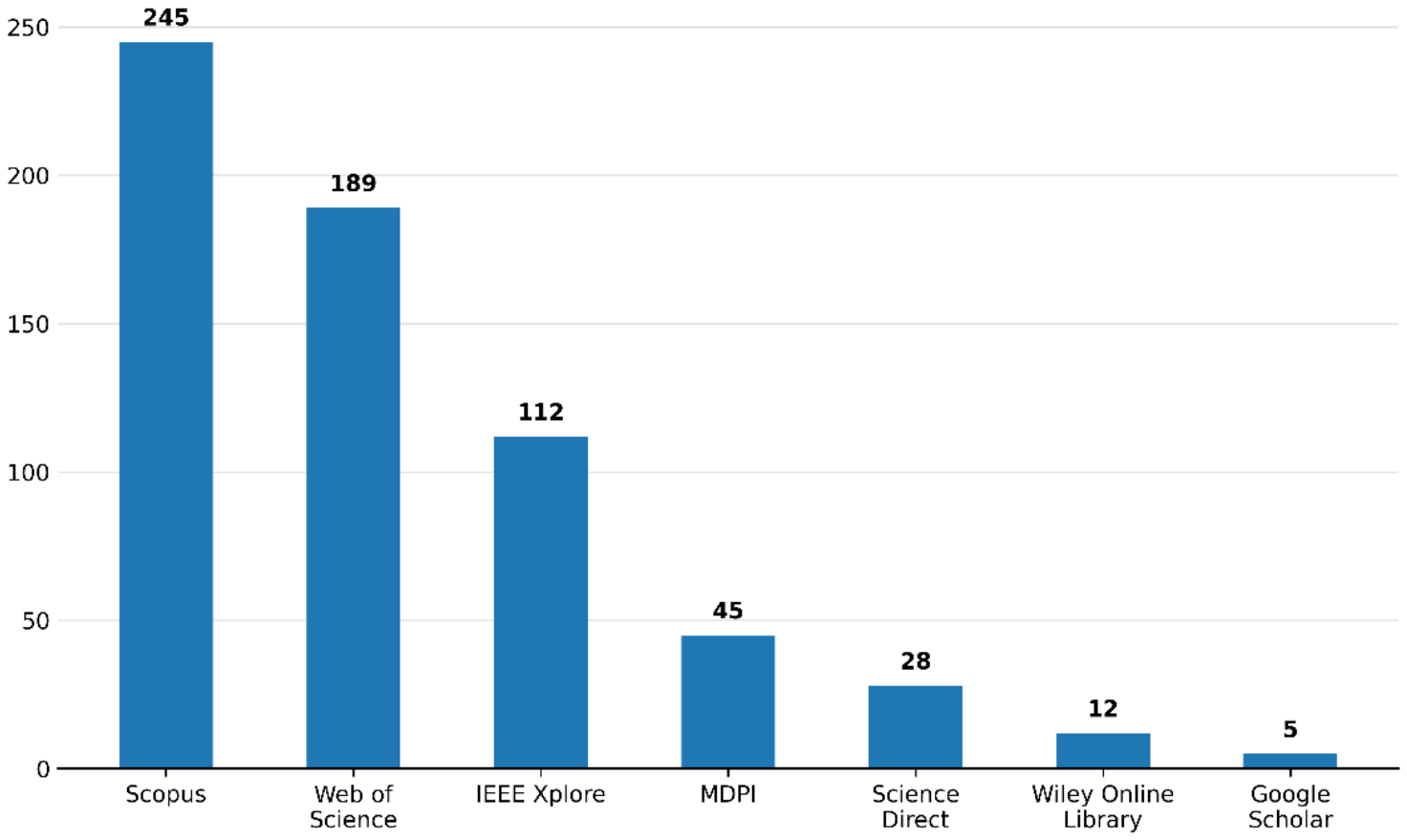
Multiple databases were searched to improve coverage. The searched databases included the primary academic ones—Scopus [39], Science Direct [40], Web of Science [41], and Google Scholar [42]—with technical publishers—IEEE Explore [43], Multidisciplinary Digital Publishing Institute (MDPI) [44], and Wiley Online Library [45]—as presented in Figure 1. The choice of multiple databases aimed to maximize the coverage of the literature, consisting of all articles for RTTM fields.
As shown in Figure 1, the number of records retrieved from Google Scholar was lower than from Scopus, Web of Science, and IEEE Xplore. This is mainly explained by source overlap, since Google Scholar broadly indexes studies that are also retrievable through databases such as Scopus, IEEE Xplore, MDPI, and Wiley. For this reason, Google Scholar was used as a complementary search source.
These chosen repositories act as an archive through which the relevant and influential scholarly articles with a specific range from 2019 to 2025 can be identified to include the current innovations related to advanced technologies like AI, edge computing, and DT for the enhancement of RTTM. This range also corresponds to the technological maturity and implementation stage related to Smart Cities and retains the ability to identify pioneering works from 2019 for the provision of the required basic knowledge.
The refinement of our original search strategy has enabled us to generate an improved search process. Through the main search strategies conducted in both Scopus and Web of Science, it was found that there are variations concerning the terms relating to RTTM. For instance, the use of RTTM is found to be uncommon. Furthermore, it was also found that domain-specific terms like “traffic signal control”, “traffic prediction”, or “adaptive management” are usually used instead of RTTM. Employing Boolean operators, we were also able to evaluate that the combination of [traffic AND management] with [smart city OR intelligent transport] generated the highest possible number of relevant articles. Consequently, the final search strategies enabled a compromise between the sensitivity of the search outcomes and relevance concerning our subject of interest.

2.2. Study Selection Criteria and Process

2.2.1. Study Selection Criteria

To improve the relevance and validity of the included literature, we developed the criteria for selection presented in Table 1, ensuring that each study included in the analysis relates to the RTTM and smart city themes and is based on a robust methodology. The study selection criteria presented in Table 1 were applied to the set of records retrieved using the search keywords defined in Section 2.1.

2.2.2. Study Selection Process and Screening Procedures

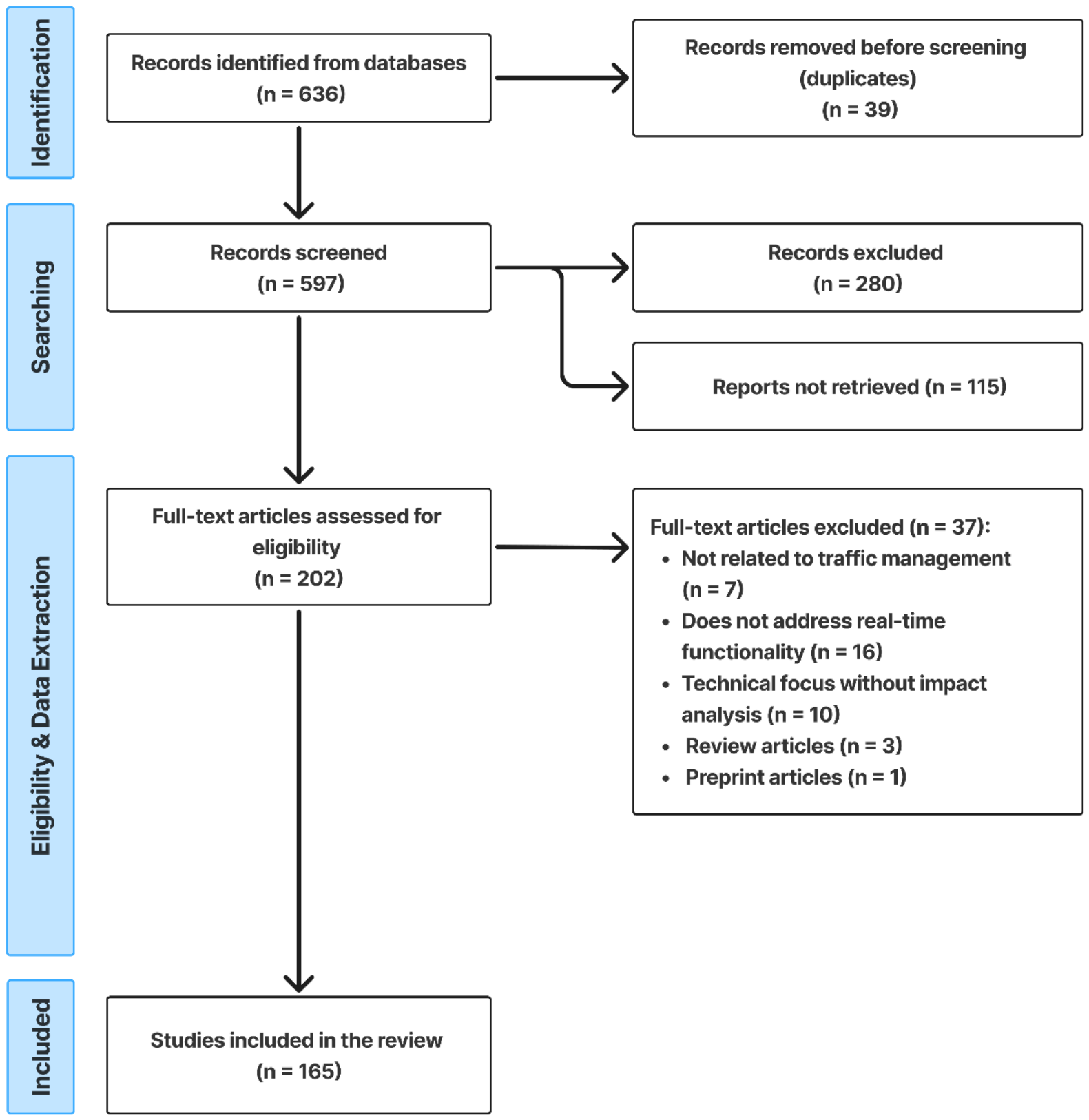
In the research, the selection and screening process was conducted through a systematic three-phased selection and screening process, as shown in Figure 2.
Phase 1: Identification and Deduplication
  • 636 publications selected at the initial phase across seven databases;
  • 39 duplication records were identified and removed using automated tools;
  • Manual verification of potential duplicates and near-duplicates;
  • 597 articles eligible for title/abstract screening at the final record set.
Phase 2: Title and Abstract Screening
  • Apply the inclusion/exclusion criteria (Table 1) to screen titles and abstracts;
  • Screening is independent with structured decision documentation;
  • Categorization of exclusions to keep transparency and reproducibility;
  • The final number of eligible articles for full-text review was 202 studies;
Phase 3: Full-Text Assessment and Final Selection
  • Full-text review based on the specific eligibility criteria;
  • Systematic quality and relevance assessment;
  • Final verification of inclusion eligibility and confirmation of readiness to extract data;
  • The last registered result comprised 165 studies.

2.3. Data Extraction Protocol and Implementation

The data are compiled systematically from each of the included studies according to our research questions and data analysis framework, employing our complete methodology of data collection. This data analysis framework comprises eight major fields. Detailed extracted data are reported in Supplementary Material S3, Table S3, consisting of the identification/bibliography, methods, integration of Smart Mobility, technology architecture of RTTM, properties and management of data, analysis/preprocessing, outcome/impact of implementation, and future research and development. This systematic methodology ensured a consistent approach to analyzing the 165 different studies so that we could conduct rigorous comparisons. This systematic research enables us to systematically compare each of the 165 different research studies.
  • Data Extraction Procedures:
A standardized data extraction processes using Excel was used for all studies. Each study also underwent comprehensive evaluations across the eight data extraction categories, with the data recorded in an Excel sheet as “reported” or “not reported” and the data types to support if they were not presented.
  • Data Organization and Analysis Preparation:
The extracted information was organized in Excel to allow for an assessment of the implementation of various applications and the identification of control architecture lane deployment patterns.

2.4. Analytical Methodology

The dataset (n = 165) was coded and synthesized through reflexive thematic analysis, as described by Braun and Clark, which consists of a six-phase process [46]. This methodology was developed due to its degree of flexibility for analyzing studies on RTTM, where technology integrates with various social and technical environments while supporting diverse types of applications. The analytical process was conducted in six clearly defined phases. A detailed description of the study phases is provided in Supplementary Material S4.
Several synthesis approaches were used to manage the differences in the literature studies included. Narrative synthesis provided a comprehensive Understanding by compiling the views on the challenges of implementation, the factors, and the research gaps. The evaluation aimed to consolidate the views on distribution trends for specified technological paradigms, models, and sectors where the implementation took place. The comparative analysis provided insights into the technology-contextual fit for specified scales, including the application field and the region.

3. Systematic Analysis of RTTM in Smart Mobility Systems

This section reports the substantive results of our systematic analysis of 165 scientific works on RTTM that have been published since 2019 and until 2025 on four key scientific questions for the structured scientific overview. The outcome was condensed into three interconnected parts to cover the entire spectrum of RTTM research and explain the state of RTTM research, its application domains, and the control architecture deployment, and then to assess the integration of AI and DT.

3.1. Application Domain Classification and Implementation Patterns

3.1.1. Application Domain Classification

This section categorizes RTTM applications into eleven domains, as presented in Table 2, as based on the reviewed studies. The diversity of these domains facilitates the understanding of RTTM applications in relation to various mobility objectives, the common technologies used in the domains, and the focus of the evaluations. The evidence indicates that many systems combine multiple application domains into platform-like deployments, so cross-domain integration is treated as a defining implementation characteristic rather than an exception.
The top-ranked domain is Urban Traffic Management systems (61 studies, 36.97%) which anchors RTTM practice, spanning intersection-level adaptation to network-scale coordination. Typical implementations combine real-time sensing, adaptive signal control, navigation support, and operational coordination via management centers. Operational strategies include sensor and IoT-supported timing adjustment and routing coordination [47,48,49,50,51,52,53,54,55,56,57]. The second in the ranking is AI and predictive analytics (21 studies, 12.73%), which includes Machine Learning (ML) and Deep Learning (DL) methods that support forecasting, anomaly detection, and adaptive control [58,59,60,61]. Common choices include Long Short-Term Memory (LSTM) models and Graph Convolution Networks (GCNs) based approaches, federated learning setups [58,59,60], and vision-based detection for operational decisions [62]. Reinforcement Learning (RL) is commonly used for adaptive signal control [63,64], while Federated Learning (FL) supports multi-jurisdiction learning under privacy constraints [65]. This domain primarily contributes to decision quality, but evaluation comparability depends on consistent baselines and deployment constraints reporting (further application domain details are provided in Section S5.1 of Supplementary Material S5).
The six secondary application domains (Public Transit Optimization; Emergency Response & Incident Management; Smart Parking & Curbside Management; Video Surveillance & Edge Processing for Traffic Flow; Mobile Crowdsensing & Participatory Sensing and Pedestrian Flow Management) collectively provide 18.18% of the studies reviewed to support the functionality of core RTTM functions, often enhancing or facilitating the operation of core RTTM instead of replacing them. Public Transit Optimization (eight studies, 4.85%) helps improve the overall network efficiency by increasing the reliability of public transit timetables, while simultaneously reducing the waiting time for passengers by applying AI technology [74,75,76] in a multimodal environment. While Emergency Response and Incident Management (seven studies, 4.24%) provides direct benefits for increased safety and resiliency from disaster through the use of emergency-aware routing, provisioning, and rapid incident detection to allow for rapid clearances of emergency vehicles [77,78,79]. By providing faster clearances, RTTM can be more useful than other types of traffic management solutions during emergencies. The secondary domains deal with the specialized mobility needs, such as emergency service, parking, multimodal coordination, and pedestrian safety, thus broadly expanding the realms of RTTM from optimization in the traffic domain to holistic mobility management (see Section S5.2 of Supplementary Material S5 for additional details).
The remaining 5.45% of the literature (n = 9) regards specialized and emergent fields of study, which represent a more specialized extension of the RTTM framework but are less developed than the more general fields. Road Infrastructure Monitoring and Pavement Analysis rely on real-time sensing for pavement condition measurement and road deterioration analysis [87], facilitating the prioritization of road maintenance work based on traffic stress distributions. The novel application connects traffic data to road maintenance and Advanced Driver Assistance System (ADAS) functions, such as LiDAR/vision pedestrian detection and object tracking, enhance safety [93] by improving hazard awareness, on top of traffic-flow optimization at the system level. Data network traffic engineering and big data analytics involve near-real-time estimation of the traffic matrix in software-defined networking contexts, applying MapReduce and NoSQL database, specifically Elasticsearch [94], focusing on networking management in addition to traffic management in urban contexts (see Section S5.3 of Supplementary Material S5 for additional details). These newly emerging areas form part of an ongoing investigation into further applications of RTTM technology, which are still at a limited scale and in the early stages of adoption. The relatively low profile of these areas may be attributed to being at a research infancy stage or being a niche application, indicating a need to validate integration.

3.1.2. Domain Integration Patterns and Implementation Complexity

  • Cross-Domain Integration Analysis
Modern RTTM solutions are increasingly characterized by cross-domain integrations, forming multi-functional platforms that address diverse urban mobility challenges simultaneously. However, the primary categories of cross-domain integration based on diverse research regarding recent RTTM developments are as follows: (i) Urban Traffic Management Systems utilizing AI in conjunction with Predictive Analytics in conjunction with IoT, Edge Computing, and Advanced Communications; (ii) Electric and Autonomous Vehicles collaborating with Emergency Response/Incident Management focusing on safety improvements; and (iii) Simulation/DT platforms providing validation and simulation capabilities for multiple applications.
  • Implementation of the Complexity Assessment Framework
The potential for varying levels of complexity in RTTM systems depends on the specific components selected, allowing for modifications tailored to the typology of the urban mobility market. The level of technological complexity, as well as the amount of collaboration and integration required, will contribute significantly to the complexity associated with a given domain. As an example, Urban Traffic Management Systems employing AI technology will have a moderate complexity level associated with this domain of AI since this technology falls under the proven domains category. Greater complexity may be added to Electric & Autonomous Vehicles, which involves technological concepts, thereby establishing high complexity in this domain. Moderate complexity may add to the domain of Emergency Response & Incident Management and Smart Parking & Curbside Management, being specific to their domain. Emerging research efforts may increase in the currently researched domains, adding greater complexity to the implementation.
In summary, with respect to RQ1, the reviewed studies show that RTTM applications in the Smart Mobility context are distributed across multiple urban functions rather than concentrated in a single operational domain. The evidence indicates that implementations vary according to the application objective, scale of deployment, sensing requirements, and degree of integration with surrounding transport infrastructure. The literature suggests that RTTM is applied through a diverse set of domain-specific configurations, with different implementation patterns emerging for monitoring-oriented, predictive, control-oriented, and service-oriented use cases.

3.2. RTTM Study Characterization and Performance Evidence

This section compiles the evidence for every study field across RTTM studies describing outcome areas, technology, metric, dataset, evaluation setting, and baseline/comparator relationship.

3.2.1. Study-Level Evidence Map

The study-level evidence (see Supplementary Material S2, Table S2((-1)–(-6))) is mapped across six RTTM outcome domains, as follows: (i) Perception and Monitoring, (ii) State Estimation and Forecasting, (iii) Signal Control and Intersection Operations, (iv) Routing and Network-Level Mobility Services, (v) Safety, Incidents, and Emergency Management, and (vi) Sustainability and Environmental Effects. Across the categories, the evidence base is characterized by significant variations in evaluation methodology and reporting completeness: perception studies tend to use benchmarking-style evaluation scores together with site-level evaluations, whereas control, routing, and operations studies tend to use scenario evaluations, wherein the outcomes vary as a function of modeling assumptions and the choice of comparators. The reporting of baselines and comparators is also uneven across domains, making it difficult to interpret the degree of improvement, despite the use of operationally relevant scores to evaluate outcomes. Dataset clarity, together with the reporting of real-time feasibility indicators (e.g., latency, computational resource use, and end-to-end delay) is also patchy, resulting in a significant gap between the performance evaluation of algorithms and their readiness for use.
Table 3 synthesizes reporting characteristics derived from the study-level evidence presented in Tables S2-1 to S2-6, which collectively represent the 165 studies included in the systematic literature review. Each column corresponds to a specific outcome category and summarizes patterns observed across the subset of studies assigned to that category.
Across these categories, there are mixed evaluation settings (real-world, benchmark/public, and simulation), suggesting that RTTM evidence is commonly constructed from complementary validation layers rather than a single evaluation mode. In contrast, Table S2(-2) more frequently leaves the evaluation context unspecified, which may indicate that forecasting/estimation-style evidence is often reported primarily through metric performance without consistently describing the operational test setting. Dataset provenance is generally site-specific/custom or mixed, consistent with the context-dependent nature of RTTM deployments. However, Table S2(-6) contains more cases where dataset details are not reported, implying that sustainability-oriented outcomes may rely more on derived indicators or integrated data streams that are not always described as discrete datasets. Baseline/comparator status is predominantly explicit, but the recurring implicit or unreported comparators in Table S2((-1),(-4),(-5)) suggest that certain outcome categories, especially those sensitive to network conditions and behavioral assumptions, still face challenges in defining operationally equivalent comparators. Table S2((-1)–(-6)) show standardization of evaluation metrics, but category-level differences in real-time feasibility and reproducibility reveal inconsistent focus on deployment-related reporting across RTTM outcomes.

3.2.2. Cross-Study Synthesis of Metrics and Comparator Evidence

The metric-based classification (visualization figure is provided in Supplementary Material S6, Figure S1) shows that runtime/latency reporting is the most common (37 studies; 22.4%), followed closely by Prediction/Estimation error (34; 20.6%) and Delay/Queue/Waiting-time outcomes (32; 19.4%). This pattern suggests that many RTTM papers still prioritize algorithmic feasibility (FPS, ms, and inference time) and model-fit quality (RMSE/MAE/MAPE/R2) rather than consistently quantifying system-level mobility impacts. Even when impact-like metrics are present (e.g., delay reduction, throughput, and emissions), they appear in smaller subsets, as follows: emissions/energy (13; 7.9%), throughput/capacity (12; 7.3%), and cost/economic outcomes (7; 4.2%). A key signal is the large Unclassified group (27; 16.4%), indicating that many extracted texts do not clearly state measurable KPIs, which weakens comparability and limits the meta-analysis of RTTM as a system. In practice, this indicates a reporting gap: studies may claim real-time or operational benefits but without consistently stating end-to-end latency budgets, baseline comparisons, deployment constraints, and standardized traffic KPIs (delay, queue length, throughput, emissions, and safety). So, the evidence base is strong on “can the model run and predict” but less consistently strong on “does the system measurably improve network performance and under what realistic deployment conditions”.
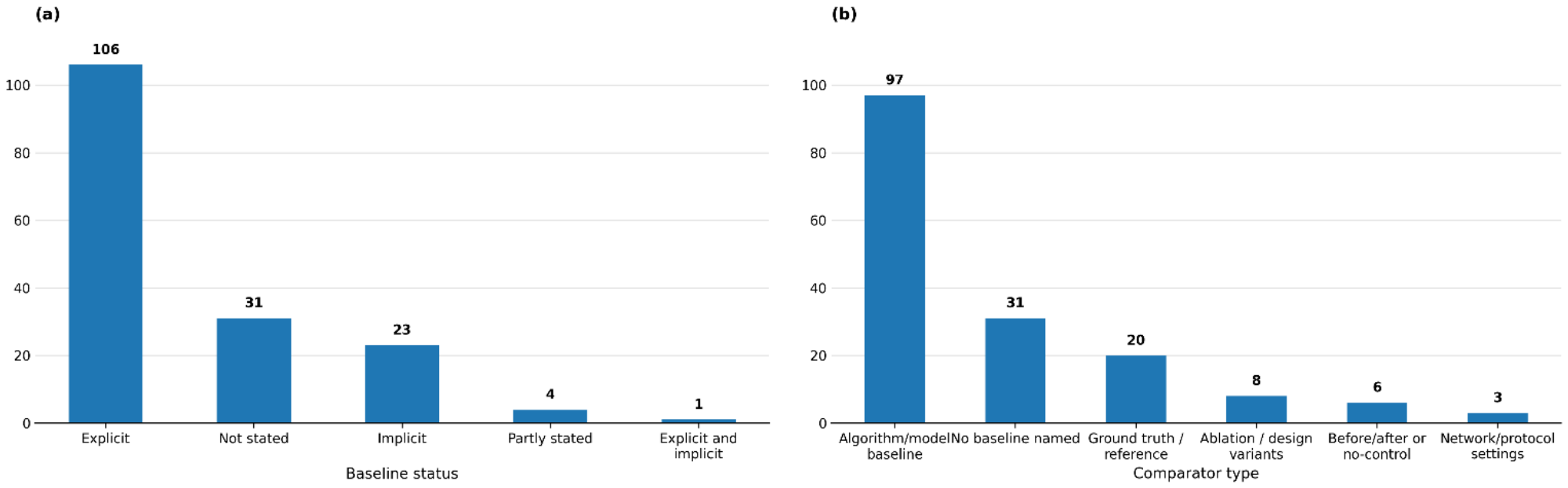
The analysis of RTTM studies, as illustrated in Figure 3a, details the types of baselines and comparators utilized. The left panel summarizes the reporting practices of RTTM studies, while the right depicts the specific comparator types employed when a baseline event is confirmed. To ensure consistency, the classification was defined as follows: baseline reporting is considered explicit when a study clearly defines and implements a comparator; implicit when the comparator can be inferred but is not formally described; partly stated when a comparator is mentioned but lacks sufficient experimental detail; not stated when no identifiable baseline is provided; and explicit and implicit when both clearly defined and loosely inferred comparisons coexist within the same study. Similarly, comparator types are categorized as algorithm/model baseline (comparison with another method), no baseline named, ground truth/reference, ablation/design variants, before/after or no-control, and network/protocol settings, based on the nature of the reference used for evaluation.
There is notable variability in the selection of baseline comparators across RTTM studies, consistent with the distribution observed in Figure 3b. A significant number of studies set their baseline comparisons against other algorithms/models or a no-control/before/after basis, such as algorithm to algorithm [53,59,81,98,99], and no-control/before/after or fixed-time versus dynamic [100,101,102,103,104], and a comparable amount used design variant (ablation) comparisons [56,57,58,62,105] as their comparison or do not define a comparator at all or report no measurable baseline [78,106]. This is critical because the quality of evidence derived from the comparison will directly correlate with the type of comparison made. Algorithm-to-algorithm comparisons are useful for showing one algorithm has greater capability than another. However, they mask many real-world challenges resulting from the deployment aspects of the algorithms [67,69,107,108]. In addition, before/after or no-control baselines are closer to understanding the policy and operational impact of the deployments. But these results can be influenced by demand variability, seasonality, or changes to the network made simultaneously, without proper control [101,109,110]. Ablation-style baselines provide helpful engineering insights; however they do not justify the benefit to the real world, only the benefits of one component in the authors’ pipeline [56,57,58,105].
The evidence pattern indicates that many RTTM studies emphasize algorithmic validation, whereas benchmarking against realistic operational alternatives is reported less uniformly. Consequently, performance gains should be interpreted considering baseline transparency and experimental equivalence: the comparator should be explicitly identified, correspond to a plausible deployed alternative, and be evaluated under comparable network and sensing conditions with consistent latency and control constraints. While quantitative synthesis enables structured cross-study comparison, it also highlights that improvements cannot be interpreted as equivalent across studies when datasets, contexts, or baseline definitions differ. This gap reinforces the need for standardized RTTM evaluation methodologies and reproducible end-to-end reporting.

3.3. Control Architecture Classification and Implementation Frameworks

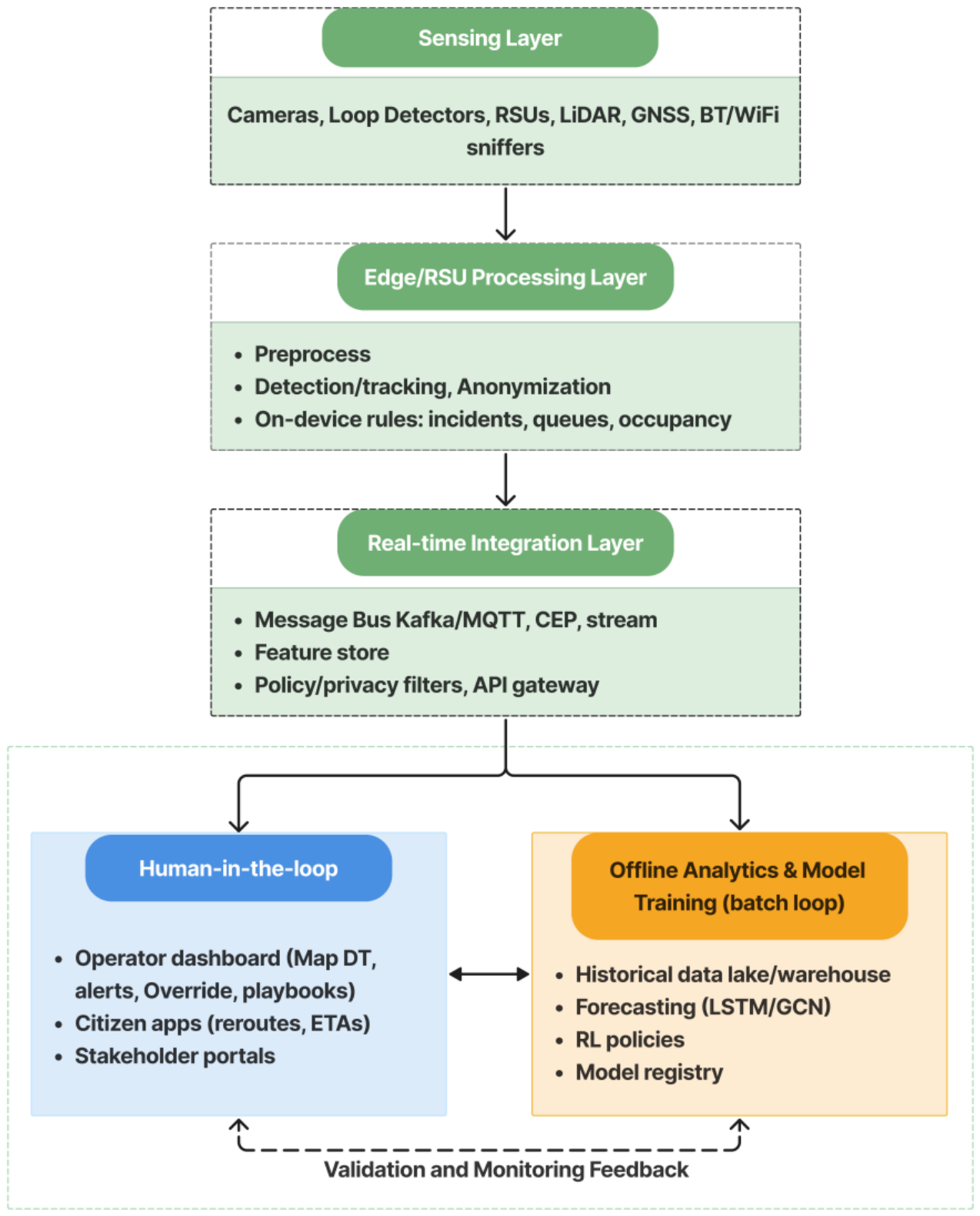
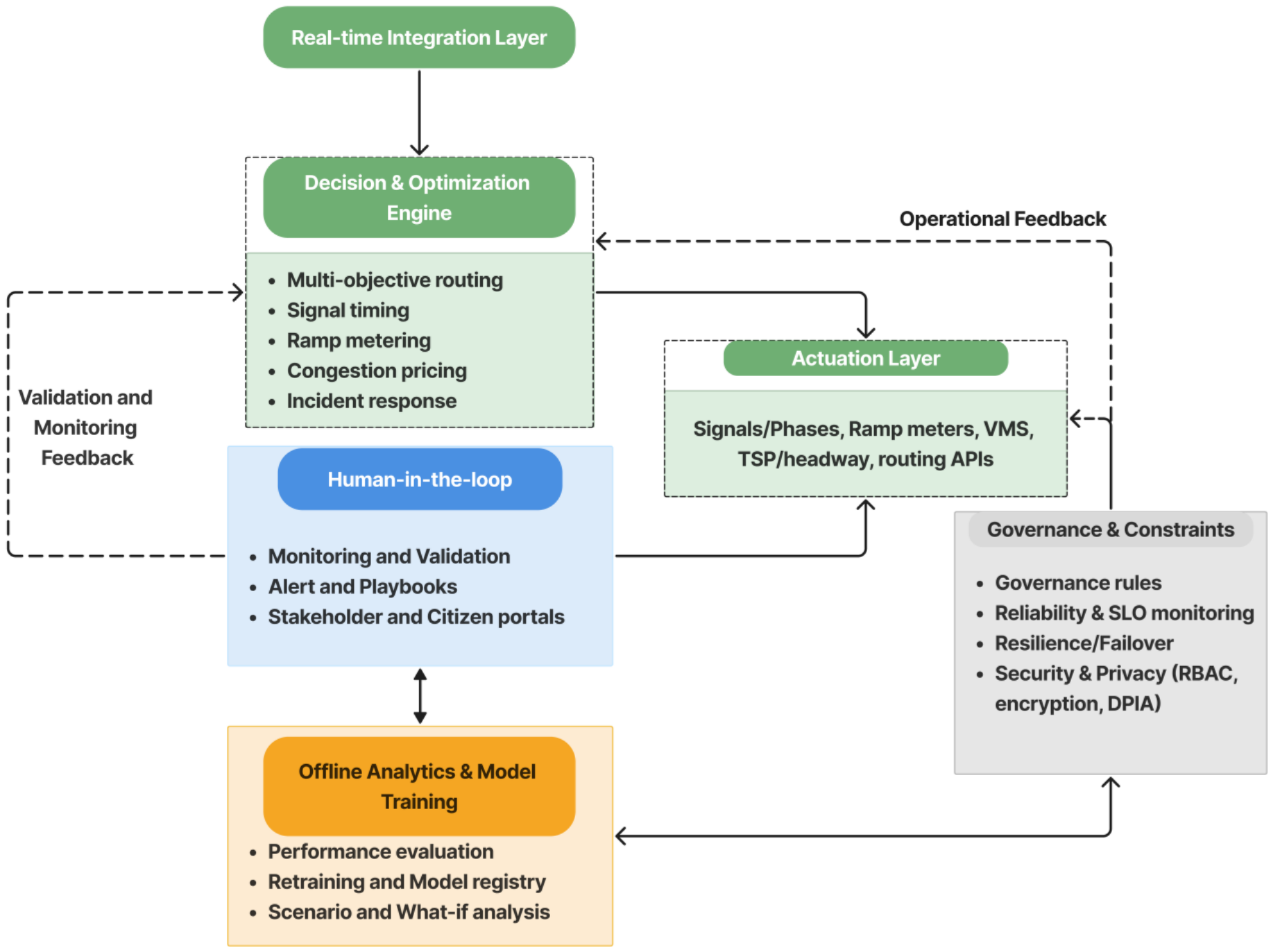
A sophisticated closed-loop control architecture is utilized in RTTM systems, as represented in Figure 4 and Figure 5. We extracted relevant descriptors about the architecture in each of our analyses. These included descriptors associated with each architecture’s sensing modalities; Edge/Roadside Unite (RSU) and centralized processing; real-time integration methods (stream vs. message bus vs. protocol); analytical and learning methods (offline training vs. online inference/optimization); actuation method interface; and cross-cutting safeguards.
The architecture is presented in two complementary views while preserving the same overall control logic. Figure 4 presents the upstream part of the loop, including sensing, Edge/RSU processing, real-time integration, human-in-the-loop functions, and offline analytics and model training. Figure 5 presents the downstream part, including decision and optimization, actuation, operational feedback, and governance constraints. Together, the two figures represent the full closed-loop architecture for real-time adaptive traffic management.
  • Sensing Layer: Studies repeatedly begin with heterogeneous sensing, dominated by vision systems (CCTV/HD/IP/smart cameras) [53,63,66,70,82,83,84,85,86,87,88,89,90,91,92,93,94,95,96,97,100,101,111,112,113,114,115,116,117], complemented by loops/counters [81,111,118,119,120,121,122,123,124], environmental sensing [60,62,125,126], vehicle/GPS, and smartphone participation [51,56,88,89,90,102,103,109,127,128,129,130,131,132], advanced sensing (LiDAR/radar/RFID/IR) [83,98,99,107,133,134,135,136,137,138,139,140,141,142], and simulation-based sensing for testing (SUMO/CARLA/METANET) [69,94,102,103,127,128,143].
  • Edge/RSU Processing Layer: A recurring pattern is near-source computation using IoT/embedded platforms (Raspberry Pi, Arduino, Jetson, sensor nodes, and LoRa transceivers) [65,73,76,143,144,145,146,147,148,149,150,151,152], including edge or fog and GPU-accelerated processing (e.g., CUDA at edge nodes) [73,130], and local pre-processing/anonymization before upstream transmission [87]. Across the reviewed studies, this block commonly supports detection, tracking, queue, or occupancy estimation and incident-related rules at the source level.
  • Real-Time Integration Layer: Many implementations explicitly separate integration from analytics, using connectivity stacks and protocols (wireless and cellular, including 4G/5G/6G and URLLC) [58,60,71,74,75,153,154], V2X/C-ITS messaging (DSRC/802.11p/C-V2V; CAM/DENM/SPATEM; V2I/VANET) [111,119,122,128,129,133,134,135,136,138,141,155,156,157], and interoperability protocols (MQTT/HTTP/CoAP/TCP/UDP) [50,56,113,130,137,145,158], together with streaming pipelines (Kafka/Spark Streaming/Kappa) [149,152,154] and multi-source fusion/standardization [124,159]. In the synthesized architecture, this block acts as the interface between upstream sensing and downstream intelligence and control.
  • Human-in-the-loop: A function in which operators validate outputs, apply operational rules and playbooks, and retain authority to override automated recommendations before field actuation, ensuring accountable decision making in high-stakes contexts. Simulation/digital-twin coupling supports this layer by enabling scenario evaluation, model updates, and simulation–real-time fusion where reported [105,123,139,142,145,160,161], while middleware analytics and observability mechanisms (e.g., standardized APIs and logging/visualization stacks) support monitoring and decision support [50,143,162].
  • Offline analytics and model training including data pre-processing, feature extraction/dimensionality reduction, and the development of forecasting and detection models (e.g., deep learning and graph-based models) [52,86,101,111,121,124,127,163]. The repeated connection between offline analytics and model training and human-in-the-loop indicates that RTTM systems do not operate as purely automated pipelines but rely on continuous validation, monitoring feedback, and model refinement.
  • Decision and optimization engine that translates real-time state estimates into control policies using learning and optimization approaches, including reinforcement-learning-based strategies and rolling-horizon control [74,78,135,164,165,166]. In the reviewed studies, this block represents the main bridge between real-time intelligence and executable interventions.
  • Actuation Layer: Studies report explicit execution interfaces and control outputs such as routing/control via TraCI [122], dynamic calibration and real-time control mechanisms [123], operational status updates, and real-time routing actions [126,167], and queue/platoon optimization outputs feeding control actions [128]. In practical terms, this block includes field-facing interventions such as signals/phases, ramp meters, VMS, TSP/headway control, and routing APIs.
  • Governance and constraints: Privacy, anonymization, and data-handling safeguards recur across multiple stages and are, therefore, modeled as a cross-cutting layer, including anonymization algorithms for IoT systems [60], masking sensitive metadata before upstream transmission or cloud processing [87] and broader operational constraints related to reliability, policy rules, and secure deployment. This block conditions both decision making and actuation, ensuring that real-time optimization remains accountable and deployable.
A comprehensive validation and feedback mechanism is incorporated into the architecture that relates every processing step to the actuation level, thus enabling an assessment of performance and improvement of adaptive control in every urban setting that might have varied environmental conditions.

3.3.1. Closed-Loop Feedback Control Patterns

RTTM runs under dynamic environments, and it is a necessity to use closed-loop feedback control. In the literature, 89% (148/165) use or refer to feedback loop methods, indicating the prevalence of a sensing, decision, action, and evaluation control paradigm.
Methodologies used include local to global control, priority in emergencies through multi-sensor Arduino controllers, unmanned Aerial Vehicle-aided Visible Light Communication (UAV-VLC) traffic congestion detection, where Acknowledgment (ACK) loops maintain integrity and enable signal modification [112], RSUs influencing routing and intersection control designs in connected-vehicle settings [113], video-based queue estimate adaptive signals [100], and IoT-mediated notification systems that close detection–decision–driver-response loops [114]. More sophisticated designs use predictive feedback, particularly DT data assimilation, adjusting signal control designs [115] and deep learning route control designs that adapt roads to traffic incident responses and timing adjustments [116]. Some Self-Tuning Gain Parameter (STGP) systems incorporate post-action review, where observed outcomes are used to update forecasts and adjust subsequent control decisions, indicating a shift toward more proactive and adaptive feedback. However, the literature proposes closed-loop designs in inconsistent ways, with limited standardization of key loop parameters such as update intervals and robustness mechanisms under packet loss and communication delays.

3.3.2. Online Optimization and Learning Loops

  • Online Optimization Implementation Scope and Methodologies
Online optimization and real-time decision support are frequently discussed in RTTM, but they are not uniformly implemented across studies. In our synthesis, we distinguish online optimization (runtime, closed-loop update control decisions from streaming data) from offline optimization (one-time calibration or static policy design). Under this stricter definition, online optimization appears in a subset of papers, particularly in resource-control and adaptation tasks. The applications include deep Q-learning for optimization of power control, cutting energy demand with retained sensing ability [101], and continuous action Deep Reinforcement Learning (DRL) for one-second real-time video bitrate adjustment, with Source Rate Control–Controller (SRC-C) regulating buffer stability and energy consumption according to real-time throughput and occupancy, improving robustness through real-time updates [117]. Reporting often remains algorithm-centered, so end-to-end latency budgets and computational feasibility are not always specified, which complicates reproducibility and assessment of deployment readiness.
  • Distributed Learning and Advanced Control Frameworks
Distributed learning is increasingly adopted to cope with high mobility and rapid topology variation in RTTM contexts. In 5G-VANET traffic, distributed DRL is coordinated across RSUs, vehicles, and mobile nodes to optimize video-stream parameters such as quantization, Group of Pictures (GOP) size, and frame rate in real-time, maintaining multimedia stability under dynamic network conditions [70]. Although robustness to imperfect coordination and heterogeneous computing/network conditions are not always specified. For intersection control, Reinforced Decision Process (RDP) schemes inspired by Markov Decision Process (MDP) formulations and dual Q-learning continuously update signal timings from live density states, yielding lower average delays than fixed-time control [63]. Still, stability under demand shocks and partial observability is less consistently evaluated. Hybrid architectures combining model predictive control with high-frequency DRL agents are also used to improve optimization under uncertainty while maintaining constraint adherence and travel-time performance [120]. The coupling is sensitive to model mismatch and update-rate design. RL pretraining accelerates adaptation in new scenarios [64] with validity bounded by how closely deployment conditions match training regimes.
  • Advanced Integration and Next-Generation Systems
Recent work advances RTTM control by coupling reinforcement learning with richer spatiotemporal representations and emerging communications. RL integrated with Spatiotemporal Graph Convolutional Networks (ST-GCNs) uses to model spatial correlations and temporal dynamics, enabling real-time phase optimization and rerouting with reported delay reduction and throughput gains under mixed traffic [113]. Hierarchical DRL with Transformer-based decision layers targets routing in dense urban networks by improving sequential decision quality [121], though its computational overhead and sensitivity to network scale are not always fully profiled for strict real-time deployment.
6G-oriented studies propose DRL-driven feedback loops to pursue sub-millisecond control cycles for signal timing and trajectory optimization [119]. These results illustrate the potential value of ultra-low-latency links, but they remain tightly coupled to assumptions about guaranteed connectivity, scheduling, and edge compute availability, which should be treated as deployment conditions rather than universally available capabilities.

3.3.3. Deployment Architecture: Embedded Systems/Edge Computing

  • Embedded System Implementation, Distribution, and Platform Analysis
Real-time embedded systems and edge computing account for 20% of studies (33 out of 165), categorized into six groups as shown in Supplementary Material S6, Figure S2. Although distributed computing is acknowledged within RTTM implementations, it remains secondary.
Low-power Raspberry Pi 3B enables real-time traffic flow analysis without cloud dependency [72], while high-performance edge devices like NVIDIA Jetson TX2 support neural network-based vehicle detection and tracking on UAVs [49]. Miniaturized modules such as Jetson Nano and TX2 running OpenDataCam provide real-time inference for freeway digital twins, ensuring privacy by sending only metadata [122].
GPU-accelerated processing combines Raspberry Pi 4 with Coral TPUs for LiDAR model inference at up to 9 fps [123]. Lightweight IoT prototypes, including NodeMCU (ESP8266) and Arduino wireless sensor nodes, enable campus-scale monitoring and vehicle counting [124]. The evidence suggests a clear push toward on-device inference and privacy-aware filtering, but reported performance is often workload- and hardware-specific, which limits direct comparability across deployments.
  • Hybrid Multi-Layer Architectures and Advanced Processing Integration
Fog and edge frameworks reduce RTTM latency by splitting computation across tiers, but performance depends on coordination overhead and network stability. Raspberry Pi 3 fog nodes enable low-cost local preprocessing for signal control [118]. Client–server designs run detection and tracking on Jetson devices and offload map-matching to central servers [163]. Improving responsiveness while making results sensitive to uplink conditions and backend load. Multi-access Edge Computing (MEC) co-locates Cellular Vehicle-to-Everything (C-V2X) services and signal controllers at the edge to reduce SPaT optimization delays [168], underscoring the value of joint compute–connectivity provisioning.
Digital-twin platforms partition workloads between cloud engines and RSU-edge servers for low-latency Connected and Autonomous Vehicle (CAV) operation [169]. METACITIES employs microservices to allow for the rapid execution of decisions at the Edge [170], thus reflecting an evolutionary shift in the control architecture toward distributed, modular control stacks. VehiCast enables continual learning at the VANET Edge via Cluster Heads [65], to generally reduce exposure at the central location while yielding model quality that is heavily dependent on mobility churn and heterogeneous data.
  • Real-Time Analytics and Advanced Inference Implementation
Real-time edge analytics and advanced inference solutions increasingly rely on optimized vision pipelines and lightweight spatiotemporal inference solutions. Via YOLOv5, in combination with Deep SORT and NVIDIA Jetson achieves vehicle tracking at about twenty-three frames per second (fps) with an elevated level of confidence. Embedded vision retrofits in CCTV reduce cloud dependency and increase privacy handling through local analytics [155]. For control-oriented inference solutions, hybrid CNN-LSTM models augmented with particle swarm optimization capture spatiotemporal patterns to provide dynamic signal optimization in edge locations [116]. In addition, for applications outside of roadway vehicles, quasi-real-time pedestrians utilize LiDAR point clouds on a Jetson Nano at approximately 40 Mbps for quasi-real-time sensing at the edge [171]. Advancements to the YOLOv5 model’s accuracy and reduction in computational needs for mobile/resource-constrained deployment via model-level enhancements such as integrated perceptual attention and multi-scale spatial channel reconstruction [87].
  • Specialized Application Implementation and Performance Validation
Examples of specialized applications demonstrate how RTTM operates under varying cost and infrastructure constraints. The processing of pavement roughness for detection Micro-Electro-Mechanical Systems (MEMS) accelerometer nodes enables local processing and alerts to be sent over the network or through the cloud, rather than sending large data files [172]. Embedded OpenCV density estimation enables off-peak adaptive signal timing with measurable delay reduction using lightweight computing [100]. Connected-vehicle settings, Dedicated Short-Range Communications (DSRC) RSUs broadcast real-time Signal Phase and Timing (SPaT) through field computers to reduce Vehicle-to-Everything (V2X) latency and support time-critical coordination [173].
Low-cost deployments are also prominent: Raspberry Pi camera modules enable real-time counting at signals, improving scalability where budgets are constrained [69], while Sensor Protocols for Information via Negotiation-Vehicular (SPIN-V) ultrasonic and magnetic sensing supports instant parking availability and user-facing guidance [156]. Bluetooth plus smartphone agents provide infrastructure-light monitoring in data-scarce contexts [83]. Though performance is sensitive to participation and device heterogeneity. Finally, distributed intrusion detection with mobile RSUs and onboard units reduces response time in VANETs [158], but its reliability depends on stable coordination under high mobility.

3.3.4. Stream Processing and Event-Driven Architecture Implementation

  • Real-Time Stream Processing Framework Implementation
Stream processing systems use semantic integration and complex event processing (CEP) to fuse vehicle and environmental signals, detect incidents, and trigger signal or routing updates in response to anomalies [101]. Cloud-hosted NoSQL ingestion, such as Firebase, can scale smartphone and external-feed inputs through sharding, enabling congestion-spike detection and automated alerting and rerouting [84]. Event-driven pipelines also use RabbitMQ with PostgreSQL to process high-rate video streams and dispatch operator notifications [172]. while fault-tolerant Apache Kafka pipelines stream camera images to multi-threaded consumers for anomaly detection and near-immediate event forwarding to downstream analytics [108].
  • Big Data Streaming and Scalable Processing Implementation
Large-scale streaming applies MapReduce for continuous aggregation and anomaly detection, with outputs used to initiate adaptive control actions such as signal timing changes [94]. Hadoop/IBM Big Insights pipelines ingest large sensor and checkpoint datasets and apply streaming operators to detect congestion or collision patterns and push rerouting commands to users [174]. At higher telemetry volumes, Azure Event Hubs collects bus and Traffic Management Center (TMC) events at scale, with Stream Analytics detecting risks and Azure Functions triggering advisories [175]. Kappa architectures combine Kafka and Spark Streaming to integrate ML-based incident prediction while unifying streaming and serving layers for rapid anomaly querying and response [153].

3.3.5. Adaptive Traffic Control Applications and Implementation Strategies (Static vs. Dynamic Approach Classification)

The review identifies a clear divide between static and dynamic adaptive traffic control (A visualization of the results is presented in Supplementary Material S6, Figure S3). Static control is rare in the corpus, represented by a single study using fixed-time or time-of-day plans where cycle length and splits are computed offline from historical averages or multi-period patterns and updated only at scheduled intervals, without real-time responsiveness [167].
Dynamic control includes many studies (100 studies) assessing concurrent manipulation of signaling operations in real-time via sensing, analysis, and optimization. A large percentage of dynamic control studies focus on IoT and sensor-driven designed schemes (21 studies), hybrid & multi-scenario adaptive archetypes (19 studies), ML/AI and reinforcement learning control methods (16), and optimization with reinforcement learning techniques (10), which indicate how IoT is developing through multiple technological sectors and scenes to achieve greater degrees of adaptiveness.
IoT and sensor-driven systems, which rely on roadside sensors and monitors for real-time traffic updates to facilitate adaptive control [63,68,69,83,85,100,101,114,124,134,135,154,157,159,160,174,176,177,178,179]. These references emphasize the role of sensing infrastructure in optimizing adaptive traffic management. Multi-modal sensing enables the integration of traffic and environmental sensing for the efficient and adaptive management of mobility in an environmentally friendly and efficient way [101,177].
ML and AI approaches use video analytics to predict congestion, thus allowing for changes in traffic signals in real-time [59,96,98,99,107,116,133,136,137,138,139,140,141,142,168], turning traffic control from a reactive workflow into an anticipatory, prediction-led one.
Hybrid/miscellaneous adaptive architectures combine a variety of adaptive methods for optimal vehicle path determination and adaptive changes [119,125,126,127,128,143,144,145,146,147,148,149,150,151,152,153,155,173,174], thus evolving towards multifunctional urban mobility systems
Urban-scale prototypes give evidence for adaptive strategies. Adaptive Traffic Control Systems (ATCS) can shorten cycle times by 15–20% [100]. In the UTC scheme in Singapore, the average delay can be cut down by 22% [102]. Dynamic control in work zones increases freeway traffic flows by 18% [103].
This presents the need for further evidence that theoretical adaptive traffic control systems are being developed into viable technology applications for maximizing efficiency, safety, and environmental performance related to transportation planning.
A comparative reading of the reviewed studies suggests that RTTM architectures differ less in their core functional blocks than in how these blocks are distributed and operationalized. Simpler implementations tend to emphasize sensing, integration, and monitoring, whereas more advanced systems extend toward adaptive decision and actuation. Edge-oriented architectures improve responsiveness and local filtering, while more centralized or integration-heavy architectures support broader coordination, optimization, and model updating. However, architectural sophistication does not always correspond to stronger deployment evidence, since many control-oriented studies still under-report latency, synchronization quality, and field-level closed-loop validation.
In summary, with respect to RQ2, the reviewed studies indicate that RTTM systems are commonly organized around a closed-loop control logic that links sensing, processing, integration, intelligent analysis, decision making, and actuation. However, the specific control architectures vary in their degree of distribution, reliance on edge or centralized processing, integration mechanisms, and level of human oversight. The evidence therefore suggests that adaptability in RTTM is improved not by a single architectural model but by architectures that can combine real-time data flow, iterative feedback, and context-sensitive control decisions.

3.4. Integrating AI and DT into RTTM

This section examines how AI and DT integrate within RTTM, examining distinct qualities within the evolving transition of DTs by demonstrating how the increasing convergence of AI will change RTTM from being based on monitoring to predictive and innovative solution approaches in urban mobility.

3.4.1. DT Integration Patterns and Implementation Approaches

  • DT Technology Adoption Goals and Objectives
The adoption of DT was found in 13 studies, as shown in Table 4. In addition to the visualization dimension of DT, several objectives go beyond visualization when DTs are utilized for supportive decision making and to support risk mitigation through predictive city and community outcomes. When DT is employed as part of the pre-assessment of the expected impacts of policies on traffic flow, DT can be used to assist in the development of Smart Mobility strategies, including smart parking, environmental implementation strategies, emergency planning, and management [170]. The most frequently mentioned implementation goal for DTs is the need to maintain an updated virtual representation of an intersection with real-time camera data, signal controller data, and provide an executed virtual representation of the intersection that is maintained in real-time, synchronized for adaptive control purposes [139]. DT integration is also used to reduce simulation uncertainty by assimilating live IoT data into agent-based simulations, including mechanisms that link physical bicycle rental stations to their virtual counterparts [109]. In mixed traffic, DTs are leveraged to adapt reinforcement learning agents to real conditions and generate multi-actor flow data that include vehicles, cyclists, and pedestrians for training and evaluation [129].
  • DT Implementation Methodologies and Technical Frameworks
DT frameworks combine sensor ingestion, simulation models, and analytics pipelines to enable predictive maintenance, incident management, and operational optimization [170]. Implementations often expose operational variables such as vehicle counts and green-phase durations to support continuous monitoring and what-if simulation for adaptive signal control [139]. In some cases, some solutions utilize special unsupervised analysis software, such as intensity-based DBSCAN algorithms, to optimize responses to varying levels of dynamic intensity [127]. Middleware and orchestration levels evaluate situations to offer courses of action for harnessing digital twins as a decision engine, as opposed to a replica [130].
  • Specialized DT Applications and Performance Optimization
Digital transformation projects focus on secure experimentation and financially optimal results. To evaluate strategies before actual implementation, DT-GM utilizes real-time traffic data with the SUMO simulation [115]. DT-based timing adaptation combines real-time and historical data, using incremental clustering such as BIRCH to process large datasets and identify traffic groupings relevant to control [132].
Smart Mobility DT platforms support connected and automated vehicle control via advanced wireless networks, positioning DTs as coordination layers for CAV operations [169]. Co-simulation environments such as CARLA–SUMO are used to evaluate strategies more safely and economically than field trials while preserving realistic dynamics [161]. DT-VANET maintains synchronized virtual representations of vehicular networks using camera and IoT inputs, with preprocessing and synchronization enabling predictive modeling of network conditions [141].
  • DT Maturity Assessment and Study Mapping
DT studies were classified according to the dominant functional role played by the twin in the RTTM pipeline. The maturity mapping follows four levels. M1 (Descriptive/Monitoring) refers to DT implementations used mainly for real-time observation, state visualization, or descriptive monitoring without explicit diagnostic, predictive, or control-oriented functionality. M2 (Diagnostic/Event or Severity Analysis) refers to DT systems that move beyond monitoring to identify, classify, or interpret system states, anomalies, or severity patterns. M3 (Predictive/Forecast/What-if) refers to DT implementations that support forecasting, simulation-based scenario analysis, or anticipatory estimation of future traffic conditions. M4 (Prescriptive/Decision/Control) refers to DT systems that support or drive decision making, optimization, adaptive intervention, or closed-loop control actions. To further qualify the M4 category, we distinguish between M4 Theoretical/Architectural (M4-TA), M4 Empirical M4-E, and M4 Theorical/Empirical (M4-T/E). M4-TA denotes studies that demonstrate prescriptive or control-oriented DT roles primarily at the theoretical or architectural level. M4-E denotes studies with stronger empirical evidence supporting prescriptive/control use, such as continuous updates, runtime synchronization, implemented interventions, or operationally grounded closed-loop behavior. M4-T/E denotes intermediate cases in which prescriptive/control roles are evident and partially supported by implementation evidence, but without comprehensive deployment-level validation. Where studies exhibited multiple functions, the assigned level reflected the highest dominant role explicitly implemented and reported by the study.
Mapping the maturity levels for the 13 studies shows that use of DTs in RTTM is primarily for prescriptive (M4—highest maturity) systems, where the DT is positioned to support decision making, adaptive control, and integrated optimization functions [107,115,130,139,141,169,170]. However, this classification should be interpreted with caution, because the M4 category is not uniform in validation depth. Of the eight studies classified as M4 in functional terms, four provide stronger empirical support, three are supported mainly at the theoretical or architectural level, and ones reflects mixed theoretical and empirical evidence. This means that, although these studies occupy a prescriptive or control-oriented role within the RTTM pipeline, they do not all demonstrate the same level of deployment readiness. Accordingly, the concentration of studies in M4 indicates that prescriptive DT roles are prominent in the RTTM literature, while empirical validation remains more limited.
The predictive clustering approach (M3) is the opposite emphasis from the M4 cluster: DTs are being used in the predictive modeling as a means of calibrating/synchronizing the predictions of the DT past with the actual performance based on the empirical datasets, which allows for increased accuracy and decreased bias in their simulations [109,129,161]. In the M3 cluster, the study effectively stops at the level of better simulation fidelity without fully quantifying how improvements in prediction can support operations’ KPIs in terms of delay, safety risk, and clearance time when implemented in the operational environment.
Both the diagnostic (M2) and descriptive (M1—lower-maturity) categories suggest that there exists an untapped opportunity for more cities to adopt lower-maturity twins as a means of establishing a path for developing higher-maturity twins within their RTTM systems (i.e., Trusted Monitoring → Validated Diagnosis → Forecasting → Control). However, there is almost no literature documentation regarding staged pathways and/or governance necessary for this devolved process.
These findings highlight the current prominent level of overlap within the RTTM DT and that they are converging towards the development of control-oriented twins. Consequently, the most significant gap of the existing research is not the absence of certain algorithms but rather the absence of computing that connects the quality of synchronization, computing limits, and decision reliability to measurable transport results and deplorability.

3.4.2. AI Paradigm Integration and Model Implementation

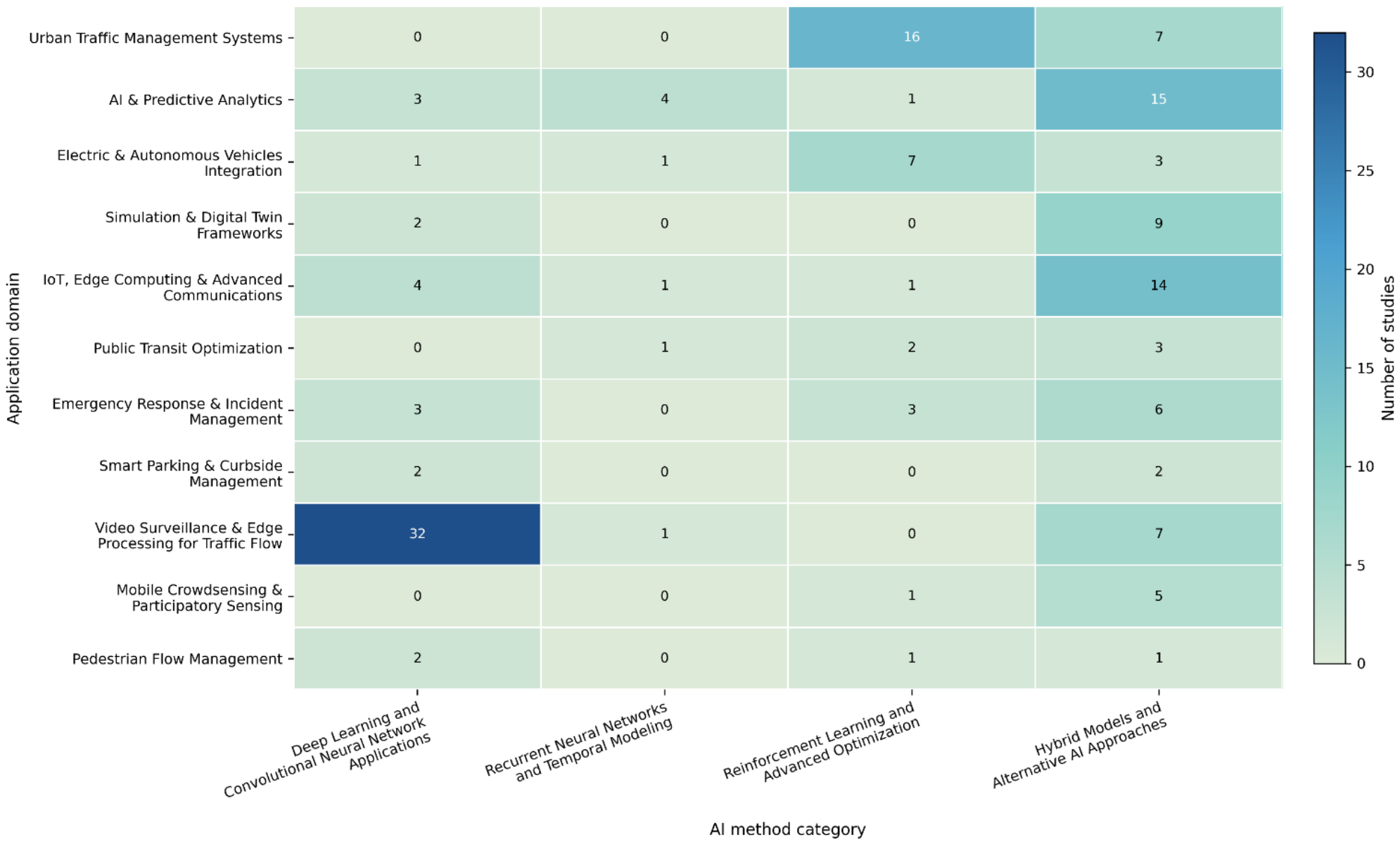
The analysis in this section focuses on AI-based methods as applied within RTTM pipelines, particularly in perception, prediction, and control tasks. Across the reviewed studies, AI mainly refers to learning-based approaches, including machine learning, deep learning, and reinforcement learning, which are used to extract features from sensing data, model traffic dynamics, and support decision-making processes. These methods are organized according to their functional role within the RTTM pipeline. The classification follows the dominant modeling patterns observed in the literature—deep learning and convolutional neural networks for perception tasks; recurrent and temporal models for time-dependent prediction; reinforcement learning and optimization-based approaches for control and decision making; as well as hybrid and alternative models combining multiple techniques. In addition, a cross-tabulation is performed to explicitly link AI approaches to application domains, as illustrated in Figure 6, enabling the identification of dominant model–application pairings across RTTM studies.
  • Deep Learning and Convolutional Neural Network (CNN) Applications
The evidence shows that CNN-based perception has become the dominant interface of RTTM pipelines. It converts high-volume raw sensing into operational variables (counts, classes, queues, conflicts) needed by control and prediction modules. YOLO families are repeatedly selected for on-time detection of vehicles and pedestrians across CCTV, UAV, and roadside LiDAR because they offer a workable accuracy–latency compromise under continuous streaming constraints [48,69,71,87,105,107,137,139,159,162,163,178]. The emergence of lightweight variants, such as YOLOX and IPA-YOLOv5, indicates a clear deployment trend: models are increasingly shaped by edge bandwidth and compute ceilings rather than accuracy alone, particularly for RSUs and embedded boards [87,105].
Tracking architectures (CenterNet and CenterTrack) extend perception from frame-level detection to identity-consistent trajectories, which is essential for safety analytics and for generating features used by higher-level prediction and control modules [11]. Segmentation models (U-Net and related variants) provide lane and footprint masks from UAV imagery, supporting geometry-aware control and more reliable multi-object tracking in dense scenes [180]. Recognition pipelines using EfficientNet and ResNet-101 pyramids address small-object and adverse-visibility conditions relevant to signs and signal states [71,181], while compact identification models, such as LightSpaN, indicate sustained pressure to reduce the memory footprint at the edge [71]. Finally, scene understanding increasingly shifts toward multi-modal segmentation (DeepLabV3+ with camera and LiDAR) and generative lane delineation (cGAN), reflecting the need to handle partial observability and complex urban layouts rather than only detecting vehicles [106,123,180].
These models are strongest in perception-intensive RTTM tasks, but their deployment value depends on whether real-time feasibility and computational constraints are also addressed.
  • Recurrent Neural Networks and Temporal Modeling
Temporal models primarily serve the state evolution layer of RTTM by translating sequences into forecasts that are actionable for control and planning. LSTM, Bidirectional Gated Recurrent Unit (Bi-GRU), CNN-LSTM, Autoregressive Integrated Moving Average ARIMA-LSTM, and Nested Long Short-Term Memory (NLSTM) variants are used for flow and speed prediction and also for forecasting edge-load dynamics, implying that prediction is not limited to traffic variables but is increasingly extended to system-resource variables that affect real-time feasibility [59,81,134,182,183]. Spatiotemporal-attention LSTM combined with Sparse Inverse Covariance Clustering (SICC-SC) is applied to long-horizon trajectory and behavior modeling, suggesting a methodological shift toward representing heterogeneity through clustering before sequence learning [149]. Multi-task deep learning and dynamic temporal context networks indicate a second shift: models are designed to share representations across related tasks and horizons, aiming to stabilize performance across short- and long-term inference rather than optimizing a single horizon [134,183]. Compared with CNN-based methods, temporal models are more suitable for forecasting and state evolution tasks, although their operational readiness is less consistently demonstrated.
  • Reinforcement Learning and Advanced Optimization
RL appears most frequently where control policies must adapt online under uncertainty and non-stationary demand. Adaptive Q-learning, Rainbow Deep Q-Network (DQN) with Attention-Convolution Mix (ACmix), Soft Actor-Critic (SAC), and hierarchical DRL are used for signal and perimeter control, reflecting a preference for methods that can handle delayed rewards and continuous adaptation [65,66,149,184].
Multi-agent and graph-aware formulations, such as Multi-Agent Deep Deterministic Policy Gradient (MADDPG) with Graph Attention Network (GAT) and cooperative lane strategies, indicate that coordination is treated as a central requirement when optimization targets network-wide performance rather than isolated intersections [113,119,129,185]. The use of RL for camera bitrate and edge streaming QoS, via SRC-C continuous-action DRL, shows that RTTM control increasingly includes operational management of sensing and communications resources, not only traffic flow actuation [117].
In contrast to perception- and prediction-oriented models, these approaches are more linked to adaptive control but are also more sensitive to simulation assumptions and limited field validation.
  • Hybrid Models and Alternative AI Approaches
Hybridization generally reflects attempts to combine complementary guarantees: data-driven adaptability with structure or constraints. Graph-aware temporal CNNs support spatial–temporal forecasting where relational dependency is central [113,134], while DRL refinement of MPC outputs suggests that learning is being used to compensate for model mismatch and disturbances that classical control alone may not capture [120]. Detector–tracker coupling (e.g., Kalman filters with DeepSORT and multi-model association) indicates that robustness is frequently achieved through system design rather than any single model class [157,159,186], and Auto-ARIMA paired with vision pipelines shows a pragmatic blend of statistical forecasting with perception-derived state estimation [138].
Traditional ML remains relevant where transparency and lower compute dominate: naïve Bayes [110], support vector machines [153,184], and tree-based methods for conflict and accident detection [50,56,81,185,186] appear as interpretable baselines or deployment-friendly alternatives, with Gaussian process regression providing probabilistic inference in some settings [187]. Fuzzy and fuzzy-hybrid systems provide fast decision logic for parking evaluation, congestion estimation, and EV routing under limited data [82,164,188]. Physics-informed and diffusion models include approaches such as Physics-Informed Machine Learning (PIML) traffic state estimation and conditional diffusion framework with Spatio-Temporal Estimator (CDSTE) probabilistic sensor-free inference [165,166]. unsupervised and causal pipelines, including iDBSCAN for dynamic clustering [127] and SAM + CDGCN for collision causality [147], reflect growing interest in extracting structure and explanation from data beyond pure prediction. c targets congestion prediction under spatial and temporal heterogeneity [189], while Simulation and Machine-Learning Utilization for Real-Time Prediction (SMURP) emphasizes the model and data parts, with the focus on the reliability of the design during implementation [190].
The advantage of hybrid models and alternative AI approaches lies in flexibility across multiple RTTM functions, but this often comes at the cost of greater architectural complexity and lower comparability across studies.
  • AI–Application Domain Cross-Tabulation
The cross-tabulation of AI and application domains reveal several points. The heat map presented in Figure 6 shows strong methodological concentration by application domain. In the case of Video Surveillance and Edge Processing, the work being performed is predominantly using deep learning and CNN-style perception pipelines (indicated by the very dense heat map cell), which correlates strongly with the majority of the real-time flow monitoring literature that successfully operationalizes AI via detection, tracking, and counting of video sources via cameras/UAVs such as YOLO and its many variations, Tracking Stack, and Segmentation [11,48,62,69,87,93,99,105,107,112,118,122,123,126,135,137,138,139,142,157,163,171,176,178,180,181,183,191,192,193,194].
By contrast, Urban Traffic Management Systems have clustered more towards reinforcement learning and advanced optimization, which is understandable given that network-level control problems are often framed as sequential decision-making and routing problems [50,63,64,73,104,113,120,121,128,129,143,145,148,185,195,196]. In relation to IoT/Edge Computing/Advanced Communications, we have a large degree of hybridization/alternatives due to the fact that much of the contribution to this domain has been around architectures, protocols, and streaming reliability, whereas AI has often been operationalized through classic ML/estimation/system design as opposed to end-to-end deep models [49,52,72,94,108,117,152,158,172,173,174,177,197,198] with DL occurring predominantly where vision/deep detection is embedded within the pipeline ORM [69,96,112,118].
The heatmap also provides insight into what we currently perceive as gaps and potential biases within the research. In particular, temporal deep learning models (from the RNN/LSTM family of models) appear to be concentrated solely within Predictive Analytics, which indicates that many of the domains still address dynamics by treating them indirectly (or reporting them without actual temporal AI), and a few domains remain sparsely populated, such as pedestrian [91,109,130,171] and parking [80,156,188,198], leaving less comparable empirical grounding than in vision-driven monitoring or RL-based control.
The reviewed AI literature shows functional specialization rather than a single dominant modeling trend. Deep learning and CNN-based approaches are concentrated in perception and monitoring tasks, recurrent and temporal models are more common in forecasting, and reinforcement learning or optimization-based methods are more strongly associated with adaptive control. Hybrid models attempt to combine these roles, but usually with greater implementation complexity. This indicates that AI use in RTTM is shaped primarily by functional task requirements rather than by a uniform preference for one model family.
In summary, with respect to RQ3, the reviewed studies show that AI and DT are integrated into RTTM systems primarily to strengthen perception, prediction, and decision-support capabilities. AI methods are most frequently used for data interpretation, forecasting, and optimization, while DT integration supports synchronization, simulation, monitoring, and scenario evaluation. Taken together, the evidence indicates that AI and DT are not used as isolated technologies but as complementary components that enhance RTTM processing and adaptive control across multiple functional stages.

4. Synthesis of RTTM Evidence and Implications for Urban Mobility Transformation

The preliminary review of the key methodological and thematic elements associated with urban mobility systems indicates that significant shifts occurred because of advancements in existing urban mobility systems that incorporated both real-time information and the objectives of sustainable urban development. The primary result derived from this research is the assertion that, while RTTM will enhance the infrastructure required to establish Smart Cities, there are numerous challenges to achieving this goal.

4.1. Critical Research Gaps and Strategic Priority Assessment

The outcome of a strategic gap analysis identifies numerous areas in which the research is deficient and needs to be focused on and prioritized, including the following:
  • The evidence base is still largely model-centric, not system-centric: Many studies report AI accuracy or prediction quality but do not translate gains into operational RTTM outcomes (delay, queue length, throughput, and travel-time reliability). This creates a performance–impact gap where strong metrics do not automatically imply deployable control benefits.
  • Comparators are frequently weak or underspecified: A non-trivial share of papers either omits baselines entirely or relies on simplistic fixed-time or rule-based references, which inflate perceived improvements and prevent fair cross-study comparison. When baselines are not clearly defined (what scenario, what demand level, what control policy), the reported gains are hard to reproduce and can be non-transferable.
  • Evaluation settings bias results toward optimistic conditions: Simulation-only validation dominates in many strands, often without calibration to local traffic patterns, sensor noise, or communication delays. Field evaluations, when present, are commonly narrow in scope (single corridor, limited time window), which limits generalization across seasons, incidents, and demand surges.
  • Real-time feasibility is rarely measured end-to-end: Even when real-time is claimed, the following full loop is seldom reported: sensing → preprocessing → inference/optimization → communication → actuation. Without explicit latency budgets, compute constraints, and failure modes, deployment readiness remains uncertain, especially for edge–cloud pipelines and multi-intersection coordination.
  • Online optimization and learning loops are explicitly addressed in only six studies: The extracted set shows true closed-loop adaptivity in a few studies [63,70,101,117,120,195], using DRL (and, in one case, MPC + DRL hybrid control). However, these works still often emphasize algorithmic adaptivity more than operational safeguards, such as stability under distribution shift, safety constraints, and robust fallback control.
  • DT maturity is uneven and often overstated: Many papers label a system as DT-enabled when it functions mainly as an offline simulator or dashboard (descriptive/diagnostic) rather than a continuously synchronized, decision-coupled twin (predictive/prescriptive). The key weakness is the missing closed control coupling: Without real-time data assimilation, validated model fidelity, and bidirectional actuation, DTs remain visualization or planning tools rather than operational RTTM engines. This maturity gap also explains why some DT studies do not report end-to-end latency, governance, or trust metrics (model drift, uncertainty bounds, and update frequency), which are essential for safe real-time deployment.
  • Implication for this SLR’s claim of RTTM as a system: The literature shows promising components, but system-level maturity is uneven. A stronger synthesis should weight studies higher when they report (i) explicit baselines, (ii) system KPIs, (iii) end-to-end latency/compute, (iv) calibrated evaluation context, and (v) closed-loop stability and safety.
Although all identified gaps are relevant to RTTM research, they are not equally critical from a deployment perspective. Based on their frequency across studies and their impact on real-world operational readiness, the highest-priority gaps are (i) the absence of system-level and end-to-end evaluation, especially with respect to latency, communication, actuation, and reliability constraints; (ii) inconsistent baseline and comparator practices, which weaken cross-study comparability; and (iii) the persistent gap between simulation-based validation and real-world deployment evidence. A second level of priority includes fragmented dataset reporting, limited interoperability, and insufficient treatment of privacy, governance, and operational safeguards. Longer-term priorities relate to broader structural issues, including multi-stakeholder coordination, standardization across urban contexts, and the development of more mature DT-enabled closed-loop frameworks. This prioritization helps distinguish the barriers that most immediately constrain deployment from those that shape longer-term field evolution.

4.2. Systematic Comparison of Evaluation Methodologies Across the Included Studies

Evaluation methodologies of RTTM systems across all the studies included in this corpus were compared using a systematic approach to support an integrated perspective of RTTM as a system. The evaluation methodology audit included how the RTTM systems were evaluated (rather than just what performance values were reported). The evaluation methodology audit consisted of six primary areas of methodology and used a single framework with established categories to encode each study, as follows:
  • Evaluation setting, including controlled testbed, field deployment, simulation, or benchmark dataset.
  • Data provenance and modality, including CCTV/UAV video, IoT/roadside sensors, connected vehicles, crowd-sensed data, and multi-source fusion.
  • Validation protocols include hold-out split, cross-validation, scenario-based experiments, repeated runs, and/or ablation/sensitivity analysis.
  • Baselines/comparators including classical statistical/ML baseline, commercially available, fixed-time control, prior deep learning architectures, and cloud vs. edge/fog.
  • Metrics and units as per the study objective (e.g., mAP, MAE, MOTA for perception contingent, delay/queue/travel time, latency/QoS/PDR for operations, and CO2/fuel for sustainability).
  • Real-time feasibility evidence (e.g., FPS, ms/frame, end-to-end latency, batch/update frequency, or online decision-making time).
In addition to enabling a rigorously consistent study-level methodology assessment via our study and providing a way to understand how we are comparing RTTM systems using the same methodology to code all studies, this code gives us an understanding of how each RTTM system’s performance was evaluated relative to its specific tasks and datasets. Three major trends in how RTTM systems were evaluated were noted within this corpus of studies. First, perception-oriented RTTM components, such as vehicle/pedestrian detection, tracking and counting, lane recognition, incident recognition, etc., are often evaluated using publicly available datasets or curated video streams where accuracy and robustness (mAP, AP, precision, and recall, [MOTA, MOTP]) are the key performance metrics used for evaluating these systems, along with the physical constraints under which they operated for development (FPS/inference time). Secondly, prediction and estimation methods (flow/speed forecasting, state estimation, interpolation, and anomaly/incident forecasting) typically used historical repositories of sensor data or benchmark datasets to evaluate performance, with the focus on statistical errors and fit (e.g., MAE, RMSE, MAPE, R2, and CRPS) to classical methods and machine learning-based techniques, while they were also claiming real-time results based on reporting inference time rather than Closed-Loop Performance-Based Dispatch (CPD) [49,56,57,58,59,60,65,81,84,85,92,95,125,134,136,140,147,150,153,154,166,184,187,190,199,200]. Lastly, control, routing, or network operation strategies (signal control, perimeter/cordon control, rerouting, evacuation, and V2X-enabled coordination) are generally evaluated through simulation studies where KPIs (delay, queue length, and throughput) are evaluated at a system level and, in some cases, emissions/fuel impact estimation, while providing baseline assessments (fixed-time or actuated control, Dijkstra route, and no-control scenarios) by benchmarking performance across a range of demand/penetration conditions [50,52,54,63,64,66,67,71,73,79,83,85,92,102,103,104,113,119,120,128,129,132,143,145,146,148,151,155,158,167,169,185,195,196,197,201,202,203,204,205,206].
Due to the diversity of scenarios and different sensor configurations used for evaluating RTTM systems, the comparative analysis of the performance of RTTM systems remains limited. For example, field studies or IoT-focused systems may prioritize elements such as reliability, latency, and update times (end-to-end lag, frame loss, packet delay, and LoRaWAN latency). Nonetheless, they do not always provide/record key metrics related to delays, queue length, and throughput [69,70,94,108,114,117,173,197,198]. By contrast, control simulation studies produce rich operational metrics for RTTM systems but rely on calibration assumptions and simulation realism, prohibiting direct performance comparisons with field deployments [67,102,104,113,119,120,129,132,143,146,151,158,185,195,201,202,203].

4.3. Implementation Challenges and Solution Frameworks

4.3.1. Comprehensive Challenge Taxonomy and Impact Assessment

The systematic investigation of the challenges of implementation has identified inherent categories of barriers that call for integrated solution strategies, and their efficacy in implementation significantly varies across urban settings.
A review of implementation challenges reveals that their sources are often deeply embedded within the technology itself, necessitating coupled solutions that address local conditions and leverage diverse resources. Technical coherence and complexity introduce coupled failure mechanisms, such that failures in sensor technology, environmental factors, and communication disruptions could result in the loss of real-time precision below the levels needed for safety, whereas processing intensity could easily exceed the capabilities of municipal infrastructure based on the size and complexity of the coordination required by the network. Various approaches provide relief within the limitations that they introduce, such that edge computing alleviates latency requirements for coordination that are maintained through increasing costs and requirements for infrastructure, whereas microservice architecture improves modularity and maintainability while requiring advanced technology innovations that are not uniformly available through municipalities.
These are primordial limitations. Failures in sensors, networks, and data processing may lead to gaps in monitoring that are not fully addressed by insights gained from subsequent analyses. Furthermore, inconsistent standards can negatively impact field performance, potentially favoring laboratory outcomes. On the other hand, multi-modal fusion offers opportunities to enhance accuracy through cross-validation and improved detection. However, this advancement introduces additional requirements for calibration, synchronization, and maintenance, which may exceed the capabilities of municipal resources.

4.3.2. Privacy, Security, and Governance Framework Development

The analysis of privacy presented in Table 5 shows a substantial number of trade-offs that occur between public trust, regulatory compliance, and efficacy. The tracing data necessary for optimizing routes, as well as behavior, may also involve risks of interception or improper use in the absence of sufficient security mechanisms. On the other hand, the interlinked routing and communication dependencies in RTTM networks increase exposure to security attacks, which can undermine public safety and erode citizen trust.
The latest privacy protection technologies show that privacy and functionality are not mutually exclusive goals. Privacy-centered frameworks are built with secure mechanisms to provide a foundation for the architectural framework [132,144,176,197]. Differential privacy allows for statistical learning and system-level optimization without infringing privacy, while federated learning solutions facilitate shared learning on algorithms without having to move privacy-sensitive information [58,65].
In summary, with respect to RQ4, the most consistently reported deployment barriers relate to fragmented datasets, insufficient real-time feasibility reporting, inconsistent comparator definitions, limited interoperability, and weak alignment between simulation-based evidence and real-world deployment conditions. The reviewed literature suggests that addressing these challenges requires more standardized evaluation frameworks, stronger governance and interoperability mechanisms, better reporting of deployment constraints, and closer integration between technical development and operational implementation requirements.

4.4. Synthesis and Theoretical Contributions

4.4.1. Fundamental Theoretical Advances

This review suggests four theoretical advances that reframe RTTM beyond purely technical optimization and provide implementation-relevant guidance, as follows:
  • Socio-Technical Systems Integration Theory: perspective indicates that RTTM effectiveness depends on alignment between technology, institutions, and stakeholders, not on algorithmic sophistication alone.
  • Multi-Dimensional Performance Optimization Framework: in the context of the RTTM framework, a multi-dimensional performance framework assumes a multi-objective profile encompassing the dimensions of technical performance, sustainability, economic viability, equity, and feasibility of the institution.
  • Temporal Sustainability Paradigm: stresses that simply achieving short-term goals is insufficient if it lacks the insight for continuous growth, capacity to adapt, and strength to handle transitions.
  • Contextual Adaptation Framework: It exists at a local level and depends upon urban planning practices, efficient governance of the created infrastructure, and available resources. Therefore, the ability to transfer technologies from one community to another requires adaptation to the local context.

4.4.2. Practical Implementation Implications

The insights presented in this report provide practical recommendations for research and practice. Use of a socio-technical perspective and not the conventional perspective provides stakeholders with a superior means of assessing their capabilities and planning with an accurate understanding of their needs to develop a sustainable urban mobility strategy. This facilitates more effective assessment methodologies that support trade-offs between various criteria or objectives, rather than restricting evaluation to a single measure of performance. The temporal perspective for developing sustained solutions provides comprehensive life-cycle planning supporting sustainable flexibility and resiliency. Integrating contextual framing into adaptability strategies enhances scalability, enabling organizations to address limitations that arise from context-specific constraints rather than relying on generic approaches that fail to account for nuanced challenges.

5. Open Challenges and Future Research Directions

This work helps frame future efforts in research and practice by applying a socio-technical lens to urban mobility planning. It supports structured capability assessment, aligns interventions with user and institutional needs, and encourages multi-dimensional optimization to surface trade-offs and identify compatible goal configurations. When integrated with economic models that account for long-term sustainability, this methodology directs capability development toward adaptable, context-sensitive solutions that are both scalable and responsive to local constraints.

5.1. Smarter Models & Methods

Modeling, simulation, and methodology: Key methodological gaps persist in variable selection (including meteorological factors) [81], vehicle-type representation [154], and comprehensive vehicle classification [191]. YOLO-style pipelines often achieve strong detection in controlled settings [48,69,87,105,107,137,139,159,163,178,193], yet reinforcement learning exhibits wider performance variability across contexts [63,64,146,195,206], highlighting sensitivity to noise, environmental change, and complexity. Calibration is still challenging on non-highway and low-capacity roads [207], and simulation realism remains limited for overlap, incident modeling, and adverse conditions [60,142,198]. Hybrid empirical–simulation approaches remain a priority to strengthen Digital Twin (DT) credibility and verification.
System adaptability and scalability: Scaling RTTM is constrained by high-volume data collection/processing demands [77,95,161,174,187] and compute-intensive pipelines that saturate resources [86,96,98,108,129,163,201,202,203]. Multi-stream video is a major latency driver, and strict synchronization/temporal constraints can trigger restarts [109]. Research should prioritize scalable designs (distributed/edge) in the short term and long-term architectures that maintain consistent performance under heterogeneous, citywide conditions.

5.2. Live Data & Intelligent Sensing

Real-time integration and processing: Deployment bottlenecks include delays and errors caused by partial online integration across tracking-to-response chains [69,115,117,203,207]. Multi-sensor fusion can improve accuracy, but single-sensor systems remain vulnerable to structural limitations [48,95,134,171,178] and calibration/synchronization practices are still inconsistent. Priorities include robust online fusion with short-term movement inference, resilient incident detection, and stable multi-stream operation despite variability and degraded video quality.
Analytical and sensor/algorithmic robustness: Some systems still rely on user input [84,179], underscoring the need for stronger sensing and analytics. Learning methods struggle with point-cloud sparsity and low-light conditions [48,95,134,171,178], and many models drift under environmental change. Temporal RNN families (LSTM, Bi-GRU, and CNN-LSTM) [59,81,134,182,183]. Often perform well in the short term but degrade over longer horizons. Research should emphasize robustness-first learning and explainable AI that sustains accuracy while enabling accountability in municipal workflows.
Integrating driver behavior into RTTM: Behavior is still under-modeled in car-following/stability [49,66,67,97,115,128,165,200,203,208], lane change [205], irregular maneuvers and safety threats [95,107,125,126,147,173,186,199], and violations [139,158,174,195,197]. Mixed traffic increases uncertainty and parameter demands [132,151,155,175,195,201,204,209], while latent psychological states (aggression and fatigue) are difficult to observe at scale [72,149,168,189]. Participatory/mobile data face scarcity, privacy, and engagement barriers [64,85,96,104,127,196], and microsimulation/agent-based models often oversimplify behavior [78,102,109,116,181,190,202]. Behavior-aware DTs, vehicular networks, and eco-driving remain early-stage [80,127,141,160,170]. Near-term needs are behavioral datasets and conflict detection; long-term goals include standardized behavior taxonomies, adaptive citywide DTs, psychophysiological models, and personalized services integrated into RTTM.
Data collection, quality, and integration: Standardized protocols remain limited, especially for combining crowdsourced and institutional data [85,126,128,154,163,170]. Heterogeneous formats, sampling rates, accuracy, and coverage create inconsistent integration outcomes, while geographic/demographic biases limit external validity. Immediate priorities include standard protocols and systematic fusion of crowd and formal data; medium-term goals target balanced datasets across vehicle categories and contexts; long-term work should develop automated quality assessment and correction to stabilize field performance.
IoT and device optimization: Deployment remains constrained by sensor costs, precision limits, and operational overhead [93,130,132,158,164,174]. Energy and maintenance burdens hinder scalability, though solar-assisted approaches show promise [100,172,198]. Fragmented integration and calibration demand reduce long-term reliability, and advanced sensing may exceed municipal skill capacity. Short-term efforts should optimize existing networks to reduce computing/maintenance loads; long-term work should pursue self-calibrating, self-sustaining sensing infrastructure.

5.3. Human-in-the-Loop Mobility

Privacy, security, and ethics: Privacy measures (e.g., anonymization) [49,85,101,127,131,144,171,197] and edge/local processing [49,86] are common, but end-to-end governance remains uneven. Security protocols are frequently managed at the component level rather than addressing system-wide risks across interconnected RTTM pipelines. Ethical considerations—including surveillance and equity—are insufficiently addressed, which may undermine public trust. Key priorities include implementing privacy-by-design principles with secure IoT/V2X communications, establishing transparent ethics and privacy policies, and ultimately integrating cybersecurity measures that align with smart city architectures
Infrastructure and policy integration: Implementation is hampered by uncoordinated strategies and limited stakeholder alignment [74,84,100,103,125,170,172]. Regulatory inconsistency reduces interoperability, and legacy integration creates budget constraints. Immediate needs include guidance for multimodal integration and inter-agency cooperation; mid-term work should define infrastructure guidance aligned with urban form; long-term efforts should build acceptance and cooperation through policy incentives.

5.4. Streets, Control & City Design

Intersection and traffic control challenges: Intersections demand dynamic responsiveness [111,146,165,196], yet solutions often struggle to transfer benefits from single intersections to network-wide performance, especially given RL limits under complexity [63,64,146,195] and multi-agent settings [113,119,129,185]. Near-term research should improve real-world-ready intersection control; mid-term work should formalize dynamic traffic control concepts; long-term goals should embed local control within network-scale RTTM optimization.
Governance and coordination: Effective governance must support stakeholder consensus through engagement and coordination across smart city systems [210]. Misaligned regulations hinder interoperability and vendor participation, and weak international collaboration limits shared best practices. Future work should advance governance structures grounded in standards, accountability, stakeholder engagement, and financing to ensure equitable RTTM growth.
This comprehensive analysis of open challenges makes it intelligible that to advance the RTTM with any effectiveness, the constant and collective process of investigation must be centered around multiple challenges. Although much has been accomplished in the area of technological development, challenges exist in the basics related to the integration of systems, economics, privacy, and coordination.

6. Conclusions

This systematic literature review was conducted within the context of the Smart Mobility paradigm, with a particular focus on Real-Time Traffic Management (RTTM) systems. Using the PRISMA methodology, 165 studies were selected and analyzed. The findings confirm that RTTM plays a central role in advancing intelligent and adaptive urban mobility systems. In particular, the integration of Artificial Intelligence (AI) and Digital Twin (DT) technologies is increasingly shaping the evolution of real-time traffic systems. The review highlights that DT-enabled approaches often achieve higher maturity levels, supporting real-time synchronization between physical and digital environments, enabling scenario analysis, and facilitating prescriptive control in complex urban settings. At the same time, while AI methods show significant progress, a gap remains between simulation-based performance and real-world deployment in terms of efficiency, robustness, and interpretability.
The analysis further reveals that a wide range of technologies and tools are used across RTTM systems, spanning simulation platforms, algorithm development environments, machine learning frameworks, and data-processing tools. These technologies collectively support different stages of the RTTM pipeline, including sensing, modeling, prediction, and control. However, despite this technological diversity, the evaluation of RTTM systems remains inconsistent. The evidence base is characterized by fragmented datasets, frequent reliance on limited public benchmarks or simulation traces, and incomplete reporting of data sources. This lack of standardization restricts reproducibility and limits the ability to generalize findings across different traffic conditions, urban morphologies, and operational contexts.
In addition, the review highlights significant variability in evaluation methodologies and baseline practices. Many studies fail to clearly define comparator systems, while others rely on algorithm-to-algorithm comparisons or simplified before/after scenarios. Although such approaches provide useful insights into model performance, they often fail to capture real-world operational complexity. As a result, the interpretation of reported improvements becomes challenging, particularly when experimental conditions, datasets, and evaluation metrics differ significantly across studies. This suggests that the primary challenge in RTTM research is not the lack of algorithmic innovation, but the absence of rigorous and standardized evaluation frameworks that support reliable and transferable conclusions.
Despite the comprehensive scope of this review, several limitations should be acknowledged. These include the restriction to English-language publications and potential biases arising from the heterogeneity of study contexts, datasets, and methodologies. Furthermore, the uneven reporting of key experimental details, such as real-time feasibility indicators and system-level performance metrics, may influence the interpretation of results. These limitations highlight the need for more transparent and consistent reporting practices in future RTTM research.
Future research should focus on addressing these challenges by developing standardized evaluation methodologies, improving data integration, and reporting practices, and strengthening the alignment between simulation environments and real-world deployment. In addition, greater emphasis should be placed on interdisciplinary collaboration, governance frameworks, and system-level integration to support scalable and sustainable RTTM implementation. Cross-disciplinary approaches that integrate urban planning, computer science, and economic perspectives are essential for addressing the complexity of real-world traffic systems. At the policy and industry levels, fostering collaboration, improving data sharing mechanisms, and investing in scalable and interoperable infrastructure will be critical to enabling the effective deployment of RTTM systems. Overall, RTTM represents a key enabler of smart city development, with strong potential to transform urban mobility systems when supported by robust, transparent, and reproducible methodologies.

Supplementary Materials

The following supporting information can be downloaded at: https://www.mdpi.com/article/10.3390/app16126241/s1, The Supplementary Materials are provided as a single supplementary document organized into six main supplements (Supplement S1–Supplement S6). These include Supplement S1, which presents the database-specific search strategy implementation (Table S1: Database-Specific Search Strategy Implementation); Supplement S2, which contains the study-level evidence tables, including Table S2: (-1) Perception-Centric RTTM Studies: Real-Time Monitoring and Sensing Evidence; (-2): Forecasting-Centric RTTM Studies: State Estimation and Predictive Performance; (-3): Operational Control at Intersections: Evidence Cluster (Signals, Queues, Delays); (-4): Network-Level RTTM Evidence Cluster: Routing, Demand Management, and Congestion Mitigation; (-5): Safety-Critical RTTM Evidence Cluster: Incidents, Risk, and Emergency Operation; (-6): Sustainability-Focused RTTM Evidence Cluster: Emissions, Fuel, and Exposure-Aware Management; Supplement S3, which provides the comprehensive data extraction framework (Table S3: Comprehensive Data Extraction Framework); Supplement S4, which presents the thematic synthesis supporting material; Supplement S5, which contains the extended supplementary analyses and subsection details; and Supplement S6, which includes the supplementary figures, namely Figure S6: (-1) Metric-Based Classification of RTTM Studies: Distribution of Reported Evaluation Metrics Across the Reviewed Literature (n = 166); (-2): Technology Focus Distribution in Studies on Real-Time Embedded Systems and Edge Computing; (-3): Number of Studies in Dynamic vs. Static Application.

Author Contributions

A.D.: Conceptualization, Methodology, Investigation, Formal analysis, Data curation, Writing—Original draft, and Visualization. M.E.: Conceptualization, Resources, Validation, Supervision, Project administration, and Writing—Review & editing. G.H.M.: Conceptualization, Methodology, Supervision, Validation, Project administration, Visualization, Formal analysis, Data curation, and Writing—Review & editing. J.Q.: Validation, Methodology, and Writing—Review & editing. D.B.: Validation and Writing—Review & editing. All authors have read and agreed to the published version of the manuscript.

Funding

This research received no external funding.

Institutional Review Board Statement

Not applicable.

Informed Consent Statement

Not applicable.

Data Availability Statement

No new data were created or analyzed in this study. Data sharing is not applicable to this article.

Acknowledgments

ChatGPT-5 (OpenAI) was used solely for minor language polishing of selected text, including grammar, sentence clarity, and readability. It was not used to generate data, perform analysis, interpret results, or draw scientific conclusions. All scientific content was developed, verified, and approved by the authors, who take full responsibility for the manuscript.

Conflicts of Interest

The authors declare no conflicts of interest.

References

  1. United Nations. World Urbanization Prospects: The 2018 Revision; United Nations: New York, NY, USA, 2019. [Google Scholar]
  2. Gracias, J.S.; Parnell, G.S.; Specking, E.; Pohl, E.A.; Buchanan, R. Smart Cities—A Structured Literature Review. Smart Cities 2023, 6, 1719–1743. [Google Scholar] [CrossRef]
  3. Tahmasseby, S. The Implementation of Smart Mobility for Smart Cities: A Case Study in Qatar. Civ. Eng. J. 2022, 8, 2154–2171. [Google Scholar] [CrossRef]
  4. Dinh Dung, N.; Rohacs, J.; Rohacs, D.; Boros, A. Intelligent Total Transportation Management System for Future Smart Cities. Appl. Sci. 2020, 10, 8933. [Google Scholar] [CrossRef]
  5. Paiva, S.; Ahad, M.A.; Tripathi, G.; Feroz, N.; Casalino, G. Enabling Technologies for Urban Smart Mobility: Recent Trends, Opportunities and Challenges. Sensors 2021, 21, 2143. [Google Scholar] [CrossRef] [PubMed]
  6. Prakash, A. Smart Mobility Solutions for a Smart City. IEEE Potentials 2021, 40, 24–29. [Google Scholar] [CrossRef]
  7. Makarova, I.; Shubenkova, K.; Mavrin, V.; Mukhametdinov, E. Influence of the Motor Transport on Sustainable Development of Smart Cities. In Sustainable Cities—Authenticity, Ambition and Dream; IntechOpen: London, UK, 2017. [Google Scholar]
  8. Senel, N.; Kefferpuetz, K.; Doycheva, K.; Elger, G. Multi-Sensor Data Fusion for Real-Time Multi-Object Tracking. Processes 2023, 11, 501. [Google Scholar] [CrossRef]
  9. Liu, X.; Lu, J.; Wang, B.; Zhu, M.; Zhang, F.; Chen, X. Exploring the Main and Interaction Effects of Traffic Flow Characteristics, Roadway Design and Weather Conditions on the Real-Time Crash Risk for Urban Roads with Mixed Logit Model. J. Transp. Saf. Secur. 2024, 16, 467–481. [Google Scholar] [CrossRef]
  10. Wan, S.; Ding, S.; Chen, C. Edge Computing Enabled Video Segmentation for Real-Time Traffic Monitoring in Internet of Vehicles. Pattern Recognit. 2022, 121, 108146. [Google Scholar] [CrossRef]
  11. Yan, J.; Lou, L. Real-Time Detecting of Urban Traffic Flow Based on Deep Learning. In Proceedings of the 5th International Conference on Computer Information Science and Application Technology (CISAT 2022); SPIE: Bellingham, WA, USA, 2022; Volume 12451, pp. 1291–1297. [Google Scholar]
  12. Hu, J.; Park, B.B.; Lee, Y.-J. Coordinated Transit Signal Priority Supporting Transit Progression under Connected Vehicle Technology. Transp. Res. Part C Emerg. Technol. 2015, 55, 393–408. [Google Scholar] [CrossRef]
  13. Smith, S.; Barlow, G.; Xie, X.-F.; Rubinstein, Z. Smart Urban Signal Networks: Initial Application of the SURTRAC Adaptive Traffic Signal Control System. Proc. Int. Conf. Autom. Plan. Sched. 2013, 23, 434–442. [Google Scholar] [CrossRef]
  14. Lee, O.L.; Tay, R.I.; Too, S.T.; Gorod, A. A Smart City Transportation System of Systems Governance Framework: A Case Study of Singapore. In Proceedings of the 2019 14th Annual Conference System of Systems Engineering (SoSE); IEEE: New York, NY, USA, 2019; pp. 37–42. [Google Scholar]
  15. Vera-Gómez, J.A.; Quesada-Arencibia, A.; García, C.R.; Suárez Moreno, R.; Guerra Hernández, F. An Intelligent Parking Management System for Urban Areas. Sensors 2016, 16, 931. [Google Scholar] [CrossRef]
  16. Robotto, A.; Bargero, C.; Marchesi, L.; Racca, E.; Brizio, E. Innovative Tools to Contrast Traffic Pollution in Urban Areas: A Review of the Use of Artificial Intelligence. Air 2024, 2, 402–418. [Google Scholar] [CrossRef]
  17. Gössling, S. Integrating E-Scooters in Urban Transportation: Problems, Policies, and the Prospect of System Change. Transp. Res. Part D Transp. Environ. 2020, 79, 102230. [Google Scholar] [CrossRef]
  18. Adalbi, M.; Ferwati, M.S.; Ahmad, A.M.; Lee, Y.C. Smart Cities Strategies in Developing Countries: The Case of Lusail City, Qatar. In Proceedings of the Intelligent Human Systems Integration (IHSI 2022): Integrating People and Intelligent Systems, Venice, Italy, 22–24 February 2022; AHFE Open Access: Istanbul, Turkey, 2022; Volume 22. [Google Scholar]
  19. Wang, X.; Ning, Z.; Hu, X.; Ngai, E.C.-H.; Wang, L.; Hu, B.; Kwok, R.Y.K. A City-Wide Real-Time Traffic Management System: Enabling Crowdsensing in Social Internet of Vehicles. IEEE Commun. Mag. 2018, 56, 19–25. [Google Scholar] [CrossRef]
  20. Fayez, A.; Mamdouh, A. A Framework for Integrating Intelligent Transportation Systems with Smart City Infrastructure. J. Infrastruct. Policy Dev. 2024, 8, 3558. [Google Scholar] [CrossRef]
  21. Reyes, G.; Vera, L. Reference Architecture for an Intelligent Transportation System. Int. J. Innov. Appl. Stud. 2016, 15, 175–182. [Google Scholar]
  22. Sood, S.; Kumar, S. Smart Vehicular Traffic Management: An Edge Cloud Centric IoT Based Framework. Internet Things 2021, 14, 100140. [Google Scholar] [CrossRef]
  23. Levinson, D. Micro-Foundations of Congestion and Pricing: A Game Theory Perspective. Transp. Res. Part A Policy Pract. 2005, 39, 691–704. [Google Scholar] [CrossRef]
  24. Carmichael, T.; Hadžikadić, M. The Fundamentals of Complex Adaptive Systems. In Complex Adaptive Systems: Views from the Physical, Natural, and Social Sciences; Carmichael, T., Collins, A.J., Hadžikadić, M., Eds.; Springer International Publishing: Cham, Germany, 2019; pp. 1–16. [Google Scholar]
  25. Alam, M.G.R.; Suma, T.M.; Uddin, S.M.; Siam, M.B.A.K.; Mahbub, M.S.B.; Hassan, M.M.; Fortino, G. Queueing Theory Based Vehicular Traffic Management System Through Jackson Network Model and Optimization. IEEE Access 2021, 9, 136018–136031. [Google Scholar] [CrossRef]
  26. Wang, M.; Chen, Y.; Kan, Y.; Xu, C.; Lepech, M.; Pun, M.-O.; Xiong, X. Traffic Signal Cycle Control with Centralized Critic and Decentralized Actors under Varying Intervention Frequencies. IEEE Trans. Intell. Transp. Syst. 2024, 25, 20085–20104. [Google Scholar] [CrossRef]
  27. Faria, R.; Brito, L.; Baras, K.; Silva, J. Smart Mobility: A Survey. In Proceedings of the 2017 International Conference on Internet of Things for the Global Community (IoTGC), Funchal, Portugal, 10–13 July 2017; pp. 1–8. [Google Scholar]
  28. Bıyık, C.; Abareshi, A.; Paz, A.; Ruiz, R.A.; Battarra, R.; Rogers, C.D.F.; Lizarraga, C. Smart Mobility Adoption: A Review of the Literature. J. Open Innov. Technol. Mark. Complex. 2021, 7, 146. [Google Scholar] [CrossRef]
  29. Butler, L.; Yigitcanlar, T.; Paz, A. Smart Urban Mobility Innovations: A Comprehensive Review and Evaluation. IEEE Access 2020, 8, 196034–196049. [Google Scholar] [CrossRef]
  30. Francini, M.; Chieffallo, L.; Palermo, A.; Viapiana, M.F. Systematic Literature Review on Smart Mobility: A Framework for Future “Quantitative” Developments. J. Plan. Lit. 2021, 36, 283–296. [Google Scholar] [CrossRef]
  31. Kussl, S.; Wald, A. Smart Mobility and Its Implications for Road Infrastructure Provision: A Systematic Literature Review. Sustainability 2023, 15, 210. [Google Scholar] [CrossRef]
  32. Vătămănescu, E.-M.; Dominici, G.; Ciuciuc, V.-E.; Vițelar, A.; Anghel, F.G. Connecting Smart Mobility and Car Sharing Using a Systematic Literature Review. An Outlook Using Bibliometrix. J. Clean. Prod. 2024, 485, 144333. [Google Scholar] [CrossRef]
  33. Elbroumi, S.; Idrissi, M.A.; Chaaouan, M.; Eddahmouny, H. Exploring Trends, Perspectives, and Challenges of Artificial Intelligence in Sustainable Mobility: A Systematic Review. In Utilizing Technology to Manage Territories; IGI Global Scientific Publishing: Hershey, PA, USA, 2025; pp. 207–238. [Google Scholar]
  34. Rydzewski, A.; Czarnul, P. Recent Advances in Traffic Optimisation: Systematic Literature Review of Modern Models, Methods and Algorithms. IET Intell. Transp. Syst. 2020, 14, 1740–1758. [Google Scholar] [CrossRef]
  35. Gheorghe, C.; Soica, A. Revolutionizing Urban Mobility: A Systematic Review of AI, IoT, and Predictive Analytics in Adaptive Traffic Control Systems for Road Networks. Electronics 2025, 14, 719. [Google Scholar] [CrossRef]
  36. Cunha, B.; Brito, C.; Araújo, G.; Sousa, R.; Soares, A.; Silva, F.A. Smart Traffic Control in Vehicle Ad-Hoc Networks: A Systematic Literature Review. Int. J. Wirel. Inf. Netw. 2021, 28, 362–384. [Google Scholar] [CrossRef]
  37. Liberati, A.; Altman, D.G.; Tetzlaff, J.; Mulrow, C.; Gøtzsche, P.C.; Ioannidis, J.P.A.; Clarke, M.; Devereaux, P.J.; Kleijnen, J.; Moher, D. The PRISMA Statement for Reporting Systematic Reviews and Meta-Analyses of Studies That Evaluate Health Care Interventions: Explanation and Elaboration. PLoS Med. 2009, 6, e1000100. [Google Scholar] [CrossRef]
  38. Moher, D.; Liberati, A.; Tetzlaff, J.; Altman, D.G. Preferred Reporting Items for Systematic Reviews and Meta-Analyses: The PRISMA Statement. PLoS Med. 2009, 6, e1000097. [Google Scholar] [CrossRef]
  39. Scopus Preview—Scopus—Welcome to Scopus. Available online: https://www.scopus.com/ (accessed on 17 February 2025).
  40. ScienceDirect.Com|Science, Health and Medical Journals, Full Text Articles and Books. Available online: https://www.sciencedirect.com/ (accessed on 17 February 2025).
  41. Web of Science Master Journal List—WoS MJL by Clarivate. Available online: https://mjl.clarivate.com/home (accessed on 22 September 2025).
  42. Google Scholar. Available online: https://scholar.google.com/ (accessed on 14 April 2025).
  43. IEEE Xplore. Available online: https://ieeexplore.ieee.org/Xplore/home.jsp (accessed on 19 February 2025).
  44. MDPI—Publisher of Open Access Journals. Available online: https://www.mdpi.com/ (accessed on 19 February 2025).
  45. Wiley Online Library. Available online: https://onlinelibrary.wiley.com/ (accessed on 14 April 2025).
  46. Braun, V.; Clarke, V. Using Thematic Analysis in Psychology. Qual. Res. Psychol. 2006, 3, 77–101. [Google Scholar] [CrossRef]
  47. Kim, S.-S.; Min, O.; Kim, Y.-K. SALT-Viz: Real-Time Visualization for Large-Scale Traffic Simulation. In Proceedings of the 2019 IEEE Transportation Electrification Conference and Expo, Asia-Pacific (Itec Asia-Pacific 2019): New Paradigm Shift, Sustainable E-Mobility; IEEE: New York, NY, USA, 2019; pp. 1–5. [Google Scholar]
  48. Azimjonov, J.; Özmen, A. A Real-Time Vehicle Detection and a Novel Vehicle Tracking Systems for Estimating and Monitoring Traffic Flow on Highways. Adv. Eng. Inform. 2021, 50, 101393. [Google Scholar] [CrossRef]
  49. Guastella, D.A.; Pournaras, E. Cooperative Multi-Agent Traffic Monitoring Can Reduce Camera Surveillance. IEEE Access 2023, 11, 142125–142145. [Google Scholar] [CrossRef]
  50. Menelaou, C.; Timotheou, S.; Kolios, P.; Panayiotou, C.G. Efficient Demand Management for the On-Time Arrival Problem: A Convexified Multi-Objective Approach Assuming Macroscopic Traffic Dynamics. Eur. J. Control 2024, 80, 101057. [Google Scholar] [CrossRef]
  51. Zhaoxia, X.; Renpeng, X.; Yong, L.; Tiecheng, S. Research on Data Fusion Method Based on Real-Time Analysis of Dynamic Traffic Flow. In Proceedings of the 2021 IEEE Asia-Pacific Conference on Image Processing, Electronics and Computers (IPEC) 2021; IEEE: New York, NY, USA, 2021; pp. 693–697. [Google Scholar]
  52. De Oliveira, L.F.P.; Manera, L.T.; Luz, P.D.G.D. Development of a Smart Traffic Light Control System with Real-Time Monitoring. IEEE Internet Things J. 2020, 8, 3384–3393. [Google Scholar] [CrossRef]
  53. Chen, Z.; Khemmar, R.; Decoux, B.; Atahouet, A.; Ertaud, J.-Y. Real Time Object Detection, Tracking, and Distance and Motion Estimation Based on Deep Learning: Application to Smart Mobility. In Proceedings of the 2019 Eighth International Conference on Emerging Security Technologies, EST; IEEE: New York, NY, USA, 2019; pp. 1–6. [Google Scholar]
  54. Hu, Y.; Rey, D.; Mohajerpoor, R.; Saberi, M. Optimizing Traffic Signal Control for Continuous-Flow Intersections: Benchmarking against a State-of-Practice Model. IET Intell. Transp. Syst. 2024, 18, 2152–2165. [Google Scholar] [CrossRef]
  55. Eldawy, E.O.; Abdalla, M.; Mokhtar, H.M.O.; Hendawi, A.; AbdelAziz, A.M. Smart Real-Time Detection of Risky Roads Using Vehicles Trajectories for Intelligent Transportation. Int. J. Cogn. Comput. Eng. 2025, 6, 370–379. [Google Scholar] [CrossRef]
  56. Xu, D.; Tang, Y.; Ju, J.; Yu, Z.; Zheng, J.; Gu, T.; Guo, H. Cross-City Traffic State Prediction Based on Knowledge Transfer Framework. Expert Syst. Appl. 2025, 272, 126747. [Google Scholar] [CrossRef]
  57. Ardestani, A.; Yang, H.; Razavi, S. Enhancing Traffic Speed Prediction Accuracy: The Multialgorithmic Ensemble Model with Spatiotemporal Feature Engineering. J. Adv. Transp. 2025, 2025, 9941856. [Google Scholar] [CrossRef]
  58. Al-Huthaifi, R.; Li, T.; Al-Huda, Z.; Li, C. FedAGAT: Real-Time Traffic Flow Prediction Based on Federated Community and Adaptive Graph Attention Network. Inf. Sci. 2024, 667, 120482. [Google Scholar] [CrossRef]
  59. Moumen, I.; Abouchabaka, J.; Rafalia, N. Enhancing Urban Mobility: Integration of IoT Road Traffic Data and Artificial Intelligence in Smart City Environment. Indones. J. Electr. Eng. Comput. Sci. 2023, 32, 985–993. [Google Scholar] [CrossRef]
  60. Zhang, S.; Fu, D.; Liang, W.; Zhang, Z.; Yu, B.; Cai, P.; Yao, B. TrafficGPT: Viewing, Processing and Interacting with Traffic Foundation Models. Transp. Policy 2024, 150, 95–105. [Google Scholar] [CrossRef]
  61. Xi, T.; Zheng, Q.; Cheng, C.; Wu, T.; Xie, G.; Qian, X.; Ye, H.; Sun, Z. SwiftSession: A Novel Incremental and Adaptive Approach to Rapid Traffic Classification by Leveraging Local Features. Future Internet 2025, 17, 114. [Google Scholar] [CrossRef]
  62. Ardianto, S.; Hang, H.-M.; Cheng, W.-H. Real-Time Vehicle Detection and Tracking on Fisheye Traffic Monitoring Video in Compressed Domain. APSIPA Trans. Signal Inf. Process. 2023, 12, 1–38. [Google Scholar] [CrossRef]
  63. Teja, M.V.P.; Naidu, V.R.; Prakash, B.V.S.; Pavithra, B.; Suchitra, S. Proficient Self-Adaptive Dynamic Traffic Monitoring Control System. In Proceedings of the 2020 Fourth International Conference on Computing Methodologies and Communication (ICCMC); IEEE: New York, NY, USA, 2020; pp. 891–896. [Google Scholar]
  64. Zhou, D.; Gayah, V.V. Evaluating the Effectiveness and Transferability of a Data-Driven Two-Region Perimeter Control Method Using Microsimulation. Transp. Res. Rec. 2024, 2678, 435–451. [Google Scholar] [CrossRef]
  65. Alnami, H.; Mohzary, M. VehiCast: Real-Time Highway Traffic Incident Forecasting System Using Federated Learning and Vehicular Ad Hoc Network. Electronics 2025, 14, 900. [Google Scholar] [CrossRef]
  66. Chen, T.; Wang, Z.; Xiang, J.; Li, H. Analysis of Mixed Traffic Flow Characteristics Based on Cellular Automata Model under Lane Management Measures. Physica A 2024, 654, 130177. [Google Scholar] [CrossRef]
  67. Chowdhury, M.M.H.; Chakraborty, T. Calibration of SUMO Microscopic Simulation for Heterogeneous Traffic Condition: The Case of the City of Khulna, Bangladesh. Transp. Eng. 2024, 18, 100281. [Google Scholar] [CrossRef]
  68. Kheder, M.Q.; Mohammed, A.A. Real-Time Traffic Monitoring System Using IoT-Aided Robotics and Deep Learning Techniques. Kuwait J. Sci. 2024, 51, 100153. [Google Scholar] [CrossRef]
  69. Seid, S.; Zennaro, M.; Libsie, M.; Pietrosemoli, E.; Manzoni, P. A Low Cost Edge Computing and LoRaWAN Real Time Video Analytics for Road Traffic Monitoring. In Proceedings of the 2020 16th International Conference on Mobility, Sensing and Networking (MSN); IEEE: New York, NY, USA, 2020; pp. 762–767. [Google Scholar]
  70. Ahmed, A.A.; Malebary, S.J.; Ali, W.; Barukab, O.M. Smart Traffic Shaping Based on Distributed Reinforcement Learning for Multimedia Streaming over 5G-VANET Communication Technology. Mathematics 2023, 11, 700. [Google Scholar] [CrossRef]
  71. Barbosa, R.; Ogobuchi, O.D.; Joy, O.O.; Saadi, M.; Rosa, R.L.; Otaibi, S.A.; Rodríguez, D.Z. IoT Based Real-Time Traffic Monitoring System Using Images Sensors by Sparse Deep Learning Algorithm. Comput. Commun. 2023, 210, 321–330. [Google Scholar] [CrossRef]
  72. Khan, A.; Khattak, K.S.; Khan, Z.H.; Gulliver, T.A.; Imran, W.; Minallah, N. Internet-of-Video Things Based Real-Time Traffic Flow Characterization. EAI Endors. Trans. Scalable Inf. Syst. 2021, 8, e9. [Google Scholar] [CrossRef]
  73. Idwan, S.; Zubairi, J.A.; Haider, S.A.; Etaiwi, W. Reactive Traffic Congestion Control by Using a Hierarchical Graph. J. Univers. Comput. Sci. 2024, 30, 449–461. [Google Scholar] [CrossRef]
  74. Hariz, M.B.; Said, D.; Mouftah, H.T. A Dynamic Mobility Traffic Model Based on Two Modes of Transport in Smart Cities. Smart Cities 2021, 4, 253–270. [Google Scholar] [CrossRef]
  75. Hariz, M.B.; Said, D.; Mouftah, H.T. Mobility Traffic Model Based on Combination of Multiple Transportation Forms in the Smart City. In Proceedings of the 2019 15th International Wireless Communications & Mobile Computing Conference (IWCMC); IEEE: New York, NY, USA, 2019; pp. 14–19. [Google Scholar]
  76. Tian, Q.; Lin, Y.H.; Wang, D.Z.W.; Yang, K. Toward Real-Time Operations of Modular-Vehicle Transit Services: From Rolling Horizon Control to Learning-Based Approach. Transp. Res. Part C Emerg. Technol. 2025, 170, 104938. [Google Scholar] [CrossRef]
  77. Dong, X.; Lan, J.; Wu, W. Research on Real-Time Monitoring of Video Images of Traffic Vehicles and Pedestrian Flow Using Intelligent Algorithms. Int. J. Adv. Comput. Sci. Appl. 2022, 13, 582–589. [Google Scholar] [CrossRef]
  78. Gonçalves, F.; Silva, G.O.; Santos, A.; Rocha, A.M.A.C.; Peixoto, H.; Durães, D.; Machado, J. Urban Traffic Simulation Using Mobility Patterns Synthesized from Real Sensors. Electronics 2023, 12, 4971. [Google Scholar] [CrossRef]
  79. Al-Heety, O.S.; Zakaria, Z.; Abu-Khadrah, A.; Ismail, M.; Shakir, M.M.; Alani, S.; Alsariera, H. Traffic Congestion Control with Emergency Awareness and Optimized Communication Infrastructure Using Reinforcement Learning and Non-Dominated Sorting Genetic Algorithm. IEEE Access 2025, 14, 33684–33704. [Google Scholar] [CrossRef]
  80. Zhang, K.; Cui, Y.; Liu, Q.; Shu, H.; Peng, L. Spread of Parking Difficulty in Urban Environments: A Parking Network Perspective. IET Intell. Transp. Syst. 2024, 18, 1494–1510. [Google Scholar] [CrossRef]
  81. Fu, X.; Wu, M.; Ponnarasu, S.; Zhang, L. A Hybrid Deep Learning Approach for Real-Time Estimation of Passenger Traffic Flow in Urban Railway Systems. Buildings 2023, 13, 1514. [Google Scholar] [CrossRef]
  82. Hao, M.-J.; Hsieh, B.-Y. Greenshields Model-Based Fuzzy System for Predicting Traffic Congestion on Highways. IEEE Access 2024, 12, 115868–115882. [Google Scholar] [CrossRef]
  83. Ali, A.; Qureshi, M.A.; Shiraz, M.; Shamim, A. Mobile Crowd Sensing Based Dynamic Traffic Efficiency Framework for Urban Traffic Congestion Control. Sustain. Comput. Inform. Syst. 2021, 32, 100608. [Google Scholar] [CrossRef]
  84. Ramburn, T.; Badoreea, D.; Cheerkoot-Jalim, S. DriveMU: A Real-Time Road-Traffic Monitoring Android Application for Mauritius. In Proceedings of the 2019 Conference on Next Generation Computing Applications (NextComp); IEEE: New York, NY, USA, 2019; pp. 1–8. [Google Scholar]
  85. Yilmaz, Ö.; Görgü, L.; O’grady, M.J.; O’hare, G.M.P. Cloud-Assisted Mobile Crowd Sensing for Route and Congestion Monitoring. IEEE Access 2021, 9, 157984–157996. [Google Scholar] [CrossRef]
  86. Skadins, A.; Ivanovs, M.; Rava, R.; Nesenbergs, K. Edge Pre-Processing of Traffic Surveillance Video for Bandwidth and Privacy Optimization in Smart Cities. In Proceedings of the 2020 17th Biennial Baltic Electronics Conference (BEC); IEEE: New York, NY, USA, 2020; pp. 1–6. [Google Scholar]
  87. Wang, Y.; Xu, S.; Wang, P.; Li, K.; Song, Z.; Zheng, Q.; Li, Y.; He, Q. Lightweight Vehicle Detection Based on Improved YOLOv5s. Sensors 2024, 24, 1182. [Google Scholar] [CrossRef] [PubMed]
  88. Yang, K.; Zhou, Y.-X.; Han, S.-Y.; Fang, Y.; Ma, X.-Y.; Zhou, J.; Yao, K. Video-Based Traffic Flow Monitoring Algorithm for Single Phase Position at an Intersection. In Proceedings of the 2019 International Conference on Security, Pattern Analysis, and Cybernetics (SPAC); IEEE: New York, NY, USA, 2019; pp. 101–105. [Google Scholar]
  89. Zhang, Y.; Zhao, J.; Xiang, Y.; Shu, J. Video-Based Traffic Flow Monitoring Algorithm. In Proceedings of the 2020 IEEE 3rd International Conference on Computer and Communication Engineering Technology (CCET); IEEE: New York, NY, USA, 2020; pp. 181–185. [Google Scholar]
  90. Fratama, R.R.; Setiadi, D.R.I.M.; Partiningsih, N.D.A. Improved Accuracy of Vehicle Counter for Real-Time Traffic Monitoring System. Transp. Telecommun. J. 2020, 21, 125–133. [Google Scholar] [CrossRef]
  91. Gazzawe, F.; Albahar, M. Reducing Traffic Congestion in Makkah during Hajj through the Use of AI Technology. Heliyon 2024, 10, e23304. [Google Scholar] [CrossRef]
  92. Molyneaux, N.; Bierlaire, M. Controlling Pedestrian Flows with Moving Walkways. Transp. Res. Part C Emerg. Technol. 2022, 141, 103672. [Google Scholar] [CrossRef]
  93. Mauri, A.; Khemmar, R.; Decoux, B.; Haddad, M.; Boutteau, R. Real-Time 3D Multi-Object Detection and Localization Based on Deep Learning for Road and Railway Smart Mobility. J. Imaging 2021, 7, 145. [Google Scholar] [CrossRef]
  94. Queiroz, W.J.; Capretz, M.A.M.; Dantas, M.A.R. A MapReduce Approach for Traffic Matrix Estimation in SDN. IEEE Access 2020, 8, 149065–149076. [Google Scholar] [CrossRef]
  95. Yuan, C.; Li, Y.; Huang, H.; Wang, S.; Sun, Z.; Li, Y. Using Traffic Flow Characteristics to Predict Real-Time Conflict Risk: A Novel Method for Trajectory Data Analysis. Anal. Methods Accid. Res. 2022, 35, 100217. [Google Scholar] [CrossRef]
  96. Nagappan, G.; Maheswari, K.G.; Siva, C. Enhancing Intelligent Transport Systems: A Cutting-Edge Framework for Context-Aware Service Management with Hybrid Deep Learning. Simul. Model. Pract. Theory 2024, 135, 102979. [Google Scholar] [CrossRef]
  97. Chen, Z.; Zheng, C.; Tao, T.; Wang, Y. Reliability Analysis of Urban Road Traffic Network under Targeted Attack Strategies Considering Traffic Congestion Diffusion. Reliab. Eng. Syst. Saf. 2024, 248, 110171. [Google Scholar] [CrossRef]
  98. Alhussen, A.; Ansari, A.S. Real-Time Prediction of Urban Traffic Problems Based on Artificial Intelligence-Enhanced Mobile Ad Hoc Networks (MANETs). Comput. Mater. Contin. 2024, 79, 1903–1923. [Google Scholar] [CrossRef]
  99. Kutlimuratov, A.; Khamzaev, J.; Kuchkorov, T.; Anwar, M.S.; Choi, A. Applying Enhanced Real-Time Monitoring and Counting Method for Effective Traffic Management in Tashkent. Sensors 2023, 23, 5007. [Google Scholar] [CrossRef]
  100. Shankaran, S.; Rajendran, L. Real-Time Adaptive Traffic Control System for Smart Cities. In Proceedings of the 2021 international conference on computer communication and informatics (ICCCI); IEEE: New York, NY, USA, 2021; pp. 1–6. [Google Scholar]
  101. Fadda, M.; Anedda, M.; Girau, R.; Pau, G.; Giusto, D.D. A Social Internet of Things Smart City Solution for Traffic and Pollution Monitoring in Cagliari. IEEE Internet Things J. 2022, 10, 2373–2390. [Google Scholar] [CrossRef]
  102. Alkhatib, A.A.A.; Maria, K.A.; AlZu’bi, S.; Maria, E.A. Smart Traffic Scheduling for Crowded Cities Road Networks. Egypt. Inform. J. 2022, 23, 163–176. [Google Scholar] [CrossRef]
  103. Mikolasek, I. Efficiency of Dynamic Traffic Signal Control in Work Zones with Shuttle Operation: Theory and Practice. Eur. Transp. Res. Rev. 2024, 16, 57. [Google Scholar] [CrossRef]
  104. Doig, J.; Daganzo, C.F.; Cassidy, M.J. How and When Cordon Metering Can Reduce Travel Times. Transp. Res. Part C-Emerg. Technol. 2024, 168, 104581. [Google Scholar] [CrossRef]
  105. Du, Z.; Jin, Y.; Ma, H.; Liu, P. A Lightweight and Accurate Method for Detecting Traffic Flow in Real Time. J. Adv. Comput. Intell. Intell. Inform. 2023, 27, 1086–1095. [Google Scholar] [CrossRef]
  106. Lin, S.-F.; Hsieh, N.-T.; Jiang, Y.-L.F.; Hsieh, Y.-C. The Studies on Automated Road Safety Monitoring System and Real-Time Traffic Reporting System of an Automatic Vehicle. In Proceedings of the 2019 International Automatic Control Conference (cacs); IEEE: New York, NY, USA, 2019; pp. 1–6. [Google Scholar]
  107. Villa, J.; Garcia, F.; Jover, R.; Martinez, V.; Armingol, J.M. Intelligent Infrastructure for Traffic Monitoring Based on Deep Learning and Edge Computing. J. Adv. Transp. 2024, 2024, 3679014. [Google Scholar] [CrossRef]
  108. Htut, A.M.; Aswakul, C. Development of near Real-Time Wireless Image Sequence Streaming Cloud Using Apache Kafka for Road Traffic Monitoring Application. PLoS ONE 2022, 17, e0264923. [Google Scholar] [CrossRef]
  109. Lenfers, U.A.; Ahmady-Moghaddam, N.; Glake, D.; Ocker, F.; Osterholz, D.; Ströbele, J.; Clemen, T. Improving Model Predictions—Integration of Real-Time Sensor Data into a Running Simulation of an Agent-Based Model. Sustainability 2021, 13, 7000. [Google Scholar] [CrossRef]
  110. Rouky, N.; Bousouf, A.; Benmoussa, O.; Fri, M. A Spatiotemporal Analysis of Traffic Congestion Patterns Using Clustering Algorithms: A Case Study of Casablanca. Decis. Anal. J. 2024, 10, 100404. [Google Scholar] [CrossRef]
  111. Smith, N.A.; Camacho, A.C.; Escobedo, E.J.; Contreras, J.M.; Mondragon, O.; Villanueva-Rosales, N.; Cheu, R.L.; Larios, V.M. A Safety Index for Smart Mobility Using Real-Time Crowdsourced Data. In Proceedings of the 2020 IEEE International Smart Cities Conference (ISC2); IEEE: New York, NY, USA, 2020; pp. 1–8. [Google Scholar]
  112. Garau Guzman, J.; Baeza, V.M. Enhancing Urban Mobility through Traffic Management with UAVs and VLC Technologies. Drones 2023, 8, 7. [Google Scholar] [CrossRef]
  113. Purnamasari, E.; Nurwildani, M.F. Efficient Graph-Based Algorithm for Real-Time Traffic Flow Optimization in Smart Cities. ALCOM J. Algorithm Comput. 2025, 1, 45–53. [Google Scholar] [CrossRef]
  114. Humayun, M.; Afsar, S.; Almufareh, M.F.; Jhanjhi, N.Z.; AlSuwailem, M. Smart Traffic Management System for Metropolitan Cities of Kingdom Using Cutting Edge Technologies. J. Adv. Transp. 2022, 2022, 4687319. [Google Scholar] [CrossRef]
  115. Kušić, K.; Schumann, R.; Ivanjko, E. A Digital Twin in Transportation: Real-Time Synergy of Traffic Data Streams and Simulation for Virtualizing Motorway Dynamics. Adv. Eng. Inform. 2023, 55, 101858. [Google Scholar] [CrossRef]
  116. Miao, Z.; Liao, Q. IoT-Based Traffic Prediction for Smart Cities. IEEE Access 2025, 13, 52369–52384. [Google Scholar] [CrossRef]
  117. Zhang, X.; Zhao, Y.; Min, G.; Miao, W.; Huang, H.; Ma, Z. Intelligent Video Ingestion for Real-Time Traffic Monitoring. ACM Trans. Sens. Netw. 2022, 18, 47. [Google Scholar] [CrossRef]
  118. Seal, A.; Sumanta, B.; Mukherjee, A. Fog Computing for Real-Time Accident Identification and Related Congestion Control. In Proceedings of the 2019 13th Annual IEEE International Systems Conference (SYSCON); IEEE: New York, NY, USA, 2019; pp. 1–8. [Google Scholar]
  119. John, D.B. 6G-Enabled Autonomous Vehicle Networks: Theoretical Analysis of Traffic Optimization and Signal Elimination. Int. J. Adv. Comput. Sci. Appl. 2025, 16, 1–11. [Google Scholar] [CrossRef]
  120. Sun, D.; Jamshidnejad, A.; De Schutter, B. A Novel Framework Combining MPC and Deep Reinforcement Learning with Application to Freeway Traffic Control. IEEE Trans. Intell. Transp. Syst. 2024, 25, 6756–6769. [Google Scholar] [CrossRef]
  121. Li, Y.; Guan, Q.; Gu, J.F.; Jiang, X.; Li, Y. A Hierarchical Deep Reinforcement Learning Method for Solving Urban Route Planning Problems under Large-Scale Customers and Real-Time Traffic Conditions. Int. J. Geogr. Inf. Sci. 2025, 39, 118–141. [Google Scholar] [CrossRef]
  122. Broekman, A.; Gräbe, P.J.; Steyn, W.J. Real-Time Traffic Quantization Using a Mini Edge Artificial Intelligence Platform. Transp. Eng. 2021, 4, 100068. [Google Scholar] [CrossRef]
  123. Ervin, L.; Eastepp, M.; McVicker, M.; Ricks, K. Evaluation of Semantic Segmentation Performance for a Multimodal Roadside Vehicle Detection System on the Edge. Sensors 2025, 25, 370. [Google Scholar] [CrossRef]
  124. AbdelHaq, M.F.; Salman, A. Wireless Sensor Network for Traffic Monitoring. In Proceedings of the 2020 International Conference on Promising Electronic Technologies (ICPET); IEEE: New York, NY, USA, 2020; pp. 16–21. [Google Scholar]
  125. Gore, N.; Chauhan, R.; Easa, S.; Arkatkar, S. Traffic Conflict Assessment Using Macroscopic Traffic Flow Variables: A Novel Framework for Real-Time Applications. Accid. Anal. Prev. 2023, 185, 107020. [Google Scholar] [CrossRef]
  126. Chen, G.-W.; Yeh, T.-C.; Liu, C.-Y.; İk, T.-U. Microscopic Traffic Monitoring and Data Collection Cloud Platform Based on Aerial Video. In Proceedings of the 2020 IEEE Wireless Communications and Networking Conference (WCNC); IEEE: New York, NY, USA, 2020; pp. 1–6. [Google Scholar]
  127. Jiang, Y.; Liu, Q.; Zhao, S.; Zhang, T.; Fan, X.; Zhong, R.Y.; Huang, G.Q. Heterogeneous Intensity-Based DBSCAN (iDBSCAN) Model for Urban Attention Distribution in Digital Twin Cities. Digit. Eng. 2024, 2, 100014. [Google Scholar] [CrossRef]
  128. Wang, C.; Atkison, T.; Park, H. Dynamic Adaptive Vehicle Re-Routing Strategy for Traffic Congestion Mitigation of Grid Network. Int. J. Transp. Sci. Technol. 2024, 14, 120–136. [Google Scholar] [CrossRef]
  129. Dubey, R.K.; Argota Sánchez–Vaquerizo, J.; Dailisan, D.; Helbing, D. Cooperative Adaptable Lanes for Safer Shared Space and Improved Mixed-Traffic Flow. Transp. Res. Part C Emerg. Technol. 2024, 166, 104748. [Google Scholar] [CrossRef]
  130. Padovano, A.; Longo, F.; Manca, L.; Grugni, R. Improving Safety Management in Railway Stations through a Simulation-Based Digital Twin Approach. Comput. Ind. Eng. 2024, 187, 109839. [Google Scholar] [CrossRef]
  131. Umair Hassan, M.; Abdel-Afou Alaliyat, S.; Hameed, I.A. Toward the Creation of a Digital Twin Authoring Tool: A Smart Mobility Perspective in Smart Cities. IEEE Access 2024, 12, 111280–111292. [Google Scholar] [CrossRef]
  132. Adarbah, H.Y.; Sookhak, M.; Atiquzzaman, M. A Digital Twin-Based Traffic Light Management System Using BIRCH Algorithm. Ad Hoc Netw. 2024, 164, 103613. [Google Scholar] [CrossRef]
  133. Hammoumi, L.; Farah, S.; Benayad, M.; Maanan, M.; Rhinane, H. Leveraging Machine Learning to Predict Traffic Jams: Case Study of Casablanca, Morocco. J. Urban Manag. 2025, 14, 813–826. [Google Scholar] [CrossRef]
  134. Almeida, A.; Brás, S.; Oliveira, I.; Sargento, S. Vehicular Traffic Flow Prediction Using Deployed Traffic Counters in a City. Future Gener. Comput. Syst. 2022, 128, 429–442. [Google Scholar] [CrossRef]
  135. Kadim, Z.; Johari, K.M.; Fairol, D.; Li, Y.S.; Hon, H.W. Real-Time Vehicle Counting in Complex Scene for Traffic Flow Estimation Using Multi-Level Convolutional Neural Network. Int. J. Adv. Technol. Eng. Explor. 2021, 8, 338–351. [Google Scholar] [CrossRef]
  136. Moriano, P.; Berres, A.; Xu, H.; Sanyal, J. Spatiotemporal Features of Traffic Help Reduce Automatic Accident Detection Time. Expert Syst. Appl. 2024, 244, 122813. [Google Scholar] [CrossRef]
  137. Maurya, T.; Kumar, S.; Rai, M.; Saxena, A.K.; Goel, N.; Gupta, G. Real Time Vehicle Classification Using Deep Learning—Smart Traffic Management. Eng. Rep. 2025, 7, e70082. [Google Scholar] [CrossRef]
  138. Narayanan, S.; Varier, S.; Bhupathi, T.; Kavali, M.S.; Kumar, P.R.; Sreelakshmi, K. Vehicle Turn Pattern Counting and Short Term Forecasting Using Deep Learning for Urban Traffic Management System. IEEE Access 2025, 13, 8585–8593. [Google Scholar] [CrossRef]
  139. Ashkanani, M.; AlAjmi, A.; Alhayyan, A.; Esmael, Z.; AlBedaiwi, M.; Nadeem, M. A Self-Adaptive Traffic Signal System Integrating Real-Time Vehicle Detection and License Plate Recognition for Enhanced Traffic Management. Inventions 2025, 10, 14. [Google Scholar] [CrossRef]
  140. Alruban, A.; Mengash, H.A.; Eltahir, M.M.; Almalki, N.S.; Mahmud, A.; Assiri, M. Artificial Hummingbird Optimization Algorithm with Hierarchical Deep Learning for Traffic Management in Intelligent Transportation Systems. IEEE Access 2024, 12, 17596–17603. [Google Scholar] [CrossRef]
  141. Zia, Q.; Jan, A.; Yang, D.; Zhang, H.; Li, Y. Optimized Real-Time Decision Making with EfficientNet in Digital Twin-Based Vehicular Networks. Electronics 2025, 14, 1084. [Google Scholar] [CrossRef]
  142. Khazukov, K.; Shepelev, V.; Karpeta, T.; Shabiev, S.; Slobodin, I.; Charbadze, I.; Alferova, I. Real-Time Monitoring of Traffic Parameters. J. Big Data 2020, 7, 84. [Google Scholar] [CrossRef]
  143. Bazzan, A.L.C.; de Almeida, V.N.; Abdoos, M. Transferring Experiences in K-Nearest Neighbors Based Multiagent Reinforcement Learning: An Application to Traffic Signal Control. AI Commun. 2024, 37, 247–259. [Google Scholar] [CrossRef]
  144. Salas, P.; Ramos, V.; Ruiz-Pérez, M.; Alorda-Ladaria, B. Methodological Proposal for the Analysis of Urban Mobility Using Wi-Fi Data and Artificial Intelligence Techniques: The Case of Palma. Electronics 2023, 12, 504. [Google Scholar] [CrossRef]
  145. Akilan, Y.; Sohna, R.; Amogh, A.; Saish, P.; Rajkumar, R.; Masih, J. Path Prediction Optimization and Secure Traffic Management Using VANET. Procedia Comput. Sci. 2024, 235, 2394–2404. [Google Scholar] [CrossRef]
  146. Zhang, K.; Xu, H.; Pan, B.; Zheng, Q. Explicit Coordinated Signal Control Using Soft Actor-Critic for Cycle Length Determination. IET Intell. Transp. Syst. 2024, 18, 1396–1407. [Google Scholar] [CrossRef]
  147. Jin, J.; Huang, H.; Li, Y.; Dai, J. Collision Causal Discovery and Real-Time Prediction of Freeway Tunnels: A Novel Dual-Task Approach. Tunn. Undergr. Space Technol. 2025, 155, 106216. [Google Scholar] [CrossRef]
  148. Dutta, P.; Sur, S.; Choudhury, S.; Khatua, S. A Traffic Management System by Identifying Pollution Hotspots among Sensitive Points in a Smart City. IEEE Access 2025, 13, 10043–10061. [Google Scholar] [CrossRef]
  149. Wei, Y.; Zeng, X.; Chen, X.; Zhang, H.; Yang, Z.; Li, Z. HTSA-LSTM: Leveraging Driving Habits for Enhanced Long-Term Urban Traffic Trajectory Prediction. Appl. Sci. 2025, 15, 2922. [Google Scholar] [CrossRef]
  150. Zhang, S.; Pei, C.Y.; Liu, W.Y. A Real Time Traffic Flow Model Based on Deep Learning. KSII Trans. Internet Inf. Syst. 2022, 16, 2473–2489. [Google Scholar] [CrossRef]
  151. Yang, M.; Yu, H.; Liu, P. A Recursive Framework of Vehicle Trajectory Planning at Mixed-Traffic Signalized Intersections. IET Intell. Transp. Syst. 2024, 18, 2660–2677. [Google Scholar] [CrossRef]
  152. Contreras, M.; Gamess, E. Real-Time Counting of Vehicles Stopped at a Traffic Light Using Vehicular Network Technology. IEEE Access 2020, 8, 135244–135263. [Google Scholar] [CrossRef]
  153. Alnami, H.; Mahgoub, I.; Al-Najada, H.; Alalwany, E. A Distributed Machine Learning-Based Scheme for Real-Time Highway Traffic Flow Prediction in Internet of Vehicles. Future Internet 2025, 17, 131. [Google Scholar] [CrossRef]
  154. Sarrab, M.; Pulparambil, S.; Awadalla, M. Development of an IoT Based Real-Time Traffic Monitoring System for City Governance. Glob. Transit. 2020, 2, 230–245. [Google Scholar] [CrossRef]
  155. Alahmadi, M.; Alzahrani, A.S. Improving Freight Traffic Efficiency at Urban Intersections Using Heavy Vehicle Platooning. Appl. Sci. 2025, 15, 2682. [Google Scholar] [CrossRef]
  156. Luque-Vega, L.F.; Michel-Torres, D.A.; Lopez-Neri, E.; Carlos-Mancilla, M.A.; González-Jiménez, L.E. Iot Smart Parking System Based on the Visual-Aided Smart Vehicle Presence Sensor: SPIN-V. Sensors 2020, 20, 1476. [Google Scholar] [CrossRef]
  157. Azimjonov, J.; Özmen, A.; Varan, M. A Vision-Based Real-Time Traffic Flow Monitoring System for Road Intersections. Multimed. Tools Appl. 2023, 82, 25155–25174. [Google Scholar] [CrossRef] [PubMed]
  158. Ngossaha, J.M.; Pidy, L.T.P.; Karunathilake, T.; Foerster, A.; Bowong, S. Advancing Urban Mobility in Developing Countries: A Mobile RSU Approach for Sustainable Transportation. IET Intell. Transp. Syst. 2024, 18, 2502–2519. [Google Scholar] [CrossRef]
  159. Fernandez-Sanjurjo, M.; Bosquet, B.; Mucientes, M.; Brea, V.M. Real-Time Visual Detection and Tracking System for Traffic Monitoring. Eng. Appl. Artif. Intell. 2019, 85, 410–420. [Google Scholar] [CrossRef]
  160. Trivedi, J.D.; Mandalapu, S.D.; Dave, D.H. Vision-Based Real-Time Vehicle Detection and Vehicle Speed Measurement Using Morphology and Binary Logical Operation. J. Ind. Inf. Integr. 2022, 27, 100280. [Google Scholar] [CrossRef]
  161. Li, T.; Bian, Z.; Lei, H.; Zuo, F.; Yang, Y.-T.; Zhu, Q.; Li, Z.; Ozbay, K. Multi-Level Traffic-Responsive Tilt Camera Surveillance through Predictive Correlated Online Learning. Transp. Res. Part C Emerg. Technol. 2024, 167, 104804. [Google Scholar] [CrossRef]
  162. Sá, J.d.S.; da Silva, E.d.N.; Gonçalves, L.N.; Cardoso, C.M.M.; do Nascimento, A.A.; Cavalcante, G.P.d.S.; Tostes, M.E.d.L.; de Araújo, J.P.L.; Barros, F.J.B.; Farias, F.d.S. Multimodal Urban Mobility Solutions for a Smart Campus Using Artificial Neural Networks for Route Determination and an Algorithm for Arrival Time Prediction. Eng. Appl. Artif. Intell. 2024, 137, 109074. [Google Scholar] [CrossRef]
  163. Kumar, A.; Kashiyama, T.; Maeda, H.; Omata, H.; Sekimoto, Y. Real-Time Citywide Reconstruction of Traffic Flow from Moving Cameras on Lightweight Edge Devices. ISPRS J. Photogramm. Remote Sens. 2022, 192, 115–129. [Google Scholar] [CrossRef]
  164. Pitakaso, R.; Srichok, T.; Khonjun, S.; Luesak, P.; Kaewta, C.; Gonwirat, S.; Enkvetchakul, P.; Srivoramas, R. Fuzzy Logic-Enhanced Sustainable and Resilient EV Public Transit Systems for Rural Tourism. IEEE Open J. Intell. Transp. Syst. 2025, 6, 407–432. [Google Scholar] [CrossRef]
  165. Zhao, M.; Yu, H.; Wang, Y.; Song, B.; Xu, L.; Zhu, D. Real-Time Freeway Traffic State Estimation for Inhomogeneous Traffic Flow. Phys. A Stat. Mech. Its Appl. 2024, 639, 129633. [Google Scholar] [CrossRef]
  166. Lei, D.; Xu, M.; Wang, S. A Conditional Diffusion Model for Probabilistic Estimation of Traffic States at Sensor-Free Locations. Transp. Res. Part C-Emerg. Technol. 2024, 166, 104798. [Google Scholar] [CrossRef]
  167. Zhaoxia, X.; Renpeng, X.; Yong, L.; Tiecheng, S. Real-Time Prediction of Urban Traffic Flow Based on Data Mining. In Proceedings of the 2021 IEEE Asia-Pacific Conference on Image Processing, Electronics and Computers (IPEC); IEEE: New York, NY, USA, 2021; pp. 665–669. [Google Scholar]
  168. Elassy, M.; Al-Hattab, M.; Takruri, M.; Badawi, S. Intelligent Transportation Systems for Sustainable Smart Cities. Transp. Eng. 2024, 16, 100252. [Google Scholar] [CrossRef]
  169. Wang, K.; Li, Z.; Nonomura, K.; Yu, T.; Sakaguchi, K.; Hashash, O.; Saad, W. Smart Mobility Digital Twin Based Automated Vehicle Navigation System: A Proof of Concept. IEEE Trans. Intell. Veh. 2024, 9, 4348–4361. [Google Scholar] [CrossRef]
  170. Faliagka, E.; Christopoulou, E.; Ringas, D.; Politi, T.; Kostis, N.; Leonardos, D.; Tranoris, C.; Antonopoulos, C.P.; Denazis, S.; Voros, N. Trends in Digital Twin Framework Architectures for Smart Cities: A Case Study in Smart Mobility. Sensors 2024, 24, 1665. [Google Scholar] [CrossRef]
  171. Torres, P.; Marques, H.; Marques, P. Pedestrian Detection with LiDAR Technology in Smart-City Deployments-Challenges and Recommendations. Computers 2023, 12, 65. [Google Scholar] [CrossRef]
  172. Ye, Z.; Yan, G.; Wei, Y.; Zhou, B.; Li, N.; Shen, S.; Wang, L. Real-Time and Efficient Traffic Information Acquisition via Pavement Vibration IoT Monitoring System. Sensors 2021, 21, 2679. [Google Scholar] [CrossRef] [PubMed]
  173. Lv, B.; Xu, H.; Wu, J.; Tian, Y.; Zhang, Y.; Zheng, Y.; Yuan, C.; Tian, S. LiDAR-Enhanced Connected Infrastructures Sensing and Broadcasting High-Resolution Traffic Information Serving Smart Cities. IEEE Access 2019, 7, 79895–79907. [Google Scholar] [CrossRef]
  174. Adoni, W.Y.H.; Aoun, N.B.; Nahhal, T.; Krichen, M.; Alzahrani, M.Y.; Mutombo, F.K. A Scalable Big Data Framework for Real-Time Traffic Monitoring System. J. Comput. Sci. 2022, 18, 801–810. [Google Scholar] [CrossRef]
  175. Tak, S.; Kim, S.; Lee, D. Risk-Based Maximum Speed Advisory System for Driving Safety of Connected and Automated Bus. IET Intell. Transp. Syst. 2024, 18, 2896–2920. [Google Scholar] [CrossRef]
  176. Barthelemy, J.; Verstaevel, N.; Forehead, H.; Perez, P. Edge-Computing Video Analytics for Real-Time Traffic Monitoring in a Smart City. Sensors 2019, 19, 2048. [Google Scholar] [CrossRef]
  177. Fajri, T.I.; Rahayu, N.; Wasiran; Budiman, Y.U.; Hasti, N. Internet of things (IoT) integration for real-time monitoring in smart cities. Int. J. Softw. Eng. Comput. Sci. (IJSECS) 2025, 5, 22–28. [Google Scholar] [CrossRef]
  178. Algiriyage, N.; Doyle, E.E.; Johnston, D.; Prasanna, R.; Stock, K.; Punchihewa, M.; Jayawardhana, S. Towards Real-Time Traffic Flow Estimation Using YOLO and SORT from Surveillance Video Footage. In Proceedings of the 18th ISCRAM Conference, Blacksburg, VA, USA, 23–26 May 2021; pp. 40–48. [Google Scholar]
  179. Bilotta, S.; Nesi, P. Traffic Flow Reconstruction by Solving Indeterminacy on Traffic Distribution at Junctions. Future Gener. Comput. Syst. 2021, 114, 649–660. [Google Scholar] [CrossRef]
  180. de Frías, C.J.; Al-Kaff, A.; Moreno, F.M.; Madridano, Á.; Armingol, J.M. Intelligent Cooperative System for Traffic Monitoring in Smart Cities. In Proceedings of the 2020 IEEE Intelligent Vehicles Symposium (IV); IEEE: New York, NY, USA, 2020; pp. 33–38. [Google Scholar]
  181. Said, Y.; Alassaf, Y.; Ghodhbani, R.; Saidani, T.; Rhaiem, O.B. Optimized Convolutional Neural Networks with Multi-Scale Pyramid Feature Integration for Efficient Traffic Light Detection in Intelligent Transportation Systems. Comput. Mater. Contin. 2025, 82, 3005–3018. [Google Scholar] [CrossRef]
  182. Sheriff, F. ELMOPP: An Application of Graph Theory and Machine Learning to Traffic Light Coordination. Appl. Comput. Inform. 2024, 20, 217–230. [Google Scholar] [CrossRef]
  183. Lim, J.; Lee, J.; An, C.; Park, E. Enhancing Real-Time Traffic Volume Prediction: A Two-Step Approach of Object Detection and Time Series Modelling. IET Intell. Transp. Syst. 2024, 18, 2744–2758. [Google Scholar] [CrossRef]
  184. Duan, G.; Du, Y.; Shang, Y.; Xue, H.; Zhang, R. Research on Support Vector Regression Short-Time Traffic Flow Prediction Model for Secondary Roads Based on Associated Road Analysis. Appl. Sci. 2025, 15, 1779. [Google Scholar] [CrossRef]
  185. Azad-Manjiri, M.; Afsharchi, M.; Abdoos, M. DDPGAT: Integrating MADDPG and GAT for Optimized Urban Traffic Light Control. IET Intell. Transp. Syst. 2025, 19, e70000. [Google Scholar] [CrossRef]
  186. Gong, B.; Zhao, B.; Wang, Y.; Lin, C.; Liu, H. Vehicle Trajectory Extraction with Interacting Multiple Model for Low-Channel Roadside LiDAR. Expert Syst. Appl. 2025, 262, 125662. [Google Scholar] [CrossRef]
  187. Cheng, Q.; Dai, G.; Ru, B.; Liu, Z.; Ma, W.; Liu, H.; Gu, Z. Traffic Flow Outlier Detection for Smart Mobility Using Gaussian Process Regression Assisted Stochastic Differential Equations. Transp. Res. Part E Logist. Transp. Rev. 2025, 193, 103840. [Google Scholar] [CrossRef]
  188. Ho, G.T.S.; Tsang, Y.P.; Wu, C.H.; Wong, W.H.; Choy, K.L. A Computer Vision-Based Roadside Occupation Surveillance System for Intelligent Transport in Smart Cities. Sensors 2019, 19, 1796. [Google Scholar] [CrossRef]
  189. Liu, H.; Zhang, W.; Wang, S.; Cheng, Z.; Wei, L.; Huang, W. Exploring the Effect of Built Environment on Spatiotemporal Evolution of Traffic Congestion Using a Novel GTWR Model: A Case Study of Hefei, China. Transp. Lett. 2025, 17, 869–880. [Google Scholar] [CrossRef]
  190. Kim, Y.; Tak, H.; Kim, S.; Yeo, H. A Hybrid Approach of Traffic Simulation and Machine Learning Techniques for Enhancing Real-Time Traffic Prediction. Transp. Res. Part C Emerg. Technol. 2024, 160, 104490. [Google Scholar] [CrossRef]
  191. Al Okaishi, W.; Zaarane, A.; Slimani, I.; Atouf, I.; Benrabh, M. A Traffic Surveillance System in Real-Time to Detect and Classify Vehicles by Using Convolutional Neural Network. In Proceedings of the 2019 International Conference on Systems of Collaboration Big Data, Internet of Things & Security (SysCoBIoTS); IEEE: New York, NY, USA, 2019; pp. 1–5. [Google Scholar]
  192. Mauri, A.; Khemmar, R.; Decoux, B.; Ragot, N.; Rossi, R.; Trabelsi, R.; Boutteau, R.; Ertaud, J.-Y.; Savatier, X. Deep Learning for Real-Time 3D Multi-Object Detection, Localisation, and Tracking: Application to Smart Mobility. Sensors 2020, 20, 532. [Google Scholar] [CrossRef]
  193. Neamah, S.B.; Karim, A.A. Real-Time Traffic Monitoring System Based on Deep Learning and YOLOv8. ARO 2023, 11, 137–150. [Google Scholar] [CrossRef]
  194. Rosende, S.B.; Gavilan, D.S.J.; Fernandez-Andres, J.; Sanchez-Soriano, J. An Urban Traffic Dataset Composed of Visible Images and Their Semantic Segmentation Generated by the CARLA Simulator. Data 2023, 9, 4. [Google Scholar] [CrossRef]
  195. Lv, J.; Wang, Z.; Ma, J. Carbon Emission Reduction in Traffic Control: A Signal Timing Optimization Method Based on Rainbow DQN. Appl. Sci. 2025, 15, 1101. [Google Scholar] [CrossRef]
  196. Nguyen, T.-H.; Jung, J.J. Swarm Intelligence-Based Green Optimization Framework for Sustainable Transportation. Sustain. Cities Soc. 2021, 71, 102947. [Google Scholar] [CrossRef]
  197. Santos-González, I.; Caballero-Gil, P.; Rivero-García, A.; Caballero-Gil, C. Priority and Collision Avoidance System for Traffic Lights. Ad Hoc Netw. 2019, 94, 101931. [Google Scholar] [CrossRef]
  198. Jabbar, W.A.; Tiew, L.Y.; Ali Shah, N.Y. Internet of Things Enabled Parking Management System Using Long Range Wide Area Network for Smart City. Internet Things Cyber-Phys. Syst. 2024, 4, 82–98. [Google Scholar] [CrossRef]
  199. Qaddoura, R.; Younes, M.B.; Boukerche, A. Towards Optimal Tuned Machine Learning Techniques Based Vehicular Traffic Prediction for Real Roads Scenarios. Ad Hoc Netw. 2024, 161, 103508. [Google Scholar] [CrossRef]
  200. Shafik, A.K.; Rakha, H.A. Real-Time Turning Movement, Queue Length, and Traffic Density Estimation and Prediction Using Vehicle Trajectory and Stationary Sensor Data. Sensors 2025, 25, 830. [Google Scholar] [CrossRef]
  201. Papamichail, I.; Bekiaris-Liberis, N.; Delis, A.I.; Manolis, D.; Mountakis, K.-S.; Nikolos, I.K.; Roncoli, C.; Papageorgiou, M. Motorway Traffic Flow Modelling, Estimation and Control with Vehicle Automation and Communication Systems. Annu. Rev. Control 2019, 48, 325–346. [Google Scholar] [CrossRef]
  202. Jung, J.; Oh, T.; Kim, I.; Park, S. Open-Sourced Real-Time Visualization Platform for Traffic Simulation. Procedia Comput. Sci. 2023, 220, 243–250. [Google Scholar] [CrossRef]
  203. Feng, L.; Zhao, X.; Chen, Z.; Song, L. An Adaptive Coupled Control Method Based on Vehicles Platooning for Intersection Controller and Vehicle Trajectories in Mixed Traffic. IET Intell. Transp. Syst. 2024, 18, 1459–1476. [Google Scholar] [CrossRef]
  204. Singh, M.K.; Formosa, N.; Man, C.K.; Morton, C.; Masera, C.B.; Quddus, M. Assessing Temporary Traffic Management Measures on a Motorway: Lane Closures vs Narrow Lanes for Connected and Autonomous Vehicles in Roadworks. IET Intell. Transp. Syst. 2024, 18, 1210–1226. [Google Scholar] [CrossRef]
  205. Pierce, D.; Chen, Y. Mill Valley Evacuation Study. Transp. Res. Interdiscip. Perspect. 2024, 23, 101021. [Google Scholar] [CrossRef]
  206. Pandey, S.C.; P, V.K. Adaptive AI-Driven Toll Management: Enhancing Traffic Flow and Sustainability through Real-Time Prediction, Allocation, and Task Optimization. Future Transp. 2025, 5, 21. [Google Scholar] [CrossRef]
  207. Mutharpavalar, A.A.P.; Sebastian, P. Measuring of Real-Time Traffic Flow Using Video from Multiple IP-Based Cameras. In Proceedings of the International Conference on Signal and Image Processing Applications, ICSIPA 2019; IEEE: New York, NY, USA, 2019; pp. 186–191. [Google Scholar]
  208. Giesen Loo, E.; Corbally, R.; Feely, L.; O’Sullivan, A. Enhanced Motorway Capacity Estimation Considering the Impact of Vehicle Length on the Fundamental Diagram. IET Intell. Transp. Syst. 2024, 18, 2995–3012. [Google Scholar] [CrossRef]
  209. Wesemeyer, D.; Ortgiese, M.; Ruppe, S. Slot-Based Dynamic Traffic Control—Deriving Generation Rules from Automated and Connected Driving and Lane Change Behavior. Front. Future Transp. 2024, 5, 1415375. [Google Scholar] [CrossRef]
  210. Dribi, A.; Essaaidi, M.; Merabet, G.H. Synergistic Interplay in Smart Cities: Mobility, Governance, and Environment—A Review. In Proceedings of the 2024 Mediterranean Smart Cities Conference (MSCC); IEEE: New York, NY, USA, 2024; pp. 1–7. [Google Scholar]
Figure 1. Distribution of retrieved records across academic databases.
Applsci 16 06241 g001
Figure 2. PRISMA 2020 flow diagram summarizing the study selection process.
Applsci 16 06241 g002
Figure 3. Baseline comparator reporting quality and comparator types across RTTM studies. (a) distribution of studies by baseline reporting quality; (b) distribution of studies by comparator type among studies with identifiable comparators.
Applsci 16 06241 g003
Figure 4. Closed-loop architecture for real-time adaptive traffic management: sensing, edge processing, integration, and intelligent processing.
Applsci 16 06241 g004
Figure 5. Closed-loop architecture for real-time adaptive traffic management: decision, actuation, feedback, and governance constraints.
Applsci 16 06241 g005
Figure 6. Cross-tabulation of RTTM studies: application domains × AI approach categories (study-count heat map).
Applsci 16 06241 g006
Table 1. Systematic study selection criteria framework.
Selection DomainInclusion CriteriaExclusion Criteria
ContextStudies focusing on RTTM systems implemented within a smart city context, where real-time data from sensors, Internet of Things (IoT) devices, or connected infrastructure is used for monitoring and decision making.Studies focusing only on traditional traffic management systems (e.g., fixed-time signal control or manual traffic planning) that are not integrated with smart city technologies.
Technical ImplementationResearch investigating the use of sensor and data acquisition technologies (e.g., cameras, IoT sensors, GPS, or connected vehicle data) within RTTM systems.Research that only addresses technical aspects of sensor technology (e.g., hardware design or signal processing) without evaluating its impact on traffic management performance.
Real-Time FunctionalityStudies addressing real-time monitoring, prediction, or control of traffic (e.g., dynamic signal control, congestion detection, or real-time routing).Research that does not incorporate real-time functionality.
Urban EnvironmentStudies analyzing RTTM applications in urban or smart city environments, including contributions to accessibility, equity, or sustainable mobility.Studies conducted in non-smart city environments or traditional urban planning contexts without real-time or digital integration.
Publication StandardsPeer-reviewed journal articles published within the last 5 years (2019–2025) and conference papers.Editorials, opinion articles, review papers, book chapters, non-peer-reviewed sources.
Language and EvidenceArticles written in English that provide empirical or evidence-based findings (e.g., simulations, experiments, or real-world case studies).Non-English publications or studies lacking empirical validation or clear theoretical grounding.
Table 2. Application domains of RTTM in the included studies.
Application Domains in Smart MobilityNumber of Studies in the DomainPercentageSome Refs.
Urban Traffic Management Systems6136.97%[47,48,49,50,51,52,53,54,55,56,57]
AI & Predictive Analytics2112.73%[58,59,60,61,62,63,64,65]
Electric & Autonomous Vehicles Integration1810.91%[62,66]
Simulation & DT Frameworks169.70%[67,68,69]
IoT, Edge Computing, & Advanced Communications106.06%[70,71,72,73]
Public Transit Optimization84.85%[74,75,76]
Emergency Response & Incident Management74.24%[77,78,79]
Smart Parking & Curbside Management53.03%[80,81,82]
Mobile Crowdsensing & Participatory Sensing42.42%[83,84,85]
Video Surveillance & Edge Processing for Traffic Flow31.82%[62,86,87,88,89,90,91].
Pedestrian Flow Management31.82%[87,92]
Other Application Domains95.45%[65,87,93,94,95,96,97]
Table 3. Cross-table synthesis of reporting characteristics across Table S2((-1)–(-6)).
Cross-Table DimensionTable S2(-1)Table S2(-2)Table S2(-3)Table S2(-4)Table S2(-5)Table S2(-6)
Dominant evaluation contextMIX (real-world/public/benchmark/simulation)UNSPEC (often not stated; some real-world/public/benchmark)MIX (simulation/real-world/public/benchmark)MIX (simulation/real-world)MIX (simulation/real-world/public/benchmark)MIX (simulation/real-world)
Typical dataset provenanceMIX (site/custom collection/benchmark/multi-source)site/custom collection (plus multi-source/benchmark/platform/traffic logs)MIX (site/custom collection/benchmark/multi-source)site/custom collection (plus multi-source/benchmark)MIX (site/custom collection/multi-source/benchmark)UNKNOWN (often not reported; when present: multi-source)
Baseline/comparator clarityExplicit Baseline (But Notable NONE/Implicit)Explicit BaselineExplicit BaselineExplicit Baseline (More Implicit/NONE Than Other Tables)Explicit Baseline (With Recurring Implicit/NONE)Explicit Baseline
Metric comparability within the tablePartly StandardizedPartly StandardizedPartly StandardizedPartly StandardizedPartly StandardizedPartly Standardized
Real-time feasibility reportingMIX (LOW/HIGH)MIX (LOW/HIGH)LOWLOWMIX (LOW/HIGH)LOW
Reproducibility completeness (dataset + metrics + baseline clarity)LOW (with a sizeable HIGH subset)HIGHHIGHMED (mixed)MED (mixed high/low)LOW
Table 4. Digital twin studies in RTTM: implementation characteristics and maturity-level mapping (M1–M4).
Ref.Twin ScopeData SyncVirtual CorePrimary AnalyticsPrimary OutputDT Maturity
[170]City DT frameworkReal-time ingestionLayered ODTF + microservicesWhat-if + recommendationAlerts + actionsM4-TA Prescriptive (Decision/Control)
[139]Intersection DTLive updatesWeb DT + system dynamicsAdaptive signal timing supportCounts + green timeM4-E Prescriptive (Decision/Control)
[109]Bike-rental systemNear real-timeABM symbiotic simulationReal-time correction + predictionImproved forecastsM3 Predictive (Forecast/What-if)
[129]Barcelona intersection/districtCalibrated with real dataCalibrated traffic DTScenario demand generationDemand curvesM3 Predictive (Forecast/What-if)
[131]Mobility DT authoringReal-time simulations3D recon + VR + simPlanning optimization insightsRoute and coverage insightsM4-TA Prescriptive (Decision/Control)
[127]DT city attention monitoringSpatiotemporal streamsiDBSCAN + attention regionsSeverity/attention clusteringAttention levelsM2 Diagnostic (Event/Severity)
[130]Railway station DTContinuous updatesSimulation DT + orchestrationDiagnose + predict + decisionWarnings + interventionsM4-E Prescriptive (Decision/Control)
[115]Geneva motorway DTRuntime synchronizedSUMO DT-GM + calibrationReal-time optimization warningEarly warning + strategy impactsM4-E Prescriptive (Decision/Control)
[132]Signal network DTReal-time + historicalDT + BIRCH clusteringPrediction + proactive controlTiming recommendationsM4-E Prescriptive (Decision/Control)
[169]Smart Mobility DT platformEvent-triggered real-timeCloud-edge SMDT + SUMO evalEvent detection + routingRoute plans + KPIsM4-T/E Prescriptive (Decision/Control)
[122]Freeway segment DTReal-time videoEdge DT quantizationDetection + trackingSpeed, density, countsM1 Descriptive (Monitoring)
[161]Cyber–physical traffic DTSimulation loopCARLA–SUMO co-simScenario testingRisk and performance impactsM3 Predictive (Forecast/What-if)
[141]VANET DT layerReal-time streamingTwin layer + EfficientNetPrediction + decision inferenceRecommended decisionsM4-TA Prescriptive (Decision/Control)
Table 5. Privacy–security solution effectiveness framework.
Privacy Protection ApproachEffectiveness LevelImplementation ComplexityComputational RequirementsRegulatory Compliance CoverageUser Trust Impact
AnonymizationHighModerateLowHigh (GDPR-aligned measures; GDPR not explicitly stated)Positive
Edge/Local ProcessingHighHighModerateModerate (Privacy alignment implied; GDPR not stated)Positive
Encryption & CryptographyVery HighHighHighHigh (GDPR explicitly stated)Strongly Positive
Decentralized/Distributed ApproachesHighHighModerate to HighModerate (privacy alignment implied; GDPR not stated)Positive
Federated Learning (FL)Very HighHighHighHigh (GDPR-aligned by design; GDPR not explicitly stated)Strongly Positive
Privacy-by-Design & Regulatory Compliance (GDPR)Very HighModerate to HighModerateHigh (GDPR explicitly stated)Strongly Positive
Ethical & Societal ConsiderationsModerate (conceptual; limited practical enforcement)Low to ModerateLowIndirect (ethical only; no regulatory compliance stated)Positive (conceptual reassurance)
Other Privacy MentionsLow to moderate (partial protection or planned future protections)LowLowLow (limited/unclear)Neutral to Positive
Disclaimer/Publisher’s Note: The statements, opinions and data contained in all publications are solely those of the individual author(s) and contributor(s) and not of MDPI and/or the editor(s). MDPI and/or the editor(s) disclaim responsibility for any injury to people or property resulting from any ideas, methods, instructions or products referred to in the content.