1. Introduction
Accurate observation and determination of solar UV radiation (
) are essential for investigating its effects on human health and the natural environment. Measurements of solar UV irradiance are relatively scarce compared to those of broadband solar radiation, mainly due to the higher complexity and cost of the required instrumentation, as well as the more stringent calibration and maintenance procedures. One of the earliest and most comprehensive initiatives is the Ultraviolet Spectral Irradiance Monitoring Network (UVSIMN), developed by the National Science Foundation, which has been providing measurements of global UV irradiance since 1988 at multiple sites located in Antarctica, South America, Southern California, and the Arctic [
1]. In China, systematic UV observations have been conducted since 2004 within the Chinese Ecosystem Research Network, which includes several stations equipped for atmospheric radiation monitoring [
2]. Despite these efforts, UV measurements remain limited even within major international radiometric networks such as the Baseline Surface Radiation Network [
3]. Within BSRN, only a small subset of stations report UV data; currently, only an extremely limited number of sites measure both UVA and UVB components. This scarcity of high-quality UV measurements highlights the need for reliable modeling approaches capable of estimating UV irradiance under a wide range of atmospheric conditions.
Numerous models have been proposed in the literature for estimating solar UV irradiance under different atmospheric conditions. Since broadband global irradiance on a horizontal plane is the most measured radiometric quantity, it is often used to estimate global UV irradiance. Several studies have investigated empirical relationships between global UV irradiance and broadband global irradiance, including analyses based on the UV/G ratio and its dependence on atmospheric conditions [
4], as well as parameterizations involving air mass [
5]. A comprehensive review and intercomparison of early UV irradiance models are provided by Koepke et al. [
6]. Global UV irradiance can be more accurately estimated through the integration of spectral models, such as the Leckner model [
7] or the SMARTS2 model [
8]. NEOPLANTA represents another spectral UV model, based on a multilayer atmospheric radiative transfer approach [
9]. More recently, modeling approaches have been extended to estimate UV irradiance on tilted surfaces through transposition techniques, motivated by applications such as advanced solar water treatment systems [
10]. Spectral models are more complex in practical applications, since they require wavelength integration and detailed atmospheric input parameters. In contrast, simpler parametric models are derived by averaging spectral atmospheric transmittances from full spectral models. FASTUV is a parametric model derived by averaging spectral transmittances from the Leckner model through an independent integration scheme [
11]. It provides estimates of global UV irradiance as well as its direct and diffuse components under clear-sky conditions.
In addition to empirical, spectral, and parametric approaches, recent years have also seen the emergence of machine learning-based models for solar UV irradiance estimation and ultraviolet index prediction (e.g., [
12,
13,
14]). These data-driven techniques, including deep learning architectures, can provide high predictive performance under specific training conditions. Nevertheless, physically based parameterization models remain attractive because of their transparency, computational efficiency, and their ability to operate with a limited number of readily available atmospheric inputs. Therefore, in this study, we focus exclusively on physically interpretable, classical modeling approaches, where solar UV irradiance is expressed through explicit analytical relationships with atmospheric input parameters.
This paper introduces a new parametric model for estimating global UV irradiance and its direct and diffuse components under clear-sky conditions. Unlike FASTUV, which is based on the Leckner spectral model, the proposed model is derived from the updated SMARTS2 spectral model and uses an interdependent integration scheme that better reflects the physical mechanisms of solar radiation attenuation in the atmosphere.
The novelty of the proposed model lies in the combination of SMARTS2-derived transmittances with the interdependent integration framework, resulting in a broadband UV parameterization that remains consistent with the underlying spectral radiative transfer model.
The main objective of this study is to develop and validate a new broadband parametric model for estimating global UV irradiance and its direct and diffuse components under clear-sky conditions. To achieve this objective, SMARTS2-based broadband transmittances are derived, the model equations are formulated using an interdependent integration scheme, and the model performance is assessed through comparison with FASTUV and with high-accuracy UV irradiance measurements from sites characterized by contrasting atmospheric conditions.
2. Materials and Methods
This section provides a brief overview of the relationship between spectral atmospheric transmittances and those integrated over the UV band, together with the equations that define the proposed parametric model for solar UV irradiance estimation.
2.1. Atmospheric Transmittances
Extraterrestrial solar irradiance undergoes attenuation during its propagation through the atmosphere due to absorption and scattering by atmospheric constituents. In the UV spectral range, the dominant attenuation processes include ozone absorption, mixed-gas absorption, Rayleigh scattering, and aerosol extinction. Each atmospheric attenuation process is characterized by a spectral transmittance
, which varies continuously with wavelength in the case of scattering processes and discretely with wavelength in the case of absorption processes. The index
denotes
for ozone absorption,
for mixed-gas absorption,
for Rayleigh scattering, and
for aerosol extinction [
15]. The mathematical expression of each spectral transmittance depends on the spectral model used. The spectral direct normal irradiance (
) at ground level can be calculated as follows:
In this equation, is the spectral solar irradiance at the top of the atmosphere and .
The broadband direct normal UV irradiance is computed by integrating the spectral direct normal irradiance over the UV spectral range (
):
The estimation of solar UV irradiance requires integrating the product of spectral transmittances defined in the spectral model over the UV range. Parametric models circumvent this integration by employing transmittances averaged over the entire spectral band (UV in this study). Unlike spectral transmittances, these broadband quantities are independent of wavelength and are expressed as functions of atmospheric optical mass and atmospheric parameters, such as the ozone content in the atmospheric column.
Two approaches can be used to average spectral atmospheric transmittances over the entire spectral band: the independent integration scheme and the interdependent integration scheme [
16,
17]. In the independent integration scheme, each spectral transmittance associated with a given attenuation process is averaged using the extraterrestrial spectrum as a weighting function, assuming that all other attenuation processes are absent. The interdependent method provides a representation of the combined effects of atmospheric constituents on solar radiation through the direct integration of the product of spectral transmittances. In this approach, an order of attenuation processes (atmospheric layers) is defined, and each associated transmittance is averaged using the extraterrestrial spectrum depleted by the preceding attenuation processes as the weighting function.
For the implementation of the interdependent integration scheme, the spherical layers and attenuation mechanisms are organized according to their natural sequence. In this study, the atmospheric model was structured as follows. The uppermost layer contains stratospheric ozone. Beneath it lies a hypothetical layer in which the solar radiation flux is attenuated through Rayleigh scattering. The third layer consists of mixed gases, while the lowest layer, adjacent to the Earth’s surface, is formed by tropospheric aerosols.
If we insert the average transmittances calculated with Equation (3) into the equation:
We attain exactly Equation (2). This property ensures consistency between the broadband parameterization and the parent spectral model, since the broadband irradiance obtained from the averaged transmittances reproduces exactly the irradiance predicted by the spectral model prior to parameterization. Such consistency is not generally preserved by the independent integration approach. This intuitive physical fact provides an additional advantage to the interdependent method over the independent one, which does not allow for such a result. Consequently, the independent integration scheme suffers from the so-called “INDEP’s pitfall” described by Ruiz-Arias (2022) [
17]. It is true that the interdependent integration scheme also has an inherent limitation, namely that it relies on an idealized representation of the atmosphere as a sequence of successive layers whose ordering is arbitrary. A direct consequence is that the atmospheric transmittances associated with the individual attenuation processes represented in this manner may depend on the assumed order of the atmospheric layers. However, the total atmospheric transmittance remains unchanged regardless of the layer ordering [
17]. In (Equation (4))
is the UV solar constant, and
is the Spencer correction for Earth’s orbital eccentricity [
18], with
J being the Julian day.
Broadband transmittances in the UV range, obtained using scheme (3) for each of the four attenuation processes, are computed over a discretized range of atmospheric parameters. The resulting discrete transmittances are then fitted to obtain continuous functions of the atmospheric parameters. These specific transmittances averaged over the UV band are the key components of a parametric clear-sky model for solar UV irradiance.
2.2. IIAT_S_UV Model
The proposed model was developed based on the interdependent integration scheme (Equation (3)). It starts with the spectral transmittances generated by the SMARTS2 radiative transfer model [
8]. Broadband transmittances were obtained by integrating the corresponding spectral transmittances. The simulations were performed using version 2.9.5 of the SMARTS2 computer code [
19], which implements the SMARTS2 model and includes updated atmospheric transmittances.
The parameterization of the SMARTS2 transmittances was performed in two steps. First, the interdependent integration scheme was applied to generate broadband transmittances from the spectral outputs of SMARTS2. Subsequently, multivariable nonlinear regression was carried out in the R statistical computing environment to derive analytical expressions for the broadband transmittances. The fitting coefficients were obtained by minimizing the deviations between the analytical expressions and the integrated transmittances. In all cases, the resulting fits exhibited correlation coefficients greater than 0.9999, indicating an excellent agreement between the parameterized expressions and the broadband transmittances generated by SMARTS2.
The parametric equations of the integrated specific spectral atmospheric transmittances are listed below:
In these equations, m is the optical atmospheric mass, is the total column ozone content, α is the Ångström exponent, and β is the turbidity coefficient.
The parameterization was developed using broadband transmittances generated from SMARTS2 spectral calculations over a wide range of atmospheric conditions. The predictor variables were sampled on discrete grids covering atmospheric mass values from 0.6 to 6 (12 non-equidistant values), ozone column contents from 0.2 to 0.6 cm·atm (8 values), Ångström turbidity coefficients β from 0.01 to 1.0 (12 values), and Ångström exponents α from 0.1 to 3.0 (8 values). The parameterization dataset consisted of 9216 combinations of atmospheric parameters.
No normalization constraint was imposed on the coefficients of Equation (8); their values resulted solely from the nonlinear regression procedure.
Direct normal and diffuse solar UV irradiances are computed using equations similar in formulation to that of SMARTS2:
Diffuse irradiance is considered to be a sum of two components, one due to Rayleigh scattering and the other due to aerosol scattering:
In the first term of Equation (10), corresponding to Rayleigh scattering, the fraction of scattering directed toward the ground is taken as
. In the second term, associated with aerosol scattering,
represents the single-scattering albedo, while
denotes the fraction of aerosol scattering directed toward the ground and does not account for multiple scattering events. The calculation procedure is derived from the SMARTS2 model [
8]:
Equations (11)–(14) follow the formulations implemented in SMARTS2 [
8], originally derived from Bird and Riordan (1986) and Justus and Paris (1987) [
20,
21].
In these equations, g is the asymmetry factor. Also, and represent the scattering and absorption contributions of aerosol attenuation, respectively.
By adding the direct normal UV irradiance projected onto the horizontal plane to the diffuse UV irradiance, the global solar UV irradiance is obtained.
Equations (5)–(15) contain the proposed model, denoted IIAT_S_UV (abbreviation from Interdependent Integrated Atmospheric Transmittance—SMARTS2—ultraviolet range). The model’s name highlights its connection with the parametric clear-sky model for the entire shortwave band, IIAT_S, published by our research group in 2025 [
22]. That model was derived using the same SMARTS2 spectral model and the same interdependent integration scheme; however, all integration calculations in the present study were performed strictly over the UV spectral range.
4. Discussion
This section presents a sensitivity analysis of the proposed model with respect to various atmospheric parameters. To assess the effect of individual atmospheric parameters on the three irradiance components, a reference atmosphere was defined with fixed values of , , , , and . The selected reference atmosphere is not intended to represent the mean conditions at either validation site; rather, it was chosen to illustrate the sensitivity of the model under conditions where aerosol effects are sufficiently pronounced. In each experiment, one atmospheric parameter was allowed to vary over a prescribed range, while the other parameters were kept constant at their reference values. The atmospheric optical mass was also considered as a model parameter, and each experiment was performed for six different values of it.
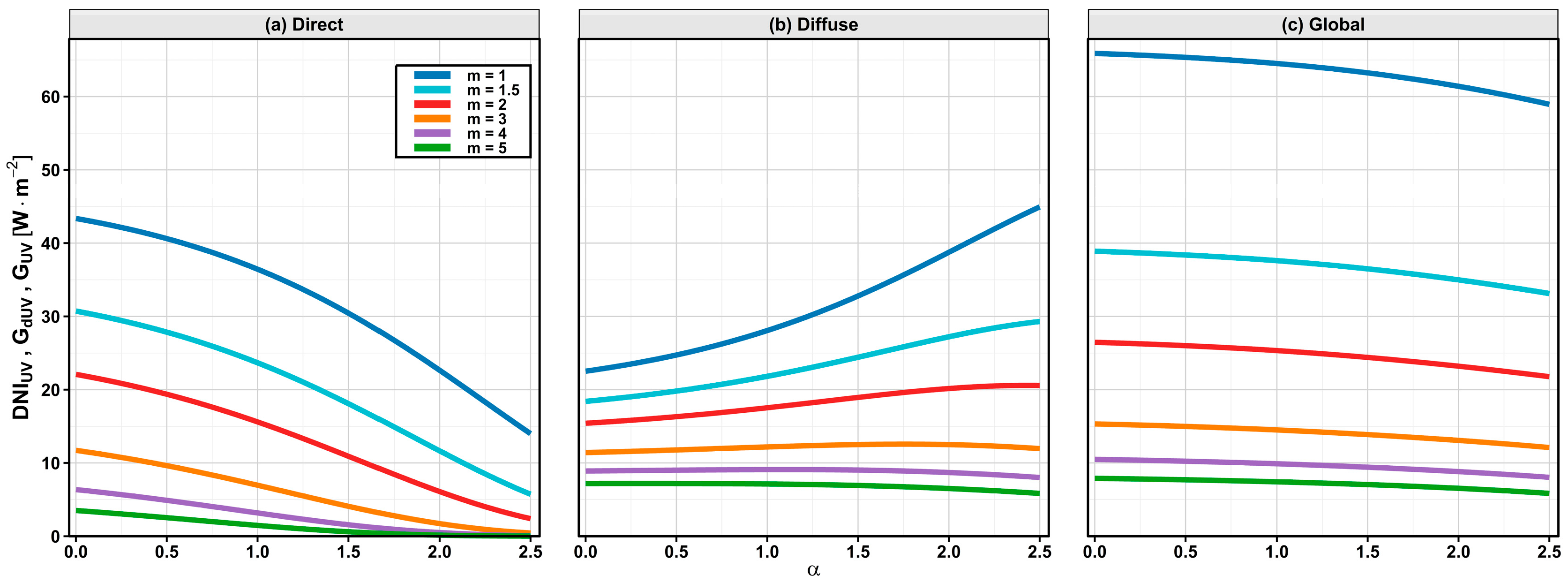
Figure 3 illustrates the direct-normal, diffuse and global solar UV irradiances estimated by the IIAT_S_UV model as a function of Ångström exponent (
). The results indicate that the direct and diffuse UV irradiance components are of comparable magnitude over a wide range of atmospheric conditions. Furthermore, if
, the diffuse component exceeds the direct normal component irrespective of the atmospheric optical mass. This behavior is consistent with previous experimental findings. Early measurements of integrated direct, diffuse, and global UVB radiation conducted in Valencia between 2012 and 2014 showed that the diffuse component constitutes a significant fraction of the total UVB irradiance and may even surpass the direct component under certain conditions [
27]. Similar conclusions were reported in a recent review published in 2026, which noted that diffuse UV irradiance can exceed direct UV irradiance in the presence of high aerosol loading or under cloudy conditions [
28]. In a previous study, we showed that the contribution of the diffuse UV Index to the global UV Index can reach 100% under clear-sky conditions in the presence of fine aerosols (high
α values). Using measured atmospheric parameters, the diffuse-to-global UV Index ratio was evaluated for six locations worldwide. The results indicate that the diffuse component accounts for at least 53% of the global UV Index and may reach 100% in the presence of fine aerosols [
29].
The Ångström exponent, α, has a strong effect on the direct and diffuse components, especially in the case of low atmospheric optical mass. Regarding the global component, compensation occurs between these two effects: the decrease in direct irradiance with increasing α and the increase in diffuse irradiance with increasing α. This analysis further confirms that the presence of fine aerosols leads to an increase in the diffuse component of solar irradiance in the UV range.
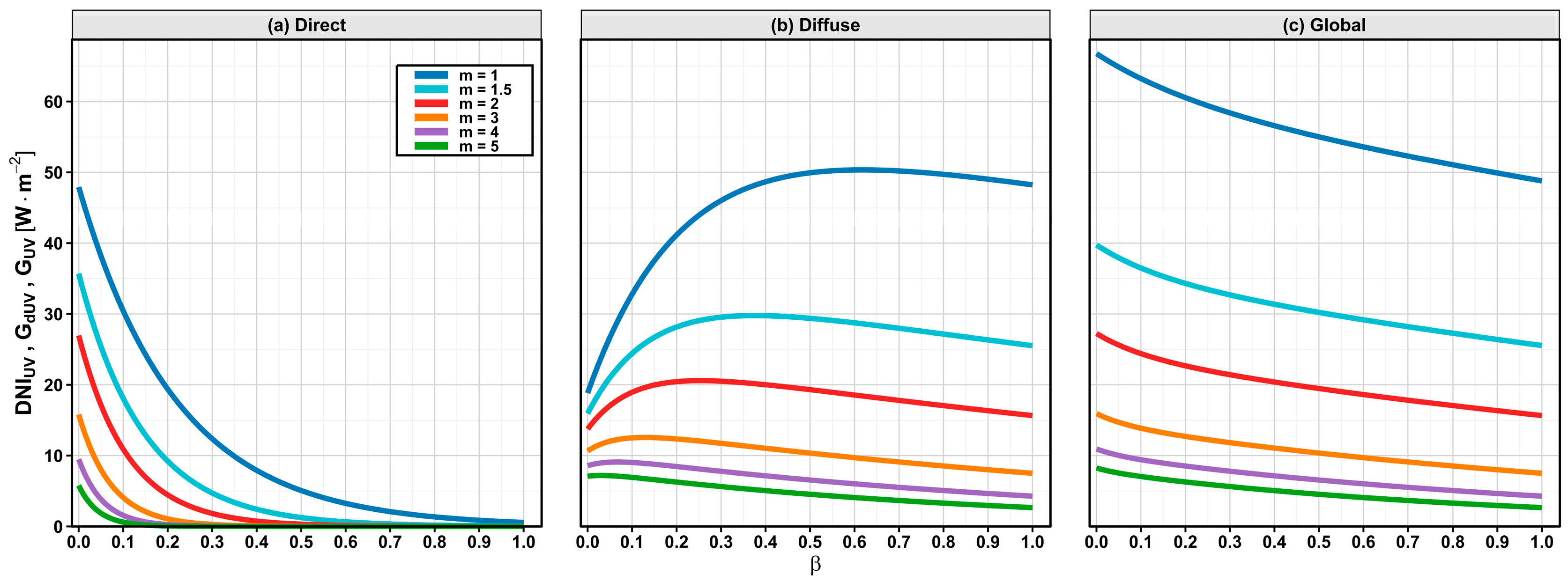
Figure 4 illustrates the direct-normal, diffuse, and global solar UV irradiances estimated by the IIAT_S_UV model as a function of turbidity (
) for six different atmospheric optical masses. As expected, direct-normal irradiance decreases markedly with increasing atmospheric turbidity, due to enhanced aerosol-induced attenuation. In contrast, the diffuse component generally increases with
β, because of the stronger scattering processes within the atmosphere. However, the variation in the diffuse irradiance is not monotonic. It increases with turbidity up to a distinct threshold, beyond which it begins to decrease. Furthermore, the
β value corresponding to the maximum diffuse irradiance shifts toward lower values as the atmospheric optical mass increases. This behavior is also consistent with that reported for broadband parametric clear-sky models such as REST2 (
Figure 3 in [
30]). This non-monotonic behavior arises from the competition between aerosol scattering enhancement and extinction attenuation at high turbidity levels, a feature previously reported for broadband clear-sky models [
31]. At high values of
β, the diffuse component of solar irradiance becomes dominant even for low atmospheric optical masses. The influence of turbidity on the global component is relatively weak, and a compensating effect appears to be present in this case as well.
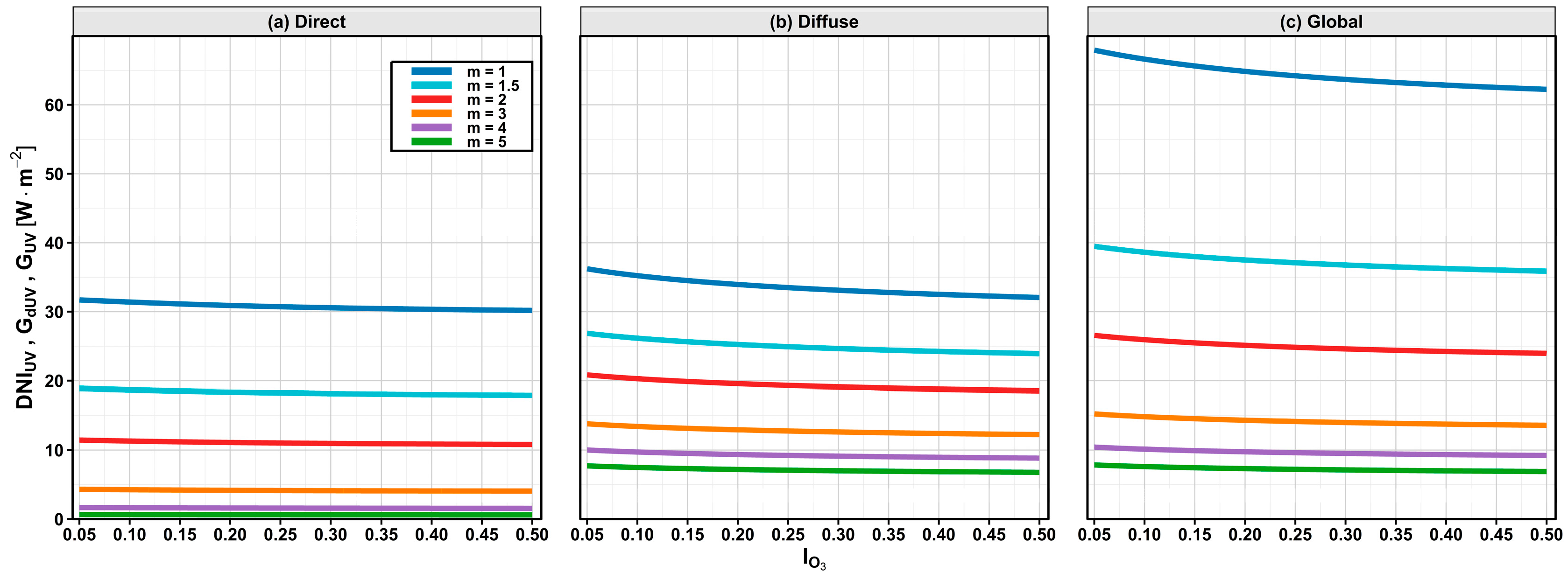
Figure 5 illustrates the direct-normal, diffuse, and global solar UV irradiances estimated by the IIAT_S_UV model as a function of the total column ozone content (
) for six different atmospheric optical masses. In comparison with the strong sensitivities observed for the Ångström exponent
and turbidity coefficient
β, the dependence of the UV irradiance components on the total column ozone content is considerably weaker. This behavior suggests that, within the investigated range of atmospheric conditions, aerosol scattering effects play a more important role in controlling the partition between direct and diffuse UV irradiance than ozone absorption. While increasing ozone content leads to a gradual attenuation of all irradiance components, the overall behavior of the curves remains similar for all atmospheric optical masses. The sensitivity of UV irradiance to ozone variations has been extensively documented. McKenzie et al. (1991) showed that a 1% decrease in total column ozone typically results in an increase of approximately 1.25 ± 0.20% in erythemal UV irradiance [
32]. Similar findings have been reported in Mediterranean regions such as Spain and Malta, where negative correlations between total ozone content and erythemal UV irradiance (UVER) were observed [
33,
34].
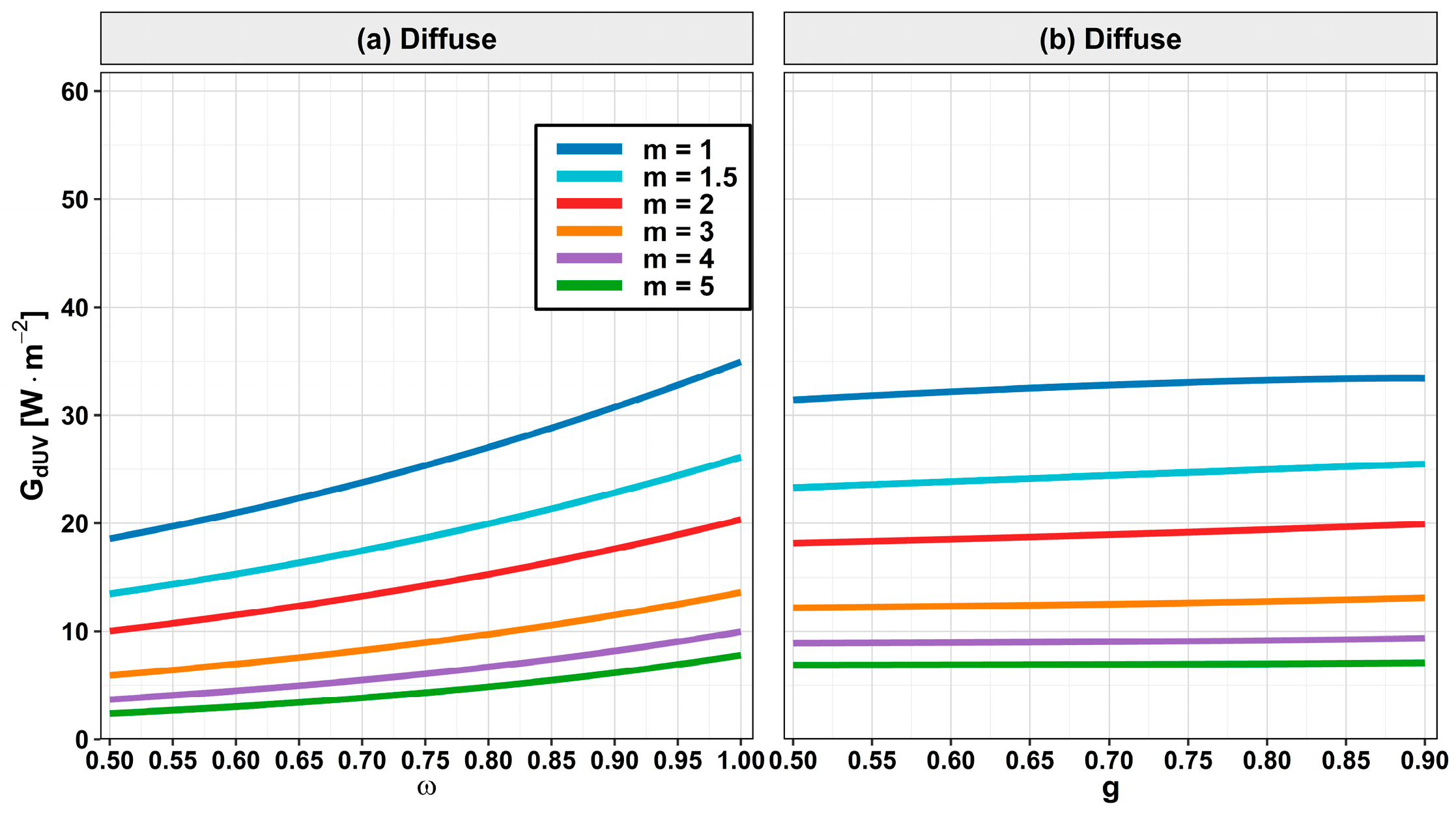
Figure 6 illustrates the diffuse solar UV irradiances estimated by the IIAT_S_UV model as a function of (
a) single scattering albedo and (b) asymmetry factor for six different atmospheric optical masses. The results show that diffuse UV irradiance is strongly dependent on
ω, increasing markedly with increasing single scattering albedo. This behavior is physically consistent, since larger
ω values correspond to weaker aerosol absorption and enhanced scattering, thereby increasing the diffuse component of solar radiation.
By contrast, the sensitivity of diffuse UV irradiance to the asymmetry factor g is comparatively weak over the investigated range. Variations in g produce only minor changes in diffuse irradiance relative to those induced by ω, indicating that aerosol absorption properties exert a stronger control on diffuse UV radiation than the angular distribution of scattering.
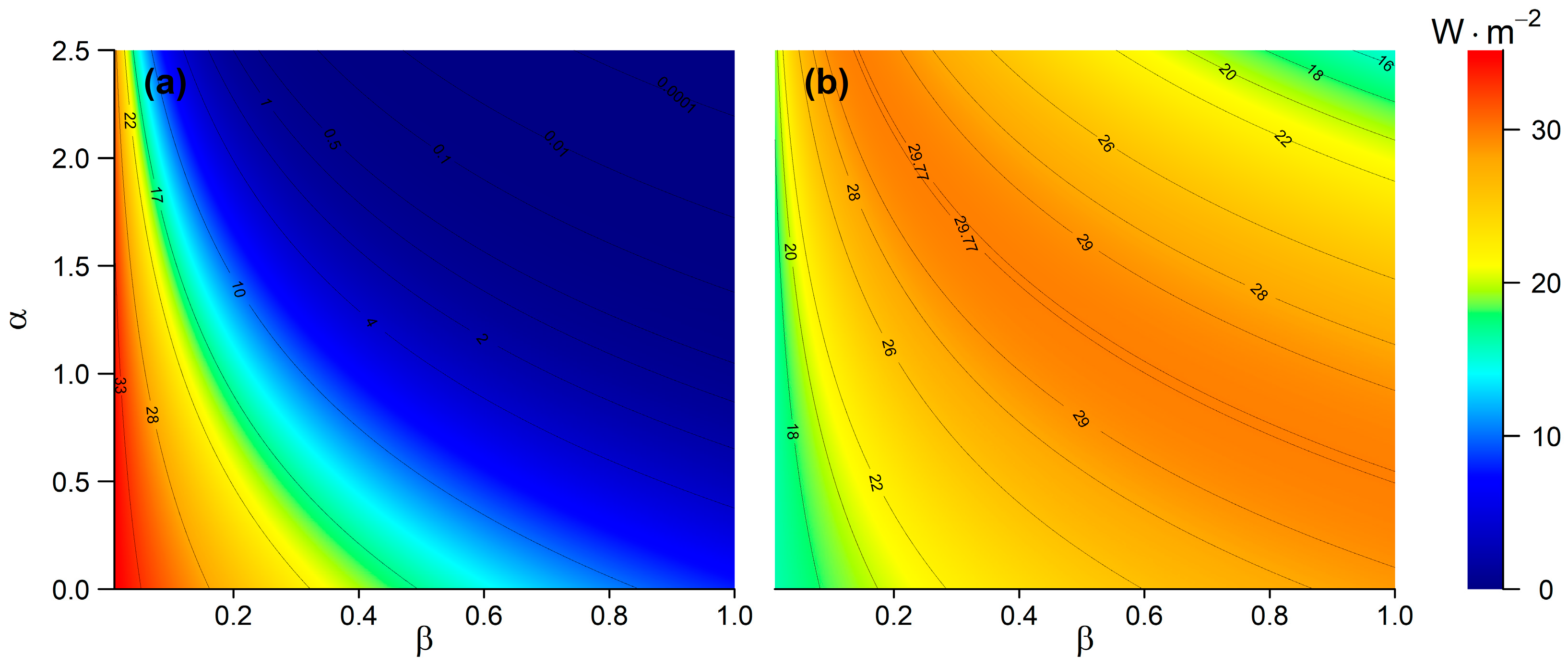
Figure 7 presents contour plots of the direct and diffuse UV irradiances as functions of the Ångström exponent (
α) and the turbidity coefficient (
β), for a fixed atmospheric optical mass of 1.5. Unlike the previous one-dimensional analyses, these representations allow a direct visualization of the combined influence of aerosol loading and aerosol size distribution on UV irradiance components. The results clearly show a strong coupled dependence on both parameters. For low
α values (coarse aerosol conditions), both direct and diffuse irradiances exhibit a weaker sensitivity to turbidity. In contrast, for higher
α values (fine aerosol conditions), the sensitivity to
β becomes significantly more pronounced. The diffuse component displays a marked increase with
β for intermediate turbidity levels, especially under fine aerosol conditions, while saturation and a subsequent decrease are observed at high
β values. This behavior reflects the balance between enhanced multiple scattering and increasing extinction effects.
The sensitivity of clear-sky solar irradiance models to the Ångström turbidity coefficient can be significant. Replacing the actual turbidity conditions with climatological or average
β values may lead to substantial errors in irradiance estimation, sometimes exceeding 20% [
35]. To quantify more rigorously the influence of atmospheric turbidity on UV irradiance components, the partial derivatives of the direct-normal irradiance (
) and diffuse irradiance (
) with respect to the turbidity coefficient
β were evaluated. These derivatives provide a local measure of the model sensitivity to aerosol loading under different atmospheric conditions.
For the sake of analytical simplicity, the factor was approximated by unity. This approximation is most accurate for low values of the Ångström exponent and is used here only to facilitate the qualitative interpretation of the sensitivity trends.
The relation (18) shows that the sensitivity of the direct-normal UV irradiance to turbidity increases with the Ångström exponent α. In other words, the attenuation of the direct component becomes stronger as α increases, indicating a larger reduction in DNI in the presence of fine aerosols. This behavior is fully consistent with the results discussed previously, which showed enhanced scattering effects associated with fine aerosol particles.
For the diffuse component, (Equation (19)), the behavior is considerably more complex due to the competing physical processes involved. On the one hand, increasing turbidity enhances aerosol scattering, which tends to increase the diffuse irradiance. On the other hand, larger aerosol loading also strengthens extinction effects, reducing the amount of radiation available for scattering. As a result, the sensitivity of the diffuse component may change signs depending on the atmospheric conditions, leading to the non-monotonic behavior previously observed in the graphical analysis.
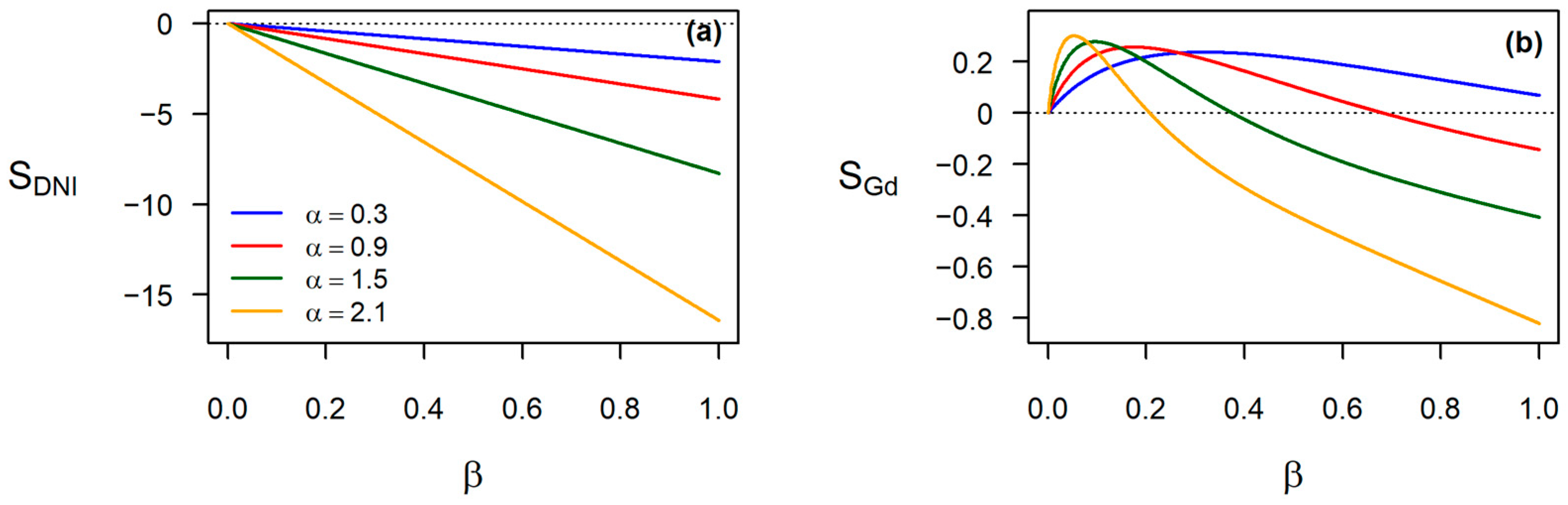
To complement the analysis based on absolute partial derivatives, relative sensitivities were also evaluated by normalizing the derivatives with the corresponding irradiance component, i.e.,
These normalized derivatives provide a measure of the relative sensitivity of the IIAT_S_UV model to turbidity variations. While the sensitivity of the direct-normal component exhibits relatively simple and monotonic behavior (see
Figure 8a), the diffuse component shows a considerably more complex response. For this reason, the analysis focuses mainly on the behavior of
, represented graphically for different values of the Ångström exponent
α in
Figure 8b.
For all values of the Ångström exponent α considered in this analysis, the relative sensitivity of the diffuse component to turbidity exhibits a similar qualitative behavior. It takes positive values and increases up to a threshold β value, after which it decreases with a smaller slope until negative values are reached. The higher the α parameter, the more pronounced this behavior becomes.
The accuracy obtained with the proposed model should be interpreted in the context of the relatively limited number of published clear-sky UV irradiance parameterizations available for direct comparison. Previous studies have reported a broad range of errors for UV irradiance estimation, depending on atmospheric conditions, geographical location, and model inputs. For example, an empirical UV estimation model developed using measurements from the Chinese Ecosystem Research Network achieved an average RMSE of 14.31% under various sky conditions [
36], while Dieste-Velasco et al. (2023) reported nRMSE values ranging from 3.77% to 46.05% for all-sky UV irradiance estimation using ANN models [
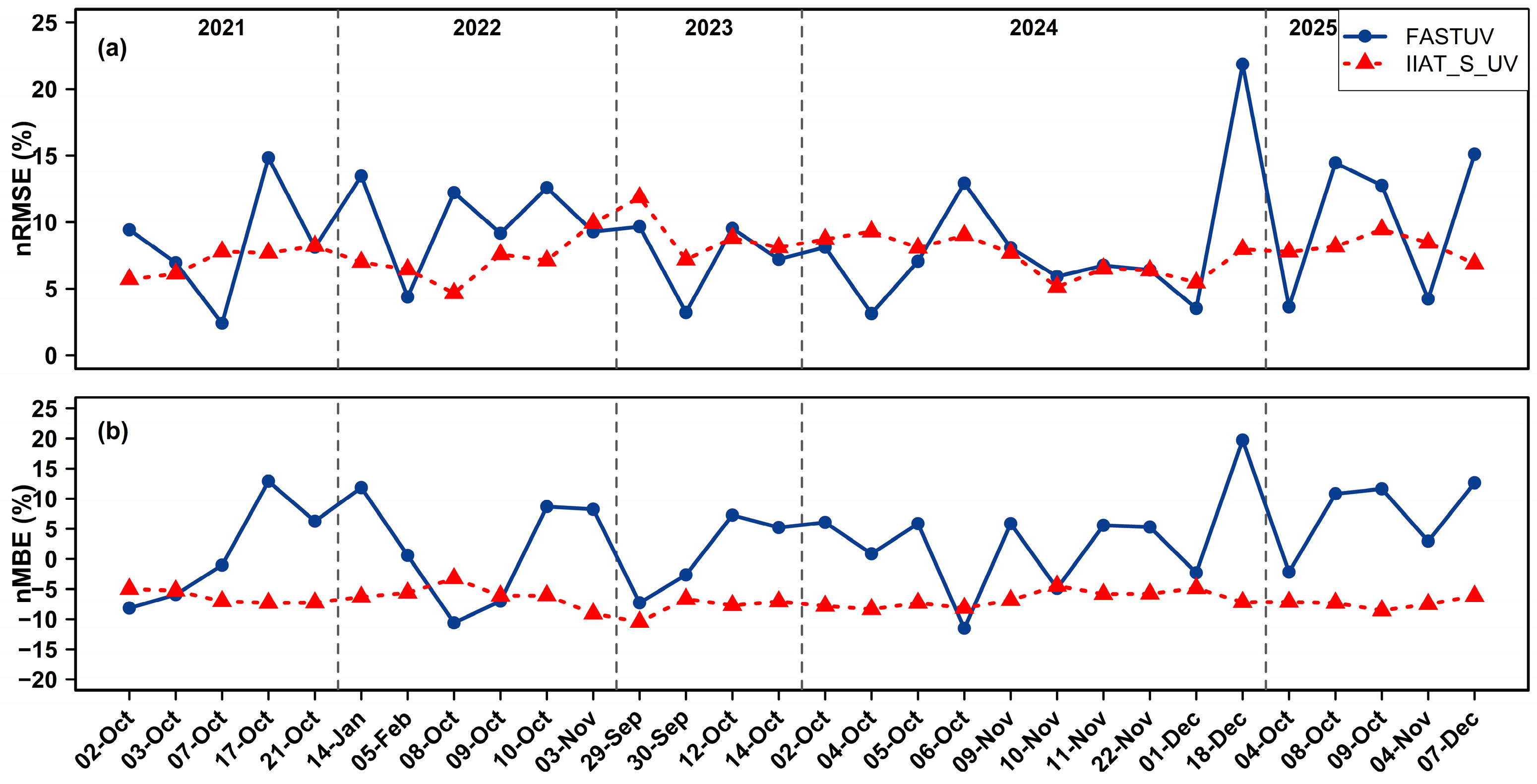
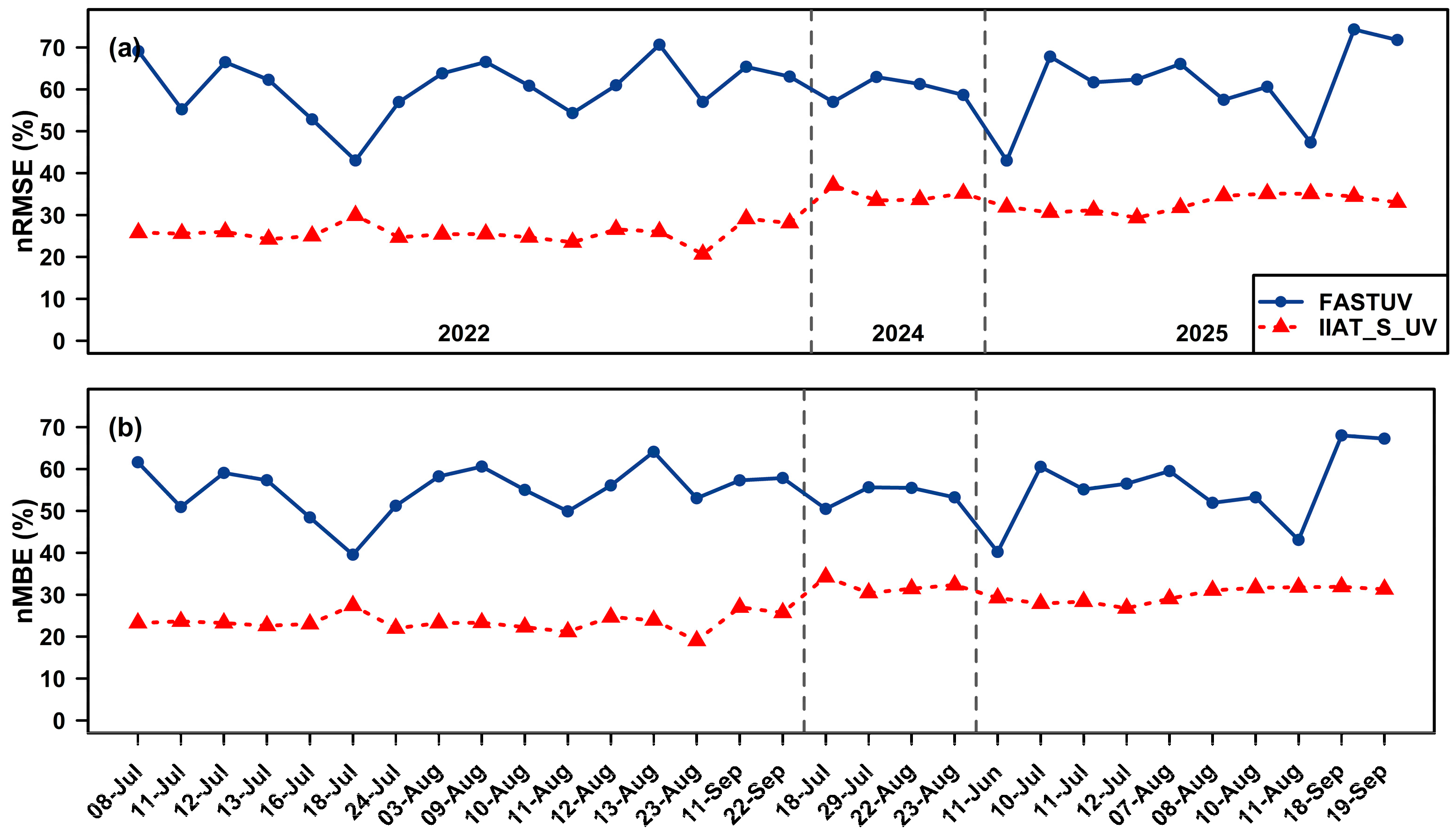
11]. Direct quantitative comparisons should be treated with caution because these studies addressed all-sky conditions and employed substantially different input variables. In contrast, the present study focuses exclusively on clear-sky UV irradiance estimation using a physically based parameterization. Under these conditions, the proposed model achieved mean nRMSE values of 7.64% at Izaña and 29.24% at Payerne. Furthermore, relative to FASTUV, the only clear-sky broadband UV parameterization considered in this study, the proposed model consistently reduced both nRMSE and nMBE, suggesting that the SMARTS2-derived transmittances and interdependent integration scheme provide a more consistent representation of broadband UV atmospheric attenuation.
It should be noted that the improved performance of IIAT_S_UV relative to FASTUV may arise from two factors: (i) the use of the SMARTS2 spectral radiative transfer model as the parent model and (ii) the adoption of the interdependent integration scheme. The present study was designed to develop and validate a broadband UV parameterization based on these two components acting together. Consequently, the individual contribution of each factor to the overall performance improvement was not isolated. A rigorous attribution analysis would require additional experiments in which the spectral model and integration scheme are varied independently, which represents an interesting direction for future research.
5. Conclusions
This study proposes a new parametric model for estimating the three components of clear-sky solar UV irradiance: direct, diffuse, and global. The model is developed within an interdependent integration framework, starting from spectral atmospheric transmittances derived from the SMARTS2 model. The proposed formulation provides a physically consistent representation of the radiative transfer processes in the UV spectral range.
The model is validated using simultaneous radiometric and atmospheric data from two sites with distinct climatic conditions, Izana (Spain) and Payerne (Switzerland). In addition, its performance is assessed against a benchmark parametric model of the same class, FASTUV, which is based on an independent integration scheme and derives atmospheric transmittances from the Leckner spectral model.
The comparative analysis shows that the proposed model performs competitively and, in several cases, more robustly than FASTUV, particularly in terms of stability and overall statistical behavior across different atmospheric conditions.
The proposed parameterization was developed using SMARTS2 simulations spanning a broad range of atmospheric conditions, namely atmospheric air mass values between 0.6 and 6, total ozone column amounts between 0.2 and 0.6 atm-cm, Ångström turbidity coefficients β between 0.01 and 1, and Ångström exponents α between 0.1 and 3. Therefore, the parameterization is expected to be physically applicable within these ranges.
The present validation is subject to several limitations. The evaluation was performed using high-quality measurements from only two BSRN stations, both characterized by relatively low atmospheric turbidity and moderate ozone content. Consequently, the performance of the model under highly polluted atmospheric conditions, strong ozone variability, or other climatic environments remains to be investigated. Furthermore, the present study focused exclusively on clear-sky conditions, and no direct validation of the diffuse UV irradiance component was possible due to the lack of corresponding measurements. Future work will include validation using a broader range of atmospheric conditions and observational datasets, as well as comparisons with satellite-derived UV products and further developments toward more general radiative conditions.