1. Introduction
The oral cavity, as the entry point to the gastrointestinal tract, is essential for food intake and swallowing. The oral mucosa, which forms a boundary with the external environment, is constantly exposed to numerous antigens and allergens and hosts approximately 400 to 700 microbial species [
1]. This environment positions the oral mucosa as both a sentinel and a mediator, eliminating pathogenic threats while maintaining tolerance to dietary antigens and commensal microorganisms [
2]. To sustain this balance, the oral mucosa functions through a specialized “mucosal immune system” distinct from systemic immunity that maintains immune homeostasis at this critical interface [
2].
A central feature of oral mucosal immunity is the secretion of secretory immunoglobulin A (SIgA) in saliva and the presence of serum-derived immunoglobulin G (IgG) in gingival crevicular fluid [
3]. The coexistence of mucosal and systemic immunoglobulins highlights the oral cavity’s dual role in immune defense. In humans, about 99% of SIgA is produced by mucosal tissues and exocrine glands [
4]. These antibodies protect through neutralization and agglutination of microbes and foreign particles, playing a key role in oral immune surveillance and pathogen exclusion.
SIgA constitutes the first line of defense at mucosal surfaces by preventing microbial adherence, neutralizing pathogens, and facilitating immune exclusion without inducing excessive inflammation [
4]. Age-associated reductions in salivary SIgA secretion have been linked to increased susceptibility to oral and respiratory infections [
5,
6].
For decades, efforts have focused on developing strategies to induce antigen-specific SIgA responses in saliva, aiming to prevent common oral infections such as dental caries and periodontal disease [
7,
8,
9]. However, these approaches have not produced clinically applicable methods, and the regulation of salivary SIgA secretion remains incompletely understood.
Hinokitiol (HNK), a natural tropolone derivative first isolated by Japanese researchers in the early 20th century, has attracted attention due to its broad-spectrum antimicrobial activity against bacteria and fungi [
10,
11,
12]. It is now widely used as a quasi-drug ingredient in oral hygiene and personal care products such as toothpastes, mouthwashes, and hair tonics. Beyond its antimicrobial properties, we previously showed that HNK induces apoptosis and inhibits proliferation in human oral squamous cell carcinoma cells [
13,
14,
15], underscoring its therapeutic potential. Previous studies have demonstrated that HNK possesses immunomodulatory properties in addition to its antimicrobial activity. For example, HNK suppresses inflammatory cytokine production in activated macrophages through inhibition of NF-κB signaling pathways [
16]. However, its effects on mucosal immune responses, particularly SIgA production, remain poorly understood.
The present study, therefore, investigated whether intranasal administration of HNK alters short-term SIgA secretion dynamics in aged mice. Rather than focusing on antigen-specific adaptive immune induction, we aimed to determine whether HNK modulates the functional activity of IgA-producing cells and salivary secretion responses. Because aging is associated with reduced SIgA output and impaired mucosal defense, understanding transient regulatory mechanisms of SIgA secretion may provide insight into novel non-invasive strategies to support oral mucosal immunity in older individuals.
2. Materials and Methods
2.1. Animals
Female BALB/c mice, aged 48 weeks, were used for immunization. The animals were housed in groups of five per cage within horizontal laminar flow cabinets under specific pathogen-free conditions at Osaka Dental University. Sterilized food and water were provided ad libitum. The experimental groups were categorized based on the timing of sample collection relative to HNK administration: immediately before administration (−0 h), and at 0.5, 1.5, 3, and 6 h post-administration. A total of five groups were established. All animal procedures were performed in accordance with the Guide for the Care and Use of Laboratory Animals of Osaka Dental University and were approved by the Institutional Animal Care and Use Committee of Osaka Dental University (Approval No. 23-02013). Animals were randomly assigned to each experimental group.
Female mice were selected to minimize inter-individual variability associated with aggressive behavior and unstable long-term group housing conditions frequently observed in aged male BALB/c mice.
2.2. Reagent
HNK (Tokyo Chemical Industry Co., Tokyo, Japan) was dissolved in dimethyl sulfoxide (DMSO; Kishida Chemical Co., Osaka, Japan) to prepare a 100 mg/mL stock solution.
2.3. Nasal Immunization and Sample Collection Schedule
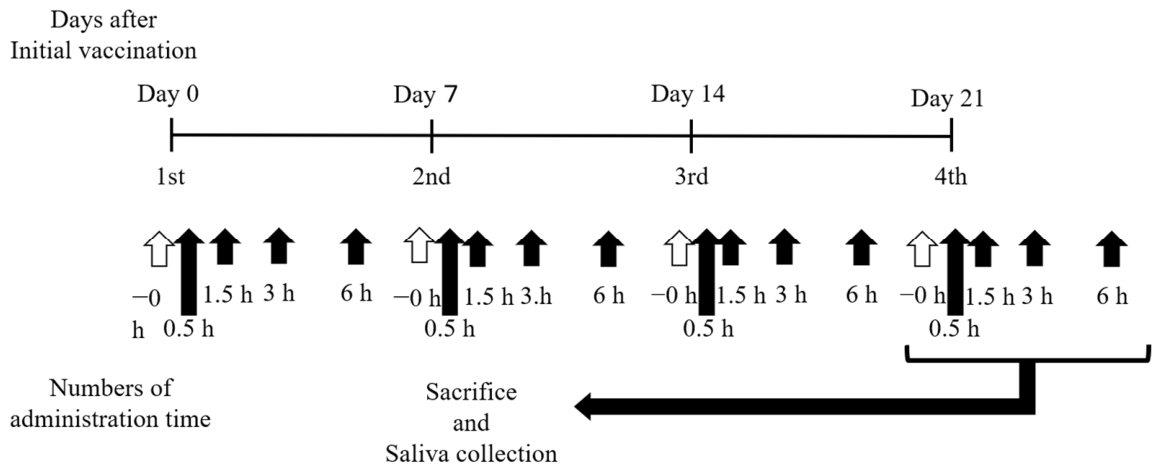
A total of 50 μg of HNK (prepared by diluting 0.5 μL of a 100 mg/mL HNK stock solution) was adjusted to a final volume of 6 μL with phosphate-buffered saline (PBS) and administered intranasally once per week for four consecutive weeks (3 μL per nostril per dose). All mice were immunized nasally under intraperitoneal anesthesia with hydrochloric acid medetomidine (0.3 mg/kg), midazolam (4 mg/kg), and butorphanol tartrate (5 mg/kg). All efforts were made to minimize animal suffering, and animals were monitored regularly for signs of distress. Saliva samples were collected using procedures modified from previous studies [
17]. On each administration day, saliva was collected at five timepoints: immediately before HNK administration (−0 h) and at 0.5, 1.5, 3, and 6 h post-administration (
Figure 1). On day 21, after saliva collection, mice were euthanized, and their submandibular glands (SMGs) were harvested. Mononuclear cells were then isolated from the SMGs as previously described [
18]. Briefly, excised SMGs were enzymatically digested with 0.5 mg/mL collagenase type IV (Sigma-Aldrich Japan, Tokyo, Japan), and the resulting cell suspension was subjected to density gradient centrifugation with Percoll (GE Healthcare Japan, Tokyo, Japan) to obtain mononuclear cells.
Vehicle control mice received intranasal administration of PBS containing the same final concentration of DMSO without HNK.
2.4. Measurement of SIgA and IgA Antibody-Forming Cells (AFCs)
Saliva samples were collected on days 0, 7, 14, and 21 and analyzed for SIgA concentrations using a Mouse IgA ELISA Quantitation Kit (Bethyl Laboratories, Montgomery, TX, USA) according to the manufacturer’s instructions. Absorbance at 450 nm was measured using a microplate reader (SpectraMax M5; Molecular Devices Japan, Tokyo, Japan), and SIgA concentrations were calculated using SoftMax Pro software, version 6 (Molecular Devices Japan). On day 21, IgA AFCs in the SMGs were quantified by an enzyme-linked immunospot (ELISPOT) assay using 96-well polyvinylidene fluoride plates (Mouse IgA ELISpot Basic Kit, 3865-2A; Mabtech, Cincinnati, OH, USA) following the manufacturer’s protocol. Spots corresponding to IgA-secreting cells were visualized using 3-amino-9-ethylcarbazole (AEC; FUJIFILM Wako Pure Chemical Corporation, Osaka, Japan) and counted under a stereomicroscope (Stemi 305; Carl Zeiss Microscopy Co., Tokyo, Japan). Outcome assessments were performed in a blinded manner.
2.5. Relative Metabolic Activity of IgA AFCs
On day 21, mononuclear cells isolated from the SMGs at each time point were incubated with biotin-conjugated rat anti-mouse IgA antibody (clone 407003; BioLegend, San Diego, CA, USA). After washing, the cells were labeled with streptavidin-conjugated magnetic beads and positively selected using the MojoSort™ Magnetic Cell Separation System (BioLegend) to isolate IgA AFCs. Purified IgA AFCs (2 × 10⁵ cells per well) were seeded into 96-well microplates (BD Biosciences, Franklin Lakes, NJ, USA), followed by the addition of 10 μL of CytoSelect™ MTT Cell Proliferation Assay Reagent (CELL BIOLABS Inc., San Diego, CA, USA). The plates were incubated for 4 h at 37 °C in a CO2 incubator. After incubation, 100 μL of Detergent Solution was added to each well, and the plates were kept at room temperature in the dark for 2 h. Absorbance was measured at 540 nm using a microplate reader (SpectraMax M5; Molecular Devices Japan), and cell viability and proliferative activity were quantified using SoftMax Pro software, version 6 (Molecular Devices Japan).
Wells containing medium alone served as background controls. Cell viability and proliferative activity were expressed relative to pre-administration AFCs (0 h), which were defined as 100%.
2.6. Flow Cytometric Analysis for B220+CD38+ Memory B-Cell Populations
Mononuclear cells were isolated from the SMGs of mice 3 h after the final administration of HNK or vehicle control. Vehicle control solutions contained the same final concentration of DMSO diluted in PBS without HNK.
The cells were then stained with Brilliant Violet 421-conjugated anti-mouse B220 and APC-conjugated anti-mouse CD38 monoclonal antibodies (BioLegend). Flow cytometric analysis was conducted using a FACSVerse flow cytometer equipped with FlowJo software v 10 (BD Biosciences).
2.7. Statistical Analysis
The data are presented as means ± standard error from three independent experiments. Statistical analyses were performed using GraphPad Prism software (version 7; GraphPad Software, San Diego, CA, USA). Comparisons among multiple groups and time points were analyzed using two-way ANOVA followed by Tukey’s multiple-comparison test. Student’s t-test was used for comparisons between two groups where appropriate. A p-value < 0.05 was considered statistically significant. No animals or data points were excluded from the analysis.
3. Results
3.1. Temporal Changes in Salivary SIgA Antibody Levels Following HNK Administration
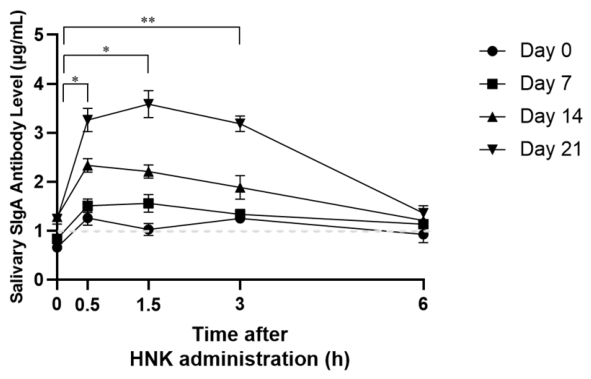
To examine the time-dependent kinetics of salivary SIgA antibody induction and resolution following HNK administration, saliva samples were collected at 0 h, 0.5 h, 1.5 h, 3 h, and 6 h post-administration on days 0, 7, 14, and 21.
The absence of significant differences at 12 and 24 h suggests that the effect of HNK on SIgA secretion is transient and rapidly reversible rather than sustained over prolonged periods.
As shown in
Figure 2, mean SIgA Ab levels increased rapidly following HNK administration and reached peak values within 0.5–1.5 h depending on the treatment day, followed by a gradual decline toward baseline levels. Although statistically significant elevations were also observed at 3 h, particularly on day 21, the mean SIgA Ab level remained highest at 1.5 h. Notably, on day 21, SIgA Ab levels remained significantly elevated at 3 h post-administration, suggesting a prolonged response relative to earlier treatment days, although the highest mean value was still observed at 1.5 h.
A cumulative effect of repeated HNK administration was observed: salivary SIgA Ab levels at each corresponding time point (−0, 3, and 6 h) progressively increased across days 0 to 21. A significant difference was found between SIgA Ab levels at 3 h on day 0 and those at 3 h on day 21 (
Figure 2), indicating increased salivary SIgA responsiveness during repeated HNK exposure during the immunization schedule.
3.2. Rapid Kinetics of Salivary SIgA Antibody Secretion Following HNK Administration
Based on the results described in
Figure 2, we investigated the short-term kinetics of salivary SIgA Ab secretion to determine the time required to reach peak levels after HNK administration. Specifically, SIgA Ab concentrations were measured at 0.5 and 1.5 h post-administration on days 0, 7, 14, and 21.
As shown in
Figure 2, on all treatment days, the highest SIgA Ab levels occurred 1.5 h post-HNK administration, consistently exceeding those at 3 h post-administration, as shown in
Figure 2. On day 21, SIgA Ab concentrations at 0.5 and 1.5 h post-administration were significantly higher than those at baseline (−0 h), indicating a rapid and robust mucosal immune response.
These results confirm that salivary SIgA Ab secretion peaked at 1.5 h post-administration and subsequently declined to baseline.
Consistent with the trends in
Figure 2, SIgA Ab levels progressively increased with successive immunizations. Specifically, on day 21, SIgA Ab levels at 0.5 and 1.5 h post-HNK administration were significantly higher than the corresponding values on day 0 (
Figure 2), indicating a cumulative enhancement in mucosal IgA responses with repeated HNK exposure.
3.3. Quantification of IgA AFCs in SMGs on the Final Day of HNK Administration
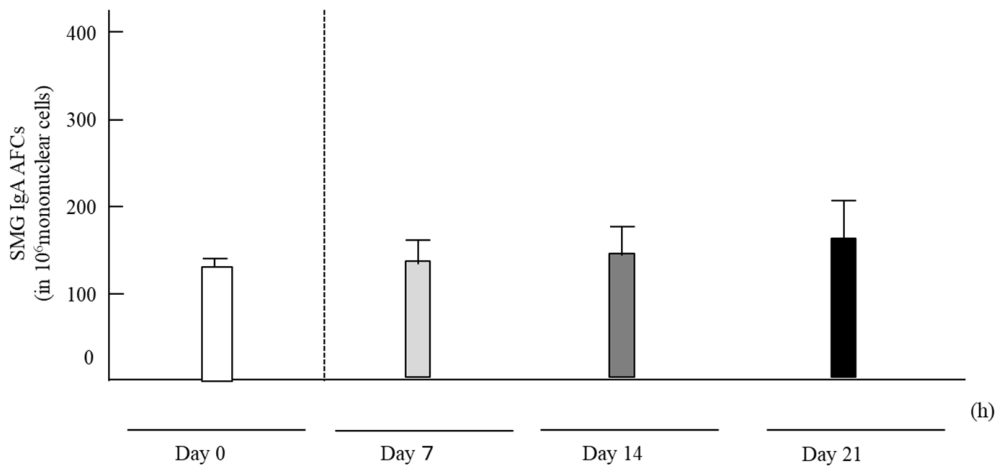
To assess whether HNK administration influenced the number of IgA AFCs in the SMGs, we quantified IgA AFCs at different timepoints on day 21, the final day of administration. Measurements were taken at −0 h (before administration), and at 0.5, 1.5, 3, and 6 h post-administration.
As shown in
Figure 3, no significant differences were observed in the number of IgA AFCs at any time points compared with the pre-administration baseline. These findings indicate that short-term changes in salivary SIgA antibody levels after HNK exposure are not associated with changes in the number of AFCs in the SMGs.
3.4. Evaluation of the Viability and Proliferative Capacity of IgA AFCs in SMGs on the Final Day of HNK Administration
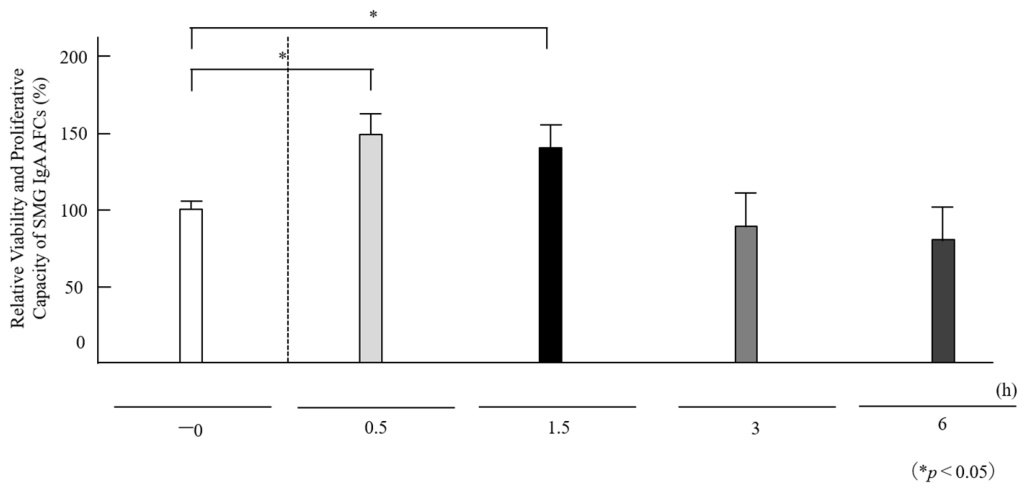
To assess the functional status of IgA AFCs, we evaluated their viability and proliferative capacity at different timepoints on day 21, the final day of HNK administration.
The viability and proliferative capacity of IgA AFCs before HNK administration (−0 h) were set as the baseline (100%), and subsequent values were compared to this reference (
Figure 4). No significant changes were observed at 3 and 6 h post-administration, whereas significant increases occurred at 0.5 and 1.5 h post-administration. The highest viability and proliferative activity were noted at 0.5 h post-HNK administration.
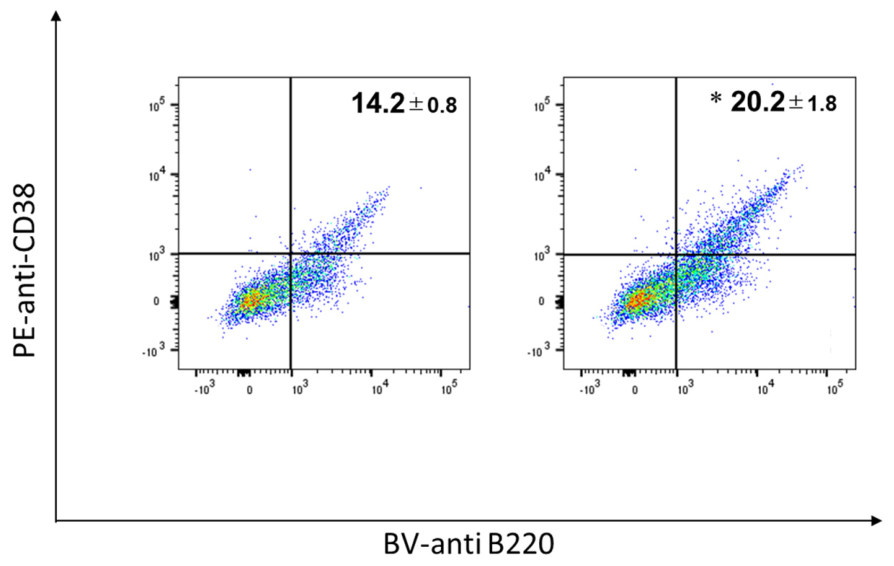
3.5. Induction of B220+CD38+ Memory B-Cells in SMGs
The frequency of B220
+CD38
+ memory B-cells in the SMGs of mice that received intranasal vaccination with or without HNK was evaluated using flow cytometry. Intranasal immunization with HNK significantly increased the proportion of B220
+CD38
+ memory B-cells in the SMGs compared to mice immunized without HNK (
Figure 5).
4. Discussion
The most notable finding of this study is the rapid and transient increase in salivary SIgA levels occurring within 0.5–1.5 h after intranasal HNK administration. Such kinetics are inconsistent with de novo adaptive immune induction, which typically requires several days. Instead, these findings indicate that HNK primarily influences short-term regulation of SIgA secretion dynamics.
One possible explanation is the involvement of a neuro-immune reflex pathway linking nasal mucosal stimulation to parasympathetic regulation of the salivary glands. Sensory stimulation of the nasal mucosa can modulate salivary gland secretion through trigeminal pathways and the superior salivatory nucleus [
19,
20,
21]. Given the rapid onset and transient nature of the response observed here, HNK may function as a local mucosal stimulant rather than an immunogenic antigen.
HNK exhibits antimicrobial activity against various bacteria and fungi, including periodontal pathogens such as
Porphyromonas gingivalis [
22] and opportunistic organisms such as
Candida albicans [
11]. However, while the antimicrobial properties of HNK are well characterized, its influence on host mucosal immune regulation remains poorly understood. Only a limited number of studies have investigated the immunobiological effects of HNK. For example, HNK has been shown to suppress lipopolysaccharide-induced inflammatory mediator production through inhibition of NF-κB activation in macrophages [
16]. Nevertheless, its effects on mucosal immune responses, particularly salivary SIgA secretion and IgA antibody-forming cell activity, have not been fully elucidated. The present findings, therefore, extend previous knowledge by demonstrating that HNK can acutely modulate mucosal immune secretion without inducing classical adaptive immune activation.
Dose–response observations from preliminary experiments further support a functional rather than proliferative mechanism. A lower dose (5 µg) induced a similar kinetic pattern with reduced magnitude, whereas a higher dose (100 µg) markedly suppressed SIgA secretion and reduced both the number and viability of IgA AFCs. These findings suggest that excessive HNK or its solvent (DMSO) may impair mucosal immune cell function, and that 50 µg represents an optimal stimulatory dose under the present conditions.
Importantly, the number of IgA AFCs in the SMGs did not change following HNK administration. This indicates that the transient elevation in SIgA secretion is unlikely to result from expansion of IgA-producing cells. Instead, the short-term increase in relative metabolic activity of IgA AFCs suggests temporary functional modulation of pre-existing cells or alterations in secretory processes within the glandular tissue [
23]. The temporal association between increased AFC metabolic activity at 0.5 h and peak SIgA secretion at 1.5 h further supports this interpretation.
Although repeated HNK administration was associated with a gradual increase in baseline SIgA secretion measured before dosing, each response remained short-lived and returned to baseline within hours. Therefore, the present data do not support the classification of HNK as a classical mucosal adjuvant but rather suggest a modulatory effect on secretory function.
Flow cytometric analysis demonstrated an increased proportion of B220
+CD38
+ memory B cells in the SMGs following repeated HNK administration. While this suggests that HNK exposure may influence the local immune environment, the relationship between these cellular changes and the rapid SIgA secretion observed remains unclear. Further mechanistic studies are needed to determine whether neural, epithelial, or immune signaling pathways are primarily responsible for the observed effects [
19,
20].
These findings may have particular relevance in the context of aging. Elderly individuals commonly exhibit reduced salivary flow rates and diminished SIgA secretion, which are associated with increased susceptibility to mucosal infections and reduced quality of life [
4,
5]. Because the present study was conducted in middle-aged to aged mice, the observed responsiveness to HNK suggests that mucosal secretory mechanisms may remain modifiable during aging. However, 48-week-old mice represent a middle-aged to aged condition rather than a severe immunosenescent model, and therefore the present findings should be interpreted cautiously. 48-week-old mice were selected because age-associated alterations in mucosal immunity have been reported to emerge during middle to late adulthood while salivary SIgA production remains detectable, allowing for evaluation of interventions targeting age-related immune decline [
24,
25].
Several limitations should be considered. First, a young control group was not included in the present study. Therefore, age-related differences in responsiveness to HNK could not be directly evaluated. Second, the SIgA measured in this study was total SIgA rather than antigen-specific SIgA. Therefore, the observed increase likely reflects a transient enhancement in nonspecific mucosal defense rather than the induction of adaptive antigen-specific immunity. Such nonspecific SIgA secretion may contribute to first-line barrier protection through immune exclusion of microorganisms at mucosal surfaces. Third, neural pathways were not directly investigated, and the proposed neuro-immune mechanism remains hypothetical. Forth, because HNK was dissolved in DMSO, potential biological effects of the vehicle cannot be completely excluded despite the inclusion of vehicle-treated controls [
23]. Finally, extrapolation of these findings to other age groups, advanced immunosenescent models, or infectious conditions should be approached with caution [
24,
25].
We did not include a young control group; therefore, age-dependent differences in responsiveness to HNK could not be directly evaluated.
In conclusion, intranasal HNK administration in aged mice induces a rapid and transient increase in salivary SIgA secretion without expanding IgA-producing cell numbers. These findings point to short-term regulatory effects on salivary gland secretion rather than classical adaptive immune induction and provide a basis for further investigation into neural and local regulatory mechanisms of mucosal immunity. Future studies should evaluate the protective effects of HNK in pathogen-challenged models, including oral Candida infection models, to determine whether the observed enhancement in SIgA secretion translates into functional mucosal protection. In addition, histological evaluation of salivary glands and mucosal tissues may provide further insight into the cellular mechanisms underlying HNK-induced immune modulation.




 ,
,