Article

Negative Trend of Regularity of Locomotion in an Endurance Walking Task: Experimental Data from Healthy Adult Recreational Athletes in an Unsupervised 100 km March

by
Marco Rabuffetti
1,
Ilaria Carpinella
1,*,
Stefan Mendt
2,
Giampiero Merati
1,3,
Mathias Steinach
2,† and
Martina Anna Maggioni
2,4,5,†
1
IRCCS Fondazione Don Carlo Gnocchi ETS, 20148 Milano, Italy
2
Center for Space Medicine and Extreme Environments Berlin, Institute of Physiology, Charité-Universitätsmedizin Berlin, 10117 Berlin, Germany
3
Department of Biotechnology and Life Sciences, Università degli Studi dell’Insubria, 21100 Varese, Italy
4
Charité Center for Global Health, Charité-Universitätsmedizin Berlin, 10117 Berlin, Germany
5
Department of Biomedical Sciences for Health, Università degli Studi di Milano, 20126 Milano, Italy
*
Author to whom correspondence should be addressed.
These authors contributed equally to this work.
Appl. Sci. 2026, 16(12), 6203; https://doi.org/10.3390/app16126203
Submission received: 13 May 2026 / Revised: 16 June 2026 / Accepted: 17 June 2026 / Published: 19 June 2026

Featured Application

Among the recent advances in motion analysis, the quantification of locomotor pattern regularity, based on wearable sensors’ measurements, provides an index potentially modulated by a prolonged effort, thus possibly considered as an objective proxy of accumulating fatigue.

Abstract

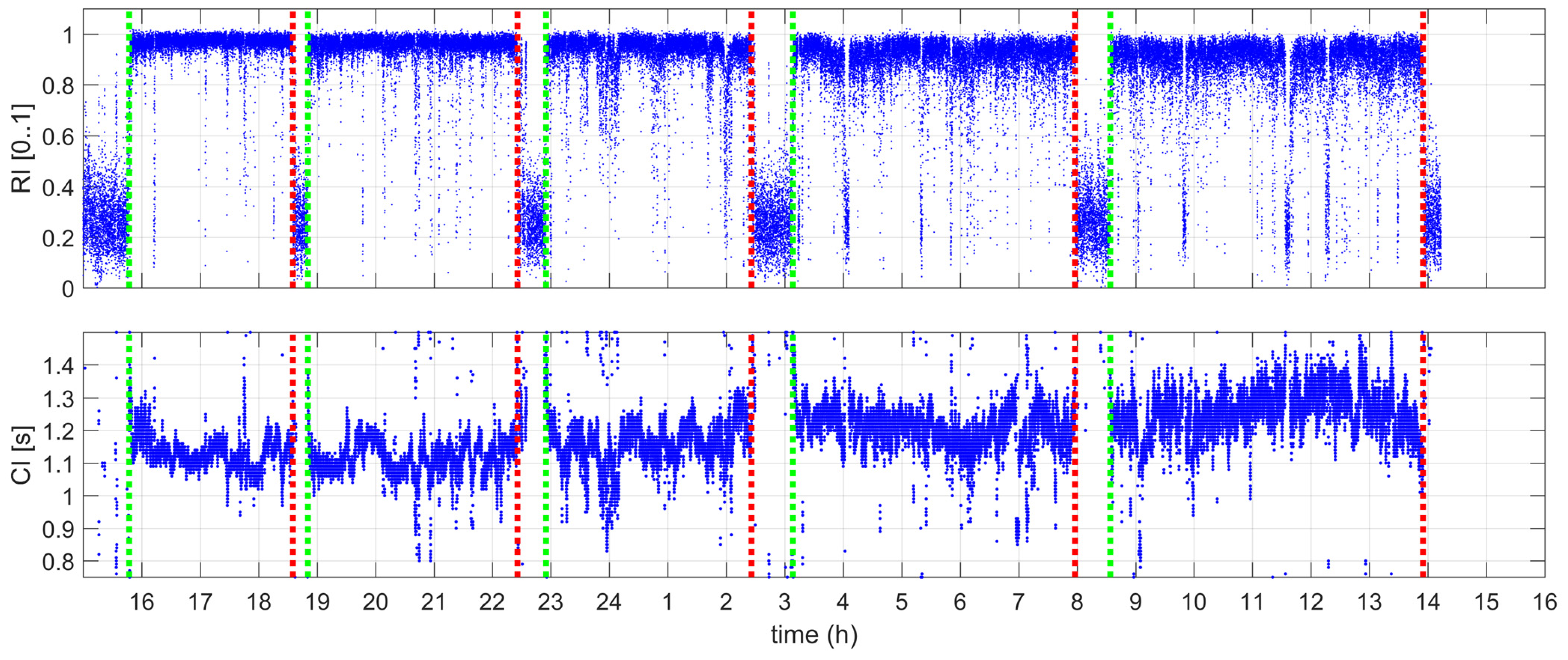
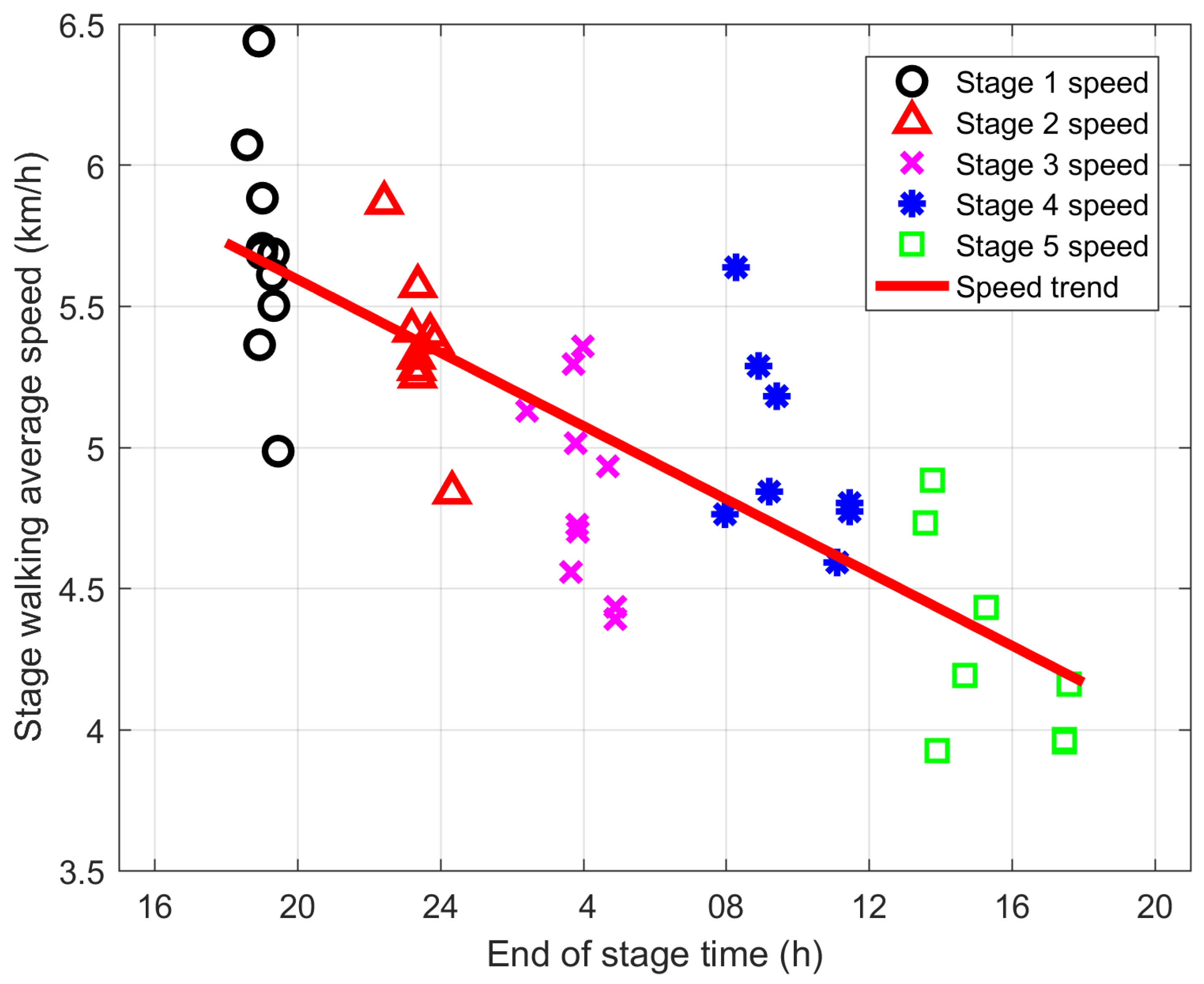
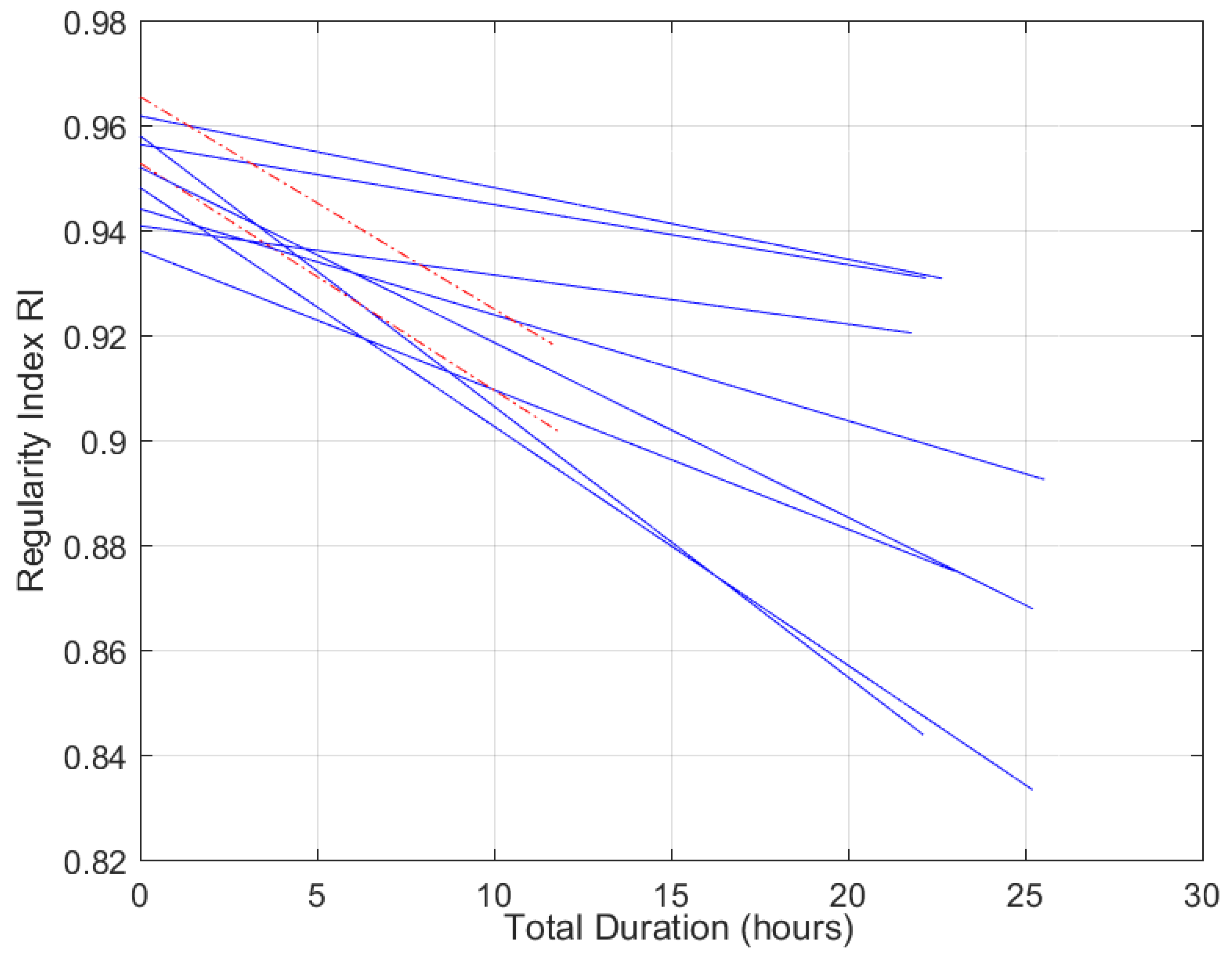
(1) Background: Physical fatigue, either in short anaerobic exercises or in aerobic ones, affects locomotion patterns. Those effects, if consistently observed, may function as fatigue proxies. The present study focuses on the regularity of the pseudo-periodic acceleration patterns measured by a wearable sensor. Studies during laboratory anaerobic tasks on healthy subjects and on persons with multiple sclerosis during 6 min walking tests demonstrated that regularity decreases with fatigue. This study’s objective is to verify if the gait regularity during an unsupervised endurance aerobic walking task progressively decreases in healthy subjects. (2) Methods: Ten healthy male adults, not competitive recreational athletes, equipped with an accelerometer, participated in a non-competitive 100 km walk in about 24 h. (3) Results: Eight participants took from about 22 to 25 h to complete the task. Two did not finish. The trend of locomotion regularity (on average −6.3%, p < 0.001, effect size 1.41) was negative for all the participants. The gait speed decrease, in all the participants, explained less than 20% of the regularity decrease. Other outcome indices, such as that related to cadence, did not provide unique trends. (4) Conclusions: Regularity decrease is associated with fatigue in submaximal locomotor efforts; due to the experimental group limitations in size and composition, further studies should extend regularity assessments to women, and to persons with neuromuscular disabilities or attending walking rehabilitation.
Keywords: regularity; fatigue; endurance; unsupervised; submaximal effort; walking; aerobic; healthy adult male subjects; rehabilitation regularity; fatigue; endurance; unsupervised; submaximal effort; walking; aerobic; healthy adult male subjects; rehabilitation