Systematic Review

Postural Sway Assessment in Virtual Reality and Technology-Assisted Rehabilitation: A Systematic Review

Department of Physical Therapy, Korea National University of Transportation, Chungju 27909, Chungcheongbuk-do, Republic of Korea
*
Author to whom correspondence should be addressed.
Appl. Sci. 2026, 16(12), 6130; https://doi.org/10.3390/app16126130
Submission received: 10 May 2026 / Revised: 9 June 2026 / Accepted: 11 June 2026 / Published: 17 June 2026
(This article belongs to the Special Issue Virtual Reality in Physical Therapy)

Abstract

Postural sway, quantified through center of pressure (COP)-based measures, is a critical indicator of postural stability and fall risk. Despite growing interest in virtual reality (VR) and technology-assisted rehabilitation, a comprehensive synthesis of how interventions and experimental conditions affect postural sway across adults and older adults is lacking. This review aimed to systematically synthesize the effects of exercise-based interventions and experimental physiological, visual, and sensory conditions on COP-based postural sway in adults and older adults, with an emphasis on acute and short-term effects relevant to VR- and technology-assisted rehabilitation. A systematic search of PubMed, Scopus, Web of Science, and the Cochrane Library was conducted from database inception to 31 March 2025. Studies reporting COP-based postural sway outcomes with extractable quantitative data were included. Narrative synthesis was performed due to substantial clinical and methodological heterogeneity. Ten studies were included (2 RCTs, 6 pre–post, 1 crossover, 1 cross-sectional). Exercise-based interventions—including balance training and visual feedback training—generally reduced postural sway. Acute physical perturbations (fatigue, immobilization, cryotherapy, proprioceptive vibration) consistently worsened stability. Destabilizing visual stimulation increased sway, whereas stabilizing visual feedback reduced it. Exercise-based interventions and sensory-stabilizing conditions show promise for improving postural stability. Fatigue, immobilization, and sensory perturbations represent important modifiable risk factors. IMU-based wearable assessment may serve as a clinically scalable alternative to force plate systems in VR-based and rehabilitation settings.

1. Introduction

Postural control—the ability to maintain the body’s center of mass within the base of support—is fundamental to daily functioning, mobility, and independence. It depends on the complex integration of visual, vestibular, and somatosensory inputs, all of which converge to generate appropriate motor responses that preserve balance [1,2,3,4,5]. Alteration, impairment, or disruption of any component of this sensorimotor loop can compromise postural stability and balance performance, thereby contributing to an increased risk of falls [6].
Falls represent a major public health burden, particularly among older adults, contributing to reduced mobility, increased fear of falling, loss of independence, and elevated mortality risk [7]. Increased postural sway—a commonly used surrogate measure of standing balance—has been independently associated with prospective fall incidence in community-dwelling elderly individuals [8].
Recent clinical studies have demonstrated that technology-assisted interventions, including horse-riding simulator exercise [9] and virtual reality-based walking-in-place exercise (VR-WIPE) [10], can significantly improve balance and gait performance in older adults, highlighting the growing potential of technology in balance rehabilitation. Given that postural impairments affect not only older adults but also younger adults with musculoskeletal or neurological conditions, the present review adopted an inclusive approach encompassing adults aged 18 years and over.
Among the tools available for objective balance assessment, center of pressure (COP) analysis is the most widely used method for quantifying postural sway during quiet standing [11]. COP-based variables—particularly sway velocity and sway path length—demonstrate adequate reliability and clinical sensitivity and are widely used as primary outcome measures in postural stability research [12,13,14]. The emergence of inertial measurement unit (IMU)-based wearable devices has further expanded the measurement possibilities: a belt-type IMU device has recently demonstrated high intra- and inter-rater reliability for postural sway assessment [15], suggesting that COP-equivalent measurements are feasible outside of laboratory settings.
Multiple intervention approaches have been applied to improve postural control, including balance training, visual feedback training, core muscle activation programs, and proprioceptive or somatosensory training approaches [16]. Postural alignment variables such as the craniovertebral angle and scapular index have been shown to correlate significantly with proprioception and balance control [17], while ankle range of motion and lower-extremity muscle strength are significant predictors of static postural stability [18], collectively underscoring the multifactorial nature of factors influencing postural sway.
Despite this growing body of evidence, existing systematic reviews have largely focused on specific intervention types or populations [19,20,21]. A comprehensive synthesis that simultaneously examines exercise-based interventions alongside sensory perturbations, acute physiological manipulations, and experimental visual conditions—factors directly relevant to VR and technology-assisted rehabilitation—has been lacking. The present study addresses this gap by integrating diverse intervention types and experimental conditions within a single systematic framework, with particular attention to findings pertinent to VR-based and technology-assisted balance rehabilitation.
The objective of this review was to systematically examine the effects of exercise-based interventions and experimental physiological, visual, and sensory conditions on COP-based postural sway in adults and older adults, and to synthesize their relevance to VR- and technology-assisted rehabilitation.

2. Materials and Methods

2.1. Study Design

The review question was developed according to the PCC (Population, Concept, Context) framework. The Population comprised adults and older adults; the Concept focused on COP-based postural sway outcomes; and the Context encompassed exercise-based interventions and experimental physiological, visual, and sensory conditions relevant to VR- and technology-assisted rehabilitation. Accordingly, this review addressed the following question: “How do exercise-based interventions and experimental physiological, visual, and sensory conditions influence COP-based postural sway in adults and older adults, and what is their relevance to VR- and technology-assisted rehabilitation?” This systematic review was conducted in accordance with the Preferred Reporting Items for Systematic Reviews and Meta-Analyses (PRISMA) 2020 guidelines [22] and was registered with the International Prospective Register of Systematic Reviews (PROSPERO; registration number: CRD420261384156). The review process comprised literature searching, eligibility screening, data extraction, methodological quality assessment, and narrative synthesis.

2.2. Literature Search Strategy

A systematic search was conducted across four electronic databases—PubMed, Scopus, Web of Science, and the Cochrane Library—by two reviewers (J.-S.O. and S.-G.K.), covering records from database inception through 31 March 2025. Search terms combined MeSH headings and free-text keywords using Boolean operators (AND, OR):
  • “postural sway” OR “center of pressure” OR “COP” OR “postural control”;
  • “sway length” OR “sway velocity” OR “sway area” OR “trajectory length”;
  • “intervention” OR “training” OR “exercise” OR “stimulation” OR “condition” OR “experimental”;
  • “adults” OR “older adults” OR “elderly” OR “aging”.
Manual reference searching of the bibliographies of all included articles was performed to identify additional eligible studies. The detailed search strategy for each database is provided in Supplementary Material (Figure S1).

2.3. Eligibility Criteria

Studies were included if they met all of the following criteria: (1) Study design: randomized controlled trials (RCTs), pre–post studies, crossover studies, experimental studies, or cross-sectional comparative studies; (2) Participants: adults aged 18 years or older, including both healthy adults and older adults; (3) Intervention or condition: any exercise-based intervention, sensory stimulation, acute physiological manipulation, or experimental condition capable of influencing postural sway; (4) Outcome measures: at least one COP-based postural sway index (sway length, velocity, area, or displacement); (5) Data availability: sufficient quantitative data (means, standard deviations, sample sizes) to determine the direction of effect; (6) Bibliographic completeness: full bibliographic information (authors, year, journal, DOI) was verifiable.
Studies were excluded if they: (1) did not report COP-based postural sway outcomes; (2) were review articles, protocols, conference abstracts, or case reports; (3) provided insufficient statistical data; (4) had incomplete or unverifiable bibliographic information; or (5) were published in a language other than English.

2.4. Data Extraction

Two reviewers independently (J.-S.O. and S.-G.K.) extracted data from all included studies using a standardized form. Extracted items included: first author, publication year, study design, participant characteristics (age, health status), sample size, intervention type and comparator condition, measurement instrument, outcome variables, time points, and direction of effect. Discrepancies were resolved through discussion between the two reviewers (J.-S.O. and S.-G.K.) until consensus was reached.

2.5. Methodological Quality and Risk of Bias Assessment

Methodological quality was evaluated according to study design. Randomized controlled trials were assessed using the Cochrane Risk of Bias 2 (RoB 2) tool [23]. Non-randomized studies were evaluated with reference to key ROBINS-I domains [24], applying assessments across selection bias, performance bias, detection bias, attrition bias, and reporting bias. Each domain was rated as low risk, some concerns, or high risk, and an overall risk-of-bias judgment was made by integrating domain ratings. Methodological quality and risk of bias were independently assessed by two reviewers (J.-S.O. and S.-G.K.), with any disagreements resolved through discussion until consensus was reached.

2.6. Data Synthesis

Owing to substantial heterogeneity in study designs, intervention types, participant characteristics, and outcome measures, a formal meta-analysis was not feasible. Instead, narrative synthesis was conducted in accordance with the SWiM (Synthesis Without Meta-analysis) guideline [25]. Results were organized by outcome variable type (sway velocity, sway length, RMS sway) and by intervention or condition category (exercise-based, acute physiological perturbation, visual/sensory condition, IMU-based measurement). The direction of effect for each study was determined based on reported means or effect estimates.

3. Results

3.1. Study Selection

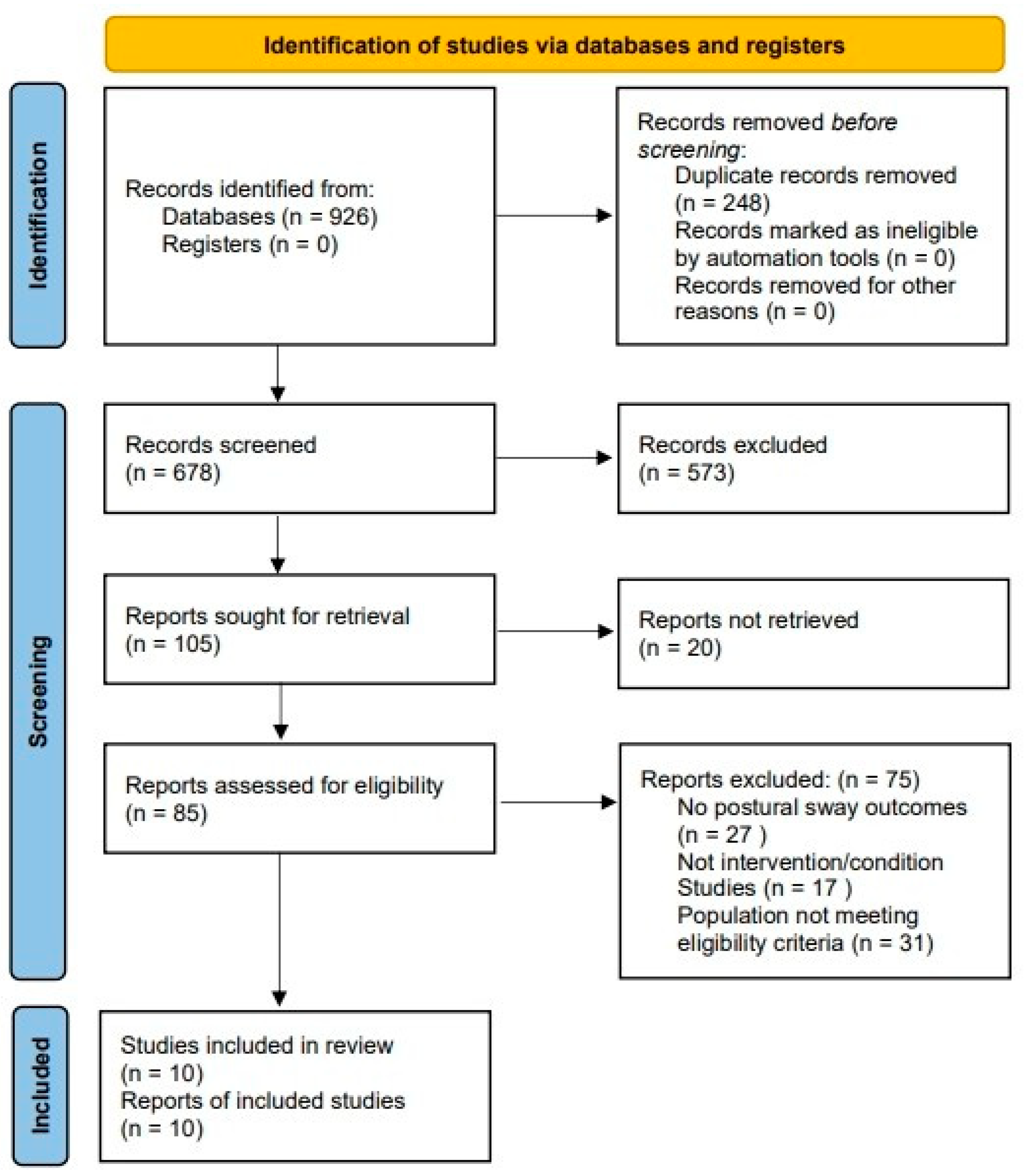
The database search retrieved 926 records. After removal of 248 duplicates, 678 records underwent title and abstract screening, of which 573 were excluded. Full-text retrieval was attempted for 105 reports; 20 reports could not be retrieved, leaving 85 reports for full-text eligibility assessment. Of these, 75 were excluded based on pre-specified eligibility criteria. The 75 reports excluded after full-text assessment were mainly excluded because they did not report COP-based postural sway outcomes (n = 27), did not examine an eligible intervention or experimental condition (n = 17), or did not meet the population-related eligibility criteria (n = 31). Ten studies met all inclusion criteria and were included in the qualitative synthesis. The complete flow of study selection is presented in Figure 1.
The included studies encompassed adults and older adults across a range of health statuses. Two were RCTs, six were pre–post designs, one was a crossover study, and one was a cross-sectional comparative study. The most frequently reported outcome was sway velocity (n = 6), followed by sway length or trajectory length (n = 2) and RMS sway (n = 2).

3.2. Overview of Included Studies

Participant populations varied across studies, including community-dwelling older adults with balance deficits, healthy adults, adults with non-specific low back pain, and older adults classified by fall history. Interventions and conditions spanned progressive balance training, transverse abdominis training, visual feedback training, cold water immersion, fatigue induction, lower limb immobilization, peripheral optic flow exposure, proprioceptive vibration, and IMU-based sway measurement. Characteristics of all included studies are summarized in Table 1.

3.3. Postural Sway Outcome Measures

Sway velocity was the most frequently reported outcome, appearing in six of the ten included studies, followed by sway length or trajectory length (n = 2) and root mean square (RMS) sway (n = 2). Because RMS-based indices differ from length- and velocity-based measures in both unit and clinical interpretation, they were classified as a separate outcome category. The distribution of outcome measures and the direction of findings across categories are presented in Table 2.

3.4. Synthesis of Intervention Effects

Exercise-based interventions—including balance training, core muscle training, and visual feedback training—generally showed a tendency to reduce postural sway. Sway velocity decreased following transverse abdominis training [29], visual feedback training [30], and progressive balance training [26], though the between-group effect in the latter RCT was not statistically significant, suggesting that four weeks of training may be insufficient for robust improvements. Peripheral optic flow stimulation increased sway velocity [35]. All four studies examining acute physiological perturbations—cold water immersion [27], fatigue induction [31], lower limb immobilization [32], and proprioceptive vibration [34]—reported increased postural sway. A synthesis of intervention categories and their effects is provided in Table 3.

3.5. Methodological Quality and Risk of Bias

Risk-of-bias results are summarized in Table 4. Both RCTs [26,27] were rated as ‘some concerns’ due to incomplete reporting of randomization and allocation concealment procedures. Pre–post studies (n = 6) were predominantly rated as ‘high risk’ owing to the absence of a control group. The crossover study [35] was rated ‘some concerns’ because of limited reporting on condition order randomization. The cross-sectional study [33] was also rated ‘some concerns’, reflecting inherent limitations in causal inference. Overall, the methodological quality of included studies ranged from some concerns to high risk of bias, a limitation that should be considered when interpreting findings.

4. Discussion

This systematic review examined how exercise-based interventions and experimental physiological, visual, and sensory conditions influence COP-based postural sway in adults and older adults, with particular attention to their relevance to VR- and technology-assisted rehabilitation. The synthesized findings largely supported the anticipated direction of effects: exercise-based and visual feedback interventions tended to reduce postural sway, whereas acute physiological perturbations and destabilizing visual input generally increased sway. This pattern aligns with prior evidence that the quality of sensory and visual input can either support or compromise postural stability [36,37,38]. Notably, the present review extends beyond conventional exercise intervention reviews by incorporating sensory and experimental conditions, offering a more comprehensive framework for understanding postural sway as both an outcome variable and a sensitive biomechanical indicator in rehabilitation contexts.
A key finding of this review is that postural sway responds not only to therapeutic exercise but also to a broad range of internal and external conditions—including sensory perturbation, fatigue, proprioceptive manipulation, and visual environment—underscoring its value as a dynamic, multi-sensitive indicator of postural system vulnerability. Exercise-based interventions consistently showed tendencies to reduce sway velocity or sway length, whereas acute perturbation conditions produced the opposite pattern. This bidirectional sensitivity supports the use of postural sway not only as a rehabilitation outcome measure but also as a biomarker for monitoring the risk state of the postural control system [8,39,40,41,42].
The beneficial effects of exercise-based interventions may be attributed to improvements in neuromuscular control, sensory reweighting processes, and lower-extremity and trunk stability [43,44,45]. Balance training and core muscle training enhance trunk–limb coordination during postural tasks, while visual feedback training strengthens error detection and corrective motor responses. Evidence from a randomized controlled trial combining balance training with VR-based visual input manipulation demonstrated reduced COP sway speed under eyes-closed conditions, decreased visual weighting, and altered non-visual feedback loop gain—providing direct mechanistic support for sensory reweighting as a training outcome [46]. This mechanism is particularly relevant to VR-based rehabilitation, in which visual environments can be systematically manipulated to challenge and retrain the sensory integration process. In older adults, a program combining sensory-challenge balance training with vibrotactile sensory augmentation yielded significant improvements in Sensory Organization Test composite scores, with retention at six months [47], confirming the durability of training effects mediated by sensory reweighting. Furthermore, error amplification visual feedback training in older adults produced greater error reduction rates (−46.5% vs. −27.1%) and enhanced multi-segmental coordination [48], identifying augmented error feedback as a potent mechanism for VR-based balance training. These findings collectively highlight the role of technology-assisted sensory manipulation in optimizing balance rehabilitation outcomes, particularly for fall prevention in older adults [47,48].
Conversely, acute physiological perturbations—including muscle fatigue, lower limb immobilization, cold water immersion, and proprioceptive vibration—all worsened postural stability, suggesting that these conditions compromise the efficiency of sensorimotor integration. These destabilizing effects carry important clinical implications: older adults and individuals with impaired balance may be at heightened fall risk in the presence of fatigue accumulation, sensory degradation, or environmental perturbations [49,50,51,52]. Research demonstrating that vestibular training with weight-shifting promotes multisensory adaptation and postural control [53] further implies that proprioceptive disruption may conversely impair this adaptive capacity. Age-related decline in lower-extremity proprioceptive acuity has also been independently associated with reduced postural control efficiency and increased sway [54], underscoring the importance of preserving sensory function. Collectively, these findings support the use of postural sway assessment not only to evaluate rehabilitation outcomes but also as a monitoring tool for detecting early functional vulnerability arising from fatigue, sensory loss, or destabilizing environmental stimuli.
Opposing effects were observed across visual conditions: peripheral optic flow increased sway, while visual feedback training decreased sway velocity. This contrast reflects the critical role of visual input quality in postural regulation and is consistent with the proposed mechanism of visual-vestibular conflict as a driver of postural instability [36,37,38]. These findings are directly relevant to the design of VR rehabilitation environments, where the visual flow parameters must be carefully calibrated to promote stabilization rather than destabilization. Sway velocity emerged as the most frequently reported and arguably the most sensitive postural outcome variable in this review. However, considerable heterogeneity in measurement protocols—including stance configuration, eyes-open vs. eyes-closed conditions, duration, and equipment—limits direct comparison across studies. Future research should prioritize standardization of COP measurement protocols to facilitate quantitative synthesis [12,14,55].
IMU-based wearable devices represent a promising complementary approach to traditional force plate assessment, overcoming spatial and cost constraints that limit laboratory-based measurement [56,57,58,59]. The inclusion of IMU-based studies in the present review—alongside recent evidence supporting the reliability of a belt-type IMU device for postural sway assessment [15]—indicates that sway evaluation is feasible in community and clinical settings beyond the laboratory. In the context of technology-assisted rehabilitation, IMU-based wearable assessment may provide a clinically scalable alternative to force plate systems, supporting real-time balance monitoring in VR-based and technology-assisted rehabilitation programs. Future research should validate the correspondence between COP-based and IMU-derived sway indices, establish minimal detectable change values, and develop standardized field assessment protocols.
From a practical perspective, the bidirectional sensitivity of postural sway supports its use not only as a rehabilitation outcome but also as a monitoring indicator of balance-related vulnerability in clinical and community settings. Exercise-based interventions and stabilizing feedback conditions may be used to reduce excessive sway, whereas increased sway under fatigue, sensory degradation, or destabilizing visual environments may help identify conditions in which postural stability is compromised. In VR- and technology-assisted rehabilitation, IMU-based wearable assessment may provide a scalable and clinically feasible complement to force plate systems, supporting balance monitoring outside laboratory settings. Future experimental studies should include adequately powered randomized controlled trials with appropriate control groups, standardized COP measurement protocols, validation of the correspondence between COP- and IMU-derived sway indices, establishment of minimal detectable change values, and long-term follow-up assessments to determine the durability of intervention effects.
Several limitations of this review should be acknowledged. First, the small number of included studies (n = 10) and the small sample sizes of individual studies limit the generalizability of the findings. Because the included studies varied substantially in population, intervention type, and sway outcome measures, a single required sample size cannot be specified from the present evidence; future trials should therefore perform a priori sample size calculations based on expected changes in COP-based sway outcomes and minimal detectable change values.
Second, substantial heterogeneity in study designs, outcome measures (sway velocity, sway length, RMS), and measurement conditions precluded quantitative meta-analysis. Third, the exclusion of five studies due to unverifiable bibliographic information may have introduced selection bias. Fourth, restriction to English-language publications may have introduced publication bias. Fifth, the predominance of non-randomized designs limits the overall level of evidence.
In summary, the findings of this review demonstrate that postural sway is a sensitive, multifactorial indicator of postural control that responds differentially to therapeutic exercise, sensory perturbation, physiological stress, and visual conditions. Understanding both stabilizing and destabilizing influences on postural sway is essential for designing effective balance rehabilitation strategies, particularly in the context of VR-based and technology-assisted rehabilitation.

5. Conclusions

This systematic review examined the effects of diverse interventions and experimental conditions on postural sway in adults and older adults, with relevance to virtual reality and technology-assisted rehabilitation. Exercise-based interventions—including balance training, core muscle training, and visual feedback training—consistently showed a tendency to reduce postural sway, supporting their role in improving postural stability. In contrast, acute physiological perturbations such as fatigue, lower limb immobilization, cold water immersion, and destabilizing visual stimulation increased postural sway, confirming that postural control is sensitive to a broad range of modifiable internal and external factors.

Supplementary Materials

The following supporting information can be downloaded at: https://www.mdpi.com/article/10.3390/app16126130/s1. Figure S1: PRISMA 2020 flow diagram. Search period: from database inception to 31 March 2025; PROSPERO registration: CRD420261384156.

Author Contributions

J.-S.O.: Conceptualization, Investigation, Methodology, Writing—Original Draft (Introduction and Methods). S.-G.K.: Formal Analysis, Writing—Original Draft (Results and Discussion), Writing—Review & Editing. All authors have read and agreed to the published version of the manuscript.

Funding

This research received no external funding.

Institutional Review Board Statement

Not applicable.

Informed Consent Statement

Not applicable.

Data Availability Statement

No new data were created or analyzed in this study. Data sharing is not applicable to this article.

Conflicts of Interest

The authors declare no conflicts of interest.

Abbreviations

The following abbreviations are used in this manuscript:
COPCenter of Pressure
VRVirtual Reality
IMUInertial Measurement Unit
EOEyes Open
ECEyes Closed
RCTRandomized Controlled Trial
PRISMAPreferred Reporting Items for Systematic Reviews and Meta-Analyses
PROSPEROInternational Prospective Register of Systematic Reviews

References

  1. Peterka, R.J. Sensorimotor integration in human postural control. J. Neurophysiol. 2002, 88, 1097–1118. [Google Scholar] [CrossRef] [PubMed]
  2. Woollacott, M.; Shumway-Cook, A. Attention and the control of posture and gait: A review of an emerging area of research. Gait Posture 2002, 16, 1–14. [Google Scholar] [CrossRef] [PubMed]
  3. Horak, F.B. Postural orientation and equilibrium: What do we need to know about neural control of balance to prevent falls? Age Ageing 2006, 35, ii7–ii11. [Google Scholar] [CrossRef] [PubMed]
  4. Chiba, R.; Takakusaki, K.; Ota, J.; Yozu, A.; Haga, N. Human upright posture control models based on multisensory inputs; in fast and slow dynamics. Neurosci. Res. 2016, 104, 96–104. [Google Scholar] [CrossRef] [PubMed]
  5. Takakusaki, K. Functional Neuroanatomy for Posture and Gait Control. J. Mov. Disord. 2017, 10, 1–17. [Google Scholar] [CrossRef] [PubMed]
  6. Giustino, V.; Messina, G.; Alesi, M.; La Mantia, L.; Palma, A.; Battaglia, G. Study of postural control and body balance in subjects with Down syndrome. Hum. Mov. 2021, 22, 66–71. [Google Scholar]
  7. Rubenstein, L.Z. Falls in older people: Epidemiology, risk factors and strategies for prevention. Age Ageing 2006, 35, ii37–ii41. [Google Scholar] [CrossRef] [PubMed]
  8. Johansson, J.; Nordström, A.; Gustafson, Y.; Westling, G.; Nordström, P. Increased postural sway during quiet stance as a risk factor for prospective falls in community-dwelling elderly individuals. Age Ageing 2017, 46, 964–970. [Google Scholar] [CrossRef] [PubMed]
  9. Lee, D.-Y.; Kim, S.-G. The Effect of Horse-Riding Simulator Exercise on Balance Control Ability and Gait in the Elderly with Dementia. Int. J. Gerontol. 2023, 17, 25–28. [Google Scholar]
  10. Rhee, H.; Kim, S.-G. Effects of Virtual Reality-based Walking-in-Place Exercise (VR-WIPE) on Step Count and Balance Control Ability in the Elderly. J. Mech. Med. Biol. 2025, 25, 2540017. [Google Scholar] [CrossRef]
  11. Prieto, T.E.; Myklebust, J.B.; Hoffmann, R.G.; Lovett, E.G.; Myklebust, B.M. Measures of postural steadiness: Differences between healthy young and elderly adults. IEEE Trans. Biomed. Eng. 1996, 43, 956–966. [Google Scholar] [CrossRef] [PubMed]
  12. Dobberke, J.; Baritello, O.; Hadzic, M.; Völler, H.; Eichler, S.; Salzwedel, A. Test-retest reliability of center of pressure measures for postural control assessment in older cardiac patients. Gait Posture 2022, 92, 359–363. [Google Scholar] [CrossRef] [PubMed]
  13. Piri, M.; Malmir, K.; Otadi, K.; Shadmehr, A. Postural stability measures as diagnostic tools for chronic ankle instability: A comprehensive assessment. BMC Sports Sci. Med. Rehabil. 2025, 17, 16. [Google Scholar] [CrossRef] [PubMed]
  14. Quijoux, F.; Nicolaï, A.; Chairi, I.; Bargiotas, I.; Ricard, D.; Yelnik, A.; Oudre, L.; Bertin-Hugault, F.; Vidal, P.P.; Vayatis, N.; et al. A review of center of pressure (COP) variables to quantify standing balance in elderly people: Algorithms and open-access code. Physiol. Rep. 2021, 9, e15067. [Google Scholar] [CrossRef] [PubMed]
  15. Jeong, J.-H.; Oh, J.-S.; Kim, S.-G. Intra- and inter-rater reliability of a belt-type device for measuring postural sway using an imu sensor. J. Mech. Med. Biol. 2025, 25, 2540103. [Google Scholar] [CrossRef]
  16. Canzone, A.; Brusa, J.; Giustino, V.; Martines, F.; Salvago, P.; Pajaujiene, S.; Patti, A.; Zangla, D.; Messina, G.; Padua, E.; et al. Acute Effects of Plantar Proprioceptive Training on Dynamic Balance and Ankle Range of Motion: A Pilot Randomized Controlled Trial. Sports 2026, 14, 180. [Google Scholar] [CrossRef] [PubMed]
  17. Jang, S.H.; Park, S.W.; Kim, S.G. Correlation Analysis of Craniovertebral Angle and Scapular Index with Muscle Tone, Pulmonary Function, Balance Control, and Proprioception. Life 2025, 15, 1526. [Google Scholar] [CrossRef] [PubMed]
  18. Kim, S.G.; Kim, W.S. Effect of Ankle Range of Motion (ROM) and Lower-Extremity Muscle Strength on Static Balance Control Ability in Young Adults: A Regression Analysis. Med. Sci. Monit. 2018, 24, 3168–3175. [Google Scholar] [CrossRef] [PubMed]
  19. Zech, A.; Hübscher, M.; Vogt, L.; Banzer, W.; Hänsel, F.; Pfeifer, K. Balance training for neuromuscular control and performance enhancement: A systematic review. J. Athl. Train. 2010, 45, 392–403. [Google Scholar] [CrossRef] [PubMed]
  20. Brachman, A.; Kamieniarz, A.; Michalska, J.; Pawłowski, M.; Słomka, K.J.; Juras, G. Balance Training Programs in Athletes—A Systematic Review. J. Hum. Kinet. 2017, 58, 45–64. [Google Scholar] [CrossRef] [PubMed]
  21. Mazaheri, M.; Coenen, P.; Parnianpour, M.; Kiers, H.; van Dieën, J.H. Low back pain and postural sway during quiet standing with and without sensory manipulation: A systematic review. Gait Posture 2013, 37, 12–22. [Google Scholar] [CrossRef] [PubMed]
  22. Page, M.; McKenzie, J.; Bossuyt, P.; Boutron, I.; Hoffmann, T.; Mulrow, C.; Shamseer, L.; Tetzlaff, J.; Akl, E.; Brennan, S.; et al. The PRISMA 2020 statement: An updated guideline for reporting systematic reviews. BMJ 2021, 372, n71. [Google Scholar] [CrossRef] [PubMed]
  23. Sterne, J.A.C.; Savović, J.; Page, M.J.; Elbers, R.G.; Blencowe, N.S.; Boutron, I.; Cates, C.J.; Cheng, H.Y.; Corbett, M.S.; Eldridge, S.M.; et al. RoB 2: A revised tool for assessing risk of bias in randomised trials. BMJ 2019, 366, l4898. [Google Scholar] [CrossRef] [PubMed]
  24. Sterne, J.A.; Hernán, M.A.; Reeves, B.C.; Savović, J.; Berkman, N.D.; Viswanathan, M.; Henry, D.; Altman, D.G.; Ansari, M.T.; Boutron, I.; et al. ROBINS-I: A tool for assessing risk of bias in non-randomised studies of interventions. BMJ 2016, 355, i4919. [Google Scholar] [CrossRef] [PubMed]
  25. Campbell, M.; McKenzie, J.E.; Sowden, A.; Katikireddi, S.V.; Brennan, S.E.; Ellis, S.; Hartmann-Boyce, J.; Ryan, R.; Shepperd, S.; Thomas, J.; et al. Synthesis without meta-analysis (SWiM) in systematic reviews: Reporting guideline. BMJ 2020, 368, l6890. [Google Scholar] [CrossRef] [PubMed]
  26. Sörlén, N.; Hult, A.; Nordström, P.; Nordström, A.; Johansson, J. Short-term balance training and acute effects on postural sway in balance-deficient older adults: A randomized controlled trial. BMC Sports Sci. Med. Rehabil. 2021, 13, 23. [Google Scholar] [CrossRef] [PubMed]
  27. Fukuchi, C.A.; Duarte, M.; Stefanyshyn, D.J. Postural sway following cryotherapy in healthy adults. Gait Posture 2014, 40, 262–265. [Google Scholar] [CrossRef] [PubMed]
  28. Ruhe, A.; Fejer, R.; Walker, B. Pain relief is associated with decreasing postural sway in patients with non-specific low back pain. BMC Musculoskelet. Disord. 2012, 13, 39. [Google Scholar] [CrossRef] [PubMed]
  29. Ferraro, R.; Garman, S.; Taylor, R.; Parrott, J.S.; Kadlowec, J. The effectiveness of transverse abdominis training on balance, postural sway and core muscle recruitment patterns: A pilot study comparison across age groups. J. Phys. Ther. Sci. 2019, 31, 729–737. [Google Scholar] [CrossRef] [PubMed]
  30. Sotirakis, H.; Patikas, D.; Stergiou, N.; Hatzitaki, V. Swaying to the complex motion of a visual target affects postural sway variability. Gait Posture 2020, 77, 125–131. [Google Scholar] [CrossRef] [PubMed]
  31. Gebel, A.; Busch, A.; Stelzel, C.; Hortobágyi, T.; Granacher, U. Effects of Physical and Mental Fatigue on Postural Sway and Cortical Activity in Healthy Young Adults. Front. Hum. Neurosci. 2022, 16, 871930. [Google Scholar] [CrossRef] [PubMed]
  32. Ikeda, T.; Takano, M.; Oka, S.; Suzuki, A.; Matsuda, K. Changes in postural sway during upright stance after short-term lower limb physical inactivity: A prospective study. PLoS ONE 2022, 17, e0272969. [Google Scholar] [CrossRef] [PubMed]
  33. Kongsawasdi, S.; Wiboonsuntharangkoon, C.; Tajarernmuang, P.; Wantanajittikul, K. Feasibility Study of a Prototype Wearable Inertial Measurement Unit for Elderly Postural Sway Assessment. J. Clin. Med. Res. 2024, 16, 174–181. [Google Scholar] [CrossRef] [PubMed]
  34. Pollind, M.; Soangra, R. Development and Validation of Wearable Inertial Sensor System for Postural Sway Analysis. Measurement 2020, 165, 108101. [Google Scholar] [CrossRef]
  35. Kim, S.H.; Park, D.J. The influence of peripheral vision induced by moving people on postural control in healthy adults. J. Exerc. Rehabil. 2016, 12, 413–416. [Google Scholar] [CrossRef] [PubMed]
  36. Phu, S.; Persiani, M.; Tan, B.; Brodie, M.; Gandevia, S.; Sturnieks, D.L.; Lord, S.R. The effects of optic flow on postural stability: Influence of age and fall risk. Exp. Gerontol. 2023, 175, 112146. [Google Scholar] [CrossRef] [PubMed]
  37. O’Connor, K.W.; Loughlin, P.J.; Redfern, M.S.; Sparto, P.J. Postural adaptations to repeated optic flow stimulation in older adults. Gait Posture 2008, 28, 385–391. [Google Scholar] [CrossRef] [PubMed]
  38. Malcolm, B.R.; Foxe, J.J.; Joshi, S.; Verghese, J.; Mahoney, J.R.; Molholm, S.; De Sanctis, P. Aging-related changes in cortical mechanisms supporting postural control during base of support and optic flow manipulations. Eur. J. Neurosci. 2021, 54, 8139–8157. [Google Scholar] [PubMed]
  39. Pizzigalli, L.; Micheletti Cremasco, M.; Mulasso, A.; Rainoldi, A. The contribution of postural balance analysis in older adult fallers: A narrative review. J. Bodyw. Mov. Ther. 2016, 20, 409–417. [Google Scholar] [CrossRef] [PubMed]
  40. Chen, Y.; Zhang, Y.; Guo, Z.; Bao, D.; Zhou, J. Comparison between the effects of exergame intervention and traditional physical training on improving balance and fall prevention in healthy older adults: A systematic review and meta-analysis. J. Neuroeng. Rehabil. 2021, 18, 164. [Google Scholar] [CrossRef] [PubMed]
  41. Sun, Y.; Sun, Y.; Zhang, J.; Ran, F. Sensor-Based Assessment of Mental Fatigue Effects on Postural Stability and Multi-Sensory Integration. Sensors 2025, 25, 1470. [Google Scholar] [CrossRef] [PubMed]
  42. Anson, E.; Bigelow, R.T.; Swenor, B.; Deshpande, N.; Studenski, S.; Jeka, J.J.; Agrawal, Y. Loss of Peripheral Sensory Function Explains Much of the Increase in Postural Sway in Healthy Older Adults. Front. Aging Neurosci. 2017, 9, 202. [Google Scholar] [CrossRef] [PubMed]
  43. Zhong, Y.; Guo, W.; Chen, P.; Wang, Y. Effects of core training on balance performance in older adults: A systematic review and meta-analysis. Front. Public Health 2025, 13, 1661460. [Google Scholar] [CrossRef] [PubMed]
  44. Granacher, U.; Gollhofer, A.; Hortobágyi, T.; Kressig, R.W.; Muehlbauer, T. The importance of trunk muscle strength for balance, functional performance, and fall prevention in seniors: A systematic review. Sports Med. 2013, 43, 627–641. [Google Scholar] [CrossRef] [PubMed]
  45. Liu, X.-x.; Wang, G.; Zhang, R.; Ren, Z.; Wang, D.; Liu, J.; Wang, J.; Gao, Y. Sensory reweighting and self-motion perception for postural control under single-sensory and multisensory perturbations in older Tai Chi practitioners. Front. Hum. Neurosci. 2024, 18, 1482752. [Google Scholar] [CrossRef] [PubMed]
  46. Ketterer, J.; Gollhofer, A.; Ringhof, S.; Assländer, L.; Granacher, U.; Gehring, D. Effects of balance training with visual input manipulations on balance performance and sensory integration in healthy young adults: A randomized controlled trial. Sci. Rep. 2024, 14, 28589. [Google Scholar] [CrossRef] [PubMed]
  47. Bao, T.; Noohi, F.; Kinnaird, C.; Carender, W.J.; Barone, V.J.; Peethambaran, G.; Whitney, S.L.; Seidler, R.D.; Sienko, K.H. Retention Effects of Long-Term Balance Training with Vibrotactile Sensory Augmentation in Healthy Older Adults. Sensors 2022, 22, 3014. [Google Scholar] [CrossRef] [PubMed]
  48. Chen, Y.C.; Chang, G.C.; Huang, W.M.; Hwang, I.S. Quick balance skill improvement after short-term training with error amplification feedback for older adults. NPJ Sci. Learn. 2023, 8, 3. [Google Scholar] [CrossRef] [PubMed]
  49. Papa, E.V.; Foreman, K.B.; Dibble, L.E. Effects of age and acute muscle fatigue on reactive postural control in healthy adults. Clin. Biomech. 2015, 30, 1108–1113. [Google Scholar] [CrossRef] [PubMed]
  50. He, Y.; Zhang, H.; Song, M.; Wu, H.; Pi, H. Association Between Fatigue and Falls Risk Among the Elderly Aged Over 75 Years in China: The Chain Mediating Role of Falls Efficacy and Lower Limb Function. Front. Public Health 2022, 10, 850533. [Google Scholar] [CrossRef] [PubMed]
  51. Beelen, P.E.; van Dieën, J.H.; Prins, M.R.; Nolte, P.A.; Kingma, I. The effect of cryotherapy on postural stabilization assessed by standardized horizontal perturbations of a movable platform. Gait Posture 2022, 94, 32–38. [Google Scholar] [CrossRef] [PubMed]
  52. Shahani, O.; Khoshraftar Yazdi, N.; Mokhtaran, S. Effect of cold water immersion on balance and postural control in young healthy individuals: A systematic review. J. Orthop. Surg. Res. 2025, 20, 948. [Google Scholar] [CrossRef] [PubMed]
  53. Appiah-Kubi, K.O.; Wright, W.G. Vestibular training promotes adaptation of multisensory integration in postural control. Gait Posture 2019, 73, 215–220. [Google Scholar] [CrossRef] [PubMed]
  54. Henry, M.; Baudry, S. Age-related changes in leg proprioception: Implications for postural control. J. Neurophysiol. 2019, 122, 525–538. [Google Scholar] [CrossRef] [PubMed]
  55. Kabbaligere, R.; Lee, B.C.; Layne, C.S. Balancing sensory inputs: Sensory reweighting of ankle proprioception and vision during a bipedal posture task. Gait Posture 2017, 52, 244–250. [Google Scholar] [CrossRef] [PubMed]
  56. Ferrari, L.; Bochicchio, G.; Bottari, A.; Scarton, A.; Lucertini, F.; Pogliaghi, S. Construct Validity of a Wearable Inertial Measurement Unit (IMU) in Measuring Postural Sway and the Effect of Visual Deprivation in Healthy Older Adults. Biosensors 2024, 14, 529. [Google Scholar] [CrossRef] [PubMed]
  57. Noamani, A.; Nazarahari, M.; Lewicke, J.; Vette, A.H.; Rouhani, H. Validity of using wearable inertial sensors for assessing the dynamics of standing balance. Med. Eng. Phys. 2020, 77, 53–59. [Google Scholar] [CrossRef] [PubMed]
  58. Kongsawasdi, S.; Bunjan, P.; Wongjak, M.; Saenmueng, W.; Wantanajittikul, K. Evaluating Postural Sway in the Elderly Using Inertial Measurement Units: A Study on Center of Mass Measurements via Accelerometers and Gyroscopes. J. Clin. Med. Res. 2025, 17, 200–207. [Google Scholar] [CrossRef] [PubMed]
  59. Wantanajittikul, K.; Wiboonsuntharangkoon, C.; Chuatrakoon, B.; Kongsawasdi, S. Application of machine learning to predict trajectory of the center of pressure (COP) path of postural sway using a triaxial inertial sensor. Sci. World J. 2022, 2022, 9483665. [Google Scholar] [CrossRef] [PubMed]
Figure 1. PRISMA 2020 Flow Diagram. Search period: from database inception to 31 March 2025. PROSPERO Registration: CRD420261384156.
Applsci 16 06130 g001
Table 1. Characteristics of Included Studies.
AuthorYearDesignPopulationIntervention/ConditionComparatorOutcome MeasureNResult Direction
Sörlén et al. [26]2021RCTOlder adults with postural instability4-week progressive balance training (3×/wk)No interventionSway length (EO/EC)IG:22/CG:29trend; no significant between-group effect
Fukuchi et al. [27]2014RCTHealthy adults20-min cryotherapy (cold water immersion)Lukewarm waterSway velocityIG:13/CG:13↑ velocity (worsened post-cryotherapy)
Ruhe et al. [28]2012Pre–postAdults with non-specific low back painPain treatment (physical therapy)None (pre vs. post)Sway velocity16↓ velocity post-treatment
Ferraro et al. [29]2019Pre–postAdults across age groupsTransverse abdominis (TA) training (4 wks)None (pre vs. post)Sway velocity18↓ velocity post-training
Sotirakis et al. [30]2020Pre–postHealthy adultsVisual feedback (visual target matching)None (pre vs. post)Sway velocity25↓ velocity with matched visual condition
Gebel et al. [31]2022Pre–postHealthy young adultsPhysical & mental fatigue inductionNone (pre vs. post)Sway velocity15↑ velocity post-fatigue (worsened)
Ikeda et al. [32]2022Pre–postHealthy adults10-h lower limb immobilizationNone (pre vs. post)Trajectory length22↑ trajectory length after immobilization
Kongsawasdi et al. [33]2024Cross-sectionalOlder adults (fallers vs. non-fallers)IMU-based postural sway measurementNon-fallersRMS swayF:25/NF:25↑ RMS in fallers vs. non-fallers
Pollind & Soangra [34]2020Pre–postHealthy adultsProprioceptive manipulation (subthreshold plantar vibration)No vibrationRMS sway10↑ RMS with proprioceptive perturbation
Kim & Park [35]2016CrossoverHealthy adultsPeripheral optic flow (moving crowd stimulus)Static visual conditionSway velocity20↑ velocity with optic flow stimulus
Note: ↑ and ↓ indicate an increase and decrease in the corresponding outcome measure, respectively.
Table 2. Summary of Postural Sway Outcome Measures by Category.
Outcome CategoryStudies ReportingDirection of FindingsInterpretation
Sway Length/Trajectory LengthSörlén 2021 [26]; Ikeda 2022 [32]↓ after balance training; ↑ after immobilizationIntuitive and responsive indicator; design heterogeneity limits pooling
Sway VelocityFukuchi 2014 [27]; Ruhe 2012 [28]; Ferraro 2019 [29]; Sotirakis 2020 [30]; Gebel 2022 [31]; Kim & Park 2016 [35]↓ with TA training, visual feedback; ↑ with fatigue, cryotherapy, optic flowMost frequently reported; highly sensitive to diverse stimuli
RMS SwayKongsawasdi 2024 [33]; Pollind & Soangra 2020 [34]↑ in fallers vs. non-fallers; ↑ with perturbationReflects fall-risk classification and sensory perturbation responses
Note: ↑ and ↓ indicate an increase and decrease in the corresponding outcome measure, respectively.
Table 3. Synthesis of Intervention Effects by Intervention Type.
Intervention CategoryStudiesIntervention/ConditionEffectNarrative Interpretation
Exercise/TrainingSörlén 2021 [26]; Ferraro 2019 [29]; Sotirakis 2020 [30]Balance training, TA training, visual feedback training↓ swayExercise-based interventions generally showed a tendency to reduce postural sway. The marginal between-group effect in Sörlén et al. (2021) [26] suggests that 4 weeks may be insufficient for significant improvement.
Sensory/Visual StimulationKim & Park 2016 [35]Peripheral optic flow (moving crowd stimulus)↑ swayDestabilizing visual input increased sway, demonstrating that the quality and stability of visual information critically determines its effect on postural control.
Acute Physical/Sensory PerturbationFukuchi 2014 [27]; Gebel 2022 [31]; Ikeda 2022 [32]; Pollind & Soangra 2020 [34]Cryotherapy; fatigue induction; limb immobilization; proprioceptive vibration↑ sway (all)All acute perturbation conditions worsened postural stability, identifying key destabilizing factors with direct relevance to fall prevention counseling.
Measurement/Risk ClassificationKongsawasdi 2024 [33]IMU-based sway measurement in fallers vs. non-fallers↑ RMS in fallersSupports IMU-based postural sway assessment as a clinically feasible tool for fall-risk classification.
Note. ↓ = reduction in sway (improvement in postural stability); ↑ = increase in sway (deterioration in postural stability). Outcome measures and measurement conditions varied across studies; readers are advised to consult original reports for complete details.
Table 4. Risk of Bias Summary of Included Studies.
StudyDesignSelection BiasPerformance BiasDetection BiasAttrition BiasReporting BiasOverall Risk
Sörlén et al. (2021) [26]RCTLowSome concernsSome concernsLowLowSome concerns
Fukuchi et al. (2014) [27]RCTLowSome concernsSome concernsLowSome concernsSome concerns
Ruhe et al. (2012) [28]Pre–postHighHighSome concernsLowSome concernsHigh
Ferraro et al. (2019) [29]Pre–postHighHighSome concernsLowSome concernsHigh
Sotirakis et al. (2020) [30]Pre–postHighHighSome concernsLowSome concernsHigh
Gebel et al. (2022) [31]Pre–postHighHighSome concernsLowLowHigh
Ikeda et al. (2022) [32]Pre–postHighHighSome concernsLowLowHigh
Kongsawasdi et al. (2024) [33]Cross-sectionalSome concernsN/ASome concernsN/ASome concernsSome concerns
Pollind & Soangra (2020) [34]Pre–postHighHighSome concernsLowLowHigh
Kim & Park (2016) [35]CrossoverSome concernsSome concernsSome concernsLowLowSome concerns
Note. Low = low risk (green); some concerns = moderate risk (yellow); high = high risk (red); N/A = not applicable.
Disclaimer/Publisher’s Note: The statements, opinions and data contained in all publications are solely those of the individual author(s) and contributor(s) and not of MDPI and/or the editor(s). MDPI and/or the editor(s) disclaim responsibility for any injury to people or property resulting from any ideas, methods, instructions or products referred to in the content.