Article

Performance Evaluation of Deep Learning Approaches for Angle Estimation Based on AoA and DoA Estimation


Department of Software, Duksung Women’s University, 33, Samyang-ro 144-gil, Dobong-gu, Seoul 01369, Republic of Korea
*
Author to whom correspondence should be addressed.
Appl. Sci. 2026, 16(12), 6052; https://doi.org/10.3390/app16126052 (registering DOI)
Submission received: 7 May 2026 / Revised: 2 June 2026 / Accepted: 3 June 2026 / Published: 15 June 2026
(This article belongs to the Section Transportation and Future Mobility)

Abstract

Accurate Angle of Arrival (AoA) and Direction of Arrival (DoA) estimation is crucial for Indoor Positioning Systems (IPS). Traditional signal processing methods, such as MUSIC and ESPRIT, provide high-resolution estimation at the cost of high computational complexity and sensitivity to multipath interference. To address these limitations, deep learning-based approaches have been explored. However, a comprehensive evaluation under standardized conditions is still lacking. This study systematically analyzes AI-based angle estimation models by categorizing them according to data structure, representation format of data, and model architecture. A unified dataset and evaluation framework are employed to ensure fair performance comparison across different methods. The analysis investigates how various signal representations influence estimation accuracy and model behavior, particularly in handling environmental noise and signal distortions. By providing an objective performance assessment, this study offers insights into the applicability of deep learning models for IPS, contributing to the development of more robust and efficient angle estimation techniques.

1. Introduction

Indoor Positioning Systems (IPS) have attracted increasing attention for applications such as indoor navigation and augmented reality. Accurate Angle of Arrival (AoA) and Direction of Arrival (DoA) estimation is fundamental to IPS performance, as it determines the direction of incoming signals [1]. Various wireless communication technologies, including Bluetooth Low Energy (BLE) [2], Wi-Fi [3], and Ultra-Wideband (UWB) [4], have been adopted to achieve high-precision positioning [5,6,7]. However, practical challenges such as signal fluctuations, multipath interference, and environmental noise significantly degrade angle estimation accuracy in real-world indoor environments [8,9].
Traditional angle estimation methods rely on signal processing algorithms such as Multiple Signal Classification (MUSIC) [10] and Estimation of Signal Parameters via Rotational Invariance Technique (ESPRIT) [11] to extract direction-related information [12,13,14]. These methods are computationally intensive and sensitive to array imperfections and multipath propagation. To address these issues, recent studies have introduced diverse deep learning-based approaches for AoA and DoA estimation, exploring different network structures and training strategies [15,16,17,18,19,20,21,22,23,24,25,26,27]. These approaches aim to directly learn angle-related features from measurement data and improve robustness in complex indoor environments. Despite substantial progress, comprehensive benchmarking under consistent experimental conditions remains scarce, making objective comparison across models difficult [28,29].
To address this gap, this study benchmarks multiple AI-based angle estimation models under standardized experimental conditions. Employing a consistent dataset and evaluation criteria enables a direct comparison across models, providing insights into their relative effectiveness in practical indoor positioning applications. The key contributions of this study are as follows. First, it systematically evaluates deep learning-based angle estimation models within a unified experimental framework to ensure fair comparisons by using an identical dataset and evaluation metrics. Second, it examines the impact of different signal representations, including covariance matrices, Channel Impulse Response (CIR), and phase drift features, on estimation accuracy and categorizes models into time-series and image-based approaches. Finally, we analyze how these representations influence performance within a controlled simulation environment by comparing methods that process spatial correlation matrices, channel characteristics, and phase variation features.
In this study, the wireless communication environment was intentionally constrained to a BLE-based setting in order to focus on comparative analysis of machine learning models under consistent physical conditions. Since angle estimation performance can vary significantly depending on factors such as carrier frequency, transmission power, antenna configuration, and hardware-related noise, fixing the physical environment enables a more controlled evaluation of representation methods and neural architectures. BLE was selected as the target wireless interface because recent IoT and compact embedded devices increasingly require low-power and direction-aware positioning capabilities. In addition, Bluetooth direction finding supports AoA and Angle of Departure (AoD), and recent Bluetooth specifications have continued to expand positioning-related features, such as Channel Sounding. Therefore, BLE provides a practical and timely platform for evaluating AI-based angle estimation models in resource-constrained indoor positioning scenarios.
AoA typically refers to azimuth estimation, while DoA may encompass both azimuth and elevation. Both are treated as angle estimation tasks and are analyzed under a unified evaluation setting. For consistency, all performance comparisons are based on azimuth estimation, regardless of whether the original model supports two-dimensional outputs.
The remainder of this paper is structured as follows. Section 2 reviews existing work, including algorithm-based and AI-based approaches. Section 3 provides a detailed analysis of various angle estimation models, categorizing them according to data structure, representation format, and estimation methodology. Section 4 presents the experimental setup and evaluation results, comparing model performance under a unified testing environment. Section 5 discusses practical deployment implications and model-device pairing strategies based on the benchmark results. Finally, Section 6 concludes the paper and highlights potential areas for future research in deep learning-based angle estimation.

2. Related Work

2.1. Algorithm-Based Approaches

Traditional angle estimation methods are founded on mathematical models and signal processing algorithms that extract directional information from received signals. Among the most widely used techniques is MUSIC, a subspace-based method that estimates signal directions by identifying peaks in the spatial spectrum [30,31]. While MUSIC provides high-resolution DoA estimation, it suffers from high computational complexity and sensitivity to array imperfections. Another commonly used approach is ESPRIT. It exploits the rotational invariance property of the signal subspace to determine signal directions [32,33]. Compared to MUSIC, ESPRIT is computationally more efficient but requires a structured antenna array configuration, limiting its flexibility. Maximum Likelihood Estimation (MLE) [34] has also been extensively studied, formulating the angle estimation problem as an optimization task [35,36]. While MLE yields statistically optimal estimates under known noise conditions, its computational burden limits its applicability in real-time scenarios, especially with large antenna arrays. More recently, sparse signal reconstruction (SSR) techniques based on compressed sensing principles have been introduced to estimate angles with fewer measurements [37]. These methods take advantage of the sparsity of incoming signals in a predefined domain, achieving robust DoA estimation in low-SNR environments. However, their performance depends heavily on precise sparsity constraints, which require careful tuning.
While algorithm-based approaches provide theoretically robust solutions for angle estimation, they often face limitations in real-world environments, such as multipath interference and noise. To provide context, Table 1 summarizes key algorithm-based approaches, including their scenarios, preprocessing techniques, and core contributions.

2.2. AI-Based Approaches

With the advancements in deep learning, AI-based approaches have emerged as alternatives to traditional angle estimation methods. These techniques leverage large datasets to learn complex signal characteristics as features and improve estimation accuracy. Unlike conventional algorithm-based methods that rely on predefined mathematical models, AI-based approaches can adapt to diverse environments and generalize better in the presence of noise, multipath interference, and hardware imperfections.
Early AI-based methods utilized conventional machine learning algorithms, such as Support Vector Machines (SVM) [38], to classify angles based on handcrafted signal features. However, their performance was often limited by the quality of the selected features, making them less effective in complex real-world scenarios. Recent deep learning-based approaches have demonstrated significant improvements in angle estimation.
Deep Neural Networks (DNNs) have been employed to process high-dimensional representations such as correlation-covariance matrices, spatial spectra, and other structured features as input, improving robustness to noise and interference [15,17,18,21,24]. Meanwhile, Convolutional Neural Networks (CNNs) have been widely adopted for DoA and AoA estimation, leveraging structured data representations such as covariance matrices to extract spatial features. Several studies have applied CNNs to image-based signal representations, demonstrating improved performance in angle estimation tasks [16,20,22,23,25,26]. Hybrid architectures integrating Recurrent Neural Networks (RNNs) have also been explored. For instance, ref. [19] employs a model combining CNN and RNN layers to capture both spatial and temporal dependencies in received signals, leading to improved estimation accuracy. Additionally, autoencoder-based methods have been introduced to enhance DoA estimation in low-SNR environments. In [21], a Denoising Autoencoder (DAE) is trained to reconstruct clean covariance matrices from noisy inputs, improving estimation robustness.
More recently, Transformer-based models have emerged as an approach to DoA/AoA estimation, in challenging environments such as low-SNR and Non-Line-of-Sight (NLoS) conditions. Unlike CNNs and RNNs, which primarily rely on spatial and temporal dependencies in structured representations, Transformers leverage self-attention mechanisms to capture long-range dependencies and effectively filter noisy input signals. A Transformer-based signal denoising network has been proposed to enhance AoA estimation accuracy under NLoS conditions by applying temporal attention mechanisms to denoise and reconstruct the CIR, mitigating errors caused by multipath effects and signal interference [39]. Additionally, an improved Transformer model has been introduced for robust DoA estimation in uniform linear arrays (ULAs) under low-SNR conditions. This model utilizes a structured covariance matrix representation that incorporates multiple signal components (i.e., real, imaginary, and phase values) to enhance feature extraction and classification performance [40].
Beyond standalone CNN- and Transformer-based estimators, recent studies have increasingly explored hybrid model-driven and data-driven approaches for DoA estimation. For example, TransMUSIC [41] combines Transformer-based subspace representation learning with the MUSIC framework, demonstrating the recent trend of integrating attention-based architectures with classical DoA estimation algorithms. These methods combine the robustness and interpretability of classical subspace algorithms with the representation learning capability of deep neural networks.
Hybrid approaches that integrate deep networks with classical subspace methods have shown remarkable improvements. For example, UNet-rootMUSIC [42] uses a U-Net denoiser to restore an ideal covariance matrix before applying rootMUSIC; DA-MUSIC [43] inserts learned augmentation modules into the MUSIC pipeline to localize coherent sources and estimate source number; the Co-learning-aided Multi-Modal framework (CoMDDL/CoMD-RootMUSIC) [44] generates candidate DOA sets via Root-MUSIC or a deep model, classifies true solutions with ML, and fuses them for enhanced accuracy in heterogeneous hybrid MIMO receivers; and SubspaceNet [45] replaces the traditional covariance decomposition step with a data-driven autocorrelation estimator that can be plugged into any subspace algorithm. Together, these hybrid and deep subspace-based approaches [42,43,44,45,46] substantially improve robustness to array imperfections, multipath, low SNR, and limited snapshots. Recent studies have also explored deep unfolding and sparse Bayesian learning approaches [47], where iterative sparse reconstruction procedures are transformed into trainable neural architectures to improve computational efficiency and robustness under complex signal conditions. However, many of these recent methods require signal representations or antenna configurations that are not directly reproducible from the BLE IQ/RSSI dataset adopted in this study. Therefore, these methods are reviewed to reflect recent research trends, while the experimental benchmark focuses on models whose input structures can be consistently reproduced under the unified BLE-based evaluation framework.
Despite extensive research on AI-driven angle estimation, a systematic comparison of existing models using a unified dataset is lacking. Many studies evaluate individual models in isolation, making it difficult to assess their comparative effectiveness. Performance evaluation is necessary to quantify the impact of different data representations, noise conditions, and learning methodologies on estimation accuracy. This study aims to evaluate multiple AI-based angle estimation models using a common dataset, providing a direct comparison under standardized conditions. By conducting a unified performance evaluation, this research provides insights into the strengths and limitations of different models, guiding the selection of optimal techniques for indoor angle estimation in IPS applications.

3. Comprehensive Analysis of Deep Learning-Based Angle Estimation Models

Table 2 provides an overview of the selected research and categorizes them based on research focus, including DoA and AoA estimation methodologies. These works cover a range of methodologies, model architectures, and application scenarios. The table summarizes key details such as research focus, publication source, and contributions, serving as the foundation for the subsequent analysis.
In this section, we analyze these studies from multiple perspectives to understand their data structures, modeling approaches, and overall effectiveness. First, we examine how different studies utilize data representations and classify them into time-series-based and image-based approaches. We then distinguish between studies that rely on simulated datasets and those that incorporate real-world experimental data, providing insights into their generalization capabilities. Additionally, we categorize models based on their learning strategies, comparing classification-based and regression-based estimation methods. The analysis also considers the types of deep learning architectures employed and assesses their effectiveness for DoA and AoA estimation.

3.1. Perspective of Training Data

To formalize the AoA/DoA estimation problem, we adopt a standard narrowband signal model. The received signal vector at a uniform linear array (ULA) with M antennas is given by:
y t = A θ s t + n t
where A ( θ )     C M × K is the steering matrix composed of array response vectors corresponding to source directions θ = θ 1 , , θ K , s t is the K-source signal vector, and n t denotes additive white Gaussian noise. From this model, various input data structures used in the surveyed studies, such as covariance matrices ( R   =   E [ y ( t ) y ( t ) H ] ), phase-difference vectors, and IQ sequences, are derived to encapsulate directional information.
Table 3 classifies the surveyed models based on their input data modalities, highlighting structural characteristics and implications for learning. Three main categories are identified: matrix-based, signal-based, and feature-based approaches.
Matrix-based approaches (e.g., [15,16,17,19,20,21,23]) utilize full or partial covariance or correlation matrices. These matrices encode inter-element spatial dependencies and phase relationships, making them particularly robust in multipath or low-SNR environments. As shown in [20], such representations can significantly reduce RMSE—often by more than 10° under low SNR conditions like −10 dB.
Signal-based methods (e.g., [18,22,25]) reflect channel or measurement-derived signal characteristics, including CSI, CIR, and IQ-derived AoA information. However, they are highly sensitive to measurement noise, requiring calibration, temporal alignment, and denoising techniques to ensure stability and robustness. For instance, in [18], real-time DOA tracking is introduced to mitigate channel distortions by updating directional estimates block by block.
Feature-based representations (e.g., [26,27]) compress raw signals into compact statistics such as the mean and difference of phase drift or IQ + RSSI vectors. These formats drastically reduce computation and memory overhead, making them suitable for embedded devices, albeit sometimes at the cost of reduced angular precision. Thus, selecting an appropriate input structure involves balancing robustness, representational fidelity, and computational efficiency, depending on the target application and hardware constraints.
Before diving into the categorization, it is important to clarify the dual role of covariance matrices. These matrices inherently encode spatial dependencies among antenna elements. However, in the surveyed models, their interpretation depends on how they are represented: when vectorized, they support temporal modeling by preserving the sequential structure of snapshots; when maintained in matrix form, they are treated as spatially structured inputs suitable for image-based processing. This distinction helps reconcile their dual role in time-series and image-based models.
Table 4 categorizes studies based on their data representation type, by separating them into time-series-based and image-based approaches. This distinction affects how received signal characteristics are preserved and utilized in deep learning models. Time-series-based methods preserve the sequential evolution of signal characteristics, often using phase variations, CIR sequences, or vectorized covariance matrices to retain temporal dependencies. In contrast, image-based methods transform signal data into a structured 2D matrix form, allowing models to learn spatial correlations rather than temporal dependencies. This transformation enables CNNs to extract spatial features from the input data, making them effective at recognizing patterns that may not be as easily captured in sequential representations.
Among the analyzed studies, time-series-based methods are employed, with seven works [15,17,18,19,21,22,27] structuring their input data in a way that maintains the sequential nature of the received signals. These approaches often use the covariance matrix in vectorized forms (e.g., upper triangular elements) to reflect the temporal order of successive snapshots. Notably, ref. [19] adopts A-CRNN architecture, simultaneously considering both spatial and temporal features, which is further discussed later. Overall, these methods are particularly advantageous in preserving the signal’s phase continuity and ensuring that the underlying frequency-domain relationships remain intact.
On the other hand, image-based methods [16,20,23,24,25,26] focus on restructuring the received signal data into 2D formats, where spatial relationships between elements are emphasized rather than their sequential order. In [23], the authors introduce multiple variations, such as DeepAoANet-FC, which vectorizes the covariance matrix for time-series processing, and DeepAoANet-CNN, which retains the matrix for image-based learning. The image-based approach is particularly beneficial in environments where spatial patterns within the signal data are more informative than sequential relationships, as seen in multi-view signal processing [26] or high-dimensional covariance structures.
Table 5 classifies the analyzed studies based on the data source used for training and evaluating DOA and AoA estimation models. The studies are divided into two categories: those that employ simulation-based data and those that utilize experimentally collected data. The data source plays a crucial role in determining the realism, variability, and applicability of deep learning models for angle estimation, as it directly influences the generalization capability of trained models.
Studies relying on simulation-based data include [15,16,17,18,19,20,21,24,26]. These works generate synthetic datasets using numerical models and antenna response emulation tools, such as Altair Feko WinProp used in [26]. Simulation-based approaches provide flexibility in testing deep learning models under diverse conditions, enabling researchers to optimize network architectures and training methodologies before real-world deployment. However, models trained solely in synthetic data may suffer from domain gaps, as simulated signals may not fully capture the complexities of real-world wireless environments.
Conversely, studies incorporating experimentally collected data, including [22,23,25,27], utilize real-world wireless measurements obtained through physical antenna arrays, UWB radios, and BLE devices. These datasets inherently capture practical environmental challenges, such as signal attenuation, multipath interference, and hardware imperfections, making them more representative of real-world deployment conditions. For instance, ref. [22] evaluates machine learning-based AoA estimation using UWB radio measurements, while ref. [23] employs KerberosSDR hardware to capture AoA data and integrates data augmentation techniques, making it a hybrid approach that incorporates both real-world and synthetic data to enhance model generalization. Separately, the public BLE AoA dataset used for real-world validation in this study was collected using the Texas Instruments BOOSTXL-AOA platform and provides BLE IQ samples with motion-capture-based ground truth [48].

3.2. Perspective of Training Model

Table 6 classifies studies based on their prediction method, distinguishing between classification-based and regression-based approaches. The choice of prediction method influences how deep learning models process received signal data and estimate angles. Classification-based methods discretize the angular space and predict the most probable category, whereas regression-based methods estimate continuous angle values, which generally offer higher accuracy but often require more complex training strategies.
Studies adopting classification-based prediction methods, including [15,17,19,20,23,24,25], formulate DOA or AoA estimation as a multi-class classification problem. These methods divide the angular space into discrete intervals and train models to classify the received signals into the most probable category. For example, ref. [17] partitions the angular space into six subregions and employs a parallel multi-layer classifier that determines the likelihood of a signal source being present in each region, following a one-versus-all classification approach. In general, classification-based angle estimation discretizes the angular space within a defined field of view (FoV), typically ranging from −60° to +60° or wider. Most models adopt a resolution of 1°, resulting in approximately 121 classes. While the exact settings may vary across studies, this level of discretization is commonly chosen to balance estimation accuracy and model complexity. Such classification-based methods are advantageous in noisy environments, as discretization reduces sensitivity to minor variations in input features. Furthermore, the structured output space contributes to computational efficiency. However, this approach is inherently constrained by its fixed angular granularity, which limits estimation resolution. Since training and inference must handle a finite number of classes, the angular precision cannot be refined indefinitely, posing a trade-off between classification simplicity and estimation accuracy.
In contrast, studies employing regression-based prediction methods, including [16,18,21,22,23,25,26,27], treat DOA or AoA estimation as a continuous prediction task. These methods map input signal features directly to continuous angle values, avoiding the constraints imposed by discretization. For example, ref. [22] applies a deep CNN model to predict AoA as a continuous variable from UWB wireless signals, enabling fine-grained angle estimation beyond predefined bins. Some studies, such as [23,25], incorporate both classification- and regression-related estimation strategies within their frameworks for DoA and AoA estimation. This two-stage approach enables the models to adapt to varying signal conditions while maintaining high estimation precision. In [23], the DeepAoANet-FC model combines a classification head for source number estimation and a regression head for predicting AoA values. In [25], classification-based CNN processing is applied to image-like AoA representations, while the final output is evaluated in terms of AoA localization accuracy. However, such hybrid frameworks generally involve higher computational complexity due to the sequential execution of classification and regression stages, potentially leading to increased processing latency compared to models using a single estimation approach.
Table 7 categorizes the analyzed studies based on their employed neural network architecture. This classification distinguishes between fully connected DNNs, CNN-based models, Alternate Convolutional Recurrent Neural Networks (A-CRNNs) and Gated Recurrent Unit (GRU)-based models, highlighting their respective roles in AoA and DoA estimation.
The DNN-based models, employed in studies [15,17,18,21,24], utilize fully connected layers to process structured input features such as correlation matrices, covariance matrices, and spatial-spectrum representations. These models excel in learning complex relationships between input features and angle estimations. For example, in [17], a fully connected DNN is trained on covariance matrices derived from received signals, demonstrating robustness against array imperfections.
The CNN-based models, found in [16,20,22,23,25,26], leverage structured or image-like signal representations to extract spatial features using convolutional layers. These approaches utilize inputs such as 2D covariance matrices, SDR-derived covariance representations, CIR-derived representations, AoA angle images, or vectorized BLE signal features to improve estimation accuracy. For example, ref. [16] applies CNNs to process two-dimensional covariance matrix representations, where the spatial relationships between received signals are explicitly modeled as images. Similarly, ref. [26] applies 1D CNNs to BLE-based multi-view signal data, where the upper-triangular real and imaginary parts of the sample covariance matrix are vectorized into image-like inputs.
The A-CRNN model in [19] integrates 1D CNNs and BiLSTM layers to jointly extract local spatial features from vectorized covariance data and model temporal variations. Specifically, the A-CRNN framework in [19] uses vectorized covariance matrix elements as 1-D input features and constructs CRNN units by combining a 1-D convolutional layer, a BiLSTM layer, and a fully connected layer. The spatial filters are implemented using a 32-CRNN unit, while the multi-label classifiers are constructed by stacking 128-CRNN and 64-CRNN units. The framework also incorporates Toeplitz matrix reconstruction for source-number determination and applies focal loss and resampling to mitigate class and label imbalance. This hybrid structure enhances robustness against multipath interference and variations in signal sources by effectively capturing both spatial and temporal dependencies.
The GRU-based model, introduced in [27], is designed to exploit sequential variations in phase drift for AoA estimation. This approach leverages phase drift characteristics, which are gradual changes in the phase of a signal over time caused by Doppler effects, frequency instability, and multipath propagation. In [27], statistical phase-related features are extracted from BLE IQ-derived phase drift sequences using their mean and difference values as the primary input features. These features are computed solely from temporal variations in BLE IQ phase samples and do not include ground-truth angle information or explicit spatial labels during feature extraction. The normalized features are then processed by GRU layers to capture temporal dependencies in phase variation. In this benchmark, however, the simulation dataset did not provide sufficient temporal continuity, which may limit the GRU-based model’s ability to fully exploit sequential phase dynamics. With its structurally lightweight architecture, the GRU-based model maintains computational efficiency while supporting robust AoA estimation under signal fluctuations and multipath conditions.

4. Performance Evaluation

4.1. Simulated Dataset Evaluation

4.1.1. Simulated Dataset Description

The dataset used in this study is the BLE Ray-Tracing Simulation Dataset, generated using ray-tracing simulations with Altair Feko WinProp. This dataset, first introduced in [26], simulates a multi-anchor BLE localization environment and provides BLE signal data for AoA estimation, including IQ data and RSSI values. For this study, we specifically utilize the testbench_01 scenario, which excludes LoS-blocking furniture to ensure a consistent evaluation setup. Note that BLE channels 37, 38, and 39 referenced in the dataset are logical indices used for connectionless advertisement purposes. Therefore, the data does not utilize the connection-based AoA features introduced in BLE version 5.1 or later. BLE was selected over alternatives such as Wi-Fi and UWB primarily due to its suitability for IoT applications, where low-power operation and integration into compact, energy-constrained devices are critical requirements. While higher-frequency signals like 5 GHz Wi-Fi and 10 GHz UWB offer advantages in AoA estimation, including shorter pulses and easier phase drift detection, BLE remains preferable for scenarios demanding minimal power consumption, wide device compatibility, and cost-effective deployment. In addition, the ubiquity of BLE modules in consumer devices and its support for mesh networking further strengthen its position as a practical solution for large-scale indoor localization. The dataset structure is summarized in Table 8, detailing the composition of 12 JSON files per room configuration—6 files containing BLE tag signal data and 6 files defining anchor point properties. A more detailed breakdown is provided in Table 9.

4.1.2. Excluded Models from Evaluation

In this study, we excluded [18,24] from our performance evaluation due to fundamental differences in the data representations they require. Specifically, ref. [18] employs a MIMO-based CSI representation, which requires multi-carrier frequency responses from multiple antennas. However, BLE IQ data lacks the necessary subcarrier-level information and spatial resolution required for CSI extraction. Since BLE operates at a single frequency (2.4 GHz) and does not provide multi-carrier information, a direct comparison with [18] is not feasible. Additionally, ref. [24] relies on AoA spatial spectrum analysis, which requires data from multiple antenna elements to construct a comprehensive angle-dependent signal power distribution. BLE IQ data, on the other hand, does not inherently provide sufficient spatial resolution for generating an equivalent spatial spectrum. As a result, ref. [24] was also excluded from our evaluation.
To ensure the validity of our performance evaluation, we focused on models that utilize data structures that can be reasonably obtained or approximated from BLE IQ data, such as CIR or direct IQ-based processing. The remaining models were evaluated under a unified experimental setup, ensuring a fair comparison across different AI-based angle estimation techniques. This exclusion was intended to preserve consistency in input representation and evaluation conditions across all compared models. Methods requiring fundamentally different signal structures or antenna configurations were therefore discussed only as recent research trends rather than included in the unified benchmark evaluation.

4.1.3. Simulated Dataset Performance Comparison

For the re-implemented models, we primarily followed the hyperparameter settings reported in the original studies. When direct application was not possible, only minimal adjustments required for compatibility with the unified BLE-based dataset were applied, such as input dimensionality, output format, and training data structure. No model-specific hyperparameter tuning was performed on a held-out validation set, in order to avoid favoring a particular model and to maintain a fair comparison across the evaluated approaches. Detailed implementation and training settings are provided in Appendix A.
For classification-based models that discretize the angle space, class imbalance across angular labels was mitigated during data preparation and model training. Angle classes containing fewer than 50 samples were first removed to avoid unstable learning from extremely sparse angular labels, and the remaining angle labels were re-indexed. SMOTE-based oversampling was applied only to the training set to balance the training distribution across the remaining angular classes. The same filtered label set, preprocessing procedure, and data split protocol were consistently applied across all evaluated classification-based models to ensure fair comparison.
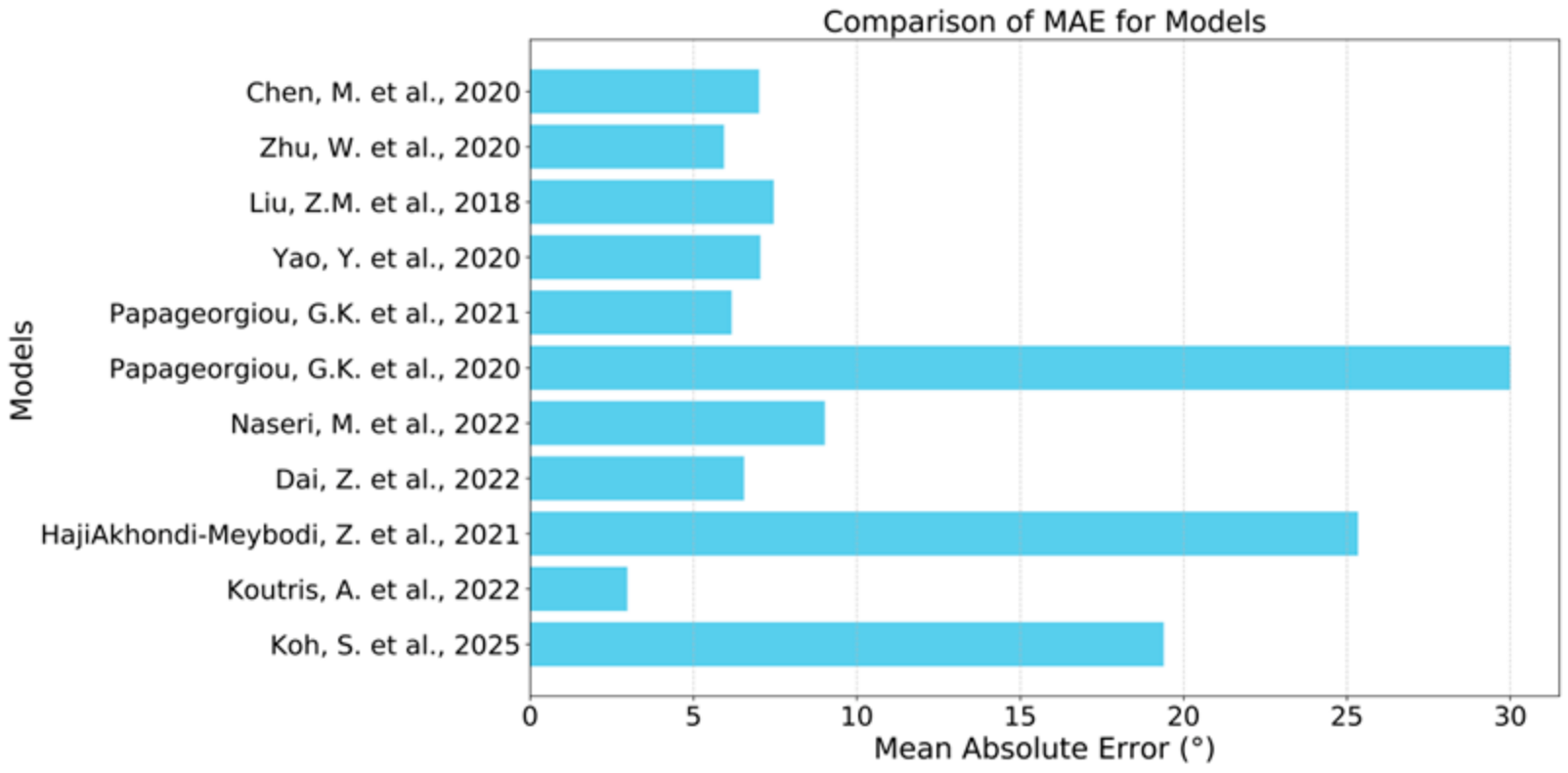
Figure 1 presents a comparison of the Mean Absolute Error (MAE) across different deep learning-based models for AoA and DoA estimation. The x-axis represents the MAE in degrees (°), while the y-axis lists the models analyzed in this study. Lower MAE values indicate higher estimation accuracy, whereas higher values suggest increased estimation errors.
The results highlight variations in estimation performance depending on the data representation, network architecture, and dataset preprocessing techniques employed. Among the evaluated models, ref. [26] (BLE IQ & RSSI-based CNN) achieved the lowest MAE of 2.98°, demonstrating both high accuracy and stable performance across different angles. This can be attributed to its joint feature vector construction from BLE IQ and RSSI values, allowing CNNs to effectively extract spatial features. Refs. [16,20], which use image-based CNNs on covariance matrices, achieved MAEs of 5.94° and 6.17°, respectively, by leveraging spatial feature extraction through 2D matrix representations. Similarly, ref. [22] (CIR-based CNN, MAE = 9.0218°) employs an image-based transformation. Although such structured representations can support spatial learning, the BLE-based CIR used here differs from the high-resolution CIR typically found in UWB systems. Due to BLE’s narrowband nature (2.4 GHz), the extracted CIR may lack the temporal granularity necessary to capture fine multipath details, which could limit the achievable estimation accuracy.
Ref. [27] (GRU-based Phase Drift model, MAE = 19.3941°) exhibits relatively higher estimation error, likely due to limited temporal context. This discrepancy between simulation and real-world performance may be related to the characteristics of BLE narrowband signals. In real BLE environments, phase drift tends to exhibit relatively continuous temporal variations caused by hardware frequency offsets and propagation dynamics, allowing the GRU-based model to capture stable sequential patterns more effectively. In contrast, the simulated dataset may not fully reproduce these practical phase continuity characteristics, limiting the effectiveness of temporal modeling in simulation. Since it processes only single-snapshot phase drift inputs, the GRU may be unable to fully leverage its temporal modeling capacity. Ref. [21] (Denoising Autoencoder for Covariance Matrix reconstruction, MAE = 30.006°) records the highest estimation error among the models evaluated. However, it is important to note that this model does not rely solely on deep learning for DoA estimation but instead integrates a DAE with the MUSIC algorithm. While the DAE appears to improve the quality of the input covariance matrix, leading to a reduction in MAE from 46.110° (MUSIC-only) to 30.006°, the overall performance may still be influenced by the inherent limitations of the MUSIC algorithm. MUSIC is a well-established signal processing technique that can perform well under idealized conditions but may be more susceptible to degradation in the presence of noise and real-world imperfections. In this case, while DAE seems to mitigate some noise effects, the model’s reliance on MUSIC for final angle estimation may have constrained its ability to fully adapt to complex signal conditions. These results suggest that although DAE contributes to refining covariance matrix inputs, the choice of post-processing algorithms could also play a crucial role in determining overall estimation accuracy. Ref. [25] (IQ-derived AoA image-based CNN, MAE = 25.3454°) uses image-like AoA representations derived from BLE IQ measurements. However, its performance remains limited under the unified BLE benchmark, suggesting that the representation may not generalize well across different BLE signal conditions.
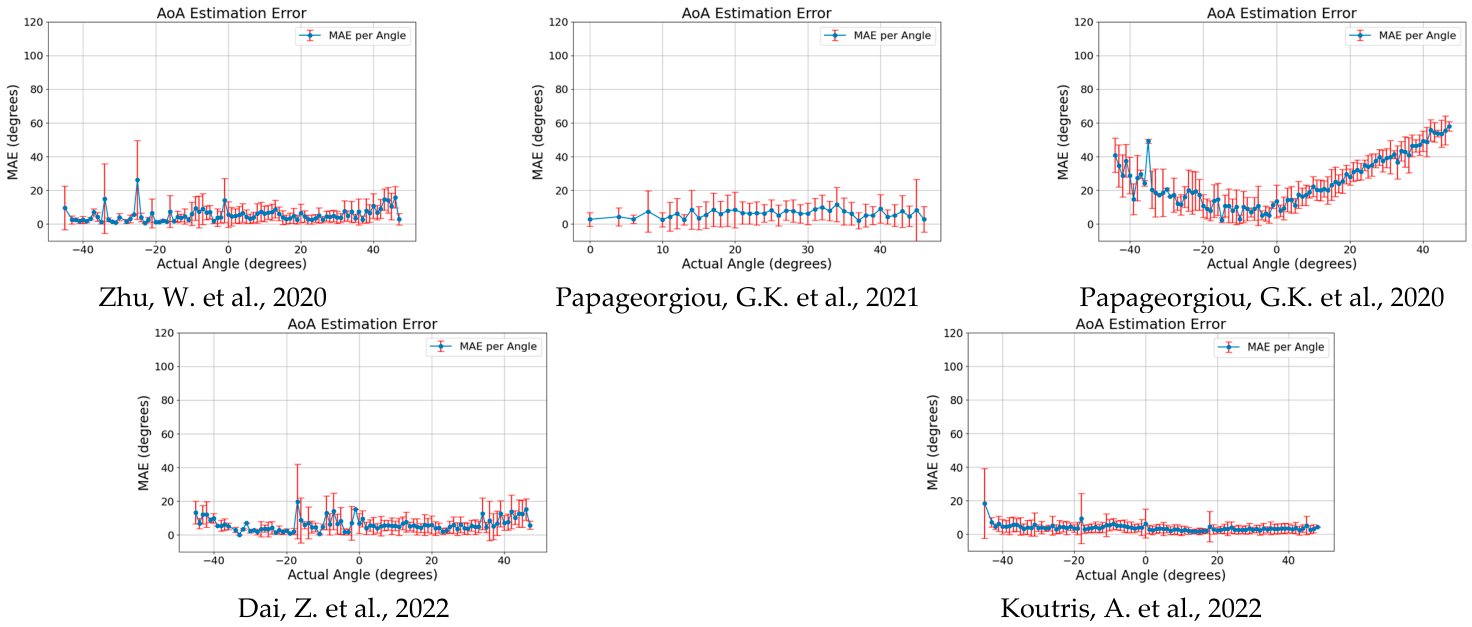
Figure 2 further illustrates the error bar distributions of MAE values for selected models [16,20,21,23,26] across different angles, providing insights into the stability of each model’s performance. These five models were selected to represent a broad spectrum of estimation accuracy—with ref. [26] demonstrating the highest accuracy, ref. [21] the lowest, and refs. [16,20,23] positioned in the mid-range. This selection enables a balanced comparison of model stability across varying performance levels. Models with smaller error bars demonstrate more consistent performance across different angles, whereas larger error bars indicate higher variability. Notably, ref. [26] maintains low MAE with minimal variance, reinforcing its stability across different angular inputs. Similarly, refs. [16,20], which utilize image-based CNNs on covariance matrices, show relatively stable error profiles with modest fluctuations. In contrast, ref. [21] (DAE + MUSIC) exhibits significant fluctuations, highlighting the sensitivity of MUSIC-based estimation to noise and environmental variations. Ref. [23] also shows variability depending on angle, reflecting potential inconsistencies arising from its image-based input design.
Table 10 provides a model-level comparison of estimation accuracy (MAE), computational cost (FLOPs), and parameter count to assess the efficiency of each method. While the performance analysis in Figure 1 and Figure 2 focuses on accuracy and angular stability, this table highlights the trade-off between estimation performance and computational demand. The FLOPs/MAE ratio is introduced as an efficient metric, where lower values indicate better performance per unit computation. For RNN-based models [19,27], FLOPs were estimated analytically due to the recursive nature of sequential operations, and parameter count is included to complement the assessment of computational complexity. Among all models, ref. [26] stands out with the lowest MAE (2.98°) and minimal computational cost (39 k FLOPs and 19 k parameters), indicating strong suitability for real-time or embedded applications. In contrast, refs. [19,20] achieve moderate accuracy (MAE ≈ 7° and 6.17°) but at significantly higher computational cost—8.9 M and 54.1 M FLOPs, respectively—posing challenges for deployment in resource-constrained environments. While ref. [27] demonstrates a low FLOPs/MAE ratio due to its lightweight GRU-based architecture, its accuracy is limited (MAE = 19.34°), especially at extreme angles. Similarly, ref. [21] (DAE + MUSIC) records the highest MAE (30.00°), reflecting the limitations of hybrid methods relying on classical signal processing under noisy or non-ideal conditions.
The performance of each model was systematically evaluated using MAE, categorized across four dimensions: data type, data representation, neural architecture, and prediction strategy. Table 11 summarizes the results, providing a comparative overview of estimation accuracy and stability. The standard deviation represents the spread of MAE values across different studies within the same category.
IQ + RSSI-based input achieved the lowest MAE of 2.98°, indicating that combining raw signal strength with phase-difference information can provide a more informative feature set for neural networks. In contrast, IQ-derived AoA and phase drift representations recorded significantly higher MAEs of 25.35° and 19.39°. These results suggest that without structural transformation or sequence continuity, such raw or sparsely structured inputs may not capture the spatial or temporal dependencies needed for precise estimation. However, it is worth noting that these data types were each evaluated in only a single study, limiting the generalizability of their performance implications. Covariance matrix-based methods, although more broadly adopted across six studies, exhibited a relatively high average MAE of 10.53° with a standard deviation of 9.56°, reflecting variability depending on how the matrix is constructed and processed. Regarding data representation, image-based approaches consistently outperformed time-series representations. Models using image-based transformations achieved an average MAE of 9.40°, although their variance increased due to the relatively high error of [25].
In terms of neural architecture, CNN-based models showed relatively strong performance across multiple studies, recording an average MAE of 9.33°. DNN-based models, in contrast, reported the highest average MAE of 14.83° with the largest performance deviation (13.15°), suggesting that fully connected layers alone may struggle to generalize in scenarios with noisy or structurally limited data. The GRU-based model in [27] underperformed, which may be attributed not only to the single-time input structure but also to the challenge of modeling phase drift dynamics without sequential context. While the A-CRNN-based model in [19] combined spatial and temporal learning for moderate accuracy, its high computational cost poses deployment challenges. When comparing prediction strategies, classification-based models showed slightly better accuracy (average MAE of 9.93°) than regression-based approaches (13.47°). This advantage can be attributed to the robustness of classification under noisy conditions, as discretization reduces sensitivity to small fluctuations. However, classification models are inherently limited in resolution by the granularity of angular bins, while regression methods offer finer output but require stronger generalization capabilities. The relatively high standard deviations in both approaches suggest that accuracy is not determined by prediction type alone, but also by how well the input features are structured and how suitable the architecture is for learning from them.

4.2. Experimental Dataset Evaluation

4.2.1. Experimental Dataset Description

In addition to the simulation-based evaluation, we conducted real-world validation using a publicly available BLE AoA dataset created by Leitch et al. [48]. This dataset was collected in an industrial indoor environment using the TI BOOSTXL-AOA platform, which features dual ULAs with three elements each, arranged orthogonally to cover an angular range of −135° to +135°. The receiver passively captured IQ samples at 4 MHz during the Constant Tone Extension (CTE) period of BLE packets, producing up to 511 IQ pairs per packet. Ground truth positions of the BLE tag were obtained using a motion capture system with millimeter-level accuracy and were aligned to each IQ sample set via timestamp-based interpolation. To evaluate model performance under realistic multipath conditions, we selected two representative subsets from the dataset: no_obstacle, representing clear line-of-sight (LoS) conditions, and obstacle, where reflective or absorbing objects were placed between the tag and the receiver to create NLoS scenarios. These subsets allow us to assess the robustness of AoA estimation models when exposed to diverse propagation environments.
The dataset includes a wide range of experimental variations, such as different tag heights (0.8 m, 1.1 m, 1.4 m), distances (1.5 m to 3.0 m), and BLE channels, with each packet containing not only IQ data but also RSSI and channel metadata. Table 12 summarizes the overall experimental setup, while Table 13 provides a detailed breakdown of the JSON file structure used for signal and ground truth data in our evaluation. For our evaluation, we used only the data samples within the range of −90° to +90°, discarding peripheral angles to avoid sparse sampling and increased error variance at the extremes.

4.2.2. Experimental Dataset Performance Comparison

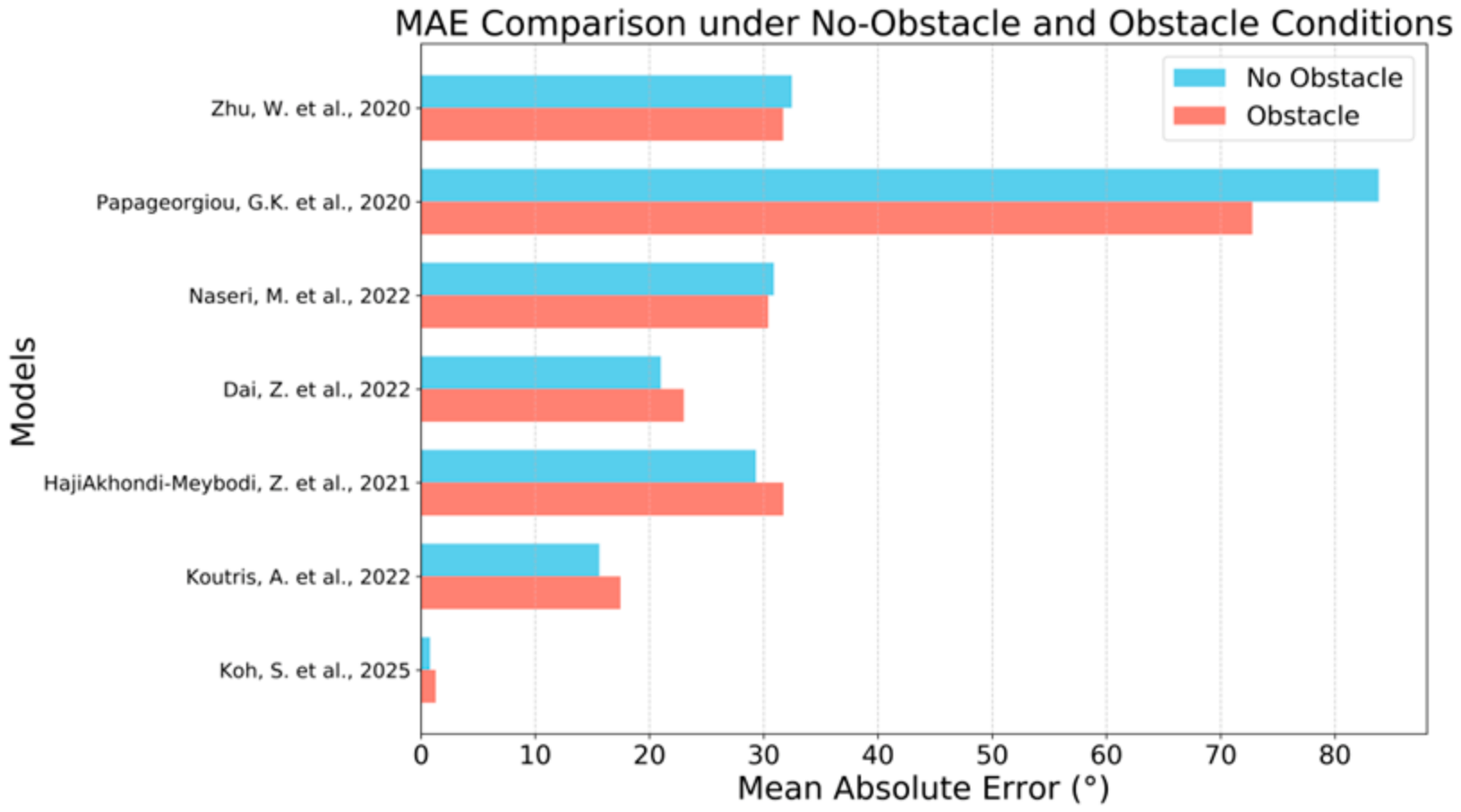
Figure 3 presents MAE results for models [16,21,22,23,25,26,27] under two real-world conditions: no obstacle and obstacle environments. The x-axis lists the models, while the y-axis indicates the corresponding MAE in degrees (°). Each bar pair represents a model’s performance under the two scenarios.
As shown, Model [27] delivers the best performance across both conditions, maintaining extremely low MAE (<1.3°), which demonstrates exceptional generalization to real-world BLE distortions. In contrast, model [21] performs the worst, with MAEs over 70°, indicating poor robustness to practical signal conditions. Interestingly, classical MUSIC alone (without DAE) achieved better performance (MAE = 58.19°), suggesting that the denoising autoencoder may have introduced signal distortions rather than removing noise—ultimately degrading the performance of the hybrid approach. This highlights that neural components, when mismatched with the signal characteristics, can negatively impact the effectiveness of traditional algorithms.
Model [26] also demonstrated moderate performance, with MAEs of 15.62° and 17.47° across the two conditions. While not as accurate as [27], the model maintains reasonable error margins and shows only minor degradation under NLoS, implying a degree of generalization likely supported by structured feature design or hybrid input strategies. Other models such as [16,22,23] show moderate error ranges (~20–30°), with slight performance degradation under obstacle conditions, reflecting typical challenges from multipath and antenna-switching artifacts. Notably, ref. [23] achieves better accuracy than [16,22], likely due to its SDR-derived covariance-based input structuring, which better supports spatial feature learning.
Overall, while some models experienced minor performance changes between LoS and NLoS, the overall MAE values were higher in real-world data compared to those from simulation. This reinforces the importance of evaluating models in realistic conditions, as BLE-specific distortions (e.g., antenna switching artifacts, multipath) can significantly alter performance. Notably, model [27], which showed only moderate accuracy in simulation, outperformed all others in real-world settings, indicating that phase drift features may be particularly effective under practical BLE signal conditions. This performance reversal can be explained by the difference between simulated BLE-like signals and real BLE phase behavior. In the simulation dataset, phase drift continuity and hardware-induced temporal variations are not fully modeled, which limits the advantage of recurrent temporal modeling. In contrast, the real-world BLE dataset contains actual phase variations caused by oscillator offset, antenna switching, multipath propagation, reflection, and other hardware-related distortions. Although these factors are often regarded as noise in conventional signal processing, they can form repeatable temporal patterns in narrowband BLE signals. The GRU-based model in [27] can exploit these sequential phase evolution patterns, allowing phase drift features to become informative cues for angle estimation rather than purely random disturbances. This may explain the observed performance reversal between the simulation and real-world evaluations.
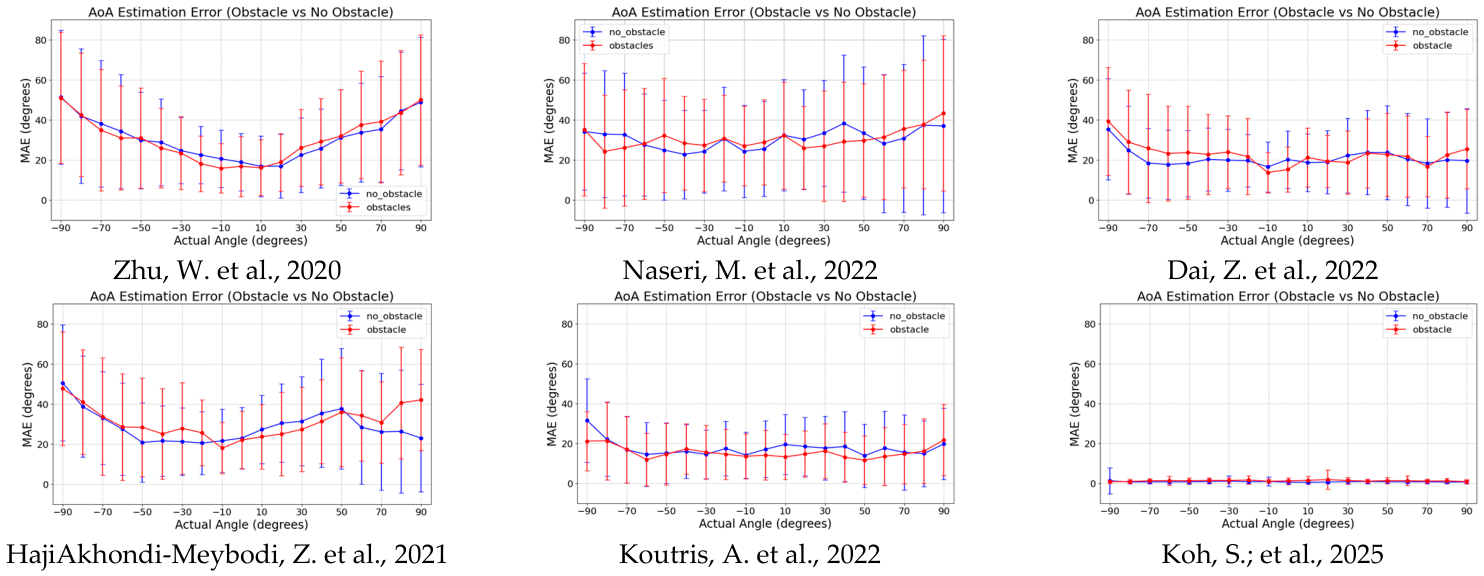
Figure 4 presents the per-angle MAE distributions for six regression-based models under no_obstacle and obstacle conditions. A consistent trend across all models is the elevated MAEs at extreme angles (±70° and beyond), primarily due to multipath propagation and edge effects in antenna patterns. In contrast, angles near the center range (−30° to +30°) yield more accurate predictions, benefiting from direct path dominance and optimal reception geometry. Among the models, ref. [27] consistently delivers the best performance across the full angular spectrum, maintaining MAEs below 1° with negligible variance. This reinforces its exceptional robustness and ability to generalize across angular positions. Model [26] also shows relatively stable behavior, with error values between 15° and 17° across all directions and low angular sensitivity. Model [23], which uses SDR-derived covariance-based input structuring, achieves better central accuracy (~21–23°) than models [16,22], indicating that its input design may better support spatial learning. In contrast, refs. [16,22] exhibit larger standard deviations and fluctuating MAEs, particularly at angular extremes, reflecting lower resilience under geometric and environmental distortions. Model [25] shows the highest instability, with erratic error trends across angles. Model [21] is excluded from this figure, as its predictions remained nearly constant across angles, resulting in uniformly high MAEs and no meaningful angular differentiation.
Table 14 summarizes angle estimation performance grouped by input type, data representation, and model architecture under both no-obstacle and obstacle conditions.
In terms of input data type, the model using phase drift information—though limited to a single study—achieved the lowest MAEs (<1.3°) in both scenarios. This result highlights the potential of phase drift features for fine-grained angle estimation, particularly in multipath-rich environments. The IQ + RSSI-based model, also representing a single study, showed strong performance (~15–17°), suggesting that integrating both amplitude and phase cues may enhance robustness. Meanwhile, models relying on IQ-derived AoA or CIR inputs yielded moderate errors of approximately 30°, and those based on covariance matrices exhibited substantial variability depending on how the input was preprocessed.
Regarding representation, image-based models consistently outperformed time-series-based ones across both conditions. The spatial encoding provided by 2D transformations appears to benefit convolutional architectures by capturing inter-antenna relationships more effectively. Time-series representations, while simpler, showed higher variance and were more sensitive to input quality and network design. From the architectural standpoint, CNN-based models maintained relatively balanced performance (~26° MAE) across diverse input types. In contrast, the DNN-based model showed higher errors and limited generalization capability, likely due to its reduced capacity for modeling spatial or temporal patterns in this real-world setting. Notably, the GRU-based model, paired with phase drift input, achieved the best overall performance.
Taken together, the results underscore that input modality, representation method, and model structure each play a critical role in determining estimation accuracy. Architectures that incorporate temporal dynamics or exploit spatial structure—when combined with informative input features—tend to yield more robust performance under real-world BLE signal conditions.
In addition to learning-based approaches, we evaluated classical signal processing algorithms on the same real-world dataset to supplement the performance comparison. Specifically, we tested traditional methods such as MUSIC, Improved MUSIC, ESPRIT with enhanced spatial smoothing (ESS), wideband ESPRIT, MESA, analytical MLE, and sparse recovery-based DoA estimation.
To provide a more comprehensive assessment beyond MAE, Table 15 additionally reports RMSE and success rates within 5° and 10° error thresholds. Although all algorithms used the same source data, input features were tailored to each algorithm’s assumptions to ensure a fair and meaningful comparison. For the classical subspace-based algorithms, the number of signal sources was fixed to one according to the single-tag BLE AoA experimental setup, and the number of snapshots was set to 32 across all evaluated methods to maintain fairness in comparison. As shown, the MAE values for these algorithms generally ranged from 50.18° to 58.19°, showing substantial performance gaps compared to deep models. These findings underscore the limitations of conventional subspace-based techniques under practical BLE distortions, such as antenna switching artifacts and multipath interference. Even theoretically sound methods like MUSIC may fail to generalize well. Furthermore, poorly integrated neural components, as seen in hybrid approaches, can further degrade performance, highlighting the need for careful design.

5. Practical Implications and Deployment Strategies

To bridge the gap between benchmarking results and real-world applicability, we propose a set of deployment strategies that align model capabilities with environmental constraints and hardware limitations. Rather than introducing new algorithmic frameworks, our focus is on providing concrete, system-level guidance to support robust, adaptive, and efficient integration of angle estimation models into practical applications.
We begin by presenting a deployment guideline that maps evaluated models to suitable hardware platforms, considering accuracy, computational complexity, and expected latency. As summarized in Table 16, we report realistic latency and throughput ranges that reflect practical deployment conditions. Under these practical conditions, high-precision scenarios such as laboratory-grade tracking still benefit most from the GRU-based phase drift model [27], which maintains sub-degree accuracy and achieves ~1 ms latency on edge-GPU devices such as the Jetson Nano. In contrast, resource-constrained environments—such as embedded or IoT systems—can effectively utilize lightweight models like [15,26], which are suitable for STM32-class MCUs, offering a practical trade-off between accuracy and latency. Consistent with the realistic estimates, actual deployments on STM32-class MCUs yield several milliseconds of latency (~3–10 ms), which remains acceptable for IoT sensing cycles. This provides a practical trade-off between accuracy and responsiveness.
Because the public BLE dataset used in this study does not provide explicit SNR or noise-floor annotations, we present the following SNR-aware model selection strategy as a deployment guideline rather than an experimentally validated result in this benchmark. This approach is independent of hardware class and focuses on adapting to signal quality. When the estimated signal-to-noise ratio (SNR) exceeds 30 dB, typically in clear line-of-sight conditions, model [27] is recommended due to its superior precision. In moderately obstructed environments (15–30 dB SNR), the CNN-based model using combined IQ and RSSI features [26] offers stable performance. In heavily degraded or noisy environments (SNR < 15 dB), simpler but more resilient models such as those in [23] (SDR-derived covariance-based CNN) or [15] (lightweight DNN) are more effective.
Beyond static selection, a confidence-weighted ensemble approach can be employed to improve estimation reliability. In this strategy, the final angle prediction is computed as a weighted average of the outputs from multiple models, where each model’s contribution is inversely proportional to its expected MAE under current conditions. While this technique was not explicitly evaluated in our experiments, it presents a promising avenue for future implementation, especially in systems requiring adaptability across varying operating conditions.
In latency-sensitive applications, we advocate a hybrid edge–cloud deployment. Initial inferences can be performed on low-power edge devices (e.g., MCUs or TPUs) to ensure real-time responsiveness (tens of milliseconds). These coarse predictions can then be refined by higher-capacity edge-GPU platforms or cloud nodes, enabling high-accuracy correction without compromising responsiveness. In summary, the proposed strategies translate benchmarking outcomes into system-level deployment guidelines, facilitating robust, adaptive, and resource-efficient integration of deep learning-based angle estimation models. These guidelines enable deployment across a wide range of real-world scenarios.

6. Conclusions

This study systematically evaluates deep learning-based AoA and DoA estimation models under a unified experimental framework. By categorizing models based on data structure, representation format, and neural network architecture, this research provides an investigation and a comprehensive performance comparison to identify the strengths and limitations of different approaches. Our evaluation relies primarily on the BLE testbench_01 simulation (static layout, no furniture) and a single public BLE AoA dataset, which may not capture dynamic multipath or other radio technologies (e.g., Wi-Fi, UWB). The results highlight the impact of data representation methods on estimation accuracy, showing that structured representations such as covariance matrices and CIR improve feature extraction for deep learning models. Furthermore, the study demonstrates that model architecture plays a crucial role, with hybrid designs effectively capturing both spatial and temporal dependencies, enhancing robustness against multipath interference and noise. By establishing a standardized evaluation framework, this study provides valuable insights for developing reliable AI-driven angle estimation techniques applicable to IPS and other wireless communication applications.
These results highlight promising directions for further research. Phase-based features such as phase drift have shown strong potential in real-world BLE environments but remain underexplored. Moreover, current simulation frameworks do not adequately capture hardware-related artifacts such as antenna switching jitter or channel-specific fading, underscoring the need for more realistic models. Addressing these issues will enable the development of more robust and generalizable angle estimation methods. In addition, the impact of obstacles and multipath conditions may vary depending on the signal representation and localization model. Certain obstacle configurations can degrade estimation accuracy for some approaches while potentially benefiting others through additional spatial propagation characteristics. Therefore, the experimental scenario in this study was intentionally constrained to provide a fair and controlled evaluation environment across all compared models. Nevertheless, the current experimental dataset has limitations in representing diverse obstacle configurations, radio environments, and hardware-induced distortions. Therefore, the findings of this study should be interpreted within the scope of the selected benchmark scenario. Future work will extend the evaluation framework to diverse wireless technologies, including Wi-Fi and UWB, as well as more realistic multipath conditions involving dynamic obstacles, antenna switching jitter, and hardware-induced distortions. To address this challenge, we plan to develop a large-scale experimental testbed for robust and generalizable AI-based angle estimation.

Author Contributions

Conceptualization, J.L.; methodology, S.K. and J.L.; software, S.K.; validation, S.K. and J.L.; formal analysis, S.K. and J.L.; investigation, S.K.; resources, S.K.; data curation, S.K.; writing—original draft preparation, S.K.; writing—review and editing, J.L.; visualization, S.K. and J.L.; supervision, J.L.; project administration, J.L.; A acquisition, J.L. All authors have read and agreed to the published version of the manuscript.

Funding

This research received no external funding.

Institutional Review Board Statement

Not applicable.

Informed Consent Statement

Not applicable.

Data Availability Statement

Publicly available datasets were analyzed in this study. The BLE ray-tracing simulation dataset used for the simulated evaluation is described by Koutris et al., and the real-world BLE AoA dataset used for the experimental evaluation is described by Leitch et al. Further details on the data sources are available in the cited references.

Conflicts of Interest

The authors declare no conflicts of interest.

Abbreviations

The following abbreviations are used in this manuscript:
AoAAngle of Arrival
AoDAngle of Departure
DoADirection of Arrival
IPSIndoor Positioning System
BLEBluetooth Low Energy
UWBUltra-Wideband
CSIChannel State Information
CIRChannel Impulse Response
IQIn-phase and Quadrature
RSSIReceived Signal Strength Indicator
MAEMean Absolute Error
RMSERoot Mean Square Error
FLOPsFloating Point Operations
MUSICMultiple Signal Classification
ESPRITEstimation of Signal Parameters via Rotational Invariance Technique
CNNConvolutional Neural Network
GRUGated Recurrent Unit
A-CRNNAlternate Convolutional Recurrent Neural Network
LoSLine-of-Sight
NLoSNon-Line-of-Sight

Appendix A

To ensure reproducibility and fair comparison, Table A1 summarizes the training settings for all evaluated models, including source code usage, optimizer type, learning rate, and number of training epochs. All models were trained with early stopping (patience = 10) unless otherwise specified in the main text. All experiments and analyses were conducted using Python 3.9.13. Data processing and numerical computations were performed using NumPy 1.26.4 and scikit-learn 1.4.1.post1, and figures were generated using Matplotlib 3.8.4.
Table A1. Implementation and Training Details.
IDSource Code UsedOptimizerLearning RateEpoch
[15]Re-implementedAdam0.001Sim:100, Real:300
[16]Re-implementedAdam0.001Sim:100, Real:300
[17]Adapted from [17]Adam0.001Sim:100, Real:300
[19]Re-implementedAdam0.001Sim:100, Real:300
[20]Re-implementedAdam0.001Sim:100, Real:300
[21]Re-implementedAdam0.001Sim:50, Real:50
[22]Re-implementedAdam0.001Sim:100, Real:300
[23]Adapted from [23]Adam0.001Sim:100, Real:300
[25]Re-implementedAdam0.001Sim:100, Real:300
[26]Adapted from [26]AdamSim:0.002
Real:0.001
Sim:1500, Real:300
[27]Author-provided
implementation
Adam0.001Sim:100, Real:300

References

  1. Heydariaan, M.; Dabirian, H.; Gnawali, O. AnguLoc: Concurrent angle of arrival estimation for indoor localization with UWB radios. In Proceedings of the International Conference on Distributed Computing in Sensor Systems (DCOSS), Marina del Rey, CA, USA, 25–27 May 2020; pp. 1–8. [Google Scholar]
  2. Bluetooth SIG. Available online: https://www.bluetooth.com/ (accessed on 8 August 2024).
  3. Wi-Fi Alliance. Available online: https://www.wi-fi.org/ko (accessed on 8 August 2024).
  4. UWB Alliance. Available online: https://uwballiance.org/ (accessed on 8 August 2024).
  5. Silicon Laboratories. UG103.18: Bluetooth Direction Finding Fundamentals, 2020. Available online: https://www.silabs.com/documents/public/user-guides/ug103-18-bluetooth-direction-finding-fundamentals.pdf (accessed on 8 August 2024).
  6. Boquet, G.; Boquet-Pujadas, A.; Pisa, I.; Dabak, A.; Vilajosana, X. Indoor position estimation using angle of arrival measurements: An efficient multi-anchor approach with outlier rejection. Internet Things 2024, 7, 100–117. [Google Scholar] [CrossRef]
  7. Valecha, N.; Lacruz, J.O.; Lentmaier, M.; Widmer, J.; Tufvesson, F. Angle estimation using mmWave RSS measurements with enhanced multipath information. arXiv 2024, arXiv:2403.09575. [Google Scholar] [CrossRef]
  8. Hao, Z.; Yan, H.; Dang, X.; Ma, Z.; Jin, P.; Ke, W. Millimeter-wave radar localization using indoor multipath effect. Sensors 2022, 22, 5671. [Google Scholar] [CrossRef]
  9. Ahmed, U.; Arablouei, R.; De Hoog, F.; Kusy, B.; Jurdak, R.; Bergmann, N. Estimating angle-of-arrival and time-of-flight for multipath components using WiFi channel state information. Sensors 2018, 18, 1753. [Google Scholar] [CrossRef]
  10. Schmidt, R.O. Multiple emitter location and signal parameter estimation. IEEE Trans. Antennas Propag. 1986, 34, 276–280. [Google Scholar] [CrossRef]
  11. Roy, R.; Kailath, T. ESPRIT—Estimation of signal parameters via rotational invariance techniques. IEEE Trans. Acoust. Speech Signal Process. 1989, 37, 984–995. [Google Scholar] [CrossRef]
  12. Lavate, T.B.; Kokate, V.K.; Sapkal, A.M. Performance analysis of MUSIC and ESPRIT DOA estimation algorithms. In Proceedings of the International Conference on Computer Network Technology (ICCNT), Bangkok, Thailand, 23–25 April 2010; pp. 308–311. [Google Scholar]
  13. Oumar, A.; Siyau, M.F.; Sattar, T.P. Comparison between MUSIC and ESPRIT direction of arrival estimation algorithms. In Proceedings of the International Conference on Future Generation Communication Technology (FGCT), London, UK, 12–14 December 2012; pp. 99–103. [Google Scholar]
  14. Ko, C.B.; Lee, J.H. Performance of ESPRIT and root-MUSIC for AOA estimation. In Proceedings of the IEEE World Symposium on Communication Engineering (WSCE), Singapore, 28–30 December 2018; pp. 49–53. [Google Scholar]
  15. Chen, M.; Gong, Y.; Mao, X. Deep neural network for estimation of direction of arrival with antenna array. IEEE Access 2020, 8, 140688–140698. [Google Scholar] [CrossRef]
  16. Zhu, W.; Zhang, M.; Li, P.; Wu, C. Two-dimensional DOA estimation via deep ensemble learning. IEEE Access 2020, 8, 124544–124552. [Google Scholar] [CrossRef]
  17. Liu, Z.M.; Zhang, C.; Yu, P.S. Direction-of-arrival estimation based on deep neural networks with robustness to array imperfections. IEEE Trans. Antennas Propag. 2018, 66, 7315–7327. [Google Scholar] [CrossRef]
  18. Huang, H.; Yang, J.; Huang, H.; Song, Y.; Gui, G. Deep learning for super-resolution channel estimation and DOA estimation based massive MIMO system. IEEE Trans. Veh. Technol. 2018, 67, 8549–8560. [Google Scholar] [CrossRef]
  19. Yao, Y.; Lei, H.; He, W. A-CRNN-based method for coherent DOA estimation with unknown source number. Sensors 2020, 20, 2296. [Google Scholar] [CrossRef] [PubMed]
  20. Papageorgiou, G.K.; Sellathurai, M.; Eldar, Y.C. Deep networks for direction-of-arrival estimation in low SNR. IEEE Trans. Signal Process. 2021, 69, 3714–3729. [Google Scholar] [CrossRef]
  21. Papageorgiou, G.K.; Sellathurai, M. Direction-of-arrival estimation in the low-SNR regime via a denoising autoencoder. In Proceedings of the IEEE International Workshop on Signal Processing Advances in Wireless Communications (SPAWC), Atlanta, GA, USA, 26–29 May 2020; pp. 1–5. [Google Scholar]
  22. Naseri, M.; Shahid, A.; Gordebeke, G.J.; Lemey, S.; Boes, M.; Van de Velde, S.; De Poorter, E. Machine learning-based angle of arrival estimation for ultra-wide band radios. IEEE Commun. Lett. 2022, 26, 1273–1277. [Google Scholar] [CrossRef]
  23. Dai, Z.; He, Y.; Tran, V.; Trigoni, N.; Markham, A. DeepAoANet: Learning angle of arrival from software defined radios with deep neural networks. IEEE Access 2022, 10, 3164–3176. [Google Scholar] [CrossRef]
  24. Bialer, N.; Garnett, N.; Tirer, T. Performance advantages of deep neural networks for angle of arrival estimation. In Proceedings of the IEEE International Conference on Acoustics, Speech, and Signal Processing (ICASSP), Brighton, UK, 12–17 May 2019; pp. 3907–3911. [Google Scholar]
  25. HajiAkhondi-Meybodi, Z.; Salimibeni, M.; Mohammadi, A.; Plataniotis, K.N. Bluetooth low energy and CNN-based angle of arrival localization in presence of Rayleigh fading. In Proceedings of the IEEE International Conference on Acoustics, Speech and Signal Processing (ICASSP), Toronto, ON, Canada, 6–11 June 2021; pp. 7913–7917. [Google Scholar] [CrossRef]
  26. Koutris, A.; Siozos, T.; Kopsinis, Y.; Pikrakis, A.; Merk, T.; Mahlig, M.; Papaharalabos, S.; Karlsson, P. Deep learning-based indoor localization using multi-view BLE signal. Sensors 2022, 22, 2759. [Google Scholar] [CrossRef]
  27. Koh, S.; Lee, J. Learning approach for angle estimation based on characteristics of phase drift. Appl. Sci. 2025, 15, 3708. [Google Scholar] [CrossRef]
  28. Ge, S.; Li, K.; Rum, S.N.B.M. Deep Learning Approach in DOA Estimation: A Systematic Literature Review. Mob. Inf. Syst. 2021, 2021, 6392875. [Google Scholar] [CrossRef]
  29. Chung, H.; Park, H.; Kim, S. Leveraging Deep Learning for Practical DoA Estimation: Experiments with Real Data Collected via USRP. Sensors 2022, 22, 7578. [Google Scholar] [CrossRef] [PubMed]
  30. Gupta, P.; Kar, S.P. MUSIC and improved MUSIC algorithm to estimate direction of arrival. In Proceedings of the International Conference on Communication and Signal Processing (ICCSP), Melmaruvathur, India, 2–4 April 2015; pp. 757–761. [Google Scholar]
  31. Joshi, R.; Dhande, A. Direction of arrival estimation using MUSIC algorithm. Int. J. Res. Eng. Technol. 2014, 3, 633–636. [Google Scholar] [CrossRef]
  32. Pan, J.; Sun, M.; Wang, Y.; Zhang, X. An enhanced spatial smoothing technique with ESPRIT algorithm. IEEE Trans. Signal Process. 2020, 68, 3635–3643. [Google Scholar] [CrossRef]
  33. Ottersten, B.; Kailath, T. Direction-of-arrival estimation for wide-band signals using ESPRIT algorithm. IEEE Trans. Acoust. Speech Signal Process. 1990, 38, 317–327. [Google Scholar] [CrossRef]
  34. Fisher, R.A. On the mathematical foundations of theoretical statistics. Philos. Trans. R. Soc. A 1922, 222, 309–368. [Google Scholar] [CrossRef]
  35. Yang, Z.; Chen, X.; Wu, X. A robust and statistically efficient maximum-likelihood method for DOA estimation using sparse linear arrays. IEEE Trans. Aerosp. Electron. Syst. 2023, 59, 6798–6812. [Google Scholar] [CrossRef]
  36. Paik, J.W.; Lee, K.H.; Lee, J.H. Asymptotic performance analysis of maximum likelihood algorithm for DOA estimation. Appl. Sci. 2020, 10, 2415. [Google Scholar] [CrossRef]
  37. Hu, N.; Ye, Z.; Xu, X.; Bao, M. DOA estimation for sparse array via sparse signal reconstruction. IEEE Trans. Aerosp. Electron. Syst. 2013, 49, 760–773. [Google Scholar] [CrossRef]
  38. Sun, F.Y.; Tian, Y.B.; Hu, G.B.; Shen, Q.Y. DOA estimation based on support vector machine ensemble. Int. J. Numer. Model. Electron. Netw. Devices Fields 2019, 32, e2614. [Google Scholar] [CrossRef]
  39. Liu, J.; Wang, T.; Li, Y.; Li, C.; Wang, Y.; Shen, Y. A transformer-based signal denoising network for AoA estimation in NLoS environments. IEEE Commun. Lett. 2022, 26, 2336–2339. [Google Scholar] [CrossRef]
  40. Wang, W.; Zhou, L.; Ye, K.; Sun, H.; Hong, S. A DOA estimation method based on an improved transformer model. IET Signal Process. 2024, 2024, 6666395. [Google Scholar] [CrossRef]
  41. Ji, J.; Mao, W.; Xi, F.; Chen, S. TransMUSIC: A Transformer-Aided Subspace Method for DOA Estimation with Low-Resolution ADCs. In Proceedings of the ICASSP 2024 IEEE International Conference on Acoustics, Speech and Signal Processing (ICASSP), Seoul, Republic of Korea, 14–19 April 2024. [Google Scholar]
  42. Nguyen, D.T.; Le, T.H.; Doan, V.S.; Hoang, V.P. UNet-rootMUSIC: A high accuracy direction of arrival estimation method under array imperfection. AEU Int. J. Electron. Commun. 2024, 173, 155008. [Google Scholar] [CrossRef]
  43. Merkofer, J.P.; Revach, G.; Shlezinger, N.; Routtenberg, T.; van Sloun, R.J.G. DA-MUSIC: Data-driven DOA estimation via deep augmented MUSIC algorithm. IEEE Trans. Veh. Technol. 2024, 73, 2771–2785. [Google Scholar] [CrossRef]
  44. Bai, J.; Shu, F.; Zhou, F.; Zheng, Q.; Xu, B.; Shi, B.; Chen, Y.; Zhang, W.; Wang, X. Co-learning-aided multi-modal deep-learning framework of passive DOA estimators. IEEE J. Sel. Top. Signal Process. 2024; Preprint.
  45. Shmuel, D.H.; Merkofer, J.P.; Revach, G.; van Sloun, R.J.G.; Shlezinger, N. SubspaceNet: Deep learning-aided subspace methods for DOA estimation. IEEE Trans. Veh. Technol. 2023; Preprint.
  46. Shmuel, D.H.; Merkofer, J.P.; Revach, G.; van Sloun, R.J.G.; Shlezinger, N. Deep root MUSIC algorithm for data-driven DoA estimation. In Proceedings of the ICASSP 2023 IEEE International Conference on Acoustics, Speech and Signal Processing (ICASSP), Rhodes Island, Greece, 4–10 June 2023; pp. 1–5. [Google Scholar]
  47. Gong, Z.; Su, X.; Hu, P.; Liu, S.; Liu, Z. Deep Unfolding Sparse Bayesian Learning Network for Off-Grid DOA Estimation with Nested Array. Remote Sens. 2023, 15, 5320. [Google Scholar] [CrossRef]
  48. Leitch, S.G.; Ahmed, Q.Z.; Van Herbruggen, B.; Baert, M.; Fontaine, J.; De Poorter, E.; Shahid, A.; Lazaridis, P.I. Bluetooth low energy dataset using in-phase and quadrature samples. IEEE Sens. J. 2025, 25, 5668–5677. [Google Scholar] [CrossRef]
Figure 1. MAE Comparison of Models on the Simulated Dataset [15,16,17,19,20,21,22,23,25,26,27].
Applsci 16 06052 g001
Figure 2. MAE Analysis for AoA Estimation Across Models [16,20,21,23,26].
Applsci 16 06052 g002
Figure 3. MAE Comparison of Models on the Experimental Dataset [16,21,22,23,25,26,27].
Applsci 16 06052 g003
Figure 4. MAE Analysis for AoA Estimation Across Models [16,22,23,25,26,27].
Applsci 16 06052 g004
Table 1. Overview of Algorithm-Based Angle Estimation Approaches.
IDYearAlgorithm TypeComplexityScenarioTechnique
/Preprocessing
Focus/Key Contribution
[30]2015MUSIC
(Improved)
MediumCoherent sourcesParameter tuning in MUSICResolution and coherent source support
[31]2014MUSICLowGeneral
narrowband
Eigen-decompositionSensitivity to spacing, elements, snapshots
[32]2020ESPRIT + ESSHighCoherent sourcesEnhanced spatial smoothingRobustness and decorrelation
[33]1990Wideband ESPRITMediumWideband DOA estimationModel decomposition, no manifoldRobustness and calibration-free
processing
[35]2023Stochastic MLEHighSLA, correlated & uncorrelated sourcesToeplitz covariance modeling, ADMM, MM High resolution and robustness
to coherent sources (MESA)
[36]2020Analytical MLEMediumGaussian noise, asymptoticTaylor approximationClosed-form MSE derivation
[37]2020Sparse
Recovery
HighSparse arraysSOC optimization, LASSOSource number-free DoA estimation
Table 2. Analyzed Research Papers.
IDYearAntenna CountRequired ComputationTraining Data VolumeFilterResearch Focus
[15]202010LowLargeNoneDNN-based DOA estimation
[16]20209HighLargeNoneCNN-based 2D DOA estimation
[17]201810HighMediumAutoencoderDOA estimation robust to array imperfections
[18]2018Variable
(Massive MIMO)
Very HighLargeNoneDOA estimation in Massive MIMO environments
[19]202011HighMediumFocal lossCNN-RNN-based DOA estimation
[20]202116HighLargeNoneDOA estimation in low-SNR environments
[21]202020MediumLargeDenoising AutoencoderDOA estimation using a Denoising Autoencoder
Table 3. Categorization of Studies by Data Type.
Input CategoryData TypePaper ID
Matrix-basedCovariance matrix [15,16,17,19,20,21,23]
AoA spatial spectrum[24]
Signal-basedCSI[18]
CIR[22]
IQ-derived AoA[25]
Feature-basedIQ + RSSI[26]
Phase Drift[27]
Table 4. Categorization of Studies by Representation Type.
Data Representation TypePaper ID
Time-Series-based[15,17,18,19,21,22,27]
Image-based[16,20,23,24,25,26]
Table 5. Categorization by Data Source.
Data SourcePaper ID
Simulation Data[15,16,17,18,19,20,21,24,26]
Experimental Data[22,23,25,27]
Table 6. Categorization of Studies by Prediction Goal.
Prediction GoalPaper ID
Classification[15,17,19,20,23,24,25]
Regression[16,18,21,22,23,25,26,27]
Table 7. Categorization of Studies by Neural Network Architecture.
Network ArchitecturePaper ID
DNN[15,17,18,21,24]
CNN-based DNN[16,20,22,23,25,26]
A-CRNN-based DNN[19]
GRU-based DNN[27]
Table 8. Summary of Simulated Dataset Composition.
ParameterDescription
Environment Dimensions14 m × 7 m indoor space
Number of Anchors4 (placed at corners at 2.5 m height)
Anchor Orientation45° azimuth rotation, 45° elevation downward
BLE Channels37 (2402 MHz), 38 (2426 MHz), 39 (2480 MHz)
Polarization ModesHorizontal and Vertical
Tag PositionFixed at 1.5 m height
Samples per Room2450 per testbench setup
Selected Scenariotestbench_01 (No LoS-blocking furniture)
Table 9. Detailed JSON File Attributes of the Simulated Dataset.
File TypeAttributeDescription
Anchor JSON FilesanchorAnchor’s index
x/y/z_anchorAnchor point coordinates (meters)
az_anchorHorizontal rotation (azimuth)
el_anchorVertical rotation (elevation angle)
reference_powerReference RSSI power level (dB)
Tag JSON FilesanchorAnchor’s index
pointPoint’s index (unique identifier)
x_tag, y_tag, z_tagTag position coordinates (meters)
losLine-of-sight indicator (0 = No LoS, 1 = LoS)
relative powerRSS value in dB
pdda_input_realIn-phase component of received signal
pdda_input_imageQuadrature-phase component of received signal
pdda_phiPDDA predicted azimuth angle
pdda_thetaPDDA predicted elevation angle
pdda_out_azSpatial power spectrum for azimuth angle
pdda_out_elSpatial power spectrum for elevation angle
true_phiGround truth azimuth angle
true_thetaGround truth elevation angle
Table 10. Model-Wise Comparison of Accuracy and Computational Cost.
IDMAEFLOPsFLOPs/MAENote
[15]7.0120,6022937DNN,
Params: 10,292
[16]5.93833,665140,394CNN,
Params: 345,857
[17]7.4682841110DNN,
Params: 4220
[19]7.058,908,8001,263,659A-CRNN,
Params: 8,908,800
[20]6.1754,145,7008,775,640CNN,
Params: 20,767,018
[21]30.00356,27311,873DNN,
Params: 176,125
[22]9.02646,14571,620CNN,
Params: 242,529
[23]6.558,055,8091,229,894CNN,
Params: 3,689,473
[25]25.341,943,04176,662CNN,
Params: 974,977
[26]2.9839,25613,173CNN,
Params: 19,832
[27]19.34185,6649600GRU,
Params: 186,664
Table 11. Performance Comparison by Category on the Simulated Dataset.
CategoryMean MAE (°)Std Dev (°)Study Count
Data TypeCIR9.0218NaN1
Correlation7.0130NaN1
Covariance10.52909.55816
IQ-derived AoA25.3454NaN1
IQ + RSSI2.9800NaN1
Phase Drift19.3941NaN1
Representation TypeImage9.39519.02875
Time-series13.32329.45546
ArchitectureCNN9.33428.07636
CRNN7.0500NaN1
DNN14.826313.14783
GRU19.3941NaN1
Prediction TypeClassification9.93147.56446
Regression13.467911.12535
Table 12. Summary of Dataset Composition.
ParameterDescription
Environment Dimensions319 m2
Antenna Configuration2 ULAs (3 elements each), orthogonal placement (−135° to +135° coverage)
Sampling Rate4 MHz (up to 511 IQ samples per CTE)
Number of Experiments39 scenarios
(across 3 motion types × 3 heights × 4 distances, with/without obstacles)
Tag Heights0.8 m, 1.1 m, 1.4 m
Tag Distances1.5 m, 2.0 m, 2.5 m, 3.0 m
GT Label FormatAzimuth angle computed from robot position (x, y);
orientation matrix included
Table 13. Detailed JSON File Attributes.
File TypeAttributeDescription
Signal JSON FilesnameDevice name
typePacket type
identifierDevice MAC address
local_timestampTimestamp of IQ sample collection
payload.idxIndex of the CTE packet
payload.offsetOffset within the full CTE
payload.rssiReceived signal strength
payload.sampleLengthBLE channel index (0–36)
payload.samplesList of IQ samples (as dicts with i and q integer values)
GT JSON FilestimestampGlobal timestamp of ground truth capture (seconds)
local_timestampLocal timestamp corresponding to signal file
position3D position of tag: [x, y, z]
rotation3 × 3 rotation matrix representing tag orientation
Table 14. Performance Comparison by Category.
CategoryNo ObstacleObstacleStudy Count
Mean MAEStd DevMean MAEStd Dev
Data TypeCIR30.888NaN30.398NaN1
Cov45.76633.44942.47726.5813
IQ-derived AoA29.316NaN31.716NaN1
IQ + RSSI15.619NaN17.465NaN1
Phase Drift0.792NaN1.293NaN1
Rep. TypeImage24.6037.69225.9636.9904
Time-series38.50042.03434.81735.9383
Arch.CNN25.867.2326.856.375
DNN83.82NaN72.76NaN1
GRU0.7927NaN1.293NaN1
Table 15. Performance of Classical DoA Estimation Algorithms Using MAE, RMSE, and Success Rate.
AlgorithmIDNo ObstacleObstacle
MAERMSESR@5°SR@10°MAERMSESR@5°SR@10°
Improved MUSIC[30]52.36°58.51°3.56%8.14%50.18°56.67°3.97%8.60%
MUSIC [31]52.36°58.51°3.56%8.14%50.18°56.68°3.97%8.61%
ESS-SS + ESPRIT [32]55.73°65.98°4.45%9.06%53.83°63.81°5.08%9.88%
Wideband ESPRIT [33]56.03°66.00°4.55%8.76%54.07°63.81°4.62%9.63%
Stochastic MLE [35]61.31°74.45°5.23%10.29%59.97°72.93°5.17%10.33%
Analytical MLE [36]57.51°68.03°4.98%8.77%56.30°66.82°4.52%8.97%
Sparse Recovery [37]58.19°70.38°5.33%9.41%56.79°69.55°6.00%10.85%
Table 16. Recommended Model-Device Pairing by Deployment Scenario.
ScenarioModelDeviceRealistic
Throughput
(Inferences/s)
Latency
(ms)
Precision Lab Tracking[27]Jetson Nano666–12490.801–1.502
Raspberry Pi 462–2484.037–16.093
Embedded/IoT Devices[26]STM32H743
(400 MHz)
147–2913.436–6.818
STM32F407
(168 MHz)
60–1218.271–16.543
Real-Time
Robotics
[23]Jetson Nano633–11900.840–1.581
Raspberry Pi 450–1785.611–20.028
Power-Efficient
Edge
[15]STM32H743156–3103.229–6.429
STM32F40774–1496.717–13.434
High-Noise
Industrial
[22]Raspberry Pi 461–2424.129–16.323
Coral Edge TPU667–12500.800–1.500
Disclaimer/Publisher’s Note: The statements, opinions and data contained in all publications are solely those of the individual author(s) and contributor(s) and not of MDPI and/or the editor(s). MDPI and/or the editor(s) disclaim responsibility for any injury to people or property resulting from any ideas, methods, instructions or products referred to in the content.