1. Introduction
It is nowadays widely recognized that raw earth can be extensively used as a building material in contemporary architecture. The growing environmental emergency has brought to the fore problems associated with the consumption of non-renewable resources, energy waste, and the pollution of soils and seas, making earth construction an increasingly relevant alternative to conventional building materials [
1]. Traditional earth techniques can indeed be used to build modern architecture and housing with a low environmental footprint, owing to the low energy consumption in the production of earth-based building materials, to the possibility of using natural soil with little or no processing directly at the construction site, and to the reversible nature of earth-based construction, which allows the material to be returned to nature or reused without recovery or recycling treatments. These benefits are most fully realized for non-stabilized earthen materials, or when the use of additives is unavoidable, by limiting their amount and favoring biocompatible ones [
2].
A key challenge in the engineering use of earth is the variability of its mechanical and physical properties, which is inherent to its nature as a natural material, as is also the case for wood or stone. The definition of characteristic properties, as required by modern design codes, is therefore not straightforward. For stone masonry constructions, structural safety is grounded in mineralogical composition and degree of weathering, combined with standardized mechanical testing; likewise, knowledge of wood species and databases of their properties accumulated over decades underpin the structural safety of timber constructions. An equivalent strategy for earth structures requires systematic knowledge of composition-related properties alongside a framework of standardized mechanical and physical testing.
Natural soil exhibits a highly variable composition that can differ significantly even between samples taken from nearby locations, owing to its nature as a granular material produced by the disaggregation and weathering of rocks, subsequently transformed and deposited. To overcome this variability, prefabrication has been proposed: material excavated from specific quarries is sieved and blended to produce a somewhat standardized product. This approach, however, relies on quarry extraction, transportation to the construction site, and supplementary mechanical processing, which partially contradicts the sustainability principles that earth construction is otherwise well placed to fulfill through the use of locally sourced raw materials [
3].
Recent research efforts have been directed toward the standardization of construction techniques and testing procedures, with the aim of improving the design of earth structures and their safety level. The development of new construction methods, such as 3D printing and shotearth [
4], together with the need to formalize traditional ones, further requires the study of the rheological behavior of soil mixtures even during the transitional stages of processing. The recently published RILEM TC 274-TCE report [
5] reviews the state of the art on this topic and highlights that published papers on raw earth as a building material are often incomplete, owing to the large number of tests required to fully characterize the soil and mostly based on the evaluation of the compressive strength. Most research papers address specific case studies tied to particular locations and traditions, and individual research groups do not always have the expertise to examine all aspects of the characterization of soil and earth-based structures.
Several studies have highlighted the influence of soil properties and manufacturing processes on the mechanical performance of earthen materials. Soil grading is typically one of the first aspects evaluated to assess suitability for rammed earth (RE) construction; however, compliance with particle size distribution criteria alone does not guarantee suitability [
6]. The permeability and porosity of the soil significantly affect the maximum dry density (MDD) and optimum moisture content (OMC) [
7], both of which directly influence the development of mechanical strength in rammed earth elements. The dry–wet induced infiltration characteristics of the soil have also been shown to have a significant impact on the failure mechanisms of rammed earth [
8]. At a finer scale, some authors have specifically evaluated the relationship between the microstructural characteristics of the soil and the macro-scale mechanical performance of the resulting earthen material. These studies have focused mainly on stabilized materials, highlighting the role of pore structure and mineral-scale interactions between the soil and additives such as cement [
9], lime [
10,
11] or biopolymers [
12].
Manufacturing parameters—including compaction energy, specimen size and shape, and curing conditions—also have a significant impact on the mechanical performance of the resulting material [
13,
14]. To link soil properties, compaction conditions, and water content to mechanical performance in a structured way, some studies have proposed multiscale evaluations of other earth-based materials. For cement-stabilized compressed earth blocks, multiscale approaches have related mineralogical composition and additive contents to compressive strength and durability [
15]. For self-consolidating earth concrete, similar frameworks have connected mix design parameters to macro-scale compressive mechanical response [
16]. These studies share the principle of relating material composition and processing conditions to macro-scale mechanical performance, but are focused on different construction techniques and limited to compressive strength as the target mechanical parameter. For rammed earth specifically, no equivalent multiscale framework has been published to date; existing studies either focus on a single scale of analysis or address the influence of isolated soil or manufacturing characteristics on specific aspects of mechanical behavior, without organizing these relationships into a systematic hierarchical structure.
Against this background, this paper presents a multiscale experimental characterization of unstabilized rammed earth (URE) using a single soil sample excavated from a construction site in Seggiano (Grosseto, Italy). The same sample has been used across several independent experimental campaigns over more than ten years at the Laboratories for Material and Structure Testing of the University of Florence, at different times, for different purposes, and by different operators, providing an unusually consistent material basis for comparison across test types. The sample was not subjected to quartering; it was excavated, transported, and stored at two different locations. The results presented include both previously published data and unpublished experimental results.
The central argument of this paper is that the mechanical response of rammed earth cannot be adequately described by compressive strength alone, and that a structured multiscale framework is needed to relate soil composition and compaction parameters to the full mechanical behavior of the material. To this end, the study investigates how soil-scale properties—mineralogy, particle size distribution, and plasticity—govern compaction behavior and cohesion at the fabric scale, and how fabric-scale conditions in turn determine the mechanical response observed at the specimen scale. Within this framework, three specific aspects of the specimen-scale behavior are examined in depth: the degree of mechanical anisotropy introduced by the layered structure of RE; the extent to which standardizing the specimen manufacturing procedure with compaction control can reduce the result scatter commonly reported in the literature; and the relationship between compressive and shear strength, particularly relevant for RE failure. The characterization is organized around three hierarchical scales: (1) soil, (2) fabric and (3) specimen, each providing a different level of insight into the behavior of the material and informing the interpretation of results at the scales above. The multiscale approach adopted in this study aims to contribute to the understanding of URE physical and mechanical behavior and to the ongoing effort toward standardized characterization of earthen construction materials.
2. Multiscale Experimental Programme: Methodology
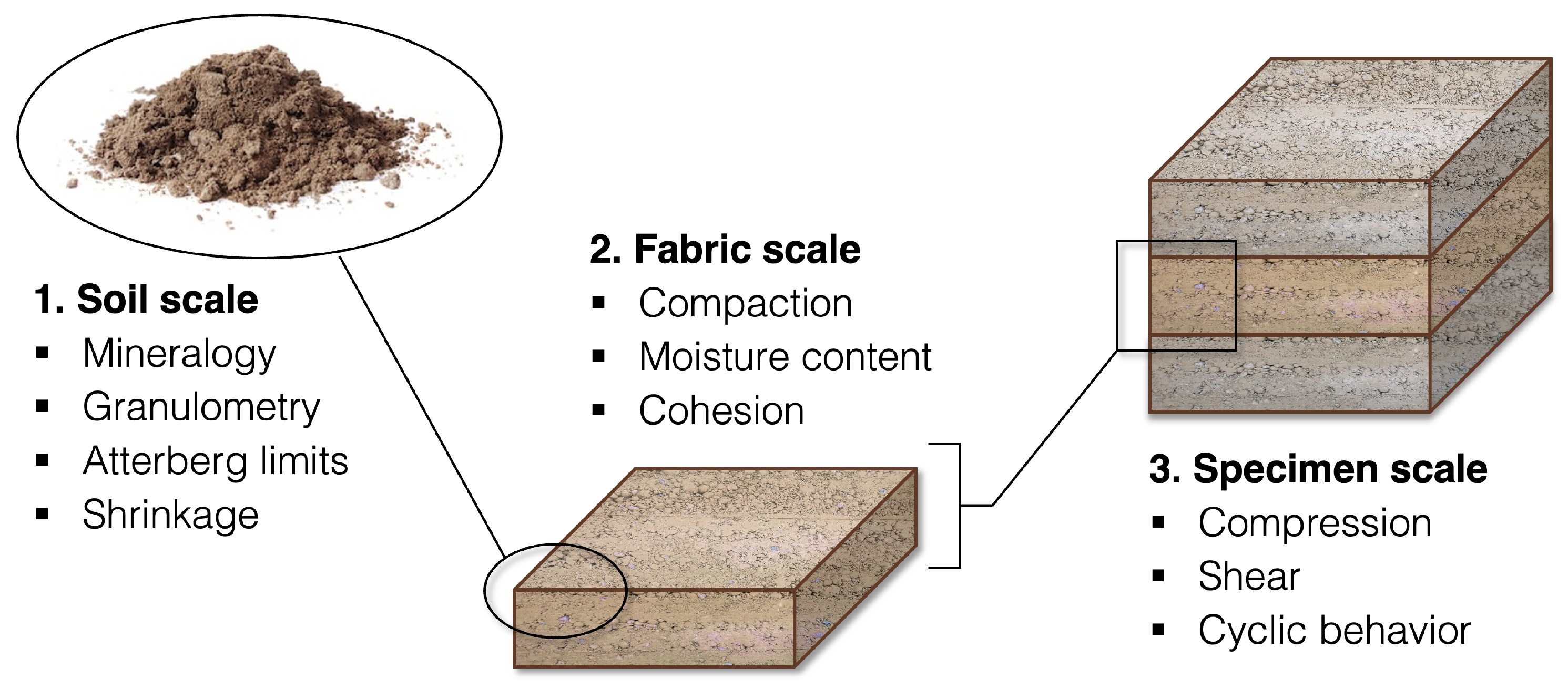
The experimental programme is structured around three hierarchical scales, as illustrated in
Figure 1, each providing a different level of characterization of the unstabilized rammed earth material. At the soil scale, the basic properties of the constituent material are established, including mineralogy, particle size distribution, and Atterberg limits. These properties govern the fundamental behavior of the material and serve as the basis for the subsequent scales of analysis.
At the fabric scale, the focus shifts to the compaction process. The compaction energy and the Proctor compaction curve are determined, yielding the optimum moisture content and maximum dry density of the material. These parameters depend strongly on the soil properties characterized at the previous scale and are known to be primary determinants of the mechanical behavior of rammed earth. Cohesion is also evaluated at this level as an additional fabric-dependent property.
At the specimen scale, the mechanical response of compacted URE samples is assessed through the evaluation of their compressive and shear behavior. Monotonic compression tests provide the compressive strength and stiffness of the material, while cyclic tests allow the characterization of its degradation behavior under repeated loading. Diagonal compression tests complement this picture by providing information on the shear and failure behavior of rammed earth.
This hierarchical structure allows the mechanical behavior observed at the specimen scale to be linked to the intrinsic material properties and the compaction-induced fabric characterized at the lower scales.
3. Soil Scale
The construction techniques traditionally used for building with earth depend primarily on the local soil composition, which is therefore a key factor in determining the appropriate processing method. The quality and quantity of sand and, above all, of clay—the fraction of soil that is chemically active in the presence of water and acts as the only binder when no additives are used—govern the material’s response. The various physical states of soil are determined by the water content in relation to the quantity and type of clay minerals present. In addition, dissolved salts and pH influence the behavior of soil in contact with water, both during processing and throughout the service life of the building.
This section presents the first step of the proposed framework, focused on the evaluation of the soil properties. Its mineralogical composition is evaluated, followed by an analysis of its granulometry and plasticity using a classical geotechnical approach. Geotechnics provides well-established, internationally recognized tools for defining the parameters that describe soil behavior, including reactivity to water, which is of fundamental importance for the study of construction processes such as extrusion and sprayed earth techniques.
3.1. Mineralogical Composition
Mineralogical composition is an important characterization parameter, as the same chemical compounds can behave differently depending on the mineral form in which they occur. The mineralogical composition of the soil was determined on the fraction passing through ASTM sieve No. 40, with an opening of 0.425 mm. The bulk composition was determined by X-ray diffraction, and clay mineral analysis was subsequently performed by interpreting the variations in lattice spacing associated with basal reflections following specific chemical treatments [
17]. The results are reported in
Table 1. Of particular note is the significant presence of illite (40% of the clay fraction), a non-expanding clay mineral that does not swell upon wetting, contributing to the dimensional stability of the material and limiting shrinkage cracking upon drying.
The acidity of the soil was assessed by means of a litmus paper test, yielding a pH value between 9 and 10.
3.2. Granulometry
In all successive analyses, coarse gravel and stones larger than 8 mm were first removed from the soil sample by sieving. This was necessary because the soil was intended for the fabrication of reduced-scale
pisé masonry specimens [
18,
19,
20].
The particle size distribution (PSD) was determined on the resulting material according to ISO 17892-4:2016 [
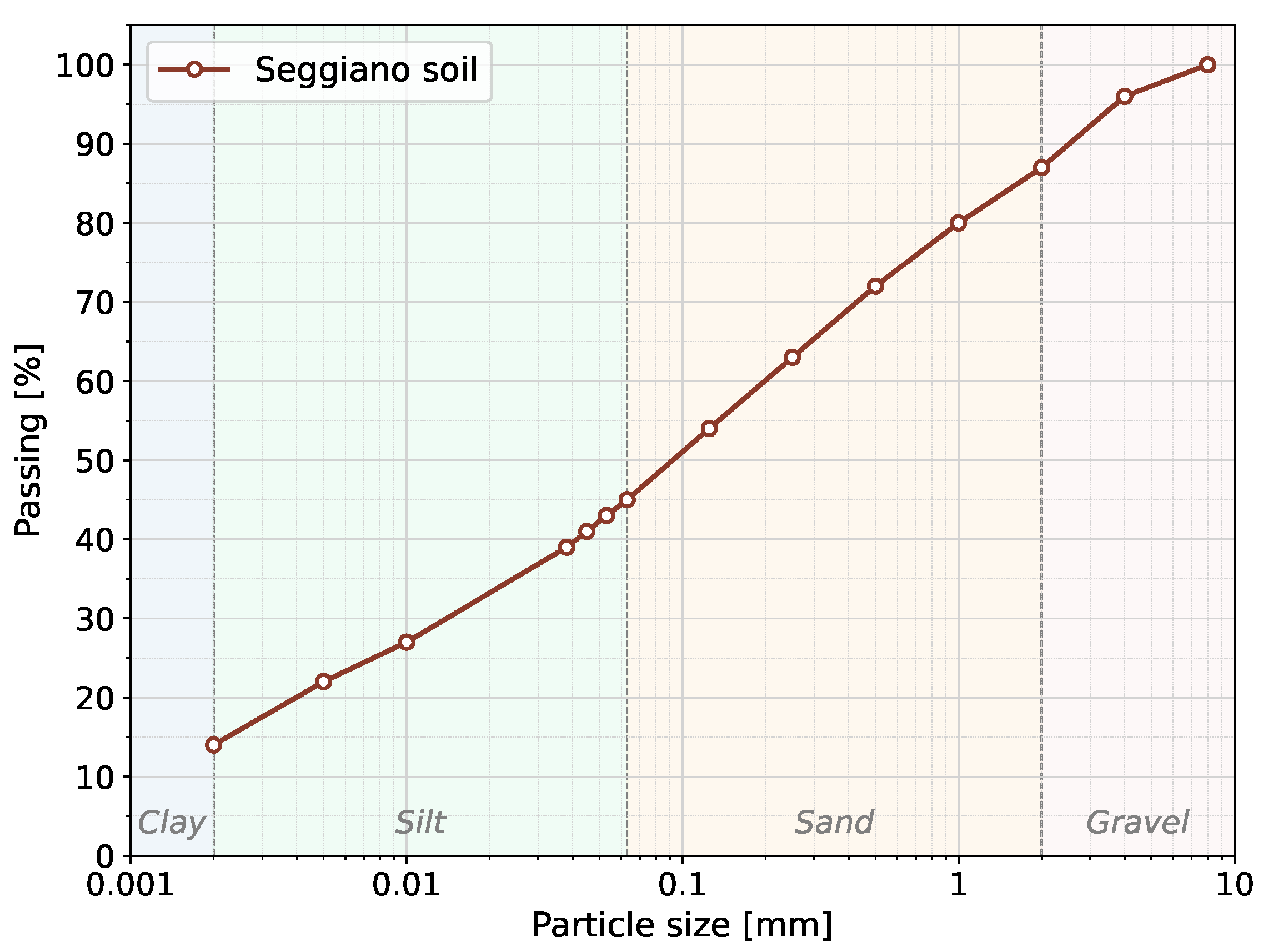
21], applied to dry soil. The resulting distribution, illustrated in
Figure 2, comprises 14% clay, 31% silt, 42% sand, and 13% gravel. This PSD is consistent with common recommendations for rammed earth construction, which typically require clay contents below 20%, sand fractions between 35% and 50%, and a fine-to-coarse grain ratio in the range 30:70 to 45:55 [
22]. According to the USDA soil textural triangle for fine earth texture classes [
23], the material classifies as sandy loam, while the European classification system ISO 14688-2 [
24] identifies it as a well-graded sand.
3.3. Atterberg Limits and Linear Shrinkage
The determination of the Atterberg limits is key to fully characterize the changes in behavior of fine-grained soils—or the fine-grained fraction of soils—with varying water content, having a significant influence on both compressive and shear behavior of the material. The liquid limit (
), plastic limit (
) and plasticity index (
) were determined according to ASTM D4318 [
25].
For the determination of the liquid limit, a soil sample of 400
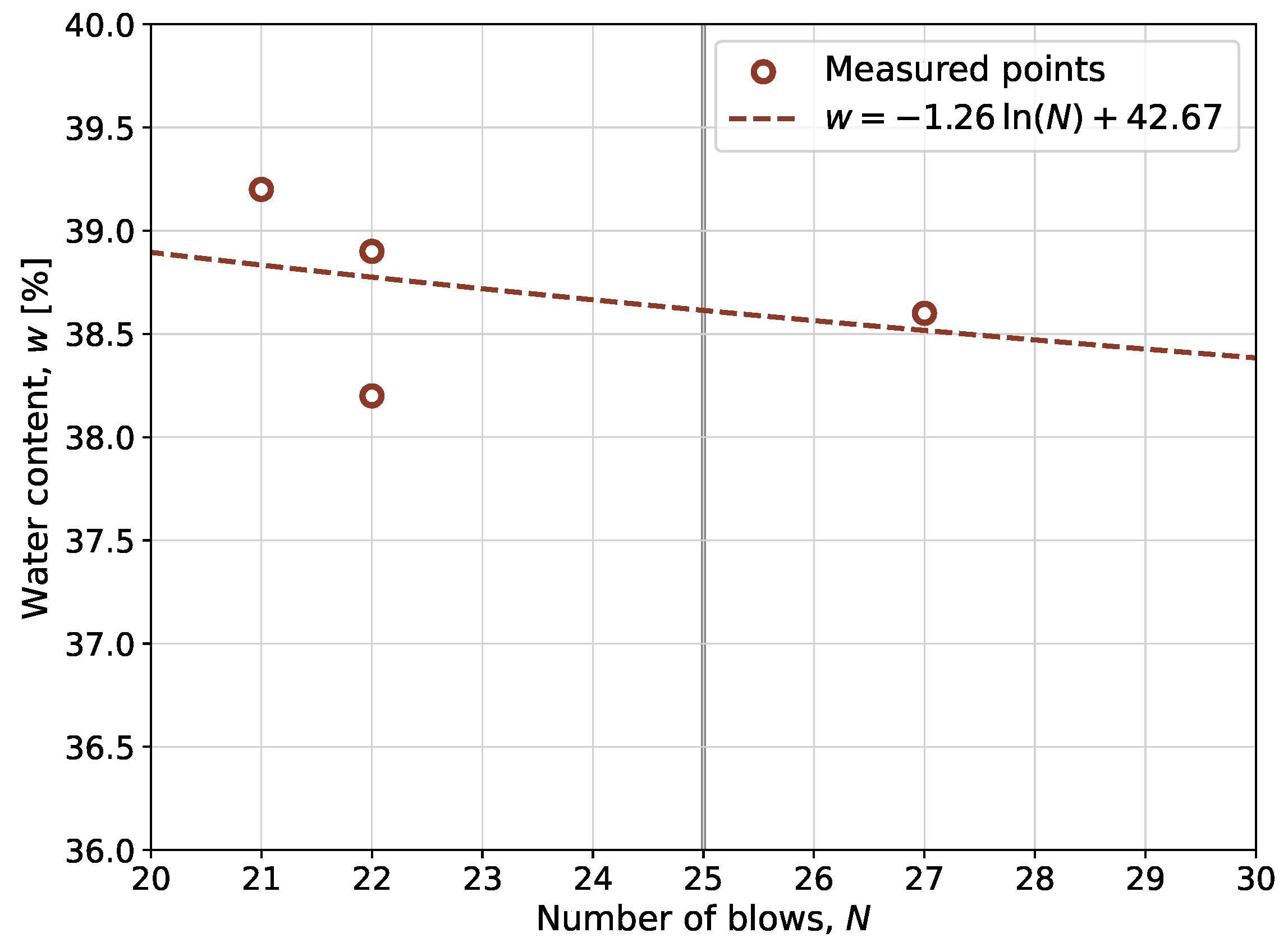
passing through ASTM sieve No. 40 (opening 0.425 mm) was prepared with a water content predictably slightly above the liquid limit, as judged by the operator. A portion of the material was placed in the Casagrande cup and a groove was cut along the center line; the device was then activated to produce standard blows until 13 mm of the groove had closed. The procedure was repeated slightly varying the moisture content of the soil sample. The number of blows and the corresponding water content are reported in
Figure 3, together with their fitting equation. The water content corresponding to 25 blows is taken as the liquid limit; for this soil,
.
The plastic limit was determined as the water content at which the soil could be rolled into cylinders of 3.2 mm diameter that begin to crack upon hand-rolling on a marble plate. A value of was obtained. The plasticity index was then calculated as . According to the USCS plasticity chart, this places the fine-grained fraction of the soil in class CL, corresponding to inorganic clays of low to medium plasticity.
Common recommendations for RE construction specify a liquid limit in the range of 25% to 50%, with a preferred interval of 30–35%, and a plastic limit in the range of 10% to 25%, with a preferred interval of 12–22% [
26]. The obtained values satisfy these recommendations and are close to the upper limit of the preferred ranges. The resulting plasticity index should remain within 10–20 [
27,
28], which is also the case for the soil under study (
). A moderate plasticity index of the soil, combined with the predominance of non-expanding clay minerals, results in a well-defined compaction curve with a clear optimum, a significant sensitivity of cohesion to moisture content, and acceptable compressive strength values within the typical range for URE. Soils with higher plasticity indices, indicating the presence of more active clay minerals, would be expected to exhibit greater shrinkage, higher sensitivity to moisture variations, and potentially higher cohesion, but lower compressive strength due to increased porosity upon drying [
26,
29].
Linear shrinkage was determined following the procedure indicated in BS 1377-2 [
30]. Soil samples of 70 g were prepared at a water content of 30%—approximately 10% above the liquid limit—and cast in greased aluminum molds 14 cm long. The specimens were dried first under ambient conditions and subsequently in an oven at progressively increasing temperatures up to 110 °C, so as to induce slow evaporation and avoid shrinkage cracking. The measured average linear shrinkage was 9.46%.
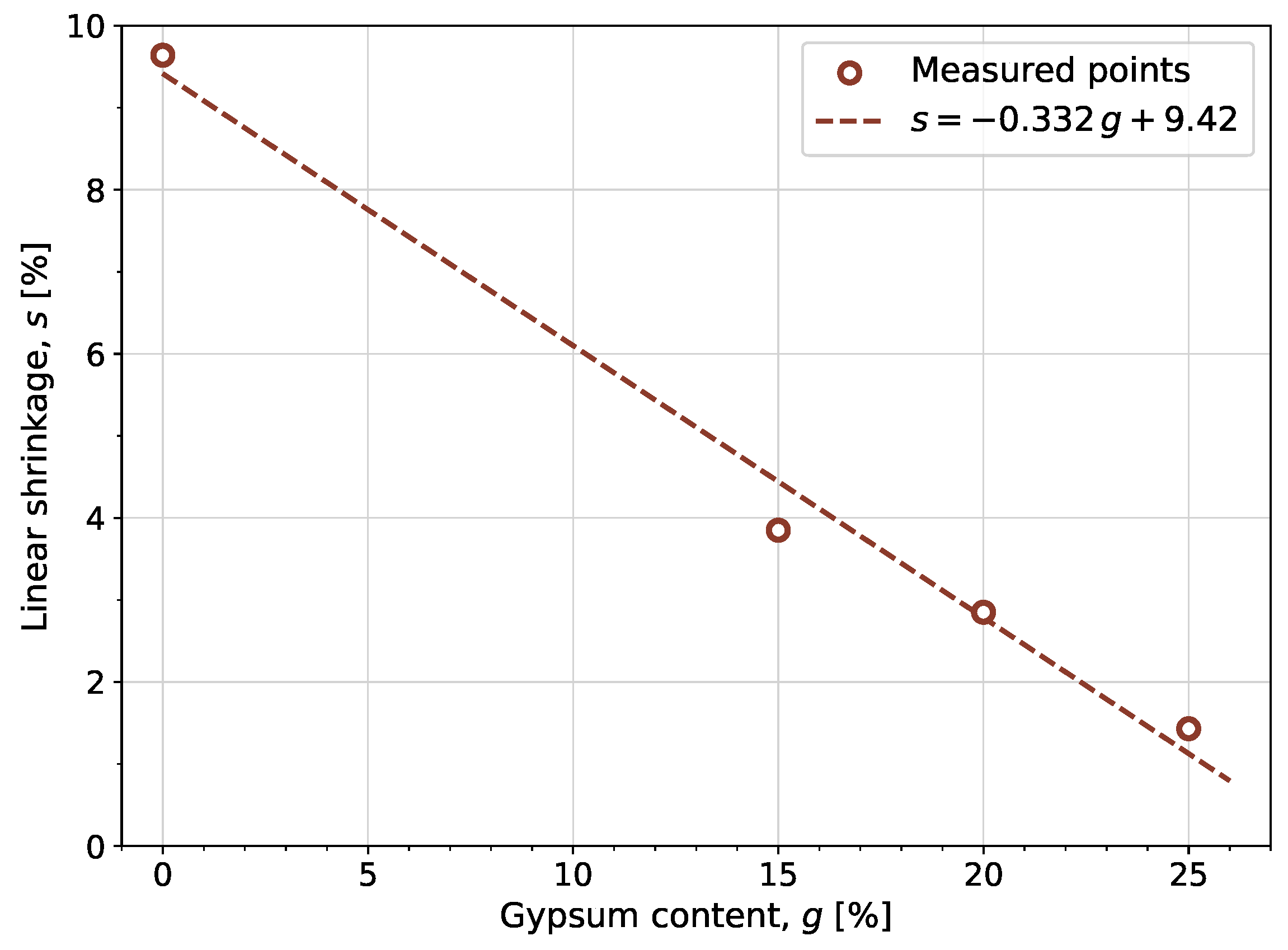
The shrinkage of the soil can be reduced by the addition of gypsum powder. Tests were carried out to quantify this effect, showing that gypsum addition produces a linear reduction in shrinkage with increasing gypsum content [
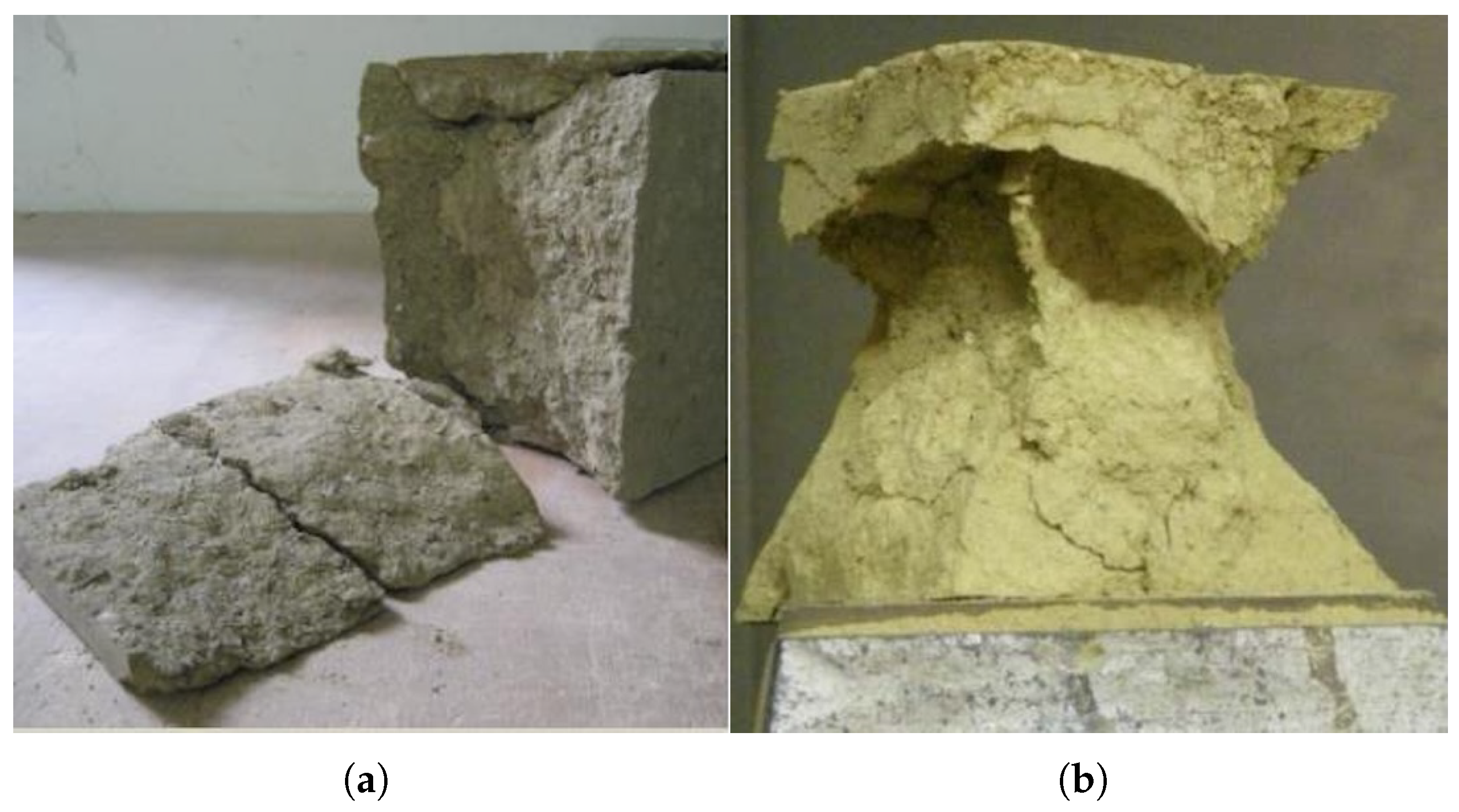
19], as illustrated in
Figure 4. Gypsum was also found to enhance the compressive behavior of the material [
31], and was accordingly used as an additive when the soil was employed as a matrix in a textile composite system for the strengthening of rammed earth structures [
20].
Additionally, the specific gravity of the soil was measured by means of a pycnometer according to ASTM D854-23 [
32]. A summary of the plasticity parameters and classification of the unstabilized soil is provided in
Table 2.
4. Fabric Scale
The mechanical behavior of rammed earth is not determined solely by the properties of the source soil, but also by the structure of the material that results from the compaction process. This structure or “fabric” of the RE encompasses the arrangement of soil particles, the density achieved, and the nature of the interfaces between compacted layers. Unlike soil-scale properties, which are intrinsic to the source material, fabric-scale properties depend on both the soil characteristics and the compaction conditions applied. In rammed earth construction, the fabric is primarily governed by two parameters: the moisture content of the soil at the time of compaction and the compaction energy delivered by the rammer. Together, these determine the dry density achieved and, consequently, the mechanical performance of the compacted material. This section characterizes the fabric of URE through two complementary approaches: the Proctor compaction test, which establishes the optimum compaction conditions, and cohesion tests, which quantify the tensile cohesion of the compacted soil as a fabric-dependent mechanical property.
4.1. Compaction
Control of the compaction process is fundamental to ensuring optimal mechanical performance in rammed earth construction. The degree of compaction achieved depends on two key factors: the compaction energy delivered to the soil—by means of a manual or pneumatic rammer—and the moisture content at the time of compaction. For a given compaction energy, there exists an optimum moisture content at which the soil reaches its maximum dry density; operating at this condition is essential to maximize the mechanical performance of the compacted material. A rigorous control of the compaction process of the samples is a key factor for reducing the dispersion of the experimental results and increasing their reliability.
In this study, the OMC and MDD of the Seggiano soil were determined by means of the standard Proctor compaction test, following the procedure described in ASTM D698 [
33] using a 152.4 mm-diameter mold (Method C). These two parameters are of practical relevance for rammed earth construction, as the compaction of earth layers on site aims to replicate the energy and moisture conditions of the Proctor test in order to achieve the maximum dry density and the associated mechanical performance.
Soil samples prepared at different water contents were compacted with 25 blows per layer over three layers, corresponding to a compaction energy of 592
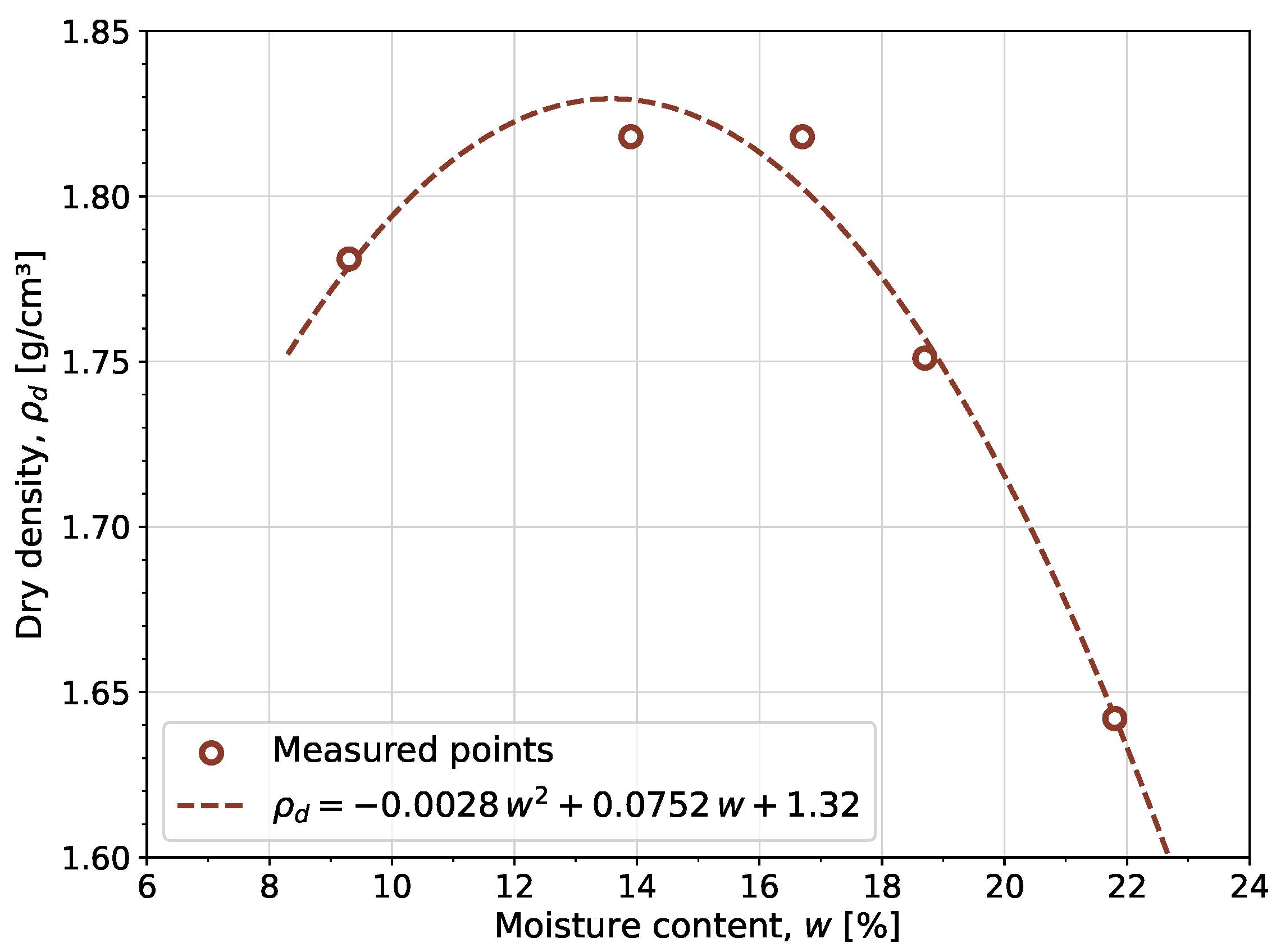
, using the standard ASTM Proctor rammer. The resulting dry density values are plotted against water content in
Figure 5 and fitted with a second-degree polynomial, which describes the compaction curve of the soil. The coordinates of the vertex of this parabola define the OMC and MDD; for the Seggiano soil, these were found to be 13.6% and 1.83
, respectively. These values are within the range typically reported for soil used in RE construction, with OMC commonly between 7% and 14% [
34].
4.2. Cohesion
Cohesion tests were carried out in accordance with the German standard DIN 18951 for earth building materials. Although this standard was withdrawn in 1971 and not replaced, it provides a comprehensive methodology for evaluating soil cohesion, rooted in the long German tradition of standards for earthen construction materials [
35], and is also described in the
Lehmbau Regeln (German Rules for Earthen Construction) [
36]. The assessment of cohesion through the application of a direct tensile load to eight-shaped specimens, as specified in DIN 18951, remains common practice in soil characterization [
37,
38], and the eight-shaped specimen geometry enables a more reliable determination of tensile strength by minimizing stress concentrations at the boundaries [
39]. The continued use of this methodology in the present study is justified by the absence of an equivalent standardized procedure for earthen construction materials and by the direct physical interpretation of the test result, which provides a measurement of tensile cohesion.
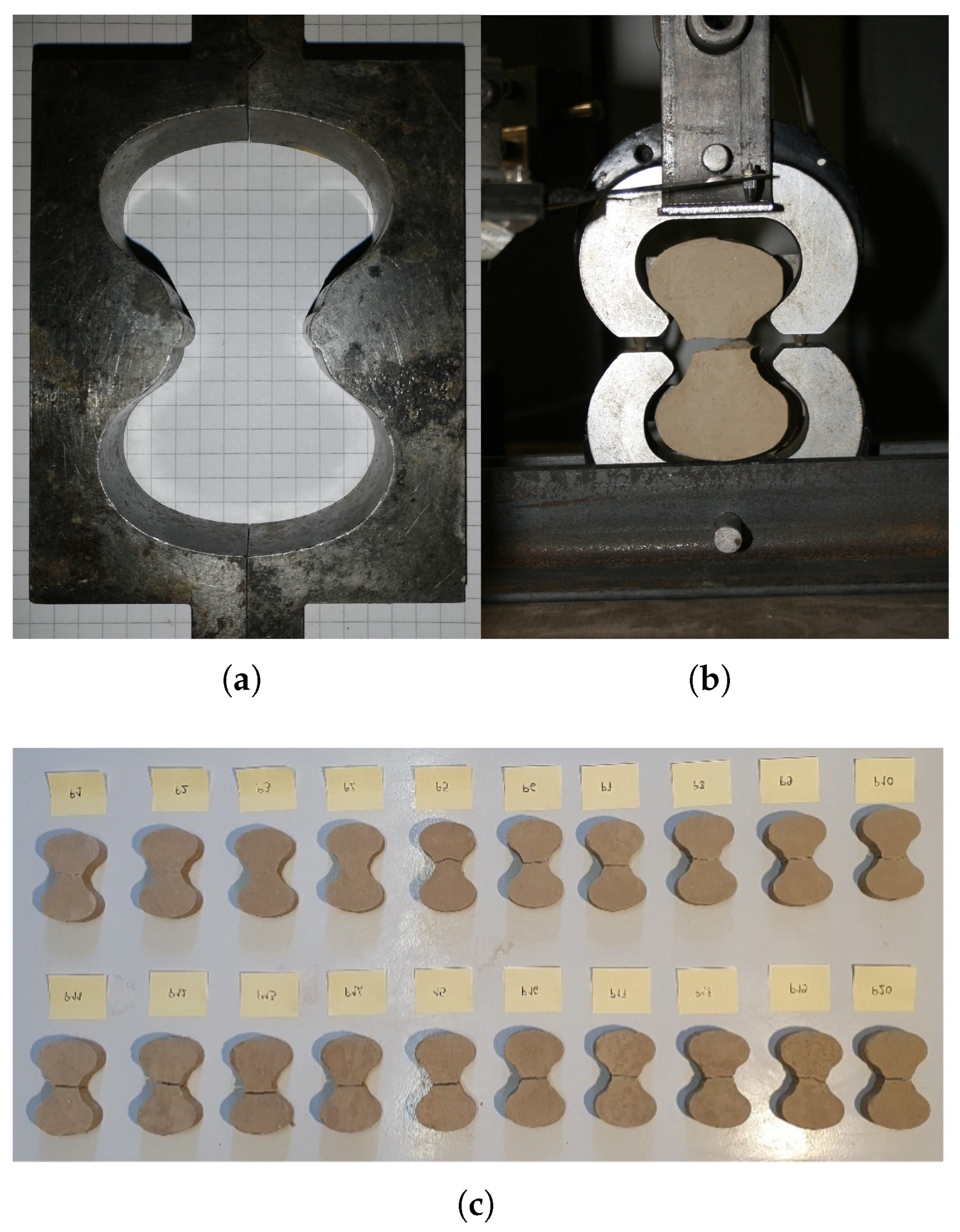
Cohesion was therefore evaluated using eight-shaped specimens prepared from the fraction of soil passing through ASTM sieve No. 40 (0.425 mm), formed in a dedicated mold (
Figure 6a). Two series of specimens were prepared: ten specimens were formed with soil at a water content close to the plastic limit (approximately 20%), and eleven specimens were formed at a water content of 11%, 2.6% below the OMC of the soil. This moisture content is consistent with the manufacturing moisture content recommendations of [
28] and matches the moisture content used for the fabrication of the RE specimens in [
20]. The selected water content also provided improved compaction consistency in the small specimens, whose compaction procedure necessarily differed from that used in the Proctor test. However, according to the compaction curve shown in
Figure 5, reducing the moisture content from the OMC to 11% results in a decrease in dry density of less than 1%.
The experimental setup and the eight-shaped specimens after testing are shown in
Figure 6b,c.
A tensile load was applied at a rate of 20
on a nominal cross-sectional area of 500 mm
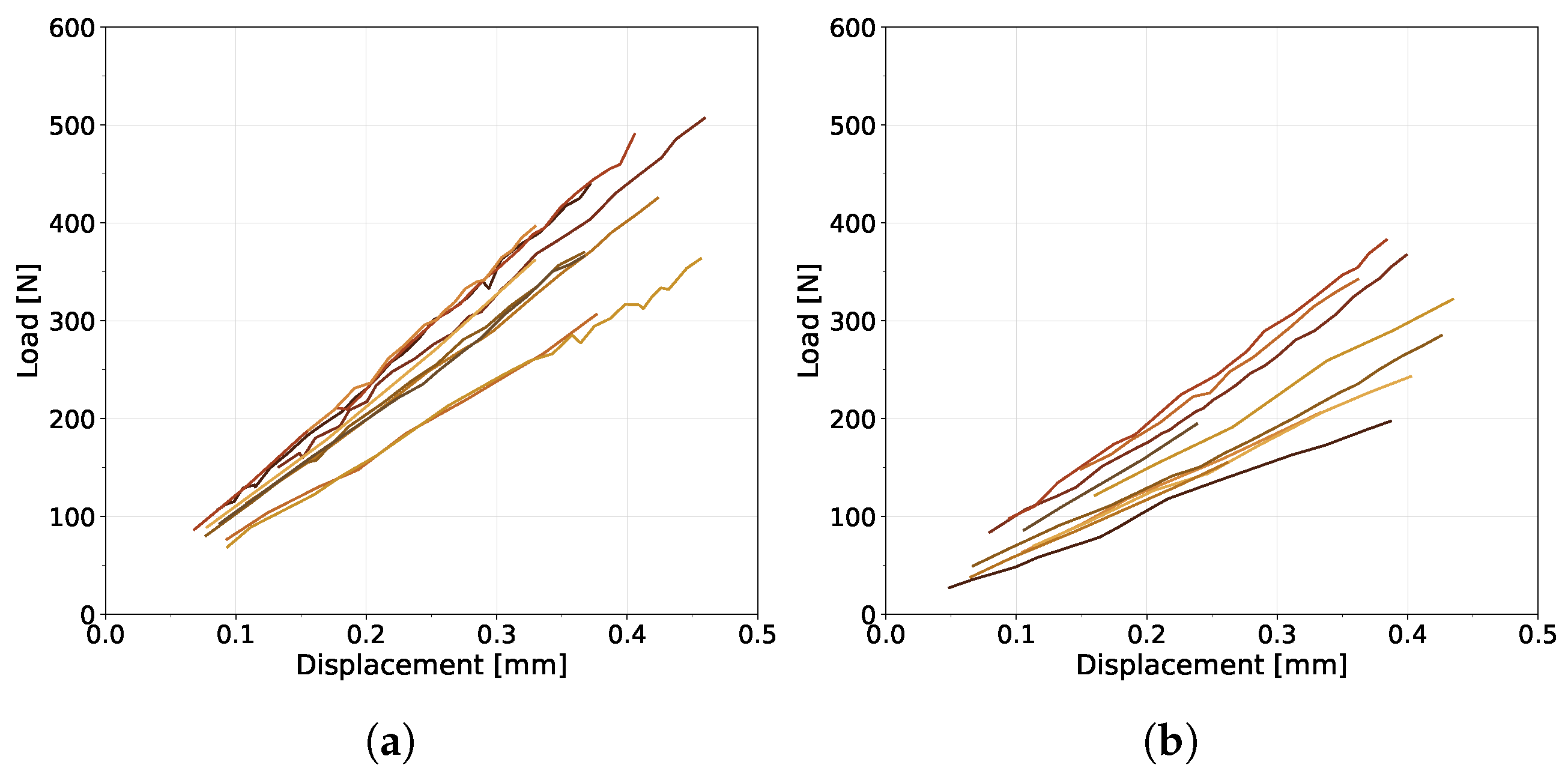
2. The results are shown in
Figure 7 and summarized in
Table 3; stresses were calculated with reference to the effective cross-sectional area of each specimen after shrinkage.
A significant improvement in cohesion performance was observed with increasing water content. Peak stress and stiffness were approximately 61% and 40% higher, respectively, for specimens prepared at 20% moisture content (close to the plastic limit) compared to those prepared at 2% below the OMC.
5. Specimen Scale
5.1. Overview and Background
At the specimen scale, the focus shifts from the properties of the source material and its compaction-induced fabric to the mechanical response of compacted rammed earth elements under applied loads. This is the scale at which structural design parameters are typically derived, and where the influence of soil composition and manufacturing conditions ultimately manifests in the form of measurable mechanical properties. Despite its central importance, the characterization of URE at this scale remains challenging, due to the large scatter of results reported in the literature and the absence of standardized testing and specimen production procedures.
Compressive strength is the primary parameter used to characterize the mechanical behavior of rammed earth, consistent with the approach adopted for brittle materials with low cohesion [
22]. Although there is significant dispersion in reported values, the compressive strength of rammed earth generally falls in the range 0.3 MPa to 7.0 MPa [
5]. This wide scatter is not only due to the inherent heterogeneity of the material and factors such as workmanship and weathering, but also to the lack of standardized testing procedures [
40]. New Zealand Standard NZS 4298 [
41] recommends a minimum of five specimens for compressive strength testing and prescribes an aspect ratio correction factor of 0.7 for cuboid samples, with a minimum uniaxial compressive strength (UCS) of 1.3 MPa for rammed earth to be used as a construction material. The compressive strength of rammed earth depends on many factors, including granulometry, clay content, moisture content, compaction energy, and the presence of fibers or stabilizers, all of which also influence density and porosity. Among these, Vargas-Neumann [
34] identified clay content, water content, and compaction energy as the dominant influences on mechanical behavior. The moisture content at manufacturing plays a particularly critical role: insufficient water increases inter-particle friction and limits the achievable compaction, while excess water occupies the pore space, reducing compaction and increasing porosity once the material dries. The water content at manufacturing is generally between 9% to 13% of the dry soil weight, with values close to the OMC being sought [
28,
41].
Regarding stiffness, the elastic modulus (
E) of rammed earth specimens shows an even larger scatter than compressive strength. According to several studies [
22,
40], values reported in the literature for specimens produced with the rammed earth technique range from 60 MPa to 1000 MPa. This dispersion is partly attributable to the heterogeneity of the material, but also to differences in testing procedures, particularly in the determination of Young’s modulus on small specimens. For this reason, many studies prefer to report the failure modulus—defined as the ratio between the peak stress and the corresponding strain [
42]—as a more reproducible characteristic parameter.
The heterogeneity of rammed earth and the challenge of producing representative specimens at laboratory scale are further discussed in [
13,
43]. Most experimental investigations have been conducted on small specimens: cubic samples with sides between 8 cm to 15 cm, or cylinders of 20 cm height and 10 cm diameter [
44,
45,
46]. The scale effect must be taken into account when interpreting results from small specimens, as differences with respect to full-scale structural elements can be significant; shape effects have also been reported in rammed earth testing [
13]. Despite these limitations, laboratory tests on small samples remain indispensable for understanding mechanical behavior, provided that the specimen production process reflects the on-site construction technique as closely as possible.
Other mechanical parameters, such as tensile and shear strength, have received comparatively less attention, despite playing a key role in the failure mechanisms of rammed earth [
47]. Tensile strength (
) values are typically around 10% of the compressive strength [
22]. For the shear strength (
), NZS 4297 [
48] suggests a value of 0.035 MPa, while Australian guidelines recommend neglecting it [
49]; however, more recent research indicates that accurate measurement of shear strength is relevant, with reported values between 0.15 MPa to 0.85 MPa, although the number of available studies remains limited. Shear strength has been shown to be highly dependent on moisture content [
50]. The tensile fracture energy (
) is also critical for defining the failure of RE structures, yet few studies are available on this parameter, with reported values ranging from 2
to 20
[
22]. Miccoli et al. [
51] proposed estimating
as
, while more recent work [
52] indicates that fracture energy is directly dependent on the clay content of the soil in unstabilized rammed earth.
With regard to anisotropy, almost all studies on the compressive strength of rammed earth have applied the load perpendicularly to the direction of the compacted layers, which is the dominant loading direction in real walls. However, the few studies that have tested specimens in the direction parallel to the layers [
42] conclude that layer interfaces do not significantly affect compressive strength, even though the layered structure does influence stiffness and crack patterns.
Against this background, the experimental work presented in this section addresses two of the main challenges identified in the literature: the variability of results due to non-standardized manufacturing procedures, and the limited understanding of the anisotropic behavior of rammed earth. To this end, a comprehensive experimental programme is presented, covering the compressive response of URE under both monotonic and cyclic loading in two orthogonal directions, as well as its shear behavior. Compressive behavior is investigated through monotonic and cyclic uniaxial compression tests (UCT) on cubic specimens in both loading directions, complemented by compression tests on cylindrical specimens manufactured using a Proctor-based compaction procedure, with the explicit aim of improving result reproducibility. Shear behavior is assessed through diagonal compression tests (DCT) on prismatic panels manufactured under the same controlled compaction conditions.
5.2. Compressive Behavior and Anisotropy
5.2.1. Monotonic Compression Tests
The compressive behavior and anisotropy of the rammed earth material were investigated by performing monotonic uniaxial compression tests in two directions—parallel and perpendicular to the compacted layers—on cubic samples.
Cubic specimens (8 cm × 8 cm × 8 cm) were prepared by manually compacting layers of approximately 1 cm thickness within a wooden framework at a moisture content of 11%, i.e., 2.6% below the OMC of the soil. As detailed in
Section 4.2, this moisture content was selected to optimize the compaction process for the specimens and is consistent with the recommendations of [
28]. Due to the small dimensions of the specimens, the soil was previously sieved through a 4 mm sieve. All tests were performed under quasi-static displacement-controlled conditions, following the procedure described in EN 1926:2006 [
53]. Six specimens were tested in each direction.
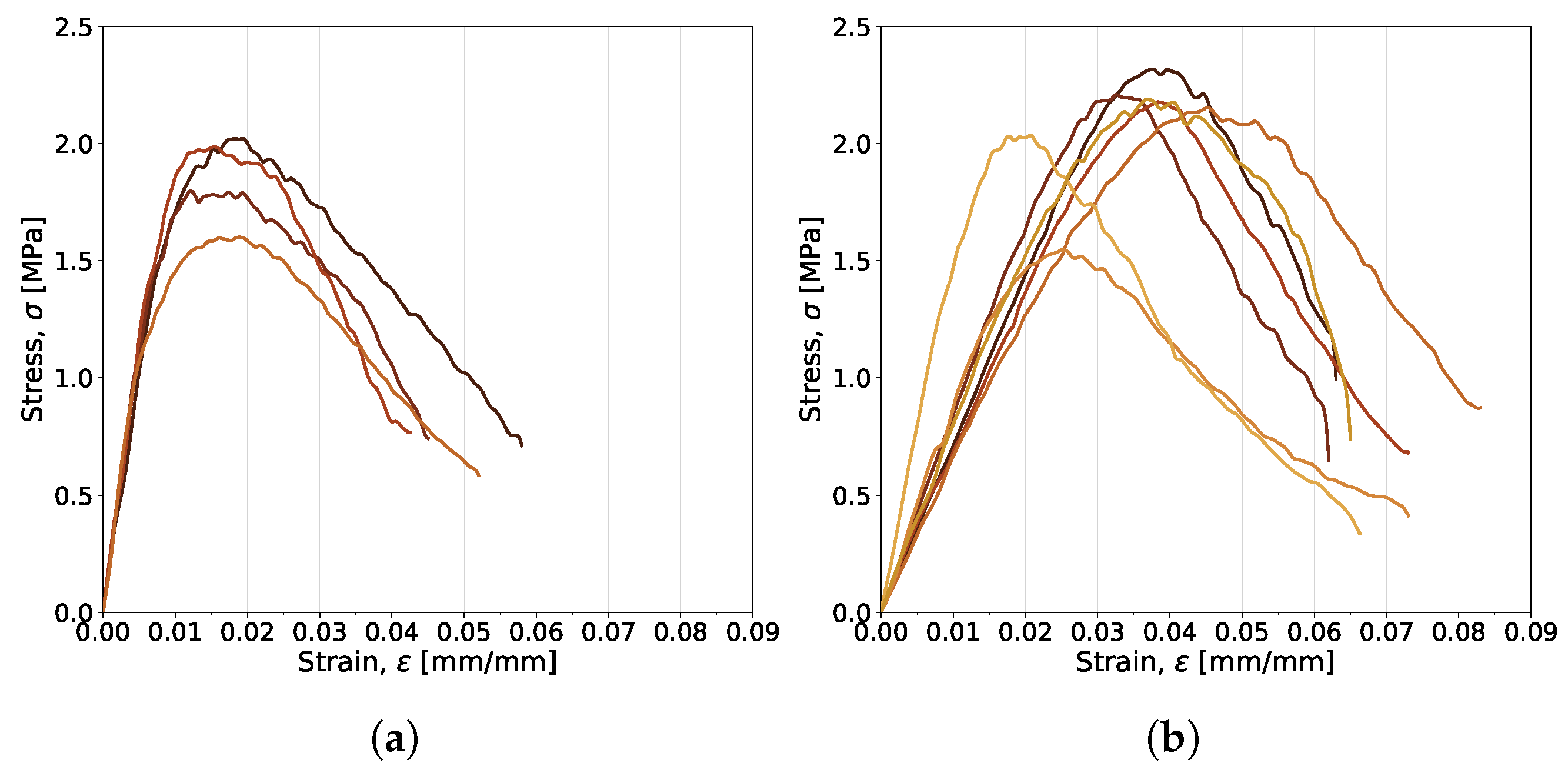
From each test, the following mechanical parameters were extracted: the compressive strength , defined as the peak stress reached during the UCT; the conventional elastic modulus E, determined in the linear branch of the load–displacement curve and calculated from the relative displacement of the loading plates divided by the specimen height, under the assumption of uniform deformation; the kinematic ductility , evaluated as the ratio between the maximum load and the slope of the first linear branch; and the available kinematic ductility , defined as the ratio between the displacement at two thirds of the peak load and the displacement at peak load.
It should be noted that the dimensions and characteristics of the specimens did not permit the effective use of displacement transducers for the direct determination of the material’s elastic modulus. Consequently, a conventional elastic modulus was estimated from the relative displacement of the loading plates divided by the specimen height, assuming uniform deformation throughout the specimen. Although the resulting values may be affected by boundary effects, the adopted procedure was applied consistently to all specimens and therefore provides a meaningful basis for comparing the elastic response of the material in the directions parallel and perpendicular to the layers.
The results are summarized in
Table 4 and stress–strain curves are shown in
Figure 8. The compressive strength in the perpendicular direction is approximately 12.2% higher than in the parallel direction, leading to an anisotropy coefficient of 1.1. This modest difference is consistent with the near-isotropic compressive behavior considered by several studies for URE materials [
43,
47,
54].
In contrast, when the elastic modulus is analyzed, a marked anisotropy is observed. An anisotropy coefficient of 2.6 was obtained, with a mean E value for loading parallel to the layers approximately 61% higher than that measured perpendicularly. This indicates that the layered structure has a much stronger influence on stiffness than on strength, and that the intrinsic anisotropy of the RE material cannot be neglected without a careful evaluation of its implication in the overall structural response.
To evaluate the statistical significance of the differences and similarities in results between parallel and perpendicular loading directions, one-way analysis of variance (ANOVA) tests were performed for each parameter. The ANOVA test yields a
p-value, when
p falls below the significance level
[
55], the null hypothesis of equal means is rejected and the difference between groups is considered statistically significant. As shown in
Table 4, the
p-values for the elastic modulus and available kinematic ductility are well below 0.05, confirming that the observed anisotropy in stiffness and ductility is statistically significant. In contrast, the
p-value for
exceeds 0.05, indicating that the difference between loading directions is not statistically significant and confirming the near-isotropic behavior of the material in terms of compressive strength.
Differences in crack patterns between the two loading directions were observed, even at this small specimen scale, as illustrated in
Figure 9. While specimens loaded parallel to the layers showed vertical splitting failure following the layer interfaces, specimens tested perpendicularly exhibited a semi-explosive failure mode, analogous to that typically observed in UCT of concrete specimens.
It should be noted that significant dispersion was found in the elastic modulus results. Although scatter is common in rammed earth materials—as previously discussed—these values should be interpreted with caution. A methodology aimed at reducing this dispersion was subsequently developed and is described in
Section 5.2.3. The variability in compressive strength was, by contrast, quite limited, with a coefficient of variation (CV) below 10.2% in both directions. Both
E and
fall within the ranges typically reported for unstabilized rammed earth in the literature.
5.2.2. Cyclic Compression Tests
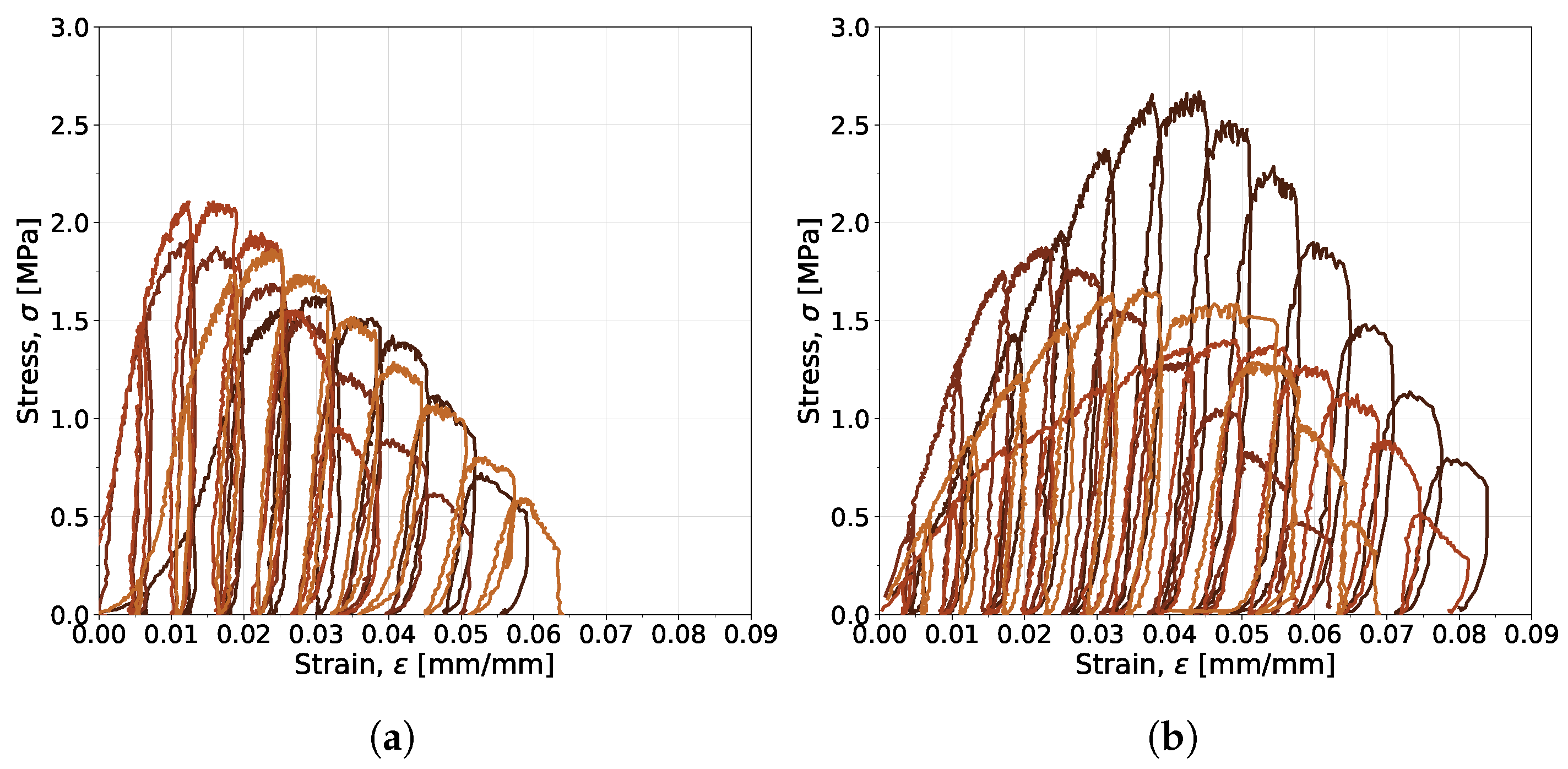
Cyclic loading–unloading compression tests were carried out on cubic specimens to investigate the non-elastic behavior of the rammed earth material and to assess the influence of loading direction on stiffness degradation. The specimens—four for each loading direction—were prepared following the same procedure and at the same moisture content used for the monotonic compression tests described in the previous section. Load history was defined so that at each cycle i the maximum cycle displacement, , was equal to . The loading rate was set at 0.5 mm/min.
The results are summarized in
Table 5 and representative stress–strain curves are shown in
Figure 10. The peak stress obtained from the cyclic tests is virtually identical in both directions—1.88 MPa parallel and 1.90 MPa perpendicular to the layers, with an anisotropy ratio almost equal to one—consistent with the near-isotropic compressive strength observed in the monotonic tests. In contrast, the stiffness (
K) calculated on the envelope curve of the cyclic tests shows a pronounced anisotropy: the value obtained for loading perpendicular to the layers (6.7
) is approximately 58% lower than that for the parallel direction, in agreement with the trend observed in the monotonic tests, where the elastic modulus in the perpendicular direction was similarly 61% lower than in the parallel direction. The cycle stiffness measured over the first loading cycles is considerably higher than the envelope stiffness in both directions, an effect attributed to the progressive compaction of the material under repeated loading; as expected, it decreases with increasing number of cycles as a result of accumulated damage.
The statistical significance of the observed differences was evaluated using the same ANOVA procedure described for the monotonic tests. The p-values obtained confirm that the anisotropy in stiffness is statistically significant, while the difference in compressive strength between the two loading directions is not, consistent with the near-isotropic behavior in terms of observed in the monotonic tests.
Taken together, the monotonic and cyclic compression tests confirm that the compressive strength of this rammed earth material is essentially isotropic, while stiffness and failure modes exhibit a clear dependence on loading direction relative to the compacted layers. This distinction has practical implications for the use of laboratory-derived mechanical properties in structural design, where the loading direction and the associated stiffness must be carefully considered.
5.2.3. Compression Tests with Controlled Compaction
Considering the significant dispersion found both in the literature [
22] and in the results of the previous subsections for the compressive strength and stiffness of rammed earth, a manufacturing procedure based on the Proctor compaction test [
33] was proposed. The aim of this methodology is to minimize the dispersion in experimental mechanical properties arising from manufacturing variability, by controlling the compaction energy and the achieved density through a well-established and widely used soil compaction technique.
Four cylindrical specimens were manufactured using a Proctor mold (10.1 cm diameter, 11.5 cm height). The soil was mixed with water to reach its OMC (13.6%), then poured into the mold and compacted in three uniform layers by dropping a standard Proctor rammer of 2.50 from a height of 30.5 cm 25 times per layer, leading to a compactive effort of 600 . This standardized procedure improves the control and replicability of the manufacturing process, increasing homogeneity between specimens. It should be noted, however, that the height-to-diameter ratio of these specimens is lower than the slenderness ratio of 2.0 typically used for cylindrical concrete specimens, which may introduce some variation when comparing results with those of other studies in the literature and with those obtained on the cubic specimens described in the previous subsections.
The specimens were cured for 28 days under controlled conditions of 25 °C and 60% relative humidity, and then subjected to uniaxial compression tests according to ASTM D1633 [
56]. The load was applied uniformly on the top face of the specimen, perpendicularly to the earth layers, using a displacement-controlled testing machine at a loading speed of 1.3
.
The average uniaxial compressive strength obtained was 1.40 MPa, within the typical range for URE, as previously described. This value is lower, however, than that obtained for the cubic specimens, as expected given the differences in water content, compaction energy and specimen geometry. Shape and size effects are known to have a significant influence on UCT results in rammed earth, although consensus on the corresponding correction factors has yet to be established [
14,
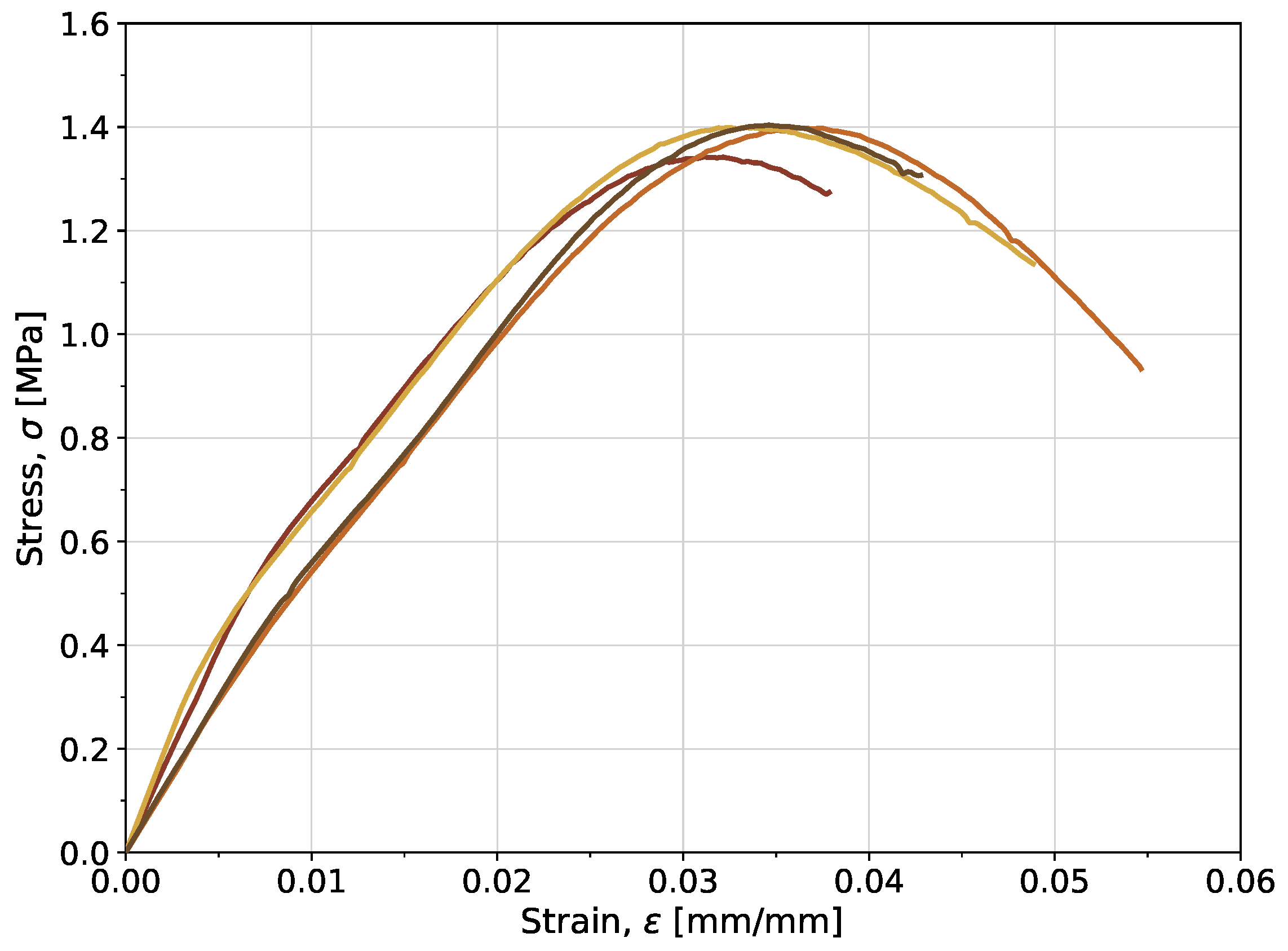
57]. Crucially, however, the dispersion of the compressive strength results was drastically reduced: the coefficient of variation was only 1.8%, compared with 11.8% for the monotonic perpendicular tests on cubic specimens.
A similar trend was observed for the elastic modulus. The initial elastic modulus—determined as the slope of the initial linear branch of the stress–strain curve—was 73 MPa, with a CV of 23.5%, lower than the 37.1% obtained for the cubic specimens but still relatively high. This is likely attributable to an approximately bilinear loading response observed in the cylindrical specimens, in which an initial stiffer branch is followed by a more compliant linear branch, probably due to particle repositioning at the onset of loading. To address this, the stiffness modulus was also evaluated over the central linear portion of the curve, between 35% and 75% of the peak stress, as recommended for RE in previous studies [
58,
59]. This yielded a value of 46 MPa with a CV of just 2.3%, demonstrating a very high consistency in the elastic behavior across specimens. It should be noted that the initial elastic modulus (73 MPa) is the value directly comparable to those reported for the cubic specimens, as it is calculated following the same procedure; the stiffness modulus evaluated over the central linear portion (46 MPa) provides a more stable estimate of the intrinsic elastic stiffness of the material, but should be interpreted with this methodological distinction in mind when comparing across specimen types.
These results confirm the effectiveness of the Proctor-based manufacturing methodology in reducing result dispersion in UCT of rammed earth specimens. Not only are the compressive strength and stiffness values considerably more homogeneous, but the entire stress–strain curves show remarkable consistency, as illustrated in
Figure 11.
Across the three experimental campaigns presented in this subsection, the compressive strength of the Seggiano rammed earth consistently falls within the range 1.4 MPa to 2.1 MPa, in agreement with values typically reported for unstabilized rammed earth in the literature. The results confirm that RE compressive strength is essentially isotropic with respect to the direction of loading relative to the compacted layers, with differences below 12% in all cases. Stiffness, on the other hand, exhibits a pronounced anisotropy: specimens loaded parallel to the layers show elastic modulus and envelope stiffness values approximately 60% higher than those loaded perpendicularly, a trend consistently observed in both the monotonic and cyclic tests. Failure modes are also direction-dependent, with vertical splitting along layer interfaces for parallel loading and a more explosive failure for perpendicular loading.
The results also highlight the critical role of manufacturing procedure on the dispersion of mechanical properties. The cubic specimens, compacted manually at 11% moisture content, showed coefficients of variation up to 36% for the elastic modulus. The adoption of the Proctor-based manufacturing procedure for the cylindrical specimens, with controlled compaction energy and moisture content at the OMC, reduced this dispersion dramatically, yielding CV values of 1.8% and 2.3% for compressive strength and stiffness, respectively. This result strongly supports the use of standardized compaction procedures for the production of rammed earth specimens intended for mechanical characterization.
5.3. Shear Behavior
Although rammed earth structural elements are primarily intended to work under compression, several authors have highlighted that tensile and shear properties play a particularly relevant role in RE failure, especially under extreme loading conditions such as seismic actions [
22,
47]. In this regard, three prismatic RE specimens were manufactured and subjected to diagonal compression tests to evaluate their shear behavior, crack propagation under shear loading and failure mechanisms.
In the absence of specific DCT standards for rammed earth, the procedure described in ASTM E519 [
60] was followed. The tests were carried out on 50 cm × 50 cm × 10 cm prismatic specimens, a scaled version of those defined in the standard, in accordance with the recommendations of previous studies on diagonal shear testing of rammed earth [
40,
61]. The soil was mixed with water to reach its OMC, then poured into a wooden formwork and compacted in six layers of 8.33 cm thickness using a modified Proctor rammer (4.54
) dropped 123 times per layer from a height of 45.7 cm, achieving the same compactive effort per unit volume as in the standard Proctor test. The specimens were carefully removed from the formwork and cured for 28 days under controlled ambient conditions of 25 °C and 60% relative humidity.
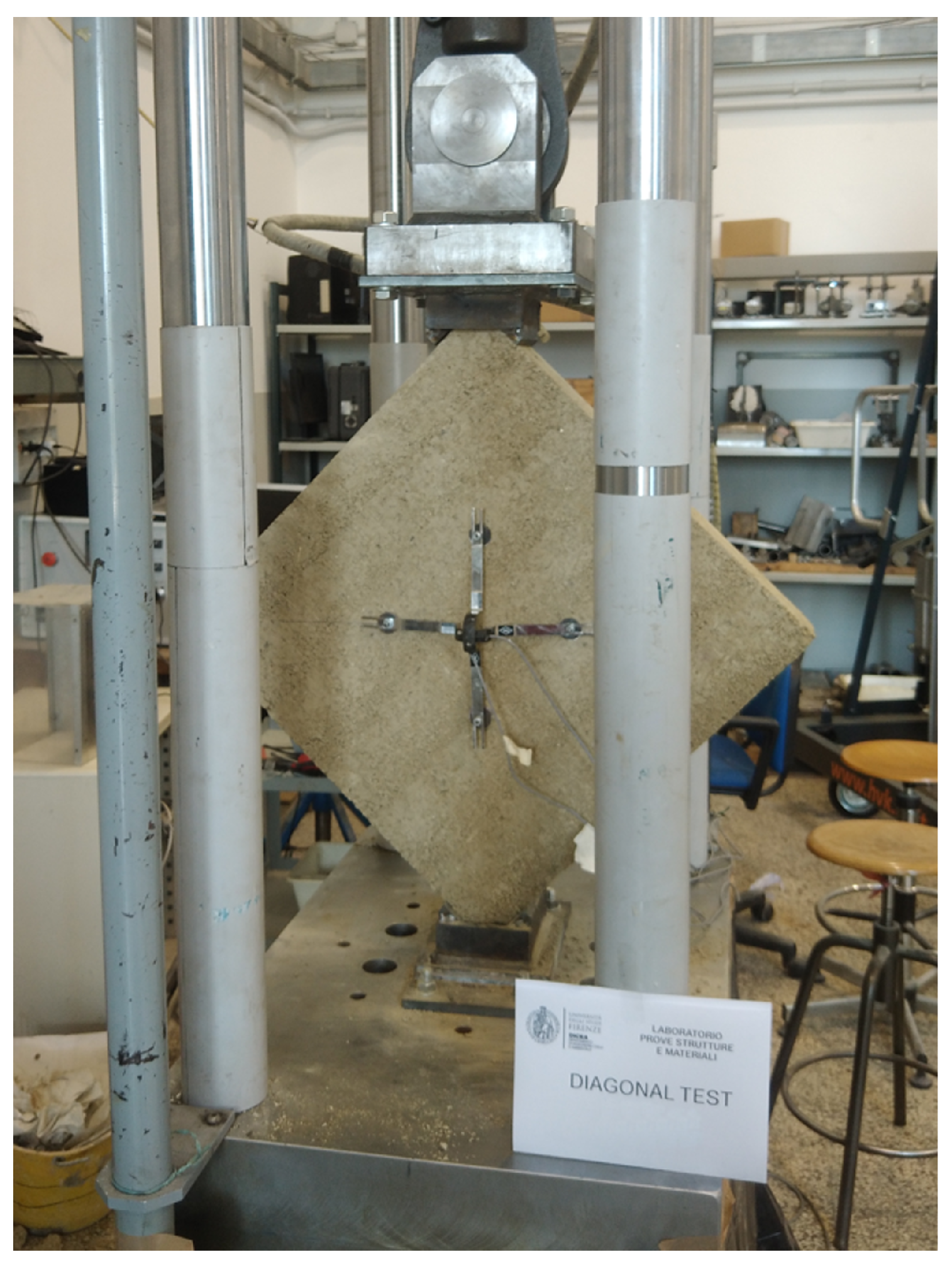
The DCT was performed by applying a monotonic displacement of 1.2
through a steel loading shoe placed at the top corner of the specimen. Displacements along both main diagonals were measured using displacement transducers with a gauge length of 150 mm, placed on both faces of the specimen. The test setup is shown in
Figure 12.
The shear stress (
[MPa]) and shear strain (
[mm/mm]) were calculated following the formulation prescribed in ASTM E519:
where
P [N] is the applied load,
[mm
2] is the net cross-sectional area of the specimen,
and
are the displacements along the two diagonals measured at the center of the specimen, and
g is the gauge length.
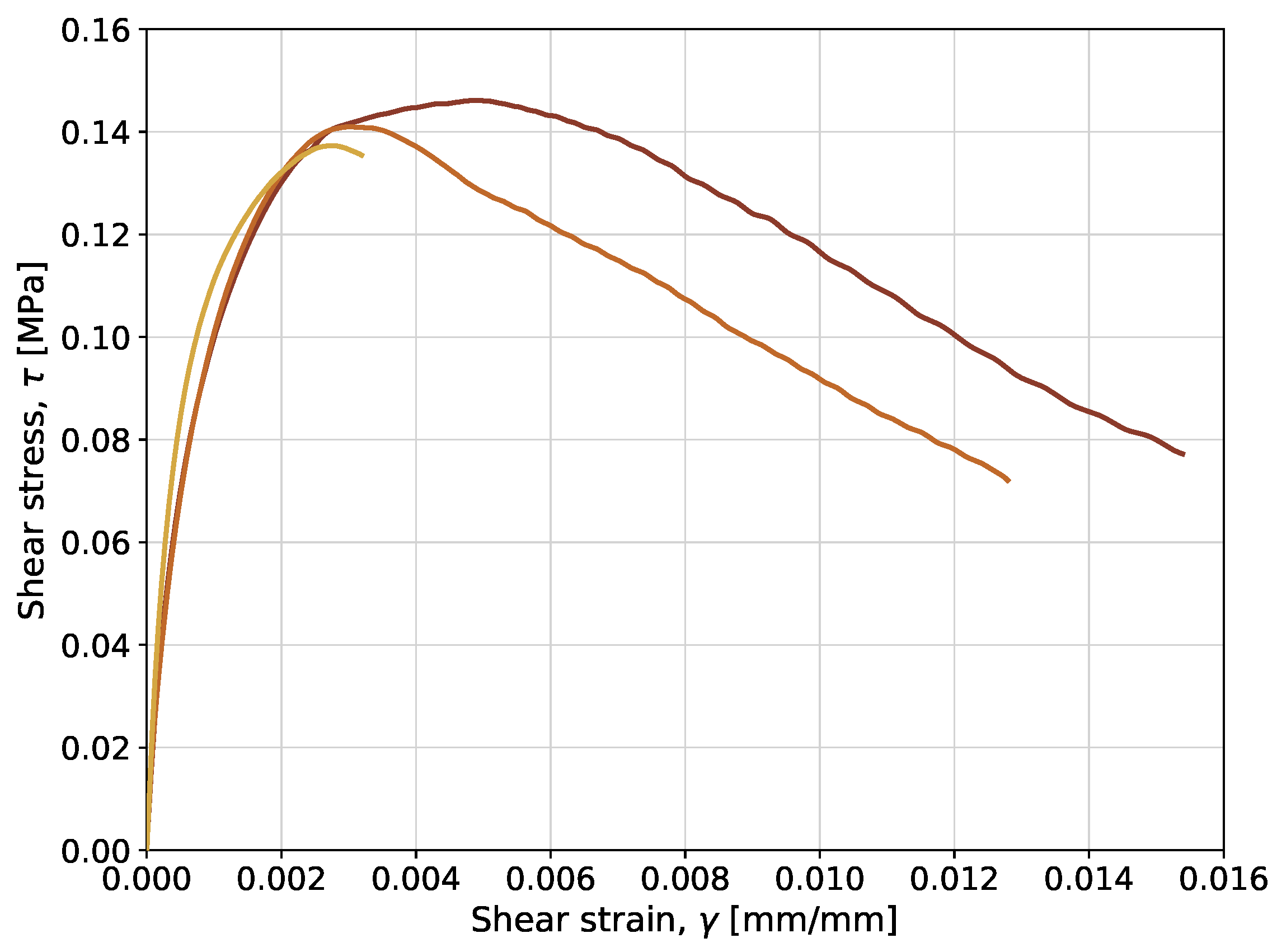
The resulting shear stress–strain curves are shown in
Figure 13. A very consistent pre-peak response was observed across specimens, characterized by an initial linear branch followed by a progressive reduction in stiffness prior to reaching the peak stress. The post-peak branch was also approximately linear, with a similar softening slope for all specimens. It should be noted that the post-peak response of one specimen could not be fully captured due to a sudden brittle failure.
An average shear strength of 0.14 MPa (CV 3.2%) was obtained, reached at shear strains between 2.8 and 4.9 mm/m. These values are consistent with those reported in the literature for URE [
47,
62], although the number of available studies on this parameter remains limited. The initial shear modulus (
), determined as the initial slope of the shear stress–strain curve, averaged 259 MPa (CV 10%).
Considering the results from the DCT and the UCT described above, the shear strength of URE is approximately 10% of the compressive strength measured perpendicularly to the earth layers. This ratio is consistent with the relationship commonly reported in the literature for estimating the tensile strength of URE as a function of its compressive strength [
22].
As ASTM E519 assumes a state of pure shear at the center of the panel, the nominal shear stress obtained from the test may be interpreted as the shear stress acting on the failure plane. Under the simplifying assumption that the normal stress on that plane is negligible, the Mohr–Coulomb criterion (Equation (
3)) reduces to
, and the measured shear strength may therefore be interpreted as the cohesion (
c) of the material:
However, when combined with the results of the uniaxial compression tests (
MPa), this interpretation yields a friction angle of approximately
, which lies above the upper bound of values typically reported for URE, generally ranging from 3565 °. This discrepancy suggests that the assumptions underlying the ASTM E519 interpretation are not fully satisfied. In particular, the central region of a panel subjected to diagonal compression does not experience a state of pure shear, but rather a complex and non-uniform stress field in which normal stress components are present [
63]. Consequently, the nominal shear strength obtained from the test cannot be directly interpreted as the Mohr–Coulomb cohesion. Additional triaxial compression tests or direct shear tests performed under different normal stress levels would be required to determine the Mohr–Coulomb failure envelope and independently identify the parameters
c and
.
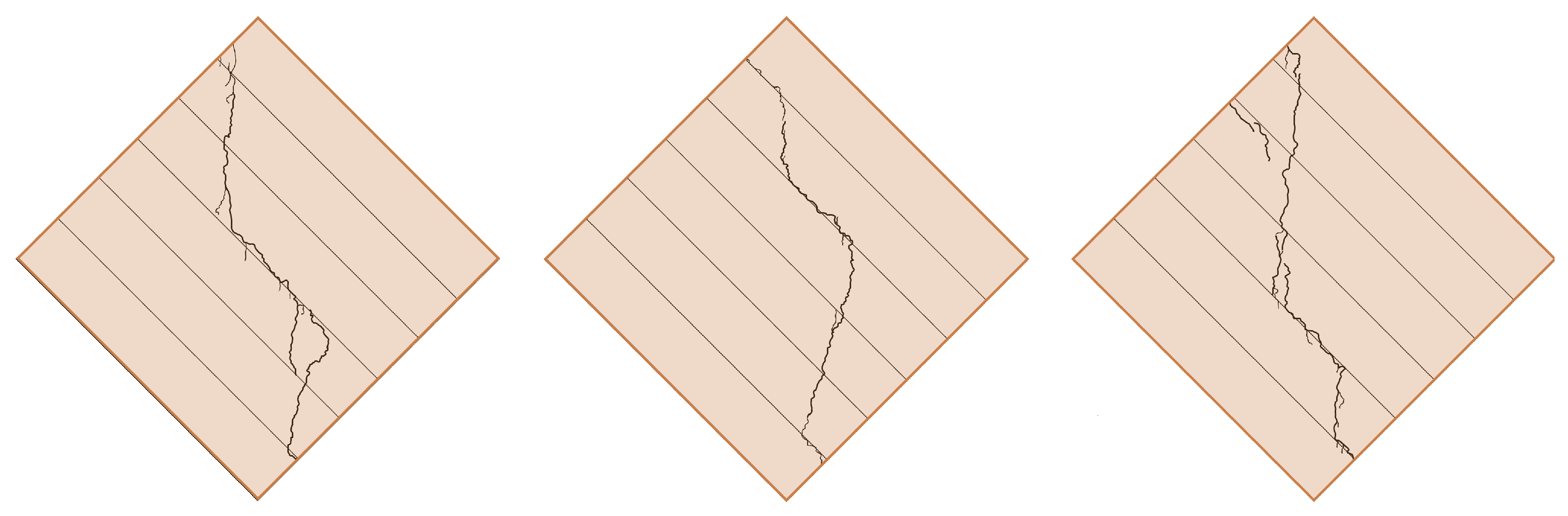
With regard to fracture and failure mechanisms, cracks initiated at the center of the specimens and propagated diagonally towards both loading shoes with increasing load. The growth of these primary cracks was partially conditioned by the presence of the interfaces between the compacted soil layers. Secondary cracks also developed near the contact surfaces between the loading shoes and the specimen prior to reaching the peak load. The cracking patterns in the specimens at the end of the DCT are illustrated in
Figure 14.
6. Conclusions
This paper proposes a multiscale experimental framework for the characterization of unstabilized rammed earth, structured around soil, fabric and specimen scales, and demonstrates its application on a single well-characterized soil over more than a decade of testing.
The soil-scale characterization establishes the mineralogical composition and particle size distribution of the source material as foundational inputs to the framework. The clay content and mineral type directly govern plasticity, shrinkage behavior, and reactivity to water, all of which influence compactability and cohesion at the fabric scale. The predominance of non-expanding clays, such as illite, contributes to binding soil particles while ensuring the dimensional stability of the compacted material. The particle size distribution of the soil used in this study, with a well-balanced fine-to-coarse ratio (45:55) and 14% clay content, falls within the range commonly recommended for URE construction.
At the fabric scale, the Proctor compaction test provides the optimum moisture content and maximum dry density of the soil, which serve as the reference conditions for specimen manufacturing. For the soil evaluated in this study, 13.6% OMC was obtained, with a density of 1.83 , values within the typical ranges for URE construction. Cohesion tests reveal a strong sensitivity of tensile cohesion to moisture content, with peak stress and stiffness approximately 61% and 40% higher near the plastic limit than for specimens prepared at approximately 2% below the OMC, highlighting the importance of moisture control throughout the construction and testing process.
At the specimen scale, compressive strength is found to be essentially isotropic with respect to loading direction, with anisotropy coefficients close to unity. Stiffness, however, exhibits a pronounced and consistent anisotropy across both monotonic and cyclic tests, with the elastic modulus parallel to the layers approximately 61% higher than in the perpendicular direction. This distinction has direct implications for structural design and modeling, where an isotropic stiffness assumption may lead to significant errors. Cyclic tests further show that stiffness degradation accumulates progressively with cycle number and is direction-dependent, a behavior particularly relevant to the seismic assessment of URE structures.
The adoption of a Proctor-based specimen manufacturing procedure reduced the coefficient of variation of compressive strength by up to 85%, with an even more dramatic reduction for stiffness. This result demonstrates that a significant part of the scatter commonly reported in the URE literature is attributable to manufacturing variability rather than material heterogeneity, and strongly supports the standardization of compaction procedures for specimen production.
Diagonal compression tests yield a shear strength of approximately 10% of the compressive strength perpendicular to the layers, consistent with the tensile-to-compressive strength ratio commonly reported for URE. This relationship provides a practical basis for estimating shear strength from compressive strength data, while also underscoring the importance of dedicated shear characterization for structures subject to lateral loading.
It should be noted that the experimental demonstration of the proposed framework is based on a single soil source from Seggiano, Italy. The specific numerical results reported are particular to this soil and should not be generalized without further testing. However, the framework itself is methodology-driven and directly applicable to any soil commonly used for URE construction. The procedures proposed at each scale are based on established, widely available standards, and the relationships identified are expected to hold more broadly, as they reflect general characteristics of compacted earthen materials rather than peculiarities of the soil used in this work.
From a practical perspective, the proposed framework offers concrete guidance at each stage of rammed earth construction and quality control. The soil-scale tests provide a low-cost basis for assessing the suitability of a candidate soil prior to any mechanical testing. The Proctor compaction test establishes the target moisture content and compaction energy that should be replicated on site and in the laboratory to ensure consistent mechanical performance. The relationships identified between stiffness anisotropy, shear strength, and compressive strength provide practical reference values for structural design and modeling.
Taken together, the findings of this study support the adoption of a multiscale characterization approach for rammed earth, in which soil-scale properties, compaction conditions, and specimen-scale mechanical response are systematically linked. The hierarchical structure of the proposed framework is directly compatible with existing geotechnical and construction material standards, and could serve as a basis for the development of a comprehensive testing protocol for URE, contributing to the ongoing effort toward standardized characterization of earthen construction materials.