Article

Design and Research of a High-Pressure-Resistant Constant Volume Combustion Device


1
College of Weaponry Engineering, Naval University of Engineering, Wuhan 430033, China
2
State Key Laboratory of Precision Blasting, Jianghan University, Wuhan 430033, China
*
Authors to whom correspondence should be addressed.
Appl. Sci. 2026, 16(12), 6031; https://doi.org/10.3390/app16126031 (registering DOI)
Submission received: 9 May 2026 / Revised: 10 June 2026 / Accepted: 12 June 2026 / Published: 15 June 2026

Abstract

In response to the current limitation where conventional constant volume combustion apparatuses are generally confined to pressure ratings of 5–20 MPa, insufficient for the demands of ultra-high-pressure combustion fundamental research, this study designs and verifies a high-pressure-resistant constant volume combustion apparatus with a rated working pressure of 250 MPa. The strength design and safety factor calculation for the combustion chamber main body were conducted based on the Lame thick-walled cylinder elastic theory. A finite element numerical simulation method was systematically employed to perform static analysis, transient impact response analysis, and high-cycle fatigue-life assessment of the key components of the apparatus. The results indicate that under a 250 MPa design internal pressure load, the maximum circumferential stress at the inner wall of the combustion chamber main body is 328.0 MPa, with a safety factor greater than 1.5, complying with relevant safety codes for high-pressure vessels. Under transient loading simulating combustion impact, the maximum equivalent stress of all structural components is below the material yield strength, with a maximum elastic deformation of less than 0.06 mm, demonstrating excellent structural stiffness and impact resistance. Fatigue assessment with a design-life target of 1.0 × 10⁶ pressure cycles shows that the cumulative damage values for all components are significantly less than 1.0, meeting the reliability requirements for long-term cyclic service. This apparatus integrates functional modules such as high-pressure precision gas mixing, high-energy reliable ignition, high-speed transient parameter acquisition, and safe product collection, providing a stable, controllable, and safe experimental platform for in-depth research on the combustion mechanisms of gaseous fuels under ultra-high-pressure conditions.

1. Introduction

The study of combustion characteristics of gaseous fuels under high-pressure conditions is a core scientific problem urgently requiring a solution for the development of efficient and clean power devices and energy systems [1]. With the advancement of internal combustion engines, gas turbines, and special-purpose engines towards higher boost ratios and thermal efficiency, peak combustion chamber pressures continue to rise. Consequently, there is an increasingly pressing need to explore ultra-high-pressure combustion mechanisms, as under such extreme operating conditions, the chemical reaction kinetic pathways of fuels, flame propagation mechanisms, and pollutant formation mechanisms may undergo fundamental changes [2,3,4,5,6]. However, in real power machinery, the combustion process is highly coupled with complex turbulent flows, non-uniform heat and mass transfer, and dynamic mechanical motions, making it difficult to isolate the influence of individual thermodynamic parameters for mechanistic studies. The Constant Volume Combustion Chamber (CVCC), comprising a closed combustion environment with precisely controlled boundary conditions, has become an ideal platform for studying the intrinsic characteristics of combustion. It is widely used in areas such as laminar/turbulent burning velocity measurement, ignition and extinction characteristic studies, and detonation phenomena observation [7,8,9].
Numerous researchers have conducted extensive design and research on constant volume combustion apparatuses for conventional operating conditions. Liu Zheng [10] designed a visual ultrasonic catalytic ignition constant-volume combustion bomb and its control system with a peak pressure of 20 MPa; Zhou Xuan [11] developed a modular constant-volume combustion bomb with a pressure resistance limit of 20 MPa, compatible with premixed combustion and spray diffusion combustion research; Yang Rui [12] optimized the structural layout of a constant-volume combustion bomb, ensuring uniform bomb body temperature, with a design pressure of 12 MPa; Hu Shangfei [13] developed a turbulent combustion experimental system, achieving controllable ignition energy and synchronization of data acquisition with ignition triggering, with a maximum pressure resistance of 10 MPa; Nguyen et al. [14] enhanced the pressure resistance of a spherical combustion bomb to 10 MPa through systematic finite element structural optimization; Alberto Larocca [15] designed a cylindrical constant-volume combustion bomb and supporting data acquisition system for high-pressure combustion research of hydrogen carrier fuels, with a design pressure of 25.5 MPa; VO TAN CHAU et al. [16] developed an optical constant-volume combustion bomb adapted for diesel engine combustion fundamental research, with a design pressure of 20 MPa; Vikas Jangir et al. [17] designed a fully optical constant-volume combustion apparatus for accurate calculation of combustion gas volume and flame surface area, capable of capturing flame propagation images throughout the process, with a design pressure of 5 MPa; James Shaffer et al. [18] addressed the safety risks associated with sudden pressure surges in traditional single-chamber devices and the high cost and structural complexity of dual-chamber high-pressure designs by adding a secondary chamber to achieve high-pressure combustion with pressure suppression, successfully conducting combustion experiments at 5 MPa; and Nguyen Van Tuan et al. [19] designed a constant-volume combustion bomb with a pressure resistance of 8 MPa to investigate the influence of oxygen concentration and ambient temperature on fuel combustion processes, focusing on fuel mixture homogeneity and flame propagation visualization. Comprehensive analysis indicates that the pressure resistance of existing apparatuses is mostly concentrated in the 5–20 MPa range. While this can satisfy conventional engine operating condition simulations, it is insufficient to support frontier research on next-generation high-boost engines, detonation combustion, and supercritical pressure combustion, which require ultra-high-pressure experimental environments.
Therefore, this study aims to design a high-pressure-resistant constant-volume combustion apparatus for gaseous fuels with a rated working pressure as high as 250 MPa and conduct comprehensive theoretical verification and numerical validation. The research content encompasses the overall scheme design of the apparatus, theoretical strength verification based on the Lame thick-walled cylinder theory, finite element simulation verification of structural mechanical performance, and key technical detail design. The main innovations of this study lie in significantly elevating the design pressure of the constant-volume combustion apparatus from conventional levels to 250 MPa; comprehensively employing static, transient dynamic, and fatigue-life analyses to systematically assess the structural integrity, dynamic response characteristics, and long-term service reliability of the apparatus under extreme operating conditions; and providing a new experimental platform for ultra-high-pressure combustion fundamental research and offering a reference for the safety design of similar high-pressure process equipment.

2. Overall Apparatus Design and Theoretical Strength Calculation

2.1. Structural and Functional Design

To achieve the study of gaseous fuel combustion characteristics under high pressure, the apparatus is designed with the objectives of “pressure-resistant safety, parameter controllability, data accuracy, and long-term reliability,” enabling a complete experimental process including high-pressure gas mixing, ignition combustion, transient parameter acquisition, and product collection. The main body of the apparatus adopts a forged thick-walled cylinder structure made of 35CrMnSiA alloy structural steel. This material possesses excellent comprehensive mechanical properties after quenching and tempering heat treatment: yield strength σ S 1275 ​  M P a , tensile strength σ b 1470 ​  M P a , elongation δ 9 % , elastic modulus E = 206   G P a , and Poisson’s ratio μ = 0.3 . Its high strength and toughness provide a guarantee for withstanding ultra-high-pressure cyclic loads.
The combustion chamber main body has an inner diameter of Φ72 mm (inner radius r i = 36 ​  m m ), outer diameter of Φ196 mm (outer radius r o = 98 ​  m m ), diameter ratio K = 2.72 , length L = 296   m m , and effective volume V c 1.2 L. The maximum design working pressure is set at 250 MPa. To prevent accidental overpressure, the system is equipped with a spring-loaded safety valve (set pressure 260 MPa) forming a pressure relief protection device.
To realize a complete ultra-high-pressure combustion experimental process, the apparatus integrates the following functional subsystems:
(1)
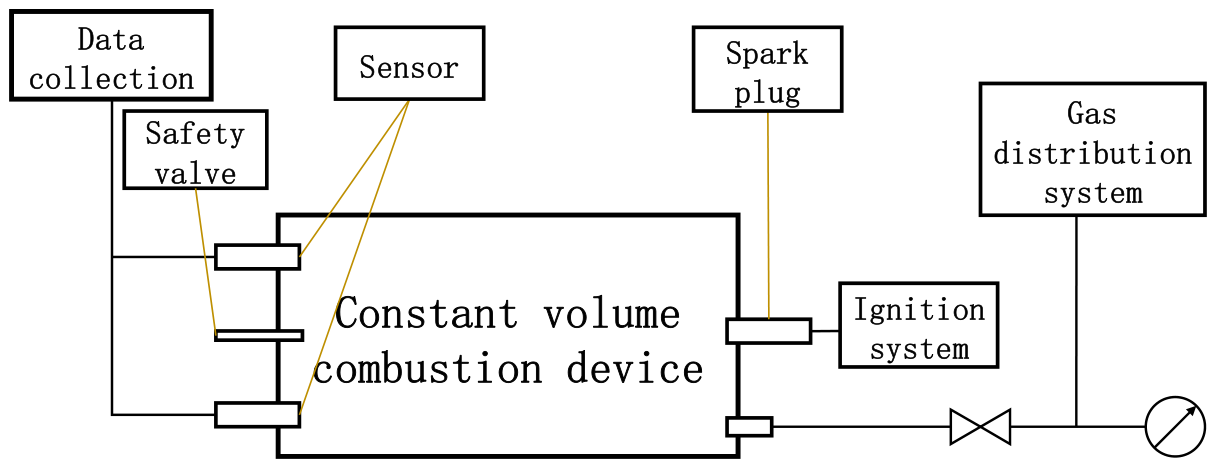
High-Pressure Precision Gas Mixing System: Based on Dalton’s law of partial pressures and the real gas equation of state [20], the partial pressure method is employed for precise preparation of multi-component gas mixtures. The system consists of high-purity gas sources, precision pressure-reducing valves, mass flow controllers, an externally mounted hydraulic-driven gas booster pump, and high-accuracy pressure sensors.
(2)
High-Energy Reliable Ignition System: To overcome the challenge of drastically increased gas dielectric breakdown voltage under high-pressure environments, a centrally located electric spark plug is used for ignition. An ignition energy between 10 J and 30 J can be selected, ensuring stable and repeatable ignition under high pressure.
(3)
Transient Data Acquisition System: Used to capture microsecond-scale physicochemical changes during combustion. High-frequency pressure and temperature sensors are integrated into the sensor-side flange. The sensor signals are fed into a high-speed data acquisition system, enabling synchronous high-speed acquisition and storage of pressure–time and temperature–time histories.
(4)
Gas Collection System: Consists of a controllable exhaust valve and gas sampling bags for safe collection of combustion products, enabling the collection and preservation of combustion products for subsequent analysis.
The combustion chamber is sealed at both ends by 110 mm thick forged flanges, connected using eight M24 × 130 bolts made of 35CrMnSiA. The sealing scheme employs a 304 (yield strength σ S = 205 ​  M P a , E = 193 ​  P a , and Poisson’s ratio μ = 0.31 .) stainless steel hollow metal O-ring placed in a groove machined on the flange end face. The sealing mechanism is as follows: initial preload causes elastic deformation of the O-ring to fill microscopic irregularities; when internal pressure increases, the pressure acts on the inner cavity of the O-ring, generating additional radial expansion force that further compresses the sealing surface, creating a self-energizing effect where higher pressure results in tighter sealing. This is particularly suitable for high-pressure, high-temperature, and pressure-cycling conditions, as shown in Figure 1.

2.2. Strength Design and Verification Based on Lame Thick-Walled Cylinder Theory

The combustion chamber’s main body is a thick-walled cylinder subjected to uniform internal pressure. With outer radius r o = 98 ​  m m , inner radius r i = 36 ​  m m , and diameter ratio k = r o / r i = 98 / 36 2.72 > 1.2 , it qualifies as a typical thick-walled cylinder. Based on the theory of stress and deformation analysis for thick-walled cylinders [21], combined with the apparatus working load characteristics and Lame’s elastic theory [22], stress analysis and strength design are performed. Under the design maximum internal pressure p i = 250 ​  M P a , the expressions for radial stress σ r , circumferential stress σ θ , and axial stress σ z at any radius r are as follows:
σ r = p i r i 2 r o 2 r i 2 ( 1 r o 2 r 2 ) σ θ = p i r i 2 r o 2 r i 2 ( 1 + r o 2 r 2 ) σ z = p i r i 2 r o 2 r i 2
where the radial stress σ r is always compressive, with a value of p i at the inner wall ( r = r i ) and 0 at the outer wall ( r = r o ). The circumferential stress σ θ is always tensile and is the key stress component determining cylinder strength, with its maximum value also located at the inner wall. The axial stress σ z is uniformly distributed along the wall thickness, with a value equal to the arithmetic mean of the circumferential and radial stresses.
Through formula derivation, the maximum circumferential stress at the inner wall (the critical point for strength verification) is derived as:
σ θ , m a x = p i r o 2 + r i 2 r o 2 r i 2
Taking the inner wall as the most critical point for static strength verification, for ductile materials, the third strength theory (maximum shear stress theory) [23] or the fourth strength theory (distortion energy theory) [24] is commonly used in engineering. According to the third strength theory, the equivalent stress σ e q = σ θ σ r . The static strength safety factor S is defined as the ratio of material yield strength σ s to the maximum equivalent stress σ e q = σ θ σ r . Substituting the data σ θ , m a x = 328.0 ​  M P a and σ e q , m a x = 578.0 ​  M P a , and taking σ s = 1275 ​  M P a , yields S 2.20 . If calculated according to the fourth strength theory, σ e q , m a x = 503.59 ​  M P a , yielding S 2.53 . The safety factors under both theories satisfy the safety factor requirement for overall plastic failure in high-pressure vessel design codes (typically S 1.5 ).
To prevent low-stress brittle fracture of the high-pressure vessel, a brittle fracture resistance design assessment is performed. The outer wall stress level is calculated as σ θ , o u t e r = 2 p i r i 2 r o 2 r i 2 = 78 ​  M P a . The ratio η = σ θ , o u t e r σ s 0.06 , which is far less than the material’s yield-to-tensile ratio ( σ S / σ b 0.87 ). This indicates that when the inner wall of the cylinder yields first due to stress concentration and undergoes plastic deformation, the outer wall remains in a lower elastic stress state. Damage and plastic deformation are more likely to initiate from the inner wall, providing an early warning for potential leakage, thereby reducing the risk of sudden, unannounced brittle fracture in the outer wall.
Further analysis of the structure’s ultimate load-bearing capacity: based on the Mises yield criterion [25] and the assumption of an ideal elastic–plastic material [26], the pressure at which the entire cylinder wall enters the plastic state is called the plastic limit pressure p u . For a closed-end thick-walled cylinder, the approximate solution is p u = 2 3 σ s ln r o r i 1474.4 ​  M P a . The plastic limit pressure is approximately 5.9 times the design pressure, indicating that the structure possesses ample plastic failure margin. It should be noted that the actual ultimate load-bearing capacity of the structure will be adversely affected by factors such as geometric out-of-roundness, welding or forging residual stresses, material property scatter, and temperature effects.

2.3. Partial Pressure Gas Mixing Theoretical Calculation

To achieve precise preparation of gas mixtures under high pressure, this apparatus employs the classic partial pressure method, whose theoretical basis is Dalton’s law of partial pressures and the real gas equation of state [20]. This method is the core principle for realizing the “high-pressure precision gas mixing system” function described in Section 2.1. Dalton’s law states that the total pressure of a gas mixture is equal to the sum of the partial pressures that each component would exert if it occupied the same volume alone, expressed as:
P t o t a l = i = 1 n P i
where P t o t a l is the total pressure of the gas mixture, P i is the partial pressure of the i-th component, and n is the number of components. The ideal gas equation of state describes the relationship between gas pressure, volume, amount of substance, and temperature, expressed as:
P i V = n i R T
where V is the total volume of the gas mixing system, ni is the amount of substance of the i-th component, R is the universal gas constant, and T is the thermodynamic temperature during the gas mixing process. The calculation process adopts the following assumptions: the gas mixing process is isothermal, with temperature held constant; all component gases conform to ideal gas behavior with no interactions; the gas mixing system is leak-free, with constant volume; air components are calculated at fixed ratios.
The formula for calculating the total amount of substance of the gas mixture is:
n t o t a l = P t o t a l V R T
where n t o t a l is the total amount of substance.
The amount of substance of each component is proportional to its overall volume fraction, expressed as:
n i = x i · n t o t a l
where x i is the overall volume fraction of the i-th component ( ( i = 1 n x i = 1 )).
Combining Dalton’s law and the ideal gas equation of state, the component partial pressure simplifies to:
P i = x i · P t o t a l

3. Mechanical Simulation Analysis of the Main Structure of the High-Pressure-Resistant Constant-Volume Combustion Apparatus

3.1. Simulation Model and Boundary Conditions

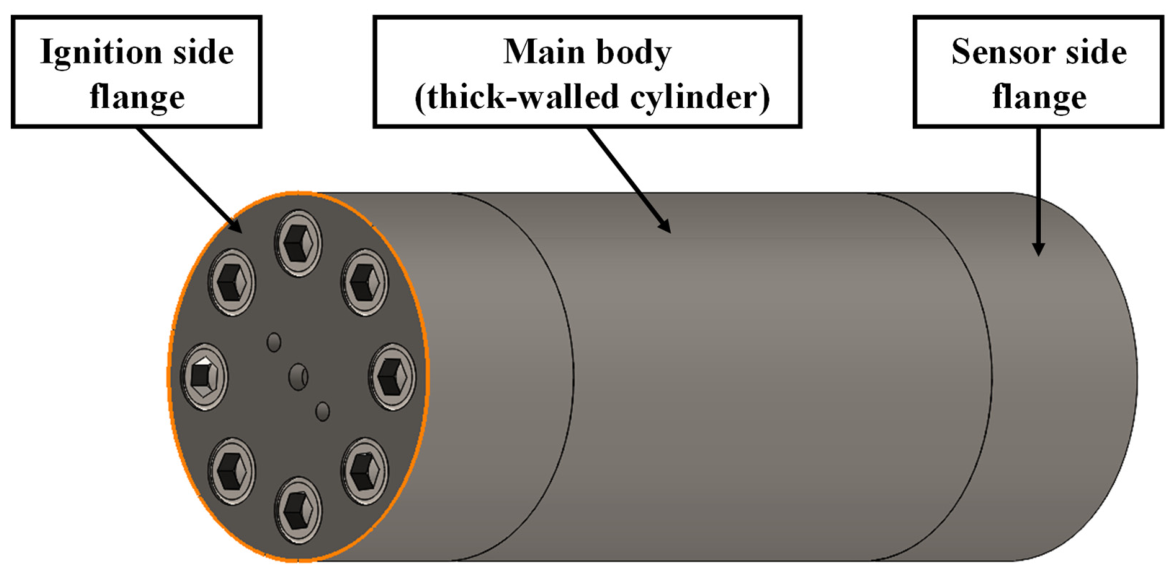
To assess the mechanical performance of the key components of the apparatus under a design internal pressure of 250 MPa and transient impact loading, finite element analysis was employed to conduct independent static and transient dynamic analyses on the combustion chamber main body (including the integrated sealing ring structure), the ignition-side flange, and the sensor-side flange. The apparatus comprises two material types: the main body of the constant volume combustion apparatus, and both side flanges (ignition side and sensor side). The bolts are made of 35CrMnSiA alloy steel, while the sealing ring is made of 304 stainless steel. The main structural assembly diagram of the apparatus is shown in Figure 2. The model includes the combustion chamber thick-walled cylinder, ignition-side flange, sensor-side flange, eight connecting bolts, nuts, and a metal O-ring seal. Minor features such as bolt threads have been reasonably simplified.
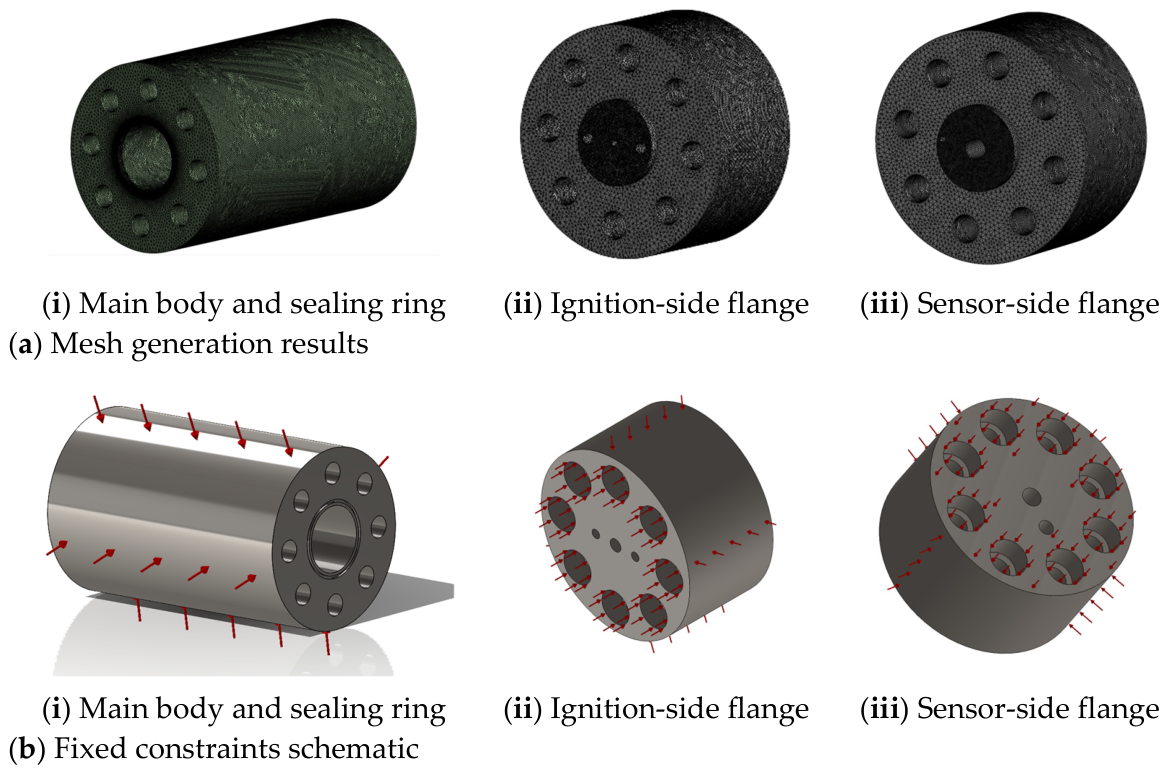
Mesh generation employs an automatic meshing method with a global element size of 2 mm. Mesh refinement to 0.5 mm is applied in regions of stress concentration such as the inner wall surface and adjacent areas of the combustion chamber, the root fillets of the sealing groove, the roots of various mounting holes on the flanges (spark plug hole, sensor hole, relief port hole), the contact regions between bolt shanks and bolt holes, and the root of the boss connecting the flanges to the cylinder body. Mesh independence verification has been conducted to ensure convergence of key stress results. The mesh generation results for the main body with sealing ring, sensor-side flange, and ignition-side flange are shown in Figure 3a. For the combustion chamber main body model, a uniform pressure of 250 MPa was applied to the inner wall surface of the cylinder to simulate the design internal pressure. To eliminate rigid body displacement, appropriate fixed constraints were applied to the outer surface of the cylinder. For the flange component models, a distributed load equivalent to the 250 MPa internal pressure was applied to the end face regions connected to the combustion chamber cylinder, while fixed constraints were applied to the outer surfaces of the flanges, as shown in Figure 3b. The red arrows indicate the direction of the fixed constraints.
To simulate the rapid pressure impact caused by combustion, a triangular wave pressure–time curve is defined: from 0 to 10 ms, pressure linearly increases from 0 to 250 MPa; from 10 to 15 ms, pressure linearly decreases from 250 MPa to 0. The full method is used for transient analysis, considering inertial effects. A fixed time step of 0.1 ms is set, with a total analysis time of 20 ms, and Rayleigh damping is considered (damping ratio taken as 0.02). High-cycle fatigue-life assessment was performed using the stress-life method. Based on the S-N curve data provided in the material handbook, Miner’s linear cumulative damage rule was applied to calculate the cumulative damage value under the design life (1.0 × 10⁶ pressure cycles).

3.2. Simulation Results Analysis

3.2.1. Main Body and Sealing Ring Simulation Results Analysis

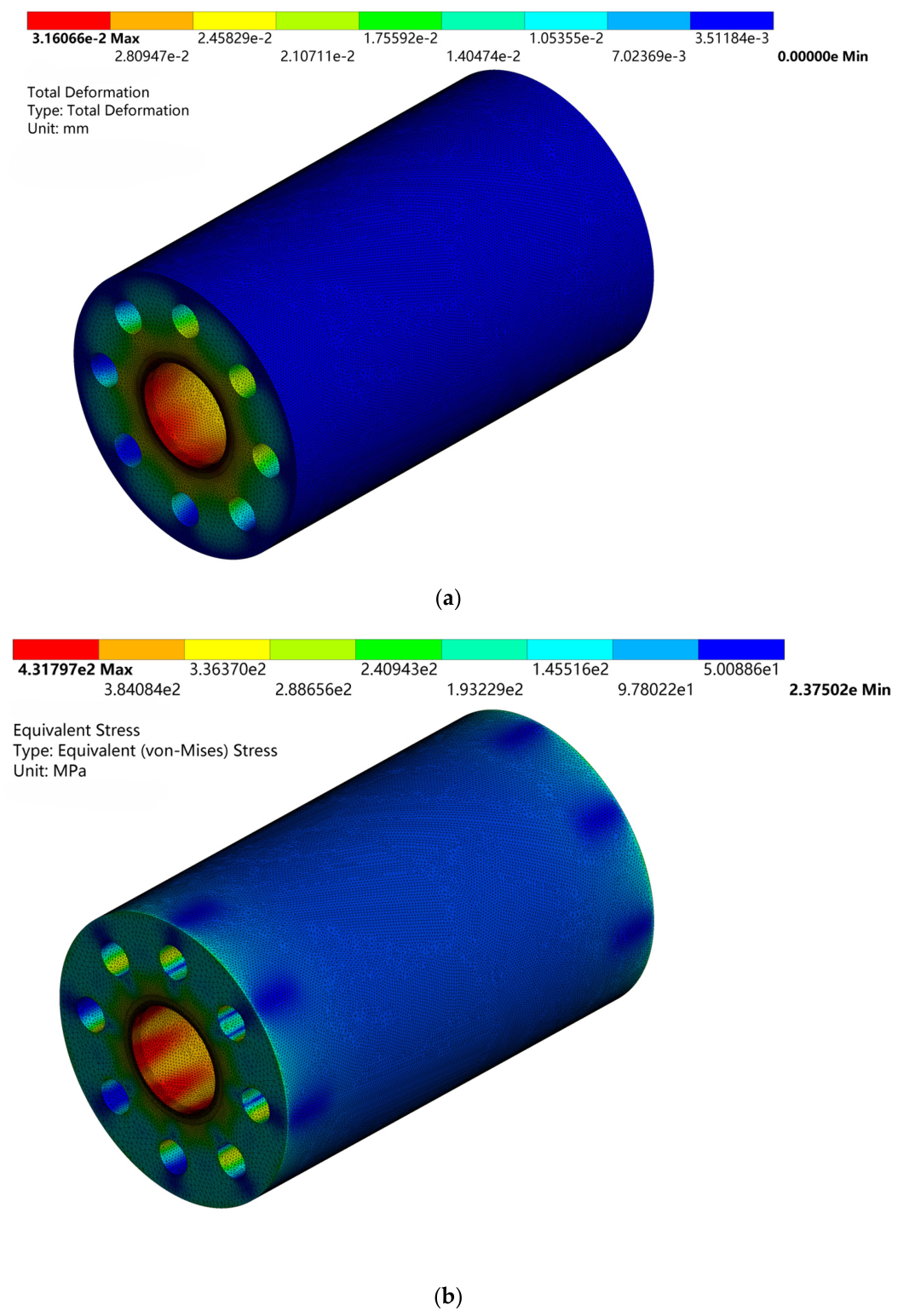
As shown in Figure 4, the finite element simulation results for the main body and sealing ring structure indicate that under 250 MPa high pressure, the maximum deformation of the main body and sealing ring is 0.0316 mm, occurring at the groove where the inner wall contacts the sealing ring. The maximum equivalent stress is 431.8 MPa, concentrated at the root fillet of the sealing groove, forming a significant local stress concentration. This peak stress is highly localized, whereas the equivalent stress calculated based on the thick-walled cylinder theory for the smooth region of the combustion chamber inner wall is 503.59 MPa (the latter serves as the primary basis for evaluating the overall structural strength). This peak stress is only 33.9% of the material yield strength (1275 MPa), indicating the structure is within the elastic safety range. Deformation and stress concentration can be reduced by increasing the groove radius and moving it away from the cylinder center. Fatigue assessment shows that for this critical point, under the design-life target of Ntarget = 1 × 10⁶ cycles, the cumulative damage D ≈ 0.0167, corresponding to a predicted fatigue life N ≈ 5.99 × 10⁷ cycles, demonstrating excellent high-cycle fatigue resistance.

3.2.2. Ignition-Side Flange Simulation Results Analysis

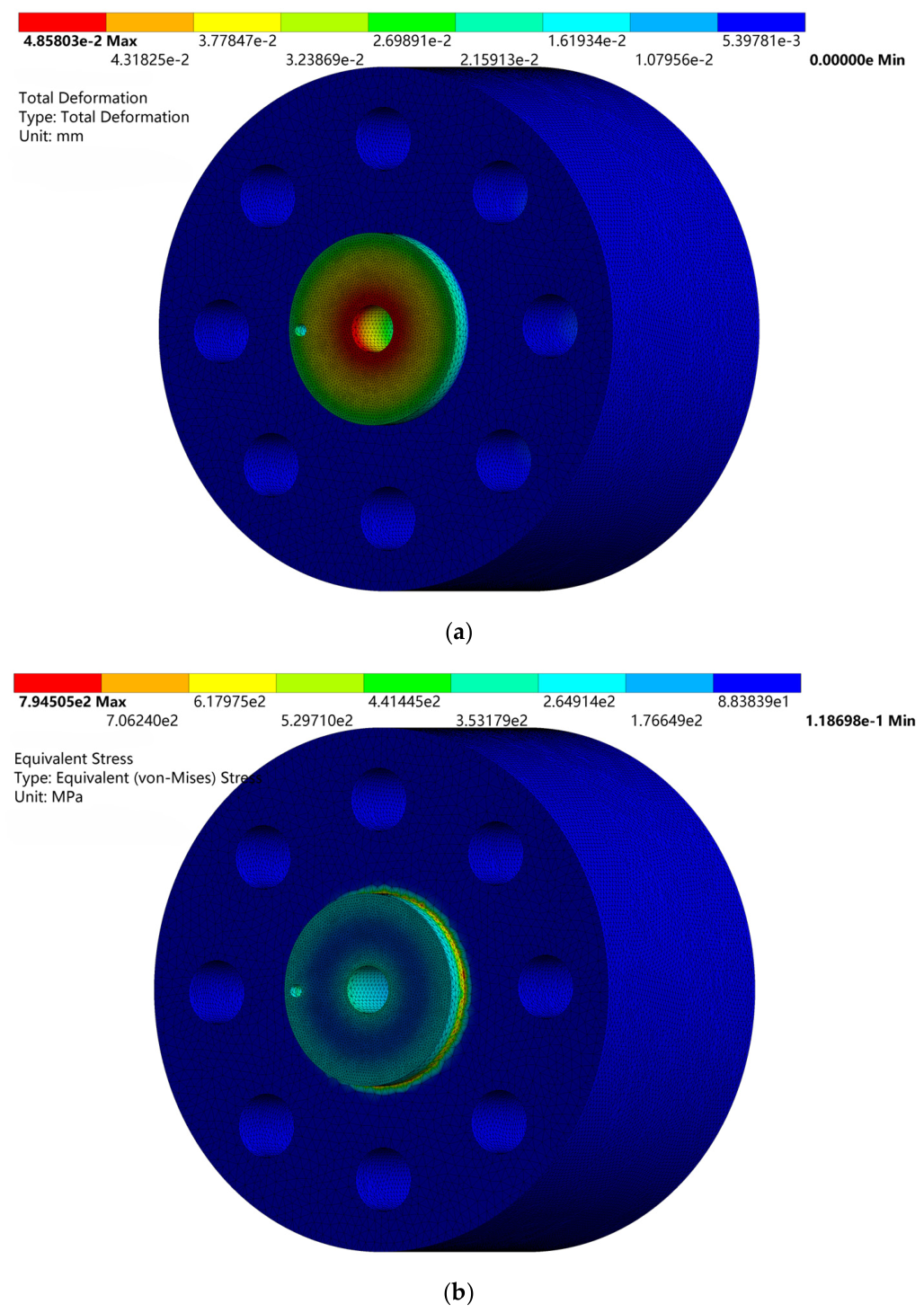
As shown in Figure 5, under 250 MPa high pressure, the maximum deformation of the ignition-side flange is 0.04858 mm. The maximum equivalent stress is 794.51 MPa, concentrated at the root of the central spark plug mounting boss, representing approximately 62.3% of the yield strength and corresponding to a safety factor of 1.60. Stress can be further reduced by adding fillets or thickening the boss. With a design life of 1 × 10⁶ cycles, the minimum fatigue life is 1.0 × 10⁸ cycles, corresponding to a damage value of only 0.01, indicating good fatigue resistance.

3.2.3. Sensor-Side Flange Simulation Results

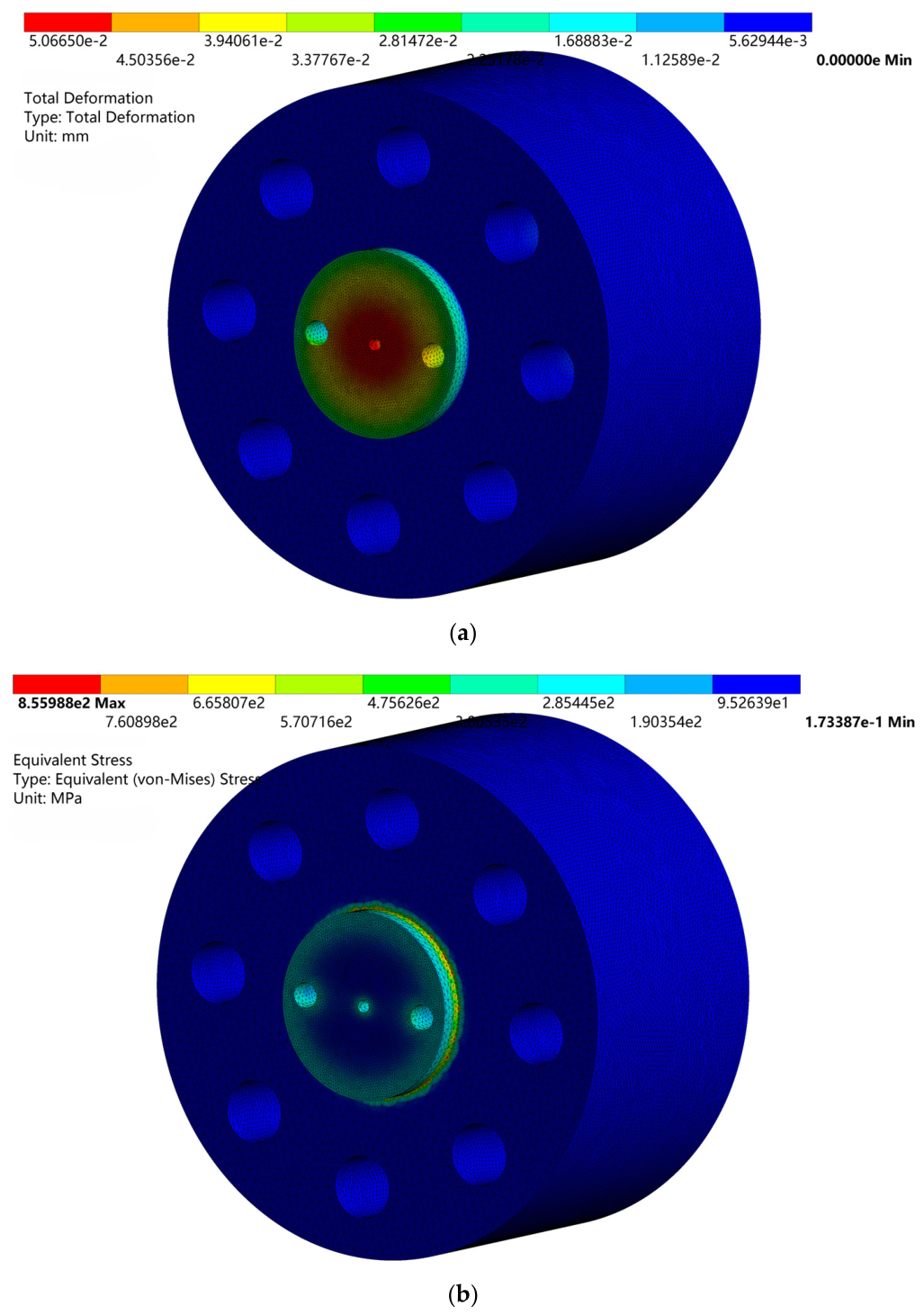
As shown in Figure 6, under 250 MPa high pressure, the maximum deformation of the sensor-side flange is 0.050665 mm, occurring near the relief port. The maximum equivalent stress is 855.99 MPa, appearing near the flange boss, representing approximately 67.1% of the yield strength and corresponding to a safety factor of 1.49, within the safe range. The structure is symmetrical with uniform stress distribution. With a design life of 1 × 10⁶ cycles, the fatigue life exceeds 1.0 × 10⁸ cycles and has a damage value of less than 0.01, meeting the requirements for long-term cyclic use.

4. Conclusions

This paper designs and verifies a high-pressure-resistant constant-volume combustion apparatus for gaseous fuels with a rated pressure of 250 MPa. Based on the Lame thick-walled cylinder theory, the maximum circumferential stress at the inner wall of the combustion chamber main body is calculated to be 328.0 MPa. The safety factors based on the third and fourth strength theories are 2.20 and 2.53, respectively, satisfying the safety codes for high-pressure vessels. Finite element static and transient impact analyses demonstrate that under a 250 MPa load, the maximum equivalent stress of all components is below the material yield strength (with a safety factor of 1.49), and the maximum elastic deformation is less than 0.06 mm, indicating excellent structural stiffness and impact resistance. Fatigue assessment targeting 1.0 × 10⁶ cycles reveals that the cumulative damage values for all components are significantly less than 1.0, meeting the reliability requirements for long-term cyclic service.
This work elevates the design pressure of the constant-volume combustion apparatus from the conventional range of 5–20 MPa to 250 MPa, and systematically validates the design through integrated theoretical, static, transient, and fatigue analysis methods. The apparatus integrates functions such as high-pressure precision gas mixing, high-energy ignition, transient data acquisition, and safety protection, providing a stable and controllable experimental platform for ultra-high-pressure combustion mechanism research, and also offering a reference for the safety design of similar high-pressure equipment. Future work will focus on structural optimization for lightweighting, developing optical and sensing diagnostic technologies suitable for high-pressure environments, and conducting thermo-mechanical coupling analysis to comprehensively assess the impact of combustion thermal shock on structural durability.

Author Contributions

Conceptualization, W.L. and Q.Z.; methodology, Q.M.; software, P.Z.; validation, Q.M., P.Z. and X.H.; formal analysis, Q.M.; investigation, P.Z.; resources, Y.Z.; data curation, Q.M. and X.H.; writing—original draft preparation, Q.M.; writing—review and editing, W.L., X.Z. and Y.Z.; visualization, P.Z.; supervision, W.L. and X.Z.; project administration, Y.Z.; funding acquisition, Y.Z. All authors have read and agreed to the published version of the manuscript.

Funding

This research received no external funding.

Data Availability Statement

The raw data supporting the conclusions of this article will be made available by the authors on request.

Conflicts of Interest

The authors declare no conflict of interest.

References

  1. Wang, Y. Study on Gas Fuel Injection, Mixing and Stratified Combustion Characteristics in Turbulent Constant Volume Combustion Bomb. Ph.D. Thesis, Beijing Jiaotong University, Beijing, China, 2024. [Google Scholar] [CrossRef]
  2. Park, C.; Jang, I.; Kim, M.; Park, G.; Kim, Y. Effect of high compression ratio on thermal efficiency and unburned ammonia emissions of a dual-fuel high-pressure direct injection marine ammonia engine. Appl. Therm. Eng. 2025, 261, 125183. [Google Scholar] [CrossRef]
  3. Bjørgen, K.O.P.; Emberson, D.R.; Løvås, T. Combustion of liquid ammonia and diesel in a compression ignition engine operated in high-pressure dual fuel mode. Fuel 2024, 360, 130269. [Google Scholar] [CrossRef]
  4. Treacy, M.; Hadadpour, A.; Bai, X.-S.; Fatehi, H. Performance and emissions of a novel high-pressure direct injection hydrogen dual-fuel engine. Fuel 2024, 376, 132639. [Google Scholar] [CrossRef]
  5. Minato, A.; Tanaka, T.; Nishimura, T. Investigation of premixed lean diesel combustion with ultra high pressure injection. In Proceedings of the SAE 2005 World Congress & Exhibition, Detroit, MI, USA, 11 April 2005. [Google Scholar]
  6. Urso, J.J.; Kinney, C.; Terracciano, A.C.; Barak, S.; Laich, A.; Albright, M.A.; Pierro, M.; McGaunn, J.; Vasu, S.S. Characterization of a new ultra-high pressure shock tube facility for combustion and propulsion studies. Rev. Sci. Instrum. 2022, 93, 063905. [Google Scholar] [CrossRef] [PubMed]
  7. Hu, Q.C.; Meng, S.; Qian, Y.J.; Wang, X.D.; Tao, C.Y.; Zhuang, Y. Multi-function constant volume combustion experimental device with multi-point ignition. J. Hefei Univ. Technol. (Nat. Sci. Ed.) 2021, 44, 37–41. [Google Scholar]
  8. Alhikami, A.F.; Wang, W.C. Experimental study of the spray ignition characteristics of hydro-processed renewable jet and petroleum jet fuels in a constant volume combustion chamber. Fuel 2021, 283, 119286. [Google Scholar] [CrossRef]
  9. Lee, S.; Kim, G.; Bae, C. Lean combustion of stratified hydrogen in a constant volume chamber. Fuel 2021, 301, 121045. [Google Scholar] [CrossRef]
  10. Liu, Z. Research on Design and Control System of Constant Volume Combustion Bomb for Ultrasonic Catalytic Ignition. Master’s Dissertation, Yanshan University, Qinhuangdao, China, 2022. [Google Scholar] [CrossRef]
  11. Zhou, X. Design of Constant Volume Combustion Bomb and Its Data Acquisition & Control System. Master’s Thesis, Zhejiang University, Hangzhou, China, 2017. [Google Scholar]
  12. Yang, R. Design of Constant Volume Combustion Bomb and Development of Combustible Mixture Supply System. Master’s Dissertation, Wuhan University of Technology, Wuhan, China, 2015. [Google Scholar] [CrossRef]
  13. Hu, S.F. Research on Premixed Turbulent Combustion Constant Volume Bomb and Its Test System. Master’s Thesis, Beijing Jiaotong University, Beijing, China, 2017. [Google Scholar]
  14. Nguyen, M.T.; Phung, M.T.; Ho, H.P.; Nguyen, V.Đ. Optimizing a design of constant volume combustion chamber for outwardly propagating spherical flame. In Advances in Asian Mechanism and Machine Science; Khang, N.V., Hoang, N.Q., Ceccarelli, M., Eds.; Springer International Publishing: Cham, Switzerland, 2022; pp. 921–931. [Google Scholar]
  15. Larocca, A.M. Design of a Constant Volume Combustion Chamber and Data Acquisition System for Hydrogen Carrier Fuels. Master’s Thesis, Politecnico di Torino, Turin, Italy, 2023. [Google Scholar]
  16. Chau, V.T.; Long, T.D.; Vang, H.B.; Long, D.H.; Huong, N.H. Design of a constant volume combustion chamber with optical approach technique. J. Sci. Technol.-IUH 2023, 64, 04. [Google Scholar]
  17. Jangir, V.; Ravi, M.R.; Ray, A. A novel approach for accurate determination of laminar burning velocity using the constant volume method in a cylindrical vessel with full optical access. Combust. Sci. Technol. 2025, 197, 3521–3541. [Google Scholar] [CrossRef]
  18. Shaffer, J.; Alvarez, L.; Askari, O. Experimental design for constant volume high pressure combustion. In AIAA SCITECH 2024 Forum; American Institute of Aeronautics and Astronautics: Reston, VA, USA, 2024. [Google Scholar]
  19. Tuan, N.V.; Truong, N.P.; Hieu, L.D. Evaluate the influence of several parameters on the HCCI combustion process in a constant volume combustion chamber. Discov. Appl. Sci. 2025, 7, 258. [Google Scholar] [CrossRef]
  20. Zhang, H.N.; Kang, N.B.; He, J.G.; Liu, G.S.; Chen, S.T.; Sun, Y.R.; Chen, Y.P. Gas Mixing System of Modified Atmosphere Packaging Based on Ideal Gas Law and Dalton’s Law of Partial Pressure. Food Mach. 2022, 38, 97–103. [Google Scholar] [CrossRef]
  21. Li, Z.H.; Li, Y.L.; Tang, A.M. Plastic Deformation Condition and Brittle Fracture Analysis of Thick-Walled Cylinders under Internal Pressure. Chin. J. Appl. Mech. 2020, 37, 1515–1520. [Google Scholar] [CrossRef]
  22. Maceri, A. Theory of Elasticity; Springer: Berlin/Heidelberg, Germany, 2010. [Google Scholar]
  23. Hoogenboom, P.C.J.; Spaan, R. Shear stiffness and maximum shear stress of tubular members. In Proceedings of the Fifteenth (2005) International Offshore and Polar Engineering Conference, Seoul, Republic of Korea, 19–24 June 2005. [Google Scholar]
  24. Hajmohammad, M.H.; Seyyed Afghahi, S.S.; Najafian, H. Minimization of wire-wound pressure vessel diameter based on distortion energy theory. Int. J. Press. Vessel. Pip. 2024, 210, 105242. [Google Scholar] [CrossRef]
  25. Eraslan, A.N. Von Mises’ yield criterion and nonlinearly hardening rotating shafts. Acta Mech. 2004, 168, 129–144. [Google Scholar] [CrossRef]
  26. Brutti, C. A theoretical model for elastic-perfectly plastic flat cylindrical punch indentation. Mech. Mater. 2021, 155, 103770. [Google Scholar] [CrossRef]
Figure 1. Design layout diagram of the constant-volume combustion device scheme.
Applsci 16 06031 g001
Figure 2. Assembly drawing of the main structure of the device.
Applsci 16 06031 g002
Figure 3. Mesh generation results (The red arrow indicates the position where the fixed constraint is applied).
Applsci 16 06031 g003
Figure 4. Simulation results of the main body and sealing ring. (a) Total deformation cloud map; (b) equivalent stress cloud map.
Applsci 16 06031 g004
Figure 5. Simulation results of the ignition-side flange. (a) Total deformation cloud map; (b) equivalent stress cloud map.
Applsci 16 06031 g005
Figure 6. Simulation results of the sensor-side flange. (a) Total deformation cloud map; (b) equivalent stress cloud map.
Applsci 16 06031 g006
Disclaimer/Publisher’s Note: The statements, opinions and data contained in all publications are solely those of the individual author(s) and contributor(s) and not of MDPI and/or the editor(s). MDPI and/or the editor(s) disclaim responsibility for any injury to people or property resulting from any ideas, methods, instructions or products referred to in the content.