Improving 1H-benzotriazole Removal from Aqueous Solutions by Polymer Inclusion Membranes by the Addition of Reduced Graphene Oxide and the Application of Ultrasound


Abstract
1. Introduction
2. Materials and Methods
2.1. Materials
Reagents
2.2. Methods
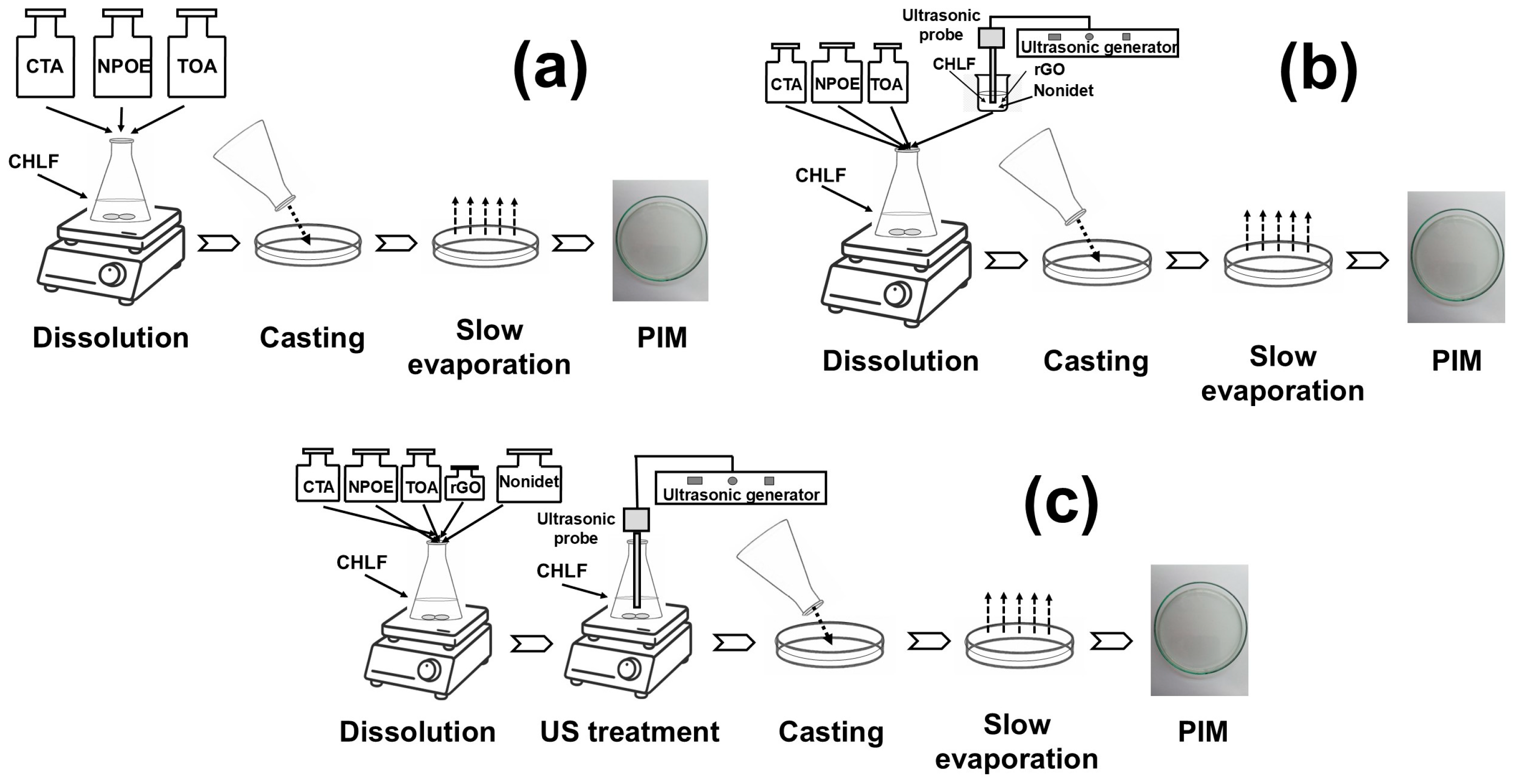
2.2.1. Polymer Inclusion Membranes Preparation
2.2.2. Benzotriazole Removal Process
3. Results and Discussion
3.1. 1H-Benzotriazole Transport Mechanism
3.2. Optimization of the Polymer Inclusion Membrane Composition
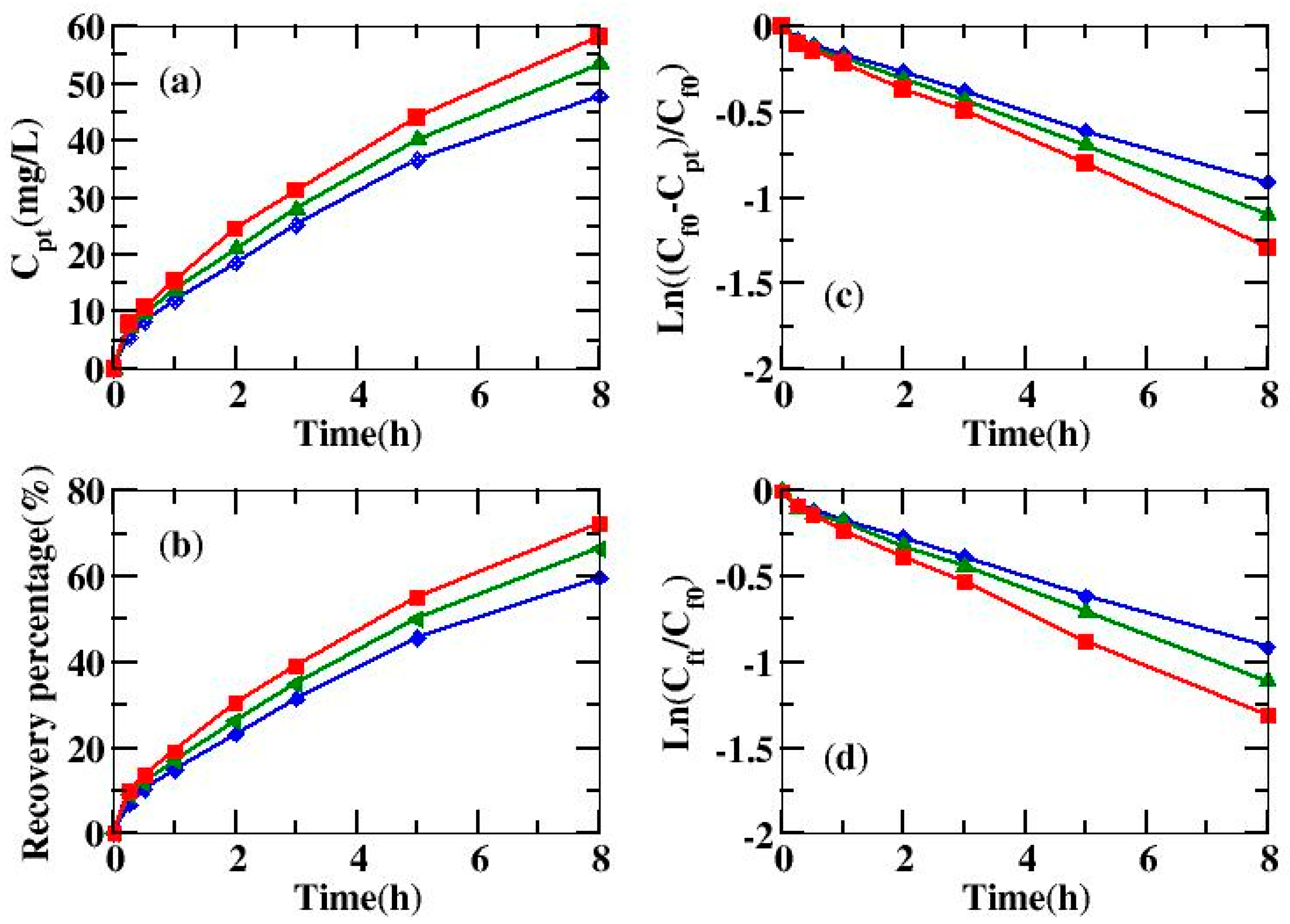
3.3. Effect of rGO Presence as a Membrane Component and of US Application in Membrane Preparation
4. Conclusions
Author Contributions
Funding
Institutional Review Board Statement
Informed Consent Statement
Data Availability Statement
Conflicts of Interest
Abbreviations
| PIMs | Polymer inclusion membranes |
| BZTH | 1H-benzotriazole |
| TOA | Tri-n-octylamine |
| CTA | Cellulose triacetate |
| NPOE | o-Nitrophenyloctylether |
| rGO | Reduced graphene oxide |
| US | Ultrasound |
References
- Ahmad, S.; Zhang, S.; Baqar, M.; Danso-Boateng, E. Toxic Pollutants in Water: Health Risk Assessment and Removal. Water 2025, 17, 1896. [Google Scholar] [CrossRef]
- Barceló, D. Emerging pollutants in water analysis. Trends Anal. Chem. 2003, 22, xiv–xvi. [Google Scholar] [CrossRef]
- Deblondea, T.; Cossu-Leguille, C.; Hartemanna, P. Emerging pollutants in wastewater: A review of the literature. Int. J. Hyg. Environ. Health 2011, 214, 442–448. [Google Scholar] [CrossRef]
- Arman, N.Z.; Salmiati, S.; Aris, A.; Salim, M.R.; Nazifa, T.H.; Muhamad, M.S.; Marpongahtun, M. A Review on Emerging Pollutants in the Water Environment: Existences, Health Effects and Treatment Processes. Water 2021, 13, 3258. [Google Scholar] [CrossRef]
- Li, X.; Shen, X.; Jiang, W.; Xi, Y.; Li, S. Comprehensive review of emerging contaminants: Detection technologies, environmental impact, and management strategies. Ecotoxicol. Environ. Saf. 2024, 278, 116420. [Google Scholar] [CrossRef] [PubMed]
- Puri, M.; Gandhi, K.; Kumar, M.S. Emerging environmental contaminants: A global perspective on policies and regulations. J. Environ. Manag. 2023, 332, 117344. [Google Scholar] [CrossRef]
- Wang, W.; Park, S.; Choi, B.; Oh, J.E. Occurrence and removal of benzotriazole and benzothiazole in drinking water treatment plants. Environ. Pollut. 2023, 316, 120563. [Google Scholar] [CrossRef]
- Amey, J.; Mikkelsen, Ø. Fate of trace elements and emerging environmental pollutants (benzotriazoles and benzothiazoles) from a glacier-fed river in the mixing zone of an Arctic fjord system. Environ. Chem. Ecotoxicol. 2025, 7, 339–350. [Google Scholar] [CrossRef]
- Molins-Delgado, D.; Távora, J.; Silvia Díaz-Cruz, M.; Barceló, D. UV filters and benzotriazoles in urban aquatic ecosystems: The footprint of daily use products. Sci. Total Environ. 2017, 602, 975–986. [Google Scholar] [CrossRef]
- Wang, L.; Zhang, J.; Sun, H.; Zhou, Q. Widespread occurrence of benzotriazoles and benzothiazoles in tap water: Influencing factors and contribution to human exposure. Environ. Sci. Technol. 2016, 50, 2709–2717. [Google Scholar] [CrossRef]
- Ling, T.; Fang, Y.; Zong, L.; Tang, Z.; Fan, K.; Chen, D.; Jin, P.; Guan, M. Review of Environmental Occurrence and Toxicity of Benzotriazole Ultraviolet Stabilizers. Environ. Health 2025, 3, 1438–1455. [Google Scholar] [CrossRef]
- Asimakopoulos, A.G.; Wang, L.; Thomaidis, N.S.; Kannan, K. Benzotriazoles and benzothiazoles in human urine from several countries: A perspective on occurrence, biotransformation, and human exposure. Environ. Int. 2013, 59, 274–281. [Google Scholar] [CrossRef]
- Seeland, A.; Oetken, M.; Kiss, A.; Fries, E.; Oehlmann, J.; Guan, M. Acute and chronic toxicity of benzotriazoles to aquatic organisms. Environ. Sci. Pollut. Res. 2012, 19, 1781–1790. [Google Scholar] [CrossRef]
- Dai, Q.; Chen, W.; Luo, J.; Luo, X. Abatement kinetics of highly concentrated 1H-Benzotriazole in aqueous solution by ozonation. Sep. Purif. Technol. 2017, 183, 327–332. [Google Scholar] [CrossRef]
- Altmann, J.; Rehfeld, D.; Träder, K.; Sperlich, A.; Jekel, M. Combination of granular activated carbon adsorption and deep-bed filtration as a single advanced wastewater treatment step for organic micropollutant and phosphorus removal. Water Res. 2016, 92, 131–139. [Google Scholar] [CrossRef] [PubMed]
- Pap, S.; Paunovic, O.; Prosen, H.; Krasevec, I.; Trebse, P.; Niemi, L.; Taggart, M.A.; Sekulic, M.T. Removal of benzotriazole derivatives by biochar: Potential environmental applications. Environ. Pollut. 2023, 334, 122205. [Google Scholar] [CrossRef] [PubMed]
- Wang, S.; Pei, S.; Zhang, J.; Huang, J.; You, S. Flow-through electrochemical removal of benzotriazole by electroactive ceramic membrane. Water Res. 2022, 218, 118454. [Google Scholar] [CrossRef]
- Llorca, M.; Badia-Fabregat, M.; Rodríguez-Mozaz, S.; Caminal, G.; Vicent, T.; Barceló, D. Fungal treatment for the removal of endocrine disrupting compounds from reverse osmosis concentrate: Identification and monitoring of transformation products of benzotriazoles. Chemosphere 2017, 184, 1054–1070. [Google Scholar] [CrossRef]
- Markoulatou, E.; Gatidou, G.; Stasinakis, A.S.; Fountoulakis, M.S. Removal of benzotriazoles from domestic wastewater using Pleurotusostreatus fungal pellets. Can. J. Chem. Eng. 2025, 103, 5812–5818. [Google Scholar] [CrossRef]
- Moghadam, M.A.; Ghanbari, F.; Moradi, M. Photocatalysis assisted by peroxymonosulfate and persulfate for benzotriazole degradation: Effect of pH on sulfate and hydroxyl radicals. Water Sci. Technol. 2015, 72, 2095–2102. [Google Scholar] [CrossRef]
- Chen, Y.; Ye, J.; Li, C.; Zhou, P.; Liu, J.; Ou, H. Degradation of 1H-benzotriazole by UV/H2O2 and UV/TiO2: Kinetics, mechanisms, products and toxicology. Environ. Sci. Water Res. Technol. 2018, 4, 1282–1294. [Google Scholar] [CrossRef]
- Minella, M.; De Laurentiis, E.; Pellegrino, F.; Prozzi, M.; Dal Bello, F.; Maurino, V.; Minero, C. Photocatalytic Transformations of 1H-Benzotriazole and Benzotriazole Derivates. Nanomaterials 2020, 10, 1835. [Google Scholar] [CrossRef]
- Ana, M.; Gutierreza, L.; D’Haesea, A.; Tana, L.; Mad, C.; Leusd, K.; Nikiforovd, A.; De Geyterd, N.; Morentd, R.; Cornelissena, E. In-situ surface modification of a reverse osmosis membrane with acrylic polymers: Transport and retention of a small neutral organic micropollutant. J. Membr. Sci. 2024, 703, 122810. [Google Scholar] [CrossRef]
- Piekutin, J.; Kotowska, U.; Struk-Sokołowska, J. Removal of selected heterocyclic organic compounds from water and possibilities of system optimization. Desalin. Water Treat. 2021, 243, 44–50. [Google Scholar] [CrossRef]
- Acero, J.L.; Benítez, F.J.; Real, F.J.; Rodríguez, E. Elimination of Selected Emerging Contaminants by the Combination of Membrane Filtration and Chemical Oxidation Processes. Water Air Soil Pollut. 2015, 226, 139. [Google Scholar] [CrossRef]
- Shehata, N.; Egirani, D.; Olabi, A.G.; Inayat, A.; Abdelkareem, M.A.; Chae, K.J.; Sayed, E.T. Membrane-based water and wastewater treatment technologies: Issues, current trends, challenges, and role in achieving sustainable development goals, and circular economy. Chemosphere 2023, 320, 137993. [Google Scholar] [CrossRef]
- Kaczorowska, M.A. The Use of Polymer Inclusion Membranes for the Removal of Metal Ions from Aqueous Solutions—The Latest Achievements and Potential Industrial Applications: A Review. Membranes 2022, 12, 1135. [Google Scholar] [CrossRef]
- Kaczorowska, M.A.; Bozejewicz, D.; Witt, K. The Application of Polymer Inclusion Membranes for the Removal of Emerging Contaminants and Synthetic Dyes from Aqueous Solutions—A Mini Review. Membranes 2023, 13, 132. [Google Scholar] [CrossRef]
- Maiphetlho, K.; Chimuka, L.; Tutu, H.; Richards, H. Technical design and optimisation of polymer inclusion membranes (PIMs) for sample pre-treatment and passive sampling—A review. Sci. Total Environ. 2021, 779, 149483. [Google Scholar] [CrossRef]
- Senila, M. Polymer Inclusion Membranes (PIMs) for Metal Separation—Toward Environmentally Friendly Production and Applications. Polymers 2025, 17, 725. [Google Scholar] [CrossRef]
- Mourtah, I.; Ouchn, R.; Yaakouby, I.E.; Raji, Y.; Mechnou, I.; Hlaibi, M. PSU-EDTA polymer inclusion membrane for selective extraction of Cr(VI) and Cr(III) from aqueous solution. J. Polym. Res. 2026, 33, 69. [Google Scholar] [CrossRef]
- Muthuraman, G.; Palanivelu, K. Transport of textile dye in vegetable oils based supported liquid membrane. Dye. Pigment. 2006, 70, 99–104. [Google Scholar] [CrossRef]
- León, G.; Martínez, G.; Guzmán, M.A.; Moreno, J.I.; Miguel, B.; Fernández-López, J.A. Increasing stability and transport efficiency of supported liquid membranes through a novel ultrasound-assisted preparation method. Its application to cobalt (II) removal. Ultrason. Sonochem. 2013, 20, 650–654. [Google Scholar] [CrossRef] [PubMed]
- Güell, R.; Fontàs, C.; Anticó, E.; Salvadó, V.; Crespo, J.G.; Velizarov, S. Transport and separation of arsenate and arsenite from aqueous media by supported liquid and anion-exchange membranes. Sep. Purif. Technol. 2011, 80, 428–434. [Google Scholar] [CrossRef]
- Kozlowski, C.; Zawierucha, I. Polymer Inclusion Membranes Based on Sulfonic Acid Derivatives as Ion Carriers for Selective Separation of Pb(II) Ions. Membranes 2025, 15, 146. [Google Scholar] [CrossRef]
- Baylan, N.; Çehreli, S.; Özparlak, N. Transport and separation of carboxylic acids through bulk liquid membranes containing tributylamine. J. Dispers. Sci. Technol. 2017, 38, 895–900. [Google Scholar] [CrossRef]
- Xie, H.; Xia, H.; Qin, Z.; Dong, Z.; Wang, X.; Sun, L.; Liu, Y.; Zhang, Y. Role of the side chain configuration on the effective recovery of phenolic compounds using polymer inclusion membranes based on tertiary amine. React. Funct. Polym. 2024, 204, 106030. [Google Scholar] [CrossRef]
- Nghiem, L.D.; Mornane, P.; Potter, I.D.; Perera, J.M.; Cattrall, R.W.; Kolev, S.D. Extraction and transport of metal ions and small organic compounds using polymer inclusion membranes (PIMs). J. Membr. Sci. 2006, 281, 7–41. [Google Scholar] [CrossRef]
- Fontás, C.; Tayeb, R.; Dhahbi, M.; Gaudichet, E.; Thominette, F.; Roy, P.; Steenkeste, K.; Fontaine-Aupart, M.P.; Tingry, S.; Tronel-Peyroz, E.; et al. Polymer inclusion membranes: The concept of fixed sites membrane revised. J. Membr. Sci. 2007, 290, 62–72. [Google Scholar] [CrossRef]
- Kaya, A.; Onac, C.; Alpoguz, H.K.; Agarwal, S.; Gupta, V.K.; Atar, N.; Yilmaz, A. Reduced graphene oxide based a novel polymer inclusion membrane: Transport studies of Cr(VI). J. Mol. Liq. 2016, 219, 1124–1130. [Google Scholar] [CrossRef]
- Monnier, H.; Wilhelm, A.M.; Delmas, H. Influence of ultrasound on mixing on the molecular scale for water and viscous liquids. Ultrason. Sonochem. 1999, 6, 67–74. [Google Scholar] [CrossRef] [PubMed]
- Chen, J.; Chen, Y.; Li, H.; Lai, S.Y.; Jow, J. Physical and chemical effects of ultrasound vibration on polymer melt in extrusion. Ultrason. Sonochem. 2010, 17, 66–71. [Google Scholar] [CrossRef] [PubMed]
- Kang, J.; Chen, Y.; Cao, Y.; Li, H. Effects of ultrasound on the conformation and crystallization behaviour of isotactic polypropylene and b-isotactic polypropylene. Polymer 2010, 51, 249–256. [Google Scholar] [CrossRef]
- Senila, L.; Kovacs, E.; Senila, M. A Review of Polylactic Acid (PLA) and Poly(3-hydroxybutyrate) (PHB) as Bio-Sourced Polymers for Membrane Production Applications. Membranes 2025, 15, 210. [Google Scholar] [CrossRef]




| Membrane | CTA | NPOE | TOA | |||
|---|---|---|---|---|---|---|
| (mg) | (%) | (mg) | (%) | (mg) | (%) | |
| Membrane 1 | 150.0 | 75.0 | 25.0 | 12.5 | 25.0 | 12.5 |
| Membrane 2 | 120.0 | 60.0 | 40.0 | 20.0 | 40.0 | 20.0 |
| Membrane 3 | 100.0 | 50.0 | 50.0 | 25.0 | 50.0 | 25.0 |
| Membrane 4 | 80.0 | 40.0 | 60.0 | 30.0 | 60.0 | 30.0 |
| Membrane 5 | 60.0 | 30.0 | 70.0 | 35.0 | 70.0 | 35.0 |
| Membrane Composition | J (kg/(m2·h)) | P (m/h) | RP (%) | k1 (h−1) |
|---|---|---|---|---|
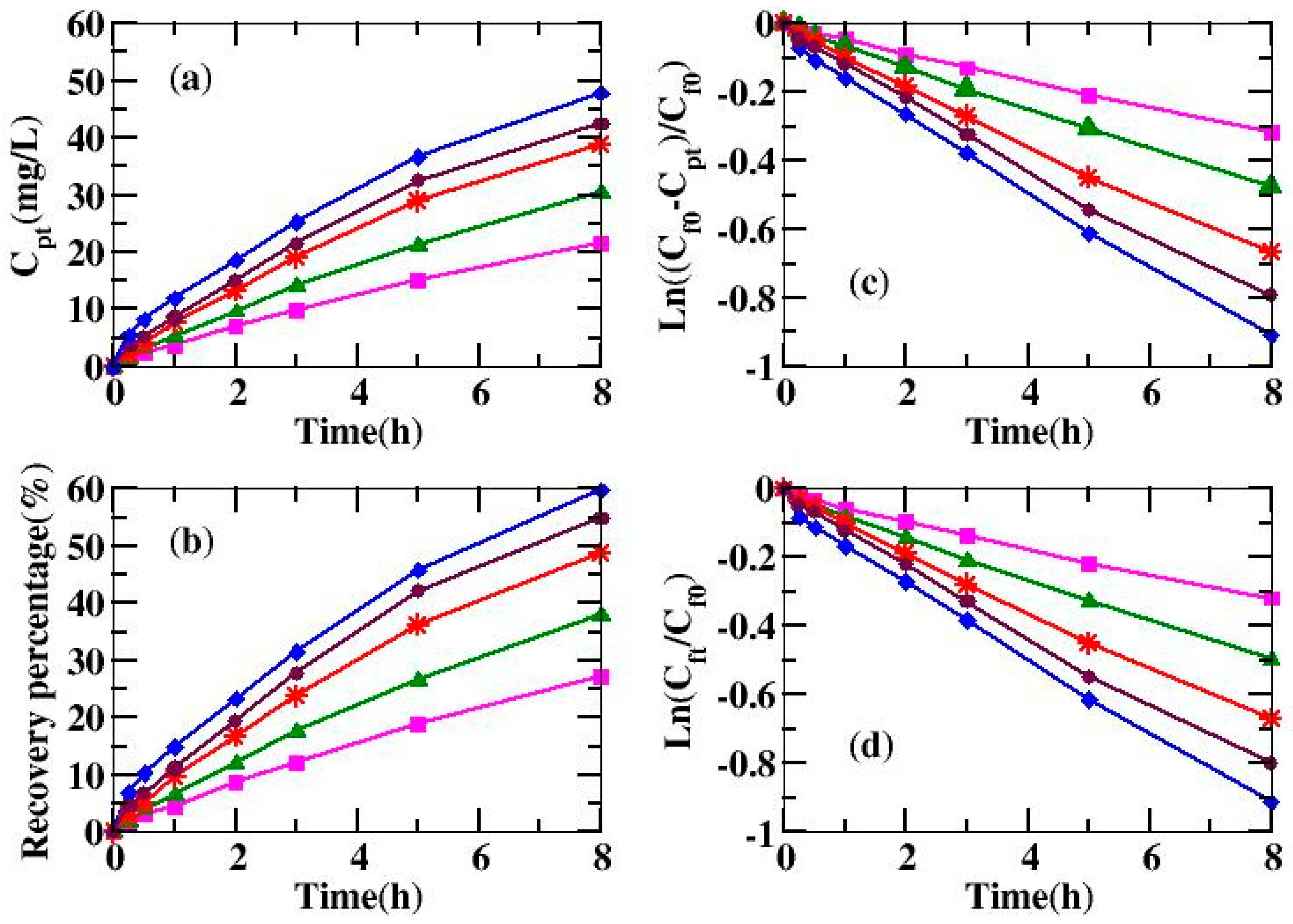
| Membrane 1: CTA (75.0%)/NPOE (12.5%)/TOA (12.5%) | 0.0003568 | 0.0051867 | 27.0649 | 0.0392 |
| Membrane 2: CTA (60.0%)/NPOE (20.0%)/TOA (20.0%) | 0.0005093 | 0.0079333 | 37.9551 | 0.0611 |
| Membrane 3: CTA (50.0%)/NPOE (25.0%)/TOA (25.0%) | 0.0006548 | 0.0111867 | 48.7105 | 0.0842 |
| Membrane 4: CTA (40.0%)/NPOE (30.0%)/TOA (30.0%) | 0.0007736 | 0.0147733 | 59.7023 | 0.1106 |
| Membrane 5: CTA (30.0%)/NPOE (35.0%)/TOA (35.0%) | 0.0007100 | 0.0132800 | 54.7988 | 0.1003 |
| Membrane Composition | J (kg/(m2·h)) | P (m/h) | RP (%) | k1 (h−1) |
|---|---|---|---|---|
| Membrane 4: CTA (40.0%)/NPOE (30.0%)/TOA (30.0%) | 0.0007736 | 0.0147733 | 59.7023 | 0.1106 |
| Membrane 4 + rGO (Nonidet P40) | 0.0008475 | 0.017520 | 66.5814 | 0.1328 |
| Membrane 4 + rGO (Nonidet P40) + US | 0.0009205 | 0.020587 | 72.4860 | 0.1605 |
Disclaimer/Publisher’s Note: The statements, opinions and data contained in all publications are solely those of the individual author(s) and contributor(s) and not of MDPI and/or the editor(s). MDPI and/or the editor(s) disclaim responsibility for any injury to people or property resulting from any ideas, methods, instructions or products referred to in the content. |
© 2026 by the authors. Licensee MDPI, Basel, Switzerland. This article is an open access article distributed under the terms and conditions of the Creative Commons Attribution (CC BY) license.
Share and Cite
León, G.; Cañavate, M.J.; Miguel, B.; Guzmán, M.A. Improving 1H-benzotriazole Removal from Aqueous Solutions by Polymer Inclusion Membranes by the Addition of Reduced Graphene Oxide and the Application of Ultrasound. Appl. Sci. 2026, 16, 6030. https://doi.org/10.3390/app16126030
León G, Cañavate MJ, Miguel B, Guzmán MA. Improving 1H-benzotriazole Removal from Aqueous Solutions by Polymer Inclusion Membranes by the Addition of Reduced Graphene Oxide and the Application of Ultrasound. Applied Sciences. 2026; 16(12):6030. https://doi.org/10.3390/app16126030
Chicago/Turabian StyleLeón, Gerardo, María José Cañavate, Beatriz Miguel, and María Amelia Guzmán. 2026. "Improving 1H-benzotriazole Removal from Aqueous Solutions by Polymer Inclusion Membranes by the Addition of Reduced Graphene Oxide and the Application of Ultrasound" Applied Sciences 16, no. 12: 6030. https://doi.org/10.3390/app16126030
APA StyleLeón, G., Cañavate, M. J., Miguel, B., & Guzmán, M. A. (2026). Improving 1H-benzotriazole Removal from Aqueous Solutions by Polymer Inclusion Membranes by the Addition of Reduced Graphene Oxide and the Application of Ultrasound. Applied Sciences, 16(12), 6030. https://doi.org/10.3390/app16126030