1. Introduction
Three-dimensional point cloud semantic segmentation plays a crucial role in fields such as medical modeling, clinical diagnosis, and medical image analysis. However, in real-world scenarios, many objects exhibit fine local structures, smooth surface transitions, and minimal boundary proportions, resulting in the formation of weak boundaries between these objects and their surrounding background. These boundaries are characterized by subtle geometric differences, high similarity in features with neighboring regions, minimal variations in grayscale and topology, and susceptibility to noise and morphological interference, which significantly complicate the effective capture of segmentation details by the model.
Current state-of-the-art segmentation methods predominantly rely on deep learning models to automatically learn semantic information from basic features such as coordinates and normal vectors, particularly Transformer-based models, which demonstrate strong capabilities in global structure understanding through self-attention mechanisms. However, traditional Transformer methods lack prior guidance, making them ill-suited for weak-boundary segmentation tasks, especially when boundary features are easily overwhelmed by the background. Moreover, the standard self-attention mechanism fails to direct sufficient focus on boundary regions, and conventional loss functions provide weak supervisory signals for challenging boundary cases, further exacerbating the issues of boundary fuzziness and discontinuity in segmentation.
These challenges are especially evident in medical anatomical segmentation. Auricle-region 3D point cloud segmentation is a typical wea- boundary task, characterized by a concave structure, smooth transitions to surrounding regions, and a very low boundary proportion. Existing Transformer models struggle to generate precise boundaries, limiting their applicability to clinical and biometric scenarios. Thus, incorporating geometric priors, enhancing boundary representations, and strengthening weak-boundary supervision are essential for improving segmentation performance.
To address the above issues, we propose Geopriors-3DEarSeg, a geometric priors-guided precise 3D point cloud segmentation network for the auricle region. This network, built upon the Transformer backbone, deeply integrates the anatomical priors of the human ear to achieve end-to-end binary segmentation of the auricle and background regions, with a particular focus on the precise localization of weak boundaries in the auricle region. The core innovations and contributions of this paper are as follows:
A three-dimensional geometric feature module is developed, using normal vector orientation, local Gaussian curvature, and shape diameter function to characterize boundary geometry and localize geometric discontinuities in an unsupervised manner.
A geometry-guided boundary-enhanced attention mechanism is proposed, where a prior-driven QKV gating structure integrates geometric cues into self-attention to enhance boundary-point weights and alleviate feature dilution.
An annotation-free boundary-aware loss, NVBLoss, is designed to quantify boundary strength via voxel-wise normal consistency and amplify supervision for boundary points.
2. Related Work
Three-dimensional point cloud semantic segmentation is a core technique for 3D structural perception, aiming to assign semantic labels to each point in unordered 3D point sets. It serves as a fundamental basis for medical imaging applications, including medical modeling and clinical diagnosis. This field has evolved from traditional handcrafted-feature-based methods to deep learning frameworks dominated by Transformers. However, for weak-boundary segmentation tasks such as auricle region segmentation, existing methods remain limited in boundary perception, prior embedding, and supervision enhancement.
2.1. Evolution of 3D Semantic Segmentation Architectures
Three-dimensional point cloud semantic segmentation fundamentally requires capturing fine-grained local geometry while modeling global structural dependencies from unordered, sparse, and irregular points. Early approaches relied on handcrafted descriptors and statistical models, e.g., the Fast Point Feature Histogram (FPFH) [
1], while graph-based methods remained heavily feature-dependent and lacked generalization. Deep learning advanced the field: PointNet [
2] enabled end-to-end learning but had limited local geometric modeling, and PointNet++ [
3] introduced hierarchical, multi-scale neighborhood aggregation. Nonetheless, purely data-driven paradigms fail to emphasize weak-boundary regions, leading to blurred auricle edges. Convolution-based methods such as KPConv [
4] and dynamic convolution [
5] improved local aggregation but remain limited in long-range modeling and sensitivity to weak-boundary geometry.
Transformer architectures now dominate due to their long-range dependency modeling. Point Transformer [
6] introduces vector self-attention for global context, while V2 and V3 [
7,
8] enhance attention computation, local aggregation, and feature fusion, with V3 as a SOTA baseline. However, indiscriminate self-attention can overwhelm weak auricle boundary features, and the lack of auricle-specific geometric priors prevents active localization of boundary discontinuities. LitePT [
9] reduces computational cost but sacrifices fine-grained boundary perception. Other variants, including Stratified Transformer [
10] and Swin3D [
11], focus on efficiency and global modeling without boundary-oriented or structure-specific priors. These limitations motivate the proposed geometry-guided weak-boundary segmentation framework. In contrast to Point Transformer V3 and LitePT, which primarily focus on efficient feature aggregation and general Transformer-based representation learning, GeoPriors-3DEarSeg is designed specifically for weak-boundary anatomical segmentation. By embedding auricle-specific geometric priors into both feature representation and attention modeling, the proposed method preserves global semantic modeling capability while explicitly enhancing the perception and localization of subtle boundary structures that are easily neglected by conventional Transformer architectures.
2.2. Geometric Priors Methods for 3D Point Clouds
Three-dimensional point clouds provide discrete representations of object geometry, whose intrinsic priors are essential for characterizing structural differences, particularly in medical anatomies with stable morphology and clear boundaries. Existing studies show that geometric priors can enhance feature representation, improve interpretability, and reduce annotation dependence. Early methods extracted handcrafted descriptors from differential geometry. APSS [
12] established a foundation for normal estimation and curvature computation, while Geo-CNN [
13] and geometry-aware graph Transformer models [
14] embed geometric cues into deep networks to strengthen local surface perception and semantic modeling. However, these methods usually rely on single cues such as normals or curvature and use geometry only as auxiliary input, making them insufficient for guiding weak-boundary localization in auricle segmentation.
In medical segmentation, geometric priors provide anatomical constraints and improve robustness in small-sample settings. Statistical shape models [
15] and shape-aware CNNs [
16] have shown effectiveness in large-organ segmentation, but their global priors cannot capture fine weak-boundary variations in small cavity structures such as the auricle region. Recently, geometry-aware point cloud models have further explored the use of spatial priors for semantic segmentation. For example, Wu and Wei [
17] proposed GENet, a geometry-enhanced network that exploits spatial geometric priors to alleviate information loss in projection-based LiDAR segmentation. In the medical point cloud domain, Wang et al. [
18] introduced M-PointNet for 3D intracranial aneurysm classification and segmentation, improving hierarchical geometric feature representation for medical point cloud analysis. However, these methods are either designed for general LiDAR scenes or specific vascular structures and do not explicitly address auricle-specific weak-boundary localization. Existing ear segmentation methods also remain limited: Yuan et al. [
19] performed multi-region 3D ear segmentation without auricle-specific geometric priors, while Hussain et al. [
20] focused on CT-based inner ear bone segmentation, and their method is difficult to adapt to high-fidelity 3D point clouds. Therefore, current methods still lack targeted geometric designs for accurately localizing weak boundaries in auricular 3D point clouds.
Recent advances in 3D medical image and point cloud segmentation have increasingly focused on geometry-aware representation learning and anatomy-guided modeling. Geometry-aware approaches integrate local surface characteristics, curvature information, and graph-based geometric relationships into feature representations to strengthen structural understanding, whereas anatomy-guided methods exploit anatomical priors and shape consistency constraints to enhance segmentation robustness, particularly in data-scarce scenarios. Despite their success, most existing methods utilize geometric information only as supplementary features or implicit constraints, without fully exploiting its potential for weak-boundary perception. In contrast, GeoPriors-3DEarSeg explicitly models and embeds multi-dimensional auricular geometric priors into the feature learning process, thereby enhancing the network’s ability to accurately identify and delineate weak boundary regions.
2.3. Three-Dimensional Weak-Boundary Segmentation and Loss Optimization
Weak-boundary segmentation remains a central challenge in 3D point cloud semantic segmentation, particularly for auricle region segmentation. Such boundaries occupy a very small area, exhibit smooth geometric transitions, and share highly similar semantic features with neighboring regions. Consequently, existing methods suffer from two key limitations: insufficient attention to weak boundaries during feature encoding and weak supervision for boundary hard samples during loss optimization.
For boundary-aware feature learning, Wang et al. [
21] introduced a boundary-aware Transformer for medical images using boundary masks to enhance edge features, while Peng et al. [
22] proposed an edge-guided bidirectional interaction network to refine ambiguous boundaries through edge–region feature interaction. In 3D point clouds, Jia et al. [
23] improved boundary segmentation by integrating multi-scale geometric descriptors.
For loss optimization, Focal Loss [
24] alleviates class imbalance by emphasizing hard samples but defines difficulty only by prediction confidence and cannot identify geometric boundary hard cases. Dice Loss [
25] mitigates foreground–background imbalance through overlap optimization, yet is sensitive to boundary errors and may cause unstable training. Boundary Loss [
26] improves boundary accuracy using distance-based supervision but requires costly distance transforms and is constrained by point cloud density. Topology-preserving loss [
27] reduces boundary discontinuity via topological constraints but is insensitive to subtle variations in smooth weak boundaries. Therefore, existing methods cannot accurately identify boundary hard samples from intrinsic point cloud geometry without additional annotations, nor can they adaptively strengthen weak-boundary supervision.
In summary, although existing 3D point cloud segmentation methods, including Transformer-based and multi-scale feature learning networks, are effective in global and local feature extraction, they remain limited in explicitly modeling geometric priors for small anatomical structures and optimizing weak-boundary regions. This issue is especially challenging in auricle segmentation, where intricate anatomical folds, subtle geometric variations, smooth boundary transitions, and severe foreground–background similarity often lead to ambiguous boundary localization and inaccurate structural delineation. To overcome these limitations, we propose GeoPriors-3DEarSeg, which integrates a three-dimensional geometric feature module, a geometry-guided QKV attention mechanism, and an annotation-free boundary-aware loss. These components jointly characterize boundary morphology, enhance weak-boundary representations, and strengthen boundary supervision, thereby improving segmentation accuracy for tiny anatomical structures and supporting high-precision auricle modeling.
3. Method
To achieve precise weak-boundary localization in the binary segmentation of the auricle region and background, we propose GeoPriors-3DEarSeg, a geometric-priors-guided 3D point cloud segmentation network. Built on a Transformer backbone, the network integrates auricle-specific anatomical priors and differential geometric features. Multi-dimensional geometric cues characterize intrinsic boundary properties, geometry-guided attention enhances boundary representations, and a normal-variation-driven boundary-aware loss strengthens boundary supervision, enabling end-to-end precise auricle segmentation.
3.1. Network Architecture
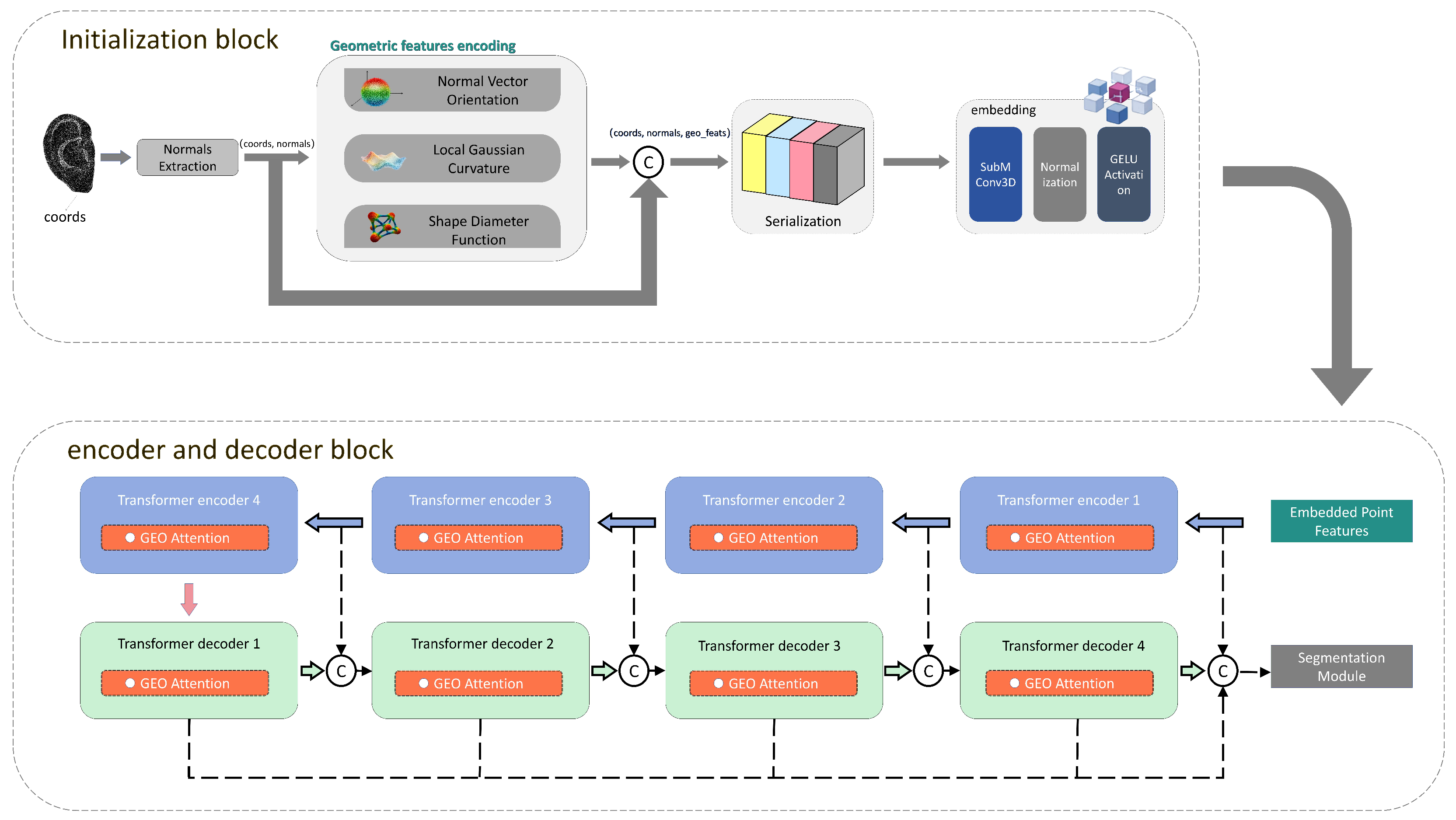
GeoPriors-3DEarSeg adopts a symmetric encoder–decoder hierarchical architecture for the end-to-end binary segmentation of the auricle region and background in human ear 3D point clouds, as shown in
Figure 1. Given point coordinates and normals, the network first encodes normalized multi-dimensional geometric features and embeds structured point representations via sparse convolution. The geometry-priors-enhanced Transformer encoder extracts multi-scale semantic features while strengthening boundary representations. A symmetric decoder then fuses multi-scale features through upsampling and skip connections to refine boundary details. Finally, the segmentation head produces point-wise predictions, supervised by the proposed boundary-aware loss to improve auricle boundary accuracy.
3.2. Geometric Feature Construction
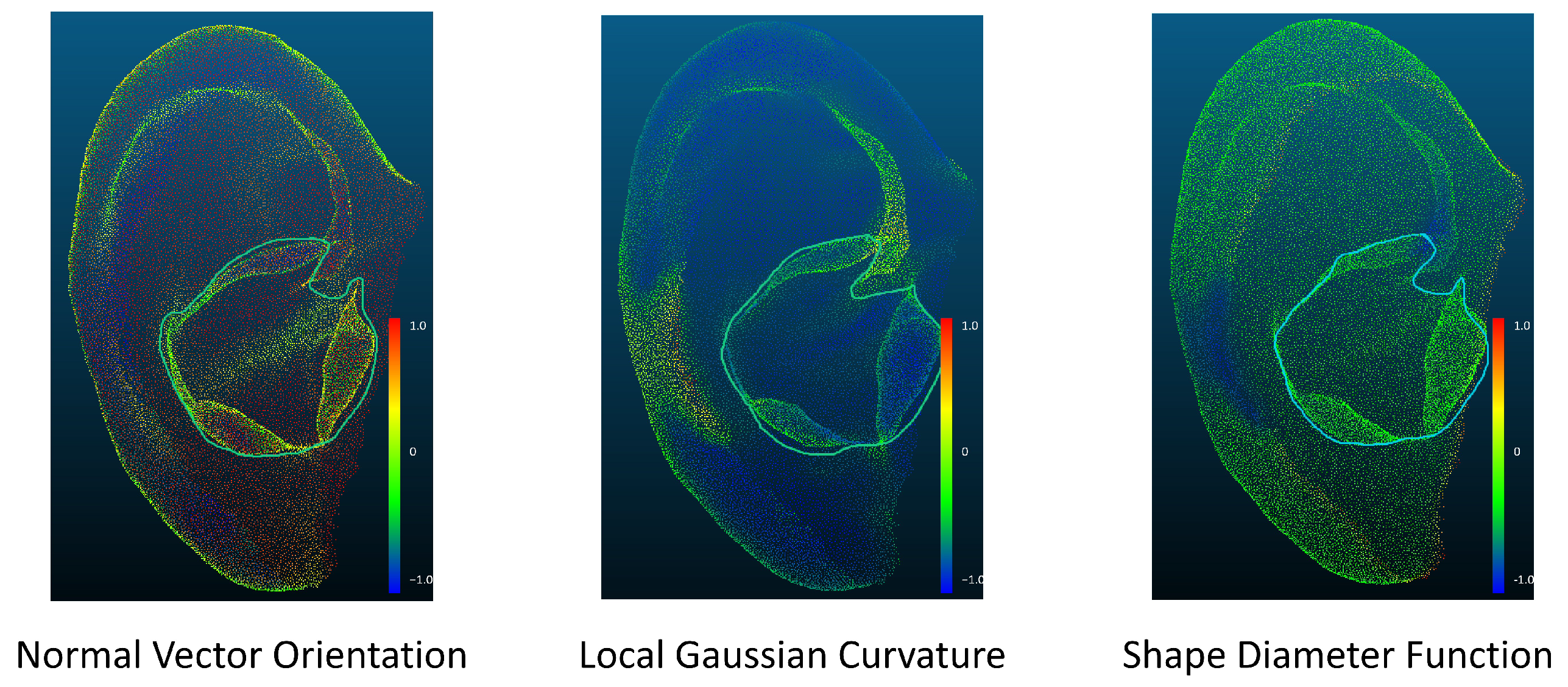
To characterize the intrinsic anatomical geometry of biological structures such as the auricle region, we designed a three-dimensional geometric feature extraction module. This module captures geometric discrepancies between the auricle boundary and surrounding structures, providing prior cues for boundary localization. The three geometric features are shown in
Figure 2. Normal vector orientation and local Gaussian curvature highlight regions with prominent boundary characteristics, whereas the shape diameter function emphasizes regions with minimal feature values, which is consistent with the expected design. These three regions depicting the auricle boundary features differ significantly from the internal and external geometric characteristics of the auricle.
3.2.1. Normal Vector Orientation
Normal vector orientation captures the global spatial direction of point cloud normals, reflecting the concave structure of the auricle toward the cranium. For any point
with unit normal
, using the cranial reference axis
, the orientation is:
indicates surface alignment: 1 for upward, for downward, and 0 for vertical. The auricle exhibits strong inward-oriented normals, contrasting protruding ear structures, enabling global-scale discrimination of the auricle from the surrounding regions.
3.2.2. Local Gaussian Curvature
Local Gaussian curvature quantifies point cloud surface curvature to detect geometric discontinuities at the auricle boundary. For a point
, let
denote its
nearest neighbors. The angles between
’s normal
and neighbors’ normals
are computed:
where
increases with local curvature: low within the flat concave auricle, and high at boundaries with geometric discontinuities, enabling direct localization of potential auricle edges.
3.2.3. Shape Diameter Function
The shape diameter function (SDF) captures the spatial scale of local regions to distinguish auricle interiors from boundary transitions. For a point
with
neighbors
, compute Euclidean distances:
where
is the 3D coordinate of
.
is higher in wide, continuous auricle interiors and lower at boundary transition zones, complementing curvature features in smooth boundaries.
After computing the three geometric features, , , and , all are z-score-normalized to form the feature matrix .
3.3. Geometric-Guided Boundary Enhancement Attention
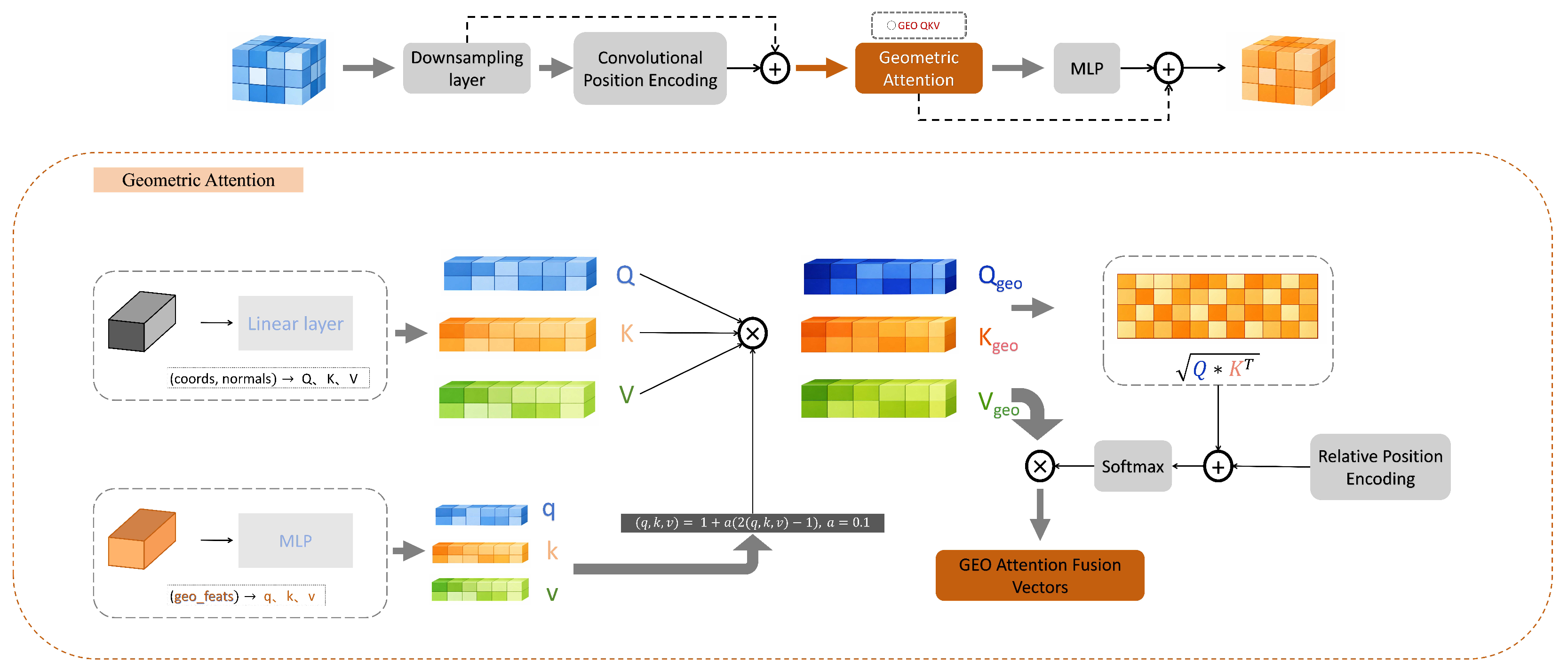
In the auricle region segmentation of human ear 3D point clouds, conventional Point Transformer self-attention relies on purely data-driven feature learning and treats all points indiscriminately. Consequently, weak-boundary points, which are sparse and geometrically smooth, are easily overwhelmed by background features, leading to blurred segmentation boundaries. To address this issue, we propose a geometric-priors-guided QKV gated attention module, as shown in
Figure 3. Built upon serialized self-attention, this module embeds auricle-specific geometric features into the attention process and adaptively enhances boundary point weights without disrupting the original semantic feature distribution. The decoder follows the same structure as the encoder, replacing downsampling with upsampling, thereby continuously strengthening weak-boundary representation throughout encoding and decoding.
Queries (Q), Keys (K), and Values (V) are linearly projected from backbone features and serve distinct roles in self-attention. Their functional differences require separate geometric priors; shared mappings fail to adapt. We employ three independent lightweight MLPs to map normalized geometric features
G into gating weights aligned with Q, K, and V dimensions:
Each MLP consists of two layers: linear, LayerNorm, GELU, and linear. A geometry-weighted gating function is applied to slightly modulate the features with gating values centered around 1:
with scaling factor
, ensuring outputs lie in
. The enhanced Q, K, V matrices are then obtained via element-wise multiplication:
Boundary points with pronounced geometric variations are assigned higher gating weights for adaptive enhancement, while interior or flat regions retain weights close to 1, thereby preserving the original semantic distribution. The geometrically enhanced matrices are then used to replace the original Q, K, and V in self-attention, producing the final GEO attention output.
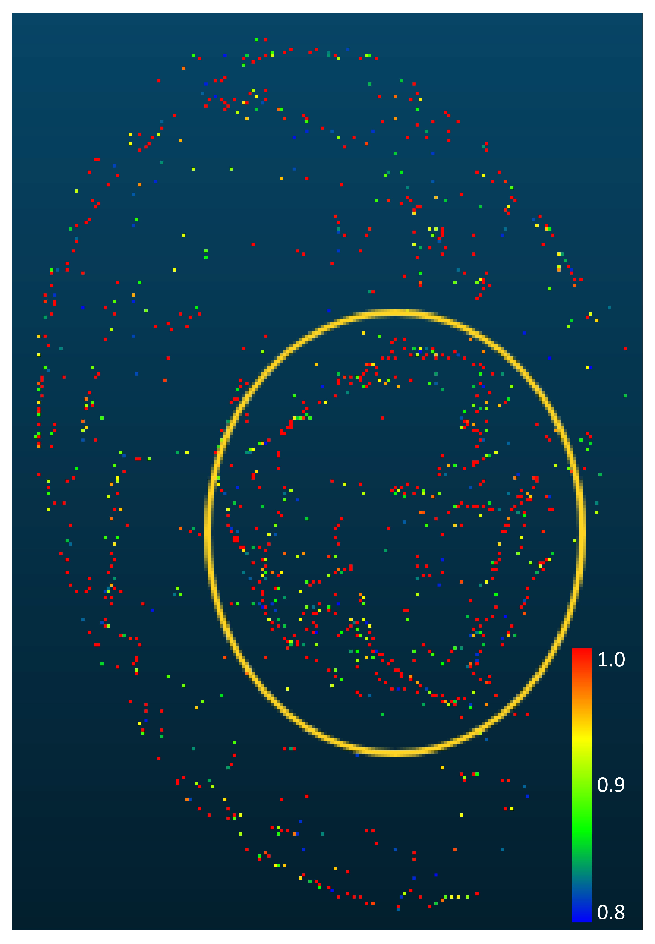
To illustrate the effect of geometric enhancement,
Figure 4 visualizes the point cloud attention weights of the Transformer encoder’s 4th layer GEO-fused vectors. Only points with weights ≥ 0.8 are shown, with yellow circles highlighting the auricular boundary. The boundary points exhibit substantially higher attention, demonstrating that the GEO-guided gating effectively focuses on weak auricular edges and enhances boundary discrimination.
3.4. Normal Vector Change-Guided Boundary-Aware Loss Function
To address the weak supervision of low-proportion boundary points, we propose the Normal Vector Change-Guided Boundary-Aware Loss Function (NVBLoss), an annotation-free, geometry-driven loss that amplifies supervision on boundary points based on voxel-wise normal vector consistency. Points at the auricle boundary exhibit high geometric variation, while interior or flat regions maintain consistent normals. NVBLoss quantifies each point’s boundary likelihood via the deviation from the voxel average normal and integrates it into point-wise cross-entropy weights:
where
is a global weight,
M is the total point count,
is the voxel point set,
is the unit normal of point
i, and
s (3.0) controls boundary amplification.
,
, and
ensure numerical stability. NVBLoss enhances boundary supervision adaptively, improving precision in weak-boundary segmentation.
4. Experiment
4.1. Dataset Construction
The dataset used in this study was the publicly available human ear dataset—YEM dataset [
28]. The point cloud data were aligned and normalized to a unit sphere to eliminate scale differences. The original 7111 points were upsampled to 29,800 points. Semantic annotations of the point cloud were performed using CloudCompare, labeling the auricle region. All auricle annotations were manually generated using CloudCompare by the second author following the internationally recognized WFAS auricular anatomical partition standard. To ensure annotation quality, all labeled samples were subsequently reviewed by the first author and a domain-experienced reviewer familiar with auricular anatomical partitioning. Particular attention was paid to weak-boundary regions between adjacent auricular partitions and surrounding structures. Any ambiguous or inconsistent labels were discussed and corrected through consensus before the final dataset was used for model training and evaluation, thereby improving annotation consistency and reducing potential labeling errors. The dataset consists of 500 samples, split into training, validation, and test sets in an 8:1:1 ratio. Data augmentation techniques, including 50% geometric transformations, random flips, and Gaussian noise with a standard deviation of 0.005, were applied during training.
4.2. Experimental Setup
The proposed network was implemented using the Pytorch framework. The training parameters were optimized based on GPU memory limitations (RTX 3090, 24 GB), with a batch size of 2 and 300 epochs to ensure convergence. The initial learning rate was set to 0.006, and the AdamW optimizer was used with a weight decay of 0.05. The experimental results show that this configuration effectively balances rapid convergence and stability.
The key hyperparameters used in this study were determined through repeated preliminary experiments and validation-set-based tuning. Specifically, (k = 20) was selected to capture sufficient local geometric information while avoiding excessive neighborhood smoothing, (a = 0.1) was chosen to provide stable geometric guidance for attention learning, and (s = 3.0) was adopted to balance weak-boundary enhancement and optimization stability. The voxel size was set to 0.02 as a compromise between boundary- detail preservation and computational efficiency, while the batch size was fixed at 2 due to GPU memory limitations. The learning rate (0.006) was selected to ensure stable convergence. Among the tested parameter combinations, the adopted configuration consistently achieved the best balance between segmentation accuracy, training stability, and computational efficiency.
4.3. Comparison Experiments
As shown in
Table 1, the proposed method outperforms all baseline models on key segmentation metrics. PointNet++ achieves the lowest performance with an mIoU of 0.8638 due to its lack of auricular anatomical geometric priors and its uniform neighborhood aggregation strategy, which fails to focus on weak-boundary areas. Point Transformer V2 is an improvement at 0.9502, but its self-attention mechanism still struggles to capture features at weak-boundary points. Point Transformer V3 achieves an mIoU of 0.9591, which is an improvement in local feature learning, but it still does not incorporate auricular anatomical geometric priors, leading to imprecise weak-boundary localization. LitePT reaches an mIoU of 0.9693, with an advantage in foreground recognition, but its reduced feature dimensionality leads to a decrease in weak-boundary perception. Geopriors-3DEarSeg performs best across all metrics, effectively addressing the core challenge of weak-boundary segmentation by combining geometric features with geometry-guided attention.
As shown in
Table 2, the computational efficiency of the different methods varies substantially. PointNet++ and LitePT are more efficient in terms of inference time and memory consumption, but their segmentation performance is lower than that of GeoPriors-3DEarSeg. Point Transformer V2 and V3 achieve stronger representation capability, yet require higher computational costs. Compared with these methods, GeoPriors-3DEarSeg introduces additional overhead due to geometric prior extraction and geometry-guided attention but achieves the best segmentation performance. These results indicate that the proposed method provides a favorable trade-off between computational efficiency and weak-boundary segmentation accuracy. A detailed component-wise analysis of the computational overhead is further provided in
Section 4.4.
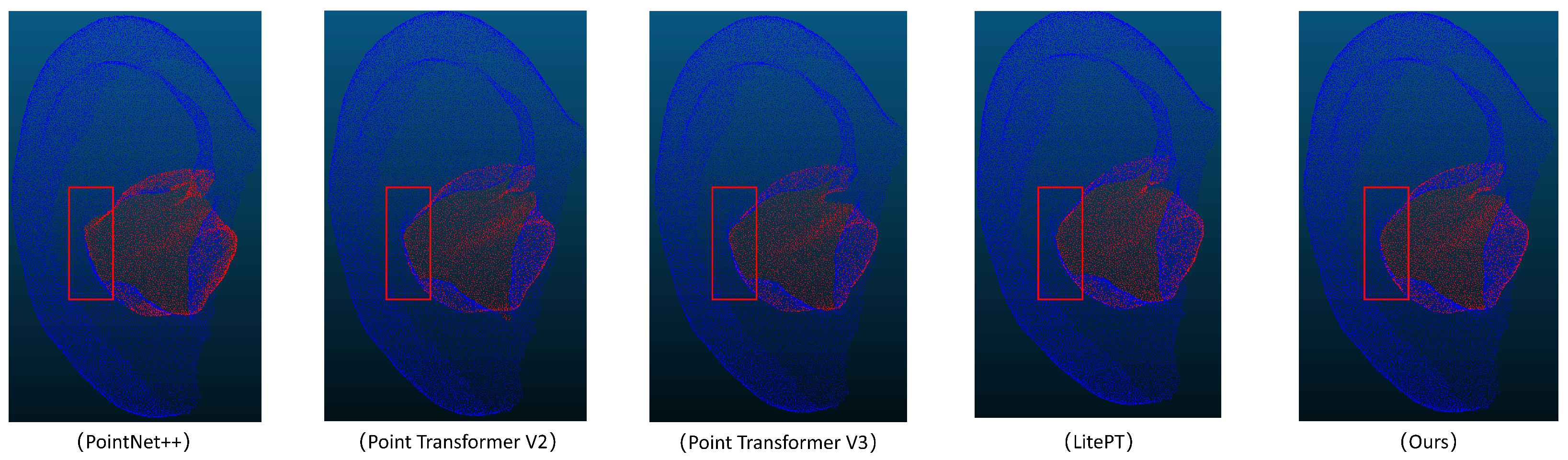
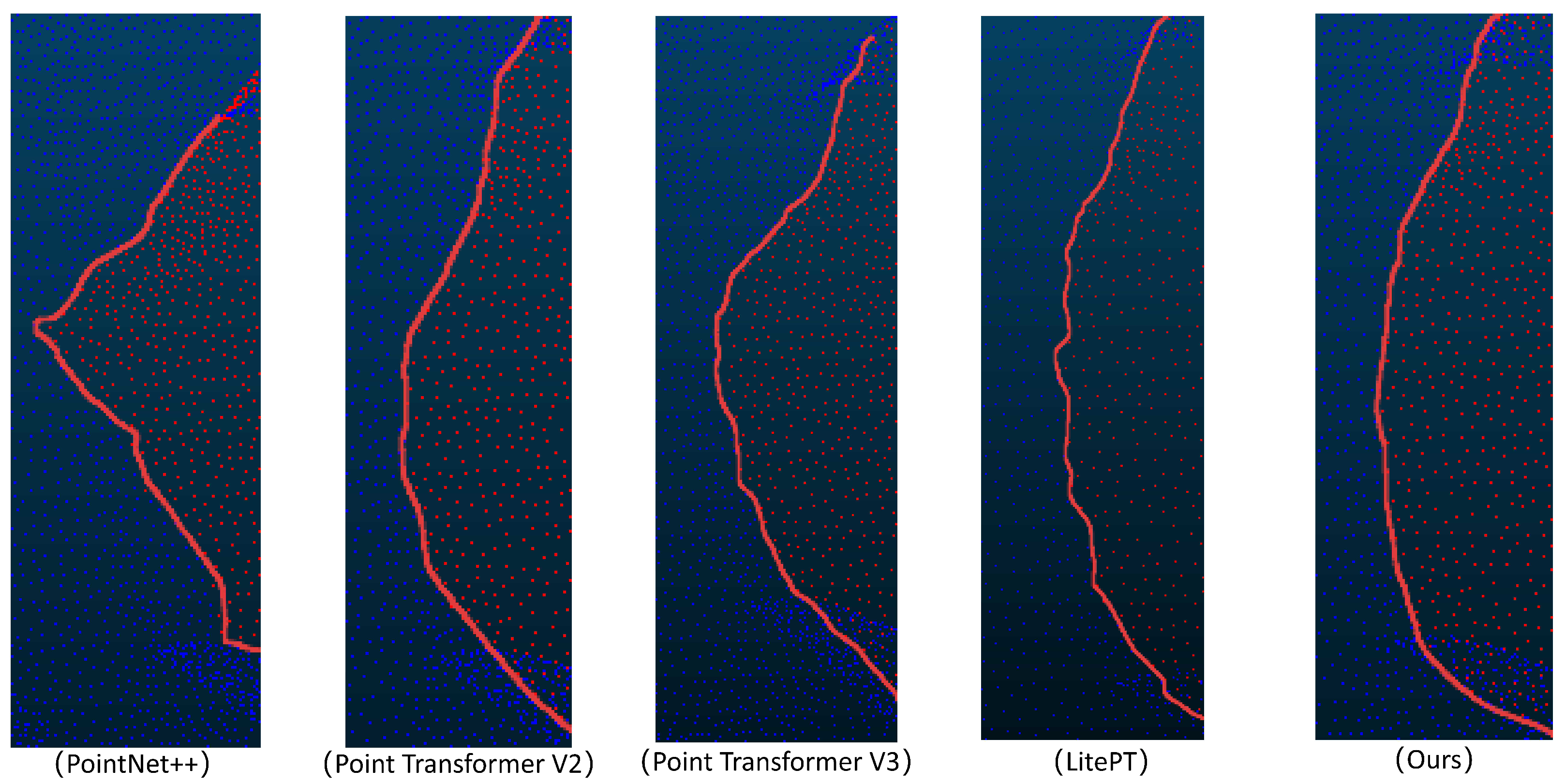
Visual comparisons of the segmentation results show that PointNet++ fails to effectively segment the auricular region, with severe boundary discontinuities. Both Point Transformer V2 and V3 produce improved structural integrity but still lack sufficient boundary segmentation accuracy.
Figure 5 provides the overall auricular segmentation visualization, and
Figure 6 zooms in on the local boundary details of the red-boxed region in
Figure 5. LitePT performs well in overall segmentation, but there is still a gap in boundary smoothness and anatomical alignment. Geopriors-3DEarSeg perfectly reconstructs the auricular anatomy, with smooth and continuous boundary segmentation that accurately matches the real anatomical boundaries, demonstrating its ability to precisely capture weak-boundary areas.
4.4. Ablation Study
This section presents the ablation experiments on geometric features, geometry-guided boundary-enhanced attention mechanism, and NVBLoss, as shown in
Table 3.
The experimental results show that the baseline model using PTV3 features achieves an mIoU of 0.9591 and mAcc of 0.9711 but lacks auricular geometric priors and targeted optimization, limiting weak-boundary capture. Model 1 integrates three geometric features—normal vector orientation, local Gaussian curvature, and shape diameter function—concatenated with original coordinates and normals, achieving an improved mIoU of 0.9672, demonstrating the discriminative power of geometric priors. Model 2 incorporates a QKV gating mechanism to embed these features into Transformer self-attention, achieving an mIoU of 0.9847, confirming the efficiency of geometry-guided boundary-enhanced attention in focusing on weak boundaries. Model 3 introduces NVBLoss, raising the mIoU to 0.9697, validating its effectiveness in addressing class imbalance at boundary points. Model 4, combining all three modules, reaches an mIoU of 0.9857, evidencing their synergistic effect: geometric features provide essential priors, geometry-guided attention enhances boundary encoding, and NVBLoss strengthens supervision. These ablation results confirm the necessity and effectiveness of the proposed designs.
The efficiency results in
Table 4 further reveal the computational contribution of each proposed component. The introduction of geometric features increases the FLOPs from 60.4 G to 62.1 G and the inference time from 4.466 s to 7.379 s, primarily because local neighborhood searching and geometric descriptor computations are required for every point. Although these operations introduce additional computational overhead, the parameter count remains nearly unchanged. When the geometry-guided boundary-enhanced attention module is incorporated, the computational cost further increases, resulting in 66.8 G FLOPs, a 13.579 s inference time, and 17.8 GB GPU memory usage. This overhead mainly arises from the projection of geometric priors into Q-, K-, and V-specific gating weights and their repeated application throughout the hierarchical Transformer architecture. In contrast, NVBLoss introduces only a marginal increase in FLOPs and parameters because it is applied only during training and mainly involves lightweight normal-consistency calculations. The full model requires 67.0 G FLOPs, 23.7 h training time, and 18.1 GB GPU memory, representing a moderate increase in computational cost compared with the baseline. Nevertheless, these additional costs lead to substantial improvements in segmentation accuracy, demonstrating that explicit geometric modeling and geometry-guided attention provide an effective trade-off between computational efficiency and weak-boundary segmentation performance.
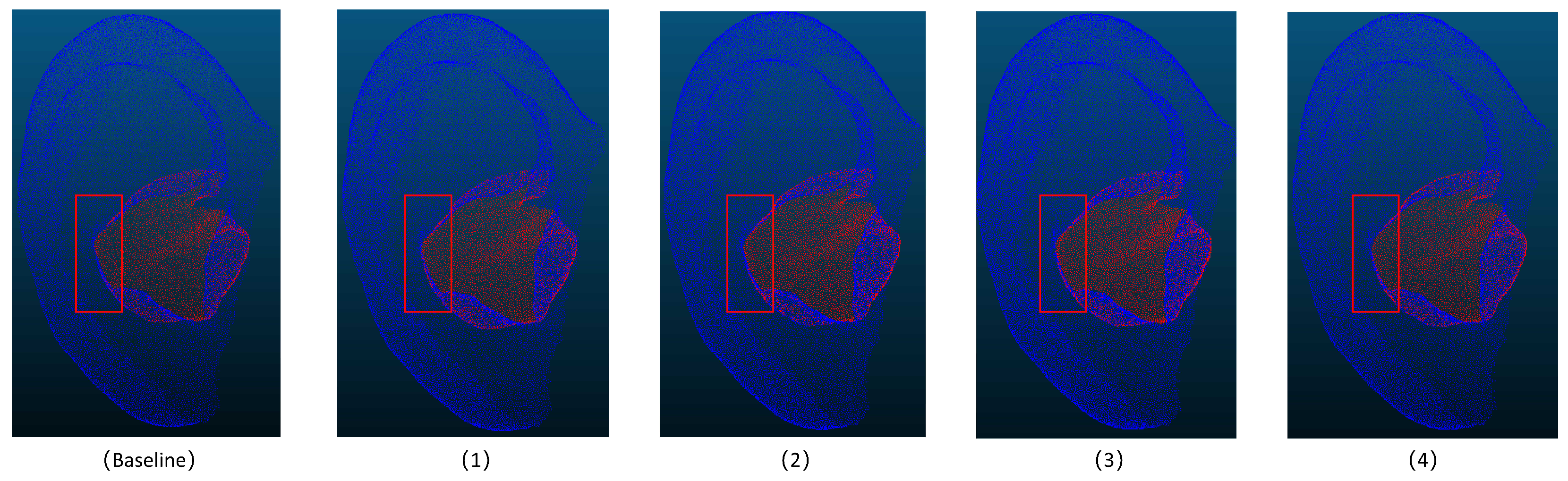
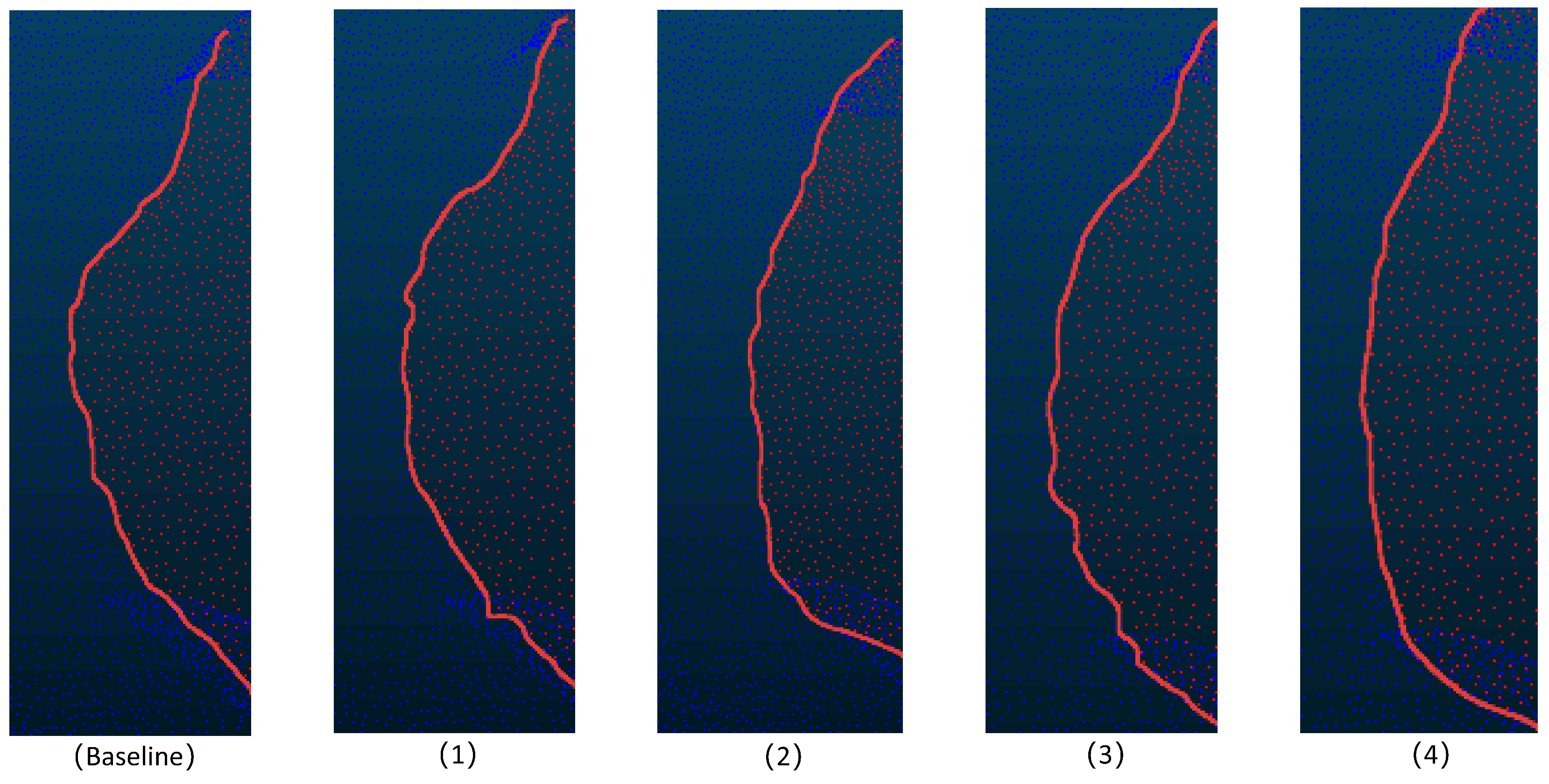
Visualizations are shown in
Figure 7,
Figure 8 presents the overall auricular segmentation, and
Figure 8 zooms into the red-boxed boundary region. The baseline roughly segments the auricle but shows over- and under-segmentation at weak boundaries. Incorporating multidimensional geometric features improves completeness, reduces background misclassification, and enhances boundary continuity. Geometry-guided attention further sharpens and smooths segmentation boundaries, ensuring accurate weak-boundary localization. NVBLoss reduces artifacts and misclassifications at boundaries, confirming effective supervision. The full integrated model reproduces auricular anatomy precisely in global and local views, achieving accurate weak-boundary segmentation.
4.5. Additional Validation on Fine-Grained Auricular Subregion Segmentation
To further evaluate the capability of GeoPriors-3DEarSeg beyond binary auricle region segmentation, an additional fine-grained auricular subregion segmentation experiment was conducted on the public YEM dataset.
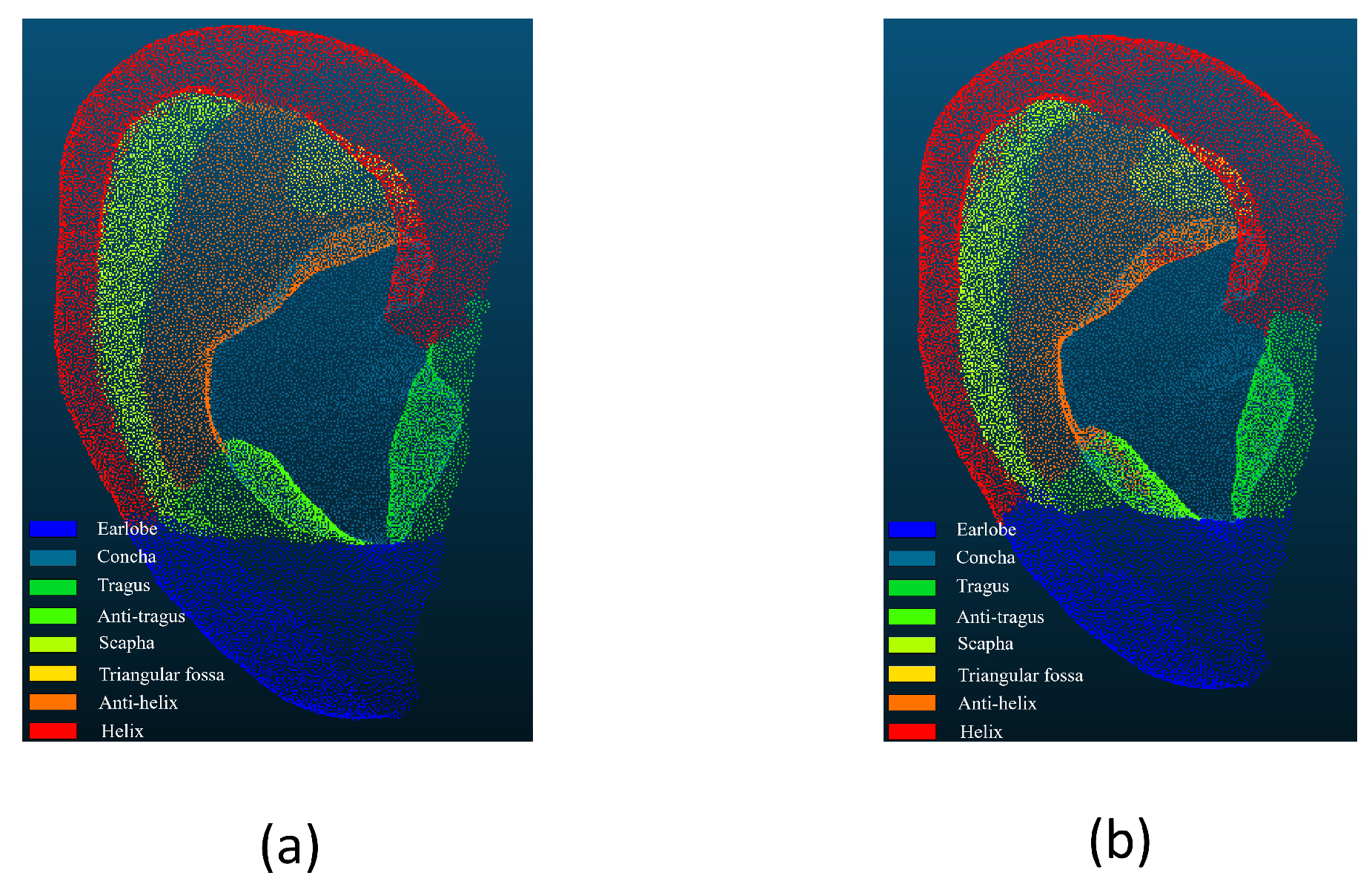
Specifically, eight anatomically defined auricular subregions were annotated in this work. In accordance with the international standard for auricular acupoints established in 2013, these eight parts correspond to the earlobe, concha, tragus, anti-tragus, scapha, triangular fossa, anti-helix, and helix [
29]. Different from the original binary segmentation between concha and non-concha tissues, this multi-class segmentation task contains numerous weak boundaries among adjacent anatomical subregions, which greatly increases segmentation difficulty.
Table 5 reports the overall segmentation performance, while
Table 6 presents the class-wise results. High segmentation accuracy was obtained across most auricular subregions, particularly for the concha, tragus, helix, and earlobe, demonstrating the effectiveness of the proposed geometric-priors-guided framework in capturing subtle anatomical boundaries.
Figure 9 visualizes representative results of eight-region auricular segmentation. The proposed method accurately preserves the geometric continuity of adjacent structures and produces clear boundaries even in anatomically complex regions such as the anti-tragus, scapha, and triangular fossa. These results indicate that GeoPriors-3DEarSeg remains effective in more challenging fine-grained weak-boundary segmentation scenarios.
4.6. Additional Validation on Multi-Source Real-World Data
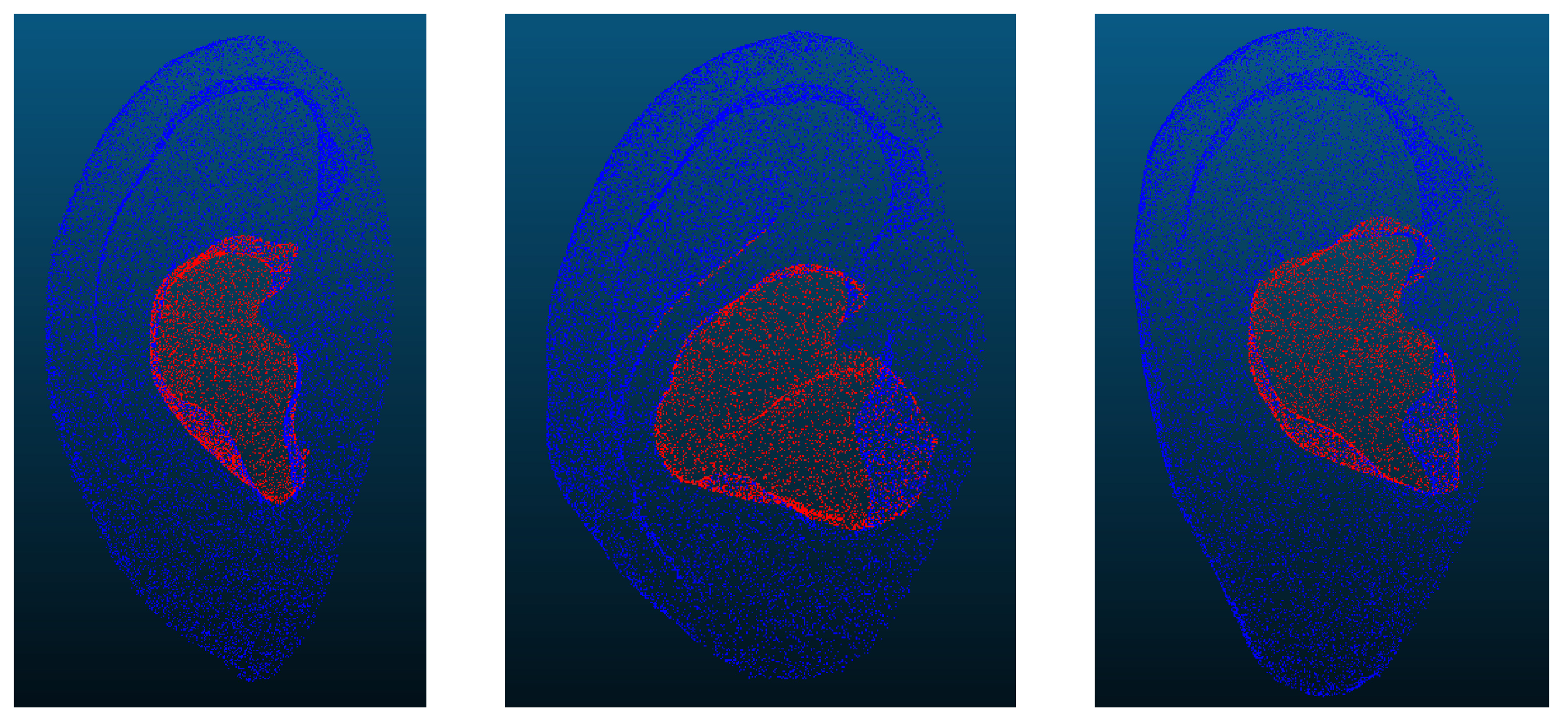
To further assess the robustness and generalization capability of the proposed framework beyond the public benchmark dataset, we conducted an additional validation experiment on an independently collected auricular point cloud dataset consisting of 30 subjects, acquired using a Shining3D Einstart Vega scanner. The dataset includes individuals from different age groups and ethnic backgrounds under real-world conditions.
To ensure consistency with the benchmark dataset, all point clouds were processed using the same preprocessing pipeline, including denoising, coordinate normalization, and point cloud standardization.
The quantitative results are reported in
Table 7. Although a performance decrease is observed compared with the public dataset, which can be attributed to domain shifts caused by heterogeneous acquisition conditions and population diversity, GeoPriors-3DEarSeg still achieves an mIoU of 0.9109 and an allAcc of 0.9680. These results indicate that the proposed framework maintains stable segmentation performance under cross-source conditions and demonstrates promising robustness to variations in subjects and scanning devices.
Figure 10 shows representative segmentation results on the independently collected auricular point cloud dataset. The red points indicate the segmented auricular region, and the blue points represent the surrounding non-auricular regions. The visualization demonstrates that GeoPriors-3DEarSeg produces coherent and anatomically consistent segmentation results under real-world conditions.
5. Conclusions and Future Work
This work addresses the challenges of weak-boundary 3D point cloud segmentation in the auricular region, where gradual geometric transitions and low feature discriminability hinder purely data-driven methods. We propose GeoPriors-3DEarSeg, a geometric-priors-guided network that leverages three complementary features—normal orientation, local Gaussian curvature, and shape diameter function—for unsupervised boundary characterization. A QKV-gated attention mechanism enhances weak-boundary features, while NVBLoss provides annotation-free boundary supervision. These components form an end-to-end framework spanning feature construction, enhancement, and loss optimization. Experiments on a public auricular dataset show the proposed network achieves significant improvements over PointNet++, Point Transformer V3, and LitePT in mIoU and mAcc, producing precise, continuous weak-boundary segmentation and enabling high-fidelity 3D modeling for clinical applications such as personalized hearing aids and otologic surgery.
Although GeoPriors-3DEarSeg achieves promising performance on both the public benchmark dataset and an independently collected real-world dataset, several limitations remain. First, the proposed framework is based on supervised learning and therefore relies on annotated training data. While the additional experiments on fine-grained eight-region auricular segmentation and cross-source real-world scans provide further evidence of robustness, the current evaluation is still limited by the overall scale of the available auricular point cloud data. Larger multi-center datasets are required to more comprehensively assess generalization capability across diverse populations, acquisition conditions, and scanning devices. Second, although the proposed method demonstrates encouraging performance under heterogeneous acquisition conditions, its applicability to other weak-boundary anatomical structures, such as blood vessels and cartilage, has not yet been systematically validated due to the lack of publicly available annotated medical point cloud datasets. In addition, the incorporation of geometric priors and geometry-guided attention introduces additional computational overhead compared with standard Transformer-based architectures. Future work will focus on collecting larger and more diverse multi-source datasets through collaborations with clinical institutions and conducting extensive cross-dataset evaluations under heterogeneous acquisition conditions. Furthermore, lightweight geometric feature extraction and efficient geometry-guided attention mechanisms will be explored to improve deployment efficiency while maintaining segmentation accuracy.
Another limitation of the present study is that the proposed segmentation framework is based on supervised deep learning and therefore requires accurately labeled auricular point cloud data for model training. The generation of dense point-wise labels is labor-intensive, and the model may require additional annotation or fine-tuning when applied to new datasets acquired using different scanners, preprocessing protocols, subject populations, or anatomical/point cloud domains. This limits the label efficiency and cross-domain applicability of the current framework. Future work will explore domain adaptation to improve model generalization and reduce annotation requirements. Previous studies have demonstrated that domain-adaptive learning can alleviate domain shift by aligning feature distributions between source and target domains, for example, through adversarial domain classifiers in domain-adaptive Faster R-CNN [
30] or DANN-based transformer models [
31]. Inspired by these approaches, domain-adaptive auricular point cloud segmentation could be investigated by adapting a model trained on a labeled source dataset to unlabeled or sparsely labeled target datasets. Potential directions include adversarial feature alignment, pseudo-label-based self-training, and Transformer-based domain-invariant representation learning.
Author Contributions
Conceptualization, L.Y. and A.G.; methodology, L.Y. and W.Z.; software, L.Y. and W.Z.; validation, L.Y., W.Z. and A.G.; formal analysis, L.Y. and W.Z.; investigation, L.Y. and W.Z.; resources, A.G. and W.H.; data curation, W.Z. and L.Y.; writing—original draft preparation, L.Y.; writing—review and editing, A.G. and W.H.; visualization, L.Y. and W.Z.; supervision, A.G. and W.H.; project administration, A.G.; funding acquisition, A.G. and W.H. All authors have read and agreed to the published version of the manuscript.
Funding
This research was funded by the scientific and technological project of the Ministry of Agriculture and Rural Affairs, the Fundamental Research Funds for the Central Universities, grant number FRF-TP-26-016, and the National Natural Science Foundation of China, grant number 42201365.
Institutional Review Board Statement
Ethical review and approval were waived for this study because the experiments were conducted using publicly available anonymized point cloud data and anonymized auricular point cloud data, without involving identifiable personal information or clinical intervention.
Informed Consent Statement
Informed consent was obtained from all subjects involved in the self-collected auricular point cloud data used in this study.
Data Availability Statement
The public human ear point cloud dataset used in this study is available from the original data source cited in this article. The self-collected auricular point cloud data are not publicly available due to privacy and ethical restrictions.
Acknowledgments
The authors would like to thank the contributors to the public human ear dataset and all participants who supported the self-collected auricular point cloud data acquisition.
Conflicts of Interest
The authors declare no conflicts of interest.
References
- Rusu, R.B.; Blodow, N.; Beetz, M. Fast point feature histograms (FPFH) for 3D registration. In Proceedings of the 2009 IEEE International Conference on Robotics and Automation; IEEE: Piscataway, NJ, USA, 2009; pp. 3212–3217. [Google Scholar] [CrossRef]
- Qi, C.R.; Su, H.; Mo, K.; Guibas, L.J. Pointnet: Deep learning on point sets for 3D classification and segmentation. In Proceedings of the IEEE Conference on Computer Vision and Pattern Recognition; IEEE: Piscataway, NJ, USA, 2017; pp. 652–660. [Google Scholar] [CrossRef]
- Qi, C.R.; Yi, L.; Su, H.; Guibas, L.J. Pointnet++: Deep hierarchical feature learning on point sets in a metric space. In Advances in Neural Information Processing Systems 30 (NIPS 2017); NeurIPS: San Diego, CA, USA, 2017. [Google Scholar] [CrossRef]
- Thomas, H.; Qi, C.R.; Deschaud, J.E.; Marcotegui, B.; Goulette, F.; Guibas, L.J. Kpconv: Flexible and deformable convolution for point clouds. In Proceedings of the IEEE/CVF International Conference on Computer Vision; IEEE: Piscataway, NJ, USA, 2019; pp. 6411–6420. [Google Scholar] [CrossRef]
- He, T.; Shen, C.; Van Den Hengel, A. Dynamic convolution for 3D point cloud instance segmentation. IEEE Trans. Pattern Anal. Mach. Intell. 2022, 45, 5697–5711. [Google Scholar] [CrossRef] [PubMed]
- Zhao, H.; Jiang, L.; Jia, J.; Torr, P.H.; Koltun, V. Point transformer. In Proceedings of the IEEE/CVF International Conference on Computer Vision; IEEE Computer Society: Washington, DC, USA, 2021; pp. 16259–16268. [Google Scholar] [CrossRef]
- Wu, X.; Lao, Y.; Jiang, L.; Liu, X.; Zhao, H. Point transformer v2: Grouped vector attention and partition-based pooling. In Advances in Neural Information Processing Systems 35 (NeurIPS 2022); NeurIPS: San Diego, CA, USA, 2022; pp. 33330–33342. [Google Scholar] [CrossRef]
- Wu, X.; Jiang, L.; Wang, P.S.; Liu, Z.; Liu, X.; Qiao, Y.; Ouyang, W.; He, T.; Zhao, H. Point transformer v3: Simpler faster stronger. In Proceedings of the IEEE/CVF Conference on Computer Vision and Pattern Recognition; IEEE: Piscataway, NJ, USA, 2024; pp. 4840–4851. [Google Scholar] [CrossRef]
- Yue, Y.; Robert, D.; Wang, J.; Hong, S.; Wegner, J.D.; Rupprecht, C.; Schindler, K. Litept: Lighter yet stronger point transformer. In Proceedings of the IEEE/CVF Conference on Computer Vision and Pattern Recognition; IEEE: Piscataway, NJ, USA, 2026; pp. 24173–24184. [Google Scholar]
- Lai, X.; Liu, J.; Jiang, L.; Wang, L.; Zhao, H.; Liu, S.; Qi, X.; Jia, J. Stratified transformer for 3D point cloud segmentation. In Proceedings of the IEEE/CVF Conference on Computer Vision and Pattern Recognition; IEEE: Piscataway, NJ, USA, 2022; pp. 8500–8509. [Google Scholar]
- Yang, Y.Q.; Guo, Y.X.; Xiong, J.Y.; Liu, Y.; Pan, H.; Wang, P.S.; Tong, X.; Guo, B. Swin3d: A pretrained transformer backbone for 3d indoor scene understanding. Comput. Vis. Media 2025, 11, 83–101. [Google Scholar] [CrossRef]
- Guennebaud, G.; Gross, M. Algebraic point set surfaces. In ACM Transactions on Graphics; ACM SIGGRAPH 2007 Papers; Association for Computing Machinery: New York, NY, USA, 2007; p. 23-es. [Google Scholar] [CrossRef]
- Lan, S.; Yu, R.; Yu, G.; Davis, L.S. Modeling local geometric structure of 3d point clouds using geo-cnn. In Proceedings of the IEEE/CVF Conference on Computer Vision and Pattern Recognition; IEEE: Piscataway, NJ, USA, 2019; pp. 998–1008. [Google Scholar] [CrossRef]
- Wang, C.; Zhao, C. Enhancing 3D point cloud learning with geometric-aware dynamic graph convolution and Transformer networks. J. Supercomput. 2026, 82, 50. [Google Scholar] [CrossRef]
- Cootes, T.F.; Taylor, C.J.; Cooper, D.H.; Graham, J. Active Shape Models-Their Training and Application. Comput. Vis. Image Underst. 1995, 61, 38–59. [Google Scholar] [CrossRef]
- Al Arif, S.M.R.; Knapp, K.; Slabaugh, G. Shape-aware Deep Convolutional Neural Network for Vertebrae Segmentation. In International Workshop on Computational Methods and Clinical Applications in Musculoskeletal Imaging; Springer: Cham, Switzerland, 2017. [Google Scholar] [CrossRef]
- Wu, Y.; Wei, H. GENet: A Geometry-Enhanced Network for LiDAR Semantic Segmentation. Sensors 2026, 26, 1460. [Google Scholar] [CrossRef] [PubMed]
- Wang, J.; Liu, J.; Xu, Z.; Zhou, Y.; Ye, M. M-PointNet: A Multi-Layer Embedded Deep Learning Model for 3D Intracranial Aneurysm Classification and Segmentation. IET Image Process. 2026, 20, e70275. [Google Scholar] [CrossRef]
- Yuan, L.; Zuo, W.; Zhao, Y.; Wang, Y.; Rong, P. 3D Ear Segmentation Based on Multiscale Point Transformer. In Proceedings of the 2025 17th International Conference on Human System Interaction (HSI); IEEE: Piscataway, NJ, USA, 2025. [Google Scholar] [CrossRef]
- Hussain, R.; Lalande, A.; Girum, K.B.; Guigou, C.; Bozorg Grayeli, A. Automatic segmentation of inner ear on CT-scan using auto-context convolutional neural network. Sci. Rep. 2021, 11, 4406. [Google Scholar] [CrossRef] [PubMed]
- Wang, J.; Wei, L.; Wang, L.; Zhou, Q.; Zhu, L.; Qin, J. Boundary-aware Transformers for Skin Lesion Segmentation. arXiv 2021, arXiv:2110.03864. [Google Scholar] [CrossRef]
- Peng, X.; Chen, S. Edge guided bidirectional iterative network in medical image segmentation. Sci. Rep. 2010, 15, 10. [Google Scholar] [CrossRef] [PubMed]
- Jia, H.; Liang, X.; Liu, Y.; Qin, Z.; Liu, K.; Dai, C. Point Cloud Semantic Segmentation Based on Boundary Awareness and Multi-scale Spatial Descriptors. IEEE Trans. Geosci. Remote Sens. 2026, 64, 4407418. [Google Scholar] [CrossRef]
- Lin, T.Y.; Goyal, P.; Girshick, R.; He, K.; Dollár, P. Focal Loss for Dense Object Detection. IEEE Trans. Pattern Anal. Mach. Intell. 2017, 42, 2999–3007. [Google Scholar] [CrossRef]
- Milletari, F.; Navab, N.; Ahmadi, S.A. V-Net: Fully Convolutional Neural Networks for Volumetric Medical Image Segmentation. In Proceedings of the 2016 Fourth International Conference on 3D Vision (3DV); IEEE: Piscataway, NJ, USA, 2016. [Google Scholar] [CrossRef]
- Kervadec, H.; Bouchtiba, J.; Desrosiers, C.; Granger, E.; Dolz, J.; Ayed, I.B. Boundary loss for highly unbalanced segmentation. In Proceedings of the International Conference on Medical Imaging with Deep Learning; PMLR: Cambridge, MA, USA, 2019; pp. 285–296. [Google Scholar] [CrossRef]
- Hu, X.; Li, F.; Samaras, D.; Chen, C. Topology-preserving deep image segmentation. In Advances in Neural Information Processing Systems 32 (NeurIPS 2019); NeurIPS: San Diego, CA, USA, 2019. [Google Scholar]
- Dai, H.; Pears, N.; Smith, W. A data-augmented 3d morphable model of the ear. In Proceedings of the 2018 13th IEEE International Conference on Automatic Face & Gesture Recognition (FG 2018); IEEE: Piscataway, NJ, USA, 2018; pp. 404–408. [Google Scholar] [CrossRef]
- WFAS Standard 002:2013; World Federation of Acupuncture-Moxibustion Societies. Name and Location of Auricular Acupuncture Points. China Traditional Chinese Medicine Press: Beijing, China, 2016.
- Wang, S. Domain-adaptive faster R-CNN for non-PPE identification on construction sites from body-worn and general images. Sci. Rep. 2026, 16, 4793. [Google Scholar] [CrossRef] [PubMed]
- Wang, S. Domain adaptation using transformer models for automated detection of exterior cladding materials in street view images. Sci. Rep. 2026, 16, 2696. [Google Scholar] [CrossRef] [PubMed]
Figure 1.
Model architecture diagram.
Figure 1.
Model architecture diagram.
Figure 2.
Visualization of three-dimensional geometric features.
Figure 2.
Visualization of three-dimensional geometric features.
Figure 3.
Geometric priors-guided QKV gated attention module structure.
Figure 3.
Geometric priors-guided QKV gated attention module structure.
Figure 4.
GEO-fused vector point cloud attention weight visualization. Yellow circles denote the auricular boundary.
Figure 4.
GEO-fused vector point cloud attention weight visualization. Yellow circles denote the auricular boundary.
Figure 5.
Overall auricle segmentation visualization in comparative experiments.
Figure 5.
Overall auricle segmentation visualization in comparative experiments.
Figure 6.
Zoomed-In boundary detail of auricle in comparative experiments.
Figure 6.
Zoomed-In boundary detail of auricle in comparative experiments.
Figure 7.
Overall auricle segmentation visualization in ablation experiments. The numbers correspond to different ablation models: Baseline, model without the proposed modules; 1, geometric features; 2, geometric features with geometry-guided boundary-enhanced attention; 3, geometric features with NVBLoss; and 4, the full model.
Figure 7.
Overall auricle segmentation visualization in ablation experiments. The numbers correspond to different ablation models: Baseline, model without the proposed modules; 1, geometric features; 2, geometric features with geometry-guided boundary-enhanced attention; 3, geometric features with NVBLoss; and 4, the full model.
Figure 8.
Zoomed-in boundary detail of auricle in ablation experiments. The numbers correspond to different ablation models: Baseline, model without the proposed modules; 1, geometric features; 2, geometric features with geometry-guided boundary-enhanced attention; 3, geometric features with NVBLoss; and 4, the full model.
Figure 8.
Zoomed-in boundary detail of auricle in ablation experiments. The numbers correspond to different ablation models: Baseline, model without the proposed modules; 1, geometric features; 2, geometric features with geometry-guided boundary-enhanced attention; 3, geometric features with NVBLoss; and 4, the full model.
Figure 9.
Additional validation on fine-grained eight-region auricular anatomical segmentation. (a) Ground-truth labels. (b) Predicted segmentation results obtained by GeoPriors-3DEarSeg. Different colors represent different auricular anatomical regions, including the earlobe, concha, tragus, anti-tragus, scapha, triangular fossa, anti-helix, and helix, as indicated in the legend.
Figure 9.
Additional validation on fine-grained eight-region auricular anatomical segmentation. (a) Ground-truth labels. (b) Predicted segmentation results obtained by GeoPriors-3DEarSeg. Different colors represent different auricular anatomical regions, including the earlobe, concha, tragus, anti-tragus, scapha, triangular fossa, anti-helix, and helix, as indicated in the legend.
Figure 10.
Representative segmentation results on self-collected real auricular point cloud dataset scanned by Shining3D EinStar Vega. Red points denote the auricular region and blue points denote the background region.
Figure 10.
Representative segmentation results on self-collected real auricular point cloud dataset scanned by Shining3D EinStar Vega. Red points denote the auricular region and blue points denote the background region.
Table 1.
Comparison of experimental results. Bold values indicate the best performance.
Table 1.
Comparison of experimental results. Bold values indicate the best performance.
| Methods | mIoU | mAcc | allAcc | mPrecision |
|---|
| PointNet++ | 0.8638 | 0.9670 | 0.9580 | 0.8929 |
| Point Transformer V2 | 0.9502 | 0.9800 | 0.9866 | 0.9685 |
| Point Transformer V3 | 0.9591 | 0.9711 | 0.9894 | 0.9871 |
| LitePT | 0.9693 | 0.9758 | 0.9921 | 0.9916 |
| Ours | 0.9857 | 0.9931 | 0.9963 | 0.9924 |
Table 2.
Computational efficiency of various methods.
Table 2.
Computational efficiency of various methods.
| Method | Params | FLOPs | Inference | Training | GPU |
|---|
| | (M) | (G) | Time (s/Sample) | Time (h) | Memory (GB) |
|---|
| PointNet++ | 8.47 | 18.7 | 0.755 | 6.3 | 6.1 |
| Point Transformer V2 | 39.08 | 52.8 | 8.929 | 21.9 | 15.2 |
| Point Transformer V3 | 46.18 | 60.4 | 4.466 | 20.8 | 16.4 |
| LitePT | 12.71 | 36.5 | 2.934 | 10.6 | 7.8 |
| Ours | 46.39 | 67.0 | 12.472 | 23.7 | 18.1 |
Table 3.
Ablation experiment results.
Table 3.
Ablation experiment results.
| Model | Geometric
Features | Geometry-Guided
Boundary-Enhanced
Attention | NVBLoss | mIoU | mAcc | allAcc | mPrecision |
|---|
| Baseline | | | | 0.9591 | 0.9711 | 0.9894 | 0.9871 |
| 1 | √ | | | 0.9672 | 0.9793 | 0.9915 | 0.9872 |
| 2 | √ | √ | | 0.9847 | 0.9910 | 0.9960 | 0.9935 |
| 3 | √ | | √ | 0.9697 | 0.9834 | 0.9921 | 0.9856 |
| 4 | √ | √ | √ | 0.9857 | 0.9931 | 0.9963 | 0.9924 |
Table 4.
Computational efficiency of ablation study.
Table 4.
Computational efficiency of ablation study.
| Model | Geometric
Features | Geometry-Guided
Boundary-Enhanced
Attention | NVBLoss | Params
(M) | FLOPs
(G) | Inference
Time (s/Sample) | Training
Time (h) | GPU
Memory (GB) |
|---|
| Baseline | | | | 46.18 | 60.4 | 4.466 | 20.8 | 16.4 |
| 1 | √ | | | 46.20 | 62.1 | 7.379 | 21.6 | 16.9 |
| 2 | √ | √ | | 46.39 | 66.8 | 13.579 | 23.4 | 17.8 |
| 3 | √ | | √ | 46.20 | 62.3 | 6.150 | 22.1 | 17.2 |
| 4 | √ | √ | √ | 46.39 | 67.0 | 12.472 | 23.7 | 18.1 |
Table 5.
Overall performance on eight-region auricular segmentation.
Table 5.
Overall performance on eight-region auricular segmentation.
| Method | mIoU | mAcc | allAcc | mPrecision |
|---|
| Ours | 0.8799 | 0.9235 | 0.9484 | 0.9483 |
Table 6.
Class-wise segmentation results on eight auricular anatomical regions.
Table 6.
Class-wise segmentation results on eight auricular anatomical regions.
| Auricular Region | IoU | Recall | Precision |
|---|
| Earlobe | 0.9180 | 0.9654 | 0.9492 |
| Concha | 0.9640 | 0.9773 | 0.9861 |
| Tragus | 0.9346 | 0.9639 | 0.9684 |
| Anti-tragus | 0.8200 | 0.8398 | 0.9720 |
| Scapha | 0.8092 | 0.8779 | 0.9119 |
| Triangular fossa | 0.8093 | 0.8715 | 0.9189 |
| Anti-helix | 0.8596 | 0.9093 | 0.9403 |
| Helix | 0.9241 | 0.9826 | 0.9395 |
Table 7.
Cross-source validation results on independently collected real-world auricular point clouds.
Table 7.
Cross-source validation results on independently collected real-world auricular point clouds.
| Method | mIoU | mAcc | allAcc | mPrecision |
|---|
| Ours | 0.9109 | 0.9544 | 0.9680 | 0.9510 |
| Disclaimer/Publisher’s Note: The statements, opinions and data contained in all publications are solely those of the individual author(s) and contributor(s) and not of MDPI and/or the editor(s). MDPI and/or the editor(s) disclaim responsibility for any injury to people or property resulting from any ideas, methods, instructions or products referred to in the content. |