Article

A Lightweight Algal Bloom Detection Algorithm for Water Surfaces Based on Improved YOLOv26

by
Haoran Wang
1,2,
Zifei Ma
1,2,
Mi Zhou
1,2,
Yunfeng Pan
3,
Jing Wang
1,2 and
Yanji Yao
1,2,*
1
College of Water Conservancy, Yunnan Agricultural University, Kunming 650201, China
2
Yunnan Key Laboratory of Water Security, Kunming 650201, China
3
College of Resources and Environment, Yunnan Agricultural University, Kunming 650201, China
*
Author to whom correspondence should be addressed.
Appl. Sci. 2026, 16(12), 5969; https://doi.org/10.3390/app16125969
Submission received: 17 April 2026 / Revised: 28 May 2026 / Accepted: 9 June 2026 / Published: 12 June 2026
(This article belongs to the Special Issue Advances in Computer Vision and Digital Image Processing)

Abstract

Monitoring water surface algal blooms from surveillance perspectives faces challenges such as small objects, low texture contrasts, dynamic background interferences, and limited labeled datasets. In this study, we propose GECA-YOLOv26, a lightweight model that integrates Ghost Convolution (GhostConv) and Efficient Channel Attention (ECA) modules. First, the GhostConv lightweight module is introduced in the first layer of the YOLOv26 backbone, reducing parameters from 4608 to 2704 and achieving a 41% reduction in computational cost. Second, eight ECA modules are embedded at key locations after backbone downsampling and neck feature fusion to enhance feature representation and mitigate degradation caused by model lightweighting. Finally, the MuSGD optimizer is used for training, with adaptive modifications to resolve tensor shape conflicts with the ECA modules. Experimental results indicate that the model achieves a mAP50 of 82.16%. Compared with the YOLOv26 baseline, our model improves mAP50 by 6.42%, while mAP@0.5:0.95 decreases by 0.79% and inference speed reduces from 143 FPS to 123 FPS. The model also reduces parameters and size, achieving 5.19 MB and 1864 fewer parameters. Compared with YOLOv8, YOLOv10, and YOLOv11, the proposed model improves mAP50 by 2.12%, 5.99%, and 2.79%, respectively. To evaluate the stability of the results under small-sample conditions, we conducted 3-fold and 5-fold cross-validation experiments, which demonstrated that the model performs robustly across different folds and random seeds. Ablation studies further confirm the effectiveness of each module. Heatmap analysis demonstrates that the proposed model effectively highlights small object regions, remains robust under limited-sample conditions, and reduces model complexity. This study provides a novel solution for algal bloom detection in surveillance scenarios.

1. Introduction

Dianchi Lake represents a vital ecological and economic asset for Kunming City. However, frequent cyanobacterial blooms induced by eutrophication severely threaten water security and aquatic ecosystems [1]. Brooks et al. [2] highlighted that harmful algal blooms (HABs) may constitute the greatest threat to public health and aquatic ecosystems in inland waters, with impacts comparable to those of conventional water pollution. Consequently, the development of efficient and accurate monitoring methods for algal blooms is essential for effective lake management [3]. Traditional monitoring methods are limited by low timeliness, high operational costs, and long update cycles, highlighting the need for intelligent and automated detection approaches.
With the advancement of artificial intelligence, deep learning-based visual monitoring approaches provide novel solutions. Among these, the YOLO series has been widely adopted due to its balance of accuracy and speed [4]. YOLOv26, released in 2025, is the latest version of the YOLO family and features a lightweight architecture. It enhances multi-scale object detection, particularly for small objects, by removing the Distribution Focal Loss (DFL) module, enabling end-to-end inference without non-maximum suppression (NMS), and integrating Progressive Loss Balancing (ProgLoss) with Small Target Aware Label assignment (STAL) [5]. Benchmark tests indicate that at a resolution of 640 × 640, YOLOv26 achieves a mAP@0.5:0.95 of 40.9% on the COCO dataset, with only 2.4 M parameters and 5.4 B FLOPs, while CPU inference speed is increased by up to 43% compared to previous versions [6]. Çarklı Yavuz [7] demonstrated that YOLOv26 exhibits significant advantages in limited-sample scenarios with only 133 images, with performance negatively correlated with dataset size, i.e., the superiority of YOLOv26 is more pronounced under limited-data conditions. Lu [8] incorporated GhostNet, ECA, and CARAFE upsampling into YOLOv5s, combined with image augmentation, increasing mAP for underwater debris detection from 60.92% to 86.19% while reducing computational cost to 15.78 GFLOPs. Yuan et al. [9] proposed a morphology-based attention detection method to address the challenge of detecting tiny algal objects in real aquatic environments, effectively enhancing feature extraction for small objects by leveraging their morphological variability.
Despite these advancements, directly applying YOLOv26 to surface algal bloom detection remains challenging. The algal bloom objects in surveillance imagery are small and exhibit blurred textures, similar to ship objects in TAD-YOLO. They are also affected by dynamic background noise, such as water waves and reflections, which increases both false positives and missed detections [10]. Moreover, obtaining high-quality annotated images in open-water environments is costly, and the limited-sample size restricts the generalization ability of deep learning models, further complicating detection [11]. The research motivations for algal bloom detection from a surveillance perspective are as follows: (1) improve the accuracy of lightweight detection models for complex algal bloom objects on water surfaces; (2) explore the trade-offs among model parameter count, computational cost, and detection accuracy under limited-sample conditions; (3) ensure that the model’s inference speed meets the requirements for real-time detection in resource-constrained environments.
To address these challenges, we propose a lightweight GECA-YOLOv26 model for algal bloom detection. Based on the YOLOv26 architecture, the model integrates GhostConv lightweight convolution layers and ECA modules. The main contributions of this work are as follows: (1) A limited-sample dataset based on surveillance imagery was constructed, and data diversity was enhanced through online augmentation techniques; (2) GhostConv was integrated with ECA modules to address the challenges of small-object detection and complex water surface monitoring under surveillance viewpoints; (3) ECA modules were embedded at eight key positions in the network to enhance feature representation and mitigate degradation caused by model lightweighting, with four modules placed after backbone downsampling to prevent feature loss and four after neck feature fusion to strengthen multi-scale feature interactions; (4) The gradient update logic of the MuSGD optimizer was extended to support the four-dimensional feature map tensors produced by the ECA modules, effectively resolving conflicts between four-dimensional feature maps and one-dimensional adaptive tensors.

2. Related Work

In recent years, deep learning-based detection of water surface objects has made significant progress. Mainstream object detection algorithms can be categorized as two-stage or single-stage methods. Two-stage methods such as R-CNN [12], Fast R-CNN [13], and Faster R-CNN [14], first generate candidate regions and then classify and refine them. Although highly accurate, these methods exhibit high computational complexity and low inference speed, limiting their suitability for real-time monitoring. Single-stage methods, including the YOLO series [4,5] and SSD [15], perform detection in a single forward pass, offering notable speed advantages. For specific water surface scenarios, various improvements have been proposed. Zhang et al. [16] developed YOLOv5-FF for detecting floating objects in freshwater environments. Their model incorporates a hybrid attention mechanism that supports long-range channel interactions while preserving direct channel-to-weight correspondence, combined with adaptive feature extraction modules and dilated encoders to enhance feature representation. However, this method was primarily designed for near-field floating objects, and its performance in detecting distant small objects has not been systematically evaluated. Yan et al. [17] proposed LRFL-YOLO for small object detection, designing a large receptive field and lightweight structure to effectively reduce computational complexity while maintaining detection accuracy. Nevertheless, its computational cost remains relatively high at 7.2 GFLOPs, which may limit real-time deployment in resource-constrained environments. Wu and Law [18] reviewed the application of deep learning and remote sensing for algal bloom detection, highlighting the limitations of conventional detection methods under dynamic background interference and limited-sample conditions, and emphasizing the need for lightweight, robust detection models. Xu et al. [19] introduced YOLOW, which preserves full channel information via the SPDCS module to enhance detection accuracy, incorporates SPPAUG for multi-scale feature fusion, and adopts the C2f module from YOLOv8 to improve inference speed, outperforming YOLOv5s on water surface floating object datasets. Collectively, these studies provide important methodological references for water surface object detection. However, Park et al. [20] noted that although deep learning-based approaches using surveillance imagery can improve monitoring efficiency, their performance heavily depends on high-quality, field-representative data and remains challenged by dynamic background interference. Furthermore, most of these models are not specifically designed for limited-sample conditions and lack sufficiently lightweight architectures.
Lightweight model optimization reduces the computational burden of YOLO models. Han et al. [21] proposed the GhostNet, which generates redundant feature maps through cheap linear transformations, significantly reducing the amount of computation. The GhostConv extends this concept, generating core features with a small number of standard convolutions and then expanding similar ghost features through depthwise convolution, thereby reducing both computational load and parameter count. In terms of attention mechanisms, Wang et al. [22] stacked three SE attention modules in YOLOv8n for small object detection, enhancing the saliency of small objects and reducing parameters by more than 35% without sacrificing accuracy. Mei et al. [23] proposed IALF-YOLO for insulator defect detection, using an improved S-CBAM mechanism that synchronously extracts channel and spatial features, effectively solving the information loss problem of traditional CBAM. Wang et al. [24] proposed ECA, a lightweight channel attention module that leverages one-dimensional convolution to capture channel dependencies, avoiding dimensionality reduction and requiring only 1/50 of the parameters of SENet, making it suitable for lightweight networks.
In the context of lightweight network context modeling, Singh et al. [25] proposed the Latent Graph Attention (LGA) module that propagates information spatially through a locally connected graph network to achieve semantic relationship modeling between arbitrary distant pixels. Building on prior success with GhostConv and ECA [8,26], this work focuses on optimizing limited-sample surface algal bloom detection.
Limited-sample detection aims to learn generalizable representations from few annotated examples. Transfer learning, which pretrains models on large datasets and fine-tunes them on small-scale tasks, is an effective strategy [27]. YOLOv26’s architectural designs, including STAL and ProgLoss, enhance few-shot learning capability. Çarklı Yavuz [7] showed that YOLOv26 maintains high detection accuracy on datasets with only 133 images. Moreover, model parameter count is positively correlated with overfitting risk, and lightweight design mitigates overfitting under limited-sample conditions [21]. In this study, GhostConv reduces the number of parameters in the first layer by 41%, and the ECA module adds only 40 parameters, resulting in a total parameter count of 2.57 M, effectively reducing overfitting risk while maintaining performance.

3. Model Improvement and Training

3.1. YOLOv26 Network

YOLOv26 is a real-time object detector developed by the Ultralytics team and represents the latest version of the YOLO family [6]. As a fully end-to-end model, YOLOv26 generates predictions directly without NMS post-processing. This eliminates the post-processing stage typical of traditional detectors, simplifies integration, and reduces inference latency, thereby enhancing deployment robustness across diverse environments. Architecturally, YOLOv26 removes the DFL module to simplify the export process, while integrating ProgLoss and STAL to improve small object detection accuracy. The MuSGD optimizer combines the benefits of Muon and SGD, accelerating convergence while preserving training stability [6]. For example, YOLOv26 achieves a mAP@0.5:0.95 of 40.9% on the COCO dataset at 640 × 640 input size, with only 2.4 M parameters and 5.4 B FLOPs. These characteristics make YOLOv26 an ideal baseline model for real-time object detection in resource-constrained environments. The network structure is shown in Figure 1.
To support the integration of ECA modules, the MuSGD optimizer was further adapted. During gradient updates, 1D tensors are reshaped to 2D, and 3D or higher-dimensional tensors are flattened to 2D to ensure compatibility. Valid 2D tensors are then orthogonalized using the Newton–Schulz method and scaled according to gradient dimensions, before being reshaped back to their original form. This adaptation enables MuSGD to handle the four-dimensional feature map tensors produced by ECA modules, effectively resolving conflicts with 1D adaptive tensors and allowing efficient integration with the network. The process can be implemented in PyTorch 2.10.0 as follows:
# Handle different tensor dimensions
        original_shape = update.shape
        if update.ndim == 1:
                # For 1D tensors (e.g., bias), reshape to 2D
                update = update.view(1, −1)
        elif update.ndim >= 3:
                # For 3D+ tensors (e.g., conv filters), flatten to 2D
                update = update.view(update.size(0), −1)

3.2. GhostConv Module

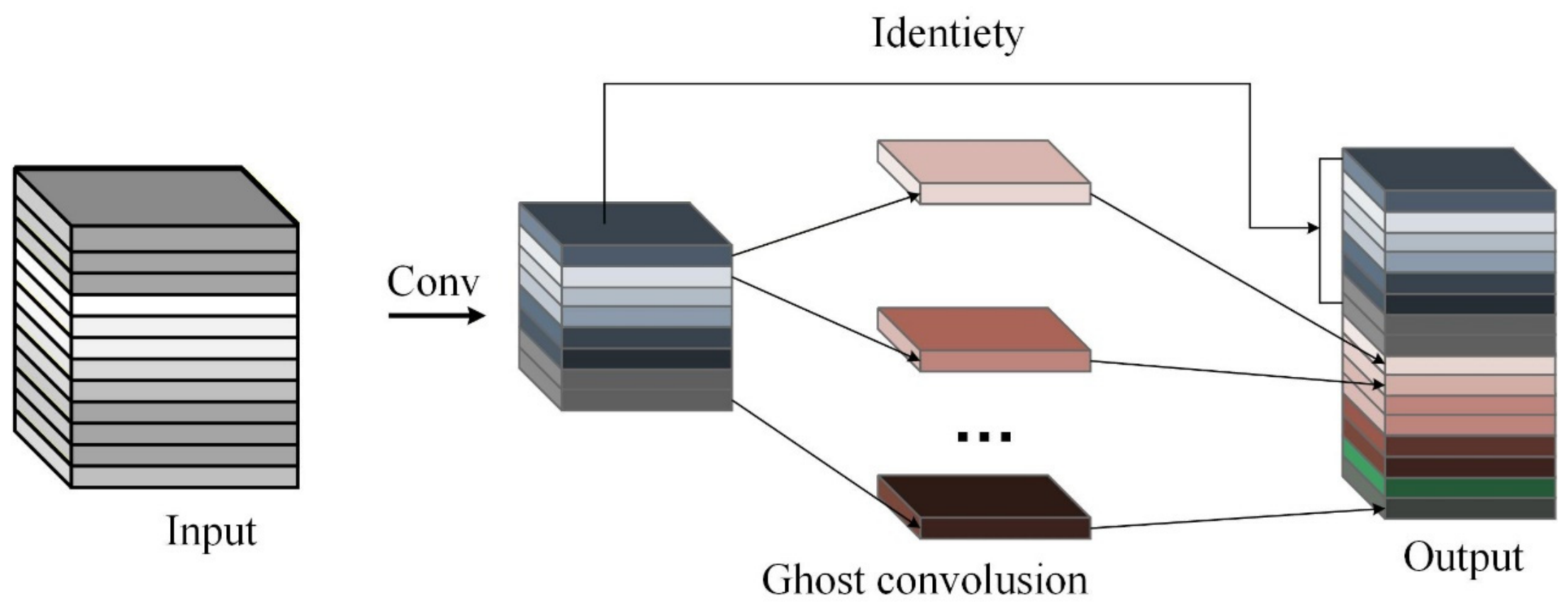
GhostConv is a lightweight convolution operation designed to reduce computational cost. Its core idea is to generate a small number of intrinsic feature maps using standard convolutions, then generate additional “ghost” feature maps through cheap linear transformations or depthwise convolutions, instead of directly computing all feature maps as in conventional convolutions. The intrinsic and ghost feature maps are concatenated to form the final output. The computation of GhostConv can be expressed as:
Y i n t r i n s i c = Conv 3 × 3 ( X ; W 1 )
Y g h o s t = DWConv 5 × 5 ( Y i n t r i n s i c ; W 2 )
GhostConv ( X ) =   Y i n t r i n s i c     Y g h o s t
where Conv 3 × 3 denotes a 3 × 3 standard convolution applied to the input feature map X. It generates the intrinsic features Y intrinsic . DWConv 5 × 5 denotes a 5 × 5 depthwise separable convolution applied to Y intrinsic . It generates the ghost features Y ghost . The symbol denotes concatenation along the channel dimension to produce the GhostConv output. The W 1 and W 2 denote the convolution weights of the primary and depthwise convolutions, respectively. The schematic of GhostConv is illustrated in Figure 2. In the improved model, the GhostConv parameters are 2704, compared with 4608 for the original convolution, a reduction of 41%, reducing computational cost and facilitating lightweight deployment.

3.3. ECA Attention Module

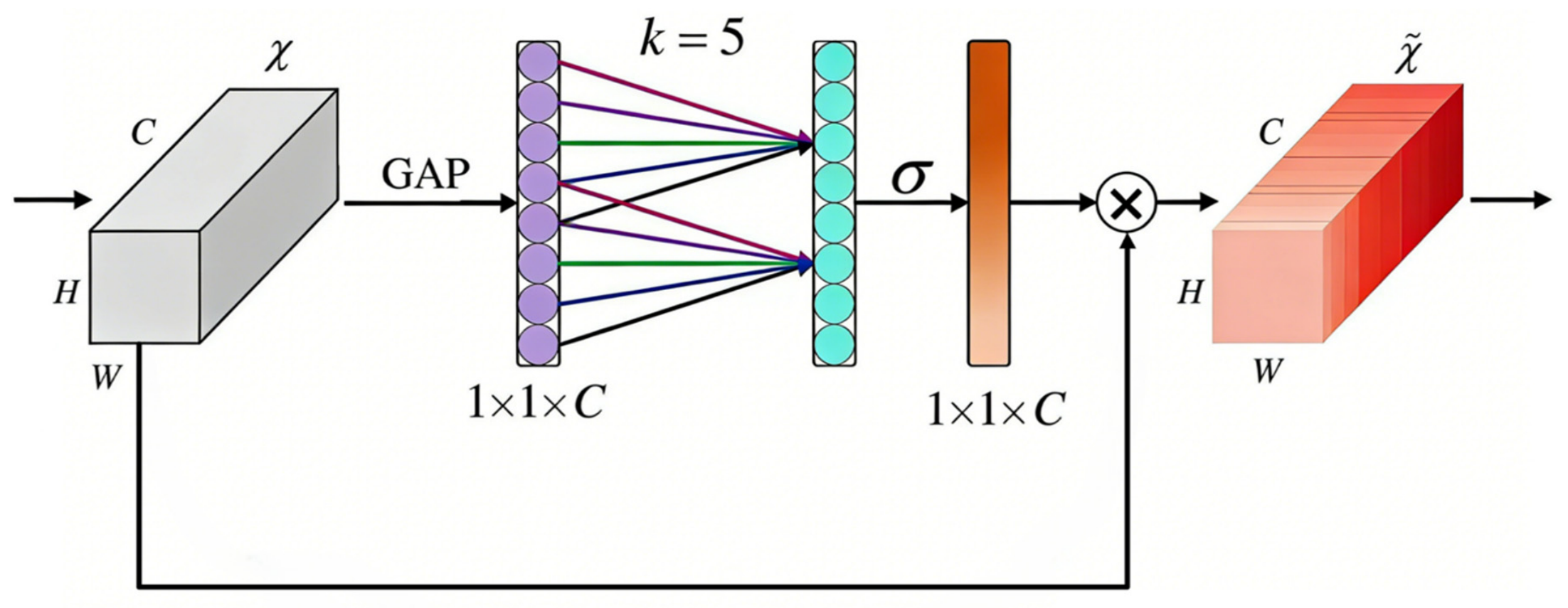
The ECA module is an effective channel attention mechanism that captures dependencies between channels via one-dimensional convolution, avoiding the complex dimensionality reduction process and preserving the integrity of original channel information, thus enhancing feature representation. Its adaptive mechanism adjusts the kernel size of the one-dimensional convolution according to the number of channels, allowing the ECA module to work effectively in networks of different scales. In this work, eight ECA modules are inserted into the network, with the computation process as illustrated in Figure 3. The ECA operation can be formulated as:
ECA ( Z ) = Z σ Conv 1 D k = 5 GAP ( Z )
where Z represents the input feature map of algal blooms, GAP denotes global average pooling, σ denotes the Sigmoid function, k is the adaptive kernel size, and ⊗ denotes channel-wise element-wise multiplication. In the improved YOLO network, the first four ECA modules are placed after downsampling to prevent feature loss caused by spatial information compression, and the last four are placed after feature fusion to optimize multi-scale feature interactions.

3.4. Improved GECA-YOLOv26 Network Structure

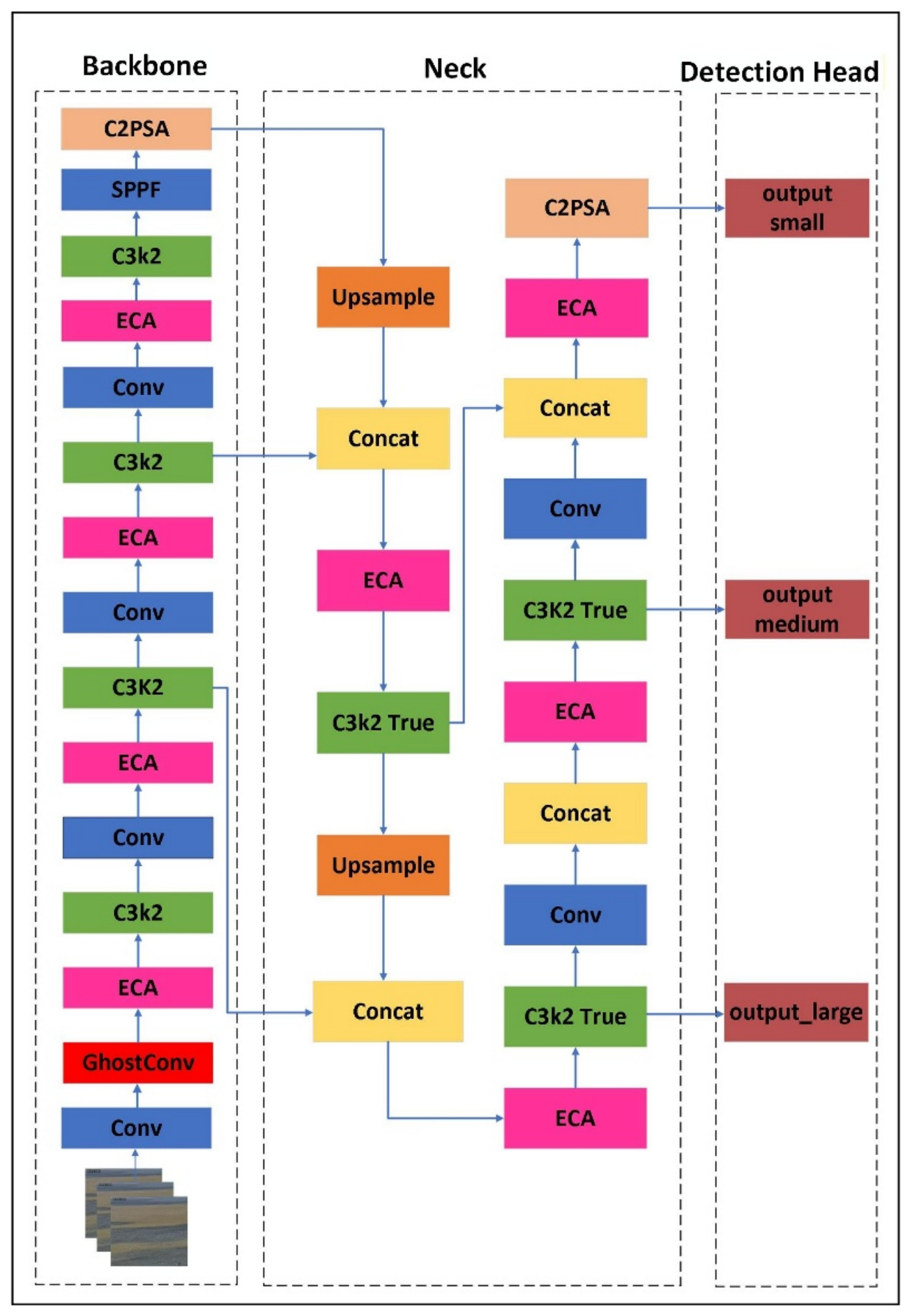
The lightweight GECA-YOLOv26 model is built on the YOLOv26 architecture. In the backbone, the initial convolution layer is replaced with GhostConv, where cv1 and cv2 use 3 × 3 and 5 × 5 kernels, respectively, and their outputs are concatenated along the channel dimension to enrich feature diversity. This configuration allows early extraction of multi-scale information with minimal computational overhead, which is particularly beneficial for detecting small algal bloom objects.
To optimize parameter efficiency while maintaining effective feature attention, eight ECA modules are inserted at specific locations. Four are positioned between the downsampled GhostConv layers and C3k2 blocks in the backbone, and the remaining four are placed between the Concat layers and C3k2 blocks in the neck. These locations process feature maps containing rich spatial and semantic information; applying channel attention here suppresses background noise (e.g., water ripples and reflections) and highlights algal bloom objects. Each ECA module captures global context via global average pooling and generates channel-wise attention weights through a lightweight one-dimensional convolution with an adaptive kernel size. The attention map is then fused with the original feature maps through element-wise multiplication, recalibrating channel importance while adding minimal parameters.
The integration of GhostConv and ECA modules forms a complementary relationship. GhostConv reduces computational redundancy and network parameters, while the ECA modules preserve feature discriminability lost due to model lightweighting. The overall architecture of GECA-YOLOv26 is depicted in Figure 4, where pink boxes denote ECA modules and red boxes indicate GhostConv modules.

4. Experiments and Results Analysis

4.1. Dataset Construction

In algal bloom detection tasks, high-quality annotated images are costly, and limited-dataset size poses a significant challenge [28]. Liu et al. [29] also reported that manual annotation of microalgae images is time-consuming and labor-intensive, increasing training costs. In this study, a limited-sample dataset containing 336 original images was constructed from monitoring videos at the Guanyin Mountain section of Dianchi Lake by extracting key frames. The dataset comes from fixed surveillance cameras, featuring a downward-looking angle, fixed field of view, and object scale varying with distance, faithfully reflecting the distribution characteristics of algal blooms in monitoring scenarios. Using the annotation tool LabelImg, a total of 1680 detection objects were manually labeled. Given the large variation in object scales within images, online data augmentation was applied to improve model generalization and robustness. The augmentation parameters are summarized in Table 1, including random translation, flipping, brightness adjustment, Mixup, and other operations. Since augmentation is performed online, the original image count remains unchanged, but each training iteration sees a transformed version.

4.2. Experimental Environment and Parameter Settings

To improve model adaptation under limited-sample conditions, transfer learning was applied by initializing YOLOv26 with pre-trained weights on the COCO dataset, leveraging general visual features to reduce dependence on domain-specific annotations. The dataset was initially split into training and validation sets at a 7:3 ratio for baseline experiments. The evaluation metrics were computed on the validation set used for model selection, and no separate test set was employed. The experiments were conducted using Ultralytics 8.4.8 + PyTorch 2.10 on Windows 11, with CUDA 13.1 and cuDNN 12.8, accelerated by an NVIDIA GeForce RTX 5050 GPU (8 GB), an Intel Core Ultra 9285H CPU, and 16 GB system memory. Python 3.11 was used as the programming language. The MuSGD optimizer was applied for YOLOv26 training. To avoid tensor conflicts with ECA modules, the optimizer was modified to support arbitrary tensor dimensions. To resolve the tensor shape conflict between the MuSGD optimizer and the ECA modules (MuSGD expects 2D weight matrices but ECA outputs 4D feature maps), the optimizer’s gradient update logic was extended to support high-dimensional tensors by reshaping them to 2D matrices before applying Muon-style updates and restoring the original dimensions afterward. Other YOLO versions, incompatible with the MuSGD, used AdamW, with identical hyperparameters as summarized in Table 2.

4.3. Evaluation Metrics

We use GFLOPs and the number of parameters (Params) to quantify the computational complexity of the model, and adopt FPS (frames per second) to evaluate its inference speed, where a higher FPS indicates faster processing. Precision, recall, and mean average precision (mAP) are used to assess detection accuracy. Precision represents the proportion of correctly predicted positive samples among all predicted positives:
P r e c i s i o n = T P T P + F P
where TP denotes true positives and FP denotes false positives. Recall represents the proportion of actual positives correctly predicted:
R e c a l l = T P T P + F N
where FN denotes false negatives. AP measures the area under the Precision–Recall curve for a single class, while mAP averages AP over all classes. Since algal bloom detection is a single-class task, AP is equivalent to mAP. Two mAP metrics were used: mAP50 and mAP@0.5:0.95, with the latter averaging mAP over IoU thresholds from 0.5 to 0.95, reflecting stricter localization accuracy. All metrics were computed on the validation set for ablation and comparison experiments.

4.4. Ablation Experiments

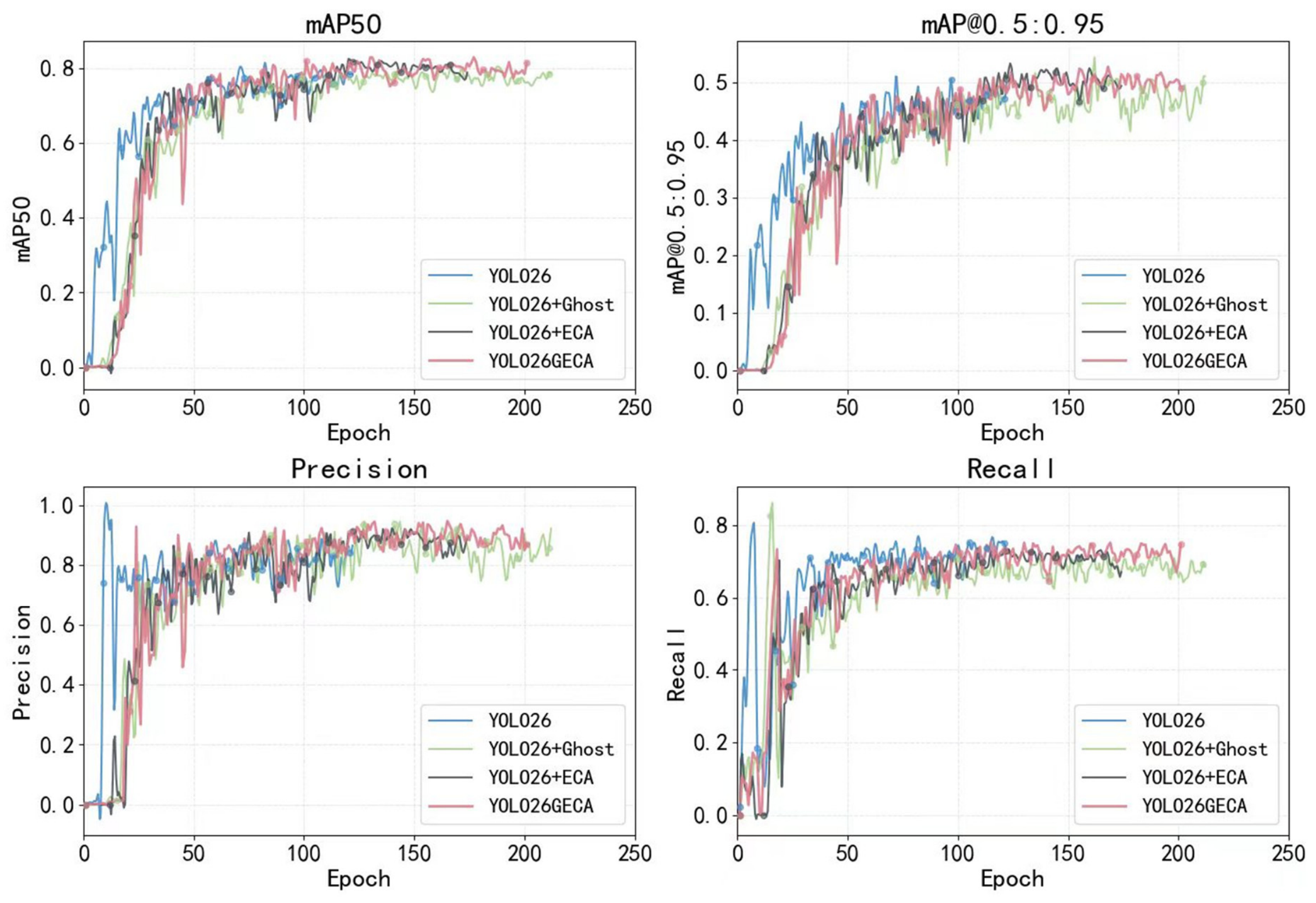
Ablation experiments were conducted to verify the effectiveness of GECA-YOLOv26. Each variant used identical hyperparameters and training strategies. Performance metrics on training and validation sets, including mAP50, mAP@0.5:0.95, Precision, and Recall, were used to evaluate the impact of individual modules. The training curves are shown in Figure 5. The YOLOv26 converges fastest but exhibits fluctuations in the first 10 epochs. Models with ECA and Ghost modules show smoother and more stable training, attributed to GhostConv reducing parameter redundancy, lowering limited-batch gradient variance, and ECA adaptively recalibrating channel features to suppress noisy gradients. The MuSGD optimizer further benefits from these modules, producing smoother optimization trajectories in early training.
The results are summarized in Table 3 (“×” indicates the module was not used, “√” indicates inclusion). On the validation set, adding only GhostConv reduced parameters by 1904 and improved mAP50 by 4.98%, though it slightly decreased inference speed to 138 FPS. Adding only ECA improved mAP50 by 5.96% without increasing GFLOPs and added only 40 parameters, but reduced speed to 127 FPS. Combining both modules (GECA-YOLOv26) further improved mAP50 by 6.42% and Recall by 9.25%, reduced computational cost by ~2%, decreased parameters by 1864. On the high-performance laptop used in this experiment, the inference speed decreased from 143 FPS to 123 FPS. This speed remains sufficient for real-time algal bloom monitoring (typically requiring ≥25 FPS). The minor speed reductions are attributed to the extra operations introduced by the attention modules, yet the overall trade-off between accuracy and speed remains favorable. Furthermore, using the MuSGD optimizer instead of AdamW led to a 3.25% improvement in mAP50 for YOLOv26, and the full GECA-YOLOv26 combined with MuSGD achieved comparatively favorable overall performance, demonstrating the effectiveness of MuSGD in this task. Notably, the GECA-YOLOv26+AdamW configuration achieved lower mAP50 than the YOLOv26+MuSGD baseline, indicating that the architectural modifications alone do not improve performance. Therefore, the performance gain in this study mainly comes from the combined effect of the lightweight architecture and the MuSGD optimization strategy, rather than the architectural modifications in isolation.

4.5. Comparison with Other Algorithms

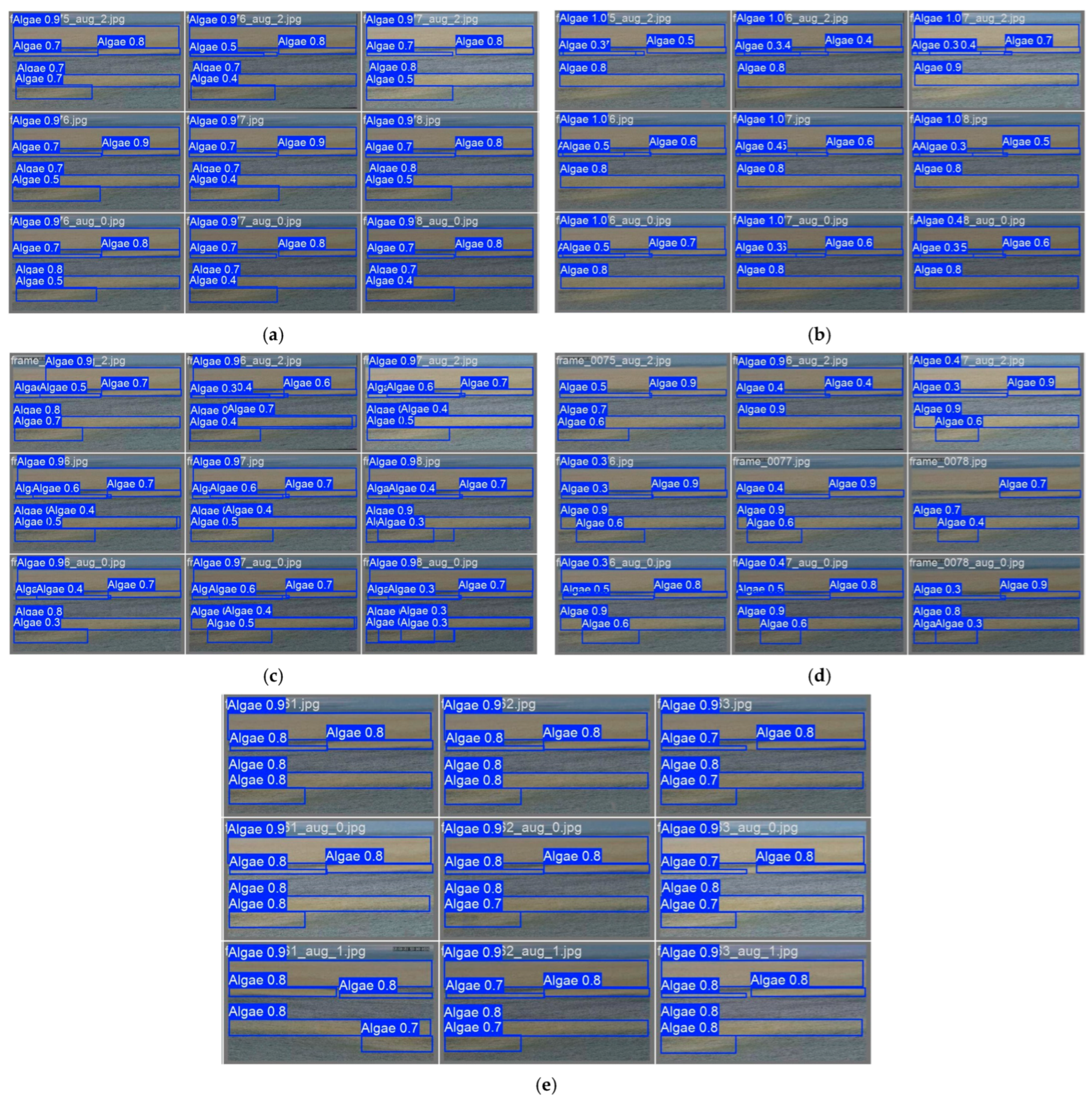
To verify the reliability of the proposed GECA-YOLOv26 model, we compared it with representative models YOLOv8, YOLOv10, YOLOv11, and YOLOv26 using the same evaluation metrics. As shown in Figure 6, when algal bloom objects are small or edges are blurred (e.g., the upper-left region of each detection frame), YOLOv10, YOLOv11, and YOLOv26 exhibit lower prediction confidence, whereas GECA-YOLOv26 accurately detects these small objects. To further validate the generality and superiority of the ECA module, it was incorporated into YOLOv8, YOLOv10, and YOLOv11 under the same training and testing conditions. Additionally, to compare the effects of different attention mechanisms on algal bloom detection, SE [30] and CBAM [31] modules were added to YOLOv8. The results are summarized in Table 4, and the detection results of GECA-YOLOv26 are shown in Figure 6e. The proposed model demonstrates robust detection performance, including small objects, indicating that the inserted ECA module effectively enhances attention to relevant features.
Compared to the original YOLO series, the proposed GECA-YOLOv26 model improves the mAP50 by 2.12%, 5.99%, and 2.79% relative to YOLOv8, YOLOv10, and YOLOv11, respectively, with corresponding increases in precision of 2.63%, 4.61%, and 1.14%. The ECA module consistently improves performance across YOLOv8, YOLOv10, and YOLOv11, raising mAP50 by 1.7%, 3.8%, and 2.2%. These results demonstrate the effectiveness of GECA-YOLOv26 in detecting small scale algal bloom objects. It is noteworthy that the mAP@0.5:0.95 of YOLOv8-ECA and YOLOv8-CBAM decreases by approximately 13.57% and 17.39%, respectively, compared with the baseline YOLOv8 (0.5447). This observation indicates that, under limited-data conditions, the introduction of high-capacity attention modules (ECA/CBAM) into higher-parameter backbone networks is prone to typical overfitting. The model tends to overfit background noise, resulting in a significant degradation in localization accuracy under strict IoU thresholds.
In summary, the ECA module consistently improves performance on YOLOv8, YOLOv10, and YOLOv11, increasing mAP50 by 1.7%, 3.8%, and 2.2%, respectively, with a parameter increase of less than 0.2%, fully demonstrating its lightweight and efficient characteristics. The lower mAP@0.5:0.95 of YOLOv8-ECA is attributed to the tendency of the standalone ECA module to overfit under limited-sample conditions, leading to degraded localization accuracy. Notably, this issue is mitigated in the proposed GECA-YOLOv26 when ECA is combined with GhostConv. The other two attention mechanisms, SE and CBAM, also improve mAP50, but the CBAM module causes a drop in mAP@0.5:0.95 to 0.37 and a large increase in parameters. The reason is that although CBAM enhances features, its complex spatial-channel attention mechanism may easily overfit under limited-sample conditions, leading to degraded localization accuracy. Compared with SE and CBAM, ECA achieves optimal mAP50 and recall with the smallest parameter count, indicating that its channel adaptive mechanism is more suitable for algal bloom detection tasks with varying scales and complex backgrounds.
To further evaluate the stability of the results under small-sample conditions, 3-fold and 5-fold cross-validation experiments were conducted. All models were trained using the same hyperparameter settings. The dataset was split at the source-image level using a fixed random seed of 42, ensuring that all augmented variants of a source image remain in the same fold. For 5-fold cross-validation, the dataset was first split into 5 folds using a fixed random seed of 42, and each fold was used once as the validation set while the remaining folds served as the training set. In the 3-fold cross-validation, each fold used random seeds 42, 43, and 44, respectively. The evaluation metrics for each fold are presented in Table 5 and Table 6. The results indicate that the GECA-YOLOv26 model is stable across different folds and random seeds.

4.6. Heatmap Analysis

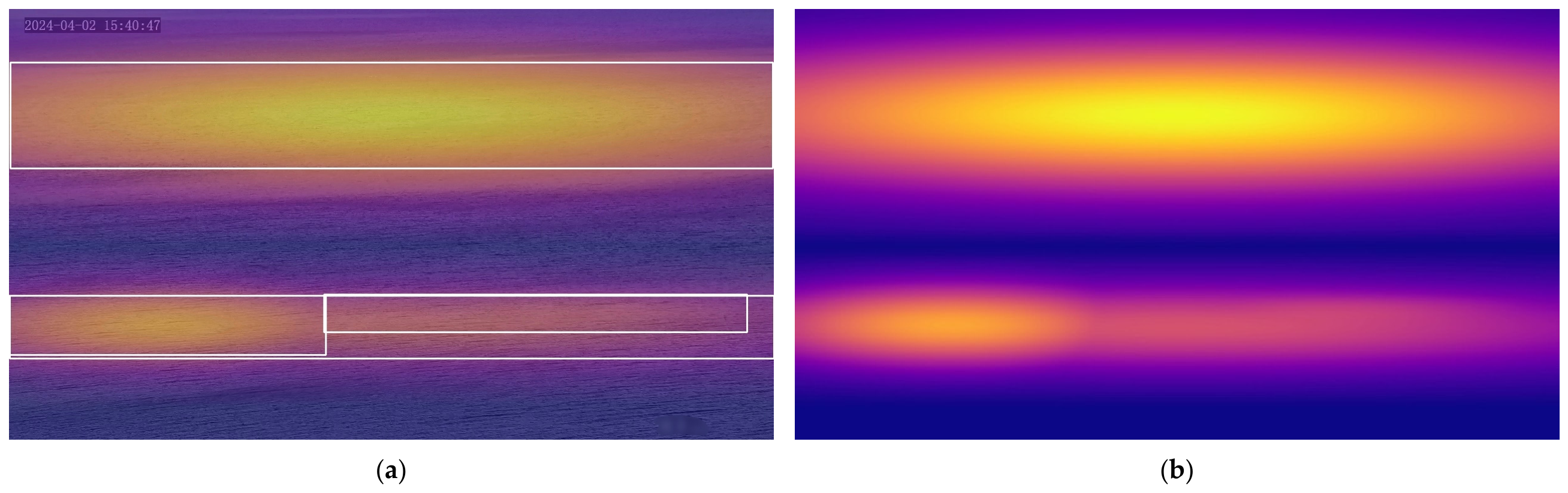
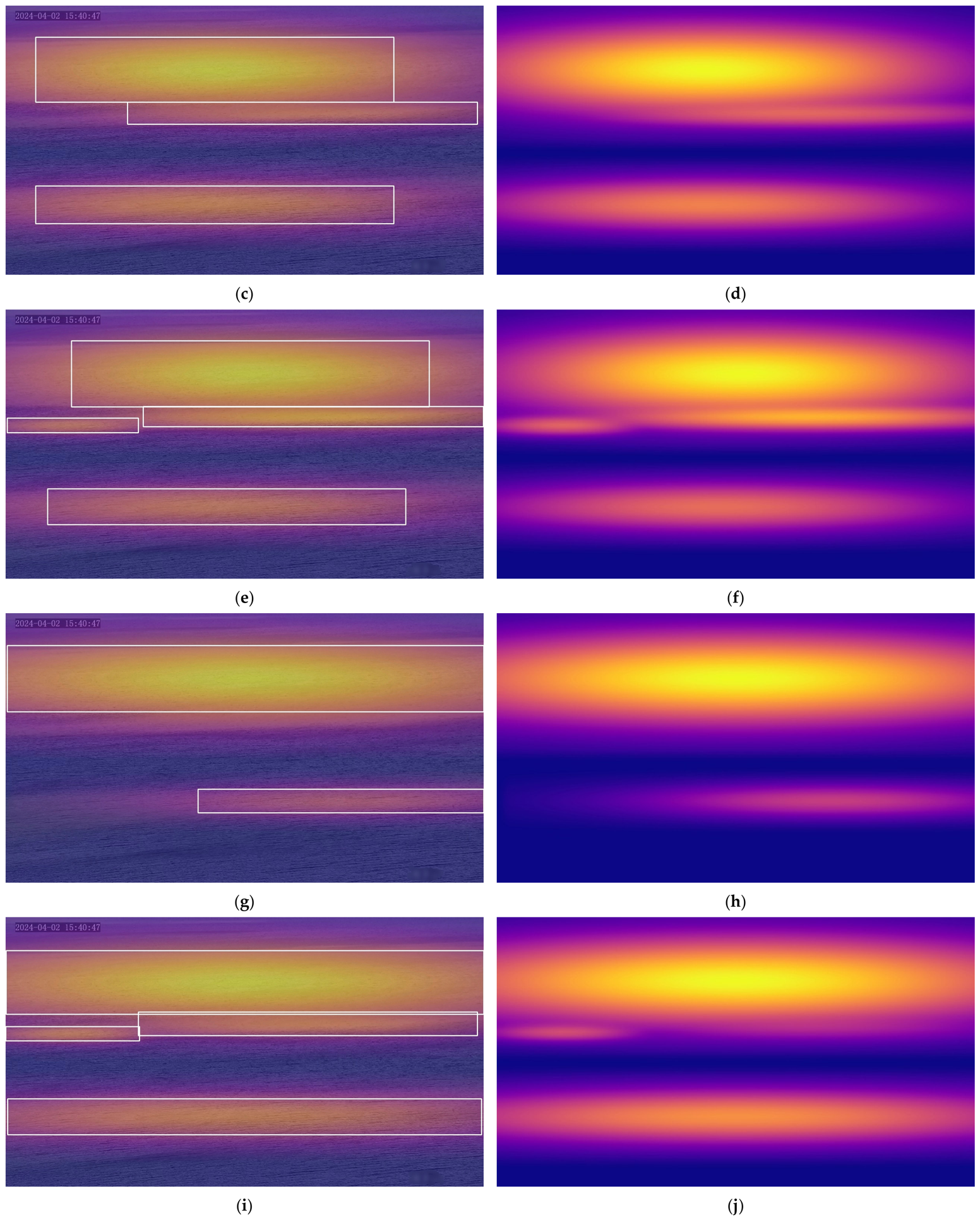
To visualize differences in attention mechanism activation regions, heatmaps were generated. Redder regions indicate stronger model attention. Representative models from the comparison experiments—YOLOv8, YOLOv8-ECA, YOLOv8-CBAM, YOLOv26, and the proposed GECA-YOLOv26—were selected, and an image containing objects of multiple scales was chosen for detection. The heatmap results are shown in Figure 7.
The heatmap results show the influence of different attention mechanisms on the detection process. In terms of activation region accuracy, models without attention modules (Figure 7a,b,g,h) have scattered activation regions and miss small objects, while the proposed GECA-YOLOv26 model (Figure 7i,j) demonstrates high sensitivity to small objects, successfully detecting all four objects and the two small objects under the main activation region, proving that the model’s recognition activates the small object regions of algal blooms. The ECA module enhances detection accuracy, but YOLOv8-ECA still misses one small object (Figure 7c,d). The CBAM attention module heatmaps demonstrate a visually significant improvement (Figure 7e,f), providing accurate and clear activation of small objects, but at the cost of a substantial increase in parameters. In terms of activation intensity, all attention modules clearly highlight medium-scale and small-scale objects, with CBAM showing a relatively pronounced visual effect on small object regions. However, as shown in Table 4, YOLOv8-CBAM achieves a relatively low mAP50 (0.7768) and mAP@0.5:0.95 (0.3708), indicating poor localization accuracy under strict IoU thresholds. In contrast, the GECA-YOLOv26 model maintains lightweightness while clearly locating the boundaries of small algal bloom objects, achieving optimal detection and localization performance.

5. Discussion

The dataset was collected from a single fixed camera at the Guanyinshan section of Dianchi Lake, lacking samples from other lakes or extreme weather conditions, so the model’s generalization requires further validation. The improvement in mAP50 (82.16%) comes with a slight decrease in mAP@0.5:0.95 compared to the baseline YOLOv26 (0.5447 vs. 0.5526), indicating a trade-off: higher detection recall but marginally lower localization accuracy, which is acceptable for algal bloom monitoring where identifying presence and approximate extent is the primary goal. Ablation experiments provide further insight into the contributions of the model components. GECA-YOLOv26 reduces the missed detection rate by 12.8% and increases recall by 9.25% compared to baseline YOLOv26, demonstrating that the ECA modules enhance detection sensitivity. The false positive rate slightly increases by 2.1%, mainly in challenging background regions such as water ripples and floating debris with textures similar to algal blooms. While GhostConv reduces model parameters, it can occasionally amplify background noise. The ECA modules generally improve channel feature recalibration but may sometimes misclassify background patterns as objects. Moreover, the standalone ECA module caused a notable drop in mAP@0.5:0.95 (0.4090), suggesting overfitting under limited-sample conditions, whereas combining ECA with GhostConv mitigated this issue (0.5447), indicating that the lightweight GhostConv design helps regularize the model and prevents overfitting to noise.
In addition, the cross-validation experiments yielded higher average mAP50 values than the main 7:3 split experiment. This discrepancy may be attributed to the extremely limited-dataset size, differences in random seeds, and the uneven difficulty distribution among different folds. Under limited-sample conditions, certain folds may contain relatively easier validation samples, potentially leading to optimistic cross-validation results. Therefore, the 7:3 split experiment is regarded as the primary evaluation result in this study, while the cross-validation results are used as supplementary evidence to assess the stability of the proposed model under different data partitions. It should be noted that the comparative results in this study (2.12%, 5.99%, and 2.79% improvements over YOLOv8/10/11) are based on a single random seed, and variance estimates were not provided. In future work, we will incorporate multi-seed experiments to further assess statistical significance.

6. Conclusions

To address insufficient detection accuracy and large model size in complex water surface algal bloom monitoring, a lightweight GECA-YOLOv26 model was proposed based on YOLOv26. The architectural design of YOLOv26 provides strong adaptability under limited-sample conditions. Applying the proposed model to algal bloom detection at a specific monitoring site demonstrates its representativeness. Experimental results indicate that the improved GECA-YOLOv26 achieves a mAP50 of 82.16%, a mAP@0.5:0.95 of 54.47%, a precision of 90.84%, and a recall of 75.30%. Ablation experiments further verify the effectiveness of the Ghostconv and ECA modules. These modules result in a 6.42% improvement in mAP50 compared with the original YOLOv26 model. This gain in detection recall comes at the cost of a slight loss in localization accuracy and inference speed, which is acceptable for the task of algal bloom monitoring. Comparison experiments further confirm that the improved model outperforms mainstream models such as YOLOv8, YOLOv10, and YOLOv11. The model also maintains a real-time inference speed of 123 FPS and a parameter size of 2.57 M, reducing parameters by 0.59 M compared with YOLOv8 (3.16 M), achieving a good balance between accuracy, speed, and model size. The algorithm effectively reduces the false-positive and missed-detection rates of algal bloom objects in water surface video surveillance scenarios and maintains good detection performance under limited-sample conditions.
Although highly cost-effective for single-site monitoring, the model’s generalizability is limited. Future work will expand dataset diversity and explore multi-source data fusion for algal bloom detection under varied scenarios, including different lakes and extreme weather conditions, to further assess model robustness and enhance generalization capability.

Author Contributions

Conceptualization, H.W. and Y.Y.; methodology, Y.Y. and M.Z.; software, H.W. and Y.Y.; validation, H.W. and Z.M.; formal analysis, Y.P. and J.W.; investigation, Z.M.; resources, J.W.; data curation, H.W. and J.W.; writing—review and editing, H.W. and Y.Y.; visualization, H.W.; supervision, Y.Y.; project administration, Z.M.; funding acquisition, Y.Y. All authors have read and agreed to the published version of the manuscript.

Funding

This research was supported by Yunnan Provincial Department of Education Science Research Fund Project (Project no. 2026J0416) and the Yunnan Key Laboratory of Water Security (Grant 20254916CE340051), the Yunnan Fundamental Research Projects (Grant No. 202601CI070036), and the Yunnan Province Xing-Dian Talent Support Plan Project (Grant No. 2025).

Institutional Review Board Statement

Not applicable.

Informed Consent Statement

Not applicable.

Data Availability Statement

The data used to support the findings of this study are available from the corresponding author upon request.

Acknowledgments

We sincerely thank the Kunming Branch of the Yunnan Hydrology and Water Resources Bureau for providing the monitoring video data that supported this study.

Conflicts of Interest

The authors declare no conflicts of interest.

References

  1. Li, H.; Zhang, H.; Duan, L.; Liu, Q.; Li, D.; Huang, J.; Fu, J.; Zi, L.; Xu, T. Spatiotemporal Variations in Water Quality Parameters and Assessment of the Current Status and Challenges of Eutrophication in Lake Dian. Ecol. Indic. 2025, 177, 113821. [Google Scholar] [CrossRef] [Scilit]
  2. Brooks, B.W.; Lazorchak, J.M.; Howard, M.D.; Johnson, M.V.; Morton, S.L.; Perkins, D.A.; Reavie, E.D.; Scott, G.I.; Smith, S.A.; Steevens, J.A. Are Harmful Algal Blooms Becoming the Greatest Inland Water Quality Threat to Public Health and Aquatic Ecosystems? Environ. Toxicol. Chem. 2016, 35, 6–13. [Google Scholar] [CrossRef] [Scilit] [PubMed]
  3. Cao, M.; Qing, S.; Jin, E.; Yuan, R.; Shun, B. A Spectral Index for the Detection of Algal Blooms Using Sentinel-2 Multispectral Instrument (MSI) Imagery: A Case Study of Hulun Lake, China. Int. J. Remote Sens. 2021, 42, 4514–4535. [Google Scholar] [CrossRef] [Scilit]
  4. Redmon, J.; Divvala, S.; Girshick, R.; Farhadi, A. You Only Look Once: Unified, Real-Time Object Detection. In Proceedings of the 2016 IEEE Conference on Computer Vision and Pattern Recognition (CVPR); CVF: Washington, DC, USA, 2016; pp. 779–788. [Google Scholar]
  5. Sapkota, R.; Cheppally, R.H.; Sharda, A.; Karkee, M. YOLOv26: Key Architectural Enhancements and Performance Benchmarking for Real-Time Object Detection. arXiv 2025, arXiv:2509.25164. [Google Scholar]
  6. Ultralytics. YOLOv26-Ultralytics YOLO Docs. Available online: https://docs.ultralytics.com/zh/models/yolo26 (accessed on 8 June 2026).
  7. Çarklı Yavuz, B. Scale-Dependent Performance Analysis of YOLOv26 and YOLOv11 for PPE Detection. Electronics 2026, 15, 1146. [Google Scholar] [CrossRef] [Scilit]
  8. Lu, X. Underwater Litter Detection Network. Int. J. Hous. Sci. Its Appl. 2025, 47, 811–826. [Google Scholar] [CrossRef] [Scilit]
  9. Yuan, S.; Peng, N.; Shi, Z.; Zhao, S.; Li, R.; Gu, Y.; He, H. Detection of Algal Tiny Objects Based on Morphological Features. Concurr. Comput. Pract. Exp. 2024, 36, e8128. [Google Scholar] [CrossRef] [Scilit]
  10. Yang, X.; Shao, S.; Liu, W.; Xiang, Z.; Zhang, B. TAD-YOLO: A Lightweight Nearshore Ship Detection Method for Small USVs in Maritime Trade Surveillance. Ocean Eng. 2025, 341, 122618. [Google Scholar] [CrossRef] [Scilit]
  11. Liao, W.; Ma, Q.; Wang, H.; Li, H. Improving Small Object Detection in Open Water Maritime Monitoring under Low-Shot Learning. Ocean Eng. 2026, 343, 123307. [Google Scholar] [CrossRef] [Scilit]
  12. Girshick, R.; Donahue, J.; Darrell, T.; Malik, J. Rich Feature Hierarchies for Accurate Object Detection and Semantic Segmentation. In Proceedings of the IEEE Conference on Computer Vision and Pattern Recognition; CVF: Washington, DC, USA, 2014; pp. 580–587. [Google Scholar]
  13. Girshick, R. Fast R-CNN. In Proceedings of the IEEE International Conference on Computer Vision; CVF: Washington, DC, USA, 2015; pp. 1440–1448. [Google Scholar]
  14. Ren, S.; He, K.; Girshick, R.; Sun, J. Faster R-CNN: Towards Real-Time Object Detection with Region Proposal Networks. Adv. Neural Inf. Process. Syst. 2015, 28, 91–99. [Google Scholar] [CrossRef] [Scilit]
  15. Jia, D.; Zhou, J.; Zhang, C. Detection of Cervical Cells Based on Improved SSD Network. Multimed. Tools Appl. 2022, 81, 13371–13387. [Google Scholar] [CrossRef] [Scilit]
  16. Zhang, X.; Min, C.; Luo, J.; Li, Z. YOLOv5-FF: Detecting Floating Objects on the Surface of Fresh Water Environments. Appl. Sci. 2023, 13, 7367. [Google Scholar] [CrossRef] [Scilit]
  17. Yan, Y.; Wang, C.; Zhou, X.; Gao, X.; Qin, Z. LRFL-YOLO: A Large Receptive Field and Lightweight Model for Small Object Detection. IEEE J. Sel. Top. Appl. Earth Obs. Remote Sens. 2025, 18, 20790–20804. [Google Scholar] [CrossRef] [Scilit]
  18. Wu, Z.; Eddie Law, K.L. Remote Sensing and Deep Learning for Algal Blooms: A Review. IEEE Access 2025, 13, 180891–180908. [Google Scholar] [CrossRef] [Scilit]
  19. Xu, S.; Tang, H.; Li, J.; Wang, L.; Zhang, X.; Gao, H. A YOLOW Algorithm of Water-Crossing Object Detection. Appl. Sci. 2023, 13, 8890. [Google Scholar] [CrossRef] [Scilit]
  20. Park, J.; Patel, K.; Lee, W.H. Recent Advances in Algal Bloom Detection and Prediction Technology Using Machine Learning. Sci. Total Environ. 2024, 938, 173546. [Google Scholar] [CrossRef] [Scilit] [PubMed]
  21. Han, K.; Wang, Y.; Tian, Q.; Guo, J.; Xu, C.; Xu, C. GhostNet: More Features from Cheap Operations. In Proceedings of the IEEE/CVF Conference on Computer Vision and Pattern Recognition; CVF: Washington, DC, USA, 2020; pp. 1577–1586. [Google Scholar]
  22. Wang, J.; Liu, Y.; Huang, T.; Qin, Y.; Lu, Z. YOLOv8n-3SE-PD: A Lightweight Model for Small Object Detection in Smart Vehicle Edge Sensing. Results Eng. 2026, 30, 109984. [Google Scholar] [CrossRef] [Scilit]
  23. Mei, Z.; Xu, H.; Yan, L.; Wang, K. IALF-YOLO: Insulator Defect Detection Method Combining Improved Attention Mechanism and Lightweight Feature Fusion Network. Measurement 2025, 253, 117701. [Google Scholar] [CrossRef] [Scilit]
  24. Wang, Q.; Wu, B.; Zhu, P.; Li, P.; Zuo, W.; Hu, Q. ECA-Net: Efficient Channel Attention for Deep Convolutional Neural Networks. In Proceedings of the IEEE/CVF Conference on Computer Vision and Pattern Recognition (CVPR); CVF: Washington, DC, USA, 2020; pp. 11531–11539. [Google Scholar]
  25. Singh, A.; Bhambhu, Y.; Buckchash, H.; Gupta, D.K.; Prasad, D.K. Latent Graph Attention for Spatial Context in Light-Weight Networks: Multi-Domain Applications in Visual Perception Tasks. Appl. Sci. 2024, 14, 10677. [Google Scholar] [CrossRef] [Scilit]
  26. Li, J.; Dai, F.; Qian, H.; Huang, L.; Zhao, J. Lightweight Wheat Spike Detection Method Based on Activation and Loss Function Enhancements for YOLOv5s. Agronomy 2024, 14, 2036. [Google Scholar] [CrossRef] [Scilit]
  27. Wang, Y.; Yao, Q.; Kwok, J.T.; Ni, L.M. Generalizing from a Few Examples: A Survey on Few-Shot Learning. ACM Comput. Surv. 2020, 53, 1–34. [Google Scholar] [CrossRef] [Scilit] [PubMed]
  28. Busari, I.; Sahoo, D.; Sudheer, K.P.; Harmel, R.D.; Privette, C.; Schlautman, M.; Sawyer, C. Investigating the Influence of Measurement Uncertainty on Chlorophyll-a Predictions as an Indicator of Harmful Algal Blooms in Machine Learning Models. Ecol. Inform. 2024, 82, 102735. [Google Scholar] [CrossRef] [Scilit]
  29. Liu, D.; Yuan, G.; Tan, H.; Jiang, Y.; Bi, H.; Cheng, Y. AlgaeClass_Net: Optimizing Few-Shot Marine Microalgae Classification with Multi-Scale Feature Enhancement Network. IEEE Access 2025, 13, 16223–16237. [Google Scholar] [CrossRef] [Scilit]
  30. Hu, J.; Shen, L.; Sun, G. Squeeze-and-Excitation Networks. In Proceedings of the IEEE Conference on Computer Vision and Pattern Recognition; CVF: Washington, DC, USA, 2018; pp. 7132–7141. [Google Scholar]
  31. Woo, S.; Park, J.; Lee, J.Y.; Kweon, I.S. CBAM: Convolutional Block Attention Module. In Proceedings of the European Conference on Computer Vision (ECCV); CVF: Washington, DC, USA, 2018; pp. 3–19. [Google Scholar]
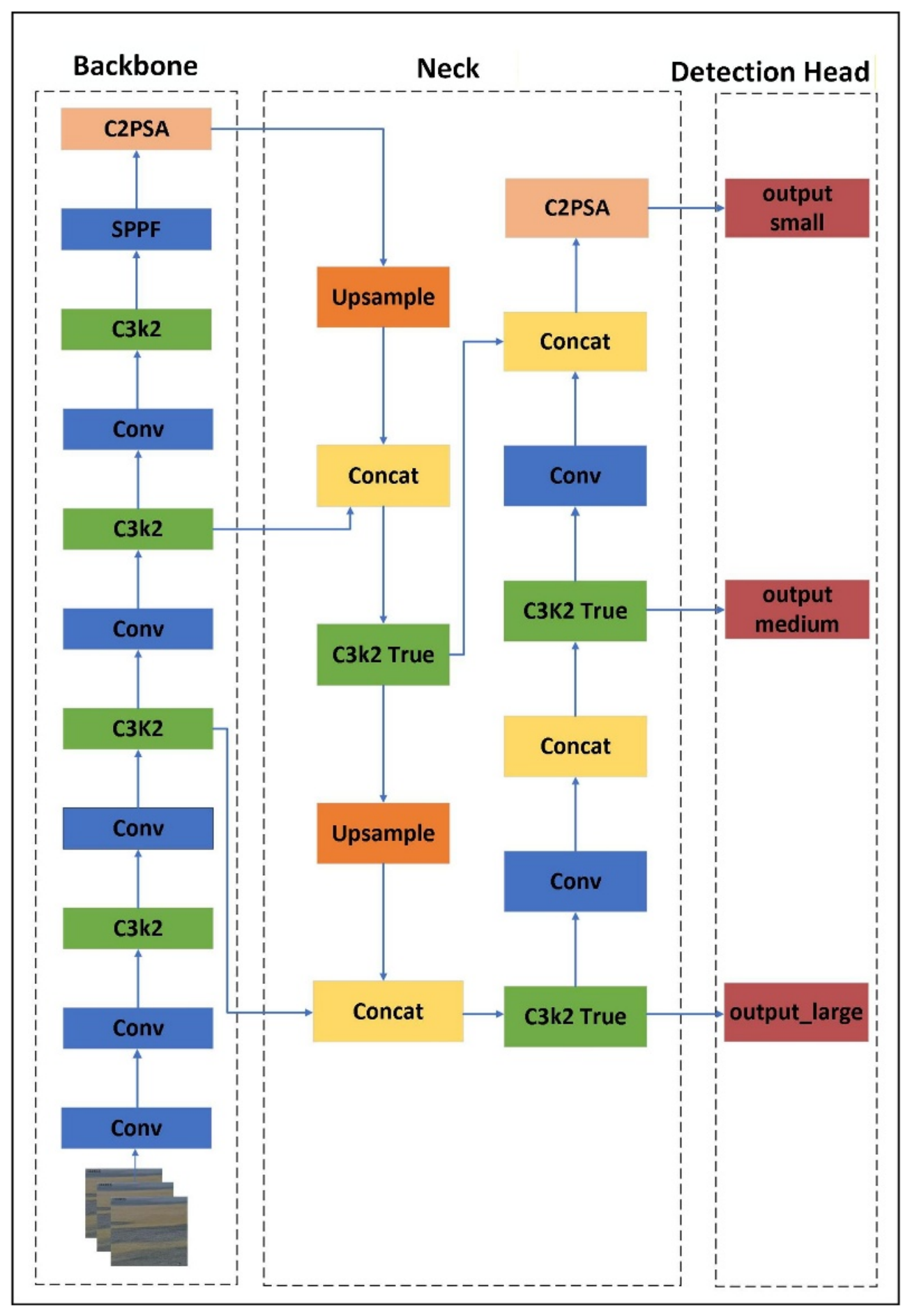
Figure 1. YOLOv26 model structure.
Applsci 16 05969 g001
Figure 2. Schematic diagram of Ghost convolution.
Applsci 16 05969 g002
Figure 3. Schematic diagram of ECA module.
Applsci 16 05969 g003
Figure 4. GECA-YOLOv26 network architecture. Note: The pink boxes indicate the ECA modules and the red boxes indicate the GhostConv modules, both of which are improved components.
Applsci 16 05969 g004
Figure 5. Training performance comparison in ablation experiments.
Applsci 16 05969 g005
Figure 6. Detection results of different models: (a) YOLOv8, (b) YOLOv10, (c) YOLOv11, (d) YOLOv26, and (e) GECA-YOLOv26.
Applsci 16 05969 g006
Figure 7. Heatmap comparison of different models: (a) YOLOv8 detection result, (b) YOLOv8 heatmap, (c) YOLOv8 + ECA detection, (d) YOLOv8 + ECA heatmap, (e) YOLOv8 + CBAM detection, (f) YOLOv8 + CBAM heatmap, (g) YOLOv26 heatmap, (h) YOLOv26 detection, (i) GECA-YOLOv26 detection, (j) GECA-YOLOv26 heatmap.
Applsci 16 05969 g007aApplsci 16 05969 g007b
Table 1. Online data augmentation parameters.
Parameter NameDescriptionValue
HueHue adjustment0.015
SaturationSaturation adjustment0.7
ValueBrightness adjustment0.4
TranslationImage translation0.1
ScalingImage scaling0.5
Flip Left RightHorizontal flipping0.5
Mosaic AugmentationMosaic augmentation0.8
Mixup AugmentationMixup 0.2
CutMix AugmentationCutMix 0.2
Auto AugmentationAuto augmentation randaugment
Random ErasingRandom region erasing0.4
Table 2. Network training parameters.
Parameter NameDescriptionValue
EpochsNumber of epochs300
Image sizeInput image resolution640
Batch SizeMini-batch size32
Learning rate0Initial learning rate0.01
Learning rate factorFinal learning rate0.01
MomentumMomentum factor0.937
Weight_decayWeight decay0.0005
patienceEarly stopping patience50
Table 3. Performance comparison of ablation models.
YOLOv26GhostECAECA + GhostAdamWMuSGDmAP50mAP@0.5:0.95PrecisionRecallParamsFPSGFLOPs
××××0.72490.49910.88600.72332,572,2801435.2
××××0.75740.55260.89870.66052,572,2801435.2
×××0.80720.53190.90330.70162,570,3761385.1
×××0.8170.5330.8990.7212,572,3201275.2
×××0.73940.48300.88320.70162,570,4161245.2
×××0.82160.54470.90840.75302,570,4161235.1
Table 4. Performance comparison results of different models.
ModelmAP50mAP@0.5:0.95PrecisionRecallParamsFPSGFLOPs
YOLOv80.80040.54470.88210.73053,157,2202068.1
YOLOv8-ECA0.81740.40900.95250.76183,157,2401868.1
YOLOv8-SE0.81040.53870.95540.73593,614,5121878.5
YOLOv8-CBAM0.77680.37080.93570.73423,615,2961538.5
YOLOv100.76170.49380.86230.66732,775,5201656.5
YOLOv10-ECA0.80010.53680.91600.69622,775,5601426.5
YOLOv110.79370.50810.89700.73072,624,0801526.3
YOLOv11-ECA0.81540.57490.88480.77742,624,1201496.3
YOLOv260.75740.55260.89870.66052,572,2801435.2
GECA-YOLOv26 (Ours)0.82160.54470.90840.75302,570,4161235.1
Table 5. 5-Fold Cross-Validation Results for GECA-YOLOv26.
ModelFlodmAP50mAP@0.5:0.95PrecisionRecallParamsFPSGFLOPs
GECA-YOLOv2610.93270.66050.89160.87232,375,0551225.2
GECA-YOLOv2620.94560.68540.89350.90952,375,0551215.2
GECA-YOLOv2630.96350.6750.91630.89092,375,0551175.2
GECA-YOLOv2640.87980.62010.86460.78612,375,0551165.2
GECA-YOLOv2650.94510.65740.91610.87812,375,0551185.2
Standard Deviation0.9333 ± 0.02850.6597 ± 0.02220.8964 ± 0.01910.8674 ± 0.0426--
Table 6. 3-Fold Cross-Validation Results for GECA-YOLOv26.
ModelSeedmAP50mAP@0.5:0.95PrecisionRecallParamsFPSGFLOPs
GECA-YOLOv26420.91370.64770.84940.84022,375,0551195.2
GECA-YOLOv26430.93330.65720.90570.84982,375,0551225.2
GECA-YOLOv26440.92280.63320.86260.86952,375,0551195.2
Standard Deviation0.9232 ± 0.00980.6460 ± 0.01210.8726 ± 0.02940.8532 ± 0.0149--
Disclaimer/Publisher’s Note: The statements, opinions and data contained in all publications are solely those of the individual author(s) and contributor(s) and not of MDPI and/or the editor(s). MDPI and/or the editor(s) disclaim responsibility for any injury to people or property resulting from any ideas, methods, instructions or products referred to in the content.