


A Rapid Design Method for Bidirectional Transmission Parallel-Axis External Line Gears


Abstract
1. Introduction
2. Design of the BTPELG
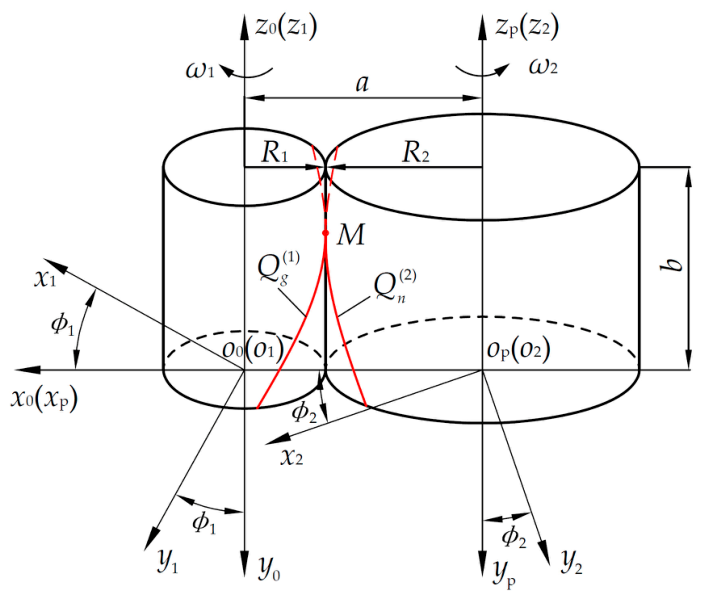
2.1. Coordinate System and Coordinate Transformation
2.2. Meshing Equation
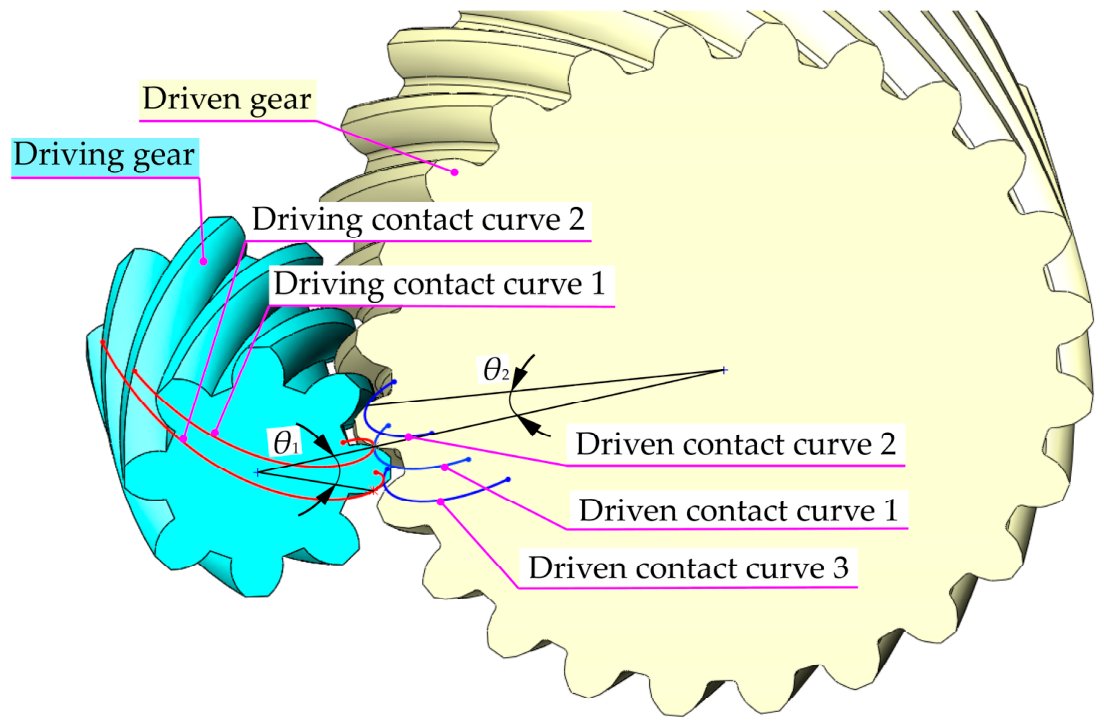
2.3. Solution of the Contact Curve Equation and the Center Guide Curve Equation
2.3.1. Contact Curve Equation
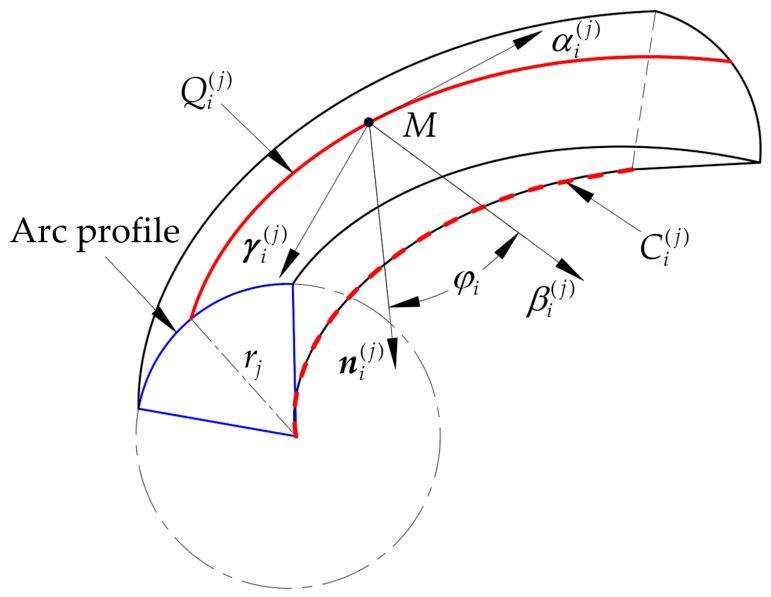
2.3.2. Center Guide Curve Equation
3. A Design Example
3.1. Design Parameters
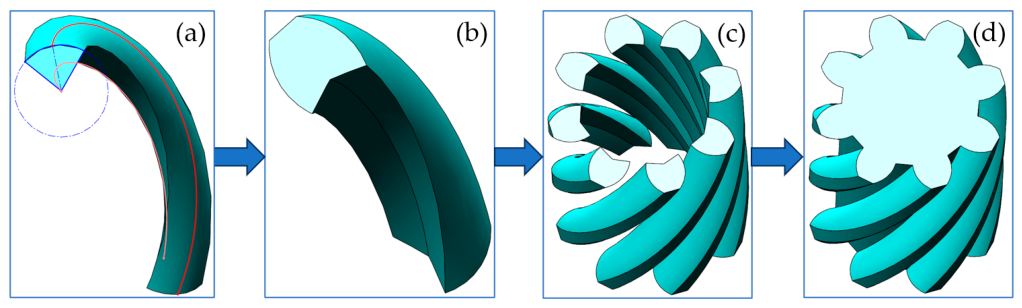
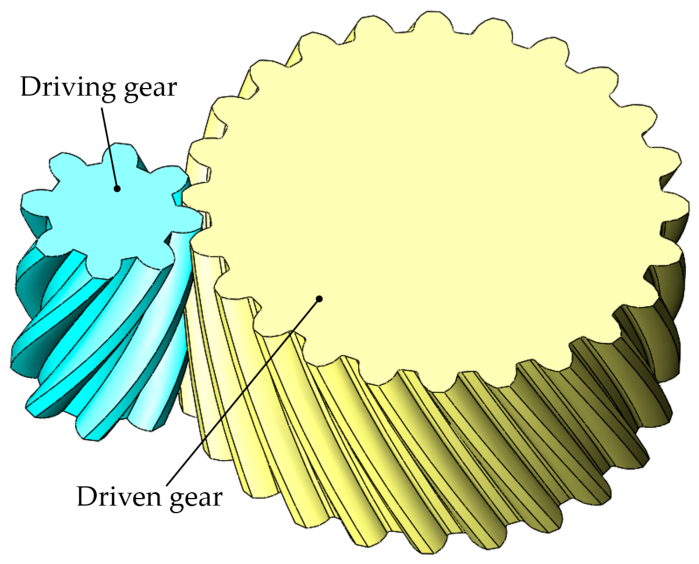
3.2. 3D Solid Model
4. Simulation and Experimental Verification
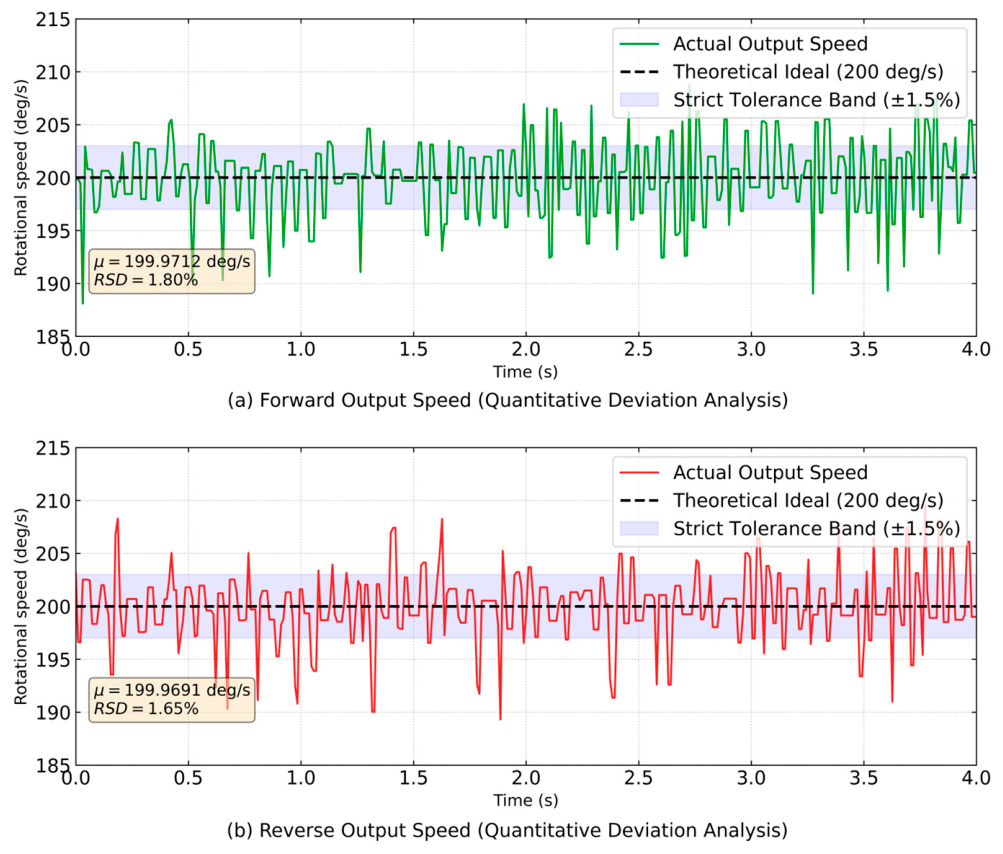
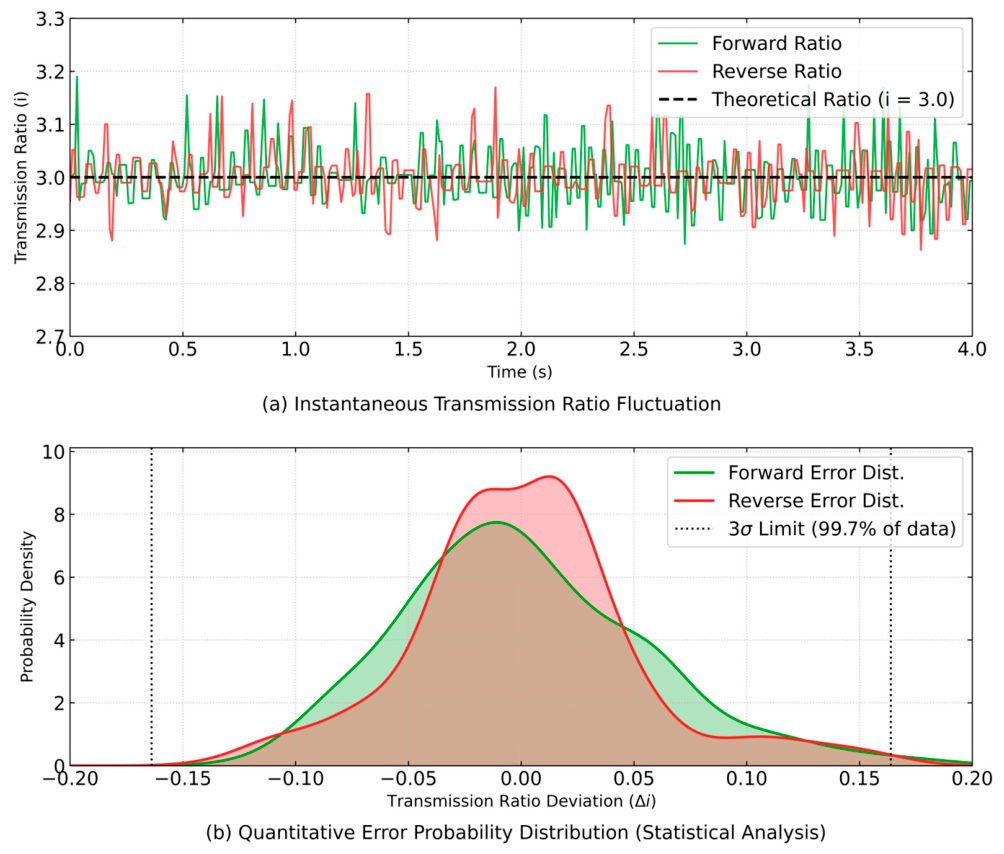
4.1. Kinematics Simulation
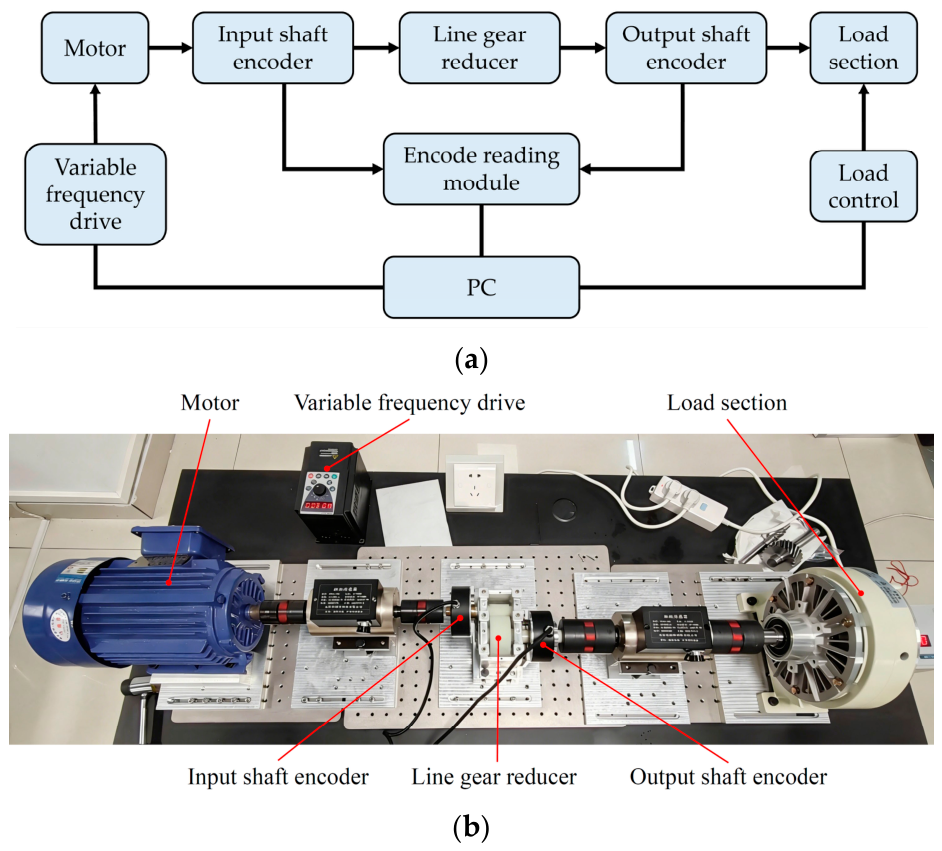
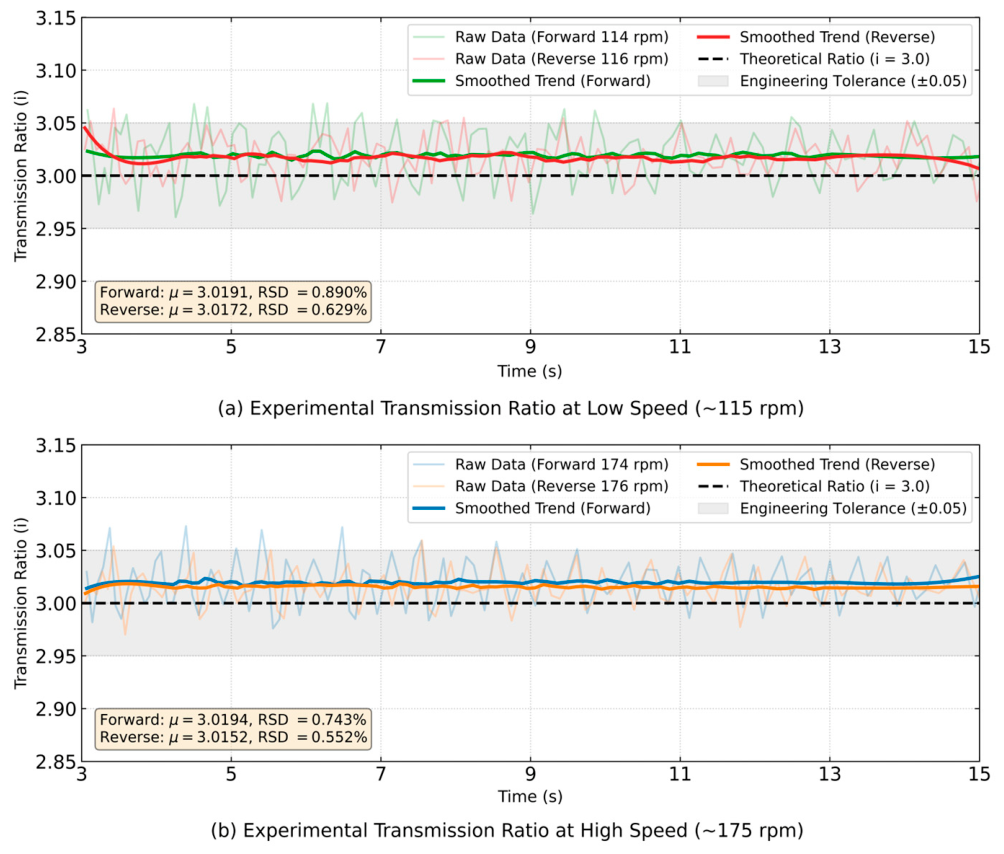
4.2. Kinematics Experiment
5. Discussion
6. Conclusions
- (1)
- A generalized spatial curve meshing equation incorporating angular parameters is proposed. This extends the direction of the common normal in the traditional meshing equation to the complete normal plane spanned by the principal and secondary normal vectors. This extension provides the necessary theoretical flexibility for subsequent active design of transmission errors and optimization of contact performance through the adjustment of angular parameters.
- (2)
- A direct sweeping method is proposed that does not require solving complex tooth surface equations. Starting from a given driving contact curve, other contact curves and their corresponding center guide lines are determined using the generalized meshing equation and coordinate transformations, and the line gear teeth are generated by combining this with direct sweeping of the tooth profile. This method bypasses the complex derivation of tooth surface equations, simplifies the design process, and provides a new approach for the rapid design and engineering validation of line gears, while also helping beginners quickly learn modeling and get started with line gears.
- (3)
- The feasibility and smoothness of bidirectional transmission parallel-axis external line gears are verified. Kinematic simulations and experiments are performed on an example line gear pair, and the results indicate that the bidirectional line gear pair designed in this paper can achieve continuous, accurate, and smooth transmission, meeting the design expectations. This provides a technical foundation for the subsequent optimization of line gear design.
Author Contributions
Funding
Institutional Review Board Statement
Informed Consent Statement
Data Availability Statement
Conflicts of Interest
Abbreviations
| BTPELG | bidirectional transmission parallel-axis external line gears |
| Nomenclature | |
| a | Center distance of the line gear pair |
| Tooth width | |
| Center guide curve, superscript j denotes coordinate system, subscript i = 1, 2 | |
| Unit vector of coordinate axis | |
| Transmission ratio | |
| Helix radius of cylindrical helix | |
| Contact point | |
| Coordinate transformation matrix from coordinate Sj to Si | |
| Pitch coefficient of cylindrical helix | |
| Unit normal vector | |
| Number of teeth of driving gear | |
| Contact curve | |
| Arc radius of the normal tooth profile of driving gear | |
| Outer radius of driving gear | |
| Arc radius of the normal tooth profile of driven gear | |
| Outer radius of driven gear | |
| Coordinate system (subscript i denotes different coordinate systems) | |
| , , | Independent variable of cylindrical helix |
| Relative velocity of the contact point in coordinate system | |
| Velocity of driving gear | |
| Velocity of driven gear | |
| Unit tangent vector | |
| Unit principal normal vector | |
| Unit secondary normal vector | |
| , | Angular velocity |
| , | Angular velocity vector |
| , | Rotation angle |
| Angular parameter of meshing equation | |
| Angle between center guide curve offset direction and principal normal vector | |
| Angle between the two contact curves on a single line tooth of the driving gear | |
| Angle between the two contact curves on a single line tooth of the driven gear | |
References
- Chen, Y.; Xing, G.; Peng, X. The space curve mesh equation and its kinematics experiment. In Proceedings of the 12th IFToMM World Congress, Besançon, France, 17–21 June 2007. [Google Scholar]
- Ding, J.; Deng, A.; Liu, L.; Lu, M. Dynamic Analysis of Line Gear Pair Based on Numerical Manifold Method. Stroj. Vestn.-J. Mech. Eng. 2021, 67, 275–286. [Google Scholar] [CrossRef]
- Chen, Y.; Lin, Y. A calculation method for friction coefficient and meshing efficiency of plastic line gear pair under dry friction conditions. Friction 2021, 9, 1420–1435. [Google Scholar] [CrossRef]
- Chen, Y.; Xiang, X.; Luo, L. A corrected equation of space curve meshing. Mech. Mach. Theory 2009, 44, 1348–1359. [Google Scholar] [CrossRef]
- Chen, Z.; Zeng, M. Design of pure rolling line gear mechanisms for arbitrary intersecting shafts. Proc. Inst. Mech. Eng. Part C J. Mech. Eng. Sci. 2019, 233, 5515–5531. [Google Scholar] [CrossRef]
- Chen, Z.; Zeng, M.; Fuentes-Aznar, A. Computerized design, simulation of meshing and stress analysis of pure rolling cylindrical helical gear drives with variable helix angle. Mech. Mach. Theory 2020, 153, 103962. [Google Scholar] [CrossRef]
- Chen, Z.; Zeng, M.; Fuentes-Aznar, A. Geometric design, meshing simulation, and stress analysis of pure rolling rack and pinion mechanisms. ASME J. Mech. Des. 2020, 142, 031122. [Google Scholar] [CrossRef]
- Ding, J.; Liu, L.; Wei, Y.; Deng, A. Improved design method for line gear pair based on screw theory. J. Mech. Sci. Technol. 2022, 36, 1885–1895. [Google Scholar] [CrossRef]
- Ding, J.; Wei, Y.; Liu, L.; Geng, T. Novel design method for constrained conjugate contact curves of line gears based on rolling-up of pitch pattern. J. Mech. Sci. Technol. 2022, 36, 4605–4615. [Google Scholar] [CrossRef]
- Chen, Z.; Zeng, M. Nonrelative sliding of spiral bevel gear mechanism based on active design of meshing line. Proc. Inst. Mech. Eng. Part C J. Mech. Eng. Sci. 2019, 233, 1055–1067. [Google Scholar] [CrossRef]
- Chen, Z.; Lei, B.; Qin, L.; Qiu, G.; Fuentes-Aznar, A. Computerized Design, Simulation of Meshing and Stress Analysis of External Helical Gear Drives Based on Critical Control Points. Energies 2022, 15, 4290. [Google Scholar] [CrossRef]
- Wen, L.; Chen, Z.; Fuentes-Aznar, A. Computerized design, simulation of meshing and stress analysis of non-generated double circular-arc helical gear drives with different combinations of transverse pressure angle. Mech. Mach. Theory 2022, 170, 104683. [Google Scholar] [CrossRef]
- Chen, Y.; Li, Z.; Xie, X.; Lyu, Y. Design Methodology for Coplanar Axes Line Gear with Controllable Sliding Rate. Stroj. Vestn.-J. Mech. Eng. 2017, 64, 362–372. [Google Scholar] [CrossRef]
- He, E.; Yin, S. Tooth profile design of a novel helical gear mechanism with improved geometry for a parallel shaft transmission. Mech. Sci. 2022, 13, 1011–1018. [Google Scholar] [CrossRef]
- Olejarczyk, K.; Wikło, M.; Rucki, M. Analysis of 3D-Printed Cycloidal Gear Degradation in a Run-to-Failure Test. Appl. Sci. 2026, 16, 2866. [Google Scholar] [CrossRef]
- Sun, Y.; Shi, Z.; Yu, B.; Li, M. Line Laser 3D Measurement Method and Experiments of Gears. Photonics 2025, 12, 782. [Google Scholar] [CrossRef]
- Wang, J.; Lv, H. Modification and optimization of cycloidal gear tooth profile based on machining error compensation. Appl. Sci. 2023, 13, 2581. [Google Scholar] [CrossRef]
- Zhou, D.; Gu, Y.; Yang, J.; Zhang, Y. Study on the Parameter Influences of Gear Tooth Profile Modification and Transmission Error Analysis. Machines 2024, 12, 316. [Google Scholar] [CrossRef]
- Dimić, A.R.; Ristivojević, M.R.; Kolarević, N.M.; Mišković, Ž.Z.; Sedak, M.I.; Djordjević, B.R. Influence of the Involute Gear Teeth Profile Shape and Running-In on Surface Load Capacity of Cylindrical Gear Pairs. Tribol. Trans. 2025, 68, 959–973. [Google Scholar] [CrossRef]
- Pei, X.; Nie, J.; Guo, H.; Li, S.; Zuo, Y. An involute gear pair meshing stiffness model considering time-varying friction under mixed lubrication. Nonlinear Dyn. 2024, 112, 19691–19709. [Google Scholar] [CrossRef]
- Singh, K.A.; Siddhartha. Development and investigation on transmission efficiency of functionally graded material-based polybutylene terephthalate spur gears. Proc. Inst. Mech. Eng. Part J. J. Eng. Tribol. 2020, 234, 473–489. [Google Scholar] [CrossRef]
- Zhang, Y.; Wang, J.; Shen, Y.; Yin, P. Research on the accuracy assessment method of herringbone gears based on contact line modeling. Measurement 2026, 274, 121229. [Google Scholar] [CrossRef]
- Jia, C.; Zhang, G.; Li, G. Numerical Analysis of Tooth Contact and Wear Characteristics of Internal Cylindrical Gears with Curved Meshing Line. Appl. Sci. 2024, 14, 5399. [Google Scholar] [CrossRef]
- Xiao, X.; Chen, Z.; Chen, Y.; Shao, Y.; Zheng, M. Meshing equation, tooth contact analysis, stress analysis and manufacture of a point-contact gear formed by double-arc milling cutter. Proc. Inst. Mech. Eng. Part C J. Mech. Eng. Sci. 2024, 238, 7870–7882. [Google Scholar] [CrossRef]
- Du, Q.; Yang, G.; Wang, W.; Chen, C.; Fang, Z. Modeling and Analysis of Transmission Efficiency for 3K Planetary Gearbox with Flexure-Based Carrier for Backdrivable Robot Joints. Actuators 2025, 14, 173. [Google Scholar] [CrossRef]
- Leaman, F.; Segura, F.; Gutiérrez, V. Experimental Analysis of the Acoustic Emission Waveforms Generated by Friction Between Involute Gear Teeth Including Effects of Surface Defects and Lubrication. Lubricants 2026, 14, 126. [Google Scholar] [CrossRef]
- Sun, W.; Shi, X.; Lu, X.; Hua, D.; Li, R. Fatigue life and transmission efficiency prediction of marine timing gears under 3D mixed lubrication state. Proc. Inst. Mech. Eng. Part E J. Process Mech. Eng. 2026, 240, 204–215. [Google Scholar] [CrossRef]
- Zhang, Y.; Li, N. Analysis of Transmission Efficiency of Herringbone Gear with Elastohydrodynamic Lubrication Theory. J. Phys. Conf. Ser. 2021, 2033, 01230. [Google Scholar] [CrossRef]
- Shang, Z.; Chu, X. Design principle and meshing performance analysis of asymmetric internal meshing gears with meshing line modification. Proc. Inst. Mech. Eng. Part C J. Mech. Eng. Sci. 2026, 240, 3277–3299. [Google Scholar] [CrossRef]
- Zuo, S.; Sun, Y.; Chen, L.; Li, S.; Wang, M. Calculation Method and Experimental Investigation of Root Bending Stress in Line Contact Spiral Bevel Gear Pairs. Machines 2025, 13, 632. [Google Scholar] [CrossRef]
- Chu, X.; Shang, Z.; Dong, S. Tooth profile design and meshing characteristics analysis of internal meshing gears based on variable center meshing line. Proc. Inst. Mech. Eng. Part C J. Mech. Eng. Sci. 2024, 238, 8542–8560. [Google Scholar] [CrossRef]
- Ben, E.Y.; Christophe, C.; Jérôme, B.; Emmanuel, R.; Joël, P. Multi-objective optimization of gear unit design to improve efficiency and transmission error. Mech. Mach. Theory 2022, 167, 104499. [Google Scholar] [CrossRef]
- Hou, X.; Gao, S.; Qiu, L.; Li, Z.; Zhu, R. Transmission Efficiency Optimal Design of Spiral Bevel Gear Based on Hybrid PSOGSA (Particle Swarm Optimization—Gravitational Search Algorithm) Method. Appl. Sci. 2022, 12, 10140. [Google Scholar] [CrossRef]
- Roth, L.; Westphal, C.; Brecher, C. Design of profile corrections and tolerances in cylindrical gears for noise-sensitive applications in line with production efforts. Forsch. Im. Ingenieurwesen 2025, 89, 11. [Google Scholar] [CrossRef]

| Parameters | Value |
|---|---|
| Helix radius of cylindrical helix (mm) | 10 |
| Pitch coefficient of cylindrical helix (mm) | 60/π |
| Independent variable of cylindrical helix | [0, π/2] |
| Number of teeth of driving gear | 8 |
| Transmission ratio | 3 |
| Center distance (mm) | 40 |
| Tooth width (mm) | 30 |
| Normal tooth profile arc radius of driving gear (mm) | 4 |
| Normal tooth profile arc radius of driven gear (mm) | 4 |
| Angular parameter of meshing equation (rad) | π/3 |
| Low-Speed Condition (≈115 rpm) | High-Speed Condition (≈175 rpm) | |||
|---|---|---|---|---|
| Parameter | Forward 114 rpm | Reverse 116 rpm | Forward 174 rpm | Reverse 176 rpm |
| Average transmission ratio | 3.0191 | 3.0172 | 3.0194 | 3.0152 |
| Transmission ratio error (%) | 0.637 | 0.573 | 0.647 | 0.507 |
| Minimum transmission ratio error (%) | –1.313 | –0.849 | –0.996 | –0.805 |
| Maximum transmission ratio error (%) | 2.283 | 2.116 | 1.98 | 2.428 |
| Standard deviation | 0.0269 | 0.019 | 0.0225 | 0.0166 |
| Relative standard deviation (%) | 0.89 | 0.629 | 0.743 | 0.552 |
| Range | 0.108 | 0.089 | 0.097 | 0.0893 |
| Relative Range (%) | 3.574 | 2.948 | 3.212 | 2.961 |
Disclaimer/Publisher’s Note: The statements, opinions and data contained in all publications are solely those of the individual author(s) and contributor(s) and not of MDPI and/or the editor(s). MDPI and/or the editor(s) disclaim responsibility for any injury to people or property resulting from any ideas, methods, instructions or products referred to in the content. |
© 2026 by the authors. Licensee MDPI, Basel, Switzerland. This article is an open access article distributed under the terms and conditions of the Creative Commons Attribution (CC BY) license.
Share and Cite
Chen, Y.; Zheng, M.; He, W.; He, S.; Xiao, X. A Rapid Design Method for Bidirectional Transmission Parallel-Axis External Line Gears. Appl. Sci. 2026, 16, 5967. https://doi.org/10.3390/app16125967
Chen Y, Zheng M, He W, He S, Xiao X. A Rapid Design Method for Bidirectional Transmission Parallel-Axis External Line Gears. Applied Sciences. 2026; 16(12):5967. https://doi.org/10.3390/app16125967
Chicago/Turabian StyleChen, Yangzhi, Maoxi Zheng, Weitao He, Siyuan He, and Xiaoping Xiao. 2026. "A Rapid Design Method for Bidirectional Transmission Parallel-Axis External Line Gears" Applied Sciences 16, no. 12: 5967. https://doi.org/10.3390/app16125967
APA StyleChen, Y., Zheng, M., He, W., He, S., & Xiao, X. (2026). A Rapid Design Method for Bidirectional Transmission Parallel-Axis External Line Gears. Applied Sciences, 16(12), 5967. https://doi.org/10.3390/app16125967

