Article

Aging Effect on IMC Evolution in Bi-Based and SAC Soldering Pastes on 3D-Shaped Aluminum Cores

1
Lukasiewicz Research Network—Tele and Radio Research Institute, Ratuszowa 11 Str., 03-450 Warsaw, Poland
2
National Chamber of Commerce for Electronics and Telecommunications, Stępińska 22/30 Str., 00-739 Warsaw, Poland
3
Lukasiewicz Research Network—Institute of Non-Ferrous Matals, Division in Skawina, Piłsudzkiego 19 Str., 32-050 Skawina, Poland
*
Author to whom correspondence should be addressed.
Appl. Sci. 2026, 16(12), 5962; https://doi.org/10.3390/app16125962 (registering DOI)
Submission received: 23 March 2026 / Revised: 28 May 2026 / Accepted: 2 June 2026 / Published: 12 June 2026

Abstract

The increasing power density of modern electronic systems intensifies challenges related to heat dissipation and long-term reliability. Insulated metal substrates (IMS), particularly three-dimensional (3D), are increasingly used as integrated thermal–mechanical solutions in high-power electronics. However, their complex geometry and material interfaces introduce new reliability concerns, especially at solder joints. This study investigates the evolution of intermetallic compounds (IMCs) in solder joints formed on 3D aluminum IMSs with ENIG metallization, focusing on SAC305 and Sn42Bi57Ag1 solder alloys. Solder joints were subjected to environmental aging under high-temperature, high-humidity, and thermal-shock conditions to simulate realistic service environments. Microstructural and compositional analyses of the interfacial IMC layers were performed, together with measurements of IMC thickness evolution. The results show that aging significantly modifies the chemical composition and morphology of IMC layers in both solder systems. In SAC305 joints, progressive development of (Cu,Ni)6Sn5 phases with increasing Cu participation was observed. In Sn42Bi57Ag1 joints, Bi affected reaction kinetics but did not alter the diffusion-controlled nature of IMC growth. Thickness measurements indicate higher sensitivity of SAC305 joints to environment-assisted interfacial degradation, while Sn42Bi57Ag1 joints exhibit greater susceptibility to stress-assisted IMC growth during severe thermal cycling. These findings highlight the distinct reliability behaviors of tested solders on 3D IMSs and provide insight into their suitability for high-power electronic applications.

1. Introduction

Heat dissipation remains one of the most critical challenges in modern electronic systems, particularly in applications requiring high power density and sustained computational performance. Although continuous scaling of semiconductor technology has led to smaller transistors and reduced current requirements at the device level, these improvements do not directly result in lower thermal loads at the system level. On the contrary, contemporary graphics processing units (GPUs) and other high-performance components often increase in overall chip size due to escalating performance demands and the widespread use of massive parallel computing architectures [1,2]. Consequently, total power consumption and localized heat generation continue to rise, making thermal management a key limiting factor for reliability, efficiency, and long-term performance [3].
Elevated operating temperatures accelerate material degradation, promote thermomechanical fatigue, and reduce the lifetime of interconnections and packaging materials [4]. To address these challenges, advanced cooling solutions such as heat pipes, vapor chambers, and other two-phase heat transfer devices are increasingly employed [1,5]. Nevertheless, efficient heat removal at the board and substrate levels remains essential, particularly in compact and high-power assemblies.
One widely adopted solution for enhanced thermal management is the use of insulated metal substrates (IMS). IMS technology typically consists of a metal core, most commonly aluminum, covered by a thin electrically insulating dielectric layer and a conductive copper layer forming the circuit traces [6,7]. The aluminum core provides an effective heat-spreading path, while the dielectric layer ensures electrical isolation. Due to these properties, IMS solutions are extensively used in applications such as high-power LED lighting and power electronics, where efficient thermal dissipation is required [4,8].
In recent years, IMS technology has evolved from conventional planar substrates toward more complex advanced substrate geometries. In such solutions, the aluminum core is extruded or die-cast into a predefined 3D shape that simultaneously fulfills mechanical, thermal, and structural functions [6,7]. The formed metal core is subsequently coated with a specialized insulating lacquer, which is cured to achieve the required dielectric and thermal properties. Laser structuring is then applied to selectively pattern the insulating layer and define circuit geometries on the 3D surface. Subsequently, copper metallization is deposited onto the prepared dielectric surface areas rather than directly onto the aluminum core, ensuring electrical insulation between the conductive layer and the aluminum substrate [7]. The metallization is typically finished with nickel and gold coatings, following established printed circuit board manufacturing practices [8]. Although the present study focuses on aluminum substrates, the described approach can be extended to other metallic materials [3].
The introduction of aluminum-based 3D IMS structures poses new challenges related to material compatibility, thermomechanical stresses, and long-term reliability. In particular, the behavior of solder joints formed on such substrates is of critical importance. Lead-free solder alloys, including tin–silver–copper (SAC) and Bi-containing (Bi-based) soldering pastes, are widely used in modern electronics due to regulatory requirements such as the RoHS and REACH directives in Europe and performance considerations. These materials differ significantly in melting characteristics, mechanical properties, and aging behavior, especially under prolonged thermal exposure and thermal cycling. Recent studies show that aging significantly alters the microstructure and mechanical properties of Bi-doped SAC solder alloys, with changes in hardness, creep resistance, and IMC distribution observed during extended thermal exposure [1].
One of the key factors affecting solder joint reliability is the formation and growth of intermetallic compounds (IMCs) at the solder–substrate interface. While the presence of an IMC layer is necessary to ensure metallurgical bonding, excessive growth can degrade joint reliability due to the IMC’s brittle nature and its thermal mismatch with both the solder and the substrate. During service, IMC layers continue to grow in a solid state, and their thickness, composition, and morphology play a decisive role in long-term performance. The use of lead-free solder alloys containing additional alloying elements may further modify IMC composition and growth kinetics, thereby influencing joint durability. A review of articles demonstrates that the formation and growth of IMC layers in lead-free solder joints are strongly dependent on alloy composition, surface finish, and aging conditions [9]. Recent work by Liang et al. [10] further showed that even at very early processing stages, IMC nucleation and Cu6Sn5 growth kinetics are highly sensitive to localized thermal input and diffusion conditions.
Previous studies have shown that alloying elements such as Bi and Ni can significantly affect the properties of SAC-based solders. The Bi content in lead-free solders influences shear strength and failure modes, especially after prolonged aging, indicating the complex role of Bi in joint reliability [11]. Bi is known to reduce the melting temperature and improve certain mechanical properties of lead-free solders [12,13]. Recent studies on Bi-based solder systems also indicate that external processing conditions can strongly influence IMC morphology, matrix refinement, and joint mechanical performance [14]. Rizvi et al. [15] reported that a small Bi addition (approximately 1 wt.%) to SAC solder reduced the melting temperature, limited IMC growth, and decreased Cu substrate consumption. Conversely, higher Bi contents (e.g., 10 wt.% Bi) have been reported to accelerate overall IMC growth, although the growth rate of specific phases such as Cu3Sn may be reduced compared to pure Sn/Cu joints [16]. These findings indicate that Bi can both enhance and modify interfacial reactions depending on its concentration. However, the use of Bi-containing solders in applications exposed to aging and thermal cycling requires careful optimization of the alloy composition and control of IMC growth [17,18]. Beyond alloy chemistry alone, recent studies have shown that external fields and nanoparticle reinforcement can also substantially modify diffusion behavior, microstructure evolution, and interfacial stability in SAC-based solders [19].
In previous work by the authors [20], SAC305 was compared with newly developed lead-free solder alloys containing Bi, Ni, and Sb, intended for extreme service environments. Technological properties such as wetting, spreading, and slump behavior were evaluated, demonstrating that the addition of these elements improves the processing characteristics of SAC-based alloys. Subsequent studies [21] investigated the simultaneous addition of Bi, Ni, and Sb to SAC alloys and its influence on IMC layer growth during isothermal aging at 105 °C. The results showed that increased concentrations of these alloying elements can reduce the IMC growth rate compared to conventional SAC305.
Despite these efforts, comparative studies addressing the aging behavior of SAC and Bi-based solder alloys on aluminum-based 3D IMSs remain limited. In particular, the combined effects of substrate material, ENIG metallization, solder composition, and complex 3D geometry under different environmental aging conditions have not been sufficiently explored.
Therefore, this study focuses on a comparative analysis of intermetallic compound formation and growth in solder joints formed with SAC305 and Sn–Bi solder alloys on ENIG-finished Cu pads integrated into 3D-shaped aluminum core substrates subjected to different environmental aging conditions. High-temperature aging, high-humidity exposure, and thermal shock testing are employed to evaluate the evolution of the IMC layer using scanning electron microscopy. The results aim to provide insight into the long-term reliability of solder joints on 3D-shaped aluminum IMS structures for advanced electronic applications.
Unlike most previous studies focused on conventional FR-4 substrates or simplified Cu/solder systems, the present work investigates IMC evolution in SAC305 and Bi-based solder joints formed on ENIG-finished 3D-shaped aluminum IMS structures under multiple environmental aging conditions. The novelty of this study lies in the combined analysis of alloy composition, ENIG interfacial reactions, and mechanically rigid aluminum substrate configuration, which together influence diffusion behavior and IMC growth during long-term aging.

2. Materials and Methods

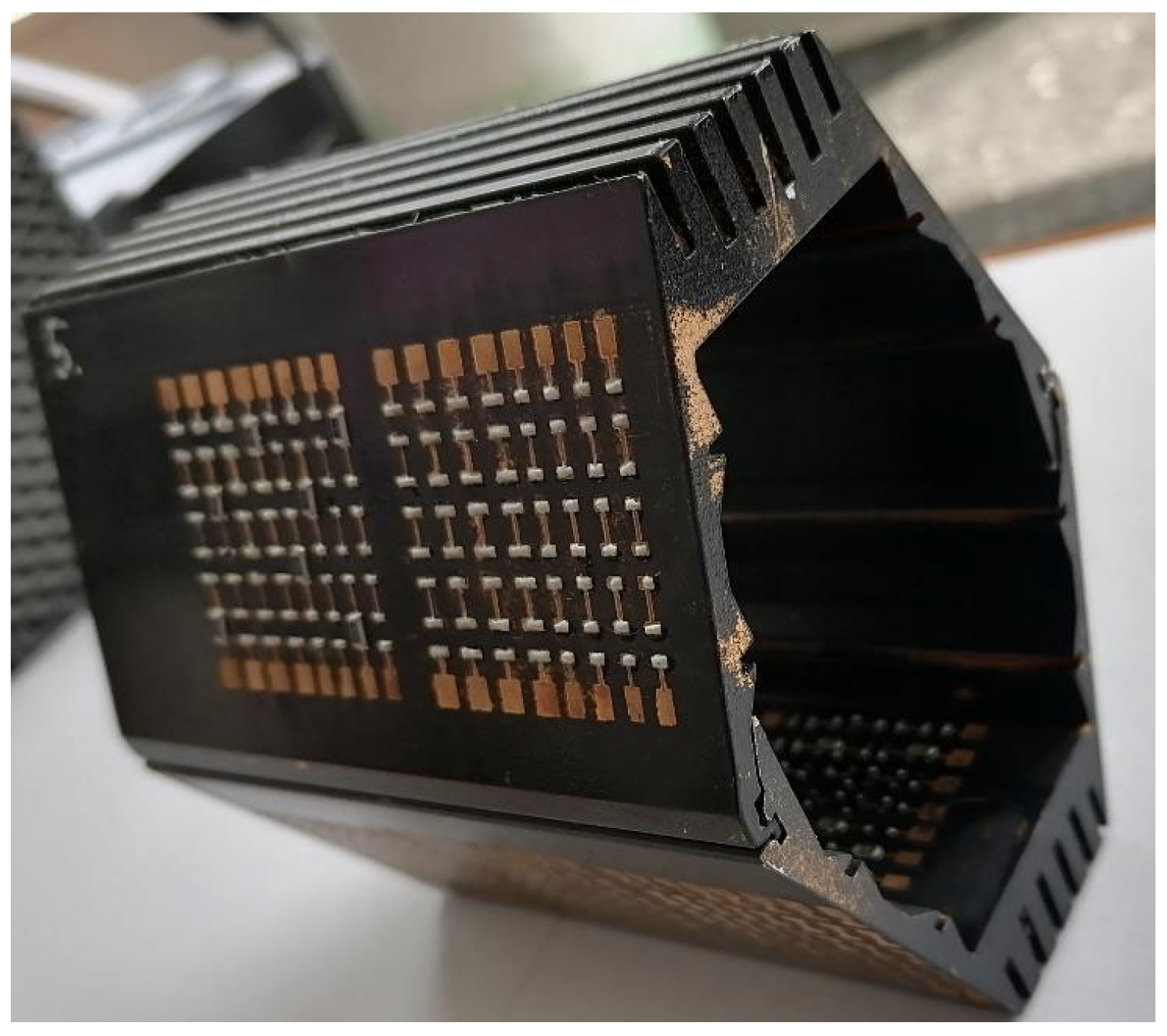
In this study, 3D-shaped aluminum core boards served as the structural substrate platform—see Figure 1. The solder joints were formed on Cu pads with ENIG surface finish deposited on the insulated aluminum core structure, thereby creating a solder/ENIG/Cu/3D-Al system for reliability evaluation. The surface of those PCBs was covered by varnish. Solder pads were formed on the varnish surface, which were then covered with a layer of copper and an ENIG surface finish. Three types of passive SMD components with standard package sizes 0603 (0.6 × 0.3 mm), 0805 (0.8 × 0.5 mm), and 1206 (1.2 × 0.6 mm) were mounted on the prepared solder pads. The components had a conventional lead-free termination finish and did not contain Au metallization. Therefore, the Au detected within the interfacial region originated exclusively from the ENIG surface finish of the substrate. Two solder pastes were used for the assembly: one with SAC305 alloy and the other one with Sn42Bi57Ag1. The tested pastes were printed on the solder pads with stainless-steel stencil. The tested samples were soldered using vapor phase reflow soldering using adequate Galdens as heat transferring agents. The peak process temperature was adjusted according to the solder paste requirements (235 st. C for SAC305 and 189 st. C for Sn42Bi57Ag1) and maintained above the alloy liquidus temperature for approximately 30–90 s.
To determine the difference in IMC formation between the alloy and the surface during different environmental aging conditions, the samples were divided into several batches. The first batch was samples in the state “as received” prior to climatic tests. Afterwards, samples were divided for 3 climatic tests: High Temperature (HT) with the constant temperature of 85 °C, Humidity (HUM) with constant exposure to humidity and temperature 85 °C 85%RH, and later on, Thermal Shock (TS) alternating temperature ranging from 0 to 50 °C with the dwell time of 30 min. Samples were investigated after 200 and 500 cycles of TS (marked as TS200 and TS500, respectively), 500 h of the HUM test (marked as HUM500), and 500 h of HT exposure (mark HT500). The selected aging conditions were chosen to simulate typical environmental and thermo-mechanical stresses encountered in high-power electronic assemblies operating on insulated metal substrates. They were selected to enable comparative evaluation of IMC evolution under different degradation mechanisms. IMC compositional analysis was performed for all conditions. Au distribution maps were analyzed for T0, TS200, and TS500 samples in order to evaluate Au redistribution during progressive thermal shock exposure. IMC thickness measurements were compared for T0, HT500, HUM500, and TS200 conditions to evaluate the influence of different environmental aging factors on interfacial layer growth.
The investigations of IMCs were performed with the JEOL JSM-7600F field emission scanning electron microscope (JOEL Ltd., Akishima, Japan). Due to the presence of the insulating varnish layer on the substrate surface, the test samples were coated with a thin (15 nm) carbon layer prior to SEM observations in order to minimize surface charging effects during analysis. The carbon contribution originating from the conductive coating was excluded from the quantitative EDX elemental analysis. Observations of the surface topography and composition were carried out at an accelerating voltage of 15 kV. The microscope is equipped with Energy Dispersive X-ray (EDX) spectrometer using X-MaxN 150 Silicon Drift Detector (Oxford Instruments, Abingdon, UK). The quantitative analysis was carried out at an accelerating voltage of 15 kV. EDX analysis element maps and IMC thickness measurements were made using Aztec software platform v3.3. In the selected areas on the substrate–solder interface, maps of the distribution of the main components of the intermetallic compound, i.e., Sn and Cu, were prepared. The compositional contrast based on backscattered electron (BE) images was relatively weak; therefore, the X-ray maps of the Sn and Cu distribution were performed. That allowed for precise measurement of the IMC thickness, which was very clearly visible against the background of the interface between the solder and the substrate. In addition to elemental mapping, EDX point analyses were conducted at selected interfacial regions to further verify local IMC composition. For each aging condition, IMC thickness measurements and compositional analyses were performed on at least three independent samples.

3. Results and Discussion

3.1. IMC Composition and Evolution

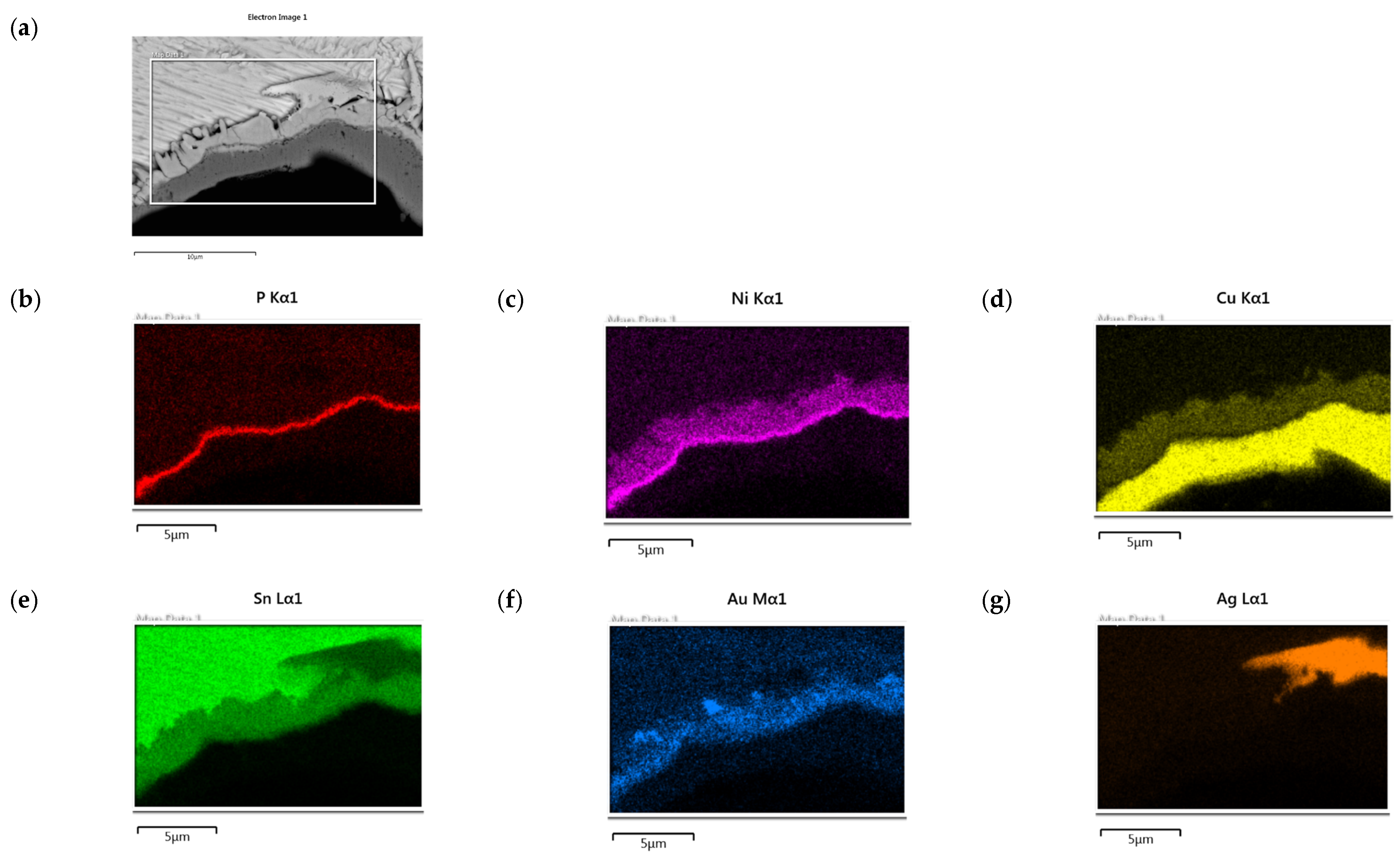
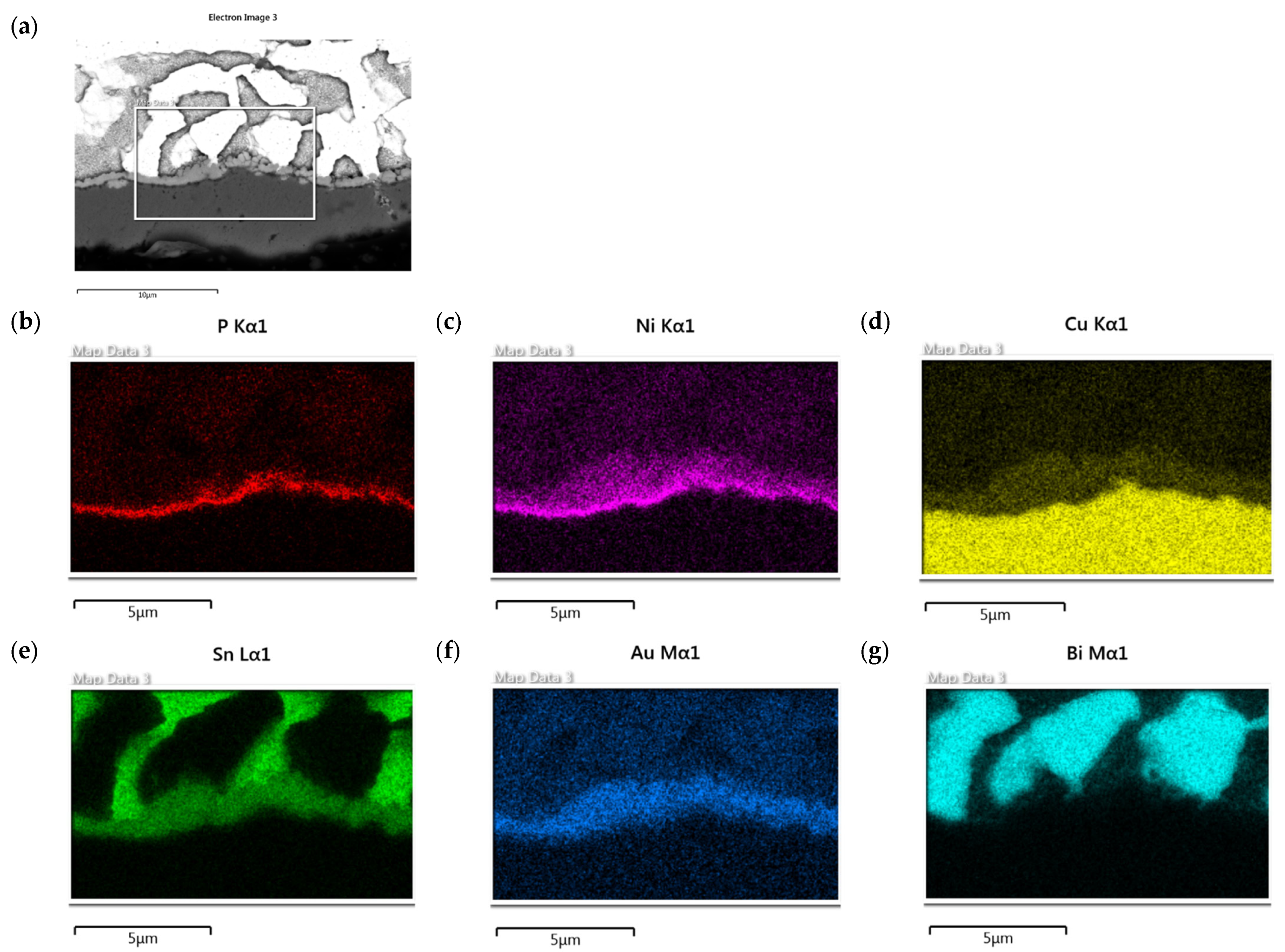
Analysis of the IMC interphase layer for SnAgCu and SnBiAg alloys in the ENIG/Cu metallization system integrated on the 3D-shaped aluminum core substrate revealed that for both alloys, it consists of the elements Sn, Cu, Ni, and Au. The EDS maps shown in Figure 2 and Figure 3 show that Sn, Cu, and Ni are present in the IMC layer. While Au is detected throughout the analyzed alloy, P is detected at the Cu surface as a continuous layer. Ag and Bi, however, are visible in the alloy beyond the IMC layer. P from the NiP sublayer and Ag or Bi contained in the alloys do not contribute to the formation of the intermetallic layer.
To further confirm the composition of the interfacial IMC layer, additional EDX point analyses were performed at three representative locations across the IMC region (Table 1 and Table 2). The point analysis consistently confirmed the presence of Sn, Cu, and Ni as the dominant elements within the interfacial phase for both solder systems, supporting the formation of a (Cu,Ni)6Sn5-type compound. Variations in local elemental ratios were observed depending on the analyzed position, which may reflect local compositional inhomogeneity or phase morphology. These results are consistent with the elemental mapping analysis and further support the identification of the primary interfacial IMC phase.
This result is not surprising. The mechanism of IMC formation in lead-free soldering systems is well described in the reviewed literature. During reflow of SAC305 on the ENIG/Cu surface, the very thin Au layer dissolves rapidly into the molten solder and does not remain as a continuous interfacial layer. The dominant interfacial reactions occur between molten Sn-based solder and the Ni-P layer. Because SAC305 contains Cu, Cu atoms diffuse toward the interface and substitute partially for Ni in the Ni3Sn4-type structure, forming (Cu,Ni)6Sn5.The (Cu,Ni)6Sn5 intermetallic layer is created at the interface. At this stage, the interfacial IMC is relatively thin. Growth is reaction-controlled rather than diffusion-controlled, consistent with recent observations of rapid thin Cu6Sn5 film formation under short-duration laser heating conditions [10]. Morphology is scallop-type or layer-like, depending on process parameters.
When Bi is added to the alloy, the interfacial sequence during reflow remains fundamentally similar. Au first dissolves into the molten solder, followed by the reaction of Sn with the Ni surface, leading to the formation of (Cu,Ni)6Sn5 as the primary interfacial IMC. Under typical Bi concentrations, Bi does not significantly participate in the initial interfacial reaction with Ni or Cu and is therefore not a dominant factor in determining the primary IMC phase. Instead, Bi is mainly distributed within the solder matrix, with only limited solubility in β-Sn and possible segregation in Bi-rich regions during solidification. Consequently, the dominant interfacial phase remains (Cu,Ni)6Sn5. After solidification, in both SAC305 and SAC-Bi systems, IMC growth becomes diffusion-controlled, governed primarily by Sn diffusion toward the interface and Ni diffusion outward into the solder. As a result, IMC layer growth follows parabolic kinetics [11].
Differences appear during aging. In SAC305, continuous growth of (Cu,Ni)6Sn5 occurs. A P-rich layer (Ni3P-type) may form beneath the Ni layer due to Ni consumption. If the Ni layer is fully consumed, Cu from the substrate may participate, leading to Cu6Sn5 formation [11]. With the addition of Bi, modified diffusion behavior can be observed. Although Bi does not form a dominant IMC layer, it can slightly reduce Sn diffusivity. It lowers the melting temperature and modifies the fluidity. It can slightly alter interfacial reaction kinetics due to changes in Sn’s thermodynamic activity. It may slow the coarsening of interfacial IMC in some compositions. However, growth remains diffusion-controlled and parabolic [9].
Analyzing the IMC composition measurement results presented in Table 3, it can be concluded that the type of aging significantly affects the chemical composition and evolution of IMCs formed at the solder/substrate interface for both SAC305 and Sn42Bi57Ag1 solders.
For SAC305, TS aging leads to a gradual increase in Cu content within the IMC layer (from ~20 wt.% in the as-soldered state to over 22 wt.% after 500 cycles), while Ni remains relatively stable and Au systematically decreases. This trend indicates continued growth of a (Cu,Ni)6Sn5-type phase during cyclic thermal loading. The increasing Cu fraction suggests progressive participation of Cu in the interfacial reaction, most likely due to diffusion through or around the Ni layer.
According to the review by Ramli et al. [11], the primary IMC formed at the interface between Sn-based solders and Ni-finished substrates is (Cu,Ni)6Sn5. During prolonged exposure, the Ni layer may be gradually consumed. If the Ni barrier becomes locally depleted, Cu from the underlying substrate can actively participate in the reaction, promoting the formation of Cu6Sn5. The compositional shift observed in the present study during TS aging is consistent with such a mechanism. The continuous decrease in Au content suggests its initial dissolution into the solder matrix and/or incorporation into early-stage interfacial phases, followed by redistribution during further aging [22,23].
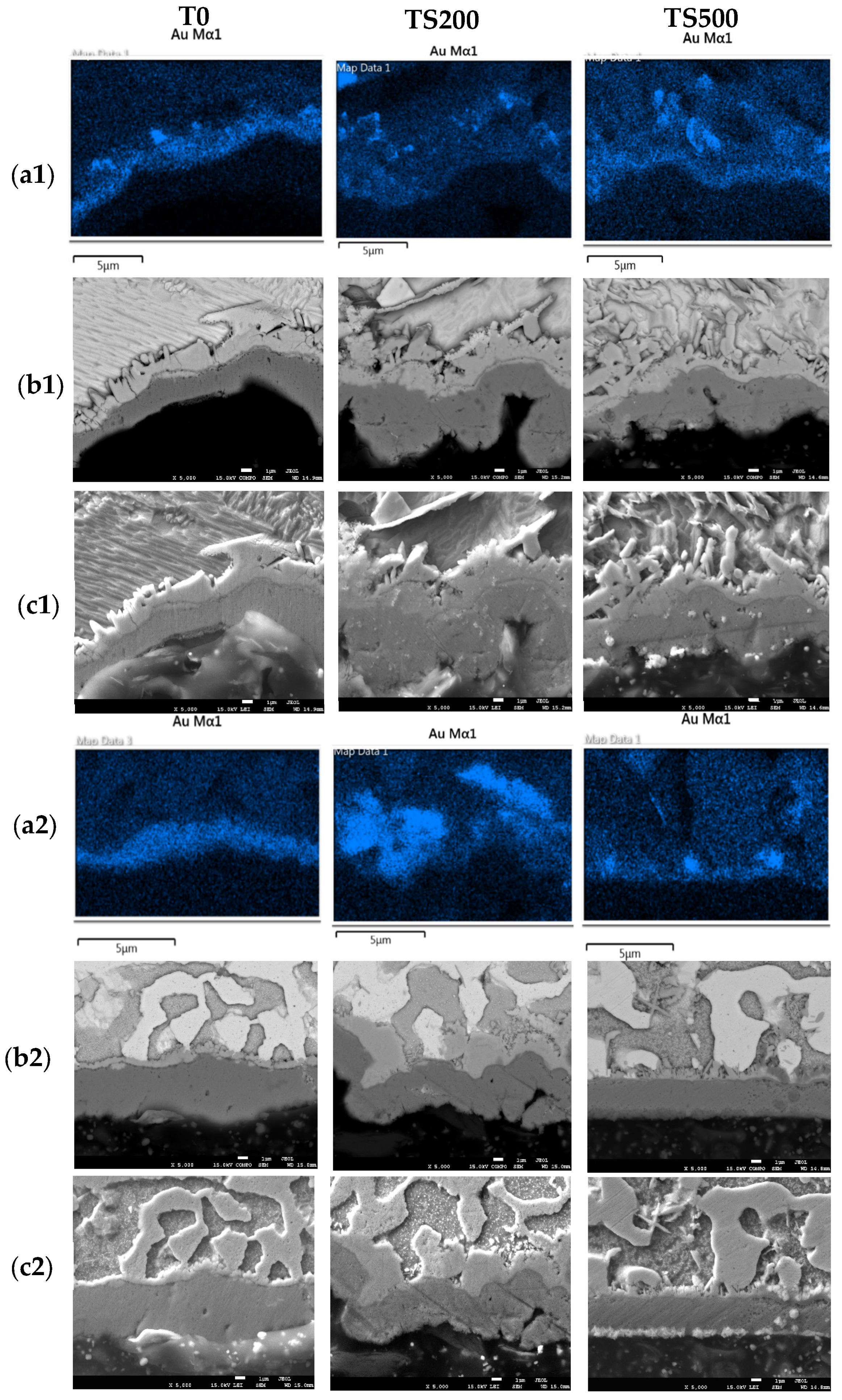
As shown, exposure of samples to thermal shocks reduced the amount of Au in the IMC layer for both tested alloys when increasing the number of thermal shock cycles. Figure 4 compares the gold EDS maps of the samples immediately after assembly and after 200 and 500 cycles of thermal shock. It can be observed that in the TS samples, Au is detected with comparable intensity throughout the entire volume of the analyzed alloy layer, indicating that it diffused into both alloys during the aging process.
HT500 aging produces a distinctly different compositional profile. A pronounced increase in Sn and Ni content, accompanied by a significant reduction in Cu, indicates a possible reorganization of the IMC layer under long-term isothermal exposure. Such behavior may be associated with enhanced Ni consumption and the formation of a Ni-rich interfacial region. In ENIG-type finishes, a P-rich layer (e.g., Ni3P) is frequently observed beneath the reacted Ni layer when Ni is depleted [10]. Although P was not quantified in the present measurements, the compositional evolution observed here is compatible with progressive Ni consumption and diffusion-controlled growth of the IMC layer.
HUM500 aging results in intermediate behavior, with relatively high Cu participation and moderate Ni content. The combined action of temperature and humidity may accelerate degradation of the protective Ni layer and facilitate diffusion processes, leading to sustained growth of (Cu,Ni)6Sn5. Overall, the growth of IMCs in SAC305 joints appears to remain diffusion-controlled, consistent with parabolic kinetics widely reported for Sn-based solder systems.
In the case of Sn42Bi57Ag1 solder, the evolution of IMC composition during aging differs quantitatively from that of SAC305, although the governing mechanism remains similar.
After 200 thermal shock cycles, a substantial increase in the Cu content is observed (from ~4 wt.% in the as-soldered condition to nearly 12 wt.%), with further fluctuations depending on the aging condition. Under HUM500, Cu participation becomes particularly pronounced. Simultaneously, the Ni content increases under TS conditions, while Au decreases significantly from the initial state.
The presence of Bi does not result in the formation of a dominant Bi-containing interfacial IMC. This is consistent with previous findings indicating that Bi does not readily form stable intermetallic phases with Ni or Cu under typical soldering conditions [9]. Instead, Bi indirectly modifies the thermodynamic and kinetic conditions of interfacial reactions. It lowers the alloy’s melting temperature, affects the fluidity of the liquid state during soldering, and alters the thermodynamic activity of Sn. As discussed by Akkara et al. [9], Bi may slightly influence interfacial reaction kinetics and, in some cases, reduce the coarsening rate of IMCs. This interpretation is consistent with recent findings for SnBi-based systems, where modified processing conditions were shown to alter the IMC morphology and interfacial stability without fundamentally changing the dominant reaction pathway [14].
The present results suggest that although Bi modifies diffusion behavior and phase evolution, the overall growth mechanism remains diffusion-controlled. The significant Cu participation observed after aging indicates that, similarly to SAC305, consumption of the Ni layer allows Cu from the substrate to contribute to IMC growth. However, compositional variations in SnBiAg joints appear more sensitive to environmental conditions, particularly humidity, which may accelerate interfacial degradation. The differences between TS, HUM, and HT aging conditions can be attributed to their distinct driving forces:
Thermal shock introduces cyclic thermal stresses, which may generate microcracks or defects within the IMC layer, enhancing effective diffusion paths and accelerating compositional evolution.
High-temperature aging promotes long-term solid-state diffusion under isothermal conditions, favoring thickening and possible phase redistribution within the IMC layer.
Combined temperature and humidity exposure may accelerate degradation of the Ni barrier layer and intensify Cu participation in interfacial reactions.
Despite these differences, in both solder systems, the evolution of IMCs during aging follows a diffusion-dominated mechanism, and the compositional changes are consistent with the parabolic growth behavior reported in the literature [9,11].

3.2. IMC Thickness Growth

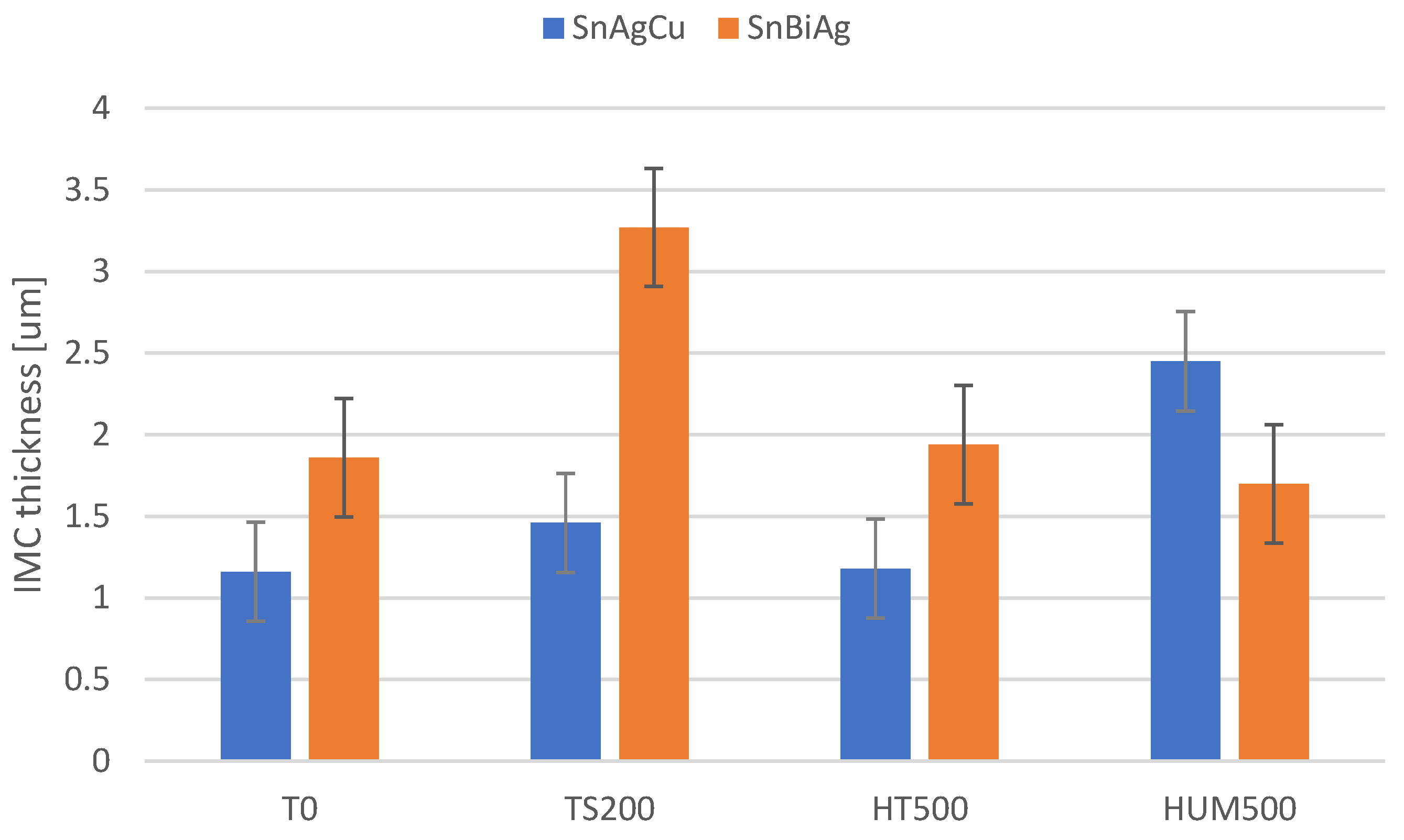
Figure 5 shows the thickness of the IMCs in SAC305/ENIG/Cu/aluminum and Sn42Bi57Ag1/ENIG/Cu/aluminum after different aging.
The results obtained from IMC layer thickness measurements indicate that the growth kinetics of intermetallic compounds strongly depends not only on solder composition and environmental exposure, but also on the mechanical characteristics of the substrate system. In the present study, ENIG/Cu pads were fabricated on an aluminum substrate separated only by a thin lacquer layer. This configuration differs significantly from conventional FR-4-based systems and has a direct impact on stress development during thermal loading.
The observed differences in IMC growth between SAC305 and Sn42Bi57Ag1 are primarily related to differences in alloy chemistry and substrate configuration. The overall IMC growth trends observed in the present study are consistent with diffusion-controlled interfacial evolution commonly reported for SAC and Bi-containing solder systems subjected to thermal aging [9,10]. The measured changes in IMC thickness are also comparable with values reported in previous studies investigating Bi-modified Sn-based solder alloys under prolonged environmental exposure [13,14,15,16]. Previous studies have shown that Bi addition refines solder microstructure and alters interfacial reaction behavior, with its effect on IMC growth depending on Bi concentration, substrate type, and thermal history, rather than acting solely as a suppressive factor [12,13,14,15,16,17,18]. In Bi-containing solders, modified diffusion pathways, interfacial stability, and phase evolution can change IMC formation kinetics compared with conventional SAC systems. Accordingly, the thicker IMC layers observed in Sn42Bi57Ag1 immediately after reflowing in the present study may result from Bi-induced changes in interfacial reaction kinetics and morphology, which can locally accelerate IMC formation despite the lower processing temperature. Similar early-stage sensitivity of IMC thickness to local reaction kinetics rather than only bulk temperature was also demonstrated by Liang et al. [10], who reported significant Cu6Sn5 growth under highly localized thermal processing.
Under environmental exposure, different dominant mechanisms appear for each alloy. For SAC305, the most significant IMC growth occurred under humidity testing. This behavior may be linked to degradation or destabilization of the Ni barrier layer in ENIG finishes, which can accelerate interfacial reactions once moisture-assisted processes occur. The dissolution behavior of Au and interfacial reaction kinetics in Sn-based solders have been described by Kim and Tu [19], while rapid AuSn4 formation and its impact on interfacial stability were recently reported by Luo et al. [23]. Although Au is typically fully dissolved during reflow, the stability of the underlying Ni layer remains critical. Moisture-induced degradation may enhance Ni consumption and promote further IMC growth.
In contrast, Sn42Bi57Ag1 showed the largest increase in IMC after thermal shock testing. This can be explained by the higher stiffness and reduced ductility of Bi-containing solders [12,17]. Under cyclic thermal loading, especially on rigid aluminum-based IMS, significant thermo-mechanical stresses develop. The thermal behavior and rigidity of aluminum-based IMS have been discussed in [3,4,5,6,7,8]. Compared to conventional FR-4 systems, aluminum substrates provide limited strain accommodation. As a result, mechanically induced microcracking at the interface may increase the effective reaction area and accelerate IMC thickening. In addition, the non-planar 3D-shaped geometry of the investigated IMS substrate may contribute to locally non-uniform thermo-mechanical stress distribution during environmental aging, particularly under thermal shock conditions. Such effects can additionally influence interfacial degradation processes and IMC evolution compared to conventional flat substrate configurations. This interpretation is consistent with fatigue-related IMC evolution reported in [16]. Although direct quantitative comparison between studies remains difficult due to differences in substrate configuration, surface finish, and aging protocols, the observed relative increase in IMC thickness under thermal shock conditions follows trends reported for Bi-containing solder systems in the literature [14,15,16]. Similar sensitivity of Bi-rich solder systems to externally induced microstructural evolution has been reported under ultrasound-assisted soldering, where altered phase distribution and mechanical response were observed [14].
Therefore, IMC growth in the analyzed system should be considered as a combined effect of alloy-dependent diffusion kinetics [11,12,13,14], environmental sensitivity of the ENIG barrier layer [22,23] and mechanically induced damage amplified by the rigid aluminum IMS substrate [3,4,5,6,7,8]. This broader interpretation agrees with recent reports showing that not only composition but also externally induced microstructural modification can significantly alter solder joint evolution [19].
The results suggest that SAC305 is more sensitive to environment-assisted interfacial degradation, whereas Sn42Bi57Ag1 is more susceptible to stress-assisted IMC growth under severe thermal cycling.
The presented interpretation is based primarily on SEM/EDS characterization of interfacial evolution. Since detailed phase identification and direct mechanical reliability measurements were beyond the scope of the present work, the proposed mechanisms should be interpreted as phenomenological explanations supported by the literature data. Additional studies including mechanical testing and advanced phase characterization are planned for future work.

4. Conclusions

The formation and evolution of intermetallic compounds in SAC305 and Sn42Bi57Ag1 solder alloys during reflow at ENIG-finished Cu pads integrated into 3D-shaped aluminum core substrates in different kinds of aging are investigated in this paper.
The results of IMC composition evolution suggest that aging significantly modifies the chemical composition of the IMC layer in both SAC305 and Sn42Bi57Ag1 joints. In SAC305, a continuous development of (Cu,Ni)6Sn5-type phases is observed, with increasing Cu involvement during prolonged exposure. In SnBiAg joints, Bi alters reaction kinetics but does not fundamentally change the diffusion-controlled nature of IMC growth. These compositional changes may have direct implications for long-term joint reliability, particularly under thermal cycling and humid environments.
The obtained IMC layer’s thickness measurements indicate that the kinetics of intermetallic compound growth strongly depends not only on the solder composition and environmental exposure but also on the mechanical properties of the substrate system. They suggest that Sn42Bi57Ag1 exhibits greater sensitivity to thermal stress in systems with high substrate stiffness, and SAC305 exhibits greater susceptibility to Ni layer degradation under high humidity conditions. This observation is consistent with recent studies emphasizing that IMC evolution is governed by the combined influence of alloy composition, processing conditions, and externally modified diffusion pathways [10,14,19].
The observed IMC evolution trends remain consistent with diffusion-controlled growth behavior reported for comparable lead-free solder systems in the literature.
The obtained results should be interpreted not only in terms of solder/ENIG interfacial metallurgy, but also in relation to the broader reliability context of ENIG-finished 3D aluminum core systems.

Author Contributions

Conceptualization: M.K. (Marek Kościelski), I.S., W.S. and S.B.; methodology: M.K. (Marek Kościelski) and A.C.; investigation: M.K. (Marek Kościelski), A.C., A.S., D.L. and M.K. (Mirosław Kozłowski); writing—original draft preparation: A.C.; writing—review and editing: M.K. (Marek Kościelski); supervision: I.S.; project administration: I.S.; funding acquisition: I.S., M.K. (Marek Kościelski), W.S. and S.B. All authors have read and agreed to the published version of the manuscript.

Funding

This research was funded by The National Centre for Research and Development, Poland, project number CORNET/34/74/Alu4CED/2023, titled: Aluminum-based multifunctional housing for circular electronic devices.

Institutional Review Board Statement

Not applicable.

Informed Consent Statement

Not applicable.

Data Availability Statement

The original contributions presented in this study are included in the article. Further inquiries can be directed to the corresponding author.

Acknowledgments

The authors would like to thank their colleagues from the Fraunhofer Institute for Mechatronic System Design and Fraunhofer Institute for Reliability and Microintegration for numerous project discussions and assistance in tested sample preparation. During the preparation of this manuscript/study, the authors used ChatGPT (OpenAI, based on the GPT-5.5 language model).for the purposes of text editing. The authors have reviewed and edited the output and take full responsibility for the content of this publication.

Conflicts of Interest

The authors declare no conflicts of interest.

Abbreviations

The following abbreviations are used in this manuscript:
IMCIntermetallic Compounds
IMSInsulated Metal Substrates
ENIGElectroless Nickel Immersion Gold Metallization
HTHigh Temperature
HUMHumidity
TSThermal Shocks

References

  1. Shukla, V.; Ahmed, O.; Su, P.; Jiang, T. Reliability Risk Mitigation in Advanced Packages by Aging-Induced Precipitation of Bi in Water-Quenched Sn–Ag–Cu–Bi Solder. Materials 2024, 17, 3602. [Google Scholar] [CrossRef]
  2. Zhang, P.; Xue, S.; Liu, L.; Wang, J.; Tatsumi, H.; Nishikawa, H. Influence of Isothermal Aging on Microstructure and Shear Property of Novel Epoxy Composite SAC305 Solder Joints. Polymers 2023, 15, 4168. [Google Scholar] [CrossRef]
  3. Gurpinar, E.; Ozpineci, B.; Chowdhury, S. Design, Analysis, Comparison, and Experimental Validation of Insulated Metal Substrates for High-Power Wide-Bandgap Power Modules. J. Electron. Packag. 2020, 142, 041107. [Google Scholar] [CrossRef]
  4. Jordan, R.C.; Weber, C.; Ehrhardt, C.; Wilke, M.; Jaeschke, J. Advanced packaging methods for high-power LED modules. J. Solid State Light. 2015, 2, 4. [Google Scholar] [CrossRef]
  5. Pelletier, M.G.; Preston, S.C.; Cook, J.A.; Tran, K.D.; Wanjura, J.D.; Holt, G.A. Thermal Performance of Double-Sided Metal Core PCBs. Agriengineering 2019, 1, 539–549. [Google Scholar] [CrossRef]
  6. Juntunen, E.; Sitomaniemi, A.; Tapaninen, O.; Persons, R.; Challingsworth, M.; Heikkinen, V. Thermal Performance Comparison of Thick-Film Insulated Aluminum Substrates with Metal Core PCBs for High-Power LED Modules. IEEE Trans. Compon. Packag. Manuf. Technol. 2012, 2, 1957–1964. [Google Scholar] [CrossRef]
  7. Ding, X.; Tang, Y.; Li, Z.; Chen, Q.; Li, Y.; He, Y. Thermal and optical investigations of high power LEDs with metal embedded printed circuit boards. Int. Commun. Heat Mass Transf. 2015, 66, 32–39. [Google Scholar] [CrossRef]
  8. Gurpinar, E.; Chowdhury, S.; Ozpineci, B.; Fan, W. Graphite-Embedded High-Performance Insulated Metal Substrate for Wide-Bandgap Power Modules. IEEE Trans. Ind. Electron. 2021, 36, 114–128. [Google Scholar] [CrossRef]
  9. Akkara, F.J.; Hamasha, S.; Alahmer, A.; Evans, J.; Belhadi, M.E.A.; Wei, X. The Effect of Micro-Alloying and Surface Finishes on the Thermal Cycling Reliability of Doped SAC Solder Alloys. Materials 2022, 15, 6759. [Google Scholar] [CrossRef]
  10. Liang, Z. Formation and growth mechanism of thin Cu6Sn5 films in Sn/Cu and Sn-0.1AlN/Cu structures using laser heating. Solder. Surf. Mt. Technol. 2024, 36, 268–275. [Google Scholar] [CrossRef]
  11. Ramli, M.I.I.; Salleh, M.A.A.M.; Abdullah, M.M.A.B.; Zaimi, N.S.M.; Sandu, A.V.; Vizureanu, P.; Rylski, A.; Amli, S.F.M. Formation and Growth of Intermetallic Compounds in Lead-Free Solder Joints: A Review. Materials 2022, 15, 1451. [Google Scholar] [CrossRef]
  12. Sayyadi, R.; Naffakh-Moosavy, H. Physical and mechanical properties of synthesized low Ag/lead-free Sn-Ag-Cu-xBi (x = 0, 1, 2.5, 5 wt%) solders. Mater. Sci. Eng. A 2018, 735, 367–377. [Google Scholar] [CrossRef]
  13. Zhao, J.; Qi, L.; Wang, X.-M.; Wang, L. Influence of Bi on microstructures evolution and mechanical properties in Sn–Ag–Cu lead-free solder. J. Alloys Compd. 2004, 375, 196–201. [Google Scholar] [CrossRef]
  14. Zhang, J.-M.; Zhang, L.; Chen, Y.-H.; Wang, H. Effect of ultrasound-assisted soldering on the microstructure and mechanical properties of Cu/Sn58Bi-Foam Co/Cu soldered joints: Experiments and first-principles calculations. Mater. Charact. 2026, 232, 116007. [Google Scholar] [CrossRef]
  15. Rizvi, M.; Chan, Y.; Bailey, C.; Lu, H.; Islam, M. Effect of adding 1wt% Bi into the Sn–2.8Ag–0.5Cu solder alloy on the intermetallic formations with Cu-substrate during soldering and isothermal aging. J. Alloys Compd. 2006, 407, 208–214. [Google Scholar] [CrossRef]
  16. Kang, T.; Xiu, Y.; Hui, L.; Wang, J.; Tong, W.; Liu, C. Effect of Bismuth on Intermetallic Compound Growth in Lead Free Solder/Cu Microelectronic Interconnect. J. Mater. Sci. Technol. 2011, 27, 741–745. [Google Scholar] [CrossRef]
  17. Belhadi, M.E.A.; Hamasha, S.; Alahmer, A. Effect of Bi content and aging on solder joint shear properties considering strain rate. Microelectron. Reliab. 2023, 146, 115020. [Google Scholar] [CrossRef]
  18. Zhao, J.; Wu, J.; Zhang, J.; Liao, M.; Wang, F. Intermetallic compound layer and fatigue crack evolution of Bi-contained Sn-1.0Ag-0.5Cu solder under thermal aging and thermal fatigue. J. Mater. Res. Technol. 2024, 34, 1191–1200. [Google Scholar] [CrossRef]
  19. Wu, C.-J.; Zhang, L.; Jiang, N.; Kim, H.S.; Chen, Y.-H. Effect of horizontal magnetic field on the microstructure and mechanical properties of Ti nanoparticles-reinforced Sn1.0Ag0.5Cu solder: Experimental and first-principles calculations. J. Mech. Work. Technol. 2025, 342, 118949. [Google Scholar] [CrossRef]
  20. Arazna, A.; Koscielski, M.; Sitek, A.; Steplewski, W.; Janeczek, K.; Lipiec, K.; Rafalik, I.; Sitek, J. Proceedings of the 8th Electronics System-Integrated Technology Conference (ESTC), Tonsberg, Norway, 15–18 September 2020; IEEE: New York, NY, USA, 2020. [Google Scholar]
  21. Chołaj, A.; Kozłowski, M.; Kościelski, M.; Stęplewski, W.; Diduszko, R. Effect of isothermal aging on IMC growth in SAC-base solder for demanding application. In Proceedings of the 45th International Microelectronics and Packaging IMAPS Poland Conference, Rzeszów- Łańcut, Poland, 24–27 September 2023. [Google Scholar]
  22. Kim, P.; Tu, K. Fast dissolution and soldering reactions on Au foils. Mater. Chem. Phys. 1998, 53, 165–171. [Google Scholar] [CrossRef]
  23. Luo, J.; Chen, F.; Xiao, Y.; Hu, Y.; Wang, C.; Zhao, B. Fast formation of AuSn4 intermetallic compound and its influence on the mechanical propertiy of Au/Sn solder joint. Mater. Sci. Eng. A 2025, 950, 149492. [Google Scholar] [CrossRef]
Figure 1. 3D shape aluminum core board used during the experiment.
Applsci 16 05962 g001
Figure 2. (a) Cross-section of as-wetted SnAgCu on ENIG/Cu substrate, (bg) maps of elements concentration.
Applsci 16 05962 g002
Figure 3. (a) Cross-section of as-wetted SnBiAg on ENIG/Cu substrate, (bg) maps of elements concentration.
Applsci 16 05962 g003
Figure 4. Comparison of Au-EDS maps (a1,a2), Backscattered Electrons Images (b1,b2) and Secondary Electron Images (c1,c2) for the sample immediately after soldering—T0 and after TS200, TS500 aging. SnAgCu alloy—a1, b1, c1 and SnBiAg alloy—a2, b2 and c2. The figures illustrate Au redistribution during thermal shock aging.
Applsci 16 05962 g004
Figure 5. Comparison of IMC thickness for SAC305 and SnBiAg solder joints before aging—T0 and after selected environmental aging conditions—thermal stress (TS), humidity (HM) and high temperature (HT). Error bars represent standard deviation calculated from measurements performed on at least three samples for each condition.
Applsci 16 05962 g005
Table 1. EDX point analysis of three representative locations within the IMC layer for SAC305 joints.
Spectrum LabelWeight %
Point 1Point 2Point 3AverageStandard
Deviation
Ni12.4612.8513.5312.950.54
Cu20.2620.8518.8319.981.04
Sn63.2160.8060.3161.441.55
Au4.075.507.345.641.64
Table 2. EDX point analysis of three representative locations within the IMC layer for Sn42Bi57Ag1 joints.
Spectrum LabelWeight %
Point 1Point 2Point 3AverageStandard
Deviation
Ni15.7518.2814.0816.042.12
Cu18.3418.3118.8918.510.33
Sn56.7655.7155.5856.020.65
Au9.157.7011.459.431.89
Table 3. Results of IMC layer composition analysis for SnAgCu and SnBiAg alloys on an ENIG/Cu substrate immediately after soldering—T0 and after TS200, TS500, HUM500 and HT500 aging. Weight percentage of elements.
StateSAC305 Solder
Weight %
NiCuSnAu
T012.9519.9861.445.64
TS20013.2920.8461.164.71
TS50013.3722.1860.823.63
HUM50011.8122.1861.294.72
HT50020.14.4973.971.44
StateSn42Bi57Ag1Solder
Weight %
NiCuSnAu
T012.543.8160.7222.93
TS20015.8711.8165.746.58
TS50016.798.7866.967.47
HUM50015.514.1165.584.8
HT50012.318.6461.387.68
Disclaimer/Publisher’s Note: The statements, opinions and data contained in all publications are solely those of the individual author(s) and contributor(s) and not of MDPI and/or the editor(s). MDPI and/or the editor(s) disclaim responsibility for any injury to people or property resulting from any ideas, methods, instructions or products referred to in the content.