Article

Metal Oxide Supports Tuning Activity of Palladium Catalysts for Methane Combustion: In Situ Spectroscopic Approach


by
Magdalena Chrzan
1,
Roman Jędrzejczyk
2,
Dominika Pawcenis
1,
Anna Gancarczyk
3,
Magdalena Leśniak
4,
Maciej Sitarz
4 and
Joanna Profic-Paczkowska
1,*
1
Faculty of Chemistry, Jagiellonian University, ul. Gronostajowa 2, 30-387 Kraków, Poland
2
Małopolska Centre of Biotechnology, Jagiellonian University, ul. Gronostajowa 7A, 30-387 Kraków, Poland
3
Institute of Chemical Engineering, Polish Academy of Sciences, ul. Bałtycka 5, 44-100 Gliwice, Poland
4
Department of Silicate Chemistry and Macromolecular Compounds, Faculty of Materials Science and Ceramics, AGH University of Science and Technology, al. Mickiewicza 30, 30-059 Kraków, Poland
*
Author to whom correspondence should be addressed.
Appl. Sci. 2026, 16(12), 5945; https://doi.org/10.3390/app16125945
Submission received: 16 April 2026 / Revised: 28 May 2026 / Accepted: 1 June 2026 / Published: 12 June 2026
(This article belongs to the Special Issue Applied Research in Combustion Technology and Heat Transfer)

Abstract

Methane combustion over palladium-based catalysts is a critical process for reducing greenhouse gas emissions from lean-burn engines and natural gas installations, yet the role of oxide support in controlling both the population and the intrinsic reactivity of Pd active centres remains incompletely understood. In this work, Pd catalysts at two series of higher and lower loading were prepared on five oxide supports—Al2O3, CeO2, SiO2, TiO2, and ZrO2—and characterised by a complementary suite of techniques including SEM-EDX, XRD, BET, AAS, in situ CO-FTIR, DRIFTS with methanol as a probe molecule, and Raman spectroscopy. Catalytic activity testing revealed the order Pd/CeO2 > Pd/ZrO2 > Pd/Al2O3 > Pd/TiO2 > Pd/SiO2. In situ CO-FTIR site quantification showed that active site density spans nearly an order of magnitude across the series, with Pd/CeO2 reaching 105.44 µmol g−1 and Pd/Al2O3 only 11.63 µmol g−1. Turnover frequency analysis revealed a striking inversion: Pd/Al2O3 exhibited the highest TOF (0.1327 s−1), approximately six times greater than Pd/CeO2 (0.0226 s−1). DRIFTS/methanol profiling demonstrated that CeO2 and ZrO2 expose cooperative redox and basic centres that promote methane activation, while SiO2 supports only weakly bound methoxy species, consistent with its lowest activity. These results establish that the oxide support simultaneously governs Pd dispersion—and hence site density—and the electronic environment of each Pd centre, thereby modulating intrinsic reactivity. High specific surface area alone does not guarantee catalytic performance, and rational support selection is therefore the decisive lever for optimising methane combustion catalysts at ultra-low Pd loadings. In all, our findings provide a quantitative, molecular-level framework that disentangles support-controlled site density from intrinsic site reactivity under identical reaction conditions. By combining in situ CO-FTIR, DRIFTS, and Raman spectroscopy with kinetic analysis on well-defined, high-purity oxide supports, this work transforms previously qualitative “support effects” in Pd-catalysed methane combustion into predictive structure–activity relationships.

1. Introduction

Palladium-based catalysts have long been considered the benchmark materials for catalytic methane combustion and emission control technologies [1,2,3,4], and they remain essentially irreplaceable for the complete low-temperature oxidation of methane. Their performance depends not only on the total palladium loading but also on the oxidation state, dispersion, and local coordination environment of Pd species—properties that are in turn strongly governed by the physicochemical nature of the oxide support [1,5,6,7,8,9,10,11,12,13,14,15,16,17]. Numerous studies have demonstrated that Pd can coexist under reaction conditions as metallic Pd0, PdO, or mixed Pd/PdO phases, and that the relative abundance and spatial arrangement of these states control both catalytic activity and stability in methane combustion [1,11,12,15,16,18,19]. Redox-active supports such as CeO2 act as oxygen reservoirs and modify the electronic and structural properties of supported Pd, leading to catalytic behaviour markedly different from that observed on more inert supports such as Al2O3 or SiO2 [20,21,22,23,24]. Understanding how the support tunes the nature, density, and intrinsic reactivity of Pd active centres is therefore central to the rational design of improved methane combustion catalysts.
Despite extensive kinetic and mechanistic work, the nature of the active centres for methane activation on supported Pd catalysts remains under debate [1,5,10,11,12,16,18]. Both structure sensitivity (particle size, dispersion, PdO/Pd ratio) and support effects (acidity/basicity, redox properties, oxygen mobility) have been invoked to rationalise the wide variations in turnover frequency (TOF) and apparent activation energy observed across different Pd/support systems [5,6,7,8,9,10,11,18]. Mechanistic proposals range from Langmuir–Hinshelwood models involving co-adsorbed CH4 and O2 to Eley–Rideal- and Mars–van Krevelen-type pathways, in which gas-phase methane reacts with surface oxygen supplied either by PdO or by the oxygen storage support [11,12,13,16,25,26,27,28,29]. For Pd/CeO2 in particular, spectroscopic and kinetic evidence suggests that lattice oxygen from ceria participates directly in methane activation, consistent with a Mars–van Krevelen mechanism and the well-known “oxygen pump” behaviour of CeO2 [13,21,22,23,24]. Resolving these competing mechanistic pictures requires combining kinetic data with direct, operando spectroscopic evidence for the identity and population of Pd surface species under realistic reaction conditions. The first obligatory step in the research of reaction mechanisms is thus finding the correlations between the structure of the surface, active centres and catalyst activity.
In situ and operando vibrational spectroscopy has emerged as an indispensable toolkit for this purpose. Probe-molecule FTIR techniques—particularly DRIFTS with methanol and transmission FTIR with CO—allow the simultaneous identification and quantification of acid, basic, and redox surface centres on oxide-supported catalysts [30,31,32,33,34,35]. Methanol is a versatile “smart probe” that discriminates acid sites (ether/methoxy formation), basic sites (carbonate formation), and redox sites (formate and further oxidised intermediates) [32,33], while quantitative CO-FTIR provides molar extinction coefficients and, hence, absolute Pd site counts that can be directly converted into TOF values [30,31,36,37,38,39]. Complementary in situ Raman spectroscopy under oxidative and reactive atmospheres gives direct access to the structural evolution of PdO and support phases—information that is inaccessible from ex situ characterisation [40,41,42,43,44,45].
The present work uses this integrated in situ spectroscopic approach to elucidate systematically how the oxide support tunes the nature, population, and intrinsic activity of Pd active centres in methane combustion. We compare Pd catalysts supported on Al2O3, SiO2, TiO2, ZrO2, and CeO2, combining quantitative site counting by in situ CO-FTIR with active centre identification by DRIFTS/methanol and structural characterisation by in situ Raman spectroscopy, XRD, BET, and SEM-EDX [13,14,15,30,31,32,33]. By correlating TOF values with the number and type of Pd-related redox, acid, and basic centres identified by probe-molecule spectroscopy, we seek to establish why Pd/Al2O3 exhibits the highest TOF per Pd centre while Pd/CeO2 achieves the highest overall methane conversion, and to clarify how support-derived oxygen mobility and acid–base properties govern the mechanism of catalytic methane combustion [1,3,5,6,7,8,9,10,11,12,13,16,17,18,19,21,22,23,24,28,29].

2. Materials and Methods

2.1. Catalyst Preparation

Palladium catalysts were prepared by incipient wetness impregnation of commercial oxide supports with solutions of palladium precursor in methanol, followed by drying and calcination. All oxide supports (γ-Al2O3, TiO2, CeO2 and ZrO2) were commercial high-purity materials of analytical reagent grade: γ-Al2O3 (120 m2 g−1, Sigma-Aldrich, St. Louis, MO, USA) obtained by thermal decomposition of Al(OH)3 at 900 °C for 12 h; SiO2 (300 m2 g−1, Cab-O-Sil); TiO2 (55 m2 g−1, Aeroxide, Evonik Operations GmbH, Hanau, Germany) calcined at 600 °C for 12 h; CeO2 (40 m2 g−1, Alfa Aesar, Ward Hill, MA, USA) and ZrO2 (30 m2 g−1, Alfa Aesar) also calcined at 600 °C for 12 h. The supports were used as received from the suppliers apart from the specified calcination/thermal treatment, and no additional purification was applied. Before impregnation, solubility tests were carried out to select appropriate solvents; methanol was chosen for palladium acetylacetonate, while distilled water was used for other metal precursors, but only Pd-containing samples were investigated in this work. Palladium was introduced from Pd(acetylacetonate)2 solutions in methanol at selected molar concentrations (typically 0.001 or 0.01 mol dm−3 in the impregnation solution) to obtain targeted Pd loadings over each support. After contact of the oxide support with the Pd precursor solution for 1 h at room temperature, the slurry was centrifuged, the solid was separated, dried in flowing air at 80 °C for 1 h, and then calcined in flowing air at 500 °C for 12 h using a linear heating rate of 3 °C min−1. The names of the catalyst take from the impregnation solution concentration.

2.2. Textural and Structural Characterisation

Specific surface areas of the Pd/catalysts were determined by N2 adsorption at 77–78 K using a NOVA 2000 Quantachrome sorption analyzer (Quantachrome Instruments, Boynton Beach, FL, USA), and surface areas were calculated from the adsorption isotherms using the BET method. Phase composition and crystallinity of the oxide supports and supported Pd species after calcination were investigated by powder X-ray diffraction (XRD) with an X’Pert Pro MPD PANalytical diffractometer (PANalytical B.V., Almelo, The Netherlands) using Cu Kα radiation (40 kV, 20 mA), collecting diffraction patterns in the 2θ range 10–90° with a step size of 0.008° and counting time of 0.57 s per step. The morphology of the catalysts and dispersion of Pd on the support surface were examined by scanning electron microscopy (SEM) with a Nova NanoSEM 200 microscope (FEI Company, Waltham, MA, USA) equipped with an energy-dispersive X-ray (EDX) analyser; samples were calcined at 550 °C for 6 h (3 °C min−1) prior to SEM/EDX and coated with a thin carbon layer. Quantitative bulk palladium loadings were determined by atomic absorption spectroscopy (AAS) after microwave digestion of the samples (UltraWave, Milestone) in mixed HNO3/HCl, using a SOLAAR M6 spectrometer (Unicam, Cambridge, UK) with air–acetylene flame and monitoring Pd at 247.6 nm.

2.3. In Situ Spectroscopic Analyses

In situ diffuse reflectance infrared Fourier transform spectroscopy (DRIFTS) was used to identify the nature of active surface centres on Pd catalysts using methanol as a probe molecule [46,47]. Spectra were collected with a Thermo Nicolet 8300 FTIR spectrometer equipped with an MCT-A detector and a Praying Mantis high-temperature reaction cell (Harrick Scientific, Pleasantville, NY, USA, ZnSe windows). The optical path was purged with dry compressed air. Spectra were recorded in the 4000–650 cm−1 range (64–128 scans, resolution 4 cm−1) and processed in OMNIC 8.0.
Catalyst powders (ca. 30–50 mg) were activated in situ by calcination in air (500 °C, 1 h) and cooled to room temperature before measurements. Methanol vapour (diluted in He, total flow 25 cm3 min−1) was adsorbed at room temperature, followed by stepwise thermal desorption in 50 °C increments (heating rate 2 °C min−1) up to 400 °C.
The absolute number of Pd active sites was determined by quantitative transmission FTIR using CO as a probe molecule [30,39]. Spectra were collected on a Thermo Nicolet 5700 spectrometer (MCT detector) using a dedicated quartz sorption cell connected to a vacuum line (base pressure 10−5 mbar).
Catalyst powders were pressed into self-supporting wafers (3.46 cm2, 50–100 mg) and activated in situ by calcination in air (500 °C, 1 h) followed by evacuation and heating to 450 °C (5 °C min−1, 1 h under vacuum). After cooling to −100 °C (liquid N2), calibrated doses of CO (99.95%, ca. 5 cm3 per dose, determined from the ideal gas law) were introduced stepwise until band saturation. Molar absorption coefficients (ε, cm µmol−1) for each CO–Pd band were determined from calibration plots of integrated band area vs. moles of adsorbed CO. The number of active centres (µmol g−1 and µmol cm−2) was calculated by dividing the integrated absorbance of the saturated CO–Pd band by the respective ε, assuming 1:1 CO:site stoichiometry. These values were used to calculate turnover frequencies (TOFs) for methane combustion at 500 °C.
In situ Raman spectroscopy was used to monitor the structure and oxidation state of supported Pd species under oxidative and reactive atmospheres. Spectra were recorded with a Jobin Yvon LabRAM HR confocal Raman microscope (Jobin Yvon S.A.S. (Raman Division), Longjumeau, France) equipped with a 532 nm diode laser (power at sample: ~1 mW), an 1800 lines mm−1 diffraction grating and a spectral resolution of ca. 2 cm−1. Catalyst powders were placed in a Linkam CCR-1000 high-temperature reaction cell (quartz window) allowing simultaneous control of temperature and gas composition.
Prior to measurements, catalysts were activated in situ by calcination at 500 °C (1 h, 30 cm3 min−1, 21 vol.% O2/He) to establish a well-defined oxidised state and to remove adsorbed water. Spectra were collected during controlled cooling under flowing He, with the first spectrum recorded at 110 °C. Instrument calibration was performed before each measurement series using the 520.7 cm−1 band of a crystalline Si reference.

2.4. Catalytic Combustion Tests

The catalytic activity of Pd catalysts for methane combustion was evaluated in a fixed-bed tubular reactor (Catlab, Hiden, Warrington, UK) coupled to a quadrupole mass spectrometer (QIC-20, Hiden). For each test, 25 mg of catalyst with particle size 400–500 μm was loaded into the reactor; prior to activity measurements the sample was activated in 21% O2/He (total flow 50 cm3 min−1) at 723 K (500 °C) for 1 h. After cooling to 298 K (25 °C), the methane–oxygen reaction mixture (typically 0.4 mol% CH4 and 21% O2 balanced with He to a total flow of 50 cm3 min−1, corresponding to a WHSV of 120 L dm−3 h g−1) was introduced over the catalyst bed. The reaction temperature was increased stepwise from 323 to 773 K (50–500 °C) at a heating rate of 10 K min−1, holding each temperature for 30 min to reach steady state before data collection. Mass spectrometric signals corresponding to CH4 (m/z 16), CO (m/z 28), CO2 (m/z 44), and H2O (m/z 18) were continuously monitored, and methane conversion and oxidation rates were calculated as a function of temperature; under the conditions used, selectivity to CO2 was 100% for all Pd/support catalysts.

3. Results

3.1. Overall Catalyst Description

In this chapter the textural, morphological and structural properties are described together with quantitate evaluation of the catalysts on different supports.
Figure 1 compares the morphology and Pd distribution of Pd0.01 (A) and Pd0.001 (B) catalysts supported on Al2O3, CeO2, SiO2, TiO2 and ZrO2. In the SEM images, Al2O3 and ZrO2 appear as relatively large, irregular agglomerates of compact grains with characteristic cauliflower shapes of Al2O3, whereas CeO2, SiO2 and TiO2 form finer, more fragmented particles with smoother or plate-like surfaces. The corresponding EDX maps show that Pd is distributed over the entire surface for all supports, but with notable differences in coverage: on finely divided CeO2 and SiO2, Pd forms a nearly continuous, homogeneous layer, while on Al2O3, TiO2 and ZrO2 it appears as more heterogeneous patches associated with larger support grains and aggregates. In all, the differences in Pd coverage are more pronounced when comparing catalysts on different oxide supports than when comparing the two Pd loadings (Pd0.01 vs. Pd0.001) on a given support.
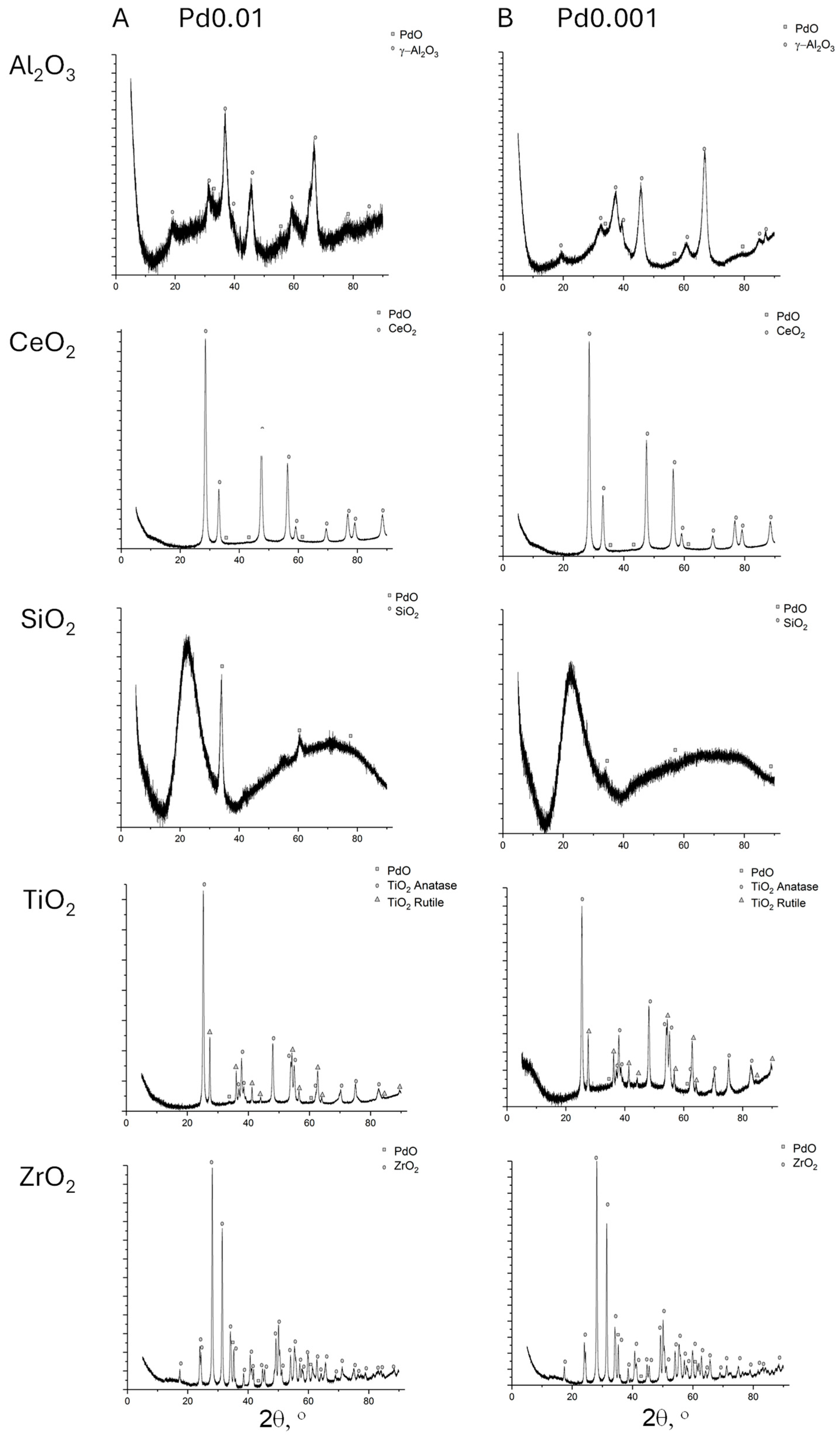
XRD patterns were recorded for Pd0.01 and Pd0.001 catalysts on Al2O3, CeO2, SiO2, TiO2, and ZrO2 to determine bulk phases of the supports and deposited palladium (Figure 2A,B). For all Pd-containing samples, the diffraction patterns show the same set of reflections as the corresponding bare supports, confirming that the impregnation and calcination procedures do not alter the support crystal structures. In addition, very weak reflections attributable to PdO appear at 2θ ≈ 42.8° and 69.7° for all Pd catalysts, with notably higher intensity for Pd0.01/Al2O3, where the Pd content is greatest according to AAS; the PdO peak intensity scales systematically with Pd loading for each support.
Support phases were clearly identified. For γ-Al2O3, reflections at 2θ ≈ 37.5°, 45.7°, and 66.6° correspond to the characteristic pattern of γ-alumina. CeO2-supported samples exhibit a series of peaks at 2θ ≈ 28.5°, 33.1°, 47.4°, 56.3°, 59.2°, 69.2°, 76.6°, 79.3°, and 88.3°, assigned to fluorite-type CeO2. Catalysts on SiO2 show only a broad amorphous halo, confirming that the silica support remains amorphous after calcination. For TiO2-based samples, reflections at 2θ ≈ 28°, 36°, 39°, 42°, 44°, 55°, 57°, 63°, 65°, 70°, and 71° are ascribed to rutile, while peaks at 2θ ≈ 25°, 37°, 38–39°, 48°, 54–55°, 63°, 69°, and 71° correspond to anatase, indicating a mixed-phase TiO2 support. ZrO2-supported catalysts display reflections at 2θ ≈ 30°, 43°, 51°, 63°, and 73°, together with additional peaks around 18°, 24°, 28°, 32°, 34°, 41°, 49–50°, and 61°, consistent with the coexistence of tetragonal and monoclinic ZrO2.
The very low intensity of PdO reflections for both Pd0.001 and Pd0.01 series indicates that PdO is highly dispersed and present as small crystallites below or close to the XRD detection limit, especially at 0.001Pd samples. Only for Pd0.01/Al2O3 do PdO peaks become clearly visible, reflecting its higher total Pd content and slightly larger PdO domains. Overall, XRD confirms phase-pure oxide supports and finely dispersed PdO without additional crystalline impurities, validating that differences in catalytic performance and spectroscopic signatures arise from the support interaction rather than from phase contamination.
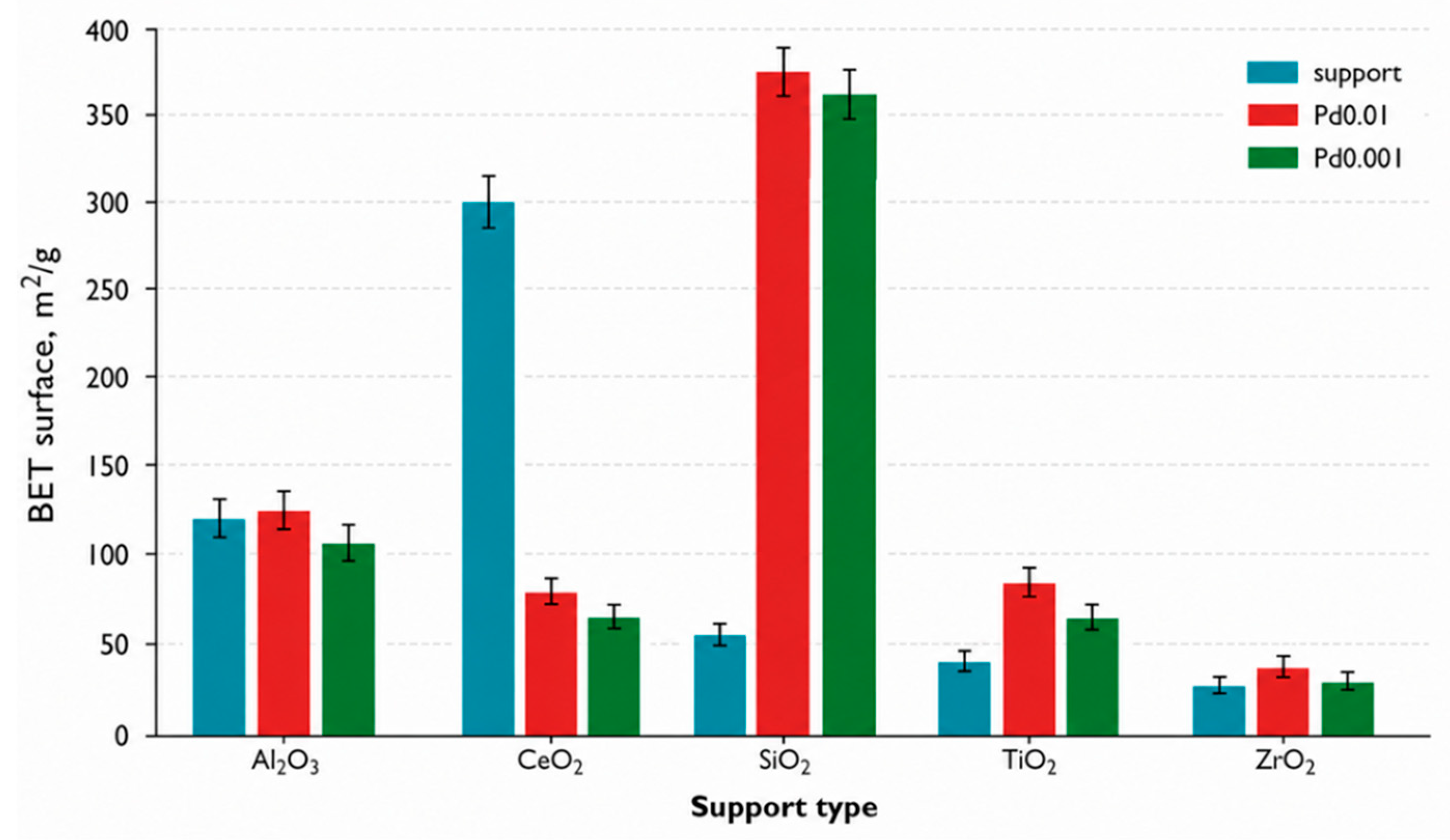
BET surface areas of the bare supports and their Pd0.001 and Pd0.01 catalysts are shown in Figure 3. For CeO2, a pronounced decrease in the surface area is observed upon Pd deposition, which can be attributed to textural changes such as partial pore blocking by Pd species and growth or coalescence of ceria crystallites during the impregnation–drying–calcination sequence, resulting in a lower nitrogen-accessible surface. In contrast, for SiO2 the BET surface area increases substantially after Pd deposition, and a moderate increase is also noted for TiO2 and ZrO2; this behaviour is consistent with preparation-induced modification of the oxide texture, where the thermal treatment associated with impregnation can remove pre-adsorbed species and restructure the pore system, thereby creating or opening additional mesoporous surface accessible to nitrogen in the Pd-loaded samples.
Table 1 summarises the palladium content determined by three complementary methods—the fraction of Pd present as CO-FTIR-accessible active centres, the surface Pd concentration from EDX, and the bulk Pd concentration from AAS. The methods provide complementary insights: sorption identifies surface species, EDX probes Pd distribution within tens of nanometres, and AAS quantifies total Pd, enabling assessment of surface segregation and the fraction of catalytically active Pd sites. In general, the Pd0.01 have larger overall loading of Pd than Pd0.001, which reflects the influence of the palladium solution concentration used at the preparation stage.
For the Pd0.01 series, γ-Al2O3 and CeO2 contain relatively high bulk Pd contents (1.69 and 1.01 at% from AAS), and their surfaces are clearly enriched in Pd, as indicated by higher EDX values (3.7 and 1.24 at%, respectively). At the same time, the fraction of Pd present as active centres is very small in absolute terms (0.06 at% on γ-Al2O3 and 0.61 at% on CeO2), but the CeO2-supported catalyst converts a significantly larger fraction of the available Pd into CO-FTIR-visible centres than the alumina-supported one. TiO2 and ZrO2 show lower bulk Pd contents (0.18 and 0.07 at% AAS) but still display surface enrichment (0.95 and 0.83 at% EDX), with intermediate values of active centres (0.45 and 0.36 at%), indicating a moderate efficiency of Pd utilisation. On SiO2, the surface and bulk Pd contents are similar (both 0.22 at%), suggesting a more uniform distribution of Pd throughout the grain, and the number of active centres (0.23 at%) remains modest despite the relatively homogeneous dispersion.
For the low-loaded Pd0.001 catalysts, the bulk Pd contents are an order of magnitude lower, yet the fraction of Pd present as active centres often becomes comparatively higher. On γ-Al2O3, only 0.05 at% Pd is present in the bulk, but 0.13 at% appears as active centres, implying that dilution of Pd improves its utilisation, even though the absolute number of centres remains small. The effect is even more pronounced on CeO2 and ZrO2: the bulk Pd content is extremely low (0.004 at% in both cases), while the fraction of atoms counted as active centres reaches 0.84 and 0.93 at%, respectively. This means that almost all Pd present in these samples is converted into CO-accessible Pd sites, highlighting the strong promoting role of CeO2 and ZrO2 in stabilising finely dispersed, highly accessible Pd species at very low loadings. In contrast, TiO2 and SiO2 at 0.001 Pd show lower active centre fractions (0.12 and 0.05 at%), consistent with less efficient conversion of the introduced Pd into catalytically active sites.
Overall, the comparison confirms the earlier conclusions: (i) Pd segregates strongly to the surface on most supports (EDX > AAS), (ii) only a fraction of the surface Pd contributes to CO-FTIR active centres, and (iii) CeO2 and ZrO2, particularly at low Pd loading, provide the most efficient use of Pd, with nearly all introduced palladium converted into accessible active centres, whereas γ-Al2O3 requires higher Pd contents and still yields a relatively lower fraction of active Pd sites.

3.2. Catalytic Performance

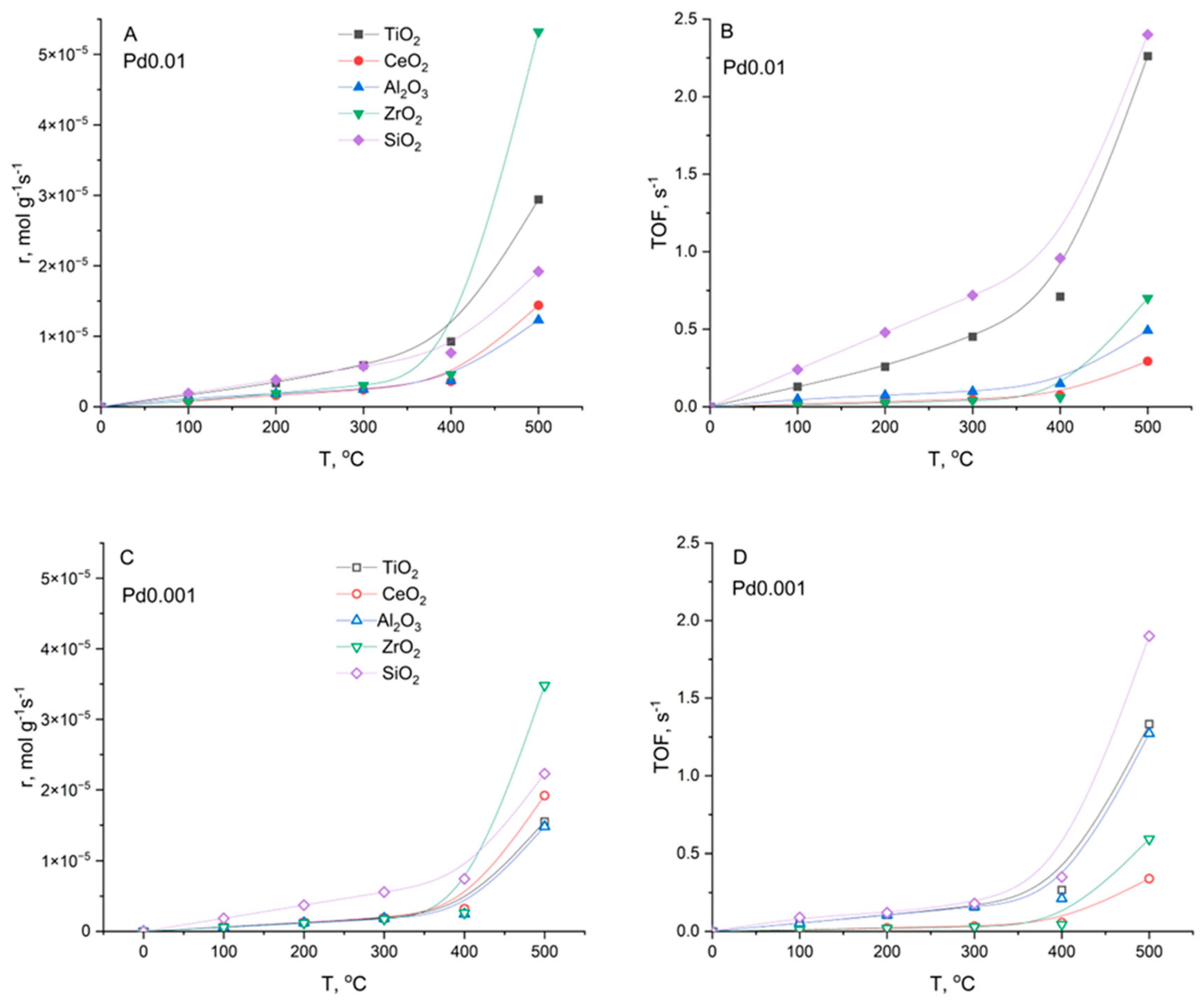
Methane combustion activity was evaluated for all Pd/support combinations at both loadings by measuring light-off curves and expressing activity as CH4 conversion as a function of temperature. The mass-normalised reaction rates measured across the full temperature window reveal a pronounced support dependence at both Pd loadings (Figure 4A,C). For the higher-loaded series (Pd0.01 see Table 1), ZrO2 yields by far the greatest reaction rate, reaching approximately 5 × 10⁻⁵ mol g−1 s−1 at 500 °C with a steep onset above 400 °C, followed by TiO2 (~3 × 10⁻⁵ mol g−1 s−1) and SiO2 (~2 × 10⁻⁵ mol g−1 s−1), while CeO2 and Al2O3 remain the least active (~1–1.5 × 10⁻⁵ mol g−1 s−1). For the lower-loaded series (Pd0.001, prepared from 0.001 M solution), ZrO2 retains its dominant position (~3.5 × 10⁻⁵ mol g−1 s−1 at 500 °C), with CeO2, Al2O3, and TiO2 clustered at intermediate values (~1.5 × 10⁻⁵ mol g−1 s−1); SiO2 records the lowest mass-normalised rate at this loading yet exhibits a perceptible onset of activity from approximately 200 °C, earlier than the other supports. In all cases, activity is negligible below 200 °C.
The turnover frequency data (Figure 4B,D) present a strikingly different and more revealing picture. At Pd0.01, TiO2 achieves the highest TOF (~2.2 s−1 at 500 °C), followed by SiO2 (~0.9 s−1), ZrO2 (~0.65 s−1), and Al2O3 (~0.5 s−1), with CeO2 yielding the lowest intrinsic activity (~0.25 s−1)—a ranking that is essentially the inverse of that observed for the mass-normalised rate. The same inversion holds at Pd0.001, where SiO2 leads substantially (~1.9 s−1), TiO2 and Al2O3 are comparable (~1.3 s−1), ZrO2 is intermediate (~0.6 s−1), and CeO2 remains the lowest (~0.35 s−1). This systematic inversion carries a clear physical meaning: the relatively high mass-normalised rates of ZrO2-supported catalysts arise primarily from a larger number of accessible Pd centres—as confirmed by CO-FTIR dispersion measurements (Table 1)—rather than from any enhancement of the intrinsic reactivity of individual sites. Conversely, SiO2 and TiO2 expose fewer CO-FTIR-accessible Pd sites per unit mass, but each of those sites is markedly more reactive toward methane activation.
Comparing the two series reveals that the TOF inversion is robust regardless of Pd series loading. Moving from Pd0.001 to Pd0.01 does not alter the qualitative ranking of intrinsic site reactivity: CeO2 retains the lowest TOF and SiO2/TiO2 retain the highest in both cases. For the mass-normalised rate, ZrO2 maintains its leading position across both series, while SiO2 shifts from the third position at Pd0.01 to last at Pd0.001, consistent with the much lower number of active centres at reduced Pd uptake (Table 1: 0.05 vs. 0.23 at% active centres). The persistence of the TOF hierarchy across both preparation concentrations argues against the inversion being an artefact of a particular metal–support interface geometry unique to one loading condition, and instead points to an intrinsic electronic or structural property of the Pd–support interaction.
The opposing trends in mass-normalised rate and TOF constitute the central experimental result of this work and directly motivate the in situ spectroscopic investigation that follows. If all supports produced Pd centres of identical character, the two metrics would rank supports in the same order; the fact that they do not implies that the chemical nature of the active Pd phase differs across supports in a way that cannot be captured by dispersion measurements alone. The consistently low TOF on CeO2—despite it generating the largest fraction of CO-FTIR-accessible Pd centres—and the consistently high TOF on SiO2 and TiO2—despite their modest dispersions—suggest that the oxidation state, coordination environment, or metal–support electronic interaction of the Pd centres are support-dependent. Rationalising this disparity at the molecular level is the objective of the in situ DRIFTS and Raman spectroscopy experiments described in the following sections.

3.3. Active Centres Determination

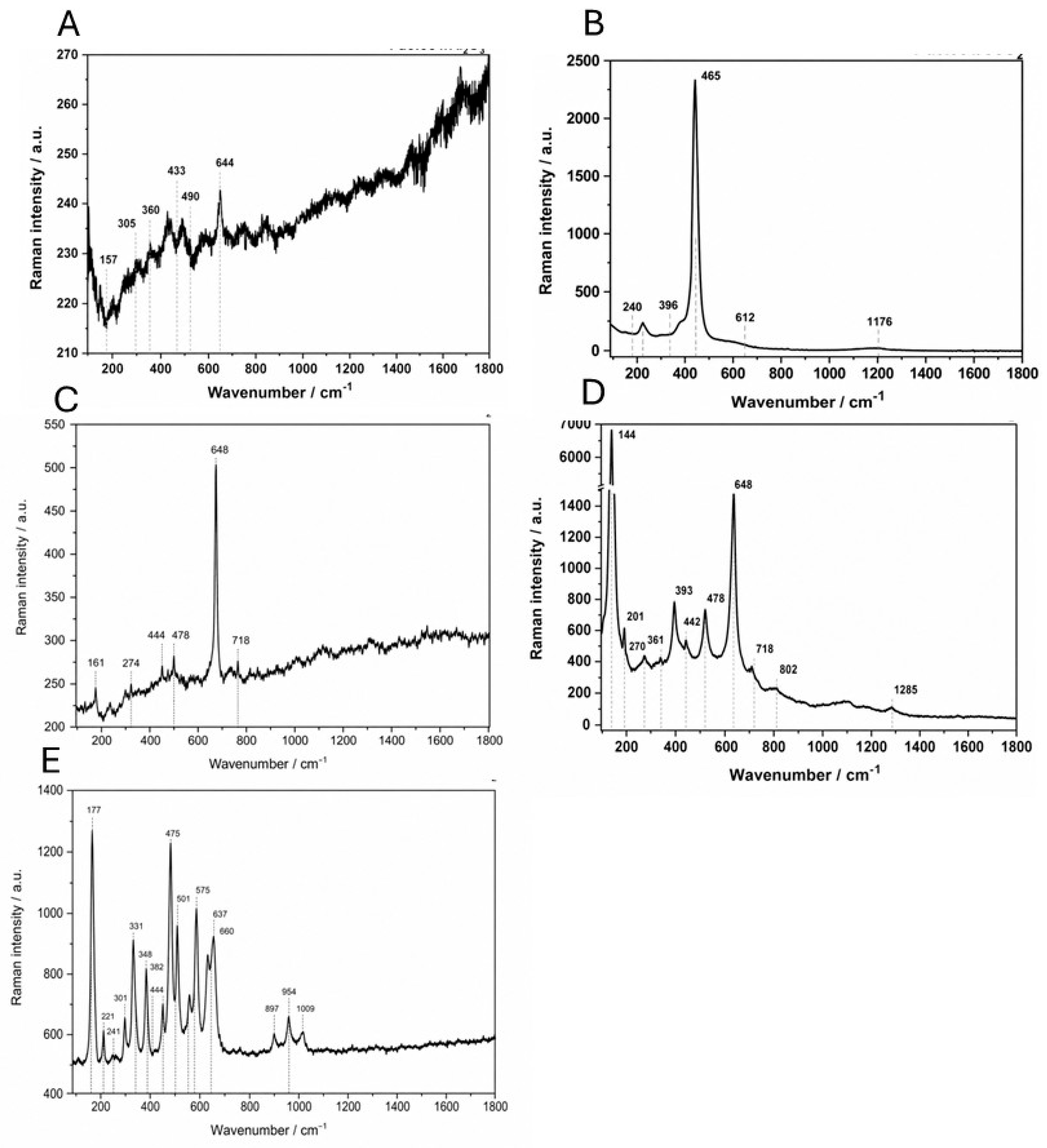
The first attempt to determine the structure of Pd active centres provides Raman experiments performed in situ (Figure 5) to be able to grasp the surface structure and composition of dehydrated samples at a higher temperature (110 °C) that is the case during the methane combustion. Raman spectra confirm the presence of PdO on all oxide supports and reveal how its vibrational signature is modified by the support and Pd loading. As the spectra of Pd0.001 and Pd0.01 differ only in intensity (not band position) for the conciseness, only low loading catalyst Pd0.001 is shown in Figure 5.
For Pd/Al2O3 (Figure 5A), both Pd0.001 and Pd0.01 show bands characteristic of PdO at about 305, 360, 433 and 644–646 cm−1, with the higher-loaded Pd0.01/Al2O3 sample displaying many additional weak bands (274, 341, 442 cm−1 and above 1000 cm−1) arising from second-order and combination scattering enhanced by the strong resonance Raman response of PdO, in agreement with the literature as in refs. [40,42]. In both cases the dominant band at 644–646 cm−1 corresponds to the B1g mode of PdO, consistent with spectra measured with Ar 514.5 nm excitation as in [42].
For Pd/CeO2 (Figure 5B), spectra are dominated by the intense F2g mode of fluorite-type CeO2 at about 465 cm−1, together with weaker bands at ~240, 396, 518, 612–614 and 1176 cm−1 assigned to ceria lattice vibrations. At low Pd loading (Pd0.001/CeO2) PdO bands are essentially masked by the strong ceria signal, whereas at higher loading (Pd0.01/CeO2) an additional band at 686 cm−1 attributable to PdO becomes visible, indicating the formation of detectable PdO domains on the ceria surface, in line with assignments for PdO in refs. [23,24,25].
Pd/SiO2 samples (Figure 5C) (both Pd0.001 and Pd0.01) exhibit PdO-related bands with a prominent feature at 648 cm−1 and additional weak bands at 161, 274, 341, 488, 550, 716 and 1293 cm−1, all assigned to PdO vibrations [40,41,42]. The underlying silica contributes only very broad, weak bands at 489, 603, 796, 829 and 978 cm−1, and the spectra are strongly affected by fluorescence, as reported in ref. [39] for calcined amorphous SiO2, which makes the support bands difficult to resolve but does not obscure the PdO B1g band at ~648 cm−1.
On TiO2 supports (Figure 5D), Raman spectra contain bands from both PdO and TiO2 polymorphs. For Pd0.001/TiO2, bands at 144, 201, 393 and 478 cm−1 plus broadening around 648 cm−1 correspond to anatase modes (Eg, B1g, A1g, Eg), while features at 442 and 802 cm−1 are assigned to Eg rutile modes, in agreement with [20,48,49,50]. Superimposed PdO bands appear at 648, 718 and 1295 cm−1, again matching the literature positions for PdO [40,41]. In Pd0.01/TiO2, an intense anatase band at 637 cm−1 and weaker rutile bands at 201 and 422 cm−1 are observed, together with PdO bands at 650 and 1293 cm−1; despite the known overlap between the TiO2 band at 637 cm−1 and the PdO band at 648 cm−1, the spectra clearly contain contributions from both oxides, consistent with previous observations for PdO/TiO2 systems.
For Pd/ZrO2 (Figure 5E), Raman spectra demonstrate the coexistence of monoclinic and tetragonal ZrO2 along with PdO. In Pd0.001/ZrO2, bands at 177, 192, 221, 301, 331, 348, 382, 444, 475, 501, 575, 613 and 954 cm−1 are assigned to tetragonal and monoclinic ZrO2, while PdO gives bands near 650 and 1009 cm−1, in line with assignments in [40,41,51,52]. Pd0.01/ZrO2 shows similar ZrO2 bands at 174, 189, 222, 274, 331, 348, 478, 526 and 616 cm−1, again characteristic of mixed monoclinic and tetragonal zirconia phases. In this sample a strong PdO band at 648 cm−1 is observed, with an additional broad feature in the 1000–1300 cm−1 region attributed to second-order or resonance scattering of PdO [40,41,42,51,52].
Overall, the Raman results show that Pd is present predominantly as PdO on all supports, with the intensity of its bands increasing with Pd loading and depending strongly on the support type. PdO bands are most clearly resolved on Al2O3, SiO2 and ZrO2, partially obscured on TiO2 by overlapping TiO2 modes, and largely masked on CeO2 except at higher Pd loading, which matches the known strong Raman cross-section of fluorite-type ceria [40,41,42,43,44,45,51,52]. It is also worth noting here that Raman spectroscopy is able to look into the micrometre layer of the catalyst, thus not being a surface sensitive method. However, the composition of this layer is a first approach to determine the active centres structure.
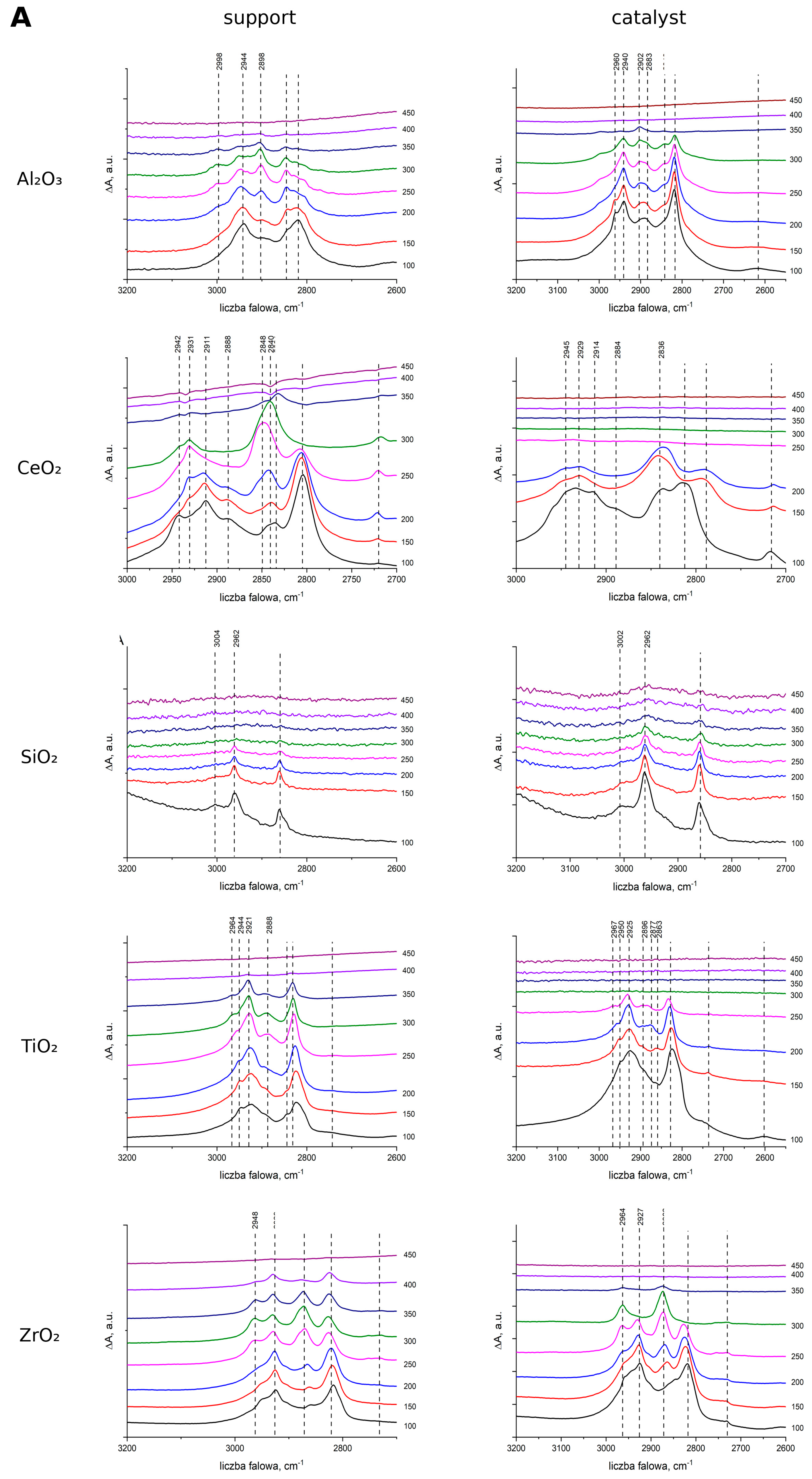
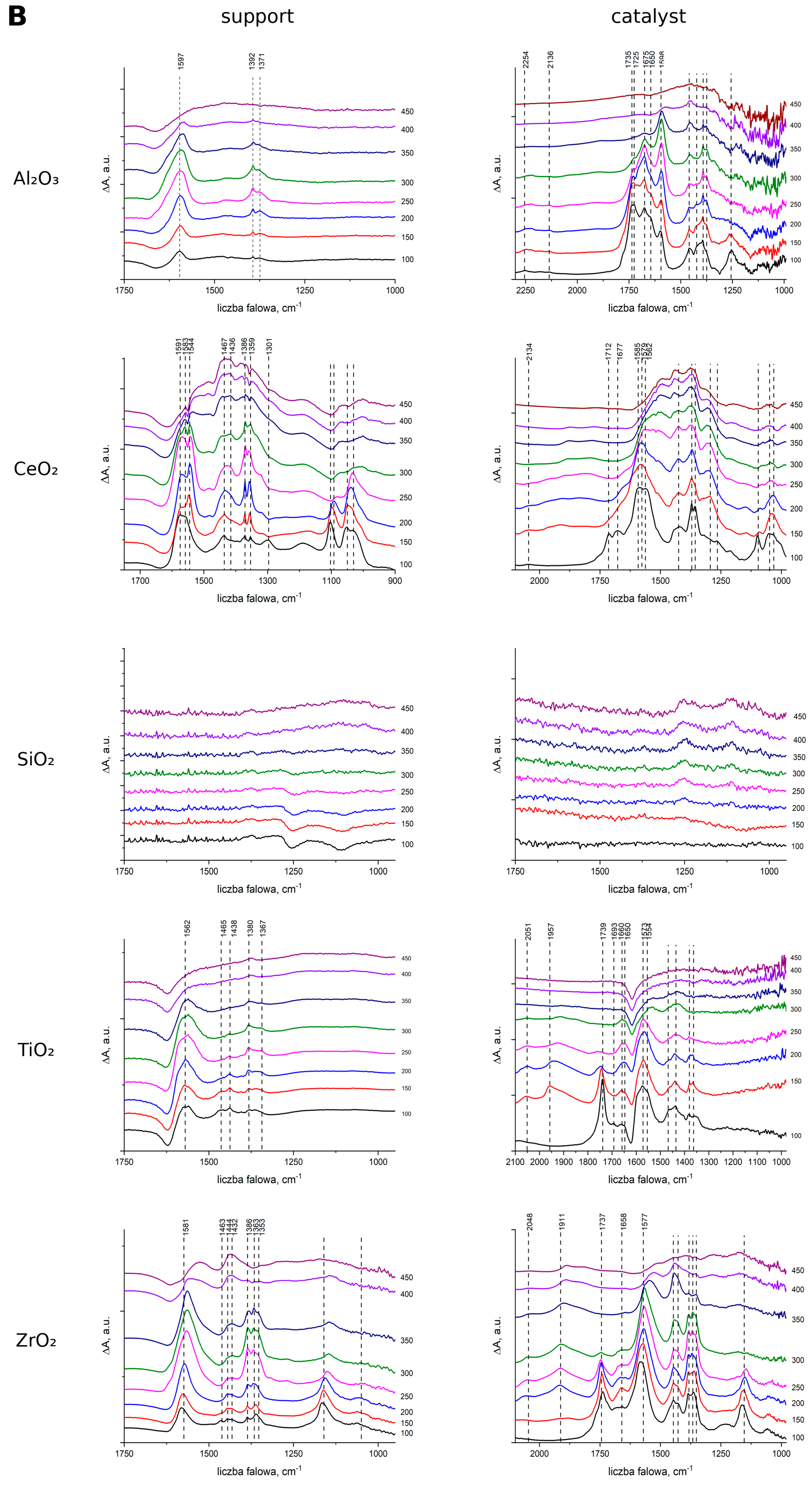
A closer look into the nature of active centres is provided by in situ DRIFT spectroscopy with methanol as a surface probe molecule (Figure 6 A,B). Methanol acts as a multifunctional probe on all Pd catalysts, producing methoxy, formate, carbonate and ether species whose bands allow discrimination between acid, basic and redox sites on the different supports [20,34,35,43,46,47]. For each oxide, spectra of Pd0.001 and Pd0.01 catalysts show the same families of bands but with markedly different intensities and, in some cases, additional features at higher Pd loading, indicating a larger population of Pd-related sites and more extensive methanol transformation on Pd0.01.
On γ-Al2O3, methanol adsorption yields methoxy bands at 2944–2900 and 2823 cm−1 with bands at 1392–1371 cm−1 and formate bands at 1597 cm−1 (νCO) with 1392–1371, 2998 and 2846 cm−1 (νCH) [34,35,46,47]. For Pd0.001/Al2O3, new methoxy bands at 2962 and 2819 cm−1 with a 1374 cm−1 bend arise from methoxy on PdO, while Pd-related formates give bands at 1670 cm−1 (νCO) and 1394, 2842 cm−1 (νCH); monodentate carbonates appear at 1598 and 1311 cm−1, and free carbonates at 1430 cm−1 [34,35,46,47]. Pd0.01/Al2O3 exhibits analogous features but with higher intensity, and additional bands at 1583, 1253 and 1031 cm−1 are assigned to bidentate carbonates, indicating a greater contribution of basic sites and more advanced oxidation of methanol on the higher-loaded catalyst [34,35,42,46,47].
On CeO2, methanol adsorption on the bare support gives methoxy bands at 2942–2888 and 2840 cm−1 with corresponding bending modes at 1463–1355, 1103 and 1056 cm−1, together with partially oxidised –O–CH2OH groups at 1591–1583 cm−1 and, upon heating, ether (1091–1051, 2721 cm−1) and formate bands at 1544 and 1386–1359, 2931 and 2848 cm−1; free carbonates appear near 1436 cm−1 [20,32,35,43,46,47,53,54]. On Pd/CeO2 additional methoxy bands at 2938–2929, 2815–2805 and 1371 cm−1 are assigned to methoxy groups on PdO sites, while formates associated with Pd appear at 1580–1579 cm−1 and 1371–1357, 2836–2805 cm−1, and monodentate carbonates at 1562, 1299–1297 and 1031 cm−1, plus free carbonates near 1423 cm−1 [20,32,35,43,46,47,53,54]. The same band pattern is observed for Pd0.001 and Pd0.01/CeO2, but all Pd-related methoxy, formate and carbonate bands are significantly more intense for Pd0.01, demonstrating a higher density of Pd redox sites and stronger participation of PdO in methanol oxidation at the higher loading [1,2,3,34,35,46,47].
On SiO2, methanol on the bare support and on both Pd0.001 and Pd0.01 catalysts shows mainly methoxy stretching bands at 3004–2962 and 2861–2860 cm−1, with only a weak additional band at 1122 cm−1 on Pd/SiO2 attributed to methoxy bound to Pd2+ [34,44,46,53,54]. No significant formate or carbonate bands develop on either Pd loading, which demonstrates that methanol is only weakly adsorbed and does not undergo substantial oxidation on silica-supported Pd, regardless of whether the sample is Pd0.001 or Pd0.01 [34,44,46,53,54].
For TiO2, methanol on the support gives methoxy bands at 2946, 2888 and 2842 cm−1 with 1367 cm−1 bending, and formate bands at 1562 cm−1 (νCO) plus 1392–1371, 2927 and 2825 cm−1 (νCH); weak bands at 1457–1438 cm−1 indicate free carbonates [34,46,48,49,50]. On Pd0.001/TiO2, PdO-bound methoxy groups appear at 2948, 2803 and 1378 cm−1, Pd formates at 1650 cm−1 (νCO) and 1367 and 2823 cm−1 (νCH), monodentate carbonates at 1590 and 1347 cm−1, free carbonates at 1440 cm−1, and weak bands at 2603–2537 and 1739 cm−1 from physisorbed formaldehyde [34,46,48,49,50]. Pd0.01/TiO2 shows the same bands with higher intensity (2967, 2883, 1378 cm−1 for Pd–methoxy; 1664, 1365, 2825 cm−1 for Pd formate; 1436 cm−1 for free carbonates; 2738, 2605, 1739 cm−1 for formaldehyde), confirming a larger number of Pd redox and basic sites at higher loading [34,46,48,49,50].
On ZrO2, methanol on the bare support forms methoxy groups at 2948 and 2825 cm−1 with a 1359 cm−1 bend, formates at 1581 cm−1 (νCO) and 1386, 2923, 2859, and 1162 cm−1, and free carbonates at 1465 cm−1 [11,34,35,41,45,46,47]. For Pd0.001/ZrO2, additional Pd–methoxy bands emerge at 2929, 2829 and 1384 cm−1, disappearing above 250 °C, Pd formates develop at 1652 cm−1 (νCO) with 1361 and 2873 cm−1 (νCH), free carbonates at 1446 cm−1, physisorbed formaldehyde at 2753 and 1739 cm−1, and ether-like bands at 1160 and 1033 cm−1 that also vanish above 250 °C [11,34,35,41,45,46,47]. Pd0.01/ZrO2 shows stronger methoxy bands at 2927 and 2819 cm−1, more intense Pd formates at 1577, 1384, 1363 and 2863 cm−1, and pronounced carbonate bands at 1583, 1211 and 1031 cm−1 (bidentate carbonates) plus a band at 2157 cm−1 associated with free carbonates; ether-related bands at 1160 and 1033 cm−1 again disappear above 250 °C [11,18,34,35,41,45,46,47]. The comparison demonstrates that higher Pd loading on ZrO2 substantially enhances the formation of formate and bidentate carbonate intermediates, reflecting more abundant and stronger redox/basic Pd sites than in Pd0.001/ZrO2.
Across all supports, Pd0.01 samples exhibit the same types of methoxy, formate, carbonate and ether bands as Pd0.001 but with greater intensity, clearer Pd-specific bands, and, on Al2O3 and ZrO2, additional signatures of bidentate carbonates and stronger free carbonate formation. This indicates that increasing Pd loading mainly increases the number and strength of Pd-related redox and basic centres rather than creating fundamentally new species, except on SiO2 where both loadings remain largely inactive and only physisorbed methanol is observed [1,2,3,11,18,34,35,41,42,43,44,45].

4. Discussion

4.1. Texture, Morphology, and Their Relation to Activity

XRD confirms that all supports are phase-pure and well-crystallised prior to Pd deposition: Al2O3 is predominantly gamma-phase, CeO2 adopts the fluorite structure, SiO2 is amorphous, TiO2 is anatase, and ZrO2 is monoclinic. PdO reflections are detectable by XRD for the higher-loaded Pd0.01 series on Al2O3, where bulk Pd concentrations determined by AAS reach 1.69 at%, consistent with the formation of crystalline PdO domains beyond the monolayer dispersion limit [14]. On CeO2, TiO2, ZrO2, and SiO2 the Pd0.01 bulk loadings are substantially lower (0.07–1.01 at%), and PdO reflections are correspondingly weak or absent, indicating a more dispersed surface phase. SEM reveals a pronounced morphological diversity among the supports: Al2O3 and ZrO2 form compact aggregates reaching ~100 µm in dimension, whereas CeO2, SiO2, and TiO2 are finely dispersed with a much smaller primary particle size. These morphological differences have direct consequences for Pd accessibility, as Pd deposited on large, dense aggregates is more likely to be distributed predominantly at the external particle surface, reducing contact with the reactive feed under diffusion-limited conditions [55].
BET surface area measurements show that Pd deposition perturbs the support surface in a support-dependent manner: the specific surface area decreases after impregnation on Al2O3 and CeO2, plausibly reflecting partial pore blockage or sintering of surface hydroxyls during calcination, whereas a moderate increase is observed for SiO2 and TiO2. These opposite trends suggest that the interaction between the palladium precursor and the support surface during drying and calcination differs qualitatively across the oxide series [56]. Methane conversion measured at 500 °C is highest for Pd/SiO2 and Pd/CeO2 (~90%), intermediate for Pd/ZrO2, and substantially lower for Pd/Al2O3 and Pd/TiO2 under the same nominal conditions. However, raw conversion data at a fixed temperature conflate the number of active Pd sites, their intrinsic reactivity, and the bulk Pd loading, which vary by more than an order of magnitude across the sample set. Meaningful comparison therefore requires an absolute site count coupled with a turnover frequency (TOF), as developed in Section 4.3 and Section 4.5.

4.2. Metal Loading, Dispersion, and Support Effects

Accurate quantification of the surface-active palladium oxide phase is a persistent challenge in supported catalyst characterisation, because bulk analytical methods report total metal content without distinguishing surface-accessible from buried or encapsulated species [37]. In the present work, bulk Pd loadings determined by AAS after microwave digestion are complemented by SEM-EDX, which provides semi-quantitative spatial information on the near-surface Pd distribution. The comparison of both data sets reveals that Pd is selectively enriched at the outer surface on most supports, with the strongest enrichment factor observed for Al2O3—where the bulk loading (1.69 at%) substantially exceeds the AAS-normalised values on other supports—and the most spatially uniform distribution found on SiO2. The very low bulk Pd contents on TiO2 (0.18 at%) and ZrO2 (0.07 at%) suggest either incomplete adsorption from solution during incipient wetness impregnation or partial incorporation of Pd into sub-surface layers inaccessible to the reactive feed.
The choice of palladium acetylacetonate as a precursor is significant. Wachs and co-workers demonstrated that metal–organic precursors such as acetates and acetylacetonates undergo a grafting reaction with surface hydroxyl groups during impregnation, producing a monolayer-type deposition in which the metal is tethered through M–O–support bonds rather than depositing as a separate hydroxide phase [56,57]. This layer-by-layer mechanism tends to yield lower absolute metal loadings than analogous nitrate-based syntheses on the same support at the same nominal solution concentration, which is consistent with the present AAS data. The resulting Pd0.01 and Pd0.001 series therefore represent catalysts in the highly dispersed, sub-monolayer regime on most supports, making them well suited for mechanistic studies of isolated or oligomeric PdOx species and their local electronic interaction with the support. It is precisely in this loading regime that support effects on intrinsic site reactivity are most apparent and least obscured by bulk PdO contributions [24].

4.3. Active Site Density and Intrinsic Activity (Tof)

CO-FTIR titration provides a quantitative count of surface Pd2+ sites accessible to probe molecules under near-ambient conditions, and the resulting active centre densities (Table 1) span nearly one order of magnitude across the support series in the Pd0.01 set: Pd0.01/CeO2 = 105.44 µmol g−1 (highest), Pd0.01/ZrO2 = 58.75, Pd0.01/TiO2 = 56.52, and Pd0.01/Al2O3 = 11.63 µmol g−1 (lowest). This ranking does not mirror the bulk Pd loading sequence, which is highest on Al2O3, indicating that a large fraction of the Pd on Al2O3 is either inaccessible to CO or is present as larger PdO crystallites whose surface Pd density, normalised per gram, is low. Conversely, CeO2 generates the highest density of CO-titratable Pd2+ centres per gram despite a moderate bulk Pd content of 1.01 at%, reflecting either a strong affinity of the fluorite surface for stabilising dispersed PdOx or a high specific surface area that accommodates more anchoring sites [23,27].
Crucially, the TOF calculated at 500 °C—defined as the molar rate of methane conversion per mole of CO-titratable Pd2+ centre per second—reveals an activity ranking that is the inverse of the site density ranking: Al2O3 delivers the highest TOF (0.1327 s−1), followed by TiO2 and ZrO2 (~0.031–0.032 s−1), and CeO2 the lowest (0.0226 s−1). The mass-normalised rate ranking, in contrast, follows ZrO2 > TiO2 > SiO2 > CeO2 ≈ Al2O3. This inversion is not an artefact of the CO-FTIR protocol but reflects a genuine difference in the intrinsic chemical reactivity of individual Pd centres as modulated by the support oxide. Such a decoupling between site density and per-site reactivity has been recognised in other supported metal oxide systems [25,32], but its systematic demonstration across five chemically distinct supports under uniform preparation conditions is uncommon in the methane combustion literature. The finding implies that optimising a Pd catalyst for methane combustion requires independent control of both the number and the intrinsic quality of Pd centres, and that these two objectives may not be simultaneously achieved on any single support.

4.4. Surface Structure and Nature of Active Centres from In Situ Spectroscopy

In situ Raman spectroscopy under reaction-relevant conditions reveals that the PdO B1g phonon mode, expected near 644–646 cm−1 for well-crystallised PdO [40], is clearly resolved on Pd/Al2O3 where it appears as a distinct feature superimposed on the broad support background. On Pd/CeO2 the intense F2g mode of the fluorite lattice near 465 cm−1 dominates the spectrum and masks any underlying PdO signal, so that the state of Pd on CeO2 cannot be directly assessed by Raman alone. On Pd/TiO2 the anatase Eg mode near 637 cm−1 overlaps with the expected PdO B1g frequency, rendering the two contributions difficult to deconvolute without isotopic substitution or variable-temperature experiments. On Pd/ZrO2 the monoclinic ZrO2 lattice bands coexist with the PdO region without severe overlap, and a feature attributable to PdO is tentatively assigned. These support-specific spectral interferences are a well-known complication in the Raman characterisation of PdO-based catalysts [25] and underscore the necessity of complementary techniques such as DRIFTS.
DRIFTS with methanol as a surface-sensitive redox and basicity probe provides a chemically informative picture of the support–Pd interface. On Pd/CeO2, the methanol adsorption–reaction sequence proceeds through methoxy formation, rapid oxidation to formate, and further conversion to carbonate species, a sequence indicative of cooperative PdO–CeO2 redox activity in which both the palladium oxide and the ceria lattice participate in methanol oxidation [46]. This cooperative behaviour is facilitated by the ease of Ce4+/Ce3+ cycling and the high oxygen storage capacity of ceria [27]. On Pd/Al2O3, formate and carbonate bands develop at lower temperatures, reflecting a combination of the moderate redox character of the alumina surface and Lewis acid–base interactions at Al3+ sites; the Al2O3 surface alone promotes formate formation without Pd, consistent with its known amphoteric character [46,57]. On Pd/SiO2, only weakly bound methoxy species are observed, with no detectable formate or carbonate, revealing that SiO2 possesses negligible surface redox density and low basicity. TiO2 and ZrO2 display intermediate behaviour—formate and carbonate bands do form, but at lower intensity than on CeO2, consistent with a moderate reducibility of TiO2 (anatase) and the amphoteric but weakly basic character of ZrO2. These DRIFTS observations directly map onto the electronic properties of the support and set the stage for interpreting the TOF data within a mechanistic framework.

4.5. Structure–Activity Correlations and Mechanistic Interpretation

The central finding of this work—that the TOF of individual Pd2+ centres for methane combustion follows the order Al2O3 > TiO2 ≈ ZrO2 > CeO2, which is opposite to the order of CO-titratable site density—forces a reconsideration of the traditional view that catalyst optimisation is primarily a matter of maximising metal dispersion [10,24,37,56]. The DRIFTS and Raman data together provide a mechanistic rationalisation for this inversion. On SiO2 and TiO2, where the TOF is among the highest in the series, the surface redox density is low to moderate, methoxy species do not progress to formate or carbonate at the Pd–support interface, and the Pd centres are therefore electronically isolated from the support redox couple. Under these conditions, methane activation most plausibly proceeds through direct C–H bond scission on Pd2+ without participation of support lattice oxygen, a mechanism associated with an electrophilic Pd2+ centre that retains its Lewis acidity and its ability to activate the first C–H bond of methane [5,16,40]. The absence of a strong support–Pd electronic coupling preserves the intrinsic oxidation state and coordination environment of Pd2+ in a form that is optimally reactive toward methane.
On CeO2, the picture is fundamentally different. The pronounced Ce4+/Ce3+ redox cycling, evidenced by the methoxy-to-formate-to-carbonate sequence in DRIFTS, implies that PdO on CeO2 operates within a Mars–van Krevelen framework in which ceria lattice oxygen is involved in the overall oxidation cycle [24,27]. This cooperative mechanism increases the total number of oxidation-competent surface sites—explaining the very high CO-titratable Pd2+ density of 105.44 µmol g−1—because CeO2 effectively stabilises Pd2+ in a highly dispersed, fluorite-epitaxial configuration that maximises nucleation sites [23,27]. However, the electronic coupling between PdO and the CeO2 support partially delocalises the positive charge on Pd2+, reducing its electrophilic character and hence its intrinsic activity for the rate-determining C–H activation step. In other words, CeO2 trades per-site reactivity for site multiplicity: the total oxidation activity is maintained by the high site count, but each individual Pd centre is a less potent methane activator than its counterpart on a non-reducible support. This interpretation is consistent with computational and kinetic studies suggesting that strong metal–support electronic interactions on reducible oxides modify the d-band character of surface Pd and alter the C–H activation barrier [7,17].
Al2O3 occupies an intermediate position that is chemically coherent with its surface properties. The appearance of formate and carbonate in DRIFTS indicates that Al2O3 is capable of mild cooperative redox and Lewis acid–base chemistry with PdO, but without the Ce4+/Ce3+ redox amplification that characterises CeO2. The resulting Pd2+ centres on Al2O3 retain a higher degree of electronic isolation relative to CeO2, which correlates with the highest observed TOF in the series. The very low site density on Al2O3 (11.63 µmol g−1) despite the highest bulk Pd loading (1.69 at%) is attributed to the formation of large PdO crystallites, confirmed by the detection of the B1g Raman mode and XRD reflections of PdO; in crystalline PdO, the surface-to-bulk ratio is low, so a large fraction of Pd atoms are buried within the crystallite interior and not titratable by CO. The few exposed, isolated Pd2+ sites that do exist at the perimeter of these crystallites, or at the interface between PdO and Al2O3, appear to be intrinsically the most reactive in the series, possibly because the gamma-Al2O3 surface exerts a minimal electronic perturbation on the Pd oxidation state while still anchoring isolated species through Al–O–Pd linkages [24,55]. ZrO2 shows a moderate TOF similar to TiO2 despite pronounced particle aggregation; the large ZrO2 aggregate morphology observed by SEM suggests that some Pd may be sequestered within inter-aggregate voids and therefore excluded from both the CO titration and the methane feed, which would cause the calculated TOF to be an underestimate of the true intrinsic value for the accessible fraction of Pd centres.
A unified structure–activity picture emerges from the synthesis of the kinetic, spectroscopic, and morphological data. Isolated Pd2+ centres anchored on weakly interacting, non-reducible or mildly reducible supports (SiO2, TiO2, and to a lesser extent Al2O3) retain a high electrophilic character that enables efficient direct C–H activation of methane and corresponds to the highest intrinsic TOF values. Electronically coupled PdOx dispersed on highly reducible oxide supports such as CeO2 achieves the highest surface density of Pd2+ sites through epitaxial stabilisation within the fluorite lattice, but each site operates with a lower intrinsic TOF because the support redox couple mediates a Mars–van Krevelen pathway that is slower on a per-site basis than direct Pd2+ C–H activation. Al2O3 and ZrO2 represent intermediate cases in which the balance between electronic isolation of Pd2+ and partial support-mediated redox leads to moderate TOF and moderate site density. This framework is consistent with the classical observations in [5,16] on the role of PdO as the active phase for methane combustion, extends the mechanistic analysis [24] regarding support effects on Pd oxidation state, and aligns with the conclusions in [15] that the nature of the support determines not merely Pd dispersion but the electronic environment—and hence the reactivity—of individual Pd centres. The present data further suggest that the use of CO-FTIR as an absolute site-counting tool, combined with TOF analysis, provides a more discriminating evaluation of support effects than conversion or mass-normalised rate data alone, and that the design of next-generation Pd combustion catalysts should target supports that balance site density with per-site electrophilicity, a constraint that is not met by any single oxide in the present series but that might be engineered through mixed-oxide or core–shell support architectures.
Overall, our findings complement and extend previous studies of Pd/support catalysts for methane combustion by adding a direct, molecular-level view of the active surface under reaction-relevant conditions. While earlier work primarily correlated global activity with parameters such as Pd loading, dispersion or support surface area, our combined CO-FTIR, DRIFTS and Raman experiments resolve the identity, population and reactivity of specific Pd-related surface species on different oxides under identical methane oxidation conditions, thereby providing a direct mechanistic link between support properties and surface chemistry. By embedding these spectroscopic fingerprints into established performance trends for Pd/Al2O3, Pd/CeO2, Pd/TiO2, Pd/ZrO2 and Pd/SiO2, the present study turns previously empirical “support effects” into a structured picture that explains why nominally similar Pd catalysts display widely different behaviours and offers a molecular-level framework for re-interpreting the literature structure–activity relationships. Importantly, the use of high-purity, reagent-grade commercial oxide supports and well-defined preparation protocols ensures that these mechanistic conclusions are not obscured by uncontrolled impurities or phase contamination, which further strengthens the reliability and generality of the insights derived from our in situ spectroscopic analysis.

5. Conclusions

The present study demonstrates that meaningful structure–activity correlations in supported Pd catalysis for methane combustion can only be established through multi-technique characterisation of the catalyst surface. Textural parameters (specific surface area, pore structure) set the upper limit for active site dispersion but are insufficient descriptors of catalytic behaviour on their own. The nature of the metal oxide support determines the acid–base and redox character of the surface, which in turn governs the oxidation state, coordination environment and dispersion of palladium. These properties were accessed here through complementary spectroscopic methods: CO-FTIR for quantifying accessible Pd2+ centres, DRIFTS with methanol as a probe molecule for surface functionality, and in situ Raman spectroscopy for PdO phase integrity—together providing a layered picture of the surface that no single technique could deliver alone. The use of high-purity, reagent-grade commercial oxide supports and well-defined preparation protocols further ensures that these correlations are not obscured by uncontrolled impurities or phase contamination.
Across the support series (Al2O3, CeO2, TiO2, ZrO2, SiO2) a clear and systematic inversion was identified between the mass-normalised reaction rate and the turnover frequency (TOF). This inversion is a direct consequence of support-dependent differences in surface chemistry: redox-active supports (CeO2, ZrO2) maximise the density of accessible Pd sites through cooperative metal–support interactions and Ce3+/Ce4+ redox cycling, whereas more acidic or inert supports (Al2O3, SiO2) yield fewer but intrinsically more reactive isolated Pd centres. Neither site density nor intrinsic reactivity alone determines overall performance; their product—controlled by the surface structure and chemistry of the support—does. This finding underlines that catalyst benchmarking based on conversion data alone is ambiguous: spectroscopic quantification of the active centre population is required to separate site-count effects from genuine differences in per-site reactivity and to place new data on Pd/support systems in a consistent framework with the existing literature.
The multi-dimensional surface description achieved here constitutes a prerequisite for mechanistic studies of methane combustion. Establishing which surface species are present, in what concentration and with what acid–base or redox character is necessary before kinetic or in situ transient experiments can be interpreted in molecular terms. The structure–activity framework developed in this work—linking support surface chemistry to Pd speciation, active site density and intrinsic TOF—provides a basis for re-examining previously reported Pd/support catalysts and for designing new materials in which support oxygen mobility and acid–base properties are deliberately tuned. Advancing such mechanistic understanding is essential for the rational design of low-loading Pd catalysts with improved activity, selectivity and long-term stability for natural gas combustion applications.

Author Contributions

Conceptualization, M.S. and J.P.-P.; methodology, D.P., A.G. and J.P.-P.; investigation, M.C., R.J., D.P., A.G. and M.L.; formal analysis, M.C., R.J. and D.P.; resources, M.S.; data curation, not applicable; writing—original draft preparation, M.C. and J.P.-P.; writing—review and editing, M.S. and J.P.-P.; visualization, not applicable; supervision, M.S. and J.P.-P.; project administration, not applicable; funding acquisition, not applicable. All authors have read and agreed to the published version of the manuscript.

Funding

This research received no external funding.

Data Availability Statement

The data presented in this study are available on reasonable request from the corresponding author. The data are not publicly available due to institutional policy.

Conflicts of Interest

The authors declare no conflict of interest.

References

  1. Choudhary, T.V.; Banerjee, S.; Choudhary, V.R. Catalysts for combustion of methane and lower alkanes. Appl. Catal. A Gen. 2002, 234, 1–23. [Google Scholar] [CrossRef]
  2. Chlebda, D.K.; Jędrzejczyk, R.J.; Jodłowski, P.J.; Łojewska, J. Surface structure of cobalt, palladium, and mixed oxide-based catalysts and their activity in methane combustion studied by means of micro-Raman spectroscopy. J. Raman Spectrosc. 2017, 48, 1871–1880. [Google Scholar] [CrossRef]
  3. Chrzan, M.; Jędrzejczyk, R.J.; Jodłowski, P.J.; Łojewska, J.; Sitarz, M. Towards methane combustion mechanism on metal oxides supported catalysts: Ceria supported palladium catalysts. Top. Catal. 2019, 62, 889–899. [Google Scholar] [CrossRef]
  4. Liotta, L.F.; Di Carlo, G.; Pantaleo, G.; Deganello, G. CoO/CeO and CoO/CeO–ZrO composite catalysts for methane combustion: Correlation between morphology reduction properties and catalytic activity. Catal. Commun. 2005, 6, 329–336. [Google Scholar] [CrossRef]
  5. Hicks, R.F.; Qi, H.; Young, M.L.; Lee, R.G. Structure sensitivity of methane oxidation over platinum and palladium. J. Catal. 1990, 122, 280–294. [Google Scholar] [CrossRef]
  6. Briot, P.; Primet, M. Catalytic oxidation of methane over palladium supported on alumina. Appl. Catal. 1991, 68, 301–314. [Google Scholar] [CrossRef]
  7. Haack, L.P.; Otto, K. X-ray photoelectron spectroscopy of Pd/γ-alumina and Pd foil after catalytic methane oxidation. Catal. Lett. 1995, 34, 31–40. [Google Scholar] [CrossRef]
  8. Muller, C.A.; Maciejewski, M.; Koeppel, R.A.; Baiker, A. Combustion of methane over palladium/zirconia: Effect of Pd-particle size and role of lattice oxygen. Catal. Today 1999, 47, 245–252. [Google Scholar] [CrossRef]
  9. Widjaja, H.; Sekizawa, K.; Eguchi, K.; Arai, H. Oxidation of methane over Pd-supported catalysts. Catal. Today 1997, 35, 197–202. [Google Scholar] [CrossRef]
  10. Hicks, R.F.; Qi, H.; Young, M.L.; Lee, R.G. Effect of catalyst structure on methane oxidation over palladium on alumina. J. Catal. 1990, 122, 295–306. [Google Scholar] [CrossRef]
  11. Fujimoto, K.I.; Ribeiro, F.H.; Avalos-Borja, M.; Iglesia, E. Structure and reactivity of PdOx/ZrO2 catalysts for methane oxidation at low temperatures. J. Catal. 1998, 179, 431–442. [Google Scholar] [CrossRef]
  12. Lyubovsky, M.; Pfefferle, L. Methane combustion over the α-alumina supported Pd catalyst: Activity of the mixed Pd/PdO state. Appl. Catal. A Gen. 1998, 173, 107–119. [Google Scholar] [CrossRef]
  13. Descorme, C.; Jacobs, P.W.; Somorjai, G.A. Catalytic combustion of ethane over palladium foil in the 300–450 °C range: Kinetics and surface composition studies. J. Catal. 1998, 178, 668–678. [Google Scholar] [CrossRef]
  14. Datye, A.K.; Bravo, J.; Nelson, T.R.; Atanasova, P.; Lyubovsky, M.; Pfefferle, L. Catalyst microstructure and methane oxidation reactivity during the Pd↔PdO transformation on alumina supports. Appl. Catal. A Gen. 2000, 198, 179–196. [Google Scholar] [CrossRef]
  15. Garbowski, E.; Feumi-Jantou, C.; Mouaddib, N.; Primet, M. Catalytic combustion of methane over palladium supported on alumina catalysts: Evidence for reconstruction of particles. Appl. Catal. A Gen. 1994, 109, 277–291. [Google Scholar] [CrossRef]
  16. Farrauto, R.J.; Lampert, J.K.; Hobson, M.C.; Waterman, E.M. Thermal decomposition and reformation of PdO catalysts; support effects. Appl. Catal. B Environ. 1995, 6, 263–270. [Google Scholar] [CrossRef]
  17. Yazawa, Y.; Yoshida, H.; Takagi, N.; Komai, S.; Satsuma, A.; Hattori, T. Acid strength of support materials as a factor controlling oxidation state of palladium catalyst for propane combustion. J. Catal. 1999, 187, 15–23. [Google Scholar] [CrossRef]
  18. Burch, R.; Urbano, F.J. Investigation of the active state of supported palladium catalysts in the combustion of methane. Appl. Catal. A Gen. 1995, 124, 121–138. [Google Scholar] [CrossRef]
  19. Müller, C.A.; Maciejewski, M.; Koeppel, R.A.; Tschan, R.; Baiker, A. Role of lattice oxygen in the combustion of methane over PdO/ZrO2: Combined pulse TG/DTA and MS study with 18O-labeled catalyst. J. Phys. Chem. 1996, 100, 20006–20014. [Google Scholar] [CrossRef]
  20. Lei, Y.; Shen, M.; Li, J.; Wang, X.; Li, J. Typical crystal face effects of different morphology ceria on the activity of Pd/CeO2 catalysts for lean methane combustion. Fuel 2018, 233, 10–20. [Google Scholar] [CrossRef]
  21. Summers, J.C.; Ausen, S.A. Interaction of cerium oxide with noble metals. J. Catal. 1979, 58, 131–143. [Google Scholar] [CrossRef]
  22. Rocha, M.G.C.; Frety, R. Catalytic combustion of methane: Activation and characterization. Stud. Surf. Sci. Catal. 1997, 110, 471–480. [Google Scholar]
  23. Liu, W.; Flytzani-Stephanopoulos, M. Total oxidation of carbon monoxide and methane over transition metal fluorite oxide composite catalysts: I. Catalyst composition and activity. J. Catal. 1995, 153, 304–316. [Google Scholar] [CrossRef]
  24. Baldwin, T.R.; Burch, R. Catalytic combustion of methane over supported palladium catalysts II. Support and possible morphological effects. Appl. Catal. 1990, 66, 359–381. [Google Scholar] [CrossRef]
  25. Vuurman, M.A.; Stufkens, D.J.; Oskam, A.; Deo, G.; Wachs, I.E. Combined Raman and IR study of MOx–V2O5/Al2O3 (MOx = MoO3, WO3, NiO, CoO) catalysts under dehydrated conditions. J. Chem. Soc. Faraday Trans. 1996, 92, 3259–3265. [Google Scholar] [CrossRef]
  26. Stefanov, P.; Todorova, S.; Naydenov, A.; Tzaneva, B.; Kolev, H.; Atanasova, G.; Stoyanova, D.; Karakirova, Y.; Aleksieva, K. On the development of active and stable Pd–Co/γ-Al2O3 catalyst for complete oxidation of methane. Chem. Eng. J. 2015, 266, 329–338. [Google Scholar] [CrossRef]
  27. Trovarelli, A. Catalytic properties of ceria and CeO2-containing materials. Catal. Rev. 1996, 38, 439–520. [Google Scholar] [CrossRef]
  28. Berg, M.; Järås, S. Catalytic combustion of methane over magnesium oxide. Appl. Catal. A Gen. 1994, 114, 227–241. [Google Scholar] [CrossRef]
  29. Lerner, B.A.; Holbrook, M.T.; Finn, J. Catalytic SOx abatement: The role of magnesium aluminate spinel in the removal of SOx from FCC flue gas. Prepr. Am. Chem. Soc. Div. Pet. Chem. 1988, 27, 1356–1360. [Google Scholar]
  30. Hadjiivanov, K.I.; Vayssilov, G.N. Characterization of oxide surfaces and zeolites by carbon monoxide as an IR probe molecule. Adv. Catal. 2002, 47, 307–511. [Google Scholar]
  31. Eischens, R.P. Infrared methods applied to surface phenomena. J. Phys. Chem. Solids 1960, 14, 56–59. [Google Scholar] [CrossRef]
  32. Turek, A.M.; Wachs, I.E.; DeCanio, E. Acidic properties of alumina-supported metal oxide catalysts: An infrared spectroscopy study. J. Phys. Chem. 1992, 96, 5000–5007. [Google Scholar] [CrossRef]
  33. Porto, S.P.S.; Krishnan, R.S. Raman effect of corundum. J. Chem. Phys. 1967, 47, 2669–2670. [Google Scholar] [CrossRef]
  34. Jodłowski, P.J.; Jędrzejczyk, R.J.; Chlebda, D.; Gierada, M.; Łojewska, J. In situ spectroscopic studies of methane catalytic combustion over Co, Ce, and Pd mixed oxides deposited on a steel surface. J. Catal. 2017, 350, 1–12. [Google Scholar] [CrossRef]
  35. Lavalley, J.C. Infrared spectrometric studies of the surface basicity of metal oxides and zeolites using adsorbed probe molecules. Catal. Today 1996, 27, 377–401. [Google Scholar] [CrossRef]
  36. Gelin, P.; Siedle, A.R.; Yates, J.T. Stoichiometric adsorbate species interconversion processes in the chemisorbed layer. An infrared study of the carbon monoxide/palladium system. J. Phys. Chem. 1984, 88, 2978–2985. [Google Scholar] [CrossRef]
  37. Benkhaled, M.; Descorme, C.; Duprez, D.; Morin, S.; Thomazeau, C.; Uzio, D. Synthesis of highly dispersed palladium alumina supported particles: Influence of the particle surface density on physico-chemical properties. Appl. Catal. A Gen. 2006, 312, 1–11. [Google Scholar] [CrossRef][Green Version]
  38. Trillat, J.F.; Massardier, J.; Moraweck, B.; Praliaud, H.; Renouprez, A.J. Reduction of NO by CO on manganese promoted palladium catalysts. Stud. Surf. Sci. Catal. 1998, 116, 103–112. [Google Scholar]
  39. Vannice, M.A.; Wang, S.-Y. Determination of IR extinction coefficients for linear- and bridged-bonded CO on supported palladium. J. Phys. Chem. 1981, 85, 2543–2546. [Google Scholar] [CrossRef]
  40. McBride, J.R.; Hass, K.C.; Weber, W.H. Resonance-Raman and lattice-dynamics studies of single-crystal PdO. Phys. Rev. B 1991, 44, 5016–5028. [Google Scholar] [CrossRef]
  41. Carstens, J.N.; Su, S.C.; Bell, A.T. Factors affecting the catalytic activity of Pd/ZrO2 for the combustion of methane. J. Catal. 1998, 176, 136–142. [Google Scholar] [CrossRef]
  42. Otto, K.; Hubbard, C.P.; Weber, W.H.; Graham, G.W. Raman spectroscopy of palladium oxide on γ-alumina applicable to automotive catalysts. Appl. Catal. B Environ. 1992, 1, 317–327. [Google Scholar] [CrossRef]
  43. Keramidas, V.G.; White, W.B. Raman spectra of oxides with the fluorite structure. J. Chem. Phys. 1973, 59, 1561–1562. [Google Scholar] [CrossRef]
  44. Wang, G.; Yu, X.; Cao, X.; Li, H.; Zhang, Z. Micro-Raman spectroscopy of Pd-B/SiO2 amorphous alloy catalyst. J. Raman Spectrosc. 2000, 31, 1051–1055. [Google Scholar] [CrossRef]
  45. Ozkan, U.S.; Kumthekar, M.W.; Karakas, G. Characterization and temperature-programmed studies over Pd/TiO2 catalysts for NO reduction with methane. Catal. Today 1998, 40, 3–14. [Google Scholar] [CrossRef]
  46. Badlani, M.; Wachs, I.E. Methanol: A ‘smart’ chemical probe molecule. Catal. Lett. 2001, 75, 137–149. [Google Scholar] [CrossRef]
  47. Burcham, L.J.; Datka, J.; Wachs, I.E. Adsorption and reaction of methanol on supported palladium catalysts: Microscopic-level studies from ultrahigh vacuum to ambient pressure conditions. J. Phys. Chem. C 2012, 116, 3541–3558. [Google Scholar]
  48. Ohsaka, T.; Izumi, F.; Fujiki, Y. Raman spectrum of anatase, TiO2. J. Raman Spectrosc. 1978, 7, 321–324. [Google Scholar] [CrossRef]
  49. Su, W.; Zhang, J.; Feng, Z.; Chen, T.; Ying, P.; Li, C. Surface phases of TiO2 nanoparticles studied by UV Raman spectroscopy and FT-IR spectroscopy. J. Phys. Chem. C 2008, 112, 7710–7716. [Google Scholar] [CrossRef]
  50. Zhang, J.; Li, M.; Feng, Z.; Chen, J.; Li, C. UV Raman spectroscopic study on TiO2. I. Phase transformation at the surface and in the bulk. J. Phys. Chem. B 2006, 110, 927–935. [Google Scholar] [CrossRef]
  51. Kilo, M.; Schild, C.; Wokaun, A.; Baiker, A. Surface oxidic phases of binary and ternary zirconia-supported metal catalysts investigated by Raman spectroscopy. J. Chem. Soc. Faraday Trans. 1992, 88, 1453–1459. [Google Scholar] [CrossRef]
  52. Orel, Z.C.; Orel, B. Structural and electrochemical properties of CeO2 and mixed CeO2/SnO2 coatings. Sol. Energy Mater. Sol. Cells 1995, 40, 205–214. [Google Scholar] [CrossRef]
  53. Jodłowski, P.J.; Jędrzejczyk, R.J.; Chlebda, D.; Gierada, M.; Łojewska, J. Spectroscopic characterization of Co3O4 catalyst doped with CeO2 and PdO for methane catalytic combustion. Spectrochim. Acta Part A 2014, 131, 696–701. [Google Scholar] [CrossRef] [PubMed]
  54. Jodłowski, P.J.; Jędrzejczyk, R.J.; Chlebda, D.; Gierada, M.; Łojewska, J. In situ and operando spectroscopic studies of sonically aided catalysts for biogas exhaust abatement. J. Mol. Struct. 2016, 1126, 132–140. [Google Scholar] [CrossRef]
  55. Hayes, R.E.; Kolaczkowski, S.T.; Li, P.K.C.; Awdry, S. The palladium catalysed oxidation of methane: Reaction kinetics and the effect of diffusion barriers. Chem. Eng. Sci. 2001, 56, 4815–4835. [Google Scholar] [CrossRef]
  56. Wachs, I.E. Infrared spectroscopy of supported metal oxide catalysts. Colloids Surf. A 1995, 105, 143–149. [Google Scholar] [CrossRef]
  57. Wachs, I.E.; Weckhuysen, B.M. Structure and reactivity of surface vanadium oxide species on oxide supports. Appl. Catal. A Gen. 1997, 157, 67–90. [Google Scholar] [CrossRef]
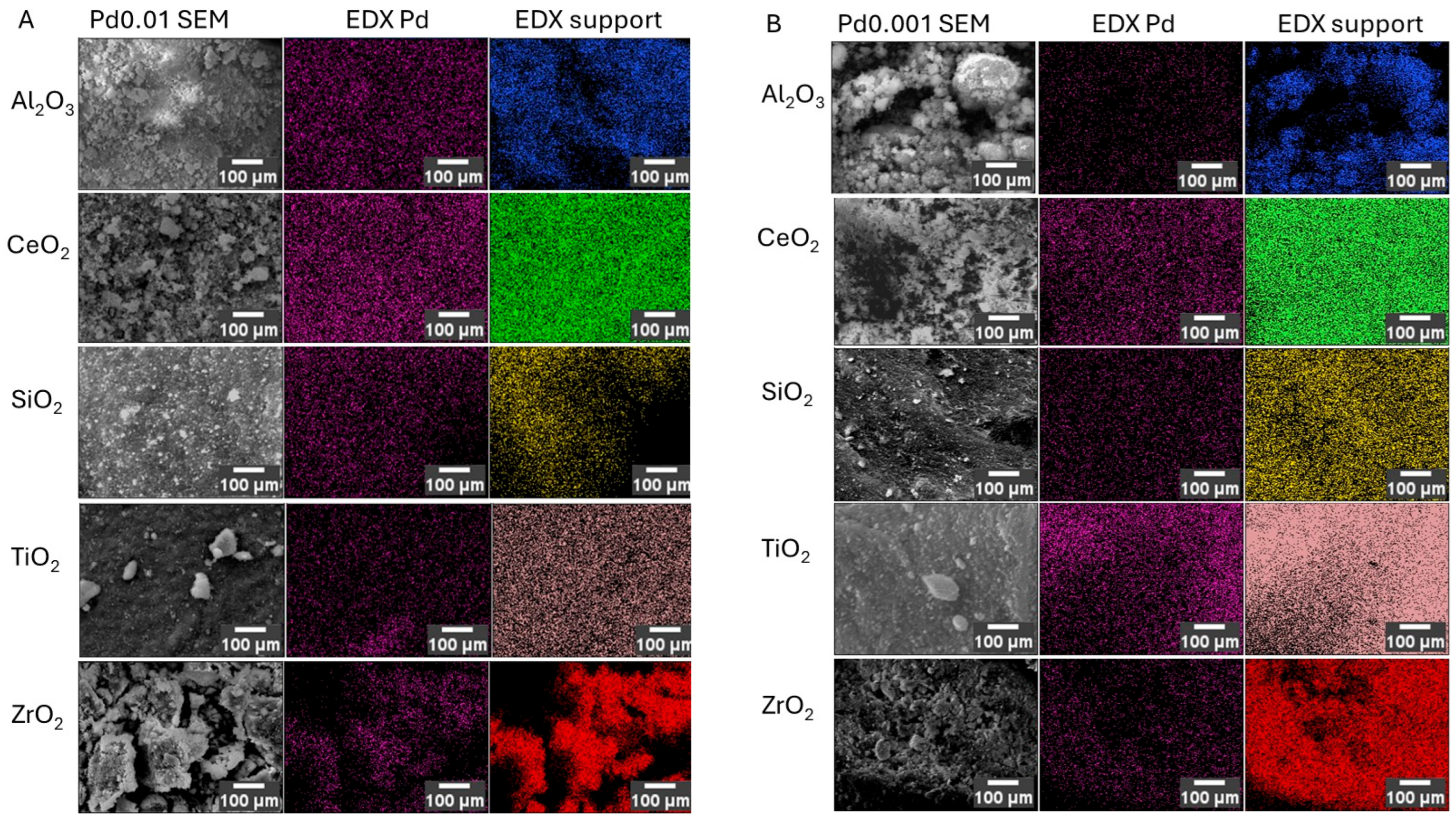
Figure 1. SEM images and EDX maps of (A) Pd0.01 and (B) Pd0.001 catalysts on different support oxides.
Applsci 16 05945 g001
Figure 2. XRD patterns of (A) Pd0.01 and (B) Pd0.001 catalysts supported on Al2O3, CeO2, SiO2, TiO2 and ZrO2.
Applsci 16 05945 g002
Figure 3. BET specific surface area of the oxide supports (g-Al2O3, CeO2, SiO2, TiO2, and ZrO2) and their palladium-modified counterparts containing 0.01 wt.% and 0.001 wt.% Pd. Error bars represent the standard deviation of the measurements.
Applsci 16 05945 g003
Figure 4. Reaction rate and TOF of methane during catalytic combustion on different Pd catalysts Pd0.01 (A,B) and Pd0.001 (C,D) expressed as relative reaction rates: (A,C)—per catalyst mass, (B,D)—per active centres number.
Applsci 16 05945 g004
Figure 5. Raman spectra of Pd-based catalysts supported on different supports: (A) Pd0.001/Al2O3, (B) Pd0.001/CeO2, (C) Pd0.001/SiO2, (D) Pd0.001/TiO2, and (E) Pd0.001/ZrO2.
Applsci 16 05945 g005
Figure 6. In situ DRIFTS spectra of Pd catalyst on different supports during methanol TPSR. (A) C–H stretching region (2700–3200 cm−1); (B) fingerprint region (900–1750 cm−1). Left column: Support; right column: Pd0.01 catalyst. Spectra collected in steps of 50 °C under He flow (25 cm3 min−1).
Applsci 16 05945 g006aApplsci 16 05945 g006b
Table 1. EDX and AAS results for Pd0.01 and Pd0.001 catalysts on oxide supports.
Sample CodeActive Centres No, at %EDX Metal Content (at %)AAS Metal Content (at %)
Pd0.01 series
Pd0.01/Al2O30.063.71.69
Pd_0.01/TiO20.450.950.18
Pd_0.01/CeO20.611.241.01
Pd_0.01/ZrO20.360.830.07
Pd_0.01/SiO20.090.230.22
Pd0.001
Pd_0.001/γ-Al2O30.131.350.05
Pd_0.001/TiO20.120.340.02
Pd_0.001/CeO20.840.510.004
Pd_0.001/ZrO20.930.230.004
Pd_0.001/SiO20.050.200.02
Disclaimer/Publisher’s Note: The statements, opinions and data contained in all publications are solely those of the individual author(s) and contributor(s) and not of MDPI and/or the editor(s). MDPI and/or the editor(s) disclaim responsibility for any injury to people or property resulting from any ideas, methods, instructions or products referred to in the content.