Article

Acoustic Survey for the Characterization of a Medieval Cave Church

Department of Medicine, Surgery and Dentistry “Scuola Medica Salernitana”, University of Salerno, 84081 Baronissi, Italy
*
Author to whom correspondence should be addressed.
Appl. Sci. 2026, 16(12), 5935; https://doi.org/10.3390/app16125935
Submission received: 28 April 2026 / Revised: 8 June 2026 / Accepted: 10 June 2026 / Published: 12 June 2026
(This article belongs to the Special Issue Vibroacoustic Monitoring: Theory, Methods and Applications)

Featured Application

The proposed field acoustic survey approach can be applied to the non-invasive acoustic assessment of fragile cultural heritage environments, such as cave churches, rock-cut sanctuaries, crypts, chapels, and small historical worship spaces. By combining portable instrumentation, calibrated acoustic measurements, and room-acoustic indicators, the method supports the preliminary documentation of sound-related heritage features, comparison between different spaces within the same site, and evidence-based interpretation of historical uses involving speech, chant, or ritual listening. It may also assist conservation planning and cultural valorisation by identifying acoustic characteristics that contribute to the sensory and intangible significance of heritage places.

Abstract

Acoustic survey provides a measurement-based approach for investigating heritage spaces in which architectural morphology, environmental conditions, and sound-related practices are physically interrelated. This study applies a portable and non-invasive survey protocol to the medieval cave sanctuary of San Michele di Mezzo, located in Fisciano, Southern Italy. The site consists of stratified natural and built spaces, including a lower cave, an upper cave, and a later upper church, and represents a relevant case study for assessing the acoustic behaviour of small, irregular, and fragile cultural heritage environments. The experimental procedure combined calibrated microphone recordings, time-domain signal inspection, third-octave-band analysis, and impulse-response-derived room-acoustic indicators, including reverberation, clarity, and definition parameters. Under the adopted source–receiver configurations, the results show acoustic differentiation among the lower cave, upper cave, and later church. The caves exhibit shorter decay times than the church over most frequency bands, while clarity and definition indicators reveal a frequency-dependent behaviour that does not support a general claim of the acoustic superiority of one space over another. Comparative data from other cave and cave-like environments further contextualize the measured response of San Michele di Mezzo. The findings do not imply intentional acoustic design; rather, in the measured configuration, they show that, under the chosen conditions, the long-lasting devotional centrality of the lower cave is compatible with an acoustic response that does not contradict spoken or sung devotional use. More broadly, the study contributes to applied acoustics by demonstrating that low-invasive field surveys can provide reproducible acoustic indicators for heritage interpretation, conservation-oriented documentation, and the investigation of intangible sound-related dimensions of cultural heritage.

1. Introduction

Acoustic field measurements in irregular heritage interiors represent a specific methodological challenge within applied acoustics. Unlike conventional halls or rooms, cave churches, crypts, rock-cut sanctuaries, and other small heritage interiors are often characterized by irregular geometry, heterogeneous boundaries, rough surfaces, partial enclosure, and restricted accessibility. These features make their acoustic behaviour difficult to infer from visual inspection or from simplified room-acoustic assumptions. At the same time, such spaces may preserve sound-related cultural functions, especially when speech, chant, recitation, or ritual listening were historically relevant to their use. For this reason, acoustic measurements can provide a physically grounded layer of evidence for interpreting the relationship between architectural morphology, historical use, and intangible cultural heritage [1,2,3].
Research on cultural heritage acoustics has mainly developed along two related directions. The first concerns performance and worship spaces, such as ancient theatres and historic churches, where room-acoustic indicators have been used to evaluate audibility, intelligibility, clarity, reverberation, and perceived acoustic comfort [4,5,6]. These studies have shown that measured acoustic parameters can contribute to the interpretation of functional suitability for collective listening, spoken communication, chant, or music. In religious buildings in particular, reverberation time, clarity, and definition parameters have been widely adopted to investigate the relationship between architectural configuration, liturgical function, and auditory experience.
The second direction concerns cave and rock-cut acoustics. Experimental studies on prehistoric decorated caves, natural cavities, and cave-like environments have shown that irregular geometry, local cavities, openings, and heterogeneous surfaces can generate highly site-specific and frequency-dependent acoustic responses [7,8]. In these contexts, acoustic features have been discussed in relation to spatial perception, ritualization, symbolic use, and the selection of specific areas within the same site. Other studies have extended this interest to caves used for concerts, theatre, guided visits, or cultural activities, showing that indicators such as EDT, T30, C50, C80, D50, and STI can be useful for assessing the acoustic behaviour and functional suitability of natural underground spaces. These works show that cave environments cannot be treated as simplified rooms, because their response is locally variable and strongly controlled by morphology.
Despite these developments, a precise technical gap remains. Most available studies concern well-known prehistoric caves, large show caves, conventional churches, or performance spaces, whereas small medieval cave sanctuaries and hermitage-like environments remain less investigated. In such sites, standard acoustic campaigns may be limited by conservation constraints, accessibility, irregular geometry, and the need to avoid invasive or time-consuming instrumentation. Moreover, acoustic indicators must be interpreted conservatively: they can support historical and cultural interpretation, but they cannot by themselves demonstrate intentional acoustic design or reconstruct past auditory experiences in a deterministic way. Therefore, the present work addresses the need for a focused, portable, and non-invasive acoustic field-survey protocol able to compare the measured response of small cave spaces while keeping the interpretation explicitly connected to directly measured quantities.
The acoustic characterization of cultural heritage sites has progressively become an important field of applied research, because sound contributes to the way historical spaces are perceived, used, and transmitted as cultural places. In theatres, churches, caves, crypts, and rock-cut sanctuaries, acoustic behaviour is not only a physical property of the enclosure, but also part of the interaction between architectural morphology, environmental conditions, and human practices. This perspective is consistent with the broader understanding of cultural heritage as a system that includes both tangible and intangible dimensions, as emphasized by international heritage frameworks and by theoretical discussions on the evolution of the concept of cultural heritage [1,2]. Within this framework, sound can be considered a measurable component of the sensory and intangible experience of a place, especially when speech, chant, music, or ritual listening were central to its historical function [3].
Research on cultural heritage acoustics has mainly developed along two related directions. The first concerns performance and worship spaces, such as ancient theatres and historic churches, where room-acoustic indicators have been used to evaluate audibility, intelligibility, clarity, reverberation, and perceived acoustic comfort [4,5,6]. These studies have shown that acoustic measurements can provide information that is not accessible through visual inspection alone and that the acoustic response of a historical space can influence its functional suitability for collective listening, spoken communication, chant, or music. In religious buildings, in particular, reverberation time, clarity, and definition parameters have been widely adopted to investigate the relationship between architectural configuration, liturgical function, and auditory experience. The second direction concerns cave and rock-cut acoustics. Experimental studies on prehistoric decorated caves, natural cavities, and cave-like environments have shown that irregular geometry, heterogeneous surfaces, local cavities, openings, and partial enclosure can generate highly site-specific acoustic responses [7,8]. In these contexts, acoustic features have been discussed in relation to spatial perception, ritualization, symbolic use, and the selection of specific areas within the same site. Other studies have extended this interest to cave environments used for concerts, theatre, guided visits, or cultural activities, showing that indicators such as EDT, T30, C50, C80, D50, and STI can be useful for assessing the acoustic behaviour and functional suitability of natural underground spaces [9,10,11,12]. Overall, these works demonstrates that caves cannot be treated as simplified rooms: their acoustic response is often frequency-dependent, locally variable, and strongly affected by morphology.
Despite these developments, several methodological and theoretical gaps remain open. First, most studies have focused either on well-known prehistoric caves, large show caves, or conventional worship spaces, whereas small medieval cave sanctuaries and hermitage-like environments remain less investigated. Second, the acoustic assessment of fragile rock-cut heritage sites is often constrained by accessibility, conservation requirements, irregular geometry, and the impossibility of deploying extensive instrumentation. Third, the interpretation of acoustic data in cultural heritage contexts requires caution: measured acoustic indicators can support historical interpretation, but they cannot, by themselves, demonstrate intentional acoustic design or reconstruct past auditory experience in a deterministic way. Therefore, there is a need for conservative field-survey protocols able to provide reproducible acoustic evidence while keeping the interpretation explicitly connected to measurable quantities.
From a theoretical perspective, this study adopts an integrated acoustic view of heritage spaces. Acoustic field survey is understood here as a measurement-based approach for investigating how sound is generated, propagated, and received in complex interiors. Although the present work focuses on the airborne acoustic response, the broader acoustic framework is useful because heritage spaces are not passive containers of sound: their geometry, boundaries, openings, materials, and patterns of use shape the measured response. In this sense, a cave sanctuary can be interpreted as a stratified physical and cultural system in which natural morphology, built additions, devotional use, and sound-related practices interact. The aim is not to replace archaeological or historical interpretation with acoustic metrics, but to add a physically grounded layer of evidence to the study of tangible and intangible heritage.
The present study applies this perspective to the medieval cave sanctuary of San Michele di Mezzo, located in the municipality of Fisciano (Campania Region, Italy). The sanctuary includes a lower cave, an upper cave, and a later upper church, forming a stratified religious complex in which natural cavities and built elements coexist. The rock-cut nucleus of the site is traditionally associated with long-lasting devotional use, while the upper church belongs to a later architectural phase completed in the 19th century. The lower cave preserves one of the oldest devotional elements of the sanctuary, including a fresco above the altar depicting the Virgin and Child, probably dating to the end of the 12th century, whereas the upper cave and the upper church reflect later transformations of the religious complex. This stratification makes the site suitable for investigating whether the historically privileged use of specific spaces was compatible with measurable acoustic conditions.
The objective of this work is to test whether a portable and non-invasive acoustic field-survey protocol can identify measurable acoustic differences between the main cave spaces of the sanctuary and provide physically grounded information for heritage interpretation. The study does not aim to derive a complete acoustic model of the sanctuary. Rather, it focuses on directly measured acoustic responses, including time-domain recordings, third-octave-band distributions, and standard acoustic indicators. The experimental protocol combines calibrated microphone measurements, sine-sweep impulse-response acquisition, and signal processing procedures aimed at evaluating acoustic parameters related to reverberation, clarity and definition. The selection of acoustic indicators was therefore guided by this voice-oriented research question: reverberation-related parameters were used to describe the temporal persistence of vocal sound, while clarity and definition parameters were used to assess the early-energy conditions associated with speech and recitation intelligibility.
The specific breakthrough points of the work are methodological, empirical, and theoretical. Methodologically, the study proposes a low-invasive field-survey procedure suitable for small, irregular, and fragile cave-like heritage environments, where full standardized acoustic campaigns may be difficult to implement. Empirically, it provides a first experimental acoustic survey of the San Michele di Mezzo cave sanctuary and compares the measured acoustic response of two historically and morphologically distinct cave spaces within the same religious complex under the adopted source–receiver configuration. Theoretically, it frames acoustic indicators as conservative evidence for discussing the compatibility between measured acoustic behaviour and historical sound-related practices, without assuming direct intentional acoustic design. In doing so, the paper contributes to the development of the acoustic field survey as an applied-physics tool for cultural heritage, where tangible structures, environmental conditions, and intangible practices are investigated within a unified measurement-based framework.

2. Materials and Methods

2.1. Case Study and Research Hypothesis

The Sanctuary of San Michele di Mezzo is located in the municipality of Fisciano, in the province of Salerno, Campania, Southern Italy. Dedicated to St. Michael the Archangel, the sanctuary belongs to the widespread tradition of Michaelic devotion, i.e., the Christian cult of the Archangel Michael, which, in medieval Southern Italy, was strongly associated with pilgrimage, elevated or rock-cut sacred places, and cave sanctuaries, with Monte Sant’Angelo (Apulia Region) representing its most influential site of Longobard origin [13]. In this tradition, natural morphology, religious practice, and spatial isolation often converged in the construction of sacred landscapes. The site is today composed of a stratified system of natural and built spaces, including a lower cave, an upper cave and a later upper church. This spatial organization makes the sanctuary a particularly relevant case study for investigating how acoustic behaviour, architectural configuration and historical use may interact in a complex heritage environment.
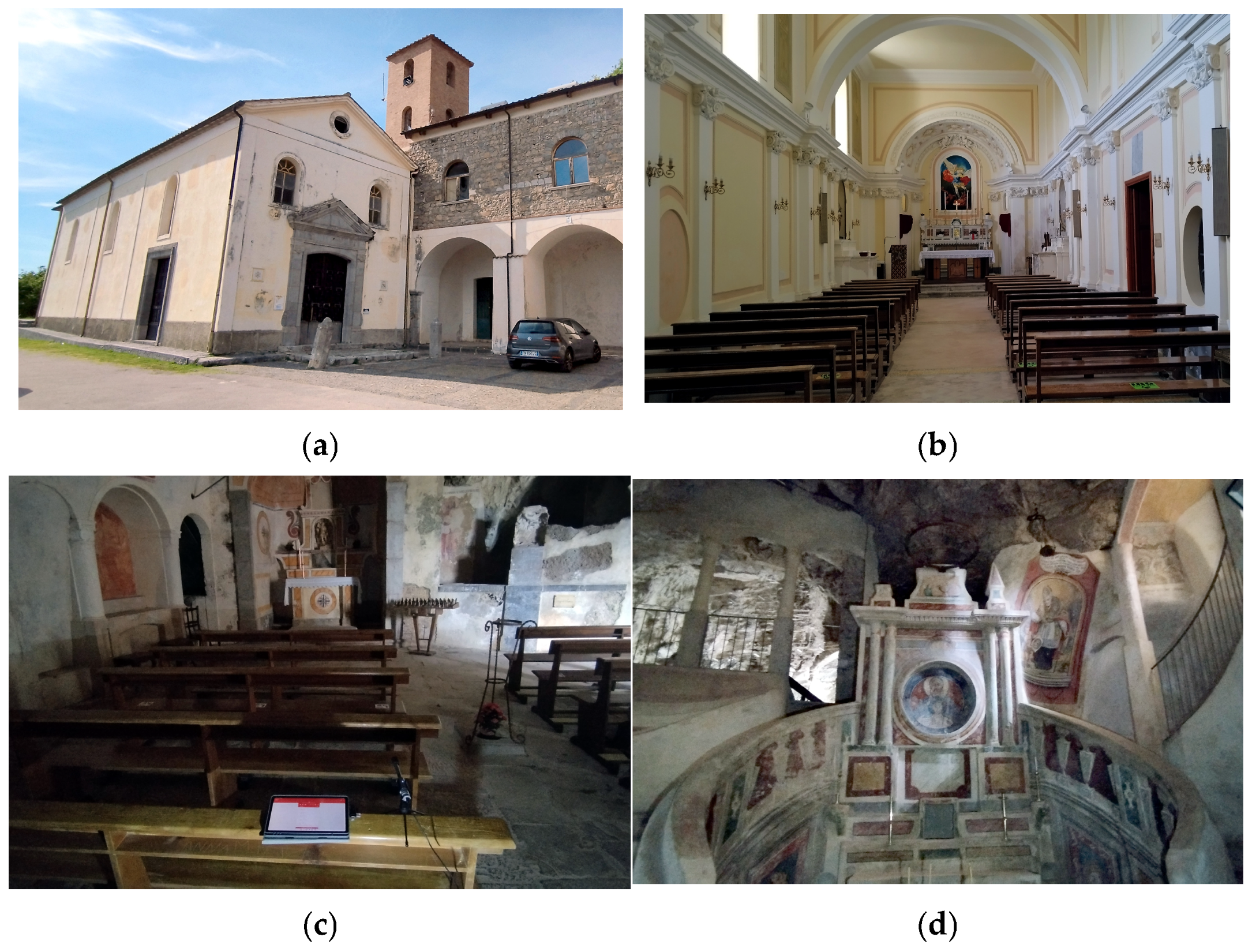
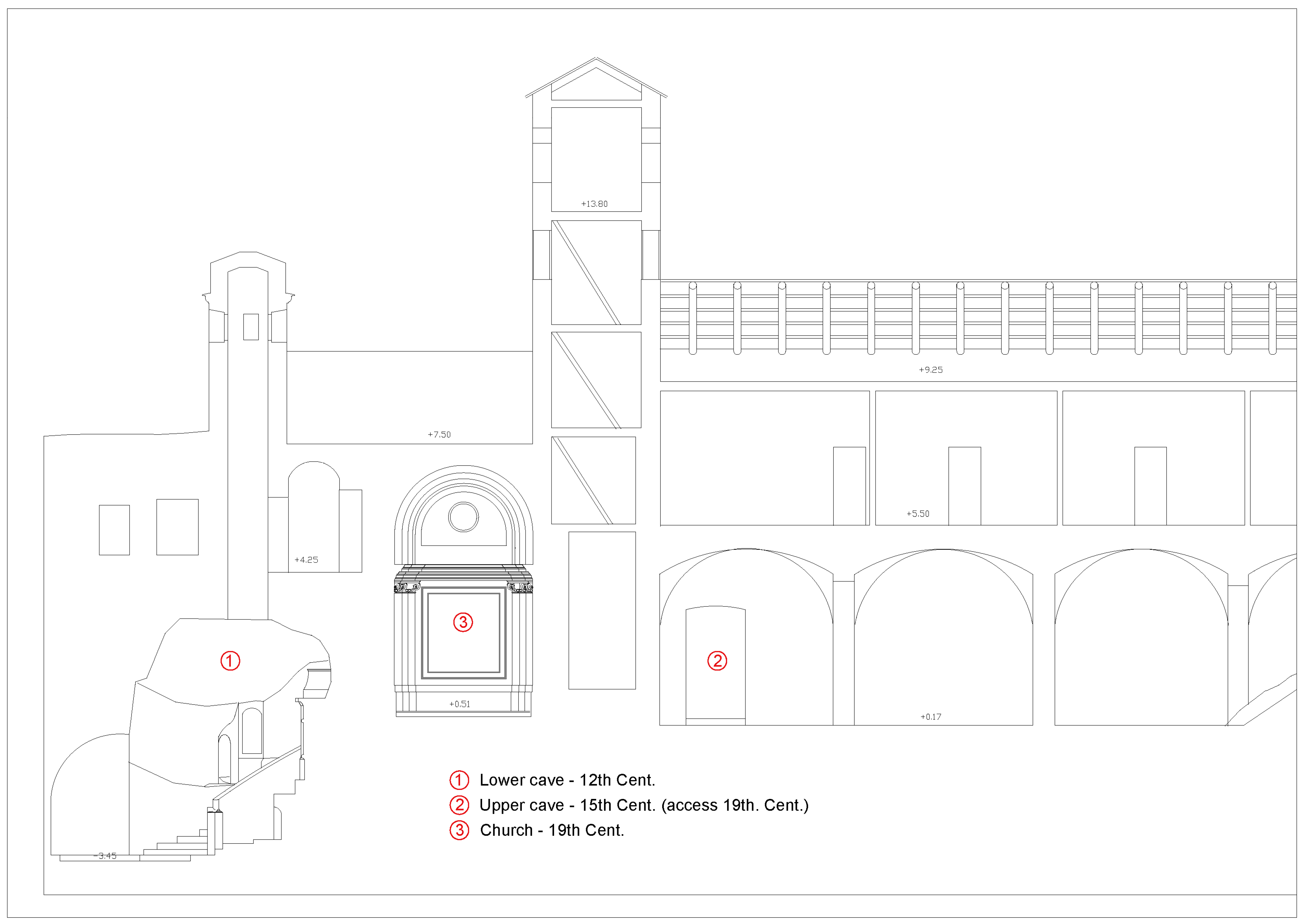
The earliest documented references to the sacred site date back to the mid-seventeenth century, where it is mentioned with the name of S. Angelo in Panicola. However, the devotional nucleus of the sanctuary appears to be older than the surviving documentary evidence. The rock-cut core was originally a karst hermitage-cave, divided into two principal cave spaces, and later integrated into a more articulated religious complex (Figure 1). The coexistence of natural cavities and later architectural additions is a key feature of the site, because it allows the acoustic response of spaces with different morphologies, materials, and historical phases to be compared within the same sacred complex.
The lower cave represents the most significant devotional space of the sanctuary. Its present arrangement dates to the late eighteenth or early nineteenth century, but the space preserves an older liturgical and iconographic layer. Above the altar, the lower cave contains a fresco depicting the Virgin and Child [14], painted in the late 12th century, still showing, in the iconography, the byzantine cultural background coming from the nearby area of Amalfi. This element indicates the presence of an early devotional focus in the lower space and supports the interpretation of the lower cave as the oldest and most historically relevant nucleus of the present-day sanctuary. The preservation of this pictorial evidence is particularly important for this study because it suggests that the lower cave was not a marginal or secondary space, but a place of sustained ritual and devotional significance.
The upper cave forms the second rock-cut component of the sanctuary. It preserves visible frescoes, including a late-Medieval depiction of Christ as the Good Shepherd, and contains an altar whose origin has been associated with the same broad chronological horizon as the original lower altar in the 17th century before later modifications. Compared with the lower cave, the upper cave shows a different spatial configuration and a different relationship with the later built components of the sanctuary. These differences are relevant from an acoustic perspective, because the two caves are not only historically distinct spaces, but also acoustic environments characterized by different geometries, boundary conditions, and degrees of enclosure.
The upper church was added in a later phase, between the end of the eighteenth century and the beginning of the nineteenth century, and was completed in 1843, as indicated by an inscription engraved in the churchyard. Its construction transformed the perception and organization of the sanctuary, creating a more conventional built worship space above the older rock-cut nucleus. The resulting complex is therefore not a homogeneous architectural object, but a temporally stratified sacred site in which natural cavities, devotional images, altars, and later masonry additions coexist. This temporal stratification provides the historical and architectural framework for the experimental acoustic survey presented in this study.
To clarify the spatial relationship between the three main components of the sanctuary, Figure 2 provides a schematic section of the site. The diagram also summarizes the probable historical sequence of use and transformation, inferred from the artistic and architectural evidence preserved in the complex. Number 1 identifies the lower cave, associated with the earliest devotional nucleus and with the late 12th century fresco of the Virgin and Child. Number 2 identifies the upper cave, associated with late-medieval pictorial evidence and with subsequent transformations, including works documented or hypothesized from the post-medieval phases. Number 3 identifies the later church and the external built structures, mainly developed during the 19th century and partly during the early 20th century, with later restoration works. Although the section does not represent the internal geometry of the upper cave, it shows its present external access, which was obtained through the partial closure of the original cave opening and the creation of an entrance below the portico. This stratified sequence provides the basis for the acoustic comparison developed in this study. The lower cave represents the most natural and earliest devotional environment; the upper cave represents a later and partially transformed rock-cut space; and the church represents the later built worship environment. The comparison among these three spaces therefore allows the measured acoustic response to be interpreted in relation to different degrees of natural morphology, architectural transformation, and historical use.
The historical and architectural evolution of San Michele di Mezzo raises a specific research question: whether the long-lasting devotional relevance, starting from the lower cave, was favoured by a combination of natural and artificial elements compatible with vocal ritual practices. The question does not imply either an intentional transformation of natural spaces to improve acoustic quality or a formalized knowledge of the acoustic construction of sacred cave sites. Such an interpretation would exceed the available historical evidence. Rather, the question is whether the measured acoustic response of these spaces, starting from the lower cave, is consistent with its historical role as a privileged devotional space, especially for practices involving spoken prayer, chant, or liturgical recitation. This hypothesis is grounded in the broader understanding of acoustic heritage as a component of intangible cultural heritage. In worship spaces, sound is not an accessory phenomenon, but part of the embodied and collective experience of ritual. Speech intelligibility, vocal clarity, reverberation, and perceived acoustic support can influence how a space is used, remembered, and transmitted as a place of devotion. For this reason, acoustic survey can provide an additional layer of evidence for interpreting the relationship between tangible architecture and intangible practices.
In the present study, this interpretive question is addressed through a portable low-cost instrumentation combined with a non-invasive acoustic survey procedure. The comparison between the lower and upper caves is based on directly measured acoustic indicators, including time-domain recordings, third-octave-band analysis, and room-acoustic parameters related to reverberation, clarity, and definition. The analysis is therefore intentionally limited to measurable and reproducible quantities. Historical interpretation is introduced only after the acoustic evidence has been established, in order to avoid circular reasoning between the presumed ritual importance of the lower cave and its measured acoustic behaviour.

2.2. Experimental Data Collection

The experimental campaign was designed as a portable and non-invasive field-survey procedure aimed at comparing the local acoustic response of the main accessible spaces of the sanctuary. The measurement strategy was intentionally based on a limited and repeatable setup, suitable for a fragile heritage environment characterized by small volumes, irregular boundaries, and restricted accessibility. Rather than reconstructing the complete sound propagation within the whole complex, the protocol focused on directly measurable acoustic quantities in the lower cave and upper cave, as well as in the church, with additional background recordings collected in the surrounding sanctuary area.
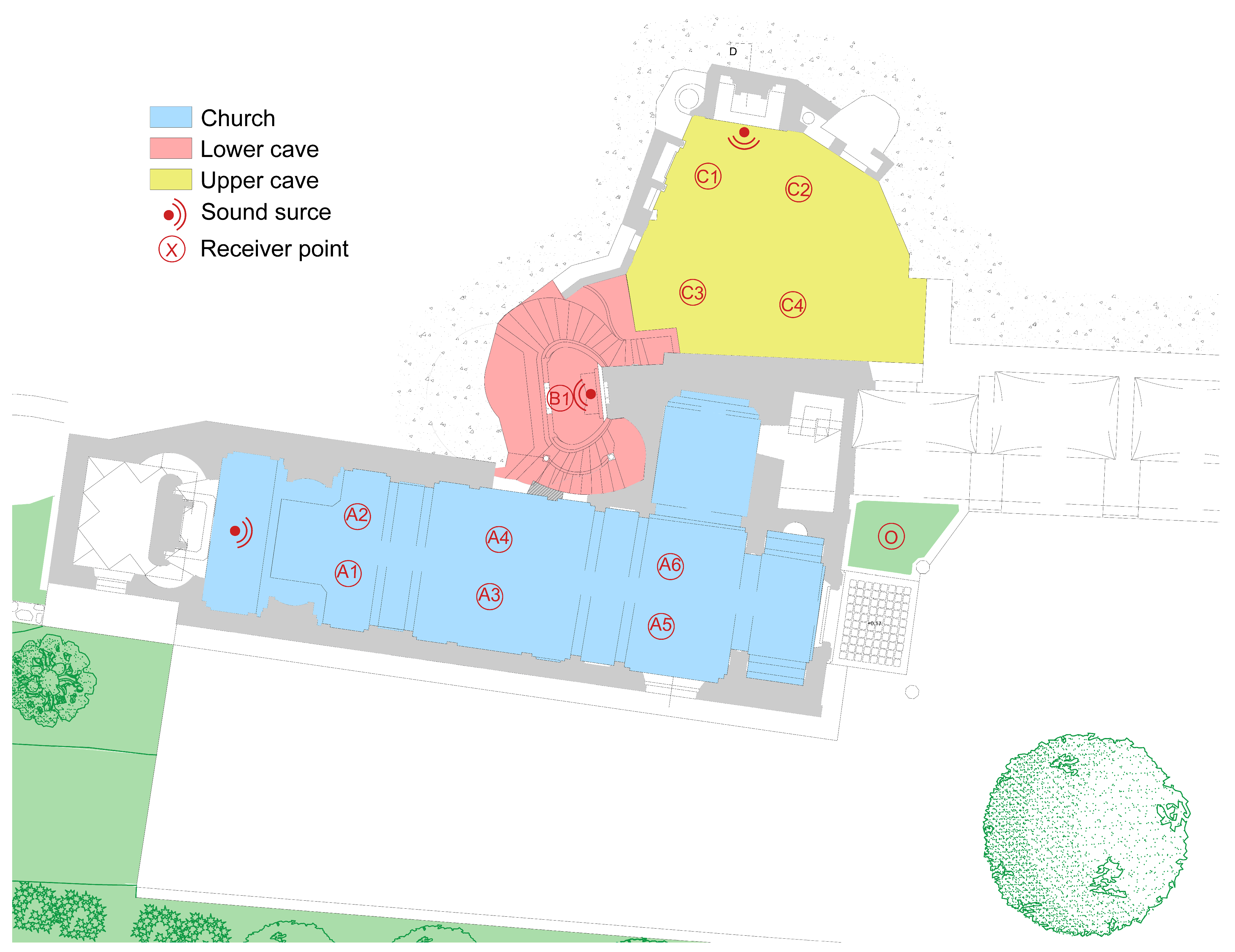
Figure 3 provides a schematic plan of the investigated spaces and of the adopted source–receiver configurations. The plan identifies the lower cave, the upper cave, and the church, together with the acoustic source positions and the receiver points used during the field survey. Receiver positions are labelled with the letters A, B, and C, referring respectively to the church, lower cave, and upper cave. The outdoor background reference position is labelled O.
Acoustic signals were acquired using a miniDSP UMIK-1 class-I USB measurement microphone. Before the field measurements, the equivalent sound pressure level was checked using an ND9B class-I digital sound level calibrator, operating at 1 kHz with available calibration levels of 94 dB and 114 dB. This preliminary calibration step was introduced to ensure consistency in the recorded sound-pressure data and to allow comparison among the investigated spaces. The receiver layout was defined according to the size, accessibility, and expected listening areas of each space, as shown in Figure 3. Six receiver positions were used in the church: two near the altar, two in the central part of the nave and two in the rear part of the space. In the lower cave, which is the smallest investigated environment and where the natural rock-cut morphology is largely preserved, one receiver position was selected in the central listening area. In the upper cave, four receiver positions were used, two in the front part and two in the rear part of the space, in order to account for the greater spatial articulation of this partially transformed cave environment. The sound source was placed at the altar position in each investigated space, consistently with the voice-oriented hypothesis of the survey. ISO 3382-1 was used only as a methodological reference for selected positioning criteria, and not as a standard-compliance framework for the present survey [15]. Receiver positions were placed approximately 1.20 m above the floor and, as far as possible, at least 1.00 m from the nearest reflecting surface, compatibly with the geometric constraints of the caves and with the architectural configuration of the church. These criteria were adopted to reduce the influence of very near reflections and to approximate representative listening positions. However, because the cave spaces are irregular and non-diffuse environments, and because a directional loudspeaker was used instead of a standardized omnidirectional source, the measurements should not be interpreted as a full ISO 3382-1 room-acoustic characterization. During the measurements, only one operator was present inside the site, and possible anthropogenic noise sources in the vicinity of the sanctuary were avoided as far as possible [15].
Two complementary sets of recordings were collected. First, uncompressed one-minute background recordings in *.wav format were acquired at selected positions in the investigated spaces and outside the sanctuary, using a sampling frequency of 48 kHz. Background measurements were acquired at A4 in the church, B1 in the lower cave, C1 in the upper cave, and O outside the sanctuary, as indicated in Figure 3. These recordings were used to inspect the time-domain behaviour of the measured signals and to characterize the ambient acoustic conditions during the field campaign. Second, controlled impulse-response measurements were performed in the church, lower cave, and upper cave. The excitation signal was an envelope-equalized sine sweep generated in MATLAB (version 2024b, developed and distributed by MathWorks, Natick, MA, USA) at a sampling frequency of 48 kHz, covering the frequency range from 0 to 20 kHz. The sweep duration was set to 20 s and the signal was reproduced through a portable directional loudspeaker connected to a laptop computer. The recorded responses were then processed in MATLAB to extract the impulse responses and the acoustic indicators considered in this study.
The use of a directional loudspeaker, rather than a professional omnidirectional source, was considered acceptable for the scope of the present study, which aimed at a comparative and non-invasive acoustic characterization rather than a full standard certification of the rooms. Similar cost-effective approaches based on common loudspeakers have been proposed for impulse-response measurements when logistical or economic constraints make standard omnidirectional sources impractical [16]. This choice was not intended to reproduce the standardized conditions of a full ISO 3382-1 room-acoustic survey, but to support a comparative, voice-oriented acoustic assessment. The research hypothesis concerns the compatibility between the acoustic response of the cave spaces and vocal practices, such as spoken prayer, chant, or liturgical recitation. At present, no documentary or material evidence is available for historical eremitic, liturgical, or devotional practices in the sanctuary involving musical instruments, nor is there evidence of historical liturgical instruments preserved or documented in the site. Therefore, a directional source positioned near the altar area, corresponding to the expected position of the officiant or speaker, was considered more consistent with the investigated vocal-use scenario than an omnidirectional source conceived for standardized room-acoustic certification. The same source type and the same altar-based source-position logic were adopted in the church, lower cave, and upper cave, in order to allow a controlled comparison among the three spaces. Nevertheless, the use of a directional source limits the universality of the results, which should be interpreted as representative of the adopted voice-oriented source–receiver configurations.
The impulse-response measurements were used to estimate acoustic indicators related to reverberation, clarity, and definition. Although the complex geometry of the caves and the use of a portable directional source do not allow a complete standardized characterization of the acoustic field, the limited duration of the excitation signal and the controlled measurement conditions support the use of a linear time-invariant approximation for the local room response. This assumption is consistent with common practice in room-acoustic measurements based on swept-sine excitation, provided that the results are interpreted as representative of the adopted source–receiver configurations and not as exhaustive descriptors of the entire sanctuary.

2.3. Signal Processing and Acoustic Indicators

The recorded signals were processed in MATLAB in order to extract time-domain descriptors, frequency-dependent spectra and acoustic indicators. First, the background recordings were inspected in the time domain to identify possible transient disturbances and to verify the absence of relevant anthropogenic noise during the acquisition windows. The calibrated microphone signals were then converted into A-weighted sound pressure levels, expressed in dBA, using a MATLAB sound-pressure-level processing routine. For each background recording, statistical descriptors were calculated, including maximum, minimum, mean value, standard deviation, and percentile levels L1, L5, L10, L50, L90, L95, and L99. These descriptors were used to quantify the stability of the acoustic background and to distinguish persistent background conditions from short transient events.
The impulse-response measurements acquired through the swept-sine procedure were used to estimate a set of room-acoustic indicators related to reverberation, clarity, and definition. The parameters considered in this study were Early Decay Time (EDT), reverberation times T20 and T30, speech clarity C50, music clarity C80, and definition D50. These descriptors are commonly adopted in room-acoustic studies and have been extensively used in the acoustic assessment of churches and historical worship spaces, where the balance between reverberation, intelligibility, and acoustic support is essential for speech, chant, and music [9,12,17]. EDT describes the initial part of the decay and is related to the perceived reverberance of a space, which can influence the subjective support of spoken or sung voice. T20 and T30 describe the persistence of sound energy and therefore help evaluate whether the environment tends to prolong vocal emission or reduce temporal separation between successive syllables. C50 and D50 are particularly relevant for speech clarity and recitation intelligibility because they quantify the proportion of early sound energy arriving within the first 50 ms with respect to later or total energy. Higher early-energy fractions generally support the perception of consonants, syllabic articulation, and verbal intelligibility. C80 was also considered because chant and liturgical recitation may occupy an intermediate position between speech and sustained vocal expression, where the balance between clarity and reverberant support remains relevant. In the present work, these indicators were not used to certify the acoustic quality of the sanctuary according to performance-space standards, but as comparative descriptors linking the measured acoustic response of the investigated spaces to historically plausible voice-related practices.
For each acoustic indicator and frequency band, mean values and standard deviations were calculated from the repeated measurements. In the church and upper cave, the statistics include both repeated measurements and the variability associated with different receiver positions. In the lower cave, the statistics describe repeated measurements at the representative receiver position B1. To avoid the overinterpretation of poorly repeatable estimates, a repeatability-based quality-control criterion was applied. Values were retained for interpretation only when the relative standard deviation was not higher than 20%. When this condition was not satisfied, the corresponding value was not reported in the table. This threshold was adopted as an operational quality-control criterion for the present field survey and not as a standardized acceptance limit. For parameters expressed in decibels such as C50 and C80, the standard deviation of repeated estimates was also checked directly, because relative dispersion can be less informative when mean values are close to zero.
Table 1 summarizes the acoustic indicators adopted in this study, their units of measurement, and their physical interpretation based on the relevant literature on this topic [5]. These parameters are derived from room-acoustic practice and are commonly discussed in relation to performance and worship spaces. In the present work, however, they are used as comparative acoustic descriptors rather than as standardized certification parameters. The reference ranges reported in the last column should therefore be understood as indicative interpretative values from the literature and not as design targets or acceptance criteria for the investigated cave sanctuary. This distinction is essential because irregular rock-cut environments differ substantially from conventional rooms and performance spaces in terms of geometry, diffuseness, surface roughness, and boundary conditions.
The complete set of measured values for all frequency bands is reported in the Appendix A. In the main text, the discussion focuses on the bands that are most relevant for comparing the two cave spaces and for interpreting their possible suitability for voice-related practices.

2.4. Methodological Scope and Limitations

The experimental protocol adopted in this study was designed as a first-level field acoustic survey for a fragile and geometrically irregular heritage site. Its objective was not to provide a complete spatial mapping of the acoustic field, nor to certify the sanctuary according to the standards normally applied to performance halls. Rather, the aim was to obtain directly measured and reproducible acoustic indicators capable of supporting a comparative assessment of the lower and upper caves under controlled field conditions.
The reference to ISO 3382-1 in this study must therefore be understood in a limited sense. Selected concepts and positioning criteria inspired by the standard were used, such as the approximate receiver height and the minimum distance from nearby reflecting surfaces. However, the survey does not claim compliance with ISO 3382-1. The investigated caves are small, irregular, and non-diffuse spaces, and the measurement campaign did not include the spatial sampling and source conditions normally required for a full standardized room-acoustic characterization.
Several methodological choices follow from this objective. The receiver grid was adapted to the size and spatial articulation of each environment. Six receiver positions were used in the church, four in the upper cave, and one in the lower cave. The single receiver position in the lower cave was selected because of the small size and limited spatial articulation of the space. This procedural option was compensated by a larger number of repeated measurements. This strategy improves the repeatability of the measured indicators while remaining compatible with the conservation and accessibility constraints of the site. Nevertheless, the survey should not be interpreted as a complete acoustic mapping of the sanctuary, but as a controlled field-survey comparison among the main accessible spaces.
Second, a directional loudspeaker was adopted instead of a professional omnidirectional sound source. This choice may affect the balance between direct sound, early reflections, and late reverberant energy, especially in irregular rock-cut environments where reflections depend strongly on source orientation, nearby surfaces, and local boundary conditions. The directional source was used because the survey was conceived as a voice-oriented acoustic assessment: the historical-use hypothesis concerns spoken or sung vocal practices rather than instrumental music. Nevertheless, this source configuration limits direct comparison with standardized room-acoustic measurements based on omnidirectional excitation.
No acoustic transfer function between adjacent spaces was estimated. In the present field conditions, such an analysis would require a denser measurement grid, multiple source–receiver configurations, and a more detailed control of source directivity and boundary conditions. The study therefore relies only on directly measured quantities, including time-domain recordings, third-octave-band distributions, and room-acoustic indicators derived from impulse-response measurements. This conservative approach avoids unsupported assumptions on acoustic coupling between the different parts of the sanctuary.
Consequently, the conclusions of the study are configuration-specific and site-specific. The results can support a comparative interpretation of the acoustic differentiation among the lower cave, upper cave, and church of San Michele di Mezzo, under the adopted source–receiver arrangements. For this reason, throughout the interpretation of the results, expressions such as acoustic differentiation, clarity, definition, or suitability refer to the measured configurations and not to the complete spatial acoustic field of the sanctuary. Therefore, the comparison among the lower cave, upper cave, and church should be interpreted as configuration-specific and repeatability-screened. The results describe the measured acoustic response at the selected receiver positions and under the adopted altar-based source configuration; they should not be generalized to the complete spatial acoustic field of the sanctuary. Within these limits, the survey provides a reproducible basis for future campaigns based on extended spatial sampling, repeated measurements, omnidirectional or voice-directivity-controlled sources, three-dimensional geometric documentation, or numerical acoustic modelling.

3. Results and Discussion

3.1. Results

The experimental campaign produced three groups of data: time-domain recordings, third-octave-band spectra, and room-acoustic indicators derived from impulse-response measurements. The measurements considered in this section refer to the lower cave and upper cave of the San Michele di Mezzo sanctuary.
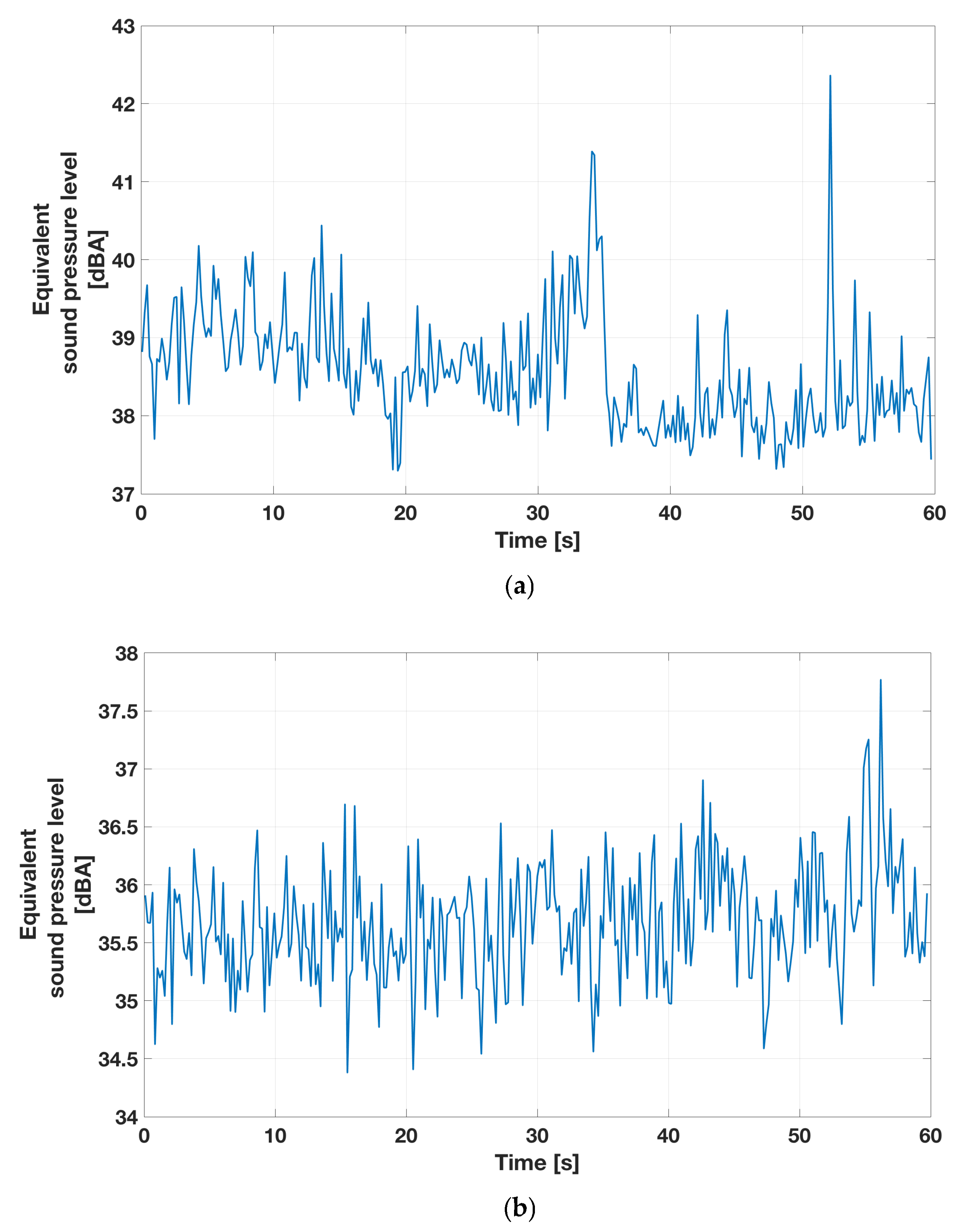
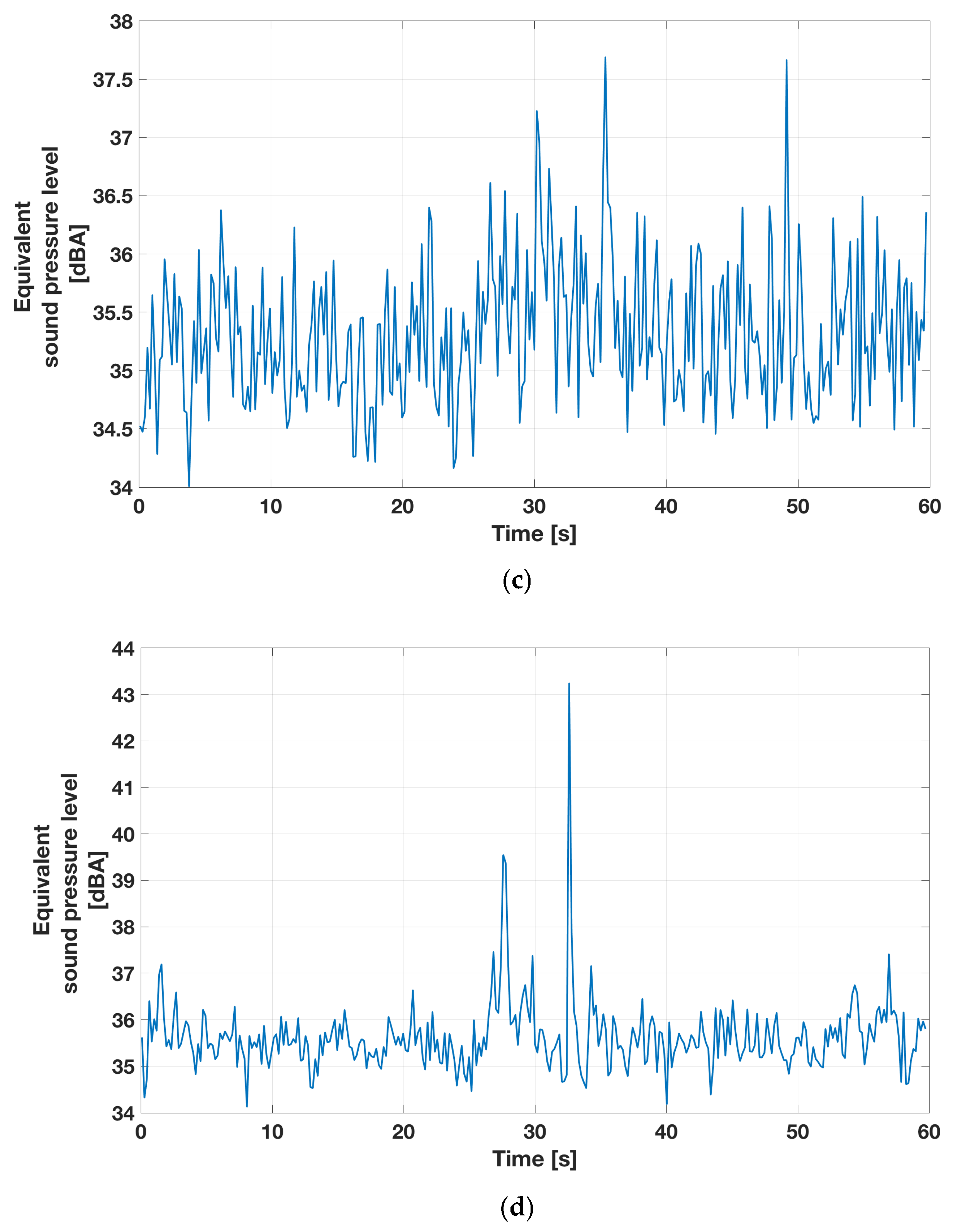
Figure 4 shows the time histories recorded in the investigated spaces during the field campaign. The signals are reported in the time domain using the same time scale, in order to allow a direct visual comparison between the acquisition windows. The recorded traces correspond to the measurement configurations described in Section 2.2.
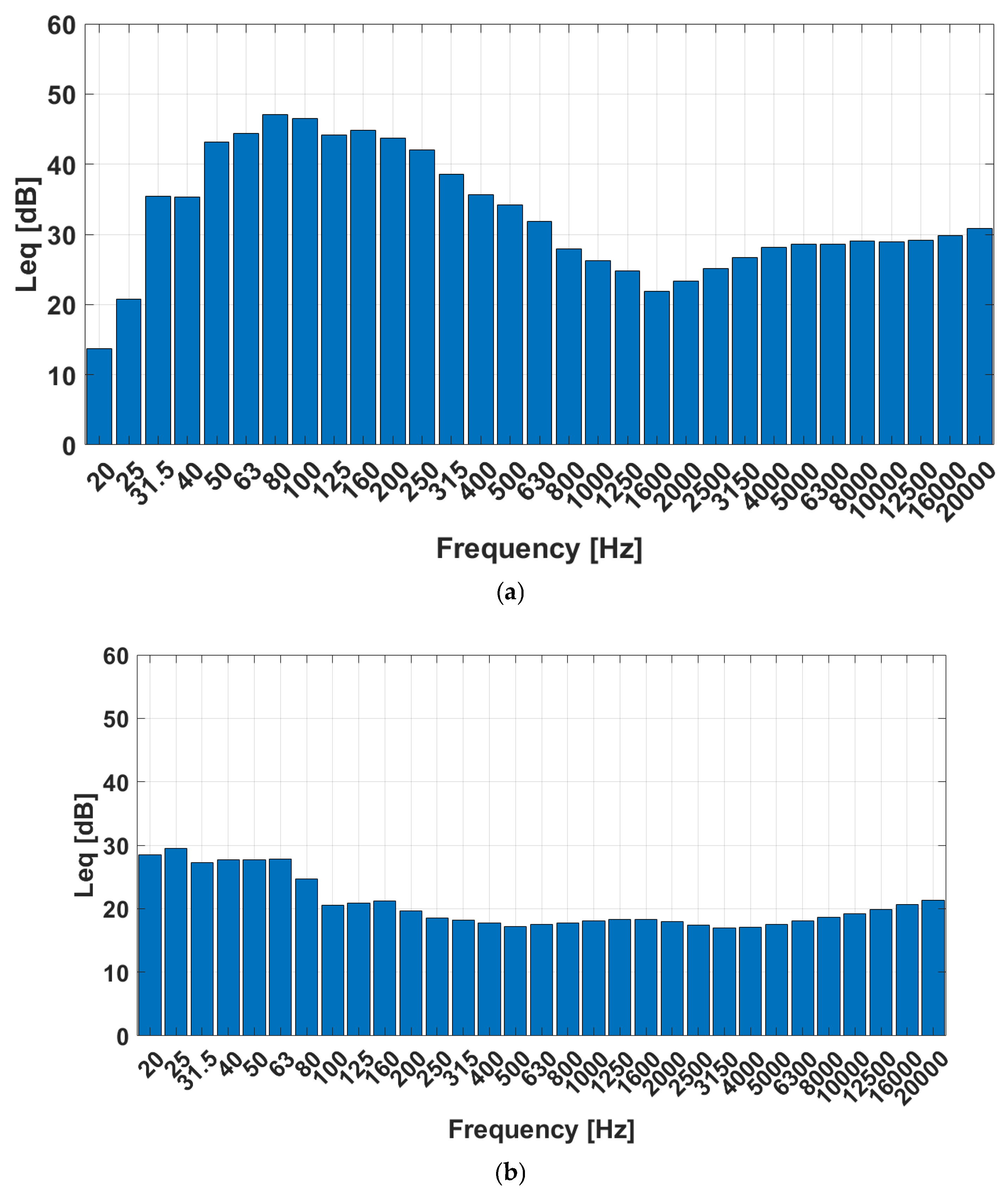
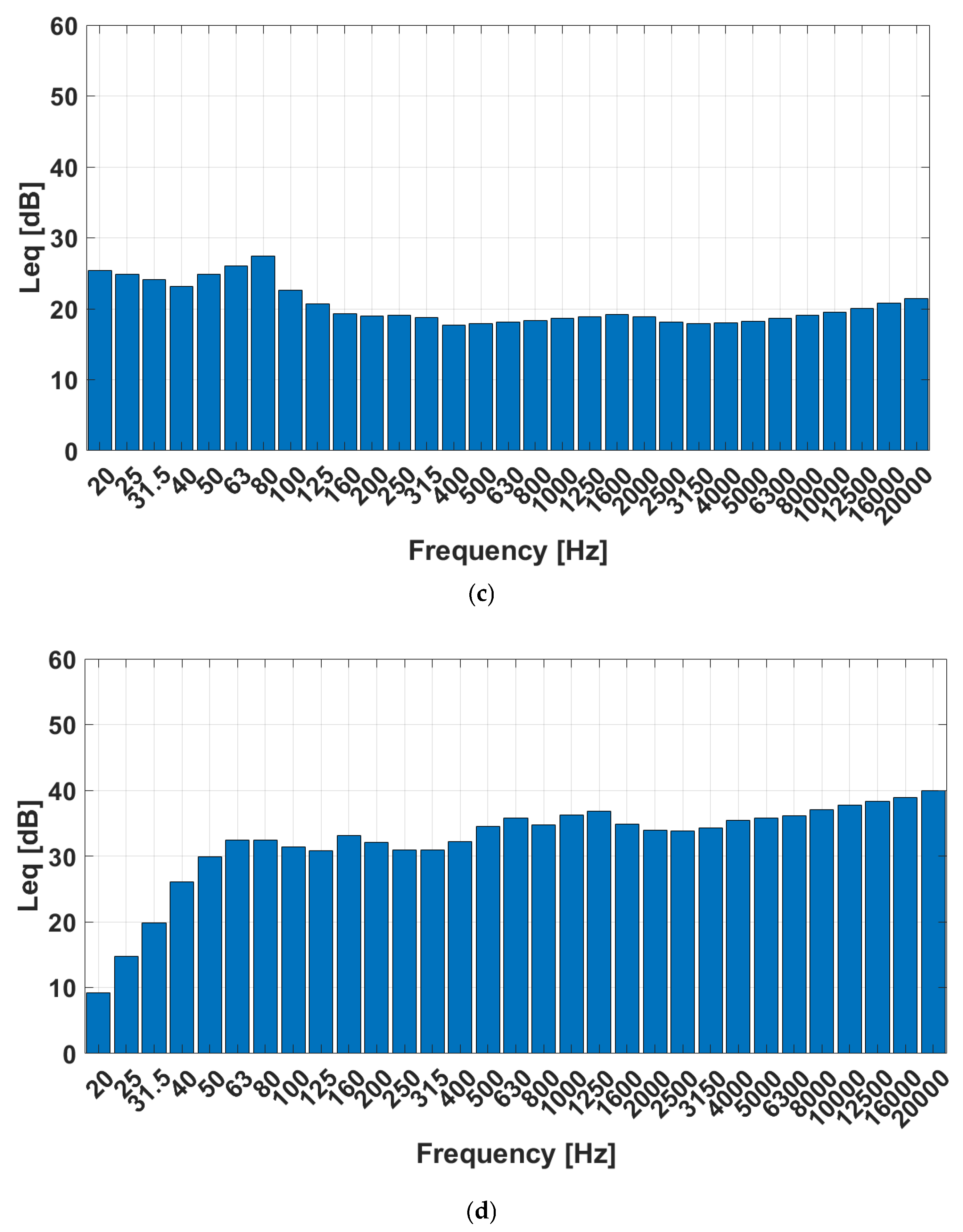
Figure 5 reports the third-octave-band representation of the recorded signals. The spectra are shown for the lower cave and upper cave over the standard frequency bands considered in the analysis. Where available, the background or external recording is included as a reference condition.
The time histories and third-octave-band spectra were used to document the acoustic background conditions during the field survey and to verify the absence of dominant environmental disturbances during the acquisition windows. To provide a quantitative description of these conditions, Table 2 reports the main statistical acoustic level descriptors extracted from the background recordings acquired in the outdoor reference position, located nearby the upper cave entrance, the church, the upper cave, and the lower cave. The reported descriptors include maximum and minimum levels, mean level, standard deviation, and part of the calculated statistical percentile levels, useful for distinguishing the general acoustic background from short transient events. In particular, L90 and L99 describe the lower background tail of the recorded sound-level distribution.
The outdoor reference position shows the highest background levels, with Lmean = 53.79 dB and L50 = 53.75 dB. The indoor spaces are markedly quieter, with mean levels of 41.00 dB in the church, 40.36 dB in the upper cave, and 39.05 dB in the lower cave. Among the indoor environments, the lower cave shows the lowest mean level and the smallest standard deviation, indicating a comparatively stable acoustic background during the recording window. These results support the use of the recordings as a reliable background context for the subsequent interpretation of the impulse-response-derived indicators.
The acoustic indicators obtained from the impulse-response measurements are summarized in Table 3 for selected frequency bands. The indicators reported in Table 2 are EDT, T20, T30, C50, C80, and D50. Values are shown for the lower cave, upper cave, and church at 250, 500, 1000, 2000, 4000, and 8000 Hz and are reported as mean ± standard deviation. The statistics refer to repeated measurements acquired at the receiver positions shown in Figure 2. Missing values indicate that the corresponding indicator was not retained because the repeatability-based quality-control criterion was not satisfied.

3.2. Discussion

The experimental dataset provides an articulated interpretation of the acoustic behaviour of the San Michele di Mezzo sanctuary site, including its three sacred spaces: the lower cave, the upper cave, and the later church. These three spaces correspond to different degrees of natural and artificial transformation within the same sacred complex. The lower cave is the space in which natural rock-cut features are most prevalent and where no complete flooring or architectural regularization is present, apart from limited devotional additions and the stair elements beside the altar. The upper cave preserves a rock-cut character but also includes more artificial elements, particularly around the altar and towards the present entrance, which was obtained by partially closing the original cave opening with a built wall connected to the later architectural phase of the sanctuary. The church, in contrast, is a built worship space and represents the most architecturally regular component of the complex.
Therefore, the acoustic results should be interpreted not as a ranking of spaces from “better” to “worse”, but as evidence of a progressive differentiation between a predominantly natural cave, a partially transformed cave, and a built church. This distinction is important for the cultural interpretation of the site. The internal cave spaces were not acoustically optimized in a modern or intentional sense, and such an interpretation would be historically inappropriate. Rather, the question is whether their measured acoustic response is compatible with voice-based devotional practices, such as spoken prayer, chant or liturgical recitation, and how this response differs from that of the later church. Accordingly, the following interpretation refers to the retained indicators obtained under the adopted source–receiver configurations, and not to an exhaustive acoustic mapping of the sanctuary. The comparison among the lower cave, upper cave, and church should therefore be understood as configuration-specific and repeatability-screened.
The background sound-level descriptors provide an important context for interpreting the acoustic survey. The outdoor reference position was characterized by substantially higher levels than the indoor spaces, with Lmean = 53.79 dB. By contrast, the church, upper cave, and lower cave showed lower mean levels, equal to 41.00 dB, 40.36 dB, and 39.05 dB, respectively. This confirms that the indoor measurements were acquired under relatively quiet conditions, with a clear reduction in the external acoustic background inside the sanctuary spaces. The lower cave was the quietest and most stable indoor environment, with data having a standard deviation of 1.48 dB. This indicates that the background during the acquisition window was not dominated by strong fluctuating noise. The upper cave and church showed slightly higher variability, with standard deviations of 2.45 dB and 2.07 dB, respectively. However, their lower percentile levels remained close to 40 dB or below. These values support the reliability of the impulse-response measurements, because the acoustic indicators were obtained in conditions where background noise was low and sufficiently stable within the indoor spaces.
The decay-related indicators show a clear separation between the church and the two caves. At 250 Hz, EDT is 2.136 ± 0.090 s in the lower cave and 2.044 ± 0.089 s in the upper cave, while it reaches 3.144 ± 0.273 s in the church. The same pattern is observed for T20 and T30, which are higher in the church than in both caves over the low- and mid-frequency range. At 500 Hz, for example, T30 is 2.17 ± 0.20 s in the lower cave and 2.27 ± 0.30 s in the upper cave, whereas it is 3.13 ± 0.08 s in the church. At 1000 Hz, T30 remains higher in the church, with 2.82 ± 0.07 s, compared with 1.93 ± 0.24 s in the lower cave and 2.19 ± 0.81 s in the upper cave. These results indicate that the later church provides a more persistent reverberant field than the cave spaces, especially in the frequency range most relevant to vocal sound.
The comparison between the two caves is more subtle. Their EDT values are close over most of the analyzed frequency range, with the lower cave showing 2.136 ± 0.090 s at 250 Hz, 1.659 ± 0.090 s at 500 Hz, 1.391 ± 0.029 s at 1000 Hz, 1.161 ± 0.047 s at 2000 Hz, 0.983 ± 0.043 s at 4000 Hz, and 0.666 ± 0.024 s at 8000 Hz. The corresponding upper-cave values are 2.044 ± 0.089 s, 1.594 ± 0.117 s, 1.379 ± 0.079 s, 1.198 ± 0.059 s, 0.992 ± 0.035 s, and 0.627 ± 0.088 s. These values show that the two caves have broadly comparable decay behaviours, despite their different degrees of artificial transformation. This suggests that the rock-cut morphology remains the dominant factor controlling the acoustic decay of both cave spaces.
However, the comparison of T30 indicates some differences in the reverberant tail. At 250 Hz, T30 is 2.68 ± 0.27 s in the lower cave and 3.07 ± 0.57 s in the upper cave, suggesting a slightly longer low-frequency reverberant tail in the upper cave. At 500 Hz and 2000–4000 Hz the two caves are again close, with T30 values around 2.17–2.27 s at 500 Hz, 1.48–1.53 s at 2000 Hz, and 1.16 s at 4000 Hz. At 8000 Hz, both caves show short decay times, with T30 = 0.74 ± 0.02 s in the lower cave and 0.79 ± 0.07 s in the upper cave. Therefore, the caves are acoustically differentiated, but not in a simple hierarchical way. Their main common feature is a frequency-dependent decay, with longer persistence at low frequencies and progressively shorter decay at high frequencies.
The church shows a different trend. Its EDT and T20 values decrease with frequency, but they remain higher than those measured in the caves up to 4000 Hz. At 4000 Hz, EDT is 1.913 ± 0.169 s in the church, compared with 0.983 ± 0.043 s in the lower cave, and 0.992 ± 0.035 s in the upper cave. At 8000 Hz, the church becomes closer to the caves, with EDT = 1.030 ± 0.089 s and T20 = 1.21 ± 0.03 s, but it still remains more persistent than both cave spaces. This confirms that the church behaves as a built reverberant worship environment, whereas the caves behave as compact rock-cut spaces with shorter high-frequency decay.
The clarity and definition indicators must be interpreted with particular caution, because only values satisfying the repeatability criterion were retained. Missing values in Table 2 therefore do not indicate an absence of processing, but an insufficient repeatability for reliable interpretation. This is especially relevant for C50 and C80, which are sensitive to source directivity, receiver position, and local reflections. In the lower cave, the available C50 values are negative, with −10.10 ± 1.47 dB at 250 Hz, −4.88 ± 0.79 dB at 500 Hz, and −3.05 ± 0.60 dB at 1000 Hz. These values do not support the claim of high speech clarity according to the modern room-acoustic criteria. Nevertheless, the trend from 250 Hz to 1000 Hz shows a progressive improvement of the early-to-late energy balance in the lower cave.
The available C80 and D50 values provide additional information. In the lower cave, C80 changes from −4.24 ± 0.68 dB at 250 Hz to 4.65 ± 0.63 dB at 8000 Hz, suggesting that the balance between early and late energy becomes more favourable at higher frequencies for sustained vocal sound. D50 also increases with frequency: 24.68 ± 3.47% at 500 Hz, 33.21 ± 3.01% at 1000 Hz, 37.87 ± 4.59% at 2000 Hz, 40.52 ± 6.03% at 4000 Hz, and 50.94 ± 5.44% at 8000 Hz. This progressive increase in D50 indicates a growing early-to-total energy ratio towards the high-frequency range. Such behaviour is not evidence of acoustic optimization, but it shows that the lower cave is not acoustically incompatible with vocal practices.
The upper cave shows a similar but partly distinct behaviour. D50 is 31.06 ± 6.16% at 1000 Hz, 41.05 ± 6.68% at 2000 Hz, 45.78 ± 5.18% at 4000 Hz, and 62.18 ± 11.92% at 8000 Hz. These values are generally comparable with or higher than those measured in the lower cave at the same frequencies, but the associated standard deviations are larger. This is consistent with the upper cave being a more spatially differentiated environment, partly because it includes artificial boundaries around the altar and the present entrance. The upper cave therefore appears less as a uniformly improved acoustic space and more as a hybrid environment, where rock-cut morphology and later architectural closure jointly influence the early-energy distribution.
The church provides a further reference for interpreting the cave spaces. Its decay times are longer than those of the caves, but the available D50 values are not uniformly higher. At 2000 Hz, D50 is 23.07 ± 4.60% in the church, lower than both the lower cave and the upper cave. At 8000 Hz, D50 reaches 51.81 ± 4.96%, close to the lower cave and lower than the upper cave. This suggests that the church, although more reverberant and architecturally regular, does not necessarily provide better early sound definition in all frequency bands. In other words, the built worship space is acoustically more persistent, but not automatically more favourable in terms of early-to-total energy ratio. This result is relevant because it shows that the cave spaces cannot be considered merely acoustically deficient predecessors of the later church. They have their own measurable acoustic profile.
Before connecting these measurements with the devotional role of the lower cave, alternative acoustic explanations must be acknowledged. The measured indicators may be affected by the adopted altar-based source position, source orientation, source–receiver distance, local geometry around the altar, nearby rock surfaces, the partial architectural closure of the upper cave, and modal or frequency-dependent behaviour typical of small irregular cavities. Therefore, the retained values should not be interpreted as general intrinsic properties of the whole cave volumes, nor as direct evidence that any space was selected because of its acoustic response. They indicate how each space behaved under the adopted source–receiver configurations and within the repeatability-screened dataset. This limitation is particularly important for clarity and definition indicators, which are more sensitive than decay-related parameters to early reflections, local geometry, and receiver position.
From the point of view of heritage interpretation, the most important result is therefore not acoustic superiority, but acoustic compatibility. The lower cave, which preserves the oldest devotional nucleus of the sanctuary, remains predominantly natural and only minimally transformed. Within these limits, its measured acoustic response does not indicate intentional design or optimization, but remains compatible with voice-based devotional use under the adopted measurement conditions. The available indicators suggest that the lower cave combines moderate decay in the mid-frequency range, a progressive reduction in reverberation towards the high-frequency range and increasing early-energy contribution with frequency. These features would not prevent spoken prayer, recitation or chant, although they do not correspond to the modern criteria of high speech clarity.
The upper cave adds a second level to this interpretation. Compared with the lower cave, it is more affected by artificial elements, including built surfaces around the altar and the partial closure of the entrance. Its decay-related indicators are close to those of the lower cave, suggesting that the cave morphology remains acoustically dominant. At the same time, its D50 values at medium–high and high frequencies are higher than those of the lower cave, but with larger dispersion. This may indicate that the built additions and the modified entrance affect the distribution of early reflections, increasing the early-energy fraction in some receiver configurations while also increasing spatial variability. Therefore, the upper cave should not be interpreted as simply acoustically better or worse than the lower cave; rather, it represents a partially transformed acoustic environment within the same rock-cut system.
The comparison with published data from other cave and cave-like environments [9,10,12], reported in Appendix A, further clarifies the position of San Michele di Mezzo. The sanctuary does not behave as a large highly reverberant cave hall. Its EDT values are lower than those reported for the large Pertosa spaces and closer to compact cave environments such as La Pasiega, Tito Bustillo, Paphos, and El Castillo in the mid-frequency range. The same applies to T30: San Michele shows values lower than those of the Large Hall and Throne Hall of Pertosa over most of the frequency range, while remaining closer to the Castle Hall and to smaller cave environments. This confirms that the site should be interpreted as a compact rock-cut sanctuary rather than as a large reverberant cavity.
The comparison of clarity indicators supports an intermediate interpretation. The available C50 values in the lower cave remain negative, and therefore San Michele should not be described as an exceptionally clear acoustic environment. However, these values are less unfavourable than those reported for some acoustically complex prehistoric cave sites, such as El Castillo, La Pasiega Turret, and Tito Bustillo, where C50 values are markedly lower. Conversely, San Michele does not reach the favourable clarity conditions reported for sites such as La Garma or Las Chimeneas. The comparative evidence therefore places San Michele in an intermediate position: it is neither a highly clear cave environment nor a strongly penalizing large reverberant cavity.
The comparison of C80 and D50 is also informative, although it must be treated cautiously because the available San Michele values are incomplete after repeatability screening. The lower cave has a C80 value at 250 Hz that is comparable with or slightly less unfavourable than values reported for several large cave spaces, while its C80 at 8000 Hz is positive and higher than the values reported for some larger environments. The D50 values of the San Michele caves increase with frequency and become comparable with, or higher than, those reported for several Pertosa spaces in the medium–high and high-frequency range. This reinforces the interpretation that the most relevant favourable feature of San Michele is not high C50-based speech clarity, but the progressive strengthening of the early-to-total energy ratio at higher frequencies.
Overall, the comparative data support a nuanced interpretation. San Michele di Mezzo is neither an acoustically optimized cave nor a large reverberant hall. It is better described as a compact rock-cut sanctuary with frequency-dependent acoustic behaviour: cave-like low-frequency persistence, moderate mid-frequency decay, and increasing early-energy contribution at higher frequencies. The later church, by contrast, shows a more persistent reverberant response typical of built worship spaces. The acoustic identity of the sanctuary therefore lies in the coexistence of these different environments rather than in the superiority of one space over another.
From the perspective of intangible heritage, the measured indicators provide a quantitative but limited connection between the physical response of the spaces and historically plausible sound-related practices. Spoken prayer, chant, and liturgical recitation depend on a balance between reverberant support and intelligibility. EDT, T20, and T30 describe the temporal persistence of vocal sound, while C50, C80, and D50 describe different aspects of early-to-late and early-to-total energy balance. In the present case, these indicators do not reconstruct past rituals and do not allow the medieval sound experience to be reproduced. They do, however, provide evidence that the older lower cave was acoustically compatible with vocal devotional practices, while the later church developed a more reverberant built acoustic environment.
The methodological contribution of the study lies in the conservative use of directly measured quantities, repeated measurements, and repeatability-based screening. The analysis does not rely on unsupported transfer-function estimates between adjacent spaces or on an uncalibrated acoustic model of the sanctuary. Instead, it uses time histories, third-octave-band spectra, and impulse-response-derived indicators obtained under controlled field conditions. The exclusion of indicators with excessive dispersion avoids overinterpreting unstable estimates, especially for clarity and definition parameters, which are particularly sensitive to source directivity, receiver position, and local reflections.
The applicability of the proposed approach may extend beyond the specific heritage interpretation of San Michele di Mezzo, but only at the methodological level. Natural caves, show caves, rock-cut sanctuaries, crypts, and other confined or semi-confined spaces share some acoustic features with the investigated site, including irregular geometry, non-diffuse sound fields, and frequency-dependent responses. Previous studies on tourist caves and natural underground spaces have shown that room-acoustic indicators such as EDT, T30, C50, C80, D50, and STI can support the assessment of guided-tour communication, visitor experience, and performance suitability [11,12]. In this sense, the present survey may be considered as an example of a portable first-level acoustic assessment potentially transferable to other cavity-like environments. However, this transferability concerns the measurement logic, including repeated measurements, uncertainty screening, and conservative interpretation, not the specific acoustic conclusions, which remain site-specific and configuration-specific.
Nevertheless, the study has limitations that affect the universality, but not the internal consistency, of the conclusions. The survey uses selected concepts and positioning criteria inspired by ISO 3382-1, but it should not be interpreted as a standard-compliant room-acoustic characterization. The use of a directional loudspeaker instead of a standardized omnidirectional source may influence the distribution of early acoustic energy, particularly in irregular cave geometries where reflections depend on source orientation, nearby surfaces, and openings. This choice was made because the survey focuses on vocal practices and because no documentary or material evidence currently supports the historical use of musical instruments in the investigated devotional context. The conclusions are therefore site-specific and configuration-specific: they demonstrate measured acoustic differentiation among the lower cave, the upper cave, and the church of San Michele di Mezzo, but they do not define universal acoustic criteria for cave sanctuaries or rock-cut worship spaces. Future research should extend the survey by increasing the number of source and receiver positions, repeating measurements under different environmental conditions and integrating the experimental data with three-dimensional geometric documentation or numerical acoustic modelling.


4. Conclusions

This study presented a portable and non-invasive acoustic field survey of the San Michele di Mezzo sanctuary, focusing on three spatially and historically distinct environments: the predominantly natural lower cave, the partially transformed upper cave, and the later built church. The analysis combined background sound-level descriptors, third-octave-band spectra, and impulse-response-derived acoustic indicators related to reverberation, clarity, and definition.
The results show that the three spaces have differentiated acoustic responses under the adopted source–receiver configurations. The church exhibits longer decay times than the cave spaces over most of the analyzed frequency range, confirming its behaviour as a more persistent built worship environment. The lower and upper caves, by contrast, show broadly comparable decay behaviour, with frequency-dependent responses and shorter high-frequency decay. This supports the interpretation of the cave spaces as compact rock-cut acoustic environments, rather than as large highly reverberant cavities. The clarity and definition indicators require a cautious interpretation. The available C50 values in the lower cave do not support a claim of high speech clarity according to modern room-acoustic criteria. However, D50 increases with frequency in both caves, indicating a growing early-to-total energy contribution at medium–high and high frequencies. Therefore, the measured response does not demonstrate acoustic optimization or intentional acoustic design, but it is compatible, within the stated methodological limits, with voice-related devotional practices such as spoken prayer, recitation, or chant. The comparison with published data from other cave and cave-like environments places San Michele di Mezzo in an intermediate acoustic position. The sanctuary does not behave like a large reverberant cave hall, nor does it emerge as an exceptionally clear acoustic environment. Rather, it can be described as a compact rock-cut sanctuary with cave-like low-frequency persistence, moderate mid-frequency decay, and increasing early-energy contribution at higher frequencies.
Beyond the specific case study, the work shows that small, irregular, and historically stratified heritage spaces can be investigated through controlled field measurements even when standard laboratory-like or fully standardized room-acoustic conditions are not available. The use of directly measured quantities, repeated measurements, and repeatability-based screening provides a conservative basis for preliminary acoustic assessment, avoiding unsupported transfer-function estimates or over-simplified acoustic interpretations. These conclusions are site-specific and configuration-specific. The survey uses selected positioning criteria inspired by ISO 3382-1, but it should not be interpreted as a standard-compliant or exhaustive acoustic characterization of the sanctuary. Future work should extend the analysis by increasing source and receiver configurations, repeating measurements under different environmental conditions, and integrating the acoustic survey with three-dimensional geometric documentation or numerical acoustic modelling.

Author Contributions

Conceptualization, M.C. and F.B.; methodology, M.C.; validation, F.B.; formal analysis, M.C. and F.B.; investigation, F.B.; data curation, M.C.; writing—original draft preparation, M.C.; writing—review and editing, F.B.; supervision, F.B. All authors have read and agreed to the published version of the manuscript.

Funding

This research received no external funding.

Data Availability Statement

The data supporting the findings of this study are reported within the article and in Appendix A. No additional datasets were generated or deposited in public repositories.

Acknowledgments

The authors express their gratitude to the administration and volunteers of the San Michele di Mezzo Sanctuary, particularly Vincenzo Serpe, for granting permission to conduct the measurements and for the logistical support provided by the volunteers. The authors would like to thank Vincenzo Ricciardi for providing the materials used to produce the figures of the architectural plant and section.

Conflicts of Interest

The authors declare no conflicts of interest.

Appendix A

This appendix reports comparative acoustic data used to contextualize the results obtained for the lower and upper caves of the San Michele di Mezzo sanctuary. The selected indicators include EDT, T30, C50, C80, and D50, reported by frequency band for San Michele di Mezzo and for selected cave or cave-like environments available in the literature. The comparison is intended only as a contextual reference, since the considered sites differ in volume, morphology, surface conditions, measurement protocols, and cultural function. Therefore, the values reported in Table A1 should not be interpreted as universal reference ranges for cave acoustics, but as a comparative framework supporting the discussion of the measured response of San Michele di Mezzo.
Table A1. Comparative EDT values [s] for the lower and upper caves of San Michele di Mezzo and selected cave or cave-like environments (sources: [9,10,12]). Standard deviations only available from the data collected for this work. Instead, indications on data standard deviations were not available from other studies. Missing values indicate that the corresponding data were not available in the comparative dataset.
Location63 Hz125 Hz250 Hz500 Hz1000 Hz2000 Hz4000 Hz8000 Hz
San Michele–Lower cave-2.404 ± 0.1062.136 ± 0.0901.659 ± 0.0901.391 ± 0.0291.161 ± 0.0470.983 ± 0.0430.666 ± 0.024
San Michele–Upper cave-2.328 ± 0.2212.044 ± 0.0891.594 ± 0.1171.379 ± 0.0791.198 ± 0.0590.992 ± 0.0350.627 ± 0.088
La Pasiega Turret cave-1.9201.6201.5801.4001.160--
Tito Bustillo cave-1.9201.6201.5801.4001.160--
Paphos-2.0201.8501.8201.7101.550--
El Castillo cave-1.3301.2001.2801.1501.120--
La Garma cave-1.2000.6800.6500.5600.420--
Hall of Bulls, Lascaux IV--2.6002.8002.4001.9001.3000.800
Large Hall, Pertosa3.7303.8505.4604.5703.8303.2902.600-
Castle Hall, Pertosa3.4902.7702.4001.6601.6101.2203.380-
Throne Hall, Pertosa6.2405.7103.8903.6903.1802.5801.990-
Table A2. Comparative T30 values [s] for the lower and upper caves of San Michele di Mezzo and selected cave or cave-like environments (sources: [9,10,12]). Standard deviations only available from the data collected for this work. Instead, indications on data standard deviations were not available from other studies. Missing values indicate that the corresponding data were not available in the comparative dataset.
Location63 Hz125 Hz250 Hz500 Hz1000 Hz2000 Hz4000 Hz8000 Hz
San Michele–Lower cave--2.68 ± 0.272.17 ± 0.201.93 ± 0.241.53 ± 0.141.16 ± 0.020.74 ± 0.02
San Michele–Upper cave--3.07 ± 0.572.27 ± 0.30-1.48 ± 0.261.16 ± 0.030.79 ± 0.07
Large Hall, Pertosa6.9405.9005.2604.7903.8303.2902.600-
Castle Hall, Pertosa4.0002.7402.1401.7301.4601.2601.050-
Throne Hall, Pertosa8.1104.9503.7803.2602.8102.3601.870-
Table A3. Comparative C50 values [dB] for the lower and upper caves of San Michele di Mezzo and selected cave or cave-like environments (sources: [9,10,12]). Standard deviations only available from the data collected for this work. Instead, indications on data standard deviations were not available from other studies. Missing values indicate that the corresponding data were not available in the comparative dataset.
Location63 Hz125 Hz250 Hz500 Hz1000 Hz2000 Hz4000 Hz8000 Hz
San Michele–Lower cave-−5.50 ± 0.92−10.10 ± 1.47−4.88 ± 0.79−3.05 ± 0.60---
San Michele–Upper cave-−8.92 ± 1.15------
Las Chimeneas−8.30−3.700.002.002.004.908.2012.00
El Castillo−22.20−26.40−32.20−30.20−31.80−37.30−37.50−39.50
La Garma−2.90−1.803.603.304.207.3011.1012.30
La Pasiega Turret−15.30−16.90−22.50−26.70−32.00−35.70−35.30−36.40
Tito Bustillo−13.70−18.90−19.40−24.40−28.50−34.50−32.40−32.60
Table A4. Comparative C80 values [dB] for the lower and upper caves of San Michele di Mezzo and selected cave or cave-like environments (sources: [9,10,12]). Standard deviations only available from the data collected for this work. Instead, indications on data standard deviations were not available from other studies. Missing values indicate that the corresponding data were not available in the comparative dataset.
Location63 Hz125 Hz250 Hz500 Hz1000 Hz2000 Hz4000 Hz8000 Hz
San Michele–Lower cave--−4.24 ± 0.68----4.65 ± 0.63
San Michele–Upper cave------2.39 ± 0.24-
Hall of Bulls, Lascaux IV--−5.00−3.60−3.50−3.30−0.803.50
Large Hall, Pertosa−2.40−2.50−5.20−4.29−2.50−2.21−1.57-
Castle Hall, Pertosa−3.03−2.92−2.320.071.172.753.38-
Throne Hall, Pertosa−4.93−6.35−5.68−4.25−3.88−1.95−1.53-
Table A5. Comparative D50 values [%] for the lower and upper caves of San Michele di Mezzo and selected cave or cave-like environments (sources: [9,10,12]). Standard deviations only available from the data collected for this work. Instead, indications on data standard deviations were not available from other studies. Missing values indicate that the corresponding data were not available in the comparative dataset.
Location63 Hz125 Hz250 Hz500 Hz1000 Hz2000 Hz4000 Hz8000 Hz
San Michele–Lower cave-22.17 ± 3.84-24.68 ± 3.4733.21 ± 3.0137.87 ± 4.5940.52 ± 6.0350.94 ± 5.44
San Michele–Upper cave-11.61 ± 2.37--31.06 ± 6.1641.05 ± 6.6845.78 ± 5.1862.18 ± 11.92
Large Hall, Pertosa31.9229.7319.1224.9833.6834.3334.05-
Castle Hall, Pertosa15.5724.8223.2735.0541.1743.8455.05-
Throne Hall, Pertosa8.548.8112.7820.1321.1630.8329.44-

References

  1. Vecco, M. A Definition of Cultural Heritage: From the Tangible to the Intangible. J. Cult. Herit. 2010, 11, 321–324. [Google Scholar] [CrossRef]
  2. United Nations Educational, Scientific and Cultural Organization (UNESCO). Basic Texts of the 2003 Convention for the Safeguarding of the Intangible Cultural Heritage. Available online: https://ich.unesco.org/doc/src/2003_Convention_Basic_Texts-_2022_version-EN_.pdf (accessed on 9 January 2022).
  3. Brezina, P. Acoustics of Historic Spaces as a Form of Intangible Cultural Heritage. Antiquity 2013, 87, 574–580. [Google Scholar] [CrossRef]
  4. Chourmouziadou, K.; Kang, J. Acoustic Evolution of Ancient Greek and Roman Theatres. Appl. Acoust. 2008, 69, 514–529. [Google Scholar] [CrossRef]
  5. Girón, S.; Álvarez-Morales, L.; Zamarreño, T. Church Acoustics: A State-of-the-Art Review after Several Decades of Research. J. Sound Vib. 2017, 411, 378–408. [Google Scholar] [CrossRef]
  6. Domenighini, P.; Belloni, E.; Buratti, C. Experimental Subjective and Objective Analysis of Speech Intelligibility and Acoustic Comfort Conditions in an Unchanged XVII Century Italian Church. Appl. Acoust. 2023, 205, 109267. [Google Scholar] [CrossRef]
  7. Fazenda, B.; Scarre, C.; Till, R.; Pasalodos, R.J.; Guerra, M.R.; Tejedor, C.; Peredo, R.O.; Watson, A.; Wyatt, S.; Benito, C.G.; et al. Cave Acoustics in Prehistory: Exploring the Association of Palaeolithic Visual Motifs and Acoustic Response. J. Acoust. Soc. Am. 2017, 142, 1332–1349. [Google Scholar] [CrossRef] [PubMed]
  8. Rainio, R.; Hytönen-Ng, E. Ringing Tone and Drumming Sages in the Crevice Cave of Pirunkirkko, Koli, Finland. Open Archaeol. 2023, 9, 20220328. [Google Scholar] [CrossRef]
  9. Till, R. Sound Archaeology: A Study of the Acoustics of Three World Heritage Sites, Spanish Prehistoric Painted Caves, Stonehenge, and Paphos Theatre. Acoustics 2019, 1, 661–692. [Google Scholar] [CrossRef]
  10. Commins, D.E.; Coppens, Y.; Hidaka, T. Acoustics of the Lascaux Cave and Its Facsimile Lascaux IV. J. Acoust. Soc. Am. 2020, 148, 918–924. [Google Scholar] [CrossRef] [PubMed]
  11. Zhao, W.; Li, Q.; Wang, Y.; Huang, X.; Du, Y.; Du, L. Acoustics of Karst Tourist Caves: A Case Study in Guizhou Province, China. Sci. Rep. 2025, 15, 42067. [Google Scholar] [CrossRef] [PubMed]
  12. Iannace, G.; Trematerra, A. The Acoustics of the Caves. Appl. Acoust. 2014, 86, 42–46. [Google Scholar] [CrossRef]
  13. Campione, A. Notes on the dies festus and on the conversion of the Lombards in the Apparitio Sancti Michaelis in Monte Gargano. In Vetera Christianorum; Edipuglia: Bari, Italy, 2014; Volume 51, pp. 115–129. [Google Scholar] [CrossRef]
  14. Lasareff, V. Studies in the Iconography of the Virgin. Art Bull. 1938, 20, 26–65. [Google Scholar] [CrossRef]
  15. ISO 3382-1; Acoustics—Measurement of the Room Acoustic Parameters. International Organization for Standardization: Geneva, Switzerland, 2009.
  16. Papadakis, N.; Stavroulakis, G. Low Cost Omnidirectional Sound Source Utilizing a Common Directional Loudspeaker for Impulse Response Measurements. Appl. Sci. 2018, 8, 1703. [Google Scholar] [CrossRef]
  17. Duran, S.; Chambers, M.; Kanellopoulos, I. An Archaeoacoustics Analysis of Cistercian Architecture: The Case of the Beaulieu Abbey. Acoustics 2021, 3, 252–269. [Google Scholar] [CrossRef]
Figure 1. Views of the San Michele di Mezzo sanctuary in Fisciano (Salerno Province, Italy): (a) External view of the 19th century church; (b) internal view of the 19th century church; (c) internal view of the upper cave; (d) internal view of the lower cave.
Applsci 16 05935 g001
Figure 2. A schematic section of the San Michele di Mezzo sanctuary showing the spatial relationship and probable historical stratification of the investigated spaces: (1) the lower cave, associated with the earliest devotional nucleus and the late 12th century fresco of the Virgin and Child; (2) the upper cave, associated with late-medieval (15th century ca.) pictorial evidence and later transformations (since 17th century); (3) the later church and external built structures, mainly developed during the 19th century and partly during the early 20th century. The drawing also shows the present external access to the upper cave, obtained through the partial closure of the cave opening and the creation of an entrance below the portico.
Applsci 16 05935 g002
Figure 3. An architectural plan of the investigated complex showing the church, lower cave, and upper cave, together with the measurement layout adopted for the acoustic survey. The sound source (S) was positioned at the altar in all impulse-response measurements. Receiver positions A1–A6 were located in the church, B1 in the lower cave, and C1–C4 in the upper cave. Background-noise measurements were acquired at A4, B1, C1, and at the outdoor reference point O.
Applsci 16 05935 g003
Figure 4. The time histories (short-time LAeq) of the acoustic signals recorded during the field campaign: (a) Outdoor (background reference); (b) Church; (c) Upper cave; (d) Lower cave.
Applsci 16 05935 g004aApplsci 16 05935 g004b
Figure 5. Third-octave-band spectra of the recorded acoustic signals: (a) Outdoor (background reference); (b) Church; (c) Upper cave; (d) Lower cave.
Applsci 16 05935 g005aApplsci 16 05935 g005b
Table 1. Acoustic indicators used for the experimental characterization of the cave spaces [5].
IndicatorMeasure UnitPhysical MeaningInterpretative Reference
EDTsEarly Decay Time, estimated from the first 10 dB of the decay curve and extrapolated to 60 dB. It is related to the perceived reverberance of the space and is often more closely connected to subjective impression than later reverberation estimates.Values close to reverberation time indicate a more uniform decay; large deviations may suggest non-uniform decay or early/late energy imbalance.
T20sReverberation time estimated from the decay between −5 dB and −25 dB and extrapolated to 60 dB.In worship and performance spaces, values around 1–3 s are commonly discussed as reference ranges, depending on volume and function.
T30sReverberation time estimated from the decay between −5 dB and −35 dB and extrapolated to 60 dB.Provides a more extended estimate of reverberant decay when a sufficient dynamic range is available.
C50dBSpeech clarity, defined as the logarithmic ratio between early sound energy arriving within 50 ms and late energy arriving after 50 ms.Higher values generally indicate better speech intelligibility; values above approximately −2 dB are often considered favourable for speech-oriented use.
C80dBMusic clarity, defined as the logarithmic ratio between early sound energy arriving within 80 ms and late energy arriving after 80 ms.Values close to 0 dB, or moderately positive/negative depending on the musical function, are commonly used to interpret the balance between clarity and reverberant support.
D50%Definition, expressed as the percentage ratio between early sound energy arriving within 50 ms and total sound energy.Higher values indicate a larger proportion of early energy and are generally associated with improved speech definition.
Table 2. Statistical descriptors of the background acoustic levels recorded during the field survey.
LocationLmax [dB]Lmin [dB]Lmean [dB]L10 [dB]L90 [dB]L99 [dB]
Close outdoor59.2348.3353.79 ± 1.6655.8551.7549.83
Church47.7636.1141.00 ± 2.0743.9638.3836.80
Upper cave48.1435.2540.36 ± 2.4543.7837.6135.57
Lower cave48.3437.5639.05 ± 1.4840.6738.0337.78
Table 3. Values of selected acoustic indicators measured in the lower cave, upper cave, and church for the adopted source–receiver configuration. Data with relative standard deviation higher than 20% were excluded from the table.
SpaceFrequency [Hz]EDT [s]T20 [s]T30 [s]C50 [dB]C80 [dB]D50 [%]
Lower cave2502.136 ± 0.0902.31 ± 0.092.68 ± 0.27−10.10 ± 1.47−4.24 ± 0.68-
Upper cave2.044 ± 0.0892.34 ± 0.243.07 ± 0.57---
Church3.144 ± 0.2733.32 ± 0.193.52 ± 0.26---
Lower cave5001.659 ± 0.0901.94 ± 0.082.17 ± 0.20−4.88 ± 0.79-24.68 ± 3.47
Upper cave1.594 ± 0.1171.98 ± 0.112.27 ± 0.30---
Church2.972 ± 0.2023.08 ± 0.073.13 ± 0.08---
Lower cave10001.391 ± 0.0291.62 ± 0.031.93 ± 0.24−3.05 ± 0.60-33.21 ± 3.01
Upper cave1.379 ± 0.0791.57 ± 0.052.19 ± 0.81--31.06 ± 6.16
Church2.649 ± 0.1212.74 ± 0.042.82 ± 0.07---
Lower cave20001.161 ± 0.0471.31 ± 0.031.53 ± 0.14--37.87 ± 4.59
Upper cave1.198 ± 0.0591.29 ± 0.041.48 ± 0.26--41.05 ± 6.68
Church2.337 ± 0.1502.41 ± 0.052.46 ± 0.07--23.07 ± 4.60
Lower cave40000.983 ± 0.0431.10 ± 0.021.16 ± 0.02--40.52 ± 6.03
Upper cave0.992 ± 0.0351.11 ± 0.031.16 ± 0.03-2.39 ± 0.2445.78 ± 5.18
Church1.913 ± 0.1691.99 ± 0.042.02 ± 0.02---
Lower cave80000.666 ± 0.0240.68 ± 0.010.74 ± 0.02-4.65 ± 0.6350.94 ± 5.44
Upper cave0.627 ± 0.0880.72 ± 0.020.79 ± 0.07--62.18 ± 11.92
Church1.030 ± 0.0891.21 ± 0.03---51.81 ± 4.96
Disclaimer/Publisher’s Note: The statements, opinions and data contained in all publications are solely those of the individual author(s) and contributor(s) and not of MDPI and/or the editor(s). MDPI and/or the editor(s) disclaim responsibility for any injury to people or property resulting from any ideas, methods, instructions or products referred to in the content.