Article

Natural Deep Eutectic Solvents as Alternative Media for the Extraction of Phenolic Compounds from Crataegus monogyna


1
Institute of Organic Chemistry with Centre of Phytochemistry, Bulgarian Academy of Sciences, 1113 Sofia, Bulgaria
2
Centre of Competence “Sustainable Utilization of Bio-Resources and Waste of Medicinal and Aromatic Plants for Innovative Bioactive Products” (CoC BioResources), 1113 Sofia, Bulgaria
*
Author to whom correspondence should be addressed.
Appl. Sci. 2026, 16(12), 5924; https://doi.org/10.3390/app16125924
Submission received: 7 May 2026 / Revised: 7 June 2026 / Accepted: 9 June 2026 / Published: 11 June 2026
(This article belongs to the Special Issue Natural Products: Source, Function, and Application)

Abstract

Natural deep eutectic solvents (NADESs) coupled with ultrasound-assisted extraction (UAE) were evaluated as an extraction technique for phenolic compounds from Crataegus monogyna leaves and flowers. Nine well-known hydrophilic NADESs were investigated as green extraction media, and their extractability was assessed in terms of major individual compounds, total flavan-3-ols and proanthocyanidins, as well as antioxidant activity. Water and ethanol–water solutions (70% and 50%, v/v) were used as reference solvents. An HPLC method was developed and partially validated for the quantitative determination of key individual components, including chlorogenic acid, hyperoside, vitexin, vitexin-2″-O-rhamnoside, and vitexin 2″-O-(4-O-acetyl)-rhamnoside. The subsequent chemometric analysis of the datasets revealed that the NADES systems choline chloride:urea:water (1:1:6) and choline chloride:glucose:water (5:2:25) exhibited pronounced extraction performance for all investigated metabolites, while preserving high antioxidant activity of the extracts. Pearson correlation coefficients and corresponding p-values demonstrated strong and statistically significant relationships among the majority of the investigated parameters: solvents’ physicochemical properties, the yield of phenolic compounds, and the antioxidant activity of the hawthorn extracts. The results highlight the potential of choline chloride based NADESs containing urea or glucose as alternative solvents for the green production of hawthorn-derived ingredients for functional foods, nutraceuticals, and herbal preparations, thereby contributing to the development of scalable, application-oriented extraction technologies.

1. Introduction

Plant-derived phenolic compounds are increasingly recognized as key contributors to the development of functional foods, nutraceuticals, dietary supplements, and herbal medicines due to their diverse biological and health-promoting properties. Among plants, hawthorn (Crataegus spp.) is known for its rich phenolic profile, which not only supports cardiovascular health but also offers opportunities for improving the nutritional quality and shelf-life of food products [1]. The genus Crataegus (Rosaceae) comprises approximately 280 species and is native to temperate regions of North America, Europe, Asia, and Africa. Within the genus, the most widespread are C. monogyna, C. laevigata, C. mexicana, and C. douglasii [2]. The single-seeded or common hawthorn (Crataegus monogyna Jacq.) is widely distributed in Europe, including Bulgaria [3], and has traditionally been used in herbal medicine for the treatment of various cardiovascular conditions such as arrhythmia, hypertension, angina, and the early stages of heart failure [4]. Extracts obtained from the leaves and flowering tops of C. monogyna exhibit a wide range of pharmacological properties, including sedative, hypotensive, vasodilator and cardiotonic effects, attributed to the presence of flavonol-O-glycosides (hyperoside) and flavone-C-glycosides (vitexin and its derivatives), as well as procyanidins [5]. As a result, numerous commercially available hawthorn-based products exist, including tinctures, tablets, teas, etc., derived from the leaves, flowers, and fruits of the plant. To achieve high flavonoid content, the extracts incorporated into the products are typically produced using a 70% methanol in water [6] or 45–70% ethanol–water solution [7], which raises safety and sustainability concerns for food and medicinal use. Methanol is strictly prohibited for human consumption due to its high toxicity. While ethanol is permitted, it poses industrial hazards due to flammability and may not be suitable for certain consumer groups when used in liquid herbal extracts such as tinctures. Specifically, ethanol-based formulations may be unsuitable for individuals with liver conditions, alcohol dependency, epilepsy, or brain injuries, as well as for pregnant or breastfeeding women [8]. Considering these health risks, along with the global shift toward green production practices and the need to ensure human safety and well-being, alternative extraction solvents should be explored. Such solvents could provide a safer and more sustainable approach for recovering valuable compounds from common hawthorn.
Deep eutectic solvents (DESs) have emerged as a promising solution. DESs are non-ideal mixtures of two or more components—hydrogen bond donors and acceptors—which, at a specific molar ratio, form stable intermolecular bridges through hydrogen bonding interactions. This results in a non-volatile liquid system with a lower melting point than that of each individual component [9]. When natural compounds (primary metabolites) are utilized in the preparation of DESs, the resulting mixtures are classified as natural deep eutectic solvents (NADESs), which are typically inexpensive, biodegradable, non-toxic, and easy to prepare [10]. In addition to their cost-effectiveness and environmental sustainability, NADESs have demonstrated the potential to enhance the extraction yields of plant-derived active substances compared to conventional solvents [10,11,12,13]. Their use supports sustainable processing and meets consumer demand for environmentally friendly technologies.
While NADESs have previously been employed for the extraction of secondary metabolites from another hawthorn species, Crataegus pinnatifida, native to China [14,15], no comparable systematic study has been conducted for C. monogyna. However, direct transfer of these methods to common hawthorn is challenging due to differences in phytochemical composition and matrix structure. C. pinnatifida is characterized by a different flavonoid profile compared to C. monogyna, which affects solvent penetration and metabolite solubilization. Therefore, species-specific extraction tailoring is essential.
The aim of the present study is to conduct—for the first time—a detailed evaluation of the extraction capabilities of nine known hydrophilic NADESs, and to elucidate their effect on the recovery of phenolic metabolites from leaves and flowers of common hawthorn (Crataegus monogyna Jacq.). An ultrasound-assisted extraction protocol was employed and the extraction performance of the NADESs was compared with that of conventional solvents (70% and 50% ethanol-in-water solutions and pure water). A high-performance liquid chromatography–photodiode array (HPLC-PDA) method was developed and applied for the simultaneous quantification of four key flavonoid glycosides: hyperoside, vitexin, vitexin-2″-O-rhamnoside, and vitexin 2″-O-(4-O-acetyl)-rhamnoside, and of chlorogenic acid in all C. monogyna extracts. In addition, the hawthorn extracts were analyzed spectrophotometrically for quantitative determination of total flavan-3-ols and proanthocyanidins, and their antioxidant activity was evaluated using DPPH and FRAP assays. The physicochemical characterization of the NADESs used is also presented and discussed. Correlation analysis was applied to clarify the relationship between NADESs’ physicochemical properties, the extracts’ phenolic content and antioxidant activity. In addition, chemometric analysis was used to establish similarities and differences in the chemical composition of the extracts depending on the extraction solvent. This provides insights into their potential application in food systems, nutraceuticals, and herbal medicines.

2. Materials and Methods

2.1. Materials

2.1.1. Plant Material

The plant material studied was a commercial sample produced by Bilec Company (Troyan, Bulgaria) and purchased from a local pharmacy. According to the manufacturer, the plant material was harvested in 2023 in the Danubian Plain, Northern Bulgaria, and consisted of dry, crushed leaves and flowers of common hawthorn (Crataegi monoginae folium cum flore). The dried plant material was additionally ground using a coffee mill, and the fraction with a particle size of 0.5–1.5 mm was stored into a closed vessel in a dark and dry place at ambient temperature until further use.

2.1.2. Chemicals and Reagents

All of the chemicals and reagents used were of analytical grade unless otherwise noted. Ethanol (absolute, 99.9%), 1,2-propanediol (≥99%), glycerol (≥99.5%), iron (II) sulfate heptahydrate (≥99.5%) and sulfuric acid (95–98%) were purchased from Valerus (Sofia, Bulgaria); sodium acetate trihydrate (≥99%) from Chim-spectar (Sofia, Bulgaria). Methanol (≥99.8%), methanol (≥99.8%, HPLC grade), acetonitrile (ACN, ≥99.9%, HPLC grade), D/L-lactic acid (≥88%), D (−) fructose (≥99%), D-glucose monohydrate (≥97.5%) and betaine anhydrous (98%) were obtained from Fisher Scientific (Loughborough, UK); choline chloride (≥98%), Nile Red and 2,2-diphenyl-1-picrylhydrazyl radical (DPPH●, ~95%) from Sigma Aldrich (Steinheim, Germany); trichloroacetic acid (TCA, >99%), D/L-malic acid (>99%), 2,4,6-tri(2-pyridyl)-1,3,5-triazine (TPTZ, 99%), iron (III) chloride anhydrous (98%) and 4-dimethylaminocinnamaldehyde (DMAC, 98%) from Acros Organics (Geel, Belgium); citric acid monohydrate AR (>99.5%) from Chem-Lab (Zedelgem, Belgium); (±)-catechin (≥95%) from Fluka Chemie AG (Buchs, Switzerland); acetic acid (≥99.8%) and hydrochloric acid (≥37%) from Honeywell (Seelze, Germany); chlorogenic acid (≥98%), hyperoside (≥95%), vitexin (≥98%) and vitexin-2″-O-rhamnoside (≥98%) from PhytoLab GmbH & Co. KG (Vestenbergsgreuth, Germany). Deionized water (≤0.55 µS/cm resistivity) was generated by water purification system Smart2Pure 12 UV/UF (Thermo Electron LED GmbH, Langenselbold, Germany).

2.2. Preparation of NADESs

In this work, nine NADESs selected as favourable for the extraction of phenolic compounds were prepared and tested. Their components in appropriate quantities were mixed in a capped glass bottle and subsequently stirred in a water bath on a magnetic stirrer (200–300 rpm, Heidolph MR 3001 K, Heidolph Instruments GmbH, Schwabach, Germany) combined with mild heating at 50 °C until a homogeneous liquid was formed [10].

2.3. Determination of the Solvents’ Physicochemical Properties

All NADESs together with conventional solvents were analyzed for their solvation properties, density, viscosity and pH. The solvatochromic dye Nile red (NR) was used to estimate the empirical solvatochromic parameter of the solvents in the form of molar transition energy (ENR, kcal/mol), according to the previously published method [16]. The absorption maximum (λmax, nm) of each solution was determined using Helios Gamma UV spectrophotometer (Thermo, Cambridge, UK) and used to calculate ENR based on the following equation:
ENR = hcNAmax = 28,591/λmax,
where h is the Planck’s constant, c is the speed of light in a vacuum, and NA is the Avogadro’s number [16].
The solvents’ density (ρ, g/mL) was determined using the standard gravimetric method. Each solvent was put into a calibrated 2 mL volumetric flask and accurately weighed on a Presica analytical balance (Dietikon, Switzerland) with a precision of ±0.0001 g. Dynamic viscosity (η, mPa.s) tests were performed using a rheometer Thermo Haake (Karlsruhe, Germany) equipped with the temperature control unit Thermo Haake Peltier TC81 at 20 °C in the shear rate range of 0.1–100 s−1. For the determination of pH, each solvent was diluted to 80% (v/v) with distilled water and direct pH measurements were taken using a pH meter Seven Compact S220 (Mettler Toledo, Greifensee, Switzerland). All experiments were conducted in triplicates. Except for viscosity, the remaining parameters were measured at room temperature 21 ± 1 °C.

2.4. Ultrasound-Assisted Extraction of Hawthorn with Different Solvents

The extraction was performed in 2 mL Eppendorf tubes containing 50 mg of powdered dry plant material and 1.5 mL solvent (liquid-to-solid ratio 30:1 mL/g). Samples were sonicated in an ultrasonic bath (Elmasonic S 30 H, Singen, Germany, ultrasonic frequency 37 kHz) at 50 °C for 1 h. In parallel with NADES extraction, reference extractions were conducted using 70% ethanol, 50% ethanol, and distilled water under identical conditions. Following extraction, the mixtures were centrifuged at 14,197× g for 10 min (Sigma 1–14, Osterode am Harz, Germany), and the resulting supernatants were filtered through PTFE membrane syringe filter (25 mm diameter; 0.45 μm pore size, Teknokroma Analitica SA, Barcelona, Spain). Each extraction was performed in triplicate. After filtration, the supernatants were combined, and the pooled extract was used for all subsequent analyses.

2.5. Phenolic Profiling by HPLC-PDA

2.5.1. Instrumental and Chromatographic Conditions

Liquid chromatographic quantitative analyses were conducted using a Shimadzu (Nexera-LC40 XS, Kyoto, Japan) chromatograph equipped with a vacuum degasser (DGU-405), a binary pump (LC-40D XS), an autosampler (SIL-40C XS), a column oven (CTO-40C) and a PDA detector (M40).
The successful separation of the hawthorn constituents was achieved using a Raptor RP-C18 column (150 mm × 4.6 mm; 2.7 μm core-shall particles) from Restek Corporation (Belafonte, PA, USA) using a 0.15 g/L of TCA in water (A) and 60% ACN in 0.15 g/L TCA (B) over a 90 min period. Using the selected mobile phases pumped at a flow rate of 0.5 mL/min, the following gradient was chosen as optimal for profiling all extract compounds: 0–2 min, 2% B; 2–15 min, 2 5% B; 15–25 min, 5 10% B; 25–50 min, 10 12% B; 50–60 min, 12 17% B; 60–80 min, 17 24% B; 80–95 min, 24 25% B, followed by a 10 min period at 100% B and a subsequent 10 min re-equilibration to initial conditions. Prior the analysis the mobile phases were filtered through an Olimpeak™ Nylon membrane filter (0.45 µm pore size, 47 mm diameter, Teknokroma Analitica SA, Barcelona, Spain). In addition, the standard and sample injection volumes were considered to be 5 µL, while the column oven was maintained at a temperature of 40 °C throughout the all runs. The PDA was set to scan from 190 to 700 nm (±0.01) and the peaks’ area was estimated at 340 nm. HPLC analysis of each extract was performed in triplicate using three consecutive injections of the pooled extract (obtained as described in Section 2.4) from a single vial.

2.5.2. HPLC Standard and Sample Preparation

The stock standard solution was prepared by individually weighing the appropriate amounts of chlorogenic acid, hyperoside, vitexin, and vitexin-2″-O-rhamnoside, and dissolving them in 100% methanol. Subsequently, aliquots from the solution containing all standard compounds were diluted with mobile phase A to achieve the concentrations previously determined for constructing the calibration curves of each standard compound (Supplementary Materials, Table S1). All NADES and conventional hawthorn extracts were diluted with mobile phase A to a concentration of 300 µL/mL. Both the sample and standard solutions were filtered through Olimpeak™ PTFE (polytetrafluoroethylene) membrane syringe filters (25 mm diameter; 0.20 μm pore size) acquired from Teknokroma Analitica SA (Barcelona, Spain) and were stored at 10 °C in the LC autosampler before being injected into a column.

2.5.3. HPLC Method Validation

The method’s validation concerning targeted compounds adhered to established parameters such as system suitability, selectivity, linearity, range, limit of detection (LOD), limit of quantification (LOQ), and precision, following the International Conference on Harmonization (ICH) guidelines Q2 R1 [17]. Method’s selectivity was assessed by comparing the mobile phase blank samples with those of sample and reference solutions. Additionally, the peak purity assessment was conducted using LC software (LabSolutions software DB version 5.114, Shimadzu, Kyoto, Japan). System suitability was established by retention time (RT) reproducibility of three sequential sample solvent injections. The integration parameters such as peak resolution and peak asymmetry was also evaluated (n = 3). Calibration curves were constructed by plotting over six points, correlating peak area with standard solution concentration (μg/mL). Method’s linearity within the analytes’ specified range was demonstrated by evaluation of the determination coefficient value (R2). Precision was determined through sequential injections of six standard solutions for intra-day analysis (n = 6) and across three different days for inter-day analysis. The LOD and LOQ were calculated based on the signal-to-noise ratio using LabSolutions software DB version 5.114 (Shimadzu, Sofia, Bulgaria). Robustness was systematically monitored throughout the development and validation of the analytical method to ensure its resilience to minor variations in experimental conditions.

2.6. Spectrophotometric Quantitative Determination of Total Flavan-3-Ols and Proanthocyanidins (TFPAC)

The TFPAC were quantified using p-dimethylaminocinnamaldehyde (DMAC) method as the assay was performed according to Wallace and Giusti [18]. The DMAC reagent was freshly prepared by mixing 2% (w/v) methanolic solution of p-dimethylaminocinnamaldehyde and 6 N methanolic solution of H2SO4 in a volume ratio 1:1. Then, to 20 µL of a sample (two- or three-fold diluted pooled NADES or conventional liquid extract with methanol), 2380 µL of absolute methanol, followed by 100 µL of DMAC reagent, were added. The resulting mixture was left for 20 min at room temperature in the dark, after which the absorbance at 640 nm was measured using a UV spectrophotometer specified in Section 2.3. (±)-Catechin was used as a standard in a concentration range 50–500 μg/mL in methanol and the results were expressed as mg of catechin equivalents per g dry weight (mg CE/g DW). The initial concentration of TFPAC has been calculated considering the dilution factors. During the analysis of each extract, individual blanks were prepared: solution of respective NADES or conventional solvent diluted in the same way described above instead of the test sample (diluted NADES or conventional hawthorn extract) was used in analogous procedure. Every assay was carried out in triplicate.

2.7. Antioxidant Activity

2.7.1. DPPH Radical Scavenging Assay

The radical scavenging activity (RSA) of the hawthorn extracts against DPPH• was determined according to a previously described procedure with slight modifications [19]. Briefly, 1 mL of each extract obtained by the procedure described in 2.4 was diluted to 10 mL with MeOH (10% v/v). Then 100 μL aliquot of this solution was mixed with 2 mL of fresh methanolic DPPH solution (0.1 mM) and the decrease in the absorption was measured after 30 min storage in a dark place at 517 nm. Each sample was analyzed in triplicate.
The results were expressed as a percentage with respect to a control value. As a control, 100 μL 10% v/v solution of respective solvent diluted in MeOH instead of the test sample (diluted NADES or conventional hawthorn extract) was used in analogous procedure. The radical scavenging activity of the tested samples was calculated by the following equation:
RSA (%) = [(A0 − AS)/A0] × 100,
where A0 is the absorbance of the control sample (solvent) and AS is the absorbance of the tested sample (respective hawthorn extract).

2.7.2. Ferric Reducing Antioxidant Power (FRAP) Assay

This colorimetric assay measures the antioxidant capacity through the conversion of ferric iron (Fe3+) to ferrous iron (Fe2+) by antioxidants that are present in the tested samples. Subsequently, a blue colour emerges as a result of the reduction in ferric iron, which is then measured by a spectrophotometer. The FRAP assay was performed according to Benzie and Devaki with a slight modification [20]. Briefly, the FRAP reagent was freshly prepared by mixing 0.3 M acetate buffer (pH 3.6), 10 mM TPTZ in 40 mM HCl and 20 mM FeCl3.6H2O in distilled H2O in a volume ratio of 10:1:1. The reaction was started by adding 3 mL FRAP reagent to 100 μL of the investigated sample (1 mL of pooled NADES or conventional extract diluted to 25 or 50 mL with MeOH beforehand). Then, the mixture was left for 30 min at room temperature in darkness and the absorbance was measured at 593 nm against a blank. Each sample was analyzed in triplicate. For blank, a solution of respective NADES or conventional solvent diluted in the same way described above instead of the test sample (diluted hawthorn extract) was used in analogous procedure. The FRAP value was calculated from a calibration curve of FeSO4.7H2O standard solutions (linearity range 100–1000 μmol/L) and expressed as µM Fe2+ considering the dilution factor.

2.8. Statistical Analysis

The quantitative HPLC results are presented as mean values ± relative standard deviation (RSD, %, n = 3), obtained from three consecutive injections of a single pooled extract (analytical replicates). The spectrophotometric results are presented as mean ± standard deviation (SD, n = 3), based on three independently prepared aliquots derived from the same pooled extract (independent measurements). Statistical analyses, including one-way ANOVA, correlation analysis, and Tukey’s HSD post hoc test, were performed using StatPlus 7.7.00 (StatPlus Inc., Taipei, Taiwan). Differences and Pearson correlation coefficients were considered statistically significant at p < 0.05 (95% confidence level) and p < 0.01 (99% confidence level). The ANOVA/Tukey analysis of the HPLC data is based on variability between analytical replicate measurements. It should be noted that the statistical analysis is based on analytical replicates of pooled extracts rather than independent extraction replicates. Therefore, the observed differences between solvents primarily reflect analytical precision and should be interpreted considering this limitation when comparing extraction efficiency. Data visualization, tabulation, result processing, and additional statistical analyses were performed using Excel (Microsoft Office Professional Plus 2021, Redmond, WA, USA). Chromatographic data processing, calibration curve construction, regression analysis, and signal-to-noise evaluation were carried out using LabSolutions software DB version 5.114 (Shimadzu, Kyoto, Japan). Chemometric analysis was performed using SIMCA 17 (Sartorius Stedim Data Analytics AB, Umeå, Sweden).

3. Results and Discussion

3.1. Characterization of NADESs

For the purpose of the study, nine known hydrophilic NADESs, considered favourable for the extraction of phenolic compounds from natural sources, were prepared and applied to evaluate their ability to extract secondary metabolites from the leaves and flowers of common hawthorn. The nine NADESs were selected based on their solvation properties, generally recognized as safe (GRAS) status, compatibility with phenolic compounds, and previous evidence of efficacy in flavonoid extraction [12,21]. Since hawthorn extracts made from leaves and flowers are a better source of bioactive phenolics and exhibit higher antioxidant activity compared to those derived from fruits, regardless of the preparation method [22,23], we focused our study specifically on this part of the plant. Pure water, as well as 70% and 50% ethanol in water, were chosen as reference solvents, as they are the most widely used for producing flavonoid-rich hawthorn extracts for food and pharmaceutical purposes, including commercially available tinctures. To explore the effects of solvent properties on extraction capacity, key physicochemical parameters relevant to the extraction process, including overall solvation parameter, density, viscosity, and pH, were determined prior to application. The NADESs components, the molar ratio, the resulting mixtures’ abbreviations, and the values of their physicochemical parameters are summarized in Table 1.
All NADESs were prepared gravimetrically or volumetrically according to the molar ratios specified in Table 1. Depending on the nature and molar ratios of their components, the NADESs exhibited diverse physicochemical properties, which ultimately determine their applicability [25]. The solvents’ overall solvation parameter was assessed using the solvatochromic dye method with Nile red (NR), a probe widely employed to estimate the empirical solvatochromic parameter (ENR), reflecting the overall solvation behaviour of solvents. The relationship between solvation properties and ENR is inverse, with lower ENR values corresponding to higher overall solvent polarity and stronger solute–solvent interactions. The reason for this is that the dye’s λmax is typically observed at higher wavelengths in more strongly interacting (e.g., polar) solvents, resulting in lower ENR values compared to less interactive systems [26]. According to the data in Table 1, LAFr and CCPD represent the systems with the highest and lowest overall solvation capacity among the tested solvents, respectively. Overall, the ENR values ranged from 47.85 to 50.78 and did not vary substantially, as changes in the dye’s λmax are generally negligible in hydrogen-bonding solvents [27]. With the exception of CAPD, LAFr, CCCAW, and BMAW, the remaining NADESs exhibited solvation characteristics comparable to those of the conventional organic solvents ET70 and ET50 (p > 0.05).
Density and viscosity are among the most critical properties of a solvent. All NADESs demonstrated higher density and viscosity than conventional extractants, with LAFr exhibiting the highest values for both parameters. This trend is consistent with previous reports on hydrophilic NADESs [28,29,30], reflecting stronger interactions between NADESs components; increasing these interactions leads to a higher density and viscosity of the liquids [31]. Viscosity measurements were performed at a shear rate ranging from 0.1 to 100 s−1 at a constant temperature of 20 °C. During rheological characterization, the viscosity of all solvents remained constant regardless of the magnitude or duration of the applied shear rate, indicating Newtonian fluid behaviour for all NADESs.
Since pH is defined only in aqueous solutions, the pH of each solvent was measured in an 80% (v/v) solution in water (Table 1). The studied NADESs exhibited a wide range of pH values (0.10 to 8.18). With the exception of CCUW, which was alkaline (pH 8.18), all other NADESs, similar to the references ET50 and ET70, were acidic (pH < 5). As expected, the nature of the NADES components strongly influenced their acidity or alkalinity, with organic acid-containing NADESs exhibiting higher acidity than those without organic acids [32,33]. The alkaline pH of CCUW is attributed to ammonia formation via partial urea hydrolysis in the presence of choline chloride [34].

3.2. Extraction Ability of NADESs

Following their physicochemical characterization, the prepared NADESs, along with reference solvents were applied as extraction media for the recovery of bioactive compounds from C. monogyna leaves and flowers. A total of 12 extracts were obtained using ultrasound-assisted extraction under standard extraction conditions: sonication time of 1 h, liquid-to-solid ratio of 30:1 mL/g, and temperature of 50 °C. The conditions were selected based on previously reported ultrasound-assisted extraction studies on Crataegus, which demonstrated efficient recovery of metabolites [5,35,36]. No further optimization was performed, which constitutes a limitation of the study.

3.2.1. Quantification of Individual Compounds by HPLC

To comprehensively evaluate the extraction efficiency of each solvent, the reliable quantitative determination of individual bioactive constituents was required. This approach enables a detailed assessment of each solvent’s capacity to extract target compounds and provides insight into the overall quality of the resulting extracts. Using the specially developed HPLC method for profiling hawthorn extracts, it was established that five compounds are predominant across all analyzed samples, namely chlorogenic acid (1, CHA) and four flavonoid glycosides: hyperoside (2, HY), vitexin (3, VTX), vitexin 2″-O-rhamnoside (4, VTX-R) and vitexin 2″-O-(4-O-acetyl) rhamnoside (5, VTX-AR) (Figure 1). This phytochemical profile is consistent with previous studies on C. monogyna leaves and flowers, in which the same compounds have been reported as major constituents [37,38,39]. Accordingly, the quantification of these five marker compounds was the primary focus of the analysis; however, due to the unavailability of a dedicated reference standard, the concentration of VTX-AR was estimated in a semi-quantitative manner based on its analogous UV response relative to VTX-R.
The developed HPLC method was designed to ensure high chromatographic performance, with peak resolution exceeding 2.0, peak asymmetry ranging between 0.9 and 1.5, and peak RT reproducibility below 1.0% (n = 3), indicative of high efficiency. The method selectivity, confirmed by blank sample analysis and peak purity assessment, showed that no interfering peaks overlapped with the analytes of interest (peak purity index ≥ 99.0% for all studied analytes). Moreover, the HPLC method was linear for the studied compounds (R2 > 0.999) across the specific analyte ranges, and precise with minimal deviation in intra- and inter-day precision (RSD < 2%). Details such as UV maxima, retention times, regression equations, coefficients of determinations (R2), and LOD/LOQ values are provided in Supplementary Materials, Table S1.
Based on the obtained validation results, the HPLC method was confirmed to be suitable, selective, linear, precise, robust, and sensitive for the quantitative determination of compounds 14 only, for which reference standards were available. Accordingly, it was successfully applied for the quantification of the major phenolic constituents in all studied hawthorn extracts. As a clarification, compounds 14 were identified by comparing their retention times and UV spectra with those of authentic standards. Contrary to this, compound 5, vitexin 2″-O-(4-O-acetyl) rhamnoside (VTX-AR), was tentatively identified using additional liquid chromatography-electrospray ionization/mass spectrometry with photodiode array detection (LC-PDA-ESI/MS), under the chromatographic conditions described above in Section 2.5.1. The identification was based on mass spectral data, relative retention time, UV spectral characteristics, and literature data [38,39,40], considering that VTX-AR has been proposed as a marker compound for distinguishing C. monogyna from other Crataegus species [39]. The mass spectrum of VTX-AR and the MS instrumental parameters are presented in Supplementary Materials, Figure S1. As already mentioned, in the absence of a commercially available standard for VTX-AR, its semi-quantification was performed using the regression equation established for VTX-R, given their structural similarity and comparable UV spectral profiles (Figure S2).
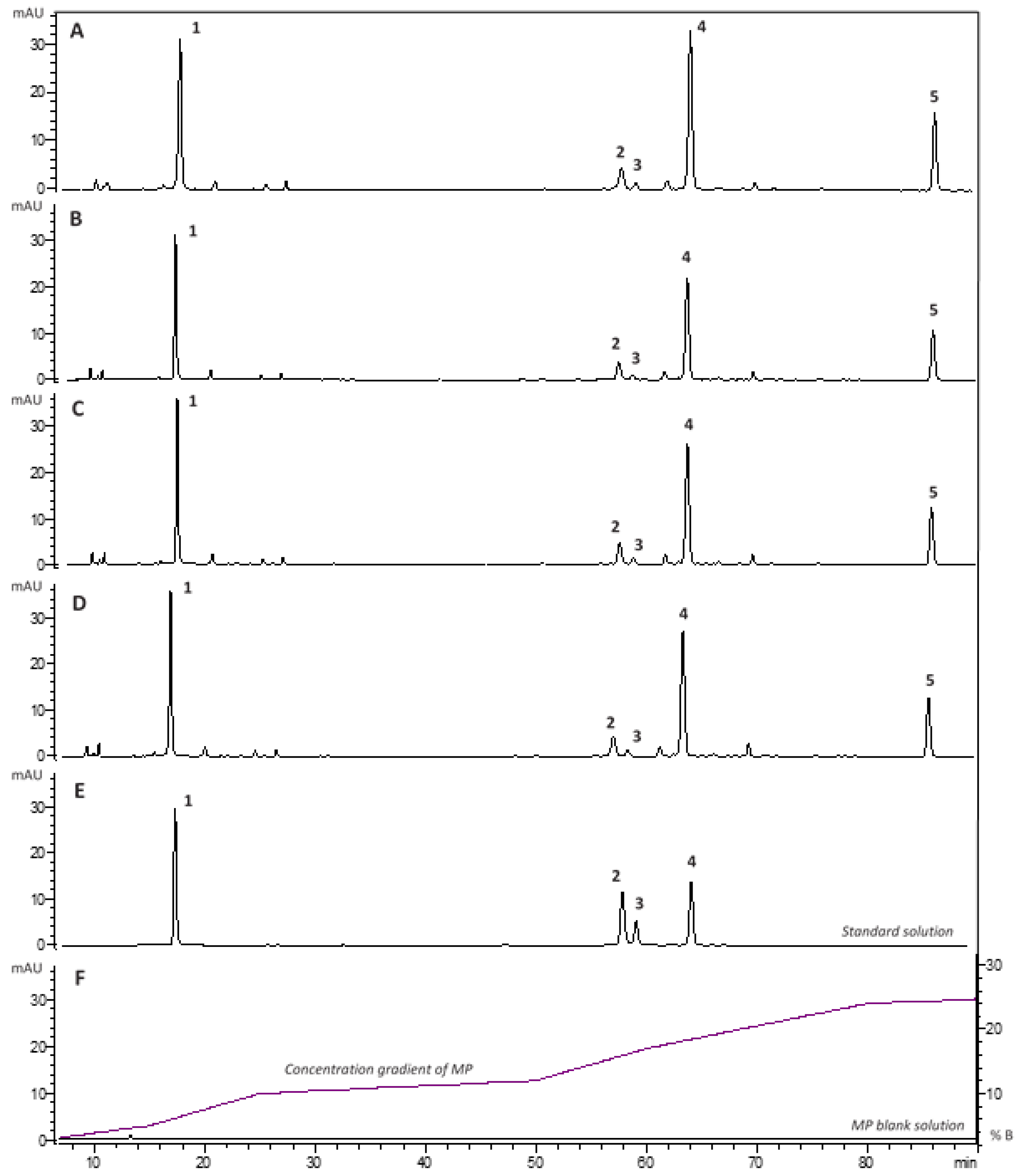
Following the HPLC analysis, the yields of compounds 15 (Figure 1) were determined (quantified for compounds 14 and semi-quantified for compound 5) in all studied extracts and expressed as mg per gram dry weight (DW). The results are summarized in Table 2. The mean total content of the quantified compounds for each extract is also presented. Representative HPLC chromatograms of selected hawthorn extracts, as well as the standard mixture of compounds 14, are shown in Figure 2. To clearly distinguish the extracts from the pure solvents, the extract names henceforth include the abbreviation of the corresponding solvent, followed by the letter “H”.
Although the phenolic profiles of all extracts were qualitatively similar, significant quantitative differences were observed. The results indicated that the extraction efficiency for CHA and flavonoid glycosides was affected by the type of solvent used, with statistically significant variations in yield across solvents (p < 0.05). Certain NADESs demonstrated superior performance in extracting specific bioactive compounds compared to conventional solvents. Based on the findings, LAPD extracted the highest amount of CHA (8.54 ± 0.12 mg/g DW), while CCUW was the most effective for extracting VTX (0.078 ± 0.32 mg/g DW) among all the tested solvents. LAPD also proved to be a highly efficient solvent for extracting HY (1.94 ± 0.27 mg/g DW) and VTX-R (7.35 ± 0.06 mg/g DW), outperforming all other NADESs, ET50, and water (p < 0.05), with the exception of ET70. Following CCUW, LAPD achieved the second highest yield of VTX (0.068 ± 0.02 mg/g DW). In the case of VTX-AR extraction, LAPD (3.44 ± 0.13 mg/g DW) and CCUW (3.19 ± 0.18 mg/g DW) produced the highest yields among NADESs, surpassed only by ET70 and ET50 (p < 0.05). In contrast, CAPD and CCGly were the least effective NADESs, yielding the lowest concentrations of all target compounds (15). As expected, water yielded significantly lower amounts than the ethanol-based mixtures ET70 and ET50.
The observed differences in the extraction performance of NADESs in terms of the individual compounds are expected based on the different NADES components and their interaction with the phenolic metabolites of the hawthorn material [10]. It is well established that solvents’ physicochemical properties influence the extraction process. In particular, viscosity affects the solvent’s ability to penetrate plant tissues and dissolve required components [29]. Higher viscosity impedes mass transfer, resulting in lower extraction yields, as confirmed by our data. Table 1 and Table 2 indicate that highly viscous solvents (CAPD, LAFr, CCGly) generally yielded lower amounts of target compounds. Beyond this trend, no clear correlation was observed between specific physicochemical parameters and extraction yields, suggesting a complex interplay of factors influencing extractability. Although some studies propose that acidic solvents enhance phenolic extraction [28,41,42], our findings do not fully support this, as CCUW, an alkaline solvent (pH 8.18), achieved high yields. Meanwhile, the impact of the solvents’ overall solvation properties should not be neglected, as they strongly influence their ability to dissolve target compounds. Additionally, an important aspect of the overall process is the affinity of the solvents themselves or their components for hawthorn metabolites [11,43]. On this basis it could be assumed that CCUW and especially LAPD, despite LAPD’s viscosity being 24 times higher than ET70, probably possess a high ability to interact and form hydrogen bonds with the target molecules. To date, no data exist on the extraction of VTX-R and VTX-AR from natural sources using NADESs. However, previous studies have demonstrated effective extraction of CHA, HY, and VTX from various plants using choline chloride:urea or lactic acid-based NADESs [44,45,46,47,48,49].

3.2.2. Quantification of Total Flavan-3-Ols and Proanthocyanidins (TFPAC)

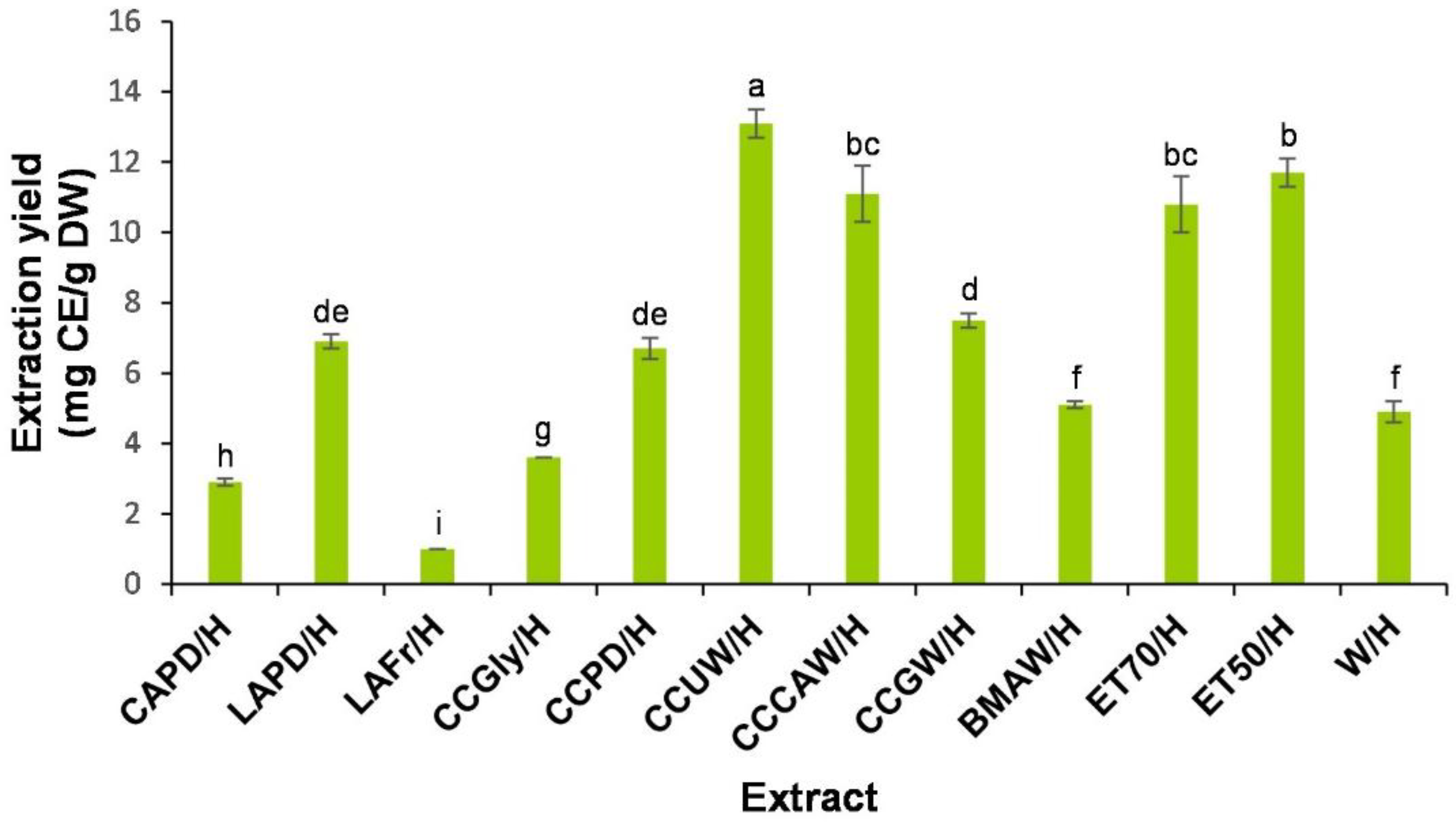
In phytotherapy, hawthorn leaf and flower (Crataegi folium cum flore) is among the most widely used herbal medicines rich in proanthocyanidins, specifically procyanidins, and is officially licensed in the European Union [50]. Beyond their medicinal relevance, these phenolic constituents have attracted growing interest in the food industry due to their strong antioxidant properties, which can improve oxidative stability and extend shelf-life in functional beverages and food formulations. The common hawthorn characteristic procyanidin constituents are (+)-catechin, (−)-epicatechin, dimeric procyanidins B1, B2, B4, B5 and trimeric procyanidin C1, with (−)-epicatechin and procyanidins B1 and B2 being predominant [51,52]. Furthermore, the beneficial effect of C. monogyna on the cardiovascular system is attributed to both flavonoids and oligomeric procyanidins [53]. Accordingly, the extractability of NADESs was evaluated based on the total flavan-3-ols and proanthocyanidins (TFPAC) content, and compared with extracts obtained using conventional solvents. The results are presented in Figure 3.
Figure 3 illustrates significant differences in extraction efficiency of the tested solvents to recover TFPAC (p < 0.05). The extraction yields ranged between 1.0 ± 0.0 and 13.1 ± 0.4 mg CE/g DW as the values are in a similar order to this, reported for leaves and flowers of common hawthorn from other geographic regions, using organic solvents [22,54,55]. Among all hawthorn extracts, the highest TFPAC content was displayed by CCUW/H as its value was significantly higher than that of other solvents including the conventional ones (p < 0.05). Along with the low viscosity, the mildly alkaline pH of the CCUW may contribute to the enhanced extraction of procyanidins from hawthorn. This observation is in line with previous studies reporting improved recovery of procyanidin compounds from natural sources under alkaline conditions. White et al. (2010) demonstrated that alkaline treatment of cranberry pomace using aqueous NaOH increased the proportion of low-molecular-weight procyanidins in the extract [56]. Recently, Loarce et al. (2020) showed that combining subcritical water with 30% NADES (choline chloride-urea, 1:2 molar ratio) improves catechin and epicatechin extraction from winemaking by-products [57]. However, no direct evidence of hydrolysis, depolymerization, or changes in molecular weight was obtained in the present study, and this explanation should be considered only as a possible interpretation. The TFPAC extraction yield when applying CCCAW was comparable to those of ET70 and ET50, which is consistent with a previous study by Dabetic et al. (2022), who reported that choline chloride–citric acid has a strong affinity for procyanidins [58]. The solvents CCGW, LAPD, CCPD and BMAW did not extract as much flavan-3-ols and proanthocyanidins as conventional organic solvents, but their extraction efficiency was higher to comparable to that of water. The lowest TFPAC content was found in LAFr/H, which is not surprising, since LAFr is characterized by the highest density and viscosity compared to the other solvents applied (Table 1).

3.3. Antioxidant Activity

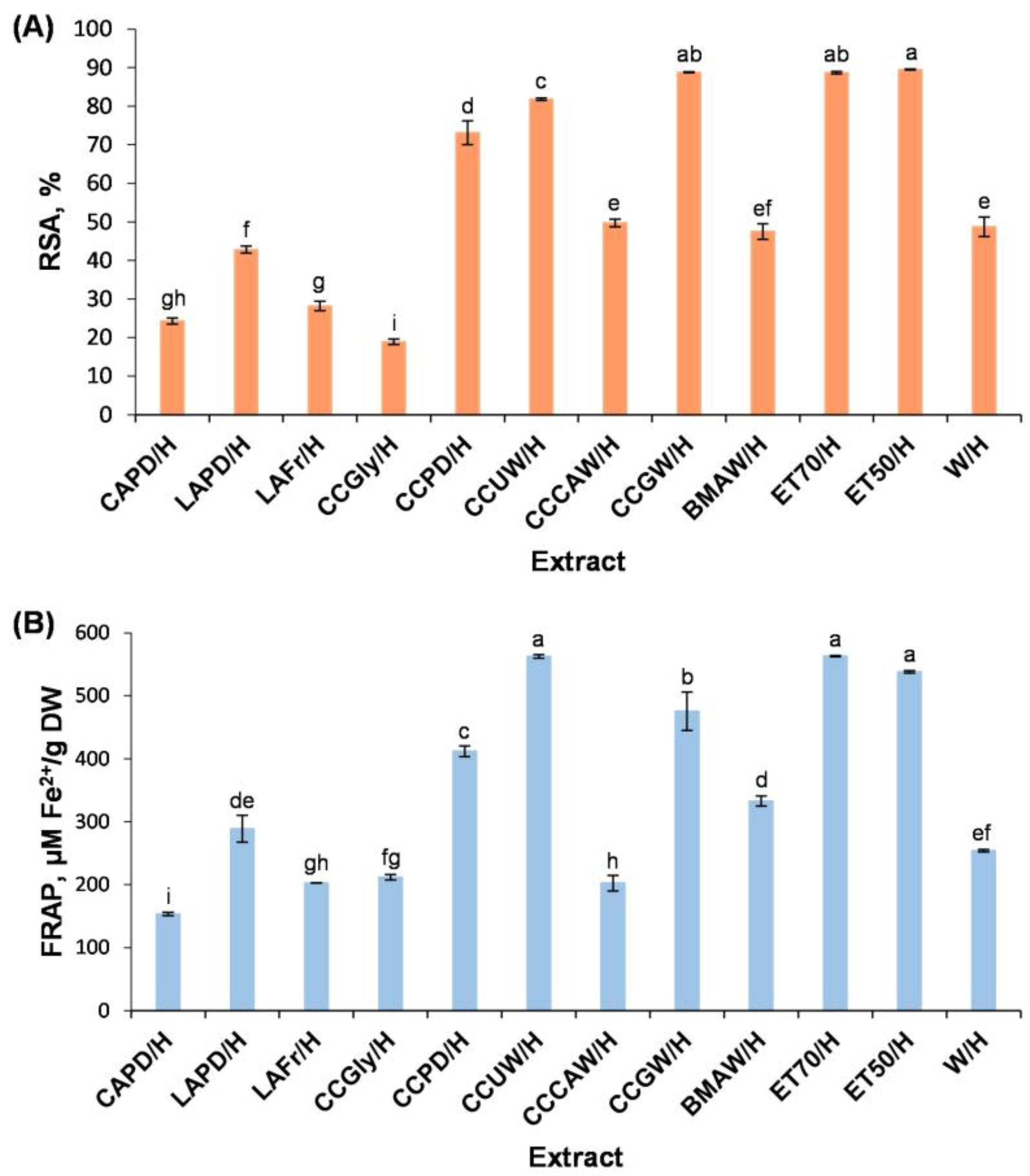
The common hawthorn is not only a valuable remedy for the cardiovascular system but also an emerging ingredient for functional food applications. Its cardioprotective effect is closely associated with significant antioxidant activity, as the oxidative status plays a major role in the development of coronary artery diseases [59,60,61]. Furthermore, antioxidant properties are relevant for food systems where oxidative stability influences product quality and shelf-life. Therefore, the antioxidant activity of the extracts was used as an additional indicator for evaluating the extraction efficiency. In this study, DPPH and FRAP methods, following different reaction mechanisms, were used to assess the antioxidant capacity of the hawthorn extracts. The results are shown in Figure 4. RSA values were determined at an extract concentration of 10% (v/v).
Among the NADES extracts, CCUW/H demonstrated the highest ferric reducing antioxidant power (FRAP), reaching 562.6 ± 0.2 a µmol Fe2+/g DW. This value was not statistically different from those of ET70/H (563.1 ± 0.9 a µmol Fe2+/g DW) and ET50/H (538.1 ± 2.0 a µmol Fe2+/g DW) (p > 0.05), and was 2.2-fold higher than that of the aqueous extract (254.1 ± 1.9 ef µmol Fe2+/g DW). Notably, CCGW/H also demonstrated high ferric reducing capacity (475.4 ± 30.5 b µmol Fe2+/g DW). Regarding DPPH radical scavenging activity, CCGW/H was the most active NADES extract, showing 88.8 ± 0.1 ab% inhibition, which was statistically comparable to ET70/H (88.7 ± 0.3 ab%) and ET50/H (89.5 ± 0.1 a%) (p > 0.05). The second most potent NADES extract in this assay was CCUW/H (81.8 ± 0.3 c%). Despite its high phenolic content (Table 2), LAPD/H exhibited relatively low antioxidant activity, likely due to its lower proanthocyanidins content (Figure 3). The antioxidant activity, including DPPH RSA and FRAP, of various Crataegus monogyna extracts obtained using conventional solvents have already been reported [35,62,63,64], but direct comparison of the results is challenging due to differences in assay procedures, extraction solvents, and the dimensionality of the presented data.
Overall, solvent type markedly affected the extraction performance and antioxidant properties. HPLC profiling revealed significant quantitative differences in the extracts’ phenolic composition, with CCUW and LAPD achieving superior recovery of chlorogenic acid and flavonoid glycosides, underscoring their potential as promising alternatives to ethanol-based systems. Similarly, CCUW provided the highest yield of total flavan-3-ols and proanthocyanidins, outperforming all conventional solvents and other NADESs, highlighting its suitability for procyanidins recovery from common hawthorn. Antioxidant assays further confirmed that CCUW and CCGW exhibited radical scavenging and ferric-reducing capacities comparable to ethanolic extracts, demonstrating that these NADES systems can deliver strong antioxidant activity while supporting green extraction practices.
To elucidate relationships among extraction performance, phenolic composition, and antioxidant activity within the complex dataset obtained, correlation analysis was first employed, followed by chemometric analysis, to identify underlying associations and clustering patterns among the investigated extracts.

3.4. Correlation Analysis

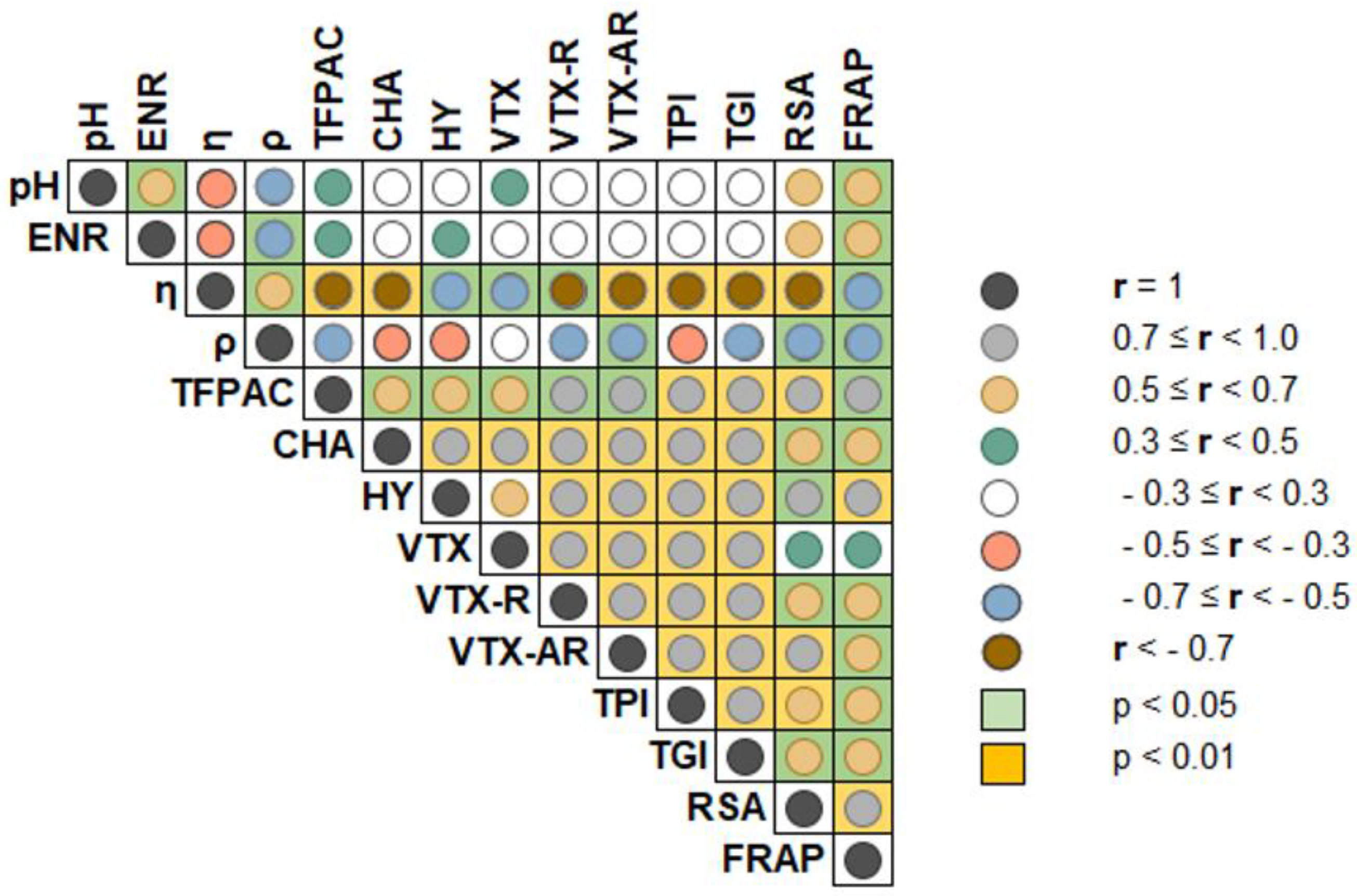
Pearson’s correlation analysis was conducted to examine the relationships between the solvents’ physicochemical properties, the content of phenolic compounds (both total and individual), and the antioxidant activity (FRAP and RSA) of the hawthorn extracts. Statistically significant correlations (p < 0.05 and p < 0.01) among the studied variables are visualized in Figure 5, highlighted in green and yellow, respectively. The corresponding correlation coefficients are presented in Supplementary Materials (Table S2).
Analysis of the physicochemical parameters revealed a strong positive correlation between pH and ENR (r = 0.6502, p < 0.05), as well as between viscosity (η) and density (ρ) (r = 0.5992, p < 0.05). Conversely, a strong negative correlation was observed between ENR and density (r = −0.6727, p < 0.05), although theoretically these two parameters are not directly related, aligning with the findings of Fernandes et al. (2023) [9]. The solvents’ viscosity was negatively correlated with the amounts of all analyzed constituents (total and individual) and with the antioxidant activity of the extracts, as the correlation dependence between viscosity and the quantities of TFPAC, CHA, VTX-R, VTX-AR, TP and TG along with the RSA of the extracts was very strong (r < −0.7, p < 0.01). A strong, though less pronounced, negative correlation was observed for HY, VTX, and FRAP (−0.7 < r < −0.5, p < 0.05). These findings suggest that increased solvent viscosity may significantly hinder the extraction efficiency of phenolic compounds, as well as reduce the antioxidant potential of the resulting extracts. Similarly, a strong negative correlation was observed between the solvents’ density and VTX-AR, RSA and FRAP (−0.7 < r < −0.5, p < 0.05). RSA and FRAP showed significant positive correlations (r > 0.6) with the quantities of all analyzed metabolites except VTX, probably due to the relatively low concentration of VTX in hawthorn extracts. The strongest correlations with RSA were observed for TFPAC (r = 0.7838, p < 0.01), HY (r = 0.702, p < 0.05), and VTX-AR (r = 0.7083, p < 0.01). Regarding FRAP, the strongest positive correlations were with TFPAC (r = 0.7414, p < 0.01) and HY (r = 0.7589, p < 0.01). One of the most notable and strongest positive correlations among all variables was observed between RSA and FRAP (r = 0.9372, p < 0.01).
It should be noted that these relationships reflect statistical associations rather than direct causal effects.

3.5. Chemometric Analysis

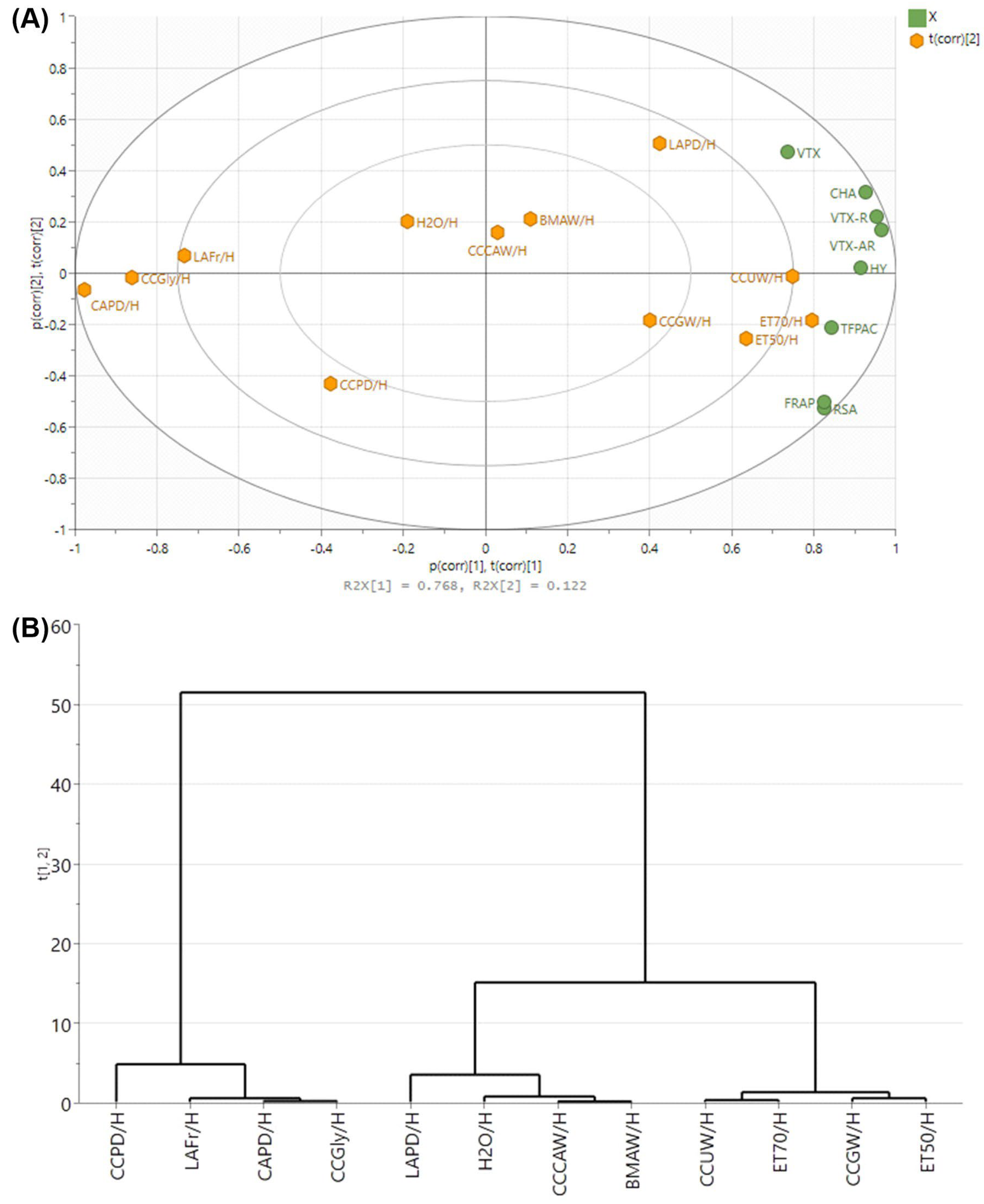
Principal component analysis (PCA) and hierarchical clustering, two unsupervised statistical techniques, were employed to simplify complex datasets and to explore the potential grouping of the extracts, both NADES-based and conventional, according to their metabolic profiles. These profiles included individual phenolic compounds and TFPAC content, as well as antioxidant capacities assessed through DPPH and FRAP assays. The results are displayed in Figure 6.
The PCA score plot revealed a clear separation among the studied extracts, with the first two principal components (PC1 and PC2) explaining 89.0% of the total variance. The first principal component (PC1) accounts for the largest proportion of the total variance and is mainly associated with the overall content of phenolic compounds and antioxidant activity, indicating that samples with higher scores along this axis are characterized by enhanced extraction capacity. The second principal component (PC2) explains a smaller portion of the variance and reflects differences in the relative composition of individual metabolites, contributing to the further differentiation among the extracts.
As shown in Figure 6, the twelve extracts are distinctly grouped into three main clusters by both methods, suggesting that samples with similar compositional and antioxidant profiles are located in proximity in the PCA space, reflecting comparable extraction performance of the respective solvents. No significant distinction is observed between the use of conventional solvents and some NADESs. Specifically, the NADESs CCUW and CCGW exhibit extraction performance comparable to that of ethanolic solvents, while CCCAW and BMAW demonstrate extraction behaviour similar to water. The PCA biplot indicates that the examined variables are positively associated and contribute to the observed separation of samples. Among them, TFPAC content is most strongly correlated with the antioxidant capacities RSA and FRAP. Of all investigated NADES extracts, CCUW/H shows a superior overall profile, combining high concentrations of individual and total target compounds with excellent antioxidant activity. In contrast, the solvents LAPD, BMAW, and CCCAW were particularly effective in the recovery of flavonoid glycosides and chlorogenic acid. These results highlight the potential of CCUW and CCGW as promising and greener alternatives to conventional organic solvents for extracting bioactive metabolites from common hawthorn.
Although Pearson correlation analysis and chemometric tools such as PCA and hierarchical clustering provide valuable insight into the relationships among extraction outcomes (i.e., phenolic composition and antioxidant activity of the extracts), they primarily describe statistical associations rather than direct causative mechanisms. The observed extraction capacity of the different solvents is likely governed by a complex interplay of multiple solvent-related factors, including viscosity, overall solvation properties, pH, and specific solute–solvent interactions such as hydrogen bonding. The observed clustering patterns reflect similarities in extraction performance rather than the direct contribution of individual physicochemical parameters. Within the scope of the present study, it is not possible to unequivocally identify a single dominant factor controlling extraction efficiency of the solvents, which represents a limitation of the study.

4. Conclusions

This study demonstrates the potential applicability of NADESs combined with UAE for the extraction of phenolic compounds from the leaves and flowers of Crataegus monogyna. Among the nine tested NADES systems, choline chloride:urea:water (1:1:6) and choline chloride:glucose:water (5:2:25) exhibited high extraction capacity for procyanidins and the main bioactive metabolites, including chlorogenic acid, hyperoside, vitexin, vitexin-2″-O-rhamnoside, and vitexin 2″-O-(4-O-acetyl)-rhamnoside, the latter being tentatively identified and semi-quantified. These systems also maintained high antioxidant activity of the extracts. The findings indicate that CCUW and CCGW represent promising alternatives to conventional organic solvents for the recovery of phenolic compounds from C. monogyna. The favourable extraction performance, together with the fact that both NADES systems consist of GRAS components, suggests potential applicability of the obtained hawthorn extracts in the formulation of functional foods, beverages, and nutraceutical products. Considering the well-documented bioactivity and traditional medicinal use of common hawthorn, particularly in relation to cardiovascular health, CCUW and CCGW extracts could be considered promising candidates for the development of standardized herbal preparations and supportive medicinal formulations. However, further studies addressing stability, bioavailability, and safety are required to confirm their practical applicability.
The developed and partially validated HPLC method proved suitable for the quantitative profiling of the major phenolic constituents in hawthorn extracts and may be applied in future studies for quality control and/or comparative assessment of extraction approaches. A limitation of this study is the lack of optimization of the extraction parameters, which may further improve extraction yields and process performance. Future research should therefore address process optimization, scalability, and a more comprehensive evaluation of the stability, bioavailability, and safety of NADES-based hawthorn extracts. Such studies will be essential to support their rational application in functional foods, nutraceuticals, dietary supplements, and herbal medicines.

Supplementary Materials

The following supporting information can be downloaded at: https://www.mdpi.com/article/10.3390/app16125924/s1, Table S1: HPLC peak characteristics and validation method results; Table S2: Pearson’s correlation coefficients (r) between solvents’ physicochemical parameters (pH, ENR, η and ρ), the content of phenolic compounds (TFPAC, TP and TG—total phenolic compounds and total glycosides, respectively, quantified by HPLC, and individual compounds—CHA, HY, VTX, VTX-R, VTX-AR), and antioxidant activity (RSA and FRAP) of the hawthorn extracts *; Figure S1: ESI-MS spectrum of vitexin 2″-O-(4-O-acetyl) rhamnoside, obtained from the LC-MS chromatogram of ET70/H extract; Figure S2: The UV spectra of vitexin 2″-O-(4-O-acetyl) rhamnoside (green) and vitexin 2″-O-rhamnoside (black), along with their adjacent UV maxima, obtained from the ET70/H extract.

Author Contributions

Conceptualization, V.B.; methodology, H.P., B.T. and V.B.; validation, V.G.; formal analysis, V.G. and M.P.; investigation, H.P., V.G., B.T. and Z.P.; writing—original draft preparation, B.T.; writing—review and editing, H.P., V.G., B.T., Z.P., V.B. and M.P.; visualization, V.G., B.T. and M.P.; supervision, M.P.; project administration, M.P.; funding acquisition, H.P. All authors have read and agreed to the published version of the manuscript.

Funding

This work was supported by the Bulgarian Ministry of Education and Science through the National Research Program “Young Scientists and Postdoctoral Students”, DCM 577/17.08.2018, and the Centre of Competence “Sustainable Utilization of Bio-resources and Waste of Medicinal and Aromatic Plants for Innovative Bioactive Products” (CoC BioResources, BG16RFPR002-1.014-0001), funded by the Program “Research, Innovation and Digitization for Smart Transformation”, 2021–2027, co-funded by the EU.

Institutional Review Board Statement

Not applicable.

Informed Consent Statement

Not applicable.

Data Availability Statement

The raw data supporting the conclusions of this article will be made available by the authors on request.

Acknowledgments

The authors would like to thank Jeslin Cheruvathoor Jenny, PhD student at the Faculty of Chemistry, Gdańsk University of Technology, for her kind assistance with the DPPH analysis.

Conflicts of Interest

The authors declare no conflicts of interest. The funders had no role in the design of the study; in the collection, analyses, or interpretation of data; in the writing of the manuscript; or in the decision to publish the results.

Abbreviations

The following abbreviations are used in this manuscript:
NADESNatural deep eutectic solvent
DESDeep eutectic solvent
UAEUltrasound assisted extraction
HPLCHigh-performance liquid chromatography
PDAPhotodiode array
DPPH2,2-Diphenyl-1-picrylhydrazyl
FRAPFerric reducing antioxidant power
RSARadical scavenging activity
TFPACTotal flavan-3-ols and proanthocyanidins
CHAChlorogenic acid
HYHyperoside
VTXVitexin
VTX-RVitexin 2″-O-rhamnoside
VTX-ARVitexin 2″-O-(4-O-acetyl) rhamnoside
ACNAcetonitrile
TCATrichloroacetic acid
TPTZ2,4,6-Tri(2-pyridyl)-1,3,5-triazine
DMACp-Dimethylaminocinnamaldehyde
NRNile red
PTFEPolytetrafluoroethylene
LODLimit of detection
LOQLimit of quantification
RTRetention time
RSDRelative standard deviation
SDStandard deviation
GRASGenerally recognized as safe
DWDry weight
TPTotal phenolic compounds
TGTotal glycosides
CECatechin equivalent
PCAPrincipal component analysis

References

  1. Zhang, J.; Chai, X.; Zhao, F.; Hou, G.; Meng, Q. Food Applications and Potential Health Benefits of Hawthorn. Foods 2022, 11, 2861. [Google Scholar] [CrossRef]
  2. Nazhand, A.; Lucarini, M.; Durazzo, A.; Zaccardelli, M.; Cristarella, S.; Souto, S.B.; Silva, A.M.; Severino, P.; Souto, E.B.; Santini, A. Hawthorn (Crataegus spp.): An Updated Overview on Its Beneficial Properties. Forests 2020, 11, 564. [Google Scholar] [CrossRef]
  3. Ganeva, T.; Uzunova, K.; Koleva, D. Comparative leaf epidermis investigation in species of genus Crataegus L. (Rosaceae) from Bulgaria. Feddes Repert. 2009, 120, 169–184. [Google Scholar] [CrossRef]
  4. Edwards, J.E.; Brown, P.N.; Talent, N.; Dickinson, T.A.; Shipley, P.R. A review of the chemistry of the genus Crataegus. Phytochemistry 2012, 79, 5–26. [Google Scholar] [CrossRef]
  5. Martino, E.; Collina, S.; Rossi, D.; Bazzoni, D.; Gaggeri, R.; Bracco, F.; Azzolina, O. Influence of the extraction mode on the yield of hyperoside, vitexin and vitexin-2″-O-rhamnoside from Crataegus monogyna Jacq. (hawthorn). Phytochem. Anal. 2008, 19, 534–540. [Google Scholar] [CrossRef] [PubMed]
  6. Koch, E.; Malek, F.A. Standardized extracts from hawthorn leaves and flowers in the treatment of cardiovascular disorders—Preclinical and clinical studies. Planta Med. 2011, 77, 1123–1128. [Google Scholar] [CrossRef] [PubMed]
  7. Koch, E.; Busse, W.R.; Juretzek, W.; Chevts, V. Hawthorn. In Encyclopedia of Dietary Supplements, 2nd ed.; Coates, P.M., Betz, J.M., Blackman, M.R., Cragg, G.M., Levine, M., Moss, J., White, J.D., Eds.; CRC Press: Boca Raton, FL, USA, 2010; pp. 411–422. [Google Scholar] [CrossRef]
  8. Humphrey, S.; Romm, A. Breastfeeding and Botanical Medicine. In Botanical Medicine for Women’s Health; Romm, A., Hardy, M.L., Mills, S., Eds.; Churchill Livingstone: Saint Louis, MO, USA, 2010; pp. 433–454. [Google Scholar] [CrossRef]
  9. Fernandes, C.C.; Paiva, A.; Haghbakhsh, R.; Duarte, A.R.C. Is it possible to correlate various physicochemical properties of Natural Deep eutectic systems in order to predict their behaviours as solvents? J. Mol. Liq. 2023, 384, 122280. [Google Scholar] [CrossRef]
  10. Dai, Y.; van Spronsen, J.; Witkamp, G.J.; Verpoorte, R.; Choi, Y.H. Natural deep eutectic solvents as new potential media for green technology. Anal. Chim. Acta 2013, 766, 61–68. [Google Scholar] [CrossRef]
  11. Rente, D.; Paiva, A.; Duarte, A.R. The Role of Hydrogen Bond Donor on the Extraction of Phenolic Compounds from Natural Matrices Using Deep Eutectic Systems. Molecules 2021, 26, 2336. [Google Scholar] [CrossRef] [PubMed]
  12. Bragagnolo, F.S.; Strieder, M.M.; Pizani, R.S.; Mesquita, L.M.S.; González-Miquel, M.; Rostagno, M.A. Revisiting natural deep eutectic solvents (NADES) as extraction media and ready-to-use purposes. TrAC Trends Anal. Chem. 2024, 175, 117726. [Google Scholar] [CrossRef]
  13. Huang, M.M.; Yiin, C.L.; Lock, S.S.M.; Chin, B.L.F.; Othman, I.; Zauzi, N.S.B.A.; Chan, Y.H. Natural deep eutectic solvents (NADES) for sustainable extraction of bioactive compounds from medicinal plants: Recent advances, challenges, and future directions. J. Mol. Liq. 2025, 425, 127202. [Google Scholar] [CrossRef]
  14. Sun, X.; Fu, M.; Lou, S.; Li, D.; Han, X.; Gao, S.; Xiu, J.; Wang, J.; Ren, Y. Optimization of flavonoids extracted from hawthorn (Crataegus pinnatifida) by ultrasonic-assisted deep eutectic solvent. Food Biosci. 2024, 59, 103767. [Google Scholar] [CrossRef]
  15. Jiao, P.; Ma, S.; He, X.; Wang, S.; Wang, P.; Yang, P.; Niu, Q. Enhanced Green Extraction of Phenolic Antioxidants from Hawthorn Leaves Based on Deep Eutectic Solvent and Ultrasonic Wave. Waste Biomass Valoriz. 2025, 16, 6275–6288. [Google Scholar] [CrossRef]
  16. Ogihara, W.; Aoyama, T.; Ohno, H. Polarity Measurement for Ionic Liquids Containing Dissociable Protons. Chem. Lett. 2004, 33, 1414–1415. [Google Scholar] [CrossRef]
  17. ICH Harmonized Tripartite Guideline. Validation of Analytical Procedures: Text and Methodology Q2(R1). Available online: https://database.ich.org/sites/default/files/Q2%28R1%29%20Guideline.pdf (accessed on 16 April 2026).
  18. Wallace, T.C.; Giusti, M.M. Evaluation of parameters that affect the 4-dimethylaminocinnamaldehyde assay for flavanols and proanthocyanidins. J. Food Sci. 2010, 75, C619–C625. [Google Scholar] [CrossRef]
  19. Nenadis, N.; Tsimidou, M. Observations on the estimation of scavenging activity of phenolic compounds using rapid 1,1-diphenyl-2-picrylhydrazyl (DPPH) tests. J. Am. Oil Chem. Soc. 2002, 79, 1191–1195. [Google Scholar] [CrossRef]
  20. Benzie, I.F.F.; Devaki, M. The ferric reducing/antioxidant power (FRAP) assay for non-enzymatic antioxidant capacity: Concepts, procedures, limitations and applications. In Measurement of Antioxidant Activity & Capacity: Recent Trends and Applications; Apak, R., Capanoglu, E., Shahidi, F., Eds.; John Wiley & Sons: Chichester, UK, 2018; pp. 77–106. [Google Scholar] [CrossRef]
  21. González, C.G.; Mustafa, N.R.; Wilson, E.G.; Verpoorte, R.; Choi, Y.H. Application of natural deep eutectic solvents for the “green” extraction of vanillin from vanilla pods. Flavour Fragr. J. 2017, 33, 91–96. [Google Scholar] [CrossRef]
  22. Froehlicher, T.; Hennebelle, T.; Martin-Nizard, F.; Cleenewerck, P.; Hilbert, J.-L.; Trotin, F.; Grec, S. Phenolic profiles and antioxidative effects of hawthorn cell suspensions, fresh fruits, and medicinal dried parts. Food Chem. 2009, 115, 897–903. [Google Scholar] [CrossRef]
  23. Zivanovic, N.; Simin, N.; Lesjak, M.; Orcic, D.; Mimica-Dukic, N.; Svircev, E. Comparative study between homemade and commercial hawthorn (Crataegus spp.) extracts regarding their phenolic profile and antioxidant activity. J. Serbian Chem. Soc. 2024, 89, 603–616. [Google Scholar] [CrossRef]
  24. Kell, G.S.; Whalley, E. Reanalysis of the density of liquid water in the range 0–150 °C and 0–1 kbar. J. Chem. Phys. 1975, 62, 3496–3503. [Google Scholar] [CrossRef]
  25. Kovacs, A.; Neyts, E.C.; Cornet, I.; Wijnants, M.; Billen, P. Modeling the Physicochemical Properties of Natural Deep Eutectic Solvents. ChemSusChem 2020, 13, 3789–3804. [Google Scholar] [CrossRef] [PubMed]
  26. Abbasi, N.M.; Anderson, J.L. Insights into the Solvation Characteristics of Zwitterionic Deep Eutectic Solvents Using Multiple Polarity Scales. Ind. Eng. Chem. Res. 2023, 62, 4084–4094. [Google Scholar] [CrossRef]
  27. Dwamena, A.K.; Raynie, D.E. Solvatochromic Parameters of Deep Eutectic Solvents: Effect of Different Carboxylic Acids as Hydrogen Bond Donor. J. Chem. Eng. Data 2020, 65, 640–646. [Google Scholar] [CrossRef]
  28. Mitar, A.; Panić, M.; Radošević, K.; Redovniković, I.R.; Kučan, K.Z.; Sander, A.; Halambek, J.; Kardum, J.P. Physicochemical Properties, Cytotoxicity, and Antioxidative Activity of Natural Deep Eutectic Solvents Containing Organic Acid. Chem. Biochem. Eng. Q. 2019, 33, 1–18. [Google Scholar] [CrossRef]
  29. Zhang, M.; Zhang, X.; Liu, Y.; Wu, K.; Zhu, Y.; Lu, H.; Liang, B. Insights into the relationships between physicochemical properties, solvent performance, and applications of deep eutectic solvents. Environ. Sci. Pollut. Res. 2021, 28, 35537–35563. [Google Scholar] [CrossRef]
  30. Rashid, R.; Mohd Wani, S.; Manzoor, S.; Masoodi, F.A.; Dar, M.M. Green extraction of bioactive compounds from apple pomace by ultrasound assisted natural deep eutectic solvent extraction: Optimisation, comparison and bioactivity. Food Chem. 2023, 398, 133871. [Google Scholar] [CrossRef]
  31. Zhang, Q.; Vigier, K.O.; Royer, S.; Jerome, F. Deep eutectic solvents: Syntheses, properties and applications. Chem. Soc. Rev. 2012, 41, 7108–7146. [Google Scholar] [CrossRef]
  32. Zannou, O.; Koca, I. Greener extraction of anthocyanins and antioxidant activity from blackberry (Rubus spp.) using natural deep eutectic solvents. LWT 2022, 158, 113184. [Google Scholar] [CrossRef]
  33. Sitthisak, C.; Nisoa, M.; Chunglok, W.; Prasopthum, A.; Phaisan, S.; Putalun, W.; Kanchanapoom, T.; Juengwatanatrakul, T.; Yusakul, G. Efficient extraction of quassinoids and alkaloids from Eurycoma longifolia Jack roots using natural deep eutectic solvents and microwave-assisted extraction. Microchem. J. 2024, 196, 109676. [Google Scholar] [CrossRef]
  34. Simeonov, S.P.; Afonso, C.A.M. Basicity and stability of urea deep eutectic mixtures. RSC Adv. 2016, 6, 5485–5490. [Google Scholar] [CrossRef]
  35. Martín-García, B.; Razola-Díaz, M.d.C.; Gómez-Caravaca, A.M.; Benítez, G.; Verardo, V. Setup of an Ultrasonic-Assisted Extraction to Obtain High Phenolic Recovery in Crataegus monogyna Leaves. Molecules 2021, 26, 4536. [Google Scholar] [CrossRef]
  36. Fu, M.; Sun, X.; Fei, C.; Li, D.; Zhang, D.; Tuo, X.; Gao, S.; Han, X.; Xiu, J.; Wang, J.; et al. Optimization and characterization of pectin extracted from hawthorn by deep eutectic solvent. Int. J. Biol. Macromol. 2024, 256, 128688. [Google Scholar] [CrossRef] [PubMed]
  37. Rehwald, A.; Meier, B.; Sticher, O. Qualitative and quantitative reversed-phase high-performance liquid chromatography of flavonoids in Crataegus leaves and flowers. J. Chromatogr. A 1994, 677, 25–33. [Google Scholar] [CrossRef]
  38. Kirakosyan, A.; Seymour, E.; Kaufman, P.B.; Warber, S.; Bolling, S.; Chang, S.C. Antioxidant capacity of polyphenolic extracts from leaves of Crataegus laevigata and Crataegus monogyna (Hawthorn) subjected to drought and cold stress. J. Agric. Food Chem. 2003, 51, 3973–3976. [Google Scholar] [CrossRef] [PubMed]
  39. Prinz, S.; Ringl, A.; Huefner, A.; Pemp, E.; Kopp, B. 4-Acetylvitexin-2″-O-rhamnoside, isoorientin, orientin, and 8-methoxykaempferol-3-O-glucoside as markers for the differentiation of Crataegus monogyna and Crataegus pentagyna from Crataegus laevigata (Rosaceae). Chem. Biodiv. 2007, 4, 2920–2931. [Google Scholar] [CrossRef] [PubMed]
  40. Nikolov, N.; Seligmann, O.; Wagner, H.; Horowitz, R.M.; Gentili, B. Neue flavonoid-glykoside aus Crataegus monogyna und Crataegus pentagyna. Planta Med. 1982, 44, 50–53. [Google Scholar] [CrossRef]
  41. Hikmawanti, N.P.E.; Ramadon, D.; Jantan, I.; Mun’im, A. Natural Deep Eutectic Solvents (NADES): Phytochemical Extraction Performance Enhancer for Pharmaceutical and Nutraceutical Product Development. Plants 2021, 10, 2091. [Google Scholar] [CrossRef]
  42. Airouyuwa, J.O.; Mostafa, H.; Riaz, A.; Maqsood, S. Utilization of natural deep eutectic solvents and ultrasound-assisted extraction as green extraction technique for the recovery of bioactive compounds from date palm (Phoenix dactylifera L.) seeds: An investigation into optimization of process parameters. Ultrason. Sonochem. 2022, 91, 106233. [Google Scholar] [CrossRef]
  43. Dai, Y.; Witkamp, G.J.; Verpoorte, R.; Choi, Y.H. Tailoring properties of natural deep eutectic solvents with water to facilitate their applications. Food Chem. 2015, 187, 14–19. [Google Scholar] [CrossRef]
  44. Redha, A.A. Review on Extraction of Phenolic Compounds from Natural Sources Using Green Deep Eutectic Solvents. J. Agric. Food Chem. 2021, 69, 878–912. [Google Scholar] [CrossRef]
  45. Lazovic, M.; Cvijetic, I.; Jankov, M.; Milojkovic-Opsenica, D.; Trifkovic, J.; Ristivojevic, P. Efficiency of Natural Deep Eutectic Solvents to Extract Phenolic Compounds from Agrimonia eupatoria: Experimental Study and In Silico Modelling. Plants 2022, 11, 2346. [Google Scholar] [CrossRef] [PubMed]
  46. Liu, L.; Xiao, A.; Zhang, Y.; Duan, S. Efficient Extraction of Flavonoids from Lotus Leaves by Ultrasonic-Assisted Deep Eutectic Solvent Extraction and Its Evaluation on Antioxidant Activities. Separations 2023, 10, 65. [Google Scholar] [CrossRef]
  47. Wang, W.; Xiao, S.-Q.; Li, L.-Y.; Gai, Q.-Y. Deep Eutectic Solvent-Based Microwave-Assisted Extraction for the Extraction of Seven Main Flavonoids from Ribes mandshuricum (Maxim.) Kom. Leaves. Separations 2023, 10, 191. [Google Scholar] [CrossRef]
  48. Wei, P.; Zhang, Y.; Wang, Y.Y.; Dong, J.F.; Liao, B.N.; Su, Z.C.; Li, W.; Xu, J.C.; Lou, W.Y.; Su, H.H.; et al. Efficient extraction, excellent activity, and microencapsulation of flavonoids from Moringa oleifera leaves extracted by deep eutectic solvent. Biomass Convers. Biorefin. 2023, 13, 15095–15109. [Google Scholar] [CrossRef]
  49. Li, Z.; Jin, Y.; Deng, J.; Ma, P.; Jin, H.; Zhang, Y.; Dong, A.; Burenjargal, M. Green extraction for hyperoside from Cuscutae semen by natural deep eutectic solvent. Microchem. J. 2025, 209, 112653. [Google Scholar] [CrossRef]
  50. Hellenbrand, N.; Sendker, J.; Lechtenberg, M.; Petereit, F.; Hensel, A. Isolation and quantification of oligomeric and polymeric procyanidins in leaves and flowers of Hawthorn (Crataegus spp.). Fitoterapia 2015, 104, 14–22. [Google Scholar] [CrossRef]
  51. Thompson, R.S.; Jacques, D.; Haslam, E.; Tanner, R.J.N. Plant proanthocyanidins. Part I. Introduction; the isolation, structure, and distribution in nature of plant procyanidins. J. Chem. Soc. Perkin Trans. 1 1972, 1, 1387–1399. [Google Scholar] [CrossRef]
  52. Petereit, F.; Nahrstedt, A. Inhaltsstoffe offizineller Weißdorn-Drogen: Crataegus aus analytischer Sicht. Pharm. Unserer Zeit 2005, 34, 22–26. [Google Scholar] [CrossRef]
  53. Martinelli, F.; Perrone, A.; Yousefi, S.; Papini, S.; Castiglione, S.; Guarino, F.; Cicatelli, A.; Maeaei, M.; Arad, N.; Gholami, M.; et al. Botanical, Phytochemical, Anti-Microbial and Pharmaceutical Characteristics of Hawthorn (Crataegus monogyna Jacq.), Rosaceae. Molecules 2021, 26, 7266. [Google Scholar] [CrossRef]
  54. Đorđević, S.; Čujić-Nikolić, N. Hawthorn (Crataegus spp.) from botanical source to phytopreparations. Lek. Sirovine 2021, 41, 63–71. [Google Scholar] [CrossRef]
  55. Żurek, N.; Kapsuta, I.; Cebulak, T. Content of Polyphenolic Compounds and Biological Activity of Berries, Leaves and Flowers of Crataegus L. Acta Univ. Cibiniensis Ser. E Food Technol. 2023, 27, 35–52. [Google Scholar] [CrossRef]
  56. White, B.L.; Howard, L.R.; Prior, R.L. Release of bound procyanidins from cranberry pomace by alkaline hydrolysis. J. Agric. Food Chem. 2010, 58, 7572–7579. [Google Scholar] [CrossRef]
  57. Loarce, L.; Oliver-Simancas, R.; Marchante, L.; Díaz-Maroto, M.C.; Alañón, M.E. Implementation of subcritical water extraction with natural deep eutectic solvents for sustainable extraction of phenolic compounds from winemaking by-products. Food Res. Int. 2020, 137, 109728. [Google Scholar] [CrossRef] [PubMed]
  58. Dabetic, N.; Todorovic, V.; Malenovic, A.; Sobajic, S.; Markovic, B. Optimization of Extraction and HPLC-MS/MS Profiling of Phenolic Compounds from Red Grape Seed Extracts Using Conventional and Deep Eutectic Solvents. Antioxidants 2022, 11, 1595. [Google Scholar] [CrossRef] [PubMed]
  59. Jayalakshmi, R.; Devaraj, S.N. Cardioprotective effect of tincture of Crataegus on isoproterenol-induced myocardial infarction in rats. J. Pharm. Pharmacol. 2004, 56, 921–926. [Google Scholar] [CrossRef]
  60. Chang, W.T.; Dao, J.; Shao, Z.H. Hawthorn: Potential roles in cardiovascular disease. Am. J. Chin. Med. 2005, 33, 1–10. [Google Scholar] [CrossRef]
  61. Wang, J.; Xiong, X.; Feng, B. Effect of Crataegus usage in cardiovascular disease prevention: An evidence-based approach. Evid. Based Complement. Altern. Med. 2013, 2013, 149363. [Google Scholar] [CrossRef]
  62. Keser, S.; Celik, S.; Turkoglu, S.; Yilmaz, Ö.; Turkoglu, I. The investigation of some bioactive compounds and antioxidant properties of hawthorn (Crataegus monogyna subsp. monogyna Jacq.). J. Intercult. Ethnopharmacol. 2014, 3, 51–55. [Google Scholar] [CrossRef]
  63. Alirezalu, A.; Salehi, P.; Ahmadi, N.; Sonboli, A.; Aceto, S.; Maleki, H.H.; Ayyari, M. Flavonoids profile and antioxidant activity in flowers and leaves of hawthorn species (Crataegus spp.) from different regions of Iran. Int. J. Food Prop. 2018, 21, 452–470. [Google Scholar] [CrossRef]
  64. Papazidou, V.; Makrygiannis, I.; Mantiniotou, M.; Athanasiadis, V.; Bozinou, E.; Lalas, S.I. Isolation of Bioactive Compounds and Antioxidant Activity Evaluation of Crataegus monogyna Leaves via Pulsed Electric Field-Assisted Extraction. Plants 2025, 14, 2262. [Google Scholar] [CrossRef] [PubMed]
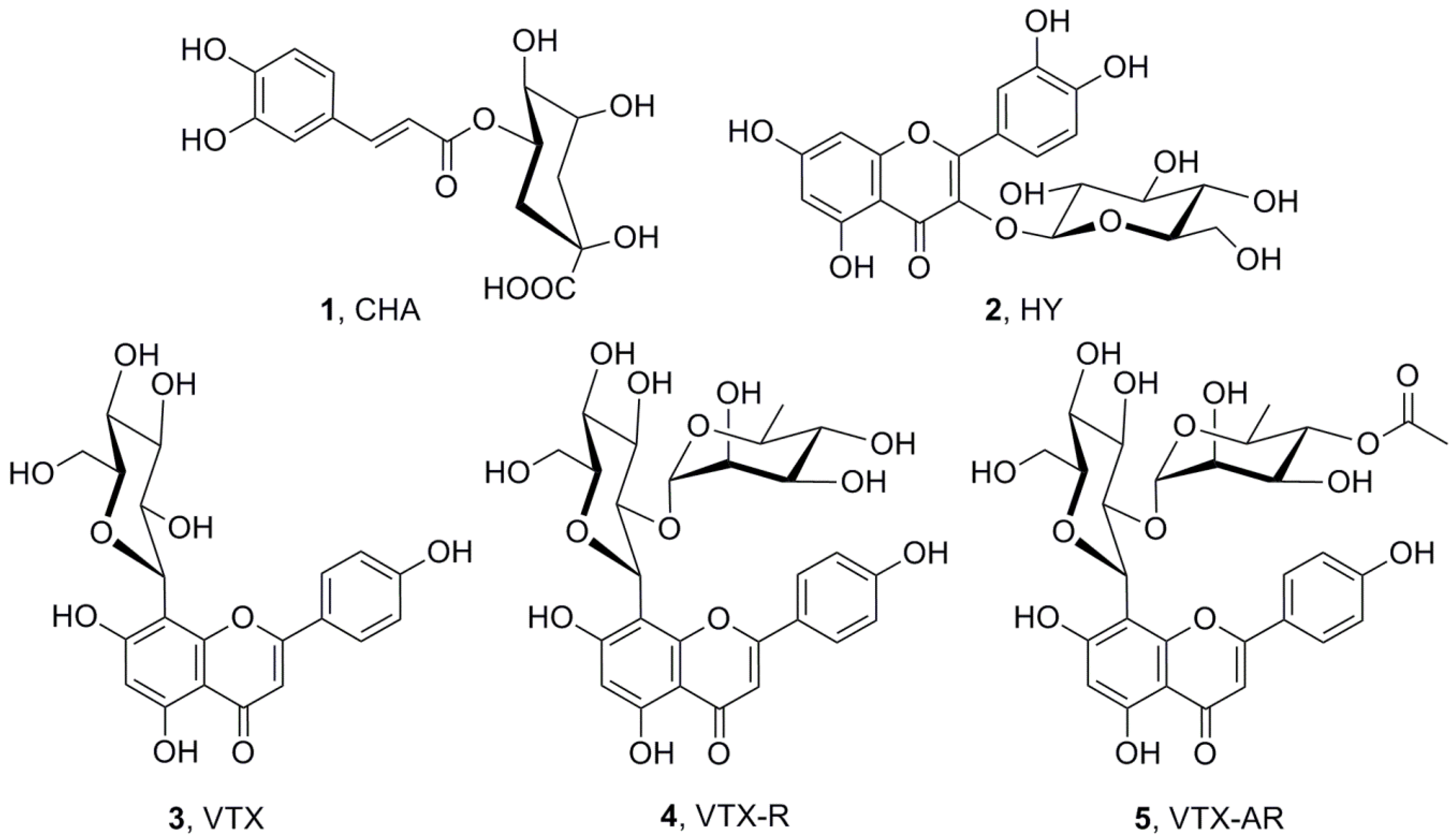
Figure 1. Chemical structures of the target metabolites identified in the studied extracts: chlorogenic acid 1 (CHA), hyperoside 2 (HY), vitexin 3 (VTX), vitexin 2″-O-rhamnoside 4 (VTX-R) and vitexin 2″-O-(4-O-acetyl) rhamnoside 5 (VTX-AR). All structures were drawn by the authors based on literature data. Compound 5 was tentatively identified.
Applsci 16 05924 g001
Figure 2. Typical HPLC-UV chromatograms (at 340 nm) of the hawthorn extracts: (A) ET70/H, (B) CCUW/H, (C) LAPD/H, (D) CCGW/H, showing chlorogenic acid (1), hyperoside (2), vitexin (3), vitexin 2″-O-rhamnoside (4), vitexin 2″-O-(4-O-acetyl)-rhamnoside (5), (E) reference standard solution, and (F) Mobile phase (MP) blank solution with concentration gradient graph of MP (B). Peak 5 is not present in the reference standard chromatogram due to the lack of an authentic standard. The compound was tentatively identified and its content was estimated in a semi-quantitative manner using the regression equation established for compound 4 (VTX-R), based on their structural similarity and comparable UV spectral profiles.
Applsci 16 05924 g002
Figure 3. Extraction yields in terms of TFPAC content. The data represents mean ± SD (n = 3) from three independent measurements of the pooled extract. Different letters above the columns showed significant differences between hawthorn extracts (p < 0.05) by analysis of variance followed by Tukey’s HSD test. CE—catechin equivalent, DW—dry weight.
Applsci 16 05924 g003
Figure 4. Radical scavenging activity (RSA, %) against DPPH• (A) and ferric reducing antioxidant power (FRAP, µM Fe2+/g DW) (B) of the studied extracts. The data represents mean ± SD (n = 3) from three independent measurements of the pooled extract. Different letters above the columns showed significant differences between hawthorn extracts (p < 0.05) by analysis of variance followed by Tukey’s HSD test.
Applsci 16 05924 g004
Figure 5. Correlation graph presenting the correlations between solvents’ physicochemical parameters, the content of phenolic compounds (both total and individual), and antioxidant activity (RSA and FRAP) of the hawthorn extracts. TP and TG refer to total phenolic compounds and total glycosides, respectively, quantified by HPLC.
Applsci 16 05924 g005
Figure 6. 2D PCA score biplot (A) and dendrogram (B) of the hawthorn extracts based on quantities of individual components, TFPAC content, RSA, and FRAP. PC1 and PC2 represent the first two principal components, explaining 76.8% and 12.2% of the total variance, respectively.
Applsci 16 05924 g006
Table 1. Composition and physicochemical parameters of the solvents applied *.
Solvent
Abbreviation
ComponentMolar RatioENR, kcal/molρ, g/mLη, mPa.spH
123
CAPDCitric acid1,2-Propanediol-1:448.21 gij1.19 d670.00 b0.86 j
LAPDD/L-Lactic acid1,2-Propanediol-1:149.55 cef1.11 f50.43 f1.37 i
LAFrD/L-Lactic acidD-Fructose-5:147.85 k1.28 a896.67 a0.40 k
CCGlyCholine chlorideGlycerol-1:250.07 ac1.20 c486.67 c4.56 d
CCPDCholine chloride1,2-Propanediol-1:350.78 a1.06 g87.31 e4.73 c
CCUWCholine chlorideUreaWater1:1:649.68 ce1.10 f6.66 i8.18 a
CCCAWCholine chlorideCitric acidWater1:1:847.89 ijk1.21 c36.24 g0.10 L
CCGWCholine chlorideD-GlucoseWater5:2:2549.17 defg1.15 e23.38 h4.05 g
BMAWBetaineD/L-Malic acidWater1:1:648.67 ghi1.24 b92.53 d2.62 h
ET7070% Ethanol in water (v/v)50.56 ab0.88 i2.09 j4.26 e
ET5050% Ethanol in water (v/v)49.77 bcd0.92 h2.77 j4.11 f
WWater49.04 defgh0.998 **1.01 k6.04 b
* The physicochemical properties are presented as mean values from three independent measurements (RSD < 2%); ** Literature data at 20 °C [24]; ENR—molar transition energy, ρ—density, η—viscosity; Values in the same column with different superscripts are significantly different at p < 0.05 by analysis of variance followed by Tukey’s HSD test.
Table 2. Extraction yields (mg/g DW) of chlorogenic acid, hyperoside, vitexin, vitexin 2″-O-rhamnoside and vitexin 2″-O-(4-O-acetyl) rhamnoside in the obtained common hawthorn extracts determined by HPLC.
ExtractPhenolic Compounds
CHAHYVTXVTX-RVTX-AR *TPTG
mg/g DW ± RSD **Mean, mg/g DW
CAPD/H2.80 ± 1.26 i0.89 ± 1.21 k0.017 ± 0.85 j1.97 ± 0.32 k1.02 ± 0.12 l6.703.86
LAPD/H8.54 ± 0.12 a1.94 ± 0.27 b0.068 ± 0.02 b7.35 ± 0.06 b3.44 ± 0.13 c21.3412.80
LAFr/H4.18 ± 0.37 g1.10 ± 0.97 h0.024 ± 0.73 i3.17 ± 0.26 h1.53 ± 0.32 i10.005.82
CCGly/H2.81 ± 0.84 i1.02 ± 0.45 i0.027 ± 0.29 h2.09 ± 0.31 j1.10 ± 0.16 k7.054.24
CCPD/H3.63 ± 0.69 h1.14 ± 0.30 g0.028 ± 0.34 g2.71 ± 0.17 i1.44 ± 0.18 j8.955.31
CCUW/H7.29 ± 0.25 c1.78 ± 0.41 e0.078 ± 0.32 a6.91 ± 0.12 f3.19 ± 0.18 d19.2511.96
CCCAW/H6.77 ± 1.01 e1.38 ± 0.79 f0.043 ± 0.35 d5.68 ± 0.40 g2.55 ± 0.12 h16.429.64
CCGW/H7.19 ± 0.97 cd1.86 ± 0.36 d0.040 ± 0.19 f6.31 ± 0.25 d2.98 ± 0.40 e18.3811.18
BMAW/H7.31 ± 0.17 c1.78 ± 0.25 e0.048 ± 0.32 c5.83 ± 0.11 f2.71 ± 0.10 f17.6810.37
ET70/H7.93 ± 0.27 b2.21 ± 0.47 a0.041 ± 0.39 e8.06 ± 0.17 a3.85 ± 0.14 a22.0914.16
ET50/H7.14 ± 1.13 de1.91 ± 0.56 c0.040 ± 0.23 f7.33 ± 0.13 b3.50 ± 0.47 b19.9212.78
W/H5.27 ± 1.37 f0.96 ± 1.36 j0.050 ± 0.30 c5.93 ± 0.22 e2.63 ± 0.11 g14.849.57
* In all extracts VTX-AR is semi-quantified based on the standard regression equation of VTX-R; ** RSD (%)—relative standard deviation expressed as a percentage of the mean value; the results are averaged from three analytical replicates; TP—total phenolic compounds and TG—total glycosides, quantified by HPLC; Different letters in the same column indicated significant differences at p < 0.05 (α = 0.05) according to the ANOVA, Tukey’s HSD test.
Disclaimer/Publisher’s Note: The statements, opinions and data contained in all publications are solely those of the individual author(s) and contributor(s) and not of MDPI and/or the editor(s). MDPI and/or the editor(s) disclaim responsibility for any injury to people or property resulting from any ideas, methods, instructions or products referred to in the content.