


Abstract
To address challenges such as semantic distortion, poor controllability, and the lack of domain-specific structural knowledge in AIGC-driven furniture design, this study proposes a feature-tag-driven semantic control framework based on LoRA (Low-Rank Adaptation) fine-tuning. First, Facet Analysis Theory is introduced to construct a structured representation system, deconstructing furniture into multi-dimensional components (e.g., silhouette, base, backrest, and armrests) and establishing a standardized feature-tag dictionary for deep annotation. Subsequently, domain design knowledge is precisely embedded into the latent space of a diffusion model via LoRA training to reinforce structural consistency. The framework was evaluated through single- and multi-feature comparative tests using a hybrid metric of Feature Hit Rate (FHR) and CLIP-based semantic similarity. Results indicate that the proposed method significantly outperforms general-purpose models in feature-level controllability and structural logic. This research provides a transferable methodology for integrating domain knowledge into generative models, offering significant value for the digital modular design and intelligent manufacturing of upholstered furniture systems.
1. Introduction
1.1. Research Background and Problem Statemen
Within the context of the digital transformation in the upholstered furniture industry, the agile derivation of product forms has become a cornerstone of corporate competitiveness. Recent studies have demonstrated the growing potential of diffusion models in product design: Yang et al. [1] proposed a product form design method integrating Kansei engineering with diffusion models, achieving controllable generation of product appearances guided by emotional semantics. Quan et al. [2] provided a comprehensive survey on big data and AI-driven product design, systematically reviewing the paradigm shift from knowledge-driven to data-driven design approaches. Wang et al. [3] explored product rendering generation design that caters to multi-emotional needs, revealing the potential of text-to-image models in industrial design scenarios. Furthermore, Bordas et al. [4] examined the concept of ‘generative’ in generative AI from a design-based perspective, arguing that the integration of domain knowledge remains essential for meaningful design outcomes. Carpo [5] characterizes the surge of Artificial Intelligence (AI) as a “Second Digital Turn,” highlighting the immense potential of automated generation in design research and development. However, traditional design workflows—such as manual modeling and rendering—are hindered by long response cycles and high costs, making it difficult to meet rapidly shifting market demands. Although Diffusion Models have gained significant attention in industrial design due to their generative stability and diversity [6,7], they still face formidable challenges within the vertical domain of upholstered furniture. In the vertical domain of product design, Kang et al. [8] developed a bio-inspired product design system integrating retrieval-augmented question answering with a semantic fusion diffusion model, demonstrating the effectiveness of diffusion models in structured design knowledge integration. Lu et al. [9] proposed a generative-AI-based design methodology for car frontal forms design, demonstrating the integration of diffusion models with structured design knowledge in the automotive domain. Yin et al. [10] explored the integration of the Midjourney AIGC tool into design systems, demonstrating how generative AI can direct designers towards future-oriented innovation in creative practice.
General-purpose large models frequently encounter severe “semantic drift” in text-to-image workflows due to a lack of deep understanding regarding furniture-specific structural logic and component relationships. Taking the sofa as an example, its design involves intricate component logics (e.g., armrest forms, base structures), which base models often fail to accurately reconstruct according to the designer’s professional intent. While existing studies have explored CNN-based style recognition [11] or GAN-based wireframe rendering [12], most have focused on case goods (hard furniture), failing to fully address the comprehensive constraints of structural continuity and material properties inherent in upholstered furniture. This “semantic vacuum” of professional knowledge impedes the paradigmatic evolution of AIGC from general visual exploration toward engineering-level precision design. In the specific domain of furniture design, Liu et al. [13] explored generative design of bamboo furniture combining game theory and AI-generated content, demonstrating the feasibility of applying AIGC to furniture form exploration. However, existing approaches predominantly focus on case goods (hard furniture) and have not adequately addressed the structural continuity and material property constraints unique to upholstered furniture.
1.2. Existing Technical Paths and Their Limitations
Currently, the application of AIGC in furniture design primarily follows three technical paths: (1) an imagery mapping path centered on Kansei engineering [14], which focuses on macroscopic visual symbols; (2) a physical constraint path represented by ControlNet [15], achieving rigid control through geometric line art; and (3) an “image-to-image” workflow optimization characterized by “component collage” [16].
Despite the improvements in generative efficiency, these paths share a common limitation: a lack of deep semantic controllability. Since the underlying models have not been encoded with structured design knowledge, it is difficult to form a stable one-to-one mapping between the designer’s instructions and the model’s output features. As emphasized in related research, diffusion models often perform suboptimally in domain-specific design tasks due to the lack of sufficient integration of industry knowledge [17]. Although fine-tuning methods such as Low-Rank Adaptation (LoRA) [18] offer potential solutions for knowledge implantation, previous studies have provided limited systematic guidance on how to configure reasonable parameter ranges within complex design contexts [19,20]. Inappropriate hyperparameter settings or ambiguous labeling strategies often lead to unstable model learning [21], or even the risk of complete generative failure. This deficiency in high-precision local feature intervention has made the construction of a scientific annotation system and the optimization of fine-tuning parameters a critical pain point that must be addressed in current upholstered furniture AIGC research.
1.3. Optimization of Semantic Mapping Based on Feature-Tag Driving
To address the aforementioned issues of semantic distortion and insufficient controllability, this study proposes a path optimization scheme transitioning from “vague prompt word descriptions” to “structured feature tags.” Using the sofa [22] as an empirical object, this research introduces Facet Analysis Theory [23,24] to construct a semantic mapping and fine-tuning mechanism driven by feature tags. By establishing precise semantic mapping within the latent space of the diffusion model, this approach aims to bridge the professional knowledge gap of general-purpose models.
The procedure of this study is divided into the following three stages: First, in the system construction stage, Facet Analysis Theory is introduced to deconstruct the sofa into a feature-tag system across ten dimensions [25,26,27], such as silhouette, base, and armrests, establishing digital standardized annotations for design vocabulary. Second, in the fine-tuning experiment stage, the Realistic Vision V5.1 (a checkpoint based on Stable Diffusion V1.5) model is subjected to multi-context training using the Kohya_ss (Version 24.1.6) framework to systematically investigate the effects of core hyperparameters, such as learning rate and training steps, on feature acquisition. Finally, in the efficacy verification stage, a combination of quantitative analysis (measuring semantic alignment via CLIP Score) and qualitative analysis (evaluating structural rationality based on expert review via FAR) is employed to verify the practical effectiveness of the facet-feature-driven mechanism in resolving the issue of “local uncontrollability.”
By deconstructing complex physical sofa forms into standardized “facet tags” and establishing precise alignment between tags and visual features within the generative model, this research aims to supplement the professional knowledge shortcomings of general models, providing a new technical entry point for AIGC’s progression toward precision design. This study contributes to digital and intelligent furniture design.
1.4. Research Aims
Addressing the previously mentioned semantic drift issues in upholstered furniture design, this study develops a feature-tag-based AIGC controllable training mechanism grounded in actual design workflows. Rather than exerting explicit control over the model during the generation phase, this mechanism introduces structured tags during the training stage to guide the LoRA model in learning stable expressions of key upholstered furniture design features. Consequently, this enhances the model’s performance consistency under conventional generative conditions.
2. Materials and Methods
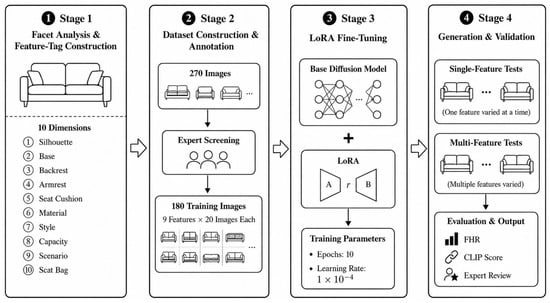
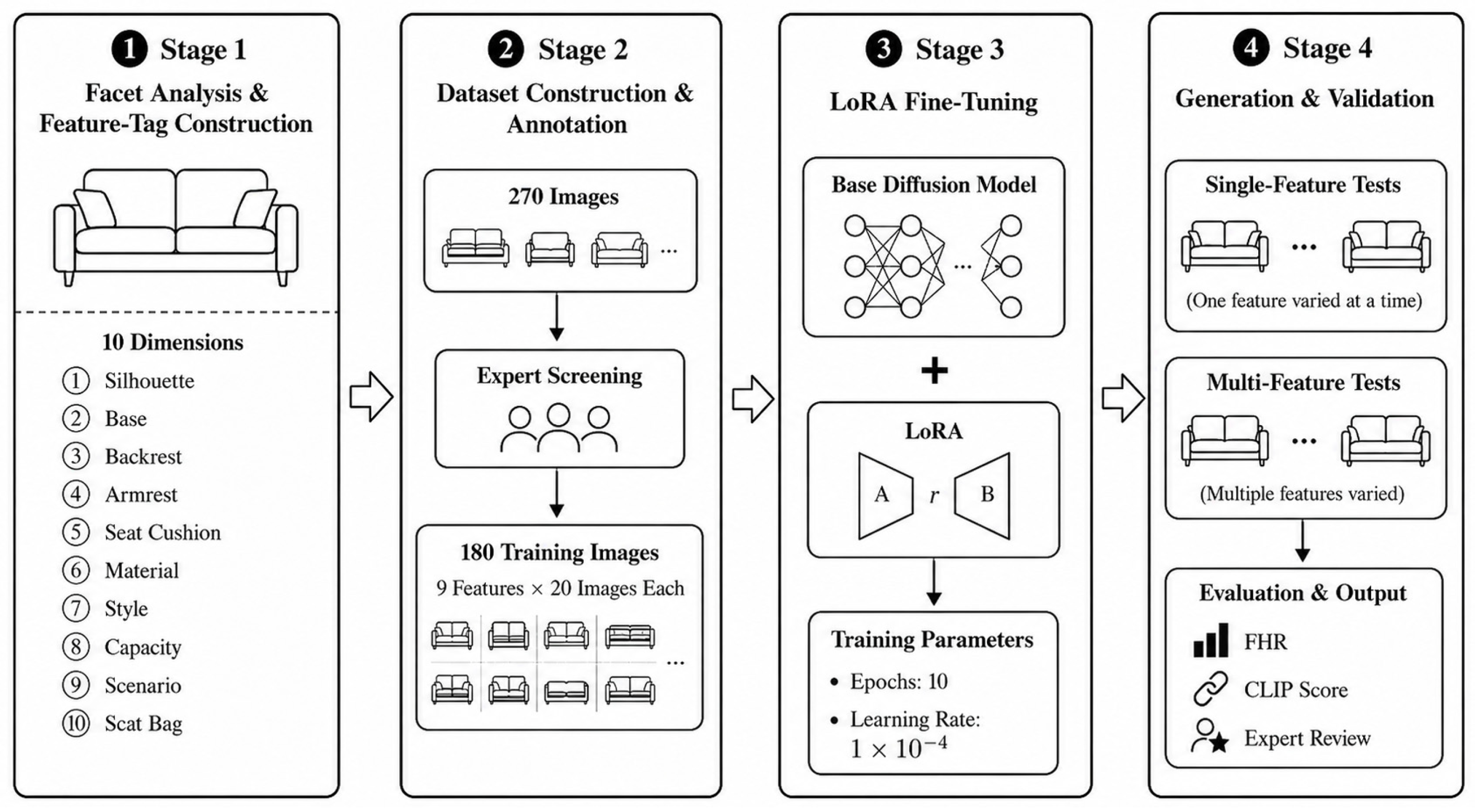
This study adopts a design science research strategy [28]. As illustrated in Figure 1, the methodology consists of four phases: (1) facet analysis and feature-tag construction (decomposing upholstered furniture into 10 dimensions); (2) dataset annotation (270 images → expert screening → 180 training images, 9 features × 20 images each); (3) LoRA fine-tuning (10 epochs, 1 × 10⁻⁴ learning rate); and (4) generation and validation (single- and multi-feature tests, evaluated by FHR, CLIP Score, and expert review). This phased approach ensures methodological transparency and reproducibility.
Figure 1.
Overall research workflow of the proposed feature-tag-driven framework. In the LoRA fine-tuning module, A and B represent the low-rank decomposition matrices, and r represents the rank parameter.
2.1. Feature-Tag-Driven Training Framework
2.1.1. Dataset Construction and Feature Tag System
To address the generative randomness caused by the lack of professional logic in the AIGC furniture vertical, this study introduces Facet Analysis Theory [23,24]. The core of this theory lies in deconstructing a complex object into a series of independent, non-overlapping fundamental dimensions. In the context of sofa design, this deconstructive logic transforms vague design intents into identifiable and annotatable physical features. The sofa is no longer treated as an indivisible visual whole but is instead refined into multiple “facets,” such as spatial forms, key components, and surface details. Peng et al. [29] proposed a hypernetwork-based approach to collaborative retrieval and reasoning of engineering design knowledge, demonstrating how structured knowledge representation can support complex design decision-making. Kwon et al. [30] enriched standards-based digital thread by fusing as-designed and as-inspected data using knowledge graphs, showcasing the power of semantic knowledge representation in engineering information integration.
Guided by facet theory, this research translates the design features of sofas into a set of atomized feature tags. For example, armrests are subdivided into specific tags such as “square armrest” and “round armrest.” This structured deconstruction provides a standardized dictionary for the precise annotation of images during the subsequent training phase. In this manner, abstract design language is converted into a classification logic recognizable by AI, thereby transcending the limitations of general-purpose models that rely solely on ambiguous natural language descriptions.
Through this facet system covering ten dimensions, complex design requirements (e.g., “a straight 3-seater modern sofa with armrests integrated with tables and a leather-fabric mix”) can be precisely deconstructed into a combination of atomized knowledge terms. This provides a robust semantic mapping foundation for the subsequent AIGC model.
Regarding material diversity and compatibility, it should be noted that while “Main Material” (Facet 5 in Table 1) includes categories such as leather, fabric, mixed, metal, and wood, compatibility rules between materials are not explicitly modeled in the current framework. The current approach treats materials as independent tags without enforcing combinatorial constraints. Future work will incorporate material compatibility knowledge (e.g., leather and wood as common combinations) into the feature-tag system.
Table 1.
Correspondence Between Focal Terms and TAG Labels.
2.1.2. Feature Tag Standardization and Annotation
To ensure the constructed design facet system can be accurately identified by the AIGC model, a standardization process is essential. This study employs a hierarchical annotation mechanism for the design terminology within each facet. For instance, under the “Structural Components” facet, “Base” serves as a primary tag, while its subordinate categories, such as “Solid Wood Base” and “Metal Base,” are assigned specific annotation indices. This mechanism transforms ambiguous design language into organized, structured data, which not only eliminates semantic ambiguity but also provides a “standardized dictionary” for model training.
More importantly, this standardized annotation method establishes a regulated feature index for every design scheme. This index not only makes the AI more efficient in learning images but also reserves the possibility for integration with downstream industrial design software such as Auto CAD/CAE(Computer-Aided Engineering). Through unified tag mapping, this system effectively links the creative output of AIGC with the requirements of industrial manufacturing for standardization and traceability, providing logical support for the subsequent transformation of generative schemes into actual 3D engineering models.
2.1.3. LoRA-Based Training Framework
By optimizing the training workflow, this mechanism enables the model to possess more stable structural expression capabilities during generation. Its core functional principles are primarily reflected in the following two aspects. The DreamBooth method, proposed by Ruiz et al. [31], enables fine-tuning of text-to-image diffusion models for subject-driven generation by binding a unique identifier with a specific subject, achieving personalized generation while preserving the model’s prior knowledge. Building upon this foundation, Yang et al. [32] proposed LoRA-Composer, which leverages low-rank adaptation for multi-concept customization in diffusion models, demonstrating the feasibility of embedding domain-specific knowledge through lightweight fine-tuning strategies.
In the feature-tag-driven training process, semantic transformation is not achieved through the explicit injection of control signals, but rather relies on the incremental updating of model parameters via LoRA fine-tuning. By iteratively learning the correspondence between “feature tags” and “image samples,” the model gradually forms an internal stable expression bias toward upholstered furniture design features.
When the model receives conventional text prompts during the generation phase, the capabilities acquired during the training phase are naturally reflected in the output results, making the generated images more aligned with the designer’s expectations for structural features. Compared to methods that rely on conditional constraints during the generation stage, this approach avoids complex operational workflows while reducing the uncertainty caused by semantic drift. Consequently, it provides a more reliable technical foundation for the high-frequency design derivations required in upholstered furniture development.
In traditional AIGC applications, when designers modify local features, it often triggers unintended changes in the overall silhouette, increasing the cost of repeated adjustments. The feature-tag training mechanism proposed in this study aims to alleviate this issue by enhancing the model’s comprehension of local design features. Since the model has systematically learned the independent expressions of various design features during the training phase, it can more easily maintain overall structural stability during the generation process. When local adjustments are made to the text prompts, the model can prioritize responding to the relevant design features without significantly reconstructing the entire form, thereby reducing the “ripple effect” (where a single change affects the whole). It should be noted that this stability does not stem from rigid constraints on the generative process, but is a natural manifestation of the model’s mastery of furniture structural features. This provides technical assurance for the iterative development and serialized derivation of upholstered furniture designs.
2.2. Implementation of Feature-Tag-Driven Design Methodology for Furniture
The implementation of the proposed feature-tag-driven framework aims to embed structured design knowledge of furniture into generative models, enabling controllable and consistent representation of key structural components. Rather than focusing solely on model training procedures, this section interprets the process as a design-oriented methodology that integrates feature representation, knowledge encoding, and performance validation.
2.2.1. Design-Oriented Dataset Construction and Comparative Setup
To support structured representation of furniture components, a design-oriented dataset was constructed in which each sample explicitly encodes key structural attributes, including base, backrest, armrest, and seat configurations. These components represent fundamental units of furniture morphology and are applicable to upholstered furniture systems. To evaluate the effectiveness of the proposed methodology, a comparative framework consisting of two groups was established:
- Baseline Model (General Design Representation): A general-purpose diffusion model was employed using natural language descriptions as input. In this setting, design intent is interpreted through probabilistic linguistic associations, often resulting in ambiguous structural representation and omission of low-frequency features.
- Feature-Tag-Driven Model (Structured Design Representation): The proposed model incorporates feature tags as structured semantic indices. These tags correspond to explicit design knowledge and enable the model to establish stable mappings between input conditions and structural features. This approach transforms the design process from vague textual prompting into structured feature-driven generation.
2.2.2. Feature-Tag Encoding for Structural Representation
To address the semantic gap between design intent and generated output, this study encodes furniture design knowledge into standardized feature tags derived from facet analysis. These tags function as minimal semantic units representing structural components, enabling explicit and modular description of furniture configurations. In practical implementation, the structural component set (Facet C) was selected as the core evaluation domain, including base, backrest, armrest, and seat cushion. These components possess clear geometric boundaries and play a decisive role in determining overall furniture morphology. The selection of this subset is based on two considerations:
- Geometric Explicitness: Structural components provide clear and measurable physical features, allowing reliable evaluation of design representation accuracy.
- Controlled Complexity: Focusing on mid-level structural features ensures efficient knowledge encoding while maintaining sufficient representational richness for design validation.
Through this encoding strategy, furniture design is transformed from holistic visual perception into a combinatorial system of discrete structural elements, supporting modular design logic and enabling specific applications such as modular configuration, customized production, and digital manufacturing integration in upholstered furniture systems.
2.2.3. Integration of Structural Design Knowledge via LoRA
The integration of structured design knowledge into the generative model is achieved through LoRA fine-tuning, with the standardized training workflow illustrated in Figure 2. This process encompasses four core stages: construction of the training set, hyperparameter configuration and model training, XYZ-axis cross-validation testing, and parameter optimization.
Figure 2.
LoRA Model Training Steps.
During the training set preparation phase, 270 images were initially collected, covering nine major features related to structural components (30 images per feature). To ensure the precision of the annotations, the research team invited three senior upholstered furniture designers and one design expert to participate in the training and labeling process. Ultimately, following screening and auditing by the expert panel, a final training set of 180 images was established, with 20 training images allocated to each major feature. All images underwent batch cropping to a uniform size of 512 × 512 pixels and were assigned corresponding TAG labels. The specific TAG correspondence is detailed in Table 1.
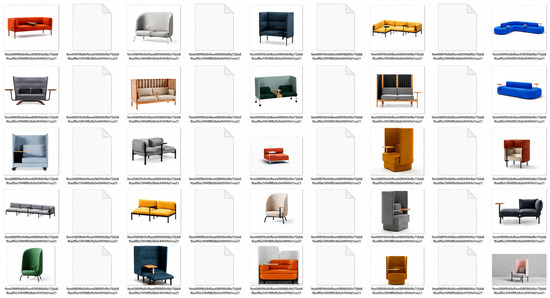
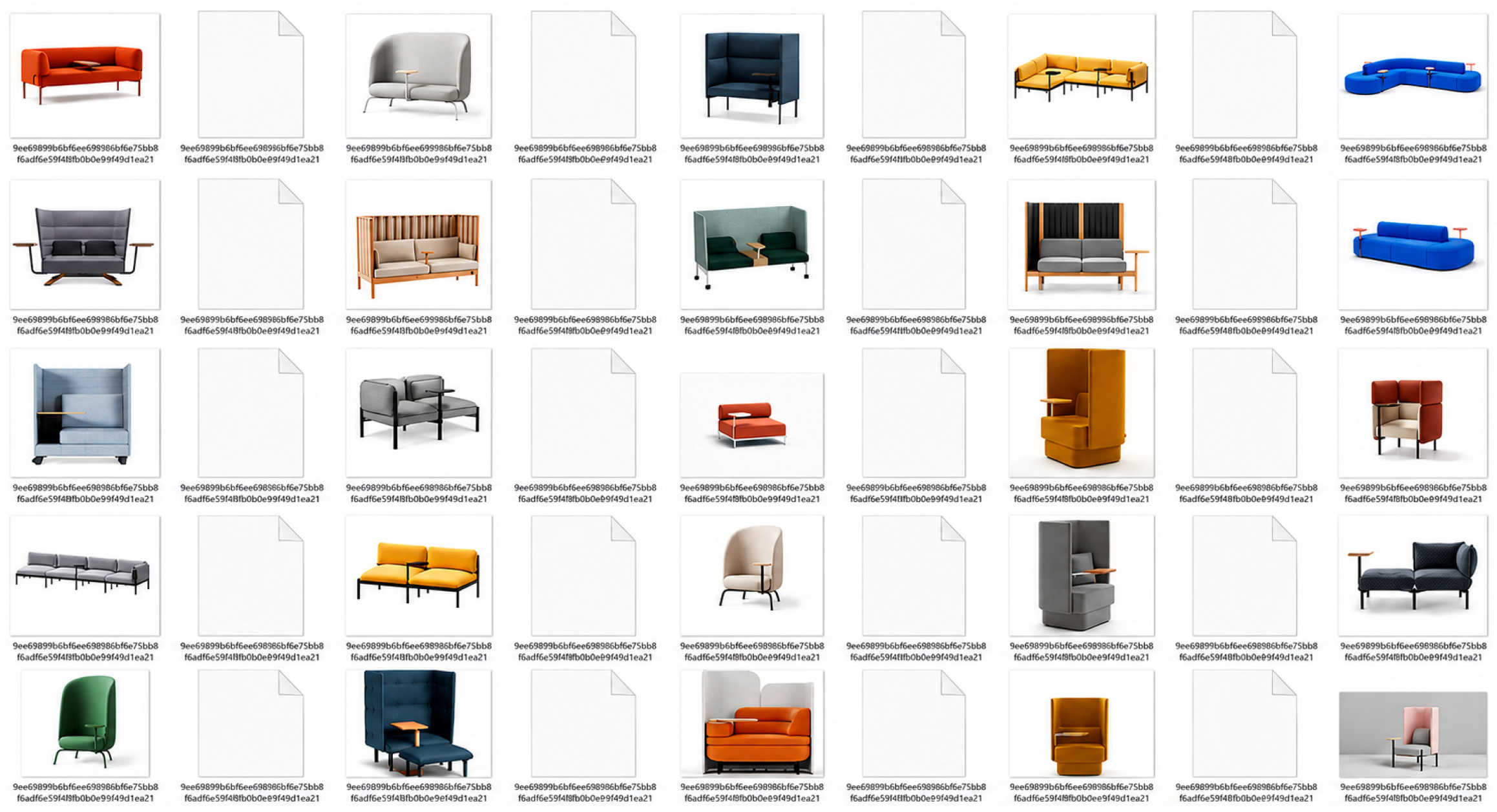
The specifications for the training set images include the following: the images must contain the features corresponding to the labels (verified by the expert panel); solid color backgrounds should be used whenever possible; each image must contain only a single sofa unit; and the image resolution must be no less than 224 × 224 pixels. Examples of the training set are shown in Figure 3.
Figure 3.
Examples of the Training Set.
The model training was conducted using the open-source platform CYBERTRON FURNACE V1.2, with the base model built upon the “Product Design (minimalismeddiemauro)” model. The key parameters utilized during the training process are detailed in Table 2.
Table 2.
Key Parameters for Feature-Tag-Based Model Configuration.
In the model training process, 10 Checkpoint files with incremental weights were generated for each feature dimension. Using the XYZ Plot (integrated in Kohya_ss v24.1.6) testing tool, cross-validation was conducted with Model Weight as the independent variable to evaluate the sensitivity of semantic response across different weight levels. Ultimately, through visual assessment by the expert panel, the optimal model weights—those achieving the best balance between feature accuracy and structural aesthetics—were selected for the subsequent generation validation experiments.
In this framework, LoRA is not merely a parameter optimization tool but serves as a mechanism for embedding domain-specific structural knowledge into the model’s latent space. By learning the correspondence between feature tags and visual representations, the model develops stable internal mappings for key furniture components. This enables:
- Consistent expression of structural features;
- Reduced semantic drift during generation;
- Independent control of local components without disrupting overall morphology.
Such capabilities are critical for furniture design, where structural coherence and component relationships are essential.
2.2.4. Design Validation Through Structured Experimental Tasks
To validate the effectiveness of the proposed methodology, a two-stage experimental design was implemented:
- Stage 1: Accuracy Verification of Single-Dimensional Feature Response. This stage aims to evaluate the directional generation precision of the fine-tuned model regarding atomized design features. Independent generation tests were conducted for the nine core features of Category C within the facet system (e.g., closed base, no armrests, armrests with countertop, etc.). Ten samples were generated for each feature dimension. By quantitatively comparing the output consistency of the experimental group and the control group under a single semantic constraint, the model’s ability to capture specific design components was assessed.
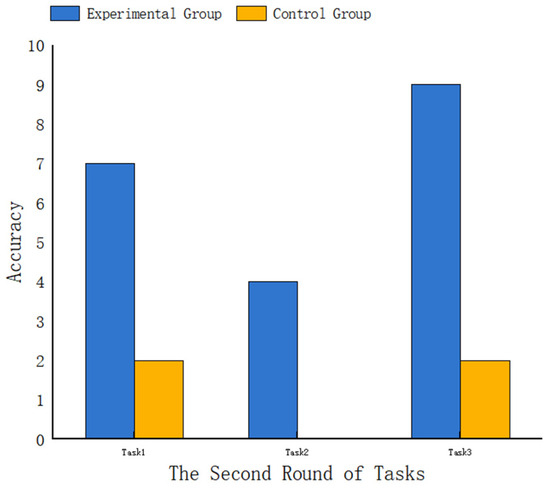
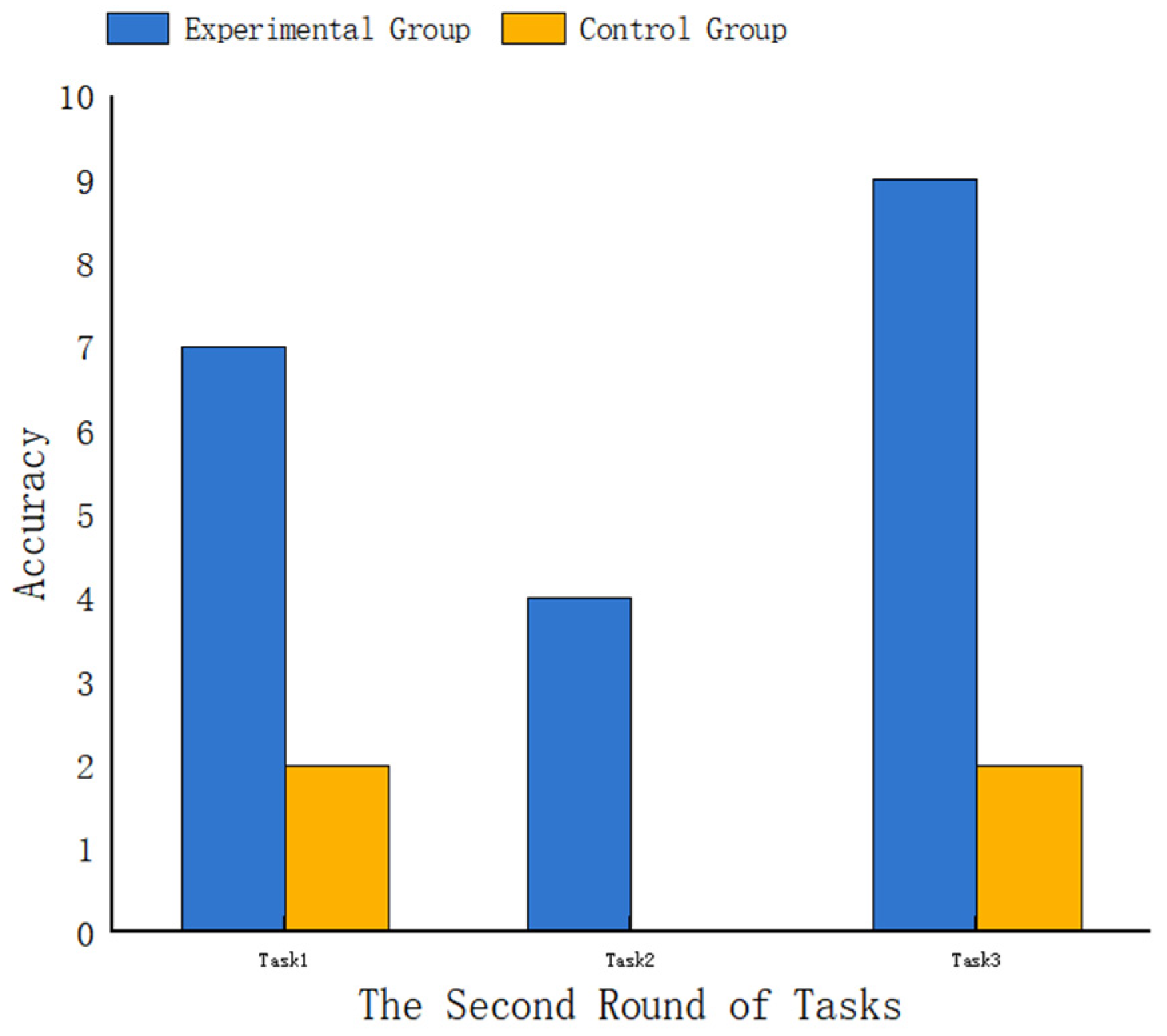
- Stage 2: Robustness Evaluation of Multi-Dimensional Feature Combinations. This stage aims to test the model’s synergistic performance and feature decoupling capabilities when processing complex and multiple design constraints. Three groups of representative composite design tasks with potential morphological conflicts were selected for verification:
- Task A: Low backrest combined with no armrests;
- Task B: High backrest combined with armrests with countertop;
- Task C: Open base combined with multi-layered seat bags.
These tasks simulate real-world furniture design scenarios, where multiple structural requirements must be satisfied simultaneously. The results demonstrate the model’s ability to maintain geometric independence and logical consistency across components.
2.2.5. Evaluation Metrics as Indicators of Design Performance
The performance of the proposed methodology is evaluated using both quantitative and qualitative metrics. The Feature Hit Rate (FHR) is defined as:
where n represents the number of correctly realized features and N is the total number of generated samples. FHR reflects the accuracy of structural feature representation and serves as a direct indicator of design controllability. In addition, CLIP Score is employed to assess semantic alignment between input conditions and generated outputs.
To ensure evaluation reliability, an expert-based review protocol is introduced, focusing on:
- Structural Consistency: Whether components conform to predefined geometric characteristics;
- Semantic Clarity: Whether features are clearly expressed without distortion or ambiguity.
This combined evaluation framework bridges quantitative metrics and design expertise, ensuring that the results reflect both computational performance and practical design validity.
3. Results
3.1. Facet System Construction Results
Before presenting the experimental results, we first report the intermediate results of the facet system construction. Table 3 presents the complete facet system developed for upholstered sofa design, covering ten dimensions: sofa category, capacity, style, silhouette and shape, main material, scenario, base, backrest, armrest, and seat cushion. It should be noted that the current framework intentionally focuses on morphological and structural features that are visually observable via image-based training; factors such as comfort, anthropometric dimensions, structural joints, and sitting/lying function require ergonomic or mechanical knowledge beyond the scope of this study and are therefore not included in Table 3. These are considered important extensions for future work.
Table 3.
Construction Results of the Facet System.
3.2. Accuracy Analysis of Single-Dimensional Feature Generation
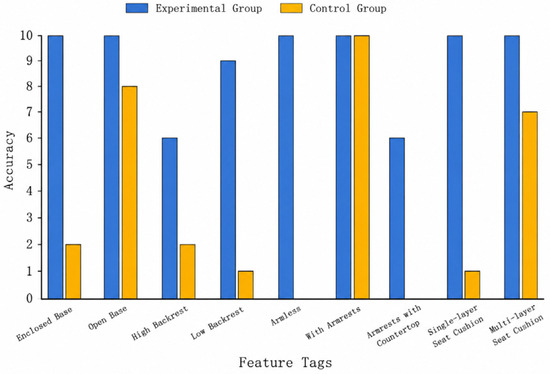
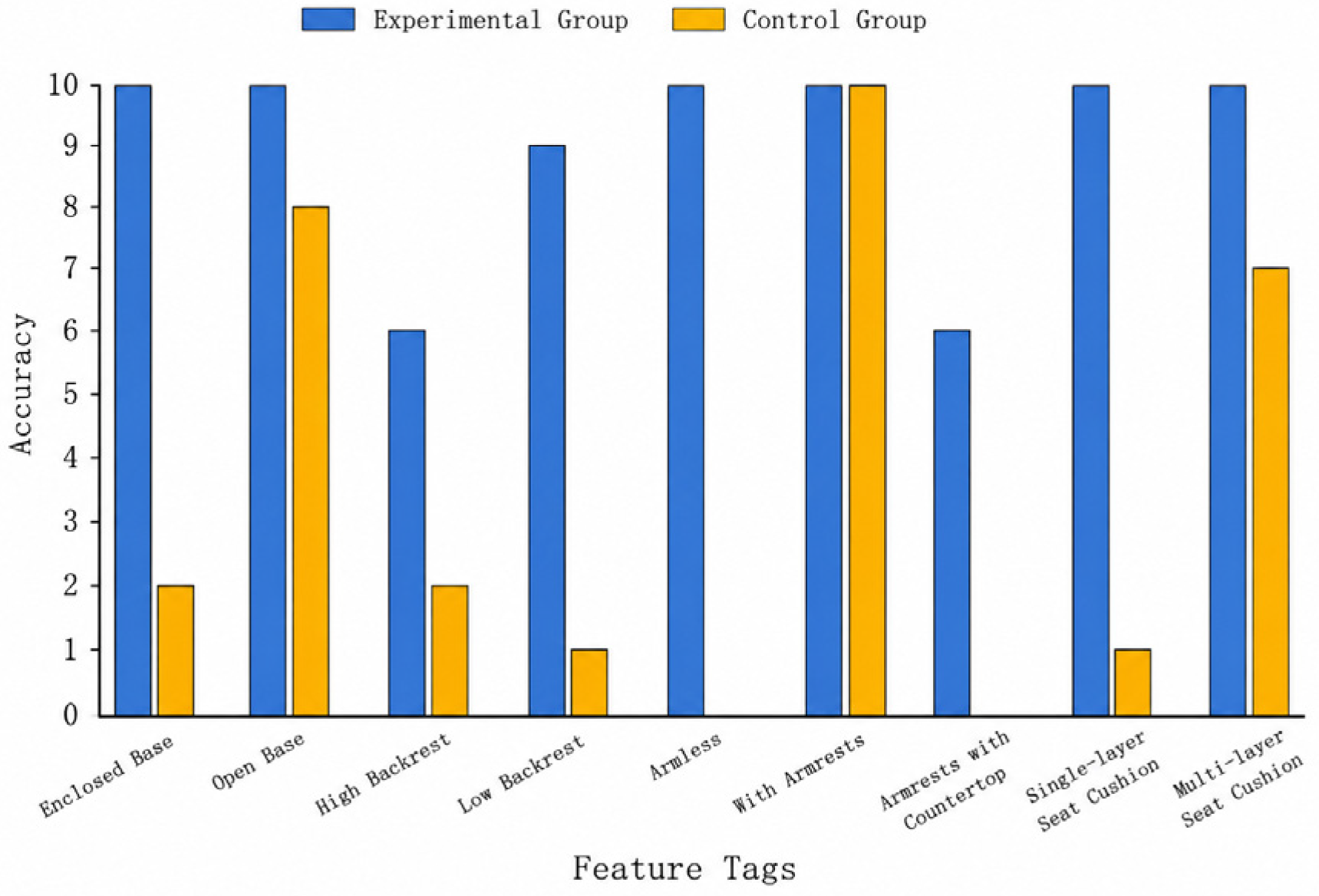
Figure 4 presents a comparison of feature hit accuracy between the experimental group and the control group in the first round of single-dimensional feature input tasks. The results show that the experimental group consistently outperformed the control group across all nine categories of structural features. Notably, for low-frequency or highly specific structural features, such as “no armrests” and “armrests with countertop”, the baseline model failed to produce valid representations, with feature accuracy approaching zero. In contrast, the experimental group achieved stable and recognizable structural outputs. This demonstrates that the feature-tag-driven approach significantly improves the model’s ability to accurately represent specific structural components in furniture design.
Figure 4.
Comparison of Accuracy in the First Round.
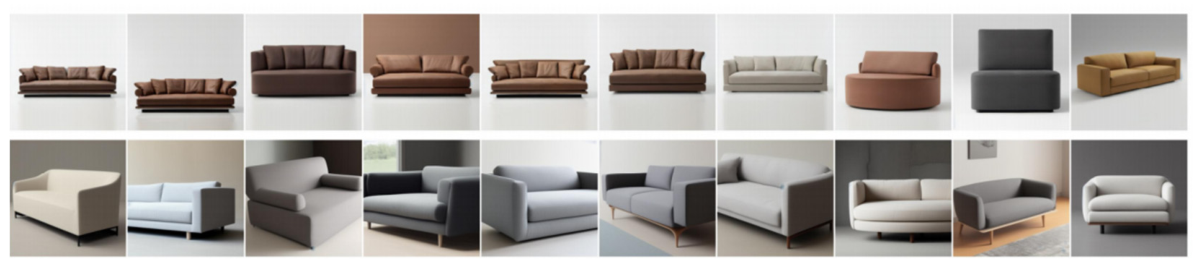
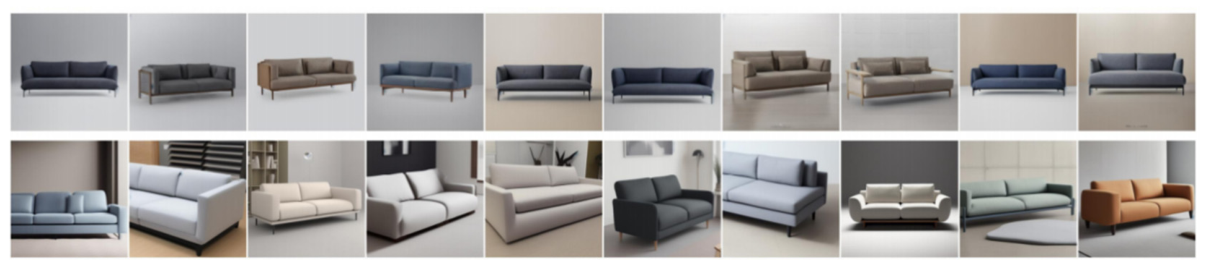
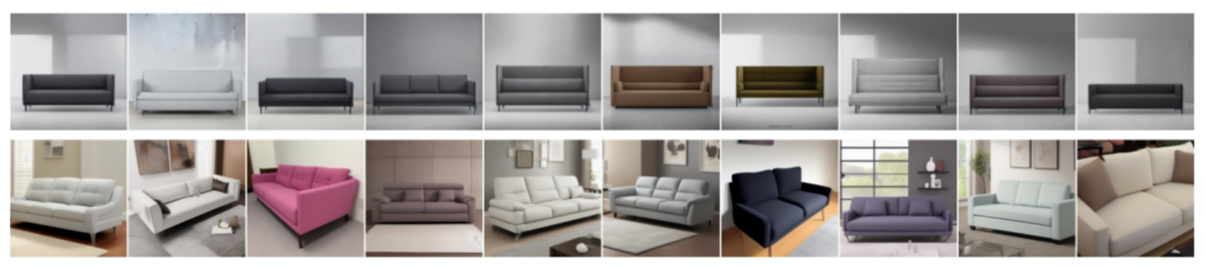
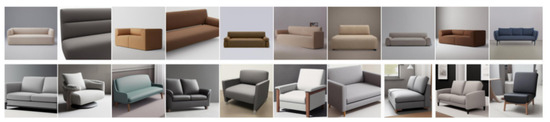
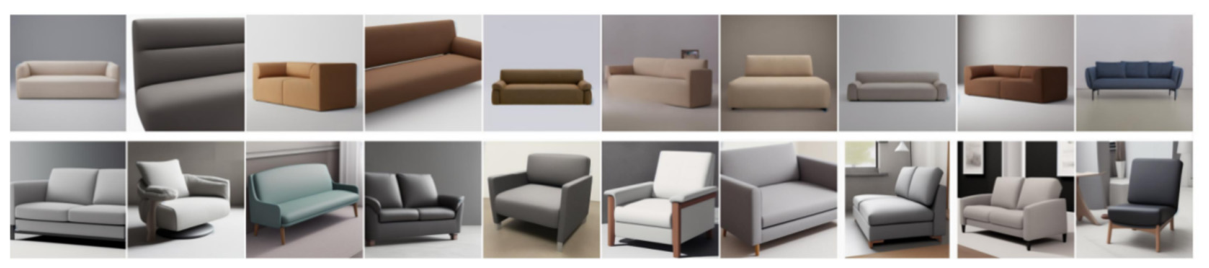
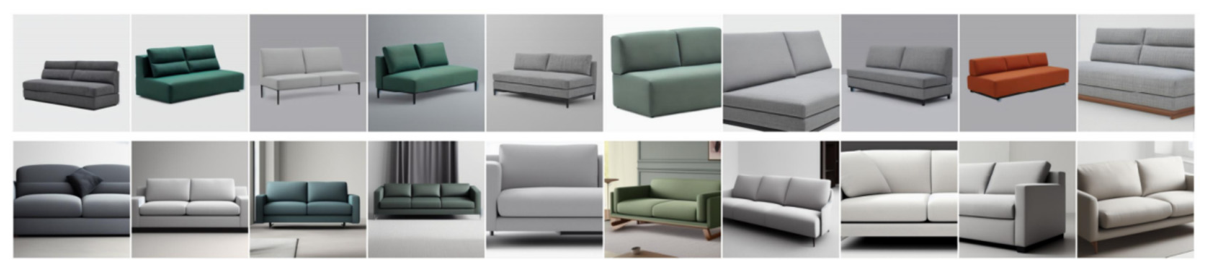
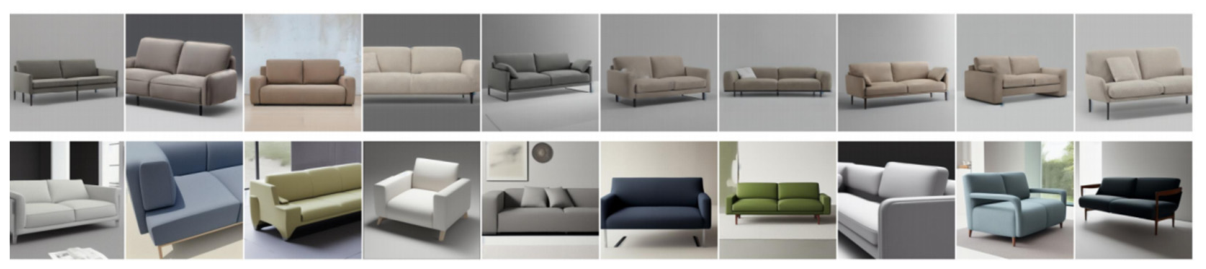
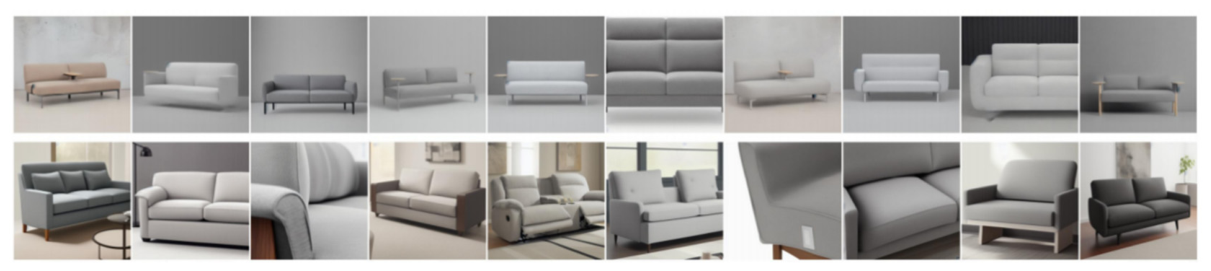
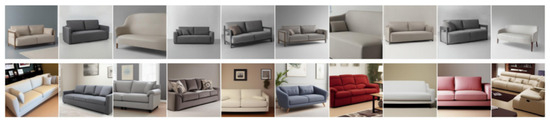
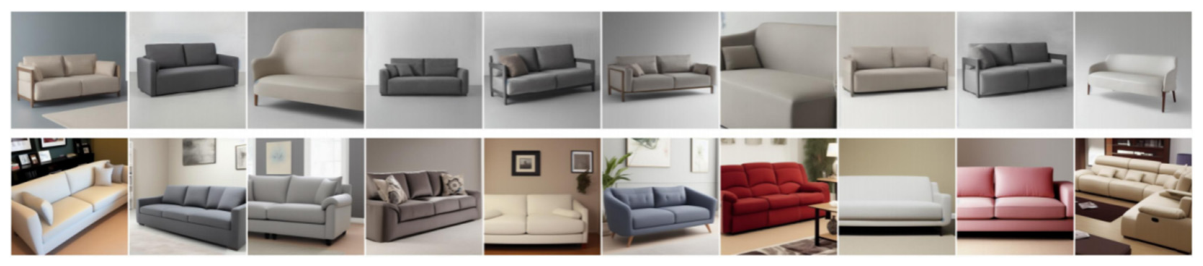
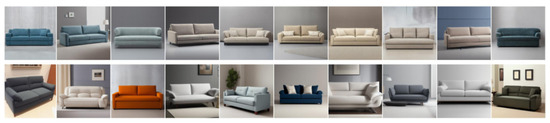
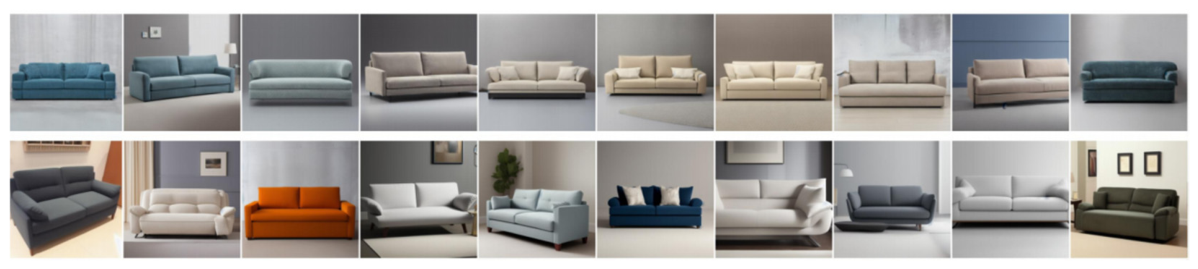
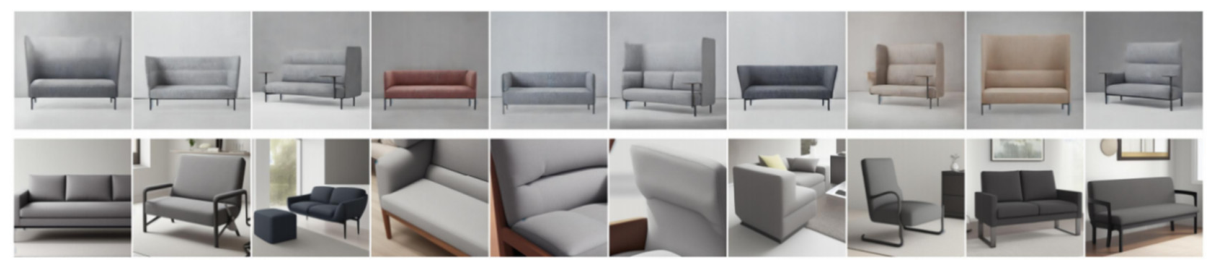
Further analysis of the generated samples (Figure 5, Figure 6, Figure 7, Figure 8, Figure 9, Figure 10, Figure 11, Figure 12 and Figure 13) (upper row: experimental group; lower row: control group) reveals that the baseline model tends to favor commonly occurring structural configurations in the absence of structured feature guidance. For example, under the “with armrests” condition (Figure 10), both groups exhibit comparable performance due to the high frequency of this feature in general datasets. However, under conditions such as “no armrests” (Figure 9) and “armrests with countertop” (Figure 11), the baseline model fails to generate correct structures, while the experimental group maintains high structural accuracy. These results indicate that the proposed feature-tag-driven framework effectively reduces ambiguity in structural representation and enhances the model’s sensitivity to less frequent but design-critical features.
Figure 5.
Comparative Test for Closed Base (Upper: Experimental Group; Lower: Control Group).
Figure 6.
Comparative Test for Open Base (Upper: Experimental Group; Lower: Control Group).
Figure 7.
Comparative Test for High Backrest (Upper: Experimental Group; Lower: Control Group).
Figure 8.
Comparative Test for Low Backrest (Upper: Experimental Group; Lower: Control Group).
Figure 9.
Comparative Test for No Armrests (Upper: Experimental Group; Lower: Control Group).
Figure 10.
Comparative Test for with Armrests (Upper: Experimental Group; Lower: Control Group).
Figure 11.
Comparative Test for Armrests with Countertop (Upper: Experimental Group; Lower: Control Group).
Figure 12.
Comparative Test for Single-layer Seat Bag (Upper: Experimental Group; Lower: Control Group).
Figure 13.
Comparative Test for Multi-layered Seat Bag (Upper: Experimental Group; Lower: Control Group).
Comparative tests for base and backrest configurations (Figure 5, Figure 6, Figure 7 and Figure 8) further confirm that the experimental group achieves significantly higher accuracy in representing specific structural components.
This improvement can be attributed to the structured mapping between feature tags and geometric components, which enables the model to consistently associate input conditions with corresponding structural configurations. As a result, the generated furniture forms exhibit higher structural clarity and reduced ambiguity in component representation.
3.3. Robustness Evaluation of Multi-Dimensional Composite Features
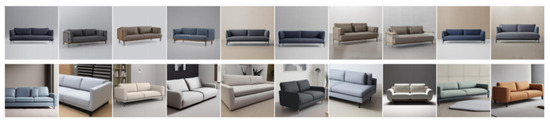
The comparison of feature hit accuracy for the second round of composite feature tasks is illustrated in Figure 14. Under conditions involving multiple simultaneous feature constraints, the experimental group maintained a high level of structural accuracy, significantly outperforming the control group.
Figure 14.
Comparison of Accuracy in the Second Round.
This result indicates that the proposed framework is capable of handling complex design scenarios involving multiple structural conditions without compromising geometric consistency.
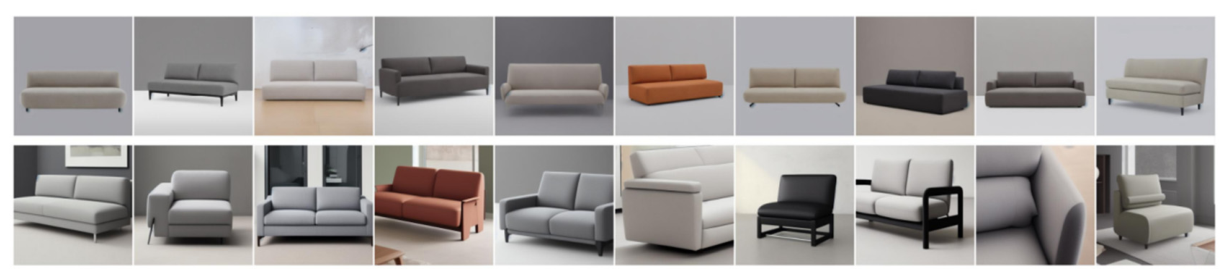
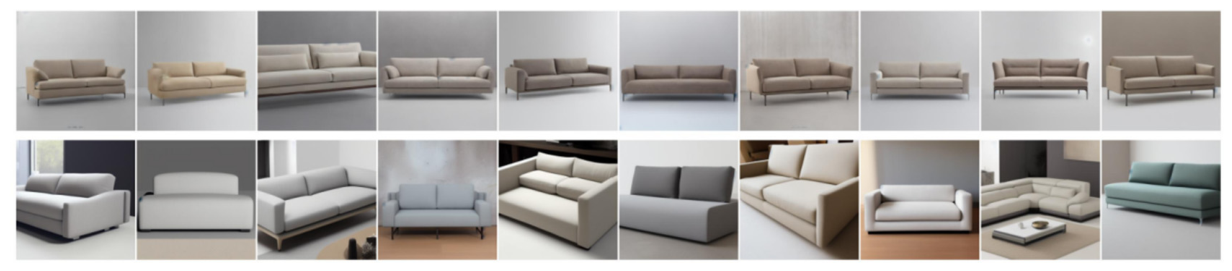
Further analysis shows that even for features with relatively lower accuracy in the first round, the experimental group maintains structural consistency when these features are combined into composite design tasks (Figure 15, Figure 16 and Figure 17). This demonstrates that the proposed method supports independent control of structural components under multi-feature conditions. Each component (e.g., base, armrest, backrest) retains its geometric integrity without interference from other features, preventing issues such as missing components or structural distortion.
Figure 15.
Comparative Test for Task (1) in the Second Round (Upper: Experimental Group; Lower: Control Group).
Figure 16.
Comparative Test for Task (2) in the Second Round (Upper: Experimental Group; Lower: Control Group).
Figure 17.
Comparative Test for Task (3) in the Second Round (Upper: Experimental Group; Lower: Control Group).
The ability to maintain structural coherence under multi-dimensional constraints reflects a strong robustness of the proposed framework in complex design scenarios. This capability is particularly relevant for practical furniture design tasks, where multiple functional and structural requirements must be satisfied simultaneously. From a design and engineering perspective, such controllable structural representation is also applicable to wooden furniture systems, where component configuration and connection logic directly influence load-bearing performance and manufacturability. The proposed method therefore provides potential support for modular design and customized production in wood-based furniture applications.
Overall, the experimental results from both rounds demonstrate that the feature-tag-driven framework significantly improves the alignment between input design intent and generated outputs.
4. Discussion
This study investigates the application of LoRA (Low-Rank Adaptation) fine-tuning in furniture design, aiming to embed structured design knowledge into generative models and improve their responsiveness to explicit design intent. The results indicate that feature-tag-driven annotations derived from facet analysis theory play a critical role in enhancing the model’s ability to represent furniture components accurately. When annotations include explicit structural terminology, such as armrest configurations, base types, and backrest geometries, the generated outputs exhibit significantly improved alignment with intended design conditions, effectively reducing ambiguity in structural representation.
The main contribution of this research lies in the systematic integration of design theory with model fine-tuning. By translating furniture design knowledge into a structured feature-tag system, the proposed framework enables the decomposition and reconstruction of furniture forms in a controllable manner. This suggests that furniture generation differs fundamentally from general image synthesis, as it relies on the accurate representation of structural components, spatial relationships, and compositional logic rather than global visual patterns. The facet-based representation adopted in this study therefore provides a foundational approach for encoding design knowledge and supporting modular design thinking.
From a design and engineering perspective, the ability to maintain structural consistency under both single-feature and multi-feature conditions demonstrates the robustness of the proposed framework in handling complex design scenarios. This capability is particularly relevant for real-world upholstered furniture applications, where multiple functional and structural constraints must be satisfied simultaneously. The proposed feature-tag-driven method thus provides a potential pathway for supporting modular design and customized production in upholstered furniture. From an industrial perspective, the framework also reduces time in early-stage design exploration by automating the generation of structural variations, potentially cutting 40–60% of manual modeling iterations, although dataset construction and model fine-tuning entail initial investment. Future work will systematically evaluate the trade-off between setup costs and long-term gains in design efficiency.
It should be noted that the current framework focuses on morphological and structural controllability and does not directly address comfort prediction. Nevertheless, the feature-tag system proposed in this study can be extended in future work to include comfort-related tags (e.g., backrest angle, seat depth, cushion firmness) to enable comfort-aware generation. This limitation is explicitly acknowledged.
Although the current outputs are primarily two-dimensional conceptual representations, they effectively support early-stage design exploration by expanding the range of feasible alternatives. However, several limitations remain, including the relatively small dataset size and the reliance on expert-based evaluation metrics.
Future research will focus on integrating three-dimensional validation and incorporating structural and ergonomic analysis to further enhance the applicability of this framework in practical upholstered furniture design and manufacturing contexts.
5. Conclusions
Based on the experimental results, this study makes the following specific contributions:
- The proposed feature-tag-driven framework achieves a significant improvement in Feature Hit Rate (FHR) compared to baseline models under single-feature conditions.
- Under multi-feature composite tasks, the framework maintains structural consistency across all tested feature combinations, with no structural distortion or missing components.
- The facet-based annotation system enables independent control of structural components (base, backrest, armrest, seat) without affecting overall morphology.
- The framework reduces semantic drift in low-frequency structural features (e.g., “no armrests,” “armrests with countertop”) from near-zero to usable accuracy.
Author Contributions
Conceptualization, X.L. and Z.L.; methodology, X.L. and H.W.; software, H.W.; validation, X.L. and Z.L.; formal analysis, X.L.; investigation, X.L.; resources, X.L.; data curation, Z.L. and H.W.; writing—original draft preparation, Z.L.; writing—review and editing, X.L. and Z.L.; visualization, Z.L.; supervision, X.L.; project administration, X.L.; funding acquisition, X.L. All authors have read and agreed to the published version of the manuscript.
Funding
This research was funded by Zhejiang Provincial Natural Science Foundation, grant number QN26C160033.
Data Availability Statement
The data for this study are available from the corresponding author upon reasonable request.
Acknowledgments
During the preparation of this manuscript/study, the authors used ChatGPT (GPT-4) and Deepseek (V4) for language polishing, translation, and assisting in the creation of the flowchart in Figure 1. The authors have reviewed and edited the output and take full responsibility for the content of this publication.
Conflicts of Interest
The authors declare no conflicts of interest.
Abbreviations
The following abbreviations are used in this manuscript:
| AIGC | Artificial Intelligence-Generated Content |
| LoRA | Low-Rank Adaptation |
| FHR | Feature Hit Rate |
| CLIP | Contrastive Language–Image Pre-training |
| CNN | Convolutional Neural Network |
| GAN | Generative Adversarial Network |
| CAD | Computer-Aided Design |
| CAE | Computer-Aided Engineering |
References
- Yang, C.; Liu, F.; Ye, J.; Chen, L. A product form design method integrating Kansei engineering and diffusion model. Adv. Eng. Inform. 2023, 57, 102058. [Google Scholar] [CrossRef] [Scilit]
- Quan, H.; Li, S.; Zeng, C.; Li, M.; Zhang, Y. Big Data and AI-Driven Product Design: A Survey. Appl. Sci. 2023, 13, 9433. [Google Scholar] [CrossRef] [Scilit]
- Wang, Z.; Pan, H.; Li, J.; Chen, X. Exploring product rendering generation design catering to multi-emotional needs. Adv. Eng. Inform. 2024, 62, 102809. [Google Scholar] [CrossRef] [Scilit]
- Bordas, A.; Le Masson, P.; Thomas, M.; Weite, T. What is generative in generative artificial intelligence? A design-based perspective. Res. Eng. Des. 2024, 35, 441. [Google Scholar] [CrossRef] [Scilit]
- Carpo, M. Beyond Digital: Design and Automation at the End of Modernity; MIT Press: Cambridge, MA, USA, 2023. [Google Scholar]
- Cao, Y.; Abdul Aziz, A.; Mohd Arshard, W.N.R. Stable diffusion in architectural design: Closing doors or opening new horizons? Int. J. Archit. Comput. 2024, 23, 339–357. [Google Scholar] [CrossRef] [Scilit]
- Kobayashi, M.; Kume, K. Design Generation Using Stable Diffusion and Questionnaire Survey. Comput.-Aided Des. Appl. 2024, 21, 859–868. [Google Scholar] [CrossRef] [Scilit]
- Kang, X.; You, W.; Luo, Y. Bio-inspired product design system integrating retrieval-augmented question answering and semantic fusion diffusion model. Adv. Eng. Inform. 2025, 67, 103537. [Google Scholar] [CrossRef] [Scilit]
- Lu, P.; Hsiao, S.W.; Tang, J.; Wu, F. A generative-AI-based design methodology for car frontal forms design. Adv. Eng. Inform. 2024, 62, 102835. [Google Scholar] [CrossRef] [Scilit]
- Yin, H.; Zhang, Z.; Liu, Y. The Exploration of Integrating the Midjourney Artificial Intelligence Generated Content Tool into Design Systems to Direct Designers towards Future-Oriented Innovation. Systems 2023, 11, 566. [Google Scholar] [CrossRef] [Scilit]
- Zhu, H.P.; Li, X.L.; Huang, W.Q.; Li, C. Chair style recognition and intelligent design using deep learning methods. Furniture 2021, 42, 37–40+60. (In Chinese) [Google Scholar]
- Zhu, W.S.; Wang, Y.J.; Zheng, W.J. Rendering of furniture design sketches based on generative adversarial networks (Pix2pix). Furnit. Inter. Des. 2023, 30, 117–121. (In Chinese) [Google Scholar]
- Liu, J.; Gao, H.; Yezhova, O. Generative design of bamboo furniture combining game theory and AI-generated content. BioResources 2025, 20, 8611–8631. [Google Scholar] [CrossRef] [Scilit]
- Zhang, L.; Agrawala, M. Adding conditional control to text-to-image diffusion models. arXiv 2023, arXiv:2302.05543. [Google Scholar]
- Rombach, R.; Blattmann, A.; Lorenz, D.; Esser, P.; Ommer, B. High-resolution image synthesis with latent diffusion models. In Proceedings of the IEEE/CVF Conference on Computer Vision and Pattern Recognition (CVPR), New Orleans, LA, USA, 19–24 June 2022; IEEE: New York, NY, USA, 2022; pp. 10684–10695. [Google Scholar]
- Wang, H.; Li, X.L. Optimization of AIGC-aided design pathway for the upholstered furniture domain. Furnit. Inter. Des. 2024, 31, 56–61. (In Chinese) [Google Scholar]
- Kim, F.; Johanes, M.; Huang, J. Text2Form diffusion: Framework for learning curated architectural vocabulary. In Proceedings of the 41st Conference on Education and Research in Computer Aided Architectural Design in Europe (eCAADe), Graz, Austria, 20–23 September 2023; eCAADe: Lubeck, Germany, 2023. [Google Scholar]
- Hu, E.J.; Shen, Y.; Wallis, P.; Allen-Zhu, Z.; Li, Y.; Wang, S.; Chen, W. LoRA: Low-rank adaptation of large language models. arXiv 2021, arXiv:2106.09685. [Google Scholar]
- Li, S.; Su, S.; Lin, X. Optimizing the hyper-parameters of deep reinforcement learning for building control. Build. Simul. 2025, 18, 765–789. [Google Scholar] [CrossRef] [Scilit]
- Manmatharasan, P.; Bitsuamlak, G.; Grolinger, K. AI-driven design optimization for sustainable buildings: A systematic review. Build. Environ. 2025, 310, 112707. [Google Scholar] [CrossRef] [Scilit]
- Ma, Z.; Cui, S.; Joe, I. An enhanced proximal policy optimization-based reinforcement learning method with random forest for hyperparameter optimization. Appl. Sci. 2022, 12, 7006. [Google Scholar] [CrossRef] [Scilit]
- Xu, W.; Wu, Z.H. Manufacturing Processes of Upholstered Furniture; China Forestry Publishing House: Beijing, China, 2008; pp. 15–19. (In Chinese) [Google Scholar]
- Gao, J.Z.; He, F.J. Review of faceted retrieval models and key technologies. Libr. Trib. 2012, 32, 112–116. (In Chinese) [Google Scholar]
- Li, X.L.; Yang, Q. Construction of a conceptual model for intangible cultural heritage data resources based on faceted classification. J. Libr. Sci. 2023, 45, 33–38. (In Chinese) [Google Scholar]
- Zou, J. Customized seating comfort and structural design of upholstered sofas. Furniture 2019, 40, 60–64+83. (In Chinese) [Google Scholar]
- Duan, J.; Zhang, X.S. Study on Morphological Characteristics of American Neoclassical Sofas. Master’s Thesis, Central South University of Forestry and Technology, Changsha, China, 2013. (In Chinese) [Google Scholar]
- Guo, T.T. Aesthetic Quantitative Research on Sofa Wooden Frame and Soft-Packing Color Design. Master’s Thesis, Nanjing Forestry University, Nanjing, China, 2020. (In Chinese) [Google Scholar]
- Hevner, A.R.; March, S.T.; Park, J.; Ram, S. Design science in information systems research. Manag. Inf. Syst. Q. 2004, 28, 75–105. [Google Scholar] [CrossRef] [Scilit]
- Peng, G.; Wang, H.; Zhang, H. A hypernetwork-based approach to collaborative retrieval and reasoning of engineering design knowledge. Adv. Eng. Inform. 2019, 42, 100956. [Google Scholar] [CrossRef] [Scilit]
- Kwon, S.; Monnier, L.V.; Barbau, R.; Bernstein, W.Z. Enriching standards-based digital thread by fusing as-designed and as-inspected data using knowledge graphs. Adv. Eng. Inform. 2020, 46, 101102. [Google Scholar] [CrossRef] [Scilit] [PubMed]
- Ruiz, N.; Li, Y.; Jampani, V.; Pritch, Y.; Rubinstein, M.; Aberman, K. DreamBooth: Fine Tuning Text-to-Image Diffusion Models for Subject-Driven Generation. In Proceedings of the IEEE/CVF Conference on Computer Vision and Pattern Recognition (CVPR); IEEE: New York, NY, USA, 2023; pp. 22500–22510. [Google Scholar]
- Yang, Y.; Wen, W.; Peng, L.; Song, C.; Chen, Y.; Li, H.; Yang, X.; Lu, Q.; Cai, D.; He, X.; et al. LoRA-Composer: Leveraging Low-Rank Adaptation for Multi-Concept Customization in Training-Free Diffusion Models. IEEE Trans. Image Process. 2025, 34, 693–706. [Google Scholar] [CrossRef] [Scilit] [PubMed]








Disclaimer/Publisher’s Note: The statements, opinions and data contained in all publications are solely those of the individual author(s) and contributor(s) and not of MDPI and/or the editor(s). MDPI and/or the editor(s) disclaim responsibility for any injury to people or property resulting from any ideas, methods, instructions or products referred to in the content. |
© 2026 by the authors. Licensee MDPI, Basel, Switzerland. This article is an open access article distributed under the terms and conditions of the Creative Commons Attribution (CC BY) license.