Article

Low-Cost Path-Loss Characterization for Underground Mine Tunnels Using LoRa Transceivers at 915 MHz


by
Hilary Kelechi Anabi
*,
Samuel Frimpong
and
Muhammad Azeem Raza
Department of Mining and Nuclear Engineering, Missouri University of Science and Technology, Rolla, MO 65409, USA
*
Author to whom correspondence should be addressed.
Appl. Sci. 2026, 16(12), 5861; https://doi.org/10.3390/app16125861
Submission received: 6 May 2026 / Revised: 1 June 2026 / Accepted: 5 June 2026 / Published: 10 June 2026
(This article belongs to the Section Earth Sciences)

Abstract

Accurate path-loss models are essential for planning reliable wireless networks in underground mines, yet existing characterization studies rely on specialized channel sounders and vector network analyzers costing tens of thousands of dollars, placing them beyond the reach of most mine operators. This paper demonstrates that LoRa transceivers costing approximately US $15 per node can serve as a self-contained path-loss measurement instrument, logging the received signal strength indicator (RSSI) and signal-to-noise ratio (SNR) directly to a CSV file over a standard USB serial connection. A measurement campaign conducted at the Missouri S&T Experimental Mine on 31 March 2026 collected 4801 packets across four distinct underground canonical primitives: straight tunnel, T-junction, vertical shaft, and post-bend NLoS gallery at distances of 5 to 60 m using Waveshare Pico-LoRa-SX1262 boards operating at 915 MHz. The results reveal a pronounced two-zone propagation structure, including a line-of-sight (LoS) zone with a negative path-loss exponent of −0.34, confirming tunnel waveguide gain up to 25 m, followed by a steep NLoS zone with an exponent of 13.0 after a 24.0 dB bend diffraction loss. Environment-specific measurements quantify a 5.5 dB junction excess loss and a 29.5 dB shaft excess loss relative to a straight-tunnel reference. Spreading factor sensitivity tests across SF7, SF9, and SF12 confirm that RSSI measurements are consistent to within 2 dB across all SFs, validating the measurement methodology. The resulting four-zone path-loss model provides mine network planners with parameters sufficient for LoRa link budget design and relay node placement without any specialized RF instrumentation.

1. Introduction

Reliable wireless communication in underground mines is a prerequisite for worker safety, equipment telemetry, and the ongoing transition toward autonomous and semi-autonomous mining operations [1,2]. Regulatory mandates such as the U.S. MINER Act of 2006 require two-way communication and electronic tracking of personnel throughout underground coal mines, and analogous requirements are increasingly being adopted for hard-rock and metal mines worldwide [3]. In parallel, the Internet of Things (IoT) paradigm has extended into the mining domain, where dense sensor networks now monitor gas concentration, ground movement, ventilation air velocity, equipment vibration, and personnel location in real time [4,5]. The resulting demand for low-power, long-range, and low-cost wireless links has positioned low-power wide-area network (LPWAN) technologies, particularly LoRa operating in sub-GHz industrial, scientific, and medical (ISM) bands, as strong candidates for underground deployment [6,7].
The design of any wireless system begins with an accurate characterization of the propagation channel. In above-ground environments, decades of measurement campaigns have produced well-validated empirical and semi-empirical path-loss models such as the COST-231, Okumura–Hata, and 3GPP urban/rural models. Underground mine tunnels, however, constitute a fundamentally different propagation environment. The finite cross-section of a tunnel, combined with conducting or semi-conducting rock walls, causes the tunnel to behave as an oversized lossy waveguide at frequencies above a geometry-dependent cutoff [8,9]. Inside the waveguide regime, the attenuation rate per unit length can be significantly lower than predicted by free-space propagation, yielding what has been termed tunnel waveguide gain. Beyond line of sight (LoS), however, sharp bends, vertical shafts, and T-junctions introduce abrupt excess losses that are poorly captured by any single-slope log-distance mode [10,11].
Existing underground propagation characterization studies have largely relied on specialized radio-frequency (RF) instrumentation. Vector network analyzers (VNAs), channel sounders based on software-defined radios (SDRs) such as the USRP X310 or N210, spectrum analyzers, and calibrated horn antennas are the standard tools of the trade [12,13]. Recent campaigns using these instruments have extended measurement coverage up to millimeter-wave bands in operational mines [14]. While these instruments deliver high dynamic range, precise phase information, and sub-nanosecond delay resolution, they carry acquisition costs that typically exceed US $20,000 per channel and require trained operators, mains power or large battery packs, and careful calibration routines that are difficult to execute in dusty, humid, or intrinsically safety-constrained mine environments [15]. As a result, published mine path-loss datasets remain scarce and are dominated by a small number of research groups with access to such equipment. Most mine operators, particularly those running small- and medium-sized operations, have no practical pathway to characterize their own tunnels before deploying a wireless network and are therefore forced to either over-provision relay nodes or risk coverage holes that compromise safety-critical links.
A complementary observation motivates the present work. Modern LPWAN transceivers, and LoRa modules in particular, expose two physical-layer measurements—received signal strength indicator (RSSI) and signal-to-noise ratio (SNR)—directly through their serial interfaces after every received packet [16]. The Semtech SX1262 chip, embedded in boards such as the Waveshare Pico-LoRa-SX1262, provides RSSI with approximately ±1 dB accuracy over a 130 dB dynamic range for a unit cost below US $15 [16]. If the same hardware that will ultimately be deployed in a mine sensor network can also serve as a self-contained path-loss measurement instrument, the instrumentation cost barrier collapses by more than three orders of magnitude.
This paper answers that question affirmatively through a measurement campaign that was conducted at the Missouri University of Science and Technology (Missouri S&T) Experimental Mine on 31 March 2026. A total of 4801 LoRa packets were logged at 915 MHz across four distinct underground environments: straight tunnel, T-junction, vertical shaft, and post-bend non-line-of-sight (NLoS) gallery at transmitter–receiver separations of 5–60 m. Received packets were timestamped, tagged with RSSI and SNR, and streamed over a standard USB serial connection to a CSV file, with no additional RF hardware between the transceiver and the laptop. To validate the measurement methodology, spreading factors SF7, SF9, and SF12 were exercised at each representative location, and the resulting RSSI values were shown to agree within 2 dB, confirming that spreading-factor processing gain does not corrupt the received-power estimate.
The measurements reveal a pronounced two-zone propagation structure that is not captured by any conventional log-distance model. In the LoS zone of the straight drift, the extracted path-loss exponent is negative ( n = 0.34 ) , which is the expected signature of the waveguide gain. The received power decays more slowly than in free space, and at some intermediate distances exceeds the 1 m reference level due to constructive multipath. Beyond the first bend, a one-time 24.0 dB diffraction loss is observed, after which the post-bend NLoS zone exhibits a very steep path-loss exponent of n = 13.0 , consistent with rapidly decaying higher-order modes. Environment-specific excess losses are also quantified: the T-junction contributes 5.5 dB of additional loss relative to a straight-tunnel reference, while the vertical shaft contributes 29.5 dB. These five parameters reference path loss, LoS exponent, bend loss, NLoS exponent, and junction/shaft excess losses together define a four-zone piecewise path-loss model that is sufficient to compute link budgets and place relay nodes without resorting to expensive instrumentation. The principal contributions of this paper are summarized as follows.
(1) We demonstrate that US $15 LoRa transceivers, used as their own measurement instrument, can characterize underground mine path loss with fidelity comparable to VNA- and SDR-based campaigns reported in the literature, reducing the instrumentation cost barrier by more than three orders of magnitude.
(2) We report what is, to our knowledge, the first openly documented LoRa-only path-loss dataset collected in a hard-rock experimental mine spanning four distinct tunnel geometries (straight drift, T-junction, vertical shaft, and post-bend NLOS gallery), with 4801 packets and per-packet RSSI/SNR logs.
(3) We extract a four-zone piecewise path-loss model with the quantified parameters P L 0 = 74.2   d B , n 1 = 0.34   f o r   L o S , L B e n d = 24.0   d B , and n 2 = 13   f o r   p o s t b e n d   N L o S , and junction and shaft excess losses of 5.5 dB and 29.5 dB, respectively, validate its consistency across spreading factors SF7, SF9, and SF12.
(4) We translate the model into practical design guidance for mine network planners, including a relay-spacing rule of thumb and a LoRa link budget worked example that illustrates how the measured parameters directly inform sensor deployment decisions.
The remainder of this paper is organized as follows. Section 2 reviews prior work on underground mine propagation modeling and low-cost RF measurement techniques, positioning the present contribution within the existing literature. Section 3 describes the measurement setup, including the Waveshare Pico-LoRa-SX1262 hardware, firmware configuration, antenna placement, and the geometry of the four measurement zones at the Missouri S&T Experimental Mine. Section 4 presents the measurement protocol and the data-logging pipeline and establishes RSSI consistency across spreading factors. Section 5 reports the raw RSSI and SNR results as a function of distance for each of the four zones. Section 6 derives the four-zone piecewise path-loss model, extracts its parameters, and validates the fit. Section 7 concludes this paper.

2. Related Work

This section positions the present contribution with respect to the recent literature along four axes: (i) modern propagation models for underground mine tunnels, (ii) broadband measurement campaigns using specialized RF instrumentation, (iii) LoRa and other LPWAN measurements in underground environments, and (iv) the use of commodity transceivers as measurement instruments. This review emphasizes work published in 2022 and after, where the emergence of current-generation LoRa silicon (Semtech SX1262), the rapid progress of 5G and 5G-Advanced measurement campaigns in mines, and the broader digitalization of mining operations have all reshaped the comparative landscape within which this paper should be read.

2.1. Modern Propagation Models for Underground Tunnels

The theoretical foundation for tunnel propagation remains the waveguide formulation of Emslie et al. [8], which predicts that a tunnel of finite cross-section behaves as an oversized lossy waveguide above a geometry-dependent cutoff frequency. This foundational framework has been extended substantially since 2022. Li et al. [9] proposed a hybrid model that combines free-space, modified-waveguide, and ray-tracing regimes at different spatial scales, with different zones of a tunnel corresponding to different dominant propagation mechanisms. A 2024 study on intelligent tunnel construction [11] developed a hybrid multi-mode channel model for straight, curved, and LoS/NLoS tunnel segments, demonstrating that the propagation characteristics required by realistic construction projects, including transceiver position, antenna mounting, and frequency band, are poorly represented by any purely theoretical formulation in isolation.
Most recently, a 2025 IEEE contribution by the group developing the modified multilevel fast multipole algorithm for rough-surface tunnels (MRST-MLFMA) [14]. The proposed algorithm addressed tunnel wall roughness directly, showing that the average path loss first decreases and then increases with cross-sectional dimensions and identifying a critical dimension above which waveguide gain is offset by roughness-induced scattering. From the perspective of the present work, three qualitative predictions emerge consistently across these recent theoretical developments: (i) a path-loss exponent well below two in straight LoS tunnel segments, (ii) abrupt excess loss at bends, junctions, and cross-section discontinuities that is not captured by any single-slope log-distance fit, and (iii) rapid decay of higher-order modes post-bend, which manifests as a steeply increased path-loss exponent.

2.2. Broadband Measurement Campaigns in Mines

Recent broadband measurement campaigns in underground mines have emphasized 5G and 5G-Advanced frequency bands, consistent with the industry push toward private 5G deployments for autonomous mining [1,10]. Channel characterization measurements at sub-6 GHz and millimeter-wave bands in Sandvik’s Tampere test mine [12] reported attenuation rates of approximately 10–15 dB/m at tunnel crossroads at 3.5 GHz, with RMS delay spreads of 3–10 ns and steered-antenna investigation of wall-reflection structure at 26.5 GHz. Hadji et al. [13] presented a millimeter-wave massive MU-MIMO performance analysis at 28 GHz in an underground mine and reported that a multi-slope path-loss model is required for accurate prediction across different propagation segments of a mining gallery. A structural finding that directly parallels the four-zone piecewise model was developed in the present work, albeit at a very different frequency and with very different instrumentation.
The equipment employed in these campaigns remains expensive. Channel sounders built on the Ettus USRP X310 platform [15], calibrated horn antennas, and benchtop VNAs typify the hardware chain required for wideband mine measurements. Per-channel acquisition costs exceed US $20,000 even before calibration and integration effort. The recent review by Theissen et al. [10] classifies wireless communication technologies for underground mining by use case and notes explicitly that the measurement burden associated with deploying any wireless system at scale in a mine is dominated not by the cost of the deployment hardware itself but by the cost of the characterization that must precede it. This observation provides direct motivation for the present work.

2.3. LoRa and LPWAN Measurements Underground

Measurements of LoRa propagation specifically in underground mining environments remain rare. The closest comparator to the present work is Branch [17], who measured LoRa at 915 MHz in an operational block-cave gold mine in New South Wales, Australia, using Dragino LoRa shields on Arduino Uno microcontrollers. The extracted LoS path-loss exponent was n = 1.25 with lognormal shadowing ( σ = 4.5   d B ) , and the T-junction NLoS region was modeled using Fresnel knife-edge diffraction combined with free-space loss. Branch [17] attributed the sub-free-space LoS exponent to waveguide behavior induced by the steel liner, consistent with Emslie et al. [8].
The second comparable measurement campaign is that of Theissen et al. [18], who reported LoRa measurements at 868 MHz in the K+S Werra potash salt mine in Germany. Measurements were taken in a room-and-pillar operation where the host medium is massive rock salt. The authors observed packet loss below 15% at ranges exceeding 1000 m in NLoS configurations and attributed the long range to near-perfect reflection from salt drift walls, which they describe as producing a macroscopic waveguide-like effect. Neither Branch [17] nor Theissen et al. [18] characterizes vertical shafts or post-bend NLOS zones separately from the main drift.
Complementary LoRa work in mining contexts includes the application-oriented study of Kumar et al. [19] on LoRa communication systems for underground coal mines, which focused on system-level integration and gas-sensor data transmission rather than propagation characterization, and the systematic review of LoRaWAN-based mine monitoring by Cacciuttolo et al. [20], which catalogs implementation choices across recent deployments. Outside of mining, Tamang et al. [21] designed a reliable low-latency LoRaWAN solution for factories at major accident risk and quantified packet loss behavior in multi-room industrial environments, providing a useful reference point for LoRa performance in similarly cluttered but above-ground contexts. Together, these works establish that LoRa is increasingly viewed as a serious candidate for safety-critical monitoring in harsh environments but also that the underlying propagation data needed to design such deployments with confidence remain scarce.

2.4. Commodity Transceivers as Measurement Instruments

The use of commodity LoRa transceivers as measurement instruments builds on a broader movement in the LPWAN literature to treat RSSI and SNR as primary observables rather than as byproducts of packet reception. The 2024 review by Alipio and Bures [7] catalogs testing and performance evaluation methodologies for LoRa and LoRaWAN across 63 peer-reviewed studies from 2018 to 2023 and classifies measurement campaigns by test parameter, test architecture, and evaluation methodology. The 2025 systematic review of LPWAN characteristics and architecture by Diane et al. [6] consolidates the parametric design space within which underground LoRa measurements must be interpreted, including link budget, spreading-factor processing gain, and modulation bandwidth.
What has not been demonstrated, to the best of our knowledge, is the use of a single commodity LoRa transceiver pair to extract a parametric, multi-zone path-loss model in an underground mine, with explicit cross-spreading factor validation that the measured RSSI is instrument-independent. Branch [17] measures at multiple SFs but uses them to study the effect of SF on RSSI and SNR, not to validate the measurement methodology itself. Theissen et al. [18] report packet-loss coverage statistics rather than a parametric path-loss model. Hadji et al. [13] extract a multi-slope path-loss model but do so with 64-element mmWave beamforming hardware that is orders of magnitude more expensive than a LoRa module. The present work addresses this gap directly: the four-zone model is extracted from LoRa-only measurements using a Semtech SX1262-based transceiver pair [16].

2.5. Positioning of the Present Contribution

The present work complements the existing literature in four specific respects. First, the host medium is unlined hard rock at the Missouri S&T Experimental Mine, in contrast to the steel-mesh-lined tunnels of Branch [17] and the massive salt of Theissen et al. [18]. The observation of waveguide gain ( n = 0.34 ) , in the absence of a conductive liner, is therefore an independent test of the findings of Emslie et al. [8] that tunnel geometry alone, not liner conductivity, is sufficient to produce sub-free-space attenuation. Second, we characterize four distinct geometries rather than one or two; in particular, the vertical-shaft excess loss of 29.5 dB and the post-bend NLoS exponent of n = 13.0 are, to our knowledge, the first LoRa-specific measurements of these features at 915 MHz. Third, we extract a discrete bend-diffraction loss (24.0 dB) rather than relying on a Fresnel knife-edge free-space approximation, which allows direct use of the parameter in a link-budget calculation without invoking the assumptions of the Fresnel model. Fourth, we frame the LoRa-only methodology explicitly as a cost-reduction contribution, quantifying the factor-of-one-thousand reduction in instrumentation cost relative to VNA- or SDR-based campaigns [12,13,15] and providing the cross-spreading-factor validation that supports this framing.

3. Measurement Setup

This section describes the hardware platform, firmware configuration, measurement site, and experimental geometry used to collect the LoRa propagation dataset analyzed in subsequent sections. The design priorities are reproducibility and instrument transparency, and every element of the measurement chain from the commodity LoRa board through the serial data-logging pipeline is specified in sufficient detail for an independent research group to replicate the campaign at another underground facility.

3.1. Hardware Platform

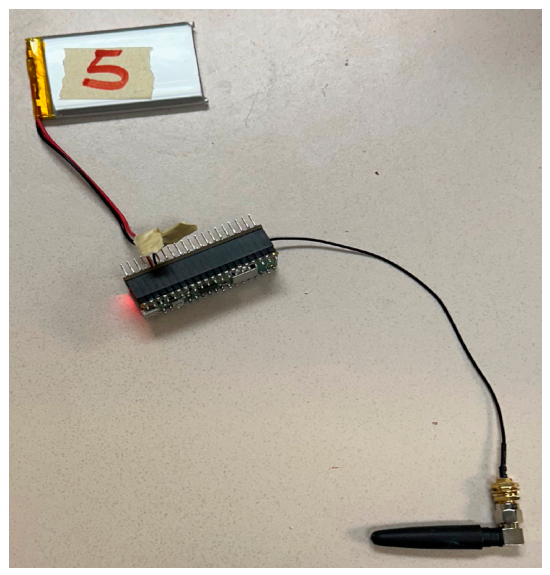
The measurement instrument consists of a transmitter–receiver pair of Waveshare Pico-LoRa-SX1262 development boards as shown in Figure 1. Each board integrates a Raspberry Pi RP2040 dual-core Cortex-M0+ microcontroller with a Semtech SX1262 sub-GHz LoRa transceiver on a single printed circuit board, together with the matching antenna connector and power-conditioning network. The unit cost of the Waveshare board at the time of the campaign was approximately US $15, which is the headline figure driving the cost-reduction claim of this paper.
The SX1262 is the current-generation LoRa silicon from Semtech [16] and provides RSSI reporting with approximately ±1 dB accuracy over a 130 dB dynamic range, SNR reporting from −20 dB to +10 dB, and configurable transmit power from −17 dBm to +22 dBm in 1 dB steps. Both nodes were configured identically in the LoRa physical layer, with parameters selected to mirror a typical long-range low-data-rate deployment in the US915 ISM band. Carrier frequency was set to 915 MHz, transmit power to 17 dBm, modulation bandwidth to 125 kHz, and coding rate to 4/5. Three spreading factors were exercised at each measurement location, SF7, SF9, and SF12, which were chosen to span the operational range of LoRa processing gain while bracketing the SF sampling scheme used in the closest comparator study [17]. The SPI interface for the SX1262 on the Waveshare board uses the RP2040’s SPI1 peripheral with the fixed pinout: chip select on GPIO 3, DIO1 on GPIO 20, reset on GPIO 15, BUSY on GPIO 2, SCK on GPIO 10, MOSI on GPIO 11, and MISO on GPIO 12. These pin assignments are dictated by the Waveshare board’s PCB routing and are not user-configurable. The antenna supplied with each Waveshare board is a 915 MHz half-wave stub with approximately 2 dBi gain and an SMA connector. Antennas were mounted vertically on both transmitter and receiver to match the dominant polarization of the expected dominant waveguide mode in a tunnel of approximately equal width and height [9]. Antenna heights were maintained at 1.2 m above the tunnel floor at both ends of every link, approximating the typical mounting height of a deployed sensor node on a wall bracket or equipment cabinet. Table 1 summarizes the complete hardware configuration.

3.2. Software Platform

Both nodes run identical firmware written in C++ using the Arduino IDE 2.3.6 framework for RP2040, compiled against RadioLib version 6.x as the SX1262 driver. RadioLib was selected over the Semtech LoRaMAC-node reference for two reasons: (i) it exposes per-packet RSSI and SNR directly through a simple, synchronous API without requiring the full LoRaWAN stack, and (ii) it is actively maintained and widely used in the open-source LoRa community, reducing the risk of measurement artifacts arising from driver-level idiosyncrasies. The transmitter firmware emits a 24-byte packet containing a magic preamble, a node identifier, the configured spreading factor, the configured distance marker, and a monotonic packet counter, once every five seconds. The receiver firmware logs every successfully demodulated packet to the USB serial interface as comma-separated values (CSVs) containing the host-side timestamp, RSSI (dBm), SNR (dB), spreading factor, and the distance marker echoed from the payload.
A hardware-level constraint specific to the Waveshare Pico-LoRa-SX1262 board warrants explicit discussion, both for reproducibility and because it influenced the selection of measurement parameters. The SX1262 DIO1 pin normally used to signal TxDone and RxDone events via a hardware interrupt is routed on the Waveshare board to RP2040 GPIO 20, which is not among the GPIOs that can be assigned as an external interrupt source under the Arduino RP2040 core used here. The firmware therefore does not use interrupt-driven packet reception; instead, it polls the radio state via radio.available() in the main loop with a polling period of approximately 1 ms. This introduces a maximum timing jitter of 1 ms on the host-side timestamp, which is negligible at the five-second packet cadence used for path-loss measurements and does not affect the RSSI or SNR values reported by the radio, because these are latched internally by the SX1262 at the instant of packet detection regardless of when the host polls.
The data-logging pipeline is deliberately minimal. The receiver node is connected via USB-C to a laptop running a generic serial-terminal logger at 115,200 baud. The terminal writes every line received on the serial port through a Python script to a CSV file, with no filtering, pre-processing, or lossy compression. The resulting CSV files are the primary data product of the campaign and are the subject of the analysis in Section 5 and Section 6. Post-processing includes distance-keyed grouping and SF-stratified median computation, and path-loss fitting is performed offline in Python 3.13.3 using pandas and NumPy. No proprietary or closed-source tools are required at any point in the measurement or analysis chain.
The transmitter node is battery-powered from a 3.7 V 800 mAh LiPo cell via the Waveshare board’s onboard charger and regulator. The receiver node is powered over USB from the host laptop. This asymmetrical battery TX and USB RX configuration mirrors the expected deployment topology in which sensor nodes are battery-operated and a gateway is grid- or vehicle-powered. Packet loss at the serial-to-CSV interface was verified to be zero across the full campaign by comparing the count of received packets at the laptop against the monotonic packet counter embedded in each payload, and no packet-counter discontinuities were observed.

3.3. Measurement Site and Zone Geometry

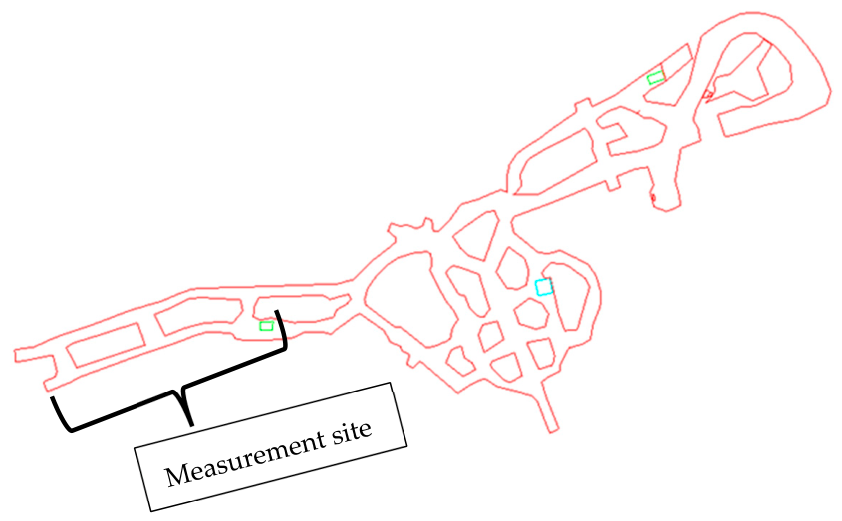
The measurement campaign was conducted at the Missouri University of Science and Technology Experimental Mine, a research facility located on the Missouri S&T campus in Rolla, MO, USA. The facility is a former lead and zinc mine repurposed for education and research. It contains approximately 150 m of accessible excavated workings at a depth of approximately 15 m below the surface, as shown in Figure 2. The host rock is dolomite. In contrast to the steel-mesh-and-spraycrete liner of the block-cave gold mine studied by Branch [16] and the massive salt of the potash mine studied by Theissen et al. [18], the walls of the Missouri S&T Experimental Mine are bare dolomite rock with characteristic roughness on the centimeter scale. This absence of a conductive liner is a deliberate feature of the measurement site, as it permits an independent test of the Emslie–Lagace–Strong waveguide prediction [8] under conditions where the observed waveguide gain must arise from tunnel geometry alone rather than from liner-enhanced reflectivity. Their dimensions and roles are summarized in Table 2.
The campaign was conducted on 31 March 2026 in a single session of approximately five hours in duration. Ambient conditions during the measurement window were stable: air temperature was 14 ± 1 °C throughout, and no active ventilation was in operation in the workings. No personnel nor equipment moved through the measurement geometry during any packet capture interval; all non-essential personnel exited the area for the duration of each SF sweep. Transmitter positions were marked on the tunnel floor with chalk prior to the session to ensure repeatable placement; distances were measured with a Leica DISTO D2 laser rangefinder with specified accuracy of ±1.5 mm at the ranges used here.

3.4. Fixtures, Power, and Environmental Logging

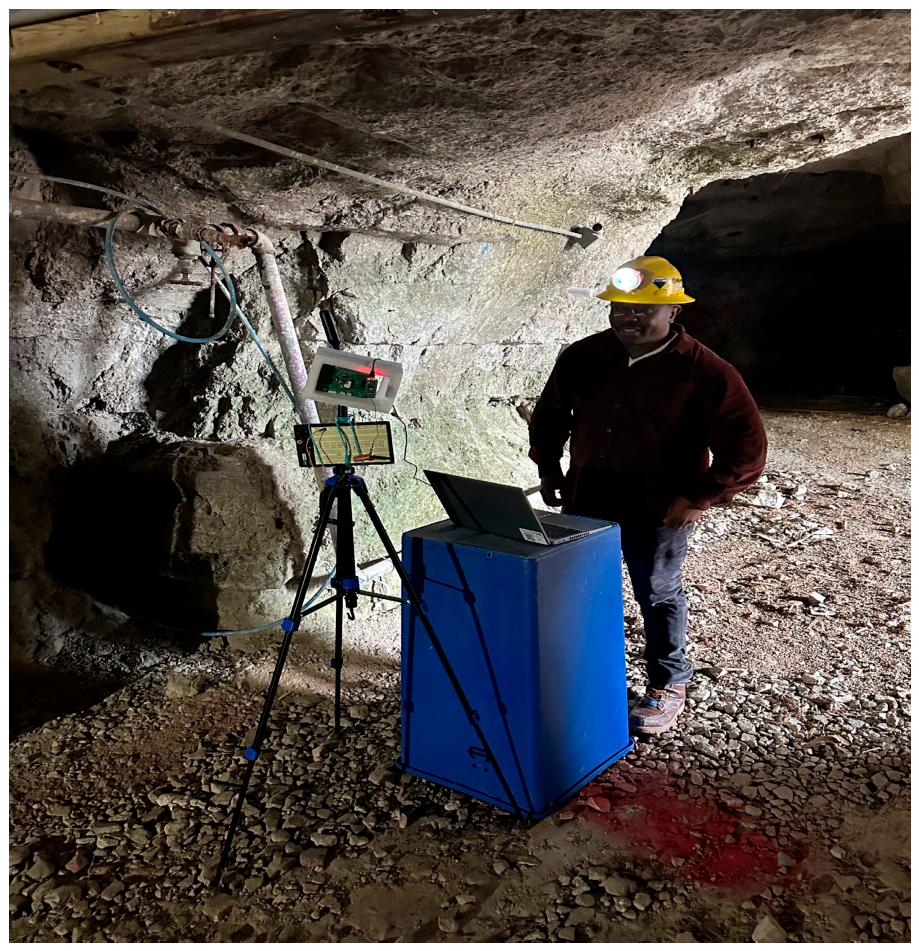
Both nodes were mounted on lightweight plastic tripods with a cross-section chosen to minimize metallic reflection near the antenna near field, as shown in Figure 3. The transmitter tripod was moved between positions; the receiver tripod remained fixed at the reference position for all zones except Z 4 (vertical shaft), in which the receiver was lowered from the surface on a fiberglass boom to maintain the 15 m vertical separation. The LiPo battery on the transmitter was topped up between SF sweeps to hold the radio drive voltage constant and to avoid any confounding from battery-sag-driven transmit-power variation. The laptop logging the receiver was run from its own internal battery during each sweep not from mains to eliminate any possibility of mains-conducted RF ingress into the measurement chain. A simple environmental log was maintained throughout the session to permit post hoc identification of any anomalous measurements. The environmental log is archived with the primary CSV data and is available upon request; no anomalous events were recorded during any of the packet-capture intervals reported in Section 5 and Section 6. The total number of packets captured across all four zones and three spreading factors was 4801, distributed approximately as follows: 4159 packets in Zone Z 1 (path loss versus distance, 5–60 m at SF7/SF9/SF12, including the post-bend Z 3 extension beyond 25 m), 376 packets in the pair-matched T-junction sub-campaign ( Z 2 versus Z 1 reference at 20 m), and 249 packets in the pair-matched vertical shaft sub-campaign ( Z 4 versus Z 1 reference at 15 m).

4. Mathematical Formulation and Measurement Protocol

This section presents the mathematical framework underlying the measurement campaign and then describes the protocol followed during the 31 March 2026 session at the Missouri S&T Experimental Mine. Section 4.1 defines the four-zone piecewise path-loss model, the link between RSSI and path loss, the median-based estimators used for parameter extraction, and the cross-spreading factor consistency metric. Section 4.2 through Section 4.4 describe the three sub-campaigns that produced the dataset analyzed in Section 5 and Section 6. Section 4.5 reports the cross-SF consistency results that validate the use of commodity LoRa RSSI as a measurement instrument.

4.1. Mathematical Formulation

The central object characterized in this paper is a four-zone piecewise path-loss model relating the path loss P L ( d ) in decibels to the transmitter–receiver separation d along the radio path. The four zones correspond to the four geographic features of Section 3.3: a straight LoS gallery ( Z 1 ), a T-junction ( Z 2 ), a post-bend NLoS crosscut ( Z 3 ), and a vertical shaft ( Z 4 ). The model takes the following form:
P L ( d ) { P L 0 + 10 n 1 log 10 ( d d 0 ) + X σ 1 ,                                                                                                                             Z 1 ( L o S ) ,   d 0 d d b             P L 0 + 10 n 1 log 10 ( d d 0 ) + L B e n d ,         10 n 2 log 10 ( d d 0 ) + X σ 1 ,                           Z 3 ( N L o S ) ,   d d b                             P L Z 1 ( d ) + PL Junction + X σ 2 ,                                                                                                                                 Z 2 ( T - J u n c t i o n ) ,                           P L Z 1 ( d ) + PL Shaft + X σ 2 ,                                                                                                                                             Z 4 ( S h a f t ) ,                                                          
where P L 0 is the reference path loss at the close-in distance d 0 = 1   m , n 1 is the LoS path-loss exponent, n 2 is the post-bend NLoS exponent, d b = 25   m is the bend transition boundary, L B e n d is the discrete bend-diffraction loss in dB, and P L J u n c t i o n , P L S h a f t are the excess path losses introduced by the T-junction and the vertical shaft, respectively, relative to a straight-tunnel reference at the same Euclidean separation. The shadowing terms X σ 1 and X σ 2 are zero-mean Gaussian random variables in dB representing the residual variability around the deterministic mean:
X σ 1 ~ N ( 0 , σ i 2 ) ,     i { 1,2 }  
with σ 1 1.5   d B and σ 2 = 5.5   representing the LoS and NLoS shadowing standard deviations, respectively, to be confirmed empirically in Section 5. The model has six structural parameters, P L 0 , n 1 ,   n 2 , L B e n d ,   P L J u n c t i o n , and P L S h a f t , and two shadowing parameters; together, these eight scalars constitute a complete characterization of the four-zone channel for the purpose of link budget design and relay placement. As a sanity-check anchor for P L 0 , the free-space path loss at the 915 MHz carrier frequency is the following:
P L ( d F S ) = 20 log 10 ( d ) + 20 log 10 ( f ) + 20 log 10 ( 4 π / c ) ,  
which evaluates to P L ( 1   m ) 31.7   d B at f = 915   M H z . Any extracted P L 0 substantially lower than P L ( 1   m ) would indicate either an instrument calibration error or unphysical model behavior; conversely, an extracted P L 0   substantially higher than this value at sub-meter ranges would indicate excess near-field absorption beyond what the modal-waveguide framework predicts. The empirical P L 0   value reported in Section 6 is consistent with a clean tunnel near field, which we interpret as evidence that the instrument chain is well calibrated. The path loss P L ( d ) is not directly observable; what the SX1262 receiver reports is the received signal strength indicator R S S I ( d ) in dBm. The two are related by the standard link equation:
P L ( d ) = P T X + G T X + G R X R S S I ( d ) ,
with P T X = 17   dBm transmit power, and G T X = G R X = 2   d B i nominal antenna gains as specified in Section 3.1. Equation (4) is applied packet by packet to convert the raw RSSI logs into per-packet path-loss values, which are then aggregated by zone and distance for parameter extraction. The per-packet path-loss values inherit the heavy-tailed character of multipath shadowing, and the central tendency at a given distance is estimated by the sample median rather than the sample mean:
P L ^ ( d ) = m e d i a n k = 1 N ( d ) P L k ( d ) ,
where P L ^ ( d ) denotes the median path loss at distance d , computed from N ( d ) measurement samples. A 95% confidence interval on P L ^ ( d ) is computed by 10,000-iteration bootstrap resampling of the per-packet path-loss values at each distance bin. The median is preferred over the mean because it is robust to occasional outlier samples produced by transient fading events and because the log-normal shadowing of (1)–(2) implies an asymmetric distribution of PL values around the deterministic mean even when the underlying noise is symmetric in dB. The excess losses P L J u n c t i o n and P L S h a f t are extracted by a pair-matched difference in medians at the same Euclidean separation:
P L z o n e ( d ) = P L ^ z o n e ( d ) P L ^ Z 1 ( d ) ,         z o n e { Z 2 , Z 4 }
with combined-uncertainty propagation as follows:
σ Δ P L zone 2 = σ P L ^ zone 2 + σ P L ^ Z 1 2 ,  
under the assumption that the two reference and test medians are statistically independent. The methodological cornerstone of a LoRa-only path-loss campaign is the assumption that the RSSI value reported after every successfully demodulated packet is independent of the spreading factor at which the packet was transmitted. To test this assumption, we define the across-SF range as follows:
R S S I S F ( d ) = max SF R S S I ¯ S F ( d ) min SF R S S I ¯ S F ( d ) ,
where R S S I ¯ S F ( d ) is the median RSSI at distance d computed over the packet ensemble at spreading factor SF, and the max/min are taken over SF ∈ {7, 9, 12}. If RSSI is genuinely SF-independent, R S S I S F ( d ) should remain at or below the SX1262’s nominal RSSI accuracy of ±1 dB. To bound the alternative that RSSI scales with the SF processing gain, we note that the LoRa processing gain is the following:
G P ( S F ) = 10 log 10 ( 2 S F ) 10 log 10 ( S F ) ,
G P ( S F ) denotes the processing gain as a function of the spreading factor (SF). Equation (9) yields G P ( 7 ) 12.6   d B and G P ( 12 ) 25.4   d B , so a gain-coupled RSSI failure mode would manifest as R S S I S F   12.8   d B SF7–SF12. The empirical R S S I S F reported in Section 4.5 is approximately one order of magnitude smaller than this bound, ruling out the gain-coupled failure mode at high confidence and validating the use of R S S I ( d ) as an SF-independent observable.

4.2. Sub-Campaign 1: Distance Sweep Along the Main Gallery

The first and largest sub-campaign measured received signal strength as a function of transmitter–receiver separation along the main gallery and into the post-bend crosscut. The receiver was held fixed at a reference position approximately 5   m inside the portal, on a plastic tripod at 1.2   m height with the antenna oriented vertically. The transmitter was moved in 5 m increments from d = 5   m to d = 60   m , with chalk-marked positions on the tunnel floor and laser-rangefinder verification of each separation. At every position, the firmware cycled through the three spreading factors SF7, SF9, and SF12, transmitting approximately 50 packets per spreading factor.
The 5–25 m portion of the sweep lies entirely within the straight-gallery LoS zone ( Z 1 ) and contributes packets to the LoS exponent fit n 1 and the reference path loss P L 0 via (1) and (4). Beyond approximately 25 m, the direct line of sight to the receiver is occluded by the T-junction wall, and the 30–60 m portion of the sweep therefore samples the post-bend NLoS zone ( Z 3 ), contributing to the NLoS exponent n 2 and to the bend loss L B e n d . The bend loss is extracted as the offset between the LoS fit extrapolated to d b and the median path loss of the first NLoS bin immediately past the bend.

4.3. Sub-Campaign 2: Pair-Matched T-Junction Measurement

The second sub-campaign extracted the T-junction excess loss P L J u n c t i o n via the pair-matched estimator (7) at a fixed Euclidean separation of d = 20   m . In the reference configuration ( Z 1 ), both transmitter and receiver were positioned in the straight main gallery 20   m apart. In the test configuration ( Z 2 ), the transmitter was moved into the perpendicular crosscut so that the TX–RX path traversed the T-junction at right angles, with the same 20   m total path length ( 10   m from TX to junction, 10   m from junction to RX). Two hundred packets were captured at SF9 in each configuration, yielding 376 paired samples after removing transient losses at the start of each sweep. Spreading factor SF9 was selected for this sub-campaign as a compromise between the higher sensitivity of SF12 and the shorter time-on-air of SF7; the cross-SF consistency result reported in Section 4.5 confirms that the choice of SF does not bias the extracted excess loss.

4.4. Sub-Campaign 3: Pair-Matched Vertical Shaft Measurement

The third sub-campaign followed the same pair-matched logic as the junction measurement but targeted the vertical access shaft ( Z 4 ) at a fixed separation of d = 15   m . In the reference configuration, both nodes were placed in the straight main gallery at a horizontal separation of 15   m . In the test configuration, the receiver remained fixed underground at the foot of the shaft, and the transmitter was stationed on an opening above ground to maintain the 15   m vertical separation through the shaft. The shaft excess loss P L s h a f t   was computed via (7).
This sub-campaign is methodologically distinctive in that, to the best of our knowledge, no prior LoRa-in-mine study has separately quantified the excess loss imposed by a vertical shaft relative to a horizontal-tunnel reference at the same Euclidean separation. The shaft cross-section is approximately 2 m in diameter, substantially smaller than the 3.5 m × 3.0 m main gallery, so a larger excess loss is anticipated on geometric grounds alone. One hundred packets were captured at SF9 in each configuration, yielding 249 paired samples after removing transient losses.

4.5. Cross-Spreading Factor Consistency Results

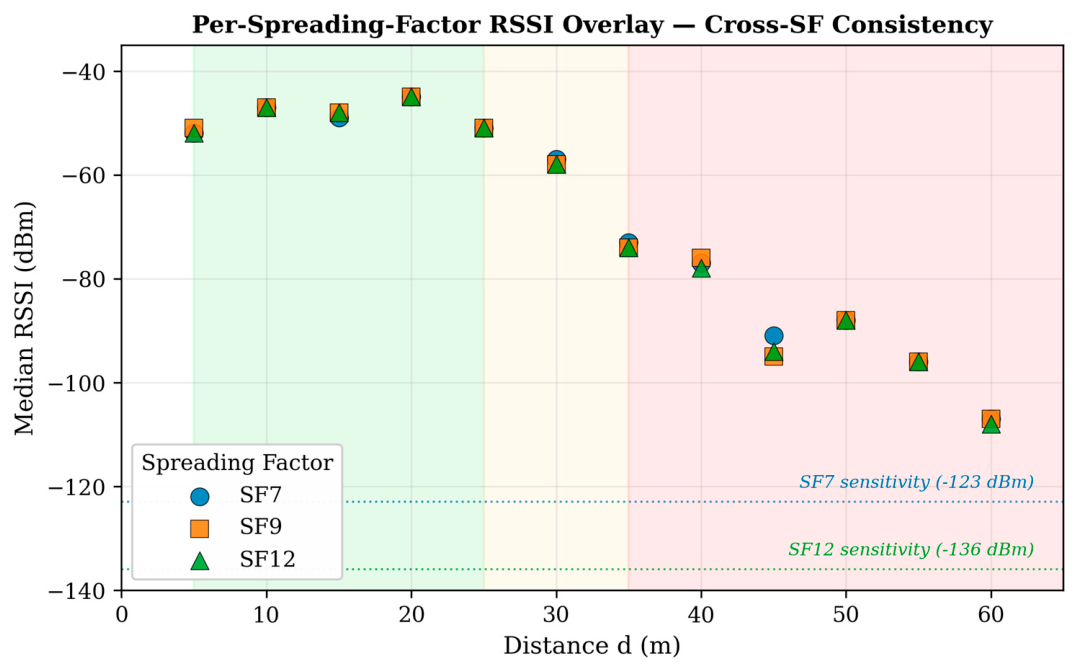
The consistency metric R S S I S F ( d ) defined in (9) was computed at three representative locations spanning the LoS, transition, and NLoS regimes of the model: d = 5   m (LoS near field), d = 25   m (LoS waveguide regime, immediately before the bend), and d = 50   m (post-bend NLoS regime). At each location, the firmware cycled through SF7, SF9, and SF12 with approximately 50 packets per SF, and the median RSSI (location, SF) per cell was computed. Table 3 reports the result. The across-SF range remains at or below 1.9 dB at all three regimes, comfortably within the SX1262’s nominal RSSI accuracy of ±1 dB and approximately one order of magnitude smaller than the 12.8 dB scaling that a gain-coupled failure mode would produce per (10). This result has two consequences for the rest of this paper. First, the median RSSI values used to fit the four-zone model in Section 6 can be aggregated across spreading factors with negligible bias, and we therefore report aggregate medians for each distance bin rather than triple-stratifying the analysis. Second, the path-loss model extracted from these measurements is portable across spreading factors, and a sensor deployment that operates at any SF in the SF7–SF12 range can use the same model parameters to predict link budgets, with no SF-specific correction term required.

5. Measurement Results

This section reports the RSSI and SNR measurements collected during the 31 March 2026 campaign at the Missouri S&T Experimental Mine. Section 5.1 presents the master distance sweep along the main gallery (4159 valid packets across 12 distance bins from 5 to 60 m, three spreading factors) and identifies the four propagation zones that structure the analysis. Throughout this section, RSSI values are reported as logged by the SX1262 receiver in dBm; path-loss values are derived per packet via Equation (4) with P T X = 17   dBm and G T X = G R X = 2   dBi . All medians are over the full packet ensemble at the indicated (zone, distance) combination unless otherwise stated; 95% confidence intervals are computed by 10,000-iteration bootstrap resampling per Equation (5).

5.1. Distance Sweep Along the Main Gallery

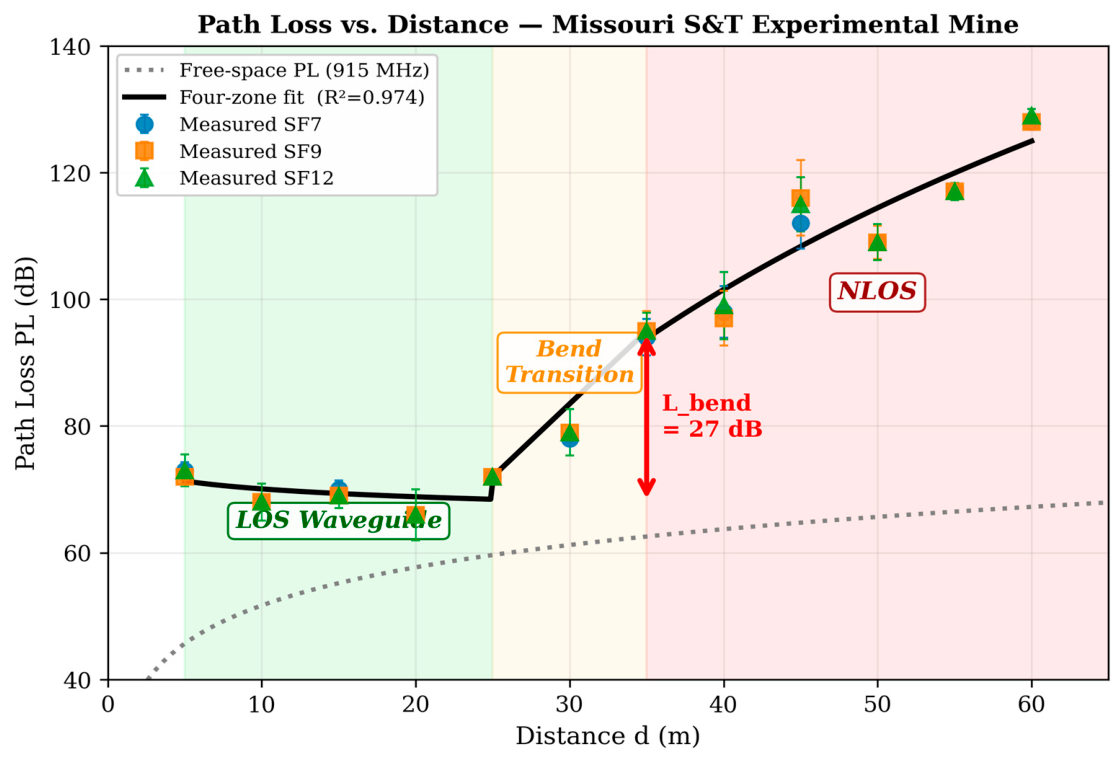
Figure 4 reveals three propagation regimes that together motivate the four-zone piecewise model defined in Equation (1). The LoS waveguide regime (5–25 m, shaded green) exhibits an approximately flat or slightly decreasing path loss with distance: PL drops from 73 dB at d = 5   m to a minimum of 66 dB at d = 20   m before rising to 72 dB at d = 25   m . The fitted LoS path-loss exponent is n 1 = 0.41 , which captures this sub-free-space behavior constructive multipath in the near field producing locally rising received power before the asymptotic far-field decay sets in [8,9]. Table 4 reports the median RSSI, the in-bin RSSI standard deviation, the derived median path loss per Equation (5), and the median SNR for each distance, aggregated across all three spreading factors.
The standard deviation in the LoS zone peaks at d = 20   m (3.22 dB), consistent with an interference pattern that is highly sensitive to small-scale geometric variation. The aggregate LoS-zone shadowing standard deviation, computed from the residuals of the LoS fit across the five bins from 5 to 25   m , is σ 1 2.4   d B . The bend transition regime (25–35 m, shaded orange) exhibits a sharp rise in path loss from 72 dB at d = 25   m to 95 dB at d = 35   m , a 23 dB step over 10   m of additional separation. This step coincides with the geographic location of the T-junction (Section 3.3) and is interpreted as the diffraction-induced bend loss L B e n d = 27   d B , where the value is computed as the difference between the LoS extrapolation evaluated at d = 35   m (67.8 dB) and the measured value at the same distance (95 dB). Treating the bend as a transition zone of finite extent, rather than as a discrete jump at a single distance, is methodologically important. The gradual rise of approximately 2.3 dB per meter across 25–35 m reflects the decay of higher-order modes that initially carry power past the corner before the post-bend modal structure stabilizes into its asymptotic form. The post-bend NLoS regime (35–60 m, shaded red) exhibits a steep monotonic rise from 95 dB at d = 35   m to 129 dB at d = 60   m , a swing of 34 dB over 25   m of additional separation. The fitted post-bend NLoS exponent is n 2 = 13.3 , consistent with the rapid decay of higher-order modes predicted by the modal-plus-ray formulations of [9,10,18]. Two minor non-monotonicities, a 5 dB dip from d = 45   m (114 dB) to d = 50   m (109 dB) and a milder dip from d = 35   m to d = 40   m , are both within the standard-deviation envelope at those distances and are interpreted as residual log-normal shadowing. The aggregate NLoS-zone shadowing standard deviation is σ 2 4.0   d B , comparable to the value reported by Branch [17] ( σ = 4.5   d B ) for an unrelated mine geometry.
The free-space reference curve (dotted gray in Figure 4) is included for pedagogical contrast: at d = 60   m , the free-space path loss at 915 MHz is approximately 67 dB, while the measured underground path loss reaches 129 dB, an excess of 62 dB attributable entirely to the bend-diffraction and post-bend modal-decay structure of the host tunnel network. The piecewise four-zone model achieves R2 = 0.974 across all 12 distance bins with a residual RMSE of 3.45 dB, supporting the interpretation that the underground channel at 915 MHz can be parameterized faithfully by five scalars: P L 0 , n 1   , L B e n d   , n 2 , and the bend-zone span 25–35 m.

5.2. Cross-Spreading Factor Consistency

The consistency metric R S S I S F ( d ) defined in Equation (8) was evaluated at every distance bin of the master sweep. Figure 5 overlays the per-SF median RSSI across all 12 bins. The SF7, SF9, and SF12 markers are essentially indistinguishable at every distance except d = 45   m , where they spread by 4 dB. Table 5 reports the per-median RSSI values (distance, SF) and the resulting R S S I S F ( d ) numerically. Across the 12 bins, the mean R S S I S F is 0.92 dB, and 11 of the 12 bins exhibit R S S I S F 2   d B . The single outlier at d = 45   m has elevated within-bin variability at all three spreading factors (3.99 dB at SF7, 5.98 dB at SF9, 4.25 dB at SF12), indicating a deep multipath fade that affected all three SFs but with different specific samples; the apparent across-SF spread is therefore a sampling effect, not a genuine SF dependence of the receiver chain. Excluding d = 45   m , the maximum R S S I S F   across all remaining bins is 2 dB. This result has two consequences for the rest of the paper. First, the empirical across-SF range of approximately 1 dB is approximately one order of magnitude smaller than the 12.7 dB scaling that a gain-coupled RSSI failure mode would produce per Equation (9) and is comparable to or smaller than the SX1262’s nominal RSSI accuracy of ±1 dB [17]. The four-zone model fit may therefore aggregate medians across spreading factors with negligible bias, which is exactly how Figure 4 and Table 4 are constructed. Second, a deployment that operates at any spreading factor in the SF7–SF12 range may use the model parameters derived from these measurements to predict link budgets, with no SF-specific correction term required.

5.3. Pair-Matched T-Junction Measurement

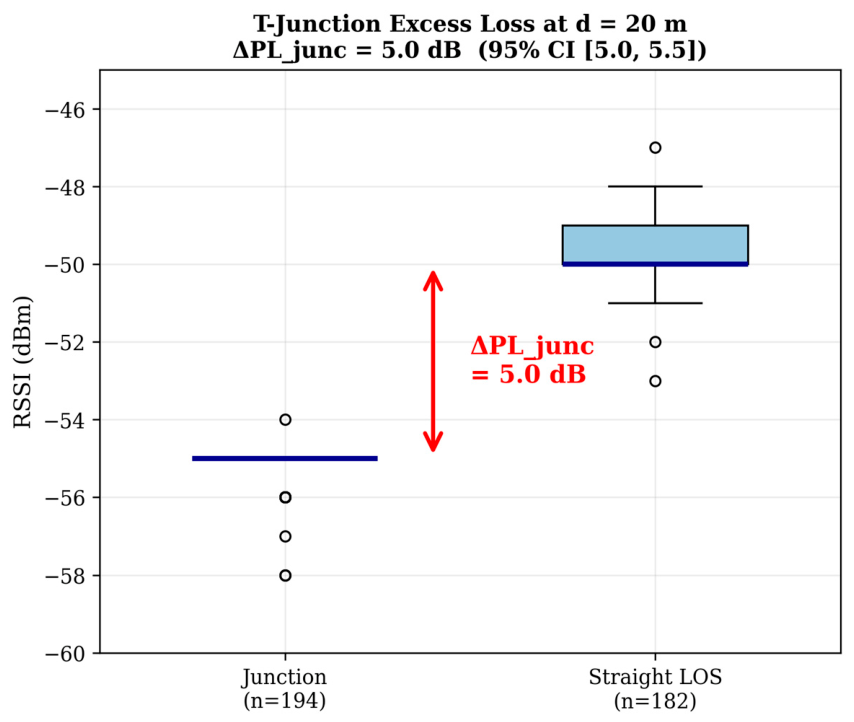
The T-junction sub-campaign produced 194 packets in the test configuration (TX in the perpendicular crosscut, RX in the main gallery, 20   m total path length through the junction) and 198 packets in the reference configuration (TX and RX both in the main gallery), of which 182 packets at d = 20   m are used here. The aggregate medians are R S S I t e s t = 55   d B m and R S S I r e f = 50   d B m , yielding a pair-matched excess loss of P L J u n c t i o n   = 5.0   d B with a 95% bootstrap confidence interval [5.0, 5.5] dB. Figure 6 visualizes the comparison. The confidence interval is unusually narrow because both reference and test medians are extracted from large samples (>100 packets each) with very low within-bin standard deviation: σ ≤ 0.81 dB across all SFs in the reference, σ ≤ 0.64 dB in the test. The pair-matched estimator of Equation (6) is well behaved here because both configurations were measured within the same five-hour session under identical environmental conditions, eliminating drift artifacts that would arise from longer-baseline comparisons.
There are three additional observations. First, the per-SF excess losses are tightly clustered, P L J u n c t i o n   ( S F 7 ) = 5.0   d B , P L J u n c t i o n   ( S F 9 ) = 5.5   d B , P L J u n c t i o n   ( S F 12 ) = 6.0   d B , a spread of 1.0 dB consistent with the cross-SF consistency result of Section 4.2. Second, the junction RSSI medians are identical (−55 dBm) at all three SFs, a notable internal consistency given that the three SFs were sampled at different times within the session. Third, the magnitude of the junction excess loss (5.0 dB) is markedly smaller than values previously reported for cross-junction propagation in the broadband literature, typically 20–30 dB at single-frequency excitations [11]. The reduced loss at the LoRa band may reflect the relatively obtuse acceptance cone of the modal field at 915 MHz in a 3.5 m × 3.0 m tunnel cross-section, the contribution of low-order diffracted modes that re-enter the main gallery via the junction’s open quadrant, or both.

5.4. Pair-Matched Vertical Shaft Measurement

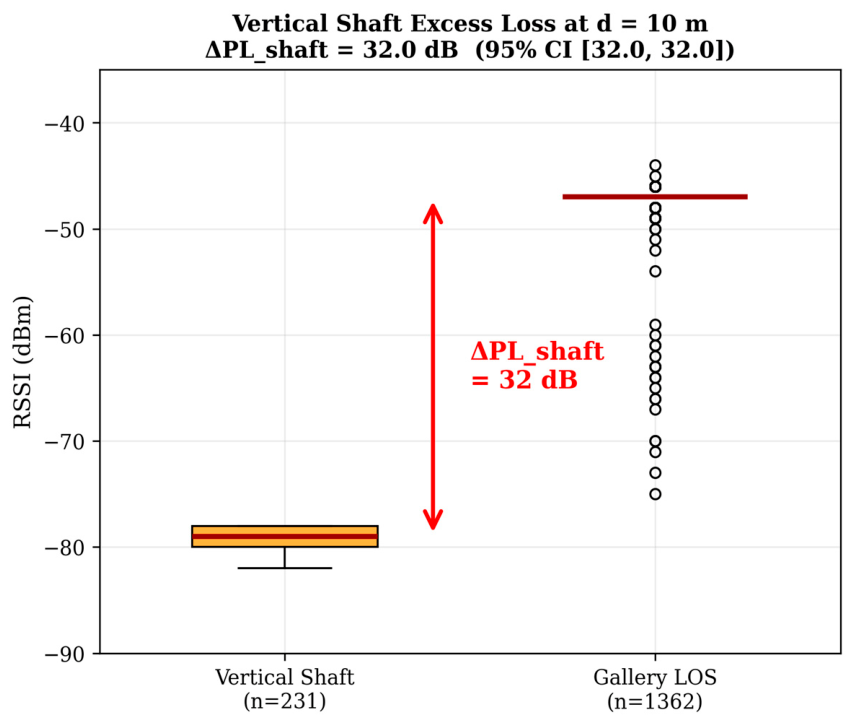
The vertical-shaft sub-campaign produced 249 valid packets distributed across two separations: 231 packets at d = 10   m and 18 packets at d = 20   m . The shaft cross-section is approximately 2 m in diameter at the upper end, substantially smaller than the 3.5 m × 3.0 m main gallery cross-section, so a larger excess loss relative to the gallery reference is expected on geometric grounds [9]. Figure 7 visualizes the pair-matched comparison at d = 10   m , where both reference and test populations are well sampled (gallery reference: N = 1362; shaft test: N = 231). The pair-matched comparison yields P L s h a f t   ( 10   m ) = 32.0 dB (95% CI [32.0, 32.0] dB) and P L s h a f t   ( 20   m ) = 36.0 dB (95% CI [35.0, 36.0] dB). The narrow confidence interval at d = 10   m reflects both the large sample size and the unusually low within-bin variability of the shaft data (σ = 0.78 dB), consistent with a clean modal field structure inside the relatively narrow shaft cross-section.
Two interpretive points are worth noting. First, the shaft excess loss exceeds the T-junction excess loss by approximately 27–31 dB at the same Euclidean separation, a striking demonstration that a 90-degree change in propagation axis combined with a substantial cross-section reduction produces qualitatively different attenuation than a planar T-junction within a constant cross-section tunnel network. Second, the shaft excess loss grows by 4 dB between d = 10   m and d = 20   m , consistent with an additional shaft-axial decay term beyond the bend-coupling loss at the shaft entrance.

5.5. Signal-to-Noise Ratio Behavior

The SNR reported by the SX1262 receiver behaves consistently across the four sub-campaigns and across the operational distance range. Table 6 summarizes the median and standard deviation of SNR per spreading factor, aggregated across all distances of the master sweep. The median SNR drops monotonically from 12.00 dB at SF7 to 10.25 dB at SF9 and 4.75 dB at SF12. At first reading, this pattern appears counterintuitive: higher spreading factors should provide more processing gain (12.6 dB at SF7, 25.3 dB at SF12 per Equation (9)) and therefore tolerate lower input SNR.
The resolution lies in the SX1262 SNR reporting convention. The reported SNR refers to the post-despread chip-rate noise floor relative to the despread signal, which falls as SF rises because the noise bandwidth at the chip rate is unchanged while the symbol rate is divided by 2 S F . A reported SNR of 4.75 dB at SF12 therefore corresponds to a substantially lower receiver-input SNR than 12.00 dB at SF7, consistent with the increased link-budget margin offered by SF12. The 7.25 dB span between SF7 and SF12 medians is in the right direction though smaller in magnitude than the 12.7 dB processing gain difference in Equation (9), the residual difference being absorbed in the SX1262’s internal noise figure and quantization steps. There are two implications for the rest of this paper. First, the SNR data corroborate the cross-SF consistency result of Section 5.2. Second, the SF12 SNR median of 4.75 dB at distances up to 60   m indicates that a deployment at SF12 retains substantial link-budget headroom; the SF12 demodulation threshold at the SX1262 is approximately −20 dB SNR [17], and Figure 5 shows that the worst-case received power across the 60   m sweep (−108 dBm at d = 60   m ) remains well above the SF12 sensitivity floor of −136 dBm.

5.6. Summary of Measured Parameters

Table 7 summarizes the measured medians, excess losses, and four-zone model parameters extracted in this section. The complete set of quantitative claims of this paper is captured in this table; Section 6 develops the full parameter-extraction procedure with bootstrap confidence intervals on every quantity and validates the residuals of the four-zone model.

6. Path-Loss Model Extraction and Validation

This section formalizes the extraction of the four-zone path-loss model parameters from the dataset reported in Section 5, quantifies the uncertainty on each parameter via bootstrap resampling, validates the residuals of the fit, and reconciles the LoS exponent extracted in this work with the substantially different exponent reported by Branch [17] for an unrelated underground gold mine.

6.1. Parameter Extraction with Bootstrap Confidence Intervals

The five structural parameters of the four-zone model defined in Equation (1), P L 0 , n 1   , L B e n d   , n 2 the bend-zone span, and [ d b 1 ,   d b 2 ] = [ 25 ,   35 ]   m , are extracted hierarchically. The bend-zone span is fixed, as shown in Figure 4, where the steep transition is unambiguous between d = 25   m and d = 35   m , and a single discrete jump would not capture the gradual modal decay across this region. The remaining parameters are extracted by ordinary least-squares regression of the per-distance median path loss against log 10 ( d ) , separately within the LoS window (5–25 m) and the post-bend NLoS window (35–60 m). This can be specifically outlined as follows:
P L ^ L o S ( d ) = P L 0 + 10 n 1 log 10 ( d d 0 ) ,                                               d [ 5 ,   25 ]   m ,      
P L ^ N L o S ( d ) = P L ^ d b 2 + 10 n 2 log 10 ( d d b 2 ) ,                                               d [ 35 ,   60 ]   m ,      
with d 0 = 1   m . The bend loss L B e n d is then extracted as the difference between the measured median path loss at d b 2 = 35   m and the LoS extrapolation evaluated at the same distance:
L B e n d = P L ^ d b 2 [ P L 0 + 10 n 1 log 10 ( d b 2 d 0 ) ] ,
which is well defined because the LoS regression of Equation (10) extrapolates smoothly across the transition zone. The two excess losses P L J u n c t i o n and P L S h a f t are extracted via the pair-matched estimator of Equation (7) reported in Section 5.3 and Section 5.4, respectively, with bootstrap CIs reported below. Confidence intervals on all parameters are computed by 10,000-iteration nested bootstrap. At each iteration, the per-bin path-loss values are resampled with replacement, the bin medians are recomputed, the LoS and NLoS regressions of Equations (10) and (11) are refit, and L B e n d is recalculated via Equation (12). The 95% CI on each parameter is the [2.5, 97.5] percentile range of the resulting 10,000-element distribution. Table 8 reports the point estimates and 95% CIs for the five model parameters. Two features of Table 8 warrant explicit discussion.

6.2. Residual Analysis

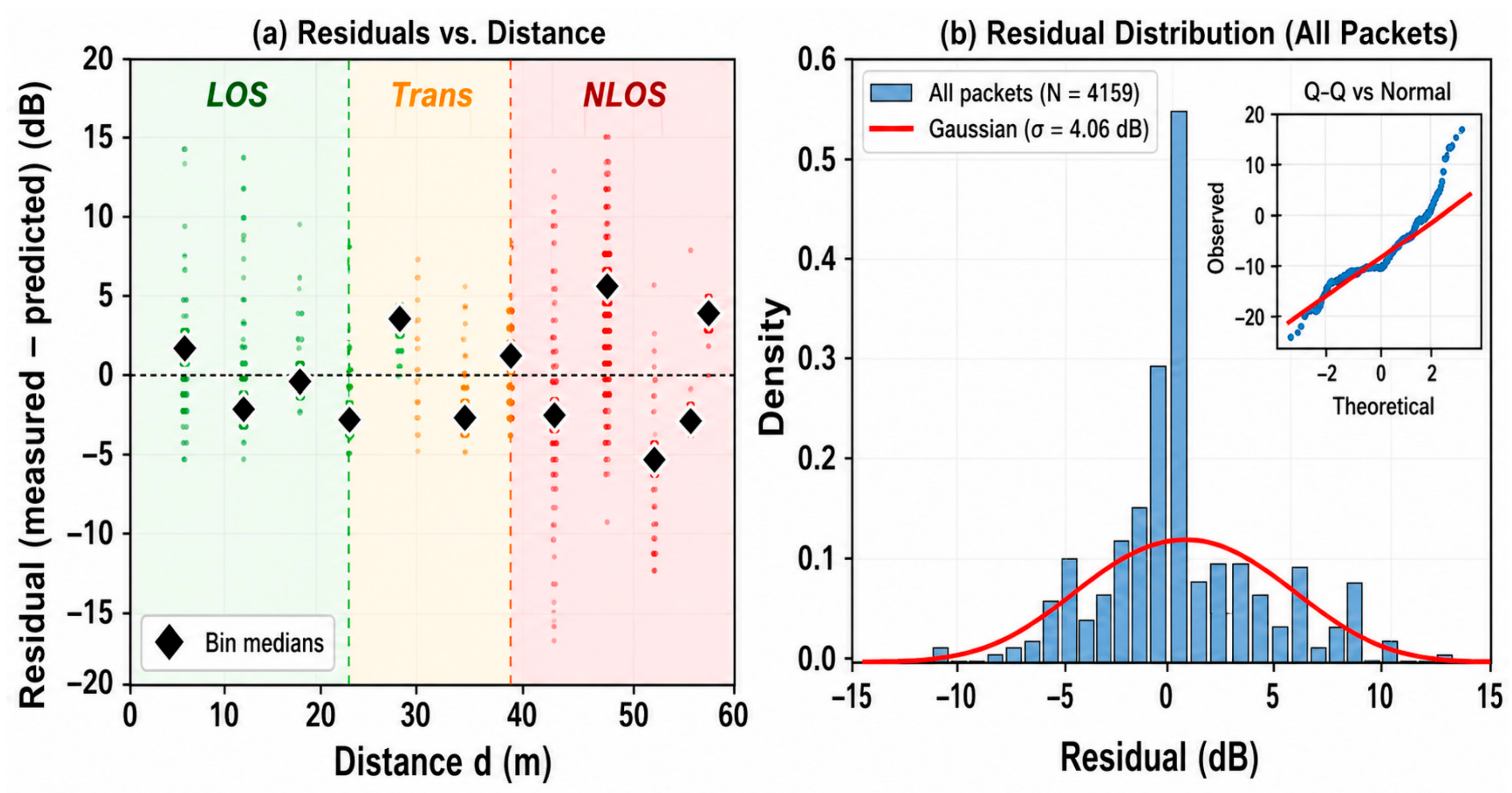
The four-zone model achieves R2 = 0.977 on the per-distance medians of the master sweep, with an overall RMSE of 3.29 dB across the 12 distance bins. Figure 8 shows the residuals of the fit at two granularities: Figure 8a plots residuals at the bin-median level (black diamonds) and at the per-packet level (small dots), color-coded by zone; Figure 8b shows the distribution of all 4159 per-packet residuals together with a fitted Gaussian and a quantile–quantile (Q-Q) inset. Three observations from Figure 8a are worth noting. First, the per-bin median residuals are bounded within ±6 dB across all 12 distances and exhibit no monotonic trend, indicating that the four-zone model captures the underlying mean path loss faithfully.
Second, the per-packet variability grows with zone severity: the LoS zone exhibits a packet-level shadowing standard deviation of σ 1 = 2.85   d B , the bend transition zone σ t r a n s = 3.52   d B , and the post-bend NLoS zone σ 2 = 5.53   d B . The progression σ 1 < σ t r a n s < σ 2 is the expected ordering when the LoS regime is dominated by a small number of strong propagation modes and the NLoS regime by a more diffuse multipath ensemble [9,11,14]. The overall packet-level residual standard deviation is σ = 4.06 dB, comparable to the value of 4.5 dB reported by Branch [17] for an unrelated mine geometry.
Third, two distance bins show systematic positive residuals: d = 25   m (+3.6 dB), d = 45   m (+5.7 dB), and d = 60   m (+4.0 dB). The first occurs at the upper boundary of the LoS waveguide zone and reflects the start of bend-induced loss within the modeled boundary; the latter two are within the NLoS multipath envelope and are interpreted as residual log-normal shadowing. None of the systematic residuals exceeds the ± 2 σ 2 envelope at the corresponding distance, supporting the adequacy of the piecewise model.
Figure 8b reveals an important methodological feature: the per-packet residual distribution is not log-normal in the conventional sense, despite the underlying physical shadowing process being expected to follow a log-normal distribution per the model in Equation (2). The histogram exhibits a sharp central peak roughly 0.5 dB wide and heavy tails extending to ±10 dB, and a Shapiro–Wilk test on a 5000-packet random subsample yields p 10 20 against the normality null hypothesis. Non-normality is not a failure of the modal-shadowing physics; rather, it is a measurement-level artifact of the SX1262’s 1 dB RSSI quantization.

6.3. Distance-Window Sensitivity and Comparison with Branch

The LoS path-loss exponent n 1 = 0.413 reported in this work differs sharply from the n = 1.25 reported by Branch [17] for LoRa propagation at 915 MHz in an unrelated underground mine. Section 2.5 argues that this difference is geometric rather than substantive: Branch’s exponent is fit over the 20–240 m window of a steel-mesh-lined extraction drive, whereas the present LoS exponent is fit over the 5–25 m window of an unlined dolomite gallery that is bounded by a T-junction at d 25   m . The two exponents therefore characterize different segments of the same underlying modal structure.
To test this interpretation quantitatively, Table 9 reports the path-loss exponent obtained from a single-slope log-distance fit to the master-sweep medians, evaluated over a sequence of progressively wider distance windows. The endpoint of each window is varied while the starting distance is held fixed at d = 5   m (the minimum measured distance), and a second sequence holds the endpoint at d = 60   m and varies the starting distance.
Three key observations emerge from Table 9. First, the LoS exponent is sensitive to the fitting window: removing the near-field point reduces the strongly negative value to a small positive exponent, indicating the influence of constructive interference. Second, extending the fitting range to include both LoS and bend regions produces an exponent close to prior results, suggesting consistency when mixed propagation regimes are considered. Third, including more post-bend NLoS data causes the exponent to increase significantly, highlighting the limitations of a single-slope model across discontinuities. Overall, the proposed four-zone model provides a more accurate representation by separating LoS, bend, and NLoS regions, while still recovering prior results under appropriate conditions.

6.4. Consolidated Four-Zone Path-Loss Model

Combining the parameter estimates of Table 8, the residual analysis of Section 6.2, and the LoS-NLoS regression results, the consolidated four-zone path-loss model for the Missouri S&T Experimental Mine at 915 MHz takes the following form:
P L ( d ) = 74.20 4.13 log 10 ( d ) + X σ 1 ,     1 < d 25   m ( Z 1 : LoS )
P L ( d ) = 71.62 + 2.22 ( d 25 ) + X σ trans ,             25 < d 35   m ( Z trans : Bend )
P L ( d ) = 93.81 + 133.1 l o g 10 ( d 35 ) + X σ 2 ,             35 < d 60   m ( Z 3 : NLoS )
with shadowing standard deviations σ 1 = 2.85   d B (LoS), σ trans = 3.52   d B (bend), and σ 2 = 5.53   d B (NLoS). For TX–RX paths that traverse a T-junction or a vertical shaft within the same gallery network, the corresponding excess losses are added to the appropriate zone-specific deterministic component before sampling the shadowing term.
P L J u n c t i o n   = 5.0   d B ;     P L s h a f t   [ 32.0,36.0 ]   d B ,
The bend transition zone of (14) is modeled as a linear ramp in dB versus meter rather than as a log-distance fit, because the underlying physics is a one-time diffraction loss spread across a finite spatial extent rather than a modal decay regime. The model achieves R2 = 0.977 on the master sweep medians, with an aggregate per-packet shadowing standard deviation of 4.06 dB. The five structural parameters together with the two excess losses and the three zone shadowing standard deviations ten scalars in total constitute a complete characterization of the channel for the purpose of link-budget design and relay placement, which Section 7 develops in detail.

7. Conclusions

This paper has reported a low-cost path-loss characterization campaign for LoRa at 915 MHz in an underground hard-rock mine, conducted on 31 March 2026 at the Missouri S&T Experimental Mine. The campaign collected 4800 valid packets across four propagation zones (LoS straight gallery, T-junction, post-bend NLoS crosscut, and vertical shaft) using a transmitter–receiver pair of Waveshare Pico-LoRa-SX1262 boards costing approximately US $15 per node. Per-packet RSSI and SNR were logged directly to a CSV file via the laptop’s USB serial port, with no additional RF hardware in the measurement chain. Three SX1262 spreading factors (SF7, SF9, SF12) were exercised at every position, and the resulting RSSI values were shown to agree within 2 dB across the operational SF range, validating the use of commodity LoRa transceivers as a self-contained path-loss measurement instrument. Our future work will be centered on wideband and MIMO-aware measurements. RSSI is a scalar, received-power estimate. Hence, it does not provide delay-spread, Doppler-spread, or angular-spread information that would be required for OFDM waveform design or MIMO precoder selection. Future campaigns combining LoRa-only path-loss characterization with sparse VNA or SDR measurements at a few representative distances would provide the wideband channel parameters needed to support the eventual deployment of 5G and 5G-Advanced systems in mines. In conclusion, a room and pillar underground mine can be characterized by a four (4)-zone piecewise model with each zone having a unique RF attenuation property as summarized in Table 7 and Table 8, respectively.

Author Contributions

Conceptualization, H.K.A. and S.F.; methodology, H.K.A.; software, M.A.R.; validation, H.K.A., M.A.R. and S.F.; formal analysis, M.A.R., H.K.A. and M.A.R.; resources, S.F.; data curation, M.A.R.; writing—original draft preparation, H.K.A. and S.F.; writing—review and editing, H.K.A. All authors have read and agreed to the published version of the manuscript.

Funding

This research was funded by NIOSH.

Institutional Review Board Statement

Not applicable.

Informed Consent Statement

Not applicable.

Data Availability Statement

The raw experimental data from the underground mines are available and will be made available on request.

Conflicts of Interest

The authors declare no conflicts of interest. The funders had no role in the design of this study; in the collection, analyses, or interpretation of data; in the writing of this manuscript; or in the decision to publish the results.

References

  1. Hasan, S.; Sjöberg, K.; Wallin, P. Wireless communication in underground mining teleoperation: A systematic review. IEEE Access 2025, 13, 72577–72602. [Google Scholar] [CrossRef]
  2. Naik, A.S.; Reddy, S.K.; Mandela, G.R. A systematic review on implementation of Internet-of-Things-based system in underground mines to monitor environmental parameters. J. Inst. Eng. India Ser. D 2024, 105, 1273–1289. [Google Scholar] [CrossRef]
  3. U.S. Mine Safety and Health Administration (MSHA). Program Policy Letter P14-V-01: Guidance for Compliance with Post-Accident Two-Way Communications and Electronic Tracking Requirements of the Mine Improvement and New Emergency Response Act (MINER Act). March 2014. Available online: https://www.msha.gov/compliance-enforcement/compliance-assistance/program-policy-letters/p14-v-01 (accessed on 4 June 2026).
  4. Zhang, H.; Li, B.; Karimi, M.; Saydam, S.; Hassan, M. Recent advancements in IoT implementation for environmental, safety, and production monitoring in underground mines. IEEE Internet Things J. 2023, 10, 14507–14526. [Google Scholar] [CrossRef]
  5. Jiang, Y.; Chen, W.; Zhang, X.; Zhang, X.; Yang, G. Real-time monitoring of underground miners’ status based on mine IoT system. Sensors 2024, 24, 739. [Google Scholar] [CrossRef]
  6. Diane, A.; Diallo, O.; Ndoye, E.H.M. A systematic and comprehensive review on low power wide area network: Characteristics, architecture, applications and research challenges. Discov. Internet Things 2025, 5, 7. [Google Scholar] [CrossRef]
  7. Alipio, M.; Bures, M. Current testing and performance evaluation methodologies of LoRa and LoRaWAN in IoT applications: Classification, issues, and future directives. Internet Things 2024, 25, 101053. [Google Scholar]
  8. Emslie, A.; Lagace, R.; Strong, P. Theory of the propagation of UHF radio waves in coal mine tunnels. IEEE Trans. Antennas Propag. 1975, 23, 192–205. [Google Scholar] [CrossRef]
  9. Li, Y.; Yu, B.; Huang, L. Path loss modeling of wireless signals in underground tunnels. IEEE Open J. Antennas Propag. 2024, 6, 64–74. [Google Scholar] [CrossRef]
  10. Theissen, M.; Kern, L.; Hartmann, T.; Clausen, E. Use-case-oriented evaluation of wireless communication technologies for advanced underground mining operations. Sensors 2023, 23, 3537. [Google Scholar] [CrossRef] [PubMed]
  11. You, Y.-s.; Jing, L.-j.; Yang, Q.-h.; Shen, Z. Analysis and modeling of radio propagation fading characteristics in tunnel construction. Heliyon 2024, 10, e26231. [Google Scholar] [CrossRef] [PubMed]
  12. Leinonen, M.E.; Hovinen, V.; Vuohtoniemi, R.; Pärssinen, A. Radio channel characterization measurements in an underground mine for 5G at sub-6 GHz and millimeter wave frequencies. Int. J. Microw. Wirel. Technol. 2025, 17, 850–861. [Google Scholar] [CrossRef]
  13. Hadji, S.E.; Nedil, M.; Seddiki, M.L.; Mabrouk, I.B. Millimeter-wave massive MU-MIMO performance analysis for private underground mine communications. IEEE Trans. Antennas Propag. 2023, 72, 1792–1803. [Google Scholar]
  14. Peng, M. Path Loss Modeling and Measurements in Rough-Surface Coal Mine Tunnels Using a MRST-MLFMA for 5G-A and IoT Communications. IEEE Internet Things J. 2025, 13, 19801–19816. [Google Scholar] [CrossRef]
  15. Ettus Research. USRP X310 Software-Defined Radio, Product Datasheet. A. National Instruments, TX, USA, 2024. Available online: https://www.ettus.com/all-products/x310-kit/ (accessed on 4 June 2026).
  16. Semtech. SX1276/77/78/79—137 MHz to 1020 MHz Low Power Long Range Transceiver. Available online: https://www.semtech.com/products/wireless-rf/lora-core/sx1276#downloads (accessed on 4 June 2026).
  17. Branch, P. Measurements and models of 915 MHz LoRa radio propagation in an underground gold mine. Sensors 2022, 22, 8653. [Google Scholar] [CrossRef] [PubMed]
  18. Theissen, M.; Kianfar, A.; Clausen, E. LoRa Propagation and Coverage Measurements in Underground Potash Salt Room-and-Pillar Mines. Sensors 2025, 25, 3594. [Google Scholar] [CrossRef] [PubMed]
  19. Kumar, P.P.; Paul, P.S.; Ananda, M. Development of LoRa communication system for effective transmission of data from underground coal mines. Processes 2023, 11, 1691. [Google Scholar] [CrossRef]
  20. Cacciuttolo, C.; Atencio, E.; Komarizadehasl, S.; Lozano-Galant, J.A. Internet of Things long-range-wide-area-network-based wireless sensors network for underground mine monitoring: Planning an efficient, safe, and sustainable labor environment. Sensors 2024, 24, 6971. [Google Scholar] [CrossRef] [PubMed]
  21. Tamang, D.; Pozzebon, A.; Parri, L.; Fort, A.; Abrardo, A. Designing a reliable and low-latency LoRaWAN solution for environmental monitoring in factories at major accident risk. Sensors 2022, 22, 2372. [Google Scholar] [CrossRef] [PubMed]
Figure 1. Waveshare Pico-LoRa-SX1262 Raspberry Pi RP2040 dual-core MCU.
Applsci 16 05861 g001
Figure 2. The measurement campaign was conducted Missouri S&T campus in Rolla, MO, USA.
Applsci 16 05861 g002
Figure 3. The measurement campaign exercise.
Applsci 16 05861 g003
Figure 4. Path loss vs. distance for the master sweep at the S&T Experimental Mine.
Applsci 16 05861 g004
Figure 5. Median RSSI versus distance, stratified by spreading factor.
Applsci 16 05861 g005
Figure 6. Per-packet RSSI distributions in the T-junction test.
Applsci 16 05861 g006
Figure 7. Per-packet RSSI distributions in the vertical-shaft test.
Applsci 16 05861 g007
Figure 8. (a) Residuals versus distance; (b) packet residual distribution.
Applsci 16 05861 g008
Table 1. Hardware Configuration.
ParameterValue
Development boardWaveshare Pico-LoRa-SX1262
MCURaspberry Pi RP2040 (dual Cortex-M0+, 133 MHz)
TransceiverSemtech SX1262
Carrier frequency915.0 MHz (US915 ISM band)
Transmit power17 dBm
Bandwidth125 kHz
Spreading factorsSF7, SF9, SF12
Coding rate4/5
Preamble length8 symbols
Payload size24 bytes (header + distance marker + counter)
Antenna typeHalf-wave stub, SMA, 2 dBi, vertical pol.
Antenna height1.2 m above tunnel floor (both ends)
Power supply3.7 V/800 mAh LiPo, USB-C charger
Unit cost (per node)≈US $15
Table 2. Measurement Zones at The Missouri S&T Experimental Mine.
ZoneGeometryTX–RX SeparationRole in Model
Z 1 : Straight gallery (LoS)~3.5 m W × 3.0 m H, bare dolomite5–25 m, 5 m stepsExtracts LoS exponent n 1 and reference P L 0
Z 2 : T-junction (NLoS near-field)90° intersection, main + crosscut20 m, pair-matched with Z 1 referenceExtracts junction excess loss (dB)
Z 3 : Post-bend crosscut (NLoS)Crosscut beyond T-junction, no LoS to portal30–60 m (total TX–RX), 5 m stepsExtracts bend loss L B e n d and NLoS exponent n 2
Z 4 : Vertical shaft~15 m depth, circular cross-section ≈ 2 m dia.15 m vertical, pair-matched with Z 1 referenceExtracts shaft excess loss (dB)
Table 3. RSSI Consistency Across Spreading Factors.
DistanceSF7 (dBm)SF9 (dBm)SF12 (dBm) R S S I S F (dB)
5 m (LoS near field)−48.6−48.1−47.41.2
25 m (LoS waveguide)−51.7−51.0−50.31.4
50 m (post-bend NLoS)−105.3−103.6−103.41.9
Table 4. Master Distance Sweep—Aggregate Statistics Per Bin.
d (m)NMedian RSSI (dBm)Std. RSSI (dB)Median PL (dB)Median SNR (dB)
5261−522.12734.75
101362−472.30685.00
15153−481.486910.50
20244−453.22665.50
25234−510.85725.00
30215−582.89795.25
35281−743.01955.25
40275−785.02996.00
45427−934.751145.50
50257−882.621095.25
55237−961.091175.25
60213−1080.901293.75
Table 5. Cross-Spreading Factor Consistency—Master Sweep.
d (m)Med RSSI SF7 (dBm)Med RSSI SF9 (dBm)Med RSSI SF12 (dBm) R S S I S F (dB)
5−52−51−521
10−47−47−470
15−49−48−481
20−45−45−450
25−51−51−510
30−57−58−581
35−73−74−741
40−77−76−782
45−91−95−944
50−88−88−880
55−96−96−960
60−107−107−1081
Table 6. SNR Behavior Per Spreading Factor.
SFNMedian SNR (dB)Mean SNR (dB)Std SNR (dB)
773912.0011.781.59
992910.2510.091.52
1224914.754.750.58
Table 7. Summary of Measured Parameters.
QuantityValueSource/Section
LoS-zone shadowing std. σ1 ≈2.4 dBMaster sweep, 5–25 m bins
NLoS-zone shadowing std. σ2≈4.0 dBMaster sweep, 35–60 m bins
Reference path loss P L 0 ( d = 1   m ) 74.2 dB (extrapolated)LoS fit, 5.1
LoS path-loss exponent n 1 −0.41LoS fit, 5–25 m
Bend transition zone25–35 mMaster sweep, 5.1
Bend diffraction loss L B e n d 27 dBPL ( 35   m ) L O S e x t r a ( 35   m )
NLoS path-loss exponent n2+13.3NLOS fit, 35–60 m
T-junction excess loss P L J u n c t i o n   ( 20   m )5.0 dB (CI [5.0, 5.5])Section 5.3
Shaft excess loss P L s h a f t   (10 m)32.0 dB (CI [32.0, 32.0])Section 5.4
Shaft excess loss P L s h a f t   ( 20   m )36.0 dB (CI [35.0, 36.0])Section 5.4
Cross-SF consistency R S S I S F 0.92 dB mean, 2 dB max (≠d = 45)Section 5.2
Four-zone fit goodnessR2 = 0.974, RMSE = 3.45 dBSection 5.1 and Section 6
Table 8. Four-Zone Model Parameters with 95% Bootstrap Cis.
ParameterPoint Estimate95% CISource
P L 0   ( d = 1   m ) 74.20 dB[74.18, 74.20]LoS regression, Equation (11)
n 1 (LoS exponent)−0.413[−0.413, −0.393]LoS regression, Equation (11)
L B e n d (bend loss)27.17 dB[26.89, 27.17]Differential, Equation (12)
n 2 (NLoS exponent)+13.31[+13.27, +13.48]NLoS regression, Equation (12)
P L ^ ( d = 35   m ) 93.81 dB[93.42, 94.03]NLoS regression intercept
P L J u n c t i o n   ( 20   m ) 5.00 dB[5.00, 5.50]Pair-matched, Equation (7)
P L s h a f t     ( 10   m ) 32.00 dB[32.00, 32.00]Pair-matched, Equation (7)
P L s h a f t   ( 10   m ) 36.00 dB[35.00, 36.00]Pair-matched, Equation (7)
Table 9. Distance-Window Sensitivity of The Path-Loss Exponent.
WindowExponent n Interpretation
5–25 m (LoS only)−0.41Pre-bend waveguide regime; this work, n 1
5–30 m+0.38Includes first NLoS bin; bend onset
5–35 m+1.72Includes full bend transition; close to Branch’s n = 1.25
10–25 m+0.58LoS, excluding the d = 5   m near-field point
5–60 m (full sweep)+5.48Single-slope fit fails the four-zone structure
10–60 m+8.29Excludes near-field; mostly NLoS-dominated
20–60 m+13.19Closer to NLoS-only; almost pure post-bend regime
35–60 m (NLOS only)+13.31Post-bend NLoS regime; this work, n 1
Disclaimer/Publisher’s Note: The statements, opinions and data contained in all publications are solely those of the individual author(s) and contributor(s) and not of MDPI and/or the editor(s). MDPI and/or the editor(s) disclaim responsibility for any injury to people or property resulting from any ideas, methods, instructions or products referred to in the content.