Review

Foam-Based Materials for the Prevention of Coal Spontaneous Combustion: Mechanisms, Performance Evaluation, and Engineering Applications

1
China Coal Research Institute, Beijing 100013, China
2
State Key Laboratory of Coal Mine Disaster Prevention and Control, China Coal Technology and Engineering Group Shenyang Research Institute, Shenfu Demonstration Zone, Fushun 113122, China
*
Author to whom correspondence should be addressed.
Appl. Sci. 2026, 16(12), 5840; https://doi.org/10.3390/app16125840 (registering DOI)
Submission received: 28 April 2026 / Revised: 11 May 2026 / Accepted: 13 May 2026 / Published: 10 June 2026
(This article belongs to the Section Energy Science and Technology)

Abstract

Coal spontaneous combustion remains a major threat to underground coal-mine safety, resource recovery, and environmental protection. Foam-based materials have attracted increasing attention because they integrate wide-area coverage, oxygen isolation, evaporative cooling, active inhibition, and adaptability to fractured or leakage-prone goaf environments. However, existing studies are dispersed among different foam systems, and the relationships among formulation design, suppression mechanisms, performance indicators, and engineering applicability remain insufficiently clarified. This review summarizes recent advances in two-/three-phase foams, gel foams, inhibitor foams, and solidified foams for coal spontaneous-combustion prevention. Unlike reviews focused on a single material type, this work develops a comparative framework linking material composition, dominant mechanisms, key performance indicators, field applicability, and environmental compatibility. Representative components, preparation routes, suppression mechanisms, quantitative performance data, engineering cases, and limitations are compared. The main challenges include high-temperature structural degradation, limited adaptability to heterogeneous leakage pathways, incomplete multi-parameter evaluation systems, and potential ecological risks. Future research should focus on multifunctional and environmentally benign formulations, improved high-temperature durability, standardized laboratory–field evaluation methods, and scenario-oriented material selection for large-scale mine applications.

1. Introduction

Coal spontaneous combustion is a major hazard during coal mining, storage, and transportation, with serious consequences for operational safety, resource recovery, and the surrounding environment [1]. The oxidation of residual coal is accompanied by heat accumulation, index-gas release, and a progressive increase in temperature. Under favorable oxygen-supply and heat-storage conditions, this process may develop into smoldering or open fire. In underground mines, fractured overburden, irregular air-leakage pathways, and residual coal in goafs make early prevention and long-term suppression particularly challenging [2,3]. Therefore, the development of efficient, adaptable, and environmentally acceptable fire-prevention materials remains an important issue in coal-fire control.
A variety of fire-prevention materials have been developed to control coal spontaneous combustion, including grouting slurries, inert gases, inhibitors, gels, foams, and solidified sealing materials [4]. These systems differ markedly from conventional flame-retardant additives used in polymer materials. Halogen-containing flame retardants generally provide high flame-retardant efficiency, but their potential corrosivity, smoke/toxic-gas release, and environmental persistence have raised concerns [5]. Phosphorus- and nitrogen-containing systems can promote char formation, radical quenching, and intumescent protection; for example, halogenated epoxyphosphazene oligomers containing phosphorus, nitrogen, and halogen elements have been reported to improve the flame resistance of epoxy resin systems [6]. Carbonaceous or mineral-based fire-retardant materials can provide thermal barriers and char-like protection, whereas mine foam-based materials are designed not only for flame retardancy but also for transport, coverage, cooling, oxygen isolation, inhibitor delivery, and fracture sealing in goafs and leakage-prone zones. The selection of coal-mine fire-extinguishment methods is also strongly affected by site conditions, fire-zone geometry, leakage pathways, and delivery constraints [7].
Several review articles have summarized coal spontaneous-combustion prevention technologies, fire-prevention materials, monitoring methods, or specific foam systems [8,9]. These studies provide useful information on material development and field application. Nevertheless, most existing reviews either treat foam materials as one category within broader fire-prevention technologies or focus mainly on a single foam type, such as gel foam or three-phase foam. A cross-system comparison of foam-based materials remains limited, particularly in terms of the links among material design, dominant mechanisms, performance indicators, engineering scenarios, and environmental constraints.
Previous reviews on coal spontaneous-combustion prevention have mainly focused on general fire-prevention materials, specific foam systems, inhibitors, or monitoring technologies. These studies have provided valuable summaries of material development and field application. However, foam-based materials were often treated as one category within broader fire-prevention technologies, or only one specific foam type, such as three-phase foam or gel foam, was emphasized. As a result, the links among foam composition, dominant suppression mechanisms, performance indicators, field suitability, and environmental constraints remain insufficiently compared. To clarify the scope of this review, the relevant literature was examined with emphasis on material formulation, suppression mechanisms, performance evaluation, and engineering application. This review therefore provides a qualitative and application-oriented comparison of two-/three-phase foams, gel foams, inhibitor foams, and solidified foams, rather than a bibliometric analysis.
To address these limitations, this review focuses on foam-based materials for coal spontaneous-combustion prevention and develops a comparative, application-oriented framework. The review covers two-/three-phase foams, gel foams, inhibitor foams, and solidified foams. For each system, material composition, preparation route, suppression mechanism, performance characteristics, representative quantitative indicators, and field applicability are discussed. The review further compares the advantages and limitations of different foam systems under different coal types, oxidation stages, leakage conditions, and engineering scenarios. The aim is to provide a clearer basis for the design, selection, and deployment of foam-based materials in practical coal-mine fire prevention.

2. Classification of Foam-Based Materials and Fire-Suppression Principles

Foam is a multiphase dispersed system in which gas is dispersed in a liquid phase or in a liquid–solid medium [10]. For coal spontaneous-combustion prevention, foam-based materials can be classified according to their composition, material structure, dominant suppression mechanism, and field application function. Based on these criteria, this review divides foam-based materials into four categories: two-/three-phase foams, gel foams, inhibitor foams, and solidified foams. This classification reflects the combined roles of phase composition, functional additives, structural evolution, and dominant fire-prevention behavior. The typical components and suppression mechanisms of these four categories are summarized in Table 1.
Foam-based materials have good fluidity, coverage ability, and accumulation behavior. These properties allow them to spread over residual coal and penetrate fractured regions in goafs. Their high water content contributes to evaporative cooling, while the gas phase trapped in the foam structure reduces local oxygen concentration and limits coal–oxygen contact. Depending on the formulation, gels, inhibitors, solid particles, or curing agents can further improve water retention, chemical inhibition, fracture filling, or air-leakage sealing. Therefore, foam-based materials should be regarded as engineering materials whose performance depends on the coupling of composition, structure, transport behavior, and field conditions.

3. Current Research Status of Foam-Based Materials

This section reviews the four foam categories according to their material design, reported performance, and field-use function. When available, experimental conditions and quantitative indicators such as drainage time, foam stability coefficient, water-retention rate, inhibition-related functional-group changes, compressive strength, and field monitoring results are summarized. However, many field studies report only qualitative engineering outcomes rather than complete dosage, monitoring period, and gas-concentration data. This limitation is considered in the comparative evaluation below.

3.1. Two-/Three-Phase Foams

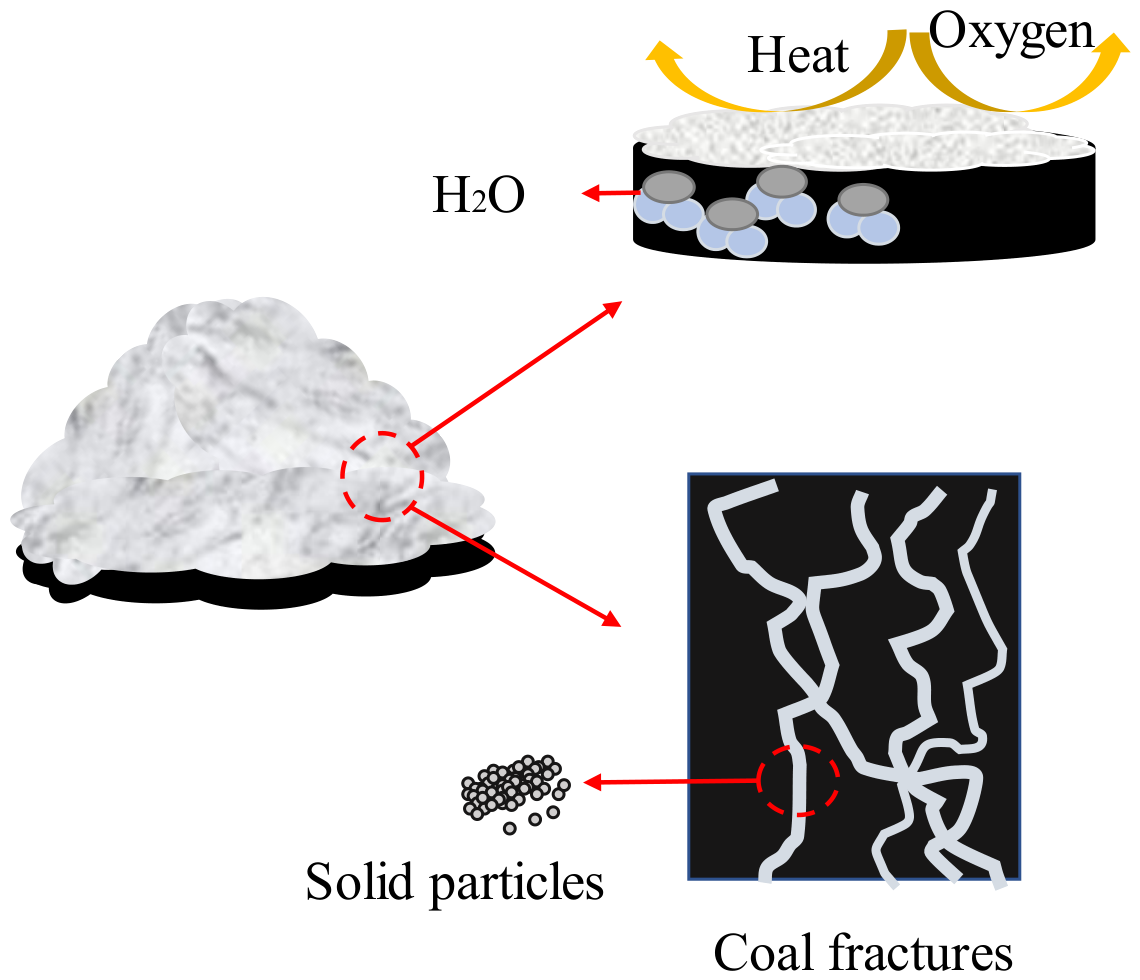
Two-phase foam is a water-based foam system in which an inert gas is used as the foaming medium to form a gas–liquid dispersion. Its fire-prevention effect is mainly achieved through liquid-phase heat absorption, foam-layer coverage, and dilution of oxygen by the released inert gas. Three-phase foam further introduces solid particles into the gas–liquid system, forming a gas–liquid–solid dispersion [24]. The added particles can strengthen the foam film, cover the coal surface, and fill fractures within the coal mass. These effects reduce coal–oxygen contact and improve the persistence of the fire-prevention barrier, as illustrated in Figure 1.
Two-/three-phase foams are widely used because they provide large-area coverage and can accumulate in elevated void spaces. However, their liquid films are prone to rupture, and their water-retention capacity is limited. To improve foam stability, many studies have optimized surfactant systems and stabilizing additives. Zuo [25], Zuo et al. [26], and Zhu et al. [27] screened commercially available surfactants and optimized foam formulations using orthogonal or response-surface experimental methods. Li [28] developed a fluorine-free foam based on organosilicon surfactants, sodium alpha-olefin sulfonate, hydroxyethyl cellulose, and magnesium–aluminum hydrotalcite. The resulting foam showed better foaming ability and stability than conventional fluorinated aqueous film-forming foams. Jia et al. [29] prepared a hydrocarbon/silicone/low-carbon alcohol ternary foam system, which achieved a 25% drainage time of 210 s and a foam stability coefficient of 0.958 after 300 s. Zhang et al. [30] further showed that long-chain alcohols with stronger steric hindrance were more effective in suppressing bubble coalescence. These experimental studies not only improved the foaming performance of existing surfactants through formulation optimization, but also demonstrated the feasibility of incorporating additional materials into the liquid-phase composition of foam systems.
Although optimizing foaming components is an effective way to improve the overall performance of foams, rapid loss of the liquid phase under high-temperature conditions remains a major cause of foam rupture. Moreover, the development of new foaming systems may substantially increase material costs. Therefore, cost-effective strategies for enhancing foam stability are still urgently needed.
Compared with liquid-phase systems, solid particles provide a cost-effective route for improving foam stability and sealing performance. Commonly used solid components include loess, fly ash, nano-aluminum hydroxide, and nano-silica, as summarized in Table 2. Among them, fly ash and loess are the most widely applied solid-phase materials [31]. Loess is inexpensive and locally available in some mining areas, but its impurities and potential ecological disturbance should be considered. Fly ash is non-combustible, low-cost, and readily available as an industrial by-product, making it a promising solid component for three-phase foams; however, it usually contains a large amount of impurities, and its excessive use may cause ecological damage. Fly ash, a solid waste generated by power plants, has the advantages of non-combustibility, low cost, and ready availability, making it an ideal candidate for solid-phase systems. Lu [32] and Lu et al. [33] conducted in-depth studies on the properties and microstructure of fly ash. However, the presence of fly ash may adversely affect foam generation. To address this issue, Wang [34] modified fly ash with sodium bentonite and investigated the interaction mechanism between highly dispersed particles and surfactants at the gas–liquid interface using an interfacial tensiometer. The results showed that sodium bentonite in the solid-phase composition could act as a dispersant by adsorbing onto the fly ash surface, thereby improving the suspension stability of the solid particles.
With the development of nanotechnology, nanoparticles have also been introduced to improve the stability of solid-containing foam systems. Their small particle size and Brownian motion reduce sedimentation and facilitate adsorption at the gas–liquid interface [35]. Bian and Zhang [36] reported that nano-aluminum hydroxide particles could interact with surfactants and enhance the mechanical strength of the foam film. Zhou [37], Wu [38], and Sheng et al. [39] investigated nano-silica-containing foam systems and found that surfactant adsorption on nanoparticle surfaces promoted the formation of interfacial aggregates, thereby improving foam stability and thermal resistance. These studies indicate that particle size, surface wettability, and particle–surfactant interactions are key factors controlling the performance of three-phase foams.
The widespread application of two-/three-phase foams is of great significance for preventing and controlling the spontaneous combustion of residual coal in goafs. Liu et al. [40] reported a three-phase foam technology using loess as the solid-phase material and conducted a field application at the 3-2421 working face of a coal mine. In this process, loess slurry was mixed with a foaming agent at a predetermined ratio in a surface grouting station and then transported through a pipeline network to the goaf, where foaming occurred. The resulting three-phase foam exhibited good fluidity and accumulation characteristics, effectively covered residual coal in elevated zones, significantly reduced coal temperature, and isolated oxygen, thereby effectively suppressing the tendency toward spontaneous combustion.
Two-/three-phase foams are suitable for large-area coverage and early-stage prevention in goafs because of their good fluidity, low cost, and accumulation ability. Their performance is mainly controlled by foam generation, drainage resistance, particle suspension stability, and water retention. The reported drainage time of 210 s and stability coefficient of 0.958 after 300 s in a hydrocarbon/silicone/low-carbon alcohol system demonstrate that formulation optimization can improve short-term stability [29], but the effective service life under high-temperature and strong air-leakage conditions remains a key limitation.

3.2. Gel Foams

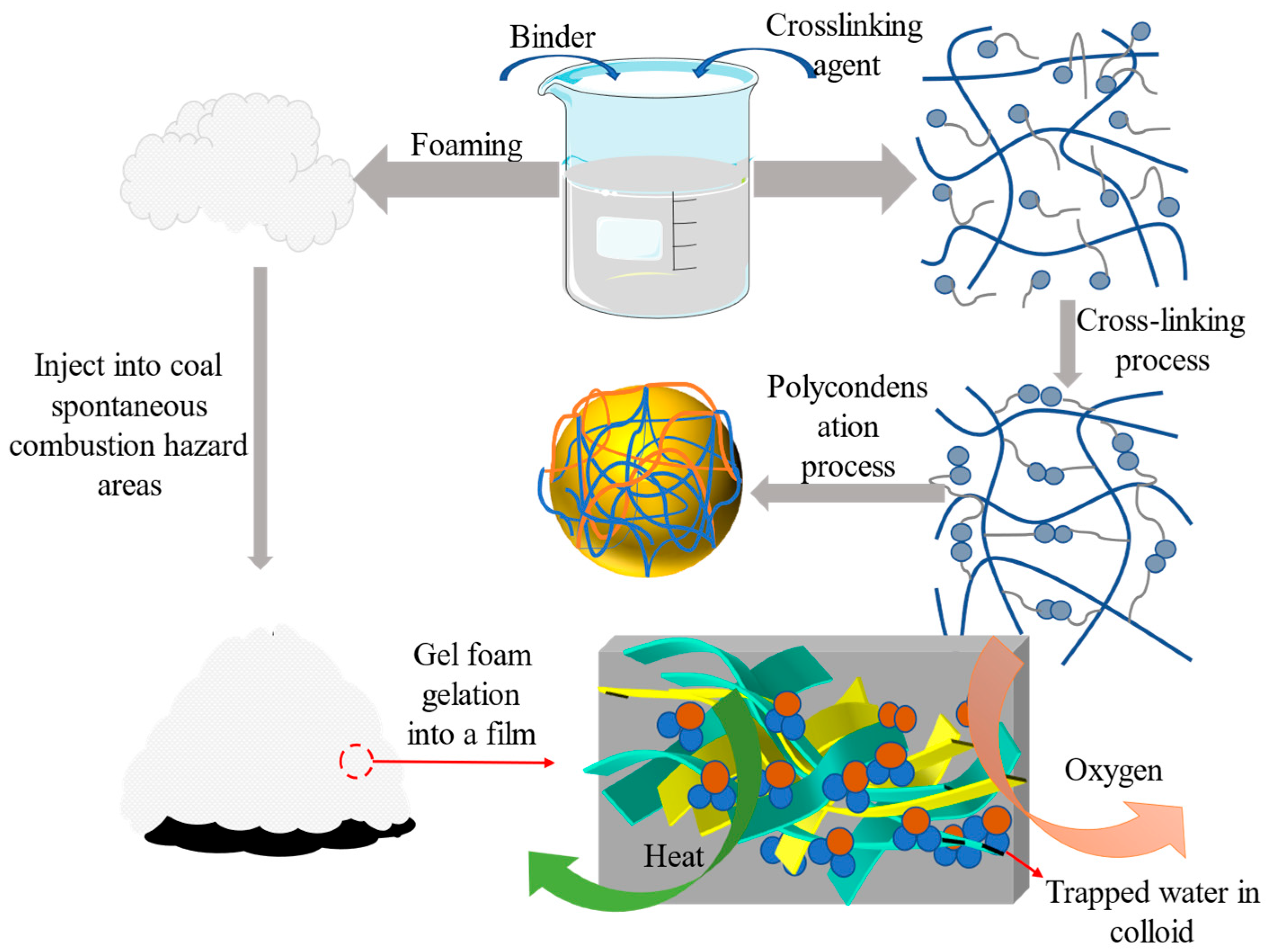
Gel foam is formed by introducing a gel network into a foam system. During gelation, the gelling agent and crosslinking agent form a three-dimensional colloidal structure, while the surfactant helps generate and stabilize the foam [41]. Compared with conventional water-based foams, gel foams exhibit stronger structural stability because the gel network suppresses gravity-driven drainage and helps retain water within the foam film [42]. After being injected into zones prone to coal spontaneous combustion, the foam–gel composite system forms a stable colloidal network on the coal surface, thereby effectively retaining liquid water within the system. Under high-temperature conditions, evaporation of the retained water can absorb a large amount of heat released during coal oxidation, thereby reducing coal temperature [43]. Meanwhile, the colloidal network acts as a barrier to oxygen ingress, thus suppressing further oxidation, as illustrated in Figure 2.
Compared with foam materials or gel materials used alone, gel foams can partly overcome the rapid rupture of water-based foams and the limited coverage ability of ordinary gels in elevated fire zones [44]. Accordingly, extensive research has been conducted on gel foam systems. Ren [45], Qin [46], Tian [47], and others systematically described the fire-prevention and fire-extinguishing mechanisms of gel foam and investigated the effects of different components on parameters such as gelation time and gel state. However, current gel foams still exhibit several limitations, including poor long-term water retention and a tendency for the foam gel to powder and crack under prolonged fire-extinguishing conditions. To address these problems, Zhang et al. [48] developed a polymer-based gel foam using a polymer as the gel material. Li [49] prepared a xanthan gum-based gel foam using biomass-derived xanthan gum as the gel component. Constant-temperature water-retention experiments showed that this gel foam maintained a water content of 66.85% even after 10 h at 60 °C. These studies indicate that polymeric and biomass-derived gel components are promising for improving the durability and environmental compatibility of gel foams.
Even after dehydration and rupture, gel foam can continue to function in the form of gel, thereby maintaining its oxygen-isolation and cooling effects. As a result, it has shown significant effectiveness in the control of high-temperature fire zones. Liang [50] conducted a field test at the 4153 working face of a coal mine in Shanxi Province. Injection of the gel foam reduced the temperature in the fire zone, while the colloidal network remaining on the foam surface continuously covered the coal surface and effectively prevented oxygen ingress. Subsequent monitoring showed that the temperature in the treated area remained stable and that no reignition occurred.
Gel foams show better water retention and structural persistence than conventional water-based foams. The reported water-retention value of 66.85% after 10 h at 60 °C for xanthan gum-based gel foam indicates that biomass-derived or polymeric gel networks can prolong cooling and oxygen-isolation effects [49]. Nevertheless, gelation time, viscosity, injectability, pipeline transport stability, and post-dehydration cracking must be balanced for field application.

3.3. Inhibitor Foams

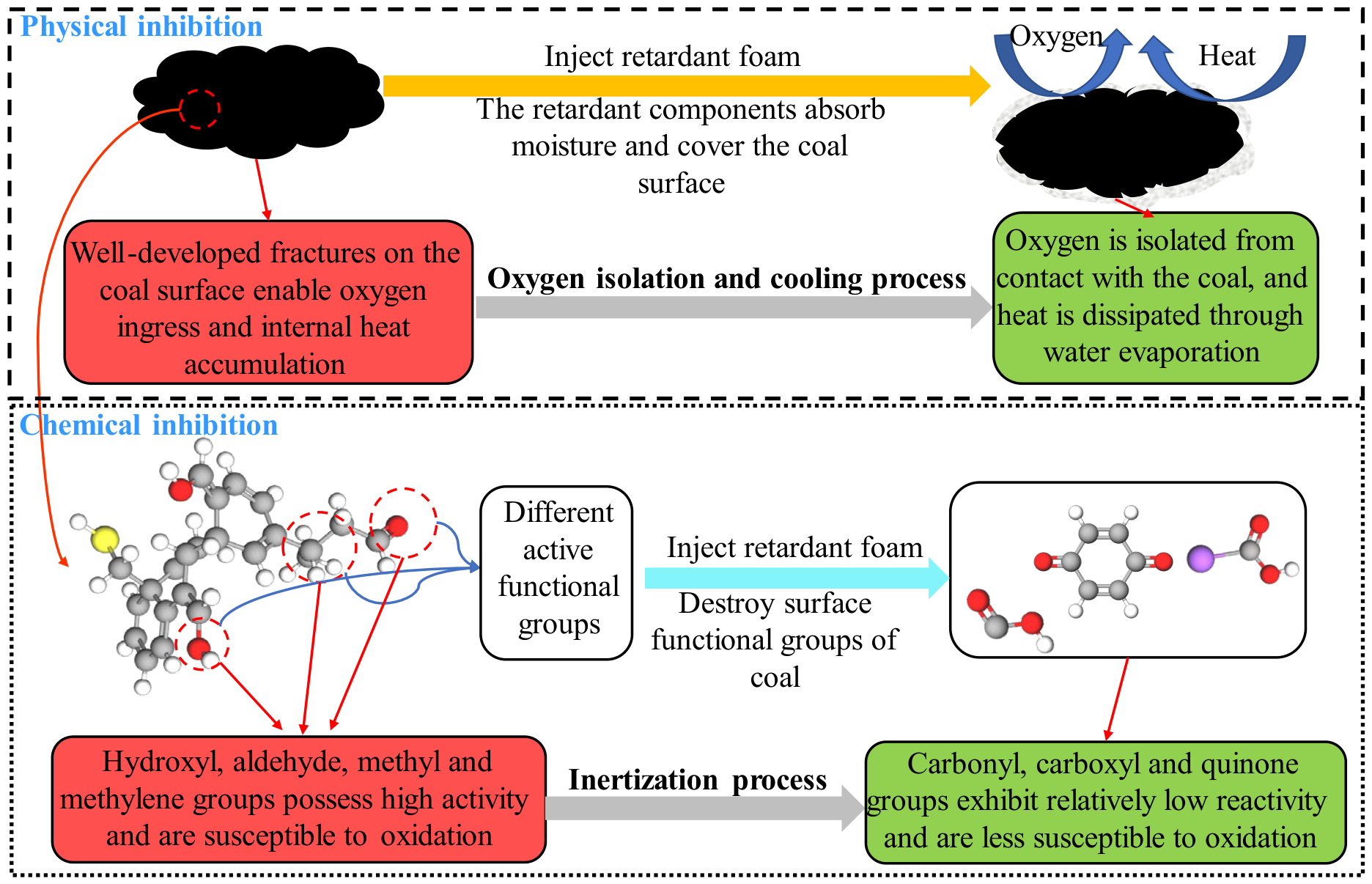
Inhibitor foams are prepared by incorporating inhibitory agents into surfactant-based foam systems. The foam phase provides coverage and transport capacity, while the inhibitor reduces the oxidation activity of coal [51]. According to their dominant suppression mechanisms, inhibitor foams can be divided into physical inhibitor foams and chemical inhibitor foams [52]. Physical inhibitor foams mainly function through cooling, moisture retention, and oxygen isolation. Chemical inhibitor foams further suppress coal oxidation by deactivating reactive functional groups, scavenging free radicals, or interrupting coal–oxygen chain reactions. The suppression mechanisms of these two types of inhibitor foam are illustrated in Figure 3.
Halide salts are commonly used in inhibitor foams because of their hygroscopicity and low cost. In many cases, these salts mainly provide physical inhibition rather than direct chemical passivation [53]. They can retain moisture, reduce coal temperature through evaporative cooling, and limit oxygen diffusion by forming a hydrated layer on the coal surface. Cao [54] used infrared spectroscopy to analyze the inhibition effect of MgCl2-based inhibitor foam on active functional groups in coal. Subsequent studies confirmed the feasibility of chloride-salt inhibitor foams, but also showed that salts may affect foamability and accelerate drainage or film rupture. Luan and Guo [55] compared different chloride inhibitors and found that CaCl2 had a more favorable effect on foam stability. Yang et al. [56] further optimized an inhibitor-foam formulation and obtained the best overall performance at mass fractions of 0.5% sodium fatty alcohol polyoxyethylene ether sulfate, 0.2% silicone resin polyether emulsion, 0.1% sodium carboxymethyl cellulose, and 5% magnesium chloride.
Halide-salt inhibitor foams mainly rely on physical coverage to isolate oxygen, whereas the inhibitory components in these systems have only limited chemical inerting effects on various active groups in coal. Under high-temperature conditions or in the presence of strong air leakage through large voids, physical coverage alone is often insufficient to effectively interrupt the coal–oxygen reaction. To improve the fire-extinguishing performance of inhibitor foams, researchers have incorporated chemical inhibitors and multicomponent composite inhibitors into foam systems. Lu [57] and Zhang [58] delivered chemical inhibitors into spontaneous-combustion zones in the form of foam and investigated their chemical inhibition characteristics. Cao [59] examined the microscopic mechanism of an inhibitor foam based on a hydroxyl-type inhibitor and found that the inhibitory effect destroyed highly reactive groups on the coal surface, such as peroxides and aliphatic groups. Wu [60] and Shu et al. [61] introduced tea polyphenols into foam systems and found that phenolic hydroxyl groups could interact with oxygen-containing functional groups in coal molecules, thereby weakening the oxidation pathway. Their results showed that the hydroxyl groups in tea polyphenol-based inhibitor foam could interact with active structures such as -COO- groups in coal molecules to form weak hydrogen bonds, thereby eliminating -COO- compounds and interrupting the oxidation reaction. Research on chemical and composite inhibitor foams has overcome the limitation of halide-salt foams, which mainly rely on physical inhibition, and has further revealed the microscopic chemical inerting pathways by which these foams deactivate reactive groups and interrupt oxidation chain reactions.
From a chemical and physicochemical perspective, inhibitor foams affect coal low-temperature oxidation through several pathways. Halide salts such as MgCl2 and CaCl2 are strongly hygroscopic and can retain water on the coal surface, thereby enhancing evaporative cooling and forming a hydrated barrier that delays oxygen diffusion. Their dissolved ions may also change the polarity and ionic strength of the liquid film, affecting adsorption on oxygen-containing functional groups. However, because these salts mainly act through moisture retention and physical coverage, their ability to directly deactivate reactive structures in coal is limited. Hydroxyl-containing inhibitors and polyphenolic compounds can provide hydrogen-donating groups that interact with peroxides, carboxyl, carbonyl, and ether-like structures in coal through hydrogen bonding, radical scavenging, or complexation. These interactions can reduce the concentration or activity of reactive intermediates and interrupt chain reactions during low-temperature oxidation.
Inhibitor foams can reduce the tendency of coal toward spontaneous combustion and are therefore widely used during the prevention stage of coal fire control. Wang et al. [62] applied a two-phase inhibitor foam at the 1192 working face of Tunbao Coal Mine to control coal fires in the goaf. Through a systematically arranged grouting pipeline network, inhibitor foam containing MgCl2 was uniformly injected into the goaf. The foam enabled effective accumulation and coverage of the inhibitor, while the inhibitor reduced the chemical activity of active functional groups on the coal surface, thereby lowering the risk of spontaneous ignition in areas prone to coal spontaneous combustion.
Inhibitor foams are particularly suitable for preventive treatment during the low-temperature oxidation stage. They combine the diffusion and coverage ability of foam with the oxidation-suppression effect of inhibitors. However, inhibitor–surfactant compatibility remains a key issue. Some salts or chemical inhibitors may reduce foamability, accelerate drainage, increase corrosion risk, or introduce environmental concerns. Future development should therefore emphasize compatibility, long-term inhibition efficiency, low corrosiveness, and environmental safety.

3.4. Solidified Foams

Solidified foams are prepared by mixing foaming agents with curing agents, followed by expansion, foaming, and solidification. Their main function is to seal loose coal, fractured rock masses, and air-leakage pathways, thereby reducing oxygen supply to residual coal [63]. According to their curing mechanism and raw-material chemistry, solidified foams can be divided into organic and inorganic systems. Organic solidified foams include polyurethane, phenolic, urea–formaldehyde, and phenol–urea–formaldehyde foams [64,65,66]. Inorganic solidified foams are usually based on cementitious materials, lime, fly ash, gypsum, or liquid sodium silicate. Cement-based systems are widely used because of their high post-curing strength and good sealing performance [67]. The main components, advantages, and limitations of these two categories are summarized in Table 3.
Organic solidified foams generally have high expansion ratios and low relative density, which are beneficial for filling voids and sealing leakage channels. However, they may also suffer from insufficient mechanical strength, weak adhesion, poor thermal stability, and potential release of toxic gases during thermal decomposition. Hu et al. [73] prepared a phenol–urea–formaldehyde foam and modified it with polyethylene glycol to improve toughness. Ma et al. [70] investigated the effects of catalysts on the mechanical properties, flame retardancy, and thermal stability of phenolic foam. An [72] examined the reinforcing effects of polyvinyl alcohol fibers and basalt fibers on urea–formaldehyde foam. Lu [80] prepared an organic–mineral solidified foam using polyisocyanate and alkali metal silicate as the main components, together with a specially designed catalyst and a block copolymer. Experimental results showed that the foam exhibited outstanding compressive strength. Nevertheless, organic solidified foams still face serious limitations, including poor biodegradability and the risk of releasing toxic gases during thermal decomposition. These drawbacks are not compatible with current requirements for mine ecological and environmental protection [81]. Therefore, although organic solidified foams can provide effective expansion and sealing, their environmental risk, thermal decomposition behavior, and potential toxicity limit their broader application in coal-mine fire prevention.
Similar to organic solidified foams, inorganic solidified foams are obtained by introducing inorganic curing agents into foam systems. Compared with organic systems, they usually show better fire resistance, lower toxicity, and higher environmental compatibility [76,82]. However, they also have limitations such as high density, brittleness, long setting time, and poor stacking behavior. To address this issue, Qin [83] and Jin [77] used fly ash as an aggregate and prepared fly ash-based solidified foams with the aid of composite additives, thereby significantly improving their sealing performance. Xiang [78] and Yi et al. [79] further examined the influence of foam dosage on post-curing strength. Their studies showed that increasing foam dosage increased internal porosity and reduced compressive strength. These findings suggest that the balance between expansion capacity and mechanical strength is critical for inorganic solidified foams.
In addition to providing effective fracture-sealing performance, inorganic solidified foams offer clear ecological advantages, which have made them particularly important for preventing and controlling the spontaneous combustion of residual coal in goafs. Jia Yuerong [84] reported an application case in the Suhaitu Mine, where an inorganic solidified foam mainly composed of cement clinker, lime, and gypsum was used for coal spontaneous combustion prevention. After injection, the inorganic solidified foam rapidly expanded and cured within coal and rock fractures, forming a high-strength sealing layer that effectively blocked air leakage and inhibited coal oxidation.
Solidified foams are more suitable for air-leakage sealing and fracture plugging than for rapid cooling. Their key performance indicators include expansion ratio, setting time, compressive strength, permeability, adhesion to coal and rock surfaces, and cracking resistance after curing. In field applications, flowability is required before curing, whereas strength and sealing integrity are required after curing. Inorganic solidified foams generally show better environmental compatibility, while organic solidified foams provide higher expansion but may involve greater ecological and safety risks.

4. Comparative Evaluation of Foam-Based Materials

Although the four types of foam-based materials share several basic functions, including cooling, oxygen isolation, and coverage, their dominant mechanisms and suitable application scenarios differ substantially. Two-/three-phase foams are characterized by good fluidity, broad coverage, and relatively low cost, but their long-term stability and water retention are limited. Gel foams improve water retention and high-temperature persistence through the formation of a gel network, but their injectability and gelation behavior must be carefully controlled. Inhibitor foams deliver physical or chemical inhibitors to coal surfaces and are particularly useful for suppressing low-temperature oxidation, although compatibility and environmental effects should be considered. Solidified foams are mainly used for fracture sealing and air-leakage control, but their curing behavior, brittleness, and density may restrict their use under complex mine conditions. The comparative characteristics, key evaluation indicators, and suitable application scenarios of these materials are summarized in Table 4.
Material selection should also consider coal type and oxidation stage [85]. Low-rank coal with abundant oxygen-containing functional groups and high moisture sensitivity may require stronger chemical inhibition and water-retaining systems, whereas higher-rank coal or compact residual coal zones may place greater emphasis on oxygen isolation and fracture sealing. At the early low-temperature oxidation stage, inhibitor foams and two-/three-phase foams are more suitable for preventive coverage and activity reduction. During self-heating or high-temperature development, gel foams become more valuable because of their water retention and thermal persistence. In zones with dominant air leakage or large fractures, solidified foams are more appropriate for long-term sealing.
This comparison indicates that no single foam system can meet all fire-prevention requirements under complex mine conditions. Material selection should therefore be scenario-oriented. For example, two-/three-phase foams are more suitable for large-scale coverage, gel foams for long-term water retention and high-temperature resistance, inhibitor foams for suppressing low-temperature oxidation, and solidified foams for air-leakage sealing. Future material design should move from single-function optimization toward multifunctional systems that integrate cooling, inhibition, sealing, durability, and environmental compatibility.
A quantitative comparison of representative performance indicators is needed to support the proposed comparative framework. However, direct comparison between studies remains difficult because reported data are often obtained under different formulations, coal samples, temperatures, heating modes, and evaluation methods. Therefore, the values summarized in Table 5 should be interpreted as representative indicators rather than directly equivalent performance rankings. Despite this limitation, these data provide useful evidence for identifying the main advantages and constraints of different foam systems.

5. Engineering Applications and Field Implementation

The engineering performance of foam-based materials depends not only on laboratory indicators but also on preparation, transportation, injection, diffusion, accumulation, and long-term service behavior under mine conditions. In practical coal-mine fire prevention, foam materials are usually prepared at surface or underground stations and then transported through pipelines to goafs, fractured coal masses, or sealed fire zones. During this process, foam stability, slurry viscosity, pipeline resistance, foaming position, and compatibility with existing grouting systems directly influence the final treatment effect.
For two-/three-phase foams, the main engineering advantage is their ability to spread over large areas and accumulate in elevated voids. For gel foams, field implementation should focus on controlling gelation time so that the material remains pumpable during transport but forms a stable gel network after reaching the target area. For inhibitor foams, the uniform distribution of inhibitory components is critical, especially in zones with developed leakage pathways. For solidified foams, the key engineering issue is the balance between pre-curing flowability and post-curing sealing strength.
The field cases summarized in Table 6 indicate that foam-based materials have been applied in different coal-mine scenarios, including goaf coverage, high-temperature fire-zone treatment, inhibitor delivery, and fracture sealing. However, many published engineering reports provide only qualitative descriptions of treatment effects. Key parameters such as injection dosage, monitoring duration, temperature reduction, oxygen concentration, CO evolution, diffusion radius, and reignition prevention performance are often incompletely reported. This limits objective comparison among different foam systems. Future field studies should therefore provide more complete monitoring data to support reliable evaluation and engineering selection.

6. Challenges and Future Prospects

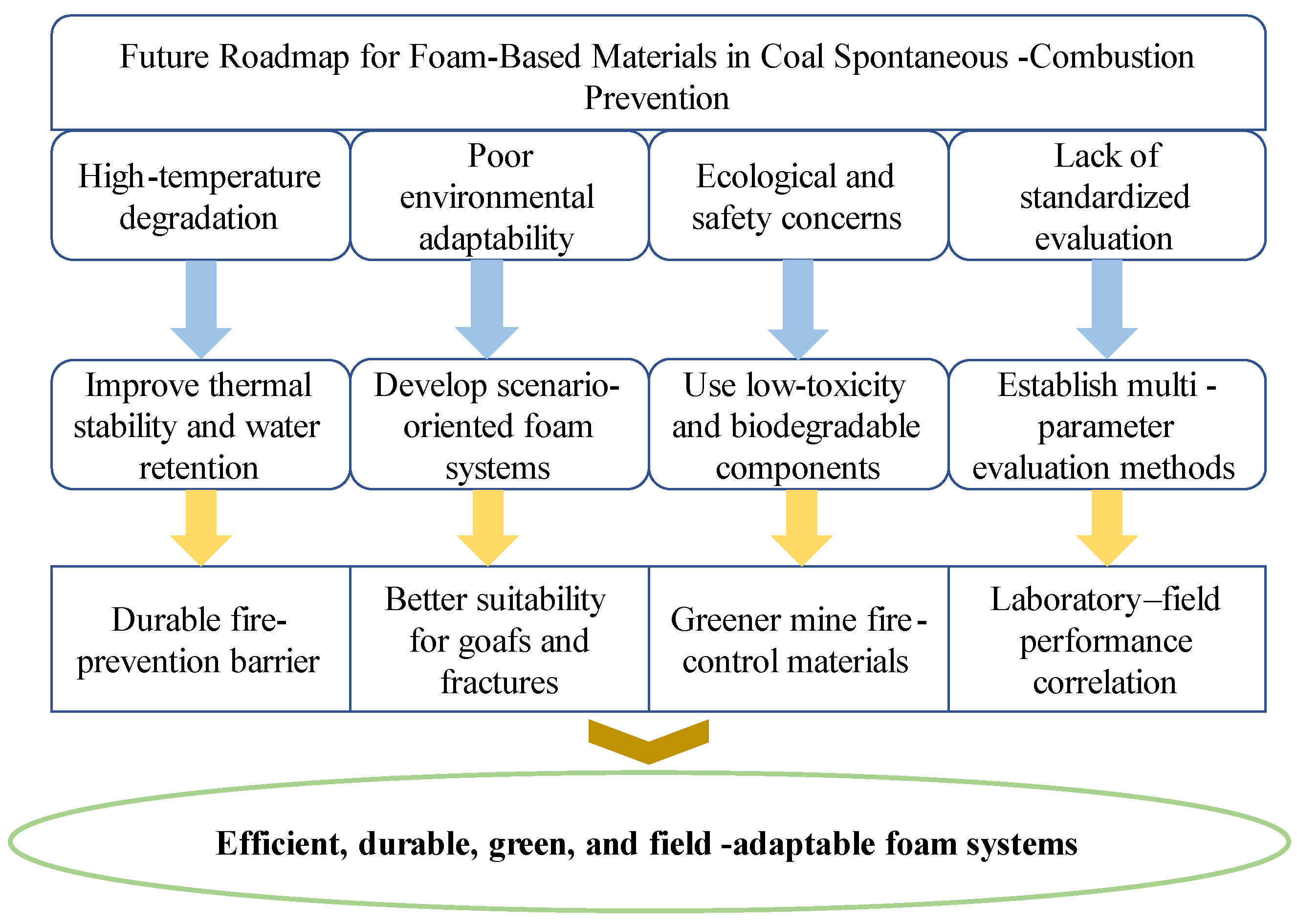
Although substantial progress has been made in foam-based fire-prevention materials, their practical application in underground coal mines still faces several challenges. These challenges are related not only to material formulation but also to high-temperature durability, environmental adaptability, ecological safety, evaluation standards, and field-scale implementation. The main challenges, corresponding development strategies, and expected target outcomes are summarized in Figure 4.

6.1. High-Temperature Performance Degradation

High-temperature degradation remains one of the main limitations of foam-based materials. For water-based systems, including two-/three-phase foams and inhibitor foams, rapid evaporation and liquid drainage can lead to foam collapse, thereby weakening cooling and oxygen-isolation effects. For gel foams and solidified foams, prolonged exposure to high temperatures may cause dehydration, cracking, powdering, or loss of structural integrity. These changes reduce the durability of the fire-prevention barrier and may increase the risk of reignition. Future research should therefore focus on improving thermal stability, water retention, and structural persistence under long-duration high-temperature conditions.

6.2. Limited Adaptability to Complex Mine Environments

The performance of foam materials is strongly affected by the heterogeneity of underground mine environments. Fracture size, leakage intensity, coal type, temperature, humidity, and transportation distance can all influence foam diffusion and retention. In three-phase foams, the particle-size distribution of the solid phase directly affects fracture filling and sealing performance. In inhibitor foams, inhibition efficiency may vary with coal rank and functional-group composition. In solidified foams, setting time and final strength are sensitive to temperature and water content. Future studies should therefore evaluate foam adaptability under representative geological, thermal, and leakage conditions, rather than only under ideal laboratory settings.

6.3. Potential Ecological Risks

Potential ecological risks should be considered when foam-based materials are used on a large scale. During migration through fracture networks, foam media may contact surrounding rock, soil, and groundwater. Halide-salt inhibitor foams containing magnesium or calcium salts may increase salinity and corrosivity when repeatedly applied or used in large quantities [86]. Some surfactants, curing agents, and synthetic polymers may have limited biodegradability and may introduce secondary environmental burdens [87,88]. Organic solidified foams containing formaldehyde-based or polyurethane-based components may release smoke, irritating gases, or toxic decomposition products under high-temperature conditions [71]. These concerns conflict with green-mining requirements. Future formulations should therefore prioritize low-toxicity surfactants, biodegradable or biomass-derived gel components, low-corrosion inhibitors, and inorganic or hybrid sealing materials with lower environmental impact.

6.4. Insufficient Standardized Evaluation Methods

The lack of standardized evaluation methods also limits the comparison and engineering selection of foam-based materials. Current studies use different indicators, such as foaming ability, drainage time, water retention, inhibition rate, compressive strength, and permeability. These indicators are often measured under different temperatures, coal samples, heating conditions, and test durations, making direct comparison difficult. More importantly, laboratory performance does not always correspond to field performance because actual goaf environments involve air leakage, fractured media, temperature gradients, water loss, and long-distance pipeline transport. A standardized multi-parameter evaluation system should therefore be established. Such a system should integrate foaming behavior, rheological properties, thermal stability, oxygen-isolation ability, inhibition efficiency, sealing performance, environmental impact, and field monitoring data.

7. Conclusions

Foam-based materials provide a versatile route for preventing coal spontaneous combustion by integrating cooling, oxygen isolation, inhibition, water retention, and sealing functions. Two-/three-phase foams are suitable for large-area coverage and early-stage goaf treatment, but their long-term stability and water retention remain limited. Gel foams improve water retention and high-temperature persistence through the formation of gel networks, although gelation control and pipeline transportability require further optimization. Inhibitor foams combine foam delivery with physical or chemical inhibition and are effective for suppressing low-temperature coal oxidation, but inhibitor compatibility, corrosion, and environmental risk should be carefully considered. Solidified foams provide durable sealing of air-leakage pathways and fractures, but their curing behavior, brittleness, density, and potential toxicity remain key constraints.
Future research should focus on multifunctional formulation design, environmentally benign components, improved high-temperature durability, and scenario-oriented material selection. More attention should also be given to coal type, oxidation stage, leakage condition, and field monitoring data. In addition, standardized evaluation methods are needed to link laboratory indicators with engineering performance. These efforts will support the development of more efficient, durable, and sustainable foam-based materials for coal spontaneous-combustion prevention.

Author Contributions

All authors contributed to the study conception and design. Literature investigation, data collection, and figure preparation were performed by Y.Z. Literature analysis and technical discussion were performed by Y.Z., F.T. and L.L. Supervision, manuscript revision, and overall coordination were performed by S.S. The first draft of the manuscript was written by Y.Z. and all authors commented on previous versions of the manuscript. All authors have read and agreed to the published version of the manuscript.

Funding

This study was funded by the National Natural Science Foundation of China [Grant Nos. 52574306, U25A20274].

Data Availability Statement

The authors declare that no new data, models, or code were generated or analyzed in support of this review article.

Conflicts of Interest

The authors declare no conflicts of interest.

References

  1. Liang, Y.; Luo, H. Current situation and development trend for coal mine fire prevention & extinguishing techniques in China. J. China Coal Soc. 2008, 33, 126–130. [Google Scholar] [CrossRef]
  2. Liang, Y.; Xin, Q.; Wang, S.; Hu, P.; Jiang, S.; Song, S. Structure variation of coal particle packing during the spontaneous combustion. J. China Coal Soc. 2020, 45, 1398–1405. [Google Scholar] [CrossRef]
  3. Wang, L.; Liang, Y.; Luo, H. Research progress and outlook on theory of thermodynamic disaster of coal mine in China. Coal Sci. Technol. 2018, 46, 1–9. [Google Scholar] [CrossRef]
  4. Zhang, Y.; Yang, K.; Li, R.; Wang, J.; Tang, L. Research progress and development trend of mine fire prevention and extinguishing materials. Saf. Coal Mines 2023, 54, 82–91. [Google Scholar] [CrossRef]
  5. Shaw, S.D.; Blum, A.; Weber, R.; Kannan, K.; Rich, D.; Lucas, D.; Koshland, C.P.; Dobraca, D.; Hanson, S.; Birnbaum, L.S. Halogenated flame retardants: Do the fire safety benefits justify the risks? Rev. Environ. Health 2010, 25, 261–305. [Google Scholar] [CrossRef]
  6. Terekhov, I.V.; Filatov, S.N.; Chistyakov, E.M.; Borisov, R.S.; Kireev, V.V. Halogenated hydroxy-aryloxy phosphazenes and epoxy oligomers based on them. Russ. J. Appl. Chem. 2013, 86, 1600–1604. [Google Scholar] [CrossRef]
  7. Hallman, D.S. A review of coal mine fire extinguishment methods. Emerg. Manag. Sci. Technol. 2024, 4, e005. [Google Scholar] [CrossRef]
  8. Liu, Y.; Wen, H.; Chen, C.; Guo, J.; Jin, Y.; Zheng, X.; Cheng, X.; Li, D. Research status and development trend of coal spontaneous combustion fire and prevention technology in China: A review. ACS Omega 2024, 9, 21727–21750. [Google Scholar] [CrossRef] [PubMed]
  9. Han, D.; Niu, G.; Zhu, H.; Chang, T.; Liu, B.; Ren, Y.; Wang, Y.; Song, B. Exploration and frontier of coal spontaneous combustion fire prevention materials. Processes 2024, 12, 1155. [Google Scholar] [CrossRef]
  10. Fu, S.Q. Experimental Research on Fire Fighting Material Characteristics of Inorganic Three-Phase Foam. Master’s Thesis, Liaoning Technical University, Fuxin, China, 2021. [Google Scholar] [CrossRef]
  11. Qin, B.; Wang, D.; Bi, Q.; Ma, K.; Xu, H. Three-phase foam for preventing spontaneous combustion of coal in goaf. J. China Univ. Min. Technol. 2006, 35, 162–166. [Google Scholar] [CrossRef]
  12. Wang, T.; Lu, Y.; Shi, S.; Wang, G.; Yan, Z. Research on diffusion properties of inorganic solidified foam slurry in air leakage fracture. China Saf. Sci. J. 2019, 29, 24–30. [Google Scholar] [CrossRef]
  13. Ren, W.X.; Wang, D.M.; Zhou, F.B.; Qin, B.T.; Ma, K. Application of three-phase foam technology in preventing coal spontaneous combustion in fully mechanized top-coal caving face with large dip angle and downward mining. Saf. Coal Mines 2006, 37, 11–14. [Google Scholar] [CrossRef]
  14. Lu, W.; Liu, C.; Zhang, Q. Application of foam carrier technology in coal mine fire prevention and extinguishing. Min. Saf. Environ. Prot. 2009, 36, 185–187. [Google Scholar] [CrossRef]
  15. Chen, J.; Jia, B.; Fu, S.; Wen, Y.; Liang, Y.; Tian, F. Novel PFA-based inorganic three-phase foam for inhibiting coal spontaneous combustion. ACS Omega 2023, 8, 24615–24623. [Google Scholar] [CrossRef] [PubMed]
  16. Zhu, S. Study on characteristics of foam gel for prevention and control of coal spontaneous combustion. Coal Sci. Technol. 2019, 47, 223–228. [Google Scholar] [CrossRef]
  17. Qin, B.T.; Feng, L.L.; Jiang, W.J.; Chen, Q.H.; Li, J.F. Research progress of mine foam fire prevention and extinguishing technology. Coal Sci. Technol. 2022, 43, 1–12+26. [Google Scholar] [CrossRef]
  18. Shi, Q.; Long, L.; Sun, Y.; Zhao, S.; Pang, Y.; Xia, C. Formation mechanism and the extinguishment performance of gel-stabilized foam for inhibiting coal spontaneous combustion. Energy 2024, 303, 131995. [Google Scholar] [CrossRef]
  19. Wen, H.; Wu, K.; Cao, X.; Yang, Y.; Zhang, D.; Li, P. Inhibiting and inert foam fire prevention and extinguishing technology for preventing coal spontaneous combustion in high ground temperature and deep mines. Coal Sci. Technol. 2014, 42, 108–111. [Google Scholar] [CrossRef]
  20. Yu, Z.J.; Deng, Y.X.; Chen, X.K.; Zhang, Z.P. Research progress and prospect of inhibitors for coal spontaneous combustion used in mine. J. Saf. Sci. Technol. 2025, 21, 5–15. [Google Scholar] [CrossRef]
  21. Zhang, H.; Zhao, Z.; Wang, Z.; Nie, S.; Han, C. Inhibition effect of coal spontaneous combustion by composite inhibitory foam based on CaCl2–melatonin inhibitor. ACS Omega 2024, 9, 13323–13331. [Google Scholar] [CrossRef]
  22. Ma, L.; Du, S.; Zhang, Z.; Wang, H.; Zhao, L.; Zhang, B. Preparation and characteristics of inorganic curing foam with large-volume fly ash in goaf. Coal Geol. Explor. 2023, 51, 243–251. [Google Scholar]
  23. Zhao, Y.; Sun, G.; Hu, X.; Xue, D.; Wang, K. Study on the preparation of inorganic solidified foam with high stability and its prevention and treatment of coal spontaneous combustion. Energy Fuels 2023, 37, 14268–14279. [Google Scholar] [CrossRef]
  24. Qin, B.; Wang, D.; Chen, J. Experimental study on inhibition characteristics of three-phase foam. J. Hunan Univ. Sci. Technol. 2006, 21, 5–8. [Google Scholar] [CrossRef]
  25. Zuo, S. Research on Preparation and Performance Test Method of Three Phase Foam Used in Coal Mine. Master’s Thesis, Anhui University of Science and Technology, Huainan, China, 2022. [Google Scholar]
  26. Zuo, X.X.; Wang, B.; Zhu, X.Y.; Li, Y.D.; Zuo, S.; Ma, X.M. Optimization and study of three-phase foam foaming agent for polymer gel. Fire Sci. Technol. 2021, 40, 741–743. [Google Scholar] [CrossRef]
  27. Zhu, H.; Hu, C.; Zhou, Q.; Guo, J.; Wang, X.; Yuan, X. Study on formula of mine three-phase foam fire prevention and control material optimized by response surface methodology. Coal Sci. Technol. 2019, 47, 120–126. [Google Scholar] [CrossRef]
  28. Li, S.L. Study on Preparation and Fire Prevention and Extinguishing Characteristics of Fluorine-Free Foam Based on Silicone-Hydrocarbon Compound System. Master’s Thesis, Anhui University of Science and Technology, Huainan, China, 2024. [Google Scholar] [CrossRef]
  29. Jia, H.; Chen, N.; Jiao, Z.; Cheng, L.; Zhao, W.; Pan, R. Analysis of ternary foam of hydrocarbon/silicone/low carbon alcohol and the inhibition effect on coal spontaneous combustion. CIESC J. 2022, 73, 470–479. [Google Scholar] [CrossRef]
  30. Zhang, H.; Wang, Y.; Wang, T. Experimental study on effect of alcohol surfactants on bubble coalescence in full range of concentrations. CIESC J. 2020, 71, 4161–4167. [Google Scholar] [CrossRef]
  31. Wang, D. A novel technology of mine fire fighting—Three-phase foam. Saf. Coal Mines 2004, 35, 16–18. [Google Scholar] [CrossRef]
  32. Lu, X.X. Study on the Preparation Technology and Field Application of Foam Used for Controlling the Large Space Coal Spontaneous Combustion. Doctoral’s Thesis, China University of Mining and Technology, Xuzhou, China, 2016. [Google Scholar]
  33. Lu, Y. Study on the Inorganic Solidified Foam and Its Characteristics for Preventing and Controlling Spontaneous Combustion of Coal. Doctoral’s Thesis, China University of Mining and Technology, Xuzhou, China, 2015. [Google Scholar]
  34. Wang, Z.L.; Qi, X.; He, S.Q.; Yu, T.T.; Fan, H.M.; Sun, L.Z.; Yang, Y.L. Preparation of fly ash three-phase foam and its stability mechanism. J. China Univ. Pet. 2020, 44, 166–176. [Google Scholar] [CrossRef]
  35. Liu, Z.P.; Li, Z.M.; Zheng, W.B.; Wang, C.Z. Stability of multi-phase foam systems. J. Petrochem. Univ. 2012, 25, 42–46+50. [Google Scholar] [CrossRef]
  36. Bian, Y.; Zhang, L. Study on preparation of nano aluminum hydroxide three-phase foam. J. Saf. Sci. Technol. 2021, 17, 59–65. [Google Scholar] [CrossRef]
  37. Zhou, R. Study on properties and mechanism of three-phase foam containing silica nanoparticles. Fire Saf. Sci. 2022, 31, 224–232. [Google Scholar] [CrossRef]
  38. Wu, Y.; Fang, S.; Zhang, K.; Zhao, M.; Jiao, B.; Dai, C. The stability mechanism of nitrogen foam in porous media with silica nanoparticles modified by cationic surfactants. Langmuir 2018, 34, 8015–8023. [Google Scholar] [CrossRef] [PubMed]
  39. Sheng, Y.; Li, Y.; Yan, C.; Peng, Y.; Ma, L.; Wang, Q. Influence of nanoparticles on the foam thermal stability of mixtures of short-chain fluorocarbon and hydrocarbon surfactants. Powder Technol. 2022, 403, 117420. [Google Scholar] [CrossRef]
  40. Liu, J.; Jia, J. Application of three-phase foam technology in fire prevention and extinguishing of fully mechanized top-coal caving face in Sanhekou Mine. Shandong Coal Sci. Technol. 2017, 96+98. [Google Scholar] [CrossRef]
  41. Tian, Z.J. Research on the Theory and Technology of Foamed Gel Using for Fire Prevention. Doctoral’s Thesis, China University of Mining and Technology, Xuzhou, China, 2009. [Google Scholar]
  42. Shi, Q.; Qin, B.; Xu, Y.; Hao, M.; Shao, X.; Zhuo, H. Experimental investigation of the drainage characteristic and stability mechanism of gel-stabilized foam used to extinguish coal fire. Fuel 2022, 313, 122685. [Google Scholar] [CrossRef]
  43. Li, X.C.; Qin, J.Y.; Yu, X.H.; Li, D.T.; Shang, X.F.; Ren, W.X.; Jia, H.L. Study on the stability of foamed gel and its structural evolution characteristics. China Min. Mag. 2024, 33, 205–210. [Google Scholar] [CrossRef]
  44. Wang, D.; Wei, Z.; Guo, Y.; Ren, W. Study on new foam gel technology for plugging coal seam fractures and preventing fire. Energy Technol. Manag. 2023, 48, 109–112. [Google Scholar] [CrossRef]
  45. Ren, W.; Guo, Q.; Zuo, B.; Wang, Z.; Fang, S. Characteristics and mechanism of prevention and control of coal spontaneous combustion with foam-gel. J. China Coal Soc. 2015, 40, 401–406. [Google Scholar] [CrossRef]
  46. Qin, B.; Zhang, L. Experimental study on preparation of multiphase gel foam for preventing coal spontaneous combustion. J. Cent. South Univ. 2013, 44, 4652–4657. [Google Scholar]
  47. Tian, Z.; Wang, D.; Xu, Y.; Qin, B.; Zhong, X. Research of Foam Gel Using for Fire Prevention and Gas Plug. J. China Univ. Min. Technol. 2010, 39, 169–172+189. [Google Scholar]
  48. Zhang, L.; Shi, B.; Qin, B.; Wu, Q.; Dao, V. Characteristics of foamed gel for coal spontaneous combustion prevention and control. Combust. Sci. Technol. 2017, 189, 980–990. [Google Scholar] [CrossRef]
  49. Li, J. Preparation and Properties Research of Xanthan Gum-Based Gel Foam for Preventing Coal Spontaneous Combustion. Master’s Thesis, Anhui University of Science and Technology, Huainan, China, 2022. [Google Scholar] [CrossRef]
  50. Liang, T. Application of gel foam material in mine fire prevention and extinguishing. Coal Sci. Technol. Mag. 2017, 183–185. [Google Scholar] [CrossRef]
  51. Xie, J.; Zhang, X.J.; Xu, S.R.; Liu, X.F.; Wang, D.J. Research status and development trend of foam fire prevention materials. Coal Technol. 2023, 42, 129–132. [Google Scholar] [CrossRef]
  52. Wang, J.; Zhang, Y.; Wang, J.; Wu, Y.; Zhou, C.; Zhang, Z. Synergistic inhibition effect of inorganic salt inhibitors and free radical scavengers on coal spontaneous combustion. J. China Coal Soc. 2020, 45, 4132–4143. [Google Scholar] [CrossRef]
  53. Yu, M.G.; Wang, L.; Li, H.T.; Wang, K.; Kang, F.R. Research status and development trend of fire-extinguishing materials in Chinese coal mines. Min. Saf. Environ. Prot. 2022, 49, 22–36. [Google Scholar] [CrossRef]
  54. Cao, X. Research on the Prevention of Coal Spontaneous Combustion by Inhibition Foam. Master’s Thesis, Xi’an University of Science and Technology, Xi’an, China, 2013. [Google Scholar]
  55. Luan, X.; Guo, R. Experimental study on foam carrier of inhibitor. Saf. Coal Mines 2016, 47, 27–30. [Google Scholar] [CrossRef]
  56. Yang, S.; Deng, H.; Qi, Q.; Dong, W. Flame resistance and foaming properties of liquid inhibition foam in the well. J. Liaoning Tech. Univ. 2016, 35, 359–364. [Google Scholar] [CrossRef]
  57. Li, J.; Lu, W.; Xu, J. Coal spontaneous combustion prevention and cure with chemical retarder as well as analysis on retarding mechanism. Coal Sci. Technol. 2012, 40, 50–53. [Google Scholar] [CrossRef]
  58. Zhang, Q.; Wang, X.; Xie, H. Application of high-multiple inhibiting foam in preventing coal spontaneous combustion in Dongtan Mine. Coal Sci. Technol. 2009, 37, 39–41. [Google Scholar] [CrossRef]
  59. Cao, K.; Zhang, Y. Technology of spontaneous combustion prevention and control with high efficient retarding foam to residual coal in goaf of fully-mechanized top coal caving mining face. Coal Sci. Technol. 2015, 43, 67–70. [Google Scholar] [CrossRef]
  60. Wu, W. Study on Preparation of Inhibitory Foam Based on Tea Polyphenols and Prevention of Coal Spontaneous Combustion. Master’s Thesis, Anhui University of Science and Technology, Huainan, China, 2022. [Google Scholar] [CrossRef]
  61. Shu, S.; Zhang, L. Preparation of retarding foam based on tea polyphenols and its flame retardancy. Saf. Coal Mines 2022, 53, 50–55+61. [Google Scholar] [CrossRef]
  62. Wang, X.D.; Wang, D.M.; Si, W.B.; Chen, J.Q.; Chang, B. Key technologies for fire area treatment of 1192 closed working face in Tunbao Mine. Saf. Coal Mines 2015, 46, 70–72+76. [Google Scholar] [CrossRef]
  63. Wang, W.; He, Y. Successful application of mine solidified foam fire extinguishing technology. Saf. Coal Mines 2011, 42, 93–95. [Google Scholar] [CrossRef]
  64. Geng, Q.; Xu, X.; Li, B. Research progress in control technology for reaction heat of polyurethane grouting materials in mines. Chem. Ind. Eng. Prog. 2025, 44, 319–328. [Google Scholar] [CrossRef]
  65. Yu, C.; Wang, F.; He, Z.H.; Liu, Z.M.; Jiao, Z.P.; Shen, L. Experimental study on toughener modified mineral phenol urea formaldehyde foam. China Min. Mag. 2021, 30, 133–138. [Google Scholar] [CrossRef]
  66. Gu, Y.X.; Zhang, D.; Qi, D.W.; Liu, Y.X.; Fan, Z.R. Effect of type and dosage of foaming agent on properties of phenolic foam. China Plast. Ind. 2014, 42, 94–98. [Google Scholar] [CrossRef]
  67. Cheng, M. Study on Foamed Cement Solidified Filling Fire Preventing and Extinguishing Material. Master’s Thesis, Xi’an University of Science and Technology, Xi’an, China, 2019. [Google Scholar]
  68. Hu, X. Study on a New Composite Foam for Air-Leakage Blocking in Mine. Doctoral’s Thesis, China University of Mining and Technology, Xuzhou, China, 2013. [Google Scholar]
  69. Wang, S. Preparation and Application of Filling Foam for Air-Leakage Blocking in Coal Mine. Master’s Thesis, China University of Mining and Technology, Xuzhou, China, 2014. [Google Scholar]
  70. Ma, Y.F.; Zhang, W.; Wang, C.P.; Chu, F.X. Effect of catalyst on properties of phenolic resin and its foam materials. Eng. Plast. Appl. 2012, 40, 7–11. [Google Scholar] [CrossRef]
  71. Anderson, R.C.; Stock, M.F.; Sawin, R.; Alarie, Y.C. Toxicity of thermal decomposition products of urea formaldehyde and phenol formaldehyde foams. Toxicol. Appl. Pharmacol. 1979, 51, 9–17. [Google Scholar] [CrossRef]
  72. An, S. Research on Strengthening and Toughening Modification of Urea-Formaldehyde Foam. Master’s Thesis, Harbin Institute of Technology, Harbin, China, 2013. [Google Scholar]
  73. Hu, X.; Wang, K.; Xue, D.; Sun, G. Preparation and application of high accumulation solidified foam for preventing coal spontaneous combustion. Coal Sci. Technol. 2024, 52, 159–170. [Google Scholar] [CrossRef]
  74. Zhang, Y.; Xu, C.; Wang, D. Study on properties of modified mine organic solidified foam with toughening agent. Coal Technol. 2015, 34, 255–257. [Google Scholar] [CrossRef]
  75. Du, J.H.; Li, Y.; Sun, C.; Liu, M.; Zhu, F.S. Study on preparation and properties of organic toughened foam for mining. Saf. Coal Mines 2024, 55, 116–125. [Google Scholar] [CrossRef]
  76. Jin, L. Study on Inorganic Solidified Foam Fire-Fighting Materials and Properties. Master’s Thesis, China Coal Research Institute, Beijing, China, 2020. [Google Scholar] [CrossRef]
  77. Jin, Y.; Zhao, D.; Yue, N.; Deng, J. Experimental study on characteristics of new mine inorganic solidified expansion filling material. Coal Technol. 2014, 33, 255–257. [Google Scholar] [CrossRef]
  78. Xiang, Q. Experimental Research of Foam Dosage Effects on Curing Filling Materials Properties. Master’s Thesis, Xi’an University of Science and Technology, Xi’an, China, 2017. [Google Scholar]
  79. Yi, X.; Kang, F.R.; Deng, J.; Xiang, Q.; Ma, L. Research and application on inorganic solidified foam filling material for mine. J. Saf. Sci. Technol. 2017, 13, 136–142. [Google Scholar] [CrossRef]
  80. Lu, Y.; Qin, B.; Ping, W. Development and application of solidified foam of organic minerals. Met. Mine 2011, 143–146+150. [Google Scholar]
  81. Ministry of Environmental Protection of the People’s Republic of China. Technical Specification for Eco-Environmental Protection and Restoration of Mines (Trial): HJ 651—2013; China Environmental Science Press: Beijing, China, 2013. [Google Scholar]
  82. Qin, B.; Wang, D. Present situation and development of mine fire control technology. China Saf. Sci. J. 2007, 17, 80–85+193. [Google Scholar] [CrossRef]
  83. Qin, B. Development & Application of Solidified Foam of Fly Ash for Mine Fire Control. Met. Mine 2008, 139–141+148. [Google Scholar] [CrossRef]
  84. Jia, Y. Application of mine solidified foam material in local fire area treatment of Wuda Coalfield. Saf. Coal Mines 2010, 41, 43–44. [Google Scholar] [CrossRef]
  85. Meng, X.; Sun, J.; Chu, R.; Fan, L.; Jiang, X.; Tang, L.; Zheng, D. Effect of active functional groups in coal on the release behavior of small molecule gases during low-temperature oxidation. Energy 2023, 273, 127290. [Google Scholar] [CrossRef]
  86. Litalien, A.; Zeeb, B. Curing the earth: A review of anthropogenic soil salinization and plant-based strategies for sustainable mitigation. Sci. Total Environ. 2020, 698, 134235. [Google Scholar] [CrossRef]
  87. Badmus, S.O.; Amusa, H.K.; Oyehan, T.A.; Saleh, T.A. Environmental risks and toxicity of surfactants: Overview of analysis, assessment, and remediation techniques. Environ. Sci. Pollut. Res. 2021, 28, 62085–62104. [Google Scholar] [CrossRef]
  88. Jahura, F.T.; Mazumder, N.-U.-S.; Hossain, M.T.; Kasebi, A.; Girase, A.; Ormond, R.B. Exploring the prospects and challenges of fluorine-free firefighting foams (F3) as alternatives to aqueous film-forming foams (AFFF): A review. ACS Omega 2024, 9, 37430–37444. [Google Scholar] [CrossRef]
Figure 1. Fire-suppression mechanisms of two-/three-phase foams.
Applsci 16 05840 g001
Figure 2. Schematic illustration of the formation and fire-prevention mechanism of gel foam.
Applsci 16 05840 g002
Figure 3. Suppression mechanisms of physical and chemical inhibitor foams during coal oxidation.
Applsci 16 05840 g003
Figure 4. Roadmap of key challenges, development strategies, and target outcomes for foam-based materials used in coal spontaneous-combustion prevention.
Applsci 16 05840 g004
Table 1. Composition and extinguishing mechanisms of different types of foam.
Material TypeClassification Basis and Dominant MechanismCommon Components and Representative Examples
Two-/three-phase foams [11,12,13,14,15]Gas–liquid or gas–liquid–solid dispersed structure; cooling, oxygen dilution, surface coverage, and fracture fillingSurfactants and stabilizers such as SDS, AOS, PAM, PVA, and hydroxyethyl cellulose; solid particles such as fly ash, loess, nano-Al(OH)3, and nano-SiO2
Gel foams [16,17,18]Foam structure coupled with a crosslinked gel network; cooling, oxygen isolation, and water retentionGelling agents and crosslinkers such as CMC, guar gum, xanthan gum, N,N-methylenebisacrylamide, polyols, and polymeric or biomass-derived gels
Inhibitor foams [19,20,21]Foam carrier containing physical or chemical inhibitors; cooling, oxygen isolation, hygroscopic inhibition, radical quenching, and functional-group deactivationInhibitors such as CaCl2, MgCl2, hydroxyl-containing inhibitors, free-radical scavengers, and tea polyphenols, combined with surfactants and stabilizers
Solidified foams [22,23]Foam system that cures after injection; sealing, plugging, air-leakage control, and oxygen isolationCuring agents and foam-forming components such as cement, gypsum, lime, fly ash, phenolic resin, polyurethane precursors, and liquid sodium silicate
Table 2. Solid-phase materials commonly used in two-/three-phase foams.
Material NameMain SourceApplication Advantages
Loess slurryLoess groundCheap and easily available, and some mining areas can obtain materials locally.
Fly ashThermal power plantCheap and easily available. As a waste product from power plants, its use in three-phase foams supports the resource utilization of industrial solid waste.
Nano-aluminum hydroxideIndustrial processing of raw materialsIt can synergize with surfactants to enhance the liquid film strength.
Nano-silicaIndustrial processing of raw materialsIt can improve the flame resistance of foam and reduce the liquid film drainage.
Table 3. Main components, advantages, and limitations of solidified foams.
TypeFoam NameMain ComponentsAdvantages and Limitations
OrganicPolyurethane foam [64,68,69]Polyisocyanate; polyolAdvantages: high expansion ratio; corrosion resistance. Limitations: high cost; flammable; releases toxic fumes when burned.
Phenolic foam [66,70,71]Phenol; formaldehydeAdvantages: simple raw materials; high foaming multiple; good sealing effect. Limitations: high brittleness; high pulverization rate; high free formaldehyde content.
Urea–formaldehyde foam [71,72]Urea; formaldehydeAdvantages: low raw material cost. Limitations: low compressive strength; high free formaldehyde content.
Phenol–urea–formaldehyde composite foam [65,71,73]Phenol; urea; paraformaldehydeAdvantages: flame retardancy; low free formaldehyde content; relatively low cost. Limitations: poor toughness; prone to pulverization.
Toughened phenolic foam [74,75]Phenolic resin; polyethylene glycol (toughening agent)Advantages: improved toughness and compressive strength compared with ordinary phenolic foam. Limitations: the toughening agent may increase foam shrinkage and curing time.
InorganicTraditional inorganic solidified foam [12,22,67]Cement; fly ash; lime; et al.Advantages: wide availability of raw materials; low cost. Limitations: long setting time; poor stacking capacity; high density.
Rapid-setting inorganic solidified foam [76,77,78,79]Liquid sodium silicate (LSS); modified cementAdvantages: strong stacking capacity; high compressive strength; high efficiency in plugging air leakage. Limitations: difficult to precisely control the LSS dosage.
Table 4. Comparative characteristics and application suitability of different foam-based materials.
Foam TypeMain AdvantagesMain LimitationsKey Evaluation IndicatorsSuitable Application Scenarios
Two-/three-phase foamsGood fluidity, wide coverage, low cost, ability to accumulate in high-position voidsPoor long-term stability, rapid drainage, limited high-temperature resistanceFoaming ability, drainage time, half-life, particle suspension, water retentionEarly-stage prevention, large-area goaf coverage, residual-coal treatment
Gel foamsGood water retention, improved structural stability, better high-temperature persistenceGelation control, pipeline transport difficulty, dehydration crackingGelation time, viscosity, water-retention rate, thermal stability, injectabilityHigh-temperature zones, long-duration fire prevention, fractured coal masses
Inhibitor foamsCombined coverage and chemical inhibition, good preventive effectPossible reduction in foamability, corrosion, ecological riskInhibition rate, foam stability, compatibility, corrosion tendency, environmental safetyLow-temperature oxidation prevention, inhibitor delivery to goafs
Solidified foamsStrong sealing and plugging capacity, durable air-leakage controlBrittleness, high density, curing-time sensitivity, potential toxicity for organic systemsExpansion ratio, setting time, compressive strength, permeability, cracking resistanceAir-leakage pathways, large fractures, sealing of loose coal and rock masses
Table 5. Representative quantitative indicators reported for foam-based fire-prevention materials.
Material/SystemReported Quantitative IndicatorExperimental or Field ConditionImplication
Hydrocarbon/silicone/low-carbon alcohol foam [29]25% drainage time: 210 s; foam stability coefficient: 0.958 after 300 sFoam formulation test using SDS, LS-99, and low-carbon alcoholsImproved short-term foam stability and anti-drainage behavior
Xanthan gum-based gel foam [49]Water retention: 66.85% after 10 hConstant-temperature water-retention test at 60 °CBiomass-derived gel network improved long-term water retention
Inhibitor foam containing MgCl2 [55,56,62]Optimal formulation: 0.5% surfactant, 0.2% silicone resin polyether emulsion, 0.1% CMC, and 5% MgCl2Orthogonal formulation optimization and field injection in goafCombined foam transport with inhibitor delivery for preventive treatment
Fly ash/sodium bentonite three-phase foam [31,32,34]Improved suspension stability of solid particlesParticle-surfactant interaction at gas–liquid interfaceSolid-particle modification enhanced foam stability
Solidified foams [67,73,77,78,79,83]Expansion ratio, setting time, compressive strength, and permeability reported as key indicatorsCuring and fracture-sealing tests under different foam dosagesHigher foam dosage improves porosity but may reduce compressive strength
Table 6. Representative field applications and reported engineering information for foam-based materials.
Foam TypeApplication Site or ScenarioInjection/Preparation MethodReported EffectInformation Still Insufficient
Three-phase foam [40]Goaf of a fully mechanized coal-mining faceLoess slurry mixed with foaming agent at a surface grouting station and transported through pipelines for in situ foamingCovered residual coal in elevated zones, reduced coal temperature, and isolated oxygenDetailed dosage, monitoring duration, and gas-concentration changes were not fully reported
Gel foam [50]4153 working face in Shanxi ProvinceGel foam injected into the fire zoneReduced fire-zone temperature; residual gel network covered coal surface; no reignition reported during subsequent monitoringExact injection dosage, monitoring period, and gas indices were not fully reported
MgCl2 inhibitor foam [56,62]1192 working face of Tunbao Coal MineTwo-phase inhibitor foam injected uniformly through a grouting pipeline networkFoam transported inhibitor into goaf and reduced activity of coal-surface functional groupsLong-term inhibition efficiency and corrosion/environmental monitoring were not fully reported
Inorganic solidified foam [84]Suhaitu Mine local fire areaCement-clinker/lime/gypsum-based foam injected into coal-rock fractures and cured in situFormed a high-strength sealing layer that blocked air leakage and inhibited oxidationPermeability change, strength retention, and long-term sealing durability were not fully reported
Disclaimer/Publisher’s Note: The statements, opinions and data contained in all publications are solely those of the individual author(s) and contributor(s) and not of MDPI and/or the editor(s). MDPI and/or the editor(s) disclaim responsibility for any injury to people or property resulting from any ideas, methods, instructions or products referred to in the content.