Article

Fruit Pomace from Brandy Production: Nutritional Profile and Potential for Circular Food Innovation


by
Gina-Maria Cucuiet
1,
Maria Simona Chiș
1,*,
Gheorghe-Adrian Martău
1,2,
Dan Cristian Vodnar
1,2,
Anamaria Iulia Török
3,
Bogdan Simion Angyus
3,
Simona Maria Man
1,
Anca Corina Fărcaș
1 and
Adriana Păucean
1
1
Faculty of Food Science and Technology, Department of Food Science, University of Agricultural Sciences and Veterinary Medicine Cluj-Napoca, Calea Mănăștur 3-5, 400372 Cluj-Napoca, Romania
2
Life Science Institute, University of Agricultural Sciences and Veterinary Medicine Cluj-Napoca, 400372 Cluj-Napoca, Romania
3
INCDO-INOE 2000, Research Institute for Analytical Instrumentation, 67 Donath Street, 400293 Cluj-Napoca, Romania
*
Author to whom correspondence should be addressed.
Appl. Sci. 2026, 16(12), 5763; https://doi.org/10.3390/app16125763 (registering DOI)
Submission received: 8 May 2026 / Revised: 5 June 2026 / Accepted: 5 June 2026 / Published: 8 June 2026
(This article belongs to the Special Issue Advancements in Food Nutrition and Bioactive Compounds—2nd Edition)

Abstract

Fruit pomace derived from traditional distillation has emerged as a valuable source of nutrients and bioactive compounds in sustainable food systems. This study investigated the nutritional and physicochemical characteristics of plum, peach, sour cherry, and quince pomace generated during the production of traditional Romanian fruit distillates. Samples were characterized in terms of proximate composition, color parameters, mineral composition, and B-complex vitamin content. Carbohydrates were the predominant macronutrients (59.97–69.30 g/100 g dw), while quince and peach pomace exhibited the highest fiber contents, reaching values of 27.47 ± 0.55 g/100 g dw and 27.37 ± 0.50 g/100 g dw, respectively. Sour cherry pomace showed the highest protein (10.83 ± 0.20 g/100 g dw) and ash levels (5.41 ± 0.11 g/100 g dw), whereas peach pomace was richest in lipids 2.98 ± 0.06 g/100 g dw). Color analysis revealed distinct chromatic characteristics among samples. Potassium, calcium, and magnesium were the dominant minerals, with plum pomace presenting particularly high potassium and calcium concentrations. In addition, peach pomace exhibited the highest levels of vitamins B2 (1987.73 ± 20 µg/100 g dw), B7 (906 ± 8 µg/100 g dw), and B9 (14.18 ± 0.1 µg/100 g dw). These findings support the valorization of fruit pomace as a nutritious functional ingredient within circular economy frameworks.

1. Introduction

The growing emphasis on health-promoting lifestyles has led to an increased demand for natural food products and more informed dietary behaviors. In response, the food industry has intensified efforts toward the development of formulations based on naturally derived ingredients that align with evolving consumer expectations [1]. Within this framework, natural bioactive compounds have garnered substantial scientific interest due to their documented physiological benefits, while fruit processing by-products, particularly pomace, are increasingly recognized as significant matrices rich in bioactive constituents [2]. Studies indicate that pomace may contain significantly higher amounts of bioactive substances compared to the corresponding juices, highlighting the strong valorization potential of these secondary resources [1,3,4].
At the same time, the continuous growth in global agricultural production, together with the expansion of the fruit processing sector, has resulted in the generation of significant quantities of agro-industrial by-products, including fruit pomace [5,6]. According to the Food and Agriculture Organization (FAO), food losses and waste represent a major global issue, with approximately one-third of global food production being lost annually, the largest share being associated with the fruit, vegetable, and seafood industries. These data emphasize the need for the development of efficient strategies for the valorization of agro-food by-products [6,7].
In this context, the improper management of these wastes can generate significant issues both in terms of environmental safety and public health, including the risk of microbial contamination, representing a major challenge for the sustainability of the food industry [5,7,8]. Uncontrolled disposal of agro-food residues may contribute to environmental pollution and ecosystem degradation, posing an important challenge for the food industry and the sustainable use of resources [6]. In addition, food waste management and disposal involve considerable economic costs, with millions of dollars being spent annually worldwide [9].
Therefore, increasing attention has been directed toward the development of sustainable strategies for the recovery and valorization of agro-food by-products. To date, agro-food wastes have been mainly used as energy sources, animal feed, or organic fertilizers. However, in the context of technological progress and the adoption of green chemistry principles, new approaches have been developed aiming at more efficient valorization of these by-products to produce value-added products [7,10,11]. In this regard, the concept of the circular economy promotes the transformation of waste into secondary resources, reducing dependence on non-renewable raw materials and mitigating environmental impact [5].
Among agro-industrial by-products, fruit pomace has gained increasing attention due to its rich composition in bioactive compounds with antioxidant and antibacterial properties. Its high content of dietary fiber, vitamins, minerals, pectin, and phenolic compounds confers significant potential for reducing the risk of chronic diseases and for its use as a functional ingredient in food products [8,9,12]. Consequently, by-products derived from fruit and vegetable processing, including pomace, are increasingly being incorporated into the formulation of innovative food products with functional and nutraceutical potential [1,12]. At the same time, pomace represents a promising raw material for replacing synthetic additives and enriching food products with bioactive compounds; however, it remains largely underutilized, highlighting the need for the development of sustainable valorization strategies [1].
The term “pomace” is encountered both in the juice production industry and in the production of alcoholic beverages, particularly in fruit distillation processes [13]. The production of pomace brandies primarily involves a fermentation stage, during which the sugars present in the raw material are converted into ethanol, followed by distillation. Fermentation is generally carried out spontaneously by indigenous microflora under anaerobic conditions, with the pomace being stored in containers of varying capacities and constructed from materials such as plastic, stainless steel, wood, or concrete [14].
Pomace distillation involves the heating of fermented biomass to evaporate ethanol and other volatile compounds, followed by vapor condensation to obtain an ethanol-enriched distillate, which may undergo further rectification to improve purity and fla-vour [15]. However, this process is resource-intensive and as-sociated with considerable economic costs and carbon dioxide emissions, while also generating large amounts of distilled pomace and acidic wastewater characterized by high chemical oxygen demand and residual phenolic compounds [16].
Fruit distillates are traditional alcoholic beverages specific to Central and Eastern Europe, obtained by distilling fermented fruits, especially plums, but also apples, pears, apricots, and others. In Romania, these beverages are known by regional names such as “țuică”, “pălincă”, or “horincă”. Depending on the ethanol concentration, the alcoholic strength ranges from approximately 24 to 86% v/v for țuică and from 40 to 70% v/v for pălincă. Classification can also be made according to the raw material used: “țuică” and “horincă” are associated with plum-based distillates, while “pălincă” is obtained from other fruits such as apples, apricots, pears, or cherries [17,18].
Processing of stone fruits from the genus Prunus (Rosaceae), including peach (Prunus persica), plum (Prunus domestica), and sweet cherry (Prunus avium), represents a significant agro-industrial sector worldwide. In Spain, production during the 2023 season reached 805,368 tons of peaches, 164,685 tons of plums, and 140,166 tons of cherries [19], while plum production in Romania was approximately 500,000 tons/year [20]. Plum brandy production generates substantial amounts of pomace, accounting for approximately 75% of the processed fruit mass and constituting the principal by-product of the distillation process [21]. Likewise, quince brandy production generates considerable amounts of pomace (pulp, peel, and seeds), which remains after fermentation and distillation and constitutes the principal by-product of the process [22].
Unlike plum brandy production, for which pomace generation has been quantitatively reported, data regarding pomace yields from sour cherry (Prunus cerasus L.), quince (Cydonia oblonga Mill.), and peach Prunus persica (L.) Batsch processing remain limited. Consequently, available estimates are primarily derived from juice-processing studies, indicating that sour cherry pomace accounts for approximately 15–28% of the processed fruit mass, while quince and peach pomace may represent about 40–60% and 20–35% of fresh fruit mass, respectively, depending on cultivar, extraction efficiency, and processing conditions [15,23,24].
Despite the traditional importance of fruit distillate production in several European countries, including Romania, limited information is available regarding the nutritional and physicochemical composition of pomace generated during the distillation process, which remains largely underexplored as a potential value-added resource. Thus, the present study aimed to systematically evaluate the nutritional composition and physicochemical characteristics of fruit pomace generated during the production of traditional fruit distillates, with particular emphasis on proximate composition, reducing sugar content, colorimetric parameters, and micronutrient profile (vitamins and minerals).

2. Materials and Methods

2.1. Raw Materials and Pomace Manufacturing Process

Four types of fruit pomace (plum, peach, sour cherry, and quince) derived from traditional “țuică” production were obtained from a local distillery in Silivașu de Câmpie, Bistrița-Năsăud County, Romania. The fruits, originating from a single orchard and representative of regional cultivars, were harvested at technological maturity to ensure optimal sugar content and characteristic aroma. They were subjected to alcoholic fermentation under traditional conditions (20–25 °C) for 6–8 weeks, followed by double distillation. Pomace was collected after the first distillation, when the alcohol content ranged between 20 and 35%.
The collected material was subsequently processed by removing seeds and stems, followed by freezing for preservation (−20 °C). Prior to analysis, the samples were thawed, subjected to convective hot-air drying at 45 °C for 16 h, and then grounded using an IKA A10 laboratory mill (Janke & Kunkel, Staufen, Germany) and sieved to a particle size of 200 µm [25]. Afterward, the resulting powders were sieved vacuum-packaged, and stored at ambient temperature under light-protected conditions. This standardized preparation ensured the suitability of the samples for subsequent physicochemical and compositional analyses.

2.2. Proximate Composition Analysis

The proximate composition of the samples was determined using the AACC 2000 and the AACC 2005 methods. Total protein content was evaluated by the Kjeldahl method, in accordance with AACC 46-11.02 (2000), using a nitrogen-to-protein conversion factor of 6.25. Lipid content was determined by the Soxhlet method, according to STAS 127-3:1990. Sample moisture was measured by oven drying, following AACC 44-15.02 (2000). Ash content was determined by sample incineration, according to AACC 08-01.01 (2000), while crude fiber content was determined using the Weende method, employing a FIWE 6 VELP system (VELP Scientifica, Usmate Velate, Italy), in accordance with AOAC 978.10 (2005). Carbohydrate content was calculated by difference, using Formula (1) [26,27].
Carbohydrates (%) = 100 − [Protein (%) + Fat (%) + Ash (%) + Fiber (%)]
Total reducing sugars (TRS) was determined using the DNS method described by Martău et al. [28], based on the colorimetric reaction between reducing sugars and 3,5-dinitrosalicylic acid. Absorbance was measured at 540 nm with an LLG–uniSPEC 2 spectrophotometer (LLG Labware, Meckenheim, Germany), and results were expressed as g sugar/100 g dry weight (dw).

2.3. Determination of Color Parameters

Color parameters, such as L* (lightness), a* (red/green coordinate), and b* (yellow/blue coordinate), were analyzed using a portable NH 300 colorimeter (Shenzhen Threenh Technology Co., Ltd., Shenzhen, China) [29]. The determination of CIELab color coordinates and sample translucency is based on measuring light reflectance spectra in the 400–700 nm range. The Kubelka–Munk theory for multiple scattering is used to correlate the light flux passing through the sample with the ratio of absorbed to scattered light. This approach enables the determination of lightness (L*), color coordinates (a*, b*), hue (h*), and chroma (C*). In addition, the corresponding RGB values were derived from the CIELab coordinates using the EasyRGB color space conversion database, based on standard color space conversion equations [30].

2.4. Mineral Composition Analysis

Mineral composition of the samples was determined by multi-element analysis following Török et al. [31]. Dried and ground samples were subjected to microwave-assisted acid digestion using HNO3/HCl, and the resulting solutions were analyzed by ICP-OES for macroelements (Ca, Mg, K, Na, and Fe) and by ICP-MS for trace and potentially toxic elements. Instrument calibration was performed using certified multi-element standards, and method accuracy was verified with certified reference materials, yielding recoveries between 92% and 105%. Results were expressed as mg/kg dry weight (DW), and concentrations below the detection limit were reported as <LOD (0.05 mg/kg).
The concentrations of Ga, As, Se, Tl, Pb, Bi, and U in the analyzed plant samples were below the method detection limits (LODs) of the applied ICP-MS method. The minimum quantifiable concentration for the instrument was 1 µg/L, taking into account instrumental sensitivity, matrix effects, and dilution-related uncertainties. Method detection limits were calculated based on the digestion procedure using Equation (2), where C is the minimum reliable measurable concentration in the digest solution (mg/L), V is the final digestion volume (L), and m is the dry plant mass (kg).
LOD   ( mg / kg ) = C   ( m g / L ) x V ( L ) m ( k g )
Based on the digestion of 0.5 g of dry sample and a final dilution volume of 25 mL, the method detection limit was determined to be 0.05 mg/kg dw.

2.5. Vitamin Content Analysis

Extraction of vitamins B1 (thiamine), B3 (niacin), B6 (pyridoxine), and B12 (cobalamin) was performed according to the method described by Călinoiu et al. [32], with minor modifications. This group of vitamins was extracted under mildly acidic conditions using an acetate buffer (8.3 mM sodium hydroxide and 20.7 mM acetic acid; pH 4.5), which is optimal for preserving the stability of thiamine and pyridoxine, both of which are susceptible to alkaline degradation [32,33]. Thiamine is thermally stable at pH 3.5–5.5, and acid-based extraction at elevated temperature is consistent with established AOAC protocols for thiamine in food matrices (AOAC 942.23). Sodium cyanide (100 µL of 1% w/v NaCN) was added to convert all endogenous cobalamin forms (hydroxocobalamin, methylcobalamin, adenosylcobalamin) to cyanocobalamin, the analytically tractable form required for LC-MS/MS detection [34]. Approximately 1 g of sample was mixed with 5 mL of this extraction solution, and the mixture was extracted in a boiling water bath for 30 min. The samples were then cooled in an ice bath and centrifuged (6900× g, 10 min). The residue was re-extracted with 5 mL of the extraction solution and centrifuged again. The combined supernatants were adjusted to a final volume of 10 mL. It is acknowledged that the boiling step, while conducted under stabilizing acidic conditions, constitutes an aggressive thermal treatment; any residual partial degradation of labile vitamins may result in conservative concentration estimates, particularly for B6 [32,35].
Extraction of vitamins B2, B7, and B9 was carried out using an acid hydrolysis-based protocol, also adapted from Călinoiu et al. [32]. Their complete liberation from these conjugated states requires more aggressive acid hydrolysis conditions. Folates in plant foods exist almost exclusively as polyglutamate conjugates that must be hydrolyzed to the monoglutamate form prior to chromatographic analysis; acid hydrolysis at elevated temperature is the standard approach for this deconjugation [36]. Similarly, biotin in food matrices is substantially bound to proteins (avidin-like proteins and biocytin) and requires acid-assisted proteolytic release [37]. Briefly, 1 g of sample was treated with 5 mL of 0.1 M HCl, and the mixture was heated to boiling for 60 min. The sample was then rapidly cooled in an ice bath to stop lysis processes [32].
Extracts obtained by both methods were filtered through a 0.45 µm membrane to remove suspended particles. After filtration, aliquots were further purified using an immunoaffinity column (Easi-Extract, R-Biopharma, Glasgow, UK) and subsequently analyzed for B-complex vitamins using a Shimadzu LCMS-8040 system (Shimadzu, Kyoto, Japan) equipped with an ESI source, following methods adapted from previously published protocols.
Chromatographic separation was performed on a Gemini C18 column (110 Å, 150 × 2.0 mm, 5 μm) at 40 °C, with a flow rate of 0.3 mL/min. The mobile phase consisted of 5 mM ammonium acetate with 0.1% (v/v) formic acid (A) and methanol (B), using the following gradient: 0–2 min, 0% B; 2–2.5 min, 30% B; 2.5–5 min, 50% B; 5–5.5 min, 99% B; 5.5–7 min, 99% B; returning to 0% B by 12 min.
Mass spectrometric detection was performed in positive ionization mode (ESI+) using multiple reaction monitoring (MRM), with retention times, ion transitions, and collision energies optimized for each B vitamin. The heating block temperature was set to 400 °C, the desolvation line temperature to 250 °C, and the drying and nebulizer gas flows were 15 and 2 L/min, respectively.
Stock solutions of vitamins were prepared at 1 mg/mL in bidistilled water, using standards with ≥98% purity (Sigma-Aldrich, Darmstadt, Germany). Calibration solutions, ranging from 0.1 to 100 μg/mL, were prepared by serial dilution of the stock solutions [32].

2.6. Statistical Analysis

Results are expressed as mean ± standard deviation (SD) of three independent replicates (n = 3). Statistical analysis was performed using one-way ANOVA followed by Tukey’s HSD post hoc test in IBM SPSS Statistics 26, with differences considered significant at p < 0.05. For compounds identified in only two samples, statistical differences were determined using an independent samples t-test. Statistical significance was set at p < 0.05.
In addition, multivariate analysis was performed using Principal Component Analysis (PCA) to evaluate relationships among the analyzed variables and to identify patterns or similarities between the different fruit pomace samples. Prior to PCA, the data were standardized to eliminate scale effects between variables. The principal components explaining the highest variance were retained and used for graphical representation.

3. Results

3.1. Proximate Composition of Fruit Pomace

The proximate composition of the analyzed pomace samples is presented in Table 1. Statistically significant differences among samples were observed (p < 0.05), highlighting the influence of the raw material type on the nutritional profile.
Moisture content ranged from 8.03 ± 0.17 g/100 g dw (QP) to 10.02 ± 0.22 g/100 g dw (PP), with significant differences observed among samples, while total protein content showed notable variation, ranging from 5.33 ± 0.07 g/100 g dw (QP) to 10.83 ± 0.20 g/100 g dw (SCP). The differences between samples were statistically significant (p < 0.05).
Total fat content was low in all samples, ranging from 1.78 ± 0.04 g/100 g dw (QP) to 2.98 ± 0.06 g/100 g dw (PeP); meanwhile, [38] ash content differed significantly, with SCP exhibiting the highest value (5.41 ± 0.11 g/100 g dw) and QP the lowest (2.07 ± 0.05 g/100 g dw).
Total fiber content differed significantly among samples, with PeP and QP exhibiting 27.37 ± 0.5 g/100 g dw and 27.47 ± 0.55 g/100 g dw, significantly higher than SCP (11.70 ± 0.25 g/100 g dw) and PP (17.34 ± 0.35 g/100 g dw) (p < 0.05).
Carbohydrate content varied significantly (p < 0.001), with SCP showing the highest value, followed by PP and QP, while PeP exhibited the lowest carbohydrate content. Post hoc analysis confirmed significant differences among the analyzed samples, with SCP and PP exhibiting comparable carbohydrate contents, while QP and especially PeP showed lower values.
Total reducing sugar content differed significantly (p < 0.05) among the tested fruit pomace powders. The highest concentration was observed in plum pomace (PP, 7.08 ± 0.08 g/100 g dw), followed by peach pomace (PeP, 3.58 ± 0.05 g/100 g dw), quince pomace (QP, 2.94 ± 0.04 g/100 g dw), and sour cherry pomace (SCP, 1.89 ± 0.03 g/100 g dw).

3.2. Principal Component Analysis of Pomace Composition

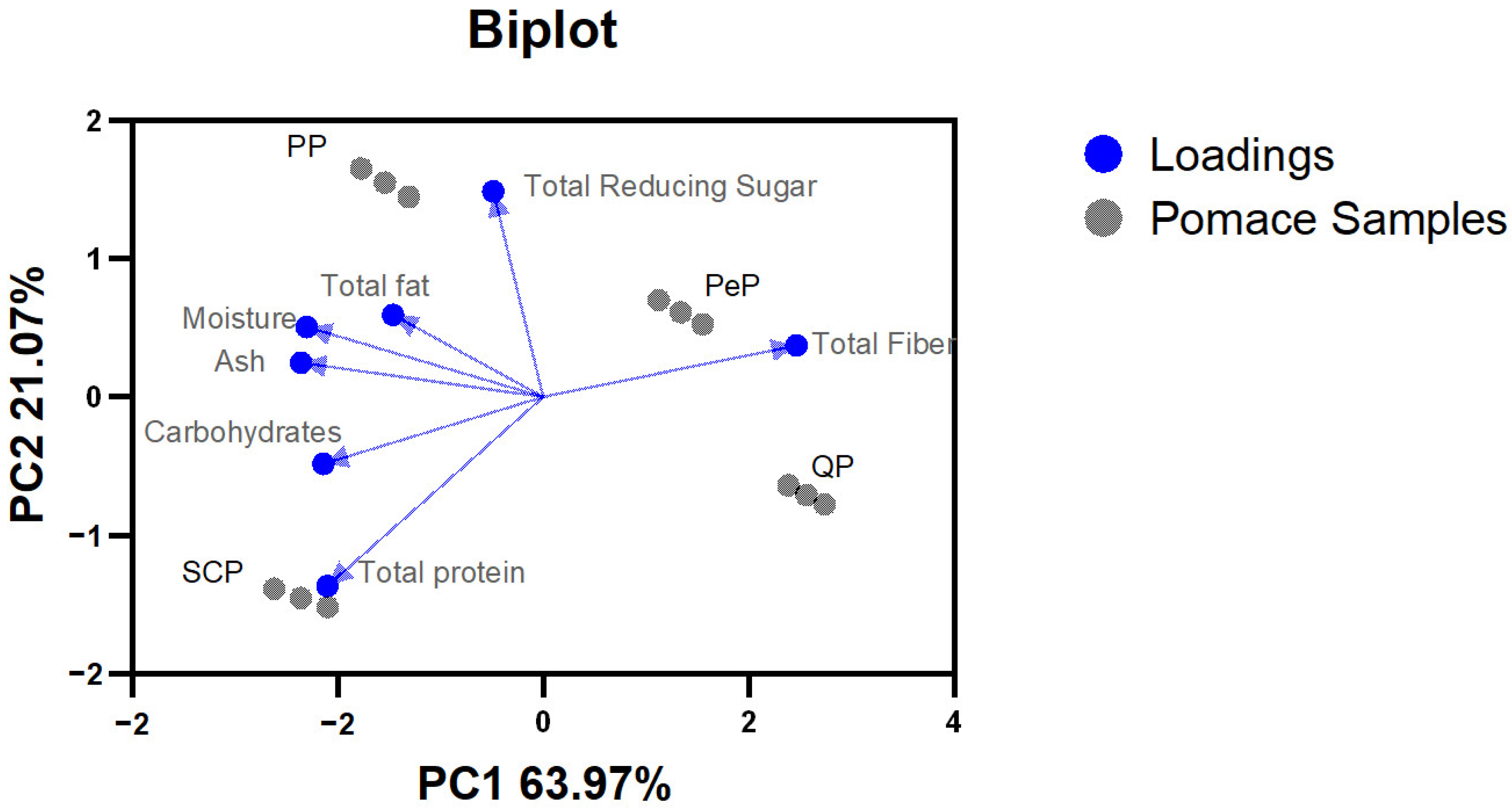
To further explore the compositional differences among the four fruit pomace types, a Principal Component Analysis (PCA) was performed using the proximate composition parameters (moisture, protein, fat, ash, total fiber, carbohydrates, and reducing sugars). The PCA biplot (Figure 1) offers a multivariate representation of the relationships between pomace powder samples (PP, PeP, SCP, QP) and the analyzed compositional variables, as defined by the first two principal components, which explain the majority of the total variance.

3.3. Color Parameters

Table 2 displayed the color parameters (L*, a*, b*, C*, and h*). Regarding lightness (L*), the highest value was recorded for the QP sample (46.86 ± 0.12), indicating that it is the brightest, while PP (30.28 ± 0.26) and SCP (29.91 ± 0.77) exhibited the lowest values, with no significant differences between them (p > 0.05), suggesting a darker appearance for these samples, and PeP showed an intermediate lightness (37.11 ± 0.18).
All samples presented positive a* values, indicating a red-oriented coloration. The highest red intensity was observed in PP (11.30 ± 0.49), followed by SCP (10.81 ± 0.52). PeP showed intermediate values (9.88 ± 0.37), while the lowest value was recorded for QP (8.54 ± 0.54).
For the b* parameter, the highest values were recorded in PeP (20.87 ± 0.3) and QP (20.39 ± 0.2), with no significant differences between them (p < 0.05), indicating a higher intensity of the yellow component. These samples showed significantly higher values compared to PP (18.94 ± 0.2) and SCP (12.51 ± 0.25), which exhibited lower values for this parameter, with SCP recording the lowest value among all analyzed samples.
Regarding chroma (C*), the highest values were recorded for PP (23.31 ± 0.2) and PeP (23.09 ± 0.3), with no significant differences between them (p > 0.05), suggesting a higher color saturation. These samples differed significantly from QP (21.81 ± 0.2), which showed intermediate values, and SCP (15.14 ± 0.11), which recorded the lowest chroma value, indicating a lower color intensity.
With respect to the hue angle (h*), the highest values were observed in PP (62.51 ± 0.07) and SCP (61.82 ± 0.67), with no significant differences between them (p > 0,05), followed by PeP (57.82 ± 0.79) and QP (53.13 ± 0.15), indicating variations in color tone among the samples.

3.4. Mineral Composition

The macroelement concentrations in the pomace samples (Table 3) varied significantly among the four types analyzed (p < 0.05, Tukey’s test), apart from Mg (p > 0.05). Macroelement analysis revealed notable differences in Ca content among the investigated pomaces. PP exhibited the highest Ca concentration (3315.75 ± 33 mg/kg dw), whereas QP showed the lowest level (663.47 ± 7 mg/kg dw). Overall, the results indicated a decreasing trend in Ca concentration in the order PP > SCP > PeP > QP.
Mg content ranged from 660 ± 6 a mg/kg DW in PeP to 675 ± 6 a mg/kg DW in PP, with no significant differences observed among the samples (p > 0.05). For Na, the highest concentration was observed in QP (118 ± 3 a mg/kg dw), followed by PeP and SCP, whereas PP had the lowest level (47 ± 1 d mg/kg dw). Mn concentrations differed significantly among all samples, following the trend QP < PP < PeP < SCP. Rb concentrations varied significantly across all samples, with the lowest values in QP, followed by PP and PeP, and the highest in SCP.
Microelements analyzed by ICP-MS (Table 3) showed significant differences among samples (p < 0.001). Fe concentrations differed markedly, with the highest level observed in PeP, followed by SCP, PP, and QP. Sr concentrations showed significant differences among all samples, with the highest in SCP, followed by PP, PeP, and the lowest in QP. Zn concentrations also differed significantly across samples, increasing in the order PP < SCP < PeP < QP.

3.5. Vitamin Content

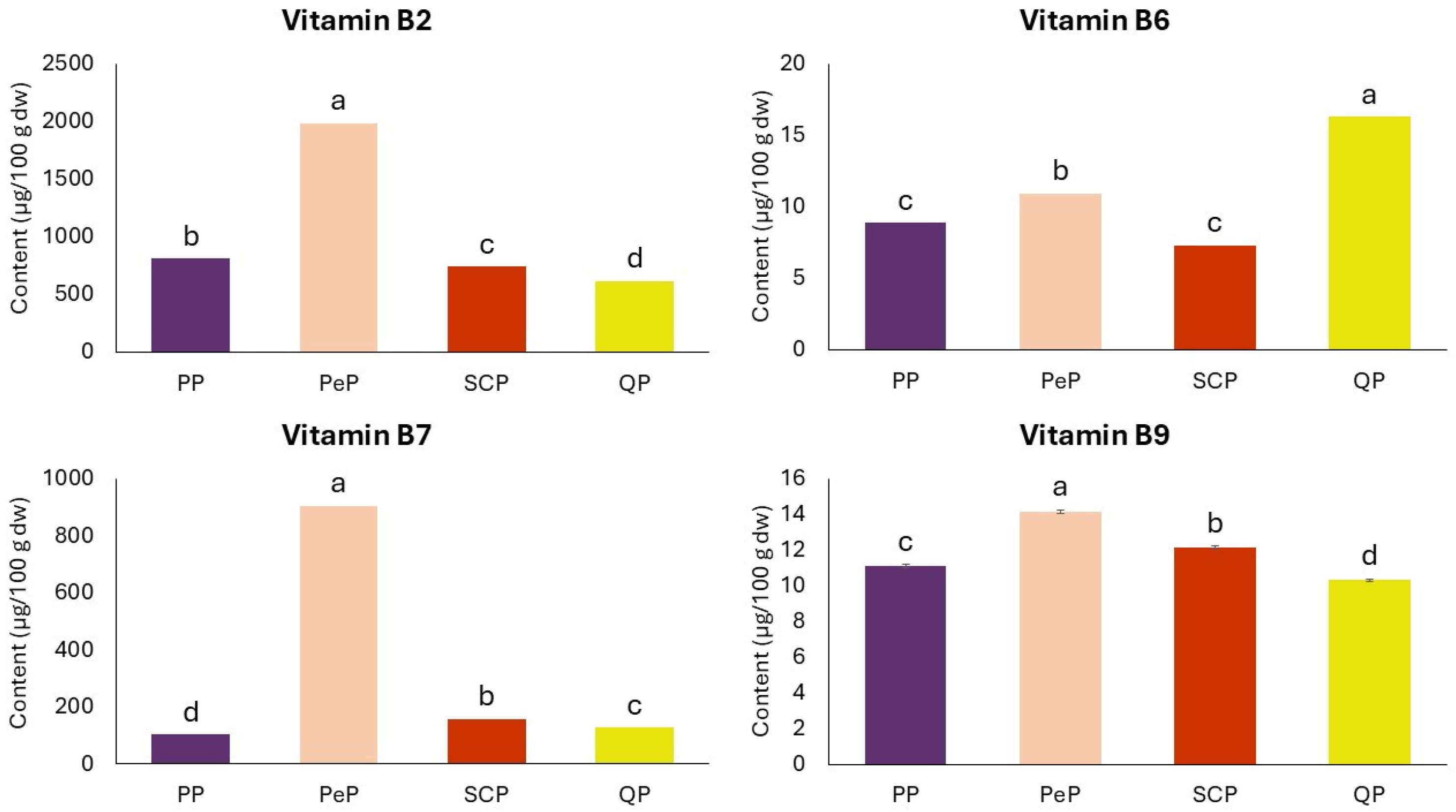
The content of B-group vitamins varied significantly (p < 0.05) among the analyzed pomace samples (Figure 2). For vitamin B2, the highest value was recorded in PeP (1987.73 ± 20 µg/100 g dw), followed by PP (810.57 ± 8 µg/100 g dw), SCP (742 ± 6 µg/100 g dw), and QP (615.72 ± 7 µg/100 g dw), all differing significantly. Vitamin B6 was most abundant in QP (16.3 ± 0.09 µg/100 g dw), followed by PeP (10.91 ± 0.12 µg/100 g dw), PP (8.89 ± 0.09 µg/100 g dw), and SCP (7.3 ± 0.1 µg/100 g dw), with significant differences observed among all samples (p < 0.05). PeP also exhibited the highest B7 content (906 ± 8 µg/100 g dw), followed by SCP (159 ± 2 µg/100 g dw), QP (129 ± 1 µg/100 g dw), and PP (103 ± 1 µg/100 g dw). Significant variations in vitamin B9 content were observed among the pomace samples, with PeP exhibiting the highest concentration, followed by SCP, PP, and QP. Vitamins B1 (thiamine), B3 (niacin), and B12 (cobalamin) were below the limit of detection in all samples.

4. Discussion

The chemical composition of fruit pomace is highly variable, being influenced by factors such as fruit cultivar, agricultural conditions, type of processing by-product, and processing method [27]. Considering that the specialized literature is predominantly focused on pomace resulting from juice production, the comparisons presented in this chapter are primarily based on these data. Studies on pomace originating from distillation processes are limited and are cited only where available.
The intrinsic moisture content of pomace can exceed 80%, thereby necessitating dehydration as a critical stabilization step. This process reduces the mass and volume of the by-product while inhibiting microbial growth, thereby enhancing its storage stability and extending shelf life [27,39]. These low values reflect the applied drying treatment, which effectively reduces perishability and microbial proliferation [39,40,41]. Moreover, the obtained values are below the maximum limits established for cereal flours (14.5–15.5%; Codex Alimentarius, FAO/WHO), indicating good storage stability. In addition, Blicharz-Kania et al. report that, for pomace, a moisture content below 16% is generally considered acceptable for preserving its functional properties. The variations observed among samples may be attributed to differences in physicochemical composition and structural characteristics. Overall, moisture content is largely influenced by the initial water content of the raw material, as well as the drying method and processing conditions employed [27].
An increasing trend in protein content was observed from QP, followed by PeP and PP, to SCP. These values are consistent with those reported in the literature for different fruit pomaces, including plum (3.9–8.2% d.m.) [38], apple (0.26–8.49 g/100 g dw) [42,43] and cherries and blackcurrants up to 13.01–17.50 g/100 g dw [44]. Protein content may vary depending on fruit variety and the drying method applied [38].
Total fat content was low in all samples (1.78–2.98 g/100 g dw), suggesting a reduced susceptibility to lipid oxidation and therefore improved processing and storage stability [45]. PeP showed the highest lipid content, while QP had the lowest. Data on lipid content in fruit pomaces are relatively limited; however plum pomace has been reported to contain 2.0–2.7 g/100 g dw lipids, indicating comparable low-fat characteristics among stone fruit by-products [38]. Similarly, apple pomace has been reported to contain approximately 1.1–3.6 g/100 g lipids, largely influenced by seed presence, which concentrates linoleic and oleic acids [40].
Reported values in the literature for ash content in fruit pomace include plum pomace (1.7–2.6%/d.m) [38], apple pomace (0.5–4.29 g/100 g) [42], cherry pomace (3.80 g/100 g dw [44], and peach pomace, with 4.1 ± 0.2 g/100 g dw closely matching the present findings [46]. Another peach pomace sample, consisting solely of pulp without skin or seeds, showed 2.07% ash at 17.07% moisture [47], explaining the higher ash content measured in the current study (3.99 ± 0.04 g/100 g dw). Overall, ash levels in SCP, PP, and PeP were higher than those reported for other fruit pomaces, which may be attributed to differences in fruit variety, origin, climatic conditions, and processing methods [38].
Carbohydrates encompass a diverse class of compounds that differ substantially in molecular structure, digestibility, and their physical and physiological effects on the gastrointestinal tract. They account for approximately 45–65% of total daily caloric intake and could have an important involvement in epithelial barrier protection [48]. From a nutritional perspective, carbohydrates consumed in the human diet are generally divided into three main groups: sugars, starches, and non-starch polysaccharides (dietary fibers).
Fruit pomace is a rich source of carbohydrates. For instance, apple pomace’s carbohydrate content ranges from 45 to 70% [43] or up to 71.7% [40], which is consistent with the sample values obtained in the present study. Likewise, peach by-products (peach peel flour) registered a value of 52.20% carbohydrate content [49]; meanwhile, Romero et al. [24] reported, for quince waste by-products, values ranging from 8.7 ± 0.2 to 75.80 ± 0.28 g in a 100 g sample. On the other hand, the carbohydrate content of sour cherry pomace shows values in the range of 62.35–78.24%. Authors mentioned that the discrepancies observed among the results may be associated with multiple factors, including the specific fruit fraction analyzed (whole fruit versus only the fruit’s central area), cultivation conditions and origin, and method of analysis, as well as differences in fruit maturity as reflected by the ripeness index [24].
In terms of total fiber content, the values obtained in the present study are lower than some ranges reported in the literature for plum pomace (38.2–49.3% d.m.), apple pomace (26.8–82.0 g/100 g or 50–65%), and peach pomace (61.2 ± 0.9 g/100 g dw) [38,42,43,46]; the high fiber content observed in QP and PeP still suggests substantial functional and prebiotic potential, which could be exploited in the development of fiber-enriched food products and for supporting intestinal health [50]. Dietary fiber contributes to digestive health through its insoluble fraction, which resists microbial degradation and promotes intestinal transit and colonic health, and its soluble fraction, which can swell or form gels in water, increasing viscosity, slowing gastric emptying, and modulating nutrient digestion and absorption [27].
Compared to the values in the literature reported for unfermented apple pomace (approximately 5.7–15%) [51,52], most of the samples analyzed in the present study exhibited lower total reducing sugar contents, except for PP, which was within the lower range. This trend can be attributed to the alcoholic fermentation process, during which reducing sugars are metabolized by yeasts, leading to a decrease in their concentration [53]. On the other hand, the higher content of sugar in plums is also highlighted by Balcerek et al. 2013 [54], who mentioned that the high fermentable sugar content of plum by-products manufacturing process (ranging from 382.7 ± 5.5 g/kg to 679.8 ± 6.9 g/kg) represents a technological advantage, providing a suitable substrate for alcoholic fermentation and contributing to increased ethanol yields in brandy production. Glucose, as the predominant carbohydrate, together with fructose, sucrose, and sorbitol, was the main identified plum pomace sugar [55].
A clear discrimination of samples according to botanical origin is observed through PCA, indicating distinct compositional profiles. This separation is primarily driven by the differential contributions of key macronutritional parameters, notably total protein, dietary fiber, moisture content, and total carbohydrates. The orientation and magnitude of the variable vectors highlight their relative influence on sample distribution (Figure 1).
Carbohydrates and total fiber showed strong positive loadings on PC1, whereas moisture, ash, total fat, and total protein loaded negatively on this axis. PC2 was primarily influenced by total reducing sugars, which exhibited positive loadings, while protein showed a negative loading.
The score plot revealed distinct clustering of the pomace samples according to their compositional characteristics. Quince pomace (QP) and peach pomace (PeP) were positioned on the positive side of PC1, reflecting their higher carbohydrate and fiber contents. Plum pomace (PP) was in the upper quadrant of the plot, associated with higher reducing sugar levels. In contrast, sour cherry pomace (SCP) was positioned in the lower-left quadrant, corresponding to higher protein and ash contents. Moreover, the angular relationships among vectors further indicate correlations among variables: carbohydrates and moisture display a positive association, whereas fiber shows an inverse relationship with these components, reflecting compositional trade-offs inherent to pomace matrices.
The PCA not only discriminated the pomace powders according to their botanical origin but also provided insights into the relationships among nutritional components. The proximity of carbohydrate and dietary fiber vectors suggests that these variables jointly contributed to the differentiation of QP and PeP pomaces, reflecting their greater abundance of structural polysaccharides and cell wall-derived components. In contrast, the opposite orientation of moisture, ash, and protein vectors indicates a negative association with carbohydrate-rich samples, highlighting compositional trade-offs among the investigated pomace matrices. These patterns suggest that the nutritional composition of the pomaces is strongly influenced by species-specific fruit characteristics and the distribution of soluble and insoluble constituents remaining after processing.
Furthermore, the distinct positioning of SCP in relation to protein and ash content may indicate a comparatively higher concentration of mineral and nitrogen-containing compounds, whereas the separation of PP along PC2 emphasizes the contribution of reducing sugars to its compositional profile. The observed clustering therefore reflects not only quantitative differences in individual nutrients but also broader compositional trends that distinguish the pomace types. Such differentiation is relevant from a valorization perspective, as pomaces characterized by higher fiber and carbohydrate contents may be particularly suitable for incorporation into bakery and cereal-based formulations, while pomaces richer in protein and minerals may offer advantages for the development of nutritionally enhanced functional foods.
Overall, the PCA results highlight distinct compositional profiles among the studied pomace types and confirm substantial nutritional variability between these fruit processing by-products.
The evaluation of color parameters represents a fundamental aspect in food technology, playing a crucial role in assessing product quality [27]. Food color is determined by chemical, biochemical, microbial, and physical changes occurring during growth, maturation, postharvest handling, and processing. Therefore, the evaluation of color parameters represents an essential tool for product quality assessment and is used as an indirect indicator of other characteristics, such as flavor and pigment content [27,56].
The differences in L values among PP, PeP, SCP, and QP obtained from distillation may be attributed to enzymatic browning reactions and variations in phenolic content and processing conditions, as previously reported for apple pomace [27]. A study on pomace from other fruit types reported, for apple pomace, L* = 66.29, a* = 9.05, b* = 28.54, and C* = 29.95, and for grape pomace, L* = 48.01, a* = 12.82, b* = 22.84, and C* = 26.20. Compared with the results obtained in the present study, the L*, b*, and C* values are higher, which can be attributed to the influence of fermentation and distillation processes on pigment composition and color properties of the material [57]. The observed differences in the L*, a*, and b* color parameters may be attributed to the cultivar and the ripening stage of the fruits used as the plant material source [27].
In the present study, PP showed significantly higher a* values compared to PeP and QP (p < 0.05), while SCP exhibited intermediate values, not significantly different from PP or PeP, but significantly higher than QP, indicating a transitional behavior in red color intensity. These differences in a value may be influenced by the red-brown coloration of the fruit peel present in the pomace [27]. Moreover, changes in the a coordinate were mainly associated with degradation of anthocyanins, particularly in sour cherry pomace. Anthocyanins are highly sensitive to thermal processing, and their degradation increases considerably with increasing temperature. Recent studies demonstrated that exposure to temperatures between 80 and 100 °C leads to rapid anthocyanin decomposition, pigment instability, and significant color deterioration in fruit matrices [58,59]. In accordance with these findings, Cisneros-Yupanqui et al. [60] demonstrated that the distillation process applied to red grape pomace may significantly influence the concentration of bioactive compounds, including anthocyanins, catechins, and other phenolic constituents, primarily as a consequence of the thermal treatment involved.
Variations in the b parameter may be related to carotenoid degradation and formation of secondary yellow-brown oxidation products during heating. Thermal processing promotes oxidative degradation of carotenoids and phenolic compounds, thereby modifying yellowness and overall chromatic properties of fruit pomace powders [59].
On the other hand, Di Lorenzo et al. [61] explained the increase in flavonoid content in Arbustus unedo L. pomace occurring after fermentation and distillation processes with the activity of yeast-derived β-glucosidase, which, during fermentation, promotes the deglycosylation of flavonol glycosides, releasing more bioavailable and antioxidant-active aglycones. In addition, microbial metabolism may induce structural modifications such as hydrolysis, oxidation, and methylation, leading to the formation or enhanced solubility of flavonoid derivatives. Distillation may further concentrate these compounds through the removal of volatile constituents, resulting in an enrichment of polyphenolic compounds in the pomace.
Higher C* values indicate a more pronounced chromatic intensity, leading to a stronger visual perception of color [27].
The RGB visualization of CIELAB data (Table 2) enables a clear and intuitive comparison of color differences among samples, emphasizing variations in lightness and chromatic components across the analyzed plum pomace samples. Therefore, the significant differences observed in the color coordinates of the selected pomace powders may be mainly attributed to thermal degradation of pigments, oxidation, hydrolysis and methylation reactions, ethanol-assisted extraction of coloring compounds, and browning phenomena occurring during alcoholic distillation.
The alcoholic distillation process may significantly alter the chemical composition of fruit pomace due to the combined effects of thermal treatment, oxidation, and fermentation-related transformations. While certain thermolabile compounds may decrease during processing, the release of bound phenolics and the formation of Maillard reaction products can contribute to enhanced antioxidant bioactivity in distilled pomace [16,61,62], as well as in color changes.
According to the literature, sour cherry pomace contains 39.54 ± 0.09 mg/100 g Ca, 19.81 ± 0.015 mg/100 g Mg, and 327.34 ± 0.71 mg/100 g K, while peach pomace contains 25.00 ± 0.03 mg/100 g Ca, 23.91 ± 0.03 mg/100 g Mg, and 542.14 ± 0.9 mg/100 g K [63]. In contrast, Blicharz-Kania et al. (2025) reported higher concentrations for other types of pomaces, with apple pomace containing 8.29 ± 0.12 g·kg−1 dw of K, 0.48 ± 0.02 g·kg−1 dw of Ca, and 18.24 ± 0.83 g·kg−1 dw of Fe [27]. Similar analyses have been reported in the literature [64]; however, direct comparison is not possible because the mineral contents were expressed per extract volume. The values obtained in the present study were generally higher than those reported in these studies. These differences may be attributed to the natural variability in fruit mineral composition, which is influenced by plant species, cultivar, and the pedoclimatic conditions of the production area [27,63].
The mineral composition of the analyzed samples may indicate potential nutritional relevance for human consumption. K is essential for maintaining intracellular fluid volume, nerve transmission, muscle contraction, and kidney function, with its balance closely linked to sodium, the primary regulator of extracellular fluid [65]. Ca supports bone and dental health and contributes to muscle contraction, blood coagulation, and nervous system function, while magnesium plays a role in energy production, regulation of muscular and nervous activity, and maintenance of bone health [66,67].
While the microelement content highlights the overall mineral richness of the four pomace types, the analysis of trace elements provides further insight into their nutritional value and safety. For instance, variations in Li, Mn, Co, V, and Zn across the samples reveal distinct mineral profiles that are relevant for health considerations as well as potential industrial applications.
Fe was among the most prominent elements, present at high concentrations in all analyzed samples. It is an essential nutrient, playing a central role in the synthesis of hemoglobin and myoglobin, proteins responsible for oxygen transport and storage. Most iron in the body is found in hemoglobin, while the remainder is distributed in storage forms, myoglobin, and various enzymes, contributing to oxidative metabolism and numerous cellular functions [68].
Cr exhibited three distinct groups: QP and PP had the lowest Cr concentrations with no significant difference between them, SCP showed intermediate values, and PeP exhibited the highest Cr content. Ni concentrations were lowest in QP, followed by SCP, PeP, and the highest in PP. V concentrations varied significantly across all samples, with the highest levels observed in SCP, followed by PeP, PP, and QP. Li content was significantly higher in PeP and SCP compared to PP and QP, with no significant differences within each group. Co concentrations were lowest in PP and increased through QP and SCP, with PeP having the highest levels. Gallium (Ga), arsenic (As), selenium (Se), thallium (Tl), lead (Pb), bismuth (Bi), and uranium (U) were below the detection limit (<LOD, 0.05 mg/kg) in all analyzed samples, indicating negligible accumulation. Overall, the results demonstrate distinct patterns of trace metal distribution among the pomace types. SCP and PeP exhibited higher concentrations of Li, Mn, and Co, whereas QP was comparatively enriched in V and Zn. The non-detectable levels of Ga, As, Se, Tl, Pb, Bi, and U further support a low risk of contamination with potentially toxic elements.
According to Mandache and Cosmulescu [63], sour cherry pomace contains 0.23 mg Mn/100 g and 0.14 mg Zn/100 g, while peach pomace contains 0.27 mg Mn/100 g and 0.33 mg Zn/100 g of dried pomace. These values for Mn and Zn are lower than those determined in the present study.
Trace elements are crucial for physiological and metabolic processes, and maintaining their balance is essential for overall health. Deficiencies or excesses can lead to various health issues, and interventions should be tailored to individual needs [69]. Essential minerals such as Ca, Fe, Mg, Mn, and Zn play a key role in bone formation, muscular and nervous system function, fluid balance regulation, and immune support. Deficiencies in these micronutrients, often called “hidden hunger,” are widespread and affect billions worldwide [63].
The mineral composition of fruit pomace varies depending on the fruit species, cultivar, climatic and soil conditions, and processing methods. Moreover, harvest period, degree of ripeness, and fertilization practices, as well as storage conditions and the natural variability in mineral composition inherent to biological materials, can influence mineral concentrations in pomaces [70]. Fruit pomace serves as a natural source of essential minerals, enhancing the nutritional value of food products and offering a potential for food fortification [27,63].
Fruit pomace brandy production involves spontaneous fermentation followed by distillation, processes that may significantly alter the chemical composition of the residual pomace. Thermal treatment during distillation, together with microbial metabolism during fermentation, can induce degradation, transformation, or concentration of bioactive compounds, including phenolics, vitamins, and volatile constituents [15,71].
In the present study, the low levels or absence of certain B-group vitamins can be partly attributed to their sensitivity to processing and storage, as these compounds degrade under exposure to temperature, oxygen, and handling [72,73]. Data on B-group vitamins in fruit pomace are scarce, making these results valuable for understanding the nutritional composition of these by-products.
The non-detectable levels of vitamins B1 and B3 in all analyzed pomace samples are consistent with the biochemistry of the production process. Thiamine is a key cofactor for pyruvate decarboxylase and is actively consumed by fermenting yeasts during alcoholic fermentation; its depletion in fermented plant substrates has been well-documented [74]. Niacin, while generally heat-stable, may also be reduced during extended fermentation. The extraction at pH 4.5 and 100 °C for 30 min was selected to balance efficient release from the matrix while preserving vitamin stability under conditions appropriate for B1 and B6.
B-group vitamins are water-soluble compounds essential for cellular metabolism, acting as coenzymes in numerous biochemical reactions involved in energy production and physiological functions. Since they cannot be synthesized in sufficient amounts by humans, dietary intake is required [75]. Vitamin B12 (cobalamin) concentrations were below the limit of detection in all analyzed pomace samples. This finding is consistent with the well-established absence of de novo cobalamin biosynthesis in higher plants, as vitamin B12 is synthesized exclusively by certain prokaryotic microorganisms and archaea, and not by Saccharomyces cerevisiae or other yeasts commonly associated with fermentation processes [76]. A limitation of the present study is that the B12 extraction protocol involved thermal treatment and NaCN-mediated conversion of corrinoid species into cyanocobalamin. Consequently, the reported B6 concentrations likely represent conservative estimates due to thermal stress-induced degradation, while the cobalamin extraction methodology does not intrinsically differentiate between biologically active cobalamin and structurally related but metabolically inactive corrinoid analogs.

5. Conclusions

The present study demonstrated that fruit pomace generated during the production of traditional fruit distillates represents a valuable secondary resource with significant nutritional and technological potential. The PCA revealed distinct clustering patterns among the fruit pomace powders, indicating differences in their physicochemical and compositional characteristics, while also highlighting similarities between certain samples.
Among the analyzed samples, sour cherry pomace showed the highest protein and ash contents, while quince and peach pomace exhibited the highest levels of dietary fiber, indicating their potential use as functional ingredients in fiber-enriched food products. Plum pomace was characterized by the highest concentration of reducing sugars and elevated levels of potassium and calcium, suggesting an important contribution to the mineral intake when used as a food ingredient.
The mineral analysis revealed that all pomace types contained considerable amounts of essential macroelements such as K, Ca, and Mg, confirming their nutritional value. In addition, the colorimetric parameters highlighted distinct chromatic characteristics among the samples, which may influence their potential application in food formulations. Furthermore, B-complex vitamins (B2, B6, B7, and B9) were identified in all samples, exhibiting statistically significant variations depending on the pomace type.
These findings demonstrate that fruit pomace derived from traditional distillation processes represents a nutritionally valuable by-product, characterized by high contents of dietary fiber (11.70 ± 0.25–27.47 ± 0.55 g/100 g dw) and carbohydrates (59.97 ± 0.73–69.30 ± 0.62 g/100 g dw), as well as considerable concentrations of essential minerals, particularly potassium and calcium. In addition, vitamins B7 and B9 were detected in all samples, with concentrations ranging from 103 ± 1 to 906 ± 8 for vitamin B7, and from 10.33 ± 0.08 to 14.18 ± 0.1 for vitamin B9. These compositional and nutritional characteristics underscore the potential of fruit pomace as a sustainable functional ingredient and support its valorization within circular economy and food system sustainability frameworks.

Author Contributions

Conceptualization, G.-M.C., M.S.C., A.C.F., D.C.V. and A.P.; methodology, G.-M.C., A.P., S.M.M., B.S.A. and A.I.T.; software, S.M.M., G.-M.C. and M.S.C.; validation, G.-M.C., D.C.V., G.-A.M., A.P., A.I.T. and B.S.A.; formal analysis, G.-M.C., A.I.T., B.S.A., G.-A.M., A.C.F., investigation, M.S.C., G.-A.M., S.M.M., A.P. and D.C.V.; resources, G.-M.C. and M.S.C.; data curation, A.P. and S.M.M.; writing—original draft preparation, G.-M.C., M.S.C., A.C.F., A.I.T. and B.S.A.; writing—review and editing, G.-M.C., S.M.M., A.P. and D.C.V.; visualization, A.P., D.C.V., G.-A.M. and A.I.T.; supervision, M.S.C., G.-A.M. and D.C.V.; project administration, M.S.C. and D.C.V.; funding acquisition, M.S.C. All authors have read and agreed to the published version of the manuscript.

Funding

This research received no external funding.

Institutional Review Board Statement

Not applicable.

Informed Consent Statement

Not applicable.

Data Availability Statement

The raw data supporting the conclusions of this article will be made available by the authors on request.

Conflicts of Interest

The authors declare no conflicts of interest.

References

  1. Majerska, J.; Michalska, A.; Figiel, A. A review of new directions in managing fruit and vegetable processing by-products. Trends Food Sci. Technol. 2019, 88, 207–219. [Google Scholar] [CrossRef]
  2. Panda, J.; Amrit, R.; Mishra, A.K.; Chakraborty, A.; Rustagi, S.; Nath, P.C.; Sarabandi, K.; Sarma, H.; Wagh, M.S.; Mohanta, Y.K. Sustainable Valorization of Fruit and Vegetable Waste for Bioactive Compounds: Advancing Functional Food and Wellness. Waste Biomass Valorization 2025, 16, 3357–3386. [Google Scholar] [CrossRef]
  3. Ebrahimi, P.; Lante, A. Environmentally Friendly Techniques for the Recovery of Polyphenols from Food By-Products and Their Impact on Polyphenol Oxidase: A Critical Review. Appl. Sci. 2022, 12, 1923. [Google Scholar] [CrossRef]
  4. Paul, A.; Chiș, M.S.; Păucean, A.; Fărcas, A.C.; Garcia-Segovia, P.; Negrea, M.; Voica, D.; Oros, S.N.; Oliveira, M.B.P.P. Closing the Loop in Plant-Based Food Systems: Polyphenol Recovery from Agro-Food Chain By-Products. Agriculture 2026, 16, 899. [Google Scholar] [CrossRef]
  5. Putra, N.R.; Rizkiyah, D.N.; Aziz, A.H.A.; Yunus, M.A.C.; Veza, I.; Harny, I.; Tirta, A. Waste to Wealth of Apple Pomace Valorization by Past and Current Extraction Processes: A Review. Sustainability 2023, 15, 830. [Google Scholar] [CrossRef]
  6. Venkidasamy, B.; Samynathan, R.; Ramasamy, P.; Kumar, M.S.; Thiruvengadam, M.; Khayrullin, M.; Shariati, M.A.; Nile, A.S.; Nile, S.H. Unveiling novel applications of fruit pomace for sustainable production of value-added products and health benefits: A review. Food Biosci. 2024, 61, 104533. [Google Scholar] [CrossRef]
  7. Ben-Othman, S.; Jõudu, I.; Bhat, R. Bioactives from agri-food wastes: Present insights and future challenges. Molecules 2020, 25, 510. [Google Scholar] [CrossRef]
  8. Raczkowska, E.; Serek, P. Health-Promoting Properties and the Use of Fruit Pomace in the Food Industry—A Review. Nutrients 2024, 16, 2757. [Google Scholar] [CrossRef]
  9. Banerjee, J.; Singh, R.; Vijayaraghavan, R.; MacFarlane, D.; Patti, A.F.; Arora, A. Bioactives from fruit processing wastes: Green approaches to valuable chemicals. Food Chem. 2017, 225, 10–22. [Google Scholar] [CrossRef]
  10. Samad, N.; Okonkwo, C.E.; Ayyash, M.; Al-Marzouqi, A.H.; Yuliarti, O.; Kamal-Eldin, A. Valorization of Fruit Pomace by Enzymatic Treatment and Microbial Fermentation. Fermentation 2025, 11, 376. [Google Scholar] [CrossRef]
  11. Boruah, B.; Ray, S. Emerging techniques for valorization of fruit processing waste and sustainable utilization: A review. Food Humanit. 2025, 5, 100920. [Google Scholar] [CrossRef]
  12. Ghani, K.; Kausar, T.; Bilal, M.; Kauser, S.; Gorsi, F.I.; Sidrah; Ghafran, M.; Hussain, A.; Woldemariam, H.W. An updated and comprehensive review about fruits and vegetables processing pomace enriched dairy products. Food Prod. Process. Nutr. 2026, 8, 7. [Google Scholar] [CrossRef]
  13. Karastergiou, A.; Gancel, A.-L.; Jourdes, M.; Teissedre, P.-L.; Teissedre. Valorization of Grape Pomace: A Review of Phenolic Composition, Bioactivity, and Therapeutic Potential. Antioxidants 2024, 13, 1131. [Google Scholar] [CrossRef]
  14. Madrera, R.R.; Bedriñana, R.P.; Hevia, A.G.; Arce, M.B.; Valles, B.S. Production of spirits from dry apple pomace and selected yeasts. Food Bioprod. Process. 2013, 91, 623–631. [Google Scholar] [CrossRef]
  15. Spaho, N. Distillation Techniques in the Fruit Spirits Production. In Distillation-Innovative Applications and Modeling; IntechOpen: Rijeka, Croatia, 2017. [Google Scholar] [CrossRef]
  16. Perra, M.; Bacchetta, G.; Muntoni, A.; De Gioannis, G.; Castangia, I.; Rajha, H.N.; Manca, M.L.; Manconi, M. An outlook on modern and sustainable approaches to the management of grape pomace by integrating green processes, biotechnologies and advanced biomedical approaches. J. Funct. Foods 2022, 98, 105276. [Google Scholar] [CrossRef]
  17. Berghian-Grosan, C.; Magdas, D.A. Application of Raman spectroscopy and Machine Learning algorithms for fruit distillates discrimination. Sci. Rep. 2020, 10, 21152. [Google Scholar] [CrossRef]
  18. Coldea, T.E.; Socaciu, C.; Moldovan, Z.; Mudura, E. Minor Volatile Compounds in Traditional Homemade Fruit Brandies from Transylvania-Romania, as Determined by GC-MS Analysis. Not. Bot. Horti Agrobot. Cluj-Napoca 2014, 42, 530–537. [Google Scholar] [CrossRef]
  19. Rodríguez-Blázquez, S.; Gómez-Mejía, E.; Rosales-Conrado, N.; León-González, M.E.; García-Sánchez, B.; Miranda, R. Valorization of Prunus Seed Oils: Fatty Acids Composition and Oxidative Stability. Molecules 2023, 28, 7045. [Google Scholar] [CrossRef]
  20. Rusu, M.; Cara, I.-G.; Stoica, F.; Țopa, D.; Jităreanu, G. Quality Parameters of Plum Orchard Subjected to Conventional and Ecological Management Systems in Temperate Production Area. Horticulturae 2024, 10, 907. [Google Scholar] [CrossRef]
  21. Katnić, Đ.; Marinović-Cincović, M.; Porobić, S.J.; Vujčić, I.; Šaponjić, A.; Sikirić, B.; Živojinović, D. Characterization and kinetics of thermal decomposition behavior of plum and fig pomace biomass. J. Clean. Prod. 2022, 352, 131637. [Google Scholar] [CrossRef]
  22. Šeregelj, V.; Tumbas-Saponjac, V.; Cetkovic, G.; Canadanovic-Brunet, J.; Vulic, J.; Stajcic, S.; Bibovski, K. Assessment of phytochemical content and bioactivities of quince alcohol distillery waste. Acta Period. Technol. 2018, 49, 169–180. [Google Scholar] [CrossRef]
  23. Teslić, N.; Kojić, J.; Đermanović, B.; Šarić, L.; Maravić, N.; Pestorić, M.; Šarić, B. Sour Cherry Pomace Valorization as a Bakery Fruit Filling: Chemical Composition, Bioactivity, Quality and Sensory Properties. Antioxidants 2023, 12, 1234. [Google Scholar] [CrossRef]
  24. Romero, J.; Méndez, A.D.; Castro-Alija, M.J.; Poveda, J.; Albertos, I. Quince (Cydonia oblonga Mill.) Waste By-Product Characterization as a Potential Functional Ingredient. Sustainability 2024, 16, 8596. [Google Scholar] [CrossRef]
  25. Fărcaș, A.C.; Socaci, S.A.; Chiș, M.S.; Pop, O.L.; Fogarasi, M.; Păucean, A.; Igual, M.; Michiu, D. Reintegration of brewers spent grains in the food chain: Nutritional, functional and sensorial aspects. Plants 2021, 10, 2504. [Google Scholar] [CrossRef] [PubMed]
  26. Man, S.M.; Stan, L.; Păucean, A.; Chiş, M.S.; Mureşan, V.; Socaci, S.A.; Pop, A.; Muste, S. Nutritional; sensory, texture properties and volatile compounds profile of biscuits with roasted flaxseed flour partially substituting for wheat flour. Appl. Sci. 2021, 11, 4791. [Google Scholar] [CrossRef]
  27. Blicharz-Kania, A.; Pecyna, A.; Zdybel, B.; Andrejko, D. Physicochemical, Functional and Nutritional Characteristics of Various Types of Fruit Pomace. Processes 2025, 13, 3182. [Google Scholar] [CrossRef]
  28. Martău, G.-A.; Unger, P.; Schneider, R.; Venus, J.; Vodnar, D.C.; López-Gómez, J.P. Integration of solid state and submerged fermentations for the valorization of organic municipal solid waste. J. Fungi 2021, 7, 766. [Google Scholar] [CrossRef]
  29. Chiș, M.S.; Păucean, A.; Lițoiu, A.; Man, S. Lucerne (Medicago sativa L.) valorization in a gluten free pastry product. J. Agroaliment. Process. Technol. 2022, 28, 153–158. [Google Scholar]
  30. León, K.; Mery, D.; Pedreschi, F.; León, J. Color measurement in L∗a∗b∗ units from RGB digital images. Food Res. Int. 2006, 39, 1084–1091. [Google Scholar] [CrossRef]
  31. Török, A.I.; Cadar, O.; Kalapos, B.; Pál, M.; Szalai, G.; Mednyánszky, Z.; Gierczik, K.; Székely, A.; Simon-Sarkadi, L.; Kocsy, G. Blue and far-red light modify the adaptation of Lemna minor L. to cadmium stress based on glutathione, phytochelatin, chemical element and free amino acid levels. Plant Stress 2025, 17, 100937. [Google Scholar] [CrossRef]
  32. Călinoiu, L.F.; Odochean, R.; Martău, G.-A.; Mitrea, L.; Nemes, S.A.; Ștefănescu, B.-E.; Vodnar, D.C. In situ fortification of cereal by-products with vitamin B12: An eco-sustainable approach for food fortification. Food Chem. 2024, 460, 140766. [Google Scholar] [CrossRef]
  33. Voelker, A.L.; Taylor, L.S.; Mauer, L.J. Effect of pH and concentration on the chemical stability and reaction kinetics of thiamine mononitrate and thiamine chloride hydrochloride in solution. BMC Chem. 2021, 15, 47. [Google Scholar] [CrossRef] [PubMed]
  34. Wang, M.; Schuster, K.; Asam, S.; Rychlik, M. Challenges in the determination of total vitamin B12 by cyanidation conversion: Insights from stable isotope dilution assays. Anal. Bioanal. Chem. 2023, 415, 5797–5807. [Google Scholar] [CrossRef]
  35. Herrera-Ardila, Y.M.; Orrego, D.; Bejarano-López, A.F.; Klotz-Ceberio, B. Effect of heat treatment on vitamin content during the manufacture of food products at industrial scale. DYNA 2022, 89, 127–132. [Google Scholar] [CrossRef]
  36. Jastrebova, J.; Witthöft, C.; Grahn, A.; Svensson, U.; Jägerstad, M. HPLC determination of folates in raw and processed beetroots. Food Chem. 2003, 80, 579–588. [Google Scholar] [CrossRef]
  37. Mock, D.M. Biotin: From Nutrition to Therapeutics. J. Nutr. 2017, 147, 1487–1492. [Google Scholar] [CrossRef]
  38. Milala, J.; Kosmala, M.; Sójka, M.; Kołodziejczyk, K.; Zbrzeźniak, M.; Markowski, J. Plum pomaces as a potential source of dietary fibre: Composition and antioxidant properties. J. Food Sci. Technol. 2013, 50, 1012–1017. [Google Scholar] [CrossRef] [PubMed]
  39. Michalska, A.; Wojdyło, A.; Majerska, J.; Lech, K.; Brzezowska, J. Qualitative and Quantitative Evaluation of Heat-Induced Changes in Polyphenols and Antioxidant Capacity in Prunus domestica L. By-products. Molecules 2019, 24, 3008. [Google Scholar] [CrossRef]
  40. Fernandes, P.A.R.; Ferreira, S.S.; Bastos, R.; Ferreira, I.; Cruz, M.T.; Pinto, A.; Coelho, E.; Passos, C.P.; Coimbra, M.A.; Cardoso, S.M.; et al. Apple pomace extract as a sustainable food ingredient. Antioxidants 2019, 8, 189. [Google Scholar] [CrossRef]
  41. Thomas, F.; Abebe, G.; Emenike, C.; Martynenko, A. Sustainable utilization of apple pomace: Technological aspects and emerging applications. Food Res. Int. 2025, 220, 117149. [Google Scholar] [CrossRef]
  42. Antonic, B.; Jancikova, S.; Dordevic, D.; Tremlova, B. Apple pomace as food fortification ingredient: A systematic review and meta-analysis. J. Food Sci. 2020, 85, 2977–2985. [Google Scholar] [CrossRef]
  43. Kanchan, R.R.; Giri, S.; Shivam, S.G. Sustainable solutions for fruit processing industry: Exploring pomace as a functional ingredient for food innovation. Int. J. Agric. Food Sci. 2025, 7, 199–210. [Google Scholar] [CrossRef]
  44. Gumul, D.; Berski, W.; Zięba, T. The Influence of Fruit Pomaces on Nutritional, Pro-Health Value and Quality of Extruded Gluten-Free Snacks. Appl. Sci. 2023, 13, 4818. [Google Scholar] [CrossRef]
  45. Gumus, C.E.; Decker, E.A. Oxidation in low moisture foods as a function of surface lipids and fat content. Foods 2021, 10, 860. [Google Scholar] [CrossRef]
  46. Ciccoritti, R.; Ciorba, R.; Ceccarelli, D.; Amoriello, M.; Amoriello, T. Phytochemical and Functional Properties of Fruit and Vegetable Processing By-Products. Appl. Sci. 2024, 14, 9172. [Google Scholar] [CrossRef]
  47. Singh, S.; Kulshrestha, K. Peach Juice and Pomace Powder; Nutritive Value and Use of Pomace Powder in Biscuits. Int. J. Food Sci. Technol. 2016, 6, 5–16. Available online: http://ssrn.com/abstract=2838790 (accessed on 5 April 2026).
  48. El-Hindawy, M. Potentials of Biowaste Carbohydrates in Gut Health Enhancement. In Mediterranean Fruits Bio-Wastes: Chemistry, Functionality and Technological Applications; Ramadan, M.F., Farag, M.A., Eds.; Springer International Publishing: Berlin/Heidelberg, Germany, 2022; pp. 29–43. [Google Scholar] [CrossRef]
  49. Solomakou, N.; Drosaki, A.M.; Kaderides, K.; Mourtzinos, I.; Goula, A.M. Valorization of Peach By-Products: Utilizing Them as Valuable Resources in a Circular Economy Model. Sustainability 2024, 16, 1289. [Google Scholar] [CrossRef]
  50. Mudgil, D.; Barak, S. Composition properties and health benefits of indigestible carbohydrate polymers as dietary fiber: A review. Int. J. Biol. Macromol. 2013, 61, 1–6. [Google Scholar] [CrossRef] [PubMed]
  51. Devi, N.; Cruz-Martins, N.; Malik, T.; Kumar, V.; Islam, M.T.; Verma, R.; Singh, G.P.; Kumar, D. Phytochemical Profiling and Anti-Bacterial Activity of Red Delicious Apple Pomace with Integrated Hydrolysis to Obtain Fermentable Sugars: A Biorefinery Approach. Food Sci. Nutr. 2025, 13, e70543. [Google Scholar] [CrossRef] [PubMed]
  52. Vendruscolo, F.; Albuquerque, P.M.; Streit, F.; Esposito, E.; Ninow, J.L. Apple pomace: A versatile substrate for biotechnological applications. Crit. Rev. Biotechnol. 2008, 28, 1–12. [Google Scholar] [CrossRef]
  53. Barreto, S.M.A.; da Silva, A.B.M.; Dutra, M.d.C.P.; Bastos, D.C.; Carvalho, A.J.d.B.A.; Viana, A.C.; Narain, N.; Lima, M.d.S. Effect of commercial yeasts (Saccharomyces cerevisiae) on fermentation metabolites, phenolic compounds, and bioaccessibility of Brazilian fermented oranges. Food Chem. 2023, 408, 135121. [Google Scholar] [CrossRef]
  54. Balcerek, M.; Pielech-Przybylska, K.; Patelski, P.; Sapińska, E.; Księżopolska, M. The usefulness of intermediate products of plum processing for alcoholic fermentation and chemical composition of the obtained distillates. J. Food Sci. 2013, 78, S770–S776. [Google Scholar] [CrossRef]
  55. Dulf, F.V. Plum (Prunus domestica L.) Wastes. In Mediterranean Fruits Bio-Wastes: Chemistry, Functionality and Technological Applications; Ramadan, M.F., Farag, M.A., Eds.; Springer International Publishing: Berlin/Heidelberg, Germany, 2022; pp. 605–624. [Google Scholar] [CrossRef]
  56. Pathare, P.B.; Opara, U.L.; Al-Said, F.A.-J. Colour Measurement and Analysis in Fresh and Processed Foods: A Review. Food Bioprocess Technol. 2013, 6, 36–60. [Google Scholar] [CrossRef]
  57. Ruta, L.L.; Farcasanu, I.C. Anthocyanins and anthocyanin-derived products in yeast-fermented beverages. Antioxidants 2019, 8, 182. [Google Scholar] [CrossRef] [PubMed]
  58. Junior, E.N.M.; Martins, M.G.; Pereira, G.A.; Chisté, R.C.; Pena, R.d.S. Stability Kinetics of Anthocyanins of Grumixama Berries (Eugenia brasiliensis Lam.) during Thermal and Light Treatments. Foods 2023, 12, 565. [Google Scholar] [CrossRef] [PubMed]
  59. Wang, X.; Cui, W.; Guo, W.; Sun, B.; Huang, M.; Li, J.; Li, H.; Meng, N. Separation techniques for manufacturing fruit spirits: From traditional distillation to advanced pervaporation process. Compr. Rev. Food Sci. Food Saf. 2024, 23, e13278. [Google Scholar] [CrossRef] [PubMed]
  60. Cisneros-Yupanqui, M.; Rizzi, C.; Mihaylova, D.; Lante, A. Effect of the distillation process on polyphenols content of grape pomace. Eur. Food Res. Technol. 2022, 248, 929–935. [Google Scholar] [CrossRef]
  61. Di Lorenzo, R.; Ferraro, M.G.; Carrera, C.; Iazzetti, F.; Chinchilla, N.; Maisto, M.; Aliaño-González, M.J.; Piccolo, V.; Romano, A.; Ricci, L.; et al. Valorization of Arbutus unedo L. Pomace: Exploring the Recovery of Bioactive Phenolic Compounds from Distillation By-Products. Antioxidants 2025, 14, 278. [Google Scholar] [CrossRef]
  62. Goloshvili, T.; Akhalkatsi, M.; Badridze, G.; Kikvidze, Z. Tocopherol contents and antioxidant activity in grape pomace after fermentation and alcohol distillation. Cell. Mol. Biol. 2021, 67, 112–115. [Google Scholar] [CrossRef]
  63. Mandache, M.B.; Cosmulescu, S. Mineral Content of Apple, Sour Cherry and Peach Pomace and the Impact of Their Application on Bakery Products. Foods 2025, 14, 3146. [Google Scholar] [CrossRef]
  64. Kaur, N.; Aggarwal, P.; Kumar, V.; Kaur, S. Ultrasound-Assisted Extraction of Phytochemicals from Java Plum (Syzygium cumini L.) Pomace: Process Optimization, Phytochemical Characterization Using HPLC, FTIR, SEM and Mineral Profiling. Waste Biomass Valorization 2022, 14, 949–961. [Google Scholar] [CrossRef]
  65. National Institutes of Health. Potassium—Health Professional Fact Sheet. 2022. Available online: https://ods.od.nih.gov/factsheets/Potassium-HealthProfessional/ (accessed on 5 April 2026).
  66. National Institutes of Health. Calcium—Health Professional Fact Sheet. 2025. Available online: https://ods.od.nih.gov/factsheets/Calcium-HealthProfessional/ (accessed on 5 April 2026).
  67. National Institutes of Health. Magnesium—Health-Professional Fact Sheet. 2026. Available online: https://ods.od.nih.gov/factsheets/Magnesium-HealthProfessional/ (accessed on 5 April 2026).
  68. Abbaspour, N.; Hurrell, R.; Kelishadi, R. Review on iron and its importance for human health. J. Res. Med. Sci. 2014, 19, 164–174. [Google Scholar]
  69. Skalnaya, M.G.; Skalny, A.V. Essential Trace Elements in Human Health: A Physician’s View. 2018. Available online: https://trace-element.org/sites/default/files/2022-02/essential-trace-elements-in-human-health-a-physician-s-view_124_fr_0.pdf (accessed on 7 April 2026).
  70. Granucci, N.; Harris, P.J.; Villas-Boas, S.G. Chemical Compositions of Fruit and Vegetable Pomaces from the Beverage Industries. Waste Biomass Valorization 2023, 14, 3841–3856. [Google Scholar] [CrossRef]
  71. López, F.; Rodríguez-Bencomo, J.; Orriols, I.; Pérez-Correa, J. Fruit Brandies. In Science and Technology of Fruit Wine Production; Elsevier: Amsterdam, The Netherlands, 2017; pp. 531–556. [Google Scholar] [CrossRef]
  72. Dias, P.; Siatka, T.; Vopršalová, M.; Moravcová, M.; Pourová, J.; Přívratská, N.; Krčmová, L.K.; Javorská, L.; Mladěnka, P. Biological properties of vitamins of the B-complex, part 2—Vitamins B6 and B7 (biotin, vitamin H). Nutr. Res. Rev. 2025, 38, 791–824. [Google Scholar] [CrossRef] [PubMed]
  73. Lee, S.K.; Kader, A.A. Preharvest and postharvest factors influencing vitamin C content of horticultural crops. Postharvest Biol. Technol. 2000, 20, 207–220. [Google Scholar] [CrossRef]
  74. Kaźmierczak-Barańska, J.; Halczuk, K.; Karwowski, B.T. Thiamine (Vitamin B1)—An Essential Health Regulator. Nutrients 2025, 17, 2206. [Google Scholar] [CrossRef] [PubMed]
  75. Ali, M.A.; Hafez, H.A.; Kamel, M.A.; Ghamry, H.I.; Shukry, M.; Farag, M.A. Dietary Vitamin B Complex: Orchestration in Human Nutrition throughout Life with Sex Differences. Nutrients 2022, 14, 3940. [Google Scholar] [CrossRef]
  76. Watanabe, F.; Bito, T. Vitamin B12 sources and microbial interaction. Exp. Biol. Med. 2018, 243, 148–158. [Google Scholar] [CrossRef]
Figure 1. PCA of fruit pomace samples. PP—plum pomace powder; PeP—peach pomace powder; SCP—sour cherry pomace powder; QP—quince pomace powder.
Applsci 16 05763 g001
Figure 2. B-complex vitamin content of fruit pomace samples. PP—plum pomace powder; PeP—peach pomace powder; QP—quince pomace powder; SCP—sour cherry pomace powder; dw = dry weight. B2—riboflavin; B5—pantothenic acid; B6—pyridoxine; B7—biotin; B9—folate. Results are expressed as mean ± SD (n = 3), in µg/100 g dw. Values are expressed as mean ± standard deviation (n = 3). Different letters above the bars indicate significant differences among samples according to Tukey’s HSD test (p < 0.05).
Applsci 16 05763 g002
Table 1. Proximate composition of various pomace types.
Type of PomaceMoistureTotal ProteinTotal FatAshTotal FiberCarbohydratesTotal Reducing Sugar
PP10.02 ± 0.22 a6.85 ± 0.10 b2.73 ± 0.05 b5.03 ± 0.10 b17.34 ± 0.35 b68.05 ± 0.6 a7.08 ± 0.08 a
PeP8.34 ± 0.18 c5.69 ± 0.08 c2.98 ± 0.06 a3.99 ± 0.09 c27.37 ± 0.5 a59.97 ± 0.73 c3.58 ± 0.05 b
SCP9.48 ± 0.21 b10.83 ± 0.20 a2.76 ± 0.06 b5.41 ± 0.11 a11.70 ± 0.25 c69.30 ± 0.62 a1.89 ± 0.03 d
QP8.03 ± 0.17 c5.33 ± 0.07 d1.78 ± 0.04 c2.07 ± 0.05 d27.47 ± 0.55 a63.35 ± 0.71 b2.94 ± 0.04 c
PP—plum pomace powder; PeP—peach pomace powder; QP—quince pomace powder; SCP—sour cherry pomace powder; dw = dry weight. Moisture content is expressed as mean ± SD (n = 3), in g/100 g sample, while all other results are expressed as mean ± SD (n = 3), in grams per 100 g dry weight (g/100 g dw). Values followed by different lowercase letters in the same column are significantly different (p < 0.05).
Table 2. Color parameters of fruit pomace.
Type of PomaceLabRGBCh
PP30.28 ± 0.26 c11.30 ± 0.49 a18.94 ± 0.2 b 23.31 ± 0.2 a62.51 ± 0.07 a
PeP37.11 ± 0.18 b9.88 ± 0.37 b20.87 ± 0.3 a 23.09 ± 0.3 a57.82 ± 0.79 b
SCP29.91 ± 0.77 c10.81 ± 0.52 ab12.51 ± 0.25 c 15.14 ± 0.11 c61.82 ± 0.67 a
QP46.86 ± 0.12 a8.54 ± 0.54 c20.39 ± 0.2 a 21.81 ± 0.2 b53.13 ± 0.15 c
PP—plum pomace powder; PeP—peach pomace powder; SCP—sour cherry pomace powder; QP—quince pomace powder; dw = dry weight. L = lightness; a = red/green coordinate; b = yellow/blue coordinate; C = chroma (color saturation); h = hue angle (color tone). Values are presented as mean ± standard deviation (n = 3). Different superscript letters within the same column indicate statistically significant differences among samples, as determined by Tukey’s HSD test (p < 0.05).
Table 3. Mineral composition (macro- and trace elements) of fruit pomace samples.
Mineral Elements
(mg/kg dw)
Type of Pomace
PPPePSCPQP
Macroelements Ca3315.75 ± 33 a892.04 ± 9 c2534.54 ± 23 b663.47 ± 7 d
Mg674.81 ± 6 a660.79 ± 7 a669.45 ± 7 a660.21 ± 6 a
K21,282.98 ± 250 a12,443.58 ± 150 c16,783.05 ± 170 b8653.93 ± 90 d
MicroelementsFe507.53 ± 5 c1136.67 ± 15 a776.12 ± 40 b201.16 ± 10 d
Na47.1 ± 1 d93.00 ± 1 b66.67 ± 0.7 c117.59 ± 3 a
Li0.22 ± 0.02 b0.96 ± 0.01 a0.94 ± 0.01 a0.21 ± 0.01 b
V0.48 ± 0.03 c1.6 ± 0.01 b2.3 ± 0.02 a0.24 ± 0.02 d
Cr3.09 ± 0.05 c9.2 ± 0.09 a8.1 ± 0.08 b3.08 ± 0.02 c
Mn17.84 ± 0.1 b42.29 ± 0.4 a44.66 ± 0.5 a7.15 ± 0.06 c
Co0.17 ± 0.01 c0.88 ± 0.01 a0.34 ± 0.02 b0.31 ± 0.02 b
Ni5.04 ± 0.05 a4.75 ± 0.05 a3.43 ± 0.04 b3.08 ± 0.15 b
Zn10.53 ± 0.1 c14.17 ± 0.1 b10.88 ± 0.1 c18.42 ± 0.19 a
Rb13.08 ± 0.1 c27.85 ± 0.3 b30.91 ± 0.3 a12.24 ± 0.11 c
Sr10.96 ± 0.1 b8.22 ± 0.07 c23.2 ± 0.2 a6.69 ± 0.07 d
Cs<LOD0.16 ± 0.01 b0.21 ± 0.01 a<LOD
Ba<LOD1.8 ± 0.03 b2.42 ± 0.03 a1.19 ± 0.01 c
PP—plum pomace powder; PeP—peach pomace powder; QP—quince pomace powder; SCP—sour cherry pomace powder; dw = dry weight. Symbols of chemical elements: Ca—Calcium, Mg—Magnesium, K—Potassium, Na—Sodium, Li—Lithium, V—Vanadium, Cr—Chromium, Mn—Manganese, Co—Cobalt, Ni—Nickel, Zn—Zinc, Rb—Rubidium, Sr—Strontium, Cs—Cesium, Ba—Barium, Fe—Iron. Trace elements include both essential and potentially toxic elements. Values are expressed in mg/kg dry weight (dw). Results are expressed as mean ± SD (n = 3), in mg/kg dw. Values followed by different lowercase letters in the same row are significantly different (p < 0.05). LOD—below the detection limit.
Disclaimer/Publisher’s Note: The statements, opinions and data contained in all publications are solely those of the individual author(s) and contributor(s) and not of MDPI and/or the editor(s). MDPI and/or the editor(s) disclaim responsibility for any injury to people or property resulting from any ideas, methods, instructions or products referred to in the content.