The HBIM Maturity Model: Accrediting Historic Building Information Modelling (HBIM) Development




Abstract
1. Introduction
1.1. Background
1.2. Research Context
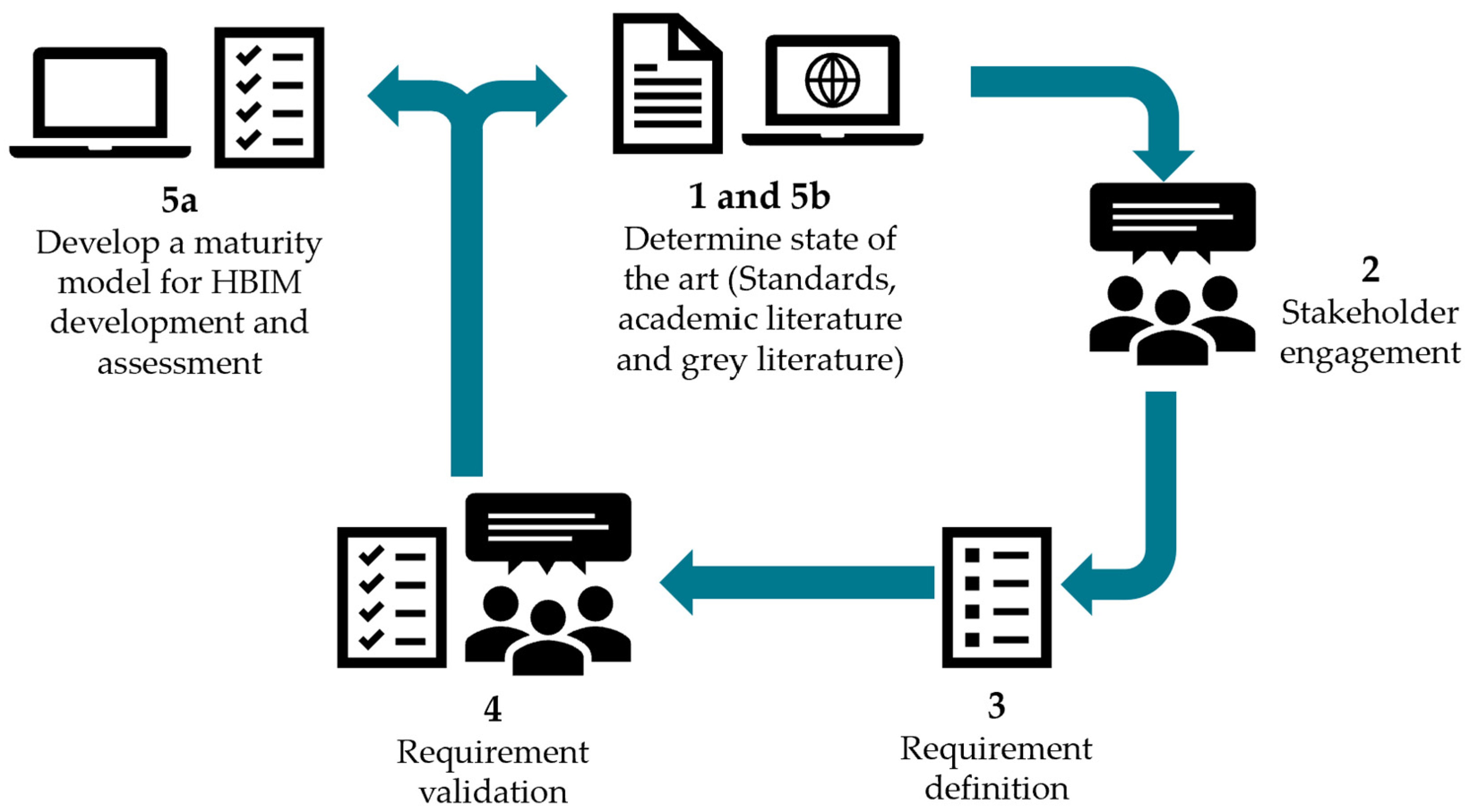
1.3. Introducing the HBIM Maturity Model
- O1—Detail the development of the HBIM Maturity Model (Section 2.1);
- O2—Evaluate to what degree the current HBIM application meets the needs of the heritage community (Section 3.1);
- O3—Evaluate the current HBIM application using the HBIM Maturity Model (Section 3.2).
2. Materials and Methods
2.1. The HBIM Maturity Model
2.1.1. Contributing Data
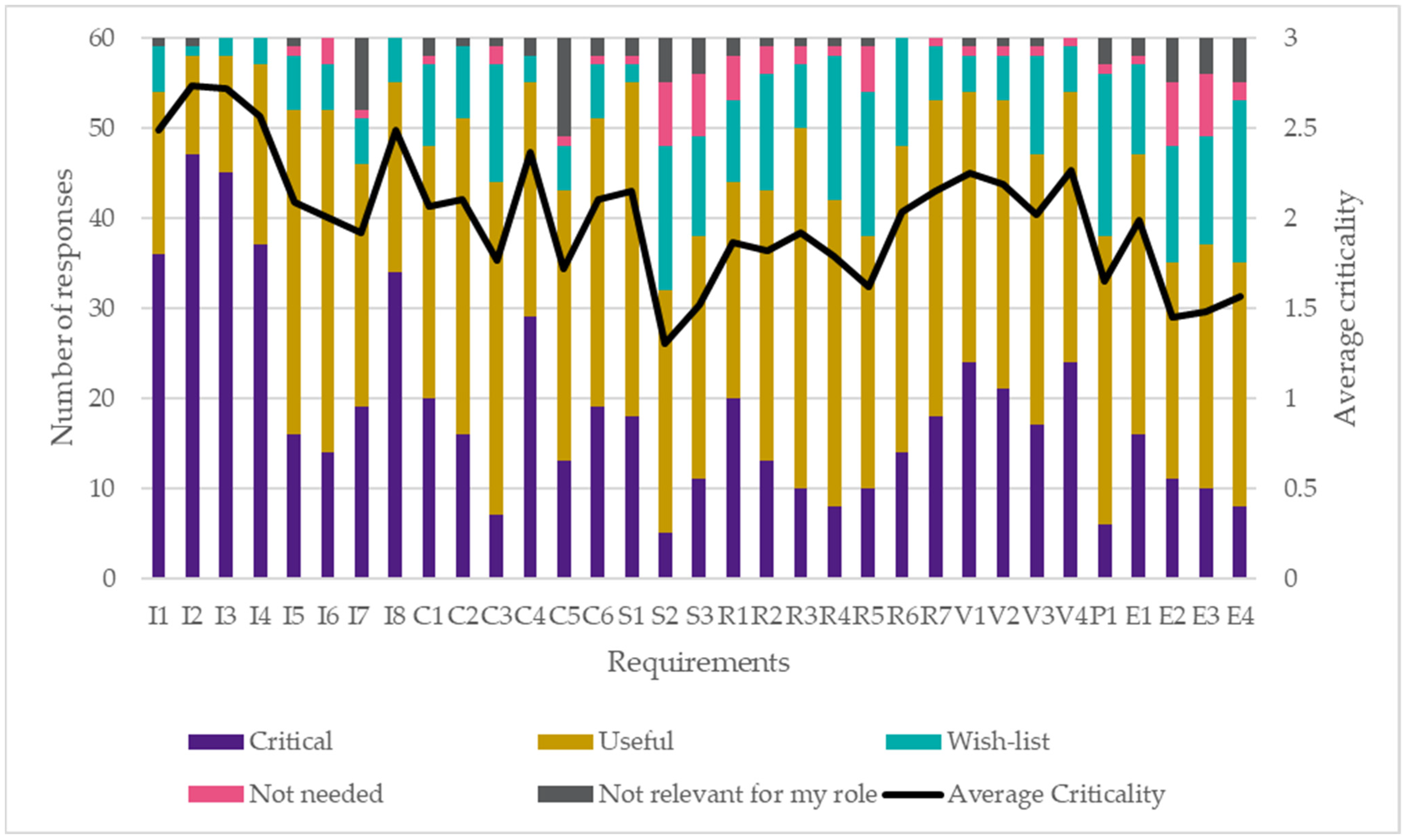
2.1.2. The Development of the HBIM Maturity Model
- Q1—What user needs does the HBIM system meet?
- Q2—Does the HBIM system meet the most important needs of its users?
2.2. HBIM Case Study Evaluation
2.2.1. Selection Criteria
- Theoretical frameworks and literature reviews;
- Articles discussing point cloud segmentation and automatic mesh generation, the exception to this being Avena et al. [123], who, whilst investigating automatic mesh creation and segmentation, did convert the created mesh into a parametric Revit object;
- Articles that focused on geometric surveys without elaborating on the HBIM methodology;
- Case studies of moveable objects, the exception being objects that are a physical architectural part of the building, such as the altar described by Scandurra et al. [110]. The justification for their exclusion is that the HBIM system requirements were defined at asset level so several would not be relevant to many moveable objects. Therefore, evaluating the case study against the requirements would provide an overly negative assessment of the case study. Whilst there are potentially relevant articles, such as the work by Moyano et al. [124], that investigate the modelling of movable objects, these are not considered significantly novel that their exclusion is detrimental to the findings of this article;
- Case studies of roads. Whilst some interesting historic road case studies exist [125,126], they were, like moveable objects, considered to have fundamentally different management considerations to buildings. Notably, bridge case studies were included because the survey used to define the requirements had respondents who worked with both bridges and buildings in a singular organisation;
- Articles using the HBIM methodology to recreate lost heritage unless there were plans to restore the heritage asset in the future. Whilst a valuable use case for HBIM technology, they are not created with the intention of being used for management activities;
- Case studies that included insufficient technical details to be repeatable. For instance, Ortiz Villarejo et al. [127] detail a pilot case study for the DIGITALESCAPE project. Whilst the paper is interesting and the project has undeniable benefits for evaluating the impacts of climate change on cultural heritage, the exact HBIM approach, being only a minor element of the overall project and, thus, a minor focus in the article, lacks specificity, and is thus excluded from the case study analysis.
2.2.2. Evaluation of HBIM Case Studies
3. Results and Discussion
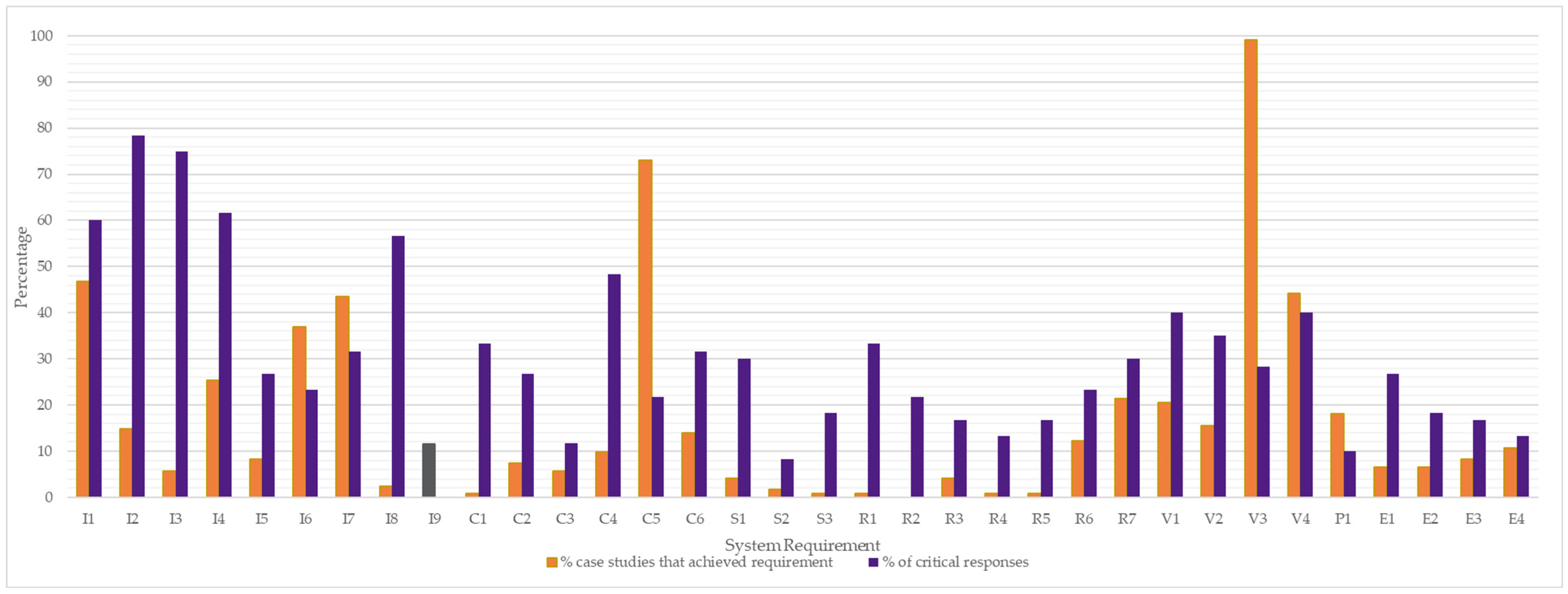
3.1. Evaluating the Extent to Which Current HBIM Application Meet the Needs of the Heritage Community
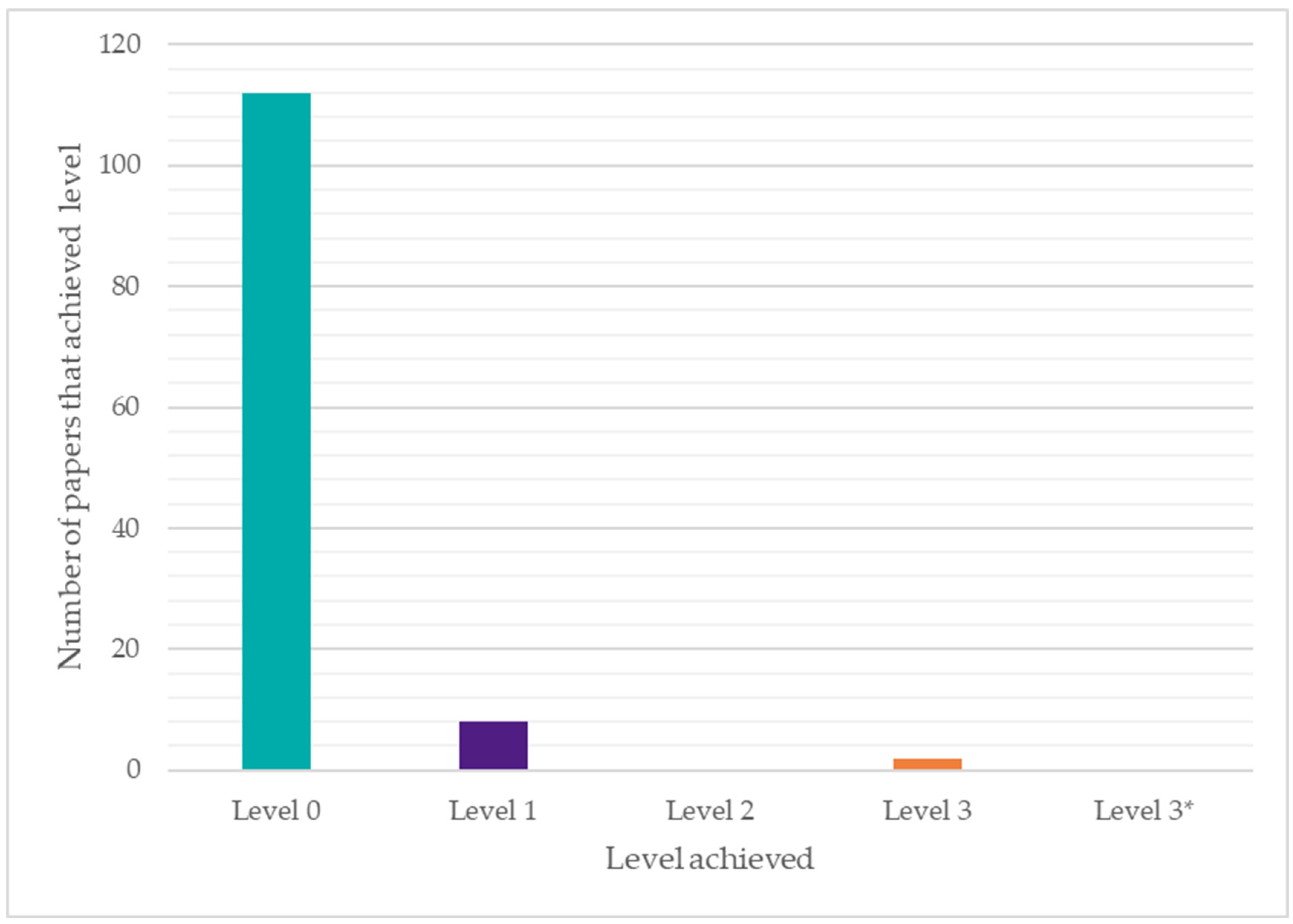
3.2. Evaluating HBIM Case Studies Using the HBIM Maturity Model
4. Future Work
5. Conclusions
Author Contributions
Funding
Data Availability Statement
Acknowledgments
Conflicts of Interest
Abbreviations
| CH | Cultural heritage |
| DNA | Did not achieve |
| GIS | Geographic information system |
| HBIM | Historic building information modelling |
| IFC | Industry Foundation Class |
| INCOSE | International Council on Systems Engineering |
| NURBS | Non-uniform rational B-spline |
| TAM | Technology acceptance model |
| UK | United Kingdom |
| XR | Extended reality |
References
- ISO 19650-1:2018; Digitization of Information about Buildings and Civil Engineering Works, Including Building Information Modelling (BIM)—Information Management Using Building Information Modelling. The British Standards Institute: London, UK, 2018.
- Murphy, M.; McGovern, E.; Pavia, S. Historic Building Information Modelling (HBIM). Struct. Surv. 2009, 27, 311–327. [Google Scholar] [CrossRef]
- Charef, R.; Emmitt, S.; Alaka, H.; Fouchal, F. Building Information Modelling Adoption in the European Union: An Overview. J. Build. Eng. 2019, 25, 100777. [Google Scholar] [CrossRef]
- Koka, E.; Bozheku, E.; Venditti, C.; Picaro, R.; Bashmili, J.; Veshi, D. Legal BIM in Italy. Bratisl. Law Rev. 2025, 9, 113–134. [Google Scholar] [CrossRef]
- Council of Europe. Convention on the Value of Cultural Heritage for Society (Faro Convention); Council of Europe: Faro, Portugal, 2005. [Google Scholar]
- BS ISO 55000:2014; Asset Management. Overview, Principles and Terminology. The International Standards Organisation: Geneva, Switzerland, 2014.
- Historic England. Practical Building Conservation: Conservation Basics; Martin, B., Wood, C., McCaig, I., Eds.; Routledge: Oxford, UK, 2024; Volume 3. [Google Scholar]
- Yang, X.; Grussenmeyer, P.; Koehl, M.; Macher, H.; Murtiyoso, A.; Landes, T. Review of Built Heritage Modelling: Integration of HBIM and Other Information Techniques. J. Cult. Herit. 2020, 46, 350–360. [Google Scholar] [CrossRef]
- García-Valldecabres, J.; Pellicer, E.; Jordan-Palomar, I. BIM Scientific Literature Review for Existing Buildings and a Theoretical Method: Proposal for Heritage Data Management Using HBIM. In Proceedings of the Construction Research Congress 2016: Old and New Construction Technologies Converge in Historic San Juan—Proceedings of the 2016 Construction Research Congress, CRC 2016, San Juan, Puerto Rico, 31 May–2 June 2016. [Google Scholar]
- Pocobelli, D.P.; Boehm, J.; Bryan, P.; Still, J.; Grau-Bové, J. BIM for Heritage Science: A Review. Herit. Sci. 2018, 6, 30. [Google Scholar] [CrossRef]
- López, F.J.; Lerones, P.M.; Llamas, J.; Gómez-García-Bermejo, J.; Zalama, E. A Review of Heritage Building Information Modeling (H-BIM). Multimodal Technol. Interact. 2018, 2, 21. [Google Scholar] [CrossRef]
- Lovell, L.J.; Davies, R.J.; Hunt, D.V.L. The Application of Historic Building Information Modelling (HBIM) to Cultural Heritage: A Review. Heritage 2023, 6, 6691–6717. [Google Scholar] [CrossRef]
- Rocha, G.; Mateus, L.; Ferreira, V. Historical Heritage Maintenance via Scan-to-BIM Approaches: A Case Study of the Lisbon Agricultural Exhibition Pavilion. ISPRS Int. J. Geoinf. 2024, 13, 54. [Google Scholar] [CrossRef]
- Centarti, L.; Ferreyra, C.; Guida, C.G.; Limongiello, M.; Messina, B. Documentation and Management of Complex 3D Morphologies through Digital Technology. Acta IMEKO 2024, 13, 1–7. [Google Scholar] [CrossRef]
- Teppati Losè, L.; Diara, F.; Spadaro, A.; Chiabrando, F. From 3D Metric Survey to HBIM Model. Testing of Different Scan2bim Approaches for the Archaeological Documentation. Int. Arch. Photogramm. Remote Sens. Spat. Inf. Sci. 2024, 48, 437–444. [Google Scholar] [CrossRef]
- Mangialardi, N.M.; Pierucci, A. Research Information System for Cultural Heritage Impact Assessment. In Proceedings of the 2022 IMEKO TC4 International Conference on Metrology for Archaeology and Cultural Heritage; IMEKO: Budapest, Hungary, 2023; pp. 268–273. [Google Scholar]
- Borkowski, A.S.; Olszewska, P. HBIM Model as a Digital Twin on the Example of the Gawrych Cottage in the Kurpie Open Air Museum in Nowogród. Wiadomości Konserw. 2024, 77, 137–148. [Google Scholar] [CrossRef]
- García-León, J.; Murrieri, P.; Collado-Espejo, P.E. HBIM as a Tool for the Analysis and Conservation of Architectural Heritage. Case Study: The Rame Tower’s Digital Twin. Int. Arch. Photogramm. Remote Sens. Spat. Inf. Sci. 2023, 48, 637–644. [Google Scholar] [CrossRef]
- Alshawabkeh, Y.; Baik, A. Integration of Photogrammetry and Laser Scanning for Enhancing Scan-to-HBIM Modeling of Al Ula Heritage Site. Herit. Sci. 2023, 11, 147. [Google Scholar] [CrossRef]
- Liu, J. Virtual Reconstruction Applications to Support the Preservation of Cultural Heritage: Two Case Studies of Temple Sites in Qufu and Beijing. Technol.|Archit. Des. 2024, 8, 212–231. [Google Scholar] [CrossRef]
- Kang, H.; Byun, H.; Lee, J. Parametric Modeling Technology for Applying HBIM to Korean Traditional Wooden Architecture. Int. Arch. Photogramm. Remote Sens. Spat. Inf. Sci. 2023, 48, 815–820. [Google Scholar] [CrossRef]
- Dionizio, R.F.; López-Chao, V. Integrating HBIM and WebGIS for the Documentation, Visualization and Management of Modern Architectural Heritage Sites. Int. J. Archit. Herit. 2025, 19, 3530–3549. [Google Scholar] [CrossRef]
- Pozzoni, L.; Barazzetti, L.; Cuca, B.; Oteri, A.M. An Integrated HBIM-GIS Digital Environment for Heritage Preservation and Enhancement in the Inner Italian Territory. Int. Arch. Photogramm. Remote Sens. Spat. Inf. Sci. 2024, 48, 357–364. [Google Scholar] [CrossRef]
- Barrile, V.; Genovese, E. GIS-like Environments and HBIM Integration for Ancient Villages Management and Dissemination. Int. Arch. Photogramm. Remote Sens. Spat. Inf. Sci. 2024, 48, 41–47. [Google Scholar] [CrossRef]
- D’Urso, M.G.; Aldrighettoni, J. Geodatabase, Metric Reconstruction and a GIS Platform of Historical-Archaeological Sites in Aquino. Acta IMEKO 2024, 13, 1–14. [Google Scholar] [CrossRef]
- Xu, J.; Garramone, M.; Scaioni, M. Integration of HGIS/HBIM to Reveal and Reconstruct the Vanished Metal Bridge Heritage of the Chinese Eastern Railway Main Line. Int. Arch. Photogramm. Remote Sens. Spat. Inf. Sci. 2024, 48, 161–166. [Google Scholar] [CrossRef]
- Baik, A. A Comprehensive Heritage BIM Methodology for Digital Modelling and Conservation of Built Heritage: Application to Ghiqa Historical Market, Saudi Arabia. Remote Sens. 2024, 16, 2833. [Google Scholar] [CrossRef]
- Colucci, E.; Iacono, E.; Matrone, F.; Ventura, G.M. The Development of a 2D/3D BIM-GIS Web Platform for Planned Maintenance of Built and Cultural Heritage: The Main10ance Project. Int. Arch. Photogramm. Remote Sens. Spat. Inf. Sci. 2023, 48, 433–439. [Google Scholar] [CrossRef]
- Ciuffreda, A.L.; Trovatelli, F.; Meli, F.; Caselli, G.; Stramaccioni, C.; Coli, M.; Tanganelli, M. Historic Building Information Modeling for Conservation and Maintenance: San Niccolo’s Tower Gate, Florence. Heritage 2024, 7, 1334–1356. [Google Scholar] [CrossRef]
- Angeloni, R.; Mariotti, C.; Petetta, L.; Coppetta, L. Enabling Scan-To-BIM Workflow for Heritage Conservation and Management Process. Int. Arch. Photogramm. Remote Sens. Spat. Inf. Sci. 2023, 48, 79–86. [Google Scholar] [CrossRef]
- De Falco, A.; Gaglio, F.; Giuliani, F.; Martino, M.; Messina, V. An HBIM Approach for Structural Diagnosis and Intervention Design in Heritage Constructions: The Case of the Certosa Di Pisa. Heritage 2024, 7, 1850–1869. [Google Scholar] [CrossRef]
- Miky, Y.; Alshawabkeh, Y.; Baik, A. Using Deep Learning for Enrichment of Heritage BIM: Al Radwan House in Historic Jeddah as a Case Study. Herit. Sci. 2024, 12, 255. [Google Scholar] [CrossRef]
- Wang, H.; He, X.; Yan, Z.; Lei, S.; Luo, S.; Lei, J.; Zhou, Q. Research on Pathology Information Management of Educational Architectural Heritage Based on Digital Technology: The Case of James Jackson Gymnasium. Buildings 2024, 14, 1048. [Google Scholar] [CrossRef]
- Fiorenza, J.; Rimella, N.; Calandra, D.; Osello, A.; Lamberti, F. Enhancing HBIM-to-VR Workflows: Semi-Automatic Generation of Virtual Heritage Experiences Using Enriched IFC Files. Digit. Appl. Archaeol. Cult. Herit. 2025, 36, e00391. [Google Scholar] [CrossRef]
- Banfi, F.; Oreni, D. Unlocking the Interactive Potential of Digital Models with Game Engines and Visual Programming for Inclusive Vr and Web-Based Museums. Virtual Archaeol. Rev. 2025, 16, 44–70. [Google Scholar] [CrossRef]
- Zachos, A.; Anagnostopoulos, C.-N. Using TLS, UAV, and MR Methodologies for 3D Modelling and Historical Recreation of Religious Heritage Monuments. J. Comput. Cult. Herit. 2024, 17, 1–23. [Google Scholar] [CrossRef]
- Antuono, G.; Elefante, E.; Vindrola, P.G.; D’Agostino, P. A Methodological Approach for an Augmented HBIM Experience the Architectural Thresholds of the Mostra D’Oltremare. Int. Arch. Photogramm. Remote Sens. Spat. Inf. Sci. 2024, 48, 9–16. [Google Scholar] [CrossRef]
- Brahmantara; Kausar, D.R.; Agustan, A.; Zainol, N.A. Digital Technology for Heritage Preservation and Interpretation in Cultural Tourism. In Proceedings of the 2025 4th International Conference on Computing and Information Technology (ICCIT), Tabuk, Saudi Arabia, 13–14 April 2025; IEEE: Piscataway, NJ, USA, 2025; pp. 652–655. [Google Scholar]
- Fazion, B.; Treccani, D.; Fregonese, L.; Lombardini, N. HBIM Structural Model to Evaluate Building Evolution and Construction Hypotheses: Preliminary Results. Int. Arch. Photogramm. Remote Sens. Spat. Inf. Sci. 2024, 48, 213–219. [Google Scholar] [CrossRef]
- Gómez, A.; Adineh, A.; Rahrig, M.; Lerma, J.L. Narrating Serranos Bridge Evolution in Valencia (1500–2022) Using Historic Building Information Modelling and Historical Data. Remote Sens. 2024, 16, 310. [Google Scholar] [CrossRef]
- Moya-Muñoz, J.; Angulo-Fornos, R.; González-Serrano, A. Survey and Analysis of the Watermill of the Marquess of Los Vélez de Oria (Almería): Correlation between Historical Plans and Present Situation. EGA Rev. Expresión Gráfica Arquit. 2024, 29, 284–299. [Google Scholar] [CrossRef]
- Sofronievska, L.D.; Cvetkovska, M.; Gavriloska, A.T.; Mihajlovska, T. BIM for Enhancing the Energy Efficiency and Sustainability of Existing Buildings. In Creating a Roadmap Towards Circularity in the Built Environment; Springer Nature: Cham, Switzerland, 2024; pp. 419–430. [Google Scholar]
- Davies, R.J.; Lovell, L.J.; Puri, V.; Nguyen, E.; Jiang, X. Integrating Thermal Images with HBIM for the Sustainable Evaluation of a Historic Building: Case Study of Rowheath Pavilion, Bournville. Appl. Sci. 2025, 15, 11109. [Google Scholar] [CrossRef]
- Shehata, A.O.; Hassan, A.M.; Shahda, M.M.; Megahed, N.A. Green Retrofitting of Heritage Buildings Based on (3Ts) Framework: An Applied Case Study. Front. Archit. Res. 2024, 13, 776–798. [Google Scholar] [CrossRef]
- Piras, G.; Muzi, F. Energy Transition: Semi-Automatic BIM Tool Approach for Elevating Sustainability in the Maputo Natural History Museum. Energies 2024, 17, 775. [Google Scholar] [CrossRef]
- Monchetti, S.; Betti, M.; Borri, C.; Gerola, C.; Matta, C.; Francalanci, B. Insight on HBIM for Conservation of Cultural Heritage: The Galleria Dell’Accademia Di Firenze. Heritage 2023, 6, 6949–6964. [Google Scholar] [CrossRef]
- Santini, S.; Canciani, M.; Borghese, V.; Sabbatini, V.; Sebastiani, C. From Digital Restitution to Structural Analysis of a Historical Adobe Building: The Escuela José Mariano Méndez in El Salvador. Heritage 2023, 6, 4362–4379. [Google Scholar] [CrossRef]
- Casimiro-Bernárdez, J.M.; Martínez-Carricondo, P.; Agüera-Vega, F.; Carvajal-Ramírez, F. FEM Structural Analysis from UAV Photogrammetry Projects. Case Study: Twenty Eyes Aqueduct in the Wadi of Carcauz (Almeria, Spain). Conserv. Sci. Cult. Herit. 2023, 23, 111–139. [Google Scholar]
- Cardinali, V.; Ciuffreda, A.L.; Coli, M.; De Stefano, M.; Meli, F.; Tanganelli, M.; Trovatelli, F. An Oriented H-BIM Approach for the Seismic Assessment of Cultural Heritage Buildings: Palazzo Vecchio in Florence. Buildings 2023, 13, 913. [Google Scholar] [CrossRef]
- Castellazzi, G.; Cardillo, E.; Lo Presti, N.; D’Altri, A.M.; de Miranda, S.; Bertani, G.; Ferretti, F.; Mazzotti, C. Advancing Cultural Heritage Structures Conservation: Integrating BIM and Cloud-Based Solutions for Enhanced Management and Visualization. Heritage 2023, 6, 7316–7342. [Google Scholar] [CrossRef]
- Velastegui-Cáceres, L.A.; Guevara-Bonifaz, B.; Velastegui-Cáceres, J.; Toulkeridis, T. Implementation of Laser Scanning and HBIM Technology for the Structural Evaluation of Built Heritage in Ecuador. Civ. Eng. Archit. 2024, 12, 3221–3234. [Google Scholar] [CrossRef]
- Qsymah, A.; Al Shdaifat, I.; Ayasarh, M.; Qidan, D.; Al-Housan, A.-Q. HBIM for Sustainable Documentaion of Historic Buildings: Case Study of Al-Faddain Umayyad Mosque. Civ. Eng. Archit. 2024, 12, 1969–1984. [Google Scholar] [CrossRef]
- Cuperschmid, A.R.M.; Costa, A.P.; Neves, I.; Fonseca, F.R.; Cuperschmid, E.M. Virtual Reconstruction of the Deconstructed Heritage: The Former Building of the Belo Horizonte School of Medicine. J. Comput. Cult. Herit. 2024, 17, 1–20. [Google Scholar] [CrossRef]
- Vaienti, B.; Petitpierre, R.; di Lenardo, I.; Kaplan, F. Machine-Learning-Enhanced Procedural Modeling for 4D Historical Cities Reconstruction. Remote Sens. 2023, 15, 3352. [Google Scholar] [CrossRef]
- Younus, I.; Al-Hinkawi, W.; Lafta, S. The Role of Historic Building Information Modeling in the Cultural Resistance of Liberated City. Ain Shams Eng. J. 2023, 14, 102191. [Google Scholar] [CrossRef]
- Spreafico, A.; Chiabrando, F.; Della Coletta, C. 3D WebGIS Applications for Digital Humanities Studies: The Turin 1911 Project. Int. Arch. Photogramm. Remote Sens. Spat. Inf. Sci. 2023, 48, 1501–1508. [Google Scholar] [CrossRef]
- Intrigila, C.; Giannetti, I.; Eramo, E.; Gabrielli, R.; Caruso, G. HBIM for Conservation and Valorization of Structural Heritage: The Stylite Tower at Umm Ar-Rasas, Jordan. J. Cult. Herit. 2024, 70, 397–407. [Google Scholar] [CrossRef]
- Muñoz-Cádiz, J.; Mariotti, C.; Nespeca, R.; Bolognese, L. A Methodology for Integrating the CIDOC-CRMba Ontology into the IFC Schema to Support Spatial Analysis in Archaeological Heritage. Digit. Appl. Archaeol. Cult. Herit. 2025, 37, e00431. [Google Scholar] [CrossRef]
- Martinelli, L.; Calvano, M.; Calcerano, F.; Gigliarelli, E. Visual Programming Language to Support Interoperability of Geometric and Data Modelling in HBIM Processes. Sci. Res. Inf. Technol. 2025, 15, 85–96. [Google Scholar]
- Cortés Meseguer, L.; García Valldecabres, J. Digital Twins. HBIM Information Repositories to Centralize Knowledge and Interdisciplinary Management of Architectural Heritage. Vitr. Int. J. Archit. Technol. Sustain. 2023, 8, 64–75. [Google Scholar] [CrossRef]
- Mazzei, A.; Martinelli, L.; Empler, T.; Cessari, L.; Gigliarelli, E. Modelling for Uncertainty in HBIM Processes. Vitr. Int. J. Archit. Technol. Sustain. 2024, 9. [Google Scholar] [CrossRef]
- Koehl, M.; Steiner, V.; Guillemin, S.; Degenève, F.; Zabollone, A.; Bignon, I.; Taufflieb, C.; Tisserand, L.; Hedtmann, L. 3D and HBIM Models: Digital Tools for the Diagnostic Study of the Stair Turret of the South-East Corner of the Main Tower of Strasbourg Cathedral. Int. Arch. Photogramm. Remote Sens. Spat. Inf. Sci. 2023, 48, 871–878. [Google Scholar] [CrossRef]
- Maravelakis, E.; Giannioti, G.; Psalti, A.; Tsakoumaki, M.; Pocobelli, D.P.; Xinogalos, M.; Galanakis, D.; Bilalis, N.; Stavroulakis, G. 3D Modeling & Analysis Techniques for the Apollo Temple in Delphi. Buildings 2023, 13, 1730. [Google Scholar] [CrossRef]
- Chaves, E.; Aguilar, J.; Barontini, A.; Mendes, N.; Compán, V. Digital Tools for the Preventive Conservation of Built Heritage: The Church of Santa Ana in Seville. Heritage 2024, 7, 3470–3494. [Google Scholar] [CrossRef]
- Woodward, A.; Heesom, D. Implementing HBIM on Conservation Heritage Projects. Int. J. Build. Pathol. Adapt. 2021, 39, 96–114. [Google Scholar] [CrossRef]
- Boit, B.; Oyuga, J.; Kedogo, J. Adoption of Digital Technologies for Heritage Conservation: The Case of Al-Busaidy Heritage Site, Mombasa County, Kenya. In Proceedings of the 2023 IEEE AFRICON, Nairobi, Kenya, 20–22 September 2023; IEEE: Piscataway, NJ, USA, 2023; pp. 1–6. [Google Scholar]
- Rolim, R.; López-González, C. Materialisation of Complex Interior Spaces for the Insertion and Visualisation of Environmental Data in HBIM Models. Appl. Syst. Innov. 2024, 7, 111. [Google Scholar] [CrossRef]
- Younis, A.; Tawalbeh, M. Innovative Energy Retrofit Approach of Historical Buildings Using HBIM Process: The Guest House of Al-Karak Greater Municipality in Jordan a Case Study. Civ. Eng. Archit. 2024, 12, 1219–1234. [Google Scholar] [CrossRef]
- Granger, G. To Create Net-Zero Cities, We Need to Look Hard at Our Older Buildings. Available online: https://www.weforum.org/stories/2022/11/net-zero-cities-retrofit-older-buildings-cop27/ (accessed on 19 March 2026).
- Heesom, D.; Boden, P.; Hatfield, A.; De Los Santos Melo, A.; Czarska-Chukwurah, F. Implementing a HBIM Approach to Manage the Translocation of Heritage Buildings. Eng. Constr. Archit. Manag. 2021, 28, 2948–2966. [Google Scholar] [CrossRef]
- García-Valldecabres, J.L.; Liu, J.; Willkens, D.S.; Escudero, P.A.; López-González, C.; Cortés Meseguer, L.; Orozco Carpio, P.R. Development of a Virtual Itinerary with HBIM and GIS. Int. Arch. Photogramm. Remote Sens. Spat. Inf. Sci. 2023, 48, 645–652. [Google Scholar] [CrossRef]
- Pavelka, K., Jr.; Kuzmanov, P.; Pavelka, K.; Rapuca, A. Different Data Joining as a Basic Model for HBIM—A Case Project St. Pataleimon in Skopje. Int. Arch. Photogramm. Remote Sens. Spat. Inf. Sci. 2023, 48, 85–91. [Google Scholar] [CrossRef]
- Lin, G.; Li, G.; Giordano, A.; Sang, K.; Stendardo, L.; Yang, X. Three-Dimensional Documentation and Reconversion of Architectural Heritage by UAV and HBIM: A Study of Santo Stefano Church in Italy. Drones 2024, 8, 250. [Google Scholar] [CrossRef]
- Clini, P.; Quattrini, R.; Mariotti, C.; Nespeca, R.; De Luca, D.A. From Point Cloud Data to HBIM for Public Performance Spaces Knowledge, Management and Storytelling: Palazzo Olivieri in Pesar. DISEGNARECON 2023, 16. [Google Scholar]
- Ávila, F.; Blanca-Hoyos, Á.; Puertas, E.; Gallego, R. HBIM: Background, Current Trends, and Future Prospects. Appl. Sci. 2024, 14, 11191. [Google Scholar] [CrossRef]
- Ewart, I.J.; Zuecco, V. Heritage Building Information Modelling (HBIM): A Review of Published Case Studies. In Advances in Informatics and Computing in Civil and Construction Engineering; Springer International Publishing: Cham, Switzerland, 2019; pp. 35–41. [Google Scholar]
- Checkland, P.; Holwell, S. Information, Systems and Information Systems: Making Sense of the Field; John Wiley & Sons: Chichester, UK, 1998. [Google Scholar]
- Nicholas, D.; Herman, E. Assessing Information Needs in the Age of the Digital Consumer; Routledge: Abingdon, UK, 2010; ISBN 9781135145651. [Google Scholar]
- Historic England. BIM for Heritage: Developing a Historic Building Information Model; Historic England: Swindon, UK, 2017. [Google Scholar]
- Historic England. BIM for Heritage: Developing the Asset Information Model; Historic England: Swindon, UK, 2019. [Google Scholar]
- Siewczyński, B.; Szot, J. BIM Goals and Uses in the Management, Maintenance, and Preservation of Historic Buildings: An Open Access Perspective. Implementation Characteristics of HBIM for Improved Documentation and Lifecycle Management. npj Herit. Sci. 2025, 13, 103. [Google Scholar] [CrossRef]
- Global Forum on Maintenance and Asset Management. The Asset Management Landscape; Global Forum on Maintenance and Asset Management: Toronto, ON, Canada, 2014; Volume 2. [Google Scholar]
- IAM. Asset Management—An Anatomy; IAM: Bristol, UK, 2015. [Google Scholar]
- The Forum on Information Standards in Heritage (FISH). MIDAS Heritage—The UK Historic Environment Data Standard, v1.1; Historic England: Swindon, UK, 2012. [Google Scholar]
- Lovell, L.J.; Davies, R.J.; Hunt, D.V.L. Building Information Modelling Facility Management (BIM-FM). Appl. Sci. 2024, 14, 3977. [Google Scholar] [CrossRef]
- Lovell, L.; Davies, R.J.; Hunt, D.V.L. Theoretical Information Requirements for Historic Building Information Modelling. In Proceedings of the FCIC’24 Faro Convention International Conference, Porto, Portugal, 29 January 2024. [Google Scholar]
- Lovell, L.J.; Davies, R.J.; Hunt, D.V.L. A Systems Thinking Approach to the Development of HBIM: Part 1—The Problematic Situation. Heritage 2025, 8, 21. [Google Scholar] [CrossRef]
- Lovell, L.J.; Davies, R.J.; Hunt, D.V.L. A Systems Thinking Approach to the Development of Historic Building Information Modelling: Part 2—Definition of Requirements. Heritage 2025, 8, 93. [Google Scholar] [CrossRef]
- Lovell, L.J.; Davies, R.J.; Hunt, D.V.L. Engaging the International Heritage Community to Validate End-User Requirements for Historic Building Information Modelling. Appl. Sci. 2025, 15, 11159. [Google Scholar] [CrossRef]
- Davis, F.D. Perceived Usefulness, Perceived Ease of Use, and User Acceptance of Information Technology. MIS Q. 1989, 13, 319. [Google Scholar] [CrossRef]
- Hartson, R.; Pyla, P. Background: Design. In The UX Book; Elsevier: Amsterdam, The Netherlands, 2019; pp. 397–401. [Google Scholar]
- INCOSE. INCOSE Systems Engineering Handbook: A Guide for System Life Cycle Processes and Activities, 4th ed.; John Wiley & Sons, Incorporated: Hoboken, NJ, USA, 2015. [Google Scholar]
- Checkland, P. Systems Thinking, Systems Practice: Includes a 30-Year Retrospective; Wiley: Hoboken, NJ, USA, 1999; ISBN 978-0-471-98606-5. [Google Scholar]
- Checkland, P. From Optimizing to Learning: A Development of Systems Thinking for the 1990s. J. Oper. Res. Soc. 1985, 36, 757–767. [Google Scholar] [CrossRef]
- Checkland, P.; Scholes, J. Soft Systems Methodology in Action; John Wiley & Sons Ltd.: Hoboken, NJ, USA, 1990; ISBN 0-471-92768-6. [Google Scholar]
- Checkland, P.; Poulter, J. Learning for Action: A Short Definitive Account of Soft Systems Methodology, and Its Use for Practitioner, Teachers and Students; John Wiley & Sons Ltd.: Hoboken, NJ, USA, 2006. [Google Scholar]
- INCOSE. INCOSE Guide to Writing Requirements v3.1—Summary Sheet; INCOSE: San Diego, CA, USA, 2022. [Google Scholar]
- Kleponė, D.; Šūmakaris, P.; Kovaitė, K.; Šūmakarienė, K. Socio-Economic Drivers of Cultural Heritage Digitization in the EU. Heritage 2026, 9, 17. [Google Scholar] [CrossRef]
- Adami, A.; Scala, B.; Treccani, D.; Dufour, N.; Papandrea, K. HBIM Approach for Heritage Protection: First Experiences for a Dedicated Training. Int. Arch. Photogramm. Remote Sens. Spat. Inf. Sci. 2023, 48, 11–18. [Google Scholar] [CrossRef]
- Argasiński, K.; Kuroczyński, P. Preservation through Digitization-Standardization in Documentation of Build Cultural Heritage Using Capturing Reality Techniques and Heritage/Historic BIM Methodology. Int. Arch. Photogramm. Remote Sens. Spat. Inf. Sci. 2023, 48, 87–94. [Google Scholar] [CrossRef]
- Hamed, W.; El Antably, A. Knowledge-Based HBIM for Conservation: The Case of Yahya al-Shabih Mausoleum. Digit. Appl. Archaeol. Cult. Herit. 2023, 30, e00278. [Google Scholar] [CrossRef]
- Green Building Council of Australia. Assessment and Certification: An Overview of the Process. Available online: https://new.gbca.org.au/green-star/certification-process/ (accessed on 12 January 2026).
- US Green Building Council. LEED Rating System. Available online: https://www.usgbc.org/leed (accessed on 12 January 2026).
- BREEAM. An Introduction to BREEAM. Available online: https://breeam.com/standards?infinity=ict2~net~gaw~cmp~22848765318~ag~183619481655~ar~767061792159~kw~breeam~mt~e~acr~3626112201&gad_source=1&gad_campaignid=22848765318&gbraid=0AAAAABgdAQIotNojigUkQT_hHOtz9BniB&gclid=Cj0KCQiA1JLLBhCDARIsAAVfy7gZWcCO4popy-LVnl0eKAb6U-3F4j4XeVdqWFkCKNv0CW7blMHYo_gaAvaSEALw_wcB (accessed on 12 January 2026).
- CMMI Institute CMMI Levels of Capability and Performance. Available online: https://cmmiinstitute.com/learning/appraisals/levels (accessed on 3 June 2026).
- Royal Institution of Chartered Surveyors (RICS). The Future of BIM: Digital Transformation in the UK Construction and Infrastructure Sector; Royal Institution of Chartered Surveyors: London, UK, 2020. [Google Scholar]
- Kim, Y.-W. Digital Twin Maturity Models. In Characterization of Digital Twin; ResearchGate: Berlin, Germany, 2020; Volume VIII, pp. 337–394. [Google Scholar]
- Sullivan, G.M.; Artino, A.R. Analyzing and Interpreting Data From Likert-Type Scales. J. Grad. Med. Educ. 2013, 5, 541–542. [Google Scholar] [CrossRef]
- Gambarota, F.; Altoè, G. Ordinal Regression Models Made Easy: A Tutorial on Parameter Interpretation, Data Simulation and Power Analysis. Int. J. Psychol. 2024, 59, 1263–1292. [Google Scholar] [CrossRef]
- Scandurra, S.; Lanzara, E.; Improta, I.; Lo Pilato, A.; Itri, F. BsDD for Artworks in HBIM Open and Standard-Oriented Documentation. Int. Arch. Photogramm. Remote Sens. Spat. Inf. Sci. 2024, 48, 397–404. [Google Scholar] [CrossRef]
- García-León, J.; Murrieri, P.; Picazo, M.T. Data Sharing and Interoperability in HBIM Applied to the Rame Tower. Disegnarecon 2024, 17. [Google Scholar]
- Connor, D. Information System Specification & Design Roadmap; Prentice Hall: Hoboken, NJ, USA, 1985. [Google Scholar]
- Banfi, F. BIM Orientation: Grades of Generation and Information for Different Type of Analysis and Management Process. In Proceedings of the International Archives of the Photogrammetry, Remote Sensing and Spatial Information Sciences—ISPRS Archives, Ottawa, ON, Canada, 28 August–1 September 2017; Volume 42. [Google Scholar]
- Brumana, R.; Stanga, C.; Banfi, F. Models and Scales for Quality Control: Toward the Definition of Specifications (GOA-LOG) for the Generation and Re-Use of HBIM Object Libraries in a Common Data Environment. Appl. Geomat. 2022, 14, 151–179. [Google Scholar] [CrossRef]
- ISO 7817-1:2024; Building Information Modelling—Level of Information Need Part 1: Concepts and Principles. The International Standards Organisation: Geneva, Switzerland, 2024.
- Canevese, E.P.; Cuttini, R.; Bertani, I. Advanced, Multidisciplinary, Interoperable Digitisation of Cultural Heritage and User-Friendly Use of the Results: Case Study of the Cathedral of Santa Maria Assunta in Cividale Del Friuli (UD). Int. Arch. Photogramm. Remote Sens. Spat. Inf. Sci. 2023, 48, 349–355. [Google Scholar] [CrossRef]
- Tini, M.A.; Forte, A.; Girelli, V.A.; Lambertini, A.; Roggio, D.S.; Bitelli, G.; Vittuari, L. Scan-to-HBIM-to-VR: An Integrated Approach for the Documentation of an Industrial Archaeology Building. Remote Sens. 2024, 16, 2859. [Google Scholar] [CrossRef]
- Arches. Arches for HERs. Available online: https://www.archesproject.org/arches-for-hers/ (accessed on 15 December 2024).
- Six Sigma. What Is TIMWOODS? 8 Waste of Lean and How to Reduce Them. Available online: https://www.6sigma.us/lean-waste/timwoods-8-waste-of-lean/ (accessed on 16 January 2026).
- Wojciechowska, G.; Bednarz, Ł.J.; Dolińska, N.; Opałka, P.; Krupa, M.; Imnadze, N. Intelligent Monitoring System for Integrated Management of Historical Buildings. Buildings 2024, 14, 2108. [Google Scholar] [CrossRef]
- Rosati, P.; Lynn, T.; Kreps, D.; Conboy, K. Digital Sustainability: Key Definitions and Concepts. In Digital Sustainability; Palgrave Macmillan: London, UK, 2024; pp. 1–24. [Google Scholar]
- Department for Environment, Food & Rural Affairs. Defra Digital Sustainability Strategy 2025 to 2030; Department for Environment, Food & Rural Affairs: London, UK, 2025. [Google Scholar]
- Avena, M.; Patrucco, G.; Remondino, F.; Spanò, A. A Scalable Approach for Automating Scan-BIM Processes in the Heritage Field. Int. Arch. Photogramm. Remote Sens. Spat. Inf. Sci. 2024, 48, 25–31. [Google Scholar] [CrossRef]
- Moyano, J.; Martínez, E.; Nieto-Julián, J.E.; Fernández-Alconchel, M. Integrating Wooden Altarpieces into H-BIM: Geometric Profiling, Complex Artworks, and Digital Heritage Mapping. Autom. Constr. 2025, 175, 106213. [Google Scholar] [CrossRef]
- Biancardo, S.A.; Intignano, M.; Veropalumbo, R.; Martinelli, R.; Calvanese, V.; Autelitano, F.; Garilli, E.; Giuliani, F.; Dell’Acqua, G. BIM Approach for Stone Pavements in Archaeological Sites: The Case Study of Vicolo Dei Balconi of Pompeii. Transp. Res. Interdiscip. Perspect. 2023, 17, 100755. [Google Scholar] [CrossRef]
- Biancardo, S.A.; Intignano, M.; Pires, D.M.; Abbondati, F.; Dell’Acqua, G. Heritage BIM Approach for Roman Pavements. Eur. Transp./Trasp. Eur. 2023, 91, 1–10. [Google Scholar] [CrossRef]
- Ortiz Villarejo, A.J.; Delgado Barrado, J.M. DIGITALESCAPE Project—Aerial Remote Sensing, HBIM, and Archaeology for the Preservation and Dissemination of the Cultural Heritage at Risk in the Sierra Sur and Sierra Morena Regions. Remote Sens. 2023, 15, 3315. [Google Scholar] [CrossRef]
- Antonelli, F.; Piovesan, R.; Tesser, E.; Tosato, M.; Sorbo, E. Original or Post-War Paintings? The Fixed Wooden Scenery of the Teatro Olimpico in Vicenza: A Guided Multidisciplinary Approach Based on Scientific Analyses and HBIM. Herit. Sci. 2024, 12, 205. [Google Scholar] [CrossRef]
- Giuliani, F.; Gaglio, F.; Martino, M.; De Falco, A. A HBIM Pipeline for the Conservation of Large-Scale Architectural Heritage: The City Walls of Pisa. Herit. Sci. 2024, 12, 35. [Google Scholar] [CrossRef]
- Espinoza Brugman, C.A.; Neri Caipo, F.K.; Almeida Del Savio, A. UAV, GNSS, Total Station, and Data Management Applied to an Ancient Clay Structure as a Historic Building Information Modeling Proposal: A Case Study of Huaca Arco Iris (Trujillo, Peru). Heritage 2024, 7, 4962–4979. [Google Scholar] [CrossRef]
- Huang, W.; Gao, X.; Lu, J. Digital Construction Preservation Techniques of Endangered Heritage Architecture: A Detailed Reconstruction Process of the Dong Ethnicity Drum Tower (China). Drones 2024, 8, 502. [Google Scholar] [CrossRef]
- Aguacil Moreno, S.; Loup, M.; Lebre, M.; Deschamps, L.; Bacher, J.-P.; Duque Mahecha, S. Virtual Tours as Effective Complement to Building Information Models in Computer-Aided Facility Management Using Internet of Things. Appl. Sci. 2024, 14, 7998. [Google Scholar] [CrossRef]
- Pascale, M.R.; Roggio, D.S.; Barbieri, E.; Marino, F.; Derelitto, C.; Girolamini, L.; Bragalli, C.; Bitelli, G.; Cristino, S. New Frontiers in Water Distribution System Management and Monitoring: First Development of a Water Safety Plan Based on Heritage Building Information Modeling (HBIM) in Neptune Fountain, Bologna, Italy. Water 2024, 16, 2075. [Google Scholar] [CrossRef]
- Mao, Y.; Lu, H.; Xiao, Y.; Lai, Z.; Huang, L. A Parametric HBIM Approach for Preservation of Bai Ethnic Traditional Timber Dwellings in Yunnan, China. Buildings 2024, 14, 1960. [Google Scholar] [CrossRef]
- Alshawabkeh, Y.; Baik, A.; Miky, Y. HBIM for Conservation of Built Heritage. ISPRS Int. J. Geoinf. 2024, 13, 231. [Google Scholar] [CrossRef]
- Liu, J.; Foreman, G.; Sattineni, A.; Li, B. Integrating Stakeholders’ Priorities into Level of Development Supplemental Guidelines for HBIM Implementation. Buildings 2023, 13, 530. [Google Scholar] [CrossRef]
- Etemad, A.; Zare, N.; Shafaat, A.; Bahman, A.M. Assessing Strategies for Retrofitting Cooling Systems in Historical Buildings. Energy Rep. 2024, 11, 1503–1516. [Google Scholar] [CrossRef]
- Alsaid, A.M.; Hegazi, Y.S.; Shalaby, H.A.; Ahmed, M.A. Methodology to Improve Energy Efficiency of Heritage Buildings Using HBIM-Sabil Qaitbay: A Case Study from Egypt. Civ. Eng. Archit. 2023, 11, 425–449. [Google Scholar] [CrossRef]
- Bertacchi, G.; Juan-Vidal, F.; Cipriani, L. From the Representation to the Digital HBIM Model of a Historic Building. EGA Rev. De Expresión Gráfica Arquit. 2023, 28, 184–197. [Google Scholar] [CrossRef]
- Spettu, F.; Achille, C.; Fassi, F.; Della Giovampaola, I. Web Platforms for Cultural Heritage Management: The Parco Archeologico Del Colosseo Case Study. Int. Arch. Photogramm. Remote Sens. Spat. Inf. Sci. 2023, 48, 1493–1500. [Google Scholar] [CrossRef]
- Galeazzo, L.; Grillo, R.; Spinaci, G. A Geospatial and Time-Based Reconstruction of the Venetian Lagoon in a 3D Web Semantic Infrastructure. In Proceedings of the CEUR Workshop Proceedings; Bernasconi, E., Mannocci, A., Poggi, A., Salatino, A., Silvello, G., Eds.; CEUR-WS; CEUR: Bonn, Germany, 2024; pp. 212–225. [Google Scholar]
- Rossato, L.; Planu, F.; Montanari, G.; Rizzi, D. The Rocca Malatestiana of Verucchio SCAN to HBIM Process for the Digitisation of Cultural Site with Severe Topography Condition. DISEGNARECON 2023, 16, 2.1-2.12. [Google Scholar] [CrossRef]
- Trisyanti, S.W.; Suwardhi, D.; Purnama, I.; Wikantika, K. A Preliminary Study of 3D Vernacular Documentation for Conservation and Evaluation: A Case Study in Keraton Kasepuhan Cirebon. Buildings 2023, 13, 546. [Google Scholar] [CrossRef]
- Santini, S.; Borghese, V.; Baggio, C. HBIM-Based Decision-Making Approach for Sustainable Diagnosis and Conservation of Historical Timber Structures. Sustainability 2023, 15, 3003. [Google Scholar] [CrossRef]
- Banfi, F.; Roascio, S.; Mandelli, A.; Stanga, C. Narrating Ancient Roman Heritage through Drawings and Digital Architectural Representation: From Historical Archives, UAV and LIDAR to Virtual-Visual Storytelling and HBIM Projects. Drones 2023, 7, 51. [Google Scholar] [CrossRef]
- Daniels, L.; Georgopoulos, A. Doric Temple HBIM Library for Cultural Heritage Management. ISPRS Ann. Photogramm. Remote Sens. Spat. Inf. Sci. 2023, X-M-1–2023, 55–62. [Google Scholar] [CrossRef]
- Celli, S.; Ottoni, F. Managing Information to Improve Conservation: The HBIM of the Wooden Chain of Santa Maria Del Fiore. Sensors 2023, 23, 4860. [Google Scholar] [CrossRef]
- Aricò, M.; Lo Brutto, M.; Maltese, A. A Scan-to-BIM Approach for the Management of Two Arab-Norman Churches in Palermo (Italy). Heritage 2023, 6, 1622–1644. [Google Scholar] [CrossRef]
- Sampaio, A.Z.; Tomé, J.; Gomes, A.M. Heritage Building Information Modelling Implementation First Steps Applied in a Castle Building: Historic Evolution Identity, Data Collection and Stratigraphic Modelling. Heritage 2023, 6, 6472–6493. [Google Scholar] [CrossRef]
- Spanò, A.; Patrucco, G.; Sammartano, G.; Perri, S.; Avena, M.; Fillia, E.; Milan, S. Digital Twinning for 20th Century Concrete Heritage: HBIM Cognitive Model for Torino Esposizioni Halls. Sensors 2023, 23, 4791. [Google Scholar] [CrossRef] [PubMed]
- Agliata, R.; D’Aponte, D.; Lione, R.; Mollo, L. HBIM Tools for Knowledge, Maintenance and Conservation of Concrete Built Heritage. Vitr. Int. J. Archit. Technol. Sustain. 2023, 8, 98–105. [Google Scholar] [CrossRef]
- Oliveira Magalhães, B.K.; Duarte, G.S.; Brasil de Matos Galvão, A.; Serpa Braga Vasconcelos, A.C.; Barbosa Costa, L.C. Documentation Strategies for HBIM Model Parameterization: A Case Study of the José de Alencar Theater. Digit. Appl. Archaeol. Cult. Herit. 2025, 38, e00443. [Google Scholar] [CrossRef]
- Cotella, V.A.; Aburamadan, R.; Di Perna, E. HBIM Applications in the World Heritage City of As-Salt, Jordan: Architecture as a Reflection of Cultural Diversity Shaped by Migratory Flows. Digit. Appl. Archaeol. Cult. Herit. 2025, 37, e00418. [Google Scholar] [CrossRef]
- Almasoudi, A.; Bhatti, A.Q.; Alluqmani, A.E.; Alotaibi, A. Investigation of Enhancing Heritage Preservation Utilizing Heritage Building Information Modeling (HBIM). J. Umm Al-Qura Univ. Eng. Archit. 2025, 16, 414–442. [Google Scholar] [CrossRef]
- Borkowski, A.S.; Winiarska, W. The HBIM Model as a Source in the Building Reconstruction Process: A Case Study of the “Koprówka” in Celestynów, Poland. Buildings 2025, 15, 1442. [Google Scholar] [CrossRef]
- Spada, F.; Greco, L.; Arcuri, N. Renovation of Prefabricated Buildings: Historical Analysis, Digital Model, Energy Retrofit. A Case Study in Calabria, Southern Italy. Vitr. Int. J. Archit. Technol. Sustain. 2025, 10. [Google Scholar] [CrossRef]
- Fernandes Dionizio, R.; Murphy, M.; Dezen-Kempter, E. Multi-Scale Documentation of Modern Brazilian Architecture: An HBIM-HGIS Approach. Int. J. Archit. Herit. 2025, 19, 3307–3324. [Google Scholar] [CrossRef]
- Martinelli, L.; Calcerano, F.; Adinolfi, F.; Chianetta, D.; Gigliarelli, E. Open HBIM-IoT Monitoring Platform for the Management of Historical Sites and Museums. An Application to the Bourbon Royal Site of Carditello. Int. J. Archit. Herit. 2025, 19, 153–170. [Google Scholar] [CrossRef]
- Balestrieri, M.; Valmori, I.; Montuori, M. UAS and TLS 3D Data Fusion for Built Cultural Heritage Assessment and the Application for St. Catherine Monastery in Ferrara, Italy. Int. Arch. Photogramm. Remote Sens. Spat. Inf. Sci. 2024, 48, 9–16. [Google Scholar] [CrossRef]
- Escudero, P.A. Scan-to-HBIM: Automated Transformation of Point Clouds into 3D BIM Models for the Digitization and Preservation of Historic Buildings. Vitr. Int. J. Archit. Technol. Sustain. 2023, 8, 52–63. [Google Scholar] [CrossRef]
- González, J.; Figueiredo, K.; Hammad, A.W.A.; Tam, V.W.Y.; Haddad, A.N.; Illankoon, C. Heritage BIM (HBIM) Applied in Emergency Scenarios: A Case Study of the National Museum in Brazil. Int. J. Constr. Manag. 2025, 25, 1239–1253. [Google Scholar] [CrossRef]
- Doumaz, A.M.; Kacher, S. Proposal for an HBIM Objects Library to Assist with the Conservation of Algerian Built Heritage. Case of the Palace of the Beys at the Citadel of Algiers. J. Archit. Conserv. 2025, 31, 21–44. [Google Scholar] [CrossRef]
- Vieira, M.M.; Ribeiro, G.; Paulo, R.; Bessa, M.; Sousa, F.R.; Moreira, E.; Mesquita, E. Strategy for HBIM Implementation Using High-Resolution 3D Architectural Documentation Based on Laser Scanning and Photogrammetry of the José de Alencar Theatre. Digit. Appl. Archaeol. Cult. Herit. 2023, 30, e00287. [Google Scholar] [CrossRef]
- Hussein, K.A.; Abrahim, A.R.; Mohammed, A.S.; Ali, K.A. Digital Preservation of Heritage Urban Facades: An Integrated Approach Using Historic Building Information Modeling and Shape Grammar Analysis. Digit. Appl. Archaeol. Cult. Herit. 2024, 35, e00383. [Google Scholar] [CrossRef]
- Kim, S.; Lee, J. A Study on the Digital Restoration of an Ancient City Based on Historic Building Information Modeling of Wooden Architectural Heritage: Focusing on Suwon Hwaseong. Herit. Sci. 2024, 12, 365. [Google Scholar] [CrossRef]
- Zhuo, L.; Zhang, J.; Hong, X. Cultural Heritage Characteristics and Damage Analysis Based on Multidimensional Data Fusion and HBIM–Taking the Former Residence of HSBC Bank in Xiamen, China as an Example. Herit. Sci. 2024, 12, 128. [Google Scholar] [CrossRef]
- Aricò, M.; Ferro, C.; La Guardia, M.; Lo Brutto, M.; Taranto, G.; Ventimiglia, G.M. Scan-to-BIM Process and Architectural Conservation: Towards an Effective Tool for the Thematic Mapping of Decay and Alteration Phenomena. Heritage 2024, 7, 6257–6281. [Google Scholar] [CrossRef]
- Suhari, K.T.; Saptari, A.Y.; Abidin, H.Z.; Gunawan, P.H. Integrating Advanced Surveying Technologies and Indigenous Knowledge into 3D Building Information Modeling. Civ. Eng. Archit. 2024, 12, 2819–2831. [Google Scholar] [CrossRef]
- Vieira, M.M.; Gonçalves, J.E.; Silva, D.M.d.O.; Mesquita, E.F.T.; Lima, J.M. Semi-Automatic Scan-to-BIM Procedure Applied to Architectural Ornaments of Nossa Senhora Do Rosário Church, Aracati-CE. J. Build. Pathol. Rehabil. 2024, 9, 75. [Google Scholar] [CrossRef]
- Farajalah, R.; Töre, T. Photogrammetry-Driven HBIM Approach for Mimar Sinan Fine Arts University Campus. In Proceedings of the 2023 16th International Conference on Developments in eSystems Engineering (DeSE), Istanbul, Turkiye, 18–20 December 2023; IEEE: Piscataway, NJ, USA, 2023; pp. 94–99. [Google Scholar]
- Moyano, J.; Fernández-Alconchel, M.; Nieto-Julián, J.E.; Marín-García, D.; Bruno, S. Integration of Dynamic Information on Energy Parameters in HBIM Models. Int. Arch. Photogramm. Remote Sens. Spat. Inf. Sci. 2023, 48, 1089–1096. [Google Scholar] [CrossRef]
- Willkens, D.S.; Liu, J.; Alathamneh, S. A Case Study of Integrating Terrestrial Laser Scanning (TLS) and Building Information Modeling (BIM) in Heritage Bridge Documentation: The Edmund Pettus Bridge. Buildings 2024, 14, 1940. [Google Scholar] [CrossRef]
- Imtiaz, S.; Arif, S.; Nawaz, A.; Shah, S.A.R. Conservation of Socio-Religious Historic Buildings: A Case Study of Shah Yousuf Gardez Shrine. Buildings 2024, 14, 2116. [Google Scholar] [CrossRef]
- Zaragoza, M.; Bayarri, V.; García, F. Integrated Building Modelling Using Geomatics and GPR Techniques for Cultural Heritage Preservation: A Case Study of the Charles V Pavilion in Seville (Spain). J. Imaging 2024, 10, 128. [Google Scholar] [CrossRef] [PubMed]
- Qiao, Y.; Lam, C.C.; Wong, M.O.; Xu, Y. A Framework of Integrating HBIM and GIS for Automated Fire Risk Assessment of Heritage Buildings. In Proceedings of the International Symposium on Automation and Robotics in Construction 2024, Lille, France, 3–5 June 2024. [Google Scholar]
- Karasaka, L.; Ulutas, N. Point Cloud-Based Historical Building Information Modeling (H-BIM) in Urban Heritage Documentation Studies. Sustainability 2023, 15, 10726. [Google Scholar] [CrossRef]
- Harmouche, H.; Hajji, R.; El Barhoumi, N.; Sardi, N.; Bouramdane, A. Integration of HBIM, XR and Beacons for Cultural Mediation of Historical Heritage: The Case of “Al-Quaraouiyine Mosque” in Fes. Int. Arch. Photogramm. Remote Sens. Spat. Inf. Sci. 2024, 48, 221–226. [Google Scholar] [CrossRef]
- Tahoon, D.; El-Zohairy, A.; Hendawy, H.I. Cost Impact Comparative Analysis via BIM between Heritage Regular Maintenance Projects and Long-Term Restoration Projects—A Case Study. Heritage 2023, 7, 50–75. [Google Scholar] [CrossRef]
- Bolognesi, C.M.; Garipova, A.; Kuznetsova, M. Heritage Decay Visible in HBIM Models. Int. Arch. Photogramm. Remote Sens. Spat. Inf. Sci. 2023, 48, 253–259. [Google Scholar] [CrossRef]
- Cecere, L.; Colace, F.; Lorusso, A.; Messina, B.; Tucker, A.; Santaniello, D. IoT and Digital Twin: A New Perspective for Cultural Heritage Predictive Maintenance. Procedia Struct. Integr. 2024, 64, 2181–2188. [Google Scholar] [CrossRef]
- Croce, V.; Caroti, G.; Piemonte, A.; De Luca, L.; Véron, P. H-BIM and Artificial Intelligence: Classification of Architectural Heritage for Semi-Automatic Scan-to-BIM Reconstruction. Sensors 2023, 23, 2497. [Google Scholar] [CrossRef]
- Delpozzo, E.; Balletti, C. Bridging the Gap: An Open-Source GIS+BIM System for Archaeological Data. The Case Study of Altinum, Italy. Int. Arch. Photogramm. Remote Sens. Spat. Inf. Sci. 2023, 48, 491–498. [Google Scholar] [CrossRef]
- Fidan, Ş.; Ulvi, A.; Yiğit, A.Y.; Hamal, S.N.G.; Yakar, M. Combination of Terrestrial Laser Scanning and Unmanned Aerial Vehicle Photogrammetry for Heritage Building Information Modeling: A Case Study of Tarsus St. Paul Church. Photogramm. Eng. Remote Sens. 2023, 89, 753–760. [Google Scholar] [CrossRef]
- Anouar, S.; Anouar, A.; Lharchi, A. Heritage Information Modeling: The Case of Chellah’s Gate. In Hybrid Intelligence; Springer: Singapore, 2023; pp. 78–88. [Google Scholar]
- Tysiac, P.; Sieńska, A.; Tarnowska, M.; Kedziorski, P.; Jagoda, M. Combination of Terrestrial Laser Scanning and UAV Photogrammetry for 3D Modelling and Degradation Assessment of Heritage Building Based on a Lighting Analysis: Case Study—St. Adalbert Church in Gdansk, Poland. Herit. Sci. 2023, 11, 53. [Google Scholar] [CrossRef]
- Roman, O.; Avena, M.; Farella, E.M.; Remondino, F.; Spanò, A. A Semi-Automated Approach to Model Architectural Elements in Scan-to-BIM Processes. Int. Arch. Photogramm. Remote Sens. Spat. Inf. Sci. 2023, XLVIII-M-2–2023, 1345–1352. [Google Scholar] [CrossRef]
- Taileb, A.; Dekkiche, H.; Sherzad, M.F. HBIM: A Tool for Enhancing the Diagnosis of Historical Buildings: The Case of St. George’s Memorial Anglican Church, Oshawa. Heritage 2023, 6, 5848–5866. [Google Scholar] [CrossRef]
- Fiorillo, F.; Bolognesi, C.M. Cultural Heritage Dissemination: BIM Modelling and AR Application for a Diachronic Tale. Int. Arch. Photogramm. Remote Sens. Spat. Inf. Sci. 2023, 48, 563–570. [Google Scholar] [CrossRef]
- Cornaro, C.; Bovesecchi, G.; Calcerano, F.; Martinelli, L.; Gigliarelli, E. An HBIM Integrated Approach Using Non-Destructive Techniques (NDT) to Support Energy and Environmental Improvement of Built Heritage: The Case Study of Palazzo Maffei Borghese in Rome. Sustainability 2023, 15, 11389. [Google Scholar] [CrossRef]
- Park, J.J.; Kim, K.; Ji, S.-Y.; Jun, H.J. Framework for BIM-Based Repair History Management for Architectural Heritage. Appl. Sci. 2024, 14, 2315. [Google Scholar] [CrossRef]
- Calcerano, F.; Thravalou, S.; Martinelli, L.; Alexandrou, K.; Artopoulos, G.; Gigliarelli, E. Energy and Environmental Improvement of Built Heritage: HBIM Simulation-Based Approach Applied to Nine Mediterranean Case-Studies. Build. Res. Inf. 2024, 52, 225–247. [Google Scholar] [CrossRef]
- Rubens, T.; Ribeiro, G.; Paulo, R.; Bessa, M.; Moreira, E.; Vieira, M.; Mesquita, E. Digitalization Based on High-Resolution Scanning and HBIM Tools for Damage Assessment of the José de Alencar House. J. Build. Pathol. Rehabil. 2023, 8, 30. [Google Scholar] [CrossRef]
- Quattrini, R.; Sacco, G.L.S.; De Angelis, G.; Battini, C. Knowledge-Based Modelling for Automatizing HBIM Objects. The Vaulted Ceilings of Palazzo Ducale in Urbino. Int. Arch. Photogramm. Remote Sens. Spat. Inf. Sci. 2023, 48, 1271–1278. [Google Scholar] [CrossRef]
- Matrone, F.; Colucci, E.; Iacono, E.; Ventura, G.M. The HBIM-GIS Main10ance Platform to Enhance the Maintenance and Conservation of Historical Built Heritage. Sensors 2023, 23, 8112. [Google Scholar] [CrossRef]
- Liu, J.; Bird, G.; Willkens, D.S.; Burt, R.A.; McGonagill, H. Preserving the History of African American Education: Digital Documentation of Rosenwald Schools-A Case Study on the Tankersley School in Hope Hull, Alabama, USA. Int. Arch. Photogramm. Remote Sens. Spat. Inf. Sci. 2023, 48, 951–958. [Google Scholar] [CrossRef]
- Garramone, M.; Jovanovic, D.; Oreni, D.; Barazzetti, L.; Previtali, M.; Roncoroni, F.; Mandelli, A.; Scaioni, M. Basilica Di San Giacomo in Como (Italy): Drawings and HBIM to Manage Archaeological, Conservative and Structural Activities. Int. Arch. Photogramm. Remote Sens. Spat. Inf. Sci. 2023, XLVIII-M-2–2023, 653–660. [Google Scholar] [CrossRef]
- Fernandes Dionizio, R.; Dezen-Kempter, E. From Data and Metadata to HBIM-GIS Integration. Int. J. Archit. Herit. 2025, 19, 2443–2456. [Google Scholar] [CrossRef]
- Serbouti, I.; Chenal, J.; Tazi, S.A.; Baik, A.; Hakdaoui, M. Digital Transformation in African Heritage Preservation: A Digital Twin Framework for a Sustainable Bab Al-Mansour in Meknes City, Morocco. Smart Cities 2025, 8, 29. [Google Scholar] [CrossRef]
- Jiang, J.N.; Henning, T.F.P.; Zou, Y. Digital Transformation in Asset Management—A Case of BIM Adoption in New Zealand Local Government. In Proceedings of the 9th International Symposium on Automation and Robotics in Construction, Bogota, Columbia, 13–15 July 2022; International Association for Automation and Robotics in Construction (IAARC): Oulu, Finland, 2022; pp. 574–581. [Google Scholar]
- Garramone, M.; Scaioni, M. IFCALIGNMENT for Raster-to-Vector GIS Railway Centreline: A Case Study in the South of Italy. In Proceedings of the International Archives of the Photogrammetry, Remote Sensing and Spatial Information Sciences, XXIV ISPRS Congress, Nice, France, 6–11 July 2022; Volume XLIII-B4-2022, pp. 39–45. [Google Scholar]
- Floros, G.S.; Ellul, C. Loss of Information during Design & Construction for Highways Asset Management: A GeoBIM Perspective. In Proceedings of the ISPRS Annals of the Photogrammetry, Remote Sensing and Spatial Information Sciences, 16th 3D GeoInfo Conference 2021, Volume VIII-4/W2-2021, New York, NY, USA, 11–14 October 2021; Volume 8. [Google Scholar]
- Moretti, N.; Ellul, C.; Re Cecconi, F.; Papapesios, N.; Dejaco, M.C. GeoBIM for Built Environment Condition Assessment Supporting Asset Management Decision Making. Autom. Constr. 2021, 130, 103859. [Google Scholar] [CrossRef]
- BuildingSMART. International IFC Specifications Database. Available online: https://technical.buildingsmart.org/standards/ifc/ifc-schema-specifications/ (accessed on 4 December 2023).




| Theme | ID | Requirement |
|---|---|---|
| Information management | I1 | The HBIM system will contain a comprehensive and accurate record of asset information (regardless of form). Note—The types of asset information will likely be asset-specific. |
| I2 | The HBIM system will allow new information to be added over time whilst retaining previous information. | |
| I3 | The HBIM system will have a search function for finding information. | |
| I4 | The HBIM system will have a structured, reportable, and viewable data storage schema. | |
| I5 | The HBIM system will allow information (irrespective of format) to be viewed or exported at different degrees of granularity. | |
| I6 | The HBIM system will allow all information to be accessed from a single source (i.e., a single platform/software/database/hardware/etc.). Information may be stored elsewhere. | |
| I7 | Information in the HBIM system should be associated with a digital entity with a known position in space. | |
| I8 | The HBIM system will record and report each change made to asset information. | |
| I9 | The HBIM system will contain comprehensive and accurate metadata regarding asset information. Note—The types of metadata may be asset/organisation specific. | |
| Collaboration | C1 | The HBIM system will present current planning/legislative/listing restraints in a manner clearly understandable to users without expert knowledge. |
| C2 | The HBIM system can share and receive information for related assets (both internally within an organisation and externally). | |
| C3 | The HBIM system can present the same information in differing ways for a defined audience. | |
| C4 | The HBIM data will be shareable with interested parties with specified access controls and monitoring processes. Example monitoring processes may include version control or download tracking. | |
| C5 | The HBIM system will be aligned with existing BIM practices for non-heritage assets. | |
| C6 | The HBIM system will integrate with other systems without duplicating information. | |
| System operability | S1 | The HBIM system will be accessible from multiple locations at the same time. |
| S2 | The HBIM information will be accessible to users without an Internet connection. | |
| S3 | Users without an Internet connection can record new information to be input into the HBIM system. | |
| Resource management and planning | R1 | The HBIM system will indicate whether an area is private or open to the public and any restraints this poses, e.g., maintenance timing or increased level of risk for the public. |
| R2 | The HBIM system will collate and supply information required for funding applications. | |
| R3 | The HBIM system will collate and supply information required to undertake defined activities. | |
| R4 | The HBIM system can be used to digitally simulate planned activities. | |
| R5 | The HBIM system will calculate the expected costs of user-defined work. | |
| R6 | The HBIM system will record and report all details of each work activity undertaken and each future work activity planned. | |
| R7 | The HBIM system will assist with the creation of proactive maintenance schedules, utilising both mandatory testing intervals, previous maintenance records, and current asset condition. | |
| Visualisation | V1 | The HBIM system will record and visually display information associated with the location of the asset. |
| V2 | The HBIM system will record and visually display each known or theorised (appropriately indicated) historic change to an asset (both large changes and small changes). | |
| V3 | The HBIM system will provide a 3D visualisation of an asset. | |
| V4 | The HBIM system will contain an accurate visual record of the current asset condition. | |
| Public engagement | P1 | The HBIM system will assist with the creation and dissemination of audience-appropriate informative materials and educational resources for the public. |
| Environmental management | E1 | The HBIM system will record and visually display environmental hazards associated with the asset. |
| E2 | The HBIM system will monitor and report right-time data regarding the environmental conditions of the asset. Environmental condition derived from information such as temperature, light, humidity, weather, etc. | |
| E3 | The HBIM system will monitor and report right-time data regarding the performance of the asset. Performance will be evaluated against organisation-specific targets. | |
| E4 | The HBIM system will allow the comparison of current performance with predicted outputs of alterations and upgrades. |
| Average Criticality | Scaled Average Criticality | Scaled Average Criticality Rounded to the Nearest 0.5 |
|---|---|---|
| 2.483333333 | 3.620899149 | 3.5 |
| Requirement Theme | ID | Credits Available | Total Credits |
|---|---|---|---|
| Information management | I1 | 3.5 | 31.5 |
| I2 | 4 | ||
| I3 | 4 | ||
| I4 | 4 | ||
| I5 | 3 | ||
| I6 | 3 | ||
| I7 | 3 | ||
| I8 | 3.5 | ||
| I9 | 3.5 | ||
| Collaboration | C1 | 3 | 17.5 |
| C2 | 3 | ||
| C3 | 2.5 | ||
| C4 | 3.5 | ||
| C5 | 2.5 | ||
| C6 | 3 | ||
| System operability | S1 | 3 | 7 |
| S2 | 2 | ||
| S3 | 2 | ||
| Resource management and planning | R1 | 2.5 | 19 |
| R2 | 2.5 | ||
| R3 | 3 | ||
| R4 | 2.5 | ||
| R5 | 2.5 | ||
| R6 | 3 | ||
| R7 | 3 | ||
| Visualisation | V1 | 3.5 | 13 |
| V2 | 3 | ||
| V3 | 3 | ||
| V4 | 3.5 | ||
| Public engagement | P1 | 2.5 | 2.5 |
| Environmental management | E1 | 3 | 9.5 |
| E2 | 2 | ||
| E3 | 2 | ||
| E4 | 2.5 | ||
| Total | 100 |
| Level | Minimum Requirements | Credit Requirements | Description of Level |
|---|---|---|---|
| Level 1 | Must achieve Requirements I2 and I4. Must demonstrate progress towards achieving Requirement I1 1. | Minimum of 20 credits. | A sustainable, long-term information storage solution for an organisation. Information will be retrievable and retained by the system owner throughout the asset lifecycle. |
| Level 2 | Must achieve Requirements I2, I4, C4 and either V1 or V4. Demonstrable progress towards achieving Requirement I1 1. | Minimum of 30 credits. | Level 1 plus: Some information will be available in a visual format and collaboration with members of the heritage community beyond the system owner will be possible. |
| Level 3 | Must achieve Requirements I1, I2, I3, I4, I7, C4 and either V1 or V4. | Minimum of 40 credits. | Level 2 plus: The system makes information easy to locate by linking the information with a digital object and by having providing a mechanism for searching information. |
| Level 3* | Must achieve Requirements I1, I2, I3, I4, I7, I8, I9, C4 and either V1 or V4. | Minimum of 50 credits. | Level 3 plus: The information within the system is traceable and verifiable. |
| Level | Problem/Feature of Heritage Management [87,88] | How Level Addresses Problem/Feature |
|---|---|---|
| Level 1 | Information is difficult to find due to ad hoc information storage processes. Much information retrieval is dependent on individual knowledge and can be lost when an individual leaves the organisation. Historic information may be lost, resulting in duplicating previously created information. | A structured, reportable, and viewable data storage schema (I4) means that any individual with access to the schema can locate information. The schema can be passed to successors and information management will be consistent [116]. The system can store historic data, as well as new data (I2), meaning the organisation can continue to use the system as time progresses. |
| Level 2 | Heritage management often involves the collaboration of external stakeholders (e.g., subject specific experts), as well as individuals with limited technical experience. | The asset owner can share information securely with external stakeholders (C4). The visualisation capabilities (V1 or V4) can assist with explaining topics with individuals with less technical expertise. |
| Level 3 | Retrieving relevant information is a time-intensive process. When information is prepared by a technical expert, it can be difficult for layman users to know what to look for. | The system can be quickly and easily queried (I3). Users of the system do not need to know naming classifications (etc.) to find data. Data can be retrieved by knowing what the physical item looks like and/or where it is (I7). |
| Level 3* | Insufficient data may result in uncertainty regarding the quality and reliability of historic data. This can make decisions, which must be informed by a good knowledge of the asset history [7]. | The system tracks changes to data over time (I8) and contains sufficient metadata (I9) that added information can be traced and verified in perpetuity. |
| Country | Number of Case Studies |
|---|---|
| Italy | 54 |
| Spain | 12 |
| Brazil | 6 |
| China | 5 |
| Jordan | 5 |
| Egypt | 4 |
| Poland | 4 |
| Saudi Arabia | 4 |
| Indonesia | 3 |
| Turkey | 3 |
| United States of America | 3 |
| Morocco | 2 |
| Portugal | 2 |
| Algeria | 1 |
| Canada | 1 |
| Czech Republic | 1 |
| Ecuador | 1 |
| El Salvador | 1 |
| France | 1 |
| Greece | 1 |
| Iran | 1 |
| Iraq | 1 |
| Korea | 1 |
| Republic of Mozambique | 1 |
| North Macedonia | 1 |
| Pakistan | 1 |
| Peru | 1 |
| Switzerland | 1 |
| Credit Totals | Minimum Requirements | No. of Case Studies | |
|---|---|---|---|
| Too few credits | DNA I1, I2, nor I4 | 51 | 73 |
| DNA I1 nor I2 | 5 | ||
| DNA I2 nor I4 | 19 | ||
| DNA I1 nor I4 | 1 | ||
| DNA I2 | 2 | ||
| Sufficient credits | DNA I1, I2 nor I4 | 1 | 34 |
| DNA I1 nor I2 | 3 | ||
| DNA I1 nor I4 | 2 | ||
| DNA I2 nor I4 | 12 | ||
| DNA I1 | 1 | ||
| DNA I2 | 11 | ||
| DNA I4 | 4 | ||
| Credit Totals | Minimum Requirements | No. of Case Studies | |
|---|---|---|---|
| Too few credits | All achieved | 1 | 2 |
| DNA C4 | 1 | ||
| Sufficient credits | DNA C4 | 5 | 6 |
| DNA V1 or V4 | 1 | ||
| Credit Totals | Minimum Requirements | No. of Case Studies | |
|---|---|---|---|
| Sufficient credits | DNA I8 | 1 | 2 |
| DNA I8 nor I9 | 1 | ||
Disclaimer/Publisher’s Note: The statements, opinions and data contained in all publications are solely those of the individual author(s) and contributor(s) and not of MDPI and/or the editor(s). MDPI and/or the editor(s) disclaim responsibility for any injury to people or property resulting from any ideas, methods, instructions or products referred to in the content. |
© 2026 by the authors. Licensee MDPI, Basel, Switzerland. This article is an open access article distributed under the terms and conditions of the Creative Commons Attribution (CC BY) license.
Share and Cite
Lovell, L.J.; Davies, R.J.; Hunt, D.V.L. The HBIM Maturity Model: Accrediting Historic Building Information Modelling (HBIM) Development. Appl. Sci. 2026, 16, 5746. https://doi.org/10.3390/app16125746
Lovell LJ, Davies RJ, Hunt DVL. The HBIM Maturity Model: Accrediting Historic Building Information Modelling (HBIM) Development. Applied Sciences. 2026; 16(12):5746. https://doi.org/10.3390/app16125746
Chicago/Turabian StyleLovell, Lucy J., Richard J. Davies, and Dexter V. L. Hunt. 2026. "The HBIM Maturity Model: Accrediting Historic Building Information Modelling (HBIM) Development" Applied Sciences 16, no. 12: 5746. https://doi.org/10.3390/app16125746
APA StyleLovell, L. J., Davies, R. J., & Hunt, D. V. L. (2026). The HBIM Maturity Model: Accrediting Historic Building Information Modelling (HBIM) Development. Applied Sciences, 16(12), 5746. https://doi.org/10.3390/app16125746