Review

Reimagining Transportation Infrastructure for the Autonomous Era: A Comprehensive Review

1
Mechanical, Environmental and Civil Engineering, Mayfield College of Engineering, Tarleton State University, Stephenville, TX 76401, USA
2
Institute of Water and Flood Management (IWFM), Bangladesh University of Engineering and Technology (BUET), Dhaka 1000, Bangladesh
3
Department of Civil and Environmental Engineering, University of Connecticut, Storrs, CT 06269, USA
*
Author to whom correspondence should be addressed.
Appl. Sci. 2026, 16(11), 5704; https://doi.org/10.3390/app16115704
Submission received: 21 April 2026 / Revised: 14 May 2026 / Accepted: 20 May 2026 / Published: 5 June 2026
(This article belongs to the Special Issue Intelligent Transportation Systems for Sustainable Mobility)

Abstract

Autonomous vehicles (AVs) are expected to reshape transportation systems by influencing roadway design, traffic operations, digital infrastructure, public transport integration, and regulatory frameworks. The implications of AV deployment extend well beyond vehicle technology itself and raise broader questions for infrastructure planning, safety governance, and urban policy. This study presents a comprehensive literature review of AV impacts on transportation infrastructure and planning, with the aim of synthesizing current knowledge across physical, operational, digital, and policy dimensions. A structured concept-centric review approach, informed by PRISMA-based screening procedures, was used to identify and analyze relevant studies published between 2010 and 2025. The review covers major themes including intersections, geometric design, pavement and bridge performance, parking, signage and lane markings, communication networks, traffic efficiency, lane-changing behavior, safety, public acceptance, public transport, mobility patterns, maintenance, testing, deployment, liability, and insurance. The synthesis indicates that AVs may improve traffic flow, reduce some forms of human-error-related risk, and alter long-standing assumptions in infrastructure design through enhanced sensing, coordination, and connectivity. Simultaneously, these benefits remain highly conditional on penetration rates, mixed-traffic interactions, infrastructure quality, cybersecurity, regulatory readiness, and public trust. The review further shows how AV adoption is likely to shift transportation planning away from purely human-centered geometric and operational design toward more integrated, digitally supported, and system-level approaches. This synthesis highlights the need for adaptive planning frameworks that can respond to transitional traffic conditions while addressing equity, safety, governance, and infrastructure resilience in the autonomous era.

1. Introduction

The advent of Autonomous Vehicles (AVs) represents one of the most transformative technological shifts in modern transportation. Promising enhanced safety, improved traffic efficiency, and greater mobility equity, AVs have the potential to fundamentally reshape how people and goods move through urban and interurban spaces [1,2]. However, the realization of this potential is inextricably linked to the physical and digital infrastructure upon which these vehicles will operate. Unlike conventional vehicles (CVs) driven by humans, AVs rely on precise sensor data, high-definition mapping, and robust Vehicle-to-Everything (V2X) communication to navigate safely and efficiently [3,4]. This fundamental shift in the “driver” from human to machine necessitates a critical re-evaluation of century-old principles of highway engineering, urban design, and traffic management [5,6]. Historically, infrastructure has been designed around human sensory and cognitive limitations, incorporating standards for sight distance, lane width, signage legibility, and intersection logic that account for reaction times and perceptual errors [7,8]. AVs, with their superior sensing capabilities and instantaneous processing, challenge these conventions. Research indicates that AVs may safely operate in narrower lanes, use revised sight-distance requirements, and improve traffic efficiency through coordinated systems such as Autonomous Intersection Management (AIM) [9,10,11]. Conversely, new challenges emerge, including concentrated pavement loading from precise AV tracking, increased structural demands from truck platooning, and heightened dependency on impeccably maintained lane markings and signage [9,12,13].
Beyond physical design, the integration of AVs introduces complex layers of cyber–physical interdependence. The efficacy of Connected and Autonomous Vehicles (CAVs) hinges on secure, high-capacity communication networks, raising critical issues of data privacy, cybersecurity, and the standardization of V2X protocols [14,15]. Furthermore, the transition to an AV-dominated ecosystem poses significant policy and planning questions concerning liability, insurance models, regulatory frameworks for testing and deployment, and the profound socio-economic impacts on employment, land use, and public transport [16,17,18]. Despite a growing body of literature, research often remains siloed, focusing on specific technical aspects such as geometric design or communication protocols without synthesizing the broader, systemic implications for infrastructure planning.

1.1. Current Research Gaps

Even with significant research interest, challenges remain at the intersection of autonomous vehicle technology and transportation planning. Current studies often remain insular, focusing on technical aspects without synthesizing broader systemic implications for infrastructure and urban development [19,20]. There is a pronounced absence of standardized frameworks for a necessary digital backbone, raising concerns about interoperability and cybersecurity. Policy and regulatory landscapes are fragmented, lacking coherent approaches to liability, data privacy, and ethical guidelines, while most municipal plans lack a ready strategy to integrate AVs into urban fabric. Furthermore, planning frequently overlooks the prolonged phase of human–AV traffic, under-addresses socioeconomic and equity impacts such as job displacement and access inequality, and fails to fully investigate the necessary adaptations of physical necessities to meet the novel demands of automated and connected fleets. These interconnected gaps highlight a disconnect between technological advancement and the holistic, adaptive planning required for a safe, efficient, and equitable transition.
Recent literature increasingly suggests that the central challenge is no longer whether AVs can function in controlled technical settings but whether transportation systems can adapt institutionally and physically during a prolonged mixed-traffic transition. In particular, studies point to three unresolved areas that cut across the field: the readiness of digital infrastructure to support reliable communication and sensing, the immaturity of regulatory and liability frameworks needed for testing and deployment, and the absence of policy mechanisms that ensure AVs complement public transport rather than intensify vehicle dependence and inequity [21,22,23]. These issues indicate that the AV challenge is increasingly systemic, requiring coordinated attention to infrastructure, governance, and social outcomes rather than isolated advances in vehicle technology alone.

1.2. Objective of the Study

This literature review aims to conduct a comprehensive, interdisciplinary synthesis of AVs for transportation infrastructure and planning. By consolidating knowledge across domains—from geometric design and digital infrastructure to policy, equity, and environmental impact—the review seeks to:
  • Clarify the interconnected challenges and opportunities presented by AV integration.
  • Identify persistent research, policy, and planning gaps that must be addressed to support a safe, efficient, and equitable transition to autonomous mobility.
  • Provide a foundational reference for policymakers, urban planners, engineers, and researchers tasked with future-proofing transportation systems for the autonomous era.
This review ultimately strives to offer a systemic perspective to guide the coordinated evolution of infrastructure, regulation, and urban form in the age of autonomy. To that end, this text traverses the spectrum from traditional engineering domains such as highway geometry, pavement and bridge design, intersections, and parking to emerging critical areas of digital infrastructure, network communication, safety, public acceptance, and legal-regulatory hurdles. By consolidating and analyzing this diverse body of work, this review aims to clarify interconnected challenges and opportunities and identify persistent shortcomings of current literature. The original contribution of this review is threefold. First, it integrates AV-related infrastructure literature across physical design, traffic operations, digital communication systems, and planning–policy domains that are often examined separately. Second, it distinguishes projected benefits from evidence-supported findings by considering whether claims are based on simulation, empirical observation, pilot deployment, technical reports, or conceptual analysis. Third, it frames AV deployment as a phased system transition, emphasizing that mixed traffic, infrastructure readiness, digital reliability, governance, and equity will jointly shape the future impacts of autonomous mobility.

1.3. Structure of the Study

This paper is structured to provide progression from foundational context to detailed synthesis and concluding insights. Following this introduction, Section 2 outlines the methodology employed for the systematic literature review, detailing the identification, screening, eligibility assessment, and thematic synthesis processes that underpin the study. Section 3 delves into the core implications of AVs for physical infrastructure, examining required adaptations in geometric design, intersections, pavement, bridges, parking facility design, and signage and lane markings. Section 4 analyzes the impacts of AVs on traffic operations and system performance in mixed autonomy environments, covering traffic efficiency, safety, public transport integration, mobility patterns, and maintenance. Section 5 examines digital infrastructure and communications, including communication networks, HD mapping and localization, digital support for hazard awareness, and stopping sight distance. Section 6 expands the perspective to planning and policy implications, discussing employment, land use, parking repurposing, equity, privacy, cybersecurity, public acceptance, legal and regulatory hurdles, urban readiness, and environmental impacts. The paper concludes with Section 7, which provides an integrated discussion of the key themes and a conclusive summary of the review’s contributions. All cited sources are compiled in Section 8, the reference list.

2. Methodology

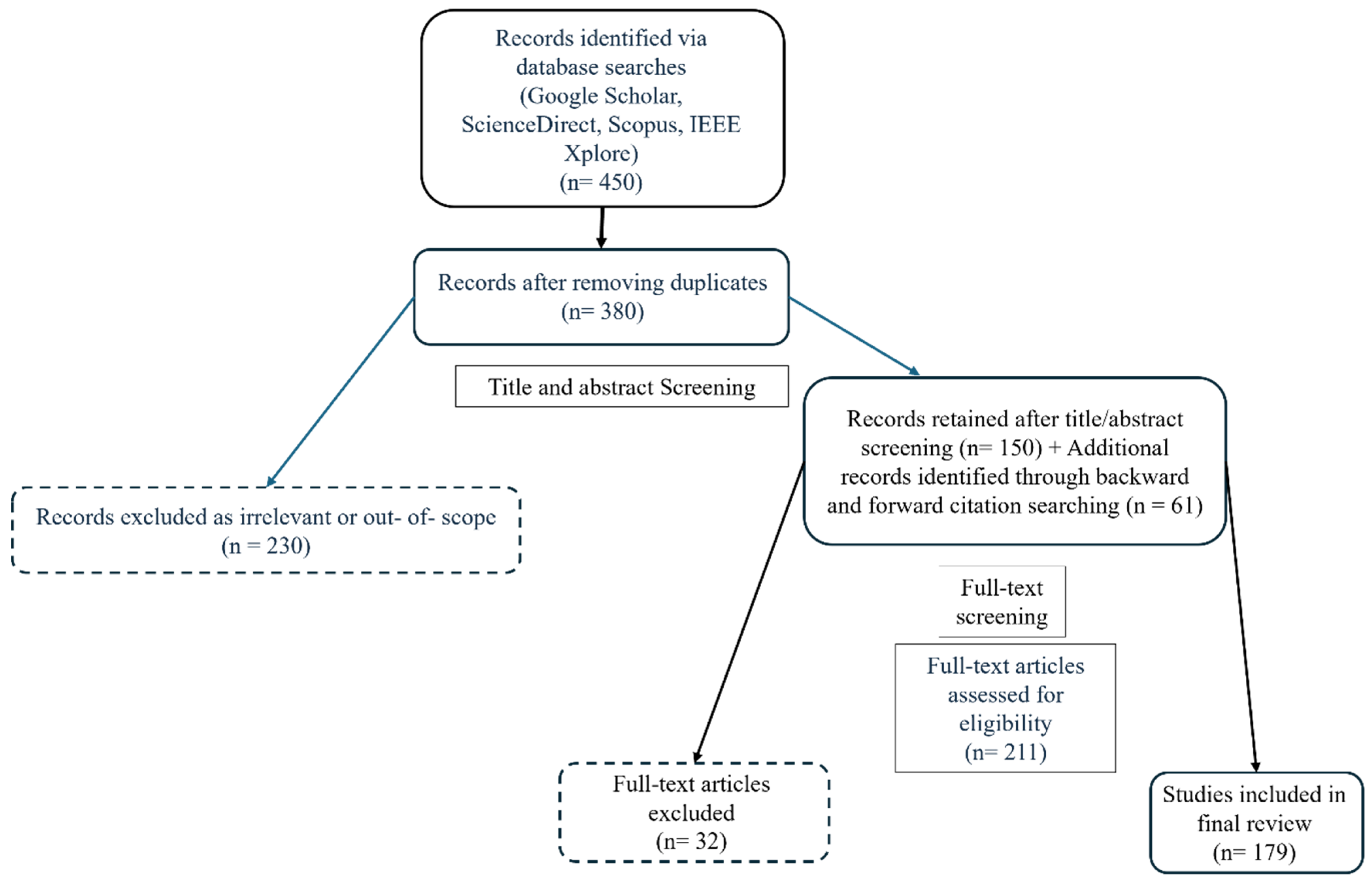
A structured, concept-centric literature review was conducted to synthesize existing research on the implications of AVs for transportation infrastructure, planning, and equity. The methodology follows the two-stage approach outlined by Webster and Watson [24] and adheres to the PRISMA (Preferred Reporting Items for Systematic Reviews and Meta-Analyses) guidelines to ensure a transparent, reproducible, and rigorous process. The procedure comprised four key phases: (1) identification of records via systematic database searches, (2) a two-stage screening process (title/abstract and full-text), (3) eligibility assessment against predefined inclusion criteria, and (4) a thematic synthesis of the final included studies. The process is summarized in the flow diagram presented in Figure 1.

2.1. Identification of Records

The identification phase employed an iterative search strategy across major academic databases and search engines to capture the breadth of relevant literature on autonomous vehicles, transportation infrastructure, traffic operations, planning, policy, safety, equity, and digital communication systems. Primary searches were conducted in Google Scholar, ScienceDirect, Scopus, and IEEE Xplore for publications published between 2010 and 2025. The search strategy used combinations of keywords and Boolean operators, including terms such as “autonomous vehicle,” “self-driving car,” “connected and autonomous vehicle,” “CAV,” “infrastructure,” “urban planning,” “highway design,” “transportation planning,” “safety,” “traffic flow,” “equity,” “policy,” “regulation,” and “cybersecurity.” The initial database search yielded 450 records. After duplicate removal, 380 unique records were retained for title and abstract screening. During title and abstract screening, 230 records were excluded because they were outside the scope of transportation infrastructure, planning, policy, safety, equity, or system-level AV impacts. This left 150 records for further consideration. To reduce the likelihood of omitting influential studies, backward and forward citation searching was then conducted using the reference lists and citation records of key papers. This process added 61 additional records, resulting in 211 full-text articles assessed for eligibility.

Search Strategy and Reproducibility

To improve reproducibility, the search strategy was documented by database, search field, and keyword combination. Searches were conducted in Google Scholar, ScienceDirect, Scopus, and IEEE Xplore using combinations of the following terms: “autonomous vehicle” OR “self-driving car” OR “connected and autonomous vehicle” OR “CAV” combined with “transportation infrastructure,” “highway design,” “geometric design,” “traffic operations,” “urban planning,” “land use,” “parking,” “safety,” “V2X,” “communication network,” “equity,” “policy,” “regulation,” “cybersecurity,” and “environmental impact.” Because search interfaces differ across databases, search strings were adapted to each database while preserving the same conceptual structure. Google Scholar was used primarily to identify broad interdisciplinary literature and citation trails; ScienceDirect and Scopus were used to identify peer-reviewed transportation, planning, engineering, and policy studies; and IEEE Xplore was used to identify literature related to V2X communication, automation, sensing, and digital infrastructure. The final database search was completed in March 2026. To improve transparency and reproducibility, the search strategy and included studies were organized according to the four thematic categories used in the synthesis. Table 1 combines the database-specific search strategy with the classification of study types and evidence types represented within each thematic category. This table is intended to summarize the structure of the search and synthesis process rather than list every included study individually.

2.2. Screening and Eligibility Assessment

A two-stage screening process was applied to the 380 unique records to select studies directly pertinent to the research objectives.

2.2.1. Stage 1: Title and Abstract Screening

The titles and abstracts of the 380 unique records were reviewed using broad relevance criteria. Records were retained if they focused on the impacts of AVs or CAVs on physical and digital infrastructure, traffic operations, safety, urban form, policy, regulation, or socio-economic equity. Records were excluded if they focused only on hardware or software technical details, non-transportation applications, or topics unrelated to planning or system-level transportation impacts. Based on this screening, 230 records were excluded as irrelevant or out of scope, leaving 150 records for further consideration.

2.2.2. Stage 2: Full-Text Screening and Eligibility

The full text of each of the 211 studies was reviewed using the following formal inclusion criteria:
  • Published in a peer-reviewed journal or conference proceeding between 2010 and 2025.
  • Written in English.
  • Provided substantive analysis, empirical findings, or conceptual discussion on the implications of AVs for transportation infrastructure, planning, policy, or equity.
Common reasons for exclusion at this stage are tangential mention of AVs without substantive analysis, singular focus on simulation algorithms without discussion of planning implications or being superseded by a more recent publication included in the review. This full-text assessment excluded 32 articles. Consequently, 179 studies satisfied all inclusion criteria and were included in the final review for synthesis.

2.3. Thematic Synthesis

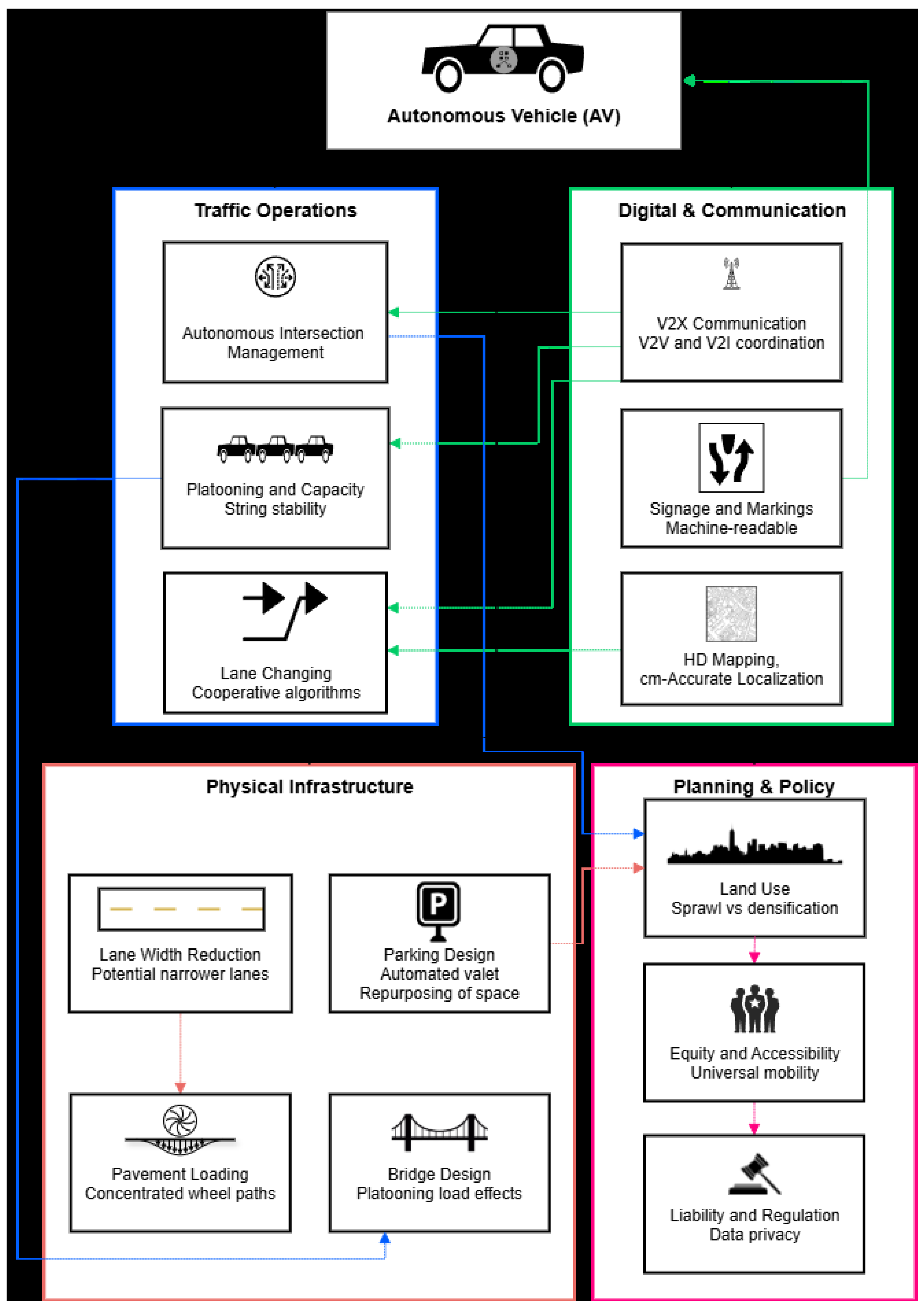
The 179 included studies formed the basis for qualitative thematic synthesis. Following a concept-centric approach, the analysis aimed to identify, organize, and summarize the key conceptual themes emerging from literature. An inductive coding process was employed: each study was reviewed in depth, and key findings, arguments, and conclusions were extracted and coded. Through an iterative process of comparison and clustering, these codes were grouped into coherent, higher-order thematic categories that collectively represent the major domains of discourse identified in literature. This process yielded the four overarching categories that structure the representation of findings in this review:
  • Physical Infrastructure
  • Traffic Operations
  • Digital Infrastructure & Communications
  • Planning & Policy
This thematic framework (Figure 2) ensures the synthesis remains focused on concepts and knowledge structures, facilitating a clear discussion of the state of the art, consensus points, controversies, and critical research gaps within each domain. During thematic synthesis, studies were also interpreted according to the type of evidence they provided. Simulation-based studies were treated as useful for exploring potential system behavior under controlled assumptions but not as direct evidence that benefits will necessarily occur in real-world deployment. Conceptual and policy studies were used to identify planning, governance, and institutional implications, while empirical and pilot studies were used to assess observed implementation challenges and user responses. This distinction was used throughout the synthesis to avoid treating all findings as having the same level of evidentiary strength. In addition to organizing the literature into thematic categories, the synthesis also interpreted the reviewed studies through an evolutionary and system-transformation lens. This was necessary because AV deployment does not affect transportation infrastructure through a single technical pathway but through a staged interaction among vehicle capability, infrastructure readiness, digital connectivity, institutional governance, and social outcomes. Accordingly, the reviewed literature was interpreted as reflecting three broad stages of development. The first stage is vehicle-centered automation, in which research primarily examines sensing, control, automated driving functions, and operational performance. The second stage is infrastructure-readiness analysis, in which attention shifted toward geometric design, pavement and bridge performance, signage, markings, parking, intersections, and communication networks. The third stage is system-level transformation, in which AV deployment is understood as a sociotechnical transition involving mixed traffic, public transport integration, land use, equity, cybersecurity, liability, regulation, and adaptive planning. This evolutionary interpretation was used to strengthen the analytical synthesis and to clarify how the “reimagining” of transportation infrastructure has developed from a vehicle-technology question into a broader infrastructure, governance, and planning challenge.

3. Physical Infrastructure

Conventional roadway geometric design has historically been calibrated to human perception, reaction, and vehicle-control limits, an approach standardized in modern design guidance on elements like curves, drainage, pavements, and intersections. Two foundational pillars of this traditional methodology were the concepts of stopping sight distance (SSD) and functional highway classification. SSD, which represents the minimum distance needed for a driver to perceive an obstacle, react, brake, and stop safely, was first introduced by Blanchard and Drowne in 1914 [7], though it initially lacked specific numerical inputs. For decades, this concept was applied within a framework that used the functional highway classifications of roads as arterials, collectors, or locals as a surrogate for design inputs to guide geometric decisions.
In parallel, both foundational concepts have undergone significant evolution to address their inherent limitations and respond to new methods. The practice of using functional classification alone has shifted towards a contemporary approach that emphasizes context classification, which links surrounding land use, multimodal expectations, and target operating speeds to geometric decisions. This change was driven by the recognition that the traditional functional system often lacks the resolution needed for context-sensitive design [72]. Simultaneously, the concept of SSD itself is being actively re-evaluated through updated evidence on perception-reaction time and deceleration behavior. NCHRP has proposed enhanced SSD criteria intended to inform future updates to AASHTO geometric design policy [73], while FHWA guidance highlights the practical gap between conservative “design SSD” assumptions and mean-driver stopping distances, reinforcing that SSD values depend strongly on the underlying assumptions used for reaction time, friction, and grade [74]. This ongoing reevaluation of design context and human factors now aligns with the emergence of AVs, whose removal of human perceptual limitations necessitates a reassessment of design standards built around human drivers [74].

3.1. Intersection

Intersections are critical points in traffic networks but also major bottlenecks and crash hotspots. Up to 96% of intersection-related crashes are attributed to human error [9]. These crashes lead to congestion, wasted time and resources, and air pollution [75,76]. Intersections, as critical nodes of conflict and delay, therefore, stand to undergo one of the most profound transformations in the AV era. Researchers propose AIM as a solution specifically designed for AVs. The use of AIM may substantially improve traffic flow throughout a network [10,77]. AIM utilizes V2I communication, where vehicles interact with an “intersection management unit” [78]. This unit provides real-time traffic information to approaching vehicles. The system prioritizes vehicles based on two factors: (1) a static conflict matrix pre-programmed to identify potential conflicts between lanes based on direction, including through and turning traffic, and (2) a dynamic information list providing real-time data on lane occupancy within the intersection. By combining this information, the intersection management unit can optimize traffic flow and significantly reduce crashes caused by human error [33]. Beyond merely improving signal efficiency, a higher-order shift reimagines intersection control mechanisms. The concept of AIM, facilitated by V2X communication, proposes replacing fixed-time or actuated signals with dynamic, slot-based reservations. This evolution could eventually alter physical layouts, reducing the need for expansive turning lanes and dedicated signal phases as conflict management moves from spatial and temporal separation for human perception to digital coordination.
Simulation evidence suggests that increasing AV penetration can substantially reduce delay at conventional signalized intersections, with large performance gains reported under fully autonomous traffic and meaningful benefits even at partial penetration [79]. Studies show significant potential for improved traffic flow with AIM, reducing average intersection delays from 47 s to between 1.1 and 3.6 s [11]. Research evaluating SAE Level 5 AVs at urban signalized intersections found that full (100%) AV penetration could reduce average delay by 32–40%, with significant gains of approximately 10% observable even at a modest 20% penetration rate [34]. These efficiencies arise from AVs’ precise vehicle control, which minimizes start-up lost time and enables smoother traffic flow. The greatest benefits are observed under conditions of balanced approach volumes and lower proportions of turning vehicles, highlighting how AV-driving patterns interact with existing geometry. Consequently, intersection footprints may shrink, and capacity may increase without physical expansion [34]. Another strategy involves dedicated lanes for CAVs at major intersections [42,54,80]. This allows for platooning of CAVs, improving efficiency and safety as CAVs move without interference from other vehicles. A key concern with AVs, however, is ensuring safety. Safety margins, which consider factors such as traffic speed, density, and intersection geometry, are crucial [41]. While a two-second buffer between vehicles in the intersection is suggested, excessively large margins can create new hazards due to longer waiting times. Finding the right balance between efficiency and safety remains a challenge, particularly in platooning situations with minimal vehicle spacing. The literature suggests that AV-enabled intersection control may improve delay and throughput, particularly through coordination and V2I communication [10,11,79]. At the same time, the extent of these benefits appears to depend on factors such as penetration rate, intersection complexity, and the persistence of mixed traffic conditions [41,78].
Effectively managing intersections is critical for the safe integration of AVs into transportation systems. Strategies such as AIM and dedicated CAV lanes hold potential for improved traffic flow and safety, but ensuring safety through appropriate safety margins and decision-making processes remains a top priority. In this context, AIM may be better understood as a promising transitional or phased approach rather than as an immediate substitute for conventional control. Forward-looking planning syntheses suggest that, under high automation and connectivity, some intersection controls could transition from fixed-time signals toward cooperative reservation-based management, with implications for geometry and right-of-way allocation [81].

3.2. Geometry

The emergence of AVs presents an important opportunity to re-evaluate traditional road design principles. AVs operate based on precise sensor data and sophisticated algorithms, bypassing humans’ inherent limitations in reaction time and perception. This key difference has significant implications for geometric design, particularly regarding lane widths. Othman highlights the potential for relaxed geometric design requirements when considering AVs [9]. Their superior “reaction times” compared to humans could translate to a need for less buffer space on roadways. Modeling work on AV-specific design assumptions indicates that reduced reaction times and more consistent braking can translate into shorter SSD requirements compared to human drivers, implying potential revisions to geometric design standards under high automation [82]. More recent synthesis work reinforces this general direction while emphasizing important bounds: a 2024 review of CAV impacts on controlling geometric design criteria notes that increased lateral control precision and more consistent longitudinal response could, in principle, reduce reliance on some traditional geometric buffers, but the magnitude of change depends strongly on penetration rate, operating speed, and the reliability of sensing/connectivity in real-world environments [26]. Similarly, research work comparing geometric design performance under human-driven, AV, and CAV operating assumptions finds that potential “relaxation” is conditional and most defensible in managed or high-automation contexts rather than general mixed-traffic conditions [83].
Correspondingly, research conducted by Engholm, Pernestål, and Kristoffersson suggest a possible reduction in lane width requirements for AVs [25]. The rationale behind this potential reduction lies in AVs’ ability to maintain a more precise lane position. Human drivers often require additional space to account for potential errors in judgment, lane drifting, or the need to compensate for blind spots. AVs, on the other hand, can rely on their advanced sensor suites and software to maintain a tighter and more consistent position within the lane. This translates to the potential for narrower lanes without compromising safety, potentially leading to several benefits. By reducing lane width, the same road space could accommodate a higher number of lanes, effectively increasing overall traffic capacity. This could be particularly beneficial in densely populated areas or for congested corridors. Narrower lanes would require less land for road construction, plausibly freeing up valuable space for other purposes such as sidewalks, bike lanes, or green infrastructure. Reduced lane widths could lead to lower construction and maintenance costs for new and existing roads. However, AVs can degrade traffic safety when the lane width is reduced. Narrow lanes reduce the superelevation runoff which compromises skid resistance, and AVs may fail to capture road surface conditions on inclines [84]. Research on passenger experience in AVs shows that subjective comfort and naturalness are strongly influenced by lateral/rotational motion and proxemic factors, not just by whether the vehicle technically remains centered in the lane [31]. In practice, tighter lateral clearances can heighten perceived risk and stress, especially at higher speeds, adjacent to heavy vehicles, or in environments with frequent merging and roadside friction, because small deviations feel more consequential and leave less perceived “escape space.” Consistent with this, AV comfort studies highlight that road geometry and turning behavior meaningfully shape comfort judgments, implying that lane-width reductions should be treated as context-dependent rather than a universal geometry relaxation strategy [31].
The literature does not yet point to a universal relaxation of geometric design standards for AVs. Although narrower lanes and reduced sight-distance requirements may become feasible in some settings, their applicability appears to remain dependent on traffic mix, speed, roadway conditions, and user comfort [26,31,82,83]. It may therefore be more appropriate to interpret geometric adaptation as context-dependent rather than broadly transferable across all road environments. However, it is important to acknowledge that this is a developing area of research, and several factors need to be carefully considered. Even with AVs, maintaining a minimum safety buffer between lanes is crucial. The optimal width of this buffer will require further research to ensure safe operation in various traffic scenarios. The potential benefits of reduced lane widths might be limited in situations where AVs share the road with CVs or where existing road infrastructure is not readily adaptable to narrower lanes. Determining the feasibility of retrofitting existing roads or the standard for new construction requires further investigation.
The potential reduction of lane width should therefore be interpreted together with the pavement-related implications of AV lateral positioning. While narrower lanes may be feasible in some controlled or high-automation environments, pavement preservation may require controlled lateral offset within the lane to distribute wheel loads more evenly. Thus, lane-width reduction and lateral wander control should not be treated as independent design assumptions but as connected geometric and pavement-design considerations.

3.3. Pavement Design

The widespread adoption of AVs presents both opportunities and challenges for road infrastructure, particularly regarding pavement performance. Othman and Manivasakan et al. identify several key factors to consider [9,78]. AVs are expected to exhibit reduced wheel wander (staying closer to the lane center) and to potentially increase traffic capacity. Victoria3 identifies increased pavement stress as a high-risk issue that needs addressing before allowing AV platooning [12,85]. While these factors can improve traffic flow, they might also lead to accelerated pavement rutting and fatigue compared to the current, more dispersed traffic patterns with CVs. The overall increase in AV adoption (potentially due to increased convenience or ridesharing) could accelerate negative pavement impacts. One proposed solution to mitigate these challenges is to program AVs for more strategic lane utilization. Othman suggests that programming AVs with a controlled lateral offset within the lane could distribute traffic loads more evenly across the entire lane width. This may reduce pavement rutting and fatigue damage and extend pavement life cycle. Finding the optimal lateral distribution for AVs will be crucial in balancing traffic flow with pavement health [9]. However, this pavement-preservation strategy interacts with geometric design choices. If AVs are intentionally programmed to vary their lateral position to spread wheel-path loading, they require sufficient lateral “room” within the lane to do so safely and comfortably. This may reduce or even negate the feasibility and benefits of narrower lane concepts, especially at higher speeds or in mixed traffic. Consequently, lane-width reductions and AV trajectory-control strategies should be evaluated jointly rather than treated as independent design improvements.
The transition to AVs might also necessitate adjustments to other road infrastructure elements. For instance, guidelines might recommend wider sidewalks and cycle paths to accommodate AV traffic integration alongside active transportation methods. Additionally, on high-speed arterial roads, physical barriers might be needed to separate AV lanes from pedestrian and cyclist paths to ensure safety for all users. The integration of AVs requires a holistic approach that considers not only traffic flow but also the long-term impact on pavement performance and the need for potential infrastructure adaptations [86]. By carefully considering these factors and exploring solutions like strategic lane utilization, we can ensure a smooth transition to a future with AVs while maintaining the integrity of our road infrastructure.
The literature generally agrees that AVs are likely to alter pavement loading patterns by reducing wheel wander and concentrating loads more precisely [12,85]. However, whether these changes ultimately improve or worsen pavement performance appears to depend largely on vehicle control strategy [9,87,88]. This body of work suggests that pavement design in the AV era may need to be considered alongside trajectory planning and lateral control behavior. Some studies suggest that autonomous trucks may utilize the pavement surface more efficiently than CVs, potentially extending pavement service life or enabling the use of thinner and more cost-effective pavement structures due to AVs’ lateral control capabilities [12]. Chen et al. examined the influence of autonomous truck wheel lateral distribution on pavement distress and demonstrated that appropriate lateral control strategies can reduce asphalt deterioration by promoting a more uniform load distribution across the pavement width [87]. Similarly, Gungor et al. found that optimizing the lateral positioning of autonomous trucks operating in platoons could significantly extend asphalt pavement life [88]. As promising as these pavement impacts may be, the implications for bridge structures present a more complex set of challenges.

3.4. Structural Design of Bridges

The widespread adoption of AVs, particularly in the form of CAV truck platoons, presents a challenge to existing bridge design standards. These limitations could potentially hinder the implementation of platooning technology and demonstrate the need for further research and development of new bridge design standards specifically addressing the unique loading patterns and potential safety risks associated with AV platoons. Furthermore, Wynand & Maina point out that many existing bridge structures, especially in rural areas, were not designed to handle the anticipated increase in freight load demand [27]. The heavier weight of autonomous freight vehicles could necessitate costly renovations of or even replacements for these bridges. As discussed, pavement design will also need to be reviewed and potentially adjusted in existing bridges to accommodate the changing traffic patterns and potential load concentrations brought about by AVs. The bridge-load simulations for autonomous truck platooning show that shorter headways and more trucks per platoon can increase internal force demands beyond conventional assumptions, suggesting that design codes or operational constraints may need updating [28]. Addressing these challenges will require collaboration between engineers, policymakers, and AV developers to ensure safe and efficient transportation in the future. The literature suggests that bridge implications of AV freight are not limited to heavier vehicles alone but also to the temporal and spatial concentration of live loads created by platooning. When trucks travel with shorter and more regular headways, bridge response may become more sensitive to convoy length, spacing, speed, and span characteristics than under more stochastic human-driven conditions [28]. This does not necessarily imply that all bridges will require immediate redesign; rather, it suggests that bridge assessment in the AV era may need to combine structural evaluation with operational controls such as minimum platoon spacing, lane assignment, routing restrictions, and traffic management policies. In this sense, bridge readiness for AVs should be understood not only as a materials or load-rating issue but as a coupled infrastructure-operations problem in which automation strategies can directly influence structural demand.

3.5. Parking Facility Design

The arrival of autonomous vehicles (AVs) presents a significant opportunity to reconsider the physical design, operation, and utilization of parking facilities. Unlike human-driven vehicles, AVs equipped with self-parking or automated valet functions can maneuver with greater precision and do not require drivers to enter, exit, or walk through the parking facility. As a result, AV-oriented parking facilities may accommodate tighter stalls, narrower internal aisles, reduced door-opening buffers, and more compact circulation layouts, potentially increasing parking density within existing lots and garages [69,89]. The high-density parking research further suggests that densification may extend beyond smaller stall dimensions to facility layouts where pedestrian access is reduced or removed and vehicles are repositioned through automated systems, improving throughput and space efficiency when supported by coordinated control [29]. Automated valet parking systems also suggest a shift from conventional parking lots toward controlled vehicle-storage and logistics facilities. In these systems, passengers may be dropped off at designated access points, while vehicles are autonomously moved, stored, charged, repositioned, or retrieved when needed. Such facilities may use automated parking systems, robotic pallets, guided vehicles, dedicated AV hubs, facility maps, parking-space status information, onboard sensing, and closed-loop control to support high-density storage and efficient vehicle movement [90]. Therefore, AV parking facilities may function less as passive storage areas and more as active operational nodes that coordinate drop-off, storage, charging, maintenance, and vehicle retrieval.
The successful execution of autonomous or valet parking generally involves three connected processes: environment recognition, motion planning, and control execution. First, the vehicle must identify parking spaces, obstacles, circulation paths, pedestrians, and other vehicles within the facility. Second, it must plan a feasible maneuver or route to the assigned parking space. Third, it must execute the maneuver while continuously adjusting to real-time conditions through onboard sensors and control systems [91,92]. Newer automated valet parking research extends this process by emphasizing deployable architectures in which the facility provides maps and parking-space status, while the vehicle relies on onboard sensing for local verification and closed-loop execution. This approach may reduce the need for extensive infrastructure-based sensing while still requiring reliable facility-to-vehicle communication and standardized parking environments [90]. Despite these opportunities, AV-ready parking facilities also introduce new design and implementation challenges. Parking facilities often differ from road networks because they contain informal movement rules, limited or inconsistent lane markings, uncertain parking-space availability, and complex interactions among vehicles, pedestrians, and facility infrastructure [93]. These conditions can make automated parking more difficult than ordinary road navigation. Practical deployment may also require consistent pavement markings, clear internal circulation design, electronic payment systems, secure access control, charging infrastructure, emergency procedures, and reliable communication between vehicles and facility management systems. In addition, remote control or facility-assisted vehicle movement could introduce cybersecurity vulnerabilities if communication and control systems are not properly protected [9]. AVs are likely to reshape parking facilities rather than simply reducing the need for parking. Future parking infrastructure may need to support higher-density vehicle storage, automated circulation, electric charging, fleet staging, passenger drop-off and pick-up, and secure digital coordination. However, these benefits will depend on the degree of AV adoption, the reliability of automated parking systems, the consistency of facility design standards, and the ability to manage cybersecurity, payment, and operational control requirements. Therefore, AV-oriented parking design should be treated as a combined physical, operational, and digital infrastructure issue.

3.6. Signage and Lane Marking

Safe and reliable operation of AVs relies heavily on their ability to accurately perceive their surroundings. This includes the detection and interpretation of road signage and lane markings. Current AV technology relies on cameras to mimic human vision systems. However, for optimal performance, AVs require clear and consistent lane markings to ensure accurate sensor data interpretation [13]. Researchers are actively developing machine learning algorithms for real-time sign recognition in AVs [42,52,54,94]. These studies address concerns like false readings and reliable recognition during vehicle motion. To differentiate between real lane markings and other white lines, some propose infrastructure changes like embedded road surface transmitters for more efficient detection. However, this approach would still rely on multi-source data fusion and validation methods. Notably, there are currently no established guidelines or policies for such infrastructure modifications. Previous research by Li et al. identifies three key factors for effective lane markings for AVs: correctness, shape, and visibility [53]. Each factor plays a crucial role in how AVs recognize and process lane marking data. Studies suggest that reflective pavement markings are most effective for AVs equipped with LiDAR sensors, as they offer superior detection capabilities. Reviews of AV infrastructure requirements continue to identify pavement marking quality and signage consistency as essential prerequisites for reliable perception across diverse weather and lighting conditions [21]. Over the longer term, reliance on physical signage for automated navigation may decline as HD maps and V2X systems mature; however, physical signs and markings are unlikely to become obsolete, as they provide legally enforceable controls for both humans and machines and serve as critical redundancy when mapping freshness, connectivity, or perception reliability is compromised. Guidance from the NCUTCD CAV Task Force and partner organizations emphasizes the need for standardized, highly visible pavement markings, particularly in work-zone practices, as uniformity remains a practical requirement for CAV operation in real-world conditions. The infrastructure assessments further reinforce the continued importance of consistent markings and signage alongside emerging digital infrastructure [30]. While AV technology has advanced substantially, clear and consistent infrastructure design remains essential for safe and reliable operation. Continued collaboration among researchers, policymakers, and infrastructure developers is needed to establish standardized practices and explore innovative solutions for secure and efficient AV operations.

4. Traffic Operations

4.1. Traffic Efficiency

An AV fleet, irrespective of vehicle type, has the potential to achieve higher speeds and reduced headways compared to CVs. This could lead to increased traffic flow at the cost of greater stress on road pavements (see Section 3.3). Despite said costs, modern literature emphasizes the potential advantages of AV platooning when compared to CV operations. The erratic and variable car-following behaviors of human drivers are significant factors contributing to crashes, traffic oscillations, and congestion. This inefficiency in traffic flow also has severe environmental impacts in urban areas [95]. Gong, Shen, and Du proposed a novel platoon car-following control scheme for interconnected dynamic platoons of CAVs and AVs [36]. Their scheme effectively mitigates speed errors and maintains stable spacing between vehicles in the platoon, ensuring “string stability.” Comparative studies indicate that this scheme outperforms conventional cooperative adaptive cruise control (CACC) in achieving smoother traffic flow and reducing traffic oscillations [36,96]. Similarly, Fernandes and Nunes explored multi-platooning of AVs to alleviate urban traffic congestion, developing algorithms for AVs to travel in dedicated lanes, exit to offline stations, and rejoin platoons seamlessly on the main track. Simulation results validated that these algorithms significantly enhance traffic capacity and vehicle density and reduce congestion compared to traditional transit systems [35].
Simulation models by Gong et al. and Fernandes & Nunes underscore the importance of AV connectivity within platoons for maintaining stable platoon strings [35,36]. Most freeway congestion stems from traffic oscillations near ramps caused by merging activities [37], leading to sections near ramps becoming critical bottlenecks in freeway systems. Integration of AVs equipped with advanced cruise control (ACC) and sensing technologies alongside human-driven vehicles can improve freeway performance by reducing speed deviations caused by merging vehicles [37,97]. Considering this, Altche, Qian, and de la Fortelle propose a supervised coordination framework for traffic scenarios where vehicles with semi-autonomous features are driven by human operators [98]. This framework overrides human inputs to prevent collisions or deadlock situations at intersections, roundabouts, and merging points [11,32]. Comparably, Xie et al. investigated an optimization-based ramp control strategy in a mixed environment of CAVs and AVs to enhance freeway performance during merging situations. Their findings demonstrate that an optimal ramp control model significantly improves average delay time, vehicle throughput, and average speed compared to gradual speed limits or no control scenarios [39]. Empirical track experiments further suggest that even low AV penetration rates can dampen stop-and-go traffic waves in mixed flow, improving stability and reducing unnecessary braking [40]. The literature broadly indicates that AVs may improve traffic flow through smoother control, shorter headways, and better coordination [35,36,40]. These benefits appear to be more evident in structured environments such as platoons, ramps, and managed corridors [37,39]. However, mixed traffic remains an important limiting condition, as human driving behavior continues to introduce variability and instability [40,97].

Lane Changing

Lane-changing is poised to be one of the most consequential ways AVs change highway driving. A traditionally driver-skilled maneuver becomes an engineered, safety-assured function that must solve the “if, when, and how” problem in real time. In automated driving stacks, this means coupling discrete decisions about desirability and timing with continuous gap acceptance, trajectory generation, and tight tracking control under safety and comfort constraints, while simultaneously managing conflicts in both the origin and target lanes. Classic automated-lane-change formulations emphasize low-complexity, real-time algorithms that decide whether a lane change is desirable [99]. Lane-changing operations are the most dangerous feature of advanced driver assistance systems (ADAS) for AVs, especially in situations where there is a mix of human and AV traffic [100]. The specific maneuvers of unplanned lane changes and exits by AVs can also significantly impede traffic flow by causing other vehicles to slow down or, in the worst case, by causing crashes [37,101]. Contrarily, Bai et al. and Nilsson et al. conclude that automated lane-changing algorithms can reduce collisions and increase the stability and efficiency, thereby reducing traffic flow [100,102]. Roughly 4–10% of crashes that stem from human error can be prevented by automated lane changes [103]. According to Nie et al., cooperative AV lane switching can provide increased traffic stability, homogeneity, and efficiency as well as a decrease in traffic congestion [104].
Research studies add an important nuance to the “AVs will smooth traffic” narrative: impacts depend strongly on interaction design, penetration, and context. On the one hand, connected cooperative lane-change strategies can yield large, simulated safety and flow gains in some regimes, including near-zero collision risk and meaningful flow improvement in congested cases, while still being advantageous at high AV penetration or in congested conditions [99]. On the other hand, empirical analysis of public AV trajectory data indicates that AV-initiated lane changes can provoke heterogeneous follower responses and substantially higher inferred conflict risk for the immediate follower, suggesting that “safe” AV behavior can still be perceived as uncertain or demanding by humans [45]. This pushes lane-change design toward interaction-aware planning and communication: safety-driven interactive planners adapt to surrounding-vehicle aggressiveness to avoid over-conservative deadlocks in dense traffic, and external intent displays in driving simulation have been shown to increase yielding rates and minimum time-to-collision during cut-in scenarios, indicating that AV lane-changing will likely be shaped as much by human response management as by geometric safety margins alone [43]. The literature points to the potential of automated lane changing to improve safety and efficiency under controlled conditions [99,100,104]. At the same time, evidence from mixed traffic suggests that AV lane changes remain sensitive to how human drivers interpret and respond to them [43,45]. This suggests that lane changing may be understood not only as a control problem but also as a human interaction problem.

4.2. Safety

Traffic fatalities are declining in developed nations due to advancements in vehicle technology, including driver assistance systems, stronger structures, and other safety features [46], as well as traffic management efforts targeting common causes of crashes, such as seatbelt nonuse, speeding, impaired driving, and distracted driving [105]. However, this trend is reversed in developing countries, and globally, road deaths remain a significant concern, far from the “Vision Zero” goal of eliminating crashes entirely. The safety potential of autonomous driving systems is often linked to their ability to reduce crashes associated with human error. While fully autonomous driving systems (ADS) will not eliminate all crashes, a significant reduction is anticipated, considering that approximately 90% of crashes stem from human error [106]. Existing crash data sources, such as Germany’s GIDAS study and the US National Highway Traffic Safety Administration (NHTSA) database, report that human error is a factor in roughly 93% of road crashes. This statistic has fueled speculation that full AV adoption could eliminate many of these errors. Similarly, a US study estimated that converting 10% and 90% of the US fleet to AVs could prevent 0.2 million and 4.2 million crashes annually, respectively, saving 1100 and 21,700 lives [107]. Even basic driver-assistance features at levels 0 and 1 have the potential to reduce traffic crashes by up to a third [64]. Despite these potential benefits, achieving major safety gains requires two key conditions: a high AV penetration rate and effective cooperative traffic management strategies. Otherwise, the potential decrease in crashes could be offset by an increase in vehicle travel distance.
The credibility of long-term numerical safety forecasts remains limited because AV deployment has progressed unevenly, and safety effects depend on penetration rate, operational design domain, mixed-traffic interactions, connectivity, and regulatory oversight [108]. Further, there is a lack of concrete evidence on the overall safety benefits of AVs [108]. Most research on crash protection potential relies on hypothetical deployment scenarios, expert opinions, forecasts, and existing databases rather than large-scale real-world deployment evidence. For this reason, AV safety benefits should be interpreted as conditional rather than automatic. The reviewed literature suggests that crash reduction depends not only on removing human error but also on system reliability, operational design domain, infrastructure quality, cybersecurity, mixed-traffic interaction, and regulatory oversight. In addition to uncertainty about projected safety benefits, AV deployment may introduce new forms of risk. Some experts warn that driver adjustments required for levels 1–3 automation might instead lead to more crashes [109]. New crash risks could also emerge due to system failures, and road users may behave more recklessly because of misplaced trust in AV capabilities [1]. Additional risks require attention, including overconfidence leading to seatbelt neglect by AV passengers or pedestrians behaving recklessly due to an assumption of AV infallibility. More concerning, CAVs and the V2X ecosystem could be attractive targets for cyberattacks. Ransomware or malware could be distributed through these networks [1,110]. Governments are aware of these threats and aim to create highly secure systems resistant to such attacks. While some communication hacking risk may remain, regaining control quickly should be feasible [111].
Safety concerns are also closely connected to sensor reliability and the complexity of the driving environment. Concerns exist regarding AV safety in confusing environments where sensors struggle, including areas with limited structures, ambiguous environmental cues, or similar cues for different objects. These situations can lead to critical sensor and vision failures, as evidenced by crashes involving Tesla and Uber vehicles. Safety-focused studies also caution that achieving large crash reductions may depend on connectivity and cooperative behaviors, since some high-risk scenarios involve occlusions or interactive uncertainties that are difficult to resolve with onboard sensing alone [112]. One potential solution involves integrating adaptive digital roadside infrastructure to provide additional information for AVs [113]. This infrastructure would need to be dynamic and adjusted to changing conditions. Alternatively, researchers propose using multi-sensor systems with data fusion to identify risks [112]. However, the effectiveness of this approach relies heavily on robust training of the data fusion algorithms. While it might offer some risk identification, it may not be as dependable as roadside infrastructure solutions. In this context, AV safety should be understood not only as a vehicle-control problem but also as an infrastructure and connectivity problem.
Recent trajectory-planning and decision-making studies further illustrate how AV safety depends on the interaction between vehicle intelligence, infrastructure information, and surrounding road users. Research by Zhou et al. addresses safety challenges in complex and uncertain traffic environments through an environment- and uncertainty-aware motion planning strategy that predicts the forward reachability of surrounding vehicles by combining road geometry and online learning of nearby vehicle behavior [49]. This dual-awareness approach improves collision avoidance by dynamically adjusting motion plans and has been validated in both simulations and real-world datasets, demonstrating enhanced safety performance in roundabouts and other dense traffic scenarios. Lin & Lin demonstrate how Model Predictive Control (MPC) can be used to optimize path planning in real-world freeway scenarios. Their simulation of Taiwan’s National Freeway No. 1 shows that MPC can effectively manage lane-change maneuvers and adaptive cruise control using simulated sensor inputs. The MPC approach not only improves collision avoidance and fuel efficiency but also maintains safe inter-vehicle distances and reduces overall travel time. These results highlight the potential of control-theoretic methods such as MPC to enhance AV reliability and safety, especially in complex or dynamic traffic environments, although future work is needed to address real-time implementation and performance under diverse environmental conditions [44]. Beyond rule-based and traditional control systems, Reinforcement Learning (RL) offers a powerful alternative for developing intelligent decision-making in AVs. However, standard RL methods involve exploration of unknown actions, which may lead to unsafe behaviors in real-world driving scenarios. To address this, Safe Reinforcement Learning (SRL) techniques have emerged as a vital advancement. Inamdar et al. provides a comprehensive review of SRL algorithms designed for autonomous vehicle control in dynamic and unpredictable traffic environments [114]. These algorithms aim to balance performance with real-time safety constraints, often incorporating uncertainty estimation, risk-penalizing reward structures, and policy regularization techniques to avoid hazardous behavior. While SRL approaches face challenges, such as high computational demands, traffic diversity, and road design variability, they might hold promises for building public trust and enhancing AV safety. Similarly, as public concern over the opaque nature of AV decision-making grows, explainable trajectory planning has become increasingly important. Liu et al. introduce the concept of risk maps, a discretized, ego-centric view of the driving environment that quantifies potential hazards spatially. Their framework integrates these risk maps with trajectory prediction trees and filters candidate paths based on cumulative risk exposure. Simulation results evaluated on real-world traffic scenarios demonstrate that this model not only enhances safety but also offers a transparent explanation for path selection, contributing to explainable and trustworthy AV planning systems [47].
Overall, the literature suggests that AVs may offer substantial safety benefits, but these benefits are not guaranteed by automation alone. Safety outcomes will depend on the interaction among vehicle technology, infrastructure quality, connectivity, cybersecurity, human behavior, and regulatory readiness. Therefore, transportation agencies and policymakers should treat AV safety as a system-level planning issue rather than a purely vehicle-based outcome. Adaptive roadside infrastructure, reliable V2X communication, clear operational design domains, cybersecurity governance, and evidence-based deployment policies will be essential for translating projected safety gains into real-world safety improvements. Despite these concerns, achieving higher levels of AV safety could significantly reduce the tangible and intangible costs associated with crashes, including medical expenses, legal fees, insurance premiums, emergency services, lost productivity, and property damage [64]. This potential economic benefit could have a significant impact on government budgets in the coming years.

4.3. Impact on Public Transport

The rise of AVs necessitates a reevaluation of transportation infrastructure, particularly regarding how AVs interact with other modes of public and active transport. Mobility hubs designed for the AV era must prioritize accessibility for all users, including young, elderly, and disabled individuals [68]. This encompasses features like user-friendly interfaces, clear signage, and access for a range of diverse physical capabilities. Efficient design and operational strategies are crucial to minimizing waiting times at mobility hubs [68]. This could involve implementing dynamic pick-up and drop-off zones for AVs, potentially utilizing time-based allocations or dedicated lanes [115]. A key function of mobility hubs is to facilitate smooth interchange between AVs and other public transport options like trams. This could involve designated transfer areas within hubs that ensure a user-friendly and efficient transition between modes (tram stop to AV pick-up zone). Mobility hubs should cater to various modes of transportation, including bicycles and pedestrians. This can be achieved by incorporating secure bicycle parking facilities and designing wide, well-maintained footpaths within the hub [115]. The planning studies emphasize that AVs may both complement transit through lower-cost automated shuttles and first/last-mile services and compete with high-capacity modes if door-to-door AV travel becomes inexpensive, implying that policy design will strongly shape net outcomes [81].
Recent planning literature suggests that the relationship between AVs and public transport is fundamentally conditional rather than uniformly positive or negative. Automated shuttles and shared AV feeder services may strengthen transit by improving first- and last-mile access, extending service in lower-density areas, and expanding mobility for older adults and people with limited driving ability [81]. However, if door-to-door AV travel becomes inexpensive and highly convenient, it may also divert riders from fixed-route transit, particularly where conventional service is already weak. This means the infrastructure implications are not limited to mobility hubs alone; they also include curb allocation, transfer design, fare integration, service coordination, and regulatory strategies that ensure AVs complement rather than cannibalize high-capacity public transport. For this reason, AV–transit integration should be treated as a network design and governance issue, not merely as a vehicle technology issue.

4.4. Influence on the Mobility Rate and on Mobility Patterns

The advent of AVs will significantly change both private and commercial transportation [2,107,116]. One advantage of private AVs is the potential for shared use within a family, offering greater flexibility compared to traditional private vehicles. AVs could revolutionize taxi services, offering a blend of car-sharing and traditional taxi operations (Shared AVs or Driverless Taxis) [58,61]. Driverless taxis are seen as potential complements to existing public transportation, with the possibility of replacing vehicle ownership and conventional taxis. This could be driven by factors like lower costs and the ability to multitask during rides [61,65,117]. AVs are also envisioned for use in commercial freight transportation. Systematic reviews project increased vehicle travel under various AV adoption scenarios due to induced demand, newly mobile user groups, and empty repositioning trips, though magnitudes vary widely and depend on governance and sharing models [23,118].
Shared mobility services like carsharing and ride-hailing are experiencing a surge in popularity. Several factors motivate this trend. The flexibility and operational efficiency of Shared Autonomous Vehicles (SAVs) could lower costs and discourage vehicle ownership [109]. Studies suggest that a single SAV could replace up to eleven CVs [58]. Unlike AVs, which can be programmed for fleet cooperation, conventional taxi drivers prioritize maximizing their individual profit. This often leads to longer waiting times for passengers and shorter trip distances (measured in passenger miles traveled or PMT) than what would be optimal for the entire taxi fleet [119]. Eliminating driver costs could make driverless taxis a more affordable travel option, further reducing vehicle ownership incentives [64]. Some envision a future with minimal or even no private vehicle ownership, with shared ownership models for AVs [59,120]. Real-world implementations demonstrate the viability of these shared mobility models. In the United States, Waymo has established the first fully autonomous commercial ride-hailing service in San Francisco, which became available to the public in June 2024 and has since expanded across the Bay Area, including Silicon Valley and airport services [121]. Similarly, Baidu’s Apollo Go has deployed autonomous ride-hailing services across multiple Asian cities [122], including Beijing, Guangzhou, Shanghai, Shenzhen, and Wuhan, with operations now extending to Hong Kong and the Middle East, demonstrating the scalability of SAV mobility platforms globally. These implementations validate the potential for SAVs to transform urban transportation systems. A decrease in vehicle ownership could lead to a need for fewer conventional parking facilities. Planners may shift towards multi-story garages in suburban areas and designated pick-up/drop-off zones for AVs near transportation hubs, as discussed in Section 5.3. Growing environmental awareness and the desire for efficient mobility options are promoting alternatives to vehicle ownership. These factors suggest a potential decrease in the overall number of vehicles needed [1]. Estimates project a vehicle fleet reduction of 22–25% in Europe and the US by 2030 [123].
The impact on overall mobility rates is less clear. Some researchers predict a decrease in vehicle miles per passenger but an overall rise in total vehicle miles travelled (VMT). This could lead to a higher level of personal mobility for society. SAVs are expected to be more efficient as they transport more passengers per trip (current vehicle occupancy is 1.3 people on average). However, recent studies [65,124] suggest VMT per passenger might still increase. This could be due to new phenomena such as private AVs making empty journeys to pick up or drop off passengers. For shared mobility to be truly sustainable, it must replace private vehicle trips, not those made by public transportation with higher passenger occupancy. The overall increase in VMT could be driven by lower transportation costs due to higher vehicle utilization through shared services. This rise is expected in both freight and passenger transportation. Shared mobility has the potential to expand access to transportation for non-drivers, young people, older adults, and others who may not be able to own a car.

4.5. Maintenance

Maintaining road infrastructure is critical for ensuring safe and reliable operation of AVs throughout their design life [125]. Over time, road surfaces, lane markings, and signage degrade, leading to issues like faded markings, potholes, and unclear signs. Increased traffic loads due to platooning (vehicles traveling closely together) and cruising (AVs traveling without passengers) could place additional stress on roads and bridges. This necessitates research on potential maintenance impacts and the development of new infrastructure standards. Previously mentioned digital infrastructure solutions require further investigation to determine their effectiveness in mitigating the effects of deteriorating infrastructure on AVs [115]. Any deficiencies in road infrastructure can create inconsistencies that confuse AV navigation systems, potentially leading to crashes and performance issues [68]. Agency-focused reports further note that maintaining AV-relevant assets expands beyond civil works to include lifecycle management of digital roadside equipment (e.g., communications units and sensors), necessitating new inventory systems, workforce skills, and interdisciplinary collaboration [55].
Maintenance in the AV era is likely to become more demanding, not less, because infrastructure conditions are tied more directly to sensing reliability and operational safety. Hallmark et al. suggest that agencies may need to broaden maintenance responsibilities beyond conventional civil assets to include communications devices, sensors, and other digital roadside equipment that require inspection, calibration, repair, and cybersecurity oversight over time [55]. This shifts infrastructure maintenance from a primarily pavement- and signage-focused task to a hybrid civil-digital asset management problem. Consequently, agencies may need new inventory systems, workforce skills, funding priorities, and performance metrics to determine which markings, signs, and digital devices are most critical for AV readiness under constrained budgets. The literature therefore suggests that AV deployment may place as much pressure on maintenance institutions as on infrastructure design itself.

5. Digital Infrastructure & Communications

The advent of AVs compels a forward-looking re-evaluation of core transportation infrastructure principles that have been optimized for human drivers for over a century. While physical infrastructure remains central to AV readiness, the transition toward automated and connected mobility also depends on digital infrastructure, communication networks, high-definition mapping, real-time hazard awareness, and data-supported safety calculations. Collectively, these adaptations signal a transition from static, human-compensatory infrastructure toward dynamic, information-enabled systems.

5.1. V2X Communication Networks

The widespread adoption of CAVs hinges on robust V2X communication networks. An efficient and well-designed network requires strategic placement of information receivers and control centers along roadsides and within vehicles themselves. Additionally, secure and reliable communication protocols are essential for fast and accurate data transmission and processing [4]. Government agencies, like Australia’s Infrastructure Victoria and Austroads, emphasize the need for improved cellular network coverage and capacity [4]. This is crucial for seamless data exchange between CAVs and infrastructure. Accurate and up-to-date digital maps are also essential for CAV navigation. Collaboration with professional mapping companies is crucial to ensure comprehensive and real-time information availability. Currently, there is a lack of standardized communication protocols for V2X networks. Importantly, no established guidelines exist for infrastructure deployment (e.g., the optimal number of sensors needed for accurate data processing). This shortcoming is pronounced in complex scenarios like multi-lane roads or multiple CAVs operating in proximity. Current practices rely heavily on engineering judgement. While Mahmood et al. offer initial guidelines for designing ambient information systems for AVs, further research is needed to establish comprehensive standards [126]. Recent guidance for transportation agencies emphasizes that CAV deployment also requires substantial “digital infrastructure” investments, including roadside units, backhaul connectivity, and data-management capacity to support low-latency V2I services at scale [55].
Beyond technological integration, the interconnected nature of CAV systems raises concerns about data privacy and security. Large amounts of data sharing are necessary for network effectiveness, but this creates a potential conflict with protecting driver privacy [51]. Robust anonymization, strong encryption, and secure data protection protocols are crucial for safeguarding CAV systems from vulnerabilities [15]. Vehicular Ad Hoc Networks (VANETs) offer a potential solution by incorporating built-in privacy preservation capabilities. One study also shows that Internet of Vehicles (IoV)-based lane-changing models, combined with HD maps and real-time data sharing, can significantly enhance lane-change safety and stability in complex traffic scenarios [57]. A resilience-based AV lane configuration model also highlights how dedicated lanes for AVs can improve post-disruption recovery and network stability during emergencies by leveraging coordinated communication and routing strategies [48]. Effective communication networks remain the cornerstone of a secure CAV ecosystem, making standardized protocols and robust data-protection measures essential for reliable autonomous transportation. Literature increasingly frames communication readiness as a core infrastructure issue rather than a secondary digital supplement. Hallmark et al. emphasize that scalable CAV deployment depends not only on low-latency communications but also on sustained investments in roadside units, backhaul connectivity, and agency-level data management capacity [55]. This implies that communication network planning should be evaluated in terms of interoperability, lifecycle cost, redundancy, and resilience under failure or disruption, not simply signal coverage. At the same time, researchers suggest that no single communications architecture is likely to serve all road environments equally well, making hybrid strategies that combine onboard sensing, HD maps, edge or cloud support, and V2X connectivity more realistic during the transition period. Accordingly, future research should move beyond whether communication is needed to the more practical question of where it is essential, where it is supportive, and how safe fallback operation can be maintained when network performance degrades.

5.2. HD Mapping and Localization

While AVs are designed to operate on existing road infrastructure, accurate reflection of this infrastructure in their navigation systems is crucial. Steering systems utilize sensors and cameras to read road signs; however, detailed data about the surrounding environment is needed to compare the real world with the navigation database [3]. High-Definition (HD) mapping has become a critical enabler for AV localization and path planning. While early pioneers like TomTom developed foundational technologies such as Road DNA for 3D mapping, the ecosystem has since expanded to include major players like HERE Technologies (owned by automotive consortiums), Google (Waymo), Apple, and Mobileye. These providers now offer dynamic, centimeter-accurate HD maps that integrate real-time sensor data, crowd-sourced updates, and cloud-based distribution essential for precise vehicle localization even in high-speed or challenging weather conditions. These detailed and optimized route representations allow AVs to effectively compare sensor and camera data with navigation information. Despite the growing interest in AVs, research on the necessary adaptations to physical road infrastructure remains limited [9]. While AVs may improve road infrastructure utilization, they may also introduce new risks and challenges that require further investigation.

5.3. Digital Support for Hazard Awareness and Stopping Sight Distance

Communication technologies play a crucial role in enhancing safety for AVs. Vehicle-to-Vehicle (V2V) and Vehicle-to-Infrastructure (V2I) systems offer significant improvements in traffic flow, driving conditions, mobility, and safety [3]. V2V communication warns drivers of potential hazards like road debris, sudden braking by the vehicle ahead, or lane changes by neighboring vehicles. These systems rely on data exchange between equipped vehicles, including location, direction, and speed. This information allows other vehicles to analyze potential collision risks and receive real-time traffic updates, leading to smoother traffic flow, reduced fuel consumption, and lower emissions. These developments provide a useful baseline for assessing how automation and connectivity may progressively reduce SSD’s role as a controlling geometric design factor. In a mature CAV fleet, SSD becomes primarily a fallback constraint rather than a primary geometric driver: braking distance still exists physically, but the traditional human-compensation role of SSD in setting geometry can diminish as hazard awareness becomes “beyond-line-of-sight” and control becomes more consistent.
The traditional concept of SSD is a cornerstone of highway geometric design, calculated from assumed human perception-reaction times and vehicle braking capabilities on a standardized road surface. The integration of AVs and CAVs challenges this static formulation. SSD, in essence, transitions from a fixed infrastructure provision to a real-time, dynamic calculation performed by the vehicle itself. The discussions of AV-era geometric policy note that conventional SSD assumptions may be revisited as automation reduces perception–reaction delays but that adverse weather and sensing limitations may still justify conservative buffers in mixed conditions [82].
Research formalizes this shift through models like Responsibility-Sensitive Safety (RSS) and dynamic safe distance calculations within an IoV framework. These models account for a multitude of real-time variables beyond speed, including road condition (dry, wet, snowy, icy), vehicle mass, tire status, weather (fog, rain), and the presence of Autonomous Emergency Braking (AEB) systems [127]. For instance, a connected vehicle can calculate an “Assured Clear Distance Ahead” (ACDA) that adapts instantaneously to a wet asphalt surface versus a dry one, ensuring safety while optimizing following distance [128]. This has direct implications for infrastructure. First, the necessity for extensive sight triangles at intersections and on horizontal curves may be reduced for CAVs, as V2V communication provides “electronic sight” beyond physical obstructions. Second, it places a premium on roadway condition monitoring and data sharing (V2I), as the friction coefficient becomes a critical digital input for real-time safety calculations rather than a conservative assumption in decades-old design guidelines [127]. The literature jointly points toward the safety model becoming probabilistic and system-wide, rather than deterministic and geometry-dependent.

5.4. Comparative Analysis of Infrastructure Evolution

The transformation of intersections, parking, communication networks, HD mapping, and sight distance principles illustrates a consistent theme: AVs shift the locus of performance and safety optimization from the physical infrastructure alone to a combined system of vehicle software, digital connectivity, and machine-readable infrastructure. This does not render infrastructure obsolete but redefines its role. Future infrastructure must be informative (providing real-time data), compatible (with machine perception and communication protocols), and adaptable in its geometric standards. The challenge for policymakers and planners lies in fostering this digital layer’s development while managing the transitional period of mixed traffic, where human-centric design standards must still be maintained. The significant efficiency and space-saving benefits projected provide a compelling impetus for this complex transition [34,62]. Table 2 below summarizes the fundamental shift from human-centric to AV-ready design.

6. Planning & Policy Implications

6.1. Employment

The potential benefits of AVs, such as reduced traffic congestion, travel time savings, and lower transportation costs, may come at a cost to some workers [18]. Jobs like driving taxis, buses, and commercial vehicles could be significantly disrupted [18]. Fewer vehicles on the road could translate into fewer jobs in manufacturing, sales, and maintenance [129]. Supporting industries like driver licensing, traffic policing, and insurance sales might also experience job losses [18]. The labor-oriented analyses caution that professional driving occupations may face significant displacement pressures under automation, underscoring the importance of proactive retraining and transition planning [130,131].
The adaptation of infrastructure for AVs could create new jobs in construction, road and highway modification, and related IT services [132]. Estimates suggest potential employment gains of up to 15% in these sectors. Governments may need to develop retraining programs to help displaced workers transition to new sectors. Programs could specifically target taxi, bus, and commercial vehicle drivers, helping them find new opportunities. Current automobile technicians and mechanics could be offered training in AV technology to maintain their skillset. The automotive industry could play a role by financially supporting government retraining initiatives.

6.2. Land Use, Parking Repurposing, and Curb Management

The impact of AVs on urban development remains complex and multifaceted, with the potential for both urbanization and suburbanization. Government policies and urban planning strategies will play a critical role in shaping the impact of AVs [133]. AVs could improve accessibility through lower transportation costs, potentially leading to population shifts towards previously less desirable ex-urban areas [18,64,109]. This may create attractive “green” sprawl around cities, with lower housing costs [116] and a potentially reduced demand for CBD rental properties [134]. However, the feasibility of such sprawl will depend on land availability and regulations [109,135]). The presence of AVs, particularly SAVs, could significantly reduce demand for on street and off-street parking, especially in downtown areas [64,109,116,134]. The specific impact will depend on SAV operation strategies and user preferences [60]. Studies suggest that SAVs could eliminate up to 90% of parking demand even at low market penetration rates [60]. AV valet parking capabilities could promote neighborhood parking zones or communal garages in inner-city areas. This, along with reduced overall parking demand, could allow for increased density in urban cores by repurposing freed-up parking spaces [116]. Repurposed parking spaces could be used for infill development (residential or commercial), potentially boosting economic activity in CBDs [64,109]. On-street parking could be transformed into high-occupancy vehicle (HOV) lanes, bus lanes, cycling lanes, or new public spaces [109]. As such, AVs have the potential to address transportation-related social exclusion, improving access for individuals who cannot currently drive [136,137,138].
Further promoting accessibility, increased road capacity through platooning has the potential to free up space for other modes of transportation like buses, bicycles, and pedestrians [35,139]. However, regulatory measures might be necessary to manage potential increases in AV traffic, especially in relation to public transit systems [134]. AVs might be better suited for suburban areas with lower population density, potentially reducing the reliance on public transportation in those regions. However, public transit is likely to remain crucial in densely populated urban centers [140]. Local and state governments will need to make crucial decisions regarding whether to allow or limit urban sprawl, guided by land-use policies [135] and how to reallocate road and parking spaces based on changing traffic patterns and travel behavior [109]. As highlighted by Isaac, there is a need for comprehensive medium- and long-term planning activities to address the potential impacts of AVs [141]. These activities may include updating transportation models with new assumptions about AV usage, forecasting financial implications of AV adoption, designating lanes for AVs and/or CVs, updating traffic signs and markings, adjusting speed limits, traffic signals, and parking regulations, and developing new predictive models for pavement maintenance.

Social Equity and Mobility Justice

AVs have the potential not only to reshape physical infrastructure and urban land use but also to transform how individuals experience travel time. Zhong et al. develop a midfare framework to assess how disposable time generated by AV travel can be distributed across social groups. Using an entropy-based index, they measure the variability in how people intend to use in-vehicle time, with a specific focus on gender-based constraints in urban mobility. Their findings suggest that AVs may help alleviate space-time constraints faced by women, potentially reducing mobility inequality in cities [71]. This adds a critical social dimension to discussions of AV integration, highlighting the need to consider equity and inclusion in urban planning and transport policy. Equity-focused reviews find that many AV strategies mention accessibility in general terms but lack concrete mechanisms (e.g., affordability, service guarantees) to prevent AV benefits accruing disproportionately to higher-income groups [142]. Equity in AV deployment should also be considered across multiple geographic and user contexts. In dense urban areas, AV services may be concentrated in profitable corridors, while rural areas, low-density suburbs, and communities with limited digital infrastructure may experience slower deployment or lower service quality. Accessibility for people with disabilities is another important dimension, since AV benefits depend not only on vehicle automation but also on accessible pick-up and drop-off spaces, wheelchair-compatible vehicles, audible and visual communication, user-friendly interfaces, and safe boarding environments. Equity concerns also extend to affordability, public transport integration, digital access, and algorithmic service allocation. If AV services are priced beyond the reach of lower-income users or optimized mainly for profitable areas, they may reinforce rather than reduce existing transportation inequities.

6.3. Privacy and Cybersecurity

An increasing share of AVs are equipped with crash-tracing technology that could mitigate product liability for manufacturers [143]. This technology, however, raises concerns about data collection from passengers and surrounding vehicles. Manufacturers must be held accountable for non-compliance with personal data protection laws [143]. AVs inherently limit user control by taking over driving tasks [107]. This challenges the concept of personal autonomy in transportation. AVs collect, store, and utilize various data points, potentially compromising privacy [107]. Examples of collected data include location tracking, travel history, and future travel plans.
Comprehensive legal and illegal tracking of AVs creates a vast pool of personal information, raising surveillance concerns. Upcoming data privacy regulations need to address data ownership, limitations on data transmission, and intended use [144]. Robust legal frameworks are essential to prevent “market resistance” from privacy-wary potential users [144]. Regulations should address the purpose of data collection, data usage limitations, data retention periods and access control.
AVs are also susceptible to cyberattacks and software/hardware defects, potentially leading to system failures [14]. They require robust cybersecurity systems to automatically respond to deliberate and inadvertent attacks [14]. These systems should prioritize securing on-board data storage and data sharing [145]. Lee emphasizes the need for federal leadership in establishing a national framework for AV communications, privacy, and cybersecurity regulations [145]. Within this framework, states and industry stakeholders can conduct experiments and develop self-regulation measures. Cybersecurity requirements should be documented in system design documents from the outset [14]. The reviews catalog emerging cyber–physical attack surfaces for AVs and CAVs, including sensor spoofing and remote compromise, reinforcing the need for cybersecurity-by-design alongside privacy governance for high-volume mobility data [146,147].

6.4. Challenges to Public Acceptance: Perceived Security and Safety

The widespread adoption of AVs hinges not only on technological advancements but also on public acceptance. Several concerns cloud public perception of AVs, creating a hurdle that must be addressed before widespread adoption can occur. One major concern lies in relinquishing control of machines. The idea of trusting a computer program for the safety of oneself and one’s passengers is a source of anxiety for many. People are accustomed to being in command behind the wheel, and the thought of surrendering that control can be unsettling. Furthermore, the data collection inherent in AV operation raises privacy concerns. The potential misuse of AV data raises red flags for many, highlighting the need for robust privacy regulations and data security measures. Cybersecurity threats pose another layer of worry. The possibility of hackers taking control of AVs or manipulating their systems is a frightening prospect. Ensuring the cybersecurity of AVs is paramount to building public trust and mitigating safety concerns. The potential impact of AVs on the job market is also a significant consideration for widespread adoption. Professions like taxi drivers, truck drivers, and auto mechanics could face significant disruption as AV technology matures. While new opportunities may arise in related fields, the potential for job displacement requires careful planning and social safety nets to ease the transition for impacted workers [16]. In the United States, automobile ownership and driving are not merely functional; they are culturally tied to independence, personal identity, and even adulthood (e.g., the “freedom” associated with having one’s own car). As a result, AV adoption can be perceived not only as a shift in technology but also as a loss of autonomy, status, and the lived experience of “being the driver.” This deeply ingrained mindset (sometimes described as a “car-brain” orientation) can amplify discomfort with automation and slow acceptance even when safety benefits are demonstrated [148].
Despite these concerns, AVs also hold the promise of significant benefits. The information and communication technology sectors stand to benefit from the development and implementation of AV infrastructure. Technology enthusiasts are likely to be early adopters, eager to experience the novelty and convenience of autonomous transportation. For environmentally conscious individuals, AVs offer the potential for cleaner and more efficient transportation systems [149]. The potential reduction in traffic crashes and congestion could have a significant perceived positive impact on air quality and urban planning. Perhaps the most significant societal impact of AVs lies in their potential to improve mobility for those with limitations. Individuals who are currently unable to drive due to age, disability, or other factors could regain independence with the advent of safe and reliable AVs [16]. The usability testing by Stange et al. indicates that children aged 7 to 14 may be able to interact independently with AVs when provided with well-designed, icon-supported interfaces [150]. While these findings point to the potential of AVs to expand mobility for underage users, they also highlight an important disconnect between technical readiness and institutional preparedness. The prospect of child-friendly AV use advances faster than current clarity on liability, legal responsibility, and adult supervision in trips involving minors. Thus, even if AV interfaces become increasingly accessible to children, broader public acceptance will still depend on whether legal and ethical concerns about accountability are adequately addressed. Educational efforts aimed at improving AV acceptance should therefore engage not only with the benefits and risks of technology but also with questions of responsibility and protection for vulnerable users.
Public acceptance appears to depend on more than technical safety alone. The literature suggests that trust is influenced by perceived control, privacy, cybersecurity, cultural attitudes toward driving, and clarity of responsibility when systems fail [16,148]. Accordingly, greater acceptance may depend not only on technological progress but also on stronger institutional confidence. The findings on child-friendly AV interfaces further suggest that usability alone may not be sufficient unless questions of legal responsibility and user protection are also clearly addressed [150].

6.5. Legal and Regulatory Hurdles for AV Implementation

The widespread adoption of AVs hinges not just on technological advancements but also on significant policy and legal changes [16]. Legal aspects stand to be a bigger hurdle than technical challenges, potentially delaying AV introduction. New regulations are needed to define the type of driving license required for operating or supervising AVs, along with the conditions for obtaining such a license. Individuals responsible for AVs (whether as drivers or supervisors) should possess thorough knowledge of traffic laws and the on-board technologies used by the vehicles. The existing system of mandatory periodic vehicle inspections will need to be significantly revamped to accommodate the unique characteristics of AVs. These areas represent crucial regulations for the future of AVs. Additionally, there is an urgent need to develop regulations that facilitate the testing of AVs in real-world environments [16]. This will allow for the safe and controlled evaluation of AV technology before widespread deployment.

6.5.1. Testing and Deployment

The development of regulations for AVs faces two key challenges: ensuring safety during testing and deployment while fostering innovation [151]. Finding the right balance is crucial. Creating meaningful regulations is difficult due to the absence of universally agreed-upon technical standards for ADS [151]. The lack of a unified regulatory approach across different jurisdictions could create friction with AV manufacturers and stifle overall innovation in the field [17]. Currently, a patchwork of approaches exists globally, with varying levels of government involvement and regulatory styles (binding vs. non-binding regulations, exemptions) [17]. The comparative legal analyses highlight that many jurisdictions are still primarily in a testing-enablement phase (often requiring safety drivers or remote supervision) and that fragmented, non-harmonized rules remain a barrier to scaled deployment [22].
Vehicle safety falls under the federal government (technology aspects), while other aspects like registration and driver licensing are handled by individual states [17,152]. The NHTSA promotes non-binding regulations through national policy guidance for manufacturers and states. California, however, represents an exception with binding legislation for AV testing and deployment. In contrast, the United Kingdom (UK) and the Netherlands centralize all aspects of vehicle safety regulation under federal agencies, with both the UK Department for Transport (DoT) and the Dutch RDW favoring non-binding regulations for AV testing and deployment [17]. The UK Code of Practice, however, differs from NHTSA policy by including requirements for test drivers. Some regulatory agencies grant exemptions to AVs from specific regulations under certain conditions. This allows for testing on public roads after functionalities are validated on closed test tracks [17]. This approach fosters technical development but may create legal uncertainties for manufacturers. Coropulis et al. emphasize that most Sustainable Urban Mobility Plans (SUMPs) fail to incorporate CAVs into their safety assessment frameworks. Through simulation studies in Italy, they show that excluding AV scenarios can lead to misleading safety evaluations. The study recommends updating legal and planning strategies to account for both fully autonomous and mixed traffic environments, including options like reserved AV lanes to manage conflict points and reduce risk in transitional phases [20].
The development of optimal regulations for testing and deploying AVs hinges on finding the right balance between safety and innovation. Binding regulations offer a clear legal framework and enforce safety during testing, building public trust and fostering responsible development [17]. However, overly rigid requirements could stifle innovation by hindering manufacturer experimentation and adaptation to rapid technological advancements. On the other hand, non-binding regulations and exemptions offer flexibility for manufacturers to adjust to evolving technology, potentially accelerating innovation [153]. This flexibility can be crucial for early-stage development. However, the lack of mandatory standards could pose safety risks during testing and potentially delay widespread public adoption due to a lack of trust. Effective AV regulations will need to strike a careful balance. Ideally, they should ensure safety while fostering innovation by allowing for adaptation to technological advancements. This may involve a combination of approaches, including some level of binding regulations for safety alongside mechanisms like pilot programs or exemptions under specific conditions to promote continued innovation. A recurring theme in the regulatory literature is that AV technology appears to be advancing more quickly than governance systems are adapting [17,22,151]. The challenge, therefore, may lie in developing regulatory approaches that protect safety while still allowing room for innovation. This appears especially complex under mixed traffic conditions and across fragmented jurisdictions [20].
The regulatory literature indicates that AV testing and deployment remain characterized by fragmented governance, uneven legal maturity, and substantial variation in how jurisdictions treat safety drivers, remote operators, reporting requirements, and public-road validation [22]. This fragmentation complicates not only manufacturer compliance but also the comparability of safety evidence across pilots and regions. Coropulis et al. further show that planning frameworks often fail to explicitly incorporate AV scenarios, which can result in incomplete assessments of safety, infrastructure needs, and mixed-traffic transition risk. These findings suggest that future governance should move beyond simply permitting pilots toward defining clearer expectations for operational design domains, data reporting, infrastructure readiness, and transition management under mixed traffic. The state of the art therefore points toward adaptive but more harmonized regulatory frameworks that protect safety while still allowing technological learning and innovation [20].

6.5.2. Liability and Insurance

The emergence of AVs presents a complex challenge regarding liability in the event of crashes. On-board data from AV sensors promises to simplify fault identification, potentially leading to faster insurance claim processing for victims [154]. This could eliminate delays and litigation costs associated with traditional tort law. However, it raises new questions about who should be held responsible. For vehicles with some driver involvement (SAE Levels 1–3), the driver would likely remain liable. For AVs at SAE Level 4 and above (fully autonomous), liability becomes less clear. Should it fall on the owner, operator, manufacturer, or some combination? The robotic nature of AVs introduces novel legal issues. Criminal law traditionally focuses on punishing individuals, but robots lack the capacity for criminal intent. Gless et al. suggest holding humans responsible for criminal acts involving intentionally harmful robots [155]. However, they also advocate limiting liability of operators who fail to take reasonable measures to mitigate risks arising from AV malfunctions. Recent insurance-focused discussions anticipate a gradual shift from driver-centered liability toward product and software liability, with growing attention to multi-party claims and cyber-related risks in AV operation. Only some legal frameworks and proposals are available at this stage. In the United States, liability regimes and insurance are handled at the state level [17,156]. For example, California’s proposed AV regulations suggest manufacturer liability for crashes caused by AVs, with proper insurance coverage required. Dutch law proposes holding AV owners liable for development risks, limiting their ability to use manufacturer defenses [17]. The UK proposal focuses on a first-party insurance model for victims, where they claim from their insurer first, with the insurer potentially seeking compensation from the manufacturer if they are deemed liable, an approach like the existing first-party model in Sweden [157,158].
Shifting liability fully to manufacturers could hinder AV development due to increased risk and potential insurance cost burdens [17]. Limiting recoverable damages and governments acting as a reinsurer for AV insurance could mitigate these concerns. That said, there are several ethical dilemmas regarding liability and decision-making in AV development. Liability-centric design also “glosses over” what many researchers consider a core AV challenge: ethical decision-making under uncertainty. Even if AVs reduce crashes overall, rare edge cases and tradeoffs will remain, and AV control policies routinely distribute risk across road users through choices about headway, speed, and evasive trajectories; the ethical question is both a stylized “trolley problem” and how to justify risk allocation, fairness, transparency, and accountability in everyday driving [159,160]. The ethics research explicitly argues for moving beyond deterministic “driverless dilemmas” toward risk-based and commonsense evaluation of AV behavior and moral expectations in realistic uncertainty [161,162].
Policy guidance reflects this shift: Germany’s Ethics Commission prioritizes protection of human life and cautions that genuine dilemmatic tradeoffs cannot be fully standardized or pre-programmed, motivating governance mechanisms rather than simplistic ethical “rules” [163]. Researchers are exploring solutions through both ethics and philosophy. Stakeholders agree on the importance of “black box” data recorders in AVs to aid crash investigations [16,70]. Germany has taken the lead in establishing specific ethical guidelines for AV operation, prioritizing human life, and minimizing harm in decision-making scenarios. Developing a clear legal framework for AV liability requires collaboration between stakeholders, authorities, and user associations. Standardized data recorders, clear ethical guidelines, and well-defined insurance models will be crucial for navigating the complexities of AV liability and ensuring the responsible development and deployment of this technology. The literature suggests that AVs challenge legal models that have traditionally been built around human fault [17,154,155]. As control shifts from driver to system, responsibility may become more distributed across manufacturers, operators, owners, and insurers. This suggests that future liability frameworks may gradually need to move beyond conventional driver-centered approaches.
Recent research suggests that AV liability is gradually shifting from a purely driver-centered model toward a more distributed framework involving manufacturers, software developers, fleet operators, insurers, and, in some cases, remote support entities, especially at higher levels of automation. This shift is important because AV crashes may stem not only from mechanical failure or user misuse but also from sensing errors, software updates, map inaccuracies, cyber incidents, and failures in human–machine oversight. As a result, insurance systems may need to evolve to accommodate multi-party claims, cyber-related losses, and the evidentiary use of vehicle-generated data in determining faults and compensation. The emerging literature therefore suggests that the central liability challenge is not only identifying who pays after a crash but also building transparent accountability structures that support innovation while preserving public trust and protection for third parties.

6.6. Urban Readiness and Capital Investment

While global and national strategies for AV deployment continue to evolve, research highlights a substantial gap at the municipal level. Lukovics et al. assessed the AV-readiness of 56 Hungarian cities without prior AV testing and found that urban planners often lacked awareness of the relationship between AV deployment and required urban development. Although larger cities with existing mobility plans were more likely to act, the correlations between city size, planning maturity, and intervention timelines were weak. Notably, around 50% of city officials did not associate AV readiness with legislation, revealing inconsistencies in planning perspectives. These findings emphasize the need for localized AV-readiness strategies, including updates to Sustainable Urban Mobility Plans (SUMPs), legislative awareness programs, and tailored municipal interventions, to ensure equitable and coordinated AV integration across cities of varying scales [19]. The planning research also suggests that many municipalities have limited readiness to translate AV discussions into actionable plans, and international benchmarking reports show substantial variation in AV readiness across countries and cities [164].
The emergence of AVs presents an opportunity to rethink investments in road expansion. Platooning technology has the potential to increase road capacity, with estimates suggesting up to a fivefold increase [35]. This highlights the importance of re-evaluating planned road expansion projects before committing resources. Similarly, existing Intelligent Transportation Systems (ITS) and Level of Service (LOS) improvement initiatives should be assessed for compatibility with CAV fleets to ensure optimal utilization [165].

6.7. Energy Consumption and Emissions

The impact of AVs on energy consumption and emissions remains uncertain [166]. Automation could significantly decrease road transport energy use and greenhouse gas (GHG) emissions, with estimates ranging from 30% to 50% [1,166,167]. AVs can potentially eliminate energy-inefficient driving behaviors like speeding and rapid acceleration [109]. Increased use of SAVs could lead to a decrease in the number of vehicles on the road, further reducing energy consumption [168]. A study by Liu et al. suggests that the introduction of SAV systems could lead to total distance-based (lifecycle and driving cycle) GHG emission savings of 16.8% to 42.7% [119]. This potential benefit may be negated by an increase in total VMT due to advancements in AV technology, the adoption of eco-friendly technologies, and a potential shift towards cleaner energy sources. AVs could complement public transportation, reducing reliance on personal vehicles [169]. The transition to electric AVs represents a significant leap forward in reducing emissions relative to both conventional and hybrid vehicles [170]. Despite potential efficiency gains, some studies suggest that total VMT could increase due to factors like reduced travel times and increased accessibility [171]. With a potential shift from fossil fuels to electric vehicles, policymakers may need to implement VMT-based pricing mechanisms to maintain government revenue previously collected from fuel taxes. Policies promoting green vehicle ownership and operation, such as tax breaks on purchase prices and registration fees, could further encourage sustainable transportation options.
The degree of automation (partial vs. full) will influence driving behavior and energy consumption. Specific features of AVs, such as eco-friendly design elements, can affect overall energy efficiency. How AVs are used (private vs. shared, passenger vs. freight) will influence total VMT and energy consumption. Government policies can significantly influence the development and use of AVs, with implications for energy and emissions. While AVs promise significant reductions in energy use and emissions, uncertainties remain. Careful consideration of implications is crucial for maximizing the potential benefits of AV technology for sustainable transportation. The scenario and review studies reiterate that net emissions outcomes depend on the balance between per-vehicle efficiency gains (e.g., smoother driving and platooning) and induced travel, with many analyses warning that increased VMT can offset efficiency benefits unless explicitly paired with electrification and fine-tuned demand-management policies [172,173].

7. Key Findings

7.1. Limitations and Drawbacks in AV/CAV Modeling and Simulation

Despite significant advancements, the planning for AVs and CAVs remains constrained by several critical limitations rooted in current modeling approaches. A primary drawback is the inherent oversimplification and fragmented nature of many models, which often focus on isolated technical aspects such as geometric design or traffic flow algorithms without synthesizing the broader cyber–physical–social interdependencies required for real-world integration [9,126]. These models frequently treat essential digital layers, including V2X communication reliability, cybersecurity, and HD map accuracy, as ideal or deterministic, neglecting the vulnerabilities and cascading failures that could destabilize the entire network [14,15]. Furthermore, simulations are heavily dependent on unvalidated assumptions regarding AV penetration rates, behavioral algorithms, and mixed-traffic interactions, leading to potentially over-optimistic projections of safety and efficiency gains that may not materialize in practice [108,109]. There is also a pronounced overreliance on simulation in controlled environments, which fails to capture the unpredictability of real-world edge cases, complex urban scenarios, and the nuanced interactions between AVs, human drivers, and vulnerable road users [37,112]. Compounding this is the frequent neglect of long-term behavioral adaptation, such as risk compensation by pedestrians or increased VMT due to induced demand and empty repositioning trips, which can offset projected environmental and congestion benefits [1,124].
From an infrastructure perspective, many models assume static, well-maintained roadways and do not dynamically account for deteriorating pavement, faded markings, or the substantial costs and feasibility of retrofitting existing structures like bridges to withstand AV platooning loads [12,27,174]. Crucially, most technical models operate in a policy and regulatory vacuum, failing to integrate fragmented legal frameworks, unresolved liability issues, data privacy constraints, and low levels of municipal readiness, which are decisive for real-world deployment [17,19,151]. This results in a significant planning—implementation gap, where optimized traffic solutions are technologically coherent but politically and socially untenable. Additionally, the scalability of models from isolated corridors to city-wide networks remains computationally and conceptually challenging, often overlooking systemic equity impacts and potentially reinforcing existing mobility inequalities [64,71]. In summary, while AV/CAV modeling is an essential exploratory tool, its current limitations stemming from idealized assumptions, neglected human and institutional factors, and a disconnect from practical barriers highlight the urgent need for more holistic, adaptive, and empirically grounded planning frameworks that bridge the gap between simulation and equitable, safe, and sustainable integration.

7.2. System-Level Implications of AV Deployment

The synthesis reveals that the integration of AVs into transportation systems necessitates a foundational re-evaluation of infrastructure, presenting a complex interplay of potential benefits and significant challenges. A predominant finding is the fundamental challenge AVs pose to human-centric design principles. Traditional geometric standards for lane width, sight distance, and intersection configuration are based on human perceptual and reaction limitations. Research indicates that AVs, with their precise sensor-based operation, could allow relaxed design criteria, including increased road capacity and a reduction in land consumption [9,25,175]. However, this potential is moderated by the realities of a prolonged mixed-traffic transition period and new physical burdens on infrastructure. Specifically, the reduced lateral wander of AVs may concentrate loading and accelerate pavement rutting, while the close-following dynamics of truck platoons introduce novel structural demands that existing bridge design standards are not equipped to handle, calling for revised codes and potentially costly upgrades [12,27,176]. The system-level syntheses emphasize that AV impacts cascade across ownership models, mode share, land use, municipal finance, and environmental performance, reinforcing the need for integrated planning rather than treating AVs as a purely technological add-on [81].
The operational viability of AVs is shown to be inextricably dependent on a robust digital and communication ecosystem. Effective navigation and safety require high-definition, dynamic maps for precise localization and sensor validation [3]. Furthermore, seamless V2X communication is critical for enabling advanced safety functions and traffic management systems, such as AIM, which can dramatically reduce delays [4,10]. The review also highlights a critical dependency on physical road furniture, as AV perception systems are highly sensitive to the clarity and consistency of lane markings and signage, driving research into improved machine learning recognition and new infrastructure standards [13,53]. The current lack of standardized protocols and deployment guidelines for this digital layer poses a significant gap, creating a fragmented and vulnerable foundation for a CAV ecosystem [126]. Substantial gains in network efficiency and traffic flow are strongly supported by simulation literature. The capability of AVs to form platoons with minimal headways can increase roadway capacity and improve energy efficiency through drafting [36,96]. Moreover, the implementation of cooperative systems like AIM and optimized ramp control algorithms can virtually eliminate stop-and-go waves and intersection delays caused by human behavior, with studies demonstrating reductions from tens of seconds to mere seconds [11,37]. The coordinated behavior of CAVs also promises smoother lane-changing maneuvers and greater overall traffic stability [57,104].
Regarding safety, the literature confirms a substantial potential to address most crashes rooted in human error [106,177]. However, this promise is coupled with the emergence of a novel risk landscape. Emerging vulnerabilities threaten autonomous vehicle (AV) deployment across multiple domains. Cybersecurity threats targeting vehicle communication networks represent a critical concern, as CAVs depend heavily on V2V and V2X communication protocols [50], making them susceptible to attacks including spoofing, jamming, denial-of-service, and replay attacks [178]. Beyond network-level threats, sensor limitations persist in complex and ambiguous environments; perception systems face significant degradation in adverse weather conditions such as heavy rain, snow, and dense fog, where LiDAR, camera, and radar sensors exhibit reduced reliability [179]. Sensor blockage caused by precipitation and environmental contamination further compromises autonomous vehicle safety [56]. Additionally, behavioral adaptations such as pedestrian recklessness and driver complacency may offset the safety gains expected from automation, as human road users adapt their actions in response to AV presence and sometimes exhibit risky behaviors around autonomous systems [180]. These multifaceted vulnerabilities spanning cybersecurity, perception robustness, and human behavioral factors underscore the complexity of ensuring safe autonomous vehicle deployment [1,15].
Achieving full safety potential therefore necessitates advanced, multi-layered safeguards beyond basic automation, including adaptive roadside infrastructure, sophisticated motion planning using techniques like MPC, SRL, and the development of explainable AI frameworks to foster public trust [44,47,114]. The impact of AVs extends far beyond traffic operations and is poised to profoundly reshape urban form, land use, and mobility patterns. The ability of AVs to self-park remotely could drastically reduce parking demand in urban cores, freeing significant land for redevelopment, green spaces, or active transportation infrastructure [60,69]. This technology exerts competing spatial pressures, potentially encouraging both urban densification through the repurpose of parking lots and suburban expansion by lowering the perceived cost and stress of longer commutes [64,65]. Furthermore, the rise of SAVs threatens to disrupt private vehicle ownership, shifting mobility towards a service-based model that could enhance access for non-drivers but also risks increasing total vehicle travel through empty repositioning trips [58,124].
A critical finding across the literature is that technological advancement is outpacing the development of essential policy, regulatory, and social frameworks. A fragmented global regulatory environment for testing, deployment, liability, and cybersecurity creates uncertainty that may hinder innovation [17,151]. The transition necessitates a paradigm shift in liability and insurance, moving fault from the human driver to the vehicle owner, operator, or manufacturer, which requires new legal doctrines and insurance models [155]. Public acceptance remains a formidable hurdle, contingent on addressing deep-seated concerns about loss of control, data privacy, cybersecurity, and job displacement [16]. Importantly, while AVs offers tools to improve mobility equity, proactive policy is required to ensure that benefits are distributed fairly and do not exacerbate existing inequalities [71].
The environmental and economic implications of AVs are highly contingent and uncertain. The net effect on energy consumption and greenhouse gas emissions hinges on the balance between gains in operational efficiency and potential increases in total vehicle miles travelled due to induced demand and empty trips [166]. The greatest environmental benefit is contingent on AVs being predominantly electric and shared, rather than privately owned and powered by fossil fuels [170]. From an infrastructure investment perspective, the capacity gains from platooning may alter the cost–benefit analysis of physical road expansion, suggesting a strategic reallocation of capital towards digital infrastructure and the maintenance of existing assets [35].
Literature delineates AVs as a transformative force with the capacity to enhance safety, efficiency, and accessibility, yet one that simultaneously introduces profound disruptions to infrastructure, legal norms, urban landscapes, and societal equity. The successful integration of this technology will be determined not by vehicular innovation alone but through coordinated, multidisciplinary efforts in engineering, telecommunications, urban planning, law, and public policy. The most pressing gaps identified reside in the establishment of adaptive governance models, robust technical standards, and strategic planning to ensure that the transition aligns with broader societal objectives. Table 3 summarizes the literature on AVs and infrastructure and synthesizes key evidence on how autonomous and connected vehicles affect transportation systems across infrastructure design, digital readiness, traffic operations, safety, urban form, policy, equity, environmental outcomes, and mobility behavior. It highlights where AVs can deliver major gains (platooning efficiency, AIM-based intersection control, crash reduction) while also introducing new risks (infrastructure loading, cybersecurity, induced VMT). Overall, it identifies the most consistent findings and urgent regulatory gaps that must be addressed for safe, equitable, and scalable AV adoption.

7.3. Future Directions

To bridge the significant gaps identified in this review and guide the responsible evolution of autonomous mobility, future research and development must adopt a more integrated and systemic approach. A primary focus should be the creation of adaptive co-design frameworks that simultaneously evolve physical infrastructure, digital ecosystems, and vehicle intelligence. This requires moving beyond siloed studies to develop dynamic design standards for roads, bridges, and intersections that are responsive to both current AV capabilities and the prolonged mixed-traffic transition, while also creating robust models that treat the cyber–physical network as an interdependent whole, accounting for real-world vulnerabilities and degradation. Concurrently, substantial research is needed to navigate the complex human factors of the mixed-traffic era. Future work must prioritize understanding long-term behavioral adaptations, such as driver and pedestrian risk compensation, and developing safe interaction protocols between AVs, CVs, and vulnerable road users. This compels the design of transitional infrastructure, such as hybrid signage and dynamic lane allocation, which is reliably interpreted by both humans and machines. Furthermore, to overcome the limits of theoretical modeling, there is a pressing need for large-scale empirical validation through real-world pilot programs and naturalistic studies, which are crucial for testing system resilience, validating simulation outcomes, and building public trust.
Policy and planning frameworks continue to lag the rapid technological advancement of AVs and need to adapt more rapidly. Research must pivot towards developing adaptive governance models and standardized yet flexible regulatory frameworks that address critical issues like liability, data privacy, and cybersecurity, areas where regulation has fallen behind technological progress. A paramount objective is to embed equity and justice into the core of AV integration strategies. This involves creating tools and policies that proactively ensure that the benefits of autonomous mobility are widely and evenly distributed. By advancing these interconnected fronts—holistic system design, human-centric transition management, empirical validation, and equitable governance—future efforts can bridge the current planning–implementation gap and steer the autonomous transition toward safer, more efficient, and more just transportation systems. Research indicates three cross-cutting priorities: (i) coupling automation with robust V2X connectivity to address interactive safety risks, (ii) deploying policy levers (pricing, sharing incentives, transit integration) to manage induced demand and equity outcomes, and (iii) advancing interdisciplinary standards for infrastructure readiness and governance [21,23,112].

8. Discussion and Conclusions

The findings of this review suggest that the transformation of transportation infrastructure in the AV era should be understood as a staged sociotechnical process rather than as a direct replacement of human-driven vehicles with automated vehicles. Across the reviewed literature, the focus of AV research has progressively expanded from vehicle automation and algorithmic performance toward infrastructure adaptation and, more recently, toward system-level questions of governance, equity, safety assurance, and urban readiness. This progression indicates that “reimagining” transportation infrastructure is not limited to redesigning lanes, intersections, parking facilities, or communication networks. Rather, it involves redefining the relationships between physical infrastructure, digital systems, operational management, and institutional decision-making. In this sense, AV deployment shifts transportation planning from a human-driver-centered design paradigm toward an integrated cyber–physical planning paradigm in which infrastructure must support both vehicle perception and system coordination.
A central interpretation emerging from the review is that AV-related infrastructure transformation is shaped by a paradox of simplification and complexity. On the one hand, automation may simplify selected physical design requirements by reducing dependence on human perception, reaction time, and manual vehicle control. This possibility is reflected in discussions about narrower lanes, reduced start-up delay, coordinated intersection control, automated parking, and smoother platooning. On the other hand, these same benefits increase dependence on digital infrastructure, data quality, cybersecurity, mapping accuracy, machine-readable road environments, and institutional oversight. Therefore, AV deployment does not simply reduce infrastructure demand; it redistributes infrastructure demand from primarily physical design toward integrated physical–digital–governance systems. This paradox helps explain why projected AV benefits remain conditional and why infrastructure planning must move beyond isolated technical optimization toward coordinated system readiness. Based on the reviewed evidence, infrastructure-system readiness can be identified as the dominant level of analysis for AV integration. Vehicle automation is the enabling technology, but its transportation impacts are mediated by the readiness of roadway infrastructure, communication networks, traffic management systems, regulatory frameworks, and planning institutions. Physical infrastructure provides the operating environment; digital infrastructure provides the coordination and information layer; governance establishes the rules, liability structures, data protections, and deployment conditions; and planning determines whether AVs reinforce public transport, reduce inequities, and support sustainable land use. This hierarchy suggests that AV outcomes will depend less on automation capability alone and more on the alignment of technical performance, infrastructure adaptation, and institutional capacity.
The comprehensive review of the literature further underscores that AV deployment represents not merely an incremental advancement in automotive technology but a systemic shift that requires transportation systems to be understood as cyber–physical–social ecosystems. The synthesis reveals a landscape of interconnected opportunities and substantial challenges, where technological potential is constrained by physical realities, institutional inertia, and societal readiness. A major finding is that infrastructure must evolve from a static, human-compensatory framework toward a dynamic and information-rich platform. The potential for geometric redesign, such as narrower lanes, and the operational efficiencies associated with platooning and autonomous intersection management are significant. However, these benefits depend on a parallel evolution in digital infrastructure. High-definition mapping, robust V2X communication, reliable localization, and consistently maintained physical signage and lane markings are not optional additions to AV deployment; they represent foundational elements of AV system readiness. As a result, the traditional boundary between transportation engineering and digital communication systems is becoming increasingly blurred, requiring stronger coordination between infrastructure agencies, technology developers, planners, and regulators.
The safety narrative surrounding AVs is also undergoing an important shift. While the reduction of human-error-related crashes remains one of the strongest motivations for AV deployment, the literature increasingly suggests that safety cannot be evaluated through a deterministic assumption that automation will automatically produce safer roads. Instead, AV safety should be understood as a probabilistic and system-level outcome shaped by vehicle reliability, infrastructure quality, connectivity, cybersecurity, human behavior, and regulatory oversight. New risk categories, including cyberattacks, sensor degradation in edge cases, mixed-traffic uncertainty, and unintended behavioral adaptation by road users, become more important as automation increases. This indicates that safety cannot be solved solely within the vehicle. It must be managed as a distributed system property involving vehicle software, communication networks, roadside infrastructure, emergency response capacity, regulatory standards, and public trust. The growing interest in explainable AI, safe reinforcement learning, risk-aware planning, and transparent decision-making reflects the broader recognition that verification, accountability, and trust are as important as algorithmic performance for AV acceptance and governance.
The implications of AV deployment for urban form and social equity present another major planning challenge. AVs are dual-use technologies with potentially contradictory spatial and social outcomes. They may support sustainable urbanism by reducing parking demand, enabling land repurposing, improving first- and last-mile access, and expanding mobility for older adults, people with disabilities, and populations with limited access to private vehicles. At the same time, they may accelerate urban sprawl, increase vehicle miles travelled, weaken fixed-route public transport, and reinforce access inequalities if deployment is governed primarily by market demand rather than public interest. Therefore, the long-term urban impacts of AVs will not be determined by the technology itself but by the policy, pricing, land-use, and service-integration frameworks established during the transition period. The literature indicates that municipal readiness remains limited in many contexts, particularly regarding curb management, AV–transit integration, data governance, equity safeguards, and adaptive infrastructure planning. This gap suggests that cities and transportation agencies must move from passive anticipation of AV deployment toward proactive governance of AV-related system outcomes.
Across the domains of infrastructure, safety, operations, and planning, a persistent theme is the asymmetry between the pace of technological development and the slower evolution of governing policy, legal, and institutional frameworks. Fragmented regulation, unresolved liability questions, inconsistent data governance standards, cybersecurity concerns, and unclear infrastructure responsibilities remain major barriers to AV integration. These are not peripheral administrative issues; they directly influence investment decisions, system reliability, innovation pathways, and public trust. Effective AV integration therefore requires adaptive governance mechanisms that can protect safety, equity, privacy, and accountability while allowing technological innovation to proceed. Such governance will require iterative collaboration among policymakers, transportation agencies, industry, researchers, and civil society. Overall, the decisive factor in AV outcomes is not automation alone but the degree of alignment among vehicle capabilities, infrastructure quality, digital readiness, governance, and policy design. AV deployment should therefore be evaluated as a coordinated system transition in which engineering performance, institutional capacity, and social objectives evolve together. This perspective is particularly important during the prolonged mixed-traffic period, when human-driven vehicles, partially automated vehicles, and highly automated vehicles are likely to share the same infrastructure. During this transition, the gap between technological possibility and practical readiness may be most pronounced, making adaptive standards, phased deployment strategies, and cross-domain planning essential.
This review shows that the autonomous era requires a broader rethinking of transportation infrastructure as an integrated sociotechnical system. Three major patterns emerge from the synthesis. First, projected AV benefits remain conditional on penetration rate, mixed-traffic interactions, infrastructure quality, digital connectivity, cybersecurity, public acceptance, and regulatory readiness. Second, AV adoption redistributes complexity across the transportation system: some human-centered physical design assumptions may become less restrictive, while digital infrastructure, maintenance, safety assurance, governance, and institutional coordination become more demanding. Third, infrastructure, operations, digital systems, and policy cannot be treated as separate domains because decisions in one area directly shape outcomes in others. Lane-width reductions, for example, must be considered alongside pavement loading and lateral control strategies; intersection automation depends on both vehicle coordination and communication reliability; and safety gains require not only automated driving capability but also infrastructure support, cybersecurity governance, and public trust. Accordingly, future research should move beyond isolated technical studies and toward integrated systems analysis. Priority areas include cross-domain AV readiness assessment, mixed-traffic transition planning, adaptive infrastructure standards, infrastructure maintenance for machine readability, cybersecurity and data governance frameworks, AV–transit integration, and equity-centered deployment strategies. For policymakers and practitioners, the central challenge is not simply to prepare roads for autonomous vehicles but to prepare transportation systems for a new form of mobility governance in which physical design, digital coordination, operational management, and social objectives are deeply interconnected. Only through such coordinated planning can AV deployment contribute meaningfully to safer, more efficient, more sustainable, and more equitable transportation systems.

Author Contributions

Conceptualization, S.R. and N.L.; methodology, S.R., R.A. and N.L.; validation, S.R., R.A., D.R. and N.L.; formal analysis, S.R., R.A. and D.R.; investigation, S.R., R.A. and D.R.; resources, S.R. and N.L.; data curation, S.R., R.A. and D.R.; writing—original draft preparation, S.R., R.A. and D.R.; writing—review and editing, S.R., R.A., D.R. and N.L.; visualization, S.R. and D.R.; supervision, N.L.; project administration, S.R. All authors have read and agreed to the published version of the manuscript.

Funding

This research received no external funding.

Institutional Review Board Statement

Not applicable.

Informed Consent Statement

Not applicable.

Data Availability Statement

The data presented in this study are available within the article. This study is a literature review; therefore, no new datasets were generated or analyzed.

Conflicts of Interest

The authors declare no conflict of interest.

References

  1. Litman, T. Autonomous Vehicle Implementation Predictions; Victoria Transport Policy Institute: Victoria, BC, Canada, 2017. [Google Scholar]
  2. Wadud, Z. Fully automated vehicles: A cost of ownership analysis to inform early adoption. Transp. Res. Part A Policy Pract. 2017, 101, 163–176. [Google Scholar] [CrossRef]
  3. Skarbek-Żabkin, A.; Szczepanek, M. Autonomous vehicles and their impact on road infrastructure and user safety. In Proceedings of the 2018 XI International Science-Technical Conference Automotive Safety; IEEE: New York, NY, USA, 2018; pp. 1–4. [Google Scholar]
  4. Huggins, R.; Topp, R.; Gray, L.; Piper, L.; Jensen, B.; Isaac, L.; Polley, S.; Benjamin, S.; Somers, A. Assessment of Key Road Operator Actions to Support Automated Vehicles (No. AP-R543-17); Austroads: Sydney, Australia, 2017. [Google Scholar]
  5. Agg, T.R. The Construction of Roads and Pavements; McGraw-Hill Book Company, Incorporated: Columbus, OH, USA, 1924. [Google Scholar]
  6. Baldock, R.H. Highway design for speeds up to 100 miles per hour. Eng.-News Rec. 1935, 732–734. [Google Scholar]
  7. Blanchard, A.H.; Drowne, H.B. Text-Book on Highway Engineering; J. Wiley & Sons: Hoboken, NJ, USA, 1913. [Google Scholar]
  8. Neuman, T.R. New approach to design for stopping sight distance. Transp. Res. Rec. 1989, 1208, 14–22. [Google Scholar]
  9. Othman, K. Impact of autonomous vehicles on the physical infrastructure: Changes and challenges. Designs 2021, 5, 40. [Google Scholar] [CrossRef]
  10. Zhu, F.; Ukkusuri, S.V. A linear programming formulation for autonomous intersection control within a dynamic traffic assignment and connected vehicle environment. Transp. Res. Part C Emerg. Technol. 2015, 55, 363–378. [Google Scholar] [CrossRef]
  11. Dresner, K.; Stone, P. A multiagent approach to autonomous intersection management. J. Artif. Intell. Res. 2008, 31, 591–656. [Google Scholar] [CrossRef]
  12. Noorvand, H.; Karnati, G.; Underwood, B.S. Autonomous vehicles: Assessment of the implications of truck positioning on flexible pavement performance and design. Transp. Res. Rec. 2017, 2640, 21–28. [Google Scholar] [CrossRef]
  13. Roper, Y.; Rowland, M.; Chakich, Z.; McGill, W.; Nanayakkara, V.; Young, D.; Whale, R. Implications of Traffic Sign Recognition (TSR) Systems for Road Operators (No. AP-R580-18); Austroads: Sydney, Australia, 2018. [Google Scholar]
  14. Yağdereli, E.; Gemci, C.; Aktaş, A.Z. A study on cyber-security of autonomous and unmanned vehicles. J. Def. Model. Simul. 2015, 12, 369–381. [Google Scholar] [CrossRef]
  15. Parkinson, S.; Ward, P.; Wilson, K.; Miller, J. Cyber threats facing autonomous and connected vehicles: Future challenges. IEEE Trans. Intell. Transp. Syst. 2017, 18, 2898–2915. [Google Scholar] [CrossRef]
  16. Martínez-Díaz, M.; Soriguera, F. Autonomous vehicles: Theoretical and practical challenges. Transp. Res. Procedia 2018, 33, 275–282. [Google Scholar] [CrossRef]
  17. Vellinga, N.E. From the testing to the deployment of self-driving cars: Legal challenges to policymakers on the road ahead. Comput. Law Secur. Rev. 2017, 33, 847–863. [Google Scholar] [CrossRef]
  18. Crayton, T.J.; Meier, B.M. Autonomous vehicles: Developing a public health research agenda to frame the future of transportation policy. J. Transp. Health 2017, 6, 245–252. [Google Scholar] [CrossRef]
  19. Lukovics, M.; Kovács, P.; Smahó, M. Assessing the readiness of Hungarian cities for autonomous vehicles. Cities 2025, 165, 106120. [Google Scholar] [CrossRef]
  20. Coropulis, S.; Berloco, N.; Intini, P.; Ranieri, V. A safety assessment planning strategy proposal within the context of sustainable Urban mobility Plans: How to account for Connected and Autonomous vehicles in safety analysis in the SUMP? Travel Behav. Soc. 2025, 41, 101083. [Google Scholar] [CrossRef]
  21. Tengilimoglu, O.; Carsten, O.; Wadud, Z. Implications of automated vehicles for physical road environment: A comprehensive review. Transp. Res. Part E Logist. Transp. Rev. 2023, 169, 102989. [Google Scholar] [CrossRef]
  22. Sever, T.; Contissa, G. Automated driving regulations–where are we now? Transp. Res. Interdiscip. Perspect. 2024, 24, 101033. [Google Scholar] [CrossRef]
  23. Ahn, K.; Rakha, H.A.; Wang, J. The rebound effect of autonomous vehicles on vehicle miles traveled: A Synthesis of Drivers, Impacts, and Policy Implications. Sustainability 2025, 17, 10089. [Google Scholar] [CrossRef]
  24. Webster, J.; Watson, R.T. Analyzing the past to prepare for the future: Writing a literature review. MIS Q. 2002, 26, xiii–xxiii. [Google Scholar] [CrossRef]
  25. Engholm, A.; Pernestål, A.; Kristoffersson, I. System-Level Impacts of Self-Driving Vehicles: Terminology, Impact Frameworks and Existing Literature Syntheses; KTH Royal Institute of Technology: Stockholm, Sweden, 2018. [Google Scholar]
  26. Hossain, M.M.; Lima, M.R.A.; Zhou, H. Potential impacts of connected and autonomous vehicles on controlling criteria for road geometric design: A Review. Transp. Res. Rec. 2024, 2678, 1128–1139. [Google Scholar] [CrossRef]
  27. Wynand, J.; Maina, J.W. Guidelines for the use of accelerated pavement testing data in autonomous vehicle infrastructure research. J. Traffic Transp. Eng. (Engl. Ed.) 2019, 6, 273–281. [Google Scholar]
  28. Ling, T.; Deng, L.; He, W.; Wu, H.; Deng, J. Load effect of automated truck platooning on highway bridges and loading strategy. Sensors 2022, 22, 7704. [Google Scholar] [CrossRef]
  29. Lee, J.; Chung, W. Multi-Robot Path Planning for High-Density Parking Environments Considering Efficiency and Fairness. Sensors 2025, 25, 4342. [Google Scholar] [CrossRef]
  30. Le Bris, G.; Nguyen, L.G.; Atallah, S.; Romero, K.M.; Sanchez, D.; Tremain, T.; Kavaipatti, P.; Nagy, J. Enhancing Airport Access with Emerging Mobility (No. ACRP Project 10-33); The National Academies Press: Washington, DC, USA, 2025. [Google Scholar]
  31. Peng, C.; Wei, C.; Solernou, A.; Hagenzieker, M.; Merat, N. User comfort and naturalness of automated driving: The effect of vehicle kinematic and proxemic factors on subjective response. Appl. Ergon. 2025, 122, 104397. [Google Scholar] [CrossRef]
  32. Zohdy, I.H.; Rakha, H.A. Enhancing roundabout operations via vehicle connectivity. Transp. Res. Rec. 2013, 2381, 91–100. [Google Scholar] [CrossRef]
  33. Li, Y.; Liu, Q. Intersection management for autonomous vehicles with vehicle-to-infrastructure communication. PLoS ONE 2020, 15, e0235644. [Google Scholar] [CrossRef] [PubMed]
  34. Alzahrani, M.; Wang, Q.; Liao, W.; Chen, X.; Yu, W. Survey on multi-task learning in smart transportation. IEEE Access 2024, 12, 17023–17044. [Google Scholar] [CrossRef]
  35. Fernandes, P.; Nunes, U. Platooning with IVC-enabled autonomous vehicles: Strategies to mitigate communication delays, improve safety and traffic flow. IEEE Trans. Intell. Transp. Syst. 2012, 13, 91–106. [Google Scholar] [CrossRef]
  36. Gong, S.; Shen, J.; Du, L. Constrained optimization and distributed computation based car following control of a connected and autonomous vehicle platoon. Transp. Res. Part B Methodol. 2016, 94, 314–334. [Google Scholar] [CrossRef]
  37. Talebpour, A.; Mahmassani, H.S. Influence of connected and autonomous vehicles on traffic flow stability and throughput. Transp. Res. Part C Emerg. Technol. 2016, 71, 143–163. [Google Scholar] [CrossRef]
  38. Zhou, M.; Qu, X.; Jin, S. On the impact of cooperative autonomous vehicles in improving freeway merging: A modified intelligent driver model-based approach. IEEE Trans. Intell. Transp. Syst. 2016, 18, 1422–1428. [Google Scholar] [CrossRef]
  39. Xie, Y.; Zhang, H.; Gartner, N.H.; Arsava, T. Collaborative merging strategy for freeway ramp operations in a connected and autonomous vehicles environment. J. Intell. Transp. Syst. 2017, 21, 136–147. [Google Scholar] [CrossRef]
  40. Stern, R.E.; Cui, S.; Delle Monache, M.L.; Bhadani, R.; Bunting, M.; Churchill, M.; Hamilton, N.; Haulcy, R.; Pohlmann, H.; Wu, F.; et al. Dissipation of stop-and-go waves via control of autonomous vehicles: Field experiments. Transp. Res. Part C Emerg. Technol. 2018, 89, 205–221. [Google Scholar] [CrossRef]
  41. Li, Z.; Wu, Q.; Yu, H.; Chen, C.; Zhang, G.; Tian, Z.Z.; Prevedouros, P.D. Temporal-spatial dimension extension-based intersection control formulation for connected and autonomous vehicle systems. Transp. Res. Part C Emerg. Technol. 2019, 104, 234–248. [Google Scholar] [CrossRef]
  42. Zhang, J.; Wu, K.; Cheng, M.; Yang, M.; Cheng, Y.; Li, S. Safety evaluation for connected and autonomous vehicles’ exclusive lanes considering penetrate ratios and impact of trucks using surrogate safety measures. J. Adv. Transp. 2020, 2020, 5847814. [Google Scholar] [CrossRef]
  43. Liu, X.; Jiao, R.; Zheng, B.; Liang, D.; Zhu, Q. Safety-driven interactive planning for neural network-based lane changing. In Proceedings of the 28th Asia and South Pacific Design Automation Conference, Tokyo, Japan, 16–19 January 2023; pp. 39–45. [Google Scholar]
  44. Lin, S.L.; Lin, B.C. Enhancing Safety in Autonomous Vehicle Navigation: An Optimized Path Planning Approach Leveraging Model Predictive Control. Comput. Mater. Contin. 2024, 80, 3555. [Google Scholar] [CrossRef]
  45. Ali, Y. Autonomous vehicle lane-changing dynamics and impact on the immediate follower. Anal. Methods Accid. Res. 2025, 46, 100388. [Google Scholar] [CrossRef]
  46. Jaśkiewicz, M.; Jurecki, R.; Szumska, E. Automotive Safety 2024; CRC Press: Boca Raton, FL, USA, 2025. [Google Scholar]
  47. Liu, Q.; Zhang, J.; Ge, J.; Chang, C.; Li, Z.; Li, S.; Li, L. Integrating spatial-temporal risk maps with candidate trajectory trees for explainable autonomous driving planning. Commun. Transp. Res. 2025, 5, 100161. [Google Scholar] [CrossRef]
  48. Zhao, T.; Sun, Z.; Wang, J.; Tang, Y.; Varga, L.; Skibniewski, M.J. Resilience-based transportation system planning optimization through dedicated autonomous vehicle lanes configuration. Transp. Res. Part E Logist. Transp. Rev. 2025, 194, 103939. [Google Scholar] [CrossRef]
  49. Zhou, J.; Gao, Y.; Olofsson, B.; Frisk, E. Robust motion planning for autonomous vehicles based on environment and uncertainty-aware reachability prediction. Control Eng. Pract. 2025, 160, 106319. [Google Scholar] [CrossRef]
  50. Arachchige, K.G.; Alkaabi, G.; Murtaza, M.; Haq, Q.E.U.; Abualkishik, A.; Lee, C. Threat Landscape and Integrated Cybersecurity Framework for V2V and Autonomous Electric Vehicles. World Electr. Veh. J. 2025, 16, 469. [Google Scholar] [CrossRef]
  51. Ohn-Bar, E.; Trivedi, M.M. Looking at humans in the age of self-driving and highly automated vehicles. IEEE Trans. Intell. Veh. 2016, 1, 90–104. [Google Scholar] [CrossRef]
  52. Lim, K.; Hong, Y.; Choi, Y.; Byun, H. Real-time traffic sign recognition based on a general purpose GPU and deep-learning. PLoS ONE 2017, 12, e0173317. [Google Scholar] [CrossRef] [PubMed]
  53. Li, B.; Song, D.; Li, H.; Pike, A.; Carlson, P. Lane marking quality assessment for autonomous driving. In Proceedings of the 2018 IEEE/RSJ International Conference on Intelligent Robots and Systems (IROS); IEEE: New York, NY, USA, 2018; pp. 1–9. [Google Scholar]
  54. Zhang, Z.; Stenneth, L.; Liu, X. Autonomous vehicle application for improving traffic sign learning near ramps. Transp. Res. Rec. 2020, 2674, 158–166. [Google Scholar] [CrossRef]
  55. Hallmark, S.; Smadi, O.; Markt, J.; Plapper, E.; Carlson, P.; Zimmerman, K.; Duncan, G. Connected and Autonomous Vehicle Technology: Determining the Impact on State DOT Maintenance Programs (No. NCHRP Project 14-42); The National Academies Press: Washington, DC, USA, 2024. [Google Scholar]
  56. Acharya, R. Sensor blockage in autonomous vehicles: AI-driven detection and mitigation strategies. World J. Adv. Eng. Technol. Sci. 2025, 15, 321–331. [Google Scholar] [CrossRef]
  57. Yu, L.; Li, M.; Chen, Y.; Liu, J. Lane-changing Model for Autonomous Vehicles Based on Internet of Vehicles. Array 2025, 27, 100439. [Google Scholar] [CrossRef]
  58. Fagnant, D.J.; Kockelman, K.M. The travel and environmental implications of shared autonomous vehicles, using agent-based model scenarios. Transp. Res. Part C Emerg. Technol. 2014, 40, 1–13. [Google Scholar] [CrossRef]
  59. Levin, M.W.; Boyles, S.D. Effects of autonomous vehicle ownership on trip, mode, and route choice. Transp. Res. Rec. 2015, 2493, 29–38. [Google Scholar] [CrossRef]
  60. Zhang, W.; Guhathakurta, S.; Fang, J.; Zhang, G. Exploring the impact of shared autonomous vehicles on urban parking demand: An agent-based simulation approach. Sustain. Cities Soc. 2015, 19, 34–45. [Google Scholar] [CrossRef]
  61. Krueger, R.; Rashidi, T.H.; Rose, J.M. Preferences for shared autonomous vehicles. Transp. Res. Part C Emerg. Technol. 2016, 69, 343–355. [Google Scholar] [CrossRef]
  62. Zhang, W.; Guhathakurta, S. Parking spaces in the age of shared autonomous vehicles: How much parking will we need and where? Transp. Res. Rec. 2017, 2651, 80–91. [Google Scholar] [CrossRef]
  63. Zhang, W.; Guhathakurta, S. Residential location choice in the era of shared autonomous vehicles. J. Plan. Educ. Res. 2021, 41, 135–148. [Google Scholar] [CrossRef]
  64. Bagloee, S.A.; Tavana, M.; Asadi, M.; Oliver, T. Autonomous vehicles: Challenges, opportunities, and future implications for transportation policies. J. Mod. Transp. 2016, 24, 284–303. [Google Scholar] [CrossRef]
  65. Milakis, D.; Snelder, M.; Van Arem, B.; Van Wee, B.; de Almeida Correia, G.H. Development and transport implications of automated vehicles in the Netherlands: Scenarios for 2030 and 2050. Eur. J. Transp. Infrastruct. Res. 2017, 17. [Google Scholar] [CrossRef]
  66. Zhang, W.; Wang, K. Parking futures: Shared automated vehicles and parking demand reduction trajectories in Atlanta. Land Use Policy 2020, 91, 103963. [Google Scholar] [CrossRef]
  67. Lin, X.; Lee, C.Y.; Fan, C.K. Exploring the impacts of autonomous vehicles on the insurance industry and strategies for adaptation. World Electr. Veh. J. 2025, 16, 119. [Google Scholar] [CrossRef]
  68. Duvall, T.; Hannon, E.; Katseff, J.; Safran, B.; Wallace, T. A New Look at Autonomous-Vehicle Infrastructure; McKinsey & Company: Washington, DC, USA, 2019. [Google Scholar]
  69. Gavanas, N. Autonomous road vehicles: Challenges for urban planning in European cities. Urban Sci. 2019, 3, 61. [Google Scholar] [CrossRef]
  70. Adeel, M.; King, M.; Usman, S.M.; Khattak, A.J. Advancing crash investigation with connected and automated vehicle data: Insights from a survey of law enforcement. J. Transp. Saf. Secur. 2025, 17, 851–880. [Google Scholar] [CrossRef]
  71. Zhong, H.; Li, W.; Burris, M.W.; Sinha, K.C. Gender, midfare, and the role of autonomous vehicles. Cities 2025, 161, 105877. [Google Scholar] [CrossRef]
  72. Stamatiadis, N.; Kirk, A.; Wright, L. Context Classification: A New Approach for Improving Highway Design. Transp. Res. Procedia 2023, 69, 45–52. [Google Scholar] [CrossRef]
  73. Savolainen, P.T.; Gates, T.; Johari, M.U.M.; Bamney, A.; Jashami, H.; Gupta, N.; Abatan, A.; Donnell, E.; Guler, S.I.; Sengupta, A.; et al. Acceleration, Deceleration, and Stopping Sight Distance Criteria for Geometric Design of Highways and Streets; Transportation Research Board: Washington, DC, USA, 2024. [Google Scholar]
  74. FHWA, US Department of Transportation. Speed Management Safety. 2024. Available online: https://highways.dot.gov/safety/speed-management (accessed on 19 May 2026).
  75. Choi, E.H. Crash Factors in Intersection-Related Crashes: An On-Scene Perspective (No. HS-811 366); U.S. Department of Transportation, National Highway, Traffic Safety Administration: Washington, DC, USA, 2010. [Google Scholar]
  76. Chen, F.; Song, M.; Ma, X. Investigation on the injury severity of drivers in rear-end collisions between cars using a random parameters bivariate ordered probit model. Int. J. Environ. Res. Public Health 2019, 16, 2632. [Google Scholar] [CrossRef]
  77. Ci, Y.; Wu, L.; Zhao, J.; Sun, Y.; Zhang, G. V2I-based car-following modeling and simulation of signalized intersection. Phys. A Stat. Mech. Appl. 2019, 525, 672–679. [Google Scholar] [CrossRef]
  78. Manivasakan, H.; Kalra, R.; O’Hern, S.; Fang, Y.; Xi, Y.; Zheng, N. Infrastructure requirement for autonomous vehicle integration for future urban and suburban roads–Current practice and a case study of Melbourne, Australia. Transp. Res. Part A Policy Pract. 2021, 152, 36–53. [Google Scholar] [CrossRef]
  79. Makahleh, H.Y.; Noaman, M.; Abdelfatah, A. Evaluating the Impact of Autonomous Vehicles on Signalized Intersections’ Performance. Smart Cities 2025, 8, 181. [Google Scholar] [CrossRef]
  80. Ma, K.; Wang, H. Influence of exclusive lanes for connected and autonomous vehicles on freeway traffic flow. IEEE Access 2019, 7, 50168–50178. [Google Scholar] [CrossRef]
  81. Litman, T. Autonomous Vehicle Implementation Predictions; Victoria Transport Policy Institute: Victoria, BC, Canada, 2025. [Google Scholar]
  82. Pham, S.; Truong, L.; Nguyen, N. Impacts of autonomous vehicles on road and pavement design. In Proceedings of the Australasian Transport Research Forum, Brisbane, Australia, 8–10 December 2021. [Google Scholar]
  83. Khan, Z.H.; Ali, F.; Altamimi, A.B.; Gulliver, T.A. Effect of human-driven, autonomous, and connected autonomous vehicles on geometric highway design. Alex. Eng. J. 2025, 127, 1073–1080. [Google Scholar] [CrossRef]
  84. Rana, M.M.; Hossain, K. Connected and autonomous vehicles and infrastructures: A literature review. Int. J. Pavement Res. Technol. 2023, 16, 264–284. [Google Scholar] [CrossRef]
  85. Chen, F.; Song, M.; Ma, X. A lateral control scheme of autonomous vehicles considering pavement sustainability. J. Clean. Prod. 2020, 256, 120669. [Google Scholar] [CrossRef]
  86. Rezwana, S.; Lownes, N. Interactions and behaviors of pedestrians with autonomous vehicles: A synthesis. Future Transp. 2024, 4, 722–745. [Google Scholar] [CrossRef]
  87. Chen, F.; Song, M.; Ma, X.; Zhu, X. Assess the impacts of different autonomous trucks’ lateral control modes on asphalt pavement performance. Transp. Res. Part C Emerg. Technol. 2019, 103, 17–29. [Google Scholar] [CrossRef]
  88. Gungor, O.E.; She, R.; Al-Qadi, I.L.; Ouyang, Y. One for all: Decentralized optimization of lateral position of autonomous trucks in a platoon to improve roadway infrastructure sustainability. Transp. Res. Part C Emerg. Technol. 2020, 120, 102783. [Google Scholar] [CrossRef]
  89. Liu, Y.; Tight, M.; Sun, Q.; Kang, R. A systematic review: Road infrastructure requirement for Connected and Autonomous Vehicles (CAVs). J. Phys. Conf. Ser. 2019, 1187, 042073. [Google Scholar] [CrossRef]
  90. Dönmez, Ö.; Vaculín, O.; de Borba, T. A cost effective solution to an automated valet parking system. Int. J. Automot. Technol. 2024, 25, 369–380. [Google Scholar] [CrossRef]
  91. Lee, C.K.; Lin, C.L.; Shiu, B.M. Autonomous vehicle parking using hybrid artificial intelligent approach. J. Intell. Robot. Syst. 2009, 56, 319–343. [Google Scholar] [CrossRef]
  92. Li, B.; Shao, Z. A unified motion planning method for parking an autonomous vehicle in the presence of irregularly placed obstacles. Knowl.-Based Syst. 2015, 86, 11–20. [Google Scholar] [CrossRef]
  93. Wong, A.; Murat, A.; Francesco, B. Improving Parking Lot Efficiency Through Autonomous Control and Assignment Strategies: A Microscopic Traffic Simulation Analysis; University of California: Los Angeles, CA, USA, 2023. [Google Scholar]
  94. Khan, J.A.; Yeo, D.; Shin, H. New dark area sensitive tone mapping for deep learning based traffic sign recognition. Sensors 2018, 18, 3776. [Google Scholar] [CrossRef] [PubMed]
  95. Hoogendoorn, R.; van Arerm, B.; Hoogendoom, S. Automated driving, traffic flow efficiency, and human factors: Literature review. Transp. Res. Rec. 2014, 2422, 113–120. [Google Scholar] [CrossRef]
  96. Van Arem, B.; Van Driel, C.J.; Visser, R. The impact of cooperative adaptive cruise control on traffic-flow characteristics. IEEE Trans. Intell. Transp. Syst. 2006, 7, 429–436. [Google Scholar] [CrossRef]
  97. Xiao, L.; Gao, F. A comprehensive review of the development of adaptive cruise control systems. Veh. Syst. Dyn. 2010, 48, 1167–1192. [Google Scholar] [CrossRef]
  98. Altche, F.; Qian, X.; De La Fortelle, A. An algorithm for supervised driving of cooperative semi-autonomous vehicles. IEEE Trans. Intell. Transp. Syst. 2017, 18, 3527–3539. [Google Scholar] [CrossRef]
  99. Monteiro, F.V.; Ioannou, P. Safe autonomous lane changes and impact on traffic flow in a connected vehicle environment. Transp. Res. Part C Emerg. Technol. 2023, 151, 104138. [Google Scholar] [CrossRef]
  100. Nilsson, J.; Brännström, M.; Coelingh, E.; Fredriksson, J. Lane change maneuvers for automated vehicles. IEEE Trans. Intell. Transp. Syst. 2016, 18, 1087–1096. [Google Scholar] [CrossRef]
  101. Meissner, E.; Chantem, T.; Heaslip, K. Optimizing departures of automated vehicles from highways while maintaining mainline capacity. IEEE Trans. Intell. Transp. Syst. 2016, 17, 3498–3511. [Google Scholar] [CrossRef]
  102. Bai, W.; Quan, J.; Fu, L.; Gan, X.; Wang, X. Online fair allocation in autonomous vehicle sharing. In Proceedings of the GLOBECOM 2017-2017 IEEE Global Communications Conference; IEEE: New York, NY, USA, 2017; pp. 1–6. [Google Scholar]
  103. Luo, Y.; Xiang, Y.; Cao, K.; Li, K. A dynamic automated lane change maneuver based on vehicle-to-vehicle communication. Transp. Res. Part C Emerg. Technol. 2016, 62, 87–102. [Google Scholar] [CrossRef]
  104. Nie, J.; Zhang, J.; Ding, W.; Wan, X.; Chen, X.; Ran, B. Decentralized cooperative lane-changing decision-making for connected autonomous vehicles. IEEE Access 2017, 4, 9413–9420. [Google Scholar] [CrossRef]
  105. Sweatman, P. Approaches to Road Safety: Evolution, Challenges, and Emerging Technologies; CRC Press: Boca Raton, FL, USA, 2025. [Google Scholar]
  106. Koopman, P.; Wagner, M. Autonomous vehicle safety: An interdisciplinary challenge. IEEE Intell. Transp. Syst. Mag. 2017, 9, 90–96. [Google Scholar] [CrossRef]
  107. Collingwood, L. Privacy implications and liability issues of autonomous vehicles. Inf. Commun. Technol. Law 2017, 26, 32–45. [Google Scholar] [CrossRef]
  108. Winkle, T. Safety benefits of automated vehicles: Extended findings from accident research for development, validation and testing. In Autonomous Driving: Technical, Legal and Social Aspects; Springer: Berlin/Heidelberg, Germany, 2016; pp. 335–364. [Google Scholar]
  109. Milakis, D.; Van Arem, B.; Van Wee, B. Policy and society related implications of automated driving: A review of literature and directions for future research. J. Intell. Transp. Syst. 2017, 21, 324–348. [Google Scholar] [CrossRef]
  110. Douma, F.; Palodichuk, S.A. Criminal liability issues created by autonomous vehicles. Santa Clara Law Rev. 2012, 52, 1157. [Google Scholar]
  111. Shaheen, S.; Totte, H.; Stocker, A. Future of Mobility White Paper; Institute of Transportation Studies at UC Berkeley: Berkeley, CA, USA, 2018. [Google Scholar]
  112. Shetty, A.; Yu, M.; Kurzhanskiy, A.; Grembek, O.; Tavafoghi, H.; Varaiya, P. Safety challenges for autonomous vehicles in the absence of connectivity. Transp. Res. Part C Emerg. Technol. 2021, 128, 103133. [Google Scholar] [CrossRef]
  113. Infrastructure Partnerships Australia. Automated Vehicles: Do We Know Which Road to Take? Infrastructure Partnerships Australia: Sydney, Australia, 2017. [Google Scholar]
  114. Inamdar, R.; Sundarr, S.K.; Khandelwal, D.; Sahu, V.D.; Katal, N. A comprehensive review on safe reinforcement learning for autonomous vehicle control in dynamic environments. e-Prime-Adv. Electr. Eng. Electron. Energy 2024, 10, 100810. [Google Scholar] [CrossRef]
  115. Victoria, I. Advice on Automated and Zero Emissions Vehicles Infrastructure: Evidence Base Report; Infrastructure Victoria: Melbourne, Australia, 2018. [Google Scholar]
  116. Heinrichs, D. Autonomous driving and urban land use. In Autonomous Driving: Technical, Legal and Social Aspects; Springer: Berlin/Heidelberg, Germany, 2016; pp. 213–231. [Google Scholar]
  117. Malokin, A.; Circella, G.; Mokhtarian, P.L. How do activities conducted while commuting influence mode choice? Testing public transportation advantage and autonomous vehicle scenarios. In Proceedings of the 94th Annual Meeting of the Transportation Research Board, Washington, DC, USA, 11–15 January 2015; pp. 11–15. [Google Scholar]
  118. Soteropoulos, A.; Berger, M.; Ciari, F. Impacts of automated vehicles on travel behaviour and land use: An international review of modelling studies. Transp. Rev. 2019, 39, 29–49. [Google Scholar] [CrossRef]
  119. Liu, J.; Kockelman, K.M.; Boesch, P.M.; Ciari, F. Tracking a system of shared autonomous vehicles across the Austin, Texas network using agent-based simulation. Transportation 2017, 44, 1261–1278. [Google Scholar] [CrossRef]
  120. Ma, S.; Zheng, Y.; Wolfson, O. Real-time city-scale taxi ridesharing. IEEE Trans. Knowl. Data Eng. 2014, 27, 1782–1795. [Google Scholar] [CrossRef]
  121. Ullmann, L.H. What Does Waymo See? A Critical Inquiry into Urban Surveillance by Autonomous Vehicles; University of California: Los Angeles, CA, USA, 2025. [Google Scholar]
  122. Garcies, P.M.D. The Role of China in Reshaping Western Automotive Strategies-in Supply Chain. Master’s Thesis, Universidade NOVA de Lisboa, Lisbon, Portugal, 2024. [Google Scholar]
  123. Kuhnert, F.; Stürmer, C.; Koster, A. Five Trends Transforming the Automotive Industry; PricewaterhouseCoopers GmbH Wirtschaftsprüfungsgesellschaft: Berlin, Germany, 2018; Volume 1, pp. 1–48. [Google Scholar]
  124. de Almeida Correia, G.H.; van Arem, B. Solving the User Optimum Privately Owned Automated Vehicles Assignment Problem (UO-POAVAP): A model to explore the impacts of self-driving vehicles on urban mobility. Transp. Res. Part B Methodol. 2016, 87, 64–88. [Google Scholar] [CrossRef]
  125. Carreras, A.; Daura, X.; Erhart, J.; Ruehrup, S. Eu-tp1488. In Proceedings of the 25th ITS World Congress, Copenhagen, Denmark, 17–21 September 2018; pp. 17–21. [Google Scholar]
  126. Mahmood, A.; Butler, B.; Sheng, Q.Z.; Zhang, W.E.; Jennings, B. Need of ambient intelligence for next-generation connected and autonomous vehicles. In Guide to Ambient Intelligence in the IoT Environment: Principles, Technologies and Applications; Springer International Publishing: Cham, Switzerland, 2019; pp. 133–151. [Google Scholar]
  127. Jeong, H.; Yang, M.H.; Choi, M.; Kim, S.; Lee, S. Environmental sustainability increase by activation of public transport and personal mobility. Chem. Eng. Trans. 2023, 106, 253–258. [Google Scholar]
  128. Srinivas, T.; Mahalaxmi, G.; Varaprasad, R.; Donald, A.D.; Thippanna, G. AI in Transportation: Current and Promising Applications. IUP J. Telecommun. 2022, 14, 37. [Google Scholar]
  129. Snyder, R. Implications of autonomous vehicles: A planner’s perspective. Inst. Transp. Eng. ITE J. 2016, 86, 25. [Google Scholar]
  130. Viscelli, S. Driverless? Autonomous Trucks and the Future of the American Trucker; UC Berkeley: Berkeley, CA, USA, 2018. [Google Scholar]
  131. Groshen, E.L.; Helper, S.; MacDuffie, J.P.; Carson, C. Preparing US Workers and Employers for An Autonomous Vehicle Future; Securing America’s Future Energy: Washington, DC, USA, 2019. [Google Scholar]
  132. Godsmark, P.; Kirk, B.; Gill, V.; Flemming, B. Automated Vehicles: The Coming of the Next Disruptive Technology; Conference Board of Canada: Ottawa, ON, Canada, 2015. [Google Scholar]
  133. Smolnicki, P.M.; Sołtys, J. Driverless mobility: The impact on metropolitan spatial structures. Procedia Eng. 2016, 161, 2184–2190. [Google Scholar] [CrossRef]
  134. Zakharenko, R. Self-driving cars will change cities. Reg. Sci. Urban Econ. 2016, 61, 26–37. [Google Scholar] [CrossRef]
  135. Yigitcanlar, T.; Kamruzzaman, M. Investigating the interplay between transport, land use and the environment: A review of the literature. Int. J. Environ. Sci. Technol. 2014, 11, 2121–2132. [Google Scholar] [CrossRef]
  136. Duvarci, Y.; Yigitcanlar, T.; Mizokami, S. Transportation disadvantage impedance indexing: A methodological approach to reduce policy shortcomings. J. Transp. Geogr. 2015, 48, 61–75. [Google Scholar] [CrossRef]
  137. Kamruzzaman, M.; Yigitcanlar, T.; Yang, J.; Mohamed, M.A. Measures of transport-related social exclusion: A critical review of the literature. Sustainability 2016, 8, 696. [Google Scholar] [CrossRef]
  138. Yigitcanlar, T.; Mohamed, A.; Kamruzzaman, M.; Piracha, A. Understanding transport-related social exclusion: A multidimensional approach. Urban Policy Res. 2019, 37, 97–110. [Google Scholar] [CrossRef]
  139. Farmer, D.L. Autonomous vehicles: The implications on urban transportation and traffic flow theory. ITE J. 2016, 86, 34–37. [Google Scholar]
  140. Meyer, J.; Becker, H.; Bösch, P.M.; Axhausen, K.W. Autonomous vehicles: The next jump in accessibilities? Res. Transp. Econ. 2017, 62, 80–91. [Google Scholar] [CrossRef]
  141. Isaac, L. How local governments can plan for autonomous vehicles. In Road Vehicle Automation 3; Springer International Publishing: Cham, Switzerland, 2016; pp. 59–70. [Google Scholar]
  142. Emory, K.; Douma, F.; Cao, J. Autonomous vehicle policies with equity implications: Patterns and gaps. Transp. Res. Interdiscip. Perspect. 2022, 13, 100521. [Google Scholar] [CrossRef]
  143. De Bruin, R. Autonomous intelligent cars on the European intersection of liability and privacy: Regulatory challenges and the road ahead. Eur. J. Risk Regul. 2016, 7, 485–501. [Google Scholar] [CrossRef]
  144. Glancy, D.J. Privacy in autonomous vehicles. Santa Clara Law Rev. 2012, 52, 1171–1239. [Google Scholar]
  145. Lee, C. Grabbing the wheel early: Moving forward on cybersecurity and privacy protections for driverless cars. Fed. Comm. LJ 2017, 69, 25. [Google Scholar]
  146. Durlik, I.; Miller, T.; Kostecka, E.; Zwierzewicz, Z.; Łobodzińska, A. Cybersecurity in autonomous vehicles—Are we ready for the challenge? Electronics 2024, 13, 2654. [Google Scholar] [CrossRef]
  147. Lee, D. Privacy challenges of automated vehicles: Merging contextual integrity and responsible innovation frameworks. Transp. Res. Interdiscip. Perspect. 2025, 32, 101536. [Google Scholar] [CrossRef]
  148. Schaeffer, K. 1 in 10 Americans Rarely or Never Drive a Car; Pew Research Center: Washington, DC, USA, 2024; Available online: https://www.pewresearch.org/short-reads/2024/11/14/1-in-10-americans-rarely-or-never-drive-a-car/ (accessed on 30 March 2025).
  149. Mouratidis, K.; Peters, S. Autonomous Vehicles as Public Transport: Perceptions of Risks and Opportunities for Mobility, the Environment, and Society. J. Urban Technol. 2025, 32, 93–114. [Google Scholar] [CrossRef]
  150. Stange, V.; Kuhlmann, K.; Schräder, T.; Brettin, L.J.; Maurer, M. Children’s perspectives on autonomous vehicles: A usability and user experience study in a high-fidelity prototype. Transp. Res. Interdiscip. Perspect. 2025, 31, 101447. [Google Scholar] [CrossRef]
  151. Nowakowski, C.; Shladover, S.E.; Chan, C.Y.; Tan, H.S. Development of California regulations to govern testing and operation of automated driving systems. Transp. Res. Rec. 2015, 2489, 137–144. [Google Scholar] [CrossRef]
  152. Nowakowski, C.; Shladover, S.E.; Chan, C.Y. Determining the readiness of automated driving systems for public operation: Development of behavioral competency requirements. Transp. Res. Rec. 2016, 2559, 65–72. [Google Scholar] [CrossRef]
  153. Maurer, M.; Gerdes, J.C.; Lenz, B.; Winner, H. Autonomous Driving: Technical, Legal and Social Aspects; Springer Nature: Berlin/Heidelberg, Germany, 2016. [Google Scholar]
  154. Dhar, V. Equity, safety, and privacy in the autonomous vehicle era. Computer 2016, 49, 80–83. [Google Scholar] [CrossRef]
  155. Gless, S.; Silverman, E.; Weigend, T. If robots cause harm, who is to blame? New Crim. Law Rev. 2016, 19, 412–436. [Google Scholar]
  156. Faisal, A.; Yigitcanlar, T.; Kamruzzaman, M.; Currie, G. Understanding autonomous vehicles: A systematic literature review on capability, impact, planning and policy. J. Transp. Land Use 2019, 12, 45–72. [Google Scholar] [CrossRef]
  157. UK Parliament. Vehicle Technology and Automation Bill. 2016. Available online: https://publications.parliament.uk/pa/bills/cbill/2016-2017/0143/cbill_2016-20170143_en_2.htm (accessed on 19 May 2026).
  158. Schellekens, M. Self-driving cars and the chilling effect of liability law. Comput. Law Secur. Rev. 2015, 31, 506–517. [Google Scholar] [CrossRef]
  159. Krügel, S.; Uhl, M. The risk ethics of autonomous vehicles: An empirical approach. Sci. Rep. 2024, 14, 960. [Google Scholar] [CrossRef]
  160. Bonnefon, J.F.; Černy, D.; Danaher, J.; Devillier, N.; Johansson, V.; Kovacikova, T.; Martens, M.; Mladenovic, M.; Palade, P. Ethics of Connected and Automated Vehicles: Recommendations on Road Safety, Privacy, Fairness, Explainability and Responsibility; European Commission: Brussels, Belgium, 2020. [Google Scholar]
  161. Krügel, S.; Uhl, M. Autonomous vehicles and moral judgments under risk. Transp. Res. Part A Policy Pract. 2022, 155, 1–10. [Google Scholar] [CrossRef]
  162. De Freitas, J.; Censi, A.; Walker Smith, B.; Di Lillo, L.; Anthony, S.E.; Frazzoli, E. From driverless dilemmas to more practical commonsense tests for automated vehicles. Proc. Natl. Acad. Sci. USA 2021, 118, e2010202118. [Google Scholar] [CrossRef]
  163. Di Fabio, U.; Broy, M.; Brüngger, R.J.; Eichhorn, U.; Grunwald, A.; Heckmann, D.; Hofleitner, J.; Lemmer, C.; Hilgendorf, E.; Lutz-Bachmann, M. Ethics Commission Automated and Connected Driving; Federal Ministry of Transport and Digital Infrastructure of the Federal Republic of Germany: Berlin, Germany, 2017; Volume 1. [Google Scholar]
  164. Freemark, Y.; Hudson, A.; Zhao, J. Are cities prepared for autonomous vehicles? Planning for technological change by US local governments. J. Am. Plan. Assoc. 2019, 85, 133–151. [Google Scholar] [CrossRef]
  165. Hendrickson, C.; Biehler, A.; Mashayekh, Y. Connected and Autonomous Vehicles 2040 Vision; Pennsylvania Department of Transportation: Harrisburg, PA, USA, 2014. [Google Scholar]
  166. Wadud, Z.; MacKenzie, D.; Leiby, P. Help or hindrance? The travel, energy and carbon impacts of highly automated vehicles. Transp. Res. Part A Policy Pract. 2016, 86, 1–18. [Google Scholar] [CrossRef]
  167. Chen, Z.; He, F.; Yin, Y.; Du, Y. Optimal design of autonomous vehicle zones in transportation networks. Transp. Res. Part B Methodol. 2017, 99, 44–61. [Google Scholar] [CrossRef]
  168. Moorthy, A.; De Kleine, R.; Keoleian, G.; Good, J.; Lewis, G. Shared autonomous vehicles as a sustainable solution to the last mile problem: A case study of Ann Arbor-Detroit area. SAE Int. J. Passeng. Cars-Electron. Electr. Syst. 2017, 10, 328–336. [Google Scholar] [CrossRef]
  169. Martinez, L.M.; Viegas, J.M. Assessing the impacts of deploying a shared self-driving urban mobility system: An agent-based model applied to the city of Lisbon, Portugal. Int. J. Transp. Sci. Technol. 2017, 6, 13–27. [Google Scholar] [CrossRef]
  170. Greenblatt, J.B.; Saxena, S. Autonomous taxis could greatly reduce greenhouse-gas emissions of US light-duty vehicles. Nat. Clim. Change 2015, 5, 860–863. [Google Scholar] [CrossRef]
  171. Smith, B.W. Managing autonomous transportation demand. Santa Clara Law Rev. 2012, 52, 1401. [Google Scholar]
  172. Taiebat, M.; Stolper, S.; Xu, M. Forecasting the impact of connected and automated vehicles on energy use: A microeconomic study of induced travel and energy rebound. Appl. Energy 2019, 247, 297–308. [Google Scholar] [CrossRef]
  173. Milovanoff, A. Greenhouse Gas Emission Mitigation Pathways for Light-Duty Vehicle Fleets under Ambitious Climate Targets; University of Toronto: Toronto, ON, Canada, 2021. [Google Scholar]
  174. American Society of Civil Engineers. ASCEreport Card Gives, U.S. Infrastructure Highest-Ever “C” Grade, Stresses Need for Sustained Investment to Support Economic Growth. Civil Engineering Source. 25 March 2025. Available online: https://www.asce.org/publications-and-news/civil-engineering-source/society-news/article/2025/03/25/asce-report-card-gives-us-infrastructure-highest-ever-c-grade (accessed on 30 March 2025).
  175. Fagnant, D.J.; Kockelman, K. Preparing a nation for autonomous vehicles: Opportunities, barriers and policy recommendations. Transp. Res. Part A Policy Pract. 2015, 77, 167–181. [Google Scholar] [CrossRef]
  176. Zheng, B.; Chen, J.; Zhao, R.; Huang, X. Skid resistance demands of asphalt pavement during the braking process of autonomous vehicles. In Proceedings of the MATEC Web of Conferences; EDP Sciences: Les Ulis, France, 2019; Volume 275, p. 04002. [Google Scholar]
  177. Ye, L.; Yamamoto, T. Evaluating the impact of connected and autonomous vehicles on traffic safety. Phys. A Stat. Mech. Appl. 2019, 526, 121009. [Google Scholar] [CrossRef]
  178. Hatwar, N. Machine Learning-Based Cybersecurity in Advanced Autonomous and Connected Vehicles. Int. J. Res. Appl. Sci. Eng. Technol. 2025, 13, 1881–1886. [Google Scholar] [CrossRef]
  179. Geng, Z.; Zhang, W. Enhancing the Robustness of Environment Perception Algorithms for Autonomous Vehicles under Complex Weather Conditions. J. Technol. Innov. Eng. 2025, 1, 5. [Google Scholar] [CrossRef]
  180. Lanzaro, G.; Sayed, T. Evaluating driver-pedestrian interaction behavior in different environments via Markov-game-based inverse reinforcement learning. Expert Syst. Appl. 2024, 260, 125405. [Google Scholar] [CrossRef]
  181. Washburn, S.S.; Washburn, L.D. Future Highways—Automated Vehicles; SunCam: Wellington, FL, USA, 2018; Available online: https://s3.amazonaws.com/suncam/docs/208.pdf (accessed on 30 March 2025).
  182. Boyles, S.D.; Lownes, N.E.; Unnikrishnan, A. Transportation network analysis, volume i: Static and dynamic traffic assignment. arXiv 2025, arXiv:2502.05182. [Google Scholar] [CrossRef]
  183. Brookhuis, K.A.; De Waard, D.; Janssen, W.H. Behavioural impacts of advanced driver assistance systems—An overview. Eur. J. Transp. Infrastruct. Res. 2001, 1. [Google Scholar] [CrossRef]
  184. Chen, O.; Chen, L.; Yang, J.; Shi, H.; Xu, L.; Li, H.; Lu, W.; Hu, G. A Framework for Testing and Evaluation of Automated Valet Parking Using Onsite and Unity3D Platforms. Machines 2025, 13, 1033. [Google Scholar] [CrossRef]
  185. Foot, P. The problem of abortion and the doctrine of double effect. Oxf. Rev. 1967, 5, 5–15. [Google Scholar]
  186. Kang, M.W.; Shariat, S.; Jha, M.K. New highway geometric design methods for minimizing vehicular fuel consumption and improving safety. Transp. Res. Part C Emerg. Technol. 2013, 31, 99–111. [Google Scholar] [CrossRef]
  187. Robbennolt, J.; Robbennolt, D.; Boyles, S.D. Relaxed Singly Constrained Static Traffic Assignment Model with Elastic Demand: Application to Telework and Urban Development Scenarios in Austin, Texas. Transp. Res. Rec. 2025, 2679, 855–869. [Google Scholar] [CrossRef]
  188. Wiley, C.C. Principles of Highway Engineering; McGraw-Hill Book Company, Incorporated: Columbus, OH, USA, 1928. [Google Scholar]
Figure 1. PRISMA-based flow diagram of the literature identification, screening, citation searching, eligibility assessment, and inclusion process.
Applsci 16 05704 g001
Figure 2. Framework of Autonomous Vehicle Impacts on Transportation Systems, Infrastructure, and Policy.
Applsci 16 05704 g002
Table 1. Database Search Strategy.
Thematic CategoryDatabases SearchedSearch String UsedEvidence TypesRepresentative Included Studies
Physical InfrastructureScopus; ScienceDirect; Google Scholar; Backward citation search(“autonomous vehicle” OR “self-driving car” OR “connected autonomous vehicle” OR “CAV”) AND (“transportation infrastructure” OR “geometric design” OR “highway design” OR “lane width” OR “pavement” OR “bridge” OR “parking” OR “infrastructure readiness”)Foundational background; conceptual infrastructure analysis; pavement modeling; bridge-load simulation; infrastructure readiness review; practice-based evidenceHistorical and geometric design foundations: [5,7,25,26]
Pavement and bridge impacts: [12,27,28]
Infrastructure readiness, parking, and user comfort: [9,13,21,29,30,31].
Traffic OperationsScopus; ScienceDirect; IEEE Xplore; Google Scholar(“autonomous vehicle” OR “self-driving car” OR “connected autonomous vehicle” OR “CAV”) AND (“traffic operations” OR “traffic flow” OR “intersection management” OR “lane changing” OR “platooning” OR “safety” OR “capacity” OR “motion planning”)Simulation-based evidence; empirical evidence; optimization modeling; control modeling; surrogate safety analysis; motion-planning evidenceIntersection management and cooperative control: [10,11,32,33,34]. Traffic flow, platooning, and capacity: [35,36,37,38,39,40].
Lane changing, safety, and motion planning: [41,42,43,44,45,46,47,48,49].
Digital Infrastructure & CommunicationsIEEE Xplore; Scopus; Google Scholar; ScienceDirect(“connected autonomous vehicle” OR “V2X” OR “vehicle-to-infrastructure” OR “CAV”) AND (“communication network” OR “cybersecurity” OR “digital infrastructure” OR “HD mapping” OR “sensing” OR “traffic sign recognition” OR “lane marking” OR “Internet of Vehicles”)Cybersecurity review; conceptual technical review; sensing and perception evidence; experimental algorithmic evidence; practice-based agency guidance; digital infrastructure readiness evidenceV2X, cybersecurity, and connected systems: [14,15,50].
Sensing, perception, and recognition systems: [51,52,53,54].
Digital infrastructure readiness and IoV applications: [3,55,56,57].
Planning & PolicyScopus; ScienceDirect; Google Scholar; Backward citation search(“autonomous vehicle” OR “self-driving car” OR “connected autonomous vehicle” OR “CAV”) AND (“urban planning” OR “transportation planning” OR “policy” OR “equity” OR “public transport” OR “land use” OR “parking” OR “regulation” OR “insurance” OR “public acceptance”)Conceptual policy synthesis; review evidence; behavioral/stated-preference evidence; planning simulation; equity analysis; insurance and regulatory analysisShared mobility, travel behavior, and land use: [58,59,60,61,62,63].
Policy, regulation, and scenario analysis: [1,2,23,64,65,66,67].
Equity, public acceptance, and planning implications: [20,68,69,70,71].
Table 2. Infrastructure Design Evolution in the Era of Autonomous Vehicles.
Infrastructure DomainHuman-Centric Design PrincipleAV-Driven AdaptationKey Enabling Technology & Research Insight
IntersectionsFixed time or actuated traffic signals; expansive turning lanes for safe sight angles.Dynamic, slot-based intersection management; potentially smaller footprints.V2X communication for Autonomous Intersection Management (AIM); simulation shows delay reductions of 32–40% at full penetration [34].
Parking FacilitiesLarge stalls and aisles for human maneuverability; located proximate to destinations.High-density automated storage/retrieval systems; located based on land cost and grid demand.Robotic Automated Parking Systems (APS) increasing density (Grand View Research, 2024); market growth in AGV parking systems (Research Nester, 2025).
Stopping Sight DistanceFixed geometric value based on standard reaction time and friction.Dynamic real-time calculation by vehicle.IoV-based models (e.g., RSS) incorporating real-time road condition, weather, and vehicle parameters [127,128].
Table 3. Categorization and summary of the literature on AVs and infrastructure.
CategorySub-CategoryKey Findings/SummaryKey References
Infrastructure & Geometric DesignSight Distance & FundamentalsTraditional highway design principles (Stopping Sight Distance) were established for human drivers. AVs’ superior sensors may reduce reliance on human-centric SSD, but limitations remain on horizontal curves.[7,8,181]
Lane Geometry & WidthAVs’ precise lane-keeping ability suggests potential for narrower lanes, increasing capacity and saving land. Challenges include mixed traffic safety and retrofitting existing roads.[9,25]
Intersection DesignIntersections are major crash sites. Autonomous Intersection Management (AIM) using V2I communication can optimize flow and drastically reduce delays. Dedicated CAV lanes facilitate efficient platooning.[9,10,11,80]
Pavement DesignAVs’ reduced wheel wander may concentrate loads, accelerating rutting and fatigue. Programming AVs for strategic lateral offset within lanes could distribute loads and extend pavement life.[9,78]
Bridge & Structural DesignCurrent bridge design standards may be inadequate for heavy, closely spaced AV truck platoons, necessitating new standards and potentially costly upgrades.[9,27]
Digital & Communication InfrastructureV2X CommunicationRobust Vehicle-to-Everything (V2X) networks are foundational for CAVs, requiring strategic sensor placement, secure protocols, and improved cellular coverage. Standardization is currently lacking.[3,4,126]
Mapping & LocalizationHigh-definition (HD) 3D maps (Road DNA) are crucial for precise AV localization and sensor data validation, especially in challenging conditions.[3]
Signage & Lane MarkingsAVs rely on clear, consistent markings and signage. Machine learning aids sign recognition, but infrastructure standards (reflectivity) are needed. Reflective markings are best for LiDAR.[13,52,53]
Traffic Flow & EfficiencyPlatooning & String StabilityAV platoons can achieve shorter headways, higher speeds, and can increase flow but increase pavement stress. Advanced control schemes improve platoon stability and reduce oscillations.[12,36,96]
Congestion ManagementMulti-platooning and optimized ramp control in mixed traffic environments can significantly alleviate congestion and improve freeway merging efficiency.[35,37,39]
Lane-ChangingAutomated lane-changing can improve safety and flow, but unplanned maneuvers can disrupt traffic. Cooperative lane-changing enhances stability and efficiency.[57,100,103,104]
SafetyCrash Reduction Potential 90% of crashes involve human error. Studies predict significant crash reductions (10–90%) with AV adoption, but high penetration rates and cooperative management are key.[64,106,108,177].
New Risks & ChallengesNew risks include cybersecurity threats, sensor failures in confusing environments, over-reliance by users/pedestrians, and potential behavioral adaptation leading to more crashes.[1,110,112]
Advanced Safety SystemsSolutions include adaptive digital roadside infrastructure, multi-sensor data fusion, and advanced motion planning using Model Predictive Control (MPC), Safe Reinforcement Learning (SRL), and explainable risk-map-based planning.[44,47,49,113,114]
Urban Planning & Land UseParking DesignAVs can park in tighter spaces, increasing density. Self-parking enables remote drop-off, freeing urban land for other uses (green space, development). Challenges include inconsistent markings and new payment systems.[9,69,89,175]
Mobility Hubs & Public TransportAV integration requires redesigned mobility hubs with efficient AV-pickup zones and seamless interchange with public transit, cycling, and walking.[68,115]
Land Use & Urban FormAVs could promote suburban sprawl (via lower travel costs) or urban densification (via repurposed parking). Reduced parking demand (up to 90%) can provide free land for HOV lanes, cycling, or infill development.[60,64,65,134,182]
Societal & Policy DimensionsPublic AcceptanceConcerns: relinquishing control, data privacy, cybersecurity, job displacement. Benefits: increased mobility for non-drivers (children, elderly, disabled), environmental gains, and convenience.[16,150]
Privacy & CybersecurityAVs generate vast amounts of personal data, necessitating strong privacy regulations (ownership, use, retention). Robust, federally guided cybersecurity frameworks are essential to protect against attacks.[14,143,144,145,183]
Liability & InsuranceLiability shifts from driver to manufacturer/owner/software developer in high-level AVs. “Black box” data aid fault determination. Ethical programming for unavoidable crashes is a major challenge.[17,154,155,184]
Regulation & TestingA patchwork of global regulations exists. Balancing safety (binding rules) with innovation (flexible exemptions/pilot programs) is critical. Updated SUMPs must include AV scenarios.[16,17,20,151,185]
Employment & EquityAVs threaten jobs in driving, maintenance, and supporting industries but may create jobs in technology and infrastructure. They promise to enhance mobility justice and reduce gender-based constraints.[18,71,132,186]
Urban ReadinessA significant gap exists in municipal-level AV readiness. City planners often lack awareness of the urban development implications of AVs, requiring localized strategies and updated SUMPs.[19]
Environmental & Economic ImpactEnergy & EmissionsAVs could reduce energy use and GHG emissions by 30–50% through efficient driving, platooning, and shared use. However, increased total VMT could offset potential gains.[119,166,170,187]
Capital InvestmentIncreased capacity from platooning may reduce the need for road expansion. Investments in ITS must be compatible with future CAV fleets.[35,165]
MaintenanceIncreased and concentrated traffic loads from AVs may accelerate infrastructure decay. Consistent maintenance of pavements and markings is vital for AV navigation.[115,125]
Mobility PatternsOwnership & Sharing ModelsSAVs could drastically reduce private vehicle ownership (1 SAV replacing ~11 conventional cars). This shifts mobility towards “Mobility-as-a-Service” (MaaS).[58,59,61]
Impact on Travel (VMT)Total VMT may increase due to empty repositioning trips, induced demand, and greater accessibility despite higher occupancy per trip.[65,124,188]
Disclaimer/Publisher’s Note: The statements, opinions and data contained in all publications are solely those of the individual author(s) and contributor(s) and not of MDPI and/or the editor(s). MDPI and/or the editor(s) disclaim responsibility for any injury to people or property resulting from any ideas, methods, instructions or products referred to in the content.