Article

Ecosystem Service Losses Under Different Urban Expansion Patterns: A Comparative Case Study of Jinan and Dongying, China


1
College of Surveying and Mapping Geo-Informatics, Shandong Jianzhu University, Jinan 250101, China
2
Shandong Institute of Coalfield Geological Planning and Investigation, Jinan 250104, China
3
Geophysical and Surveying Brigade, Shandong Bureau of Coal Geological Exploration, Jinan 250100, China
*
Author to whom correspondence should be addressed.
Appl. Sci. 2026, 16(11), 5690; https://doi.org/10.3390/app16115690
Submission received: 22 April 2026 / Revised: 28 May 2026 / Accepted: 29 May 2026 / Published: 5 June 2026

Abstract

Urban expansion is a major anthropogenic driver of ecosystem service degradation, and its effects differ significantly among expansion patterns and city types. This study selects Jinan, a megacity in Shandong Province, and Dongying, a resource-based city, as study areas. Based on 2000–2020 land cover data, we identified the key urban expansion patterns that lead to ecosystem service losses. We used a built-up land source matrix to analyze the land composition of newly developed built-up areas and adopted the Landscape Expansion Index (LEI) to classify urban expansion into three types: edge-expansion, infilling, and leapfrog expansion. We quantified losses of five core ecosystem services—carbon sequestration, water yield, food production, habitat quality, and soil retention—to identify which expansion pattern exerted the most significant impact on ecosystem service degradation. We further compared loss differences and underlying mechanisms to propose differentiated urban strategies. The results indicate that cultivated land was the primary source in Jinan, while Dongying’s sources were more diverse. Edge-expansion dominated both cities, with a higher proportion in Dongying. Jinan showed a greater increase in leapfrog expansion, and infilling expansion was limited. Leapfrog expansion caused the most severe losses for most services, while edge-expansion dominated food production loss via farmland occupation. This study provides a scientific basis for optimizing spatial development and coordinating urban expansion with ecological conservation.

1. Introduction

Urban expansion is the most striking form of land cover change during rapid urbanization. By converting natural and agricultural land into impervious surfaces, it profoundly alters the structure and function of regional ecosystems, leading to a series of ecosystem service losses, such as biodiversity decline, reduced carbon sequestration capacity, and degraded water yield functions [1]. The global urban population continues to grow [2]. Land urbanization is much faster than population urbanization, which has profound impacts on ecosystem services [3]. The adverse impacts of urban expansion on ecosystem services have become a frontier topic in sustainable development research. It is listed as a key research issue in the Global Land Programme and the IPCC assessment reports [4]. Ecosystem services are the core support for human well-being and regional sustainable development. Their degradation directly threatens ecological security and human survival. However, urban expansion is spatially heterogeneous, with marked regional differences in land source composition and spatial expansion patterns. Different urban expansion patterns exert differentiated impacts on ecosystem services, owing to their distinct spatial forms and development mechanisms: edge-expansion spreads outward along existing urban areas and tends to encroach on high-quality farmland and green space; infilling densifies built-up land by using underutilized land, which may cause concentrated impacts on local habitats; leapfrog expansion forms new patches detached from existing urban areas, which may lead to landscape fragmentation and increased soil erosion [5]. Therefore, deeply revealing the relationship between different urban expansion patterns and ecosystem service loss has important theoretical value and practical significance for optimizing urban spatial development patterns and balancing urban expansion with ecological protection.
Identifying and classifying urban expansion patterns is a fundamental topic in urban geography and land use change research [6]. Forman et al. proposed that urban spatial forms can be divided into three basic types—edge-expansion, leapfrog expansion, and infilling expansion—which differ substantially in spatial morphology, land occupation sources, and ecological effects [7]. Edge-expansion refers to the continuous outward sprawl of built-up areas along existing urban boundaries, which usually occupies large amounts of contiguous cultivated land and leads to prominent losses in food production. Infilling expansion occurs in the internal gaps of built-up areas and helps improve land use efficiency, but its scale is often limited in rapidly developing cities. Leapfrog expansion forms new urban patches that are spatially separated from the original urban core, which tends to encroach upon ecologically sensitive land such as wetlands, water bodies, and forested hills, resulting in severe landscape fragmentation and significant losses in regulating and supporting services [8]. This classification framework laid the theoretical foundation for subsequent studies. With the development of remote sensing and GIS technologies, researchers began exploring quantitative methods for identifying expansion patterns. Xu et al. used landscape metrics to analyze the spatial characteristics of urban expansion [9]. They found that different expansion patterns had significantly different effects on landscape fragmentation. Liu et al. first proposed the Landscape Expansion Index (LEI) [10]. Before LEI, the identification of urban expansion patterns mainly relied on qualitative descriptions or simple spatial overlay, making it difficult to accurately distinguish the three expansion patterns. LEI addressed this gap. By quantifying the spatial relationship between new urban patches and existing patches, it achieved accurate classification of edge-expansion, infilling, and leapfrog expansion. This index has been widely used and validated in subsequent research [11,12,13,14,15,16]. However, most existing studies focus on describing the spatiotemporal characteristics of expansion patterns. Few studies have coupled expansion patterns with land sources for analysis. Zank et al. pointed out that whether new built-up land are converted from farmland, forest, grassland, or other ecological land matters [17]. The differences in ecological background values mean that the same expansion pattern can produce completely different ecological effects. Ignoring land source composition limits deeper attribution of the ecological effects of urban expansion.
Given that urban development conditions largely shape ecological changes, comparative analysis of ecosystem service variations amid different urban development backgrounds is of great theoretical and practical value. This paper chooses Jinan and Dongying within the Yellow River Basin as research cases. According to official population census and land use monitoring data from 2000 to 2020, the two cities presented obvious developmental disparities over this period. As the provincial capital of Shandong Province, Jinan saw its permanent resident population rise from 5.92 million in 2000 to 9.20 million in 2020. Driven by social and economic development as well as administrative construction needs, the demand for residential and industrial land kept growing, and cultivated land remained the main source supporting urban land expansion [18]. As a typical resource-based coastal city located in the Yellow River Delta, Dongying had a much milder population growth, with permanent residents increasing from 1.79 million to 2.19 million within the same period. Restricted by local natural endowments, wetland and unused land account for a large proportion of its territorial space, and urban land expansion is mainly promoted by oil industry development and coastal economic construction, with industrial land expansion standing out prominently, which forms a totally different development path from inland central cities [19]. In terms of urban functional orientation, population growth trend, overall land use structure and the proportion of various construction lands, the two cities possess distinct characteristics. Such realistic differences lay a solid foundation for further clarifying the differentiated influence rules of urban land use changes on ecosystem services.
Ecosystem services serve as a conceptual bridge connecting ecosystems and human well-being [20]. The evolution of assessment frameworks reflects the deepening academic understanding of coupled human-nature systems. The Millennium Ecosystem Assessment (MA) established a four-category framework of “provisioning–regulating–supporting–cultural” services, moving ecosystem services from academic concepts to global policy agendas [21]. The Intergovernmental Science-Policy Platform on Biodiversity and Ecosystem Services (IPBES) further expanded this framework by emphasizing the integration of local knowledge and diverse values in assessments, marking a shift from single-discipline research to interdisciplinary integration in ecosystem service studies [22]. For ecosystem service quantification, previous studies often used single indicators or simplified models. With the widespread application of GIS and remote sensing technologies, process-based dynamic assessment models have become mainstream [23]. Among them, the InVEST model has become the most widely used tool for ecosystem service assessment due to its moderate data requirements, clear spatial representation, and flexible modular design. By integrating multi-source data on land use, climate, and soil, this model can systematically quantify the spatial and temporal patterns of key services such as carbon sequestration, water yield, food production, habitat quality, and soil retention [24].
The selection of ecosystem service indicators in this study is closely linked to the actual ecological problems faced by the study area and the core functions of its land cover types. Considering the main land sources of urban expansion in Jinan and Dongying—including cultivated land, forest and grassland, water bodies and wetlands, and unused land—we chose five key services that are most sensitive to these land use conversions and directly reflect regional ecological security: food production, to capture the decline in provisioning services caused by the occupation of high-quality farmland [25]; carbon sequestration, to reflect the loss of carbon storage as vegetation-covered lands are converted [26]; water yield, to represent the degradation of hydrological regulation from wetland and water area encroachment [27]; soil retention, to address the impact of vegetation destruction on soil erosion control [28]; and habitat quality, to indicate the reduction in biodiversity and ecological connectivity due to landscape fragmentation [29]. These five services cover the core provisioning, regulating, and supporting functions relevant to the study area, allowing us to comprehensively capture the ecological losses caused by different urban expansion patterns and providing a solid basis for analyzing how expansion modes affect regional ecosystems.
A variety of economic and biophysical approaches have been developed to assess ecosystem service losses induced by urban expansion. The avoidance damage method estimates socioeconomic costs that would occur if ecosystem services were lost, representing the potential damage expenses avoided by intact ecosystems [30]. The replacement cost method quantifies the expenditure required to substitute degraded natural services with artificial or engineered alternatives, such as constructing reservoirs to replace natural water retention [31]. The factor income method treats ecosystem services as production inputs and evaluates their value through changes in agricultural or industrial output and factor returns caused by service degradation [31]. The transportation cost method (travel cost method) infers recreational and cultural value by analyzing visitors’ travel expenditures and willingness to pay for accessing natural sites [31]. The benefit transfer method extrapolates service values from well-studied source sites to unstudied policy sites with similar ecological and socioeconomic conditions, which is widely used in data-limited regions [31]. Additionally, the total economic value (TEV) framework, proposed by Costanza et al. [32], integrates both use values and non-use values, providing a comprehensive valuation of natural capital [32]. Recent advances further link service loss assessment with carbon emission accounting and remote sensing-based land use monitoring, enabling spatially explicit and high-precision quantification of service dynamics [33]. While these economic methods enable monetary valuation of losses, they often require extensive socioeconomic data and strong assumptions. Therefore, this study adopts spatial overlay analysis to biophysically quantify multiple ecosystem service losses under different urban expansion patterns in Jinan and Dongying, offering a transparent foundation for future monetary valuation using the above economic approaches.
Urban expansion’s impacts on ecosystem services are a research hotspot at the intersection of urban ecology and land use science. International scholars paid early attention to this topic. Seto et al. simulated global urban expansion scenarios and revealed potential threats to biodiversity hotspots and carbon sequestration [1]. They pointed out that habitat loss caused by urban expansion is a major driver of biodiversity decline. Currently, domestic research on urban expansion and ecosystem services has yielded rich results in urban agglomerations such as the Yangtze River Delta and the Pearl River Delta [34]. However, research on typical cities in the Yellow River Basin remains relatively weak. Jinan, as the capital of Shandong Province and a central city in the Yellow River Basin, has experienced rapid urban expansion eastward and westward in recent years driven by urbanization. It faces dual pressures of farmland protection and ecological maintenance. Dongying, as a city at the Yellow River estuary, has characteristics of both a petroleum industrial city and a wetland ecological sensitive area. The conflict between urban expansion and ecological protection in the Yellow River Delta is particularly prominent. However, comparative studies on ecosystem service losses under different expansion patterns in different city types have not been conducted. This makes it difficult to formulate differentiated urban ecological management strategies.
Based on this, this study takes Jinan and Dongying as the study areas. It focuses on the urban expansion process from 2000 to 2020. The study approaches the issue from two perspectives: expansion patterns and expansion sources. For expansion patterns, the Landscape Expansion Index is used to identify the spatial composition of three urban expansion patterns: edge-expansion, infilling, and leapfrog. For expansion sources, a built-up area source matrix is used to analyze the land conversion structure of new built-up land. Meanwhile, the InVEST model is used to quantify and assess five core ecosystem services: carbon sequestration, water yield, food production, habitat quality, and soil retention. By linking expansion patterns, land sources, and ecosystem service losses, this study systematically compares the characteristics of ecosystem service losses under different expansion patterns in the two cities. The aim is to provide a scientific basis for optimizing spatial development patterns and balancing urban expansion with ecological protection in different types of cities.

2. Materials and Methods

2.1. Study Area

Jinan (36°40′ N–37°44′ N, 116°12′ E–117°44′ E) lies in the central and western part of Shandong Province. It is on the southern bank of the lower Yellow River. The city has a warm temperate semi-humid continental monsoon climate. Its landforms mainly include mountains, hills and plains. Urban areas spread along the Yellow River and the Xiaoqing River in a strip shape. Jinan is the political, economic and cultural center of Shandong Province. In recent years, urban expansion has moved mainly to eastern areas such as Zhangqiu and Licheng Districts. It also extends to western areas such as Changqing District. Farmland and forest land are occupied more obviously in these processes.
Dongying (36°55′ N–38°10′ N, 118°07′ E–119°10′ E) is located in the northern part of Shandong Province, at the estuary of the Yellow River. It has a warm temperate semi-humid climate. The terrain mainly consists of the Yellow River alluvial plain. It is home to the Yellow River Delta National Nature Reserve, an important wetland ecosystem distribution area in China. As a typical petroleum industrial city, urban expansion is driven by both oil field development and urban area growth. Expansion mainly extends into Hekou District and Kenli District. The city faces a conflict between wetland protection and industrial land expansion.
The geographical location of the study area is shown in Figure 1.

2.2. Data Sources

The data used in this study include land cover data for 2000, 2010, and 2020, obtained from the China National Land Cover Change Database. These data were processed through manual visual interpretation and accuracy verification, with an overall accuracy exceeding 90%. Digital Elevation Model data (30 m resolution) were obtained from Geospatial Data Cloud and used to extract terrain factors. Net Primary Productivity (NPP) data (500 m resolution) and Normalized Difference Vegetation Index data (250 m resolution) were obtained from the MOD17A3HGE and MOD13Q1 products on Google Earth Engine. These were used to calculate carbon sequestration and food production services. Soil data (1 km resolution) were obtained from the World Soil Database and used to assess soil retention services. Meteorological data (1 km resolution) were obtained from the National Tibetan Plateau Data Center.

2.3. Methods

2.3.1. Source Matrix for Built-Up Land

The built-up area source matrix provides a visual representation of the scale at which various land use types are transferred to newly developed built-up land, thereby revealing the spatiotemporal evolution characteristics of these new areas. The calculation formula is as follows:
C i t = C 1 t C 2 t C m t
where C i t represents the area of land use type i converted into new built-up land in the target city during the time period t; m denotes the number of original land cover types; in this study, m = 6, corresponding to farmland, forest land, grassland, water area, unused land, and wetlands; t denotes the study period; in this study, t covers the two periods of 2000–2010 and 2010–2020.

2.3.2. Identification of Urban Expansion Patterns

Analysis of the sources of built-up land reveals the compositional attributes of land encroachment during urban expansion, clarifies the scale of land use conversion and ecological baseline differences among various land types during the expansion process, and provides a foundation for understanding potential losses in ecosystem services. However, urban expansion involves not only the attribute question of “where it comes from” but also the spatial pattern question of “how it expands”. Different expansion patterns directly influence the spatial distribution and intensity of ecosystem service losses. Therefore, building upon the identification of land use sources, further identifying the spatial patterns of urban expansion is a critical step in revealing the mechanisms of ecosystem service loss. Based on this, this study further introduces the LEI to quantitatively identify and compare the urban expansion patterns of Jinan and Dongying from the perspective of spatial morphology. The LEI quantifies the spatial relationship between newly developed urban patches and existing urban patches, enabling accurate classification of expansion patterns. Its calculation formula is as follows:
L E I = A 0 A 0 + A v × 100
where A 0 represents the area of existing urban patches within the buffer zone of the newly developed area, and A v represents the area of non-urban land within the buffer zone of the newly developed urban patch. The Landscape Expansion Index ranges from 0 to 100, where 0 < LEI < 50 indicates an edge-expansion pattern; when the newly developed urban patch does not overlap with the initial urban patch and LEI = 0, it is considered a leapfrog expansion; when the LEI of the newly developed urban patch is ≥50, it is considered an internal filling pattern. This study uses a 30 m buffer distance as the input data for analysis.

2.3.3. Quantification of Ecosystem Services

Five ecosystem services closely related to urban ecological security and human well-being were selected in this study, including carbon sequestration, water yield, food production, habitat quality and soil retention. The specific methods are as follows:
(1) Carbon Sequestration Service: The Carbon module of the InVEST model (3.13.0) was used to estimate carbon sequestration for different land use types. Carbon stocks in terrestrial ecosystems primarily depend on the carbon stored in aboveground and belowground biomass, soil, and dead organic matter [35]. The calculation formula is as follows:
C S = C a b o v e + C b e l o w + C s o i l + C d e a d
where C S represents the supply of carbon sequestration services (t/hm2); C a b o v e represents the carbon stock of all aboveground living vegetation components; C b e l o w represents the carbon stock in the root systems of underground vegetation; C s o i l represents the carbon stock in soil organic matter; and C d e a d represents the carbon stock in dead organic matter such as standing dead trees, fallen trees, and litter.
(2) Water yield services: Based on the Water Yield module of the InVEST model, annual water yield is calculated using average annual precipitation and the Budyko curve [36]. The calculation formula is as follows:
Y x = 1 A E T x / P x × P x
In the equation, Y x represents the annual water yield (mm) for grid cell x; A E T x represents the annual actual evapotranspiration (mm); and P x represents the annual average precipitation (mm).
(3) Food Production Service: This study proposes to uniformly convert food yield into caloric value to quantitatively assess the food production service in the study area [37]. The calculation formula is as follows:
F S = i = 1 n F S i = i = 1 n ( M i × C a l i )
where F S represents the total caloric content of food supply (kcal); n represents the number of food types; F S i represents the caloric content of the i-th food type (kcal); M i represents the total yield of the i-th food type (t); and C a l i represents the caloric density of the i-th food type (kcal/t), with caloric data sourced from the Standard Edition of the Chinese Food Composition Tables [38].
(4) Habitat Quality: The habitat quality index derived from the Habitat Quality module of the InVEST model reflects the ecosystem’s potential to provide conditions for species survival and reproduction by considering land use types and threat factors; that is, the higher the habitat quality index, the higher the level of biodiversity [39]. The calculation formula is as follows:
Q x j = H j × 1 D x j z D x j z + k z
D x j = r = 1 R y = 1 Y r w r / r = 1 R w r r y i r x y β x S j r
where Q x j represents the habitat quality of grid x in land use type j; H j represents habitat suitability; D x j z represents habitat degradation; k is the half-saturation constant, generally set to 1/2 of the maximum habitat degradation level; and z is the model’s default parameter, typically set to 2.5. R represents the number of threat factors; Y r represents the total number of grids for threat factor r; w r represents the weight; r y denotes the number of threat factors in grid y; i r x y denotes the impact of threat factor r in grid y on grid x; β x denotes the habitat protection level; and S j r denotes the sensitivity of land use type j to threat factor r.
(5) Soil Retention Services: Based on the Sediment Delivery Ratio module of the InVEST model, soil erosion sediment volume is calculated for each grid cell. By incorporating the sediment delivery ratio, the model accounts for the erosion-mitigating effects of vegetation in downstream areas, as well as the interception and deposition of upstream sediment, to assess soil retention capacity [40]. The calculation formula is as follows:
S E D R E T x = R K L S x U S L E x + S E D R x
In the equation, S E D R E T x represents the soil retention capacity of grid cell x  ( t / ( h m 2 · a ) ) ; R K L S x represents the potential soil erosion rate based on topographic and climatic conditions ( t / ( h m 2 · a ) ) ; U S L E x represents the actual soil erosion rate after implementing soil retention measures ( t / ( h m 2 · a ) ) ; and S E D R x is the sediment retention capacity of grid cell x.

2.3.4. Loss of Ecosystem Services

This study adopted spatial overlay analysis to quantify ecosystem service variations and further calculated their spatiotemporal dynamics across different periods [41]:
Δ E S i , j = E S i , j t 2 E S i , j t 1
where Δ E S i , j represents the change in the ecosystem service i in pixel j during the period from t 1 to t 2 ; E S i , j t 1 represents the value of the ecosystem service i in pixel j at time t 1 ; and E S i , j t 2 represents the value of the ecosystem service i in pixel j at time t 2 .

2.3.5. Quantification of Ecosystem Service Losses Resulting from Different Urban Expansion Patterns

To quantify the negative impact of urban expansion on ecosystem services, this study first calculated the total loss of five ecosystem services within urban expansion areas over a 20-year period. Then, based on the identified urban expansion patterns, it computed the average ecosystem service loss under different expansion patterns:
M e a n a l l = E S s s u m _ a l l A r e a u e _ a l l
M e a n i = E S s s u m _ i A r e a u e _ i
where M e a n a l l represents the average loss of ecosystem services resulting from the total area of urban expansion; E S s s u m _ a l l represents the total loss of ecosystem services caused by urban expansion; A r e a u e _ a l l represents the total area of urban expansion; M e a n i represents the average loss of ecosystem services resulting from different urban expansion patterns; E S s s u m _ i represents the amount of ecosystem service loss caused by different urban expansion patterns; A r e a u e _ i represents the area of different urban expansion patterns; and i represents the type of urban expansion pattern.

3. Results and Analysis

3.1. Analysis of Expansion Sources

The land sources driving the expansion of urban built-up land serve as the direct physical agents of disturbance to ecosystems. As representative cities in the Shandong section of the Yellow River Basin, Jinan’s role as a provincial capital and Dongying’s petroleum industry and wetland ecological characteristics have jointly shaped the two cities’ distinctly different land source patterns. Based on the built-up area source matrix, this subsection quantifies the land use composition characteristics of the newly developed built-up land in Jinan and Dongying from 2000 to 2020, providing foundational data support for subsequent attribution analysis of ecosystem service losses. The specific statistical results are shown in Table 1.
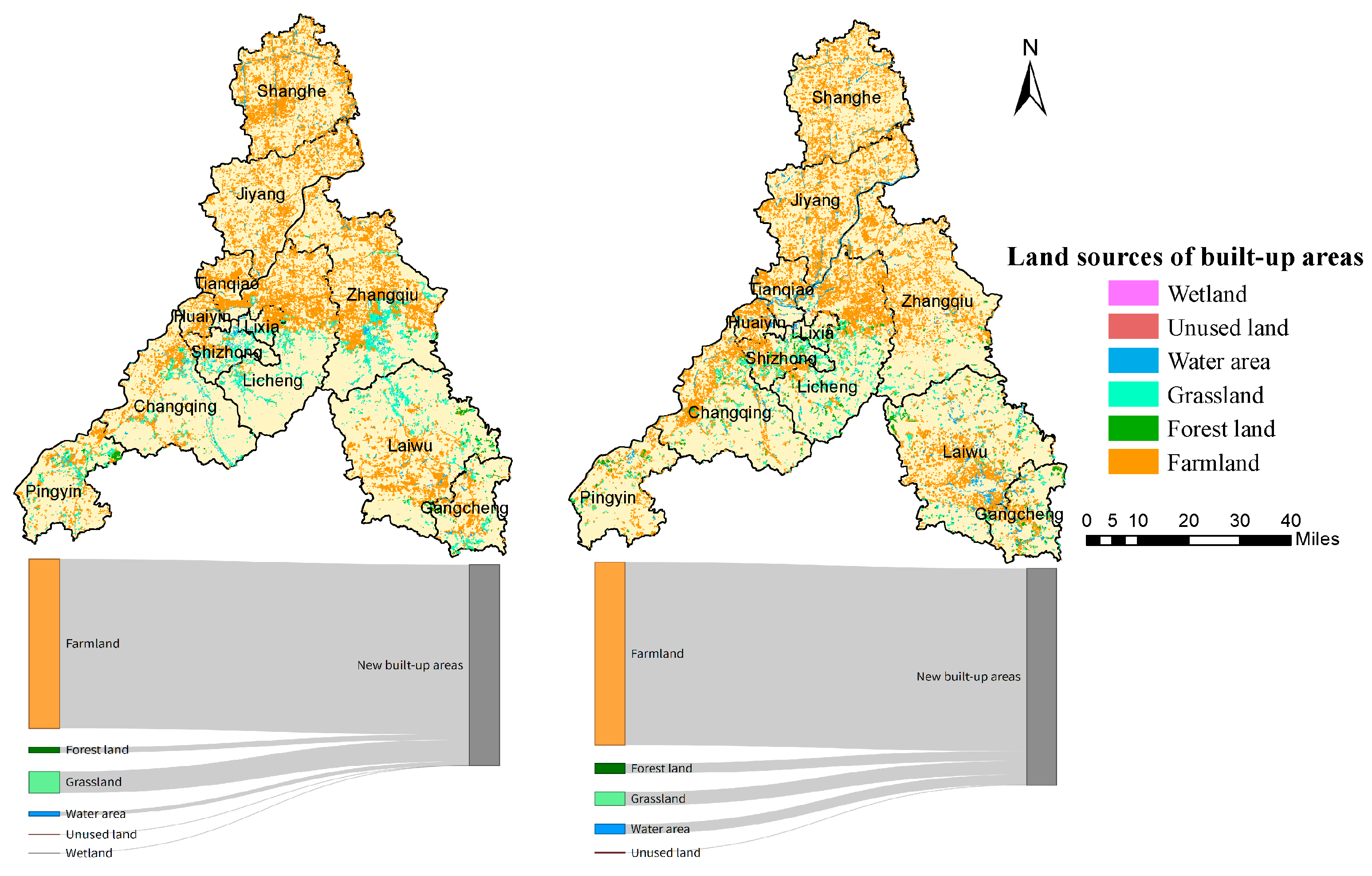
Urban expansion in Jinan has always followed the path of “high-quality farmland occupation–expansion into ecologically sensitive areas” [42]. From 2000 to 2010, the total Darea of new built-up land in Jinan reached 1311.46 km2; farmland conversion accounted for 84.4% of the total, making it the dominant source. From 2010 to 2020, the total area of new built-up land in Jinan decreased to 1247.84 km2, the composition of land sources changed, farmland conversion decreased to 79.9%, and the conversion areas of forest land, grassland, water area, and unused land all showed increasing trends. The total proportion of ecological land conversion rose to 17.4%. The core driver of this change is that high-quality farmland around the built-up land was nearly saturated for development. The city had to expand eastward into Zhangqiu District and westward into Changqing District, which are mountainous, hilly, and near rivers and lakes. These areas are precisely where ecological lands are concentrated. This directly intensified the conflict between urban expansion and ecological protection, setting the stage for subsequent losses in ecosystem services. The spatial distribution and proportion of land sources for built-up land expansion in Jinan are shown in Figure 2.
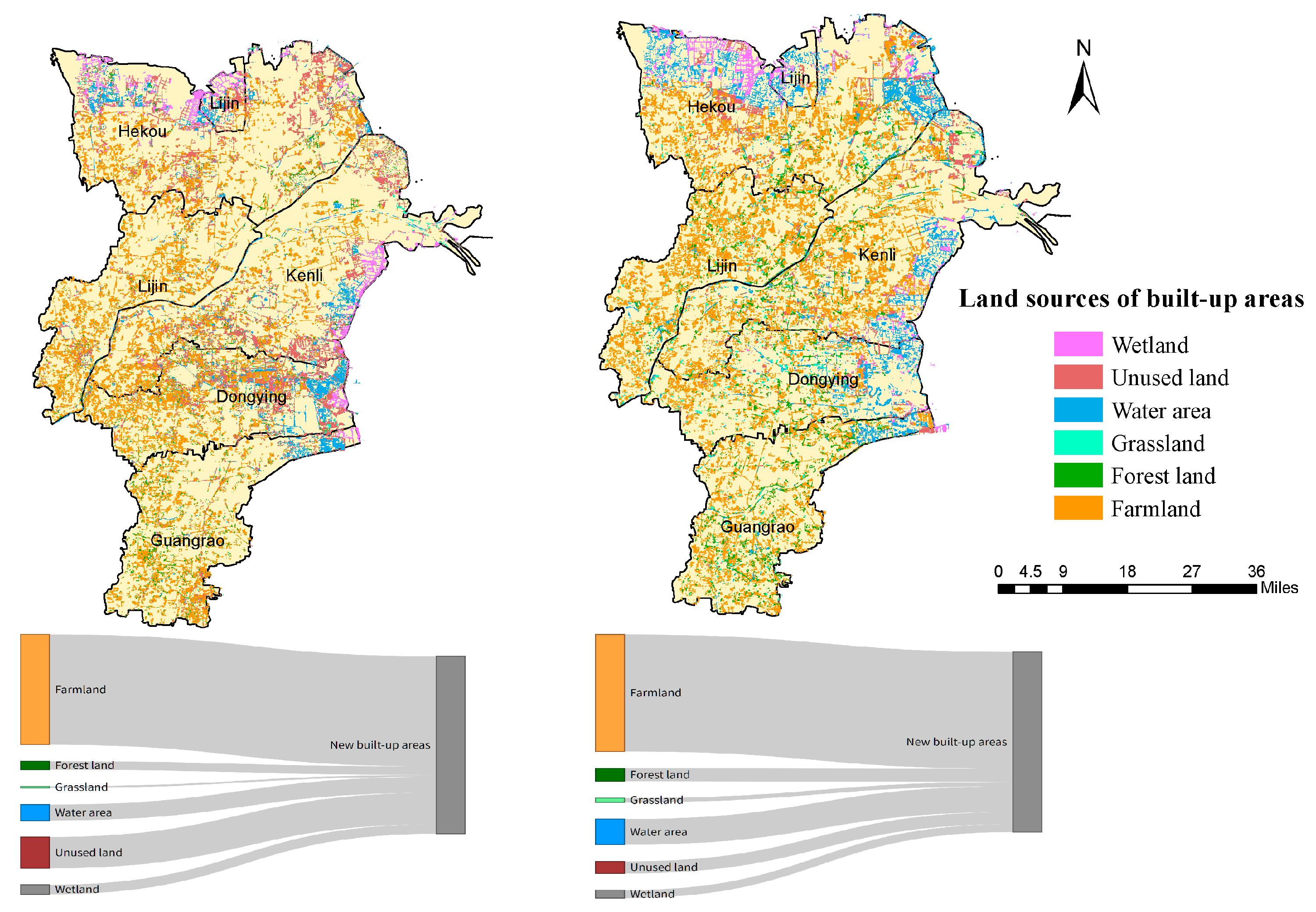
Different from the absolute dominance of farmland conversion in Jinan, Dongying, as a resource-based city at the Yellow River estuary, showed a “farmland–unused land–water area” multi-source characteristic in its new built-up land. This pattern was deeply tied to Dongying’s terrain endowment of the Yellow River alluvial plain, its widely distributed water areas and wetland ecosystems, and the dual development drive of “oil field development + urban expansion”. From 2000 to 2010, the total area of new built-up land in Dongying was 1000.88 km2; farmland conversion accounted for 62.1%. Although it was the largest source, its proportion was significantly lower than that of Jinan in the same period. From 2000 to 2010, the conversion scales of unused land and water area were particularly prominent, together accounting for 26.73%. This land structure clearly reflected the characteristics of petroleum industry development—industrial facilities were laid out on unused land and wetland edges in the Yellow River alluvial plain, initiating a long-term conflict between industrial expansion and wetland protection. From 2010 to 2020, the total area of new built-up land in Dongying increased to 1214.52 km2, and farmland conversion rose to 64.9%, remaining the main source; the conversion areas of forest land and grassland increased to 88.56 km2 and 29.07 km2, respectively, reflecting increased encroachment on surrounding green spaces due to urban expansion. The spatial distribution and proportion of land sources for built-up land expansion in Dongying are shown in Figure 3.

3.2. Characteristics of Expansion Patterns

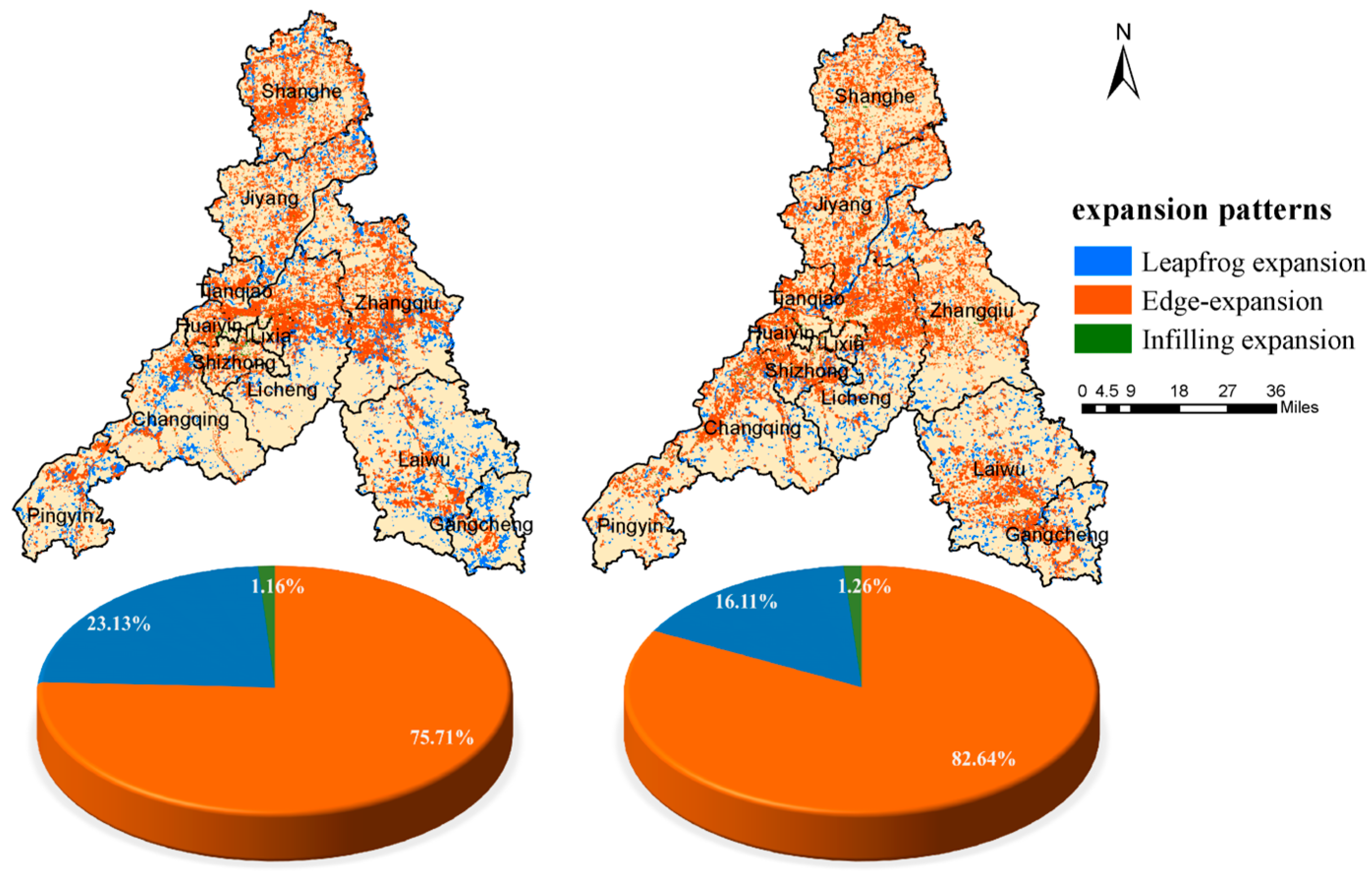
From 2000 to 2010, the edge-expansion area in Jinan was 992.909 km2, accounting for over 70% of the total. The leapfrog expansion area was 303.357 km2, contributing 23.13% of the new built-up land. The infilling expansion area was only 1.520 km2. During this period, edge-expansion was the dominant pattern in Jinan, with continuous expansion outward from existing built-up land. Leapfrog and infilling expansion accounted for relatively low proportions. From 2010 to 2020, the edge-expansion area increased to 1031.202 km2, with its proportion rising further to 82.64%. The leapfrog expansion area was 200.97 km2, accounting for 16.12%. The infilling expansion area was 15.67 km2. This indicates that edge-expansion remained the main pattern in Jinan. Infilling expansion remained at a low level for a long time, suggesting that Jinan still has great potential for promoting urban renewal and improving the efficiency of existing space utilization in the future. The spatial distribution of urban expansion patterns and their area proportions in Jinan are shown in Figure 4.
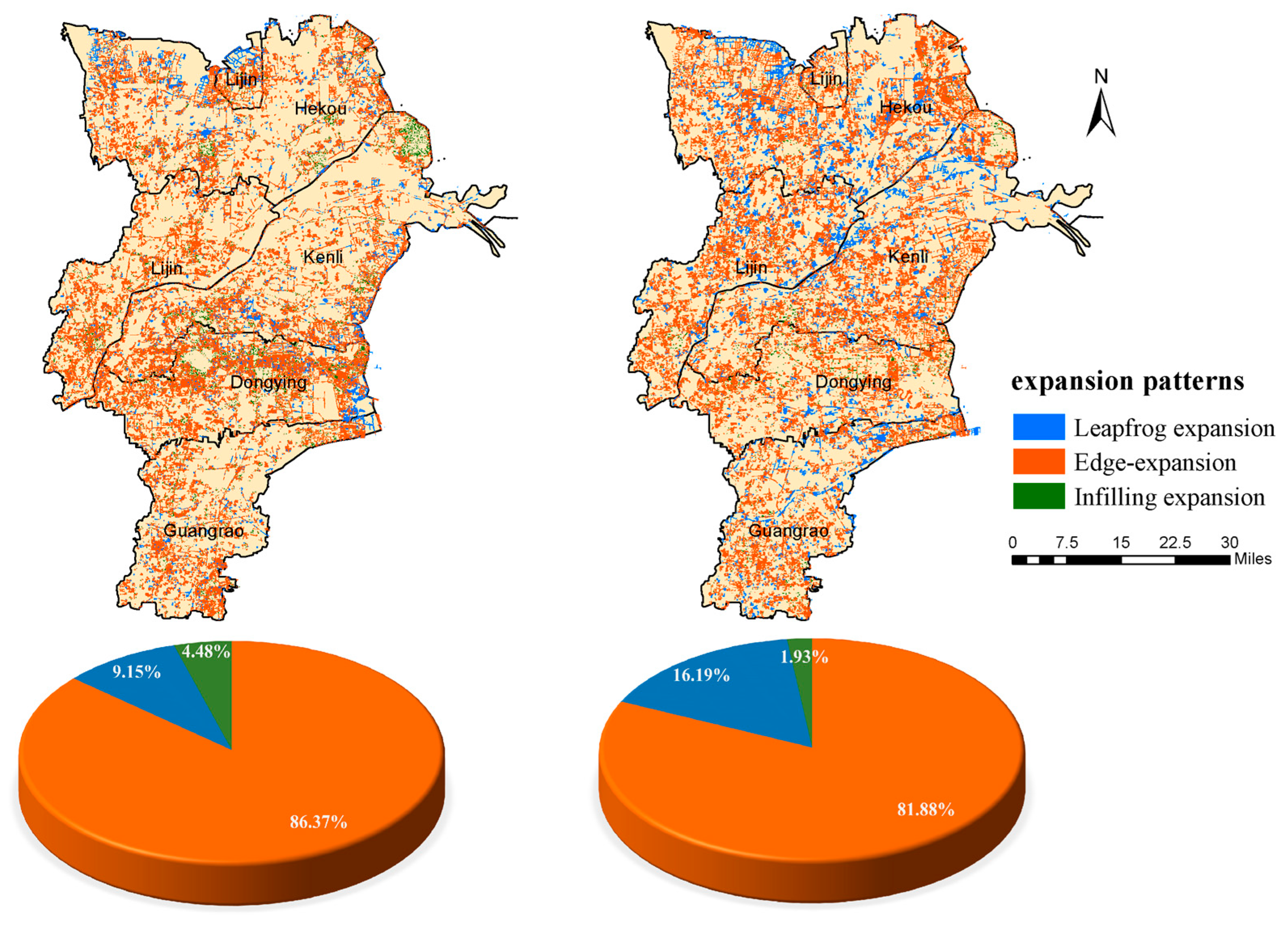
From 2000 to 2010, the edge-expansion area in Dongying was 864.472 km2, accounting for over 86% of the total. The leapfrog expansion area was 91.585 km2. The infilling expansion area was 4.482 km2. This shows a pattern strongly dominated by edge-expansion, with the city continuously expanding outward along the boundaries of existing built-up land. From 2010 to 2020, the edge-expansion area in Dongying was 994.436 km2, accounting for about 82% of the total. The leapfrog expansion area was 196.684 km2, with its proportion increasing to about 16%. The infilling expansion area was 2.340 km2. This indicates that edge-expansion remained the core pattern in Dongying. At the same time, the proportion of leapfrog expansion increased. Infilling expansion increased but remained small in scale. The spatial distribution of urban expansion patterns and their area proportions in Dongying are shown in Figure 5.

3.3. Analysis of Ecosystem Service Losses

3.3.1. Analysis of Ecosystem Service Losses in Jinan

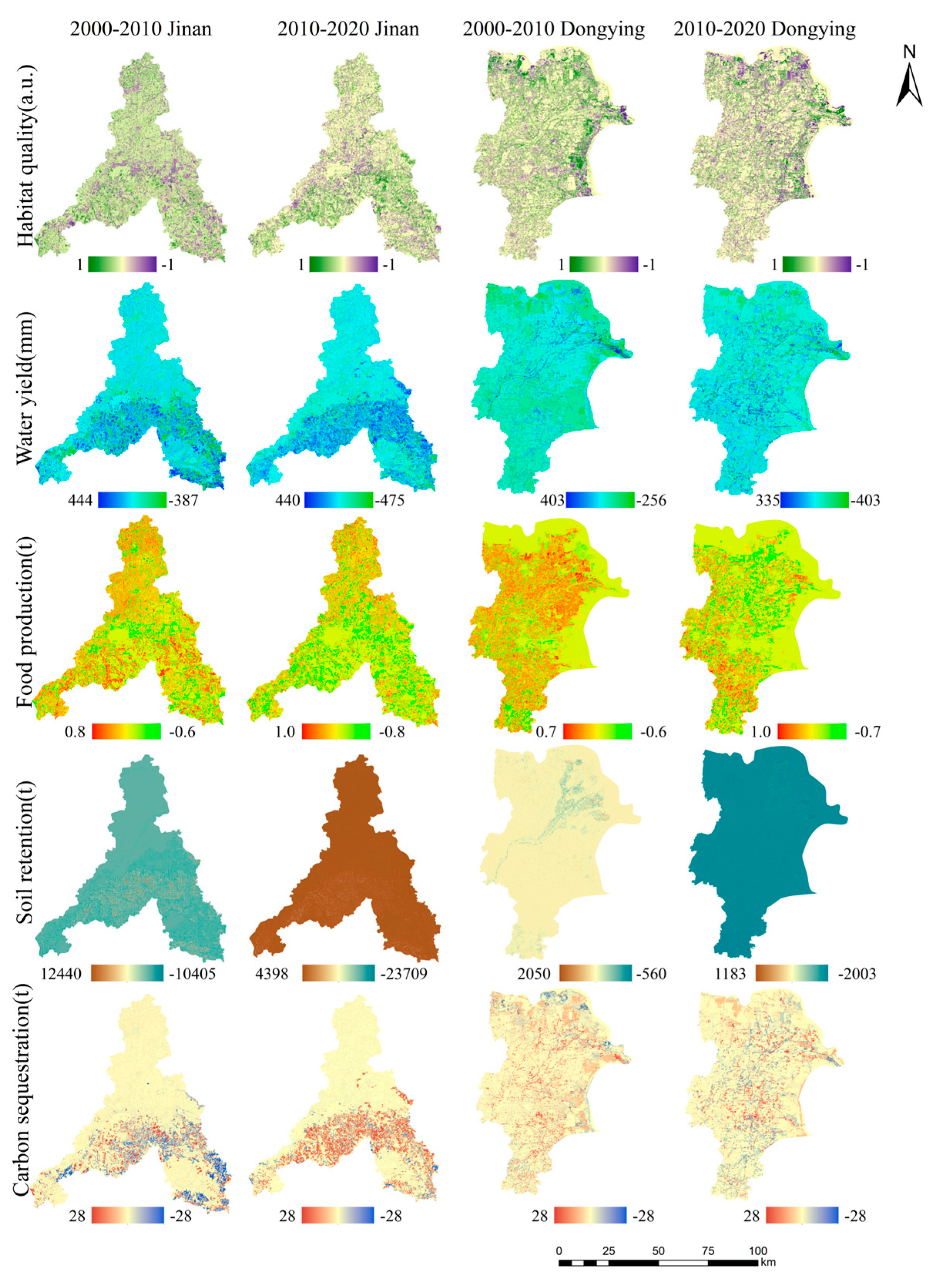
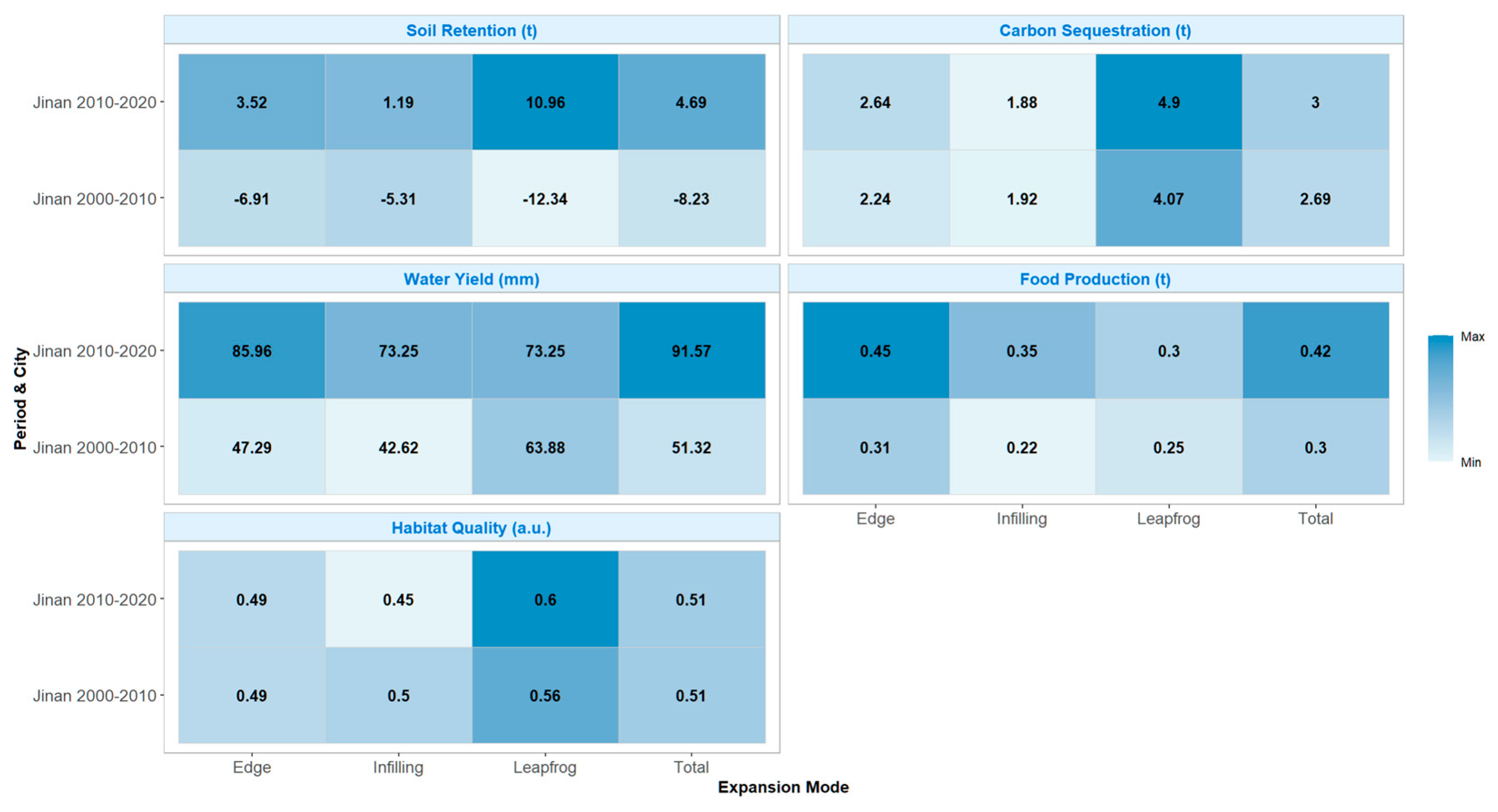
Based on the land conversion characteristics revealed by the built-up area source matrix, combined with the spatial expansion logic of different expansion patterns, the losses of five ecosystem services in Jinan were analyzed [43]. The spatial distribution characteristics of ecosystem service losses are shown in Figure 6. Quantitative data on ecosystem service losses under different expansion patterns in Jinan are shown in Figure 7.
For carbon sequestration service, leapfrog expansion caused the largest carbon sequestration loss in both time periods. From 2010 to 2020, carbon sequestration losses under all expansion patterns increased compared to the 2000–2010 period, showing an intensifying decline in carbon sequestration capacity. From the perspective of land source coupling, the loss intensity of carbon sequestration service was related to the carbon sequestration of converted land types [10,44]. From 2010 to 2020, as the conversion scale of ecological lands with high carbon sequestration, such as forest land and grassland, increased significantly, the proportion of high-carbon-storage land occupied by leapfrog expansion increased notably, leading to greater carbon sequestration losses.
For water yield service, leapfrog expansion caused the most significant water yield losses in both 2000–2010 and 2010–2020. The increase in loss was substantial, indicating accelerated degradation of water yield capacity. This characteristic closely matched the spatiotemporal changes in land sources. From 2000 to 2010, water area conversion was only 2.68 km2, so leapfrog expansion had limited impact on water yield. From 2010 to 2020, water area conversion increased to 57.74 km2. Moreover, leapfrog expansion often involved water areas and wetland sensitive zones around rivers and lakes. These areas are core carriers of water yield function. The increase in impervious surfaces and the destruction of wetland ecological functions during development directly led to significant degradation of water yield capacity.
For food production service, edge-expansion caused the largest losses in both time periods. This reflects its more significant occupation effect on agricultural production land. From the perspective of land sources, farmland conversion in Jinan accounted for 84.4% and 82.64% of new built-up land in 2000–2010 and 2010–2020, respectively; farmland remained the absolute dominant land source throughout. Edge-expansion, as the main expansion pattern, directly occupied large amounts of high-quality farmland through continuous expansion. The reduction in farmland area and the loss of agricultural production function directly led to food production service losses. This coupling relationship fully reflects the strong correlation between farmland conversion and food production service.
For habitat quality service, leapfrog expansion caused the largest losses in both time periods. The loss magnitude increased from 2010 to 2020, indicating a continuously strengthening effect on habitat destruction. The core driving factor is the dependence of habitat quality service on ecological lands. From 2000 to 2010, the conversion scale of ecological lands was small, so habitat quality losses were limited. From 2010 to 2020, the conversion scale of ecological lands such as forest land, grassland, and water area increased significantly. These lands are core habitats for biodiversity. The discontinuous development of leapfrog expansion led to habitat fragmentation. Moreover, new patches were isolated from existing ecological patches, further exacerbating habitat quality degradation.
For soil retention service, all expansion patterns showed an increase in soil retention capacity from 2000 to 2010. Leapfrog expansion showed the largest increase. During this period, 84.4% of new built-up land in Jinan came from farmland. Farmland was mostly distributed in plain areas with low background soil erosion risk. The continuous expansion dominated by edge-expansion caused relatively mild disturbance to surface vegetation and soil structure. The small amount of unused land and grassland conversion involved in leapfrog expansion had low original vegetation coverage. After development, infrastructure construction and greening projects actually reduced soil erosion risk. From 2010 to 2020, soil retention capacity showed a significant decline. Leapfrog expansion caused the most prominent loss. The core driving factor was the increased conversion area of ecological lands during this period. Leapfrog expansion mostly targeted forest land and grassland concentration areas in the eastern mountainous hills and areas around rivers and lakes. These areas had high vegetation coverage and loose soil. During development, vegetation destruction and terrain disturbance directly aggravated soil erosion, leading to significant losses in soil retention service.
Overall, leapfrog expansion had the most prominent negative impact on ecosystem services in Jinan. It caused the largest losses in four services: carbon sequestration, water yield, habitat quality, and soil retention. The essence of this is the increasing spatial coupling between leapfrog expansion and the conversion of high-ecological-value lands [45]. Edge-expansion, which was always dominated by farmland conversion, showed the most significant losses in food production service. From a temporal trend perspective, the loss values of each ecosystem service from 2010 to 2020 were generally higher than those from 2000 to 2010. The core driver was the shift in the source structure of built-up land from “farmland absolute dominance” to “farmland + ecological land synergy”. The expanded scale of ecological land conversion combined with the spatial targeting of expansion patterns led to continuously intensifying degradation of ecosystem services.
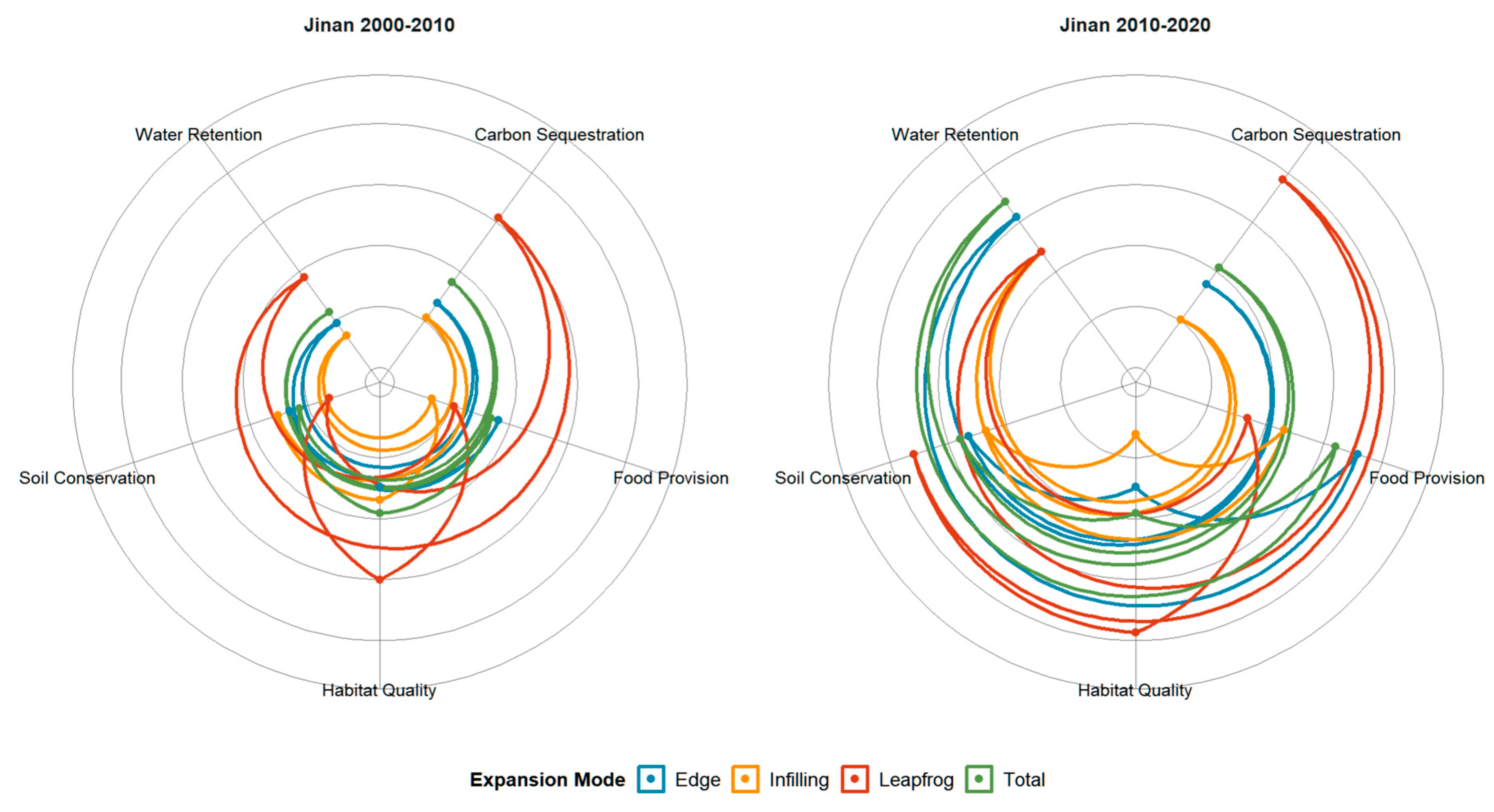
We adopted Z-score standardization to preprocess the ecosystem service loss data for the three urban expansion patterns and visualized the results [46]. A greater distance from the center indicates a stronger negative impact, as illustrated in Figure 8 for Jinan.

3.3.2. Analysis of Ecosystem Service Losses in Dongying

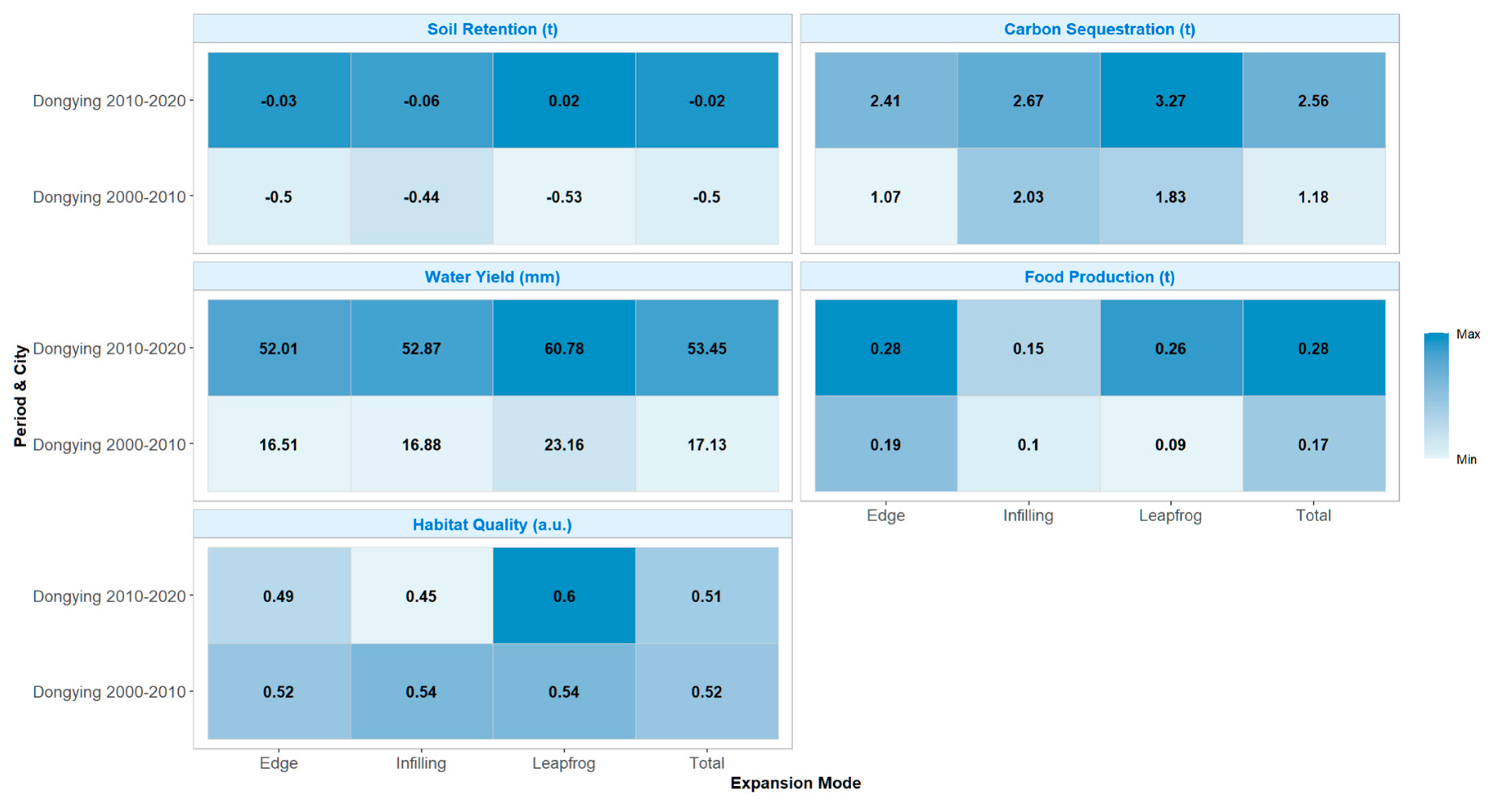
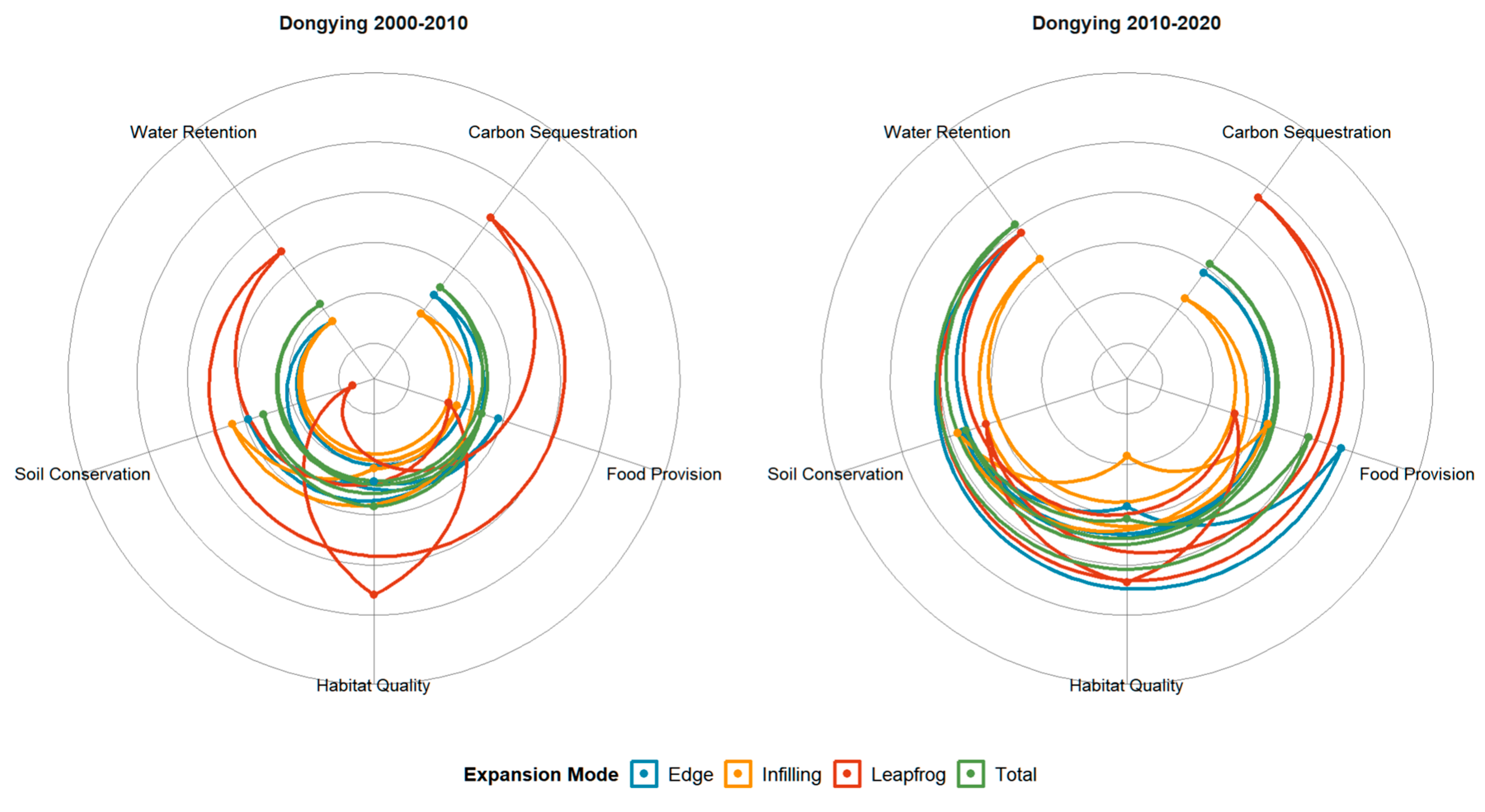
A coupling analysis was conducted on the losses of five ecosystem services under different expansion patterns in Dongying. Quantitative data on ecosystem service losses under different expansion patterns in Dongying are shown in Figure 9. Trends in ecosystem service losses under three urban expansion patterns in Dongying are shown in Figure 10.
For carbon sequestration service, from 2000 to 2010, the loss values for edge-expansion, infilling, leapfrog, and total expansion were 1.07, 2.03, 1.83, and 1.19, respectively. From 2010 to 2020, these loss values increased to 2.41, 2.67, 3.27, and 2.56, respectively. Leapfrog expansion caused the most significant carbon sequestration losses in both time periods. Carbon sequestration losses under all patterns showed a clear upward trend, indicating intensifying decline in carbon sequestration capacity. From the perspective of land source coupling analysis, the core driver of carbon sequestration loss was the increased conversion scale of high-carbon-storage lands. From 2000 to 2010, the conversion scales of wetland and forest land in Dongying were limited, so the carbon loss was under good control. From 2010 to 2020, forest land conversion increased from 47.89 km2 to 88.56 km2. The proportion of carbon sink lands such as forest land and wetland occupied by leapfrog expansion increased, leading to greater carbon sequestration losses. Edge-expansion, which mainly involved farmland conversion, had relatively mild carbon sequestration losses due to the lower background carbon sequestration value of farmland.
For water yield service, from 2000 to 2010, the loss values for edge-expansion, infilling, leapfrog, and total expansion were 16.51, 16.88, 23.15, and 17.13, respectively. From 2010 to 2020, these loss values increased to 52.01, 52.87, 60.78, and 53.45, respectively. Leapfrog expansion caused the largest water yield losses in both time periods, and the loss increase was substantial, indicating accelerated degradation of water yield capacity. This characteristic was highly correlated with the conversion characteristics of water areas and wetlands in Dongying. As a city at the Yellow River estuary, Dongying has abundant water area and wetland resources. From 2000 to 2010, water area conversion was 89.78 km2 and wetland conversion was 53.87 km2. From 2010 to 2020, water area conversion was 73.80 km2 and wetland conversion was 53.51 km2. These land types are core carriers of water yield function. Their hydrological regulation function is closely related to vegetation cover and soil permeability. Leapfrog expansion mostly targeted areas around water areas and wetlands. During development, the increase in impervious surfaces and the destruction of wetland ecosystems directly led to the degradation of water yield capacity. As water area and wetland conversion scales remained high over time, losses showed an increasing trend.
For food production service, from 2000 to 2010, the loss values for edge-expansion, infilling, leapfrog, and total expansion were 0.19, 0.1, 0.09, and 0.17, respectively. From 2010 to 2020, these loss values increased to 0.28, 0.15, 0.26, and 0.28, respectively. Edge-expansion caused relatively larger food supply losses in both time periods, reflecting its more prominent occupation effect on agricultural production land. From the perspective of land sources, although Dongying’s land sources were diverse, farmland conversion was always the largest source. Edge-expansion, as the dominant pattern, directly occupied large amounts of high-quality farmland through continuous expansion, leading to continuous losses in food production service. This coupling relationship was consistent with Jinan, reflecting the universal correlation between farmland conversion and food production service losses.
For habitat quality service, from 2000 to 2010, the loss values for edge-expansion, infilling, leapfrog, and total expansion were 0.44, 0.41, 0.51, and 0.44, respectively. From 2010 to 2020, these loss values were 0.52, 0.54, 0.54, and 0.52, respectively. Leapfrog expansion caused the largest habitat quality losses in both time periods, and the loss magnitude increased, indicating a continuously strengthening effect on habitat destruction. Leapfrog expansion mostly involved wetland edges and forest land and grassland concentration areas. Development led to habitat fragmentation and isolation, directly exacerbating habitat quality degradation. Meanwhile, the increased conversion scale of forest land and grassland from 2010 to 2020 further enhanced the damage intensity of leapfrog expansion on habitats.
For soil retention service, from 2000 to 2010, the loss values for edge-expansion, infilling, leapfrog, and total expansion were −0.5, −0.44, −0.53, and −0.5, respectively. All patterns showed an increase in soil retention capacity. From 2010 to 2020, the loss values for the four patterns were −0.03, −0.06, 0.02, and −0.02, respectively. Except for leapfrog expansion, all patterns still maintained increased soil retention capacity. Only leapfrog expansion showed a slight loss in soil retention capacity. This characteristic was closely related to the diverse land sources in Dongying. Dongying’s terrain mainly consists of the Yellow River alluvial plain. Unused land conversion accounted for a significant proportion of new built-up land. These lands had low vegetation coverage and high background soil erosion risk. During development, land leveling and vegetation restoration actually reduced erosion risk. Edge-expansion mainly involved farmland conversion. Farmland was distributed in plain areas. Development caused relatively mild disturbance to soil structure, so soil retention capacity remained stable.
Overall, leapfrog expansion had a relatively prominent negative impact on ecosystem services in Dongying. It caused the largest losses in three services: carbon sequestration, water yield, and habitat quality. The essence of this is the high coupling between leapfrog expansion and the conversion of ecological lands such as water areas, wetlands, and forest lands. Edge-expansion, which was always dominated by farmland conversion, showed more significant losses in food production service.

3.3.3. Comparison of Ecosystem Service Losses Under Different Expansion Patterns Between the Two Cities

(1) Common characteristics
There are clear commonalities in the structure of ecosystem service losses between the two cities. First, leapfrog expansion had the most prominent negative impact on regulating services (carbon sequestration, water yield, and habitat quality). It was the expansion pattern with the highest loss intensity per unit area in both cities. This indicates that new patches detached from existing urban areas were more likely to encroach on ecological lands, leading to habitat fragmentation and degradation of ecosystem functions. Second, edge-expansion dominated the losses in food production service. This reflects that continuous outward expansion along existing built-up boundaries, which continuously encroaches on high-quality farmland, was the main driver of the decline in food production function. Third, infilling expansion accounted for a very low proportion in both cities. This indicates that both cities still have significant room for improvement in the renewal of existing urban land and intensive use. Urban expansion remained mainly extensive.
(2) Comparison of differences
The differences in ecosystem service losses between Jinan and Dongying stem primarily from their distinct inland versus coastal locations, the contrast between farmland-dominated and multi-source land conversion structures, and the spatial targeting of expansion patterns. Jinan is characterized by prominent losses in food production service, while Dongying is characterized by losses in regulating services such as water yield and habitat quality. These differences are rooted in the two cities’ completely different land source structures. Urban expansion in Jinan has long been dominated by farmland conversion. The continuous encroachment of edge-expansion on agricultural production space directly led to food production service losses. Urban expansion in Dongying showed a multi-source characteristic involving farmland, water areas, and unused land. Water areas and wetlands maintained relatively high conversion scales in both periods. The disturbance of leapfrog expansion to hydrologically sensitive areas and wetland edges became the main driver of water yield and habitat quality losses. The differences in loss characteristics between the two cities deeply reveal how the coupling of urban resource endowments, land source structures, and expansion patterns shapes the pathways of ecosystem service losses. This provides a scientific basis for formulating differentiated urban ecological management strategies.

4. Discussion

4.1. Coupled Ecological Effects of Expansion Sources and Expansion Patterns

This study, through the coupled analysis of built-up area expansion sources and expansion patterns on ecosystem service losses, reveals a core mechanism long overlooked in research on the ecological effects of urban expansion: the interaction between expansion patterns and land sources. The study identifies a structural divergence in the loss mechanisms between regulating services and provisioning services. The most prominent negative impact of leapfrog expansion on regulating services stems from the systematic coupling between its spatial form and high-ecological-value lands. The dominant effect of edge-expansion on provisioning service losses stems from the structural overlap between its continuous expansion pattern and farmland resources. This finding indicates that the matching relationship between expansion patterns and land sources, rather than single-dimensional characteristics, constitutes the fundamental driver of differentiation in ecosystem service loss types.

4.2. Ecological Management Implications for Typical Urban Expansion

Jinan and Dongying, as typical cities in the Shandong section of the Yellow River Basin, provide important references for other cities in the basin regarding their ecological loss characteristics:
For cities with abundant farmland resources and high urbanization pressure such as Jinan, the encroachment of edge-expansion on high-quality farmland should be strictly controlled. By designating farmland protection red lines and optimizing urban spatial structure, food production service losses can be reduced. At the same time, the extension of leapfrog expansion into ecologically sensitive areas such as mountainous and hilly regions should be restricted. Ecological restoration can enhance the disturbance resistance of high-ecological-value lands.
The case of Dongying reveals the complex trade-offs between industrial development and ecological protection in resource-based cities. For ecologically sensitive and industry-driven cities, the protection of core ecological lands such as wetlands and water areas should be strengthened. Leapfrog expansion into areas surrounding ecological reserves should be strictly limited. By leveraging the advantage of abundant unused land resources, edge-expansion can be directed toward low-ecological-value areas, achieving a balance between urban development and ecological protection.

4.3. Limitations and Future Perspectives

(1) This study focuses on spatial patterns and land sources, but does not incorporate socioeconomic drivers such as population, GDP, and urban planning policy interventions. Future research can integrate multi-factor analysis to further reveal the driving mechanism of ecosystem service loss under urban expansion.
(2) In addition to the biophysical quantification of ecosystem service function losses in this study, further in-depth exploration can be conducted on the assessment of ecosystem service value losses. On the basis of the spatial overlay analysis results obtained in this paper, multiple mature evaluation approaches including the avoidance damage method, replacement cost method, factor income method, travel cost method and benefit transfer method can be integrated to systematically measure the overall value loss of various ecosystem services. Combined with the total economic value evaluation system proposed by Costanza et al., it is feasible to comprehensively analyze the actual loss status of both dominant ecological service functions and potential ecological reserve values affected by urban expansion. This study only focuses on the quantitative identification of physical ecological service losses, and the relevant value loss evaluation work will be supplemented and improved in subsequent in-depth research.
(3) This study only analyzes historical changes in ecosystem services driven by actual urban expansion patterns and land conversion sources from 2000 to 2020, and fails to design diverse urbanization development scenarios. In addition, critical threshold ranges of relevant parameters that trigger drastic ecosystem service loss have not been explored. In follow-up research, multiple urban development scenarios will be constructed on the basis of regional development characteristics. We will define reasonable variation thresholds of core indicators, simulate land use evolution and ecological service dynamics under different development paths, and identify critical boundaries of urban expansion, so as to provide more targeted decision-making references for regional space governance.

5. Conclusions

Taking Jinan and Dongying as study areas, this study adopted a built-up source matrix and Landscape Expansion Index to identify which urban expansion patterns or land sources exert greater impacts on the loss of specific ecosystem services, and quantified the loss characteristics of five core ecosystem services from 2000 to 2020. The main conclusions are as follows:
(1) For expansion sources, Jinan was dominated by farmland conversion. After 2010, the proportion of ecological land conversion increased significantly. Dongying showed a multi-source characteristic of “farmland–unused land–water area”. Wetland conversion remained stable over the long term.
(2) For expansion patterns, edge-expansion was the main pattern in both cities. The proportion of leapfrog expansion in Jinan first increased and then stabilized. The proportion of leapfrog expansion in Dongying steadily increased. Infilling expansion was very limited in both cities. This reflects that expansion in typical cities in the Yellow River Basin remains dominated by extensive outward sprawl. The potential for intensive use of existing urban space has not been fully realized.
(3) For ecosystem service losses, the coupled driving effect was significant. Edge-expansion, highly coupled with farmland conversion, dominated food production service losses in both cities. Leapfrog expansion, spatially overlapped with ecological land conversion, dominated losses in carbon sequestration, water yield, and habitat quality services.
(4) The differences in ecosystem service loss characteristics between the two cities confirm the shaping role of urban resource endowments and land source structures on ecological loss pathways. Jinan, due to its absolute dominance of farmland conversion, showed prominent characteristics of food production service losses. Dongying, due to continuous conversion of ecological lands such as water areas and wetlands, showed core characteristics of water yield and habitat quality service losses.
By analyzing the coupled ecological effects of expansion sources and expansion patterns, this study clarifies the driving mechanisms of ecosystem service losses in typical cities in the Yellow River Basin. It provides a scientific basis for optimizing spatial development patterns and balancing urban expansion with ecological protection in different city types. It also offers a reference paradigm for ecological management in similar cities.

Author Contributions

Conceptualization, Z.Z., X.L. (Xiaotong Li), Y.S. (Yingjun Sun) and F.W.; methodology, Y.S. (Yingjun Sun), Y.S. (Yanshuang Song) and F.W.; software, Y.S. (Yingjun Sun) and X.L. (Xiaotong Li); validation, Y.S. (Yingjun Sun), Y.S. (Yanshuang Song), J.Z. and X.L. (Xiang Li); formal analysis, Z.Z. and X.L. (Xiaotong Li); investigation, Y.S. (Yingjun Sun), J.Z., F.W. and H.Z.; resources, Y.S. (Yingjun Sun) and F.W.; data curation, Y.S. (Yanshuang Song); writing—original draft preparation, Y.S. (Yingjun Sun) and X.L. (Xiaotong Li); writing—review and editing, X.L. (Xiaotong Li); visualization, Y.S., Z.Z., X.L. (Xiaotong Li), Y.S. (Yingjun Sun) and F.W.; supervision, Y.S. (Yingjun Sun) and F.W.; project administration, Y.S. (Yingjun Sun). All authors have read and agreed to the published version of the manuscript.

Funding

This research received no external funding.

Institutional Review Board Statement

Not applicable.

Informed Consent Statement

Not applicable.

Data Availability Statement

The original contributions presented in this study are included in the article. Further inquiries can be directed to the corresponding author.

Acknowledgments

The authors sincerely thank the experts involved in the reviewing, editing, publishing, and dissemination of this work.

Conflicts of Interest

The authors declare no conflicts of interest.

Abbreviations

The following abbreviations are used in this manuscript:
LEILandscape Expansion Index
InVESTIntegrated Valuation of Ecosystem Services and Trade-offs
NPPNet Primary Productivity
NDVINormalized Difference Vegetation Index
MAMillennium Ecosystem Assessment
IPBESIntergovernmental Science-Policy Platform on Biodiversity and Ecosystem Services
IPCCIntergovernmental Panel on Climate Change
CNLUCCChina National Land Cover Change Database
USLEUniversal Soil Loss Equation
RKLSRevised Universal Soil Loss Equation
SEDRSediment Delivery Ratio

References

  1. Seto, K.C.; Güneralp, B.; Hutyra, L.R. Global forecasts of urban expansion to 2030 and direct impacts on biodiversity and carbon pools. Proc. Natl. Acad. Sci. USA 2012, 109, 16083–16088. [Google Scholar] [CrossRef] [PubMed]
  2. Foley, J.A.; Defries, R.; Asner, G.P.; Barford, C.; Bonan, G.; Carpenter, S.R.; Chapin, F.S.; Coe, M.T.; Daily, G.C.; Gibbs, H.K.; et al. Global consequences of land use. Science 2005, 309, 570–574. [Google Scholar] [CrossRef]
  3. Gao, L.; Zhou, F.; Gong, W.; Pang, X. The mutual influence of land-sea ecological security and its coordinated governance in the Guangdong-Hong Kong-Macao greater bay area. Ecol. Indic. 2023, 156, 111073. [Google Scholar] [CrossRef]
  4. Turner, B.L.; Lambin, E.F.; Reenberg, A. The emergence of land change science for global environmental change and sustainability. Proc. Natl. Acad. Sci. USA 2007, 104, 20666–20671. [Google Scholar] [CrossRef]
  5. Chen, Z.; Li, Y.; Liu, Z.; Wang, J.; Liu, X. Impacts of Different Rural Settlement Expansion Patterns on Eco-Environment and Implications in the Loess Hilly and Gully Region, China. Front. Environ. Sci. 2022, 10, 857776. [Google Scholar] [CrossRef]
  6. Zhang, A.; Tariq, A.; Quddoos, A.; Naz, I.; Aslam, R.W.; Barboza, E.; Ullah, S.; Abdullah-Al-Wadud, M. Spatio-temporal analysis of urban expansion and land use dynamics using google earth engine and predictive models. Sci. Rep. 2025, 15, 6993. [Google Scholar] [CrossRef]
  7. Forman, R.T.T. Land Mosaics: The Ecology of Landscapes and Regions; Choice Reviews Online; Cambridge University Press: Cambridge, UK, 1996; Volume 33. [Google Scholar] [CrossRef]
  8. Li, S.; He, Y.; Xu, H.; Zhu, C.; Dong, B.; Lin, Y.; Si, B.; Deng, J.; Wang, K. Impacts of Urban Expansion Forms on Ecosystem Services in Urban Agglomerations: A Case Study of Shanghai-Hangzhou Bay Urban Agglomeration. Remote Sens. 2021, 13, 1908. [Google Scholar] [CrossRef]
  9. Xu, C.; Liu, M.; Zhang, C.; An, S.; Yu, W.; Chen, J.M. The spatiotemporal dynamics of rapid urban growth in the Nanjing metropolitan region of China. Landsc. Ecol. 2007, 22, 925–937. [Google Scholar] [CrossRef]
  10. Liu, X.; Li, X.; Chen, Y.; Tan, Z.; Li, S.; Ai, B. A new landscape index for quantifying urban expansion using multi-temporal remotely sensed data. Landsc. Ecol. 2010, 25, 671–682. [Google Scholar] [CrossRef]
  11. Bosch, M.; Jaligot, R.; Chenal, J. Spatiotemporal patterns of urbanization in three Swiss urban agglomerations: Insights from landscape metrics, growth modes and fractal analysis. Landsc. Ecol. 2020, 35, 879–891. [Google Scholar] [CrossRef]
  12. Zeng, Y.; Lobsang, T.; Luo, X.; Zhang, Z.; Yang, H.; Zhao, X. Spatiotemporal Characteristics and Decoupling Effects of Urban Construction Land Expansion in Plateau Basins. Land 2025, 14, 685. [Google Scholar] [CrossRef]
  13. Wu, H.; Wang, Y.; Zhuang, A.; Qiang, S.; Song, Y. Urban Expansion and Landscape Pattern Dynamics in Urban Agglomerations: A Case Study of the Guanzhong Plain Urban Agglomeration, China. Land 2026, 15, 768. [Google Scholar] [CrossRef]
  14. Kou, X.; Zhao, J.; Sang, W. Impact of Typical Land Use Expansion Induced by Ecological Restoration and Protection Projects on Landscape Patterns. Land 2024, 13, 1513. [Google Scholar] [CrossRef]
  15. Yan, Y.; Ju, H.; Zhang, S.; Jiang, W. Spatiotemporal Patterns and Driving Forces of Urban Expansion in Coastal Areas: A Study on Urban Agglomeration in the Pearl River Delta, China. Sustainability 2020, 12, 191. [Google Scholar] [CrossRef]
  16. Salem, M.; Tsurusaki, N. Impacts of Rapid Urban Expansion on Peri-Urban Landscapes in the Global South: Insights from Landscape Metrics in Greater Cairo. Sustainability 2024, 16, 2316. [Google Scholar] [CrossRef]
  17. Zank, B.; Bagstad, K.J.; Voigt, B.; Villa, F. Modeling the effects of urban expansion on natural capital stocks and ecosystem service flows: A case study in the Puget Sound, Washington, USA. Landsc. Urban Plan. 2016, 149, 31–42. [Google Scholar] [CrossRef]
  18. Tan, L.; Tiong, R.L.K.; Zhang, Z. Analysis of land use/land cover changes and driving forces during the period 1992–2022: A case study of Jinan City, China. AQUA—Water Infrastruct. Ecosyst. Soc. 2024, 73, 584–607. [Google Scholar] [CrossRef]
  19. Zhao, X.; Wang, P.; Gao, S.; Yasir, M.; Islam, Q.U. Combining LSTM and PLUS Models to Predict Future Urban Land Use and Land Cover Change: A Case in Dongying City, China. Remote Sens. 2023, 15, 2370. [Google Scholar] [CrossRef]
  20. Daily, G.C. Nature’s Services: Societal Dependence on Natural Ecosystems (1997). In The Future of Nature; Robin, L., Sörlin, S., Warde, P., Eds.; Yale University Press: New Haven, CT, USA, 2017; pp. 454–464. [Google Scholar]
  21. Ghazinoory, S.; Nasri, S.; Dastranj, R.; Sarkissian, A. “Bio to bits”: The Millennium Ecosystem Assessment (MA) as a metaphor for Big Data ecosystem assessment. ITP 2022, 35, 835–858. [Google Scholar] [CrossRef]
  22. Díaz, S.; Demissew, S.; Carabias, J.; Joly, C.; Lonsdale, M.; Ash, N.; Larigauderie, A.; Adhikari, J.R.; Arico, S.; Báldi, A.; et al. The IPBES Conceptual Framework—Connecting nature and people. Curr. Opin. Environ. Sustain. 2015, 14, 1–16. [Google Scholar] [CrossRef]
  23. Costanza, R.; de Groot, R.; Braat, L.; Kubiszewski, I.; Fioramonti, L.; Sutton, P.; Farber, S.; Grasso, M. Twenty years of ecosystem services: How far have we come and how far do we still need to go? Ecosyst. Serv. 2017, 28, 1–16. [Google Scholar] [CrossRef]
  24. Bagstad, K.J.; Semmens, D.J.; Waage, S.; Winthrop, R. A comparative assessment of decision-support tools for ecosystem services quantification and valuation. Ecosyst. Serv. 2013, 5, 27–39. [Google Scholar] [CrossRef]
  25. Duan, X.; Meng, Q.; Fei, X.; Lin, M.; Xiao, R. The Impacts of Farmland Loss on Regional Food Self-Sufficiency in Yangtze River Delta Urban Agglomeration over Last Two Decades. Remote Sens. 2021, 13, 3514. [Google Scholar] [CrossRef]
  26. Zhang, C.; Zhao, L.; Zhang, H.; Chen, M.; Fang, R.; Yao, Y.; Zhang, Q.; Wang, Q. Spatial-temporal characteristics of carbon emissions from land use change in Yellow River Delta region, China. Ecol. Indic. 2022, 136, 108623. [Google Scholar] [CrossRef]
  27. Huang, Q.; Zhao, X.; He, C.; Yin, D.; Meng, S. Impacts of urban expansion on wetland ecosystem services in the context of hosting the Winter Olympics: A scenario simulation in the Guanting Reservoir Basin, China. Reg. Environ. Change 2019, 19, 2365–2379. [Google Scholar] [CrossRef]
  28. Xiong, M.; Sun, R.; Chen, L. Effects of soil conservation techniques on water erosion control: A global analysis. Sci. Total Environ. 2018, 645, 753–760. [Google Scholar] [CrossRef]
  29. Fahrig, L. Ecological Responses to Habitat Fragmentation Per Se. Annu. Rev. Ecol. Evol. Syst. 2017, 48, 1–23. [Google Scholar] [CrossRef]
  30. Gallay, I.; Olah, B.; Gallayová, Z.; Lepeška, T. Monetary Valuation of Flood Protection Ecosystem Service Based on Hydrological Modelling and Avoided Damage Costs. An Example from the Čierny Hron River Basin, Slovakia. Water 2021, 13, 198. [Google Scholar] [CrossRef]
  31. Zandebasiri, M.; Jahanbazi Goujani, H.; Iranmanesh, Y.; Azadi, H.; Viira, A.-H.; Habibi, M. Ecosystem services valuation: A review of concepts, systems, new issues, and considerations about pollution in ecosystem services. Environ. Sci. Pollut. Res. 2023, 30, 83051–83070. [Google Scholar] [CrossRef]
  32. Costanza, R.; d’Arge, R.; de Groot, R.; Farber, S.; Grasso, M.; Hannon, B.; Limburg, K.; Naeem, S.; O’Neill, R.V.; Paruelo, J.; et al. The value of the world’s ecosystem services and natural capital. Nature 1997, 387, 253–260. [Google Scholar] [CrossRef]
  33. de Araujo Barbosa, C.C.; Atkinson, P.M.; Dearing, J.A. Remote sensing of ecosystem services: A systematic review. Ecol. Indic. 2015, 52, 430–443. [Google Scholar] [CrossRef]
  34. Tian, L.; Shen, T. Evaluation of plan implementation in the transitional China: A case of Guangzhou city master plan. Cities 2011, 28, 11–27. [Google Scholar] [CrossRef]
  35. Nelson, E.; Mendoza, G.; Regetz, J.; Polasky, S.; Tallis, H.; Cameron, D.; Chan, K.M.A.; Daily, G.C.; Goldstein, J.; Kareiva, P.M.; et al. Modeling multiple ecosystem services, biodiversity conservation, commodity production, and tradeoffs at landscape scales. Front. Ecol. Environ. 2009, 7, 4–11. [Google Scholar] [CrossRef]
  36. Hamel, P.; Guswa, A.J. Uncertainty analysis of a spatially explicit annual water-balance model: Case study of the Cape Fear basin, North Carolina. Hydrol. Earth Syst. Sci. 2015, 19, 839–853. [Google Scholar] [CrossRef]
  37. Ouyang, Z.; Zheng, H.; Xiao, Y.; Polasky, S.; Liu, J.; Xu, W.; Wang, Q.; Zhang, L.; Xiao, Y.; Rao, E.; et al. Improvements in ecosystem services from investments in natural capital. Science 2016, 352, 1455–1459. [Google Scholar] [CrossRef]
  38. The first two volumes of the 6th edition of the Standard Edition of “Chinese Food Composition Table” were published. J. Nutr. 2019, 41, 426.
  39. Newbold, T.; Hudson, L.N.; Hill, S.L.L.; Contu, S.; Lysenko, I.; Senior, R.A.; Börger, L.; Bennett, D.J.; Choimes, A.; Collen, B.; et al. Global effects of land use on local terrestrial biodiversity. Nature 2015, 520, 45–50. [Google Scholar] [CrossRef]
  40. Hamel, P.; Chaplin-Kramer, R.; Sim, S.; Mueller, C. A new approach to modeling the sediment retention service (InVEST 3.0): Case study of the Cape Fear catchment, North Carolina, USA. Sci. Total Environ. 2015, 524–525, 166–177. [Google Scholar] [CrossRef]
  41. Song, S.; He, C.; Liu, Z.; Qi, T. Evaluating the influences of urban expansion on multiple ecosystem services in drylands. Landsc. Ecol. 2022, 37, 2783–2802. [Google Scholar] [CrossRef]
  42. Yu, G.; Liu, T.; Wang, Q.; Li, T.; Li, X.; Song, G.; Feng, Y. Impact of Land Use/Land Cover Change on Ecological Quality during Urbanization in the Lower Yellow River Basin: A Case Study of Jinan City. Remote Sens. 2022, 14, 6273. [Google Scholar] [CrossRef]
  43. Peng, J.; Tian, L.; Liu, Y.; Zhao, M.; Hu, Y.; Wu, J. Ecosystem services response to urbanization in metropolitan areas: Thresholds identification. Sci. Total Environ. 2017, 607–608, 706–714. [Google Scholar] [CrossRef] [PubMed]
  44. Goldstein, J.H.; Caldarone, G.; Duarte, T.K.; Ennaanay, D.; Hannahs, N.; Mendoza, G.; Polasky, S.; Wolny, S.; Daily, G.C. Integrating ecosystem-service tradeoffs into land-use decisions. Proc. Natl. Acad. Sci. USA 2012, 109, 7565–7570. [Google Scholar] [CrossRef]
  45. Lang, Y.; Song, W.; Deng, X. Projected land use changes impacts on water yields in the karst mountain areas of China. Phys. Chem. Earth Parts A/B/C 2018, 104, 66–75. [Google Scholar] [CrossRef]
  46. Hinton, B.J.; Fan, B.; Ng, B.K.; Shepherd, J.A. Dual energy X-ray absorptiometry body composition reference values of limbs and trunk from NHANES 1999–2004 with additional visualization methods. PLoS ONE 2017, 12, e0174180. [Google Scholar] [CrossRef] [PubMed]
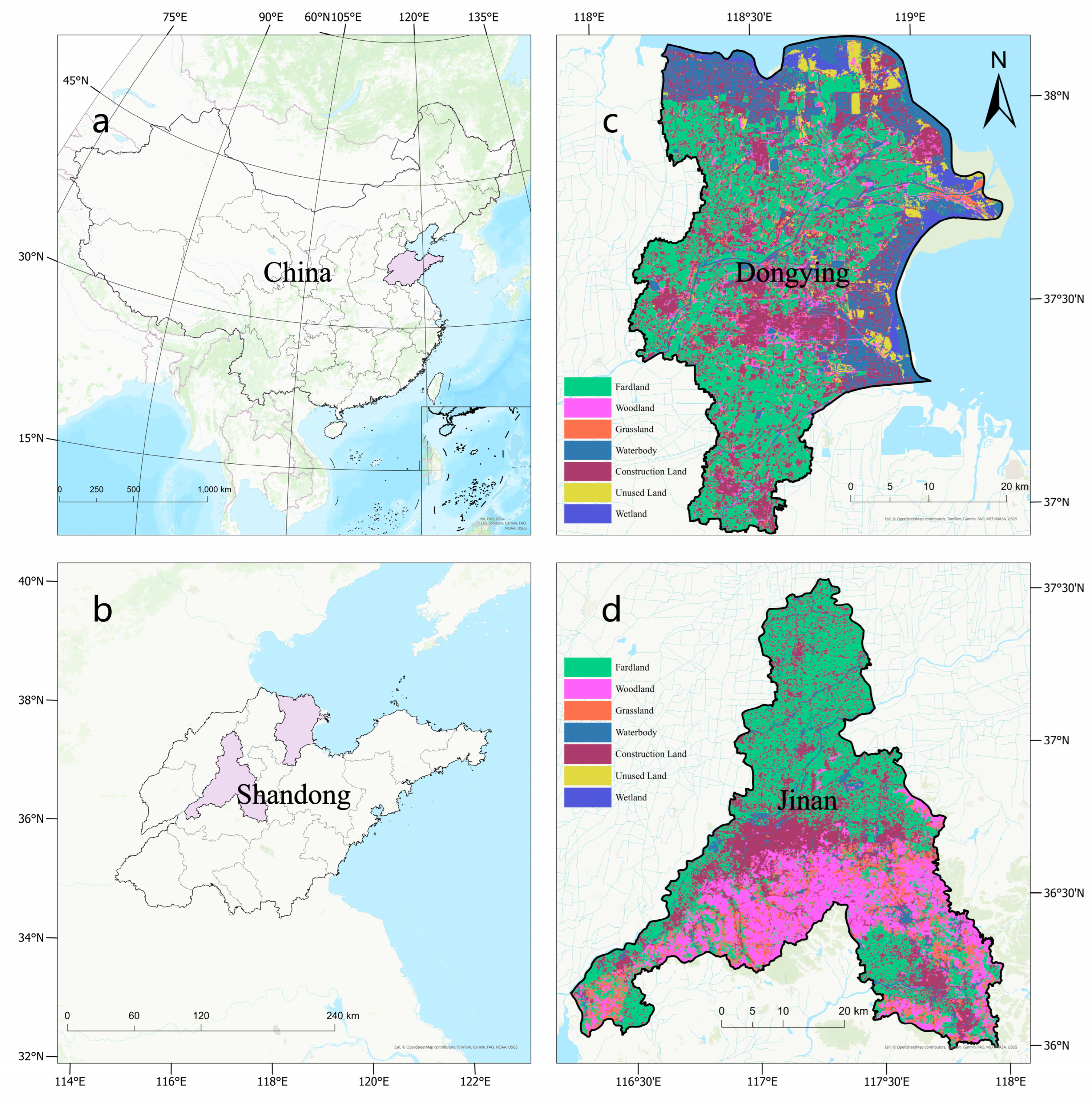
Figure 1. Overview of study area: (a) Shandong Province, China; (b) Dongying City and Jinan City, Shandong Province; (c) land cover data for Dongying City; (d) land cover data for Jinan City.
Applsci 16 05690 g001
Figure 2. Land sources of built-up land in Jinan during 2000–2010 (left) and 2010–2020 (right).
Applsci 16 05690 g002
Figure 3. Land sources of built-up land in Dongying during 2000–2010 (left) and 2010–2020 (right).
Applsci 16 05690 g003
Figure 4. Spatial distribution of urban expansion patterns and their area proportions in Jinan during 2000–2010 (left) and 2010–2020 (right). The legend’s color scheme is consistent across both the spatial distribution map and the area proportion pie chart.
Applsci 16 05690 g004
Figure 5. Spatial distribution of urban expansion patterns and their area proportions in Dongying during 2000–2010 (left) and 2010–2020 (right). The legend’s color scheme is consistent across both the spatial distribution map and the area proportion pie chart.
Applsci 16 05690 g005
Figure 6. Ecosystem service losses.
Applsci 16 05690 g006
Figure 7. Ecosystem service losses under different expansion patterns in Jinan.
Applsci 16 05690 g007
Figure 8. Trends in ecosystem service losses under three urban expansion patterns in Jinan.
Applsci 16 05690 g008
Figure 9. Ecosystem service losses under different expansion patterns in Dongying.
Applsci 16 05690 g009
Figure 10. Trends in ecosystem service losses under three urban expansion patterns in Dongying.
Applsci 16 05690 g010
Table 1. Land sources of new built-up land (km2).
City—Time PeriodFarmlandForest LandGrasslandWater AreaUnused LandWetland
Jinan—2000~20101106.88936.120142.35825.6190.4460.028
Jinan—2010~20201051.05457.59978.01857.7383.4350.000
Jinan—Difference−55.83521.479−64.34032.1192.989−0.028
Dongying—2000~2010621.05947.88810.49989.783177.77953.874
Dongying—2010~2020787.96188.56429.068173.85081.57353.508
Dongying—Difference 166.90240.67618.56984.067−96.206−0.366
Note: “Difference” = 2010–2020 value minus 2000–2010 value. Positive values indicate an increase, and negative values indicate a decrease.
Disclaimer/Publisher’s Note: The statements, opinions and data contained in all publications are solely those of the individual author(s) and contributor(s) and not of MDPI and/or the editor(s). MDPI and/or the editor(s) disclaim responsibility for any injury to people or property resulting from any ideas, methods, instructions or products referred to in the content.