1. Introduction
The ionosphere is a plasma region in the upper atmosphere of the Earth formed by ionization under solar radiation, and it constitutes an important component of the near-Earth space environment. Variations in the ionospheric state can affect the propagation velocity, propagation path, and signal phase of radio waves, thereby influencing systems such as navigation, positioning, and satellite communication. For example, ionospheric disturbances may degrade the positioning accuracy of the Global Positioning System (GPS) or affect the stability of satellite communication links [
1,
2]. Total Electron Content (TEC) is an important parameter for describing the ionospheric state. It represents the integral of electron density along the signal propagation path and is commonly expressed in TEC units (TECU). TEC can reflect the spatial distribution and dynamic variation characteristics of ionospheric electron density, and has therefore been widely used in ionospheric structure analysis and space weather monitoring [
3]. Accurate prediction of the spatiotemporal distribution of TEC is helpful for identifying ionospheric variation trends in advance, and provides important support for space weather research, navigation and positioning error correction, and the reliability assurance of satellite communication systems.
Existing TEC prediction methods can generally be classified into physical models, empirical or semi-empirical models, statistical and time-series models, and deep learning models. Physical models are based on theories of atmospheric physics and ionospheric electrodynamics, and can simulate the generation, transport, and loss processes of electron density in the ionosphere. These models are of great significance for understanding the mechanisms of ionospheric variation and the effects of space weather. For instance, the SAMI series models proposed by Huba et al. can be used to simulate the dynamic processes of the ionosphere/plasmasphere system [
4,
5], while the CTIPe model developed by Codrescu et al. can describe the coupled variations among the thermosphere, ionosphere, and plasmasphere [
6]. However, such models are usually computationally complex and strongly dependent on external driving parameters, such as solar radiation, geomagnetic activity, and neutral atmospheric conditions. Consequently, their application in real-time and high-accuracy prediction remains limited to some extent.
Empirical and semi-empirical models, such as the International Reference Ionosphere (IRI) and NeQuick models, describe the average state of the ionosphere by integrating long-term observational data with partial physical constraints [
7,
8]. Among them, the IRI model is mainly used to describe the climatological distributions of parameters such as ionospheric electron density, electron temperature, and ion temperature, whereas the NeQuick model can be used for electron density and TEC modeling and calculation. These models show good stability in representing the long-term average background state of the ionosphere, namely its climatological distribution. Nevertheless, their ability to characterize short-term disturbances, geomagnetic storm processes, and rapid local variations is limited.
Statistical and time-series models, such as the Autoregressive Integrated Moving Average (ARIMA) model, mainly achieve prediction by modeling the autocorrelation characteristics of historical TEC sequences. These models have the advantages of simple structure and relatively strong interpretability [
9]. For example, Wang et al. adopted an adaptive autoregressive model to predict global vertical TEC maps, demonstrating the applicability of autoregressive modeling in short-term global TEC prediction [
10]. However, TEC data exhibit pronounced nonlinearity, nonstationarity, and complex spatiotemporal coupling characteristics, and are jointly affected by multiple factors, including diurnal periodicity, seasonal variation, solar activity, and geomagnetic disturbances. Therefore, the prediction accuracy of traditional statistical models remains limited for long lead times and under complex disturbance conditions.
In recent years, deep learning methods have been widely applied to TEC prediction. According to the way spatial information is utilized, related methods can be roughly divided into prediction models mainly focused on temporal dependence modeling and prediction models based on joint spatiotemporal modeling. The former mainly use historical TEC sequences or their low-dimensional representations to learn the temporal evolution patterns of TEC, with typical models including Long Short-Term Memory (LSTM) and Gated Recurrent Unit (GRU) networks. LSTM alleviates the gradient vanishing problem of traditional recurrent neural networks in long-sequence modeling through gating mechanisms, and can effectively learn long-term dependencies in time series [
11]. GRU selectively retains and updates historical information through update and reset gates, reducing the number of model parameters while maintaining strong sequence modeling capability [
12]. Based on such time-series models, Liu et al. applied deep learning methods to global TEC prediction and incorporated auxiliary parameters related to solar and geomagnetic activities, thereby improving the model’s ability to characterize temporal variations in TEC [
13].
However, TEC not only exhibits obvious temporal correlation, but also has a complex spatial grid structure. To further model the spatiotemporal coupling characteristics of TEC, ConvLSTM, ConvGRU, and their improved variants have gradually been applied to TEC map prediction. The ConvLSTM proposed by Shi et al. replaces the fully connected operations in traditional LSTM with convolution operations, enabling the model to simultaneously characterize temporal dependencies and spatial neighborhood structures [
14]. In terms of global TEC prediction, Lin et al. constructed a spatiotemporal network model for global ionospheric TEC prediction, showing that the simultaneous utilization of temporal dependence and spatial distribution characteristics of TEC can improve prediction performance [
15]. Tang et al. proposed a CNN-LSTM-Attention model that combines the spatial feature extraction capability of CNN, the temporal modeling capability of LSTM, and the attention mechanism, while introducing space weather parameters such as Bz, Kp, Dst, and F10.7 for TEC prediction [
16]. Liu et al. further developed a ConvLSTM model to predict global TEC maps and compared it with the CODE C1pg product and the persistence method. Their results showed that a residual prediction strategy can improve the prediction performance of global TEC maps [
17]. In addition, Gao and Yao proposed a multi-channel ConvLSTM model for TEC prediction during geomagnetic storms [
18], Luo et al. proposed the SAM-ConvLSTM model to enhance long-term spatiotemporal dependence modeling [
19], and Tang et al. adopted a BiConvGRU model to predict regional TEC maps over China, verifying the effectiveness of convolutional gated recurrent structures in regional TEC map spatiotemporal prediction [
20]. Li et al. proposed an ED-AttConvLSTM model, which further improved TEC map prediction performance through an encoder–decoder architecture and adaptively weighted spatiotemporal features [
21]. Xue et al. proposed an RA-ConvLSTM model that integrates recurrent structures with an attention mechanism for global TEC prediction, further demonstrating the potential of combining attention mechanisms with ConvLSTM structures in global TEC map prediction [
22].
Although the above deep learning methods have achieved promising results in TEC prediction, there remains room for further improvement. First, TEC exhibits significant diurnal variation, and the TEC distribution at the same temporal phase on the previous day can often provide important background information for future TEC prediction. Previous studies have shown that residual prediction strategies can reduce the difficulty of directly predicting absolute TEC values [
17]. However, how to more fully exploit the periodic background information of TEC remains worthy of further investigation. If a model directly predicts future absolute TEC values, it must simultaneously learn the background distribution of TEC and its day-to-day variations, which may increase the difficulty of prediction. Second, global TEC maps are usually represented as latitude–longitude grids, and the spatial distribution of TEC and its prediction errors vary across different latitude and longitude regions. In particular, prediction accuracy in low-latitude and equatorial regions may show a certain degree of longitudinal dependence [
23]. Meanwhile, studies related to spherical convolution have pointed out that spherical or global grid data differ from ordinary two-dimensional planar images in terms of spatial topology, and directly applying conventional planar convolution may be insufficient for preserving global spatial structural characteristics [
24]. However, traditional convolution operations usually treat global TEC maps as ordinary two-dimensional planar images and adopt zero padding or conventional boundary padding at the edges. For global TEC maps, the longitude direction has an inherent closed continuity, and the −180° and 180° meridians are adjacent in physical space. Therefore, the longitudinal boundaries should be regarded as periodic boundaries rather than open image edges. Ignoring this physical and geometrical property may introduce artificial spatial discontinuities at the longitudinal boundaries, thereby affecting the model’s ability to learn the global spatial structure of TEC.
To address the above issues, this paper proposes an ED-ConvLSTM model for global TEC map prediction that integrates periodic-matched residual prediction with longitude-circular boundary-aware convolution, termed Longitude-Circular Periodic-Residual ED-ConvLSTM (LC-PR-EDConvLSTM). The proposed model first uses the TEC map at the same temporal phase on the previous day as a periodic background field, enabling the network to focus on learning the residual variation in future TEC relative to this periodic background, thereby reducing the difficulty of directly predicting absolute TEC values. Furthermore, considering the closed continuity of global TEC maps in the longitude direction, this study replaces the longitude boundary padding in standard convolution with periodic padding, allowing the model to preserve spatial continuity in the longitude direction during convolution operations. In this way, the model can simultaneously exploit the temporal periodic prior of TEC and the boundary continuity of the global spatial domain, thereby improving the spatiotemporal prediction accuracy of future TEC maps.
The main contributions of this paper are as follows:
- (1)
To address the diurnal variation characteristics of TEC, a periodic-matched residual prediction strategy is proposed. The TEC map at the same temporal phase on the previous day is used as a dynamic background field, allowing the model to focus on learning the day-to-day residual variation in future TEC relative to the periodic background.
- (2)
To account for the periodic continuity of global TEC maps in the longitude direction, longitude-circular boundary-aware convolution is introduced. Periodic padding is adopted along the longitude direction to alleviate the spatial information discontinuity caused by conventional convolution at the boundaries of global maps.
- (3)
An LC-PR-EDConvLSTM model is constructed, and comparative experiments and ablation analyses are conducted under high- and low-solar-activity years to verify the effectiveness of the proposed method.
The remainder of this paper is organized as follows.
Section 2 introduces the data sources and preprocessing methods.
Section 3 describes the architecture and key components of the proposed LC-PR-EDConvLSTM model in detail.
Section 4 presents the experimental settings, results, analysis, and discussion.
Section 5 concludes the paper.
2. Data and Preprocessing
The TEC data used in this study were obtained from the Global Ionospheric Map (GIM) products released by the Center for Orbit Determination in Europe (CODE) [
25,
26]. Specifically, the final CODE GIM product, denoted as CODG, was used as the observed TEC reference in this study. The GIM products are derived from global GNSS observations and provide global coverage with continuous temporal availability. They have been widely used in studies on ionospheric TEC distribution analysis and modeling [
3]. The data describe the global TEC distribution in the form of latitude–longitude grids under a geographic coordinate system, with latitudes ranging from −87.5° to 87.5° and longitudes ranging from −180° to 180°. The spatial resolutions in latitude and longitude are 2.5° and 5°, respectively, resulting in a total of 71 × 73 grid points. Therefore, the global TEC map at each epoch can be represented as two-dimensional gridded data.
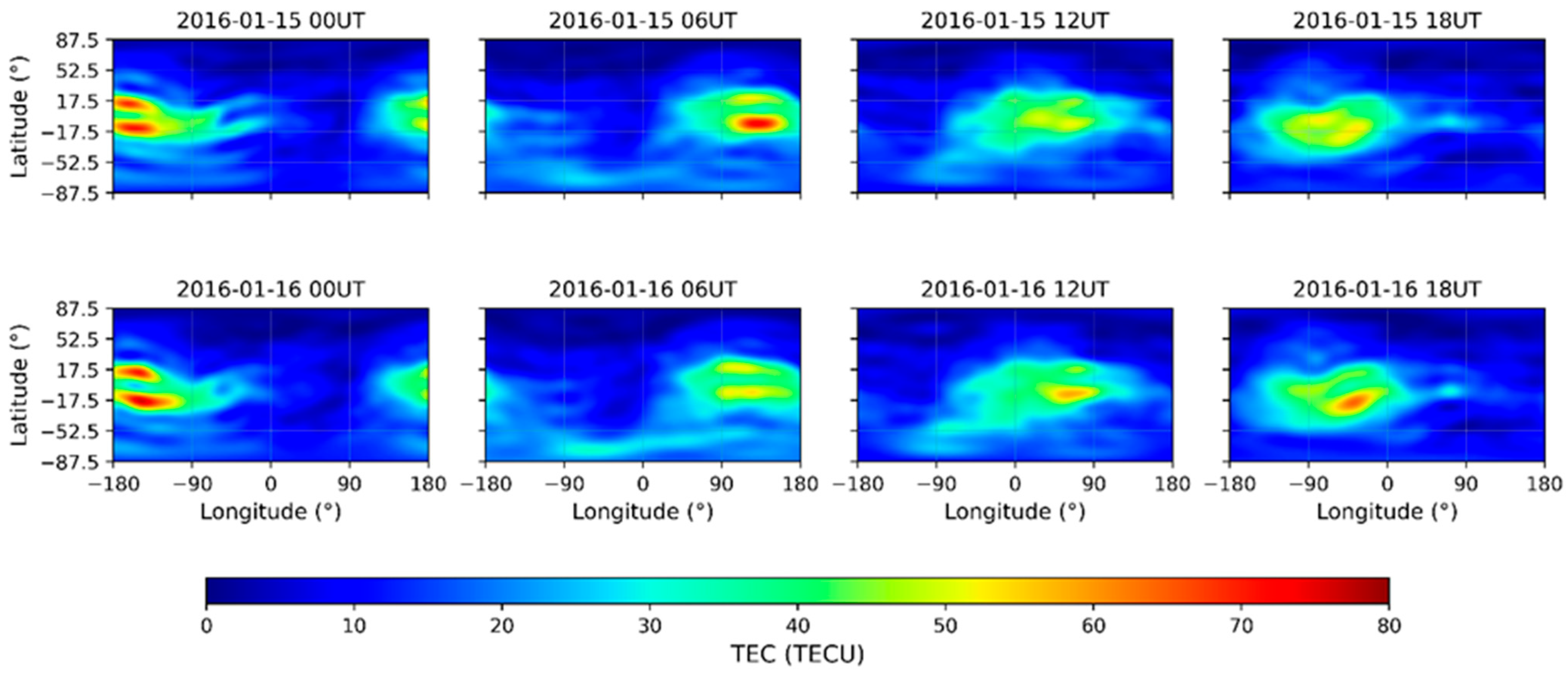
Figure 1 presents examples of global TEC distributions at different epochs over two consecutive days from the CODE GIM products. It can be observed that TEC exhibits pronounced latitudinal differences and enhanced values at low latitudes, and shows significant diurnal variations with changes in UT. Meanwhile, in the longitude direction, the −180° and 180° meridians correspond to the left and right boundaries of the global grid, respectively, and are continuous in physical space. Unlike some studies that transform TEC data into other coordinate systems [
27], this study directly models and predicts the TEC maps in the geographic coordinate system released by CODE. This approach preserves the consistency of the original data representation and further enables investigation of the periodic boundary characteristics of global TEC maps in the geographic longitude direction.
The temporal resolution of CODE GIM products varies across different time periods. Specifically, the data before 19 October 2014 have a temporal resolution of 2 h, whereas the data after that date have a temporal resolution of 1 h. Considering that the study period covers 2009–2019, TEC data with a unified 2 h resolution are used in all experiments to ensure a consistent temporal interval across all years. Accordingly, each day contains 12 TEC maps, corresponding to 00 UT, 02 UT, 04 UT, …, and 22 UT. In this study, only historical TEC map sequences are used as model inputs, without introducing external space weather indices such as F10.7, Kp, and Dst. This design is adopted to evaluate the model’s ability to predict future spatiotemporal TEC variations under TEC-only conditions. Although these external space weather indices are not used as model inputs, they are used in the event analysis to characterize the solar and geomagnetic background conditions and to evaluate the model response under disturbed ionospheric states.
Ionospheric TEC is significantly affected by the level of solar activity. The overall intensity, fluctuation amplitude, and spatiotemporal variation characteristics of TEC differ substantially across different phases of solar activity. The F10.7 index represents the solar radio flux at a wavelength of 10.7 cm and a frequency of 2800 MHz, and is commonly used as a proxy indicator for solar activity intensity [
28]. Compared with direct solar radiation quantities such as solar extreme ultraviolet radiation, which are difficult to observe continuously over long periods, the F10.7 index provides long-term, continuous, and stable observational records. Moreover, it shows good correlation with sunspot numbers and variations in solar radiation, and has therefore been widely used in ionospheric and space weather studies to characterize solar activity levels [
28]. The F10.7 index used in this study was obtained from the OMNI space weather dataset [
29].
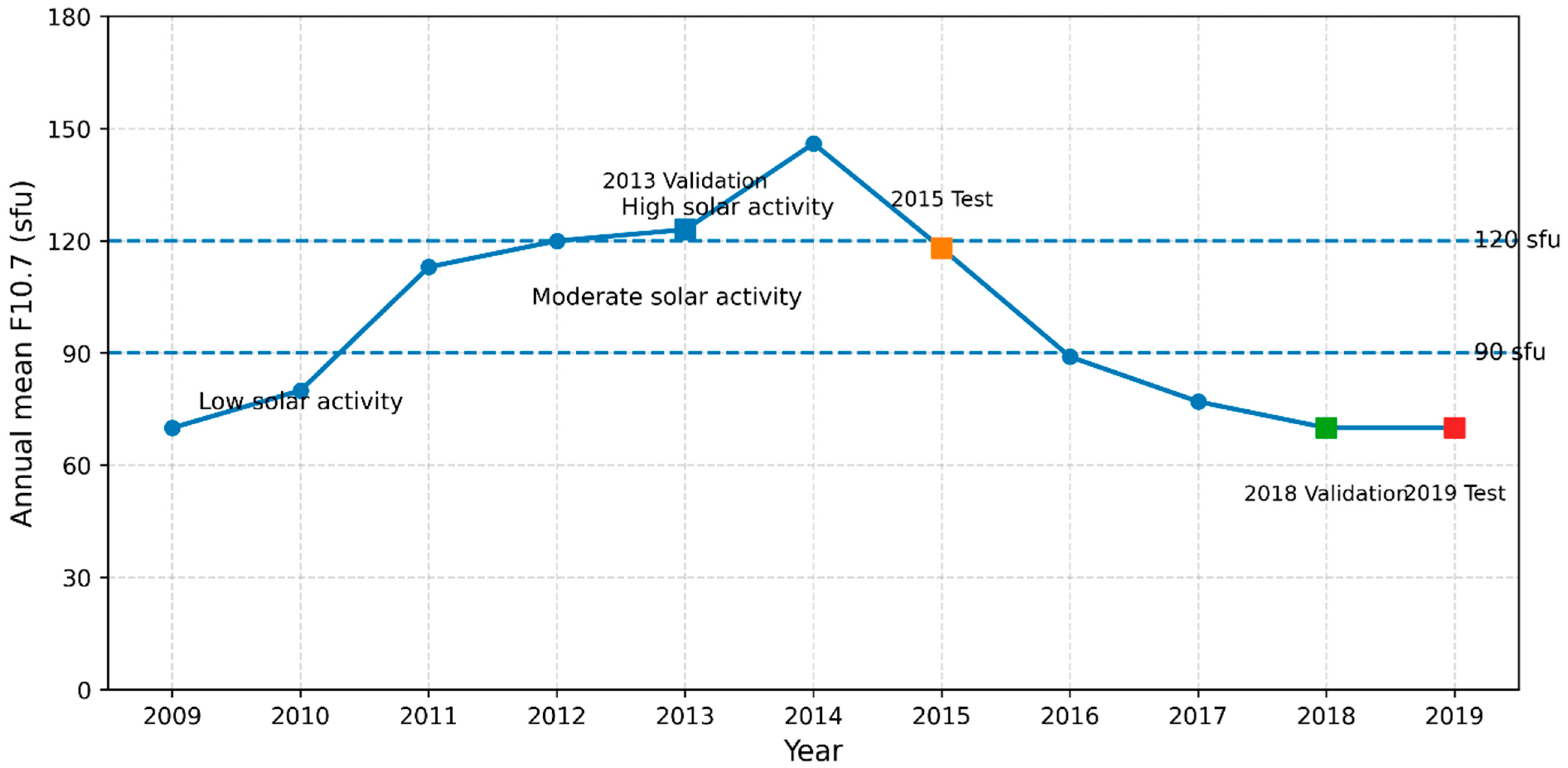
To improve the diversity and generalization capability of the training samples, the CODE TEC data from 2009 to 2019 were selected in this study. This period broadly covers the main phases of Solar Cycle 24, including the low-activity, ascending, high-activity, and declining phases, and therefore provides TEC variation samples under different solar activity conditions.
Figure 2 shows the variation in the annual mean F10.7 index from 2009 to 2019. It can be seen that the solar activity level was relatively low during 2009–2010. The F10.7 index then gradually increased and reached a relatively high level around 2014, before decreasing gradually and returning to a low-solar-activity phase during 2018–2019.
Considering that the test set should be independent of the model training process and should also reflect the prediction capability of the model under different solar activity levels, the year 2015 was selected as the test set representing relatively high solar activity, while 2019 was selected as the test set representing low solar activity. The years 2013 and 2018 were used as validation sets under relatively high and low solar activity conditions, respectively. The remaining years, namely 2009–2012, 2014, and 2016–2017, were used for model training. With this partitioning strategy, the training set covers different phases of the solar activity cycle, while the validation and test sets can be used to evaluate the generalization capability of the model under different solar activity conditions.
Before model training, the TEC data were first subjected to normalization and standardization. The normalization and standardization parameters were calculated only from the training set and then uniformly applied to the validation and test sets. This procedure was adopted to avoid information leakage from the validation and test sets and to ensure the objectivity and comparability of evaluation results across different datasets.
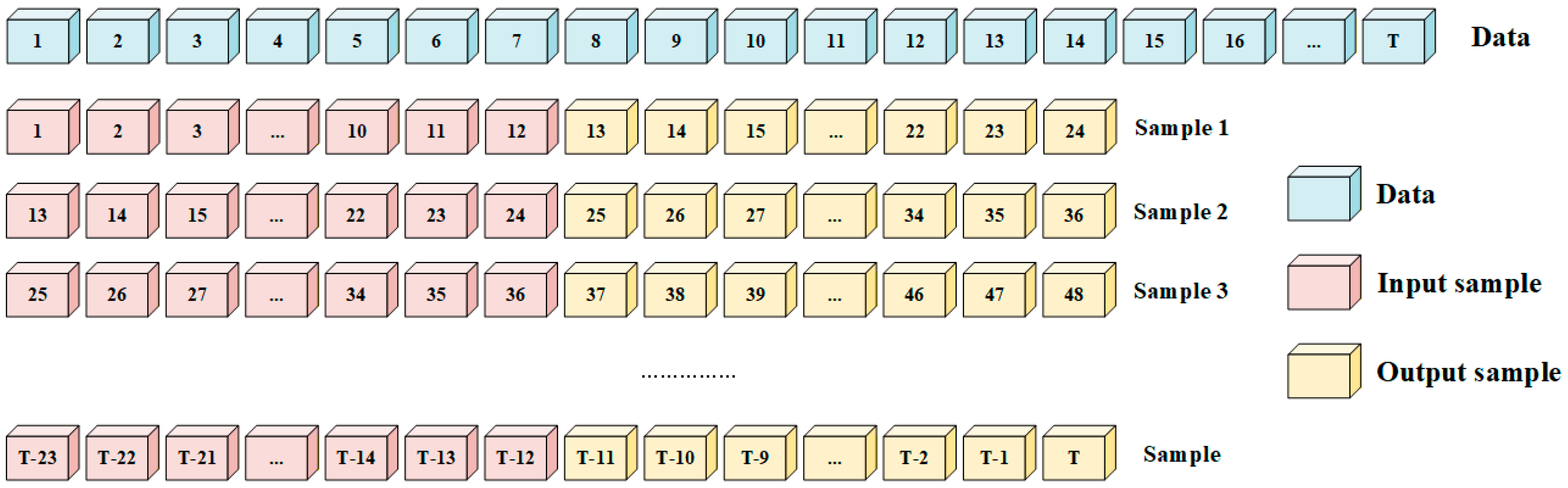
During sample construction, a sliding-window strategy was adopted to generate the input–output sequences. The TEC data used in this study have a temporal resolution of 2 h, with each day containing 12 TEC maps corresponding to 00 UT, 02 UT, 04 UT, …, and 22 UT. For each sample, the model input consists of 12 TEC maps from the previous day, while the prediction target consists of 12 TEC maps for the following day. The sliding step was set to 1 day, meaning that the starting positions of two adjacent samples differ by 12 time steps. The sample construction process is illustrated in
Figure 3.
It should be noted that samples were constructed only within the continuous time periods corresponding to the same dataset, without crossing the year boundaries between the training, validation, and test sets. For example, in the training set, the periods 2009–2012 and 2016–2017 were each treated as continuous time segments for sample construction, while the year 2014 was processed separately. The samples generated from these different periods were then merged to form the final training set. The year partitioning and number of samples for each dataset are listed in
Table 1.
3. Methods
3.1. Overall Model Framework
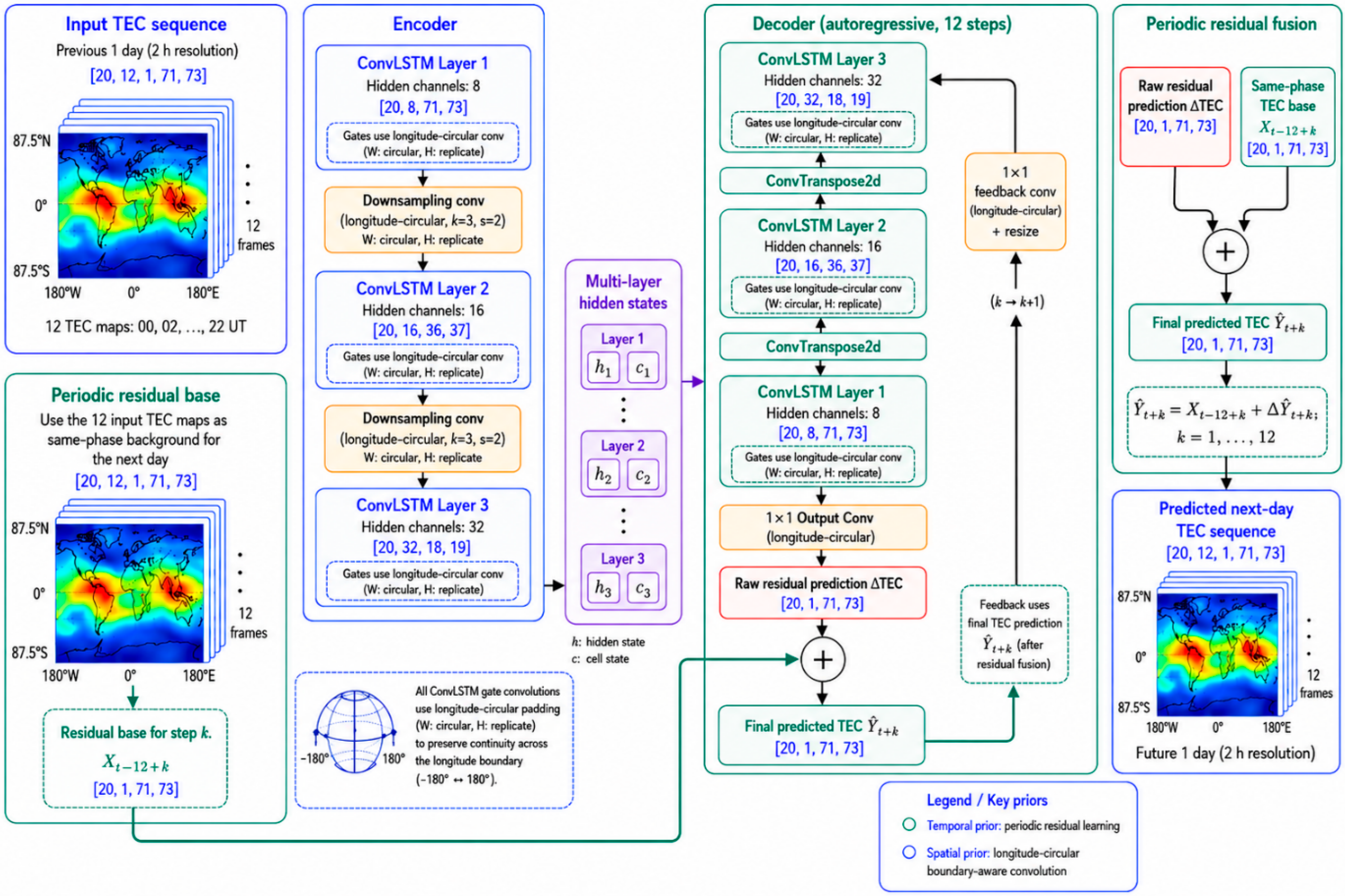
The architecture of the proposed LC-PR-EDConvLSTM model is shown in
Figure 4. The model takes the global TEC map sequence from the previous day as input and predicts the TEC map sequence for the following day. Since TEC data with a temporal resolution of 2 h are used in this study, both the input and output sequences contain 12 TEC maps. The overall model consists of three components: an encoder, a decoder, and a periodic-matched residual fusion module. The encoder is used to extract multi-level spatiotemporal features from the input TEC sequence, while the decoder progressively generates residual predictions for the next 12 time steps in an autoregressive manner. The periodic-matched residual fusion module then adds the residual terms output by the decoder to the TEC background field at the same temporal phase on the previous day, thereby obtaining the final TEC prediction results. In addition, longitude-circular boundary-aware convolution is introduced into the gated convolutions of ConvLSTM and the downsampling convolutions of the encoder to enhance the model’s ability to capture the longitudinal continuity of global TEC maps.
3.2. Longitude-Circular Boundary-Aware Convolution
Global TEC maps are typically represented as geographic latitude–longitude grids. In the longitude direction, the −180° and 180° meridians are adjacent in physical space; therefore, global TEC maps exhibit inherent periodic continuity along the longitude direction. Previous studies on spherical convolution have indicated that spherical or global gridded data differ from ordinary planar images in terms of spatial topology, and directly applying conventional planar convolution may be insufficient to preserve global spatial structural characteristics [
24]. However, standard two-dimensional convolution usually adopts zero padding or conventional padding at image boundaries, which treats the left and right boundaries of a global TEC map as discontinuous edges and may lead to insufficient modeling of spatial information near the longitudinal boundaries.
To address this issue, longitude-circular boundary-aware convolution is introduced by imposing a periodic boundary condition along the longitude direction. Similar longitude-periodic treatments have been adopted in data-driven global geophysical prediction tasks on latitude–longitude grids [
30]. With this design, convolution kernels near one longitudinal boundary can use grid cells from the opposite boundary as neighboring information, allowing continuous spatial features to be extracted across the −180°/180° boundary. This treatment is consistent with the closed longitudinal topology of global TEC maps, while no circular connection is imposed along the latitude direction because the northern and southern boundaries are not physically adjacent.
Let the input feature map be denoted as F, with a shape of [B,C,H,W], where B represents the batch size, C denotes the number of feature channels, and H and W represent the numbers of grid points in the latitude and longitude directions, respectively. For the original TEC input, C = 1; in the intermediate layers of the network, C corresponds to the number of feature channels extracted by convolution. For a convolution operation with a kernel size of k, periodic padding is first applied along the longitude direction:
That is, the features outside the left boundary are supplemented by those from the right boundary, while the features outside the right boundary are supplemented by those from the left boundary. Since the latitude direction does not have periodic closed continuity, replication padding is adopted along the latitude direction:
Finally, the longitude-circular boundary-aware convolution can be expressed as:
In the model implementation, this convolution is applied to the gated convolutions inside the ConvLSTM units, including the input convolutions and hidden-state convolutions of the forget gate, input gate, candidate memory cell, and output gate. In addition, the convolutions used for spatial downsampling in the encoder also adopt the proposed longitude-circular boundary-aware convolution. In this way, the longitudinal continuity of global TEC maps can be preserved during spatiotemporal feature extraction, avoiding the unrealistic spatial discontinuities introduced by conventional convolution at the longitudinal boundaries.
3.3. Encoder–Decoder ConvLSTM Architecture
The Encoder–Decoder ConvLSTM architecture is adopted to model the spatiotemporal features of TEC map sequences. The encoder consists of three ConvLSTM layers with hidden channel numbers of 8, 16, and 32, respectively. The input sequence has a shape of [20, 12, 1, 71, 73], where 20 denotes the batch size, 12 represents the 12 input time steps, 1 indicates the TEC channel, and 71 and 73 represent the numbers of grid points in the latitude and longitude directions, respectively.
In the encoder, the first ConvLSTM layer preserves the original spatial resolution, while the subsequent layers reduce the spatial resolution through downsampling convolutions with a stride of 2. Different from the conventional ED-ConvLSTM, the downsampling convolutions in the proposed model adopt longitude-circular boundary-aware convolution to preserve the longitudinal continuity of global TEC maps. The hidden and memory states generated by the encoder are then used as the initial states of the decoder.
The decoder consists of three ConvLSTM layers arranged in the reverse hierarchical order of the encoder, and the spatial resolution is progressively restored through transposed convolution, upsampling, and size alignment operations. A 1 × 1 output convolution is finally used to map the decoded features into a single-channel residual prediction map. The decoder generates predictions for the next 12 time steps in an autoregressive manner. At each prediction step, the residual prediction is fused with the periodic background field to obtain the final TEC prediction, which is then fed back to the decoder as the input for the next prediction step.
3.4. Periodic-Matched Residual Fusion Strategy
TEC exhibits pronounced diurnal variation, and the TEC distributions at the same temporal phase on adjacent days usually show strong similarity. Therefore, this study adopts a periodic-matched residual prediction strategy, in which the TEC map at the same temporal phase on the previous day is used as a periodic background field. In this way, the model focuses on learning the residual variation in future TEC relative to this background field.
Since TEC data with a temporal resolution of 2 h are used in this study, each day contains 12 TEC maps. For the input sequence:
The prediction target is defined as:
At the k-th future prediction time step, the TEC map corresponding to the same temporal phase in the input sequence, X
t−12+k, is selected as the periodic background field, where k = 1, 2, …, 12. The decoder first outputs the residual term of the future TEC relative to this periodic background:
where f
θ(k)(·) denotes the nonlinear mapping learned by the model from the historical TEC sequence X to the residual prediction ΔŶ
t+k at the k-th forecasting step, and θ represents the learnable parameters of the model. Subsequently, the residual prediction is added to the periodic background field to obtain the final TEC prediction:
Unlike periodic persistence prediction, in which Ŷt+k = Xt−12+k, the proposed method further learns a residual correction term based on the periodic background field. Therefore, it can simultaneously exploit the diurnal periodic prior of TEC and the day-to-day variation information.
In the multi-step prediction process, the decoder generates the predictions for the next 12 future time steps in an autoregressive manner. After the final prediction Ŷ
t+k is obtained at each step, it is mapped into the decoder input feature space through a feedback convolution and then used as the input for the next prediction step:
Therefore, the information fed back to the next prediction step is the complete TEC prediction after residual fusion, rather than the original residual term ΔŶt+k. This design helps maintain the continuity of TEC state information during the recursive prediction process.
3.5. Evaluation Metrics
To comprehensively evaluate the TEC prediction performance of the model, this study adopts the mean absolute error (MAE), root mean square error (RMSE), correlation coefficient (CC), and coefficient of determination (R
2) as evaluation metrics. MAE and RMSE are used to measure the numerical errors between the predicted and observed TEC values, CC is used to quantify the linear correlation between the predictions and observations, and R
2 is used to evaluate the ability of the model to explain TEC variations. These evaluation metrics are defined as follows:
Here, Ŷi and Yi denote the predicted and observed TEC values at the i-th grid point or sample, respectively; mean(Ŷ) and mean(Y) denote the mean values of the predicted and observed TEC, respectively; and N represents the total number of samples used for evaluation, including all test samples, forecast time steps, and spatial grid points. Smaller MAE and RMSE values indicate lower prediction errors. A CC value closer to 1 indicates a stronger correlation between the predicted and observed results, while an R2 value closer to 1 indicates a stronger ability of the model to explain TEC variations.
4. Results and Discussion
4.1. Experimental Setup
All deep learning models in this study were implemented using the PyTorch framework and were trained and tested under the same experimental environment. The experiments were conducted on an NVIDIA GeForce RTX 4060 Ti GPU with 16 GB of memory. The software environment included Python 3.11.2, PyTorch 2.2.0+cu118, CUDA 11.8, and cuDNN 8.7.0. To ensure a fair comparison, all models used the same dataset partitioning strategy, input–output sequence length, data preprocessing procedure, and evaluation metrics.
During training, the batch size was set to 20. The input and output tensors both had a shape of [20, 12, 1, 71, 73], where 12 denotes the 12 TEC maps within one day from 00 UT to 22 UT at 2 h intervals, 1 denotes the single TEC channel, and 71 and 73 represent the numbers of grid points in the latitude and longitude directions, respectively. The Adam optimizer was used with an initial learning rate of 0.0005, and a cosine learning-rate decay strategy was adopted. The mean squared error (MSE) was used as the loss function. The maximum number of training epochs was set to 100, and early stopping was applied when the validation loss did not decrease for 20 consecutive epochs. For all models, MAE, RMSE, CC, and R2 were calculated after inverse standardization and inverse normalization of the prediction results, where CC denotes the correlation coefficient and R2 denotes the coefficient of determination.
To improve reproducibility, the random seed was fixed at 1234 for Python random, NumPy, and PyTorch. In addition, torch.backends.cudnn.benchmark was set to False, and torch.backends.cudnn.deterministic was set to True to reduce randomness caused by automatic algorithm selection in cuDNN.
4.2. Overall Prediction Performance and Ablation Analysis
To verify the effectiveness of the proposed LC-PR-EDConvLSTM model, comparative experiments were first conducted from three aspects: overall prediction performance, residual prediction strategy, and longitude-circular boundary-aware convolution. The comparison of overall prediction performance was used to evaluate the advantages of the proposed model over operational forecast products and other deep learning models. The ablation study on the residual prediction strategy was conducted to analyze the influence of different residual baselines on TEC prediction results. The ablation study on longitude-circular boundary-aware convolution was performed to verify the effectiveness of modeling the periodic boundary in the global longitude direction.
4.2.1. Overall Prediction Performance Analysis
To evaluate the overall prediction performance of the proposed LC-PR-EDConvLSTM model, it was compared with C1pg, ED-ConvGRU, and ED-ConvLSTM. Among them, C1pg is the 1-day global TEC forecast product released by CODE, while ED-ConvGRU and ED-ConvLSTM are typical deep learning models for spatiotemporal sequence prediction.
It should be noted that the original C1pg product has a temporal resolution of 1 h, whereas the output of the proposed model has a temporal resolution of 2 h. To ensure a fair comparison, temporal alignment was performed for C1pg. Specifically, TEC maps at corresponding epochs were extracted from the C1pg product at 2 h intervals, retaining 12 epochs from 00 UT, 02 UT, 04 UT, …, to 22 UT. In this way, C1pg was made consistent with the output sequence of the proposed model in terms of temporal resolution and forecast length. The overall prediction results of different models on the 2015 high-solar-activity test set and the 2019 low-solar-activity test set are shown in
Table 2.
As shown in
Table 2, LC-PR-EDConvLSTM achieves the best performance in both test years. For the 2015 high-solar-activity test set, it obtains the lowest MAE and RMSE values of 2.49 TECU and 3.68 TECU, respectively, and the highest CC and R
2 values of 0.974 and 0.949. These results indicate that the proposed model provides lower prediction errors and better agreement with the observed TEC distributions than the comparison models under high-solar-activity conditions.
For the 2019 low-solar-activity test set, LC-PR-EDConvLSTM also achieves the lowest MAE and RMSE values of 0.90 TECU and 1.37 TECU, respectively, with CC and R2 values of 0.974 and 0.948. Compared with C1pg and ED-ConvLSTM, the RMSE is reduced by approximately 7.43% and 12.18%, respectively. This further confirms the advantage of the proposed model under low-solar-activity conditions. The prediction errors of all models are higher in 2015 than in 2019, mainly because stronger solar activity leads to higher TEC intensity, larger spatial gradients, and stronger temporal fluctuations.
As shown in
Figure 2, the F10.7 index was used to distinguish different solar activity levels. To further evaluate the model performance under an intermediate solar activity condition, an additional out-of-sample test was conducted for the continuous one-year period from 1 July 2021 to 30 June 2022. The mean F10.7 index during this period was 103.14 sfu, which lies between the low- and high-solar-activity levels indicated in
Figure 2. Therefore, this period can be regarded as a moderate-solar-activity condition. It should be noted that this period was not included in the original 2009–2019 training, validation, or test datasets, and the trained models were directly applied without retraining or fine-tuning.
As shown in
Table 3, LC-PR-EDConvLSTM achieves the best performance during the moderate-solar-activity period, with MAE and RMSE values of 1.78 TECU and 2.73 TECU, respectively. Compared with C1pg, the RMSE decreases from 2.92 TECU to 2.73 TECU. Compared with ED-ConvLSTM, the RMSE decreases from 3.00 TECU to 2.73 TECU. In addition, LC-PR-EDConvLSTM obtains the highest CC and R
2 values, reaching 0.977 and 0.954, respectively. These results indicate that the proposed model maintains its advantage not only under the high-solar-activity condition in 2015 and the low-solar-activity condition in 2019, but also under the additional moderate-solar-activity out-of-sample period.
Overall, the results in
Table 2 and
Table 3 demonstrate that LC-PR-EDConvLSTM consistently outperforms the comparison models under different solar activity conditions. The prediction errors increase with stronger solar activity and larger TEC variability, but the proposed model maintains stable prediction performance and better agreement with the observed TEC distributions across high, moderate, and low solar activity conditions.
4.2.2. Ablation Analysis of the Residual Prediction Strategy
To verify the effectiveness of the periodic-matched residual prediction strategy, this study compares several residual prediction schemes based on the ED-ConvLSTM model, including Last Residual ED-ConvLSTM (LR-EDConvLSTM), Recursive Residual ED-ConvLSTM (RR-EDConvLSTM), and Periodic Residual ED-ConvLSTM (PR-EDConvLSTM). In LR-EDConvLSTM, the last TEC map of the input sequence is used as the residual background for all future forecasting steps. In RR-EDConvLSTM, the TEC map predicted at the previous forecasting step is used as the residual background for the next forecasting step. In contrast, PR-EDConvLSTM adopts the periodic-matched residual strategy described in
Section 3.4, in which the TEC map at the same temporal phase on the previous day is selected as the periodic background for each forecasting step. In addition, Periodic Persistence is used as a non-learning baseline method. This method directly takes the TEC map at the same temporal phase on the previous day as the future prediction result, and is used to evaluate the predictive capability of the diurnal periodic background itself. The evaluation results of different residual prediction strategies on the 2015 high-solar-activity test set and the 2019 low-solar-activity test set are shown in
Table 4.
As shown in
Table 4, PR-EDConvLSTM achieves the best performance in both test years. In 2015, its MAE and RMSE are 2.57 TECU and 3.81 TECU, respectively, which are lower than those of ED-ConvLSTM. In 2019, PR-EDConvLSTM also obtains the lowest MAE and RMSE values of 0.92 TECU and 1.40 TECU, respectively, with the RMSE reduced by approximately 10.26% compared with ED-ConvLSTM. The improved CC and R
2 values in both years indicate that the periodic-matched residual strategy not only reduces numerical prediction errors, but also improves the consistency between the predicted and observed TEC distributions.
The results of Periodic Persistence further reflect the dependence of TEC prediction on solar activity conditions. In 2019, its RMSE is 1.54 TECU, which is slightly lower than that of ED-ConvLSTM, indicating that TEC has strong diurnal repeatability during low-solar-activity periods and that the same-phase TEC map from the previous day has useful predictive information. However, in 2015, the RMSE of Periodic Persistence increases to 4.36 TECU, showing that the previous-day TEC map alone cannot adequately represent day-to-day variations and short-term disturbances under high-solar-activity conditions. This comparison supports the need to learn a residual correction term on the basis of the periodic background.
The comparison among residual learning schemes also shows that the choice of residual background is important. LR-EDConvLSTM improves over ED-ConvLSTM, suggesting that residual prediction can reduce the difficulty of directly predicting absolute TEC values. However, because it uses the last input frame as a unified background for all future steps, it ignores the diurnal phase differences among different forecast times. RR-EDConvLSTM performs worse than ED-ConvLSTM in both years, indicating that using the previous prediction as the residual background may introduce error accumulation during multi-step forecasting.
Overall, PR-EDConvLSTM provides each forecasting step with a periodic background field corresponding to the same temporal phase on the previous day, enabling the model to focus on learning day-to-day residual variations. The results confirm that the periodic-matched residual prediction strategy is more suitable for one-day-ahead global TEC map forecasting than periodic persistence, last-frame residual prediction, and recursive residual prediction.
4.2.3. Ablation Analysis of the Longitude-Circular Boundary-Aware Convolution Module
To verify the role of longitude-circular boundary-aware convolution in global TEC map prediction, this study introduces this convolution into the ED-ConvLSTM and PR-EDConvLSTM frameworks, respectively, and compares them with the corresponding models using conventional convolution. Specifically, Longitude-Circular ED-ConvLSTM (LC-EDConvLSTM) denotes the model that incorporates only longitude-circular boundary-aware convolution without using the periodic-matched residual strategy. LC-PR-EDConvLSTM denotes the final model that combines both longitude-circular boundary-aware convolution and periodic-matched residual prediction. The evaluation results of different models on the 2015 high-solar-activity test set and the 2019 low-solar-activity test set are shown in
Table 5.
As shown in
Table 5, LC-EDConvLSTM outperforms ED-ConvLSTM in both test years when the periodic-matched residual strategy is not used. The RMSE decreases from 4.00 TECU to 3.94 TECU in 2015 and from 1.56 TECU to 1.48 TECU in 2019, while the CC and R
2 values also increase slightly. These results indicate that longitude-circular boundary-aware convolution itself can improve the ability of ED-ConvLSTM to model the spatial structure of global TEC maps.
Under the periodic-matched residual framework, introducing longitude-circular boundary-aware convolution further improves prediction performance. Compared with PR-EDConvLSTM, LC-PR-EDConvLSTM reduces the RMSE from 3.81 TECU to 3.68 TECU in 2015 and from 1.40 TECU to 1.37 TECU in 2019. The CC and R2 values are also improved in both years, indicating that the proposed boundary-aware convolution enhances the agreement between predicted and observed TEC maps.
Compared with the original ED-ConvLSTM, the final LC-PR-EDConvLSTM model reduces the RMSE by approximately 8.00% in 2015 and 12.18% in 2019. These results demonstrate that periodic-matched residual prediction and longitude-circular boundary-aware convolution play complementary roles. The former exploits the diurnal background information of TEC from the temporal perspective, while the latter preserves the longitudinal continuity of global TEC maps from the spatial perspective.
The improvement obtained by longitude-circular boundary-aware convolution is physically reasonable because the −180° and 180° meridians are adjacent in physical space. Conventional convolution treats the left and right longitude boundaries as discontinuous edges, whereas the proposed convolution uses periodic padding along the longitude direction to extract continuous spatial features across the longitudinal boundary. Overall, the ablation results confirm the effectiveness of longitude-circular boundary-aware convolution in global TEC map forecasting.
4.3. Prediction Performance at Different Forecasting Epochs
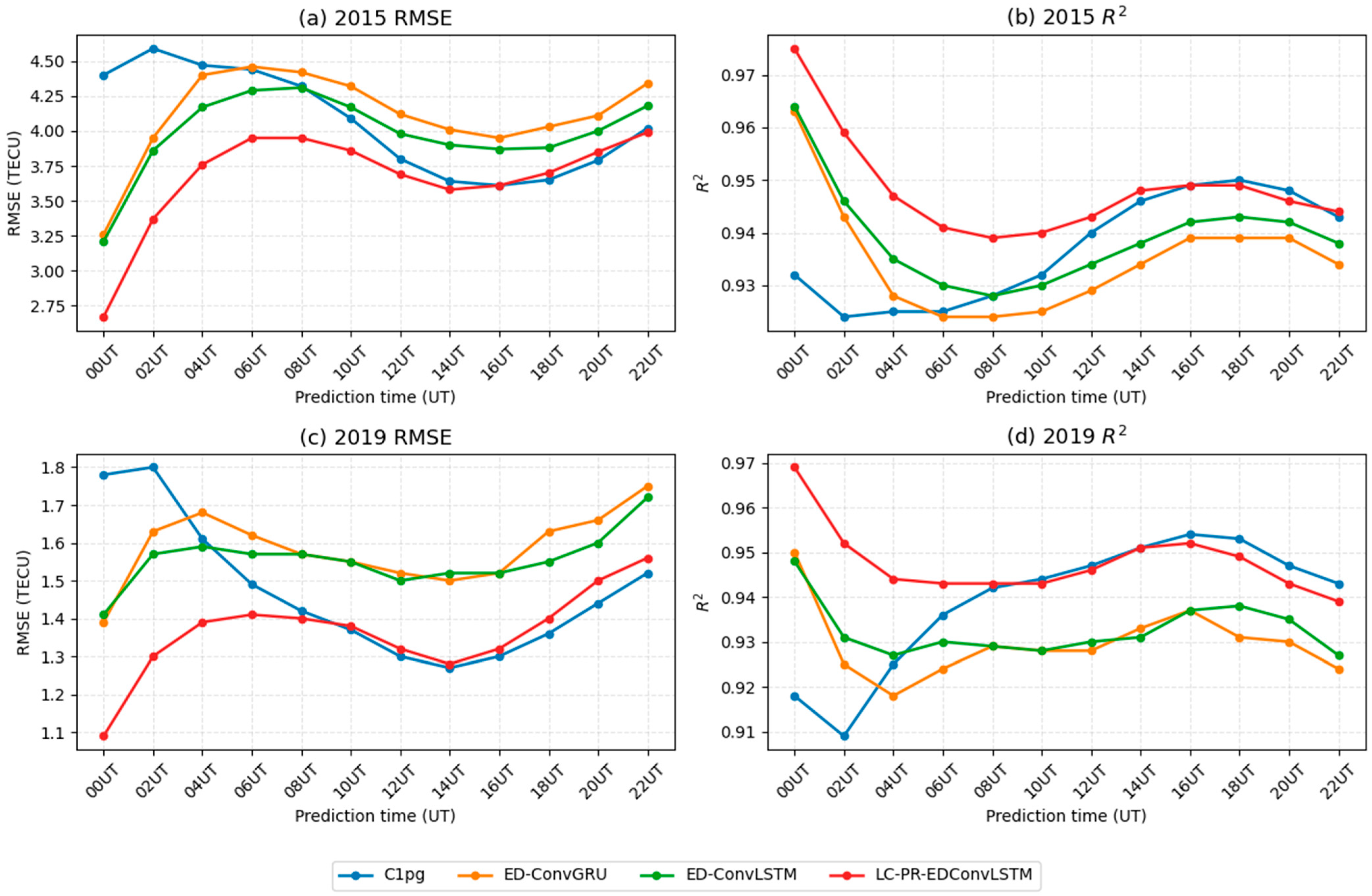
To further analyze the performance of different models at each epoch within the forecasting day, this study calculates the RMSE and R
2 at 12 forecasting epochs, namely 00 UT, 02 UT, 04 UT, …, and 22 UT. Since the effectiveness of the periodic-matched residual prediction strategy and the longitude-circular boundary-aware convolution has already been verified through the ablation experiments in
Section 4.2, this section only compares C1pg, ED-ConvGRU, ED-ConvLSTM, and the final proposed model, LC-PR-EDConvLSTM. The variations in RMSE and R
2 of different models at each forecasting epoch on the 2015 and 2019 test sets are shown in
Figure 5.
As shown in
Figure 5a,b, LC-PR-EDConvLSTM achieves lower RMSE and higher R
2 values than the comparison models at most forecasting epochs in the high-solar-activity year of 2015. The advantage is particularly evident at early epochs such as 00 UT, 02 UT, and 04 UT. For example, at 00 UT, the RMSE of LC-PR-EDConvLSTM is 2.67 TECU, which is lower than those of C1pg, ED-ConvGRU, and ED-ConvLSTM. Meanwhile, its R
2 values at 00 UT and 02 UT reach 0.975 and 0.959, respectively. These results indicate that the proposed model can better characterize intra-day TEC variations under high-solar-activity conditions.
For the low-solar-activity year of 2019,
Figure 5c,d show that LC-PR-EDConvLSTM maintains lower RMSE and higher or comparable R
2 values at most forecasting epochs, especially from 00 UT to 08 UT. At 00 UT, its RMSE is 1.09 TECU, lower than those of C1pg, ED-ConvGRU, and ED-ConvLSTM. In the second half of the day, C1pg shows competitive performance at some epochs, suggesting that the operational forecast product remains effective when TEC variations are relatively stable. Nevertheless, LC-PR-EDConvLSTM still achieves the best overall annual performance in 2019, indicating stronger comprehensive prediction capability.
Overall, the epoch-wise comparison shows that LC-PR-EDConvLSTM maintains stable prediction performance across different forecasting epochs. This suggests that the periodic-matched residual strategy provides useful same-phase diurnal background information, while longitude-circular boundary-aware convolution helps preserve the spatial continuity of global TEC maps.
4.4. Analysis of Prediction Results Under Typical Space Weather Conditions
To further analyze the prediction capability of the model under complex space weather conditions, this study selects two typical scenarios for case analysis: a strong solar activity day and an intense geomagnetic storm event. The F10.7 index is used to characterize the level of solar activity [
28], while the Dst index is used to characterize geomagnetic disturbances and storm intensity [
31]. It should be noted that space weather indices such as F10.7 and Dst are used only for typical event selection and background description, and are not used as input features for the proposed model.
4.4.1. Analysis of Prediction Results on a Strong Solar Activity Day
To analyze the spatial prediction capability of the model under strong solar activity conditions, 22 June 2015 was selected as a typical strong solar activity day for case analysis. On this day, the F10.7 index reached 255 sfu, indicating a high level of solar radiative activity [
28]. For this forecasting day, the model input consisted of 12 TEC maps from 00 UT to 22 UT on 21 June 2015, while the prediction target consisted of 12 TEC maps from 00 UT to 22 UT on 22 June 2015.
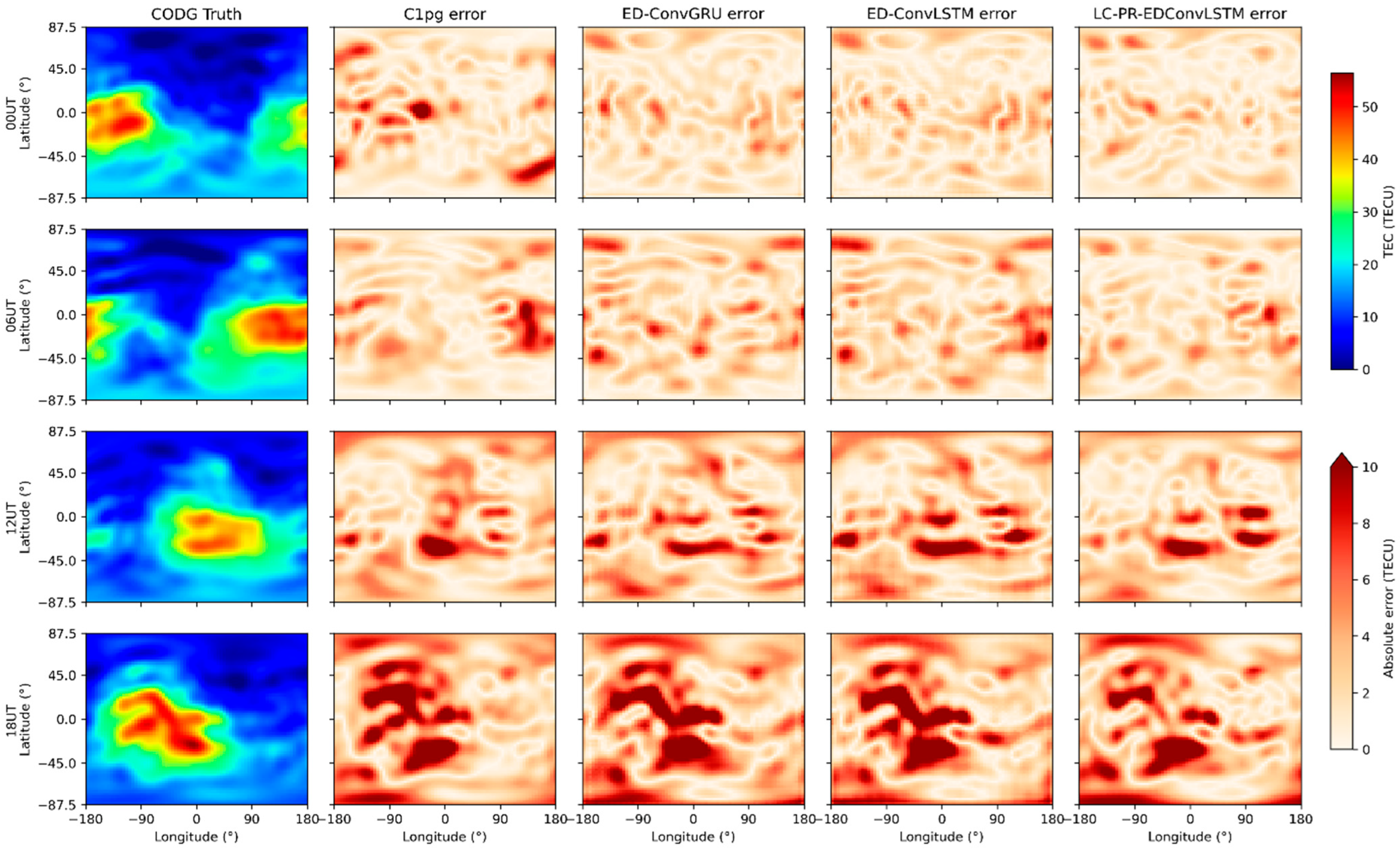
As shown in
Figure 6, the prediction error distributions of C1pg, ED-ConvGRU, ED-ConvLSTM, and LC-PR-EDConvLSTM are presented at four representative epochs, namely 00 UT, 06 UT, 12 UT, and 18 UT, on this day. The first column shows the observed TEC distribution from CODG, while the second to fifth columns show the absolute error distributions of different models relative to the observed TEC. It can be seen that, under strong solar activity conditions, the overall TEC level is relatively high, with evident TEC enhancement structures in low-latitude regions. In addition, the spatial distributions vary considerably among different epochs, indicating strong spatiotemporal complexity in TEC variations on this day.
From the spatial error distributions, C1pg, ED-ConvGRU, and ED-ConvLSTM exhibit relatively large errors in low-latitude high-TEC regions and areas with strong spatial gradients. In contrast, LC-PR-EDConvLSTM shows generally smaller errors, with a reduced extent of high-error regions. This indicates that the proposed model can better preserve the main spatial structures of TEC under strong solar activity conditions. In particular, at 00 UT and 06 UT, the error distributions of LC-PR-EDConvLSTM are overall lighter, suggesting that the proposed model has good spatial prediction capability during the early stage of the forecasting day.
At 12 UT and 18 UT, the low-latitude high-value regions in the observed TEC distribution become more pronounced, and the spatial gradients are further enhanced. As a result, the prediction errors of all models increase to some extent. In particular, at 18 UT, several models show large errors in the low-latitude enhancement regions, indicating that high-TEC regions and strong-gradient areas under strong solar activity conditions remain major challenges for TEC prediction. Nevertheless, the error distribution of LC-PR-EDConvLSTM remains relatively smoother, suggesting that the combination of the periodic-matched residual strategy and longitude-circular boundary-aware convolution helps improve the prediction stability of the model under complex TEC spatial structures.
As shown in
Table 6, LC-PR-EDConvLSTM achieves the best performance across all four metrics, namely MAE, RMSE, CC, and R
2, over the 12 epochs from 00 UT to 22 UT on this day. Its MAE and RMSE are 2.89 TECU and 4.25 TECU, respectively, which are lower than those of C1pg, with corresponding values of 3.27 TECU and 4.65 TECU; ED-ConvGRU, with corresponding values of 3.27 TECU and 4.60 TECU; and ED-ConvLSTM, with corresponding values of 3.26 TECU and 4.64 TECU. Meanwhile, the CC and R
2 of LC-PR-EDConvLSTM reach 0.932 and 0.864, respectively, which are also higher than those of the comparison models. These results indicate that the proposed model can not only reduce numerical TEC prediction errors, but also better maintain the spatial consistency between the predicted and observed TEC maps.
Overall,
Figure 6 and
Table 6 show that, under strong solar activity conditions, the spatial distribution of TEC becomes more complex, and low-latitude high-TEC regions and strong-gradient areas are the main sources of prediction errors. Compared with C1pg and the other deep learning models, LC-PR-EDConvLSTM exhibits smaller spatial errors at most representative epochs and achieves the best overall daily performance, demonstrating that the proposed model has better capability for global TEC map prediction under strong solar activity conditions.
4.4.2. Analysis of Prediction Results During an Intense Geomagnetic Storm
Since the proposed model uses only historical TEC maps as input, its response to abrupt ionospheric disturbances needs to be further examined. Historical TEC maps can implicitly contain the ionospheric effects of previous solar and geomagnetic forcing, but rapid variations during severe geomagnetic storms may still increase prediction uncertainty. Therefore, the following storm event is used to evaluate the performance and limitation of the proposed TEC-only model under disturbed space weather conditions.
To further analyze the prediction performance of the model under strong geomagnetic disturbance conditions, the period from 15 March to 21 March 2015 was selected as the analysis interval for an intense geomagnetic storm event. The Dst index is a commonly used geomagnetic activity indicator for characterizing storm intensity, and it reflects the geomagnetic field disturbance caused by the enhancement of the ring current during geomagnetic storms [
31]. The St. Patrick’s Day geomagnetic storm that occurred on 17 March 2015 was a typical intense storm event during Solar Cycle 24, and previous studies have analyzed the global ionospheric response during this event [
32,
33]. This period covers the pre-storm phase, the development of the main phase, and the recovery phase, and can therefore effectively reflect the ability of the model to predict rapid TEC variations under extreme space weather conditions. The Dst index used in this study was also obtained from the OMNI space weather dataset [
29].
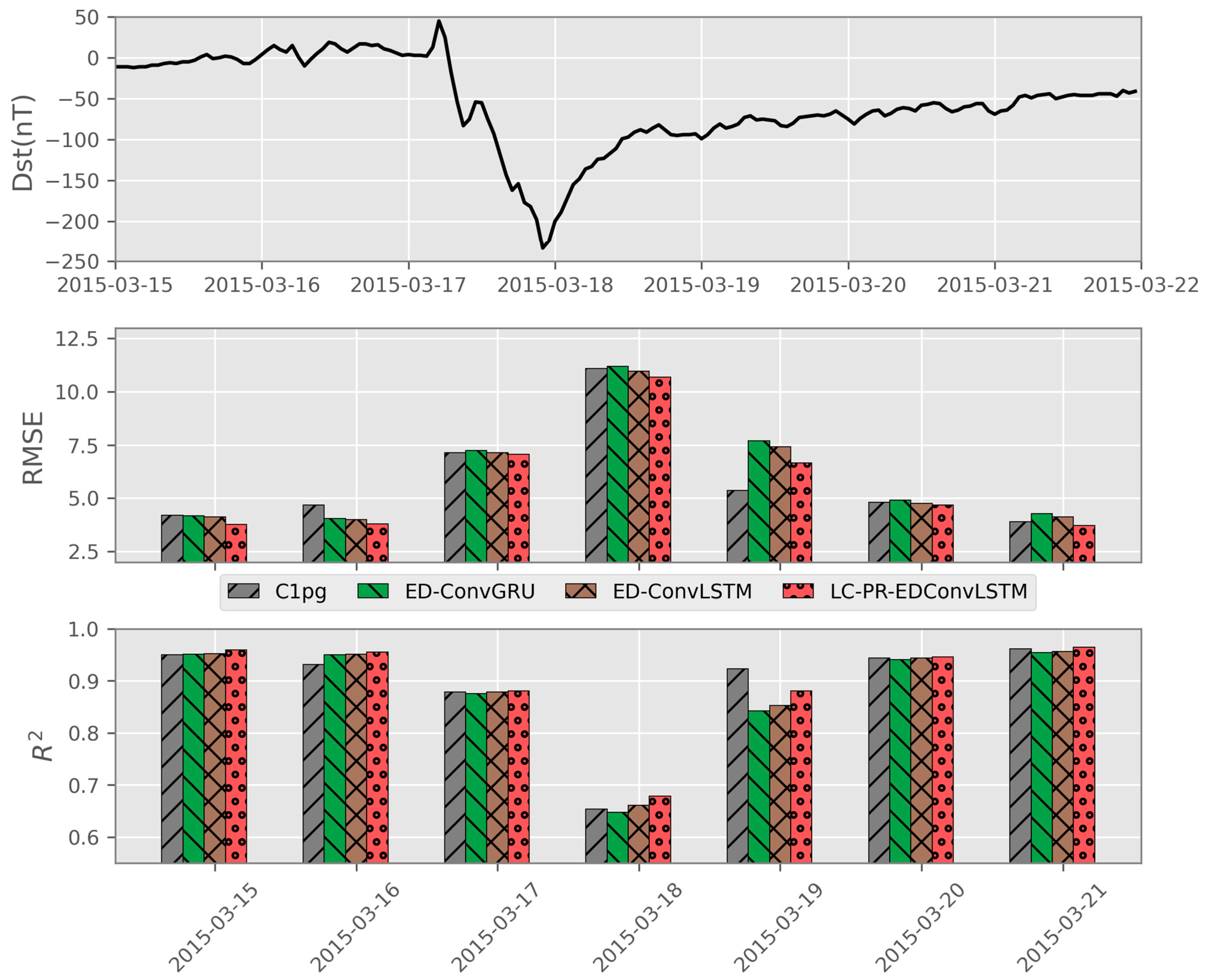
As shown in
Figure 7, the Dst index decreased rapidly from 17 to 18 March 2015 and reached approximately −230 nT, indicating a strong geomagnetic disturbance. Previous studies have reported significant TEC disturbances at middle and low latitudes during this event [
33]. The enhanced geomagnetic activity changed the spatiotemporal structure of ionospheric TEC and increased the prediction errors of all models. In particular, the RMSE values of all models exceeded 10 TECU on 18 March, indicating that the storm main phase substantially increased the difficulty of TEC prediction.
Before the storm, LC-PR-EDConvLSTM maintained relatively low RMSE values of 3.75 TECU and 3.79 TECU on 15 and 16 March, respectively, with R2 values of 0.960 and 0.955. During the strongly disturbed period, its RMSE increased to 7.06 TECU on 17 March and 10.67 TECU on 18 March; however, these values remained lower than those of C1pg, ED-ConvGRU, and ED-ConvLSTM. The corresponding R2 values were also higher than those of the comparison models, indicating that the proposed model could still reduce prediction errors and maintain better consistency with observed TEC variations during the geomagnetic storm.
During the recovery phase, the prediction errors gradually decreased. C1pg achieved the best performance on 19 March, showing that the operational forecast product remained competitive on certain recovery days. However, LC-PR-EDConvLSTM regained superior performance on 20 and 21 March, with RMSE values of 4.68 TECU and 3.72 TECU, respectively. These results indicate that the proposed model can recover its prediction accuracy as the storm effect weakens.
Overall, the intense geomagnetic storm substantially increased the difficulty of global TEC map prediction, but LC-PR-EDConvLSTM achieved lower RMSE and higher R2 during the pre-storm period, the main disturbance phase, and part of the recovery phase. Nevertheless, its errors during the storm main phase were still much higher than those under quiet conditions, indicating that historical TEC map sequences alone are insufficient to fully capture rapid ionospheric responses caused by strong geomagnetic disturbances. Future studies may further introduce external space weather driving parameters, such as Kp and Dst, to improve prediction capability during extreme space weather events.
4.5. Prediction Performance Analysis in Different Latitude Regions
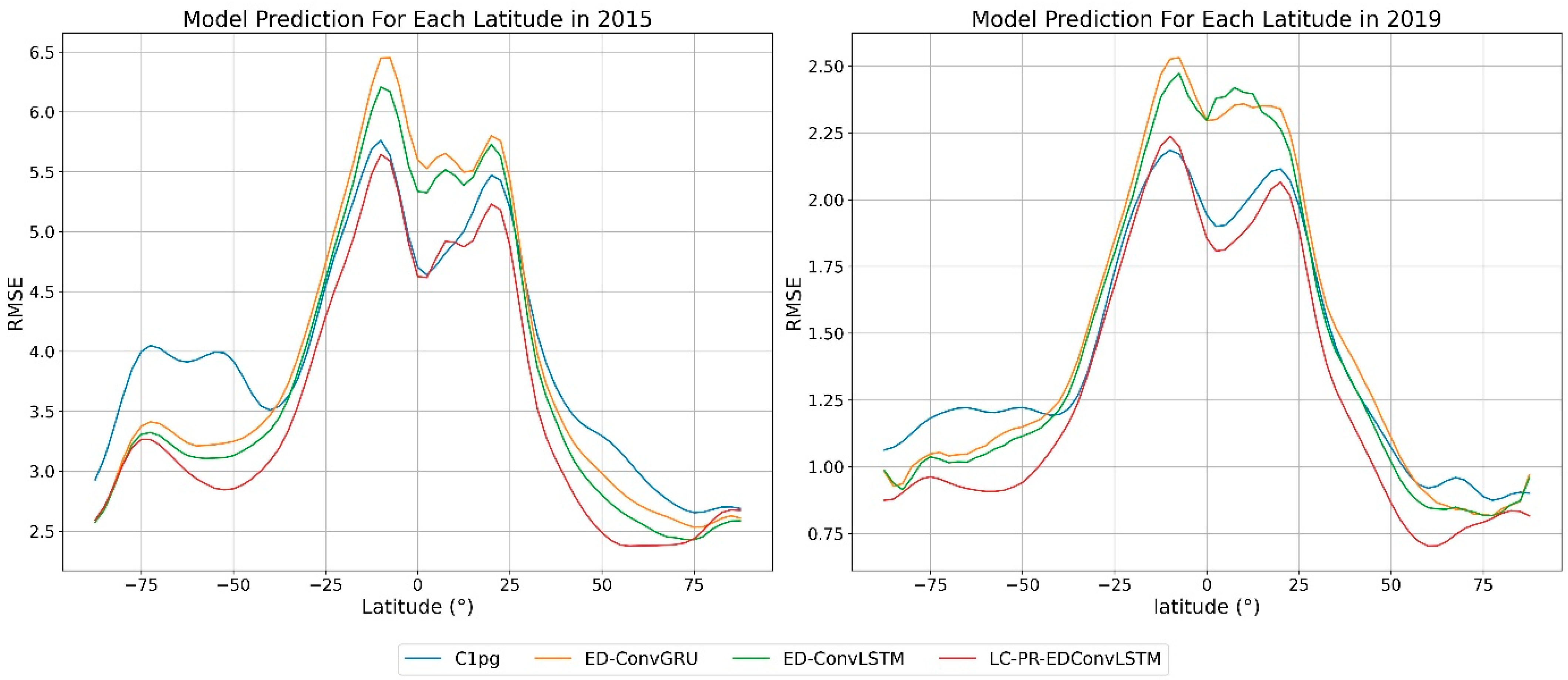
To further analyze the prediction capability of different models in different global latitude regions, this study calculates the RMSE for each latitude band and compares the latitudinal error distributions of C1pg, ED-ConvGRU, ED-ConvLSTM, and LC-PR-EDConvLSTM on the 2015 high-solar-activity test set and the 2019 low-solar-activity test set. The RMSE results at different latitudes are shown in
Figure 8.
As shown in
Figure 8, prediction errors show clear differences among latitude regions. Previous studies based on geomagnetic latitude–local time coordinates have also reported spatial regional differences in TEC variation characteristics and prediction performance [
27]. In this study, the latitudinal RMSE results in the geographic coordinate system show that errors are generally larger in low- and middle–low-latitude regions than in high-latitude regions, especially near the equator and adjacent areas. This is mainly related to stronger TEC gradients and more complex ionospheric variations caused by solar radiation, electric field drift, and the equatorial ionization anomaly. By contrast, the overall TEC level and the corresponding RMSE values are relatively lower in high-latitude regions.
In 2015, all models show pronounced error peaks from low- to middle-latitude regions, reflecting stronger latitudinal TEC variations under high-solar-activity conditions. LC-PR-EDConvLSTM achieves lower RMSE values over most latitude ranges, especially in the middle- and high-latitude regions of the Southern Hemisphere and the middle-latitude regions of the Northern Hemisphere. In 2019, the overall RMSE values are lower than those in 2015, but low-latitude regions remain the main areas with relatively large errors. The proposed model still maintains the lowest RMSE in most latitude bands, indicating good latitudinal generalization capability under both high- and low-solar-activity conditions.
The advantage of LC-PR-EDConvLSTM can be attributed to the combination of temporal and spatial modeling strategies. The periodic-matched residual strategy uses the same-phase TEC map from the previous day as a background field, which helps capture diurnal variations across different latitude regions. Meanwhile, longitude-circular boundary-aware convolution preserves the longitudinal continuity of global TEC maps and improves the representation of global spatial structures. Therefore, the proposed model can reduce prediction errors in most latitude regions and maintain stable performance across different solar activity levels.
Nevertheless, relatively large errors still occur in low- and middle–low-latitude regions. This indicates that complex ionospheric dynamics in these regions remain a major challenge for global TEC map prediction. Previous studies have also shown that TEC prediction accuracy in equatorial regions has evident longitudinal dependence [
23], suggesting that low-latitude errors are related not only to latitude, but also to longitudinal structures and local time differences. Future studies may further incorporate auxiliary information such as solar activity, geomagnetic disturbances, and local time to improve prediction performance in low-latitude regions with strong TEC gradients.
5. Conclusions
This study proposes an ED-ConvLSTM model integrating periodic-matched residual prediction and longitude-circular boundary-aware convolution for one-day-ahead global TEC map forecasting, namely LC-PR-EDConvLSTM. The model uses the TEC map at the same temporal phase on the previous day as a periodic background field, enabling the network to focus on learning the residual variation in future TEC relative to this periodic background. Meanwhile, a longitude-circular boundary-aware mechanism is introduced into the convolution operations to preserve the spatial continuity of global TEC maps across the −180° and 180° meridians, thereby enhancing the model’s ability to characterize the global spatiotemporal structure of TEC.
Experimental results based on CODE TEC data from 2009 to 2019 show that LC-PR-EDConvLSTM achieves the best prediction performance on both the 2015 relatively high-solar-activity test set and the 2019 low-solar-activity test set. Compared with C1pg, ED-ConvGRU, and ED-ConvLSTM, the proposed model performs better in terms of MAE, RMSE, CC, and R2. These results indicate that the proposed method can effectively reduce numerical TEC prediction errors and better maintain the consistency between the predicted and observed TEC maps.
The ablation experiments demonstrate that the periodic-matched residual prediction strategy can effectively exploit the diurnal background information of TEC and achieves better prediction performance than last-frame residual prediction, recursive residual prediction, and Periodic Persistence. In addition, longitude-circular boundary-aware convolution improves the model’s ability to capture the spatial continuity of global TEC maps and further enhances prediction accuracy under the periodic residual framework. The analyses of typical events and latitude regions further show that the proposed model maintains good prediction stability on a strong solar activity day, during an intense geomagnetic storm, and across most latitude regions.
Nevertheless, the proposed model still has certain limitations. Since it only uses historical TEC map sequences as input and does not explicitly introduce external space weather driving parameters, such as F10.7, Kp, and Dst, its prediction errors remain relatively large under severe disturbance conditions, such as intense geomagnetic storms. Although historical TEC maps can implicitly contain the ionospheric response to previous solar and geomagnetic forcing, abrupt TEC variations that are not sufficiently represented in the preceding TEC sequence may still increase prediction uncertainty. Future studies may further incorporate solar and geomagnetic activity indices and combine them with attention mechanisms or graph neural networks to improve the model’s prediction capability for extreme space weather events and complex low-latitude ionospheric structures.