Article

Mapping Smartwatches’ Aesthetic and Ergonomic Features to Perception and Preferences Among Millennials and Generation Zs Using Kansei Engineering and Eye-Tracking Approaches

1
Industrial and Manufacturing Engineering Department, School of Innovative Design Engineering, Egypt-Japan University for Science and Technology, Alexandria 21934, Egypt
2
Production Engineering Department, Faculty of Engineering, Alexandria University, Alexandria 21544, Egypt
3
Department of Human Informatics and Cognitive Sciences, Faculty of Human Sciences, Waseda University, 1-Chōme-104 Totsukacho, Shinjuku City 169-8050, Tokyo, Japan
*
Authors to whom correspondence should be addressed.
Appl. Sci. 2026, 16(11), 5624; https://doi.org/10.3390/app16115624
Submission received: 27 April 2026 / Revised: 22 May 2026 / Accepted: 27 May 2026 / Published: 4 June 2026
(This article belongs to the Special Issue Human-Centred Design in Ergonomics)

Abstract

Wearables design research often evaluates aesthetic and ergonomic features without capturing their emotional and cognitive effects on user experience and buying decisions. This paper investigates both dimensions for smartwatches as screen-based wrist-worn wearable devices (SBWWDs) among Millennials and Generation Z using Kansei Engineering to structure SBWWD design features into users’ emotional perception and affective preferences. The study examines four hypotheses: (H1a) aesthetic perception differs between Millennials and Generation Z, (H1b) aesthetic perception differs across genders within the same generation, (H2a) ergonomic perception and visual needs for smartwatches’ screen interfaces differ between Millennials and Generation Z, and (H2b) ergonomic preferences differ across genders within the same generation. The research adopts a two-phase design methodology. Phase I-A identifies key aesthetic attributes from market-leading smartwatches and develops controlled design stimuli using AI-assisted concept generation. A questionnaire-based survey captures demographic-linked aesthetic preferences and emotional responses, with emphasis on case shape, strap material, and wearable color, to psychological perception and preference in smartwatch product designs. Phase I-B examines ergonomic interface display preferences relevant to smartwatch screens, including contrast and polarity, using Likert scales and bipolar Semantic Differential Scales. Subsequently, participants evaluate the combined interface features’ stimuli through measures of task accuracy and completion, best/worst interface display selections, eye-tracking metrices analysis, as well as emotional and cognitive arousal provoked by psychological intention using the Self-Assessment Manikin. Further, a full factorial design experiment evaluates the effects of participants’ demographic variables, including generation and gender, as well as smartwatch design features, on aesthetics and ergonomics design perception and preference. Phase II applies Kansei Engineering principles by mapping design features to affective responses of Phase I. Findings provide a structured mapping of smartwatch design perception and preferences across generational and gender groups within the Egyptian market, supporting affective principles in SBWWD design guidelines. The study contributes an evidence-based framework that integrates aesthetic and ergonomic features through Kansei Engineering, aiming to enhance online purchasing in smartwatch devices.

1. Introduction

Wrist-worn wearable devices, specifically smartwatches with interactive microscreens, are widely used across health, fitness, communication, and lifestyle applications. In this study, the empirical scope focuses on smartwatches, as the smartwatch market is currently valued at USD 35.29 billion, growing at a CAGR of 10.05% (2025 to 2035). Among internet users, smartwatches are predominantly adopted by Millennials and Generation Z, with 27.2% for females and 26.9% for males among Millennials as well as 19.6% for females and 21.0% for males among Generation Z for self-monitoring, digital interaction, and personal expression Refs. [1,2]. These generations’ buying decisions are strongly influenced by demographic behavior as well as design perceptions and preferences given that most of their purchasing transactions are through online shopping Refs. [2,3,4]. The variations in smartwatch perception and preferences across demographic generations highlight the need to strengthen the visual appeal and usability of smartwatch displays in digital retail environments. This can be achieved by systematically capturing users’ emotional and functional preferences, alongside sensor-based techniques, such as eye trackers to quantify visual behavior, and mapping these insights into product features aligned with anticipated user expectations. Kansei Engineering provides a structured approach for translating affective responses into tangible design attributes by aligning product features with users’ feelings and sociopsychological needs Ref. [5]. Within this perspective, aesthetics enhances emotional attachment and a sense of belonging, while ergonomics supports usability and overall user experience Refs. [6,7]. Achieving this balance is particularly important in the human–computer interaction (HCI) context, where product evaluation is primarily mediated through digital representations rather than direct physical interaction.
This study investigates aesthetic and ergonomic design features in the smartwatch design context and applies Kansei Engineering to map users’ affective responses of emotional and cognitive perception and preferences onto design attributes that can enhance purchasing intention among Millennials and Generation Z. The remainder of the paper is organized as follows. The literature review synthesizes prior work on aesthetic and ergonomic design, Kansei Engineering, and screen-based wrist-worn wearable product perception. The Methodology Section presents the proposed two-phase approach for data collection and evaluation. The Results Section reports findings from these phases, followed by a discussion that interprets the key outcomes, outlines future research directions, and proposes practical design recommendations. The paper concludes by summarizing limitations and implications.

2. Literature Review

The literature review first outlines aesthetic and ergonomic design applications in product design, followed by Kansei Engineering, with emphasis on integrating emotional, functional, and sociopsychological aspects within a conceptual design perspective. It then reviews prior work on wrist-worn wearable devices, with a focus on interface screen design. The review concludes by synthesizing evidence on the integration of aesthetics and ergonomics in wrist-worn wearable design to support Millennial- and Gen-Z-oriented product development, while accounting for gender-based perceptions and preferences.

2.1. Aesthetics in Product Designs

Don Norman states that human responses to design operate across three interconnected levels: visceral, behavioral, and reflective levels. The visceral level relates directly to aesthetic appeal and immediate sensory impression, the behavioral level concerns usability and functional performance during interaction, and the reflective level involves meaning, self-image, and long-term emotional interpretation, demonstrating that aesthetics forms the first layer of emotional response in product experience Ref. [8]. Building on Norman’s framework, contemporary research has sought to systematically model and quantify aesthetic perception. Ref. [9] reviewed product design aesthetic preferences by integrating the Unified Model of Aesthetics and the Categorical Motivation model, concluding that preferences emerge from a category moderated balance of opposing perceptual, cognitive, and social factors. Ref. [10] proposed and validated a Product Appearance Aesthetics framework using a Variational Onsager Neural Network optimized by the Osprey Optimization Algorithm, achieving high image-based aesthetic evaluation performance compared with existing models while demonstrating high accuracy, precision, sensitivity, and specificity.
Ref. [11] explored how aesthetics affects customer perception and preferences to emphasize the need for alignment with consumer traits and recommended the consideration of psychological factors. Similarly, Ref. [12] examined the impact of aesthetics on product development and consumer acceptance. Ref. [13] tested the relationship between aesthetics, functionality, and design creativity across product designs and concluded that creativity aligns more with aesthetic appeal, novelty, and surprise than the other factors, recommending broader studies across more product types and evaluator groups to confirm generalizability. Overall, these studies show that product aesthetics are a multidimensional construct that shapes emotional response, cognitive evaluation, and purchasing preference, requiring psychological grounding and systematic modeling to align design features with user expectations and market acceptance.

2.2. AI-Driven Ergonomic Design Using Eye Tracking

Ergonomics engineering centers on shaping products around human capabilities and limitations to improve comfort, task efficiency, and overall user experience. In the user interface context, Ref. [14] presented a systematic literature review analysis of 146 studies on Explanation User Interfaces (XUIs) to identify the Artificial Intelligence (AI) models and eXplainable Artificial Intelligence (XAI) techniques used on them. Cappuccio et al. concluded that effective XUIs require tight integration between XAI and human-centered interface design to improve trust, usability, and transparency, while calling for stronger real evaluation and more consistent metrics and guidelines for scalable deployment. Ref. [15] presented a systematic review of 14 eye-tracking studies showing that older adults’ online performance is strongly influenced by interface ergonomics, emphasizing the need for applying friendly interface strategies. Ref. [16] argued that effective digital learning depends on intuitive and ergonomically designed user interfaces that support clear navigation, balanced interactivity, and reduced cognitive load. Razaque et al. further showed that AI-driven UI personalization can adapt layout, typography, and support features to enhance engagement and strengthen skill development. Ref. [17] showed that interface design guidelines under different vibration conditions (static, fore-and-aft, and lateral vibration) should prioritize color scheme selection and fatigue, as they significantly affect visual search efficiency and user perceptions, while vibration mainly increases mental workload.
Further, ergonomics provides a human-centered framework for understanding usability, and sensor-based techniques, such as eye tracking, strengthening this evaluation by objectively capturing visual attention, cognitive effort, and interaction behavior during users’ engagement with products, interfaces, and digital systems. Ref. [18] reviewed advances in eye tracking and machine learning for analyzing reading behavior and cognitive performance, showing strong links between eye metrics and attention and productivity, while highlighting the need for improved data, standardization, and real-world applicability. Ref. [19] reviewed eye-tracking methods for evaluating user experience by linking visual behavior metrics to usability and perception, highlighting their effectiveness in quantifying interaction quality while emphasizing the need for accessible, low-cost solutions, such as passive eye-tracking technologies. Ref. [20] identified key eye-tracking metrics, such as fixations, saccades, pupil dilation, and blinking, as reliable indicators for measuring cognitive load and user behavior in human–computer interaction, supporting improved interface design and usability.
Integrating aesthetics and ergonomics, Refs. [7,21] emphasized the impact of integrating ergonomics, sustainability, and aesthetics in design, focusing on balancing comfort and visual appeal while recommending the leverage of AI technologies. Ref. [22] explored the role of generative product engineering modeling technologies in aesthetic design education, highlighting the role of these technologies in creating pleasing designs while considering ergonomic factors in design. Ref. [23] developed a sustainable, multidimensional evaluation framework for Artificial Intelligent Generated Content that combines Emotional Design Theory with Delphi screening and Analytical Hierarchical Processing (AHP) weighting to assess aesthetic, functional, cultural, and iterative improvement dimensions for balancing heritage preservation with innovation. Earlier, Ref. [24] reviewed prior work to clarify the relationship between aesthetics and product design, concluding that aesthetics is strategically as important as functionality and ergonomics for shaping customer perception and market success, and recommended future research that develops systematic methods to measure product aesthetics. These studies show that ergonomics and aesthetics must be treated as complementary foundations of product and interface design, since they jointly shape comfort, performance, trust, emotional response, and acceptance across diverse contexts. Also, studies highlight the benefit of adopting AI-supported methods and sensor-based techniques for evaluation, personalization, and scalable design decision-making.

2.3. AI in Kansei Engineering

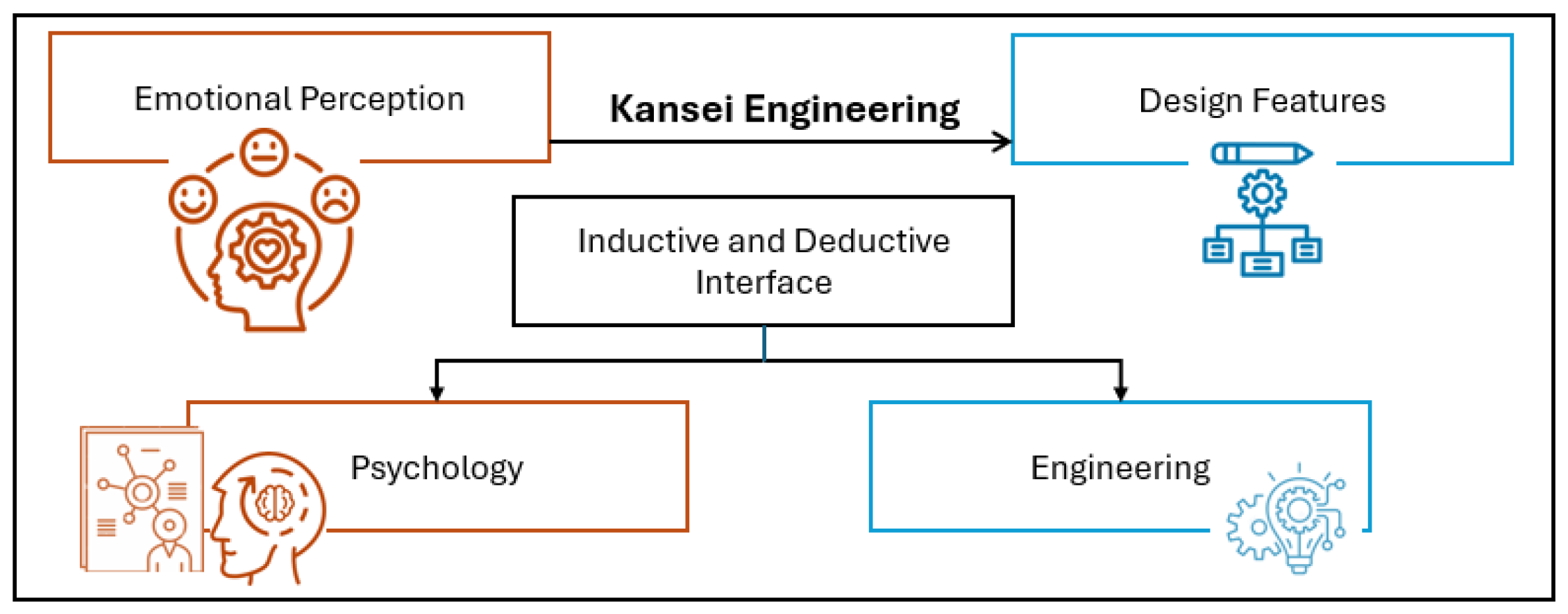
Kansei Kougaku (感性工学), known as Sense/Affective Engineering, is a customer-oriented methodology that translates consumers’ emotional responses into product design parameters through engineering-based techniques, developed by Ref. [5]. It enables systematic quantification of perceptual needs and expectations into concrete design elements, as illustrated in Figure 1 Refs. [25,26]. Shigemoto explains the similar relationship between Kansei Engineering (KE) and (AI) from a design management perspective as the machine learning mechanism that connects consumers’ emotions (Kansei) to product design elements through inductive and deductive inferences grounded in psychology and engineering.
Ref. [27] presented a systematic review of KE developments, showing their expanding use in product and service design and recommending stronger integration with emerging technologies, such as AI and virtual reality. Refs. [28,29] applied AI-generated imagery to enhance KE-driven designs, advocating for improved AI fine-tuning and broader product applications. Earlier, Ref. [30] proposed a KE framework that linked the semantic space of user emotions with the space of product properties through both qualitative and statistical tools, concluding that predictive design models can be systematically developed, validated, and refined to translate psychological impressions into concrete product parameters.
Ref. [31] proposed and validated a two-phase Human–AI collaborative Kansei Engineering methodology that generated and authenticated heritage-inspired product designs to show that demographic and thematic alignment shaped visual engagement and purchase preference. Meanwhile, Ref. [32] explained that digital transformation opens new directions for engineering design by promoting multidisciplinary integration and human-centered thinking, arguing that “New Design” should extend beyond traditional products into digital context. Recent research highlights the increasing convergence of Kansei Engineering, Artificial Intelligence, and digital transformation, indicating a future design paradigm that integrates emotional responses, functional relevance, and advanced technological capability.

2.4. Perception in SBWWD Design

Wearable devices have emerged as human-centered systems that are widely applied in healthcare, communication, fitness, safety, industrial monitoring, fashion, and many other domains. Their effectiveness depends not only on technological capability but also on the aesthetic and ergonomic qualities that shape user perception, emotional response, and acceptance across diverse demographic groups. Ref. [33] presented an umbrella review of 39 systematic reviews (98 studies) and found that interventions using wrist-worn wearables’ feedback reliably increased physical activity, but evidence for effects on cardiometabolic markers and other health outcomes remains limited. Ref. [34] reviewed research on wearable health device user experience and usability, identifying major themes around usability, health monitoring, rehabilitation, and user acceptance, and indicating a shift toward future work on HCI context, affective computing, AI, trust, and privacy-oriented design. Ref. [35] examined smart wearable devices for estimating sports energy consumption by integrating multisensory data, such as motion, heart rate, and chronophysiological signals, concluding that they can support real-time training and health management but still face limitations in accuracy, compliance, privacy, and personalization.
Ref. [36] reviewed computational fashion wearables research across domains, theories, materials, and interaction modalities, showing a clear shift from mainly functional wearable design toward more embodied, aesthetic, and expressive approaches. Jabari et al. suggested that future work should strengthen theory-driven design, develop smarter and more flexible materials, and expand interaction techniques, such as ambient sensing and kinetic outputs for socially acceptable designs. Ref. [37] addressed that smart wearable technology is reshaping casual wear into intelligent, interactive clothing by balancing functional integration with fashionable expression, concluding that successful smart clothing depends on ergonomic comfort, concealed technology, and aesthetic adaptability, while future work should advance lightweight flexible materials, modular design, and personalization to improve user acceptance and scalability. Ref. [38] shows that smartwatch adoption intention is shaped by both perceived usefulness and social visibility, with attitudes mediating these effects and users often viewing smartwatches as both technology and fashion, so future research should test broader samples and examine brand and concrete design attributes, such as size, shape, and color, that influence usefulness and visibility.
Overall, wearable device design requires an integrated consideration of aesthetic and functional features, since visual form, such as color and material, as well as interface legibility can provoke distinct emotional responses, influence behavioral reactions, and shape user decision-making. Incorporating human psychology is essential for translating perceptual and affective reactions into concrete design features, ensuring that wearable products achieve both ergonomic effectiveness and emotional resonance.

2.5. Research Gap and Problem Statement

Although prior studies have examined smartwatch adoption, SBWWD usability, energy monitoring accuracy, and smart fashion integration, limited research has systematically investigated the integrated role of aesthetic and ergonomic design features of smartwatches on sociopsychological perception and preferences in human–computer interaction. This gap is more evident when considering the limited use of eye trackers integrated into usability interface evaluation to objectively quantify visual attention and interaction behavior in small-screen interfaces. Also, existing work often treats functionality, usability, or fashion value separately, without empirically modeling the way aesthetic and ergonomic attributes jointly influence emotional responses, task performance, perceptual evaluation, and purchasing intention. Furthermore, comparative evidence examining generational demographic differences remains limits across Millennials and Generation Z, particularly regarding smartwatch aesthetics and their screen display interaction in terms of design perception and preferences. There remains a gap in translating smartwatch design features into measurable emotional, cognitive, and behavioral outcomes using a structured Kansei Engineering approach, integrated with eye-tracking techniques to quantify visual attention and interaction patterns, that maps design attributes to reflective demographic sociopsychological perception, preferences, and purchasing decisions.
This study addresses the proposed gap by exploring the integration of aesthetic and ergonomic design features of screen-based WWA in the HCI context, with a focus on demographic generational and gender-based differences across Millennials and Generation Z. Using the Kansei Engineering approach, this study translates design attributes into affective responses, task performance indicators, visual and cognitive behavior metrices, and purchase intentions. The study aims to develop a predictive framework that maps smartwatch design features to reflect psychological perception and purchasing decisions supporting tailored SBWWD design strategies. The aim is pursued by addressing smartwatch perception and preferences through the following research questions and hypothesis testing:
  • RQ1: Do Millennials and Generation Z differ in aesthetic perception and preference for smartwatch design features, and do these aesthetic perceptions vary by gender within each generation?
  • RQ2: Do Millennials and Generation Z differ in ergonomic perception and preference for smartwatches’ screens, including visual needs, and do these ergonomic preferences vary by gender within each generation?
The study examines the following hypotheses:
H1a. 
Aesthetic perception differs between Millennials and Generation Z.
H1b. 
Aesthetic perception differs across genders within Millennials and Generation Z generations.
H2a. 
Ergonomic perception and preference, particularly visual needs for small-screen interfaces, differ between Millennials and Generation Z.
H2b. 
Ergonomic preferences differ across genders within Millennials and Generation Z generations.

3. Methodology

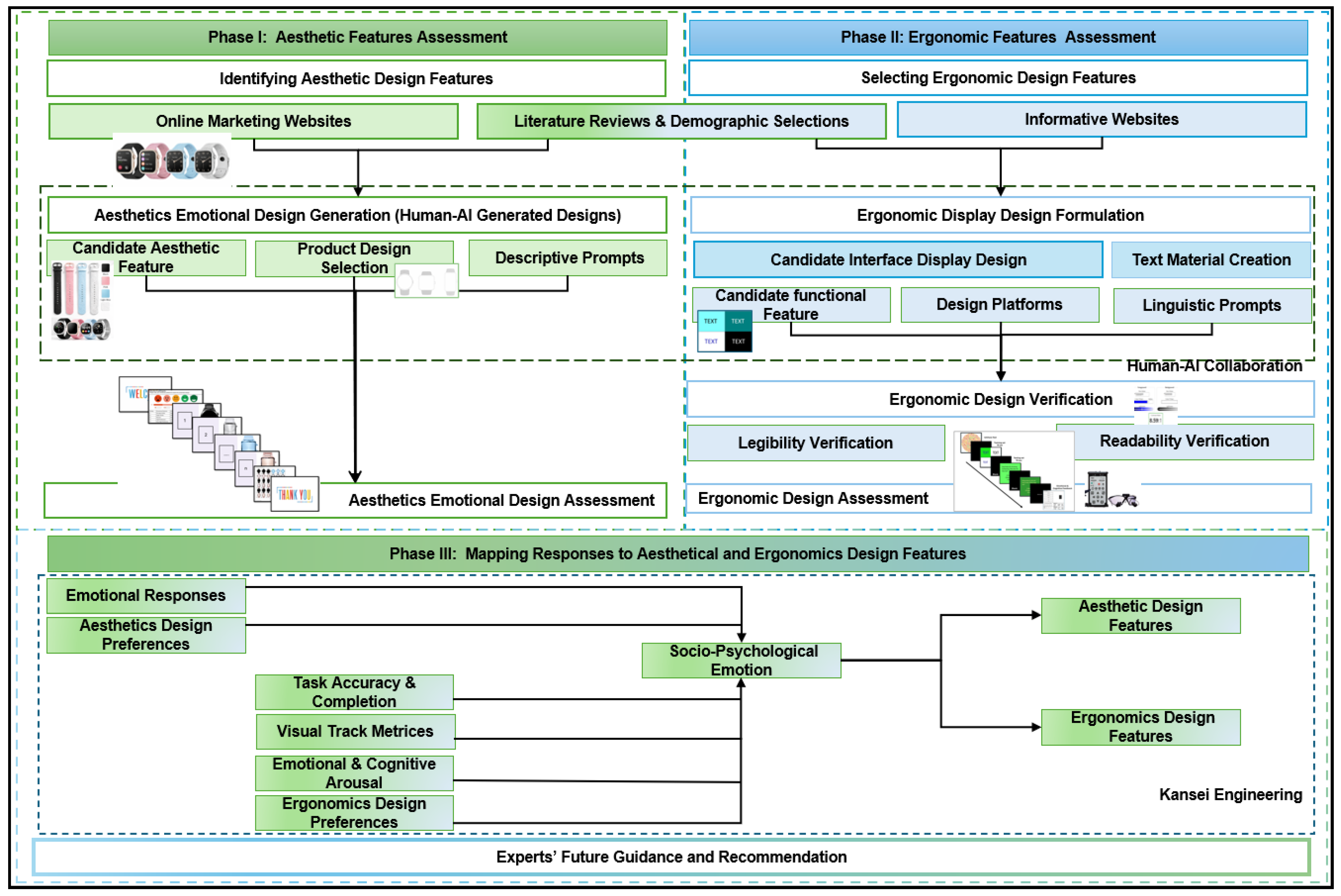
This research examines the influence of smartwatch design features on psychological perception and preference across generational demographics, specifically Millennials and Generation Z, while considering gender differences. By investigating demographic perception and preference the study aims to translate participants’ affective responses into concrete design guidelines in smartwatches to support the development of screen-based wrist-worn wearable products that satisfy aesthetic and ergonomic needs in everyday use. The study follows two phases, Phase I-A for aesthetic feature assessment and Phase I-B for ergonomic interface feature assessment. Based on Phase I-A outcomes, the most preferred and frequently selected aesthetic smartwatch design was adopted as the visual baseline for Phase I-B ergonomic evaluation. Phase II then applies Kansei Engineering mapping to integrate the affective outputs from Phase I-A and Phase I-B and translate them into design feature guidelines linked to demographic perception and preference patterns. The study presents a structured two-phase methodology implemented on smartwatches as the application case, as illustrated in Figure 2.

3.1. Phase I: Aesthetic and Ergonomic Features’ Evaluation

Phase I evaluates the aesthetic and ergonomic features of smartwatch design through two complementary subphases, Phase I-A for aesthetic feature assessment and Phase I-B for ergonomic interface feature assessment.

3.1.1. Phase I-A: Aesthetic Design Features

Phase I-A focuses on aesthetic design features and their influence on users’ psychological perception and preference, as well as emotional response. A preliminary literature review and an analysis of highly rated current smartwatch products, which are available on online shopping platforms, were conducted to identify relevant aesthetic attributes. These features were refined and combined through human–AI collaboration to generate controlled visual stimuli. Millennials and Generation Z participants completed a structured survey assessing aesthetic preferences and emotional responses toward the proposed smartwatch design stimuli. The data collected were analyzed using ANOVA to determine significant generational and gender differences and to identify correlated aesthetic factors.

3.1.2. Phase I-B: Ergonomic Design Features

In parallel, Phase I-B addresses the impact of ergonomic design features, particularly those related to screen-based wrist-worn wearable interface displays on the perception and preference of the small screens. Relevant literature and established design resources were reviewed to define candidate display interface features. Participants from Millennials and Generation Z completed a structured survey evaluating ergonomic needs and visual preferences for smartwatches’ screen interfaces. Statistical analysis using ANOVA identified significant ergonomic display combined factors. Based on these findings, candidate interface variation was developed using a design platform under expert supervision. In parallel, standardized textual materials were generated through human–AI collaboration and validated in terms of readability rate then added to the candidate interface, forming the interface stimuli set. To maintain coherence across phase flow, the most preferred aesthetic smartwatch design identified in Phase I-A was adopted as the visual baseline for illustrating the Phase I-B interface stimuli assessment, so that ergonomic assessment was conducted within the context of the selected aesthetic configuration. The interfaces’ stimuli were evaluated in terms of task accuracy and completion, visual tracking metrices, emotional and cognitive arousal, as well as overall interface design preference.

3.2. Phase II: Mapping Participants’ Responses to Design Features

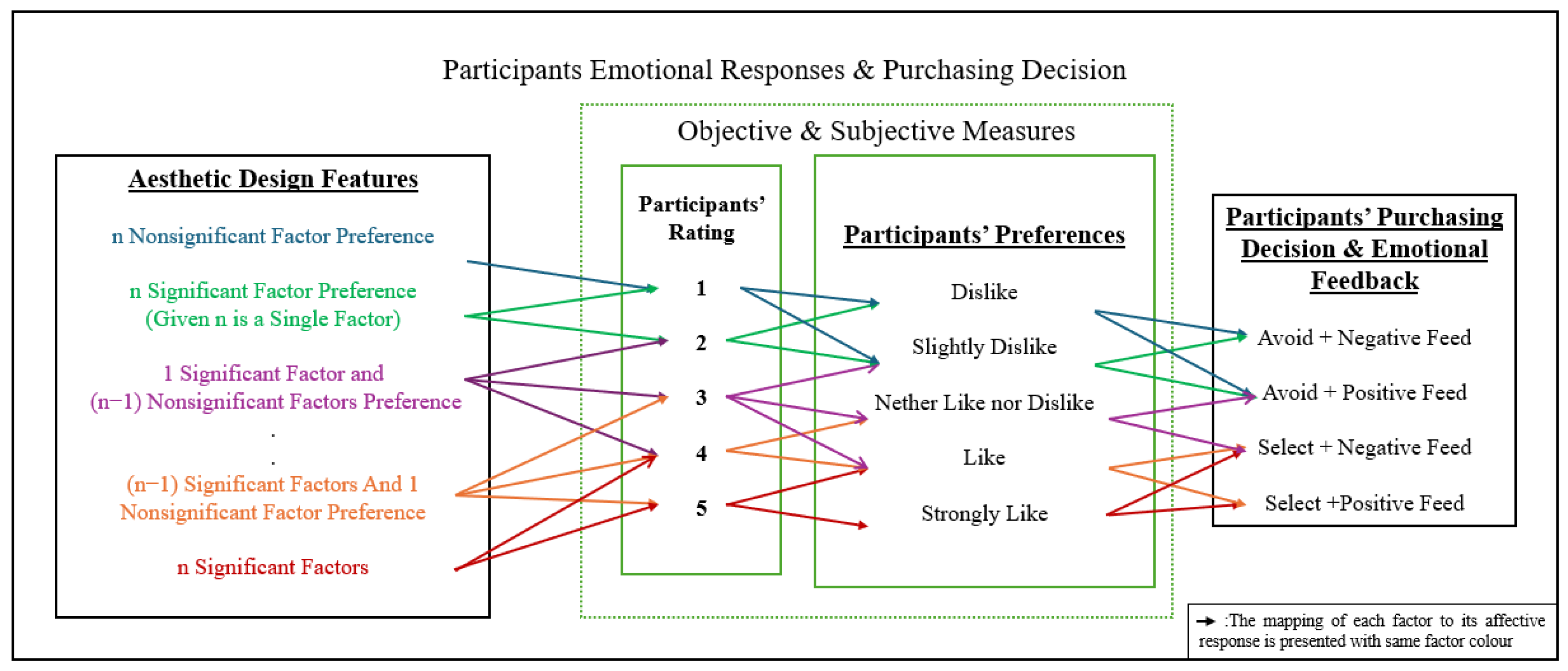
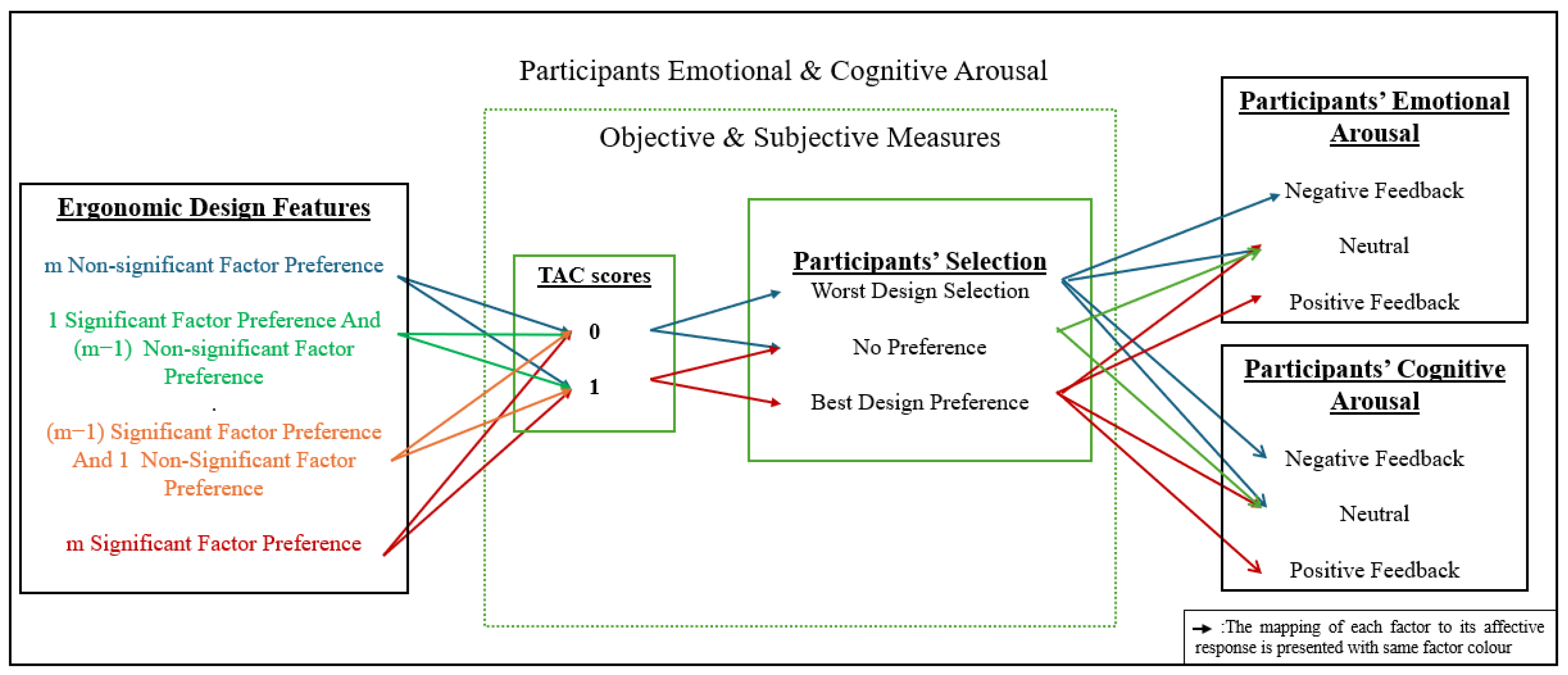
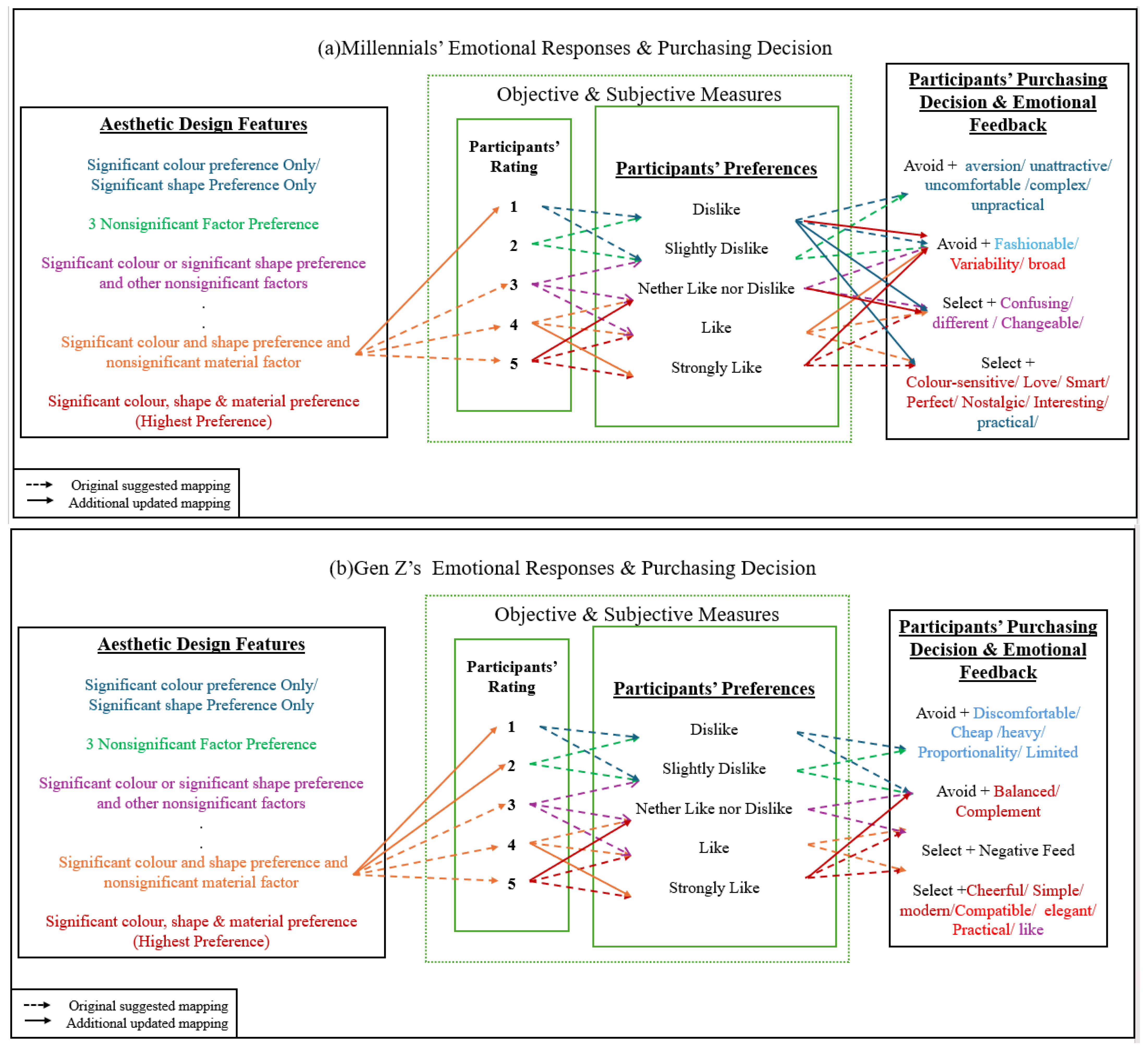
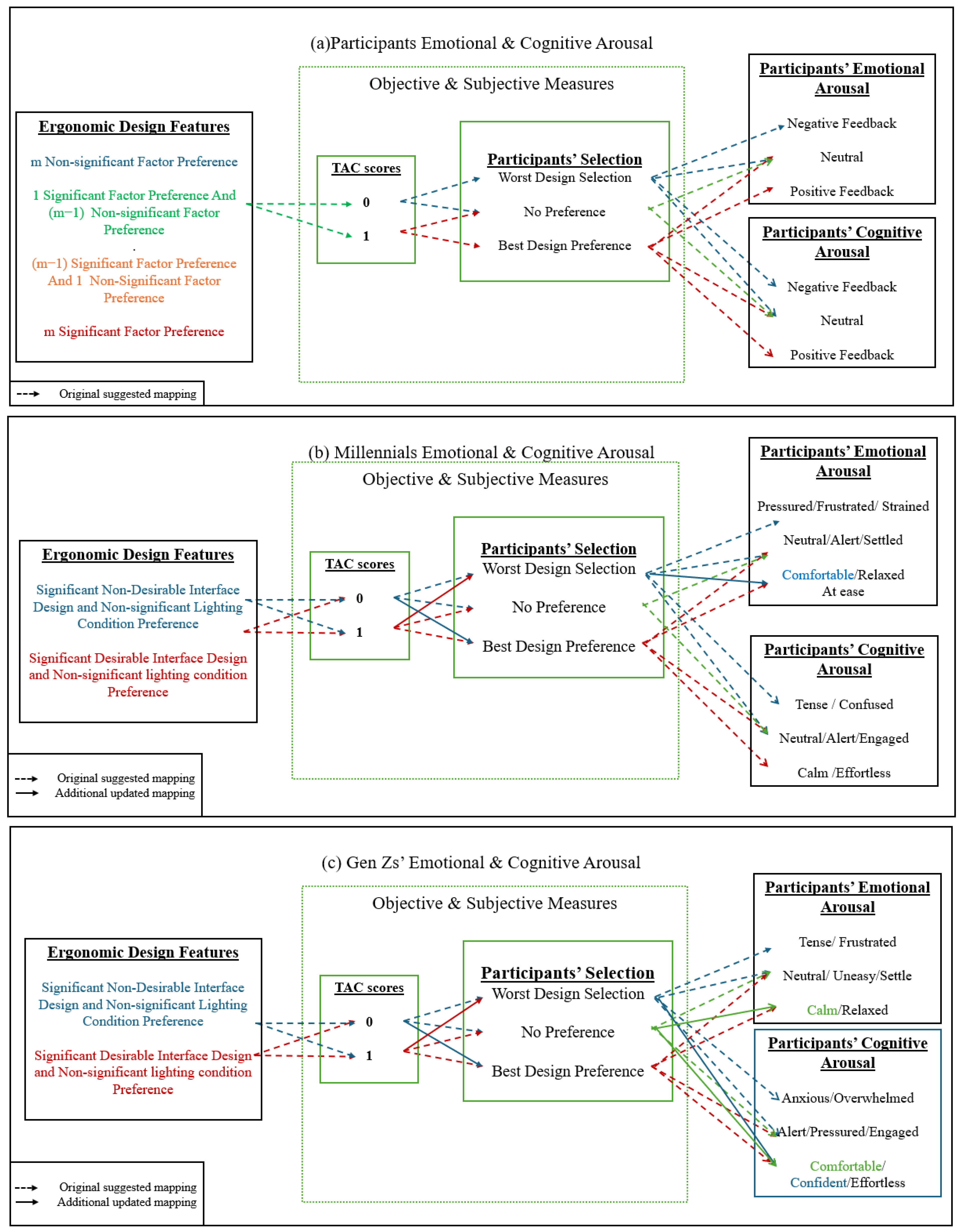
Phase II maps the affective responses collected across both stages (A and B) into specific aesthetic and ergonomic design features using Kansei Engineering. KE translates users’ affective responses to product features by mapping demographic psychological impressions to design features using evaluation methods, helping in providing tailored product design guidelines. In Phase I-A, aesthetic features were defined through n factors of design features and were assessed through both objective and subjective measures, providing insights on participants’ purchasing decision and emotional feedback, as illustrated in Figure 3. Subsequently, Phase I-B extended the KE framework to consider m factors of ergonomic design features to evaluate emotional and cognitive arousal, as shown in Figure 4. Ergonomic design features’ assessment was quantified using task accuracy and completion to reflect usability, best/worst design selection to show participants’ preference, alongside self-report measures of emotional and cognitive arousal to capture emotional feelings and perceived workload through affective state during HCI with smartwatch devices. The flow of each factor is mapped with the same coloring arrow. The proposed two-phase methodology provides a structured pathway from aesthetic emotion and preference to ergonomic performance and arousal, enabling a KE-based mapping between design features and users’ reflective psychological perception, preferences, and decision-making for smartwatches in the HCI context across demographic categories.

4. Data Collection

Data collection focused on Phase I, which includes Phase I-A (aesthetic design assessment) and Phase I-B (ergonomic design assessment). Design development in both phases was guided and reviewed by experts in Arts and Design, and Innovative Design Engineering, with a total of 598 Egyptian participants from Millennials and Generation Z involved across the two phases. The sample covered both generations’ age ranges and included participants from diverse occupational backgrounds with varied small-screen device usage patterns, not limited to frequent smartwatch users, which supports variability in perception and preference outcomes. Phase I-A included 148 participants, as illustrated in Table 1, where the phase began by identifying the smartwatches’ aesthetic design features, which were used to generate an emotional aesthetic stimulus set to be evaluated through structured surveys assessing participants’ aesthetic preferences and emotional psychological perceptions using Likert scales and Semantic Differential Scales (SDSs).
Phase I-B involved 450 participants and the phase focused on the smartwatches’ interface screens’ evaluation, where few interface features were selected, formulated as candidate interface stimuli, and verified to be ergonomically assessed by Millennials and Gen Zs. The interface features selection process was conducted by 410 participants of almost equivalent generation, genders, and demographic information, as illustrated in Table 2; meanwhile, the interface stimuli assessment was conducted by 40 participants, as illustrated in Table 3. The candidate interface stimuli were functionally assessed using task accuracy and completion, best–worst design selection, as well as the emotional and cognitive tactical Self-Assessment Manikin. Overall, Phase I follows the Kansei Engineering approach, linking sociopsychological affective responses with measurable design features of smartwatches in wrist-worn wearables.

4.1. Phase I-A: Aesthetic Design Features

4.1.1. Aesthetic Design Features Identification

Phase I-A builds on identifying the most common morphological smartwatch aesthetic appeal features to influence psychological perception, preference aiming to enhance emotional attachment, user satisfaction, and purchasing decisions Ref. [39]. The selected factors were identified through a review of online marketing websites and relevant literature, with emphasis on attributes that contribute to perceived design quality, social image, and perceived ease of use, which can strengthen purchase intention Refs. [40,41,42,43]. Accordingly, the selected factors and their evaluated levels were smartwatches’ color (black, gray/silver, rose gold, and blue), material (leather, metal, and rubber), and interface shape (round, square, and thin/slim). Further, Ref. [43] reported shape interpretative designs where slim, compact forms communicate sportiness and simplicity, square forms with side buttons suggest sportiness and fashion, and round forms with strong mechanical connections convey higher value.

4.1.2. Aesthetic Emotional Design Generation

To formulate the stimulus set for emotional aesthetic assessment, highly rated smartwatch designs were sampled from online retailers, such as Amazon. The selected product designs were then transformed into emotional aesthetic stimuli through descriptive prompts developed using human–AI collaboration. These prompts incorporated the identified design attributes, including smartwatch screen shape (e.g., round, square, and slim interfaces), color variation, strap material (e.g., leather, rubber, and metal), and clear interface presentation to maintain focus on aesthetic perception rather than interface functionality. Prompt formulation further specified bezel structure, case geometry, strap texture appearance, color tone, and interface cleanliness to support controlled variation and consistent emotional interpretation across the generated smartwatch concepts. Logos and branding cues were removed to reduce visual bias and maintain focus on aesthetic perception. Additional adjustments, such as removing screen interface content, were applied to reduce confounding effects using pro-Canva® and Dall-E 3® under expert guidance, as illustrated in Figure 5. Subsequently, image refinement procedures were conducted to improve visual consistency of the generated stimuli, including refinement of smartwatch shape proportions, bezel smoothness, strap alignment, material texture depiction, metallic reflection consistency, and color harmony, to ensure coherent representation of leather, rubber, and metal strap materials across the different smartwatch forms. The stimulus set included 36 designs, representing 4 colors combined with 3 materials and 3 interface shapes, as summarized in Table 4.
Finally, the proposed emotional aesthetic stimuli were reviewed and verified by two product design experts using Gestalt-based principles of perceptual design, confirming that the proposed designs were psychologically perceived as coherent, characteristic, and smoothly recognizable shapes Ref. [44]. The validation process further considered perceptual balance, visual continuity, figure–ground relationship, proportional harmony, and consistency of shape identity across the smartwatch variations. In parallel, four fine-arts experts evaluated color accuracy and texture depiction using color principles and color psychology to verify that the palettes conveyed the intended emotional tone and supported consistent texture psychological perception across the smartwatch designs Refs. [45,46,47]. The experts additionally assessed color warmth, perceived material realism, metallic and matte texture consistency, visual comfort, emotional appropriateness of color combinations, and the ability of the selected color palettes to communicate intended design perceptions. Overall, the experts agreed with almost all the intended designs, yet with a small number of exceptions where color and grooving cues shifted the perceived material. Specifically, one expert judged the black square rubber variant as closer to leather (70% leather, 30% rubber). Another expert reported that the thin rubber design appeared more leather-like (70% leather, 30% rubber), attributing this to color theory and rooted psychological effects. For the gray/silver rubber square design, two experts reported mixed perceptions, rating it as 40% leather and 60% rubber, and 30% leather and 70% rubber, respectively. One expert also noted that the metallic black finish smartwatches produced a plastic or rubber impression, rating the black metal round, square, and thin variants as 50% leather and 50% rubber.

4.1.3. Aesthetic Emotional Design Assessment

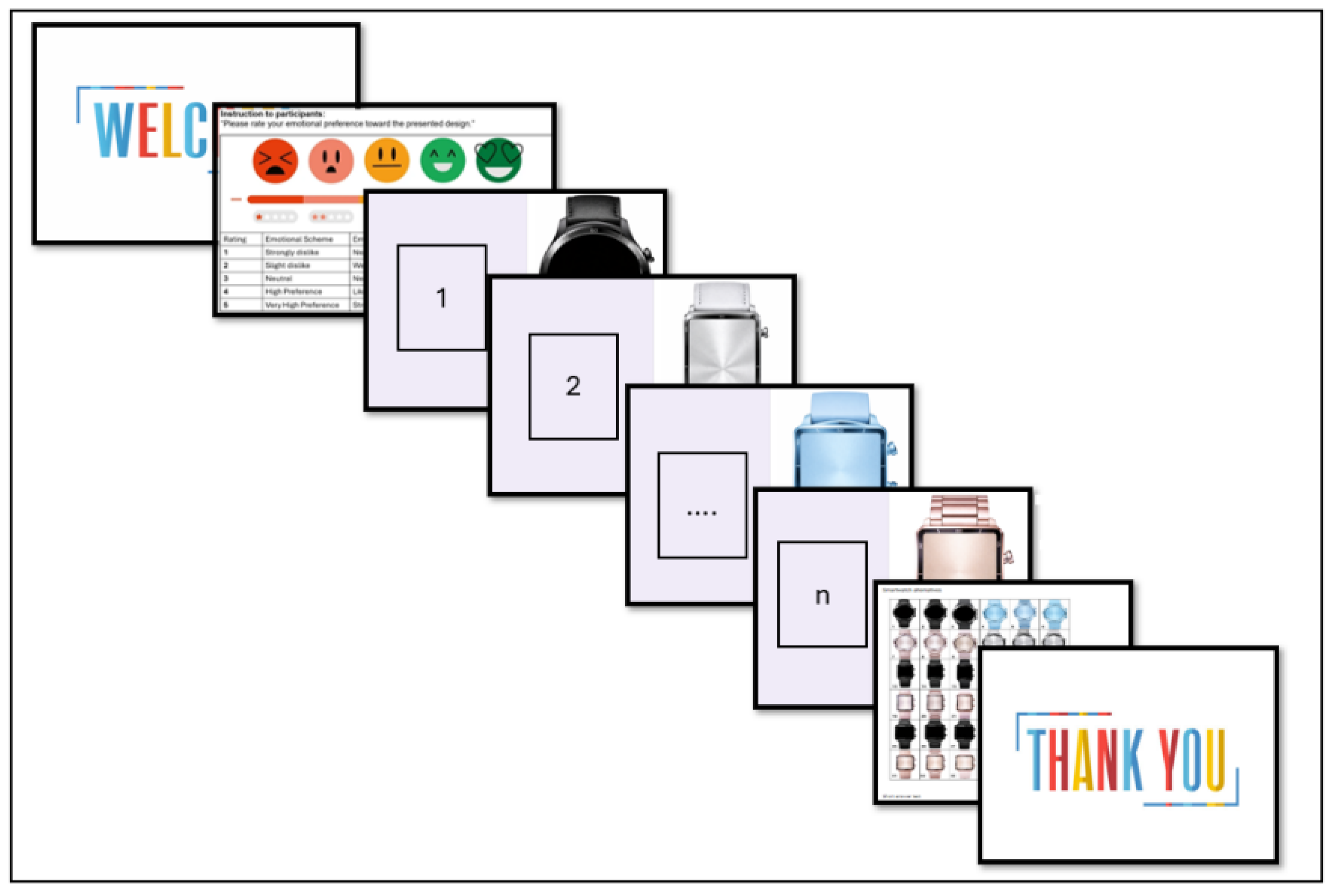
The assessment of the proposed aesthetic emotional design set was conducted using an online form to evaluate smartwatch design appeal through 148 participants. The survey began with a welcome message, followed by demographic information filling, an emotional rating scheme with an interpretation guide, and then the smartwatches’ stimuli presented in a random sequence. After viewing the proposed smartwatch designs, participants were also asked to select their preferred and most reflective design, followed by a closing thank you section, as illustrated in Figure 6.
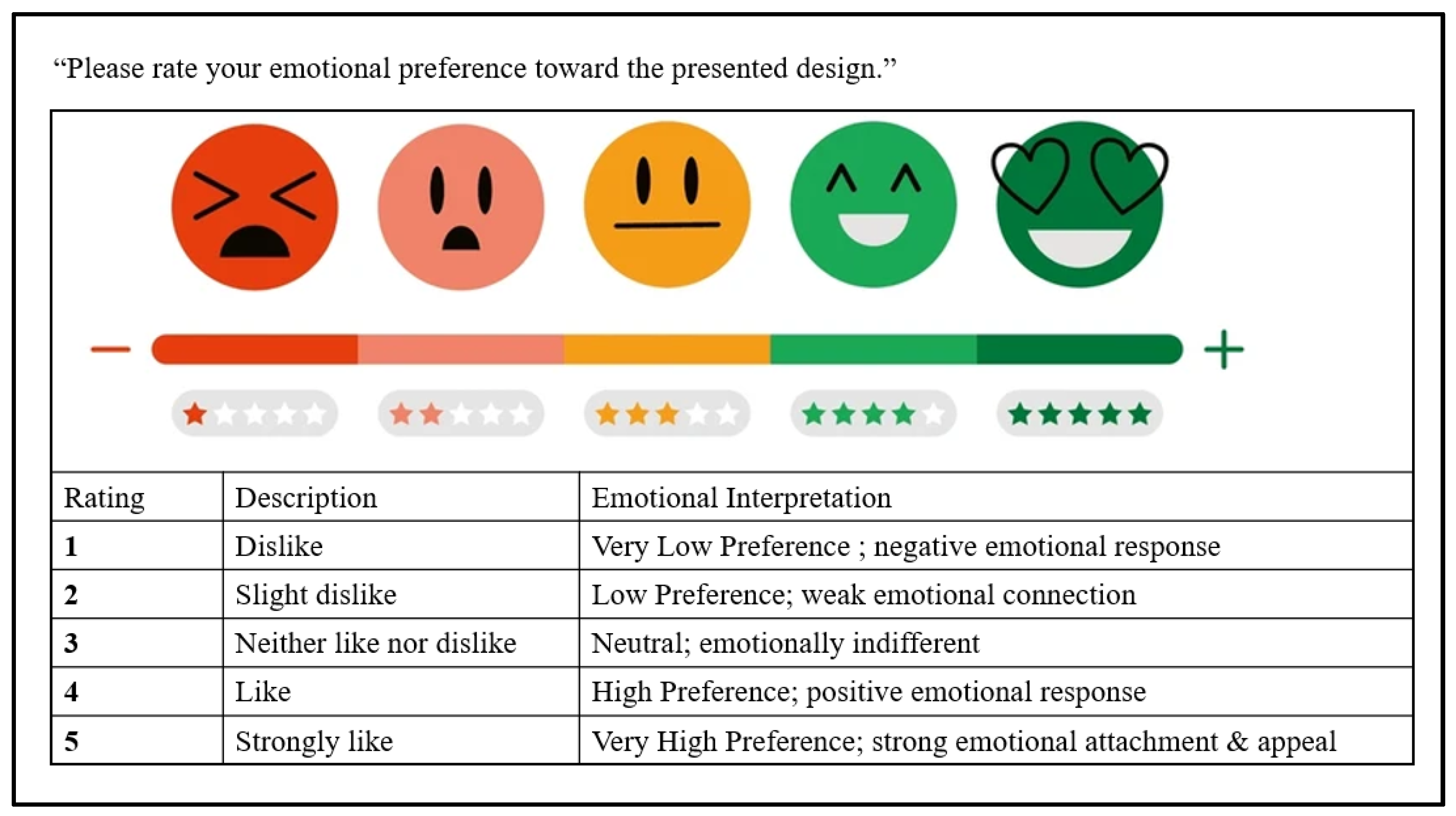
The emotional rating scheme and interpretation guide were designed to help participants translate their ratings into clear emotional descriptions that reflect their feelings and responses toward each design. The emotional assessment used a 1 to 5 Likert scale, which is commonly applied in online survey platforms to capture participants’ level of agreement, preference, or perception toward each stimulus. A brief interpretation guide was provided at the beginning of the survey to clarify the meaning of each rating point. The rating structure was formulated under the guidance of a Likert scale and the semantic differential approach Ref. [48], where rating expressions were transferred into emotional response categories in guidance with Refs. [49,50], as shown in Figure 7. The semantic differential approach further supported this structure because it uses graded bipolar ratings to translate numerical responses into emotional and perceptual meanings. To reduce subjectivity and overlap between categories, the numerical ratings were grouped into positive and negative emotional interpretation ranges based on the valence direction of participants’ responses. Lower ratings represented negative emotional perception, including discomfort, unattractiveness, or rejection toward the design, while higher ratings represented positive emotional perception, including attractiveness, satisfaction, emotional attachment, and preference. For cognitive perception, lower ratings were interpreted as higher cognitive difficulty, including confusion, effort, stress, or mental load, whereas higher ratings indicated clearer cognitive processing, including ease of understanding, confidence, comfort, and effortless interaction with the design.

4.2. Phase I-B: Ergonomic Design Features

4.2.1. Ergonomic Design Features Selection

Phase I-B was conducted in parallel with Phase I-A, with a focus on ergonomic features of smartwatch screens, as wrist-worn wearables’ interfaces are the most interactive and usability-critical component in the HCI context. The selection of ergonomics features began with a review of relevant prior literature and informative design resources to identify interface display features. The previewed small-screen features included several features, among which the most common display features were display polarity (positive and negative) and contrast level (high and low) Refs. [51,52,53,54].
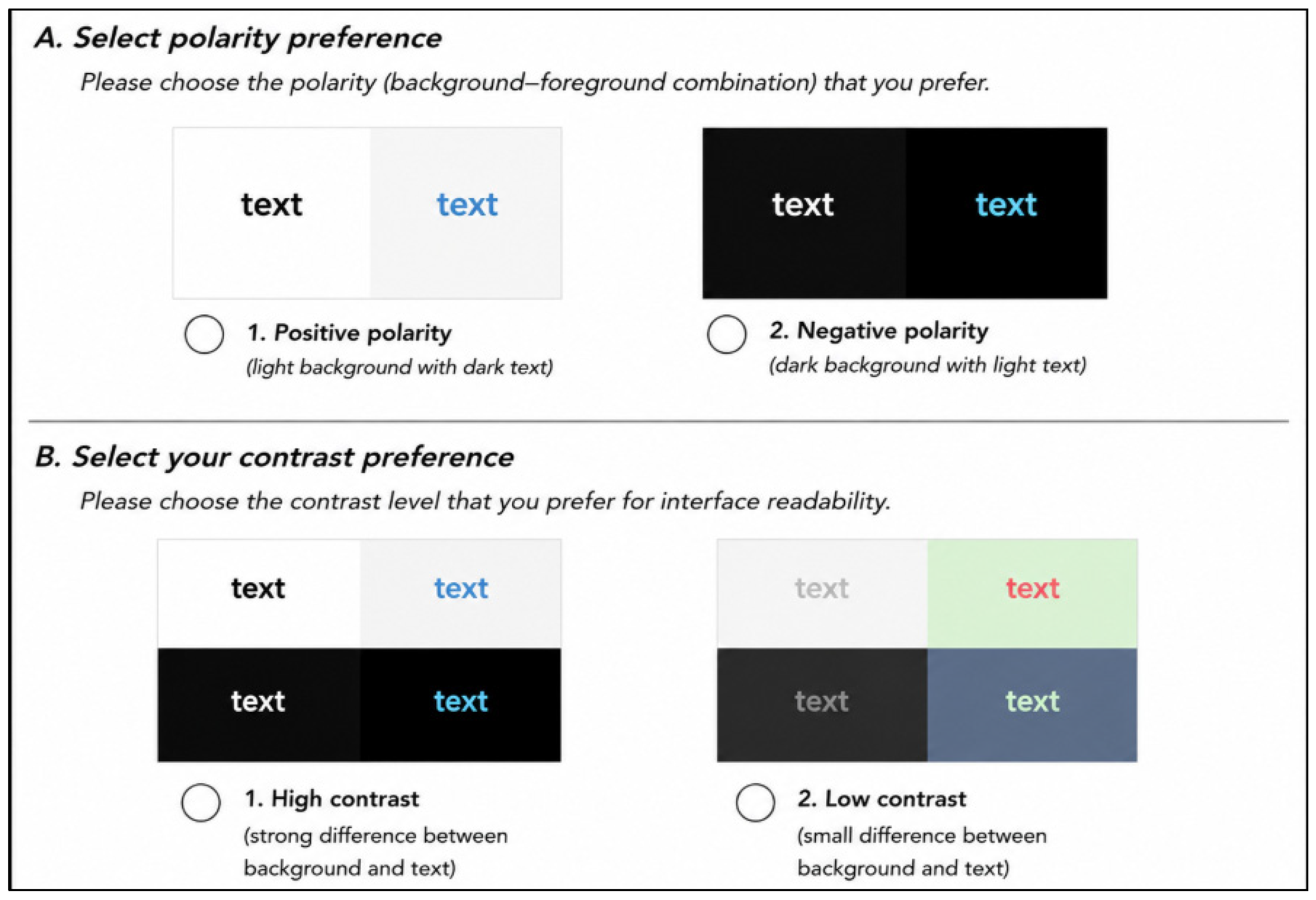
Following this, an online form was used with the selected features to evaluate their preferences across 410 Millennial and Generation Z participants of both genders, as illustrated in Figure 8. Figure 8 shows that Figure 8A a polarity preference selection instance and Figure 8B a contrast preference instance. The selected ergonomic display features were evaluated through classic bipolar Semantic Differential Scales and Likert scales to quantify perceived design preference, legibility, and comfort for each parameter.

4.2.2. Ergonomic Display Design Formulation

Formulating the ergonomic display design stimuli of smartwatch screens required two main steps. First, the survey-selected design features were used to develop the candidate interface designs and create the interface display stimulus set. Second, the text materials used to evaluate these stimuli were generated and prepared for integration into the final display set.
Candidate Interface Display Design
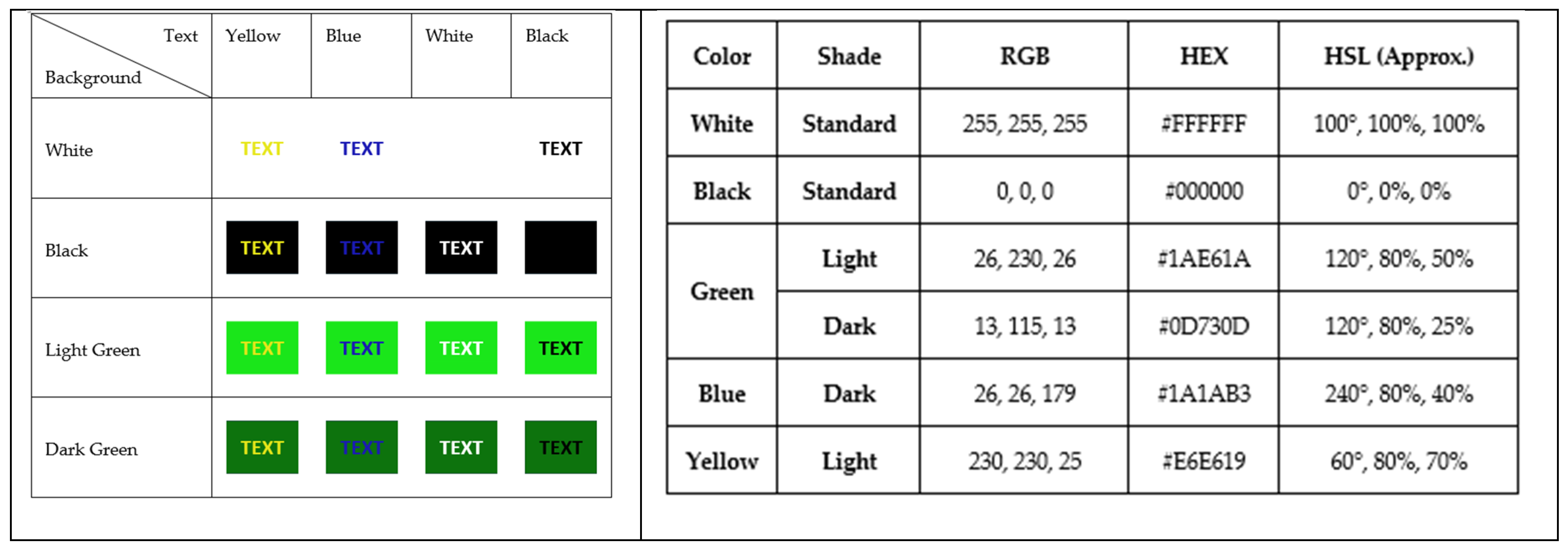
The candidate display interfaces were constructed based on the selected features from prior work, where these features are of polarity and contrast levels. Polarity was implemented as positive polarity (dark text on a light background) and negative polarity (light text on a dark background), as addressed in Ref. [53]. Polarity was further classified into two subcategories of gray- and color-scale levels, provoking four design categories: positive polarity gray scale (PPGS), positive polarity color scale (PPCS), negative polarity gray scale (NPGS), and negative polarity color scale (NPCS) [52]. The colors used across polarity display features were green background, as suggested in Ref. [55], as well as blue and yellow text, as indicated in prior work Refs. [17,56,57]. Meanwhile, contrast was set to the high condition because of a prior study’s recommendations Ref. [58], and the survey results supported a significant legibility advantage, as explained in the Results and Analysis Section. All colors were selected from the Canva® and HTML colour picker W3schools® at approximately 80% saturation, as displayed in Figure 9, illustrating color codes and properties for easier color information tracking and validity.
Text Material Creation
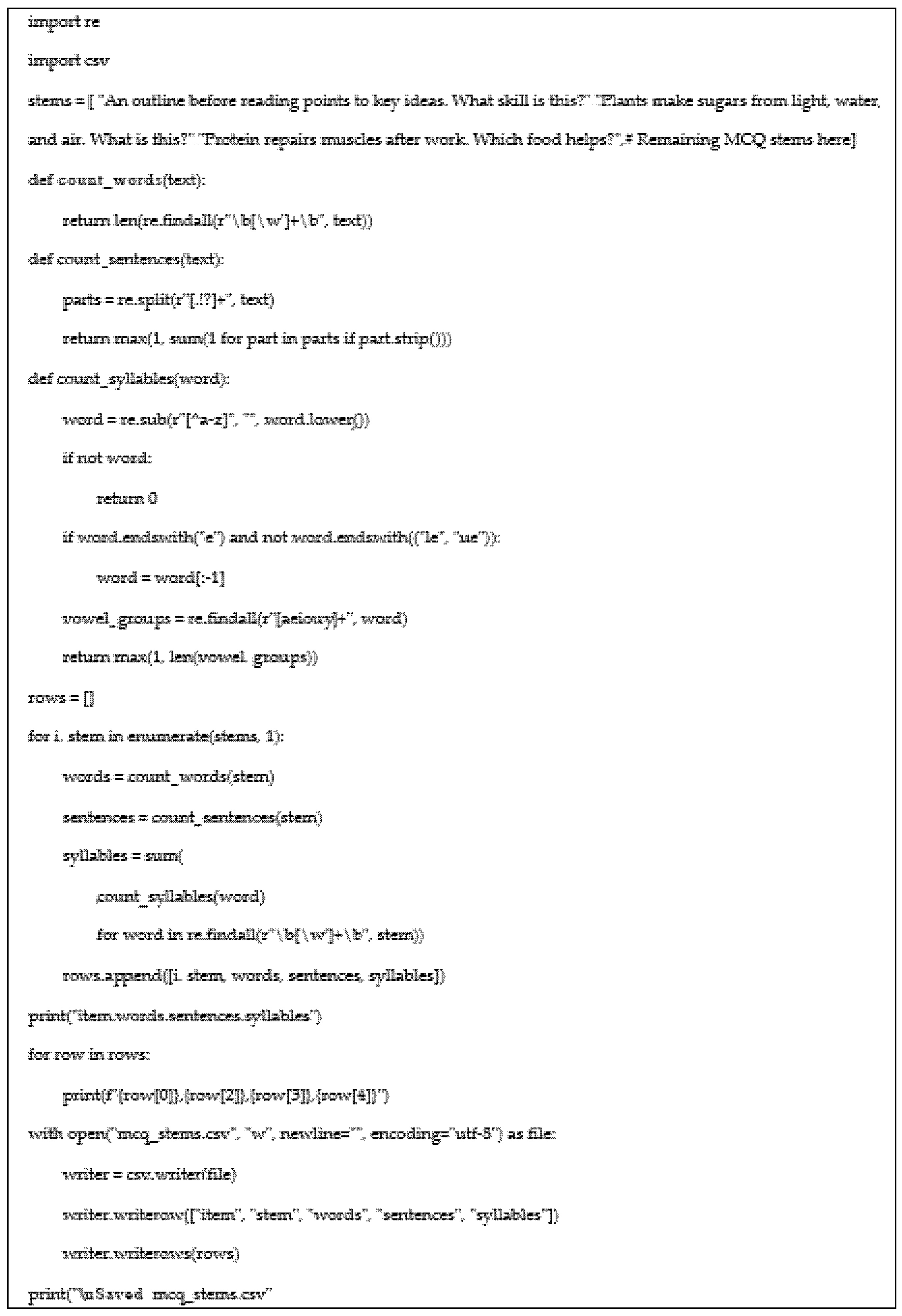
Text materials were developed for integration with the candidate interface designs to enable the evaluation of their perception across demographic participant groups. The texts were first created using Python 3.9 code and then refined through human–AI collaboration using the ChatGPT platform under linguistically guided prompts of expert supervision, as illustrated in Figure 10.
The generated text aimed for maintaining a consistent readability level across stimuli to reduce cognitive load due to word intuition. Each text material instance was formulated as a question followed by three multiple choice responses, in which one option provided the clear and relevant answer to the question, while the other two options were intentionally irrelevant. To ensure the proper reading rate, each generated text instance was limited to a maximum of 25 words, in line with the recommended exposure of non-native English speakers’ duration of 293 wpm, resulting in 7 s/stimulus guided by Ref. [59], as illustrated in the following equation:
Reading   rate   for   learning   ( multiple   choice   text )   =   293   W / m   =   293 60   W / s = 4.88   W / s 4   W / s   if   approximated   to   lower   level ,
Reading   rate   =   25 4 = 6.25   s 7   s .

4.2.3. Ergonomic Design Verification

Legibility Verification
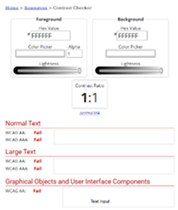
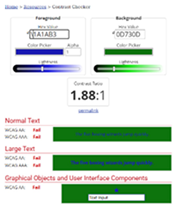
Following interface design formulations, the candidate display features were verified to confirm their suitability as experimental stimulus legibility using the WebAIM® contrast checker WCAG 2.1, as shown in Table 5. This procedure yielded eight high-contrast display conditions, which are highlighted in red, covering both polarity modes and required contrast levels.
Readability Verification
Linguistic validation for word count was conducted by the Microsoft Word® count property to ensure that each text instance remained within participants’ reading rate guidelines. The results showed that the generated texts satisfied the intended readability timing and word length constraints, as in Table 6. The estimated reading time fell within the targeted reading rate of 7 s per stimulus, with the calculated reading time ranging between 4 s and 6 s per stimulus. Based on expert guidance and prior work, the stimulus presentation time was set to 16 s to ensure sufficient time for reading, comprehension, and accurate task response. After validation, the text materials were integrated with the candidate interface parameters to form the final stimulus set.

4.2.4. Ergonomic Design Features Assessment Using Eye Tracker

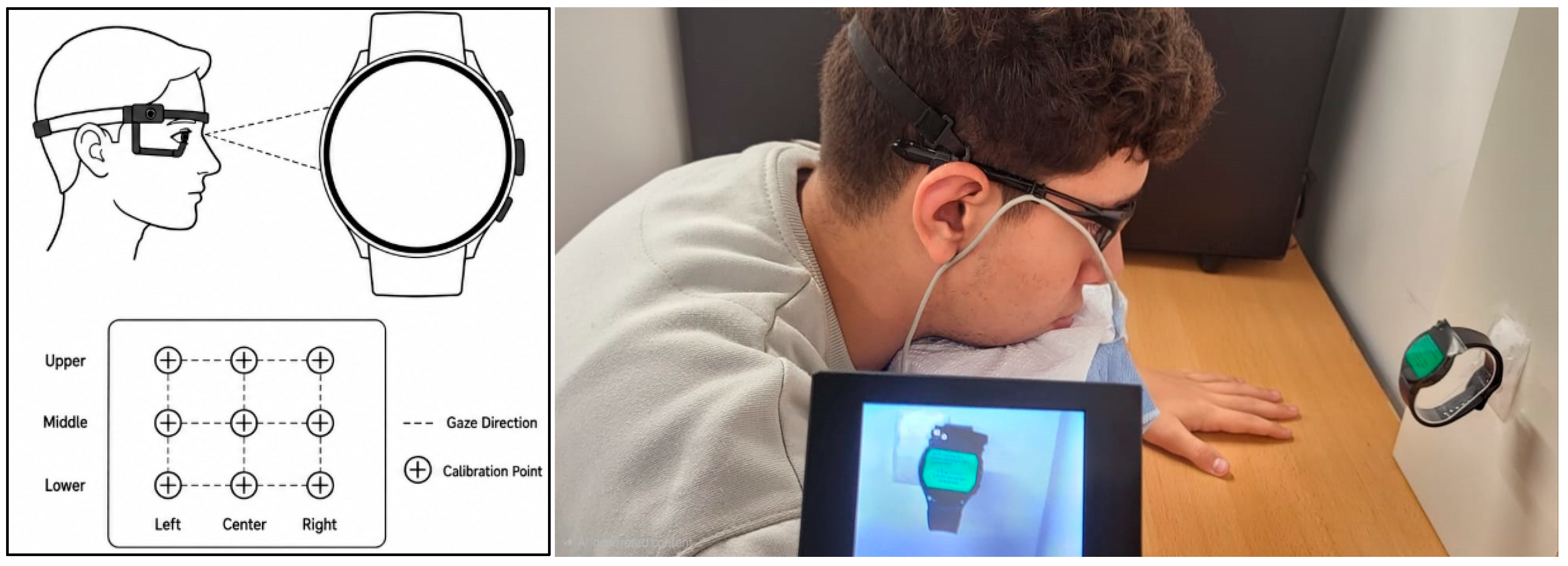
At first, a pilot test was conducted to ensure proper vision and comfortable viewing conditions, with the viewing distance estimated at approximately 20–30 mm and adjusted according to each participant’s visual comfort. Lighting illumination was set to 360 lx for high light and 5 lx for low light, aligning with the recommendation of Refs. [60,61]. Before the main experiment, EMR-9 calibration was performed using a nine-point calibration procedure, including three upper points, three middle points, and three lower points distributed across right, center, and left gaze positions. After eye-tracking calibration, the interface assessment experiment of the ergonomic design features was conducted, as illustrated in Figure 11. The ergonomic design features were assessed using a candidate set of interface stimuli displayed on a round black Samsung Galaxy Watch 6 and recorded using the EMR-9 eye tracker, while also adhering to the aesthetic emotional design recommendations identified in the Phase I-A results and analysis.
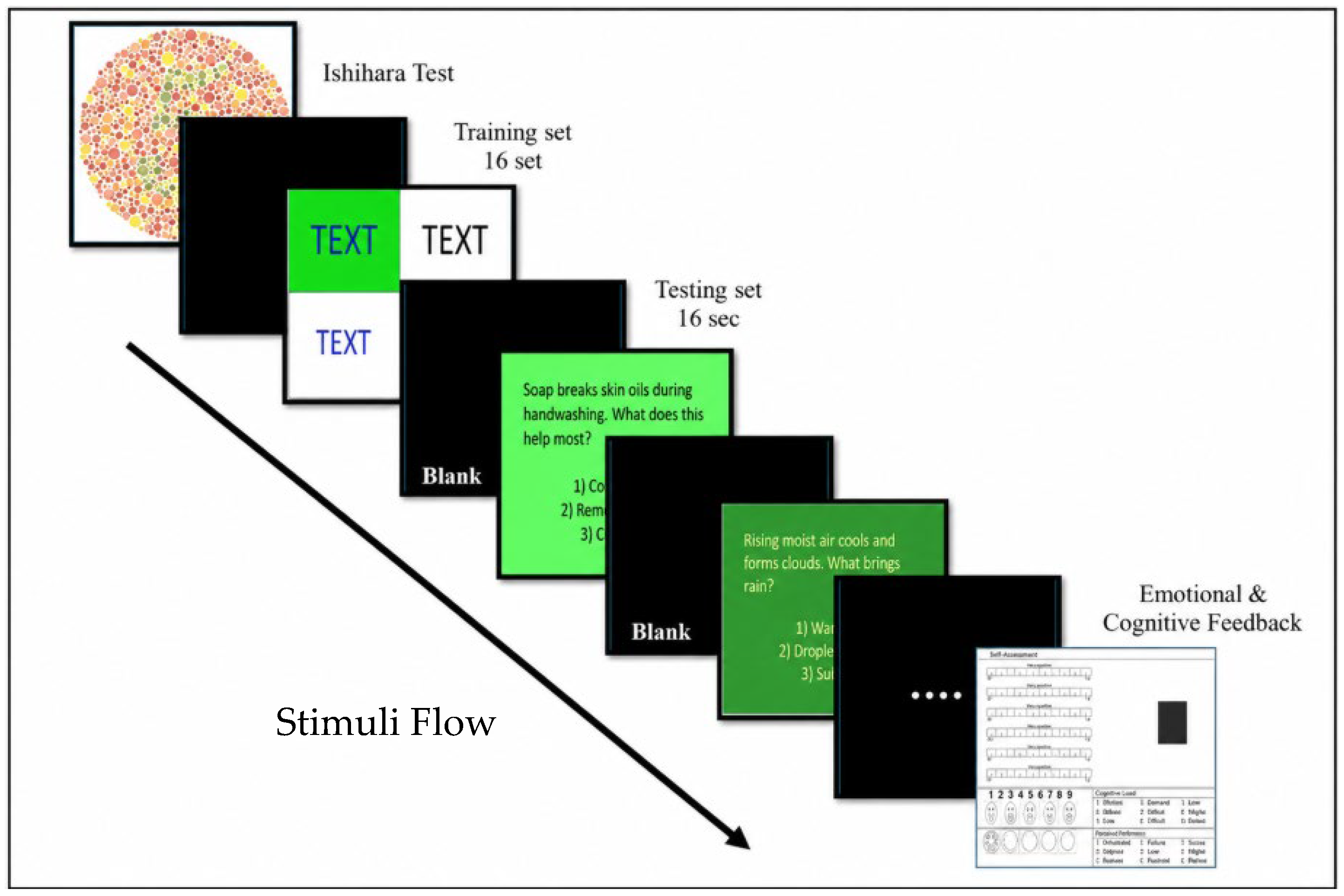
Ergonomic design features varied by polarity through text–background color combinations. The assessment began with the Ishihara color vision test and demographic information filling, then the ergonomic design features assessment test and participants’ feedback, as illustrated in Figure 12. For the ergonomic features assessment experiment, the participants were first introduced to a short training block Ref. [62], then the main test block, including 16 candidate designs, which were presented in a randomized order under high and low lighting conditions. Each stimulus was displayed for 16 s, followed by a 4 s blank screen to reduce carryover effects and prepare participants for the next stimulus, with timing guided by readability rate considerations Ref. [59]. After completing the trials, task accuracy and completion Ref. [63] were calculated to quantify legibility, and the Self-Assessment Manikin Ref. [64] was used to capture emotional and cognitive arousal for the best and worst candidate interface designs. The obtained eye-tracking data were filtered using the EMR-9 noise filtration procedure. The addressed eye-tracking metrics included Eye Mark fixation point trace analysis, which provided information on fixation duration and visual scan patterns. These metrics are explained in detail in Section 5.

5. Results and Analysis

This phase first presents the aesthetic emotional design assessment through a survey-based questionnaire that measures emotional responses and aesthetic design preference selection in smartwatches. Then, it reports the selection of ergonomic design features in device interfaces. This is followed by the assessment of the developed interface designs through survey-based measures of task accuracy and completion, selected design preference, and their visual tracking metrices as well as emotional and cognitive arousal feedback. Finally, the second phase maps affective responses obtained by the previous phase into the addressed aesthetic and ergonomic design features in order to derive suggested guidelines for wrist-worn wearable designs.

5.1. Phase I: Aesthetics and Ergonomic Design Features Evaluation

5.1.1. Phase I-A: Aesthetic Design Features

The survey and questionnaire findings from the aesthetic emotional design assessment summarize the emotional ratings and purchase selections of smartwatches reported by 148 Millennial and Generation Z participants across both genders. The emotional rating scores are guided by the emotional interruption scheme as follows: 1 (dislike)—very low preference, 2 (slightly dislike)—low preference, 3 (neutral)—neither like nor dislike, 4 (like)—high preference, and 5 (strongly like)—very high preference. The evaluated design factors in smartwatch aesthetics included smartwatch color (black (B), gray/silver (G), rose gold/pink (P), and blue (Bl)), case shape (round (R), thin (T), and square (S)), and strap material (leather (LRT), metal (MET), and rubber (RUB)). Combining these factor levels produced 36 stimulus designs that were rated based on participants’ aesthetic emotional responses and purchase preference.
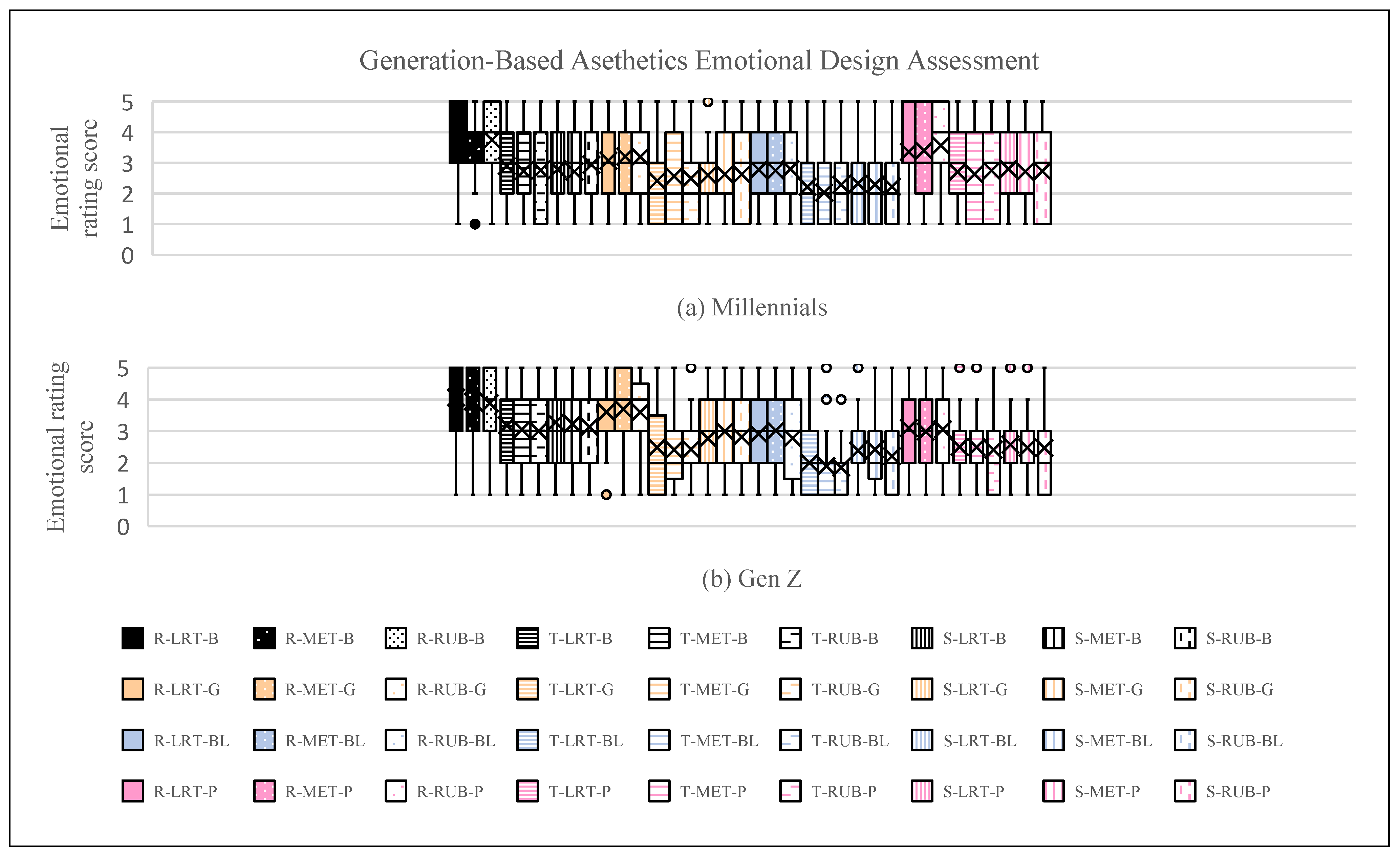
Millennials and Generation Zs’ aesthetic emotional rating scores are presented in Figure 13a and b, respectively. Regarding Figure 13a, Millennials provoked the highest mean rating scores for the round black design, mainly R-R-RUB-B (3.7) and LRT-B (3.5), with approximately a value of 4 (like), provoking high emotional preference, then the R-Rub-P design with a mean rating score of 3.6. Meanwhile, the lowest rating score was for square and thin blue designs (2.0–2.3) across all materials and T-LRT-G (2.4) with approximately a value of 2 (dislike), provoking low emotional preference. The rest of the designs achieved mean scores between values of 2.5 and 3.4. These findings suggest a high preference for round black smartwatch designs as well as a low emotional preference for square and thin blue smartwatch designs among Millennials. Meanwhile, Figure 13b shows that Gen Z provoked the highest mean rating score for round black (3.9–4.1 and round gray/silver (3.6–3.7) designs across all materials with approximately a value of 4 (like), provoking a high emotional preference, then the R-RUB-P design with a mean rating score of 3.1. Meanwhile, the lowest mean score was T-MET-BL (1.9) with a value of approximately 2 (slightly dislike), provoking the lowest preference. Following this, Gen Z reported low scores mainly for square and thin blue designs across all materials (1.9–2.4), in silver/gray T-MET-G and T-RUB-G (2.4), as well as T-RUB-P (2.4) and S-RUB-P (2.4) with an approximate value of 2 (slightly dislike), provoking low emotional preferences. The rest of the designs achieved a mean score between values of 2.5 and 3.3. These findings suggest a high preference for round black and silver/gray smartwatch designs as well as a low emotional preference for square and thin blue smartwatch designs among Generation Z.
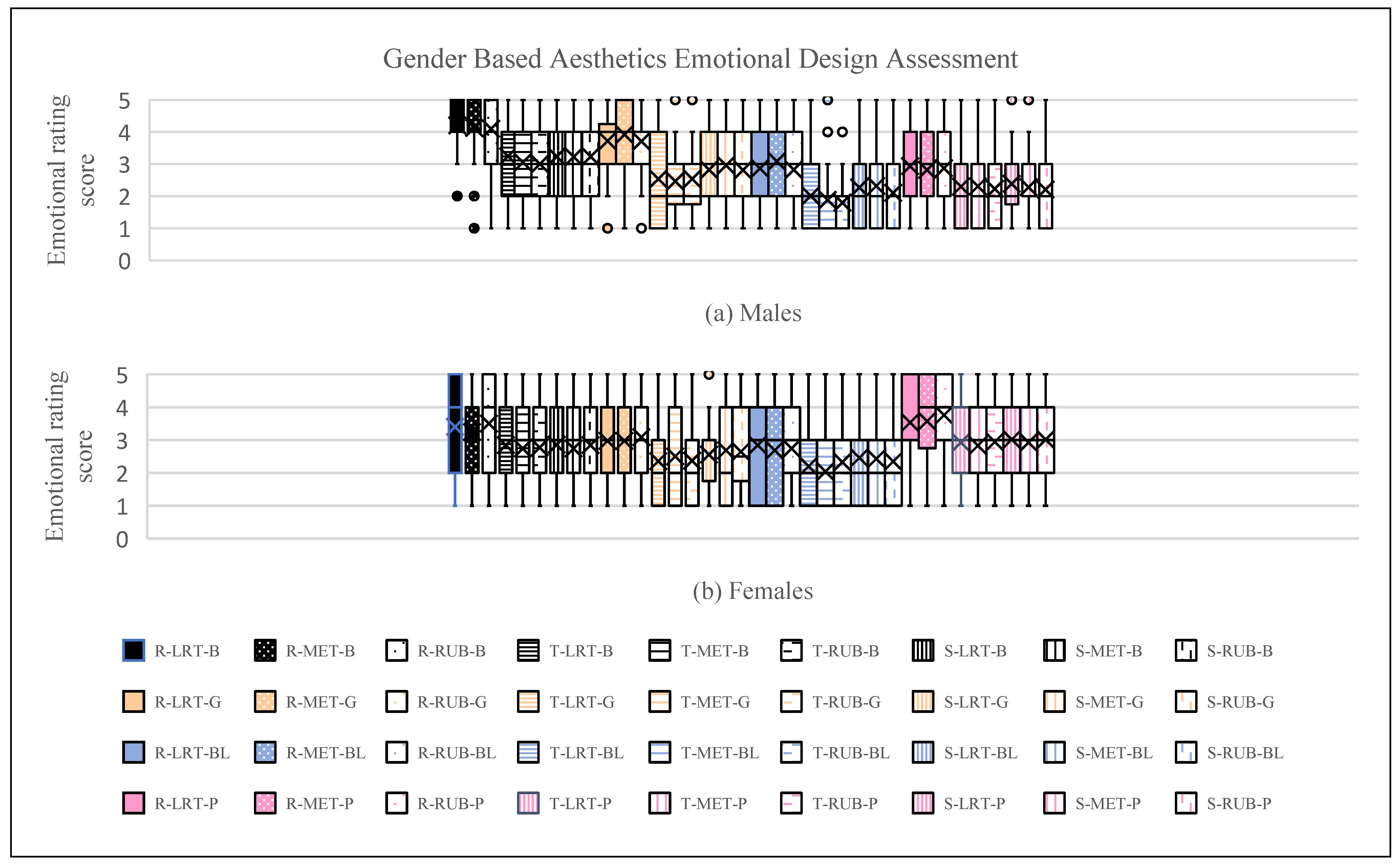
Gender-based emotional rating scores are presented in Figure 14a for males and 14b for females, respectively. In Figure 14a, males provoked the highest mean rating scores for round black (4.2–4.1) and round gray/silver (3.9–3.7) designs across all materials with an approximate value of 4 (like), provoking high emotional preference. Following this was the square black designs with a mean rating score of 3.2. Meanwhile, the lowest rating scores were for square and thin blue designs across all materials (1.8–2.3), gray/silver thin designs (2.5), as well as rose gold color in T-LRT-P (2.3), T-MET-P (2.3), S-RUB-P (2.2), and S-LTR-P (2.3) with an approximate value of 2 (slightly dislike), provoking low emotional preferences. The rest of the designs achieved an average score between values of 3.1 and 2.4. These findings suggest a high preference for round black and silver/gray smartwatch designs while a low emotional preference for square and thin blue smartwatch designs and some rose gold smartwatch designs among males. For females, Figure 14b shows that females provoked the highest mean rating scores for rose gold round designs, such as R-RUB-P (3.8) and R-MET-P (3.6), followed by R-LTR-P (3.6), with an approximate value of 4 (like), provoking a high emotional preference, respectively. Following this, the R-RUB-B (3.5) design had a mean rating score of approximately 4 (like), provoking a high emotional preference too. Meanwhile, the lowest mean scores were mainly for square and thin blue designs across all materials (2.0–2.5), and thin gray designs (2.4–2.5), with an approximate value of 2 (slightly dislike), provoking a low emotional preference. These findings suggest a high preference for rose gold round smartwatch designs across all materials as well as a low emotional preference for square and thin blue smartwatch designs for females.
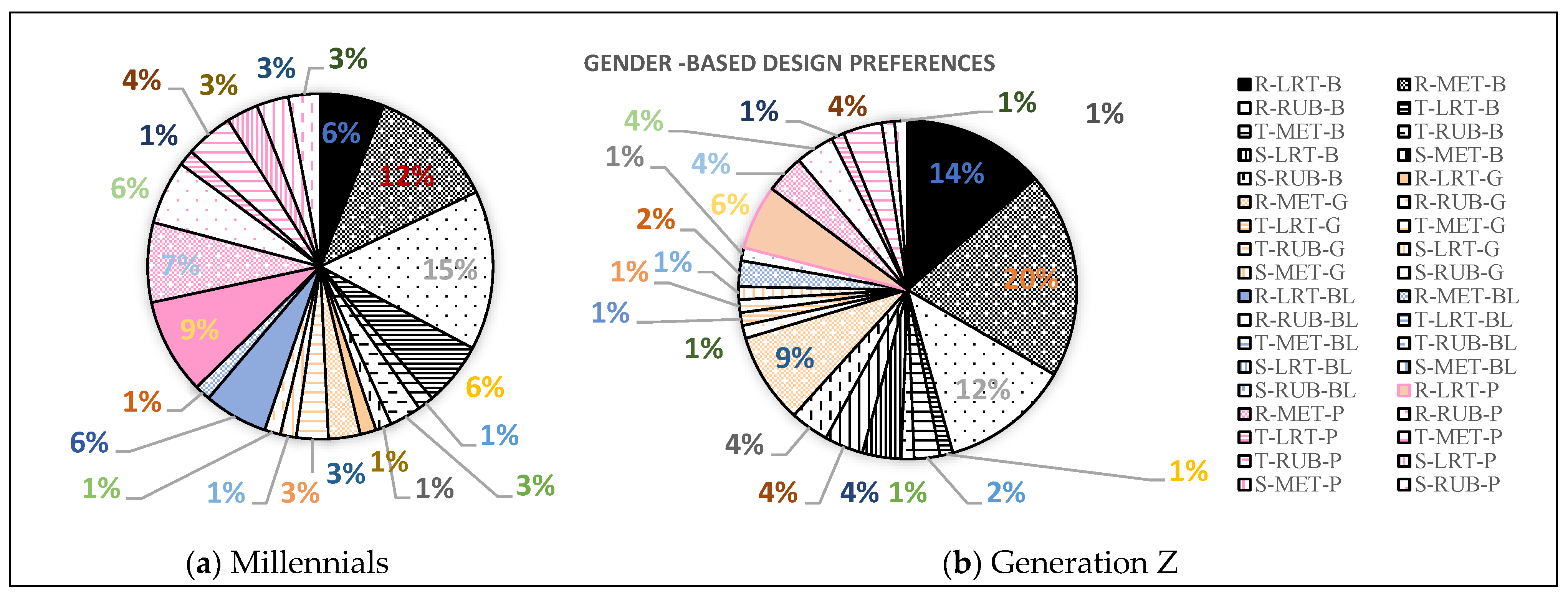
The generation-based design preference selection for smartwatch designs is presented in Figure 15 for (a) Millennials and (b) Generation Z, respectively. In Figure 15a, Millennials showed high preferences for round black smartwatches mainly in R-RUB-B and R-MET-B with 15% and 12% selection frequencies. Following this, round rose gold smartwatches, with mainly R-LRT-P and R-MET-P, had 9% and 7% selection rates. On the contrary, the unselected designs were mostly thin and square blue smartwatch designs, especially T-LRT-BL, T-MET-BL, T-RUB-BL, S-LRT-BL, S-MET-BL, S-RUB-BL, and R-RUB-BL, as well as silver/gray designs in T-RUB-G, T-LRT-G, S-LRT-G, and R-RUB-G. Similarly, black square S-LRT-B and S-MET-B designs as well as rose gold T-RUB-P smartwatches were not selected by Millennials. The rest of the proposed smartwatch designs had a scatter selection preference ranging between 6% and 1% among Millennial participants. These findings show preferences for round black and rose gold designs as the most selected smartwatch design preferences, while thin and square blue designs were the least selected smartwatch designs by Millennials. Meanwhile, Figure 15b illustrates that Generation Z had a high smartwatch selection preference for round black designs with R-MET-B, R-LRT-B, and R-RUB-B, with 20%, 14%, and 12% selection frequencies, followed by round gray R-MET-G with 9% and rose gold R-LRT-P with 6%. Meanwhile, the unselected smartwatch designs by Generation Z were similar to Millennials, with mostly thin and square blue designs, such as T-LRT-BL, T-MET-BL, T-RUB-BL, S-LRT-BL, S-MET-BL, S-RUB-BL, and R-LRT-BL. In addition, in gray/silver, T-RUB-G, S-RUB-G, and R-LRT-G designs, as well as in rose gold, S-LRT-P and S-MET-P designs, were not selected as purchasing preferences. The remaining smartwatch designs had selection preferences ranging between 6% and 1% for Generation Z participants. These findings suggest a high selection preference of Generation Z for round black smartwatches across all materials and the lowest selection preference for thin and square blue smartwatch designs.
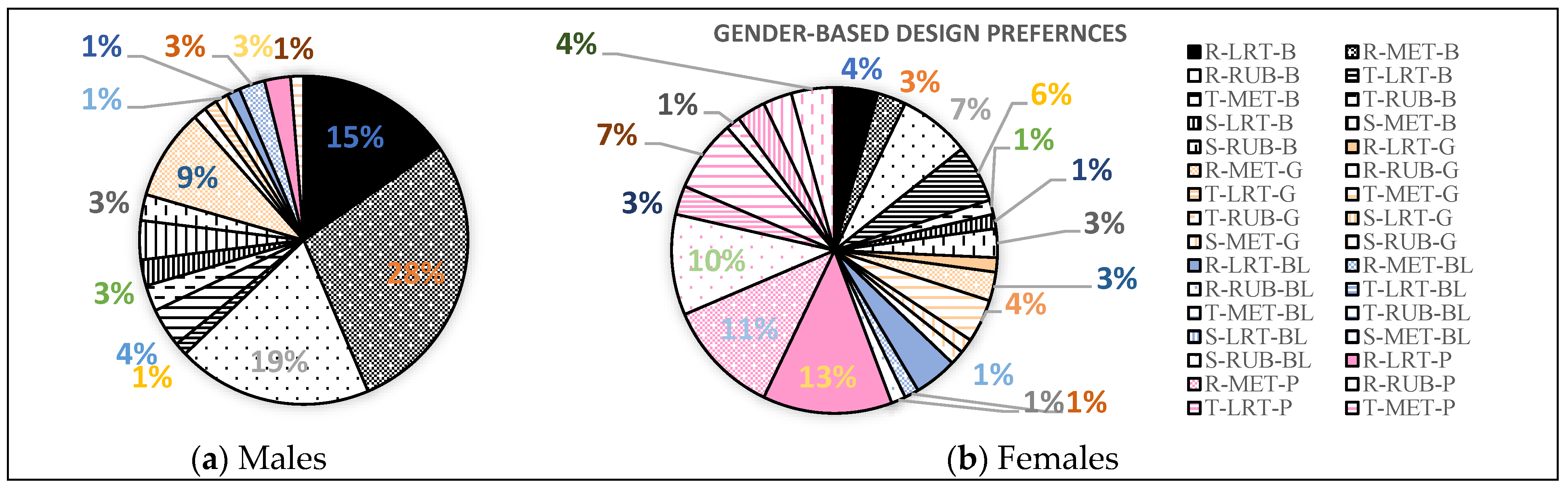
Furthermore, gender-based design preferences for smartwatch selection are presented in Figure 16 for (a) males and (b) females, respectively. In Figure 16a, males showed high preference selection for mostly round black smartwatches across all materials, with R-MET-B, R-RUB-B, and R-LRT-B with 28%, 19%, and 15% selection frequencies, respectively. Following this was round gray/silver smartwatches, R-MET-G, with 9% selection frequency. Meanwhile, the unselected smartwatch designs were mostly thin and square blue designs, especially T-LRT-BL, T-MET-BL, T-RUB-BL, S-LRT-BL, S-MET-BL, S-RUB-BL, and R-RUB-BL, as well as rose gold square, thin, and round designs, particularly S-LRT-P, S-MET-P, S-RUB-P, T-RUB-P, T-LRT-P, R-MET-P, and R-RUB-P. In addition, gray/silver smartwatches, such as R-LTR-G, T-MET-G, T-RUB-G, S-LRT-G, and R-LRT-G, were not selected by males. The remaining smartwatch designs had selection preference frequencies between 4% and 1% among males. These findings show that the highest smartwatch preference was for the round black design, especially R-MET-B, with more than quarter of the smartwatch selection percentage, while thin and square blue and rose gold designs reported the lowest smartwatch design selection preference for male participants. Meanwhile, Figure 16b illustrates that females had a high smartwatch preference selection for round rose gold designs in R-LRT-P, R-MET-P, and R-RUB-P, with 13%, 11%, and 10%, respectively, as well as T-MET-P and R-RUB-B, with 7% selection frequency for both designs. On the contrary, the unselected smartwatch designs by females were thin and square blue designs, such as T-LRT-BL, T-MET-BL, T-RUB-BL, S-LRT-BL, S-MET-BL, and S-RUB-BL. In addition, the gray/silver R-RUB-G, T-LRT-G, T-RUB-G, and S-LRT-G designs, as well as black T-MET-B and S-MET-B designs, were not selected as smartwatch design preferences. Furthermore, females selected the remaining designs as their smartwatch design preferences with a selection frequency ranging between 6% and 1%. These findings highlight a high preference for round rose gold smartwatches and low design preferences for thin and square blue smartwatches across female participants.
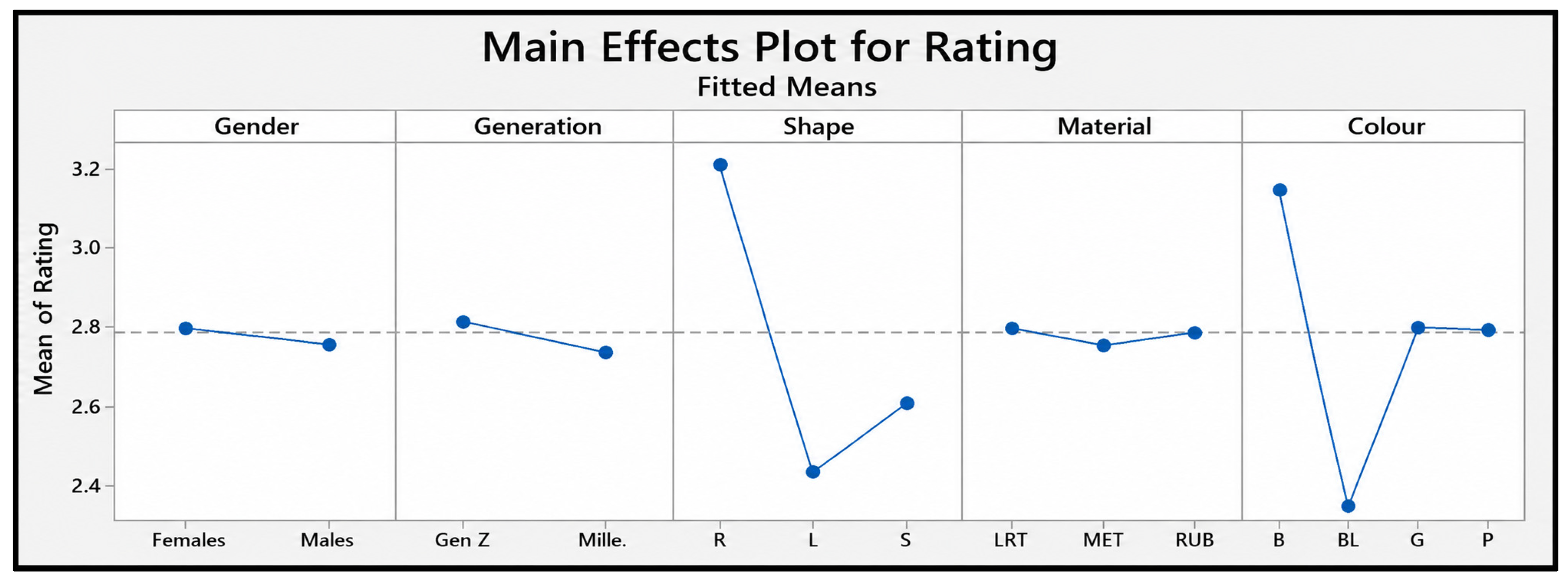
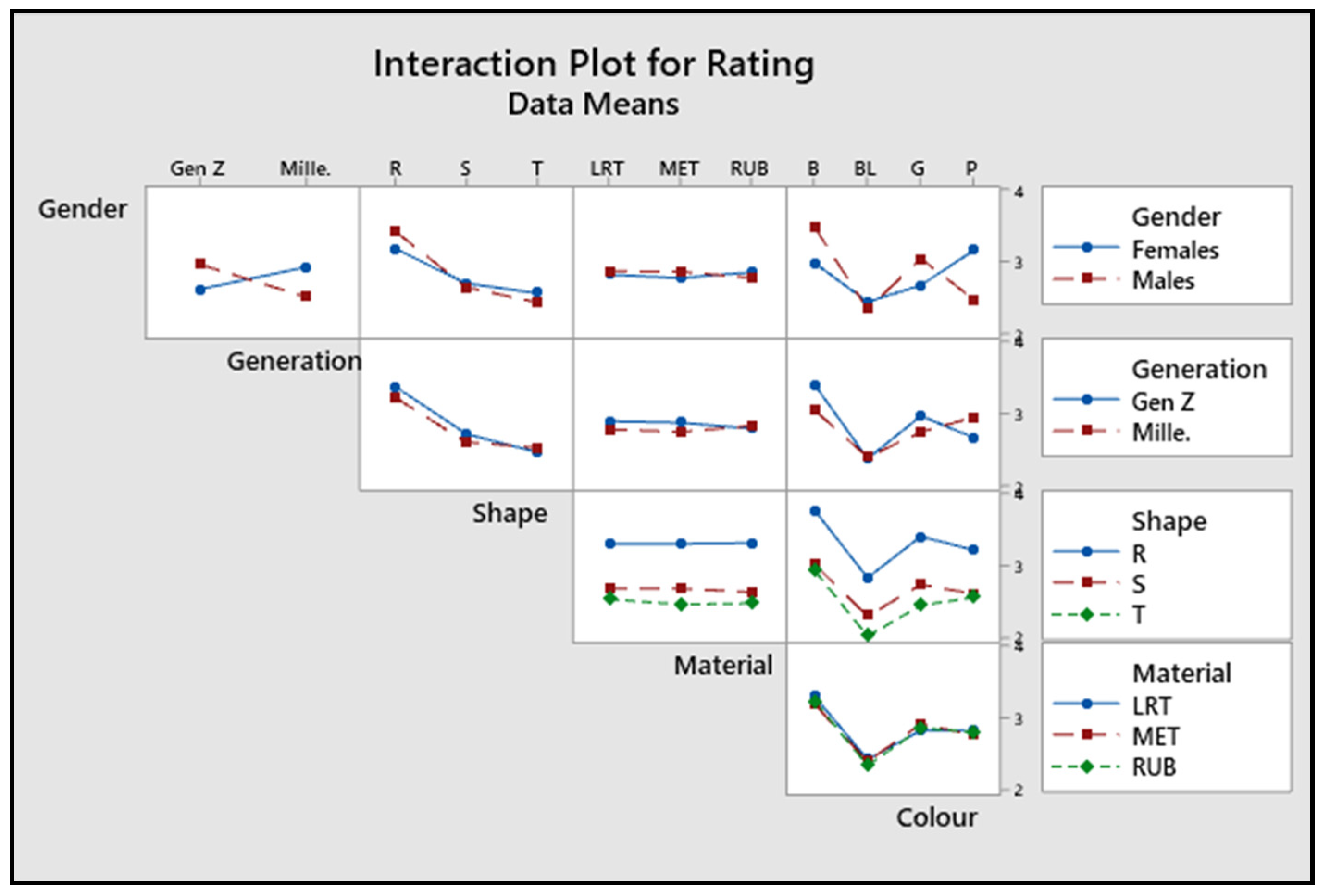
Further statistical analysis of ANOVA, main effect plot, and interaction plots were conducted to address the significant impact of the addressed factors on emotion rating responses and design selection preferences, as illustrated in Table 7 and Table 8, and Figure 17 and Figure 18. Table 7 reports that shape (p-value = 0.000 and F-value 185.68) and color (p-value = 0.000 and F-value = 87.36), as well as the interactions of Gender*Generation (p-value = 0.000 and F-value = 112.03), Gender*Shape (p-value = 0.000 and F-value = 9.32), and Gender*Color (p-value = 0.000 and F-value = 47.87) showed significant impacts on the emotional rating responses obtained by the participants. Meanwhile, the rest of the factors and their interactions showed non-significant impacts on emotional rating responses. These findings support H1a and H1b, where the interaction effect of Gender*Generation showed that these factors significantly impact aesthetic perception and preference in smartwatch designs. Table 8 highlights the significant effect of gender (p-value = 0.000 and F-value = 556.05), generation (p-value = 0.001 and F-value = 10.82), and their interaction, Gender*Generation (p-value = 0.002 and F-value = 10.06), on smartwatch design selection. These findings support H1a and H1b, emphasizing their significant impact on aesthetic smartwatch design selection. Partial eta-squared analysis indicated that the gender factor demonstrated a moderate practical effect on design selection, with values ranging between 0.01 and 0.06, whereas both gender and generation factors showed a comparatively low effect size below 0.01 on rating and design selection responses, suggesting limited practical influence despite statistical significance.
The main effects plot in Figure 17 indicates that smartwatch shape and color produced the strongest influence on participants’ rating responses compared with gender, generation, and material factors. Notably, the third plot shows that circular smartwatch designs achieved the highest mean ratings, whereas rectangular forms showed the lowest preference, suggesting a stronger emotional and aesthetic preference toward rounded interface shapes. Following color in the fourth plot, black achieved the highest ratings, while blue recorded the lowest evaluation, indicating that darker and more neutral tones were more positively perceived by participants. In contrast, gender, generation, and material factors demonstrated relatively minor variations around the overall mean, indicating lower independent effects on the overall aesthetic evaluation.
Figure 18 illustrates the interaction plots of the studied factors on emotional rating responses for the previewed smartwatch designs. The first interaction plot in the first row shows a Gender × Generation interaction, where females in the Millennial group and males in the Gen Z group provided higher ratings than males in the Millennial group and females in the Gen Z group. The plots in the second column show a consistent smartwatch shape preference across both generations and genders, with round designs rated highest, followed by square then thin designs, which do not support H1a and H1b for shape preferences. Column 3 suggests only small differences for Gender × Material and Generation × Material. The first plot in the third column indicates that males tended to prefer metal and leather more than rubber, whereas females preferred rubber and leather more than metal. The second plot in the third column presented that Millennials showed a higher preference for rubber, while Gen Z preferred metal and leather more than rubber, indicating limited material effects overall. In contrast, color preferences showed clearer demographic differences, as illustrated in the fourth column. The first row in the fourth column showed that males preferred black smartwatch designs first, followed by silver/gray and rose gold, while females preferred rose gold first, followed by black and then silver/gray. Both genders showed the lowest preference for blue smartwatch designs. Similarly, Millennials preferred black, then rose gold, then silver/gray, and finally blue smartwatch designs, whereas Gen Z preferred black, then silver/gray, then rose gold, and finally blue smartwatch designs. These findings support H1a and H1b for the differences in color preferences across generations and genders. Overall, the results indicate stable smartwatch shape preferences across groups, limited material effects, and meaningful differences in smartwatch color preferences, supporting H1b and H1a for color-based aesthetic perception.


5.1.2. Phase I-B: Ergonomic Design Features

Ergonomic Design Features Selection
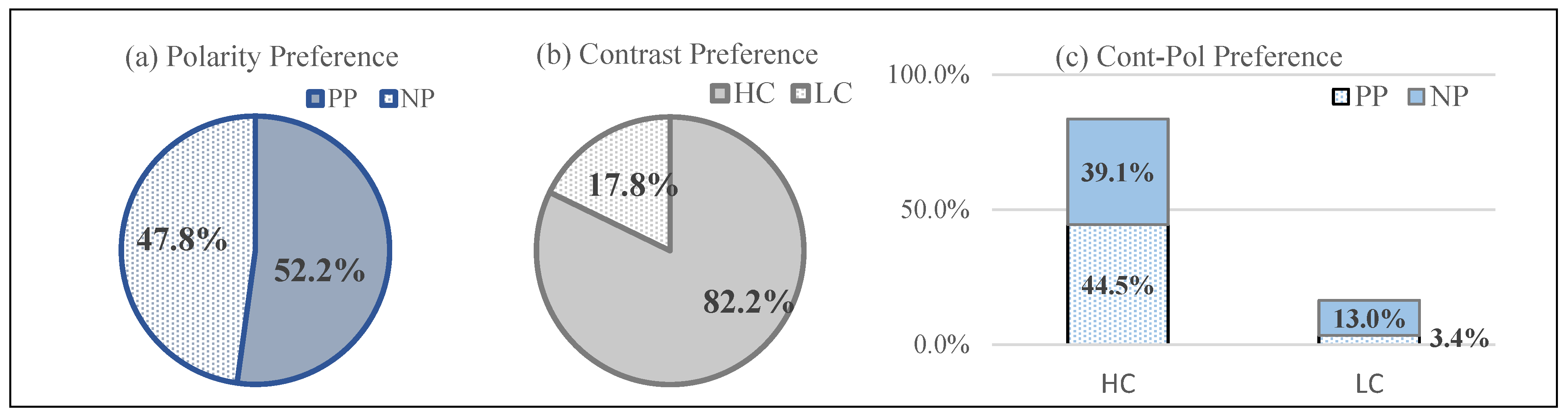
The results summarize interface feature preferences of 410 Millennials and Generation Z participants for key interface display features in smartwatch designs, including polarity, contrast level, and their combination effect, as shown in Figure 19. Figure 19a indicates a higher preference among participants for positive polarity at 52.5%, compared with 47.8% for negative polarity. Figure 19b shows a strong preference across participants for a sharp contrast level at 82%, compared with 17.9% for a low contrast level. Figure 19c shows that the contrast and polarity combination (Cont–Pol) includes low-contrast positive polarity (LCPP), high-contrast positive polarity (HCPP), low-contrast negative polarity (LCNP), and high-contrast negative polarity (HCNP). The plot shows that HCPP received the highest preference at 44.5%, followed by HCNP at 39.1%, then LCPP at 13.0%, and finally LCNP at 3.4%. Furthermore, ANOVA was conducted to address the impact of generation and gender on polarity, contrast scale, and Cont–Pol preference, respectively. For polarity preferences, there were significant main effects of generation (p-value = 0.002, F-value = 9.48) and gender (p-value = 0.001, F-value = 11.20), with no significant effect of the Generation × Gender interaction (p-value = 0.316, F-value = 1.01). For contrast preferences, no significant effects were observed for generation (p-value = 0.085, F-value = 2.98), gender (p-value = 0.900, F-value = 0.02), or their interaction (p-value = 0.964, F-value = 0.00), indicating similarities in high-contrast preferences. For Cont–Pol preference, significant main effects were found for generation (p-value = 0.001, F-value = 12.03) and gender (p-value = 0.002, F-value = 9.84), while the interaction remained non-significant (p-value = 0.571, F-value = 0.32). Overall, these results support H2a and H2b for polarity and Cont–Pol preferences, but they conflict with the hypotheses for similar high-contrast level preferences.
Ergonomic Design Features Assessment
The ergonomic design features assessment was conducted through task accuracy and completion to detect the legibility rate as well as the capture of emotional and cognitive arousal for the best and worst candidate interface designs’ selection.
Task accuracy and completion (TAC) reflect participants’ ability to read the displayed text and provide an accurate response within the allocated viewing time. TAC was computed using a binary scoring scheme, where correct responses were coded as 1 and incorrect or missed responses as 0, yielding a maximum accuracy of 100% across 40 participants for the population sample and 20 participants for each binary comparison, such as generation (Millennials and Gen Zs) and gender (males and females).
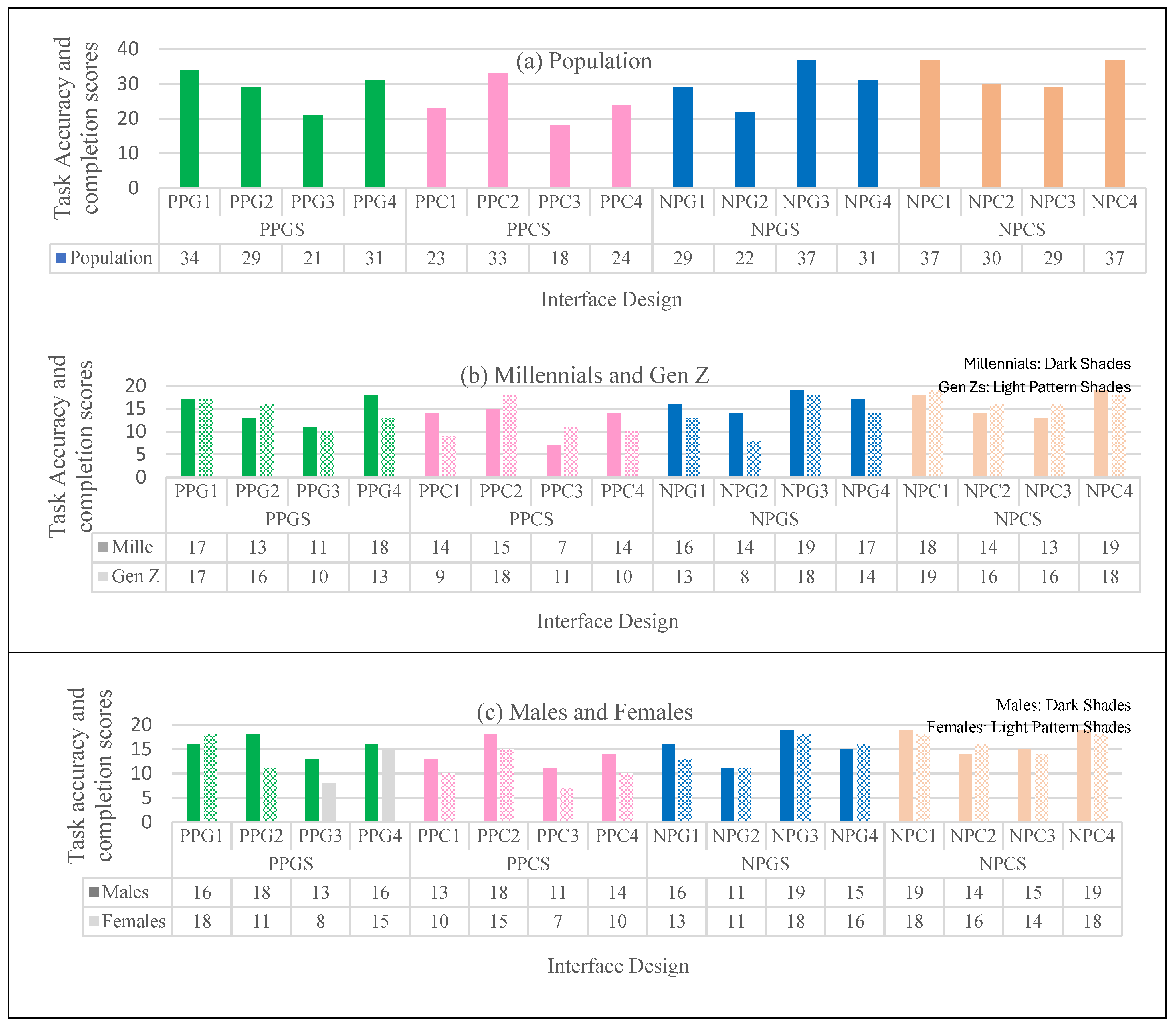
Figure 20 reports the analysis of TAC scores across Figure 20a population sample, Figure 20b generation, and Figure 20c gender for the proposed interface designs. Figure 20a shows TAC counts for the interface design stimuli across the full sample. The highest TAC instance was observed in NPCS with 37 counts by 2 stimuli, followed by NPGS by 1 stimulus, whereas the lowest TAC instance occurred in PPGS with 21 counts across 1 stimulus. The highest mean TAC was recorded for NPCS with 33.25 counts followed by NPGS with 29.75 counts, then PPGS with 28.75 counts, and finally PPCS with 24.5 counts. Figure 20b shows generation-based variation in TAC scores across interface categories—the figure illustrates that Millennials achieved higher TAC scores across most of the categories compared to Gen Z. The highest TAC instances for millennials were in NPGS and NPCS with 19 counts by 1 stimulus in each category, while the highest TAC instances for Gen Zs were in NPCS with 19 counts by 1 stimulus. The lowest TAC instances for Millennials were in PPCS with 7 counts, while the lowest TAC instances for Gen Zs were in NPGS with 8 counts. Regarding mean TAC scores, the mean TAC scores showed difference in hierarchical order between Millennials and Gen Zs.
For Millennials, the mean hierarchal scores were NPGS with 16.5 counts, NPCS with 16 counts, PPGS with 14.8 counts, and finally PPCS with 12.5 counts; meanwhile, for Gen Zs, the mean hierarchal scores were NPCS with 17.3 counts, PPGS with 14 counts, NPGS with 13.3 counts, and finally PPCS with 12 counts. These variations in mean TAC scores across categories and the differences in values obtained suggest supporting H2a. Figure 20c shows gender-based variation in TAC across interface categories. The figure illustrates that males generally exhibited higher TAC scores compared to females across most of the categories. The highest TAC instances for males were in NPCS with 19 counts by 2 stimuli and NPGS with 19 counts by 1 stimulus, meanwhile the highest TAC instances for females were with a lesser value of 18 counts in NPCS by 2 stimuli as well as NPGS and PPGS by 1 stimulus each. The lowest TAC instances for males were in PPCS and NPGS with 11 counts for 1 stimulus in each category. These observations highlighted an interwind effect where the NPGS category provoked the highest (19) and lowest (11) TAC score instances for males. Thereby, further linguistic analysis was conducted on NPG2 and NPG3 instances, revealing the proper CEFR level of both instances, the B1 level. Therefore, to resolve this observation, further post hoc analysis for participants’ feedback was conducted and stated at the end of this section. Meanwhile, the lowest TAC instances for females were with a lower value of 7 counts in PPCS. For males, the mean hierarchal scores were NPCS with 16.8 counts, PPGS with 15.8 counts, NPGS with 15.3 counts, and finally PPCS with 14 counts; meanwhile, for females, they were NPCS with 16.5 counts, NPGS with 14.5 counts, PPGS with 13 counts, and finally PPCS with 10.5 counts. These variations in mean TAC scores across categories and the differences in TAC score values obtained suggest supporting H2b.
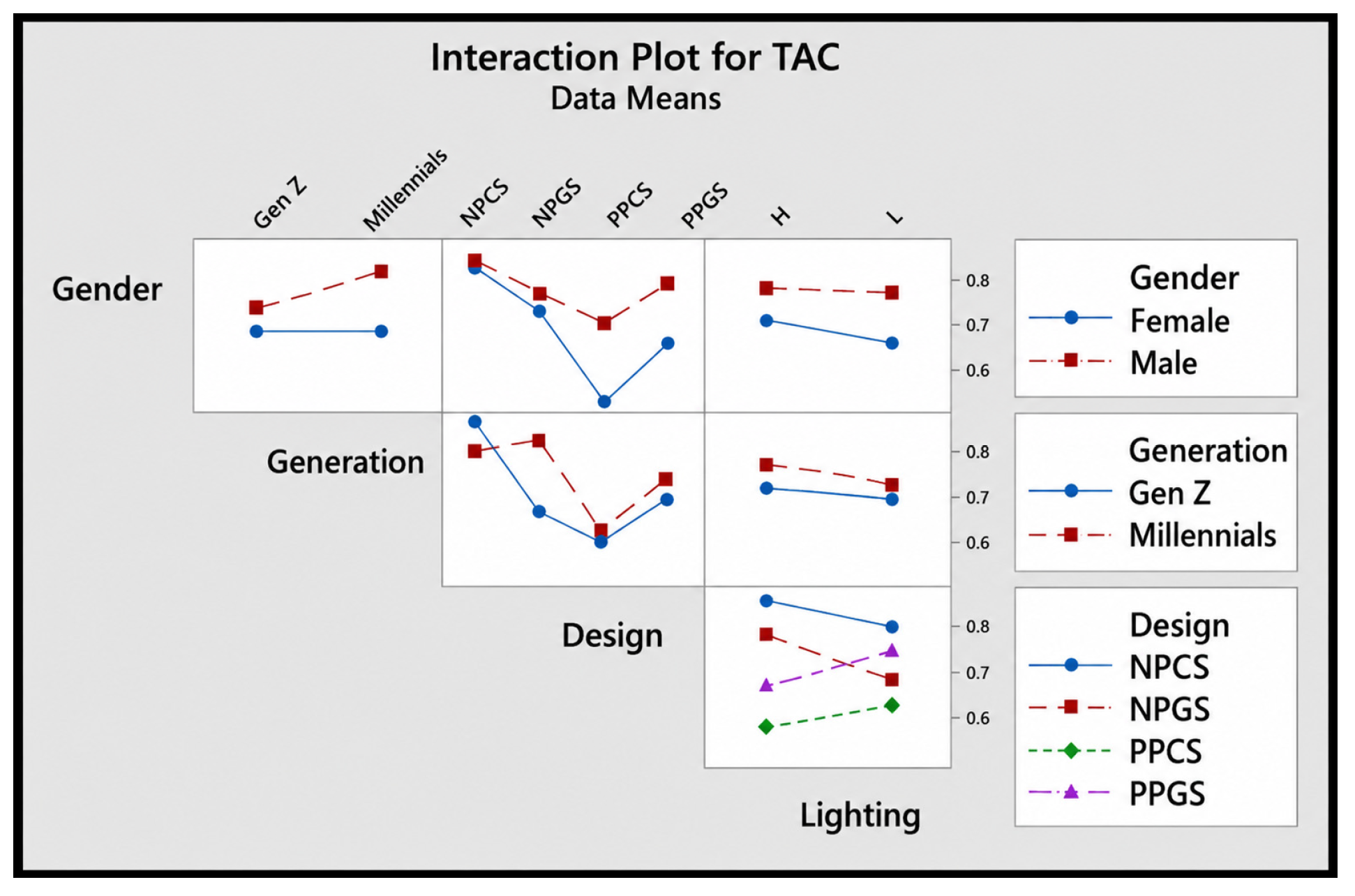
ANOVA and interaction plots were conducted to examine the impact of participants’ demographic factors, including generation (Millennials and Gen Z) and gender (male and female), as well as stimulus factors, including proposed designs (PPGS, PPCS, NPCS, and NPGS) under different lighting (high versus low), on TAC responses. The ANOVA results of TAC responses are reported in Table 9, while their interaction plots are depicted in Figure 21. Table 9 shows that all factors and their interactions had no statistically significant effect on TAC responses except design (p-value = 0.000, F-value = 6.00) and gender (p-value = 0.028, F-value = 4.83). These findings suggest supporting H2a while contradicting H2b.
Figure 21 summarizes the interaction effects of the addressed factors on TAC responses. In the Generation*Gender plot, it reports that males achieved higher scores compared to females across generation. Also, findings indicate that Millennial males scored higher TAC scores compared to Genz Z males; meanwhile, females across both generations achieved almost similar TAC scores. In the second column, the Gender*Design indicates that males outperformed females across design categories, particularly PPGS and PPCS; meanwhile, females were almost reaching the TAC score of males in NPCS. The Generation*Design plot indicates that Millennials scored higher TAC scores across PPGS, NPGS, and PPCS, while Gen Z scored higher TAC scores in NPCS. These findings support H2b while explaining the contradiction with H1b in terms of generation. The third column reports that the Gender*Light interaction plot showed that males generally achieved higher TAC scores compared to females, yet genders achieved their high TAC scores under high lighting conditions. Similarly, the Gender*Lighting interaction plot showed that Millennials generally achieved higher TAC scores compared to Gen Z, yet both genders achieved their high TAC scores under high lighting conditions.
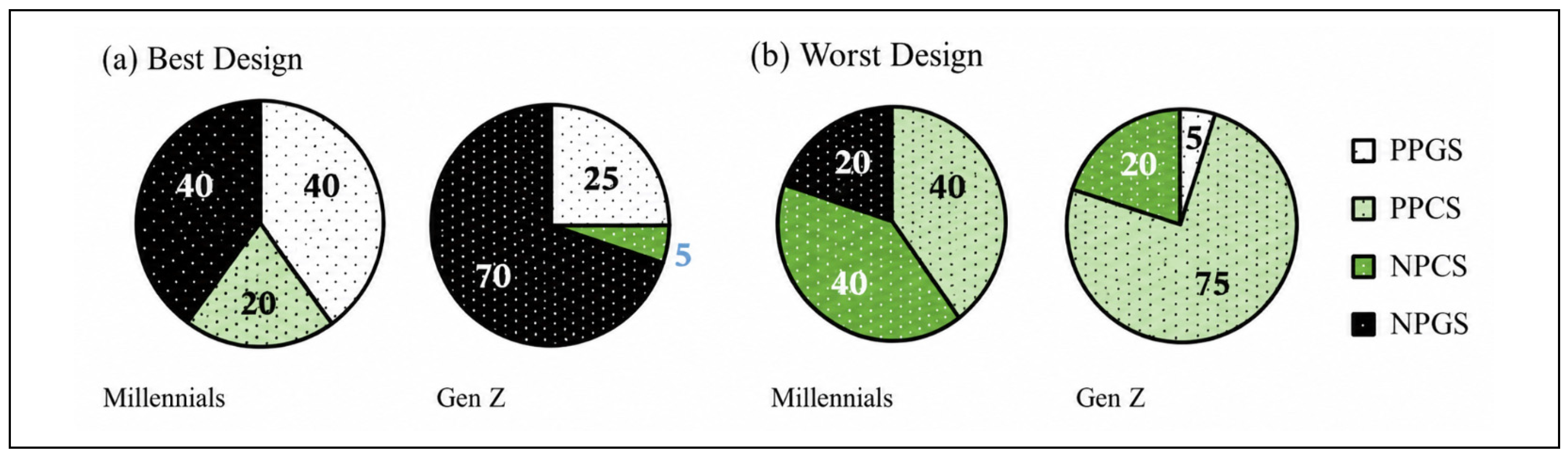
The best vs. worst design selection captures participants’ choices of the most and least preferred interface designs across generation and gender, as illustrated in Figure 22 and Figure 23, respectively. Each figure contrasts demographic groups in terms of the best design selection based on perceived readability and worst design selection associated with visual fatigue and information processing difficulty. Figure 22 illustrates generation-based selections of the (a) best design and (b) worst design across Millennials and Gen Z, respectively. The figure shows a clearly defined selection for Gen Zs compared to Millennials across the best and worst design selections. In Figure 22a, Millennials selected PPGS and NPGS as the most selected designs at 40%, followed by PPCS with 20%, while there was no selection for NPCS as the best design. Gen Z showed a high selection for the NPGS interface design of 70%, followed by PPGS at 25%, then 5% for NPCS, while there was no selection for PPCS. On the contrary, Figure 22b shows that Millennials selected PPCS and NPCS as the most undesirable designs for selection at 40%, followed by NPGS at 20%, while there was no selection for PPGS as the worst display design. Gen Z showed a highly undesirable selection for the PPCS interface design at 75%, followed by NPCS at 20%, then PPGS at 5%, while there was no selection for NPGS as the worst design selection. These fluctuations in findings across design categories suggest supporting H2a.
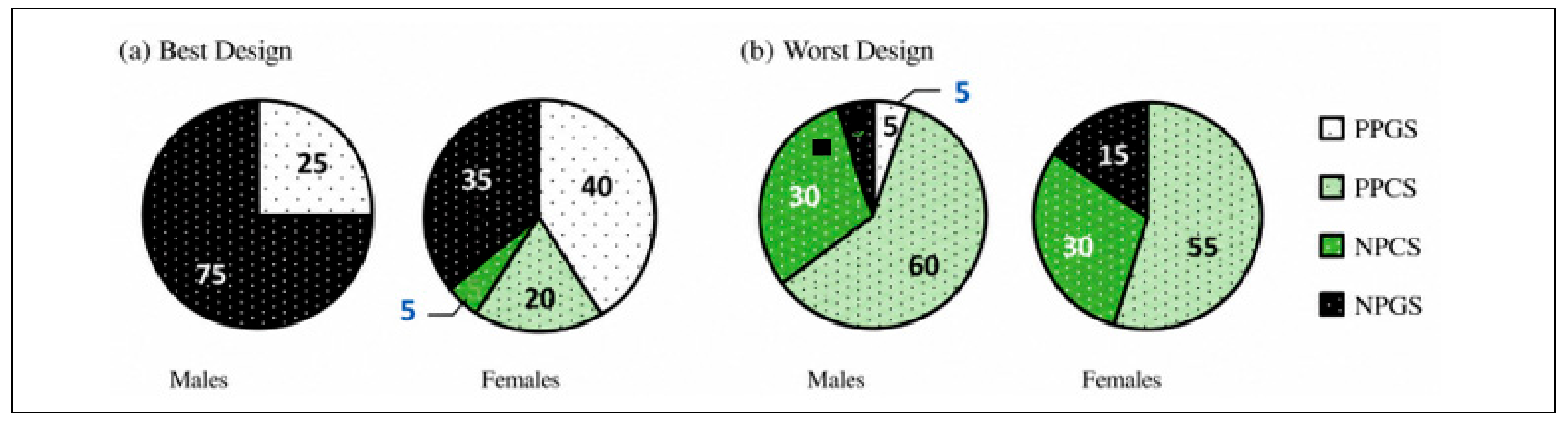
Figure 23 illustrates gender-based selection for the (a) best design and (b) worst design across males and females, respectively. In Figure 23a, males selected NPGS as the most preferred display interface at 75%, followed by PPGS at 25%, while there was no selection for NPCS and PPCS as the best design. Females showed a high selection for the PPGS interface design at 40%, followed by NPGS at 35%, then PPCS at 20%, while the lowest selection was for NPCS at 5%. Meanwhile, for the worst design selection, Figure 23b shows that males selected PPCS as the most undesirable design at 60%, followed by NPCS at 30% then both NPGS and PPGS at 5% each. Females showed a highly undesirable selection for the PPCS interface design at 55%, followed by NPCS at 30%, then 15% for NPGS, while there was no selection for PPGS as the worst design selection. These variations in gender-based findings across design categories suggest supporting H2b.
Similar to the TAC scores, ANOVA was conducted to examine the impact of participants’ demographic factors, including generation and gender, on the best vs. worst design selection responses. The ANOVA results are reported in Table 10. Table 10 shows that all factors and their interactions had a significant effect on best vs. worst design selection responses. The ANOVA findings and the data obtained from Figure 22 and Figure 23 suggest supporting H2a and H2b.
A post hoc analysis was conducted to interpret the interwind effects behind the same design category, which produced both the highest and lowest TAC scores across male participants. Several participants reported that they could read the full text, but lacked the knowledge required to answer the question, which led either to random responses or no response, and therefore zero scores, and they recommended using customized text matching their background proficiency. Some participants, particularly Millennials, reported difficulty responding to continuous text, while a subset of Gen Z participants stated that parts of the stimulus set were outside their knowledge, recommending simpler questions with lower lexical difficulty. Further, post hoc analysis revealed that most participants expressed strong interest in their subjective feedback on best/worst design selection. This indicates that TAC may partially reflect domain knowledge in addition to interface readability, which is acknowledged as a study limitation. Future work including generated text should be suggested to consider the use of discipline-matched or content-neutral question sets with controlled lexical difficulty to reduce knowledge-driven variance while preserving the intended legibility assessment.
Regarding visual tracking metrics, the obtained eye-tracking measures reflect participants’ visual and cognitive behavior during the evaluation of the design stimuli using the EMR-9 eye tracker,-NAC group, Japan. The sample visual tracking data presented in Table 11 illustrate the most common tracking patterns observed across both genders when reviewing their best and worst design selections. These metrics are represented through circular tracking maps, where red indicates the right eye and green indicates the left eye. The number and size of the circles correspond to fixation number (FN) and fixation duration (FD), respectively. The path between circles indicates the scan pattern, where a smooth and consistent flow represents efficient visual processing, while a fragmented or jumpy path indicates distracted or inefficient visual behavior Refs. [20,65].
As shown in Table 11, participants generally exhibited higher FN, longer FD, and more irregular scan paths when evaluating their worst design selections compared to their best selections. For male participants, most cases (e.g., 3M, 4M, 5M, 7M, 8M, and 9M) showed increased FN and more fragmented scan paths in worst design selections, indicating reduced legibility and inefficient visual processing. Longer FD was also observed in several cases (e.g., 1M, 2M, 4M, 5M, 7M, and 10M), suggesting higher cognitive load. In some instances (e.g., 3M, 6M, and 9M), longer FD was accompanied by lower FN, indicating focused attention but increased cognitive effort. Similarly, female participants demonstrated higher FN and more fragmented scan paths for worst design selections in most cases (e.g., 3F, 4F, 6F, 7F, 8F, 9F, and 10F), reflecting reduced visual clarity and increased difficulty in processing. Unlike males, longer FD for worst designs was observed in fewer cases (e.g., 1F and 3F), while moderate FD appeared across both best and worst selections in cases such as 4F, 5F, 7F, and 10F, indicating comparable levels of cognitive load. Additionally, longer FD combined with lower FN was observed in cases such as 2F, 6F, 8F, and 9F, suggesting increased cognitive focus. These findings are further supported by post hoc analysis of participants’ feedback, as mentioned in the best vs. worst design selection section.

5.2. Phase II: Mapping Participants’ Responses to Design Features

Phase II maps generation and gender psychology perception and preference for aesthetic features as well as ergonomic features of smartwatch design by integrating Kansei Engineering with captured affective responses, for Millennials and Generation Z across both genders. Phase I-A focuses on aesthetic design features and captures participants’ emotional ratings and design selection preferences across three key aesthetic factors in smartwatch designs, with the corresponding Kansei mapping illustrated in Figure 24. Meanwhile, Phase I-B shows the mapping of the two evaluated interface display factors in smartwatch screens in assessing display legibility and interaction comfort/fatigue by using TAC scores, alongside cognitive and emotional arousal measures. The mapping of affective responses to the ergonomic features assessment workflow is illustrated in Figure 25. Phase I-B mapping was conducted after Phase I-A mapping, as the examined ergonomic interface features used the preferred smartwatch aesthetic design stimulus from Phase I-A as the aesthetic baseline prototype.

5.2.1. Phase I-A: Aesthetic Design Features

Figure 24 illustrates a Kansei Engineering mapping that translates smartwatch aesthetic features into measurable affective outcomes and decision-oriented preferences across (a) millennials and (b) Gen Z, respectively. Figure 24a,b map Millennials and Gen Zs’ emotional responses and purchasing decisions toward the addressed smartwatch aesthetic feature combinations based on a three-factor structure (n = 3: color, shape, and material), respectively. Across Figure 24, the mapping of all significant factor combinations, including “significant color, shape, and material preference”, the mapping of all non-significant factor combinations, including “non-significant color, shape, or material preference”, and the mapping of a single significant factor among non-significant factors, including “significant color or significant shape preference and other non-significant factors”, were omitted from the figure since only two factors were significant, while the third was not. In addition, the mapping of a single significant aesthetic design feature representation (n = 1), “significant color preference only” or “significant shape preference only”, was excluded, as illustrated in the figure. The mentioned design factor combinations were omitted and excluded, as they do not reflect the current state of this research study. The constructed Figure 24a,b are derived from Figure 3 to incorporate actual updated mappings that provoke participants’ objective ratings (1–5) with subjective preference levels (dislike to strongly like), establishing the relationship between proposed aesthetic features and the evaluation scores and perceived preference.
Based on Millennials’ mappings in Figure 24a, the results highlight that lower ratings are associated with avoidance decisions, driven by perceptions such as unattractive, uncomfortable, complex, or impractical designs. Moderate ratings reflect mixed responses, where designs may be perceived as fashionable or variable, yet they are avoided, or otherwise the designs may be selected but still under hesitation or confusion. Higher ratings are associated with selection decisions, particularly when designs are perceived as color-sensitive, emotionally appealing, smart, nostalgic, interesting, and practical. Overall, Millennials’ purchasing decisions are influenced by both emotional engagement and perceived usability, with strong preference given to designs that balance aesthetic appeal with functional clarity. Meanwhile, for Gen Zs’ mappings in Figure 24b, the results indicate that lower ratings are associated with avoidance decisions, driven by perceptions such as discomfort, heaviness, limited proportionality, or low visual appeal. Mid-level evaluations reflect conditional acceptance, where balanced or complementary designs may still lead to avoidance or mixed responses. Higher ratings are associated with selection decisions, particularly when designs are perceived as cheerful, simple, modern, compatible with purchased product, elegant, and practical. Overall, Gen Zs’ purchasing decisions are strongly influenced by emotional clarity, visual simplicity, and perceived functional harmony of the design features.

5.2.2. Phase I-B: Ergonomic Design Features

Building upon the preferred aesthetic design candidates from Phase I-A, Phase I-B maps effective ergonomic interface design features to participants’ emotional and cognitive arousal responses. The mapping captures TAC scores and participants’ design selections for the addressed interface display factors, as illustrated in Figure 25. The addressed ergonomic design feature combination is based on two factors (m = 2), representing interface designs under different lighting conditions. Since the current study indicated that there is a single factor that was significant (interface design) while the other was non-significant (lighting condition), therefore, only the state of ergonomic design features of “1 significant factor preference and (m-1) non-significant factor preference” was considered in Figure 25a, which is derived from Figure 4. To provide a clearer mapping representation of the addressed display feature combinations, a detailed illustration is presented in Figure 25b and Figure 25c for Millennials and Gen Z, respectively. Each of these figures provides a mapping of the distinct factor levels of the interface design, indicating whether each interface display stimulus is desirable (preferred) or undesirable (non-preferred). The mapping is based on affective responses captured through TAC scores (0–1) and participants’ design selection (worst design selection, no preference, and best design preference). This establishes a structured relationship between the proposed ergonomic features, evaluation scores, and perceived usability.
For Millennials’ mappings in Figure 25b, the addressed interface designs of smartwatches are associated with different TAC scores and correspond to all participants’ design selection categories. For Millennials’ worst design selections, they provoked negative emotional arousal (pressure or frustration), neutral emotional arousal (alert and neutral), and positive emotional arousal (comfort), as well as cognitive arousal of negative feedback (tense and confusion) and neutral feedback (alert and neutral). The no preference design selections provoked neutral emotional arousal (neutral and settle) and neutral cognitive arousal (neutral and engaged). The best design preference provoked neutral emotional arousal (neutral and settle) and positive emotional arousal (comfortable, relaxed, and at ease), as well as cognitive arousal of neutral feedback (neutral and engaged) and positive feedback (calm and effortless).
Meanwhile, for Gen Zs’ mappings in Figure 25c, they also provoked different TAC scores, and they showed variation in participants’ design selection for the proposed interface designs of smartwatches. Regarding Gen Zs’ design selections, the worst design selection resulted in negative emotional arousal (tense or frustration) and neutral emotional arousal (uneasy or neutral), as well as cognitive arousal of negative feedback (anxious and overwhelmed), neutral feedback (alert and pressured), and positive feedback of confidence. The no preference design selection indicated neutral emotional arousal (neutral and settle) and positive emotional arousal (calm), as well as cognitive arousal of neutral feedback (alert and engaged) and positive feedback (confident and comfortable). Similarly, the best design preference resulted in neutral emotional arousal (neutral and settle) and positive emotional arousal (calm and relaxed), along with cognitive arousal of neutral feedback (engaged) and positive feedback (comfortable and effortless).

6. Discussion

6.1. Phase I-A: Aesthetic Design Features

Phase I-A aesthetic findings indicate that smartwatch shape preference was largely stable across generations and genders, with round cases rated and selected most, followed by square, while thin designs were consistently least preferred. This pattern provides limited support for H1a and H1b for shape, since the direction of shape preference was similar across groups. In contrast, smartwatch color preference showed clear generational and gender-based differentiation, which supports H1a and H1b. Across both cohorts, black round designs achieved the highest emotional ratings and selection frequencies, while blue thin and square designs were repeatedly unselected and received the lowest ratings for smartwatch designs. Millennials tended to rank black smartwatch designs first and rose gold second, whereas Gen Z ranked black smartwatch designs first and showed stronger acceptance of gray/silver than rose gold designs. Gender trends were also distinct, where males favored black then gray/silver smartwatches designs, while females favored rose gold then black designs. Smartwatch strap material effects were comparatively small and were mostly non-significant, which aligns with the interaction plots and ANOVA outcomes emphasizing stronger effects for color and shape than for material. Suggested SBWWD design guidelines, derived from the smartwatches’ empirical ratings, selection frequencies, and the significant ANOVA effects, are as follows. The round case shape geometry can be treated as the most robustly preferred aesthetic design baseline of smartwatches across Millennials and Gen Z, while square designs remain a viable secondary option and thin profiles appear less suitable when broad smartwatch acceptance is required. Smartwatch color should be treated as a key segmentation variable since it explains a substantial portion of the generational and gender-based differences. Black smartwatch designs can be positioned as a cross-group SBWWD baseline, gray/silver appears more compatible with Gen Z preferences, and rose gold appears more compatible with Millennials, specifically for female preferences. Blue smartwatch designs, particularly in thin and square configurations, may be treated as a lower-priority option in this dataset due to consistent low ratings and low selection incidence. Strap material may be treated as a secondary tuning parameter in smartwatch aesthetic appeal preferences, given the weaker and less consistent effects relative to color and shape.

6.2. Phase I-B: Ergonomic Design Features

Phase I-B ergonomic results indicate that interface legibility and comfort depend on the combined configuration of polarity and contrast levels. In the survey stage, high contrast was the dominant preference and was stable across demographics, while polarity and combined contrast polarity judgments varied by generation and gender. Participants’ responses showed a slight overall preference for PP conditions over NP conditions; similarly, the combined Cont–Pol results ranked the high-contrast PP condition first, followed closely by the high-contrast NP condition, while both low-contrast options received minimal interest. The ANOVA findings confirm that generation and gender significantly influenced polarity and Cont–Pol preferences. Thereby, given the variation across polarity preference (PP vs. NP) and Cont–Pol (HCPP vs. HCNP) as well as ANOVA findings, these results suggest supporting H2a and H2b for polarity-related ergonomic judgments, while contrast scale did not differ across groups and, therefore, does not support H2a or H2b for contrast as a standalone factor.
The experimental stage extends these survey patterns by testing performance, perceived comfort, and preference for the proposed screen interface designs through TAC scores, and by collecting the best and worst design selections under controlled lighting conditions. Regarding TAC scores, task performance varied across the four interface design categories, indicating a configuration-dependent effect of design categories. In general, Millennials achieved higher task performance than Gen Z across most proposed interface design categories, and males mostly outperformed females. Meanwhile, the ANOVA and interaction plots results indicate significant variation in TAC scores across demographic genders, only emphasizing H2b while contradicting H1b. Also, demographic analysis breakdown highlights that males provoked the highest mean TAC scores for NPGS design categories, while females provoked the highest mean TAC scores for the NPCS category. Meanwhile, both achieved the lowest TAC scores in PPCS design categories, suggesting low ratings for screen interface designs for smartwatches’ interface display in terms of green color code across genders. In addition, the lighting condition showed higher TAC scores under high illumination across participants, suggesting that brighter viewing conditions support more accurate and efficient task completion in smartwatch designs across both demographics, generation and genders. Regarding best/worst design selection, figures and ANOVA results showed significant variation in demographic selection for the proposed interface designs across generations and genders, supporting H2a and H2b. In addition, the best/worst design selection results highlighted high desire selection for PPGS and NPGS design categories across demographic groups, while, on the contrary, an undesirable selection for PPCS design categories was identified. Furthermore, the visual tracking results highlight clear differences between best and worst design selections through FN, FD, and scan behavior. The best designs showed lower FN, moderate FD, and consistent visual paths, while the worst designs showed higher FN, longer FD, and jumpy patterns, indicating higher cognitive load. The proposed visual tracking behaviors support H2b, confirming gender-based differences in ergonomic preferences and visual interaction patterns. These findings suggest a baseline interface display design for SBWWD devices in the HCI context based on the proposed design categories and inputs. Nevertheless, since the interfaces were displayed on a single smartwatch, its display software and hardware characteristics may have slightly influenced color rendering and contrast perception, particularly under light and dark background conditions; therefore, further validation using different devices is important to support broader generalization.

6.3. Phase II: Mapping Participants’ Responses to Design Features

Phase II highlights the importance of the Kansei Engineering (KE) approach in transferring smartwatch design features into measurable affective responses and purchasing decision outcomes for both Millennials and Gen Z. By linking objective evaluations with subjective sociopsychological perceptions and preferences, KE establishes a structured relationship between aesthetic and ergonomic design features of smartwatch designs and users’ affective responses, aiming to provide design guidelines in the SBWWD design context. Since the study was conducted within the Egyptian context, these design implications should be interpreted as culturally situated findings that may require further validation before being transferred to other regional or cultural user groups.
The aesthetic mapping indicates that combined design features of color, shape, and material drive emotional responses and purchasing decisions rather than isolated attributes. Lower evaluation scores are associated with avoidance due to unattractive or impractical designs, while higher scores lead to selection driven by emotional appeal and perceived usability. Millennials tend to prefer designs that balance emotional richness and nostalgic impact with functional clarity, whereas Gen Z shows stronger preference for simple, modern, and visually coherent aesthetics. This suggests that smartwatches’ aesthetic design should emphasize feature integration, avoid visual complexity, and maintain clarity, while adapting hedonism expressive elements for Millennials as well as minimal and clean aesthetics for Gen Z. The ergonomic mapping further demonstrates that interface effectiveness, reflected through TAC scores, design selection, and visual tracking metrices, directly influences emotional and cognitive arousal. Lower perception and performance levels are mostly associated with stress, discomfort, and cognitive load, while higher perception and performance leads to calm, confident, and effortless interaction. The findings confirm that a single significant ergonomic factor governs interface desirability, with suggested color interface potentials under different lighting display conditions. Accordingly, smartwatches’ interface design should prioritize legibility, reduced cognitive load, and clear visual structure through appropriate polarity, color scaling, and illumination conditions. Furthermore, although direct generalization to other device categories is not claimed, the proposed approach may be worth trying and further exploring within the broader context of screen-based wrist-worn wearables, provided that future studies validate it across different interface sizes, device forms, and user populations.

7. Conclusions, Future Work, and Recommendations

This study investigated the mapping of aesthetic and ergonomic smartwatch design features to users’ affective responses, grounded in sociopsychological perception and preference, with the aim of establishing primary design guidelines for screen-based wrist-worn wearables targeting Millennials and Generation Z. Through a structured Kansei Engineering (KE) approach, the research translated the design attributes into measurable emotional, cognitive, and decision-oriented outcomes, enabling an appropriate understanding of user-centered smartwatch design.
Phase I-A examined aesthetic design perception across three key features, color, shape, and material. The findings revealed that color and shape were the dominant significant factors with p-value = 0.00, while material showed no significant influence on preference with p-value = 0.602. Shape preference remained stable across groups, with round cases consistently rated highest with a mean score above 4. In contrast, color perception varied significantly across generations and genders, indicating its strong influence on emotional evaluation and design selection. Statistical analysis confirmed that the generation and gender interaction contributed to significant differences in aesthetic perception, supporting the proposed hypotheses regarding demographic variations in psychological responses to design features with p-value 0.00. Phase I-B focused on ergonomic interface perception by evaluating smartwatches’ screen display conditions through task accuracy and completion, alongside interface selection and visual perception tracking. The results demonstrated that performance and usability were influenced by display configuration, particularly polarity conditions combined with color scaling and lighting. NPGS conditions consistently achieved higher task accuracy and design preference across demographic participant groups, while certain configurations, such as PPCS, resulted in the lowest performance and preference. For best/worst design interface selection, selection patterns showed general agreement across groups, with variations reflecting significant generational and gender tendencies with p-values = 0.00 for design selections. Visual tracking metrics in the best and worst design selections showed that the best designs achieved a lower fixation number with shorter fixation durations and more consistent visual flow, while the worst designs showed a higher fixation number with a longer fixation duration, and jumpy patterns indicating a higher cognitive load. Furthermore, statistical analysis and plots further confirmed that ergonomic outcomes were primarily driven by interface design configuration, moderated by generation and gender, and enhanced under higher illumination conditions.
Phase II integrated Phase I findings by mapping aesthetic and ergonomic design features to affective responses. The KE approach proved effective in linking subjective and objective evaluations with sociopsychological perception and preferences, establishing a structured relationship between design attributes and users’ emotional and cognitive responses as well as purchasing decisions. The aesthetic mapping highlighted that integrated design features drive user preference, with Millennials favoring emotionally rich and meaningful designs, while Gen Z preferred simple, modern, and visually clear aesthetics. The ergonomic mapping demonstrated that interface effectiveness directly influenced emotional and cognitive arousal, where higher legibility led to comfort, confidence, and effortless interaction, and lower performance induced stress and cognitive load. Overall, the study confirms that effective smartwatch design requires a balanced integration of aesthetic appeal and ergonomic performance, guided by users’ sociopsychological perception and preferences. The proposed KE-based mapping suggests a baseline approach for investigating the translation of design features into user-centered guidelines, supporting the development of smartwatch designs that align with the distinct preferences and psychological expectations of Millennials and Generation Z.
Future work will expand effective factors and levels in the aesthetic and ergonomic phases to strengthen generalizability and enhance Kansei-based approach mapping between design features and users’ emotional–psychological responses. For the aesthetic phase, broader factor coverage is recommended, including additional color tones and case proportions, as well as incorporating objective measures to complement emotional ratings. For the ergonomic phase, ongoing work will increase the sample size and include more granular visual status grouping aligned with WHO-based impairment categories, enabling clearer segmentation of interface needs. Expanding the set of color scale combinations, contrast levels, and testing more typography features is required to strengthen the mapping between display features and task performance while considering participants’ occupational knowledge in the tested stimuli set. While broader sampling beyond Egyptian participants and the inclusion of additional cohorts beyond Millennials and Generation Z needs further validation to generalize, expanding these demographic boundaries is a potential area worth investigation to improve external validity. Furthermore, sensory-based evaluation methods, such as eye trackers and EEG, can be integrated to quantify visual behavior and cognitive fatigue. Combining these objective measures with Kansei modeling provides a baseline to enable a richer interpretation that highlights visual effort from cognitive load, thereby enabling a tailored design framework across diverse demographic groups and visual status categories.

8. Research Limitations

This research acknowledges that, although participants were recruited from diverse Egyptian cities, the findings remain culturally and regionally bounded and generalization is not allowed unless cross-cultural validation happens; nevertheless, testing the framework across other cultural settings is a potential direction worth investigation. The study focused on Millennials and Generation Z and examined generation and gender differences, serving as a baseline that may not capture population-wide variation, particularly across other generations or visual status categories, as well as the consideration of a wider set of aesthetic and ergonomic design features. In addition, occupational and disciplinary background was not modeled as an explicit factor, so differences in domain knowledge and technology exposure may have contributed unexplained variance in TAC and preference outcomes. Furthermore, the ergonomic interface assessment was conducted using a single smartwatch device, and its display matrix, software rendering, and hardware characteristics may have influenced contrast perception and light or dark background display modes; therefore, this outcome-based assessment needs validation across other smartwatch devices to generalize. The current addressed evidence is driven by objective ratings, task performance indicators, and emotional and cognitive responses, with eye tracking used to quantify visual behavior rather than a fully integrated multimodal measurement framework. Future work should, therefore, incorporate neurophysiological sensing techniques, such as EEG or fNIRS, alongside eye tracking to strengthen the interpretation of cognitive processes and mental workload, particularly in relation to visual behavior and cognitive fatigue. Despite these limitations, the proposed Kansei-driven approach remains a valuable baseline that is worth investigation for linking product design features to emotional and cognitive responses, performance measures, and purchase-related preferences, thereby enhancing psychological perception and purchasing decisions.

Author Contributions

S.A., conceptualization, formal analysis, investigation, methodology, validation, visualization, writing—original draft; I.A., conceptualization, methodology, validation, writing—original draft, writing—reviewing and editing, supervision; M.K., conceptualization, formal analysis, validation, writing—reviewing and editing, supervision; A.B.E., conceptualization, formal analysis, investigation, methodology, validation, writing—reviewing and editing, supervision. All authors have read and agreed to the published version of the manuscript.

Funding

This work is sponsored by the scholarship of Egypt-Japan University of Science and Technology (EJUST) and the support of Japan International Cooperation Agency (JICA).

Institutional Review Board Statement

This research complied with the international guidelines, such as the Committee on Publication Ethics (COPE), the University of Tokyo School of Science Code of Ethics (2010), the NCGE Research Code of Ethics (Ireland, 2008), the Psychological Society of Ireland (PSI) Code of Professional Ethics (2008), and the World Organization for Animal Health (OIE) standards for animal research ethics, where it was approved by the Institutional Review Board at the E-JUST Research Ethics Committee. This study was conducted in accordance with the institutional guidelines and received ethical approval from the E-JUST Research Ethics Committee, approval number [Certificate No. #251211]. All participants provided informed consent prior to participation.

Data Availability Statement

The data supporting the results of this study are unavailable due to ethical and privacy considerations and are therefore not publicly accessible.

Acknowledgments

This research used ChatGPT (version 5.3) for text material used in legibility evaluation and text refining. Also, the research used Microsoft Office® (Office 2016–2019), HTML colour picker W3schools®, pro-Canva®, DELL-E3®, and contrast checker WCAG 2 WebAIM® for interface design formulation and validation. The mentioned tools aided in exploring design creation and enhancing the quality of the study.

Conflicts of Interest

The authors declare no conflicts of interest.

References

  1. Kemp, S. Digital 2023 Deep-Dive: The Rise of Wearables. January 2023. Available online: https://datareportal.com/reports/digital-2023-deep-dive-the-rise-of-wearables (accessed on 25 March 2026).
  2. Kumar, N. Smartwatch Statistics (2026)–Global Users & Market Share. Sacramento. January 2026. Available online: https://www.demandsage.com/smartwatch-statistics/#:~:text=56%25%20of%20GenZ%20and%2046,almost%2039.8%20million%20watches%20globally (accessed on 24 March 2026).
  3. Dharmesti, M.; Dharmesti, T.R.S.; Kuhne, S.; Thaichon, P. Understanding online shopping behaviours and purchase intentions amongst millennials. Young Consum. 2019, 22, 152–167. [Google Scholar] [CrossRef]
  4. Douglas, A. The First ‘German Watch Study’ Sees a Smartwatch Boom in Germany. Munich. November 2021. Available online: https://usa.watchpro.com/the-first-german-watch-study-sees-a-smartwatch-boom-in-germany/?utm_source=chatgpt.com (accessed on 26 February 2026).
  5. Nagamachi, M.; Lokman, A.M. Innovations of Kansei Engineering; CRC Press: Boca Raton, FL, USA, 2016. [Google Scholar] [CrossRef]
  6. Norman, D. Emotional Design: Why We Love (or Hate) Everyday Things; Basic Books: New York, NY, USA, 2007. [Google Scholar]
  7. Naeini, H.S.; Karuppiah, K.; Jafarnejad, M.; Shokranipour, N.; Abbasrouhollahi, M. The Role of Ergonomics, Sustainability and Aesthetics in Product Design Process. In Advances in Design, Music and Arts III; Springer: Berlin/Heidelberg, Germany, 2025; pp. 337–345. [Google Scholar] [CrossRef]
  8. Norman, D.A. The Design of Everyday Things; Basic Books: New York, NY, USA, 2013. [Google Scholar]
  9. Gao, Y.; Bin Yahaya, M.F.; Tai, L.-C.; Bin Abdul Rahman, A.R.; Ma, J. The Joint Effect of the Unified Model of Aesthetics and Categorical-Motivation Model on Aesthetic Preferences for Product Design: A Review. Int. J. Acad. Res. Bus. Soc. Sci. 2024, 14, 639–655. [Google Scholar] [CrossRef]
  10. Zheng, J. Product Appearance Aesthetics in Industrial Design Based on Variational Onsager Neural Network Optimized with Osprey Optimization Algorithm. J. Electr. Syst. 2024, 20, 2762–2773. [Google Scholar] [CrossRef]
  11. Baghirov, F.; Zhang, Y. Assessment of the association between aesthetic products and perceived product quality: An analysis of customer attitudes. J. Consum. Mark. 2024, 41, 789–803. [Google Scholar] [CrossRef]
  12. Pandey, R. Impact of Aesthetics in Innovative Product Development on Consumer Perception and Acceptance. ECS Trans. 2022, 107, 9915–9922. [Google Scholar] [CrossRef]
  13. Han, J.; Forbes, H.; Schaefer, D. An exploration of how creativity, functionality, and aesthetics are related in design. Res. Eng. Des. 2021, 32, 289–307. [Google Scholar] [CrossRef]
  14. Cappuccio, E.; Esposito, A.; Greco, F.; Desolda, G.; Lanzilotti, R.; Rinzivillo, S. Explanation User Interfaces: A Systematic Literature Review. arXiv 2025, arXiv:2505.20085. [Google Scholar]
  15. Li, G.; Tang, T. Online Performance and Interface Design Implications Among Older Adults: A Systematic Review of Eye Tracking Studies; Elsevier Ltd.: Amsterdam, The Netherlands, 2025. [Google Scholar] [CrossRef]
  16. Razaque, A.; Hariri, S.; Yoo, J. AI-Driven User Interface Design: Enhancing Digital Learning and Skill Development. Int. J. Hum.-Comput. Stud. 2025. [Google Scholar]
  17. Tao, D.; Ren, X.; Liu, K.; Mao, Q.; Cai, J.; Wang, H. Effects of color scheme and visual fatigue on visual search performance and perceptions under vibration conditions. Displays 2024, 82, 102667. [Google Scholar] [CrossRef]
  18. Arnold, L.; Aryal, S.; Hong, B.; Nitharsan, M.; Shah, A.; Ahmed, W.; Lilani, Z.; Su, W.; Piaggio, D. A Systematic Literature Review of Eye-Tracking and Machine Learning Methods for Improving Productivity and Reading Abilities. Appl. Sci. 2025, 15, 3308. [Google Scholar] [CrossRef]
  19. García, M.; Cano, S. Eye Tracking to Evaluate the User eXperience (UX): Literature Review. In Lecture Notes in Computer Science (Including Subseries Lecture Notes in Artificial Intelligence and Lecture Notes in Bioinformatics); Springer Science and Business Media Deutschland GmbH: Heidelberg, Germany, 2022; Volume 13315, pp. 134–145. [Google Scholar] [CrossRef]
  20. Joseph, A.W.; Murugesh, R. Potential Eye Tracking Metrics and Indicators to Measure Cognitive Load in Human-Computer Interaction Research. J. Sci. Res. 2020, 64, 168–175. [Google Scholar] [CrossRef]
  21. Nawi, A.M.; Yusof, F.M. Form, Function, and Comfort: Rethinking Product Design through the Lens of Ergonomics and Aesthetics. Int. J. Res. Innov. Soc. Sci. 2024, VIII, 1358–1373. [Google Scholar] [CrossRef]
  22. Furferi, R.; Buonamici, F. The Role of Product Engineering Modelling in Aesthetic Design Education. Designs 2023, 7, 127. [Google Scholar] [CrossRef]
  23. Pan, S.; Bin Anwar, R.; Awang, N.N.B.; He, Y. Constructing a Sustainable Evaluation Framework for AIGC Technology in Yixing Zisha Pottery: Balancing Heritage Preservation and Innovation. Sustainability 2025, 17, 910. [Google Scholar] [CrossRef]
  24. Singh, J.; Sarkar, P. Understanding the Relationship between Aesthetics and Product Design. Prabir Sarkar Int. J. Eng. Technol. Sci. Res. 2018, 5, 363–368. [Google Scholar]
  25. Shigemoto, Y. Meaning and approach of new product designing through Kansei Engineering. In Advances in Intelligent Systems and Computing; Springer: Heidelberg, Germany, 2020. [Google Scholar] [CrossRef]
  26. Xue, L.; Yi, X.; Zhang, Y. Research on optimized product image design integrated decision system based on Kansei Engineering. Appl. Sci. 2020, 10, 1198. [Google Scholar] [CrossRef]
  27. Hakim, A.; Suhardi, B.; Laksono, P.W.; Ushada, M. Systematic Review of Kansei Engineering Method Developments in the Design Field. J. Optimasi Sist. Ind. 2024, 23, 92–108. [Google Scholar] [CrossRef]
  28. Du, Y.; Liu, X.; Cai, M.; Park, K. A Product’s Kansei Appearance Design Method Based on Conditional-Controlled AI Image Generation. Sustainability 2024, 16, 8837. [Google Scholar] [CrossRef]
  29. Ishihara, S.; Kuo, R.; Ishihara, K. AI image generation boosts Kansei Engineering design process. In Kansei Engineering; AHFE International: Honolulu, HI, USA, 2023. [Google Scholar] [CrossRef]
  30. Schütte, S.T.W.; Eklund, J.; Axelsson, J.R.C.; Nagamachi, M. Concepts, methods and tools in Kansei Engineering. Theor. Issues Ergon. Sci. 2004, 5, 214–231. [Google Scholar] [CrossRef]
  31. Atef, S.; Ali, I.; Romouzy-Ali, A.; Kato, M.; Eltawil, A.B. A proposed Human-AI collaborative Kansei Engineering methodology for heritage-inspired designs: A study using surveying and eye-tracking with Africans and Asians. J. Eng. Des. 2026, 1–40. [Google Scholar] [CrossRef]
  32. Jiao, R.; Luo, J.; Malmqvist, J.; Summers, J. New Design: Opportunities for Engineering Design in an Era of Digital Transformation; Taylor and Francis Ltd.: Oxford, UK, 2022. [Google Scholar] [CrossRef]
  33. Glisic, M. An umbrella review of systematic reviews of the impact of wrist-worn wearables on health outcomes. Physiol. Rev. 2026, 106, 935–969. [Google Scholar] [CrossRef]
  34. Hu, L.; Chen, Y.; Cao, E.; Hu, W. User Experience & Usability of Wearable Health Device: A Bibliometric Analysis of 2014–2023. Int. J. Hum. Comput. Interact. 2025, 41, 5100–5119. [Google Scholar] [CrossRef]
  35. Gu, L.; Qian, C. The application of smart wearable devices in the detection of sports energy consumption: A review. Intell. Sports Health 2025, 1, 67–78. [Google Scholar] [CrossRef]
  36. Jabari, S.; Shaikh, A.; Genç, Ç.; Buruk, O.; Virkki, J.; Hamari, J. A Systematic Literature Review on Computational Fashion Wearables. Int. J. Hum. Comput. Interact. 2024, 40, 6913–6940. [Google Scholar] [CrossRef]
  37. Shen, J. The Influence of Smart Wearable Technology on the Functionality and Fashion of Casual Wear. Contemp. Educ. Front. 2025, 3, 5. [Google Scholar] [CrossRef]
  38. Krey, N.; Rauschnabel, P.; Chuah, S.; Nguyen, B.; Hein, D.; Rossmann, A.; Lade, S. Smartwatches: Accessory or Tool? The Driving Force of Visibility and Usefulness. In Series of the Gesellschaft fur Informatik (GI); Gesellschaft für Informatik eV: Aachen, Germany, 2016. [Google Scholar] [CrossRef]
  39. Gu, J.; Lee, S. Emotional Design Elements of Product Satisfaction. Arch. Des. Res. 2025, 38, 135–156. [Google Scholar] [CrossRef]
  40. Watch, S. Wrist Watches Construction: Material and Craftsmanship. Defining the Components: Case, Strap, Crown. 2023. Available online: https://sylvi.in/blogs/watch-guides/wrist-watch-construction-materials?srsltid=AfmBOoqZYy3iuXv5HlTv-CaY8G6fhm1QPTfljmMZJIZg9W3wB79vYIYu (accessed on 18 January 2026).
  41. Apple. “Apple Watch,” Apple. Available online: https://www.apple.com/watch/ (accessed on 5 March 2026).
  42. Samsung. “Galaxy Watch,” Samsung. Available online: https://www.samsung.com/uk/business/watches/galaxy-watch/galaxy-watch5-44mm-silver-lte-sm-r915fzsaeua/#:~:text=Four%20Galaxy%20Watch5%20devices%20are,Pink%20to%20Violet%20to%20Navy (accessed on 5 March 2026).
  43. Feng, Y.L.; Lin, Y.C.; Chen, C.C. The effect of smartwatch head shape on visual imagery perception. PLoS ONE 2023, 18, e0290259. [Google Scholar] [CrossRef] [PubMed]
  44. Woodward, W.R. Gestalt Psychology. In Encyclopedia of Philosophy and the Social Sciences; SAGE Publications, Inc.: Thousand Oaks, CA, USA, 2013. [Google Scholar] [CrossRef]
  45. Cugelman, B.; Cugeman, R. Color Psychology For Ux, Design and Marketing. 2020. Available online: www.alterspark.com (accessed on 10 March 2026).
  46. Morris, J.A. The Purpose and Power of Color in Industrial Design: Encouraging the Meaningful Use of Color in Design Education. 2007. Available online: https://www.idsa.org (accessed on 10 March 2026).
  47. Abd El-Aziz, E.; Abdelraouff, A.; El-Desoky, S.; El-Bahrawy, G.; Ezat, H.; Abd El-Rahman, R.; Hassabo, A. Psychological Color and Texture in Marketing and Textile Printing Design. J. Text. Color. Polym. Sci. 2023, 20, 265–275. [Google Scholar] [CrossRef]
  48. Lewis-Beck, M.S.; Bryman, A.; Liao, T.F. (Eds.) Semantic Differential Scale. In The SAGE Encyclopedia of Social Science Research Methods; Sage Publications, Inc.: Thousand Oaks, CA, USA, 2004; pp. 1015–1016. [Google Scholar] [CrossRef]
  49. Norman, D.A. (Ed.) Part II: Design in Practice. In Emotional Design-Why We Love or Hate Everday Things; Chapter 2; Emotional Design; Basic Books: New York, NY, USA, 2004; pp. 63–98. [Google Scholar]
  50. Hassenzahl, M. The Interplay of Beauty, Goodness, and Usability in Interactive Products. Hum. Comput. Interact. 2004, 19, 319–349. [Google Scholar] [CrossRef]
  51. Sulta, S. Better Color Contrast—Better User Experience. June 2019. Available online: https://medium.com/@saifsultanc/better-color-contrast-better-user-experience-6fcec2c74321 (accessed on 7 March 2026).
  52. Colorado State University. Color Contrast. 2026. Available online: https://www.chhs.colostate.edu/accessibility/best-practices-how-tos/color-contrast/ (accessed on 7 March 2026).
  53. While, Z.; Sarvghad, A. Dark Mode or Light Mode? Exploring the Impact of Contrast Polarity on Visualization Performance Between Age Groups. In 2024 IEEE Visualization and Visual Analytics (VIS); IEEE: New York, NY, USA, 2024; pp. 211–215. [Google Scholar] [CrossRef]
  54. Bernal-Molina, P.; Esteve-Taboada, J.J.; Ferrer-Blasco, T.; Montés-Micó, R. Influence of contrast polarity on the accommodative response. J. Optom. 2019, 12, 38–43. [Google Scholar] [CrossRef]
  55. Wang, X.; Xu, L.; Li, J.; Cheng, C.; Yu, L. How Background Colour Shapes Digital Text-Information Processing: A fNIRS-Eye Tracking Study. Int. J. Hum. Comput. Interact. 2026, 42, 1427–1441. [Google Scholar] [CrossRef]
  56. Valenko, S.I.; Čačić, M.; Stanimirović, I.Ž.; Zorko, A. Visual Perception of Peripheral Screen Elements: The Impact of Text and Background Colors. Appl. Sci. 2025, 15, 7636. [Google Scholar] [CrossRef]
  57. Xu, L.; Hou, B.; Wang, X.; Zhang, Z.; Yu, L. Exploring the effects of background colour and gender on cognitive performance of visual attention: A multimodal approach using fNIRS and eye-tracking. J. Int. Colour. Assoc. 2025, 38, 30–40. [Google Scholar]
  58. Huang, X. Research on reading comfort contrast based on the three elements of color perception. In Proceedings of 2024 International Conference on Image Processing, Multimedia Technology and Maching Learning, IPMML 2024; Association for Computing Machinery, Inc.: New York, NY, USA, 2025; pp. 1–6. [Google Scholar] [CrossRef]
  59. Boudjella, A.; Sharma, M.; Sharma, D. Non-Native English Speaker Readability Metric: Reading Speed and Comprehension. J. Appl. Math. Phys. 2017, 5, 1257–1268. [Google Scholar] [CrossRef]
  60. Lege, R.P.; Hasegawa, S.; Ishio, H.; Takahashi, T.; Hyodo, K.; Matsunami, S.; Ishii, Y.; Iwata, K.; Kojima, T.; Miyao, M. Measuring the effects of lighting on the readability of electronic devices. J. Soc. Inf. Disp. 2017, 25, 12–19. [Google Scholar] [CrossRef]
  61. Guo, H.; Wang, W.; Song, F.; Liu, Y.; Liu, H.; Bo, Z. The Effect of Color Combinations on the Efficiency of Text Recognition in Digital Devices. Int. J. Hum. Comput. Interact. 2024, 40, 1317–1326. [Google Scholar] [CrossRef]
  62. Sheskin, D.J. Handbook of Parametric and Nonparametric Statistical Procedures, 2nd ed.; Chapman and Hall/CRC: Washington, DC, USA, 2003; Volume 2. [Google Scholar] [CrossRef]
  63. Yu, N.; Ouyang, Z.; Wang, H.; Tao, D.; Jing, L. The Effects of Smart Home Interface Touch Button Design Features on Performance among Young and Senior Users. Int. J. Environ. Res. Public Health 2022, 19, 2391. [Google Scholar] [CrossRef]
  64. Iturregui-Gallardo, G.; Méndez-Ulrich, J.L. Towards the Creation of a Tactile Version of the Self-Assessment Manikin (T-SAM) for the Emotional Assessment of Visually Impaired People. Int. J. Disabil. Dev. Educ. 2020, 67, 657–674. [Google Scholar] [CrossRef]
  65. Ball, L.J.; Richardson, B.H. Eye-Tracking and Physiological Measurements for UX Evaluation. In User Experience Methods and Tools in Human-Computer Interaction; Stephanidis, C., Salvendy, G., Eds.; CRC Press: Lancashire, UK, 2024; pp. 224–245. [Google Scholar] [CrossRef]
Figure 1. The Kansei Engineering of the product design process.
Applsci 16 05624 g001
Figure 2. Research methodology.
Applsci 16 05624 g002
Figure 3. Mapping the product aesthetic design features to the demographic psychological affective responses.
Applsci 16 05624 g003
Figure 4. Mapping the product ergonomic design features to the demographic psychological affective responses.
Applsci 16 05624 g004
Figure 5. Transferring a typical smartwatch design into an emotional aesthetic design stimulus.
Applsci 16 05624 g005
Figure 6. Smartwatch appeal stimuli set for aesthetic emotional assessment.
Applsci 16 05624 g006
Figure 7. Emotional preference rating scheme.
Applsci 16 05624 g007
Figure 8. Survey and questionnaire template sample including (A) polarity, and (B) contrast preference.
Applsci 16 05624 g008
Figure 9. An illustration of the candidate interface features.
Applsci 16 05624 g009
Figure 10. Python code for text generation.
Applsci 16 05624 g010
Figure 11. Eye-tracking calibration and assessment process on smartwatch screens.
Applsci 16 05624 g011
Figure 12. Smartwatch interface display features assessment.
Applsci 16 05624 g012
Figure 13. Generational-based aesthetic emotional design assessment: (a) Millennials and (b) Generation Zs.
Applsci 16 05624 g013
Figure 14. Gender-based aesthetic emotional design assessment: (a) males and (b) females.
Applsci 16 05624 g014
Figure 15. Generation-based smartwatch designs: (a) Millennials and (b) Generation Z.
Applsci 16 05624 g015
Figure 16. Gender-based smartwatch design preferences: (a) males and (b) females.
Applsci 16 05624 g016
Figure 17. Main effects plot of rating emotional responses.
Applsci 16 05624 g017
Figure 18. Interaction plot of emotional rating responses.
Applsci 16 05624 g018
Figure 19. Millennial and Gen Z preferences for key small-screen interface display features: (a) polarity, (b) contrast level, and (c) contrast–polarity interaction.
Applsci 16 05624 g019
Figure 20. (a) Population, (b) generation, and (c) gender TAC scores for the designs’ stimuli.
Applsci 16 05624 g020
Figure 21. Interaction plot for TAC responses.
Applsci 16 05624 g021
Figure 22. Generation-based selection for the (a) best design and (b) worst design across Millennials and Generation Zs.
Applsci 16 05624 g022
Figure 23. Gender-based selection for the (a) best design and (b) worst design across males and females.
Applsci 16 05624 g023
Figure 24. Mapping the smartwatches’ aesthetic design features to (a) Millennials and (b) Gen Zs’ affective responses.
Applsci 16 05624 g024
Figure 25. Mapping the smartwatches’ ergonomic design features to (a) generally addressed participants’ demography, and (b) Millennials and (c) Gen Zs’ emotional and cognitive responses.
Applsci 16 05624 g025
Table 1. Participants of Phase I-A (aesthetic design assessment).
Sample Size (n)ParticipantsAgeGenderEducational Language BackgroundOccupational Background
148Millennials30–41Males and FemalesArabic, Armenian, English, French, German, GreekPostgrad students
Working employees
Generation Z17–29Arabic, English, FrenchUndergraduate students
Table 2. Participants of Phase I-B (interface features selection).
Sample Size (n)ParticipantsAgeGenderEducational Language BackgroundOccupational Background
410Millennials30–45Males and FemalesArabic, Armenian, English, French, German, GreekPostgrad students
Working employees
Generation Z18–29Arabic, English, FrenchUndergraduate students
Postgrad students
Table 3. Participants of Phase I-B (ergonomic design assessment).
Sample Size (n)ParticipantsAgeGenderEducational Language BackgroundOccupational Background
40Millennials33–42Males and FemalesArabic, Armenian, English, FrenchPostgraduate students
Working employees in Engineering, Basic and Applied Sciences, Pharmacy, Dentistry, Business and Finance
Generation Z19–23Arabic, EnglishUndergraduate students in Engineering, Pharmacy, Applied Arts
Table 4. The design combinations of smartwatches’ aesthetic design features.
Material
LeatherMetalRubberLeatherMetalRubber
Shape
ColorBlackGray/Silver
RoundApplsci 16 05624 i001Applsci 16 05624 i002Applsci 16 05624 i003Applsci 16 05624 i004Applsci 16 05624 i005Applsci 16 05624 i006
SquareApplsci 16 05624 i007Applsci 16 05624 i008Applsci 16 05624 i009Applsci 16 05624 i010Applsci 16 05624 i011Applsci 16 05624 i012
ThinApplsci 16 05624 i013Applsci 16 05624 i014Applsci 16 05624 i015Applsci 16 05624 i016Applsci 16 05624 i017Applsci 16 05624 i018
ColorBlueRose Gold
RoundApplsci 16 05624 i019Applsci 16 05624 i020Applsci 16 05624 i021Applsci 16 05624 i022Applsci 16 05624 i023Applsci 16 05624 i024
SquareApplsci 16 05624 i025Applsci 16 05624 i026Applsci 16 05624 i027Applsci 16 05624 i028Applsci 16 05624 i029Applsci 16 05624 i030
ThinApplsci 16 05624 i031Applsci 16 05624 i032Applsci 16 05624 i033Applsci 16 05624 i034Applsci 16 05624 i035Applsci 16 05624 i036
Table 5. Legibility verification using contrast check—WEbAIM.
Text
YellowBlueWhiteBlack
Background
WhiteApplsci 16 05624 i037Applsci 16 05624 i038Applsci 16 05624 i039Applsci 16 05624 i040
Light GreenApplsci 16 05624 i041Applsci 16 05624 i042Applsci 16 05624 i043Applsci 16 05624 i044
Dark GreenApplsci 16 05624 i045Applsci 16 05624 i046Applsci 16 05624 i047Applsci 16 05624 i048
BlackApplsci 16 05624 i049Applsci 16 05624 i050Applsci 16 05624 i051Applsci 16 05624 i052
Table 6. Reading rate linguistic validation.
InstanceWord CountsReading Rate (s)Instance #Word CountsReading Rate (s)
1174.25 ≈ 59164
2225.5 ≈ 610205
3153.75 ≈ 411215.25 ≈ 6
4235.75 ≈ 612164
5194.75 ≈ 513235.76 ≈ 6
6184.5 ≈ 514205
720515164
820516215.25 ≈ 6
Table 7. ANOVA for the emotional rating responses.
SourceF-Valuep-ValueSourceF-Valuep-Value
Gender0.960.326Gender*Generation*Shape1.590.205
Generation4.080.043Gender*Generation*Material1.250.285
Shape185.680.000Gender*Generation*Color0.880.450
Material0.510.602Gender*Shape*Material0.300.880
Color87.360.000Gender*Shape*Color1.410.205
Gender*Generation112.030.000Gender*Material*Color0.140.991
Gender*Shape9.320.000Generation*Shape*Material0.160.959
Gender*Material0.870.421Generation*Shape*Color0.940.465
Gender*Color47.870.000Generation*Material*Color0.170.984
Generation*Shape1.960.141Shape*Material*Color0.190.999
Generation*Material1.290.274Gender*Generation*Shape*Material0.310.874
Generation*Color2.150.091Gender*Generation*Shape*Color0.730.629
Shape*Material0.170.952Gender*Generation*Material*Color0.320.927
Shape*Color1.800.094Gender*Shape*Material*Color0.290.992
Material*Color0.840.542Generation*Shape*Material*Color0.151.000
Gender*Generation*Shape*Material*Color0.290.992
Table 8. ANOVA for smartwatch design preference selection responses.
SourceF-Valuep-ValueSourceF-Valuep-Value
Gender556.050.000Gender*Generation10.060.002
Generation10.820.001
Table 9. ANOVA for TAC responses.
SourceF-Valuep-ValueSourceF-Valuep-Value
Design6.000.000Lighting*Gender0.570.451
Lighting0.020.879Generation*Gender0.760.384
Generation0.480.490Design*Lighting*Generation0.160.926
Gender4.830.028Design*Lighting*Gender0.580.627
Design*Lighting0.720.541Design*Generation*Gender0.570.633
Design*Generation1.640.179Lighting*Generation*Gender0.230.635
Design*Gender1.000.391Design*Lighting*Generation*Gender0.780.504
Lighting*Generation0.090.770
Table 10. ANOVA for best vs. worst design selection responses.
Best DesignWorst Design
SourceF-Valuep-ValueSourceF-Valuep-Value
Generation68.530.000Generation193.320.000
Gender86.730.000Gender28.600.000
Gender*Generation26.770.000Gender*Generation56.050.000
Table 11. Visual tracking metrices for best and worst design selection across genders.
MalesFemales
Best Design PreviewWorst Design Preview Best Design PreviewWorst Design Preview
1MApplsci 16 05624 i053Applsci 16 05624 i0541FApplsci 16 05624 i055Applsci 16 05624 i056
2MApplsci 16 05624 i057Applsci 16 05624 i0582FApplsci 16 05624 i059Applsci 16 05624 i060
3MApplsci 16 05624 i061Applsci 16 05624 i0623FApplsci 16 05624 i063Applsci 16 05624 i064
4MApplsci 16 05624 i065Applsci 16 05624 i0664FApplsci 16 05624 i067Applsci 16 05624 i068
5MApplsci 16 05624 i069Applsci 16 05624 i0705FApplsci 16 05624 i071Applsci 16 05624 i072
6MApplsci 16 05624 i073Applsci 16 05624 i0746FApplsci 16 05624 i075Applsci 16 05624 i076
7MApplsci 16 05624 i077Applsci 16 05624 i0787FApplsci 16 05624 i079Applsci 16 05624 i080
8MApplsci 16 05624 i081Applsci 16 05624 i0828FApplsci 16 05624 i083Applsci 16 05624 i084
9MApplsci 16 05624 i085Applsci 16 05624 i0869FApplsci 16 05624 i087Applsci 16 05624 i088
10MApplsci 16 05624 i089Applsci 16 05624 i09010FApplsci 16 05624 i091Applsci 16 05624 i092
Disclaimer/Publisher’s Note: The statements, opinions and data contained in all publications are solely those of the individual author(s) and contributor(s) and not of MDPI and/or the editor(s). MDPI and/or the editor(s) disclaim responsibility for any injury to people or property resulting from any ideas, methods, instructions or products referred to in the content.