Article

Measuring Building Circularity Through Materials, Processes and Impacts: An Evaluation Framework for Architecture Integrating Reused, Bio-Based and Recycled Components


Planning, Design, Technology of Architecture Department, Sapienza University of Rome, Via Flaminia 72, 00196 Rome, Italy
*
Author to whom correspondence should be addressed.
Appl. Sci. 2026, 16(11), 5617; https://doi.org/10.3390/app16115617 (registering DOI)
Submission received: 9 March 2026 / Revised: 6 May 2026 / Accepted: 24 May 2026 / Published: 3 June 2026

Abstract

In line with circular bioeconomy goals, this research focuses on circular materials—reused, bio-based (including waste-derived ones) and recycled—as a strategic solution to simultaneously cut Embodied Carbon and material resource uptake in buildings. The research develops a methodology for early, rapid assessment of circular materials’ contribution to cutting climate-altering emissions and material consumption, supporting architects during the initial design stage, where strategic choices are most impactful. Multiple case studies of buildings employing 12 circular design strategies and different materials were analysed, of which 10 are presented here, mapping approaches and material mixes. In parallel, by analysing 15 existing circularity and sustainability evaluation frameworks at the building and product level, screening 80 relevant indicators and integrating specific ones, the research develops a set of eight KPIs enabling designers to assess alternative combinations of reused, bio-based and recycled building materials from the early design stage. Validated on three case studies, the KPIs proved sensitive in capturing the diversity of circular material strategies by measuring circular material origin, local materials, disassemblability, material and Embodied Carbon intensity, with the latter proving particularly effective in cross-measuring the impacts of material choices. The research thus provides operational support for rapid comparative assessments guiding design decisions during early stages, focusing on materials, processes and relative impacts.

1. Introduction

The building industry ranks among the most resource-intensive sectors in Europe, accounting for nearly half of total material consumption by weight and generating close to 40% of all waste produced across the EU [1]. These figures translate into substantial pressure on natural resource stocks and greenhouse gas (GHG) emissions, with estimates suggesting that enhanced material efficiency could cut GHG emissions by up to 80% [1]. In response, EU policy has set an ambitious target to double the share of recycled materials in overall economic consumption between 2020 and 2030 [1], thereby curbing the extraction of virgin raw materials and the associated environmental burdens. Yet progress remains limited: in 2023, recycled content represented merely 11.8% of materials used within the EU, while bio-based materials accounted for just 3% by mass and 10% by volume of the building materials used in Europe [2]. This gap highlights a considerable untapped potential, particularly regarding bio-based materials—especially those derived from waste streams—whose broader integration into construction practices would represent a concrete step towards circular bioeconomy goals [3].
Starting with the “Roadmap to a resource efficient Europe” (2011) and the “Circular Economy Action Plan” (2015, updated 2020) [1], the European Commission promoted circular economy principles in construction to valorise existing building stock and to reduce primary resource use and associated energy and emissions. The “Circular Economy Principles for Buildings Design” outlined key actions for circularity in the construction sector, considering that design determines up to 80% of environmental impacts, recommending that architects, designers and project management teams should establish relevant indicators for an effective assessment [4]. Implementing circular principles in the built environment indeed reveals that assessing circularity demands a holistic evaluation across the entire building life cycle, encompassing aspects such as the provenance of building materials, architectural design choices, material selection and end-of-life strategies [5].
The growing adoption of circular design strategies in the built environment has prompted increasing attention toward the development of appropriate evaluation frameworks. In fact, research increasingly focuses on circular design, with growing attention to metrics supporting circularity verification. Specific metrics are needed to guide built environment interventions towards circularity goals and measure materials’ contribution to the buildings’ energy transition and progressive decarbonization. Level(s) (2017) [6], the European framework measuring building sustainability through Life Cycle Assessment indicators, provided clear direction for reporting environmental performances, but without specifically addressing circular materials, while measuring the impacts of building material-related circular design strategies through thematic indicators represents a crucial design support tool.
While numerous frameworks exist for circularity measurement, most of these focus on assessment at the product-level, such as Material Circularity Indicator by Ellen McArthur Foundation [7], which proves, in fact, to be the most widely used in the industry [8], rather than in the construction sector. Complete indicator sets for measuring building circularity are under development or recently introduced, as in ARUP’s Circular Buildings Toolkit, which integrated different existing relevant metrics [9]. Existing building-scale evaluation systems primarily measure sustainability rather than circularity, though many environmental-energy certification frameworks (like the LEED or BREEAM protocols) include material criteria. However, such holistic tools are not conceived as design support instruments, but as complex environmental reporting frameworks, lacking a direct and operative focus on circular material selection, sourcing processes, and their impacts. Therefore, operative, lean sets of indicators to support circular material selection from the initial design stages, ensuring optimized reduction of material resources uptake and climate-altering emissions, are missing. Moreover, though reliable indicators allowing designers to respond to circular design principles are essential, clear definitions linking strategies to appropriate measurement indicators remain unclear, particularly for building technologies at full complexity.
In this context, based on previous research activities by the Research Group (RG) focusing on reuse as a key strategy to valorise the building stock as a urban mine—saving material resources and EC [10]—on the combination of reused components with bio-based materials into Circular Bio-hybrid Building Systems [11] and on bio-based materials derived from organic waste producible from urban waste streams at the neighbourhood scale [12,13], the research reported here maps the state of the art of buildings adopting circular design strategies and including materials of different circular origin—reused, bio-based and recycled components—and aims at bridging the gap regarding evaluation frameworks supporting the design process from the initial stage for this kind of buildings.
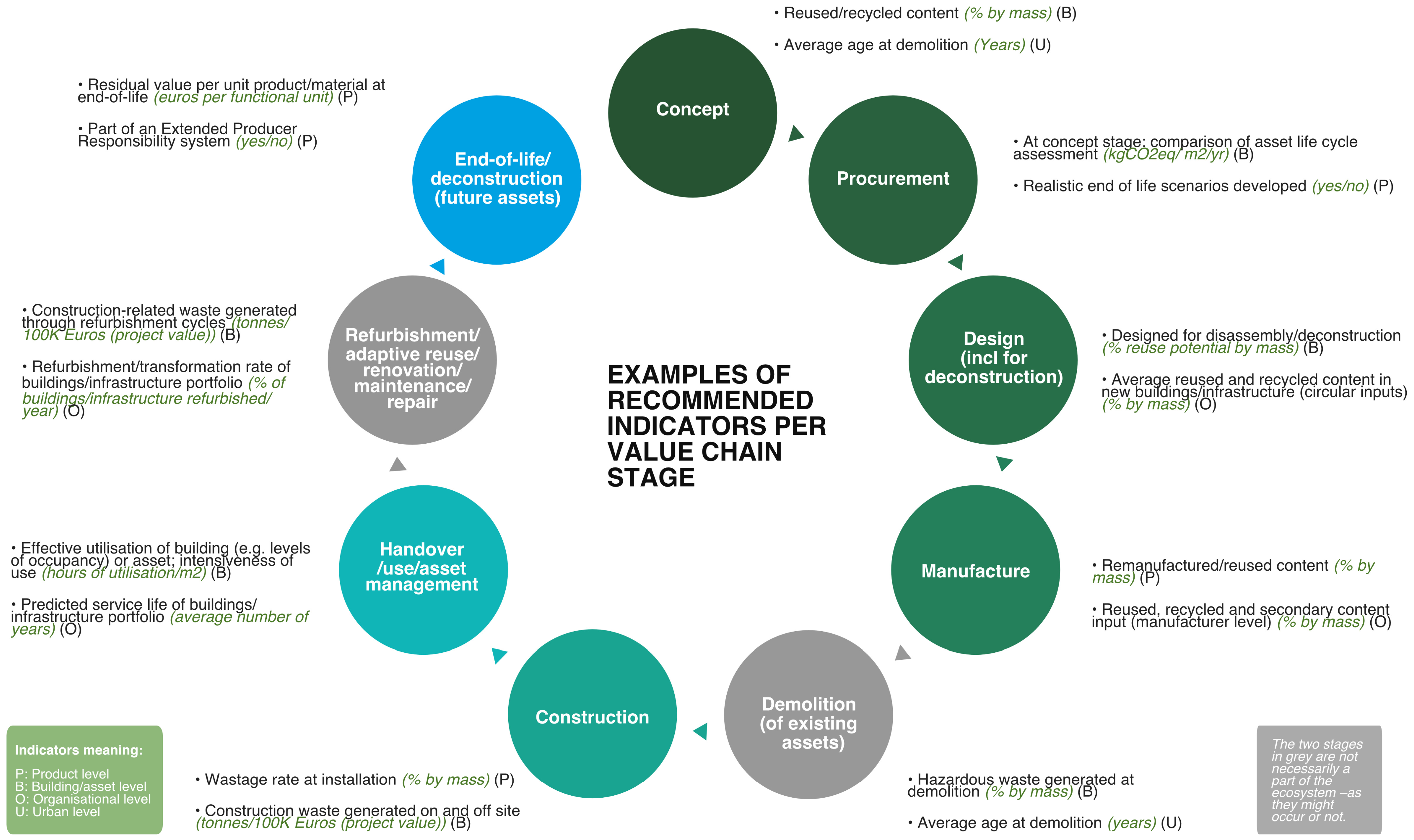
The research objective stems from the awareness of the multiplicity and variability of indicators required to measure the circularity level of buildings, with reference to the different life cycle stages (Figure 1) [14]. By focusing on material selection during the design phase, the research looks at indicators useful at the design stage, which include circular inputs—namely, the quantity of different types of circular materials employed in the project—and Design for Disassembly. For the purpose of evaluation, it is central to have a detailed inventory of a building split by mass and by material, such as the Bill of Quantities required by Level(s) [14] to support measurement of circularity.
Circular materials, ranging from reclaimed building components to bio-based and recycled materials, present distinct environmental profiles that challenge conventional assessment methods [16,17]. The integration of Design for Disassembly principles further compounds this complexity, as end-of-life considerations must be embedded from the earliest design stages and it is difficult to quantitatively assess the level of reversibility of connections [18,19]. Circularity indicators have been proposed at different scales, from manufacturing [20] to the building level [21,22], with the aim of quantifying circular performance across the life cycle. However, the literature highlights persistent barriers to the operationalization of such indicators in practice [23] and existing micro-level frameworks often remain disconnected from mainstream sustainability assessment tools [24]. This fragmentation underscores the need for a concise, design-oriented set of circularity KPIs capable of capturing the multidimensional potential of circular materials and strategies.
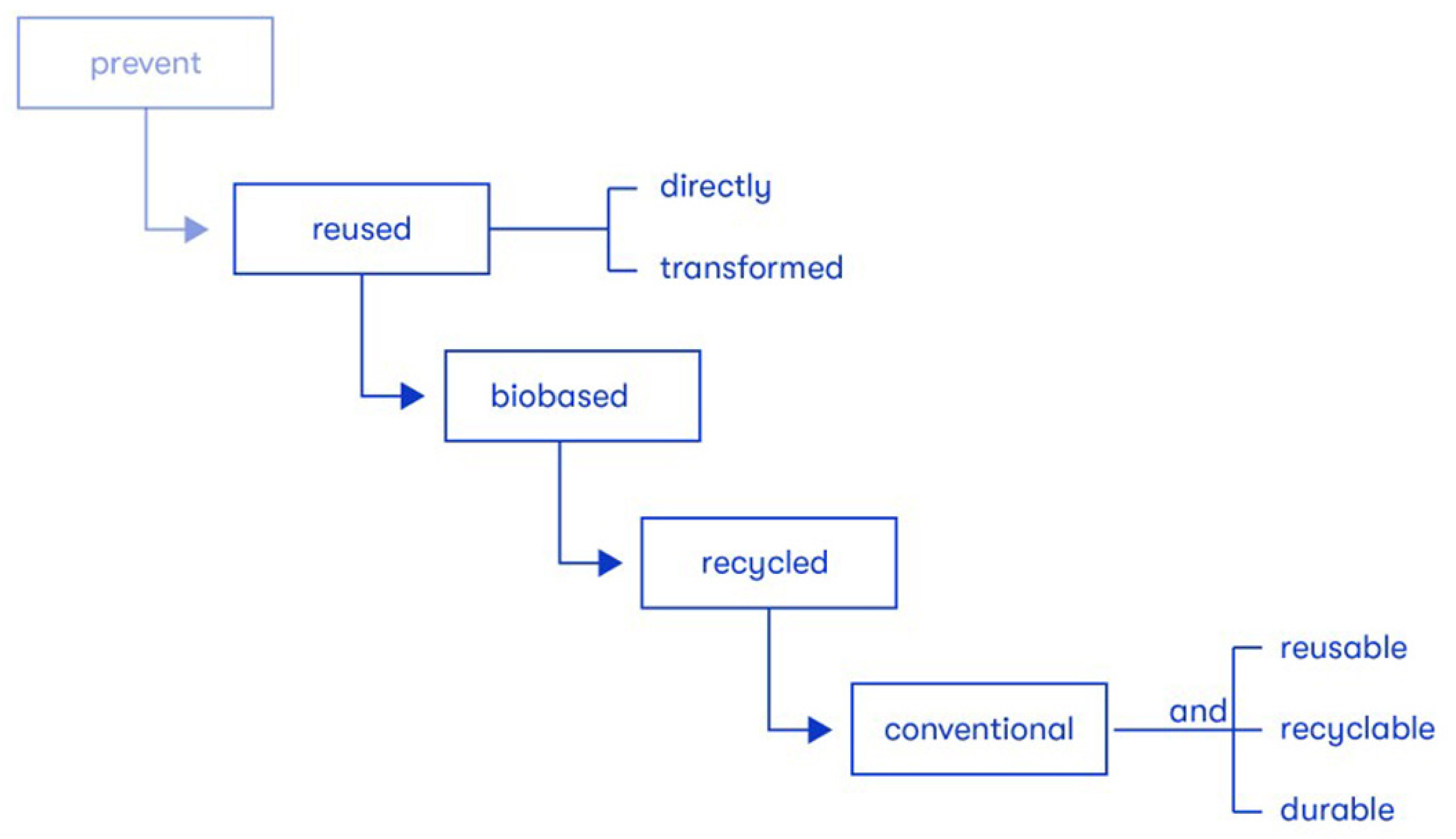
Within this context, the first objective of this contribution is to focus on circular building materials as a strategic solution to simultaneously cut EC and material consumption in buildings, by analyzing relevant case studies. In particular, the definition of circular materials adopted in the research includes reused, bio-based (cultivated or derived from sub-products and waste) and recycled materials from multiple sources (not necessarily only from the construction value chains) in this material choices hierarchy, as assumed by the materials decision tree by Superuse Studios (Figure 2). This approach allows for the highlighting of the strategic role of reuse, to ensure minimal carbon emissions and resource consumption [25], and is consistent with the provisions of Commission Delegated Regulation (EU) 2023/2486 of 27 June 2023 [26], which requires that the use of primary raw materials in building construction be minimized through the use of secondary raw materials.
Connected to this, the second aim of the research is to provide a design-oriented methodology for an early, rapid and effective assessment of the contribution that circular building materials can make to reducing climate-altering emissions and resource consumption. To achieve this goal, existing evaluation frameworks for sustainability and circularity at the building and product level were selected, assessed and screened to select relevant KPIs, to be combined and integrated with specific ones—established in relation to the specific scope of the research—to create a new KPI set. This was aimed at providing operational support for rapid comparative assessments guiding design decisions during early stages, focusing on materials, processes and relative impacts.
The third objective is to test the developed KPI set on selected case studies of buildings fostering climate-change mitigation and resource conservation by including a different share of reused, bio-based and recycled materials. Thus, the research aimed at validating the selected KPIs, verifying their effectiveness in supporting the designer in taking material-related choices and comparing different scenarios, with the aim of reducing EC and material resources uptake.

2. Methodology

The research activities reported in this contribution were developed within the NPRR-funded “Rome Technopole” Project, and, specifically, in the Flagship Project 2 “Energy and digital transition in urban regeneration and construction”, within the Thematic Panel 1 “Energy transition in the multiscale project”, Sub-Panel 1.4 “Energy and ecological management of material, water and immaterial resources”. Consistent with the broader scopes of the Flagship Project 2, within Sub-Panel 1.4, the research aimed at the development of a design methodology based on an integrated, multi/inter-disciplinary and multi-scale approach, capable of configuring green buildings which, through low-impact solutions and by leveraging local resource assets, maximize ecological effectiveness and overall resource efficiency. The specific scope of the activities developed by the RG looked at building materials, to support the broader design methodology, by defining a specific method to assess the contribution that circular materials can provide to reducing climate-altering emissions and resource consumption in buildings.
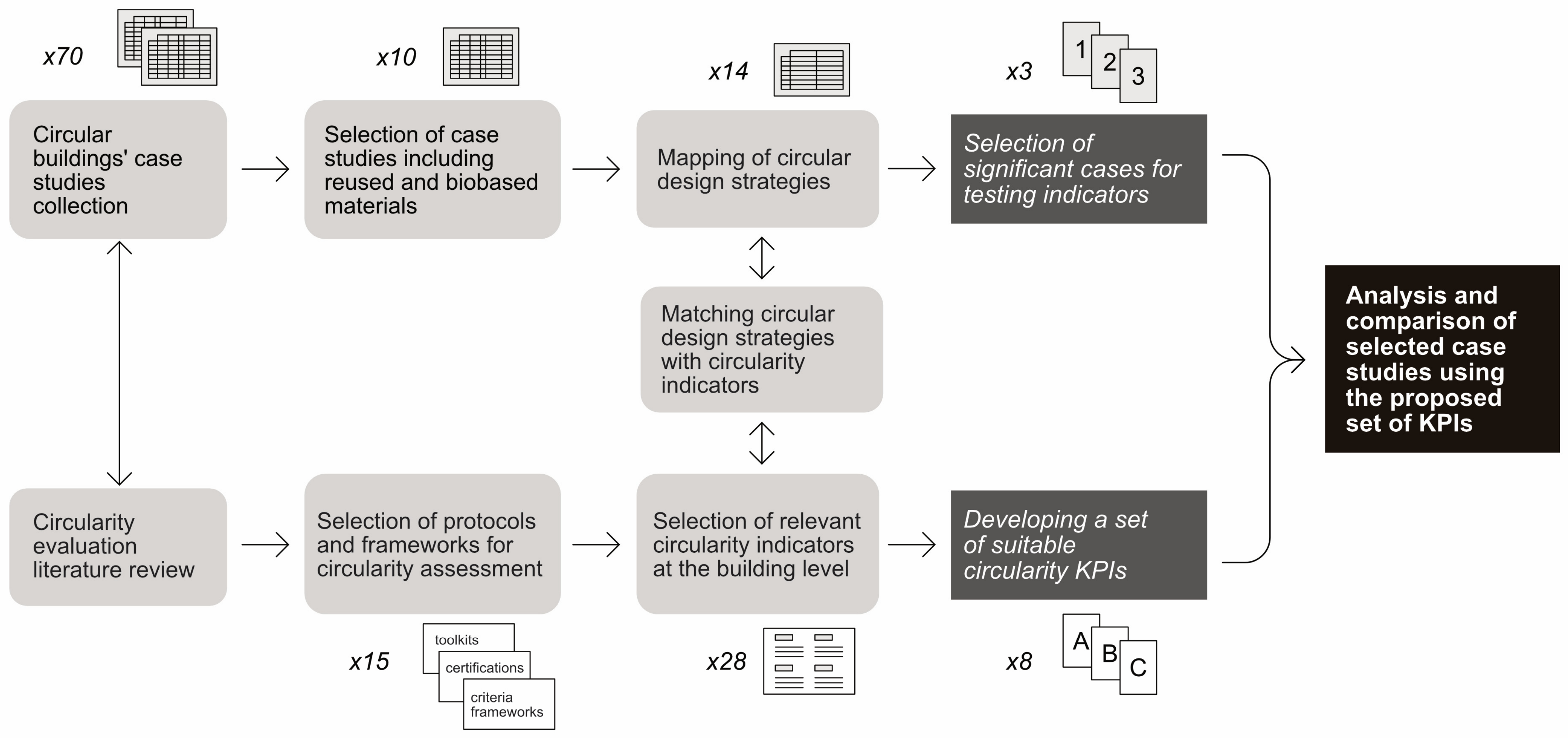
The research adopted a mixed qualitative–quantitative methodology, summarized in Figure 3, combining a systematic literature review—aimed at case studies and evaluation framework identification—with a dual analytical framework, structured as a funnel-based selection process that progressively narrows both the case study sample and the indicator set, to develop an evaluation framework enabling a comparative performance assessment.
In the first phase, the research methodological process was started by collecting and selecting case studies of buildings fostering climate change mitigation and resource consumption reduction using circular materials. The latter were defined considering reused components, bio-based materials and/or materials with a high recycled content. Through a literature wide-spectrum screening, a collection of 70 case studies of circular buildings adopting a variety of strategies and including different typologies of circular materials (reused, bio-based and recycled, in different proportions), the research built a broad state of the art. Out of this collection, 10 cases were selected, based on the following criteria:
  • Integration of diverse design strategies and actions aimed at the climate neutrality of the building by circular-material use;
  • Adoption of at least two of the three groups of circular materials considered in the research (for example, reused and bio-based or bio-based and recycled);
  • Diversification of the circular materials adopted, in order to be able to assess the decarbonisation potential of each typology;
  • Diversity of the methods and distances of supply of circular materials;
  • Diversification of the typologies of interventions to include new construction, renovation/extension and demolition/reconstruction, in order to show the potential of the use of circular materials in different scenarios, demanding varying quantities of materials and construction modalities.
The second phase concerned the qualitative analysis of previously collected and selected case studies of buildings with circular materials. The selected case studies were thus reported in separate, comparable sheets, providing the information necessary to be examined in the subsequent steps of the research, using the selected indicators. The analysis’ sheets included the list of the adopted circular and non-circular materials and technical drawings, describing the building architectural layout and technological system, with construction details useful to understand the level of disassemblability of building components, with a view to the future reusability/recyclability of materials. This allowed for the gathering of all the relevant information for each building, which would be examined in the next steps of the research. Three steps of comparative analysis were conducted for the set of selected case studies. First, a critical interpretation led to grouping them into three main approaches, corresponding to different circular strategies and prevailing use of different types of circular materials. Secondly, a mapping of the 12 circular design strategies adopted across the cases was elaborated. This allowed for the identification of the 10 most recurrent strategies. Thirdly, a mapping of all the circular materials adopted in the different projects allowed a clear classification: the case studies were analysed by cataloguing the circular materials found in each, classifying them into four categories (reused, cultivated bio-based, waste-derived bio-based, and recycled). For each material, the construction layer it belonged to—structure, envelope, or finishes—was recorded across all cases, enabling a comparative mapping of technological recurrences.
In the third phase, within a parallel workflow starting with a literature review about circularity evaluation frameworks, the research activity focused on the selection and analysis of existing evaluation frameworks, including indicators for the assessment of the level of circularity of building materials and components. Attention was given to frameworks allowing for the simultaneous assessment of resource and energy efficiency, including indicators such as EC and reused/recycled/renewable content rate, to highlight the nexus between energy transition and circularity, both contributing to decarbonising the building sector, towards climate neutrality. Out of 20 frameworks taken into consideration, 15 were selected, pertaining to 2 groups: 8 tools strictly oriented toward circularity at the building (5) or product (3) scale—including indicator frameworks, certifications and protocols—and 7 international energy-environmental building certification protocols containing criteria related to the circular use of materials. The latter were included in the pool to verify which material circularity indicators are currently embedded in the main green building certification systems. Among policy-driven tools at EU and national level, Level(s) and the Italian Green Public Procurement Minimum Environmental Criteria for construction were included, the latter being a legally mandatory instrument for public works.
In the fourth phase, the research activity concerned the screening of the indicators from the 15 evaluation frameworks and their selection and recurrence analysis, aimed at identifying the core KPIs for the definition of a set for an early, rapid and effective assessment of the contribution that circular building materials can make to reducing climate-altering emissions and resource consumption. The indicators were filtered from existing protocols to align specifically with the research pillars: material circularity, local sourcing, low material and EC intensity and disassemblability. The new KPI set was developed in order to consolidate these themes into a unified, multi-indicator framework, providing a targeted assessment method for the circular design strategies to support designers from the early design stage. From the first pool of 84 indicators, grouped in 8 thematic clusters, a consolidated list of 28 indicators was developed, assimilating similar, overlapping ones. Based on a occurrences analysis, the 6 most recurring indicators were identified. The final set of 8 KPIs, aimed at supporting architects in the early stage of design to maximize circularity by considering and assessing material quantities, sourcing processes and environmental impacts, integrates the 6 derived from the previous step, adapting them (for example, doubling each one by weight and volume) and adding 2 more specific ones. The set of KPIs (described in detail in Section 3.2) includes 3 indicators regarding the share of reused, bio-based and recycled materials; a fourth one summing up these 3 shares, to measure the overall circular material origin; a fifth one measuring the share of local materials; a sixth one referred to the disassemblability of building elements for the future recoverability of materials; a seventh one measuring material intensity; and the last one, which is EC intensity, reflecting the effects of all material-related choices.
Then, the 2 methodological tracks of the research converged in the matching of the 10 most recurring circular design strategies, mapped in the case studies, with the single 8 indicators in the set, to verify the effective coverage offered by the proposed KPIs in measuring the effects of the key circular design strategies identified in the case studies.
The last phase, aimed at validating the KPIs, concerned the quantitative analysis of 3 case studies—selected among the 10—with the developed set of KPIs, allowing for their individual and comparative assessment. The 3 case studies (02_K118, 05_FH and 06_GH) were chosen from the broader pool of 10, according to a maximum variation sampling logic, aimed at maximising the coverage of the variability of circular strategies and material types identified across the full sample. Specifically, the selection was guided by the following criteria:
  • Differentiation of the prevailing circular design approach (reuse-led, bio-based-led, and hybrid reuse/bio-based);
  • Breadth and diversity of circular design strategies adopted (02_K118: 11 strategies; 06_GH: 8; 05_FH: 7), with each case combining strategies in a distinct and non-redundant way;
  • Complementary distribution of the three types of circular materials (reused, bio-based and recycled);
  • Availability of sufficiently detailed quantitative material data to enable reliable calculation of all 8 KPIs.
Together, these criteria ensure that the three cases constitute a differentiated and representative sample for testing the sensitivity of the KPI set to the effects of different circular strategies and material choices adopted in the project, as well as its operability across a wide spectrum of design approaches, in line with the research aims.

3. Results

This section reports the research results, which include the following:
  • The comparative qualitative assessment of a selection of 10 case studies of buildings fostering climate change mitigation using circular building materials, with a variable mix of reused, bio-based and/or recycled materials and components, grouped according to three prevailing strategic approaches, and mapped according to the adopted circular design strategies and specific materials (Section 3.1);
  • A selection of 80 indicators derived from the screening of 15 existing sustainability and circularity evaluation frameworks at the building and product level, from which the relevant indicators, useful for the KPI set development, were extracted, based on an occurrences analysis and on targeted integrations (Section 3.2);
  • The final set of eight KPIs, defined by combining, modifying and integrating the group of indicators extracted from the screening of the existing evaluation frameworks (Section 3.2);
  • The results of the testing of the KPI set in the three most significant case studies—representing different approaches and balances between the three types of circular materials (Section 3.3).

3.1. Case Studies: Comparative Qualitative Analysis

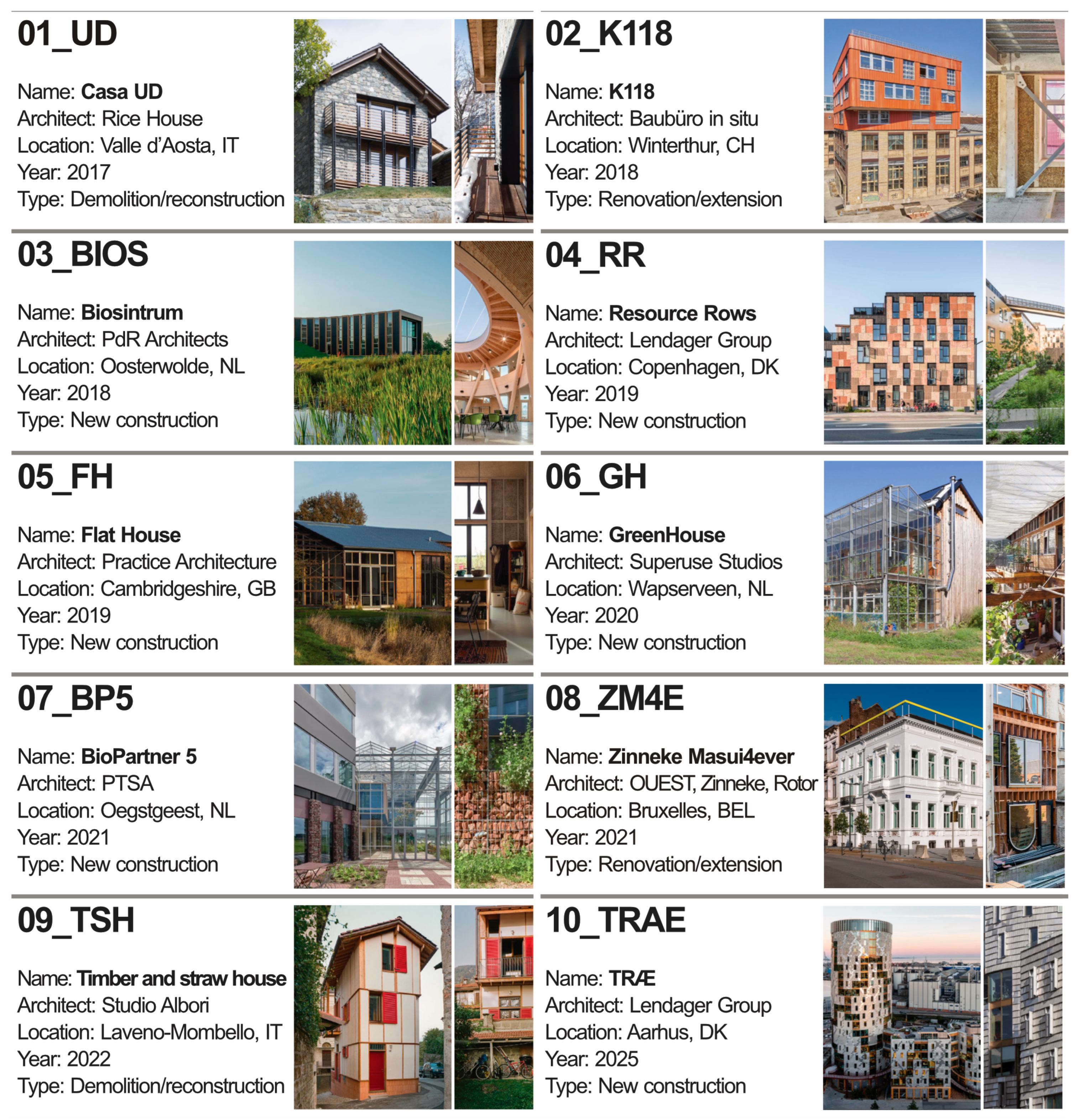
The 10 selected case studies (Figure 4) represent multiple circular design strategies and adopt differentiated combinations of reused, bio-based and recycled materials and components.
The 10 case studies are presented below through a critical reading that divides them into three groups (Section 3.1.1, Section 3.1.2 and Section 3.1.3), corresponding to three main approaches outlining a gradient in the combination of diverse circular strategies and different share of circular materials used:
  • First group (cases 04_RR and 07_BP5): mainly based on reuse, with a limited use of bio-based materials;
  • Second group (cases 01_UD, 02_K118, 06_GH, 08_ZM4E, 09_TSH and 10_TRÆ): reuse with a strong orientation to urban mining and superuse of non-construction materials, and a consistent use of bio-based materials;
  • Third group (cases 03_BIOS and 05_FH): use of bio-based materials with innovative/waste-based biomaterials, including minor quantities of recycled materials.

3.1.1. First Group of Case Studies: Focus on Reuse with Limited Use of Bio-Based Materials

The first group includes the case studies 04_RR, Resource Rows (designed by Lendager Group, 2021), and 07_BP5, BioPartner 5 (designed by PTSA, 2021), which represent experimentations on reuse, with a limited use of bio-based materials. In Denmark, demolition bricks are typically crushed and reused as aggregates because the presence of a mortar stronger than the brick itself prevents their direct reuse. The Resource Rows project explores an alternative approach: the designers chose to cut square 1 m2 modules from the perimeter masonry of disused buildings near the site—such as the historic Carlsberg brewery and old schools—and then anchored them to a concrete panel and a metal grid, to produce prefabricated modules for the envelope of the new building. The project also makes use of waste wood sourced from the crates used to transport concrete elements during the construction of the Copenhagen underground, treated using a Japanese technique based on surface carbonisation, to achieve an impregnating and protective effect. These strategies made it possible to save 463 tonnes of material waste. The LCA analysis shows a 12% reduction in CO2, compared to a reference building with primary materials, when considering construction materials alone—a figure that rises to 60% for wood only and to 86% for window frames only—while, when both EC and operational emissions over a 50-year lifespan are taken into account, Resource Rows saves 29% of CO2 per m2 [27].
The new Biopartner 5 laboratory at Leiden Bio Science Park, completed in 2021 by PTSA, is the first Paris Proof building in the Netherlands. The building’s 7000 square metres are divided between private research laboratories and various informal and shared spaces. The reduction in Biopartner 5’s environmental impact is partly due to the use of reclaimed materials. The most significant result was achieved by constructing the new building’s structure using 165,000 kg of steel from a nearby laboratory at Leiden University, which was about to be demolished after only a few decades of use. Bricks originally used to cover the ventilation ducts were also recovered from the same building, and crushed and recycled into gabion pillars around the base in order to bring the aesthetics of reuse to the façade. Even the ribbon windows running along the façade were reused from an office building that was being demolished in the nearby city of Haarlem, and, in fact, have slightly different rhythms and dimensions [28,29].

3.1.2. Second Group of Case Studies: Focus on Reuse, with a Strong Orientation to Urban Mining and Superuse and a Consistent Use of Bio-Based Materials

The second group includes the case studies 01_UD, Casa UD (designed by Ricehouse, 2017), 02_K118 (designed by Baubüro in Situ, 2018), 06_GH, Greenhouse (designed by Superuse Studios on Site, 2020), 08_ZM4E, Zinneke (designed by Ouest, Zinneke and Rotor, 2021), 09_TSH (designed by Studio Albori, 2022) and 10_TRÆ (designed by Lendager, 2025), which show an evolution of the approach based on reuse, with a strong orientation to urban mining and superuse of non-construction materials, and a consistent use of bio-based materials, especially in the two cases of demolition and reconstruction (01_UD and 09_TSH).
To design Pavilion K118 (02_K118) as a vertical extension of a former carpentry workshop in Winterthur, the designers Baubüro in situ sourced materials and components from demolition sites within a 90 km radius of the construction site, adapting the design according to availability. The geometry of the steel load-bearing structure—reclaimed IPE beams from a distribution centre in Basel—determined the cantilevered overhang of the addition over the existing building. Concrete was used only where structurally necessary or required for acoustic and fire protection. The window frames were salvaged from a nearby warehouse and were installed in a double layer to improve thermal performance. Other large-format triple-glazed aluminium windows came from another demolition site in Zurich. The building envelope was built using timber frames filled with straw bale insulation. On the exterior, the finish consists of reclaimed corrugated metal sheets painted red, while the interior plaster is made from locally excavated clay. External access to the upper floors was made possible by reusing a fire escape staircase from the same building that supplied the window frames [30].
TRÆ (10_TRÆ), designed by Lendager Group and completed in 2025, is a complex of three office towers—one of 20 storeys and two of 6 storeys—designed following the principle of “form follows availability”. The highest of the TRÆ towers, nearly 80 metres tall, is the first timber building of its scale in Denmark, storing one tonne of CO2 per cubic metre of material used—including, for example, the timber used for window frames in place of aluminium, saving 87% of emissions compared to new conventional windows. The use of CLT floor slabs and glulam columns has further contributed to significant CO2 savings relative to conventional concrete structural systems; concrete was used for the foundations and vertical connections cores, but kept to a minimum by avoiding the construction of basement levels and car parks. End-of-life wind turbine blades were recovered and cut to produce the solar shading elements, achieving the upcycling of a complex, multi-layered waste material and saving 95% of emissions compared to an alternative such as aluminium. The steel and aluminium metal sheets forming the facade are reclaimed from agricultural silos and sheds and treated by playing with the layering and flattening of elements to achieve material variation and shadow effects, drawing inspiration from the texture of tree bark. These strategies achieved a saving of 170,534 kg of waste and a reduction in CO2 of 130,096 kg, compared to a conventional building [31].
Greenhouse (06_GH), designed by Superuse on Site in the province of Drenthe, the Netherlands, is a flexible home for two to four families. The use of reused and waste derived bio-based materials has reduced significantly the emissions footprint, while the exposure of the rooms according to their functions has allowed the glasshouse to be used as a passive climate machine for ventilation, heating and cooling, powered by the sun. In order to stay within the available budget of €250,000, the strategy of ‘design by availability’ was followed, whereby the design is based on materials available on-site or nearby, scouted by a “Harvest Team” of residents and volunteers trained by Superuse. With the exception of the heating and photovoltaic systems, almost all of the materials are not new: the entire steel, aluminium and glass structure of the glasshouse, as well as the wooden structure of the opaque part of the building, have been recovered and briefly adapted for their new function; straw, organised into bales and obtained from agricultural waste in the area, was chosen for insulation; the flooring and internal and external plaster were made from a mountain of unused clay sourced from 10 km from the site [32,33].
A similar approach adopted in a renovation intervention is implemented in the case of Zinneke (08_ZM4E), in Brussels. Zinneke is a socio-artistic organisation founded in 2000 which, in 2013, set up in the Masui district, north of the city of Brussels, in a former complex of state-owned printing workshops. In 2015, Zinneke invited Rotor to participate in the renovation of the complex, and in 2016 Ouest architecture and Matriciel were also brought on board to take part in the pilot project, with the aim of preserving as much of the original building as possible and designing it to be ‘future-proof’, so that it could be adapted over the years for a variety of uses. Through minimal and targeted interventions, 94% of the building’s mass has been preserved and reused on site. Of the new materials used that did not originate from the site itself, 12% by mass are reused (second-hand) components, including numerous timber (waste derived bio-based) elements: 30 steel beams used as lintels for the new spans, five window frames comprising the rear façade, 450 m2 of rock wool insulation panels, two elegant steel staircases from the former Flemish government headquarters, 90 m2 of azobe wood planks for a new terrace, 300 m2 of oak parquet, around 20 radiators, more than 20 doors (including fire-resistant ones) and, finally, a complete ventilation system salvaged from an office tower [34].
The last two case studies within this group, 01_UD and 09_TSH, are demolition and reconstruction interventions, reclaiming and reusing demolition materials, off- and on-site, and integrating them with bio-based materials.
Timber and straw house (09_TSH), Studio Albori’s project for a small house located within the historic fabric of the town of Laveno, on Lake Maggiore, involves the reconstruction of a previously demolished building, keeping its original outline. The building incorporates several salvaged materials sourced from demolition processes: the external and internal window frames, roof tiles, parapets, gates, grilles and the stones of the small garden all come from the pre-existing structure, from other demolitions, or from local salvage dealers. As for the remaining construction materials, these were sourced locally and, where possible, are bio-based: the foundations are built from metal gabions filled with rubble stone, while the load-bearing structure is made of Piedmontese larch; the infill for the perimeter walls consists of straw bales and lime plaster. Straw construction aligns with circularity principles by valorising a largely underutilised agricultural by-product generated in large quantities [35].
Casa UD (01_UD) represents a similar approach, in which bio-based materials are dominant and reclaimed construction materials are included as a solution to logistic problems. Built by Ricehouse on the ruins of an old dry-stone farmhouse dating back to 1834 in Chamois, Italy, Casa UD was designed with a load-bearing structure made of prefabricated fir wood frames and rice straw bales sourced from the rice fields of Vercelli and assembled in just four days. The house requires no heating system, as it uses, in addition to straw insulation, passive solar gain, ventilation, and natural lighting. The focus on reducing the project’s environmental impacts is evident, through the use of natural materials (such as sheep’s wool for cavity insulation and impact sound insulation), recycled materials (such as recycled cellular glass panels for the subgrade insulation), and reused materials (such as the stone used for the exterior cladding or the larch wood used to create the balconies and internal staircase, salvaged on-site from the existing building). However, due to the impossibility of traditional transportation to reach the construction site, a helicopter was used for the assembly of the building and the transport of some materials, which clearly led to increased emissions during the construction phase [36].

3.1.3. Third Group: Focus on Bio-Based Materials with Limited Use of Recycled Materials

The third group includes 03_BIOS, Biosintrum and 05_FH, Flat House, demonstrating a highly structured use of bio-based materials within design solutions in line with the circular approach, where experimentation with innovative and waste-based biomaterials goes hand in hand with the established use of organic materials for envelopes and structures. The selected cases both include minor quantities of recycled materials, showing a specific attention to the full substitution of non-based primary materials.
The Biosintrum knowledge centre, completed in 2018 within the Ecomunitypark in Oosterwolde, The Netherlands, was conceived by the municipal authorities of Ooststellingwerf to bring together companies, educational institutions and government agencies that want to focus on a future based on biological resources. The designers at Paul de Ruiter Architects responded to the requirements by making the building itself an inspiring model of bio-based construction: over 80% of the building, BREEAM Outstanding certified, is made from bio-based materials. Knowledge sharing, the centre’s main function, began right from the design stage: NHL Stenden University of Applied Sciences provided advice on bio-based materials, while students from Van Hall Larenstein calculated energy neutrality and water savings. The result is a building whose exposed load-bearing structure is made of locally sourced larch wood and offset by the Dutch Forestry Commission through the planting of new trees, while the fixtures are made of untreated Accoya wood and the interior cladding is made of wood or biocomposite facades based on mycelium, as a binder between sawdust and straw. The choice of all materials was guided by circular logic, such as the use of recycled plastic for the skylights and insulation made from collected jeans, a healthy, economical and effective alternative to glass wool. Experimentation with natural materials was carried out in particular for the interior finishes, where the floors are made of elephant grass as a substitute for sand and gravel, and the surfaces are based on linen, clay and marmoleum made from cocoa shells [37].
The case study of the Flat House, completed in 2020 in Cambridgeshire, UK, shows that if long transport distances are not involved, plant-based materials store more carbon than they produce. Located at Margent Farm, a rural research and development facility that produces bioplastics from hemp and flax, the house was designed with a prefabricated construction system that allowed all the modules to be assembled in just two days: the module, approximately 2 m high by 1 m wide, consists of a wooden joist structure sourced from the UK and a hemp concrete infill, which is a mixture of lime chips and hemp from the farm’s 20 acres. The processing of hemp, which involves separating the different elements of the plant—seeds, fibres and shives—made it possible to experiment with different materials, integrating the different matrices produced. In collaboration with Material Cultures [38], a unique corrugated bio-composite panel was developed, made from locally grown hemp fibre and thermally compressed with a sugar-based bio-resin, which was used as an external cladding. The high natural cellulose content (60–70%) and high resistance allow it to be used as a rain screen instead of corrugated steel, PVC and bitumen sheets, making it a great plastic alternative [39,40].

3.1.4. Mapping of the Circular Design Strategies Adopted in the Case Studies

The analysis of circular design strategy recurrence across the 10 case studies (Table 1) reveals how a consistent core of strategies recurs in almost all projects, such as the reuse of building components (whether on-site or off-site) and the use of bio-based materials (whether cultivated or from bio-waste).
Out of 12 strategies identified, eight appear in seven or more projects, confirming a broad convergence around a shared set of circular design principles within the sample. ‘Design by availability’ emerges as the most recurrent strategy (eight case studies), followed by a group of seven strategies—‘off-site reuse’, ‘use of cultivated bio-based materials’, ‘use of waste-derived bio-based materials’, ‘use of recycled materials’, ‘territorial research into local sources of waste materials’, ‘design for disassembly’ and ‘design for material optimization’—each present in seven projects. This suggests a robust core of circular design practices commonly applied across different building typologies and geographical contexts. ‘On-site reuse of building components’ and ‘Superuse/upcycling of other types of waste’ follow (five occurrences each), suggesting that the adoption of such strategies is becoming increasingly established in construction practice.
By contrast, beyond these 10 most recurrent strategies, ‘prefabrication’ (4) and ‘design for adaptability’ (3) remain the least adopted ones, reflecting how these were not the central goals of the selected cases. It appears evident that, when designing circular building systems, strategies based on materials selection are of the greatest importance, followed by sourcing related ones and disassemblability for future recovery.
The combination of strategies varies considerably across projects. 02_K118 adopts the broadest set, with 11 strategies, while 06_GH follows with eight, though with a markedly different combination, prioritizing material-origin strategies—such as waste-derived bio-based, recycled and superuse/upcycling—over lifecycle-oriented ones. 05_FH also applies seven strategies, with a distinctive profile oriented towards bio-based cultivated materials, design for disassembly and prefabrication. By contrast, cases such as 01_UD and 08_ZM4E adopt a more selective approach with four to five strategies each, prioritizing specific circular principles. The diversity of circular design approaches embodied by 02_K118, 05_FH and 06_GH—ranging from the broadest multi-strategy integration to more focused, yet complementary, combinations—makes these three projects a differentiated and representative sample for the validation of the KPI set developed in this research, as they collectively cover a wide spectrum of circular strategies and material choices.

3.1.5. Mapping of the Circular Materials Adopted in the Case Studies

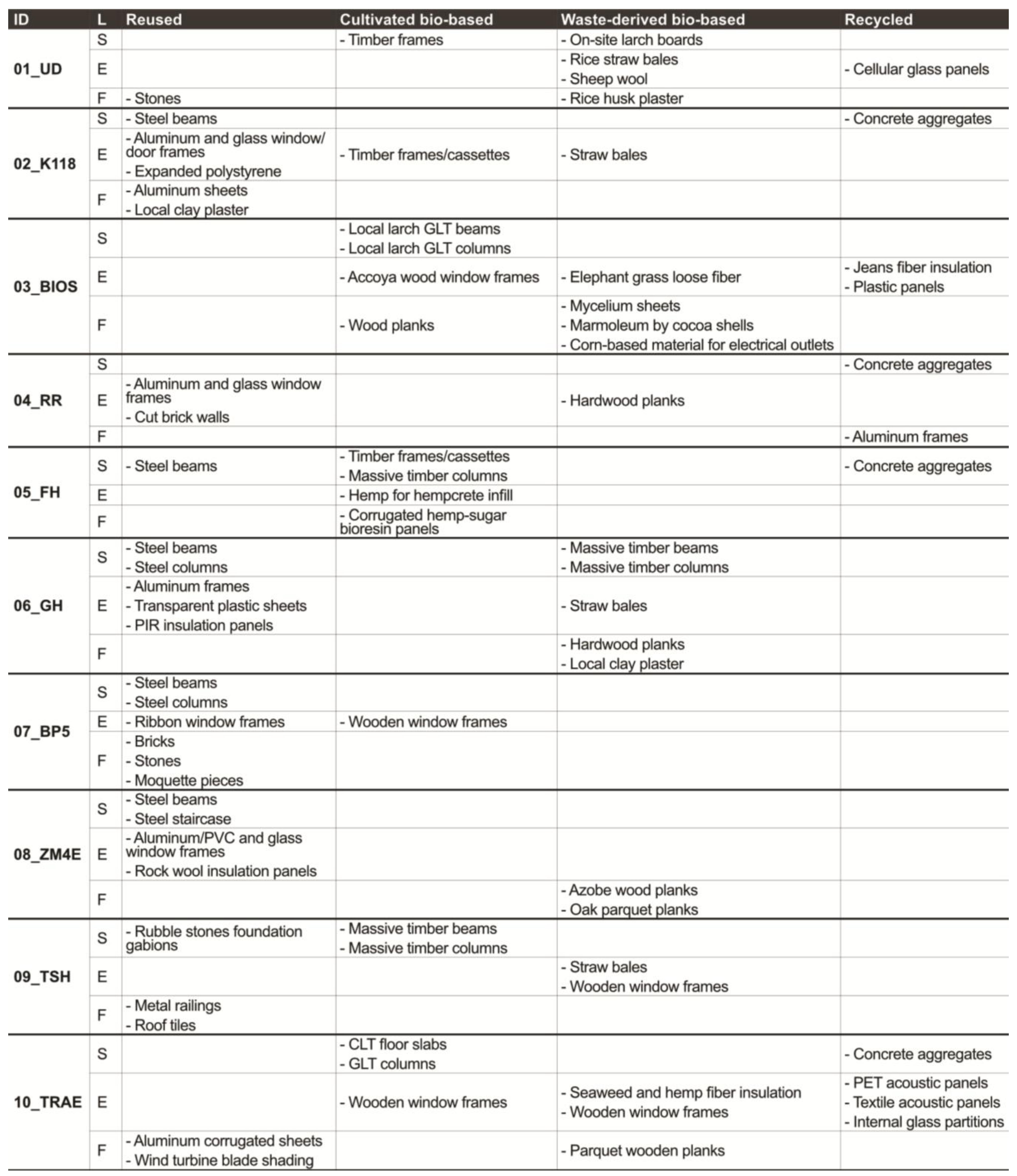
The 10 case studies were compared not only at the strategic level, but also at the material level (Figure 5). This dual approach aimed to assess how different circular strategies influence material selection, by examining the recurrence of the three material types—reused, bio-based and recycled—and their applications across building systems. The materials were at this stage re-classified into four categories: reused, cultivated bio-based, waste-derived bio-based and recycled, splitting the bio-based category into two sub-categories to reflect the distinction between the corresponding circular design strategies traced across the case studies. For each material and component identified, the construction layer it was employed in—structure, envelope or finishes (both internal and external)—was recorded, enabling a taxonomic and comparative mapping aimed at identifying technological recurrences and synergies between resource origin and construction function.
The mapping reveals distinct patterns in the adoption of circular materials across the ten case studies. Within the reused category, steel beams and aluminium frames are the most recurrent elements, predominantly employed in the structure and envelope sub-systems, respectively, reflecting the relative ease of reusing standardized metal components. Steel beams appear in five projects (02_K118, 05_FH, 06_GH, 07_BP5, and 08_ZM4E) in the structure, while aluminium elements recur in the envelope of several cases (02_K118 and 06_GH). Stone and brick elements appear sporadically, mainly in finishes (07_BP5).
Among cultivated bio-based materials, timber-based products dominate, with massive timber beams and columns (05_FH, 09_TSH), glue laminated timber (GLT) elements (03_BIOS, 10_TRAE), and timber frames/cassettes (01_UD, 02_K118, 05_FH) recurring across multiple projects in the structure, confirming the consolidated role of wood in circular construction. Hemp-based products are notably present in the envelope (05_FH).
The waste-derived bio-based category shows the greatest material diversity. Straw bales emerge as one of the most recurrent elements overall, appearing in four case studies (01_UD, 02_K118, 06_GH, and 09_TSH) within the envelope sub-system, confirming their established role as a bio-based insulation and infill solution. Plaster, including rice husk or waste clay, recurs in two projects (01_UD and 06_GH) in the finishes sub-system, highlighting its recognised potential as a low-impact, waste-derived surface material. More innovative solutions—such as mycelium sheets (03_BIOS), seaweed and hemp insulation (10_TRAE)—appear only in specific projects.
Within the recycled category, concrete aggregates are the most frequently adopted material in the structure (02_K118, 04_RR, 05_FH, and 10_TRAE), while recycled panels of various types appear in envelope (03_BIOS and 10_TRAE), though with limited recurrence.
Across all categories, the envelope sub-system exhibits the highest material diversity, whereas the structure sub-system is more consistently dominated by timber-based and metal elements.

3.2. Construction of the Evaluation Framework

In order to map the existing, most recurring circularity indicators, the research took into consideration 15 different assessment frameworks of varying nature and reference scale, divided into two groups (Table 2). The first group included eight tools of different types, namely indicator frameworks, certifications, and protocols, strictly oriented toward circularity at the building or product scale: the C2C Circularity Standard 4.1 [41]; the ReMade certification scheme [42]; the Material Circularity Indicator by the Ellen McArthur Foundation [7]; the Building Circularity Index by BCI Gebouw [43]; the Circular Buildings Toolkit by ARUP [8]; the Circularity Passport by EPEA [44]; GPP Minimum Environmental Criteria for Buildings by the Italian Ministry of Environment, mandatory for all interventions on public buildings [45]; and the EU Commission’s framework Level(S) [6]. The second group instead included seven international energy-environmental building certification protocols, which contain criteria oriented toward the circular use of materials: the DGNB System for new construction and buildings [46]; BREEAM for new construction [47]; the LEED protocol for building design and construction [48]; the Living Building Challenge 4.0 Standard [49]; the SBTool MED—Sustainable Building Tool Integrated tool and assessment methodology for sustainable buildings in MED cities [50]; the Green Globes New Construction [51]; and the ITACA Protocol, developed in Italy by ITACA and adopted by many different Regions [52,53].
The analysis was carried out as follows: after the extraction of pertinent indicators from each evaluation framework, 84 indicators were collected across the 15 systems. Then, a consolidated list of indicators was developed by removing duplicates and merging indicators with very similar formulations and measuring the same aspect. Such a consolidation process led to considering 28 out of the 84 extracted indicators. The 28 indicators were then grouped into eight thematic clusters: carbon, emissions and life cycle impacts; material content; material origin and quality; circularity and flows; waste management; cycling pathways; disassembly and adaptability; and durability and material quantities. Then the 28 indicators’ recurrence across the 15 evaluation frameworks was analyzed (Table 3), reporting the total number of occurrences on the total sample (84) and the number of frameworks in which they appear.
The occurrence analysis reveals a clear concentration of indicators within three thematic groups: material content (23 occurrences); disassembly and adaptability (16); and carbon emissions and life cycle impacts (13). The material content group is the most numerically significant, containing the highest-scoring individual indicator across both metrics: ‘Reused/reclaimed material from existing building or off-site’ records the highest absolute occurrence count (9 out of 84, 11%) and appear in 6 out of 15 frameworks (40%). The three indicators ‘Recycled/reclaimed content’, ‘Embodied Carbon/Carbon Footprint/GWP’ and ‘Disassemblability/Dismantability/Separability/Detachability’ follow, reaching 8 occurrences (10%) and appearing in 7 out of 15 frameworks (47%). Overall, these four indicators therefore stand out as the most recurring across both metrics, suggesting a broad consensus among evaluation frameworks on the centrality of material reuse, recycled content, carbon assessment, and end-of-life recoverability, as core dimensions of circular building performance.
Notably, ‘Disassemblability’ appears in a variety of formulations at different levels (strategic or technical) and assessment methods, reflecting the broad recognition of the theme as central to circularity, while also highlighting the challenges involved in establishing a standardized calculation approach.
With 5 occurrences and a presence in 5 out of 15 frameworks (33%), the ‘Renewable/bio-based material content’ indicator occupies an intermediate position in the recurrence ranking, reflecting a growing but not yet consolidated recognition of bio-based materials as a measurable dimension of circular performance within current evaluation frameworks. In fact, bio-based materials appeared under-represented, in contrast to their considerable relevance, acknowledged in the literature [16]. ‘CDW recovery rate/Construction waste management’ records the same values, suggesting that waste management is increasingly acknowledged as a relevant performance dimension.
Finally, the next most recurring indicator is ‘Local materials/Local supply’, appearing in 27% of the frameworks analyzed. By contrast, indicators in the clusters ‘Cycling pathways’ and ‘Durability and materials quantities’ and synthetic indicators from the ‘Circularity and flows’ group appear only once or twice and in a single framework, indicating that end-of-life pathway indicators, material quantity-related ones, and composite circularity metrics have yet to achieve widespread adoption in current evaluation practice.
Starting from the pool of the seven most recurring indicators, an assessment was made of their relevance to the research scopes, identifying which indicators were most suitable for buildings with reused, bio-based and recycled materials. Therefore, the indicator relating to the calculation of construction and demolition waste (CDW)—though present in 5 out of 15 protocols—was excluded, because the research does not focus on CDW optimization itself. Then, one less common indicator—Material intensity, present in only 2 out of 15 protocols—was integrated for its relevance to the overall assessment of the project’s impact, enabling the evaluation as to whether the project is designed to optimize the quantity of materials.
Furthermore, the selected indicators, mostly considered only by weight in existing evaluation frameworks, were inserted in the set not just by weight, but also by volume share on the total materials used: this is because, especially in the case of lightweight bio-based materials (straw and hemp), the value can differ greatly in the two dimensions.
Lastly, for the local materials share, the threshold was set at 150 km from the construction site, consistent with the strictest threshold found in the investigated evaluation frameworks (the Italian ITACA Protocol), in order to favour the local sourcing.
The set of KPIs therefore includes a total of eight indicators:
  • ‘Reused materials share’: Weight/volume of reused materials from the total weight/volume of building materials used in the intervention [%];
  • ‘Bio-based materials share’: Weight/volume of cultivated and waste-derived bio-based materials from the total weight/volume of the materials used [%];
  • ‘Recycled materials share’: Weight/volume of recycled materials from the total weight/volume of the materials used [%];
  • ‘Circular material origin’: Sum of reused materials, renewable materials and recycled materials shares used in the building (both by weight and by volume) [%];
  • ‘Local materials share’: Weight/volume of local materials (in a 150 km range) from total weight/volume of the materials used [%];
  • ‘Disassemblability’: Weight/volume of disassemblable materials and components from total weight/volume of materials [%];
  • ‘Material intensity’: Weight of structural and envelope components per unit of useful floor area [kg/m2];
  • ‘Embodied Carbon Intensity’: Embodied carbon dioxide equivalents per unit of internal useful floor area [kgCO2eq/m2].
The eight KPIs were then associated with the most relevant circular design strategies, i.e., those most recurrent (10 out of 12) across the 10 case studies. The association matrix (Table 4) was constructed to verify the effective coverage offered by the proposed KPIs in measuring the effects of the key circular design strategies identified in the case studies.
From this association, the cross-cutting nature of the ‘EC Intensity’ KPI—linked to 9 out of 10 strategies—becomes evident, reflecting the strong influence of material choices on EC, from on-site and off-site reuse to bio-based, recycled and locally sourced materials, as well as the effects of material optimization.
KPI 4 ‘Circular material origin’ follows, with eight associations, functioning as a synthetic indicator that aggregates the contribution of all material-related circular strategies. In this context, the KPIs ‘Reused materials share’, ‘Bio-based materials share’, and ‘Local materials share’ assume a central importance, constituting the operational pillars of the design by availability strategy, which privileges the use of territorial and regenerative resources. KPI 1 and KPI 2 are each associated with four strategies. KPI 1 connects to both on-site and off-site reuse and superuse/upcycling and design by availability, highlighting the multiple pathways through which reused content can be introduced into a building. KPI 2 links to the two bio-based strategies, territorial research into local waste sources and design by availability, acknowledging the relevance of local bio-based waste streams. KPI 5, ‘Local materials share’, is associated with three strategies, reflecting the strong connection between locality and circular material sourcing.
Finally, KPI, ‘Recycled materials share’, KPI 6, ‘Disassemblability’, and KPI 7, ‘Material intensity’, show the narrowest associations, each linked to a single strategy, reflecting their more focused nature.
In conclusion, it is worth highlighting that the developed set constitutes a multi-indicator framework, in which eight KPIs are applied independently, rather than aggregated into a single composite score. Each KPI captures a distinct dimension of circular material strategies and is intended to be read in conjunction with the others, rather than weighted or ranked. Crucially, EC intensity serves as the overarching indicator, allowing designers to cross-measure the combined effects of all other material-related choices and thus providing an integrated reading of circularity performance without requiring aggregation. This structure was chosen to preserve the interpretability of individual criteria, while still enabling rapid comparative assessments during early design stages.
Furthermore, from an operational standpoint, it is important to highlight that the calculation of all indicators requires relying on the complete Bill of Quantities of the building—one of the fundamental documents prescribed by Level(s)—which must also include sourcing distances, for the purpose of calculating both the ‘Local material share’ and the ‘EC intensity’ KPIs.

3.3. Implementation of the Quantitative Evaluation Framework on Three Selected Case Studies

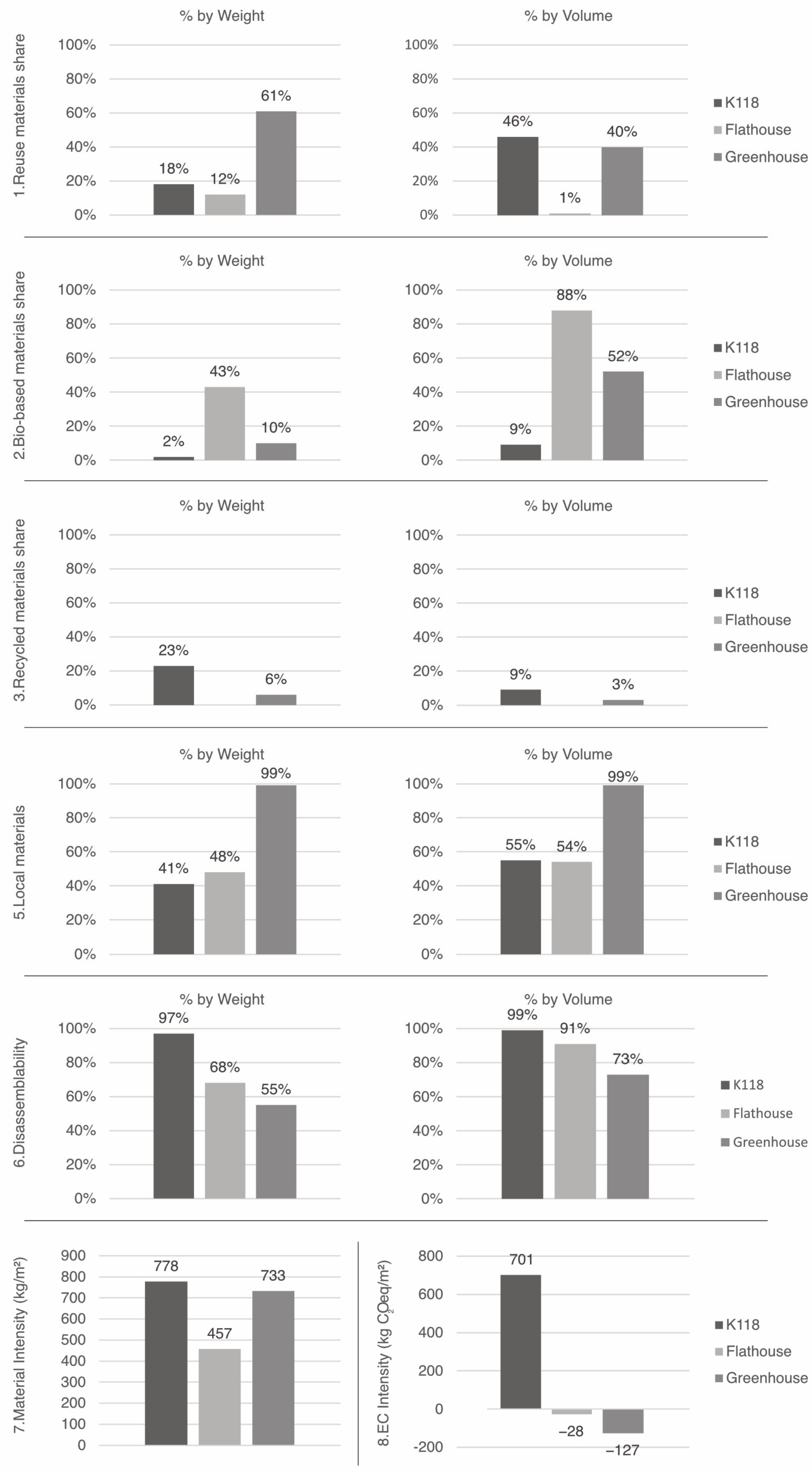
The three case studies selected for the testing of the KPI set, 02_K118, 05_FH and 06_GH, represent different approaches and balances between reused, bio-based and recycled materials. The results of KPI calculation can be seen from Table 5 and Figure 6 and are commented on in the next sub-sections by single KPIs, while KPIs 1, 2 and 3 are presented as a single group, as their analysis benefits from direct comparison.

3.3.1. KPIs 1, 2, 3: Reused, Bio-Based and Recycled Material Share

The projects differ in terms of whether their approach focuses on bio-based materials or second-life materials: K118 makes reuse its main strategy, with 46% of the intervention in terms of volume being carried out using reclaimed materials and components (492 m3 out of 1080 m3 total), although this figure drops to 18% by weight, reflecting the high mass of the steel structure; Flat House, on the other hand, is built with only 1% of the volume in reclaimed materials, and focuses entirely on bio-based materials, with 88% of the volume being of organic origin and 43% by weight—the discrepancy reflecting the low density of the organic materials employed (straw and hemp; notably, all cultivated and not waste-derived); and finally, Greenhouse starts from an approach based on reuse but also uses a large amount of natural materials, including salvaged ones, and, therefore, the share of reuse and bio-based materials in terms of volume stands at 40% and 52%, respectively, figures that drop to 61% and 10%, respectively, by weight, largely due to the mass of the clay plaster used throughout. In contrast to Flat House, all of Greenhouse’s bio-based content is waste-derived (26 t of agricultural by-products and reclaimed timber elements), pointing to a fundamentally different sourcing logic within the bio-based category. K118 combines both sub-categories, with 14 t of cultivated and 7 t of waste-derived bio-based materials, albeit at a much smaller overall share.
Across all three cases, the recycled material share remains comparatively low: K118 records the highest values (23% by weight and 9% by volume) and Greenhouse reaches only 6% by weight and 3% by volume, both cases attributable to the use of concrete with recycled aggregates; Flat House presents no recycled material content whatsoever. This suggests that, within this sample, recycled inorganic materials play a secondary role relative to reuse and bio-based strategies in achieving circular material performance.

3.3.2. KPI 4: Circular Material Origin

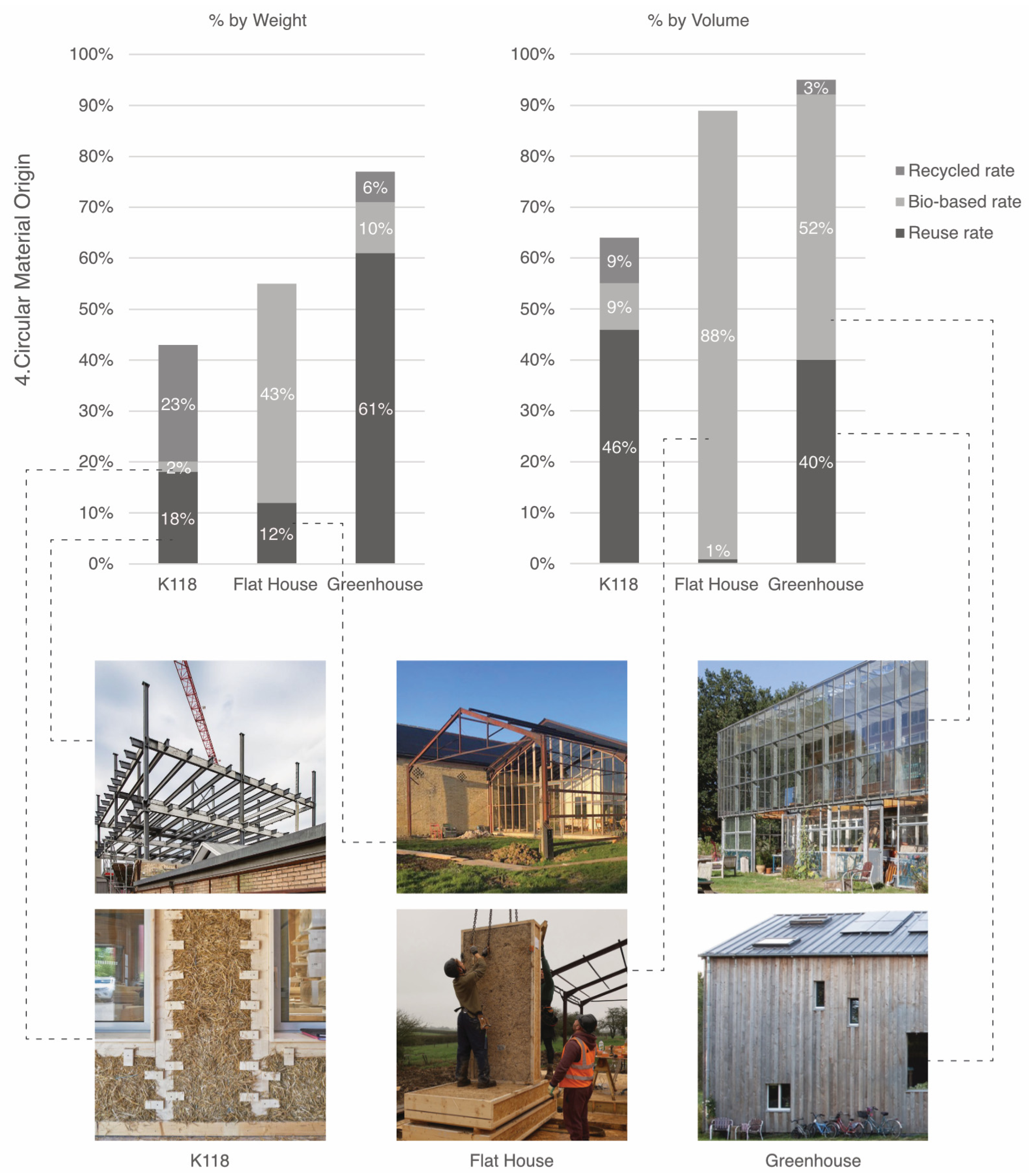
A comparison between the three cases can therefore be drawn, considering the composite Circular Material Origin indicator shown in Figure 7, which presents the KPI disaggregated by reuse, renewable and recycled rates, and expressed by weight and volume.
The composition of the indicator reflects the fundamentally different circular strategies adopted in each case: in K118, the circular material origin is driven primarily by the reuse and recycled shares, with bio-based materials playing a secondary role; in Flat House, the indicator is dominated almost entirely by the renewable rate, consistent with a design approach centred on bio-based materials with virtually no reuse or recycled content; in Greenhouse, the indicator results from a balanced integration of reuse and renewable materials, with the two shares contributing in comparable proportions. The photographs accompanying the figure directly illustrate the material types and construction systems underlying each measured share: for K118, the reused steel structure under erection and the straw bale and timber infill envelope panels; for Flat House, the hempcrete prefabricated cassette modules being installed; for Greenhouse, the reclaimed glass-and-steel greenhouse structure and the timber-clad opaque volume with straw bale walls.
The KPI shows that, considering volume, 64% of the materials used for K118 are renewable or circular, while for Flat House this figure rises to 89% and for Greenhouse to 95%. The percentage variation between the calculation in terms of weight and volume, which is common to all three cases, is linked to the usually lower weight of natural materials (wooden beams, straw bales, and hempcrete boxes) compared to inorganic materials such as concrete and steel, which, even if used only for foundations and structure, weigh heavily in the overall calculation: in K118, which reuses the steel and uses recycled concrete, the percentage varies little, falling to 43%; in Flat House, where non-renewable raw materials are essentially only used for fixtures and foundations, the value drops significantly, to 55%, precisely because of the incidence in weight of these materials on the total, compared to the bio-based materials used for the envelope; for Greenhouse, the weight-based figure rises to 77%, the largest absolute gap between weight and volume metrics among the three cases, which is explained by the high density of the clay plaster dominating the weight calculation, despite being a relatively contained volume. The results suggest that the most effective strategy for maximising circular material origin is the integration of reuse with bio-based materials, especially when natural components can themselves be reclaimed, as in the case of Greenhouse’s salvaged timber structure.

3.3.3. KPI 5: Local Materials

With regard to the use of local materials, with a threshold set within a 150 km radius from the construction site, Greenhouse’s approach of seeking out materials available in the area and collaborating with volunteers and residents to identify possible sources of resources has proved successful, given that virtually all the materials needed for construction were sourced locally, achieving near-total local sourcing (99% by both weight and volume). The share of local materials decreases where the percentage of virgin material, of unspecified origin, increases, as in the case of K118, where the floors are made of virgin material (41% by weight and 55% by volume), or Flat House, where the hemp is literally grown on-site but the wood used to build the cassettes is of national origin, although no more specific information is available (48% by weight, 54% by volume). In any case, all the case studies manage to build more than half of the project in volume using local sources of resources, indicating that local sourcing is a shared baseline, even where it is not the primary design driver.

3.3.4. KPI 6: Disassemblability

To calculate the disassemblability KPI, the study focused on identifying and estimating (in weight and volume) those components which—due to their physical characteristics and installation methods—do not allow for a quick and effective deconstruction process, aimed at reusing the components in the most direct way possible. These were then subtracted from the overall mass/volume of the building materials.
The choice to finish the partitions and internal side of the envelope using wet plaster is quite common among the case studies, as in 01_UD, where Ricehouse uses raw earth plasters. This solution also characterizes K118, where the internal envelope features a 4–6 cm thick layer of clay paster. In K118, however, it is assumed that in the event of the building’s deconstruction, once the wet finish is removed, the wood and straw modules could be recovered and reused in a new building, given that they are connected by reversible joints. This choice therefore impacts the calculation of disassemblability rate, but only to a minor extent. Considering that, within the K118 case, only the new intervention is taken into consideration, excluding the existing building and the foundations from the analysis, this case presents the highest disassemblability value (97% by weight and 99% by volume).
Thanks to its modular and dry construction, the entire structure of the Flat House’s envelope is designed to be disassembled, so that the KPI value reaches 91%. Internally, the hemp has been left unplastered, with only a light coat of clay paint, and this coat does not interfere with the connections between the modules. Externally, the corrugated cladding has been connected to the supporting structure using reversible metal connections, and is therefore easily disassembled. The non-disassemblable component of the building is the foundations, made of wet-laid concrete block kerbs: this part has a significant impact on the percentage of disassemblability by weight, while it is almost negligible when considering the volume. The weight-based reduction reflects the density differential between the concrete foundations and the lightweight bio-based modules.
In the case of Greenhouse, the decision to use reused clay for the flooring and internal and external plaster, although consistent with circular principles as it is a local and recycled resource, partially compromises the building’s disassemblability: since it was not built using prefabricated modules, although the glasshouse and wooden structures of the building are recoverable, the entire opaque envelope is considered non-disassemblable, with the exception of the external cladding in wooden planks. Like the clay flooring on the ground floor, the plastered straw bale walls have a wet finish that prevents deconstruction and reuse. This has a significant impact on the share of disassemblability by mass, given the estimated 90,000 tonnes of clay used in the project. Therefore, not all components can be easily recovered for reuse, as only 55% by weight and 73% by volume can be disassembled. The case therefore illustrates a key tension in circular design: wet-applied finishes such as clay plaster score well on material origin and EC—being local, reused and low-carbon—but reduce end-of-life recoverability by hindering clean deconstruction and separate recovery of the components they are applied to.

3.3.5. KPI 7: Material Intensity

In terms of material intensity, given the lightweight prefabricated modules that form both the envelope and the structure, the Flat House achieves the lowest value (457 kg/m2). In contrast, due to the steel structure of the K118 building, this case almost doubles the value of the Flat House (778 kg/m2), and the Greenhouse achieves a similar value, due to the 90,000 tonnes of clay plaster used for a relatively small project in terms of useful floor surface. This confirms that the material intensity metric is sensitive not only to structural choices, but also to finishing systems, particularly when high-density materials are applied at scale.

3.3.6. KPI 8: Embodied Carbon Intensity

The EC assessment drew on available studies for the K118 and Flat House cases [30,38], while for Greenhouse, since no data was available in the literature, the EC was estimated by constructing the Bill of Quantities of materials, which was used to calculate all KPIs, and by adopting CO2eq/kg values for the single materials, extracted from the ICE database [54]. The EC assessment was conducted with the same methodological assumptions adopted in the studies about the compared case studies: the selected reference stages are cradle-to-gate (A1–A3); for reused components, in line with other studies, only transport emissions were accounted for; for bio-based materials, biogenic carbon (stored by plants during their growth) was taken into account, which therefore compensates for the impacts associated with extraction and transport, and even—in the case of bio-waste materials—removes more CO2 from the atmosphere than is emitted during their sourcing process.
The EC Intensity KPI shows the greatest differences between the three cases, mainly due to the varying impacts of their respective combination of raw, secondary and bio-based materials. Greenhouse achieves the best performance, reaching the lowest value of −127 kgCO2eq/m2, thanks to the extensive use of reused and local materials and the recovery of natural waste materials: the wooden structure is reused, while the straw bales are a waste derived from local agricultural processes. Through the reuse of 18% by weight and 46% by volume, the designers of K118 achieved a 60% reduction in greenhouse gas emissions and saved 500 tonnes of raw materials compared to conventional construction, resulting in a relatively low EC Intensity value of 701 kgCO2eq/m2. However, thanks to the use of natural, fast-growing materials throughout almost the entire project—such as hemp, a plant species ideal for CO2 absorption—the Flat House designers managed to achieve a negative EC Intensity value of −28 kgCO2eq/m2: in fact, for every m2 of the building, 28 kg of carbon dioxide were sequestered from the atmosphere.
The results thus demonstrate that reuse combined with bio-based and waste-derived bio-based strategies, can shift the EC balance of a building from a source to a sink—a performance that reuse alone, as in K118, might not achieve to the same degree.

4. Discussion and Conclusions

The KPI implementation allowed to validate the new multi-indicator framework developed within the research, which proved sensitive and effective in capturing the diversity of design strategies and circular materials adopted in the case studies. The results reveal that the combined adoption of different types of circular materials—in particular, reused and bio-based ones—represents a key strategy for reducing EC and the resource consumption. Across the eight KPIs, the three case studies occupy distinct but partially overlapping performance profiles, each reflecting the priorities embedded in their respective design strategies. K118 achieves the strongest results in disassemblability and reuse share, but records the highest EC intensity and the lowest bio-based content, consistent with a reuse-led approach applied to a heavy steel-framed building. Flat House and Greenhouse both achieve negative EC values, driven by their extensive use of bio-based materials, with Flat House excelling in bio-based material share and Greenhouse in local sourcing and Circular material origin. Moreover, Greenhouse records the lowest EC score among the three, leveraging reused, local and waste-derived bio-based materials. Taken together, the results suggest that no single case achieves uniformly high performance across all indicators, highlighting that circular material strategies involve inherent trade-offs and that the optimisation of resource origin, material intensity and local procurement—reflected in carbon impact—remains a key challenge in circular building design. However, looking at the overarching EC intensity KPI, it appears evident that relying on a combination of reused and waste-derived bio-based materials provides a strategic optimization.
The KPIs successfully differentiate between reuse-led, bio-based and hybrid approaches, producing meaningful performance profiles that reflect the underlying design choices of each project. When the EC Intensity KPI is read in combination with the material origin, local sourcing, and disassemblability indicators, the framework produces clearly differentiated performance profiles for each case study, bringing to light the trade-offs that characterise circular building design. In fact, among the eight KPIs, EC Intensity emerges as the key metric for measuring the effectiveness of all design choices, revealing whether the necessary trade-offs have been successfully balanced—for instance, between material type and sourcing distance. The combination of reuse and bio-based materials proves to be a strategic optimization.
While the validation of the design-oriented multi-indicator framework proved successful, the testing of the KPI set simultaneously highlighted the complexity of collecting and assessing material and connection-related data for the purpose of quantitative assessment. In particular, constructing the Bill of quantities for the three case studies—including sourcing distances—was a demanding but necessary step in the KPIs’ calculation. This limited the number of case studies that could be assessed within the scope of the present contribution. Extending the application to a larger sample is ongoing—through field and desk data collection—and represents a key expected development of future work.
The complex data collection process tested for Greenhouse highlighted a reliability issue concerning material-related calculations and EC, too. Direct exchanges with the project designer were carried out to retrieve precise information on the origin and sourcing of the different materials, which significantly reduced uncertainty in the application of the KPIs. However, in the EC calculations, since the emission coefficients adopted are drawn from the ICE database, providing average European data, the KPI calculations are clearly not as accurate as those from a primary-data-based LCA study. This limitation is inherent in the early-stage nature of the methodology, which is deliberately designed to rely on accessible, standardised data sources in order to enable rapid assessments during preliminary design stages, where primary data are rarely available.
Another limit of the developed multi-indicator framework is that indicators regarding end-of-life and future cycling pathways—such as reusability and recyclability—were not included. This is due to the inherently theoretical and uncertain nature of such assessments when conducted without detailed knowledge of construction techniques and the actual condition of materials and components at end-of-life, which makes it difficult to define reliable yet easily applicable evaluation criteria at the early design stage. The integration of such indicators into the set, based on the definition of reliable but easily applicable evaluation methodologies, is a future step of research.
Lastly, one important future research perspective concerns the refinement of the disassemblability assessment method, which requires the systematization of technological criteria to a level that enables a quantitative—rather than binary on/off—evaluation of the actual deconstruction potential of building components.
Overall, this research contributes to advancing a more rigorous and design-oriented approach to circularity assessment in the built environment, laying the groundwork for the development of standardized, broadly applicable KPI frameworks capable of supporting circular design decisions from the initial project stages.

Author Contributions

Conceptualization, S.B., P.A. and G.R.; methodology, S.B., P.A. and G.R.; validation, S.B. and P.A.; formal analysis, P.A., G.R. and G.G.; investigation, P.A., G.R. and G.G.; data curation, P.A., G.R. and G.G.; writing—original draft preparation, P.A., G.R. and G.G.; writing—review and editing, S.B., P.A., G.R. and G.G.; visualization, G.R. and G.G.; supervision, F.T., S.B.; project administration, F.T.; funding acquisition, F.T. All authors have read and agreed to the published version of the manuscript.

Funding

The present work has been founded by the National Recovery and Resilience Plan (PNNR), Mission 4 Component 2 Investment 1.5—Call for tender No. 3277 of 30/12/2021 of the Italian Ministry of University and Research funded by the European Union—NextGenerationEU.

Institutional Review Board Statement

Not applicable.

Informed Consent Statement

Not applicable.

Data Availability Statement

All data is available from the authors upon reasonable request.

Acknowledgments

The research is part of the broader project conducted by the Department of Planning, Design, and Technology of Architecture (PDTA) at ‘Sapienza’ University of Rome, under the PNRR Rome Technopole Project, spoke 3, CUP: B83C22002820006, funded by the National Recovery and Resilience Plan (NRRP), Mission 4—Component 2—Investment 1.5—RM TECH—Flagship Project No. 2, where Fabrizio Tucci serves as P.I. Specifically, the research was developed within Thematic Line 1, “New project models of green and smart Net Zero Energy Buildings (NZEBs) for energy transition, resource circularity, and decarbonisation in construction, towards Climate Neutrality and Positive Energy behaviour, also aimed at the design of the new campus and headquarters of the Rome Technopole”, for which the same Fabrizio Tucci acts as Co-P.I., and, in particular, within the Sub-theme 1.4 “Energy and Ecological Management of Materials, Water and Immaterial Resources”, by the Research Group: S. Baiani, P. Altamura, G. Rossini and G. Garofali.

Conflicts of Interest

The authors declare no conflicts of interest. The funders had no role in the design of the study; in the collection, analyses, or interpretation of data; in the writing of the manuscript; or in the decision to publish the results.

References

  1. European Commission. A New Circular Economy Action Plan for a Cleaner and More Competitive Europe, COM/2020/98. European Commission. 2020. Available online: https://eur-lex.europa.eu/legal-content/EN/TXT/HTML/?uri=CELEX:52020DC0098 (accessed on 21 February 2026).
  2. Cardellini, G.; Mijnendonckx, J. Synergies, Energy Efficiency and Circularity in the Renovation Wave. Bio-Based Products for the Renovation Wave. European Environmental Agency—European Topic Centre—Climate Change Mitigation Report, 2022/01. Available online: https://www.eionet.europa.eu/etcs/etc-cm/products/etc-cm-report-1-2022#:~:text=Nowadays%2C%20bio-based%20materials%20represent,total%20market%20volume%20in%20Europe (accessed on 21 February 2026).
  3. European Commission. A Strategic Framework for a Competitive and Sustainable EU Bioeconomy, COM(2025) 960 Final, 2025. Available online: https://environment.ec.europa.eu/document/download/dbf8d2ba-9332-4f7a-b336-f356fa4b7236_en?filename=COM_2025_960_1_EN_ACT_part1_v10_0.pdf (accessed on 21 February 2026).
  4. European Commission. Circular Economy Principles for Buildings Design. 2020. Available online: https://ec.europa.eu/docsroom/documents/39984 (accessed on 21 February 2026).
  5. World Business Council for Sustainable Development. Measuring Circular Buildings. Key Considerations. 2022. Available online: https://www.wbcsd.org/wp-content/uploads/2023/10/Measuring-circular-buildings_key-considerations.pdf (accessed on 21 February 2026).
  6. European Commission. Directorate-General for Environment, Level(s)-European Framework for Sustainable Buildings. Available online: https://environment.ec.europa.eu/topics/circular-economy/levels_en (accessed on 21 February 2026).
  7. Ellen McArthur Foundation. Material Circularity Indicator. 2015. Available online: https://www.ellenmacarthurfoundation.org/material-circularity-indicator (accessed on 21 February 2026).
  8. ARUP. Circular Buildings Toolkit. 2022. Available online: https://ce-toolkit.dhub.arup.com/framework (accessed on 21 February 2026).
  9. Janik, A.; Ryszko, A. Towards measuring circularity at product level—Methodology and application of Material Circularity Indicator. Procedia Eng. 2017, 192, 719–724. [Google Scholar]
  10. Luciano, A.; Altamura, P.; Baiani, S.; Cutaia, L. The building stock as an urban mine. The case of the circular regeneration of disused buildings. Sustain. Chem. Pharm. 2023, 33, 101104. [Google Scholar] [CrossRef]
  11. Rossini, G.; Altamura, P.; Baiani, S. Towards the definition of Circular Bio-hybrid Building Materials. An experimental glossary linking research and design. In Beyond All Limits Conference 2025. 3rd International Conference on Sustainability in Architecture, Planning, and Design; Etyemez Çiplak, L., Özkan Öztürk, H.N., Yeşilbağ, D., Tünger, Ç., Eds.; Çankaya University Press: Ankara, Turkey, 2025; pp. 86–100. ISBN 978-975-6734-23-0. [Google Scholar]
  12. Tucci, F.; Baiani, S.; Altamura, P.; Turchetti, G.; Tulelli, V. Adaptive circular model for residual biomass valorisation at the neighbourhood scale. A key stream for climate neutrality. In Networks, Markets & People. Communities, Institutions and Enterprises Towards Post-humanism Epistemologies and AI Challenges; Calabrò, F., Madureira, L., Morabito, F.C., Piñeira Mantiñan, M.J., Eds.; Springer: Cham, Switzerland, 2024; Volume 7, pp. 195–207. [Google Scholar] [CrossRef]
  13. Tucci, F.; Baiani, S.; Altamura, P.; Tulelli, V.; Rossini, G. Low carbon bio-based building materials from organic waste: A closed-loop production model within circular neighborhoods. In Getting to Zero—Beyond Energy Transition Towards Carbon-Neutral Mediterranean Cities. Selected Papers from the World Renewable Energy Congress Med Green Forum 2024; Sayigh, A., Trombadore, A., Calcagno, G., Eds.; Springer: Cham, Switzerland, 2025; pp. 927–938. [Google Scholar] [CrossRef]
  14. European Commission: European Innovation Council and SMEs Executive Agency. Study on Measuring the Application of Circular Approaches in the Construction Industry Ecosystem—Final Study; Publications Office of the European Union: Brussels, Belgium, 2023. Available online: https://data.europa.eu/doi/10.2826/488711 (accessed on 21 February 2026).
  15. European Innovation Council and SMEs Executive Agency. Study: Measuring the Application of Circular Approaches in the Construction Industry Ecosystem. 2023. Available online: https://eismea.ec.europa.eu/news/study-measuring-application-circular-approaches-construction-industry-ecosystem-2023-07-13_en (accessed on 21 February 2026).
  16. Bekkering, J.; Nan, C.; Schroeder, T. C+Bb 4TUe Circularity and Bio-Based Materials in Architecture and Design. Evaluation of the Status Quo and Defining Future Perspectives. Available online: https://pure.tue.nl/ws/portalfiles/portal/356649898/CIRCULAR_Report.pdf (accessed on 21 February 2026).
  17. De Wolf, C.; Hoxha, E.; Fivet, C. Comparison of environmental assessment methods when reusing building components: A case study. Sustain. Cities Soc. 2020, 61, 102322. [Google Scholar] [CrossRef]
  18. Ostapska, K.; Rüther, P.; Loli, A.; Gradeci, K. Design for Disassembly: A systematic scoping review and analysis of built structures Designed for Disassembly. Sustain. Prod. Consum. 2024, 48, 377–395. [Google Scholar] [CrossRef]
  19. Antonini, E.; Boeri, A.; Lauria, M.; Giglio, F. Reversibility and Durability as Potential Indicators for Circular Building Technologies. Sustainability 2020, 12, 7659. [Google Scholar] [CrossRef]
  20. Azevedo, S.G.; Godina, R.; Matias, J.C.d.O. Proposal of a Sustainable Circular Index for Manufacturing Companies. Resources 2017, 6, 63. [Google Scholar] [CrossRef]
  21. Feizollahbeigi, B.; Mateus, R. An analysis of the circularity indicators at the building design level. In 4th International Conference “Coordinating Engineering for Sustainability and Resilience” & Midterm Conference of CircularB “Implementation of Circular Economy in the Built Environment”, CESARE 2024; Ungureanu, V., Bragança, L., Baniotopoulos, C., Abdalla, K.M., Eds.; Lecture Notes in Civil Engineering; Springer: Cham, Switzerland, 2024; CE 489; pp. 392–403. [Google Scholar] [CrossRef]
  22. Incelli, F.; Cardellicchio, L.; Rossetti, M. Circularity indicators as a design tool for design and construction strategies in architecture. Buildings 2023, 13, 1706. [Google Scholar] [CrossRef]
  23. Kanters, J. Circular building design: An analysis of barriers and drivers for a circular building sector. Buildings 2020, 10, 77. [Google Scholar] [CrossRef]
  24. Kristensen, H.S.; Mosgaard, M.A. A review of micro level indicators for a circular economy: Moving away from the three dimensions of sustainability? J. Clean. Prod. 2020, 243, 10–17. [Google Scholar] [CrossRef]
  25. Superuse Studios. About Us. Circular Materials, Strategy 3. Available online: https://www.superuse-studios.com/about-us/ (accessed on 21 February 2026).
  26. European Commission. Commission Delegated Regulation (EU) 2023/2486 of 27 June 2023 Supplementing Regulation (EU) 2020/852 of the European Parliament and of the Council by Establishing the Technical Screening Criteria for Determining the Conditions under Which an Economic Activity Qualifies as Contributing Substantially to the Sustainable Use and Protection of Water and Marine Resources, to the Transition to a Circular Economy, to Pollution Prevention and Control, or to the Protection and Restoration of Biodiversity and Ecosystems; Official Journal of the European Union L, 2023/2486; Publications Office of the European Union: Luxembourg, 2023. Available online: http://data.europa.eu/eli/reg_del/2023/2486/oj (accessed on 21 February 2026).
  27. Lendager, A.; Pedersen, E. Solution, 1st ed.; Danish Architectural Press: Copenaghen, Denmark, 2020. [Google Scholar]
  28. ARUP. Biopartner 5. Available online: https://ce-toolkit.dhub.arup.com/case_studies/f843ccd9-3dc6-4360-8a74-f93db9b3ab8d (accessed on 21 February 2026).
  29. PTSA, Biopartner 5. Hightech Incubator Binnen Paris Proof CO2 Budget. Available online: https://ptsa.nl/biopartner-5/ (accessed on 21 February 2026).
  30. Stricker, E.; Brandi, G.; Sonderegger, A.; Angst, M.; Buser, B.; Massmünster, M. (Eds.) Reuse in Construction: A Compendium of Circular Architecture; Zürcher Hochschule für Angewandte Wissenschaften: Winterthur, Switzerland, 2022. [Google Scholar]
  31. TRAE. Denmark’s Tallest Timber Building. Available online: https://lendager.com/project/trae/ (accessed on 21 February 2026).
  32. Superuse Studios. Greenhouse. Available online: https://www.superuse-studios.com/projectplus/greenhouse/ (accessed on 21 February 2026).
  33. Guzzo, D. Greenhouse. Available online: https://www.re-use.eu/projects-greenhouse-superuse-on-site (accessed on 21 February 2026).
  34. Baiani, S.; Altamura, P.; Turchetti, G. Circular Contemporary Heritage. Design Experimentations on Conservation and Reuse Aiming at Material Resource Efficiency and Decarbonization. In Contemporary Heritage Lexicon. Volume 2; Bartolomei, C., Ippolito, A., Vizioli, S.H.T., Eds.; Springer Tracts in Civil Engineering; Springer: Cham, Switzerland, 2024; pp. 435–478. [Google Scholar] [CrossRef]
  35. Casa di Legno e Paglia/Timber and Straw House. Available online: https://www.albori.it/portfolio-item/casa-di-legno-e-paglia-timber-and-straw-house-laveno-mombello-varese-2017-22/ (accessed on 18 February 2026).
  36. Ricehouse. Casa UD. Available online: https://www.ricehouse.it/storie/casa-ud/ (accessed on 21 February 2026).
  37. Biosintrum. Available online: https://paulderuiter.nl/en/projects/biosintrum (accessed on 21 February 2026).
  38. Material Cultures, Practice Architecture. Available online: https://materialcultures.org/flat-house/ (accessed on 21 February 2026).
  39. Practice Architecture, Flat House. Available online: https://practicearchitecture.co.uk/project/flat-house/ (accessed on 21 February 2026).
  40. Wilson, R. From Farm to Form: Flat House by Practice Architecture. Architects’ Journal 2020. Available online: https://www.architectsjournal.co.uk/buildings/from-farm-to-form-flat-house-by-practice-architecture-2 (accessed on 21 February 2026).
  41. Cradle to Cradle Products Innovation Institute. Cradle to Cradle Certified Product Standard, Version 4.1. Available online: https://api.c2ccertified.org/assets/c2cc-v4.1-standard_final_092624.pdf (accessed on 21 February 2026).
  42. ReMade Foundation. Requirements for ReMade Certification (ReMade Producers TS) Vers 2.1_2025. Available online: https://www.remade.it/wp-content/uploads/2026/01/ReMade-Producers-TS.pdf (accessed on 21 February 2026).
  43. BCI Gebouw. Whitepaper Circular Real Estate Measurement Method. 2022. Available online: https://www.bcigebouw.nl/en/whitepaper-building-circularity-index/ (accessed on 21 February 2026).
  44. EPEA. The Circularity Passport: EPEA Presents Unique Analysis, Report. 2023. Available online: https://www.epea.com/en/news/the-circularity-passportr-epea-presents-unique-analysis (accessed on 21 February 2026).
  45. Italian Ministry of Environment. Green Public Procurement Minimum Environmental Criteria for Buildings. Ministerial Decree 256/2022. Available online: https://www.mase.gov.it/portale/cam-vigenti (accessed on 21 February 2026).
  46. DGNB. DGNB System—New Construction and Buildings Criteria Set. 2023. Available online: https://www.dgnb.de/en/certification/buildings/new-construction (accessed on 21 February 2026).
  47. BRE. BREEAM International New Construction Version 7 Technical Standard Summary. 2025. Available online: https://breeam.com/breeam-newconstructionv7/downloads (accessed on 21 February 2026).
  48. Green Building Council. LEED v4 for Building Design and Construction. 2019. Available online: https://www.usgbc.org/resources/leed-v4-building-design-and-construction-current-version (accessed on 21 February 2026).
  49. Living Building Challenge 4.0 Standard. 2019. Available online: https://living-future.org/wp-content/uploads/2022/08/LBC-4_0_v14_2_compressed.pdf (accessed on 21 February 2026).
  50. Sustainable MED Cities. SBTool MED—Sustainable Building Tool Integrated Tool and Assessment Methodology for Sustainable Buildings in MED Cities. 2023. Available online: https://sustainablemedcities.tools/manuals/Manual_SBTool_MED_Cities.pdf?v=20231018 (accessed on 21 February 2026).
  51. Green Building Initiative. Green Globes New Construction 2021 (ES + BEQ) Technical Reference Manual. Available online: https://lms.thegbi.org/topic/green-globes-for-new-construction-2021-technical-reference-manual/ (accessed on 21 February 2026).
  52. Registro Nazionale Protocollo ITACA. Protocollo ITACA per la valutazione della sostenibilità energetica ed ambientale degli edifici. 2025. Available online: https://www.registroprotocolloitaca.org/protocollo.asp (accessed on 23 May 2026).
  53. UNI. Sostenibilità Ambientale Nelle Costruzioni—Strumenti Operativi Per la Valutazione Della Sostenibilità—Edifici Residenziali, Environmental Sustainability of Construction Works—Operational Tools for Sustainability Assessment—Residential Buildings; UNI/PdR 13.1; Ente Nazionale Italiano di Unificazione: Milano, Italy, 2025. [Google Scholar]
  54. ICE (Inventory of Carbon and Energy) Database. Available online: http://www.circularecology.com/embodied-energy-and-carbon-footprint-database.html#.VUZxqLlTH4Y (accessed on 21 February 2026).
Figure 1. Examples of indicators for circularity assessment split per each value-chain stage. The steps highlighted in grey don’t always occur. Adapted from [15].
Applsci 16 05617 g001
Figure 2. Materials decision tree by Superuse Studios, prioritizing reuse over bio-based and recycled materials [25].
Applsci 16 05617 g002
Figure 3. Research methodological flow. Numbers next to each symbol indicate the quantity of items (case studies, protocols, indicators, or KPIs) involved at each methodological step.
Applsci 16 05617 g003
Figure 4. Overview of the selected 10 case studies of circular buildings.
Applsci 16 05617 g004
Figure 5. Mapping of the specific materials/components used in the 10 case studies of circular buildings, grouped into the four categories: reused, cultivated bio-based, waste-derived bio-based, and recycled materials. For each case study, materials and components are recorded and categorised according to the construction layer (L) in which they are used: structure (S), envelope (E) and finishes (F).
Applsci 16 05617 g005
Figure 6. Charts representing the values of seven out of eight KPIs compared across the three case studies: five KPIs in weight and volume, plus the two KPIs Material and Embodied Carbon Intensity.
Applsci 16 05617 g006
Figure 7. Circular Material Origin KPI for the three selected case studies (K118, Flat House, Greenhouse) divided by reuse, bio-based and recycled rates, expressed by weight and volume, with corresponding material and construction system photographs.
Applsci 16 05617 g007
Table 1. Mapping of the 12 circular design strategies adopted in the selected 10 case studies of circular buildings including reused, bio-based and recycled materials in different proportions.
Case StudyOn-Site Reuse of
Building Components
Off-Site Reuse of
Building Components
Use of Cultivated
Bio-Based Materials
Use of Waste-Derived Bio-Based MaterialsUse of Recycled
Materials
Superuse/Upcycling of Other Types of WasteTerritorial Research
into Local Sources of Waste Materials
Design for DisassemblyDesign by AvailabilityDesign for Material
Optimisation
PrefabricationDesign for Adaptability
01_UD
02_K118
03_BIOS
04_RR
05_FH
06_GH
07_BP5
08_ZM4E
09_TSH
10_TRÆ
Table 2. Overview of the reviewed 15 evaluation frameworks, classified by institution, year of first release/consulted version, country of origin, type, scale and thematic focus, with relevant indicators listed for each tool. In “Type”: Cert. = Certification, Ind. Fram. = Indicators’ Framework, Pol. = Policy. In “Scale”: B. = Building, P. = Product. In “Focus”: Circ. = Circularity, Sust. = Sustainability.
NameInstitutionYearCountryTypeScale Focus Relevant Indicators
C2C Circularity Standard 4.1 [41]EPEA2005/
2024
DE, Int.Cert.P.Circ.Intended cycling pathways; cycled/renewable content; easy disassembly; compatibility with intended cycling pathways for technical and/or biological cycles (recyclability, compostability, biodegradability); increased use of post-consumer and/or responsibly sourced renewable material; Embodied Carbon (EC)
ReMade [42]ReMade
Foundation
2013/
2025
ITCert.P.Circ.Recycled/reclaimed content; reduced energy use through secondary material use; carbon footprint
Material Circularity
Indicator [7]
Ellen McArthur Foundation2019Int.Ind.P.Circ.Linear Flow Index; Utility; Material Circularity Indicator
Building Circularity Index [43]BCI Gebouw2015/
2025
NLInd. Fram.B.Circ.Global Warming Potential Phase A–D; construction stored carbon; Material Circularity Index; % of bio-based material; % of non-virgin material; level of disassembly; Building Circularity Index
Circular Buildings Toolkit [8]ARUP, Ellen McArthur Foundation2022Int.Ind. Fram.B.Circ.Reused floor area; material use intensity per functional unity/by area; EC intensity; EMF’s Material Circularity Indicator; Level(s) Adaptability & Disassembly ratings
Circularity
Passport [44]
EPEA2019/
2023
Int.Cert.B.Circ.Sustainable resource content; Material Recovery Indicator; carbon footprint; separability; dismantability
GPP MEC for
Buildings [45]
IT Ministry of
Environment
2016/
2022
ITPol. B.Circ.Recycled/reclaimed content; construction & demolition waste (CDW) recovery rate; disassemblability rate
Level(S) [6]European
Commission
2018/
2021
EUInd. Fram.B.Circ.Bill of quantities, materials, lifespans; CDW and materials; adaptability and disassembly ratings
DGNB System—
New construction and buildings
criteria set [46]
DGNB2009/
2023
Int.Cert.B.Sust.Preservation of existing building (share of area); mass of materials accrued during deconstruction; share by mass of deconstruction materials reinstalled on site; (circular) material origin; circularity—post-use pathways; share of renewable materials; detachability; reuse/repurpose
BREEAM New
Construction V7 [47]
BRE1990/
2025
UK, Int.Cert.B.Sust.Building LCA with EC reporting; EPDs; responsible sourcing; durability and resilience; material efficiency; construction waste management; recycled aggregates; speculative finishes; disassembly and adaptability
LEED v4 for
building
design and
construction [48]
U.S. Green Building
Council
2009/
2019
USA, Int.Cert.B.Sust.CDW recovery rate; recycled/reclaimed materials
Reuse of the building; building product disclosure and optimization: sourcing of raw materials, EPDs, material ingredients; building life-cycle impact reduction; local supply
Living Building
Challenge 4.0 [49]
Int. Living Future Institute 2006/
2019
USA, Int.Cert.B.Sust.Responsible materials; material red list; local supply; responsible sourcing; net-positive waste; EC
SBTool MED (V:2023-A) [50]Sustainable MED Cities2021/
2023
Int.Ind. Fram.B.Sust.Degree of re-use of suitable existing structure(s); material intensity; renewable materials; local materials; recycled materials; EC; design for deconstruction
Green Globes New
Construction (ES + BEQ) [51]
Green Building
Initiative
2000/
2021
USA, Int.Cert.B.Sust.Reuse of existing structures and materials; material reuse from off-site; Sustainable Materials Index; design for deconstruction
ITACA Protocol [52,53]ITACA
Institute
2004/
2025
ITCert.B.Sust.Renewable materials; recycled materials; local materials; Building disassemblability; certified materials
Table 3. Result of 28 indicators identified across the 15 evaluation frameworks under analysis, grouped by 8 thematic categories (shown in bold). The indicators listed are the result of a consolidation process in which comparable indicators were merged into single representative entries. For each indicator, the table reports the total number of occurrences and the number of frameworks in which it appears, both in absolute value and as a percentage of the total sample.
Indicators Grouped by ThemeOccurrences% of 84No. of Evaluation
Frameworks
% of 15
Carbon, emissions and life cycle impacts
Embodied Carbon/Carbon Footprint/GWP810%747%
Building LCA/Life-cycle impact reduction22%213%
Reduced energy use through secondary materials use11%17%
EPDs22%213%
Material content
Recycled/reclaimed content810%747%
Renewable/bio-based material content56%533%
Reused/reclaimed material from existing building or off-site911%640%
Non-virgin material content11%17%
Material origin and quality
Local materials/Local supply45%427%
Responsible/Sustainable sourcing45%320%
Certified materials11%17%
Materials red list/Building product disclosure and material ingredients22%213%
Circularity and flows
Material Circularity Indicator (MCI)34%320%
Building Circularity Index11%17%
Linear Flow Index11%17%
Utility11%17%
Sustainable Materials Index11%17%
Waste management
CDW recovery rate/Construction waste management56%533%
Cycling pathways
Intended cycling pathways/Compatibility with cycling pathways22%17%
Material recovery indicator11%17%
Post-use pathways/Reuse/Repurpose22%17%
Disassembly and adaptability
Design for Disassembly/Deconstruction45%427%
Disassemblability/Dismantability/Separability/Detachability810%747%
Adaptability ratings34%320%
Speculative finishes11%17%
Durability and materials quantities
Durability and resilience11%17%
Bill of quantities, materials, lifespans11%17%
Material use intensity/Material intensity22%213%
Table 4. Association matrix between the eight KPIs and the 10 circular design strategies identified across the case studies. Filled cells indicate that the effect of the corresponding strategy can be measured through that KPI.
KPIsOn-Site Reuse of
Building Components
Off-Site Reuse of
Building Components
Use of Cultivated
Bio-Based Materials
Use of Waste-Derived Bio-Based MaterialsUse of Recycled
Materials
Superuse/Upcycling of Other Types of WasteTerritorial Research
into Local Sources of Waste Materials
Design for DisassemblyDesign by AvailabilityDesign for Material
Optimisation
1. Reused materials share
2. Bio-based materials share
3. Recycled materials share
4. Circular material origin
5. Local materials share
6. Disassemblability
7. Material intensity
8. EC intensity
Table 5. Comparison of partial and total scores calculated for the eight KPIs across the three case studies. N/A = Not Applicable, material type not present in the case study.
KPIs K118Flat HouseGreen-House
1. Reused
materials
share
Reused materials weight (t)1639.4165
Total building weight (t)90982271
Reused materials weight share (reused/total) (%)181161
Reused materials volume (m3)4921.2169
Total building volume (m3)1080133427
Reused materials volume share (reused/total) (%)46140
2. Bio-based
materials
share
Bio-based cultivated materials weight (t)1435N/A
Bio-based from waste materials weight (t)7N/A26
Total building weight (t)90982271
Bio-based materials weight share [(c. + w.)/t.] (%)24310
Bio-based cultivated materials volume (m3)13117N/A
Bio-based from waste materials volume (m3)84N/A223
Total building volume (m3)1080133427
Bio-based materials volume share [(c. + w.)/t.] (%)98852
3. Recycled
materials
share
Recycled materials weight (t)210N/A15
Total building weight (t)90982271
Recycled materials weight share (rec./total) (%)23N/A6
Recycled materials volume (m3)96N/A11
Total building volume (m3)1080133427
Recycled materials volume share (recycled/total) (%)9N/A3
4. Circular
material
origin
Reused + renewable + recycled weight share (%)435577
Reused + renewable + recycled volume share (%)648995
5. Local
materials
share
Local materials weight (t)36939269
Total building weight (t)90982271
Local materials weight share (local/total) (%)414899
Local materials volume (m3)59472424
Total building volume (m3)1080133427
Local materials volume share (local/total) (%)555499
6. DisassemblabilityDisassemblable materials weight (t)88556149
Total building weight (t)90982271
Disassemblability by weight (dis./total) (%)976855
Disassemblable materials volume (m3)1065121311
Total building volume (m3)1080133427
Disassemblability by volume (dis./total) (%)999173
7. Material
intensity
Weight of structure and envelope (kg)909,00082,225271,110
Internal useful floor area (m2)1168180370
Material intensity (kg/m2)778457733
8. Embodied
Carbon
intensity
Embodied Carbon eq. (kg CO2eq)819,171−5100−47,074
Internal useful floor area (m2)1168180370
Embodied Carbon intensity (kg CO2eq/m2)701−28−127
Disclaimer/Publisher’s Note: The statements, opinions and data contained in all publications are solely those of the individual author(s) and contributor(s) and not of MDPI and/or the editor(s). MDPI and/or the editor(s) disclaim responsibility for any injury to people or property resulting from any ideas, methods, instructions or products referred to in the content.