Article

An Improved GA-PSO Hybrid Algorithm for Accurate Impact Source Localization in RC Slabs

1
College of Civil Engineering and Architecture, Xinjiang University, Urumqi 830017, China
2
Xinjiang Key Laboratory of Building Structure and Earthquake Resistance, Xinjiang University, Urumqi 830017, China
*
Authors to whom correspondence should be addressed.
Appl. Sci. 2026, 16(11), 5550; https://doi.org/10.3390/app16115550
Submission received: 18 April 2026 / Revised: 26 May 2026 / Accepted: 29 May 2026 / Published: 2 June 2026

Abstract

Reinforced concrete (RC) slabs, as the core load-bearing components in construction engineering, are prone to internal damage induced by impact loads, and accurate positioning of impact locations is a key task in structural health monitoring. The proposed method was developed for typical RC slabs such as building floors, bridge decks, and road slabs. Traditional acoustic emission (AE) positioning methods suffer from low positioning accuracy and a tendency to fall into local optimum when applied to RC slabs, which is attributed to the material’s heterogeneity, the complex propagation characteristics of stress waves and ambient noise interference. In this study, a GA-PSO hybrid algorithm is proposed, which integrates the global search capability of the Genetic Algorithm (GA) with the superior local convergence performance of the Particle Swarm Optimization (PSO) algorithm. The premature convergence issue of the traditional PSO algorithm is alleviated by adopting strategies including tournament selection, α hybrid crossover, boundary-constrained mutation, and linearly decreasing inertia weight. Based on the Time Difference of Arrival (TDOA) principle, the root mean square error between the theoretical and measured time differences is taken as the fitness function, and a boundary penalty mechanism is incorporated to ensure the physical validity of positioning results. AE data were acquired through drop weight impact tests to verify the performance of the proposed algorithm. Compared with traditional TDOA grid search, pure GA, and pure PSO methods under the same conditions, the proposed GA-PSO algorithm achieves an average localization error of only 54.95 mm, which is 61.0% lower than that of pure GA, while reducing the error standard deviation from approximately 114 mm to 24.87 mm. The average positioning error for all impact sources on the RC slab is within 100 mm, with the error in the central area as low as 42.97 mm. These results demonstrate that the GA-PSO algorithm significantly outperforms existing methods in terms of accuracy, stability, and maximum error control, verifying its high potential for impact source localization in complex heterogeneous materials.

1. Introduction

Reinforced concrete (RC) slab is the most widely used horizontal load-bearing member in construction, bridge, and underground engineering. During the whole service cycle, it may be subjected to various dynamic loads such as high-altitude falling objects, vehicle collision, and explosion impact. Impact load not only causes macroscopic damage such as slab concrete spalling and steel bar yielding, but also causes the initiation and propagation of internal micro-cracks, which significantly reduces the bearing capacity and durability of the structure, and even causes the overall collapse accident in extreme cases. Therefore, the rapid and accurate positioning of the position of the RC plate after impact is the core premise for carrying out structural damage assessment and formulating repair and reinforcement schemes, and it is also an important research direction in the field of structural health monitoring [1,2].
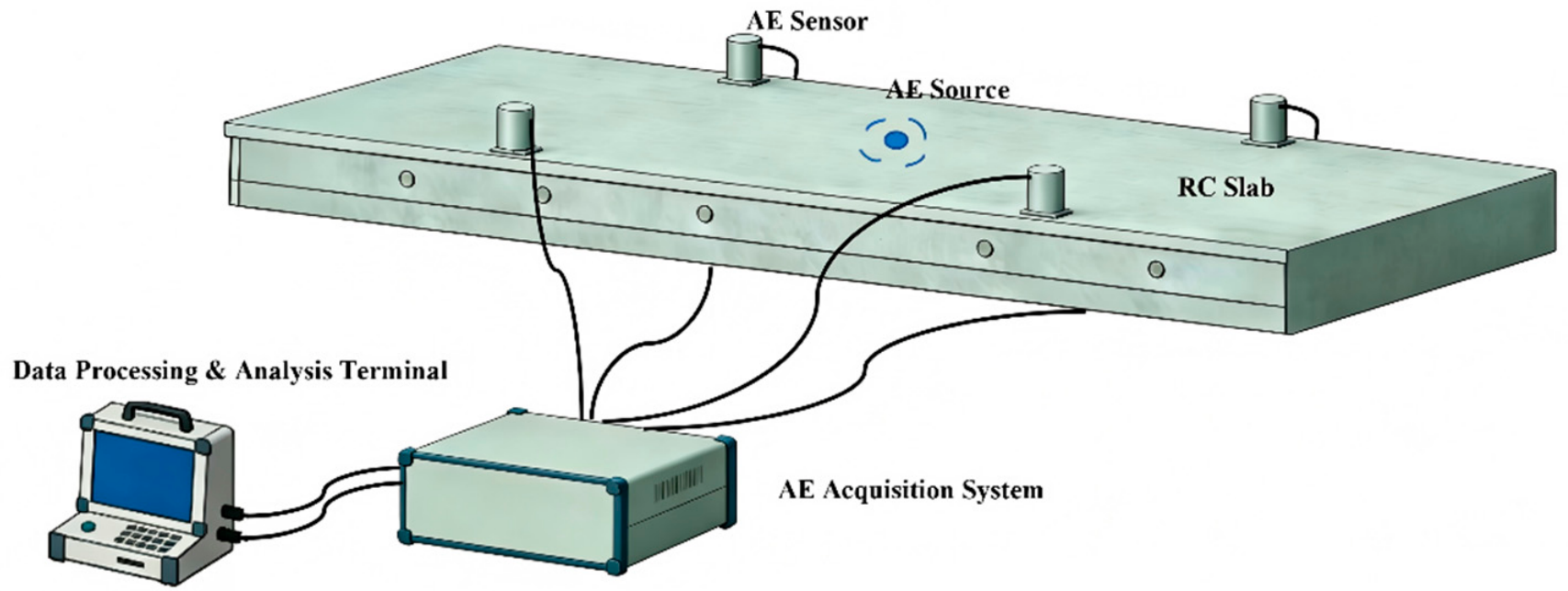
Acoustic emission (AE) technology is a highly promising technical method for this task, as illustrated in Figure 1. By capturing the stress waves released by materials during deformation or fracture and combining with the time difference of arrival (TDOA) of signals from a multi-sensor array, this technology can realize the inversion calculation of damage source positions.
Traditional AE localization is centered on the triangulation method [3], which constructs a system of hyperbolic equations to solve for damage source positions based on the TDOA principle. This method collects stress wave signals generated by impacts through a sensor array arranged on the component surface, extracts the wave arrival time differences of different channels, and inverts the spatial coordinates of the impact source in combination with a wave velocity propagation model [1,4]. Traditional localization solution methods are represented by the Geiger iteration method [5] and the least squares method. These methods feature mature theories and simple calculation processes, and can obtain stable localization results under the ideal working conditions of homogeneous materials [4]. However, RC slabs are heterogeneous composite materials composed of concrete and steel bars. Stress waves exhibit significant refraction, reflection, and dispersion during propagation, and the wave velocity shows obvious anisotropy [2,4,6]. Coupled with the influences of environmental noise at engineering sites, errors in the extraction of signal first arrival time, and other factors [7,8], traditional linear iteration methods are highly prone to iterative non-convergence and trapping in local optimal solutions, and they have a strong dependence on initial inversion values [9]. Thus, it is difficult for these methods to meet the accuracy and efficiency requirements for impact localization of RC slabs under complex working conditions.
To address the inherent limitations of traditional methods, extensive research has been conducted in academia in recent years along two main directions: one is data-driven artificial intelligence methods, especially deep learning, and the other is heuristic intelligent optimization algorithms.
In recent years, deep learning and data-driven methods have been widely applied to damage localization and identification of concrete structures based on vibration signals or acoustic emission (AE) signals, significantly advancing the development of this field. For example, Chen and Shang [10] developed a convolutional neural network (CNN)-based method for localization and imaging of hidden internal defects in concrete slabs, which achieved high-precision identification of defects such as voids and cavities through optimized one-dimensional and two-dimensional networks. Yan et al. [11] combined the piezoelectric impedance (EMI) technique with a deep hybrid network (CNN + GRU + KAN) to realize intelligent monitoring and quantitative assessment of impact damage in concrete. Zhou et al. [12] used a deep residual network to classify the time-frequency maps of AE signals in steel–concrete composite slabs, achieving accurate localization of acoustic emission sources at 3–4.5 cm intervals. Wang et al. [13] proposed a joint network of convolutional denoising with skip connections and fully-connected localization, which reduced the localization error to 1.7% of the beam length in strong noise environments. Liu et al. [14] adopted an improved BP neural network, introduced Particle Swarm Optimization (PSO) and Genetic Algorithm (GA) to optimize the network, and combined it with Maximal Information Coefficient (MIC) feature selection, which significantly improved the accuracy of AE source localization in concrete beams. Ai et al. [15] realized precise localization of crack damage in reinforced concrete slabs based on the piezoelectric impedance technique and a probability-weighted imaging algorithm, with localization errors approaching 0 mm under some working conditions. Chen et al. [16] combined impact hammer tests with deep learning models such as one-dimensional CNN and ResNet, and achieved high-precision identification of void damage in slab tracks after rebar-planting repair for the first time (accuracy > 98%). Ravichandran et al. [17] and Pavurala et al. [18] used impact-echo (IE) signals, LSTM networks, adaptive threshold clustering, and other methods to realize automated assessment and localization of defects such as delamination and voids in concrete slabs. Kocur et al. [19] achieved accurate localization of concrete cracking acoustic events based on TDOA and the minimum-error microphone subset method. These studies fully demonstrate that data-driven models (especially deep learning and hybrid optimization algorithms) can effectively extract complex damage features, overcome the limitations of traditional physical models, and provide a new technical path for impact source localization in reinforced concrete slabs.
Meanwhile, various heuristic intelligent optimization algorithms have also been gradually introduced into the research on structural damage source localization. Among them, GA, based on the selection, crossover, and mutation mechanisms of biological evolution, possesses extremely strong global search capability, can effectively avoid local optimum traps in complex solution spaces, and has low sensitivity to initial values. PSO simulates the swarm intelligence behavior of bird flocks foraging for food, achieves optimization through dynamic updates of particle velocity and position, and has the advantages of simple structure, fast convergence speed, and high local optimization efficiency, performing outstandingly in continuous space optimization problems [20,21].
At present, single GA and PSO algorithms have been widely applied in fields such as rock mass microseismic localization and acoustic emission damage localization of metal components [9,22], and some scholars have also applied them to solve the acoustic emission source localization problem of concrete slabs [9]. However, the inherent defects of single algorithms are still difficult to completely overcome: GA has insufficient local exploitation capability and slow convergence speed in the later stage [23]; PSO is prone to problems such as loss of population diversity and premature convergence [20,21]. When dealing with the nonlinear localization problems of heterogeneous materials such as RC slabs, there is still considerable room for improvement in both localization accuracy and stability.
The GA-PSO hybrid algorithm formed by fusing GA and PSO can realize the synergy between global search and local optimization through complementary advantages, and has become an important direction for algorithm improvement in the current structural localization field. Zhou et al. [24] proposed a hierarchical GA-PSO algorithm for the problem of mine microseismic source localization. It first completes global coarse search through GA to obtain high-quality initial solutions, and then adopts dual-population adaptive PSO for local fine optimization, which effectively improves the accuracy and convergence speed of seismic source localization. Han et al. [25] further proposed an improved GA-PSO algorithm, which nonlinearly adjusts the learning factors via a sine function, adopts adaptive quadratic decay inertia weight, and combines the crossover and mutation operations of GA. In mine blasting verification, the localization error was reduced by 59% and 43% compared with single GA and PSO, respectively. In addition, Roy and Das [26] analyzed the theoretical framework and optimization mechanism of the GA-PSO hybrid algorithm, providing a theoretical basis for the application of hybrid algorithms in engineering optimization.
Subsequent scholars have further improved the optimization performance of the GA-PSO algorithm through methods such as adaptive parameter adjustment and optimization of population information interaction mechanisms, and verified its effectiveness in engineering scenarios such as pipeline leakage localization and rock mass AE source localization. However, in existing studies, the improvement and application of GA-PSO hybrid algorithms are mostly concentrated on homogeneous or quasi-homogeneous materials such as rock masses and metals. There are relatively few studies on impact localization of heterogeneous composite materials such as RC slabs. Few studies have carried out targeted adaptation of the structure, parameters, and objective function of the GA-PSO algorithm in combination with the propagation characteristics of stress waves in RC slabs, and there is also a lack of systematic experimental verification and engineering applicability analysis.
Therefore, aiming at the demand for AE source localization of RC slabs under impact loads, this study constructs a GA-PSO hybrid optimization localization algorithm and develops an integrated localization system that incorporates material parameter configuration, multi-channel AE data analysis, TDOA localization model solution, and result visualization.
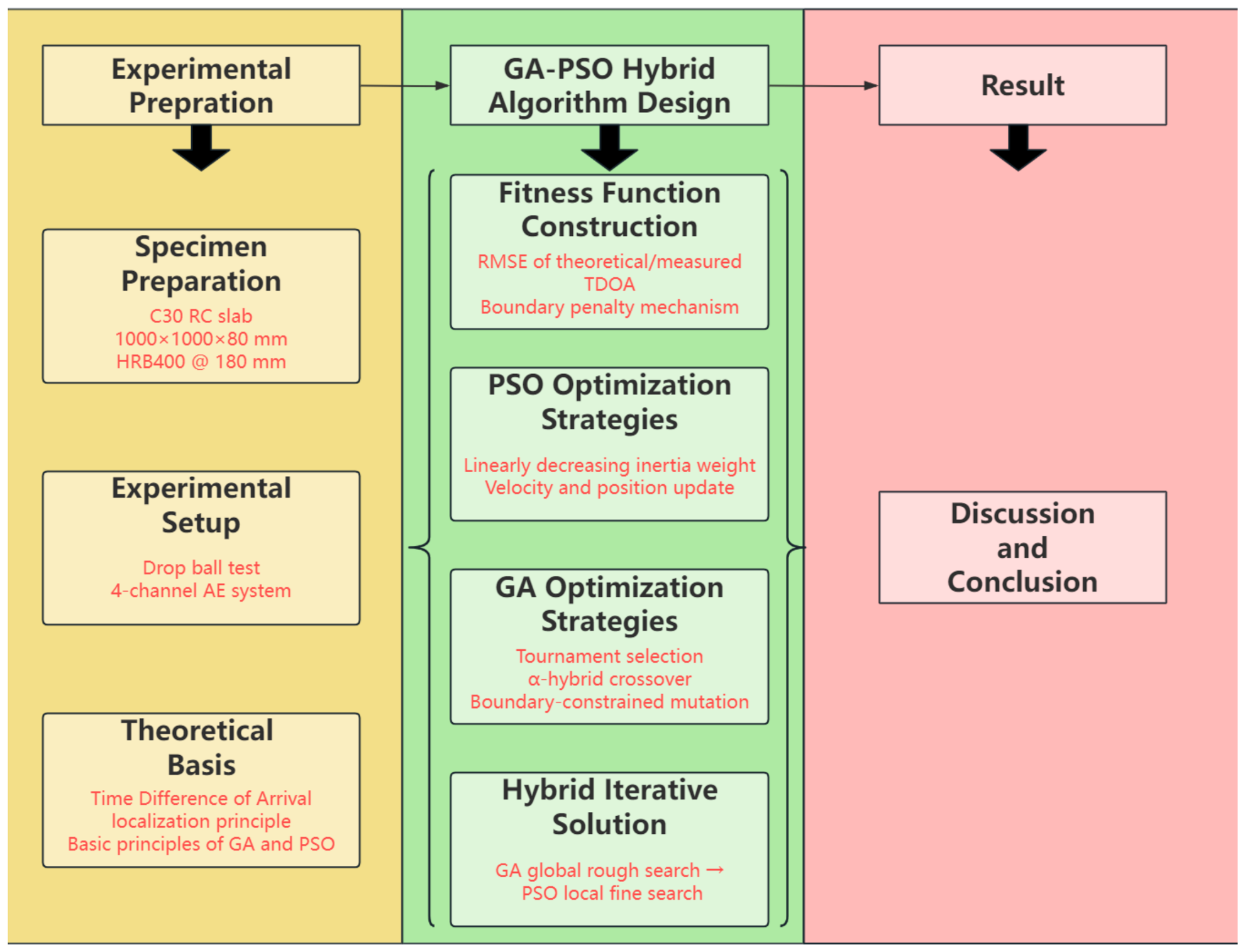
As shown in Figure 2, to address the demand for accurate localization of impact sources in RC slabs under impact loads, this study conducted a systematic investigation following the technical roadmap: experimental and theoretical preparation, GA-PSO hybrid algorithm design, and experimental verification and analysis.

2. Materials and Methods

2.1. Test Specimen and Instrumentation

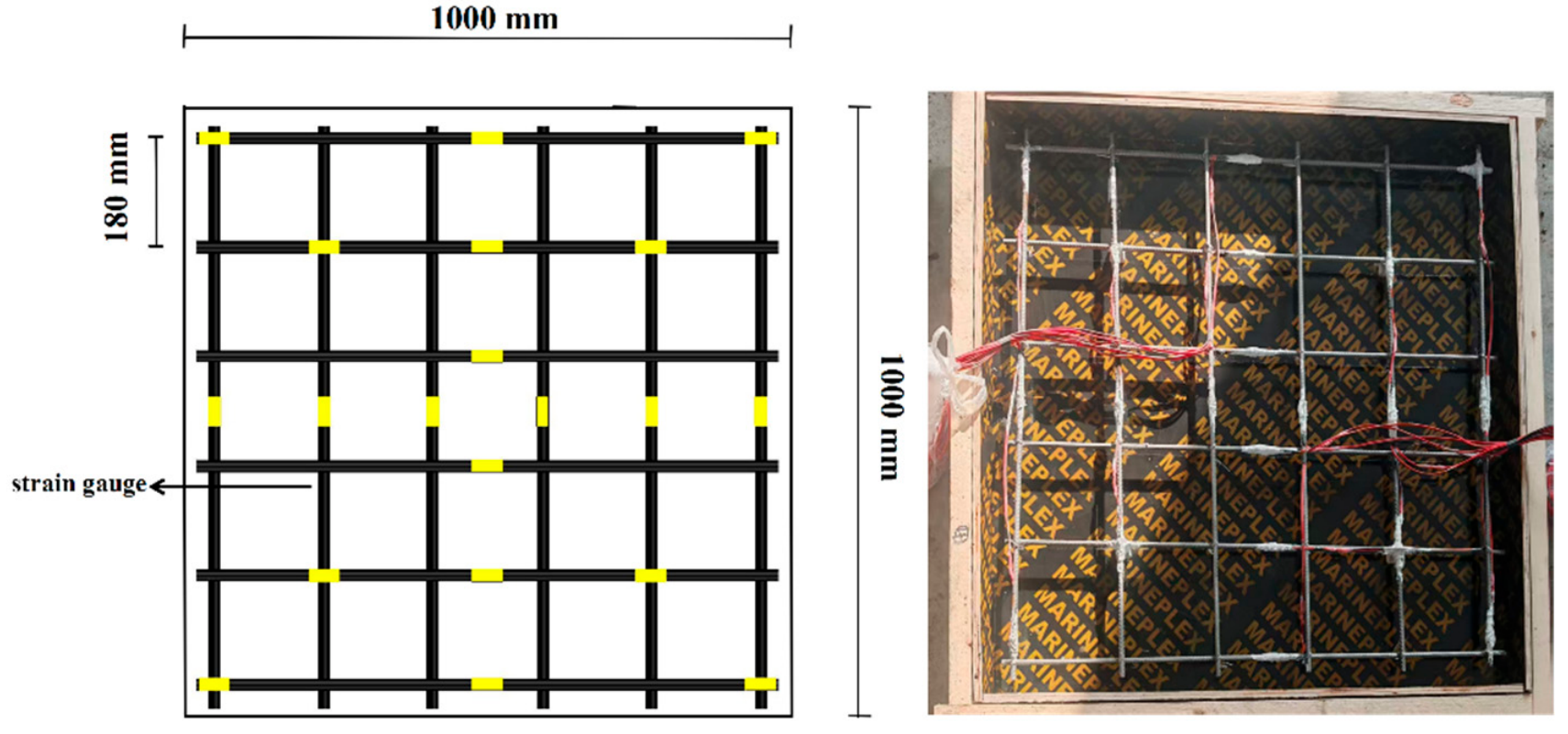
The planar dimension of the RC slab was set to 1000 mm × 1000 mm by default, with a thickness of 80 mm. The concrete mixture was designed with a target compressive strength of C30. The mix proportions (cement–mineral admixture–fine aggregate–coarse aggregate–superplasticizer–water) were 331:50:750:1125:3.8:160 by mass. Ordinary Portland cement (grade 42.5) was used. The mineral admixture was Class F fly ash. The superplasticizer was a polycarboxylate-based high-range water-reducing agent. Fine aggregate consisted of natural river sand with a fineness modulus of 2.6. Coarse aggregate was crushed limestone with a continuous grading of 5–31.5 mm. The water-to-cementitious materials ratio was approximately 0.42. This mix design is typical for C30 reinforced concrete slabs in civil engineering applications, ensuring adequate workability and mechanical properties for impact testing. And it was internally reinforced with bidirectional HRB400 reinforcing steel bars with a diameter of 10 mm and a spacing of 180 mm, as shown in Figure 3. The concrete cover thickness was 20 mm.

2.2. TDOA Localization Model and Fitness Function

2.2.1. TDOA Localization Principle

The Time Difference of Arrival (TDOA) localization method is currently the most widely used, most real-time, and least computationally intensive localization technology in AE monitoring of concrete structures. The basic physical principle of this method can be traced back to the field of seismology, and it has since been widely extended to multiple disciplines including radio frequency positioning and microphone array speech processing.
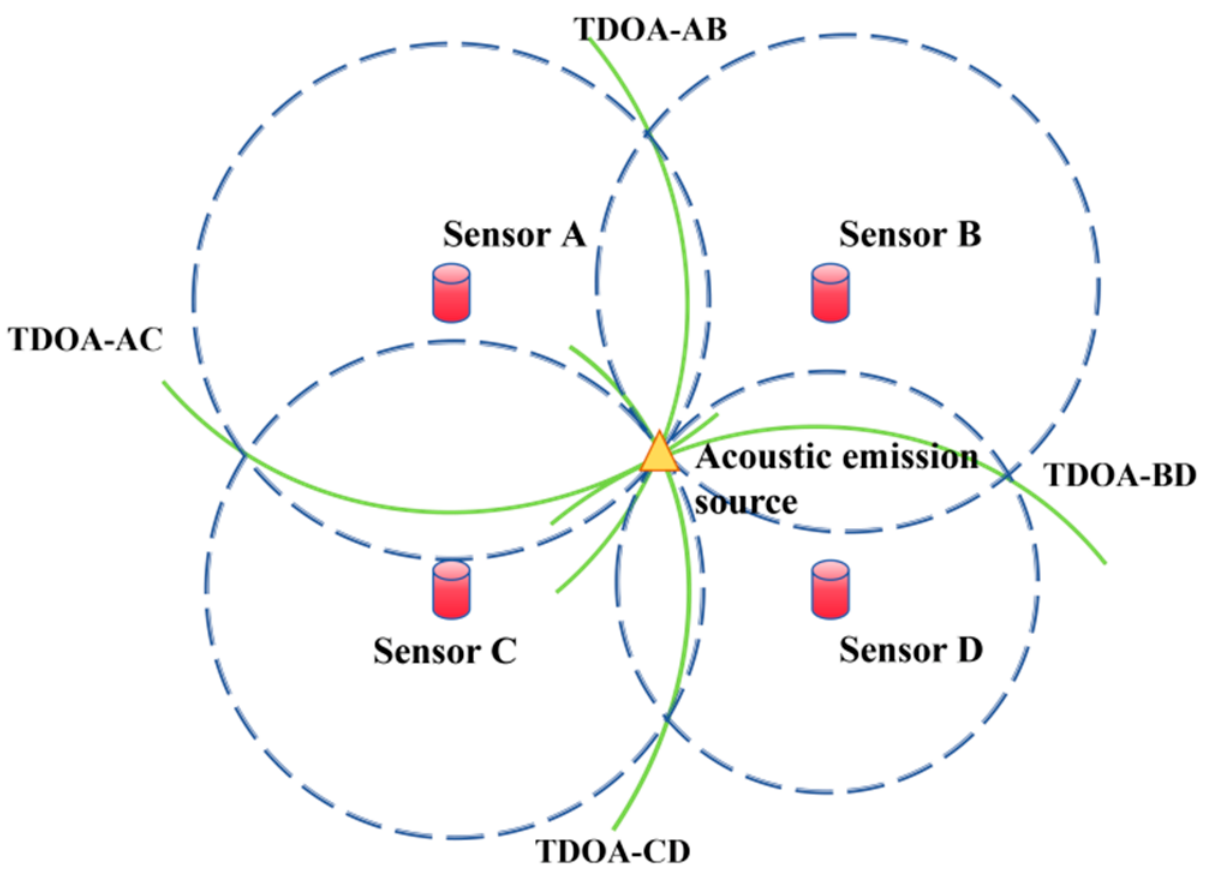
The basic principle of TDOA localization is as follows: when a concrete slab is subjected to impact or damage (e.g., crack propagation), elastic waves are generated and propagate outward at a constant velocity. There exists a time difference in the AE signals from the same event received by sensors at different positions. Let the position of the unknown damage source be (x,y), the coordinates of the i-th sensor be (xi,yi), and the propagation velocity of elastic waves be v. Then, the theoretical time difference of arrival can be expressed as the distance difference divided by the wave velocity, as shown in Equation (1):
Δ t ij theory = d i d j v
where d i = ( x x i ) 2 + ( y y i ) 2 2 is the distance from the damage source to the i-th sensor, and dj is the distance from the damage source to the j-th sensor.
As shown in Figure 4, TDOA localization requires at least 3 sensors (for 2D planar space) or 4 sensors (for 3D spatial space) to uniquely determine the position of the event source [26,27]. The time difference of each sensor pair defines a hyperbolic trajectory (in 2D) or a hyperboloid (in 3D), and the intersection of multiple such curves represents the most probable position of the damage source [3]. According to the systematic analysis by the International Telecommunication Union [27], the main advantages of the TDOA method over the Angle of Arrival (AOA) method include simple sensor requirements, low demands for station deployment and calibration, a strong ability to suppress uncorrelated noise and interference, and applicability to indoor and multipath environments.

2.2.2. Fitness Function Based on Root Mean Square Error

The fitness function serves as the quantitative criterion for the GA-PSO algorithm to search for the optimal solution. In this study, the root mean square error (RMSE) between the actually measured TDOA and the theoretically calculated TDOA is used as the fitness function, which is expressed as
Fitness ( x , y ) = 1 N i = 1 N ( Δ t i measured Δ t i theory ( x , y ) ) 2
where N is the number of effective channels, set to 4 in this study;
Δ t i measured is the TDOA measured by channel i, calculated from the first arrival time difference;
Δ t i theory ( x , y ) is the theoretical TDOA assuming the damage source is at position (x,y).
The algorithm aims to minimize this fitness function, i.e., to find the optimal source position (xopt,yopt) that minimizes the deviation between the theoretical and measured TDOA values. Mathematically, this function design is entirely consistent with the residual minimization principle for multi-station localization in seismology [28], while its application in the AE field features the following characteristics:
(1) AE localization under impact loads imposes a much higher demand on time accuracy than conventional monitoring, and nanosecond-level measurement accuracy is a core prerequisite. A time synchronization error of 0.1 microsecond will lead to a significant deviation in the localization error calculated from the erroneous time data.
(2) Different from the linear or approximately linear solution methods commonly used in seismic localization, the TDOA equation set exhibits highly nonlinear characteristics under the complex boundary conditions of concrete. Traditional triangulation localization methods are prone to failure, and it is necessary to introduce optimization algorithms for iterative solution [9].
(3) The heterogeneity and internal cracks of concrete materials will cause reflection, refraction, and diffraction of AE signals, thus forming multipath propagation. As a result, sensors will collect signals from the same sound source arriving through different paths multiple times, which seriously interferes with the accurate extraction of the first arrival time of the P-wave. The picking error of the P-wave first arrival time will directly propagate to the TDOA calculation, ultimately significantly degrading the localization accuracy [6,22].
To ensure that the localization results have practical physical significance, a boundary penalty mechanism is set in the code. When the position of a candidate solution has x or y values exceeding the length/width of the slab or being less than 0, its fitness function value is directly set to 1010. This forces the algorithm to search for the optimal solution only within the effective area of the slab and avoids meaningless localization results without physical interpretation. This design is consistent in principle with the boundary constraint method used in microseismic source localization, and can effectively improve the convergence efficiency of the algorithm and the reliability of the results.

2.3. Sensor Placement Scheme

A four-sensor placement scheme is adopted in this study, which offers the following advantages: (1) the maximum distance between sensors is achieved, which is conducive to expanding the effective localization area; (2) it forms relatively uniform geometric coverage for damage sources at any position in the slab, reduces the Geometric Dilution of Precision (GDOP), avoids excessive local errors, and improves localization stability; (3) it can effectively suppress multipath reflection and surface wave interference in the slab, ensure the accuracy of P-wave first arrival picking and TDOA calculation, and adapt to the acoustic emission monitoring characteristics of concrete structures.

2.4. Design of the GA-PSO Hybrid Optimization Localization Algorithm

2.4.1. Limitations of the Traditional PSO Algorithm

To address the nonlinear characteristics of the TDOA equation set and the problem that the traditional Particle Swarm Optimization algorithm is prone to falling into local optima, a hybrid optimization strategy combining the Genetic Algorithm and PSO is adopted in this study. The crossover and mutation operations of GA can enhance population diversity and help the algorithm jump out of local optima, while the velocity-position update mechanism of PSO enables fast convergence. The combination of the two strikes a balance between global exploration and local fine search.
The traditional PSO algorithm, proposed by Kennedy and Eberhart [20] in 1995, is a swarm intelligence-based global optimization algorithm. By simulating the foraging behavior of bird flocks, particles in the population iteratively update their velocity and position through information sharing of the individual historical optimal position and the global optimal position of the population, and finally converge to the optimal solution. Its core velocity and position update formulas are as follows:
V k t + 1 = ω · V k t + c 1 · r 1 · p Best k X k t + c 2 · r 2 · gBest X k t
X k t + 1 = X k t + V k t + 1
where V k t   and   X k t are the velocity and position of the k-th particle in the t-th iteration, respectively; ω is the inertial weight; c1 is the cognitive coefficient, representing the influence weight of the individual historical optimal position; c2 is the social coefficient, representing the influence weight of the global optimal position of the population; r1 and r2 are random numbers in the interval [0, 1]; pBestk is the individual historical optimal position of the k-th particle; gBest is the global optimal position of the population.
Although the traditional PSO algorithm features fast convergence, it has significant limitations in the high-dimensional nonlinear solution scenario of AE localization for RC slabs: with the increase in iteration times, the population suffers from severe homogenization and a rapid decline in diversity, leading the algorithm to fall into local optimal solutions and exhibit premature convergence. The boundary reflection of concrete structures will bring significant interference to the localization process of the single PSO algorithm. The reflection effect will amplify the TDOA measurement error and cause the divergence of localization results. Under complex working conditions with low signal-to-noise ratio (SNR) and multipath effect interference, the algorithm performance will deteriorate further.

2.4.2. Optimization Strategies of the GA-PSO Hybrid Algorithm

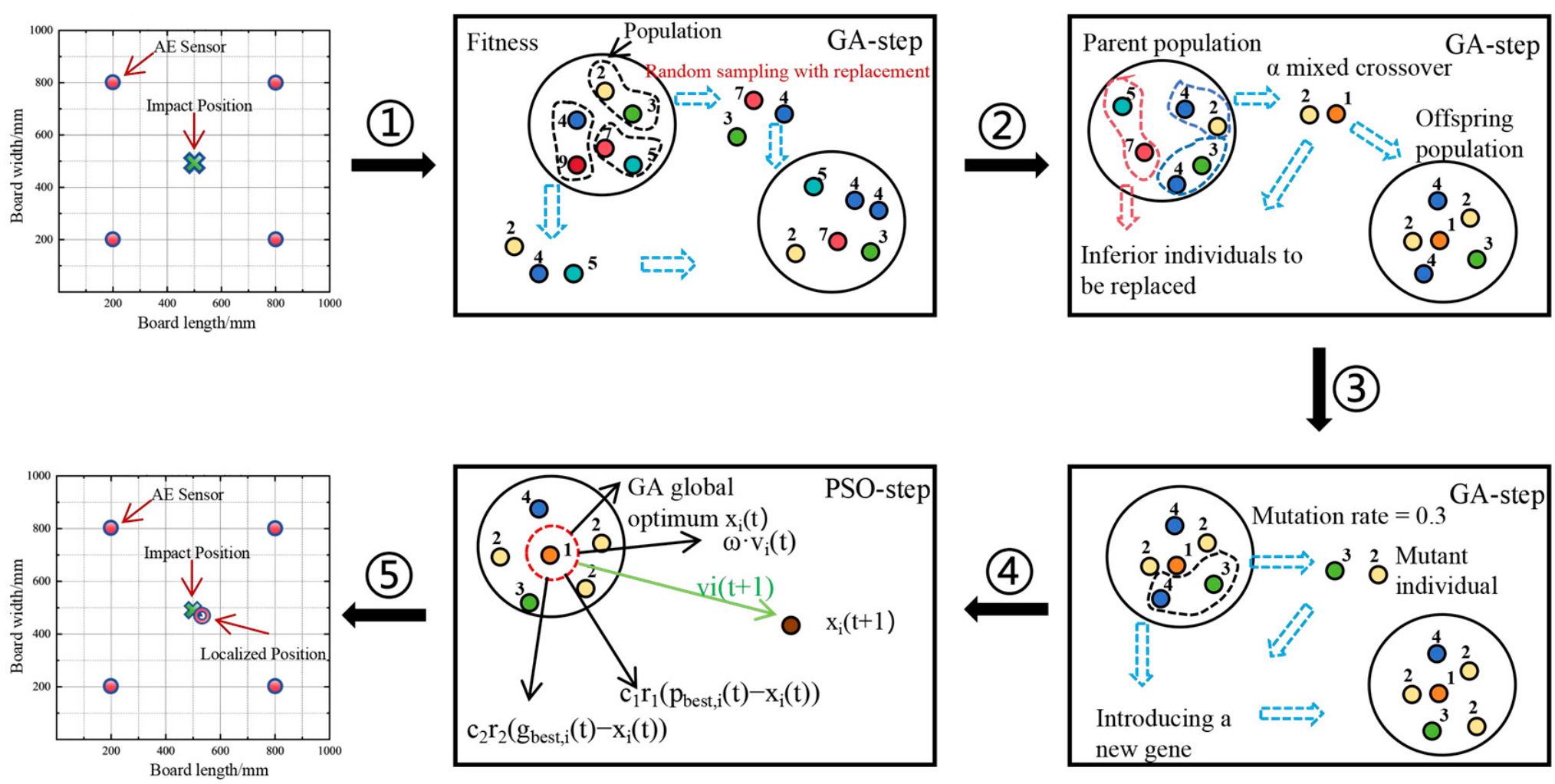
To address the drawbacks of the traditional PSO algorithm, this study incorporates the selection, crossover, and mutation operations of the GA to construct a GA-PSO hybrid optimization algorithm, as shown in Figure 5. While retaining the advantage of fast convergence of the PSO algorithm, the proposed algorithm enhances population diversity through GA operations, balances the global exploration and local fine search capabilities of the algorithm, and avoids premature convergence. Its core optimization strategies are as follows:
(1) Tournament Selection Strategy
This strategy randomly selects 3 particles from the current population, compares their fitness function values, and selects the particle with the minimum fitness as the parent. The tournament selection method is adopted to screen high-quality parental particles, which can effectively preserve the genes of excellent individuals and avoid the premature convergence problem that is prone to occur in the roulette wheel selection method. It is one of the most widely used selection strategies in evolutionary algorithms.
(2) α Hybrid Crossover Operation
Two parental particles undergo α hybrid crossover at a preset crossover rate, and the generated offspring particles are used to replace the inferior particles with the maximum fitness in the current population. The crossover formula is expressed as
X child = α X parent 1 + 1 α X parent 2
where α is a random number in the interval [0, 1];
Xparent1 and Xparent2 are the positions of the two parental particles;
Xchild is the position of the offspring particle.
This crossover method enables effective recombination of parental genes, expands the search range of the population, and enhances the global exploration capability of the algorithm. Relevant studies have shown that the α hybrid crossover strategy has a better ability to maintain population diversity in nonlinear inversion problems compared with single-point crossover and two-point crossover [23].
(3) Boundary-Constrained Mutation Operation
In the code, the position of randomly selected particles is subjected to small-scale random perturbation at a mutation rate of 30%, with the perturbation range set to 2.5% of the RC slab dimensions. The mutated particle positions are forcibly constrained within the physical boundaries of the slab. Mutation operations can randomly introduce new individual genes, avoid population homogenization, and help the algorithm jump out of local optimal solutions. This is consistent in principle with the mutation strategy adopted by Zhou et al. [6] in the GA-PSO algorithm for microseismic localization.
(4) Linearly Decreasing Inertia Weight Strategy
The inertia weight ω directly affects the global and local search capabilities of the algorithm. A linearly decreasing strategy is adopted in this study, where the inertia weight decreases linearly from an initial value of 0.7 to 0.3 with the increase in the number of iterations:
ω = ω init iter maxIter · ω
where ωinit = 0.7 is the initial inertia weight;
iter is the current number of iterations;
maxIter is the maximum number of iterations;
Δω = 0.4 is the inertia weight decay amplitude.
A larger inertia weight is used in the early stage of iteration to enhance the global search capability of the algorithm, while a smaller inertia weight is adopted in the late stage to improve the local fine search capability, achieving a balance between convergence speed and solution accuracy. Proposed by Shi and Eberhart in 1998, this strategy is the most mature inertia weight optimization method applied in the PSO algorithm to date and can effectively avoid premature convergence of the algorithm [21].

2.4.3. Parameter Setting and Implementation Process of the Algorithm

Based on the scenario requirements for impact source localization of RC slabs under impact loads, a parameter sensitivity analysis was first conducted. The results are summarized in Table 1. Following this analysis, the final parameter settings were determined, as shown in Table 2.

3. Drop Weight Impact Test

To verify the actual performance of the GA-PSO localization algorithm in impact source localization for RC slabs, a drop weight impact test was conducted in this study to validate the accuracy of the localization results.

3.1. Test Materials and Setup

3.1.1. Component Parameters and Sensor Placement Scheme

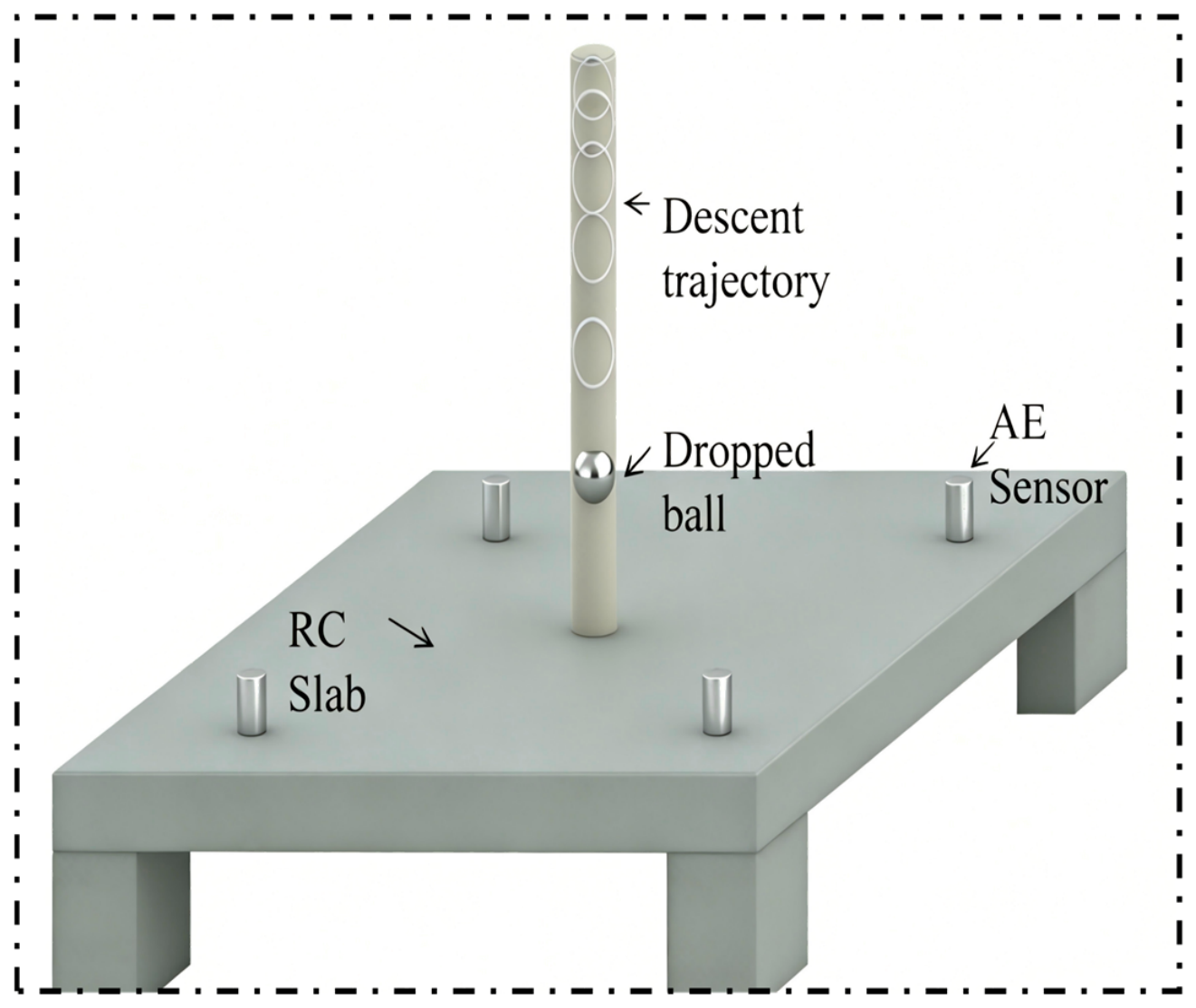
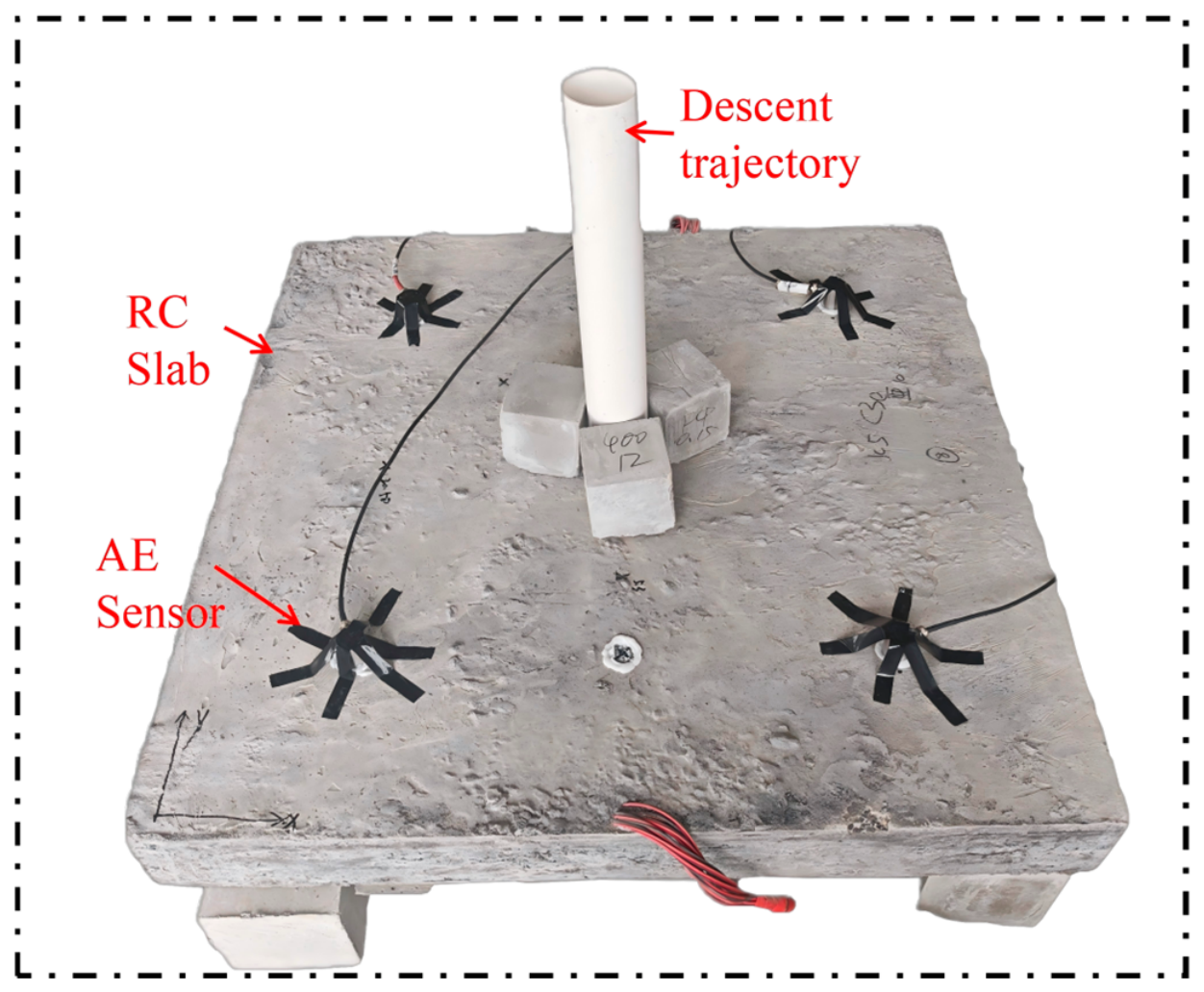
As shown in Figure 6 and Figure 7, a four-corner placement scheme was adopted for the sensors in the test. Four acoustic AE sensors were installed at the four top corners of the RC slab in clockwise order, at a distance of 200 mm from the slab edges. Taking the bottom left corner of the RC slab as the origin of the coordinate system, the x-axis was defined along the length of the slab and the y-axis along the width of the slab. The coordinates of the four sensors were as follows: Sensor 1 (800, 200), Sensor 2 (200, 200), Sensor 3 (200, 800), and Sensor 4 (800, 800), with the sensors spaced 200 mm both horizontally and vertically from the slab edges.
The RC slab was supported at its four corners by four cubic test blocks with dimensions of 150 mm × 150 mm. Plastic tubes were placed at each preset localization point on the surface of the RC slab to serve as falling guide rails, ensuring that the impact point of the ball fell within the preset coordinate range.

3.1.2. AE Data Acquisition and Processing

The Qingcheng Multi-Channel Integrated AE Testing System(Guangzhou, China) was adopted in this test, which was equipped with four channels, an input signal range of ±10 V and a system dynamic range of 85 dB. The probe-type AE sensor used in the test had a frequency response range of 60–400 kHz and a built-in preamplification gain of 40 dB. The four sensors were mounted on the surface of the RC slab, 20 cm away from each of the four corner edges. The threshold of each channel was set with a sampling rate of 3.0 MHz. AE signals were collected after preamplification, and the system threshold was set to 45 dB. To ensure the consistency and reproducibility of first arrival picking, uniform standardized event detection parameters were adopted for all channels: an amplitude trigger threshold of 45 dB, a pre-trigger time of 200 μs, a Peak Definition Time (PDT) of 300 μs, a Hit Definition Time (HDT) of 600 μs, and a Hit Lockout Time (HLT) of 1000 μs. This parameter combination is a widely accepted industry standard for acoustic emission (AE) monitoring of concrete materials and can accurately identify stress wave signals in the 60–400 kHz frequency range.
AE parameter files were extracted via AE testing software (Qingcheng Acoustic Emission Software, Version 4.6.25.67), which contained characteristic parameters of impact events such as arrival time, channel number, amplitude, rise time, and duration. The code prioritized the arrival time from the parameter files for localization, and valid impact events were screened using an amplitude threshold of 45 dB. The TDOA was calculated from the arrival time of the first valid event of each channel, which could effectively eliminate noise interference and improve the reliability of localization results.

3.2. Localization Results

3.2.1. Convergence Analysis of the Algorithm

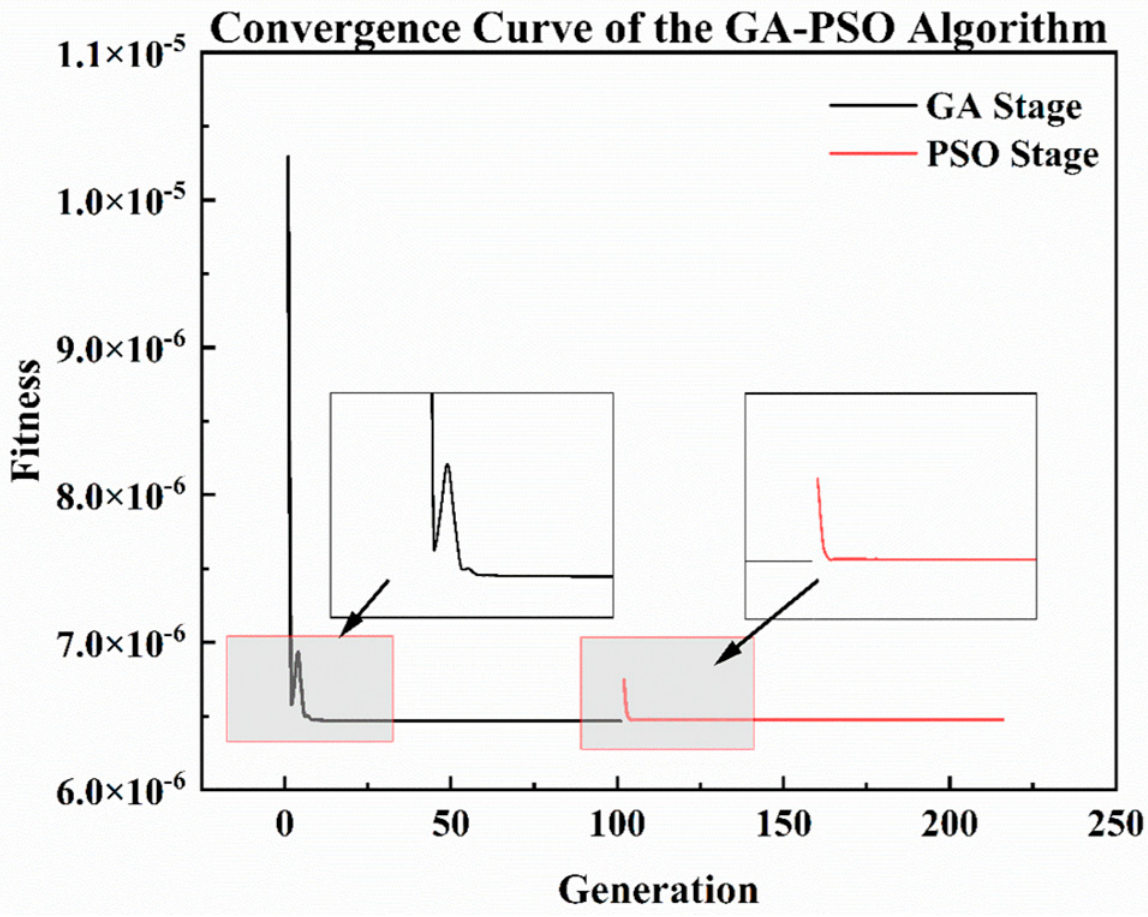
The convergence of the GA-PSO hybrid algorithm was verified using multi-channel AE data collected from the drop weight impact test. The test involved impacting pre-determined different points on the slab surface with a falling ball, and the variation law of the global optimal fitness during the algorithm iteration was as follows.
As shown in Figure 8, the algorithm exhibited a fast convergence speed in the early stage of iteration, with the global optimal fitness decreasing rapidly; the fitness curve tended to be stable at approximately 50 iterations, indicating the basic convergence of the algorithm; at 100 iterations, the fitness value stabilized at the order of 10−6 without obvious fluctuations. An early stopping mechanism was set for the PSO algorithm: the algorithm would terminate automatically if there was no change in fitness after 50 generations. The results demonstrate that the GA-PSO hybrid algorithm possesses both fast convergence capability and convergence stability, which can effectively meet the demand for real-time localization of AE sources induced by impact on RC slabs. This is consistent with the convergence characteristics of the GA-PSO algorithm for microseismic localization reported by Han et al. [25], verifying the rationality of the algorithm design.

3.2.2. Localization Error Analysis

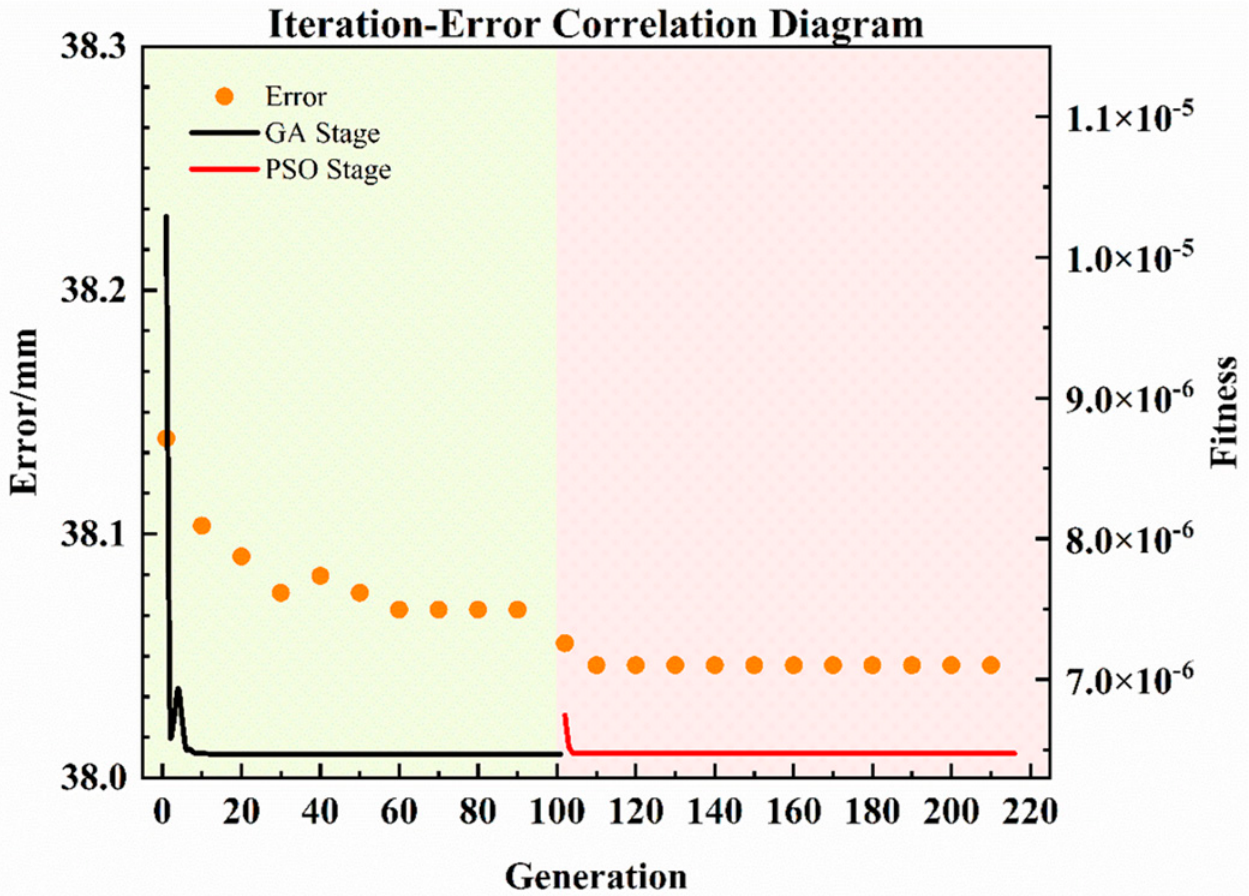
As shown in Figure 9, the accuracy of localization results was evaluated using the absolute localization error, which was calculated as the Euclidean distance between the actual falling ball coordinates and the localized coordinates obtained by the code. The calculation formula is as follows:
E r r o r   =   ( x loc x actual ) 2   +   ( y loc y actual ) 2
where (xloc,yloc) is the localized coordinate output by the algorithm;
(xactual,yactual) is the actual coordinate of the impact source.
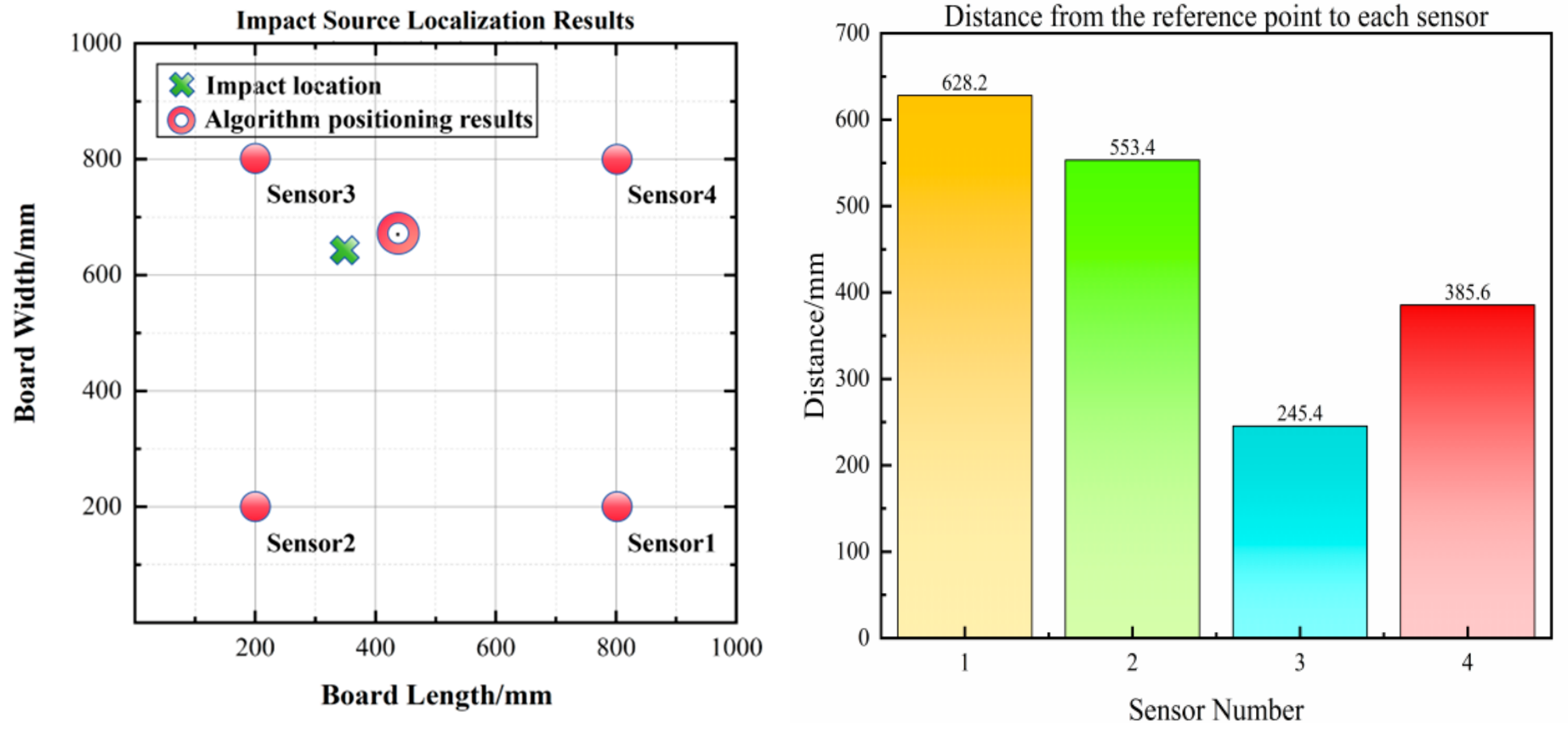
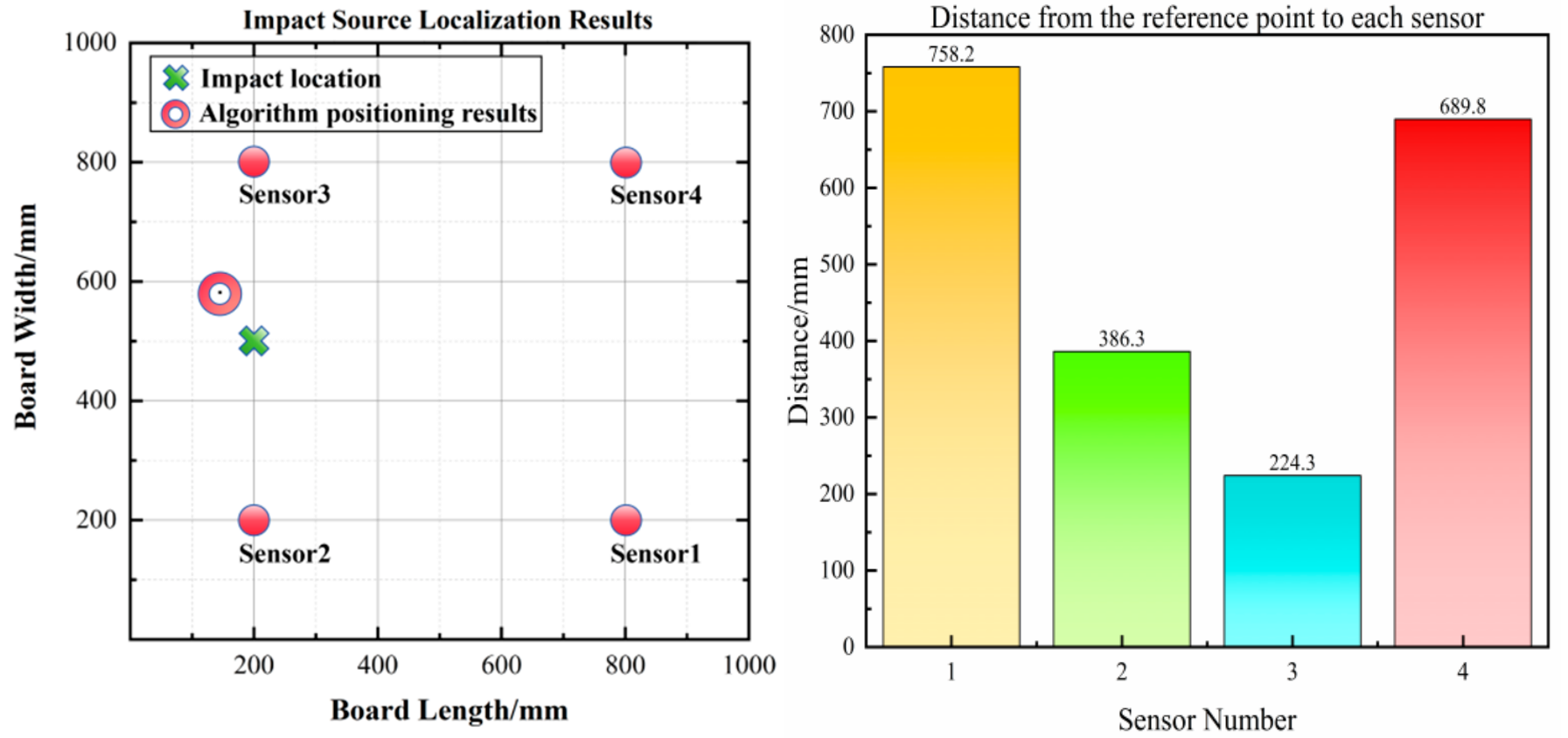
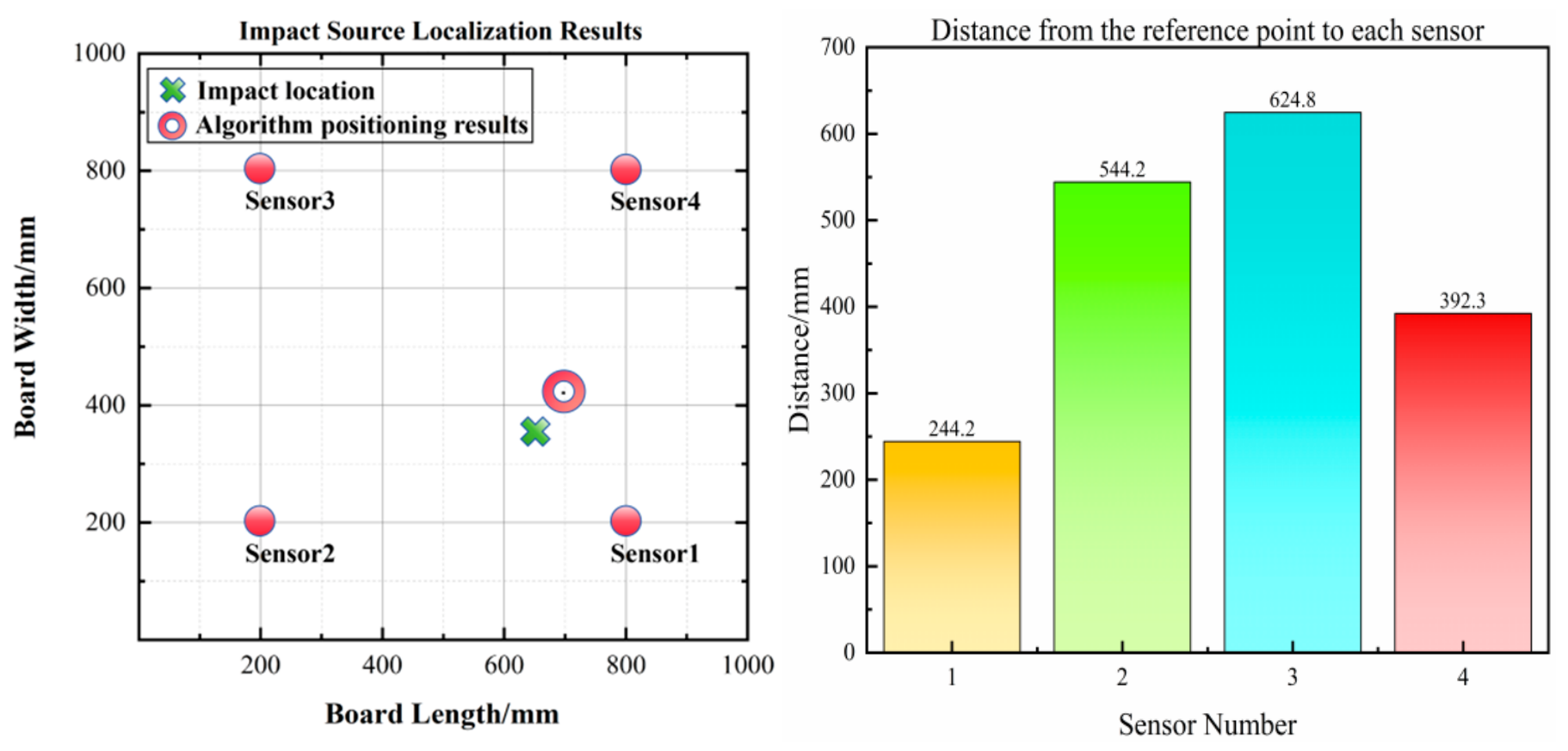
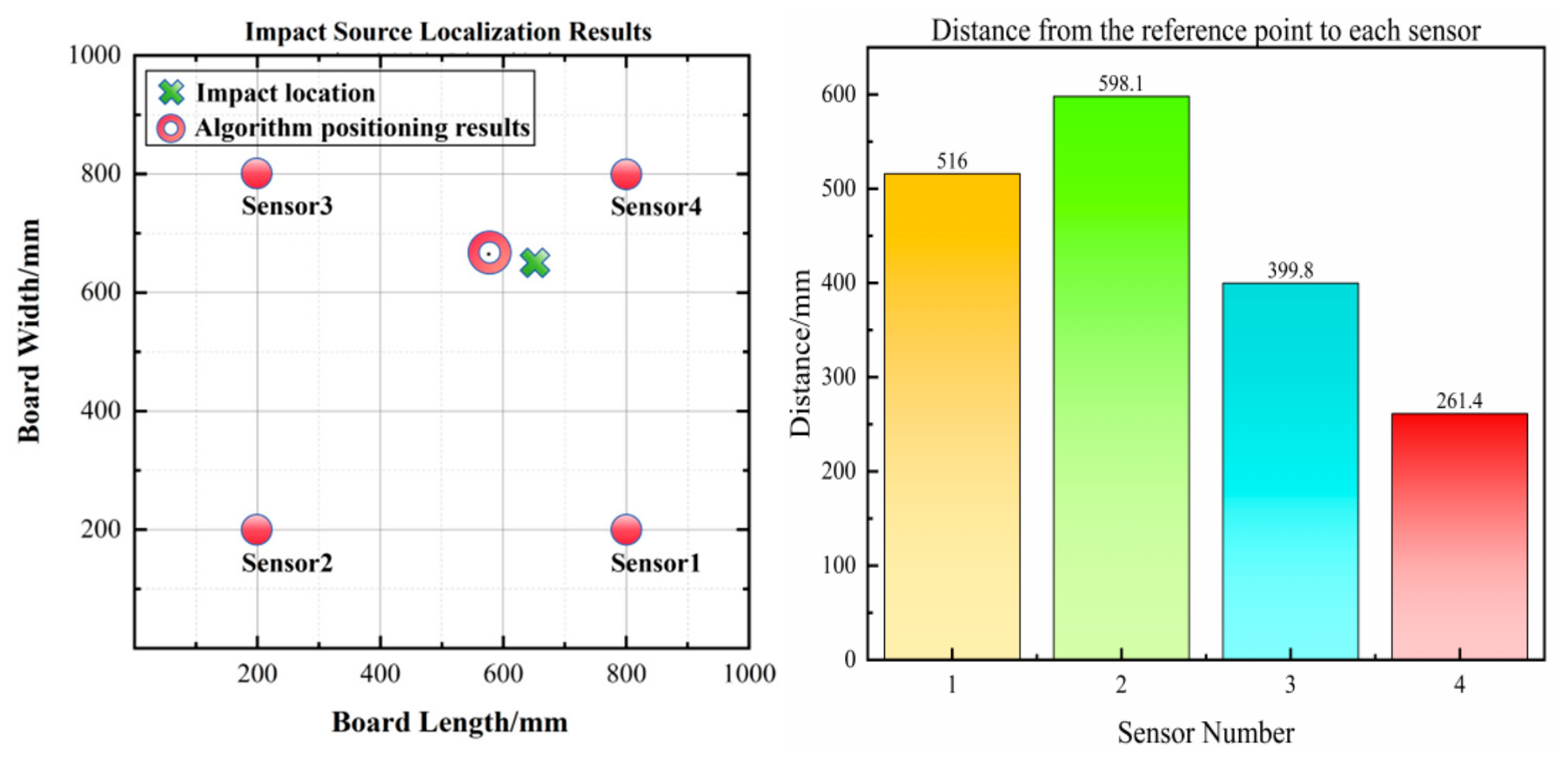
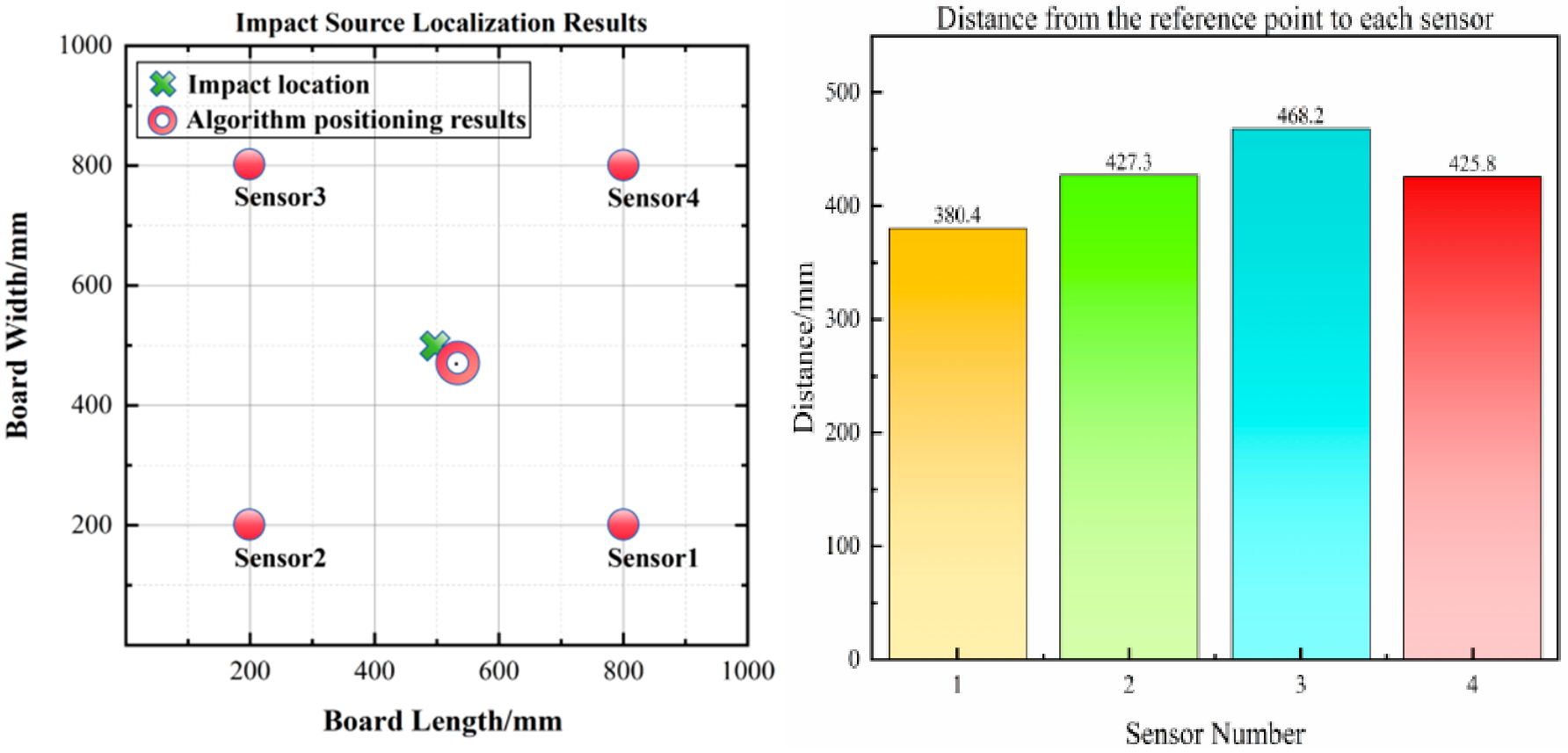
As shown in Table 3, we conducted 30 drop ball tests at each impact point. And the average localization error of the GA-PSO hybrid algorithm for all impact positions on the RC slab is within 100 mm, with the average localization error at the slab center as low as 42.97 mm, and partial localization results are illustrated in Figure 10, Figure 11, Figure 12, Figure 13 and Figure 14. The localization accuracy is the highest in the central region of the slab, and the localization error increases slightly in the edge and corner regions due to the boundary reflection effect.
To quantitatively evaluate the performance of the GA-PSO hybrid algorithm proposed in this paper, this study randomly selected 10 sets of impact data from the position with the highest center accuracy. Using the same experimental data and TDOA model, the traditional TDOA least squares method, the pure GA algorithm, and the pure PSO algorithm were implemented, and their performance was compared in terms of average positioning error. The results are shown in Table 4.

4. Discussion

To contextualize the performance of the proposed GA-PSO algorithm, we compared it with three alternative methods using the same experimental dataset: (1) the conventional TDOA grid search method, (2) the pure Genetic Algorithm, and (3) the pure Particle Swarm Optimization algorithm. As summarized in Table 3, the average localization errors of TDOA, GA, and PSO were 141.74 mm, 140.96 mm, and 141.63 mm, respectively, whereas the GA-PSO hybrid achieved an average error of only 54.95 mm—a reduction of approximately 61% compared to the single-algorithm approaches. Moreover, the standard deviation of the GA-PSO error was 24.87 mm, significantly lower than those of GA (≈114 mm) and PSO (≈113 mm), indicating superior stability.
Unlike most existing GA-PSO applications that target homogeneous or quasi-homogeneous materials (e.g., rock masses or metals) [24,25], this study specifically adapts the hybrid algorithm to the highly heterogeneous nature of RC slabs by incorporating a boundary penalty mechanism and a TDOA-RMSE fitness function that accounts for multipath propagation and wave dispersion. Second, to our knowledge, the combination of tournament selection, α hybrid crossover, and boundary-constrained mutation—each chosen for its ability to maintain population diversity in nonlinear inversion problems—has rarely been systematically applied to AE source localization in concrete structures. Third, the linearly decreasing inertia weight strategy balances global exploration and local fine-tuning, which is particularly beneficial for the complex, multi-modal solution space of TDOA equations under concrete boundary conditions.
The main advantages of the GA-PSO hybrid algorithm are as follows:
(1) It effectively overcomes the premature convergence problem inherent in standalone PSO algorithm, as evidenced by the stable fitness curve in Figure 7 and the low error variance in Table 3.
(2) It does not require accurate initial guesses, whereas traditional linearized methods (e.g., Geiger iteration method or least squares method) are highly sensitive to initial values and often diverge in heterogeneous media.
(3) It exhibits high computational efficiency: the entire iterative optimization process of the algorithm can converge within a few seconds on a standard workstation.
However, it should be acknowledged that the proposed algorithm has certain limitations. First, the performance of the algorithm is critically dependent on the accuracy of P-wave first arrival picking. In this study, a fixed amplitude threshold of 45 dB and standardized event detection parameters were adopted, which perform well under laboratory conditions with high signal-to-noise ratio (SNR). In field environments with background noise, first arrival picking errors may increase and directly propagate to TDOA calculations, ultimately degrading localization accuracy. Second, the wave velocity (v) was assumed constant in this study, whereas the actual P-wave velocity in concrete varies with damage degree, moisture content, and aggregate distribution. This simplification introduces systematic bias, especially for impact sources far from the sensor array.
Compared with deep learning-based methods, the GA-PSO algorithm has both advantages and disadvantages. Compared with deep learning, the main advantage of the algorithm lies in its interpretability and generalizability. GA-PSO is based on the physical TDOA model, so it does not require a large number of labeled datasets for training, and does not suffer from domain shift when applied to slabs with different dimensions or boundary conditions. In contrast, deep learning models typically require hundreds or even thousands of impact samples to achieve generalization, and their performance degrades when tested on slabs with different reinforcement layouts or concrete mix proportions.
The main disadvantage lies in noise robustness. Deep learning methods, especially those integrated with denoising autoencoders or attention mechanisms, can learn to suppress irrelevant noise patterns. In contrast, the GA-PSO algorithm only uses a fixed amplitude threshold for event filtering and does not explicitly model noise. Under severe noise conditions, first arrival picking errors may increase significantly, causing the GA-PSO algorithm to fail to converge to the correct location.

5. Conclusions

Aiming at the problem of impact source localization of RC slabs under impact load conditions, this study proposed an iterative optimization method based on the GA-PSO algorithm and the TDOA localization principle. Verified by drop weight impact tests, the main conclusions are drawn as follows:
  • A fitness function was constructed based on the TDOA principle to quantify the deviation between the theoretical and measured time differences of arrival, which provides a reliable quantitative basis for the iterative solution of the localization algorithm. In addition, a boundary penalty mechanism was incorporated, which not only ensures that the localization results conform to the actual physical scenario and are valid, but also improves the stability of the solution process and avoids unreasonable localization results.
  • The traditional PSO algorithm is prone to falling into local optimal solutions during iteration, leading to insufficient localization accuracy and slow convergence speed. To address this defect, the GA was introduced in this study. The tournament selection, α hybrid crossover, and boundary-constrained mutation operations effectively improve the global search capability of the algorithm and prevent it from being trapped in local optima. Meanwhile, the linearly decreasing inertia weight strategy was adopted to balance the global exploration capability and local search efficiency of the algorithm in a rational manner, resulting in a significant improvement in both the convergence speed and solution accuracy of the algorithm.
  • The results of drop weight impact tests show that the average localization error of the GA-PSO algorithm for impact sources on RC slabs is all within 100 mm, indicating that the algorithm can realize the localization of impact sources on RC slabs efficiently and accurately.
  • Future research will focus on the following three aspects: (1) combining adaptive wave velocity estimation technology to solve the problem that stress wave velocity varies with damage degree; (2) developing high-precision first arrival picking algorithms based on deep learning to further improve the calculation accuracy of TDOA; (3) conducting full-scale structural field tests to verify the applicability of the proposed algorithm in practical engineering environments.

Author Contributions

Conceptualization, A.J.; methodology, A.J.; software, W.W.; validation, C.W.; formal analysis, W.W. and C.W.; investigation, A.M.; resources, A.J.; data curation, W.W. and C.W.; writing—original draft preparation, W.W. and C.W.; writing—review and editing, A.J.; visualization, A.M.; supervision, A.J.; project administration, A.J.; funding acquisition, C.W. and A.J. All authors have read and agreed to the published version of the manuscript.

Funding

This work was supported by the National Natural Science Foundation of China (grant No. 52368051), the Natural Science Foundation of Xinjiang Uygur Autonomous Region (grant No. 2025D01C271), and the Tianchi Talent Introduction Program of Xinjiang Uygur Autonomous Region (grant No. 51052601826). The above-mentioned funding sources and support are gratefully acknowledged.

Institutional Review Board Statement

Not applicable.

Informed Consent Statement

Not applicable.

Data Availability Statement

The original contributions presented in the study are included in the article; further inquiries can be directed to the corresponding author.

Conflicts of Interest

The authors declare no conflicts of interest.

References

  1. Chen, Y.; Zhang, M.; Wu, H.; Zhang, K.; Qian, D. Improving the positioning accuracy of acoustic emission events by optimizing the sensor deployment and first arrival signal picking. IEEE Access 2020, 8, 71160–71172. [Google Scholar] [CrossRef]
  2. Jierula, A.; Wang, S.; Oh, T.M.; Wang, P. Study on accuracy metrics for evaluating the predictions of damage locations in deep piles using artificial neural networks with acoustic emission data. Appl. Sci. 2021, 11, 2314. [Google Scholar] [CrossRef]
  3. Tobias, A. Acoustic-emission source location in two dimensions by an array of three sensors. Non-Destr. Test. 1976, 9, 9–12. [Google Scholar] [CrossRef]
  4. Jierula, A.; Wu, C.; Kali, A.; Fu, Z. A review of acoustic emission source localization techniques in different dimensions. Appl. Sci. 2024, 14, 8684. [Google Scholar] [CrossRef]
  5. Geiger, L. Herbsetimmung bei Erdbeben aus den Ankunfzeiten. Nachrichten Ges. Wiss. Zu Göttingen Math.-Phys. Kl. 1910, 1910, 331–349. [Google Scholar]
  6. Gollob, S.; Kocur, G.K.; Schumacher, T.; Mhamdi, L.; Vogel, T. A novel multi-segment path analysis based on a heterogeneous velocity model for the localization of acoustic emission sources in complex propagation media. Ultrasonics 2017, 74, 48–61. [Google Scholar] [CrossRef]
  7. Jones, M.; Rogers, T.; Worden, K.; Cross, E. A Bayesian methodology for localising acoustic emission sources in complex structures. Mech. Syst. Signal Process. 2022, 163, 108143. [Google Scholar] [CrossRef]
  8. Dong, L.; Li, X. Three-dimensional analytical solution of acoustic emission or microseismic source location under cube monitoring network. Trans. Nonferrous Met. Soc. China 2012, 22, 3087–3094. [Google Scholar] [CrossRef]
  9. Mirgal, P.; Pal, J.; Banerjee, S. Online acoustic emission source localization in concrete structures using iterative and evolutionary algorithms. Ultrasonics 2020, 108, 106211. [Google Scholar] [CrossRef] [PubMed]
  10. Chen, J.; Shang, G. Localization and imaging of internal hidden defects in concrete slabs based on deep learning of vibration signals. J. Build. Eng. 2023, 76, 107087. [Google Scholar] [CrossRef]
  11. Yan, Q.; Yang, Y.; Zhang, C.; Xiong, Z.; Zhong, H.; Xu, Y.; Yang, W. Intelligent monitoring of impact damage within concrete through deep learning-empowered electromechanical impedance technique. Measurement 2025, 245, 116650. [Google Scholar] [CrossRef]
  12. Zhou, Y.; Liang, M.; Yue, X. Deep residual learning for acoustic emission source localization in a steel-concrete composite slab. Constr. Build. Mater. 2024, 411, 134220. [Google Scholar] [CrossRef]
  13. Wang, S.; Wang, W.; Yan, D.; Liu, X.; Deng, Y.; Huo, Y.; Hua, X. Noise-robust acoustic emission source localization in reinforced concrete structures using a novel deep learning framework with skip connections. Mech. Syst. Signal Process. 2025, 240, 113387. [Google Scholar] [CrossRef]
  14. Guilin University of Technology; Liu, T.; Miao, T.; Liu, L.; Yang, Y.; Yu, A. Damage localization of concrete structures based on improved BP neural network. In Proceedings of the 6th International Conference on Structural Health Monitoring and Integrity Management, Zhengzhou, China, 8–10 November 2024. [Google Scholar]
  15. Ai, D.; Zhang, D.; Zhu, H. Damage localization on reinforced concrete slab structure using electromechanical impedance technique and probability-weighted imaging algorithm. Constr. Build. Mater. 2024, 424, 135824. [Google Scholar] [CrossRef]
  16. Chen, Z.; Cai, X.; Wang, Y.; Zhong, Y.; Zhang, Y. Void damage identification in post-installed rebar reinforced slab tracks via impact hammer tests and deep learning. Constr. Build. Mater. 2025, 495, 143565. [Google Scholar] [CrossRef]
  17. Ravichandran, Y.; Liao, D.; Kurakula, C.T. Data-driven assessment of concrete slab integrity via impact-echo signals and neural networks. NDT E Int. 2025, 143, 103300. [Google Scholar]
  18. Pavurala, D.; Liao, D.; Pasunuru, C.R. Adaptive signal analysis for automated subsurface defect detection using impact echo in concrete slabs. In Proceedings of the IEEE International Conference on Big Data, Washington, DC, USA, 15–18 December 2024; pp. 3282–3291. [Google Scholar]
  19. Kocur, G.K.; Kumar, B.; Markert, B. TDOA-based localization of cracking sound events with minimal-error microphone subsets. NDT E Int. 2025, 142, 103201. [Google Scholar] [CrossRef]
  20. Kennedy, J.; Eberhart, R. Particle swarm optimization. In Proceedings of the ICNN‘95-International Conference on Neural networks, Perth, WA, Australia, 27 November–1 December 1995; IEEE: Piscataway, NJ, USA, 1995; Volume 4, pp. 1942–1948. [Google Scholar]
  21. Shi, Y.; Eberhart, R. A modified particle swarm optimizer. Evol. Comput. Proc. 1998, 890, 69–73. [Google Scholar]
  22. Zhang, F.; Pahlavan, L.; Yang, Y. Evaluation of acoustic emission source localization accuracy in concrete structures. Struct. Health Monit. 2020, 19, 2063–2074. [Google Scholar] [CrossRef]
  23. Tian, X. Research on Genetic Algorithm with Hybrid Crossover Strategy and Its Applications. Master’s Thesis, North China Electric Power University, Baoding, China, 2009. [Google Scholar]
  24. Zhou, G.Q.; Luo, S.L.; Gao, Y.X.; Zhang, W.X.; Jin, X.L.; Meng, F.B.; Wang, Y.F. Research on GA-PSO Microseismic Source Location Optimization Algorithm Based on Hierarchical Structure and Multi-strategy Adaptive Mechanism. Coal Sci. Technol. 2026, 1–12. Available online: https://link.cnki.net/urlid/11.2402.TD.20250825.1256.004 (accessed on 30 March 2026).
  25. Han, Y.; Zeng, F.; Fu, L.; Zheng, F. GA-PSO algorithm for microseismic source location. Appl. Sci. 2025, 15, 1841. [Google Scholar] [CrossRef]
  26. Roy, C.; Das, D.K. A hybrid genetic algorithm (GA)–particle swarm optimization (PSO) algorithm for demand side management in smart grid considering wind power for cost optimization. Sādhanā 2021, 46, 101. [Google Scholar] [CrossRef]
  27. ITU-R SM.2211-0; Comparison of Time Difference of Arrival and Angle of Arrival Methods for Signal Geolocation. International Telecommunication Union: Geneva, Switzerland, 2011.
  28. Hou, X.; Guo, Z.; Gao, D.; Li, L.; Liu, J. Review of recent advances in seismic location methods. Prog. Geophys. 2024, 39, 959–974. [Google Scholar]
Figure 1. Schematic of AE acquisition process.
Applsci 16 05550 g001
Figure 2. Technical roadmap.
Applsci 16 05550 g002
Figure 3. Details of RC plate.
Applsci 16 05550 g003
Figure 4. Schematic of TDOA.
Applsci 16 05550 g004
Figure 5. Technical roadmap of the GA-PSO algorithm.
Applsci 16 05550 g005
Figure 6. Schematic of the drop weight impact test.
Applsci 16 05550 g006
Figure 7. Photograph of the drop weight impact test.
Applsci 16 05550 g007
Figure 8. Convergence curve of the GA-PSO algorithm.
Applsci 16 05550 g008
Figure 9. Iteration error correlation diagram.
Applsci 16 05550 g009
Figure 10. Schematic diagram of localization results at (350, 650).
Applsci 16 05550 g010
Figure 11. Schematic diagram of localization results at (200, 500) mm.
Applsci 16 05550 g011
Figure 12. Schematic diagram of localization results at (650, 350) mm.
Applsci 16 05550 g012
Figure 13. Schematic diagram of localization results at (650, 650) mm.
Applsci 16 05550 g013
Figure 14. Schematic diagram of localization results at (500, 500) mm.
Applsci 16 05550 g014
Table 1. Results of parameter sensitivity analysis.
ParameterTested ValuesSelected ValueCriterion
Population size200, 400, 600, 800, 1000800Minimal error after 200 iterations
Crossover rate0.6, 0.7, 0.8, 0.90.8Fastest fitness decrease
Mutation rate0.1, 0.2, 0.3, 0.40.3Best diversity without divergence
Initial inertia weight0.5, 0.7, 0.90.7 (linear to 0.3)Balanced exploration/exploitation
Table 2. Core parameter settings of the GA-PSO hybrid algorithm.
Parameter NameParameter ValueParameter Description
Population Size800Number of particles in a single iteration
Maximum Number of IterationsGA:100
PSO:200
Upper termination limit of algorithm iteration
α Crossover Coefficient0.75Probability of parental particles crossing to replace inferior particles
Crossover Rate0.8Probability of parental particles performing crossover operations
Mutation Rate0.3Probability of particles performing mutation operations
Initial Inertia Weight0.7Inertia weight value at the initial iteration
Cognitive Coefficient c12.0Influence weight of the individual historical optimal position
Social Coefficient c22.0Influence weight of the global optimal position of the population
Maximum Velocity Limit150Upper and lower threshold values of particle velocity
Table 3. Statistical results of localization errors at different impact positions.
Impact
Position No.
Impact
Position/mm
Average Localization
Coordinate/mm
Average
Error/mm
Standard
Deviation/mm
1(500, 500)(493.17, 493.36)42.9723.64
2(350, 650)(387.07, 600.84)95.7250.95
3(650, 650)(612.07, 580.62)96.6728.90
4(650, 350)(586.47, 389.49)98.4718.86
5(200, 500)(233.28, 535.73)86.3737.98
Table 4. Localization results of the plate center point using different algorithms.
GA-PSOTDOAGAPSO
X/mmY/mmError/mmX/mmY/mmError/mmX/mmY/mmError/mmX/mmY/mmError/mm
546.87466.3957.67489.8612.24112.71486.99616.81117.53487.93617.79118.4
541.89509.1442.88551.02489.852.03541.87509.1842.87541.87509.1842.86
569.76512.0570.79489.8897.96398.09484.32906.11406.42484.37909.36409.66
548.76434.4181.72367.35510.2133.04367.5506.9132.68366.78506.29133.37
487.19515.6020.18326.53693.88260.15328.77692.41257.57335.14698.92258.36
533.90447.9962.08367.35510.2133.04372.28511.22128.22370.26512.08130.3
506.21476.4324.36367.35530.61136.14367.96525.62134.5368.88525.27133.53
506.24474.0126.73510.2469.3932.27506.24474.0226.72506.23474.0226.72
576.41435.27100.14571.43448.9887.78576.4435.26100.14576.4435.27100.13
542.87453.9162.94551.02448.9872.15542.89453.8962.97542.9453.962.97
541.89509.1457.67489.8612.24112.71486.99616.81117.53487.93617.79118.4
Average valueAverage valueAverage valueAverage value
536.01472.5254.95459.18561.22141.74457.52563.14140.96458.07564.20141.63
Disclaimer/Publisher’s Note: The statements, opinions and data contained in all publications are solely those of the individual author(s) and contributor(s) and not of MDPI and/or the editor(s). MDPI and/or the editor(s) disclaim responsibility for any injury to people or property resulting from any ideas, methods, instructions or products referred to in the content.